Science, Technology and
Development
Science, Technology and
Development
• Definition of the concepts,
• Forms of technologies,
• Importance of science and technology in
development,
• Transfer of technology,
• Technology and life in Tanzania.
Definition of the concepts
• Science refers to the systematic investigation and
understanding of the world around us. It aim for
objectivity, use rigorous techniques of empirical
testing and strive for explanations of wide
applicability.
• Science is a body of knowledge that provides
methods or means to control the environment,
extracts resources, produces goods and services
and improves the quality of life.
Definition of the concepts
• Science may be either:
• Pure Science/Basic research – Investigating with
objectives of understanding nature. It seeks
exploration. OR
• Applied science/ research – Investigating with the
objective of controlling nature to serve human
purposes.
• NB: In pure science is the matter of understanding
while in applied science is the matter of action.
Knowledge /theory can not be scientific until it has
been verified by studies of the researchers. It must
be repeatedly tested experimentally and found to be
true.
Definition of the concepts
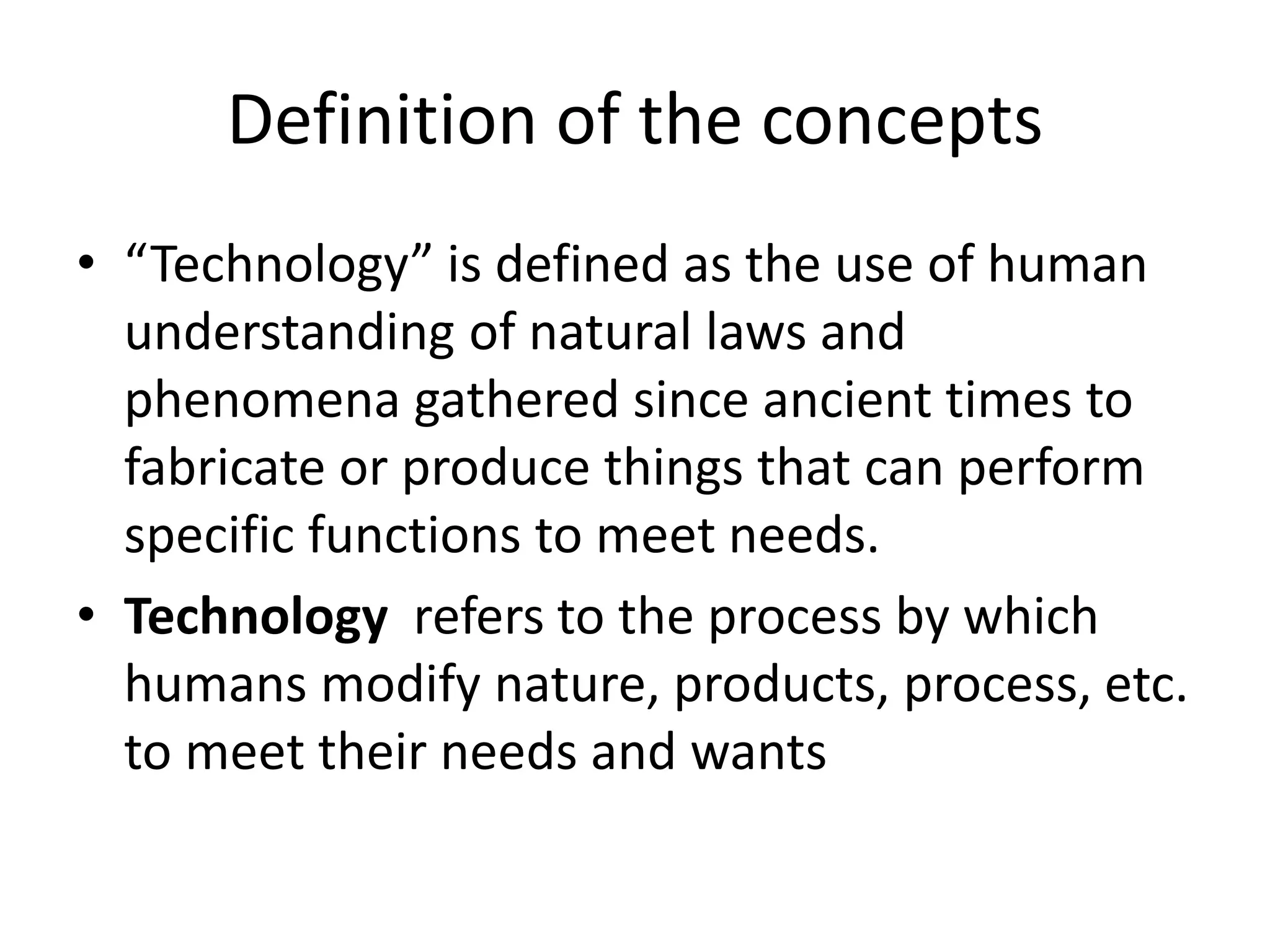
• “Technology” is defined as the use of human
understanding of natural laws and
phenomena gathered since ancient times to
fabricate or produce things that can perform
specific functions to meet needs.
• Technology refers to the process by which
humans modify nature, products, process, etc.
to meet their needs and wants
Definition of the concepts
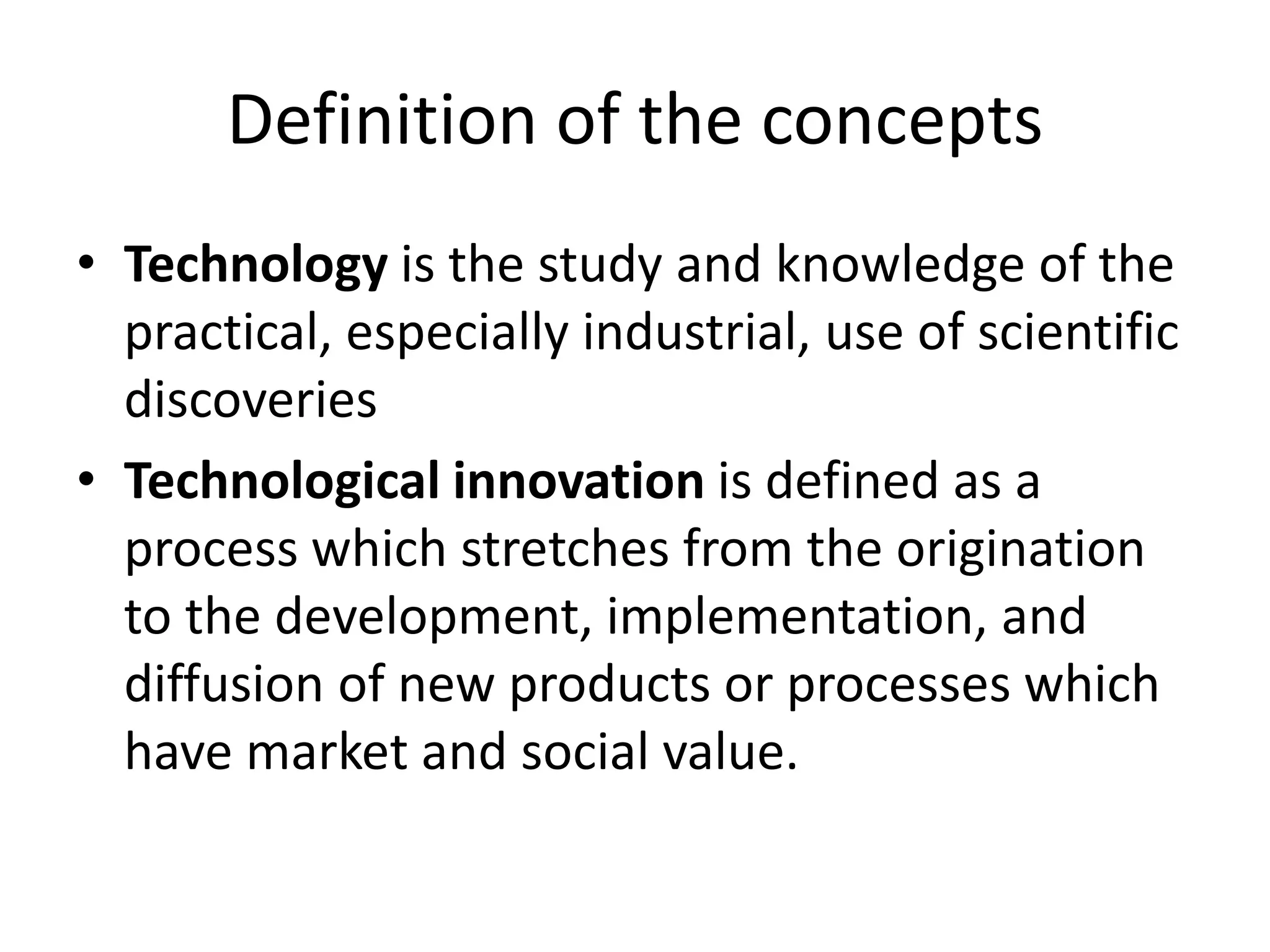
• Technology is the study and knowledge of the
practical, especially industrial, use of scientific
discoveries
• Technological innovation is defined as a
process which stretches from the origination
to the development, implementation, and
diffusion of new products or processes which
have market and social value.
Types of Technology
1 March 2017 7
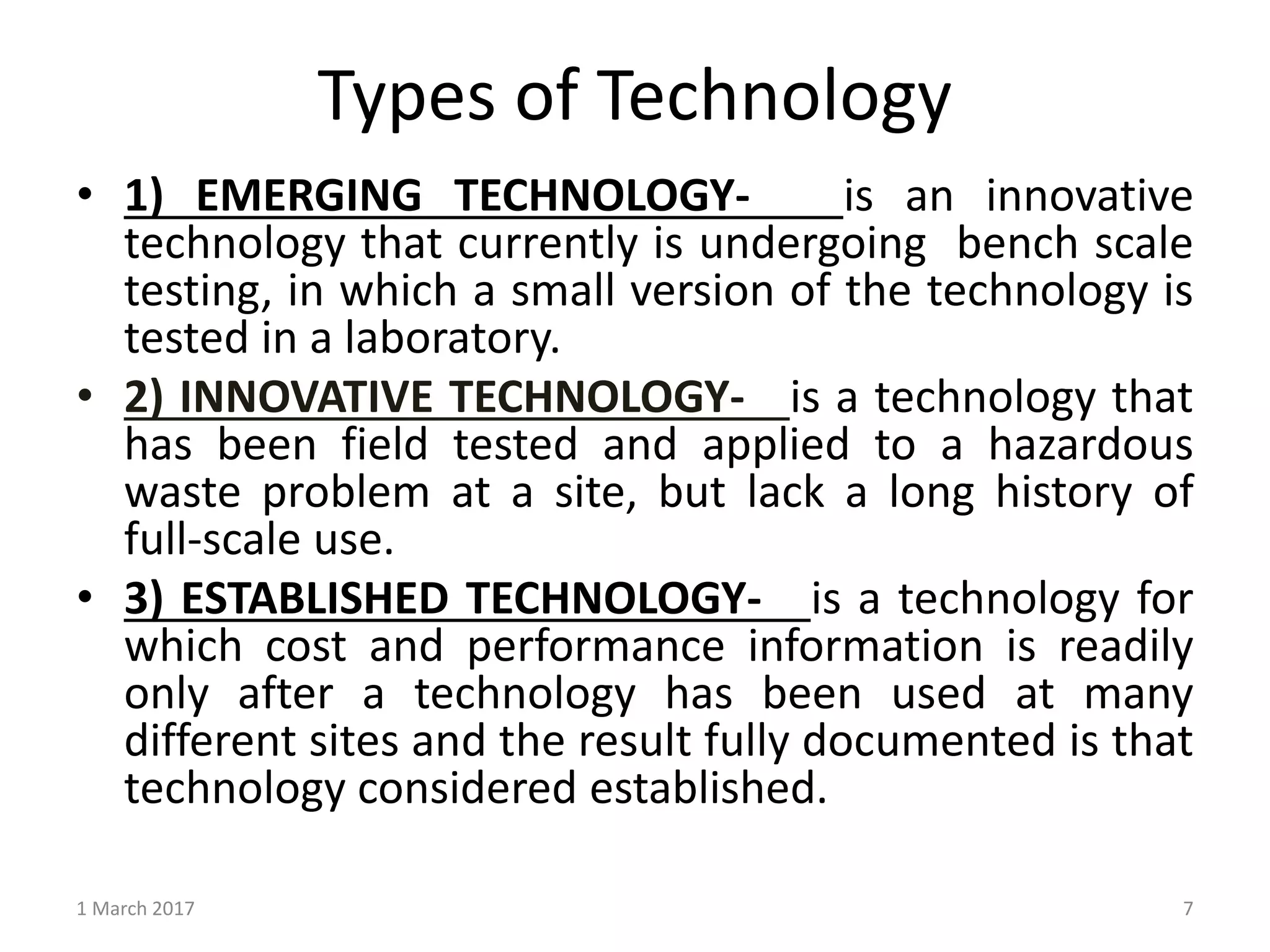
• 1) EMERGING TECHNOLOGY- is an innovative
technology that currently is undergoing bench scale
testing, in which a small version of the technology is
tested in a laboratory.
• 2) INNOVATIVE TECHNOLOGY- is a technology that
has been field tested and applied to a hazardous
waste problem at a site, but lack a long history of
full-scale use.
• 3) ESTABLISHED TECHNOLOGY- is a technology for
which cost and performance information is readily
only after a technology has been used at many
different sites and the result fully documented is that
technology considered established.
Types of Technology
1 March 2017 8
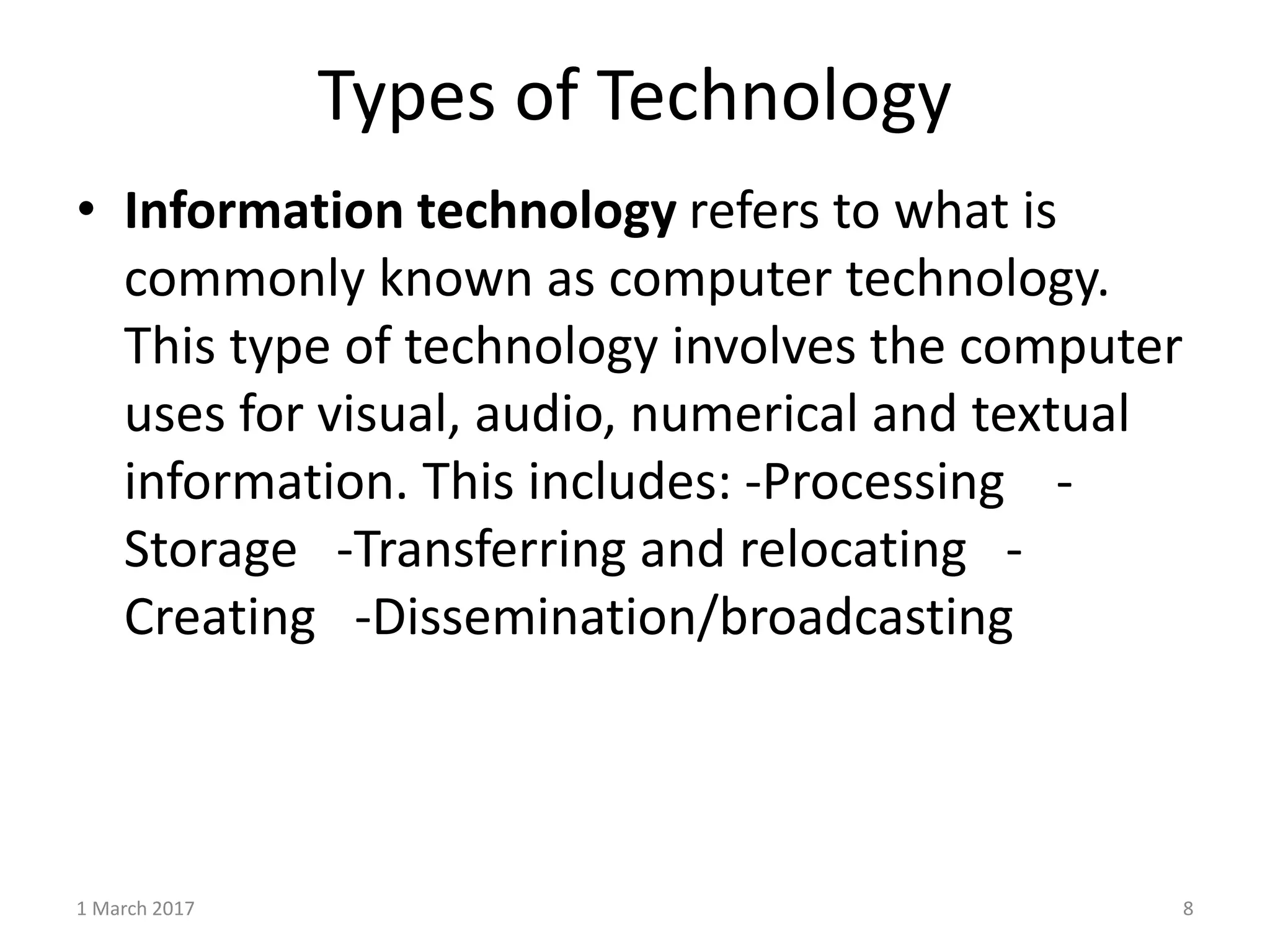
• Information technology refers to what is
commonly known as computer technology.
This type of technology involves the computer
uses for visual, audio, numerical and textual
information. This includes: -Processing -
Storage -Transferring and relocating -
Creating -Dissemination/broadcasting
Types of Technology
1 March 2017 9
• Assistive Technology is the term used to describe
technology that aids people. The best example of
this is its use in improving the quality of life for
people who suffer from disabilities. Examples of
this include:-Hearing aids, -Prosthetic limbs, Text
speech aids. This term refers to any form of
technology that complies with this use.
• Medical Technology differs greatly to Assistive
Technology. The difference is that this form is
used to describe technology that helps medics
with problems such as:-Surgery, -Diagnosing, -
Monitor, Treatment
Major components of technology
• Technology is often identified in terms of
hardware and software:
• Hardware: refers to the physical part of the
technology (technology embodied in machine
and processes) that can be seen and touched.
• Software: consists of skills, know-how and
procedures for performing practical tasks.
Importance of science and technology
• Benefits of Technology
• Increase production of goods and services
• Reduces the amount of labour needed to
produce goods and services
• Has increased capability of innovations in
different fields and areas
• Technology makes labour easier
• Increase job channels
• It gives people higher living standards (provision
of social services) etc…………
Adverse effects of Technology
• Environmental pollution
• Depletion of natural resources
• Technological unemployment
• Creation of unsatisfying jobs
• Harmful effects due to misuse (weapon mass
destruction, drugs etc….)
• Loss of personal privacy
• Technological dependency (continuous and
systematic reliance on imported technology) –
lack of self reliant and sustainable development,
loss of autonomous in decision making, etc…………
Transfer of technology
• Comprises the process of learning to
understand, utilize and replicate the
technology, including the capacity to choose
and adapt to local conditions and integrate it
with indigenous technologies…
• Technology transfer is the transmission and
adaptation for specific cultural, social,
economic and environmental influences of
ideas, information, methods, procedures,
techniques, tools, or technology from the
knowledge holders to potential users.
International technology transfer
• Horizontal technology transfer - consists of the
movement of an established technology from one
operational environment to another (for instance
from one company to another).
• Vertical technology transfer, in contrast, refers to
the transmission of new technologies from their
generation during research and development
activities in science and technology organizations,
for instance, to application in the industrial and
agricultural sectors.
1 March 2017
15
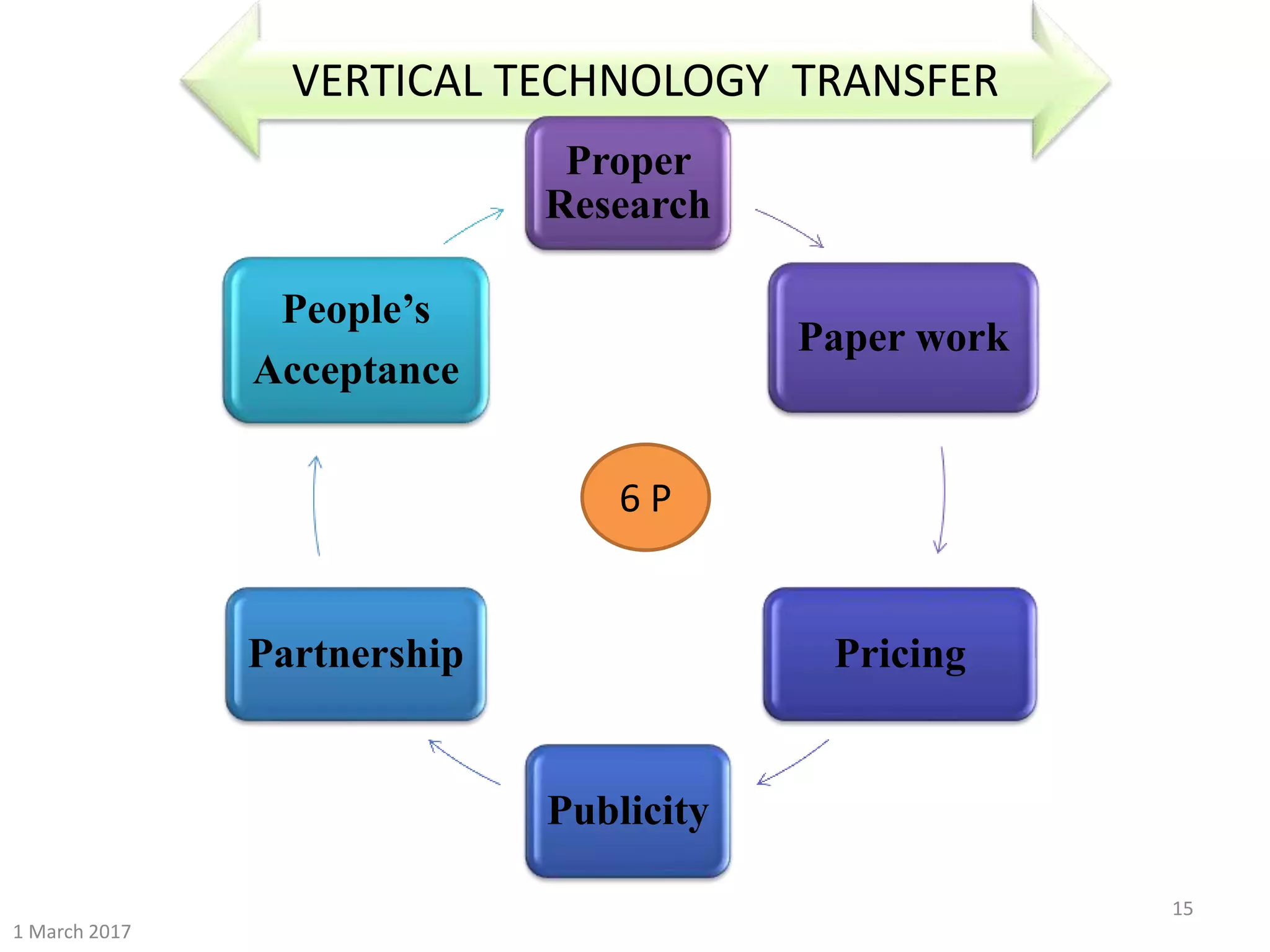
VERTICAL TECHNOLOGY TRANSFER
Proper
Research
Paper work
Pricing
Publicity
Partnership
People’s
Acceptance
6 P
Channels of Technology Transfer
• Trade in goods
• Foreign Direct Investment
• Licensing
• Movement of People
Channels of Technology Transfer
• Trade in goods
• Consumers may be willing to pay a premium for
higher quality (innovative) products. As new
products result from new ideas, international
trade can help transmit embodied knowledge
internationally.
• Trade can contribute to ITT by allowing reverse
engineering by local firms and by granting firms
access to new machinery and equipment.
Channels of Technology Transfer
• Foreign Direct Investment
• FDI may provide developing countries with
more efficient foreign technologies and result
in technological spillovers and greater
competition
• Case studies suggest that substantial
technology diffusion occurs due to FDI
Channels of Technology Transfer
• Licensing
• Licensing is an important source of ITT for
developing countries. They typically involve
the purchase of production or distribution
rights and the underlying technical
information and know-how
• Successful transfer typically requires capacity
to learn and investments to apply
technologies into production processes.
Channels of Technology Transfer
• Licensing
• Fear of technologies leaking back into the
host economy, transferred technologies are
easily copied, industrial espionage, or
technical personnel ‘defect’ to competitor
firms, May cause foreign firms not to license
or to prefer Foreign Direct Investment.
Channels of Technology Transfer
• Movement of People
• International movement of people associated
with nationals studying or working abroad for a
limited period and applying their new knowledge
when they return, or the inward movement of
foreign nationals into the country is another
potential channel for ITT.
• A challenge for developing countries is to
facilitate temporary movement abroad and to
encourage returnees to undertake local research
and business development.
constraints related to transfer
• finance;
• manpower;
• environment;
• location;
• motivation;
• institutional practices; and,
• Politics.
ENVIRONMENTAL CONSTRAINTS.
• Generally manufacturers indicate some limits
related to temperature and humidity beyond which
their equipment is not guaranteed to function.
• The natural environment in many developing
countries does not fall within these limits, thus if
users are going to adhere to their guarantee
conditions, air conditioning will have to be used.
• This is an expense additional to the actual system.
• Wild life, dust, electricity etc
Location
• Developing countries are often located far
from equipment manufacturers. Long distances
present a risk to manufacturers, and only
those with good capital reserves can afford to
beinterested in such markets.
• Causes difficulties in equipment maintenance.
Because of distance repairmen's visits are
expensive.
• Cases are known where users have had to
wait a whole year for a repair, leaving the
equipment idle the whole time.
MOTIVATIONAL CONSTRAINTS.
• the low motivation of employees in
developing countries. Low salaries are the
most serious reason for lack of motivation.
The employees are forced to search for
various sources of income and acquire
several jobs.
INSTITUTIONAL CONSTRAINTS.
• Institutional practices in developing countries
generate many constraints for technology transfer.
Corruption is the most serious of these.
• Through corrupt practices unqualified and
incompetent, but often influential individuals may be
drawn into the ranks of the civil service.
• Corrupt customs and bribery slow down the
acquisition of equipment, make it additionally
expensive and prevent normal selection procedures.
• Another completely different problem is the drain
of qualified personnel due to the very early
retirement age permitted in many countries.
POLITICAL CONSTRAINTS.
• Incompatibility between the political system of
a potential supplier and the receiver of
technology prevents an otherwise advisable
transaction.
• The abuse of power in dictatorial regimes may
lead to the establishment of projects for
completely selfish reasons and they are thus
almost doomed to fail.
• The transfer of technology of military
significance may be restricted to maintain an
extant military power balance.
Technology and life in Tanzania.
• Most of the developing countries do not realize
that their situation can only be rectified with the
infusion of modern science and technology into
their societies.
• Some of the developing countries are aware of
the importance of science and technology, but
not necessarily making it easy to develop, and
popularize science.
• Inadequate scientific infrastructure is a critical
factor which creates strong barriers to the path of
advancement in developing countries.
Technology and life in Tanzania.
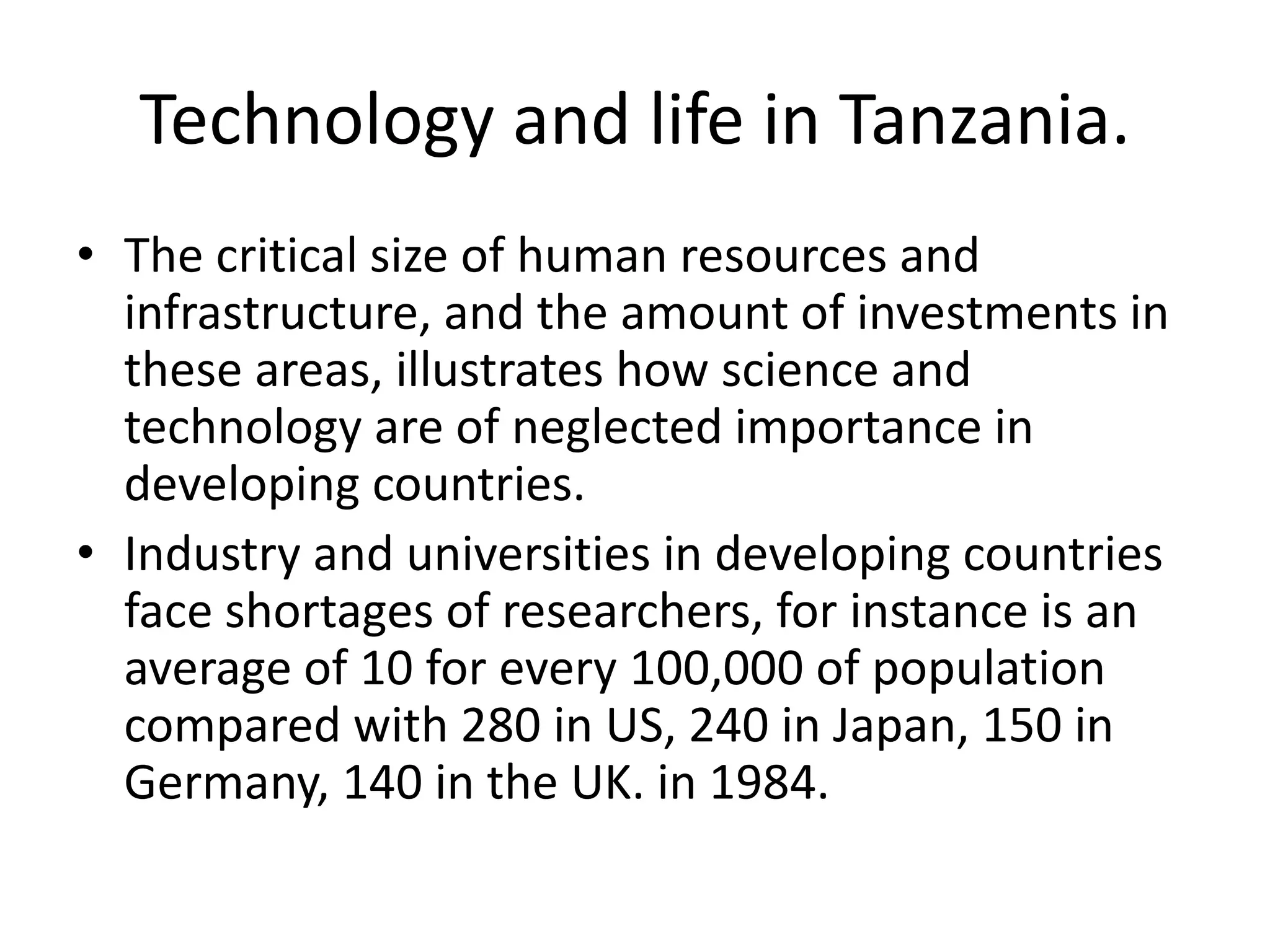
• The critical size of human resources and
infrastructure, and the amount of investments in
these areas, illustrates how science and
technology are of neglected importance in
developing countries.
• Industry and universities in developing countries
face shortages of researchers, for instance is an
average of 10 for every 100,000 of population
compared with 280 in US, 240 in Japan, 150 in
Germany, 140 in the UK. in 1984.
Technology and life in Tanzania.
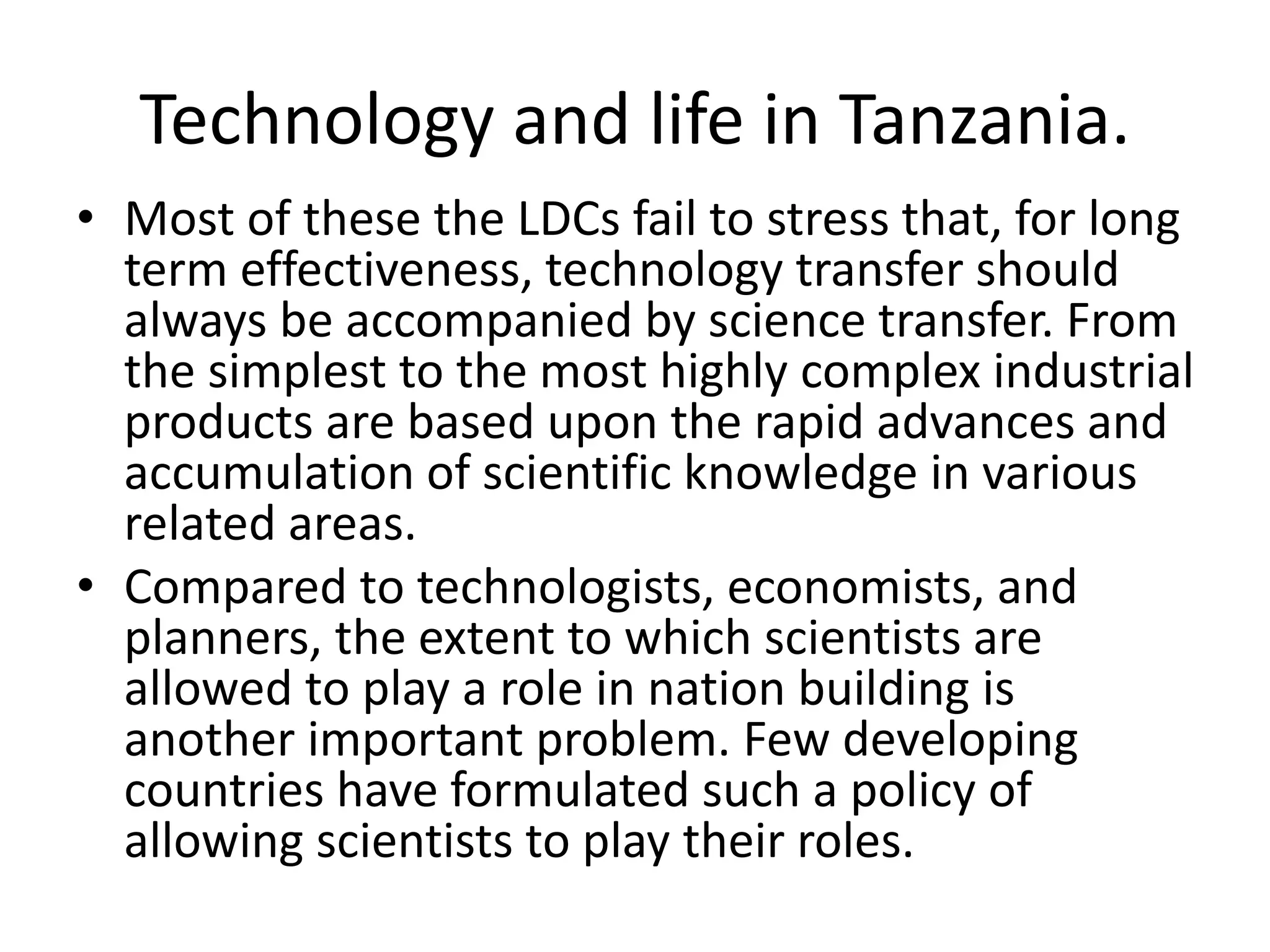
• Most of these the LDCs fail to stress that, for long
term effectiveness, technology transfer should
always be accompanied by science transfer. From
the simplest to the most highly complex industrial
products are based upon the rapid advances and
accumulation of scientific knowledge in various
related areas.
• Compared to technologists, economists, and
planners, the extent to which scientists are
allowed to play a role in nation building is
another important problem. Few developing
countries have formulated such a policy of
allowing scientists to play their roles.
Technology and life in Tanzania.
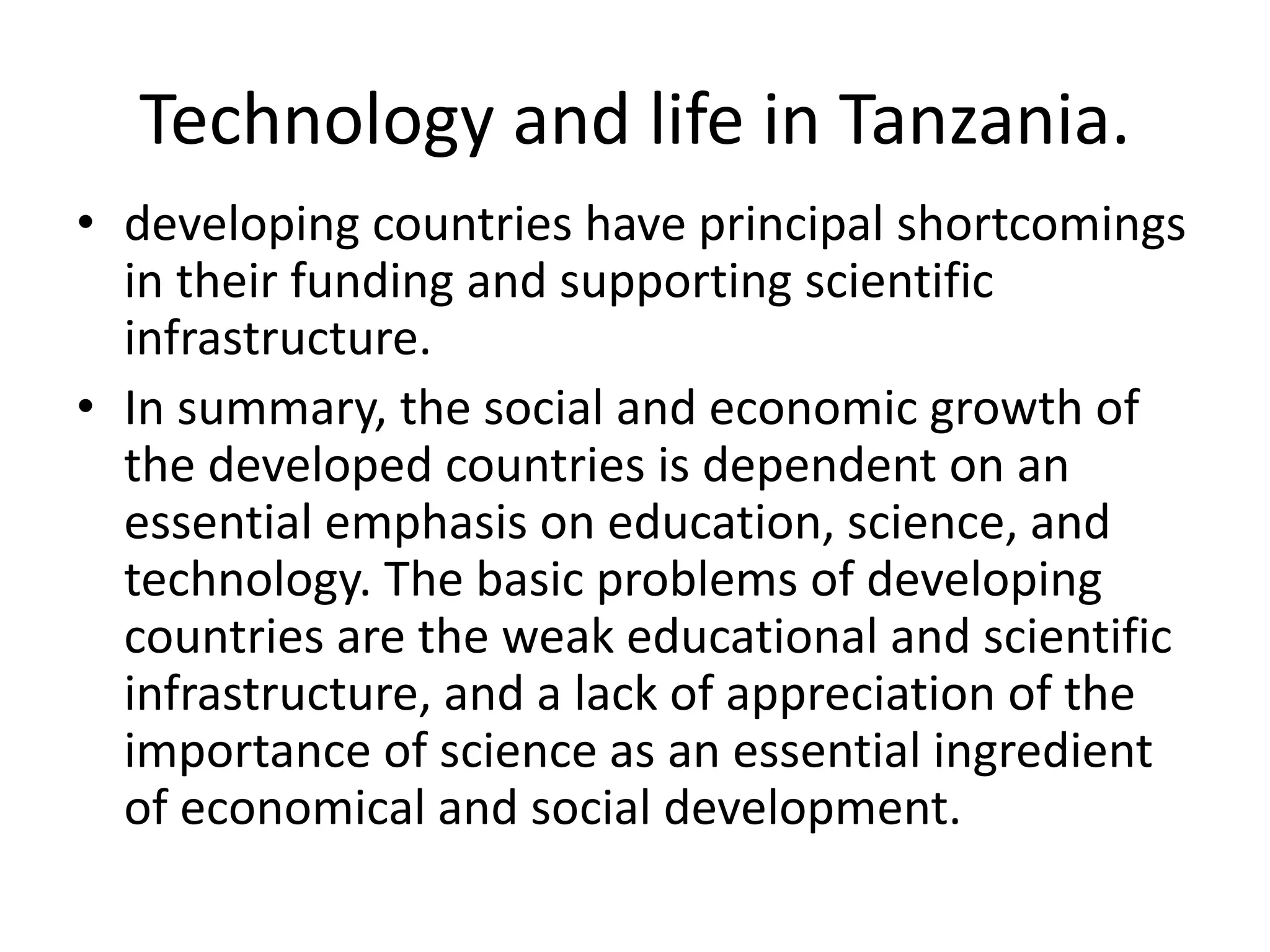
• developing countries have principal shortcomings
in their funding and supporting scientific
infrastructure.
• In summary, the social and economic growth of
the developed countries is dependent on an
essential emphasis on education, science, and
technology. The basic problems of developing
countries are the weak educational and scientific
infrastructure, and a lack of appreciation of the
importance of science as an essential ingredient
of economical and social development.
A framework for making science and
technology work for the poor
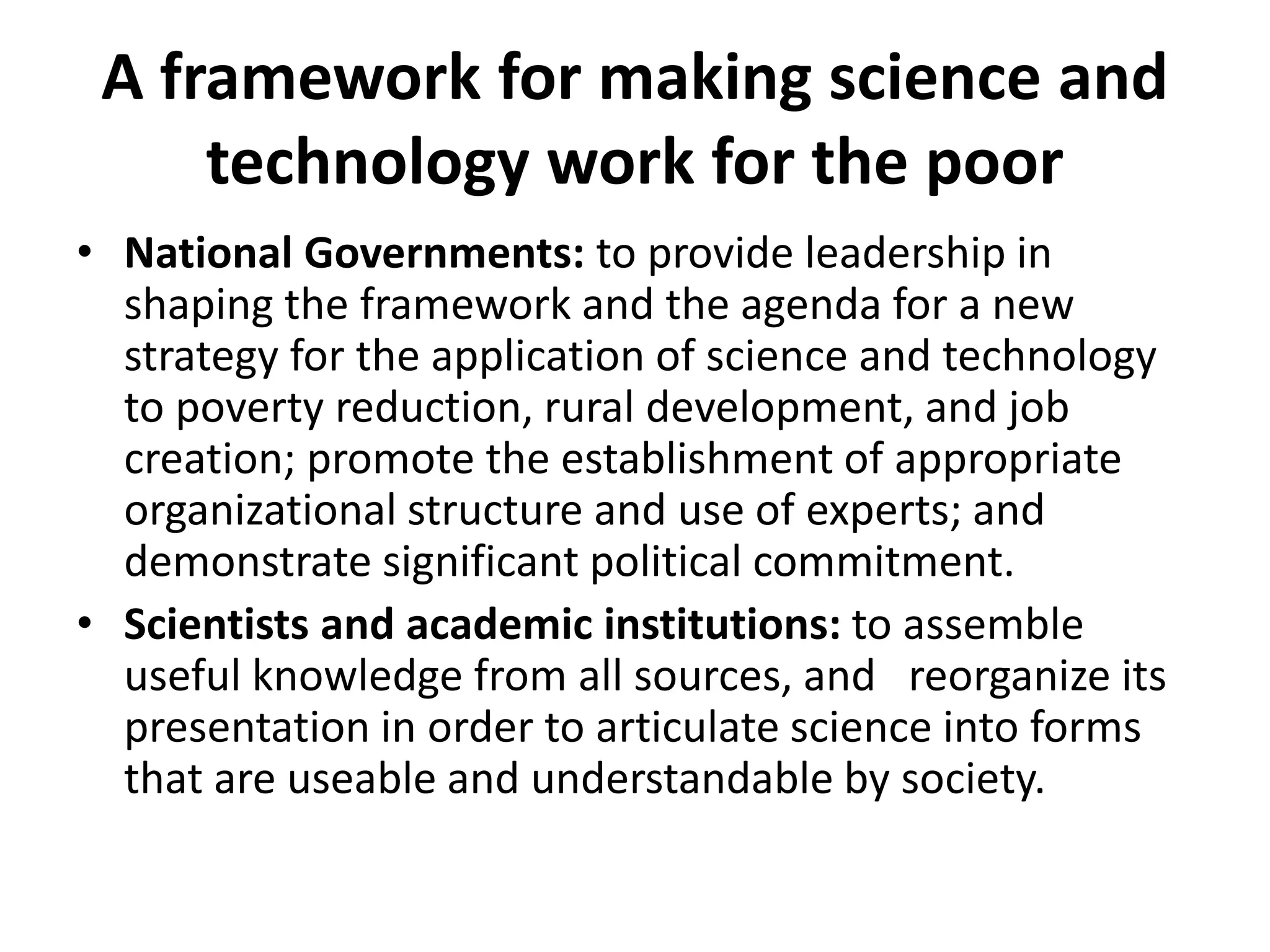
• National Governments: to provide leadership in
shaping the framework and the agenda for a new
strategy for the application of science and technology
to poverty reduction, rural development, and job
creation; promote the establishment of appropriate
organizational structure and use of experts; and
demonstrate significant political commitment.
• Scientists and academic institutions: to assemble
useful knowledge from all sources, and reorganize its
presentation in order to articulate science into forms
that are useable and understandable by society.
A framework for making science and
technology work for the poor
• Professional associations: to establish presence
in individual schools, and find appropriate means
to introduce scientific concepts into the curricula.
• The media, whose role can be pivotal in the
efforts to reach the public: to create awareness,
enlighten the poor with respect to cultural and
traditional practices that undermine
development, and generally provide a platform
through which the popularization of science can
flourish.
A framework for making science and
technology work for the poor
• Non-Governmental Organizations: to use their
comparative advantage to assist in providing services in
health, education and social welfare to rural and
isolated communities.
• Donors, whose dwindling support for science and
technology needs to be re-invigorated. Their past
emphasis on capacity building needs to be revised to
include capacity for developing the content of
sustainable development. Donors should also support
public activities, and strengthen mechanisms for
disseminating scientific knowledge and technological
practice, as well as promoting scientific writing and
publication

Suza dds 03 science, technology and development

  • 1.
  • 2.
    Science, Technology and Development •Definition of the concepts, • Forms of technologies, • Importance of science and technology in development, • Transfer of technology, • Technology and life in Tanzania.
  • 3.
    Definition of theconcepts • Science refers to the systematic investigation and understanding of the world around us. It aim for objectivity, use rigorous techniques of empirical testing and strive for explanations of wide applicability. • Science is a body of knowledge that provides methods or means to control the environment, extracts resources, produces goods and services and improves the quality of life.
  • 4.
    Definition of theconcepts • Science may be either: • Pure Science/Basic research – Investigating with objectives of understanding nature. It seeks exploration. OR • Applied science/ research – Investigating with the objective of controlling nature to serve human purposes. • NB: In pure science is the matter of understanding while in applied science is the matter of action. Knowledge /theory can not be scientific until it has been verified by studies of the researchers. It must be repeatedly tested experimentally and found to be true.
  • 5.
    Definition of theconcepts • “Technology” is defined as the use of human understanding of natural laws and phenomena gathered since ancient times to fabricate or produce things that can perform specific functions to meet needs. • Technology refers to the process by which humans modify nature, products, process, etc. to meet their needs and wants
  • 6.
    Definition of theconcepts • Technology is the study and knowledge of the practical, especially industrial, use of scientific discoveries • Technological innovation is defined as a process which stretches from the origination to the development, implementation, and diffusion of new products or processes which have market and social value.
  • 7.
    Types of Technology 1March 2017 7 • 1) EMERGING TECHNOLOGY- is an innovative technology that currently is undergoing bench scale testing, in which a small version of the technology is tested in a laboratory. • 2) INNOVATIVE TECHNOLOGY- is a technology that has been field tested and applied to a hazardous waste problem at a site, but lack a long history of full-scale use. • 3) ESTABLISHED TECHNOLOGY- is a technology for which cost and performance information is readily only after a technology has been used at many different sites and the result fully documented is that technology considered established.
  • 8.
    Types of Technology 1March 2017 8 • Information technology refers to what is commonly known as computer technology. This type of technology involves the computer uses for visual, audio, numerical and textual information. This includes: -Processing - Storage -Transferring and relocating - Creating -Dissemination/broadcasting
  • 9.
    Types of Technology 1March 2017 9 • Assistive Technology is the term used to describe technology that aids people. The best example of this is its use in improving the quality of life for people who suffer from disabilities. Examples of this include:-Hearing aids, -Prosthetic limbs, Text speech aids. This term refers to any form of technology that complies with this use. • Medical Technology differs greatly to Assistive Technology. The difference is that this form is used to describe technology that helps medics with problems such as:-Surgery, -Diagnosing, - Monitor, Treatment
  • 10.
    Major components oftechnology • Technology is often identified in terms of hardware and software: • Hardware: refers to the physical part of the technology (technology embodied in machine and processes) that can be seen and touched. • Software: consists of skills, know-how and procedures for performing practical tasks.
  • 11.
    Importance of scienceand technology • Benefits of Technology • Increase production of goods and services • Reduces the amount of labour needed to produce goods and services • Has increased capability of innovations in different fields and areas • Technology makes labour easier • Increase job channels • It gives people higher living standards (provision of social services) etc…………
  • 12.
    Adverse effects ofTechnology • Environmental pollution • Depletion of natural resources • Technological unemployment • Creation of unsatisfying jobs • Harmful effects due to misuse (weapon mass destruction, drugs etc….) • Loss of personal privacy • Technological dependency (continuous and systematic reliance on imported technology) – lack of self reliant and sustainable development, loss of autonomous in decision making, etc…………
  • 13.
    Transfer of technology •Comprises the process of learning to understand, utilize and replicate the technology, including the capacity to choose and adapt to local conditions and integrate it with indigenous technologies… • Technology transfer is the transmission and adaptation for specific cultural, social, economic and environmental influences of ideas, information, methods, procedures, techniques, tools, or technology from the knowledge holders to potential users.
  • 14.
    International technology transfer •Horizontal technology transfer - consists of the movement of an established technology from one operational environment to another (for instance from one company to another). • Vertical technology transfer, in contrast, refers to the transmission of new technologies from their generation during research and development activities in science and technology organizations, for instance, to application in the industrial and agricultural sectors.
  • 15.
    1 March 2017 15 VERTICALTECHNOLOGY TRANSFER Proper Research Paper work Pricing Publicity Partnership People’s Acceptance 6 P
  • 16.
    Channels of TechnologyTransfer • Trade in goods • Foreign Direct Investment • Licensing • Movement of People
  • 17.
    Channels of TechnologyTransfer • Trade in goods • Consumers may be willing to pay a premium for higher quality (innovative) products. As new products result from new ideas, international trade can help transmit embodied knowledge internationally. • Trade can contribute to ITT by allowing reverse engineering by local firms and by granting firms access to new machinery and equipment.
  • 18.
    Channels of TechnologyTransfer • Foreign Direct Investment • FDI may provide developing countries with more efficient foreign technologies and result in technological spillovers and greater competition • Case studies suggest that substantial technology diffusion occurs due to FDI
  • 19.
    Channels of TechnologyTransfer • Licensing • Licensing is an important source of ITT for developing countries. They typically involve the purchase of production or distribution rights and the underlying technical information and know-how • Successful transfer typically requires capacity to learn and investments to apply technologies into production processes.
  • 20.
    Channels of TechnologyTransfer • Licensing • Fear of technologies leaking back into the host economy, transferred technologies are easily copied, industrial espionage, or technical personnel ‘defect’ to competitor firms, May cause foreign firms not to license or to prefer Foreign Direct Investment.
  • 21.
    Channels of TechnologyTransfer • Movement of People • International movement of people associated with nationals studying or working abroad for a limited period and applying their new knowledge when they return, or the inward movement of foreign nationals into the country is another potential channel for ITT. • A challenge for developing countries is to facilitate temporary movement abroad and to encourage returnees to undertake local research and business development.
  • 22.
    constraints related totransfer • finance; • manpower; • environment; • location; • motivation; • institutional practices; and, • Politics.
  • 23.
    ENVIRONMENTAL CONSTRAINTS. • Generallymanufacturers indicate some limits related to temperature and humidity beyond which their equipment is not guaranteed to function. • The natural environment in many developing countries does not fall within these limits, thus if users are going to adhere to their guarantee conditions, air conditioning will have to be used. • This is an expense additional to the actual system. • Wild life, dust, electricity etc
  • 24.
    Location • Developing countriesare often located far from equipment manufacturers. Long distances present a risk to manufacturers, and only those with good capital reserves can afford to beinterested in such markets. • Causes difficulties in equipment maintenance. Because of distance repairmen's visits are expensive. • Cases are known where users have had to wait a whole year for a repair, leaving the equipment idle the whole time.
  • 25.
    MOTIVATIONAL CONSTRAINTS. • thelow motivation of employees in developing countries. Low salaries are the most serious reason for lack of motivation. The employees are forced to search for various sources of income and acquire several jobs.
  • 26.
    INSTITUTIONAL CONSTRAINTS. • Institutionalpractices in developing countries generate many constraints for technology transfer. Corruption is the most serious of these. • Through corrupt practices unqualified and incompetent, but often influential individuals may be drawn into the ranks of the civil service. • Corrupt customs and bribery slow down the acquisition of equipment, make it additionally expensive and prevent normal selection procedures. • Another completely different problem is the drain of qualified personnel due to the very early retirement age permitted in many countries.
  • 27.
    POLITICAL CONSTRAINTS. • Incompatibilitybetween the political system of a potential supplier and the receiver of technology prevents an otherwise advisable transaction. • The abuse of power in dictatorial regimes may lead to the establishment of projects for completely selfish reasons and they are thus almost doomed to fail. • The transfer of technology of military significance may be restricted to maintain an extant military power balance.
  • 28.
    Technology and lifein Tanzania. • Most of the developing countries do not realize that their situation can only be rectified with the infusion of modern science and technology into their societies. • Some of the developing countries are aware of the importance of science and technology, but not necessarily making it easy to develop, and popularize science. • Inadequate scientific infrastructure is a critical factor which creates strong barriers to the path of advancement in developing countries.
  • 29.
    Technology and lifein Tanzania. • The critical size of human resources and infrastructure, and the amount of investments in these areas, illustrates how science and technology are of neglected importance in developing countries. • Industry and universities in developing countries face shortages of researchers, for instance is an average of 10 for every 100,000 of population compared with 280 in US, 240 in Japan, 150 in Germany, 140 in the UK. in 1984.
  • 30.
    Technology and lifein Tanzania. • Most of these the LDCs fail to stress that, for long term effectiveness, technology transfer should always be accompanied by science transfer. From the simplest to the most highly complex industrial products are based upon the rapid advances and accumulation of scientific knowledge in various related areas. • Compared to technologists, economists, and planners, the extent to which scientists are allowed to play a role in nation building is another important problem. Few developing countries have formulated such a policy of allowing scientists to play their roles.
  • 31.
    Technology and lifein Tanzania. • developing countries have principal shortcomings in their funding and supporting scientific infrastructure. • In summary, the social and economic growth of the developed countries is dependent on an essential emphasis on education, science, and technology. The basic problems of developing countries are the weak educational and scientific infrastructure, and a lack of appreciation of the importance of science as an essential ingredient of economical and social development.
  • 32.
    A framework formaking science and technology work for the poor • National Governments: to provide leadership in shaping the framework and the agenda for a new strategy for the application of science and technology to poverty reduction, rural development, and job creation; promote the establishment of appropriate organizational structure and use of experts; and demonstrate significant political commitment. • Scientists and academic institutions: to assemble useful knowledge from all sources, and reorganize its presentation in order to articulate science into forms that are useable and understandable by society.
  • 33.
    A framework formaking science and technology work for the poor • Professional associations: to establish presence in individual schools, and find appropriate means to introduce scientific concepts into the curricula. • The media, whose role can be pivotal in the efforts to reach the public: to create awareness, enlighten the poor with respect to cultural and traditional practices that undermine development, and generally provide a platform through which the popularization of science can flourish.
  • 34.
    A framework formaking science and technology work for the poor • Non-Governmental Organizations: to use their comparative advantage to assist in providing services in health, education and social welfare to rural and isolated communities. • Donors, whose dwindling support for science and technology needs to be re-invigorated. Their past emphasis on capacity building needs to be revised to include capacity for developing the content of sustainable development. Donors should also support public activities, and strengthen mechanisms for disseminating scientific knowledge and technological practice, as well as promoting scientific writing and publication