Implicit Dierentiation 
Tyler Murphy 
October 8, 2014 
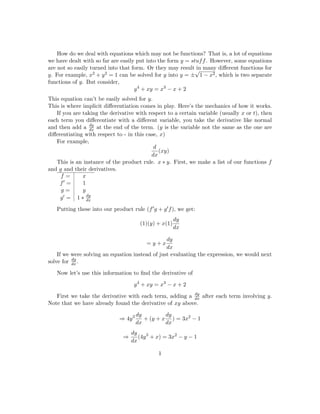
How do we deal with equations which may not be functions? That is, a lot of equations 
we have dealt with so far are easily put into the form y = stuff. However, some equations 
are not so easily turned into that form. Or they may result in many dierent functions for 
y. For example, x2 + y2 = 1 can be solved for y into y =  
p 
1  x2, which is two separate 
functions of y. But consider, 
y4 + xy = x3  x + 2 
This equation can't be easily solved for y. 
This is where implicit dierentiation comes in play. Here's the mechanics of how it works. 
If you are taking the derivative with respect to a certain variable (usually x or t), then 
each term you dierentiate with a dierent variable, you take the derivative like normal 
and then add a dy 
dx at the end of the term. (y is the variable not the same as the one are 
dierentiating with respect to - in this case, x) 
For example, 
d 
dx 
(xy) 
This is an instance of the product rule. x  y. First, we make a list of our functions f 
and g and their derivatives. 
f = x 
f0 = 1 
g = y 
g0 = 1  dy 
dx 
Putting these into our product rule (f0g + g0f), we get: 
(1)(y) + x(1) 
dy 
dx 
= y + x 
dy 
dx 
If we were solving an equation instead of just evaluating the expression, we would next 
solve for dy 
dx . 
1
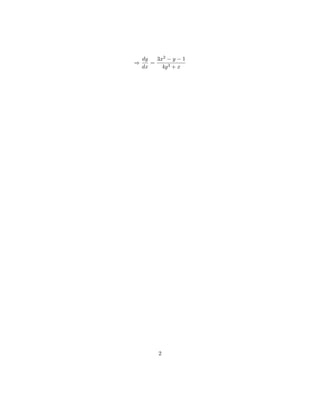
Now let's use this information to

intro to Implicit differentiation

  • 1.
    Implicit Dierentiation TylerMurphy October 8, 2014 How do we deal with equations which may not be functions? That is, a lot of equations we have dealt with so far are easily put into the form y = stuff. However, some equations are not so easily turned into that form. Or they may result in many dierent functions for y. For example, x2 + y2 = 1 can be solved for y into y = p 1 x2, which is two separate functions of y. But consider, y4 + xy = x3 x + 2 This equation can't be easily solved for y. This is where implicit dierentiation comes in play. Here's the mechanics of how it works. If you are taking the derivative with respect to a certain variable (usually x or t), then each term you dierentiate with a dierent variable, you take the derivative like normal and then add a dy dx at the end of the term. (y is the variable not the same as the one are dierentiating with respect to - in this case, x) For example, d dx (xy) This is an instance of the product rule. x y. First, we make a list of our functions f and g and their derivatives. f = x f0 = 1 g = y g0 = 1 dy dx Putting these into our product rule (f0g + g0f), we get: (1)(y) + x(1) dy dx = y + x dy dx If we were solving an equation instead of just evaluating the expression, we would next solve for dy dx . 1
  • 2.
    Now let's usethis information to
  • 3.
    nd the derivativeof y4 + xy = x3 x + 2 First we take the derivative with each term, adding a dy dx after each term involving y. Note that we have already found the derivative of xy above. ) 4y3 dy dx + (y + x dy dx ) = 3x2 1 ) dy dx (4y3 + x) = 3x2 y 1 ) dy dx = 3x2 y 1 4y3 + x 2