Finding the polynomial from data 
Tyler Murphy 
September 2, 2014 
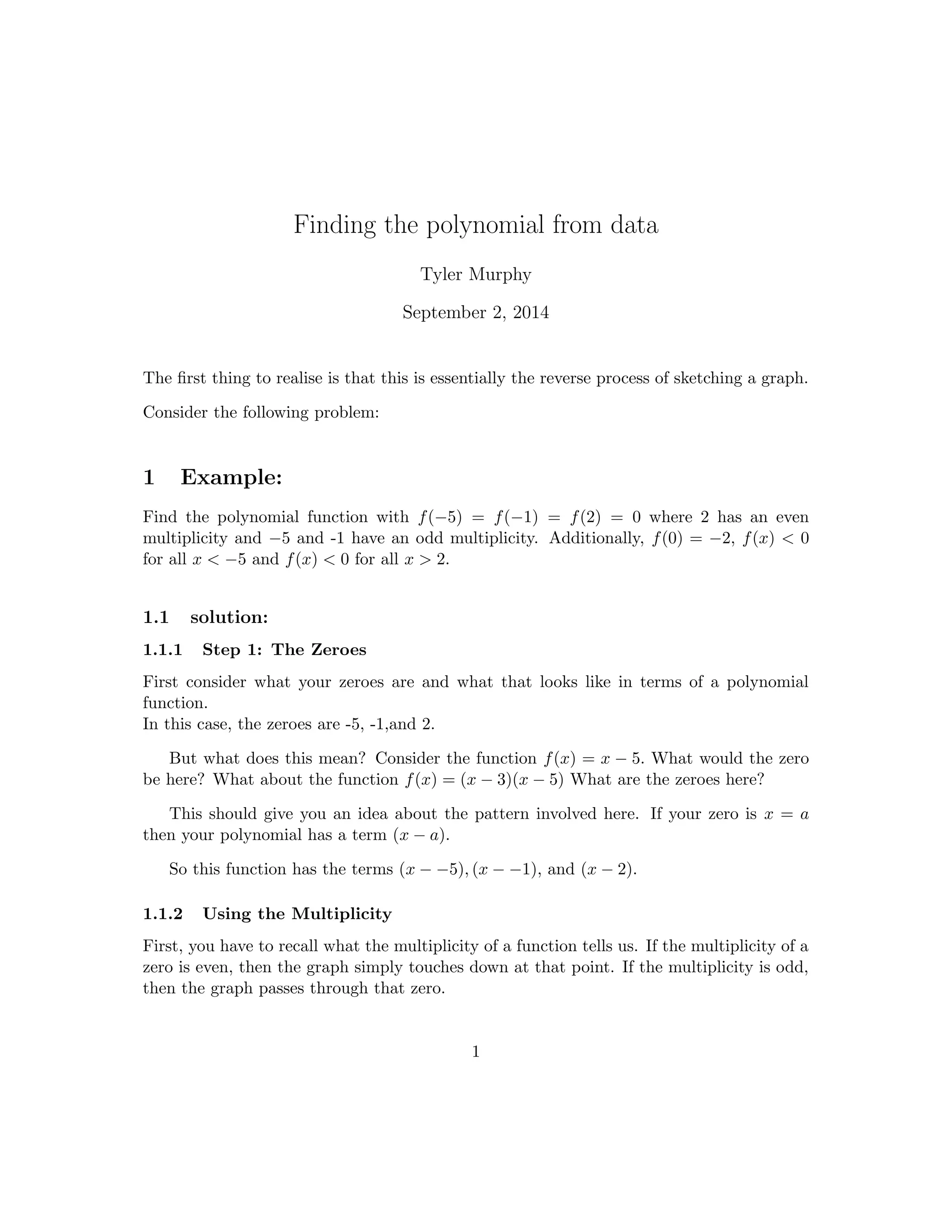
The
rst thing to realise is that this is essentially the reverse process of sketching a graph. 
Consider the following problem: 
1 Example: 
Find the polynomial function with f(5) = f(1) = f(2) = 0 where 2 has an even 
multiplicity and 5 and -1 have an odd multiplicity. Additionally, f(0) = 2, f(x)  0 
for all x  5 and f(x)  0 for all x  2. 
1.1 solution: 
1.1.1 Step 1: The Zeroes 
First consider what your zeroes are and what that looks like in terms of a polynomial 
function. 
In this case, the zeroes are -5, -1,and 2. 
But what does this mean? Consider the function f(x) = x  5: What would the zero 
be here? What about the function f(x) = (x  3)(x  5) What are the zeroes here? 
This should give you an idea about the pattern involved here. If your zero is x = a 
then your polynomial has a term (x  a). 
So this function has the terms (x  5); (x  1); and (x  2). 
1.1.2 Using the Multiplicity 
First, you have to recall what the multiplicity of a function tells us. If the multiplicity of a 
zero is even, then the graph simply touches down at that point. If the multiplicity is odd, 
then the graph passes through that zero. 
1
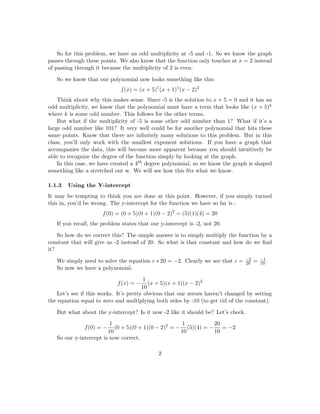
So for this problem, we have an odd multiplicity at -5 and -1. So we know the graph 
passes through these points. We also know that the function only touches at x = 2 instead 
of passing through it because the multiplicity of 2 is even. 
So we know that our polynomial now looks something like this: 
f(x) = (x + 5)1(x + 1)1(x  2)2 
Think about why this makes sense. Since -5 is the solution to x + 5 = 0 and it has an 
odd multiplicity, we know that the polynomial must have a term that looks like (x + 5)k 
where k is some odd number. This follows for the other terms. 
But what if the multiplicity of -5 is some other odd number than 1? What if it's a 
large odd number like 101? It very well could be for another polynomial that hits these 
same points. Know that there are in

Finding a polyomial from data

  • 1.
    Finding the polynomialfrom data Tyler Murphy September 2, 2014 The
  • 2.
    rst thing torealise is that this is essentially the reverse process of sketching a graph. Consider the following problem: 1 Example: Find the polynomial function with f(5) = f(1) = f(2) = 0 where 2 has an even multiplicity and 5 and -1 have an odd multiplicity. Additionally, f(0) = 2, f(x) 0 for all x 5 and f(x) 0 for all x 2. 1.1 solution: 1.1.1 Step 1: The Zeroes First consider what your zeroes are and what that looks like in terms of a polynomial function. In this case, the zeroes are -5, -1,and 2. But what does this mean? Consider the function f(x) = x 5: What would the zero be here? What about the function f(x) = (x 3)(x 5) What are the zeroes here? This should give you an idea about the pattern involved here. If your zero is x = a then your polynomial has a term (x a). So this function has the terms (x 5); (x 1); and (x 2). 1.1.2 Using the Multiplicity First, you have to recall what the multiplicity of a function tells us. If the multiplicity of a zero is even, then the graph simply touches down at that point. If the multiplicity is odd, then the graph passes through that zero. 1
  • 3.
    So for thisproblem, we have an odd multiplicity at -5 and -1. So we know the graph passes through these points. We also know that the function only touches at x = 2 instead of passing through it because the multiplicity of 2 is even. So we know that our polynomial now looks something like this: f(x) = (x + 5)1(x + 1)1(x 2)2 Think about why this makes sense. Since -5 is the solution to x + 5 = 0 and it has an odd multiplicity, we know that the polynomial must have a term that looks like (x + 5)k where k is some odd number. This follows for the other terms. But what if the multiplicity of -5 is some other odd number than 1? What if it's a large odd number like 101? It very well could be for another polynomial that hits these same points. Know that there are in