Derivative Application Group Members:  Baba Qazi; Joey Lee; Tam Dong
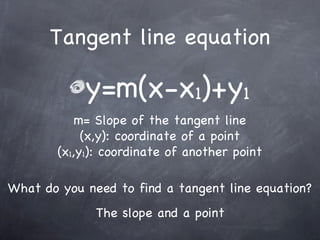
Tangent line equation y=m(x-x 1 )+y 1 What do you need to find a tangent line equation? m= Slope of the tangent line (x,y): coordinate of a point (x 1 ,y 1 ): coordinate of another point The slope and a point
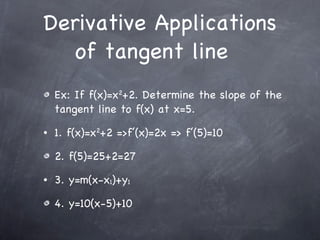
Ex: If f(x)=x 2 +2. Determine the slope of the tangent line to f(x) at x=5. 1. f(x)=x 2 +2 =>f’(x)=2x => f’(5)=10 2. f(5)=25+2=27 3. y=m(x-x 1 )+y 1 4. y=10(x-5)+10 Derivative Applications of tangent line
Derivative Applications of tangent line  (cont) Ex: If f(x)=sin(x)cos(x). Determine the slope of the tangent line to f(x) at x=π/4. 1.f(x)=sin(x)cos(x) => product rule 2.f(x)=sin(x);f’(x)=cos(x) | g(x)=cos(x);g’(x)=-sin(x) 3.f’(x)= -sin(x)sin(x)+2cos(x) = 2cos(x)-2sin(x) 4.f(π/4)=sin(π/4)cos(π/4)=(√2/2)(√2/2)=1 5.f’(π/4)=2cos(π/4)-2sin(π/4)=2(√2/2) - 2(√2/2)=0 6.y=m(x-x 1 )+y 1   => y=0[x-(π/4)]+1
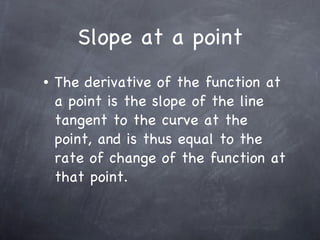
Slope at a point The derivative of the function at a point is the slope of the line tangent to the curve at the point, and is thus equal to the rate of change of the function at that point.
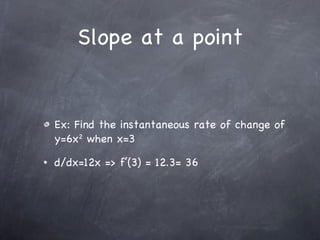
Slope at a point Ex: Find the instantaneous rate of change of y=6x 2  when x=3 d/dx=12x => f’(3) = 12.3= 36
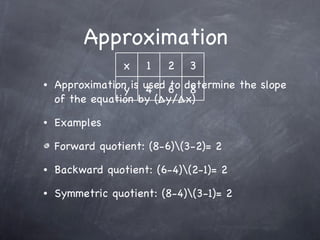
Approximation  Approximation is used to determine the slope of the equation by (∆y/∆x)  Examples Forward quotient: (8-6)\(3-2)= 2 Backward quotient: (6-4)\(2-1)= 2 Symmetric quotient: (8-4)\(3-1)= 2 x 1 2 3 y 4 6 8
Implicit Differentiation The purpose of using implicit differentiation is when it is very difficult to express y as a function respect to x Derive: y 3  + y 2  - 5y -x 2  = -4 1. y 3  + y 2  - 5y -x 2  = -4 2. (d/dx) [y 3  + y 2  - 5y -x 2 ] = (d/dx) -4 3. 3y 2 (dy/dx) + 2y(dy/dx) - 5(dy/dx) - 2x = 0 4. (dy/dx)(3y 2  + 2y -5) = 2x 5. (dy/dx) = 2x/(3y 2  + 2y -5)
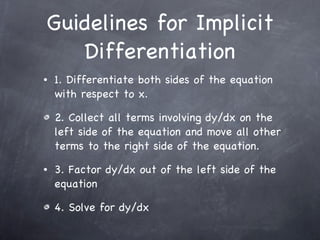
Guidelines for Implicit Differentiation 1. Differentiate both sides of the equation with respect to x. 2. Collect all terms involving dy/dx on the left side of the equation and move all other terms to the right side of the equation. 3. Factor dy/dx out of the left side of the equation 4. Solve for dy/dx

Tam 2nd

  • 1.
    Derivative Application GroupMembers: Baba Qazi; Joey Lee; Tam Dong
  • 2.
    Tangent line equationy=m(x-x 1 )+y 1 What do you need to find a tangent line equation? m= Slope of the tangent line (x,y): coordinate of a point (x 1 ,y 1 ): coordinate of another point The slope and a point
  • 3.
    Ex: If f(x)=x2 +2. Determine the slope of the tangent line to f(x) at x=5. 1. f(x)=x 2 +2 =>f’(x)=2x => f’(5)=10 2. f(5)=25+2=27 3. y=m(x-x 1 )+y 1 4. y=10(x-5)+10 Derivative Applications of tangent line
  • 4.
    Derivative Applications oftangent line (cont) Ex: If f(x)=sin(x)cos(x). Determine the slope of the tangent line to f(x) at x=π/4. 1.f(x)=sin(x)cos(x) => product rule 2.f(x)=sin(x);f’(x)=cos(x) | g(x)=cos(x);g’(x)=-sin(x) 3.f’(x)= -sin(x)sin(x)+2cos(x) = 2cos(x)-2sin(x) 4.f(π/4)=sin(π/4)cos(π/4)=(√2/2)(√2/2)=1 5.f’(π/4)=2cos(π/4)-2sin(π/4)=2(√2/2) - 2(√2/2)=0 6.y=m(x-x 1 )+y 1 => y=0[x-(π/4)]+1
  • 5.
    Slope at apoint The derivative of the function at a point is the slope of the line tangent to the curve at the point, and is thus equal to the rate of change of the function at that point.
  • 6.
    Slope at apoint Ex: Find the instantaneous rate of change of y=6x 2 when x=3 d/dx=12x => f’(3) = 12.3= 36
  • 7.
    Approximation Approximationis used to determine the slope of the equation by (∆y/∆x) Examples Forward quotient: (8-6)\(3-2)= 2 Backward quotient: (6-4)\(2-1)= 2 Symmetric quotient: (8-4)\(3-1)= 2 x 1 2 3 y 4 6 8
  • 8.
    Implicit Differentiation Thepurpose of using implicit differentiation is when it is very difficult to express y as a function respect to x Derive: y 3 + y 2 - 5y -x 2 = -4 1. y 3 + y 2 - 5y -x 2 = -4 2. (d/dx) [y 3 + y 2 - 5y -x 2 ] = (d/dx) -4 3. 3y 2 (dy/dx) + 2y(dy/dx) - 5(dy/dx) - 2x = 0 4. (dy/dx)(3y 2 + 2y -5) = 2x 5. (dy/dx) = 2x/(3y 2 + 2y -5)
  • 9.
    Guidelines for ImplicitDifferentiation 1. Differentiate both sides of the equation with respect to x. 2. Collect all terms involving dy/dx on the left side of the equation and move all other terms to the right side of the equation. 3. Factor dy/dx out of the left side of the equation 4. Solve for dy/dx