Download to read offline
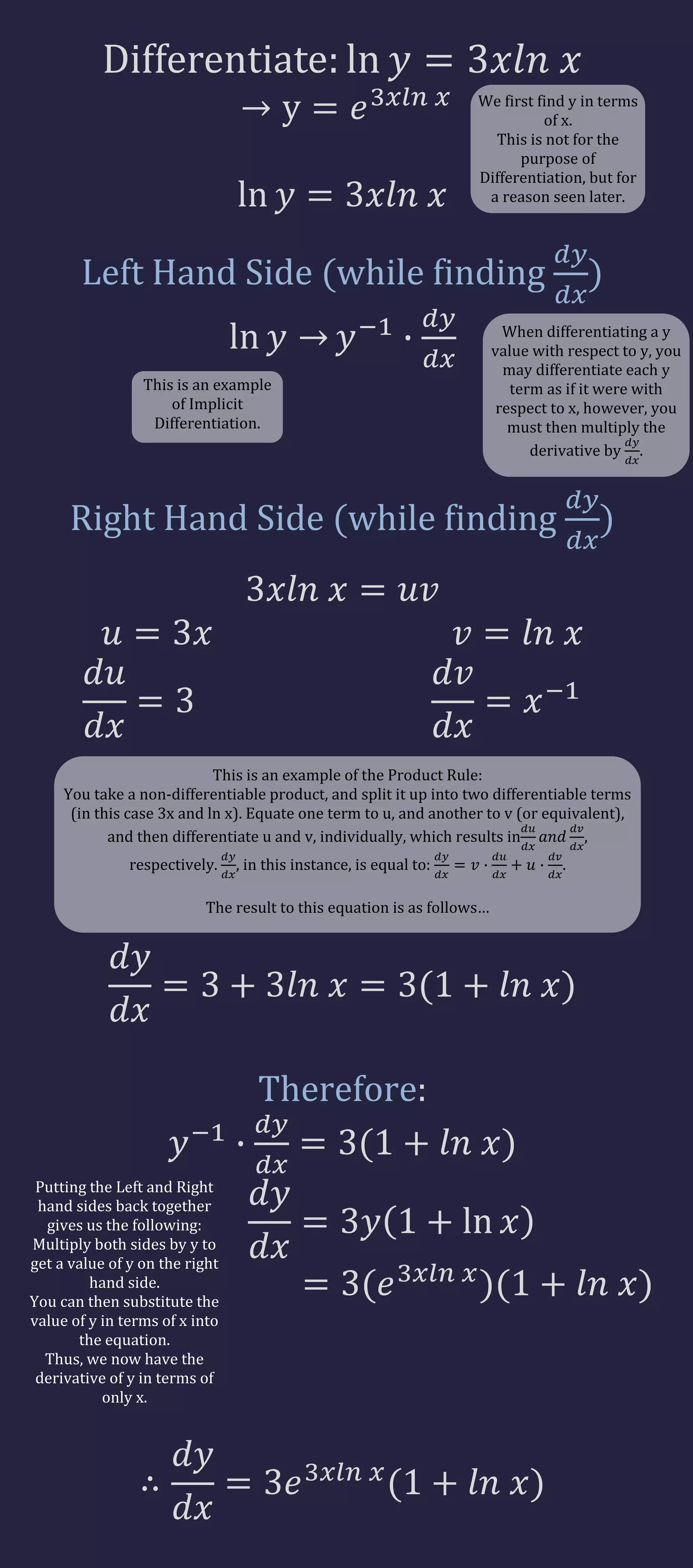

We first find y in terms of x, not for differentiation but for a later reason. This is an example of implicit differentiation, where each y term is differentiated as if it were respect to x and then multiplied by dy/dx. The product rule is used to differentiate a non-differentiable product by splitting it into two differentiable terms, equating them to u and v, differentiating individually, and combining the results. Putting the left and right hand sides back together and multiplying by y gives the derivative of y in terms of only x.


