TRAINING & ITS METHODS
BY
ABHISHIKTH SANDEEP ABRAHAM
TRAINING
 It refers to the acquisition of knowledge, skills, and
competencies as a result of the teaching of practical skills
and knowledge that relate to specific useful competencies
 It enhances employee efficiency for doing the present job
 It is goal specific and relates mostly to the current state.
 It improves the organization’s effectiveness
 It is a transforming process that requires some input and
in turn it produces output in the form of knowledge,
skills, and attitudes
OBJECTIVES OF TRAINING
• Orients new employee to the organization
• Enhances employee’s performance in their current jobs
• Greater job satisfaction and morale among employees
• Increases productivity
• Improved quality: standards
• Reduces employee turnover
• Enhances company image
•Match the employee performance with orgazational requirements
• Enhances Organizational effectiveness and efficiency
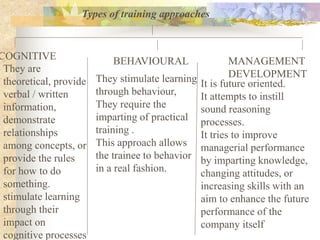
Types of training approaches
COGNITIVE BEHAVIOURAL MANAGEMENT
DEVELOPMENTThey are
theoretical, provide
verbal / written
information,
demonstrate
relationships
among concepts, or
provide the rules
for how to do
something.
stimulate learning
through their
impact on
cognitive processes
They stimulate learning
through behaviour,
They require the
imparting of practical
training .
This approach allows
the trainee to behavior
in a real fashion.
It is future oriented.
It attempts to instill
sound reasoning
processes.
It tries to improve
managerial performance
by imparting knowledge,
changing attitudes, or
increasing skills with an
aim to enhance the future
performance of the
company itself
Management Development approach
On the job training Off the job training
The development of a manager's
abilities can take place while the
employee is on the job using the
actual tools, equipment and
material.
This type of training takes place
away from work situations —
ie) the employee does not count
as a directly productive worker
while such training takes place.
Off-the-job training has the
advantage that it allows people
to get away from work and
concentrate more thoroughly on
the training itself.
On the job training methods
COACHING: It is more likely done by the supervisor
MENTORING: It is an ongoing relationship that is developed
between a senior and junior employee. It provides guidance &
understanding to the junior as to how the organization
achieves its vision and mission.
JOB ROTATION It call for the regular rotation of an
employee to different functions in the company.This approach
allows the manger to operate in diverse roles and understand
the different issues that crop up
JOB INSTRUCTION TECHNIQUE (JIT) Job Instruction
Technique (JIT) uses a strategy with focus on knowledge
(factual and procedural), skills and attitudes development
Off the job training methods
SENSITIVITY TRAINING: It is about making people understand about
themselves and others, this is done by developing in them social sensitivity
(It is ability of an individual to sense what others feel and think from their
own point of view) and behavioral flexibility.
TRANSACTIONAL ANALYSIS: It realistically helps analyze and
understand the behavior of others. In every social interaction, there is a
motivation provided by one person and a reaction to that motivation given
by another person. This motivation- reaction relationship between two
persons is a transaction. It can be done by the ego states of an individual.
LECTURES: It creates a general understanding of a topic/ influences
attitudes through education about a topic.
SIMULATION/VESTIBULE EXERCISES: involves the virtual duplication
of work environment in an off-site setting. It places the trainee in an
artificial environment that closely imitates actual working conditions
CASE STUDY: It simulates decision making situations at the work place.
It reflects the situations and complex problems
Cognitive approach
 LECTURES It tells someone about something. It enhances the knowledge of
listener or to give him the theoretical aspect of a topic
 DEMONSTRATIONS This method is a visual display of how something works or
how to do something
 DISCUSSIONS lectures, followed by discussion and questioning interaction and
the communication.
 COMPUTER BASED TRAINING (CBT) provides training through Intranet or
Internet. Internet is a technique of delivering training.
CBT does not require face to face interaction with a human trainer.
 INTELLEGENT TUTORIAL SYSTEM(ITS) It uses artificial intelligence to train
participants. This system learns through trainee responses.
 PROGRAMMED INSTRUCTION (PI) It is a Computer-based training that
comprises of graphics, multimedia, text that is connected to one another and is
stored in memory. It provides the participant with content, information, asks
questions, and based on the answer goes to the next level of information
 VIRTUAL REALITY It puts the participant in 3-D environment which stimulates
situations and events that are experienced in the job. The participant interacts with
3-D images to accomplish the training objectives.
Behavioural approach
 GAMES AND SIMULATIONS: They may be structured or unstructured
& are designed to simulate events, circumstances, processes that take
place in trainees’ job. A Training Game is defined as spirited activity or
exercise in which the trainees compete with each other Simulation is
creating computer versions of real-life games.
 BEHAVIOR-MODELING: It uses the innate inclination for people to
observe others to discover how to do something new.the behavior is
videotaped and then is watched by the trainees
 BUSINESS GAMES; They are iterative rule based procedures, plans,
relationships, principles derived from the research. The participants are
given some information that describes a particular situation and are then
asked to make decisions. And then the system provides the feedback about
the impact of their decisions. Again, on the basis of the feedback they are
asked to make the decisions again. This process continues until some
meaningful results do not came out or some predefined state of the
organization exists or a specified number of trails are completed.
 APPRENTICESHIP TRAINING; The trainee is taken as an apprentice
and trained.
Behavioural approach…..
CASE STUDIES : They try to simulate a decision making situation
that trainees may find at their work place. It reflects the situations
and complex problems
 EQUIPMENT STIMULATORS: They are mechanical devices that
trainees use in actions, plans, measures, trials, movements, or decision
processes they would use with equipment back on the their respective
work place.
 IN-BASKET TECHNIQUE: The trainee is given some information
about the role to be played such as, description, responsibilities, general
context about the role. He is given the log of materials that make up the
in-basket and asked to respond to materials within a particular time
period.
 ROLE PLAYS: It is a simulation in which each participant is given a
role to play & provided with some information related to the role,
concerns, objectives, responsibilities, emotions, etc. Then, a general
description of the situation and problem that they face is given.
THANK YOU
ANY CONSTRUCTIVE SUGGESTIONS ARE
WELCOME

Training- methods - approaches

  • 1.
    TRAINING & ITSMETHODS BY ABHISHIKTH SANDEEP ABRAHAM
  • 2.
    TRAINING  It refersto the acquisition of knowledge, skills, and competencies as a result of the teaching of practical skills and knowledge that relate to specific useful competencies  It enhances employee efficiency for doing the present job  It is goal specific and relates mostly to the current state.  It improves the organization’s effectiveness  It is a transforming process that requires some input and in turn it produces output in the form of knowledge, skills, and attitudes
  • 3.
    OBJECTIVES OF TRAINING •Orients new employee to the organization • Enhances employee’s performance in their current jobs • Greater job satisfaction and morale among employees • Increases productivity • Improved quality: standards • Reduces employee turnover • Enhances company image •Match the employee performance with orgazational requirements • Enhances Organizational effectiveness and efficiency
  • 4.
    Types of trainingapproaches COGNITIVE BEHAVIOURAL MANAGEMENT DEVELOPMENTThey are theoretical, provide verbal / written information, demonstrate relationships among concepts, or provide the rules for how to do something. stimulate learning through their impact on cognitive processes They stimulate learning through behaviour, They require the imparting of practical training . This approach allows the trainee to behavior in a real fashion. It is future oriented. It attempts to instill sound reasoning processes. It tries to improve managerial performance by imparting knowledge, changing attitudes, or increasing skills with an aim to enhance the future performance of the company itself
  • 5.
    Management Development approach Onthe job training Off the job training The development of a manager's abilities can take place while the employee is on the job using the actual tools, equipment and material. This type of training takes place away from work situations — ie) the employee does not count as a directly productive worker while such training takes place. Off-the-job training has the advantage that it allows people to get away from work and concentrate more thoroughly on the training itself.
  • 6.
    On the jobtraining methods COACHING: It is more likely done by the supervisor MENTORING: It is an ongoing relationship that is developed between a senior and junior employee. It provides guidance & understanding to the junior as to how the organization achieves its vision and mission. JOB ROTATION It call for the regular rotation of an employee to different functions in the company.This approach allows the manger to operate in diverse roles and understand the different issues that crop up JOB INSTRUCTION TECHNIQUE (JIT) Job Instruction Technique (JIT) uses a strategy with focus on knowledge (factual and procedural), skills and attitudes development
  • 7.
    Off the jobtraining methods SENSITIVITY TRAINING: It is about making people understand about themselves and others, this is done by developing in them social sensitivity (It is ability of an individual to sense what others feel and think from their own point of view) and behavioral flexibility. TRANSACTIONAL ANALYSIS: It realistically helps analyze and understand the behavior of others. In every social interaction, there is a motivation provided by one person and a reaction to that motivation given by another person. This motivation- reaction relationship between two persons is a transaction. It can be done by the ego states of an individual. LECTURES: It creates a general understanding of a topic/ influences attitudes through education about a topic. SIMULATION/VESTIBULE EXERCISES: involves the virtual duplication of work environment in an off-site setting. It places the trainee in an artificial environment that closely imitates actual working conditions CASE STUDY: It simulates decision making situations at the work place. It reflects the situations and complex problems
  • 8.
    Cognitive approach  LECTURESIt tells someone about something. It enhances the knowledge of listener or to give him the theoretical aspect of a topic  DEMONSTRATIONS This method is a visual display of how something works or how to do something  DISCUSSIONS lectures, followed by discussion and questioning interaction and the communication.  COMPUTER BASED TRAINING (CBT) provides training through Intranet or Internet. Internet is a technique of delivering training. CBT does not require face to face interaction with a human trainer.  INTELLEGENT TUTORIAL SYSTEM(ITS) It uses artificial intelligence to train participants. This system learns through trainee responses.  PROGRAMMED INSTRUCTION (PI) It is a Computer-based training that comprises of graphics, multimedia, text that is connected to one another and is stored in memory. It provides the participant with content, information, asks questions, and based on the answer goes to the next level of information  VIRTUAL REALITY It puts the participant in 3-D environment which stimulates situations and events that are experienced in the job. The participant interacts with 3-D images to accomplish the training objectives.
  • 9.
    Behavioural approach  GAMESAND SIMULATIONS: They may be structured or unstructured & are designed to simulate events, circumstances, processes that take place in trainees’ job. A Training Game is defined as spirited activity or exercise in which the trainees compete with each other Simulation is creating computer versions of real-life games.  BEHAVIOR-MODELING: It uses the innate inclination for people to observe others to discover how to do something new.the behavior is videotaped and then is watched by the trainees  BUSINESS GAMES; They are iterative rule based procedures, plans, relationships, principles derived from the research. The participants are given some information that describes a particular situation and are then asked to make decisions. And then the system provides the feedback about the impact of their decisions. Again, on the basis of the feedback they are asked to make the decisions again. This process continues until some meaningful results do not came out or some predefined state of the organization exists or a specified number of trails are completed.  APPRENTICESHIP TRAINING; The trainee is taken as an apprentice and trained.
  • 10.
    Behavioural approach….. CASE STUDIES: They try to simulate a decision making situation that trainees may find at their work place. It reflects the situations and complex problems  EQUIPMENT STIMULATORS: They are mechanical devices that trainees use in actions, plans, measures, trials, movements, or decision processes they would use with equipment back on the their respective work place.  IN-BASKET TECHNIQUE: The trainee is given some information about the role to be played such as, description, responsibilities, general context about the role. He is given the log of materials that make up the in-basket and asked to respond to materials within a particular time period.  ROLE PLAYS: It is a simulation in which each participant is given a role to play & provided with some information related to the role, concerns, objectives, responsibilities, emotions, etc. Then, a general description of the situation and problem that they face is given.
  • 11.
    THANK YOU ANY CONSTRUCTIVESUGGESTIONS ARE WELCOME