International Journal of Mechanical Engineering and Technology (IJMET), ISSN 0976 –
6340(Print), ISSN 0976 – 6359(Online) Volume 5, Issue 1, January (2014), © IAEME
26
IMPLEMENTATION OF RELIABILITY CENTERED MAINTENANCE IN
AIR COMPRESSOR UNIT
Vivek S. Narnaware1
, Ganesh D.Gosavi2
, Pravin V. Jadhav3
, Rahul D. Gorle4
1,2,4
(Mechanical Engg., Department, Dr. Babasaheb Ambedkar College of Engg. and Research,
WanadongriHingna Road Nagpur/RTMNU Nagpur, India)
3
(Mechanical Engg., Department, Priyadarshini College of Engg., Hingna Road Nagpur/RTMNU
Nagpur, India)
ABSTRACT
Today’s maintenance programs are suffered from many drawbacks. Some équipements get
too little, while some gets too much préventive maintenance than required. Reliability centered
maintenance approach is found to be successful technique for solving such complex management
orientated problems regarding the maintenance. Reliability centered maintenance (RCM) is the
qualitative technique for developing the optimal preventative maintenance program which ensures
relability of machine opération. It focuses on the system, system function, functional failure, system
failure effect, their occurrences and criticality. Failure data analysis plays an important rôle to take
décision on maintenance planning. It is important to identify the occurrences of failure and
probability of failure for ranking the failure paths. It gives information about area of concentration in
maintenance activities. This paper includes RCM principles and methodology to understand RCM is
carried out in the plant or a system. The case study has been conducted at MSEB Thermal Power
Plant Khaperkheda Nagpur. An air compressor unit is selected for opération. The selection is based
on the breakdown failures record of past 18 months. RCM methodology are applied an system failure
analysis is done. Preventative maintenance shedule for RCM is prepared and it is compared with the
plant maintenance schedule.
Keywords: Functional Failure, Failure Analysis, FMEA, RCM, RTF.
1. INTRODUCTION
Air compressor unit plays an important role in thermal power plant. It supplies compressed
instrument air and service air to the plant. It consists of various components, proper working of
which ensures the functions of the compressor unit. While studying the failure record of the
INTERNATIONAL JOURNAL OF MECHANICAL ENGINEERING
AND TECHNOLOGY (IJMET)
ISSN 0976 – 6340 (Print)
ISSN 0976 – 6359 (Online)
Volume 5, Issue 1, January (2014), pp. 26-32
© IAEME: www.iaeme.com/ijmet.asp
Journal Impact Factor (2013): 5.7731 (Calculated by GISI)
www.jifactor.com
IJMET
© I A E M E
International Journal of Mechanical Engineering and Technology (IJMET), ISSN 0976 –
6340(Print), ISSN 0976 – 6359(Online) Volume 5, Issue 1, January (2014), © IAEME
27
components, it is observed that some of them are frequently fail during the operation, some fail to
work earlier than predicted. Moreover failures of such components cause the shutdown of the
compressor unit and hence affect the working of the overall plant. The maintenance schedule of the
company mainly focuses on the daily breaking failures and an overhauling during year. Therefore
this work aims to generate proper maintenance planning and scheduling for the compressor unit that
based on the RCM technique for the air compressor unit components. Reliability centered
maintenance (RCM) is the qualitative technique for developing the optimal preventive maintenance
program which will ensure inherit ant reliability of machine operation. RCM can be defined as a
process or method used in structured way to determine the most effective approach of preventive
maintenance of equipment in its operating condition after proper evaluation of failure consequence.
It focuses on the system, function, functional failure, dominant failure effect, their occurrences and
critically. RCM philosophy employs preventive maintenance, predictive maintenance (PDM), time
directed (TD), condition directed (CD), failure finding (FF) and run-to-failure (RTF) maintenance
techniques in an integrated manner to increase the probability that a machine or component will
function in the required manner over its design life cycle with a minimum of maintenance. This
paper contains the RCM methodology and its implementation in an air compressor unit, key points in
RCM maintenance plan.
2. LITERATURE REVIEW
Study made by Islam H. Afefy
The results of the RCM technique applied of the plant show that the PM proposed tasks and
planning are generated. Moreover, PM is consisted of on-condition and scheduled maintenance. The
Run-To-Failure (RTF) frequency has been decreased. It is recommended to perform these tasks (CD,
TD and FF) every yearly, six monthly and monthly.
Study made by Katharina Fischer, Francois Besnard and LinaBertling
A Reliability-Centred Maintenance analysis of the two wind turbine models V44-600kW and
V90-2MW has been carried out. The analysis forms the basis for the development of quantitative
models for maintenance strategy selection and optimization. The mathematical models for
maintenance strategy selection and optimization that are being developed based on the presented
RCM study aim at contributing to this process. It is concluded to be an important step in order to
enhance the reliability, availability and profitability of wind turbines.
Study made by Salman T. Al-Mishari, and S. M. A. Suliman
The potential losses due to missing any element of the DMAIC process are very significant.
Assessment of contributing factors is often based on very subjective judgment. Shifts and drifts often
occur. The work reported in this paper attempts to illustrate the potential losses of missing these
important elements through a real example.
Study made by RizauddinRamli and Mohammad NizamArffin
RCM implementation in the PM activities at automotive manufacturing plant. The RCM has
been used to analyze and perform a decision making process in which maintenance strategy needs to
be chosen depends on the criticality of the equipment to the organization.
3. RESEARCH METHODOLOGY
This methodology will provide a comprehensive description of seven steps that have been
developed to systematically delineate the required information.
International Journal of Mechanical Engineering and Technology (IJMET), ISSN 0976 –
6340(Print), ISSN 0976 – 6359(Online) Volume 5, Issue 1, January (2014), © IAEME
28
Step 1: System Selection & Information Collection
Step 2: System boundary definition.
Step 3: System description & functional block diagram.
Step 4: System functions & functional failures.
Step 5: Failure mode & effect analysis (FMEA)
Step 6: Criticality & Probability of occurrences.
Step 7: Task Selection.
Satisfactory completion of these seven steps will provide the preferred PM tasks. Failures in
air compressor unit is selected for the RCM study and the relevant information is collected from the
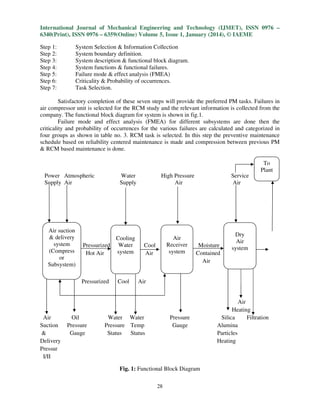
company. The functional block diagram for system is shown in fig.1.
Failure mode and effect analysis (FMEA) for different subsystems are done then the
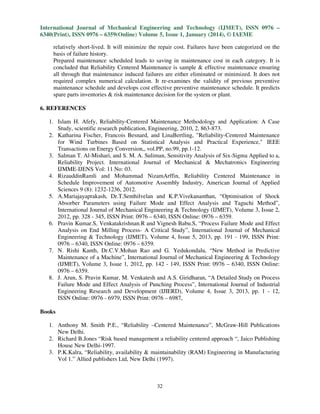
criticality and probability of occurrences for the various failures are calculated and categorized in
four groups as shown in table no. 3. RCM task is selected. In this step the preventive maintenance
schedule based on reliability centered maintenance is made and compression between previous PM
& RCM based maintenance is done.
Power Atmospheric Water High Pressure Service
Supply Air Supply Air Air
Pressurized Cool Moisture
Hot Air Air Contained
Air
Pressurized Cool Air
Air
Heating
Air Oil Water Water Pressure Silica Filtration
Suction Pressure Pressure Temp Gauge Alumina
& Gauge Status Status Particles
Delivery Heating
Pressur
I/II
Fig. 1: Functional Block Diagram
Air suction
& delivery
system
(Compress
or
Subsystem)
Cooling
Water
system
Air
Receiver
system
Dry
Air
system
To
Plant
International Journal of Mechanical Engineering and Technology (IJMET), ISSN 0976 –
6340(Print), ISSN 0976 – 6359(Online) Volume 5, Issue 1, January (2014), © IAEME
29
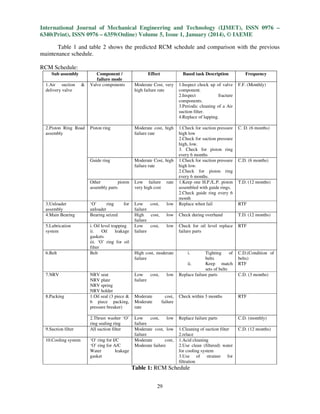
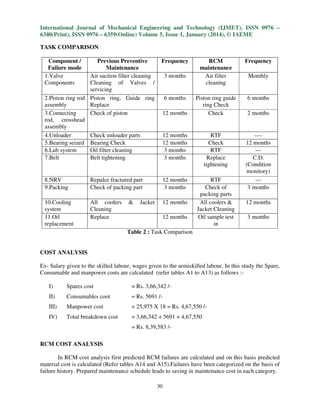
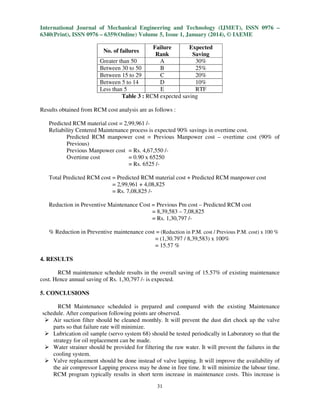
Table 1 and table 2 shows the predicted RCM schedule and comparison with the previous
maintenance schedule.
RCM Schedule:
Sub assembly Component /
failure mode
Effect Based task Description Frequency
1.Air suction &
delivery valve
Valve components Moderate Cost, very
high failure rate
1.Inspect chock up of valve
component.
2.Inspect fracture
components.
3.Periodic cleaning of a Air
suction filter.
4.Replace of lapping.
F.F. (Monthly)
2.Piston Ring Road
assembly
Piston ring Moderate cost, high
failure rate
1.Check for suction pressure
high low
2.Check for suction pressure
high, low.
3. Check for piston ring
every 6 months
C. D. (6 months)
Guide ring Moderate Cost, high
failure rate
1.Check for suction pressure
high low.
2.Check for piston ring
every 6 months.
C.D. (6 months)
Other piston
assembly parts
Low failure rate
very high cost
1.Keep one H.P./L.P. piston
assembled with guide rings.
2.Check guide ring every 6
month
T.D. (12 months)
3.Unloader
assembly
‘O’ ring for
unloader
Low cost, low
failure
Replace when fail RTF
4.Main Bearing Bearing seized High cost, low
failure
Check during overhand T.D. (12 months)
5.Lubrication
system
i. Oil level trapping
ii. Oil leakage
gaskets
iii. ‘O’ ring for oil
filter
Low cost, low
failure
Check for oil level replace
failure parts
RTF
6.Belt Belt High cost, moderate
failure
i. Tighting of
belts
ii. Keep match
sets of belts
C.D.(Condition of
belts)
RTF
7.NRV NRV seat
NRV plate
NRV spring
NRV holder
Low cost, low
failure
Replace failure parts C.D. (3 months)
8.Packing 1.Oil seal (3 piece &
6 piece packing,
pressure breaker)
Moderate cost,
Moderate failure
rate
Check within 3 months RTF
2.Thrust washer ‘O’
ring sealing ring
Low cost, low
failure
Replace failure parts C.D. (monthly)
9.Suction filter All suction filter Moderate cost, low
failure
1.Cleaning of suction filter
2.relace
C.D. (12 months)
10.Cooling system ‘O’ ring for I/C
‘O’ ring for A/C
Water leakage
gasket
Moderate cost,
Moderate failure
1.Acid cleaning
2.Use clean (filtered) water
for cooling system
3.Use of strainer for
filtration
Table 1: RCM Schedule
International Journal of Mechanical Engineering and Technology (IJMET), ISSN 0976 –
6340(Print), ISSN 0976 – 6359(Online) Volume 5, Issue 1, January (2014), © IAEME
30
TASK COMPARISON
Component /
Failure mode
Previous Preventive
Maintenance
Frequency RCM
maintenance
Frequency
1.Valve
Components
Air suction filter cleaning
Cleaning of Valves /
servicing
3 months Air filter
cleaning
Monthly
2.Piston ring rod
assembly
Piston ring, Guide ring
Replace
6 months Piston ring guide
ring Check
6 months
3.Connecting
rod, crosshead
assembly
Check of piston 12 months Check 2 months
4.Unloader Check unloader parts 12 months RTF ----
5.Bearing seized Bearing Check 12 months Check 12 months
6.Lub system Oil filter cleaning 3 months RTF ---
7.Belt Belt tightening 3 months Replace
tightening
C.D.
(Condition
monitory)
8.NRV Repalce fractured part 12 months RTF ---
9.Packing Check of packing part 3 months Check of
packing parts
3 months
10.Cooling
system
All coolers & Jacket
Cleaning
12 months All coolers &
Jacket Cleaning
12 months
11.Oil
replacement
Replace 12 months Oil sample test
in
3 months
Table 2 : Task Comparison
COST ANALYSIS
Ex- Salary given to the skilled labour, wages given to the semiskilled labour. In this study the Spare,
Consumable and manpower costs are calculated (refer tables A1 to A13) as follows :-
I) Spares cost = Rs. 3,66,342 /-
II) Consumables coot = Rs. 5691 /-
III) Manpower cost = 25,975 X 18 = Rs. 4,67,550 /-
IV) Total breakdown cost = 3,66,342 + 5691 + 4,67,550
= Rs. 8,39,583 /-
RCM COST ANALYSIS
In RCM cost analysis first predicted RCM failures are calculated and on this basis predicted
material cost is calculated (Refer tables A14 and A15).Failures have been categorized on the basis of
failure history. Prepared maintenance schedule leads to saving in maintenance cost in each category.
International Journal of Mechanical Engineering and Technology (IJMET), ISSN 0976 –
6340(Print), ISSN 0976 – 6359(Online) Volume 5, Issue 1, January (2014), © IAEME
31
No. of failures
Failure
Rank
Expected
Saving
Greater than 50 A 30%
Between 30 to 50 B 25%
Between 15 to 29 C 20%
Between 5 to 14 D 10%
Less than 5 E RTF
Table 3 : RCM expected saving
Results obtained from RCM cost analysis are as follows :
Predicted RCM material cost = 2,99,961 /-
Reliability Centered Maintenance process is expected 90% savings in overtime cost.
Predicted RCM manpower cost = Previous Manpower cost – overtime cost (90% of
Previous)
Previous Manpower cost = Rs. 4,67,550 /-
Overtime cost = 0.90 x 65250
= Rs. 6525 /-
Total Predicted RCM cost = Predicted RCM material cost + Predicted RCM manpower cost
= 2,99,961 + 4,08,825
= Rs. 7,08,825 /-
Reduction in Preventive Maintenance Cost = Previous Pm cost – Predicted RCM cost
= 8,39,583 – 7,08,825
= Rs. 1,30,797 /-
% Reduction in Preventive maintenance cost = (Reduction in P.M. cost / Previous P.M. cost) x 100 %
= (1,30.797 / 8,39,583) x 100%
= 15.57 %
4. RESULTS
RCM maintenance schedule results in the overall saving of 15.57% of existing maintenance
cost. Hence annual saving of Rs. 1,30,797 /- is expected.
5. CONCLUSIONS
RCM Maintenance scheduled is prepared and compared with the existing Maintenance
schedule. After comparison following points are observed.
Air suction filter should be cleaned monthly. It will prevent the dust dirt chock up the valve
parts so that failure rate will minimize.
Lubrication oil sample (servo system 68) should be tested periodically in Laboratory so that the
strategy for oil replacement can be made.
Water strainer should be provided for filtering the raw water. It will prevent the failures in the
cooling system.
Valve replacement should be done instead of valve lapping. It will improve the availability of
the air compressor Lapping process may be done in free time. It will minimize the labour time.
RCM program typically results in short term increase in maintenance costs. This increase is
International Journal of Mechanical Engineering and Technology (IJMET), ISSN 0976 –
6340(Print), ISSN 0976 – 6359(Online) Volume 5, Issue 1, January (2014), © IAEME
32
relatively short-lived. It will minimize the repair cost. Failures have been categorized on the
basis of failure history.
Prepared maintenance scheduled leads to saving in maintenance cost in each category. It is
concluded that Reliability Centered Maintenance is sample & effective maintenance ensuring
all through that maintenance induced failures are either eliminated or minimized. It does not
required complex numerical calculation. It re-examines the validity of previous preventive
maintenance schedule and develops cost effective preventive maintenance schedule. It predicts
spare parts inventories & risk maintenance decision for the system or plant.
6. REFERENCES
1. Islam H. Afefy, Reliability-Centered Maintenance Methodology and Application: A Case
Study, scientific research publication, Engineering, 2010, 2, 863-873.
2. Katharina Fischer, Francois Besnard, and LinaBertling, "Reliability-Centered Maintenance
for Wind Turbines Based on Statistical Analysis and Practical Experience," IEEE
Transactions on Energy Conversion,, vol.PP, no.99, pp.1-12.
3. Salman T. Al-Mishari, and S. M. A. Suliman, Sensitivity Analysis of Six-Sigma Applied to a,
Reliability Project. International Journal of Mechanical & Mechatronics Engineering
IJMME-IJENS Vol: 11 No: 03.
4. RizauddinRamli and Mohammad NizamArffin, Reliability Centered Maintenance in
Schedule Improvement of Automotive Assembly Industry, American Journal of Applied
Sciences 9 (8): 1232-1236, 2012.
5. A.Mariajayaprakash, Dr.T.Senthilvelan and K.P.Vivekananthan, “Optimisation of Shock
Absorber Parameters using Failure Mode and Effect Analysis and Taguchi Method”,
International Journal of Mechanical Engineering & Technology (IJMET), Volume 3, Issue 2,
2012, pp. 328 - 345, ISSN Print: 0976 – 6340, ISSN Online: 0976 – 6359.
6. Pravin Kumar.S, Venkatakrishnan.R and Vignesh Babu.S, “Process Failure Mode and Effect
Analysis on End Milling Process- A Critical Study”, International Journal of Mechanical
Engineering & Technology (IJMET), Volume 4, Issue 5, 2013, pp. 191 - 199, ISSN Print:
0976 – 6340, ISSN Online: 0976 – 6359.
7. N. Rishi Kanth, Dr.C.V.Mohan Rao and G. Yedukondalu, “New Method in Predictive
Maintenance of a Machine”, International Journal of Mechanical Engineering & Technology
(IJMET), Volume 3, Issue 1, 2012, pp. 142 - 149, ISSN Print: 0976 – 6340, ISSN Online:
0976 – 6359.
8. J. Arun, S. Pravin Kumar, M. Venkatesh and A.S. Giridharan, “A Detailed Study on Process
Failure Mode and Effect Analysis of Punching Process”, International Journal of Industrial
Engineering Research and Development (IJIERD), Volume 4, Issue 3, 2013, pp. 1 - 12,
ISSN Online: 0976 - 6979, ISSN Print: 0976 – 6987,
Books
1. Anthony M. Smith P.E., “Reliability –Centered Maintenance”, McGraw-Hill Publications
New Delhi.
2. Richard B.Jones “Risk based management a reliability centered approach “, Jaico Publishing
House New Delhi-1997.
3. P.K.Kalra, “Reliability, availability & maintainability (RAM) Engineering in Manufacturing
Vol 1.” Allied publishers Ltd, New Delhi (1997).

IMPLEMENTATION OF RELIABILITY CENTERED MAINTENANCE IN AIR COMPRESSOR UNIT

  • 1.
    International Journal ofMechanical Engineering and Technology (IJMET), ISSN 0976 – 6340(Print), ISSN 0976 – 6359(Online) Volume 5, Issue 1, January (2014), © IAEME 26 IMPLEMENTATION OF RELIABILITY CENTERED MAINTENANCE IN AIR COMPRESSOR UNIT Vivek S. Narnaware1 , Ganesh D.Gosavi2 , Pravin V. Jadhav3 , Rahul D. Gorle4 1,2,4 (Mechanical Engg., Department, Dr. Babasaheb Ambedkar College of Engg. and Research, WanadongriHingna Road Nagpur/RTMNU Nagpur, India) 3 (Mechanical Engg., Department, Priyadarshini College of Engg., Hingna Road Nagpur/RTMNU Nagpur, India) ABSTRACT Today’s maintenance programs are suffered from many drawbacks. Some équipements get too little, while some gets too much préventive maintenance than required. Reliability centered maintenance approach is found to be successful technique for solving such complex management orientated problems regarding the maintenance. Reliability centered maintenance (RCM) is the qualitative technique for developing the optimal preventative maintenance program which ensures relability of machine opération. It focuses on the system, system function, functional failure, system failure effect, their occurrences and criticality. Failure data analysis plays an important rôle to take décision on maintenance planning. It is important to identify the occurrences of failure and probability of failure for ranking the failure paths. It gives information about area of concentration in maintenance activities. This paper includes RCM principles and methodology to understand RCM is carried out in the plant or a system. The case study has been conducted at MSEB Thermal Power Plant Khaperkheda Nagpur. An air compressor unit is selected for opération. The selection is based on the breakdown failures record of past 18 months. RCM methodology are applied an system failure analysis is done. Preventative maintenance shedule for RCM is prepared and it is compared with the plant maintenance schedule. Keywords: Functional Failure, Failure Analysis, FMEA, RCM, RTF. 1. INTRODUCTION Air compressor unit plays an important role in thermal power plant. It supplies compressed instrument air and service air to the plant. It consists of various components, proper working of which ensures the functions of the compressor unit. While studying the failure record of the INTERNATIONAL JOURNAL OF MECHANICAL ENGINEERING AND TECHNOLOGY (IJMET) ISSN 0976 – 6340 (Print) ISSN 0976 – 6359 (Online) Volume 5, Issue 1, January (2014), pp. 26-32 © IAEME: www.iaeme.com/ijmet.asp Journal Impact Factor (2013): 5.7731 (Calculated by GISI) www.jifactor.com IJMET © I A E M E
  • 2.
    International Journal ofMechanical Engineering and Technology (IJMET), ISSN 0976 – 6340(Print), ISSN 0976 – 6359(Online) Volume 5, Issue 1, January (2014), © IAEME 27 components, it is observed that some of them are frequently fail during the operation, some fail to work earlier than predicted. Moreover failures of such components cause the shutdown of the compressor unit and hence affect the working of the overall plant. The maintenance schedule of the company mainly focuses on the daily breaking failures and an overhauling during year. Therefore this work aims to generate proper maintenance planning and scheduling for the compressor unit that based on the RCM technique for the air compressor unit components. Reliability centered maintenance (RCM) is the qualitative technique for developing the optimal preventive maintenance program which will ensure inherit ant reliability of machine operation. RCM can be defined as a process or method used in structured way to determine the most effective approach of preventive maintenance of equipment in its operating condition after proper evaluation of failure consequence. It focuses on the system, function, functional failure, dominant failure effect, their occurrences and critically. RCM philosophy employs preventive maintenance, predictive maintenance (PDM), time directed (TD), condition directed (CD), failure finding (FF) and run-to-failure (RTF) maintenance techniques in an integrated manner to increase the probability that a machine or component will function in the required manner over its design life cycle with a minimum of maintenance. This paper contains the RCM methodology and its implementation in an air compressor unit, key points in RCM maintenance plan. 2. LITERATURE REVIEW Study made by Islam H. Afefy The results of the RCM technique applied of the plant show that the PM proposed tasks and planning are generated. Moreover, PM is consisted of on-condition and scheduled maintenance. The Run-To-Failure (RTF) frequency has been decreased. It is recommended to perform these tasks (CD, TD and FF) every yearly, six monthly and monthly. Study made by Katharina Fischer, Francois Besnard and LinaBertling A Reliability-Centred Maintenance analysis of the two wind turbine models V44-600kW and V90-2MW has been carried out. The analysis forms the basis for the development of quantitative models for maintenance strategy selection and optimization. The mathematical models for maintenance strategy selection and optimization that are being developed based on the presented RCM study aim at contributing to this process. It is concluded to be an important step in order to enhance the reliability, availability and profitability of wind turbines. Study made by Salman T. Al-Mishari, and S. M. A. Suliman The potential losses due to missing any element of the DMAIC process are very significant. Assessment of contributing factors is often based on very subjective judgment. Shifts and drifts often occur. The work reported in this paper attempts to illustrate the potential losses of missing these important elements through a real example. Study made by RizauddinRamli and Mohammad NizamArffin RCM implementation in the PM activities at automotive manufacturing plant. The RCM has been used to analyze and perform a decision making process in which maintenance strategy needs to be chosen depends on the criticality of the equipment to the organization. 3. RESEARCH METHODOLOGY This methodology will provide a comprehensive description of seven steps that have been developed to systematically delineate the required information.
  • 3.
    International Journal ofMechanical Engineering and Technology (IJMET), ISSN 0976 – 6340(Print), ISSN 0976 – 6359(Online) Volume 5, Issue 1, January (2014), © IAEME 28 Step 1: System Selection & Information Collection Step 2: System boundary definition. Step 3: System description & functional block diagram. Step 4: System functions & functional failures. Step 5: Failure mode & effect analysis (FMEA) Step 6: Criticality & Probability of occurrences. Step 7: Task Selection. Satisfactory completion of these seven steps will provide the preferred PM tasks. Failures in air compressor unit is selected for the RCM study and the relevant information is collected from the company. The functional block diagram for system is shown in fig.1. Failure mode and effect analysis (FMEA) for different subsystems are done then the criticality and probability of occurrences for the various failures are calculated and categorized in four groups as shown in table no. 3. RCM task is selected. In this step the preventive maintenance schedule based on reliability centered maintenance is made and compression between previous PM & RCM based maintenance is done. Power Atmospheric Water High Pressure Service Supply Air Supply Air Air Pressurized Cool Moisture Hot Air Air Contained Air Pressurized Cool Air Air Heating Air Oil Water Water Pressure Silica Filtration Suction Pressure Pressure Temp Gauge Alumina & Gauge Status Status Particles Delivery Heating Pressur I/II Fig. 1: Functional Block Diagram Air suction & delivery system (Compress or Subsystem) Cooling Water system Air Receiver system Dry Air system To Plant
  • 4.
    International Journal ofMechanical Engineering and Technology (IJMET), ISSN 0976 – 6340(Print), ISSN 0976 – 6359(Online) Volume 5, Issue 1, January (2014), © IAEME 29 Table 1 and table 2 shows the predicted RCM schedule and comparison with the previous maintenance schedule. RCM Schedule: Sub assembly Component / failure mode Effect Based task Description Frequency 1.Air suction & delivery valve Valve components Moderate Cost, very high failure rate 1.Inspect chock up of valve component. 2.Inspect fracture components. 3.Periodic cleaning of a Air suction filter. 4.Replace of lapping. F.F. (Monthly) 2.Piston Ring Road assembly Piston ring Moderate cost, high failure rate 1.Check for suction pressure high low 2.Check for suction pressure high, low. 3. Check for piston ring every 6 months C. D. (6 months) Guide ring Moderate Cost, high failure rate 1.Check for suction pressure high low. 2.Check for piston ring every 6 months. C.D. (6 months) Other piston assembly parts Low failure rate very high cost 1.Keep one H.P./L.P. piston assembled with guide rings. 2.Check guide ring every 6 month T.D. (12 months) 3.Unloader assembly ‘O’ ring for unloader Low cost, low failure Replace when fail RTF 4.Main Bearing Bearing seized High cost, low failure Check during overhand T.D. (12 months) 5.Lubrication system i. Oil level trapping ii. Oil leakage gaskets iii. ‘O’ ring for oil filter Low cost, low failure Check for oil level replace failure parts RTF 6.Belt Belt High cost, moderate failure i. Tighting of belts ii. Keep match sets of belts C.D.(Condition of belts) RTF 7.NRV NRV seat NRV plate NRV spring NRV holder Low cost, low failure Replace failure parts C.D. (3 months) 8.Packing 1.Oil seal (3 piece & 6 piece packing, pressure breaker) Moderate cost, Moderate failure rate Check within 3 months RTF 2.Thrust washer ‘O’ ring sealing ring Low cost, low failure Replace failure parts C.D. (monthly) 9.Suction filter All suction filter Moderate cost, low failure 1.Cleaning of suction filter 2.relace C.D. (12 months) 10.Cooling system ‘O’ ring for I/C ‘O’ ring for A/C Water leakage gasket Moderate cost, Moderate failure 1.Acid cleaning 2.Use clean (filtered) water for cooling system 3.Use of strainer for filtration Table 1: RCM Schedule
  • 5.
    International Journal ofMechanical Engineering and Technology (IJMET), ISSN 0976 – 6340(Print), ISSN 0976 – 6359(Online) Volume 5, Issue 1, January (2014), © IAEME 30 TASK COMPARISON Component / Failure mode Previous Preventive Maintenance Frequency RCM maintenance Frequency 1.Valve Components Air suction filter cleaning Cleaning of Valves / servicing 3 months Air filter cleaning Monthly 2.Piston ring rod assembly Piston ring, Guide ring Replace 6 months Piston ring guide ring Check 6 months 3.Connecting rod, crosshead assembly Check of piston 12 months Check 2 months 4.Unloader Check unloader parts 12 months RTF ---- 5.Bearing seized Bearing Check 12 months Check 12 months 6.Lub system Oil filter cleaning 3 months RTF --- 7.Belt Belt tightening 3 months Replace tightening C.D. (Condition monitory) 8.NRV Repalce fractured part 12 months RTF --- 9.Packing Check of packing part 3 months Check of packing parts 3 months 10.Cooling system All coolers & Jacket Cleaning 12 months All coolers & Jacket Cleaning 12 months 11.Oil replacement Replace 12 months Oil sample test in 3 months Table 2 : Task Comparison COST ANALYSIS Ex- Salary given to the skilled labour, wages given to the semiskilled labour. In this study the Spare, Consumable and manpower costs are calculated (refer tables A1 to A13) as follows :- I) Spares cost = Rs. 3,66,342 /- II) Consumables coot = Rs. 5691 /- III) Manpower cost = 25,975 X 18 = Rs. 4,67,550 /- IV) Total breakdown cost = 3,66,342 + 5691 + 4,67,550 = Rs. 8,39,583 /- RCM COST ANALYSIS In RCM cost analysis first predicted RCM failures are calculated and on this basis predicted material cost is calculated (Refer tables A14 and A15).Failures have been categorized on the basis of failure history. Prepared maintenance schedule leads to saving in maintenance cost in each category.
  • 6.
    International Journal ofMechanical Engineering and Technology (IJMET), ISSN 0976 – 6340(Print), ISSN 0976 – 6359(Online) Volume 5, Issue 1, January (2014), © IAEME 31 No. of failures Failure Rank Expected Saving Greater than 50 A 30% Between 30 to 50 B 25% Between 15 to 29 C 20% Between 5 to 14 D 10% Less than 5 E RTF Table 3 : RCM expected saving Results obtained from RCM cost analysis are as follows : Predicted RCM material cost = 2,99,961 /- Reliability Centered Maintenance process is expected 90% savings in overtime cost. Predicted RCM manpower cost = Previous Manpower cost – overtime cost (90% of Previous) Previous Manpower cost = Rs. 4,67,550 /- Overtime cost = 0.90 x 65250 = Rs. 6525 /- Total Predicted RCM cost = Predicted RCM material cost + Predicted RCM manpower cost = 2,99,961 + 4,08,825 = Rs. 7,08,825 /- Reduction in Preventive Maintenance Cost = Previous Pm cost – Predicted RCM cost = 8,39,583 – 7,08,825 = Rs. 1,30,797 /- % Reduction in Preventive maintenance cost = (Reduction in P.M. cost / Previous P.M. cost) x 100 % = (1,30.797 / 8,39,583) x 100% = 15.57 % 4. RESULTS RCM maintenance schedule results in the overall saving of 15.57% of existing maintenance cost. Hence annual saving of Rs. 1,30,797 /- is expected. 5. CONCLUSIONS RCM Maintenance scheduled is prepared and compared with the existing Maintenance schedule. After comparison following points are observed. Air suction filter should be cleaned monthly. It will prevent the dust dirt chock up the valve parts so that failure rate will minimize. Lubrication oil sample (servo system 68) should be tested periodically in Laboratory so that the strategy for oil replacement can be made. Water strainer should be provided for filtering the raw water. It will prevent the failures in the cooling system. Valve replacement should be done instead of valve lapping. It will improve the availability of the air compressor Lapping process may be done in free time. It will minimize the labour time. RCM program typically results in short term increase in maintenance costs. This increase is
  • 7.
    International Journal ofMechanical Engineering and Technology (IJMET), ISSN 0976 – 6340(Print), ISSN 0976 – 6359(Online) Volume 5, Issue 1, January (2014), © IAEME 32 relatively short-lived. It will minimize the repair cost. Failures have been categorized on the basis of failure history. Prepared maintenance scheduled leads to saving in maintenance cost in each category. It is concluded that Reliability Centered Maintenance is sample & effective maintenance ensuring all through that maintenance induced failures are either eliminated or minimized. It does not required complex numerical calculation. It re-examines the validity of previous preventive maintenance schedule and develops cost effective preventive maintenance schedule. It predicts spare parts inventories & risk maintenance decision for the system or plant. 6. REFERENCES 1. Islam H. Afefy, Reliability-Centered Maintenance Methodology and Application: A Case Study, scientific research publication, Engineering, 2010, 2, 863-873. 2. Katharina Fischer, Francois Besnard, and LinaBertling, "Reliability-Centered Maintenance for Wind Turbines Based on Statistical Analysis and Practical Experience," IEEE Transactions on Energy Conversion,, vol.PP, no.99, pp.1-12. 3. Salman T. Al-Mishari, and S. M. A. Suliman, Sensitivity Analysis of Six-Sigma Applied to a, Reliability Project. International Journal of Mechanical & Mechatronics Engineering IJMME-IJENS Vol: 11 No: 03. 4. RizauddinRamli and Mohammad NizamArffin, Reliability Centered Maintenance in Schedule Improvement of Automotive Assembly Industry, American Journal of Applied Sciences 9 (8): 1232-1236, 2012. 5. A.Mariajayaprakash, Dr.T.Senthilvelan and K.P.Vivekananthan, “Optimisation of Shock Absorber Parameters using Failure Mode and Effect Analysis and Taguchi Method”, International Journal of Mechanical Engineering & Technology (IJMET), Volume 3, Issue 2, 2012, pp. 328 - 345, ISSN Print: 0976 – 6340, ISSN Online: 0976 – 6359. 6. Pravin Kumar.S, Venkatakrishnan.R and Vignesh Babu.S, “Process Failure Mode and Effect Analysis on End Milling Process- A Critical Study”, International Journal of Mechanical Engineering & Technology (IJMET), Volume 4, Issue 5, 2013, pp. 191 - 199, ISSN Print: 0976 – 6340, ISSN Online: 0976 – 6359. 7. N. Rishi Kanth, Dr.C.V.Mohan Rao and G. Yedukondalu, “New Method in Predictive Maintenance of a Machine”, International Journal of Mechanical Engineering & Technology (IJMET), Volume 3, Issue 1, 2012, pp. 142 - 149, ISSN Print: 0976 – 6340, ISSN Online: 0976 – 6359. 8. J. Arun, S. Pravin Kumar, M. Venkatesh and A.S. Giridharan, “A Detailed Study on Process Failure Mode and Effect Analysis of Punching Process”, International Journal of Industrial Engineering Research and Development (IJIERD), Volume 4, Issue 3, 2013, pp. 1 - 12, ISSN Online: 0976 - 6979, ISSN Print: 0976 – 6987, Books 1. Anthony M. Smith P.E., “Reliability –Centered Maintenance”, McGraw-Hill Publications New Delhi. 2. Richard B.Jones “Risk based management a reliability centered approach “, Jaico Publishing House New Delhi-1997. 3. P.K.Kalra, “Reliability, availability & maintainability (RAM) Engineering in Manufacturing Vol 1.” Allied publishers Ltd, New Delhi (1997).