MEHRAN UNIVERSITY OF ENGINEERING & TECHNOLOGY
DEPARTMENT OF MECHANICAL ENGINEERING
MECHANICAL & MECHATRONIC
PROJECT &POSTER COMPETITION 2018
RELIABILITY-CENTERED-MAINTENANCE (RCM) OF GAS COMPRESSOR
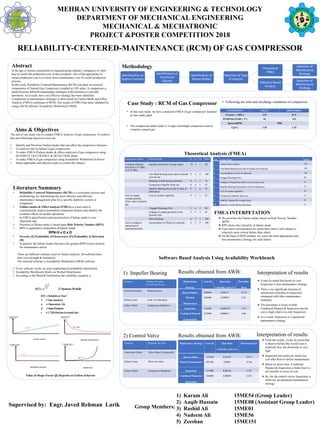
Abstract
In the age of intense competition in manufacturing industry, companies try their
best to curtail the production cost of their products. One of the approaches to
curtail production cost is to lower down maintenance cost of overall production
process.
In this work, Reliability Centered Maintenance (RCM) was done on selected
components of Natural Gas Compressor installed at LPG plant. A comparison is
made between different maintenance strategies with reference to cost and
downtime. As a result, best cost-effective strategy has been identified.
Comparison of maintenance strategies is done based on Failure Mode and Effect
Analysis (FMEA) technique of RCM. The results of FMEA has been validated by
using a RCM software Availability Workbench (AWB).
Aims & Objectives
The aim of our study was to conduct FMEA Analysis of gas compressor. To achieve
this aim following objectives were set :
• Identify and Prioritize Failure modes that can affect the compressor function
• To analyze risks in failure of gas compressors
• To make FMEA (Failure modes & effects analysis) of gas compressor using
SEVERITY, OCCURANCE & DETECTION charts.
• To make FMEA of gas compressor using Availability Workbench Software
• Select applicable and effective tasks to control the failures
Supervised by: Engr. Javed Rehman Larik
Case Study : RCM of Gas Compressor
• In this case study, we have conducted FMEA of gas compressor installed
at case study plant
• The compressor under study is 3-stage centrifugal compressor used to
compress natural gas
• Following are inlet and discharge conditions of compressor
CONDITIONS INLET DISCHARGE
Pressure ( MPa ) 3.57 8.72
TEMPERATURE ( °C) 44 131
Speed (RPM) 7050
Cp/Cv 1.39 1.35
Literature Summary
• Reliability Centered Maintenance (RCM) is a systematic process and
methodology for determining the most effective and efficient
maintenance management plan for a specific platform, system or
component
• Failure modes & Effect analysis (FMEA) is a tool used to
systematically analyze postulated component failures and identify the
resultant effects on system operations
• In FMEA identification and prioritization of failure mode is very
important step
• Prioritize of failure mode is based upon Risk Priority Number (RPN)
• RPN is quantitative evaluation of failure mode
RPN=S x O x D
• Severity (S),Probability of Occurrence (O),Probability of Detection
(D)
• In general, the failure modes that have the greatest RPN receive priority
for maintenance action
There are different software used for failure analysis, All software have
their own strength & limitations
The selected software is Availability Workbench (AWB) software.
• Every software works on some mathematical probability distribution
• Availability Workbench Works on Weibull Distribution
• According to the Weibull Distribution the reliability equation is
Value of Shape Factor (β) Depends on Failure behavior
Methodology
Theoretical Analysis (FMEA)
❖ We prioritize the Failure modes based on Risk Priority Number
(RPN)
❖ RPN shows the criticality of failure mode
❖ From above prioritization we noted that control valve failure is
relatively most critical failure than others
❖ On the basis of RPN number, we select the most appropriate and
best maintenance strategy for each failure
FMEA INTERPETATION
Functional Failure Failure Mode S O D RPN
Compress Natural
Gas from 3.57 MPa
to 8.72 MPa
Impeller jammed by foreign object 10 2 1 20
Line Shaft bearing seizes due to normal
wear & tear
9 5 4 180
Bending of shaft during operation 8 2 1 16
Compressor Impeller Wear out 8 4 1 32
Impeller Bearing Seizes due to lack of
lubrication
9 1 6 54
Fails to supply
enough quantity
(Flow rate) of natural
gas
Loss of coolant capability 9 5 1 45
Clogged Discharge Port 5 6 3 90
Leakage of output gas back to low
pressure side
3 7 3 63
Valve Sticking 6 7 7 294
Fail to compress
natural gas at
required pressure
Accumulation of Water in Lubricant 4 3 9 108
S.No. Failure Modes (RPN)
1 Control Valve Failure 294
2 Line Shaft Bearing Seize due to normal wear and tear 180
3 Accumulation of water in lubricant 108
4 Clogged Discharge Port 90
5 Leakage of Output Gas back to low pressure side 63
6 Impeller Bearing Seized due to lack of lubrication 54
7 Loss of coolant capability 45
8 Compressor Impeller Wear-out 32
9 Impeller Jammed by foreign object 20
10 Bending of shaft during Operation 16
1) Impeller Bearing
Function Reduce Friction,
Avoid loss Power
Functional Failure Bearing Seizes
Failure Cause Lack of Lubrication
Failure Effect Compressor Shutdown
Maintenance
Strategy
Cost ($) Operation
Criticality (out of 1)
Downtime
(hrs)
Run-to-failure 288900 0.00171 16.16
Planned
Maintenance
304600 0.00097 9.52
Inspection 116300 0.000539 5.25
Combined Planned
& Inspection
225900 0.000417 4.06
Results obtained from AWB:
❖ It may be noted that based on cost
Inspection is best maintenance strategy
❖ There is no significant increase of
operational criticality in inspection
compared with other maintenance
strategies
❖ The downtime is lesser in both
Combined Planned & Inspection but the
cost is high relative to only Inspection
❖ As a result, Inspection is a optimized
maintenance strategy
2) Control Valve Results obtained from AWB: Interpretation of results
Function Regulate the flow
Functional Failure Valve Shuts Unexpectedly
Failure Cause Wear over time
Failure Effect Compressor Shutdown
Maintenance Strategy Cost ($) Operation
Criticality (out of 1)
Downtime (hrs)
Run-to-failure 123100 0.01227 107.5
Planned Maintenance 895100 0.0054 47.46
Inspection 277000 0.00136 11.97
Combined Planned &
Inspection
506000 0.00093 8.187
❖ From the results, it may be noted that
in Run-to-failure the overall cost is
relatively low, but downtime is very
high
❖ Inspection has relatively much less
cost after Run-to-failure maintenance
❖ Based on down time, Combined
Planned & Inspection is better but it is
not feasible in terms of cost
❖ So, for the control valves Inspection is
relatively an optimized maintenance
strategy
Interpretation of results
Identification of
System Function
Identification of
Functional
Failures
Identification of
Failure Modes
Selection of Type
of Analysis
Theoretical
FMEA
Selection of
Maintenance
Strategy
Software Based
Analysis
Selection of
Maintenance
Strategy
Software Based Analysis Using Availability Workbench
1) Karam Ali 15ME54 (Group Leader)
2) Aaqib Hussain 15ME08 (Assistant Group Leader)
3) Rashid Ali 15ME01
4) Nadeem Ali 15ME56
5) Zeeshan 15ME151
Group Members:

Poster pdf

  • 1.
    MEHRAN UNIVERSITY OFENGINEERING & TECHNOLOGY DEPARTMENT OF MECHANICAL ENGINEERING MECHANICAL & MECHATRONIC PROJECT &POSTER COMPETITION 2018 RELIABILITY-CENTERED-MAINTENANCE (RCM) OF GAS COMPRESSOR Abstract In the age of intense competition in manufacturing industry, companies try their best to curtail the production cost of their products. One of the approaches to curtail production cost is to lower down maintenance cost of overall production process. In this work, Reliability Centered Maintenance (RCM) was done on selected components of Natural Gas Compressor installed at LPG plant. A comparison is made between different maintenance strategies with reference to cost and downtime. As a result, best cost-effective strategy has been identified. Comparison of maintenance strategies is done based on Failure Mode and Effect Analysis (FMEA) technique of RCM. The results of FMEA has been validated by using a RCM software Availability Workbench (AWB). Aims & Objectives The aim of our study was to conduct FMEA Analysis of gas compressor. To achieve this aim following objectives were set : • Identify and Prioritize Failure modes that can affect the compressor function • To analyze risks in failure of gas compressors • To make FMEA (Failure modes & effects analysis) of gas compressor using SEVERITY, OCCURANCE & DETECTION charts. • To make FMEA of gas compressor using Availability Workbench Software • Select applicable and effective tasks to control the failures Supervised by: Engr. Javed Rehman Larik Case Study : RCM of Gas Compressor • In this case study, we have conducted FMEA of gas compressor installed at case study plant • The compressor under study is 3-stage centrifugal compressor used to compress natural gas • Following are inlet and discharge conditions of compressor CONDITIONS INLET DISCHARGE Pressure ( MPa ) 3.57 8.72 TEMPERATURE ( °C) 44 131 Speed (RPM) 7050 Cp/Cv 1.39 1.35 Literature Summary • Reliability Centered Maintenance (RCM) is a systematic process and methodology for determining the most effective and efficient maintenance management plan for a specific platform, system or component • Failure modes & Effect analysis (FMEA) is a tool used to systematically analyze postulated component failures and identify the resultant effects on system operations • In FMEA identification and prioritization of failure mode is very important step • Prioritize of failure mode is based upon Risk Priority Number (RPN) • RPN is quantitative evaluation of failure mode RPN=S x O x D • Severity (S),Probability of Occurrence (O),Probability of Detection (D) • In general, the failure modes that have the greatest RPN receive priority for maintenance action There are different software used for failure analysis, All software have their own strength & limitations The selected software is Availability Workbench (AWB) software. • Every software works on some mathematical probability distribution • Availability Workbench Works on Weibull Distribution • According to the Weibull Distribution the reliability equation is Value of Shape Factor (β) Depends on Failure behavior Methodology Theoretical Analysis (FMEA) ❖ We prioritize the Failure modes based on Risk Priority Number (RPN) ❖ RPN shows the criticality of failure mode ❖ From above prioritization we noted that control valve failure is relatively most critical failure than others ❖ On the basis of RPN number, we select the most appropriate and best maintenance strategy for each failure FMEA INTERPETATION Functional Failure Failure Mode S O D RPN Compress Natural Gas from 3.57 MPa to 8.72 MPa Impeller jammed by foreign object 10 2 1 20 Line Shaft bearing seizes due to normal wear & tear 9 5 4 180 Bending of shaft during operation 8 2 1 16 Compressor Impeller Wear out 8 4 1 32 Impeller Bearing Seizes due to lack of lubrication 9 1 6 54 Fails to supply enough quantity (Flow rate) of natural gas Loss of coolant capability 9 5 1 45 Clogged Discharge Port 5 6 3 90 Leakage of output gas back to low pressure side 3 7 3 63 Valve Sticking 6 7 7 294 Fail to compress natural gas at required pressure Accumulation of Water in Lubricant 4 3 9 108 S.No. Failure Modes (RPN) 1 Control Valve Failure 294 2 Line Shaft Bearing Seize due to normal wear and tear 180 3 Accumulation of water in lubricant 108 4 Clogged Discharge Port 90 5 Leakage of Output Gas back to low pressure side 63 6 Impeller Bearing Seized due to lack of lubrication 54 7 Loss of coolant capability 45 8 Compressor Impeller Wear-out 32 9 Impeller Jammed by foreign object 20 10 Bending of shaft during Operation 16 1) Impeller Bearing Function Reduce Friction, Avoid loss Power Functional Failure Bearing Seizes Failure Cause Lack of Lubrication Failure Effect Compressor Shutdown Maintenance Strategy Cost ($) Operation Criticality (out of 1) Downtime (hrs) Run-to-failure 288900 0.00171 16.16 Planned Maintenance 304600 0.00097 9.52 Inspection 116300 0.000539 5.25 Combined Planned & Inspection 225900 0.000417 4.06 Results obtained from AWB: ❖ It may be noted that based on cost Inspection is best maintenance strategy ❖ There is no significant increase of operational criticality in inspection compared with other maintenance strategies ❖ The downtime is lesser in both Combined Planned & Inspection but the cost is high relative to only Inspection ❖ As a result, Inspection is a optimized maintenance strategy 2) Control Valve Results obtained from AWB: Interpretation of results Function Regulate the flow Functional Failure Valve Shuts Unexpectedly Failure Cause Wear over time Failure Effect Compressor Shutdown Maintenance Strategy Cost ($) Operation Criticality (out of 1) Downtime (hrs) Run-to-failure 123100 0.01227 107.5 Planned Maintenance 895100 0.0054 47.46 Inspection 277000 0.00136 11.97 Combined Planned & Inspection 506000 0.00093 8.187 ❖ From the results, it may be noted that in Run-to-failure the overall cost is relatively low, but downtime is very high ❖ Inspection has relatively much less cost after Run-to-failure maintenance ❖ Based on down time, Combined Planned & Inspection is better but it is not feasible in terms of cost ❖ So, for the control valves Inspection is relatively an optimized maintenance strategy Interpretation of results Identification of System Function Identification of Functional Failures Identification of Failure Modes Selection of Type of Analysis Theoretical FMEA Selection of Maintenance Strategy Software Based Analysis Selection of Maintenance Strategy Software Based Analysis Using Availability Workbench 1) Karam Ali 15ME54 (Group Leader) 2) Aaqib Hussain 15ME08 (Assistant Group Leader) 3) Rashid Ali 15ME01 4) Nadeem Ali 15ME56 5) Zeeshan 15ME151 Group Members: