Fast Inversion of Normal CDF
John D. Cook
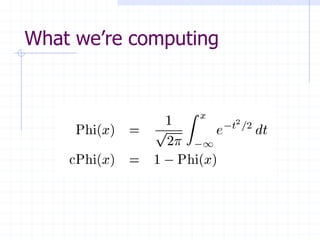
What we’re computing
Basic assumptions
  Five or six significant figures is
  adequate for many applications
  Memory is fast and plentiful
  Low-level bit operations are faster than
  arithmetic
Basic Approach
  Tabulate values at sample points and
  use low-order approximations to fill in
  Take advantage of binary
  representation of floating point
  numbers to decide where to sample
  Change variables to avoid arithmetic
Big clever idea
  Extract sample points based on the
  exponent and mantissa
  The extraction is extremely fast
  It is biased to sample more frequently
  near zero, exactly where cPhi-1 needs
  more sampling
IEEE Floating Point
Representation (conceptual)

  x = +/- 2e m, 1 <= m < 2
  Bit 1: sign bit +/-
  Bits 2 through 9: exponent e
  Bits 10 through 32: mantissa
IEEE Floating Point
Representation (details)

  Bit 1: 0 for positive, 1 for negative
  Bits 2 through 9: exponent of 2 biased
  by 127
  (values 0 through 255 correspond to
  actual exponents -127 through 128)
  Bits 10 through 32: mantissa minus 1
  (leading bit always 1, so don’t store)
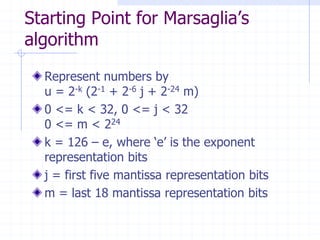
Starting Point for Marsaglia’s
algorithm
  Represent numbers by
  u = 2-k (2-1 + 2-6 j + 2-24 m)
  0 <= k < 32, 0 <= j < 32
  0 <= m < 224
  k = 126 – e, where ‘e’ is the exponent
  representation bits
  j = first five mantissa representation bits
  m = last 18 mantissa representation bits
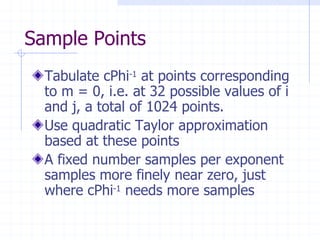
Sample Points
  Tabulate cPhi-1 at points corresponding
  to m = 0, i.e. at 32 possible values of i
  and j, a total of 1024 points.
  Use quadratic Taylor approximation
  based at these points
  A fixed number samples per exponent
  samples more finely near zero, just
  where cPhi-1 needs more samples
Clever indexing
  Conceptually, we have a matrix A[i][j] of
  tabulated values
  This requires two calculations to find indices –
  one for i and one for j – and two operations
  to lookup values
  Combine into a single index
  n = 992-32k + j
  that can be extracted directly by one bit
  manipulation: bits 2 through 14 minus 3040
Polynomial evaluation
  Taylor approximation:
  t = h B(k,j)
  x = A(k,j) -0.5 t + 0.125 A(k,j)t2
  Rescale B’s by square root of 8:
  t = h B’
  x = A – c t – A t2 [ c = sqrt(2) ]
  Horner’s method:
  x = A – t(c – A t)
C++ Implementation
double NormalCCDFInverse(double x)
{
      float f1 = (float) x;
      unsigned int ui;
      memcpy(&ui, &f1, 4);
      int n = (ui >> 18) - 3008;
      ui &= 0xFFFC0000;
      float f2;
      memcpy(&f2, &ui, 4);
      double v = (f1-f2)*B[n];

     return A[n] - v*(sqrt2 - A[n]*v);
}
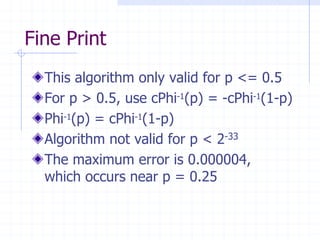
Fine Print
  This algorithm only valid for p <= 0.5
  For p > 0.5, use cPhi-1(p) = -cPhi-1(1-p)
  Phi-1(p) = cPhi-1(1-p)
  Algorithm not valid for p < 2-33
  The maximum error is 0.000004,
  which occurs near p = 0.25
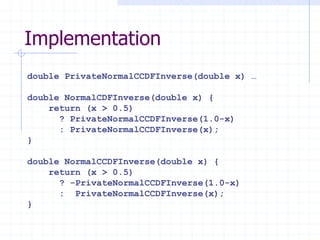
Implementation
double PrivateNormalCCDFInverse(double x) …

double NormalCDFInverse(double x) {
    return (x > 0.5)
      ? PrivateNormalCCDFInverse(1.0-x)
      : PrivateNormalCCDFInverse(x);
}

double NormalCCDFInverse(double x) {
    return (x > 0.5)
      ? -PrivateNormalCCDFInverse(1.0-x)
      : PrivateNormalCCDFInverse(x);
}
References
  Rapid evaluation of the inverse of the
  normal distribution function
  by Marsaglia, Zaman, and Marsaglia
  Statistics and Probability Letters
  19 (1994) 259 – 266
Notes
  This talk presented June 6, 2001
  http://www.JohnDCook.com

Fast coputation of Phi(x) inverse

  • 1.
    Fast Inversion ofNormal CDF John D. Cook
  • 2.
  • 3.
    Basic assumptions Five or six significant figures is adequate for many applications Memory is fast and plentiful Low-level bit operations are faster than arithmetic
  • 4.
    Basic Approach Tabulate values at sample points and use low-order approximations to fill in Take advantage of binary representation of floating point numbers to decide where to sample Change variables to avoid arithmetic
  • 5.
    Big clever idea Extract sample points based on the exponent and mantissa The extraction is extremely fast It is biased to sample more frequently near zero, exactly where cPhi-1 needs more sampling
  • 6.
    IEEE Floating Point Representation(conceptual) x = +/- 2e m, 1 <= m < 2 Bit 1: sign bit +/- Bits 2 through 9: exponent e Bits 10 through 32: mantissa
  • 7.
    IEEE Floating Point Representation(details) Bit 1: 0 for positive, 1 for negative Bits 2 through 9: exponent of 2 biased by 127 (values 0 through 255 correspond to actual exponents -127 through 128) Bits 10 through 32: mantissa minus 1 (leading bit always 1, so don’t store)
  • 8.
    Starting Point forMarsaglia’s algorithm Represent numbers by u = 2-k (2-1 + 2-6 j + 2-24 m) 0 <= k < 32, 0 <= j < 32 0 <= m < 224 k = 126 – e, where ‘e’ is the exponent representation bits j = first five mantissa representation bits m = last 18 mantissa representation bits
  • 9.
    Sample Points Tabulate cPhi-1 at points corresponding to m = 0, i.e. at 32 possible values of i and j, a total of 1024 points. Use quadratic Taylor approximation based at these points A fixed number samples per exponent samples more finely near zero, just where cPhi-1 needs more samples
  • 10.
    Clever indexing Conceptually, we have a matrix A[i][j] of tabulated values This requires two calculations to find indices – one for i and one for j – and two operations to lookup values Combine into a single index n = 992-32k + j that can be extracted directly by one bit manipulation: bits 2 through 14 minus 3040
  • 11.
    Polynomial evaluation Taylor approximation: t = h B(k,j) x = A(k,j) -0.5 t + 0.125 A(k,j)t2 Rescale B’s by square root of 8: t = h B’ x = A – c t – A t2 [ c = sqrt(2) ] Horner’s method: x = A – t(c – A t)
  • 12.
    C++ Implementation double NormalCCDFInverse(doublex) { float f1 = (float) x; unsigned int ui; memcpy(&ui, &f1, 4); int n = (ui >> 18) - 3008; ui &= 0xFFFC0000; float f2; memcpy(&f2, &ui, 4); double v = (f1-f2)*B[n]; return A[n] - v*(sqrt2 - A[n]*v); }
  • 13.
    Fine Print This algorithm only valid for p <= 0.5 For p > 0.5, use cPhi-1(p) = -cPhi-1(1-p) Phi-1(p) = cPhi-1(1-p) Algorithm not valid for p < 2-33 The maximum error is 0.000004, which occurs near p = 0.25
  • 14.
    Implementation double PrivateNormalCCDFInverse(double x)… double NormalCDFInverse(double x) { return (x > 0.5) ? PrivateNormalCCDFInverse(1.0-x) : PrivateNormalCCDFInverse(x); } double NormalCCDFInverse(double x) { return (x > 0.5) ? -PrivateNormalCCDFInverse(1.0-x) : PrivateNormalCCDFInverse(x); }
  • 15.
    References Rapidevaluation of the inverse of the normal distribution function by Marsaglia, Zaman, and Marsaglia Statistics and Probability Letters 19 (1994) 259 – 266
  • 16.
    Notes Thistalk presented June 6, 2001 http://www.JohnDCook.com