WELCOME
IMPACTFUL COMMUNICATION &
INTERPERSONAL SKILLS
LEARNING OBJECTIVES
• Describe the importance of communication
and interpersonal skills.
• Learn how to use communication strategies to
enhance self-esteem in your workplace and
how to motivate co-workers to take on new
challenges, to strive to manage effectively and
to reach corporate goals.
LEARNING OBJECTIVES
• Acquire the skills on how to ask the right
questions to gather information and to check
whether your message has been understood.
• Create a win-win situation by applying human
relationship principles when dealing with
prospects and potential customers.
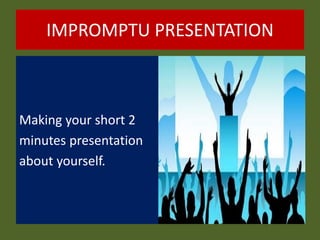
IMPROMPTU PRESENTATION
Making your short 2
minutes presentation
about yourself.
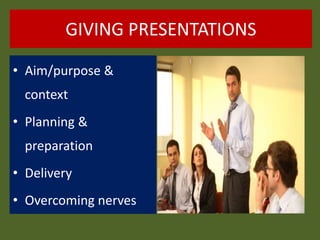
• Aim/purpose &
context
• Planning &
preparation
• Delivery
• Overcoming nerves
GIVING PRESENTATIONS
PURPOSE & CONTEXT
• To inform, train,
persuade, entertain,
sell or demonstrate?
• Who is the audience?
PURPOSE & CONTEXT
• How much time do
you have?
• Where is the venue?
• Formal or informal?
PLANNING & PREPARATION
• Relevance to aim and
audience!
• Gather material
relevant to message
• Key points only!
PLANNING & PREPARATION
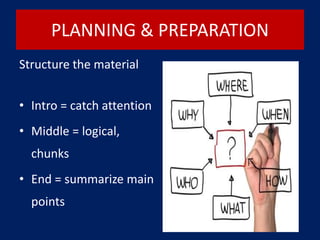
Structure the material
• Intro = catch attention
• Middle = logical,
chunks
• End = summarize main
points
PLANNING & PREPARATION
• Use of notes
• Use of visual aids –
KISS!
• Rehearse
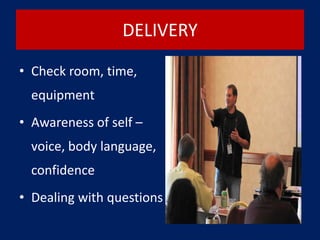
DELIVERY
• Check room, time,
equipment
• Awareness of self –
voice, body language,
confidence
• Dealing with questions
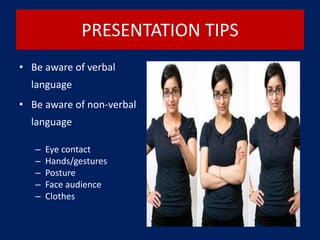
PRESENTATION TIPS
• Be aware of verbal
language
• Be aware of non-verbal
language
– Eye contact
– Hands/gestures
– Posture
– Face audience
– Clothes
OVERCOMING NERVES
• Reasons for feeling
nervous:
– Lack of experience
– Lack of preparation
– Lack of enthusiasm
– Negative self-talk
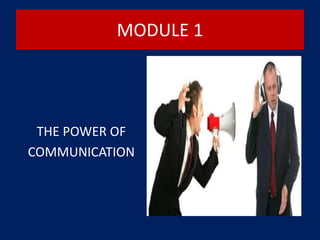
MODULE 1
THE POWER OF
COMMUNICATION
COMMUNICATIONS
• Occurs between two
or more people
• A process of sending ,
receiving and
understanding
message
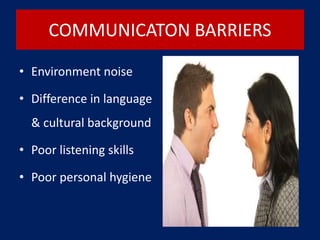
COMMUNICATON BARRIERS
• Environment noise
• Difference in language
& cultural background
• Poor listening skills
• Poor personal hygiene
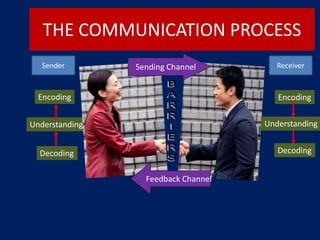
THE COMMUNICATION PROCESS
Encoding
Decoding
Encoding
Understanding
Decoding
Feedback Channel
Sending Channel
Understanding
ReceiverSender
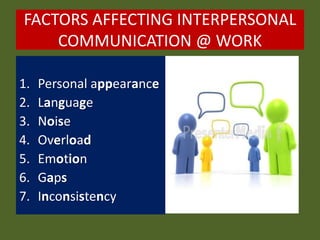
FACTORS AFFECTING INTERPERSONAL
COMMUNICATION @ WORK
1. Personal appearance
2. Language
3. Noise
4. Overload
5. Emotion
6. Gaps
7. Inconsistency
WHY INTERPERSONAL
COMMUNICATONS ?
• Necessary for relating
and working with
others
WHY INTERPERSONAL
COMMUNICATONS ?
• Effective
communication skills
–listening and
expressing
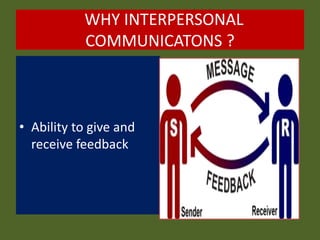
WHY INTERPERSONAL
COMMUNICATONS ?
• Ability to give and
receive feedback
WHY INTERPERSONAL
COMMUNICATONS ?
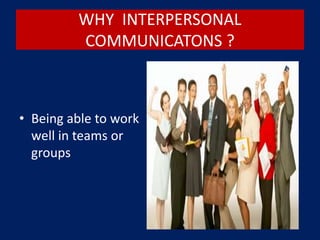
• Being able to work
well in teams or
groups
BENEFITS OF INTERPERSONAL
COMMUNICATIONS
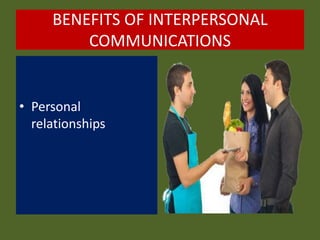
• Personal
relationships
BENEFITS OF INTERPERSONAL
COMMUNICATIONS
• Professional
relationships
BENEFITS OF INTERPERSONAL
COMMUNICATIONS
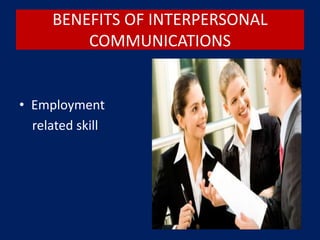
• Employment
related skill
MODULE 2
SEEK TO UNDERSTAND
AND ASK THE RIGHT
QUESTIONS
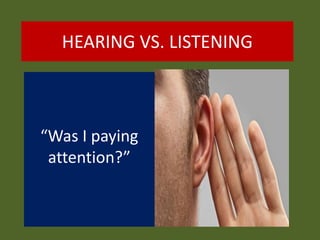
HEARING VS. LISTENING
“Was I paying
attention?”
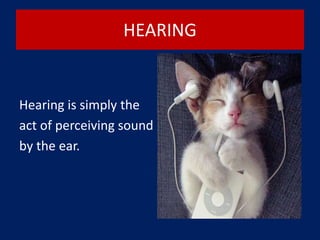
HEARING
Hearing is simply the
act of perceiving sound
by the ear.
LISTENING
Listening, however, is
something you
consciously choose to
do.
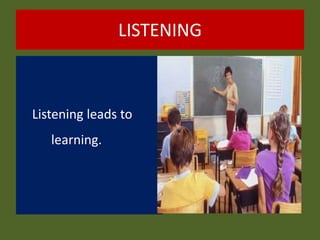
LISTENING
Listening requires
concentration so that
your brain processes
meaning from words
and sentences.
LISTENING
Listening leads to
learning.
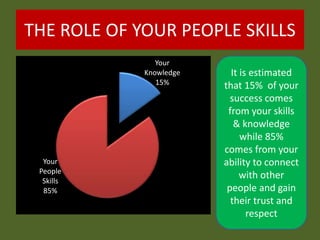
THE ROLE OF YOUR PEOPLE SKILLS
Your
Knowledge
15%
Your
People
Skills
85%
It is estimated
that 15% of your
success comes
from your skills
& knowledge
while 85%
comes from your
ability to connect
with other
people and gain
their trust and
respect
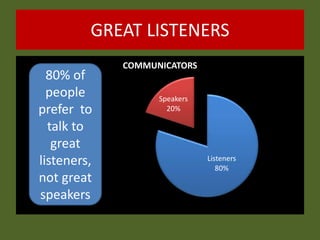
GREAT LISTENERS
Listeners
80%
Speakers
20%
COMMUNICATORS
80% of
people
prefer to
talk to
great
listeners,
not great
speakers
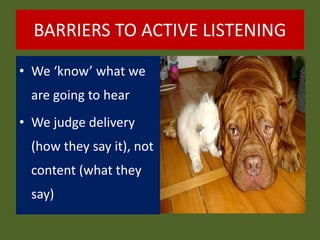
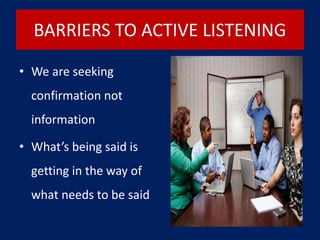
BARRIERS TO ACTIVE LISTENING
• We ‘know’ what we
are going to hear
• We judge delivery
(how they say it), not
content (what they
say)
• We are seeking
confirmation not
information
• What’s being said is
getting in the way of
what needs to be said
BARRIERS TO ACTIVE LISTENING
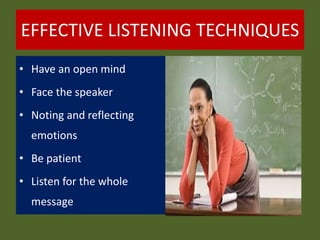
EFFECTIVE LISTENING TECHNIQUES
• Have an open mind
• Face the speaker
• Noting and reflecting
emotions
• Be patient
• Listen for the whole
message
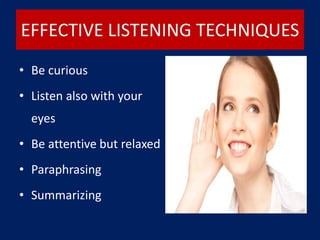
EFFECTIVE LISTENING TECHNIQUES
• Be curious
• Listen also with your
eyes
• Be attentive but relaxed
• Paraphrasing
• Summarizing
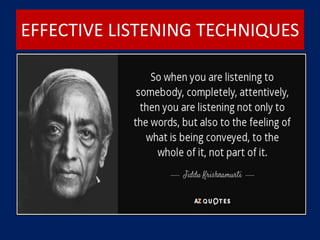
EFFECTIVE LISTENING TECHNIQUES
LEVELS OF LISTENING
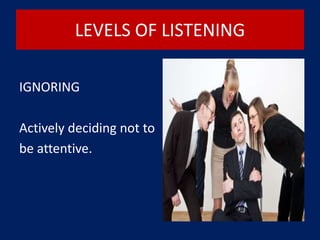
IGNORING
Actively deciding not to
be attentive.
LEVELS OF LISTENING
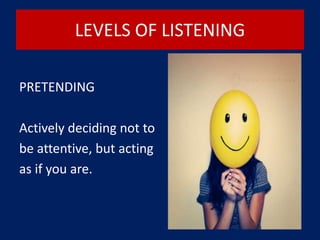
PRETENDING
Actively deciding not to
be attentive, but acting
as if you are.
LEVELS OF LISTENING
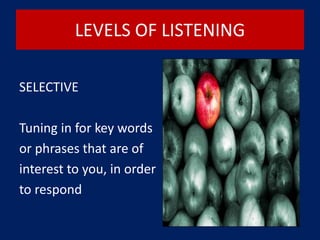
SELECTIVE
Tuning in for key words
or phrases that are of
interest to you, in order
to respond
LEVELS OF LISTENING
EMPHATIC
Appreciating the other
person’s frame of
reference. It is not
necessarily agreeing with
their position, but it is
acknowledging that they
do have an opinion.
YOUR SCORE
A = B = C =
Mostly A’s – You are a visual communicator
Mostly B’s – You are an auditory communicator
Mostly C’s – You are a kinesthetic communicator
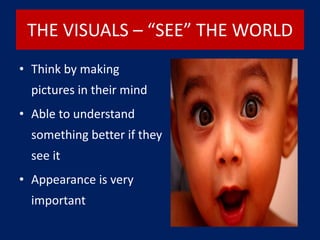
THE VISUALS – “SEE” THE WORLD
• Think by making
pictures in their mind
• Able to understand
something better if they
see it
• Appearance is very
important
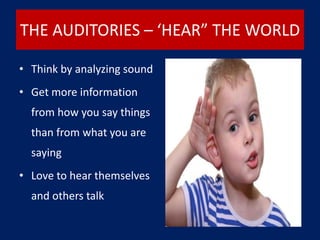
THE AUDITORIES – ‘HEAR” THE WORLD
• Think by analyzing sound
• Get more information
from how you say things
than from what you are
saying
• Love to hear themselves
and others talk
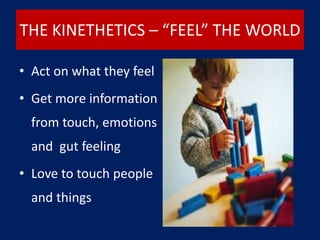
THE KINETHETICS – “FEEL” THE WORLD
• Act on what they feel
• Get more information
from touch, emotions
and gut feeling
• Love to touch people
and things
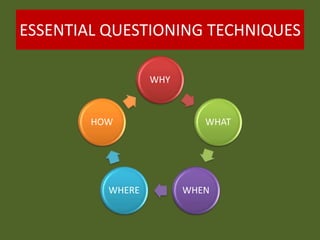
ESSENTIAL QUESTIONING TECHNIQUES
WHY
WHAT
WHENWHERE
HOW
RULES IN CONVEYING MESSAGE
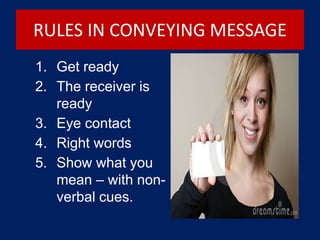
1. Get ready
2. The receiver is
ready
3. Eye contact
4. Right words
5. Show what you
mean – with non-
verbal cues.
RULES IN CONVEYING MESSAGE
6. Repeat important
message
7. Use the right
channel
8. Avoid interruptions
9. Give chances to
ask questions
10.Follow-up – check
with the receivers.
MODULE 3
COMMUNICATION
TECHNIQUES TO
SUSTAIN AND IMPROVE
RESULTS
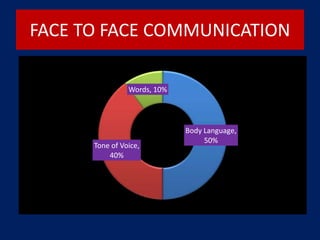
FACE TO FACE COMMUNICATION
Body Language,
50%
Tone of Voice,
40%
Words, 10%
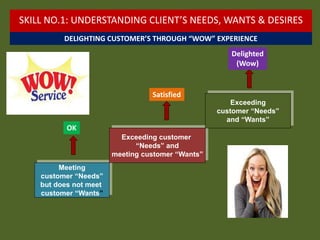
DELIGHTING CUSTOMER’S THROUGH “WOW” EXPERIENCE
Meeting
customer “Needs”
but does not meet
customer “Wants”
Exceeding customer
“Needs” and
meeting customer “Wants”
Exceeding
customer “Needs”
and “Wants”
OK
Satisfied
Delighted
(Wow)
SKILL NO.1: UNDERSTANDING CLIENT’S NEEDS, WANTS & DESIRES
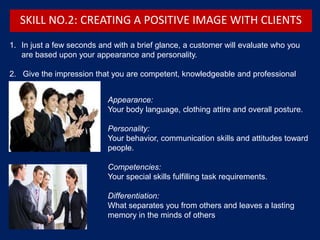
Appearance:
Your body language, clothing attire and overall posture.
Personality:
Your behavior, communication skills and attitudes toward
people.
Competencies:
Your special skills fulfilling task requirements.
Differentiation:
What separates you from others and leaves a lasting
memory in the minds of others.
1. In just a few seconds and with a brief glance, a customer will evaluate who you
are based upon your appearance and personality.
2. Give the impression that you are competent, knowledgeable and professional
SKILL NO.2: CREATING A POSITIVE IMAGE WITH CLIENTS
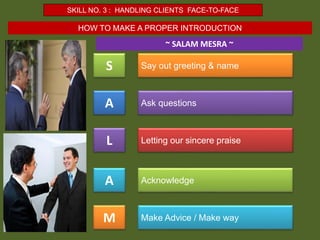
S Say out greeting & name
A Ask questions
L Letting our sincere praise
A Acknowledge
M Make Advice / Make way
~ SALAM MESRA ~
HOW TO MAKE A PROPER INTRODUCTION
SKILL NO. 3 : HANDLING CLIENTS FACE-TO-FACE
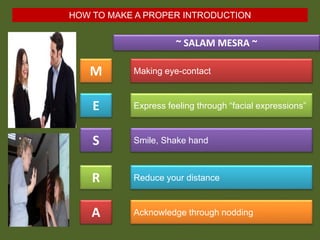
~ SALAM MESRA ~
M Making eye-contact
E Express feeling through “facial expressions”
S Smile, Shake hand
R Reduce your distance
A Acknowledge through nodding
HOW TO MAKE A PROPER INTRODUCTION
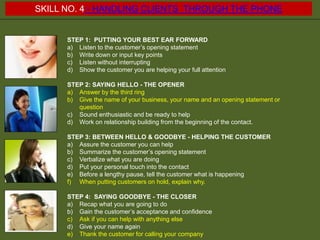
STEP 1: PUTTING YOUR BEST EAR FORWARD
a) Listen to the customer’s opening statement
b) Write down or input key points
c) Listen without interrupting
d) Show the customer you are helping your full attention
STEP 2: SAYING HELLO - THE OPENER
a) Answer by the third ring
b) Give the name of your business, your name and an opening statement or
question
c) Sound enthusiastic and be ready to help
d) Work on relationship building from the beginning of the contact.
STEP 3: BETWEEN HELLO & GOODBYE - HELPING THE CUSTOMER
a) Assure the customer you can help
b) Summarize the customer’s opening statement
c) Verbalize what you are doing
d) Put your personal touch into the contact
e) Before a lengthy pause, tell the customer what is happening
f) When putting customers on hold, explain why.
STEP 4: SAYING GOODBYE - THE CLOSER
a) Recap what you are going to do
b) Gain the customer’s acceptance and confidence
c) Ask if you can help with anything else
d) Give your name again
e) Thank the customer for calling your company
SKILL NO. 4:- HANDLING CLIENTS THROUGH THE PHONE
MODULE 4
BUILDING SELF
CONFIDENCE FOR
CORPORATE
PROFESIONALISM
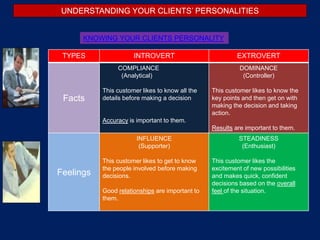
TYPES INTROVERT EXTROVERT
Facts
COMPLIANCE
(Analytical)
This customer likes to know all the
details before making a decision
Accuracy is important to them.
DOMINANCE
(Controller)
This customer likes to know the
key points and then get on with
making the decision and taking
action.
Results are important to them.
Feelings
INFLUENCE
(Supporter)
This customer likes to get to know
the people involved before making
decisions.
Good relationships are important to
them.
STEADINESS
(Enthusiast)
This customer likes the
excitement of new possibilities
and makes quick, confident
decisions based on the overall
feel of the situation.
UNDERSTANDING YOUR CLIENTS’ PERSONALITIES
KNOWING YOUR CLIENTS PERSONALITY
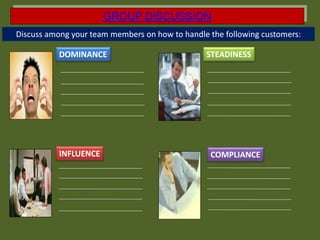
GROUP DISCUSSION
Discuss among your team members on how to handle the following customers:
DOMINANCE
INFLUENCE
STEADINESS
COMPLIANCE
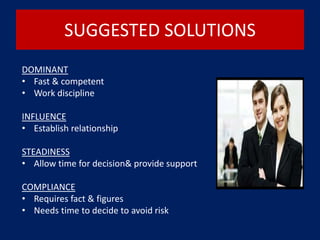
SUGGESTED SOLUTIONS
DOMINANT
• Fast & competent
• Work discipline
INFLUENCE
• Establish relationship
STEADINESS
• Allow time for decision& provide support
COMPLIANCE
• Requires fact & figures
• Needs time to decide to avoid risk
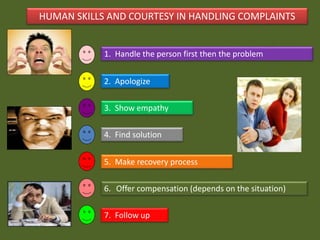
1. Handle the person first then the problem
2. Apologize
3. Show empathy
4. Find solution
5. Make recovery process
6. Offer compensation (depends on the situation)
7. Follow up
HUMAN SKILLS AND COURTESY IN HANDLING COMPLAINTS
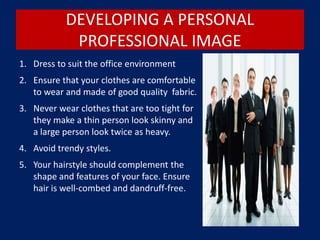
DEVELOPING A PERSONAL
PROFESSIONAL IMAGE
1. Dress to suit the office environment
2. Ensure that your clothes are comfortable
to wear and made of good quality fabric.
3. Never wear clothes that are too tight for
they make a thin person look skinny and
a large person look twice as heavy.
4. Avoid trendy styles.
5. Your hairstyle should complement the
shape and features of your face. Ensure
hair is well-combed and dandruff-free.
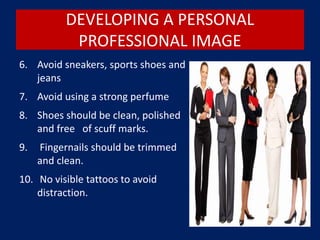
DEVELOPING A PERSONAL
PROFESSIONAL IMAGE
6. Avoid sneakers, sports shoes and
jeans
7. Avoid using a strong perfume
8. Shoes should be clean, polished
and free of scuff marks.
9. Fingernails should be trimmed
and clean.
10. No visible tattoos to avoid
distraction.
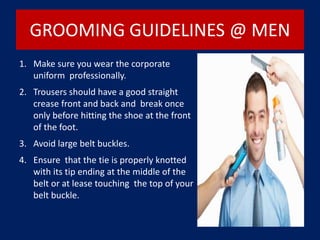
GROOMING GUIDELINES @ MEN
1. Make sure you wear the corporate
uniform professionally.
2. Trousers should have a good straight
crease front and back and break once
only before hitting the shoe at the front
of the foot.
3. Avoid large belt buckles.
4. Ensure that the tie is properly knotted
with its tip ending at the middle of the
belt or at lease touching the top of your
belt buckle.
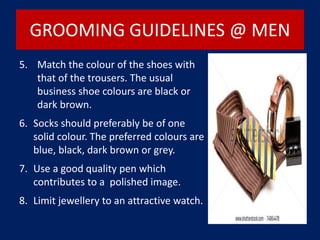
GROOMING GUIDELINES @ MEN
5. Match the colour of the shoes with
that of the trousers. The usual
business shoe colours are black or
dark brown.
6. Socks should preferably be of one
solid colour. The preferred colours are
blue, black, dark brown or grey.
7. Use a good quality pen which
contributes to a polished image.
8. Limit jewellery to an attractive watch.
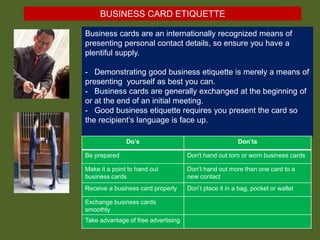
BUSINESS CARD ETIQUETTE
Business cards are an internationally recognized means of
presenting personal contact details, so ensure you have a
plentiful supply.
- Demonstrating good business etiquette is merely a means of
presenting yourself as best you can.
- Business cards are generally exchanged at the beginning of
or at the end of an initial meeting.
- Good business etiquette requires you present the card so
the recipient’s language is face up.
Do’s Don’ts
Be prepared Don't hand out torn or worn business cards
Make it a point to hand out
business cards
Don’t hand out more than one card to a
new contact
Receive a business card properly Don’t place it in a bag, pocket or wallet
Exchange business cards
smoothly
Take advantage of free advertising
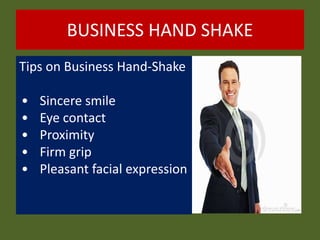
BUSINESS HAND SHAKE
Tips on Business Hand-Shake
• Sincere smile
• Eye contact
• Proximity
• Firm grip
• Pleasant facial expression
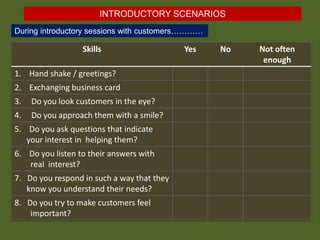
INTRODUCTORY SCENARIOS
Skills Yes No Not often
enough
1. Hand shake / greetings?
2. Exchanging business card
3. Do you look customers in the eye?
4. Do you approach them with a smile?
5. Do you ask questions that indicate
your interest in helping them?
6. Do you listen to their answers with
real interest?
7. Do you respond in such a way that they
know you understand their needs?
8. Do you try to make customers feel
important?
During introductory sessions with customers…………
THANK YOU
WINNING DOESN’T ALWAYS MEAN
BEING FIRST – WINNING MEANS YOU’RE
DOING BETTER THAN YOU’VE DONE
BEFORE
SUCCESS MEANS – KNOWING MORE
THAN THE OTHERS, WORKING MORE
THAN THE OTHERS & EXPECTING LESS
THAN THE OTHERS

Impactful Communication & Interpersonal Skills

  • 1.
  • 2.
    LEARNING OBJECTIVES • Describethe importance of communication and interpersonal skills. • Learn how to use communication strategies to enhance self-esteem in your workplace and how to motivate co-workers to take on new challenges, to strive to manage effectively and to reach corporate goals.
  • 3.
    LEARNING OBJECTIVES • Acquirethe skills on how to ask the right questions to gather information and to check whether your message has been understood. • Create a win-win situation by applying human relationship principles when dealing with prospects and potential customers.
  • 4.
    IMPROMPTU PRESENTATION Making yourshort 2 minutes presentation about yourself.
  • 5.
    • Aim/purpose & context •Planning & preparation • Delivery • Overcoming nerves GIVING PRESENTATIONS
  • 6.
    PURPOSE & CONTEXT •To inform, train, persuade, entertain, sell or demonstrate? • Who is the audience?
  • 7.
    PURPOSE & CONTEXT •How much time do you have? • Where is the venue? • Formal or informal?
  • 8.
    PLANNING & PREPARATION •Relevance to aim and audience! • Gather material relevant to message • Key points only!
  • 9.
    PLANNING & PREPARATION Structurethe material • Intro = catch attention • Middle = logical, chunks • End = summarize main points
  • 10.
    PLANNING & PREPARATION •Use of notes • Use of visual aids – KISS! • Rehearse
  • 11.
    DELIVERY • Check room,time, equipment • Awareness of self – voice, body language, confidence • Dealing with questions
  • 12.
    PRESENTATION TIPS • Beaware of verbal language • Be aware of non-verbal language – Eye contact – Hands/gestures – Posture – Face audience – Clothes
  • 13.
    OVERCOMING NERVES • Reasonsfor feeling nervous: – Lack of experience – Lack of preparation – Lack of enthusiasm – Negative self-talk
  • 14.
    MODULE 1 THE POWEROF COMMUNICATION
  • 15.
    COMMUNICATIONS • Occurs betweentwo or more people • A process of sending , receiving and understanding message
  • 16.
    COMMUNICATON BARRIERS • Environmentnoise • Difference in language & cultural background • Poor listening skills • Poor personal hygiene
  • 17.
  • 18.
    FACTORS AFFECTING INTERPERSONAL COMMUNICATION@ WORK 1. Personal appearance 2. Language 3. Noise 4. Overload 5. Emotion 6. Gaps 7. Inconsistency
  • 19.
    WHY INTERPERSONAL COMMUNICATONS ? •Necessary for relating and working with others
  • 20.
    WHY INTERPERSONAL COMMUNICATONS ? •Effective communication skills –listening and expressing
  • 21.
    WHY INTERPERSONAL COMMUNICATONS ? •Ability to give and receive feedback
  • 22.
    WHY INTERPERSONAL COMMUNICATONS ? •Being able to work well in teams or groups
  • 23.
  • 24.
  • 25.
  • 26.
    MODULE 2 SEEK TOUNDERSTAND AND ASK THE RIGHT QUESTIONS
  • 27.
    HEARING VS. LISTENING “WasI paying attention?”
  • 28.
    HEARING Hearing is simplythe act of perceiving sound by the ear.
  • 29.
    LISTENING Listening, however, is somethingyou consciously choose to do.
  • 30.
    LISTENING Listening requires concentration sothat your brain processes meaning from words and sentences.
  • 31.
  • 32.
    THE ROLE OFYOUR PEOPLE SKILLS Your Knowledge 15% Your People Skills 85% It is estimated that 15% of your success comes from your skills & knowledge while 85% comes from your ability to connect with other people and gain their trust and respect
  • 33.
  • 34.
    BARRIERS TO ACTIVELISTENING • We ‘know’ what we are going to hear • We judge delivery (how they say it), not content (what they say)
  • 35.
    • We areseeking confirmation not information • What’s being said is getting in the way of what needs to be said BARRIERS TO ACTIVE LISTENING
  • 36.
    EFFECTIVE LISTENING TECHNIQUES •Have an open mind • Face the speaker • Noting and reflecting emotions • Be patient • Listen for the whole message
  • 37.
    EFFECTIVE LISTENING TECHNIQUES •Be curious • Listen also with your eyes • Be attentive but relaxed • Paraphrasing • Summarizing
  • 38.
  • 39.
    LEVELS OF LISTENING IGNORING Activelydeciding not to be attentive.
  • 40.
    LEVELS OF LISTENING PRETENDING Activelydeciding not to be attentive, but acting as if you are.
  • 41.
    LEVELS OF LISTENING SELECTIVE Tuningin for key words or phrases that are of interest to you, in order to respond
  • 42.
    LEVELS OF LISTENING EMPHATIC Appreciatingthe other person’s frame of reference. It is not necessarily agreeing with their position, but it is acknowledging that they do have an opinion.
  • 43.
    YOUR SCORE A =B = C = Mostly A’s – You are a visual communicator Mostly B’s – You are an auditory communicator Mostly C’s – You are a kinesthetic communicator
  • 44.
    THE VISUALS –“SEE” THE WORLD • Think by making pictures in their mind • Able to understand something better if they see it • Appearance is very important
  • 45.
    THE AUDITORIES –‘HEAR” THE WORLD • Think by analyzing sound • Get more information from how you say things than from what you are saying • Love to hear themselves and others talk
  • 46.
    THE KINETHETICS –“FEEL” THE WORLD • Act on what they feel • Get more information from touch, emotions and gut feeling • Love to touch people and things
  • 47.
  • 48.
    RULES IN CONVEYINGMESSAGE 1. Get ready 2. The receiver is ready 3. Eye contact 4. Right words 5. Show what you mean – with non- verbal cues.
  • 49.
    RULES IN CONVEYINGMESSAGE 6. Repeat important message 7. Use the right channel 8. Avoid interruptions 9. Give chances to ask questions 10.Follow-up – check with the receivers.
  • 50.
  • 51.
    FACE TO FACECOMMUNICATION Body Language, 50% Tone of Voice, 40% Words, 10%
  • 52.
    DELIGHTING CUSTOMER’S THROUGH“WOW” EXPERIENCE Meeting customer “Needs” but does not meet customer “Wants” Exceeding customer “Needs” and meeting customer “Wants” Exceeding customer “Needs” and “Wants” OK Satisfied Delighted (Wow) SKILL NO.1: UNDERSTANDING CLIENT’S NEEDS, WANTS & DESIRES
  • 53.
    Appearance: Your body language,clothing attire and overall posture. Personality: Your behavior, communication skills and attitudes toward people. Competencies: Your special skills fulfilling task requirements. Differentiation: What separates you from others and leaves a lasting memory in the minds of others. 1. In just a few seconds and with a brief glance, a customer will evaluate who you are based upon your appearance and personality. 2. Give the impression that you are competent, knowledgeable and professional SKILL NO.2: CREATING A POSITIVE IMAGE WITH CLIENTS
  • 54.
    S Say outgreeting & name A Ask questions L Letting our sincere praise A Acknowledge M Make Advice / Make way ~ SALAM MESRA ~ HOW TO MAKE A PROPER INTRODUCTION SKILL NO. 3 : HANDLING CLIENTS FACE-TO-FACE
  • 55.
    ~ SALAM MESRA~ M Making eye-contact E Express feeling through “facial expressions” S Smile, Shake hand R Reduce your distance A Acknowledge through nodding HOW TO MAKE A PROPER INTRODUCTION
  • 56.
    STEP 1: PUTTINGYOUR BEST EAR FORWARD a) Listen to the customer’s opening statement b) Write down or input key points c) Listen without interrupting d) Show the customer you are helping your full attention STEP 2: SAYING HELLO - THE OPENER a) Answer by the third ring b) Give the name of your business, your name and an opening statement or question c) Sound enthusiastic and be ready to help d) Work on relationship building from the beginning of the contact. STEP 3: BETWEEN HELLO & GOODBYE - HELPING THE CUSTOMER a) Assure the customer you can help b) Summarize the customer’s opening statement c) Verbalize what you are doing d) Put your personal touch into the contact e) Before a lengthy pause, tell the customer what is happening f) When putting customers on hold, explain why. STEP 4: SAYING GOODBYE - THE CLOSER a) Recap what you are going to do b) Gain the customer’s acceptance and confidence c) Ask if you can help with anything else d) Give your name again e) Thank the customer for calling your company SKILL NO. 4:- HANDLING CLIENTS THROUGH THE PHONE
  • 57.
    MODULE 4 BUILDING SELF CONFIDENCEFOR CORPORATE PROFESIONALISM
  • 58.
    TYPES INTROVERT EXTROVERT Facts COMPLIANCE (Analytical) Thiscustomer likes to know all the details before making a decision Accuracy is important to them. DOMINANCE (Controller) This customer likes to know the key points and then get on with making the decision and taking action. Results are important to them. Feelings INFLUENCE (Supporter) This customer likes to get to know the people involved before making decisions. Good relationships are important to them. STEADINESS (Enthusiast) This customer likes the excitement of new possibilities and makes quick, confident decisions based on the overall feel of the situation. UNDERSTANDING YOUR CLIENTS’ PERSONALITIES KNOWING YOUR CLIENTS PERSONALITY
  • 59.
    GROUP DISCUSSION Discuss amongyour team members on how to handle the following customers: DOMINANCE INFLUENCE STEADINESS COMPLIANCE
  • 60.
    SUGGESTED SOLUTIONS DOMINANT • Fast& competent • Work discipline INFLUENCE • Establish relationship STEADINESS • Allow time for decision& provide support COMPLIANCE • Requires fact & figures • Needs time to decide to avoid risk
  • 61.
    1. Handle theperson first then the problem 2. Apologize 3. Show empathy 4. Find solution 5. Make recovery process 6. Offer compensation (depends on the situation) 7. Follow up HUMAN SKILLS AND COURTESY IN HANDLING COMPLAINTS
  • 62.
    DEVELOPING A PERSONAL PROFESSIONALIMAGE 1. Dress to suit the office environment 2. Ensure that your clothes are comfortable to wear and made of good quality fabric. 3. Never wear clothes that are too tight for they make a thin person look skinny and a large person look twice as heavy. 4. Avoid trendy styles. 5. Your hairstyle should complement the shape and features of your face. Ensure hair is well-combed and dandruff-free.
  • 63.
    DEVELOPING A PERSONAL PROFESSIONALIMAGE 6. Avoid sneakers, sports shoes and jeans 7. Avoid using a strong perfume 8. Shoes should be clean, polished and free of scuff marks. 9. Fingernails should be trimmed and clean. 10. No visible tattoos to avoid distraction.
  • 64.
    GROOMING GUIDELINES @MEN 1. Make sure you wear the corporate uniform professionally. 2. Trousers should have a good straight crease front and back and break once only before hitting the shoe at the front of the foot. 3. Avoid large belt buckles. 4. Ensure that the tie is properly knotted with its tip ending at the middle of the belt or at lease touching the top of your belt buckle.
  • 65.
    GROOMING GUIDELINES @MEN 5. Match the colour of the shoes with that of the trousers. The usual business shoe colours are black or dark brown. 6. Socks should preferably be of one solid colour. The preferred colours are blue, black, dark brown or grey. 7. Use a good quality pen which contributes to a polished image. 8. Limit jewellery to an attractive watch.
  • 66.
    BUSINESS CARD ETIQUETTE Businesscards are an internationally recognized means of presenting personal contact details, so ensure you have a plentiful supply. - Demonstrating good business etiquette is merely a means of presenting yourself as best you can. - Business cards are generally exchanged at the beginning of or at the end of an initial meeting. - Good business etiquette requires you present the card so the recipient’s language is face up. Do’s Don’ts Be prepared Don't hand out torn or worn business cards Make it a point to hand out business cards Don’t hand out more than one card to a new contact Receive a business card properly Don’t place it in a bag, pocket or wallet Exchange business cards smoothly Take advantage of free advertising
  • 67.
    BUSINESS HAND SHAKE Tipson Business Hand-Shake • Sincere smile • Eye contact • Proximity • Firm grip • Pleasant facial expression
  • 68.
    INTRODUCTORY SCENARIOS Skills YesNo Not often enough 1. Hand shake / greetings? 2. Exchanging business card 3. Do you look customers in the eye? 4. Do you approach them with a smile? 5. Do you ask questions that indicate your interest in helping them? 6. Do you listen to their answers with real interest? 7. Do you respond in such a way that they know you understand their needs? 8. Do you try to make customers feel important? During introductory sessions with customers…………
  • 69.
    THANK YOU WINNING DOESN’TALWAYS MEAN BEING FIRST – WINNING MEANS YOU’RE DOING BETTER THAN YOU’VE DONE BEFORE SUCCESS MEANS – KNOWING MORE THAN THE OTHERS, WORKING MORE THAN THE OTHERS & EXPECTING LESS THAN THE OTHERS