CONTENT OF Training
QP Code: MEP/Q2702
Communications
Soft skills
.
(BETTER PLUMBING FOR BETTER LIVING)
Module 2
 Communicate with in the team.
 Communicate outside the team.
 Plan and prepare.
 Comprehend Worker manual.
 Skills in the team members.
 Understand responsibility for work.
 Working in a team.
Module 2
 Report structure and workflow management.
Work process communication and reporting of
disruptions.
 Understand the role in team.
 Quality and delivery standards.
 Dress codes.
 How to collaborate with Seniors to establish Goals.
 Producing self-realistic sales goals for the
Company.
Maximization of sales revenues through
management of an assigned geographic sales area
or product line.
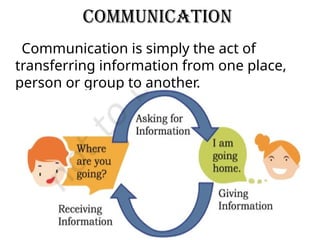
Communication
Communication is simply the act of
transferring information from one place,
person or group to another.
Communication Skills
 Communication and its importance.
 Critical elements of the communication
process.
 Barriers to communication.
 Types of communication.
 Communication as a process.
 Listening Skills.
Importance of communication
 Communication helps us to:
 grow
 learn
 explore
 be aware of ourselves and around.
 adjust to our environment.
 know others.
 Improve relationships.
Forms of communication
spoken or verbal communication
which includes face-to-face, telephone,
radio or television and other media.
Non-Verbal Communication
covering body language, gestures, how
we dress or act, where we stand, and
even our scent.
Forms of communication
Written Communication
which includes letters, e-mails, social
media, books, magazines, the Internet
and other media.
Visualizations
graphs and charts, maps, logos and
other visualizations can all
communicate messages
Non-Verbal communication
Non-verbal communication is the
message we send to others without
using any words.
We send signals and messages to
others, through expressions, gestures
and body postures.
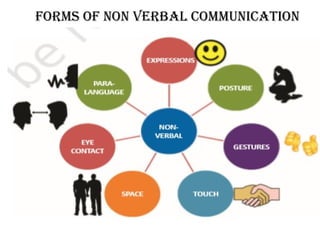
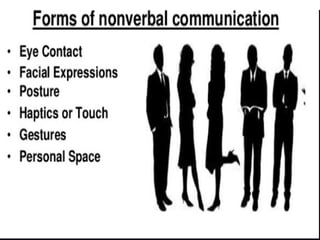
Forms of Non verbal Communication
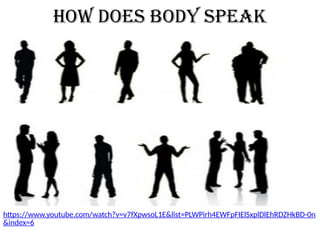
How does Body Speak
https://www.youtube.com/watch?v=v7fXpwsoL1E&list=PLWPirh4EWFpFIElSxplDlEhRDZHkBD-0n
&index=6
Head Position
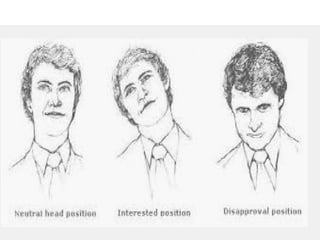
Neutral Position
The first is with the head up and is the position
taken by the person who has a neutral attitude
about what he is hearing.
Disapproval Position
When the head is down, it signals that the
attitude is negative and even judgmental.
Critical evaluation clusters are normally made
with the head down and, unless you can get the
person’s head up or tilted, you may have a
communication problem.
Head Position
Interested Position
When the head tilts to one side it shows
that interest has developed. Charles
Darwin was one of the first to note that
humans, as well as animals, tilt their
heads to one side when they become
interested in something. If you are giving
a sales presentation or delivering a
speech, always make a point of looking
for this gesture among your audience.
Interested Position
When you see them tilt their heads and
lean forward using hand-to-chin
evaluation gestures, you are getting the
point across. Women use this head
position to show interest in an attractive
male.
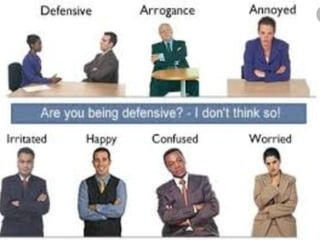
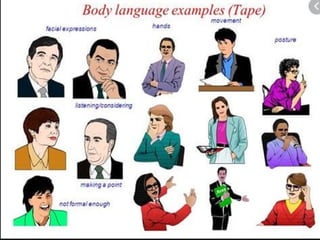
Body language
Body language refers to the nonverbal
signals that we use to communicate.
According to experts, these nonverbal
signals make up a huge part of daily
communication. From our facial
expressions to our body movements,
the things we don't say can still convey
volumes of information.
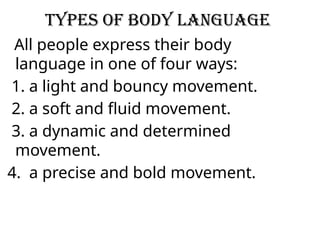
Types of body language
All people express their body
language in one of four ways:
1. a light and bouncy movement.
2. a soft and fluid movement.
3. a dynamic and determined
movement.
4. a precise and bold movement.
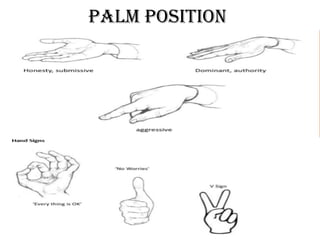
Palm Position
Expressive Skills
These are the simplest skills. You can use them
to convey to another person the information to
which you have access. You do this in three
stages.
 first you get the other person's attention.
 then you convey the information to him/her.
 Then you check his/her understanding.
 The other person is more likely to understand it
if you convey it specifically, and not defensively.
It helps to avoid blaming, criticizing,
interpreting, or making demands on the other
person.
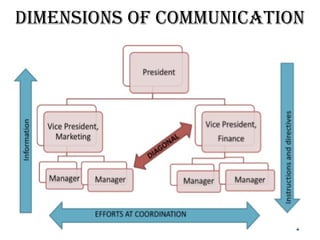
Dimensions of Communication
Types of communication (D)
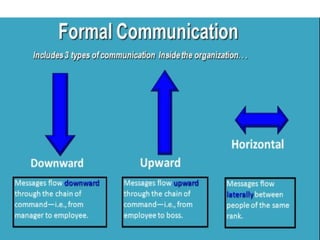
VERTICAL Communication
• Upward
Mostly information sharing from to subordinates to
the bosses. Its purpose is to let the bosses know
what is happening at the lower levels. E.g.: requests,
reports, proposals and feedbacks in the form of
suggestions/recommendations.
• Downward
It is a flow of instructions, orders and directives from
superior to subordinates. It is to tell the
subordinates that this is what they should be doing.
E.g.: Feedback on past performance, memorandums,
policy statements and procedures.
Types of communication (D)
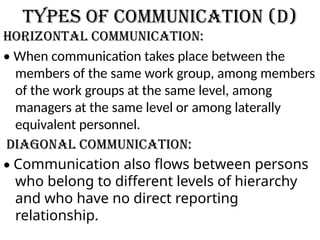
HORIZONTAL Communication:
• When communication takes place between the
members of the same work group, among members
of the work groups at the same level, among
managers at the same level or among laterally
equivalent personnel.
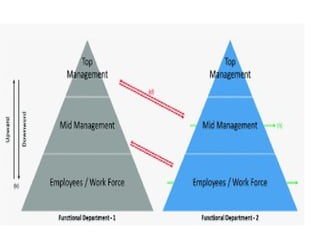
DIAGONAL Communication:
• Communication also flows between persons
who belong to different levels of hierarchy
and who have no direct reporting
relationship.
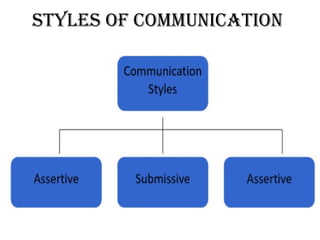
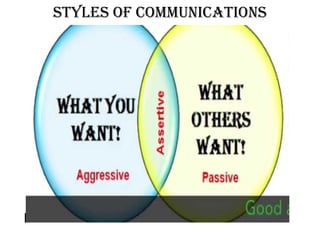
Styles of Communication
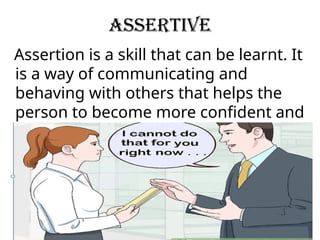
assertive
Assertion is a skill that can be learnt. It
is a way of communicating and
behaving with others that helps the
person to become more confident and
aware of themselves.
Styles of communications
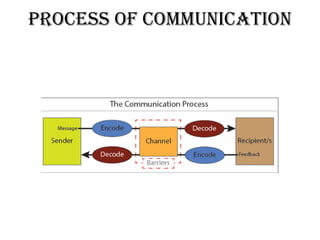
Process of communication
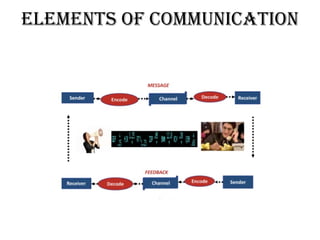
Elements of Communication
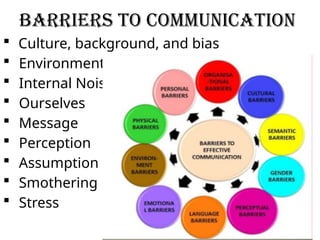
Barriers to Communication
 Culture, background, and bias
 Environmental
 Internal Noise
 Ourselves
 Message
 Perception
 Assumption
 Smothering
 Stress
How to overcome barriers
 Audience-centered approach
Communication always starts from the
other end. Communication is not for
‘ME’, it is for ‘YOU’. Always customize
your communication.
 Open communication
be open to giving and receiving
feedbacks. Be open to giving
information when required.
How to overcome barriers
 Lean, efficient message
A message in simple and precise words
is better understood.
 Be nonjudgmental
empty your mind of preconceived
notions. Don’t jump to conclusions.
 Focus on message and not the person
focus more on what is being said rather
than who is saying it.
Barriers to Accurate Perception
Stereotyping and generalizing
Be careful not to hold on to
preconceptions about people or things.
Not investing time
Making assumptions and ignoring details
or circumstances can lead to
misconceptions.
Having a distorted focus
Focusing on the negative aspects of a
conversation or a situation is a habit
common to many people.
Effective Communication
Articulation
The ability to piece and construct your
ideas in a lucid and simple manner. As they
say the power of “gab” (Smooth Talker).
Expressive Skills
The ability to express yourself without any
fetters or inhibitions to express your
opinion in a forthright manner with the
courage of conviction.
Effective Communication
Comprehension Skills
The ability to grasp the essence of a situation
leaving out the unimportant details. This skill is
important for you to understand an issue or a
situation.
Listening Skills
Perhaps the most important skill required to be an
effective communicator as you can speak as much
as you might want but if the recipient is not
listening, it’s a waste of time, effort, and energy for
you. We are going to delve a little deeper to
unravel all dimensions of the listening skills.
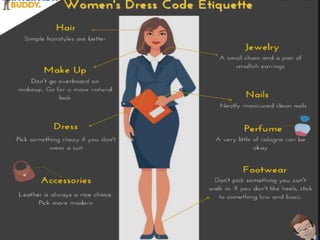
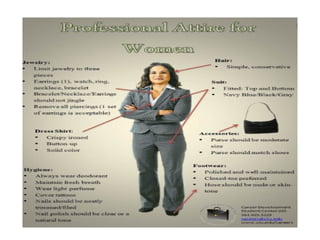
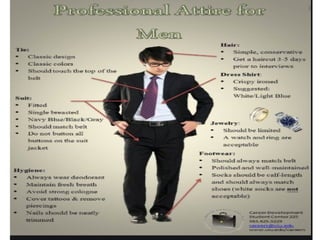
Dress code etiquette
A set of rules specifying the garb or type
of clothing to be worn by a group or by people
under specific circumstances: a military dress code;
The restaurant's dress code requires men
to wear jackets and ties at dinner.
the most important advantages
1) A dress code promotes a more serious at working
atmosphere which emphasizes profesionalism and
promotes good behavior.
2) Dress codes have proven to increase persons
achievement by encouraging students to
concentrate more on their profession and less on
their wardrobe.
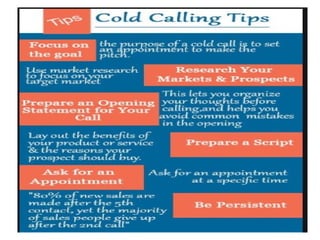
Telephone Etiquette
Ability to effectively communicate on
telephone with accuracy, briefness and
clarity while projecting courtesy, confidence
and enthusiasm in your voice.
Benefits
 Helps in confidently handling customers.
 Ensures speed and ease in accomplishing
tasks.
 Results in target achievement .
 Enables Spectacular Service.
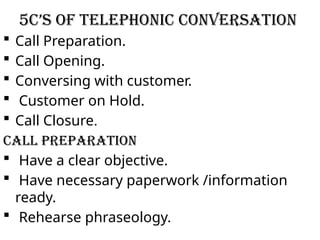
5C’s of Telephonic Conversation
 Call Preparation.
 Call Opening.
 Conversing with customer.
 Customer on Hold.
 Call Closure.
Call Preparation
 Have a clear objective.
 Have necessary paperwork /information
ready.
 Rehearse phraseology.
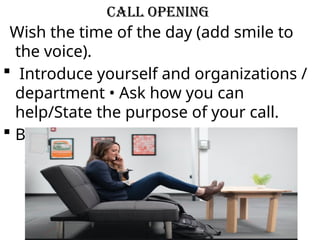
Call Opening
Wish the time of the day (add smile to
the voice).
 Introduce yourself and organizations /
department • Ask how you can
help/State the purpose of your call.
 Be polite and don't sound hasty .
Conversing with Customer
Be genuinely polite and respectful in
your tone.
 Say “Please” and "Thank you" when
appropriate,
 Give the person you are talking to your
full attention.
 Sound interested.
 Sound clear and concise.
 Listen attentively and give verbal nods
• Do not rush the caller.
Conversing with Customer
 Be genuinely polite and respectful in
your tone.
 Say “Please” and "Thank you" when
appropriate.
 Give the person you are talking to your
full attention.
 Sound interested.
 Sound clear and concise.
 Listen attentively and give verbal nods.
Customer on Hold
 Seek Permission.
 Specify the duration.
 Explain the reason.
 Wait for customer’s response.
 Get back to the customer in the
committed time frame.
Call Closure
 Thank the customer.
 Wish customer a great day and bid
good-bye with a smile in the voice.
 Don't sound rushed.
 Keep a pleasant tone.
Verbal and Behavioral Signals
You need to look for buying signals including:
Verbal Signals
1. Questions.
2. Enquiries.
3. Comments/Indirect feedback.
Behavioral Signals
4. Facial Expressions and body language.
5. Reactions.
3. Actions in response to what you said.
Interaction with senior
How To Report Status On A Project
The Management Perspective
If your project is significant, your boss will be
pressed hard to keep his superiors informed of its
growth.
Smart managers consume status on significant
projects insatiably. Excellent status reporting
means
that managers are fully informed of your projects
health and overall way deprived of having to get
involved themselves.
Interaction with senior
There is specific information your boss
needs in order to show her boss that
she is on top of things and able to run
the show efficiently. Provide this
information in a way your boss can
consume it on a regular basis, and you
will fall upstairs so fast your head will
spin.
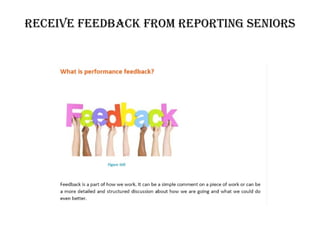
Receive feedback from reporting seniors
Expressive Skills
These are the simplest skills. You can use them
to convey to another person the information to
which you have access. You do this in three
stages.
 first you get the other person's attention;
 then you convey the information to him/her;
 Then you check his/her understanding.
Information about your intentions needs to be
handled with some care. It may otherwise be
taken as a threat. Rather than learn this as a
formula, you find your own words, and
experiment with different ways of saying it.
Listening Skills
Listening skills are in most respects a little
harder to hone than expressive skills.
Because they depend upon foundation of
emotional skills. It is hard to place
yourself completely at the disposal of
other person when you are under threat.
Yet this is what good listening requires. It
is listening for understanding, not
listening for ammunition (a different
listening style), and not mentally
rehearsing your next statement.
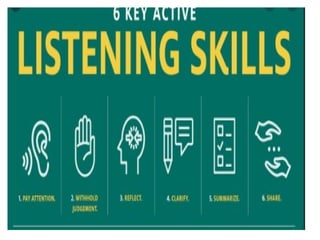
Listening Skills
Another reason for the difficulty is that
there are more components to listening
than to speaking. After you have given
the other person your attention, there
are still three or four different things for
you to do.
Listening Skills
Listen
Give the other person your undivided
attention as you try to understand what
the problem is like for his/her.
Acknowledge
Let the other person know just what you
have understood his/her to imply verbally
and non-verbally: the whole message.
Make clear that this is just your
interpretation.
Listening Skills
Check
Make sure that you understand him/her, by
making it as easy as possible for him/her to
amend or add to your understanding.
Enquire
Ask the questions that will help the other
person to change his/her first answer (which
probably avoids the issue, or blames, or
demands) into one which gives specific
information about what you have done or said,
or about what she wants you to say or do.
Soft skills
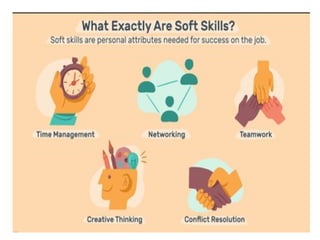
 Soft Skills are the set of skills that a
person should possess in order to face
life's daily challenges successfully and
to positively adapt to it. This would
build the self confidence in an
individual to handle life challenges in a
more effective manner.
 Soft skills are the behaviors and
characteristics that people demonstrate
unconsciously and routinely.
Soft skills
 Soft skills are learned through practice
and experience.
 Soft skills will take you higher in your
profession while giving you the
technical skills to provide an efficient
service.
Soft Skills
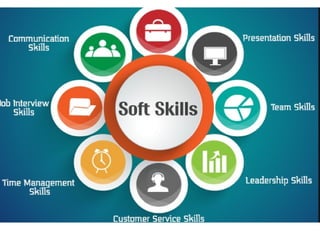
 Understanding oneself.
 Innovative thinking.
 Problem management.
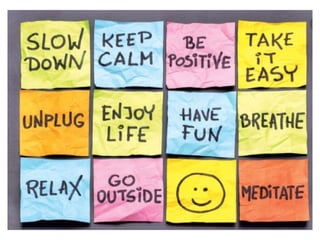
 Stress and emotional management.
 Leadership.
 Team work.
 Communication.
The Importance of Soft Skills
 To build and maintain interpersonal
relationships.
 To make meaningful/appropriate
decisions.
 Efficient Communication.
 To influence the professional development.
 For effective, efficient and higher
performance.
Soft Skills.
Understanding Oneself
This topic will create an opportunity to
identify a person’s skills, aspirations,
qualities and personality traits.
ACTIVITY 1
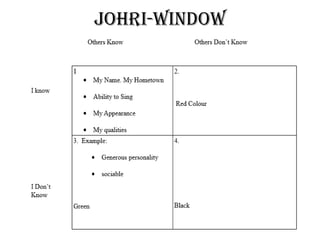
Provide each participant with a model
copy of a Johari window that is prepared
according to the model paper number 1
Now, in square number 1 note down the
things that you and others know well
about yourself.
Understanding Oneself
In square number 2 write down the things
that you think others think of you but you do
not know. You can fill in this box by making
an open invitation to the others.
Square number 3 should be filled by facts
that you and only yourself knows about you.
These should be secret to others.
Square number 4 is the dark box. You
should fill in it with facts that neither you nor
others know about you.
Johri-window
Innovative Thinking
In order to successfully overcome life's challenges
and obstacles, one should free himself of the
traditional ways of thinking and adopt a new and
creative way of thinking. Employing such novel
methods would help a person to reach ones
goals in a unique manner with minimum effort.
To enhance creativity while departing from
traditional thinking, some activities can be done.
Activity -2
In a board that is visible to all participants, mark
9 dots. Instruct them to cut the 9 dots using 4
lines.
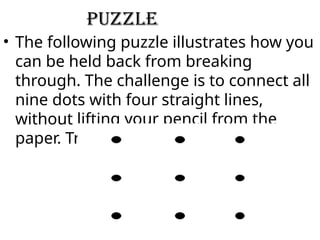
puzzle
• The following puzzle illustrates how you
can be held back from breaking
through. The challenge is to connect all
nine dots with four straight lines,
without lifting your pencil from the
paper. Try it!
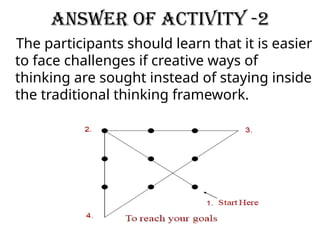
Answer of activity -2
The participants should learn that it is easier
to face challenges if creative ways of
thinking are sought instead of staying inside
the traditional thinking framework.
PROBLEM MANANGEMENT
Facing problems are part and parcel of
our daily life. But there are instances
where people have attempted suicide
due to their inability to handle
problems successfully. Therefore it has
become vital to learn the skill of
problem management as a soft skill.
Activity -3
One day a banana seller crossed a 50m
river and arrived at an island to get
bananas for his business. Next he came to
the bank of the river with 2 bunches of
bananas of 50 bananas each. The banana
seller asked the boatman to transport the
2 bunches of bananas to the other side of
the river. The boatman says that the
transport fee to take one bunch of
banana for 01 meter is 01 banana. The
seller agrees to this condition.
Activity -3
The seller does not violate the contract
but also saves some bananas for
himself.
• Question: 1. How many bananas are left
to the seller after crossing the river?
• 2. How many bananas are left, if any?
• 3. Explain the way by which the
transport fee is paid to the boatman?
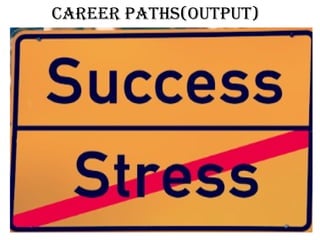
Career paths(output)
STRESS AND EMOTIONAL MANAGEMENT
 Solve a problem in its early stages
rather than letting the problem worsen.
 To only have realistic hopes. That is
living with achievable, feasible targets
rather than impossible dreams.
 Engage in activities that you enjoy
outside of work. Start a new hobby and
maintain it.
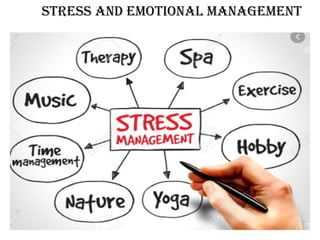
STRESS AND EMOTIONAL MANAGEMENT
 Practice a relaxing exercise daily even
for a short while Exercise regularly.
 Share your problems or worries with
your spouse or trustworthy friends.
 Discuss your life plans Create a good
plan.
 Manage your time accordingly.
STRESS AND EMOTIONAL MANAGEMENT
• Take a small break from every two
hours of work.
• Get enough sleep.
• Check if the food that you consume is
healthy enough. If it’s not, get used to a
healthy eating pattern.
• Get a full medical checkup annually.
• Drink the required amount of water
daily.
STRESS AND EMOTIONAL MANAGEMENT
• Make it a habit to drink water.
• Walk in way that the entire sole of the
foot touches the floor.
• Get rid of the thoughts that make you
think that things should only happen in
a particular way and in that way only.
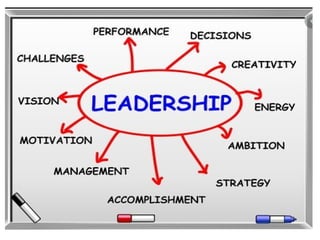
LEADERSHIP
A leader can be identified as a person who motivates
and guides the people who are striving to achieve a
common goal in the family, society or workplace.
Understanding Leadership
What qualities do you see in the following leaders?
 Nelson Mandela Adolf Hitler
 Marting Luther king Mahatama Gandhi
 West India leader Siyatel
 https://www.youtube.com/watch?v=etE1rFUURhQ
1.All Aboard
Participants are required to build a
“boat” using pieces of wood, mats, or
any other materials available, and then
all must stand on the “boat” at once. As
pieces of the “boat” are removed the
team must endeavour to occupy the
ever diminishing space as best they
can. This activity helps to encourage
communication, problem solving and
critical thinking.
2.Minefield
The participants are asked to blindfold
one team member and then create a
‘minefield’ of obstacles to negotiate
around or over. Using only specified
communication techniques, for
example only being able to use the
words left, right, forward, and
backwards, the other participants must
guide the blindfolded person through
the ‘minefield’.
2.Minefield
• This activity can be set in an elaborate
outdoors environment or simplified in a
regular office space; it is great for
enhancing communication skills and
building trust.
3.Round Tables
This activity requires four tables, each
set up with a different task. The tasks
have to have separate steps that can be
delegated among participants. A team
leader is selected, who can only
communicate and delegate tasks. Each
table is timed to see how long it takes
to complete the task. This is an activity
that helps develop leadership and
delegation skills.
TEAMING UP
. It’s important to understand what a team is
 Engage in a discussion with the trainees
about the feature of a team.
 List down the discussed features based on
their preference.
 Compare the following definitions with the
features brought forward by the trainees.
 Common Goal.
 The importance of each team members
contribution to achieve a common goal.
 Interaction between team members.
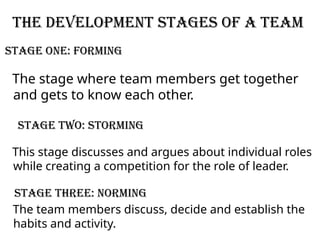
The Development Stages of a Team
Stage One: Forming
The stage where team members get together
and gets to know each other.
Stage Two: Storming
This stage discusses and argues about individual roles
while creating a competition for the role of leader.
Stage Three: Norming
The team members discuss, decide and establish the
habits and activity.
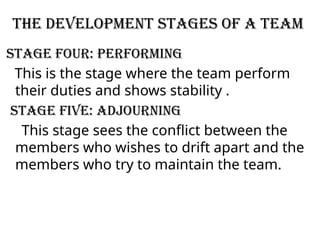
The Development Stages of a Team
Stage Four: Performing
This is the stage where the team perform
their duties and shows stability .
Stage Five: Adjourning
This stage sees the conflict between the
members who wishes to drift apart and the
members who try to maintain the team.
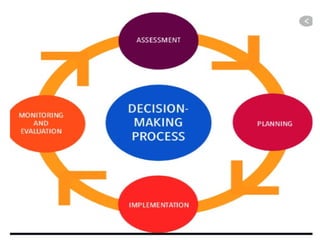
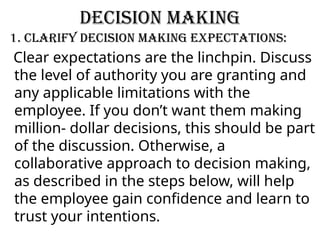
Decision making
1. Clarify decision making expectations:
Clear expectations are the linchpin. Discuss
the level of authority you are granting and
any applicable limitations with the
employee. If you don’t want them making
million- dollar decisions, this should be part
of the discussion. Otherwise, a
collaborative approach to decision making,
as described in the steps below, will help
the employee gain confidence and learn to
trust your intentions.
2. Help the employee understand the factors
important to the decision:
Every decision is governed by
objectives, priorities and limitations.
When people are reluctant to make a
decision, it is often because they are
unclear about these factors. They don’t
want to make a decision, nor do you
want them to make a decision, until
they understand:
3. Generate and evaluate alternatives
together
Decision making is a matter of
choosing among alternatives. The
ability to identify reasonable
alternatives depends on knowledge,
experience and creativity .
4. Ensure the discipline and expertise
needed to assess potential risks
A skilled decision maker will not rush
forward without first considering the
downside of the best alternatives.
Surely you can think of a time when you
“didn’t stop to think,” “didn’t stop to ask
someone from that department,” or
were dumbfounded by the decision of
someone else, “what was he thinking?”
5. Support the risk-taking needed to
make decisions
If you have developed employee
knowledge and decision making skill by
following all of the steps above and still
see a reluctance to make decisions,
examine your own behavior and the
way you react when things don’t work
out the way you would like. Employees
can smell a no win situation from a mile
away. Be sure you aren’t creating a no-
win environment.
Activity -An empty room or hallway
• Blindfolds
• A collection of common office items
• Instructions:
• 1. Place the items (boxes, chairs, water
bottles, bags, etc.) around the room so
there's no clear path from one end of
the room to the other.
• 2. Divide your team into pairs and
blindfold one person on the team.
Activity -An empty room or hallway
• 3. The other must verbally guide that
person from one end of the room to the
other, avoiding the "mines."
• 4. The partner who is not blindfolded
can't touch the other.
• 5. If you want to make the activity more
challenging, have all the pairs go
simultaneously so teams must find ways
to strategically communicate over each
other.
20 sticks of uncooked spaghetti
1 roll of masking tape
1 yard of string
1 marshmallow
Instructions:
1. The goal of this exercise is to see which
team can use the materials provided to build
the tallest tower within an allotted time period.
The tower must be able to stand on its own.
2. To make this exercise more challenging, try
adding a marshmallow to the top of the tower.
This team problem solving exercise helps
teams think on their toes while building
Activity 2- of decision making and team building
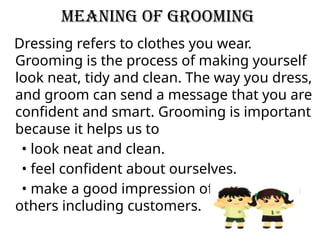
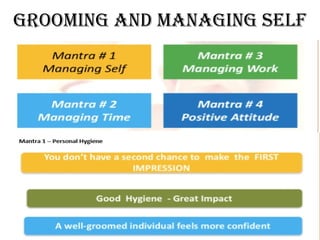
Meaning of grooming
Dressing refers to clothes you wear.
Grooming is the process of making yourself
look neat, tidy and clean. The way you dress,
and groom can send a message that you are
confident and smart. Grooming is important
because it helps us to
• look neat and clean.
• feel confident about ourselves.
• make a good impression of ourselves on
others including customers.
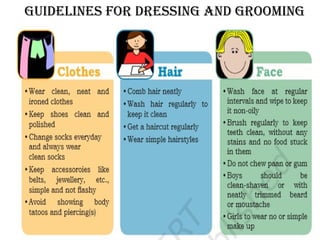
Guidelines for Dressing and Grooming
Grooming and Managing Self
Strength and Weakness Analysis
Being ‘self-aware’ or understanding
‘Who am I?’ means looking outside the
usual characteristics, such as name,
qualifications, the relationship one has
with others. It actually means knowing
our inner strengths, hidden talents,
skills and even weaknesses.
Activity 1 Assignment
• Preparing the interests and abilities
worksheet Material required textbooks,
pen Procedure
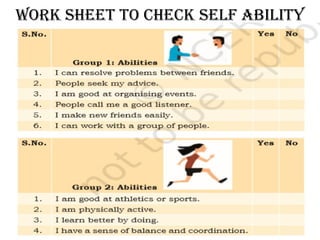
• 1. Each candidates has to complete two
worksheets, each containing a list of
statements. First worksheet is for
interests and the second is for abilities.
Activity 1 Assignment
• 2. Each candidates has to be real and
honest when marking the statements in the
two worksheets as it is for their own
understanding of themselves. If they are
not real and honest, they will get incorrect
results about their own interests and
abilities.
• 3. Based on your interests, think of a career
you would like to have. Now see if you have
the ability to follow this career. This will help
you identify what career is best for you.
Work sheet
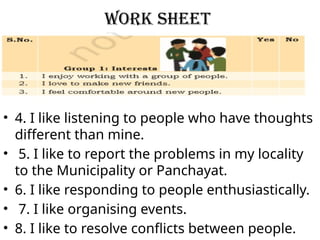
• 4. I like listening to people who have thoughts
different than mine.
• 5. I like to report the problems in my locality
to the Municipality or Panchayat.
• 6. I like responding to people enthusiastically.
• 7. I like organising events.
• 8. I like to resolve conflicts between people.
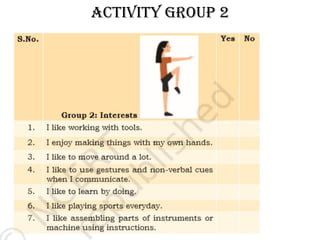
Activity group 2
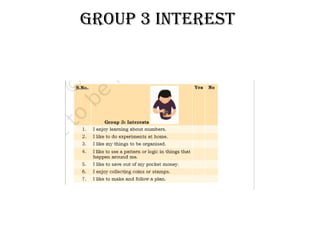
Group 3 interest
Work sheet to check self ability
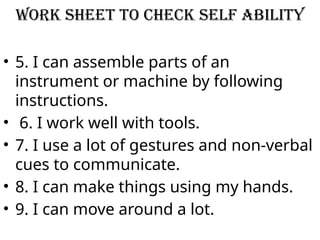
• 5. I can assemble parts of an
instrument or machine by following
instructions.
• 6. I work well with tools.
• 7. I use a lot of gestures and non-verbal
cues to communicate.
• 8. I can make things using my hands.
• 9. I can move around a lot.
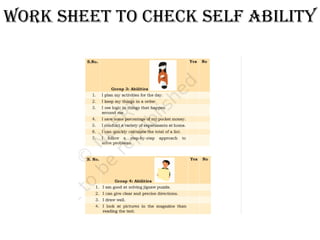
Work sheet to check self ability
Techniques for Identifying Your Strengths and
Weaknesses
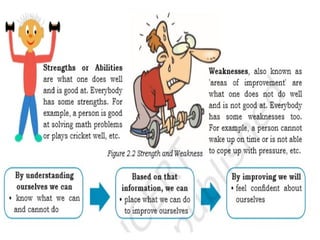
Finding your Strengths
 Take time off to think about what you
do well
 Think of anything that you are always
good at
 Think of what others appreciate about
you.
Finding your Weaknesses
 Point out the areas where you struggle
and what you find difficult to do.
 Look at the feedback you receive about
yourself from others
 Be open to feedback and accept your
weaknesses without feeling bad about
it. Look at it as an area of improvement.
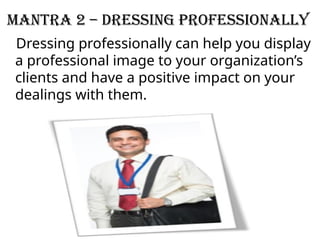
Mantra 2 – Dressing Professionally
Dressing professionally can help you display
a professional image to your organization’s
clients and have a positive impact on your
dealings with them.
Attire – Do’s & Don’ts
 Do not wear too bright colours while
visiting a customer.
 Clothes to be well ironed. No wrinkles
or creases to be seen.
 Avoid causing stains/marks on clothes.
 Use mild detergent to wash the
clothes.
 Shirts to be always tucked in.
Attire – Do’s & Don’ts
 Dark-coloured belts are preferable.
 Dark-coloured shoes and socks to be worn.
 Do not wear loose socks. No portion of leg
to be visible while seated.
 Shoes should be polished and not worn off
at the edges.
Mantra 3 – Managing Time
 Effective time management is about:
 Planning and setting priorities. You will
be able to manage your time more
effectively if you set out a PLAN first.
 Decide what the most important things
to do today are.
 List those important things IN ORDER in
your diary or a sheet of paper.
Mantra 3 – Managing Time
 Work through your list in order. This will
ensure that you tackle the most
important tasks first and don't miss out
on them.
 Avoid using mobile phones- It is a
distraction if your mobile phone keeps
ringing while interacting with the
customer.
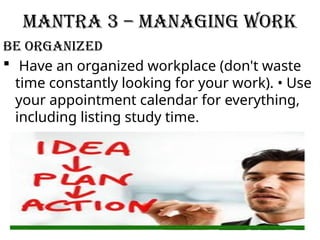
Mantra 3 – Managing Work
Be Organized
 Have an organized workplace (don't waste
time constantly looking for your work). • Use
your appointment calendar for everything,
including listing study time.
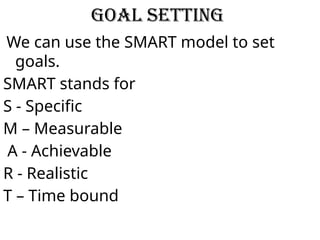
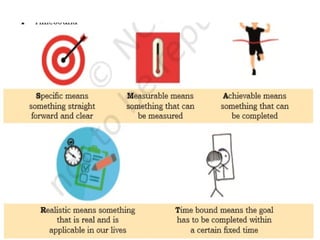
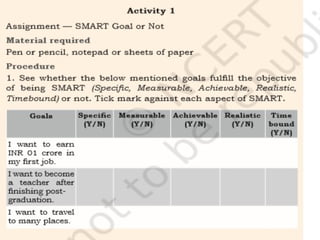
Goal setting
We can use the SMART model to set
goals.
SMART stands for
S - Specific
M – Measurable
A - Achievable
R - Realistic
T – Time bound
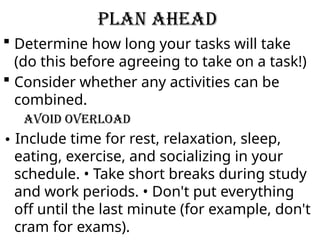
Plan Ahead
 Determine how long your tasks will take
(do this before agreeing to take on a task!)
 Consider whether any activities can be
combined.
Avoid Overload
• Include time for rest, relaxation, sleep,
eating, exercise, and socializing in your
schedule. • Take short breaks during study
and work periods. • Don't put everything
off until the last minute (for example, don't
cram for exams).
Have a Vision (why are you doing all of this?)
 Don't forget the "big picture" - why are
you doing the task? Is it important to
your long-term personal goals?
 Have and follow a personal mission
statement (personal and career). (Are
your activities ultimately helping you
achieve your goals?)
 Know what is important to you. (What
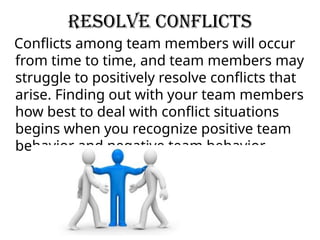
Resolve Conflicts
Conflicts among team members will occur
from time to time, and team members may
struggle to positively resolve conflicts that
arise. Finding out with your team members
how best to deal with conflict situations
begins when you recognize positive team
behavior and negative team behavior.
Staying off the destructive track
Various kinds of behavior make conflicts
worse. Here are some examples:
Finger-pointing
Finding fault or blaming someone else
does nothing to solve the problem is
great for building unhealthy tension in
a team.
Staying off the destructive track
My way, or the highway
When you push and push for your point of
view and show little interest in considering
someone else's, you only increase the volume
of debate, which drowns out any prospects of
settling debate.
Insults galore
Name-calling and other personal insults are
not invitations for resolving a conflict.
Staying off the destructive track
Verbal threats and ultimatums.
These sound like, "I'm going to get you," or
"This way or else!" Such outbursts intimidate
some people, turn off others, and they're
not exactly the best way to promote good
teamwork.
Defensiveness.
Justifying your action instead of listening to
what someone else is trying to tell you
builds a wall between you and the other
party, making agreements nearly impossible
to achieve.
Staying off the destructive track
Avoidance
Running away from the problem and
hoping that it goes away — avoidance
at its best — seldom resolves an issue.
Beating around the bush
Attempting to address the concern at
hand but then rambling and talking
around the point simply clouds the
issue so much that it's left unaddressed.
Beating around the bush.
Attempting to address the concern
at hand but then rambling and
talking around the point simply
clouds the issue so much that it's left
unaddressed.
Telling others and not the source
Complaining to others about what
someone else has done and not talking
directly to that person is a great way of
stirring divisiveness on a team. Many
people place this behavior at the top of
the destructive-behavior list.
Flaming e-mails
This means blaming and complaining
electronically about the source of your
concern and not talking directly to that
person. Sometimes the perpetrator
makes this unacceptable behavior even
worse by copying others with the
disruptive e-mail.
Focusing on perceived intentions
Making assumptions about another
person and, of course, assuming the
worst is not a great frame of mind for
dealing with team members about your
concerns.
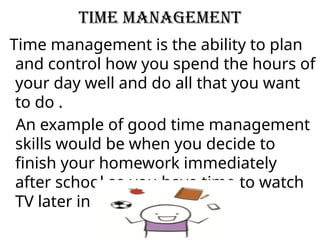
time management
Time management is the ability to plan
and control how you spend the hours of
your day well and do all that you want
to do .
An example of good time management
skills would be when you decide to
finish your homework immediately
after school so you have time to watch
TV later in the evening.
time management
Time management is the thinking skill that
helps you to
• complete tasks on time.
• make a daily timetable.
• make a good guess at how long it will take
you to do something.
• submit homework and assignments before
or
on time.
• not waste time during the day.
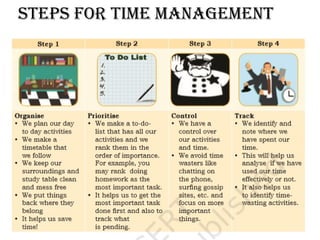
Steps for time management
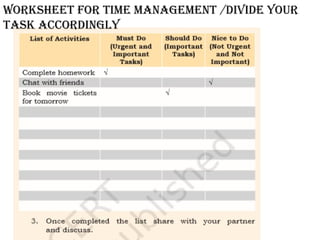
Worksheet for time management /divide your
task accordingly
THANK YOU
Some videos for soft skills
• https://www.youtube.com/watch?v=caJJyoAyBBs
• https://www.youtube.com/watch?v=2AQ3FGQhRO
M
Assignment for trainee

soft skills and communication in engineering

  • 1.
    CONTENT OF Training QPCode: MEP/Q2702 Communications Soft skills . (BETTER PLUMBING FOR BETTER LIVING)
  • 2.
    Module 2  Communicatewith in the team.  Communicate outside the team.  Plan and prepare.  Comprehend Worker manual.  Skills in the team members.  Understand responsibility for work.  Working in a team.
  • 3.
    Module 2  Reportstructure and workflow management. Work process communication and reporting of disruptions.  Understand the role in team.  Quality and delivery standards.  Dress codes.  How to collaborate with Seniors to establish Goals.  Producing self-realistic sales goals for the Company. Maximization of sales revenues through management of an assigned geographic sales area or product line.
  • 4.
    Communication Communication is simplythe act of transferring information from one place, person or group to another.
  • 5.
    Communication Skills  Communicationand its importance.  Critical elements of the communication process.  Barriers to communication.  Types of communication.  Communication as a process.  Listening Skills.
  • 6.
    Importance of communication Communication helps us to:  grow  learn  explore  be aware of ourselves and around.  adjust to our environment.  know others.  Improve relationships.
  • 7.
    Forms of communication spokenor verbal communication which includes face-to-face, telephone, radio or television and other media. Non-Verbal Communication covering body language, gestures, how we dress or act, where we stand, and even our scent.
  • 8.
    Forms of communication WrittenCommunication which includes letters, e-mails, social media, books, magazines, the Internet and other media. Visualizations graphs and charts, maps, logos and other visualizations can all communicate messages
  • 9.
    Non-Verbal communication Non-verbal communicationis the message we send to others without using any words. We send signals and messages to others, through expressions, gestures and body postures.
  • 11.
    Forms of Nonverbal Communication
  • 13.
    How does BodySpeak https://www.youtube.com/watch?v=v7fXpwsoL1E&list=PLWPirh4EWFpFIElSxplDlEhRDZHkBD-0n &index=6
  • 14.
    Head Position Neutral Position Thefirst is with the head up and is the position taken by the person who has a neutral attitude about what he is hearing. Disapproval Position When the head is down, it signals that the attitude is negative and even judgmental. Critical evaluation clusters are normally made with the head down and, unless you can get the person’s head up or tilted, you may have a communication problem.
  • 16.
    Head Position Interested Position Whenthe head tilts to one side it shows that interest has developed. Charles Darwin was one of the first to note that humans, as well as animals, tilt their heads to one side when they become interested in something. If you are giving a sales presentation or delivering a speech, always make a point of looking for this gesture among your audience.
  • 17.
    Interested Position When yousee them tilt their heads and lean forward using hand-to-chin evaluation gestures, you are getting the point across. Women use this head position to show interest in an attractive male.
  • 18.
    Body language Body languagerefers to the nonverbal signals that we use to communicate. According to experts, these nonverbal signals make up a huge part of daily communication. From our facial expressions to our body movements, the things we don't say can still convey volumes of information.
  • 20.
    Types of bodylanguage All people express their body language in one of four ways: 1. a light and bouncy movement. 2. a soft and fluid movement. 3. a dynamic and determined movement. 4. a precise and bold movement.
  • 22.
  • 23.
    Expressive Skills These arethe simplest skills. You can use them to convey to another person the information to which you have access. You do this in three stages.  first you get the other person's attention.  then you convey the information to him/her.  Then you check his/her understanding.  The other person is more likely to understand it if you convey it specifically, and not defensively. It helps to avoid blaming, criticizing, interpreting, or making demands on the other person.
  • 24.
  • 25.
    Types of communication(D) VERTICAL Communication • Upward Mostly information sharing from to subordinates to the bosses. Its purpose is to let the bosses know what is happening at the lower levels. E.g.: requests, reports, proposals and feedbacks in the form of suggestions/recommendations. • Downward It is a flow of instructions, orders and directives from superior to subordinates. It is to tell the subordinates that this is what they should be doing. E.g.: Feedback on past performance, memorandums, policy statements and procedures.
  • 27.
    Types of communication(D) HORIZONTAL Communication: • When communication takes place between the members of the same work group, among members of the work groups at the same level, among managers at the same level or among laterally equivalent personnel. DIAGONAL Communication: • Communication also flows between persons who belong to different levels of hierarchy and who have no direct reporting relationship.
  • 29.
  • 30.
    assertive Assertion is askill that can be learnt. It is a way of communicating and behaving with others that helps the person to become more confident and aware of themselves.
  • 31.
  • 32.
  • 33.
  • 34.
    Barriers to Communication Culture, background, and bias  Environmental  Internal Noise  Ourselves  Message  Perception  Assumption  Smothering  Stress
  • 35.
    How to overcomebarriers  Audience-centered approach Communication always starts from the other end. Communication is not for ‘ME’, it is for ‘YOU’. Always customize your communication.  Open communication be open to giving and receiving feedbacks. Be open to giving information when required.
  • 36.
    How to overcomebarriers  Lean, efficient message A message in simple and precise words is better understood.  Be nonjudgmental empty your mind of preconceived notions. Don’t jump to conclusions.  Focus on message and not the person focus more on what is being said rather than who is saying it.
  • 37.
    Barriers to AccuratePerception Stereotyping and generalizing Be careful not to hold on to preconceptions about people or things. Not investing time Making assumptions and ignoring details or circumstances can lead to misconceptions. Having a distorted focus Focusing on the negative aspects of a conversation or a situation is a habit common to many people.
  • 38.
    Effective Communication Articulation The abilityto piece and construct your ideas in a lucid and simple manner. As they say the power of “gab” (Smooth Talker). Expressive Skills The ability to express yourself without any fetters or inhibitions to express your opinion in a forthright manner with the courage of conviction.
  • 39.
    Effective Communication Comprehension Skills Theability to grasp the essence of a situation leaving out the unimportant details. This skill is important for you to understand an issue or a situation. Listening Skills Perhaps the most important skill required to be an effective communicator as you can speak as much as you might want but if the recipient is not listening, it’s a waste of time, effort, and energy for you. We are going to delve a little deeper to unravel all dimensions of the listening skills.
  • 41.
    Dress code etiquette Aset of rules specifying the garb or type of clothing to be worn by a group or by people under specific circumstances: a military dress code; The restaurant's dress code requires men to wear jackets and ties at dinner. the most important advantages 1) A dress code promotes a more serious at working atmosphere which emphasizes profesionalism and promotes good behavior. 2) Dress codes have proven to increase persons achievement by encouraging students to concentrate more on their profession and less on their wardrobe.
  • 45.
    Telephone Etiquette Ability toeffectively communicate on telephone with accuracy, briefness and clarity while projecting courtesy, confidence and enthusiasm in your voice. Benefits  Helps in confidently handling customers.  Ensures speed and ease in accomplishing tasks.  Results in target achievement .  Enables Spectacular Service.
  • 48.
    5C’s of TelephonicConversation  Call Preparation.  Call Opening.  Conversing with customer.  Customer on Hold.  Call Closure. Call Preparation  Have a clear objective.  Have necessary paperwork /information ready.  Rehearse phraseology.
  • 49.
    Call Opening Wish thetime of the day (add smile to the voice).  Introduce yourself and organizations / department • Ask how you can help/State the purpose of your call.  Be polite and don't sound hasty .
  • 50.
    Conversing with Customer Begenuinely polite and respectful in your tone.  Say “Please” and "Thank you" when appropriate,  Give the person you are talking to your full attention.  Sound interested.  Sound clear and concise.  Listen attentively and give verbal nods • Do not rush the caller.
  • 52.
    Conversing with Customer Be genuinely polite and respectful in your tone.  Say “Please” and "Thank you" when appropriate.  Give the person you are talking to your full attention.  Sound interested.  Sound clear and concise.  Listen attentively and give verbal nods.
  • 53.
    Customer on Hold Seek Permission.  Specify the duration.  Explain the reason.  Wait for customer’s response.  Get back to the customer in the committed time frame.
  • 54.
    Call Closure  Thankthe customer.  Wish customer a great day and bid good-bye with a smile in the voice.  Don't sound rushed.  Keep a pleasant tone.
  • 55.
    Verbal and BehavioralSignals You need to look for buying signals including: Verbal Signals 1. Questions. 2. Enquiries. 3. Comments/Indirect feedback. Behavioral Signals 4. Facial Expressions and body language. 5. Reactions. 3. Actions in response to what you said.
  • 57.
    Interaction with senior HowTo Report Status On A Project The Management Perspective If your project is significant, your boss will be pressed hard to keep his superiors informed of its growth. Smart managers consume status on significant projects insatiably. Excellent status reporting means that managers are fully informed of your projects health and overall way deprived of having to get involved themselves.
  • 59.
    Interaction with senior Thereis specific information your boss needs in order to show her boss that she is on top of things and able to run the show efficiently. Provide this information in a way your boss can consume it on a regular basis, and you will fall upstairs so fast your head will spin.
  • 60.
    Receive feedback fromreporting seniors
  • 61.
    Expressive Skills These arethe simplest skills. You can use them to convey to another person the information to which you have access. You do this in three stages.  first you get the other person's attention;  then you convey the information to him/her;  Then you check his/her understanding. Information about your intentions needs to be handled with some care. It may otherwise be taken as a threat. Rather than learn this as a formula, you find your own words, and experiment with different ways of saying it.
  • 63.
    Listening Skills Listening skillsare in most respects a little harder to hone than expressive skills. Because they depend upon foundation of emotional skills. It is hard to place yourself completely at the disposal of other person when you are under threat. Yet this is what good listening requires. It is listening for understanding, not listening for ammunition (a different listening style), and not mentally rehearsing your next statement.
  • 66.
    Listening Skills Another reasonfor the difficulty is that there are more components to listening than to speaking. After you have given the other person your attention, there are still three or four different things for you to do.
  • 67.
    Listening Skills Listen Give theother person your undivided attention as you try to understand what the problem is like for his/her. Acknowledge Let the other person know just what you have understood his/her to imply verbally and non-verbally: the whole message. Make clear that this is just your interpretation.
  • 68.
    Listening Skills Check Make surethat you understand him/her, by making it as easy as possible for him/her to amend or add to your understanding. Enquire Ask the questions that will help the other person to change his/her first answer (which probably avoids the issue, or blames, or demands) into one which gives specific information about what you have done or said, or about what she wants you to say or do.
  • 70.
    Soft skills  SoftSkills are the set of skills that a person should possess in order to face life's daily challenges successfully and to positively adapt to it. This would build the self confidence in an individual to handle life challenges in a more effective manner.  Soft skills are the behaviors and characteristics that people demonstrate unconsciously and routinely.
  • 72.
    Soft skills  Softskills are learned through practice and experience.  Soft skills will take you higher in your profession while giving you the technical skills to provide an efficient service.
  • 73.
    Soft Skills  Understandingoneself.  Innovative thinking.  Problem management.  Stress and emotional management.  Leadership.  Team work.  Communication.
  • 74.
    The Importance ofSoft Skills  To build and maintain interpersonal relationships.  To make meaningful/appropriate decisions.  Efficient Communication.  To influence the professional development.  For effective, efficient and higher performance. Soft Skills.
  • 75.
    Understanding Oneself This topicwill create an opportunity to identify a person’s skills, aspirations, qualities and personality traits. ACTIVITY 1 Provide each participant with a model copy of a Johari window that is prepared according to the model paper number 1 Now, in square number 1 note down the things that you and others know well about yourself.
  • 76.
    Understanding Oneself In squarenumber 2 write down the things that you think others think of you but you do not know. You can fill in this box by making an open invitation to the others. Square number 3 should be filled by facts that you and only yourself knows about you. These should be secret to others. Square number 4 is the dark box. You should fill in it with facts that neither you nor others know about you.
  • 77.
  • 78.
    Innovative Thinking In orderto successfully overcome life's challenges and obstacles, one should free himself of the traditional ways of thinking and adopt a new and creative way of thinking. Employing such novel methods would help a person to reach ones goals in a unique manner with minimum effort. To enhance creativity while departing from traditional thinking, some activities can be done. Activity -2 In a board that is visible to all participants, mark 9 dots. Instruct them to cut the 9 dots using 4 lines.
  • 79.
    puzzle • The followingpuzzle illustrates how you can be held back from breaking through. The challenge is to connect all nine dots with four straight lines, without lifting your pencil from the paper. Try it!
  • 80.
    Answer of activity-2 The participants should learn that it is easier to face challenges if creative ways of thinking are sought instead of staying inside the traditional thinking framework.
  • 81.
    PROBLEM MANANGEMENT Facing problemsare part and parcel of our daily life. But there are instances where people have attempted suicide due to their inability to handle problems successfully. Therefore it has become vital to learn the skill of problem management as a soft skill.
  • 82.
    Activity -3 One daya banana seller crossed a 50m river and arrived at an island to get bananas for his business. Next he came to the bank of the river with 2 bunches of bananas of 50 bananas each. The banana seller asked the boatman to transport the 2 bunches of bananas to the other side of the river. The boatman says that the transport fee to take one bunch of banana for 01 meter is 01 banana. The seller agrees to this condition.
  • 83.
    Activity -3 The sellerdoes not violate the contract but also saves some bananas for himself. • Question: 1. How many bananas are left to the seller after crossing the river? • 2. How many bananas are left, if any? • 3. Explain the way by which the transport fee is paid to the boatman?
  • 84.
  • 85.
    STRESS AND EMOTIONALMANAGEMENT  Solve a problem in its early stages rather than letting the problem worsen.  To only have realistic hopes. That is living with achievable, feasible targets rather than impossible dreams.  Engage in activities that you enjoy outside of work. Start a new hobby and maintain it.
  • 87.
  • 89.
    STRESS AND EMOTIONALMANAGEMENT  Practice a relaxing exercise daily even for a short while Exercise regularly.  Share your problems or worries with your spouse or trustworthy friends.  Discuss your life plans Create a good plan.  Manage your time accordingly.
  • 91.
    STRESS AND EMOTIONALMANAGEMENT • Take a small break from every two hours of work. • Get enough sleep. • Check if the food that you consume is healthy enough. If it’s not, get used to a healthy eating pattern. • Get a full medical checkup annually. • Drink the required amount of water daily.
  • 93.
    STRESS AND EMOTIONALMANAGEMENT • Make it a habit to drink water. • Walk in way that the entire sole of the foot touches the floor. • Get rid of the thoughts that make you think that things should only happen in a particular way and in that way only.
  • 95.
    LEADERSHIP A leader canbe identified as a person who motivates and guides the people who are striving to achieve a common goal in the family, society or workplace. Understanding Leadership What qualities do you see in the following leaders?  Nelson Mandela Adolf Hitler  Marting Luther king Mahatama Gandhi  West India leader Siyatel  https://www.youtube.com/watch?v=etE1rFUURhQ
  • 96.
    1.All Aboard Participants arerequired to build a “boat” using pieces of wood, mats, or any other materials available, and then all must stand on the “boat” at once. As pieces of the “boat” are removed the team must endeavour to occupy the ever diminishing space as best they can. This activity helps to encourage communication, problem solving and critical thinking.
  • 97.
    2.Minefield The participants areasked to blindfold one team member and then create a ‘minefield’ of obstacles to negotiate around or over. Using only specified communication techniques, for example only being able to use the words left, right, forward, and backwards, the other participants must guide the blindfolded person through the ‘minefield’.
  • 98.
    2.Minefield • This activitycan be set in an elaborate outdoors environment or simplified in a regular office space; it is great for enhancing communication skills and building trust.
  • 99.
    3.Round Tables This activityrequires four tables, each set up with a different task. The tasks have to have separate steps that can be delegated among participants. A team leader is selected, who can only communicate and delegate tasks. Each table is timed to see how long it takes to complete the task. This is an activity that helps develop leadership and delegation skills.
  • 100.
    TEAMING UP . It’simportant to understand what a team is  Engage in a discussion with the trainees about the feature of a team.  List down the discussed features based on their preference.  Compare the following definitions with the features brought forward by the trainees.  Common Goal.  The importance of each team members contribution to achieve a common goal.  Interaction between team members.
  • 102.
    The Development Stagesof a Team Stage One: Forming The stage where team members get together and gets to know each other. Stage Two: Storming This stage discusses and argues about individual roles while creating a competition for the role of leader. Stage Three: Norming The team members discuss, decide and establish the habits and activity.
  • 103.
    The Development Stagesof a Team Stage Four: Performing This is the stage where the team perform their duties and shows stability . Stage Five: Adjourning This stage sees the conflict between the members who wishes to drift apart and the members who try to maintain the team.
  • 105.
    Decision making 1. Clarifydecision making expectations: Clear expectations are the linchpin. Discuss the level of authority you are granting and any applicable limitations with the employee. If you don’t want them making million- dollar decisions, this should be part of the discussion. Otherwise, a collaborative approach to decision making, as described in the steps below, will help the employee gain confidence and learn to trust your intentions.
  • 106.
    2. Help theemployee understand the factors important to the decision: Every decision is governed by objectives, priorities and limitations. When people are reluctant to make a decision, it is often because they are unclear about these factors. They don’t want to make a decision, nor do you want them to make a decision, until they understand:
  • 107.
    3. Generate andevaluate alternatives together Decision making is a matter of choosing among alternatives. The ability to identify reasonable alternatives depends on knowledge, experience and creativity .
  • 108.
    4. Ensure thediscipline and expertise needed to assess potential risks A skilled decision maker will not rush forward without first considering the downside of the best alternatives. Surely you can think of a time when you “didn’t stop to think,” “didn’t stop to ask someone from that department,” or were dumbfounded by the decision of someone else, “what was he thinking?”
  • 109.
    5. Support therisk-taking needed to make decisions If you have developed employee knowledge and decision making skill by following all of the steps above and still see a reluctance to make decisions, examine your own behavior and the way you react when things don’t work out the way you would like. Employees can smell a no win situation from a mile away. Be sure you aren’t creating a no- win environment.
  • 110.
    Activity -An emptyroom or hallway • Blindfolds • A collection of common office items • Instructions: • 1. Place the items (boxes, chairs, water bottles, bags, etc.) around the room so there's no clear path from one end of the room to the other. • 2. Divide your team into pairs and blindfold one person on the team.
  • 111.
    Activity -An emptyroom or hallway • 3. The other must verbally guide that person from one end of the room to the other, avoiding the "mines." • 4. The partner who is not blindfolded can't touch the other. • 5. If you want to make the activity more challenging, have all the pairs go simultaneously so teams must find ways to strategically communicate over each other.
  • 113.
    20 sticks ofuncooked spaghetti 1 roll of masking tape 1 yard of string 1 marshmallow Instructions: 1. The goal of this exercise is to see which team can use the materials provided to build the tallest tower within an allotted time period. The tower must be able to stand on its own. 2. To make this exercise more challenging, try adding a marshmallow to the top of the tower. This team problem solving exercise helps teams think on their toes while building Activity 2- of decision making and team building
  • 115.
    Meaning of grooming Dressingrefers to clothes you wear. Grooming is the process of making yourself look neat, tidy and clean. The way you dress, and groom can send a message that you are confident and smart. Grooming is important because it helps us to • look neat and clean. • feel confident about ourselves. • make a good impression of ourselves on others including customers.
  • 116.
  • 120.
  • 121.
    Strength and WeaknessAnalysis Being ‘self-aware’ or understanding ‘Who am I?’ means looking outside the usual characteristics, such as name, qualifications, the relationship one has with others. It actually means knowing our inner strengths, hidden talents, skills and even weaknesses.
  • 123.
    Activity 1 Assignment •Preparing the interests and abilities worksheet Material required textbooks, pen Procedure • 1. Each candidates has to complete two worksheets, each containing a list of statements. First worksheet is for interests and the second is for abilities.
  • 124.
    Activity 1 Assignment •2. Each candidates has to be real and honest when marking the statements in the two worksheets as it is for their own understanding of themselves. If they are not real and honest, they will get incorrect results about their own interests and abilities. • 3. Based on your interests, think of a career you would like to have. Now see if you have the ability to follow this career. This will help you identify what career is best for you.
  • 125.
    Work sheet • 4.I like listening to people who have thoughts different than mine. • 5. I like to report the problems in my locality to the Municipality or Panchayat. • 6. I like responding to people enthusiastically. • 7. I like organising events. • 8. I like to resolve conflicts between people.
  • 126.
  • 127.
  • 128.
    Work sheet tocheck self ability
  • 129.
    Work sheet tocheck self ability • 5. I can assemble parts of an instrument or machine by following instructions. • 6. I work well with tools. • 7. I use a lot of gestures and non-verbal cues to communicate. • 8. I can make things using my hands. • 9. I can move around a lot.
  • 130.
    Work sheet tocheck self ability
  • 131.
    Techniques for IdentifyingYour Strengths and Weaknesses Finding your Strengths  Take time off to think about what you do well  Think of anything that you are always good at  Think of what others appreciate about you.
  • 132.
    Finding your Weaknesses Point out the areas where you struggle and what you find difficult to do.  Look at the feedback you receive about yourself from others  Be open to feedback and accept your weaknesses without feeling bad about it. Look at it as an area of improvement.
  • 133.
    Mantra 2 –Dressing Professionally Dressing professionally can help you display a professional image to your organization’s clients and have a positive impact on your dealings with them.
  • 134.
    Attire – Do’s& Don’ts  Do not wear too bright colours while visiting a customer.  Clothes to be well ironed. No wrinkles or creases to be seen.  Avoid causing stains/marks on clothes.  Use mild detergent to wash the clothes.  Shirts to be always tucked in.
  • 136.
    Attire – Do’s& Don’ts  Dark-coloured belts are preferable.  Dark-coloured shoes and socks to be worn.  Do not wear loose socks. No portion of leg to be visible while seated.  Shoes should be polished and not worn off at the edges.
  • 137.
    Mantra 3 –Managing Time  Effective time management is about:  Planning and setting priorities. You will be able to manage your time more effectively if you set out a PLAN first.  Decide what the most important things to do today are.  List those important things IN ORDER in your diary or a sheet of paper.
  • 139.
    Mantra 3 –Managing Time  Work through your list in order. This will ensure that you tackle the most important tasks first and don't miss out on them.  Avoid using mobile phones- It is a distraction if your mobile phone keeps ringing while interacting with the customer.
  • 140.
    Mantra 3 –Managing Work Be Organized  Have an organized workplace (don't waste time constantly looking for your work). • Use your appointment calendar for everything, including listing study time.
  • 141.
    Goal setting We canuse the SMART model to set goals. SMART stands for S - Specific M – Measurable A - Achievable R - Realistic T – Time bound
  • 144.
    Plan Ahead  Determinehow long your tasks will take (do this before agreeing to take on a task!)  Consider whether any activities can be combined. Avoid Overload • Include time for rest, relaxation, sleep, eating, exercise, and socializing in your schedule. • Take short breaks during study and work periods. • Don't put everything off until the last minute (for example, don't cram for exams).
  • 145.
    Have a Vision(why are you doing all of this?)  Don't forget the "big picture" - why are you doing the task? Is it important to your long-term personal goals?  Have and follow a personal mission statement (personal and career). (Are your activities ultimately helping you achieve your goals?)  Know what is important to you. (What
  • 146.
    Resolve Conflicts Conflicts amongteam members will occur from time to time, and team members may struggle to positively resolve conflicts that arise. Finding out with your team members how best to deal with conflict situations begins when you recognize positive team behavior and negative team behavior.
  • 147.
    Staying off thedestructive track Various kinds of behavior make conflicts worse. Here are some examples: Finger-pointing Finding fault or blaming someone else does nothing to solve the problem is great for building unhealthy tension in a team.
  • 148.
    Staying off thedestructive track My way, or the highway When you push and push for your point of view and show little interest in considering someone else's, you only increase the volume of debate, which drowns out any prospects of settling debate. Insults galore Name-calling and other personal insults are not invitations for resolving a conflict.
  • 149.
    Staying off thedestructive track Verbal threats and ultimatums. These sound like, "I'm going to get you," or "This way or else!" Such outbursts intimidate some people, turn off others, and they're not exactly the best way to promote good teamwork. Defensiveness. Justifying your action instead of listening to what someone else is trying to tell you builds a wall between you and the other party, making agreements nearly impossible to achieve.
  • 150.
    Staying off thedestructive track Avoidance Running away from the problem and hoping that it goes away — avoidance at its best — seldom resolves an issue. Beating around the bush Attempting to address the concern at hand but then rambling and talking around the point simply clouds the issue so much that it's left unaddressed.
  • 151.
    Beating around thebush. Attempting to address the concern at hand but then rambling and talking around the point simply clouds the issue so much that it's left unaddressed.
  • 152.
    Telling others andnot the source Complaining to others about what someone else has done and not talking directly to that person is a great way of stirring divisiveness on a team. Many people place this behavior at the top of the destructive-behavior list.
  • 153.
    Flaming e-mails This meansblaming and complaining electronically about the source of your concern and not talking directly to that person. Sometimes the perpetrator makes this unacceptable behavior even worse by copying others with the disruptive e-mail.
  • 154.
    Focusing on perceivedintentions Making assumptions about another person and, of course, assuming the worst is not a great frame of mind for dealing with team members about your concerns.
  • 155.
    time management Time managementis the ability to plan and control how you spend the hours of your day well and do all that you want to do . An example of good time management skills would be when you decide to finish your homework immediately after school so you have time to watch TV later in the evening.
  • 156.
    time management Time managementis the thinking skill that helps you to • complete tasks on time. • make a daily timetable. • make a good guess at how long it will take you to do something. • submit homework and assignments before or on time. • not waste time during the day.
  • 157.
    Steps for timemanagement
  • 158.
    Worksheet for timemanagement /divide your task accordingly
  • 159.
  • 160.
    Some videos forsoft skills • https://www.youtube.com/watch?v=caJJyoAyBBs • https://www.youtube.com/watch?v=2AQ3FGQhRO M
  • 161.