Delivering Exceptional Telephone
    Customer Service


     “It’s an Attitude”
Service is the lifeblood of any
organization. Everything flows
from it and is nourished by it.
   Customer service is not a
 department…it’s an attitude.
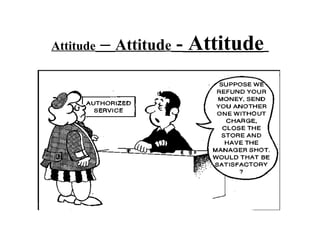
Attitude   – Attitude - Attitude
Learning Objectives
          • Emphasize importance
            of Attitude in CS
          • Raise awareness of the
            steps to great CS
          • CS Telephone
            Techniques
          • How to handle the
            Irate Customer
Steps To Outstanding
               Customer
•   Enthusiasm
•   Adaptability
•   Empathy
•   Responsiveness
•   Resiliency
•   Reliability
•   Assurance
•   Ownership
Biggest Customer Service
             Mistakes
• Displaying lack of
  urgency
• Not listening
• Asking closed ended
  questions ( ??? )
• Lack of concern
• Letting your bad hair
  day show
• Poor follow-up
Maintaining Customer
           Relationships
• Stay focused on customer needs
  (relationships)
• Be an “active” and Empathic listener
• Become knowledgeable in many areas
• Maintain a positive attitude about your job,
  your customer and your organization
• Strive for win-win customer relationships
• Apologize for poor service
More “Points” to Remember
• Don’t Over-React to Customer’s Mistakes
• Provide fair hearing – Don’t interrupt

• Help the customer save face

• Don’t linger on customer mistakes
• Speak the customers language
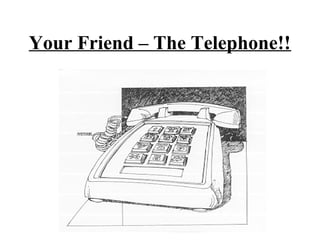
Your Friend – The Telephone!!
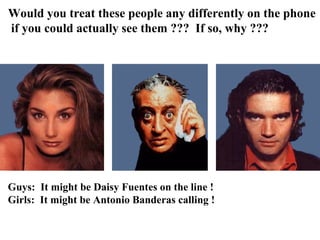
Would you treat these people any differently on the phone
if you could actually see them ??? If so, why ???


Guys: It might be Daisy Fuentes on the line !
Girls: It might be Antonio Banderas calling !
Why Do People Call?
           “They Need Help”
• Address Customers
  with Respect
• Model Good
  Telephone Etiquette

• Understand Impact of
  Your Message
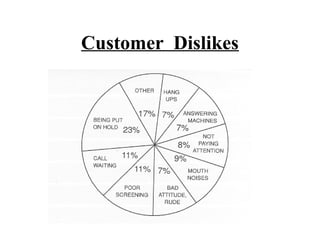
Customer Dislikes
Communicate with your customers as
 you would with your kids ! Keep it
 simple and make sure it is clear; then
 make sure they understand.
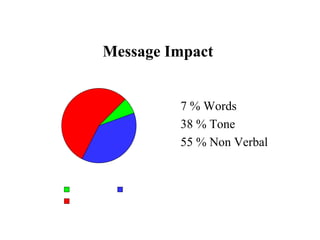
Message Impact


                    7 % Words
                    38 % Tone
                    55 % Non Verbal


Words        Tone
Non Verbal
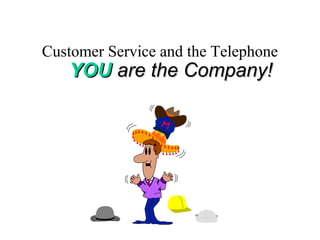
Customer Service and the Telephone
   YOU are the Company!
Customer Service and the Telephone
     The Listener’s Imagination

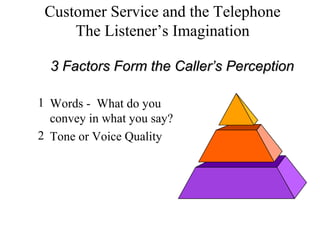
  3 Factors Form the Caller’s Perception

1 Words - What do you
  convey in what you say?
2 Tone or Voice Quality
Customer Service and the Telephone
3 Factors Form The Caller’s Perception
  2 Tone or Voice Quality
• What affects our tone?
 Attitude
 Job Satisfaction
 Personal Issues
 Having a bad day
 Previous bad phone call
Customer Service and the Telephone
3 Factors Form The Caller’s Perception
  2 Tone or Voice Quality
• What can I do to Improve?
 Project Sincerity
 Project friendliness
 Show responsiveness
 Avoid sounding mechanical
Customer Service and the Telephone
     The Listeners Imagination

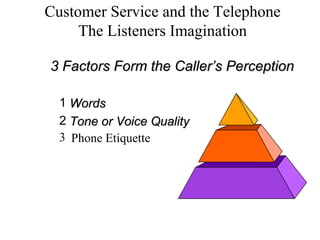
3 Factors Form the Caller’s Perception

  1 Words
  2 Tone or Voice Quality
  3 Phone Etiquette
Telephone Techniques

• Know & use your strategic tool kit
   (1) Vocabulary Choices   (2) Voice Tone
• Use effective greetings
• Manage the flow of calls
   – Acknowledge and Take The Lead
• Wrap up the call properly

• Lear to Handle all customer Types
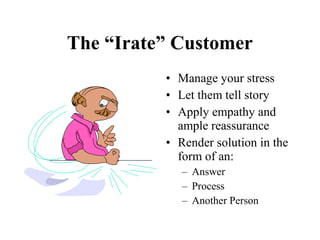
The “Irate” Customer
          • Manage your stress
          • Let them tell story
          • Apply empathy and
            ample reassurance
          • Render solution in the
            form of an:
             – Answer
             – Process
             – Another Person
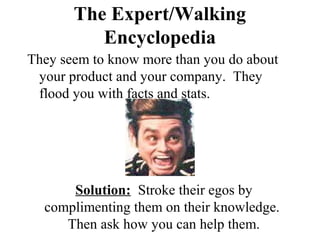
The Expert/Walking
          Encyclopedia
They seem to know more than you do about
 your product and your company. They
 flood you with facts and stats.


      Solution: Stroke their egos by
  complimenting them on their knowledge.
     Then ask how you can help them.
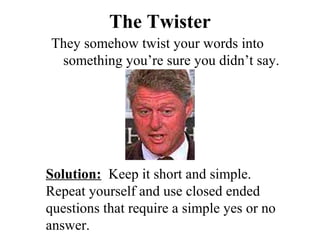
The Twister
They somehow twist your words into
 something you’re sure you didn’t say.


Solution: Keep it short and simple.
Repeat yourself and use closed ended
questions that require a simple yes or no
answer.
The Interrupter
They make you want to yell “shut up and
 listen,” but you can’t.


Solution: Suggest that the best way for you to
help them is for you to brief them first,
assuring you’ll leave them plenty of time for
any questions they may have.
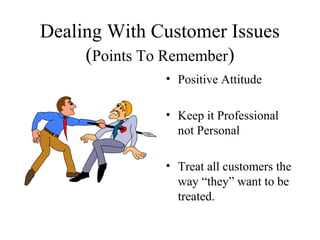
Dealing With Customer Issues
     (Points To Remember)
              • Positive Attitude

              • Keep it Professional
                not Personal

              • Treat all customers the
                way “they” want to be
                treated.
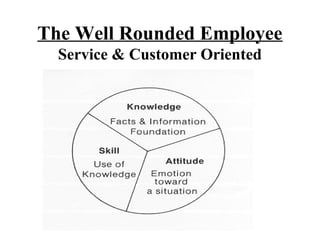
The Well Rounded Employee
  Service & Customer Oriented
In Conclusion
       • Great Service
         Begins With
         You !!

Delivering exceptional telephone customer service

  • 1.
    Delivering Exceptional Telephone Customer Service “It’s an Attitude”
  • 2.
    Service is thelifeblood of any organization. Everything flows from it and is nourished by it. Customer service is not a department…it’s an attitude.
  • 3.
    Attitude – Attitude - Attitude
  • 4.
    Learning Objectives • Emphasize importance of Attitude in CS • Raise awareness of the steps to great CS • CS Telephone Techniques • How to handle the Irate Customer
  • 5.
    Steps To Outstanding Customer • Enthusiasm • Adaptability • Empathy • Responsiveness • Resiliency • Reliability • Assurance • Ownership
  • 6.
    Biggest Customer Service Mistakes • Displaying lack of urgency • Not listening • Asking closed ended questions ( ??? ) • Lack of concern • Letting your bad hair day show • Poor follow-up
  • 7.
    Maintaining Customer Relationships • Stay focused on customer needs (relationships) • Be an “active” and Empathic listener • Become knowledgeable in many areas • Maintain a positive attitude about your job, your customer and your organization • Strive for win-win customer relationships • Apologize for poor service
  • 8.
    More “Points” toRemember • Don’t Over-React to Customer’s Mistakes • Provide fair hearing – Don’t interrupt • Help the customer save face • Don’t linger on customer mistakes • Speak the customers language
  • 9.
    Your Friend –The Telephone!!
  • 10.
    Would you treatthese people any differently on the phone if you could actually see them ??? If so, why ??? Guys: It might be Daisy Fuentes on the line ! Girls: It might be Antonio Banderas calling !
  • 11.
    Why Do PeopleCall? “They Need Help” • Address Customers with Respect • Model Good Telephone Etiquette • Understand Impact of Your Message
  • 12.
  • 13.
    Communicate with yourcustomers as you would with your kids ! Keep it simple and make sure it is clear; then make sure they understand.
  • 14.
    Message Impact 7 % Words 38 % Tone 55 % Non Verbal Words Tone Non Verbal
  • 15.
    Customer Service andthe Telephone YOU are the Company!
  • 16.
    Customer Service andthe Telephone The Listener’s Imagination 3 Factors Form the Caller’s Perception 1 Words - What do you convey in what you say? 2 Tone or Voice Quality
  • 17.
    Customer Service andthe Telephone 3 Factors Form The Caller’s Perception 2 Tone or Voice Quality • What affects our tone? Attitude Job Satisfaction Personal Issues Having a bad day Previous bad phone call
  • 18.
    Customer Service andthe Telephone 3 Factors Form The Caller’s Perception 2 Tone or Voice Quality • What can I do to Improve? Project Sincerity Project friendliness Show responsiveness Avoid sounding mechanical
  • 19.
    Customer Service andthe Telephone The Listeners Imagination 3 Factors Form the Caller’s Perception 1 Words 2 Tone or Voice Quality 3 Phone Etiquette
  • 20.
    Telephone Techniques • Know& use your strategic tool kit (1) Vocabulary Choices (2) Voice Tone • Use effective greetings • Manage the flow of calls – Acknowledge and Take The Lead • Wrap up the call properly • Lear to Handle all customer Types
  • 21.
    The “Irate” Customer • Manage your stress • Let them tell story • Apply empathy and ample reassurance • Render solution in the form of an: – Answer – Process – Another Person
  • 22.
    The Expert/Walking Encyclopedia They seem to know more than you do about your product and your company. They flood you with facts and stats. Solution: Stroke their egos by complimenting them on their knowledge. Then ask how you can help them.
  • 23.
    The Twister They somehowtwist your words into something you’re sure you didn’t say. Solution: Keep it short and simple. Repeat yourself and use closed ended questions that require a simple yes or no answer.
  • 24.
    The Interrupter They makeyou want to yell “shut up and listen,” but you can’t. Solution: Suggest that the best way for you to help them is for you to brief them first, assuring you’ll leave them plenty of time for any questions they may have.
  • 25.
    Dealing With CustomerIssues (Points To Remember) • Positive Attitude • Keep it Professional not Personal • Treat all customers the way “they” want to be treated.
  • 26.
    The Well RoundedEmployee Service & Customer Oriented
  • 27.
    In Conclusion • Great Service Begins With You !!

Editor's Notes

  • #2 Intro
  • #7 Proper preparation prevents poor performance ! Pay attention and listen….don’t just hear…listen Ask for the business Ask “Where do we go from here ?” Tailor your presentation for that customer Make sure you follow up When scheduling an appointment, have a specific reason and time in mind in which you want to see the client. Don’t just say “I’ll be in the area and was hoping to stop in”
  • #12 Proper preparation prevents poor performance ! Pay attention and listen….don’t just hear…listen Ask for the business Ask “Where do we go from here ?” Tailor your presentation for that customer Make sure you follow up When scheduling an appointment, have a specific reason and time in mind in which you want to see the client. Don’t just say “I’ll be in the area and was hoping to stop in”
  • #15 It is said that when we communicate face to face, the words we choose only account for 7% of our message’s impact he tone we use accounts for 38% of the impact, and our non verbal signals or body language accounts for 55% of our message. Think about that.... 55% of what you say is not heard, but rather perceived by your body language. Over the telephone, it’s a little more difficult to read someone’s body language right? Therefore anyone who uses the telephone faces somewhat of a tougher communication challenge. All of us in this room face this challenge as we provide internal customer service over the telephone. Today we’re going to discuss some very basic, but essential things that can help make us effective communicators in our non face to face environment.
  • #16 At J.B. Hunt, our lifeline is literally our telephone line. The way we handle ourselves on the telephone is a direct reflection of J.B. Hunt as a company. Anyone who answers the telephone for J.B. Hunt should always remember that they are the voice of the company. Give Phonogenic Quiz Then Next slide
  • #17 Since the caller does not have the benefit of seeing you face to face, they must rely on their imagination to form their perception of you and the company. There are 3 factors that make up the callers perception of you. 1. First lets look at the words we choose. I have some phrases that are commonly heard around the building, let’s take a look at some of the things we say and what we convey. (pass around bowl of sayings, have everyone take one, read aloud and discuss what is conveyed in each phrase) (J.B. Hunt Hold Please) (I’m sorry I didn’t return your call, I had to go to lunch) (I’m sorry, Fred is STILL at lunch) (That’s not my job) (I don’t deal with that, you’ll have to call the personnel department) ( when we did the EDM connect, the DB2 failed to update the VSAM table) (I’m afraid you just don’t understand) (I'm sorry you’ve been transferred twice, but they say the 3rd time’s a charm) (Thank you for holding, What do you want?) (I think she’s gone to lunch, She should be back at one o’clock, you should try back then) (I hope this will take care of your problem) (If you’ll just calm down) (Don’t you think you’re overreacting a little?) Probably none of us have ever said anything like this, right? We of course would all be more professional, but is it enough to simply know the right words to say? Everyone close your eyes for a moment and pretend you’ve just dialed by number (say in wrong tone) “Thank you for calling J.B. Hunt, this is Joetta”... Okay, I used the correct words, what is your impression of me? Obviously my tone of voice communicated something totally different than the words I used. My words said, Thank you for calling, my tone said otherwise. This leads us to factor # 2 Tone or Voice Quality. A lot of times we know the correct words to use, but we use them out of habit. We’ll get busy, have a bad day, or just be bored with our jobs, and we’ll out of habit say the right things, not realizing our tone had contradicted what we’ve said. Most people do not realize how they themselves are perceived over the telephone.
  • #18 How you speak is just as important as the words you’ve chosen. Your voice tone and words should go together and should convey a total customer service attitude. It is important that we be conscience of our words and our tone with each and ever caller. All callers should be made to feel that they are important. This is a very small detail that is often overlooked. (give voice assessment quiz) What things affect our tone? 1 Attitude: Our attitude toward customers influences our behavior, we can not always camouflage how we feel. Remember, your internal customers do not think of themselves as customers. They think of themselves as people who need your help. To provide customer service, you must enjoy helping people. 2. Job satisfaction” if you are bored, unchallenged or simply do not like what you do, it will is easy to convey in your tone when talking about a job related subject. 3. Personal Issues - 4. Bad Day. 5 Bad phone call - We all have times when it may be hard to maintain a caring customer service attitude. However, we must keep in mind that the caller didn’t call to hear about your problems, they probably have plenty of their own. It is important to avoid emotional carryover. Many times we allow one situation to negatively affect the next when they are totally unrelated.
  • #19 What are some things we can do to improve voice tone and quality? Project sincerity: Develop a positive attitude toward helping customers. Use natural vocabulary and tone of voice. Don’t try to be something or someone you aren’t. . Keep voice clear, inflection up and tone bright and cheerful Avoid obvious exaggerations and claims Relate what you’re saying to the callers situation Project friendliness; Use tone and manner that are warm and cordial- smile BEFORE answering the call. Identify yourself, as well as the customer, with warmth and interest Avoid trite or canned approaches that sound impersonal Do not be formal or rigid don’t rush the caller, pace yourself to the customer’s tempo Be attentive.. respond to what the customer says Be courteous - use good manners Show responsiveness Answer the customer’s questions Make sure to get facts straight by asking the caller questions Do not sound as if you are reading something off of a manual Listen to what you are saying, be aware of how it may come across to the caller Avoid Sounding mechanical: Put energy into your voice. Avoid using a monotone voice, be careful to vary your pitch and inflection, this will keep people interested in what you are saying and will help avoid sounding bored. Rate of Speech - Average rate is 125 words per minute. Sometimes it is necessary to adjust your rate of speech depending on the person you are speaking with. Take the hint if the caller is saying ‘huh” or “what was that again”, “could you repeat that”, These are all clues that you are speaking too fast for the caller to get the necessary information. Do not speed or rush over the caller. Some things that are familiar to you, may not be to the caller.
  • #20 The 3rd factor in forming the caller’s perception is your telephone etiquette: How you handle the telephone itself. Basic Rules of Phone etiquette: Know how the phone works BEFORE you practice on the caller. Learn all the functions of the buttons and how to use them. Answer the phone within 3 rings. A caller usually doesn't start to become irritated until the 4th ring. Answer with Buffer words, The company name and then your name. Buffer words are words like, good morning, good afternoon, or thank you for calling. If these words are cut off during the connection, you’ve lost nothing. The company name however is not expendable. Don’t transfer the caller unless absolutely necessary. Always try to help the caller to avoid transferring. If transfer becomes necessary, conference call instead of transferring and stay on the line until you are sure the person on the other end will be able to help. Remember basic etiquette, say Please, Thank you and You are Welcome Don’t eat or chew gum while talking on the telephone.