Practical Immunology
And Serology
Phagocytosis activity
By
Ahmed Riyadh Abdul Rahman
Al-Noor University College
1
2
PHAGOCYTOSIS ACTIVITY
 Phagocytosis (meaning to eat) is a process refers to the engulfing of microorganisms or other
cells or foreign particles by phagocytes.
 It is the first line of defense mechanism against microorganisms of body provided by white
blood cells through Phagocytosis, and used to remove pathogens and cell debris, dead tissue
cells, and small mineral particles. Some protozoa use phagocytosis as means to obtain
nutrients.
Phagocytic Cells of the Immune System
The most types of immune cells have the greatest role in immune response to most infections are:
1. Neutrophils –polymorphonuclear leukocytes (PMNs) found in the blood.
2. Macrophages – tissue resident cells.
3. Dendritic cells.
Phagocytosis steps
3
4
Pathogen killing can occur in one of two ways:
 The oxygen dependent pathway (oxidative burst) involves: reactive
oxygen species (ROS) such as (superoxide radical & hydrogen peroxide.
 The oxygen independent pathway involves: lysosomal enzymes
(such as lysozyme), tumor necrosis factor & hydrolytic enzymes.
5
 A semi-quantitative microscopic nitroblue tetrazolium (NBT) assay.
 Used to determine the activity of phagocytes by the determination of the production of
superoxide (O-2).
 This microscopic assay is depend on counting the cells containing blue NBT formazan deposits,
which are formed by reduction yellow-colored, nitroblue tetrazolium (Y-NBT) by (O-2).
 The method is commonly used to diagnose Chronic granulomatous disorder (CGD) is an
immune deficiency disorder caused by defect in phagocytic cells (neutrophils and monocytes)
which fail to effectively destroy invading bacteria and fungi, Because of the inability of
phagocytes to produce superoxide.
Microscopical Determination of Phagocytosis
by Nitroblue Tetrazolium (NBT)
6
Objective
To determine the phagocytic activity & phagocytic defects.
Principle
 NBT reduction is a technique used to evaluate the oxidative
metabolism.
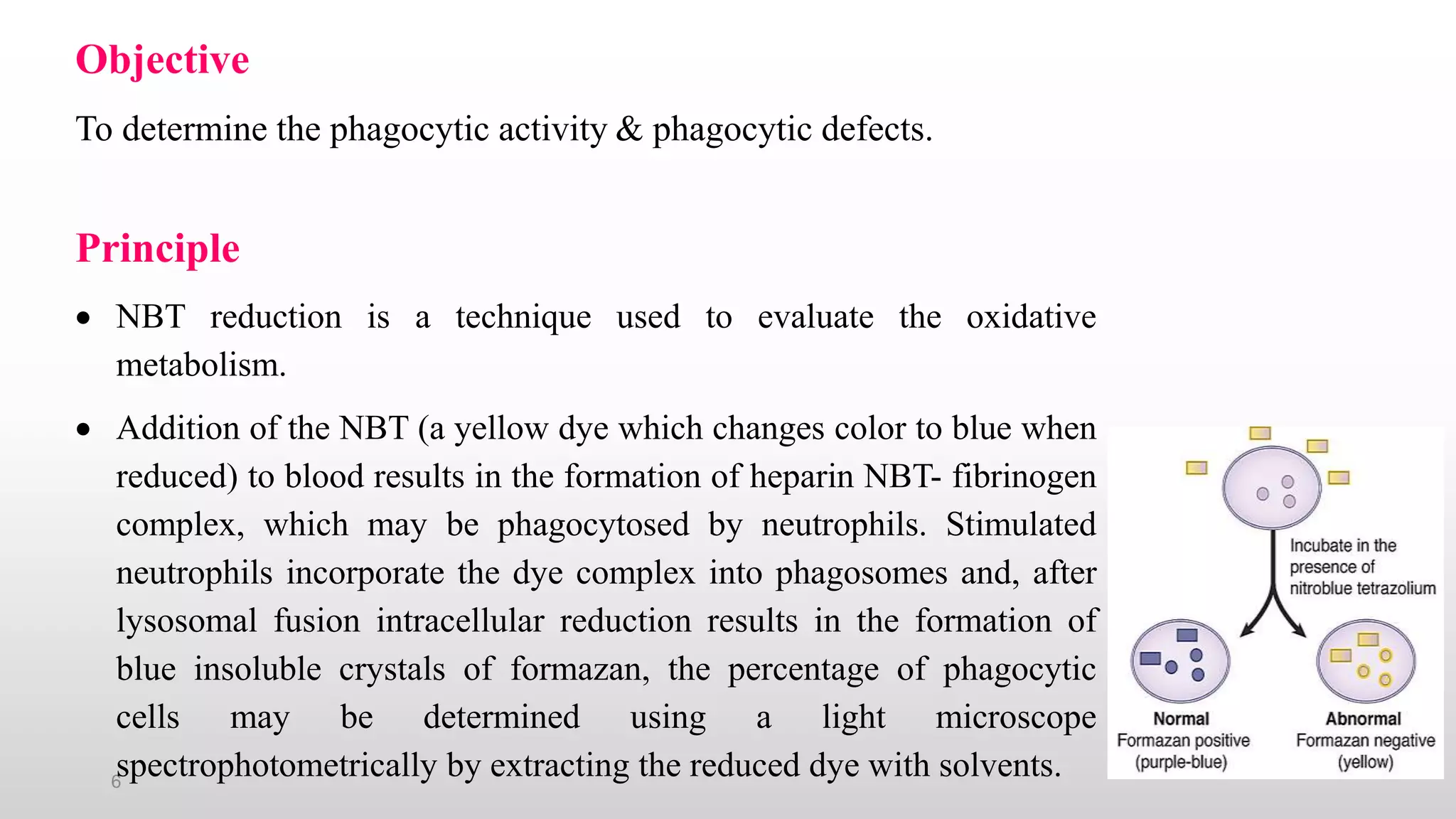
 Addition of the NBT (a yellow dye which changes color to blue when
reduced) to blood results in the formation of heparin NBT- fibrinogen
complex, which may be phagocytosed by neutrophils. Stimulated
neutrophils incorporate the dye complex into phagosomes and, after
lysosomal fusion intracellular reduction results in the formation of
blue insoluble crystals of formazan, the percentage of phagocytic
cells may be determined using a light microscope
spectrophotometrically by extracting the reduced dye with solvents.
7
Procedure
1. The blood samples transferred into glass tubes coated with heparin.
2. Prepare NBT solution by mixing equal volumes of 0.2% NBT solution with phosphate
buffered saline.
3. Transfer 50µl well-mixed heparinized blood to an Eppendorf tube.
4. Add 50µl ml NBT Solution to an Eppendorf tube.
5. Mix heparinized blood-NBT mixture by “rolling” gently.
6. Incubate The Eppendorf tube at 37°C for 30 min.
7. Transfer 5 µL of mixture onto a clean glass slide.
8. NOTE: Care should be taken to minimize mechanical damage to white blood cells during
smear preparation.
9. Prepare smear with blood-NBT mix and allowed to air dry.
10.Smears were fixed with methanol for 3 min and stained.
8
Treat smear with leishman (or wright) Stain as follows:
 Flood dried smear with 1 ml of stain for 3 min.
 Add 1 ml of distilled water and allow for 3-8 min (longer times increase stain
intensity).
 Rinse smear slides with distilled water up to 2 minutes.
 Let it dry in air and then observe the slides under oil immersion objective lens of the
microscope.
9
Microscopic Examination
Examine stained smears using oil immersion objective and count a total of 100 of
neutrophils containing “formazan” deposits as a percentage. Record as positive those
neutrophils showing formazan deposits.
Interpretation of Result
1-Normal or positive result: NBT reduction (cells with blue-black formazan) all the
PMNL containing formazan deposit, the positive cells were transformed, enlarged,
and lost their nuclear lobulation and reduced NBT to formazan deposits (dark blue
cytoplasm granules).
2-Abnormal or Negative result: No NBT reduction (cells without blue-black
formazan), these cells were not transformed, and failed to reduce NBT.
10
Reading Result Note:
I. All normal adults gave 100% of all normal neutrophils gave NBT reduction.
II. The healthy children had a range between 96% and 100% of stimulated PMN cells.
III.The patients with CGD gave no reduction and their cells, which failed to reduce NBT,
were not transformed
IV.In the heterozygote state, two cell populations were clearly seen: those that can
reduce NBT and transformed, and those that cannot reduce NBT and remained
lobulated.
11
12

Immuology Phagocytosis activity

  • 1.
    Practical Immunology And Serology Phagocytosisactivity By Ahmed Riyadh Abdul Rahman Al-Noor University College 1
  • 2.
    2 PHAGOCYTOSIS ACTIVITY  Phagocytosis(meaning to eat) is a process refers to the engulfing of microorganisms or other cells or foreign particles by phagocytes.  It is the first line of defense mechanism against microorganisms of body provided by white blood cells through Phagocytosis, and used to remove pathogens and cell debris, dead tissue cells, and small mineral particles. Some protozoa use phagocytosis as means to obtain nutrients. Phagocytic Cells of the Immune System The most types of immune cells have the greatest role in immune response to most infections are: 1. Neutrophils –polymorphonuclear leukocytes (PMNs) found in the blood. 2. Macrophages – tissue resident cells. 3. Dendritic cells.
  • 3.
  • 4.
    4 Pathogen killing canoccur in one of two ways:  The oxygen dependent pathway (oxidative burst) involves: reactive oxygen species (ROS) such as (superoxide radical & hydrogen peroxide.  The oxygen independent pathway involves: lysosomal enzymes (such as lysozyme), tumor necrosis factor & hydrolytic enzymes.
  • 5.
    5  A semi-quantitativemicroscopic nitroblue tetrazolium (NBT) assay.  Used to determine the activity of phagocytes by the determination of the production of superoxide (O-2).  This microscopic assay is depend on counting the cells containing blue NBT formazan deposits, which are formed by reduction yellow-colored, nitroblue tetrazolium (Y-NBT) by (O-2).  The method is commonly used to diagnose Chronic granulomatous disorder (CGD) is an immune deficiency disorder caused by defect in phagocytic cells (neutrophils and monocytes) which fail to effectively destroy invading bacteria and fungi, Because of the inability of phagocytes to produce superoxide. Microscopical Determination of Phagocytosis by Nitroblue Tetrazolium (NBT)
  • 6.
    6 Objective To determine thephagocytic activity & phagocytic defects. Principle  NBT reduction is a technique used to evaluate the oxidative metabolism.  Addition of the NBT (a yellow dye which changes color to blue when reduced) to blood results in the formation of heparin NBT- fibrinogen complex, which may be phagocytosed by neutrophils. Stimulated neutrophils incorporate the dye complex into phagosomes and, after lysosomal fusion intracellular reduction results in the formation of blue insoluble crystals of formazan, the percentage of phagocytic cells may be determined using a light microscope spectrophotometrically by extracting the reduced dye with solvents.
  • 7.
    7 Procedure 1. The bloodsamples transferred into glass tubes coated with heparin. 2. Prepare NBT solution by mixing equal volumes of 0.2% NBT solution with phosphate buffered saline. 3. Transfer 50µl well-mixed heparinized blood to an Eppendorf tube. 4. Add 50µl ml NBT Solution to an Eppendorf tube. 5. Mix heparinized blood-NBT mixture by “rolling” gently. 6. Incubate The Eppendorf tube at 37°C for 30 min. 7. Transfer 5 µL of mixture onto a clean glass slide. 8. NOTE: Care should be taken to minimize mechanical damage to white blood cells during smear preparation. 9. Prepare smear with blood-NBT mix and allowed to air dry. 10.Smears were fixed with methanol for 3 min and stained.
  • 8.
    8 Treat smear withleishman (or wright) Stain as follows:  Flood dried smear with 1 ml of stain for 3 min.  Add 1 ml of distilled water and allow for 3-8 min (longer times increase stain intensity).  Rinse smear slides with distilled water up to 2 minutes.  Let it dry in air and then observe the slides under oil immersion objective lens of the microscope.
  • 9.
    9 Microscopic Examination Examine stainedsmears using oil immersion objective and count a total of 100 of neutrophils containing “formazan” deposits as a percentage. Record as positive those neutrophils showing formazan deposits. Interpretation of Result 1-Normal or positive result: NBT reduction (cells with blue-black formazan) all the PMNL containing formazan deposit, the positive cells were transformed, enlarged, and lost their nuclear lobulation and reduced NBT to formazan deposits (dark blue cytoplasm granules). 2-Abnormal or Negative result: No NBT reduction (cells without blue-black formazan), these cells were not transformed, and failed to reduce NBT.
  • 10.
    10 Reading Result Note: I.All normal adults gave 100% of all normal neutrophils gave NBT reduction. II. The healthy children had a range between 96% and 100% of stimulated PMN cells. III.The patients with CGD gave no reduction and their cells, which failed to reduce NBT, were not transformed IV.In the heterozygote state, two cell populations were clearly seen: those that can reduce NBT and transformed, and those that cannot reduce NBT and remained lobulated.
  • 11.
  • 12.