INTRODUCTION TO
IMMUNOLOGY
What is immunity?
• Immunity is the resistance exhibited by the
host towards injury caused by microorganisms
and their products.
• The immune system produces antibodies or
cells that can deactivate pathogens.
• Fungi, protozoans, bacteria, and viruses are all
potential pathogens.
Pathogens
= disease causing micro-organisms
bacteria
virus
fungi,
protozoa,
parasite,
prion
Immunity
1.Innate Immunity
A.Types of Innate Immunity
B.Factors Influencing Innate Immunity
C.Mechanism of Innate Immunity
2. Acquired (Adaptive) Immunity
A.Active Immunity: Natural, Artificial
B.Passive Immunity: Natural, Artificial
Immunity (Cont)
3. Miscellaneous:
A.Combined Immunization
B.Adoptive Immunity
C.Local immunity
D.Herd Immunity
The Immune System is the Third Line of
Defense Against Infection
A.Types of Innate Immunity
1. Species Immunity
 Resistance to a pathogen, shown by all members of a particular species, e.
g. B. anthracis infects human beings, but not chickens.
 It is due to physiological & biological differences between tissues of
different host species.
2. Racial Immunity
Within one species, different races may exhibit differences in resistance to
infections. Algerian sheep is highly resistant to Anthrax.
American blacks are more susceptible to tuberculosis than whites.
2.Racial Immunity (cont)
Races with sickle cell anaemia prevalent in
Mediterranean coast are immune to P. falciparum
infection
Persons with heriditary deficiency of glucose-6-
phosphate dehydrogenase (G-6-PD) are less
susceptible to P. faciparum
3. Individual immunity: It varies with different
individuals of same race and species. Homozygous
twins exhibit similar degrees of susceptibility or
resistance to tuberculosis. It is not the same in
heterozygous twins.
B. Factors Influencing Innate Immunity
1.Age
2.Sex
3.Hormones
4.Nutrition
1.Age
• The two extremes of life carry a higher susceptibility to infectious
diseases as compared to adults
• Foetus: Susceptible to TORCH group of infections (IgM in cord blood)
1. Toxoplasma
2. Ohers: Syphillis, HIV, Chicken Pox, Hepatitis B
3. Rubella
4. Cytomegalovirus
5. Herpes
2.Sex
X Chromosome Factor Make Women Strong
By Medic4health, September 29, 2011, In
Men & Women Health
Septicaemia more common in male infants.
Autoimmune diseases are more common in
females
3.Hormonal Influence
1.Diabetes mellitus 2. Hypothyroidism
3.Adrenal dysfunction: Pregnant woman more susc to
infections
Susc: Staphylococcal infections, Streptococcal
infections, Candidiasis, Zygomycosis,
Aspergillosis
4. Nutrition
C. Mechanism of innate immunity
1.Epithelial Surface
i. Intact skin:
ii. Sebaceous secretions & long chain fatty acids
iii. High concentration of salt
iv. Normal flora
v. Mucous membrane
vi. Nasal & respiratory Secretions
First lines of defence
skin
prevents
entry
tears
antibacterial
enzymes
saliva
antibacterial
enzymes
stomach acid
low pH kills
harmful
microbes
mucus linings
traps dirt and
microbes
“good” gut
bacteria out
compete bad
2. Antibacterial Substances
Nonspecific Antibacterial Substances present in blood & tissues;
a.Properdin
b.Complement
c.Lysozymes
d.Betalysin
e.Basic Polypeptides: leukins (leucocytes) Plakins (Platelets)
Antiviral: Interferon secreted by cells in response to products of viral
infected cells….antiviral effect by preventing the synthesis of viral structural proteins.
α,βinnate immunity & ϒ produced by T cells (AI).
3. Cellular Factors
• Once the infective agent has crossed the
barrier of epithelial surface, the tissue factors
come into play for defence.
• Exudative inflammatory reaction occurs
• Accumulation of phagocytes at the site of
infection
• Deposition of fibrin entangles organism
• Phagocytic cells ingest these organisms &
destroy them
Cellular factors (Cont)
Phagocytic action can be divided into Four stages
I. Chemotaxis: Phagocyte reach the site of
infection attracted by chemotactic substances.
II. Attachment: Infective Agent gets attached to
phagocytic membrane.
III. Ingestion: Engulf the infective material into a
vacuole (phagosome)
IV. Intracellular killing: Most bacteria are destroyed
in the phagolysosomes by hydrolytic enzymes of
lysosomes. M. tuberculosis & M. leprae resist it
& can multiply.
Phagocytosis
4. Inflammation
i. Occurs as a result of tissue injury/irritation
ii. Non-specific defence mechanism.
iii. Leads to vasodilatation, increased vascular
permeability
iv. Microorganisms are phagocytosed & destroyed
v. Outpouring of plasma due to increased
vascularity
vi. A fibrin barrier is laid to contain the infection.
5.Fever
i. Fever is a natural defence mechanism
ii. It destroys the infecting organisms
iii. Also stimulate the production of interferon,
which helps in recovery from viral infections
6. Acute phase proteins
There is a sudden rise in plasma concentrations of
certain proteins……acute phase proteins
C reactive proteins (CRP), Mannose binding proteins
Acute phase proteins
Following infections/injury
Sudden increase in plasma concentration of C
reactive protein (CRP)
Mannose binding proteins
These proteins prevent tissue injury & promote
repair of inflammatory lesions.
Types of Acquired Immunity
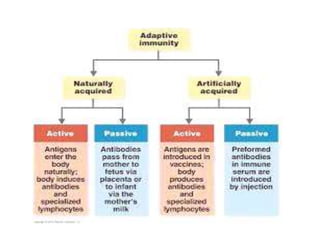
I. Naturally Acquired Immunity: Obtained in the
course of daily life.
A. Naturally Acquired Active Immunity:
– Antigens or pathogens enter body naturally.
– Body generates an immune response to antigens.
– Immunity may be lifelong (chickenpox or mumps)
or temporary (influenza or intestinal infections).
B. Naturally Acquired Passive Immunity:
– Antibodies pass from mother to fetus via placenta
or breast feeding (colostrum).
– No immune response to antigens.
– Immunity is usually short-lived (weeks to months).
– Protection until child’s immune system develops.
Types of Acquired Immunity (Continued)
II. Artificially Acquired Immunity: Obtained by receiving
a vaccine or immune serum.
1. Artificially Acquired Active Immunity:
– Antigens are introduced in vaccines (immunization).
– Body generates an immune response to antigens.
– Immunity can be lifelong (oral polio vaccine) or temporary
(tetanus toxoid).
2. Artificially Acquired Passive Immunity:
– Preformed antibodies (antiserum) are introduced into body
by injection.
• Snake antivenom injection from horses or rabbits.
– Immunity is short lived (half life three weeks).
– Host immune system does not respond to antigens.
Mechanism of active immunity
Active immune response stimulates both humoral &
cell mediated immunity
i. Humoral Immunity
Ab mediated, depends on synthesis of Ab by plasma
cells
Abs are specific
ii. Cell mediated immunity (CMI)
It depends on T-lymphocytes developed against
certain antigens.
Artificial active immunity
a.Live vaccines
BCG for tuberculosis, Ty 21a for typhoid
Sabin vaccine for poliomyelitis, MMR vaccine for measles
Mumps,rubella
b.Killed vaccines
TAB for enteric fever
Killed cholera vaccine, Salk vaccine for poliomyelitis
c. Bacterial products: Tetanus toxoid for tetanus, Diphtheria
toxoid for diphtheria
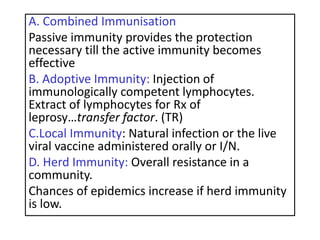
A. Combined Immunisation
Passive immunity provides the protection
necessary till the active immunity becomes
effective
B. Adoptive Immunity: Injection of
immunologically competent lymphocytes.
Extract of lymphocytes for Rx of
leprosy…transfer factor. (TR)
C.Local Immunity: Natural infection or the live
viral vaccine administered orally or I/N.
D. Herd Immunity: Overall resistance in a
community.
Chances of epidemics increase if herd immunity
is low.
Comparison of Active & Passive Immunity
Thankyou…..

Immunity

  • 1.
  • 2.
    What is immunity? •Immunity is the resistance exhibited by the host towards injury caused by microorganisms and their products. • The immune system produces antibodies or cells that can deactivate pathogens. • Fungi, protozoans, bacteria, and viruses are all potential pathogens.
  • 3.
    Pathogens = disease causingmicro-organisms bacteria virus fungi, protozoa, parasite, prion
  • 4.
    Immunity 1.Innate Immunity A.Types ofInnate Immunity B.Factors Influencing Innate Immunity C.Mechanism of Innate Immunity 2. Acquired (Adaptive) Immunity A.Active Immunity: Natural, Artificial B.Passive Immunity: Natural, Artificial
  • 5.
    Immunity (Cont) 3. Miscellaneous: A.CombinedImmunization B.Adoptive Immunity C.Local immunity D.Herd Immunity
  • 7.
    The Immune Systemis the Third Line of Defense Against Infection
  • 8.
    A.Types of InnateImmunity 1. Species Immunity  Resistance to a pathogen, shown by all members of a particular species, e. g. B. anthracis infects human beings, but not chickens.  It is due to physiological & biological differences between tissues of different host species. 2. Racial Immunity Within one species, different races may exhibit differences in resistance to infections. Algerian sheep is highly resistant to Anthrax. American blacks are more susceptible to tuberculosis than whites.
  • 9.
    2.Racial Immunity (cont) Raceswith sickle cell anaemia prevalent in Mediterranean coast are immune to P. falciparum infection Persons with heriditary deficiency of glucose-6- phosphate dehydrogenase (G-6-PD) are less susceptible to P. faciparum 3. Individual immunity: It varies with different individuals of same race and species. Homozygous twins exhibit similar degrees of susceptibility or resistance to tuberculosis. It is not the same in heterozygous twins.
  • 10.
    B. Factors InfluencingInnate Immunity 1.Age 2.Sex 3.Hormones 4.Nutrition
  • 11.
    1.Age • The twoextremes of life carry a higher susceptibility to infectious diseases as compared to adults • Foetus: Susceptible to TORCH group of infections (IgM in cord blood) 1. Toxoplasma 2. Ohers: Syphillis, HIV, Chicken Pox, Hepatitis B 3. Rubella 4. Cytomegalovirus 5. Herpes
  • 12.
    2.Sex X Chromosome FactorMake Women Strong By Medic4health, September 29, 2011, In Men & Women Health Septicaemia more common in male infants. Autoimmune diseases are more common in females
  • 13.
    3.Hormonal Influence 1.Diabetes mellitus2. Hypothyroidism 3.Adrenal dysfunction: Pregnant woman more susc to infections Susc: Staphylococcal infections, Streptococcal infections, Candidiasis, Zygomycosis, Aspergillosis 4. Nutrition
  • 14.
    C. Mechanism ofinnate immunity 1.Epithelial Surface i. Intact skin: ii. Sebaceous secretions & long chain fatty acids iii. High concentration of salt iv. Normal flora v. Mucous membrane vi. Nasal & respiratory Secretions
  • 15.
    First lines ofdefence skin prevents entry tears antibacterial enzymes saliva antibacterial enzymes stomach acid low pH kills harmful microbes mucus linings traps dirt and microbes “good” gut bacteria out compete bad
  • 16.
    2. Antibacterial Substances NonspecificAntibacterial Substances present in blood & tissues; a.Properdin b.Complement c.Lysozymes d.Betalysin e.Basic Polypeptides: leukins (leucocytes) Plakins (Platelets) Antiviral: Interferon secreted by cells in response to products of viral infected cells….antiviral effect by preventing the synthesis of viral structural proteins. α,βinnate immunity & ϒ produced by T cells (AI).
  • 17.
    3. Cellular Factors •Once the infective agent has crossed the barrier of epithelial surface, the tissue factors come into play for defence. • Exudative inflammatory reaction occurs • Accumulation of phagocytes at the site of infection • Deposition of fibrin entangles organism • Phagocytic cells ingest these organisms & destroy them
  • 18.
    Cellular factors (Cont) Phagocyticaction can be divided into Four stages I. Chemotaxis: Phagocyte reach the site of infection attracted by chemotactic substances. II. Attachment: Infective Agent gets attached to phagocytic membrane. III. Ingestion: Engulf the infective material into a vacuole (phagosome) IV. Intracellular killing: Most bacteria are destroyed in the phagolysosomes by hydrolytic enzymes of lysosomes. M. tuberculosis & M. leprae resist it & can multiply.
  • 19.
  • 20.
    4. Inflammation i. Occursas a result of tissue injury/irritation ii. Non-specific defence mechanism. iii. Leads to vasodilatation, increased vascular permeability iv. Microorganisms are phagocytosed & destroyed v. Outpouring of plasma due to increased vascularity vi. A fibrin barrier is laid to contain the infection.
  • 22.
    5.Fever i. Fever isa natural defence mechanism ii. It destroys the infecting organisms iii. Also stimulate the production of interferon, which helps in recovery from viral infections 6. Acute phase proteins There is a sudden rise in plasma concentrations of certain proteins……acute phase proteins C reactive proteins (CRP), Mannose binding proteins
  • 23.
    Acute phase proteins Followinginfections/injury Sudden increase in plasma concentration of C reactive protein (CRP) Mannose binding proteins These proteins prevent tissue injury & promote repair of inflammatory lesions.
  • 24.
    Types of AcquiredImmunity I. Naturally Acquired Immunity: Obtained in the course of daily life. A. Naturally Acquired Active Immunity: – Antigens or pathogens enter body naturally. – Body generates an immune response to antigens. – Immunity may be lifelong (chickenpox or mumps) or temporary (influenza or intestinal infections). B. Naturally Acquired Passive Immunity: – Antibodies pass from mother to fetus via placenta or breast feeding (colostrum). – No immune response to antigens. – Immunity is usually short-lived (weeks to months). – Protection until child’s immune system develops.
  • 25.
    Types of AcquiredImmunity (Continued) II. Artificially Acquired Immunity: Obtained by receiving a vaccine or immune serum. 1. Artificially Acquired Active Immunity: – Antigens are introduced in vaccines (immunization). – Body generates an immune response to antigens. – Immunity can be lifelong (oral polio vaccine) or temporary (tetanus toxoid). 2. Artificially Acquired Passive Immunity: – Preformed antibodies (antiserum) are introduced into body by injection. • Snake antivenom injection from horses or rabbits. – Immunity is short lived (half life three weeks). – Host immune system does not respond to antigens.
  • 26.
    Mechanism of activeimmunity Active immune response stimulates both humoral & cell mediated immunity i. Humoral Immunity Ab mediated, depends on synthesis of Ab by plasma cells Abs are specific ii. Cell mediated immunity (CMI) It depends on T-lymphocytes developed against certain antigens.
  • 27.
    Artificial active immunity a.Livevaccines BCG for tuberculosis, Ty 21a for typhoid Sabin vaccine for poliomyelitis, MMR vaccine for measles Mumps,rubella b.Killed vaccines TAB for enteric fever Killed cholera vaccine, Salk vaccine for poliomyelitis c. Bacterial products: Tetanus toxoid for tetanus, Diphtheria toxoid for diphtheria
  • 29.
    A. Combined Immunisation Passiveimmunity provides the protection necessary till the active immunity becomes effective B. Adoptive Immunity: Injection of immunologically competent lymphocytes. Extract of lymphocytes for Rx of leprosy…transfer factor. (TR) C.Local Immunity: Natural infection or the live viral vaccine administered orally or I/N. D. Herd Immunity: Overall resistance in a community. Chances of epidemics increase if herd immunity is low.
  • 30.
    Comparison of Active& Passive Immunity
  • 31.