 It is the capacity of the human body to resist
and destroy the invading organisms or
toxins.
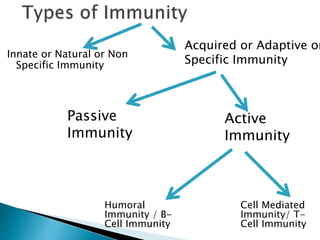
Innate or Natural or Non
Specific Immunity
Acquired or Adaptive or
Specific Immunity
Passive
Immunity
Active
Immunity
Humoral
Immunity / B-
Cell Immunity
Cell Mediated
Immunity/ T-
Cell Immunity
 It is the natural resistances with which a person
is born
 It includes general processes, rather than the
specific processes directed against specific
disease organisms.
 Phagocytosis of bacteria and other invaders by
white blood cells mainly Neutrophils and cells of
the tissue macrophage system.
 Natural Barriers: Resistance of the skin to invasion
by organisms
 Destruction of swallowed organisms by the acid
secretions of the stomach and the digestive
enzymes.
 Presence of certain chemical compounds in the
blood that attach to foreign organisms or toxins
and destroy them. These Include:
◦ Lysozyme, a mucolytic polysaccharide that attacks
bacteria and causes them to dissolute
◦ Basic polypeptides, which react with and inactivate certain
types of gram-positive bacteria
◦ The complement complex, a system of about 20 proteins
that can be activated in various ways to destroy bacteria
◦ Natural killer lymphocytes that can recognize and destroy
foreign cells, tumor cells, and even some infected cells.
 It is the ability of human body to develop extremely
powerful specific responses against individual
invading agents such as lethal bacteria, viruses,
toxins, and even foreign tissues from other animals.
 It does not develop until after the body is first
attacked by a bacterium, virus, or toxin, often
requiring weeks or months to develop the immunity
 Acquired immunity is caused by a special immune
system that forms antibodies and/or activated
lymphocytes that attack and destroy the specific
invading organism or toxin.
 It is produced by administration of already made
antibodies, e.g.,
◦ Serum obtained from actively immunized horses
◦ Human serum rich in antibodies against invading
bacteria, viruses.
 This type of immunity results when the body of
a human being itself produces an immune
reaction in response to the entry of antigen into
the body.
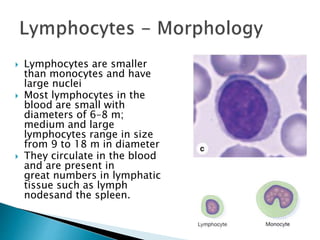
 Lymphocytes are smaller
than monocytes and have
large nuclei
 Most lymphocytes in the
blood are small with
diameters of 6–8 m;
medium and large
lymphocytes range in size
from 9 to 18 m in diameter
 They circulate in the blood
and are present in
great numbers in lymphatic
tissue such as lymph
nodesand the spleen.
 They can be subdivided into functional groups
according to distinctive surface molecules
(markers) that can best be distinguished
immunocytochemically
 T lymphocytes
 B lymphocytes
 Lymphocytes are the vital component of immune
system which includes bone marrow, thymus,
spleen, lymph nodes, tonsils, Peyer’s patches,
appendix.
 Earliest ancesters first appear in the primitive yolk
sac during the first trimester of pregnancy.
 Later during the second and third trimester these
are found in the liver and spleen.
 The Stem cells give rise to lymphoblasts whihc then
to lymphocytes.
 The lymphocytes designate to develop cell
mediated immunity migrate into thymus
gland and are transformed into T-
lymphocytes.
 The lymphocytes designate to develop
humoral immunity are processed in liver
during fetal life and bone marrow after birth
and are transformed into B lymphocytes.
 Types of T Lymphocytes:
 1) Helper T cells
 2) Cytotoxic T cells
 3) Suppressor T cells
 4) Memory T cells.
 B Lymphocytes:
 It were first discovered in Bursa of Fabricius
in birds. So these were named as B
lymphocytes. The bursa of Fabricius is a
lymphoid organ situated near the cloaca of
birds.
 The Bursa is absent in mammals, and the
processing of B lymphocytes takes place in
liver and bone marrow.
 For a substance to be antigenic, it usually must
have a high molecular weight, 8000 or greater.
 Furthermore, the process of antigenicity usually
depends on regularly recurring molecular groups,
called epitopes, on the surface of the large
molecule.
 This also explains why proteins and large
polysaccharides are almost always antigenic
 This type of immunity involves B lymphocytes
 Before exposure to a specific antigen, the clones of B
lymphocytes remain dormant in the lymphoid tissue.
 On entry of a foreign antigen, macrophages in the
lymphoid tissue phagocytize the antigen and then
present it to adjacent B lymphocytes.
 In addition, the antigen is presented to T cells at the
same time, and activated helper T cells are formed.
 These helper cells also contribute to extreme activation
of the B lymphocytes by the release of interleukins
(Lymphokines)
 Those B lymphocytes specific for the antigen
immediately enlarge and take on the appearance of
lymphoblasts.
 Some of the lymphoblasts further differentiate to form
plasmablasts, which are precursors of plasma cells that
form and release large number of Antibodies i.e.
gammaglobulins.
 A few of the lymphoblasts formed by activation of a clone
of B lymphocytes do not go on to form plasma cells but
instead form moderate numbers of new B lymphocytes
similar to those of the original clone.
 In other words, the B cell population of the specifically
activated clone becomes greatly enhanced, and the new B
lymphocytes are added to the original lymphocytes of the
same clone.
 They also circulate throughout the body to populate all the
lymphoid tissue; immunologically, however, they remain
dormant until activated once again by a new quantity of
the same antigen. These lymphocytes are called memory
cells.
 Antibodies act mainly in two ways to protect
the body against invading agents:
 by direct attack on the invader
 by activation of the “complement system” that
then has multiple means of its own for
destroying the invader.
 Agglutination, in which multiple large particles with
antigens on their surfaces, such as bacteria or red
cells, are bound together into a clump
 Precipitation, in which the molecular complex of
soluble antigen (such as tetanus toxin) and antibody
becomes so large that it is rendered insoluble and
precipitates
 Neutralization, in which the antibodies cover the toxic
sites of the antigenic agent
 Lysis, in which some potent antibodies are
occasionally capable of directly attacking membranes
of cellular agents and thereby cause rupture of the
agent
Innate or Natural or Non
Specific Immunity
Acquired or Adaptive or
Specific Immunity
Passive
Immunity
Active
Immunity
Humoral
Immunity /
B-Cell
Cell
Mediated
Immunity/
 This type of acquired immunity is achieved through
the formation of large numbers of activated T
lymphocytes.
 The lymphocytes that are destined to eventually
form activated T lymphocytes first migrate to and
are preprocessed in the thymus gland, and thus
they are called “T” lymphocytes to designate the
role of the thymus.
 Most of the preprocessing of T lymphocytes in the
thymus occurs shortly before birth of a baby and
for a few months after birth
 The T lymphocytes, after origination in the bone marrow, first
migrate to the thymus gland.
 Here they divide rapidly and at the same time develop
extreme diversity for reacting against different specific
antigens.
 That is, one thymic lymphocyte develops specific reactivity
against one antigen.
 Then the next lymphocyte develops specificity against
another antigen.
 This continues until there are thousands of different types of
thymic lymphocytes with specific reactivities against many
thousands of different antigens.
 These different types of preprocessed T lymphocytes now
leave the thymus and spread by way of the blood throughout
the body to lodge in lymphoid tissue everywhere.
 When specific antigens come in contact with T
lymphocytes in the lymphoid tissue, certain of the T
lymphocytes become activated to form activated T
cells
 The activated T cells in turn react highly
specifically against the particular types of antigens
that initiated their development.
 T-cell responses are extremely antigen specific, like
the antibody responses of B cells, and are at least
as important as antibodies in defending against
infection.
 T lymphocytes respond to antigens only when they
are bound to specific molecules called MHC
proteins on the surface of antigen-presenting cells
in the lymphoid tissues
 The three major types of antigen-presenting cells
are macrophages, B lymphocytes, and dendritic
cells
 Activation of T cells
requires interaction of T-
cell receptors with an
antigen (foreign protein)
that is transported to the
surface of the antigen-
presenting cell by a major
histocompatibility complex
(MHC) protein.
 Cell-to-cell adhesion
proteins enable the T cell
to bind to the antigen-
presenting cell long
enough to become
activated.
1. Helper T cells
2. Cytotoxic T cells
3. Suppressor T cells
4. Memory T cells
 Most Numerous T Cells
 They help in the functions of the immune system
in many ways.
 They serve as the major regulator of virtually all
immune functions by forming a series of protein
mediators, called lymphokines, that act on other
cells of the immune system as well as on bone
marrow cells
 In the absence of the lymphokines from the helper
T cells, the remainder of the immune system is
almost paralyzed
 It is the helper T cells that are inactivated or
destroyed by the acquired immunodeficiency
syndrome (AIDS) virus, which leaves the body
almost totally unprotected against infectious
disease.
 These stimulate growth and proliferation of:
◦ Cytotoxic T cells
◦ Suppresor T cells
 These stimulate B Cells to grow and
differentiate to form plasma cells and
antibodies
 Activation of Macrophage System
 Feedback Stimulatory Effect on the Helper Cells
Themselves
 The cytotoxic T cell is a direct-attack cell that is
capable of killing micro-organisms and, at times,
even some of the body’s own cells.
 For this reason, these cells are called killer cells.
 The receptor proteins on the surfaces of the
cytotoxic cells cause them to bind tightly to those
organisms or cells that contain the appropriate
binding-specific antigen
 Then, they kill the attacked cell by secreting hole
forming proteins i.e. perforins
 In addition, the cytotoxic T cell releases cytotoxic
substances directly into the attacked cell.
 Especially important, these cytotoxic killer cells
can pull away from the victim cells after they have
punched holes and delivered cytotoxic substances
and then move on to kill more cells. Indeed, some
of these cells persist for months in the tissues
Functions of Cytotoxic T cells
 Much less is known about the suppressor T
cells than about the others
 They are capable of suppressing the functions
of both cytotoxic and helper T cells.
 It is believed that these suppressor functions
serve the purpose of preventing the cytotoxic
cells from causing excessive immune reactions
that might be damaging to the body’s own
tissues.

Immunity

  • 2.
     It isthe capacity of the human body to resist and destroy the invading organisms or toxins.
  • 3.
    Innate or Naturalor Non Specific Immunity Acquired or Adaptive or Specific Immunity Passive Immunity Active Immunity Humoral Immunity / B- Cell Immunity Cell Mediated Immunity/ T- Cell Immunity
  • 4.
     It isthe natural resistances with which a person is born  It includes general processes, rather than the specific processes directed against specific disease organisms.
  • 5.
     Phagocytosis ofbacteria and other invaders by white blood cells mainly Neutrophils and cells of the tissue macrophage system.  Natural Barriers: Resistance of the skin to invasion by organisms  Destruction of swallowed organisms by the acid secretions of the stomach and the digestive enzymes.
  • 6.
     Presence ofcertain chemical compounds in the blood that attach to foreign organisms or toxins and destroy them. These Include: ◦ Lysozyme, a mucolytic polysaccharide that attacks bacteria and causes them to dissolute ◦ Basic polypeptides, which react with and inactivate certain types of gram-positive bacteria ◦ The complement complex, a system of about 20 proteins that can be activated in various ways to destroy bacteria ◦ Natural killer lymphocytes that can recognize and destroy foreign cells, tumor cells, and even some infected cells.
  • 7.
     It isthe ability of human body to develop extremely powerful specific responses against individual invading agents such as lethal bacteria, viruses, toxins, and even foreign tissues from other animals.  It does not develop until after the body is first attacked by a bacterium, virus, or toxin, often requiring weeks or months to develop the immunity  Acquired immunity is caused by a special immune system that forms antibodies and/or activated lymphocytes that attack and destroy the specific invading organism or toxin.
  • 8.
     It isproduced by administration of already made antibodies, e.g., ◦ Serum obtained from actively immunized horses ◦ Human serum rich in antibodies against invading bacteria, viruses.
  • 9.
     This typeof immunity results when the body of a human being itself produces an immune reaction in response to the entry of antigen into the body.
  • 10.
     Lymphocytes aresmaller than monocytes and have large nuclei  Most lymphocytes in the blood are small with diameters of 6–8 m; medium and large lymphocytes range in size from 9 to 18 m in diameter  They circulate in the blood and are present in great numbers in lymphatic tissue such as lymph nodesand the spleen.
  • 11.
     They canbe subdivided into functional groups according to distinctive surface molecules (markers) that can best be distinguished immunocytochemically  T lymphocytes  B lymphocytes
  • 12.
     Lymphocytes arethe vital component of immune system which includes bone marrow, thymus, spleen, lymph nodes, tonsils, Peyer’s patches, appendix.  Earliest ancesters first appear in the primitive yolk sac during the first trimester of pregnancy.  Later during the second and third trimester these are found in the liver and spleen.  The Stem cells give rise to lymphoblasts whihc then to lymphocytes.
  • 13.
     The lymphocytesdesignate to develop cell mediated immunity migrate into thymus gland and are transformed into T- lymphocytes.  The lymphocytes designate to develop humoral immunity are processed in liver during fetal life and bone marrow after birth and are transformed into B lymphocytes.
  • 14.
     Types ofT Lymphocytes:  1) Helper T cells  2) Cytotoxic T cells  3) Suppressor T cells  4) Memory T cells.
  • 15.
     B Lymphocytes: It were first discovered in Bursa of Fabricius in birds. So these were named as B lymphocytes. The bursa of Fabricius is a lymphoid organ situated near the cloaca of birds.  The Bursa is absent in mammals, and the processing of B lymphocytes takes place in liver and bone marrow.
  • 16.
     For asubstance to be antigenic, it usually must have a high molecular weight, 8000 or greater.  Furthermore, the process of antigenicity usually depends on regularly recurring molecular groups, called epitopes, on the surface of the large molecule.  This also explains why proteins and large polysaccharides are almost always antigenic
  • 17.
     This typeof immunity involves B lymphocytes  Before exposure to a specific antigen, the clones of B lymphocytes remain dormant in the lymphoid tissue.  On entry of a foreign antigen, macrophages in the lymphoid tissue phagocytize the antigen and then present it to adjacent B lymphocytes.  In addition, the antigen is presented to T cells at the same time, and activated helper T cells are formed.  These helper cells also contribute to extreme activation of the B lymphocytes by the release of interleukins (Lymphokines)  Those B lymphocytes specific for the antigen immediately enlarge and take on the appearance of lymphoblasts.  Some of the lymphoblasts further differentiate to form plasmablasts, which are precursors of plasma cells that form and release large number of Antibodies i.e. gammaglobulins.
  • 18.
     A fewof the lymphoblasts formed by activation of a clone of B lymphocytes do not go on to form plasma cells but instead form moderate numbers of new B lymphocytes similar to those of the original clone.  In other words, the B cell population of the specifically activated clone becomes greatly enhanced, and the new B lymphocytes are added to the original lymphocytes of the same clone.  They also circulate throughout the body to populate all the lymphoid tissue; immunologically, however, they remain dormant until activated once again by a new quantity of the same antigen. These lymphocytes are called memory cells.
  • 21.
     Antibodies actmainly in two ways to protect the body against invading agents:  by direct attack on the invader  by activation of the “complement system” that then has multiple means of its own for destroying the invader.
  • 22.
     Agglutination, inwhich multiple large particles with antigens on their surfaces, such as bacteria or red cells, are bound together into a clump  Precipitation, in which the molecular complex of soluble antigen (such as tetanus toxin) and antibody becomes so large that it is rendered insoluble and precipitates  Neutralization, in which the antibodies cover the toxic sites of the antigenic agent  Lysis, in which some potent antibodies are occasionally capable of directly attacking membranes of cellular agents and thereby cause rupture of the agent
  • 24.
    Innate or Naturalor Non Specific Immunity Acquired or Adaptive or Specific Immunity Passive Immunity Active Immunity Humoral Immunity / B-Cell Cell Mediated Immunity/
  • 25.
     This typeof acquired immunity is achieved through the formation of large numbers of activated T lymphocytes.  The lymphocytes that are destined to eventually form activated T lymphocytes first migrate to and are preprocessed in the thymus gland, and thus they are called “T” lymphocytes to designate the role of the thymus.  Most of the preprocessing of T lymphocytes in the thymus occurs shortly before birth of a baby and for a few months after birth
  • 26.
     The Tlymphocytes, after origination in the bone marrow, first migrate to the thymus gland.  Here they divide rapidly and at the same time develop extreme diversity for reacting against different specific antigens.  That is, one thymic lymphocyte develops specific reactivity against one antigen.  Then the next lymphocyte develops specificity against another antigen.  This continues until there are thousands of different types of thymic lymphocytes with specific reactivities against many thousands of different antigens.  These different types of preprocessed T lymphocytes now leave the thymus and spread by way of the blood throughout the body to lodge in lymphoid tissue everywhere.
  • 27.
     When specificantigens come in contact with T lymphocytes in the lymphoid tissue, certain of the T lymphocytes become activated to form activated T cells  The activated T cells in turn react highly specifically against the particular types of antigens that initiated their development.  T-cell responses are extremely antigen specific, like the antibody responses of B cells, and are at least as important as antibodies in defending against infection.  T lymphocytes respond to antigens only when they are bound to specific molecules called MHC proteins on the surface of antigen-presenting cells in the lymphoid tissues  The three major types of antigen-presenting cells are macrophages, B lymphocytes, and dendritic cells
  • 28.
     Activation ofT cells requires interaction of T- cell receptors with an antigen (foreign protein) that is transported to the surface of the antigen- presenting cell by a major histocompatibility complex (MHC) protein.  Cell-to-cell adhesion proteins enable the T cell to bind to the antigen- presenting cell long enough to become activated.
  • 29.
    1. Helper Tcells 2. Cytotoxic T cells 3. Suppressor T cells 4. Memory T cells
  • 30.
     Most NumerousT Cells  They help in the functions of the immune system in many ways.  They serve as the major regulator of virtually all immune functions by forming a series of protein mediators, called lymphokines, that act on other cells of the immune system as well as on bone marrow cells  In the absence of the lymphokines from the helper T cells, the remainder of the immune system is almost paralyzed  It is the helper T cells that are inactivated or destroyed by the acquired immunodeficiency syndrome (AIDS) virus, which leaves the body almost totally unprotected against infectious disease.
  • 31.
     These stimulategrowth and proliferation of: ◦ Cytotoxic T cells ◦ Suppresor T cells  These stimulate B Cells to grow and differentiate to form plasma cells and antibodies  Activation of Macrophage System  Feedback Stimulatory Effect on the Helper Cells Themselves
  • 33.
     The cytotoxicT cell is a direct-attack cell that is capable of killing micro-organisms and, at times, even some of the body’s own cells.  For this reason, these cells are called killer cells.  The receptor proteins on the surfaces of the cytotoxic cells cause them to bind tightly to those organisms or cells that contain the appropriate binding-specific antigen  Then, they kill the attacked cell by secreting hole forming proteins i.e. perforins  In addition, the cytotoxic T cell releases cytotoxic substances directly into the attacked cell.  Especially important, these cytotoxic killer cells can pull away from the victim cells after they have punched holes and delivered cytotoxic substances and then move on to kill more cells. Indeed, some of these cells persist for months in the tissues
  • 34.
  • 35.
     Much lessis known about the suppressor T cells than about the others  They are capable of suppressing the functions of both cytotoxic and helper T cells.  It is believed that these suppressor functions serve the purpose of preventing the cytotoxic cells from causing excessive immune reactions that might be damaging to the body’s own tissues.