LYMPHATIC SYSTEM &
BODY DEFENSES
Anatomy & Physiology
Lymphatic System consists of two semi-
independent parts:
• Lymphatic vessels - Transports escaped fluids from the cardiovascular
system back to the blood
• Lymphoid tissues & Lymphoid organs – house phagocytic cells and lymphocytes
, which play essential roles in body defense and resistance to disease.
Lymph – a fluid that
has escape from the blood vessels
- If fluids are not picked up, edema occurs as fluid accumulates in
tissues
Edema – swelling of tissue
Lymphatic system functions
• Plays essential roles in body defense and resistance to disease
• Takes up fats & vitamins
• Transports escaped fluids from the cardiovascular system back to
the blood
Lymphatic Vessels
• Form a one-way system (Lymph flows only toward the heart)
• Lymph consists of excess tissue fluid and plasma proteins carried
by lymphatic vessels
• If fluids are not picked up, edema occurs as fluid accumulates in
tissues
• Lymphatic vessels (lymphatics) pick up excess fluid (lymph) and
return it to the circulatory veins
• Right Lymphatic duct – drains lymph from the right side of the arm
and right side of the head and the thorax
• Thoracic duct – drains lymph from the rest of the body
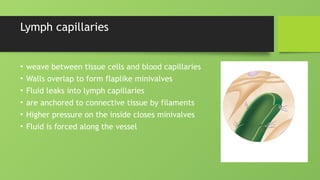
Lymph capillaries
• weave between tissue cells and blood capillaries
• Walls overlap to form flaplike minivalves
• Fluid leaks into lymph capillaries
• are anchored to connective tissue by filaments
• Higher pressure on the inside closes minivalves
• Fluid is forced along the vessel
Transport of lymph is aided by:
• Milking action of skeletal muscles
• Pressure changes in thorax during breathing
• Smooth muscle in walls of lymphatics
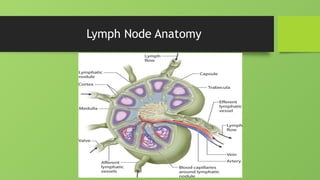
Lymph nodes
• filter lymph before it is returned to the blood
• Filters: Bacteria, Viruses, Cancer cells & Cell debris
• Contains & produce :
1. Macrophages—engulf and destroy bacteria, viruses, and
other foreign substances in lymph
2. Lymphocytes—respond to foreign substances in lymph
lymph nodes are kidney-shaped, less than 1 inch long, and buried in
connective tissue
Surrounded by a capsule; Divided into compartments by trabeculae
Lymph Node Anatomy
Parts of the Lymph Nodes
1. Cortex (outer part)
Contains follicles—collections of lymphocytes
Germinal centers enlarge when antibodies are released
by plasma cells
2. Medulla (inner part)
Contains phagocytic macrophages
Other lymphoid organs contribute to
lymphatic function
1. Spleen – largest lymphoid organ filters pathogens & aged blood
cells
Located on the left side of the abdomen
Provides a site for lymphocyte proliferation and
immune surveillance
Destroys worn-out blood cells
Forms blood cells in the fetus
Acts as a blood reservoir
with 2 compartments: Red & White Pulp
THYMUS
Primary Lymphoid organs
• Thymus & Bone marrow – sites for lymphocyte production,
maturation & selection
• Thymus – together with the spleen; 1st
lymphoid organ to appear
in embryo
• Thymus gland – produces hormones (thymosin)
• overlying the heart
• Functions at peak levels only during youth
Tonsils
• Small masses of lymphoid tissue deep to the mucosa surrounding
the pharynx (throat)
• Trap & remove bacteria and other foreign pathogens
• Tonsillitis results when the tonsils become congested with bacteria
Peyer’s patches
• Found in the wall of the small intestine
• Similar lymphoid follicles are found in the appendix
• Macrophages capture and destroy bacteria in the intestine
Two mechanisms that make up the immune
system
I. Innate (nonspecific) defense system
Mechanisms protect against a variety of invaders
Responds immediately to protect body from foreign materials
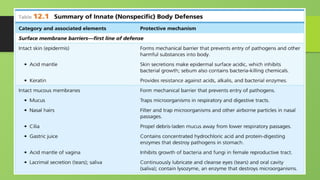
mechanical barriers to pathogens, include:
Body surface coverings
Intact skin
Mucous membranes
Specialized human cells
Chemicals produced by the body
Resistance & Immunity
• II. Adaptive (specific) defense system
• Fights invaders that get past the innate system
• Specific defense is required for each type of invader
• The highly specific resistance to disease is immunity
• Immunity—specific resistance to disease
• Immune system is a functional system rather than an organ system
in an anatomical sense
second line of defense
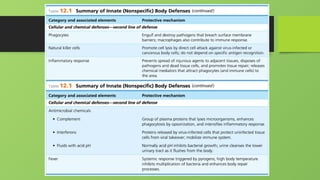
I. Natural killer cells and phagocytes
II. Inflammatory response - Triggered when body tissues are injured
Four most common indicators or cardinal signs
1. Redness
2. Heat
3. Pain
4. Swelling (edema)
III. Chemicals that kill pathogens – Most important types
Complement proteins- refers to a group of at least 20 plasma
proteins that circulate in the plasma
- activated when these plasma proteins
encounter and attach to cells (known as
complement fixation)
Interferon - are small proteins secreted by virus-infected cells
- bind to membrane receptors on healthy cell surfaces to interfere
with the ability of viruses to multiply
IV. Fever – increase in body temperature
-Abnormally high body temperature is a systemic
response to invasion by microorganisms
- Hypothalamus regulates body temperature at 37ºC
(98.6ºF)
- The hypothalamus thermostat can be reset higher by
pyrogens (secreted by white blood cells)
- High temperatures inhibit the release of iron and zinc
(needed by bacteria) from the liver and spleen
-also increases the speed of repair processes
Third Line of Defense
• Adaptive body defenses are the body’s specific defense system
• Antigens are targeted and destroyed by antibodies
Three aspects of adaptive defense
• Antigen specific—defense system recognizes and acts against
particular foreign substances
• Systemic immunity - is not restricted to the initial infection site
• Memory—defense system recognizes and attack on previously
encountered pathogens
Types of the adaptive defense system
• Humoral immunity = antibody-mediated immunity
-Provided by antibodies present in body fluids
• Cellular immunity = cell-mediated immunity
Targets virus-infected cells, cancer cells, and
cells of foreign grafts
Antigens
• substances capable of exciting the immune system and provoking
an immune response
• Common nonself antigens
1. Foreign proteins provoke the strongest response
2. Nucleic acids
3. Large carbohydrates
4. Some lipids
5. Pollen grains
6. Microorganisms (bacteria, fungi, viruses)
Self-antigens
1. Human cells have many protein and carbohydrate
molecules
2. Self-antigens do not trigger an immune response in us
3. The presence of our cells in another person’s body can
trigger an immune response because they are foreign
Restricts donors for transplants
Haptens, or Incomplete Antigens
• are not antigenic by themselves
• When they link with our own proteins, the immune system may
recognize the combination as foreign and respond with an attack
• Found in poison ivy, animal dander, detergents, hair dyes,
cosmetics
Humoral (Antibody-Mediated) Immune
Response
I. Active immunity
-Occurs when B cells encounter antigens and produce
antibodies
- Active immunity can be:
A. Naturally acquired during bacterial and viral infections
B. Artificially acquired from vaccines
Passive immunity
-Occurs when antibodies are obtained from someone else
- acquired from a mother to her fetus or in the breast milk
- Artificially acquired from immune serum or gamma globulin
(donated antibodies)
- Immunological memory does not occur
- short-lived protection (2–3 weeks)
Antibodies (immunoglobulins, Igs)
• Constitute gamma globulin part of blood proteins
• Soluble proteins secreted by activated B cells (plasma cells)
• Formed in response to a huge number of antigens
Antibody structure
Made of four polypeptide chains, two heavy and two light, linked by
disulfide bonds to form a T- or Y-shaped molecule
• Each polypeptide chain has a:
a. Variable regions - form antigen-binding sites, one on each
arm of the T or Y
b. Constant regions - determine the type of antibody formed
(antibody class)
Classification of Antibodies (immunoglobulins, Igs)
as to their structure and function
Five major immunoglobulin classes (MADGE)
• IgM—can fix complement; blood & lymph
• IgA—found mainly in secretions, such as mucus or tears, saliva and
breastmilk; common type
• IgD—important in activation of B cell
• IgG—can cross the placental barrier and fix complement; most
abundant antibody in plasma blood & other body fluids; bacterial
and viral infection
• IgE—involved in allergies
Antibody Function
inactivate antigens by:
1. Complement fixation: chief antibody ammunition used
against cellular antigens
2. Neutralization: antibodies bind to specific sites on
bacterial exotoxins or on viruses that can cause
cell injury
3. Agglutination: antibody-antigen reaction that causes
clumping of cells
4. Precipitation: cross-linking reaction in which antigen-
antibody complex settles out of solution
Cellular (Cell-Mediated) Immune Response
Main difference between two arms of the adaptive response
1. B cells secrete antibodies
2. T cells fight antigens directly - immunocompetent T cells are
activated to form a clone by binding with a recognized antigen
-T cells are unable to bind to free antigens
- Types of effector T cells
A. Helper T cells
B. Cytotoxic T cells
Cytotoxic T cell
• Specialize in killing infected cells
• Insert a toxic chemical (perforin or granzyme) that enters the
foreign cell’s plasma membrane
• Granzymes kill the foreign cell
• Cytotoxic T cell detaches and seeks other targets
Helper T cells
• Recruit other cells to fight invaders
• Interact directly with B cells bound to an antigen,
• Stimulates the B cells into clone production
• Release cytokines (chemicals that act directly to rid the body of
antigens)
Regulatory T cells
• Release chemicals to suppress the activity of T and B cells
• Stop the immune response to prevent uncontrolled activity
Major types of transplants/grafts
• Autografts—tissue transplanted from one site to another on the
same person
• Isografts—tissue grafts from a genetically identical person
(identical twin)
• Allografts—tissue taken from a person other than an identical twin
(most common type of graft)
• Xenografts—tissue taken from a different animal species (never
successful)
Organ Transplants & Rejection
• Blood group and tissue matching -done to ensure the best match
possible
• 75% match is needed to attempt a graft
• Organ transplant is followed by immunosuppressive therapy to
prevent rejection
Disorders of Immunity
• The most important disorders of the immune system
• Allergies-Allergies, or hypersensitives, are abnormal, vigorous
immune responses .The immune system overreacts to an otherwise
harmless antigen, and tissue damage occurs
• Autoimmune diseases
• Immunodeficiencies

LYMPHATIC SYSTEMdfewfewfr32r23r3re,.pptx

  • 1.
    LYMPHATIC SYSTEM & BODYDEFENSES Anatomy & Physiology
  • 2.
    Lymphatic System consistsof two semi- independent parts: • Lymphatic vessels - Transports escaped fluids from the cardiovascular system back to the blood • Lymphoid tissues & Lymphoid organs – house phagocytic cells and lymphocytes , which play essential roles in body defense and resistance to disease. Lymph – a fluid that has escape from the blood vessels - If fluids are not picked up, edema occurs as fluid accumulates in tissues Edema – swelling of tissue
  • 3.
    Lymphatic system functions •Plays essential roles in body defense and resistance to disease • Takes up fats & vitamins • Transports escaped fluids from the cardiovascular system back to the blood
  • 4.
    Lymphatic Vessels • Forma one-way system (Lymph flows only toward the heart) • Lymph consists of excess tissue fluid and plasma proteins carried by lymphatic vessels • If fluids are not picked up, edema occurs as fluid accumulates in tissues • Lymphatic vessels (lymphatics) pick up excess fluid (lymph) and return it to the circulatory veins • Right Lymphatic duct – drains lymph from the right side of the arm and right side of the head and the thorax • Thoracic duct – drains lymph from the rest of the body
  • 5.
    Lymph capillaries • weavebetween tissue cells and blood capillaries • Walls overlap to form flaplike minivalves • Fluid leaks into lymph capillaries • are anchored to connective tissue by filaments • Higher pressure on the inside closes minivalves • Fluid is forced along the vessel
  • 6.
    Transport of lymphis aided by: • Milking action of skeletal muscles • Pressure changes in thorax during breathing • Smooth muscle in walls of lymphatics
  • 7.
    Lymph nodes • filterlymph before it is returned to the blood • Filters: Bacteria, Viruses, Cancer cells & Cell debris • Contains & produce : 1. Macrophages—engulf and destroy bacteria, viruses, and other foreign substances in lymph 2. Lymphocytes—respond to foreign substances in lymph lymph nodes are kidney-shaped, less than 1 inch long, and buried in connective tissue Surrounded by a capsule; Divided into compartments by trabeculae
  • 8.
  • 9.
    Parts of theLymph Nodes 1. Cortex (outer part) Contains follicles—collections of lymphocytes Germinal centers enlarge when antibodies are released by plasma cells 2. Medulla (inner part) Contains phagocytic macrophages
  • 10.
    Other lymphoid organscontribute to lymphatic function 1. Spleen – largest lymphoid organ filters pathogens & aged blood cells Located on the left side of the abdomen Provides a site for lymphocyte proliferation and immune surveillance Destroys worn-out blood cells Forms blood cells in the fetus Acts as a blood reservoir with 2 compartments: Red & White Pulp
  • 11.
    THYMUS Primary Lymphoid organs •Thymus & Bone marrow – sites for lymphocyte production, maturation & selection • Thymus – together with the spleen; 1st lymphoid organ to appear in embryo • Thymus gland – produces hormones (thymosin) • overlying the heart • Functions at peak levels only during youth
  • 12.
    Tonsils • Small massesof lymphoid tissue deep to the mucosa surrounding the pharynx (throat) • Trap & remove bacteria and other foreign pathogens • Tonsillitis results when the tonsils become congested with bacteria
  • 13.
    Peyer’s patches • Foundin the wall of the small intestine • Similar lymphoid follicles are found in the appendix • Macrophages capture and destroy bacteria in the intestine
  • 14.
    Two mechanisms thatmake up the immune system I. Innate (nonspecific) defense system Mechanisms protect against a variety of invaders Responds immediately to protect body from foreign materials mechanical barriers to pathogens, include: Body surface coverings Intact skin Mucous membranes Specialized human cells Chemicals produced by the body
  • 17.
    Resistance & Immunity •II. Adaptive (specific) defense system • Fights invaders that get past the innate system • Specific defense is required for each type of invader • The highly specific resistance to disease is immunity
  • 18.
    • Immunity—specific resistanceto disease • Immune system is a functional system rather than an organ system in an anatomical sense
  • 19.
    second line ofdefense I. Natural killer cells and phagocytes II. Inflammatory response - Triggered when body tissues are injured Four most common indicators or cardinal signs 1. Redness 2. Heat 3. Pain 4. Swelling (edema)
  • 20.
    III. Chemicals thatkill pathogens – Most important types Complement proteins- refers to a group of at least 20 plasma proteins that circulate in the plasma - activated when these plasma proteins encounter and attach to cells (known as complement fixation) Interferon - are small proteins secreted by virus-infected cells - bind to membrane receptors on healthy cell surfaces to interfere with the ability of viruses to multiply
  • 21.
    IV. Fever –increase in body temperature -Abnormally high body temperature is a systemic response to invasion by microorganisms - Hypothalamus regulates body temperature at 37ºC (98.6ºF) - The hypothalamus thermostat can be reset higher by pyrogens (secreted by white blood cells) - High temperatures inhibit the release of iron and zinc (needed by bacteria) from the liver and spleen -also increases the speed of repair processes
  • 22.
    Third Line ofDefense • Adaptive body defenses are the body’s specific defense system • Antigens are targeted and destroyed by antibodies Three aspects of adaptive defense • Antigen specific—defense system recognizes and acts against particular foreign substances • Systemic immunity - is not restricted to the initial infection site • Memory—defense system recognizes and attack on previously encountered pathogens
  • 23.
    Types of theadaptive defense system • Humoral immunity = antibody-mediated immunity -Provided by antibodies present in body fluids • Cellular immunity = cell-mediated immunity Targets virus-infected cells, cancer cells, and cells of foreign grafts
  • 24.
    Antigens • substances capableof exciting the immune system and provoking an immune response • Common nonself antigens 1. Foreign proteins provoke the strongest response 2. Nucleic acids 3. Large carbohydrates 4. Some lipids 5. Pollen grains 6. Microorganisms (bacteria, fungi, viruses)
  • 25.
    Self-antigens 1. Human cellshave many protein and carbohydrate molecules 2. Self-antigens do not trigger an immune response in us 3. The presence of our cells in another person’s body can trigger an immune response because they are foreign Restricts donors for transplants
  • 26.
    Haptens, or IncompleteAntigens • are not antigenic by themselves • When they link with our own proteins, the immune system may recognize the combination as foreign and respond with an attack • Found in poison ivy, animal dander, detergents, hair dyes, cosmetics
  • 27.
    Humoral (Antibody-Mediated) Immune Response I.Active immunity -Occurs when B cells encounter antigens and produce antibodies - Active immunity can be: A. Naturally acquired during bacterial and viral infections B. Artificially acquired from vaccines
  • 28.
    Passive immunity -Occurs whenantibodies are obtained from someone else - acquired from a mother to her fetus or in the breast milk - Artificially acquired from immune serum or gamma globulin (donated antibodies) - Immunological memory does not occur - short-lived protection (2–3 weeks)
  • 29.
    Antibodies (immunoglobulins, Igs) •Constitute gamma globulin part of blood proteins • Soluble proteins secreted by activated B cells (plasma cells) • Formed in response to a huge number of antigens Antibody structure Made of four polypeptide chains, two heavy and two light, linked by disulfide bonds to form a T- or Y-shaped molecule • Each polypeptide chain has a: a. Variable regions - form antigen-binding sites, one on each arm of the T or Y b. Constant regions - determine the type of antibody formed (antibody class)
  • 30.
    Classification of Antibodies(immunoglobulins, Igs) as to their structure and function Five major immunoglobulin classes (MADGE) • IgM—can fix complement; blood & lymph • IgA—found mainly in secretions, such as mucus or tears, saliva and breastmilk; common type • IgD—important in activation of B cell • IgG—can cross the placental barrier and fix complement; most abundant antibody in plasma blood & other body fluids; bacterial and viral infection • IgE—involved in allergies
  • 31.
    Antibody Function inactivate antigensby: 1. Complement fixation: chief antibody ammunition used against cellular antigens 2. Neutralization: antibodies bind to specific sites on bacterial exotoxins or on viruses that can cause cell injury 3. Agglutination: antibody-antigen reaction that causes clumping of cells 4. Precipitation: cross-linking reaction in which antigen- antibody complex settles out of solution
  • 32.
    Cellular (Cell-Mediated) ImmuneResponse Main difference between two arms of the adaptive response 1. B cells secrete antibodies 2. T cells fight antigens directly - immunocompetent T cells are activated to form a clone by binding with a recognized antigen -T cells are unable to bind to free antigens - Types of effector T cells A. Helper T cells B. Cytotoxic T cells
  • 33.
    Cytotoxic T cell •Specialize in killing infected cells • Insert a toxic chemical (perforin or granzyme) that enters the foreign cell’s plasma membrane • Granzymes kill the foreign cell • Cytotoxic T cell detaches and seeks other targets
  • 34.
    Helper T cells •Recruit other cells to fight invaders • Interact directly with B cells bound to an antigen, • Stimulates the B cells into clone production • Release cytokines (chemicals that act directly to rid the body of antigens) Regulatory T cells • Release chemicals to suppress the activity of T and B cells • Stop the immune response to prevent uncontrolled activity
  • 35.
    Major types oftransplants/grafts • Autografts—tissue transplanted from one site to another on the same person • Isografts—tissue grafts from a genetically identical person (identical twin) • Allografts—tissue taken from a person other than an identical twin (most common type of graft) • Xenografts—tissue taken from a different animal species (never successful)
  • 36.
    Organ Transplants &Rejection • Blood group and tissue matching -done to ensure the best match possible • 75% match is needed to attempt a graft • Organ transplant is followed by immunosuppressive therapy to prevent rejection
  • 37.
    Disorders of Immunity •The most important disorders of the immune system • Allergies-Allergies, or hypersensitives, are abnormal, vigorous immune responses .The immune system overreacts to an otherwise harmless antigen, and tissue damage occurs • Autoimmune diseases • Immunodeficiencies