Data Security and Transmission over Wireless
Networks
Saurabh Nambiar
SuryaPrabha C P
Smruthi K
Shijil
1Department of Computer Science and
Engineering
Govt. College of Engineering, Kannur
Under the Guidance of
Mr. Nidheesh N.
1 of 1
Project Outline
• About the Project
• Introduction
• Motivation
• About the Work
◦ Encryption Phase
◦ Encoding Phase
◦ Pixel Modification and Splitting
◦ Overlapping Phase
◦ Decoding Phase
◦ Decryption Phase
• Testing and Results
• Conclusion
• Future Work
• References
2 of 1
About the Project
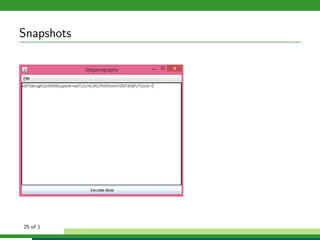
The Project aims at secure data hiding of confidential information
and its transmission over networks. The proposed system provides the
best approach for Least Significant Bit (LSB) based steganography
using Genetic Algorithm (GA) along with Visual Cryptography (VC).
Original message is converted into cipher text by using secret key and
then hidden into the LSB of original image. Genetic Algorithm and
Visual Cryptography has been used for enhancing the security.
Genetic Algorithm is used to modify the pixel location of stego image
and the detection of this message is complex. Visual Cryptography is
used to encrypt the visual information. It is achieved by breaking the
image into two shares so that the hidden data is also split. The main
aim of this paper is to design the enhanced secure algorithm which
uses both LSB steganography using Genetic Algorithm and Visual
Cryptography to ensure improved security and reliability.
3 of 1
Introduction
The main aim of the project is to design a feasible RS steganalysis
resistant secure Algorithm which combines the use of both
steganography and cryptography with the goals of improving security,
reliability, and efficiency for secret message. DES encryption
algorithm is used for encrypting the data into cipher text. Apart from
that, LSB Steganography is combined with the Visual Cryptography
making it more secure from RS steganalysis.
4 of 1
Introduction
5 of 1
Introduction
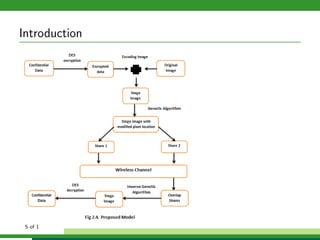
The Project is divided into following important six phases:
• Encryption Phase: The data to be encrypted is first inputted by
the user.The encrypted text is called cipher text. The encryption
algorithm used is DES, which is comparatively considered more
secure than RSA encryption.
• Encoding Phase : The encrypted cipher is then encoded into the
least significant bits of an appropriate image.
• Pixel Modification & Splitting Phase : Since the LSB
steganography can easily be detected by RS steganalysis, the
information pixels at the LSB have to be distributed throughout
the image randomly. After this random distribution, the image is
divided into two shares(parts) before its transmission. This ensures
that information pixels are distributed into two shares.
6 of 1
Introduction
• Overlapping Phase: To retrieve the information, both the shares of
image are required. Both the shares are combined into a single
image in this phase. The image generated consists of the
information.
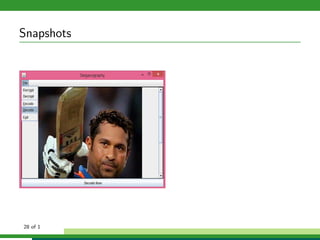
• Decoding Phase: The data in the encrypted form is retrieved back
from the stego-image.
• Decryption Phase:The original data is retrieved back using the
DES decryption algorithm using the same secret key.
7 of 1
Motivation
• The primary reason for selecting steganography among the list of
possible project topics was due to the unfamiliarity of the word
that twigged an interest in the subject.
• Another reason is the data security that it provides. Even if the
hacker(or intruder) gets access to our multimedia data, then also
he cant access the information, that is, the hacker has done the
difficult part of hacking and getting access to the data but the
actual data is still under his nose. This aspect makes it more
interesting.
8 of 1
Related Work
• There exists many information hiding softwares in the market but
most of them are based on LSB Steganography.
• LSB Steganography can easily be detected by RS steganalysis.
Hence, security level is low.
• There are many papers related to the combination of
steganography with cryptography. These provide an additional
layer of protection over the cryptographic model.
• A combination of Cryptography and Steganography is more
resistant to RS Steganalysis.
9 of 1
About the Work
Encryption Module
• The original data to be encrypted is given as input by the user.
• The encryption algorithm used is DES (Data Encryption Standard).
• DES is a private key encryption scheme, that is, only the sender
and receiver know the secret key.
• DES uses a 56-bit secret key to encrypt data.
10 of 1
About the Work
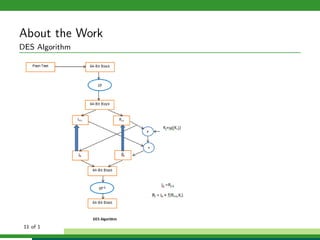
DES Algorithm
11 of 1
About the Work
DES Algorithm
• DES is based on a cipher known as The Feistily block cipher.
• To accomplish encryption, most secret key algorithms use two
main techniques known as substitution and permutation.
• Substitution is simply a mapping of one value to another whereas
permutation is a reordering of the bit positions for each of the
inputs.
• The two inputs for DES algorithm are: plain text to be encrypted
and the secret key.
• DES is therefore a symmetric, 64 bit block cipher as it uses the
same key for both encryption and decryption and only operates on
64 bit blocks of data at a time (be they plaintext or ciphertext).
• The key size used is 56 bits, however a 64 bit (or eight-byte) key is
actually input.
12 of 1
About the Work
DES Algorithm
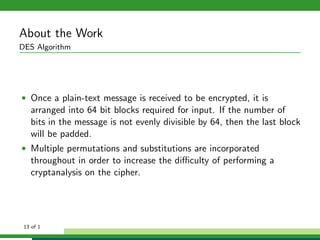
• Once a plain-text message is received to be encrypted, it is
arranged into 64 bit blocks required for input. If the number of
bits in the message is not evenly divisible by 64, then the last block
will be padded.
• Multiple permutations and substitutions are incorporated
throughout in order to increase the difficulty of performing a
cryptanalysis on the cipher.
13 of 1
About the Work
Encoding Phase
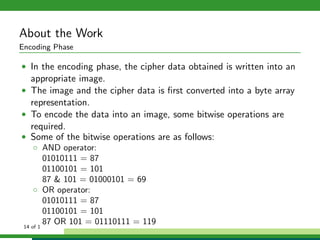
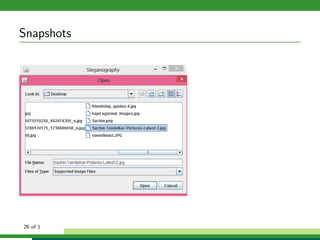
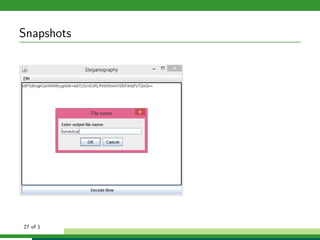
• In the encoding phase, the cipher data obtained is written into an
appropriate image.
• The image and the cipher data is first converted into a byte array
representation.
• To encode the data into an image, some bitwise operations are
required.
• Some of the bitwise operations are as follows:
◦ AND operator:
01010111 = 87
01100101 = 101
87 & 101 = 01000101 = 69
◦ OR operator:
01010111 = 87
01100101 = 101
87 OR 101 = 01110111 = 11914 of 1
About the Work
Encoding Phase
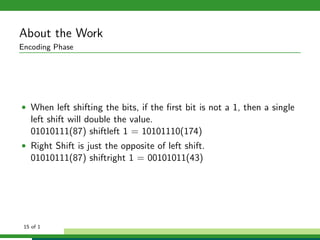
• When left shifting the bits, if the first bit is not a 1, then a single
left shift will double the value.
01010111(87) shiftleft 1 = 10101110(174)
• Right Shift is just the opposite of left shift.
01010111(87) shiftright 1 = 00101011(43)
15 of 1
Encoding Module
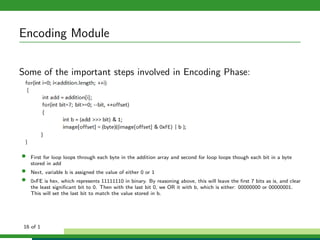
Some of the important steps involved in Encoding Phase:
• First for loop loops through each byte in the addition array and second for loop loops though each bit in a byte
stored in add
• Next, variable b is assigned the value of either 0 or 1
• 0xFE is hex, which represents 11111110 in binary. By reasoning above, this will leave the first 7 bits as is, and clear
the least significant bit to 0. Then with the last bit 0, we OR it with b, which is either: 00000000 or 00000001.
This will set the last bit to match the value stored in b.
16 of 1
Pixel Modification Phase
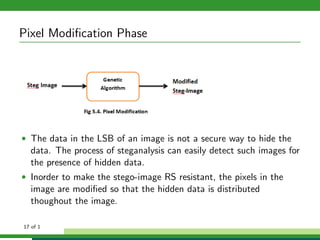
• The data in the LSB of an image is not a secure way to hide the
data. The process of steganalysis can easily detect such images for
the presence of hidden data.
• Inorder to make the stego-image RS resistant, the pixels in the
image are modified so that the hidden data is distributed
thoughout the image.
17 of 1
Splitting and Overlapping Phase
• In the splitting phase, the image is divided into two shares.
• Each share of the image contains a set of pixels of the original
image. The idea behind this is that the information(hidden text)is
now divided into these two shares.
• First, the source image is divided into black and white, that is, the
image contains only black and white pixels.
• Secondly, a key image is generated of the same dimensions, where
each pixel is randomly set to white or black.
• Third, the original image is encrypted using this key - if the pixel in
the key is white then the corresponding pixel in the original image
is used in the encrypted image, whereas if the key pixel is black
then the corresponding pixel in the original image is flipped (black
to white, white to black) for the encrypted image. The result is
two images of apparently random black and white pixels.
18 of 1
Splitting and overlapping Phase
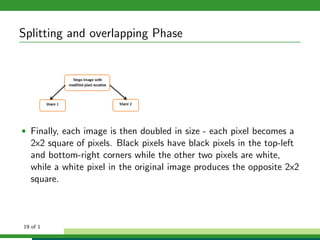
• Finally, each image is then doubled in size - each pixel becomes a
2x2 square of pixels. Black pixels have black pixels in the top-left
and bottom-right corners while the other two pixels are white,
while a white pixel in the original image produces the opposite 2x2
square.
19 of 1
Splitting and Overlapping Phase
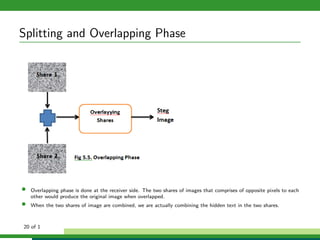
• Overlapping phase is done at the receiver side. The two shares of images that comprises of opposite pixels to each
other would produce the original image when overlapped.
• When the two shares of image are combined, we are actually combining the hidden text in the two shares.
20 of 1
Decoding Module
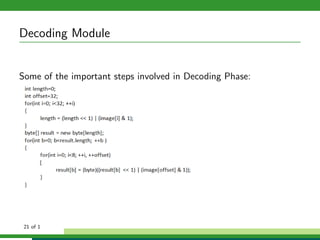
Some of the important steps involved in Decoding Phase:
21 of 1
Decoding Module
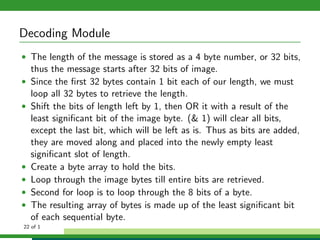
• The length of the message is stored as a 4 byte number, or 32 bits,
thus the message starts after 32 bits of image.
• Since the first 32 bytes contain 1 bit each of our length, we must
loop all 32 bytes to retrieve the length.
• Shift the bits of length left by 1, then OR it with a result of the
least significant bit of the image byte. (& 1) will clear all bits,
except the last bit, which will be left as is. Thus as bits are added,
they are moved along and placed into the newly empty least
significant slot of length.
• Create a byte array to hold the bits.
• Loop through the image bytes till entire bits are retrieved.
• Second for loop is to loop through the 8 bits of a byte.
• The resulting array of bytes is made up of the least significant bit
of each sequential byte.
22 of 1
Decryption Phase
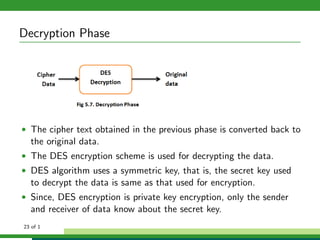
• The cipher text obtained in the previous phase is converted back to
the original data.
• The DES encryption scheme is used for decrypting the data.
• DES algorithm uses a symmetric key, that is, the secret key used
to decrypt the data is same as that used for encryption.
• Since, DES encryption is private key encryption, only the sender
and receiver of data know about the secret key.
23 of 1
Results
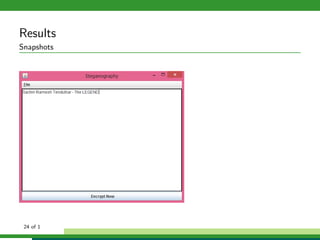
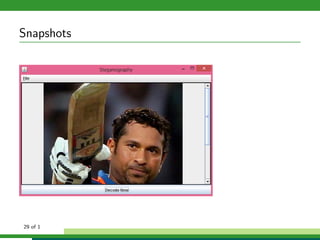
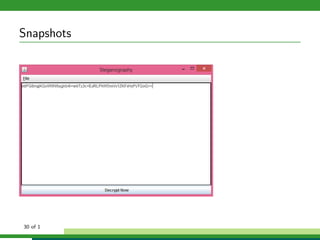
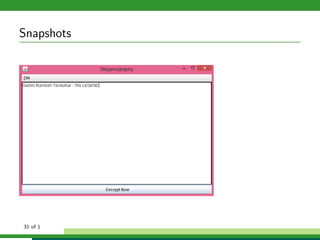
Snapshots
24 of 1
Snapshots
25 of 1
Snapshots
26 of 1
Snapshots
27 of 1
Snapshots
28 of 1
Snapshots
29 of 1
Snapshots
30 of 1
Snapshots
31 of 1
Future Work
• Transmission of data in highly secured manner through audio
streams and video streams.
• Send the any multimedia data in encryted form with audio, video
or text format.
• Enhanced to support digital watermarking.
• Many research work is going on in this direction to prevent
steganographic images from steganalysis.
32 of 1
Conclusion
• This software has securely implemented least significant bit
manipulation based steganography that uses the DES algorithm
and genetic algorithm along with visual cryptographic technique.
• It can be concluded that when normal image security using
steganographic and visual cryptographic technique is applied, the
decryption of the encoded authenticated data becomes a
cumbersome effort. The security features of the steganographic
technique are highly optimized using the least significant bit
manipulation along with visual cryptography.
33 of 1
References
• ieeexplore.ieee.org/xpl/articleDetails.jsp?reload=true&arnumber=6508373
• www.techrepublic.com/resource-library/whitepapers/integratingsteganography-
using-genetic-algorithm-and-visual-cryptography-for-robustencryption-in-computer-forensics/
• asprs.org/a/publications/pers/2009journal/may/2009may557-567.pdf
• www.ijcsit.com/docs/Volume%203/vol3Issue3/ijcsit20120303112.pdf
• en.wikipedia.org/wiki/Data Encryption Standard
• docs.oracle.com/javase
• www.doc.ic.ac.uk/ nd/surprise 96/journal/vol4/tcw2/report.html
34 of 1
Thank You ! ! !
35 of 1

Steganography using visual cryptography

  • 1.
    Data Security andTransmission over Wireless Networks Saurabh Nambiar SuryaPrabha C P Smruthi K Shijil 1Department of Computer Science and Engineering Govt. College of Engineering, Kannur Under the Guidance of Mr. Nidheesh N. 1 of 1
  • 2.
    Project Outline • Aboutthe Project • Introduction • Motivation • About the Work ◦ Encryption Phase ◦ Encoding Phase ◦ Pixel Modification and Splitting ◦ Overlapping Phase ◦ Decoding Phase ◦ Decryption Phase • Testing and Results • Conclusion • Future Work • References 2 of 1
  • 3.
    About the Project TheProject aims at secure data hiding of confidential information and its transmission over networks. The proposed system provides the best approach for Least Significant Bit (LSB) based steganography using Genetic Algorithm (GA) along with Visual Cryptography (VC). Original message is converted into cipher text by using secret key and then hidden into the LSB of original image. Genetic Algorithm and Visual Cryptography has been used for enhancing the security. Genetic Algorithm is used to modify the pixel location of stego image and the detection of this message is complex. Visual Cryptography is used to encrypt the visual information. It is achieved by breaking the image into two shares so that the hidden data is also split. The main aim of this paper is to design the enhanced secure algorithm which uses both LSB steganography using Genetic Algorithm and Visual Cryptography to ensure improved security and reliability. 3 of 1
  • 4.
    Introduction The main aimof the project is to design a feasible RS steganalysis resistant secure Algorithm which combines the use of both steganography and cryptography with the goals of improving security, reliability, and efficiency for secret message. DES encryption algorithm is used for encrypting the data into cipher text. Apart from that, LSB Steganography is combined with the Visual Cryptography making it more secure from RS steganalysis. 4 of 1
  • 5.
  • 6.
    Introduction The Project isdivided into following important six phases: • Encryption Phase: The data to be encrypted is first inputted by the user.The encrypted text is called cipher text. The encryption algorithm used is DES, which is comparatively considered more secure than RSA encryption. • Encoding Phase : The encrypted cipher is then encoded into the least significant bits of an appropriate image. • Pixel Modification & Splitting Phase : Since the LSB steganography can easily be detected by RS steganalysis, the information pixels at the LSB have to be distributed throughout the image randomly. After this random distribution, the image is divided into two shares(parts) before its transmission. This ensures that information pixels are distributed into two shares. 6 of 1
  • 7.
    Introduction • Overlapping Phase:To retrieve the information, both the shares of image are required. Both the shares are combined into a single image in this phase. The image generated consists of the information. • Decoding Phase: The data in the encrypted form is retrieved back from the stego-image. • Decryption Phase:The original data is retrieved back using the DES decryption algorithm using the same secret key. 7 of 1
  • 8.
    Motivation • The primaryreason for selecting steganography among the list of possible project topics was due to the unfamiliarity of the word that twigged an interest in the subject. • Another reason is the data security that it provides. Even if the hacker(or intruder) gets access to our multimedia data, then also he cant access the information, that is, the hacker has done the difficult part of hacking and getting access to the data but the actual data is still under his nose. This aspect makes it more interesting. 8 of 1
  • 9.
    Related Work • Thereexists many information hiding softwares in the market but most of them are based on LSB Steganography. • LSB Steganography can easily be detected by RS steganalysis. Hence, security level is low. • There are many papers related to the combination of steganography with cryptography. These provide an additional layer of protection over the cryptographic model. • A combination of Cryptography and Steganography is more resistant to RS Steganalysis. 9 of 1
  • 10.
    About the Work EncryptionModule • The original data to be encrypted is given as input by the user. • The encryption algorithm used is DES (Data Encryption Standard). • DES is a private key encryption scheme, that is, only the sender and receiver know the secret key. • DES uses a 56-bit secret key to encrypt data. 10 of 1
  • 11.
    About the Work DESAlgorithm 11 of 1
  • 12.
    About the Work DESAlgorithm • DES is based on a cipher known as The Feistily block cipher. • To accomplish encryption, most secret key algorithms use two main techniques known as substitution and permutation. • Substitution is simply a mapping of one value to another whereas permutation is a reordering of the bit positions for each of the inputs. • The two inputs for DES algorithm are: plain text to be encrypted and the secret key. • DES is therefore a symmetric, 64 bit block cipher as it uses the same key for both encryption and decryption and only operates on 64 bit blocks of data at a time (be they plaintext or ciphertext). • The key size used is 56 bits, however a 64 bit (or eight-byte) key is actually input. 12 of 1
  • 13.
    About the Work DESAlgorithm • Once a plain-text message is received to be encrypted, it is arranged into 64 bit blocks required for input. If the number of bits in the message is not evenly divisible by 64, then the last block will be padded. • Multiple permutations and substitutions are incorporated throughout in order to increase the difficulty of performing a cryptanalysis on the cipher. 13 of 1
  • 14.
    About the Work EncodingPhase • In the encoding phase, the cipher data obtained is written into an appropriate image. • The image and the cipher data is first converted into a byte array representation. • To encode the data into an image, some bitwise operations are required. • Some of the bitwise operations are as follows: ◦ AND operator: 01010111 = 87 01100101 = 101 87 & 101 = 01000101 = 69 ◦ OR operator: 01010111 = 87 01100101 = 101 87 OR 101 = 01110111 = 11914 of 1
  • 15.
    About the Work EncodingPhase • When left shifting the bits, if the first bit is not a 1, then a single left shift will double the value. 01010111(87) shiftleft 1 = 10101110(174) • Right Shift is just the opposite of left shift. 01010111(87) shiftright 1 = 00101011(43) 15 of 1
  • 16.
    Encoding Module Some ofthe important steps involved in Encoding Phase: • First for loop loops through each byte in the addition array and second for loop loops though each bit in a byte stored in add • Next, variable b is assigned the value of either 0 or 1 • 0xFE is hex, which represents 11111110 in binary. By reasoning above, this will leave the first 7 bits as is, and clear the least significant bit to 0. Then with the last bit 0, we OR it with b, which is either: 00000000 or 00000001. This will set the last bit to match the value stored in b. 16 of 1
  • 17.
    Pixel Modification Phase •The data in the LSB of an image is not a secure way to hide the data. The process of steganalysis can easily detect such images for the presence of hidden data. • Inorder to make the stego-image RS resistant, the pixels in the image are modified so that the hidden data is distributed thoughout the image. 17 of 1
  • 18.
    Splitting and OverlappingPhase • In the splitting phase, the image is divided into two shares. • Each share of the image contains a set of pixels of the original image. The idea behind this is that the information(hidden text)is now divided into these two shares. • First, the source image is divided into black and white, that is, the image contains only black and white pixels. • Secondly, a key image is generated of the same dimensions, where each pixel is randomly set to white or black. • Third, the original image is encrypted using this key - if the pixel in the key is white then the corresponding pixel in the original image is used in the encrypted image, whereas if the key pixel is black then the corresponding pixel in the original image is flipped (black to white, white to black) for the encrypted image. The result is two images of apparently random black and white pixels. 18 of 1
  • 19.
    Splitting and overlappingPhase • Finally, each image is then doubled in size - each pixel becomes a 2x2 square of pixels. Black pixels have black pixels in the top-left and bottom-right corners while the other two pixels are white, while a white pixel in the original image produces the opposite 2x2 square. 19 of 1
  • 20.
    Splitting and OverlappingPhase • Overlapping phase is done at the receiver side. The two shares of images that comprises of opposite pixels to each other would produce the original image when overlapped. • When the two shares of image are combined, we are actually combining the hidden text in the two shares. 20 of 1
  • 21.
    Decoding Module Some ofthe important steps involved in Decoding Phase: 21 of 1
  • 22.
    Decoding Module • Thelength of the message is stored as a 4 byte number, or 32 bits, thus the message starts after 32 bits of image. • Since the first 32 bytes contain 1 bit each of our length, we must loop all 32 bytes to retrieve the length. • Shift the bits of length left by 1, then OR it with a result of the least significant bit of the image byte. (& 1) will clear all bits, except the last bit, which will be left as is. Thus as bits are added, they are moved along and placed into the newly empty least significant slot of length. • Create a byte array to hold the bits. • Loop through the image bytes till entire bits are retrieved. • Second for loop is to loop through the 8 bits of a byte. • The resulting array of bytes is made up of the least significant bit of each sequential byte. 22 of 1
  • 23.
    Decryption Phase • Thecipher text obtained in the previous phase is converted back to the original data. • The DES encryption scheme is used for decrypting the data. • DES algorithm uses a symmetric key, that is, the secret key used to decrypt the data is same as that used for encryption. • Since, DES encryption is private key encryption, only the sender and receiver of data know about the secret key. 23 of 1
  • 24.
  • 25.
  • 26.
  • 27.
  • 28.
  • 29.
  • 30.
  • 31.
  • 32.
    Future Work • Transmissionof data in highly secured manner through audio streams and video streams. • Send the any multimedia data in encryted form with audio, video or text format. • Enhanced to support digital watermarking. • Many research work is going on in this direction to prevent steganographic images from steganalysis. 32 of 1
  • 33.
    Conclusion • This softwarehas securely implemented least significant bit manipulation based steganography that uses the DES algorithm and genetic algorithm along with visual cryptographic technique. • It can be concluded that when normal image security using steganographic and visual cryptographic technique is applied, the decryption of the encoded authenticated data becomes a cumbersome effort. The security features of the steganographic technique are highly optimized using the least significant bit manipulation along with visual cryptography. 33 of 1
  • 34.
    References • ieeexplore.ieee.org/xpl/articleDetails.jsp?reload=true&arnumber=6508373 • www.techrepublic.com/resource-library/whitepapers/integratingsteganography- using-genetic-algorithm-and-visual-cryptography-for-robustencryption-in-computer-forensics/ •asprs.org/a/publications/pers/2009journal/may/2009may557-567.pdf • www.ijcsit.com/docs/Volume%203/vol3Issue3/ijcsit20120303112.pdf • en.wikipedia.org/wiki/Data Encryption Standard • docs.oracle.com/javase • www.doc.ic.ac.uk/ nd/surprise 96/journal/vol4/tcw2/report.html 34 of 1
  • 35.
    Thank You !! ! 35 of 1