FUNDAMENTALS OF HEAT 
EXCHANGER DESIGN 
Fundamentals of Heat Exchanger Design. Ramesh K. Shah and Dušan P. Sekulic 
Copyright © 2003 John Wiley & Sons, Inc.
FUNDAMENTALS OF 
HEAT EXCHANGER 
DESIGN 
Ramesh K. Shah 
Rochester Institute of Technology, Rochester, New York 
Formerly at Delphi Harrison Thermal Systems, Lockport, New York 
Dusˇan P. Sekulic´ 
University of Kentucky, Lexington, Kentucky 
JOHN WILEY & SONS, INC.
This book is printed on acid-free paper.*1 
Copyright # 2003 by John Wiley & Sons, Inc. All rights reserved 
Published by John Wiley & Sons, Inc., Hoboken, New Jersey 
Published simultaneously in Canada 
No part of this publication may be reproduced, stored in a retrieval system, or transmitted in any 
form or by any means, electronic, mechanical, photocopying, recording, scanning, or otherwise, 
except as permitted under Section 107 or 108 of the 1976 United States Copyright Act, without either 
the prior written permission of the Publisher, or authorization through payment of the appropriate 
per-copy fee to the Copyright Clearance Center, Inc., 222 Rosewood Drive, Danvers, MA 01923, 
(978) 750-8400, fax (978) 750-4470, or on the web at www.copyright.com. Requests to the Publisher 
for permission should be addressed to the Permissions Department, John Wiley & Sons, Inc., 
111 River Street, Hoboken, NJ 07030, (201) 748-6011, fax (201) 748-6008, 
e-mail: permcoordinator@wiley.com. 
Limit of Liability/Disclaimer of Warranty: While the publisher and author have used their best 
efforts in preparing this book, they make no representations or warranties with respect to the 
accuracy or completeness of the contents of this book and specifically disclaim any implied 
warranties of merchantability or fitness for a particular purpose. No warranty may be created or 
extended by sales representatives or written sales materials. The advice and strategies contained 
herein may not be suitable for your situation. You should consult with a professional where 
appropriate. Neither the publisher nor author shall be liable for any loss of profit or any other 
commercial damages, including but not limited to special, incidental, consequential, or other 
damages. 
For general information on our other products and services or for technical support, please contact 
our Customer Care Department within the United States at (800) 762-2974, outside the United 
States at (317) 572-3993 or fax (317) 572-4002. 
Wiley also publishes its books in a variety of electronic formats. Some content that appears in print 
may not be available in electronic books. For more information about Wiley products, visit our web 
site at www.wiley.com 
Library of Congress Cataloging-in-Publication Data: 
Shah, R. K. 
Fundamentals of heat exchanger design / Ramesh K. Shah, Dusˇan P. Sekulic´ . 
p. cm. 
Includes index. 
ISBN 0-471-32171-0 
1. Heat exchangers–Design and construction. I. Sekulic´ , Dusˇan P. II. Title. 
TJ263 .S42 2003 
0 
621.402 
5–dc21 
2002010161 
Printed in the United States of America 
10 9 8 7 6 5 4 3 2 1
Contents 
Preface xv 
Nomenclature xix 
1 Classification of Heat Exchangers 1 
1.1 Introduction 1 
1.2 Classification According to Transfer Processes 3 
1.2.1 Indirect-Contact Heat Exchangers 3 
1.2.2 Direct-Contact Heat Exchangers 7 
1.3 Classification According to Number of Fluids 8 
1.4 Classification According to Surface Compactness 8 
1.4.1 Gas-to-Fluid Exchangers 11 
1.4.2 Liquid-to-Liquid and Phase-Change Exchangers 12 
1.5 Classification According to Construction Features 12 
1.5.1 Tubular Heat Exchangers 13 
1.5.2 Plate-Type Heat Exchangers 22 
1.5.3 Extended Surface Heat Exchangers 36 
1.5.4 Regenerators 47 
1.6 Classification According to Flow Arrangements 56 
1.6.1 Single-Pass Exchangers 57 
1.6.2 Multipass Exchangers 64 
1.7 Classification According to Heat Transfer Mechanisms 73 
Summary 73 
References 73 
Review Questions 74 
2 Overview of Heat Exchanger Design Methodology 78 
2.1 Heat Exchanger Design Methodology 78 
2.1.1 Process and Design Specifications 79 
2.1.2 Thermal and Hydraulic Design 83 
2.1.3 Mechanical Design 87 
2.1.4 Manufacturing Considerations and Cost Estimates 90 
2.1.5 Trade-off Factors 92 
2.1.6 Optimum Design 93 
2.1.7 Other Considerations 93
2.2 Interactions Among Design Considerations 93 
Summary 94 
References 94 
Review Questions 95 
Problems 95 
3 Basic Thermal Design Theory for Recuperators 97 
3.1 Formal Analogy between Thermal and Electrical Entities 98 
3.2 Heat Exchanger Variables and Thermal Circuit 100 
3.2.1 Assumptions for Heat Transfer Analysis 100 
3.2.2 Problem Formulation 102 
3.2.3 Basic Definitions 104 
3.2.4 Thermal Circuit and UA 107 
3.3 The "-NTU Method 114 
3.3.1 Heat Exchanger Effectiveness " 114 
3.3.2 Heat Capacity Rate Ratio C* 118 
3.3.3 Number of Transfer Units NTU 119 
3.4 Effectiveness – Number of Transfer Unit Relationships 121 
3.4.1 Single-Pass Exchangers 122 
3.5 The P-NTU Method 139 
3.5.1 Temperature Effectiveness P 140 
3.5.2 Number of Transfer Units, NTU 140 
3.5.3 Heat Capacity Rate Ratio R 141 
3.5.4 General P–NTU Functional Relationship 141 
3.6 P–NTU Relationships 142 
3.6.1 Parallel Counterflow Exchanger, Shell Fluid Mixed, 1–2 
TEMA E Shell 142 
3.6.2 Multipass Exchangers 164 
3.7 The Mean Temperature Difference Method 186 
3.7.1 Log-Mean Temperature Difference, LMTD 186 
3.7.2 Log-Mean Temperature Difference Correction Factor F 187 
3.8 F Factors for Various Flow Arrangements 190 
3.8.1 Counterflow Exchanger 190 
3.8.2 Parallelflow Exchanger 191 
3.8.3 Other Basic Flow Arrangements 192 
3.8.4 Heat Exchanger Arrays and Multipassing 201 
3.9 Comparison of the "-NTU, P–NTU, and MTD Methods 207 
3.9.1 Solutions to the Sizing and Rating Problems 207 
3.9.2 The "-NTU Method 208 
3.9.3 The P-NTU Method 209 
3.9.4 The MTD Method 209 
3.10 The -P and P1 
P2 Methods 210 
3.10.1 The -P Method 210 
3.10.2 The P1 
P2 Method 211 
vi CONTENTS
CONTENTS vii 
3.11 Solution Methods for Determining Exchanger Effectiveness 212 
3.11.1 Exact Analytical Methods 213 
3.11.2 Approximate Methods 213 
3.11.3 Numerical Methods 213 
3.11.4 Matrix Formalism 214 
3.11.5 Chain Rule Methodology 214 
3.11.6 Flow-Reversal Symmetry 215 
3.11.7 Rules for the Determination of Exchanger Effectiveness 
with One Fluid Mixed 216 
3.12 Heat Exchanger Design Problems 216 
Summary 219 
References 219 
Review Questions 220 
Problems 227 
4 Additional Considerations for Thermal Design of Recuperators 232 
4.1 Longitudinal Wall Heat Conduction Effects 232 
4.1.1 Exchangers with C* ¼ 0 236 
4.1.2 Single-Pass Counterflow Exchanger 236 
4.1.3 Single-Pass Parallelflow Exchanger 239 
4.1.4 Single-Pass Unmixed–Unmixed Crossflow Exchanger 239 
4.1.5 Other Single-Pass Exchangers 239 
4.1.6 Multipass Exchangers 239 
4.2 Nonuniform Overall Heat Transfer Coefficients 244 
4.2.1 Temperature Effect 248 
4.2.2 Length Effect 249 
4.2.3 Combined Effect 251 
4.3 Additional Considerations for Extended Surface Exchangers 258 
4.3.1 Thin Fin Analysis 259 
4.3.2 Fin Efficiency 272 
4.3.3 Fin Effectiveness 288 
4.3.4 Extended Surface Efficiency 289 
4.4 Additional Considerations for Shell-and-Tube Exchangers 291 
4.4.1 Shell Fluid Bypassing and Leakage 291 
4.4.2 Unequal Heat Transfer Area in Individual Exchanger Passes 296 
4.4.3 Finite Number of Baffles 297 
Summary 298 
References 298 
Review Questions 299 
Problems 302 
5 Thermal Design Theory for Regenerators 308 
5.1 Heat Transfer Analysis 308 
5.1.1 Assumptions for Regenerator Heat Transfer Analysis 308 
5.1.2 Definitions and Description of Important Parameters 310 
5.1.3 Governing Equations 312
viii CONTENTS 
5.2 The -NTUo Method 316 
5.2.1 Dimensionless Groups 316 
5.2.2 Influence of Core Rotation and Valve Switching Frequency 320 
5.2.3 Convection Conductance Ratio (hA)* 320 
5.2.4 -NTUo Results for a Counterflow Regenerator 321 
5.2.5 -NTUo Results for a Parallelflow Regenerator 326 
5.3 The – Method 337 
5.3.1 Comparison of the -NTUo and – Methods 341 
5.3.2 Solutions for a Counterflow Regenerator 344 
5.3.3 Solution for a Parallelflow Regenerator 345 
5.4 Influence of Longitudinal Wall Heat Conduction 348 
5.5 Influence of Transverse Wall Heat Conduction 355 
5.5.1 Simplified Theory 355 
5.6 Influence of Pressure and Carryover Leakages 360 
5.6.1 Modeling of Pressure and Carryover Leakages for a Rotary 
Regenerator 360 
5.7 Influence of Matrix Material, Size, and Arrangement 366 
Summary 371 
References 372 
Review Questions 373 
Problems 376 
6 Heat Exchanger Pressure Drop Analysis 378 
6.1 Introduction 378 
6.1.1 Importance of Pressure Drop 378 
6.1.2 Fluid Pumping Devices 380 
6.1.3 Major Contributions to the Heat Exchanger Pressure Drop 380 
6.1.4 Assumptions for Pressure Drop Analysis 381 
6.2 Extended Surface Heat Exchanger Pressure Drop 381 
6.2.1 Plate-Fin Heat Exchangers 382 
6.2.2 Tube-Fin Heat Exchangers 391 
6.3 Regenerator Pressure Drop 392 
6.4 Tubular Heat Exchanger Pressure Drop 393 
6.4.1 Tube Banks 393 
6.4.2 Shell-and-Tube Exchangers 393 
6.5 Plate Heat Exchanger Pressure Drop 397 
6.6 Pressure Drop Associated with Fluid Distribution Elements 399 
6.6.1 Pipe Losses 399 
6.6.2 Sudden Expansion and Contraction Losses 399 
6.6.3 Bend Losses 403 
6.7 Pressure Drop Presentation 412 
6.7.1 Nondimensional Presentation of Pressure Drop Data 413 
6.7.2 Dimensional Presentation of Pressure Drop Data 414
CONTENTS ix 
6.8 Pressure Drop Dependence on Geometry and Fluid Properties 418 
Summary 419 
References 420 
Review Questions 420 
Problems 422 
7 Surface Basic Heat Transfer and Flow Friction Characteristics 425 
7.1 Basic Concepts 426 
7.1.1 Boundary Layers 426 
7.1.2 Types of Flows 429 
7.1.3 Free and Forced Convection 438 
7.1.4 Basic Definitions 439 
7.2 Dimensionless Groups 441 
7.2.1 Fluid Flow 443 
7.2.2 Heat Transfer 446 
7.2.3 Dimensionless Surface Characteristics as a Function of the 
Reynolds Number 449 
7.3 Experimental Techniques for Determining Surface Characteristics 450 
7.3.1 Steady-State Kays and London Technique 451 
7.3.2 Wilson Plot Technique 460 
7.3.3 Transient Test Techniques 467 
7.3.4 Friction Factor Determination 471 
7.4 Analytical and Semiempirical Heat Transfer and Friction Factor 
Correlations for Simple Geometries 473 
7.4.1 Fully Developed Flows 475 
7.4.2 Hydrodynamically Developing Flows 499 
7.4.3 Thermally Developing Flows 502 
7.4.4 Simultaneously Developing Flows 507 
7.4.5 Extended Reynolds Analogy 508 
7.4.6 Limitations of j vs. Re Plot 510 
7.5 Experimental Heat Transfer and Friction Factor Correlations for 
Complex Geometries 511 
7.5.1 Tube Bundles 512 
7.5.2 Plate Heat Exchanger Surfaces 514 
7.5.3 Plate-Fin Extended Surfaces 515 
7.5.4 Tube-Fin Extended Surfaces 519 
7.5.5 Regenerator Surfaces 523 
7.6 Influence of Temperature-Dependent Fluid Properties 529 
7.6.1 Correction Schemes for Temperature-Dependent Fluid 
Properties 530 
7.7 Influence of Superimposed Free Convection 532 
7.7.1 Horizontal Circular Tubes 533 
7.7.2 Vertical Circular Tubes 535 
7.8 Influence of Superimposed Radiation 537 
7.8.1 Liquids as Participating Media 538
x CONTENTS 
7.8.2 Gases as Participating Media 538 
Summary 542 
References 544 
Review Questions 548 
Problems 553 
8 Heat Exchanger Surface Geometrical Characteristics 563 
8.1 Tubular Heat Exchangers 563 
8.1.1 Inline Arrangement 563 
8.1.2 Staggered Arrangement 566 
8.2 Tube-Fin Heat Exchangers 569 
8.2.1 Circular Fins on Circular Tubes 569 
8.2.2 Plain Flat Fins on Circular Tubes 572 
8.2.3 General Geometric Relationships for Tube-Fin Exchangers 574 
8.3 Plate-Fin Heat Exchangers 574 
8.3.1 Offset Strip Fin Exchanger 574 
8.3.2 Corrugated Louver Fin Exchanger 580 
8.3.3 General Geometric Relationships for Plate-Fin Surfaces 584 
8.4 Regenerators with Continuous Cylindrical Passages 585 
8.4.1 Triangular Passage Regenerator 585 
8.5 Shell-and-Tube Exchangers with Segmental Baffles 587 
8.5.1 Tube Count 587 
8.5.2 Window and Crossflow Section Geometry 589 
8.5.3 Bypass and Leakage Flow Areas 592 
8.6 Gasketed Plate Heat Exchangers 597 
Summary 598 
References 598 
Review Questions 599 
9 Heat Exchanger Design Procedures 601 
9.1 Fluid Mean Temperatures 601 
9.1.1 Heat Exchangers with C*  0 603 
9.1.2 Counterflow and Crossflow Heat Exchangers 604 
9.1.3 Multipass Heat Exchangers 604 
9.2 Plate-Fin Heat Exchangers 605 
9.2.1 Rating Problem 605 
9.2.2 Sizing Problem 617 
9.3 Tube-Fin Heat Exchangers 631 
9.3.1 Surface Geometries 631 
9.3.2 Heat Transfer Calculations 631 
9.3.3 Pressure Drop Calculations 632 
9.3.4 Core Mass Velocity Equation 632 
9.4 Plate Heat Exchangers 632 
9.4.1 Limiting Cases for the Design 633 
9.4.2 Uniqueness of a PHE for Rating and Sizing 635
CONTENTS xi 
9.4.3 Rating a PHE 637 
9.4.4 Sizing a PHE 645 
9.5 Shell-and-Tube Heat Exchangers 646 
9.5.1 Heat Transfer and Pressure Drop Calculations 646 
9.5.2 Rating Procedure 650 
9.5.3 Approximate Design Method 658 
9.5.4 More Rigorous Thermal Design Method 663 
9.6 Heat Exchanger Optimization 664 
Summary 667 
References 667 
Review Questions 668 
Problems 669 
10 Selection of Heat Exchangers and Their Components 673 
10.1 Selection Criteria Based on Operating Parameters 674 
10.1.1 Operating Pressures and Temperatures 674 
10.1.2 Cost 675 
10.1.3 Fouling and Cleanability 675 
10.1.4 Fluid Leakage and Contamination 678 
10.1.5 Fluids and Material Compatibility 678 
10.1.6 Fluid Type 678 
10.2 General Selection Guidelines for Major Exchanger Types 680 
10.2.1 Shell-and-Tube Exchangers 680 
10.2.2 Plate Heat Exchangers 693 
10.2.3 Extended-Surface Exchangers 694 
10.2.4 Regenerator Surfaces 699 
10.3 Some Quantitative Considerations 699 
10.3.1 Screening Methods 700 
10.3.2 Performance Evaluation Criteria 713 
10.3.3 Evaluation Criteria Based on the Second Law of 
Thermodynamics 723 
10.3.4 Selection Criterion Based on Cost Evaluation 724 
Summary 726 
References 726 
Review Questions 727 
Problems 732 
11 Thermodynamic Modeling and Analysis 735 
11.1 Introduction 735 
11.1.1 Heat Exchanger as a Part of a System 737 
11.1.2 Heat Exchanger as a Component 738 
11.2 Modeling a Heat Exchanger Based on the First Law of 
Thermodynamics 738 
11.2.1 Temperature Distributions in Counterflow and Parallelflow 
Exchangers 739 
11.2.2 True Meaning of the Heat Exchanger Effectiveness 745
xii CONTENTS 
11.2.3 Temperature Difference Distributions for Parallelflow and 
Counterflow Exchangers 748 
11.2.4 Temperature Distributions in Crossflow Exchangers 749 
11.3 Irreversibilities in Heat Exchangers 755 
11.3.1 Entropy Generation Caused by Finite Temperature Differences 756 
11.3.2 Entropy Generation Associated with Fluid Mixing 759 
11.3.3 Entropy Generation Caused by Fluid Friction 762 
11.4 Thermodynamic Irreversibility and Temperature Cross Phenomena 763 
11.4.1 Maximum Entropy Generation 763 
11.4.2 External Temperature Cross and Fluid Mixing Analogy 765 
11.4.3 Thermodynamic Analysis for 1–2 TEMA J Shell-and-Tube 
Heat Exchanger 766 
11.5 A Heuristic Approach to an Assessment of Heat Exchanger 
Effectiveness 771 
11.6 Energy, Exergy, and Cost Balances in the Analysis and Optimization 
of Heat Exchangers 775 
11.6.1 Temperature–Enthalpy Rate Change Diagram 776 
11.6.2 Analysis Based on an Energy Rate Balance 779 
11.6.3 Analysis Based on Energy/Enthalpy and Cost Rate Balancing 783 
11.6.4 Analysis Based on an Exergy Rate Balance 786 
11.6.5 Thermodynamic Figure of Merit for Assessing Heat 
Exchanger Performance 787 
11.6.6 Accounting for the Costs of Exergy Losses in a Heat 
Exchanger 791 
11.7 Performance Evaluation Criteria Based on the Second Law of 
Thermodynamics 796 
Summary 800 
References 801 
Review Questions 802 
Problems 804 
12 Flow Maldistribution and Header Design 809 
12.1 Geometry-Induced Flow Maldistribution 809 
12.1.1 Gross Flow Maldistribution 810 
12.1.2 Passage-to-Passage Flow Maldistribution 821 
12.1.3 Manifold-Induced Flow Maldistribution 834 
12.2 Operating Condition–Induced Flow Maldistribution 837 
12.2.1 Viscosity-Induced Flow Maldistribution 837 
12.3 Mitigation of Flow Maldistribution 844 
12.4 Header and Manifold Design 845 
12.4.1 Oblique-Flow Headers 848 
12.4.2 Normal-Flow Headers 852 
12.4.3 Manifolds 852 
Summary 853 
References 853
CONTENTS xiii 
Review Questions 855 
Problems 859 
13 Fouling and Corrosion 863 
13.1 Fouling and its Effect on Exchanger Heat Transfer and Pressure Drop 863 
13.2 Phenomenological Considerations of Fouling 866 
13.2.1 Fouling Mechanisms 867 
13.2.2 Single-Phase Liquid-Side Fouling 870 
13.2.3 Single-Phase Gas-Side Fouling 871 
13.2.4 Fouling in Compact Exchangers 871 
13.2.5 Sequential Events in Fouling 872 
13.2.6 Modeling of a Fouling Process 875 
13.3 Fouling Resistance Design Approach 881 
13.3.1 Fouling Resistance and Overall Heat Transfer Coefficient 
Calculation 881 
13.3.2 Impact of Fouling on Exchanger Heat Transfer Performance 882 
13.3.3 Empirical Data for Fouling Resistances 886 
13.4 Prevention and Mitigation of Fouling 890 
13.4.1 Prevention and Control of Liquid-Side Fouling 890 
13.4.2 Prevention and Reduction of Gas-Side Fouling 891 
13.4.3 Cleaning Strategies 892 
13.5 Corrosion in Heat Exchangers 893 
13.5.1 Corrosion Types 895 
13.5.2 Corrosion Locations in Heat Exchangers 895 
13.5.3 Corrosion Control 897 
Summary 898 
References 898 
Review Questions 899 
Problems 903 
Appendix A: Thermophysical Properties 906 
Appendix B: -NTU Relationships for Liquid-Coupled Exchangers 911 
Appendix C: Two-Phase Heat Transfer and Pressure Drop Correlations 913 
C.1 Two-Phase Pressure Drop Correlations 913 
C.2 Heat Transfer Correlations for Condensation 916 
C.3 Heat Transfer Correlations for Boiling 917 
Appendix D: U and CUA Values for Various Heat Exchangers 920 
General References on or Related to Heat Exchangers 926 
Index 931
Preface 
Over the past quarter century, the importance of heat exchangers has increased immen-sely 
from the viewpoint of energy conservation, conversion, recovery, and successful 
implementation of new energy sources. Its importance is also increasing from the stand-point 
of environmental concerns such as thermal pollution, air pollution, water pollu-tion, 
and waste disposal. Heat exchangers are used in the process, power, transportation, 
air-conditioning and refrigeration, cryogenic, heat recovery, alternate fuels, and 
manufacturing industries, as well as being key components of many industrial products 
available in the marketplace. From an educational point of view, heat exchangers 
illustrate in one way or another most of the fundamental principles of the thermal 
sciences, thus serving as an excellent vehicle for review and application, meeting the 
guidelines for university studies in the United States and oversees. Significant advances 
have taken place in the development of heat exchanger manufacturing technology as well 
as design theory. Many books have been published on the subject, as summarized in 
the General References at the end of the book. However, our assessment is that none of 
the books available seems to provide an in-depth coverage of the intricacies of heat 
exchanger design and theory so as to fully support both a student and a practicing 
engineer in the quest for creative mastering of both theory and design. Our book was 
motivated by this consideration. Coverage includes the theory and design of exchangers 
for many industries (not restricted to, say, the process industry) for a broader, in-depth 
foundation. 
The objective of this book is to provide in-depth thermal and hydraulic design theory 
of two-fluid single-phase heat exchangers for steady-state operation. Three important 
goals were borne in mind during the preparation of this book: 
1. To introduce and apply concepts learned in first courses in heat transfer, fluid 
mechanics, thermodynamics, and calculus, to develop heat exchanger design 
theory. Thus, the book will serve as a link between fundamental subjects men-tioned 
and thermal engineering design practice in industry. 
2. To introduce and apply basic heat exchanger design concepts to the solution of 
industrial heat exchanger problems. Primary emphasis is placed on fundamental 
concepts and applications. Also, more emphasis is placed on analysis and less on 
empiricism. 
3. The book is also intended for practicing engineers in addition to students. 
Hence, at a number of places in the text, some redundancy is added to make the 
concepts clearer, early theory is developed using constant and mean overall heat 
transfer coefficients, and more data are added in the text and tables for industrial 
use.
xvi PREFACE 
To provide comprehensive information for heat exchanger design and analysis in a 
book of reasonable length, we have opted not to include detailed theoretical derivations 
of many results, as they can be found in advanced convection heat transfer textbooks. 
Instead, we have presented some basic derivations and then presented comprehensive 
information through text and concise tables. 
An industrial heat exchanger design problem consists of coupling component and 
system design considerations to ensure proper functioning. Accordingly, a good design 
engineer must be familiar with both system and component design aspects. Based on 
industrial experience of over three decades in designing compact heat exchangers for 
automobiles and other industrial applications and more than twenty years of teaching, 
we have endeavored to demonstrate interrelationships between the component and sys-tem 
design aspects, as well as between the needs of industrial and learning environments. 
Some of the details of component design presented are also based on our own system 
design experience. 
Considering the fact that heat exchangers constitute a multibillion-dollar industry in 
the United States alone, and there are over 300 companies engaged in the manufacture 
of a wide array of heat exchangers, it is difficult to select appropriate material for an 
introductory course. We have included more material than is necessary for a one-semester 
course, placing equal emphasis on four basic heat exchanger types: shell-and-tube, 
plate, extended surface, and regenerator. The choice of the teaching material to 
cover in one semester is up to the instructor, depending on his or her desire to focus on 
specific exchanger types and specific topics in each chapter. The prerequisites for this 
course are first undergraduate courses in fluid mechanics, thermodynamics, and heat 
transfer. It is expected that the student is familiar with the basics of forced convection 
and the basic concepts of the heat transfer coefficient, heat exchanger effectiveness, and 
mean temperature difference. 
Starting with a detailed classification of a variety of heat exchangers in Chapter 1, an 
overview of heat exchanger design methodology is provided in Chapter 2. The basic 
thermal design theory for recuperators is presented in Chapter 3, advanced design theory 
for recuperators in Chapter 4, and thermal design theory for regenerators in Chapter 5. 
Pressure drop analysis is presented in Chapter 6. The methods and sources for obtaining 
heat transfer and flow friction characteristics of exchanger surfaces are presented in 
Chapter 7. Surface geometrical properties needed for heat exchanger design are covered 
in Chapter 8. The thermal and hydraulic designs of extended-surface (compact 
and noncompact plate-fin and tube-fin), plate, and shell-and-tube exchangers are out-lined 
in Chapter 9. Guidelines for selecting the exchanger core construction and surface 
geometry are presented in Chapter 10. Chapter 11 is devoted to thermodynamic analysis 
for heat exchanger design and includes basic studies of temperature distributions in heat 
exchangers, a heuristic approach to an assessment of heat exchanger effectiveness, and 
advanced topics important for modeling, analysis, and optimization of heat exchangers 
as components. All topics covered up to this point are related to thermal–hydraulic 
design of heat exchangers in steady-state or periodic-flow operation. Operational 
problems for compact and other heat exchangers are covered in Chapters 12 and 13. 
They include the problems caused by flow maldistribution and by fouling and corrosion. 
Solved examples from industrial experience and classroom practice are presented 
throughout the book to illustrate important concepts and applications. Numerous review 
questions and problems are also provided at the end of each chapter. If students can 
answer the review questions and solve the problems correctly, they can be sure of their 
grasp of the basic concepts and material presented in the text. It is hoped that readers will
PREFACE xvii 
develop good understanding of the intricacies of heat exchanger design after going 
through this material and prior to embarking on specialized work in their areas of 
greatest interest. 
For the thermal design of a heat exchanger for an application, considerable intellec-tual 
effort is needed in selecting heat exchanger type and determining the appropriate 
value of the heat transfer coefficients and friction factors; a relatively small effort is 
needed for executing sizing and optimizing the exchanger because of the computer-based 
calculations. Thus, Chapters 7, 9, and 10 are very important, in addition to 
Chapter 3, for basic understanding of theory, design, analysis, and selection of heat 
exchangers. 
Material presented in Chapters 11 through 13 is significantly more interdisciplinary 
than the rest of the book and is presented here in a modified methodological approach. In 
Chapter 11 in particular, analytical modeling is used extensively. Readers will participate 
actively through a set of examples and problems that extend the breadth and depth of the 
material given in the main body of the text. A number of examples and problems in 
Chapter 11 require analytical derivations and more elaborate analysis, instead of illus-trating 
the topics with examples that favor only utilization of the formulas and comput-ing 
numerical values for a problem. The complexity of topics requires a more diverse 
approach to terminology, less routine treatment of established conventions, and a more 
creative approach to some unresolved dilemmas. 
Because of the breadth of the subject, the coverage includes various design aspects and 
problems for indirect-contact two-fluid heat exchangers with primarily single-phase 
fluids on each side. Heat exchangers with condensing and evaporating fluids on one 
side can also be analyzed using the design methods presented as long as the thermal 
resistance on the condensing or evaporating side is small or the heat transfer coefficient 
on that side can be treated as a constant. Design theory for the following exchangers 
is not covered in this book, due to their complexity and space limitations: two-phase 
and multiphase heat exchangers (such as condensers and vaporizers), direct-contact 
heat exchangers (such as humidifiers, dehumidifiers, cooling towers), and multifluid 
and multistream heat exchangers. Coverage of mechanical design, exchanger fabrication 
methods, and manufacturing techniques is also deemed beyond the scope of the 
book. 
Books by M. Jakob, D. Q. Kern, and W. M. Kays and A. L. London were considered 
to be the best and most comprehensive texts on heat exchanger design and analysis 
following World War II. In the last thirty or so years, a significant number of books 
have been published on heat exchangers. These are summarized in the General 
References at the end of the book. 
This text is an outgrowth of lecture notes prepared by the authors in teaching courses 
on heat exchanger design, heat transfer, and design and optimization of thermal systems 
to senior and graduate students. These courses were taught at the State University of 
New York at Buffalo and the University of Novi Sad, Yugoslavia. Over the past fifteen 
years or more, the notes of the first author have been used for teaching purposes at a 
number of institutions, including the University of Miami by Professor S. Kakac¸ , 
Rensselaer Polytechnic Institute by Professors A. E. Bergles and R. N. Smith, 
Rochester Institute of Technology by Professor S. G. Kandlikar, Rice University by 
Professor Y. Bayazitogˇ lu, University of Tennessee Space Center by Dr. R. Schultz, 
University of Texas at Arlington by Professor A. Haji-Sheikh, University of 
Cincinnati by Professor R. M. Manglik, Northeastern University by Professor Yaman 
Yener, North Carolina AT State University by Professor Lonnie Sharpe, Auburn
University by Dr. Peter Jones, Southern Methodist University by Dr. Donald Price, 
University of Tennessee by Professor Edward Keshock, and Gonzaga University by 
Professor A. Aziz. In addition, these course notes have been used occasionally at a 
number of other U.S. and foreign institutions. The notes of the second author have 
also been used for a number of undergraduate and graduate courses at Marquette 
University and the University of Kentucky. 
The first author would like to express his sincere appreciation to the management 
of Harrison Thermal Systems, Delphi Corporation (formerly General Motors 
Corporation), for their varied support activities over an extended period of time. The 
second author acknowledges with appreciation many years of support by his colleagues 
and friends on the faculty of the School of Engineering, University of Novi Sad, and 
more recently at Marquette University and the University of Kentucky. We are also 
thankful for the support provided by the College of Engineering, University of 
Kentucky, for preparation of the first five and final three chapters of the book. A special 
word of appreciation is in order for the diligence and care exercised by Messrs. Dale Hall 
and Mack Mosley in preparing the manuscript and drawings through Chapter 5. 
The first author is grateful to Professor A. L. London of Stanford University for 
teaching him the ABCs of heat exchangers and for providing constant inspiration and 
encouragement throughout his professional career and particularly during the course of 
preparation of this book. The first author would also like to thank Professors Sadik 
Kakac¸ of the University of Miami and Ralph Webb of the Pennsylvania State University 
for their support, encouragement, and involvement in many professional activities 
related to heat exchangers. The second author is grateful to his colleague and friend 
Professor B. S. Bacˇ lic´ , University of Novi Sad, for many years of joint work and teaching 
in the fields of heat exchanger design theory. Numerous discussions the second author 
have had with Dr. R. Gregory of the University of Kentucky regarding not only what 
one has to say about a technical topic, but in particular how to formulate it for a reader, 
were of a great help in resolving some dilemmas. Also, the continuous support and 
encouragement of Dr. Frederick Edeskuty of Los Alamos National Laboratory, and 
Professor Richard Gaggioli of Marquette University were immensely important to the 
second author in an effort to exercise his academic experience on both sides of the 
Atlantic Ocean. We appreciate Professor P. V. Kadaba of the Georgia Institute of 
Technology and James Seebald of ABB Alstom Air Preheater for reviewing the complete 
manuscript and providing constructive suggestions, and Dr. M. S. Bhatti of Delphi 
Harrison Thermal Systems for reviewing Chapters 1 through 6 and Dr. T. Skiepko of 
Bialystok Technical University for reviewing Chapter 5 and providing constructive 
suggestions. The constructive feedback over a period of time provided by many students 
(too numerous to mention by name) merits a special word of appreciation. 
Finally, we must acknowledge the roles played by our wives, Rekha and Gorana, and 
our children, Nilay and Nirav Shah and Visˇnja and Aleksandar Sekulic´ , during the 
course of preparation of this book. Their loving care, emotional support, assistance, 
and understanding provided continuing motivation to compete the book. 
We welcome suggestions and comments from readers. 
Ramesh K. Shah 
Dusˇan P. Sekulic´ 
xviii PREFACE
NOMENCLATURE 
NOMENCLATURE xix 
The dimensions for each symbol are represented in both the SI and English systems of 
units, where applicable. Note that both the hour and second are commonly used as units 
for time in the English system of units; hence a conversion factor of 3600 should be 
employed at appropriate places in dimensionless groups. 
A total heat transfer surface area (both primary and secondary, if any) on one 
side of a direct transfer type exchanger (recuperator), total heat transfer 
surface area of all matrices of a regenerator,{ m2, ft2 
Ac total heat transfer area (both primary and secondary, if any) on the cold side 
of an exchanger, m2, ft2 
Aeff effective surface area on one side of an extended surface exchanger [defined by 
Eq. (4.167)], m2, ft2 
Af fin or extended surface area on one side of the exchanger, m2, ft2 
Afr frontal or face area on one side of an exchanger, m2, ft2 
Afr;t window area occupied by tubes, m2, ft2 
Afr;w gross (total) window area, m2, ft2 
Ah total heat transfer surface area (both primary and secondary, if any) on the 
hot fluid side of an exchanger, m2, ft2 
Ak fin cross-sectional area for heat conduction in Section 4.3 (Ak;o is Ak at the 
fin base), m2, ft2 
Ak total wall cross-sectional area for longitudinal conduction [additional 
subscripts c, h, and t, if present, denote cold side, hot side, and total (hot þ 
cold) for a regenerator] in Section 5.4, m2, ft2 
A*k 
ratio of Ak on the Cmin side to that on the Cmax side [see Eq. (5.117)], 
dimensionless 
Ao minimum free-flow (or open) area on one fluid side of an exchanger, heat 
transfer surface area on tube outside in a tubular exchanger in Chapter 13 
only, m2, ft2 
Ao;bp flow bypass area of one baffle, m2, ft2 
Ao;cr flow area at or near the shell centerline for one crossflow section in a shell-and-tube 
exchanger, m2, ft2 
Ao;sb shell-to-baffle leakage flow area, m2, ft2 
Ao;tb tube-to-baffle leakage flow area, m2, ft2 
Ao;w flow area through window zone, m2, ft2 
Ap primary surface area on one side of an exchanger, m2, ft2 
Aw total wall area for heat conduction from the hot fluid to the cold fluid, or total 
wall area for transverse heat conduction (in the matrix wall thickness direc-tion), 
m2, ft2 
a short side (unless specified) of a rectangular cross section, m, ft 
a amplitude of chevron plate corrugation (see Fig. 7.28), m, ft 
{ Unless clearly specified, a regenerator in the nomenclature means either a rotary or a fixed-matrix regenerator.
xx NOMENCLATURE 
B parameter for a thin fin with end leakage allowed, he=mkf , dimensionless 
Bi Biot number, Bi ¼ hð=2Þ=kf for the fin analysis; Bi ¼ hð=2Þ=kw for the 
regenerator analysis, dimensionless 
b distance between two plates in a plate-fin heat exchanger [see Fig. 8.7 for b1 
or b2 (b on fluid 1 or 2 side)], m, ft 
b long side (unless specified) of a rectangular cross section, m, ft 
c some arbitrary monetary unit (instead of $, £, etc.), money 
C flow stream heat capacity rate with a subscript c or h, m_ cp, W=K, Btu/hr-8F 
C correction factor when used with a subscript different from c, h, min, or max, 
dimensionless 
C unit cost, c/J(c/Btu), c/kg (c/lbm), c/kW [c/(Btu/hr)], c/kW  yr(c/Btu on 
yearly basis), c/m2(c/ft2) 
C annual cost, c/yr 
C* heat capacity rate ratio, Cmin=Cmax, dimensionless 
C  flow stream heat capacitance, Mcp, Cd, W s=K, Btu/8F 
CD drag coefficient, p=ðu1=2 
2gc 
Þ, dimensionless 
Cmax maximum of Cc and Ch, W=K, Btu/hr-8F 
Cmin minimum of Cc and Ch, W/K, Btu/hr-8F 
Cms heat capacity rate of the maldistributed stream, W/K, Btu/hr-8F 
Cr heat capacity rate of a regenerator, MwcwN or Mwcw=Pt [see Eq. (5.7) for the 
hot- and cold-side matrix heat capacity rates Cr;h and Cr;c], W/K, Btu/hr-8F 
C*r 
total matrix heat capacity rate ratio, Cr=Cmin, C*r 
;h 
¼ Cr;h=Ch, C*r 
;c 
¼ Cr;c=Cc, 
dimensionless 
 Cr total matrix wall heat capacitance, Mwcw or CrPt [see Eq. (5.6) for hot- and 
cold-side matrix heat capacitances  Cr;h and  Cr;c], W s=K, Btu/8F 
 C*r 
ratio of  Cr to  Cmin, dimensionless 
CUA cost per unit thermal size (see Fig. 10.13 and Appendix D), c/W/K 
Cus heat capacity rate of the uniform stream, W/K, Btu/hr-8F 
Cw matrix heat capacity rate; same as Cr, W/K, Btu/hr-8F 
 Cw total wall heat capacitance for a recuperator, Mwcw, W s=K, Btu/8F 
 Cw* ratio of  Cw to  Cmin, dimensionless 
CF cleanliness factor, Uf =Uc, dimensionless 
c specific heat of solid, J=kg  K,{ Btu/lbm-8F 
c annual cost of operation percentile, dimensionless 
cp specific heat of fluid at constant pressure, J=kg  K, Btu/lbm-8F 
cw specific heat of wall material, J=kg  K, Btu/lbm-8F 
d exergy destruction rate, W, Btu/hr 
Dbaffle baffle diameter, m, ft 
Dctl diameter of the circle through the centers of the outermost tubes, Dotl 
 do, 
m, ft 
Dh hydraulic diameter of flow passages, 4rh, 4Ao=P, 4AoL=A, or 4=, m, ft 
{ J ¼ joule ¼ newton  meter ¼ watt  second; newton ¼ N ¼ kg  m=s2:
NOMENCLATURE xxi 
Dh;w hydraulic diameter of the window section, m, ft 
Dotl diameter of the outer tube limit (see Fig. 8.9), m, ft 
Dp port or manifold diameter in a plate heat exchanger, m, ft 
Ds shell inside diameter, m, ft 
d differential operator 
dc collar diameter in a round tube and fin exchanger, do 
þ 2, m, ft 
de fin tip diameter of a disk (radial) fin, m, ft 
di tube inside diameter, m, ft 
do tube (or pin) outside diameter, tube outside diameter at the fin root for a 
finned tube after tube expansion, if any, m, ft 
dw wire diameter, m, ft 
d1 tube hole diameter in a baffle, m, ft 
_e 
e exergy rate, W, Btu/hr 
E energy, J, Btu 
E activation energy in Chapter 13 [see Eq. (13.12)], J=kg  mol, Btu/lbm-mole 
E fluid pumping power per unit surface area, m_ p=A, W=m2, hp/ft2 
Eu row average Euler number per tube row, p=ðu2 
mNr=2gc 
Þ or 
p=ðG2Nr=2gcÞ, dimensionless 
e surface roughness size, m, ft 
þ 
e 
roughness Reynolds number, eu*=, dimensionless 
F log-mean temperature difference correction factor [defined by Eq. (3.183)], 
dimensionless 
f Fanning friction factor, w=ðu2 
m=2gc 
Þ, p gcDh=ð2LG2Þ, dimensionless 
fD Darcy friction factor, 4f, dimensionless 
ftb row average Fanning friction factor per tube for crossflow to tubes, used in 
Chapter 7, p=ð4G2Nr=2gc Þ, Eu/4, dimensionless 
G fluid mass velocity based on the minimum free area, m_ =Ao (replace Ao by Ao;c 
for the crossflow section of a tube bundle in a shell-and-tube heat exchan-ger), 
kg=m2  s, lbm/hr-ft2 
Gr Grashof number [defined by Eq. (7.159)], dimensionless 
Gz Graetz number, m_ cp=kL [see Eqs. (7.39) and (12.53)], dimensionless 
Gzx local Graetz number, m_ cp=kx, dimensionless 
g gravitational acceleration, m/s2, ft/sec2 
gc proportionality constant in Newton’s second law of motion, gc 
¼ 1 and 
dimensionless in SI units, gc 
¼ 32:174 lbm-ft/lbf-sec2 
H head or velocity head, m, ft 
H fluid enthalpy, J, Btu 
_H 
H enthalpy rate, used in Chapter 11, W, Btu/hr 
Hg Hagen number, defined by Eq. (7.23), dimensionless 
*H thermal boundary condition referring to constant axial as well as peripheral 
wall heat flux; also constant peripheral wall temperature; boundary 
condition valid only for the circular tube, parallel plates, and concentric 
annular ducts when symmetrically heated
xxii NOMENCLATURE 
*H1 thermal boundary condition referring to constant axial wall heat flux with 
constant peripheral wall temperature 
*H2 thermal boundary condition referring to constant axial wall heat flux with 
constant peripheral wall heat flux 
h heat transfer coefficient [defined by Eqs. (7.11) and (7.12)], W=m2  K, Btu/ 
hr-ft2-8F 
h specific enthalpy, J/kg, Btu/lbm 
he heat transfer coefficient at the fin tip, W=m2  K, Btu/hr-ft2-8F 
h‘g specific enthalpy of phase change, J/kg, Btu/lbm 
I_irr irreversibility rate (defined in Table 11.3), W, Btu/hr 
In 
ðÞ modified Bessel function of the first kind and nth order 
ij flow direction indicator, ij 
¼ þ1 or 1, fluid j ¼ 1 or 2, dimensionless 
J mechanical to thermal energy conversion factor, J ¼ 1 and dimensionless in SI 
units, J ¼ 778:163 lbf-ft/Btu 
Ji correction factors for the shell-side heat transfer coefficient for the Bell– 
Delaware method [see Eq. (9.50)]; i ¼ c for baffle cut and spacing; i ¼ ‘ for 
baffle leakage effects, including both shell-to-baffle and tube-to-baffle leak-age; 
i ¼ b for the bundle bypass flow (C and F streams); i ¼ s for variable 
baffle spacing in the inlet and outlet sections; i ¼ r for adverse temperature 
gradient buildup in laminar flow, dimensionless 
j Colburn factor, St Pr2/3, ðh=Gcp 
ÞPr2=3, dimensionless 
K pressure loss coefficient, p=ðu2 
m=2gc 
Þ; subscripts: b for a circular bend, s for 
a miter bend, and v for a screwed valve in Chapter 6, and br for branches in 
Chapter 12, dimensionless 
Kð1Þ incremental pressure drop number for fully developed flow (see Table 7.2 for 
the definition), dimensionless 
Kc contraction loss coefficient for flow at heat exchanger entrance, dimensionless 
Ke expansion loss coefficient for flow at heat exchanger exit, dimensionless 
Kn 
ðÞ modified Bessel function of the second kind and nth order 
k fluid thermal conductivity for fluid if no subscript, W=m  K, Btu/hr-ft-8F 
kf thermal conductivity of the fin material in Chapter 4 and of the foulant 
material in Chapter 13, W=m  K, Btu/hr-ft-8F 
kw thermal conductivity of the matrix (wall) material, W=m  K, Btu/hr-ft-8F 
L fluid flow (core) length on one side of an exchanger, m, ft 
Lf fin flow length on one side of a heat exchanger, Lf 
 L, m, ft 
Lh plate length in a PHE for heat transfer (defined in Fig. 7.28), m, ft 
Lp plate length in a PHE for pressure drop (defined in Fig. 7.28), m, ft 
L1 flow (core) length for fluid 1 of a two-fluid heat exchanger, m, ft 
L2 flow (core) length for fluid 2 of a two-fluid heat exchanger, m, ft 
L3 noflow height (stack height) of a two-fluid heat exchanger, m, ft 
Lq Le´veˆque number, defined by Eq. (7.41), dimensionless
NOMENCLATURE xxiii 
‘ fin height or fin length for heat conduction from primary surface to either fin 
tip or midpoint between plates for symmetric heating, ‘ ¼ ðde 
 do 
Þ=2 for 
individually finned tubes, ‘ with this meaning used only in the fin analysis 
and in the definition of f, m, ft 
‘c baffle cut, distance from the baffle tip to the shell inside diameter (see Fig. 8.9), 
m, ft 
‘ef effective flow length between major boundary layer disturbances, distance 
between interruptions, m, ft 
‘s strip length of an offset strip fin, m, ft 
‘* flow length between interruptions, ‘ef=ðDh 
 Re  PrÞ, dimensionless 
‘c* baffle cut, ‘c=Ds, dimensionless 
m molecular weight (molar mass) of a gas, kg/kmol, lbm/lb mole 
MA foulant material mass per unit heat transfer surface area in Chapter 13, m/A, 
kg/m2, lbm/ft2 
Mw mass of a heat exchanger core or the total mass of all matrices of a regenerator, 
kg, lbm 
m fin parameter [defined by Eqs. (4.62) and (4.65); see also Table 4.5 for other 
definitions], 1/m, 1/ft 
m mass of a body or fluid in a control volume, kg, lbm 
m_ fluid mass flow rate, umAo, kg/s, 1bm/hr 
m_ n fluid mass flow rate for nominal flow passages in Chapter 12, kg/s, 1bm/hr 
N number of subexchangers in gross flow maldistributed exchanger or a number 
of differently sized/shaped passages in passage-to-passage nonuniformity, 
used in Chapter 12 
N rotational speed for a rotary regenerator, rev/s, rpm 
Nb number of baffles in a plate-baffled shell-and-tube exchanger 
Nc number of fluid channels in a plate heat exchanger 
Nf number of fins per unit length in the fin pitch direction, l/m, l/ft 
Np number of fluid 1 passages in a two-fluid heat exchanger 
Np number of pass divider lanes through the tube field that are parallel to the 
crossflow stream in a shell-and-tube exchanger 
N 
0 
p number of separating plates in a plate-fin exchanger, number of pass divider 
lanes in a shell-and-tube exchanger 
Nr number of tube rows in the flow direction 
Nr;c number of effective tube rows crossed during flow through one baffle section, 
Nr;cc 
þ Nr;cw 
Nr;cc number of effective tube rows crossed during flow through one crossflow 
section (between baffle tips) 
Nr;cw number of effective tube rows crossed during flow through one window zone in 
a segmental baffled shell-and-tube heat exchanger 
Nt total number of tubes in an exchanger, total number of holes in a tubesheet, or 
total number of plates in a plate heat exchanger 
Nt;b total number of tubes associated with one segmental baffle
xxiv NOMENCLATURE 
Nt;c number of tubes at the tube bundle centerline cross section 
Nt; p number of tubes per pass 
Nt;w number of tubes in the window zone 
N 
0 
t number of tubes in a specified row 
NTU number of exchanger heat transfer units, UA=Cmin [defined by Eqs. (3.59) 
through (3.64)], it represents the total number of transfer units in a multipass 
unit, dimensionless 
NTU1 number of exchanger heat transfer units based on fluid 1 heat capacity rate, 
UA=C1; similarly, NTU2 
¼ UA=C2, dimensionless 
NTUc number of exchanger heat transfer units based on Cc, UA=Cc, dimensionless 
NTUh number of exchanger heat transfer units based on Ch, UA=Ch, dimensionless 
NTUo modified number of heat transfer units for a regenerator [defined by Eq. 
(5.48)], dimensionless 
NTU* number of heat transfer units at maximum entropy generation, dimensionless 
Nu Nusselt number [defined by Eqs. (7.26) and (7.27)], dimensionless 
n, np number of passes in an exchanger 
nc number of cells of a regenerator matrix per unit of frontal area, 1/m2, 1/ft2 
nf total number of fins on one fluid side of an extended-surface exchanger 
nt number of tubes in each pass 
ntuc number of heat transfer units based on the cold fluid side, ðohAÞ 
c=Cc, 
dimensionless 
ntu*cost reduction in ntu [defined by Eq. (12.44)], dimensionless 
ntuh number of heat transfer units based on the hot fluid side, ðohAÞ 
h=Ch, 
dimensionless 
P fluid pumping power, m_ p=, W, hp 
P temperature effectiveness for one fluid stream [defined by Eqs. (3.96) and 
(3.97)], dimensionless 
P wetted perimeter of exchanger passages on one fluid side, P ¼ A=L ¼ 
Afr, m, ft 
} deposition probability function, dimensionless 
Pc cold-gas flow period, duration of the cold-gas stream in the matrix or duration 
of matrix in the cold-gas stream, used in Chapter 5, s, sec 
Ph hot-gas flow period, duration of the hot-gas stream in the matrix or duration 
of matrix in the hot-gas stream, used in Chapter 5, s, sec 
Pr reversal period for switching from hot- to cold-gas stream, or vice versa, in a 
fixed-matrix regenerator, used in Chapter 5, s, sec 
Pt total period between the start of two successive heating (or cooling) periods in 
a regenerator, used in Chapter 5, Pt 
¼ Ph 
þ Pc 
þ Pr 
 Ph 
þ Pc, s, sec 
Pe Pe´ clet number, Re  Pr, dimensionless 
Pr Prandtl number, 	cp=k, umDh=, dimensionless 
p fluid static pressure, Pa, lbf/ft2 (psf ) or lbf/in2 (psi){ 
{ Pa ¼ Pascal ¼ N=m2 ¼ kg=m  s2; N ¼ newton ¼ kg  m=s2; psf ¼ lbf=ft3; psi ¼ lbf=in3:
NOMENCLATURE xxv 
p porosity of a matrix, a ratio of void volume to total volume of a matrix, rh, 
dimensionless 
p* ratio of cold-fluid inlet pressure to hot-fluid inlet pressure, pc;i=ph;i , dimension-less 
pd fin pattern depth, peak-to-valley distance, excluding fin thickness (see Fig. 
7.30), m, ft 
pf fin pitch, 1=Nf, m, ft 
pt tube pitch, center-to-center distance between tubes, m, ft 
p fluid static pressure drop on one fluid side of a heat exchanger core [see 
Eq. (6.28)], Pa, psf (psi) 
p* ¼ p=ðu2 
m=2gc 
Þ, dimensionless 
pb fluid static pressure drop associated with a pipe bend, Pa, psf (psi) 
pb;i fluid static pressure drop associated with an ideal crossflow section between 
two baffles, Pa, psf (psi) 
pc fluid static pressure drop associated with the tube bundle central section 
(crossflow zone) between baffle tips, Pa, psf (psi) 
pgain pressure drop reduction due to passage-to-passage nonuniformity [defined by 
Eq. (12.36)], Pa, psf (psi) 
ps shell-side pressure drop, Pa, psf (psi) 
pw;i fluid static pressure drop associated with an ideal window section, Pa, psf (psi) 
Q heat transfer in a specified period or time, J, Btu 
q total or local (whatever appropriate) heat transfer rate in an exchanger, or 
heat ‘‘duty,’’ W, Btu/hr 
q* normalized heat transfer rate, q=½ðm_ cp 
ÞðT2;i 
 T1;i 
Þ, dimensionless 
q 
0 
heat transfer rate per unit length, q=L, W/m, Btu/hr-ft 
q 
00 
heat flux, heat transfer rate per unit surface area, q=A, W/m2, Btu/hr-ft2 
qe heat transfer rate through the fin tip, W, Btu/hr 
q0 heat transfer rate at the fin base, W, Btu/hr 
qmax thermodynamically maximum possible heat transfer rate in a counterflow heat 
exchanger as expressed by Eq. (3.42), and also that through the fin base as 
expressed by Eq. (4.130), W, Btu/hr 
R universal gas constant, 8.3143 kJ=kmol  K, 1545.33 1bf-ft/1b mole-8R 
R heat capacity rate ratio [defined by Eqs. (3.105) and (3.106)], dimensionless 
R thermal resistance based on the surface area A; R ¼ 1=UA ¼ overall thermal 
resistance in a two-fluid exchanger, Rh 
¼ 1=ðhAÞ 
h 
¼ hot-side film resistance 
(between the fluid and the wall), Rc 
¼ cold-side film resistance, Rf 
¼ fouling 
resistance, and Rw 
¼ wall thermal resistance [definitions found after Eq. 
(3.24)], K/W, hr-8F/Btu 
^R 
R ¼ RA ¼ 1=U, ^R 
R unit thermal resistance, ^R 
Rh 
¼ 1=ðohÞ 
h, ^R 
Rw 
¼ 1=ðohÞ 
c, 
^RRw 
¼ w=Aw, m2  K=W, hr-ft2 8F/Btu 
R* ratio of thermal resistances on the Cmin to Cmax side, 1=ðohAÞ*; it is also the 
same as the ratio of hot to cold reduced periods, h=c, Chapter 5, dimen-sionless
xxvi NOMENCLATURE 
R* total thermal resistance (wall, fouling, and convective) on the enhanced (or 
plain with subscript p) ‘‘outside’’ surface side normalized with respect to the 
thermal resistance ½1=ðhAi; Þ p 
of ‘‘inside’’ plain tube/surface (see Table 10.5 
for explicit formulas), dimensionless 
~ R gas constant for a particular gas, R/m, J=kg  K, 1bf-ft=1bm-8R 
^R 
Rf fouling factor or unit thermal resistance (‘‘fouling resistance’’), 1=hf , 
m2  K=W, hr-ft2-8F/Btu 
Ri pressure drop correction factor for the Bell–Delaware method, where i ¼ b for 
bundle bypass flow effects (C stream), i ¼ ‘ for baffle leakage effects (A and 
E streams), i ¼ s for unequal inlet/outlet baffle spacing effects, dimension-less 
Ra Rayleigh number [defined by Eq. (7.160)], dimensionless 
Re Reynolds number based on the hydraulic diameter, GDh=	, dimensionless 
Red Reynolds number based on the tube outside diameter and mean velocity, 
um do=	, dimensionless 
Redc Reynolds number based on the collar diameter and mean velocity, um dc=	, 
dimensionless 
Reo Reynolds number based on the tube outside diameter and free stream 
(approach or core upstream) velocity, u1 do=	, dimensionless 
^r radial R 
coordinate in the cylindrical coordinate system, m, ft 
rc radius of curvature of a tube bend (see Fig. 6.5), m, ft 
rf fouling factor or fouling resistance rf 
¼ Rf 
¼ 1=hf 
¼ f =kf, m2  K=W, hr-ft2- 
8F/Btu 
rh hydraulic radius, AoL=A or Dh=4, m, ft 
ri tube inside radius, m, ft 
S entropy, J/K, Btu/8R 
S* normalized entropy generation rate, _S 
Sirr=C2 or _SSirr=Cmax, dimensionless 
_S 
Sirr entropy generation rate, W/K, Btu/hr-8R 
St Stanton number, h=Gcp, Sto 
¼ U=Gcp, dimensionless 
s specific entropy in Chapter 11, J=kg  K, Btu/lbm-8R 
s complex Laplace independent variable with Laplace transforms only in 
Chapter 11, dimensionless 
s spacing between adjacent fins, pf 
 , m, ft 
T fluid static temperature to a specified arbitrary datum, except for Eqs. (7.157) 
and (7.158) and in Chapter 11 where it is defined on an absolute temperature 
scale, 8C, 8F 
*T thermal boundary condition referring to constant wall temperature, both 
axially and peripherally 
Tc;o flow area average cold-fluid outlet temperature unless otherwise specified, 8C, 
8F 
Th;o flow area average hot-fluid outlet temperature unless otherwise specified, 8C, 
8F 
T‘ temperature of the fin tip, 8C, 8F 
Tm fluid bulk mean temperature, 8C, 8F
NOMENCLATURE xxvii 
Ts steam temperature, 8C, 8F 
Tw wall temperature, 8C, 8F 
T1 ambient fluid temperature, free stream temperature beyond the extent of the 
boundary layer on the wall, 8C, 8F 
T* ratio of hot-fluid inlet temperature to cold-fluid inlet temperature, Th;i=Tc;i , 
dimensionless 
Tc* ¼ ðTc 
 Tc;i 
Þ=ðTh;i 
 Tc:i 
Þ, dimensionless 
Th* ¼ ðTh 
 Tc;i 
Þ=ðTh;i 
 Tc:i 
Þ, dimensionless 
Tw* ¼ ðTw 
 Tc;i 
Þ=ðTh;i 
 Tc;i 
Þ, dimensionless 
T0 temperature of the fin base, 8C, 8F 
T local temperature difference between two fluids, Th 
 Tc, 8C, 8F 
Tc temperature rise of the cold fluid in the exchanger, Tc;o 
 Tc;i , 8C, 8F 
Th temperature drop of the hot fluid in the exchanger, Th;i 
 Th;o, 8C, 8F 
Tlm log-mean temperature difference [defined by Eq. (3.172)], 8C, 8F 
Tm true (effective) mean temperature difference [defined by Eqs. (3.9) and (3.13)], 
8C, 8F 
Tmax inlet temperature difference (ITD) of the two fluids, ðTh;i 
 Tc;i 
Þ, ðTw;i 
 Ta;i 
Þ 
in Section 7.3.1, 8C, 8F 
U, Um overall heat transfer coefficient [defined by Eq. (3.20) or (3.24)], subscript 
m represents mean value when local U is variable (see Table 4.2 for the 
definitions of other U’s), W=m2  K, Btu/hr-ft2-8F 
u, um fluid mean axial velocity, um occurs at the minimum free flow area in the 
exchanger unless specified, m/s, ft/sec 
uc fluid mean velocity for flow normal to a tube bank based on the flow area of 
the gap ðXt 
 do 
Þ; evaluated at or near the shell centerline for a plate-baffled 
shell-and-tube exchanger, m/s, ft/sec 
ucr critical gap velocity for fluidelastic excitation or critical axial velocity for 
turbulent buffeting, m/s, ft/sec 
uz, uw effective and ideal mean velocities in the window zone of a plate-baffled shell-and- 
tube exchanger [see Eq. (6.41)], m/s, ft/sec 
u1 free stream (approach) velocity, m/s, ft/sec 
u* friction velocity, ðwgc=Þ1=2, m/s, ft/sec 
V heat exchanger total volume, Vh 
¼ volume occupied by the hot-fluid-side heat 
transfer surface area, Vc defined similarly for the cold fluid side, m3, ft3 
V* ratio of the header volume to the matrix total volume, dimensionless 
_V 
V ¼ m_ = ¼ umAo, m3/s, ft3/sec 
V volumetric flow rate, _V 
Vm matrix or core volume, m3, ft3 
Vp heat exchanger volume between plates on one fluid side, m3, ft3 
Vv void volume of a regenerator, m3, ft3 
v specific volume, 1=, m3=kg, ft3/1bm 
W plate width between gaskets (see Fig. 7.28), m, ft 
wp width of the bypass lane (see Fig. 8.9), m, ft 
X* axial distance or coordinate, x=L, dimensionless
xxviii NOMENCLATURE 
Xd diagonal pitch, ðX2 
t 
þ X2 
‘ 
Þ1=2, m, ft 
Xd* ratio of the diagonal pitch to the tube outside diameter in a circular tube bank, 
Xd=do, dimensionless 
X‘ longitudinal (parallel to the flow) tube pitch (see Table 8.1), m, ft 
X‘* ratio of the longitudinal pitch to the tube outside diameter in a circular tube 
bank, X‘=do, dimensionless 
Xt transverse (perpendicular to the flow) tube pitch, m, ft 
Xt* ratio of the transverse pitch to the tube diameter in a circular tube bank, Xt=do, 
dimensionless 
x Cartesian coordinate along the flow direction, m, ft 
þ 
x 
axial distance, x=Dh 
 Re, dimensionless 
x* axial distance, x=Dh 
 Re  Pr, dimensionless 
xf projected wavy length for one-half wavelength (see Fig. 7.30), m, ft 
y transverse Cartesian coordinate, along the matrix wall thickness direction in a 
regenerator, or along fluid 2 flow direction in other exchangers, m, ft 
Z capital investment or operating expenses in Chapter 11, c/yr 
z Cartesian coordinate, along the noflow or stack height direction for a plate-fin 
exchanger, m, ft 
 fluid thermal diffusivity, k=cp, m2/s, ft2/sec 
 ratio of total heat transfer area on one fluid side of an exchanger to the total 
volume of an exchanger, A=V, m2/m3, ft2/ft3 
w thermal diffusivity of the matrix material, kw=wcw, m2/s, ft2/sec 
* aspect ratio of rectangular ducts, ratio of the small to large side length, 
dimensionless 
f* fin aspect ratio, 2‘=, dimensionless 
 chevron angle for a PHE chevron plate measured from the axis parallel to the 
plate length (  908) (see Fig. 1.18c or 7.28), rad, deg 
 heat transfer surface area density: ratio of total transfer area on one fluid side 
of a plate-fin heat exchanger to the volume between the plates on that fluid 
side, A=AfrL, packing density for a regenerator, m2=m3, ft2=ft3 
* coefficient of thermal expansion, 1=T for a perfect gas, 1/K, 1/8R 

 unbalance factor, ðc=Þ=ðc 
h=h 
Þ or Cc=Ch in Chapter 5 [see Eq. (5.92)], 
dimensionless 

 specific heat ratio, cp=cv, dimensionless 
 denotes finite difference 
@,  partial and finite differential operators 
 fin thickness, at the root if the fin is not of constant cross section, m, ft 
b segmental baffle thickness, m, ft 
bb shell-to-tube bundle diametral clearance, Ds 
 Dotl, m, ft 
c channel deviation parameter [defined in Eqs. (12.44), (12.46), and (12.47)], 
dimensionless 
f fouling film thickness, m, ft 
h header thickness, m, ft
NOMENCLATURE xxix 
‘ laminar (viscous) sublayer thickness in a turbulent boundary layer, m, ft 
otl shell-to-tube outer limit diameter clearance, Do 
 Dotl, m, ft 
s leakage and bypass stream correction factor to the true mean temperature 
difference for the stream analysis method [defined by Eq. (4.170)], dimen-sionless 
sb shell-to-baffle diametral clearance, Ds 
 Dbaffle, m, ft 
tb tube-to-baffle hole diametral clearance, d1 
 do, m, ft 
t thermal boundary layer thickness, m, ft 
v velocity boundary layer thickness, m, ft 
w wall or primary surface (plate) thickness, m, ft 
 heat exchanger effectiveness [defined by Eq. (3.37) or (3.44) and Table 11.1]; 
represents an overall exchanger effectiveness for a multipass unit, dimen-sionless 
c temperature effectiveness of the cold fluid [defined by Eq. (3.52)], also as the 
exchanger effectiveness of the cold fluid in Appendix B, dimensionless 
cf counterflow heat exchanger effectiveness [see Eq. (3.83)], dimensionless 
h temperature effectiveness of the hot fluid [defined by Eq. (3.51)], also as the 
exchange effectiveness of the hot fluid in Appendix B, dimensionless 
h;o temperature effectiveness of the hot fluid when flow is uniform on both fluid 
sides of a two-fluid heat exchanger (defined the same as h), dimensionless 
p heat exchanger effectiveness per pass, dimensionless 
r regenerator effectiveness of a single matrix [defined by Eq. (5.81)], dimension-less 
* effectiveness deterioration factor, dimensionless 
 Cartesian coordinate, ðy=L2 
ÞC*  NTU [see Eq. (11.21)], dimensionless 
i correction factors for shellside pressure drop terms for the Bell–Delaware 
method [see Eq. (9.51)]; i ¼ ‘ for tube-to-baffle and baffle-to-shell leakage; 
i ¼ b for bypass flow; i ¼ s for inlet and outlet sections, dimensionless 
 reduced time variable for a regenerator [defined by Eq. (5.69)] with subscripts 
j ¼ c and h for cold- and hot-gas flow periods, dimensionless 
 exergy efficiency [defined by Eq. (11.60)], dimensionless 
f fin efficiency [defined by Eq. (4.129)], dimensionless 
o extended surface efficiency on one fluid side of the extended surface heat 
exchanger [see Eqs. (4.158) and (4.160) for the definition], dimensionless 
ðohAÞ* convection conductance ratio [defined by Eq. (4.8)], dimensionless 
p pump/fan efficiency, dimensionless 
 fin effectiveness [defined by Eq. (4.156)], dimensionless 
 ¼ 1
¼ ðT  T1;Þ=i 
ðT2; i 
T1;i 
Þ in Chapter 11 only, dimensionless
angular coordinate in the cylindrical coordinate system, rad, deg
excess temperature for the fin analysis in Chapter 4 [defined by Eq. (4.63)];
0 
¼ T0 
 T1 at the fin base, 8C, 8F
¼ ðT  T2;i 
Þ=ðT1;i 
 T2;i 
Þ in Chapter 11 only, dimensionless
b angle between two radii intersected at the inside shell wall with the baffle cut 
(see Fig. 8.9), rad unless explicitly mentioned in degrees
b bend deflection angle (see Fig. 6.5), deg
c disk sector angle for the cold-fluid stream in a rotary regenerator, rad, deg
h disk sector angle for the hot-fluid stream in a rotary regenerator, rad, deg
r disk sector angle covered by the radial seals in a rotary regenerator, rad, deg
¼
þ
þ t 
h 
c
¼ ¼ r 
2
 3608, rad, deg 
# fluid temperature for internal flow in Chapter 7, ðT  Tw;m 
Þ=ðTm 
 Tw;m 
Þ, 
dimensionless 
# ratio of fluid inlet temperatures, T1;i=T2;i in Chapter 11 where temperatures 
are on absolute temperature scale, dimensionless 
#* fluid temperature for external flow, ðT  Tw 
Þ=ðT1  Tw 
Þ or 
ðT  Tw 
Þ=ðTe 
 Tw 
Þ, dimensionless 
 length effect correction factor for the overall heat transfer coefficient [see Eqs. 
(4.32) and (4.33)] dimensionless 
T isothermal compressibility, 1/Pa, ft2/lbf 
 reduced length for a regenerator [defined by Eqs. (5.84), (5.102), and (5.103)], 
dimensionless 
m mean reduced length [defined by Eq. (5.91)], dimensionless 
* ¼ h=c, dimensionless 
, wavelength of chevron plate corrugation (see Fig. 7.28), m, ft 
 longitudinal wall conduction parameter based on the total conduction area, 
 ¼ kwAk;t=CminL, c 
¼ kwAk;c=CcLc, h 
¼ kwAw;h=ChLh, dimensionless 
	 fluid dynamic viscosity, Pa  s, 1bm/hr-ft 
 fluid kinematic viscosity 	=, m2/s, ft2/sec 
 reduced length variable for regenerator [defined by Eq. (5.69], dimensionless 
 axial coordinate in Chapter 11, x=L, dimensionless 
 reduced period for a regenerator [defined by Eqs. (5.84), (5.104), and (5.105)], 
dimensionless 
m harmonic mean reduced period [defined by Eq. 5.90)], dimensionless 
 fluid density, kg/m3, 1bm/ft3 
 ratio of free flow area to frontal area, Ao=Afr, dimensionless 
 time, s, sec 
d delay period or induction period associated with initiation of fouling in 
Chapter 13; dwell time, residence time, or transit time of a fluid particle in a 
heat exchanger in Chapter 5, s, sec 
d;min dwell time of the Cmin fluid, s, sec 
s fluid shear stress, Pa, psf 
w equivalent fluid shear stress at wall, Pa, psf (psi) 
* time variable, =d;min, dimensionless 
*, * chtime variable for the cold and hot fluids [defined by Eq. (5.26)], dimensionless 
ðÞ denotes a functional relationship 
 axial coordinate, ðx=L1 
ÞNTU, in Chapter 11 only, dimensionless 
xxx NOMENCLATURE
i fractional distribution of the ith shaped passage, dimensionless 
Tm=ðTh;i 
 Tc;i 
Þ, dimensionless 
removal resistance [scale strength factor; see Eq. (13.12)], dimensionless 
 water quality factor, dimensionless 
Subscripts 
A unit (row, section) A 
a air side 
B unit (row, section) B 
b bend, tube bundle, or lateral branch 
c cold-fluid side, clean surface in Chapter 13 
cf counterflow 
cp constant properties 
cr crossflow section in a segmental baffled exchanger 
cv control volume 
cu cold utility 
d deposit 
df displaced fluid 
eff effective 
f fouling, fluid in Section 7.3.3.2 
g gas side 
H constant axial wall heat flux boundary condition 
h hot-fluid side 
hu hot utility 
hex heat exchanger 
H1 thermal boundary condition referring to constant axial wall heat flux with 
constant peripheral wall temperature 
i inlet to the exchanger 
i inside surface in Chapter 13 
id ideal 
iso isothermal 
L coupled liquid 
leak caused by a leak 
lm logarithmic mean 
m mean or bulk mean, manifold (in Chapter 12) 
max maximum 
min minimum 
mixing caused by mixing 
ms maldistributed fluid 
n nominal or reference passage in Chapter 12 
o overall 
o outside surface in Chapter 13 
NOMENCLATURE xxxi
xxxii NOMENCLATURE 
o outlet to the exchanger when used as a subscript with the temperature 
opt optimal 
otl outer tube limit in a shell-and-tube heat exchanger 
p pass, except for plain surface in Section 10.3 
pf parallelflow 
r reentrainment 
ref referent thermodynamic conditions 
s shellside; steam; structural 
std arbitrarily selected standard temperature and pressure conditions 
T constant wall temperature boundary condition 
t tubeside, tube 
tot total 
v viscous 
w wall or properties at the wall temperature, window zone for a shell-and-tube 
exchanger 
w water 
x local value at section x along the flow length 
1 fluid 1; one section (inlet or outlet) of the exchanger 
2 fluid 2; other section (outlet or inlet) of the exchanger 
1 free stream
1 Classification of Heat Exchangers 
A variety of heat exchangers are used in industry and in their products. The objective of 
this chapter is to describe most of these heat exchangers in some detail using classification 
schemes. Starting with a definition, heat exchangers are classified according to transfer 
processes, number of fluids, degree of surface compactness, construction features, flow 
arrangements, and heat transfer mechanisms. With a detailed classification in each cate-gory, 
the terminology associated with a variety of these exchangers is introduced and 
practical applications are outlined. A brief mention is also made of the differences in 
design procedure for the various types of heat exchangers. 
1.1 INTRODUCTION 
A heat exchanger is a device that is used to transfer thermal energy (enthalpy) between 
two or more fluids, between a solid surface and a fluid, or between solid particulates and 
a fluid, at different temperatures and in thermal contact. In heat exchangers, there are 
usually no external heat and work interactions. Typical applications involve heating or 
cooling of a fluid stream of concern and evaporation or condensation of single- or 
multicomponent fluid streams. In other applications, the objective may be to recover 
or reject heat, or sterilize, pasteurize, fractionate, distill, concentrate, crystallize, or con-trol 
a process fluid. In a few heat exchangers, the fluids exchanging heat are in direct 
contact. In most heat exchangers, heat transfer between fluids takes place through a 
separating wall or into and out of a wall in a transient manner. In many heat exchangers, 
the fluids are separated by a heat transfer surface, and ideally they do not mix or leak. 
Such exchangers are referred to as direct transfer type, or simply recuperators. In con-trast, 
exchangers in which there is intermittent heat exchange between the hot and cold 
fluids—via thermal energy storage and release through the exchanger surface or matrix— 
are referred to as indirect transfer type, or simply regenerators. Such exchangers usually 
have fluid leakage from one fluid stream to the other, due to pressure differences and 
matrix rotation/valve switching. Common examples of heat exchangers are shell-and-tube 
exchangers, automobile radiators, condensers, evaporators, air preheaters, and 
cooling towers. If no phase change occurs in any of the fluids in the exchanger, it is 
sometimes referred to as a sensible heat exchanger. There could be internal thermal 
energy sources in the exchangers, such as in electric heaters and nuclear fuel elements. 
Combustion and chemical reaction may take place within the exchanger, such as in 
boilers, fired heaters, and fluidized-bed exchangers. Mechanical devices may be used in 
some exchangers such as in scraped surface exchangers, agitated vessels, and stirred tank 
reactors. Heat transfer in the separating wall of a recuperator generally takes place by 
Fundamentals of Heat Exchanger Design. Ramesh K. Shah and Dušan P. Sekulic 1 
Copyright © 2003 John Wiley  Sons, Inc.
2 CLASSIFICATION OF HEAT EXCHANGERS 
conduction. However, in a heat pipe heat exchanger, the heat pipe not only acts as a 
separating wall, but also facilitates the transfer of heat by condensation, evaporation, 
and conduction of the working fluid inside the heat pipe. In general, if the fluids are 
immiscible, the separating wall may be eliminated, and the interface between the fluids 
replaces a heat transfer surface, as in a direct-contact heat exchanger. 
FIGURE 1.1 Classification of heat exchangers (Shah, 1981).
CLASSIFICATION ACCORDING TO TRANSFER PROCESSES 3 
A heat exchanger consists of heat transfer elements such as a core or matrix containing 
the heat transfer surface, and fluid distribution elements such as headers, manifolds, 
tanks, inlet and outlet nozzles or pipes, or seals. Usually, there are no moving parts in 
a heat exchanger; however, there are exceptions, such as a rotary regenerative exchanger 
(in which the matrix is mechanically driven to rotate at some design speed) or a scraped 
surface heat exchanger. 
The heat transfer surface is a surface of the exchanger core that is in direct contact 
with fluids and through which heat is transferred by conduction. That portion of the 
surface that is in direct contact with both the hot and cold fluids and transfers heat 
between them is referred to as the primary or direct surface. To increase the heat transfer 
area, appendages may be intimately connected to the primary surface to provide an 
extended, secondary, or indirect surface. These extended surface elements are referred 
to as fins. Thus, heat is conducted through the fin and convected (and/or radiated) from 
the fin (through the surface area) to the surrounding fluid, or vice versa, depending on 
whether the fin is being cooled or heated. As a result, the addition of fins to the primary 
surface reduces the thermal resistance on that side and thereby increases the total heat 
transfer from the surface for the same temperature difference. Fins may form flow 
passages for the individual fluids but do not separate the two (or more) fluids of the 
exchanger. These secondary surfaces or fins may also be introduced primarily for struc-tural 
strength purposes or to provide thorough mixing of a highly viscous liquid. 
Not only are heat exchangers often used in the process, power, petroleum, transpor-tation, 
air-conditioning, refrigeration, cryogenic, heat recovery, alternative fuel, and 
manufacturing industries, they also serve as key components of many industrial products 
available in the marketplace. These exchangers can be classified in many different ways. 
We will classify them according to transfer processes, number of fluids, and heat transfer 
mechanisms. Conventional heat exchangers are further classified according to construc-tion 
type and flow arrangements. Another arbitrary classification can be made, based on 
the heat transfer surface area/volume ratio, into compact and noncompact heat exchan-gers. 
This classification is made because the type of equipment, fields of applications, and 
design techniques generally differ. All these classifications are summarized in Fig. 1.1 and 
discussed further in this chapter. Heat exchangers can also be classified according to the 
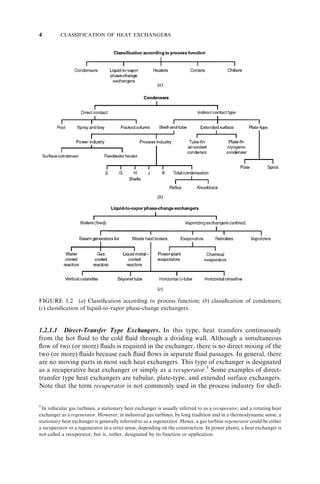
process function, as outlined in Fig. 1.2. However, they are not discussed here and the 
reader may refer to Shah and Mueller (1988). Additional ways to classify heat exchangers 
are by fluid type (gas–gas, gas–liquid, liquid–liquid, gas two-phase, liquid two-phase, 
etc.), industry, and so on, but we do not cover such classifications in this chapter. 
1.2 CLASSIFICATION ACCORDING TO TRANSFER PROCESSES 
Heat exchangers are classified according to transfer processes into indirect- and direct-contact 
types. 
1.2.1 Indirect-Contact Heat Exchangers 
In an indirect-contact heat exchanger, the fluid streams remain separate and the heat 
transfers continuously through an impervious dividing wall or into and out of a wall in a 
transient manner. Thus, ideally, there is no direct contact between thermally interacting 
fluids. This type of heat exchanger, also referred to as a surface heat exchanger, can be 
further classified into direct-transfer type, storage type, and fluidized-bed exchangers.
4 CLASSIFICATION OF HEAT EXCHANGERS 
FIGURE 1.2 (a) Classification according to process function; (b) classification of condensers; 
(c) classification of liquid-to-vapor phase-change exchangers. 
1.2.1.1 Direct-Transfer Type Exchangers. In this type, heat transfers continuously 
from the hot fluid to the cold fluid through a dividing wall. Although a simultaneous 
flow of two (or more) fluids is required in the exchanger, there is no direct mixing of the 
two (or more) fluids because each fluid flows in separate fluid passages. In general, there 
are no moving parts in most such heat exchangers. This type of exchanger is designated 
as a recuperative heat exchanger or simply as a recuperator.{ Some examples of direct-transfer 
type heat exchangers are tubular, plate-type, and extended surface exchangers. 
Note that the term recuperator is not commonly used in the process industry for shell- 
{ In vehicular gas turbines, a stationary heat exchanger is usually referred to as a recuperator, and a rotating heat 
exchanger as a regenerator. However, in industrial gas turbines, by long tradition and in a thermodynamic sense, a 
stationary heat exchanger is generally referred to as a regenerator. Hence, a gas turbine regenerator could be either 
a recuperator or a regenerator in a strict sense, depending on the construction. In power plants, a heat exchanger is 
not called a recuperator, but is, rather, designated by its function or application.
CLASSIFICATION ACCORDING TO TRANSFER PROCESSES 5 
FIGURE 1.2 (d) classification of chemical evaporators according to (i) the type of construction, 
and (ii) how energy is supplied (Shah and Mueller, 1988); (e) classification of reboilers. 
and-tube and plate heat exchangers, although they are also considered as recuperators. 
Recuperators are further subclassified as prime surface exchangers and extended-surface 
exchangers. Prime surface exchangers do not employ fins or extended surfaces on any 
fluid side. Plain tubular exchangers, shell-and-tube exchangers with plain tubes, and 
plate exchangers are good examples of prime surface exchangers. Recuperators consti-tute 
a vast majority of all heat exchangers. 
1.2.1.2 Storage Type Exchangers. In a storage type exchanger, both fluids flow alter-natively 
through the same flow passages, and hence heat transfer is intermittent. The 
heat transfer surface (or flow passages) is generally cellular in structure and is referred to 
as a matrix (see Fig. 1.43), or it is a permeable (porous) solid material, referred to as a 
packed bed. When hot gas flows over the heat transfer surface (through flow passages),
6 CLASSIFICATION OF HEAT EXCHANGERS 
the thermal energy from the hot gas is stored in the matrix wall, and thus the hot gas is 
being cooled during the matrix heating period. As cold gas flows through the same 
passages later (i.e., during the matrix cooling period), the matrix wall gives up thermal 
energy, which is absorbed by the cold fluid. Thus, heat is not transferred continuously 
through the wall as in a direct-transfer type exchanger (recuperator), but the corre-sponding 
thermal energy is alternately stored and released by the matrix wall. This 
storage type heat exchanger is also referred to as a regenerative heat exchanger, or 
simply as a regenerator.{ To operate continuously and within a desired temperature 
range, the gases, headers, or matrices are switched periodically (i.e., rotated), so that 
the same passage is occupied periodically by hot and cold gases, as described further in 
Section 1.5.4. The actual time that hot gas takes to flow through a cold regenerator 
matrix is called the hot period or hot blow, and the time that cold gas flows through the 
hot regenerator matrix is called the cold period or cold blow. For successful operation, it 
is not necessary to have hot- and cold-gas flow periods of equal duration. There is some 
unavoidable carryover of a small fraction of the fluid trapped in the passage to the other 
fluid stream just after switching of the fluids; this is referred to as carryover leakage. In 
addition, if the hot and cold fluids are at different pressures, there will be leakage from 
the high-pressure fluid to the low-pressure fluid past the radial, peripheral, and axial 
seals, or across the valves. This leakage is referred to as pressure leakage. Since these 
leaks are unavoidable, regenerators are used exclusively in gas-to-gas heat (and mass) 
transfer applications with sensible heat transfer; in some applications, regenerators may 
transfer moisture from humid air to dry air up to about 5%. 
For heat transfer analysis of regenerators, the -NTU method of recuperators needs 
to be modified to take into account the thermal energy storage capacity of the matrix. We 
discuss the design theory of regenerators in detail in Chapter 5. 
1.2.1.3 Fluidized-Bed Heat Exchangers. In a fluidized-bed heat exchanger, one side of 
a two-fluid exchanger is immersed in a bed of finely divided solid material, such as a 
tube bundle immersed in a bed of sand or coal particles, as shown in Fig. 1.3. If the 
upward fluid velocity on the bed side is low, the solid particles will remain fixed in 
position in the bed and the fluid will flow through the interstices of the bed. If the 
upward fluid velocity is high, the solid particles will be carried away with the fluid. At a 
‘‘proper’’ value of the fluid velocity, the upward drag force is slightly higher than the 
weight of the bed particles. As a result, the solid particles will float with an increase in 
bed volume, and the bed behaves as a liquid. This characteristic of the bed is referred to 
as a fluidized condition. Under this condition, the fluid pressure drop through the bed 
remains almost constant, independent of the flow rate, and a strong mixing of the solid 
particles occurs. This results in a uniform temperature for the total bed (gas and par-ticles) 
with an apparent thermal conductivity of the solid particles as infinity. Very high 
heat transfer coefficients are achieved on the fluidized side compared to particle-free or 
dilute-phase particle gas flows. Chemical reaction is common on the fluidized side in 
many process applications, and combustion takes place in coal combustion fluidized 
beds. The common applications of the fluidized-bed heat exchanger are drying, mixing, 
adsorption, reactor engineering, coal combustion, and waste heat recovery. Since the 
{ Regenerators are also used for storing thermal energy for later use, as in the storage of thermal energy. Here the 
objective is how to store the maximum fraction of the input energy and minimize heat leakage. However, we do not 
concentrate on this application in this book.
CLASSIFICATION ACCORDING TO TRANSFER PROCESSES 7 
FIGURE 1.3 Fluidized-bed heat exchanger. 
initial temperature difference (Th;i 
 Tf ;i){ is reduced due to fluidization, the exchanger 
effectiveness is lower, and hence -NTU theory for a fluidized-bed exchanger needs to be 
modified (Suo, 1976). Chemical reaction and combustion further complicate the design 
of these exchangers but are beyond the scope of this book. 
1.2.2 Direct-Contact Heat Exchangers 
In a direct-contact exchanger, two fluid streams come into direct contact, exchange heat, 
and are then separated. Common applications of a direct-contact exchanger involve mass 
transfer in addition to heat transfer, such as in evaporative cooling and rectification; 
applications involving only sensible heat transfer are rare. The enthalpy of phase change 
in such an exchanger generally represents a significant portion of the total energy trans-fer. 
The phase change generally enhances the heat transfer rate. Compared to indirect-contact 
recuperators and regenerators, in direct-contact heat exchangers, (1) very high 
heat transfer rates are achievable, (2) the exchanger construction is relatively inexpensive, 
and (3) the fouling problem is generally nonexistent, due to the absence of a heat transfer 
surface (wall) between the two fluids. However, the applications are limited to those cases 
where a direct contact of two fluid streams is permissible. The design theory for these 
{Th;i , inlet temperature of the hot fluid to the fluidized bed; Tf ;i , temperature of the fluidized bed itself at the inlet.
8 CLASSIFICATION OF HEAT EXCHANGERS 
exchangers is beyond the scope of this book and is not covered. These exchangers may be 
further classified as follows. 
1.2.2.1 Immiscible Fluid Exchangers. In this type, two immiscible fluid streams are 
brought into direct contact. These fluids may be single-phase fluids, or they may involve 
condensation or vaporization. Condensation of organic vapors and oil vapors with 
water or air are typical examples. 
1.2.2.2 Gas–Liquid Exchangers. In this type, one fluid is a gas (more commonly, air) 
and the other a low-pressure liquid (more commonly, water) and are readily separable 
after the energy exchange. In either cooling of liquid (water) or humidification of gas 
(air) applications, liquid partially evaporates and the vapor is carried away with the gas. 
In these exchangers, more than 90% of the energy transfer is by virtue of mass transfer 
(due to the evaporation of the liquid), and convective heat transfer is a minor mechan-ism. 
A ‘‘wet’’ (water) cooling tower with forced- or natural-draft airflow is the most 
common application. Other applications are the air-conditioning spray chamber, spray 
drier, spray tower, and spray pond. 
1.2.2.3 Liquid–Vapor Exchangers. In this type, typically steam is partially or fully 
condensed using cooling water, or water is heated with waste steam through direct 
contact in the exchanger. Noncondensables and residual steam and hot water are the 
outlet streams. Common examples are desuperheaters and open feedwater heaters (also 
known as deaeraters) in power plants. 
1.3 CLASSIFICATION ACCORDING TO NUMBER OF FLUIDS 
Most processes of heating, cooling, heat recovery, and heat rejection involve transfer of 
heat between two fluids. Hence, two-fluid heat exchangers are the most common. Three-fluid 
heat exchangers are widely used in cryogenics and some chemical processes (e.g., air 
separation systems, a helium–air separation unit, purification and liquefaction of hydro-gen, 
ammonia gas synthesis). Heat exchangers with as many as 12 fluid streams have been 
used in some chemical process applications. The design theory of three- and multifluid 
heat exchangers is algebraically very complex and is not covered in this book. 
Exclusively, only the design theory for two-fluid exchangers and some associated 
problems are presented in this book. 
1.4 CLASSIFICATION ACCORDING TO SURFACE COMPACTNESS 
Compared to shell-and-tube exchangers, compact heat exchangers are characterized by a 
large heat transfer surface area per unit volume of the exchanger, resulting in reduced 
space, weight, support structure and footprint, energy requirements and cost, as well as 
improved process design and plant layout and processing conditions, together with low 
fluid inventory. 
A gas-to-fluid exchanger is referred to as a compact heat exchanger if it incorporates 
a heat transfer surface having a surface area density greater than about 700m2/m3
CLASSIFICATION ACCORDING TO SURFACE COMPACTNESS 9 
(213 ft2/ft3){ or a hydraulic diameter Dh 
 6mm (1 
4 in.) for operating in a gas stream and 
400m2/m3 (122 ft2/ft3) or higher for operating in a liquid or phase-change stream. A 
laminar flow heat exchanger (also referred to as a meso heat exchanger) has a surface 
area density greater than about 3000m2/m3 (914 ft2/ft3) or 100 mm  Dh 
 1 mm. The 
term micro heat exchanger is used if the surface area density is greater than about 
15,000m2/m3 (4570 ft2/ft3) or 1mm  Dh 
 100 mm. A liquid/two-phase fluid heat 
exchanger is referred to as a compact heat exchanger if the surface area density on any 
one fluid side is greater than about 400m2/m3. In contrast, a typical process industry shell-and- 
tube exchanger has a surface area density of less than 100m2/m3 on one fluid side with 
plain tubes, and two to three times greater than that with high-fin-density low-finned 
tubing.Atypical plate heat exchanger has about twice the average heat transfer coefficient 
h on one fluid side or the average overall heat transfer coefficient U than that for a shell-and- 
tube exchanger for water/water applications. A compact heat exchanger is not neces-sarily 
of small bulk and mass. However, if it did not incorporate a surface of high-surface-area 
density, it would be much more bulky and massive. Plate-fin, tube-fin, and rotary 
regenerators are examples of compact heat exchangers for gas flow on one or both fluid 
sides, and gasketed, welded, brazed plate heat exchangers and printed-circuit heat exchan-gers 
are examples of compact heat exchangers for liquid flows. Basic flow arrangements of 
two-fluid compact heat exchangers are single-pass crossflow, counterflow, and multipass 
cross-counterflow (see Section 1.6 for details); for noncompact heat exchangers, many 
other flow arrangements are also used. The aforementioned last two flow arrangements for 
compact or noncompact heat exchangers can yield a very high exchanger effectiveness 
value or a very small temperature approach (see Section 3.2.3 for the definition) between 
fluid streams. 
A spectrum of surface area density of heat exchanger surfaces is shown in Fig. 1.4. On 
the bottom of the figure, two scales are shown: the heat transfer surface area density  
(m2/m3) and the hydraulic diameter Dh,{ (mm), which is the tube inside or outside 
diameter D (mm) for a thin-walled circular tube. Different heat exchanger surfaces are 
shown in the rectangles. When projected on the  (or Dh) scale, the short vertical sides of 
a rectangle indicate the range of surface area density (or hydraulic diameter) for the 
particular surface in question. What is referred to as  in this figure is either 1 or 2, 
defined as follows. For plate heat exchangers, plate-fin exchangers, and regenerators, 
1 
¼ Ah 
Vh 
or 
Ac 
Vc 
ð1:1Þ 
For tube-fin exchangers and shell-and-tube exchangers, 
2 
¼ Ah 
Vtotal 
or 
Ac 
Vtotal 
ð1:2Þ 
{ The unit conversion throughout the book may not be exact; it depends on whether the number is exact or is an 
engineering value. 
{ The hydraulic diameter is defined as 4Ao=P, where Ao is the minimum free-flow area on one fluid side of a heat 
exchanger and P is the wetted perimeter of flow passages of that side. Note that the wetted perimeter can be 
different for heat transfer and pressure drop calculations. For example, the hydraulic diameter for an annulus of a 
double-pipe heat exchanger for q and p calculations is as follows. 
Dh;q 
¼ 4ð=4ÞðD2o 
 D2i 
Þ 
Di 
¼ D2o 
 D2i 
Di 
Dh;p 
¼ 4ð=4ÞðD2o 
 D2i 
Þ 
ðDo 
þ Di 
Þ 
¼ Do 
 Di 
where Do is the inside diameter of the outer pipe and Di is the outside diameter of the inside pipe of a double-pipe 
exchanger. See also Eq. (3.65) for a more precise definition of the hydraulic diameter.
10 CLASSIFICATION OF HEAT EXCHANGERS 
FIGURE 1.4 Heat transfer surface area density spectrum of exchanger surfaces (Shah, 1981). 
Here A is the heat transfer surface area, V the exchanger volume, and the subscripts h and 
c denote hot and cold fluid sides, respectively. Vh and Vc are the volumes individually 
occupied by the hot- and cold-fluid-side heat transfer surfaces. From this point on in the 
book, 1 is simply designated as  and 2 is designated as : 
 ¼ 1  ¼ 2 
ð1:3Þ 
Note that both  and  (with the definitions noted above) are used in defining the surface 
area densities of a plate-fin surface; however, only  is used in defining the surface area 
density of a tube-fin surface since  has no meaning in this case. The following specific 
values are used in preparing Fig. 1.4: 
. For a shell-and-tube exchanger, an inline arrangement{ is considered with 
Xt*Xl* ¼ 1:88. 
. For plate and plate-fin exchangers, the porosity between plates is taken as 0.8333; 
and for a regenerator, the porosity of matrix surface is taken as 0.8333. With these 
values,  (m2/m3) and Dh (mm) are related as  ¼ 3333=Dh. 
{ The tube array is idealized as infinitely large with thin-walled circular tubes. Xt* and Xl* are the transverse and 
longitudinal tube pitches normalized with respect to the tube outside diameter. Refer to Table 8.1 for the defini-tions 
of tube pitches.
Note that some industries quote the total surface area (of hot- and cold-fluid sides) in 
their exchanger specifications. However, in calculations of heat exchanger design, we 
need individual fluid-side heat transfer surface areas; and hence we use here the defini-tions 
of  and  as given above. 
Based on the foregoing definition of a compact surface, a tube bundle having 5 mm 
(0.2 in.) diameter tubes in a shell-and-tube exchanger comes close to qualifying as a 
compact exchanger. As  or  varies inversely with the tube diameter, the 25.4 mm 
(1 in.) diameter tubes used in a power plant condenser result in a noncompact exchanger. 
In contrast, a 1990s automobile radiator [790 fins/m (20 fins/in.)] has a surface area 
density  on the order of 1870m2/m3 (570 ft2/ft3) on the air side, which is equivalent 
to 1.8mm (0.07 in.) diameter tubes. The regenerators in some vehicular gas turbine 
engines under development have matrices with an area density on the order of 
6600m2/m3 (2000 ft2/ft3), which is equivalent to 0.5 mm (0.02 in.) diameter tubes in a 
bundle. Human lungs are one of the most compact heat-and-mass exchangers, having a 
surface area density of about 17,500m2/m3 (5330 ft2/ft3), which is equivalent to 0.19 mm 
(0.0075 in.) diameter tubes. Some micro heat exchangers under development are as 
compact as the human lung (Shah, 1991a) and also even more compact. 
The motivation for using compact surfaces is to gain specified heat exchanger per-formance, 
q=Tm, within acceptably low mass and box volume constraints. The heat 
exchanger performance may be expressed as 
q 
Tm 
¼ UA ¼ UV ð1:4Þ 
where q is the heat transfer rate, Tm the true mean temperature difference, and U the 
overall heat transfer coefficient. Clearly, a high  value minimizes exchanger volume V 
for specified q=Tm. As explained in Section 7.4.1.1, compact surfaces (having small Dh) 
generally result in a higher heat transfer coefficient and a higher overall heat transfer 
coefficient U, resulting in a smaller volume. As compact surfaces can achieve structural 
stability and strength with thinner-gauge material, the gain in a lower exchanger mass is 
even more pronounced than the gain in a smaller volume. 
1.4.1 Gas-to-Fluid Exchangers 
The heat transfer coefficient h for gases is generally one or two orders of magnitude lower 
than that for water, oil, and other liquids. Now, to minimize the size and weight of a gas-to- 
liquid heat exchanger, the thermal conductances (hA products) on both sides of the 
exchanger should be approximately the same. Hence, the heat transfer surface on the gas 
side needs to have a much larger area and be more compact than can be realized practi-cally 
with the circular tubes commonly used in shell-and-tube exchangers. Thus, for an 
approximately balanced design (about the same hA values), a compact surface is 
employed on the gas side of gas-to-gas, gas-to-liquid, and gas-to-phase change heat 
exchangers. 
The unique characteristics of compact extended-surface (plate-fin and tube-fin) 
exchangers, compared to conventional shell-and-tube exchangers (see Fig. 1.6), are as 
follows: 
. Availability of numerous surfaces having different orders of magnitude of surface 
area density 
CLASSIFICATION ACCORDING TO SURFACE COMPACTNESS 11
12 CLASSIFICATION OF HEAT EXCHANGERS 
. Flexibility in distributing surface area on the hot and cold sides as warranted by 
design considerations 
. Generally, substantial cost, weight, or volume savings. 
The important design and operating considerations for compact extended-surface 
exchangers are as follows: 
. Usually, at least one of the fluids is a gas having a low h value. 
. Fluids must be clean and relatively noncorrosive because of low-Dh flow passages 
and no easy techniques for cleaning. 
. The fluid pumping power (and hence the pressure drop) is often as important as the 
heat transfer rate. 
. Operating pressures and temperatures are somewhat limited compared to shell-and- 
tube exchangers, due to joining of the fins to plates or tubes by brazing, 
mechanical expansion, and so on. 
. With the use of highly compact surfaces, the resulting shape of the exchanger is one 
having a large frontal area and a short flow length; the header design of a compact 
heat exchanger is thus important for achieving uniform flow distribution among 
very large numbers of small flow passages. 
. The market potential must be large enough to warrant the sizable initial manufac-turing 
tooling and equipment costs. 
Fouling is a major potential problem in compact heat exchangers (except for plate-and- 
frame heat exchangers), particularly those having a variety of fin geometries or very 
fine circular or noncircular flow passages that cannot be cleaned mechanically. Chemical 
cleaning may be possible; thermal baking and subsequent rinsing are possible for small 
units.{ Hence, extended-surface compact heat exchangers may not be used in heavy 
fouling applications. Nonfouling fluids are used where permissible, such as clean air or 
gases, light hydrocarbons, and refrigerants. 
1.4.2 Liquid-to-Liquid and Phase-Change Exchangers 
Liquid-to-liquid and phase-change exchangers are gasketed plate-and-frame and welded 
plate, spiral plate, and printed-circuit exchangers. Some of them are described in detail in 
Section 1.5.2. 
1.5 CLASSIFICATION ACCORDING TO CONSTRUCTION FEATURES 
Heat exchangers are frequently characterized by construction features. Four major con-struction 
types are tubular, plate-type, extended surface, and regenerative exchangers. 
Heat exchangers with other constructions are also available, such as scraped surface 
exchanger, tank heater, cooler cartridge exchanger, and others (Walker, 1990). Some 
of these may be classified as tubular exchangers, but they have some unique features 
compared to conventional tubular exchangers. Since the applications of these exchangers 
{ Some additional techniques for cleaning and mitigation of fouling are summarized in Section 13.4.
CLASSIFICATION ACCORDING TO CONSTRUCTION FEATURES 13 
are specialized, we concentrate here only on the four major construction types noted 
above. 
Although the -NTU and MTD methods (see end of Section 3.2.2) are identical for 
tubular, plate-type, and extended-surface exchangers, the influence of the following 
factors must be taken into account in exchanger design: corrections due to leakage 
and bypass streams in a shell-and-tube exchanger, effects due to a few plates in a plate 
exchanger, and fin efficiency in an extended-surface exchanger. Similarly, the -NTU 
method must be modified to take into account the heat capacity of the matrix in a 
regenerator. Thus, the detailed design theory differs for each construction type and is 
discussed in detail in Chapters 3 through 5. Let us first discuss the construction features 
of the four major types. 
1.5.1 Tubular Heat Exchangers 
These exchangers are generally built of circular tubes, although elliptical, rectangular, or 
round/flat twisted tubes have also been used in some applications. There is considerable 
flexibility in the design because the core geometry can be varied easily by changing the 
tube diameter, length, and arrangement. Tubular exchangers can be designed for high 
pressures relative to the environment and high-pressure differences between the fluids. 
Tubular exchangers are used primarily for liquid-to-liquid and liquid-to-phase change 
(condensing or evaporating) heat transfer applications. They are used for gas-to-liquid 
and gas-to-gas heat transfer applications primarily when the operating temperature and/ 
or pressure is very high or fouling is a severe problem on at least one fluid side and no 
other types of exchangers would work. These exchangers may be classified as shell-and-tube, 
double-pipe, and spiral tube exchangers. They are all prime surface exchangers 
except for exchangers having fins outside/inside tubes. 
1.5.1.1 Shell-and-Tube Exchangers. This exchanger, shown in Fig. 1.5, is generally 
built of a bundle of round tubes mounted in a cylindrical shell with the tube axis parallel 
to that of the shell. One fluid flows inside the tubes, the other flows across and along the 
tubes. The major components of this exchanger are tubes (or tube bundle), shell, front-end 
head, rear-end head, baffles, and tubesheets, and are described briefly later in this 
subsection. For further details, refer to Section 10.2.1. 
A variety of different internal constructions are used in shell-and-tube exchangers, 
depending on the desired heat transfer and pressure drop performance and the methods 
employed to reduce thermal stresses, to prevent leakages, to provide for ease of cleaning, 
to contain operating pressures and temperatures, to control corrosion, to accommodate 
highly asymmetric flows, and so on. Shell-and-tube exchangers are classified and con-structed 
in accordance with the widely used TEMA (Tubular Exchanger Manufacturers 
Association) standards (TEMA, 1999), DIN and other standards in Europe and else-where, 
and ASME (American Society of Mechanical Engineers) boiler and pressure 
vessel codes. TEMA has developed a notation system to designate major types of 
shell-and-tube exchangers. In this system, each exchanger is designated by a three-letter 
combination, the first letter indicating the front-end head type, the second the shell 
type, and the third the rear-end head type. These are identified in Fig. 1.6. Some common 
shell-and-tube exchangers are AES, BEM, AEP, CFU, AKT, and AJW. It should be 
emphasized that there are other special types of shell-and-tube exchangers commercially 
available that have front- and rear-end heads different from those in Fig. 1.6. Those 
exchangers may not be identifiable by the TEMA letter designation.
14 CLASSIFICATION OF HEAT EXCHANGERS 
FIGURE 1.5 (a) Shell-and-tube exchanger (BEM) with one shell pass and one tube pass; (b) shell-and- 
tube exchanger (BEU) with one shell pass and two tube passes. 
The three most common types of shell-and-tube exchangers are (1) fixed tubesheet 
design, (2) U-tube design, and (3) floating-head type. In all three types, the front-end 
head is stationary while the rear-end head can be either stationary or floating (see Fig. 
1.6), depending on the thermal stresses in the shell, tube, or tubesheet, due to temperature 
differences as a result of heat transfer. 
The exchangers are built in accordance with three mechanical standards that specify 
design, fabrication, and materials of unfired shell-and-tube heat exchangers. Class R is 
for the generally severe requirements of petroleum and related processing applications. 
Class C is for generally moderate requirements for commercial and general process 
applications. Class B is for chemical process service. The exchangers are built to comply 
with the applicable ASME Boiler and Pressure Vessel Code, Section VIII (1998), and 
other pertinent codes and/or standards. The TEMA standards supplement and define the 
ASME code for heat exchanger applications. In addition, state and local codes applicable 
to the plant location must also be met. 
The TEMA standards specify the manufacturing tolerances for various mechanical 
classes, the range of tube sizes and pitches, baffling and support plates, pressure 
classification, tubesheet thickness formulas, and so on, and must be consulted for all 
these details. In this book, we consider only the TEMA standards where appropriate, but 
there are other standards, such as DIN 28 008. 
Tubular exchangers are widely used in industry for the following reasons. They are 
custom designed for virtually any capacity and operating conditions, such as from high
CLASSIFICATION ACCORDING TO CONSTRUCTION FEATURES 15 
FIGURE 1.6 Standard shell types and front- and rear-end head types (From TEMA, 1999). 
vacuum to ultrahigh pressure [over 100 MPa (15,000 psig)], from cryogenics to high 
temperatures [about 11008C (20008F)] and any temperature and pressure differences 
between the fluids, limited only by the materials of construction. They can be designed 
for special operating conditions: vibration, heavy fouling, highly viscous fluids, erosion, 
corrosion, toxicity, radioactivity, multicomponent mixtures, and so on. They are the 
most versatile exchangers, made from a variety of metal and nonmetal materials (such 
as graphite, glass, and Teflon) and range in size from small [0.1m2 (1 ft2)] to supergiant 
[over 105m2 (106 ft2)] surface area. They are used extensively as process heat exchangers
16 CLASSIFICATION OF HEAT EXCHANGERS 
in the petroleum-refining and chemical industries; as steam generators, condensers, boiler 
feedwater heaters, and oil coolers in power plants; as condensers and evaporators in 
some air-conditioning and refrigeration applications; in waste heat recovery applications 
with heat recovery from liquids and condensing fluids; and in environmental control. 
Next, major components of shell-and-tube exchangers are briefly described. 
Tubes. Round tubes in various shapes are used in shell-and-tube exchangers. Most 
common are the tube bundles{ with straight and U-tubes (Fig. 1.5) used in process 
and power industry exchangers. However, sine-wave bend, J-shape, L-shape or hockey 
sticks, and inverted hockey sticks are used in advanced nuclear exchangers to accom-modate 
large thermal expansion of the tubes. Some of the enhanced tube geometries 
used in shell-and-tube exchangers are shown in Fig. 1.7. Serpentine, helical, and bay-onet 
are other tube shapes (shown in Fig. 1.8) that are used in shell-and-tube exchan-gers. 
In most applications, tubes have single walls, but when working with radioactive, 
Turbo - EHP 
(a) 
Turbo - CDI 
(b) 
FIGURE 1.7 Some enhanced tube geometries used in shell-and-tube exchangers: (a) internally 
and externally enhanced evaporator tube; (b) internally and externally enhanced condenser tube. 
(Courtesy of Wolverine Tube, Inc., Decatur, AL.) 
FIGURE 1.8 Additional tube configurations used in shell-and-tube exchangers. 
{A tube bundle is an assembly of tubes, baffles, tubesheets and tie rods, and support plates and longitudinal baffles, 
if any.
CLASSIFICATION ACCORDING TO CONSTRUCTION FEATURES 17 
FIGURE 1.9 Low-finned tubing. The plain end goes into the tubesheet. 
reactive, or toxic fluids and potable water, double-wall tubing is used. In most applica-tions, 
tubes are bare, but when gas or low-heat-transfer coefficient liquid is used on the 
shell side, low-height fins (low fins) are used on the shell side. Also, special high-flux-boiling 
surfaces employ modified low-fin tubing. These are usually integral fins made 
from a thick-walled tube, shown in Fig. 1.9. Tubes are drawn, extruded, or welded, and 
they are made from metals, plastics, and ceramics, depending on the applications. 
Shells. The shell is a container for the shell fluid.{ Usually, it is cylindrical in shape with 
a circular cross section, although shells of different shapes are used in specific applica-tions 
and in nuclear heat exchangers to conform to the tube bundle shape. The shell is 
made from a circular pipe if the shell diameter is less than about 0.6m (2 ft) and is made 
from a metal plate rolled and welded longitudinally for shell diameters greater than 
0.6m (2 ft). Seven types of shell configurations, standardized by TEMA (1999), are E, 
F, G, H, J, K, and X, shown in Fig. 1.6. The E shell is the most common, due to its low 
cost and simplicity, and has the highest log-mean temperature-difference correction 
factor F (see Section 3.7.2 for the definition). Although the tubes may have single or 
multiple passes, there is one pass on the shell side. To increase the mean temperature 
difference and hence exchanger effectiveness, a pure counterflow arrangement is desir-able 
for a two-tube-pass exchanger. This is achieved by use of an F shell having a 
longitudinal baffle and resulting in two shell passes. Split- and divided-flow shells, such 
as G, H, and J (see Fig. 1.6), are used for specific applications, such as thermosiphon 
boiler, condenser, and shell-side low pressure drops. The K shell is a kettle reboiler used 
for pool boiling applications. The X shell is a crossflow exchanger and is used for low 
pressure drop on the shell side and/or to eliminate the possibility of flow-induced 
vibrations. A further description of the various types of shell configurations is provided 
in Section 10.2.1.4. 
Nozzles. The entrance and exit ports for the shell and tube fluids, referred to as nozzles, 
are pipes of constant cross section welded to the shell and channels. They are used to 
distribute or collect the fluid uniformly on the shell and tube sides. Note that they differ 
from the nozzle used as a fluid metering device or in jet engines, which has a variable 
flow area along the flow length. 
{ The fluid flowing in the tubes is referred to as the tube fluid; the fluid flowing outside the tubes is referred to as the 
shell fluid.
18 CLASSIFICATION OF HEAT EXCHANGERS 
Front- and Rear-End Heads. These are used for entrance and exit of the tube fluid; in 
many rear-end heads, a provision has been made to take care of tube thermal expan-sion. 
The front-end head is stationary, while the rear-end head could be either station-ary 
(allowing for no tube thermal expansion) or floating, depending on the thermal 
stresses between the tubes and shell. The major criteria for selection of the front-end 
head are cost, maintenance and inspection, hazard due to mixing of shell and tube 
fluids, and leakage to ambient and operating pressures. The major criteria for selection 
of the rear-end head are the allowance for thermal stresses, a provision to remove the 
tube bundle for cleaning the shell side, prevention of mixing of tube and shell fluids, and 
sealing any leakage path for the shell fluid to ambient. The design selection criteria for 
the front- and rear-end heads of Fig. 1.6 are discussed in Sections 10.2.1.5 and 10.2.1.6. 
Baffles. Baffles may be classified as transverse and longitudinal types. The purpose of 
longitudinal baffles is to control the overall flow direction of the shell fluid such that a 
desired overall flow arrangement of the two fluid streams is achieved. For example, F, 
G, and H shells have longitudinal baffles (see Fig. 1.6). Transverse baffles may be 
classified as plate baffles and grid (rod, strip, and other axial-flow) baffles. Plate baffles 
are used to support the tubes during assembly and operation and to direct the fluid in 
the tube bundle approximately at right angles to the tubes to achieve higher heat 
transfer coefficients. Plate baffles increase the turbulence of the shell fluid and minimize 
tube-to-tube temperature differences and thermal stresses due to the crossflow. Shown 
in Fig. 1.10 are single- and multisegmental baffles and disk and doughnut baffles. 
Single- and double-segmental baffles are used most frequently due to their ability to 
assist maximum heat transfer (due to a high-shell-side heat transfer coefficient) for a 
given pressure drop in a minimum amount of space. Triple and no-tubes-in-window 
segmental baffles are used for low-pressure-drop applications. The choice of baffle type, 
spacing, and cut is determined largely by flow rate, desired heat transfer rate, allowable 
pressure drop, tube support, and flow-induced vibrations. Disk and doughnut baffles/ 
support plates are used primarily in nuclear heat exchangers. These baffles for nuclear 
exchangers have small perforations between tube holes to allow a combination of 
crossflow and longitudinal flow for lower shell-side pressure drop. The combined 
flow results in a slightly higher heat transfer coefficient than that for pure longitudinal 
flow and minimizes tube-to-tube temperature differences. Rod (or bar) baffles, the most 
common type of grid baffle, used to support the tubes and increase the turbulence of the 
shell fluid, are shown in Fig. 1.11. The flow in a rod baffle heat exchanger is parallel to 
the tubes, and flow-induced vibrations are virtually eliminated by the baffle support of 
the tubes. One alternative to a rod baffle heat exchanger is the use of twisted tubes (after 
flattening the circular tubes, they are twisted), shown in Fig. 1.12. Twisted tubes pro-vide 
rigidity and eliminate flow-induced tube vibrations, can be cleaned easily on the 
shell side with hydrojets, and can be cleaned easily inside the tubes, but cannot be 
retubed. Low-finned tubes are also available in a twisted-tube configuration. A 
helical baffle shell-and-tube exchanger with baffles as shown in Fig. 1.13 also has the 
following advantages: a lower shell-side pressure drop while maintaining the high heat 
transfer coefficient of a segmental exchanger, reduced leakage streams (see Section 
4.4.1), and elimination of dead spots and recirculation zones (thus reducing fouling). 
Every shell-and-tube exchanger has transverse baffles except for X and K shells, which 
have support plates because the sole purpose of these transverse baffles is to support the 
tubes. Baffle types and their design guidelines are described further in Section 10.2.1.3.
CLASSIFICATION ACCORDING TO CONSTRUCTION FEATURES 19 
FIGURE 1.10 Plate baffle types, modified from Mueller (1973). 
Butterworth (1996) provides further descriptions of these designs, and they are com-pared 
in Table 1.1. 
Tubesheets. These are used to hold tubes at the ends. A tubesheet is generally a round 
metal plate with holes drilled through for the desired tube pattern, holes for the tie rods 
(which are used to space and hold plate baffles), grooves for the gaskets, and bolt holes 
for flanging to the shell and channel. To prevent leakage of the shell fluid at the
20 CLASSIFICATION OF HEAT EXCHANGERS 
FIGURE 1.11 (a) Four rod baffles held by skid bars (no tubes shown); (b) tube in a rod baffle 
exchanger supported by four rods; (c) square layout of tubes with rods; (d) triangular layout of tubes 
with rods (Shah, 1981). 
FIGURE 1.12 Twisted tube bundle for a shell-and-tube exchanger. (Courtesy of Brown Fintube 
Company, Houston, TX.)
CLASSIFICATION ACCORDING TO CONSTRUCTION FEATURES 21 
FIGURE 1.13 Helical baffle shell-and-tube exchanger: (a) single helix; (b) double helix. (Courtesy 
of ABB Lumus Heat Transfer, Bloomfield, NJ.) 
tubesheet through a clearance between the tube hole and tube, the tube-to-tubesheet 
joints are made by many methods, such as expanding the tubes, rolling the tubes, 
hydraulic expansion of tubes, explosive welding of tubes, stuffing of the joints, or 
welding or brazing of tubes to the tubesheet. The leak-free tube-to-tubesheet joint 
made by the conventional rolling process is shown in Fig. 1.14. 
1.5.1.2 Double-Pipe Heat Exchangers. This exchanger usually consists of two con-centric 
pipes with the inner pipe plain or finned, as shown in Fig. 1.15. One fluid 
flows in the inner pipe and the other fluid flows in the annulus between pipes in a 
counterflow direction for the ideal highest performance for the given surface area. 
However, if the application requires an almost constant wall temperature, the fluids 
may flow in a parallelflow direction. This is perhaps the simplest heat exchanger. Flow 
distribution is no problem, and cleaning is done very easily by disassembly. This con-figuration 
is also suitable where one or both of the fluids is at very high pressure, 
TABLE 1.1 Comparison of Various Types of Shell-and-Tube Heat Exchangers 
Characteristic 
Segmental 
Baffle Rod Baffle 
Twisted 
Tube 
Helical 
Baffle 
Good heat transfer per unit 
pressure drop 
No Yes Yes Yes 
High shell-side heat 
transfer coefficient 
Yes No No Yes 
Tube-side enhancement With inserts With inserts Included With inserts 
Suitable for very high 
exchanger effectiveness 
No Yes Yes No 
Tends to have low fouling No Yes Yes Yes 
Can be cleaned 
mechanically 
Yes, with 
square pitch 
Yes Yes Yes, with 
square pitch 
Low flow-induced tube 
vibration 
With special 
designs 
Yes Yes With double 
helix 
Can have low-finned tubes Yes Yes Yes Yes 
Source: Data from Butterworth with private communication (2002).
22 CLASSIFICATION OF HEAT EXCHANGERS 
FIGURE 1.14 Details of a leak-free joint between the tube and tube hole of a tubesheet: (a) before 
tube expansion; (b) after tube expansion. 
FIGURE 1.15 Double-pipe heat exchanger. 
because containment in the small-diameter pipe or tubing is less costly than containment 
in a large-diameter shell. Double-pipe exchangers are generally used for small-capacity 
applications where the total heat transfer surface area required is 50m2 (500 ft2) or less 
because it is expensive on a cost per unit surface area basis. Stacks of double-pipe or 
multitube heat exchangers are also used in some process applications with radial or 
longitudinal fins. The exchanger with a bundle of U tubes in a pipe (shell) of 150mm 
(6 in.) diameter and above uses segmental baffles and is referred to variously as a hairpin 
or jacketed U-tube exchanger. 
1.5.1.3 Spiral Tube Heat Exchangers. These consist of one or more spirally wound 
coils fitted in a shell. Heat transfer rate associated with a spiral tube is higher than that 
for a straight tube. In addition, a considerable amount of surface can be accommodated 
in a given space by spiraling. Thermal expansion is no problem, but cleaning is almost 
impossible. 
1.5.2 Plate-Type Heat Exchangers 
Plate-type heat exchangers are usually built of thin plates (all prime surface). The plates 
are either smooth or have some form of corrugation, and they are either flat or wound in 
an exchanger. Generally, these exchangers cannot accommodate very high pressures,
CLASSIFICATION ACCORDING TO CONSTRUCTION FEATURES 23 
temperatures, or pressure and temperature differences. Plate heat exchangers (PHEs){ 
can be classified as gasketed, welded (one or both fluid passages), or brazed, depending 
on the leak tightness required. Other plate-type exchangers are spiral plate, lamella, and 
platecoil exchangers. These are described next. 
1.5.2.1 Gasketed Plate Heat Exchangers 
Basic Construction. The plate-and-frame or gasketed plate heat exchanger (PHE) con-sists 
of a number of thin rectangular metal plates sealed around the edges by gaskets 
and held together in a frame as shown in Fig. 1.16. The frame usually has a fixed end 
cover (headpiece) fitted with connecting ports and a movable end cover (pressure plate, 
follower, or tailpiece). In the frame, the plates are suspended from an upper carrying 
bar and guided by a bottom carrying bar to ensure proper alignment. For this purpose, 
each plate is notched at the center of its top and bottom edges. The plate pack with 
fixed and movable end covers is clamped together by long bolts, thus compressing the 
gaskets and forming a seal. For later discussion, we designate the resulting length of the 
plate pack as Lpack. The carrying bars are longer than the compressed stack, so that 
when the movable end cover is removed, plates may be slid along the support bars for 
inspection and cleaning. 
Each plate is made by stamping or embossing a corrugated (or wavy) surface pattern 
on sheet metal. On one side of each plate, special grooves are provided along the per-iphery 
of the plate and around the ports for a gasket, as indicated by the dark lines in 
Fig. 1.17. Typical plate geometries (corrugated patterns) are shown in Fig. 1.18, and over 
60 different patterns have been developed worldwide. Alternate plates are assembled such 
FIGURE 1.16 Gasketed plate- and-frame heat exchanger. 
{ Unless explicitly mentioned, PHE means gasketed plate heat exchanger.
24 CLASSIFICATION OF HEAT EXCHANGERS 
FIGURE 1.17 Plates showing gaskets around the ports (Shah and Focke, 1988). 
that the corrugations on successive plates contact or cross each other to provide mechan-ical 
support to the plate pack through a large number of contact points. The resulting 
flow passages are narrow, highly interrupted, and tortuous, and enhance the heat transfer 
rate and decrease fouling resistance by increasing the shear stress, producing secondary 
flow, and increasing the level of turbulence. The corrugations also improve the rigidity of 
the plates and form the desired plate spacing. Plates are designated as hard or soft, 
depending on whether they generate a high or low intensity of turbulence. 
FIGURE 1.18 Plate patterns: (a) washboard; (b) zigzag; (c) chevron or herringbone; 
(d) protrusions and depressions; (e) washboard with secondary corrugations; ( f ) oblique 
washboard (Shah and Focke, 1988).
CLASSIFICATION ACCORDING TO CONSTRUCTION FEATURES 25 
Sealing between the two fluids is accomplished by elastomeric molded gaskets 
[typically, 5 mm (0.2 in.) thick] that are fitted in peripheral grooves mentioned earlier 
(dark lines in Fig. 1.17). Gaskets are designed such that they compress about 25% of 
thickness in a bolted plate exchanger to provide a leaktight joint without distorting the 
thin plates. In the past, the gaskets were cemented in the grooves, but now, snap-on 
gaskets, which do not require cementing, are common. Some manufacturers offer special 
interlocking types to prevent gasket blowout at high pressure differences. Use of a double 
seal around the port sections, shown in Fig. 1.17, prevents fluid intermixing in the rare 
event of gasket failure. The interspace between the seals is also vented to the atmosphere 
to facilitate visual indication of leakage (Fig. 1.17). Typical gasket materials and their 
range of applications are listed in Table 1.2, with butyl and nitrile rubber being most 
common. PTFE (polytetrafluoroethylene) is not used because of its viscoelastic proper-ties. 
Each plate has four corner ports. In pairs, they provide access to the flow passages on 
either side of the plate. When the plates are assembled, the corner ports line up to form 
distribution headers for the two fluids. Inlet and outlet nozzles for the fluids, provided in 
the end covers, line up with the ports in the plates (distribution headers) and are con-nected 
to external piping carrying the two fluids. A fluid enters at a corner of one end of 
the compressed stack of plates through the inlet nozzle. It passes through alternate 
channels{ in either series or parallel passages. In one set of channels, the gasket does 
not surround the inlet port between two plates (see, e.g., Fig. 1.17a for the fluid 1 inlet 
port); fluid enters through that port, flows between plates, and exits through a port at the 
other end. On the same side of the plates, the other two ports are blocked by a gasket with 
a double seal, as shown in Fig. 1.17a, so that the other fluid (fluid 2 in Fig. 1.17a) cannot 
enter the plate on that side.{ In a 1 pass–1 pass} two-fluid counterflow PHE, the next 
channel has gaskets covering the ports just opposite the preceding plate (see, e.g., Fig. 
1.17b, in which now, fluid 2 can flow and fluid 1 cannot flow). Incidentally, each plate has 
gaskets on only one side, and they sit in grooves on the back side of the neighboring plate. 
In Fig. 1.16, each fluid makes a single pass through the exchanger because of alternate 
gasketed and ungasketed ports in each corner opening. The most conventional flow 
arrangement is 1 pass–1 pass counterflow, with all inlet and outlet connections on the 
fixed end cover. By blocking flow through some ports with proper gasketing, either one 
or both fluids could have more than one pass. Also, more than one exchanger can be 
accommodated in a single frame. In cases with more than two simple 1-pass–1-pass heat 
exchangers, it is necessary to insert one or more intermediate headers or connector plates 
in the plate pack at appropriate places (see, e.g., Fig. 1.19). In milk pasteurization 
applications, there are as many as five exchangers or sections to heat, cool, and regen-erate 
heat between raw milk and pasteurized milk. 
Typical plate heat exchanger dimensions and performance parameters are given in 
Table 1.3. Any metal that can be cold-worked is suitable for PHE applications. The most 
{A channel is a flow passage bounded by two plates and is occupied by one of the fluids. In contrast, a plate 
separates the two fluids and transfers heat from the hot fluid to the cold fluid. 
{ Thus with the proper arrangement, gaskets also distribute the fluids between the channels in addition to provid-ing 
sealing to prevent leakage. 
} In a plate heat exchanger, a pass refers to a group of channels in which the flow is in the same direction for one full 
length of the exchanger (from top to bottom of the pack; see Fig. 1.65). In anm pass – n pass two-fluid plate heat 
exchanger, fluid 1 flows through m passes and fluid 2 through n passes.
26 CLASSIFICATION OF HEAT EXCHANGERS 
TABLE 1.2 Gasket Materials Used in Plate Heat Exchangers 
Gasket Material Generic Name 
Maximum 
Operating 
Temperature 
(8C) Applications Comments 
Natural rubber cis-1,4- 
polyisoprene 
70 Oxygenated solvents, 
acids, alcohols 
SBR (styrene 
butadiene) 
80 General-purpose aqueous, 
alkalies, acids, and 
oxygenated solvents 
Has poor fat 
resistance 
Neoprene trans-1,4- 
polychloroprene 
70 Alcohols, alkalies, acids, 
aliphatic hydrocarbon 
solvents 
Nitrile 100–140 Dairy, fruit juices, 
beverage, pharmaceutical 
and biochemical 
applications, oil, gasoline, 
animal and vegetable oils, 
alkalies, aliphatic organic 
solvents 
Is resistant to 
fatty materials; 
particularly 
suitable 
for cream 
Butyl 
(resin cured) 
120–150 Alkalies, acids, animal and 
vegetable oils, aldehydes, 
ketones, phenols, and 
some esters 
Has poor fat 
resistance; 
suitable 
for UHT 
milk duties; 
resists 
inorganic 
chemical 
solutions up 
to 1508C 
Ethylene propylene 
(EDPM) rubber 
140 Alkalies, oxygenated 
solvents 
Unsuitable for 
fatty liquids 
Silicone rubber Polydimethyl-siloxane 
140 General low-temperature 
use, alcohols, sodium 
hypochlorite 
Fluorinated rubber 175 High-temperature aqueous 
solutions, mineral oils and 
gasoline, organic solvents, 
animal and vegetable oils 
Compressed 
asbestos fiber 
200–260 Organic solvents, high-operating- 
temperature 
applications 
common plate materials are stainless steel (AISI 304 or 316) and titanium. Plates made 
from Incoloy 825, Inconel 625, and Hastelloy C-276 are also available. Nickel, cupro-nickel, 
and monel are rarely used. Carbon steel is not used, due to low corrosion resis-tance 
for thin plates. Graphite and polymer plates are used with corrosive fluids. The 
heat transfer surface area per unit volume for plate exchangers ranges from 120 to 
660m2/m3 (37 to 200 ft2/ft3).
CLASSIFICATION ACCORDING TO CONSTRUCTION FEATURES 27 
FIGURE 1.19 A three-fluid plate heat exchanger. (Courtesy of Alfa Laval Thermal, Inc., Lund, 
Sweden.) 
Flow Arrangements. A large number of flow arrangements are possible in a plate heat 
exchanger (shown later in Fig. 1.65), depending on the required heat transfer duty, 
available pressure drops, minimum and maximum velocities allowed, and the flow rate 
ratio of the two fluid streams. In each pass there can be an equal or unequal number of 
thermal plates.{ Whether the plate exchanger is a single- or multipass unit, whenever 
possible, the thermodynamically superior counterflow or overall counterflow arrange-ment 
(see Sections 1.6.1 and 1.6.2) is used exclusively. 
One of the most common flow arrangements in a PHE is a 1-pass–1-pass U config-uration 
(see Fig. 1.65a). This is because this design allows all fluid ports to be located on 
TABLE 1.3 Some Geometrical and Operating Condition Characteristics of Plate-and-Frame Heat 
Exchangers 
Unit Operation 
Maximum surface area 2500 m2 Pressure 0.1 to 3.0 MPa 
Number of plates 3 to 700 Temperature 40 to 2608C 
Port size Up to 400 mm Maximum port velocity 6 m/s (for liquids) 
(for liquids) Channel flow rates 0.05 to 12.5 m3/h 
Maximum unit flow rate 2500 m3/h 
Plates Performance 
Thickness 0.5 to 1.2 mm Temperature approach As low as 18C 
Size 0.03 to 3.6 m2 Heat exchanger efficiency Up to 93% 
Spacing 1.5 to 7 mm Heat transfer coefficients 3000 to 8000 W/m2 K 
Width 70 to 1200 mm for water–water duties 
Length 0.4 to 5 m 
Hydraulic diameter 2 to 10 mm 
Surface area per plate 0.02 to 5 m2 
Source: Data from Shah (1994). 
{ In the plate exchanger, the two outer plates serve as end plates and ideally do not participate in heat transfer 
between the fluids because of the large thermal resistance associated with thick end plates and air gaps between the 
end plates and the header/follower. The remaining plates, known as thermal plates, transfer heat between the 
fluids.
28 CLASSIFICATION OF HEAT EXCHANGERS 
the fixed end cover, permitting easy disassembly and cleaning/repair of a PHE without 
disconnecting any piping. In a multipass arrangement, the ports and fluid connections 
are located on both fixed and movable end covers. A multipass arrangement is generally 
used when the flow rates are considerably different or when one would like to use up 
the available pressure drop by multipassing and hence getting a higher heat transfer 
coefficient. 
Advantages and Limitations. Some advantages of plate heat exchangers are as follows. 
They can easily be taken apart into their individual components for cleaning, inspec-tion, 
and maintenance. The heat transfer surface area can readily be changed or re-arranged 
for a different task or for anticipated changing loads, through the flexibility of 
plate size, corrugation patterns, and pass arrangements. High shear rates and shear 
stresses, secondary flow, high turbulence, and mixing due to plate corrugation patterns 
reduce fouling to about 10 to 25% of that of a shell-and-tube exchanger, and enhance 
heat transfer. Very high heat transfer coefficients are achieved due to the breakup and 
reattachment of boundary layers, swirl or vortex flow generation, and small hydraulic 
diameter flow passages. Because of high heat transfer coefficients, reduced fouling, the 
absence of bypass and leakage streams, and pure counterflow arrangements, the surface 
area required for a plate exchanger is one-half to one-third that of a shell-and-tube 
exchanger for a given heat duty, thus reducing the cost, overall volume, and space 
requirement for the exchanger. Also, the gross weight of a plate exchanger is about one-sixth 
that of an equivalent shell-and-tube exchanger. Leakage from one fluid to the 
other cannot take place unless a plate develops a hole. Since the gasket is between the 
plates, any leakage from the gaskets is to the outside of the exchanger. The residence 
time (time to travel from the inlet to the outlet of the exchanger) for different fluid 
particles or flow paths on a given side is approximately the same. This parity is desir-able 
for uniformity of heat treatment in applications such as sterilizing, pasteurizing, 
and cooking. There are no significant hot or cold spots in the exchanger that could lead 
to the deterioration of heat-sensitive fluids. The volume of fluid held up in the exchan-ger 
is small; this feature is important with expensive fluids, for faster transient response, 
and for better process control. Finally, high thermal performance can be achieved in 
plate exchangers. The high degree of counterflow in PHEs makes temperature 
approaches of up to 18C (28F) possible. The high thermal effectiveness (up to about 
93%) facilitates economical low-grade heat recovery. The flow-induced vibrations, 
noise, thermal stresses, and entry impingement problems of shell-and-tube exchangers 
do not exist for plate heat exchangers. 
Some inherent limitations of the plate heat exchangers are caused by plates and 
gaskets as follows. The plate exchanger is capable of handling up to a maximum pressure 
of about 3 MPa gauge (435 psig) but is usually operated below 1.0 MPa gauge (150 psig). 
The gasket materials (except for the PTFE-coated type) restrict the use of PHEs in highly 
corrosive applications; they also limit the maximum operating temperature to 2608C 
(5008F) but are usually operated below 1508C (3008F) to avoid the use of expensive 
gasket materials. Gasket life is sometimes limited. Frequent gasket replacement may 
be needed in some applications. Pinhole leaks are hard to detect. For equivalent flow 
velocities, pressure drop in a plate exchanger is very high compared to that of a shell-and-tube 
exchanger. However, the flow velocities are usually low and plate lengths are 
‘‘short,’’ so the resulting pressure drops are generally acceptable. The normal symmetry 
of PHEs may make phase-change applications{ more difficult, due to large differences 
in volumetric flows. For some cases, heat exchanger duties with widely different fluid flow
CLASSIFICATION ACCORDING TO CONSTRUCTION FEATURES 29 
rates and depending on the allowed pressure drops of the two fluids, an arrangement of a 
different number of passes for the two fluids may make a PHE advantageous. However, 
care must be exercised to take full advantage of available pressure drop while multi-passing 
one or both fluids. 
Because of the long gasket periphery, PHEs are not suited for high-vacuum applica-tions. 
PHEs are not suitable for erosive duties or for fluids containing fibrous materials. 
In certain cases, suspensions can be handled; but to avoid clogging, the largest suspended 
particle should be at most one-third the size of the average channel gap. Viscous fluids 
can be handled, but extremely viscous fluids lead to flow maldistribution problems, 
especially on cooling. Plate exchangers should not be used for toxic fluids, due to poten-tial 
gasket leakage. Some of the largest units have a total surface area of about 2500m2 
(27,000 ft2) per frame. Some of the limitations of gasketed PHEs have been addressed by 
the new designs of PHEs described in the next subsection. 
Major Applications. Plate heat exchangers were introduced in 1923 for milk pasteur-ization 
applications and now find major applications in liquid–liquid (viscosities up to 
10 Pa  s) heat transfer duties. They are most common in the dairy, juice, beverage, 
alcoholic drink, general food processing, and pharmaceutical industries, where their 
ease of cleaning and the thermal control required for sterilization/pasteurization make 
them ideal. They are also used in the synthetic rubber industry, paper mills, and in the 
process heaters, coolers, and closed-circuit cooling systems of large petrochemical and 
power plants. Here heat rejection to seawater or brackish water is common in many 
applications, and titanium plates are then used. 
Plate heat exchangers are not well suited for lower-density gas-to-gas applications. 
They are used for condensation or evaporation of non-low-vapor densities. Lower vapor 
densities limit evaporation to lower outlet vapor fractions. Specially designed plates are 
now available for condensing as well as evaporation of high-density vapors such as 
ammonia, propylene, and other common refrigerants, as well as for combined evapora-tion/ 
condensation duties, also at fairly low vapor densities. 
1.5.2.2 Welded and Other Plate Heat Exchangers. One of the limitations of the 
gasketed plate heat exchanger is the presence of gaskets, which restricts their use to 
compatible fluids (noncorrosive fluids) and which limits operating temperatures and 
pressures. To overcome this limitation, a number of welded plate heat exchanger designs 
have surfaced with welded pairs of plates on one or both fluid sides. To reduce the 
effective welding cost, the plate size for this exchanger is usually larger than that of the 
gasketed PHE. The disadvantage of such a design is the loss of disassembling flexibility 
on the fluid sides where the welding is done. Essentially, laser welding is done around 
the complete circumference, where the gasket is normally placed. Welding on both sides 
then results in higher limits on operating temperatures and pressures [3508C (6608F) and 
4.0MPa (580 psig)] and allows the use of corrosive fluids compatible with the plate 
material. Welded PHEs can accommodate multiple passes and more than two fluid 
streams. A Platular heat exchanger can accommodate four fluid streams. Figure 1.20 
shows a pack of plates for a conventional plate-and-frame exchanger, but welded on one 
{ Special plate designs have been developed for phase-change applications.
30 CLASSIFICATION OF HEAT EXCHANGERS 
FIGURE 1.20 Section of a welded plate heat exchanger. (Courtesy of Alfa Laval Thermal, Inc., 
Richmond, VA.) 
fluid side. Materials used for welded PHEs are stainless steel, Hastelloy, nickel-based 
alloys, and copper and titanium. 
A Bavex welded-plate heat exchanger with welded headers is shown in Fig. 1.21. A 
Stacked Plate Heat Exchanger is another welded plate heat exchanger design (from 
Packinox), in which rectangular plates are stacked and welded at the edges. The physical 
size limitations of PHEs [1.2m wide  4m long maximum (4  13 ft)] are considerably 
extended to 1.5m wide20m long (566 ft) in Packinox exchangers. A maximum 
surface area of over 10,000m2 (100,000 ft2) can be accommodated in one unit. The 
potential maximum operating temperature is 8158C (15008F) with an operating pressure 
of up to 20 MPa (3000 psig) when the stacked plate assembly is placed in a cylindrical 
pressure vessel. For inlet pressures below 2 MPa (300 psig) and inlet temperatures below 
2008C (4008F), the plate bundle is not placed in a pressure vessel but is bolted between 
two heavy plates. Some applications of this exchanger are for catalytic reforming, hydro-sulfurization, 
and crude distillation, and in a synthesis converter feed effluent exchanger 
for methanol and for a propane condenser. 
A vacuum brazed plate heat exchanger is a compact PHE for high-temperature and 
high-pressure duties, and it does not have gaskets, tightening bolts, frame, or carrying 
and guide bars. It consists simply of stainless steel plates and two end plates, all generally 
copper brazed, but nickel brazed for ammonia units. The plate size is generally limited to 
0.3m2. Such a unit can be mounted directly on piping without brackets and foundations. 
Since this exchanger cannot be opened, applications are limited to negligible fouling 
cases. The applications include water-cooled evaporators and condensers in the refrig-eration 
industry, and process water heating and heat recovery. 
A number of other plate heat exchanger constructions have been developed to address 
some of the limitations of the conventional PHEs. A double-wall PHE is used to avoid 
mixing of the two fluids. A wide-gap PHE is used for fluids having a high fiber content or 
coarse particles/slurries. A graphite PHE is used for highly corrosive fluids. A flow-flex 
exchanger has plain fins on one side between plates and the other side has conventional 
plate channels, and is used to handle asymmetric duties (a flow rate ratio of 2 : 1 and 
higher). A PHE evaporator has an asymmetric plate design to handle mixed process flows 
(liquid and vapors) and different flow ratios.
CLASSIFICATION ACCORDING TO CONSTRUCTION FEATURES 31 
FIGURE 1.21 Bavex welded-plate heat exchanger (From Reay, 1999). 
1.5.2.3 Spiral Plate Heat Exchangers. A spiral plate heat exchanger consists of two 
relatively long strips of sheet metal, normally provided with welded studs for plate 
spacing, wrapped helically around a split mandrel to form a pair of spiral channels 
for two fluids, as shown in Fig. 1.22. Alternate passage edges are closed. Thus, each fluid 
has a long single passage arranged in a compact package. To complete the exchanger, 
covers are fitted at each end. Any metal that can be cold-formed and welded can be used 
for this exchanger. Common metals used are carbon steel and stainless steel. Other 
metals include titanium, Hastelloy, Incoloy, and high-nickel alloys. The basic spiral 
element is sealed either by welding at each side of the channel or by providing a gasket 
(non–asbestos based) at each end cover to obtain the following alternative arrangements 
of the two fluids: (1) both fluids in spiral counterflow; (2) one fluid in spiral flow, the 
other in crossflow across the spiral; or (3) one fluid in spiral flow, the other in a 
combination of crossflow and spiral flow. The entire assembly is housed in a cylindrical 
shell enclosed by two (or only one or no) circular end covers (depending on the flow 
arrangements above), either flat or conical. Carbon steel and stainless steel are common 
materials. Other materials used include titanium, Hastelloy, and Incoloy. 
A spiral plate exchanger has a relatively large diameter because of the spiral turns. 
The largest exchanger has a maximum surface area of about 500m2 (5400 ft2) for a 
maximum shell diameter of 1.8m (72 in.). The typical passage height is 5 to 25 mm 
(0.20 to 1.00 in.) and the sheet metal thickness range is 1.8 to 4mm (0.07 to 0.16 in.).
32 CLASSIFICATION OF HEAT EXCHANGERS 
Fluid 2 in 
Fluid 1 in Fluid 2 out 
Fluid 1 out 
FIGURE 1.22 Spiral plate heat exchanger with both fluids in spiral counterflow. 
The heat transfer coefficients are not as high as in a plate exchanger if the plates are not 
corrugated. However, the heat transfer coefficient is higher than that for a shell-and-tube 
exchanger because of the curved rectangular passages. Hence, the surface area require-ment 
is about 20% lower than that for a shell-and-tube unit for the same heat duty. 
The counterflow spiral unit is used for liquid–liquid, condensing, or gas cooling 
applications. When there is a pressure drop constraint on one side, such as with gas 
flows or with high liquid flows, crossflow (straight flow) is used on that side. For con-densation 
or vaporization applications, the unit is mounted vertically. Horizontal units 
are used when high concentrations of solids exist in the fluid. 
The advantages of this exchanger are as follows: It can handle viscous, fouling liquids 
and slurries more readily because of a single passage. If the passage starts fouling, the 
localized velocity in the passage increases. The fouling rate then decreases with increased 
fluid velocity. The fouling rate is very low compared to that of a shell-and-tube unit. It is 
more amenable to chemical, flush, and reversing fluid cleaning techniques because of the 
single passage. Mechanical cleaning is also possible with removal of the end covers. Thus, 
maintenance is less than with a shell-and-tube unit. No insulation is used outside the 
exchanger because of the cold fluid flowing in the outermost passage, resulting in neg-ligible 
heat loss, if any, due to its inlet temperature closer to surrounding temperature. 
The internal void volume is lower (less than 60%) than in a shell-and-tube exchanger, 
and thus it is a relatively compact unit. By adjusting different channel heights, consider-able 
differences in volumetric flow rates of two streams can be accommodated. 
The disadvantages of this exchanger are as follows: As noted above, the maximum 
size is limited. The maximum operating pressure ranges from 0.6 to 2.5MPa gauge (90 to 
370 psig) for large units. The maximum operating temperature is limited to 5008C 
(9308F) with compressed asbestos gaskets, but most are designed to operate at 2008C 
(3928F). Field repair is difficult due to construction features. 
This exchanger is well suited as a condenser or reboiler. It is used in the cellulose 
industry for cleaning relief vapors in sulfate and sulfite mills, and is also used as a 
thermosiphon or kettle reboiler. It is preferred especially for applications having very 
viscous liquids, dense slurries, digested sewage sludge, and contaminated industrial efflu-ents. 
A spiral version free of welded studs for plate spacing on one or both fluid sides but
CLASSIFICATION ACCORDING TO CONSTRUCTION FEATURES 33 
with reduced width is used for sludge and other heavily fouling fluids. It is also used in the 
treatment of bauxite suspensions and mash liquors in the alcohol industry. 
1.5.2.4 Lamella Heat Exchangers. A lamella heat exchanger consists of an outer 
tubular shell surrounding an inside bundle of heat transfer elements. These elements, 
referred to as lamellas, are flat tubes (pairs of thin dimpled plates, edge welded, resulting 
in high-aspect-ratio rectangular channels), shown in Fig. 1.23. The inside opening of the 
lamella ranges from 3 to 10 mm (0.1 to 0.4 in.) and the wall thickness from 1.5 to 2mm 
(0.06 to 0.08 in.). Lamellas are stacked close to each other to form narrow channels on 
the shell side. Lamellas are inserted in the end fittings with gaskets to prevent the 
leakage from shell to tube side, or vice versa. In a small exchanger, lamellas are of 
increasing width from either end to the center of the shell to fully utilize the available 
space, as shown in Fig. 1.23a. However, in a larger exchanger, lamellas consist of two 
(see Fig. 1.23b) or more flat tubes to contain operating pressures. There are no baffles. 
One end of the tube bundle is fixed and the other is floating, to allow for thermal 
FIGURE 1.23 (a) Lamella heat exchanger; (b) cross section of a lamella heat exchanger; 
(c) lamellas. (Courtesy of Alfa Laval Thermal, Inc., Lund, Sweden.)
34 CLASSIFICATION OF HEAT EXCHANGERS 
expansion. Thus, this exchanger is a modified floating-head shell-and-tube exchanger. 
One fluid (tube fluid) flows inside the lamellas and the other fluid (shell fluid) flows 
longitudinally in the spaces between them, with no baffles on the shell side. The exchan-ger 
thus has a single pass, and the flow arrangement is generally counterflow. The flat 
tube walls have dimples where neighboring tubes are spot-welded. High-heat-transfer 
coefficients are usually obtained because of small hydraulic diameters and no leakage or 
bypass streams as encountered in a conventional shell-and-tube exchanger. Also, pos-sible 
point dimples increase the heat transfer coefficient and pressure drop in the same 
way as do corrugated plate channels. It can handle fibrous fluids and slurries with 
proper plate spacing. The large units have surface areas up to 1000m2 (10,800 ft2). A 
lamella exchanger weighs less than a shell-and-tube exchanger having the same duty. A 
lamella exchanger is capable of pressures up to 3.45 MPa gauge (500 psig) and tem-perature 
limits of 2008C (4308F) for PTFE gaskets and 5008C (9308F) for nonasbestos 
gaskets. This exchanger is used for heat recovery in the pulp and paper industry, 
chemical process industry, and for other industrial applications, in competition with 
the shell-and-tube exchanger. 
1.5.2.5 Printed-Circuit Heat Exchangers. This exchanger shown in Fig. 1.24 has only 
primary heat transfer surface, as do PHEs. Fine grooves are made in the plate by using 
FIGURE 1.24 Printed-circuit crossflow exchanger. (Courtesy of Heatric Division of Meggitt 
(UK) Ltd., Dorset, UK.)
CLASSIFICATION ACCORDING TO CONSTRUCTION FEATURES 35 
the same techniques as those employed for making printed circuit boards. A block 
(stack) of chemically etched plates is then diffusion bonded, and fluid inlet/outlet head-ers 
are welded to make the exchanger. For the two fluid streams, there are different 
etching patterns, as desired to make a crossflow, counterflow, or multipass cross-coun-terflow 
exchanger. Multiple passes and multiple fluid streams can be made in a single 
block. Several blocks are welded together for large heat duty applications. The channel 
depth is 0.1 to 2 mm (0.004 to 0.08 in.). High surface area densities, 650 to 1300m2/m3 
(200 to 400 ft2/ft3), are achievable for operating pressures 50 to 10MPa (7250 to 290 
psi),{ and temperatures 150 to 8008C (300 to 15008F). A variety of materials, including 
stainless steel, titanium, copper, nickel, and nickel alloys, can be used. It has been used 
successfully with relatively clean gases, liquids, and phase-change fluids in the chemical 
processing, fuel processing, waste heat recovery, power and energy, refrigeration, and 
air separation industries. They are used extensively in offshore oil platforms as com-pressor 
aftercoolers, gas coolers, cryogenic processes to remove inert gases, and so on. 
Having a small channel size, the fluid pressure drop can be a constraint for low-to-moderate 
pressure applications. However, the main advantage of this exchanger is high 
pressure/strength, flexibility in design, and high effectivenesses. 
1.5.2.6 Panelcoil Heat Exchangers. The basic elements of this exchanger are called 
panelcoils, platecoils, or embossed-panel coils, as shown in Fig. 1.25. The panelcoil 
serves as a heat sink or a heat source, depending on whether the fluid within the coil 
is being cooled or heated. As a result, the shape and size of the panelcoil is made to fit 
the system, or flat panelcoils are immersed in a tank or placed in the atmosphere for heat 
transfer. Basically, three different methods have been employed to manufacture panel-coils: 
a die-stamping process, spot-weld process, and roll-bond process. In the die-stamping 
process, flow channels are die-stamped on either one or two metal sheets. 
When one sheet is embossed and joined to a flat (unembossed sheet), it forms a one-sided 
embossed panelcoil. When both sheets are stamped, it forms a double-sided 
embossed panelcoil. The two plates are joined by electric resistance welding of the 
metal sheets. Examples are shown in Fig. 1.25a and b. 
In the spot-weld process, two flat sheets are spot-welded in a desired pattern (no die 
stamping), and then are inflated by a fluid under high pressure to form flow passages 
interconnected by weld points. An example is shown in Fig. 1.25d. 
In a roll-bond process, two sheets of metal (copper or aluminum) are bonded with a 
true metallurgical bond, except in certain desired ‘‘specified channels,’’ where a special 
stopweld material is applied. On one of the metal sheets, the stopweld material is applied 
in the desired flow pattern. This sheet is then stacked with another plain sheet without 
stopweld material on it. The sheets are then heated and immediately hot-rolled under 
high pressure to provide a metallurgical bond. Subsequent cold rolling follows to provide 
an appropriate increase in length. After annealing the panelcoil, a needle is inserted at the 
edge, exposing stopweld material, and high-pressure air inflates the desired flow passages 
when the panelcoil is placed between two plates in a heavy hydraulic press. The roll-bond 
process limits the panelcoils to a flat in shape. 
The most commonly used materials for panelcoils are carbon steel, stainless steel, 
titanium, nickel and its alloys, and monel. The panelcoil sheet metal gauges range 
between 1.5 and 3.0 mm (0.06 to 0.12 in.) depending on the materials used and whether 
{ Note that operating pressures for 650- and 1300-m2/m3 surface area densities are 50 and 10 MPa, respectively.
36 CLASSIFICATION OF HEAT EXCHANGERS 
FIGURE 1.25 Die-stamped plate coils: (a) serpentine, (b) multizone, (c) a vessel; (d) spot-welded 
Econocoil bank. (Courtesy of Tranter PHE, Inc., Wichita, TX.) 
or not the panels are single or double embossed. The maximum operating pressure 
ranges from 1.8MPa (260 psig) for double-embossed and 1.2MPa (175 psig) for single-embossed 
carbon steel, stainless steel, and monel panelcoils to 0.7 MPa (100 psig) for 
double-embossed titanium panelcoils. 
Panelcoil heat exchangers are relatively inexpensive and can be made into desired 
shapes and thicknesses for heat sinks and heat sources under varied operating conditions. 
Hence, they have been used in many industrial applications, such as cryogenics, chemi-cals, 
fibers, food, paints, pharmaceuticals, and solar absorbers. 
1.5.3 Extended Surface Heat Exchangers 
The tubular and plate-type exchangers described previously are all prime surface heat 
exchangers, except for a shell-and-tube exchanger with low finned tubing. Their heat 
exchanger effectiveness (see Section 3.3.1 for the definition) is usually 60% or below, and 
the heat transfer surface area density is usually less than 700m2/m3 (213 ft2/ft3). In some 
applications, much higher (up to about 98%) exchanger effectiveness is essential, and the 
box volume and mass are limited so that a much more compact surface is mandated. 
Also, in a heat exchanger with gases or some liquids, the heat transfer coefficient is quite 
low on one or both fluid sides. This results in a large heat transfer surface area require-ment. 
One of the most common methods to increase the surface area and exchanger
CLASSIFICATION ACCORDING TO CONSTRUCTION FEATURES 37 
FIGURE 1.26 Basic components of a plate-fin heat exchanger (Shah and Webb, 1983). 
compactness is to add the extended surface (fins) and use fins with the fin density ( fin 
frequency, fins/m or fins/in.) as high as possible on one or both fluid sides, depending on 
the design requirement. Addition of fins can increase the surface area by 5 to 12 times the 
primary surface area in general, depending on the design. The resulting exchanger is 
referred to as an extended surface exchanger. Flow area is increased by the use of thin-gauge 
material and sizing the core properly. The heat transfer coefficient on extended 
surfaces may be higher or lower than that on unfinned surfaces. For example, interrupted 
(strip, louver, etc.) fins provide both an increased area and increased heat transfer coeffi-cient, 
while internal fins in a tube increase the tube-side surface area but may result in a 
slight reduction in the heat transfer coefficient, depending on the fin spacing. Generally, 
increasing the fin density reduces the heat transfer coefficient associated with fins. Flow 
interruptions (as in offset strip fins, louvered fins, etc.) may increase the heat transfer 
coefficient two to four times that for the corresponding plain (uncut) fin surface. Plate-fin 
and tube-fin geometries are the two most common types of extended surface heat 
exchangers.{ 
1.5.3.1 Plate-Fin Heat Exchangers. This type of exchanger has corrugated fins (most 
commonly having triangular and rectangular cross sections) or spacers sandwiched 
between parallel plates (referred to as plates or parting sheets), as shown in Fig. 1.26. 
Sometimes fins are incorporated in a flat tube with rounded corners (referred to as a 
formed tube), thus eliminating the need for side bars. If liquid or phase-change fluid 
flows on the other side, the parting sheet is usually replaced by a flat tube with or 
without inserts or webs (Fig. 1.27). Other plate-fin constructions include drawn-cup 
{ If the heat transfer surface in a prime surface heat exchanger is rough (due either to the manufacturing process or 
made artificially) or small-scale fins (the fin height is approximately 5% or less of the tube radius) are made integral 
to the prime surface, the exchanger is sometimes referred to as a microfin heat exchanger.
38 CLASSIFICATION OF HEAT EXCHANGERS 
FIGURE 1.27 Flat webbed tube and multilouver fin automotive condenser. (Courtesy of Delphi 
Harrison Thermal Systems, Lockport, NY.) 
(Fig. 1.28) and tube-and-center{ configurations. The plates or flat tubes separate the two 
fluid streams, and the fins form the individual flow passages. Alternate fluid passages are 
connected in parallel by suitable headers to form the two or more fluid sides of the 
exchanger. Fins are die or roll formed and are attached to the plates by brazing,{ 
soldering, adhesive bonding, welding, mechanical fit, or extrusion. Fins may be used 
on both sides in gas-to-gas heat exchangers. In gas-to-liquid applications, fins are gen-erally 
used only on the gas side; if employed on the liquid side, they are used primarily 
for structural strength and flow-mixing purposes. Fins are also sometimes used for 
pressure containment and rigidity. In Europe, a plate-fin exchanger is also referred to 
as a matrix heat exchanger. 
Plate fins are categorized as (1) plain (i.e., uncut) and straight fins, such as plain 
triangular and rectangular fins, (2) plain but wavy fins (wavy in the main fluid flow 
direction), and (3) interrupted fins, such as offset strip, louver, perforated, and pin 
fins. Examples of commonly used fins are shown in Fig. 1.29. Louver form of the multi-louver 
fin is shown in Fig. 7.29, along with a sketch of its louver form at section AA in 
{ In the automotive industry, corrugated fins in the plate-fin unit are referred to as centers, to distinguish them 
from the flat fins outside the tubes in a tube-fin exchanger. The latter are referred to simply as fins in the 
automotive industry. 
{ In the automotive industry, the most common brazing technique is controlled atmosphere brazing (CAB; brazing 
at atmospheric pressure in a nitrogen environment and with noncorrosive flux; also known as a Nocolok process), 
and sometimes vacuum brazing is used. In the cryogenics industry, only vacuum brazing is used.
CLASSIFICATION ACCORDING TO CONSTRUCTION FEATURES 39 
FIGURE 1.28 U-channel ribbed plates and multilouver fin automotive evaporator. (Courtesy of 
Delphi Harrison Thermal Systems, Lockport, NY.) 
(a) (b) (c) 
(d) (e) (f) 
FIGURE 1.29 Corrugated fin geometries for plate-fin heat exchangers: (a) plain triangular fin; 
(b) plain rectangular fin; (c) wavy fin; (d) offset strip fin; (e) multilouver fin; ( f ) perforated fin. 
(Courtesy of Delphi Harrison Thermal Systems, Lockport, NY.)
40 CLASSIFICATION OF HEAT EXCHANGERS 
Fig. 7.29c. Strip fins are also referred to as offset fins, lance-offset fins, serrated fins, and 
segmented fins. Many variations of interrupted fins are used in industry since they employ 
the materials of construction more efficiently than do plain fins and are therefore used 
when allowed by the design constraints. 
Plate-fin exchangers are generally designed for moderate operating pressures [less 
than about 700 kPa gauge (100 psig)], although plate-fin exchangers are available 
commercially for operating pressures up to about 8300 kPa gauge (1200 psig). 
Recently, a condenser for an automotive air-conditioning system (see Fig. 1.27) using 
carbon dioxide as the working fluid has been developed for operating pressures of 14 
MPa (2100 psia). A recently developed titanium plate-fin exchanger (manufactured by 
superelastic deformation and diffusion bonding, shown in Fig. 1.30) can take 35 MPa 
(5000 psig) and higher pressures. The temperature limitation for plate-fin exchangers 
depends on the method of bonding and the materials employed. Such exchangers have 
been made from metals for temperatures up to about 8408C (15508F) and made from 
ceramic materials for temperatures up to about 11508C (21008F) with a peak temperature 
of 13708C (25008F). For ventilation applications (i.e., preheating or precooling of incom-ing 
air to a building/room), the plate-fin exchanger is made using Japanese treated 
(hygroscopic) paper and has the operating temperature limit of 508C (1228F). Thus, 
FIGURE 1.30 Process of manufacturing of a super elastically deformed diffusion bonded plate-fin 
exchanger (From Reay, 1999).
CLASSIFICATION ACCORDING TO CONSTRUCTION FEATURES 41 
plates and fins are made from a variety of materials, metals, ceramics, and papers. Plate-fin 
exchangers have been built with a surface area density of up to 5900m2/m3 (1800 ft2/ 
ft3). There is total freedom in selecting the fin surface area on each fluid side, as required 
by the design, by varying the fin height and fin density. Although typical fin densities are 
120 to 700 fins/m (3 to 18 fins/in.), applications exist for as many as 2100 fins/m (53 fins/ 
in.). Common fin thickness ranges between 0.05 and 0.25 mm (0.002 to 0.01 in.). Fin 
heights may range from 2 to 25mm(0.08 to 1.0 in.). A plate-fin exchanger with 600 fins/m 
(15.2 fins/in.) provides about 1300m2 (400 ft2/ft3) of heat transfer surface area per cubic 
meter of volume occupied by the fins. Plate-fin exchangers are manufactured in virtually 
all shapes and sizes and are made from a variety of materials. A cryogenic plate-fin 
exchanger has about 10% of the volume of an equivalent shell-and-tube exchanger 
(Reay, 1999). 
Plate-fin exchangers have been produced since the 1910s in the auto industry (copper 
fin–brass tubes), since the 1940s in the aerospace industry (using aluminum), and in gas 
liquefaction applications since the 1950s using aluminum because of the better mechan-ical 
characteristics of aluminum at low temperatures. They are now used widely in 
electric power plants (gas turbine, steam, nuclear, fuel cell, etc.), propulsive power plants 
(automobile, truck, airplane, etc.), systems with thermodynamic cycles (heat pump, 
refrigeration, etc.), and in electronic, cryogenic, gas-liquefaction, air-conditioning, and 
waste heat recovery systems. 
1.5.3.2 Tube-Fin Heat Exchangers. These exchangers may be classified as conven-tional 
and specialized tube-fin exchangers. In a conventional tube-fin exchanger, heat 
transfer between the two fluids takes place by conduction through the tube wall. 
However, in a heat pipe exchanger (a specialized type of tube-fin exchanger), tubes 
with both ends closed act as a separating wall, and heat transfer between the two fluids 
takes place through this ‘‘separating wall’’ (heat pipe) by conduction, and evaporation 
and condensation of the heat pipe fluid. Let us first describe conventional tube-fin 
exchangers and then heat pipe exchangers. 
Conventional Tube-Fin Exchangers. In a gas-to-liquid exchanger, the heat transfer coef-ficient 
on the liquid side is generally one order of magnitude higher than that on the gas 
side. Hence, to have balanced thermal conductances (approximately the same hA) on 
both sides for a minimum-size heat exchanger, fins are used on the gas side to increase 
surface area A. This is similar to the case of a condensing or evaporating fluid stream 
on one side and gas on the other. In addition, if the pressure is high for one fluid, it is 
generally economical to employ tubes. 
In a tube-fin exchanger, round and rectangular tubes are most common, although 
elliptical tubes are also used. Fins are generally used on the outside, but they may be used 
on the inside of the tubes in some applications. They are attached to the tubes by a tight 
mechanical fit, tension winding, adhesive bonding, soldering, brazing, welding, or 
extrusion. 
Depending on the fin type, tube-fin exchangers are categorized as follows: (1) an 
individually finned tube exchanger or simply a finned tube exchanger, as shown in 
Figs. 1.31a and 1.32, having normal fins on individual tubes; (2) a tube-fin exchanger 
having flat (continuous) fins, as shown in Figs. 1.31b and 1.33; the fins can be plain, wavy, 
or interrupted, and the array of tubes can have tubes of circular, oval, rectangular, or 
other shapes; and (3) longitudinal fins on individual tubes, as shown in Fig. 1.34. A tube-fin 
exchanger with flat fins has been referred to variously as a plate-fin and tube, plate
42 CLASSIFICATION OF HEAT EXCHANGERS 
FIGURE 1.31 (a) Individually finned tubes; (b) flat (continuous) fins on an array of tubes. The flat 
fins are shown as plain fins, but they can be wavy, louvered, or interrupted. 
finned tube, and tube in-plate fin exchanger in the literature. To avoid confusion with a 
plate-fin exchanger defined in Section 1.5.3.1, we refer to it as a tube-fin exchanger having 
flat (plain, wavy, or interrupted) fins. A tube-fin exchanger of the aforementioned cate-gories 
1 and 2 is referred to as a coil in the air-conditioning and refrigeration industries 
and has air outside and a refrigerant inside the tube. Individually finned tubes are 
probably more rugged and practical in large tube-fin exchangers. The exchanger with 
flat fins is usually less expensive on a unit heat transfer surface area basis because of its 
simple and mass-production construction features. Longitudinal fins are generally used 
in condensing applications and for viscous fluids in double-pipe heat exchangers. 
Shell-and-tube exchangers sometime employ low finned tubes to increase the surface 
area on the shell side when the shell-side heat transfer coefficient is low compared to the 
tube-side coefficient, such as with highly viscous liquids, gases, or condensing refrigerant 
vapors. The low finned tubes are generally helical or annular fins on individual tubes; the 
fin outside diameter (see Fig. 1.9) is slightly smaller than the baffle hole. Longitudinal fins 
on individual tubes are also used in shell-and-tube exchangers. Fins on the inside of the 
tubes are of two types: integral fins as in internally finned tubes, and attached fins. 
Internally finned tubes are shown in Fig. 1.35. 
Tube-fin exchangers can withstand ultrahigh pressures on the tube side. The highest 
temperature is again limited by the type of bonding, materials employed, and material 
thickness. Tube-fin exchangers usually are less compact than plate-fin units. Tube-fin 
exchangers with an area density of about 3300m2/m3 (1000 ft2/ft3) are available com-mercially. 
On the fin side, the surface area desired can be achieved through the proper fin 
density and fin geometry. Typical fin densities for flat fins vary from 250 to 800 fins/m 
(6 to 20 fins/in.), fin thicknesses vary from 0.08 to 0.25 mm (0.003 to 0.010 in.), and fin 
flow lengths vary from 25 to 250 mm (1 to 10 in.). A tube-fin exchanger having flat fins 
with 400 fins/m (10 fins/in.) has a surface area density of about 720m2/m3 (220 ft2/ft3).
CLASSIFICATION ACCORDING TO CONSTRUCTION FEATURES 43 
FIGURE 1.32 Individually finned tubes (Shah, 1981). 
Tube-fin exchangers are employed when one fluid stream is at a higher pressure and/ 
or has a significantly higher heat transfer coefficient than that of the other fluid stream. 
As a result, these exchangers are used extensively as condensers and evaporators in air-conditioning 
and refrigeration applications, as condensers in electric power plants, as oil 
coolers in propulsive power plants, and as air-cooled exchangers (also referred to as fin-fan 
exchangers) in process and power industries. 
FIGURE 1.33 Flat fins on an array of round, flat, or oval tubes: (a) wavy fin; (b) multilouver fin; 
both fins with staggered round tubes; (c) multilouver fin with inline elliptical tubes. (Courtesy of 
Delphi Harrison Thermal Systems, Lockport, NY.)
44 CLASSIFICATION OF HEAT EXCHANGERS 
FIGURE 1.34 Longitudinal fins on individual tubes: (a) continuous plain; (b) cut and twisted; 
(c) perforated; (d) internal and external longitudinal fins. (Courtesy of Brown Fintube Company, 
Houston, TX.) 
An air-cooled exchanger is a tube-fin exchanger in which hot process fluids (usually 
liquids or condensing fluids) flow inside the tubes, and atmospheric air is circulated 
outside by forced or induced draft over the extended surface. If used in a cooling 
tower with the process fluid as water, it is referred to as a dry cooling tower. 
Characteristics of this type of exchanger are shallow tube bundles (short airflow length) 
and large face area, due to the design constraint on the fan power. 
Heat Pipe Heat Exchangers. This type of exchanger is similar to a tube-fin exchanger 
with individually finned tubes or flat (continuous) fins and tubes. However, the tube is a 
FIGURE 1.35 Internally finned tubes. (Courtesy of Forged-Fin Division, Noranda Metal 
Industries, Inc., Newtown, CT.)
CLASSIFICATION ACCORDING TO CONSTRUCTION FEATURES 45 
FIGURE 1.36 Heat pipe heat exchanger (Reay, 1979). 
heat pipe, and hot and cold gases flow continuously in separate parts of the exchanger, 
as shown in Fig. 1.36. Heat is transferred from the hot gas to the evaporation section of 
the heat pipe by convection; the thermal energy is then carried away by the vapor to 
the condensation section of the heat pipe, where it transfers heat to the cold gas by 
convection. 
As shown in Fig. 1.37, a heat pipe is a closed tube or vessel that has been evacuated, 
partially filled with a heat transfer fluid (a working fluid sufficient to wet the entire wick), 
FIGURE 1.37 Heat pipe and its operation.
46 CLASSIFICATION OF HEAT EXCHANGERS 
and sealed permanently at both ends. The inner surfaces of a heat pipe are usually lined 
with a capillary wick (a porous lining, screen, or internally grooved wall). The wick is 
what makes the heat pipe unique; it forces condensate to return to the evaporator by the 
action of capillary force. In a properly designed heat pipe, the wick is saturated with the 
liquid phase of the working fluid, while the remainder of the tube contains the vapor 
phase. When heat is applied at the evaporator by an external source, the working fluid in 
the wick in that section vaporizes, the pressure increases, and vapor flows to the con-denser 
section through the central portion of the tube. The vapor condenses in the 
condenser section of the pipe, releasing the energy of phase change to a heat sink (to a 
cold fluid, flowing outside the heat pipe; see Fig. 1.37). The heat applied at the evaporator 
section tries to dry the wick surface through evaporation, but as the fluid evaporates, the 
liquid–vapor interface recedes into the wick surface, causing a capillary pressure to be 
developed. This pressure is responsible for transporting the condensed liquid back to 
the evaporator section, thereby completing a cycle. Thus, a properly designed heat pipe 
can transport the energy of phase change continuously from the evaporator to the con-denser 
without drying out the wick. The condensed liquid may also be pumped back to 
the evaporator section by the capillary force or by the force of gravity if the heat pipe is 
inclined and the condensation section is above the evaporator section. If the gravity force 
is sufficient, no wick may be necessary. As long as there is a temperature difference 
between the hot and cold gases in a heat pipe heat exchanger, the closed-loop evapora-tion– 
condensation cycle will be continuous, and the heat pipe will continue functioning. 
Generally, there is a small temperature difference between the evaporator and condenser 
section [about 58C (98F) or so], and hence the overall thermal resistance of a heat pipe in 
a heat pipe exchanger is small. Although water is a common heat pipe fluid, other fluids 
are also used, depending on the operating temperature range. 
A heat pipe heat exchanger (HPHE), shown in Fig. 1.36 for a gas-to-gas application, 
consists of a number of finned heat pipes (similar to an air-cooled condenser coil) 
mounted in a frame and used in a duct assembly. Fins on the heat pipe increase the 
surface area to compensate for low heat transfer coefficients with gas flows. The fins can 
be spirally wrapped around each pipe, or a number of pipes can be expanded into flat 
plain or augmented fins. The fin density can be varied from side to side, or the pipe may 
contain no fins at all (liquid applications). The tube bundle may be horizontal or vertical 
with the evaporator sections below the condenser sections. The tube rows are normally 
staggered with the number of tube rows typically between 4 and 10. In a gas-to-gas 
HPHE, the evaporator section of the heat pipe spans the duct carrying the hot exhaust 
gas, and the condenser section is located in the duct through which the air to be preheated 
flows. The HPHE has a splitter plate that is used primarily to prevent mixing between the 
two gas streams, effectively sealing them from one another. Since the splitter plate is thin, 
a heat pipe in a HPHE does not have the usual adiabatic section that most heat pipes 
have. 
Unit size varies with airflow. Small units have a face size of 0.6m (length) by 0.3m 
(height), and the largest units may have a face size up to 5m  3 m. In the case of gas-to-liquid 
heat exchangers, the gas section remains the same, but because of the higher 
external heat transfer coefficient on the liquid side, it need not be finned externally or 
can even be shorter in length. 
The heat pipe performance is influenced by the angle of orientation, since gravity 
plays an important role in aiding or resisting the capillary flow of the condensate. 
Because of this sensitivity, tilting the exchanger may control the pumping power and 
ultimately the heat transfer. This feature can be used to regulate the performance of a
CLASSIFICATION ACCORDING TO CONSTRUCTION FEATURES 47 
heat pipe heat exchanger. For further details on the design of a HPHE, refer to Shah and 
Giovannelli (1988). 
Heat pipe heat exchangers are generally used in gas-to-gas heat transfer applications. 
They are used primarily in many industrial and consumer product–oriented waste heat 
recovery applications. 
1.5.4 Regenerators 
The regenerator is a storage-type heat exchanger, as described earlier. The heat transfer 
surface or elements are usually referred to as a matrix in the regenerator. To have 
continuous operation, either the matrix must be moved periodically into and out of 
the fixed streams of gases, as in a rotary regenerator (Figs. 1.38 through 1.40), or the 
gas flows must be diverted through valves to and from the fixed matrices as in a fixed-matrix 
regenerator (Fig. 1.41). The latter is also sometimes referred to as a periodic-flow 
regenerator,{ a swing regenerator, or a reversible heat accumulator. Thus, in a rotary 
Heated air 
to furnace 
Guide 
bearing 
Radial 
seal 
Hot flue gas 
from boiler 
Externally adjustable 
radial sealing plate 
Axial 
seal 
Cooled flue gas 
to stack 
Modular rotor 
Cold air in section 
Support 
feet 
Cold-end element 
removal door 
FIGURE 1.38 Ljungstrom air preheater. (Courtesy of ABB Alstom Power Air Preheater, Inc., 
Wellsville, NY.) 
{ Both rotary matrix and fixed-matrix regenerators have been designated as periodic-flow heat exchangers by Kays 
and London (1998), because from the viewpoint of an observer riding on the matrix, periodic conditions are 
experienced in both types of regenerators.
48 CLASSIFICATION OF HEAT EXCHANGERS 
FIGURE 1.39 Heat wheel or a rotary regenerator made from a polyester film. 
regenerator, the matrix (disk or rotor) rotates continuously with a constant fraction of 
the core (having disk sector angle h) in the hot-fluid stream and the remaining fraction 
(having the disk sector angle c) in the cold-fluid stream; the outlet fluid temperatures 
vary across the flow area and are independent of time. The two fluids generally flow in the 
opposite directions and are separated by some form of ductwork and rubbing seals on 
FIGURE 1.40 Rotary regenerator made from a treated Japanese paper.
CLASSIFICATION ACCORDING TO CONSTRUCTION FEATURES 49 
Manhole 
Checkerwork 
Cold blast 
air 
Waste gas 
Dome 
Insulation 
Skinwall 
Combustion 
chamber 
Hot blast 
main 
Air 
Mixer air 
line 
Fan for 
combustion 
air Clean gas 
Common Valve Types 
Elbow 
Mushroom Gate Goggle 
Plaster 
(profile) wall 
Checkers 
Checker shoes 
Grids 
Columns 
Bottom pad (concrete) 
Paving brick 
Girders 
Typical Bottom Construction 
Butterfly 
Three-lever 
Koppers McKee 
Breeching (to stack) 
Shell Andco 
Typical Modern Checker Brick 
FIGURE 1.41 Cowper stove. (Courtesy of Andco Industries, Inc., Buffalo, NY.) 
the matrix. In a fixed-matrix regenerator, the hot and cold fluids are ducted through the 
use of valves to the different matrices (with a minimum of two identical matrices for 
continuous operation) of the regenerator in alternate operating periods Ph and Pc; the 
outlet fluid temperatures vary with time. Here again, the two fluids alternately flow in 
opposite directions in a given matrix. 
A third type of regenerator has a fixed matrix (in disk form) and fixed streams of 
gases, but the gases are ducted through rotating hoods (headers) to the matrix as shown 
in Fig. 1.42. This Rothemuhle regenerator is used as an air preheater in some power-generating 
plants. Since the basic thermal design theory of all types of regenerators is the 
same, no specific attention will be given to the Rothemuhle regenerator for the thermal 
design. 
The desired material properties for the regenerator are high volumetric heat capacity 
(high cp) and low effective thermal conductivity in the longitudinal (gas flow) direction. 
It should be noted that at very low temperatures, 20 K (368R) and below, the specific 
heat of most metals decreases substantially, thus affecting the regenerator performance 
significantly. 
The thermodynamically superior counterflow arrangement is usually employed for 
storage type heat exchangers by introducing gases successively at the opposite ends. 
When the rotational speed or frequency of switching hot and cold fluids through such 
a regenerator is increased, its thermal performance ideally approaches that of a pure 
counterflow heat exchanger; but in reality, the carryover leakage may become significant 
with increased speed, thus reducing the regenerator performance. For some applications, 
a parallelflow arrangement (gases introduced successively at the same end) may be used, 
but there is no counterpart of the single- or multipass crossflow arrangements common 
in recuperators. For a rotary regenerator, the design of seals to prevent leakages of hot
50 CLASSIFICATION OF HEAT EXCHANGERS 
FIGURE 1.42 Rothemuhle regenerator. (Courtesy of Babcock and Wilcox, New Orleans, LA.) 
to cold fluids, and vice versa, becomes a difficult task, especially if the two fluids are at 
significantly different pressures. Rotating drives also pose a challenging mechanical 
design problem. For a fixed-matrix regenerator operating at high temperatures, due to 
thermal distortion of housing and valves, various large and small cracks occur in the 
matrix housing and the valves do not seal the flow of gases perfectly, resulting in pressure 
leakages. 
Major advantages of the regenerators are the following. A much more compact sur-face 
may be employed than in a recuperator, thus providing a reduced exchanger volume 
for given exchanger effectiveness and pressure drop and thereby making a regenerator 
economical compared to an equivalent recuperator. The major reason for having a much 
more compact surface for a regenerator is that the hot and cold gas streams are separated 
by radial seals or valves, unlike in a recuperator, where the primary surface is used to 
separate the fluid streams. The cost of manufacturing such a compact regenerator 
surface per unit of heat transfer area is usually substantially lower than that for the 
equivalent recuperator. Similarly, material cost could be lower in a regenerator than in 
a recuperator. Hence, a compact regenerator usually has a smaller volume and is lower 
in weight than an equivalent recuperator. Effectively, many fin configurations of plate-fin 
exchangers and any finely divided matrix material (high specific heat preferred) that 
provides high surface area density may be used. However, the leakproof core required 
in a recuperator is not essential in a regenerator, due to the mode of operation. 
Regenerators have been made from metals, ceramics, nylon, plastics, and paper, depend-ing 
on the application. Another important advantage of a counterflow regenerator over a 
counterflow recuperator is that the design of inlet and outlet headers used to distribute 
hot and cold gases in the matrix is simple. This is because both fluids flow in different 
sections (separated by radial seals) of a rotary regenerator, or one fluid enters and leaves
CLASSIFICATION ACCORDING TO CONSTRUCTION FEATURES 51 
one matrix at a time in a fixed-matrix regenerator. In contrast, the header design to 
separate two fluids at the inlet and outlet in a counterflow recuperator is complex and 
costly (see Fig. 1.49 for possible header arrangements). Also, in a rotary regenerator, the 
flow sectors for the hot and cold gases can be designed to optimize the pressure drop on 
the hot and cold gases; and the critical pressure drop (usually on the hot side) in a rotary 
regenerator is lower than that in a comparable recuperator. The matrix surface has self-cleaning 
characteristics, resulting in low gas-side fouling and associated corrosion, if any, 
because the hot and cold gases flow alternately in opposite directions in the same fluid 
passage. Hence, regenerators are used with particulate-laden gases that promote surface 
fouling in a recuperator. Compact surface area density and the counterflow arrangement 
make the regenerator ideally suited for gas-to-gas heat exchanger applications requiring 
high exchanger effectiveness, generally exceeding 85%. 
A major disadvantage of a rotary regenerator is that an unavoidable carryover of a 
small fraction of one fluid stream trapped in the flow passages under the radial seal is 
pushed out by the other fluid stream just after the periodic flow switching. Similar 
unavoidable carryover of the fluid stream trapped in the void volume of a given matrix 
of a fixed-matrix regenerator occurs when it is pushed out by the other fluid stream 
just after valve switching. Where fluid contamination (small mixing) is prohibited as 
with liquid flows, a regenerator cannot be used. Hence, regenerators are used exclusively 
for gas-to-gas heat and/or energy transfer applications, primarily for waste heat 
recovery applications, and are not used with liquid or phase-changing fluids. Other 
disadvantages are listed separately in the following subsections for rotary and fixed-matrix 
regenerators. 
1.5.4.1 Rotary Regenerators. Rotary regenerators are shown in Figs. 1.38 through 
1.40. Depending on the applications, rotary regenerators are variously referred to as 
a heat wheel, thermal wheel, Munter wheel, or Ljungstrom wheel. When the gas flows are 
laminar, the rotary regenerator is also referred to as a laminar flow wheel. 
In this exchanger, any of the plain plate-fin surface geometries could be used in 
the matrix made up of thin metal sheets. Interrupted passage surfaces (such as strip 
fins, louver fins) are not used because a transverse (to the main flow direction) flow 
leakage is present if the two fluids are at different pressures. This leak mixes the two 
fluids (contaminates the lower pressure fluid) and reduces the exchanger effectiveness. 
Hence, the matrix generally has continuous (uninterrupted) flow passages. Flat or 
wavy spacers are used to stack the ‘‘fins’’{ (see Fig. 1.43). The fluid is unmixed at 
any cross section for these surfaces. Two examples of rotary regenerator surfaces are 
shown in Fig. 1.43. The herringbone or skewed passage matrix does not require 
spacers for stacking the ‘‘fins’’. The design Reynolds number range with these 
types of surfaces is 100 to 1000. 
The matrix in the regenerator is rotated by a hub shaft or a peripheral ring gear 
drive. Every matrix element is passed periodically from the hot to the cold stream and 
back again. The time required for a complete rotation of the matrix is equivalent to 
the total period of a fixed-matrix regenerator. In a rotary regenerator, the stationary 
radial seal locations control the desired frontal areas for each fluid and also serve 
{ It should be emphasized that in a regenerator matrix, however, the entire surface acts as a direct heat-absorbing 
and heat-releasing surface (a primary surface); there is no secondary surface or fins, although the surface between 
spacers is usually referred to as fins.
52 CLASSIFICATION OF HEAT EXCHANGERS 
FIGURE 1.43 Continuous-passage matrices for a rotary regenerator: (a) notched plate; 
(b) triangular passage. 
to minimize the primary leakage from the high-pressure fluid to the low-pressure 
fluid. 
A number of seal configurations are used in rotary regenerators. Two common shapes 
are shown in Fig. 1.44. For the annular sector–shaped seals shown in Fig. 1.44a, flow 
passages at every radial location experience the same flow exposure and seal-coverage 
histories. For the uniform-width seals in Fig. 1.44b, flow passages at different radial 
locations experience different flow exposure and seal coverage. For regenerators with 
seals of equal area but arbitrary shape, the regenerator effectiveness is highest for annular 
sector–shaped seals (Beck and Wilson, 1996). 
Rotary regenerators have been designed for surface area densities of up to about 
6600m2/m3 (2000 ft2/ft3). They can employ thinner stock material, resulting in the lowest 
amount of material for a given effectiveness and pressure drop of any heat exchanger 
known today. Metal rotary regenerators have been designed for continuous operating 
inlet temperatures up to about 7908C (14508F). For higher-temperature applications, 
ceramic matrices are used. Plastics, paper, and wool are used for regenerators operating 
below 658C (1508F). Metal and ceramic regenerators cannot withstand large pressure 
differences [greater than about 400 kPa (60 psi)] between hot and cold gases, because the 
design of seals (wear and tear, thermal distortion, and subsequent leakage) is the single 
most difficult problem to resolve. Plastic, paper, and wool regenerators operate approxi- 
FIGURE 1.44 Seals used in rotary regenerators: (a) annular sector shaped; (b) uniform width 
shape (Beck and Wilson, 1996).
CLASSIFICATION ACCORDING TO CONSTRUCTION FEATURES 53 
mately at atmospheric pressure. Seal leakage can reduce the regenerator effectiveness 
significantly. Rotary regenerators also require a power input to rotate the core from one 
fluid to the other at the rotational speed desired. 
Typical power plant regenerators have a rotor diameter up to 10m (33 ft) and 
rotational speeds in the range 0.5 to 3 rpm (rev per min). Air-ventilating regenerators 
have rotors with diameters of 0.25 to 3m (0.8 to 9.8 ft) and rotational speeds up to 10 
rpm. Vehicular regenerators have diameters up to 0.6m (24 in.) and rotational speeds up 
to 18 rpm. 
Ljungstrom air preheaters for thermal power plants, commercial and residential oil-and 
coal-fired furnaces, and regenerators for the vehicular gas turbine power plants are 
typical examples of metal rotary regenerators for preheating inlet air. Rotary regenera-tors 
are also used in chemical plants and in preheating combustion air in electricity 
generation plants for waste heat utilization. Ceramic regenerators are used for high-temperature 
incinerators and the vehicular gas turbine power plant. In air-conditioning 
and industrial process heat recovery applications, heat wheels are made from knitted 
aluminum or stainless steel wire matrix, wound polyester film, plastic films, and honey-combs. 
Even paper, wettable nylon, and polypropylene are used in the enthalpy or 
hygroscopic wheels used in heating and ventilating applications in which moisture is 
transferred in addition to sensible heat. 
1.5.4.2 Fixed-Matrix Regenerator. This type is also referred to as a periodic-flow, 
fixed-bed, valved, or stationary regenerator. For continuous operation, this exchanger 
has at least two identical matrices operated in parallel, but usually three or four, shown 
in Figs. 1.45 and 1.46, to reduce the temperature variations in outlet-heated cold gas in 
high-temperature applications. In contrast, in a rotary or rotating hood regenerator, a 
single matrix is sufficient for continuous operation. 
Fixed-matrix regenerators have two types of heat transfer elements: checkerwork and 
pebble beds. Checkerwork or thin-plate cellular structure are of two major categories: 
(1) noncompact regenerators used for high-temperature applications [925 to 16008C 
(1700 to 29008F)] with corrosive gases, such as a Cowper stove (Fig. 1.41) for a blast 
furnace used in steel industries, and air preheaters for coke manufacture and glass melt-ing 
tanks made of refractory material; and (2) highly compact regenerators used for low-to 
high-temperature applications, such as in cryogenic process for air separation, in 
refrigeration, and in Stirling, Ericsson, Gifford, and Vuileumier cycle engines. The regen-erator, 
a key thermodynamic element in the Stirling engine cycle, has only one matrix, 
and hence it does not have continuous fluid flows as in other regenerators. For this 
reason, we do not cover the design theory of a Stirling regenerator. 
Cowper stoves are very large with an approximate height of 35m(115 ft) and diameter 
of 7.5m (25 ft). They can handle large flow rates at inlet temperatures of up to 12008C 
(22008F). A typical cycle time is between 1 and 3 h. In a Cowper stove, it is highly 
desirable to have the temperature of the outlet heated (blast) air approximately constant 
with time. The difference between the outlet temperatures of the blast air at the beginning 
and end of a period is referred to as a temperature swing. To minimize the temperature 
swing, three or four stove regenerators, shown in Figs. 1.45 and 1.46, are employed. In 
the series parallel arrangement of Fig. 1.45, part of the cold air (blast) flow is bypassed 
around the stove and mixed with the heated air (hot blast) leaving the stove. Since the 
stove cools as the blast is blown through it, it is necessary constantly to decrease the 
amount of the blast bypassed while increasing the blast through the stove by a corre-
54 CLASSIFICATION OF HEAT EXCHANGERS 
FIGURE 1.45 (a) Three-stove regenerator with series–parallel arrangement; (b) operating 
schedule. H, hot-gas period; C, blast period (Shah, 1981). 
FIGURE 1.46 (a) Four-stove regenerator with staggered parallel arrangement; (b) operating 
schedule. H, hot-gas period; C, blast period (Shah, 1981).
CLASSIFICATION ACCORDING TO CONSTRUCTION FEATURES 55 
sponding amount to maintain the hot blast temperature approximately constant. In the 
staggered parallel arrangement of Fig. 1.46, two stoves on air are maintained out of phase 
by one-half period. In this arrangement, cold blast is routed through a ‘‘hot’’ stove and a 
‘‘cool’’ stove (i.e., through which a cold blast has blown for one-half period) rather than 
being bypassed. The amount of blast through the hot stove is constantly increased while 
that through the cool stove is decreased by the same amount to maintain the hot blast air 
temperature approximately constant. At the end of one-half period, the hot stove’s inlet 
valve is fully open and the cool stove’s inlet valve is fully closed. At this point, the cool 
stove is put ‘‘on gas,’’ the hot stove becomes the cool stove, and a new hot stove is 
switched in. 
The heat transfer surface used in the aforementioned high-temperature fixed-matrix 
regenerator is made of refractory bricks, referred to simply as checkerwork. The com-monly 
used checker shapes’ surface area density range is 25 to 42m2/m3 (8 to 13 ft2/ft3), 
as shown in Fig. 1.47. The checker flow passage (referred to as a flue) size is relatively 
large, primarily to accommodate the fouling problem associated with highly corrosive 
hot exhaust gases coming to the regenerator. A typical heat transfer coefficient in such a 
passage is about 5 W/m2 K (1 Btu/hr-ft2-8F). 
The surface geometries used for a compact fixed-matrix regenerator are similar to 
those used for rotary regenerators. The surface geometries used for packed beds are 
quartz pebbles, steel, copper, or lead shots, copper wool, packed fibers, powders, 
randomly packed woven screens, and crossed rods. Heat transfer surface area densities 
of 82,000m2/m3 (25,000 ft2/ft3) are achievable; the heat transfer coefficient range is 50 to 
200 W/m2 K (9 to 35 Btu/hr-ft2-8F). 
The design flexibility of selecting different frontal areas is not possible for a fixed-matrix 
regenerator having multiple matrices, but instead, different hot and cold flow 
periods are selected. The pressure leakage in a fixed-matrix regenerator is through the 
‘‘imperfect’’ valves after wear and tear and through the cracks of matrix walls. Fixed-matrix 
regenerators can be used for large flow rates and can have very large surface areas 
and high-heat-capacity material, depending on the design requirements. 
FIGURE 1.47 Checkers used for a blast furnace regenerator (Shah, 1981).
56 CLASSIFICATION OF HEAT EXCHANGERS 
1.6 CLASSIFICATION ACCORDING TO FLOW ARRANGEMENTS 
Common flow arrangements of the fluids in a heat exchanger are classified in Fig. 1.1. 
The choice of a particular flow arrangement is dependent on the required exchanger 
effectiveness, available pressure drops, minimum and maximum velocities allowed, 
fluid flow paths, packaging envelope, allowable thermal stresses, temperature levels, 
piping and plumbing considerations, and other design criteria. Let us first discuss the 
concept of multipassing, followed by some of the basic ideal flow arrangements for a two-fluid 
heat exchanger for single- and multipass heat exchangers. 
Multipassing. The concept of multipassing applies separately to the fluid and heat 
exchanger. A fluid is considered to have made one pass if it flows through a section 
of the heat exchanger through its full length. After flowing through one full length, if 
the flow direction is reversed and fluid flows through an equal- or different-sized 
section, it is considered to have made a second pass of equal or different size. A heat 
FIGURE 1.48 (a) Two-pass cross-counterflow exchanger; (b) single-pass crossflow exchanger; 
(c, d) unfolded exchangers of (a) and (b), respectively.
CLASSIFICATION ACCORDING TO FLOW ARRANGEMENTS 57 
exchanger is considered as a single-pass unit if both fluids make one pass in the 
exchanger or if it represents any of the single-pass flow arrangements when the multi-pass 
fluid side is unfolded (note that the folding is used to control the envelope size). To 
illustrate the concept, consider one exchanger with two different designs of inlet headers 
for fluid 2 as shown in Fig. 1.48a and b; fluid 1 makes a single pass, and fluid 2 makes 
two passes in both exchangers. If the exchanger of Fig. 1.48b with fluid 2 unmixed in 
the headers is unfolded to the horizontal direction (the exchanger length for fluid 2 will 
be 2L1), as in Fig. 1.48d,{ the resulting geometry is a single-pass exchanger having the 
same inlet temperatures as fluids 1 and 2 of Fig. 1.48b. Hence, the exchanger of Fig. 
1.48b is considered a single-pass exchanger from the exchanger analysis point of view. In 
contrast, the temperature of fluid 1 at the inlet to the first and second pass of fluid 2 is 
different in Fig. 1.48a. Hence, when it is unfolded vertically as in Fig. 1.48c, the inlet 
temperature of fluid 1 to each half of the exchanger will be different, due to the presence 
of two passes, each with one-half of the original flow length L2. This does not corre-spond 
to a single-pass exchanger of the unfolded exchanger height. Therefore, the 
exchanger of Fig. 1.48a is considered as a two-pass exchanger. An additional degree 
of freedom is introduced by unfolding. This degree of freedom describes how to lead a 
fluid between the passes (see, e.g., the case considered in Fig. 1.48c, fluid 1). Depending 
on how the fluid is routed from the exit of one pass to the inlet of the following pass, 
several distinct flow arrangements can be identified (see Section 1.6.2.1 for further 
details). 
1.6.1 Single-Pass Exchangers 
1.6.1.1 Counterflow Exchanger. In a counterflow or countercurrent exchanger, as 
shown in Fig. 1.49a, the two fluids flow parallel to each other but in opposite directions 
within the core.{ The temperature variation of the two fluids in such an exchanger may 
be idealized as one-dimensional, as shown in Fig. 1.50. As shown later, the counterflow 
arrangement is thermodynamically superior to any other flow arrangement. It is the 
most efficient flow arrangement, producing the highest temperature change in each fluid 
compared to any other two-fluid flow arrangements for a given overall thermal con-ductance 
(UA), fluid flow rates (actually, fluid heat capacity rates), and fluid inlet 
temperatures. Moreover, the maximum temperature difference across the exchanger 
wall thickness (between the wall surfaces exposed on the hot and cold fluid sides) either 
at the hot- or cold-fluid end is the lowest, and produce minimum thermal stresses in the 
wall for an equivalent performance compared to any other flow arrangements. 
However, with plate-fin heat exchanger surfaces, there are manufacturing difficulties 
associated with the true counterflow arrangement. This is because it is necessary to 
separate the fluids at each end, and the problem of inlet and outlet header design is 
complex. Some header arrangements are shown in Fig. 1.49b–f. Also, the overriding 
importance of other design factors causes most commercial heat exchangers to be 
designed for flow arrangements different from single-pass counterflow if extremely 
high exchanger effectiveness is not required. 
{ In unfolded exchangers of Fig. 1.48c and d, the U-bend lengths of the tubes are neglected for the present 
discussion since they do not take an active part in heat transfer between two fluids. 
{ This flow arrangement can be rigorously identified as a countercurrent parallel stream. However, based on Kays 
and London’s (1998) terminology, used widely in the literature, we use the term counterflow for this flow arrange-ment 
throughout the book.
58 CLASSIFICATION OF HEAT EXCHANGERS 
FIGURE 1.49 (a) Double-pipe heat exchanger with pure counterflow; (b–f ) plate-fin exchangers 
with counterflow core and crossflow headers (Shah, 1981). 
FIGURE 1.50 Temperature distributions in a counterflow heat exchanger of single-phase fluids 
(no boiling or condensation). Here Ch 
¼ ðm_ cp 
Þ 
h is the heat capacity rate of the hot fluid, Cc is the 
heat capacity rate of the cold fluid, and specific heats cp are treated as constant. The symbol T is used 
for temperature; the subscripts h and c denote hot and cold fluids, and subscripts i and o represent 
the inlet and outlet of the exchanger (Shah, 1981). 
Typical temperature distributions for a counterflow regenerator are shown in Fig. 
1.51. Note that the wall temperature fluctuates periodically between the solid line limits 
shown. Also compare the similarity between the fluid temperature distributions of 
Fig. 1.50 for Ch 
¼ Cc and those of Fig. 1.51b. 
1.6.1.2 Parallelflow Exchanger. In a parallelflow (also referred to as cocurrent or 
cocurrent parallel stream) exchanger, the fluid streams enter together at one end, flow 
parallel to each other in the same direction, and leave together at the other end. Figure 
1.49a with the dashed arrows reversed would then depict parallelflow. Fluid temperature 
variations, idealized as one-dimensional, are shown in Fig. 1.52. This arrangement has 
the lowest exchanger effectiveness among single-pass exchangers for given overall ther-mal 
conductance (UA) and fluid flow rates (actually, fluid heat capacity rates) and fluid 
inlet temperatures; however, some multipass exchangers may have an even lower effec-tiveness, 
as discussed later. However, for low-effectiveness exchangers, the difference in 
parallelflow and counterflow exchanger effectiveness is small. In a parallelflow exchan-ger, 
a large temperature difference between inlet temperatures of hot and cold fluids
CLASSIFICATION ACCORDING TO FLOW ARRANGEMENTS 59 
FIGURE 1.51 (a) Hot-side solid and fluid temperature excursion; (b) balanced (Ch 
¼ Cc) 
regenerator temperature distributions at the switching instant (Shah, 1991b). 
FIGURE 1.52 Temperature distributions in a parallelflow heat exchanger (Shah, 1981). 
exists at the inlet side, which may induce high thermal stresses in the exchanger wall at 
the inlet. Although this flow arrangement is not used for applications requiring high-temperature 
effectiveness, it may be used in the following applications: 
1. It often produces a more uniform longitudinal tube wall temperature distribution 
and not as high or low tube wall temperature as in a counterflow arrangement 
at the same surface area (NTU),{ fluid flow rates (fluid heat capacity rates or C*), 
and fluid inlet temperatures (see Example 3.2). For this reason, a parallelflow 
exchanger is sometimes used with temperature-sensitive materials, highly viscous 
liquids, and metal recuperators having inlet temperatures in excess of 11008C 
(20008F). 
2. The lowest wall temperature for the parallelflow exchanger is higher than that for 
the counterflow or other flow arrangements for the same NTU, C*, and fluid inlet 
temperatures, although the exchanger effectiveness will also be lower. Thus, if acid 
vapors are present in the exhaust gas, the parallelflow arrangement minimizes or 
{ See Sections 3.3.2 and 3.3.3 for definitions of C* and NTU.
60 CLASSIFICATION OF HEAT EXCHANGERS 
avoids condensation of acid vapors and hence corrosion of the metal surface. The 
parallelflow exchanger may be preferred when there is a possibility that the tem-perature 
of the warmer fluid may reach its freezing point. 
3. The highest wall temperature for the parallelflow exchanger is lower than that for 
the counterflow or other flow arrangements for the same NTU, C*, and inlet 
temperatures. This may eliminate or minimize the problems of fouling, wall 
material selections, and fluid decomposition. 
4. It provides early initiation of nucleate boiling for boiling applications. 
5. A large change in NTU causes a relatively small change in  for NTU  2, as 
shown in Fig. 3.8. Thus a parallelflow exchanger is preferred if the desired exchan-ger 
effectiveness is low and is to be maintained approximately constant over a large 
flow rate range (e.g., for NTU  1 to 5 or higher at C* ¼ 1, see Fig. 3.8). 
6. The application allows piping suited only to parallelflow. 
1.6.1.3 Crossflow Exchanger. In this type of exchanger, as shown in Fig. 1.53, the two 
fluids flow in directions normal to each other. Typical fluid temperature variations are 
idealized as two-dimensional and are shown in Fig. 1.54 for the inlet and outlet sections 
only. Thermodynamically, the effectiveness for the crossflow exchanger falls in between 
that for the counterflow and parallelflow arrangements. The largest structural tempera-ture 
difference exists at the ‘‘corner’’ of the entering hot and cold fluids, such as point a 
in Fig. 1.54. This is one of the most common flow arrangements used for extended-surface 
heat exchangers, because it greatly simplifies the header design at the entrance 
and exit of each fluid. If the desired heat exchanger effectiveness is high (such as greater 
than 80%), the size penalty for the crossflow exchanger may become excessive. In such a 
case, a counterflow unit is preferred. This flow arrangement is used in a TEMA X shell 
(see Fig. 1.6) having a single tube pass. The length L3 (or the ‘‘height’’ in the x direction) 
FIGURE 1.53 (a) Plate-fin unmixed–unmixed crossflow heat exchanger; (b) serpentine (one tube 
row) tube-fin unmixed–mixed crossflow heat exchanger (Shah, 1981).
CLASSIFICATION ACCORDING TO FLOW ARRANGEMENTS 61 
FIGURE 1.54 Temperature distributions at inlets and outlets of an unmixed–unmixed crossflow 
heat exchanger (Shah, 1981). 
in Fig. 1.53a does not represent the flow length for either fluid 1 or fluid 2. Hence, it is 
referred to as noflow height or stack height since the fins are stacked in the L3 direction. 
In a crossflow arrangement, mixing of either fluid stream may or may not occur, 
depending on the design. A fluid stream is considered unmixed when it passes through 
individual flow channels or tubes with no fluid mixing between adjacent flow channels. In 
this case within the exchanger, temperature gradients in the fluid exist in at least one 
direction (in the transverse plane) normal to the main fluid flow direction. A fluid stream 
is considered completely mixed when no temperature gradient exists in the transverse 
plane, either within one tube or within the transverse tube row within the exchanger. 
Ideally, the fluid thermal conductivity transverse to the flow is treated as zero for the 
unmixed-fluid case and infinity for the mixed-fluid case. Fluids 1 and 2 in Fig. 1.53a are 
unmixed. Fluid 1 in Fig. 1.53b is unmixed, while fluid 2 is considered mixed because there 
is only one flow channel. The temperature of an unmixed fluid, such as fluid 1 in Fig. 1.53, 
is a function of two coordinates z and y within the exchanger, and it cannot be treated as 
constant across a cross section (in the y direction) perpendicular to the main flow direc-tion 
x. Typical temperature distributions of the unmixed fluids at exchanger outlet 
sections are shown in Fig. 1.54. The outlet temperature from the exchanger on the 
unmixed side is defined as a mixed mean temperature that would be obtained after 
complete mixing of the fluid stream at the exit. For the cases of Fig. 1.53, it is idealized 
that there is no variation of the temperature of either fluid in the x direction. The 
temperature of a mixed fluid (fluid 2 in Fig. 1.53b) is mainly dependent on the coordinate 
y. The temperature change per pass (in the x direction) of fluid 2 in Fig. 1.53b is small 
compared to the total. 
In a multiple-tube-row tubular crossflow exchanger, the tube fluid in any one tube is 
considered mixed at any cross section. However, when split and distributed in different 
tube rows, the incoming tube fluid is considered unmixed between the tube rows. 
Theoretically, it would require an infinite number of tube rows to have a truly unmixed 
fluid on the tube side. In reality, if the number of tube rows is greater than about four, it 
will practically be an unmixed side. For an exchanger with fewer than about four or five 
tube rows, the tube side is considered partially unmixed or partially mixed. Note that 
when the number of tube rows is reduced to one, the tube fluid is considered mixed.
62 CLASSIFICATION OF HEAT EXCHANGERS 
FIGURE 1.55 Symbolic presentation of various degrees of mixing in a single-phase crossflow 
exchanger. 
Mixing thus implies that a thermal averaging process takes place at each cross section 
across the full width of the flow passage. Even though the truly unmixed and truly mixed 
cases are the extreme idealized conditions of a real situation in which some mixing exists, 
the unmixed condition is nearly satisfied in many plate-fin and tube-fin (with flat fins) 
exchanger applications. As will be shown in Section 11.3 and in the discussion of Example 
3.5, for the same surface area and fluid flow rates, (1) the exchanger effectiveness generally 
decreases with increasing mixing on any fluid side, although counter examples can be 
found in the multipass case; and (2) if the Cmax fluid is placed on the unmixed fluid side, 
the exchanger effectiveness and performance will be higher than that for placing Cmax on 
the mixed fluid side. 
Seven idealized combinations of flow arrangements for a single-pass crossflow 
exchanger are shown symbolically in Fig. 1.55. The flow arrangements are: 
(a) Both fluids unmixed. A crossflow plate-fin exchanger with plain fins on both sides 
represents the ‘‘both fluids unmixed’’ case. 
(b) One fluid unmixed, the other mixed.Acrossflow plate-fin exchanger with fins on one 
side and a plain gap on the other side would be treated as the unmixed–mixed case.
(c) Both fluids mixed. This case is practically less important, and represents a limiting 
case of some multipass shell-and-tube exchangers (e.g., 1–1 TEMA E and J), as 
presented later. 
(d) One fluid unmixed and coupled in identical order, the other partially mixed. Here 
identical order refers to the fact that a fluid coupled in such order leaves the first 
row at the point where the other fluid enters (leaves) the first row, and enters the 
other row where the second fluid enters (leaves) that row (see the stream AA in 
Fig. 1.55d). A tube-fin exchanger with flat fins represents the case of tube fluid 
partially mixed, the fin fluid unmixed. When the number of tube rows is reduced 
to one, this exchanger reduces to the case of out-of-tube (fin) fluid unmixed the 
tube fluid mixed (case b). When the number of tube rows approaches infinity (in 
reality greater than four), the exchanger reduces to the case of both fluids 
unmixed (case a). 
(e) One fluid partially unmixed, the other partially mixed. The case of one fluid (fluid 
1) partially unmixed (i.e., mixed only between tube rows) and the other (fluid 2) 
partially mixed (see Fig. 1.55e) is of less practical importance for single-pass 
crossflow exchangers. However, as mentioned later (see the middle sketch of 
Fig. 1.58b with the notation of fluids 1 and 2 interchanged),{ it represents the 
side-by-side multipass crossflow arrangement. When the number of tube rows is 
reduced to one, this exchanger is reduced to the case of out-of-tube fluid unmixed, 
the tube fluid mixed. When the number of tube rows approaches infinity, 
the exchanger reduces to the case of out-of-tube fluid mixed, the tube fluid 
unmixed. 
(f) One fluid unmixed and coupled in inverted order, the other partially mixed. Here, 
the term inverted order refers to the fact that a fluid coupled in such order leaves 
the first row at the point where the other fluid enters (leaves) the first row and 
enters the other row where the second fluid leaves (enters) that row (see the 
stream AA in Fig. 1.55f ). This case is also of academic interest for single-pass 
crossflow exchangers. 
(g) One fluid mixed, the other partially mixed. This is the case realized in plain tubular 
crossflow exchangers with a few tube rows. 
1.6.1.4 Split-Flow Exchanger, TEMA G Shell. In this exchanger, shown in Fig. 1.56a, 
the shell fluid stream enters at the center of the exchanger and divides into two streams. 
These streams flow in longitudinal directions along the exchanger length over a long-itudinal 
baffle, make a 1808 turn at each end, flow longitudinally to the center of the 
exchanger under the longitudinal baffle, unite at the center, and leave from the central 
nozzle. The other fluid stream flows straight in the tubes. Typical temperature distribu-tions 
for the two fluids in this exchanger are shown in Fig. 1.56. This single-pass flow 
arrangement is found in the TEMA G shell (see Fig. 1.6). Another variant is a double-split 
flow arrangement, as found in the TEMA H shell (see Fig. 1.6), again having a 
single tube pass. 
CLASSIFICATION ACCORDING TO FLOW ARRANGEMENTS 63 
{ In Fig. 1.58b, this means fluid 1 partially mixed (considering mixed in each individual passes) and fluid 2 partially 
unmixed (i.e., unmixed within a pass and mixed between passes).
64 CLASSIFICATION OF HEAT EXCHANGERS 
FIGURE 1.56 (a) Single-pass split-flow (TEMA G) exchanger; (b) idealized shell fluid and tube 
fluid temperature distributions. 
1.6.1.5 Divided-Flow Exchanger, TEMA J Shell. In this exchanger as shown in Fig. 
1.57a, the shell fluid stream enters at the center of the exchanger and divides into two 
streams. These streams flow ideally in longitudinal directions along the exchanger length 
and exit from two nozzles, one at each end of the exchanger. The other fluid stream 
flows straight in the tubes. Typical temperature distributions for the two fluids are 
shown in Fig. 1.57b. This flow arrangement is found in the TEMA J shell having a 
single tube pass. 
1.6.2 Multipass Exchangers 
When the design of a heat exchanger results in either an extreme length, significantly low 
fluid velocities, or a low effectiveness (sometimes maybe other design criteria), a multi-pass 
heat exchanger or several single-pass exchangers in series, or a combination of both, 
is employed. Heat exchangers in any of the five basic flow arrangements of Section 1.6.1 
can be put into series to make a multipass unit. In addition, there exist other multipass 
flow arrangements that have no single-pass counterpart. One of the major advantages of 
proper multipassing is to increase the exchanger overall effectiveness over the individual 
pass effectivenesses, but with increased pressure drop on the multipass side. If the overall 
direction of the two fluids is chosen as counterflow (see Figs. 1.58a left and 1.62), the 
exchanger overall effectiveness approaches that of a pure counterflow exchanger as
CLASSIFICATION ACCORDING TO FLOW ARRANGEMENTS 65 
FIGURE 1.57 (a) Single-pass divided-flow (TEMA J) exchanger with shell fluid mixed; 
(b) idealized shell and tube fluid temperature distributions. 
the number of passes increases. The multipass arrangements are classified according to 
the type of construction: for example, extended surface, shell-and-tube, or plate 
exchangers (see Fig. 1.1). 
1.6.2.1 Multipass Crossflow Exchangers. This arrangement is the most common for 
extended surface exchangers; two or more passes are put in series, with each pass usually 
having crossflow, although any one of the single-pass basic flow arrangements could be 
employed. The flow arrangements could be categorized as (a) a series coupling of n 
passes or over-and-under passes, (b) a parallel coupling of n passes or side-by-side passes, 
and (c) a combination of both or a compound arrangement. These are shown in Fig. 
1.58. Each module in Fig. 1.58 can be either an individual pass or an individual heat 
exchanger. In the series coupling of n passes, each of the fluid streams is in series; 
whereas in the parallel coupling of n passes, one fluid stream is in series, the other in 
parallel. The parallel coupling (side-by-side) two-pass arrangement is also referred to as 
the face-U flow arrangement. For the same surface area, fluid flow rates and inlet 
temperatures, a series-coupled overall counterflow multipass exchanger yields higher 
effectiveness and heat transfer rate than that for a parallel-coupled multipass exchanger, 
as will be shown in Example 3.5. In a series-coupled multipass exchanger, usually the 
flow direction is chosen such that an overall counterflow is obtained, as shown in Fig. 
1.58a, to obtain higher exchanger effectiveness. This arrangement is then referred to as 
n-pass cross-counterflow. If the direction of fluid 2 in Fig. 1.58a is reversed, overall
66 CLASSIFICATION OF HEAT EXCHANGERS 
FIGURE 1.58 Examples of multipass exchangers: (a) series coupling or over-and-under pass 
arrangement; (b) parallel coupling or side-by-side pass arrangement; (c) compound coupling. 
parallelflow would be achieved, and it is referred to as an n-pass cross-parallelflow 
arrangement. The latter arrangement is used to prevent freezing of the hot fluid (such 
as water) in the core near the inlet of the cold fluid (such as air). There are a large 
number of combinations of the foregoing basic multipass arrangements yielding com-pound 
multipass arrangements. No specific broadly accepted classification scheme has 
emerged for compound multipass arrangements. 
Now let us introduce additional basic terminology for series-coupled multipass 
exchangers. The exchanger effectiveness of any of the foregoing multipass crossflow 
exchangers depends on whether the fluids are mixed, partially unmixed, or fully unmixed 
within each pass and mixed or unmixed between passes on each fluid side, in addition to 
independent variables for single-pass exchangers. When the fluids are unmixed between 
passes (in the pass return or header), the exchanger effectiveness is dependent on how the 
fluid is distributed in the header, whether in identical or inverted order, and which fluid 
has larger heat capacity rate. As shown in Fig. 1.59a, consider two rows per pass for the 
tube fluid and the air flows across the tubes in sequence of rows 1 through 4 in the 
direction of arrows. The tube fluid in row 1 (the first tube in pass 1) is first in contact
CLASSIFICATION ACCORDING TO FLOW ARRANGEMENTS 67 
FIGURE 1.59 Two-pass cross-parallelflow exchangers with both fluids unmixed throughout. For 
the tube fluid in the pass return: (a) identical order; (b) inverted order. Cases (c) and (d) are symbolic 
representations of cases (a) and (b), respectively. In both cases (a) and (b), air (out-of-tube fluid) is in 
inverted order. 
with the air in pass 1, and the same fluid in row 3 (the first tube in pass 2) is first in contact 
with air in pass 2. The tube fluid between passes for this arrangement is then defined to be 
in identical order. In Fig. 1.59b, the tube fluid stream in row 1 (the first tube in pass 1) is 
again first in contact with air in pass 1. However, the different fluid stream (or row 
connected to the second tube in pass 1) makes the first contact with air in pass 2. In 
this arrangement, the tube fluid between passes is said to be in inverted order. In either 
Fig. 1.59a or b, the air-side fluid is in inverted order between passes. This is because the 
airstream that crossed the tube inlet end in the first pass then crosses the tube exit end in 
the second pass (see the first vertical airstream, S1 in Fig. 1.59c and d). Figures 1.59a and 
b are represented symbolically as Fig. 1.59c and d, respectively, since one does not have 
always tubes in the exchanger, for example, in a plate-fin multipass exchanger. 
Multipassing of crossflow exchangers retains the header and ducting advantages of a 
simple crossflow exchanger, while it is possible to approach the thermal performance of 
a true counterflow heat exchanger using an overall cross-counterflow arrangement. The 
maximum temperature differences in the wall across the wall thickness direction (some-times 
referred to as structural temperature differences) are considerably reduced in a 
multipass cross-counterflow exchanger relative to a single-pass crossflow design for the 
same terminal temperatures. For high-temperature applications (approximately above 
4508C or 8508F), the heat exchanger can be divided into two or more passes having 
distinct operating temperature ranges. Special metals (such as stainless steel and super-alloys) 
may be used in passes having high operating temperatures, and ordinary metals
68 CLASSIFICATION OF HEAT EXCHANGERS 
(such as aluminum or copper) could be used in moderate to low operating temperatures, 
thus achieving substantial cost savings and improved durability of the exchanger. 
1.6.2.2 Multipass Shell-and-Tube Exchangers. When the number of tube passes is 
greater than one, the shell-and-tube exchangers with any of the TEMA shell types 
(except for the F shell) represent a multipass exchanger. Since the shell-side fluid flow 
arrangement is unique with each shell type, the exchanger effectiveness is different for 
each shell even though the number of tube passes may be the same. For illustrative 
purposes, in the following subsections, two tube passes (as in a U-tube bundle) are 
considered for the multipass shell-and-tube exchangers having E, G, H, and J shells. 
However, more than two tube passes are also common, as will be mentioned later. The 
ideal flow arrangement in the F shell with two tube passes is a pure counterflow 
arrangement as considered with single-pass exchangers and as can be found by unfold-ing 
the tubes. Since the liquid is evaporating on the shell side in the K shell (as a kettle 
reboiler application), it represents the C* ¼ 0 case and can be analyzed using the single-pass 
exchanger results, as will be explained with Eq. (3.84) and in item 4 after Eq. (3.88). 
The flow arrangement with the X shell having two or more tube passes represents an 
overall cross-counterflow or cross-parallelflow arrangement, as described for extended 
surface exchangers, depending on the overall directions of the two fluids. Hence, only 
the unique multipass arrangements used in shell-and-tube exchangers are summarized 
next. 
Parallel Counterflow Exchanger, TEMA E Shell. This is one of the most common flow 
arrangements used in single-phase shell-and-tube heat exchangers, and is associated 
with the TEMA E shell. One of the simplest flow arrangements is one shell pass and 
two tube passes, as shown in Fig. 1.60 using a U-tube bundle. A heat exchanger with 
this arrangement is also simply referred to as a conventional 1–2 heat exchanger by 
industry and in this book, although the more precise terminology would be 1–2 TEMA 
FIGURE 1.60 (a) A 1–2 TEMA E heat exchanger (one shell pass and two tube passes); 
(b) corresponding temperature distributions.
CLASSIFICATION ACCORDING TO FLOW ARRANGEMENTS 69 
E exchanger. Similarly, we simply designate the 1–2n TEMA E exchanger as the 1–2n 
exchanger. 
As the tubes are rigidly mounted only at one end, thermal expansion is readily 
accommodated. If the shell fluid is idealized as well mixed, its temperature is constant 
at any cross section but changes from a cross section to another cross section along the 
shell length direction. In this case, reversing the tube fluid flow direction will not change 
the idealized temperature distribution of Fig. 1.60b and the exchanger effectiveness. 
Increasing the even number of tube passes of a 1–2n exchanger from two to four, six, 
and so on, decreases the exchanger effectiveness slightly, and in the limit when the 
number of tube passes approaches infinity with one shell pass, the exchanger effectiveness 
approaches that for a single-pass crossflow exchanger with both fluids mixed. Common 
tube-side multipass arrangements are shown in Fig. 1.61.{ 
The odd number of tube passes per shell has slightly better effectiveness when the shell 
fluid flows countercurrent to the tube fluid for more than one half the tube passes. 
However, this is an uncommon design and may result in structural and thermal problems 
in manufacturing and design. 
FIGURE 1.61 Common tube-side multipass arrangements in shell-and-tube exchangers (to 
simplify the sketches, tubes are not shown in the cross section of the exchanger). The solid lines 
indicate pass ribs in the front header; the dashed lines represent pass ribs in the rear header (From 
Saunders, 1988). 
{ Each sketch in Fig. 1.61 represents a cross section of the shell and tube fluid nozzles at the inlet and pass 
partitions. The dashed lines are the pass partitions on the other end of the tube bundle. No tubes or baffles are 
shown for clarity. Also, no horizontal orientation of the nozzles is shown, although horizontal nozzles are 
common for some applications.
70 CLASSIFICATION OF HEAT EXCHANGERS 
FIGURE 1.62 (a) Two shell pass–four tube pass exchanger; (b) three shell pass–six tube pass 
exchanger. 
Since the 1–2n exchanger has a lower effectiveness than that of a counterflow exchan-ger, 
multipassing of the basic 1–2 arrangement may be employed with multiple shells 
(each shell as a 1–2 exchanger) to approach the counterflow effectiveness. The heat 
exchanger with the most general flow arrangement would have m shell passes and n 
tube passes. Figure 1.62 represents two such exchangers. 
Split-Flow Exchanger, TEMA G Shell. In this exchanger, there is one central inlet and 
one central outlet nozzle with a longitudinal baffle, as shown in Fig. 1.63a. Typical 
temperature distribution is shown in Fig. 1.63b. This arrangement is used in the TEMA 
FIGURE 1.63 (a) A 1–2 split flow (TEMA G) exchanger; (b) idealized shell fluid and tube fluid 
temperature distributions.
CLASSIFICATION ACCORDING TO FLOW ARRANGEMENTS 71 
FIGURE 1.64 (a) A 1–2 divided flow (TEMA J) exchanger with shell fluid mixed; (b) idealized 
shell fluid and tube fluid temperature distributions. 
G shell. It is a variant of the conventional 1–2 exchanger. As the ‘‘mixing’’ is less severe 
than that for the 1–2 exchanger of Fig. 1.60, the exchanger effectiveness is slightly 
higher, particularly at high NTU values. A double split-flow arrangement is used in 
the TEMA H shell. 
Divided-Flow Exchanger, TEMA J Shell. In this exchanger, the shell fluid enters at the 
center, divides into two equal streams, and leaves at both ends, as shown in Fig. 1.64 
with typical temperature distributions. The TEMA J shell has this flow arrangement. 
1.6.2.3 Multipass Plate Exchanger. In a plate exchanger, although a single-pass coun-terflow 
arrangement is common, there exist a large number of feasible multipass flow 
arrangements, depending on the gasketing around the ports in the plates. Some of them 
are shown in Fig. 1.65. Essentially, these are combinations of parallelflow and counter-flow 
arrangements with heat transfer taking place in adjacent channels. 
One of the common ways of classifying two-fluid plate exchangers is on the basis 
of the number of passes on each fluid side. Possible arrangements are 1 pass – 1 pass, 
2 pass – 1 pass, and so on, multipass arrangements. Usually, the 1 pass – 1 pass plate 
exchanger has looped patterns, the m pass – n pass plate exchanger has the complex flow 
arrangement, and the n pass – n pass plate exchanger has the series flow arrangement. 
Looped patterns are most commonly used. The flow arrangement represents pure 
counterflow (although pure parallelflow is also possible) in a single pass. It is used for 
large flow rates but relatively small temperature drops or rises (T) on each fluid side. Of
72 CLASSIFICATION OF HEAT EXCHANGERS 
the two looped patterns, the U-arrangement (Fig. 1.65a) is usually preferred over the Z-arrangement 
(Fig. 1.65b) since it allows all connections to be made on the same side of 
the frame. This eliminates the need for disconnecting pipework for maintenance and 
cleaning purposes. 
A complex flow arrangement results by combining Z-arrangements in series with a 
generally identical number of thermal plates in each pass. Although only three such flow 
arrangements are shown in Fig. 1.65c–e, many other combinations are possible (see, e.g., 
Table 3.6). Primarily, these arrangements are used when there is a significant difference in 
the flow rates of the two fluid streams and the corresponding available pressure drops. 
Generally, the fluid, having very low permissible pressure drop, goes through the single 
pass; the other fluid goes through multiple passes in order to utilize the available pressure 
drop and pumping power. Also, if the flow rates are significantly different, the fluid 
having the lower flow rate goes through n ( 1) passes such that in each pass the heat 
capacity rates of both fluid streams are about equal. This would produce approximately 
equal heat transfer coefficients on each fluid side, resulting in a balanced exchanger (hA 
values approximately the same). Multipass arrangements always have ports located on 
fixed and movable end plates. 
In the series flow arrangement (Fig. 1.65 f ), each flow passage represents a pass. The 
series arrangement is used for small fluid flow rates that must undergo a large tempera-ture 
difference. It is used for very close temperature approaches. Because of many flow 
reversals, a significant portion of the available pressure drop is wasted in reversals (i.e., 
the pressure drop in the series flow arrangement is extremely high). The manifold- 
FIGURE 1.65 Single- and multipass plate heat exchanger arrangements. Looped or single-pass 
arrangements: (a) U arrangement; (b) Z arrangement. Multipass arrangements: (c) 2 pass – 1 pass, 
(d) 3 pass – 1 pass, (e) 4 pass – 2 pass, and ( f ) series flow.
CLASSIFICATION ACCORDING TO HEAT TRANSFER MECHANISMS 73 
induced flow maldistribution (see Section 12.1.3) found in the looped pattern is 
nonexistent in the series flow arrangement. The series flow is not as effective as pure 
counterflow because each stream flows parallel to the other fluid stream on one side and 
counter on the other side. In most pasteurizers, a large section is in series flow. 
1.7 CLASSIFICATION ACCORDING TO HEAT TRANSFER MECHANISMS 
The basic heat transfer mechanisms employed for transfer of thermal energy from the 
fluid on one side of the exchanger to the wall (separating the fluid on the other side) are 
single-phase convection (forced or free), two-phase convection (condensation or 
evaporation, by forced or free convection), and combined convection and radiation 
heat transfer. Any of these mechanisms individually or in combination could be active 
on each fluid side of the exchanger. Such a classification is provided in Fig. 1.1. 
Some examples of each classification type are as follows. Single-phase convection 
occurs on both sides of the following two-fluid exchangers: automotive radiators and 
passenger space heaters, regenerators, intercoolers, economizers, and so on. Single-phase 
convection on one side and two-phase convection on the other side (with or without 
desuperheating or superheating, and subcooling, and with or without noncondensables) 
occur in the following two-fluid exchangers: steam power plant condensers, automotive 
and process/power plant air-cooled condensers, gas or liquid heated evaporators, steam 
generators, humidifiers, dehumidifiers, and so on. Two-phase convection could occur on 
each side of a two-fluid heat exchanger, such as condensation on one side and evapora-tion 
on the other side, as in an air-conditioning evaporator. Multicomponent two-phase 
convection occurs in condensation of mixed vapors in distillation of hydrocarbons. 
Radiant heat transfer combined with convective heat transfer plays a role in liquid 
metal heat exchangers and high-temperature waste heat recovery exchangers. 
Radiation heat transfer is a primary mode in fossil-fuel power plant boilers, steam 
generators, coal gasification plant exchangers, incinerators, and other fired heat 
exchangers. 
SUMMARY 
Heat exchangers have been classified according to transfer processes, number of fluids, 
degrees of surface compactness, construction features, flow arrangements, and heat 
transfer mechanisms. A summary is provided in Fig. 1.1. The major emphasis in this 
chapter is placed on introducing the terminology and concepts associated with a broad 
spectrum of commonly used industrial heat exchangers (many specialized heat exchan-gers 
are not covered in this chapter). To acquaint the reader with specific examples, major 
applications of most types of heat exchangers are mentioned. With a thorough under-standing 
of this broad overview of different types of exchangers, readers will be able to 
apply the theory and analyses presented in the succeeding chapters to their specific needs. 
REFERENCES 
ASME, 1998, ASME Boiler and Pressure Vessel Code, Sec. VIII, Div. 1, Rules for Construction of 
Pressure Vessels, American Society of Mechanical Engineers, New York. 
Beck, D. S., and D. G. Wilson, 1996, Gas Turbine Regenerators, Chapman  Hall, New York.
74 CLASSIFICATION OF HEAT EXCHANGERS 
Butterworth, D., 1996, Developments in shell-and-tube heat exchangers, in New Developments in 
Heat Exchangers, N. Afgan, M. Carvalho, A. Bar-Cohen, D. Butterworth, and W. Roetzel, eds., 
Gordon  Breach, New York, pp. 437–447. 
Kays, W. M., and A. L. London, 1998, Compact Heat Exchangers, reprint 3rd ed., Krieger Publish-ing, 
Malabar, FL. 
Mueller, A. C., 1973, Heat exchangers, in Handbook of Heat Transfer, W. M. Rohsenow and J. P. 
Hartnett, eds., McGraw-Hill, New York, Chapter 18. 
Reay, D. A., 1979, Heat Recovery Systems—A Directory of Equipment and Techniques, E. and F.N. 
Spon, London. 
Reay, D. A., 1999, Learning from Experiences with Compact Heat Exchangers, CADDET Analyses 
Series No. 25, Centre for the Analysis and Dissemination of Demonstrated Energy Technologies, 
Sittard, The Netherlands. 
Saunders, E. A. D., 1988, Heat Exchangers: Selection, Design and Construction, Wiley, New York. 
Shah, R. K., 1981, Classification of heat exchangers, in Heat Exchangers: Thermal-Hydraulic Funda-mentals 
and Design, S. Kakac¸ , A. E. Bergles, and F. Mayinger, eds., Hemisphere Publishing, 
Washington, DC, pp. 9–46. 
Shah, R. K., 1991a, Compact heat exchanger technology and applications, in Heat Exchanger 
Engineering, Vol. 2, Compact Heat Exchangers: Techniques for Size Reduction, E. A. Foumeny 
and P. J. Heggs, eds., Ellis Horwood, London, pp. 1–29. 
Shah, R. K., 1991b, Industrial heat exchangers—functions and types, in Industrial Heat Exchangers, 
J-M. Buchlin, ed., Lecture Series No. 1991-04, von Ka´rma´n Institute for Fluid Dynamics, 
Belgium. 
Shah, R. K., 1994, Heat exchangers, in Encyclopedia of Energy Technology and the Environment, A. 
Bisio and S. G. Boots, eds., Wiley, New York, pp. 1651–1670. 
Shah, R. K., and W. W. Focke, 1988, Plate heat exchangers and their design theory, in Heat Transfer 
Equipment Design, R. K. Shah, E. C. Subbarao, and R. A. Mashelkar, eds., Hemisphere Publish-ing, 
Washington, DC, pp. 227–254. 
Shah, R. K., and A. D. Giovannelli, 1988, Heat pipe heat exchanger design theory, in Heat Transfer 
Equipment Design, R. K. Shah, E. C. Subbarao, and R. A. Mashelkar, eds., Hemisphere Publish-ing, 
Washington, DC, pp. 267–296. 
Shah, R. K., and A. C. Mueller, 1988, Heat exchange, in Ullmann’s Encyclopedia of Industrial 
Chemistry, Unit Operations II, Vol. B3, Chapt. 2, VCH Publishers, Weinheim, Germany. 
Shah, R. K., and R. L. Webb, 1983, Compact and enhanced heat exchangers, in Heat Exchangers: 
Theory and Practice, J. Taborek, G. F. Hewitt, and N. Afgan, eds., Hemisphere/McGraw-Hill, 
Washington, DC, pp. 425–468. 
Suo, M., 1976, Calculation methods for performance of heat exchangers enhanced with fluidized 
beds, Lett. Heat Mass Transfer, Vol. 3, pp. 555–564. 
TEMA, 1999, Standards of TEMA, 8th ed., Tubular Exchanger Manufacturers Association, New 
York. 
Walker, G., 1990, Industrial Heat Exchangers: A Basic Guide, 2nd ed., Hemisphere Publishing, 
Washington, DC. 
REVIEW QUESTIONS 
Where multiple choices are given, circle one or more correct answers. Explain your answers 
briefly. 
1.1 Which of the following are compact heat exchangers? 
(a) double-pipe exchanger (b) automobile radiator 
(c) plate exchanger (d) Stirling engine regenerator
REVIEW QUESTIONS 75 
1.2 Which of the following are all prime surface heat exchangers? 
(a) steam boiler with plain tubes (b) spiral plate exchanger 
(c) automobile radiator (d) plate exchanger for beer processing 
(e) strip-fin gas turbine regenerator (f) shell-and-tube exchanger with plain 
tubes 
1.3 Fins are used primarily to: 
(a) increase heat transfer coefficient h (b) increase surface area A 
(c) increase both h and A (d) increase neither h nor A 
1.4 Louver fins (as compared to similar plain uncut fins) are used primarily to: 
(a) increase heat transfer coefficient h (b) increase surface area A 
(c) increase both h and A (d) increase neither h nor A 
1.5 A finned double-pipe exchanger has fins on the outside of the inner tube(s) for the 
following reasons: 
(a) The tube outside heat transfer coefficient is high. 
(b) The tube inside heat transfer coefficient is more than double for tube outside 
with longitudinal flow. 
(c) Fouling is expected on the tube side. 
1.6 Which one of the following is not a function fulfilled by transverse plate baffles in a 
shell-and-tube exchanger? 
(a) to provide counterflow operation 
(b) to support the tubes 
(c) to direct the fluid approximately at right angles to the tubes 
(d) to increase the turbulence and mixing in the shell fluid 
(e) to minimize tube-to-tube temperature differences and thermal stresses 
1.7 Which of the following properties of plate heat exchangers, due to their specific 
construction features, make them particularly suited for the food processing 
industry? 
(a) close temperature control 
(b) easy disassembly for cleaning 
(c) low probability of one fluid to other fluid contamination 
(d) high corrosion resistance 
1.8 In which of the following exchangers, is a single-pass crossflow arrangement used? 
(a) plate-fin exchanger (b) Ljungstrom air preheater 
(c) gasketed plate heat exchanger (d) 1–2 TEMA E shell-and-tube 
exchanger 
(e) double-pipe exchanger 
1.9 Commonly used flow arrangements for a shell-and-tube exchanger are: 
(a) parallelflow (b) cross-counterflow (c) 1–2 parallel counterflow 
1.10 Commonly used flow arrangements in a plate-fin heat exchanger are: 
(a) parallel flow (b) crossflow (c) counterflow 
(d) parallel counterflow (e) cross-counterflow (f) split flow
76 CLASSIFICATION OF HEAT EXCHANGERS 
1.11 A single-coolant-tube-row car radiator is a crossflow heat exchanger with follow-ing 
fluid streams: 
(a) mixed–mixed (b) mixed–unmixed (c) unmixed–unmixed 
1.12 A truck radiator with six coolant-tube rows and multilouver air centers is a cross-flow 
heat exchanger with following fluid streams: 
(a) mixed–mixed (b) mixed–unmixed (c) unmixed–unmixed 
1.13 A multipass exchanger can be identified by: 
(a) inspecting the number of hot-fluid passes 
(b) inspecting the number of cold-fluid passes 
(c) trying to unfold the fluid that travels in series from one pass to the second; this 
unfolding results in the other fluid traveling in a series (two passes) 
(d) making sure that the number of loops (passes) is greater than one for both 
fluids 
1.14 Identify which of the following are multipass heat exchangers: 
(a) over-and-under multipass arrangement with fluids unmixed between passes 
(b) side-by-side two-pass arrangement with the fluid unmixed between passes 
(c) side-by-side multipass arrangement with fluids mixed between passes 
(d) two-pass cross-parallelflow exchanger with both fluids unmixed and fluids 
between passes are planar (in inverted order; see Fig. 1.59b) 
(e) a 2–2 shell-and-tube exchanger with an F shell 
(f) a 1–2 split-flow exchanger 
1.15 Which of the following are possible reasons for using a cross-parallelflow instead 
of a cross-counterflow multipass exchanger? 
(a) higher effectiveness (b) less prone to core freeze-up near the 
cold fluid inlet 
(c) reduced thermal stresses (d) reduced size 
(e) reduced higher axial temperature gradient in the wall 
1.16 Fill in the blanks. 
(a) A heat exchanger is made up of heat transfer elements called _______ and fluid 
distribution elements called _______. 
(b) In an extended surface exchanger, the total heat transfer surface consists of 
__________________ and ____________________. 
(c) A direct-transfer type exchanger is referred to simply as a _________, and a 
storage type exchanger is referred to simply as a _________. 
(d) Two categories of transverse baffles used for shell-and-tube exchangers are 
______________ baffle and _________________ baffle. 
(e) Thermodynamically, the most efficient single-pass exchanger flow arrange-ment 
is _______, and the least efficient flow arrangement is ____________. 
1.17 Name the specific exchanger construction types used in the following applications: 
(a) milk pasteurizing: __________ (b) sulfuric acid cooling: _________ 
(c) automotive radiator: _________ (d) blast furnace air preheating: _______ 
(e) air-cooled condenser: _________
1.18 Circle the following statements as true or false. 
(a) T F In a well-designed heat exchanger, a significant portion of the total 
heat transfer takes place in inlet and outlet manifolds/tanks. 
(b) T F Fins are generally used on the water side of an air-to-water heat 
exchanger. 
(c) T F A highly compact rotary regenerator is more compact than human 
lungs. 
(d) T F Free convection is more dominant than forced convection in most 
single-phase two-fluid heat exchangers. 
(e) T F For highly viscous liquids, a parallelflow exchanger is desirable 
because the relatively high wall temperature at the inlet reduces 
liquid viscosity, yielding reduced flow resistance and increased 
heat transfer coefficient. 
(f) T F A shell-and-tube exchanger is the most versatile exchanger. 
(g) T F Tube-fin exchangers are generally more compact than plate-fin 
exchangers. 
(h) T F A blast furnace regenerator is generally more compact than a shell-and- 
tube or plate heat exchanger. 
(i) T F Figure 1.53b represents a single-pass heat exchanger. 
(j) T F The heat transfer coefficient for airflow in a compact heat exchanger 
is higher than that for high water flow in a 20 mm diameter tube. 
1.19 For the identical average inlet and outlet fluid temperatures, arrange the following 
exchangers in terms of decreasing largest structural temperature differences across 
the wall thickness direction: 
(a) parallelflow (b) counterflow (c) four-pass overall cross-counterflow 
(d) two-pass overall cross-counterflow (e) single-pass crossflow 
Now can you tell which exchanger will have the highest thermal stresses in the 
dividing walls between two fluids and which will have the least thermal stresses? 
Why? Hint: Review the temperature distributions of the hot and cold fluids and 
of the wall. 
1.20 Consider the flow between parallel plates (1m width  1m length) spaced 6 mm 
apart. Calculate the compactness (m2/m3) of the surface exposed to the flow 
between parallel plates. Now suppose that straight plain fins of 0.05 mm thickness 
are installed between parallel plates and spaced on 1-mm centers. Calculate the 
compactness for this plate-fin surface. 
1.21 Name five heat exchangers that you are familiar with and classify them in proper 
subcategories of six major schemes of Fig. 1.1. 
REVIEW QUESTIONS 77
2 Overview of Heat Exchanger Design 
Methodology 
An overview of the methodology of heat exchanger design is presented in this chapter. 
Various quantitative and qualitative design aspects and their interaction and interdepen-dence 
are discussed, to arrive at an optimum heat exchanger design. Most of these 
considerations are dependent on each other and should be considered simultaneously 
to arrive iteratively at the optimum exchanger design based on an optimum system design 
approach. These are discussed briefly to demonstrate the multidisciplinary approach of 
heat exchanger design as a component and as part of a system for an overall optimum 
solution. 
2.1 HEAT EXCHANGER DESIGN METHODOLOGY 
Design is an activity aimed at providing complete descriptions of an engineering system, 
part of a system, or just of a single system component. These descriptions represent an 
unambiguous specification of the system/component structure, size, and performance, as 
well as other characteristics important for subsequent manufacturing and utilization. 
This can be accomplished using a well-defined design methodology. 
From the formulation of the scope of this activity, it must be clear that the design 
methodology has a very complex structure. Moreover, a design methodology for a heat 
exchanger as a component must be consistent with the life-cycle design of a system. Life-cycle 
design assumes considerations organized in the following stages. 
. Problem formulation (including interaction with a consumer) 
. Concept development (selection of workable designs, preliminary design) 
. Detailed exchanger design (design calculations and other pertinent considerations) 
. Manufacturing 
. Utilization considerations (operation, phase-out, disposal) 
At the initial stage, an engineer must specify requirements and define the main goal of 
the system design. This must be based on a good understanding of customer needs. If the 
problem is clearly formulated, an engineer evaluates alternative concepts of the system 
design and selects one or more workable design solutions. Based on this analysis, detailed 
sizing, costing, and optimization have to be completed. This activity leads to a proposed 
design solution. Simultaneously, project engineering (construction/manufacturing) 
78 Fundamentals of Heat Exchanger Design. Ramesh K. Shah and Dušan P. Sekulic 
Copyright © 2003 John Wiley  Sons, Inc.
HEAT EXCHANGER DESIGN METHODOLOGY 79 
considerations should be taken into account. The issues related to startups, transients, 
steady and erratic operations, and ultimately, the retirement, should be considered as 
well. Through consideration of these steps, a design team reconsiders the conclusions 
and, in the light of the constraints imposed, iterates one or more steps until all the 
requirements are met within the tolerable limits. Within the framework of these activities, 
a particular design methodology has to be developed. 
A methodology for designing a new (single) heat exchanger is illustrated in Fig. 2.1; it 
is based on experience and presented by Kays and London (1998), Taborek (1988), and 
Shah (1982) for compact and shell-and-tube exchangers. This design procedure may be 
characterized as a case study (one case at a time) method. Major design considerations 
include: 
. Process and design specifications 
. Thermal and hydraulic design 
. Mechanical design 
. Manufacturing considerations and cost 
. Trade-off factors and system-based optimization 
These design considerations are usually not sequential; there could be strong inter-actions 
and feedback among the aforementioned considerations, as indicated by double-sided 
arrows in Fig. 2.1, and may require a number of iterations before the design is 
finalized. The overall design methodology is quite complex because of the many quali-tative 
judgments, in addition to quantitative calculations, that must be introduced. It 
should be emphasized that depending on the specific application, some (but not neces-sarily 
all) of the foregoing considerations of heat exchanger designs are applied in various 
levels of detail during the design process. In the following, these broad considerations are 
discussed in some detail, accompanied by several examples showing the main features of 
the design procedures and interactions among them. Refer to appropriate blocks and 
boxes in Fig. 2.1 for identification of the following specific sections and subsections. 
2.1.1 Process and Design Specifications 
The process and problem specification (the top dashed block in Fig. 2.1) is one of the 
most important steps in heat exchanger design. A heat exchanger design engineer can add 
the most value by working together with a system design engineer to develop ‘‘smart’’ 
specifications for the heat exchanger that define an optimum system. The smart specifica-tions 
need to be completed based on discussions with the customer, on industry and 
customer standards, and on design engineer’s own experiences. 
Process or design specifications include all necessary information to design and 
optimize an exchanger for a specific application. It includes problem specifications for 
operating conditions, exchanger type, flow arrangement, materials, and design/manufac-turing/ 
operation considerations. In addition, the heat exchanger design engineer pro-vides 
necessary and missing information on the minimum input specifications required. 
2.1.1.1 Problem Specifications. The first and most important consideration is to select 
the design basis (i.e., design conditions). Next comes an analysis of the performance at 
the design point and off-design (turndown) conditions. The design basis would require 
the specification of operating conditions and the environment in which the heat exchan-
80 OVERVIEW OF HEAT EXCHANGER DESIGN METHODOLOGY 
FIGURE 2.1 Heat exchanger design methodology. (Modified from Shah, 1982; Taborek, 1988; 
and Kays and London, 1998.)
HEAT EXCHANGER DESIGN METHODOLOGY 81 
ger is going to be operated. These include fluid mass flow rates (including fluid types 
and their thermophysical properties), inlet temperatures and pressures of both fluid 
streams, required heat duty and maximum allowed pressure drops on both fluid 
sides, fluctuations in inlet temperatures and pressures due to variations in the process 
or environment parameters, corrosiveness and fouling characteristics of the fluids, and 
the operating environment (from safety, corrosion/erosion, temperature level, and 
environmental impact points of view). In addition, information may be provided on 
overall size, weight, and other design constraints, including cost, materials to be used, 
and alternative heat exchanger types and flow arrangements. If too many constraints 
are specified, there may not be a feasible design, and some compromises may be needed 
for a solution. The heat exchanger designer and system design engineer should work 
together at this stage to prepare the complete smart specifications for the problem. 
However, in some industries the heat exchanger designer is constrained by ‘‘dumb’’ 
specifications that he or she inherits and has little or no opportunity to provide input. 
2.1.1.2 Exchanger Specifications. Based on the problem specifications and the design 
engineer’s experience, the exchanger construction type and flow arrangement (see Fig. 
1.1) are first selected. Selection of the construction type depends on the fluids (gas, 
liquid, or condensing/evaporating) used on each side of a two-fluid exchanger, operat-ing 
pressures, temperatures, fouling and cleanability, fluids and material compatibility, 
corrosiveness of the fluids, how much leakage is permissible from one fluid to the other 
fluid, available heat exchanger manufacturing technology, and cost. The choice of a 
particular flow arrangement is dependent on the required exchanger effectiveness, 
exchanger construction type, upstream and downstream ducting, packaging envelope/ 
footprint, allowable thermal stresses, and other criteria and design constraints. The 
orientation of the heat exchanger, the locations of the inlet and outlet pipes, and so 
on, may be dictated by the system and/or available packaging/footprint space and 
ducting. Some guidelines on selection of the exchanger type and flow arrangements 
are provided in Section 10.2. 
Next, the core or surface geometry and material are selected. The core geometry (such 
as shell type, number of passes, baffle geometry, etc.) is selected for a shell-and-tube 
exchanger, while the surface geometry is chosen for a plate, extended surface, or regen-erative 
heat exchanger. There are several quantitative and qualitative criteria for surface 
selection. Some of the qualitative and quantitative criteria for compact heat exchanger 
surfaces are discussed in Sections 10.2 and 10.3. The qualitative criteria for surface 
selection are the operating temperature and pressure, the designer’s experience and judg-ment, 
fouling, corrosion, erosion, fluid contamination, cost, availability of surfaces, 
manufacturability, maintenance requirements, reliability, and safety. For shell-and-tube 
exchangers, the criteria for selecting core geometry or configuration are the desired 
heat transfer performance within specified pressure drops, operating pressures and tem-peratures, 
thermal/pressure stresses, the effect of potential leaks on the process, corrosion 
characteristics of the fluids, fouling, cleanability, maintenance, minimal operational 
problems (vibrations, freeze-up, instability, etc.), and total installed cost. Some of 
these are discussed in Section 10.2. 
For shell-and-tube exchangers, the tube fluid is usually selected as the one having 
more fouling, high corrosiveness, high pressure, high temperature, increased hazard 
probability, high cost per unit mass, and/or low viscosity. Maximum allowable pressure 
drop will also dictate which fluid will be selected for the tube side (high-pressure fluid) 
and which for the shell side.
82 OVERVIEW OF HEAT EXCHANGER DESIGN METHODOLOGY 
For compact heat exchangers, such as for plate-fin exchangers, one may have a choice 
of considering offset strip fin, louver fin, or other fin geometry. For each fin geometry 
selected, the thermal/hydraulic design and mechanical design of Fig. 2.1 are carried out. 
This is what we mean by ‘‘one or more cases’’ in the box. One or more cases also include 
different heat exchanger technologies. 
Example 2.1 A hydrocarbon gas has to be cooled in a chemical plant. A stream of a 
liquid hydrocarbon is available to be used as a coolant. The gas stream has to change its 
temperature from 2558C to 308C. The liquid stream has the inlet temperature of 258C. 
The required enthalpy change of the hot gas is smaller than 300kW (with a small mass 
flow rate of an order of magnitude 0.01 kg/s). Both fluids are at relatively high pressures 
(i.e., the respective pressures are of an order of magnitude 10 MPa). Is it possible, using 
this incomplete set of process data, to offer an unambiguous selection of a feasible heat 
exchanger type that will be capable of performing the task? Consider the following heat 
exchanger types: shell-and-tube, double-pipe, welded plate, gasketed plate, lamella, and 
spiral plate heat exchanger. 
SOLUTION 
Problem Data and Schematic: An incomplete database is provided to support a process 
specification. Only information regarding some selected operating conditions is available 
(a situation often encountered in practice). All the information regarding various heat 
exchanger types under consideration (shell-and-tube, double-pipe, welded plate, 
gasketed plate, lamella, and spiral plate heat exchanger) are available (see Sections 
1.5.1.1, 1.5.1.2, 1.5.2.2, 1.5.2.1, 1.5.2.4, and 1.5.2.3, respectively). 
Determine: Based on the available process specification data, select a feasible heat 
exchanger type for further design considerations. 
Assumptions: Design specifications for the heat exchanger types listed are valid, as 
discussed in Chapter 1. 
Analysis and Discussion: One possible approach to a selection of the feasible heat exchan-ger 
type is first to eliminate the types characterized with specifications that conflict with 
the process conditions. The first important fact to be considered is related to the operat-ing 
temperature ranges and pressures. A study of various designs (see Chapter 1) leads to 
the conclusion that lamella, welded, and gasketed plate heat exchangers cannot be used 
because the allowable operating pressures and temperatures for them are both substan-tially 
lower than the process condition data imposed by the problem formulation. More 
precisely, lamella heat exchangers usually operate at pressures lower than 3.45 MPa and 
temperatures lower than 2008C (see Section 1.5.2.4). For welded and gasketed plate heat 
exchangers, these parameters are 4.0 MPa and 3508C, and 3 MPa and 1508C, respectively 
(see Sections 1.5.2.2 and 1.5.2.1). A spiral heat exchanger can operate at much higher 
temperatures (up to 5008C; see Section 1.5.2.3), but the pressure limitation is 2 MPa. So, 
only two remaining types should be considered. This means that only shell-and-tube and 
double-pipe heat exchangers are feasible candidates. 
Both shell-and-tube and double-pipe heat exchangers (see Sections 1.5.1.1 and 
1.5.1.2) can easily sustain high pressures and temperatures. Consequently, other criteria 
should be considered for the selection. These criteria include the required heat exchanger
HEAT EXCHANGER DESIGN METHODOLOGY 83 
effectiveness, the heat load, fluid characteristics (such as fouling and corrosion ability), 
cost, and others. For a relatively small heat load (i.e., smaller than 500 kW), a double-pipe 
heat exchanger would be a cost-effective solution. Also, for higher performance, a 
multitube double-pipe heat exchanger with or without fins should be considered if cost 
considerations support this decision. See Example 2.4 for the inclusion of cost considera-tions 
in a heat exchanger selection. 
Finally, a decision should be made whether to use finned or plain tubes in the double-pipe 
multitube heat exchanger selected. Due to the fact that the heat exchanger should 
accommodate both a gas and a liquid, the heat transfer conductance (hA) on the gas side 
(with low gas mass flow rate) will be low. Hence, employing fins on the gas side will yield 
a more compact unit with approximately balanced hA values on the gas and liquid sides. 
Note also that the tube fluid (liquid hydrocarbon) is more prone to fouling. So a double-pipe 
multitube heat exchanger with finned tubes on the hydrocarbon gas side and liquid 
hydrocarbon on the tube side has to be suggested as a feasible workable design. 
2.1.2 Thermal and Hydraulic Design 
Heat exchanger thermal/hydraulic design procedures (the second block from the top in 
Fig. 2.1) involve exchanger rating (quantitative heat transfer and pressure drop evalua-tion) 
and/or exchanger sizing. This block is the heart of this book, covered in Chapters 3 
through 9. Only two important relationships constitute the entire thermal design 
procedure. These are: 
1. Enthalpy rate equations 
q ¼ qj 
¼ m_ j hj 
ð2:1Þ 
one for each of the two fluids (i.e., j ¼ 1, 2) 
2. Heat transfer rate equation or simply the rate equation [see also the equality on the 
left-hand side in Eq. (1.4)] 
q ¼ UATm 
ð2:2Þ 
Equation (2.1) is a well-known relationship from thermodynamics. It relates the heat 
transfer rate q with the enthalpy rate change for an open nonadiabatic system with a 
single bulk flow stream (either j ¼ 1 or 2) entering and leaving the system under isobaric 
conditions. For single-phase fluids in a heat exchanger, the enthalpy rate change is equal 
to m_ j hj 
¼ ðm_ cp 
Þ 
j Tj 
¼ ðm_ cp 
Þ 
j Tj;i 
 Tj;o 
 
 
. Equation (2.2) reflects a convection– 
conduction heat transfer phenomenon in a two-fluid heat exchanger. The heat transfer 
rate is proportional to the heat transfer area A and mean temperature difference Tm 
between the fluids. This mean temperature difference is a log-mean temperature differ-ence 
(for counterflow and parallelflow exchangers) or related to it in a way that involves 
terminal temperature differences between the fluids such as (Th;i 
 Tc;o) and (Th;o 
 Tc;i). 
It is discussed in Section 3.7.2. The coefficient of proportionality in Eq. (2.2) is the overall 
heat transfer coefficient U (for the details, see Section 3.2.4). Solving a design problem 
means either determining A (or UA) of a heat exchanger to satisfy the required terminal 
values of some variables (the sizing problem), or determining the terminal values of the 
variables knowing the heat exchanger physical size A or overall conductance UA (the
84 OVERVIEW OF HEAT EXCHANGER DESIGN METHODOLOGY 
rating problem). Note that the seven variables on the right-hand side of Eqs. (2.1) and 
(2.2) are (m_ cp)j , Tj;i , Tj;o, with j ¼ 1 or 2 and UA. 
Let us define first the heat exchanger thermal design problems. Subsequently, the 
concept of a design method to solve the problem is introduced. Finally, the main inputs 
to the design procedures are discussed. 
2.1.2.1 Heat Exchanger Thermal Design Problems. From the quantitative analysis 
point of view, there are a number of heat exchanger thermal design problems. Two 
of the simplest (and most important) problems are referred to as the rating and sizing 
problems. 
Rating Problem. Determination of heat transfer and pressure drop performance of 
either an existing exchanger or an already sized exchanger (to check vendor’s design) 
is referred to as a rating problem. Inputs to the rating problem are the heat exchanger 
construction, flow arrangement and overall dimensions, complete details on the materi-als 
and surface geometries on both sides, including their nondimensional heat transfer 
and pressure drop characteristics ( j or Nu and f vs. Re),{ fluid flow rates, inlet tem-peratures, 
and fouling factors. The fluid outlet temperatures, total heat transfer rate, 
and pressure drops on each side of the exchanger are then determined in the rating 
problem. The rating problem is also sometimes referred to as the performance or 
simulation problem. 
Sizing Problem. In a broad sense, the design of a new heat exchanger means the 
determination/selection of an exchanger construction type, flow arrangement, tube/ 
plate and fin material, and the physical size of an exchanger to meet the specified 
heat transfer and pressure drops within all specified constraints. However, in a sizing 
problem for an extended surface exchanger, we will determine the physical size (length, 
width, height, and surface areas on each side) of an exchanger; we will assume that 
selection of the exchanger construction type, flow arrangement, and materials was 
completed beforehand based on some of the selection guidelines presented in 
Sections 10.1 and 10.2. For a shell-and-tube exchanger, a sizing problem in general 
refers to the determination of shell type, diameter and length, tube diameter and num-ber, 
tube layout, pass arrangement, and so on. For a plate exchanger, a sizing problem 
means the selection of plate type and size, number of plates, pass arrangements, gasket 
type, and so on. Inputs to the sizing problem are surface geometries (including their 
dimensionless heat transfer and pressure drop characteristics), fluid flow rates, inlet and 
outlet fluid temperatures, fouling factors, and pressure drops on each fluid side. The 
sizing problem is also referred to as the design problem. However, in the literature the 
design problem is variously referred to as a rating or sizing problem. To avoid confusion 
with the term design problem, we will distinctly refer to heat exchanger thermal design 
problems as rating and sizing problems. The sizing problem is a subset of the compre-hensive 
design process outlined in Fig. 2.1. 
2.1.2.2 Basic Thermal and Hydraulic Design Methods. Based on the number of vari-ables 
associated with the analysis of a heat exchanger, dependent and independent 
dimensionless groups are formulated. The relationships between dimensionless groups 
{ j, Colburn factor; Nu, Nusselt number; f, Fanning friction factor; Re, Reynolds number. They are defined in 
Section 7.2.
HEAT EXCHANGER DESIGN METHODOLOGY 85 
are subsequently determined for different flow arrangements. Depending on the choice 
of dimensionless groups, several design methods are being used by industry. These 
methods include -NTU, P-NTU, MTD correction factor, and other methods 
(see Chapter 3 for details). The basic methods for recuperators are presented in 
Chapter 3 and for regenerators in Chapter 5. Advanced auxiliary methods for recup-erators 
are presented in Chapter 4. Hydraulic design or pressure drop analyses are 
presented in Chapter 6. As shown in Fig. 2.1, inputs to the thermal and hydraulic 
procedures are the surface heat transfer and flow friction characteristics (also referred 
to as surface basic characteristics), geometrical properties, and thermophysical proper-ties 
of fluids, in addition to the process/design specifications. 
2.1.2.3 Surface Basic Characteristics. Surface basic characteristics on each fluid side 
are presented as j or Nu and f vs. Re curves in dimensionless form and as the heat 
transfer coefficient h and pressure drop p vs. the fluid mass flow rate m_ or fluid mass 
velocity G in dimensional form. Accurate and reliable surface basic characteristics are 
a key input for exchanger thermal and hydraulic design. Theoretical solutions and 
experimental results for a variety of exchanger heat transfer surfaces are presented in 
Chapter 7 together with the description of experimental techniques for their determina-tions. 
2.1.2.4 Surface Geometrical Properties. For heat transfer and pressure drop analyses, 
at least the following heat transfer surface geometrical properties are needed on each 
side of a two-fluid exchanger: minimum free-flow area Ao; core frontal area Afr; heat 
transfer surface area A which includes both primary and fin area, if any; hydraulic 
diameter Dh; and flow length L. These quantities are computed from the basic dimen-sions 
of the core and heat transfer surface. On the shell side of a shell-and-tube heat 
exchanger, various leakage and bypass flow areas are also needed. Procedures to com-pute 
these quantities for some surface geometries are presented in Chapter 8. 
2.1.2.5 Thermophysical Properties. For thermal and hydraulic design, the following 
thermophysical properties are needed for the fluids: dynamic viscosity , density , 
specific heat cp, and thermal conductivity k. For the wall, material thermal conductivity 
and specific heat may be needed. Some information on the thermophysical properties is 
provided in Appendix A. 
2.1.2.6 Thermal and Hydraulic Design Problem Solution. Solution procedures for 
rating and sizing problems are of an analytical or numerical nature, with empirical 
data for heat transfer and flow friction characteristics and other pertinent character-istics. 
These procedures are presented in Chapter 9. Due to the complexity of the 
calculations, these procedures are often executed using commercial or proprietary 
computer codes. Since there are many geometrical and operating condition–related 
variables and parameters associated with the sizing problem, the question is how to 
formulate the best possible design solution (selection of the values of these variables and 
parameters) among all feasible solutions that meet the performance and design criteria. 
This is achieved by employing mathematical optimization techniques after initial sizing 
to optimize the heat exchanger design objective function within the framework of 
imposed implicit and explicit constraints. A heat exchanger optimization procedure is 
outlined in Section 9.6. From the viewpoint of a computer code, the thermal and
86 OVERVIEW OF HEAT EXCHANGER DESIGN METHODOLOGY 
hydraulic design procedures, including optimization (the second major dashed-line 
block in Fig. 2.1), are summarized in Chapter 9. 
Example 2.2 Consider a heat exchanger as a black box with two streams entering 
and subsequently leaving the exchanger without being mixed. Assume the validity of 
both Eqs. (2.1) and (2.2). Also take into account that m_ j hj 
¼ ðm_ cp 
Þ 
jTj , where 
Tj 
¼ Tj;i 
 Tj;o 
 
 
. Note that regardless of the actual definition used, Tm must be a 
function of terminal temperatures (Th;i ;Th;o;Tc;i ;Tc;o). With these quite general assump-tions, 
answer the following two simple questions: 
(a) How many variables of the seven used on the right-hand sides of Eqs. (2.1) and 
(2.2) should minimally be known, and how many can stay initially unknown, to 
be able to determine all design variables involved? 
(b) Using the conclusion from question (a), determine how many different problems 
of sizing a heat exchanger (UA must be unknown) can be defined if the set of 
variables includes only the variables on the right-hand sides of Eqs. (2.1) and (2.2) 
[i.e., ðm_ cp 
Þ 
j , Tj;i , Tj;o with j ¼ 1 or 2, and UA]. 
SOLUTION 
Problem Data: A heat exchanger is considered as a black box that changes the set of inlet 
temperatures Tj;i of the two fluids [with ðm_ cp 
Þ 
j , j ¼ 1, 2] into the set of their respective 
outlet temperatures Tj;o 
ð j ¼ 1; 2Þ through heat transfer characterized by Eq. (2.2) (i.e., 
by the magnitude of UA). So in this problem, we have to deal with the following 
variables: ðm_ cp 
Þ 
1, ðm_ cp 
Þ 
2, T1;i , T1;o, T2;i , T2;o, and UA. 
Determine: How many of the seven variables listed must be known to be able to deter-mine 
all the variables involved in Eqs. (2.1) and (2.2)? Note that Eq. (2.1) represents two 
relationships, one for each of the two fluids. How many different sizing problems (with at 
least UA unknown) can be defined? 
Assumptions: The heat exchanger is adiabatic; the enthalpy changes in enthalpy rate 
equations, Eq. (2.1), can be determined by m_ j hj 
¼ ðm_ cp 
Þ 
j Tj ; and the heat transfer 
rate can be determined by Eq. (2.2). 
Analysis: (a) The answer to the first question is trivial and can be devised by straight-forward 
inspection of the three equations given by Eqs. (2.1) and (2.2). Note that the left-hand 
sides of these equalities are equal to the same heat transfer rate. This means that 
these three equations can be reduced to two equalities by eliminating heat transfer rate q. 
For example, 
ðm_ cp 
Þ 
1 T1;i 
 T1;o 
 
 
¼ UATm 
ðm_ cp 
Þ 
2 T2;i 
 T2;o 
 
 
¼ UATm 
So we have two relationships between seven variables [note that 
Tm 
¼ f ðT1;i ; T1;o; T2;i ; T2;o 
Þ]. Using the two equations, only two unknowns can be 
determined. Consequently, the remaining five must be known. 
(b) The answer to the second question can now be obtained by taking into account the 
fact that (1) UA must be treated as an unknown in all the cases considered (a sizing
HEAT EXCHANGER DESIGN METHODOLOGY 87 
TABLE E2.2 Heat Exchanger Sizing Problem Types 
Problem UA ðm_ cp 
Þ 
1 
ðm_ cp 
Þ 
2 T1;i T1;o T2;i T2;o 
1        
2        
3        
4        
5        
6        
, Unknown variable; , known variable. 
problem), and (2) only two variables can be considered as unknown since we have only 
two equations [Eqs. (2.1) and (2.2)] at our disposal. Thus, the number of combinations 
among the seven variables is six (i.e., in each case the two variables will be unknown and 
the remaining five must be known). This constitutes the list of six types of different sizing 
problems given in Table E2.2. 
Discussion and Comments: Among the six types of sizing problems, four have both heat 
capacity rates [i.e., the products ðm_ cp 
Þ 
j known]; and in addition to UA, the unknown is 
one of the four terminal temperatures. The remaining two problem types presented in 
Table E2.2 have one of the two heat capacity rates unknown and the other heat capacity 
rate and all four temperatures known. 
Exactly the same reasoning can be applied to devise a total of 15 rating problems 
(in each of these problems, the product UA must stay known). A complete set of design 
problems (including both the sizing and rating problems), devised in this manner, is 
given in Table 3.11. 
2.1.3 Mechanical Design 
Mechanical design is essential to ensure the mechanical integrity of the exchanger under 
steady-state, transient, startup, shutdown, upset, and part-load operating conditions 
during its design life. As mentioned in the beginning of Chapter 1, the exchanger consists 
of heat exchanging elements (core or matrix where heat transfer takes place) and fluid 
distribution elements (such as headers, manifolds, tanks, inlet/outlet nozzles, pipes, and 
seals, where ideally, no heat transfer takes place). Mechanical/structural design should be 
performed individually for these exchanger elements. Also, one needs to consider the 
structural design of heat exchanger mounting. Refer to the third dashed-line block from 
the top in Fig. 2.1 for a discussion of this section. 
The heat exchanger core is designed for the desired structural strength based on the 
operating pressures, temperatures, and corrosiveness or chemical reaction of fluids with 
materials. Pressure/thermal stress calculations are performed to determine the thick-nesses 
of critical parts in the exchangers, such as the fin, plate, tube, shell, and tubesheet. 
A proper selection of the material and the method of bonding (such as brazing, soldering, 
welding, or tension winding) fins to plates or tubes is made depending on the operating 
temperatures, pressures, types of fluids used, fouling and corrosion potential, design life, 
and so on. Similarly, proper bonding techniques should be developed and used for tube-
88 OVERVIEW OF HEAT EXCHANGER DESIGN METHODOLOGY 
to-header joints,{ tube-to-tubesheet joints, expansion joints, flanges, and so on. These 
bonding methods are usually decided upon before conducting the thermal-hydraulic 
analysis. At this stage, attention should also be paid to operational problems. Thermal 
stress and fatigue calculations are performed to ensure the durability and desired life of 
the exchanger for expected startup and shutdown periods and for part-load operating 
conditions. In addition, some of the less obvious operating problems should also be 
addressed up front. A check should be made to eliminate or minimize flow-induced 
vibrations, which may result in erosion, fatigue, and so on, of tubes leading to failure. 
Flow velocities are checked to eliminate or minimize erosion, corrosion, and fouling. 
Adequate provisions are also made for thermal expansion. At this stage, considerations 
are also given to other operating problems, if they exist, such as dynamic instability 
and freezing. Field experience, if any, becomes quite valuable at this step of design. 
Fouling and corrosion are covered in Chapter 13. 
In addition to the heat exchanger core, proper design of flow distribution devices 
(headers, tanks, manifolds, nozzles, or inlet–outlet pipes) is made to ensure that there is 
uniform flow distribution through the exchanger flow passages, and that neither erosion 
nor fatigue will be a problem during the design life of the exchanger. Header design and 
flow maldistribution are covered in Chapter 12. 
Either the exchanger is mounted on the floor/ground in a room or open environment 
or in a system along with other components. The structural support for the heat exchan-ger 
needs to be designed properly with proper tabs, brackets, and other mounting fea-tures 
on the exchanger to ensure no failure of the supporting structure due to vibration, 
impact loads, fatigue, and so on. In the mechanical design, consideration is also given to 
maintenance requirements (such as cleaning, repair, serviceability, and general inspec-tion) 
and shipping limitations, such as for overall size. 
Every heat exchanger must comply with applicable local, state, national, and/or 
international codes and standards (such as ASME pressure vessel codes, TEMA 
standards, etc.), and should be designed accordingly for good mechanical design that 
will also result in good thermal design. Particularly, the exchanger may need extensive 
structural design to meet the codes and standards for one or more of the following 
conditions: severe duty (extreme pressures and temperatures); considerable number of 
pressure and temperature cycles during the design life; earthquake criteria; special appli-cation 
where destructive testing is not feasible, where reliability is critical, or where 
repair/replacement is not easily effected; or when a customer specifies it. Structural design 
would include thermal stresses, fatigue, and creep analyses in such a situation to define 
the life of the exchanger also. 
Although some aspects of mechanical design are considered upfront before the 
thermal design, a common practice in some exchangers is first to design the exchanger 
to meet the thermal/hydraulic requirements and then check that design from a structural 
design viewpoint, conducting necessary iterations until the thermal/hydraulic require-ments 
and structural design are both satisfied. Thus, a mechanical design of the exchan-ger 
is equally important and probably more difficult than the thermal design primarily 
because it is not all analytical and is different for each specific case; one must rely on 
experimentation, prior experience, and good design practice. Many mechanical design 
criteria should be considered simultaneously or iteratively with thermal design. 
{ The tubesheet in a tube-fin exchanger is referred to as a header in the automotive industry. However, conical, 
triangular, trapezoidal, or other-shaped flow distribution devices at the exchanger inlet and outlet with gas flows 
are referred to as headers. See, for example, Section 12.4 for further details.
HEAT EXCHANGER DESIGN METHODOLOGY 89 
As shown in Fig. 2.1, several optimized optional solutions may be available when the 
thermal and mechanical designs are completed. The designer addresses, in both parallel 
and series, manufacturing considerations and cost estimating followed by trade-off fac-tors 
to arrive at an optimum solution. For shell-and-tube exchangers, since TEMA 
standards detail most of the mechanical design, the pricing of the exchanger is done 
before finalizing the mechanical design; the final drawings (solid models) are made 
after a firm order is placed. 
Example 2.3 An engineer has to perform a stress analysis within the scope of a mechan-ical 
design of a shell-and-tube heat exchanger for a given task. The following is the 
available information: A TEMA E shell-and-tube heat exchanger has to be used for 
cooling oil with water. All process conditions are known (fluid types, thermophysical 
properties, mass flow rates, temperature and pressure terminal conditions, fouling fac-tors, 
etc.) The heat load is fully defined. Design specification data (flow arrangement, 
tube inside and outside diameters, pitch, angle, tube material, shell inside diameter, 
TEMA designation, etc.) are also known. It is specified that the heat exchanger has to 
operate indoors and that the plant site is in a seismically inactive area. All data regarding 
allowable stress limits and fatigue life requirements for the materials used are known. In 
addition, the engineer has all the data needed to calculate thermal loads caused by 
differential thermal expansions between the shell and tubes. Enlist the important missing 
data to perform the stress analysis. 
SOLUTION 
Problem Data and Schematic: All the process/design specification data, as well as the 
information about allowable stresses, are known. Specific application of the exchanger is 
known. The operating environment of the exchanger is specified. The schematic of the 
TEMA E shell-and-tube heat exchanger (BEM) is given in Fig. 1.5a. 
Determine: The missing set of data necessary for performing the stress analysis of the 
heat exchanger described in the example formulation. 
Assumptions: All usual assumptions for the heat exchanger type mentioned are satisfied. 
Analysis: Inspection of the data indicates that most of the information needed for stress 
analysis is available: 
. The application of the heat exchanger is known. 
. The process and design information and specifications are known. 
. The heat load is specified. 
. Information about environmental and seismic conditions is available. 
. Allowable stress limits and fatigue life data are determined. 
. Empty, and static loading can be calculated. 
. Vibration can be assessed. 
However, very important pieces of information are missing. These are mechanical, 
superimposed, and operating transient loads. The loads include:
90 OVERVIEW OF HEAT EXCHANGER DESIGN METHODOLOGY 
. Mechanical loads caused by pressure and gravity forces 
. Superimposed loads caused by piping connections to nozzles (these loads may 
cause axial, bending, and torsion forces), as well as loads caused by support reac-tions 
(consequently, vertical or horizontal orientation must have been specified as 
well) 
. Operating loads under transient conditions (such as startup and shutdown opera-tion), 
including impact loads caused by eventual erratic fluctuations of pressure 
and/or temperature 
Discussion: This example emphasizes a need for a thorough study of the input data. This 
is the case not only when a mechanical design is considered, but even more often, that is 
the case when thermal design is performed. Frequently, an incomplete set of data is 
available. An engineer must identify the minimum required data set to start the analysis. 
Subsequently, through numerous additional assumptions, the complete set of data will 
be defined. This illustrates why two engineers will never provide two exactly equal 
designs, even if the initial set of data is the same. 
2.1.4 Manufacturing Considerations and Cost Estimates 
Manufacturing considerations and cost estimates (see the first dashed-line major block 
from the bottom in Fig. 2.1) are made for those optimized solutions obtained from 
thermal and mechanical design considerations. 
2.1.4.1 Manufacturing Considerations. Manufacturing considerations may be sub-divided 
into manufacturing equipment considerations, processing considerations, and 
other qualitative criteria. The equipment considerations that may influence which 
design should be selected include existing tooling versus new tooling; availability and 
limitations of dies, tools, machines, furnaces, and manufacturing space; production 
versus offline setup; and funding for capital investment. Processing considerations are 
related to how individual parts and components of a heat exchanger are manufactured 
and eventually assembled. This includes manufacturing of individual parts within spe-cified 
tolerances; flow of parts; stacking of a heat exchanger core and eventual brazing, 
soldering, welding, or mechanical expansion of tubes or heat transfer surfaces; leak-free 
mounting ( joining) of headers, tanks, manifolds, or return hairpins on the heat exchan-ger 
core; mounting of pipes; washing/cleaning of the exchanger; leak testing, mounting 
of the exchanger in the system; and structural supports. Not only the manufacturing 
equipment but also the complete processing considerations are evaluated upfront nowa-days 
when a new design of a heat exchanger is being considered, particularly for an 
extended surface heat exchanger. Other evaluation criteria include the shop workload, 
delivery dates, company policy, and estimate of the strength of the competition. 
2.1.4.2 Costing. The overall total cost, also called lifetime costs, associated with a heat 
exchanger may be categorized as the capital, installation, operating, and sometimes also 
disposal costs. The capital (total installed) cost includes the costs associated with 
design, materials, manufacturing (machinery, labor, and overhead), testing, shipping, 
installation, and depreciation. Installation of the exchanger on the site can be as high as 
the capital cost for some shell-and-tube and plate heat exchangers. The operating cost 
consists of the costs associated with fluid pumping power, warranty, insurance, main-
HEAT EXCHANGER DESIGN METHODOLOGY 91 
tenance, repair, cleaning, lost production/downtime due to failure, energy cost asso-ciated 
with the utility (steam, fuel, water) in conjunction with the exchanger in the 
network, and decommissioning costs. Some of the cost estimates are difficult to obtain 
and best estimates are made at the design stage. 
Example 2.4 A heat exchanger designer needs to make a preliminary selection of a heat 
exchanger type for known heat transfer performance represented by q=Tm [Eqs. (1.4) 
and Eq. (2.2)]. The exchanger should operate with q=Tm 
¼ 6:3  104 W/K. The criter-ion 
for selection at that point in the design procedure is the magnitude of the unit cost per 
unit of q=Tm. From a preliminary analysis, the engineer has already selected four 
possible workable design types as follows: (1) a shell-and-tube heat exchanger, (2) a 
double-pipe heat exchanger, (3) a plate-and-frame heat exchanger, and (4) a welded 
plate heat exchanger. From the empirical data available, the unit costs (in dollars per 
unit of q=Tm) for the two values of q=Tm are given in Table E2.4A. Idealize the 
dependence of the unit cost vs. q=Tm as logarithmic. What is going to be the engineer’s 
decision? Discuss how this decision changes with a change in the heat exchanger perfor-mance 
level. 
SOLUTION 
Problem Data and Schematic: From the available empirical data, the heat exchanger unit 
cost per unit of heat exchanger performance level is known (see Table E2.4A). 
Schematics of heat exchanger types selected are given in Figs. 1.5, 1.15, 1.16, and 1.20. 
Determine: The heat exchanger type for a given performance. Formulate the decision 
using the unit cost per unit of q=Tm as a criterion. 
Assumptions: The cost of heat exchangers vs. q=Tm (W/K) is a logarithmic relationship. 
All heat exchanger types selected represent workable designs (meet process/design 
specifications). The heat exchanger performance is defined by q=Tm as given by Eq. 
(1.4). 
Analysis: The analysis should be based on data provided in Table E2.4A. Because there 
are no available data for the performance level required, an interpolation should be 
performed. This interpolation must be logarithmic. In Table E2.4B, the interpolated 
data are provided along with the data from Table E2.4A. 
TABLE E2.4A Unit Cost for q=Tm 
Heat Exchanger Type 
$/(W/K) for q=Tm 
5  103 W/K 1  105 W/K 
Shell-and-tube 0.91 0.134 
Double pipe 0.72 0.140 
Plate-and-frame 0.14 0.045 
Welded plate 1.0 0.108 
Source: Modified from Hewitt and Pugh (1998).
92 OVERVIEW OF HEAT EXCHANGER DESIGN METHODOLOGY 
TABLE E2.4B Logarithmically Interpolated Unit Costs for q=Tm 
Heat Exchanger Type 
$/(W/K) for q=Tm 
5  103 W/K 6:3  104 W/K 1  105 W/K 
Shell-and-tube 0.91 0.180 0.134 
Double pipe 0.72 0.180 0.140 
Plate-and-frame 0.14 0.054 0.045 
Welded plate 1.0 0.152 0.108 
A comparison of data from Table E2.4B is presented in Table E2.4C in a reduced 
form. The numbers in Table E2.4C represent dimensionless ratios of the unit cost esti-mates 
for the shell-and-tube type versus respective types as listed in Table E2.4B. For 
example, the number 3.33 in the third column for a plate-and-frame heat exchanger 
means that a shell-and-tube heat exchanger has a 3.33 times larger unit cost than that 
of a plate-and-frame heat exchanger for the same performance level. From Table E2.4C, 
comparing the data in the column for q=Tm 
¼ 6:3  104 W/K, it becomes clear that the 
most economical heat exchanger type is the plate-and-frame heat exchanger. 
TABLE E2.4C Reduced Unit Costs Values q=Tm 
Heat Exchanger Type 
$/(W/K) for q=Tm 
5  103 W/K 6:3  104 W/K 1  105 W/K 
Double pipe 1.26 1 0.96 
Plate-and-frame 6.5 3.33 2.98 
Welded plate 0.91 1.18 1.08 
Discussion and Comments: The following conclusions can be formulated. The double-pipe 
heat exchanger is more economical than the shell-and-tube type only for small 
performance values. For higher performance levels, the unit cost may be exactly the 
same for both shell-and-tube and double-pipe heat exchangers (for q=Tm 
¼ 
6:3  104 W/K, see the corresponding column in Table E2.4B), for larger q=Tm, a 
shell-and-tube exchanger may be even cheaper (compare the numbers in the last column 
of Table E2.4B). The most economical is the plate-and-frame heat exchanger, regardless of 
the heat transfer performance level (see Table E2.4B, the last column).Awelded plate heat 
exchanger is the least economical for the small performance level (see the corresponding 
values in the first column of Table E2.4B). For large duties, the least desirable solution is a 
double-pipe heat exchanger (it has a reduced unit cost value 0.96 compared to 2.98 and 
1.08 for plate-and-frame and welded plate heat exchangers; Table E2.4C). Data presented 
are based on an approximate costing method developed by Hewitt et al. (1982). 
2.1.5 Trade-off Factors 
Fairly accurate cost estimates are made as above to the various case studies, after detailed 
evaluation of thermal, mechanical, and manufacturing design considerations. Now we
INTERACTIONS AMONG DESIGN CONSIDERATIONS 93 
are in a position to evaluate cost-related trade-off factors. These may be developed to 
weigh quantitatively the relative costs of pressure drop, heat transfer performance, 
weight, envelope size, leakage, initial cost versus life{ of the exchanger for fouling, 
corrosion, and fatigue failures, and the cost of a one-of-a-kind design versus a design 
with a large production run. The trade-off factors relate to the physical input of the 
problem specifications and constraints they impose, including operating conditions. 
Trade-off analysis may involve both economic considerations and the second law of 
thermodynamics associated with heat exchanger design. 
If the heat exchanger is one component of a system or a thermodynamic cycle, an 
optimum system design is necessary rather than just an optimum heat exchanger design 
to arrive at p, q, to minimize utilities (pinch analysis), cost, and so on, for an optimum 
system. In such a case, the problem statement for the heat exchanger design is reformu-lated 
after obtaining an optimum design and then applying the trade-off factors. The 
dashed line from the bottom to top near the left-hand margin of Fig. 2.1 suggests this 
iterative solution procedure. 
2.1.6 Optimum Design 
The final output of the quantitative and qualitative analyses is an optimum design, or 
possibly, several such designs (depending on the number of surface or core geometries 
selected) to submit to the customer. 
2.1.7 Other Considerations 
If the heat exchanger incorporates new design features, is a critical part of the system, or 
is going to be mass produced, model and prototype heat exchangers are built and tested 
in the laboratory to confirm any of the following: its heat transfer and pressure drop 
performance both as a component and part of a system, fatigue characteristics due to 
vibration, the quality and life of the fin-to-tube/plate joint, pressure and temperature 
cycling, corrosion and erosion characteristics, and burst pressure limit. 
2.2 INTERACTIONS AMONG DESIGN CONSIDERATIONS 
The design methodology presented in Fig. 2.1 could be considered a series solution if we 
ignore the connecting line branches with double arrows. In this case, one would complete 
the process specifications and thermal and hydraulic design blocks, followed by the 
mechanical design, and so on. But in reality, these design considerations are dependent 
on each other and in many cases cannot be addressed individually without considering 
the effects on each other. Let us review two examples to illustrate this point. 
Consider a shell-and-tube exchanger design with heavy fouling. In the process speci-fications 
module, geometry and material are selected properly to minimize the fouling, 
minimize corrosion, and facilitate cleaning. The heat exchanger is architecturally placed 
and oriented such that it could provide on-location cleaning or could be removed easily 
{ The design life of an exchanger may vary from a few days/weeks operating in a very hostile environment to 30 
years or more for nuclear power plant exchangers. For a conventional exchanger, the design life is based on the 
field experience of similar exchangers. For exchangers with new designs, new heat transfer surfaces or new 
materials, the design life may be based on accelerated tests in the laboratory.
94 OVERVIEW OF HEAT EXCHANGER DESIGN METHODOLOGY 
for external cleaning. During thermal–hydraulic design, the fouling resistance and hence 
the amount of increased surface area required should be taken into account properly, 
depending on the cleaning cycle schedule. Also the selection of the core geometry or heat 
transfer surface should be such that it either minimizes fouling or provides easy cleaning. 
During mechanical design, the proper material gauge should be selected for the desired 
life of the exchanger from the fouling and corrosion point of view. The tube gauge could 
in turn affect both the heat transfer and pressure drop. The decision should be made up 
front in terms of what type of cleaning technique and maintenance schedule should 
be employed: online, offline, chemical cleaning, mechanical cleaning, or a throwaway 
exchanger—since this may affect the exchanger construction, material selection, and 
thermal/hydraulic design. The material and gauge selection as well as cleaning cycle 
will affect the fixed and operating cost of the exchanger. For example, two aluminum 
heat exchangers may be less expensive than one titanium exchanger for the same total 
service time when using ocean water for cooling. This material choice will affect the 
geometry, thermal–hydraulic design, and mechanical design. 
Consider a plate-fin exchanger for high-temperature (8158C or 15008F) waste heat 
recovery. The application will dictate the choice of material as stainless steel or more 
exotic materials. High-temperature operation means that a special brazing technique will 
be required, and it needs to be developed for each different fin geometry selected. The 
resultant contact resistance between the fin and the plate/tube could be finite and not 
negligible, depending on the brazing material and the technique employed, which in turn 
will affect the thermal performance. The cost and thermal performance considerations 
will dictate the selection of material with respect to the desired life of the exchanger. The 
cost and allowed pressure drop will dictate the choice of whether or not to use fins and 
which types. The operating thermal stresses and required waste heat recovery will dictate 
the choice of construction and flow arrangement (crossflow, counterflow, or multipass). 
So there are many interdependent factors that must be considered while designing and 
optimizing this exchanger. 
SUMMARY 
The problem of heat exchanger design is multidisciplinary. Only a part of the total design 
process consists of quantitative analytical evaluation. Because of a large number of 
qualitative judgments, trade-offs, and compromises, heat exchanger design is more of 
an art than a science at this stage. In general, no two engineers will come up with the same 
heat exchanger design for a given application. Most probably, an experienced engineer 
will arrive at a ‘‘better’’ design since he or she has a better ‘‘feel’’ for the qualitative 
considerations. 
Heat exchanger design is a complex endeavor and involves not only a determination 
of one or more feasible solution(s) but also the best possible or nearly optimal design 
solution. In the chapters that follow, we address systematically the most important 
quantitative aspects of design methodology outlined here. 
REFERENCES 
Hewitt, G. F., and S. J. Pugh, 1998, Approximate design and costing methods for heat exchangers, 
Proc. Int. Conf. Heat Exchangers for Sustainable Development, June 14–18, Lisbon, Portugal, 
pp. 801–820.
REVIEW QUESTIONS 95 
Hewitt, G. F., A. R. Guy, and R. H. Marsland, 1982, Heat transfer equipment, in User Guide on 
Process Integration for the Efficient Use of Energy, B. Linhoff et al., eds., Institution of Chemical 
Engineers, Rugby, UK, pp. 129–186. 
Kays, W. M., and A. L. London, 1998, Compact Heat Exchangers, reprint 3rd ed., Krieger Publish-ing, 
Malabar, FL. 
Shah, R. K., 1982, Advances in compact heat exchanger technology and design theory, Heat Trans-fer 
1982, Proc. 7th Int. Heat Transfer Conf., Vol. 1, pp. 123–142. 
Taborek, J., 1988, Strategy of heat exchanger design, in Two-Phase Flow Heat Exchangers: Thermal- 
Hydraulic Fundamentals and Design, S. Kakac¸ , A. E. Bergles, and E. O. Fernandes, eds., Kluwer 
Academic Publishers, Dordrecht, The Netherlands, pp. 473–493. 
REVIEW QUESTIONS 
2.1 Establish one-to-one correspondence between design considerations identified 
within the scope of the heat exchanger design methodology and the process stages 
within the life-cycle design process. 
2.2 An engineer has concluded during a heat exchanger design procedure that three 
important constraints limit his decision-making process. The first is that the pres-sure 
drop of one of the two fluids is larger than the value permitted. The second is 
that the cost of one of the two fluids used in the exchanger limits the mass flow rate 
of that fluid through the exchanger. Finally, the third is that the temperature 
difference between the two fluids at the exit of the exchanger must be reduced 
due to the need to increase the plant’s overall efficiency. From a study of the design 
methodology chart presented in Fig. 2.1, uncover in which of the suggested 
segments of the design procedure these constraints are probably identified. 
2.3 Two competing feasible heat exchanger types have been identified. List the criteria 
(as many as you can) to be used to select the heat exchanger type that will suit the 
imposed requirements (impose your own requirements). 
2.4 For a given (known) heat load and inlet temperatures, the outlet temperatures of 
both fluids can be calculated with the thermophysical properties known. A design 
engineer does not know either the magnitudes of the required mass flow rates of the 
fluids or the required size of the heat exchanger. Can he or she determine these three 
variables using the data available? 
2.5 How many distinct rating problems can one identify to be characterized by: 
(a) one known and other unknown mass flow rate? 
(b) one known and other unknown inlet temperature? 
2.6 List all the information you need to perform the stress analysis of a given heat 
exchanger. 
PROBLEMS 
2.1 Develop a flowchart showing detailed steps for thermal and mechanical design, 
laboratory, and other tests involved in developing an automotive radiator from 
an initial concept to the final mass production.
96 OVERVIEW OF HEAT EXCHANGER DESIGN METHODOLOGY 
2.2 Develop a flow diagram of various departments involved in carrying out the tasks 
involved in Problem 2.1. 
2.3 Repeat Problems 2.1 and 2.2 for a one-of-a-kind shell-and-tube exchanger for a 
petroleum refinery. 
2.4 Repeat Problems 2.1 and 2.2 for an exchanger either of your interest or for any 
industry of your interest.
3 Basic Thermal Design Theory for 
Recuperators 
As defined in Chapter 1, in a recuperator, two fluids are separated by a heat transfer 
surface (wall), these fluids ideally do not mix, and there are no moving parts. In this 
chapter the thermal design theory of recuperators is presented. In a heat exchanger, when 
hot and cold fluids are maintained at constant temperatures of Th and Tc as shown in Fig. 
3.1a, the driving force for overall heat transfer in the exchanger, referred to as mean 
temperature difference (MTD), is simply Th 
 Tc. Such idealized constant temperatures 
on both sides may occur in idealized single-component condensation on one fluid side 
and idealized single-component evaporation on the other fluid side of the exchanger. 
However, a number of heat transfer applications have condensation or evaporation of 
single-component fluid on one side and single-phase fluid on the other side. In such cases, 
the idealized temperature distribution is shown in Fig. 3.1b and c. The mean temperature 
difference for these cases is not simply the difference between the constant temperature 
and the arithmetic mean of the variable temperature. It is more complicated, as will 
be discussed. In reality, when the temperatures of both fluids are changing during their 
passage through the exchanger (see, e.g., Figs. 1.50, 1.52, 1.54, 1.56b, 1.57b, 1.60b, 1.63b 
and 1.64b), the determination of the MTD is complex. Our objective in this chapter is to 
conduct the appropriate heat transfer analysis in the exchanger for the evaluation of 
MTD and/or performance. Subsequently, design methods are outlined and design 
problems will be formulated. 
The following are the contents of this chapter: An analogy between thermal, fluid, and 
electrical parameters is presented in Section 3.1. Heat exchanger variables and the ther-mal 
circuit are presented in Section 3.2. The -NTU method is introduced in Section 3.3. 
Specific -NTU relationships for various flow arrangements are summarized in Section 
3.4. The P-NTU method is introduced in Section 3.5, and P-NTU relationships for 
various flow arrangements are summarized in Section 3.6. The mean temperature differ-ence 
(MTD) method is introduced in Section 3.7. The MTD correction factors F for 
various flow arrangements are presented in Section 3.8. It is shown in Section 3.9 that the 
results of applications of -NTU and MTD methods are identical, although each method 
has some limitations. The -P and P1-P2 graphical presentation methods, which elim-inate 
some of the limitations of the aforementioned methods, are presented in Section 
3.10. A brief description of various methods used to obtain -NTU or P-NTU formulas 
for various exchanger flow arrangements is presented in Section 3.11. Considering seven 
variables of the heat exchanger design problem, there are a total of 21 design problems 
possible, as discussed in Section 3.12. 
Fundamentals of Heat Exchanger Design. Ramesh K. Shah and Dušan P. Sekulic 97 
Copyright © 2003 John Wiley  Sons, Inc.
98 BASIC THERMAL DESIGN THEORY FOR RECUPERATORS 
FIGURE 3.1 Idealized temperature distributions of one or both single-component phase-change 
fluids: (a) one fluid condensing, the other evaporating; (b) one single-phase fluid cooling, the other 
fluid evaporating; (c) one fluid condensing, the other single-phase fluid heating. 
3.1 FORMAL ANALOGY BETWEEN THERMAL AND ELECTRICAL 
ENTITIES 
In heat exchanger analysis, a formal analogy between heat transfer and conduction of 
electricity is very useful; to understand this analogy clearly, let us start with the defini-tions. 
Heat flow q is a consequence of thermal energy in transit by virtue of a temperature 
difference T. By Ohm’s law, the electric current i is a consequence of electrical energy in 
transit by virtue of an electromotive force (potential) difference E. In both cases, the 
rate of flow of related entity is inhibited by one or more recognizable resistances acting in 
series and/or in parallel combinations. 
Heat Flow ðHeat Transfer RateÞ Electric Current Flow 
q ¼ T 
ðUAÞ1 
¼ T 
R 
T ¼ Rq i¼ E 
R 
E ¼ Ri ð3:1Þ 
With this notion, the formal analogy between various parameters is presented in Table 
3.1. It is important to note that the relationships between current, potential, resistance, 
conductance, capacitance, and time constant terms are analogous for these different 
physical processes. While the expressions for power and energy are analogous for heat 
and current flow from the physics point of view, they are not analogous from the resis-tance 
circuit point of view as their formulas differ as shown in Table 3.1. Moreover, there 
is no thermal analogy to electrical inductance or ‘‘inertia’’ in this analogy (not shown in 
Table 3.1). Note that heat capacity or thermal capacitance energy storage terminology 
used in heat transfer is used incorrectly as ‘‘thermal inertia’’ in the literature. 
Since we know electrical circuit symbolism, we will find it convenient to borrow the 
symbols for the thermal circuits used to describe the exchanger heat transfer process. 
These are summarized in Fig. 3.2. 
We will also need an analogy between fluid flow in a pipe (exchanger) and electric 
current for the pressure drop analysis of the exchanger. The basic parameters of pressure 
drop (head), fluid flow rate, and flow losses are analogous to the voltage potential,
FORMAL ANALOGY BETWEEN THERMAL AND ELECTRICAL ENTITIES 99 
TABLE 3.1 Analogies and Nonalogies between Thermal and Electrical Parameters 
Parameter Electrical Thermal 
Current i ampere, A q W, Btu/hr 
Potential E volts, V T 8CðKÞ; 8Fð8RÞ 
Resistance R ohms, ; V/A R ¼ 1=UA 8C=W; 8F-hr/Btu 
Conductance G siemens, S, A/V UA W/8C, Btu/hr-8F 
Capacitance C farads, F, A s/V  C W s=8C; Btu/8F 
Time constant RC s R  C s, hr 
Power iE W q W, Btu/hr 
Energy 
ð 
0 
iE d J, W s 
current, and resistance. 
Analogies 
Nonanalogies 
y 
Since the flow losses are measured in terms of the pressure loss 
or head or fluid column, which have the same units as the potential, this analogy is not as 
well defined as the analogy between heat transfer and electric current. Again, the rela-tionship 
between analogous parameters for fluid flow is not linear for transition and 
turbulent flows or developing laminar flows in pipes. 
ð 
0 
q d J, Btu 
FIGURE 3.2 Thermal circuit symbolism. 
y 
Pipe and duct design based on one-dimensional lumped parameter analysis typically defines the flow resistance or 
the flow loss coefficient K as equal to the number of velocity heads lost due to frictional effects [see Eq. (6. 53)].
100 BASIC THERMAL DESIGN THEORY FOR RECUPERATORS 
3.2 HEAT EXCHANGER VARIABLES AND THERMAL CIRCUIT 
In this section, starting with the assumptions built into heat exchanger design theory, the 
basic problem for the exchanger heat transfer analysis is formulated. This includes the 
differential equations used for the analysis as well as a list of independent and dependent 
variables associated with heat exchanger design and analysis problems. Next, the basic 
definitions of important dimensional variables and important terminologies are intro-duced. 
Finally, the thermal circuit, and expressions for UA and wall temperatures are 
presented. 
3.2.1 Assumptions for Heat Transfer Analysis 
To analyze the exchanger heat transfer problem, a set of assumptions are introduced so 
that the resulting theoretical models are simple enough for the analysis. The following 
assumptions and/or idealizations are made for the exchanger heat transfer problem 
formulations: the energy balances, rate equations, boundary conditions, and subsequent 
y 
analysis [see, e.g., Eqs. (3.2) and (3.4) through (3.6) in differential or integral form]. 
1. The heat exchanger operates under steady-state conditions [i.e., constant flow 
rates and fluid temperatures (at the inlet and within the exchanger) independent 
of time]. 
2. Heat losses to or from the surroundings are negligible (i.e. the heat exchanger 
outside walls are adiabatic). 
3. There are no thermal energy sources or sinks in the exchanger walls or fluids, such 
as electric heating, chemical reaction, or nuclear processes. 
4. The temperature of each fluid is uniform over every cross section in counterflow 
and parallelflow exchangers (i.e., perfect transverse mixing and no temperature 
gradient normal to the flow direction). Each fluid is considered mixed or unmixed 
from the temperature distribution viewpoint at every cross section in single-pass 
crossflow exchangers, depending on the specifications. For a multipass exchan-ger, 
the foregoing statements apply to each pass depending on the basic flow 
arrangement of the passes; the fluid is considered mixed or unmixed between 
passes as specified. 
5. Wall thermal resistance is distributed uniformly in the entire exchanger. 
6. Either there are no phase changes (condensation or vaporization) in the fluid 
streams flowing through the exchanger or the phase change occurs under the 
following condition. The phase change occurs at a constant temperature as for 
a single-component fluid at constant pressure; the effective specific heat cp;eff for 
the phase-changing fluid is infinity in this case, and hence Cmax 
¼ m_ cp;eff 
!1; 
where m_ is the fluid mass flow rate. 
7. Longitudinal heat conduction in the fluids and in the wall is negligible. 
8. The individual and overall heat transfer coefficients are constant (independent of 
temperature, time, and position) throughout the exchanger, including the case of 
phase-changing fluids in assumption 6. 
y 
The complete set of differential equations and boundary conditions describing the mathematical models of heat 
exchangers, based on these assumptions, is presented in Section 11.2.
HEAT EXCHANGER VARIABLES AND THERMAL CIRCUIT 101 
9. The specific heat of each fluid is constant throughout the exchanger, so that the 
heat capacity rate on each side is treated as constant. Note that the other fluid 
properties are not involved directly in the energy balance and rate equations, but 
are involved implicitly in NTU and are treated as constant. 
10. For an extended surface exchanger, the overall extended surface efficiency o is 
considered uniform and constant. 
11. The heat transfer surface area A is distributed uniformly on each fluid side in a 
single-pass or multipass exchanger. In a multipass unit, the heat transfer surface 
area is distributed uniformly in each pass, although different passes can have 
different surface areas. 
12. For a plate-baffled 1–n shell-and-tube exchanger, the temperature rise (or drop) 
per baffle pass (or compartment) is small compared to the total temperature rise 
(or drop) of the shell fluid in the exchanger, so that the shell fluid can be treated as 
mixed at any cross section. This implies that the number of baffles is large in the 
exchanger. 
13. The velocity and temperature at the entrance of the heat exchanger on each fluid 
side are uniform over the flow cross section. There is no gross flow maldistribution 
at the inlet. 
14. The fluid flow rate is uniformly distributed through the exchanger on each fluid 
side in each pass i.e., no passage-to-passage or viscosity-induced maldistribution 
occurs in the exchanger core. Also, no flow stratification, flow bypassing, or flow 
leakages occur in any stream. The flow condition is characterized by the bulk 
(or mean) velocity at any cross section. 
Assumptions 1 through 5 are necessary in a theoretical analysis of steady-state 
heat exchangers. Heat losses to the surroundings, if small, may be taken into account 
approximately by using the effective heat capacity rate Ceff for the hot fluid instead of the 
actual C ð¼ m_ cp 
Þ in the analysis. Ceff is determined based on the actual heat transfer rate 
from the hot to cold fluid. Assumption 6 essentially restricts the analysis to single-phase 
flow on both sides or one side with a dominating thermal resistance. For two-phase flows 
on both sides, many of the foregoing assumptions are not valid since mass transfer in 
phase change results in variable properties and variable flow rates of each phase, and the 
heat transfer coefficients may also vary significantly. As a result, the -NTU and other 
methods presented in Sections 3.3 through 3.11 are not applicable to two-phase heat 
exchangers. Assumptions 7 through 12 are relaxed in Chapter 4. Assumptions 13 and 14 
are addressed in Chapter 12. 
If any of the foregoing assumptions are not valid for a particular exchanger applica-tion 
and the sections that cover the relaxation of these assumptions do not provide a 
satisfactory solution, the approach recommended is to work directly with Eqs. (3.3) and 
(3.4), or a set of equations corresponding to the model. In this case, modify these differ-ential 
equations by including a particular effect, and integrate them numerically across 
sufficiently small segments of the exchanger in which all the assumptions are valid. Refer 
to Section 4.2.3.2 for an example. 
In Sections 3.3 through 3.11, we present -NTU, P-NTU, MTD, -P, and P1-P2 
methods of exchanger heat transfer analysis for which the 14 assumptions are invoked. 
The corresponding model building, based on these assumptions, is discussed in detail in 
Section 11.2.
3.2.2 Problem Formulation 
To perform the heat transfer analysis of an exchanger, our objective is to relate the heat 
transfer rate q, heat transfer surface area A, heat capacity rate C of each fluid, overall 
heat transfer coefficient U, and fluid terminal temperatures. Two basic relationships are 
used for this purpose: (1) energy balance based on the first law of thermodynamics, and 
(2) rate equations for heat transfer, as outlined by Eqs. (2.1) and (2.2). 
Consider a two-fluid exchanger (a counterflow exchanger as an example) shown in Fig 
3.3 to arrive at the variables relating to the thermal performance of a two-fluid exchan-ger. 
Schematic of Fig. 3.3 and the balance equations for different exchanger flow arrange-ments 
may be different, but the basic concept of modeling remains the same. The analysis 
that will follow is intended to introduce variables important for heat exchanger analysis. 
Detailed approaches to a general thermodynamic problem formulation are presented in 
Chapter 11. 
Two differential energy conservation (or balance) equations (based on the energy 
balance implied by the first law of thermodynamics) can be combined as follows for 
control volumes associated with the differential element of dA area for steady-state flow, 
an overall adiabatic system, and negligible potential and kinetic energy changes: 
dq ¼ q 
00 
dA ¼ Ch dTh 
¼ Cc dTc 
ð3:2Þ 
102 BASIC THERMAL DESIGN THEORY FOR RECUPERATORS 
FIGURE 3.3 Nomenclature for heat exchanger variables (From Shah, 1983).
HEAT EXCHANGER VARIABLES AND THERMAL CIRCUIT 103 
The negative signs in this equation are a result of Th and Tc decreasing with increasing 
A (these temperatures decrease with increasing flow length x as shown in Fig. 1.50); 
y 
also, 
dq is the heat transfer rate from the hot to cold fluid, C ¼ m_ cp is the heat capacity rate of 
the fluid, m_ is the fluid flow rate, cp is the fluid specific heat at constant pressure, T is the 
fluid temperature, and the subscripts h and c denote hot and cold fluids, respectively. The 
heat capacity rate C J/s  8C (Btu/hr  8F) is the amount of heat in joules (Btu) that must 
be added to or extracted from the fluid stream per second (hour) to change its tempera-ture 
by 18C ð8FÞ. The product m_ cp 
¼ C appears in the energy balance [Eq. (3.2)] for 
constant cp, and hence C is commonly used in the heat exchanger analysis instead of m_ 
and cp as two parameters separately. 
In general, for any isobaric change of state, Eq. (3.2) should be replaced by 
dq ¼ m_ h dhh 
¼ m_ c dhc 
ð3:3Þ 
where h is the fluid specific enthalpy, J/kg (Btu/lbm). If the change of state is a phase 
change, enthalpy differences should be replaced by enthalpies of phase change (either 
enthalpy of evaporation or enthalpy of condensation). However, cp can be assumed as 
infinity for condensing or evaporating single-component fluid streams. Hence, the phase-changing 
stream can be treated as a ‘‘single-phase’’ fluid having T ¼ q=C or 
dT ¼ dq=C, with C being infinity for a finite q or dq since the T or dT ¼ 0 for 
isothermal condensing or evaporating fluid streams (see Fig. 3.1). Note that here 
T ¼ Th;  i 
Th;o or Tc;o 
Tc;i as appropriate. 
The overall heat transfer rate equation on a differential base for the surface area dA of 
Fig. 3.3 is 
dq ¼ UðTh 
 Tc 
Þ 
local dA ¼ U T dA ð3:4Þ 
z 
Thus for 
where U is the local overall heat transfer coefficient to be defined in Eq. (3.20). 
this differential element dA, the driving potential for heat transfer is the local temperature 
difference ðTh 
 Tc 
Þ ¼ T and the thermal conductance is UdA. 
Integration of Eqs. (3.2) and (3.4) together over the entire heat exchanger surface for 
specified inlet temperatures will result in an expression that will relate all important 
operating variables and geometry parameters of the exchanger. The derivation of such 
an expression for a counterflow exchanger will be presented in Section 3.3 together with 
final results for many industrially important exchanger flow arrangements. The common 
assumptions invoked for the derivation and integration of Eqs. (3.2) and (3.4) are 
summarized in Section 3.2.1. 
Two basic equations, energy conservation (balance) and rate equations, could also be 
written on an overall basis for the entire exchanger as follows (under the conditions 
implied by the above-mentioned idealizations): 
y 
The sign convention adopted in Eq. (3.2) leads to positive value of heat transfer rate change along each dx 
element, and should be considered only as formal (i.e., not necessarily in agreement with thermodynamic con-vention 
for heat). 
z 
Note that although the overall heat transfer coefficient U is idealized as constant (see assumption 8 in Section 
3.2.1), it can vary significantly in a heat exchanger. In that case, the mean overall heat transfer coefficient Um is 
obtained from local U data (see Section 4.2.3). Even though U ¼ Um 
¼ constant throughout this chapter, we 
distinguish between U and Um in Sections 3.2.3 and 3.2.4 to emphasize how the theory is developed using U and 
Um.
104 BASIC THERMAL DESIGN THEORY FOR RECUPERATORS 
q ¼ 
ð 
CdT ¼ Ch 
ðTh;i 
 Th;o 
Þ ¼ Cc 
ðTc;o 
 Tc;i 
Þ ð3:5Þ 
q ¼ 
ð 
U T dA ¼ UmATm 
ð3:6Þ 
Here the subscripts i and o denote inlet and outlet, respectively; Th;o and Tc;o represent the 
outlet temperatures; they are bulk temperatures defined by Eq. (7.10) for a nonuniform 
temperature distribution across a cross section; and Um and Tm are the mean overall 
heat transfer coefficient and the exchanger mean temperature difference, respectively, 
and will be defined shortly. 
From Eqs. (3.5) and (3.6) and Fig. 3.3, the steady-state overall-adiabatic heat exchan-ger 
behavior can thus be presented in terms of dependent fluid outlet temperatures or 
heat transfer rate as functions of four operating condition variables and three designer 
controlled parameters: 
Th;o;Tc;o or q 
|fflfflfflfflfflfflfflfflfflffl{zfflfflfflfflfflfflfflfflfflffl} 
dependent 
variables 
¼  ðTh;i ;Tc;i ;Ch;Cc 
|fflfflfflfflfflfflfflfflfflfflfflffl{zfflfflfflfflfflfflfflfflfflfflfflffl} 
operating condition 
variables 
U;A; flow arrangementÞ 
|fflfflfflfflfflfflfflfflfflfflfflfflfflfflfflfflfflfflfflfflfflffl{zfflfflfflfflfflfflfflfflfflfflfflfflfflfflfflfflfflfflfflfflfflffl} 
parameters under 
designer’s control 
|fflfflfflfflfflfflfflfflfflfflfflfflfflfflfflfflfflfflfflfflfflfflfflfflfflfflfflfflfflfflfflfflfflfflfflfflfflfflffl{zfflfflfflfflfflfflfflfflfflfflfflfflfflfflfflfflfflfflfflfflfflfflfflfflfflfflfflfflfflfflfflfflfflfflfflfflfflfflffl} 
independent variables and parameters 
ð3:7Þ 
This equation represents a total of six independent and one or more dependent vari-ables 
for a given heat exchanger flow arrangement. Of course, any one of the independent 
variables/parameters in Eq. (3.7) can be made dependent (if unknown); in that case, one 
of the three dependent variables in Eq. (3.7) becomes an independent variable/parameter. 
Thus the most general heat exchanger design problem is to determine any two unknown 
variables from this set when the rest of them are known. 
For heat exchanger analysis, it is difficult to understand and work with such a large 
number of variables and parameters as outlined in Eq. (3.7). From dimensional analysis, 
three dimensionless groups are formulated from six independent and one or more depen-dent 
variables of Eq. (3.7). The reduced number of nondimensional variables and para-meters 
simplifies much of the analysis, provides a clear understanding of performance 
behavior, and the results can be presented in more compact graphical and tabular forms. 
The specific form of these groups is to some extent optional. 
Five such options have been used, depending on which method of heat transfer 
analysis has been used: the effectiveness–number of heat transfer units (-NTU or P-NTU) 
method, the mean temperature difference (MTD) method, the nondimensional 
mean temperature difference–temperature effectiveness ( -P) method, and the P1-P2 
method. These methods are discussed in Sections 3.3 through 3.10. 
3.2.3 Basic Definitions 
The definitions of the mean overall heat transfer coefficient and mean temperature 
difference are introduced first. 
The rate equation (3.4), after rearrangement, is presented in integral form as 
ð 
q 
dq 
T 
¼ 
ð 
A 
U dA ð3:8Þ
HEAT EXCHANGER VARIABLES AND THERMAL CIRCUIT 105 
Now we define the mean temperature difference and mean overall heat transfer 
coefficient as follows using the terms in Eq. (3.8): 
1 
Tm 
¼ 1 
q 
ð 
q 
dq 
T 
ð3:9Þ 
Um 
¼ 1 
A 
ð 
A 
U dA ð3:10Þ 
Substitution of Eqs. (3.9) and (3.10) into Eq. (3.8) results into the following equation 
after rearrangement: 
q ¼ UmATm 
ð3:11Þ 
Here Um is the mean overall heat transfer coefficient, and Tm is the true (or effective) 
mean temperature difference (MTD), also referred to as mean temperature driving poten-tial 
or force for heat transfer. 
Generally, the overall heat transfer coefficient is treated as constant in the heat exchan-ger 
analysis. It is simply designated as U, without subscripts or overbars, throughout the 
book except for Section 4.2, where various definitions of mean overall heat transfer 
coefficients are introduced. Thus the overall rate equation (3.6) is simply 
q ¼ UATm 
ð3:12Þ 
Note that if U is treated as a constant, integration of Eq. (3.4) will yield 
Tm 
¼ 1 
A 
ð 
A 
T dA ð3:13Þ 
Other commonly used important entities for heat exchangers are the inlet temperature 
difference, temperature range, temperature approach, temperature pinch, temperature 
gap, temperature meet, and temperature cross. They are discussed below and 
summarized in Table 3.2. 
The inlet temperature difference (ITD) is the difference between inlet temperatures of 
the hot and cold fluids and is designated as Tmax in this book. Tmax 
¼ Th;i 
 Tc;i 
is also sometimes referred to as the temperature span or temperature head in a heat 
exchanger. 
The temperature range for a fluid is referred to as its actual temperature rise or drop 
T within the exchanger. The temperature ranges for hot and cold fluids in the exchan-gers 
are then Th 
¼ Th;i 
 Th;o and Tc 
¼ Tc;o 
 Tc;i , respectively. 
The temperature approach for exchangers with single-phase fluids is defined as the 
difference between outlet fluid temperatures ðTh;o 
 Tc;o 
Þ for all single-pass and multipass 
flow arrangements except for the counterflow exchanger. For the latter, it is defined as 
the smaller of ðTh; Þ  Þ. i 
Tc;o 
and ðTh;o 
Tc;i 
The temperature approach for multiphase 
multicomponent streams is defined as the minimum local temperature difference between 
hot and cold fluid streams. This could occur anywhere in the exchanger, depending on 
the flow arrangement, heat duty, and so on. It can be shown that the temperature 
approach for single-phase exchangers is related to the exchanger effectiveness  defined 
by Eq. (3.44) later as follows:
106 BASIC THERMAL DESIGN THEORY FOR RECUPERATORS 
TABLE 3.2 Expressions for Temperature Span, Range, Approach, Pinch, Gap, Meet, and Cross 
Item Expression 
Inlet temperature difference, ITD, maximim 
temperature span or temperature head 
Temperature range for hot fluid Th;i 
Temperature range for cold fluid Tc;o 
Temperature approach, counterflow exchanger min jðTh;i 
Temoerature approach, all other exchangers Th;o 
Temperature pinch at a local point in an exchanger Th 
Temperature gap Th;o 
Temperature meet, counterflow sigle-phase exchanger Th;i 
Temperature meet, all other single-phase exchangers Th;o 
Temperature cross, single-pass exchangers Tc;o 
Temperature cross, multipass exchangers Tc 
temperature 
approach 
¼ 
Th;i 
 Tc;i 
 Th;o 
 Tc;i 
 Tc;o 
Þ; ðTh;o 
 Tc;i 
Þj 
 Tc;o 
 Tc with ðTh 
 Tc 
Þ  ðTh;i 
 Tc;o 
Þ 
or ðTh;o 
 Tc;i 
Þ 
 Tc;o with Th;o  Tc;o 
¼ Tc;o or Th;o 
¼ Tc;i 
¼ Tc;o 
 Th;o with Tc;o  Th;o 
 Th with Tc  Th in one of the passes 
ð1  ÞTmax for a counterflow exchanger 
½ð1  ð1 þ C*ÞTmax 
¼ ðTh;o 
 Tc;o 
Þ for other exchangers 
 
ð3:14Þ 
where Tmax 
¼ Th;i 
 Tc;i and C* ¼ Cmin=Cmax. For some shell-and-tube, multipass, 
and two-phase exchangers, it may not be either easy or possible to determine quantita-tively 
the magnitude of the temperature approach. In that case, while the foregoing 
definition is valid, it loses its usefulness. 
A temperature pinch refers to a local temperature difference within an exchanger (or 
an array of exchangers) that is substantially less than either of two terminal temperature 
differences and is minimum in the exchanger. In the limit, it can approach zero, which is 
referred to as temperature meet defined below. The temperature pinch usually occurs in 
an exchanger with two-phase multicomponent fluids. In reality, a temperature pinch 
close to zero will require a very large (approaching infinity) surface area for a single-pass 
exchanger. Hence, for a finite-size heat exchanger, the exchanger would cease to 
function efficiently beyond the temperature pinch point (i.e., resulting in a more signifi-cant 
reduction in heat transfer than justified). However, for a multipass exchanger, the 
temperature pinch could occur in one pass, and in that case, the performance of that pass 
beyond the temperature pinch is reduced significantly. 
A temperature gap refers to the temperature difference between hot and cold fluid 
outlet temperatures provided that Th;o  Tc;o: 
A temperature meet refers to the case when the temperature pinch is zero or the hot 
and cold fluid temperatures are the same locally somewhere in the exchanger or at 
outlets. This is an idealized condition and does not occur in a single-pass heat exchanger, 
but may occur in one of the passes of a multipass exchanger. 
A temperature cross refers to the case when the cold fluid temperature becomes equal 
or greater than the hot fluid temperature within the exchanger. External temperature 
cross refers to the case when the cold fluid outlet temperature Tc;o is greater than the hot 
fluid outlet temperature Th;o. There is no physical (actual) crossing of hot and cold fluid 
temperature distributions within an exchanger. This is quite common in a counterflow 
exchanger (see Fig. 1.50a) and other single-pass and multipass exchangers having high
HEAT EXCHANGER VARIABLES AND THERMAL CIRCUIT 107 
NTUs (see Section 3.3.3 for the definition of NTU). The magnitude of the external 
temperature cross is Tc; o 
Th;o. Internal temperature cross refers to the case when locally 
somewhere within the exchanger Tc becomes equal to Th (within a pass or in a segment of 
the exchanger), and beyond that point along the flow length, Tc  Th in that pass or 
segment; subsequently, reverse heat transfer takes place (original cold fluid transferring 
heat to the original hot fluid). The external temperature cross can occur with or without 
the internal temperature cross; similarly an internal temperature cross can occur with or 
without an external temperature cross (see Section 11.4.1). 
3.2.4 Thermal Circuit and UA 
To understand the exchanger overall heat transfer rate equation [Eq. (3.12)], consider the 
thermal circuit model of Fig. 3.4. Scale or fouling deposit layers are also shown on each 
side of the wall. 
In the steady state, heat is transferred from the hot fluid to the cold fluid by the 
following processes: convection to the hot fluid wall, conduction through the wall, and 
subsequent convection from the wall to the cold fluid. In many heat exchangers, a fouling 
film is formed as a result of accumulation of scale or rust formation, deposits from 
the fluid, chemical reaction products between the fluid and the wall material, and/or 
biological growth. This undesired fouling film usually has a low thermal conductivity 
and can increase the thermal resistance to heat flow from the hot fluid to the cold fluid. 
This added thermal resistance on individual fluid sides for heat conduction through the 
fouling film is taken into account by a fouling factor 
y 
rf 
¼ 1=hf , where the subscript f 
denotes fouling (or scale); it is shown in Fig. 3.4. Thus, the heat transfer rate per unit 
area at any section dx (having surface areas dAh, dAc, etc.) can be presented by the 
appropriate convection and conduction rate equations as follows: 
dq ¼ 
Th 
 Th; f 
dRh 
¼ 
 Tw;h 
dRh; f 
Th; f 
 Tw;c 
dRw 
¼ Tw;h 
¼ 
 Tc; f 
dRc; f 
Tw;c 
¼ 
 Tc 
dRc 
Tc; f 
ð3:15Þ 
Alternatively 
 Tc 
dRo 
dq ¼ Th 
¼ U dAðTh 
 Tc 
Þ ð3:16Þ 
where the overall differential thermal resistance dRo consists of component resistances in 
series (similar to those shown in Fig. 3.4b for a heat exchanger): 
1 
U dA 
¼ dRo 
¼ dRh 
þ dRh; f 
þ dRw 
þ dRc; f 
þ dRc 
ð3:17Þ 
or 
1 
U dA 
¼ 1 
ðoh dAÞ 
h 
þ 1 
ðohf dAÞ 
h 
þ dRw 
þ 1 
ðohf dAÞ 
c 
þ 1 
ðoh dAÞ 
c 
ð3:18Þ 
^R 
y 
We also refer to the fouling factor as the unit fouling thermal resistance or concisely as fouling resistance 
rf 
¼ Rf 
¼ 1=hf 
¼ f =kf where f is the thickness of fouling layer and kf is the thermal conductivity of the fouling 
material. Refer to Section 13.1 for more details on the fouling resistance concept.
Various symbols in this equation are defined after Eq. (3.24). If we idealize that the heat 
transfer surface area is distributed uniformly on each fluid side (see assumption 11 in 
Section 3.2.1), the ratio of differential area on each fluid side to the total area on the 
respective side remains the same; that is, 
dA 
A 
¼ dAh 
Ah 
¼ dAc 
Ac 
¼ dAw 
Aw 
ð3:19Þ 
Replacing differential areas of Eq. (3.18) by using corresponding terms of Eq. (3.19), 
we get 
1 
UA 
¼ 1 
ðohAÞ 
h 
þ 1 
ðohfAÞ 
h 
þ Rw 
þ 1 
ðohfAÞ 
c 
þ 1 
ðohAÞ 
c 
ð3:20Þ 
It should be emphasized that U and all h’s in this equation are assumed to be local. Using 
the overall rate equation [Eq. (3.6)], the total heat transfer rate will be 
q ¼ UmATm 
¼ UmAðTh;e 
 Tc;e 
Þ ¼ 1 
Ro 
ðTh;e 
 Tc;e 
Þ ð3:21Þ 
108 BASIC THERMAL DESIGN THEORY FOR RECUPERATORS 
FIGURE 3.4 (a) Thermal resistances; (b) thermal circuit for a heat exchanger (From Shah, 1983).
HEAT EXCHANGER VARIABLES AND THERMAL CIRCUIT 109 
and a counterpart of Eq. (3.15) for the entire exchanger is 
q ¼ 
Th;e 
 Th; f 
Rh 
¼ 
 Tw;h 
Rh; f 
Th; f 
¼ Tw;h 
 Tw;c 
Rw 
¼ 
 Tc; f 
Rc; f 
Tw;c 
¼ 
Tc; f 
 Tc;e 
Rc 
ð3:22Þ 
where the subscript e denotes the effective value for the exchanger, or 
ðTh; Tc;Þ ¼ e 
e 
Tm. To be more precise, all individual temperatures in Eq. (3.22) should 
also be mean or effective values for respective fluid sides. However, this additional sub-script 
is not included for simplicity. In Eq. (3.21), the overall thermal resistance Ro 
consists of component resistances in series as shown in Fig. 3.4b. 
1 
UmA 
¼ Ro 
¼ Rh 
þ Rh; f 
þ Rw 
þ Rc; f 
þ Rc 
ð3:23Þ 
1 
UmA 
¼ 1 
ðohmAÞ 
h 
þ 1 
ðohm; fAÞ 
h 
þ Rw 
þ 1 
ðohm; fAÞ 
c 
þ 1 
ðohmAÞ 
c 
ð3:24Þ 
For constant and uniform U and h’s throughout the exchanger, Eqs. (3.24) and (3.20) 
are identical. In that case, Um 
¼ U and we will use U throughout the book except for 
Section 4.2. In Eqs. (3.20) and (3.24), depending on the local or mean value, we define 
Rh 
¼ hot-fluid-side convection resistance ¼ 1 
ðohAÞ 
h 
or 
1 
ðohmAÞ 
h 
Rh; f 
¼ hot-fluid-side fouling resistance ¼ 1 
ðohfAÞ 
h 
or 
1 
ðohm; fAÞ 
h 
Rw 
¼ wall thermal resistance expressed by Eq: ð3:25Þ or ð3:26Þ 
Rc; f 
¼ cold-fluid-side fouling resistance ¼ 1 
ðohfAÞ 
c 
or 
1 
ðohm; fAÞ 
c 
Rc 
¼ cold-fluid-side convection resistance ¼ 1 
ðohAÞ 
c 
or 
1 
ðohmAÞ 
c 
In the foregoing definitions, h is the heat transfer coefficient, discussed in detail in Section 
7.1.4.3; hf is referred to as the fouling coefficient (inverse of fouling factor), discussed in 
Chapter 13; A represents the total of primary and secondary (finned) surface area; and o 
is the extended surface efficiency of an extended (fin) surface defined in Section 4.3.4. In 
the literature, 1=ðohÞ 
f 
¼ RfA ¼ ^RRf is referred to as unit fouling resistance. Note that no 
fins are shown in the upper sketch of Fig. 3.4; however, o is included in the aforemen-tioned 
various resistance terms in order to make them most general. For all prime surface 
exchangers (i.e., having no fins or extended surface), o;h and o;c are unity. 
The wall thermal resistance Rw for flat walls is given by 
Rw 
¼ 
w 
kwAw 
for flat walls with a single layer wall 
X 
j 
w 
kwAw 
  
j 
for flat walls with a multiple-layer wall 
8 
 
: 
ð3:25Þ
For a cylindrical (tubular) wall, it is given as 
Rw 
¼ 
lnðdo=di 
Þ 
2kwLNt 
for Nt circular tubes with a single-layer wall 
1 
2LNt 
X 
j 
lnðdjþ1=dj 
Þ 
kw; j 
for Nt circular tubes with a multiple-layer wall 
8 
 
: 
ð3:26Þ 
where w is the wall plate thickness, Aw the total wall area of all flat walls for heat 
conduction, kw the thermal conductivity of the wall material, do and di the tube outside 
and inside diameters, L the tube or exchanger length, and Nt the number of tubes. A flat 
(or plain) wall is generally associated with a plate-fin or an all-prime-surface plate 
exchanger. In this case, 
Aw 
¼ L1L2Np 
ð3:27Þ 
Here L1, L2, and Np are the length, width, and total number of separating plates, 
respectively. The wall thickness w is then the length for heat conduction. 
If there is any contact or bond resistance present between the fin and tube or plate on 
the hot or cold fluid side, it is included as an added thermal resistance on the right-hand 
side of Eq. (3.23) or (3.24). For a heat pipe heat exchanger, additional thermal resistances 
associated with the heat pipe need to be included on the right-hand side of Eq. (3.23) or 
(3.24); these resistances are evaporation resistance at the evaporator section of the heat 
pipe, viscous vapor flow resistance inside the heat pipe (very small), internal wick resis-tance 
at the condenser section of the heat pipe, and condensation resistance at the 
condenser section. 
If one of the resistances on the right-hand side of Eq. (3.23) or (3.24) is significantly 
higher than other resistances, it is referred to as the controlling resistance. It is considered 
significantly dominant when it represents more than 80% of the total resistance. For 
example, if the cold side is gas (air) and the hot side is condensing steam, the thermal 
resistance on the gas side will be very high (since h for air is very low compared to that for 
the condensing steam) and will be referred to as the controlling resistance for that 
exchanger. However, for a water-to-water heat exchanger, none of the thermal resis-tances 
may be dominant if the water flow rates are about the same. 
The lowest overall thermal resistance in a heat exchanger can be obtained by making 
the hot- and cold-side thermal resistances about equal (considering wall and fouling 
resistances is negligible or low). Hence, a low h is often compensated by a high A to 
make ðohAÞ 
 ðh 
ohAÞ 
c. This is the reason the surface area on the gas side is about 5 to 
10 times higher than that on the liquid-side when the liquid side heat transfer coefficient h 
is 5 to 10 times higher than the h on the gas side. This would explain why fins are used on 
the gas sides in a gas–to–liquid or gas–to–phase change exchanger. 
In Eq. (3.24) or (3.12), the overall heat transfer coefficient U may be defined optionally 
in terms of the surface area of either the hot surface, the cold surface, or the wall 
conduction area. Thus, 
UA ¼ UhAh 
¼ UcAc 
¼ UwAw 
ð3:28Þ 
110 BASIC THERMAL DESIGN THEORY FOR RECUPERATORS
HEAT EXCHANGER VARIABLES AND THERMAL CIRCUIT 111 
Thus in specifying UA as a product, we don’t need to specify A explicitly. However, 
the option of Ah, Ac, or Aw must be specified in evaluating U from the product UA since 
Uh 
6¼ Uc if Ah 
6¼ Ac. It should be mentioned that the value of Ro 
¼ 1=UA will always be 
larger than the largest thermal resistance component of Eq. (3.23). This means that UA 
will always be smaller than the minimum thermal conductance component [a reciprocal 
of any one term of the right-hand side of Eq. (3.24)]. UA is referred to as the overall 
thermal conductance. 
If the overall rate equation is based on a unit surface area 
q 
A 
¼ q 
00 ¼ U Tm 
ð3:29Þ 
the unit overall thermal resistance is ^R 
Ro 
¼ 1=U. In this case, individual components of 
resistances are also on a unit area basis, all based on either Ah or Ac explicitly as follows: 
1 
Uh 
¼ 1 
ðohÞ 
h 
þ 1 
ðohf 
Þ 
h 
þ RwAh 
þ Ah=Ac 
ðohf 
Þ 
c 
þ Ah=Ac 
ðohÞ 
c 
¼ ^R 
Rh 
þ 1 
o;h 
^R 
Rh; f 
þ ^R 
Rw 
Ah 
Aw 
þ 1 
o;c 
^R 
Rc; f 
Ah 
Ac 
þ ^R 
Rc 
Ah 
Ac 
ð3:30aÞ 
1 
Uc 
¼ Ac=Ah 
ðohÞ 
h 
þ Ac=Ah 
ðohf 
Þ 
h 
þ RwAc 
þ 1 
ðohf 
Þ 
c 
þ 1 
ðohÞ 
c 
¼ ^R 
Rh 
Ac 
Ah 
þ 1 
o;h 
^R 
Rh; f 
Ac 
Ah 
þ ^R 
Rw 
Ac 
Aw 
þ 1 
o;c 
^R 
Rc; f 
þ ^R 
Rc 
ð3:30bÞ 
where 1=Uh is the unit overall thermal resistance based on the hot-fluid-side surface area. 
Similarly, 1=Uc is defined. Also ^R 
Rj 
¼ 1=ðohÞ 
j , j ¼ h or c are unit thermal resistances for 
hot or cold fluids, ^R 
Rf 
¼ 1=hf 
¼ unit thermal fouling resistance, and ^R 
Rw 
¼ w=kw 
¼ unit 
wall thermal resistance. For a plain tubular exchanger, o 
¼ 1; then from Eq. (3.30), Uo 
based on the tube outside surface area is given as follows after inserting the value of Rw 
from the first equation of Eq. (3.26): 
1 
Uo 
¼ 1 
ho 
þ 1 
ho; f 
þ do lnðdo=di 
Þ 
2kw 
þ do 
hi; f di 
þ do 
hidi 
ð3:31aÞ 
1 
Ui 
¼ di 
hodo 
þ di 
ho; f do 
þ di lnðdo=di 
Þ 
2kw 
þ 1 
hi; f 
þ 1 
hi 
ð3:31bÞ 
Here the subscripts o and i denote the tube outside and inside, respectively; 1=Uo and 
1=Ui are the unit overall thermal resistances based on the tube outside and inside surface 
area, respectively. 
Knowledge of wall temperature in a heat exchanger is essential to determine 
the localized hot spots, freeze points, thermal stresses, local fouling characteristics, or 
boiling/condensing coefficients. In this case, Tw;h and Tw;c can be computed from 
Eq. (3.22) on a local basis as follows: 
Th 
 Tw;h 
Rh 
þ Rh; f 
¼ Tw;c 
 Tc 
Rc 
þ Rc; f 
ð3:32Þ
112 BASIC THERMAL DESIGN THEORY FOR RECUPERATORS 
Based on the thermal circuit of Fig. 3.4, when Rw is negligible, Tw;h 
¼ Tw;c 
¼ Tw, and Eq. 
(3.32) reduces to 
Tw 
¼ 
Th 
þ ½ðRh 
þ Rh; f 
Þ=ðRc 
þ Rc; f 
Þ=Tc 
1 þ ½ðRh 
þ Rh; f 
Þ=ðRc 
þ Rc; f 
Þ 
ð3:33Þ 
When there is no fouling on either fluid side (Rh; f 
¼ Rc; f 
¼ 0Þ, this reduces further to 
Tw 
¼ 
ðTh=Rh 
Þ þ ðTc=Rc 
Þ 
ð1=Rh 
Þ þ ð1=Rc 
Þ 
¼ 
ðohAÞ 
hTh 
þ ðohAÞ 
cTc 
ðohAÞ 
h 
þ ðohAÞ 
c 
ð3:34Þ 
Equations (3.32) through (3.34) are also valid for the entire exchanger if all temperatures 
are used as mean or effective values on respective fluid sides. 
Example 3.1 In a shell-and-tube feedwater heater, cold water at 158C flowing at the rate 
of 180 kg/h is preheated to 908C by flue gases from 1508C flowing at the rate of 900 kg/h. 
The water flows inside the copper tubes ðdi 
¼ 25 mm, do 
¼ 32 mm) having thermal 
conductivity kw 
¼ 381W=m  K. The heat transfer coefficients on gas and water sides 
are 120 and 1200 W/m2  K, respectively. The fouling factor on the water side is 
0.002m2  K=W. Determine the flue gas outlet temperature, the overall heat transfer 
coefficient based on the outside tube diameter, and the true mean temperature difference 
for heat transfer. Consider specific heats cp for flue gases and water as 1.05 and 
4:19 J=g  K respectively, and the total tube outside surface area as 5m2. There are no 
fins inside or outside the tubes, and there is no fouling on the gas side. 
SOLUTION 
Problem Data and Schematic: Fluid flow rates, inlet temperatures, and cold fluid outlet 
temperature are provided for a shell-and-tube exchanger of prescribed tube inner and 
outer diameters (Fig. E3.1). Also, the thermal conductivity of the tube and the thermal 
resistance on the cold fluid side are given. There are no fins on either side of the tubes. 
Determine: Hot fluid outlet temperature Th;o, overall heat transfer coefficient U, and true 
mean temperature difference Tm. 
Assumptions: The assumptions invoked in Section 3.2.1 are valid. Hot-fluid-side fouling 
is negligible. 
FIGURE E3.1
HEAT EXCHANGER VARIABLES AND THERMAL CIRCUIT 113 
Analysis: The required heat transfer rate may be obtained from the overall energy 
balance for the cold fluid [Eq. (3.5)]. 
q ¼ Cc 
ðTc;o 
 Tc;i 
Þ ¼ ðm_ cp 
Þ 
c 
ðTc;o 
 Tc;i 
Þ 
¼ 180 kg=h 
3600 s=h 
 
ð4:19 J=g  KÞð1000 g=kgÞð90  15Þ8C ¼ 15,713W 
 
Apply the same Eq. (3.5) on the hot fluid side to find the outlet temperature for flue gas: 
Th;o 
¼ Th;i 
 q 
ðm_ cp 
Þ 
h 
Since 
m_ h 
¼ 900 kg=h 
3600 s=h 
¼ 0:25 kg=s 
cp;h 
¼ ð1:05 J=g  KÞ  ð1000 g=kgÞ ¼ 1050 J=kg  K 
we get 
Th;o 
¼ 1508C  15,713W 
0:25 kg=s  1050 J=kg  8C 
¼ 90:18C Ans: 
Since U is based on A ¼ Ah 
¼ doLNt, Eq. (3.31) reduces to the following form after 
substituting the hot-fluid-side fouling factor (1=hf ) as zero, and replacing the subscripts o 
and i of U and h with h and c, respectively. 
R ¼ 1 
^R 
Uh 
¼ 1 
hh 
þ 1 
hh; f 
þ do lnðdo=di 
Þ 
2kw 
þ do 
hc; f di 
þ do 
hcdi 
¼ 1 
120W=m2  K 
þ 0:032m½lnð32mm=25mmÞ 
2  381W=m  K 
þ 0:002m2  K=W 0:032m 
0:025m 
þ 0:032m 
120W=m2  K  0:025m 
¼ ð0:00833 þ 0:00001 þ 0:00256 þ 0:00107Þm2  K=W ¼ 0:01197m2  K=W 
ð69:6%Þ ð0:1%Þ ð21:4%Þ ð8:9%Þ 
Hence, 
Uh 
¼ 83:54W=m2  K Ans: 
Note that the controlling thermal resistance for this feedwater heater is 69.6% on the flue 
gas side. Now the mean temperature difference can be determined from Eq. (3.12) as 
Tm 
¼ q 
UhAh 
¼ 15,713W 
83:54W=m2  K  5m2 
¼ 37:68C Ans:
Discussion and Comments: Since the heat transfer coefficient on the cold side is greater 
than that on the hot side and the hot- and cold-side surface areas are about the same, the 
hot side becomes the controlling resistance side. This can be seen from the unit thermal 
resistance distribution as 69.6% of the total unit thermal resistance on the hot-gas side. 
The tube wall, made of copper, turned out to be a very good conductor with very small 
thermal resistance. Notice that the fouling resistance on the water side contributes about 
one-fifth (21.4%) of the total unit thermal resistance and hence about 21% surface area 
penalty. If there had been no fouling on the water side, we would have reduced the heat 
transfer surface area requirement by about one-fifth. Hence, if it is desired to make a 
single important improvement to reduce the surface area requirement in this exchanger, 
the best way would be to employ fins on the gas side (i.e., employing low finned tubing in 
the exchanger). 
3.3 THE e-NTU METHOD 
In the -NTU method, the heat transfer rate from the hot fluid to the cold fluid in the 
exchanger is expressed as 
q ¼ Cmin 
ðTh;i 
 Tc;i 
Þ ¼ Cmin Tmax 
ð3:35Þ 
where  is the heat exchanger effectiveness, 
y 
sometimes referred to in the literature as the 
thermal efficiency, Cmin is the minimum of Ch and Cc; Tmax 
¼ ðTh;i 
 Tc;i 
Þ is the fluid 
inlet temperature difference (ITD). The heat exchanger effectiveness  is nondimensional, 
and it can be shown that in general it is dependent on the number of transfer units NTU, 
the heat capacity rate ratio C*, and the flow arrangement for a direct-transfer type heat 
exchanger: 
 ¼ ðNTU;C*; flow arrangementÞ ð3:36Þ 
Here the functional relationship  is dependent on the flow arrangement. The three 
nondimensional groups, , NTU, and C* are first defined below. The relationship 
among them is illustrated next. 
3.3.1 Heat Exchanger Effectiveness e 
Effectiveness  is a measure of thermal performance of a heat exchanger. It is defined for 
a given heat exchanger of any flow arrangement as a ratio of the actual heat transfer rate 
from the hot fluid to the cold fluid to the maximum possible heat transfer rate qmax 
thermodynamically permitted: 
 ¼ q 
qmax 
ð3:37Þ 
114 BASIC THERMAL DESIGN THEORY FOR RECUPERATORS 
y 
It should be emphasized that the term effectiveness may not be confused with efficiency. The use of the term 
efficiency is generally restricted to (1) the efficiency of conversion of energy form A to energy form B, or (2) a 
comparison of actual system performance to the ideal system performance, under comparable operating condi-tions, 
from an energy point of view. Since we deal here with a component (heat exchanger) and there is no 
conversion of different forms of energy in a heat exchanger (although the conversion between heat flow and 
enthalpy change is present), the term effectiveness is used to designate the efficiency of a heat exchanger. The 
consequence of the first law of thermodynamics is the energy balance, and hence the definition of the exchanger 
effectiveness explicitly uses the first law of thermodynamics (see Chapter 11 for further discussion).
THE e-NTU METHOD 115 
Here it is idealized that there are no flow leakages from one fluid to the other fluid, and 
vice versa. If there are flow leakages in the exchanger, q represents the total enthalpy gain 
(or loss) of the Cmin fluid corresponding to its actual flow rate in the outlet (and not inlet) 
stream. How do we determine qmax? It would be obtained in a ‘‘perfect’’ counterflow heat 
exchanger (recuperator) of infinite surface area, zero longitudinal wall heat conduction, 
and zero flow leakages from one fluid to the other fluid, operating with fluid flow rates 
and fluid inlet temperatures the same as those of the actual heat exchanger; also, assump-tions 
8 to 11, 13, and 14 of Section 3.2.1 are invoked for this perfect counterflow 
exchanger. This perfect exchanger is the ‘‘meterbar’’ (or ‘‘yardstick’’) used in measuring 
the degree of perfection of actual exchanger performance. The value of  ranges from 0 to 
1. Thus  is like an efficiency factor and has thermodynamic significance. As shown 
below, in such a perfect heat exchanger, the exit temperature of the fluid with the smaller 
y 
heat capacity will reach the entering temperature of the larger heat capacity fluid. 
Consider a counterflow heat exchanger having infinite surface area. An overall energy 
balance for the two fluid streams is 
q ¼ Ch 
ðTh;i 
 Th;o 
Þ ¼ Cc 
ðTc;o 
 Tc;i 
Þ ð3:38Þ 
Based on this equation, for Ch  Cc, ðTh;i 
 Th;o 
Þ  ðTc;o 
 Tc;i 
Þ. The temperature drop 
on the hot fluid side will thus be higher, and over the infinite flow length the hot fluid 
temperature will approach the inlet temperature of the cold fluid as shown by the two 
bottom curves in Fig. 3.5, resulting in Th;¼ o 
Tc;i . Thus for an infinite area counterflow 
exchanger with Ch  Cc, we get qmax as 
qmax 
¼ Ch 
ðTh;i 
 Tc;i 
Þ ¼ Ch Tmax 
ð3:39Þ 
Similarly, for Ch 
¼ Cc 
¼ C; 
qmax 
¼ Ch 
ðTh;i 
 Tc;i 
Þ ¼ Cc 
ðTh;i 
 Tc;i 
Þ ¼ CTmax 
ð3:40Þ 
Based on Eq. (3.38), for Ch  Cc, (Tc;o 
 Tc;i 
Þ  ðTh;i 
 Th;o 
Þ. Hence, Tc;o will 
approach Th;i over the infinite length, and therefore 
qmax 
¼ Cc 
ðTh;i 
 Tc;i 
Þ ¼ Cc Tmax 
ð3:41Þ 
Or, more generally, based on Eqs. (3.39) throught (3.41), 
qmax 
¼ Cmin 
ðTh;i 
 Tc;i 
Þ ¼ Cmin Tmax 
ð3:42Þ 
where 
Cmin 
¼ 
Cc for Cc  Ch 
Ch for Ch  Cc 
( 
ð3:43Þ 
y 
It should be mentioned here that the second law of thermodynamics is involved implicitly in the definition of the 
exchanger effectiveness since the ‘‘maximum possible heat transfer rate’’ is limited by the second law. Further 
discussion of this and related issues is presented in Section 11.2.2.
116 BASIC THERMAL DESIGN THEORY FOR RECUPERATORS 
FIGURE 3.5 Temperature distributions in a counterflow exchanger of infinite surface area (From 
Shah 1983). 
Thus qmax is determined by Eq. (3.42) for defining the measure of the actual performance 
of a heat exchanger having any flow arrangement. Notice that Tmax 
¼ Th;i 
 Tc;i in 
every case and Cmin appears in the determination of qmax regardless of Ch  Cc or 
Ch 
 Cc. 
Using the value of actual heat transfer rate q from the energy conservation equation 
(3.5) and qmax from Eq. (3.42), the exchanger effectiveness  of Eq. (3.37) valid for all flow 
arrangements of the two fluids is given by 
 ¼ Ch 
ðTh;i 
 Th;o 
Þ 
Cmin 
ðTh;i 
 Tc;i 
Þ 
¼ Cc 
ðTc;o 
 Tc;i 
Þ 
Cmin 
ðTh;i 
 Tc;i 
Þ 
ð3:44Þ 
Thus  can be determined directly from the operating temperatures and heat capacity 
rates. It should be emphasized here that Th;o and Tc;o are the bulk outlet temperatures 
defined by Eq. (7.10). If there is flow and/or temperature maldistribution at the exchan-ger 
inlet, not only the fluid outlet temperatures but also the fluid inlet temperatures 
should be computed as bulk values and used in Eq. (3.44). 
An alternative expression of  using q from the rate equation (3.12) and qmax from Eq. 
(3.42) is 
 ¼ UA 
Cmin 
Tm 
Tmax 
ð3:45Þ 
Now let us nondimensionalize Eq. (3.7). The mean fluid outlet temperatures Th;o and 
Tc;o, the dependent variables of Eq. (3.7), are represented in a nondimensional form by 
the exchanger effectiveness  of Eq. (3.44). There are a number of different ways to arrive
THE e-NTU METHOD 117 
at nondimensional groups on which this exchanger effectiveness will depend. Here we 
consider an approach in which we list all possible nondimensional groups from visual 
inspection of Eqs. (3.44) and (3.45) as follows and then eliminate those that are not 
independent; the exchanger effectiveness  is dependent on the following nondimensional 
groups: 
 ¼  
 UA 
Cmin 
; 
Cmin 
Cmax 
|fflfflfflfflfflfflfflfflffl{zfflfflfflfflfflfflfflfflffl} 
independent 
; 
 Th;o 
Tmax 
Th;i 
; 
Tc;o 
 Tc;i 
Tmax 
; 
Tm 
Tmax 
; flow arrangement 
 
|fflfflfflfflfflfflfflfflfflfflfflfflfflfflfflfflfflfflfflfflfflfflfflfflfflfflfflfflfflfflfflfflfflfflfflfflfflfflfflfflfflfflfflfflfflfflfflfflffl{zfflfflfflfflfflfflfflfflfflfflfflfflfflfflfflfflfflfflfflfflfflfflfflfflfflfflfflfflfflfflfflfflfflfflfflfflfflfflfflfflfflfflfflfflfflfflfflfflffl} 
dependent 
ð3:46Þ 
Note that Tmax 
¼ Th;i 
 Tc;i in the last three groups of Eq. (3.46) is an independent 
parameter. In Eq. (3.46), Cmax 
¼ Cc for Cc  Ch and Cmax 
¼ Ch for Ch  Cc, so that 
Cmin 
Cmax 
¼ 
Cc 
Ch 
for Cc  Ch 
Ch 
Cc 
for Ch  Cc 
8 
 
: 
ð3:47Þ 
In order to show that the third through fifth groups on the right-hand side of Eq. 
(3.46) are dependent, using Eqs. (3.5) and (3.44), we can show that the first two of the 
three groups are related as 
 Th;o 
Tmax 
Th;i 
¼ Cc 
Ch 
Tc;o 
 Tc;i 
Tmax 
¼  
Ch=Cmin 
¼ 
 for Ch 
¼ Cmin 
ðCmin=Cmax 
Þ for Ch 
¼ Cmax 
 
ð3:48Þ 
and using Eq. (3.45), we can show that the fifth group of Eq. (3.46) is 
Tm 
Tmax 
¼  
UA=Cmin 
ð3:49Þ 
Since the right-hand side of the last equality of Eqs. (3.48) and (3.49) have , Cmin=Cmax, 
and UA=Cmin as the only nondimensional groups and they are already included in Eq. 
(3.46), the dimensionless groups of the left-hand side of Eqs. (3.48) and (3.49) are depen-dent. 
Thus Eq. (3.46) can be written in terms of nondimensional groups, without a loss of 
generality, as follows: 
 ¼  
UA 
Cmin 
; 
Cmin 
Cmax 
 
; flow arrangement 
¼ ðNTU;C*; flow arrangementÞ 
 
ð3:50Þ 
where UA=Cmin (number of transfer units ¼ NTU) is a dimensionless parameter under 
designer’s control, Cmin=Cmax (heat capacity rate ratio ¼ C*) is a dimensionless operating 
parameter, and the heat exchanger flow arrangement built into  is also a designer’s 
parameter. Note that we could have obtained the three nondimensional groups, from 
the variables and parameters of Eq. (3.7), directly by using Buckingham’s  theorem 
(McAdams, 1954) for a given flow arrangement. In Section 11.2, a rigorous modeling 
approach is presented to determine the same dimensionless groups. 
A comparison of Eqs. (3.50) and (3.7) will support the advantages claimed for 
the nondimensional analysis approach. For each flow arrangement, we have reduced a
seven-parameter problem 
y 
[Eq. (3.7)], to a three-parameter problem, [Eq. (3.50)] for a 
given heat exchanger flow arrangement of two fluids. 
Before discussing the physical significance of the two independent parameters C* and 
NTU, let us introduce the definitions of the temperature effectiveness for the hot and cold 
fluids. The temperature effectiveness h of the hot fluid is defined as a ratio of the 
temperature drop of the hot fluid to the fluid inlet temperature difference: 
h 
¼ Th;i 
 Th;o 
Th;i 
 Tc;i 
¼ Th 
Tmax 
ð3:51Þ 
Similarly, the temperature effectiveness of the cold fluid is defined as a ratio of the 
temperature rise of the cold fluid to the fluid inlet temperature difference: 
c 
¼ Tc;o 
 Tc;i 
Th;i 
 Tc;i 
¼ Tc 
Tmax 
ð3:52Þ 
From an energy balance [Eq. (3.5)], and definitions of h, and c, it can be shown that 
Chh 
¼ Ccc 
ð3:53Þ 
A comparison of temperature effectivenesses with Eq. (3.44) for the exchanger (heat 
transfer) effectiveness reveals that they are related by 
 ¼ Ch 
Cmin 
h 
¼ 
h for Ch 
¼ Cmin 
h=C* for Ch 
¼ Cmax 
( 
ð3:54Þ 
 ¼ Cc 
Cmax 
c 
¼ 
c for Cc 
¼ Cmin 
c=C* for Cc 
¼ Cmax 
( 
ð3:55Þ 
Now let us define and discuss C* and NTU. 
3.3.2 Heat Capacity Rate Ratio C* 
C* is simply a ratio of the smaller to larger heat capacity rate for the two fluid streams so 
that C*  1. A heat exchanger is considered balanced when C* ¼ 1: 
C* ¼ Cmin 
Cmax 
¼ 
ðm_ cp 
Þ 
min 
ðm_ cp 
Þ 
max 
¼ 
ðTc;o 
 Tc;i 
Þ=ðTh;i 
 Th;o 
Þ for Ch 
¼ Cmin 
ðTh;i 
 Th;o 
Þ=ðTc;o 
 Tc;i 
Þ for Cc 
¼ Cmin 
( 
ð3:56Þ 
C* is a heat exchanger operating parameter since it is dependent on mass flow rates 
and/or temperatures of the fluids in the exchanger. The Cmax fluid experiences a 
smaller temperature change than the temperature change for the Cmin fluid in the absence 
of extraneous heat losses, as can be found from the energy balance: 
q ¼ Ch Th 
¼ Cc Tc 
ð3:57Þ 
118 BASIC THERMAL DESIGN THEORY FOR RECUPERATORS 
y 
In counting, we have considered only one dependent variable of Eq. (3.7).
where the temperature ranges Th and Tc are 
Th 
¼ Th;i 
 Th;o Tc 
THE e-NTU METHOD 119 
¼ Tc;o 
 Tc;i 
ð3:58Þ 
Let us reemphasize that for a condensing or evaporating fluid at ideally constant tem-perature, 
the T range (rise or drop) is zero, and hence the heat capacity rate C 
approaches infinity for a finite q ¼ C T. Since C ¼ m_ cp, the effective specific heat of 
condensing or evaporating fluid is hence infinity. The C* ¼ 0 case then represents Cmin as 
finite and Cmax approaching infinity in the sense just discussed. The C* ¼ 0 case with 
Cmin 
¼ ðm_ cp 
Þ 
¼ min 
0 is not of practical importance, since m_ ¼ 0 in that case and hence 
there is no flow on the Cmin side of the exchanger. 
3.3.3 Number of Transfer Units NTU 
The number of transfer units NTU is defined as a ratio of the overall thermal conductance 
to the smaller heat capacity rate: 
NTU ¼ UA 
Cmin 
¼ 1 
Cmin 
ð 
A 
U dA ð3:59Þ 
If U is not a constant, the definition of the second equality applies. NTU may also be 
interpreted as the relative magnitude of the heat transfer rate compared to the rate of 
enthalpy change of the smaller heat capacity rate fluid. A substitution of the UA 
magnitude from Eq. (3.24) into Eq. (3.59) for U as constant results in 
NTU ¼ 1 
Cmin 
1 
1=ðohmAÞ 
h 
þ Rh; f 
þ Rw 
þ Rc; f 
þ 1=ðohmAÞ 
c 
ð3:60Þ 
NTU designates the nondimensional heat transfer size or thermal size of the exchanger, 
and therefore it is a design parameter. NTU provides a compound measure of the heat 
exchanger size through the product of heat transfer surface area A and the overall heat 
transfer coefficient U. Hence, in general, NTU does not necessarily indicate the physical 
size of the exchanger. In contrast, the heat transfer surface area designates the physical 
size of a heat exchanger. A large value of NTU does not necessarily mean that a heat 
exchanger is large in physical size. As a matter of fact, the automotive gas turbine 
regenerator at the idle operating point may have NTU  10 and core volume 
V  0:01m3, whereas a chemical plant shell-and-tube exchanger may have NTU  1 
and V  100m3. However, when comparing heat exchangers for a specific application, 
U=Cmin approximately remains constant; and in this case, a higher NTU value means a 
heat exchanger larger in physical size. Hence, NTU is sometimes also referred to as a heat 
exchanger size factor. In general, higher NTU is obtained by increasing either U or A or 
both or by decreasing Cmin. Whereas a change in Cmin affects NTU directly, a change in 
Cmax (i.e., its flow rate) affects h on the Cmax side. This in turn influences U and NTU. 
Thus, a change in the value of C* may have direct or indirect effect on NTU. 
NTU is also variously referred to as a performance factor or thermal length  in 
the plate heat exchanger 
y 
literature, and as reduced thermal flux in the shell-and-tube 
y 
In a PHE with chevron plates, a plate with high chevron angle  has a high heat transfer coefficient and high 
pressure drop in general and is referred to as a hard plate; in contrast, a soft plate has a low chevron angle  and low 
heat transfer coefficient and low pressure drop in general.
120 BASIC THERMAL DESIGN THEORY FOR RECUPERATORS 
exchanger literature. Other names are given in the following text with appropriate inter-pretations. 
At low values of NTU, the exchanger effectiveness is low. With increasing values of 
NTU, the exchanger effectiveness generally increases, and in the limit, it approaches a 
thermodynamic asymptotic value. Note that the perfect exchanger requires that 
NTU!1(because A!1) for qmax 
¼ Cmin Tmax. The following approximate values 
of NTU will illustrate this point further. 
Automobile radiator: NTU  0:5 !   40% 
Steam plant condenser: NTU  1 !   63% 
Regenerator for industrial gas turbine engine: NTU  10 !   90% 
Regenerator for Stirling engine: NTU  50 !   98% 
Regenerator for an LNG plant: NTU  200 !   99% 
Another interpretation of NTU as nondimensional residence time is as follows by 
substituting Cmin 
¼  Cmin=d in the definition of NTU: 
NTU ¼ 1 
ð1=UAÞCmin 
¼ d 
ð1=UAÞ  Cmin 
¼ d 
Ro 
 Cmin 
¼ d* ð3:61Þ 
Here Ro 
¼ 1=UA is the overall thermal resistance;  Cmin 
¼ ðMcp 
Þ 
min 
¼ Cmind is the mini-mum- 
side fluid heat capacitance (M ¼ fluid mass in the exchanger at an instant of time) 
in the exchanger at any instant of time; and d is the dwell time, residence time, or transit 
time of a fluid particle passing through the exchanger. Thus, NTU can be interpreted as a 
nondimensional residence time or a ratio of residence time to the time constant of the Cmin 
fluid in the exchanger at an instant. NTU might well be expected to play an important 
part in the transient problem! And from the viewpoint of an observer riding with a 
particle in the Cmin stream, he or she would indeed have a transient temperature–time 
experience. 
Yet another interpretation of NTU is as follows. NTU is related to Tm from Eq. 
(3.45) with the use of Eq. (3.44) as 
NTU ¼ Tmax 
Tm 
¼ 
ðTh;i 
 Tc;i 
Þ 
Tm 
¼ Ch Th 
Cmin Tm 
¼ Cc Tc 
Cmin Tm 
ð3:62Þ 
Therefore, NTU is referred to as a temperature ratio (TR), where 
NTU ¼ 
Th 
Tm 
 Th;o 
Tm 
¼ Th;i 
for Ch 
¼ Cmin 
Tc 
Tm 
 Tc;i 
Tm 
¼ Tc;o 
for Cc 
¼ Cmin 
8 
 
: 
ð3:63Þ 
Thus, NTU ¼ Tmax;i=Tm, where Tmax;i is a maximum of Th and Tc. When Tm 
is equal to Th or Tc whichever is larger, NTU ¼ 1. Notice that Eq. (3.63) is 
convenient for small values of NTU, in which case Tm 
 Tm;h 
 Tm;c is a good 
approximation; there is no need to calculate Tlm or F (see Section 3.7). Here Tm;h 
and Tm;c are the arithmetic mean values of the corresponding terminal temperatures.
EFFECTIVENESS–NUMBER OF TRANSFER UNIT RELATIONSHIPS 121 
NTU is also directly related to the overall (total) Stanton number Sto formulated with 
U in place of h of Eq. (7.28) as 
NTU ¼ Sto 
4L 
Dh 
ð3:64Þ 
Thus, NTU can also be interpreted as a modified Stanton number. Note that here the 
hydraulic diameter Dh is defined as follows depending on the type of heat exchanger 
surface geometry involved. 
Dh 
¼ 
4  flow area 
wetted perimeter 
¼ 4Ao 
P 
¼ 4AoL 
A 
4  core flow volume 
fluid contact surface area 
¼ 4pV 
A 
¼ 4p 
 
¼ 4p 
 
8 
 
: 
ð3:65Þ 
where p is the porosity, a ratio of void volume to total volume of concern. Here the first 
definition of Dh is for constant cross-sectional flow passages in a heat exchanger. 
However, when flow area is expanding/contracting across flow cross sections along the 
flow length as in three-dimensional flow passages (such as in a corrugated perforated fin 
geometry of Fig. 1.29f ), the more general second definition is applicable. In the second 
definition, Dh 
¼ 4p= for plate-fin type and regenerative surfaces; for tube bundles and 
tube-fin surfaces, Dh 
¼ 4p=. Note that heat transfer and pressure drop Dh magnitudes 
will be different if the heated and flow friction perimeters are different, as illustrated in the 
footnote of p. 9. 
Equations (3.63) and (3.59) may also be interpreted as the number of transfer units 
required by the heat duty ðNTU ¼ Tmax;i=Tm 
Þ and the number of transfer units 
achieved by the heat exchanger ðNTU ¼ UA=Cmin 
Þ, respectively. 
The foregoing definitions and interpretations are for the overall NTU for the exchan-ger. 
The number of heat transfer units individually on the hot and cold sides of the 
exchanger may be defined as: 
ntuh 
¼ 
ðohAÞ 
h 
Ch 
ntuc 
¼ 
ðohAÞ 
c 
Cc 
ð3:66Þ 
We use ntuh and ntuc in Chapter 9 when outlining the solution procedure for the sizing 
problem for extended surface heat exchangers. The overall thermal resistance equation 
(3.24), in the absence of fouling resistances, can then be presented in terms of overall and 
individual number of transfer units as 
1 
NTU 
¼ 1 
ntuh 
ðCh=Cmin 
Þ 
þ RwCmin 
þ 1 
ntuc 
ðCc=Cmin 
Þ 
ð3:67Þ 
3.4 EFFECTIVENESS–NUMBER OF TRANSFER UNIT RELATIONSHIPS 
In the preceding section we demonstrated that  is a function of NTU, C*, and flow 
arrangement. We now derive this functional relationship for a single-pass counterflow
122 BASIC THERMAL DESIGN THEORY FOR RECUPERATORS 
FIGURE 3.6 Counterflow heat exchanger with temperature distributions and differential 
elements for energy balance and rate equation development. 
exchanger and then summarize similar functional relationships for single-pass and multi-pass 
flow arrangements. 
3.4.1 Single-Pass Exchangers 
3.4.1.1 Counterflow Exchanger. 
y 
Consider a counterflow heat exchanger with the tem-perature 
distributions for hot and cold fluids as shown in Fig. 3.6. The fluid tempera-tures 
on the left-hand end of the exchanger are denoted with the subscript I, and those 
on the other end with the subscript II. 
In the analysis, we consider the overall counterflow exchanger as shown in Fig. 3.3 
with only two passages. This is because the idealizations made in Section 3.2.1 (such as 
uniform velocities and temperatures at inlet, uniform surface area distribution, uniform 
U, etc.) are also invoked here. Thus, in fact, the hot-fluid passage shown represents all 
hot-fluid flow passages, and the cold-flow passage shown consists of all cold-fluid flow 
y 
We derive the heat exchanger effectiveness in this section, and show how to obtain temperature distributions in 
Chapter 11.
EFFECTIVENESS–NUMBER OF TRANSFER UNIT RELATIONSHIPS 123 
passages. This is the reason that Ch and Cc are associated with the respective single-flow 
passages shown in Fig. 3.3 and not dCh and dCc. 
Based on an energy balance consideration on the differential element dx, 
dq ¼ Ch dTh 
¼ Cc dTc 
ð3:68Þ 
Here Th represents the bulk temperature of the hot fluid in the differential element dx of 
Fig. 3.6. Tc is defined in a similar manner for the cold fluid. 
The rate equations applied individually to the dx length elements of the hot fluid, wall, 
and the cold fluid yield 
dq ¼ 
ðohAÞ 
h 
ðTh 
 Tw;h 
Þ dx 
L 
for the hot fluid ð3:69Þ 
kw 
w 
Aw dx 
L 
ðTw;h 
 Tw;c 
Þ for the wall ð3:70Þ 
ðohAÞ 
c 
ðTw;c 
 Tc 
Þ dx 
L 
for the cold fluid ð3:71Þ 
8 
 
: 
Note that considering a general case, we have included the extended surface efficiency 
o in Eqs. (3.69) and (3.71), although fins are not shown in Fig. 3.6. After getting the 
expressions for individual temperature differences from Eqs. (3.69)–(3.71), adding them 
up, and rearranging, we get 
dq ¼ UAðTh 
 Tc 
Þ dx 
L 
ð3:72Þ 
Here U represents the local overall heat transfer coefficient for the element dA or dx. 
However, we treat this local U the same as Um for the entire exchanger, and hence U will 
be treated as a constant throughout the exchanger. Hence UA in Eq. (3.72) is given by 
Eq. (3.20) or (3.24) without the fouling resistances on the hot and cold sides. If the fouling 
or other resistances are present, UA in Eq. (3.72) will have those resistances included. 
Elimination of dq from Eqs. (3.68) and (3.72) will result in two ordinary differential 
equations. We need two boundary conditions to solve them and they are 
Th 
ðx ¼ 0Þ ¼ Th;I Tc 
ðx ¼ LÞ ¼ Tc;II 
ð3:73Þ 
Now let us solve the set of Eqs. (3.68), (3.72), and (3.73) as follows to obtain a ratio of 
terminal temperature differences so that we can determine the exchanger effectiveness 
directly. We derive the temperature distributions in Section 11.2.1. Here, effectively, we 
will solve one differential equation that is based on the energy balance and rate equa-tions. 
Substituting the values of dTh and dTc in terms of dq, Eq. (3.68) can be rearranged 
to 
dðTh 
 Tc 
Þ ¼ 
 1 
Cc 
 1 
Ch 
 
dq ð3:74Þ 
Eliminating dq from Eqs. (3.72) and (3.74) and rearranging yields 
dðTh 
 Tc 
Þ 
Th 
 Tc 
 
1  Ch 
¼  
Cc 
 UA 
Ch 
dx 
L 
ð3:75Þ
Integrating this equation from the hot-fluid inlet (section I) to the outlet section (section 
II) yields 
Th;II 
 Tc;II 
Th;I 
 Tc;I 
¼ exp 
 
 UA 
Ch 
 
1  Ch 
Cc 
 
ð3:76Þ 
It can be shown algebraically that the left-hand side of Eq. (3.76) is 
Th;II 
 Tc;II 
Th;I 
 Tc;I 
¼ 1  ðTh;I 
 Th II 
Þ=ðTh;I 
 Tc;II 
Þ 
1  ðTc;I 
 Tc II 
Þ=ðTh;I 
 Tc;II 
Þ 
ð3:77Þ 
Now employ the definitions of the temperature effectivenesses from Eqs. (3.51) and 
(3.52), using the nomenclature of Fig. 3.6: 
h 
¼ Th;I 
 Th ;II 
Th;I 
 Tc;II 
c 
¼ Tc;I 
 Tc;II 
Th;I 
 Tc;II 
ð3:78Þ 
Substituting the definitions of h and c in Eq. (3.77), it reduces to 
Th;II 
 Tc;II 
Th;I 
 Tc;I 
¼ 1  h 
1  c 
¼ 1  h 
1  ðCh=Cc 
Þh 
ð3:79Þ 
where Eq. (3.53) is used to obtain the last equality. Substituting Eq. (3.79) into (3.76) and 
rearranging, we get 
h 
¼ 1  exp½ðUA=Ch 
Þð1  Ch=Cc 
Þ 
1  ðCh=Cc 
Þ exp½ðUA=Ch 
Þð1  Ch=Cc 
Þ 
ð3:80Þ 
Now the temperature effectiveness of the cold fluid, c, can be determined either 
directly by employing its definition [Eq. (3.52)], or by substituting Eq. (3.80) into 
(3.53). Using the second approach, gives us 
c 
¼ Ch 
Cc 
h 
¼ 1  exp½ðUA=Cc 
Þð1  Cc=Ch 
Þ 
ðCc=Ch 
Þ  exp½ðUA=Cc 
Þð1  Cc=Ch 
Þ 
ð3:81Þ 
Notice that the argument of the exponential terms has been rearranged. By multiplying 
both numerator and denominator by exp fðUA=Cc 
Þ½1  ðCc=Ch 
Þg and rearranging, we 
get 
c 
¼ 1  exp½ðUA=Cc 
Þð1  Cc=Ch 
Þ 
1  ðCc=Ch 
Þ exp½ðUA=Cc 
Þð1  Cc=Ch 
Þ 
ð3:82Þ 
A comparison of Eqs. (3.80) and (3.82) reveals that Eq. (3.82) can be obtained directly 
from Eq. (3.80) by replacing the subscripts h with c and c with h. 
To generalize the solution, let Cmin 
¼ Cc, C* ¼ Cc=Ch and NTU ¼ 
UA=Cmin 
¼ UA=Cc. In this case,  ¼ c from Eq. (3.52), and Eq. (3.82) reduces to 
 ¼ cf 
¼ 1  exp½NTUð1  C*Þ 
1  C* exp½NTUð1  C*Þ 
ð3:83Þ 
124 BASIC THERMAL DESIGN THEORY FOR RECUPERATORS
EFFECTIVENESS–NUMBER OF TRANSFER UNIT RELATIONSHIPS 125 
However, if Cmin 
¼ Ch, then C* ¼ Ch=Cc, NTU ¼ UA=Cmin 
¼ UA=Ch. In this case, 
 ¼ h from Eq. (3.51), and Eq. (3.80) reduces to the exchanger effectiveness expression 
of Eq. (3.83). Thus, regardless of which fluid has the minimum heat capacity rate, the - 
NTU expression for the counterflow exchanger is given by Eq. (3.83). 
Two limiting cases of interest of Eq. (3.83) are C* ¼ 0 and 1. For the special case 
of C* ¼ 0 (an evaporator or a condenser), the exchanger effectiveness , Eq. (3.83), 
reduces to 
 ¼ 1  expðNTUÞ ð3:84Þ 
Note that when C* ¼ 0, the temperature of the Cmax fluid remains constant throughout 
the exchanger, as shown in Fig. 3.1b and c. In this case, the Cmin fluid can have any 
arbitrary flow arrangement. Hence Eq. (3.84) is valid for all flow arrangements when 
C* ¼ 0. 
For the special case of C* ¼ 1, Eq. (3.83) reduces to the 0/0 form. Hence, using 
l’Hospital’s rule (taking the derivatives of the numerator and the denominator separately 
with respect to C* and substituting C* ¼ 1 in the resultant equation), we get 
 ¼ NTU 
1 þ NTU 
ð3:85Þ 
For all 0  C*  1; the value of  falls in between those of Eqs. (3.84) and (3.85), as 
shown in Fig. 3.7. 
FIGURE 3.7 Counterflow exchanger  as a function of NTU and C*.
126 BASIC THERMAL DESIGN THEORY FOR RECUPERATORS 
By inverting Eq. (3.83), NTU for a counterflow exchanger can be expressed explicitly 
as a function of  and C*: 
NTU ¼ 1 
1  C* 
ln 
1  C* 
1   
ð3:86Þ 
which for C* ¼ 0 and C* ¼ 1 (using l’Hospital’s rule) are given by 
For C* ¼ 0: NTU ¼ ln 
1 
1   
or NTU ¼ ln 
Th;i 
 Tc;i 
Th;i 
 Tc;o 
for Th;i 
¼ constant 
ð3:87Þ 
For C* ¼ 1: NTU ¼  
1   
¼ Th;i 
 Th;o 
Th;i 
 Tc;o 
¼ Tc;o 
 Tc;i 
Th;o 
 Tc;i 
ð3:88Þ 
The -NTU results for the counterflow exchanger are presented in Fig. 3.7. The 
following important observations may be made by reviewing Fig. 3.7: 
1. The heat exchanger effectiveness  increases monotonically with increasing values 
of NTU for a specified C*. For all C*,  ! 1 as NTU!1. Note that this is true 
for the counterflow exchanger, and  may not necessarily approach unity for many 
other exchanger flow arrangements, as can be found from Tables 3.3 and 3.6. 
2. The exchanger effectiveness  increases with decreasing values of C* for a specified 
NTU. 
3. For 940%, the heat capacity rate ratio C* does not have a significant influence 
on the exchanger effectiveness . As a matter of fact, it can be shown that when 
NTU ! 0, the effectiveness for all flow arrangements reduces to 
  NTU½1  1 
2NTUð1 þ C*Þ ð3:89Þ 
This formula will yield highly accurate results for decreasing value of NTU for 
NTU9 0.4. 
4. Although not obvious from Fig. 3.7, but based on Eq. (3.84), the  vs. NTU curve 
is identical for all exchanger flow arrangements, including those of Tables 3.3 and 
3.6 for C* ¼ 0. 
5. Heat exchanger effectiveness increases with increasing NTU as noted above in item 
1, but at a diminishing rate. For example, increasing NTU from 0.5 to 1 at C* ¼ 1 
increases  from 0.333 to 0.50; a 50% increase in  for a 100% increase in NTU (or 
approximately 100% increase in surface area). Increasing NTU from 1 to 2 at 
C* ¼ 1 increases  from 0.50 to 0.667, a 33% increase in  for a 100% increase 
in NTU (or size). Increasing NTU from 2 to 4 at C* ¼ 1 increases  from 0.667 to 
0.8, a 20% increase in  for a 100% increase in NTU (or size). This clearly shows a 
diminishing rate of increase in  with NTU. 
6. Because of the asymptotic nature of the -NTU curves, a significant increase in 
NTU and hence in the exchanger size is required for a small increase in  at high 
values of . For example, for C* ¼ 1,  ¼ 90% at NTU ¼ 9, and  ¼ 92% at 
NTU ¼ 11:5. Thus an increase of 2 percentage points in  requires an increase
EFFECTIVENESS–NUMBER OF TRANSFER UNIT RELATIONSHIPS 127 
of 28% in NTU and hence in the exchanger size for the same surface area and 
flow rates. Alternatively, a larger increase in NTU (or the size of the exchanger) 
is required to compensate for the same (or small) amount of heat loss to the 
surroundings at high values of  in comparison to that for a lower  exchanger. 
The counterflow exchanger has the highest exchanger effectiveness  for specified 
NTU and C* of that for all other exchanger flow arrangements. Thus, for a given 
NTU and C*, maximum heat transfer performance is achieved for counterflow; alter-natively, 
the heat transfer surface area is utilized most efficiently for counterflow 
compared to all other flow arrangements. 
Should we design heat exchangers at high effectiveness for maximum heat transfer? 
Let us interpret the results of Fig. 3.7 from the industrial point of view. It should be 
emphasized that many industrial heat exchangers are not counterflow, and the following 
discussion in general is valid for other flow arrangements. 
When the heat exchanger cost is an important consideration, most heat exchangers 
are designed in the approximate linear range of -NTU curves (NTU  2 or   60%, 
such as in Fig. 3.7) that will meet the required heat duty with appropriate values of Cmin 
and Tmax. The reason for this is that an increase in the exchanger size (NTU) will 
increase with  approximately linearly and hence will result in a ‘‘good’’ return on the 
investment of added surface area. However, when the exchanger is a component in 
the system, and an increase in the exchanger effectiveness has a significant impact on 
reducing the system operating cost compared to an increase in the exchanger cost, 
the exchangers are designed for high effectivenesses. For example, a 1% increase in the 
regenerator effectiveness approximately increases about 0.5% the thermal efficiency of an 
electricity generating gas turbine power plant. This increase in the power plant efficiency 
will translate into millions of dollars’ worth of additional electricity generated annually. 
Hence, the cost of the regenerator represents only a small fraction of the annual savings 
generated. Therefore, most gas turbine regenerators are designed at about  ¼ 90%. A 
1% increase in the effectiveness of a cryogenic heat exchanger used in an air separation 
plant will decrease the compressor power consumption by about 5%. This will translate 
into an annual savings of more than $500,000 (in 1995 dollars) in operating costs for a 
1000-ton oxygen plant. That is why most cryogenic heat exchangers are designed for 
  95%: 
3.4.1.2 Exchangers with Other Flow Arrangements. The derivation of -NTU 
formulas for other heat exchanger flow arrangements becomes more difficult as the 
flow arrangement becomes more complicated (Sekulic´ et al., 1999). The solutions 
have been obtained in the recent past for many complicated flow arrangements, as in 
Table 3.6 and Shah and Pignotti (1989). Temperature distributions for counterflow, 
parallelflow, and unmixed–unmixed crossflow exchangers are derived in Sections 11.2.1 
and 11.2.4. 
-NTU Results. Table 3.3 and Figs. 3.8 through 3.11 show the -NTU formulas and 
results for some heat exchanger flow arrangements. NTU can be expressed explicitly as 
a function of  and C* only for some flow arrangements and those formulas are 
presented in Table 3.4. For all other flow arrangements, NTU is an implicit function 
of  and C* and can be determined iteratively or by using appropriate analytical 
methods to solve the equation f (NTUÞ ¼ 0. C* cannot be expressed explicitly as a 
function of  and NTU for any exchanger flow arrangements.
TABLE 3.3 e–NTU Formulas and Limiting Values of e for C* ¼ 1 and NTU!1for Various Exchanger Flow Arrangements 
Flow Arrangement -NTU Formulas 
-NTU Formulas 
for C* ¼ 1 
Asymptotic Value of  
When NTU!1 
Counterflow  ¼ 1  exp½NTUð1  C*Þ 
1  C* exp½NTUð1  C*Þ  ¼ NTU 
1 þ NTU 
 ¼ 1 fop all C* 
Parallelflow  ¼ 1  exp½NTUð1 þ C*Þ 
1 þ C* 
 ¼ 1 
2 
½1  expðNTUÞ  ¼ 1 
1 þ C* 
Crossflow, both fluids unmixed  ¼ 1  expðNTUÞ 
1 
exp½ð1 þ C*ÞNTUX 
n¼1 
C*nPn 
ðNTUÞ 
Pn 
ðyÞ ¼ 1 
ðn þ 1Þ! 
n 
X 
j¼1 
ðn þ 1  jÞ 
j! 
ynþj 
Same as general formula 
with C* ¼ 1 
 ¼ 1 for all C* 
Crossflow, one fluid mixed, 
other unmixed 
For Cmin mixed, Cmax unmixed, 
 ¼ 1  expf½1  expðNTU  C*Þ=C*g 
 ¼ 1  expf½1  expðNTUÞg For Cmin mixed, 
 ¼ 1  expð1=C*Þ 
For Cmax mixed, Cmin unmixed, 
 ¼ 1 
C* 
ð1  expfC*½1  expðNTUÞgÞ 
 ¼ 1  expf½1  expðNTUÞg For Cmax mixed, 
 ¼ ½1  expðC*Þ=C* 
Crossflow, both fluids mixed  ¼ 1 
1 
1  expðNTUÞ 
þ C* 
1  expðNTU  C*Þ 
 1 
NTU 
 ¼ 1 
2=½1  expðNTUÞ  1=NTU 
 ¼ 1 
1 þ C* 
1–2 shell-and-tube exchanger; 
shell fluid mixed; TEMA E shell 
 ¼ 2 
ð1 þ C*Þ þ ð1 þ C*2Þ1=2 cothð=2Þ 
where  ¼ NTUð1 þ C*2Þ1=2 
coth(=2Þ ¼ ð1 þ e 
Þ=ð1  e 
Þ 
2 
 ¼ p 
2 þ ffi2ffiffi 
cothð=2Þ 
p 
where  ¼ ffi2ffiffi 
NTU 
 ¼ 2 
ð1 þ C*Þ þ ð1 þ C*2Þ1=2 
128
EFFECTIVENESS–NUMBER OF TRANSFER UNIT RELATIONSHIPS 129 
FIGURE 3.8 Parallelflow exchanger  as a function of NTU and C*. 
FIGURE 3.9 Unmixed–unmixed crossflow exchanger  as a function of NTU and C*.
130 BASIC THERMAL DESIGN THEORY FOR RECUPERATORS 
FIGURE 3.10 Unmixed–mixed crossflow exchanger  as a function of NTU and C*. 
FIGURE 3.11 Mixed–mixed crossflow exchanger  as a function of NTU and C*.
EFFECTIVENESS–NUMBER OF TRANSFER UNIT RELATIONSHIPS 131 
 
1 þ 1 
 
From a review of Fig. 3.11, it is found for C*  0 that the effectiveness of the mixed– 
mixed crossflow exchanger increases with increasing NTU up to some value of NTU 
beyond which increasing NTU results in a decrease in . The reason for this unexpected 
behavior is that due to the idealized complete mixing of both fluids, the hot-fluid tem-perature 
is lower than the cold-fluid temperature in a part of the exchanger, resulting in a 
temperature cross (discussed in Section 3.6.1.2) and existence of entropy generation 
extrema (discussed in Section 11.4). Hence, heat transfer takes place in the reverse 
direction, which in turn reduces the exchanger effectiveness. 
3.4.1.3 Interpretation of e-NTU Results. As noted in Eq. (3.7), the heat exchanger 
design problem in general has six independent and one or more dependent variables. 
For analysis and concise presentation of the results, we arrived at a total of three 
dimensionless groups (, NTU, and C*) for this method. However, from the industrial 
viewpoint, the final objective in general is to determine dimensional variables and 
parameters of interest in any heat exchanger problem. The nondimensionalization is 
the shortest ‘‘road’’ to obtaining the results of interest. In this regard, let us review Eq. 
(3.35) again: 
q ¼ Cmin 
ðTh;i 
 Tc;i 
Þ ¼ ðm_ cp 
Þ 
min 
ðTh;i 
 Tc;i 
Þ ð3:90Þ 
If we increase the flow rate on the Cc 
¼ Cmin side (such as on the air side of a water-to-air 
heat exchanger), it will increase C* ð¼ Cmin=Cmax 
Þ, reduce NTU ð¼ UA=Cmin 
Þ, and 
TABLE 3.4 NTU as an Explicit Function of e and C* for Known Heat Exchanger Flow 
Arrangements 
Flow Arrangement Formula 
Counterflow NTU ¼ 1 
1  C* 
ln 
1  C* 
1   
ðC*  1Þ 
NTU ¼  
1   
ðC* ¼ 1Þ 
Parallelflow NTU ¼ ln½1  ð1 þ C*Þ 
1 þ C* 
Crossflow (single pass) 
Cmax (mixed), Cmin (unmixed) NTU ¼ ln 
C* 
lnð1  C*Þ 
Cmin (mixed), Cmax (unmixed) NTU ¼  1 
C* 
ln½1 þ C* lnð1  Þ 
1–2 TEMA E Shell-and-Tube NTU ¼ 1 
D 
ln 
2  ð1 þ C*  DÞ 
2  ð1 þ C* þ DÞ 
where D ¼ ð1 þ C*2Þ1=2 
All exchangers with C* ¼ 0 NTU ¼ lnð1  Þ
132 BASIC THERMAL DESIGN THEORY FOR RECUPERATORS 
hence will reduce  nonlinearly at a lower rate (see Figs. 3.7 to 3.11). Thus from Eq. 
(3.90), q will increase linearly with increasing Cmin and q will decrease nonlinearly at a 
lower rate with decreasing . The net effect will be that q will increase. From Eq. (3.5), 
q ¼ Cc 
ðTc;o 
 Tc;i 
Þ ¼ Ch 
ðTh;i 
 Th;o 
Þ ð3:91Þ 
Thus, overall, a lower increase in q and a linear increase in Cc will yield reduced 
ðTc; o 
Tc;Þ; i 
it means that Tc;o will be lower for a given Tc;i . Again from Eq. (3.91), 
Th;o will also be lower with increased q for given Ch and Th;i . These results are shown 
qualitatively by an arrow up or down in Table 3.5 depending on whether the particular 
value increases or decreases. It is interesting to note that both Th;o and Tc;o in this table 
can either increase, decrease, or one increases and the other decreases! A thorough 
understanding of the qualitative trends of the variables of this table is necessary to 
interpret the experimental/analytical results and anomalies or unexpected test results. 
Reviewing Eq. (3.90), the desired heat transfer rate q in a heat exchanger can be 
obtained by varying either  of Cmin since the ITD ð¼ Th;i 
 Tc;i 
Þ is generally a fixed 
design value in many applications. The effectiveness  can be varied by changing the 
surface area A (the size of the exchanger) and hence NTU, impacting the capital cost;  
increases with A or NTU nonlinearly and asymptotically. The minimum heat capacity 
rate Cmin 
ð¼ m_ cp 
Þ can be varied by changing the mass flow rate through a fluid pumping 
device (fan, blower, or pump); the change in Cmin has a direct (linear) impact on q. Hence, 
in general, specified percentage change in Cmin will have more impact on q than the 
change in  due to the same percentage change in A or the size of the exchanger. 
Current practice in many industries is to maintain the heat exchanger effectiveness 
60% or lower to optimize the heat exchanger cost. The desired heat transfer rate is 
then obtained by using a proper capacity fluid pumping device, which in turn has a 
major impact on the operating cost. Thus the heat exchanger and the fluid pumping 
device are selected individually. However, to get the desired heat transfer rate q in an 
exchanger, the better cost effective approach would be to select optimally the heat 
exchanger size (NTU) and the fluid pumping power to get the appropriate flow rate 
(and hence Cmin 
Þ: 
Also, a review of Eq. (3.90) indicates that if there is an insufficient fluid flow rate m_ , 
the exchanger will not provide the desired performance even if  ! 100% for a given 
TABLE 3.5 Effect of Increasing One Independent Variable at a Time on the Remaining Heat 
Exchanger Variables Based on the e-NTU Relationshipsa 
Specific Variable 
with 
Increasing Value 
Variables Affected 
 NTU C* q Th;o Tc;o 
m_ h or Ch 
  #    
m_ c or Cc 
# #   # # 
Th;i — — —    
Tc;i — — — #   
hc or Ac 
  —  #  
hh or Ah 
  —  #  
a Cmin 
¼ Cc for this table. , increase; —, no change; #, decrease.
EFFECTIVENESS–NUMBER OF TRANSFER UNIT RELATIONSHIPS 133 
Tmax. This is important when the fluid flow is blocked partially or totally in a heat 
exchanger, due to inadequate manufacturing or specific application/installation in a 
system. 
Equation (3.90) also implies that a perfectly designed exchanger may not operate 
properly in a system if the heat duty of the exchanger is dictated by the system. For 
example, if the engine heat rejection is reduced due to the use of a smaller engine in a 
given automobile, correspondingly, ðTh; Þ i 
Tc;i 
will reduce for the same fan, and the 
passenger compartment will not warm up to a comfortable level with the same auto-motive 
heater (i.e., given ). To be more specific, consider the coolant temperature Th;i 
from the engine lower than the desired value (such as 758C vs. desired value of 908C) with 
a smaller engine. Hence, the ambient air will not be heated to the desired value (such as 
508C vs. the desired value of 628C) even though the heater is designed properly (i.e., 
desired ) due to the reduced ITD. 
3.4.1.4 Stream Symmetry. A two-fluid heat exchanger is considered to be stream 
symmetric if the exchanger effectiveness  (or P) remains invariant by switching the 
two fluids (such as the tube fluid to the shell side, and the shell fluid to the tube side). 
Alternatively, the log-mean temperature difference correction factor F (defined in 
Section 3.7.2) remains the same for the original and stream-switched configurations. 
Thus, for a stream symmetric exchanger, as shown in Eq. (3.36), 
 ¼  ðNTU;C*; flow arrangementÞ ð3:92Þ 
regardless of whether the Cmin fluid is on the tube or shell side in a shell-and-tube 
exchanger, for example. 
All geometrically symmetrical exchangers are stream symmetric such as single-pass 
counterflow, parallelflow, and mixed–mixed and unmixed–unmixed crossflow exchan-gers. 
Some geometrically asymmetric exchangers (such as 1–2 and 1–1 TEMA E, 1–1 
TEMA G, and 1–1 TEMA J exchangers, all with shell fluid mixed) are also stream 
symmetric exchangers. 
If an exchanger is stream asymmetric, the formula for the exchanger effectiveness  is 
different for the two fluid sides of the exchanger (such as the shell side and tube side). This 
means that 
 ¼ 
1 
ðNTU; C*; flow arrangementÞ for fluid 1 as Cmin fluid ð3:93aÞ 
2 
ðNTU; C*; flow arrangementÞ for fluid 2 as Cmin fluid ð3:93bÞ 
( 
where 1 and 2 are different functional relationships. Some examples of stream 
asymmetric exchangers are unmixed–mixed or mixed–unmixed crossflow, 1–2 TEMA 
E with shell fluid unmixed, 1–n TEMA E (with 3  n  1Þ with shell fluid mixed or 
unmixed, 1–2 TEMA G, 1–1 and 1–2 TEMA H, and 1–1, 1–2 and 1–4 TEMA J 
exchangers with shell fluid mixed or unmixed. All heat exchanger arrays with parallel 
coupling and those with compound coupling that include parallel coupling are stream 
asymmetric. 
Example 3.2 In an oil-to-water heat exchanger, the oil enters the exchanger at 1008C 
with a heat capacity rate of 3700 W/K. Water is available at 158C and 0.6 kg/s. Determine 
the exit temperatures in (a) counterflow, and (b) parallelflow arrangements for
134 BASIC THERMAL DESIGN THEORY FOR RECUPERATORS 
U ¼ 500W/m2  K and surface area of 10 m2. Consider cp 
¼ 1:88 and 4.19 J/g  K for oil 
and water, respectively. If the ratio of convection thermal resistances of oil to water is 1.2, 
and the wall and fouling resistances are negligible, calculate the wall temperature at each 
end of the counterflow and parallelflow exchangers. 
SOLUTION 
Problem Data and Schematic: Fluid flow rates, inlet temperatures, and overall heat 
transfer coefficient are provided for counterflow and parallelflow arrangements 
(Fig. E3.2A). Also, total heat transfer area and the ratio of thermal resistances of the 
two fluid sides are given. 
Determine: Wall and fluid exit temperatures at each end ðx=L ¼ 0 and 1) of the counter-flow 
and parallelflow arrangements. 
Assumptions: The assumptions invoked in Section 3.2.1 are valid, wall and fouling resis-tances 
and negligible, the ratio of thermal resistances of oil to water is uniform through-out 
the exchanger. 
Analysis: Knowing the inlet temperatures, we could use the definition of heat exchanger 
effectiveness  to find the outlet temperatures of various exchangers. To determine , we 
need to determine C* and NTU. For the determination of C*, the heat capacity rates are 
Ch 
¼ 3700W=K 
Cc 
¼ ðm_ cp 
Þ 
c 
¼ 0:6kg=s  ð4:19 J=g  K  1000 g=kgÞ ¼ 2514W=K 
where the subscripts h and c denote the hot (oil) and cold (water) sides, respectively. 
Hence, Cmin 
¼ 2514W=K. Using the definitions of C* and NTU from Eqs. (3.56) and 
(3.59), we have 
C* ¼ Cc 
Ch 
¼ 2514W=K 
3700W=K 
¼ 0:679 
NTU ¼ UA 
Cmin 
¼ 
ð500W=m2  KÞð10m2Þ 
2514W=K 
¼ 1:989 
FIGURE E3.2A
EFFECTIVENESS–NUMBER OF TRANSFER UNIT RELATIONSHIPS 135 
(a) Counterflow Exchanger: The exchanger effectiveness for the counterflow exchanger, 
from Eq. (3.83), is 
 ¼ 1  exp½NTUð1  C*Þ 
1  C* exp½NTUð1  C*Þ 
¼ 1  exp½1:989ð1  0:679Þ 
1  0:679 exp½1:989ð1  0:679Þ 
¼ 0:736 
Since water is the Cmin fluid, according to the definition of the effectiveness, Eq. (3.44), 
 ¼ Tc;o 
 Tc;i 
Th;i 
 Tc;i 
¼ 
ðTc;o 
 15Þ8C 
ð100  15Þ8C 
¼ 0:736 
Hence, 
Tc;o 
¼ 158C þ 0:736ð100  15Þ8C ¼ 77:68C Ans: 
Employing the energy balance equation (3.5), we could find the heat transfer rate on 
the water side as 
q ¼ Cc 
ðTc;o 
 Tc;i 
Þ ¼ ð2514W=KÞð77:6  15Þ8C ¼ 157:4  103W 
The oil outlet temperature from the energy balance equation (3.5) is then 
Th;o 
¼ Th;i 
 q 
Ch 
¼ 1008C  157:4  103W 
3700W=K 
¼ 57:58C Ans: 
To determine the wall temperature at each end of the exchanger (designated by a 
second subscript I and II), we use Eq. (3.34) with Rh; f and Rc; f 
¼ 0, and Rh=Rc 
¼ 1:2: 
Tw;I 
¼ Th;i 
þ ðRh=Rc 
ÞTc;o 
1 þ ðRh=Rc 
Þ 
¼ 1008C þ 1:2  77:68C 
1 þ 1:2 
¼ 87:88C Ans: 
Tw;II 
¼ Th;o 
þ ðRh=Rc 
ÞTc;i 
1 þ ðRh=Rc 
Þ 
¼ 57:58C þ 1:2  158C 
1 þ 1:2 
¼ 34:38C Ans: 
(b) Parallelflow Exchanger: The heat exchanger effectiveness for a parallelflow exchan-ger, 
from Table 3.3, is 
 ¼ 1  exp½NTUð1 þ C*Þ 
1 þ C* 
¼ 1  exp½1:989ð1 þ 0:679Þ 
1 þ 0:679 
¼ 0:574 
The water outlet is then calculated from the definition of the effectiveness as 
 ¼ Tc;o 
 Tc;i 
Th;i 
 Tc;i 
¼ 
ðTc;o 
 15Þ8C 
ð100  15Þ8C 
¼ 0:574 
so that 
Tc;o 
¼ 63:88C Ans:
136 BASIC THERMAL DESIGN THEORY FOR RECUPERATORS 
The heat transfer rate on the water side is then 
q ¼ Cc 
ðTc;o 
 Tc;i 
Þ ¼ ð2514W=KÞð63:8  15Þ8C ¼ 122:7  103W 
Subsequently, the oil outlet temperature is 
Th;o 
¼ Th;i 
 q 
Ch 
¼ 1008C  122:7  103W 
3700W=K 
¼ 66:88C Ans: 
The wall temperature at each end of the exchanger is 
Tw;I 
¼ Th;i 
þ ðRh=Rc 
ÞTc;i 
1 þ ðRh=Rc 
Þ 
¼ 1008C þ 1:2  158C 
1 þ 1:2 
¼ 53:68C Ans: 
Tw;II 
¼ Th;o 
þ ðRh=Rc 
ÞTc;o 
1 þ ðRh=Rc 
Þ 
¼ 66:88C þ 1:2  63:88C 
1 þ 1:2 
¼ 65:28C Ans: 
Discussion and Comments: In this problem, we have compared two thermodynamically 
extreme performance exchangers (counterflow and parallelflow) at the same NTU, C*, 
and fluid inlet temperatures. The following observations may be made based on the 
results presented graphically in Fig. E3.2B. 
. The wall temperature across the exchanger length varies from 87.8 to 34.38C in the 
counterflow exchanger and from 53.6 to 65.28C in the parallelflow exchanger. Thus 
longitudinal wall temperature distribution is more uniform in the parallelflow 
exchanger compared to the counterflow exchanger. 
. The lowest wall temperatures are 34.3 and 53.68C in the counterflow and parallel-flow 
exchangers, respectively. Thus, the lowest wall temperature in the parallelflow 
exchanger is higher than that for the counterflow exchanger. 
. Similarly, the highest wall temperature in the parallelflow exchanger is lower than 
that for the counterflow exchanger (65.28C vs. 87.88C). 
FIGURE E3.2B
EFFECTIVENESS–NUMBER OF TRANSFER UNIT RELATIONSHIPS 137 
It can be shown that these observations are true for comparing a parallelflow exchan-ger 
to an exchanger with any other flow arrangement for specified NTU, C*, and inlet 
temperatures. 
As expected, the parallelflow exchanger provides lower heat transfer rate 
ð78% ¼ 122:7kW 100=157:4kWÞ than that of a counterflow exchanger. However, if 
the exchanger is designed for the effectiveness lower than 40%, there is not a significant 
difference in the exchanger effectiveness and heat transfer rate between parallelflow and 
counterflow exchangers at equal NTU and inlet temperatures. This is an industrially 
important conclusion for low effectiveness waste heat recovery from exhaust gases 
having SO2 as one of the constituents. The sulfuric acid condensation in a heat exchanger 
can be prevented at atmospheric pressure if the minimum wall temperature is maintained 
above about 1508C. For this case, the parallelflow exchanger becomes an attractive 
solution since its lowest wall temperature is higher than that of any other exchanger 
flow arrangement. 
Example 3.3 One important design point for a radiator design is to cool the engine at 
50 km/h on a 7% grade road. Your responsibility as a design engineer is to make sure that 
the coolant (50% water–50% glycol) at the radiator inlet (top tank) does not exceed 
1208C temperature at 100 kPa gauge radiator cap pressure. Determine the radiator top 
tank temperature for the following conditions: engine heat rejection rate q ¼ 35 kW, 
airflow rate 0.75 kg/s, air inlet temperature 538C, and water–glycol flow rate 1.4 kg/s. 
For this radiator, UA ¼ 1180 W/K. The specific heats for the air and the water–glycol 
mixture are 1009 and 3664 J/kg  K respectively. What will be the outlet temperature of 
the water–glycol mixture? Consider the radiator with both fluids unmixed. 
SOLUTION 
Problem Data and Schematic: Fluid flow rates, inlet temperature of the cold fluid, heat 
transfer rate, and the total thermal conductance are given (see Fig. E3.3). 
Determine: The inlet temperature of the hot fluid (water–glycol mixture). 
FIGURE E3.3
138 BASIC THERMAL DESIGN THEORY FOR RECUPERATORS 
Assumptions: The fluid properties and UA are constant, and the maximum inlet 
temperature for the hot fluid is 1208C at 100 kPa, beyond which it will boil in the engine. 
Analysis: We could find the NTU from the information given. But first, we have to find 
C* and Cmin: 
Cair 
¼ Cc 
¼ ðm_ cp 
Þ 
air 
¼ 0:75 kg=s  1009 J=kg  K ¼ 756:75W=K ¼ Cmin 
Cliquid 
¼ Ch 
¼ ðm_ cp 
Þ 
liquid 
¼ 1:4kg=s  3664 J=kg  K ¼ 5129:6W=K 
C* ¼ Cair 
Cliquid 
¼ 756:75W=K 
5129:6W=K 
¼ 0:148 
NTU ¼ UA 
Cmin 
¼ 1180W=K 
756:75W=K 
¼ 1:559 
From Fig. 3.9 or the Table 3.3 formula for an unmixed–unmixed crossflow exchanger, we 
get 
 ¼ 0:769 
Hence, Th;i from Eq. (3.35) is given by 
Th;i 
¼ Tc;i 
þ q 
Cmin 
¼ 538C þ 35kW  1000W=kW 
0:769  756:75W=K 
¼ 113:18C Ans: 
Since this is less than 1208C, the design is safe. If we would have determined Th;i  1208C, 
we would have changed the radiator design (such as increasing A and hence UA and 
NTU) so that Th; i 
1208C. 
Using the energy balance equation (3.5), we could find the water–glycol mixture outlet 
temperature as follows: 
Th;o 
¼ Th;i 
 q 
Ch 
¼ 113:18C  35kW  1000W=kW 
5129:6W=K 
¼ 106:38C Ans: 
Discussion and Comments: As we discussed in Section 2.1.2.1, the two most important 
heat exchanger design problems are the rating and sizing problems. However, based 
on Eq. (3.7), the six independent variables of the problem for the specified flow arrange-ment 
yields a total of 21 different problems, summarized later in Table 3.11. The 
problem above is one example beyond the simple sizing problems (numbers 2 and 4 in 
Table 3.11). 
In reality, one needs to design/size a radiator (i.e., UA or NTU to be determined) such 
that the top tank temperature does not exceed the boiling temperature of the water– 
glycol mixture at the worst design point (7% grade with air-conditioning on at the 
highest blower speed for airflow in a desert summer condition); and at the same time, 
it requires ‘‘low’’ fan power to reduce the total cost of the radiator and fan as well as to 
reduce a negative impact on the fuel economy. However, to simplify the present problem, 
the UA and airflow rate were given as part of the input data.
3.5 THE P-NTU METHOD 
THE P-NTU METHOD 139 
In the P-NTU method, the heat transfer rate from the hot fluid to the cold fluid in the 
exchanger is expressed as 
q ¼ P1C1 Tmax 
¼ P2C2 Tmax 
ð3:94Þ 
where P is the temperature effectiveness for fluid 1 or 2, depending on the subscript 1 or 2, 
C ¼ m_ cp is the heat capacity rate for fluid 1 or 2 with the corresponding subscripts, and 
the inlet temperature difference is Tmax 
¼ Th;i 
 Tc;i 
¼ jT2;i 
 T1;i 
j. The temperature 
effectiveness P, similar to , is nondimensional and is dependent on the number of 
transfer units, heat capacity rate ratio, and the flow arrangement as will be shown in 
Eq. (3.95). We define these dimensionless groups after providing the rationale for this 
method. 
Historically, the P-NTU method has been used for designing shell-and-tube exchan-gers 
even before the -NTU method became widely known in the 1940s. The -NTU 
method represents a variant of the P-NTU method. Let us first discuss the reason for use 
of the P-NTU method before presenting the details of the method. 
As shown in Table 3.3, the -NTU relationship for a mixed–unmixed crossflow 
exchanger is different depending on whether the mixed fluid is the Cmin or Cmax fluid, 
because this exchanger is stream asymmetric, as discussed in Section 3.4.1.4. The other 
stream asymmetric exchangers are also mentioned in Section 3.4.1.4. Hence, they will 
have two -NTU formulas, depending on which fluid side is the Cmin side. Consider that 
the heat capacity rate ratio (tube-to-shell) Ct=Cs 
¼ 0:9 at an operating point in a 1–2 
TEMA G exchanger. Now, due to a change in the process condition, the tube flow rate is 
increased in the same exchanger, so that the new Ct=Cs 
¼ 10=9  1:1. In this case, 
Ct 
¼ Cmin for the first operating point, and Cs 
¼ Cmin for the second operating point 
in the same exchanger. One needs to use two different -NTU formulas for the analysis of 
these two operating points resulting in two different ’s. Thus one has to keep track of 
which is the Cmin fluid in the calculations. 
To avoid possible errors and confusion, an alternative is to present the temperature 
effectiveness P of one fluid stream as a function of NTU based on that side’s heat 
capacity rate and a ratio of heat capacity rates of that side to the other side, R. In that 
case, R can vary from 0 to1, and only one P-NTU formula will suffice for the complete 
operating range of the exchanger. Of course, we will still have two different formulas 
(functional relationships as shown below for a stream asymmetric exchanger), and any 
one will cover the complete operating range ð0  R1Þ in the exchanger. 
P1 
¼ 1 
ðNTU1;R1; flow arrangementÞ P2 
¼ 2 
ðNTU2;R2; flow arrangementÞ 
ð3:95Þ 
Note that we use the general subscripts 1 and 2 in the P-NTU method for fluids 1 and 2 of 
the exchanger; and individual fluids 1 and 2 can be hot or cold, or Cmin or Cmax fluids. 
Somewhat arbitrarily, we choose the fluid 1 side as the shell fluid side regardless of 
whether it is the hot- or cold-fluid side in our representation here. For exchangers 
other than shell-and-tube types, one of the two fluid sides is specifically designated as 
fluid 1 side, as shown in the corresponding sketches of Table 3.6. 
It may not be a problem at all in a computer program to keep track of which fluid is 
the Cmin before using the proper -NTU formula for a stream asymmetric exchanger.
However, it may not be possible to determine whether a new but complicated flow 
arrangement of an industrial heat exchanger is stream symmetric or asymmetric. 
One does not need to know this fact if one uses the P-NTU method. The P-NTU 
formulas are flow arrangement dependent (as is the case for the -NTU formulas), and 
not on the dimensional value of Cs or Ct (or Cmin) as an additional variable in the -NTU 
method. Thus, this is where the P-NTU method has an apparent advantage over the 
-NTU method. Note that regardless of how complicated the exchanger flow arrange-ment 
is, it may be possible now to obtain a closed-form P-NTU formula by the chain 
rule methodology (Pignotti and Shah, 1992; Sekulic´ et al., 1999). Now let us define P, 
NTU, and R of this method. 
3.5.1 Temperature Effectiveness P 
The temperature effectiveness P is referred to as thermal effectiveness in the shell-and-tube 
heat exchanger literature. It is different for each fluid of a two-fluid exchanger. For 
fluid 1, it is defined as the ratio of the temperature range (rise or drop) of fluid 1 
(regardless of whether it is a cold fluid or a hot fluid) to the inlet temperature difference 
(Tmax or ITD) of the two fluids: 
P1 
¼ T1;o 
 T1;i 
T2;i 
 T1;i 
ð3:96Þ 
Similarly, the temperature effectiveness of fluid 2 is defined as 
P2 
¼ T2;i 
 T2;o 
T2;i 
 T1;i 
ð3:97Þ 
It can be shown that 
P1 
¼ P2R2 P2 
¼ P1R1 
ð3:98Þ 
where R1 and R2 are defined later in Eqs. (3.105) and (3.106). Note that the temperature 
effectivenesses defined by Eqs. (3.96) and (3.97) are identical to those defined by Eqs. 
(3.51) and (3.52). 
Comparing Eqs. (3.44) and (3.96), it is found that the temperature effectiveness P1 and 
the exchanger effectiveness  are related as 
P1 
¼ Cmin 
C1 
 ¼ 
 for C1 
¼ Cmin 
C* for C1 
¼ Cmax 
 
ð3:99Þ 
Similarly, 
P2 
¼ Cmin 
C2 
 ¼ 
 for C2 
¼ Cmin 
C* for C2 
¼ Cmax 
 
ð3:100Þ 
Thus, the values of P1 and P2 will always be less than or equal to . 
3.5.2 Number of Transfer Units, NTU 
The number of transfer units NTU1 and NTU2 are defined as 
NTU1 
¼ UA 
C1 
NTU2 
¼ UA 
C2 
ð3:101Þ 
140 BASIC THERMAL DESIGN THEORY FOR RECUPERATORS
It can be shown that 
NTU1 
¼ NTU2R2 NTU2 
THE P-NTU METHOD 141 
¼ NTU1R1 
ð3:102Þ 
These NTUi’s are related to NTU based on Cmin as 
NTU1 
¼ NTU 
Cmin 
C1 
¼ 
NTU for C1 
¼ Cmin 
NTU C* for C1 
¼ Cmax 
( 
ð3:103Þ 
NTU2 
¼ NTU 
Cmin 
C2 
¼ 
NTU for C2 
¼ Cmin 
NTU C* for C2 
¼ Cmax 
( 
ð3:104Þ 
Thus, NTU1 or NTU2 is always less than or equal to NTU. 
3.5.3 Heat Capacity Rate Ratio R 
The heat capacity ratio R is defined as 
R1 
¼ C1 
C2 
¼ T2;i 
 T2;o 
T1;o 
 T1;i 
ð3:105Þ 
R2 
¼ C2 
C1 
¼ T1;o 
 T1;i 
T2;i 
 T2;o 
ð3:106Þ 
and hence 
R1 
¼ 1 
R2 
ð3:107Þ 
Comparing Eqs. (3.105) and (3.106) with Eq. (3.56), we get 
R1 
¼ C1 
C2 
¼ 
C* for C1 
¼ Cmin 
1=C* for C1 
¼ Cmax 
( 
ð3:108Þ 
R2 
¼ C2 
C1 
¼ 
C* forC2 
¼ Cmin 
1=C* forC2 
¼ Cmax 
( 
ð3:109Þ 
Thus R1 and R2 are always greater than or equal to C*. Individually, values of R1 and R2 
range from 0 to 1, zero being for pure vapor condensation and infinity being for pure 
liquid vaporization. 
3.5.4 General P-NTU Functional Relationship 
Similar to the exchanger effectiveness , the temperature effectiveness P1 is a function of 
NTU1, R1 and flow arrangement represented by the function 1: 
P1 
¼ 1 
ðNTU1;R1; flow arrangementÞ ð3:110Þ
142 BASIC THERMAL DESIGN THEORY FOR RECUPERATORS 
Similarly, P2 can be expressed as a function 2 of NTU2, R2, and flow arrangement. 
Hence the functions 1 and 2 will be dependent on the exchanger flow arrangement and 
different for a stream asymmetric exchanger (i.e., the explicit formulas will be different). 
The P-NTU results are generally presented on a semilog paper for the following 
reason. The origin of the P-NTU method is related to shell-and-tube exchangers, and 
the most useful NTU design range is from about 0.2 to 3.0 for shell-and-tube exchangers. 
Hence, the NTU scale is chosen as a logarithmic scale to stretch it in the range 0.2 to 3.0 
to determine graphically a more accurate value of NTU, as was the case before the 
computer era. 
3.6 P-NTU RELATIONSHIPS 
As demonstrated in Section 3.5, P is a function of NTU, R and flow arrangement; here P, 
NTU, and R should be defined consistently based on either fluid 1 or 2 side. Since the 
basic energy balance and rate equations are identical to those mentioned while deriving a 
-NTU relationship, we will not derive any specific P-NTU relationship here. Instead, we 
illustrate the results for the 1–2 TEMA E exchanger with shell fluid mixed and discuss 
the concepts of temperature cross and multipassing to emphasize the peculiarity of some 
results and how to obtain results for more complex flow arrangement. Explicit P-NTU 
formulas for a large number of exchanger flow arrangements are presented in Table 3.6. 
It must be emphasized that all formulas are presented in Table 3.6 in terms of P1, NTU1 
and R1 where fluid 1 is defined in the accompanying sketch in the first column on the left. 
If one needs an explicit formula for fluid 2, replace P1, NTU1, and R1 as P1 
¼ P2R2, 
NTU1 
¼ NTU2R2 and R1 
¼ 1=R2 to obtain an explicit expression for P2 in terms of 
NTU2 and R2. 
3.6.1 Parallel Counterflow Exchanger, Shell Fluid Mixed, 1–2 TEMA E Shell 
3.6.1.1 P-NTU Relationships. This exchanger has one shell pass and an even (rarely, 
odd) number of tube passes. The simplest arrangement is one shell pass and two tube 
passes, simply referred to as a 1–2 exchanger. Such an exchanger, having two different 
nozzle arrangements with respect to the tube return end, is shown in Fig. 3.12 with 
idealized temperature distributions. Note that the tube fluid in one pass is in the 
counterflow direction and the tube fluid in the second pass is in the parallelflow 
direction to the shell fluid flow direction. 
Although this exchanger is not geometrically symmetric, it is highly stream symmetric 
if the shell fluid is considered perfectly mixed at each cross section (see Section 3.4.1.4). 
Hence, the temperature effectiveness P is identical for the exchangers of Fig. 3.12a and b 
for the same NTU and R. In other words, it does not make any difference in the theore-tical 
P as to which end the exchanger inlet nozzle is located on. Also, the flow direction of 
either the tube or shell fluid or both fluids can be reversed, and P will still be the same for 
specified values of NTU and R. Note that in all these cases, all four terminal tempera-tures 
and the tube fluid temperature at the end of the first tube pass, Tt;‘ will be identical, 
as shown in Fig. 3.12a. The explicit P-NTU formula for this flow arrangement is given in 
Table 3.6, and the results are shown in Fig. 3.13. From this figure, it is clear that when 
NTU1 
!1and R1  0, P1 is less than 1. Also note that P1 monotonically increases with 
NTU1 to asymptotic values for all values of R1.
P-NTU RELATIONSHIPS 143 
The P1-NTU1 relationship for the 1–n exchanger (one shell pass, even-n tube passes 
with shell fluid mixed) is also presented in Table 3.6. Note that this 1–n exchanger ðn  4Þ 
is stream asymmetric. The temperature effectiveness P1 of the 1–n exchanger ðn  2 and 
even) is lower than that of the 1–2 exchanger for specified values of NTU1 and R1. The 
maximum reduction in P1 of the 1–n exchanger over the 1–2 exchanger occurs at R1 
¼ 1. 
The thermal effectivenesses of the 1–n exchangers at R1 
¼ 1 are shown in Table 3.7. From 
a review of this table, if the P1-NTU1 expression of Table 3.6 for the 1–2 exchanger is 
used for the 1–n exchanger ðn  4 and even), the error introduced is negligible for low 
NTU1 (NTU1  3), particularly for R1 
6¼ 1. However, if this error is not acceptable, it is 
recommended to employ the P1-NTU1 expression [see Eq. (III.4) in Table 3.6] of the 1–4 
exchanger for the 1–n exchanger for n  4 and even. When n!1, the 1–n exchanger 
effectiveness approaches that of a crossflow exchanger with both fluids mixed, and the 
formula is given in Table 3.6 as Eq. (III.5). 
The P-NTU results are presented in Figs. 3.14, 3.15, and 3.16 for 1–2 TEMA G, H, 
and J exchangers for comparisons with those in Fig. 3.13 for the 1–2 TEMA E exchanger. 
3.6.1.2 Temperature Cross. 
y 
As defined earlier, the temperature cross refers to the 
situation where the cold-fluid outlet temperature Tc;o is greater than the hot-fluid outlet 
temperature Th;o; and in this case, the magnitude of the temperature cross is 
ðTc; Þ. o 
Th;o 
It derives its name from fictitious (e.g., counterflow exchanger; see Fig. 
1.50) or actual crossing (e.g., 1–2 TEMA E exchanger as shown in Fig. 3.17b) of the 
temperature distributions of the hot and cold fluids in heat exchangers. Note that the 
tube fluid temperature in the second pass beyond point X in Fig. 3.17b is higher than 
the shell fluid temperature at the corresponding axial position in the exchanger. 
To further understand the temperature cross, consider a 1–2 exchanger with two 
possible shell fluid directions with respect to the tube fluid direction as shown in Fig. 
3.17. Since the 1–2 exchanger is symmetric with respect to P or F, when the shell fluid is 
considered mixed, the same overall performance is obtained regardless of the direction of 
the shell fluid or whether the hot or cold fluid is the shell fluid. In Fig. 3.17 the solid line 
temperature distributions correspond to a high-NTUs case; and Ps and F are identical in 
both cases for the same NTUs and Rs. Similarly, the dashed line temperature distribu-tions 
in Fig. 3.17 correspond to a low-NTUs case, and Ps and F will again be identical, 
although different from those for the solid lines. 
The temperature distributions of Fig. 3.17b reveal that there is a temperature cross of 
the shell fluid and the tube fluid in the second pass for the high-NTUs case. In region J of 
this case, the second tube pass transfers heat to the shell fluid. This is contrary to the 
original design, in which ideally, heat transfer should have taken place only in one 
direction (from the shell fluid to the tube fluid in Fig. 3.17) throughout the two passes. 
This temperature cross can be explained qualitatively as follows: Although an addition 
of surface area (a high value of NTUs or a low value of F) is effective in raising the 
temperature Tt;‘ of the tube fluid at the end of the first tube pass, the temperature of the 
tube fluid rises in the second tube pass up to a point X. Beyond this point, the tempera-ture 
of the shell fluid is lower than that of the tube fluid, since we have considered the 
shell fluid mixed at a cross section and it is cooled rapidly by the first tube pass. Thus the 
y In all the discussion of this subsection, we consider only the external temperature cross; refer to Section 11.4.1 for 
external and internal temperature crosses. Also, throughout this subsection, the shell fluid is considered hot, the 
tube fluid cold, and heat transfer takes place from the shell fluid to the tube fluid. However, all the discussion and 
results presented in this subsection are valid if the shell fluid is cold and the tube fluid is hot.
TABLE 3.6 P1–NTU1 Formulas and Limiting Values of P1 for R1 
¼ 1 and NTU1 
!1for Various Exchanger Flow Arrangements 
Flow Arrangementa Eq. No. General Formulab Value for R1 
¼ 1c Value for NTU1 
!1 
I.1.1 P1 
¼ 1  exp½NTU1 
ð1  R1 
Þ 
1  R1 exp½NTU1 
ð1  R1 
Þ P1 
¼ NTU1 
1 þ NTU1 
P1 
! 1 for R1 
 1 
P1 
! 1=R1 for R1 
 1 
I.1.2 NTU1 
¼ 1 
1  R1 
ln 
1  R1P1 
1  P1 
NTU1 
¼ P1 
1  P1 
NTU1 
!1 
Counterflow exchanger, stream 
symmetric I.1.3 F ¼ 1 F ¼ 1 F ¼ 1 
I.2.1 P1 
¼ 1  exp½NTU1 
ð1 þ R1 
Þ 
1 þ R1 
P1 
¼ 1 
2 
½1  expð2NTU1 
Þ P1 
! 1 
1 þ R1 
I.2.2 NTU1 
¼ 1 
1 þ R1 
ln 
1 
1  P1 
ð1 þ R1 
Þ NTU1 
¼ 1 
2 
ln 
1 
1  2P1 
NTU1 
!1 
Parallelflow exchanger, stream 
symmetric 
I.2.3 F ¼ 
ðR1 
þ 1Þ ln½ð1  R1P1 
Þ=ð1  P1 
Þ 
ðR1 
 1Þ ln½1  P1 
ð1 þ R1 
Þ F ¼ 2P1 
ðP1 
 1Þ lnð1  2P1 
Þ F ! 0 
Single-pass crossflow exchanger, both 
fluids unmixed, stream symmetric 
II.1 P1 
¼ 1  expðNTU1 
Þ 
exp½ð1 þ R1 
ÞNTU1 
 
1 
X 
n¼1 
1 
ðn þ 1Þ! 
Rn1 
n 
X 
j¼1 
ðn þ 1  jÞ 
j! 
ðNTUj 
Þnþj 
Same as Eq. (II.1) 
with R1 
¼ 1 
P1 
! 1 for R1 
 1 
P1 
! 1 
R1 
for R1 
 1 
P1 
 1  exp 
NTU0:22 
1 
R1 
R1NTU0:78 
ðe 
 
1  1Þ 
This approximate equation is accurate within 	1% for 
1  NTU1  7: 
144
II.2.1 P1 
¼ 1  expðKR1 
Þ 
R1 
P1 
¼ 1  expðKÞ P1 
! 1  expðR1 
Þ 
R1 
K ¼ 1  expðNTU1 
Þ K ¼ 1  expðNTU1 
Þ 
II.2.2 NTU1 
¼ ln 
1 
1 þ ð1=R1 
Þ lnð1  R1P1 
Þ NTU1 
¼ ln 
1 
1 þ lnð1  P1 
Þ NTU1 
!1 
Single-pass crossflow exchanger, 
fluid 1 unmixed, fluid 2 mixed II.2.3 F ¼ ln½ð1  R1P1 
Þ=ð1  P1 
Þ 
ðR1 
 1Þ ln½1 þ ð1=R1 
Þ lnð1  R1P1 
Þ F ¼ P1 
ðP1 
 1Þ ln½1 þ lnð1  P1 
Þ F ! 0 
II.3.1 P ¼ 1  exp 
 
 K 
R1 
 
K ¼ 1  expðR1 
 NTU1 
Þ 
P ¼ 1  expðKÞ 
K ¼ 1  expðNTU1 
Þ 
P1 
! 1  exp 
 
 1 
R1 
 
II.3.2 NTU1 
¼ 1 
R1 
ln 
 1 
1 þ R1lnð1  P1 
Þ 
 
NTU1 
¼ ln 
1 
1 þ lnð1  P1 
Þ NTU1 
!1 
Single-pass crossflow exchanger, 
fluid 1 mixed, fluid 2 unmixed II.3.3 F ¼ lnð1  R1P1 
Þ=ð1  P1 
Þ 
ð1  1=R1 
Þ ln½1 þ R1 lnð1  P1 
Þ F ¼ P1 
ðP1 
 1Þ ln½1 þ lnð1  P1 
Þ F ! 0 
II.4 P1 
¼ 
 1 
K1 
þ R1 
K2 
 1 
NTU1 
1 
 
P1 
¼ 
 2 
K1 
 1 
NTU1 
1 
 
P1 
! 1 
1 þ R1 
K1 
¼ 1  expðNTU1 
Þ 
K2 
¼ 1  expðR1 
 NTU1 
Þ 
Single-pass crossflow exchanger, both 
fluids mixed, stream symmetric 
(continued over) 
145
TABLE 3.6 (Continued) 
Flow Arrangementa Eq. No. General Formulab Value for R1 
¼ 1c Value for NTU1 
!1 
III.1.1 P1 
¼ 2 
1 þ R1 
þ E cothðE NTU1=2Þ P1 
¼ 1 
p 
Þ= ffiffiffi2 
1 þ cothðNTU1= ffiffiffi2 
p P1 
! 2 
1 þ R1 
þ E 
E ¼ ð1 þ R21 
Þ1=2 
III.1.2 NTU1 
¼ 1 
E 
ln 
2  P1 
ð1 þ R1 
 EÞ 
2  P1 
ð1 þ R1 
þ EÞ NTU1 
¼ ln 
2  P1 
2  3P1 
NTU1 
!1 
1–2 TEMA E shell-and-tube 
exchanger, shell fluid mixed, stream 
symmetric 
III.1.3 F ¼ E ln½ð1  R1P1 
Þ=ð1  P1 
Þ 
ð1  R1 
Þ ln 
 2  P1 
ð1 þ R1 
 EÞ 
2  P1 
ð1 þ R1 
þ EÞ 
 
F ¼ P1=ð1  P1 
Þ 
ln½ð2  P1 
Þ=ð2  3P1 
Þ F ! 0 
III.2 P1 
¼ 1 
R1 
 
1  
ð2  R1 
Þð2E þ R1BÞ 
ð2 þ R1 
Þð2E  R1=BÞ 
 
P1 
¼ 1 
2 
 
1  1 þ E 
2 
2ð1 þ NTU1 
Þ 
 
P1 
! 2 
2 þ R1 
for R1 
¼ 2 for R1 
 2 
E ¼ expðNTU1 
Þ 
B ¼ exp 
 R1 
2 
 
 NTU1 
 
Same as 11 J shell; Eq: ðIII:10Þ 
P1 
! 1 
R1 
for R1 
 2 
1–2 TEMA E shell-and-tube 
exchanger, shell fluid divided into 
two streams individually mixed 
146
III.3 P1 
¼ 1 
R1 
 
1  C 
AC þ B2 
 Same as Eq: ðIII:3Þ 
with R1 
¼ 1 
P1 
! 1 for R1 
 1 
A ¼ X1 
ðR1 
þ 	1 
ÞðR1 
 	2 
Þ 
2	1 
 X3 
X2 
ðR1 
þ 	2 
ÞðR1 
 	1 
Þ 
2	2 
þ 1 
1  R1 
B ¼ X1 
ðR1 
 	2 
Þ  X2 
ðR1 
 	1 
Þ þ X3 
C ¼ X2 
ð3R1 
þ 	1 
Þ  X1 
ð3R1 
þ 	2 
Þ þ X3 
Xi 
¼ expð	1 
 NTU1=3Þ 
2 
; i ¼ 1; 2; 3 
 ¼ 	1 
 	2 
A ¼ expðNTU1 
Þ 
18 
expðNTU1=3Þ 
2 
þ 
ðNTU1 
þ 5Þ 
9 
P1 
! 1 
R1 
for R1 
 1 
1–3 TEMA E shell-and-tube 
exchanger, shell and tube fluids 
mixed, one parallelflow and two 
counterflow passes 
	1 
¼ 3 
2 
þ 
 9 
4 
þ R1 
ðR1 
1=2 
 1Þ 
	2 
¼ 3 
2 
 
 9 
4 
þ R1 
ðR1 
1=2 
 1Þ 
	3 
¼ R1 
III.4 P1 
¼ 4½2ð1 þ R1 
Þ þ DA þ R1B1 
A ¼ coth 
DNTU1 
4 
B ¼ tanh 
R1 NTU1 
4 
D ¼ ð4 þ R21 
Þ1=2 
P1 
p 
A þ BÞ1 
¼ 4ð4 þ ffiffiffi5 
A ¼ coth 
p 
ffiffiffi5 
NTU1 
4 
B ¼ tanh 
NTU1 
4 
P1 
! 4 
2ð1 þ 2R1 
Þ þ D  R1 
14 TEMA E shell-and-tube 
exchanger; shell and tube fluids mixed 
(continued over) 
147
TABLE 3.6 (Continued) 
Flow Arrangementa Eq. No. General Formulab Value for R1 
¼ 1c Value for NTU1 
!1 
Same as Eq. (III.4) with n!1, 
exchanger stream symmetric 
III.5 Eq. (II.4) applies in this limit with n!1 Same as for Eq. (II.4) Same as for Eq. (II.4) 
III.6 P1 
¼ A þ B  ABð1 þ R1 
Þ þ R1AB2 Same as Eq. (III.6) with P1 
! 1 for R1 
 1 
A ¼ 1 
1 þ R1 
 
1  exp 
 
 NTU1 
ð1 þ R1 
Þ 
2 
 
B ¼ 1  D 
1  R1D 
D ¼ exp 
 
 NTU1 
ð1  R1 
Þ 
2 
 
B ¼ NTU1 
2 þ NTU1 
for R1 
¼ 1 
P1 
! 1 
R1 
for R1 
 1 
11 TEMA G shell-and-tube 
exchanger; tube fluid split into two 
streams individually mixed; shell fluid 
mixed; stream symmetric 
III.7 P1 
¼ B  2 
A þ 2 þ R1B 
A ¼ 
2R1 
ð1  Þ2 
2 þ R1 
B ¼ 4  ð2 þ R1 
Þ 
2  R1 
 ¼ exp 
 
 NTU1 
ð2 þ R1 
Þ 
4 
 
 ¼ exp 
 
 NTU1 
ð2  R1 
Þ 
2 
 
P1 
¼ 1 þ 2NTU1 
 2 
4 þ 4NTU1 
 ð1  Þ2 
for R1 
¼ 2 
 ¼ expðNTU1 
Þ 
P1 
! 2 þ R1 
R21 
þ R1 
þ 2 
for R1 
 2 
P1 
! 1 
R1 
for R1 
 2 
Overall counterflow 12 TEMA G 
shell-and-tube exchanger; shell and 
tube fluids mixed in each pass at a cross 
section 
148
III.8 P1 
¼ E½1 þ ð1  BR1=2Þ 
ð1  AR1=2 þ ABR1 
Þ 
ABð1  BR1=2Þ 
Same as Eq. (III.8) with 
B ¼ NTU1 
2 þ NTU 
for R1 
¼ 2 
P1 
! 4ð1 þ R1 
Þ  R21 
ð2 þ R1 
Þ2 
for R1 
 2 
A ¼ 1 
1 þ R1=2 
f1  exp½NTU1 
ð1 þ R1=2Þ=2g P1 
! 1 
R1 
R1 
 2 
B ¼ ð1  DÞ=ð1  R1D=2Þ 
D ¼ exp½NTU1 
ð1  R1=2Þ=2 
E ¼ ðA þ B  ABR1=2Þ=2 
11 TEMA H shell-and-tube 
exchanger; tube fluid split into two 
streams individually mixed; shell fluid 
mixed 
III.9 P1 
¼ 1 
R1 
 
1  
ð1  DÞ4 
B  4G=R1 
 
B ¼ ð1 þ HÞð1 þ EÞ2 
G ¼ ð1  DÞ2ðD2 þ E2Þ þ D2ð1 þ EÞ2 
H ¼ 1  expð2Þ 
4=R1 
 1 
E ¼ 1  expðÞ 
4=R1 
 1 
D ¼ 1  expðÞ 
4=R1 
þ 1 
 ¼ NTU1 
ð4 þ R1 
Þ 
8 
 ¼ NTU1 
ð4  R1 
Þ 
8 
Same as Eq. (III.11) with 
H ¼ NTU1 
E ¼ NTU1 
2 
for R1 
¼ 4 
P1 
! 
 
R1 
þ 
ð4  R1 
Þ3 
ð4 þ R1 
ÞðR31 
þ 16Þ 
1 
 
for R1 
 4 
P1 
! 1 
R1 
for R1 
 4 
Overall counterflow 12 TEMA H 
shell-and-tube exchanger; shell and 
tube fluids mixed in each pass at a 
cross section 
(continued over) 
149
TABLE 3.6 (Continued) 
Flow Arrangementa Eq. No. General Formulab Value for R1 
¼ 1c Value for NTU1 
!1 
III.10 P1 
¼ 1 
R1 
 
1  
ð2  R1 
Þð2A þ R1BÞ 
ð2 þ R1 
Þð2A  R1=BÞ 
 
A ¼ expðNTU1 
Þ 
B ¼ exp 
 11 TEMA J shell-and-tube 2 
exchanger; shell and tube fluids 
 R1 
2 
 
 NTU1 
 
Same as Eq. (III.2) 
P1 
¼ 1 
2 
 
1  1 þ A 
2 
2ð1 þ NTU1 
Þ 
 
for R1 
¼ 2 
P1 
! 2 
2 þ R1 
for R1 
 2 
P1 
! 1 
R1 
for R1 
mixed 
III.11 P1 
¼ 
 
1 þ R1 
2 
 
þ 	B  2	CD 
1 
B ¼ A	 þ 1 
A	1 
 1 
C ¼ A 
ð1þ	Þ=2 
	  1 þ ð1 þ 	ÞA	 
ð	1Þ=2 
A	  1 
D ¼ 1 þ 	A 
A ¼ expðNTU1) 
	 ¼ 
 
1 þ R21 4 
1=2 
Same as Eq. (III.11) 
with R1 
¼ 1 
P1 
! 
 
1 þ R1 
2 
 
þ 	 
1 
12 TEMA J shell-and-tube 
exchanger; shell and tube fluids 
mixed; results remain the same if 
fluid 2 is reversed 
150
III.12 P1 
¼ 
 
1 þ R1 
4 
1 þ 3E 
1 þ E 
 
þ 	B  2	CD 
1 
Same as Eq. (III.12) P1 
! 
 
1 þ 3R1 
4 
 
þ 	 
1 
B ¼ A	 þ 1 
A	  1 
C ¼ A 
ð1þ	Þ=2 
	  1 þ ð1 þ 	ÞA	 
ð	1Þ=2 
A	  1 
D ¼ 1 þ 	A 
A ¼ expðNTU1 
Þ 
E ¼ exp 
R1 
 NTU1 
2 
 
	 ¼ 
 
1 þ R21 
16 
1=2 
with R1 
¼ 1 
14 TEMA J shell-and-tube exchanger; 
shell and tube fluids mixed 
Limit of 1  n TEMA J shell-and tube 
exchangers for n!1, shell and tube III.13 Eq. (II.4) applies in this limit Same as for Eq. (II.4) Same as for Eq. (II.4) 
fluids mixed, stream symmetric 
IV.1.1 P1 
n 
¼ 1 Y 
i¼1 
ð1  P1;Ai 
Þ Same as Eq. (IV.1.1) Same s Eq. (IV.1.1) 
IV.1.2 
1 
R1 
n 
¼X 
i¼1 
1 
R1;Ai 
n 
1 ¼X 
i¼1 
1 
R1;Ai 
Same as Eq. (IV.1.2) 
Parallel coupling of n exchengers; fluid 
2 split arbitrarily into n streams 
IV.1.3 NTU1 
n 
¼X 
i¼1 
NTU1;Ai Same as Eq. (IV.1.3) NTU1 
!1 
(continued over) 
151
TABLE 3.6 (Continued) 
Flow Arrangementa Eq. No. General Formulab Value for R1 
¼ 1 Value for NTU1 
!1 
IV.2.1 P1 
¼ 
Qni 
¼1 
ð1  R1P1;Ai 
Þ Qni 
¼1 
ð1  P1;Ai 
Þ 
Qni 
¼1 
ð1  R1P1;Ai 
Þ  R1 
Qni 
¼1 
ð1  P1;Ai 
Þ P1 
¼ 
Pni 
¼1 
½P1;Ai =ð1  P1;Ai 
Þ 
1 þPni 
¼1 
½P1;Ai =ð1  P1;Ai 
Þ 
Same as Eq:ðIV:2:1Þ 
counterflow 
IV.2.2 R1 
¼ R1;Ai ; i ¼ 1; . . . ; n 1 ¼ R1;Ai ; i ¼ 1; . . . ; n Same as Eq. (IV.2.2) 
Series coupling of n exchangers, 
overall counterflow 
arrangement, stream symmetric 
if all A1 are stream symmetric 
IV.2.3 NTU1 
n 
¼X 
i¼1 
NTU1;Ai Same as for Eq. (IV.2.3) Same as Eq. (IV.2.3) 
IV.2.4 F ¼ 1 
NTU1 
n 
X 
i¼1 
NTU1;Ai 
 FAi Same as Eq. (IV.2.4) Same as Eq. (IV.2.4) 
IV.3.1. P1 
¼ 1 
1 þ R1 
n 
 
1 Y 
i¼1 
½1  ð1 þ R1 
ÞP1;Ai 
 
 
P1 
¼ 1 
2 
n 
 
1 Y 
i¼1 
ð1  2P1;Ai 
 
Þ 
Same as Eq. (IV.3.1) 
IV.3.2 R1 
¼ R1;Ai ; i ¼ 1; . . . ; n 1 ¼ R1;Ai i ¼ 1; . . . ; n Same as Eq. (IV.3.2) 
IV.3.3 NTU1 
n 
¼X 
i¼1 
NTU1;Ai Same as Eq. (IV.3.3) NTU1 
!1 
Series coupling of n exchangers; 
overall parallelflow arrangement; 
stream symmetric if all A1 are 
stream symmetric 
152
In all formulas of plate heat exchangers with the number of thermal plates N !1 (equation numbers starting with V.), the single-pass parallel flow and 
counterflow temperature effectivenesses are presented in implicit forms. Their explicit forms are as follows with x and y representing the appropriate values of 
the number of transfer units and heat capacity rate ratio, respectively. 
Single-Pass Parallelflow Single-pass Counterflow 
Pp 
ðx; yÞ ¼ 1  exp½xð1 þ yÞ 
1 þ y 
Pc 
ðx; yÞ ¼ 1  exp½xð1  yÞ 
1  y exp½xð1  yÞ 
Pp 
ðx; 1Þ ¼ 1 
2 
½1  expð2xÞ Pc 
ðx; 1Þ ¼ x 
1 þ x 
Pp 
ð1; yÞ ¼ 1 
1 þ y 
Pc 
ð1; yÞ ¼ 
1 for y  1 
1=y for y  1 
 
Flow Arrangementa Eq. No. General Formulab 
Value for R1 
¼ 1 Unless 
Specified Differently Value for NTU1 
!1 
V.1 P1 
¼A P1 
¼ 1  expð2NTU1 
Þ 
2 
P1 
¼ 1 
1 þ R1 
A ¼ Pp 
ðNTU1;R1 
Þ 
P1 same as in Eq: ðI:2:1Þ 
1 pass–1 pass parallelflow plate exchanger, 
stream symmetric 
V.2 P1 
¼B P1 
¼ NTU1 
1 þ NTU1 
P1 
¼ 
1 for R1 
 1 
1 
R1 
for R1  1 
8 
 
: B ¼ Pc 
ðNTU1;R1 
Þ 
P1 same as in Eq: ðI:1:1Þ 
1 pass–1 pass counterflow plate exchanger, 
stream symmetric 
(continued over) 
153
TABLE 3.6 (Continued) 
Flow Arrangementa Eq. No. General Formulab 
Value for R1 
¼ 1 Unless 
Specified Differently Value for NTU1 
!1 
V.3 P1 
¼ 1 
2 
ðA þ B  1 
2ABR1 
Þ Same as Eq. (V.3) with P1 
¼ 
2 
2 þ R1 
for R1 
 2 
1 
R1 
for R1  2 
8 
 
: 
A ¼ Pp 
 
NTU1; 
R1 
2 
 
B ¼ NTU1 
1 þ NTU1 
B ¼ Pc 
 
NTU1; 
R1 
2 
 for R1 
¼ 2 
1 pass2 pass plate exchanger 
V.4 P1 
¼ 1 
3 
 
1  R1B 
 
B þ A 
3 
2  R1A 
 
3 
 
A ¼ Pp 
 
NTU1; 
R1 
3 
 
B ¼ Pc 
 
NTU1; 
R1 
3 
 
Same as Eq. (V.4) 
with 
B ¼ NTU1 
1 þ NTU1 
for R1 
¼ 3 
P1 
¼ 
9 þ R1 
ð3 þ R1 
Þ2 R1 
 3 
1 
R1 
R1  3 
8 
 
: 
V.5 P1 
¼ 1 
3 
 
A þ B 
 
1  R1A 
3 
2  R1B 
 
3 
 
A ¼ Pp 
 
NTU1; 
R1 
3 
 
B ¼ Pc 
 
NTU1; 
R1 
3 
 
Same as Eq. (V.5) 
with 
B ¼ NTU1 
1 þ NTU1 
for R1 
¼ 3 
P1 
¼ 
9  R1 
9 þ 3R1 
R1 
 3 
1 
R1 
R1  3 
8 
 
: 
1 pass3 pass plate exchanger with 
two end passes in counterflow 
154 
1 pass–3 pass plate exchanger with 
two end passes in parallelflow
V:6 P1 
¼ 1  Q 
R1 
Q ¼ 
 
1  AR1 
4 
2 
1  BR1 
4 
2 
A ¼ Pp 
 
NTU1; 
R1 
4 
 
B ¼ Pc 
 
NTU1; 
R1 
4 
 
Same as Eq: ðV:6Þ 
with 
B ¼ NTU1 
1 þ NTU1 
for R1 
¼ 4 
P1 
¼ 
16 
ð4 þ R1 
Þ2 R1 
 4 
1 
R1 
R1  4 
8 
 
: 
1 pass4 pass plate exchanger 
V.7 P1 same as in Eq. (V.1) Same as Eq. (V.1) Same as Eq. (V.1) 
2 pass–2 plate exchanger with 
overall parallelflow and individual 
passes in parallelflow, stream 
symmetric 
2 pass–2 pass plate exchanger with overall 
parallelflow and individual passes in 
counterflow, stream symmetric 
V.8 P1 
¼ B½2  Bð1 þ R1 
Þ 
B ¼ Pc 
NTU1 
2 
;R1 
 
Same as Eq. (V.8) 
with 
B ¼ NTU1 
2 þ NTU1 
for R1 
¼ 1 
P1 
¼ 
1  R1 R1 
 1 
 1 
R21 
R1 
R1  1 
8 
 
: 
(continued over) 
155
TABLE 3.6 (Continued) 
Flow Arrangementa Eq. No. General Formulab 
Value for R1 
¼ 1 Unless 
Specified Differently Value for NTU1 
!1 
2 pass–2 pass plate exchanger with overall 
counterflow and individual passes in 
parallelflow, stream symmetric 
V.9 P1 
¼ 2A  A2ð1 þ R1 
Þ 
1  R1A2 
A ¼ Pp 
NTU1 
2 
;R1 
 
Same as Eq. (V.9) P1 
¼ 1 þ R1 
1 þ R1 
þ R21 
V.10 P1 same as Eq. (V.2) Same as Eq. (V.2) Same as Eq. (V.2) 
2 pass–2 pass plate exchanger with overall 
counterflow and idividual passes in 
counterflow, stream symmetric 
2 pass–3 pass plate exchanger with overall 
parallelflow 
V.11 P1 
¼ A þ B  
2 
9 
þ D 
3 
 
ðA2 þ B2Þ 
5 
9 
 
þ 4D 
3 
 
AB 
þDð1 þ DÞABðA þ BÞ 
3 
D2A2B2 
9 
Same as Eq. (V.11) 
with 
B ¼ NTU1 
2 þ NTU1 
for R1 
¼ 3 
2 
P1 
¼ 
9  2R1 
9 þ 6R1 
R1 
 3 
2 
4R21 
þ 2R1 
 3 
2R21 
ð3 þ 2R1 
Þ R1  
3 
2 
8 
 
: 
156
V:12 P1 
¼ A þ 0:5B þ 0:5C þ D 
R1 
A ¼ 2R1EF2  2EF þ F  F2 
2R1E2F2  E2  F2  2EF þ E þ F 
B ¼ AðE  1Þ 
F 
; C ¼ 1  A 
E 
D ¼ R1E2C  R1E þ R1 
 C 
2 
E ¼ 1 
2R1G=3 
; F ¼ 1 
2R1H=3 
G ¼ Pc 
NTU1 
2 
; 
2R1 
3 
 
H ¼ Pp 
NTU1 
2 
; 
2R1 
3 
 
Same as Eq: ðV:12Þ with 
G ¼ NTU1 
2 þ NTU1 
for R1 
¼ 3 
2 
P1 
¼ 
27 þ 12R1 
 4R21 
27 þ 12R1 
þ 4R21 
R1 
 3 
2 
1 
R1 
R1  
3 
2 
8 
 
: 
2 pass–4 pass plate exchanger with 
overall parallel flow 
V.13 P1 
¼ 2D  ð1 þ R1 
ÞD2 
D ¼ A þ B  ABR1=2 
2 
A ¼ Pp 
NTU1 
2 
; 
R1 
2 
 
B ¼ Pc 
NTU1 
2 
; 
R1 
2 
 
Same as Eq. (V.13) with 
B ¼ NTU1 
2 þ NTU1 
for R1 
¼ 2 
P1 
¼ 
4 
ð2 þ R1 
Þ2 R1 
 2 
 1 
R21 
R1 
R1  2 
8 
 
: 
(continued over) 
2 pass–3 pass plate exchanger with 
overall counterflow 
157
TABLE 3.6 (Continued). 
Flow Arrangementa Eq. No. General Formulab 
Value for R1 
¼ 1 Unless 
Specified Differently Value for NTU1 
!1 
2 pass–4 pass plate exchanger with 
overall counterflow 
V.14 P1 
¼ 2D  ð1 þ R1 
ÞD2 
1  D2R1 
D ¼ A þ B  ABR1=2 
2 
A ¼ Pp 
NTU1 
2 
; 
R1 
2 
 
B ¼ Pc 
NTU1 
2 
; 
R1 
2 
 
Same as Eq. (V.14) with 
B ¼ NTU1 
2 þ NTU1 
for R1 
¼ 2 
P1 
¼ 
4 
ð4 þ R1 
Þ2 R1 
 2 
1 
R1 
R1  2 
8 
 
: 
a For those flow arrangements where ‘‘stream symmetric’’ is not mentioned explicitly, they are asymmetric. 
b All the formulas in this table are based on the fluid 1 side. They can be converted to the fluid side 2 using the following relations: (1) for stream symmetric exchangers, change P1, 
NTU1, and R1 to P2, NTU2, and, R2. (2) For stream asymmetric exchangers, convert P1-NTU1-R1 expressions to P2-NTU2-R2 expressions using the following relationships: 
P1 
¼ P2R2, NTU1 
¼ NTU2R2, and R1 
¼ 1=R2. 
c Value for R1 
¼ 1 unless specified differently. 
158
P-NTU RELATIONSHIPS 159 
FIGURE 3.12 Idealized temperature distributions in a 1–2 TEMA E exchanger with shell fluid 
mixed for a low-NTU case. 
FIGURE 3.13 P1 as a function of NTU1 and R1 for a 1–2 TEMA E exchanger, shell fluid mixed; 
constant-F factor lines are superimposed (From Shah and Pignotti, 1989).
addition of the surface area in the second tube pass left of the X is not useful from the 
thermal design point of view. A review of Fig. 3.13 does reveal that Ps increases mono-tonically 
with NTUs for a specified Rs, although the rate of increase in Ps decreases with 
increasing values of NTUs. Thus, increasing NTUs (or decreasing F) will result in the 
higher Tt;‘ of Fig. 3.17b and higher overall Ps, but with an increased temperature cross 
(point X will move farther right with increasing NTUs). Theoretically, the maximum 
possible temperature cross for a constant U and infinite surface area is 
Tt;o;max 
 Ts;o 
¼ Ts;o 
 Tt;i 
ð3:111Þ 
160 BASIC THERMAL DESIGN THEORY FOR RECUPERATORS 
TABLE 3.7 1–n Exchanger Effectiveness as a Function of NTU1 for R1 
¼ 1 
NTU1 
P1 for the 1–n Exchanger 
1–2 1–4 1–6 1–8 1–10 1–12 1–1 
1.0 0.463 0.463 0.463 0.463 0.463 0.463 0.462 
2.0 0.557 0.553 0.553 0.552 0.552 0.552 0.552 
3.0 0.579 0.569 0.567 0.566 0.566 0.566 0.563 
4.0 0.584 0.568 0.564 0.562 0.561 0.561 0.559 
5.0 0.585 0.564 0.558 0.555 0.554 0.553 0.551 
6.0 0.586 0.560 0.552 0.549 0.547 0.546 0.544 
FIGURE 3.14 P1 as a function of NTU1 and R1 for a 1–2 TEMA G (split-flow) exchanger, 
overall counterflow, shell and tube fluids mixed (From Shah and Pignotti, 1989).
P-NTU RELATIONSHIPS 161 
FIGURE 3.15 P1 as a function of NTU1 and R1 for a 1–2 TEMA H (double-split-flow) 
exchanger, overall counterflow, shell and tube fluids mixed in individual passes (From Shah and 
Pignotti, 1989). 
FIGURE 3.16 P1 as a function of NTU1 and R1 for a 1–2 TEMA J (divided-flow) exchanger, shell 
fluid mixed; overall flow can be either counterflow or parallelflow (From Shah and Pignotti, 1989).
J 
2 2 
X 
2 2 
This equation is derived by applying the rate equations at the tube return end 
(section BB) in Fig. 3.17b; the heat transfer rate from the tube fluid of the second pass 
to the shell fluid is equal to the heat transfer rate from the shell fluid to the tube fluid of 
the first pass. 
Now changing the nozzle orientation of the shell fluid as in Fig. 3.17a, we find no 
apparent crossing of the temperature distributions, although the temperature cross 
ðTt; o 
Ts;o 
Þ does exist due to the counterflow direction of the shell fluid and the tube 
fluid in the second pass. Note that in a counterflow exchanger, the cold-fluid outlet 
temperature can be higher than the hot-fluid outlet temperature (refer to Fig. 1.50). 
These cases then have an external temperature cross. It must be emphasized that Tt;‘ 
can never exceed Ts;o since the shell fluid and the fluid in tube pass 1 represent a parallel-flow 
exchanger, as seen in Fig. 3.17a. 
The temperature cross is undesirable, particularly for shell-and-tube exchangers, 
because the tube surface area is not utilized cost-effectively. A ‘‘good’’ design avoids 
the temperature cross in a shell-and-tube exchanger. Theoretically, the optimum design 
would have the temperature cross (or temperature meet) point just at the end of the 
second tube pass (Shah, 1983); that is, 
Tt;o 
¼ Ts;o or Tt;o 
 Ts;o 
¼ 0 ð3:112Þ 
Now 
Tt;o 
 Ts;o 
Ts;i 
 Tt;i 
¼ Tt;o 
 Tt;i 
þ Tt;i 
 Ts;i 
þ Ts;i 
 Ts;o 
Ts;i 
 Tt;i 
¼ Pt 
 1 þ Ps 
¼ Pt 
 1 þ PtRt 
¼ 0 
ð3:113Þ 
162 BASIC THERMAL DESIGN THEORY FOR RECUPERATORS 
Shell fluid Shell fluid 
Tube fluid Tube fluid 
Rs  1 B Rs  1 
Ts,i Ts,i 
Ts,o 
Tt,i 
Tt,i 
Tt,o Tt,o 
Tt, Tt, 
Tube pass 1 Tube pass 1 
L L 
(a) (b) 
FIGURE 3.17 Idealized temperature distributions in a 1–2 TEMA E exchanger with shell fluid 
mixed for (a) high-NTU2 case with solid lines, and (b) low-NTU2 case with dashed lines (From Shah, 
1983).
P-NTU RELATIONSHIPS 163 
where Pt and Ps are substituted from their definitions using Eqs. (3.96)–(3.97), and the 
last equality of 0 comes from Eq. (3.112). Equation (3.113) can be simplified [using Eq. 
(3.98)] to the following after generalizing the subscripts t and s to 1 and 2: 
P1 
þ P2 
¼ 1 P1 
¼ 1 
1 þ R1 
P2 
¼ 1 
1 þ R2 
ð3:114Þ 
Thus for a given R, Eq. (3.114) provides the limiting (maximum) value of P; cor-respondingly 
NTU computed from the NTU equation for the 1–2 TEMA E exchanger 
in Table 3.6 provides the limiting (maximum) value of NTUs beyond which there will be 
a temperature cross. These limiting values for the 1–2 exchanger are shown in Fig. 3.26 
as an Fmin line. Implications of these limiting values, valid for all exchangers that have 
temperature crosses, are discussed in detail in Section 11.4. 
This concept of the temperature cross (or meet) at the exchanger outlet can readily be 
utilized to determine whether or not one or more shells in series will be necessary to meet 
the required heat duty without having a temperature cross in any individual shell. 
Consider desired inlet and outlet temperatures for the hot fluid to be 310 and 1858C, 
and those for the cold fluid to be 105 and 2758C. Considering a linear variation in specific 
heats, the hot- and cold-fluid temperature profiles for an overall counterflow exchanger 
can be drawn as shown in Fig. 3.18 (the length of the horizontal scale is arbitrary). Now 
draw a horizontal line from the cold-fluid outlet temperature until it meets the hot-fluid 
temperature profile, 
y 
where you draw a vertical line. Continue this process until the 
horizontal line meets the right-hand-side ordinate. The number of horizontal lines 
Cold stream 
350 
300 
250 
200 
150 
100 
50 
Heat transfer, qx 
Temperature (°C) 
Hot stream 
FIGURE 3.18 Estimate of a required number of shells in series to avoid the temperature cross in a 
1–2 TEMA E exchanger (From Bell, 1998). 
y This horizontal line then assures the temperature cross at the outlet section of individual shell-and-tube 
exchangers.
then indicates the number of shells required (three for Fig. 3.18) to avoid the temperature 
cross in the exchanger. Thus with this procedure, there is no need to conduct a detailed 
thermal analysis to find out how many shells are required in series to avoid the tempera-ture 
cross. 
3.6.2 Multipass Exchangers 
Amultipass exchanger, defined at the beginning of Section 1.6, is a single exchanger having 
multipassing of one or both fluids in the exchanger. A heat exchanger array consists of a 
number of individual heat exchangers connected to each other in a specified arrangement. 
If the two fluids are the same in a given exchanger array, the analysis presented below 
applies. However, in petrochemical and refining applications, there are many heat exchan-gers 
interconnected with more than two fluids (although any given exchanger may 
have only two fluid streams) in such a heat exchanger ‘‘train.’’ It is beyond the scope of 
this book to provide heat transfer analysis of such trains. We will now derive the overall 
effectiveness and related results for multipass extended surface, shell-and-tube and plate 
exchangers, and many other construction types, including heat exchanger arrays. An 
important additional assumption made in the following analyses is: An individual fluid 
stream is perfectly mixed between passes or between exchangers in an array. 
3.6.2.1 Multipass Crossflow Exchangers and Exchanger Arrays. These flow arrange-ments 
could be categorized as (1) a series coupling of n passes of a multipass crossflow 
exchanger or n individual exchangers of an exchanger array, either overall counterflow 
or parallelflow, (2) a parallel coupling of n passes of a multipass crossflow exchanger or 
n individual exchangers, and (3) a combination of series and parallel couplings or other 
compound multipass/array exchangers. The P-NTU expressions are now presented 
separately for each category. 
Series Coupling: Overall Counterflow. Consider exchangers A and B in series coupling 
as shown in Fig. 3.19a. The results presented below are equally valid if the two exchan-gers 
are considered as two passes of a multipass crossflow exchanger. Figure 3.19b 
shows their combined equivalent exchanger C. In this figure, the temperatures are 
shown by two subscripts: the first subscript refers to either fluid 1 or fluid 2, and 
the second subscript denotes the mean terminal temperature at the location outside 
the passes or exchangers. The temperature effectivenesses of fluid 1 for exchangers A 
and B from their definitions [see Eq. (3.96)] are given by 
P1;A 
¼ T1;2 
 T1;1 
T2;2 
 T1;1 
P1;B 
¼ T1;3 
 T1;2 
T2;3 
 T1;2 
ð3:115Þ 
164 BASIC THERMAL DESIGN THEORY FOR RECUPERATORS 
FIGURE 3.19 (a) Series coupled exchangers A and B in overall counterflow arrangement; 
(b) combined equivalent exchanger C.
and for the combined equivalent exchanger C, 
P1;C 
¼ T1;3 
 T1;1 
T2;3 
 T1;1 
P-NTU RELATIONSHIPS 165 
ð3:116Þ 
Also, we need an expression for the heat capacity rate ratio R1 
¼ C1=C2 expressed in 
the form of temperatures of Fig. 3.19 as given by Eq. (3.105). Since R1 is the same for 
exchangers A, B, and C of Fig. 3.19, we get 
R1 
¼ C1 
C2 
¼ T2;2 
 T2;1 
T1;2 
 T1;1 
¼ T2;3 
 T2;2 
T1;3 
 T1;2 
¼ T2;3 
 T2;1 
T1;3 
 T1;1 
ð3:117Þ 
Exchanger Exchanger Exchanger 
A B C 
To relate P1;A and P1;B of Eq. (3.115) with the overall P1 
¼ P1;C of Eq. (3.116), let us 
first compute the following expression in terms of temperatures for exchanger A by 
algebraic manipulation using Eqs. (3.115) and (3.117): 
1  P1;A 
1  R1P1;A 
¼ 1  ðT1;2 
 T1;1 
Þ=ðT2;2 
 T1;1 
Þ 
1  T2;2 
 T2;1 
 T1;2 
T1;2 
 T1;1 
 T1;1 
  
T2;2 
 T1;1 
¼ 
ðT2;2 
 T1;1 
Þ  ðT1;2 
 T1;1 
Þ 
ðT2;2 
 T1;1 
Þ  ðT2;2 
 T2;1 
Þ 
¼ T2;2 
 T1;2 
T2;1 
 T1;1 
¼ 
ðfluid 2 inletÞ 
A 
 ðfluid 1 outletÞ 
A 
ðfluid 2 outletÞ 
A 
 ðfluid 1 inletÞ 
A 
ð3:118Þ 
Similarly, we can arrive at the following expression for exchanger B, using the terminol-ogy 
of the right-hand side of Eq. (3.118): 
1  P1;B 
1  R1P1;B 
¼ T2;3 
 T1;3 
T2;2 
 T1;2 
ð3:119Þ 
and for the combined exchanger C from Fig. 3.19b as 
1  P1 
1  R1P1 
¼ T2;3 
 T1;3 
T2;1 
 T1;1 
ð3:120Þ 
From Eqs. (3.118)–(3.120), it is obvious that 
1  P1 
1  R1P1 
¼ 1  P1;A 
1  R1P1;A 
1  P1;B 
1  R1P1;B 
¼ X ð3:121Þ 
where the right-hand side of the first equality sign is designated as X. Then, from Eq. 
(3.121), 
P1 
¼ 1  X 
1  R1X 
¼ 
ð1  R1P1;A 
Þð1  R1P1;B 
Þ  ð1  P1;A 
Þð1  P1;B 
Þ 
ð1  R1P1;A 
Þð1  R1P1;B 
Þ  R1 
ð1  P1;A 
Þð1  P1;B 
Þ 
ð3:122Þ
166 BASIC THERMAL DESIGN THEORY FOR RECUPERATORS 
which upon simplification reduces to 
P1 
¼ P1;A 
þ P1;B 
 1 þ R1 
ð ÞP1;AP1;B 
1  R1P1;AP1;B 
ð3:123Þ 
Equation (3.121) could have been obtained easily without the algebraic manipulations 
of Eqs. (3.118)–(3.120) by the operating line–equilibrium line approach used in chemical 
engineering or by the matrix formalism method. 
If we refer to exchangers A and B of Fig. 3.19 as A1 and A2, Eq. (3.122) can be 
generalized to n exchangers (or passes) Ai in series in overall counterflow as 
P1 
¼ 
¼1 1  R1P1;Ai 
Qni 
	 
Qni 
¼1 1  P1;Ai 
	 
 
¼1 1  R1P1;Ai 
Qni 
	 
 R1 
¼1 1  P1;Ai 
Qni 
	 
 
ð3:124Þ 
When R1 
¼ 1, it can be shown that Eq. (3.124) reduces to 
P1 
¼ 
Pni 
¼1 
½P1;Ai=ð1  P1;Ai 
Þ 
1 þPni 
¼1 
½P1;Ai=ð1  P1;Ai 
Þ 
ð3:125Þ 
These formulas are reported in Table 3.6 as Eq. (IV.2.1). For this case, the overall NTU1 
and R1 are related to the corresponding individual exchanger/pass quantities by the 
following relationships: 
NTU1 
n 
¼X 
i¼1 
NTU1;Ai 
ð3:126Þ 
R1 
¼ R1;Ai i ¼ 1; 2; . . . ; n ð3:127Þ 
Now let us summarize the additional assumptions made to derive the overall P1 from 
the individual P1;Ai [i.e., the relationships of Eqs. (3.124) and (3.125)]. 
1. Both fluids are considered perfectly mixed between exchangers or passes. This is 
the reason we considered the outlet temperatures from individual exchangers, T1;2 
and T2;2 in Fig. 3.19a as mixed mean temperatures. 
2. Fluid properties and flow rates are idealized as constant, so that R1 is the same for 
each exchanger or each pass. 
Note that in the derivation of Eq. (3.124), we did not impose any constraints on the 
NTUs, flow arrangement, and stream symmetry or asymmetry of individual exchangers. 
Hence, Eq. (3.124) is valid for: 
1. Any values of individual NTU1;Ai may be specified (they need not be the same). 
2. Individual exchangers can have any flow arrangements, such as counterflow, 
1–2 TEMA E, parallelflow, and crossflow, as shown in a hypothetical array of 
exchangers in Fig. 3.20. 
3. Individual exchangers can be stream symmetric or asymmetric.
P-NTU RELATIONSHIPS 167 
For design purposes, one is also interested in intermediate temperatures between 
exchangers (or passes). In the example of Fig. 3.19a we want to determine T1;2 and 
T2;2. These temperatures expressed as z1 in dimensionless form are defined as the ratio 
of the temperature range (rise or drop) of individual fluids 1 and 2 in exchanger A to that 
in the combined equivalent exchanger C. They are defined by the first two equality signs 
in the following equation and can be derived as follows: 
z1 
¼ T1;2 
 T1;1 
T1;3 
 T1;1 
¼ T2;2 
 T2;1 
T2;3 
 T2;1 
¼ 
½ð1  P1;A 
Þ=ð1  R1P1;A 
Þ  1 
½ð1  P1 
Þ=ð1  R1P1 
Þ  1 
ð3:128Þ 
Here the terms after the first and second equality signs are based on the energy balances 
on exchangers A and C; the term after the third equality sign can be derived using Eqs. 
(3.118) and (3.120). If there are n exchangers in series, the temperatures of fluids 1 and 2 
after the jth exchanger/pass are T1; jþ1 and T2; jþ1, given by 
zj 
¼ 
T1;1 
 T1; jþ1 
T1;1 
 T1;nþ1 
¼ 
T2;1 
 T2; jþ1 
T2;1 
 T2;nþ1 
¼ 
Qj 
i¼1 
½ð1  P1;Ai 
Þ=ð1  R1P1;Ai 
Þ  1 
½ð1  P1=ð1  R1P1 
Þ  1 
ð3:129Þ 
For R1 
¼ 1, Eq. (3.129) reduces to 
zj 
¼ 1  P1 
j 
ð ÞX 
i¼1 
1 
1  P1;Ai 
ð3:130Þ 
If all n exchangers (or passes) have identical flow arrangements and identical indivi-dual 
NTU (i.e., NTUp), Eqs. (3.124) and (3.129) are further simplified as follows: 
P1 
¼ 
½ð1  R1P1; p 
Þ=ð1  P1; p 
Þn  1 
½ð1  R1P1; p 
Þ=ð1  P1; p 
Þn  R1 
ð3:131Þ 
zj 
¼ 
½ð1  P1; p 
Þ=ð1  R1P1; p 
Þ j  1 
ð1  P1 
Þ=ð1  R1P1 
Þ  1 
ð3:132Þ 
zj 
¼ 
½ð1  P1 
Þ=ð1  R1P1 
Þ j=n  1 
ð1  P1 
Þ=ð1  R1P1 
Þ  1 
ð3:133Þ 
cf 1–2 pf Crossflow 
FIGURE 3.20 Hypothetical exchanger array made up of counterflow (cf), 1–2 TEMA E, 
parallelflow (pf ), and crossflow exchangers.
Here P1; p is the temperature effectiveness of each pass (or individual identical 
exchangers). Equation (3.131) reduces to the following forms when R1 
¼ 1 and 0: 
P1 
¼ 
nP1; p 
1 þ ðn  1ÞP1; p 
for R1 
¼ 1 ð3:134Þ 
1  ð1  P1; p 
Þn for R1 
¼ 0 ð3:135Þ 
8 
 
: 
The temperature effectiveness per pass P1; p can be expressed in terms of P1, R1, and n 
by inverting Eq. (3.131) as follows: 
P1; p 
¼ 1  R1P1 
½ ð Þ= ð 1  P1 
Þ1=n1 
1  R1P1 
½ ð Þ= ð 1  P1 
Þ1=nR1 
ð3:136Þ 
For the special cases, Eq. (3.136) reduces to 
P1; p 
¼ 
P1 
n  ðn  1ÞP1 
for R1 
¼ 1 ð3:137Þ 
1  ð1  P1 
Þ1=n for R1 
¼ 0 ð3:138Þ 
8 
 
: 
Finally, the number of passes n can be presented as a function of P1, P1; p, and R1 by 
inverting Eq. (3.131) as 
n ¼ ln 1  R1P1 
½ ð Þ 
ð Þ= 1  P1 
	 
= 1  P1; p 
ln 1  R1P1; p
! 
R1 
¼1 
P1 
ð1  P1; p 
Þ 
P1; p 
ð1  P1 
Þ 
ð3:139Þ 
When individual passes of a multipass overall counterflow exchanger are crossflow 
exchangers (such as exchangers A and B in Fig. 3.19a), the resultant arrangement is 
referred to as the multipass cross-counterflow. 
There are many possible combinations of the multipass overall cross-counterflow 
exchanger, depending on the following: (1) each fluid is mixed or unmixed between 
passes (in the preceding section we considered the fluids mixed between passes); (2) 
each fluid is mixed or unmixed within each pass; (3) the fluid that is unmixed between 
passes has an identical or inverted order (see Fig. 1.55); (4) fluid 1 is the Cmin or Cmax 
fluid; and (5) the number of passes. Baˇ clic´ (1990) has provided closed-form formulas 
for 36 such two-pass cross-counterflow exchangers. The simplified relationship of Eq. 
(3.131) is adequate for the design and analysis of most two- and three-pass industrial 
exchangers. 
Series Coupling. Overall Parallelflow. If the direction of one of the two fluids in Fig. 3.19 
is reversed, both fluids will flow in the same overall direction, as shown in Fig. 3.21. The 
resultant series coupling then has an overall parallelflow arrangement. In this case, the 
overall temperature effectiveness P1 of such n exchangers (or passes) in series is given as 
follows [which is a counterpart of Eq. (3.124) and can be derived similarly]. 
P1 
¼ 1 
1 þ R1 
n 
 
1 Y 
i¼1 
1  ð1 þ R1 
ÞP1;Ai
ð3:140Þ 
168 BASIC THERMAL DESIGN THEORY FOR RECUPERATORS
P-NTU RELATIONSHIPS 169 
FIGURE 3.21 (a) Series-coupled exchangers A and B in overall parallelflow arrangement; 
(b) combined equivalent exchanger C. 
The temperatures of fluids 1 and 2 after the jth exchanger (pass) are given by 
zj 
¼ 
T1;1 
 T1; jþ1 
T1;1 
 T1;nþ1 
¼ 
T2;1 
 T2; jþ1 
T2;1 
 T2;nþ1 
¼ 
Qj 
i¼1 P1;Ai 
P1 
ð3:141Þ 
For this case of series coupling with overall parallelflow, individual NTU1;Ai and R1;Ai 
are related to the overall NTU1 and R1 by Eqs. (3.126) and (3.127). 
If all n exchangers (or passes) have identical flow arrangements and identical indivi-dual 
NTUs (i.e., NTUp), Eqs. (3.140) and (3.141) simplify to 
P1 
¼ 1 
1 þ R1 

 n ð3:142Þ 
1  ½1  ð1 þ R1 
ÞP1; p 
zj 
¼ 
P j 
1; p 
P1 
¼ P j=n 
1 
P1 
ð1j=nÞ 
1 
¼ P 
ð3:143Þ 
The temperature effectiveness per pass, P1; p, can be expressed as follows from Eq. 
(3.142): 
P1; p 
¼ 1 
1 þ R1 
f1  ½1  ð1 þ R1 
ÞP1 
1=ng ð3:144Þ 
It should be emphasized that if n exchangers are series coupled in overall parallelflow, 
their P1 and R1 are related as follows for NTU1 
!1 [see Table 3.6, Eq. (I.2.1) for 
NTU1 
!1 
P1 
¼ 1 
1 þ R1 
ð3:145Þ 
Hence, 
ð1 þ R1 
ÞP1  1 for NTU1 1 ð3:146Þ 
The condition of Eq. (3.146) applies to Eq. (3.144) for its use. 
Finally, the number of passes can be expressed from Eq. (3.142) as 
n ¼ ln½1  ð1 þ R1 
ÞP1 
 
ln½1  ð1 þ R1 
ÞP1; p 
 
ð3:147Þ
170 BASIC THERMAL DESIGN THEORY FOR RECUPERATORS 
When individual passes of the multipass overall parallelflow exchanger are crossflow 
exchangers, the resultant arrangement is referred to as the multipass cross-parallel-flow. 
There are many possible combinations of this flow arrangement: (1) each fluid is 
mixed or unmixed between passes (in the preceding section we considered the fluids 
mixed between passes; (2) each fluid is mixed or unmixed within each pass; (3) the 
fluid that is unmixed between passes has an identical or inverted order (see Fig. 1.55); 
(4) fluid 1 is the Cmin or Cmax fluid; and (5) the number of passes. Bacˇ lic´ (1990) has 
provided closed-form formulas for 36 such two-pass cross-parallelflow exchangers. The 
simplified relationship of Eq. (3.142) is adequate for the design and analysis of most two-and 
three-pass industrial exchangers. 
Example 3.4 The heat exchanger array shown in Fig. E3.4a has hot and cold fluids with 
equal heat capacity rates and inlet temperatures of 3008C and 1008C, respectively. Heat 
exchangers A, B, and C are unmixed–unmixed crossflow, counterflow, and parallelflow 
exchangers, respectively. The corresponding NTUs for each exchanger are 2, 3, and 3. 
Determine: 
(a) the overall exchanger array effectiveness and outlet temperatures at the exit of 
exchanger C 
(b) the outlet temperatures at the exits of exchangers A and B. 
SOLUTION 
Problem Data and Schematic: Fluid inlet temperatures and each exchanger’s NTU are 
given as shown in Fig. E3.4a. Also given are the flow arrangements of each exchanger. 
Determine: The overall effectiveness and the outlet temperatures at the exit of each 
exchanger. 
Assumptions: The assumptions invoked in Section 3.2.1 are valid, the hot and cold fluids 
have equal heat capacity rates, and both fluids are mixed between passes. 
Analysis: (a) The overall exchanger array effectiveness will be evaluated first by consider-ing 
exchangers A and B in the overall counterflow direction. Since the heat capacity rates 
are equal, R ¼ 1. Knowing R, NTU, and the flow arrangement of each exchanger, we 
could obtain the effectiveness of each exchanger from the formulas in Table 3.6. 
PA 
¼ 0:6142 for NTUA 
¼ 2 from Table 3:6; Eq: ðII:1Þ 
PB 
¼ 0:7500 for NTUB 
¼ 3 from Table 3:6; Eq: ðI:1:1Þ 
PC 
¼ 0:4988 for NTUC 
¼ 3 from Table 3:6; Eq: ðI:2:1Þ 
Note that P, NTU, and R are the same for fluids 1 and 2 since R ¼ 1. Hence, the sub-scripts 
A, B, and C used here for P and NTU designate those values for exchangers A, B, 
and C for either fluid.
Hot fluid 
300°C 
Th,4 = 199.8°C 
A B C 
(a) 
X X X 
Considering exchangers A and B in overall counterflow arrangement, we could 
calculate the overall effectiveness for the two exchangers from Eq. (3.125): 
PAB 
¼ 0:6142=0:3858 þ 0:7500=0:2500 
1 þ 0:6142=0:3858 þ 0:7500=0:2500 
¼ 0:8212 
So the problem now looks as shown in Fig. E3.4b. These exchangers are in overall 
parallelflow arrangement. Hence, the overall effectiveness from Eq. (3.140) for R ¼ 1 is 
P ¼ 1 
1 þ R 
f1  ½1  ð1 þ RÞPAB 
½1  ð1 þ RÞPB 
g 
¼ 1 
2 
f1  ½1  ð2  0:8212Þ½1  ð2  0:4988Þg ¼ 0:5008 Ans: 
The definition of the overall P in terms of the temperatures for R ¼ 1 are as follows: 
P ¼ Th;i 
Th;o 
Th;i 
Tc;i 
¼ Th;1 
Th;4 
Th;1 
Tc;1 
P ¼ Tc;o 
Tc;i 
Th;i 
Tc;i 
¼ Tc;4 
Tc;1 
Th;1 
Tc;1 
NTU1 = 2 NTU2 = 3 NTU3 = 3 
300°C 
100°C 
Cold fluid 
100°C 
Tc,2 = 207.3°C 
Th,1 = 300°C 
Tc,1 = 100°C 
Tc,4 = 200.2°C 
Th,3 = 135.8°C 
Tc,3 = 264.2°C 
Th,2 = 243.1°C 
Th,4 
Th,3 
Tc,4 
Tc,3 
X 
X 
X 
X 
PA–B = 0.8212 Pc = 0.4988 
(b) 
(c) 
FIGURE E3.4 
P-NTU RELATIONSHIPS 171
172 BASIC THERMAL DESIGN THEORY FOR RECUPERATORS 
Rearranging the equations above, we could solve for Th;4 and Tc;4: 
Th;4 
¼ Th;1 
 PðTh;1 
 Tc;1 
Þ ¼ 3008C  0:5008ð300  100Þ8C ¼ 199:88C Ans: 
Tc;4 
¼ Tc;1 
þ PðTh;1 
 Tc;1 
Þ ¼ 1008C þ 0:5008ð300  100Þ8C ¼ 200:28C Ans: 
(b) Knowing the overall effectiveness of exchangers A and B to be PAB, we could 
again use the definition of effectiveness to solve for the cold-fluid outlet temperature at 
exchanger B and the hot-fluid outlet temperature at exchanger A. 
Th;3 
¼ Th;1 
 PAB 
ðTh;1 
 Tc;1 
Þ ¼ 3008C  0:8212ð300  100Þ8C ¼ 135:88C Ans: 
Tc;3 
¼ Tc;1 
þ PAB 
ðTh;1 
 Tc;1 
Þ ¼ 1008C þ 0:8212ð300  100Þ8C ¼ 264:28C Ans: 
Thus, we know all temperatures except for the hot-fluid inlet temperature to exchanger B 
and the cold-fluid inlet temperature to exchanger A. Applying the definition of the 
temperature effectiveness to exchanger A yields 
Tc;3 
¼ Tc;2 
þ PA 
ð3008C  Tc;2 
Þ 
With known Tc;3 
¼ 264:28C, we get 
Tc;2 
¼ 207:38C Ans: 
Using the definition of the temperature effectiveness again for exchanger A, we get the 
following equation: 
Th;2 
¼ Th;1 
 PA 
ðTh;1 
 Tc;2 
Þ ¼ 3008C  0:6142ð300  207:3Þ8C ¼ 243:18C Ans: 
Thus, all temperatures are now known as shown in Fig. E3.4c. 
Discussion and Comments: The objective of this example is to demonstrate how to do the 
analysis of a heat exchanger array when individual exchangers have different flow 
arrangements and different values of NTU. While the formulas for exchanger arrays 
derived in the text were used for the analysis, the intermediate temperatures were com-puted 
using the definition of the temperature effectiveness for each exchanger rather than 
using those formulas in the text. 
Even though the overall flow arrangement is parallelflow between exchanger C and 
combined exchangers A and B, the total exchanger effectiveness approaches that of a 
parallelflow (i.e., 0.5 asymptotically in an oscillatory manner). If we review the inlet 
temperatures to exchanger C, the original hot fluid is now cold, and the original cold 
fluid is now hot. The heat transfer occurs in the opposite direction than what one would 
have thought. Hence, the temperatures at the outlet of exchanger C do make sense 
(i.e., Th; Tc;Þ: 
4 4 
Parallel Coupling. Consider exchangers A and B in parallel coupling, as shown in Fig. 
3.22a. The results presented below are equally valid if the two exchangers are considered 
as two passes of a multipass crossflow exchanger with fluids mixed between passes. 
Figure 3.22b shows their combined equivalent exchanger C. In this figure, the tempera-tures 
are shown by two subscripts: The first subscript refers to either fluid 1 or fluid 2, and
P-NTU RELATIONSHIPS 173 
FIGURE 3.22 (a) Parallel coupled exchangers A and B; (b) combined equivalent exchanger C. 
the second subscript denotes the mean terminal temperature at the location outside the 
passes or exchangers. The temperature effectiveness of fluid 1 of exchangers A, B, and C 
from their definitions [see Eq. (3.96)] is given by 
P1;A 
¼ T1;3 
 T1;2 
T2;1 
 T1;2 
P1;B 
¼ T1;2 
 T1;1 
T2;1 
 T1;1 
P1;C 
¼ T1;3 
 T1;1 
T2;1 
 T1;1 
ð3:148Þ 
To relate P1;A and P1;B with P1;C, let us first compute the following expressions from 
their definitions of Eq. (3.148): 
1  P1;A 
¼ 1  T1;3 
 T1;2 
T2;1 
 T1;2 
¼ T2;1 
 T1;3 
T2;1 
 T1;2 
ð3:149Þ 
1  P1;B 
¼ 1  
T1;2 
 T1;1 
T2;1 
 T1;1 
¼ 
T2;1 
 T1;2 
T2;1 
 T1;1 
ð3:150Þ 
1  P1;C 
¼ 1  T1;3 
 T1;1 
T2;1 
 T1;1 
¼ T2;1 
 T1;3 
T2;1 
 T1;1 
ð3:151Þ 
Hence, from Eqs. (3.149)–(3.151), it can be shown that 
ð1  P1;A 
Þð1  P1;B 
Þ ¼ ð1  P1;C 
Þ ð3:152Þ 
Rearranging Eq. (3.152), we get 
P1;C 
¼ 1  ð1  P1;A 
Þð1  P1;B 
Þ ¼ P1;A 
þ P1;B 
 P1;AP1;B 
ð3:153Þ 
For this parallel coupling, the heat capacity rate of fluid 2 is divided into two 
components: 
C2 
¼ C2;A 
þ C2;B 
ð3:154Þ
174 BASIC THERMAL DESIGN THEORY FOR RECUPERATORS 
Hence R1 
ð¼ C1=C2 
Þ will be related to R1;A 
ð¼ C1=C2;A 
Þ and R1;B 
ð¼ C1=C2;B 
Þ as 
1 
R1 
¼ 1 
R1;A 
þ 1 
R1;B 
ð3:155Þ 
If we refer to exchangers A and B of Fig. 3.22 as A1 and A2, Eqs. (3.153) and (3.155) 
can be generalized to n exchangers (or passes) Ai in parallel coupling as 
P1 
n 
¼ 1 Y 
i¼1 
ð1  P1;Ai 
Þ ð3:156Þ 
1 
R1 
n 
¼X 
i¼1 
1 
R1;Ai 
ð3:157Þ 
and 
NTU1 
n 
¼X 
i¼1 
NTU1;Ai 
ð3:158Þ 
In the foregoing derivations, we idealized both fluids perfectly mixed between exchan-gers 
or passes as well as fluid properties and flow rates as constant. Here again, we did not 
impose any constraints on the magnitude of individual exchanger NTUs, flow 
arrangement, and stream symmetry or asymmetry condition. 
If all passes (exchangers) have the same NTU1;Ai and R1;Ai , they will have the same 
temperature effectiveness P1; p, and Eq. (3.156) simplifies to 
P1 
¼ 1  ð1  P1; p 
Þn ð3:159Þ 
or 
P1; p 
¼ 1  ð1  P1 
Þ1=n ð3:160Þ 
and 
n ¼ lnð1  P1 
Þ 
lnð1  P1; p 
Þ 
ð3:161Þ 
Equation (3.159) can be presented in terms of P2 (of fluid stream 2 of Fig. 3.22) as 
follows since P1 
¼ P2R2 from Eq. (3.98) and hence P1;Ai 
¼ P2;AiR2;Ai : 
P2 
¼ 1 
R2 
 	 
n
¼ 1 
1  1  P2; pR2; p 
nR2; p 
 	 
n
ð3:162Þ 
1  1  P2; pR2; p 
where R2 
¼ nR2; p from Eq. (3.157) since R1 
¼ 1=R2 and R1;Ai 
¼ 1=R2;Ai . 
Exchangers shown in Fig. 1.55e and g are parallel-coupled exchangers, and their 
temperature effectiveness P1 is calculated from Eq. (3.159) or Eq. (IV.1.1) of Table 3.6.
P-NTU RELATIONSHIPS 175 
Example 3.5 A decision needs to be made on connecting two 1–2 shell-and-tube 
exchangers so that minimum total surface area is required to heat oil from 158C to 
608C with a mass flow rate of 1.666 kg/s using hot water at 958C and 1.000 kg/s flow 
rate. The overall heat transfer coefficient is 540 W/m2  K based on the shell-side surface 
area. The specific heats of oil and water are 1675 and 4187 J/kg  K, respectively. The oil 
flows in the tubes. Determine the total surface area required to do the job. Consider fluids 
mixed between passes and the shell-side fluid mixed at every cross section. 
SOLUTION 
Problem Data and Schematic: The overall heat transfer coefficient, fluid flow rates, inlet 
temperatures, and cold-fluid outlet temperature are provided for two 1–2 shell-and-tube 
exchangers in series (Fig. E3.5). The tube-side fluid is oil and the shell-side fluid is hot 
water. Consider four possible arrangements for the two exchangers as shown in the 
figure: 
(a) Series coupling and overall counterflow 
(b) Series coupling with overall parallelflow 
(c) Parallel coupling with the shell fluid in series 
(d) Parallel coupling with the tube fluid in series 
Determine: The total surface area required to do the job for each case. 
Assumptions: The assumptions invoked in Section 3.2.1 are valid, there are no fins on 
either side of tubes, and the two 1–2 exchangers are identical (i.e., have the same NTUp 
Þ. 
Analysis: (a) Two exchangers in series in overall counterflow (Fig. E3.5a): Since this is an 
exchanger array problem, we cannot calculate total NTU directly. First, we need to 
calculate the temperature effectiveness of one of the fluids for one exchanger and then 
determine NTUp to come up with total NTU and A. We need to evaluate R1 and P1 to 
proceed. Here we designate the shell fluid (water) as fluid 1 and the tube fluid (oil) as 
fluid 2. 
Cwater 
¼ Cs 
¼ C1 
¼ ðm_ cp 
Þ 
s 
¼ 1:000 kg=s  4187 J=kg  K ¼ 4187:0W=K 
Coil 
¼ Ct 
¼ C2 
¼ ðm_ cp 
Þ 
t 
¼ 1:666 kg=s  1675 J=kg  K ¼ 2790:6W=K 
R1 
¼ C1 
C2 
¼ 4187:0 W=K 
2790:6 W=K 
¼ 1:50 ¼ R1; p 
To calculate the shell fluid temperature effectiveness P1, we calculate the water outlet 
temperature based on the energy balance, using Eq. (3.5). 
ð2790:6W=KÞð60  15Þ8C ¼ ð4187:0W=KÞð95  Th;o 
Þ8C 
Hence, 
Th;o 
¼ Ts;o 
¼ 65:08C
Oil 
60°C 
The shell-side temperature effectiveness, using Eq. (3.96), is 
Ps 
¼ P1 
¼ Ts;i 
 Ts;o 
Ts;i 
 Tt;i 

 
C  65 
¼ 95 

 
C 
95
C  15
C 
¼ 0:375 
Now use Eq. (3.136) to compute the temperature effectiveness of the same fluid per pass: 
P1; p 
¼ 
½ð1  R1P1 
Þ=ð1  P1 
Þ1=n  1 
½ð1R1P1 
Þ=ð1P1 
Þ1=n R1 
¼ 
½ð1  1:50  0:375Þ=ð1  0:375Þ1=21 
½ð11:500:375Þ=ð10:375Þ1=21:50 
¼ 0:2462 
176 BASIC THERMAL DESIGN THEORY FOR RECUPERATORS 
U = 540 W/m2 • K 
Water 
Oil 
Water 
Water in 
Oil out 
Oil in 
Water out 
Shell fluid 
in series 
mt = 1.666 kg/s 
ms = 1.00 kg/s 
Tt,i = 15°C 
cp,t = 1675 J/kg • K 
(a) (b) 
(c) 
Water in 
Water out 
Oil in 
Oil out 
(d) 
Tube fluid 
in series 
Ts,i = 95°C, cp,s = 4187 J/kg . K 
FIGURE E3.5
P-NTU RELATIONSHIPS 177 
Using Eq. (III.1.2) of Table 3.6 or Fig. 3.14, we get NTU1; p 
¼ NTUs; p: 
E ¼ ½1 þ R21 
1=2 ¼ ð1 þ 1:502Þ1=2 ¼ 1:8028 
NTU1; p 
¼ 1 
E 
ln 
2  P1; p 
ð1 þ R1; p 
 EÞ 
2  P1; p 
ð1 þ R1; p 
þ EÞ 
¼ 1 
1:8028 
ln 
2  0:2462ð1 þ 1:5  1:8028Þ 
2  0:2462ð1 þ 1:5 þ 1:8028Þ 
¼ 0:3686 
Hence, using Eq. (3.126) gives us 
NTU1 
2 
¼X 
i¼1 
NTU1; p 
¼ 0:3686 þ 0:3686 ¼ 0:7372 
and 
 C1 
U 
A ¼ NTU1 
¼ 0:7372  4187:0W=K 
540W=m2  K 
¼ 5:72m2 Ans: 
(b) Two exchangers in series in overall parallelflow (Fig. E3.5b). In this case, R1 and P1 
are specified as in part (a). 
R1 
¼ 1:50 P1 
¼ 0:375 
The temperature effectiveness per pass, P1; p, is computed from Eq. (3.144) as 
P1; p 
¼ 1 
1 þ R1 
f1  ½1  ð1 þ R1 
ÞP1 
1=ng 
¼ 1 
1 þ 1:50 
f1  ½1  ð1 þ 1:50Þ  0:3751=2g ¼ 0:300 
Using Eq. (III.1.2) of Table 3.6 or Fig. 3.14, we get NTU1; p 
¼ NTUs; p as follows with 
E ¼ 1:8028 as before: 
NTU1; p 
¼ 1 
E 
ln 
2  P1; p 
ð1 þ R1; p 
 EÞ 
2  P1; p 
ð1 þ R1; p 
þ EÞ 
¼ 1 
1:8028 
ln 
2  0:300  ð1 þ 1:5  1:8028Þ 
2  0:300  ð1 þ 1:5 þ 1:8028Þ 
¼ 0:5138 
Hence, using Eq. (3.126) yields 
NTU1 
¼ 2NTU1; p 
¼ 2  0:5138 ¼ 1:0277 
and 
 C1 
U 
A ¼ NTU1 
¼ 1:0277  4187:0W=K 
540W=m2  K 
¼ 7:97m2 Ans:
178 BASIC THERMAL DESIGN THEORY FOR RECUPERATORS 
(c) Parallel coupling with the shell fluid in series (Fig. E3.5c). In this case, for the 
equivalent combined exchanger, R1 and P1 are 1.50 and 0.375. The individual pass 
temperature effectiveness of fluid 1 is computed from Eq. (3.160) as 
P1;p 
¼ 1  ð1  P1 
Þ1=2 ¼ 1  ð1  0:375Þ1=2 ¼ 0:2094 
The heat capacity rate ratio for the individual pass will change for parallel coupling and 
can be determined from Eq. (3.157) as 
R1; p 
¼ 2R1 
¼ 3:00 
Thus NTU1; p is computed from Eq. (III.1.2) of Table 3.6 with E ¼ ½1 þ R21 
1=2 ¼ 
ð1 þ 3:002Þ1=2 ¼ 3:1623 as 
NTU1; p 
¼ 1 
E 
ln 
2  P1; p 
ð1 þ R1; p 
 EÞ 
2  P1; p 
ð1 þ R1; p 
þ EÞ 
¼ 1 
3:1623 
ln 
2  0:2094ð1 þ 3:00  3:1623Þ 
2  0:2094ð1 þ 3:00 þ 3:1623Þ 
¼ 0:4092 
Hence, using Eq. (3.158) gives us 
NTU1 
2 
¼X 
i¼1 
NTU1; p 
¼ 0:4092 þ 0:4092 ¼ 0:8184 
and 
 C1 
U 
A ¼ NTU1 
¼ 0:8184  4187:0W=K 
540W=m2  K 
¼ 6:35m2 Ans: 
(d) Parallel coupling with the tube fluid in series (Fig. E3.5d). For the parallel 
coupling, consider the temperature effectiveness of the tube fluid in series. Hence, in 
this case, for the equivalent combined exchanger, redefine R1 and P1 on the tube side 
and compute the values as 
R1 
¼ Rt 
¼ Coil 
Cwater 
¼ 2790:6W=K 
4187:0W=K 
¼ 0:666 
P1 
¼ Pt 
¼ Tt;o 
 Tt;i 
Ts;i 
 Tt;i 
¼ 60  15 ð Þ
 
C 
ð95  15Þ
 
C 
¼ 0:5625 
The individual pass temperature effectiveness of fluid 1 is computed from Eq. (3.160) as 
P1; p 
¼ 1  ð1  P1 
Þ1=2 ¼ 1  ð1  0:5625Þ1=2 ¼ 0:3386 
The heat capacity rate ratio for the individual pass will change for parallel coupling as 
in the previous case and can be determined from Eq. (3.157) as 
R1; p 
¼ Rt; p 
¼ 2R1 
¼ 1:332
P-NTU RELATIONSHIPS 179 
Since the 1–2 TEMA E exchanger is a symmetrical exchanger, the formulas presented 
in Table 3.6, Eq. (III.1), are also valid for the tube side as long as P1, NTU1, and R1 are 
defined consistently for the tube side. Hence, we compute NTU1; p from Eq. (III.1.2) of 
Table 3.6 with E ¼ ð1 þ R21 
; p 
Þ1=2 ¼ ð1 þ 1:3322Þ1=2 ¼ 1:6656 as 
NTU1; p 
¼ 1 
E 
ln 
2  P1; p 
ð1 þ R1; p 
 EÞ 
2  P1; p 
ð1 þ R1; p 
þ EÞ 
¼ 1 
1:6656 
ln 
2  0:3386ð1 þ 1:332  1:6656Þ 
2  0:3386ð1 þ 1:332 þ 1:6656Þ 
¼ 0:6062 ¼ NTUt; p 
Hence, using Eq. (3.158), the total tube side NTU is 
NTUt 
¼ 2NTU1; p 
¼ 2  0:6062 ¼ 1:2124 
UA ¼ NTUtCt 
¼ 1:2124  2790:6W=K ¼ 3383:3W=K 
Finally, the shell-side total surface area is 
A ¼ UA 
U 
¼ 3383:3W=K 
540W=m2  K 
¼ 6:27m2 Ans: 
To compare results with all three previous cases, we redefine all important parameters 
for this last case based on the shell side. 
Ps 
¼ PtRt 
¼ 0:5625  0:666 ¼ 0:375 
Rs 
¼ 1 
Rt 
¼ 1 
0:666 
¼ 1:50 
Rs; p 
¼ 1 
Rt; p 
¼ 1 
1:332 
¼ 0:75 
Ps; p 
¼ Pt; pRt; p 
¼ 0:3386  1:332 ¼ 0:4510 
NTUs; p 
¼ NTUt; pRt; p 
¼ 0:6062  1:332 ¼ 0:8075 
NTUs 
¼ NTUtRt 
¼ 1:2124  0:666 ¼ 0:8075 
We can now summarize the results of four cases analyzed (see Table E3.5). 
TABLE E3.5 Results of Analysis 
Series Series Parallel Parallel 
Coupling, Coupling, Coupling, Coupling, 
Overall Overall Shell Fluid Tube Fluid 
Shell-side Counterflow Parallelflow ðCmax 
Þ in Series ðCmin 
Þ in Series 
Parameter [Case (a)] [Case (b)] [Case (c)] [Case (d)] 
Ps 0.375 0.375 0.375 0.375 
Rs 1.50 1.50 1.50 1.50 
Ps; p 0.2462 0.300 0.2094 0.4510 
Rs; p 1.50 1.50 3.00 0.75 
NTUs; p 0.3686 0.5138 0.4092 0.8075 
NTUs 0.7372 1.0277 0.8184 0.8075 
As 
ðm2Þ 5.72 7.97 6.35 6.27
180 BASIC THERMAL DESIGN THEORY FOR RECUPERATORS 
Discussion and Comments: The objective of this example is threefold: compare (1) series 
coupling arrangements, (2) parallel coupling arrangements, and (3) series vs. parallel 
coupling arrangements. 
. A comparison of cases (a) and (b) of series coupling indicates as expected that the 
overall counterflow arrangement is superior to the overall parallelflow exchanger 
requiring 5.72m2 vs. 7.97m2 surface area (about 28% less) for the same desired 
performance. As a matter of fact, the desired overall temperature effectiveness of 
fluid 1 over 40% cannot be achieved in the overall parallelflow arrangement; NTU1 
or A1 of infinity should have resulted in P1 
¼ 40%, as per Eq. (3.145). 
. Comparison of cases (c) and (d) indicate that these arrangements feature a minimal 
difference in overall performance. Far reaching conclusions regarding the perfor-mance 
level of these arrangements vs. (a) and (b) cannot be provided in all details 
due to specified low exchanger effectiveness. However, what can be stated is that 
splitting the streams and mixing them again causes a deterioration of the overall 
performance (for a further discussion see Section 11.5) when compared with a case 
that does not feature flow splitting and has the same overall flow direction (like in 
case a). Of course, cases (c) and (d) still have better performance than the overall 
parallelflow of case (b). 
. Finally, a comparison of the best cases of series and parallel coupling, cases (a) and 
(d), indicate clearly, as expected, that series coupling with overall counterflow 
arrangement yields smallest area requirement than does parallel coupling with 
the Cmin fluid in series. This is due to the fact that overall counterflow leads to 
smaller temperature differences than in parallelflow of two separated streams (in 
parallel coupling); this, in turn, results in the smallest surface area requirement for 
the same temperature effectiveness for the overall counterflow arrangement. 
In addition to the considerations above, several other points need to be considered 
when designing a heat exchanger. From the heat transfer point of view, whenever the 
fluid velocity is reduced in the exchanger, the corresponding heat transfer coefficient will 
be lower in turbulent and transition flow regimes than that for the nominal fluid velocity. 
This, in turn, may reduce the overall heat transfer coefficient and the heat transfer rate in 
the exchanger. However, the lower velocity will also reduce the pressure drop on that 
side. Now compare the parallel coupling vs. series coupling. The fluid, which splits into 
two streams [oil for case (c) and water for case (d)], will have lower heat transfer coeffi-cient 
and will result in lower overall U and higher required exchanger surface area than 
those calculated in the example above. However, if the pressure drop specified is severely 
constrained, parallel coupling may be a choice for the fluid with the limited pressure 
drop, to split it into two streams in the parallel coupling. Of course, this solution will 
result in a twofold penalty in surface area requirement for the same heat transfer: (1) an 
increase in the surface area for parallel coupling vs. that for series coupling with overall 
counterflow as in the example above, and (2) a reduction in the heat transfer coefficient 
and U for parallel coupling resulting in increased surface area. Example 7.6 also provides 
some insight into performance of single-pass vs. two-pass series or parallel coupled 
exchanges. In addition, there are other considerations, such as fouling, laminar vs. 
turbulent flow on the shell side, pressure containment, and thermal stresses, that should 
be considered before the specific choice is made for series vs. parallel coupling for a given 
application.
P-NTU RELATIONSHIPS 181 
Compound Coupling. Many examples are found in industrial applications having com-pound 
multipass exchangers and exchanger arrays: (1) a mixed coupling (a series 
coupling of exchangers with a combination of overall counterflow and parallelflow; 
Fig. 3.23), (2) a combination of series and parallel couplings (Fig. 3.24), and (3) a 
compound coupling that cannot be reduced to any simple configuration (Fig. 3.25). 
Let us illustrate how we can analyze such compound assemblies by three examples. 
Series Coupling of a TEMA E Exchanger. Consider a 1–2 TEMA E shell-and-tube 
exchanger with four transverse (plate) baffles, as shown in Fig. 3.23a. The sections 
between two baffles with pairs of idealized single-pass unmixed–unmixed crossflow 
exchangers are assumed to have individual fluids mixed between passes, as shown in 
Fig. 3.23b. Using the series coupling of Fig. 3.19, we coalesce exchangers B1 and B2 into 
a single unit B. Performing an analogous operation with two pairs C1 and C2, D1 and 
D2, and E1 and E2, we arrive at the configuration shown in Fig. 3.23c. The series-coupled 
exchangers A and B of Fig. 3.23c can be combined into one which then can 
be reduced with C, and so on, to end up eventually with one exchanger. Hence, the 
FIGURE 3.23 (a) 1–2 TEMA E exchanger with four baffles; (b) decomposition into coupled 
unmixed–unmixed crossflow units mixed between passes; and (c) first reduction of the model in 
(b) (From Shah and Pignotti, 1989).
overall combined exchanger temperature effectiveness of fluid 1 of Fig. 3.23a can be 
computed, making repeated use of the appropriate series coupling formulas given earlier 
along with the P-NTU formula of the individual exchangers; in this case, they are 
identical crossflow units. 
Series and Parallel Coupled 2 Pass–4 Pass Plate Heat Exchanger. Consider a 2 pass–4 
NTU1 relationship for 
pass plate heat exchanger shown in Fig. 3.24a. We now derive P1 
this exchanger to illustrate how a closed-form formula can be derived for an exchanger 
that involves series and parallel couplings. A decomposition of this exchanger into 
counterflow and parallelflow units is shown in Fig. 3.24b. Keeping in mind that 
exchangers A and D are counterflow and B and C are parallelflow, they can be shown 
simply as boxes in Fig. 3.24c. We will refer to their temperature effectivenesses as Pcf and 
Ppf , respectively, with the subscripts cf and pf here denoting counterflow and parallel-flow. 
Note that for individual exchangers of Fig. 3.24c, fluid 1 heat capacity rate is C1=2 
and the surface area is A=4. Hence, 
R1;A 
¼ C1=2 
C2 
¼ 1 
2 
C1 
C2 
¼ R1 
2 
¼ R1;B 
¼ R1;C 
¼ R1;D 
ð3:163Þ 
NTU1;A 
¼ UAA 
C1;A 
¼ UA=4 
C1=2 
¼ 1 
2 
UA 
C1 
¼ NTU1 
2 
¼ NTU1;B 
¼ NTU1;C 
¼ NTU1;D 
ð3:164Þ 
Here A in NTU1 is the total surface area on fluid 1 side of the 2 pass–4 pass exchanger. 
ExchangersAand B in Fig. 3.24c are in parallel coupling with fluid 1 divided equally in 
these exchangers. Note that fluids 1 and 2 in this subassembly correspond to fluids 2 and 1 
in Fig. 3.22. Hence the combined temperature effectiveness P2;E of this subassembly 
(referred to as E in Fig. 3.24d) is given by Eq. (3.153) with the subscript 1 replaced by 2: 
P2E 
¼ 1  ð1  P2;A 
Þð1  P2;B 
Þ ð3:165Þ 
Using the relationship of P2 
¼ P1R1 of Eq. (3.98), we reduce Eq. (3.165) as 
P1;ER1;E 
¼ 1  ð1  R1;AP1;A 
Þð1  R1;BP1;B 
Þ ð3:166Þ 
182 BASIC THERMAL DESIGN THEORY FOR RECUPERATORS 
FIGURE 3.24 (a) 2 pass–4 pass plate heat exchanger; (b) decomposition into parallelflow and 
counterflow units; (c) first reduction of the model in (b); (d) next reduction of the model (c).
Hence, simplify Eq. (3.166) using Eq. (3.163) as 
P1;E 
¼ 
Pcf 
þ Ppf 
P-NTU RELATIONSHIPS 183 
 Pcf PpfR1=2 
2 
ð3:167Þ 
where 
R1;E 
¼ R1 P1;A 
¼ Pcf P1;B 
¼ Ppf 
ð3:168Þ 
Similarly, the combined P1;F of exchangers C and D of Fig. 3.24c is given by 
P1;F 
¼ 
Pcf 
þ Ppf 
 Pcf PpfR1=2 
2 
ð3:169Þ 
The resulting exchangers E and F are in series coupling with overall counterflow, similar 
to Fig. 3.19a. Their combined effectiveness P1, using Eq. (3.123), is given by 
P1 
¼ P1;E 
þ P1;F 
 ð1 þ R1 
ÞP1;EP1;F 
1  R1P1;EP1;F 
ð3:170Þ 
Designating P1;E 
¼ P1;F 
¼ PI, Eq. (3.170) reduces to 
P1 
¼ 2PI 
 ð1 þ R1 
ÞP2I 
1  R1P2I 
ð3:171Þ 
This is the same expression as Eq. (V.14) in Table 3.6. 
Compound Coupling. Consider the 1–4 TEMA E exchanger shown in Fig. 3.25. As was 
done for the 1–2 TEMA E exchanger in Fig. 3.23b, this exchanger can be modeled, as 
shown in Fig. 3.25b, consisting of unmixed–unmixed crossflow units with individual 
fluids mixed between passes. Following the approach of reducing the pairs of exchangers 
A1–A2, B1–B2, and so on, the model of Fig. 3.25b reduces to that of Fig. 3.25c. No 
further reduction is possible for the resulting compound assembly (coupling) of Fig. 
3.25c. Hence, it can be concluded that not all compound assemblies can be reduced 
using series and parallel coupled exchangers successively. However, it should be empha-sized 
that many compound assemblies, including that of Fig. 3.25c, can be analyzed by 
the chain rule methodology (Pignotti and Shah, 1992) to come up with a closed-form P-NTU 
expression. 
A reasonable estimate of upper and lower bounds for the exchanger temperature 
effectiveness for a compound multipass exchanger can be made once the results for 
appropriate series and parallel coupled (over-and-under and side-by-side) passes are 
known. A procedure for this estimate has been outlined by Pignotti and Cordero (1983). 
3.6.2.2 Multipass Shell-and-Tube Exchangers. A large number of multipass arrange-ments 
are possible with shell-and-tube exchangers that employ TEMA E, F, G, H, and 
J shells. The P-NTU relationship for most of these exchangers are provided in Table 
3.6, except for the 2–2 TEMA F exchanger. If there is no flow leakage at the baffle-to-shell 
joints for the longitudinal baffle (see Fig. 1.6), and if there is no heat conduction
184 BASIC THERMAL DESIGN THEORY FOR RECUPERATORS 
FIGURE 3.25 (a) 1–4 TEMA E exchanger with two baffles; (b) decomposition into coupled 
unmixed–unmixed crossflow units mixed between passes; (c) irreducible configuration obtained 
from (b) after several reduction steps (From Shah and Pignotti, 1989). 
across the longitudinal baffle, this 2–2 F shell exchanger is a true ‘‘single-pass’’ counter-flow 
exchanger. Hence, its P-NTU formula is the same as Eq. (I.1.1) in Table 3.6. 
All of the exchangers in the preceding paragraph have only one shell pass (except for 
the F shell) and one or more tube passes. A careful comparison at the same P1 and R1 
indicates that NTU1 and hence the surface area requirement for all these configurations 
is higher than that for the counterflow exchanger. This fact will be obvious when we 
compare the log-mean temperature correction factor F, which will be lower than unity
P-NTU RELATIONSHIPS 185 
for these configurations. An increase in surface area (and hence NTU1) will increase the 
temperature effectiveness and hence overall thermal performance of the exchanger for 
most configurations (except for the J shell; see Fig. 3.16 for P1-NTU1 results). However, 
the gain in performance will be small compared to a large amount of added surface area 
in the asymptotic region of the P-NTU curve. 
A remedy for this situation (a lower gain or reduction in P1 with increasing NTU1) is 
to employ multiple shells in series, with one or more tube passes in each shell. If the 
overall flow direction of the two fluids is chosen as counterflow (that is generally the 
case), the temperature effectiveness of a given fluid of such an exchanger will approach 
that of a pure counterflow exchanger as the number of shells is increased. Up to six shells 
in series have been used in applications; generally, the number of shells in series is limited 
due to the pressure drop constraint on one of the two fluid streams. With an increased 
number of shells in series, the temperature change for each stream will represent only a 
fraction of the total temperature change, and hence the flow arrangement within each 
shell then has less importance. Note that if the individual exchangers are 1–2 TEMA E 
exchangers, the number of multiple shells is determined by the procedure outlined in 
Section 3.6.1.2 to avoid the temperature cross in the exchanger. 
Multiple shells in series (with individual identical shell-and-tube exchangers) are used 
in some applications to increase the overall temperature effectiveness, to obtain high-temperature 
effectiveness where it is essential, mainly for part-load operation where 
multiple shells (individual shells of smaller size) are economical, and for shipping/hand-ling 
considerations. For multiple E, F, and G shells in series, both shell and tube fluids 
are considered as mixed outside individual shells. In this case, obtain the overall tem-perature 
effectiveness as follows: 
. For series coupling of exchangers in overall counterflow 
. Use Eq. (3.131) if all individual exchangers are identical and their effectivenesses 
is known. 
. Use Eq. (3.136) if the overall temperature effectiveness of one fluid is specified 
and one needs to determine individual exchanger temperature effectiveness of the 
same fluid for sizing. In this case, all individual exchangers are identical. 
. If the exchangers connected in series are not identical, use Eq. (3.124) to compute 
the overall temperature effectiveness of one fluid of the exchangers in series. 
. For series coupling of exchangers in overall parallelflow 
. Use Eq. (3.142) to compute P1 if all exchangers are identical and P1; p and R1 are 
known. 
. Use Eq. (3.144) to determine P1; p if all exchangers are identical and P1 and R1 
are known. 
. Use Eq. (3.140) to calculate P1 if all exchangers are not identical. 
. For parallel coupling of exchangers 
. Use Eq. (3.159) to compute P1 if all exchangers are identical and P1; p is known. 
. Use Eq. (3.160) to determine P1; p if all exchangers are identical and P1 is known. 
. Use Eq. (3.156) to determine P1 if all exchangers are not identical. 
3.6.2.3 Multipass Plate Exchangers. In a plate exchanger, although a single-pass 
counterflow arrangement is most common, a large number of multipass arrangements 
have been used in industry, depending on design criteria. Some of them are shown in
186 BASIC THERMAL DESIGN THEORY FOR RECUPERATORS 
Fig. 1.65. A multipass plate exchanger is designated by the number of passes that each 
stream makes in the exchanger. For example, in a 2 pass–1 pass plate exchanger, fluid 1 
makes two passes and fluid 2 makes one pass in the exchanger. In each pass, there can 
be any equal or unequal number of thermal plates. Essentially, these are combinations 
of counterflow and parallelflow arrangements, with heat transfer taking place in adja-cent 
channels. These arrangements can be obtained simply by proper gasketing around 
the ports in the plates. The single-pass arrangement is used for large flow rates but 
relatively small T on each fluid side. The n pass–n pass arrangement (with n being a 
large number) is used for low flow rates and relatively large T on each fluid side. The 
other flow arrangements are used for intermediate flow rates and T ranges as well as 
unbalanced flow rates. P-NTU results are presented for 14 flow arrangements for plate 
exchangers in Table 3.6. For additional 10 flow arrangements (up to 4 pass–4 pass 
geometry), the P-NTU results are provided by Kandlikar and Shah (1989). 
3.7 THE MEAN TEMPERATURE DIFFERENCE METHOD 
In this section we introduce the concepts of the log-mean temperature difference LMTD, 
mean temperature difference MTD, and log-mean temperature difference correction 
factor F, then implicit and explicit functional relationships among three nondimensional 
groups of this method. 
3.7.1 Log-Mean Temperature Difference, LMTD 
The log-mean temperature difference (LMTD or Tlm 
Þ is defined as 
LMTD ¼ Tlm 
¼ TI 
 TII 
lnðTI=TII 
Þ 
ð3:172Þ 
Here TI and TII are temperature differences between two fluids at each end of a 
counterflow or parallelflow exchanger. For a counterflow exchanger, from Fig. 1.50, 
TI 
¼ Th;i 
 Tc;o TII 
¼ Th;o 
 Tc;i 
ð3:173Þ 
For a parallelflow exchanger, from Fig. 1.52, 
TI 
¼ Th;i 
 Tc;i TII 
¼ Th;o 
 Tc;o 
ð3:174Þ 
For all other flow arrangements, the heat exchanger is hypothetically considered as a 
counterflow unit operating at the same R (or C*) value and the same terminal tempera-tures 
(or the same effectiveness). Hence, LMTD for all other flow arrangements is eval-uated 
from Eq. (3.172) using TI and TII of Eq. (3.173). Note that LMTD represents 
the maximum temperature potential for heat transfer that can only be obtained in a 
counterflow exchanger.
THE MEAN TEMPERATURE DIFFERENCE METHOD 187 
Some limiting values of Tlm defined by Eqs. (3.172) and (3.173) are 
Tlm 
¼ 
TI 
þ TII 
2 
for TI 
! TII 
TI 
¼ TII for TI 
¼ TII 
0 for TI or TII 
¼ 0 ðNTU!1Þ 
8 
 
: 
ð3:175Þ 
It can be shown that when 1  T1=TII 
 2:2, the error introduced by considering 
the arithmetic mean instead of the log-mean temperature difference is within 5%, i.e., 
Tam=Tlm  1:05 where 
Tam 
¼ ðTI 
þ TII 
Þ=2 ¼ ðTh;i 
 Tc;o 
Þ=2 þ ðTh;o 
 Tc;i 
Þ=2 
¼ ðTh;i 
þ Th;o 
Þ=2  ðTc;i 
þ Tc;o 
Þ=2 ð3:175aÞ 
Note that Tlm 
 Tam. 
The log-mean temperature difference Tlm normalized with respect to the inlet tem-perature 
difference Tmax 
¼ Th;i 
 Tc;i can be expressed in terms of the temperature 
(thermal) effectiveness and the exchanger effectiveness: 
Tlm 
Th;i 
 Tc;i 
¼ P1 
 P2 
ln½ð1  P2 
Þ=ð1  P1 
Þ 
¼ 
ð1  C*Þ 
ln½ð1  C*Þ=ð1  Þ 
ð3:176Þ 
This relationship is obtained directly from the definitions of Tlm, P1, P2, , and C*, and 
hence is valid for all flow arrangements. Following are two limiting forms of Eq. (3.176): 
Tlm 
Th;i 
 Tc;i 
¼ 
Tlm 
Tmax 
¼ 1   for C* ! 1 ð3:177Þ 
Tlm 
Tmax 
! 0 for  ! 1 ð3:178Þ 
8 
 
: 
Equation (3.177) is the same as Eq. (3.175) for TI 
¼ TII. Equations (3.177) and 
(3.178) clearly show that Tlm 
! 0 as  ! 1. Thus a decreasing LMTD means increas-ing 
exchanger effectiveness for a given exchanger. An alternative way of interpretation is 
that Tlm decreases with increasing NTU and hence increasing A. 
3.7.2 Log-Mean Temperature Difference Correction Factor F 
As shown in Eq. (3.12), the heat transfer rate in the exchanger is represented by 
q ¼ UATm 
ð3:179Þ 
Here UA is the exchanger overall thermal conductance defined by Eq. (3.24), and Tm is 
the true (or effective) mean temperature difference (TMTD), simply referred to as the 
mean temperature difference (MTD). The value ofTm is different for different exchanger 
flow arrangements at the same inlet and outlet fluid temperatures. In contrast, the 
LMTD is the same for all exchanger arrangements as given by Eq. (3.172). From Eq.
188 BASIC THERMAL DESIGN THEORY FOR RECUPERATORS 
(3.62) and definitions of  and Tmax, the mean temperature difference Tm can be 
presented in terms of , NTU, and temperature drop (or rise) on the hot (or cold) side as 
Tm 
¼ Tmax 
NTU 
¼ Th;i 
 Th;o 
UA=Ch 
¼ Tc;o 
 Tc;i 
UA=Cc 
ð3:180Þ 
Alternatively, it can be represented in terms of P1, and the temperature range (drop or 
rise) of fluids 1 and 2 or the tube and shell fluids as 
Tm 
¼ TmaxP1 
NTU1 
¼ P1 
jT1;i 
 T2;i 
j 
NTU1 
¼ 
jT1;i 
 T1;o 
j 
UA=C1 
¼ 
jT2;o 
 T2;i 
j 
UA=C2 
¼ 
jTt;o 
 Tt;i 
j 
UA=Ct 
¼ 
jTs;i 
 Ts;o 
j 
UA=Cs 
ð3:181Þ 
As will be shown later for counterflow, parallelflow, or C* ¼ 0 exchanger only, 
Tm 
¼ Tlm 
ð3:182Þ 
is obtained by eliminating dq from the energy balance equation (3.2) and the rate 
equation (3.4), and then integrating the resulting expression. For all other flow arrange-ments, 
integration of these differential energy and rate equations yields a complicated 
explicit or implicit expression for Tm. Hence, for these flow arrangements it is custom-ary 
to define a correction factor F as a ratio of the true mean temperature difference to 
the log-mean temperature difference, or a ratio of the actual heat transfer rate in a given 
exchanger to that in a counterflow exchanger having the same UA and fluid terminal 
temperatures, as shown by the following two equalities: 
F ¼ Tm 
Tlm 
¼ q 
UATlm 
ð3:183Þ 
Thus, 
q ¼ UAF Tlm 
ð3:184Þ 
F is referred to as the log-mean temperature difference correction factor, MTD correc-tion 
factor, or exchanger configuration correction factor. It is dimensionless. It can be 
shown that in general it is dependent on the temperature effectiveness P, the heat capacity 
rate ratio R, and the flow arrangement. 
F ¼ 
1 
ðP1;R1 
Þ ¼ 1 
ðP2;R2 
Þ for a stream symmetric exchanger ð3:185Þ 
1 
ðP1;R1 
Þ ¼ 2 
ðP2;R2 
Þ for a stream asymmetric exchanger ð3:186Þ 
 
As an example, the explicit relationships of Eqs. (3.185) and (3.186) are shown in 
Table 3.8 for the stream symmetric 1–2 TEMA E exchanger and the stream asymmetric 
crossflow exchanger with one fluid unmixed and the other mixed. 
F is unity for a true counterflow exchanger, and thus the maximum temperature 
potential (driving force) Tm for any heat exchanger may approach the log-mean tem-perature 
difference Tlm (computed considering two fluids hypothetically arranged in 
counterflow). F is generally less than unity for all other flow arrangements provided that
THE MEAN TEMPERATURE DIFFERENCE METHOD 189 
TABLE 3.8 F as an Explicit Function of P1 and R1 only for the Specific Heat Exchanger Flow 
Arrangements Listed Here. 
Flow Arrangement Formula 
Counterflow F ¼ 1 
Parallelflow F ¼ 1 
Crossflow (single-pass) 
fluid 1 unmixed, fluid 2 mixed, stream 
asymmetric 
F ¼ ln½ð1  R1P1 
Þ=ð1  P1 
Þ 
ðR1 
 1Þ ln½1 þ ð1=R1 
Þ lnð1  R1P1 
Þ 
¼ ln½ð1  R2P2 
Þ=ð1  P2 
Þ 
ð1  1=R2 
Þ ln½1 þ R2 lnð1  P2 
Þ 
fluid 1 mixed, fluid 2 unmixed, 
stream asymmetric 
F ¼ ln½ð1  R1P1 
Þ=ð1  P1 
Þ 
ð1  1=R1 
Þ ln½1 þ R1 lnð1  P1 
Þ 
¼ ln½ð1  R2P2 
Þ=ð1  P2 
Þ 
ðR2 
 1Þ ln½1 þ 1=R2 lnð1  R2P2 
Þ 
1–2 TEMA E, shell fluid mixed, 
stream symmetric 
F ¼ D1 ln½ð1  R1P1 
Þ=ð1  P1 
Þ 
ð1  R1 
Þ ln 
2  P1 
ð1 þ R1 
 D1 
Þ 
2  P1 
ð1 þ R1 
þ D1 
Þ 
¼ D2 ln½ð1  R2P2 
Þ=ð1  P2 
Þ 
ð1  R2 
Þ ln 
2  P2 
ð1 þ R2 
 D2 
Þ 
2  P2 
ð1 þ R2 
þ D2 
Þ 
where D1 
¼ ð1 þ R21 
Þ1=2Þ 
and D2 
¼ ð1 þ R22 
Þ1=2 
All exchangers with R1 
¼ 0 or 1 F ¼ 1 
R1, and P1 are both different from zero. F can be explicitly presented as a function of P1, 
R1 and NTU1 by Eq. (3.202). For these flow arrangements, a limited meaning of F should 
be clearly understood. It does not represent the effectiveness of a heat exchanger. But it 
represents a degree of departure for the true mean temperature difference from the 
counterflow log-mean temperature difference. Alternatively, F is a gauge of the actual 
exchanger performance (in terms of Tm or NTU) in comparison with the counterflow 
exchanger performance. An F value close to unity does not necessarily mean a highly 
efficient heat exchanger; it means a close approach to the counterflow performance for 
the comparable operating conditions of flow rates and fluid inlet temperatures. 
It should be emphasized that all idealizations mentioned in Section 3.2.1 for heat 
exchanger analysis are invoked for the derivation of F and Tm and are not built into the 
concept of the log-mean temperature difference Tlm as sometimes referred to in the 
literature. The definition of Tlm is given by Eq. (3.172) for all exchangers, with TI and 
TII defined by Eq. (3.173) for all exchangers except for the parallelflow exchanger and 
by Eq. (3.174) for the parallelflow exchanger.
TheMTDmethod is generally used for designing shell-and-tube exchangers because it 
provides a ‘‘feel’’ to the designer regarding the size if the reduction in effective T (given 
by Tm 
Þ against the best possible T (given by Tlm 
Þ for the counterflow exchanger. 
A large reduction in Tm over Tlm means a low value of F or a large value of NTU 
[see Eq. (3.200) or (3.204)] for the same counterflow effectiveness or NTUcf, or a reduc-tion 
in the temperature effectiveness for the same NTU [see Eq. (3.203) or (3.204)]. In 
such a case, the exchanger operates in the asymptotic region of the -NTU or P-NTU 
curve; and a large increase in surface area provides only a small increase in heat transfer. 
This is true in general regardless of whether or not there is a temperature cross for a 
specified exchanger flow arrangement. Because the capital cost for a shell-and-tube 
exchanger is an important design consideration, generally it is designed in the steep 
region of the -NTU or P-NTU curve ð  60%Þ; and as a rule of thumb, the F value 
selected is 0.80 and higher. However, a better guideline for Fmin is provided by Eq. (3.114) 
when the temperature meet is at the end of the second tube pass in a 1–2 TEMA E 
exchanger. Further detailed comparisons between the MTD and -NTU methods are 
provided in Section 3.9. 
When the temperatures of the hot and cold fluids remain constant (as in a phase-change 
condition or C* ¼ 0) in a heat exchanger, Eqs. (3.182) and (3.183) become 
Tm 
¼ Tlm 
¼ Th;i 
 Tc;i 
¼ ITD ¼ Tmax and F ¼ 1 ð3:187Þ 
This is also a good approximation when condensation takes place on one fluid side and 
evaporation on the other fluid side (with each fluid side having a single component or an 
azeotropic fluid), or one of the fluids can be water or other liquids with a high heat 
capacity rate and having a high flow rate. In this case, Eq. (3.179) becomes 
q ¼ UATm 
¼ UA ðTh;i 
 Tc;i 
Þ ¼ ðUAÞ 
mod 
ðTh;i 
 Tc;i 
Þ ð3:188Þ 
where is defined by Eq. (3.212). Here (UA)mod 
¼ UA when the hot and cold fluid 
temperatures are truly constant. However, when they are not constant, sometimes in 
the literature ðUAÞ 
mod 
¼ UA is used to take into account the nonconstancy of the mean 
temperature difference. Since the MTD method is more commonly used than the -P 
method (discussed in Section 3.10), it is suggested Eq. (3.184) be used in all cases. 
3.8 F FACTORS FOR VARIOUS FLOW ARRANGEMENTS 
3.8.1 Counterflow Exchanger 
We derive an expression for Tm and hence for F for the counterflow exchanger of Fig. 
3.6. Following the same algebraic details starting from Eq. (3.68), and integrating Eq. 
(3.75) from the hot-fluid inlet (section I) to outlet (section II), we get 
ln 
TII 
TI 
¼ 1 
Cc 
 1 
Ch 
 
UA 
 
ð3:189Þ 
for constant U. Note that TI 
¼ Th;i 
 Tc;o represents the temperature difference at one 
end and TII 
¼ Th;o 
 Tc;i at the other end. Replacing Cc and Ch of this equation by the 
values obtained from the energy balances of Eq. (3.5), we get 
ln 
TII 
TI 
¼ 1 
q 
½ðTc;o 
 Tc;i 
Þ  ðTh;i 
 Th;o 
ÞUA ¼ 1 
q 
ðTII 
 TI 
ÞUA ð3:190Þ 
190 BASIC THERMAL DESIGN THEORY FOR RECUPERATORS
F FACTORS FOR VARIOUS FLOW ARRANGEMENTS 191 
A rearrangement of this equation yields 
q ¼ UA 
TI 
 TII 
ln ðTI=TII 
Þ 
ð3:191Þ 
A comparison of Eq. (3.191) with Eq. (3.179) provides the magnitude for Tm as 
Tm 
¼ TI 
 TII 
lnðTI=TII 
Þ 
¼ Tlm 
ð3:192Þ 
where Tlm after the second equality sign comes from the definition of Eq. (3.172). Thus 
for a counterflow heat exchanger, from Eq. (3.183), 
F ¼ 1 ð3:193Þ 
A comparison of Eq. (3.192) with Eqs. (3.180) and (3.181) yields the following rela-tionship 
for the counterflow exchanger: 
Tm 
¼ Tlm 
¼ 
ðTh;i 
 Tc;i 
Þ 
NTU 
¼ Tmax 
NTU 
¼ TmaxP1 
NTU1 
ð3:194Þ 
The relationship of Eq. (3.192) or (3.193) is valid for all C* of a counterflow exchanger 
and hence also for the special case of C* ¼ 0. As we noted before, when C* ¼ 0, the 
counterflow -NTU relationship of Eq. (3.84) is valid for all flow arrangements. Hence, 
when C* ¼ 0, regardless of the flow arrangement, 
F ¼ 1 ð3:195Þ 
This is the case when boiling or condensation takes place on one fluid side in a heat 
exchanger. 
3.8.2 Parallelflow Exchanger 
From a derivation similar to the counterflow exchanger, we can show for the parallelflow 
exchanger that 
Tm 
¼ Tlm 
¼ TI 
 TII 
lnðTI=TII 
Þ 
ð3:196Þ 
and hence, 
F ¼ 1 ð3:197Þ 
Here again TI represents the temperature difference at one end of the exchanger and 
TII at the other end, and they are defined in Eq. (3.174). Notice that these definitions for 
the parallelflow exchanger are thus different from those for the counterflow exchanger, 
Eq. (3.173). If we use the definitions of TI and TII of Eq. (3.173), it can be shown that 
for the parallelflow exchanger, 
F ¼ R1 
þ 1 
R1 
 1 
ln½ð1  R1P1 
Þ=ð1  P1 
Þ 
ln½1  ð1 þ R1 
ÞP1 
 
ð3:198Þ
3.8.3 Other Basic Flow Arrangements 
As noted in Eq. (3.185) or (3.186), F is a function of P1 and R1 for a given flow arrange-ment. 
Let us derive this general functional relationship in an explicit form that will have 
NTU1 as an additional group. Substituting the equality of Eq. (3.181) for Tm and Eq. 
(3.194) for Tlm for the counterflow exchanger, Eq. (3.183) for F becomes 
F ¼ Tm 
Tlm 
¼ Tm 
ðTlm 
Þ 
cf 
¼ Tmax P1 
NTU1 
 NTU1 
Tmax P1 
 
cf 
ð3:199Þ 
To evaluate F, we compare an actual exchanger of any flow arrangement of interest with 
a reference counterflow exchanger having the same terminal temperatures and heat 
capacity rates (i.e., the same P1, Tmax, and R1 
Þ. Hence P1 
¼ P1;cf and 
Tmax 
¼ Tmax;cf, and Eq. (3.199) reduces to 
F ¼ NTU1;cf 
NTU1 
ð3:200Þ 
Here NTU1 represents the actual number of transfer units for a given exchanger. Now 
NTU1;cf from Eq. (I.1.2) in Table 3.6 can be expressed as 
NTU1;cf 
¼ 
ln½ð1  R1=P1 
Þ=ð1  P1 
Þ 
1  R1 
for R1 
6¼ 1 
P1 
1  P1 
for R1 
¼ 1 
8 
 
: 
ð3:201Þ 
A substitution of Eq. (3.201) into Eq. (3.200) results in the desired explicit relationship 
among F, P1, R1, and NTU1 valid for all flow arrangements (except for parallelflow). 
F ¼ 
ln½ð1  R1P1 
Þ=ð1  P1 
Þ 
NTU1 
ð1  R1 
Þ for R1 
6¼ 1 
P1 
NTU1 
ð1  P1 
Þ for R1 
¼ 1 
8 
 
: 
ð3:202Þ 
Equation (3.202) is also valid for parallelflow if the F expression of Eq. (3.198) is con-sidered 
instead of commonly used F ¼ 1. 
From Eq. (3.202), we can also express P1 as a function of F, R1, and NTU1 as follows. 
P1 
¼ 
1  exp½F  NTU1 
ð1  R1 
Þ 
R1 
 exp½F  NTU1 
ð1  R1 
Þ for R6¼ 1 
F  NTU1 
1 þ F  NTU1 
for R ¼ 1 
8 
 : 
ð3:203Þ 
The relationship between F and the effectiveness can be obtained by substituting Tm 
from Eqs. (3.181) and (3.180) with the first equality sign into Eq. (3.183). 
F ¼ NTUcf 
NTU 
¼ Tmax P1 
NTU1 Tlm 
¼ Tmax  
NTUTlm 
ð3:204Þ 
192 BASIC THERMAL DESIGN THEORY FOR RECUPERATORS
F FACTORS FOR VARIOUS FLOW ARRANGEMENTS 193 
Using the relationships of Eqs. (3.99), (3.103), and (3.108), F of Eq. (3.202) can be 
expressed as a function of , NTU, and C*: 
F ¼ 
ln½ð1  C*Þ=ð1  Þ 
NTUð1  C*Þ for C*6¼ 1 
 
NTUð1  Þ for C* ¼ 1 
8 
 
: 
ð3:205Þ 
Let us emphasize the interpretation of Eqs. (3.200) and (3.202). Since these equations 
are based on the premises that P1 
¼ P1;cf, R1 
¼ R1;cf, and Tmax 
¼ Tmax;cf, it means 
that to achieve the same counterflow effectiveness for a given exchanger, we have 
F  NTU1 
¼ NTU1;cf; thus the lower the value of the F factor, the higher will be the 
required NTU1. 
F / 1 
NTU1 
ð3:206Þ 
Also, since F Tlm 
¼ Tm 
¼ ðTlm 
Þ 
cf, and F  1 for a noncounterflow exchanger, the 
log-mean temperature difference for all other exchanger flow arrangements will be higher 
than that for a counterflow exchanger for specified values of NTU1 and R1. 
However, if we want to compare a given exchanger A to any other exchanger B (e.g., 
TEMA E vs. TEMA J) at the same NTU1, R1, and Tmax, we obtain the ratio FA=FB for 
the two exchangers using Eq. (3.202) twice (in the ratio form): 
FA 
FB 
¼ 
ln½ð1  R1P1;A 
Þ=ð1  PÞ 
1;A 
Þ 
ln½ð1  R1P1;B 
Þ=ð1  PÞ 
1;B 
Þ for R1 
6¼ 1 
P1;A 
ð1  P1;B 
Þ 
P1;B 
ð1  P1;A 
Þ for R1 
¼ 1 
8 
 
: 
ð3:207Þ 
Here the second subscript A or B of P denotes the exchanger A or B, respectively. From 
this equation it can be shown that for given values of NTU1, R1, and Tmax, we get 
FA  FB if P1;A  P1;B 
ð3:208Þ 
This means that a reduction in F translates into a reduction in P1 and vice versa, when 
comparing two exchangers at the same NTU1, R1, and Tmax. 
Although F in Eq. (3.202) is a function of three nondimensional groups P1, R1, and 
NTU1, we know that NTU1 is a function of P1 and R1, as can be found from Eq. (3.110). 
Thus, F is a function of only two independent nondimensional groups, P1 and R1 [as 
noted in Eq. (3.185)], P1 and NTU1, or NTU1 and R1, for a given flow arrangement. 
Based on the results of Table 3.6, P1 can be presented explicitly as a function of NTU1 
and R1 for all flow arrangements considered. However, NTU1 can be presented explicitly 
as a function of P1 and R1 for only a few flow arrangements, as shown in Table 3.4 in 
terms of the -NTU method. Hence, the NTU1 expression for these flow arrangements 
can be substituted in Eq. (3.204) to obtain F as an explicit function of P1 and R1, or  and 
C*. All known explicit formulas for the F factor are presented in Table 3.8. For all other 
flow arrangements of Table 3.6, since NTU1 cannot be expressed explicitly as a function
194 BASIC THERMAL DESIGN THEORY FOR RECUPERATORS 
FIGURE 3.26 LMTD correction factor F as a function of P1 and R1 for a 1–2 TEMA E shell-and- 
tube exchanger with the shell fluid mixed (From Shah, 1983). 
of P1 and R1, it is calculated iteratively for known values of P1 and R1. Subsequently, F 
is computed from Eq. (3.204). 
The F factors for the 1–2 TEMA E exchanger (which is stream symmetric) are pre-sented 
in Fig. 3.26. As noted earlier, Eq. (3.114) represents the temperature cross at the 
exit of the second pass. The corresponding F factor (computed from the expression in 
Table 3.8) is designated as Fmin in Fig. 3.26. There will be a temperature cross in the 1–2 
exchanger for F values lower than Fmin. 
The following important observations may be made by reviewing this figure: 
. The F factor increases with decreasing R1 for a specified P1. 
. The F vs. P1 curves become more steep with increasing R1. 
. The F factor increases with decreasing P1 for a specified R1. For all R1, F ! 1 as 
P1 
! 0. 
. Although not obvious from Fig. 3.26, it can be shown that when R1  0, F ! 0 as 
NTU1 
!1 or P1 approaches the asymptotic value for all R1  0. This F vs. P1 
asymptotic trend corresponds to the  vs. NTU asymptotic behavior at high NTU. 
A large change in F is required to obtain a slight change in P1 in this region. A low 
value of F means that the exchanger will require a large amount of surface area. 
It should be pointed out that although the curves at high values of R1 appear to be too 
steep compared to the curves for low values of R1, that steepness, or the asymptotic 
nature of the curves, is misleading: 
1. If we consider that P1 and R1 are based on the shell side as 0.2899 and 2.5, the F 
factor from Fig. 3.26 is 0.7897. If P1 and R1 would have been based on the tube
F FACTORS FOR VARIOUS FLOW ARRANGEMENTS 195 
side, they would be 0.7247 ð¼ 0:2899  2:5Þ and 0.4 ð¼ 1=2:5Þ, and the correspond-ing 
F factor would again be 0.7897. A careful review of Fig. 3.26 indeed indicates 
this fact (although the reading accuracy is only within two digits) for the stream 
y 
symmetric exchanger considered. 
2. A very steep asymptotic curve of F vs. P1 at high values of R1 implies a large 
change in F for a small change in P1. However, it does not mean that the exchanger 
will have large fluctuations in the heat duty since q / F (as q ¼ UAF Tlm 
Þ. All 
it means is that UA will have corresponding inverse large fluctuations with P1 
(see the asymptotic behavior of P-NTU curves in Fig. 3.13 for the same R1), 
and hence the changes in the product UAF will have similar changes in P1 since 
q ¼ P1C1 
jT1;i 
 T1;o 
j. 
Example 3.6 In a 1–2 TEMA E shell-and-tube exchanger, water enters the shell at 218C 
at a rate of 1.4 kg/s. Engine oil flows through the tubes at a rate of 1.0 kg/s. The inlet and 
outlet temperatures of the oil are 1508C and 908C, respectively. Determine the surface 
area of the exchanger by both the MTD and -NTU methods if U ¼ 225W=m2  K. The 
specific heats of water and oil are 4.19 and 1.67 J/g  K respectively. 
SOLUTION 
Problem Data and Schematic: Fluid flow rates, inlet temperatures, and hot fluid outlet 
temperature are provided for a one shell pass/two tube pass exchanger (Fig. E3.6A). Also 
given is the overall heat transfer coefficient. 
Determine: The surface area of the exchanger by both the MTD and -NTU methods. 
Assumptions: The assumptions invoked in Section 3.2.1 are valid and these are no fins 
on either side of the tubes. 
Analysis 
The MTD Method. We first determine q and Tlm. Subsequently, we could determine P, 
R, and F. Finally, we apply the MTD rate equation, Eq. (3.184) to obtain A. To find the 
Ts,i = 21°C 
y 
Note that the F value calculated by the given P1 and R1 will not be equal to that for P2 
ð¼ P1R1 
Þ and R2 
ð¼ 1=R1 
Þ for a stream asymmetric exchanger as shown in Eq. (3.186). In that case, compute F using Eq. (3.202) by 
replacing the subscript 1 by 2 at all places. 
ms = 1.4 kg/s 
Tt,o = 90°C 
Tt,i = 150°C 
cp,t = 1.67 J/g • K 
cp,s = 4.19 J/g • K 
U = 225 W/m2 • K 
Water 
Oil 
FIGURE E3.6A
196 BASIC THERMAL DESIGN THEORY FOR RECUPERATORS 
heat duty, we determine the heat capacity rate for the shell fluid (water) and the tube fluid 
(oil). 
Cs 
¼ ðm_ cp 
Þ 
s 
¼ 1:4kg=s  ð4:19  103 J=kg  KÞ ¼ 5866W=K 
Ct 
¼ ðm_ cp 
Þ 
t 
¼ 1:0kg=s  ð1:67  103 J=kg  KÞ ¼ 1670W=K 
Therefore, the heat transfer rate from the oil is 
q ¼ Ct 
ðTt;i 
 Tt;o 
Þ ¼ 1670W=Kð150  90Þ8C ¼ 100:2  103W 
Using the energy balance equation, we could also find the water outlet temperature: 
Ts;o 
¼ Ts;i 
þ q 
Cs 
¼ 218C þ 100:2  103W 
5866W=K 
¼ 38:18C 
Hence all four terminal temperatures are known. 
Now let us determine Tlm. Using Fig. E3.6B and the definition of Tlm of Eq. 
(3.172), we have 
Tlm 
¼ TI 
 TII 
lnðTI=TII 
Þ 
¼ 
ð111:9  69Þ8C 
lnð111:98C=698CÞ 
¼ 88:748C 
Now the values of tube-side P1 and R1 from Eqs. (3.96) and (3.105) are 
P1 
¼ Tt;i 
 Tt;o 
Tt;i 
 Ts;i 
¼ 
ð150  90Þ8C 
ð150  21Þ8C 
¼ 0:4651 
R1 
¼ Ts;o 
 Ts;i 
Tt;i 
 Tt;o 
¼ Ct 
Cs 
¼ 1670W=K 
5866W=K 
¼ 0:2847 
Coil  Cwater 
x/L 
150°C 
38.1°C 
90°C 
21.0°C 
0 1 
ΔTI = 150°C – 38.1°C = 111.9°C 
ΔTII = 90°C – 21°C = 69°C 
Oil 
Water 
I II 
FIGURE E3.6B
F FACTORS FOR VARIOUS FLOW ARRANGEMENTS 197 
Therefore, from Fig. 3.26 or using the formula from Table 3.8, F ¼ 0:9776. Thus the heat 
transfer area from the rate equation is 
A ¼ q 
UF Tlm 
¼ 100:2  103W 
225W=m2  K  0:9776  88:74K 
¼ 5:133m2 Ans: 
The -NTU Method. First, we determine  and C*, and subsequently, NTU and A. In 
this problem, Ct  Cs, hence 
C* ¼ Ct 
Cs 
¼ 1670W=K 
5866W=K 
¼ 0:2847 
Using the definition of the effectiveness for the tube side (Cmin side), we get 
 ¼ Tt;i 
 Tt;o 
Tt;i 
 Ts;i 
¼ 1508C  908C 
1508C  218C 
¼ 0:4651 
Now we could calculate the NTU either from the formula of Table 3.4 for the 1–2 TEMA 
E exchanger or from Fig. 3.13 with proper interpretation for , NTU, and C*. Therefore, 
NTU ¼ 0:6916. Hence, the area is 
A ¼ Cmin 
U 
NTU ¼ 1670W=K 
225W=m2  K 
 0:6916 ¼ 5:133m2 Ans: 
Discussion and Comments: The solution procedure for the sizing problem is straight-forward 
for both the MTD and -NTU methods. Also as expected, the calculated surface 
area is identical by both methods. 
Example 3.7 In an oil-to-water heat exchanger, the oil enters the exchanger at 1008C 
with a heat capacity rate of 3700 W/K. Water is available at 158C and 0.6 kg/s. Determine 
the exit temperatures in a 1–2 TEMA E shell-and-tube exchanger by the MTD method 
for U ¼ 500W=m2  K and surface area of 10 m2. Consider cp 
¼ 1:88 and 4.19 J=g  K for 
oil and water, respectively. 
SOLUTION 
Problem Data and Schematic: Fluid flow rates, inlet temperatures, and overall heat 
transfer coefficient are provided for a 1–2 shell-and-tube exchanger (Fig. E3.7). Also, 
the total heat transfer area and ratio of thermal resistances of the two fluids are given. 
Determine: The outlet temperatures at each end of the exchanger, using the MTD 
method. 
Assumptions: The assumptions invoked in Section 3.2.1 are valid, wall and fouling resis-tances 
are negligible, and the ratio of thermal resistances of oil to water is uniform 
throughout the exchanger. 
Analysis: The MTD rate equation is 
q ¼ UAF Tlm
198 BASIC THERMAL DESIGN THEORY FOR RECUPERATORS 
Tt,i = 15°C 
U = 500 W/m2 • K 
Since we do not know the outlet temperatures,{ we cannot calculate directly Tlm, q, and 
F. We have to use an iterative approach to get the solution. Knowing R and NTU, we 
could estimate P and F to calculate the outlet temperatures from the heat balance. 
NTUs 
¼ UA 
Cs 
¼ 
ð500W=m2  KÞð10m2Þ 
3700W=K 
¼ 1:351 
Rs 
¼ Cs 
Ct 
¼ 3700W=K 
ð0:6kg=sÞð4190 J=kg  KÞ 
¼ 1:472 
The first estimate for P from Fig. 3.13 is 0.43. The outlet temperatures are then calculated 
from the definition of P. 
Ps 
¼ Ts;i 
 Ts;o 
Ts;i 
 Tt;i 
¼ 
ð100  Ts;o 
Þ8C 
ð100  15Þ8C 
¼ 0:43 
z 
Solving for the oil outlet temperature, we get 
Ts;o 
¼ 63:458C 
The water outlet temperature is calculated from the overall energy balance as 
Tt;o 
¼ Tt;i 
þ Cs 
ðTs;i 
 Ts;o 
Þ 
Ct 
¼ 158C þ 1:472ð100  63:45Þ8C ¼ 68:698C 
The log-mean temperature difference is 
Tlm 
¼ 
ð100  68:79Þ8C  ð63:45  15Þ8C 
ln½ð100  68:79Þ8C=ð63:45  15Þ8C 
¼ 39:208C 
mwater = 0.6 kg/s 
A = 10 m2 
Water 
Oil 
Ts,i = 100°C, Coil = 3700 W/K, cp,s = 1.88 J/g • K 
cp,t = 4.19 J/g • K 
FIGURE E3.7 
y 
This rating problem can be solved straightforward, similar to Example 3.2, using the P-NTU method. 
z 
We use here two decimal places for temperatures for iterative calculations although we measure temperatures 
accuracte to one decimal place.
For Ps 
¼ 0:43 and Rs 
F FACTORS FOR VARIOUS FLOW ARRANGEMENTS 199 
¼ 1:472, from Fig. 3.26 or from the F formula in Table 3.8, we get 
F ¼ 0:72. Thus the heat transfer rate is 
q ¼ UAF Tlm 
¼ 500W=m2  K  10m2  0:72  39:208C ¼ 141:9  103W 
We could then use the energy balance equations to calculate the outlet temperatures. 
Ts;o 
¼ Ts;i 
 q 
Cs 
¼ 1008C  141:9  103W 
3700W=K 
¼ 61:668C 
Tt;o 
¼ Tt;i 
þ q 
Ct 
¼ 158C þ 141:9  103W 
2514W=K 
¼ 71:438C 
Since these temperatures are different from those assumed above, let us iterate using 
the newly calculated temperatures. The new log-mean temperature difference, Ps, and Rs 
are 
Tlm 
¼ 
ð100  71:43Þ8C  ð61:66  15Þ8C 
ln½ð100  71:43Þ8C=ð61:66  15Þ8C 
¼ 36:888C 
Ps 
¼ 
ð100  61:66Þ8C 
ð100  15Þ8C 
¼ 0:451 Rs 
¼ 1:472 
For Ps 
¼ 0:451 and Rs 
¼ 1:472, we get F ¼ 0:613 from Fig. 3.26 or from the F formula in 
Table 3.8. Thus the heat transfer rate is 
q ¼ 500W=m2  K  10m2  0:613  36:888C ¼ 112:9  103W 
Subsequently, new outlet temperatures from the energy balance are 
Ts;o 
¼ 1008C  112:9  103W 
3700W=K 
¼ 69:478C 
Tt;o 
¼ 158C þ 112:9  103W 
2514W=K 
¼ 59:938C 
The outlet temperatures calculated based on the first estimated value of P and then 
for the first two iterations are summarized as follows: 
Ts;o 
ð8CÞ Tt;o 
ð8CÞ 
Estimation 63.45 68.79 
Iteration 1 61.66 71.43 
Iteration 2 69.47 59.93 
Correct values 63.08 69.35 
For this problem, if we had continued iterations, the outlet fluid temperatures would 
continue to diverge rather than converging to the correct value. Consequently, the appli-cation 
of this approach is not appropriate.
200 BASIC THERMAL DESIGN THEORY FOR RECUPERATORS 
An alternative way for solving the rating problem is to iterate on F rather than on Ps 
to ensure that the solution will converge. Assume that F ¼ 0:80, a generally minimum 
value for F for a good design. Determine P1 from Fig. 3.26 for R1 
¼ 1:472 and F ¼ 0:8 as 
P1 
¼ 0:4052 (actually, a computer program was used to determine the exact value of 
P1 
¼ Ps here and in the following iterations). Then from the definition of Ps, the oil 
outlet temperature is given by 
Ts;o 
¼ Ts;i 
 Ps 
ðTs;i 
 Tt;i 
Þ ¼ 1008C  0:4052ð100  15Þ8C ¼ 65:568C 
The heat transfer rate in the exchanger is 
q ¼ Cs 
ðTs;i 
 Ts;o 
Þ ¼ 3700W=K  ð100  65:56Þ8C ¼ 127:43kW 
The water outlet temperature is then 
Tt;o 
¼ Tt;i 
þ q 
Ct 
¼ 158C þ 127:43kW 
ð0:6kg=sÞð4:19 kJ=kgKÞ 
¼ 65:698C 
The log-mean temperature difference is 
Tlm 
¼ 
ð100  65:69Þ8C  ð65:56  15Þ8C 
ln½ð100  65:69Þ8C=ð65:56  15Þ8C 
¼ 41:918C 
Subsequently, the new value of the F factor is 
F ¼ q 
UATlm 
¼ 127:43kW 
ð500W=m2 KÞð10m2Þð41:918CÞ 
¼ 0:6080 
With this value of F, determine Ps from Fig. 3.26 for R1 
¼ 1:472. Subsequently, calculate 
Ts;o, q, Tt;o, and Tlm as noted above and compute the new value of F. Continue itera-tions 
in this manner until the outlet temperatures are converged within the desired 
accuracy. Following are the first 16 iterations: 
F Ps Ts;o Tt;o F Ps Ts;o Tt;o 
0.8 0.4052 65.56 65.69 0.7243 0.4291 63.53 68.68 
0.6080 0.4513 61.64 71.46 0.6868 0.4375 62.81 69.74 
0.7701 0.4163 64.61 67.09 0.7173 0.4314 63.33 68.98 
0.6435 0.4456 62.13 70.75 0.6949 0.4363 62.92 69.58 
0.7477 0.4234 64.01 67.98 0.7125 0.4322 63.26 69.08 
0.6672 0.4417 62.46 70.26 0.6979 0.4359 62.95 69.54 
0.7328 0.4273 63.68 68.46 0.7113 0.4329 63.20 69.17 
0.6806 0.4394 62.65 69.98 0.7005 0.4355 62.98 69.49 
The convergence of the iterations is slow and F continues to fluctuate, but it will 
converge.
F FACTORS FOR VARIOUS FLOW ARRANGEMENTS 201 
This rating problem can be made guaranteed convergent using the Newton–Raphson 
method [i.e., the solution of f ðxÞ ¼ 0 where the function f is nonlinear in the present 
case] as follows. Since 
F ¼ 1 
ðPs;Rs 
Þ ¼ 2 
ðTs;o 
Þ ð1Þ 
for this particular problem, and from the overall energy balance between the shell fluid 
and tube fluid, we get for given Ps and Rs 
Tt;o 
¼ 3 
ðTs;o 
Þ ð2Þ 
Hence, 
Tlm 
¼ 4 
ðTs;o;Tt;o 
Þ ¼ 5 
ðTs;o 
Þ ð3Þ 
Thus, using the functional relationship of F and Tlm with Ts;o, we obtain the following 
functional relationship for q from Eq. (3.184): 
q ¼ UAF Tlm 
¼ UA2 
ðTs;o 
Þ5 
ðTs;o 
Þ ¼ 6 
ðTs;o 
Þ ð4Þ 
Since 
q ¼ UAF Tlm 
¼ Cs 
ðTs;i 
 Ts;o 
Þ ð5Þ 
Hence, 
UAF Tlm 
 Cs 
ðTs;i 
 Ts;o 
Þ ¼ 0 ¼ 6 
ðTs;o 
Þ  7 
ðTs;o 
Þ ¼ ðTs;o 
Þ ð6Þ 
In Eq. (6), the only unknown is Ts;o; which can be determined accurately by the Newton– 
Raphson method of solving the f ðxÞ ¼ 0 equation. Subsequently, Tt;o can be computed 
from the energy balance. 
Discussion and Comments: This example clearly demonstrates that the rating problem 
may not converge by the simple iterative scheme on Ps. It will converge slowly by 
iterating on F. One may resort to a more complex numerical convergence scheme for a 
guaranteed convergence. However, this problem can be solved relatively straightforward 
by the P-NTU or -NTU method, as shown in Example 3.2 for counterflow and parallel-flow 
arrangements with different operating conditions. 
3.8.4 Heat Exchanger Arrays and Multipassing 
We consider two cases: (1) determine the F factor for an exchanger array consisting of n 
identical or nonidentical exchangers, and (2) determine the F factors for an exchanger 
array for specified performance data (i.e., a combined equivalent exchanger), when the 
number n of identical individual exchangers is increased so that individual NTU1=n 
decreases (where NTU1 is for the combined equivalent exchanger). As we discussed in 
Section 3.6.2, our description of an exchanger array also applies to a multipass exchanger 
having n passes.
202 BASIC THERMAL DESIGN THEORY FOR RECUPERATORS 
For a series-coupled exchanger array in overall counterflow, Fig. 3.19, the F factor 
for the combined equivalent exchanger is given by (Shah and Pignotti, 1989) 
F ¼ 1 
NTU1 
n 
X 
i¼1 
NTU1;Ai 
 FAi 
ð3:209Þ 
where NTU1;Ai and FAi are the NTU1 and F factors for individual exchangers in the 
array. Assume that the array has all identical n exchangers: 
NTU1;Ai 
¼ NTU1; p and FA;i 
¼ Fp 
ð3:210Þ 
In this case, we find from Eq. (3.209) that 
F ¼ Fp 
ð3:211Þ 
Thus we can conclude that the F factors for individual identical exchangers and the 
combined equivalent exchangers are the same for series coupling in overall counterflow 
exchangers. 
For exchangers series coupled in overall parallelflow (see Fig. 3.21) and parallel 
coupled (see Figs. 3.22 and 1.58b), no closed-form relationship exists between the indi-vidual 
and combined equivalent exchanger F factors. For individual exchangers, F 
factors are determined for known P1;Ai and R1;Ai ; and the overall F factor is determined 
using Eq. (3.202) from the known P1, NTU1, and R1 for the combined equivalent 
exchanger. The relationships between the individual and combined equivalent exchanger 
P, NTU, and R are given in Table 3.6: Eq. (IV.1) for parallel coupling and Eq. (IV.3) for 
series coupling in overall parallelflow. 
Compared to series coupling in overall parallelflow or parallel coupling of n exchan-gers 
(see Example 3.5), series coupling in overall counterflow direction yields the highest 
effectiveness and heat transfer rate. Hence, when an exchanger with specified flow 
arrangement cannot meet the specified heat duty, one alternative is to divide the exchan-ger 
into n exchangers, with individual exchangers having NTU1; p 
¼ NTU1=n, and 
arrange them such that two fluids have overall counterflow arrangement. In this case, 
the exchanger effectiveness will approach that of a counterflow exchanger as n increases. 
Since individual exchanger NTU1; p will reduce as n increases, F will increase [see Eq. 
(3.206)] and eventually, F ! 1. However, as noted in Eq. (3.211), the F factors for 
individual and combined equivalent exchangers will be identical for a given n. 
Example 3.8 It is desired to preheat the feed stream of a distillation column to 1758C. 
It has been proposed to exchange the heat between the column feed and the bottom 
products in an existing 1–2 TEMA E exchanger. Data for this problem are as follows: 
Column feed : shell side; m_ s 
¼ 725 kg=h; cs 
¼ 3:43 kJ=kg  K; Ts;i 
¼ 1008C 
Bottom products : tube side;m_ t 
¼ 590 kg=h; ct 
¼ 3:38 kJ=kg  K;Tt;i 
¼ 2358C 
Surface area A ¼ 21:58m2; Overall heat transfer coefficient U ¼ 77W=m2  K 
(a) Can the feed be heated to the desired temperature of 1758C using this exchanger? 
(b) If you cannot heat the feed to the desired temperature, can you explain why?
F FACTORS FOR VARIOUS FLOW ARRANGEMENTS 203 
(c) Now instead of one 1–2 exchanger having NTU calculated in part (a), consider 
two 1–2 exchangers connected in series in overall counterflow arrangement, each 
having NTU exactly one-half that of part (a), so that the total NTU remains the 
same. Now determine whether or not the column feed can be heated to 1758C. 
(d) Compare the results of parts (a) and (c) and discuss the implications. 
(e) What is the F factor for the original 1–2 exchanger? Outline a procedure for how 
to calculate the F factor for the two 1–2 exchangers connected in series in part (c). 
Will the F factor in the latter case be higher or lower than the single 1–2 exchanger 
of part (a)? Why? 
SOLUTION 
Problem Data and Schematic: The fluid flow rates, inlet temperatures, total heat transfer 
area, and total heat transfer coefficient are as given (see Fig. E3.8A). 
Determine: 
1. Can the feed be heated to the desired temperature? If not, why? 
2. Can doubling the number of exchangers heat the feed to the desired temperature? 
3. Compare the results and the corresponding F factors for the two different types of 
arrangements. 
ms = 725 kg/h 
Ts,i = 100°C 
mt = 590 kg/h 
Tt,i = 235°C 
cs = 3430 J/kg • K 
Column feed 
ct = 3380 J/kg • K 
Bottom Product 
A = 21.58m2 
U = 77 W/m2 • K 
NTU1 = 2.406 
100°C 
NTUp 134°C = 1.203 
181°C 
235°C 
R1 = 1.247 
FIGURE E3.8A
204 BASIC THERMAL DESIGN THEORY FOR RECUPERATORS 
Assumptions: The assumptions invoked in Section 3.2.1 are valid, there are no fins on 
either side of tubes, and there is perfect mixing of fluid streams between exchangers when 
two exchangers are connected in series. 
Analysis: (a) 
R1 
¼ Cs 
Ct 
¼ 725 kg=h  ð3:43  103Þ J=kg  K 
590 kg=h  ð3:38  103Þ J=kg  K 
¼ 1:247 
NTU1 
¼ UA 
ðm_ cp 
Þ 
s 
¼ 77W=m2  K  21:58m2 
ð725=3600Þ kg=s  3430 kJ=kg  K 
¼ 2:406 
This part could be solved in two alternative ways. As a first alternative, we calculate 
P1 and hence outlet temperatures. 
From Eq. (III.1.1) of Table 3.6 or Fig. 3.13, for R1 
¼ 1:247 and NTU1 
¼ 2:406, we 
get 
P1 
¼ 0:5108 
Hence, 
Ts;o 
¼ Ts;i 
þ P1 
ðTt;i 
 Ts;i 
Þ ¼ 1008C þ 0:5108ð235  100Þ8C ¼ 169:08C 
Tt;o 
¼ Tt;i 
 P1R1 
ðTt;i 
 Ts;i 
Þ ¼ 2358C  0:5108  1:247ð235  100Þ8C ¼ 149:08C 
Thus with the 1–2 exchanger, the column feed cannot be heated to the desired 
Ts;o 
¼ 1758C temperature. Ans. 
An alternative way to solve this problem is to calculate the required P1 
ð¼ Ps 
Þ to get 
1758C. 
P1 
¼ Ts;o 
 Ts;i 
Tt;i 
 Ts;i 
¼ 
ð175  100Þ8C 
ð235  100Þ8C 
¼ 0:5556 
Now, from Eq. (III.1) of Table 3.6, when NTU1 
!1, we get 
P1;max 
¼ 2 
1 þ R1 
þ ð1 þ R21 
Þ1=2 
¼ 2 
1 þ 1:247 þ ð1 þ 1:2472Þ1=2 
¼ 0:5201 
Thus the maximum shell fluid temperature effectiveness that can ideally be achieved is 
0.5201 for NTU1 
!1, while the desired P1 is 0.5556 for a 1758C outlet temperature. 
Therefore, we cannot heat the column feed to 1758C even with an infinite surface 
area. 
Note that if we had a true counterflow exchanger with the specified R1 
¼ 1:247 and 
NTU1 
¼ 2:406, we get P1 
¼ 0:6446 from Eq. (I.1.1) of Table 3.6. In this case, the shell-side 
outlet temperature is 
Ts;o 
¼ Ts;i 
þ P1 
ðTt;i 
 Ts;i 
Þ ¼ 1008C þ 0:6446ð235  100Þ8C ¼ 187:08C 
This means that the feed can be heated to 187.08C in a pure counterflow exchanger.
F FACTORS FOR VARIOUS FLOW ARRANGEMENTS 205 
(b) The F factor for this case is 0.5023 from Eq. (III.1.3) of Table 3.6 or extrapolation 
in Fig. 3.26 for P1 
¼ 0:5108 and R1 
¼ 1:247. It is too low and there is a temperature cross 
(see Fmin line in Fig. 3.26). The exchanger flow arrangement is just not efficient to heat the 
feed to 1758C with the surface area provided or even increasing A to 1. 
(c) Now NTU1; p 
¼ 2:406=2 ¼ 1:203, and R1 
¼ 1:247. Hence, P1; p 
¼ 0:4553 from Eq. 
(III.1.1) of Table 3.6 or 0.46 from Fig. 3.13. The overall effectiveness of two 1–2 exchan-gers 
in overall counterflow arrangement is determined from Eq. (3.131). 
P1 
¼ 
½ð1  R1P1; p 
Þ=ð1  P1; p 
Þ2  1 
½ð1  R1P1; p 
Þ=ð1  P1; p 
Þ2  R1 
¼ 
½ð1  1:247  0:4553Þ=ð1  0:4553Þ2  1 
½ð1  1:247  0:4553Þ=ð1  0:4553Þ2  1:247 
¼ 0:5999 
Ts;o 
¼ Ts;i 
þ P1 
ðTt;i 
 Ts;i 
Þ ¼ 1008C þ 0:5999ð235  100Þ8C ¼ 181:08C 
Tt;o 
¼ Tt;i 
 P1R1 
ðTt;i 
 Ts;i 
Þ ¼ 2358C  0:5999  1:247ð235  100Þ8C ¼ 134:08C 
Using two exchangers, the feed can be heated to 1818C, which is above the required value 
of 1758C. Ans. 
(d) Instead of one 1–2 exchanger having NTU1 
¼ 2:406, if we employ two 1–2 exchan-gers 
in series in overall counterflow direction each having NTU1 
¼ 1:203, we can increase 
the shell fluid temperature effectiveness from 0.5108 to 0.5999. Regardless of the flow 
arrangement of individual heat exchangers, when two or more exchangers are connected 
in series in the overall counterflow direction, the overall temperature effectiveness 
approaches that of a pure counterflow exchanger. Note that in the present problem, 
part (c), F ¼ 0:7786 for P1; ¼ p 
0:4553 and R1 
¼ 1:247 using Eq. (III.1.3) of Table 3.6 
(or see Fig. 3.26). Hence, there is only a small temperature cross in individual exchangers, 
and the surface is used more efficiently. 
Note that by making two smaller frontal area 1–2 exchangers, the flow velocities will 
go up by a factor of 2, due to the reduction in flow area by one-half. This change will also 
increase individual h’s and hence further increase in NTU1, P1, and q than what is 
calculated. An important but negative impact of this design will be a significant increase 
in the pressure drop on both sides (discussed further in Chapter 6). 
(e) The F factor for the original 1–2 exchanger for NTU1 
¼ 2:406 and R1 
¼ 1:247 is 
0.5023, as noted in part (b). When two 1–2 exchangers are connected in overall counter-flow 
direction, the F factor for the two exchangers in series is the same as the F factor for 
the individual exchangers [see Eq. (3.211)], since F ¼ 1 for counterflow arrangement. 
Hence, for two 1–2 exchangers in series, F ¼ 0:7786 for NTU1; ¼ p 
1:203 and R1 
¼ 1:247 
from Eq. (III.1.3) of Table 3.6 or Fig. 3.26. 
An alternative proof can be presented from the general definition of the F factor of 
Eq. (3.204) as follows. 
F ¼ TmaxP1 
NTU1 Tlm 
This F formula is valid for one exchanger or multiple exchangers in series in overall 
counterflow direction as long as the appropriate values of P1, NTU1, and Tlm are used. 
For two exchangers in series, total NTU1 
¼ 2:406 and P1 
¼ 0:5999, as calculated in 
part (c), Tmax 
¼ 2358C  1008C ¼ 1358C, and Tlm 
¼ 43:238C is calculated from the 
temperatures found in part (c).
206 BASIC THERMAL DESIGN THEORY FOR RECUPERATORS 
235°C 
181°C 
ΔTI = 235.0°C – 181.0°C = 54.0°C 
ΔTII = 134.0°C – 100.0°C = 34.0°C 
ΔTlm = 
0 1 
F in this case is then 
x/L 
FIGURE E3.8B 
F ¼ 1358C  0:5999 
2:406  43:238C 
(54.0 – 34.0)°C 
ln (54.0°C/34.0°C) 
134°C 
100°C 
¼ 0:7786 
= 43.23°C 
Thus, the F factor for two one-half-size 1–2 exchangers connected in series in counterflow 
will be higher than that for one full-size 1–2 exchanger (i.e., one having the same total 
NTU). 
Discussion and Comments: Several points can be observed from this example: 
. When a specified exchanger cannot provide the specified heat duty, one should 
investigate a higher-performance flow arrangement. One can always approach 
the effectiveness of a counterflow exchanger by series coupling of exchangers in 
overall counterflow. 
. The F factors for individual identical exchangers and the equivalent combined 
exchanger are the same for series coupling in overall counterflow. However, the 
F factor for two 1–2 exchangers in series in overall counterflow is higher than 
the F factor for one 1–2 exchanger having the same total NTU. 
. As one exchanger is divided into n identical exchangers (NTU1 
¼ nNTU1; p 
Þ and 
series coupled in overall counterflow, NTU1; p decreases as n increases. Similarly, 
with R1 
¼ R1; p, the F of individual exchangers and hence the equivalent combined 
exchanger increases with increasing n. When n!1, NTU1; p 
! 0, p 
! 0, F ! 1; 
and P1 
! P1;cf. 
The overall temperature effectiveness of the two exchangers exceeded the effectiveness 
required for this problem. Consequently, the NTUs of the individual exchangers could be 
reduced. In doing so, the thermal and physical size of the exchanger will be reduced, 
which in turn may lower the cost; however, the cost of two smaller heat exchangers will 
probably be higher than the cost of a single larger exchanger. Further investigation into 
the use of additional exchangers is warranted. The pressure drop constraints and external 
constraints (e.g., location of pipes, compartment sizes) might limit the number of 
exchangers allowed.
COMPARISON OF THE -NTU, P-NTU, AND MTD METHODS 207 
3.9 COMPARISON OF THE e-NTU, P-NTU, AND MTD METHODS 
The heat transfer analysis of an exchanger can be performed by using any of the -NTU, 
P-NTU, or MTD methods described earlier. Let us first compare the heat transfer rate 
equation and the relationship of nondimensional groups associated with these methods, 
presented in Table 3.9. Clearly, there are three nondimensional groups associated with 
each method, and there is a direct one-to-one correspondence among the three methods; 
only the algebraic forms of the resulting equations are different. 
Now let us discuss the basic steps involved in the solution of the two specific heat 
exchanger problems, the rating and sizing problems. In a sizing problem, U, Cc, Ch, and 
the inlet and outlet (terminal) temperatures are specified, and the surface area A is to be 
determined. The basic steps involved in the -NTU and MTD methods are presented 
below. Since the P-NTU method is closely related to the -NTU method, the solution 
procedure for the P-NTU method will be identical to that for the -NTU method by 
replacing , NTU, and C* by P1, NTU1, and R1, respectively. A computer algorithm can 
readily be prepared for such solution procedures. 
3.9.1 Solutions to the Sizing and Rating Problems 
3.9.1.1 Solution to the Sizing Problem 
The -NTU Method 
1. Compute  from the specified inlet and outlet temperatures. Also calculate 
C* ¼ Cmin=Cmax: 
2. Determine NTU for known  and C* for the given flow arrangement from the - 
NTU plots (similar to Fig. 3.7) or by using analytical expressions and/or numerical 
routines. If NTU is determined from the -NTU formula, it may require iterations 
to compute NTU for some flow arrangements. 
3. Calculate the required surface area A from A ¼ NTU  Cmin=U: 
TABLE 3.9 Comparison of the e-NTU, P-NTU, and MTD Methods 
-NTU P-NTU MTD 
q ¼ Cmin 
ðTh;i 
 Tc;i 
Þ q ¼ P1C1 
jT1;i 
 T2;i 
j q ¼ UAF Tlm 
 ¼ 1 
ðNTU;C*Þ P1 
¼ 2 
ðNTU1;R1 
Þ F ¼ 3 
ðP1;R1 
Þ 
Cc 
¼ Cmin Ch 
¼ Cmin 
P1 
¼  P1 
¼ C* 
R1 
¼ C* R1 
¼ 1=C* 
F ¼ 
NTUcf 
NTU 
¼ 
ðTh;i 
 Tc;i 
Þ 
NTUTlm 
¼ 1 
NTUð1  C*Þ ln 
1  C* 
1   
! 
C 
¼1 
 
NTUð1  Þ 
F ¼ 
ðTh;i 
 Tc;i 
ÞP1 
NTU1 Tlm 
¼ 
ðTh;i 
 Tc;i 
ÞP1 
NTU1 Tlm 
¼ 1 
NTU1 
ð1  R1 
Þ ln 
1  R1P1 
1  P1 
! 
R1 
¼1 
P1 
NTU1 
ð1  P1 
Þ
208 BASIC THERMAL DESIGN THEORY FOR RECUPERATORS 
The MTD Method 
1. Compute P1 and R1 from the inlet and outlet temperatures specified. 
2. Determine F from F–P1 curves (similar to Fig. 3.26) for known P1 and R1 for the 
flow arrangement given. 
3. Calculate the heat transfer rate from q ¼ m_ cp 
jTi 
 To 
j on either side, and the log-mean 
temperature difference Tlm from the terminal temperatures. 
4. Calculate A from A ¼ q=UF Tlm. 
3.9.1.2 Solution to the Rating Problem 
The -NTU Method 
1. Calculate NTU and C* from the input specifications. 
2. Determine  for the known NTU and C* for the given flow arrangement from 
either the -NTU graph or the -NTU formula. 
3. Compute q from q ¼ Cmin 
ðTh;i 
 Tc;i 
Þ and the outlet temperatures from 
Th;o 
¼ Th;i 
 q=Ch and Tc;o 
¼ Tc;i 
þ q=Cc. 
The MTD Method 
1. Compute R1 from R1 
¼ C1=C2; assume that F ¼ 0:95: 
2. Determine P1 from the F–P1 plot, for the flow arrangement given. 
3. Calculate q from q ¼ P1C1 
jT2;i 
 T1;i 
j: 
4. Calculate T1;o and T2;o from the energy balance for known q. Subsequently, 
determine Tlm. 
5. Calculate F ¼ q=UATlm. If F is different from the value in step 4, use the latest 
value of F and iterate (i.e., go to step 2). In this way, continue iterations until F 
converges to the degree desired. The outlet temperatures are then known from 
step 4. 
The results for the rating or sizing problem using either method will be identical 
within the convergence criterion specified. However, when tried, one will appreciate 
the straightforward solution method for the -NTU method compared to the iterative 
procedure for the MTD method for determining outlet temperatures. 
The important points for each method are summarized below. 
3.9.2 The e-NTU Method 
. The nondimensional groups involved have thermodynamic significance. 
. Energy balance and rate equations are used explicitly in the derivation of -NTU 
formulas, thus carrying the physical significance in heat exchanger design theory. 
. Rating and sizing problem solutions are straightforward. If graphical results are 
not used, NTU is solved from P1 
¼ ðNTU1;R1) by a computer code. 
. Determination of the improvement in exchanger performance with increasing 
surface area is straightforward for this method, to optimize the capital investment. 
For constant U, it means a direct look-up in the -NTU chart and finding an 
increase in  for a specified increase in NTU for a given C*. This is not possible 
from the F–P charts for the MTD method.
COMPARISON OF THE -NTU, P-NTU, AND MTD METHODS 209 
. The effect of change in the inlet temperature on exchanger performance can readily 
be evaluated from the definition of  since NTU and C* are not significantly 
affected by changes in the inlet temperatures (except through fluid 
property changes). As a result, one can calculate new outlet temperatures for 
changes in the inlet temperatures for given . This is not readily possible with the 
MTD method. 
. The major drawback of the -NTU method is that one needs to keep track of the 
Cmin side for a stream asymmetric heat exchanger since it will involve two different 
formulas for , depending on which fluid side is the Cmin side. 
. For the graphical presentation of -NTU results, the abscissa ranges from 0 to 1 
and hence is unbounded. 
3.9.3 The P-NTU Method 
. If fluid 1 side is the Cmin side, this method is identical to the -NTU method for 
0  R1 
 1; otherwise, P1 
¼ P2R2 when 0  R2 
 1. The first five and last items of 
the -NTU method are also applicable here. 
. Since the P-NTU formula is valid for 0  R1 
1, one can use the P-NTU formula 
for the complete operating range of R1, regardless of whether the exchanger is 
symmetric or asymmetric. 
3.9.4 The MTD Method 
. The F factor represents a penalty paid in the loss of mean temperature difference 
potential for using a flow arrangement different from the ideal counterflow. 
. The F factor is not like an efficiency factor. A value of F close to unity does not 
represent a highly efficient heat exchanger. All it means is that the exchanger 
performance is close to that of a counterflow exchanger for the comparable oper-ating 
conditions of flow rates and inlet fluid temperatures. 
. The log-mean rate equation q ¼ UAFTlm implies that only the rate equation is 
required for the heat exchanger design theory, whereas, in fact, the energy balance 
equation is hidden in the F factor. 
. The solution to the rating problem is iterative even when the graph of F vs. P1 with 
R1 as a parameter is available. 
. The simple rate equation of q ¼ UAFTlm provides a quick feel for q if Tlm is 
estimated or forTlm if q is known. Here the value of F factor is chosen between 0.8 
and 1.0 and UA is known for the application from past experience. 
. In the very early design stage of a new exchanger, if the designer has a feel for the 
values of Tlm and the F factor from past practices, one can estimate the surface 
area required on the ‘‘back of an envelope’’ for known heat duty q and known U. 
One does not need to know the flow arrangement or exchanger configuration for 
a rough estimate. These types of estimates are not possible with the -NTU or 
P-NTU method. 
Apart from the advantages and disadvantages of each method discussed above, it 
should again be emphasized that for a given input, all of the methods above will yield 
identical results within the specified convergence accuracy. Generally, the -NTU
210 BASIC THERMAL DESIGN THEORY FOR RECUPERATORS 
method is used by automotive, aircraft, air-conditioning, refrigeration, and other indus-tries 
that design/manufacture compact heat exchangers. The MTD method is used by 
process, power, and petrochemical industries that design/manufacture shell-and-tube 
and other noncompact heat exchangers. 
The important dimensionless groups of the aforementioned three methods (-NTU, 
P-NTU, and MTD) are P1 and P2 (or ), NTU1 and NTU2 (or NTU), R1 and R2 (or C*), 
and F. Hence, if these groups are presented on one graph, the solutions to the rating and 
sizing problems described above can be obtained graphically in a straightforward way, 
without iterations. In this regard, two additional graphical presentation methods are 
available: the -P method (Mueller charts) and the P1-P2 method (Roetzel–Spang 
y 
charts). 
3.10 THE w-P AND P1-P2 METHODS 
3.10.1 The w-P Method 
For the -P method, a different group is introduced. It is a ratio of the true mean 
temperature difference (MTD) to the inlet temperature difference (ITD) of the two fluids: 
¼ Tm 
Th;i 
 Tc;i 
¼ Tm 
Tmax 
ð3:212Þ 
Using Eqs. (3.180) and (3.181), it can be shown that is related to the parameters of the 
-NTU and P-NTU methods as follows: 
¼  
NTU 
¼ P1 
NTU1 
¼ P2 
NTU2 
ð3:213Þ 
Also substituting the value of 1/NTU1 from Eq. (3.202) into Eq. (3.213), is related to 
F as 
¼ 
FP1 
ð1  R1 
Þ 
ln½ð1  R1P1 
Þ=ð1  P1 
Þ for R1 
6¼ 1 
Fð1  P1 
Þ for R ¼ 1 
8 
 
: 
ð3:214Þ 
This method was proposed by Mueller (1967) by plotting as a function of P1 and R1 
with the lines for constant values of NTU1 and the F factor superimposed, as shown in 
Fig. 3.27. Note that the constant NTU1 lines are straight, pass through the (0, 0) point, 
and have a slope 1/NTU1 as found from Eq. (3.213). Hence, any NTU1 line can be drawn 
quickly. In this method, the heat transfer rate in the exchanger is given by 
q ¼ UA ðTh;i 
 Tc:i 
Þ ð3:215Þ 
y 
It should be emphasized that all methods (-NTU, P-NTU, MTD, -P, and P1-P2) will yield identical results 
for a given set of input variables. Thus they indeed represent different routes to achieving the same final goal. The 
-P and P1-P2 methods are presented here for completeness of literature information. However, the P-NTU or - 
NTU method is more commonly computerized today.
THE -P AND P1-P2 METHODS 211 
FIGURE 3.27 Nondimensional mean temperature difference as a function of P1 and R1 for a 1– 
2 TEMA E shell-and-tube exchanger with the shell fluid mixed (From Shah, 1983). 
3.10.2 The P1-P2 Method 
In the P1-P2 method, P1 is presented as a function of R1 with NTU1 as a parameter on a 
458 triangle chart (compared to a 908 rectangle chart such as the P-NTU or F-P chart), 
and a similar chart of P2 as a function of R2 with NTU2 as a parameter, both put together 
as shown in Fig. 3.28. Thus straight lines connecting the origin to the R1 (the top 
abscissa) or R2 (the right ordinate) represent constant values of R1 or R2. To 
minimize crowding of many lines, the lines of constant R1 or R2 are not shown in Fig. 
3.28. The lines of constant F values are also superimposed, thus including all important 
parameters of heat exchanger theory. The dimensionless mean temperature difference 
can then be computed from Eq. (3.213). This method of presentation was proposed by 
Roetzel and Spang (1990). The P1-P2 charts for a variety of heat exchanger flow arrange-ments 
are provided by Roetzel and Spang (1993). 
The advantages of this method are as follows: (1) It includes all major dimensionless 
heat exchanger parameters. Hence the solution to the rating and sizing problem is non-iterative 
straightforward. (2) One can start with P1 or P2 so that one does not need to 
work with a very small value of P1 or P2, thus improving the accuracy of the graphical 
solution. (3) Since both P1-NTU1-R1 and P2-NTU2-R2 relationships are presented on 
one graph, symmetry or asymmetry of the exchanger flow arrangement can be deter-mined 
by visualizing the results, whether or not they are symmetrical about the diagonal
212 BASIC THERMAL DESIGN THEORY FOR RECUPERATORS 
FIGURE 3.28 P1–P2 chart for a 1–2 TEMA E shell-and-tube exchanger with shell fluid mixed 
(From Roetzel and Spang, 1993). 
P1 
¼ P2 axis (the 458 line from the origin). (4) Since the NTU¼1line is shown, one can 
easily recognize the region beyond NTU¼1 where a set of mutually consistent heat 
exchanger parameters does not exist (no design is possible). From the visual inspection 
point of view, in the P1-P2 method, (1) one cannot easily recognize direct asymptotic 
behavior of P with NTU as in a P-NTU chart, and (2) one cannot recognize P decreasing 
with increasing NTU after some maximum value as in the temperature cross case. 
3.11 SOLUTION METHODS FOR DETERMINING EXCHANGER 
EFFECTIVENESS 
In Section 3.4.1.1, differential energy balance and rate equations were derived for a 
counterflow exchanger. Subsequently, a procedure for determining heat exchanger effec-tiveness 
was illustrated based on the analytical model derived. Although no attempt was 
made there to derive formulas for temperature distribution in both fluids and the wall, 
they can be obtained, as presented in Sections 11.2.1 and 11.2.4. All we derived in Section 
3.4.1.1 was the outlet temperature difference ratio and subsequently the -NTU formula
SOLUTION METHODS FOR DETERMINING EXCHANGER EFFECTIVENESS 213 
for a counterflow exchanger by integrating compound differential equations across 
the exchanger surface area (length). In addition to the -NTU formulas, expressions 
for P-NTU and F factors were presented. 
A variety of methods have been used to derive -NTU or P-NTU formulas for 
different heat exchanger flow arrangements. The major methods employed are: analytical 
for obtaining exact solutions, approximate (analytical, seminumerical, and analog), 
numerical, matrix formalism, and one based on exchanger configuration properties. 
These methods have been summarized by Sekulic et al. (1999). The ultimate goal of 
each of these methods is to determine heat exchanger effectiveness. These methods 
are described briefly next. More details about the temperature distributions and some 
guidelines for determining thermodynamic properties of heat exchangers are given in 
Chapter 11. 
3.11.1 Exact Analytical Methods 
Three major categories of methods are employed: 
1. A direct integration of ordinary and/or partial differential equations from applica-tion 
of the energy balances and rate equations. Single-pass parallelflow and coun-terflow 
exchangers and 1–2n TEMA E shell-and-tube exchangers have been 
analyzed by this method. 
2. Operational calculus methods. These include the Laplace transform technique and 
Mikusinski operational calculus. Single-pass and multipass crossflow exchangers 
and various shell-and-tube heat exchanger flow arrangements have been analyzed 
by these methods. 
3. Transformations of differential equations into integral equations and subsequent 
solution of integral equations; Volterra integral equations have been solved for 
analyzing an unmixed–unmixed single-pass crossflow exchanger. 
3.11.2 Approximate Methods 
Semianalytical/numerical methods used for analyzing single-pass and multipass cross-flow 
exchangers are a collocation method, Galerkin method, and two-dimensional 
Roesser discrete linear image processing method. In the collocation method applied to 
a two-pass crossflow exchanger, first the Laplace transforms are applied to independent 
variables. The resulting equations are coupled at the boundary conditions between passes 
and lead to integral equations that can be solved exactly or approximately by the collo-cation 
and Galerkin methods. When the partial differential equations of a heat exchanger 
model are discretized and organized in matrix form, they are similar in form to a discrete 
image-processing model. The important advantage of these models is their straightfor-ward 
computer implementation for the solution. 
3.11.3 Numerical Methods 
Finite difference, finite volume, and finite element methods have been used for obtaining 
-NTU or P-NTU relationships for single and multipass crossflow exchangers and some 
shell-and-tube heat exchangers.
214 BASIC THERMAL DESIGN THEORY FOR RECUPERATORS 
3.11.4 Matrix Formalism 
The matrix formalism method uses matrix algebra to obtain the P-NTU formulas for an 
exchanger array (e.g., see Fig. 3.19 to 3.22) or for a complex exchanger which can be 
broken into simpler subexchangers whose P-NTU formulas are known. In this method, 
using the overall energy balance for each fluid, any two fluid temperatures (e.g., outlet 
temperatures) can be presented in terms of two remaining independent fluid temperatures 
(e.g., inlet temperatures) (see, e.g., Table 3.10). The coefficients of independent fluid 
temperatures can then be presented in a 2  2 linear matrix. The overall P value of an 
exchanger array or a complex exchanger is eventually obtained by proper multiplication 
of appropriate 2  2 matrices. Thus matrix transformation rules are applied using indi-vidual 
exchanger effectiveness as building blocks to obtain overall effectiveness. Refer to 
Sekulic´ et al. (1999) for further details. 
3.11.5 Chain Rule Methodology 
For a very complex flow arrangement, the matrix formalism method mentioned above 
becomes too difficult to handle, due to the large number of matrices involved and the 
associated matrix multiplication and transformation. Our primary interest is in obtaining 
only P1 or P2, rather than performing matrix multiplication (which involves all four 
terms of each 2  2 matrix) for a complex heat exchanger configuration or an array. 
Hence, only one term of the 2  2 matrix (P1 or P2) for the overall exchanger is evaluated 
through matrix multiplication of the corresponding terms of N 2  2 matrices. In fact, 
the chain rule methodology offers a scheme to relate an assembly matrix element Mi j 
(such as P1) to individual component elements Zi j , Yi j , and so on, without the use of 
direct matrix algebra or matrix multiplication. This is a powerful technique to obtain a 
closed-form expression for the effectiveness of many highly complex exchanger config-urations 
and assemblies. It can analyze exchangers with multiple (more than two) inlet or 
TABLE 3.10 Formulas for Exchanger 2 Terminal Temperatures as Functions of Two Remaining 
Terminal Temperatures, P1 and P2 
T1;o 
¼ ð1  P1 
ÞT1;i 
þ P1T2;i T1;i 
¼ 1 
1  P1 
ðT1;o 
 P1T2;i 
Þ 
T2;o 
¼ P1R1T1;i 
þ ð1  P1R1 
ÞT2;i T2;o 
¼ 1 
1  P1 
fP1R1T1;o 
þ ½1  P1 
ð1 þ R1 
ÞT2;i 
g 
T1;i 
¼ 1 
1  P1 
ð1 þ R1 
Þ 
½ð1  P1R1 
ÞT1;o 
 P1T2;o 
 T1;i 
¼ 1 
P1R1 
½ð1  P1R1 
ÞT2;i 
þ T2;o 
 
T2;i 
¼ 1 
1  P1 
ð1 þ R1 
Þ 
½P1R1T1;o 
þ ð1  P1 
ÞT2;o 
 T1;o 
¼ 1 
P1R1 
½P1T2;i 
þ ð1  P1 
ÞT2;o 
 
T1;o 
¼ 1 
1  P1R1 
f½1  P1 
ð1 þ R1 
ÞT1;i 
þ P1T2;o 
g T2;i 
¼ 1 
P1 
½ð1  P1 
ÞT1;i 
þ T1;o 
 
T2;i 
¼ 1 
1  P1R1 
ðP1R1T1;i 
þ T2;o 
Þ T2;o 
¼ 1 
P1 
f½1  P1 
ð1 þ R1 
ÞT1;i 
þ ð1  P1R1 
ÞT1;o 
g
SOLUTION METHODS FOR DETERMINING EXCHANGER EFFECTIVENESS 215 
outlet streams (such as 1–2 TEMA J or H exchangers), unmixed streams between exchan-gers 
or passes, and the exchanger assembly, which may or may not be coupled only in 
series and parallel coupling (i.e., connected by some compound coupling). This chain rule 
methodology with examples is presented by Pignotti and Shah (1992). A number of 
formulas in Table 3.6 have been determined in the recent past using this methodology. 
3.11.6 Flow-Reversal Symmetry 
Flow-reversal symmetry refers to identical overall thermal performance (q, , P1, or F) of 
an exchanger under the inversion of flow directions of both fluids in any one exchanger. 
Such an exchanger can have one or more inlet and outlet streams for fluid 1 and one or 
more inlet and outlet streams for fluid 2. This means that q, , P1, or F of a given 
exchanger and an exchanger with the flow direction of both fluids reversed remains 
unchanged under the idealizations listed in Section 3.2.1. Thus, the principle of flow-reversal 
symmetry is valid for all two-fluid individual exchangers. Although in some 
cases, this statement of flow-reversal symmetry is obvious; in other instances it is a useful 
tool to determine whether or not seemingly different exchanger configurations are truly 
different or the same. For example, consider the two plate exchangers of Fig. 3.29a and b. 
At first glance, they appear to be quite different. Reversing the flow directions of both 
streams of Fig. 3. 29b results in Fig. 3.29c; it will not change the -NTU (or P1-NTU1) 
relationship, as mentioned above. The mirror image of Fig. 3.29c is then shown in 
Fig. 3.29d, which will again maintain the -NTU (or P1-NTU1) relationship invariant. 
Thus the flow arrangements of Fig. 3.29a and d are identical within the exchanger; the 
only difference is that the directions of fluid 1 in the inlet and outlet manifolds are 
changed. Since this is outside the active heat transfer region, it does not have any 
effect on  or P1 under the idealizations of Section 3.2.1. Thus, using the principle of 
flow reversibility, it is shown that the -NTU (or P1-NTU1) relationships of the 
seemingly different plate exchangers of Fig. 3.29a and b are identical. 
FIGURE 3.29 (a) 1 pass–2 pass plate exchanger; (b) alternative 1 pass– 2 pass plate exchanger; 
(c) exchanger of (b) with both fluids reversed; (d) mirror image of the exchanger of (c) (From Shah 
and Pignotti, 1989).
216 BASIC THERMAL DESIGN THEORY FOR RECUPERATORS 
Most of the configurations of Table 3.6 are geometrically symmetric (i.e., after 
reversal of both fluids, they coincide with the original geometry, except for some trivial 
transformation, such as rotation, mirror image, etc.). For such cases, flow reversal sym-metry 
does not provide any additional information. The geometrically asymmetric cases 
are III.1, III.2, III.4, III.10, III.11, III.12, V.3, V.6, V.11, V.12, and V.13 in Table 3.6. For 
these cases, two seemingly different geometries (one shown in the schematics of Table 3.6 
and the other with both flows reversed) have the same effectiveness; and hence the 
effectiveness of the seemingly different configuration is known instantly through the 
concept of flow reversibility. 
3.11.7 Rules for the Determination of Exchanger Effectiveness with One Fluid Mixed 
As presented in Section 3.11.6, the principle of flow reversibility indicates that when the 
directions of both fluids are reversed in any two-fluid individual exchangers (not an 
array), the exchanger effectiveness  (and P1 and F) does not change. In contrast, con-sider 
a multipass or complex configuration exchanger having at least one fluid side 
perfectly mixed throughout, the other fluid side being mixed, unmixed, or partially 
mixed. If the effectiveness of such an exchanger is known for overall parallelflow (or 
counterflow), the effectiveness of the same exchanger configuration with the direction of 
only one fluid (which one is immaterial) reversed [i.e., the resulting overall counterflow 
(parallelflow)], can be found readily as follows. The effectiveness P1 of the original 
exchanger and the effectiveness ^ P1 of the exchanger with one fluid reversed are related 
as follows (Sekulic´ et al., 1999): 
^ P1 
ðR1;NTU1 
Þ ¼ P1 
ðR1;NTU1 
Þ 
1 þ R1P1 
ðR2;NTU1 
Þ 
ð3:216Þ 
Here the subscript 1 refers to the fluid side having no restrictions (i.e., it can be mixed, 
unmixed, or split). The temperature effectiveness of the mixed fluid (the subscript 2) is 
then given by 
^ P2 
ðR2;NTU2 
Þ ¼ 
P2 
ðR2;NTU2 
Þ 
1  P1 
ðR2;NTU2 
Þ 
ð3:217Þ 
It must be emphasized that Eq. (3.216) or (3.217) is a mathematical relationship 
between values of P of the original and inverted exchangers. ^ P of the inverted exchanger 
for the physical (positive) values of R is related to P of the original exchanger for the 
unphysical (negative) values of R as shown in Eq. (3.216) or (3.217). 
If one of the fluid flow directions is reversed for the exchangers of Eqs. (III.3), (III.7), 
and (III.9), Eq. (3.216) can be applied to get the effectiveness of the overall parallelflow 
exchanger, and hence those configurations are not included in Table 3.6. 
3.12 HEAT EXCHANGER DESIGN PROBLEMS 
While comparing the -NTU and MTD methods in Section 3.9, the solution procedures 
for two heat exchanger design problems (rating and sizing) were provided. However, 
considering seven variables of the heat exchanger design problem [Eq. (3.7)], there are a 
total of 21 problems, as shown in Table 3.11. In this table, the dimensionless parameters
TABLE 3.11 Design Problems in Terms of Dimensional and Dimensionless Parameters 
Dimensional Parameters Dimensionless Groups 
Problem UA m_ 1 or C1 m_ 2 or C2 T1;i T1;o T2;i T2;o P1 P2 NTU1 NTU2 R1 R2 
Sizing 1
2
3
4
5
6
Rating 7
8
9
10
11
12
13
14
15
16
17
18
19
20
21
Source: Data from Bacˇ lic´ (1990). 
a
, Unknown; 
, known parameter. 
217
218 BASIC THERMAL DESIGN THEORY FOR RECUPERATORS 
are also included with known or unknown values based on the dimensional variables. If 
only one of the temperatures is known, we evaluate the specific heat at that temperature 
for the determination/estimate of C and hence R; eventually, once we know both tem-peratures, 
an iteration may be needed. If specific heats are treated as constant, C1 and C2 
in the equations above are interchangeable with m_ 1 and m_ 2. Also, we have presently 
considered the UA product as one of the design parameters. We discuss separating U and 
A when we discuss the detailed sizing problem in Chapter 9. In the foregoing count, we 
have not added q since q can readily be calculated from the overall energy balance [Eq. 
(3.5)] or the rate equation [Eq. (3.6) or (3.12)]. Alternatively, if q is given, one of the 
temperatures or the flow rates (heat capacity rate) could be unknown in Table 3.11. We 
could classify the first six problems as variations of the sizing problem and the next 15 
problems as a variation of the rating problem. Using the P-NTU method, these 21 
problems can be solved as follows. 
1. For problems 1 to 6, P1 (also P2) and R1 are known through the heat balance. 
Hence, NTU1 can be calculated from the P-NTU formula for a given flow arrange-ment, 
either straightforward or iteratively, depending on whether NTU can be 
expressed explicitly (see Table 3.4) or implicitly (see Table 3.6). 
2. For problem 7, since all four temperatures are known, both P1 and R1 are known 
through their definitions [Eqs. (3.96) and (3.105)]. Hence, NTU1 can be calculated 
as mentioned in the preceding paragraph for a given flow arrangement. Then 
C1 
¼ UA=NTU1 and C2 
¼ C1=R1. Knowing the specific heats of the given fluids, 
one can determine m_ 1 and m_ 2. 
3. For problems 8 to 13, NTU1 and R1 are known. Hence, determine P1 using the 
appropriate formula from Table 3.6. Now knowing P1, R1, and the definition of 
P1, compute the unknown temperatures using the formulas given in Table 3.10. 
4. Problems 14 and 16 can only be solved iteratively, with the solution procedure 
for problem 14 as follows. Assume m_ 1 (or C1). Calculate R2 
ð¼ C2=C1 
Þ. From the 
problem specifications, NTU2 
¼ UA=C2 and q ¼ C2 
jT2;i 
 T2;o 
j are known. 
Hence, knowing NTU2 and R2 for a given flow arrangement, determine P2 
using the appropriate formula from Table 3.6. Subsequently, compute T1;i from 
the definition of P2, and C1 from the energy balance C1 
jðT1;i 
 T1;o 
Þj ¼ q. With 
this new value of C1, repeat all the calculations above. Continue to iterate until the 
successive values of C1 converge within the accuracy desired. The solution pro-cedure 
for problem 16 is identical to that for problem 14 just described, starting 
with assuming m_ 2 (or C2) and computing R1 and NTU1. The solution procedure 
for problem 15 is relatively straightforward. In this case, P2 and NTU2 are given. 
From the known P-NTU formula from Table 3.6, compute R2 iteratively (such 
as using the Newton–Raphson method) since it is an implicit function of P2 and 
NTU2. Similarly, P1 and NTU1 are known for problem 17 and determine 
iteratively R1 from the known P-NTU formula of Table 3.6. 
5. Problems 18 and 20 can only be solved iteratively, with the solution procedure for 
problem 18 as follows. Assume C2 and hence determine R1 
ð¼ C1=C2 
Þ. Also, 
compute NTU1 
ð¼ UA=C1 
Þ from the input. For a given flow arrangement, deter-mine 
P1 using the appropriate formula from Table 3.6. Subsequently, compute T1;i 
from the definition of P1. Finally, calculate C2 from the overall energy balance 
C1 
ðT1; T1;Þ ¼  Þ. i 
o 
C2 
ðT2;o 
T2;i 
With this new value of C2, repeat all the calcula-tions 
above. Continue to iterate until successive values of C2 converge within the
SUMMARY 219 
desired accuracy. The solution procedures for problem 20 is identical to that for 
problem 18 just described, starting with assuming C1 and computing R2 and 
NTU2. 
The solution procedure for problem 19 is relatively straightforward. In this case, 
P2 and NTU1 are known. For the given flow arrangement, select the P1-NTU1 
formula from Table 3.6 and replace P1 by P2=R1 [see Eq. (3.98)]. The resulting 
equation has only one unknown, R1, since NTU1 and P2 are known; and R1 is 
implicit. It can be computed iteratively using, for example, the Newton–Raphson 
method. Similarly, P1 and NTU2 are known in problem 21, and compute R2 
iteratively after replacing P1 by P2R2 in the appropriate P-NTU formula of 
Table 3.6. See the footnote of Table 3.6 for how to convert P1-NTU1-R1 formulas 
into P2-NTU2-R2 formulas. 
SUMMARY 
This chapter is very important to the book. We have presented in considerable detail the 
basic thermal design theory for recuperators or exchangers with no moving parts or 
periodic flows as in regenerators. Through the problem formulations, it is shown that 
there are six independent and one or more dependent variables for the exchanger thermal 
design problem for any flow arrangement. The solution to this problem can be presented 
in terms of -NTU, P-NTU, MTD, -P and P1-P2 methods. The exchanger rating or 
sizing problem can be solved by any of these methods and will yield the identical solution 
within the numerical error of computation. Theoretical details are presented for the - 
NTU, P-NTU, and MTD methods in the text for an understanding of concepts, these 
methods, and their advantages and disadvantages. Many idealizations are made to 
simplify the complex heat exchanger design problem to obtain the solution in terms of 
-NTU, P-NTU, and MTD parameters. A thorough understanding of the concepts and 
results presented in this chapter will provide a strong foundation for rating, sizing, and 
analysis of industrial heat exchangers. 
REFERENCES 
Bacˇ lic´ , B. S., 1990, -Ntu analysis of complicated flow arrangements, in Compact Heat Exchangers: 
A Festschrift for A. L. London, R. K. Shah, A. D. Kraus, and D. Metzger, eds., Hemisphere 
Publishing, Washington, DC, pp. 31–90. 
Bell, K. J., 1998, Approximate sizing of shell-and-tube heat exchangers, in Heat Exchanger Design 
Handbook, G. F. Hewitt, exec. ed., Begell House, New York, Vol. 3, Sec. 3.1.4. 
Kandlikar, S. G., and R. K. Shah, 1989, Asymptotic effectiveness–NTU formulas for multipass 
plate heat exchangers, ASME J. Heat Transfer, Vol. 111, pp. 314–321. 
McAdams, W. H., 1954, Heat Transmission, 3rd ed., McGraw-Hill, New York, pp. 129–131. 
Mueller, A. C., 1967, New Charts for True Mean Temperature Difference in Heat Exchangers, AIChE 
Paper 10, 9th National Heat Transfer Conf., Seattle, WA. 
Pignotti, A., and G. O. Cordero, 1983, Mean temperature difference in multipass crossflow, ASME 
J. Heat Transfer, Vol. 105, pp. 584–591. 
Pignotti, A., and R. K. Shah, 1992, Effectiveness-number of transfer units relationships for heat 
exchanger complex flow arrangements, Int. J. Heat Mass Transfer, Vol. 35, pp. 1275–1291.
220 BASIC THERMAL DESIGN THEORY FOR RECUPERATORS 
Roetzel, W., and B. Spang, 1990, Verbessertes Diagramm zur Berechnung von Wa¨rmeu¨ bertragern, 
Wa¨rme-und Stoffu¨bertragung, Vol. 25, pp. 259–264. 
Roetzel, W., and B. Spang, 1993, Design of Heat Exchangers, in VDI Heat Atlas, VDI-Verlag 
GmbH, Du¨ sseldorf, Germany, Sect. Ca, p. 18. 
Sekulic´ , D. P., R. K. Shah, and A. Pignotti, 1999, A review of solution methods for determining 
effectiveness–NTU relationships for heat exchangers with complex flow arrangements, Appl. 
Mech. Rev., Vol. 52, No. 3, pp. 97–117. 
Shah, R. K., 1983, Heat exchanger basic design methods, in Low Reynolds Number Flow Heat 
Exchangers, S. Kakac¸ , R. K. Shah, and A. E. Bergles, eds., Hemisphere Publishing, Washington, 
DC, pp. 21–72. 
Shah, R. K., and A. Pignotti, 1989, Basic Thermal Design of Heat Exchangers, Report Int-8513531, 
National Science Foundation, Washington, DC. 
REVIEW QUESTIONS 
Where multiple choices are given, circle one or more correct answers. Explain your 
answers briefly. 
3.1 Thermal and electrical analogy exists for: 
(a) resistances in parallel (b) resistances in series 
(c) power (d) time constant 
3.2 The true mean temperature difference for nonuniform U is defined as: 
(a) Tm 
¼ 1 
A 
ð 
A 
T dA (b) Tm 
¼ 1 
q 
ð 
q 
T dq 
(c) 
1 
Tm 
¼ 1 
q 
ð 
q 
dq 
T 
3.3 Fouling generally provides: 
(a) an increase in heat transfer coefficient 
(b) an increase in thermal resistance to heat flow path 
(c) higher outlet temperatures (d) none of these 
3.4 Explicit basic principles used in deriving -NTU relationships or F factors are: 
(a) second law of thermodynamics (b) energy balances 
(c) rate equation (d) equation of state 
3.5 The explicit rate equation used in the heat exchanger analysis is: 
(a) dq ¼ jChdTh 
j (b) hCh 
¼ cCc 
(c) dq ¼ U T dA (d) q ¼ Ch 
ðTh;i 
 Th;o 
Þ 
(e) q ¼ Cmin 
ðTh;i 
 Tc;i 
Þ 
3.6 The energy balance equation used in the heat exchanger analysis, from those 
equations in Question 3.5, is (check as appropriate) 
(a) _______ (b) _______ (c) _______ (d) _______ (e) _______
REVIEW QUESTIONS 221 
3.7 Consider a heat exchanger for which C* is near unity. The hot- and cold-fluid 
temperatures are shown in Fig. RQ3.7 as functions of the position in the 
exchanger. In this figure, 
(a) sketch the variation of wall temperature with position (neglecting wall resis-tance) 
when ðhAÞ 
h 

 ðhAÞ 
c. 
(b) repeat part (a) when ðhAÞ 
c 

 ðhAÞ 
h. 
FIGURE RQ3.7 
3.8 The -NTU and MTD methods employ the following assumptions: 
(a) variable heat transfer coefficients (b) two-dimensional analysis 
(c) longitudinal heat conduction negligible 
(d) variable velocity and temperature profiles at the entrance 
3.9 The perfect (ideal) heat exchanger, providing the maximum possible heat transfer 
rate, has the following things in common with the actual heat exchanger with 
constant cp: 
(a) flow arrangement (b) outlet temperatures (c) inlet temperatures 
(d) surface area (e) flow rates (f) none of these 
(g) all of these 
3.10 A high number of transfer units NTUs (let’s say, 100) is generally obtainable in 
aðnÞ: 
(a) physically very large exchanger (b) exchanger with high flow rates 
(c) high effectiveness exchanger (d) small exchanger 
(e) can’t tell 
3.11 The total NTUs of a two-pass cross-counterflow exchanger is 4. The hot air 
enters at 3158C and leaves at 1508C on one side. On the other side, 450 kg/h 
cold air enters at 258C and leaves at 2608C. The approximate hot-air flow rate 
should be: 
(a) 450 kg/h (b) 325 kg/h (c) 640 kg/h (d) can’t tell 
3.12 The effectiveness of the exchanger of Question 3.11 is: 
(a) 71% (b)  85% (c) 59% (d) 81%
222 BASIC THERMAL DESIGN THEORY FOR RECUPERATORS 
3.13 A heat exchanger has been designed so that Cc 
¼ 20kW=K and Ch 
¼ 40kW=K. 
The number of transfer units on the cold side, ntuc 
¼ 6, and that on the hot side, 
ntuh 
¼ 4:5. Recall ntuside 
¼ ðohA=CÞ 
side. The total NTUs for the exchanger, 
neglecting wall resistance and fouling, is: 
(a) 10.5 (b) 1.5 (c) 3.6 (d) 1.33 
3.14 What is the ratio of hot- and cold-side convective thermal resistances in Question 
3.13? 
(a) 1.33 (b) 2.67 (c) 2 (d) 0.667 
3.15 The terminal temperatures of a particular heat exchanger are: hot fluid: 1208C, 
508C; cold fluid: 408C, 808C. The effectiveness of this exchanger is approximately: 
(a) 87% (b) 50% (c) 75% (d) 38% 
3.16 The heat capacity rate ratio C* for the heat exchanger of Question 3.15 is: 
(a) 1.75 (b) 0.38 (c) 0.64 (d) 0.57 
3.17 The heat exchanger of Question 3.15 may have a parallelflow arrangement. 
(a) true (b) false (c) can’t tell 
3.18 If you consider the heat exchanger of Question 3.15 as counterflow, the tempera-ture 
distribution in the exchanger will be: 
(a) concave up (b) convex up (c) linear 
3.19 If you consider the heat exchanger of Question 3.15 as a crossflow unit with both 
fluids unmixed, the log-mean temperature difference Tlm is approximately: 
(a) 708C (b) 558C (c) 518C (d) 408C (e) 228C 
3.20 In a hypothetical counterflow gas turbine regenerator, having the same heat capa-city 
rate for both fluids, the design NTU and effectiveness are 0.5 and 33%, 
respectively. If at part-load operation, NTU doubles, the corresponding effective-ness 
is: 
(a) 66% (b) 50% (c) 83% (d) 40% 
3.21 Other things being equal (including identical heat transfer surfaces), a multipass 
cross-counterflow heat exchanger designed for a particular set of specifications 
(i.e., given , C*, flow rates, and flow lengths) will have a shorter noflow (stack) 
height dimension than a single-pass crossflow heat exchanger. 
(a) It depends on the surface geometries. (b) true (c) false 
(d) It depends on the capacity rate ratio. 
3.22 The effectiveness of a single-pass crossflow heat exchanger with both fluids 
unmixed, and with equal heat capacity rates, approaches the following limit as 
the NTU is increased to infinity: 
(a) 50% (b) 62% (c) 67% (d) 100% 
3.23 In a steam condenser, the steam is effectively at a constant temperature of 508C 
throughout the heat exchanger, while the temperature of cooling water increases 
from 208C to 318C as it passes through the condenser. The NTU for this heat 
exchanger is 
(a) 1.00 (b) 0.367 (c) 4.55 (d) 0.457 (e) 2.19
3.24 Suppose that we desire to increase the water outlet temperature to 408C in the heat 
exchanger of Question 3.23 at the same flow rate. The surface area of this 
exchanger required (considering that U ¼ constant) should be increased by a 
factor of: 
(a) 2.40 (b) 1.29 (c) 1.0 (d) 0.67 
3.25 Suppose in Question 3.23 that the flow rate of the cooling water is doubled. 
Describe qualitatively how the thermal behavior of the exchanger will change. 
Idealize no subcooling of steam. Consider all the implications you can think of. 
3.26 The curves in Fig. RQ3.26a and b represent the temperature profiles in two 
different counterflow exchangers having the same cold fluids and the same cold 
fluid flow rate in each exchanger. The heat transfer rate of exchanger A is as 
follows compared to that of exchanger B: 
(a) higher (b) lower (c) same (d) can’t tell 
3.27 Circle the following statements as true or false. 
(a) T F The F factor represents exchanger effectiveness. 
(b) T F The F factor is a ratio of the true mean temperature difference in a 
counterflow exchanger to that in the actual exchanger. 
(c) T F The F factor is a ratio of the counterflow NTU to NTU of the actual 
exchanger under consideration. 
(d) T F The higher F factor means generally higher NTU. 
(e) T F In the asymptotic region of the F-factor curves in Fig. 3.26, a slight 
change in the exchanger thermal effectiveness means a large change 
in the F factor, and hence a large change in q and instability in the 
exchanger performance ð q ¼ UAF Tlm 
Þ. 
(f) T F The F factor increases with an increasing number of shell passes at 
the same total NTU for overall counterflow. 
(g) T F A decreasing LMTD for an exchanger means increasing its heat 
exchanger effectiveness. 
REVIEW QUESTIONS 223 
FIGURE RQ3.26
224 BASIC THERMAL DESIGN THEORY FOR RECUPERATORS 
3.28 A value close to unity of the log-mean temperature correction factor F means: 
(a) exchanger effectiveness approaching 100% 
(b) performance approaching that of a crossflow exchanger with both fluids 
unmixed 
(c) performance approaching that of a counterflow exchanger 
(d) can’t tell 
3.29 (a) When is it true that Tlm for counterflow ¼ Tlm for parallelflow for a given 
duty? 
(b) When is it true that Tlm 
¼ ðT1 
þ T2 
Þ=2 for a single-phase counterflow 
exchanger? (Mention the R value.) 
(c) When is Tlm 
¼ ðT1 
þ T2 
Þ=2 true for a single-phase parallelflow 
exchanger? 
(d) When is it true that Ta 
ð¼ Ta;o 
 Ta;i 
Þ ¼ Tlm for a steam condenser where 
the subscript a denotes the air side? 
3.30 TEMA E shell-and-tube exchangers are generally designed with an approximate 
minimum log-mean temperature difference correction factor F of: 
(a) 0.90 (b) 0.80 (c) 0.40 (d) 0.98 (e) no limit 
Hint: No temperature cross is desired in the exchanger. 
3.31 Hot (150 to 1008C) and cold (50 to 758C) fluids undergo the same temperature 
changes (as indicated in parentheses) in a counterflow exchanger and a parallel-flow 
exchanger. For the identical temperature changes and flow rates (same U), 
the heat transfer surface area required for the counterflow exchanger compared to 
that for the parallelflow exchanger is: 
(a) 1.00 (b) 1.14 (c) 0.877 (d) 2.00 
3.32 Which of the following dimensionless groups can have values ranging from 0 to 1 
only? 
(a)  (b) NTU1 (c) F (d) 
(e) R1 (f) NTU (g) P1 (h) C* 
3.33 Which of the following statements are always true? 
(a) P1 
  (b) R1 
 C* (c) NTU1 
 NTU 
3.34 In a heat exchanger, the effectiveness generally increases with: 
(a) increasing NTU (b) increasing C* 
(c) increasing the mixing of fluids at a cross section 
(d) increasing F 
3.35 For the same surface areas, fluid flow rates, and inlet temperatures, arrange the 
following flow arrangements from lowest to highest effectiveness: 
(a) unmixed–unmixed (b) mixed–mixed (c) mixed–unmixed 
(d) one fluid partially unmixed, other unmixed 
3.36 Circle the statements that are true about multipass exchangers. 
(a) Multipass exchangers are always of crossflow type.
REVIEW QUESTIONS 225 
(b) A multipass counterflow exchanger can be more efficient than a single-pass 
counterflow exchanger having the same NTU and C*. 
(c) A multipass overall parallelflow exchanger can be more efficient than a single-pass 
parallelflow exchanger having the same NTU and C*. 
3.37 The temperature approach for a counterflow exchanger of infinite surface area is: 
(a) indeterminate (b) zero 
(c) a very large value (d) can’t tell 
3.38 In a single-pass counterflow heat exchanger with a fixed heat duty, the closer the 
temperature approach, the more heat transfer surface area is required. 
(a) true (b) false (c) can’t tell in general 
3.39 The true mean temperature difference in an exchanger can be determined by: 
(a) Tm 
¼ F Th (b) Tm 
¼ Tlm 
(c) Tm 
¼ Tmax 
NTU 
(d) Tm 
¼ Th 
ðNTUÞ 
c 
3.40 An nð1Þ 1–2 TEMA G exchanger in series in overall counterflow may be 
analyzed using Eq. (3.131). 
(a) true (b) false (c) can’t tell 
3.41 The dimensionless temperature difference can be presented as the following 
functional relationship for a given heat exchanger flow arrangement. Subscripts 
1 and 2 refer to fluid 1 and 2 sides, respectively. 
(a) ¼ ðP1; P2 
Þ (b) ¼ ðNTU1;NTU2 
Þ (c) ¼ ðR1;R2 
Þ 
(d) ¼ ðP1;NTU2 
Þ (e) can’t tell 
3.42 The exchanger effectiveness  can be presented as the following functional rela-tionship 
for a given heat exchanger flow arrangement. Subscripts 1 and 2 refer to 
fluid 1 and 2 sides, respectively. 
(a)  ¼ ðP1;P2 
Þ (b)  ¼ ðNTU1;NTU2 
Þ 
(c)  ¼ ðR1;R2 
Þ (d)  ¼ ðP1;NTU2 
Þ 
(e) can’t tell 
3.43 For a given exchanger and specified operating conditions, one can calculate 
F1 
¼ ðP1;R1 
Þ or F2 
¼ ðP2;R2 
Þ. Is it correct that F1 
¼ F2 in general? 
(a) yes (b) no (c) can’t tell 
3.44 In a heat exchanger, engine oil with a 0.2 kg/s flow rate and 1308C inlet tempera-ture 
is being cooled by water having a 0.438 kg/s flow rate at 908C inlet. The engine 
oil and water specific heats are 2.3 and 4.2 kJ/kg  K, respectively. What is the 
maximum possible exchanger effectiveness if it is a counterflow exchanger? 
(a) 100% (b) 25% (c) 50% (d) 80% (e) can’t tell 
3.45 What is the maximum possible exchanger effectiveness if the exchanger of 
Question 3.44 is a parallelflow exchanger? 
(a) 100% (b) 25% (c) 50% (d) 80% (e) can’t tell 
3.46 In a counterflow double-pipe heat exchanger, cold water enters the annulus at 
208C and leaves at 658C. In the inner pipe, hot water enters at 1108C and leaves
226 BASIC THERMAL DESIGN THEORY FOR RECUPERATORS 
at 658C. The length of the exchanger is 2 m. We would like to increase the outlet 
temperature of the cold water to 808C by increasing the length of the double-pipe 
exchanger without changing the inlet temperatures and flow rates of both fluids 
and also keeping constant the tube diameters of the exchanger. Make appropriate 
idealizations and find the new length of the exchanger as: 
(a) 2 m (b) 3 m (c) 4 m (d) 5 m (e) can’t tell 
3.47 A 2-ton window air-conditioner needs to remove 8.4 kW of heat from its con-denser. 
In the condenser, the inlet temperature of air is 388C and the refrigerant 
condenses at 578C. Ignore the effect of desuperheating and subcooling in the 
condenser. UA for this air-conditioner is 700 W/K. Assume the specific heat of 
air as 1.0 kJ/kg  K. Use any appropriate information from this or any other book, 
and determine the airflow rate through the condenser as: 
(a) 1 kg/s (b) 0.7 kg/s (c) 0.5 kg/s (d) 1.5 kg/s (e) can’t tell 
Hint: Assume the exponent to e to be an integer. 
3.48 For Question 3.47, the air temperature rise will be: 
(a) 108C (b) 68C (c) 128C (d) 208C (e) can’t tell 
3.49 A 1–2 TEMA E shell-and-tube exchanger has the temperature effectiveness of 0.09 
and heat capacity rate ratio of 10. At this operating point, the log-mean tempera-ture 
difference correction factor F will be approximately: 
(a) 0.65 (b) 0.75 (c) 0.85 (d) 0.95 (e) can’t tell 
3.50 A heat exchanger is made of connecting two crossflow subexchangers designed 
having total NTU1 
¼ 2 and overall R1 
¼ 0:5. Arrange the following design alter-natives 
from higher to lower effectiveness P1. 
(a) series coupling with overall parallelflow 
(b) series coupling with overall counterflow 
(c) parallel coupling with fluid 1 in series 
(d) can’t tell 
3.51 An unmixed–unmixed crossflow exchanger has  ¼ 60% and F ¼ 0:98 at 
NTU ¼ 1 for C* ¼ 0:2. To demonstrate how F varies with NTU, we increase 
NTU ¼ 3 at C* ¼ 0:2. In that case, the exchanger effectiveness  increases to 
90%. The corresponding F value will be: 
(a) 0.98 (b) 0.88 (c) 1.00 (d) 0.01 
3.52 Consider a clean counterflow heat exchanger with desired  ¼ 85% at C* ¼ 1. If 
the heat leakage to the ambient is 2%, approximately how much will be an 
increase in heat transfer surface area on each fluid side to increase the cold-fluid 
temperature at the same level of the no-heat-leakage case? Consider all other 
geometric and operating parameters of the exchanger remaining the same and 
ðohAÞ* ¼ 1. 
(a) 0% (b) 2% (c) 6.4% (d) 12.8% (e) can’t tell
PROBLEMS 
PROBLEMS 227 
3.1 The typical temperature distributions for hot and cold fluids in a counterflow 
exchanger are shown in the left-hand sketch of Fig. 1.50 for Ch  Cc. Using the 
energy balance and rate equations, show why the temperature distributions must 
be convex up. Hint: First show that ðTh 
 Tc 
Þ increases as x increases. 
3.2 Discuss in detail where each of the assumptions listed in Section 3.2.1 is invoked in 
the set of Eqs. (3.2), (3.4), (3.5), and (3.6). Alternatively, show how one or more of 
these equations could be changed if those assumptions were not invoked. 
3.3 The required NTU for a given exchanger is 2.0. If Cc 
¼ 10;000W=K, 
Ch 
¼ 40;000W=K, and the thermal resistance Rw of the wall separating hot and 
cold fluids is 10 
5 K/W, find ntuh and ntuc when the convective resistances of hot 
and cold sides are estimated to be equal. What would the values be if the thermal 
resistance of the wall is neglected? 
NTU for all flow arrangements when 
3.4 Explain the physical reasoning why  ¼ 1  e 
C* ¼ 0. 
3.5 (a) For a typical counterflow heat exchanger, explain briefly the change in the 
effectiveness as the flow rate of the cold fluid is decreased slowly from some 
initial value to near zero. Note that we are not interested in transient effects, 
just a series of steady-state operating conditions. See Fig. 1.50b for the initial 
temperature profiles. 
(b) Explain briefly the effect on the temperature drop of the hot fluid, Th. 
3.6 In a single-pass crossflow exchanger with both fluids unmixed, it has been deter-mined 
that the hot and cold streams should leave the exchanger at the same mean 
temperature (i.e. Tc;o 
¼ Th;o 
Þ. The following data are given for the exchanger: 
Th;i 
¼ 2508C, Tc;i 
¼ 308C, m_ h 
¼ 0:15 kg=s, m_ c 
¼ 0:60 kg=s, cp;h 
¼ 2000 J/kg  K, 
cp;c 
¼ 1000 J=kg  K, and U ¼ 1000W=m2  K. Determine (a) the required heat 
exchanger area (m2); (b) the total heat transfer rate between the hot and cold 
streams (W); (c) the outlet temperatures Tc;o and Th;o (8C); (d) the effectiveness 
of the heat exchanger; and (e) which (if any) of the answers to parts (a) through (d) 
would be different if the heat exchanger were, instead, a single-pass counterflow. 
Explain. Be sure to address each of parts (a) through (d). 
3.7 Determine the heat transfer surface area required for a heat exchanger constructed 
from a 25.4mmOD tube to heat helium from 78C to 08C using hot water at 
858C. The water and helium flow rates are 0.6 and 2.4 kg/s. Helium flows within 
the tubes. The overall heat transfer coefficient is 120W/m2  K. The specific heats 
for water and helium are 4.18 and 5.20 kJ/kg  K, respectively. Consider (a) a 
counterflow exchanger, and (b) a 1–2 TEMA E exchanger. Solve the problem 
by both the -NTU and MTD methods. 
3.8 At 80 km/h, the inlet temperature of air to an automobile radiator is 37.88C. 
Water enters at 98.98C with a flow rate of 1.89 kg/s and leaves with a temperature 
of 93.38C. UA for this radiator is 960.6 W/K. Determine the airflow rate and air 
outlet temperature for this radiator using both the -NTU and MTD methods. 
Consider cp for air and water as 1.01 and 4.19 kJ/kg  K, respectively. The radiator 
is unmixed on the air side and mixed on the water side.
228 BASIC THERMAL DESIGN THEORY FOR RECUPERATORS 
3.9 An automobile radiator has a heat transfer rate q ¼ 98:45 kW. Air and water flow 
rates are 3.86 and 3.00 kg/s, respectively, and air and water inlet temperatures are 
43 and 1158C. The specific heat for air and water are 1.00 and 4.23 kJ/kg  K, 
respectively. Consider the radiator as a crossflow heat exchanger with both fluids 
unmixed. 
(a) Determine the exchanger effectiveness , the number of transfer units NTU, 
and UA. 
(b) Determine the true mean temperature difference Tm for heat transfer. 
(c) Determine the F factor. Is the calculated value of F reasonable? If not, why? 
(d) Describe by means of a thermal circuit the makeup of (UAÞ1, and provide 
your estimates of the component resistances expressed as a percentage of the 
overall resistance ðUAÞ1. 
3.10 Derive Eq. (3.131) for a four-pass arrangement and demonstrate that it reduces to 
P1 
¼ 
4Pp 
1 þ 3Pp 
for C * ¼ 1 
1  e 
NTU for C * ¼ 0 
8 
 
: 
3.11 Three exchangers identical to the crossflow exchanger of Problem 3.6 are placed in 
a multipass overall counterflow arrangement with the same inlet temperatures and 
flow rates. Find the overall effectiveness of this arrangement and the outlet fluid 
temperatures. 
3.12 In the text, the exchanger overall effectiveness  (P1) for a multipass overall 
counterflow exchanger is given by Eq. (3.131) for the case when the NTU per 
pass is equal. The objective of this problem is to calculate  for a multipass overall 
counterflow exchanger when the NTU per pass is not equal. Consider a counter-flow 
exchanger with crossflow headers as a three-pass exchanger (Fig. P3.12). 
(a) Derive an algebraic expression for an overall effectiveness 
 ¼ ð1; 2; 3;C *Þ 
Then show that for C* ¼ 1 and 1 
¼ 3, it reduces to 
 ¼ 3 1 2 
2 1 
2 
2 1 2 
1 
1 
FIGURE P3.12
PROBLEMS 229 
(b) Harrison Model TR regenerator (for a 12,000-hp GE Frame 3000 marine gas 
turbine for a Chevron tanker) may be considered as having NTU ¼ 4 and 
C* ¼ 1. Obtain its effectiveness considering it as a true counterflow heat 
exchanger. Next approximate it as having two crossflow (unmixed–unmixed) 
headers with a counterflow core, as shown in part (a) with NTU1 
¼ NTU3 
¼ 1 
and NTU2 
¼ 2. Evaluate the overall effectiveness. How good is this approx-imation? 
3.13 Consider a single-pass crossflow exchanger with one fluid mixed and NTU ¼ 5 
and C* ¼ 1. 
(a) Divide this exchanger into two equal passes (so that NTUp 
¼ 2:5) and arrange 
the two passes into overall counterflow arrangement and obtain the exchanger 
overall effectiveness. Repeat this procedure by dividing the original exchanger 
into three passes and arranging them in an overall counterflow arrangement, 
and subsequently obtain the exchanger overall effectiveness. Repeat this 
procedure by dividing the original exchanger into four and five passes and 
subsequently, obtain the exchanger effectiveness for overall counterflow 
arrangement. Make a plot of this crossflow exchanger effectiveness as a 
function of the number of passes. Compare this curve with the effectiveness 
of a single-pass counterflow exchanger having NTU ¼ 5 and C* ¼ 1. Discuss 
the results. 
(b) Repeat the complete part (a) using an arrangement of n passes ð2  n  5Þ in 
overall parallelflow arrangement. Plot the results on the same graph as that of 
part (a) and compare them with the effectiveness of a single-pass parallelflow 
exchanger having NTU ¼ 5 and C* ¼ 1. Discuss the results. 
3.14 A counterflow heat exchanger is currently used to heat fluid A by fluid C. A need 
has arisen to heat a second process stream B, and it has been proposed to do this 
by adding another section of exchanger to the existing unit (see Fig. P3.14). For 
the data given below and on the figure: 
(a) Determine the extra heat exchanger area (i.e., the area of section II) required 
heating fluid B from 25 to 758C. 
(b) What is the effectiveness of section II? 
(c) Suppose that the heat exchanger area of section I was very much larger than 
0.75m2. What would happen to your answer to part (a)? Explain briefly. 
Data: The heat exchanger area of section I ¼ 0:75m2. For each of sections I and 
II, U ¼ 250W=m2  K. For fluid A: m_ ¼ 0:10 kg=s, cp 
¼ 2000 J=kg  K. For fluid B: 
m_ ¼ 0:30 kg=s, cp 
¼ 1000 J=kg  K. For fluid C: m_ ¼ 0:20 kg=s, cp 
¼ 1250 J=kg  K. 
FIGURE P3.14
230 BASIC THERMAL DESIGN THEORY FOR RECUPERATORS 
3.15 Given Th;i 
¼ 608C, Th;o 
¼ 43:38C, Tc;i 
¼ 26:78C, and Tc;o 
¼ 40:68C, calculate the 
true-mean temperature difference for (a) parallelflow, (b) counterflow, (c) single-pass 
crossflow with both fluids unmixed, (d) single-pass crossflow with cold fluid 
unmixed and hot fluid mixed, and (e) a 1–2 TEMA E exchanger. Also determine 
the exchanger effectiveness for each case. 
3.16 To calculate Tm for any flow arrangement (except for parallelflow), we calculate 
it from 
Tm 
¼ F Tlm 
where F is the correction factor applied to the logarithmic temperature difference 
Tlm for a hypothetical (or actual) counterflow exchanger operating at the same R 
and the same terminal temperatures. This Tlm is obtained from Eq. (3.172) using 
Eq. (3.173). Now consider that we use the same counterflow Tlm definition for a 
parallelflow exchanger [i.e., Eq. (3.172) in conjunction with Eq. (3.173) and not 
Eq. (3.174)]. In this case, F will not be unity, but it will be 
F ¼ R þ 1 
R  1 
ln½ð1  RPÞ=ð1  PÞ 
ln½1  ð1 þ RÞP 
Derive this equation for F for a parallelflow exchanger. 
3.17 Lubricating oil at a temperature of 608C enters a 10mm diameter tube with a 
velocity of 2.0 m/s. The tube surface is maintained at 308C. Calculate the tube 
length required to cool the oil to 458C. Consider the following properties for oil: 

 ¼ 865 kg=m3, k ¼ 0:14W=m  K, cp 
¼ 1780 J=kg  K, and  ¼ 0:0078 Pa  s. 
For oil flow in the tube, the heat transfer coefficient h ¼ 51:2W=m2  K. 
3.18 A shell-and tube exchanger is required to cool the hot oil from 2408C to 908C. 
After some process, the same oil returns to the exchanger at 408C and leaves at 
1908C. Assume a negligible change in the specific heat of oil in the temperature 
range 110 to 1708C. 
(a) If you design one 1–2 TEMA E shell-and-tube exchanger, would there be a 
temperature cross? 
(b) Is it possible to design one 1–2 TEMA E exchanger to meet the required 
specifications, and why? 
(c) What minimum number of 1–2 TEMA E exchangers in series would you 
require to eliminate the temperature cross? Hint: Use an appropriate 
equation from Eqs. (3.131)–(3.139). Specify any idealization you may 
make. 
(d) What would be the overall arrangement of two fluids in part (c)? Tell whether 
or not you could use an alternate (opposite) flow arrangement and why. 
(e) What would be the F factor for part (c)? 
3.19 Two identical single-pass counterflow exchangers are used for heating water 
ðcp 
¼ 4:2kJ=kg  K) at 258C with the hot oil ðcp 
¼ 2:1kJ=kg  K) at 1208C. The 
water and oil flow rates are 1 and 4 kg/s, respectively. The heat exchangers are 
connected in series on the water side and in parallel on the oil side, as shown in
PROBLEMS 231 
FIGURE P3.19 
Fig. P3.19. The oil flow rate splits equally between the two exchangers at the 
inlet and rejoins at the exit. Use U ¼ 420W=m2  K and Apass 
¼ 10m2 for each 
exchanger. Determine the outlet temperatures of the water and oil.
4 Additional Considerations for 
Thermal Design of Recuperators 
The design theory for heat exchangers developed in Chapter 3 is based on the set of 
assumptions discussed in Section 3.2.1. That approach allows relatively straightforward 
solution of the corresponding design problems. In many applications, such design theory 
suffices and is used extensively. Still, some applications do require inclusion of additional 
effects i.e., relaxation of a number of assumptions. In all these situations, however, the 
conventional theory generally fails. So, additional assumptions are necessary to modify 
the simplified approach or to devise a completely new design methodology. 
In industry, heat exchanger design and analysis calculations are performed almost 
exclusively using commercial and/or proprietary computer software. These tools are 
equipped with sophisticated routines that can deal with real engineering designs, 
although they do not possess the transparency necessary for clearly guiding an engineer 
through the design process. To assess the order of magnitude of various influences, to 
analyze preliminary designs in a fast and flexible manner, and to involve engineering 
judgment in a most creative way, analytical and/or back-of-the-envelope approaches 
would be very helpful. These also require, however, insights into the additional influences 
beyond the basic assumptions mentioned above. Thus, it would be necessary to develop 
ways of assessing the effects not included in the basic design procedure covered in 
Chapter 3. In this chapter we consider the following enhancements to the basic design 
procedure: (1) longitudinal wall heat conduction effects in Section 4.1, (2) nonuniform 
heat transfer coefficients in Section 4.2, and (3) complex flow distributions in shell-and-tube 
heat exchangers in Section 4.4. 
Additional considerations for completion of either a simplified design approach or 
one based on the relaxed assumptions are still necessary. Among these, the most impor-tant 
is the need to take into account the fin efficiency of extended heat transfer surfaces 
commonly used in compact heat exchangers and some shell-and-tube heat exchangers. 
Hence, considerable theory development and discussion is devoted to fin efficiency in 
Section 4.3. 
4.1 LONGITUDINAL WALL HEAT CONDUCTION EFFECTS 
In a heat exchanger, since heat transfer takes place, temperature gradients exist in both 
fluids and in the separating wall in the fluid flow directions. This results in heat conduc- 
232 Fundamentals of Heat Exchanger Design. Ramesh K. Shah and Dušan P. Sekulic 
Copyright © 2003 John Wiley  Sons, Inc.
LONGITUDINAL WALL HEAT CONDUCTION EFFECTS 233 
tion in the wall and in fluids from the hotter to colder temperature regions, which may 
affect the heat transfer rate from the hot fluid to the cold fluid. 
Heat conduction in a fluid in the fluid flow direction is negligible for Pe  10 and 
x*  0:005, where the Pe´ clet number Pe ¼ Re  Pr ¼ umDh= and x* ¼ x=ðDh 
 PeÞ; the 
significance and meaning of Pe and x* are presented in Section 7.2. For most heat 
exchangers, except liquid metal heat exchangers, Pe and x* are higher than the values 
indicated above. Hence, longitudinal heat conduction in the fluid is negligible in most 
applications and is not covered here. 
If a temperature gradient is established in the separating walls between fluid flow 
streams in a heat exchanger, heat transfer by conduction takes place from the hotter 
to colder region of the wall, flattens the wall temperature distribution, and reduces the 
performance of the exchanger. For example, let us review typical temperature distribu-tions 
in the hot fluid, cold fluid, and wall for a counterflow heat exchanger as shown in 
Fig. 4.1. Dashed lines represent the case of zero longitudinal heat conduction, and solid 
lines represent the case of finite longitudinal conduction [ ¼ 0:4,  defined in Eq. (4.13)]. 
From the figure it is clear that longitudinal conduction in the wall flattens the tempera-ture 
distributions, reduces the mean outlet temperature of the cold fluid, and thus reduces 
the exchanger effectiveness  from 90.9% to 73.1%. This in turn produces a penalty in the 
exchanger overall heat transfer rate. The reduction in the exchanger effectiveness at a 
specified NTU may be quite significant in a single-pass exchanger having very steep 
temperature changes in the flow direction (i.e., large Th=L or Tc=L). Such a situation 
arises for a compact exchanger designed for high effectiveness (approximately above 
80%) and has a short flow length L. Shell-and-tube exchangers are usually designed 
for an exchanger effectiveness of 60% or below per pass. The influence of heat conduc-tion 
in the wall in the flow direction is negligible for such effectiveness. 
Since the longitudinal wall heat conduction effect is important only for high-effec-tiveness 
single-pass compact heat exchangers, and since such exchangers are usually 
designed using -NTU theory, we present the theory for the longitudinal conduction 
effect by an extension of -NTU theory. No such extension is available in the MTD 
method. 
The magnitude of longitudinal heat conduction in the wall depends on the wall heat 
conductance and the wall temperature gradient. The latter in turn depends on the 
thermal conductance on each side of the wall. To arrive at additional nondimensional 
groups for longitudinal conduction effects, we can work with the differential energy and 
rate equations of the problem and can derive the same Eq. (4.9) mentioned later. For 
example, see Section 5.4 for the derivation of appropriate equations for a rotary regen-erator. 
However, to provide a ‘‘feel’’ to the reader, a more heuristic approach is followed 
here. Let us consider the simple case of a linear temperature gradient in the wall as shown 
in Fig. 4.1. The longitudinal conduction rate is 
qk 
¼ kwAk 
Tw;1 
 Tw;2 
L 
ð4:1Þ 
where Ak is total wall cross-sectional area for longitudinal conduction. The convective 
heat transfer from the hot fluid to the wall results in its enthalpy rate drop as follows, 
which is the same as enthalpy rate change (convection rate) qh: 
ðm_ hÞ 
h 
¼ Ch 
ðTh;1 
 Th;2 
Þ ¼ qh 
ð4:2Þ
234 ADDITIONAL CONSIDERATIONS FOR THERMAL DESIGN OF RECUPERATORS 
FIGURE 4.1 Fluid and wall temperature distributions in a counterflow exchanger having zero 
and finite longitudinal wall heat conduction. 
Similarly, the enthalpy rate rise of the cold fluid as a result of convection from the wall 
to the fluid is 
ðm_ hÞ 
c 
¼ Cc 
ðTc;1 
 Tc;2 
Þ ¼ qc 
ð4:3Þ 
Of course, qh 
¼ qc, with no heat losses to the ambient. Therefore, the ratios of 
longitudinal heat conduction in the wall to the convection rates in the hot and 
cold fluids are 
qk 
qh 
¼ kwAk 
LCh 
Tw;1 
 Tw;2 
Th;1 
 Th;2 
ð4:4Þ 
qk 
qc 
¼ kwAk 
LCc 
Tw;1 
 Tw;2 
Tc;1 
 Tc;2 
ð4:5Þ 
The resulting new dimensionless groups in Eqs. (4.4) and (4.5) are defined as 
h 
¼ kwAk 
  
LC 
h 
c 
¼ kwAk 
  
LC 
c 
ð4:6Þ 
where for generality (for an exchanger with an arbitrary flow arrangement), the sub-scripts 
h and c are used for all quantities on the right-hand side of the equality sign of ’s.
LONGITUDINAL WALL HEAT CONDUCTION EFFECTS 235 
The individual  is referred to as the longitudinal conduction parameter. It is defined as a 
ratio of longitudinal wall heat conduction per unit temperature difference and per unit 
length to the heat capacity rate of the fluid. Keeping in mind that relaxation of a zero 
longitudinal conduction idealization means the introduction of a new heat transfer pro-cess 
deterioration factor, we may conclude that the higher the value of , the higher are 
heat conduction losses and the lower is the exchanger effectiveness compared to the  ¼ 0 
case. 
Now considering the thermal circuit of Fig. 3.4 (with negligible wall thermal resis-tance 
and no fouling), the wall temperature at any given location can be given by Eq. 
(3.34) as 
Tw 
þ o ð hAÞ*Tc 
1 þ ðohAÞ* 
¼ Th 
ð4:7Þ 
where 
ðohAÞ* ¼ ðohAÞ 
c 
ðohAÞ 
h 
ð4:8Þ 
Hence, the wall temperature distribution is between Th and Tc distributions, as shown in 
Fig. 4.1, and its specific location depends on the magnitude of ðohAÞ*. If ðohAÞ* is zero 
(as in a condenser), Tw 
¼ Th. And since Th is approximately constant for a condenser, Tw 
will also be a constant, indicating no longitudinal temperature gradients in the wall, even 
though  will be finite. Thus, when ðohAÞ* is zero or infinity, the longitudinal heat 
conduction is zero. Longitudinal heat conduction effects are maximum for ðohAÞ* ¼ 1. 
Thus, in the presence of longitudinal heat conduction in the wall, we may expect and it 
can be proven that the exchanger effectiveness is a function of the following groups: 
 ¼ ½NTU;C*; h; c; ðohAÞ*; flow arrangement ð4:9Þ 
It should be added that the same holds for a parallelflow exchanger, but as shown in 
Section 4.1.3, longitudinal wall conduction effects for a parallelflow exchanger are neg-ligible. 
Note that for a counterflow exchanger, 
Lh 
¼ Lc 
¼ L and Ak;h 
¼ Ak;c 
¼ Ak 
ð4:10Þ 
Equation (4.6) then becomes 
h 
¼ kwAk 
LCh 
c 
¼ kwAk 
LCc 
ð4:11Þ 
and therefore, 
h 
c 
¼ Cc 
Ch 
¼ C* for Cc 
¼ Cmin 
1=C* for Cc 
¼ Cmax 
 
ð4:12Þ 
Thus for a counterflow exchanger, h and c are not both independent parameters since 
C* is already included in Eq. (4.9); only one of them is independent. Instead of choosing
236 ADDITIONAL CONSIDERATIONS FOR THERMAL DESIGN OF RECUPERATORS 
one of them, alternatively, a unique longitudinal conduction parameter  is defined as 
follows for a counterflow exchanger: 
 ¼ kwAk 
LCmin 
ð4:13Þ 
and Eq. (4.9) takes the following form for a counterflow exchanger: 
 ¼  NTU;C*; ; o ½ ð hAÞ* ð4:14Þ 
However, for exchangers other than counterflow and parallelflow, Eq. (4.9) is the correct 
general relationship. 
Multiplying by (Th;i 
 Tc;i) the numerator and denominator of Eq. (4.13),  can be 
interpreted as the ratio of longitudinal heat conduction rate in a counterflow heat 
exchanger (having NTU¼1and C* ¼ 1) to the thermodynamically maximum possible 
heat transfer rate. 
Next, we summarize the longitudinal conduction effects for various exchangers. 
4.1.1 Exchangers with C* ¼ 0 
The operating condition having C* ¼ 0 usually occurs when condensing or boiling takes 
place on one side of a two-fluid heat exchanger. The thermal resistance (1/hA) in such a 
case on the two-phase (Cmax) side is generally very small, and hence the wall temperature 
is close to the fluid temperature of the Cmax side and almost constant (i.e., the wall has a 
very small temperature gradient, if any, in the longitudinal direction). As a result, long-itudinal 
heat conduction in the wall is negligible and its effect on the exchanger effec-tiveness 
is also negligible for the C* ¼ 0 case. 
4.1.2 Single-Pass Counterflow Exchanger 
The counterflow exchanger problem with finite longitudinal wall conduction has been 
analyzed by Kroeger (1967), among others, and extensive graphical results are available 
for the exchanger ineffectiveness (1  ) for a wide range of NTU, C*, and . Kroeger 
showed that the influence of (ohA)* on  or (1  ) is negligible for 0:1  ðohAÞ*  10, 
and hence the longitudinal wall conduction effect can be taken into account by only one 
additional parameter  [see Eq. (4.14)] besides NTU and C*. The penalty to exchanger 
effectiveness due to longitudinal wall conduction increases with increasing values of 
NTU, C*, and , and is largest for C* ¼ 1. Kroeger’s solution for C* ¼ 1 and 
0:1  ðohAÞ*  10 is 
 ¼ 1  1 
1 þ NTUð1 þ Þ=ð1 þ   NTUÞ 
ð4:15Þ 
where for NTU  3, 
 ¼   NTU 
 1=2 
1 þ   NTU 
ð4:16Þ
LONGITUDINAL WALL HEAT CONDUCTION EFFECTS 237 
For  ¼ 0 and 1, Eq. (4.15) reduces to 
 ¼ 
NTU=ð1 þ NTUÞ for  ¼ 0 
1 
2 ½1  expð2NTUÞ for  ¼ 1 
 
ð4:17Þ 
Note that for !1, the counterflow exchanger effectiveness  from Eq. (4.17) is 
identical to  for a parallelflow exchanger (see Table 3.4). This is expected since the 
wall temperature distribution will be perfectly uniform for !1, and this is the case 
for a parallelflow exchanger with C* ¼ 1. 
For NTU!1, Eq. (4.15) reduces to 
 ¼ 1   
1 þ 2 
ð4:18Þ 
The results from Eq. (4.15) are presented in Fig. 4.2 in terms of ineffectiveness (1  ) 
as a function of NTU and . The concept of ineffectiveness is useful particularly for 
high values of effectiveness because small changes in large values of effectiveness are 
magnified. For example, consider an exchanger to be designed for  ¼ 98% and 
C* ¼ 1. From Fig. 4.2, NTU ¼ 49 when  ¼ 0, and NTU ¼ 94 for  ¼ 0:01. Thus long-itudinal 
heat conduction increases the NTU required by 92%, a significant penalty in 
required surface area due to longitudinal conduction. Alternatively, for NTU ¼ 49 and 
 ¼ 0:01, from Fig. 4.2, ð1  Þ  100 ¼ 3% or  ¼ 97%. Thus, the result is a 1% 
decrease in exchanger effectiveness for  ¼ 0:01! A direct expression for the reduction 
in the exchanger effectiveness due to longitudinal wall heat conduction is 
 
 
 6¼0 
¼0 
¼ ¼0 
¼ 
ðNTU  Þ 
1 þ NTUð1 þ  þ Þ 
  ð4:19Þ 
FIGURE 4.2 Counterflow heat exchanger ineffectiveness ð1  Þ as a function of NTU and  for 
C* ¼ 1. (From Kroeger, 1967.)
238 ADDITIONAL CONSIDERATIONS FOR THERMAL DESIGN OF RECUPERATORS 
for NTU large. In Eq. (4.19), the term on the right-hand side of the second equal sign is 
obtained from using Eq. (4.15) for 6¼ 0 and Eq. (4.17) for  ¼ 0, and the last term on 
the right-hand side is obtained from Kays and London (1998). 
The exchanger ineffectiveness for C*  1 has been obtained and correlated by 
Kroeger (1967) as follows: 
1   ¼ 1  C* 
ð ÞC* 
exp r1 
ð4:20Þ 
where 
r1 
¼ ð1  C*ÞNTU 
1 þ   NTU  C* 
ð4:21Þ 
 ¼ 1 þ * 
1  * 
 1=2 1 þ  
* ¼  
1 þ  
1=    2 
ð4:22Þ 
 ¼ 1  C* 
1 þ C* 
1 
1 þ  
 ¼   NTU  C* ð4:23Þ 
Note that here  and  are local dimensionless variables as defined in Eq. (4.23). The 
values of  are shown in Fig. 4.3. The approximate Eq. (4.20), although derived for 
ðohAÞ*=C* ¼ 1, could be used for values of this parameter different from unity. For 
0:5  ðohAÞ*=C*  2, the error introduced in the ineffectiveness is within 0.8% and 
4.7% for C* ¼ 0:95 and 0.8, respectively. 
FIGURE 4.3 Function  of Eq. (4.20) for computation of single-pass counterflow exchanger 
ineffectiveness, including longitudinal wall heat conduction effects. (From Kroeger, 1967.)
LONGITUDINAL WALL HEAT CONDUCTION EFFECTS 239 
In summary, the decrease in exchanger effectiveness due to longitudinal wall heat 
conduction increases with increasing values of NTU, C* and , and the decrease in  
is largest for C* ¼ 1. Longitudinal wall conduction has a significant influence on the 
counterflow exchanger size (NTU) for a given  when NTU  10 and   0:005. 
4.1.3 Single-Pass Parallelflow Exchanger 
In the case of a parallelflow exchanger, the wall temperature distribution is always almost 
close to constant regardless of the values of C* and NTU. Since the temperature gradient 
in the wall is negligibly small in the fluid flow direction, the influence of longitudinal wall 
conduction on exchanger effectiveness is negligible. Hence, there is no need to analyze or 
take this effect into consideration for parallelflow exchangers. 
4.1.4 Single-Pass Unmixed–Unmixed Crossflow Exchanger 
In this case, the temperature gradients in the wall in the x and y directions of two fluid 
flows are different. This is because Tw;1 and Tw;2 (Tw;1 is the temperature difference 
in the wall occurring between inlet and outlet locations of fluid 1; similarly Tw;2 is 
defined for fluid 2) are in general different, as well as Lh 
6¼ Lc in general. Hence, h 
and c are independent parameters for a crossflow exchanger, and  is a function of 
five independent dimensionless groups, as shown in Eq. (4.9), when longitudinal wall 
heat conduction is considered. For the same NTU and C* values, the crossflow exchan-ger 
effectiveness is lower than the counterflow exchanger effectiveness; however, the wall 
temperature distribution is two-dimensional and results in higher temperature gradients 
for the crossflow exchanger compared to counterflow. Hence, for identical NTU, C*, and 
, the effect of longitudinal conduction on the exchanger effectiveness is higher for the 
crossflow exchanger than that for the counterflow exchanger. Since crossflow exchangers 
are usually not designed for   80%, the longitudinal conduction effect is generally small 
and negligible compared to a counterflow exchanger that is designed for  up to 98 to 
99%. Since the problem is more complicated for the crossflow exchanger, only the 
numerical results obtained by Chiou (published in Shah and Mueller, 1985) are presented 
in Table 4.1. 
4.1.5 Other Single-Pass Exchangers 
The influence of longitudinal conduction on exchanger effectiveness is not evaluated for 
recuperators of other flow arrangements. However, most single-pass exchangers with 
other flow arrangements are not designed with high effectiveness, hence there seems to 
be no real need for that information for such industrial heat exchangers. 
4.1.6 Multipass Exchangers 
The influence of longitudinal conduction in a multipass exchanger is evaluated indivi-dually 
for each pass, depending on the flow arrangement. The results of preceding 
sections are used for this purpose. Thus although the overall exchanger effectiveness 
may be quite high for an overall counterflow multipass unit, the individual pass effec-tiveness 
may not be high, and hence the influence of longitudinal conduction may not be 
significant for many multipass exchangers.
TABLE 4.1 Reduction in Crossflow Exchanger Effectiveness (e=e) Due to Longitudinal Wall Heat Conduction for C* ¼ 1. 
x 
y 
ð = for ¼ ohAÞ 
x 
: x 
 for 
ðohAÞ 
y NTU x 
¼ 0 0.005 0.010 0.015 0.020 0.025 0.030 0.040 0.060 0.080 0.100 0.200 0.400 
0.5 0.5 1.00 
2.00 
4.00 
6.00 
8.00 
10.00 
50.00 
100.00 
0.4764 
0.6147 
0.7231 
0.7729 
0.8031 
0.8238 
0.9229 
0.9476 
0.0032 
0.0053 
0.0080 
0.0099 
0.0114 
0.0127 
0.0246 
0.0311 
0.0062 
0.0103 
0.0156 
0.0192 
0.0220 
0.0243 
0.0446 
0.0543 
0.0089 
0.0150 
0.0227 
0.0279 
0.0319 
0.0351 
0.0616 
0.0732 
0.0115 
0.0194 
0.0294 
0.0360 
0.0411 
0.0451 
0.0764 
0.0893 
0.0139 
0.0236 
0.0357 
0.0437 
0.0497 
0.0545 
0.0897 
0.1034 
0.0162 
0.0276 
0.0418 
0.0510 
0.0578 
0.0633 
0.1017 
0.1160 
0.0204 
0.0350 
0.0530 
0.0644 
0.0728 
0.0793 
0.1229 
0.1379 
0.0276 
0.0481 
0.0726 
0.0877 
0.0984 
0.1066 
0.1569 
0.1729 
0.0336 
0.0592 
0.0892 
0.1072 
0.1197 
0.1290 
0.1838 
0.2001 
0.0387 
0.0689 
0.1036 
0.1239 
0.1377 
0.1480 
0.2057 
0.2223 
0.0558 
0.1026 
0.1535 
0.1810 
0.1988 
0.2115 
0.2765 
0.2942 
0.0720 
0.1367 
0.2036 
0.2372 
0.2580 
0.2724 
0.3427 
0.3666 
1.0 1.00 
2.00 
4.00 
6.00 
8.00 
10.00 
50.00 
100.00 
0.4764 
0.6147 
0.7231 
0.7729 
0.8031 
0.8238 
0.9229 
0.9476 
0.0029 
0.0055 
0.0078 
0.0097 
0.0113 
0.0125 
0.0245 
0.0310 
0.0055 
0.0097 
0.0151 
0.0188 
0.0217 
0.0240 
0.0445 
0.0543 
0.0079 
0.0141 
0.0220 
0.0273 
0.0314 
0.0347 
0.0614 
0.0731 
0.0102 
0.0182 
0.0284 
0.0353 
0.0404 
0.0446 
0.0763 
0.0892 
0.0123 
0.0221 
0.0346 
0.0428 
0.0489 
0.0538 
0.0895 
0.1033 
0.0143 
0.0258 
0.0404 
0.0499 
0.0569 
0.0624 
0.1015 
0.1159 
0.0180 
0.0327 
0.0512 
0.0630 
0.0716 
0.0782 
0.1226 
0.1378 
0.0244 
0.0449 
0.0702 
0.0857 
0.0968 
0.1052 
0.1566 
0.1727 
0.0296 
0.0553 
0.0863 
0.1049 
0.1178 
0.1274 
0.1834 
0.1999 
0.0341 
0.0643 
0.1002 
0.1213 
0.1356 
0.1462 
0.2053 
0.2221 
0.0490 
0.0959 
0.1491 
0.1779 
0.1965 
0.2096 
0.2758 
0.2933 
0.0634 
0.1286 
0.1991 
0.2344 
0.2560 
0.2708 
0.3405 
0.3619 
2.0 1.00 
2.00 
4.00 
6.00 
8.00 
10.00 
50.00 
100.00 
0.4764 
0.6147 
0.7231 
0.7729 
0.8031 
0.8238 
0.9229 
0.9476 
0.0027 
0.0048 
0.0076 
0.0095 
0.0111 
0.0124 
0.0245 
0.0310 
0.0051 
0.0092 
0.0147 
0.0184 
0.0214 
0.0238 
0.0444 
0.0542 
0.0074 
0.0134 
0.0213 
0.0268 
0.0309 
0.0343 
0.0613 
0.0731 
0.0095 
0.0173 
0.0277 
0.0346 
0.0398 
0.0440 
0.0761 
0.0891 
0.0116 
0.0211 
0.0336 
0.0420 
0.0482 
0.0532 
0.0893 
0.1032 
0.0135 
0.0247 
0.0393 
0.0490 
0.0561 
0.0617 
0.1013 
0.1158 
0.0170 
0.0313 
0.0499 
0.0619 
0.0706 
0.0774 
0.1223 
0.1377 
0.0232 
0.0432 
0.0685 
0.0844 
0.0956 
0.1041 
0.1563 
0.1725 
0.0285 
0.0533 
0.0844 
0.1033 
0.1164 
0.1262 
0.1831 
0.1997 
0.0330 
0.0621 
0.0982 
0.1196 
0.1342 
0.1450 
0.2050 
0.2219 
0.0489 
0.0938 
0.1468 
0.1760 
0.1949 
0.2083 
0.2754 
0.2928 
0.0652 
0.1274 
0.1971 
0.2328 
0.2548 
0.2698 
0.3401 
0.3600 
240
1.0 0.5 1.00 
2.00 
4.00 
6.00 
8.00 
10.00 
50.00 
100.00 
0.4764 
0.6147 
0.7231 
0.7729 
0.8031 
0.8238 
0.9229 
0.9476 
0.0020 
0.0034 
0.0053 
0.0066 
0.0076 
0.0085 
0.0170 
0.0218 
0.0039 
0.0067 
0.0103 
0.0129 
0.0148 
0.0165 
0.0316 
0.0395 
0.0057 
0.0098 
0.0152 
0.0189 
0.0217 
0.0241 
0.0445 
0.0543 
0.0074 
0.0128 
0.0198 
0.0246 
0.0283 
0.0313 
0.0562 
0.0673 
0.0090 
0.0157 
0.0243 
0.0302 
0.0346 
0.0382 
0.0667 
0.0789 
0.0106 
0.0185 
0.0287 
0.0355 
0.0406 
0.0448 
0.0765 
0.0894 
0.0136 
0.0238 
0.0369 
0.0456 
0.0520 
0.0571 
0.0940 
0.1080 
0.0190 
0.0336 
0.0520 
0.0637 
0.0723 
0.0790 
0.1233 
0.1385 
0.0237 
0.0423 
0.0653 
0.0797 
0.0900 
0.0979 
0.1474 
0.1632 
0.0280 
0.0501 
0.0773 
0.0940 
0.1057 
0.1145 
0.1677 
0.1840 
0.0436 
0.0803 
0.1229 
0.1472 
0.1634 
0.1751 
0.2378 
0.2546 
0.0609 
0.1154 
0.1753 
0.2070 
0.2270 
0.2410 
0.3092 
0.3273 
1.0 1.00 
2.00 
4.00 
6.00 
0.00 
10.00 
50.00 
100.00 
0.4764 
0.6147 
0.7231 
0.7729 
0.8031 
0.8238 
0.9229 
0.9476 
0.0020 
0.0034 
0.0053 
0.0066 
0.0076 
0.0085 
0.0170 
0.0218 
0.0038 
0.0066 
0.0103 
0.0129 
0.0149 
0.0165 
0.0316 
0.0395 
0.0055 
0.0097 
0.0152 
0.0189 
0.0217 
0.0241 
0.0445 
0.0543 
0.0072 
0.0127 
0.0198 
0.0246 
0.0283 
0.0313 
0.0562 
0.0673 
0.0088 
0.0156 
0.0243 
0.0301 
0.0346 
0.0382 
0.0667 
0.0789 
0.0103 
0.0183 
0.0286 
0.0354 
0.0406 
0.0448 
0.0765 
0.0894 
0.0132 
0.0236 
0.0368 
0.0455 
0.0519 
0.0571 
0.0940 
0.1080 
0.0183 
0.0331 
0.0517 
0.0636 
0.0722 
0.0789 
0.1233 
0.1385 
0.0228 
0.0417 
0.0650 
0.0795 
0.0898 
0.0978 
0.1473 
0.1632 
0.0268 
0.0493 
0.0769 
0.0936 
0.1054 
0.1143 
0.1677 
0.1840 
0.0412 
0.0786 
0.1220 
0.1466 
0.1630 
0.1749 
0.2377 
0.2546 
0.0567 
0.1125 
0.1742 
0.2064 
0.2266 
0.2407 
0.3090 
0.3270 
2.0 1.00 
2.00 
4.00 
6.00 
8.00 
10.00 
50.00 
100.00 
0.4764 
0.6147 
0.7231 
0.7729 
0.8031 
0.8238 
0.9229 
0.9476 
0.0020 
0.0034 
0.0053 
0.0066 
0.0076 
0.0085 
0.0170 
0.0218 
0.0039 
0.0067 
0.0103 
0.0129 
0.0148 
0.0165 
0.0316 
0.0395 
0.0057 
0.0098 
0.0152 
0.0189 
0.0217 
0.0241 
0.0445 
0.0543 
0.0074 
0.0128 
0.0198 
0.0246 
0.0283 
0.0313 
0.0562 
0.0673 
0.0090 
0.0157 
0.0243 
0.0302 
0.0346 
0.0382 
0.0667 
0.0789 
0.0106 
0.0185 
0.0287 
0.0355 
0.0406 
0.0448 
0.0765 
0.0894 
0.0136 
0.0238 
0.0369 
0.0456 
0.0520 
0.0571 
0.0940 
0.1080 
0.0190 
0.0336 
0.0520 
0.0637 
0.0723 
0.0790 
0.1233 
0.1385 
0.0237 
0.0423 
0.0653 
0.0797 
0.0900 
0.0979 
0.1474 
0.1632 
0.0280 
0.0501 
0.0773 
0.0940 
0.1057 
0.1145 
0.1677 
0.1840 
0.0436 
0.0803 
0.1229 
0.1472 
0.1634 
0.1751 
0.2378 
0.2546 
0.0609 
0.1154 
0.1753 
0.2070 
0.2270 
0.2410 
0.3092 
0.3273 
(continued) 
241
TABLE 4.1 (Continued). 
x 
y 
ð = for ¼ ohAÞ 
x 
: x 
 for 
ðohAÞ 
y NTU x 
¼ 0 0.005 0.010 0.015 0.020 0.025 0.030 0.040 0.060 0.080 0.100 0.200 0.400 
2.0 0.5 1.00 
2.00 
4.00 
6.00 
8.00 
10.00 
50.00 
100.00 
0.4764 
0.6147 
0.7231 
0.7729 
0.8031 
0.8238 
0.9229 
0.9476 
0.0014 
0.0024 
0.0039 
0.0049 
0.0057 
0.0063 
0.0130 
0.0168 
0.0027 
0.0048 
0.0076 
0.0095 
0.0111 
0.0124 
0.0245 
0.0310 
0.0039 
0.0070 
0.0112 
0.0141 
0.0163 
0.0182 
0.0349 
0.0433 
0.0051 
0.0092 
0.0147 
0.0184 
0.0214 
0.0238 
0.0444 
0.0542 
0.0063 
0.0113 
0.0181 
0.0227 
0.0262 
0.0291 
0.0531 
0.0641 
0.0074 
0.0134 
0.0213 
0.0268 
0.0309 
0.0343 
0.0613 
0.0731 
0.0095 
0.0173 
0.0277 
0.0346 
0.0398 
0.0440 
0.0761 
0.0891 
0.0135 
0.0247 
0.0393 
0.0490 
0.0561 
0.0617 
0.1013 
0.1158 
0.0170 
0.0313 
0.0499 
0.0619 
0.0706 
0.0774 
0.1223 
0.1377 
0.0203 
0.0375 
0.0596 
0.0736 
0.0837 
0.0914 
0.1404 
0.1563 
0.0330 
0.0621 
0.0982 
0.1196 
0.1342 
0.1448 
0.2050 
0.2219 
0.0489 
0.0938 
0.1468 
0.1760 
0.1949 
0.2083 
0.2754 
0.2928 
1.0 1.00 
2.00 
4.00 
6.00 
8.00 
10.00 
50.00 
100.00 
0.4764 
0.6147 
0.7231 
0.7729 
0.8031 
0.8238 
0.9229 
0.9476 
0.0015 
0.0026 
0.0040 
0.0050 
0.0057 
0.0064 
0.0130 
0.0169 
0.0029 
0.0050 
0.0078 
0.0097 
0.0113 
0.0125 
0.0245 
0.0310 
0.0042 
0.0074 
0.0115 
0.0144 
0.0166 
0.0184 
0.0350 
0.0434 
0.0055 
0.0097 
0.0151 
0.0188 
0.0217 
0.0240 
0.0445 
0.0543 
0.0067 
0.0119 
0.0186 
0.0231 
0.0266 
0.0295 
0.0533 
0.0641 
0.0079 
0.0141 
0.0220 
0.0273 
0.0314 
0.0347 
0.0614 
0.0731 
0.0102 
0.0182 
0.0284 
0.0353 
0.0404 
0.0446 
0.0763 
0.0892 
0.0143 
0.0258 
0.0404 
0.0499 
0.0569 
0.0624 
0.1015 
0.1159 
0.0180 
0.0327 
0.0512 
0.0630 
0.0716 
0.0782 
0.1226 
0.1378 
0.0213 
0.0391 
0.0611 
0.0749 
0.0848 
0.0924 
0.1407 
0.1564 
0.0341 
0.0643 
0.1002 
0.1213 
0.1356 
0.1462 
0.2053 
0.2221 
0.0490 
0.0959 
0.1491 
0.1779 
0.1965 
0.2096 
0.2758 
0.2933 
2.0 1.00 
2.00 
4.00 
6.00 
8.00 
10.00 
50.00 
100.00 
0.4764 
0.6147 
0.7231 
0.7729 
0.8031 
0.8238 
0.9229 
0.9476 
0.0016 
0.0027 
0.0041 
0.0051 
0.0058 
0.0065 
0.0130 
0.0169 
0.0032 
0.0053 
0.0080 
0.0099 
0.0114 
0.0127 
0.0246 
0.0311 
0.0047 
0.0078 
0.0119 
0.0146 
0.0168 
0.0186 
0.0350 
0.0434 
0.0062 
0.0103 
0.0156 
0.0192 
0.0220 
0.0243 
0.0446 
0.0543 
0.0076 
0.0127 
0.0192 
0.0236 
0.0270 
0.0298 
0.0534 
0.0642 
0.0089 
0.0150 
0.0227 
0.0279 
0.0319 
0.0351 
0.0616 
0.0732 
0.0115 
0.0194 
0.0294 
0.0360 
0.0411 
0.0451 
0.0764 
0.0893 
0.0162 
0.0276 
0.0418 
0.0510 
0.0578 
0.0633 
0.1017 
0.1160 
0.0204 
0.0350 
0.0530 
0.0644 
0.0728 
0.0793 
0.1229 
0.1379 
0.0241 
0.0418 
0.0632 
0.0766 
0.0862 
0.0936 
0.1410 
0.1566 
0.0387 
0.0689 
0.1036 
0.1239 
0.1377 
0.1480 
0.2057 
0.2223 
0.0558 
0.1026 
0.1535 
0.1810 
0.1988 
0.2115 
0.2765 
0.2942 
Source: Data from Chiou as published in Shah and Mueller (1985). 
242
LONGITUDINAL WALL HEAT CONDUCTION EFFECTS 243 
Example 4.1 A gas-to-air crossflow waste heat recovery exchanger, having both fluids 
unmixed, has NTU ¼ 6 and C* ¼ 1. The inlet fluid temperatures on the hot and cold 
sides are 3608C and 258C, respectively. Determine the outlet fluid temperatures with 
and without longitudinal wall heat conduction. Assume that ¼ ¼ c 
h 
0:04, and 
ðohAÞ 
h=ðohAÞ 
c 
¼ 1. 
SOLUTION 
Problem Data and Schematic: NTU, ratio of heat capacity rates, inlet temperatures, and 
hot- and cold-side ’s are given for a crossflow gas-to-air waste heat recovery exchanger 
(Fig. E4.1). 
Determine: The outlet temperatures with and without longitudinal wall heat conduction. 
Assumptions: Fluid properties are constant and the longitudinal conduction factor  is 
also constant throughout the exchanger. 
Analysis: In the absence of longitudinal conduction (i.e., x 
¼ 0), we could find the 
effectiveness  ¼ 0:7729 from Table 4.1 or Eq. (II.1) of Table 3.6. Using the definition 
of , the outlet temperatures are 
Th;o 
¼ Th;i 
ðTh;i 
Tc;i 
Þ ¼ 3608C  0:7729ð360  25Þ8C ¼ 101:18C Ans: 
Tc;o 
¼ Tc;i 
þ ðTh;i 
Tc;i 
Þ ¼ 258C þ 0:7729ð360  25Þ8C ¼ 283:98C Ans: 
To take longitudinal conduction into account, we need to find the new effectiveness of 
the exchanger. Knowing that NTU ¼ 6, C* ¼ 1, c=h 
¼ 1, and c 
¼ 0:04, from Table 
4.1 we have = ¼ 0:0455. Therefore, the new effectiveness, using the expressions of the 
first equality of Eq. (4.19), is 
6¼0 
¼ 
 
1   
 
 
¼0 
¼ ð1  0:0445Þ0:7729 ¼ 0:7377 
360°C 
25°C 
NTU = 6 
C* = 1 
λc = λh = 0.04 
(ηohA)h/(ηohA)c = 1 
FIGURE E4.1
244 ADDITIONAL CONSIDERATIONS FOR THERMAL DESIGN OF RECUPERATORS 
Thus, from the definition of effectiveness, the outlet temperatures are 
Th;o 
¼ Th;i 
 ðTh;i 
 Tc;i 
Þ ¼ 3608C  0:7377ð360  25Þ8C ¼ 112:98C Ans: 
Tc;o 
¼ Tc;i 
þ ðTh;i 
 Tc;i 
Þ ¼ 258C þ 0:7377ð360  25Þ8C ¼ 272:18C Ans: 
Discussion and Comments: For this particular problem, the reduction in exchanger effec-tiveness 
is quite serious, 4.6%, with corresponding differences in the outlet temperatures. 
This results in a 4.6% reduction in heat transfer or a 4.6% increase in fuel consumption 
to make up for the effect of longitudinal wall heat conduction. This example implies that 
for some high-effectiveness crossflow exchangers, longitudinal wall heat conduction may 
be important and cannot be ignored. So always make a practice of considering the effect 
of longitudinal conduction in heat exchangers having   75% for single-pass units or for 
individual passes of a multiple-pass exchanger. 
4.2 NONUNIFORM OVERALL HEAT TRANSFER COEFFICIENTS 
In -NTU, P-NTU, and MTD methods of exchanger heat transfer analysis, it is idealized 
that the overall heat transfer coefficient U is constant and uniform throughout the 
exchanger and invariant with time. As discussed for Eq. (3.24), this U is dependent on 
the number of thermal resistances in series, and in particular, on heat transfer coefficients 
on fluid 1 and 2 sides. These individual heat transfer coefficients may vary with flow 
Reynolds number, heat transfer surface geometry, fluid thermophysical properties, 
entrance length effect due to developing thermal boundary layers, and other factors. 
In a viscous liquid exchanger, a tenfold variation in h is possible when the flow pattern 
encompasses laminar, transition, and turbulent regions on one side. Thus, if the indivi-dual 
h values vary across the exchanger surface area, it is highly likely that U will not 
remain constant and uniform in the exchanger. 
Now we focus on the variation in U and how to take into account its effect on 
exchanger performance considering local heat transfer coefficients on each fluid side 
varying slightly or significantly due to two effects: (1) changes in the fluid properties or 
radiation as a result of a rise in or drop of fluid temperatures, and (2) developing thermal 
boundary layers (referred to as the length effect). In short, we relax assumption 8 
postulated in Section 3.2.1 that the individual and overall heat transfer coefficients are 
constant. 
The first effect, due to fluid property variations (or radiation), consists of two com-ponents: 
(1) distortion of velocity and temperature profiles at a given free flow cross 
section due to fluid property variations (this effect is usually taken into account by the 
property ratio method, discussed in Section 7.6); and (2) variations in the fluid tempera-ture 
along axial and transverse directions in the exchanger, depending on the exchanger 
flow arrangement; this effect is referred to as the temperature effect. The resulting axial 
changes in the overall mean heat transfer coefficient can be significant; the variations in 
Ulocal could be nonlinear, depending on the type of fluid. While both the temperature and 
thermal entry length effects could be significant in laminar flows, the latter effect is 
generally not significant in turbulent flow except for low-Prandtl-number fluids. 
It should be mentioned that in general the local heat transfer coefficient in a heat 
exchanger is also dependent on variables other than the temperature and length effects, 
such as flow maldistribution, fouling, and manufacturing imperfections. Similarly, the
NONUNIFORM OVERALL HEAT TRANSFER COEFFICIENTS 245 
overall heat transfer coefficient is dependent on heat transfer surface geometry, indivi-dual 
Nu (as a function of relevant parameters), thermal properties, fouling effects, tem-perature 
variations, temperature difference variations, and so on. No information is 
available on the effect of some of these parameters, and it is beyond the scope of this 
book to discuss the effect of other parameters. In this section we concentrate on non-uniformities 
in U due to temperature and length effects. 
To outline how to take temperature and length effects into account, let us introduce 
specific definitions of local and mean overall heat transfer coefficients. The local overall 
heat transfer coefficient U x1 * 
ð ; TÞ, is defined as follows in an exchanger at a local 
; x2 * 
position ½x* ¼ x=ðDh 
 Re  PrÞ, subscripts 1 and 2 for fluids 1 and 2] having surface area 
dA and local temperature difference ðTh 
 Tc 
Þ ¼ T: 
U ¼ dq 
dA T 
ð4:24Þ 
Traditionally, the mean overall heat transfer coefficient Um 
ðTÞ is defined as 
1 
UmA 
¼ 1 
ðohmAÞ 
h 
þ Rw 
þ 1 
ðohmAÞ 
c 
ð4:25Þ 
Here fouling resistances and other resistances are not included for simplifying the dis-cussion 
but can easily be included if desired in the same way as in Eq. (3.24). In Eq. (4.25), 
the hm’s are the mean heat transfer coefficients obtained from the experimental/empirical 
correlations, and hence represent the surface area average values. The experimental/ 
empirical correlations are generally constant fluid property correlations, as explained 
in Section 7.5. If the temperature variations and subsequent fluid property variations are 
not significant in the exchanger, the reference temperature T in Um 
ðTÞ for fluid properties 
is usually the arithmetic mean of inlet and outlet fluid temperatures on each fluid side for 
determining individual hm’s; and in some cases, this reference temperature T is the log-mean 
average temperature on one fluid side, as discussed in Section 9.1, or an integral-mean 
average temperature. If the fluid property variations are significant on one or both 
fluid sides, the foregoing approach is not adequate. 
A more rigorous approach is the area averageU ^ 
used in the definition of NTU [see the 
first equality in Eq. (3.59)], defined as follows: 
U ^ 
¼ 1 
A 
ð 
A 
Uðx; yÞ dA ð4:26Þ 
This definition takes into account exactly both the temperature and length effects for 
counterflow and parallelflow exchangers, regardless of the size of the effects. However, 
there may not be possible to have a closed-form expression for Uðx; yÞ for integration. 
Also, no rigorous proof is available that Eq. (4.26) is exact for other exchanger flow 
arrangements. 
When both the temperature and length effects are not negligible, Eq. (4.24) needs to be 
integrated to obtain an overall U (which takes into account the temperature and length 
effects) that can be used in conventional heat exchanger design. The most accurate 
approach is to integrate Eq. (4.24) numerically for a given problem. However, if we 
can come up with some reasonably accurate value of the overall U after approximately
246 ADDITIONAL CONSIDERATIONS FOR THERMAL DESIGN OF RECUPERATORS 
integrating Eq. (4.24), it will allow us to use the conventional heat exchanger design 
methods with U replaced by U. 
Therefore, when either one or both of the temperature and length effects are not 
negligible, we need to integrate Eq. (4.24) approximately as follows. Idealize local 
Uðx; y;TÞ ¼ Um 
ðTÞ f ðx; yÞ and U x1 * 
ð ;TÞ ¼ Um 
; x2 * 
ðTÞ f ðx1 * 
Þ; here Um 
; x2 * 
ðTÞ is a pure 
temperature function and f ðx; yÞ ¼ f ðx1 * 
Þ is a pure position function. Hence, Eq. 
; x2 * 
(4.24) reduces to 
Um 
ðTÞ f ðx1 * 
Þ ¼ dq 
; x2 * 
dAT 
ð4:27Þ 
and integrate it as follows: 
ð dq 
Um 
ðTÞT 
¼ 
ð 
f ðx1 * 
Þ dA ð4:28Þ 
; x2 * 
An overall heat transfer coefficient U~ that takes the temperature effect into account 
exactly for a counterflow exchanger is given by the first equality of the following equa-tion, 
obtained by Roetzel as reported by Shah and Sekulic´ (1998): 
1 
U~ 
¼ 1 
lnTII 
 lnTI 
ðlnTII 
lnTI 
dðlnTÞ 
UðTÞ 
 1 
lnTII 
 lnTI 
ðlnTII 
lnTI 
dðlnTÞ 
Um 
ðTÞ 
ð4:29Þ 
Note that UðTÞ ¼ Um 
ðTÞ in Eq. (4.29) depends only on local temperatures on each fluid 
side and is evaluated using Eq. (4.25) locally. The approximate equality sign in Eq. (4.29) 
indicates that the counterflow temperature effect is valid for any other exchanger flow 
arrangement considering it as hypothetical counterflow, so that TI and TII are 
evaluated using Eq. (3.173). 
The overall heat transfer coefficient Um 
ðTÞ on the left-hand side of Eq. (4.28) depends 
on the temperature only. Let us write the left-hand side of Eq. (4.28) by definition in the 
following form: 
ð dq 
Um 
ðTÞT 
¼ 1 
U~ 
ð dq 
T 
ð4:30Þ 
Thus, this equation defines U~ which takes into account the temperature effect only. The 
integral on the right-hand side of Eq. (4.30) is replaced by the definition of true mean 
temperature difference (MTD) as follows: 
ð dq 
T 
¼ q 
Tm 
ð4:31Þ 
Integration of the right-hand side of Eq. (4.28) yields the definition of a correction factor 
 that takes into account the length effect on the overall heat transfer coefficient. 
 ¼ 1 
A 
ð 
A 
f ðx1 * 
Þ dA ð4:32Þ 
; x2 * 
where x1 * 
and x2 * 
are the dimensionless axial lengths for fluids 1 and 2, as noted earlier.
NONUNIFORM OVERALL HEAT TRANSFER COEFFICIENTS 247 
Finally, substituting the results from Eqs. (4.30)–(4.32) into Eq. (4.28) and re-arranging 
yields 
q ¼ U~ATm 
¼UATm 
ð4:33Þ 
Thus, an overall heat transfer coefficient U which takes into account both the tempera-ture 
ðU~Þ and length effects () is given by 
U ¼ 1 
A 
ð 
Um 
ðTÞ f ðx; yÞ dA ¼ U~ ð4:34Þ 
As noted before, f ðx; yÞ ¼ f ðx1 * 
Þ is a pure position function. We provide appropriate 
; x2 * 
formulas for U~ and  in the following sections. Note that since   1 (see Fig. 4.5), 
U  U~. Also from Eq. (4.30) we find that U~ ¼ Um if the temperature effect is not 
significant (i.e., Um 
ðTÞ does not vary significantly with T). 
It can be shown that for a counterflow exchanger, 
U ¼ ~ U ¼ U ^ 
ð4:35Þ 
withU ^ 
defined by Eq. (4.26) and U~ defined by Eq. (4.29) with Uðx;TÞ instead of UðTÞ or 
Um 
ðTÞ. Hence, for evaluating U for a counterflow exchanger, one can use U ^ 
, which is a 
function of only the area (flow length), such as for laminar gas flows, or U~, which is a 
function of the temperature only such as for turbulent liquid flows. These different 
definitions of overall heat transfer coefficients are summarized in Table 4.2. 
TABLE 4.2 Definitions of Local and Mean Overall Heat Transfer Coefficients 
Symbol Definition Comments 
U U¼ dq 
dAT 
Basic definition of the local overall heat 
transfer coefficient. 
Um 
1 
UmA 
¼ 1 
ðohmAÞ 
h 
þ Rw 
þ 1 
ðohmAÞ 
c 
Overall heat transfer coefficient defined 
using area average heat transfer 
coefficients on both sides. 
Individual heat transfer coefficients 
should be evaluated at respective 
reference temperatures (usually 
arithmetic mean of inlet and outlet 
fluid temperatures on each fluid side). 
˘U 
˘U 
¼ 1 
A 
ð 
A 
UðAÞ dA Mean overall heat transfer coefficient 
averaged over heat transfer surface 
area. 
U~ U~ ¼ ðlnT2 
 lnT1 
Þ 
 ðlnT2 
lnT1 
dðlnTÞ 
UðTÞ 
 
1 Mean overall heat transfer coefficient 
that takes into account the 
temperature effect only. 
U U ¼ U~ Mean overall heat transfer coefficient 
that takes into account the 
temperature and length effects. The 
correction factor  takes into account 
the entry length effect.
248 ADDITIONAL CONSIDERATIONS FOR THERMAL DESIGN OF RECUPERATORS 
Now we discuss methods that take temperature and length effects into account, to 
arrive at U for the exchanger analysis. 
4.2.1 Temperature Effect 
4.2.1.1 Counterflow Exchanger. Consider a single-pass counterflow exchanger in 
which U varies linearly with the temperature of either fluid stream, U ¼ að1 þ bTÞ, 
where a and b are constants. In this case, the mean value of U T (where T is the 
temperature difference between the hot and cold fluids) is as given by Colburn (1933): 
q 
A 
¼ ðU TÞ 
m 
¼ UI TII 
 UII TI 
lnðUI TII=UII TI 
Þ 
ð4:36Þ 
where UI and UII are overall heat transfer coefficients determined at the exchanger hot 
and cold terminals, and TI and TII are given by Eq. (3.173). Note that ðU TÞ 
m 
cannot be equal to U~ Tm. In this case, from Eq. (4.36), we get the exchanger heat 
transfer rate as q ¼ ðU TÞ 
mA. Equation (4.36) represents a good approximation for 
very viscous liquids and partial condensation, and further discussion will be provided 
later with an example. 
An alternative approach to take into account the temperature effect on U is to use the 
approximate method of integration by evaluating local U at specific points in the exchan-ger 
or perform a numerical analysis. Since such methods are more general, they are 
discussed next for all other exchanger flow arrangements. 
4.2.1.2 Other Exchangers. We first illustrate the concept of how to include the effect 
of variable UA for a counterflow exchanger and then extend it to all other flow arrange-ments. 
To find out whether or not variations in UA are significant with temperature 
variations, first evaluate UA at the two ends of a counterflow exchanger or a hypo-thetical 
counterflow for all other exchanger flow arrangements. If it is determined that 
variations in UA are significant, such as shown in Fig. 4.4, the average value U~A can be 
determined by approximate integration of the variations in UA [i.e., Eq. (4.29) with the 
first equality sign], by the three-point Simpson method as follows (Roetzel and Spang, 
1993): 
1 
U~A 
¼ 1 
6 
1 
UIA 
þ 2 
3 
1 
U1=2 * A 
þ 1 
6 
1 
UIIA 
ð4:37Þ 
where 
=2A ¼ U1=2A 
U*1 
T1=2 
T*1 
=2 
ð4:38Þ 
In Eq. (4.38), T1=2 and T*1 
=2 are defined as 
T1=2 
¼ Th;1=2 
 Tc;1=2 and T*1=2 
ð Þ1=2 ð4:39Þ 
¼ TI TII
NONUNIFORM OVERALL HEAT TRANSFER COEFFICIENTS 249 
FIGURE 4.4 Variable UA in a counterflow exchanger for the Simpson method. 
where the subscripts I and II correspond to terminal points at the end sections, and the 
subscript 1 
2 corresponds to a point in between defined by the second equation, respec-tively. 
Here Th;1=2 and Tc;1=2 are computed through the procedure of Eqs. (4.43)–(4.45). 
Usually, uncertainty in the individual heat transfer coefficient is high, so that the 
three-point approximation may be sufficient in most cases. Note that for simplicity, we 
have selected the third point as the middle point in the example above. The middle point 
is defined in terms of TI and TII [defined by Eq. (3.173)] to take the temperature effect 
properly into account; it is not a physical middle point along the length of the exchanger. 
The step-by-step procedure that involves this approach is presented in Section 4.2.3.1. 
4.2.2 Length Effect 
The heat transfer coefficient can vary significantly in the entrance region of laminar flow. 
This effect is negligible for turbulent flows. Hence, we associate the length effect to 
laminar flow. For hydrodynamically developed and thermally developing flow, the 
local and mean heat transfer coefficients hx and hm for a circular tube or parallel plates 
are related as follows (Shah and London, 1978): 
hx 
¼ 2 
3 hm 
ðx*Þ1=3 ð4:40Þ 
where x* ¼ x=ðDh 
 Re  PrÞ. Using this variation in h on one or both fluid sides, counter-flow 
and crossflow exchangers have been analyzed, and the correction factors  are 
presented in Fig. 4.5 and Table 4.3 as a function of ’1 or ’2, where 
’1 
¼ o;2hm;2A2 
1 
  
o;1hm;1A1 
þ 2Rw 
’2 
¼ Rw 
1 
  
ðohmAÞ 
1 
þ 1 
ohm ð AÞ 
2 
1 
ð4:41Þ 
The value of  is 0.89 for ’1 
¼ 1, (i.e., when the exchanger has the hot- and cold-side 
thermal resistances approximately balanced and Rw 
¼ 0). Thus, when a variation in the 
heat transfer coefficient due to the thermal entry length effect is considered,U  U~ or Um 
since U ¼ U~ from Eq. (4.34). This can be explained easily if one considers the thermal 
resistances connected in series for the problem. For example, consider a very simplified 
problem with the heat transfer coefficient on each fluid side of a counterflow exchanger
250 ADDITIONAL CONSIDERATIONS FOR THERMAL DESIGN OF RECUPERATORS 
FIGURE 4.5 Length effect correction factor  for one and both laminar streams based on 
equations in Table 4.3 (From Roetzel, 1974). 
varying from 80 to 40 W=m2  K from entrance to exit and A1 
¼ A2, Rw 
¼ 0, 
o;1 
¼ o;2 
¼ 1, and there is no temperature effect. In this case, the arithmetic average 
hm;1 
¼ hm;2 
¼ 60 W=m2  K and Um 
¼ 30 W=m2  K. However, at each end of this 
counterflow exchanger, U1 
¼ U2 
¼ 26:67 W=m2  K (since 1=U ¼ 1=80 þ 1=40). 
Hence U ¼ ðU1 
þ U2 
Þ=2 ¼ 26:67 W=m2  K. Thus U=Um 
¼ 26:67=30 ¼ 0:89. 
TABLE 4.3 Length Effect Correction Factor  When One or Both Streams Are in Laminar Flow for 
Various Exchanger Flow Arrangements 
One stream laminar  ¼ ð1 þ ’1 
 
1  4 
Þ 
3 
’1 
þ 8 
9 
’21 
ln 
 
1 þ 3 
2’1 
 
counterflow, parallelflow, 
crossflow, 1–2n TEMA E 
Both streams laminar 
Counterflow  ¼ 1  0:65 þ 0:23Rw 
ða1 
þ a2 
Þ 
4:1 þ a1=a2 
þ a2=a1 
þ 3Rw 
ða1 
þ a2 
Þ þ 2R2 
wa1a2 
Crossflow  ¼ 1  0:44 þ 0:23Rw 
ða1 
þ a2 
Þ 
4:1 þ a1=a2 
þ a2=a1 
þ 3Rw 
ða1 
þ a2 
Þ þ 2R2 
wa1a2 
Parallelflow  ¼ ð1 þ ’2 
 
1  4 
Þ 
3 
’2 
þ 8 
9 
’22 
ln 
 
1 þ 3 
2’2 
 
’1 
¼ a2 
 1 
a1 
þ Rw 
 
1 
’2 
¼ Rw 
1=a1 
þ 1=a2 
a1 
¼ ðohmAÞ 
1 a2 
¼ ðohmAÞ 
2
NONUNIFORM OVERALL HEAT TRANSFER COEFFICIENTS 251 
4.2.3 Combined Effect 
A specific step-by-step procedure is presented below to take into account the combined 
temperature and length effects on U; the reader may refer to Shah and Sekulic´ (1998) for 
further details. First, we need to determine heat transfer coefficients on each fluid side by 
taking into account fluid property variations due to two effects: (1) distortion of velocity 
and temperature profiles at a given flow cross section due to fluid property variations, 
and (2) variations in fluid temperature along the axial and transverse directions in the 
exchanger. In general, most correlations for the heat transfer coefficient are derived 
experimentally at almost constant fluid properties (because generally, small temperature 
differences are maintained during experiments) or are theoretically/numerically obtained 
for constant fluid properties. When temperature differences between the fluid and wall 
(heat transfer surface) are large, the fluid properties will vary considerably across a given 
cross section (at a local x) and will distort both velocity and temperature profiles. In that 
case, the dilemma is whether to use the fluid bulk temperature, wall temperature, or 
something in between for fluid properties to determine h’s for constant property correla-tions. 
Unless a specific heat transfer correlation includes this effect, it is commonly taken 
into account by a property ratio method using both fluid bulk temperatures and wall 
temperature, as discussed in Section 7.6. Hence, it must be emphasized that the local heat 
transfer coefficients at specific points needed in the Simpson method of integration must 
first be corrected for the local velocity and temperature profile distortions by the property 
ratio method and then used as local h values for the integration. The net effect on U~ due 
to these two temperature effects can be significant, and U~ can be considerably higher or 
lower than Um at constant properties. 
The individual heat transfer coefficients in the thermal entrance region could be 
generally high. However, in general it will have less impact on the overall heat transfer 
coefficient. This is because when computing Ulocal by Eq. (4.25), with Um and hm’s 
replaced by corresponding local values [see also Eq. (3.20) and the subsequent discus-sion], 
its impact will be diminished, due to the presence of the other thermal resistances in 
the series that are controlling (i.e., having a low hA value). It can also be seen from Fig. 
4.5 that the reduction in Um due to the entry length effect is at the most 11% (i.e., the 
minimum value of  ¼ 0:89Þ. Usually, the thermal entry length effect is significant for 
laminar gas flow in a heat exchanger. 
4.2.3.1 Step-by-Step Procedure to Determine U. A step-by-step method to determine 
U~A for an exchanger is presented below based on the original work of Roetzel and 
Spang (1993), later slightly modified by Shah and Sekulic´ (1998). In this method, not 
only the variations in individual h’s due to the temperature effect are taken into 
account, but the specific heat cp is considered temperature dependent. 
1. Hypothesize the given exchanger as a counterflow exchanger (if it is different from 
a counterflow exchanger), and determine individual heat transfer coefficients and 
enthalpies at the inlet and outlet of the exchanger. Subsequently, compute the 
overall conductances UIA and UIIA at inlet and outlet of the exchanger by using 
Eq. (3.24). 
2. To consider the temperature-dependent specific heats, compute the specific enthal-pies 
h of the Cmax fluid (with a subscript j) at the third point (designated by 1/2 as a 
subscript, see Section 4.2.1.2) within the exchanger from the following equation
252 ADDITIONAL CONSIDERATIONS FOR THERMAL DESIGN OF RECUPERATORS 
using the known values at each end: 
hj;1=2 
¼ hj;II 
  T*1=2 
þ hj;I 
 hj;II 
 TII 
  
TI 
 TII 
ð4:42Þ 
where T*1=2 is given by 
T*1=2 
¼ TI TII 
ð Þ1=2 ð4:43Þ 
Here TI 
¼ ðTh 
 Tc 
Þ 
I and TII 
¼ ðTh 
 Tc 
Þ 
II. If TI 
¼ TII, (i.e., 
C* ¼ R1 
¼ 1), the rightmost bracketed term in Eq. (4.42) becomes 1/2. If the 
specific heat is constant, the enthalpies can be replaced by temperatures in Eq. 
(4.42). If the specific heat does not vary significantly, Eq. (4.42) could also be used 
for the Cmin fluid. However, when it varies significantly as in a cryogenic heat 
exchanger, the third point calculated for the Cmax and Cmin fluid by Eq. (4.42) 
will not be close enough in the exchanger (Shah and Sekulic´ , 1998). In that case, 
compute the third point for the Cmin fluid by the energy balance as follows: 
½m_ ðhi 
 h1=2 
Þ 
Cmax 
¼ ½m_ ðh1=2 
 ho 
Þ 
Cmin 
ð4:44Þ 
Subsequently, using the equation of state or tabular/graphical results, determine 
the temperature Th;1=2 and Tc;1=2 corresponding to hh;1=2 and hc;1=2. Then 
T1=2 
¼ Th;1=2 
 Tc;1=2 
ð4:45Þ 
3. For a counterflow exchanger, the heat transfer coefficient hj;1=2 on each fluid side at 
the third point is calculated based on the temperatures Tj;1=2 determined in the 
preceding step. For other exchangers, compute hj;1=2 at the following corrected 
reference (Roetzel and Spang, 1993): 
Th;1=2;corr 
¼ Th;1=2 
 3 
2 
ðTh;1=2 
 Tc;1=2 
Þ 1  F 
1 þ R2=3 
h 
ð4:46Þ 
Tc;1=2;corr 
¼ Tc;1=2 
þ 3 
2 
ðTh;1=2 
 Tc;1=2 
Þ 1  F 
1 þ R2=3 
c 
ð4:47Þ 
In Eqs. (4.46) and (4.47), F is the log-mean temperature difference correction 
factor and Rh 
¼ Ch=Cc or Rc 
¼ Cc=Ch. The temperatures Th;1=2;corr and Tc;1=2;corr 
are used only for the evaluation of fluid properties to compute hh;1=2 and hc;1=2. The 
foregoing correction to the reference temperature Tj;ð 1=2 
j ¼ h or cÞ results in the 
cold temperature being increased and the hot temperature being decreased. 
Calculate the overall conductance at the third point by 
1 
U1=2A 
¼ 1 
o;hhh;1=2Ah 
þ Rw 
þ 1 
o;chc;1=2Ac 
ð4:48Þ 
Note that f and o can be determined accurately at local temperatures.
NONUNIFORM OVERALL HEAT TRANSFER COEFFICIENTS 253 
4. Calculate the apparent overall heat transfer coefficient at this third point using Eq. 
(4.38): 
U*1=2A ¼ U1=2A 
T1=2 
T*1=2 
ð4:49Þ 
5. Find the mean overall conductance for the exchanger (taking into account the 
temperature dependency of the heat transfer coefficient and heat capacities) 
from the equation 
1 
U~A 
¼ 1 
6 
1 
UIA 
þ 2 
3 
1 
U*1=2A 
þ 1 
6 
1 
UIIA 
ð4:50Þ 
6. Finally, the true mean heat transfer coefficient U that also takes into account the 
laminar flow entry length effect is given by 
UA ¼ U~A ð4:51Þ 
where the entry length effect factor   1 is given in Fig. 4.5 and Table 4.3. 
Example 4.2 In a liquid-to-steam two-fluid heat exchanger, the controlling thermal 
resistance fluid side is the liquid side. Let’s assume that the temperature of the steam 
stays almost constant throughout the exchanger (Tsteam 
¼ 1088C) while the liquid 
changes its temperature from 26.78C to 93.38C. The heat transfer coefficient on the 
steam side is uniform and constant over the heat transfer surface (12,200 W/m2  K), 
while on the liquid side, its magnitude changes linearly between 122 W/m2  K(at the cold 
end) and 415 W/m2  K (at the hot end). Determine the heat transfer surface area if the 
following additional data are available. The mass flow rate of the liquid is 1.682 kg/s. The 
specific heat at constant pressure of the liquid is 1,967.8 J/kg  K. The heat exchanger is a 
double-pipe design with the inner tube inside diameter 52.6 mm and the inner tube 
outside diameter 60.4 mm. The thermal conductivity of the tube wall is 60.58 W/m K. 
Assume that no fouling is taking place. 
SOLUTION 
Problem Data and Schematics: Data for the double-pipe heat exchanger are provided in 
Fig. E4.2. 
Determine: The heat transfer area of the heat exchanger. 
Assumpions: All the assumptions described in Section 3.2.1 hold except for a variable 
heat transfer coefficient on the liquid side. Also assume that there is no thermal entry 
length effect on U. To apply a conventional design method (say, the MTD method; 
Section 3.7) a mean value of the overall heat transfer coefficient should be defined (see 
Section 4.2.3.1). 
Analysis: The heat transfer surface area can be calculated from 
A ¼ q 
U Tlm
254 ADDITIONAL CONSIDERATIONS FOR THERMAL DESIGN OF RECUPERATORS 
Steam 
hl,i hl,o 
II 
ΔTII = 108°C – 93.3°C = 14.7°C 
ΔTI = 108°C – 26.7°C = 81.3°C 
108°C 
93.3°C 
do 
26.7°C 
I 
I 
II 
Tsteam 
x 
di 
Liquid 
in 
Tl,i 
Liquid 
out 
Tl,o 
Di 
do = 60.4 mm, di = 52.6 mm 
ml • 
= 1.682 kg/s cp,l = 1967.8 J/kg • K 
kw = 60.58 W/m • K 
hl,i = 122 W/m2 • K hl,= 415 W/m2 o • K 
hsteam = 12200 W/m2 • K 
Tl,i = 26.7°C Tl,o = 93.3°C 
Tsteam = 108°C 
T 
FIGURE E4.2 
whereU ¼ U~ represents an average overall heat transfer coefficient defined by Eq. (4.50). 
The heat transfer rate can be calculated from the enthalpy change of the cold fluid 
(liquid): 
q ¼ m_ cp Tliquid 
¼ 1:682 kg=s  1967:8 J=kg  K  ð93:3  26:7Þ8C 
¼ 220; 435W ¼ 220:4kW 
The log-mean temperature difference by definition [Eq. (3.172)] is equal to 
Tlm 
¼ TI 
 TII 
lnðTI=TII 
Þ 
¼ 81:38C  14:78C 
lnð81:38C=14:78CÞ 
¼ 38:98C 
where 
TI 
¼ 1088C  26:78C ¼ 81:38C TII 
¼ 1088C  93:38C ¼ 14:78C 
and I and II denote the terminal points of the heat exchanger (cold and hot ends of the liquid 
side, respectively). Now let us calculate UI and UII (step 1 of Section 4.2.3.1) from the 
information given.
1 
UI 
¼ 1 
hsteam 
ðdo=di 
Þ 
NONUNIFORM OVERALL HEAT TRANSFER COEFFICIENTS 255 
þ di lnðdo=di 
Þ 
2kw 
þ 1 
hliquid;i 
¼ 1 
12200W=m2  Kð60:4mm=52:6mmÞ 
þ 
3 mÞ lnð60:4mm=52:6mmÞ 
2  60:58W=m  K 
ð52:6  10 
þ 1 
122W=m2  K 
¼ ð0:7138 þ 0:6003 þ 81:9672Þ  10 
4 m2  K=W ¼ 83:2813  10 
4 m2  K=W 
Therefore, 
UI 
¼ 120:1W=m2  K 
Analogously, UII 
¼ 393:6 W/m2  K by changing 122 W/m2  K to 415 W/m2 K in 
the equation above for 1=UI. The magnitude of the local overall heat transfer coefficient 
at the referent temperature Tliquid;1=2 can be determined using Eq. (4.42), keeping in mind 
that for a constant specific heat of the fluid, the same form of the equations can be written 
for both enthalpy and temperature magnitudes: 
Tliquid;1=2 
¼ Tliquid;II 
þ ðTliquid;I 
 Tliquid;II 
Þ 
T*1=2 
 TII 
TI 
 TII 
where 
T*1=2 
¼ TI TII 
ð Þ1=2 ¼ ð81:38C  14:78CÞ1=2 ¼ 34:68C 
Therefore, 
Tliquid;1=2 
¼ 93:38C þ ð26:78C  93:38CÞ 34:68C  14:78C 
81:38C  14:78C 
¼ 73:48C 
and 
T1=2 
¼ Tsteam 
 Tliquid;1=2 
¼ 1088C  73:48C ¼ 34:68C 
It is specified that the liquid-side heat transfer coefficient varies linearly from 122 to 415 
W/m2  K with the temperature change from 26.78C to 93.38C. Hence from a linear 
interpolation, hliquid;1=2 at 73.48C is 
hliquid;1=2 
¼ 122W=m2  K þ 
ð455  122ÞW=m2  K 
ð93:3  26:7Þ8C 
ð73:4  26:7Þ8C ¼ 327:5W=m2  K 
Now changing 122W/m2  K to 327.5W/m2  K in the last term of the 1=UI equation 
above, we get 
U1=2 
¼ 314:0W=m2  K
256 ADDITIONAL CONSIDERATIONS FOR THERMAL DESIGN OF RECUPERATORS 
The apparent overall heat transfer coefficient at this third point is given by Eq. (4.49) as 
U*1=2 
¼ U1=2 
T1=2 
T*1=2 
¼ 314:0W=m2  K 
34:68C 
34:68C 
  
¼ 314:0W=m2  K 
Finally, the mean overall heat transfer coefficient can be calculated, using Eq. (4.50), as 
1 
U~ 
¼ 1 
6 
1 
  
120:1W=m2  K 
þ 2 
3 
1 
  
314:0W=m2  K 
þ 1 
6 
1 
  
393:6W=m2  K 
3 m2  K=W 
¼ 3:934  10 
Since the thermal entry length is negligible for liquids and zero for condensing steam, 
 ¼ 0. Hence, 
U~ ¼ U ¼ 254:2W=m2  K 
The heat transfer surface area of the exchanger is now 
A ¼ q 
U Tlm 
¼ 220; 435W 
254:2W=m2  K  38:9K 
¼ 22:29m2 
Discussion and Comments: This simple example illustrates how to determine U and the 
heat transfer surface area for a counterflow exchanger. For other exchangers, with both 
fluids as single-phase, the procedure will be more involved, as outlined in Section 4.2.3.1. 
Calculation of the mean overall heat transfer coefficient by determining the arithmetic 
mean value of the local values of terminal overall heat transfer coefficients, [i.e., 
U~ ¼ 1 
2 
ðUI 
þ UII 
Þ] will result in this case in a heat transfer surface area about 1% smaller 
than the value determined using the elaborate procedure above. It should be noted that 
the local heat transfer coefficient on the liquid side changes linearly. Often, the changes of 
heat transfer coefficients are not linear and the values calculated for the mean overall heat 
transfer coefficient determined using various approaches may be substantially different 
(Shah and Sekulic´ , 1998). In those situations, a numerical approach is the most reliable. 
4.2.3.2 Numerical Analysis. In the foregoing section, the methodology was presented 
to take into consideration variations in U due to the temperature effect, the length 
effect, or both. As mentioned earlier, other factors also play a role in making U non-uniform. 
In addition, a number of other factors that could violate the assumptions (see 
Section 3.2.1) are built into the basic -NTU, P-NTU, or MTD methods, such as 
nonuniform velocity and temperature distributions at the exchanger inlet, and highly 
variable fluid properties. All these effects can be taken into account by a numerical 
analysis. 
To illustrate the principles, consider an unmixed–unmixed single-pass crossflow 
exchanger. Divide this exchanger into m  n segments, as shown in Fig. 4.6, with the 
hot-fluid passage having m segments, the cold-fluid, n segments. The size of individual 
segments is chosen sufficiently small so that all fluid properties and other variables/ 
parameters could be considered constant within each segment. Fluid outlet temperatures 
from each segment are indexed as shown in Fig. 4.6. Energy balance and rate equations 
for this problem are given in Table 11.2 for an unmixed–unmixed case. For the ð j; kÞ
NONUNIFORM OVERALL HEAT TRANSFER COEFFICIENTS 257 
Tc,1,n 
Tc,2,n Tc,3,n Tc, j,n Tc, m,n 
Th, j-1,k 
Th,0,n 
Th,0,k 
( j,k) 
(1,n) 
(1,k) 
(1,2) 
A 
Th,m,2 Th,0,2 
(1,1) 
(2,1) 
A 
Tc,1,0 Tc,2,0 Tc,3,0 
Th,m,n 
Th,m,k Th, j,k 
Tc, j,k 
Tc, j,k-1 
Th,0,1 
Th,m,1 
Δζ∗ 
Δχ∗ 
( j,1) (m,1) 
Tc, j,0 Tc, m,0 
y 
k(n segments) 
x 
j(m segments) 
FIGURE 4.6 Numerical modeling of an unmixed–unmixed crossflow exchanger. 
element, a set of model equations can be written in finite-difference form as follows: 
h; j;k 
 h; j1;k 
* 
¼  h; j;k 
þ h; jþ1;k 
2 
 c; j;k 
þ c; j;k1 
2 
  
NTUh; j;k 
ð4:52Þ 
c; j;k 
 c; j;k1 
	* 
¼ þ h; j;k 
þ h; j;k1 
2 
 c; j;k 
þ c; j;k1 
2 
  
NTUc; j;k 
ð4:53Þ 
with the boundary conditions 
h;0;k 
¼ 1 c; j;0 
¼ 0 ð4:54Þ 
where * ¼ x=L1 and 	* ¼ ðy=L2 
ÞC*. Equations (4.52) and (4.53) have two unknowns 
(the two outlet temperatures), and hence the solution is straightforward at each element if 
the inlet temperatures are known for that element. The NTUs required in Eqs. (4.52) and 
(4.53) are based on the overall U for individual local segments and are to be evaluated 
locally taking into account all the effects for the local element, such as fluid property 
variations and flow maldistribution. Flow maldistribution translates into different local 
m_ values for each element in the transverse direction, such as that m_ h could be 
different for each element at the entrance to the first element (left most vertical line 
AA in Fig. 4.6). Generally, we assume that m_ h remains the same all along the row 
specified. If the inlet temperature is not uniform, the boundary conditions of Eq. (4.54) 
will need to be changed accordingly. Once the local velocity and temperature distribu-tions 
are known on each fluid side, individual heat transfer coefficients can be calculated 
using the appropriate correlations: subsequently, UA and local NTUs for individual 
elements.
258 ADDITIONAL CONSIDERATIONS FOR THERMAL DESIGN OF RECUPERATORS 
For this particular exchanger, the analysis procedure is straightforward since it repre-sents 
an explicit marching procedure analysis. Knowing the two inlet temperatures for 
the element (1,1), two outlet temperatures can be calculated. For the first calculation, all 
fluid properties can be calculated at the inlet temperature. If warranted, in the next 
iteration, they can be calculated on each fluid side at the average temperature of the 
preceding iteration. Once the analysis of the element (1, 1) is completed, analyze element 
(1, 2) in the same manner since inlet temperatures (Th;0;2 and Tc;1;1) for this element are 
now known. Continue such analysis for all elements of column 1. At this time, the hot-fluid 
temperatures at the inlet of the second column are known as well as the cold-fluid 
outlet temperature from the first column. Continue such analysis to the last column, after 
which all outlet temperatures are known for both hot and cold fluids. 
The example we considered was simple and did not involve any major iteration. If the 
temperature of one of the fluids is unknown while starting the analysis, the numerical 
analysis method will become iterative, and perhaps complex, depending on the exchanger 
configuration, and one needs to resort to more advanced numerical methods. 
Particularly for shell-and-tube exchangers, not only do the baffles make the geometry 
much more complicated, but so do the leakage and bypass flows (see Section 4.4.1) in the 
exchanger. In this case, modeling for evaluating the leakage and bypass flows and their 
effects on heat transfer analysis needs to be incorporated into the advanced numerical 
methods. 
4.3 ADDITIONAL CONSIDERATIONS FOR EXTENDED SURFACE 
EXCHANGERS 
Extended surfaces or fins are used to increase the surface area{ and consequently, to 
increase the total rate of heat transfer. Both conduction through the fin cross section and 
convection over the fin surface area take place in and around the fin. Hence, the fin 
surface temperature is generally lower than the base (primary surface) temperature T0 if 
the fin is hotter than the fluid (at T1) to which it is exposed. This in turn reduces the local 
and average temperature difference between the fin and the fluid for convection heat 
transfer, and the fin transfers less heat than it would if it were at the base temperature. 
Similarly, if the heat is convected to the fin from the ambient fluid, the fin surface 
temperature will be higher than the fin base temperature, which in turn reduces the 
temperature differences and heat transfer through the fin. Typical temperature distribu-tions 
for fin cooling and heating are shown in Fig. 4.13. This reduction in the temperature 
difference is taken into account by the concept of fin efficiency{ f and extended surface 
efficiency o for extended surfaces. Once they are evaluated properly, the thermal resis-tances 
are evaluated by Eq. (3.24). The heat transfer analysis for direct-transfer type 
exchangers, presented in Sections 3.2 through 4.2, then applies to the extended surface 
heat exchangers. 
First we obtain the temperature distribution within a fin and the heat transfer through 
a fin heated (or cooled) at one end and convectively cooled (or heated) along its surface. 
{ As mentioned in Section 1.5.3, the heat transfer coefficient for the fins may be higher or lower than for the 
primary surface, depending on fin type and density. 
{ Kays and London (1998) refer to f as the fin temperature effectiveness, while Incropera and DeWitt (1996) refer 
to the fin effectiveness as , defined by Eq. (4.156). To avoid possible confusion, we refer to f as the fin efficiency 
and  as the fin effectiveness.
ADDITIONAL CONSIDERATIONS FOR EXTENDED SURFACE EXCHANGERS 259 
Next, we derive an expression for fin efficiency. The analysis presented next is valid for 
both fin cooling and fin heating situations. 
4.3.1 Thin Fin Analysis 
4.3.1.1 Thermal Circuit and Differential Equation. Consider a thin fin of variable 
thickness 
 as shown in Fig. 4.7. Its length for heat conduction in the x direction (fin 
height) is ‘, its perimeter for surface convection is PðxÞ ¼ 2½Lf 
þ 
ðxÞ and its cross-sectional 
area for heat conduction at any cross section x is Ak 
ðxÞ ¼ 
ðxÞLf . Note that 
throughout this section, Ak 
ðxÞ will represent the fin cross-sectional area for heat con-duction. 
Note also that both Af (the fin surface area for heat transfer) and P can be a 
function of x (i.e., variable along the fin length ‘), but they are generally constant with 
straight fins in heat exchangers so that Af 
¼ P‘. The fin is considered thin, if 

ðxÞ  ‘  Lf . Let us invoke the following assumptions for the analysis. 
1. There is one-dimensional heat conduction in the fin (i.e., the fin is ‘‘thin’’) so that 
the temperature T is a function of x only and does not vary significantly in the y 
and z directions or across Ak. However, Ak can, in general, depend on x. 
2. The heat flow through the fin is steady state, so that the temperature T at any cross 
section does not vary with time. 
3. There are no heat sources or sinks in the fin. 
4. Radiation heat transfer from and to the fin is neglected. 
5. The thermal conductivity of the fin material is uniform and constant. 
6. The heat transfer coefficient h for the fin surface is uniform over the surface (except 
at the fin tip in some cases) and constant with time. 
7. The temperature of the ambient fluid T1 is uniform. 
8. The thermal resistance between the fin and the base is negligible. 
T0 
T0 
T∞ ,h T∞ = ambient temperature 
T 
0 x + dx 
Ak 
Lf 
(datum) 
δ 
δ 
q0 q0 
qx 
qconv 
x 
 
z 
y 
x 
Temperature difference for 
convective heat transfer at 
cross section x 
Thin fin 
of variable 
cross section 
qx +dx 
x 
(a) (b) 
FIGURE 4.7 Thin fin of a variable cross section.
260 ADDITIONAL CONSIDERATIONS FOR THERMAL DESIGN OF RECUPERATORS 
dAf = Pdx 
qx + dx = –kf Ak,x 
Although two-dimensional conduction exists at a fin cross section, its effect will be 
small in most heat exchanger applications. Near the end of Section 4.3.2.2 (p. 285), we 
discuss what happens if any of assumptions 5 to 8 above are not met. 
An energy balance on a typical element between x and x þ dx of Fig. 4.7b is shown in 
Fig. 4.8. Heat enters this element by conduction at x. Part of this heat leaves the cross 
section at x þ dx, and the rest leaves by convection through its surface area dAf 
¼ Pdx. 
The energy balance on this element of length dx over its full width is 
qx 
 qxþdx 
 dqconv 
¼ 0 ð4:55Þ 
The two conduction rate equations associated with conduction through the fin and one 
convection rate equation for convection to the surroundings for this differential element 
are given by 
qx 
¼ kfAk;x 
dT 
dx 
ð4:56Þ 
qxþdx 
  
¼ kf Ak;x 
dT 
dx 
þ d 
dx 
Ak;x 
dT 
dx 
  
dx 
ð4:57Þ 
dqconv 
¼ hdAf ðT  T1Þ ¼ hðP dxÞðT  T1Þ ð4:58Þ 
Substituting these rate equations into Eq. (4.55) and simplifying, we get 
kf 
d 
dx 
Ak;x 
dT 
dx 
  
dx ¼ hðP dxÞ T  T1 ð Þ ð4:59Þ 
Carrying out the necessary differentiation and rearranging results in 
d2T 
dx2 
þ 1 
Ak;x 
dAk;x 
dx 
dT 
dx 
 hP 
kfAk;x 
ðT  T1Þ ¼ 0 ð4:60Þ 
qx = –kf Ak,x 
dT dx 
dx 
dT 
dx 
d 
dx 
+ Ak,x 
Ak(x) 
dT 
dx 
δ(x) 
Lf 
dx 
dqconv = h dAf (T – T∞) = hPdx(T – T∞) 
FIGURE 4.8 Energy terms associated with the differential element of the fin.
or 
ADDITIONAL CONSIDERATIONS FOR EXTENDED SURFACE EXCHANGERS 261 
d2T 
dx2 
þ 
  
d ln Ak;x 
dx 
dT 
dx 
 m2ðT  T1Þ ¼ 0 ð4:61Þ 
where 
m2 ¼ hP 
kfAk;x 
ð4:62Þ 
where both P and Ak will be functions of x for a variable cross section. Note that m has 
units of inverse length. To simplify further, define a new dependent variable, excess 
temperature, as 
ðxÞ ¼ TðxÞ  T1 ð4:63Þ 
We assume that the ambient temperature T1 is a constant,{ so that d=dx ¼ dT=dx and 
Eq. (4.61) reduces to 
d2 
dx2 
þ 
  
d lnAk;x 
dx 
d 
dx 
 m2 ¼ 0 ð4:64Þ 
This second-order, linear, homogeneous ordinary differential equation with nonconstant 
coefficients is valid for any thin fins of variable cross section. Once the boundary condi-tions 
and the fin geometry are specified, its solution would provide the temperature 
distribution, and subsequently, the heat transfer rate through the fin, as discussed later. 
4.3.1.2 Thin, Straight Fin of Uniform Rectangular Cross Section. Let us derive specific 
solutions to Eq. (4.64) for a straight fin of uniform thickness 
 and constant conduction 
area Ak of Fig. 4.9, on page 263. This solution will also be valid for pin fins (having a 
circular cross section) as long as P and Ak are evaluated properly. For the straight fin of 
Fig. 4.9, 
m2 ¼ 
2hðLf 
þ 
Þ 
kf Lf 
 
 2h 
kf 
 
ð4:65Þ 
for Lf 
	 
. Since Ak;x is constant, dðlnAk;x 
Þ=dx ¼ 0, and m2 is constant. Equation (4.64) 
reduces to 
d2 
dx2 
 m2 ¼ 0 ð4:66Þ 
This is a second-order, linear, homogeneous ordinary differential equation. The general 
solution to this equation is 
mx þ C2emx ð4:67Þ 
 ¼ C1e 
where C1 and C2 (the local nomenclature only), the constants of integration, remain to be 
established by the boundary conditions discussed in the following subsection. 
{ If T1 is not constant, use Eq. (4.61) for the solution.
262 ADDITIONAL CONSIDERATIONS FOR THERMAL DESIGN OF RECUPERATORS 
Boundary Conditions. For a second-order ordinary differential equation [i.e., Eq. 
(4.66)], we need two boundary conditions to evaluate two constants of integration, 
C1 and C2. The boundary condition at the fin base, x ¼ 0, is simply T ¼ T0. Hence, 
ð0Þ ¼ T0 
 T1 ¼ 0 
ð4:68Þ 
At the fin tip (x ¼ ‘), there are five possible boundary conditions, as shown in Fig. 4.10. 
case 1: long, thin fin. As shown in Fig. 4.10a on page 264, the fin is very long 
compared to its thickness (‘=
!1), so that T  T1 at x ¼ ‘!1. Hence, 
ð1Þ ¼ 0 ð4:69Þ 
case 2: thin fin with an adiabatic tip. As shown in Fig. 4.10b on page 264, the fin 
tip is considered adiabatic and hence the heat transfer rate through the fin tip is zero. 
Therefore, 
q‘ 
¼ q x¼‘ 
j ¼ kfAk 
dT 
dx 
  
x¼‘ 
¼ kfAk 
d 
dx 
  
x¼‘ 
¼ 0 ð4:70Þ 
or 
d 
dx 
  
x¼‘ 
¼ 0 ð4:71Þ 
case 3: thin fin with convective boundary at the fin tip. As shown in Fig. 4.10c 
on page 264, there is a finite heat transfer through the fin tip by convection and hence 
q‘ 
¼ kfAk 
dT 
dx 
  
x¼‘ 
¼ heAk T‘ 
 T1 ð Þ ð4:72Þ 
Or in terms of , 
d 
dx 
  
x¼‘ 
¼  he 
kf 
‘ 
ð4:73Þ 
Here we have explicitly specified the fin tip convection coefficient he as different from h 
for the fin surface. However, in reality, he is not known in most applications and is 
considered the same as h (i.e., he 
¼ h). 
case 4: thin fin with finite heat transfer at the fin tip. As shown in Fig. 4.10d 
on page 264, the finite heat transfer through the fin tip is shown as q‘ since it could be 
conduction to the neighboring primary surface (not shown in the figure). 
kfAk 
dT 
dx 
  
x¼‘ 
¼ q‘ 
ð4:74Þ 
or 
d 
dx 
  
x¼‘ 
¼  q‘ 
kfAk 
ð4:75Þ
ADDITIONAL CONSIDERATIONS FOR EXTENDED SURFACE EXCHANGERS 263 
Fin 
δ 
 
T∞ ,h 
Ak 
Primary surface 
q0 
T0 
x 
Lf 
P = 2(Lf + δ) 
Ak = Lf δ 
FIGURE 4.9 Straight, thin fin of uniform thickness 
. 
case 5: thin fin with fin tip temperature specified. As shown in Fig. 4.10e on 
page 264, the fin is not very long and the fin tip temperature specified as T‘ is constant, 
so that 
‘ 
¼  x¼‘ 
j ¼ T‘ 
 T1 ð4:76Þ 
All these boundary conditions are summarized in Table 4.4. In Fig. 4.10, the tem-perature 
distribution in the fin near the fin tip region is also shown for the first three 
boundary conditions. The common trend in all three temperature distributions is that the 
temperature gradient in the fin decreases continuously with increasing x when the fin 
convects heat to the ambient (T  T1). This is due to less heat available for conduction 
as x increases because of convection heat transfer from the fin surface. The reverse will be 
true if the fin receives heat from the ambient. Later we discuss temperature distributions 
for the last two cases of Fig. 4.10 by Eq. (4.104) and Fig. 4.11, respectively. 
Total Fin Heat Transfer. The total convective heat transfer from the fin can be found 
by computing convective heat transfer from the fin surface once the specific temperature 
distribution within the fin is found from Eq. (4.67) after applying boundary conditions 
from the preceding section. 
The convective heat transfer rate from the differential element dx, from Fig. 4.8, is 
dqconv: 
dqconv 
¼ hP dx ðT  T1Þ ¼ hPdx  ð4:77Þ 
Hence, the total convective heat transfer rate qconv from the constant cross section fin, 
excluding the heat exchanged from the tip (to be included later), is found by integrating
264 ADDITIONAL CONSIDERATIONS FOR THERMAL DESIGN OF RECUPERATORS 
qx =  = –kf Ak = 0 
this equation from x ¼ 0 to x ¼ ‘. 
dT 
dx 
qconv 
dT 
dx 
¼ hP 
ð‘ 
0 
qe = he Ak(T – T∞) 
 dx ð4:78Þ 
 
The conduction heat transfer rate through the base is obtained by 
q0 
¼ kfAk 
dT 
dx 
  
x¼0 
¼ kfAk 
d 
dx 
  
x¼0 
ð4:79Þ 
where the temperature gradient ðd=dxÞ 
x¼0 is obtained by evaluating the temperature 
gradient ðd=dxÞ at x ¼ 0 from the specific temperature distribution derived. The heat 
transfer rate between the fin and the environment at the fin tip must be equal to the heat 
transfer rate conducted through the fin at x ¼ ‘; it is given by 
q‘ 
¼ kfAk 
dT 
dx 
  
x¼‘ 
¼ kfAk 
d 
dx 
  
x¼‘ 
ð4:80Þ 
From the overall energy balance on the fin, 
qconv 
¼ q0 
 q‘ 
ð4:81Þ 
From here onward, we consider T0  T1, so that q0 is coming from the base to the fin 
(i.e., in the positive x direction) by conduction and ql is leaving fin (again in the positive x 
direction). For the boundary conditions of Fig. 4.10a and b, q‘ 
¼ 0. Hence 
qconv 
¼ q0 
ð4:82Þ 
T∞ 
T(x) 
T∞ 
T(x) 
T∞ 
T 
q 
T(x) 
x  
qx =  = –kf Ak = qe 
 
 
x  x 
x  x  
Insulated 
 
dT 
dx 
= 0 
δ 
/δ ∞ 
(a) (b) 
(d) (e) 
(c) 
FIGURE 4.10 Five boundary conditions at x ¼ ‘ for the thin-fin problem: (a) very long fin; (b) 
adiabatic fin tip, (c) convection at the fin tip; (d) finite heat leakage at the fin tip, (e) temperature 
specified at the fin tip.
TABLE 4.4 Boundary Conditions, Temperature Distributions, and Heat Transfer Rates for the Rectangular Profile Thin Fin Problem 
Case Fin Tip Condition 
Boundary 
Condition 
at x ¼ ‘ 
Temperature 
Distribution in the Fin 
Heat Transfer Rate at x ¼ 0 
and ‘, Temperature 
at x ¼ ‘, and Fin Efficiency 
1 Long, thin fin  ¼ 0 
 
0 
¼ e 
mx q0 
¼ qconv 
¼ hP 
m 
0 
¼ kf Akm0 
q‘ 
¼ 0 ‘ 
¼ 0 f 
¼ 1 
m‘ 
2 Thin fin with an adiabatic tip 
d 
dx 
¼ 0 
 
0 
¼ coshmð‘  xÞ 
coshm‘ 
q0 
¼ hP 
m 
0 tanhm‘ ¼ hP 
m 
0 
coshð2m‘Þ  1 
sinhð2m‘Þ 
q‘ 
¼ 0 
‘ 
0 
¼ 1 
coshm‘ 
f 
¼ tanhm‘ 
m‘ 
3 Thin fin with convection 
boundary at the fin tip 
d 
dx 
¼ he 
kf 
‘ 
 
0 
¼ coshmð‘  xÞ þ Bsinhmð‘  xÞ 
coshm‘ þ Bsinhm‘ 
q0 
¼ hP 
m 
0 
sinhm‘ þ Bcoshm‘ 
coshm‘ þ B sinhm‘ 
where B ¼ he 
mkf 
q‘ 
¼ heAk0 
1 
coshm‘ þ B sinhm‘ 
‘ 
0 
¼ 1 
coshm‘ þ Bsinhm‘ 
f 
¼ tanhm‘ þ B 
ðB þ m‘Þð1 þ B tanhm‘Þ 
4 Thin fin with finite heat 
transfer at the fin tip 
d 
dx 
¼  q‘ 
kf Ak 
 
0 
¼ coshmð‘  xÞ  ðq‘m=hP0 
Þ sinh mx 
coshm‘ 
q0 
¼ hP 
m 
0 tanhm‘ þ q‘ 
‘ 
0 
¼ 1  ðq‘m=hP0 
Þ sinhm‘ 
coshm‘ 
5 Thin fin with fin tip 
temperature specified 
 ¼ ‘ 
 
0 
¼ sinhmð‘  xÞ þ ð‘=0 
Þ sinh mx 
sinhm‘ 
q0 
¼ hP 
m 
0 
coshm‘  ð‘=0 
Þ 
sinhm‘ 
q‘ 
¼ hP 
m 
0 
ð‘=0 
Þ coshm‘  1 
sinhm‘ 
¼ hP 
m 
‘ 
coshm‘  ð0=‘ 
Þ 
sinhm‘ 
265
266 ADDITIONAL CONSIDERATIONS FOR THERMAL DESIGN OF RECUPERATORS 
and the fin heat transfer can be obtained either by integrating the temperature distribu-tion 
along the fin length [Eq. (4.78)] or by differentiating the temperature distribution and 
evaluating the derivative at the fin base [Eq. (4.79)]! 
For the boundary condition of Fig. 4.10c and from Eq. (4.81), 
q0 
¼ qconv 
þ qe 
ð4:83Þ 
If qe is the convection heat transfer from the fin tip, q0 represents the total convection 
heat transfer through the fin surface, including the fin tip. 
For the boundary conditions of Fig. 4.10d and e, q‘ can be positive, zero, or negative, 
and one needs to apply Eq. (4.81) to determine qconv. 
Now let us derive specific temperature distributions for the five boundary conditions. 
case 1: long thin fin ð‘=
!1Þ. 
Substituting the boundary conditions of Eqs. (4.68) 
and (4.69) into the general solution of Eq. (4.67), we obtain 
C1 
þ C2 
¼ 0 
ð4:84Þ 
C1 
 0 þ C2 
1¼ 0 ð4:85Þ 
The equality of Eq. (4.85) will hold only if C2 
¼ 0, and hence from Eq. (4.84), C1 
¼ 0. 
Thus, the specific solution of Eq. (4.67) has 
C1 
¼ 0 C2 
¼ 0 ð4:86Þ 
and 
 
0 
¼ e 
mx ð4:87Þ 
As noted before, the total fin heat transfer rate can be obtained by integrating this 
temperature profile as indicated by Eq. (4.78) or by differentiating it and using Eq. (4.79), 
and we get 
q0 
¼ qconv 
¼ hP 
m 
0 
¼ kfAkm0 
ð4:88Þ 
where m2 ¼ hP=kfAk. For this case, 
‘ 
¼ 0 q‘ 
¼ 0 ð4:89Þ 
case 2: thin finwith an adiabatic tip. Substituting the boundary conditions of Eqs. 
(4.68) and (4.71) into the general solution, Eq. (4.67), we obtain 
C1 
þ C2 
¼ 0 
ð4:90Þ 
m‘ þ mC2 em‘ ¼ 0 ð4:91Þ 
mC1 e
ADDITIONAL CONSIDERATIONS FOR EXTENDED SURFACE EXCHANGERS 267 
Solving for C1 and C2 from these equations and substituting them into Eq. (4.67), after 
simplification, we get 
 
0 
¼ coshmð‘  xÞ 
coshm‘ 
ð4:92Þ 
and from Eq. (4.79), 
q0 
¼ hP 
m 
0 tanhm‘ ð4:93Þ 
For this case, 
‘ 
0 
¼ 1 
coshm‘ 
q‘ 
¼ 0 ð4:94Þ 
case 3: thin fin with convective boundary at the fin tip. In this case, the bound-ary 
conditions are given by Eqs. (4.68) and (4.73). Substituting them into the general 
solution, Eq. (4.67), we obtain 
C1 
þ C2 
¼ 0 
ð4:95Þ 
m‘ þ mC2 em‘ ¼ he 
mC1 e 
kf 
‘ 
ð4:96Þ 
Solving for C1 and C2 from these equations and substituting them into Eq. (4.67), after 
some algebraic manipulation we get 
 
o 
¼ coshm ‘  x ð ÞþB 
sinhmð‘  xÞ 
coshm‘ þ B sinh m‘ 
ð4:97Þ 
and after finding d=dx from Eq. (4.97), we get q0 from Eq. (4.79) and q‘ from Eq. (4.80): 
q0 
¼ hP 
m 
0 
sinhm‘ þ B coshm‘ 
coshm‘ þ B sinhm‘ 
ð4:98Þ 
q‘ 
¼ heAk0 
1 
coshm‘ þ B sinhm‘ 
ð4:99Þ 
and from Eq. (4.97) at x ¼ ‘, 
‘ 
0 
¼ 1 
coshm‘ þ B sinhm‘ 
ð4:100Þ 
where 
B ¼ he 
mkf 
¼ 2 
m
 
Bi* ¼ *f 
m‘ 
Bi* Bi* ¼ he
 
2kf 
*f 
¼ 2‘ 

 
ð4:101Þ
268 ADDITIONAL CONSIDERATIONS FOR THERMAL DESIGN OF RECUPERATORS 
f 
Here Bi* *is the Biot number at the fin tip; it is the ratio of conduction resistance within 
the fin ½1=fkf =ð
=2Þg to convection resistance at the fin tip ð1=he 
Þ. is the fin aspect 
ratio as defined. 
case 4: thin fin with finite heat transfer at the fin tip. Substituting the boundary 
conditions of Eqs. (4.68) and (4.75) into the general solution of Eq. (4.67), we get 
C1 
þ C2 
¼ 0 
ð4:102Þ 
m‘ þ mC2 em‘ ¼  q‘ 
mC1 e 
kfAk 
ð4:103Þ 
Solving for C1 and C2 from these equations and substituting them into Eq. (4.67), after 
some algebraic manipulation, yields 
 
0 
ð Þsinh mx 
coshm‘ 
¼ coshmð‘  xÞ  q‘m=hP0 
ð4:104Þ 
and subsequently, from Eq. (4.79), 
q0 
¼ hP 
m 
0 tanhm‘ þ q‘ 
ð4:105Þ 
and from Eq. (4.80) at x ¼ ‘, 
‘ 
0 
¼ 1  q‘m=hP0 
ð Þsinhm‘ 
coshm‘ 
ð4:106Þ 
case 5: thin fin with fin tip temperature specified. Substituting the boundary 
conditions of Eqs. (4.68) and (4.76) into the general solution, Eq. (4.67), we obtain 
C1 
þ C2 
¼ 0 
ð4:107Þ 
m‘ þ C2em‘ ¼ ‘ 
C1e 
ð4:108Þ 
Solving for C1 and C2 from these equations and substituting them into Eq. (4.67), after 
some algebraic manipulation, we get 
 
0 
¼ sinhm ‘  x ð Þþ 
ð Þsinh mx 
‘=0 
sinhm‘ 
ð4:109Þ 
Subsequently, the heat transfer rates at x ¼ 0 and ‘ are obtained for Eqs. (4.79) and 
(4.80) as 
q0 
¼ hP 
m 
0 
coshm‘  ‘=0 
ð Þ 
sinhm‘ 
ð4:110Þ 
q‘ 
¼ hP 
m 
0 
1  ‘=0 
ð Þcoshm‘ 
sinhm‘ 
¼ hP 
m 
‘ 
ð Þcoshm‘ 
0=‘ 
sinhm‘ 
ð4:111Þ
ADDITIONAL CONSIDERATIONS FOR EXTENDED SURFACE EXCHANGERS 269 
Depending on the magnitude of T‘ with respect to T0 and T1, four temperature 
distributions within the fin are possible, as shown in Fig. 4.11 with T‘  T0 (if 
T‘  T0, we reverse the notation ‘ and 0 and get T‘  T0). The location of zero heat 
transfer rate in the axial direction of fin then can be determined where the temperature 
gradient in the fin ðd=dxÞ ¼ 0. After obtaining d=dx from Eq. (4.109), equating it to 
zero and simplifying, we obtain 
e2mX ¼ em‘  ‘=0 
ð Þ 
ð Þe 
‘=0 
m‘ 
ð4:112Þ 
where X denotes the value of x where the temperature gradient within the fin becomes 
zero, and this location is shown in Fig. 4.11 for four possible temperature distributions 
(Prasad, 1996). If ‘ 
¼ 0, then X ¼ ‘=2 as expected, and this case is identical to the case 
of a thin fin with an adiabatic tip discussed previously. From Eq. (4.112), we find the zero 
heat flux location X as 
X  ‘ for 
‘ 
0 
 
1 
coshm‘ 
ð4:113Þ 
X ¼ ‘ for 
‘ 
0 
¼ 1 
coshm‘ 
ð4:114Þ 
X  ‘ for 
‘ 
0 
 
1 
coshm‘ 
ð4:115Þ 
Equations (4.114) and (4.115) correspond to the temperature distributions of Fig. 4.11d 
and b, respectively. The location X of zero heat transfer rate for Fig. 4.11a and c can be 
found from Eq. (4.112) and will depend on the value of ‘=0 specified. Note that 
‘=0  1 for all four cases of Fig. 4.11. 
The solutions for the temperature distributions of the foregoing boundary conditions, 
along with the expressions for q0, q‘, and ‘ are summarized in Table 4.4. 
4.3.1.3 Thin Circular Fin of Uniform Thickness. Next, we derive a solution for the 
temperature distribution in another important fin geometry, the circular fin, also 
referred to as the disk fin, radial fin, or circumferential fin, shown in Fig. 4.12. An 
energy balance for a differential element dr of the fin of uniform thickness presented 
in Fig. 4.12 is given by as follows. 
ðq 
00 
2r
Þj 
r 
 ðq 
00 
2r
Þj 
rþdr 
 2hð2rÞ drðT  T1Þ ¼ 0 ð4:116Þ 
where q 
00 ¼ kf 
ðdT=drÞ represents conduction heat flux at a given location. After sim-plification, 
Eq. (4.116) becomes 
 d 
dr 
 
r 

 
2 
q 
00 
 hrðT  T1Þ ¼ 0 ð4:117Þ
T0 T0 
T0 
T 
Replacement of the explicit form of q 
T 
00 
in Eq. (4.117) and rearrangement lead to 
d 
dr 
 
r 
dT 
dr 
 
 2hr 

kf 
ðT  T1Þ ¼ 0 ð4:118Þ 
or 
d2 
dr2 
þ 1 
r 
d 
dr 
 m2 ¼ 0 ð4:119Þ 
where m2 ¼ hP=kfAk 
¼ 2h=kf 
 ¼ constant since P ¼ 2ð2rÞ and Ak 
¼ 2r
. Equation 
(4.119) is the modified Bessel equation of order zero. The general solution of this equa-tion 
is given by 
 ¼ C3Io mr ð ÞþC 
4Ko mr ð Þ ð4 
:120Þ 
270 ADDITIONAL CONSIDERATIONS FOR THERMAL DESIGN OF RECUPERATORS 
T∞ 
T∞ 
T, T∞ 
T 
T∞ 
T0 
 
 X 
X 
(a) (b) 
 , X 
X 
(c) (d) 
FIGURE 4.11 Temperature distributions in the thin fin when the temperatures are specified 
at both ends as in Fig. 4.10e: (a) T0  T‘  T1; (b) T0  T‘  T1; (c) T0  T1  T‘; 
(d) T0  T‘ 
¼ T1. (From Prasad, 1996).
ADDITIONAL CONSIDERATIONS FOR EXTENDED SURFACE EXCHANGERS 271 
where C3 and C4 are constants of integration, and Io and Ko are the modified zero-order 
Bessel functions of the first and second kinds, respectively. 
Similar to the uniform thickness straight-fin case, the boundary condition for the 
circular fin at r ¼ ro is simply T ¼ T0. There are five boundary conditions at r ¼ re, 
similar to those shown in Fig. 4.10. Since the boundary condition of an adiabatic fin 
tip at r ¼ re (similar to that of Fig. 4.10b) represents a good approximation in many 
practical applications, we will obtain a solution of Eq. (4.120) for this case only. 
 ¼ 0 at r ¼ ro 
ð4:121Þ 
d 
dr 
¼0 atr ¼ re 
ð4:122Þ 
Substitution of these boundary conditions in Eq. (4.120) results in 
0 
¼ C3Io mro 
ð ÞþC 
ð Þ ð4 
4Ko mro 
:123Þ 
ð ÞC 
0 ¼ C3I1 mre 
ð Þ ð4 
4K1 mre 
:124Þ 
where I1 and K1 are the modified first-order Bessel functions of the first and second kinds, 
respectively. Solving for C3 and C4 from these two algebraic equations and substituting 
them into Eq. (4.120) yields 
 
0 
ð ÞIo mr ð ÞþI 
¼ K1 mre 
ð ÞKoðmrÞ 
1 mre 
ð ÞIo mro 
K1 mre 
ð ÞþI 
ð ÞKo mro 
1 mre 
ð Þ 
ð4:125Þ 
The heat flow through the base is 
q0 
¼ kf ð2ro
Þ d 
  
dr 
r¼ro 
ð4:126Þ 
FIGURE 4.12 Thin circular fin of uniform thickness.
272 ADDITIONAL CONSIDERATIONS FOR THERMAL DESIGN OF RECUPERATORS 
After differentiating Eq. (4.125), evaluate ðd=drÞ 
r¼ro and substitute it in Eq. (4.126). The 
result is 
q0 
¼ kf ð2ro
ÞmB10 
¼ 4roh 
m 
B10 
ð4:127Þ 
where 
B1 
ð ÞK1 mro 
¼ I1 mre 
ð ÞK 
ð ÞI1 mro 
1 mre 
ð Þ 
ð ÞK1 mre 
Io mro 
ð ÞþI 
ð ÞKo mro 
1 mre 
ð Þ 
ð4:128Þ 
4.3.2 Fin Efficiency 
For extended surface heat exchangers, we are interested in actual heat transfer by the fins. 
Regardless of whether the fin is heating or cooling the ambient fluid, all heat must pass 
through the fin base for the first three boundary conditions of Fig. 4.10 or Table 4.4. The 
heat transfer rate q0 through the fin base can be calculated in two different ways as shown 
before, either by integrating or by differentiating the temperature profile for these three 
boundary conditions. 
This heat transfer rate q0 can be presented in dimensionless form by the concept of fin 
efficiency f , defined as 
f 
¼ q0 
qmax 
ð4:129Þ 
Here our meterbar (yardstick) for comparison is a ‘‘perfect fin’’ having (1) the same 
geometry as the actual fin; (2) the same operating conditions, T0, T1, h, and he; and 
(3) infinite thermal conductivity kf of the fin material. Under these circumstances, the 
perfect fin is at the uniform base temperature T0, as shown in Fig. 4.13 on page 274. The 
heat transfer from the fin base, qmax (the fin is considered to be of uniform cross section), 
is 
qmax 
 T1 ð Þþ heAk T0 
¼ hP‘ T0 
 T1 ð Þ¼ hAf 
þ heAk 
 T1 ð Þ¼ hAf 
 T0 
þ heAk 
 0 
ð4:130Þ 
Thus the heat transfer rate through the fin is then, from Eq. (4.129), 
q0 
¼ f hAf 
þ heAk 
ð  T1Þ ð4:131Þ 
 T0 
Thus f is a measure of thermal performance of a fin. In the equations above, Af 
¼ P‘ is 
the fin convection area and Ak is the fin tip convection area. It will be shown that f is 
independent of q0 and ¼  T1Þ. 0 
ðT0 
The thermal resistance of the fin Rf , based on the 
temperature difference 0, from Eq. (4.131), is 
Rf 
¼ 
1 
f hAf 
þ heAk 
  
if he 
6¼ 0 
1 
f hAf 
if he 
¼ 0 
8 
 
: 
ð4:132aÞ 
ð4:132bÞ
ADDITIONAL CONSIDERATIONS FOR EXTENDED SURFACE EXCHANGERS 273 
However, for a finned surface in an exchanger, we need to take the primary surface into 
consideration, and we will use the thermal resistance of an extended surface given by Eq. 
(4.164). 
We now derive expressions for the fin efficiency for some fin geometries of importance. 
4.3.2.1 Thin, Straight Fin of Uniform Rectangular Cross Section. The temperature 
distributions through this fin for the first three boundary conditions in Table 4.4 are 
presented by Eqs. (4.87), (4.92), and (4.97) or in Table 4.4. The actual heat transfer 
rates q0 through the fin base are given by Eqs. (4.88), (4.93), and (4.98) for these 
boundary conditions. Using these values of q0 and qmax from Eq. (4.130), the f values 
are obtained as follows using Eq. (4.129). For completeness, the expression for q0 is also 
provided below in terms of f . 
For the long, thin fin (case 1), 
f 
¼ 1 
m‘ 
q0 
¼ f hAf T0 
 T1 ð Þ ð4:133Þ 
For the thin fin with an adiabatic tip (case 2),{ 
f 
¼ tanh m‘ 
m‘ 
q0 
¼ f hAf T0 
 T1 ð Þ ð4:134Þ 
For the thin fin with a convection boundary at the fin tip ðB ¼ he=mkf 
¼ 2Bi*=m
; case 3), 
f 
¼ tanh m‘ þ B 
ðB þ m‘Þ ð1 þ B tanh m‘Þ 
¼ 
m2‘2 tanh m‘ þ m‘*f 
 Bi* 
ð*f 
 Bi* þ m2‘2Þðm‘ þ *f 
 Bi* tanh m‘Þ 
ð4:135Þ 
where B ¼ *f 
 Bi*=m‘ from Eq. (4.101) is substituted to get the expression after the 
second equality in Eq. (4.135). For this case, q0 is given by Eq. (4.131). If the convected 
heat from the fin tip is small, f can be approximately computed from Eq. (4.134) with ‘ 
replaced by ‘ þ 
=2. This approximation is referred to as the Harper–Brown approxima-tion. 
The fin efficiency of case 4 of Table 4.4 is the same as that in Eq. (4.135) if we assume 
that q‘ at the fin tip represents convection heat transfer; otherwise, f cannot be defined 
since q‘ can be any positive or negative value and q0 cannot be evaluated explicitly [see 
Eq. (4.81)]. The fin efficiency for case 5 may not readily be defined; it is discussed later in a 
subsection on p. 278. 
The expression for the fin efficiency becomes increasingly complicated in Eqs. (4.133)– 
(4.135). It can be shown that 
f of Eq: ð4:135Þ  f of Eq: ð4:134Þ  f of Eq: ð4:133Þ ð4:136Þ 
A simple criterion can be set up for the use of Eq. (4.133) for Eq. (4.134) and the use of 
Eq. (4.134) for Eq. (4.135) as follows. 
{ Note that if q0 instead of T0 is specified at x ¼ 0 for a case alternative to case 2 (and q ¼ 0 at x ¼ ‘), it can be 
shown that the expression for f is identical to that in Eq. (4.134).
274 ADDITIONAL CONSIDERATIONS FOR THERMAL DESIGN OF RECUPERATORS 
T(x) for the perfect fin 
T(x) for the actual fin 
T0 
T 
T∞ 
0 
0 x  
q0 qe 
T0 
Convection heat transfer 
from ambient 
(a) 
T(x) for the perfect fin 
T∞ 
T 
T0 
0 
0 x  
q0 qe 
T0 
Convection heat transfer 
from ambient 
(b) 
FIGURE 4.13 Temperature distributions for actual and perfect thin fins: (a) fin is being cooled; 
(b) fin is being heated (From Shah, 1983). 
Since tanh m‘ ! 1 for m‘!1, f of Eq. (4.134) properly reduces to that of Eq. 
(4.133) in the limit. If we set up a criterion that if f of Eq. (4.134) is within 2% of f of 
Eq. (4.133), we designate it as a ‘‘long’’ fin. Now since tanh m‘ ¼ 0:98 for m‘ ¼ 2:30, we 
may treat a straight rectangular fin as a ‘‘long’’ fin for m‘  2:30. 
Similarly, when B or Bi* ¼ 0 (i.e., no heat transfer through the fin tip), f of Eq. 
(4.135) reduces to that of Eq. (4.134), as expected. The higher the value of Bi*, the lower 
will be f of Eq. (4.135) compared to that of Eq. (4.134). If we desire f of Eq. (4.135) 
within 2% of f of Eq. (4.134), a simple criterion for the values of B can be set up for each 
value of m‘. For example, when m‘ ¼ 1, tanh m‘ ¼ 0:761, 
f of Eq: ð4:235Þ 
f of Eq: ð4:134Þ 
¼ 0:761 þ B 
ð1 þ BÞð1 þ 0:761BÞ 
 1 
0:761 
¼ 0:98 for B ¼ 0:045 ð4:137Þ 
Hence for m‘ ¼ 1, B  0:045 will provide an error of less than 2% in f by the use of Eq. 
(4.134) instead of Eq. (4.135). 
As shown later, the f formula of Eq. (4.134) with an adiabatic tip is applicable to 
most two-fluid plate-fin heat exchangers. This f as a function of m‘ is shown in Fig. 4.14 
on page 276 for a straight fin designated by re=ro 
¼ 1. It is found that f increases with 
decreasing m‘, but the variation is nonlinear. Exploitation of this nonlinear behavior by 
industry is explained in Example 4.3. Since m2 ¼ 2h=kf 
, m‘ decreasing means ‘ or h 
decreasing or kf or 
 increasing. This means that f will increase with decreasing fin 
length ‘, decreasing heat transfer coefficient h (or decreasing Bi), increasing fin thermal 
conductivity kf , or increasing fin thickness 
. From an engineering viewpoint, to attain 
high fin efficiency: (1) maintain low fin conduction length or plate spacing b (see Fig. 4.15 
on page 277); (2) use fins when the heat transfer coefficients are low, such as for forced 
convection with gases, oils, or a free convection situation; (3) use low height fins when the 
heat transfer coefficients are high, such as for forced convection with water and other 
liquids or phase-change fluids; (4) use fin material as aluminum or copper instead of 
stainless steel and other low-thermal-conductivity materials; and (5) increase the fin 
thickness to a practical value. However, a decrease in the fin thickness is generally
ADDITIONAL CONSIDERATIONS FOR EXTENDED SURFACE EXCHANGERS 275 
pursued by industry due to the nonlinear behavior of f vs. m‘. The decrease in f will be 
much less than the decrease in the fin weight and fin material cost, as illustrated in 
Example 4.3. 
Example 4.3 A plate-fin exchanger has 24-mm-high 0.12-mm-thick rectangular fins 
(Fig. 4.15a on page 277) with a fin density of 600 fins/m. The heat transfer coefficient 
for airflow over the fins is 170 W/m2  K. Determine the fin efficiency if the fins are made 
from copper with a thermal conductivity of 401W/m K. If the fin thickness is reduced to 
0.06 mm, what happens to the fin efficiency and associated heat transfer rate? How would 
you change the fin density to bring the same level of heat transfer performance with the 
thinner fins if you idealize that there is no change in heat transfer coefficient with the 
change in fin density? Now change the fin material from copper to aluminum with 
the thermal conductivity as 237W/m2  K. Discuss the implication on fin efficiency and 
fin heat transfer of changing the material from copper to aluminum. The mass densities 
of these materials are 8933 and 2702 kg/m3. 
SOLUTION 
Problem Data and Schematic: The fin is shown in Fig. 4.15a. The following information is 
provided. 
h ¼ 170 W/m2  K ‘ ¼ 12 mm (b ¼ 24 mm) 
Copper fins: 
 ¼ 0:12 mm kf 
¼ 401 W/mK fin density ¼ 600 fins/m 

 ¼ 0:06 mm kf 
¼ 401 W/mK 
Aluminum fins: 
 ¼ 0:12 mm kf 
¼ 237 W/mK fin density ¼ 600 fins/m 
Determine: 
(a) The change in the fin efficiency and heat transfer rate if the copper fin thickness is 
changed from 0.12 mm to 0.06 mm. 
(b) The change in fin density for the same heat transfer rate when reducing the fin 
thickness from 0.12 to 0.06 mm. 
(c) How the fin efficiency is changed if the fin material is changed from copper to 
aluminum, keeping the same fin geometry. What are other design implications? 
Assumptions: The heat transfer coefficient does not change with the change in fin density 
and the assumptions of Section 4.3.1.1 are valid here. 
Analysis: Let us compute the fin efficiency using Eq. (4.134) for original copper fins. 
Using Eq. (4.65) or (4.147) yields 
m ¼ 
2h 
kf 
 
!1=2 
 #1=2 
¼ 2  170W=m2  K 
401W=m  K  ð0:12  103Þm 
1 
¼ 84:0575m 
Therefore, 
m‘ ¼ 84:0575m 
1  ð12  10 
3Þm ¼ 1:0087 
f 
¼ tanhm‘ 
m‘ 
¼ tanh ð1:0087Þ 
1:0087 
¼ 0:7652 
1:0087 
¼ 0:759 Ans:
276 ADDITIONAL CONSIDERATIONS FOR THERMAL DESIGN OF RECUPERATORS 
FIGURE 4.14 Fin efficiencies of straight and circular fins of uniform thickness 
 (From Kays and 
London, 1998). 
If the fin thickness is reduced to 0.06 mm, we get 
m ¼ 
2h 
kf 
 
!1=2 
¼ 2  170W=m2  K 
#1=2 
401W=m  K  ð0:06  103Þm 
1 
¼ 118:875m 
2 
4 
Therefore, 
1  ð12  10 
m‘ ¼ 118:875m 
3Þm ¼ 1:4265 
f 
¼ tanhm‘ 
m‘ 
¼ tanhð1:4265Þ 
1:4265 
¼ 0:625 Ans: 
Thus, the fin efficiency is reduced from 0.759 to 0.625, about 18% reduction. This in turn 
will reduce fin heat transfer by about 18%. For simplicity here we do not include the 
effect of the primary surface (which is considered in Section 4.3.4). 
Fin heat transfer can be kept approximately constant by increasing the fin surface 
area by 18% (i.e., increasing the fin density from 600 fins/m to 729 fins/m). Here we have 
idealized that the heat transfer coefficient h does not change with the change in fin 
density. In reality, h will decrease with an increase in the fin density in general. 
Now changing the fin material from copper to aluminum, m, m‘, and f for the 
0.12mm thick fins will be
ADDITIONAL CONSIDERATIONS FOR EXTENDED SURFACE EXCHANGERS 277 
FIGURE 4.15 (a) Idealized plain rectangular fin (b) plain triangular fin (From Shah, 1981). 
m ¼ 
2h 
kf 
 
!1=2 
 #1=2 
¼ 2  170W=m2  K 
237W=m  K  ð0:12  103Þm 
1 
¼ 109:339m 
m‘ ¼ 109:339m 
1  ð12  10 
3Þm ¼ 1:3121 
f 
¼ tanhm‘ 
m‘ 
¼ tanhð1:3121Þ 
1:3121 
¼ 0:659 Ans: 
Thus, we can see that by changing the material from copper to aluminum reduces f from 
0.759 to 0.659. However, if we compare 0.12-mm-thick aluminum fin with 0.06-mm 
copper fin, the fin efficiency is about the same (0.659 vs. 0.625), and hence from the 
heat transfer point of view, these two fins are equivalent. Now let us compare the material 
use for these two fins (0.12 mm aluminum fins vs. 0.06 mm copper fins) at the same fin 
density. Since the mass densities of aluminum and copper are 2702 and 8933 kg/m3, 
respectively, the ratio of the fin material is 
Al fin material 
Cu fin material 
¼ 
0:12mm 
0:06mm 
! 2702 kg=m3 
8933 kg=m3 
! 
¼ 0:60 
This indicates that aluminum fin material use by weight is about 40% less than that for 
copper for about the same heat transfer performance despite the double fin thickness for 
aluminum. 
Discussion and Comments: This example clearly indicates that reducing the fin thickness 
will reduce fin heat transfer as expected, but in a nonlinear way, as shown in Fig. 4.14. In 
the present case, reducing the fin thickness from 0.12 mm to 0.06 mm (50% reduction) 
reduces the fin efficiency and heat transfer by 18%. This reduction can be compensated 
by increasing the fin density by about 18%. Thus there is a net gain of about 32% 
reduction in weight for the same heat transfer. Although the example above is not for 
an automobile radiator, this was the direction taken by the automobile industry for the
278 ADDITIONAL CONSIDERATIONS FOR THERMAL DESIGN OF RECUPERATORS 
radiator fin. The fin gauge was reduced over the years from 0.20 mm to 0.046 mm as the 
manufacturing technology improved to make fins with thin gauges, along with increased 
fin density from about 400 fins/m to 800 fins/m. When the fin thickness was reduced to 
about 0.046 mm, it was so thin that copper could not handle the corrosion common in the 
application, and the radiator life was reduced significantly. Changing the material from 
copper to aluminum and increasing the fin thickness from 0.046 mm to 0.075 mm, the 
durability was brought back to the desired radiator life with thicker aluminum fins, and 
at the same time the total material mass was reduced, as was the cost of material. In 
summary, the material mass for fins can be minimized by reducing the fin thickness as 
permitted by the design and manufacturing considerations and increasing the fin density 
to maintain the desired fin heat transfer. This is primarily because fins are used for 
increasing the surface area for convection heat transfer and thickness comes into picture 
for conduction heat transfer through the fin, which can be maintained smallest by 
increasing the fin density somewhat. 
To repeat, the important variable for convection heat transfer through the fin surface 
is the fin surface area, and the important variable for conduction heat transfer from the 
base along the fin length is the fin thickness. The fin thickness is chosen the thinnest and is 
of secondary importance for industrial heat exchangers due to a limited range of permis-sible 
fin sizes. That is the reason that fins have one-third to one-fourth primary surface 
thickness to cost effectively utilize the material. Thus the modern fin designs have the 
largest possible fin density and smallest possible fin thickness permitted by design to 
make the most use of the fin material for fins in a heat exchanger. This trend will continue 
with the improvements in material and manufacturing technologies. 
Fin Heat Transfer for a Specified Fin Tip Temperature. For this case, the boundary 
conditions of case 5 shown in Fig. 4.10e, q0 and q‘ are given by Eqs. (4.110) and (4.111). 
Substituting them in Eq. (4.81) with 0=¼ ‘ 
1, we get the total fin transfer rate as 
(Prasad, 1996) 
qconv 
¼ q0 
 q‘ 
¼ hP 
m 
ð Þcoshm‘  1 
0 
þ ‘ 
sinhm‘ 
¼ hP 
m 
ð Þtanh 
0 
þ ‘ 
m‘ 
2 
ð Þtanhðm‘=2Þ 
¼ hAf ;1=2 0 
þ ‘ 
m‘=2 
ð Þf ;1=2 
¼ hAf ;1=2 0 
þ ‘ 
ð4:138Þ 
Here (cosh m‘  1)/sinh m‘ ¼ tanhðm‘=2Þ is a hyperbolic function identity, and 
Af ¼ ;1=2 
P‘=2. Hence, one can see that we can calculate accurately the total fin transfer 
rate for this case through the half-fin-length idealization (case 2, thin fin with an adiabatic 
tip in Table 4.4 with ‘ replaced by ‘=2). This means that we can consider the fin of Fig. 
4.11 made up of two fins of ‘=2 length each, one having the heat transfer rate through the 
fin base as q0 and the other as q‘ and their meeting point at ‘=2 as adiabatic. The fin 
efficiency calculated under this idealization is given by Eq. (4.134) with the fin length as 
‘=2. For the half-fin idealization, we find q0;1=2 from Eq. (4.93) by replacing ‘ with ‘=2 as 
q0;1=2 
¼ hP 
m 
0 tanh 
m‘ 
2 
¼ hP 
m 
0 
coshm‘  1 
sinhm‘ 
ð4:139Þ 
As shown clearly shown in Fig. 4.11, the reason is that the adiabatic plane will not be at 
x ¼ ‘=2, but can be found from Eq. (4.112) for the specified temperatures ‘ and 0. Thus 
we find that q0;1=2 of Eq. (4.139) is different from the actual q0 given by Eq. (4.110). Thus,
ADDITIONAL CONSIDERATIONS FOR EXTENDED SURFACE EXCHANGERS 279 
the concept of fin efficiency has real limitations for this fin problem and similarly for 
the fin problem of case 4, Fig. 4.10d. Further implications are discussed by Prasad 
(1996). 
Dimensionless Groups. A careful review of Eqs. (4.133)–(4.135) reveals that f is a 
function of m‘ and B or Bi*. Employing the definitions of m and B yields 
f 
¼ ðAk;P; ‘; kf ; h; he 
Þ ð4:140Þ 
Thus f for the thin fin is a function of the fin geometry ðAk;P; ‘Þ, fin material thermal 
conductivity kf , heat transfer coefficient h, and the fin tip boundary condition. Based on 
Eq. (4.140), it should be emphasized that f is not a direct function of T0, T1, ðT0 
 T1Þ, 
T‘, q0, or q‘. 
The parameters on the right-hand side of Eq. (4.140) can be cast into dimensionless 
groups as follows: 
f 
¼ ðm‘; Bi*Þ ¼ ð*f 
 Bi1=2; Bi*Þ ð4:141Þ 
where  is a functional relationship and f depends on the fin geometry and fin tip 
boundary condition. The dimensionless groups m‘ and B have already appeared in 
Eqs. (4.133)–(4.135). From the definition, m‘ ¼ *f 
 Bi1=2, where Bi ¼ h
=2kf is the 
Biot number at the fin surface and *f 
¼ 2‘=
 is the aspect ratio of the fin. Also, 
Bi* ¼ he
=2kf . 
In the context of fin heat transfer, the Biot number Bi ¼ h
=2kf is the ratio of con-duction 
resistance within the fin, 
=2kf 
¼ 1=½kf =ð
=2Þ, and the convection resistance at 
the fin surface, 1=h. A small value of Bi indicates that the conduction resistance is small 
compared to the convection resistance. Therefore, the temperature gradient within the fin 
is small compared to that at the fin surface and indicates that the fin may be approxi-mated 
as a thin fin for the fin efficiency calculation. In contrast, a large value of Bi 
indicates that the conduction resistance is comparable to the convection resistance; 
hence, the temperature gradient within the fin may not be negligible for the fin efficiency 
calculations as in a two-dimensional or ‘‘thick’’ fin problem. For example, an approx-imate 
two-dimensional fin efficiency formula for the straight fin of a rectangular profile [a 
counterpart of Eq. (4.135) for a two-dimensional fin] is given by Huang and Shah (1992): 
f 
¼ 
þÞ1=2 
ðBi 
*f 
 Bi þ Bi* 
Bi* cosh½*f 
þÞ1=2 þ ðBi 
ðBi 
þÞ1=2 sinh½*f 
þÞ1=2 
ðBi 
ðBiþÞ1=2 þ ðBiþÞ1=2 cosh½*f 
Bi* sinh½*f 
ðBiþÞ1=2 
for Bi*  0 
ð4:142aÞ 
þÞ1=2 
ðBi 
*f 
 Bi 
ðBi 
tanh½*f 
þÞ1=2 for Bi* ¼ 0 
ð4:142bÞ 
8 
 
: 
where 
Bi 
þ ¼ Bi 
1 þ Bi=4 
*f 
¼ 2‘ 

 
ð4:143Þ 
A comparison of Eqs. (4.134) and (4.142b) reveals that the thin fin approximation of Eq. 
(4.134) introduces a maximum error of 0.3% for Bi  0:01 and *f  100; otherwise, use 
Eq. (4.142b) for a thick fin.
280 ADDITIONAL CONSIDERATIONS FOR THERMAL DESIGN OF RECUPERATORS 
Based on Eq. (4.142), we find for a two-dimensional or thick straight fin of rectan-gular 
profile, 
f 
¼  *f  ; Bi;Bi* ð4:144Þ 
A comparison of Eqs. (4.141) and (4.144) indicates that the fin efficiency is now a distinct 
function of the fin aspect ratio and Biot number for a thick fin. Based on Eq. (4.142), it 
can also be shown that f increases with decreasing Bi and decreasing *f . 
4.3.2.2 Plate-Fin Surfaces. In most two-fluid plate-fin heat exchangers, heat flow from 
(or to) both sides of a fin in the interior exchanger flow passages is idealized as symme-trical. 
For example, see Fig. 4.15a for a typical flow passage in a plate-fin exchanger. 
Here heat flows from both ends to the center of a fin when the base temperature T0 is 
higher than the fluid temperature T1. There is no heat transfer through the center of 
the fin and it is treated as adiabatic. Therefore, the appropriate formula for the fin 
efficiency is Eq. (4.134), and this formula is one of the most useful formulas for many 
plate-fin exchangers. For the end passages in a plate-fin exchanger, the heat source (or 
sink) for the fin is on only one end. For such passages, the appropriate fin efficiency 
formula is either Eq. (4.135) with finite heat transfer at the fin tip, or the fin tip may 
again be idealized as adiabatic [use Eq. (4.134)], in which case the fin length is twice the 
fin length of the central passages. 
Consider the two most commonly used fin geometries, rectangular and triangular, 
shown in Fig. 4.15. The idealized plain rectangular fin geometry has sharp corners 
instead of actual rounded corners. The fin surface area and primary surface area 
associated with this fin are shown in Fig. 4.15a. From the review of this figure, the fin 
length ‘ for heat conduction (up to the adiabatic plane) is 
‘ ¼ b  
 
2 
 b 
2 
or ‘ ¼ b  2
 
2 
 b 
2 
ð4:145Þ 
where the last approximate expression in each formula is valid for b (or ‘) 	 
. If ‘ is not 
very large compared to 
, then f  0:95, and either of the approximations will not 
significantly affect the value of f . The fin efficiency of this plain rectangular fin is then 
f 
¼ tanhm‘ 
m‘ 
ð4:146Þ 
m ¼ 
hP 
kfAk 
!1=2 
¼ 
 #1=2 
 þ 2
 
kf Lf 
 
h 2Lf 
¼ 
 2h 
kf 
 
1 þ 
 
Lf 
!#1=2 
 
2h 
kf 
 
!1=2 
ð4:147Þ 
Here review Fig. 4.9 for substituted values of P and Ak in Eq. (4.147). The last approx-imate 
term on the right-hand side is valid when 
  Lf . 
The plain triangular fin geometry of constant cross section is shown in Fig. 4.15b. 
Here the corners are shown rounded with a braze or solder fillet. The size of this fillet will 
depend on the radius of the corner and the manufacturing process. The fin conduction 
length ‘ for the f evaluation is half of the distance 2‘ shown in this figure. The fin 
efficiency is computed from Eq. (4.146) with the value of the fin parameter m obtained 
by Eq. (4.147).
ADDITIONAL CONSIDERATIONS FOR EXTENDED SURFACE EXCHANGERS 281 
Now let us summarize the f evaluation for other plate-fin surfaces of Fig. 1.29. The 
offset strip fin is similar to the plain rectangular fin except that the fin length Lf is not 
continuous. The length Lf is the sum of many strip lengths ‘s. The fin efficiency is 
determined by the use of Eq. (4.146) with ‘ and m calculated from Eqs. (4.145) and 
(4.147), respectively, except that Lf in Eq. (4.147) is replaced by ‘s. 
In a louver fin, the louver cuts are ideally parallel to the heat conduction path direc-tion 
from the base to the center of the fin, and the louvers do not extend to the base of the 
fin in order to maintain the required fin structural strength. Hence, ideal heat transfer 
through individual louvers is identical to the case of plain triangular fins of Fig. 4.15b, 
and the applicable fin efficiency formula is Eq. (4.146). The exposed edge area of the 
louver is part of the fin surface area Af and should be included in the determination Af 
for consistency. However, the common industrial practice is to ignore the louver edge 
area (see Example 8.2) in the Af determination and also in the calculation of m from Eq. 
(4.147). Thus for the f evaluation from Eq. (4.146), the louver fin is treated as the plain 
triangular fin with m ¼ ð2h=kf 
Þ1=2. 
The wavy and corrugated fins are treated as either rectangular or triangular fins, 
depending on the cross-section shape for the f evaluation. Ambiguity exists for the 
determination of Af and ‘ for perforated fins for the determination of f . The common 
practice is to ignore the perforations and determine f as if the fin were unperforated. As 
long as the heat transfer coefficient is determined experimentally using this assumption 
and the fin efficiency is calculated subsequently the same way for its use in the design of a 
heat exchanger, the error introduced may not be significant. For pin fins, f is evaluated 
from Eq. (4.146) with 
‘ ¼ b 
2 
 d0 
 b 
2 
 #1=2 
ð Þ 
m ¼ h d0 
kf d2 
0  =4 
¼ 
4h 
kf d0 
!1=2 
ð4:148Þ 
where d0 is the pin diameter and b is the plate spacing. 
In all of the foregoing fin geometries, the fin thickness 
 is considered constant, and 
hence the cross section of the fin in the ‘ (or x) direction is rectangular (see Fig. 4.9). 
Solutions for f have been obtained for this cross-section shape as triangular, concave 
parabolic, convex parabolic, and so on. We do not consider such fins here, as they are 
uncommon in two-fluid extended surface exchangers. Refer to Kraus et al. (2001) for 
further details. 
From the foregoing discussion, it is clear that the fin efficiency formula of Eq. (4.134) 
or (4.146) is the most common expression for plate-fin surfaces, and it is presented in Fig. 
4.14 as a straight fin. Fin efficiency formulas for some important fin geometries are 
summarized in Table 4.5. 
Example 4.4 A gas-to-air waste heat recovery heat exchanger has 0:3  0:3  0:6m 
modules with the 0.6m dimension as the noflow height. Each module is a single-pass 
crossflow plate-fin exchanger having fluids unmixed on both fluid sides. Each fluid side 
has plain rectangular aluminum fins of Fig. 4.15a. Consider the plate spacing as 13 mm, 
fin thickness as 0.15 mm, double fin height 2‘ as 13 mm, and the fin length as 300 mm. 
Determine the fin efficiency and heat transfer rate per unit fin surface area for (a) a fin in 
the center of the core, and (b) a fin at one end of the core for which the heat source is only 
on one side. Treat the other fin end as having a finite heat transfer with h ¼ he. Use
282 ADDITIONAL CONSIDERATIONS FOR THERMAL DESIGN OF RECUPERATORS 
thermal conductivity of fin material as 190 W/mK for aluminum and heat transfer 
coefficient is 120W/m2  K. Fin base temperature is 2008C and fluid temperature 308C. 
SOLUTION 
Problem Data and Schematic: Fin geometry and material properties and heat transfer 
coefficients are provided for a single-pass crossflow plate-fin exchanger (Fig. E4.4) on 
page 284. Fluids are unmixed on both sides. The fin base temperature as well as the 
ambient temperature are also provided. 
Determine: The fin efficiency and heat transfer rate per unit area for: 
(a) A fin in the center of the core (fin 2 in Fig. E4.4) 
(b) A fin at one end of the core (fin 1 in Fig. E4.4) for which heat source is only on one 
side 
Assumptions: The assumptions of Section 4.3.1.1 are invoked here. 
Analysis: (a) For a fin at the center of the core, the heat source is on both sides. Hence, the 
adiabatic plane in the fin will be at the center of the fin, as shown in Fig. 4.15a. For this 
case, ‘ ¼ 6:5 mm. Now from Eq. (4.147), 
  1=2 
m ¼ 2h 
kf 
 
1 þ 
 
Lf 
  #1=2 
¼ 2  120 W=m2  K 
þ 0:15 mm 
ð 190  103 W=m  KÞ ð 0:15  mÞ 1 103 300 mm 
1 
¼ 91:79 m 
and hence 
m‘ ¼ 91:79 m 
1  6:5  10 
3 m ¼ 0:5966 
f 
¼ tanhm‘ 
m‘ 
¼ tanh 0:5966 ð Þ 
0:5966 
¼ 0:896 Ans: 
The heat transfer rate is just the product of the fin efficiency and the theoretical maximum 
heat transfer rate: 
00 
0 
q 
00 
max 
¼ f q 
¼ fh T0 
ð  T1Þ ¼ 0:896  120 W=m2  K  ð200  30Þ8C 
¼ 18,278 W=m2 Ans: 
(b) When the heat source is only on one side of the fin, the heat conduction length for 
the fin will be at least 2‘ (see Fig. 4.15a), and there will be heat transfer from that end to 
the braze fillet area and the plate. Let us designate the appropriate m and ‘ for this case 
with the subscript 1: 
m1 
1 
¼ m ¼ 91:79 m 
‘1 
¼ 2‘ ¼ 13 mm ¼ 0:13 m
ADDITIONAL CONSIDERATIONS FOR EXTENDED SURFACE EXCHANGERS 283 
TABLE 4.5 Fin Efficiency for Plate-Fin and Tube-Fin Geometries of Uniform Fin Thickness 
Geometry 
Fin efficiency formula where 
mi 
¼ 2h 
kf 
i 
 
1 þ 
i 
Lf 
1=2 
Ei 
¼ tanhðmi‘i 
Þ 
mi‘i 
i ¼ 1; 2; 3 
f 
¼ E1 
‘1 
¼ b 
2 
 
1 
1 
¼ 
 
f 
¼ 
hA1 
ðT0 
 T1Þ sinhðm1‘1 
Þ 
m1‘1 
þ qe 
coshðm1‘1 
 
hA1 
ðT0 
Þ 
 T1Þ þ qe 
T0 
 T1 
T1 
 T1 
 
1 
¼ 
 
f 
¼ E1 
‘1 
¼ ‘=2 
1 
¼ 
 
f 
¼ E1‘1 
þ E2‘2 
‘1 
þ ‘2 
1 
1 þ m21 
E1E2‘1‘2 
‘1 
¼ b  
 þ 
s=2 ‘2 
¼ ‘3 
¼ pf =2 

1 
¼
 
2 
¼ 
3 
¼ 
 þ 
s 
f 
¼ tanhðm‘Þ 
m‘ 
‘ ¼ b 
2 
 do m ¼ 
 4h 
kf do 
1=2 

 ¼ do 
2 
f 
¼ 
aðm‘e 
Þb for   0:6 þ 2:257ðr*Þ0:445 
tanh 
 
for   0:6 þ 2:257ðr*Þ0:445 
8 
 
: 
a ¼ ðr*Þ0:246  ¼ m‘e 
ðr*Þn n ¼ expð0:13m‘e 
 1:3863Þ 
b ¼ 
0:9107 þ 0:0893r* 
0:9706 þ 0:17125 ‘n r* 
for r*  2 
for r*  2 
m ¼ 
 2h 
kf 
 
1=2 
‘e 
¼ ‘f 
þ 
 
2 
r* ¼ deo 
f 
¼ tanhðm‘e 
Þ 
m‘e 
m ¼ 
 2h 
kf 
 
 
1 þ 
 
w 
1=2 
‘e 
¼ ‘f 
þ 
 
2 
‘f 
¼ 
ðde 
 do 
Þ 
2 
Source: Data from Shah (1985).
284 ADDITIONAL CONSIDERATIONS FOR THERMAL DESIGN OF RECUPERATORS 
m1‘1 
Fluid 2 
L3 
L1 = 0.3 m, L2 = 0.3 m, L3 = 0.6 m 
δ 
b = 12.7 mm, = 0.15 mm 
2= 13 mm, Lf = 300 mm 
kf = 190 W/m • K 
h = he = 120 W/m2 • K 
T0 = 200°C T∞ = 30°C 
FIGURE E4.4 
1  0:013 m ¼ 1:1933 
L1 
¼ 91:79m 
tanhm1‘1 
¼ 0:8316 
b 
L2 
B ¼ he 
mkf 
¼ 120 W=m2  K 
91:79 m1  190 W=m  K 
¼ 0:0069 
Fin 1 
Fin 2 
Fluid 1 
The fin efficiency from Eq. (4.135) is 
f 
¼ tanh m1‘1 
þ B 
ðB þ m1‘1 
Þð1 þ Btanhm1‘1 
Þ 
¼ 0:8316 þ 0:0069 
ð0:0069 þ 1:1933Þ ð1 þ 0:0069  0:8316Þ 
¼ 0:695 
Ans: 
Since B  0:1, f from Eq. (4.134) is 
f 
¼ tanh m1‘1 
m1‘1 
¼ 0:8316 
1:1933 
¼ 0:697 Ans: 
which is within 0.3% of f calculated by Eq. (4.135). The heat transfer rate could be 
calculated by Eq. (4.131), per unit of fin surface area Af as 
00 
0 
q 
00 
max 
¼ f q 
¼ f h þ he 
Ak 
Af 
  
ð  T1Þ 
T0 
Since Ak=Af 
ð 
=2‘Þ  1, we neglect the last term. Therefore, the heat transfer rate is 
00 
0 
q 
¼ 0:697  120 W=m2  K  ð200  30Þ8C ¼ 14,219 W=m2 
Discussion and Comments: Two points of interest from this example may be observed: 
(1) decreasing the fin conduction length from 13mm to 6.5mm increased the fin efficiency 
from 0.697 to 0.896 but not by a factor of 2; and (2) the heat transfer rate per unit fin area 
increased from 14,219 to 18,278 W/m2. This is because the addition of the fin surface 
area from the conduction length of 6.5mm to 13mm (for only one heat source) is not
ADDITIONAL CONSIDERATIONS FOR EXTENDED SURFACE EXCHANGERS 285 
quite as effective as that from ‘ ¼ 0 to 6.5mm (having a heat source on both sides in Fig. 
4.15a). 
We can consider this problem in a different way: The results obtained in this example 
are applicable to fins with a heat source on both sides and having fin lengths 2‘ ¼ 13mm 
and 26 mm. In this comparison, the heat transfer rate ratio of the two fins is 
q‘¼6:5mm 
q‘¼13mm 
¼ 
00 
0 
 q 
 2‘  1 
‘¼6:5mm 
q00 
0 
  2‘  1 
‘¼13mm 
¼ 18,278 W=m2 
14,219 W=m2 
! 6:5 mm 
  
13 mm 
¼ 0:643 
Thus reducing the fin height by 50% (i.e., reducing the fin material mass by 50%) reduces 
the fin heat transfer rate by 35.7%. Even increasing the fin density (fins per meter or inch) 
by 35.7% and assuming no change in the heat transfer coefficient, there will be 14.3% 
material savings. However, more important is the fact that the shorter fin has much 
higher column structural strength and that increasing the fin density will increase the 
column strength. Hence, a shorter fin is more desirable from both the heat transfer and 
mechanical strength points of view. In reality, reduction in the heat transfer coefficient 
due to shorter and denser fins should be taken into account as well as a potential fouling 
problem before making a final selection on the fin height. 
Influence of Violation of Basic Assumptions for the Fin Analysis. The basic assumptions 
made for heat transfer analysis of fins are presented in Section 4.3.1.1. The influence of 
a violation of assumptions 5 to 8 is found as follows for the thin straight fin of a 
rectangular profile (Huang and Shah, 1992). 
. A 10% linear variation in fin thermal conductivity will increase or decrease f by up 
to 1.7%, depending on whether the fin is being cooled or heated, respectively, when 
f  80%. For a composite fin, the low thermal conductivity layer plays a dominant 
role in the heat transfer mechanism; a reduction of heat flow by the insulating layer 
due to frost can be significant, about 8% at a typical ¼ f 
96%. 
. The assumption of uniform heat transfer coefficient may lead to gross errors in 
predicting fin heat transfer. It was found that for a particular linear variation of h, 
f was lower by 6% and 16% for f 
¼ 90% and 80%. In reality, since h for a given 
heat transfer surface is determined experimentally based on f for constant h, the 
assumption of constant h for f for the design of the exchanger would not introduce 
a significant error, particularly for high f, such as f  80%. However, one needs to 
be aware of the impact of nonuniform h on f if the heat exchanger test conditions 
and design conditions are significantly different. 
. Nonuniform ambient temperature T1 has less than a 1% effect on the fin efficiency 
for f  60%, and hence this effect can be neglected. 
. Longitudinal heat conduction in the fin in the Lf direction in Fig. 4.9 affects f less 
than 1% for f  10%, and hence this effect can be neglected. 
. The thermal resistance between the fin and the base can have a significant impact on 
fin heat transfer, and hence care must be exercised to minimize or eliminate it. 
It should be emphasized that for most plate-fin heat exchangers, the fin efficiency is 
maintained at 80% and higher, and more typically at 90% and higher. One way of 
thinking of a fin having f 
¼ 80% means that 80% of that fin material is as good as
286 ADDITIONAL CONSIDERATIONS FOR THERMAL DESIGN OF RECUPERATORS 
the primary surface from the convection heat transfer point of view; thus, effectively 20% 
of the material cost is wasted. A typical automotive radiator has a fin efficiency of over 
95% at a 80- to 90-km/h automobile speed. If f is maintained high, as pointed out 
above, most of the assumptions made for the fin heat transfer analysis are quite adequate. 
4.3.2.3 Circular Fin and Tube-Fin Surfaces 
Thin Circular Fin of Uniform Thickness. The temperature distribution for this fin (see 
Fig. 4.12) is given by Eq. (4.125) and the heat flow q0 through the base as Eq. (4.127). 
The fin surface area and qmax for this fin are given by 
Af 
  ð4:149Þ 
¼ 2 r2e 
 r2o 
qmax 
¼ 2 r2e 
 r2o 
ð  T1Þ ¼ 2 r2e 
 h T0 
 r2o 
 ho 
ð4:150Þ 
where the fin tip surface area is neglected but can be added if desired. Finally, using the 
definition of Eq. (4.129), the fin efficiency is given by 
f 
¼ q0 
qmax 
¼ 2roB1 
ð Þ 
m r2e 
 r2o 
ð4:151Þ 
where B1 is given by Eq. (4.128). Since B1 involves evaluating six Bessel functions, 
approximations have been proposed using simpler expressions for hand calculations. 
Such a formula is given in Table 4.5, which is accurate within 1% for most useful ranges 
of mðro 
 re 
Þ and re=ro. 
If the radial fin tip is not adiabatic and heat transfer at the fin tip is small, it can be 
taken into account by the Harper–Brown approximation by replacing re with ðre 
þ 
=2Þ 
in Eq. (4.151). 
Although it is not obvious from Eq. (4.151), a review of the formula in Table 4.5 
shows that for the thin circular fin, 
f 
¼  m re 
½ ð Þ; r* ð4:152Þ 
 ro 
for an adiabatic fin tip. Hence, f for the thin circular fin is shown in Fig. 4.14 as a 
function of mðro 
 re 
Þ and r* ¼ re=ro. Note that for re=ro 
¼ 1, the circular fin becomes a 
straight fin. Also note that f for the circular fin is less than f for a straight fin. 
The fin efficiency for most of the fin geometries shown in Fig. 1.32 can be evaluated by 
Eq. (4.151) except for studded, serrated, and wire form fins. Those fins having slots and 
cuts are treated as if they were plain circular fins. Studded and serrated fins are treated as 
straight fins, and the f formula is given in Table 4.5 as a last item. A wire form fin is 
treated as a pin fin with the f given by Eq. (4.146) with ‘ ¼ ðde 
 do 
Þ=2 and m given by 
Eq. (4.148). 
Flat Fins on an Array of Circular Tubes. The fin efficiency for flat plain fins on inline 
and staggered tube arrangements may be obtained approximately by an equivalent 
annulus method or by a more accurate sector method. Based on the arrangement of 
the tubes, first the idealized adiabatic planes are located. Such planes for inline and 
staggered tube arrangements are shown in Fig. 4.16a and b by dashed lines, resulting in 
a rectangle or a hexagon around the tube. In an equivalent annulus method, the
ADDITIONAL CONSIDERATIONS FOR EXTENDED SURFACE EXCHANGERS 287 
rectangular or hexagonal fin around the tube (see Fig. 4.16a and b) is represented 
hypothetically as a circular fin (see Fig. 4.12) having the same fin surface area. The 
fin efficiency of this fin is then computed using Eq. (4.151). In the sector method, the 
smallest representative segment of the fin of Fig. 4.16a is shown in Fig. 4.16c, which is 
divided into two parts, OAB and OBC. The part OAB (having the subtended angle 0) 
is then divided into m equal-angle ( ¼ 0=m) segments. Similarly, the part OBC 
(having the subtended angle 0) is then divided into n equal-angle ( ¼ 0=n) seg-ments. 
The outer radius of each circular sector is determined by equating the area of the 
sector with the area of the equivalent annular sector (Kundu and Das, 2000). Thus for 
the inline tube arrangement of Fig. 4.16a and c, it is given by 
re;i 
¼ Xt 
2 
tanðiÞ  tan½ði  1Þ 
 1=2 
 
re; j 
¼ X‘ 
2 
tanð jÞ  tan½ð j  1Þ 
 1=2 
 
ð4:153Þ 
The smallest representative segment of the staggered tube arrangement of Fig. 4.16b is 
shown in Fig. 4.16d, which is divided into two parts, OAD and ODF; and ODF is divided 
into two equal parts, ODE and OEF, as shown in Fig. 4.16e. The part OAD (having the 
subtended angle 0) is then divided into m equal angle ( ¼ 0=m) segments. Similarly, 
each part (ODE and OEF, each having the subtended angle 0) is then divided into n 
equal angle ( ¼ 0=n) segments. Here again, re;i and re; j of ith and jth segments of 
OAD and ODE are given by 
Flow Flow 
X X 
Xt 
(a) (b) 
ith sector 
A B 
jth 
sector 
re,j 
re,i 
Δφ 
Δθ 
θ0 
O C 
A D 
E 
B 
re,j 
re, j 
re,i 
dθ 
dφ0 
dφ0 
θ0 
O F 
(c) (d) 
Xt 
φ0 
φ0 
φ0 
2r0 = d0 
FIGURE 4.16 Flat fin over (a) an inline, and (b) a staggered tube arrangement. The smallest 
representative shaded segment of the fin for (c) an inline, and (d) a staggered tube arrangement.
288 ADDITIONAL CONSIDERATIONS FOR THERMAL DESIGN OF RECUPERATORS 
re;i 
¼ X‘ 
tanðiÞ  tan½ði  1Þ 
 1=2 
 
re; j 
¼ 
 X2 
þ ðXt =2Þ2	1=2 
‘ 
2 
tanð j Þ  tan½ð j  1Þ 
 1=2 
 
ð4:154Þ 
The fin efficiency of each sector is then determined by the circular fin of constant cross 
section [Eq. (4.151)]. Once f for each sector is determined, f for the entire fin is the 
surface-area weighted average of f ’s for each sector. 
f 
¼ 
Pmi 
¼1 f ;i Af ;i 
þ aPnj 
¼1 f ; jAf ; j 
Pmi 
¼1 Af ;i 
þ aPnj 
¼1 Af ; j 
ð4:155Þ 
Here a ¼ 1 for inline arrangement (Fig. 4.16c) for segment OBC and n ¼ 2 for staggered 
arrangement (Fig. 4.16d) for two equal segments, ODE and OEF. This approximation 
improves as the number of sectors m, n!1. However, in reality, only a few sectors m 
and n will suffice to provide f within the desired accuracy (such as 0.1%). An implicit 
assumption made in this method is that the heat flow is only in the radial direction and 
not in the path of least thermal resistance. Hence, f calculated by the sector method will 
be lower than that for the actual flat fin, a conservative value. However, the equivalent 
annulus method yields an f that may be considerably higher than that by the sector 
method, particularly when the fin geometry around the circular tube departs more and 
more from a square fin; as a result, the heat transfer computed will be too high. 
4.3.3 Fin Effectiveness 
Another measure of fin heat transfer performance is the fin effectiveness. It is a ratio of 
actual heat transfer rate through the fin base area to the heat transfer rate through the 
same fin base area ðAk;Þ 0 
if the fin were removed. Thus, 
 
¼ q0 
hAk;00 
ð4:156Þ 
This concept is useful for the first three boundary conditions of Fig. 4.10, and particu-larly 
for the most common boundary condition of an adiabatic fin tip. In the definition of 
, it is idealized that the heat transfer coefficient at the fin base when the fin is removed is 
identical to the heat transfer coefficient at the fin surface. Using the q0 expression of Eq. 
(4.134) for the thin straight fin with an adiabatic fin tip,  of Eq. (4.156) is related to f as 
 
¼ 
Af 
Ak;0 
f 
¼ 
 þ 
‘ 
Lf 
 
2 Lf 
f 
 2‘ 

 
f 
ð4:157Þ 
where it is idealized that Lf 
	 
 for the term after the approximate equality sign. This 
equation is also applicable to the fin of an infinite length. A similar relationship can also 
be developed between  and f using q0 of Eq. (4.131) for a fin with the convective 
boundary at the fin tip.
ADDITIONAL CONSIDERATIONS FOR EXTENDED SURFACE EXCHANGERS 289 
The following observations can be made from Eq. (4.157): 
. The explicit formula for  can be obtained when the expression for f is available. 
Of course, Eq. (4.157) needs to be modified by substituting q0 from Eq. (4.131) in 
Eq. (4.156) for a thin fin with convective boundary at the fin tip. 
.  will generally be much greater than unity. For a typical automotive radiator, 
‘  3mm and 
  0.075 mm. Hence,  
 75! In a good design,  must exceed a 
minimum of 2. 
. All parameters that increase f [see the discussion in Section 4.3.2.1 after Eq. 
(4.137)] will also increase  except for ‘ and 
. Note that an increase in ‘ will 
increase m‘ and reduce f (see Fig. 4.14). However, the reduction in f is much 
smaller than the increase in ‘ on a percentage basis. Since  is directly proportional 
to ‘, the overall  will increase linearly with an increase in ‘. Similarly, as noted 
above, an increase in 
 increases f, but at a much lower rate, while  is inversely 
proportional to 
 from Eq. (4.157). Hence, overall  will increase with a decrease in 

. Thus,  will increase with an increase in ‘ and kf and a decrease in 
 and h. 
4.3.4 Extended Surface Efficiency 
An extended surface exchanger has fins attached to the primary surface by brazing, 
soldering, welding, adhesive bonding, mechanical (press) fit, or extrusion, such as the 
plate-fin exchanger section shown in Fig. 4.17a. In a plate-fin exchanger, fins are spaced 
sufficiently far apart to allow desired fluid flow rate (that produces pressure drop within 
allowed limits) and to have minimum fouling potential. The primary surface Ap is then 
exposed between fins as shown in Fig. 4.17a. In most tube-fin designs, there is also a 
primary surface exposed to the fluid along with the fins (secondary surface) as shown in 
Fig. 4.17b. The heat transfer performance of this extended surface is measured by an 
extended (or overall) surface efficiency o, defined as{ 
o 
¼ qtotal 
qmax 
¼ 
qp 
þ qf 
h Ap 
þ Af 
ð  T1Þ 
 T0 
ð4:158Þ 
In this equation the definition of qmax is similar to that defined by Eq. (4.130) for an 
adiabatic fin tip with an added heat transfer component for the primary surface. We have 
also redefined Af and qf 
ð¼ q0 
Þ as total values for all finned surfaces; we also redefine f 
using the values of Af and qf for all finned surfaces instead of a single fin. Also, Ap in Eq. 
(4.158) represents the total primary surface area associated with the particular fluid side 
of concern in the exchanger. We have idealized heat transfer coefficients for the primary 
and fin surface areas as the same in Eq. (4.158). Now the total heat transfer rate qtotal is 
given by 
qtotal 
¼ qp 
þ qf 
¼ hAp T0 
 T1 ð Þþ hAf f T0 
 T1 ð Þ¼ hðAp 
þ fAf 
Þ T0 
 T1 ð Þ 
ð4:159Þ 
Substituting Eq. (4.159) into Eq. (4.158), and simplifying yields 
o 
¼ 1  
Af 
A 
  ð4:160Þ 
1  f 
{ For the case of finite heat transfer at the fin tip with he as the actual or equivalent heat transfer coefficient, replace 
Af with Af 
þ ðh=he 
ÞAk in Eqs. (4.158), (4.160), (4.162), and (4.163), and Af with ðAf 
þ Ak 
Þ in Eq. (4.158).
290 ADDITIONAL CONSIDERATIONS FOR THERMAL DESIGN OF RECUPERATORS 
FIGURE 4.17 Extended surface heat exchanger: (a) plate-fin, (b) tube-fin (From Incropera and 
DeWitt, 2002). 
where A ¼ Ap 
þ Af . Note that we considered f 
¼ 100% for the primary surface in Eq. 
(4.159). Hence, one can readily see that{ 
o 
 f 
ð4:161Þ 
and 
qtotal 
¼ ohA T0 
ð  T1Þ ð4:162Þ 
In the derivation of Eq. (4.159), we have neglected the thermal contact resistance that 
could be present in the exchanger when the fins are attached by the mechanical fit. The 
thermal circuit for heat transfer in such an extended surface is shown in Fig. 4.18 on page 
292. Here hcont is the contact conductance and Ak;0 is the cross-sectional area of all fins at 
the fin base. The total thermal resistance for the extended surface from this circuit is given 
by 
1 
Rt 
¼ hAp 
þ 1 
1=hcontAk;0 
þ 1=f hAf 
¼ hAp 
þ 1 
1=hcontAk;0 
þ Rf 
ð4:163Þ 
If the thermal contact resistance (1=hcont) is zero, 
Rt 
¼ 1 
hAp 
þ f hAf 
¼ 1 
ohA 
ð4:164Þ 
Thus, Rt represents the combined thermal resistance of the fin and primary surface area. 
If we want to include the thermal contact resistance, o of Eq. (4.164) is not given by 
{ For any finite fin length ‘, o  f . When ‘ ! 0, o 
! f .
ADDITIONAL CONSIDERATIONS FOR SHELL-AND-TUBE EXCHANGERS 291 
Eq. (4.160) but needs to be modified as follows: 
o;cont 
¼ 1  
Af 
A 
1  f 
  
C1 
ð4:165Þ 
where 
C1 
¼ 1  f hAf 
hcontAk;0 
ð4:166Þ 
The thermal resistance term of Eq. (4.164) is used for thermal resistances (Rh and Rc) 
on the hot- and cold-fluid sides in Eq. (3.23). It must thus be emphasized that the 
extended surface efficiency o appears in the overall resistance equation, such as Eq. 
(3.24) and not f . In research articles,  is sometimes used for o and is designated as 
fin efficiency, although it is really the extended surface efficiency. 
In some industries, the effective surface area Aeff is used instead of the extended 
surface efficiency, defined as 
Aeff 
¼ Ap 
þ fAf 
¼ oA ð4:167Þ 
so that 
q ¼ hAeff To 
 T1 ð Þ ð4:168Þ 
4.4 ADDITIONAL CONSIDERATIONS FOR SHELL-AND-TUBE 
EXCHANGERS 
Any of the basic methods (-NTU, P-NTU, MTD, -P and P1-P2) can be used for the 
design of shell-and-tube heat exchangers. However, the construction features of these 
exchangers may invalidate assumptions 11, 12, and 14 listed in Section 3.2.1. The influ-ence 
of flow bypassing and leakages, unequal pass area, and a finite number of baffles on 
the MTD analysis is presented in this section. 
4.4.1 Shell Fluid Bypassing and Leakage 
Conventional shell-and-tube exchangers have segmental plate baffles. The shell-side flow 
is very complex in such a heat exchanger, due to a substantial portion of the fluid 
bypassing the tube bundle through necessary constructional clearances. As a result, 
the conventional heat transfer correlations and the MTD method applied to a shell-and- 
tube exchanger generally do not predict the actual performance. To understand 
the reasons, let us first discuss the shell-side flow phenomenon, and then briefly present 
two current approaches, the Bell–Delaware method and the stream analysis method, for 
the determination of exchanger performance. 
4.4.1.1 Shell-side Flow Patterns. Even though one of the major functions of the plate 
baffle is to induce crossflow (flow normal to the tubes) for higher heat transfer coeffi-cients 
and hence improved heat transfer performance, this objective is not quite 
achieved in conventional shell-and-tube heat exchangers. This is because various
292 ADDITIONAL CONSIDERATIONS FOR THERMAL DESIGN OF RECUPERATORS 
r0 
q0 
T0 T0 
T0 
(ηf hAt)–1 
qtotal 
(hcont Ak,0)–1 
q0 
qp 
qp 
T∞,h 
(hAp)–1 
(ηo, cont hA)–1 
T∞ 
T∞ 
FIGURE 4.18 Thermal circuit for an extended surface with finite thermal contact resistance 
(From Incropera and DeWitt, 2002). 
clearances are required for the construction of the exchanger and the shell fluid leaks or 
bypasses through these clearances with or without flowing past the tubes (heat transfer 
surface). Three clearances associated with a plate baffle are tube-to-baffle hole clear-ance, 
bundle-to-shell clearance, and baffle-to-shell clearance. In a multipass unit, the 
tube layout partitions may create open lanes for bypass of the crossflow stream. 
The total shell-side flow distributes itself into a number of distinct partial streams due 
to varying flow resistances, as shown in Fig. 4.19. This flow model was originally pro-posed 
by Tinker (1951) and later modified by Palen and Taborek (1969) for a segmental 
baffle exchanger. 
Various streams in order of decreasing influence on thermal effectiveness are as 
follows:{ 
. B stream: crossflow stream flowing over the tubes (and fins, if any) between suc-cessive 
windows. This stream is the ‘‘desired’’ stream and is considered 
fully effective for both heat transfer and pressure drop. 
. A stream: tube-to-baffle hole leakage stream through the annular clearance 
between the tubes and baffle holes of a baffle. This stream is created 
by the pressure difference on the two sides of the baffle. As heat transfer 
coefficients are very high in the annular spaces, this stream is considered 
fully effective. 
. C stream: bundle-to-shell bypass stream through the annular spaces (clearances) 
between the tube bundle and shell. This bypass flow area exists because 
the tube holes cannot be punched close to the tubesheet edge, due to the 
structural strength requirement. The C stream flows between successive 
baffle windows. This stream is only partially effective for heat transfer, 
as it contacts only those tubes near the circumference. 
. E stream: shell-to-baffle leakage stream through the clearance between the edge of 
a baffle and the shell. This stream is least effective for heat transfer, 
particularly in laminar flow, because it may not come in contact with 
any tube. 
{ Note that there is no D stream since D is used for the shell diameter.
ADDITIONAL CONSIDERATIONS FOR SHELL-AND-TUBE EXCHANGERS 293 
FIGURE 4.19 Shell-side flow distribution and identification of various streams. 
. F stream: tube-pass partition bypass stream through open passages created by 
tube layout partitions (when placed in the direction of the main cross-flow 
stream) in a multipass unit. This stream is less effective than the A 
stream because it comes into contact with less heat transfer area per unit 
volume; however, it is slightly more effective than the C stream. It is 
listed last because not all exchangers have two or more passes. 
4.4.1.2 Flow Fractions for Each Shell-Side Stream. Each of the streams has a certain 
flow fraction Fi of the total flow such that the total pressure drop is the same for each 
stream from the entrance to the exit of the exchanger. Each stream undergoes different 
acceleration/deceleration and frictional processes and influences heat transfer in differ-ent 
ways. 
The design of the plate-baffled shell-and-tube exchanger should be such that most of 
the flow (ideally, about 80%) represents the crossflow B stream. However, this is rarely 
achieved in practice. The narrow baffle spacing results in a higher p for the B stream 
and forces more flow into the A, C, and E streams. If the computed values of the B stream 
are lower than those indicated, the baffle geometry and various clearances should be 
checked. 
Since the A stream is effective from a heat transfer point of view, it is not of great 
concern if its flow fraction is large, as in the case of a narrow baffle spacing. If the tube-to-baffle 
hole clearance is plugged due to fouling, the shell-side pressure drop generally 
increases. The flow fraction of the A stream generally decreases for increasing values 
of multiple-segmental baffles. 
Since C and F streams are only partially effective, the design of the tube bundle should 
be such that it minimizes the flow fraction for each of these streams to below 10%. 
Sealing devices are used for this purpose. 
The E stream does not contact the heat transfer area and is ineffective from the heat 
transfer viewpoint. It mixes only poorly with other streams. Since the baffle-to-shell 
clearances are dictated by TEMA standards, if the flow fraction computed for the E 
stream is found to be excessive (15% or more), the designer should consider multiple-segmental 
baffles instead of a single-segmental baffle. This is because the total shell-side 
pressure drop is lower for the multiple-segmental baffle case, thus forcing more flow to 
the B, A, and C streams.
294 ADDITIONAL CONSIDERATIONS FOR THERMAL DESIGN OF RECUPERATORS 
Based on extensive test data, Palen and Taborek (1969) arrived at the flow fractions of 
Table 4.6, on page 296, for various streams. It is surprising to note from this table that the 
B stream may represent only 10% of the total flow for some exchangers. Even for a good 
design, it represents only 65% of the total flow in turbulent flow. Hence the performance 
predicted based on the conventional MTD method will not be accurate in general. As a 
result, there is no need to compute very accurate values of the MTD correction factor F 
for various exchanger configurations. 
4.4.1.3 The Bell–Delaware Method 
In this method the flow fraction for each stream on the shell side is found by knowing the 
corresponding flow areas and flow resistances. The heat transfer coefficient for ideal 
crossflow is then modified for the presence of each stream by correction factors. These 
correction factors are based on experimental data obtained on units of 200 mm diameter 
TEMA E shell and segmental baffles by Bell (1988) in the 1950s at the University of 
Delaware. The shell-side heat transfer coefficient hs is given by 
hs 
¼ hidJcJ‘JbJsJr 
ð4:169Þ 
where hid is the heat transfer coefficient for the pure crossflow stream (B stream) eval-uated 
at a Reynolds number at or near the centerline of the shell. Jc is the correction 
factor for baffle configuration (baffle cut and spacing) and takes into account the heat 
transfer in the window. J‘ is the correction factor for baffle leakage effects and takes into 
account both the shell-to-baffle (E stream) and tube-to-baffle hole (A stream) leakages. Jb 
is the correction factor for bundle and pass partition bypass (C and F) streams and is 
dependent on the flow bypass area and number of sealing strips. Js is the correction factor 
for baffle spacing that is larger at the inlet and outlet sections than in the center. Jr is the 
correction factor for the adverse temperature gradient in laminar flows (at low Reynolds 
numbers). These correction factors are discussed further with Eq. (9.50) and their effects 
are discussed in Section 9.5.1.1. These correction factors in equation form are presented 
in Table 9.2. 
4.4.1.4 The Stream Analysis Method. The conventional MTD method cannot be 
applied to a shell-and-tube exchanger to determine the actual heat transfer rate. This 
is because of the existence of crossflow, leakage, and bypass streams on the shell side; 
the leakage and bypass streams are idealized as zero in the MTD analysis. Each stream 
flows through different paths, has different heat transfer rates, and has different tem-perature 
profiles, depending on the mixing. 
As an illustration, consider the temperature distributions of the tube-side fluid and of 
various fluid streams on the shell side, shown in Fig. 4.20. The shell-side exit temperature 
Ts;o represents a mixed mean temperature of these streams, depending on the heat trans-fer 
effectiveness and heat capacity rate of each stream. Whereas Ts;o is used to calculate 
the log-mean temperature difference, TB;o (the exit temperature of the crossflow B 
stream) defines the crossflow driving potential for heat transfer. 
Since the apparent temperature profile is different from an idealized temperature 
profile (B stream), this effect must be considered in the determination of the true mean 
temperature difference. To obtain Tm from Tlm, Palen and Taborek (1969) proposed 
a correction factor 
s, the delta factor, in addition to the F factor, as follows: 
Tm 
¼ 
sF Tlm 
ð4:170Þ
TABLE 4.6 Flow Fractions (%) for Various Shell-Side Flow Streams 
Flow Stream Turbulent Flow Laminar Flow 
Crossflow stream B 30–65 10–50 
Tube-to-baffle leakage stream A 9–23 0–10 
Bundle-to-shell bypass stream C 15–33 30–80 
Baffle-to-shell leakage stream E 6–21 6–48 
Source: Data from Palen and Taborek (1969). 
so that 
ADDITIONAL CONSIDERATIONS FOR SHELL-AND-TUBE EXCHANGERS 295 
q ¼ UATm 
¼ UA
sF Tlm 
ð4:171Þ 
Theoretically, it is possible to derive an expression for 
s in terms of flow distribution 
and idealized mixing efficiencies for each stream if these factors are all known. Palen and 
Taborek derived 
s empirically as 

s 
  
¼  FE; 
Tt;i 
 Ts;o 
Ts;o 
 Ts;i 
; Re 
ð4:172Þ 
where FE is the baffle-to-shell leakage stream flow fraction, Re is the Reynolds number 
for crossflow, and the subscripts t and s for temperatures are for tube and shell fluids, 
respectively. They found that FE is the only important flow fraction affecting 
s in most 
heat exchangers; all other streams mix with the crossflow stream in the exchanger. The 
baffle-to-shell leakage stream also becomes well mixed at high Reynolds numbers, and 
s 
approaches unity as Re becomes large. The qualitative behavior of 
s at low Reynolds 
numbers is shown in Fig. 4.21; 
s decreases with decreasing ðTt; Ts;Þ= i 
o 
ðTs;o 
Ts;i 
Þ and 
increasing FE. Palen and Taborek found 
s varying from 0.4 to 1.0 for their units. Thus, 

s can be a large correction compared to F, and hence the minimum possible baffle-to-shell 
clearances are recommended. 
In the stream analysis method, first flow fractions for each stream are calculated 
considering the total pressure drop for each stream the same. Next, the heat transfer 
FIGURE 4.20 Temperature profiles of shell-side streams in a single-pass TEMA E exchanger 
(From Palen and Taborek, 1969).
296 ADDITIONAL CONSIDERATIONS FOR THERMAL DESIGN OF RECUPERATORS 
effectiveness is assigned to each stream and appropriate correction factors are developed. 
Finally, an equation of the type Eq. (4.171) is used for an overall rate equation for rating 
or sizing problems. 
4.4.2 Unequal Heat Transfer Area in Individual Exchanger Passes 
In a multipass exchanger, it may be preferable to have different heat transfer surface 
areas in different passes to optimize exchanger performance. For example, if one pass has 
two fluids in counterflow and the second pass has two fluids in parallelflow, the overall 
exchanger performance for a specified total surface area will be higher if the parallelflow 
pass has a minimum amount of surface area. 
The 1–2, 1–3, and 1–n (n  4 and even) TEMA E exchangers for an unequal heat 
transfer area in counterflow and parallelflow passes have been analyzed with the shell 
inlet at either the stationary head or floating head by Roetzel and Spang (1989). For a 1–2 
TEMA E exchanger, they obtained the following expression for tube-side Pt, NTUt, and 
Rt: 
1 
Pt 
¼
þ Rt 
þ 1 
NTUt 
m1em1  m2em2 
em1  em2 
ð4:173Þ 
where 
m1;m2 
¼ NTUt 
2 
f
½ðRt 
þ 2
1Þ2 þ 4
ð1
Þ1=2  ðRt 
þ 2
1Þg ð4:174Þ
¼ 
NTUpf 
NTUt 
Rt 
¼ Ct 
Cs 
ð4:175Þ 
Here NTUpf represents the NTU on the tube side of the parallelflow pass and 
NTUt 
ð¼ NTUpf 
þ NTUcf 
Þ is the total NTU of the exchanger on the tube side. 
Equation (4.173) represents an excellent approximation for a 1–n (n even) exchanger 
for NTUt 
 2, with
being not close to zero. If
is close to zero, the appropriate 
formulas are given by Roetzel and Spang (1989). Refer to Roetzel and Spang (1989) 
for formulas for unequal passes for 1–3 and 1–n (n even) exchangers. The following are 
the general observations that may be made from the results above. 
. As expected, F factors are higher for K  1:0 than for the K ¼ 1 (balanced pass) 
case for given P and R, where K ¼ ðUAÞ 
cf=ðUAÞ 
pf 
¼ ð1
Þ=
and the subscripts cf 
and pf denote counterflow and parallelflow passes, respectively. 
. As K increases, P increases for specified F (or NTU) and R. 
. The F factors for the 1–2 exchanger are higher than those for the 1–4 exchanger for 
specified values of P, R, and K. 
. As the number of passes is increased, the F factors (or P) continue to approach that 
of a crossflow exchanger with both fluids mixed, and the advantage of unbalanced 
passes over balanced passes becomes negligible. 
. Although not evaluated specifically, the unbalanced UA (i.e., K  1) exchanger will 
have a higher total tube-side pressure drop and lower tube-side h than those for the 
balanced UA (i.e., K ¼ 1) exchanger.
ADDITIONAL CONSIDERATIONS FOR SHELL-AND-TUBE EXCHANGERS 297 
FIGURE 4.21 Temperature distortion correction factor 
s as a function of the baffle-to-shell 
stream flow fraction and the temperature ratio indicated (From Palen and Taborek, 1969). 
Since the analysis was based on the value of K ¼ UcfAcf =UpfApf , it means that not 
only the influence of unequal tube pass area can be taken into account, but also the 
unequal tube-side overall heat transfer coefficients. Similarly, it should be emphasized 
that, if properly interpreted, the results for nonuniform UA presented in Section 4.2 can 
also apply to unequal surface areas in different passes. As noted above, higher exchanger 
performance can be achieved with higher values of K ¼ Ucf =Upf for equal pass areas. 
Hence, the shell inlet nozzle should be located at the stationary head when heating the 
tube fluid and at the floating head when cooling the tube fluid. This is because higher 
temperatures mean higher heat transfer coefficients. It should be emphasized that Ucf 
and Upf represent mean values of U across the counterflow and parallelflow tube passes 
and not at the inlet and outlet ends. 
4.4.3 Finite Number of Baffles 
Assumption 12 in Section 3.2.1 indicates that the number of baffles used is very large and 
can be assumed to approach infinity. Under this assumption, the temperature change 
within each baffle compartment is very small in comparison with the total temperature 
change of the shell fluid through the heat exchanger. Thus the shell fluid can be con-sidered 
as uniform (perfectly mixed) at every cross section (in a direction normal to the 
shell axis). It is with this model that the mean temperature difference correction factor for 
the exchanger effectiveness is normally derived for single-phase exchangers. In reality, a 
finite number of baffles are used and the condition stated above can be achieved only 
partially. Shah and Pignotti (1997) have made a comprehensive review and obtained new 
results as appropriate; they arrived at the following specific number of baffles beyond 
which the influence of the finite number of baffles on the exchanger effectiveness is not 
significantly larger than 2%. 
. Nb 
 10 for 1–1 TEMA E counterflow exchanger 
. Nb 
 6 for 1–2 TEMA E exchanger for NTUs 
 2, Rs 
 5 
. Nb 
 9 for 1–2 TEMA J exchanger for NTUs 
 2, Rs 
 5 
. Nb 
 5 for 1–2 TEMA G exchanger for NTUs 
 3 for all Rs
298 ADDITIONAL CONSIDERATIONS FOR THERMAL DESIGN OF RECUPERATORS 
. Nb 
 11 for 1–2 TEMA H exchanger for NTUs 
 3 for all Rs 
For 1–n TEMA E exchangers, exchanger effectiveness will depend on the combination 
of the number of baffles and tube passes, as discussed by Shah and Pignotti (1997). 
SUMMARY 
Many assumptions are made to simplify the complex heat exchanger design problem 
to obtain the solution in terms of -NTU, P-NTU, and MTD parameters. Sufficient 
information is provided in this chapter for relaxing these assumptions. These include 
approaches to design that include longitudinal wall heat conduction, variable local 
overall heat transfer coefficient, and specific effects (the influence of flow bypassing 
and leakages, unequal pass areas, and a finite number of baffles) in a shell-and-tube 
heat exchanger. For an extended heat transfer surface exchanger, careful determination 
of the fin efficiencies of the extended surfaces must be accomplished. Sufficient details 
are provided in this chapter for the most important extended surfaces used in heat 
exchangers by industry. A thorough understanding of concepts and results presented 
in this chapter and Chapter 3 will provide a strong foundation for rating, sizing, and 
analysis of industrial heat exchangers. 
REFERENCES 
Bell, K. J., 1988, Delaware method for shell-side design, in Heat Transfer Equipment Design, R. K. 
Shah, E. C. Subbarao, and R. A. Mashelkar, eds., Hemisphere Publishing, Washington, DC, 
pp. 145–166. 
Colburn, A. P., 1933, Mean temperature difference and heat transfer coefficient in liquid heat 
exchangers, Ind. Eng. Chem., Vol. 25, pp. 873–877. 
Huang, L. J., and R. K. Shah, 1992, Assessment of calculation methods for efficiency of straight fins 
of rectangular profile, Int. J. Heat Fluid Flow, Vol. 13, pp. 282–293. 
Incropera, F. P., and D. P. DeWitt, 1996, Fundamentals of Heat and Mass Transfer, 4th ed., Wiley, 
New York. 
Kays, W. M., and A. L. London, 1998, Compact Heat Exchangers, reprint 3rd ed., Krieger Publish-ing, 
Malabar, FL. 
Kraus, A. D., A. Aziz, and J. R. Welty, 2001, Extended Surface Heat Transfer, Wiley, New York. 
Kroeger, P. G., 1967, Performance deterioration in high effectiveness heat exchangers due to axial 
heat conduction effects, Adv. Cryogen. Eng., Vol. 12, pp. 363–372. 
Kundu, B., and P. K. Das, 2000, Performance of symmetric polygonal fins with and without tip 
loss—a comparison of different methods of prediction, The Canadian J. Chem. Eng., Vol. 78, 
pp. 395–401. 
Palen, J. W., and J. Taborek, 1969, Solution of shell side flow, pressure drop and heat transfer by 
stream analysis method, Chem. Eng. Prog. Symp. Ser. 92, Vol. 65, pp. 53–63. 
Prasad, B. S. V., 1996, Fin efficiency and mechanisms of heat exchanger through fins in multi-stream 
plate-fin heat exchangers: formulation, Int. J. Heat Mass Transfer, Vol. 39, pp. 419–428. 
Roetzel, W., 1974, Heat exchanger design with variable transfer coefficients for crossflow and mixed 
arrangements, Int. J. Heat Mass Transfer, Vol. 17, 1037–1049. 
Roetzel, W., and B. Spang, 1989, Thermal calculation of multipass shell and tube heat exchangers, 
Chem. Eng., Res. Des., Vol. 67, pp. 115–120.
Roetzel, W., and B. Spang, 1993, Design of heat exchangers, Sect. Cb, Heat transfer, VDI Heat 
Atlas, VDI-Verlag, Dusseldorf, Germany. 
Shah, R. K., and A. L. London, 1978, Laminar Flow Forced Convection in Ducts, Supplement 1 to 
Advances in Heat Transfer, Academic Press, New York. 
Shah, R. K., 1981, Compact heat exchanger design procedures, in Heat Exchangers: Thermal- 
Hydraulic Fundamentals and Design, S. Kakac¸ . A. E. Bergles and F. Mayinger, eds., Hemisphere 
Publishing, Washington, DC, pp. 495–536. 
Shah, R. K., 1983, Heat exchanger basic design methods, in Low Reynolds Number Flow Heat 
Exchangers, S. Kakac¸ , R. K. Shah and A. E. Bergles, eds., Hemisphere Publishing, Washington, 
DC., pp. 21–72. 
Shah, R. K., and A. C. Mueller, 1985, Heat exchanger basic thermal design methods, in Handbook of 
Heat Transfer Applications, 2nd ed., W. M. Rohsenow, J. P. Hartnett, and E. N. Ganic´ , eds., 
McGraw-Hill, New York, pp. 4–1 to 4–77. 
Shah, R. K., and A. Pignotti, 1997, The influence of a finite number of baffles on the shell-and-tube 
heat exchanger performance, Heat Transfer Eng., Vol. 18, No. 1, pp. 82–94. 
Shah, R. K., and D. P. Sekulic´ , 1998, Nonuniform heat transfer coefficients in conventional heat 
exchanger design theory, ASME J. Heat Transfer, Vol. 119, pp. 520–525. 
Tinker, T., 1951, Shell side characteristics of shell and tube heat exchangers, General Discussion on 
Heat Transfer, Proc. Institution of Mechanical Engineers, London, UK, pp. 89–116. 
REVIEW QUESTIONS 
Where multiple choices are given, circle one or more correct answers. Explain your 
answers briefly. 
4.1 The true mean temperature difference for nonuniform U is defined as: 
(a) Tm 
¼ 1 
A 
ð 
A 
T dA (b) Tm 
¼ 1 
q 
ð 
q 
T dq (c) 
1 
Tm 
¼ 1 
q 
ð 
q 
dq 
T 
4.2 The mean heat transfer coefficientU in a counterflow exchanger is exactly defined 
as: 
(a) U ¼ hi 
þ ho 
2 
(b) U ¼ 1 
A 
ð 
A 
U dA (c) 
1 
U 
¼ 1 
A 
ð 
A 
1 
U 
dA 
4.3 Longitudinal wall heat conduction effect is more likely important for a: 
(a) shell-and-tube exchanger (b) condenser with C*  0 
(c) regenerator with C*  1 (d) parallelflow exchanger 
4.4 A loss in counterflow exchanger effectiveness (and not the absolute value of ) due 
to longitudinal heat conduction increases with: 
(a) decreasing value of  (b) increasing value of C* 
(c) increasing value of NTU 
4.5 The analysis for the fins presented in the text is valid for: 
(a) a fin with a large square cross section 
(b) a fin with a small circular cross section 
(c) variable heat transfer coefficients 
(d) finite longitudinal heat conduction in the fin 
REVIEW QUESTIONS 299
300 ADDITIONAL CONSIDERATIONS FOR THERMAL DESIGN OF RECUPERATORS 
4.6 The following is the differential energy equation applicable to thin fins: 
d2T 
dx2 
ð Þ 
dx 
þ d lnAk 
dT 
dx 
 m2 T  T1 ð Þ¼ 0 
It is valid for thin fins of the following cross sections: 
(a) triangular straight fins (b) concave parabolic fins 
(c) rectangular constant (d) circular constant cross-sectional fin 
cross-sectional fins 
4.7 The fin efficiency depends on: 
(a) fin geometry (b) heat flux level (c) fin base temperature 
(d) fin material (e) ambient temperature (f) heat transfer coefficient 
(g) fin tip boundary conditions 
4.8 The fin efficiency f 
¼ tanhðm‘Þ=m‘ is valid for a straight thin fin of constant cross 
section and: 
(a) heat flux specified at the base and adiabatic fin tip 
(b) temperature specified at the base and fin tip heat transfer allowed 
(c) temperature specified at the base and adiabatic fin tip 
(d) none of these 
4.9 For the specified kf , h, he, Ak, P, and ‘, arrange the following three thin fins in 
decreasing order of the fin efficiency: 
(a) long fin, ‘!1 (b) fin with an adiabatic end (tip) 
(c) fin with finite heat transfer at tip allowed 
4.10 For a plate-fin heat exchanger, the total surface efficiency of the finned surface side 
is given by tanhðm‘Þ=m‘. 
(a) true (b) false (c) It depends on the fin geometry. 
(d) It depends on the boundary conditions. 
4.11 The fin efficiency increases with: 
(a) increasing fin height (b) increasing heat transfer coefficient 
(c) increasing thermal conductivity of the fin material 
(d) increasing fin thickness 
4.12 Circle the following statements as true or false. 
(a) T F Overall extended surface efficiency is always higher than the fin 
efficiency in a plate-fin exchanger. 
(b) T F The fin efficiency of low-finned tubes is higher than that of the high-finned 
tubes if the only difference is the fin height. 
(c) T F The fin efficiency is determined from the parameter m‘, where 
m ¼ ð2h=k
Þ1=2. In this equation, k is the thermal conductivity of 
the fluid that flows over the finned surface. 
(d) T F The fin efficiency of a specified fin is higher for water flows compared 
to air flows at the same velocity.
REVIEW QUESTIONS 301 
(e) T F For a fin of given geometry and thickness, stainless steel will yield a 
higher fin efficiency than copper will. 
(f) T F Doubling the fin thickness doubles the value of the fin efficiency. 
(g) T F Even though fouling may add a large thermal resistance to primary 
and secondary surfaces, it has no primary effect on the fin efficiency 
f . 
4.13 It is proposed to add pin fins to the outside surfaces of tubes in a tube bank over 
which air flows. Water flows inside the tubes fast enough to be in turbulent flow, so 
that hwater 
	 hair. 
(a) Sketch the variation of fin efficiency f as a function of fin length ‘ for a 
constant value of m (Fig. RQ4.13a). 
(b) For fixed water and air temperatures, sketch the total heat transfer rate as a 
function of the fin length (Fig. RQ4.13b). 
1 
η 
f 
0 
0  
1 
q 
0 
0  
FIGURE RQ4.13 
4.14 Plate-fin exchanger A has plain fins whereas exchanger B has offset strip fins. For 
equal total surface area, frontal area, free-flow area, and flow rates, which has a 
higher fin efficiency? 
(a) A (b) B 
4.15 The thermal conductivity of plastics is about 1000 times lower than that for the 
aluminum. If the fin efficiency is 95% for an aluminum fin of 6 mm height, the 
height required for a similar (same thickness and cross section) plastic fin for 95% 
fin efficiency would be: 
(a) 6 mm (b) 0.006 mm (c) 0.2 mm (d) 0.5 mm (e) can’t tell 
Hint: Do not calculate the fin efficiency. Assume the heat transfer coefficient as 
constant and same. 
4.16 In a shell-and-tube exchanger, the following streams are substantially less effective 
for heat transfer from the hot fluid to the cold fluid: 
(a) main crossflow stream (b) baffle-to-shell leakage stream 
(c) tube-to-baffle leakage stream (d) all of these (e) none of these 
4.17 Which of the following dimensionless parameters have values ranging from 0 to 1 
only? 
(a)  (b) ðohAÞ* (c)  (d) f (e)  (f) o
302 ADDITIONAL CONSIDERATIONS FOR THERMAL DESIGN OF RECUPERATORS 
4.18 Which of the following statements are always true? 
(a) U  U~ (b) ¼0 
 6¼0 (c) o 
 f 
(d) f 
  (e) Rt 
 Rf (f ) hs 
 hid 
4.19 The Bell–Delaware method for shell-and-tube exchanger design is used to: 
(a) determine shell-side heat transfer coefficient and pressure drop 
(b) determine tube-side heat transfer coefficient and pressure drop 
(c) determine the required number of tube passes 
(d) determine the required number of shell passes 
4.20 Arrange fluids for case (a) and materials for case (b) below having from the highest 
to lowest magnitude of the fin efficiency for identical corrugated plain fin geometry 
in a given heat exchanger. 
(a) air, water, viscous oil (b) stainless steel, copper, aluminum 
PROBLEMS 
4.1 A counterflow ceramic vehicular gas turbine recuperator operates at the following 
conditions: Air and gas inlet temperatures are 234 and 7308C, respectively, air and 
gas flow rates are 0.57 and 0.59 kg/s, respectively, and the product of the overall 
heat transfer coefficient and heat transfer area is 6650 W/K. The cross-sectional 
area for longitudinal conduction is 0.03226 m2 and the core length is 101.6 mm. 
Calculate the air and gas outlet temperatures with and without longitudinal wall 
heat conduction. Consider air and gas specific heats as 1.08 and 1.09 kJ/kg  K, 
respectively and the thermal conductivity of the ceramic material kw as 3.12 
W/m K. Discuss the results. 
4.2 In conventional -NTU or F–P theory, heat transfer coefficients on each fluid side 
are treated as constant and uniform (arithmetic average of inlet and outlet values) 
throughout the exchanger. If the exchanger is short and has a considerable ther-mal 
entrance length effect, the heat transfer coefficient may vary considerably 
along the flow length. The purpose of this example is to investigate the influence 
of the thermal entrance length effect on the overall heat transfer coefficient. 
Consider a double-pipe counterflow heat exchanger with thin walls, negligible 
wall resistance, and without fins on either fluid side. On the tube side, the heat 
transfer coefficients on the inlet and outlet sides are 100 and 30 W/m2  K, respec-tively. 
Similarly, on the annulus side, the heat transfer coefficients on the outlet 
and inlet locations are 30 and 100 W/m2  K, respectively. 
(a) Calculate the mean heat transfer coefficient on each fluid side as normally 
computed as an arithmetic mean. Subsequently, determine the overall heat 
transfer coefficient (lumped mean value). 
(b) Compute the local values of the overall heat transfer coefficient individually at 
each end (inlet and outlet) of the exchanger. Now consider that the local 
overall heat transfer coefficient varies linearly from one end of the exchanger 
to the other end, and determine the integrated average value of the overall heat 
transfer coefficient.
PROBLEMS 303 
(c) Based on the results of the foregoing two values of U (lumped mean value and 
integrated mean value), determine the percentage increase or decrease in the 
integrated mean value of U compared to the lumped mean value of U. 
(d) Now discuss the results. Will the overall heat transfer coefficient increase, 
decrease, or remain the same when you take into account the influence of 
thermal entry length effect on U? Explain the physical reason on whatever 
you found out. 
4.3 Heat is transferred from water to air through a 0:305m  0:305m brass wall 
(thermal conductivity 77.9 W/m K). The addition of straight fins of rectangular 
cross section is contemplated. These fins are 0.76mm thick, 25.4mm long and 
spaced 12.7 mm apart. Consider the water- and air-side heat transfer coefficients 
as 170 and 17.0 W/m2  K, respectively. 
(a) Determine f and o if the fins are added only on (i) the air side and (ii) the 
water side. 
(b) Calculate the gain in heat transfer rate achieved by adding fins to (i) the air 
side, (ii) the water side, and (iii) both sides. If you try to make the thermal 
resistances more balanced, on which side would you add fins? Why? Consider 
the temperature drop through the wall negligible and the fin tip as adiabatic for 
f calculations. 
4.4 A solid copper rod is used to cool a hot spot inside a box of airborne electronic 
equipment (Fig. P4.4). The shell of the box is double walled and has Freon boiling 
at 308C serving as a sink for the thermal energy generated inside the box. The 
ambient temperature inside the box is 908C. Because of good thermal contact at 
the box wall, the rod temperature is 408C at the rod-to-wall junction. The ultimate 
purpose of the analysis is to establish q0 and q‘, heat flows in and out of the rod. 
Do the following to this end: 
(a) Picture how you expect TðxÞ to vary relative to the other temperatures noted 
in the sketch and text of this problem. 
(b) Derive from basic considerations, using a thermal circuit, an appropriate 
differential equation for TðxÞ and formulate the boundary conditions 
explicitly. 
Hot 
spot 
x 
90°C 
q0 q 
200°C 40°C 
30°C 
boiling 
freon 
A(x) and 
perimeter 
and constant 
with x 
x =  
Box 
} 
Double walled shell 
FIGURE P4.4
304 ADDITIONAL CONSIDERATIONS FOR THERMAL DESIGN OF RECUPERATORS 
(c) Write down a general solution for the differential equation and indicate how 
you would reduce it for this particular problem. 
(d) Given the solution of your differential equation and boundary conditions for 
TðxÞ, how would you evaluate q0 and q‘? 
4.5 In a cryogenics multifluid heat exchanger, offset strip fins are generally used 
between plates, In neighboring channels, different fluids with different heat trans-fer 
coefficients and temperature differences ðTh 
 Tc 
Þ flow. Consider a typical fin 
of length ‘ as shown in Fig. P4.5. Derive the temperature distribution in this fin 
as follows. 
T  T1 ¼ q0 cosh½mð‘  xÞ þ q‘ cosh mx 
kfAk sinhm‘ 
Also locate the plane, a value of x, in terms of q0, q‘, m, and ‘ where the tempera-ture 
gradient dT=dx ¼ 0. Show that x ¼ ‘=2 for q0 
¼ q‘. 
4.6 As an alternative to the boundary conditions of Problem 4.5, consider the thin fin 
shown in Fig. P4.6. Derive the temperature distribution for this fin as 
T  T1 
T1 
 T1 
 sinh mx 
mx þ T2 
¼ e 
T1 
T1 
T1 
m‘ 
 e 
sinhm‘ 
Subsequently, derive the heat transfer rate expression at x ¼ 0 and ‘. Also, locate 
the plane, a value of x, in terms of T1, T2, T1, m and ‘ where the temperature 
gradient dT=dx ¼ 0. Show that the foregoing temperature distribution reduces to 
Eq. (4.92) when the value of T2 is such that dT=dx ¼ 0 at x ¼ ‘. 
T∞ 
4.7 Consider the composite thin rectangular fin ð
1 
 ‘1; 
2 
 ‘2; Lf 
	 
1; 
2 
Þ 
shown in Fig. P4.7. Idealize the constant and identical heat transfer coefficients 
for both fin segments and uniform ambient temperature T1. Show the fin effi-ciency 
for this fin as 
f 
¼ E1‘1 
þ E2‘2 
‘1 
þ ‘2 
1 
1 þ m21 
‘1‘2 E1 E2 
O2 
N2 
q0 q 
Air 
x = 0 x =  
FIGURE P4.5 
T1 T2 T1  T2  T∞ 
x = 0 x =  
FIGURE P4.6
where 
Ei 
¼ tanh mi‘i 
mi‘i 
mi 
 1=2 
¼ 2h 
kf 
i 
PROBLEMS 305 
i ¼ 1; 2 
Perform the analysis from the solutions presented in the text for thin fin with (a) an 
adiabatic tip, and (b) finite heat transfer at the fin tip without solving any differ-ential 
equations. Make an appropriate energy balance at x ¼ ‘1. Mention 
explicitly any additional assumptions that you may make. 
FIGURE P4.7 
4.8 A heat exchanger design is generally considered good if ohA on hot and cold fluid 
sides are about the same. Because of very low values of heat transfer coefficients 
with gas flows compared to those for liquid flows, a considerable amount of sur-face 
area is needed on the gas side. It can be achieved by increasing either the fin 
density or the fin height, or both. High fin height may be structurally very weak. 
An alternative way is to put two layers of fins in between liquid tubes as shown in 
the Fig. P4.8a. Figure P4.8b represents a general unit fin section. Show that the fin 
efficiency for this fin is 
f 
¼ 2E1‘1 
þ E2‘2 
þ E3‘3 
2‘1 
þ ‘2 
þ ‘3 
1 
1 þ ðm21 
=2ÞE1‘1 E2‘2 
ð Þ 
þ E3‘3 
where 
Ei 
¼ tanh mi‘i 
mi‘i 
mi 
 1=2 
¼ 2h 
kf 
i 
i ¼ 1; 2; 3 
Perform the analysis using the solutions presented in the text for thin fins with 
(a) an adiabatic fin tip, and (b) finite heat transfer at the fin tip without solving any 
FIGURE P4.8
306 ADDITIONAL CONSIDERATIONS FOR THERMAL DESIGN OF RECUPERATORS 
differential equations. Make an appropriate energy balance at the T‘ point. 
Mention explicitly any additional assumptions that are needed for your analysis. 
4.9 Gra¨ nges Metallverken Co. of Sweden has developed a compact fin geometry for 
a crossflow plate-fin exchanger as a car heater. Two layers of air centers (fins), as 
shown in Fig. P4.8, made from copper (thermal conductivity 380 W/m K) are 
sandwiched between the water tubes. The fins and the splitter plate are 0.0254 mm 
thick. The distance between the water tube and the splitter plate is 3.16 mm 
(‘¼  1 
3:175mm 0:0127 mm). The fin density is 2 fins/mm, so that ‘2 
¼ 
0:25 mm. Consider the heat transfer coefficient on the air side as 120 W/m2  K. 
Determine f and o for this fin geometry using the f formula of Problem 4.8. 
Consider as an approximation only one fin of the full height 6.40 
ð3:175 þ 3:175 þ 2  0:0254Þmm and the same fin density. What is the approx-imate 
f ? How good is this approximation? 
4.10 In the conventional fin efficiency analysis, the ambient temperature T1 is idealized 
as constant along the fin length ‘. However, for the case of laminar flow, the 
transverse mixing along the fin length ‘ may be negligible after a short distance 
along the heat exchanger flow length Lf . In such a case, the difference between 
the fin temperature and the ambient temperature ðT  T1Þ at any x will be 
constant, independent of x. Consider the straight, thin fin of uniform thickness 
shown in Fig. P4.10. 
(a) Starting with Eq. (4.61), show that the temperature distribution within this fin 
is given by 
T  To 
T  T1 
¼ m2 x2 
2 
 ‘x 
! 
with m2 ¼ hP 
kfAk 
(b) Derive an expression for the actual heat transfer q0 through the base. 
(c) For the fin efficiency, consider the integrated average temperature  T1 to 
obtain qmax, where 
 T1 ¼ 1 
‘ 
ð‘ 
0 
T1 dx 
Using the results of part (a), show that 
T0 
  T1 ¼ ðT  T1Þ 1 þ m2 ‘2 
3 
! 
T∞ 
• 
• 
dT 
dx 
= 0 
x 
T 
T 
T 
T0 
x 
T∞ 
 
T 0 
FIGURE P4.10
(d) Define the fin efficiency for this problem and obtain 
f 
¼ 1 
1 þ m2 ‘2=3 
PROBLEMS 307 
(e) If we would have considered T1 as a constant, the fin efficiency would have 
been 
f 
¼ tanhm‘ 
m‘ 
as summarized in Eq. (4.134). For the fin of Example 4.4, f 
¼ 0:896. How 
much error is introduced in this f , if we would have considered ðT  T1Þ as 
constant instead of T1 as constant? 
4.11 In a round tube and flat fin exchanger, the air on the fin side is heated with water in 
the tubes. The use of turbulators is contemplated on the tube side to augment the 
exchanger performance. The following experimental data have been obtained at 
various air and water flows with and without turbulators. 
ðohAÞ 
water (W/K) 
Test Airflow Rate Water Flow ðohAÞ 
air Without With 
Point (m3/s) Rate (L/s) (W/K) Turbulators Turbulators 
5 395.6 110.8 395.6 
1 0.118 6:3  10 
5 182.0 110.8 395.6 
2 0.024 6:3  10 
4 395.6 264.8 817.6 
3 0.118 4:8  10 
4 182.0 264.8 1345.1 
4 0.024 4:8  10 
(a) For the same Tm, determine an increase in the heat transfer rate due to the 
turbulators for each of the test points. Consider the wall thermal resistance as 
 2:27 10 
5 K/W. 
(b) Discuss at what airflows and water flows the turbulators provide a significant 
increase in performance, and why. 
(c) For what design points would you recommend the use of turbulators?
5 Thermal Design Theory for 
Regenerators 
In this chapter our objective is to present comprehensive thermal design theory for rotary 
and fixed-matrix regenerators. Definitions, types, operation, and applications of regen-erators 
are described in Sections 1.1 and 1.5.4. Here in Section 5.1, basic heat transfer 
analysis is presented, including a list of assumptions made in the analysis and develop-ment 
of governing equations. Two methods have been used for the regenerator thermal 
performance analysis: -NTUo and - methods, respectively, for rotary and fixed-matrix 
regenerators. These are discussed in Sections 5.2 and 5.3. The influence of 
longitudinal wall heat conduction is important in high-effectiveness regenerators and is 
discussed in Section 5.4. The influence of transverse conduction may be important in low-thermal- 
conductivity materials and in thick-walled regenerators and is presented in 
Section 5.5. The influence of pressure and carryover leakages is important in regenera-tors, 
particularly those operating at high effectivenesses. A detailed procedure to take 
these effects into account is presented in Section 5.6. Finally, the influence of matrix 
material, size, and arrangement is summarized in Section 5.7. 
5.1 HEAT TRANSFER ANALYSIS 
For the quasi-steady-state or regular periodic-flow heat transfer analysis of regenerators, 
the basic assumptions are presented first. Next, the basic variables and parameters are 
outlined, and then governing equations are derived. 
5.1.1 Assumptions for Regenerator Heat Transfer Analysis 
The following assumptions are built into the derivation of the governing equations 
presented in Section 5.1.3 for rotary and fixed-matrix regenerators. 
1. The regenerator operates under quasi-steady-state or regular periodic-flow 
conditions (i.e., having constant mass flow rates and inlet temperatures of both 
fluids during respective flow periods). 
2. Heat loss to or heat gain from the surroundings is negligible (i.e., the regenerator 
outside walls are adiabatic). 
3. There are no thermal energy sources or sinks within the regenerator walls or 
fluids. 
308 Fundamentals of Heat Exchanger Design. Ramesh K. Shah and Dušan P. Sekulic 
Copyright © 2003 John Wiley  Sons, Inc.
HEAT TRANSFER ANALYSIS 309 
4. No phase change occurs in the regenerator. 
5. The velocity and temperature of each fluid at the inlet are uniform over the flow 
cross section and constant with time. 
6. The analysis is based on average and thus constant fluid velocities and the 
thermophysical properties of both fluids and matrix wall material throughout 
the regenerator (i.e., independent on time and position). 
7. The heat transfer coefficients (hh and hc) between the fluids and the matrix wall 
are constant (with position, temperature, and time) throughout the exchanger. 
8. Longitudinal heat conduction in the wall and the fluids is negligible. 
9. The temperature across the wall thickness is uniform at a cross section and the 
wall thermal resistance is treated as zero for transverse conduction in the matrix 
wall (in the wall thickness direction). 
10. No flow leakage and flow bypassing of either of the two fluid streams occurs in the 
regenerator due to their pressure differences. No fluid carryover leakage (of one 
fluid stream to the other fluid stream) occurs of the fluids trapped in flow passages 
during the switch from hot to cold fluid period, and vice versa, during matrix 
rotation or valve switching. 
11. The surface area of the matrix as well as the rotor mass is uniformly distributed. 
12. The time required to switch the regenerator from the hot to cold gas flow is 
negligibly small. 
13. Heat transfer caused by radiation within the porous matrix is negligible compared 
with the convective heat transfer. 
14. Gas residence (dwell) time in the matrix is negligible relative to the flow period. 
The first eight assumptions parallel those generally made in the design theory for 
recuperators (direct-transfer type exchangers). In the fifth assumption, the fluid velocities 
and temperatures are considered uniform over the entering cross sections. Generally, a 
deterioration in heat transfer occurs for nonuniform entering velocity and temperature 
profiles. In many cases, the temperature is uniform; however, the velocity profile may be 
nonuniform, due to the header design. The influence of the nonuniform velocity profile at 
the entrance is considered in Chapter 12. 
Saunders and Smoleniec (1951) investigated a part of the sixth assumption. They 
found the error in the effectiveness less than 1% due to variations in fluid and matrix 
specific heats. However, if a significant influence of variations in specific heats of the 
gases and the matrix is anticipated, a numerical solution to the problem is suggested. 
Molecular heat conduction in the fluids is generally negligible for the Pe´ clet number 
Pe ¼ Re  Pr  10, as discussed in Section 7.2.2.5. It is important primarily for the liquid 
metals having Pr  0:03. Since the regenerators are used exclusively for gas-to-gas heat 
exchanger applications having Pe  10, the assumption of negligible molecular heat 
conduction in the fluids is very reasonable. 
Longitudinal heat conduction in the wall may not be negligible, particularly for metal 
matrices having continuous flow passages. This effect is considered in Section 5.4. The 
thermal conductance for transverse heat conduction across intrinsic thick ceramic walls 
may not be infinity. This effect is considered in Section 5.5. 
If there is any pressure difference between the hot and cold fluids in the regenerator, 
there will be pressure leakage from high- to low-pressure gas across the radial, peripheral, 
and/or axial seals. This includes flow bypassing from the inlet to the outlet side on each
310 THERMAL DESIGN THEORY FOR REGENERATORS 
fluid stream. The pressure leakage will depend on the pressure difference between the hot 
and cold gases. Flow bypassing on each fluid side in the gap between the rotor and the 
housing will depend on its pressure drop in the matrix. Fluid carryover leakage will occur 
of the fluids trapped in flow passages during the switch from hot to cold fluid, and vice 
versa, during matrix rotation or valve switching. This effect will depend on the matrix 
rotational speed and the void volume of the matrix and headers. Similarly, for a fixed-matrix 
regenerator, the pressure leakage will occur across the valves and cracks in the 
housing, and the carryover leakage will occur when switching the fluids. The effects of 
various pressure and carryover leakages are discussed in Section 5.6. 
The influence of matrix material (specific heat cw and packing density ) and of the 
size and arrangement of the layers in a multilayer regenerator are discussed in Section 
5.7. The governing equations based on the aforementioned assumptions are developed in 
Section 5.1.3 for the regenerator heat transfer analysis. 
The matrix and fluid temperatures depend on x and  coordinates in a fixed-matrix 
regenerator. In a rotary regenerator, the fluid temperatures are functions of the axial 
coordinate x and the angular coordinate  for a stationary observer looking at the 
regenerator. Based on the foregoing assumptions, for an observer riding on the matrix, 
the fluid temperatures in a rotary regenerator are also functions of x and . Thus, we 
consider the fluid temperatures Th and Tc as functions of x and  for both types of 
regenerators. 
5.1.2 Definitions and Description of Important Parameters 
In this section we define and describe the heat capacity rates, heat capacitances, heat 
transfer areas, porosity, and volumetric heat capacity for rotary and fixed-matrix regen-erators. 
Let us first define heat capacitance terms ð  Ch;  Cc;  Cr;h;  Cr;c, and  Cr 
Þ for the fluids 
and the matrix, and their relationship to the heat capacity rates (Ch and Cc) and the heat 
transfer areas Ah and Ac before setting up the energy balance and rate equations. Ch is the 
hot-fluid heat capacity rate and  Ch is the hot-fluid heat capacitance within the regenera-tor. 
The same set of entities can be defined for cold fluid as well, i.e., Cc and  Cc. Their 
definitions and relationships are as follows: 
Cj 
¼ m_ jcp; j  Cj 
¼ Mjcp; j 
¼ Cjd; j 
¼ CL 
  
um 
j 
j ¼ h or c ð5:1Þ 
Here the subscript j ¼ h for the hot fluid and j ¼ c for the cold fluid; m_ j is the mass flow 
rate; Mj is the mass of the j-fluid contained in the regenerator matrix at any instant of 
time; cp; j , um; j , and d; j are the specific heat, mean fluid axial velocity, and fluid dwell 
time (or residence time), respectively; and Lj is the regenerator matrix length. The regen-erator 
matrix wall heat capacitance  Cr and the matrix wall heat capacity rate Cr are 
defined and related as follows: 
 Cr 
¼ Mwcw Cr 
¼ 
MwcwN ¼ CrN  rotary regenerator 
Mwcw 
¼ 
Cr 
 Pt 
Pt 
fixed-matrix regenerator 
8 
 
: 
ð5:2Þ 
HereMw is the mass of all matrices (disks), cw is the specific heat of the matrix material, N 
is the rotational speed for a rotary regenerator, and Pt is the total period for a fixed-
HEAT TRANSFER ANALYSIS 311 
matrix regenerator. This Pt is the interval of time between the start of two successive 
heating periods and is the sum of the hot-gas flow period Ph, cold-gas flow period Pc, and 
reversal period Pr (i.e., the time required to switch from the hot to the cold gas period, 
and vice versa): 
Pt 
¼ Ph 
þ Pc 
þ Pr 
ð5:3Þ 
Since Pr is generally small compared to Ph or Pc, it is usually neglected. Similarly, for a 
rotary regenerator, h and c are the disk sector angles through which hot and cold gases 
flow, and 
t 
¼ h 
þ c 
þ r 
¼ 2 ð5:4Þ 
with r as the sector angle covered by the radial seals shown Fig. 5.13. The periods and 
sector angles are related as 
Pj 
Pt 
¼ j 
t 
j ¼ h or c ð5:5Þ 
Now the matrix wall heat capacitances  Cr; j , j ¼ h or c, are related to the total matrix 
heat capacitance as 
 Cr; j 
¼  Cr 
Pj 
Pt 
or  Cr 
j 
t 
j ¼ h or c ð5:6Þ 
The matrix wall heat capacity rates during the hot and cold periods, using the definition, 
are 
Cr; j 
¼ 
 Cr; j 
Pj 
¼ 
 Cr 
Pt 
¼  CrN j ¼ h or c ð5:7Þ 
where the second equality is from Eq. (5.6) and the third equality from Eq. (5.2). Thus, 
Cr; j 
¼ Cr;h 
¼ Cr;c 
¼ Cr 
ð5:8Þ 
The heat transfer areas Ah and Ac are related to the total heat transfer area A of all 
matrices of a fixed-matrix regenerator as 
Aj 
¼ 
APj 
Pt 
¼ VPj 
Pt 
j ¼ h or c ð5:9Þ 
and for a rotary regenerator, 
Aj 
¼ 
Aj 
t 
¼ Vj 
t 
j ¼ h or c ð5:10Þ 
Here  is the heat transfer surface area density or packing density, and V is the total 
volume of all matrices.
312 THERMAL DESIGN THEORY FOR REGENERATORS 
At this time, it may again be pointed out that we have selected the reference coordi-nate 
system as (x; ) for both rotary and fixed-matrix regenerators (see Fig. 5.1). Hence, 
even for a rotary regenerator, we will use Eq. (5.9) and the pertinent expression in Eqs. 
(5.2), (5.6), and (5.7) in terms of Pt, Ph, and Pc. 
Porosity and Volumetric Heat Capacity of the Matrix. The core or matrix porosity is a 
ratio of the void volume to the total core or matrix volume. If the heat transfer surface 
is made of continuous flow passages (see Fig. 1.43), the porosity is the ratio of the flow 
area to the frontal area of the core. If the heat transfer surface has interruptions (such 
as perforations) or is made up of porous materials, the porosity is the ratio of the void 
volume to the total core volume. Thus, the porosity is defined as follows: 
 ¼ 
Ao 
Afr 
for continuous flow passages 
Vvoid 
AfrL 
for porous flow passages 
8 
 
: 
ð5:11Þ 
The porosity  is related to the flow passage hydraulic diameter as 
Dh 
¼ 4 
 
¼ 
4AoL 
A 
for continuous flow passages 
4Vvoid 
A 
for porous flow passages 
8 
 
: 
ð5:12Þ 
A high-porosity matrix surface is desired because higher porosity means effectively 
thinner walls, lower wall thermal resistance for transverse conduction to and from the 
wall and gases, and higher heat transfer performance. High porosity is particularly 
desired for low-thermal-conductivity materials such as ceramics; for stainless steel and 
higher-thermal-conductivity materials, the wall thermal resistance is negligibly small. 
Higher desired porosity means lower solid volume for the matrix, and in order to 
store the maximum amount of heat within the matrix, the matrix material should have 
high volumetric heat capacity (i.e., high wcw). 
5.1.3 Governing Equations 
On the basis of the foregoing assumptions, let us derive the governing equations and 
boundary conditions. Consider the counterflow regenerator of Fig. 5.1. A rotary regen-erator 
is shown in Fig. 5.1a. For clarity, only one regenerator elemental flow passage and 
the associated flow matrix are shown in Fig. 5.1b during the hot-gas flow period and in 
Fig. 5.1c during the cold-gas flow period. In fact, in the derivation of the governing 
differential equations, all quantities (surface area, flow area, flow rate, etc.) associated 
with a complete cross section of the regenerator at x and x þ dx are considered. The 
reference coordinate system considered is ðx; Þ, so that Figs. 5.1b and c are valid for 
a rotary regenerator having an observer riding on the matrix. Figure 5.1b and c are 
also valid for a fixed-matrix regenerator with the observer standing on the stationary 
matrix. To show clearly that the theoretical analysis is identical for rotary and fixed-matrix 
regenerators, we consider variables and parameters associated with a complete
HEAT TRANSFER ANALYSIS 313 
FIGURE 5.1 (a) Rotary regenerator showing sections x and dx; (b) regenerator elemental flow 
passage and associated matrix during the hot-gas flow period; (c) same as (b) during the cold-gas 
flow period (From Shah, 1981).
dx 
Ch dx 
∂Th 
( dx) 
L 
∂τh 
L 
dqh = hh (Th – Tw) 
regenerator in this section. That means that we will consider the heat transfer surface 
area, flow rates, and so on, associated with all matrices of a fixed-matrix regenerator. 
Hot Period: Fluid. The differential fluid and matrix elements of the hot-gas flow period 
are shown in Fig. 5.2 with the associated energy transfer terms at a given instant of 
time. In Fig. 5.2a, during its flow through the elemental passage, the hot gas transfers 
heat to the wall by convection, resulting in a reduction in its outlet enthalpy and 
internal thermal energy storage. Applying the energy balance, the first law of thermo-dynamics, 
to this elemental passage, we get 
ChTh 
 Ch 
 
Th 
þ @Th 
@x 
dx 
 
 hh 
Ah dx 
L 
ðTh 
 Tw;h 
Þ ¼  Ch 
dx 
L 
@Th 
@h 
ð5:13Þ 
Substituting the value of  Ch from Eq. (5.1) into this equation and simplifying, we get 
@Th 
@h 
þ L 
d;h 
@Th 
@x 
¼ ðhAÞ 
h 
Chd;h 
  ð5:14Þ 
Tw;h 
 Th 
Hot Period: Matrix. With zero longitudinal and infinite transverse wall heat conduc-tion, 
the heat transferred from the hot fluid to the matrix wall is stored in the wall in the 
form of an increase in wall enthalpy. An energy balance on the matrix wall elemental 
passage is (see Fig. 5.2b) 
 @Tw;h 
 Cr;h 
dx 
L 
@h 
¼ hh 
Ahdx 
L 
  ð5:15Þy 
Th 
 Tw;h 
314 THERMAL DESIGN THEORY FOR REGENERATORS 
∂Th 
∂x (T h ) ( ) 
dx 
dx 
(a) (b) 
∂Tw 
∂τh 
ChTh Cr,h Ch + 
(A hd x) 
L 
Ahdx 
L 
dqh = hh (Th – Tw) 
δw/2 
FIGURE 5.2 Energy rate terms associated with the elemental passage dx (a) of fluid, and (b) of 
matrix at a given instant of time during the hot-gas flow period (From Shah, 1981). 
{ This equation is accurate for a fixed-matrix wall. For a rotary regenerator, the temperature time derivative 
ð@Tw;h=@h 
Þ may be interpreted as a substantial derivative (i.e., a material derivative), DTw;h=Dh. This is because 
a fixed reference frame is used and the wall temperature appears to be a function of both time and angular 
coordinate, which are not independent variables. Consequently, Eq. (5.15) can be represented accurately as 
follows for a rotary regenerator matrix: 
 
 Cr;h 
dx 
L 
 DTw;h 
Dh 
¼ hh 
Ah dx 
L 
ðTh 
 Tw;h 
Þ ð5:16Þ 
Because the angular velocity is constant, Eq. (5.16) reverts to Eq. (5.15).
HEAT TRANSFER ANALYSIS 315 
Combining it with Eq. (5.7) and simplifying, we get 
@Tw;h 
@h 
¼ ðhAÞ 
h 
Cr;hPh 
ðTh 
 Tw;h 
Þ ð5:17Þ 
Cold Period: Fluid and Matrix. For the cold-gas flow period, a pair of equations similar 
to Eqs. (5.14) and (5.17) results: 
@Tc 
@c 
þ L 
d;c 
@Tc 
@x 
¼ hA ð Þ 
c 
Ccd;c 
  ð5:18Þ 
Tc 
 Tw;c 
@Tw 
@c 
¼ hA ð Þ 
c 
Cr;cPc 
Tw;c 
 Tc 
  ð5:19Þ 
The boundary conditions are as follows. The inlet temperature of the hot gas is constant 
during the hot-gas flow period, and the inlet temperature of the cold gas is constant 
during the cold-gas flow period: 
ð Þ¼T 
Th 0; h 
h;i 
¼ constant for 0  h 
 Ph 
ð5:20Þ 
ð Þ¼T 
Tc L; c 
c;i 
¼ constant for 0  c 
 Pc 
ð5:21Þ 
The periodic equilibrium conditions for the wall are 
ð Þ¼ Tw;c x; c 
Tw;h x; h 
¼ Ph 
ð ¼ 0Þ for 0  x  L ð5:22Þ 
ð ¼ 0Þ ¼ Tw;c x; c 
Tw;h x; h 
ð Þ for 0  x  L ð5:23Þ 
¼ Pc 
Since the regenerator is in periodic equilibrium, Eqs. (5.20)–(5.23) are valid for 
 ¼  þ nPt, where n is an integer, n  0. 
The boundary conditions of Eqs. (5.20) and (5.21) are simplest for the analysis. The 
corresponding analytical models can be solved using analytical and seminumerical 
methods. In applications, the hot- and cold-fluid inlets to the regenerator may have 
nonuniform temperature profiles. Then the solution can only be obtained by a numerical 
analysis. 
Based on the foregoing differential equations and boundary conditions [Eqs. (5.14) 
and (5.17)–(5.23)], the dependent fluid and matrix temperatures are functions of the 
following variables and parameters: 
Th;Tc;Tw 
|fflfflfflfflfflffl{zfflfflfflfflfflffl} 
dependent 
variables 
¼  ½x; h; c 
; Th;i ; Tc;i ; Ch; Cc; d;h; d;c; 
|fflfflfflffl{zfflfflfflffl} 
independent 
variables 
|fflfflfflfflfflfflfflfflfflfflfflfflfflfflfflfflfflfflfflfflfflfflffl{zfflfflfflfflfflfflfflfflfflfflfflfflfflfflfflfflfflfflfflfflfflfflffl} 
operating condition 
variables 
Cr; ðhAÞ 
h; hA ð Þ 
c; L; Ph; Pc 
|fflfflfflfflfflfflfflfflfflfflfflfflfflfflfflfflfflfflfflfflfflfflfflfflffl{zfflfflfflfflfflfflfflfflfflfflfflfflfflfflfflfflfflfflfflfflfflfflfflfflffl} 
parameters under designer’s control 
 
ð5:24Þ 
Neither Cr;c nor Cr;h is included in the foregoing list since Cr;c 
¼ Cr;h 
¼ Cr [see Eq. (5.8)]. 
The regenerator fluid and wall temperatures are thus dependent on 14 independent 
variables and parameters (since  is the independent time variable designated with the 
subscripts h and c for ease of understanding) . Through nondimensionalization we obtain
four independent and one dependent dimensionless groups. The specific form of these 
groups is optional to some extent. Two such sets have been used for regenerator analysis 
leading to two design methods. The effectiveness–number of transfer units (-NTUo) 
method is generally used for rotary regenerators. The reduced length–reduced period 
(-) method is generally used for fixed-matrix regenerators. It was shown by Shah 
(1981) that both methods are equivalent. These methods are presented in the following 
sections, with solutions for counterflow and parallelflow regenerators. Note that for 
regenerators, there are no counterparts to the other flow arrangements used in recup-erators, 
such as crossflow and multipass cross-counterflow. 
5.2 THE e-NTUo METHOD 
This -NTUo method was developed by Coppage and London (1953). The dimensionless 
groups in this method are first formulated in Section 5.2.1 such that most of the impor-tant 
groups parallel those of the recuperators discussed in Section 3.3. In Sections 5.2.2 
and 5.2.3, the physical significance of the additional dimensionless groups (compared to 
that for a recuperator) is discussed. In Sections 5.2.4 and 5.2.5, the -NTUo results for 
counterflow and parallelflow regenerators are presented. 
5.2.1 Dimensionless Groups 
There are a number of different ways to formulate dimensionless groups. In Section 3.3.1 
on recuperators, we made a list of all possible dimensionless groups from the energy 
balances and rate equations and then eliminated those which were dependent. Now we 
use a different approach to illustrate an alternative way to formulate dimensionless 
groups for the regenerator problem. We derive dimensionless groups by making differ-ential 
equations and boundary conditions nondimensional. 
y 
Introduce the following dimensionless independent variables X* and * as 
X* ¼ x 
L 
ð5:25Þ 
h* ¼ h 
Ph 
c* ¼ c 
Pc 
ð5:26Þ 
and the following definitions of dependent dimensionless temperatures: 
Th* ¼ Th 
 Tc;i 
Th;i 
 Tc;i 
Tc* ¼ Tc 
 Tc;i 
Th;i 
 Tc;i 
Tw* ¼ Tw 
 Tc;i 
Th;i 
 Tc;i 
ð5:28Þ 
316 THERMAL DESIGN THEORY FOR REGENERATORS 
c { In the case h * 
* 
of cryogenics and Stirling engine regenerators, the rotational speed or the valve switching frequency is 
so high that d;h and d;c may not be so small as to be negligible compared to Ph and Pc. Consideration of this effect 
is beyond the scope of this chapter. However, in that case, and are defined as 
h * 
¼ 1 
Ph 
 
h 
 x 
L 
d;h 
 
c * 
¼ 1 
Pc 
 
c 
 x 
L 
d;c 
 
ð5:27Þ
Define the dimensionless design parameters as 
ntuh 
¼ ðhAÞ 
h 
Ch 
ntuc 
THE -NTUo METHOD 317 
¼ hA ð Þ 
c 
Cc 
ð5:29Þ 
Cr * 
;h 
¼ Cr;h 
Ch 
Cr;c * ¼ Cr;c 
Cc 
ð5:30Þ 
With these nondimensional groups, Eqs. (5.14), (5.17), (5.18), and (5.19) reduce as 
follows: 
@Th* 
@X* 
¼ ntuh Tw*  Thð *Þ ð5:31Þ 
@Tw* 
@h* 
¼ ntuh 
C*r;h 
Th*  Twð *Þ ð5:32Þ 
@Tc* 
@X* 
¼ ntuc Tc*  Twð *Þ ð5:33Þ 
@Tw* 
@c* 
¼ ntuc 
C*r 
;c 
ð Þ ð5:34Þ 
Tc*  Tw * 
The boundary conditions and periodic equilibrium conditions of Eqs. (5.20)–(5.23) 
reduce to 
Th* 0; h* ð Þ ¼1 
for 0  h*  1 ð5:35Þ 
Tc* 1; c* ð Þ ¼0 
for 0  c*  1 ð5:36Þ 
Tw;h * X*; hð * ¼ 1Þ ¼ Tw;c * X*; cð * ¼ 0Þ for 0  X*  1 ð5:37Þ 
T*w;h X*; hð * ¼ 0Þ ¼ Tw;c * X*; cð * ¼ 1Þ for 0  X*  1 ð5:38Þ 
It is clear from Eqs. (5.31)–(5.38) that the dependent temperatures are functions of 
  ð5:39Þ 
Th*;Tc*;Tw* ¼  X*; h*; c*; ntuh; ntuc; C*r 
;h; C*r 
;c 
Thus we are able to reduce independent variables and parameters from 14 to 6 (con-sidering 
only one period at a time). 
For overall regenerator performance, we are interested in determining average fluid 
outlet temperatures. In a rotary regenerator, the outlet temperatures vary as a function of 
the angular coordinate . If h and c represent the angles for the sectors through which 
hot and cold gases flow, respectively, the space average outlet temperatures are 
 Th;o 
¼ 1 
h 
ðh 
0 
Th;o 
ðÞ d;  Tc;o 
¼ 1 
c 
ðc 
0 
Tc;o 
ðÞ d ð5:40Þ 
where Th;o 
ðÞ and Tc;o 
ðÞ represent the angular coordinate-dependent fluid temperatures 
at the regenerator outlet. However, for an observer riding on the rotary regenerator
matrix, the fluid outlet temperatures are functions of the time . In this case, the time-averaged 
outlet temperatures are 
 Th;o 
¼ 1 
Ph 
ðPh 
0 
Th;oðÞ d; Tc;o 
¼ 1 
Pc 
ðPc 
0 
Tc;oðÞ d ð5:41Þ 
Here Th;o 
ðÞ and Tc;o 
ðÞ are the time-dependent fluid temperatures at the regenerator 
outlet.  Th;o and  Tc;o in Eqs. (5.40) and (5.41), respectively, represent the space- and time-averaged 
fluid temperatures at the regenerator outlet. Equation (5.41) is valid for both 
the fixed-matrix and rotary regenerators, provided that an observer rides on the matrix 
for a rotary regenerator. 
Thus, the functional relationship of Eq. (5.39) for the dependent regenerator average 
outlet temperatures is 
T*h 
;o; T*c 
;o 
¼ ðntuh; ntuc; C*r 
;h; C*r 
;c 
Þ ð5:42Þ 
A bar on these dimensionless as well as dimensional [of Eq. (5.41)] average outlet tem-peratures 
is eliminated for convenience (like in a recuperator) in the rest of the chapter, 
except where such terminology could create ambiguity. 
These outlet temperatures are conveniently expressed by the regenerator effectiveness 
 ¼ q=qmax. Using the outlet temperatures defined by Eq. (5.41), the actual heat transfer 
rate in the rotary regenerator is 
q ¼ Ch 
ðTh;i 
  Th;o 
Þ ¼ Cc 
ð  Tc;o 
 Tc;i 
Þ ð5:43Þ 
In this section we have considered either a rotary regenerator or all matrices of a fixed-matrix 
regenerator as a system. The hot and cold fluids flow continuously in and out of 
such a system. To determine qmax for such a system, we define a ‘‘perfect’’ heat exchanger 
as defined for recuperators after Eq. (3.37). This perfect heat exchanger is a counterflow 
recuperator of infinite surface area, zero longitudinal wall heat conduction, and zero flow 
leakages from one fluid to another fluid, operating with fluid flow rates and fluid inlet 
temperatures the same as those of an actual regenerator; fluid properties are considered 
constant for both exchangers. qmax for this perfect heat exchanger as in Eq. (3.42) is 
qmax 
  ð5:44Þ 
¼ Cmin Th;i 
 Tc;i 
where Cmin is the minimum of Ch and Cc. The regenerator effectiveness is thus 
 ¼ q 
qmax 
¼ 
Ch Th;i 
  Th;o 
  
Cmin Th;i 
 Tc;i 
  
¼ 
Cc  Tc;o 
 Tc;i 
  
Cmin Th;i 
 Tc;i 
  
ð5:45Þ 
Then for Cc 
¼ Cmin, comparing  with  T*h 
;o 
¼ 1  C* and  T*c 
;o 
¼  from the definitions 
in Eq. (5.28) for the outlet temperatures, we get 
 ¼ 1   T*h 
;o 
C* 
¼  T*c 
;o 
ð5:46Þ 
and Eq. (5.42) in terms of  is 
 ¼ ðntuh; ntuc; C*r 
;h; C*r 
;c 
Þ ð5:47Þ 
318 THERMAL DESIGN THEORY FOR REGENERATORS
THE -NTUo METHOD 319 
Since these independent dimensionless groups, defined in Eqs. (5.29) and (5.30), are 
not parallel to those of a recuperator (a direct-transfer exchanger), let us define a related 
set as follows: 
NTUo 
¼ 1 
Cmin 
 1 
1=ðhAÞ 
h 
þ 1=ðhAÞ 
c 
 
ð5:48Þ 
C* ¼ Cmin 
Cmax 
ð5:49Þ 
Cr * 
¼ Cr 
Cmin 
ð5:50Þ 
ðhAÞ* ¼ 
ðhAÞ on the Cmin side 
ðhAÞ on the Cmax side 
ð5:51Þ 
Since Eqs. (5.48)–(5.51) utilize only four independent dimensionless groups [to be shown 
related to those of Eq. (5.47)], it is then valid to recast Eq. (5.47) as 
 ¼ ½NTUo;C*; Cr * 
; ðhAÞ* ð5:52Þ 
Here NTUo is the modified number of transfer units. Since there is no direct heat transfer 
from the hot fluid to the cold fluid in a regenerator (similar to that in a recuperator), UA 
does not come into the picture directly for the regenerator. However, if the bracketed 
term of Eq. (5.48) is designated as UoA, with Uo termed as a modified overall heat transfer 
coefficient, then 
1 
UoA 
¼ 1 
ðhAÞ 
h 
þ 1 
ðhAÞ 
c 
and NTUo 
¼ UoA 
Cmin 
ð5:53Þ 
A comparison of this expression with Eq. (3.24) or (3.20) reveals that UoA is the same as 
UA when the wall thermal resistance and fouling resistances are zero. Note that the entire 
surface in a regenerator is primary surface (no fins), and hence the overall extended 
surface efficiency ¼ o 
1. Thus the definition of NTUo 
¼ UoA=Cmin parallels that of 
NTU of Eq. (3.59), and in the limiting case of Cr * 
¼1, the numerical solutions demon-strate 
that the regenerator has the same performance as a recuperator with its NTUo 
identical to NTU provided that the pressure and carryover leakage effects are neglected. 
The newly defined dimensionless groups of Eq. (5.52) are related to those of Eq. (5.47) as 
follows for Cc 
¼ Cmin: 
NTUo 
¼ 1 
ðC*r 
;h=C*r 
;c 
Þ=ntuh 
þ 1=ntuc 
ð5:54Þ 
C* ¼ C*r 
;h 
C*r 
;c 
ð5:55Þ 
Cr * 
¼ C*r 
;c 
ð5:56Þ 
ðhAÞ* ¼ ntuc 
ntuh 
C*r 
;h 
C*r 
;c 
ð5:57Þ
320 THERMAL DESIGN THEORY FOR REGENERATORS 
A comparison of Eq. (5.52) with Eq. (3.50) reveals that the effectiveness of a regen-erator 
is dependent on two additional parameters, Cr * 
and (hA)*. Since the thermal 
energy is stored and delivered by the matrix wall periodically, the wall temperature is 
going to be dependent on (1) the storage heat capacity rate of the matrix wall, and (2) the 
thermal conductances between the matrix wall and the hot fluid, ðhAÞ 
h, and between 
the matrix wall and the cold fluid, ðhAÞ 
c. And as a result, two additional dimensionless 
groups, Cr * 
and (hA)*, come into the picture; they are discussed further next. 
r 5.2.2 Influence * 
of Core Rotation and Valve Switching Frequency 
Heat transfer in the regenerator from the hot gas to the matrix surface is by convection/ 
radiation during the hot gas flow period, depending on the applications, and that from 
the matrix surface to the cold gas is by convection/radiation during the cold-gas flow 
period. With all other variables/parameters the same, this heat transfer rate is greatest 
when the temperature difference between the gas and surface is the greatest. For this 
reason, the matrix surface is not allowed to be heated to the hot-fluid inlet temperature or 
cooled to the cold-fluid temperature; otherwise, this would result in zero temperature 
potential and zero heat transfer near the end of the hot- or cold-gas flow period. The 
temperature swing at the exit of the regenerator is reduced with large C, which translates 
into relatively fast rotational speeds for rotary regenerators or fast valve switching in 
fixed-matrix regenerators. Hence, from the heat transfer point of view, the dimensionless 
group Cr * 
which takes the rotational speed/valve switching frequency into account, can 
have a large impact on the design of the regenerator. 
When the cold-gas period starts, the cold gas gets heated at the entrance from the heat 
rejected by the local matrix elements. If the blow period is long (i.e., low values of Cr * 
), the 
local matrix elements at the entrance will be cooled to the cold-fluid inlet temperature, 
and hence no heat transfer will take place in that region subsequently. A similar phe-nomenon 
will take place during the hot-gas period, where the entrance region will be 
r heated to * 
the hot-fluid inlet temperature, and hence no heat transfer will take place in 
that region subsequently. This effect propagates downstream, depending on the length of 
the period until the fluid flow switches. This phenomenon is sometimes quantified by an 
exhaustion coefficient which is inversely proportional to C. 
Figure 5.3 clearly demonstrates that the regenerator effectiveness  increases with Cr * 
r for given * 
values of NTUo and C*. However, higher rotational speeds/valve switching 
frequency would induce larger carryover leakage and effect higher seal wear and tear 
(thus increasing the seal leakage), both of which will reduce the regenerator effectiveness. 
The range of the optimum value of Cis between 2 and 4 for optimum regenerator 
r * 
effectiveness and seal life (Shah, 1988), although many rotary regenerators are designed 
with Clarger than 4. 
5.2.3 Convection Conductance Ratio (hA)* 
As mentioned earlier, the wall temperature profile in a regenerator (in the absence of 
longitudinal wall heat conduction) is going to be dependent on the thermal conductances 
ðhAÞ 
h and ðhAÞ 
c between the matrix wall and the hot/cold fluids. For a high-temperature 
regenerator, the thermal conductance will not only include convection conductance but 
also radiation conductance. The dimensionless group that takes into account the effect of 
the convection conductance ratio is (hA)*, as defined by Eq. (5.51). Lambertson (1958) 
and others have shown through a detailed analysis that (hA)* has a negligible influence
THE -NTUo METHOD 321 
on the regenerator effectiveness for the range 0:25  ðhAÞ*  4. Since most regenerators 
operate in this range of ðhAÞ*, fortunately, the effect of ðhAÞ* on the regenerator effec-tiveness 
can usually be ignored. 
r 5.2.4 e-* 
NTUo Results for a Counterflow Regenerator 
No closed-form exact solution of the theoretical model [Eqs. (5.31)–(5.38)] is available 
presently. The solutions mentioned below are obtained to determine the regenerator 
effectiveness directly, and not the detailed temperature distributions. A numerical 
solution to Eqs. (5.31)–(5.38) has been obtained by Lamberston (1958) using a finite 
difference method and a closed-form approximate solution by Bacˇ lic´ (1985) using a 
Galerkin method. Lamberston (1958) employed a finite difference method to analyze a 
rotary regenerator. He presented the solution in terms of  as a function of the four 
dimensionless groups of Eq. (5.52). He covered the following range of the parameters: 
1  NTUo 
 10, 0:1  C*  1:0, 1  C1, and 0:25  ðhAÞ*  1. His results are 
r presented by * 
Kays and London (1998). A closed-form solution for a balanced 
(C* ¼ 1) and symmetric ½ðhAÞ* ¼ 1 counterflow regenerator has been obtained by 
Bacˇ lic´ (1985), valid for all values of C 1 as follows: 
 ¼ Cr * 
1 þ 72 
 24 B  2 R1 
f ½ ð þ 2EÞg 
 A1 
 90 N1 
1 þ 92 
 24fB  6½R  A  20ðN  3EÞg 
ð5:58Þ 
100 
90 
80 
70 
60 
50 
0 2 4 6 8 10 
NTUo 
ε% 
1.0 
1.5 
2.0 
5.0 
C*r 
= ∞ 
0.25 ≤ (hA)* ≤ 4 
FIGURE 5.3 Counterflow regenerator  as a function of NTUo and for C* ¼ 1 (Kays and 
London, 1998).
322 THERMAL DESIGN THEORY FOR REGENERATORS 
where 
B ¼ 33 
 134 
þ 30 5 
ð Þ 
 6 
R ¼ 2 34 
½ ð Þ 
 5 35 
 46 
A ¼ 3 33 
½ ð Þ 
 5 34 
þ 45 
 126 
½ ð Þ þ 32 
N ¼ 4 24 
 3 5 
þ 6 
5 
E ¼ 246 
 22 
5 
 2 
36 
þ 2345 
 3 
4 
N1 
¼ 4 4 
½ ð Þ þ 22 
 2 5 
þ 6 
5 
A1 
¼ 3 3 
½ ð Þ 
 15 4 
þ 45 
 126 
R1 
¼ 2 4 
½ ð Þ 
 15 5 
 26 
i 
ð Þ 
¼ Vi 2NTUo;2NTUo=Cr * 
ð Þi1 i ¼ 2; 3; . . . ; 6 
2NTUo 
ð5:59Þ 
and 
1 
Vi ðx; yÞ ¼ exp½ðx þ yÞ X 
n¼i1 
 n 
i  1 
 y 
x 
n=2 
p 
  i ¼ 2; 3; . . . ; 6 ð5:60Þ 
In 2 ffixffiffiyffiffiffi 
In these equations, all variables/parameters are local except for NTUo, Cr * 
, and . 
r Here In * 
represents the modified Bessel function of the first kind and nth (integer) 
order. The regenerator effectiveness of Eq. (5.58) is presented in Table 5.1 for 
0:5  NTUo 
 500 and 1  C1, and some typical results are presented in Fig. 
5.3. The values for Cr * 
¼1 can be calculated from an asymptotic expression 
 ¼ NTUo=ð1 þ NTUo 
Þ. 
Now let us discuss further the reasons for choosing the set of dimensionless indepen-dent 
groups of Eq. (5.52) instead of those of Eq. (5.47): 
1. For specified NTUo, C*, and Cr * 
, the effectiveness  generally decreases with 
r * 
decreasing values of (hA)*, and the reverse occurs for large values of NTUo and 
C*  1. However, the influence of (hA)* on  is negligibly small for 
0:25  ðhAÞ*  4, as shown by Lambertson, among others. A maximum error 
of 0.5 point on %  occurs for C*  0:9, C 1, and NTUo 
 9. A maximum 
error of 2 points on %  occurs at C*  0:7, Cr * 
 1, and NTUo 
 9. The 
maximum error of 5 points on %  occurs for C* ¼ 0:1, Cr * 
 1, and 
NTUo 
¼ 3. Since in most regenerators, C*  0:8, we can effectively eliminate 
(hA)* from Eq. (5.52). Hence, 
 ¼  NTUo; C*; Cr * 
ð Þ ð5:61Þ 
2. When Cr * 
!1, the effectiveness  of a regenerator approaches that of a recup-erator. 
The difference in  for Cr * 
 5 and that for Cr * 
¼1is negligibly small and 
may be ignored for the design purpose.
TABLE 5.1 Counterflow Regenerator e as a Function of NTUo and for C* ¼ 1.0 and (hA)*¼1 
NTUo 
 for Cr * 
¼ : 
1.0 1.5 2.0 2.5 3.0 3.5 4.0 4.5 5.0 10. 1 
0.5 0.3321 0.3282 0.3304 0.3315 0.3320 0.3324 0.3326 0.3328 0.3329 0.3332 0.3333 
1.0 0.4665 0.4845 0.4912 0.4943 0.4960 0.4971 0.4978 0.4982 0.4986 0.4996 0.5000 
1.5 0.5477 0.5757 0.5861 0.5910 0.5937 0.5954 0.5965 0.5972 0.5977 0.5994 0.6000 
2.0 0.6006 0.6359 0.6490 0.6553 0.6587 0.6608 0.6622 0.6631 0.6638 0.6659 0.6667 
2.5 0.6385 0.6791 0.6940 0.7011 0.7051 0.7075 0.7091 0.7102 0.7109 0.7134 0.7143 
3.0 0.6672 0.7117 0.7279 0.7356 0.7399 0.7425 0.7442 0.7454 0.7463 0.7491 0.7500 
3.5 0.6900 0.7374 0.7544 0.7625 0.7670 0.7698 0.7716 0.7729 0.7738 0.7768 0.7778 
4.0 0.7086 0.7583 0.7757 0.7840 0.7887 0.7916 0.7935 0.7948 0.7958 0.7989 0.8000 
4.5 0.7242 0.7756 0.7933 0.8017 0.8065 0.8094 0.8114 0.8128 0.8138 0.8171 0.8182 
5.0 0.7375 0.7903 0.8080 0.8165 0.8213 0.8243 0.8264 0.8278 0.8288 0.8322 0.8333 
5.5 0.7491 0.8029 0.8206 0.8290 0.8339 0.8369 0.8390 0.8404 0.8415 0.8450 0.8462 
6.0 0.7592 0.8139 0.8315 0.8398 0.8447 0.8477 0.8498 0.8513 0.8524 0.8559 0.8571 
6.5 0.7682 0.8236 0.8410 0.8492 0.8540 0.8571 0.8592 0.8607 0.8618 0.8654 0.8667 
7.0 0.7762 0.8322 0.8494 0.8575 0.8622 0.8653 0.8674 0.8689 0.8701 0.8737 0.8750 
7.5 0.7834 0.8399 0.8568 0.8648 0.8695 0.8726 0.8747 0.8762 0.8773 0.8811 0.8824 
8.0 0.7900 0.8468 0.8635 0.8713 0.8759 0.8790 0.8811 0.8827 0.8838 0.8876 0.8889 
8.5 0.7959 0.8531 0.8695 0.8771 0.8817 0.8848 0.8869 0.8885 0.8896 0.8934 0.8947 
9.0 0.8014 0.8588 0.8749 0.8824 0.8869 0.8900 0.8921 0.8937 0.8948 0.8987 0.9000 
9.5 0.8065 0.8641 0.8799 0.8872 0.8917 0.8947 0.8968 0.8984 0.8995 0.9034 0.9048 
10.0 0.8111 0.8689 0.8844 0.8916 0.8960 0.8990 0.9011 0.9026 0.9038 0.9077 0.9091 
10.5 0.8155 0.8733 0.8886 0.8956 0.8999 0.9029 0.9050 0.9065 0.9077 0.9117 0.9130 
11.0 0.8195 0.8774 0.8924 0.8992 0.9035 0.9064 0.9086 0.9101 0.9113 0.9153 0.9167 
11.5 0.8233 0.8813 0.8960 0.9026 0.9068 0.9097 0.9119 0.9134 0.9146 0.9186 0.9200 
12.0 0.8268 0.8848 0.8993 0.9058 0.9099 0.9128 0.9149 0.9165 0.9176 0.9217 0.9231 
12.5 0.8302 0.8882 0.9204 0.9087 0.9127 0.9156 0.9177 0.9193 0.9205 0.9245 0.9259 
323
13.0 0.8333 0.8913 0.9053 0.9114 0.9154 0.9182 0.9203 0.9219 0.9231 0.9271 0.9286 
13.5 0.8363 0.8942 0.9079 0.9140 0.9178 0.9207 0.9228 0.9243 0.9255 0.9296 0.9310 
14.0 0.8391 0.8970 0.9105 0.9163 0.9202 0.9230 0.9250 0.9266 0.9278 0.9319 0.9333 
14.5 0.8417 0.8996 0.9128 0.9186 0.9223 0.9251 0.9272 0.9287 0.9299 0.9340 0.9355 
15.0 0.8442 0.9020 0.9151 0.9207 0.9243 0.9271 0.9292 0.9307 0.9319 0.9360 0.9375 
16.0 0.8489 0.9065 0.9192 0.9245 0.9280 0.9307 0.9328 0.9344 0.9356 0.9397 0.9412 
17.0 0.8532 0.9106 0.9229 0.9279 0.9313 0.9340 0.9360 0.9376 0.9388 0.9430 0.9444 
18.0 0.8571 0.9143 0.9262 0.9310 0.9343 0.9369 0.9389 0.9405 0.9417 0.9459 0.9474 
19.0 0.8607 0.9176 0.9292 0.9338 0.9370 0.9395 0.9415 0.9431 0.9443 0.9485 0.9500 
20.0 0.8640 0.9207 0.9320 0.9363 0.9394 0.9419 0.9439 0.9455 0.9467 0.9509 0.9524 
25.0 0.8775 0.9328 0.9427 0.9461 0.9487 0.9510 0.9530 0.9545 0.9557 0.9600 0.9615 
30.0 0.8874 0.9412 0.9502 0.9529 0.9551 0.9572 0.9591 0.9607 0.9619 0.9662 0.9677 
35.0 0.8951 0.9475 0.9558 0.9578 0.9597 0.9617 0.9636 0.9651 0.9663 0.9707 0.9722 
40.0 0.9014 0.9524 0.9600 0.9616 0.9632 0.9651 0.9670 0.9685 0.9697 0.9740 0.9756 
45.0 0.9065 0.9562 0.9634 0.9646 0.9660 0.9678 0.9696 0.9711 0.9723 0.9767 0.9783 
50.0 0.9109 0.9594 0.9662 0.9670 0.9682 0.9700 0.9717 0.9732 0.9744 0.9788 0.9804 
60.0 0.9180 0.9642 0.9704 0.9707 0.9716 0.9732 0.9749 0.9764 0.9776 0.9820 0.9836 
70.0 0.9235 0.9677 0.9734 0.9733 0.9740 0.9755 0.9772 0.9787 0.9799 0.9843 0.9859 
80.0 0.9280 0.9704 0.9758 0.9754 0.9758 0.9773 0.9789 0.9804 0.9816 0.9860 0.9877 
90.0 0.9317 0.9725 0.9776 0.9770 0.9773 0.9787 0.9803 0.9817 0.9829 0.9874 0.9890 
100.0 0.9348 0.9742 0.9791 0.9782 0.9784 0.9798 0.9814 0.9828 0.9840 0.9885 0.9901 
200.0 0.9522 0.9820 0.9860 0.9841 0.9837 0.9848 0.9863 0.9877 0.9889 0.9934 0.9950 
300.0 0.9602 0.9847 0.9884 0.9861 0.9854 0.9864 0.9879 0.9894 0.9905 0.9950 0.9967 
400.0 0.9650 0.9861 0.9896 0.9871 0.9863 0.9873 0.9888 0.9902 0.9914 0.9959 0.9975 
500.0 0.9684 0.9869 0.9903 0.9877 0.9869 0.9878 0.9893 0.9907 0.9919 0.9964 0.9980 
a Neglecting the effects of longitudinal wall heat conduction, fluid bypass and carryover. 
Source: Data from Shah (1988). 
324
THE -NTUo METHOD 325 
Thus by the selection of the Eq. (5.52) set, we have demonstrated the similarities and 
differences between a regenerator and a recuperator in the absence of flow leakages and 
carryover. 
The following observations may be made by reviewing Fig. 5.3, the results of Table 
5.1 for C* ¼ 1, and those for C*  1 by Kays and London (1998): 
1. For specified Cr * 
and C*, the heat exchanger effectiveness increases with increasing 
NTUo. For all Cr * 
and C*,  ! 1 as NTUo 
!1. 
2. For specified NTUo and C*,  increases with increasing values of Cr * 
and 
approaches asymptotically the value for a counterflow recuperator. 
3. For specified NTUo and Cr * 
,  increases with decreasing values of C*. The percen-tage 
change in  is largest in the lower NTUo range, and this percentage change in  
increases with increasing values of Cr * 
. 
4. For   40% and Cr * 
 0:6, C* and Cr * 
do not have a significant influence on the 
exchanger effectiveness. 
Now let us present approximate formulas to compute  for a wide range of Cr * 
and C*. 
The influence of Cr * 
on  can be presented by an empirical correlation for   90% by 
Kays and London (1998) as 
 # 
 ¼ cf 1  1 
9ðCr * 
Þ1:93 
ð5:62Þ 
where cf is the counterflow recuperator effectiveness as follows: 
cf 
¼ 1  exp½NTUo 
ð1  C*Þ 
1  C exp½NTUo 
ð1  C*Þ 
! 
C 
¼1 
NTUo 
1 þ NTUo 
ð5:63Þ 
r * 
Equation (5.62) agrees within 1% with the tabular results of Lambertson (1958) for 
C* ¼ 1 for the following ranges: 2  NTUo  14 for C 1:5, NTUo 
 20 for 
Cr * 
¼ 2, and a complete range of NTUo for Cr * 
 5. For decreasing values of C*, the 
error due to the approximation increases with lower values of Cr * 
. For example, to obtain 
accuracy within 1%, Cr * 
 1:5 for C* ¼ 0:9, and Cr * 
 2:0 for C* ¼ 0:7. 
The following approximate procedure is proposed by Razelos (1980) to calculate the 
r r * 
regenerator effectiveness  for * 
the case of C*  1. For the known values of NTUo, C*, 
and C, calculate ‘‘equivalent’’ values of NTUo and Cfor a balanced regenerator 
(C* ¼ 1), designated with a subscript m, as follows: 
NTUo;m 
¼ 2NTUo 
 C* 
1 þ C* 
ð5:64Þ 
C*r 
;m 
¼ 2Cr * 
C* 
1 þ C* 
ð5:65Þ 
With these values of NTUo;m and C*r 
;m, obtain the value of r using Eq. (5.58) with  ¼ r 
or from the approximate equation 
r 
¼ NTUo;m 
1 þ NTUo;m 
 # 
1  1 
9ðC*r 
;m 
Þ1:93 
ð5:66Þ
326 THERMAL DESIGN THEORY FOR REGENERATORS 
Subsequently, calculate  from 
 ¼ 1  expfr 
ðC*2  1Þ=½2C* 1  r 
ð Þg 
1  C* exp rðC*2  1Þ=½2C* 1  r 
	 ð Þg 
ð5:67Þ 
A comparison of  from this procedure with that of Eq. (5.62) shows that the Razelos 
approximation yields more accurate values of  compared to that from Eq. (5.62) for 
C*  1. It can be shown that ’s of Eqs. (5.62) and (5.67) are identical for Cr * 
¼1. Note 
that either by employing the foregoing approximate method or a direct use of Eq. (5.62), 
we at most need Table 5.1 or Fig. 5.3; thus the tabular data for C*  1 are not needed. 
5.2.5 e-NTUo Results for a Parallelflow Regenerator 
The differential equations and boundary conditions for the parallelflow regenerator are 
the same as those of Eqs. (5.31)–(5.38) except for Eq. (5.36). The boundary condition of 
Eq. (5.36) for this case is 
Tc* 0; c* ð Þ ¼0 
for 0  c*  1 ð5:68Þ 
The solution may be presented in terms of  as a function of the same four dimensionless 
groups as for a counterflow regenerator, Eq. (5.52). Theoclitus and Eckrich (1966) 
obtained the solution numerically by a finite difference method. They covered the follow-ing 
ranges of the parameters: 1  NTUo 
 10, 0:5  C*  1:0, 0:2  Cr * 
1, and 
0:25  ðhAÞ*  1. Their results for C* ¼ 1 are presented in Fig. 5.4. 
From a review of Fig. 5.4, it is interesting to note that the effectiveness of a parallel-flow 
regenerator oscillates above and below that for a parallelflow recuperator 
80 
70 
60 
50 
40 
30 
* = Cr/Cmin = 1.00 
5.00, ∞ 
0 2 4 6 8 10 
NTUo 
1.25 
0.60 
1.50 
2.00 
0.40 
Cr 
ε% 
FIGURE 5.4 Parallelflow regenerator  as a function of NTUo and for Cr * 
¼ 1 and (hAÞ* ¼ 1.
(max 
¼ 50%). The oscillations decrease in amplitude as Cr* increases. The maximum 
effectiveness for the parallelflow regenerator is reached at Cr * 
 1, and it exceeds the 
r * 
effectiveness of a parallelflow recuperator. These results contrast with those for the 
counterflow regenerator where the limiting effectiveness, represented by the counterflow 
recuperator, is never exceeded, but is approached asymptotically as Cincreases. 
Similar to a recuperator, parallelflow is sometimes preferred to counterflow in some 
regenerator applications for the first three reasons mentioned for a recuperator in Section 
1.6.1.2. 
Example 5.1 A boiler is equipped with a regenerator rotating at 4 rpm and having 
the flue gas (hot) and air (cold) flow areas with disk sector angles of 1958 and 1658, 
respectively. The rotor with 2 m diameter and 0.4 m height is turned by a shaft of 0.2 m 
diameter. The matrix material has the following characteristics: 
Density ¼ 7800 kg=m3 Packing density ¼ 1200 m2=m3 
Specific heat ¼ 0:44 kJ=kg  K Porosity ¼ 0:76 
The flue gas and airstream flowing in counterflow have the following characteristics: 
Flue Gas Air 
Heat transfer coefficient (W/m2  K) 60 50 
Isobaric specific heat (kJ/kg  K) 1.11 1.005 
Mass flow rate (kg/s) 8.3 6.9 
Inlet temperature (8C) 320 26 
Assuming that 10% of the rotor face is covered by radial seals, calculate the regen-erator 
effectiveness and heat transfer rate from the flue gas stream to the airstream. 
SOLUTION 
Problem Data and Schematic: The heat transfer coefficients, fluid flow rates, and inlet 
temperatures are provided in Fig. E5.1 for both the hot and cold fluid streams. In 
Seal coverage 
10% 
165° 
195° 
0.2 m 
4 rpm 
Hot gas 
Th,i = 320°C 
mh • = 8.3 kg/s 
0.4 m 
Matrix 
ρ 
w = 7800 kg/m3 
cw = 0.44 kJ/kg • K 
= 1200 m2/m3 
= 0.76 
Cold air, Tc,i = 26°C, mc = 6.9 kg/s • 
2 m 
Gas/air 
hh = 60 W/m2 
• K, cp,h = 1.11 kJ/kg • K 
hc = 50 W/m2 
• K, cp,c = 1.005 kJ/kg • K 
β 
σ 
FIGURE E5.1 
THE -NTUo METHOD 327
328 THERMAL DESIGN THEORY FOR REGENERATORS 
addition, the regenerator dimensions and rotational speed are specified. Also specified 
are the physical properties of both hot and cold fluid streams as well as the matrix 
material. 
Determine: The regenerator effectiveness and the heat transfer rate from the flue gas to 
the air. 
Assumptions: The assumptions of Section 5.1.1 are invoked here. 
Analysis: The regenerator effectiveness  is a function of four dimensionless groups as 
given in Eq. (5.52): 
 ¼ ½NTUo;C*;Cr * 
; ðhAÞ* 
To determine whether the effect of the convection conductance ratio (hA)* is 
negligible, we first establish which side has the lower heat capacity rate. To that end, 
Ch 
¼ m_ hcp;h 
¼ 8:3kg=s  1:11 kJ=kg  K ¼ 9:21kW=K 
Cc 
¼ m_ ccp;c 
¼ 6:9kg=s  1:005 kJ=kg  K ¼ 6:93kW=K 
Thus, 
Cmax 
¼ Ch 
¼ 9:21kW=K Cmin 
¼ Cc 
¼ 6:93 kW=K 
C* ¼ Cmin 
Cmax 
¼ 6:93 kW=K 
9:21 kW=K 
¼ 0:752 
Now 
ðhAÞ* ¼ ðhAÞ on Cmin side 
ðhAÞ on Cmax side 
Noting that the heat transfer surface areas on the two sides are in proportion to the disk 
sector angles, we have 
ðhAÞ* ¼ 50W=m2  K  1658 
60 W=m2  K  1958 
¼ 0:71 
As pointed out by Lambertson (1958), (hA)* has a negligible influence on the regen-erator 
effectiveness  in the range 0:25  ðhAÞ*  4. Hence, in the present case with 
ðhAÞ* ¼ 0:71, we have 
 ¼ ðNTUo;C*;Cr * 
Þ 
To determine Cr * 
, we first determine matrix mass as 
Mw 
¼ rotor cross-sectional area  rotor height  matrix material density 
 matrix solidity 
¼  
4 
ð22  0:22Þm2  0:4m  7800 kg=m3  ð1  0:76Þ ¼ 2328:9kg 
Knowing the matrix mass, its heat capacity rate is computed as
Cr 
THE -NTUo METHOD 329 
¼ MwcwN ¼ 2328:9kg  0:44 kJ=kg  K  4 
60 
rev=s ¼ 68:3kW=K 
Knowing Cr and Cmin, we get 
Cr * 
¼ Cr 
Cmin 
¼ 68:3kW=K 
6:93kW=K 
¼ 9:86 
To find the hot- and cold-side heat transfer surface areas, we note that the total matrix 
surface area A is given by 
A ¼ rotor cross-sectional area  rotor height  matrix packing density  
 fraction of rotor face area not covered by radial seals 
¼  
4 
ð22  0:22Þm2  0:4m  1200m2=m3  ð1  0:1Þ ¼ 1343:6m2 
The hot- and cold-gas-side surface areas are proportional to the respective sector angles, 
so that 
Ah 
¼ 1958 
  
3608 
A ¼ 1958 
3608 
 1343:6m2 ¼ 727:8m2 
Ac 
¼ 1658 
  
3608 
A ¼ 1658 
3608 
 1343:6m2 ¼ 615:8m2 
Thus, 
ðhAÞ 
h 
¼ 60W=m2  K  727:8m2 ¼ 43,668W=K ¼ 43:67kW=K 
ðhAÞ 
c 
¼ 50W=m2  K  615:8m2 ¼ 30; 790W=K ¼ 30:79kW=K 
From the foregoing values in conjunction with Eq. (5.48), we get 
NTUo 
¼ 1 
Cmin 
1 
1=ðhAÞ 
h 
þ1=ðhAÞ 
c 
¼ 1 
6:93kW=K 
1 
  
ð1=43:67 þ 1=30:79ÞK=kW 
¼ 2:606 
Knowing C* and NTUo, the counterflow recuperator effectiveness cf is determined from 
Eq. (5.63). Thus 
cf 
¼ 1  exp NTUo 1  C* ½ ð Þ 
1  C* exp½NTUoð1  C*Þ 
¼ 1  exp 2:606 1  0:752 ½ ð Þ 
1  0:752 exp½2:606ð1  0:752Þ 
¼ 0:7855 
Knowing Cr * 
and cf , the regenerator effectiveness  can be calculated from Eq. (5.62) 
valid for   0:9: 
 ¼ cf 1  1 
1:93 
9Cr * 
! 
¼ 0:7855 1  1 
  
9  9:861:93 
¼ 0:7844 Ans:
330 THERMAL DESIGN THEORY FOR REGENERATORS 
By definition, 
 ¼ q 
qmax 
¼ q 
Cmin Th;i 
 Tc;i 
  
Hence, 
q ¼ Cmin Th;i 
 Tc;i 
 ¼ 0:7844  6:93 kW=K  ð320  26ÞK ¼ 1598 kW Ans: 
We now demonstrate the use of Razelos method (1980) to evaluate  since C* is 
considerably less than unity. First compute the parameters NTUo;m, C*r 
;m, and r of 
Eqs. (5.64)–(5.66). 
NTUo;m 
¼ 2NTUoC* 
1 þ C* 
¼ 2  2:606  0:752 
1 þ 0:752 
¼ 2:237 
C*r 
;m 
¼ 2Cr * 
C* 
1 þ C* 
¼ 2  9:86  0:752 
1 þ 0:752 
¼ 8:46 
r 
¼ NTUo;m 
1 þ NTUo;m 
 
1  1 
9C*1:93 
r;m 
 
¼ 2:237 
1 þ 2:237 
1  1 
  
9  8:461:93 
¼ 0:6898 
In terms of these parameters, the regenerator effectiveness  is given in Eq. (5.67) as 
 ¼ 1  expfr 
ðC*2  1Þ=½2C*ð1  r 
Þg 
1  C* expfr 
ðC*2  1Þ=½2C*ð1  r 
Þg 
¼ 1  expf0:6898ð0:7522  1Þ=½2  0:752ð1  0:6898Þg 
1  0:752 expf0:6898ð0:7522  1Þ=½2  0:752ð1  0:6898Þg 
¼ 0:7842 Ans: 
This value of  is very close to the value (0.7844) calculated by Eq. (5.62). Hence, the 
value of q calculated above will remain virtually the same. 
Discussion and Comments: Determination of the regenerator effectiveness and subse-quent 
heat transfer rate for a regenerator is straightforward, as was the case with the 
recuperator. The only difference is that the regenerator effectiveness depends on Cr * 
and 
(hA)* in addition to NTUo and C*. Only the latter two dimensionless groups are used for 
the recuperator effectiveness determination. 
A comparison of Kays and London (1998) and Razelos methods for the determina-tion 
of  shows that both methods yield virtually the same effectiveness, as expected. The 
Razelos method would be more accurate for low values of C*. 
As mentioned in the text, the regenerator effectiveness approaches the recuperator 
effectiveness for higher values of Cr * 
. It can be seen here that when Cr * 
¼ 9:86,   cf 
(0.784 vs. 0.785). When we consider the seal and carryover leakages, the actual  will be 
lower than 0.784, depending on the amount of leakage. These leakage effects are dis-cussed 
in Section 5.6. 
Example 5.2 A rotary regenerator, with a rotational speed of 10 rpm, is used to recover 
energy from a gas stream at 2508C flowing at 10 kg/s. This heat is transferred to the 
airstream at 108C, also flowing at 10 kg/s. The wheel depth is 0.22 m and diameter 1.6 m,
THE -NTUo METHOD 331 
so that its face area is approximately 1.8 m2. The mass of the matrix is 150 kg with a 
surface-to-volume ratio of 3000 m2/m3, and the mean specific heat of the matrix material 
is 0.8 kJ/kg  K. The heat transfer coefficient for both fluid streams is 30 W/m2  K. The 
mean isobaric specific heat of the gas is 1.15 kJ/kg  K and that of air is 1.005 kJ/kg  K. 
The flow split gas : air ¼ 50% : 50%. For a counterflow arrangement, calculate the 
following values: 
(a) The regenerator effectiveness 
(b) The rate of heat recovery and the outlet temperatures of air and gas 
(c) The rate of heat recovery and the outlet temperatures of air and gas if the 
rotational speed of the wheel is increased to 20 rpm 
(d) The rate of heat recovery and the outlet temperatures of air and gas if the 
rotational speed of the wheel is reduced to 5 rpm 
SOLUTION 
Problem Data and Schematic: The heat transfer coefficients, fluid flow rates, and inlet 
temperatures are provided in Fig. E5.2 for both fluid streams. In addition, the regen-erator 
dimensions and rotational speed are specified. Also specified are the physical 
properties of both hot and cold fluid streams as well as the matrix material. 
10 rpm 
Hot gas 
Th,i = 250°C 
mh • = 10 kg/s 
0.22 m 
Matrix 
Mw = 150 kg/150 kg 
cw = 0.8 kJ/kg • K 
= 3000 m2/m3 
β 
Afr = 1.8 m2 
1.6 m 
Cold air 
Tc,i = 10°C 
mc = 10 kg/s • 
Gas/air 
hh = hc = 30 W/m2 
• K 
cp,h = 1.15 kJ/kg • K 
cp,c = 1.005 kJ/kg • K 
Flow split = 50:50 
FIGURE E5.2 
Determine: (a) The heat exchanger effectiveness, (b) the heat recovery rate and air outlet 
temperature at the given wheel speed, (c) the heat recovery rate and air outlet tempera-ture 
at the increased wheel speed, and (d) the heat recovery rate and air outlet tempera-ture 
at the reduced wheel speed. 
Assumptions: The assumptions of Section 5.1.1 are invoked here. Seal face coverage is 
assumed negligible.
r Analysis: (* 
a) The regenerator effectiveness  can be calculated using Eq. (5.62), valid for 
  0:9, in conjunction with Eq. (5.63). For this purpose, we first need to determine C*, 
C, and NTUo. Let us first calculate various heat capacity rates. 
Ch 
¼ m_ hcp;h 
¼ 10 kg=s  1:15 kJ=kg  K ¼ 11:5kJ=s  K ¼ 11:5kW=K 
Cc 
¼ m_ ccpc 
¼ 10 kg=s  1:005 kJ=kg  K ¼ 10:05 kJ=s  K ¼ 10:05kW=K 
Cmax 
¼ Ch 
¼ 11:5kW=K Cmin 
¼ Cc 
¼ 10:05kW=K 
C* ¼ Cmin 
Cmax 
¼ 10:05kW=K 
11:5kW=K 
¼ 0:8739 
Cr 
¼ MwcwN ¼ 150 kg  0:8kJ=kg  K  10 
60 
rev=s ¼ 20kW=K 
Cr * 
¼ Cr 
Cmin 
¼ 20kW=K 
10:05kW=K 
¼ 1:99 
The modified overall heat transfer coefficient Uo, with negligible wall thermal resistance 
and fouling resistance, is given as 
1 
ðUoAÞ 
h 
¼ 1 
ðUoAÞ 
c 
¼ 1 
hhAh 
þ 1 
hcAc 
With equal hot- and cold-side heat transfer areas (since flow split ¼ 50 : 50; i.e., Ah 
¼ Ac), 
Uo is given by 
1 
Uo 
¼ 1 
hh 
þ 1 
hc 
¼ 1 
30W=m2  K 
þ 1 
30W=m2  K 
¼ 1 
15 
m2  K=W 
or 
Uo 
¼ 15W=m2  K 
The total heat transfer area A is expressible as 
A ¼ matrix volume  surface area density 
¼ matrix face area  depth  surface area density 
¼ 1:8m2  0:22m  3000m2=m3 ¼ 1188m2 
Therefore, 
Ah 
¼ Ac 
¼ 594m2 
Thus, NTUo is determined as 
NTUo 
¼ UoA 
Cmin 
¼ 15W=m2  K  594m2 
10:05  103W=K 
¼ 0:8866 
332 THERMAL DESIGN THEORY FOR REGENERATORS
THE -NTUo METHOD 333 
Now cf and  are evaluated from Eqs. (5.63) and (5.62) as 
cf 
¼ 1  exp½NTUo 
ð1  C*Þ 
1  C* exp½NTUo 
ð1  C*Þ 
¼ 1  exp½0:8866ð1  0:8739Þ 
1  0:8739 exp½0:8866ð1  0:8739Þ 
¼ 0:4840 
 ¼ cf 
 
1  1 
Þ1:93 
9ðCr * 
 
¼ 0:4840 1  1 
  
9  1:991:93 
¼ 0:4697 Ans: 
(b) By definition, 
 ¼ q 
qmax 
¼ q 
Cmin Th;i 
 Tc;i 
  
Hence, 
q ¼ Cmin 
ðTh;i 
 Tc;i 
Þ ¼ 0:4697  10:05kW=K  ð250  10ÞK ¼ 1133kW Ans: 
To find the outlet temperatures of the cold and hot fluid streams, we have from the 
energy balance 
q ¼ Cc 
ðTc;o 
 Tc;i 
Þ ¼ Ch 
ðTh;i 
 Th;o 
Þ 
Thus, 
Tc;o 
¼ Tc;i 
þ q 
Cc 
¼ 108C þ 1133kW 
10:05kW=8C 
¼ 122:78C Ans: 
Th;o 
¼ Th;i 
 q 
Ch 
¼ 2508C  1133kW 
11:5kW=8C 
¼ 151:58C Ans: 
(c) When the rotational speed is increased to 20 rpm, 
Cr 
¼ MwcwN ¼ 150 kg  0:8kJ=kg  K  20 
60 
rev=s ¼ 40kW=K 
Cr * 
¼ Cr 
Cmin 
¼ 40kW=K 
10:05kW=K 
¼ 3:98 
In this case, cf will still remain the same as in part (a) since it is not affected by the rpm. 
Then  is given by 
 ¼ cf 
1  1 
1:93 
9Cr * 
! 
¼ 0:4840 
1  1 
9  3:981:93 
! 
¼ 0:4803 
q ¼ Cmin 
ðTh;i 
 Tc;i 
Þ ¼ 0:4803  10:05kW=K  ð250  10ÞK ¼ 1158kW Ans: 
Tc;o 
¼ Tc;i 
þ q 
Cc 
¼ 108C þ 1158kW 
10:05kW=8C 
¼ 125:28C Ans: 
Th;o 
¼ Th;i 
 q 
Ch 
¼ 2508C  1158kW 
11:5kW=8C 
¼ 149:38C Ans:
334 THERMAL DESIGN THEORY FOR REGENERATORS 
(d) When the rotational speed is reduced to 5 rpm, 
Cr 
¼ MwcwN ¼ 150 kg  0:8kJ=kg  K  5 
60 
rev=s ¼ 10kW=K 
Cr * 
¼ Cr 
Cmin 
¼ 10kW=K 
10:05kW=K 
¼ 0:995 
 ¼ cf 1  1 
1:93 
9Cr * 
! 
¼ 0:4840 1  1 
  
9  0:9951:93 
¼ 0:4297 
q ¼ Cmin 
ðTh;i 
 Tc;i 
Þ ¼ 0:4297  10:05kW=K  ð250  10ÞK ¼ 1036kW Ans: 
Tc;o 
¼ Tc;i 
þ q 
Cc 
¼ 108C þ 1036kW 
10:05kW=8C 
¼ 113:18C Ans: 
Th;o 
¼ Th;i 
 q 
Ch 
¼ 2508C  1036kW 
11:5kW=8C 
¼ 159:98C Ans: 
r * 
Discussion and Comments: This example illustrates the effect of the rotational speed on 
the heat recovery rate and the cold- and hot-stream outlet temperatures. As seen from the 
following list, the higher the rotational speed, the higher the heat recovery rate and the 
cold-stream outlet temperature and the lower the hot-stream outlet temperature. 
However, the rate of change decreases with increasing Cwhen comparing the results 
for 5, 10, and 20 rpm. The rotational speed (in low Cr * 
operating range) is clearly an 
important variable in controlling all three quantities. 
Heat Cold Stream Hot Stream 
Wheel Rotational Recovery Rate (Air) Outlet (Gas) Outlet 
Speed (rpm) (kW) Temperature (8C) Temperature (8C)  
5 1036 113.1 159.9 0.4297 
10 1133 122.7 151.5 0.4697 
20 1158 125.2 149.3 0.4803 
A review of the regenerator effectivenesses indicates that as the rotational speed 
(and Cr) increases,  increases and approaches that of a counterflow recuperator 
(¼ cf 
0:4840). 
Example 5.3 Determine the effectiveness and the outlet temperatures of the hot and 
cold fluids of a two-disk (in parallel) counterflow rotary regenerator for a vehicular gas 
turbine using the following data: 
Operating conditions Disk geometry (exclusive of rim) 
Airflow rate ¼ 2.029 kg/s Disk diameter ¼ 0.683 m 
Gas flow rate ¼ 2.094 kg/s Hub diameter ¼ 0.076 m 
Disk speed ¼ 15 rpm Seal face coverage ¼ 7% 
Air inlet temperature ¼ 4808C Matrix effective mass (two disks) ¼ 34.93 kg 
Gas inlet temperature ¼ 9608C Matrix compactness  ¼ 5250 m2/m3 
Flow length ¼ 0.0715 m Flow split, gas : air ¼ 50:50
Heat transfer coefficients Physical properties 
hair 
¼ 220.5 W/m2  K cp;air 
¼ 1.050 kJ/kg  K 
hgas 
¼ 240.5 W/m2  K cp;gas 
¼ 1.084 kJ/kg  K 
cw 
¼ 1.130 kJ/kg  K 
SOLUTION 
Problem Data and Schematic: The heat transfer coefficients, fluid flow rates, and inlet 
temperatures are provided in Fig. E5.3 for both hot and cold streams. In addition, the 
regenerator dimensions and rotational speed are specified. Also specified are the physical 
properties of both hot and cold fluid streams as well as the matrix material. 
15 rpm 
Hot gas 
Th,i = 960°C 
m• h = 2.094 kg/s (2 disks) 
0.0715 m 
Matrix (2 disks) 
Mw = 34.93 kg 
cw = 1.130 kJ/kg • K 
= 5250 m2/m3 
0.683 m 
Seal coverage 
7% 
Cold air 
Tc,i = 480°C 
m• c = 2.029 kg/s (2 disks) 
Gas/air 
hh = 240.5 W/m2 
Determine: The regenerator effectiveness and outlet temperatures of both hot and cold 
fluids. 
Assumptions: The assumptions of Section 5.1.1 are invoked here. 
Analysis: Let us first evaluate the dimensionless groups NTUo, C*, Cr * 
, and (hA)* for the 
determination of . To that end, first we need to compute the frontal area and volume of 
both disks: 
frontal area ¼ ðdisk area  hub areaÞ  ð1  seal face coverageÞ  number of disks 
¼  
4 
0:6832  0:0762m2  ð1  0:07Þ  2 ¼ 0:673m2 
matrix volume ¼ frontal area  flow length ðdisk heightÞ 
¼ 0:673m2  0:0715m ¼ 0:0481m3 
The total heat transfer area is given by 
A ¼ V ¼ 5250m2=m3  0:0481m3 ¼ 252:53m2 
• K 
hc = 220.5 W/m2 
• K 
cp,h = 1.084 kJ/kg • K 
cp,c = 1.050 kJ/kg • K 
Flow split = 50:50 
0.076 m 
β 
FIGURE E5.3 
THE -NTUo METHOD 335
336 THERMAL DESIGN THEORY FOR REGENERATORS 
Since the flow split is 50 : 50, the hot and cold side areas are equal, so that 
Ah 
¼ Ac 
¼ 252:53m2 
2 
¼ 126:26m2 
Knowing the heat transfer areas and heat transfer coefficients for both sides, we have 
ðhAÞ 
h 
¼ 240:5W=m2  K  126:26m2 ¼ 30,366W=K ¼ 30:37kW 
ðhAÞ 
c 
¼ 220:5W=m2  K  126:26m2 ¼ 27,840W=K ¼ 27:84kW=K 
ðhAÞ* ¼ ðhAÞ 
c 
ðhAÞ 
h 
¼ 27:84kW=K 
30:37kW=K 
¼ 0:917 
Knowing the flow rates and specific heats of the two fluids, we get 
Ch 
¼ m_ hcp;h 
¼ 2:094 kg=s  1:084 kJ=kg  K ¼ 2:270kW=K 
Cc 
¼ m_ ccp;c 
¼ 2:029 kg=s  1:050 kJ=kg  K ¼ 2:130kW=K 
Cmin 
¼ 2:130kW=K Cmax 
¼ 2:270kW=K 
C* ¼ Cmin 
Cmax 
¼ Cc 
Ch 
¼ 2:130kW=K 
2:270kW=K 
¼ 0:9383 
Cr 
¼ MwcwN ¼ 34:93 kg  1:130 kJ=kg  K  15 
60 
rev=s ¼ 9:868kW=K 
Cr * 
¼ Cr 
Cmin 
¼ 9:868kW=K 
2:130kW=K 
¼ 4:63 
NTUo 
¼ 1 
Cmin 
1 
1=ðhAÞ 
h 
þ 1=ðhAÞ 
c 
¼ 1 
2130kW=K 
1 
  
1=ð30:37 þ 1=27:84ÞK=kW 
¼ 6:819 
With the foregoing values of NTUo, C*, Cr * 
, and (hA)*, we determine the regenerator 
effectiveness  using Eqs. (5.63) and (5.62). 
cf 
¼ 1  exp NTUo 1  C* ½ ð Þ 
1  C* exp½NTUoð1  C*Þ 
¼ 1  exp 6:819ð1  0:9383Þ ½  
1  0:9383 exp½6:819ð1  0:9383Þ 
¼ 0:8945 
Introducing this value in Eq. (5.62), we obtain 
 ¼ cf 
 
1  1 
1:93 
9Cr * 
 
 
1  1 
¼ 0:8945 
9  4:631:93 
 
¼ 0:8893 Ans: 
Knowing the heat exchanger effectiveness , the average outlet temperatures of the fluids 
are readily computed based on the definition of : 
Th;o 
¼ Th;i 
 C* Th;i 
 Tc;i 
 ¼ 9608C  0:8893  0:9383ð960  480Þ8C ¼ 559:58C Ans: 
Tc;o 
¼ Tc;i 
 ¼ 4808C  0:8893ð960  480Þ8C ¼ 906:98C Ans: 
  Th;i 
 Tc;i
THE - METHOD 337 
r * 
Discussion and Comments: This example is very similar to Example 5.1 or 5.2 except that 
the regenerator consists of two disks. We have opted for the analysis that includes both 
disks together as a single entity; we could have performed the analysis considering a 
single disk and would have obtained the same results. Note that the design rotational 
speed of the regenerator is sufficiently high, as reflected by C¼ 4:63 to yield the regen-erator 
effectiveness  ¼ 0:8893, within 0.58% of the pure counterflow recuperator 
cf 
¼ 0:8945. 
5.3 THE ,- METHOD 
This method for determining regenerator performance is due to Hausen (1929, 1983). 
He analyzed a fixed-matrix regenerator starting with Eqs. (5.14) and (5.17)–(5.19). He 
defined spatial and time-independent nondimensional variables such that Eqs. (5.31)– 
(5.34) became parameter-free. Hausen introduced the following, now referred to as 
Schumann dimensionless independent variables{: 
	j 
¼ hA 
  
C 
j 
x 
L 
j 
¼ hA 
  
 Cr 
j 
j j ¼ h or c ð5:69Þ 
Here A represents the total heat transfer area of the matrix in the jth period, Mw repre-sents 
its mass, and  Cr; j 
¼ ðMwcw 
Þ 
j 
¼ Mwcw based on Eqs. (5.2) and (5.8). Substituting 
these variables into Eqs. (5.14) and (5.17)–(5.19) yield the following. For the hot-gas flow 
period, 
@Th 
@	h 
¼ Tw 
 Th 
@Tw 
@h 
¼ Th 
 Tw 
ð5:71Þ 
For the cold-gas flow period, 
@Tc 
@	c 
¼ Tc 
 Tw 
@Tw 
@c 
¼ Tc 
 Tw 
ð5:72Þ 
Note that these equations are now parameter-free. The boundary and periodic-flow 
conditions are still those of Eqs. (5.20)–(5.23). 
The independent variables 	 and  of Eq. (5.69) are represented irrespective of the 
period as 
	 ¼ hA 
CL 
x ¼ bx / x  ¼ hA 
 Cr 
 ¼ c /  ð5:73Þ 
Here b and c are the constants since h, A, C, L, and  Cr all are constants due to the 
assumptions listed in Section 5.1.1. For this reason, the variables 	 and  are interpreted 
as the reduced length and reduced period variables, respectively. 
{ If the dwell periods d;h and d;c are not negligible, h and c are expressed as 
h 
¼ hhAh 
 Cr;h 
 
h 
 x 
L 
d;h 
 
c 
¼ hcAc 
 Cr;c 
 
c 
 
 
1  x 
L 
 
d;c 
 
ð5:70Þ
338 THERMAL DESIGN THEORY FOR REGENERATORS 
If the temperatures Th, Tc, and Tw are made dimensionless as before [Eq. (5.28)], it is 
evident from Eqs. (5.69)–(5.72) that 
Th*;Tc*; Tw* ¼ ð	h; 	c; h; c 
Þ ð5:74Þ 
For overall regenerator performance, we are interested in determining the time-aver-aged 
fluid outlet temperatures. These temperatures are obtained from their definitions 
[Eq. (5.41)] after suitable modifications based on Eq. (5.69), with  replaced by h and c 
for the hot- and cold-gas flow periods, respectively. These temperatures are expressed by 
the regenerator effectiveness. Since we have considered only one matrix at a time in the 
foregoing analysis, the hot and cold fluid flows are intermittent. In an ideal steady-state 
periodic condition, the actual heat transfer ( joules or Btu) during one hot- or cold-gas 
flow period will be 
Q ¼ ChPh Th;i 
  Th;o 
 ¼ CcPc  Tc;o 
 Tc;i 
  ð5:75Þ 
This means that the regenerator is in a cyclic equilibrium because the heat transferred to 
the matrix during the hot period equals the heat transferred to the cold fluid during the 
cold period. The maximum possible heat transfer will be in a counterflow regenerator of 
infinite surface area having the same fluid flow rates and fluid inlet temperatures. Thus 
this maximum possible heat transfer is 
Qmax 
¼ ðCPÞ 
min 
ðTh;i 
 Tc;i 
Þ ð5:76Þ 
Thus, the effectiveness for a fixed-matrix regenerator (with two matrices) is defined as 
follows: 
 ¼ Q 
Qmax 
¼ 
ðCPÞ 
h 
ðTh;i 
  Th;o 
Þ 
min 
ðTh:i 
ðCPÞ 
 Tc;i 
Þ 
¼ 
ðCPÞ 
c 
ð  Tc;o 
 Tc;i 
Þ 
ðCPÞ 
min 
ðTh:i 
 Tc;i 
Þ 
ð5:77Þ 
However, the effectiveness of a single matrix of two or more matrices of a fixed-matrix 
regenerator can be defined as follows by considering only one matrix going through the 
hot and cold period (i.e., one complete period). The maximum possible heat transfer 
during hot- and cold-gas flow periods, respectively, is 
Qmax;h 
¼ ChPh Th;i 
 Tc;i 
  Qmax;c 
¼ CcPc Th;i 
 Tc;i 
  ð5:78Þ 
Thus, the regenerator effectiveness during hot- and cold-gas flow periods are 
h 
¼ Qh 
Qmax;h 
¼ ChPh 
ðTh;i 
  Th;o 
Þ 
ChPh 
ðTh;i 
 Tc;i 
Þ 
¼ Th;i 
  Th;o 
Th;i 
 Tc;i 
¼ 1   T*h 
;o 
ð5:79Þ 
c 
¼ Qc 
Qmax;c 
¼ CcPc 
ð  Tc;o 
 Tc;i 
Þ 
CcPc 
ðTh;i 
 Tc;i 
Þ 
¼ 
 Tc;o 
 Tc;i 
Th;i 
 Tc;i 
¼  T*c 
;o 
ð5:80Þ 
where the last equalities in Eqs. (5.79) and (5.80) are obtained using the definitions of Eq. 
(5.28). Note that the effectiveness in Eqs. (5.79) and (5.80) is similar to the temperature 
effectiveness for a recuperator [Eqs. (3.51) and (3.52)]. Razelos (1979) defined the overall
effectiveness of a single matrix as 
r 
¼ Qh 
þ Qc 
Qmax;h 
þ Qmax;c 
THE - METHOD 339 
¼ 2Q 
Qmax;h 
þ Qmax;c 
ð5:81Þ 
Using Eqs. (5.79)–(5.81), it can be shown that 
1 
r 
¼ 1 
2 
1 
h 
þ 1 
  
c 
therefore, r 
¼ 2ðCc=Ch 
Þ 
1 þ ðCc=Ch 
Þ c 
ð5:82Þ 
Comparing Eqs. (5.77) and (5.82), it can be shown for a two-matrix regenerator that 
 ¼ 1 þ C* 
  
2C* 
r 
ð5:83Þ 
The independent dimensionless variables of Eqs. (5.69), collocated at x ¼ L, h 
¼ Ph 
or c 
¼ Pc, become the dimensionless parameters as follows{: 
j 
¼ 	j 
ðLÞ ¼ hA 
  
C 
j 
j 
 ¼ hA 
¼ j Pj 
  
 Cr 
j 
Pj j ¼ h or c ð5:84Þ 
Hence, the regenerator effectiveness is a function of four parameters: 
 ¼ ðh; c;h;c 
Þ ð5:86Þ 
From the first equation of Eq. (5.84), j 
¼ 	j 
ðLÞ; and from Eq. (5.73), 	ðLÞ ¼ bL, we get 
 ¼ bL ð5:87Þ 
Similarly, from the second equation of Eq. (5.84), j 
¼ j 
ðPj 
Þ; and from Eq. (5.73), 
j 
ðPj 
Þ ¼ cPj . Hence, we get 
 ¼ cPh or cPc 
ð5:88Þ 
Since b and c are constants in Eqs. (5.87) and (5.88),  and  are designated as reduced 
length and reduced period, respectively, for the regenerator. The reduced length  also 
designates the dimensionless heat transfer or thermal size of the regenerator [see, e.g., Eq. 
(5.107)], and this method is referred to as the - method. It has been used primarily for 
the design of fixed-matrix regenerators, but of course it can also be used for the design of 
rotary regenerators. In the - method, several different designations are used to classify 
regenerators, depending on the values of  and . Such designations and their equivalent 
dimensionless groups of the -NTUo method are summarized in Table 5.2. 
For the effectiveness of the most general unbalanced and unsymmetrical regenerator, 
Razelos (1979) proposed an alternative set of four dimensionless groups, instead of those 
of Eq. (5.86): 
; r; h; c 
¼  m;m ð ; 
;R*Þ ð5:89Þ 
{ If the dwell periods d;h and c;h are not negligible, h and c would be 
h 
¼ h 
ðPh 
Þ ¼ hhAh 
Cr;h 
ðPh 
 d;h 
Þ c 
¼ c 
ðPc 
Þ ¼ hcAc 
 Cr;c 
ðPc 
 d;c 
Þ ð5:85Þ
340 THERMAL DESIGN THEORY FOR REGENERATORS 
TABLE 5.2 Designation of Various Types of Regenerators Depending on the Values of 
Dimensionless Groups 
Regenerator Terminology - Method -NTUo Method 
Balanced h=h 
¼ c=c or 
 ¼ 1 C* ¼ 1 
Unbalanced h=h 
6¼ c=c C*6¼ 1 
Symmetric h 
¼ c or R* ¼ 1 ðhAÞ* ¼ 1 
Unsymmetric h 
6¼ c 
ðhAÞ*6¼ 1 
Symmetric and balanced h 
¼ c, h 
¼ c 
ðhAÞ* ¼ 1, C* ¼ 1 
Unsymmetric but balanced h=h 
¼ c=c 
ðhAÞ*6¼ 1, C* ¼ 1 
Long =  5 Cr * 
 5 
Source: Data from Shah (1985). 
where m and m are the mean reduced length and mean reduced period, respectively. 
They have been proposed by Hausen (1983) as the harmonic means in the following 
sense: 
1 
m 
¼ 1 
2 
1 
h 
þ 1 
c 
  
ð5:90Þ 
1 
m 
¼ 1 
2m 
h 
h 
þ c 
  
c 
ð5:91Þ 
and 
 and R* are defined as 

 ¼ c=c 
h=h 
¼ CcPc 
Mw;ccw 
Mw;hcw 
ChPh 
¼ Cc 
Ch 
ð5:92Þ 
R* ¼ h 
c 
¼ 
ðhAÞ 
h 
ðhAÞ 
c 
Ph 
Mw;hcw 
Mw;ccw 
Pc 
¼ 
ðhAÞ 
h 
ðhAÞ 
c 
ð5:93Þ 
In Eqs. (5.92) and (5.93), note that Mw;hcw=Ph 
¼ Cr;h, Mw;ccw=Pc 
¼ Cr;c, and 
Cr;h 
¼ Cr;c 
¼ Cr, from Eq. (5.8). Razelos (1979) also showed that the influence of R* 
on r is negligible for 1  R*  5:{ Thus, 
r 
¼  m;m ð ; 
Þ ð5:94Þ 
He also pointed out that 
rðm;m; 
Þ ¼ rðm;m; 1=
Þ ð5:95Þ 
and therefore the tabulation of r is needed only for 
  1. 
Schack (1965) and others have characterized the measure of fixed-matrix regenerator 
performance in terms of the matrix (brick){ utilization coefficient . It is defined as the 
{ Since R* ¼ 1=ðhAÞ* for Cc 
¼ Cmin, it has been already shown by Lambertson (1958) that the influence of ðhAÞ* is 
negligible on  for 0:25  ðhAÞ*  4: 
{ See Fig. 1.47 for brick geometries used in a fixed-matrix regenerator.
ratio of the heat that the matrix (brick) actually absorbs or gives up during one period to 
the heat it would have absorbed or given up if it had infinite transverse thermal con-ductivity. 
The amount of heat that the matrix absorbs or gives up during one period is the 
same as the amount of heat transferred from the hot gas to the matrix or the amount 
given up from the matrix to cold gas during one period. 
 ¼ 
ChPh Th;i 
  Th;o 
  
ðMwcw 
Þ 
h Th;i 
 Tc;i 
  
¼ 
CcPc Tc;o 
 Tc;i 
  
ðMwcw 
Þ 
c Th;i 
 Tc;i 
  
¼ c 
c 
c 
¼  
Cr * 
ð5:96Þ 
Thus it is clear that the higher the value of Cr * 
, the lower is the utilization coefficient, 
indicating the lower amount of heat stored in the regenerator. 
Before presenting the specific results, let us compare the dimensionless groups of the 
- method with those of the -NTUo method. 
5.3.1 Comparison of the e-NTUo and ,- Methods 
The functional relationships for these methods are given by Eqs. (5.52) and (5.86) or 
(5.89). For comparison purposes, we consider Cc 
¼ Cmin. The regenerator effectiveness  
is related to r, h, and c as 
 ¼ 
ð
 þ 1Þr 
2
 
h 

 
c 
8 
 
: 
ð5:97Þ 
The independent variables of Eqs. (5.52) and (5.89) are related as follows for Cc 
¼ Cmin: 
NTUo 
¼ C* 
ntuh 
þ 1 
ntuc 
1 
¼ m 
  
ð1 þ 
Þ 
4
 
ð5:98Þ 
C* ¼ 
 ð5:99Þ 
Cr * 
ð1 þ 
Þ 
2
m 
¼ m 
ð5:100Þ 
ðhAÞ* ¼ 1 
R* 
ð5:101Þ 
Similarly, the independent variables of Eqs. (5.86) and (5.47) are related as follows for 
Cc 
¼ Cmin: 
THE - METHOD 341
342 THERMAL DESIGN THEORY FOR REGENERATORS 
h 
¼ hA 
  
C 
h 
¼ ntuh 
¼ C* 1 þ 1 
  
ðhAÞ* 
NTUo 
ð5:102Þ 
c 
¼ hA 
  
C 
c 
¼ ntuc 
¼ ½1 þ ðhAÞ*NTUo 
ð5:103Þ 
h 
¼ hA 
  
 Cr 
h 
Ph 
¼ ntuh 
C*r 
;h 
¼ 1 
Cr * 
1 þ 1 
  
ðhAÞ* 
NTUo 
ð5:104Þy 
c 
¼ hA 
  
 Cr 
c 
Pc 
¼ ntuc 
C*r 
;c 
¼ 1 
Cr * 
½1 þ ðhAÞ*NTUo 
ð5:105Þ 
Noting the relationships of Eqs. (5.98)–(5.105), it is clear that there is a one-to-one 
correspondence between the dimensionless groups in the -NTUo and - methods. 
To summarize in concise form, the general functional relationship and basic defini-tions 
of dimensionless groups of -NTUo, and - methods are presented in Table 5.3, 
the relationship between the dimensionless groups of these methods in Table 5.4, and the 
definitions of dimensionless groups in Table 5.5. 
TABLE 5.3 General Functional Relationships and Basic Definitions of Dimensionless Groups for 
e-NTUo and - Methods for Counterflow Regenerators 
-NTUo Method - Methoda 
q ¼ Cmin 
ðTh;i 
 Tc;i 
Þ Q ¼ hChPh 
ðTh;i 
 Tc;i 
Þ ¼ cCcPc 
ðTh;i 
 Tc;i 
Þ 
; ðhAÞ* r, h, c 
 ¼ ½NTUo;C*;Cr * 
¼ ðm, m, 
, R*Þ 
 ¼ Ch 
ðTh;i 
 Th;o 
Þ 
Cmin 
ðTh;i 
 Tc;i 
Þ 
¼ Cc 
ðTc;o 
 Tc;i 
Þ 
Cmin 
ðTh;i 
 Tc;i 
Þ h 
¼ Qh 
Qmax;h 
¼ ChPh 
ðTh;i 
  Th;o 
Þ 
ChPh 
ðTh;i 
 Tc;i 
Þ 
¼ Th;i 
  Th;o 
Th;i 
 Tc;i 
NTUo 
¼ 1 
Cmin 
1 
1=ðhAÞ 
h 
þ 1=ðhAÞ 
c 
c 
¼ Qc 
Qmax;c 
¼ CcPc 
ð  Tc;o 
 Tc;i 
Þ 
CcPc 
ðTh;i 
 Tc;i 
Þ 
¼ 
 Tc;o 
 Tc;i 
Th;i 
 Tc;i 
C* ¼ Cmin 
Cmax 
r 
¼ Qh 
þ Qc 
Qmax;h 
þ Qmax;c 
¼ 2Q 
Qmax;h 
þ Qmax;c 
Cr * 
¼ Cr 
Cmin 
1 
r 
¼ 1 
2 
 1 
h 
þ 1 
c 
 
 ¼ 
1 þ 
 
2
 
 
r 
ðhAÞ* ¼ hA on the Cmin side 
hA on the Cmax side 
1 
m 
¼ 1 
2 
 1 
h 
þ 1 
c 
 1 
m 
¼ 1 
2m 
h 
h 
þ c 
c 
 

 ¼ c=c 
h=h 
R* ¼ h 
c 
h 
¼ 
ðhAÞ 
h 
Ch 
c 
¼ 
ðhAÞ 
c 
Cc 
h 
¼ 
hA 
Cr 
 
h 
c 
¼ 
hA 
Cr 
 
c 
Source: Data from Shah (1985). 
a Ph and Pc represent hot- and cold-gas flow periods, respectively, in seconds. 
{ If the hot- and cold-gas dwell times are not neglected in the definition of h and c, the right-hand term of Eqs. 
(5.104) and (5.105) should be multiplied by ð1  d;h=Ph 
Þ and ð1  d;c=Pc 
Þ, respectively.
TABLE 5.4 Relationship between Dimensionless Groups of e-NTUo and - Methods for 
Cc 
¼ Cmin 
a 
-NTUo - 
NTUo 
¼ m 
ð1 þ 
Þ 
4
 
¼ c=c 
1=h 
þ 1=c 
h 
 
1 þ 1 
¼ C* 
ðhAÞ* 
ð1 þ 
Þ 
2
m 
TABLE 5.5 Definitions of Dimensionless Groups for Regenerators in Terms of Dimensional 
Variables of Rotary and Fixed-Matrix Regenerators for Cc 
¼ Cmin 
a 
Dimensionless Group Rotary Regenerator Fixed-Matrix Regenerator 
NTUo 
hcAc 
Cc 
hhAh 
hhAh 
þ hcAc 
hcAc 
Cc 
hhPh 
hhPh 
þ hcPc 
C* 
Cc 
Ch 
CcPc 
ChPh 
Cr * 
MwcwN 
Cc 
Mwcw 
CcPc 
ðhAÞ* 
hcAc 
hhAh 
hcPc 
hhPh 
1 
m 
Ch 
þ Cc 
4 
 1 
hhAh 
þ 1 
hcAc 
 ChPh 
þ CcPc 
4A 
 1 
hhPh 
þ 1 
hcPc 
 
1 
m 
MwcwN 
2 
 1 
hhAh 
þ 1 
hcAc 
 Mwcw 
2A 
 1 
hhPh 
þ 1 
hcPc 


Cc 
Ch 
CcPc 
ChPh 
R* 
hhAh 
hcAc 
hhPh 
hcPc 
Source: Data from Shah (1985). 
a If Ch 
¼ Cmin, the subscripts c and h in this table should be changed to h and c, respectively. The definitions are 
given for one rotor (disk) of a rotary regenerator or for one matrix of a fixed-matrix regenerator. 
 
NTUo 
C* ¼ 
 ¼ c=c 
h=h 
c 
¼ ½1 þ ðhAÞ*NTUo 
Cr * 
¼ m 
¼ c 
c 
h 
¼ 1 
Cr * 
 
1 þ 1 
ðhAÞ* 
 
NTUo 
ðhAÞ* ¼ 1 
R* 
¼ c 
h 
c 
¼ 1 
Cr * 
½1 þ ðhAÞ*NTUo 
Source: Data from Shah (1985). 
a  ¼ c 
¼ h=
 ¼ ð
 þ 1Þðr=2
Þ for Cc 
¼ Cmin. If Ch 
¼ Cmin, the subscripts c and h in this table should be 
changed to h and c, respectively. 
THE - METHOD 343
5.3.2 Solutions for a Counterflow Regenerator 
Hausen (1929) obtained the fluid temperature distributions for a balanced and symmetric 
counterflow regenerator [C* ¼ 1 and ðhAÞ* ¼ 1Þ in the form of infinite series by using 
the method of separation of variables for solving sets of governing equations (5.71)– 
(5.72) with the boundary and periodic-flow conditions of Eqs. (5.20)–(5.23). 
Subsequently, integrating exit temperatures over the entire duration of the period, 
average exit temperatures and ultimately the effectiveness can be determined. In this 
case, 
 ¼  ; ð Þ ð5 
:106Þ 
where  ¼ h 
¼ c and  ¼ h 
¼ c. His results are shown in Fig. 5.5. From the 
relationships of Eqs. (5.102)–(5.105), we have 
 ¼ 2NTUo  ¼ 2NTUo 
Cr * 
ð5:107Þ 
Using the results of Table 5.1 and Eq. (5.107), the effectiveness of Fig. 5.5 can be 
determined for the balanced and symmetric ½C* ¼ 1, ðhAÞ* ¼ 1 regenerators. 
For a general (balanced/unbalanced and symmetric/asymmetric) counterflow regen-erator, 
Dragutinovic´ and Bac˘ lic´ (1998) have presented exact analytical relations and 
computational algorithms for evaluation of temperature distributions and regenerator 
effectiveness in terms of four dimensionless groups; they refer to them as the utilization 
factor U1, reduced length 1, unbalance factor , and asymmetry factor , defined as 
follows. 
U1 
¼ 1 
1 
¼ 
ðCPÞ 
1 
Mwcw 
1 
¼ hA 
  
C 
1 
 ¼ U1 
U2 
¼ 
ðCPÞ 
1 
ðCPÞ 
2 
 ¼ 1 
2 
¼ hA 
  
C 
1 
C 
hA 
  
2 
ð5:108Þ 
344 THERMAL DESIGN THEORY FOR REGENERATORS 
ε 
1.0 
0.8 
0.6 
0.4 
0.2 
0.0 
0 10 20 30 40 50 
Λ 
Π = 0 
10 
20 
30 
40 
50 
Λ = reduced length 
Π = reduced period 
FIGURE 5.5 Effectiveness chart for a balanced and symmetric counterflow regenerator (From 
Hausen, 1983).
1.0 
0.8 
0.6 
ε 
0.4 
0.2 
0.0 
Counterflow Π = 0 
Counterflow Π = Λ 
THE - METHOD 345 
Π = 40 
Π = 50 
Λ = reduced length 
Π = reduced period 
Π = 10 
Π = 0 
Π = 0 
Π = 20 
Π = 30 
0 5 10 15 20 25 30 35 40 45 50 
Λ 
FIGURE 5.6 Effectiveness chart for a balanced and symmetric parallelflow regenerator (From 
Hausen, 1983). 
They provided comprehensive tabular results for the counterflow regenerator effective-ness 
for the following ranges of the dimensionless groups: 1 
	 1 to 1; U1 
	 0 to 2, 
1 
	 0 to 1, and  	 0 to 1. 
5.3.3 Solution for a Parallelflow Regenerator 
Hausen (1983) also obtained the solution for a balanced and symmetric parallelflow 
regenerator as shown in Fig. 5.6. The oscillations in  above and below  ¼ 0:5 are clearly 
observed in this figure (see Fig. 5.4 for similar trends, although clearly not seen due to the 
shortened abscissa, NTUo 
¼ 10 !  ¼ 20). Comparing the results for the effectiveness 
of a counterflow regenerator (Fig. 5.5) and parallelflow (Fig. 5.6), it becomes obvious 
that parallelflow provides significantly smaller effectiveness for the same regenerator 
length and period duration. The performance of a regenerator reduces to the perfor-mance 
of a parallelflow recuperator in the limit of an infinitely short period ( ¼ 0). 
Example 5.4 A rotary regenerator has a circular matrix of 2m diameter and 1m depth 
rotating at 1 rpm. The metal matrix weighs 3500 kg and has a total surface area of 
7900m2. Its specific heat is 0.43 kJ/kg  K. Flue gas at 5008C flows through the matrix 
at the rate of 52 kg/s and air at 208C flows at the same flow rate in a countercurrent 
fashion. Determine the air and flue gas outlet temperatures assuming that the isobaric 
specific heat is 1.05 kJ/kg K and the heat transfer coefficient is 130 W/m2 K for both the 
flue gas and air. Idealize the regenerator as symmetric and balanced. 
SOLUTION 
Problem Data and Schematic: The heat transfer coefficients, fluid flow rates, and inlet 
temperatures are provided in Fig. E5.4 for both hot and cold streams. In addition, the
Th,i = 500°C 
mh = 52 kg/s • 
Matrix 
2 m 
regenerator dimensions and rotational speed are specified. Also specified are the physical 
properties of both hot and cold fluid streams as well as the matrix material. 
Determine: The cold- and hot-fluid outlet temperatures. 
Assumptions: The assumptions of Section 5.1.1 are invoked here. 
Analysis: For a symmetric and balanced regenerator, the reduced length  and the 
reduced period  are equal on the hot and cold sides: 
h 
¼ c 
¼  ¼ m 
¼ hA 
m_ cp 
¼ ntu ð1Þ 
h 
¼ c 
¼  ¼ m 
¼ hAP 
Mwcw 
ð2Þ 
Note that in Eq. (2), P is the total period ifMw is the total matrix mass of the regenerator; 
otherwise, P ¼ Pc or Ph when Mw 
¼ Mw;c or Mw;h. 
The heat transfer coefficients, flow rates, and specific heats are equal on the hot and 
cold fluid sides. Based on Eqs. (1) and (2), for a symmetric and balanced regenerator 
(¼ h 
c, h 
¼ c), this implies that the flow split between the hot and cold sides must be 
50 : 50 and the heat transfer surface area must be equal. Now let us first determine the 
reduced length  and the reduced period  from using Eqs. (1) and (2). 
 ¼ hA 
m_ cp 
¼ 0:130kW=m2  K  ð7900=2Þm2 
52 kg=s  1:05 kJ=kg  K 
¼ 9:4 
 ¼ hAP 
Mwcw 
¼ 0:130kW=m2  K  3950m2  60 s 
3500 kg  0:43 kJ=kg  K 
¼ 20:47 
346 THERMAL DESIGN THEORY FOR REGENERATORS 
1 rpm 
Hot gas 
1 m 
Mw = 3500 kg 
cw = 0.43 kJ/kg • K 
Ah + Ac = 7900 m2 
Cold air 
Tc,i = 20°C 
mc = 52 kg/s • 
Gas/air 
hh = hc = 130 W/m2 
• K 
cp,h = cp,c = 1.05 kJ/kg • K 
Regenerator symmetric and balanced 
C*= 1 (hA)*= 1 Λh = Λc Πh = Πc 
FIGURE E5.4
THE ,- METHOD 347 
With  ¼ 9:4 and  ¼ 20:47, the regenerator effectiveness is obtained as  ¼ 0:42 
from Fig. 5.5. Knowing  together with the inlet temperatures Th;i and Tc;i of the hot 
and cold fluid streams, the cold-fluid outlet temperature  Tc;o and the hot-fluid tempera-ture 
outlet  Th;o are determined from Eqs. (5.79) and (5.80). 
 Tc;o 
¼ Tc;i 
 ¼ 208C þ 0:42ð500  20Þ8C ¼ 221:68C Ans: 
þ  Th;i 
 Tc;i 
 Th;o 
¼ Th;i 
  Th;i 
 Tc;i 
 ¼ 5008C  0:42ð500  20Þ8C ¼ 298:48C Ans: 
Alternatively, the example can be analyzed by the -NTUo method as follows: 
Cmin 
¼ Ch 
¼ Cc 
¼ m_ cp 
¼ 52 kg=s  1:05 kJ=kg  s ¼ 54:6kW=K 
C* ¼ Cmin 
Cmax 
¼ 1 
Cr 
¼ MwcwN ¼ 3500 kg  0:43 kJ=kg  K  1 
60 rev=s ¼ 25:08kW=K 
Cr * 
¼ Cr 
Cmin 
¼ 25:08kW=K 
54:6kW=K 
¼ 0:459 
ðhAÞ 
h 
¼ ðhAÞ 
c 
¼ 0:130kW=m2  K  3950m2 ¼ 513:5kW=K 
Now let us calculate NTUo. 
NTUo 
¼ 1 
Cmin 
1 
1=ðhAÞ 
h 
þ 1=ðhAÞ 
c 
¼ 1 
54:6kW=K 
1 
  
ð1=513:5 þ 1=513:5ÞK=kW 
¼ 4:702 
Now the regenerator effectiveness  could have been determined by using Fig. 5.3 if the 
graph for C¼ 0:459 or a close value (0.50) would have been available. Hence, we will 
r * 
resort to Eqs. (5.62) and (5.63) for the determination of . Using Eq. (5.63) for C* ¼ 1, 
cf 
¼ NTUo 
1 þ NTUo 
¼ 4:702 
1 þ 4:702 
¼ 0:8246 
Subsequently,  from Eq. (5.62) is 
 ¼ 0:8246 1  1 
  
9  0:4591:93 
¼ 0:413 
The outlet temperatures, using the definition of  from Eq. (5.45), are 
 Tc;o 
¼ Tc;i 
 ¼ 208C þ 0:413ð500  20Þ8C ¼ 218:28C Ans: 
þ  Th;i 
 Tc;i 
 Th;o 
¼ Th;i 
  Th;i 
 Tc;i 
 ¼ 5008C  0:413ð500  20Þ8C ¼ 301:88C Ans: 
Discussion and Comments: First it is shown how to solve the problem by the - method. 
Since Fig. 5.5 is valid only for the balanced and symmetric regenerator,  should be 
evaluated carefully using Eq. (2), where A represents the heat transfer surface area on 
only one fluid side (hot or cold), not the total surface area; however, P=Mw can be 
evaluated either for the total matrix or for the hot (or cold) gas side. The rest of the 
procedure for determining  is straightforward.
The same problem is solved by the -NTUo method for illustration. The regenerator 
effectiveness is determined graphically for the - method and by an empirical formula 
for the -NTUo method; they are found to be close enough within the reading accuracy 
of the graphical results. Thus, as expected, the results should be identical regardless of 
which method is used for the analysis. 
5.4 INFLUENCE OF LONGITUDINAL WALL HEAT CONDUCTION 
Longitudinal heat conduction in the wall may not be negligible, particularly for a high-effectiveness 
regenerator having a short flow length L. Longitudinal wall heat conduction 
reduces the exchanger effectiveness as discussed in Section 4.1 with Fig. 4.1, hence it is 
important that its influence on  be determined quantitatively. It should be emphasized 
that one end of the matrix (regenerator) in a counterflow regenerator is always hotter 
than the other end during both hot and cold blow periods. Hence, longitudinal heat 
conduction in the matrix wall occurs in the same direction through both periods. 
In Section 4.1, we used a heuristic approach to derive the dimensionless groups 
associated with the longitudinal wall heat conduction effect; here we use a more rigorous 
approach. The basic differential energy balance equations, Eqs. (5.14) and (5.18) for the 
hot and cold fluid sides, do not change, but those for the wall change. For finite axial heat 
conduction in the wall during the hot-gas flow period, the model is modified by adding 
the corresponding heat conduction terms as shown in Fig. 5.7 (compare with Fig. 5.2b). 
Applying the energy balance to the differential element of the wall in Fig. 5.7, we get 
kwAk;h 
@Tw 
@x 
 
 
 kwAk;h 
@Tw 
@x 
þ @2Tw 
 
@x2 dx 
þ hh 
Ah dx 
L 
  
ðTh 
 Tw 
 @Tw 
Þ¼  Cr;h 
dx 
L 
@h 
ð5:109Þ 
Upon simplification, 
@Tw 
@h 
¼ ðhAÞ 
h 
 Cr;h 
ð Þþ kwAk;hL 
Th 
 Tw 
 Cr;h 
@2Tw 
@x2 
ð5:110Þ 
348 THERMAL DESIGN THEORY FOR REGENERATORS 
dqh = hh (Th – Tw) 
–kw Ak, h + –kw Ak, h 
dx 
dx 
(A h d x) 
L 
( dx) ∂Tw 
( ∂Tw 
) 
L 
∂τh 
∂x 
∂Tw 
∂x 
∂2Tw 
∂x2 
Cr,h 
FIGURE 5.7 Energy rate terms associated with the element dx of the matrix during the hot-gas 
flow period; longitudinal heat conduction has been included (From Shah, 1981).
INFLUENCE OF LONGITUDINAL WALL HEAT CONDUCTION 349 
Using the previous definitions of X*, h*, Th*, Tw*, ntuh, and C*r 
;h [Eqs. (5.25)–(5.30)], 
Eq. (5.110) is made dimensionless: 
@Tw* 
@h* 
¼ ntuh 
C*r 
;h 
Th*  Tw ð *Þ þ h 
C*r 
;h 
@2Tw* 
@X*2 
ð5:111Þ 
where 
h 
¼ kwAk;h 
LCh 
ð5:112Þ 
Similarly, the governing differential equation for the matrix wall temperature during the 
cold-gas flow period is 
@Tw* 
@c* 
¼ ntuc 
C*r 
;c 
Tw*  Tcð *Þ þ c 
C*r 
;c 
@2Tw* 
@X*2 
ð5:113Þ 
where 
c 
¼ kwAk;c 
LCc 
ð5:114Þ 
Since Eqs. (5.111) and (5.113) are second-order partial differential equations with 
respect to X*, we need to define four boundary conditions for the matrix wall tempera-tures 
in order to get a particular solution: two during the hot-gas flow period and two 
during the cold-gas flow period. The realistic boundary conditions are adiabatic bound-ary 
conditions for each period at X* ¼ 0 and 1: 
@Tw* 
@X* 
  
X¼0 
¼ 
@Tw* 
@X* 
  
X¼1 
¼ 0 for 0  h*  1 
@Tw* 
@X 
  
X¼1 
¼ 0 for 0  c*  1 
8 
 
: 
ð5:115Þ 
ð5:116Þ 
Thus, the inclusion of the effect of longitudinal heat conduction adds two dimensionless 
groups, h and c, on which the exchanger effectiveness  would depend. Bahnke and 
Howard (1964) suggested an alternative set of two dimensionless groups: 
 ¼ kwAk;t 
LCmin 
Ak* ¼ Ak on the Cmin side 
Ak on the Cmax side 
ð5:117Þ 
where Ak;t is the total area for longitudinal conduction, 
Ak;t 
¼ Ak;h 
þ Ak;c 
¼ Afr 
 Ao 
¼ Afr 
ð1  Þ ð5:118Þ 
Note that  and Ak* are related to h and c as follows for Cc 
¼ Cmin: 
 ¼ c 
þ h 
C* 
Ak* ¼ Ak;c 
Ak;h 
¼ C* 
c 
h 
ð5:119Þ
350 THERMAL DESIGN THEORY FOR REGENERATORS 
This choice of dimensionless groups offers the advantage that the resulting  is not 
affected significantly by Ak* for 0:25  Ak*  1 (Bahnke and Howard, 1964; Skiepko 
and Shah, 1994). Thus, the effect of longitudinal heat conduction in the wall is taken 
into account by  and is added to the functional relationship for  of Eq. (5.61): 
 ¼ ðNTUo;C*;Cr * 
; Þ ð5:120Þ 
In order to obtain an exact solution for this problem, Eqs. (5.31), (5.33), (5.111), and 
(5.113) need to be solved using the boundary conditions and periodic equilibrium con-ditions 
of Eqs. (5.35) through (5.38), (5.115), and (5.116). The first closed-form analytical 
r solution to * 
these equations was obtained by Skiepko (1988). Bahnke and Howard 
(1964) obtained a numerical solution by a finite difference method. They determined 
the exchanger effectiveness and longitudinal conduction effect over the following 
ranges of dimensionless parameters: 1  NTUo 
 100, 0:9  C*  1, 1  C1, 
0:01    0:32, 0:25  ðhAÞ*  1, 0:25  Ak*  1. The ineffectiveness (1  ) as a func-tion 
of NTUo and  is shown in Fig. 5.8 for C* ¼ 0:95 and Cr * 
 5. Similar results for 
C* ¼ 1 and Cr * 
 5 are already shown in Fig. 4.2. 
Bahnke and Howard’s results are correlated by Shah (1975) as follows{: 
 # 
 ¼ cf 1  1 
ð Þ1:93 
9 Cr * 
1  C 
! 
2  C* 
ð5:121Þ 
where 
C 
¼ 1 
1 þ NTUo 
ð1 þ Þ=ð1 þ NTUo 
Þ 
 1 
1 þ NTUo 
ð5:122Þ 
and 
 1=2 
 ¼ NTUo 
1 þ NTUo 
( ) 
tanh 
NTUo 
½ Þ1=2 
NTUo=ð1 þ NTUo 
ð5:123aÞ 
 1=2 
 NTUo 
1 þ NTUo 
for NTUo 
 3 ð5:123bÞ 
The regenerator effectiveness  of Eq. (5.121) agrees well within 
0.5% with the 
results of Bahnke and Howard for the following range of parameters: 
3  NTUo 
 12, 0:9  C*  1, 2  Cr * 
1, 0:5  ðhAÞ*  1, and 0    0:04. It 
agrees within 
1% for the following range of parameters: 1  NTUo 
 20, 
0:9  C*  1, 2  Cr * 
1, 0:25  ðhAÞ*  1, and 0    0:08. 
The following is a more accurate method for a wider range of C*  1. 
1. Use the Razelos method to compute r;¼0 for an equivalent balanced regenerator 
using the procedure from Eqs. (5.64)–(5.66). 
2. Compute C from Eq. (5.122) using computed NTUo;m and given . 
3. Calculate ¼ r;¼60 
Cr;¼0. 
4. Finally, determine  from Eq. (5.67) with r replaced by r;6¼0. 
{ The correlation of Shah (1975) has been modified here by replacing Hahnemann’s solution with Kroeger’s 
solution (1967) for
0 because of the ready availability of the later reference. The accuracy of the results is 
identical.
INFLUENCE OF LONGITUDINAL WALL HEAT CONDUCTION 351 
10 
8 
6 
5 
4 
3 
2 
Ineffectiveness, (1 – ε)(%) 
1.0 
0.8 
0.004 
λ = 0.008 
0.04 
0.6 
λ = 0 
0.01 0.02 
0.5 
10 20 30 40 50 60 80 100 200 300 500 
NTU or NTUo 
FIGURE 5.8 Influence of longitudinal wall heat conduction on the performance of storage and 
direct-transfer counterflow exchangers; C* ¼ 0:95. (From Kays and London, 1998.) 
This procedure yields , which is accurate within 1% for 1  NTUo 
 20 for Cr * 
 1 
when compared to the results of Bahnke and Howard. 
A careful review of Figs 5.8 and 4.2 and Eq. (5.121) reveals that longitudinal heat 
conduction in the wall reduces the regenerator effectiveness. Thus, similar to a recup-erator, 
due to longitudinal heat conduction in the wall, the regenerator effectiveness  
r decreases with * 
increasing values of NTU, C*, and , and the decrease in  is largest for 
C* ¼ 1. However, the effect of increasing Cwhen NTU, C*, and  are kept constant is 
complicated. For given values of NTUo, C*, and , increasing Cr * 
increases = at small 
r * 
values of NTUo for   0:32; at intermediate values of NTUo ( 4 to 5), increasing Cfrom 1 to 5 (and higher) first increases and then decreases =; at large values of NTUo 
(9), increasing Cfrom 1 to 10 decreases =. Bahnke and Howard’s results show 
r * 
that Kays and London’s approximation (1998) 
 
 
¼  ð5:124Þ 
is a very good engineering approximation for NTUo  10 and   0:1. 
Longitudinal heat conduction can have a serious impact on the regenerator effective-ness 
or NTU for an ultra high-effectiveness regenerator. For example, a Stirling engine 
regenerator may require 350 ideal NTU to get 200 usable NTU due to longitudinal heat 
conduction. As a result, such regenerators may require a stack of high thermal conduc-tivity 
(copper or aluminum) perforated plates (Venkatarathnam, 1996) or wire screens, 
alternating with low thermal conductivity spacers made up of plastic, stainless steel,
352 THERMAL DESIGN THEORY FOR REGENERATORS 
and so on. Such a design would significantly reduce longitudinal heat conduction or the 
stack conduction. 
No detailed temperature distributions for fluids and wall were obtained by either 
Lambertson (1958) or Bahnke and Howard (1964). Mondt (1964) obtained these tem-perature 
distributions by solving the differential equations numerically for some values of 
the associated dimensionless groups. Illustrative results are shown in Figs. 5.9–5.11. 
In Fig. 5.9, the matrix wall temperatures Tw* at x ¼ 0, x ¼ L=2, and x ¼ L are shown 
as functions of a dimensionless time for the  ¼ 0 case. Also shown are the hot- and cold-gas 
inlet and outlet temperatures. Experimental points shown for T*c 
;o are in good agree-ment 
with the theoretical predictions. The wall temperatures are linear with time except 
for the sections of hot- and cold-fluid inlets. 
In Fig. 5.10, hot-gas and matrix temperatures are shown as a function of the flow 
length X* for h 
¼ 0;Ph=2, and Ph. Here, again, these temperature distributions are linear 
except for the regenerator ends. 
In Fig. 5.11, the matrix wall temperatures are shown at switching time  ¼ Ph and Pc. 
The reduction in matrix wall temperature gradients at X* ¼ 0 due to longitudinal heat 
conduction is evident. Note that the time average T*c 
;o is reduced, which in turn indicates 
that the exchanger effectiveness  is reduced due to longitudinal wall heat conduction, as 
expected. 
Skiepko (1988) presented three-dimensional temperature charts demonstrating how 
the longitudinal matrix heat conduction affects the matrix as well as the gas temperature 
distributions, shown as dependent on coordinate x and time . 
Example 5.5 Determine the reduction in the regenerator effectiveness of Example 5.3 
due to longitudinal wall heat conduction given that the thermal conductivity of the 
T* 
h,i 
T* 
T* 
h,o 
T* 
w,i 
T* 
w,m 
Ph Pc 
T* 
c,o 
T* 
w,o 
T* 
c,j 
1.0 
1.0 
0.5 
0.5 
0.0 
0.0 
at x = 0 
at x = L/2 
at x = L 
_ 
hAτ/Cr 
FIGURE 5.9 Cyclic temperature fluctuations in the matrix at the entrance, midway, and exit of a 
regenerator. (From Mondt, 1964.)
INFLUENCE OF LONGITUDINAL WALL HEAT CONDUCTION 353 
T* 
h 
T* 
w 
Ph 
Ph/2 
τh = 0 
Hot fluid 
Matrix 
1.0 
T* 
1.0 
0.5 
0.5 
0.0 
0.0 
X* 
FIGURE 5.10 Fluid and matrix wall temperature excursion during hot-gas flow period. (From 
Mondt, 1964.) 
1/C*r Solid 
T* 
h 
T* 
w,m 
T*c 
Fluid 
1.0 
T* 
1.0 
0.5 
0.5 
0.0 
0.0 
X* 
FIGURE 5.11 Balanced regenerator temperature distributions at switching instants. (From 
Mondt, 1964.) 
ceramic matrix is 0.69 W/mK and its porosity is 0.7. Use all other pertinent information 
from Example 5.3. 
SOLUTION 
Problem Data and Schematic: The heat transfer coefficients, fluid flow rates, and inlet 
temperatures are provided in Fig. E5.5 for both hot and cold streams. In addition, the
354 THERMAL DESIGN THEORY FOR REGENERATORS 
Th,i = 960°C 
mh = 2.094 kg/s (2 disks) • 
Matrix 
0.683 m Gas/air 
Seal coverage 
7.% 
regenerator dimensions and rotational speed are specified. Also specified are the physical 
properties of both hot- and cold-fluid streams as well as the matrix material. 
Determine: The regenerator effectiveness and outlet temperatures of both hot and cold 
fluids. 
Assumptions: The assumptions of Section 5.1.1 are invoked here. 
Analysis: To assess the impact of the longitudinal wall heat conduction on the regen-erator 
effectiveness, we must first compute the total conduction area Ak;t as the difference 
between the effective frontal area and the free-flow area. Thus, 
Ak;t 
¼ Afr 
 Ao 
¼ Afr 1   ð Þ ¼0 
:673m2  ð1  0:70Þ ¼ 0:2019m2 
Introducing this value of Ak;t together with the value of Cmin 
¼ 2130 W/K computed 
in Example 5.3, we obtain from Eq. (5.117) the value of the longitudinal wall conduction 
parameter  as 
 ¼ kwAk;t 
LCmin 
¼ 0:69W=m  K  0:2019m2 
0:0715m  2130W=K 
¼ 9:133  10 
4 
Knowing  and NTUo 
¼ 6:819 from Example 5.3, the dimensionless parameter , 
defined in Eq. (5.123b) for NTUo 
 3, can be determined as 
 1=2 
 ¼ NTUo 
1 þ NTUo 
¼ 
4  6:819 
 9:133  10 
1 þ 9:133  104  6:819 
1=2 
¼ 0:0787 
Knowing , NTUo, and , the parameter C, defined in Eq. (5.122), can be deter-mined 
as 
15 rpm 
Hot gas 
0.0715 m 
Mw = 34.93 kg 
cw = 1.130 kJ/kg • K 
= 5250 m2/m3 
= 0.76, kw = 0.69 W/m • K 
Cold air 
Tc,i = 480°C 
m• c = 2.029 kg/s (2 disks) 
hh = 240.5 W/m2 
• K 
hc = 220.5 W/m2 
• K 
cp,h = 1.084 kJ/kg • K 
cp,c = 1.050 kJ/kg • K 
Flow split = 50:50 
0.076 m 
β 
σ 
FIGURE E5.5
C 
INFLUENCE OF TRANSVERSE WALL HEAT CONDUCTION 355 
¼ 1 
1 þ NTUo 
ð1 þ Þ=ð1 þ NTUo 
Þ 
 1 
1 þ NTUo 
¼ 1 
1 þ 6:819ð1 þ 9:133  104  0:0787Þ=ð1 þ 9:133  104  6:819Þ 
 1 
1 þ 6:819 
4 
¼ 6:860  10 
From Example 5.3 we have cf 
¼ 0:8945, Cr * 
¼ 4:63, and C* ¼ 0:9383. Hence, the 
value of the regenerator effectiveness with longitudinal conduction from Eq. (5.121) is 
 ¼ cf 
 
1  1 
1:93 
9Cr * 
 
1  C 
  
2  C* 
¼ 0:8945 1  1 
  
9  4:631:93 
4 
1  6:860  10 
2  0:9383 
 
¼ 0:8888 
On comparing this value with the value of  ¼ 0:8893 calculated in Example 5.3 
without longitudinal heat conduction, we notice that longitudinal heat conduction 
accounts for only a 0.06% decrease in the regenerator effectiveness. 
Discussion and Comments: This example was intended to demonstrate how to evaluate 
the effect of longitudinal heat conduction on the regenerator effectiveness. The result 
shows that this effect is negligible for this case primarily because of the very low value of 
. However, this may not be the case for matrices made up of metals, thick walls, or short 
regenerator flow lengths. The recommended practice is to include the effect of long-itudinal 
wall heat conduction in a computer program and thus always consider it, no 
matter of how small or large. 
5.5 INFLUENCE OF TRANSVERSE WALL HEAT CONDUCTION 
One of the idealizations (assumption 9 in Section 5.1.1) made in the foregoing regen-erator 
design theory is that the wall thermal resistance is zero. This assumption is invoked 
in deriving Eqs. (5.17) and (5.19). The temperature gradient in the wall thickness (
w=2) 
direction in Fig. 5.2b is zero. It was also shown that the wall thermal resistance in UoA of 
Eq. (5.53) is zero. The zero wall thermal resistance represents a good approximation for 
metal matrices having high thermal conductivity. For those matrices having thick walls 
or low thermal conductivity, such as ceramic matrices for fixed-matrix regenerators, the 
wall resistance may not be negligible. 
5.5.1 Simplified Theory 
A simplified method is now outlined to include the influence of wall thermal resistance 
on regenerator effectiveness. An additional but essential assumption made for the 
analysis{ is: The temperatures of hot and cold gases and the wall at any cross section 
{ In this section, the analysis is made for finite thermal resistance in the wall thickness direction and infinite 
thermal resistance in the longitudinal direction (the zero-longitudinal heat conduction case).
in the regenerator are linear with time, and the numerical value of this time derivative of 
temperature at any point in the wall is the same. For the wall temperature, this means 
@Tw 
@ 
¼ @Tw;o 
@ 
¼ @Tw;m 
@ 
¼ constant ð5:125Þ 
Here Tw;o and Tw;m are the surface wall temperature and mean wall temperature at a 
given instant in time. This linear temperature–time relationship represents a good 
approximation to the actual wall temperature profile in the greater part of either hot-or 
cold-gas flow period along most of the regenerator length, as shown in Fig. 5.9. 
Now let us consider a differential element of the regenerator matrix wall as shown 
in Fig. 5.12 during the hot-gas flow period. Here Aw represents the conduction area for 
the wall for heat conduction in the y direction. For continuous flow passages, Aw 
¼ A 
(the convective heat transfer surface area), and Aw 
 A for noncontinuous flow passages. 
The energy balance on the element of Fig. 5.12b yields the well-known one-dimensional 
transient conduction equation valid at each x coordinate. 
w 
@2Tw 
@y2 
¼ @Tw 
@ 
ð5:126Þ 
where w 
¼ kw=wcw is the thermal diffusivity of the matrix material. The appropriate 
boundary conditions are (see Fig. 5.12) 
Tw 
¼ Tw;o at y ¼ 0 and 
w 
ð5:127Þ 
356 THERMAL DESIGN THEORY FOR REGENERATORS 
dy 
Th,m Th,m 
– 
∂Tw ∂Tw 
∂y ∂τ (ρwAwdycw) ––– ∂Tw ∂2Tw 
dy 
dy 
dQ dA dx 
x x 
Tw 
Tw 
δw δw 
Tw,o 
Tw,o 
Tw,o 
Tw,m 
Tw,o 
y 
(a) 
(b) 
(c) 
Section x 
– kw Aw –––– – kw Aw 
∂y ∂y2 [–––– + ––––] 
– 
– 
– 
FIGURE 5.12 (a) Matrix wall of thickness 
w, (b) energy transfer terms across the differential wall 
element; (c) parabolic temperature distribution in the wall at a given x (From Shah, 1981).
INFLUENCE OF TRANSVERSE WALL HEAT CONDUCTION 357 
Now let us first obtain the temperature distribution in the wall by a double integration 
of Eq. (5.126) using the boundary conditions of Eq. (5.127) and the assumption of Eq. 
(5.125). We get 
 Tw 
  Tw;o 
¼  1 
2w 
@Tw 
@ 
  
ð  yÞy ð5:128Þ 

w 
Hence, Tw and Tw;o of Eq. (5.128) must be time-averaged temperatures, and they are 
designated by a bar in Eq. (5.128) to denote them as time-averaged quantities. The 
temperature profile of Eq. (5.128) is parabolic at each x as shown in Fig. 5.12c. 
The mean wall temperature  Tw:;m is obtained by integrating Eq. (5.128) with respect to 
y across the wall thickness as 
 Tw;m 
  Tw;o 
¼  
2w 
12w 
@Tw 
@ 
ð5:129Þ 
Thus, the differences between the mean wall temperature and the surface wall tempera-ture 
during hot- and cold-gas flow periods are 
 Tw;m 
  Tw;o 
  
h 
¼  
2w 
12w 
@Tw 
@ 
  
h 
ð5:130Þ 
 Tw;m 
 Tw;o 
  
c 
¼  
2w 
12w 
@Tw 
@ 
  
c 
ð5:131Þ 
The mean wall temperatures during the hot- and cold-gas flow periods must by equal for 
the idealized true periodic flow conditions (i.e.,  Tw;m;h 
¼  Tw;m;c). Subtracting Eq. (5.131) 
from Eq. (5.130), we get 
 Tw;o 
  
h 
  Tw;o 
  
c 
¼  
2w 
12w 
@Tw 
@ 
  
  
c 
 @Tw 
  
@ 
h 
ð5:132Þ 
To determine the influence of wall thermal resistance on regenerator effectiveness, we 
want to arrive at an expression for Rw for a flat (plain) wall. This means that we want to 
derive an expression for an equivalent UA for the regenerator for the finite wall thermal 
resistance case. This will now be achieved by writing an energy balance and a rate 
equation for an element dx during hot- and cold-gas periods. 
During the hot-gas flow period, heat will be conducted from both sides of the wall 
(exposed to convection from the gas) to the center of the wall. In this case, the heat 
transfer surface area of a matrix element of length dx will be dA, considering both sides of 
the wall. The heat will be conducted through the wall thickness 
w=2. The reverse heat 
transfer by conduction will take place in the wall during the cold-gas flow period. They 
are given by 
dQh 
¼ wcw 

w 
2 
dA 
@Tw 
@ 
  
h 
Ph dQc 
¼ wcw 

w 
2 
dA 
@Tw 
@ 
  
c 
Pc 
ð5:133Þ 
Substituting values of the temperature gradients from these equations into Eq. (5.132) 
and noting that dQh 
¼ dQc 
¼ dQ for the idealized periodic conditions yields 
 Tw;o 
  
h 
  Tw;o 
  
c 
¼ 
w 
6kw 
1 
Ph 
þ 1 
Pc 
 dQ 
dA 
ð5:134Þ
358 THERMAL DESIGN THEORY FOR REGENERATORS 
Now the rate equations during hot- and cold-gas flow periods are 
dQh 
¼ hh dA½Th 
 ð  Tw;o 
Þ 
h 
Ph dQc 
¼ hc dA½  Tc 
 ð  Tw;o 
Þ 
c 
Pc 
ð5:135Þ 
where Th and Tc  are the hot- and cold-fluid time-averaged temperatures at a section x 
during the hot- and cold-gas flow periods, respectively. Substituting ð Tw; Þ 
ð  Þ 
o 
h and Tw;o 
c 
from these equations into Eq. (5.134) and noting that dQh 
¼ dQc 
¼ dQ, rearrangement 
yields 
dQ ¼ 1 
hhPh 
þ 1 
hcPc 
þ 
w 
6kw 
1 
Ph 
þ 1 
Pc 
1 
   
ð Þ ð5:136Þ 
dA Th 
  Tc 
Since Q ¼ Qh 
¼ Qc represents total heat transfer per cycle in time ðPh 
þ Pc 
Þ, the average 
heat transfer rate during one cycle is 
q ¼ Q 
Ph 
þ Pc 
ð5:137Þ 
and hence 
dq ¼ dQ 
Ph 
þ Pc 
ð5:138Þ 
Substituting dQ from Eq. (5.136) into Eq. (5.138), we get 
ð Þ ð5:139Þ 
dq ¼ Uo dA  Th 
  Tc 
where 
1 
Uo 
¼ 1 
hhPh 
þ 1 
hcPc 
þ 
w 
6kw 
1 
Ph 
þ 1 
Pc 
   
ð Þ ð5:140Þ 
Ph 
þ Pc 
Integration of Eq. (5.139) along the length of a counterflow regenerator yields 
q ¼ UoATlm 
ð5:141Þ 
where 
Tlm 
¼ 
Th;i 
  Tc;o 
   Th;o 
 Tc;i 
  
ln½ðTh;i 
  Tc;o 
Þ=ð  Th;o 
 Tc;i 
Þ 
ð5:142Þ 
The bar on T represents the corresponding (hot or cold)-period time-averaged tempera-tures. 
A in Eq. (5.141) represents the total surface area (Ah 
þ Ac), in contrast to either Ah 
or Ac for a recuperator. This is because dq in Eq. (5.138) is over one cycle. 
Now dividing both sides of Eq. (5.140) by the total surface area A and introducing the 
definitions of Ah and Ac from Eq. (5.9), we get 
1 
UoA 
¼ 1 
hhAh 
þ 1 
hcAc 
þ 
w 
6kw 
1 
Aw;h 
þ 1 
Aw;c 
  
ð5:143Þ 
where the relationships Aw;h 
¼ Ah and Aw;c 
¼ Ac, as noted just before Eq. (5.126), are 
used in Eq. (5.143). Now this equation is valid for both the rotary and fixed-matrix 
regenerators as long as proper values of Ah and Ac from Eqs. (5.9) and (5.10) are
INFLUENCE OF TRANSVERSE WALL HEAT CONDUCTION 359 
used. From a comparison of this equation with that for a recuperator, the equivalent wall 
thermal resistance for the regenerator is 
Rw 
¼ 
w 
6kw 
1 
Aw;h 
þ 1 
Aw;c 
  
ð5:144Þ 
Now consider a rotary or fixed-matrix regenerator with two matrices and the special case 
of a 50 : 50 split of flow areas in a rotary regenerator or Ph 
¼ Pc in a fixed-matrix 
regenerator. For this regenerator, Aw;h 
¼ Aw;c 
¼ Aw. Thus, for this case, Eq. (5.144) 
reduces to 
Rw 
¼ 
w 
3kwAw 
ð5:145Þ 
For a comparable recuperator having plain walls of thickness 
w, conduction area Aw, 
and thermal conductivity kw, the wall thermal resistance is 
Rw 
¼ 
w 
kwAw 
ð5:146Þ 
From a comparison of Eqs. (5.145) and (5.146), it is evident that the wall thermal 
resistance of a regenerator is one-third that of an equivalent recuperator. 
Alternatively, the regenerator is equivalent to a recuperator of one-third wall thickness. 
The qualitative reason for the lower wall thermal resistance is that the thermal energy is 
not transferred through the wall in a regenerator; it is stored and rejected. 
One of the basic assumptions made in the foregoing analysis is that the temperatures 
Th, Tc, and Tw are all linear with time. Since this is not true at the switching moment and 
near the regenerator inlet and outlet, Hausen (1983) in 1942 suggested modifying Rw of 
Eq. (5.145) by a factor *, so that 
1 
UoA 
¼ 1 
hhAh 
þ 1 
hcAc 
þ Rw* ð5:147Þ 
where for a plain wall, 
* ¼ 
1  
2w 
60w 
1 
Ph 
þ 1 
Pc 
  
for 

2w 
2w 
1 
Ph 
þ 1 
Pc 
  
 10 
 
0:3 þ 
2w 2w 
2:142 
1 
Ph 
þ 1 
Pc 
  
1=2 
for 

2w 
2w 
1 
Ph 
þ 1 
Pc 
  
 10 
8 
 
: 
ð5:148Þ 
Generally, the wall thermal resistance is much smaller than the hot- or cold-gas film 
resistance. Hence the wall thermal resistance formula of Eq. (5.144) is adequate for rating 
and sizing problems of most applications. This correction factor * is not adequate to 
accurately determine the temperature distribution in the wall immediately after the 
changeover and near the regenerator ends. In those cases, a numerical method of 
Heggs and Carpenter (1979) is suggested to take into account the wall thermal resistance 
effect. Heggs and Carpenter designate this effect the intraconduction effect.
360 THERMAL DESIGN THEORY FOR REGENERATORS 
5.6 INFLUENCE OF PRESSURE AND CARRYOVER LEAKAGES 
In both rotary and fixed-matrix regenerators, flow leakages from cold to hot gas streams, 
and vice versa, occur due to pressure differences and carryover (as a result of the matrix 
rotation or valve switching). Pressure leakage is defined as any leakage due to the pres-sure 
difference between the cold and hot gases in a regenerator. In a rotary regenerator, 
this leakage occurs at face seals, through the pores in the matrix, or through the circum-ferential 
gap between the disk and the housing. In a fixed-matrix regenerator, this leakage 
occurs at valves as well as to and from the cracks in the housing (which is usually made of 
bricks) in high-temperature applications. In such an application, the operating pressure 
on the hot-gas matrix is below ambient pressure (i.e., under vacuum) to avoid the 
leakage of poisonous flue gas from the matrix to the surrounding room; and in this 
case, the pressure leakage is from outside to the matrix through cracks in the walls. 
For further details, refer to Shah and Skiepko (1998). 
Carryover leakage in a rotary regenerator is defined as the transport of the trapped gas 
in the voids of the matrix to the other fluid side just after the switching from fluid 1 stream 
to fluid 2 stream, and vice versa, due to matrix rotation. The carryover leakage is 
unavoidable and its mass flow rate is a function of total void volume, rotor speed, and 
fluid density. In a fixed-matrix regenerator, the carryover leakage in one cycle from fluid 
1 to fluid 2 is the gas in the void volume of one matrix of a two-matrix regenerator and 
associated header volume. 
In the following, a model is presented to take into account the pressure and carryover 
leakages in a rotary regenerator (Shah and Skiepko, 1997). Refer to Shah and Skiepko 
(1998) for modeling leakages for a fixed-matrix regenerator. 
5.6.1 Modeling of Pressure and Carryover Leakages for a Rotary Regenerator 
In a rotary regenerator, pressure leakage occurs at face seals separating the hot and cold 
gas sides, through the pores in the matrix itself (which is neglected in the present analy-sis), 
or through the circumferential gap between the disk (rotor) and housing. The cir-cumferential 
leakage is sometimes referred to as the side bypass leakage, and the pressure 
leakage at the face seals is referred to as the cross bypass leakage. The influence of the 
total pressure leakage on the regenerator effectiveness is modeled and summarized next. 
However, this net flow leakage also represents a loss in the heated cold-gas flow rate to 
the process or the thermodynamic system. This loss may also have a substantial influence 
on the process or cycle efficiency. For example, in a gas turbine power plant, a 6% cold 
high-pressure air leak to the exhaust gas stream in a regenerator means a 6% reduction in 
the net power output—a significant penalty! However, unless there are significantly large 
leakages, the regenerative cycle has substantially higher thermal efficiency than a simple 
cycle for the gas turbine power plant. 
A Ljungstrom rotary regenerator with radial, peripheral, and axial seals is shown in 
Fig. 5.13. Radial seals prevent leakage of high-pressure gas to low-pressure gas at the 
inlet and outlet faces of the regenerator. The axial seals prevent the leakage of high-pressure 
gas to low-pressure gas in the circumferential direction in the gap between the 
housing and rotor. The peripheral seals prevent the flow bypass from the regenerator 
inlet to regenerator outlet side on each gas side (in the axial direction) of the regenerator 
in the gap between the housing and rotor if the axial seals are perfect (zero leakage); the 
leakage between the axial seals (since there are usually 12 or fewer axial seals along the 
perimeter of the rotor) also eventually has to go through the peripheral seals. Note that in
INFLUENCE OF PRESSURE AND CARRYOVER LEAKAGES 361 
 
 
θ r 
FIGURE 5.13 A Ljungstrom rotary regenerator with radial, peripheral, and axial seals. (From 
Shah and Skiepko, 1997.) 
some regenerator applications, such as for a gas turbine, the axial seals are not used; only 
peripheral seals are used to prevent/minimize the flow leakage bypasses in axial and 
circumferential directions. 
A model for regenerator thermal design consists of an internal (or ideal) regenerator 
(represented by the rotating disk with no leakage streams within its boundary as marked 
by dashed lines in Fig. 5.14), and an actual regenerator (that is considered as the internal 
regenerator with its housing, and radial, peripheral, and axial seals that include all 
leakages and bypass flows). The concept of these two regenerators is used for the thermal 
design procedure. It is easily seen from Fig. 5.14 that there are no leakages within the
362 THERMAL DESIGN THEORY FOR REGENERATORS 
FIGURE 5.14 Regenerator gas flow network with all categories of leakages. (From Shah and 
Skiepko, 1997.) 
region bounded by dashed lines (i.e., the internal regenerator). In Fig. 5.14, all leakage 
streams are shown by medium-thickness lines with arrows indicating the flow directions; 
the exception is the axial leakage stream, which is shown as a large-dashed line through 
the internal regenerator but which in reality flows circumferentially through the gap 
between the rotor and housing. The flow rates associated with each stream are identified 
as follows: The first subscript, h or c, designates the hot or cold gas stream. The second 
subscripts r, p, ax, and co designate the radial, peripheral, axial, and carryover leakage 
streams. The superscripts (H) and (C) denote the hot end (hot-gas inlet side) and cold 
end (cold-gas inlet side) of the regenerator disk. The temperatures associated with 
each stream are identified as follows: The first subscript, h or c, designates the hot 
or cold stream. The second subscripts, i and o, refer to the inlet and outlet gas sides of 
the regenerator; those with a prime mark denote inlet and outlet from the internal 
regenerator, and those without a prime mark denote inlet and outlet from the actual 
regenerator. 
All radial, peripheral, and axial seal leakages are modeled as a flow through an orifice 
as follows: 
m_ seal 
¼ CdAo;sY ffiffiffiffiffiffiffiffiffiffiffiffiffi 2 p p ð5:149Þ
INFLUENCE OF PRESSURE AND CARRYOVER LEAKAGES 363 
Here we have assumed that the thermodynamic process involved is isentropic, the pres-sure 
leakages through seals can be evaluated by applying Bernoulli and continuity equa-tions, 
and the thermodynamic relations are used for gas flow through the leakage area. In 
Eq. (5.149), Cd is the coefficient of discharge, assumed to be 0.80 (Shah and Skiepko, 
1997); Ao;s is the seal gap flow area; Y is the expansion factor for the compressibility 
effect, assumed to be 1;  is the gas density before the seal; and p is the pressure drop in 
the seal. The leakage flow rate terms, p, and inlet density for each leakage stream are 
summarized in Table 5.6. 
The carryover leakage from hot to cold gas in one rotation will correspond to the hot 
void volume times the average density  of the gas: 
m_ h;co 
¼ ðAfrLÞhN ð5:150Þ 
where h is determined at arithmetic averages of inlet and outlet gas temperature and 
pressure. A similar expression can be written for the carryover leakage m_ c;co fromthe cold 
side to the hot side. In some regenerator applications, heat transfer surface of different 
porosity is used along the flow length, in which case L in Eq. (5.150) is replaced by 
P 
i Lii . In the Ljungstrom regenerator and some other regenerators, the matrix flow 
length is L, and the radial ribs (separating heat transfer baskets) are slightly higher by 
L=2 on the hot and cold ends on which the radial seals scrub (see Fig. 5.13). Hence, the 
gas trapped in this header volume is also carried over to the other side. Hence, the 
carryover leakage term in general for each fluid side is given by 
m_ j;co 
¼ AfrNj 
 # 
n 
X 
i¼1 
ðLii 
Þ þ L 
j ¼ h or c ð5:151Þ 
TABLE 5.6 Rotary Regenerator Pressure Leakage and Carryover Flow Rates, Pressure Drops, and 
Inlet Density for the Orifice Analysis 
Leakage Term Symbols 
Pressure 
Drop Density 
Flows through radial seal clearances 
Flow of the higher-pressure cold gas at the hot end m_ 
ðHÞ 
c;r pc;o 
 ph;i c;o 
Flow of the higher-pressure cold gas at the cold end m_ 
ðCÞ 
c;r pc;i 
 ph;o c;i 
Flows through peripheral seal clearances 
Flows at the hot end of the disk face 
Flow around the inlet to the lower-pressure hot-gas zone m_ 
ðHÞ 
h; p ph;i 
 ph* h;i if ph;i  ph* 
ph*  ph;i h* if ph;i  ph* 
Flow around the outlet from the higher-pressure cold-gas m_ 
ðHÞ 
c; p pc;o 
 pc * 
c;o if pc;o  pc * 
zone pc * 
 pc;o c * 
if pc;o  pc * 
Flows at the cold end of the disk face 
Flow around the outlet from the lower-pressure hot-gas m_ 
ðCÞ 
h; p ph*  ph;o h* 
zone 
Flow around the inlet to the higher-pressure cold-gas zone m_ 
ðCÞ 
c; p pc;i 
 pc * 
c;i 
Flow through axial seal clearances m_ c;ax pc * 
 ph* c * 
Gas carryover 
Carryover of the lower-pressure hot gas into cold gas m_ h;co  
h 
Carryover of the higher-pressure cold gas into hot gas m_ c;co c 
Source: Data from Shah and Skiepko (1997).
364 THERMAL DESIGN THEORY FOR REGENERATORS 
Generally, the carryover leakage is very small and its influence on the regenerator effec-tiveness 
is also negligibly small for most rotary regenerator applications, except for the 
cryogenics and Stirling engine regenerators, which have effectively a very high value of 
switching frequency. 
The leakage modeling of an actual regenerator involves the determination of all nine 
leakage flow rates mentioned in Table 5.6, plus mass flow rates, pressures, and tempera-tures 
at the mixing points A, B, . . . , F in Fig. 5.14. To be more specific, four additional 
mass flow rate terms are hot- and cold-gas mass flow rates through the regenerator disk 
ðm_ h;m_ c 
Þ, and hot- and cold-gas mass flow rates at the outlet of the actual regenerator 
ðm_ h;o;m_ c;o 
Þ; four pressures and temperatures at points B and E of Fig. 5.14: ph*, pc*, Th*, 
Tc* (note these are dimensional values); and three temperatures from the actual regen-erator 
0 
h;i . Thus it represents a 
to the outside or to an internal regenerator: Th;o, Tc;o, and T 
total of 20 unknowns for the actual regenerator. Determination of various leakage flow 
rates of Table 5.6 represents nine equations [seven of Eq. (5.149) and two of Eq. (5.150)]. 
The mass flow rate balances at six junction points A, B, . . . , F in Fig. 5.14 represent six 
equations presented in Table 5.7. The energy balances at five points, A, B, C, E, and F in 
Fig. 5.14, provide an additional five equations, as summarized in Table 5.8. Thus a total 
of 20 linear/nonlinear equations are available to determine 20 unknowns mentioned 
above. If m_ 
ðCÞ 
c;r leaks from point C to D in Fig. 5.14, one additional energy balance 
0 
c;i . 
equation at point D is available in Table 5.8, and the additional unknown is T 
To investigate the influence of leakage distribution on regenerator heat transfer per-formance, 
we also need to consider heat transfer and pressure drop modeling of the 
internal regenerator. Heat transfer analysis includes applying -NTUo theory, including 
longitudinal and transverse wall heat conduction effects, discussed in Sections 5.2, 5.4, 
and 5.5 for the internal regenerator. Here the appropriate mass flow rates and inlet 
temperatures are determined for the internal regenerator from an analysis of the actual 
regenerator as mentioned above. The internal regenerator heat transfer analysis will then 
yield temperatures and the internal regenerator effectiveness i;b. The pressure drop 
analysis for the hot- and cold-gas sides of the internal regenerator is also straightforward 
and is presented in Chapter 6. Appropriate flow rates within the internal regenerator and 
TABLE 5.7 Mass Flow Rate Balances at Mixing Locations in the Regenerator 
Mixing Location Pressure Condition Mass Flow Rate Balance 
A ph;i  ph* m_ h;i 
 m_ 
ðHÞ 
c;r 
þ m_ 
ðHÞ 
h; p 
þ m_ h;co 
þ m_ h 
¼ 0 
ph;i  ph* m_ h;i 
 m_ 
ðHÞ 
c;r 
 m_ 
ðHÞ 
h; p 
þ m_ h;co 
þ m_ h 
¼ 0 
B ph;i  ph* m_ 
ðHÞ 
h; p 
 m_ c;ax 
þ m_ 
ðCÞ 
h; p 
¼ 0 
ph;i  ph* m_ 
ðHÞ 
h; p 
 m_ c;ax 
þ m_ 
ðCÞ 
h; p 
¼ 0 
C m_ h 
 m_ 
ðCÞ 
c;r 
 m_ 
ðCÞ 
h; p 
 m_ c;co 
þ m_ h;o 
¼ 0 
D m_ c;i 
þ m_ c;co 
þ m_ 
ðCÞ 
c; p 
þ m_ 
ðCÞ 
c;r 
þ m_ c 
¼ 0 
E pc;o  pc * 
m_ 
ðCÞ 
c; p 
 m_ 
ðHÞ 
c; p 
þ m_ c;ax 
¼ 0 
pc;o  pc * 
m_ 
ðCÞ 
c; p 
þ m_ 
ðHÞ 
c; p 
þ m_ c;ax 
¼ 0 
F pc;o  pc * 
m_ c 
 m_ h;co 
þ m_ 
ðHÞ 
c; p 
þ m_ 
ðHÞ 
c;r 
þ m_ c;o 
¼ 0 
pc;o  pc * 
m_ c 
 m_ h;co 
 m_ 
ðHÞ 
c; p 
þ m_ 
ðHÞ 
c;r 
þ m_ c;o 
¼ 0 
Source: Data from Shah and Skiepko (1997).
INFLUENCE OF PRESSURE AND CARRYOVER LEAKAGES 365 
TABLE 5.8 Energy Balances or Temperatures at Mixing Locations in the Regenerator 
Mixing 
Location 
Pressure 
Condition Energy Balance 
A ph;i  ph* m_ h;iHh;i 
 m_ 
ðHÞ 
c;r Hc;o 
þ ðm_ 
ðHÞ 
h; p 
þ m_ h;co 
þ m_ h 
0 
h;i 
ÞH 
¼ 0 
ph;i  ph* m_ h;iHh;i 
 m_ 
ðHÞ 
c;r Hc;o 
 m_ 
ðHÞ 
h; p Hh* þ ðm_ h;co 
þ m_ h 
ÞH 
0 
h;i 
¼ 0 
B ph;i  ph* m_ 
ðHÞ 
h; p H 
0 
h;i 
 m_ c;axHc * 
þ m_ 
ðCÞ 
h; pHh* ¼ 0 
ph;i  ph* Th* ¼ Tc * 
C ðm_ c;co 
þ m_ 
ðCÞ 
c;r 
ÞHc;i 
 m_ 
ðCÞ 
h; pHh*  m_ hH 
0 
h;o 
þ m_ h;oHh;o 
¼ 0 
D If m_ 
ðCÞ 
c;r from D to C: T 
0 
c 
¼ Tc;i 
If m_ 
ðCÞ 
c;r from C to D: m_ c;coH 
0 
c;i 
 m_ 
ðCÞ 
c;r Hh;o 
þ m_ 
ðCÞ 
c; pH 
0 
c;i 
0 
c;i 
þ m_ cH 
 m_ c;iHc;i 
¼ 0 
E pc;o  pc * 
m_ 
ðCÞ 
c; pHc;i 
 m_ 
ðHÞ 
c; p Hc;o 
þ m_ c;axHc * 
¼ 0 
pc;o  pc * 
Tc * 
¼ Tc;i 
F pc;o  pc * 
0 
c;o 
m_ cH 
0 
h;i 
 m_ h;coH 
þ ðm_ 
ðHÞ 
c; p 
þ m_ 
ðHÞ 
c; r 
þ m_ c;o 
ÞHc;o 
¼ 0 
pc;o  pc * 
0 
c;o 
m_ cH 
0 
h;i 
 m_ h;coH 
 m_ 
ðHÞ 
c; p Hc;i 
þ ðm_ 
ðHÞ 
c;r 
þ m_ c;o 
ÞHc;o 
¼ 0 
Source: Data from Shah and Skiepko (1997). 
temperatures (for density calculations) are needed. This analysis yields outlet pressures 
ph;o and pc;o. 
Thus heat transfer and pressure drop modeling of the internal regenerator has five 
unknowns: i;b, T 
0 
h;o, T 
0 
c;o, ph;o, and pc;o. Correspondingly, there are five equations: the 
definition of i;b, two equations for outlet temperatures (for known inlet temperatures, 
i;b and Cmin), and two pressure drop equations. The modeling of actual and internal 
regenerators thus requires solving 25 nonlinear equations iteratively for 25 unknowns 
using, for example, an iterative Newton–Raphson method. Such a large set of equations 
can only be solved by a computer program. Specific illustrative results for 5 and 10% 
leakages individually through radial, peripheral, and axial seals for a gas turbine regen-erator 
problem are presented by Shah and Skiepko (1997). The following are specific 
conclusions from that study. 
. Any radial seal leakage location (at the hot or cold end of a regenerator) has a 
negligible effect on actual heat transfer to the cold stream.{ Hence, one can assume 
50% radial seal leakage at the hot end and 50% at the cold end. For one specific 
example of a gas turbine regenerator, 5% and 10% radial seal leakages reduced the 
useful thermal energy transfer (heat recovery) to the cold gas in the outlet duct by 
3.2% and 6.9%, respectively. These 5% and 10% leakages reduced the cold-gas 
side pressure drop by 1.4% and 3.2% and increased the hot-gas side pressure drop 
by 4.5% and 9.5%, respectively. If a conservative (i.e., high) value of the pressure 
drop is desired, consider total pressure leakage of the cold gas at the regenerator hot 
end only. 
{ This is often true for high-effectiveness  regenerators. If   40 to 50%, the hot-end leakage of cold gas can 
dilute the hot-gas temperature entering the actual regenerator, thus having some impact on ðTh; Tc;Þ i 
i 
and 
reduction in heat transfer.
366 THERMAL DESIGN THEORY FOR REGENERATORS 
. The effects of the peripheral seal leakage on heat transfer and cold and hot gas side 
pressure drops are similar to those for radial seal leakage. 
. Four cases of leakage across axial seals have been considered for the following flow 
paths in Fig. 5.14: DEBC, DEBA, FEBC, and FEBA. The effects on heat transfer 
and pressure drops are very sensitive to the leakage distribution (flow path): from 
about the same effect as for the radial seals to detrimental effect over a factor of 
two. 
. Since all leakages occur simultaneously in a regenerator, even a moderate or small 
leak through individual seals can have a significant effect on regenerator perfor-mance. 
It is highly desirable to have all radial, peripheral, and axial seals as tight as 
possible. However, it is shown that the axial seals should be tightened as much as 
possible because of the most detrimental effects for the gas turbine regenerator 
problem considered. 
5.7 INFLUENCE OF MATRIX MATERIAL, SIZE, AND ARRANGEMENT 
In a fixed-matrix regenerator, the outlet temperature of the cold gas (air) decreases as a 
function of time during the cold-gas flow period. The difference in the outlet temperature 
from  ¼ 0 to that at  ¼ Pc is referred to as the temperature swing. The swing should be 
minimized so that the heated air from the regenerator is at a relatively constant tem-perature 
for the process downstream. The design of three and four stove systems, as 
mentioned in Section 1.5.4.2, has been developed to minimize this temperature swing. 
Since the temperature swing depends on the heat capacity of the matrix material, it can be 
minimized by employing a high-volumetric-heat-capacity (wcw) material in the matrix, 
such as silicon carbide or corundum instead of fireclay. However, the high-heat-capacity 
material is much more expensive. Use of proper matrix material size and arrangement 
along with different materials in a two- or three-zoned regenerator results in an optimum 
regenerator. 
Heggs and Carpenter (1978), among others, proposed the use of high-heat-capacity 
material near the outlet end of the cold-gas flow path and low-heat-capacity material 
near the inlet end of the cold-gas flow path. Only 10% of the heat transfer surface area is 
required to have higher-heat-capacity material, the other 90% with lower-heat-capacity 
material. Heggs and Carpenter also found that thick bricks can be used near the outlet 
end and thin bricks near the inlet end of the cold-gas flow path in a two-zoned regenerator. 
Either of the alternatives will reduce the temperature swing. The design of a two-zoned 
regenerator is carried out by considering two zones in series; the outlet fluid temperature 
from the first zone is the inlet fluid temperature of the second zone. Alternatively, an 
equivalent height for one zone is computed in terms of the second-zone heat transfer 
coefficient, surface area, and packing density, as shown in Example 5.6. 
The steam boiler regenerator utilizes two layers (each having different surfaces) in the 
matrix for the following reasons: (1) To get higher heat transfer, the hot end has a higher 
performance surface of rather complex geometry, which is unsuitable for the cold end 
due to the possibility of plugging by particulate (a plain surface is often used so that 
particulates can flow through easily); and (2) near the cold end, the hot flue gas is cooled 
enough so that there is a possibility of sulfuric acid corrosion. Hence, the sheet metal 
thickness of the surface near the cold end is higher than that for the hot matrix layer, 
where corrosion is not a problem. Also, due to the condensed water vapor near the cold
INFLUENCE OF MATRIX MATERIAL, SIZE, AND ARRANGEMENT 367 
end, the surface is wet and hence fouling is a serious problem. Hence, the matrix surface 
flow passages are straight (duct flow with lower heat transfer coefficients) to get easier self 
cleaning and forced blow-off of the matrix. At the cold end, ceramic elements are some-times 
applied to the matrix surface, or the steel sheet surface is covered with ceramic 
material to resist corrosion. 
Example 5.6 A rotary regenerator matrix used to preheat air in a thermal power plant 
is made of two layers (each having different surfaces) in the air/gas flow direction. The 
upper layer near the hot end of the regenerator has an enhanced surface for higher 
performance. The lower layer near the cold end has a plain surface with higher sheet 
metal thickness (compared to that for the upper layer) to minimize and accommodate 
corrosion and fouling, as mentioned in the text above. The geometries, heat transfer 
coefficients, and physical properties of the matrix material for the upper and lower layers 
are as follows: 
Upper Layer Lower Layer 
Regenerator Parameters and (Near the (Near the 
Fluid Properties Hot End) Cold End) 
Height of the individual layer (m) 1.300 0.300 
Hydraulic diameter (mm) 8.54 7.08 
Sheet metal thickness (mm) 0.7 1.0 
Packing density (m2/m3) 402.3 440.4 
Porosity 0.859 0.780 
Flue gas–side heat transfer coefficient (W/m2  K) 82.2 33.0 
Air-side heat transfer coefficient (W/m2  K) 72.7 29.3 
Density w (kg/m3) 7841 7841 
Specific heat cw (J/kg  K) 456 456 
Thermal conductivity kw (W/m  K) 50.3 50.3 
The frontal area of the rotor, excluding the shaft but including the seal coverage, is 
19.1 m2. The rotor turns at 2.32 rpm with the flue gas (hot) side spanning 1958 and the air 
(cold) side spanning 1658 of the rotor face. The radial seals cover 10% of the rotor face 
area. The mass flow rate of the flue gas stream entering at 3398C is 51.1 kg/s, and it flows 
in countercurrent to the air stream at 298C, flowing at 42.4 kg/s. The isobaric specific heat 
of gas and air are 1.11 and 1.02 kJ/kg K respectively. 
Determine the regenerator effectiveness and the heat transfer rate from the flue gas to 
the airstream. 
SOLUTION 
Problem Data and Schematic: The rotor geometry comprising two layers of the same 
material but with different physical characteristics is specified. In addition, the rotor 
dimensions and rotational speed are specified. The fluid flow rates and inlet temperatures 
are provided for both the hot and cold fluid streams. The physical properties of matrix 
material and fluids are specified (see Fig. E5.6). 
Determine: The regenerator effectiveness and the heat transfer rate from the flue gas to 
the air.
368 THERMAL DESIGN THEORY FOR REGENERATORS 
Effective face 
area =19.1 m2 
165° 
2.32 rpm 
Hot gas 
195° 
Th,i = 339°C 
mh • = 51.1 kg/s 
1.3 m 
0.3 m 
Matrix 
ρw(kg/m3) 
cw (kJ/kg • K) 
(m2/m3) 
Cold air, Tc,i = 29°C, mc = 42.4 kg/s • 
β 
σ 
Gas/air 
hh (W/m2) • K 
hc (W/m2)• K 
cp,h = 1.11 kJ/kg • K 
cp,c = 1.02 kJ/kg • K 
Upper 
layer 
7841 
0.456 
402.3 
0.859 
Lower 
layer 
7841 
0.456 
440.4 
0.780 
82.2 33.0 
72.7 29.3 
FIGURE E5.6 
Assumptions: The assumptions of Section 5.1.1 are invoked here, and the fluid tempera-ture 
distributions after the first layer and entering the second layer are uniform. 
Analysis: To solve this problem, compute the height of the equivalent lower layer to 
represent it as if it were an equivalent upper layer maintaining the same actual heat 
transfer rate of the lower layer. Once this equivalent upper layer height is obtained for 
the lower layer, add it up with the upper layer height to obtain a single height (in terms of 
the upper layer geometry and other characteristics) of the equivalent regenerator indi-vidually 
for hot gas and cold air. So this equivalent regenerator may have different 
heights for the gas and air sides for performance calculation purposes. Then the solution 
procedure of this single-layer regenerator follows the same steps as those presented in 
Section 5.2. 
Let us calculate the height of the equivalent lower layer. Noting that the heat transfer 
area A of individual layers is given as 
A ¼ rotor frontal area Afr 
 layer height L  packing density  
we can write, based on Eq. (5.141), the following expression for the heat transfer rate q in 
the lower layer: 
q ¼ Uo;loAlo Tlo 
¼ Uo;loAfrLlo lo Tlo 
Similarly, using Eq. (5.141), we can write an expression for the heat transfer rate q in the 
lower layer in terms of the height of the equivalent upper layer as follows: 
q ¼ Uo;upAfrLeq;up up Tup 
Equating the two equations for the lower layer heat transfer rates and taking cognizance 
of the fact that the temperature potential for heat transfer in the original and equivalent
INFLUENCE OF MATRIX MATERIAL, SIZE, AND ARRANGEMENT 369 
layers is equal (Tlo 
¼ Tup), we obtain an equivalent upper layer height of the same 
heat transfer duty as the lower layer: 
Leq;up 
¼ Uo;lo 
Uo;up 
lo 
up 
Llo 
We use Eq. (5.143) to calculate the overall heat transfer coefficients Uo;lo and Uo;up. 
Neglecting the heat conduction term in Eq. (5.143), we get 
1 
Uo 
¼ 1 
hh 
ðAh=AÞ 
þ 1 
hc 
ðAc=AÞ 
where Ah 
¼ Afr;hL and Ac 
¼ Afr;cL. However, the frontal areas are given as 
Afr;h 
¼ 0:9Afrh=3608 and Afr;c 
¼ 0:9Afrc=3608 
and, moreover, A ¼ Ah 
þ Ac. Thus, we get 
Ah 
A 
¼ h 
h 
þ c 
and 
Ac 
A 
¼ c 
h 
þ c 
where h and c are specified as 1958 and 1658 respectively. Using Ah=A and Ac=A in the 
formula for Uo, we get the overall heat transfer coefficients in the lower and upper 
layers as 
1 
Uo;lo 
¼ 1 
33:0 W=m2  Kð1958=3608Þ 
þ 1 
29:3 W=m2  Kð1658=3608Þ 
) Uo;lo 
¼ 7:67 W=m2  K 
and 
1 
Uo;up 
¼ 1 
82:2 W=m2  Kð1958=3608Þ 
þ 1 
72:7 W=m2  Kð1658=3608Þ 
) Uo;up 
¼ 19:1 W=m2  K 
Inserting the numerical values in the formula above for Leq;up, we obtain an equivalent 
upper layer height for the lower layer as 
Leq;up 
¼ 7:67 W=m2  K 
19:1 W=m2  K 
 440:4 
402:3 
 0:3m ¼ 0:132m 
Adding the equivalent height to the actual upper layer height of 1.300 m, we obtain 
the effective height for the purpose of heat transfer as Leff 
¼ ð1:300 þ 0:132Þm ¼ 
1:432 m. Note that this effective height is lower than the actual physical height of the 
two layers, which is ð1:300 þ 0:300Þm ¼ 1:600 m. Now we can treat this two-layer regen-erator 
as a single-layer regenerator with a height of 1.432 m, having all the characteristics 
of the upper layer only.
370 THERMAL DESIGN THEORY FOR REGENERATORS 
Now let us calculate hA values on each fluid side. Frontal areas for the hot and cold 
sides are calculated knowing the fraction of frontal area not covered by seals, total 
frontal area, and the sector angle divided by 3608: 
Afr;h 
¼ 0:9Afr h ð =3608Þ ¼ 0:9  19:1m2  ð1958=3608Þ ¼ 9:311m2 
Afr;c 
¼ 0:9Afrðc=3608Þ ¼ 0:9  19:1m2  ð1658=3608Þ ¼ 7:879m2 
Knowing individual frontal areas and effective heights, the heat transfer areas for the hot 
and cold sides are found as 
Ah 
¼ Afr;hLeffh 
¼ 9:311m2  1:432m  402:3m2=m3 ¼ 5364m2 
Ac 
¼ Afr;cLeffh 
¼ 7:879m2  1:432m  402:3m2=m3 ¼ 4539m2 
Knowing the heat transfer areas and heat transfer coefficients, we obtain 
ðhAÞ 
h 
¼ 0:0822kW=m2  K  5364m2 ¼ 440:9kW=K 
ðhAÞ 
c 
¼ 0:0727kW=m2  K  4539m2 ¼ 330:0kW=K 
Hence, the ratio of the convection conductances is found as 
ðhAÞ* ¼ 
ðhAÞ 
min 
ðhAÞ 
max 
¼ 
ðhAÞ 
c 
ðhAÞ 
h 
¼ 330:0kW=K 
440:9kW=K 
¼ 0:748 
Thus ðhAÞ* is within the range 0.25 to 4.0, and hence its effect is negligible on the 
regenerator . 
To determine the regenerator effectiveness, we calculate various heat capacity rates: 
Ch 
¼ m_ hcp;h 
¼ 51:1kg=s  1:11 kJ=kg  K ¼ 56:72kW=K 
Cc 
¼ m_ ccp;c 
¼ 42:4kg=s  1:02 kJ=kg  K ¼ 43:25kW=K 
Cmax 
¼ Ch 
¼ 56:72kW=K Cmin 
¼ Cc 
¼ 43:25kW=K 
C* ¼ Cmin 
Cmax 
¼ 43:25kW=K 
56:72kW=K 
¼ 0:7625 
For the matrix heat capacity rate, we must first determine the matrix mass as follows. 
Mw 
¼ rotor frontal area  rotor height  matrix solidity  matrix material density 
¼ 19:1m2  ½1:3m  ð1  0:859Þ þ 0:3m  ð1  0:780Þ  7841 kg=m3 ¼ 37,336 kg 
Knowing the matrix mass, its heat capacity rate is computed as 
Cr 
¼ MwcwN ¼ 37,336 kg  0:456 kJ=kg  K  2:32 
60 
rev=s ¼ 658:3kW=K 
Cr * 
¼ Cr 
Cmin 
¼ 658:3kW=K 
43:25kW=K 
¼ 15:22
SUMMARY 371 
From the foregoing values, we can compute NTUo, given in Eq. (5.48), as 
NTUo 
¼ 1 
Cmin 
1 
1=ðhAÞ 
h 
þ1=ðhAÞ 
c 
¼ 1 
43:25kW=K 
1 
  
ð1=440:9 þ 1=330:0ÞK=kW 
¼ 4:364 
Now determine the regenerator  using Eqs. (5.62) and (5.63): 
cf 
¼ 1  exp NTUo 1  C* ½ ð Þ 
1  C* exp½NTUoð1  C*Þ 
¼ 1  exp 4:364 1  0:7625 ½ ð Þ 
1  0:7625 exp½4:364ð1  0:7625Þ 
¼ 0:8845 
 ¼ cf 1  1 
1:93 
9Cr * 
! 
¼ 0:8845 1  1 
  
9  15:221:93 
¼ 0:8840 
It can be shown that  calculated by the Razelos method [Eqs. (5.64)–(5.67)] would have 
been identical to 0.8840. The heat transfer rate is then determined as 
 ¼ 0:8840  43:25kW=Kð339  29Þ8C ¼ 11,852 kW Ans: 
q ¼ Cmin Th;i 
 Tc;i 
Knowing the heat transfer rate, the hot- and cold-fluid outlet temperatures are cal-culated 
as 
Th;o 
¼ Th;i 
 q 
Ch 
¼ 3398C  11,852kW 
56:72kW=K 
¼ 130:08C Ans: 
Tc;o 
¼ Tc;i 
þ q 
Cc 
¼ 298C þ 11,852kW 
43:25kW=K 
¼ 303:08C Ans: 
Discussion and Comments: This example illustrates the methodology of analyzing a 
regenerator with multilayer packing. As discussed in the text, the multilayer packing is 
used to accommodate high temperatures, high fouling and corrosion, and/or high matrix 
volumetric heat capacity rates in different regions of the regenerator. The analysis above 
presumes that the fluid temperature distribution is uniform after leaving the first zone 
and entering the second zone on each fluid side. This is a reasonably good approxima-tion, 
considering the fact that there are large uncertainties involved in the determination 
of heat transfer coefficients and various flow leakages associated with regenerator 
analysis. Once the problem is reformulated having an equivalent single layer, the analysis 
is straightforward, as outlined in Section 5.2 since we have neglected the longitudinal wall 
conduction effect. 
SUMMARY 
r * 
Regenerators differ from recuperators in that the heat is transferred intermittently from 
the hot fluid to the cold fluid via periodic thermal energy storage and release from the 
heat transfer surface (matrix). As a result, two additional parameters enter in the analysis 
of regenerators: the storage heat capacity rate of the matrix wall and the ratios of the 
thermal conductances between the wall and hot and cold fluids [in a dimensionless form 
Cand (hA)*, respectively], with the latter group of less importance in most industrial 
regenerators. The two most commonly used methods for the design and analysis of
372 THERMAL DESIGN THEORY FOR REGENERATORS 
regenerators described are the -NTUo and - methods. The details of these methods 
with the basic concepts and advantages/disadvantages are presented. In addition to 
longitudinal conduction in the wall (as in recuperators) at high effectivenesses, the trans-verse 
conduction in the wall can also be important for ceramic and low-thermal-conductivity 
materials. The design theory is presented to take these effects into account. 
In addition, pressure and carryover leakages can reduce the regenerator effectiveness 
significantly, depending on the operating conditions. A design theory is presented to 
take these effects into account. Since the last two effects are too complex and interde-pendent 
on the regenerator geometry and operating conditions, the design theory 
involves iterative calculations. The details presented in the text are essential for any 
computer analysis of regenerator rating and sizing. 
REFERENCES 
Bac˘ lic´ , B. S., 1985, The application of the Galerkin method to the solution of the symmetric and 
balanced counterflow regenerator problem, ASME J. Heat Transfer, Vol. 107, pp. 214–221. 
Bahnke, G. D., and C. P. Howard, 1964, The effect of longitudinal heat conduction on periodic-flow 
heat exchanger performance, ASME J. Eng. Power, Vol. 86, Ser. A, pp. 105–120. 
Coppage, J. E., and A. L. London, 1953, The periodic-flow regenerator: a summary of design theory, 
Trans. ASME, Vol. 75, pp. 779–787. 
Dragutinovic´ , G. D., and B. S. Bac˘ lic´ , 1998, Operation of Counterflow Regenerators, Vol. 4, Com-putational 
Mechanics Publications, WIP Press, Southampton, UK. 
Hausen, H., 1929, U¨ 
ber die Theorie von Wa¨ rmeaustauches in Regeneratoren, Z. Angew. Math. 
Mech., Vol. 9, pp. 173–200. 
Hausen, H., 1983, Heat Transfer in Counterflow, Parallel Flow and Cross Flow, McGraw-Hill, New 
York. 
Heggs, P. J., and K. J. Carpenter, 1978, The effects of packing material, size and arrangement of the 
performance of thermal regenerators, Heat Transfer 1978, Proc. 6th Int. Heat Transfer Conf., 
Vol. 4, Hemisphere Publishing, Washington, DC, pp. 321–326. 
Heggs, P. J., and K. J. Carpenter, 1979, A modification of the thermal regenerator infinite conduc-tion 
model to predict the effects of intraconduction, Trans. Inst. Chem. Eng., Vol. 57, pp. 228– 
236. 
Kays, W. M., and A. L. London, 1998, Compact Heat Exchangers, reprint 3rd ed., Krieger Publish-ing, 
Malabar, FL. 
Kroger, P. G., 1967, Performance deterioration in high effectiveness heat exchangers due to axial 
heat conduction effects, Advances in Cryogenic Engineering, Vol. 12, pp. 363–372. 
Lambertson, T. J., 1958, Performance factors of a periodic-flow heat exchanger, Trans. ASME, Vol. 
80, pp. 586–592. 
Mondt, J. R., 1964, Vehicular gas turbine periodic-flow heat exchanger solid and fluid temperature 
distributions, ASME J. Eng. Power, Vol. 86, Ser. A, pp. 121–126. 
Razelos, P., 1979, An analytic solution to the electric analog simulation of the regenerative heat 
exchanger with time-varying fluid inlet temperatures, Wa¨rme-und Stoffu¨bertragung, Vol. 12, 
pp. 59–71. 
Razelos, P., 1980, Personal communication, Department of Applied Science, City University of New 
York, Staten Island, NY. 
Saunders, O. A., and S. Smoleniec, 1951, Heat transfer in regenerators, IMechE–ASME General 
Discussion on Heat Transfer, London, pp. 443–445.
REVIEW QUESTIONS 373 
Schack, A., 1965, Industrial Heat Transfer, Wiley, New York. 
Shah, R. K., 1975, A correlation for longitudinal heat conduction effects in periodic-flow heat 
exchangers, ASME J. Eng. Power, Vol. 97, Ser. A, pp. 453–454. 
Shah, R. K., 1981, Thermal design theory for regenerators, in Heat Exchangers: Thermal-Hydraulic 
Fundamentals and Design, S. Kakac¸ , A. E. Bergles, and F. Mayinger, eds., Hemisphere Publish-ing, 
Washington, DC, pp. 721–763. 
Shah, R. K., 1985, Compact heat exchangers, in Handbook of Heat Transfer Applications, 2nd ed., 
W. M. Rohsenow, J. P. Hartnett and E. N. Ganic´ , eds., McGraw-Hill, New York, Chapter 4, 
pp. 174–311. 
Shah, R. K., 1988, Counterflow rotary regenerator thermal design procedures, in Heat Transfer 
Equipment Design, R. K. Shah, E. C. Subbarao, and R. A. Mashelkar, eds., Hemisphere Publish-ing, 
Washington, DC, pp. 267–296. 
Shah, R. K., and T. Skiepko, 1997, Influence of leakage distribution on the thermal performance of a 
rotary regenerator, in Experimental Heat Transfer, Fluid Mechanics and Thermodynamics 1997, 
Vol. 1, Edizioni ETS, Pisa, Italy, pp. 365–377. 
Shah, R. K., and T. Skiepko, 1998, Modeling of leakages in fixed matrix regenerators, Heat Transfer 
1998, Proc. 11th Int. Heat Transfer Conf., Vol. 6, pp. 233–238. 
Skiepko, T., 1988, The effect of matrix longitudinal heat conduction on the temperature fields in the 
rotary heat exchanger, Int. J. Heat Mass Transfer, Vol. 31, pp. 2227–2238. 
Skiepko, T., and R. K. Shah, 1994, Some additional data on longitudinal wall heat conduction in 
counterflow rotary regenerators, in Heat Transfer 1994, Proc. 10th Int. Heat Transfer Conf., Vol. 
4, pp. 429–434. 
Theoclitus, G., and T. L. Eckrich, 1966, Parallel flow through the rotary heat exchanger, Proc. 3rd 
Int. Heat Transfer Conf., Vol. I, pp. 130–138. 
Venkatarathnam, G., 1996, Effectiveness–Ntu relationship in perforated plate matrix heat exchan-gers, 
Cryogenics, Vol. 36, pp. 235–241. 
REVIEW QUESTIONS 
Where multiple choices are given, circle one or more correct answers. Explain your 
answers briefly. 
5.1 What is the difference between heat capacitance and the heat capacity rate of a 
fluid? Explain with equations. 
5.2 How do you define the heat capacity rate of a matrix? How is it related to the heat 
capacity of the wall for a rotary regenerator and for a fixed-matrix regenerator? 
5.3 In a storage-type heat exchanger, when the hot fluid flows through the matrix, the 
temperature of the entire matrix rises to the hot-fluid temperature. When cold 
fluid flows through it, its temperature drops to the cold-fluid temperature. Check 
the appropriate answer for this phenomenon to occur. 
(a) It depends on the matrix NTU. (b) true (c) false 
(d) It depends on the temperature levels. 
5.4 Given a number of independent variables associated with differential equations 
and boundary conditions, independent dimensionless groups can be obtained by: 
(a) making differential equations and boundary conditions parameter free 
(b) using the Buckingham  theorem
374 THERMAL DESIGN THEORY FOR REGENERATORS 
(c) making differential equations and boundary conditions dimensionless 
(d) first making all possible dimensionless groups and then eliminating dependent 
groups 
5.5 Time is an important variable in: 
(a) storage-type heat exchanger design (b) shell-and-tube exchanger steady-theory 
state theory 
(c) recuperator steady-state pressure drop analysis 
5.6 In normal steady-state or periodic operation, the cold-fluid outlet temperature 
varies as a function of time for the following exchanger: 
(a) plate exchanger (b) rotary regenerator (c) tube-fin exchanger 
(d) fixed-matrix regenerator (e) double-pipe exchanger 
5.7 The following factors make analysis of regenerators more complicated than for 
recuperators: 
(a) Thermal resistance of solid material is important. 
(b) Thermal capacitance of solid material is important. 
(c) Heat transfer coefficients vary with position. 
(d) Heat transfer from/to fluid streams occurs independently. 
(e) Compactness  (m2/m3) is higher. 
5.8 Regenerator effectiveness depends on the following dimensionless groups: 
(a) NTU (b) NTUo (c) F (d) C* (e) Cr * 
(f ) P (h) R (h) (hA)* 
5.9 Regenerator effectiveness depends on the following dimensionless groups: 
(a) * (b) X* (c) h (d) c (e) h (f ) 	c (g) h (h) c (i) Tw* 
5.10 How does the regenerator effectiveness of an ideal counterflow regenerator 
change with increasing rotational speed N (rpm)? Ignore carryover and pressure 
leakages. 
(a) decreases, but does not approach 0 as N!1 
(b) decreases, approaches 0 as N!1 
(c) increases, but does not approach 1 as N!1for NTUo  1 
(d) increases, approaches 1 as N!1for NTUo 
!1 
5.11 The following things occur when the thickness (flow length) of an ideal counter-flow 
regenerator matrix is doubled with all other operating conditions remaining 
unchanged: 
(a) Wall thermal resistance effects become more important. 
(b) Exchanger effectiveness increases (ideal regenerator). 
(c) Longitudinal conduction effects become more important. 
(d) Capacity rate ratio C* increases. 
(e) Pressure drop increases. 
5.12 The counterflow regenerator effectiveness will increase with: 
(a) increasing pressure leakage between hot and cold streams 
(b) increasing rotational speed and neglecting carryover losses
REVIEW QUESTIONS 375 
(c) increasing the specific heat of the matrix 
(d) increasing the thermal conductivity of the matrix material 
(e) increasing the regenerator flow length 
5.13 How would  change for a counterflow regenerator (having Cr * 
¼ 5 and C* ¼ 1) 
by increasing the disk speed from 3 rpm to 20 rpm? 
(a) less than 1% (b) about 5% (c) more than 10% 
5.14 In a vehicular gas turbine rotary regenerator, the terminal temperatures are: hot 
r * 
fluid: 7608C, 2978C; cold fluid: 2048C, 6678C. The rotational speed is such that 
C¼ 10. The effectiveness of this regenerator is approximately: 
(a) 83% (b) 75% (c) 100% (d) 64% 
5.15 The number of transfer units NTU for the regenerator of Question 5.14 is 
approximately: 
(a) 10 (b) 5 (c) 8 (d) 1 (e) 7.33 
5.16 A loss in the counterflow regenerator effectiveness due to longitudinal heat 
conduction increases with: 
(a) decreasing value of NTUo (b) decreasing value of C* 
(c) decreasing value of  
5.17 The unbalanced regenerator effectiveness depends on  and . 
(a) false (b) true (c) can’t say anything 
5.18 A greater temperature ‘‘swing’’ is exhibited in a regenerator with Cr * 
¼ 5 than in a 
regenerator with Cr * 
¼ 1 for a fixed Cmin. 
(a) true (b) false (c) can’t say anything 
5.19 The transverse conduction in the regenerator matrix wall is important for: 
(a) gas turbine rotary regenerators (b) Ljungstrom air preheaters 
(c) Cowper stoves (d) glass melting furnace air preheaters 
(e) thick ceramic walls (f) thin ceramic walls 
5.20 For identical surface geometry, matrix surface thickness and rpm, which matrix 
material will require the least disk depth for the same ? Assume fixed frontal area 
and velocities. 
(a) Aluminum: ¼ 3¼ w 
2702 kg=m, cw 
903 J=kg  K, kw 
¼ 237W=m  K 
(b) Stainless steel: w 
¼ 8238 kg=m3, cw 
¼ 468 J=kg  K, kw 
¼ 13:4 W/mK 
Ignore longitudinal and transverse conduction as well as pressure and carryover 
leakages. 
5.21 Consider two counterflow rotary regenerators, one with Cr * 
¼ 5 and the other with 
Cr * 
¼ 2. Otherwise, the exchangers are identical, with the same inlet temperatures 
and flow rates. Sketch the temperature variation with position of the hot-fluid 
outlet temperature during one blow period in Fig. RQ5.21a for each exchanger. 
Repeat in Fig. RQ5.21b for the cold-fluid outlet temperature variation. For 
convenience, let C* ¼ 1.
376 THERMAL DESIGN THEORY FOR REGENERATORS 
PROBLEMS 
FIGURE RQ5.21 
5.1 Following are the design data for a ceramic counterflow disk rotary regenerator. 
Two such disks are used in a truck gas turbine engine. 
Regenerator operating conditions Dimensions for one disk (exclusive of rim) 
Airflow rate ¼ 1.400 kg/s Disk diameter ¼ 597 mm 
Gas flow rate ¼ 1.414 kg/s Hub diameter ¼ 50.8 mm 
Disk speed ¼ 15 rpm Flow length ¼ 74.7 mm 
Air inlet temperature ¼ 2048C Seal face and hub coverage ¼ 10.8% 
Gas inlet temperature ¼ 8668C Flow split, gas : air ¼ 1.2 : 1 
Air inlet pressure ¼ 393 kPa Effective total frontal area ¼ 0.2495 m2 
Gas inlet pressure ¼ 105 kPa Matrix volume (excluding coverage) 
Regenerator leakage ¼0.01863 m2 
¼ 5.15% of airflow Matrix effective mass ¼ 13.43 kg 
Header-to-matrix volume ratio V* ¼ 0:5 
Physical properties Matrix geometry 
cp;air 
¼ 1093 J/kg K Surface area density  ¼ 6463 m2/m3 
cp;gas 
¼ 1118 J/kg K Hydraulic diameter Dh 
¼ 0:44 mm 
cw at 4008C ¼ 1093 J/kg K Porosity  ¼ 0:71 
Matrix wall density ¼ 2214 kg/m3 Cell count N ¼ 2:17 mm2 
Matrix k ¼ 0:19 W/mK Wall thickness ¼ 0.076 mm 
Triangular passages 
Heat transfer coefficients 
hair 
¼ 409 W/m2  K 
hgas 
¼ 425 W/m2  K 
Calculate the regenerator effectiveness and outlet temperatures in the absence of 
longitudinal conduction, wall thermal resistance, and pressure and carryover leak-age 
effects. Then determine separately the influences of longitudinal wall heat con-duction 
and wall thermal resistance, again neglecting the effect of pressure and 
carryover leakages on regenerator effectiveness. What will be the outlet tempera-tures 
in the latter case? Discuss your results. 
5.2 The rotary air preheaters at the Moss Landing power plant have the following 
geometry and operating conditions: 14.63-m disk diameter with Ah 
¼ Ac 
¼ 
31,120m2/unit, m_ gas 
 m_ air 
¼ 340 kg/s per preheater, effectiveness  ¼ 65%,
Mw 
¼ 1121 kg/m3 of total volume, csteel 
PROBLEMS 377 
¼ 460:6 J/kg  K, cair 
 cgas 
¼ 1026 
J/kg  K, and the matrix air flow length ¼ 1.52 m. The preheater rotates 
at 48 rev/h. What are the disk heat capacity rate ratio Cr * 
and the disk NTUo? 
What is the average air-side convective conductance? Assume that hc 
 hh. 
Explain why you would neglect longitudinal conduction in the wall for this 
problem. In this case, the C of Eq. (5.122) is assumed as zero. 
5.3 Consider a rotary regenerator of compactness  ðm2=m3Þ, disk diameter D, thick-ness 
(flow length) L, hot and cold gas flow ratio m_ h and m_ c, respectively, and 
rotating speed N. For what flow split (a fraction of a cycle in which an element 
of matrix is in the hot blow divided by the fraction in the cold blow) will the 
exchanger effectiveness be maximum? Justify your answer briefly. Assume that 
the heat transfer coefficients hh and hc are equal and do not depend on the flow 
split. Neglect any seal area. Hint: Use Eq. (5.10) and the definition of NTUo. 
5.4 Consider a fixed-matrix regenerator used as a thermal storage device with the 
following data: m_ h 
¼ m_ c 
¼ 0:156 kg/s, cp;c 
¼ cp;h 
¼ 1011:0 J/kg  K, hh 
¼ hc 
¼ 
50:23W/m2  K, A ¼ 5:8m2, Mw 
¼ 904:8 J/kg  K, and cw 
¼ 920 J/kg  K. The 
cycle period Pt is specified as very short. Determine the mean outlet temperatures 
of the hot and cold gases if Th;¼ i 
808C and Tc;i 
¼ 108C and the hot and cold gases 
are in counterflow. 
5.5 An industrial water tube boiler produces 2.52 kg/s of steam at 5.17 MPa. The flue 
r * 
gases leave the boiler at 3218C (55.68C above the steam saturation temperature). To 
increase the boiler efficiency, a rotary counterflow regenerator will be installed to 
recover heat from 3218C gases to preheat 17:88C combustion air. The boiler is oil 
fired, and the combustion products, which contain sulfur, have a dew point of 
1358C. To avoid corrosion, the gas temperature leaving the regenerator is limited 
to 1438C. The following design data are provided: Air and gas flow rates are 2.39 
and 2.55 kg/s, respectively, and their specific heats are 1005 and 1089 J/kg  K. As a 
good design practice, consider C¼ 5. The regenerator matrix is made up of low-alloy 
steel with  ¼ 8009 kg/m3 and cw 
¼ 461 J/kg  K. The heat transfer coefficients 
for air and gas sides are 190 and 207 W/m2  K, respectively, and the split of gas to 
air flow is 50 : 50%. Determine the total heat transfer surface area required for the 
regenerator. Neglect longitudinal conduction, carryover, and pressure leakage 
effects. Once you determine the total area required, how would you determine 
the disk diameter and flow length? Answer the last question qualitatively only.
6 Heat Exchanger Pressure Drop 
Analysis 
Fluids need to be pumped through the heat exchanger in most applications. It is essential 
to determine the fluid pumping power required as part of the system design and operating 
cost analysis. The fluid pumping power is proportional to the fluid pressure drop, which 
is associated with fluid friction and other pressure drop contributions along the fluid flow 
path. The fluid pressure drop has a direct relationship with exchanger heat transfer, 
operation, size, mechanical characteristics, and other factors, including economic con-siderations. 
The objective of this chapter is to outline the methods for pressure drop 
analysis in heat exchangers and related flow devices. In this chapter, we start with the 
importance of pressure drop evaluation, pumping devices used for fluid flow, and the 
major contributions to the total pressure drops associated with a heat exchanger in 
Section 6.1. Two major contributions to pressure drop are associated with (1) core or 
matrix and (2) flow distribution devices. Then a detailed derivation for various contribu-tions 
to the core pressure drop is outlined for a plate-fin exchanger, followed by the 
pressure drop equations for all other major types of exchangers, in Sections 6.2 through 
6.5. For most other exchangers, the flow distribution devices are of varied type (ducting, 
pipe bends, valves and fitting, etc.), and the pressure drop associated with them is calcu-lated 
separately; appropriate methods for their computation are summarized in Section 
6.6. Next, the presentation of pressure drop data in nondimensional and dimensional 
forms is outlined for the design and analysis of heat exchangers in Section 6.7. Finally, 
pressure drop dependence on geometry and fluid properties is outlined in Section 6.8. 
6.1 INTRODUCTION 
First we outline why pressure drop is important for gases vs. liquids, what devices are 
used for pumping fluids in the exchanger, and the major components of the pressure drop 
in a heat exchanger. Assumptions for the pressure drop analysis are also presented in 
Section 6.1.4 before we start the pressure drop analysis in the following subsections. 
6.1.1 Importance of Pressure Drop 
The determination of pressure drop p in a heat exchanger is essential for many applica-tions 
for at least two reasons: (1) The fluid needs to be pumped through the exchanger, 
which means that fluid pumping power is required. This pumping power is proportional 
to the exchanger pressure drop. (2) The heat transfer rate can be influenced significantly 
378 Fundamentals of Heat Exchanger Design. Ramesh K. Shah and Dušan P. Sekulic 
Copyright © 2003 John Wiley  Sons, Inc.
INTRODUCTION 379 
by the saturation temperature change for a condensing/evaporating fluid if there is a 
large pressure drop associated with the flow. This is because saturation temperature 
changes with changes in saturation pressure and in turn affects the temperature potential 
for heat transfer. 
Let us first determine the relative importance of the fluid pumping power P for gas 
flow vs. liquid flow in a heat exchanger. P is proportional to p in a heat exchanger and 
is given by 
P ¼ 
_V 
V p 
p 
¼ m_ p 
p 
ð6:1Þ 
where _V 
V is the volumetric flow rate and p is the pump/fan efficiency. Now introduce the 
following relationships: 
m_ ¼ GAo p  f 
4L 
Dh 
G2 
2gc 
Re ¼ GDh 
 
ð6:2Þ 
where G is referred to as the core mass velocity ðG ¼ um 
Þ, Ao is the minimum free flow 
area, f is the Fanning friction factor, 
y 
and Re is the Reynolds number as defined in Eq. 
(6.2). The p expression in Eq. (6.2) is for the core frictional pressure drop and is derived 
later as Eq. (6.29). Substituting the expressions of Eq. (6.2) into Eq. (6.1) and simplifying 
results in 
P ¼ m_ p 
p 
 
1 
2gcp 
 
2 
4L 
Dh 
m_ 2 
DhAo 
ð f  ReÞ for fully developed laminar flow ð6:3aÞ 
0:046 
2gcp 
0:2 
2 
4L 
Dh 
m_ 2:8 
A1:8 
o D0:2 
h 
for fully developed turbulent flow ð6:3bÞ 
8 
 
: 
0:2 [see Eq. (7.72) in Table 7.6] is used in the derivation of the right-hand- 
Here f ¼ 0:046Re 
side expression of Eq. (6.3b) for fully developed turbulent flow. 
z 
Note also that 
f  Re in Eq. (6.3a) is constant for fully developed laminar flow, as discussed in Section 
7.4.1.1. To determine the order of magnitude for the fluid pumping power requirement 
for gas vs. liquid flow, let us assume that the flow rate and flow passage geometry are 
given (i.e., m_ , L, Dh, and Ao are specified). It is evident from Eq. (6.3) that P / 1=2 (i.e., 
strongly dependent on  in laminar and turbulent flows);P /  (i.e., strongly dependent 
on  in laminar flow); and P / 0:2 (i.e., weakly dependent on  in turbulent flow). For 
high-density moderate-viscosity liquids, the pumping power is generally so small that it 
has only a minor influence on the design. For laminar flow of highly viscous liquids in 
large L=Dh exchangers, the fluid pumping power is an important constraint. In addition, 
the pumping power is an important consideration for gases, in both turbulent and 
laminar flow, because of the great impact of 1/2. For example, the density ratio for 
liquid water vs. air at ambient conditions is approximately 800 : 1, which indicates that 
the pumping power for airflow will be much higher than that for water if p is to be kept 
y 
The definition of the Fanning friction factor is given in Eq. (6.9). 
z 
It should be emphasized that Eqs. (6.3a) and (6.3b) are presented for demonstrating the importance of p, and 
they do not imply that we avoid the transition flow regime. As a matter of fact, most automotive heat exchangers 
operate in the transition regime. We discuss the range of Re for laminar, transition, and turbulent flows in heat 
exchangers in Section 7.1.2.2.
380 HEAT EXCHANGER PRESSURE DROP ANALYSIS 
the same. Hence, typical design values of p for water and air as working fluids in a heat 
exchanger are 70 kPa (10 psi) (a typical value in shell-and-tube exchangers) and 0.25 kPa 
(1 in. H2O) (for compact exchangers with airflows near ambient pressures), respectively, 
to maintain the low fluid pumping power requirement for exchanger operation. Refer 
also to the first footnote in Section 13.1 and the associated discussion. 
6.1.2 Fluid Pumping Devices 
The most common fluid pumping devices are fans, pumps, and compressors. A fan is a 
low-pressure air- or gas-moving device, which uses rotary motion. There are two major 
types of fans: axial and radial (centrifugal), depending on the direction of flow through 
the device. Fans may be categorized as blowers and exhausters. A blower is a centrifugal 
fan when it is used to force air through a system under positive pressure, and it develops a 
reasonably high static pressure (500 Pa or 2.0 in.H2O). An exhauster is a fan placed at the 
end of a system where most of the pressure drop is on the suction side of the fan. A pump 
is a device used to move or compress liquids. A compressor is a high-volume centrifugal 
device capable of compressing gases [100 to 1500 kPa (15 to 220 psi) and higher]. 
Fans and pumps are volumetric devices and are commonly used to pump fluids 
through heat exchangers. This means that a fan will develop the same dynamic head 
[pressure rise per unit fluid (gas) weight across the fan; Eq. (6.4)] at a given capacity 
(volumetric flow rate) regardless of the fluids handled, with all other conditions being 
equal. This means that the pressure rise across a fan will be proportional to the fluid 
density at a given volumetric flow rate for all other conditions being equal. Note that the 
head, dynamic head or velocity head is referred to as the kinetic energy per unit weight of 
the fluid pumped, expressed in units of millimeters or inches (feet). Thus the pressure rise 
across a fan (which is mainly consumed as the pressure drop across a heat exchanger) can 
be expressed in terms of the head H as follows: 
p 
g=gc 
¼ H ¼ u2 
m 
2g 
ð6:4Þ 
Since fans and pumps are generally head limited, the pressure drop in the heat exchanger 
can be a major consideration. 
6.1.3 Major Contributions to the Heat Exchanger Pressure Drop 
The pressure drop associated with a heat exchanger is considered as a sum of two major 
contributions: pressure drop associated with the core or matrix, and pressure drop 
associated with fluid distribution devices such as inlet/outlet headers, manifolds, tanks, 
nozzles, ducting, and so on. The purpose of the heat exchanger is to transfer thermal 
energy from one fluid to the other; and for this purpose, it requires pressure difference 
(and fluid pumping power) to force the fluid flow over the heat transfer surface in the 
exchanger. Hence, ideally most of the pressure drop available should be utilized in 
the core and a small fraction in the manifolds, headers, or other flow distribution devices. 
However, this ideal situation may not be the case in plate heat exchangers and other heat 
exchangers in which the pressure drop associated with manifolds, headers, nozzles, and 
so on, may not be a small fraction of the total available pressure drop. 
If the manifold and header pressure drops are small, the core pressure drop domi-nates. 
This results in a relatively uniform flow distribution through the core. All heat
EXTENDED SURFACE HEAT EXCHANGER PRESSURE DROP 381 
transfer and core pressure drop analyses outlined here and in preceding chapters presume 
that the flow distribution through the core is uniform. A serious deterioration in perfor-mance 
may result for a heat exchanger when the flow through the core is not uniformly 
distributed. This topic is covered in Chapter 12. 
The core pressure drop is determined separately on each fluid side. It consists of one 
or more of the following contributions, depending on the exchanger construction: (1) 
frictional losses associated with fluid flow over the heat transfer surface (this usually 
consists of skin friction plus form drag), (2) momentum effect (pressure drop or rise due 
to the fluid density changes in the core), (3) pressure drop associated with sudden con-traction 
and expansion at the core inlet and outlet, and (4) gravity effect due to the 
change in elevation between the inlet and outlet of the exchanger. The gravity effect is 
generally negligible for gases. For vertical liquid flow through the exchanger, the pressure 
drop or rise due to the elevation change is given by 
p ¼ mgL 
gc 
ð6:5Þ 
where the ‘‘+’’ sign denotes vertical upflow (i.e., pressure drop), the ‘‘’’ sign denotes 
vertical downflow (i.e., pressure rise or recovery), g is gravitational acceleration, L is the 
exchanger length, and m is the mean fluid mass density calculated at bulk temperature 
and mean pressure between the two points where the pressure drop is to be determined. 
The first three contributions to the core pressure drop are presented for extended surface 
exchangers, regenerators, and tubular and plate heat exchangers in Sections 6.2 through 
6.5. Since the manifolds are integral parts of a PHE, the pressure drop associated with 
manifolds is also included in p calculations for a PHE in Section 6.5. 
6.1.4 Assumptions for Pressure Drop Analysis 
The following are the major assumptions made for the pressure drop analysis presented 
in this chapter. 
1. Flow is steady and isothermal, and fluid properties are independent of time. 
2. Fluid density is dependent on the local temperature only or is treated as a constant 
(inlet and exit densities are separately constant). 
3. The pressure at a point in the fluid is independent of direction. If a shear stress is 
present, the pressure is defined as the average of normal stresses at the point. 
4. Body forces are caused only by gravity (i.e., magnetic, electrical, and other fields 
do not contribute to the body forces). 
5. If the flow is not irrotational, the Bernoulli equation is valid only along a stream-line. 
6. There are no energy sinks or sources along a streamline; flow stream mechanical 
energy dissipation is idealized as zero. 
7. The friction factor is considered as constant with passage flow length. 
6.2 EXTENDED SURFACE HEAT EXCHANGER PRESSURE DROP 
The pressure drop analysis is presented now for plate-fin and tube-fin heat exchangers.
382 HEAT EXCHANGER PRESSURE DROP ANALYSIS 
6.2.1 Plate-Fin Heat Exchangers 
One flow passage in a plate-fin heat exchanger is shown in Fig. 6.1 along with fluid flow 
and static pressure distribution along the flow path. The incoming flow to the passage is 
assumed to be uniform. As it enters the passage, it contracts due to the free-flow area 
change. Flow separation takes place at the entrance followed by irreversible free expan-sion. 
In the core, the fluid experiences skin friction; it may also experience form drag at 
the leading and trailing edges of an interrupted fin surface; it may also experience internal 
contractions and expansions within the core, such as in a perforated fin core. If heating or 
cooling takes place in the core, as in any heat exchanger, the fluid density and mean 
velocity change along the flow length. Thus, the fluid within the flow passage accelerates 
or decelerates depending on whether it is being heated or cooled. At the core exit, flow 
separation takes place followed by an expansion due to the free-flow area change. Then 
the total pressure drop on one side of the exchanger, from Fig. 6.1, is 
p ¼ p12 
þ p23 
 p34 
ð6:6Þ 
Here the subscripts 1, 2, 3, and 4 represent locations far upstream, passage entrance, 
passage exit, and far downstream, respectively, as shown in Fig. 6.1. The p12 is the 
pressure drop at the core entrance due to sudden contraction, p23 the pressure drop 
within the core (also simply referred to as the core pressure drop), and p34 the pressure 
rise at the core exit. Usually, p23 is the largest contribution to the total pressure drop, 
and we evaluate it first before the other two contributions. 
6.2.1.1 Core Pressure Drop. The pressure drop within the core consists of two con-tributions: 
(1) the pressure loss caused by fluid friction, and (2) the pressure change 
due to the momentum rate change in the core. The friction losses take into account 
both skin friction and form drag effects. The influence of internal contractions and 
FIGURE 6.1 Pressure drop components associated with one passage of a heat exchanger (From 
Shah, 1983; modified from Kays and London, 1998).
EXTENDED SURFACE HEAT EXCHANGER PRESSURE DROP 383 
expansions due to flow area changes, if present, is also lumped into the core friction loss 
term. Consider a differential element of flow length dx in the core as shown in Fig. 6.1. 
Various force and momentum rate terms in and out of this element are shown in Fig. 
6.2. 
y 
Applying Newton’s second law of motion, we have 
G2Ao 
gc 
1 
 
þ d 
  
dx 
1 
 
  
dx 
 G2Ao 
gc 
¼ pAo 
 
 
p þ dp 
dx 
 
Ao 
dx 
 wP dx ð6:7Þ 
Here w is the effective wall shear stress 
z 
due to skin friction, form drag, and internal 
contractions and expansions, if any. P is the wetted perimeter of the fluid flow passages of 
heat exchanger surface. Rearranging and simplifying Eq. (6.7), we get 
 dp 
dx 
¼ G2 
gc 
d 
dx 
1 
 
  
þ w 
P 
Ao 
ð6:8Þ 
Note that we use the mass velocity G ¼ m_ =Ao as the flow variable for the exchanger p 
analysis. This is because G is constant for a constant-steady state fluid flow rate m_ and 
constant Ao 
} even though both  and um in G ¼ um vary along the flow length in the heat 
exchanger. 
Now define the Fanning friction factor f } as the ratio of wall shear stress w to the 
flow kinetic energy per unit volume. 
f ¼ w 
u2 
m=2gc 
¼ w 
G2=2gc 
ð6:9Þ 
FIGURE 6.2 Force and momentum rate terms for a differential element of a heat exchanger core. 
y 
While wPdx is shown acting on both top and bottom surface in Fig. 6.2, in reality it acts along the entire surface 
Pdx. 
z 
w is dependent on the flow passage geometry and size, fluid velocity, fluid density and viscosity, and surface 
roughness, if any. 
} The minimum free-flow area Ao is constant in most heat exchangers, including that for flow over the tube banks 
and flow in the regenerator matrix, made up of solid objects such as bricks, rocks, pebbles, and so on. 
} The friction factor is either derived experimentally for a surface or derived theoretically for laminar flow and 
simple geometries. It is discussed further in Chapter 7.
384 HEAT EXCHANGER PRESSURE DROP ANALYSIS 
As discussed in Section 7.2.1.2, w represents the effective wall shear stress, and  is the 
fluid mass density determined at the local bulk temperature and mean pressure. Also 
define the hydraulic radius rh as 
rh 
¼ Ao 
P 
ð6:10Þ 
Note that the hydraulic diameter Dh 
¼ 4rh; it was defined earlier by Eq. (3.65) and in the 
footnote in Section 1.4. 
Substituting Eqs. (6.9) and (6.10) into Eq. (6.8) and using dð1=Þ ¼ ð1=2Þ d, we 
get, upon simplification, 
dp 
dx 
¼ G2 
2gc 
 2 
2 
d 
dx 
þ f 
1 
rh 
  
ð6:11Þ 
Integration of this equation from x ¼ 0 ð ¼ , p ¼ p2; see Fig. 4.1) to x ¼ L ði  ¼ o, 
p ¼ p3) will provide the expression for the core pressure drop p2¼  3 
p2 
p3 as 
p23 
¼ G2 
2gci 
  
  
2 
i 
o 
 1 
þ f 
L 
rh 
i 
1 
 
  
m 
ð6:12Þ 
where the mean specific volume with respect to the flow length, (1=Þ 
m, is defined as 
1 
 
  
m 
¼ 1 
L 
ðL 
0 
dx 
 
ð6:13Þ 
Here, the fluid mean specific volume ð1=Þ 
m can be expressed as follows [see also Eq. 
(9.18)]. For a liquid with any flow arrangement, or for an ideal gas with C* ¼ 1 and any 
flow arrangement except for parallelflow, 
1 
 
  
m 
¼ vm 
¼ vi 
þ vo 
2 
¼ 1 
2 
1 
i 
þ 1 
  
o 
ð6:14Þ 
Here v denotes the specific volume in m3=kg or ft3/lbm; vi and vo are evaluated at inlet 
and outlet temperatures and pressures, respectively. Note that, in general, 
1 
 
  
m 
6¼ 1 
m 
where m 
¼ i 
þ o 
2 
ð6:15Þ 
However, ð1=Þ 
m 
 1=m is a good approximation for liquids with very minor changes in 
density with temperatures and small changes in pressure. For a perfect gas with C* ¼ 0 
and any exchanger flow arrangement, 
1 
 
  
m 
¼ 
~ R 
pave 
Tlm 
ð6:16Þ 
where ~ R is the gas constant in J/kg K or lbf ft/lbm-8R, pave 
¼ ðpi 
þ po 
Þ=2 and 
Tlm 
¼ Tconst 
 Tlm. Here Tconst is the average temperature of the fluid stream on the 
other side of the heat exchanger, and Tlm is the log-mean temperature difference.
EXTENDED SURFACE HEAT EXCHANGER PRESSURE DROP 385 
Note the core pressure drop [Eq. (6.12)] has two contributions: The first term repre-sents 
the momentum rate change or the flow acceleration (deceleration) effects due to the 
fluid heating (cooling); its positive value represents a pressure drop for flow acceleration 
and the negative value a pressure rise for flow deceleration. The second term represents 
the frictional losses and is the dominating term for p. 
6.2.1.2 Core Entrance Pressure Drop. The core entrance pressure drop consists of two 
contributions: (1) the pressure drop due to the flow area change, and (2) the pressure 
losses associated with free expansion that follow sudden contraction. To evaluate the 
core entrance losses, it will be assumed that the temperature change at the entrance is 
small and that the fluid velocity is small compared to the velocity of sound. Thus the fluid 
is treated as incompressible. The pressure drop at the entrance due to the area change 
alone, for a frictionless incompressible fluid, is given by the Bernoulli equation as 
p1 
0 
2 
 p 
¼ i 
u22 
2gc 
 u21 
2gc 
! 
¼ iu22 
2gc 
  2# 
1  u1 
u2 
ð6:17Þ 
where i is the fluid density at the core inlet and i 
¼ 1 
0 
2 is the 
¼ 2 in Fig. 6.1; and p 
hypothetical static pressure at section 2 in Fig. 6.1 if the pressure drop would have been 
alone due to the area change. From the continuity equation, 
iAo;1u1 
¼ iAo;2u2 
ð6:18Þ 
Introduce  as the ratio of core minimum free-flow area to frontal area and G as the core 
mass velocity: 
 ¼ Ao;2 
Ao;1 
¼ Ao;3 
Ao;4 
ð6:19Þ 
G ¼ iu2 
¼ m_ 
Ao;2 
ð6:20Þ 
Substituting Eqs. (6.18)–(6.20) into Eq. (6.17), the pressure drop at the core entrance due 
to the area change alone is 
p1 
0 
2 
 p 
¼ G2 
2gci 
ð1  2Þ ð6:21Þ 
The second contribution to the pressure drop at the entrance is due to the losses 
associated with irreversible free expansion that follows the sudden contraction. A region 
of flow separation and secondary flows (as shown in Fig. 6.1 at the vena contracta) 
produces irreversible pressure losses, and the change in the momentum rate (due to 
any nonuniform flow) will also produce pressure losses. The resulting pressure change 
is due to the change in the momentum rate downstream of the vena contracta. Pressure 
drop due to these losses is taken into account by the contraction loss coefficient Kc 
multiplied by the dynamic velocity head at the core inlet as follows: 
ploss 
¼ Kc 
iu22 
2gc 
¼ Kc 
G2 
2gci 
ð6:22Þ
386 HEAT EXCHANGER PRESSURE DROP ANALYSIS 
FIGURE 6.3 Entrance and exit pressure loss coefficients for (a) a multiple circular tube core, 
(b) multiple-tube flat-tube core, (c) multiple square tube core, and (d) multiple triangular tube core 
with abrupt contraction (entrance) and abrupt expansion (exit). (From Kays and London, 1998.)
EXTENDED SURFACE HEAT EXCHANGER PRESSURE DROP 387 
Kc is a function of the contraction ratio , Reynolds number Re, and flow cross-sectional 
geometry. Values of Kc for four different entrance flow passage geometries are presented 
in Fig. 6.3. 
It may be mentioned at this stage that if the velocity profile just downstream of the 
vena contracta is partially or fully developed, it represents a gain in the momentum rate 
over the flat velocity profile (at the entrance) due to boundary layer displacement effects 
and the velocity profile shape for the constant flow rate. This gain in the momentum rate 
results in a decrease in the static pressure or it represents a pressure drop. This pressure 
drop is also lumped into the p loss of Eq. (6.22) that defines Kc. Thus, Kc is made up of 
two contributions: irreversible expansion after the vena contracta and the momentum 
rate change due to a partially or fully developed velocity profile just downstream of the 
vena contracta. 
The total pressure drop p12 
¼ p1 
 p2 at the core entrance is the sum of those from 
Eqs. (6.21) and (6.22): 
p12 
¼ G2 
2gci 
ð1  2 þ Kc 
Þ ð6:23Þ 
6.2.1.3 Core Exit Pressure Rise. The core exit pressure rise ðp4 
 p3 
Þ is divided into 
two contributions idealizing the fluid as incompressible at the core exit ð3 
¼ 4 
¼ o 
Þ 
in Fig. 6.1. The first contribution is the pressure rise due to the deceleration associated 
with an area increase and it is given by an expression similar to Eq. (6.21): 
prise 
¼ G2 
2gco 
ð1  2Þ ð6:24Þ 
The second contribution is the pressure loss associated with the irreversible free expan-sion 
and momentum rate changes following an abrupt expansion, and it is similar to Eq. 
(6.22). 
ploss 
¼ Ke 
3u23 
2gc 
¼ Ke 
G2 
2gco 
ð6:25Þ 
Note that Ke is based on the dynamic velocity head at the core outlet. The exit loss 
coefficient Ke is a function of the expansion ratio 1=, the Reynolds number Re, and the 
flow cross-sectional geometry. Values of Ke for four different flow passage geometries 
are presented in Fig. 6.3. 
It should be emphasized that two effects are lumped into defining Ke: (1) pressure loss 
due to the irreversible free expansion at the core exit, and (2) pressure rise due to the 
momentum rate changes, considering partially or fully developed velocity profile at 
the core exit and uniform velocity profile far downstream at section 4 in Fig. 6.1. 
Hence, the magnitude of Ke will be positive or negative, depending on whether the 
sum of the foregoing two effects represents a pressure loss or a pressure rise. 
The net pressure rise at the core exit, p34 
¼ p4 
 p3, from Eqs. (6.24) and (6.25), is 
p34 
¼ G2 
2gco 
  ð6:26Þ 
1  2  Ke
6.2.1.4 Total Core Pressure Drop. The total core pressure drop on one fluid side of a 
plate-fin exchanger is given by Eq. (6.6) as 
p ¼ p12 
þ p23 
 p34 
ð6:27Þ 
Introducing p components from Eqs. (6.23), (6.12), and (6.26), we get 
p 
pi 
¼ G2 
2gcipi 
1  2 þ Kc 
|fflfflfflfflfflfflfflffl{zfflfflfflfflfflfflfflffl} 
entrance effect 
þ 2 
i 
o 
  
 1 
|fflfflfflfflfflfflffl{zfflfflfflfflfflfflffl} 
momentum effect 
þ f 
L 
rh 
i 
1 
 
  
m 
|fflfflfflfflfflfflfflffl{zfflfflfflfflfflfflfflffl} 
core friction 
 i 
 1  2  Ke 
o 
|fflfflfflfflfflfflfflfflfflfflfflfflffl{zfflfflfflfflfflfflfflfflfflfflfflfflffl} 
exit effect 
2 
64 
3 
75 
ð6:28Þ 
Generally, the core frictional pressure drop is a dominating term, about 90% or more of 
p for gas flows in many compact heat exchangers. The entrance effect represents the 
pressure loss, and the exit effect in many cases represents a pressure rise; thus the net 
effect of entrance and exit pressure losses is usually compensating. 
The entrance and exit losses are important when their values with respect to the core 
friction term in the brackets of Eq. (6.28) is nonnegligible. Reviewing the terms in the 
brackets of Eq. (6.28), it is clear that the entrance and exit effects may be nonnegligible 
when  and L are small, rh (or Dh) is large, and f is small. Small values of f for a given 
surface are usually obtained at high values of Re (such as in turbulent flow). Thus, the 
entrance and exit losses are important at small values of  and L (short cores), large 
values of Dh and Re, and for gases; they are generally negligible for liquids because 
the total p of Eq. (6.28) is small compared to that for gases. Note that the small values 
of  are obtained in a plate-fin exchanger (1) if the passages are small and the plates/fins 
are relatively thick, and/or (2) a large portion of the frontal area (on the fluid side of 
interest) is blocked by the flow passages of the other fluid. 
The values of Kc and Ke presented in Fig. 6.3 apply to long tubes for which flow is 
fully developed at the exit. For partially developed flows, Kc is lower and Ke is higher 
than that for fully developed flows, due to the associated momentum rate changes, as 
discussed before. For interrupted surfaces, flow is hardly ever fully developed but may be 
periodic. For highly interrupted fin geometries, the entrance and exit losses are generally 
small compared to a high value of the core pressure drop, and the flow is mixed very well; 
hence, Kc and Ke for Re!1 should represent a good approximation. For many 
enhanced and compact heat exchangers, flow passages are nonsmooth and uninterrupted 
(such as wavy, ribbed, stamped, etc.) or interrupted with flows partially developed, 
periodic or with flow separation, attachment, recirculation, vortices, and so on. For 
flows through such passages, the estimate of Kc and Ke from Fig. 6.3 may not be 
accurate. However, if the entrance and exit losses are only a small fraction of the core 
pressure drop p, the error in the calculation of p due to large errors in Kc and Ke will 
still be small. 
The core frictional pressure drop, being the major contribution in the total core 
pressure drop of Eq. (6.28), may be approximated as follows in different forms: 
p  4fLG2 
2gcDh 
1 
 
  
m 
¼ 4fLm_ 2 
2gcA2o 
mDh 
¼ f 
4L 
Dh 
mu2 
m 
2gc 
¼ f 
4L 
Dh 
G2 
2gc 
¼  
2gc 
4L 
D2h 
m_ 
Ao 
ð f  ReÞ 
ð6:29Þ 
388 HEAT EXCHANGER PRESSURE DROP ANALYSIS
where it is idealized that ð1=Þ 
m 
 1=m 
 1=. Corresponding fluid pumping power P is 
P ¼ m_ p 
 
¼ GAo 
 
4fLG2 
2gcDh 
¼ 1 
2gc2 fAG3 ð6:30Þ 
where the last term is obtained after substituting Dh 
¼ 4AoL=A in the preceding term 
and simplifying it. Equations (6.29) and (6.30) will be considered later for comparing, 
assessing, and evaluating the merits of different heat exchanger surfaces. 
We can evaluate the flow area ratio for two different surfaces on one fluid side for a 
given application (specified mass flow rate and pressure drop on one fluid side) using 
Eq. (6.29) as follows: 
Ao;1 
Ao;2 
¼ f1 
f2 
ðL=Dh 
Þ 
1 
ðL=Dh 
Þ 
2 
ð6:31Þ 
Example 6.1 A gas-to-air single-pass crossflow plate-fin heat exchanger has overall 
dimensions of 0.300m  0:600m  0:900m and employs strip fins on the air side. The 
following information is provided for the air side: 
Geometrical properties Operating conditions 
Fin density ¼ 0:615 mm 
1 Volumetric airflow rate ¼ 0:6m3=s 
Plate spacing ¼ 6:35 mm Reynolds number¼ 786 
Fin offset length ¼ 3:18 mm Fanning friction factor¼0.0683 
Airflow length ¼ 0:6 m Inlet pressure¼ 110 kPa 
Hydraulic diameter ¼ 0:002383 m Inlet temperature¼ 48C 
Fin metal thickness ¼ 0:15 mm Outlet temperature¼ 194:58C 
Minimum free-flow area ¼ 0:1177m2 Gas constant for air 
Free-flow area/frontal area ¼ 0:437 ¼ 287:04 J=kg  K 
Determine the air-side pressure drop. 
SOLUTION 
Problem Data and Schematic: All necessary geometrical information and operating con-ditions 
are given for the air side (Fig. E6.1), as listed above, to compute the pressure 
drop. 
EXTENDED SURFACE HEAT EXCHANGER PRESSURE DROP 389 
FIGURE E6.1
390 HEAT EXCHANGER PRESSURE DROP ANALYSIS 
Determine: The air-side pressure drop for this plate-fin heat exchanger. 
Assumptions: The flow distribution through the heat exchanger is uniform, and air is 
treated as an ideal gas. 
Analysis: To compute the pressure drop for a plate-fin heat exchanger using Eq. (6.28), 
first we need to determine the inlet, outlet, and mean air densities in the core as well as the 
core mass velocity G. Considering air as an ideal gas, the inlet density is given by 
a;i 
¼ pa;i 
~ RTa;i 
¼ 110  103 Pa 
287:04 J=kg  K  ð4:0 þ 273:15ÞK 
¼ 1:3827 kg=m3 
Note that we converted the inlet temperature to an absolute temperature scale. Similarly, 
the air density at the core outlet is given by 
a;o 
¼ pa;o 
~ RTa;o 
¼ 110  103 Pa 
287:04 J=kg  K  ð194:5 þ 273:15ÞK 
¼ 0:8195 kg=m3 
Note that we have considered here the outlet pressure as 110 kPa since the pressure drop 
across the core is usually very small, and hence it is neglected in the first trial. The mean 
density is the harmonic mean value given by Eq. (6.14) as 
1 
 
  
m 
¼ 1 
2 
1 
i 
þ 1 
  
o 
¼ 1 
2 
1 
1:3827 kg=m3 
þ 1 
0:8195 kg=m3 
  
¼ 0:9717 
m3 
kg 
¼ 1 
1:0291 kg=m3 
Since the airflow is given as the volumetric flow rate at the inlet, let us calculate the mass 
velocity as 
G ¼ 
_V 
Vii 
Ao 
¼ 0:6m3=s  1:3827 kg=m3 
0:1177m2 
¼ 7:0486 kg=m2  s 
Now let us calculate the entrance and exit pressure loss coefficients so that we can 
compute the pressure drop using Eq. (6.28). Since strip fins are used, the flow is well 
mixed. Hence, Kc and Ke are evaluated at Re!1using Fig. 6.3. Reviewing Fig. 6.3b 
and c for parallel plates and square ducts, while it is found that Kc and Ke are dependent 
on the aspect ratio of the rectangular passages, it is also found that Kc and Ke are 
identical for Re!1 (i.e., independent of the aspect ratio). Hence, even though one 
can easily calculate the aspect ratio of the rectangular passages formed by the offset strip 
fin from the given geometry data, there is no need to compute it. Then from Fig. 6.3b or c, 
for ¼ a 
0:437, we get 
Kc 
¼ 0:33 Ke 
¼ 0:31 
The core pressure drop for the air side is then given by Eq. (6.28) as
p 
pi 
¼ G2 
2gcipi 
EXTENDED SURFACE HEAT EXCHANGER PRESSURE DROP 391 
  
1  2 þ Kc 
  
 þ 2 
i 
o 
 1 
þ f 
L 
rh 
i 
1 
 
  
m 
 i 
 1  2  Ke 
o 
¼ 
ð7:0486 kg=m2  sÞ2 
2  1  110  103 Pa  1:3827 kg=m3 
 
1:3827 kg=m3 
0:8194 kg=m3 
 
ð1  0:4372 þ 0:33Þ þ 2 
 
 1 
þ 0:0683  0:6m  1:3827 kg=m3 
ð0:002383=4Þm  1:0291 kg=m3 
 ð1  0:4372  0:31Þ 
1:3827 kg=m3 
0:8194 kg=m3 
 
3ð1:1390 þ 1:3745 þ 92:4226  1:8883Þ 
¼ 0:1633  10 
ð1:2%Þ ð1:5%Þ ð98:2%Þ ð0:9%Þ 
¼ 0:01536 
Hence, 
ðpÞ 
a 
¼ pi 
p 
pi 
¼ 110 kPa  0:01536 ¼ 1:69 kPa Ans: 
Note that the pressure drop on the air side (1.69 kPa) is 1.5% of the inlet pressure 
(110 kPa). Hence, our assumption of po 
 pi to calculate o is good. Otherwise, once the 
pressure drop is computed, determine the outlet pressure and then iterate once more with 
the newly computed outlet density. 
Discussion and Comments: As one can see, the determination of the pressure drop is 
straightforward. In this example, the core pressure drop is dominant, consisting of 
98.2% of the total pressure drop. The combined entrance and exit losses are 0.3% 
ð¼ 1:2  0:9Þ of the pressure drop. Since the core frictional pressure drop contribution 
for this example is so large that reducing the core depth by 50% would not have made 
any significant difference in the contribution of the combined entrance and exit losses. 
However, modern automotive compact heat exchangers have an airflow length of about 
12 to 50 mm only. In this case, the entrance and exit losses may become a nonnegligible 
fraction of the total core pressure drop; and the approximation of the entrance and exit 
losses for Re!1may not be a good approximation. However, until better information 
is available, the current approach of using Kc and Ke from Kays and London (1998) is 
recommended to obtain at least a good approximate correction. 
6.2.2 Tube-Fin Heat Exchangers 
6.2.2.1 Tube Inside. The pressure drop inside the tubes is determined in the same 
manner as that for plate-fin surfaces using Eq. (6.28). Appropriate values of the f factor 
and Kc and Ke are used in this expression for flow inside the tubes with or without fins. 
6.2.2.2 Tube Outside with Fins. The three types of fins on tubes (Section 1.5.3.2) are: 
normal fins on individual tubes, longitudinal fins on individual tubes, and flat fins on an 
array of tubes. For the first two types of finned tubes, the tube outside flow in each tube
392 HEAT EXCHANGER PRESSURE DROP ANALYSIS 
row experiences a contraction and an expansion. Thus, the pressure losses associated 
with a tube row within the core are of the same order of magnitude as those at the 
entrance with the first tube row and those at the exit with the last tube row. 
Consequently, the entrance and exit pressure drops are not calculated separately, but 
they are generally lumped into the friction factor (which is generally derived experi-mentally) 
for individually finned tubes and longitudinally finned tubes. Then the total 
pressure drop associated with the core, from Eq. (6.28), becomes 
p 
pi 
¼ G2 
2gcipi 
   
f 
L 
rh 
i 
1 
 
  
m 
þ2 
i 
o 
 1 
ð6:32Þ 
It should be emphasized that the friction factor in Eq. (6.32) is based on the hydraulic 
diameter. If, instead, the pressure drop correlation is available in terms of an average 
Euler number Eu per tube row [see Eq. (7.22) for the definition], the pressure drop will be 
p 
pi 
¼ G2 
2gcipi 
   
EuNri 
1 
 
  
m 
þ 2 
i 
o 
 1 
ð6:33Þy 
where Nr represents the number of tube rows. Thus, entrance and exit pressure losses are 
effectively lumped into the friction factor f by eliminating them from the p equation. 
For flat fins on an array of tubes (Fig. 1.31b), the components of the total core 
pressure drop on the fin side are all the same as those for plate-fin surfaces. The only 
difference is that the flow area at the entrance and exit is between the fins and is inde-pendent 
of the tube arrangement. 
To obtain the entrance and exit losses based on the flow area at the leading edge, first 
apply the continuity equation as follows: 
m_ ¼ umAo 
ð Þ 
leading edge 
¼ umAo 
ð Þ 
core 
ð6:34Þ 
Introducing G 
0 ¼ ðum 
Þ 
leading edge and  
0 ¼ Ao;leading edge=Afr in this equation, we get 
G 
0 
 
0 ¼ G ð6:35Þ 
Thus, Kc and Ke are evaluated for  
0 
from Fig. 6.3. The total pressure drop for this 
geometry (flat fins on an array of tubes) is then given by 
p 
pi 
¼ G2 
2gcipi 
   
f 
L 
rh 
i 
1 
 
  
m 
þ2 
i 
o 
 1 
þ G 
02 
2gcipi 
  
1   
02 þ Kc 
 i 
02  Ke 
  1   
o 
ð6:36Þ 
6.3 REGENERATOR PRESSURE DROP 
For a rotary regenerator matrix having either continuous cylindrical passages or 
herringbone (or skewed) passages, the pressure drop consists of the same components 
2d 
y 
Note that Eq. (6.33) can also be presented in terms of an average Hagen number Hg [see Eq. (7.23) for the 
definition] by relacing Eu with 2 Hg/Re.
TUBULAR HEAT EXCHANGER PRESSURE DROP 393 
as that for the plate-fin exchanger [Eq. (6.28)]. For a fixed-matrix regenerator matrix 
made up of any porous material (such as randomly packed screens, cross rods, bricks, 
tiles, spheres, copper wool, etc.), the entrance and exit pressure drops are included in the 
experimental friction factors. Thus Eq. (6.32) applies for the pressure drop of fixed-matrix 
regenerators. 
6.4 TUBULAR HEAT EXCHANGER PRESSURE DROP 
6.4.1 Tube Banks 
The pressure drop on the tube side is determined from Eq. (6.28). The pressure drop 
associated with flow over the tube banks consists of the same contributions as that for the 
plate-fin exchanger, except that the entrance and exit pressure drops are included in the 
friction factors. Hence, the total pressure drop on the outside of a tube bank is given by 
Eq. (6.32). 
6.4.2 Shell-and-Tube Exchangers 
6.4.2.1 Tube Side. The pressure drop inside the tube is determined from Eq. (6.28) 
with proper values of Kc, Ke, and f. However, in shell-and-tube exchangers, the 
entrance and exit pressure drops for the tube flow are generally neglected since their 
contribution is small compared to the losses associated with inlet and outlet nozzles and 
chambers. If U-tubes or hairpins are used in a multipass unit, additional pressure drop 
due to the 1808 bend needs to be included. The pressure drop associated with such a 
bend is discussed in Section 6.6.3. 
6.4.2.2 Shell Side. The pressure drop evaluation on the shell side of a shell-and-tube 
heat exchanger is complicated due to the presence of bypass and leakage streams 
(discussed briefly in Section 4.4.1.1) in addition to the crossflow stream. In this case, 
the pressure drop is evaluated first for an ideal crossflow section and an ideal window 
section. Correction factors are then applied for the leakage and bypass streams. The 
total pressure drop is then the sum of the pressure drops for each window section and 
each crossflow section (Bell, 1988). In this section we just provide the empirical correla-tions 
for the pressure drop for the ideal crossflow and window sections. The expression 
for the total shell-side pressure drop is presented where correction factors for leakage 
and bypass streams are defined in Section 9.5.1.2. 
The pressure drop associated with liquid flow in an ideal crossflow section between 
two baffles is 
pb;id 
¼ Eu 
G2c 
2gcs 
Nr;cc 
 0:25 
w 
m 
¼ 4fidG2c 
2gcs 
Nr;cc 
 0:25 
w 
m 
¼ 2 
gc 
Nr;cc 
d2 
o 
Hg ð6:37Þy 
y 
The viscosity correction factor (w=m 
Þ0:25 is considered only for liquids. Replace this term from Eq. (6.37) with 
(Tw=Tm 
Þm for a gas on the shell side. See Tables 7.12 and 7.13 for the values of m.
where 
Eu ¼ pb;id 
ð Þ 
u2 
m=2gc 
1 
Nr;cc 
Eu ¼ 4fid and Hg ¼ 32 Re ð6:38Þ 
Hence, where Eu is the average Euler number per tube row, Nr;cc is the number of 
effective tube rows crossed during flow through one crossflow section; Gc is the crossflow 
mass velocity, a ratio of total mass flow rate divided by the minimum free-flow area Ao;c 
over the tubes at or near the shell centerline for one crossflow section;  is the liquid 
viscosity evaluated at the tube wall (w) or bulk/mean (m) temperatures; and Hg is the 
Hagen Number per tube row defined by Eq. (7.23). The Euler number and Hagen 
number are determined from the correlations for flow normal to a tube bank of a 
specified arrangement. Correlations in terms of the Hagen number are summarized in 
Section 7.5.1. It should be emphasized that Eu ¼ 4fid in Eq. (6.37), and fid is the ideal 
Fanning friction factor per tube row as defined by (with data provided by) Bell (1988). 
This definition of fid is used only here and in Section 9.5.1.2 while discussing the Bell– 
Delaware method. At all other places in the book, the definition of the Fanning friction 
factor used is given by Eqs. (7.17) and (7.18). 
The pressure drop associated with an ideal one-window-section pw;i depends on the 
shell-side Reynolds number Red 
¼ Gdo= ¼ ucdo=, where uc is evaluated at or near the 
shell centerline in one crossflow section as mentioned above. It is given by 
pw;id 
¼ 
ð2 þ 0:6Nr;cw 
Þ G2 
w 
2gcs 
for Red  100 ð6:39aÞ 
26Gws 
gcs 
Nr;cw 
pt 
 do 
þ Lb 
D2h 
;w 
! 
þ G2 
w 
gcs 
for Red 
 100 ð6:39bÞ 
8 
 
: 
where pt is the tube pitch, Nw is the number of effective crossflow tube rows in each 
window, Lb is the baffle spacing, and Dh:w (the hydraulic diameter of the window section) 
and uz (and Gw) are given by 
Dh;w 
¼ 4Ao;w 
doNt;w 
þ Dsb=360 ð6:40Þ 
G2 
w 
2s 
¼ u2z¼ ucuw 
¼ m_ 
Ao;crs 
m_ 
Ao;ws 
ð6:41Þ 
where m_ is the total shell-side flow rate, Ao;cr and Ao;w are the flow areas for the crossflow 
and window sections, respectively, uc and uw are the ideal crossflow and window mean 
velocities, and b in Eq. (6.40) is in degrees. The ¼ s 
m is the mean density of the shell-side 
fluid. 
The combined pressure drop associated with the inlet and outlet sections on the shell 
side is given by 
pio 
¼ 2pb;id 1 þ Nr;cw 
  
Nr;cc 
bs 
ð6:42Þ 
394 HEAT EXCHANGER PRESSURE DROP ANALYSIS
TUBULAR HEAT EXCHANGER PRESSURE DROP 395 
The total pressure drop on the shell side is the sum of the pressure drop associated 
with each crossflow section between baffles, the pressure drop associated with each 
window section, and the pressure drop for crossflow sections on each end between the 
first (and last) baffle and the tubesheet. Since the pb;id, pw;id, and pio of Eqs. (6.37), 
(6.39), and (6.42) are for ideal conditions, they must be corrected for the presence of the 
bypass and leakage streams. The total pressure drop on the shell side, excluding the p 
associated with the entrance and exit nozzles and headers, is 
ps 
¼ pcr 
þ pw 
þ pio 
¼ Nb 
ð  1Þpb;idb 
þ Nb pw;id 
 	‘ 
þ 2pb;id 1 þ Nr;cw 
  
Nr;cc 
bs 
ð6:43Þ 
where Nb is the number of baffles, b is the pressure drop correction factor for bypass 
flows (C and F streams in Fig. 4.19), l is the pressure drop correction factor for both 
baffle-to-shell (E stream) and tube-to-baffle (A stream) leakage streams, and s is the 
pressure drop correction factor for the unequal baffle spacings for inlet and exit baffle 
sections. The values of b, l , and s are presented later in Table 9.3. 
Example 6.2 A shell-and-tube heat exchanger is designed to cool the shell-side lubri-cating 
oil from 658C to 608C. Following are the specifications for the shell-and-tube heat 
exchanger. 
Tube outside diameter ¼ 19 mm Tube wall thickness ¼ 1:2 mm 
Tube pitch ¼ 25 mm, square layout Number of baffles ¼ 14 
Crossflow area near the shell centerline Number of effective tube rows 
¼ 0:04429m2 crossed in one window zone ¼ 3:868 
Flow area through the window zone Oil flow rate ¼ 36:3 kg/s 
¼ 0:01261m2 Ideal tubebank friction factor ¼ 0:23 
Number of effective tube rows Shell-side Reynolds number ¼ 242 
baffle section ¼ 9 Oil density ¼ 849 kg=m3 
Factors for various leakage and bypass flows for the pressure drop correction are (1) 0.59 
for baffle-to-shell and tube-to-baffle leakage streams, (2) 0.69 for baffle-to-shell bypass 
stream, and (3) 0.81 for unequal baffle spacing on inlet and exit baffle sections. Calculate 
the shell-side pressure drop. 
SOLUTION 
Problem Data and Schematic: All necessary geometrical information and operating con-ditions 
are given for the oil side, as listed below, to compute the shell-side oil pressure 
drop. A schematic of a shell-and-tube heat exchanger is shown in Fig. 1.5a. 
Geometry: do 
¼ 19 mm, pt 
¼ 25 mm, Ao;c 
¼ 0:04429m2, Ao;w 
¼ 0:01261m2, Nr;cc 
¼ 9, 
Nr;cw 
¼ 3:868, 	w 
¼ 1:2 mm, Nb 
¼ 14 
Operating conditions and oil density: m_ ¼ 36:3 kg/s, fid 
¼ 0:23, Res 
¼ 242,  ¼ 849 kg=m3 
Correction factors: l 
¼ 0:59; b 
¼ 0:69; s 
¼ 0:81
396 HEAT EXCHANGER PRESSURE DROP ANALYSIS 
Determine: The oil-side pressure drop for this shell-and-tube heat exchanger. 
Assumption: The assumptions adopted for the pressure drop analysis made in Section 
6.1.4 are invoked here. Fluid density on hot-water side is treated as constant. 
Analysis: To compute the pressure drop for the shell side using Eq. (6.43), let us first 
compute individual pressure drop components using Eqs. (6.37) and (6.39a). The mass 
velocity 
Gc 
¼ m_ 
Ao;c 
¼ 36:3kg=s 
0:04429m2 
¼ 819:60 kg=m2  s 
pb;id 
¼ 4fidG2c 
2gcs 
Nr;cc 
 0:14 
w 
m 
¼ 4  0:23  ð819:60 kg=m2  sÞ2 
2  1  849 kg=m3 
 9  ð1Þ0:14 ¼ 3275:6Pa 
Note that we have not included the viscosity correction primarily because no data are 
given (due to the small temperature drop specified). Since the shell-side Reynolds number 
is given as 242, the appropriate equation for the window zone pressure drop is Eq. 
(6.39a). Let us first calculate the velocity uz using Eq. (6.41): 
u2z 
¼ ucuw 
¼ m_ 
Ao;cs 
m_ 
Ao;ws 
¼ 36:3kg=s 
0:04429m2  849 kg=m3 
36:3kg=s 
0:01261m2  849 kg=m3 
¼ 3:2732m2=s2 
The ideal window section pressure drop is then given by 
pw;id 
¼ ð2 þ 0:6Nr;cw 
Þ mu2z 
2gc 
¼ ð2 þ 0:6  3:868Þ 849 kg=m3  3:2732m2=s2 
2  1 
¼ 6003:6Pa 
We are now ready to compute the shellside pressure drop using Eq. (6.43) as 
ps 
¼ Nb 
ð  1Þpb;idb 
þ Nbpw;id 
 	‘ 
þ 2pb;id 1 þ Nr;cw 
  
Nr;cc 
bs 
¼ ½ð14  1Þ  3275:6Pa  0:69 þ 14  6003:6Pa  0:59 þ 2  3275:6Pa 
 1 þ 3:868 
  
9 
 0:69  0:81 
¼ ð17; 335 þ 49; 590 þ 5235Þ Pa ¼ 72,160 Pa ¼ 72:2 kPa Ans: 
ð24%Þ ð69%Þ ð7%Þ 
Discussion and Comments: Since all the data were provided, the computation of the shell-side 
pressure drop is straightforward. Note that the total pressure drop contribution 
associated with the crossflow streams is 24 þ 7 ¼ 31%and the pressure drop contribution 
associated with the window zone is 69%. It should be clear that the pressure drop in the 
window zone can be significant and can also increase substantially with smaller baffle
PLATE HEAT EXCHANGER PRESSURE DROP 397 
cuts and baffle spacings. In Chapters 8 and 9, we show how to obtain some of the input 
data of this problem. 
6.5 PLATE HEAT EXCHANGER PRESSURE DROP 
Pressure drop in a plate heat exchanger consists of three contributions: (1) pressure drop 
associated with the inlet and outlet manifolds and ports, (2) pressure drop within the core 
(plate passages), and (3) pressure drop due to the elevation change for a vertical flow 
exchanger. The pressure drop in the manifolds and ports should be kept as low as 
possible (generally  10%, but may be as high as 25 to 30% or higher in some designs). 
Empirically, it is calculated as approximately 1.5 times the inlet velocity head per pass. 
Since the entrance and exit losses in the core (plate passages) cannot be determined 
experimentally, they are included in the friction factor for the given plate geometry. 
Although the momentum effect [see Eq. (6.28)] is negligibly small for liquids, it is also 
included in the following p expression. The pressure drop (rise) caused by the elevation 
change for liquids is given by Eq. (6.5). Summing all contributions, the pressure drop on 
one fluid side in a plate heat exchanger is given by 
p ¼ 
1:5G2p 
np 
2gci 
þ 4fLG2 
2gcDe 
1 
 
  
m 
 G2 
þ 1 
o 
 1 
i 
gc 
 mgL 
gc 
ð6:44Þ 
where Gp 
¼ m_ =ð=4ÞD2p 
is the fluid mass velocity in the port, np is the number of passes on 
the given fluid side, De is the equivalent diameter of flow passages (usually, De equals 
twice the plate spacing), and o and i are fluid mass densities evaluated at local bulk 
temperatures and mean pressures at outlet and inlet, respectively. 
Example 6.3 A 1-pass 1-pass plate heat exchanger with chevron plates is being used to 
cool hot water with cold water on the other fluid side. The following information is 
provided for the geometry and operating conditions: number of flow passages 24 on 
the hot-water side, plate width 0.5 m, plate height 1.1 m, port diameter 0.1 m, channel 
spacing 0.0035 m, equivalent diameter 0.007 m, hot-water flow rate 18 kg/s, mean 
dynamic viscosity 0.00081 Pa  s, and mean density 995.4 kg/m3 for both manifolds and 
core. The hot water is flowing vertically upward in the exchanger. The friction factor for 
the plates is given by f ¼ 0:8Re 
0:25, where Re ¼ GDe= is the Reynolds number. 
Compute the pressure drop on the hot-water side. 
SOLUTION 
Problem Data and Schematic: The following information is provided: 
np 
¼ 1 Np 
¼ 24 w ¼ 0:5m L ¼ 1:1m Dp 
¼ 0:1m b ¼ 0:0035m 
De 
¼ 0:007m m_ ¼ 18 kg=s  ¼ 0:00081 kg=m  s  ¼ 995:4 kg/m3 
0:25 
f ¼ 0:8Re 
A typical plate heat exchanger is shown in Fig. 1.16. 
Determine: The hot-water-side pressure drop for this plate heat exchanger.
398 HEAT EXCHANGER PRESSURE DROP ANALYSIS 
Assumptions: All assumptions of Section 6.1.4 involved in the pressure drop evaluation 
are invoked here. 
Analysis: We compute the pressure drop using Eq. (6.44). The mass velocity through the 
port is given by 
Gp 
¼ m_ 
ð=4ÞD2p 
¼ 18 kg=s 
ð=4Þð0:1mÞ2 
¼ 2291:83 kg=m2  s 
The mass velocity through the core is given by 
G ¼ _ m 
Ao 
¼ 18 kg=s 
0:042m2 
¼ 428:57 kg=m2  s 
where 
Ao 
¼ Np 
 w  b ¼ 24  0:5m  0:0035m ¼ 0:042m2 
Next, compute the Reynolds number and the friction factor as follows: 
Re ¼ GDe 
 
¼ 428:57 kg=m2  s  0:007m 
0:00081 kg=m  s 
¼ 3704 
0:25 ¼ 0:8  ð3704Þ0:25 ¼ 0:1025 
f ¼ 0:8Re 
Now we are ready to compute the pressure drop on the hot-water side using Eq. (6.44): 
p ¼ 
1:5G2p 
np 
2gci 
þ 4fLG2 
2gcDe 
1 
 
 
m 
þ mgL 
gc 
¼ 1:5  ð2291:83 kg=m2  sÞ2  1 
2  1  995:4kg=m3 
þ 4  0:1025  1:1m  ð428:57 kg=m2  sÞ2 
2  1  0:007m 
 1 
995:4kg=m3 
þ 995:4kg=m3  9:87m=s2  1:1m 
1 
¼ ð3957:6 þ 5944:2 þ 10; 807:1Þ kg=m2  s ¼ 20,708:9kg=m2  s ¼ 20:71 kPa Ans: 
ð19:1%Þ ð28:7%Þ ð52:2%Þ 
Note that we did not include the momentum effect term of the pressure drop above since 
the inlet and outlet densities were not given primarily because the inlet and outlet density 
difference will be negligible for water. 
Discussion and Comments: The pressure drop evaluation is straightforward for this 
exchanger. For this problem, the pressure drop due to the elevation change is quite 
significant. However, if it had been a two-pass exchanger, the pressure drop and pressure 
rise due to the elevation change would have been almost canceled out for vertical flows in 
the exchanger. Note also that the port pressure drop is about the same order of magni-tude 
as the core pressure drop. The port pressure drop is generally not a small fraction of 
the total pressure drop in plate heat exchangers. Care should be exercised in the design of 
the exchanger to minimize the port pressure drop so that more allowable pressure drop is
PRESSURE DROP ASSOCIATED WITH FLUID DISTRIBUTION ELEMENTS 399 
available for the core and that will also result in more uniform flow through the plate 
passages. 
6.6 PRESSURE DROP ASSOCIATED WITH FLUID DISTRIBUTION 
ELEMENTS 
Fluid flows into and out of the heat exchanger through pipes, ducts, or nozzles. These are 
usually connected to manifolds, tanks, or headers for fluid distribution to the heat 
exchanger flow passages. The pressure drop associated with these components usually 
consists of wall friction, bend losses, sudden contraction and expansion losses, and 
branch losses, depending on the geometry. When information on the friction factor is 
not available, these pressure losses are generally presented in terms of velocity heads, as 
in the first equality of Eq. (6.53), where the pressure loss coefficient K represents the 
number of velocity heads. These pressure losses are summarized separately next. 
6.6.1 Pipe Losses 
The pressure drop associated with a pipe of constant cross section, due to wall friction, is 
given by Eq. (6.29) as 
p ¼ f 
4L 
Dh 
u2 
m 
2gc 
ð6:45Þ 
where f is the Fanning friction factor, generally dependent on the Reynolds number and 
flow cross-section geometry. In turbulent flow, f is also dependent on the surface rough-ness 
of the pipe. Fluid mass density is evaluated at local bulk temperature and mean 
pressure. 
The Fanning friction factor as a function of Re and e=di 
¼ e=Dh for a circular tube is 
presented in Fig. 6.4. Here e is the surface roughness magnitude (average height) and 
di 
ð¼ Dh 
Þ is the tube inside diameter. The results are valid for fully developed laminar and 
turbulent flows. Notice that the surface roughness has no influence on the f factors in 
laminar flow. If the ordinate of Fig. 6.4 is changed to 4f ¼ Darcy friction factor [see Eq. 
(7.20)], the resulting figure is referred to as the Moody diagram. The turbulent flow f 
factors of Fig. 6.4 are also valid for noncircular pipes provided that a proper value of the 
hydraulic diameter is used in Eq. (6.45). The laminar friction factors f are dependent on 
the cross-section geometry and are presented in Chapter 7. Further explanation of this 
figure and the theory are presented in a subsection on Circular Tube with Surface 
Roughness in Section 7.4.1.3. 
6.6.2 Sudden Expansion and Contraction Losses 
At the entrance of a heat exchanger, a pipe is generally connected to a manifold. Fluid 
experiences a sudden expansion during the flow to the manifold. Similarly, it experiences 
a sudden contraction while flowing from the exit manifold to the exit pipe. Sudden 
expansion and contraction losses presented in Fig. 6.3 are applicable here. In heat 
exchangers, these losses are associated with relatively large pipes, for which the flow is 
turbulent. A review of Fig. 6.3 reveals that Ke is highest for Re¼1 for a given . By
400 HEAT EXCHANGER PRESSURE DROP ANALYSIS 
FIGURE 6.4 Fanning friction factors for smooth and rough circular tubes (From Bhatti and 
Shah, 1987.) 
applying the momentum equation and Bernoulli equation across the sudden expansion 
(sections 3 and 4 in Fig. 6.1), it can be shown rigorously that 
Ke 
¼ ð1  Þ2 ð6:46Þ 
This equation, referred to as the Borda–Carnot equation, is valid for Re¼1. It is shown 
in all four geometries of Fig. 6.3 for Re¼1: This value of Ke is generally used for a 
sudden expansion in a single pipe. 
For a sudden contraction, an experimentally derived ratio of vena contracta area to 
pipe area is required to obtain the value of Kc. The Crane Co. (1976) presents the value of 
Kc for a single pipe as 
Kc 
¼ 0:5ð1  Þ ð6:47Þ 
This represents a 25% higher value of Kc than the more conservative value of Kays 
and London (1998) in Fig. 6.3a for Re¼1. The pressure drops due to sudden contrac-tion 
and expansion are then determined from Eqs. (6.22) and (6.25), respectively, with the 
appropriate values of the density and mean velocities. 
Example 6.4 Determine the effect of a change in the cross-sectional area on the pressure 
drop of a square pipe. The original square pipe has a cross section side length of 70.7 mm.
PRESSURE DROP ASSOCIATED WITH FLUID DISTRIBUTION ELEMENTS 401 
To reduce the pressure drop, an engineer decided to double the pipe cross section with a 
side length of 141.4 mm over the pipe length of 1 m. Consider air flowing at 0.05 kg/s at 
278C. The air density and dynamic viscosity are 1.1614 kg/m3 and 184.6  10 
7 Pa  s, 
respectively. For fully developed turbulent flow for rectangular (and square) ducts, 
consider 
0:25ð1:0875  0:1125
*Þ 
f ¼ 0:0791Re 
where 
* is the aspect ratio of the rectangular flow passage. 
Problem Data and Schematic: The schematics of the pipe cross sections are shown in Fig. 
E6.4. The following data are provided: 
a1 
¼ b1 
¼ 0:0707m a2 
¼ b2 
¼ 0:1414m L ¼ 1m m_ ¼ 0:05 kg=s 
7 kg=m  s 

* ¼ 1  ¼ 1:1614 kg=m3  ¼ 184:6  10 
0:25ð1:0875  0:1125
*Þ 
f ¼ 0:0791Re 
where the subscripts 1 and 2 are for the small and large cross-sectional-area (square) 
pipes. 
70.7 mm 141.4 mm 
b1 b2 
a2 
Determine: The increase or decrease in pressure drop due to the sudden expansion and 
sudden contraction associated with the square pipe. 
Assumptions: It is assumed that the flow entering the small cross-sectional-area pipe is 
fully developed turbulent flow and is isothermal throughout the flow length. 
Analysis: Let us first compute the necessary geometry and other information to deter-mine 
the pressure drop desired. 
Flow area before the sudden expansion: Ao;1 
3 m2 
¼ 0:0707m  0:0707m ¼ 5  10 
Flow area after the sudden expansion: Ao;2 
¼ 0:1414m  0:1414m ¼ 0:02m2 
1 m 
1 m 
b1 = 70.7 mm 
a1 = 70.7 mm 
a1 
a2 = b2 = 141.4 mm 
(a) 
(b) 
FIGURE E6.4 (a) Original pipe; (b) modified pipe.
402 HEAT EXCHANGER PRESSURE DROP ANALYSIS 
Thus, the area ratio 
 ¼ Ao;1 
Ao;2 
3 m 
¼ 5  10 
0:02m 
¼ 0:25 
The hydraulic diameter of the flow passage for a square duct is the length of its side: 
Dh;1 
¼ 0:0707m Dh;2 
¼ 0:1414m 
The mass velocities G based on the flow area before and after the sudden expansion with 
subscripts 1 and 2 are 
G1 
¼ m_ 
Ao;1 
¼ 0:05 kg=s 
5  103 m2 
¼ 10 kg=m2  s and G2 
¼ 2:5kg=m2  s 
Flow Reynolds number Re in the small-cross-sectional-area pipe is given by 
Re1 
¼ GDh 
  
 
1 
¼ 10 kg=m2  s  0:0707m 
184:6  107 kg=m  s 
¼ 38,304 
Flow Reynolds number Re in the large-cross-sectional area pipe is given by 
Re2 
¼ GDh 
  
 
2 
¼ 2:5kg=m2  s  0:1414m 
184:6  107 kg=m  s 
¼ 19,152 
Using the equation given, let us compute the friction factor for the small- and large-cross-sectional- 
area ducts 
f1 
0:25ð1:0875  0:1125
*Þ 
¼ 0:0791Re 
¼ 0:0791  ð38,304Þ0:25 ð1:0875  0:1125  1Þ ¼ 0:005513 
¼ f2 
0:0791Re 
0:25ð1:0875  0:1125
*Þ 
¼ 0:0791  ð19,152Þ0:25 ð1:0875  0:1125  1Þ ¼ 0:006556 
Now we determine the sudden expansion and contraction losses for the large pipe using 
Fig. 6.3. In both cases, we calculate the mass velocity for the small-cross-sectional-area 
pipe. The sudden expansion and sudden contraction coefficients for the square pipe for 
Re ¼ 38304 and  ¼ 0:25 from Fig. 6.3 are 
Ke 
¼ 0:55 Kc 
¼ 0:47 
Hence, the pressure rise due to sudden expansion at the entrance to the large-cross-sectional- 
area pipe, using Eq. (6.26), is given by 
pexp 
¼ G2 
2gc 
1  2  Ke 
 ¼ 
10 kg=m 2  s2 
2  1  1:1614 kg=m3 1  0:25 2  0:55 ¼ 16:68 Pa
PRESSURE DROP ASSOCIATED WITH FLUID DISTRIBUTION ELEMENTS 403 
The pressure drop due to sudden contraction at the exit of the large-cross-sectional-area 
pipe, from Eq. (6.23), is 
pcon 
¼ G2 
2gc 
1  2 þ Kc 
 ¼ 
10 kg=m2  s2 
2  1  1:1614 kg=m3 1  0:25 2 þ 0:47 ¼ 60:59 Pa 
The pressure drop due to friction in a large-cross-sectional-area pipe of length 1m is 
given by 
pfr 
¼ f2 
4L 
Dh;2 
G2 
2gc 
¼ 0:006556  4  1m 
0:1414m 
 
2:5kg=m 2  s2 
2  1  1:1614 kg=m3 
¼ 0:499 Pa 
Thus the total pressure drop associated with the large cross-sectional area pipe due 
sudden expansion, friction and sudden contraction is 
pt 
¼ pexp 
þ pfr 
þ pcon 
¼ ð16:68 þ 0:499 þ 60:59Þ Pa ¼ 44:41 Pa 
For a straight small cross-sectional area pipe of 1m length, the associated pressure 
drop is only for the friction component and is given by 
pfr 
¼ f1 
4L 
Dh;1 
G21 
2gc 
¼ 0:005513  4  1m 
0:0707m 
 
10 kg=m 2  s2 
2  1  1:1614 kg=m3 
¼ 13:43 Pa 
Thus, the pressure drop for the pipe with large cross-sectional area and 1m length is 
44.41 Pa; while the pressure drop for the straight pipe without any change in cross section 
is 13.43 Pa. Ans. 
Discussion and Comments: From this example it is found that the frictional pressure 
drop in the small-cross-sectional-area pipe is increased by a factor of about 
27 (13.43 Pa/0.499 Pa) compared to that for a pipe with four times the flow area and 
double the hydraulic diameter. Despite this significant increase in the frictional compo-nent, 
there are no other pressure losses, whereas for the large-cross-sectional-area pipe, 
the sudden expansion and contraction losses are significantly larger than the frictional 
pressure loss contribution. Hence, the increase in cross-sectional area for supposedly 
reducing pressure drop, in fact, increases the pressure drop. 
However, for this example, if the length of the large cross-sectional pipe were 
increased over 3.4m (by comparing the total pressure drop for each pipe), its total 
pressure drop would be lower than that for the small-cross-sectional-area pipe. This is 
because the expansion and contraction losses remain constant irrespective of the pipe 
length. 
6.6.3 Bend Losses 
In a number of applications, the inlet and outlet pipes that carry the fluids into and out of 
heat exchangers have various bends. These pipes may have a circular or rectangular cross 
section with a certain bend deflection angle b (see Fig. 6.5) or a miter bend (see inset in 
Fig. 6.12) with a circular cross section.
When a fluid flows through a bend or a curve, it experiences a variation of centrifugal 
force across the tube. This results in a pressure gradient between the outer wall 
(maximum pressure) and the inner wall (minimum pressure) at a given cross section. 
This results in a secondary flow, as shown at section AA in Fig. 6.5, superimposed on the 
main flow. The frictional energy loss near the tube walls is thus increased and the pressure 
drop is greater than that for the corresponding flow in a straight tube. 
In the following formulation of expressions for the pipe bend pressure losses, it is 
assumed that these losses are associated only with the pipe bend and the outlet pipe 
section of Fig. 6.5. The pressure drop associated with a smooth straight inlet pipe section 
of the bend is not included (but must be included when calculating the total pressure drop 
associated with a heat exchanger having pipe bends) because it can be calculated straight-forwardly 
[e.g., by using Eq. (6.29)] separately. If the bend follows another component 
(bend, tee, etc.), the pressure loss associated with the inlet pipe section is already included 
in Eq. (6.49) for specific lengths of the inlet pipe section specified in Sections 6.6.3.1 
through 6.6.3.3. 
The pressure drop associated with a bend may be represented by 
pb 
¼ Kb;t 
u2 
m 
2gc 
ð6:48Þ 
where  is the fluid density evaluated at local bulk temperature and mean pressure, um the 
mean axial velocity (both  and um evaluated at the entrance of the bend), and Kb;t is the 
total pressure drop coefficient due to the bend. The total pressure drop for a bend consists 
of two contributions: (1) the pressure drop for the bend due to the curvature effect, 
the flow development effect in the outlet pipe, and the surface roughness effect, and (2) 
the pressure drop associated with the outlet straight pipe of specified surface roughness. 
The pressure loss coefficients Kb and Kf for these two contributions to the pressure drop 
are strongly dependent on the flow Reynolds number. Thus, 
Kb;t 
¼ Kb 
þ Kf 
¼ Kb 
þ f 
4L 
Dh 
ð6:49Þ 
404 HEAT EXCHANGER PRESSURE DROP ANALYSIS 
FIGURE 6.5 Circular-cross-section pipe bend with a secondary flow pattern.
PRESSURE DROP ASSOCIATED WITH FLUID DISTRIBUTION ELEMENTS 405 
where the Fanning friction factor f for the outlet pipe is determined from Fig. 6.4 for the 
appropriate surface roughness size, and the bend pressure loss coefficient Kb is given by 
Miller (1990) as 
Kb 
¼ Kb * 
CReCdevCrough 
ð6:50Þ 
Here Kb * 
is the bend pressure loss coefficient evaluated at Re ¼ umdi= ¼ 106, CRe is the 
correction factor for the actual Reynolds number for a given application, Cdev is the 
correction factor for flow development in the outlet pipe, and Crough is the correction 
factor for the pipe surface roughness. Crough is given by 
Crough 
¼ 
frough 
fsmooth 
ð6:51Þ 
where fsmooth is the friction factor for a hydraulically smooth pipe and frough is the 
friction factor for the given or assumed roughness for the pipe bend. Both these friction 
factors can be obtained from Fig. 6.4. Values of Kb * 
, CRe, and Cdev are provided next for 
pipe bends of three different geometries. 
b * 
6.6.3.1 Pipe Bends with a Circular Cross Section. The pipe bend is shown in Fig. 6.5 
with important geometrical parameters as the pipe inside diameter di , the radius of 
curvature rc of the bend, the bend deflection angle b, and the outlet pipe length L. The 
bend total pressure loss coefficient Kb;t is computed using Eq. (6.49) with Kb from Eq. 
(6.50), where Kat Re ¼ 106 is given in Fig. 6.6. Since the actual Reynolds number for 
a given application in general will be different, a correction factor CRe for the Reynolds 
number is applied. CRe is presented in Fig. 6.7 as a function of Re for various values of 
rc=di . For bends with rc=di  1, CRe is strongly dependent on Re. It is calculated as 
follows (Miller, 1990): 
1. For 0:7  rc=di  1 or Kb * 
 0:4, use CRe from Fig. 6.7 for bends with rc=di 
¼ 1: 
2. For other rc=di 
ð 1Þ and Kb * 
	 0:4; compute CRe from the equation 
CRe 
¼ Kb * 
Kb * 
 0:2C0 
Re 
þ 0:2 
ð6:52Þ 
where C 
0 
Re is CRe from Fig. 6.7 for rc=di 
¼ 1. 
The outlet pipe length correction Cdev is presented in Fig. 6.8 as a function of L=di and 
Kb * 
. For rc=di  3 and/or b  1008; Cdev 
 1 (Miller, 1990). Refer to Miller (1990) for Kb * 
values for short outlet pipes. 
The pb of Eq. (6.48) is not underestimated using the pressure loss coefficient Kb;t of 
Eq. (6.49) if the inlet pipe lengths (Li) comply with the following conditions (Miller, 
1990): (1) Li=di  2 when the bend follows another component which has a pressure loss 
coefficient of less than 0.25 at Re ¼ 106, and (2) Li=di  4 when the bend follows another 
component which has a pressure loss coefficient greater than 0.5 at Re ¼ 106. 
Example 6.5 In a 908 circular bend, water at 258C flows at 2 kg/s. The pipe inside 
diameter is 25 mm, the radius of curvature of the bend is 150 mm, and the average height 
of the pipe inside surface roughness is 0.025 mm. The downstream straight pipe length is 
0.25 m. Assume that the flow entering the pipe is fully turbulent. Compute the pressure
406 HEAT EXCHANGER PRESSURE DROP ANALYSIS 
FIGURE 6.6 Bend pressure loss coefficient Kb* at Re ¼ 106 for circular cross section bends. (From 
Miller, 1990.) 
FIGURE 6.7 Reynolds number correction factor CRe as a function of Re and rc=di. (From Miller, 
1990.)
PRESSURE DROP ASSOCIATED WITH FLUID DISTRIBUTION ELEMENTS 407 
FIGURE 6.8 Outlet pipe length correction factor Cdev as a function of the outlet pipe L=di and 
Kb*. (From Miller, 1990.) 
drop associated with the bend and the downstream pipe. Use the following properties 
for water: density 997 kg/m3 and a dynamic viscosity of 0.000855 Pa  s. 
SOLUTION 
Problem Data and Schematic: The schematic of the pipe bend is shown in Fig. E6.5 
together with the pipe data. 
L = 0.25 m 
Flow 
rc = 150 mm 
di = 25 mm 
di = 0.025 m 
rc = 0.150 m 
b = 90° 
e = 0.000025 m 
L = 0.25 m 
= 997 kg/m2 
= 0.000855 Pa • s μ ρ 
θ 
FIGURE E6.5 
Determine: Bend and downstream pipe pressure drops for the specified pipe. 
Assumptions: The flow entering the bend is fully developed turbulent flow.
408 HEAT EXCHANGER PRESSURE DROP ANALYSIS 
Analysis: Let us first compute the necessary geometry data and other information to 
determine the desired pressure drops. 
Pipe flow area: Ao 
¼  
4 
d2 
i 
¼  
4 
ð0:025Þ2 ¼ 0:0004909m2 
Mass velocity : G ¼ m_ 
Ao 
¼ 2kg=s 
0:0004909m2 
¼ 4074:15 kg=m2  s 
Flow velocity : um 
¼ m_ 
Ao 
¼ 2kg=s 
997 kg=m3  0:0004909m2 
¼ 4:086m=s 
Reynolds number: Re ¼ Gdi 
 
¼ 4074:15 kg=m2  s  0:025m 
855  106 kg=m  s 
¼ 0:119  106 
Dimensionless pipe surface roughness: e=di 
3 
¼ 0:025mm=25mm ¼ 10 
From Fig. 6.4 we get the following values of friction factors for smooth and rough pipes 
at Re ¼ 0:119  106 and e=di 
¼ 10 
3: 
fsmooth 
¼ 0:0043 frough 
¼ 0:0056 
The bend pressure drop is computed using Eqs. (6.48)–(6.50). The bend loss pressure 
loss coefficient Kb from Eq. (6.50) is 
Kb 
¼ Kb * 
CReCdevCrough 
For rc=di 
¼ 0:150m=0:025m ¼ 6 and b 
¼ 908, we get Kb * 
¼ 0:20 from Fig. 6.6. For 
Re ¼ 0:119  106 and rc=di 
¼ 6, we get CRe 
¼ 1:48 from Fig. 6.7. For Kb * 
¼ 0:20 and 
L=di 
¼ 0:25m=0:025m ¼ 10, we get Cdev 
¼ 0:86 from Fig. 6.8. The correction factor for 
the pipe surface roughness, from Eq. (6.51), is 
Crough 
¼ 
frough 
fsmooth 
¼ 0:0056 
0:0043 
¼ 1:30 
Thus using Eq. (6.50), 
Kb 
¼ Kb * 
CReCdevCrough 
¼ 0:20  1:48  0:86  1:30 ¼ 0:331 
and 
Kb;t 
¼ Kb 
þ Kf 
¼ Kb 
þ f 
4L 
Dh 
¼ 0:331 þ 0:0056  4  0:25m 
0:025m 
¼ 0:555 
Finally, the bend pressure loss is given by Eq. (6.48) as 
pb 
¼ Kb;t 
u2 
m 
2gc 
¼ 0:555  997 kg=m3  ð4:086m=sÞ2 
2  1 
¼ 4619 Pa ¼ 4:62 kPa Ans: 
For comparison purposely let us compute the pressure drop associated with the 
straight pipe of the same length and surface roughness. The straight length equals the
PRESSURE DROP ASSOCIATED WITH FLUID DISTRIBUTION ELEMENTS 409 
length of 908 bend with the radius of curvature as 150 mm plus the straight pipe of 0.25 m 
downstream. 
Leq;st 
¼  
2 
rc 
þ L ¼  
2 
 0:150m þ 0:25m ¼ 0:486m 
Using the friction factor for a rough pipe as 0.0056 from the above, 
p ¼ 
4Leq;st 
Dh 
 f  u2 
m 
2gc 
¼ 4  0:486m 
0:025m 
 0:0056  997 kg=m3  ð4:086m=sÞ2 
2  1 
¼ 3624 Pa ¼ 3:62 kPa 
Thus the increase in the pressure drop due to the bend effect is 27% 
½ð4619=3624  1Þ  100. 
Discussion and Comments. As shown through this example, the bend effect increases the 
pressure drop due to the curvature effect and the subsequent effect on the downstream 
flow development. For this example, the increase is 27%. If heat transfer is taking place, 
there will also be an increase in heat transfer (though not 27%) for the 908 bend. 
6.6.3.2 Pipe Bends with Rectangular Cross Section. The pipe bend with rectangular 
cross section is shown as an inset in Fig. 6.9, with the geometrical parameters as 
rectangles of sides a and b as shown (and not necessarily short and long sides), the 
radius of curvature rc, the bend deflection angle b, and the outlet pipe length L. 
The bend total pressure loss coefficient Kb;t is computed using Eq. (6.49) with Kb from 
Eq. (6.50), where Kb * 
is given in Figs. 6.9 through 6.11 for the cross-section aspect ratio 

* ¼ a=b ¼ 0:5, 1, and 2, respectively. The magnitude of CRe, the Reynolds number 
correction factor (for actual Re6¼ 106), is the same as that given for the circular cross-section 
bend in Section 6.6.3.1. The outlet pipe length correction Cdev is determined from 
Fig. 6.8 for the circular cross section bend with the following modifications: 
1. Cdev;rect 
¼ 1  ð1  Cdev;cir 
Þ=2 for 
* ¼ a=b  0:7 and L=Dh  1: 
2. Cdev;rect 
¼ Cdev;cir for 
* ¼ a=b  0:7 and L=Dh  1: 
3. Cdev;rect 
¼ Cdev;cir for 
* ¼ a=b  1 and L=Dh  1: 
4. Cdev for the circular cross section for 

 ¼ a=b  1:0 and L=Dh  1 except for rc=b 
between 1.5 and 3 when the basic coefficient Kb * 
should be multiplied by 2. 
The values for Kb * 
for short outlet pipes are given by Miller (1990). If the inlet pipe 
length exceeds 4Dh, the pressure loss computed for a rectangular bend with the foregoing 
methodology will probably be conservative. 
6.6.3.3 Miter Bends. For the miter bends of circular and rectangular cross sections 
(see inset in Fig. 6.12), the procedure to determine Kb;t is identical to that for a circular-cross- 
section pipe bend (see Section 6.6.3.1) except that Kb * 
is determined from Fig. 
6.12; and no correction is applied for the outlet pipe flow development (i.e., Cdev 
¼ 1Þ: 
The loss coefficients for composite miter bends and other bends are given by Miller 
(1990) and Idelchik (1994).
410 HEAT EXCHANGER PRESSURE DROP ANALYSIS 
FIGURE 6.9 Bend pressure loss coefficient Kb* at Re ¼ 106 for a rectangular cross section bend 
with the aspect ratio 
* ¼ a=b ¼ 0:5. (From Miller, 1990.) 
FIGURE 6.10 Bend pressure loss coefficient Kb* at Re ¼ 106 for a square cross section bend. 
(From Miller, 1990.)
PRESSURE DROP ASSOCIATED WITH FLUID DISTRIBUTION ELEMENTS 411 
FIGURE 6.11 Bend pressure loss coefficient Kb* at Re ¼ 106 for a rectangular cross section bend 
with the aspect ratio 
* ¼ a=b ¼ 2. (From Miller, 1990.) 
FIGURE 6.12 Bend pressure loss coefficient Kb* at Re ¼ 106 for a miter bend. (From Miller, 
1990.)
412 HEAT EXCHANGER PRESSURE DROP ANALYSIS 
Example 6.6 Determine the pressure drop in a 908 miter bend using all the data given in 
Example 6.5 for a 908 circular bend. 
SOLUTION 
Problem Data and Schematic: The schematic of the 908 miter bend is shown in Fig. E6.6 
together with the input data. 
di 
di = 0.025 m 
θb = 90° 
e = 0.000025 m 
L = 0.25 m 
ρ = 997 kg/m2 
μ = 0.000855 Pa • s 
Flow 
θb = 90° 
L 
FIGURE E6.6 
Determine: Miter bend and downstream pipe pressure drop for the specified pipe. 
Assumptions: The flow entering the bend is fully developed turbulent flow. 
b *Analysis: Most of the information generated for the 908 circular bend is also applicable 
here. For the miter bend, as mentioned in Section 6.6.3.3, Cdev 
¼ 1 and K¼ 1:2 from 
Fig. 6.12. From Example 6.4, CRe 
¼ 1:48 and Crough 
¼ 1:30: Hence, 
Kb 
¼ Kb * 
CReCdevCrough 
¼ 1:2  1:48  1  1:30 ¼ 2:31 
and 
Kb;t 
¼ Kb 
þ Kf 
¼ Kb 
þ f 
4L 
Dh 
¼ 2:31 þ 0:0056  4  0:25m 
0:025m 
¼ 2:534 
The pressure drop associated with the 908 miter bend is then 
pb 
¼ Kb;t 
u2 
m 
2gc 
¼ 2:534  997 kg=m3ð4:086m=sÞ2 
2  1 
¼ 21,090 Pa ¼ 21:09 kPa Ans: 
Discussion and Comments: The pressure drop associated with the miter bend is 21.09 kPa; 
for the same fluid and flow rates, the pressure drop for the circular bend is 4.62 kPa. Thus 
the miter bend resulted in an increase in the pressure drop by about 4.5 times for this 
example. Hence, whenever there is an option, a circular bend is generally preferred over a 
miter bend for a lower pressure drop through the bend. 
6.7 PRESSURE DROP PRESENTATION 
For most heat exchanger surfaces, the core pressure drop [the core friction term in Eq. 
(6.28)] for a given heat transfer surface is determined experimentally (using a ‘small size’
PRESSURE DROP PRESENTATION 413 
heat exchanger) as a function of the fluid flow rate. Details on the experimental method 
are presented in Section 7.3.4. These data may then be used for the design and analysis of 
heat exchangers of different physical size, operating at different temperatures and/or 
pressures, and operating with different fluids compared to those for the test exchanger, 
but using the same heat transfer surface. Hence, we need to present the test exchanger 
core p vs. m_ results in a universal form so that they can be used for operating condi-tions, 
physical sizes, and fluids beyond those for the test exchanger. 
If the detailed geometry (such as the hydraulic diameter Dh, minimum free flow area 
Ao, etc.) of the heat exchanger surface is known, the best approach is to present the core 
pressure drop versus mass flow rate results in nondimensional form, such as an f vs. Re 
curve. If the detailed geometry information is not available, the measured core p vs. m_ 
results are presented in dimensional form. Both approaches are presented next. 
6.7.1 Nondimensional Presentation of Pressure Drop Data 
The core pressure drop in a dimensionless form is generally presented in two alternative 
forms, 
y 
in terms of the pressure loss coefficient K or Euler number Eu and the Fanning 
friction factor f defined by 
p ¼ K 
u2 
m 
2gc 
¼ Eu 
u2 
m 
2gc 
ð6:53Þ 
p ¼ f 
4L 
Dh 
u2 
m 
2gc 
ð6:54Þ 
Thus, the Euler number is the same as the pressure loss coefficient K. If the pressure loss 
coefficient K is constant along the flow length, such as in tube banks, manifolds, bends, 
valves, and so on, as a result of turbulent flow, usually K or Eu is used to present the 
pressure drop. For a tube bank with Nr rows, the Euler number is generally defined as an 
Nr row average as in Eq. (6.37) for Nr;¼ cc 
Nr. 
The Fanning friction factor generally represents primarily the frictional component of 
the pressure drop and is used when the given heat transfer surface has approximately the 
same frictional pressure drop per unit length along the flow direction. Thus, use of the 
friction factor allows pressure drop prediction of different flow lengths of the heat 
exchanger surface. In fluid dynamics books, generally the Darcy friction factor fD is 
used and is related to the Fanning friction factor f as 
fD 
¼ 4f ¼ p 
ð Þ 
u2 
m=2gc 
Dh 
L 
ð6:55Þ 
A comparison of Eqs. (6.54) and (6.55) indicates that one needs to know the hydraulic 
diameter and flow length of the exchanger surface if the pressure drop is presented in 
terms of the friction factor. No such information is needed for p to be presented in 
terms of K or Eu. 
y 
See also Eq. (7.115) for presenting pressure drop in terms of the Hagen number.
The fluid flow rate is presented in dimensionless form as the Reynolds number defined 
as 
Re ¼ umDh 
 
¼ GDh 
 
¼ m_Dh 
Ao 
¼  _V 
VDh 
Ao 
ð6:56Þ 
The further significance of Re is presented in Section 7.2.1.1. 
The greatest advantage of the nondimensional presentation is that for a given 
Reynolds number, geometrically similar surfaces (regardless of the physical size) have 
the same friction factor with any fluid flowing through the surface. This means that when 
converted into terms of f vs. Re (such as Fig. 7.8), the experimental data ðp vs. m_ ) 
can be used for different operating conditions (temperature, pressure, etc.), different 
physical sizes (different Dh but geometrically similar surfaces), and different fluids 
from those used in the test conditions. Also, such f vs. Re plots allow one to compare 
p vs. m_ data taken on different surfaces with different fluids or operating conditions so 
that a heat exchanger design with minimum flow resistance can be selected for a given 
application. 
_V 
6.7.2 Dimensional Presentation of Pressure Drop Data 
In industry, it is a common practice to present the pressure drop data in a dimensional 
form for specified heat exchanger surfaces since no geometry information is required for 
such a presentation. These results are presented in different forms by different industries, 
y 
such asp vs. m _ ,p vs. V , or p vs. G: 
To correct for an operating/design temperature 
being different from the test temperature, a density correction is usually applied to the 
pressure drop by plotting the pressure drop at some standard density. However, let us 
outline the theory for this pressure drop correction by matching the friction factor and 
Reynolds number between the actual and standard conditions for p vs. _ m , _V 
V , or G. 
The standard pressure and temperature are different for different industries depending on 
their applications, fluids used, and other factors. For example, the standard conditions 
for air for some industrial heat exchangers could be 1 atm pressure and 208C (688F) 
temperature. 
To obtain a standard flow rate (in terms of m_ or G) from the actual flow rate measured 
at operating conditions for a given exchanger surface, we need to match 
Restd 
¼ React 
) m_ stdDh 
stdAo 
¼ m_ actDh 
actAo 
ð6:57Þ 
Thus, 
m_ std 
¼ m_ act 
std 
act 
ð6:58Þ 
Since _ m ¼ _V 
Vstd and _V 
Vact using Eq. (6.58): 
V , we get the following relationship between _V 
_V 
Vstd 
¼ _V 
Vact 
act 
std 
std 
act 
ð6:59Þ 
414 HEAT EXCHANGER PRESSURE DROP ANALYSIS 
y 
Note that the pressure drop is identical for two exchangers having different frontal areas but identical heat 
transfer surfaces and flow length when the mass velocities G are identical in both exchangers. Thus, different 
frontal areas are taken into account if p is plotted against G rather than m_ . However, in this case, the information 
on the minimum free-flow area is required to determine G ¼ m_ =Ao.
Since G ¼ m_ =Ao, we get from Eq. (6.58), 
Gstd 
¼ Gact 
PRESSURE DROP PRESENTATION 415 
std 
act 
ð6:60Þ 
To match friction factors, use Eq. (6.54) and m_ = umAo to get 
f ¼ p 
2gc 
u2 
m 
Dh 
4L 
¼ p 
2gcA2o 
m_ 2 
Dh 
4L 
ð6:61Þ 
Now let us match the standard and actual friction factors for a given geometry using 
Eq. (6.61). 
fstd 
¼ fact 
) pstdstd 
m_ 2 
std 
¼ pactact 
m_ 2 
act 
ð6:62Þ 
Thus 
pstd 
¼ pact 
act 
std 
 2 
m_ std 
m_ act 
ð6:63Þ 
Substituting m_ std from Eq. (6.58) into Eq. (6.63), we get 
pstd 
¼ pact 
act 
std 
 2 
std 
act 
ð6:64Þ 
This is the most general relationship between pstd and pact that requires both density 
and viscosity corrections, and should be used in all cases. 
To illustrate the aforementioned effects of density and viscosity corrections, the 
experimental pressure drop p with air as a function of the measured mass velocity G 
is shown in Fig. 6.13a for a heat exchanger. The pressure drop p vs. mass velocity G 
tests were conducted with air at six different inlet temperatures under isothermal condi-tions. 
There is about a 17% spread in the experimental pressure drop over the tempera-ture 
range covered. The same results are replotted in Fig. 6.13b with a traditional density 
correction to a standard temperature of 158C (598F) [i.e., the pressure drop is corrected 
using Eq. (6.66), and no correction is applied to the measured mass velocity G]. The 
results collapse to about a 4% spread with the test temperature. Figure 6.13c shows the 
recommended correction of density and viscosity [i.e., the pressure drop is corrected 
using Eq. (6.64) and the mass velocity is corrected using Eq. (6.60)]. The results collapse 
to a single curve, as expected from the foregoing theoretical basis. 
However, in industry the viscosity correction in Eq. (6.64) is usually neglected 
and only the density correction is applied. It can be rationalized as follows. When the 
friction factor is constant (independent of the Reynolds number for turbulent flow, such 
as in a rough pipe; see Fig. 6.4) or when f is not strongly variable for turbulent flow in a 
smooth pipe, we do not need to match Restd and React as is done in Eq. (6.57). Hence, in 
this case, 
m_ std 
¼ m_ act 
ð6:65Þ
416 HEAT EXCHANGER PRESSURE DROP ANALYSIS 
FIGURE 6.13 Pressure drop p as a function of the mass velocity G for a heat exchanger: 
(a) measured data; (b) density correction applied to p; (c) density and viscosity correction 
applied to p and the density correction applied to G.
PRESSURE DROP PRESENTATION 417 
FIGURE 6.14 Pressure drop p as a function of the mass velocity G for a perforated plate: 
(a) measured data; (b) density correction applied to p; (c) density and viscosity correction 
applied to p and the density correction applied to G.
418 HEAT EXCHANGER PRESSURE DROP ANALYSIS 
and Eq. (6.63) simplifies to 
pstd 
¼ pact 
act 
std 
ð6:66Þ 
To demonstrate that the viscosity correction is not significant for a turbulent flow (or 
where the pressure drop is approximately proportional to the velocity square), isother-mal 
tests similar to those of Fig. 6.13a are shown in Fig. 6.14a with air at three tempera-tures 
on a perforated plate. The results are shown in Fig. 6.14b with the density 
correction alone, and in Fig. 6.14c with the density and viscosity corrections together. 
As it is found, whether only the density correction is applied (Fig. 6.14b) or both the 
density and viscosity corrections are applied (Fig. 6.14c), the results of these tests collapse 
to a single curve, as anticipated from the theoretical basis outlined above. 
In most situations, whether or not f is constant is not known a priori, and therefore 
Eq. (6.64) is recommended for correcting pact to pstd and Eqs. (6.58), (6.59), and 
(6.60) for correcting _ m; _V 
V, and G, respectively, for a plot of p vs. _ m; _V 
V, or G at standard 
conditions. 
6.8 PRESSURE DROP DEPENDENCE ON GEOMETRY AND FLUID 
PROPERTIES 
Pressure drop in a heat exchanger core/matrix is dependent on some fluid properties and 
geometrical parameters. Since the frictional pressure drop is the dominating contribution 
to the core pressure drop, we use that term only for the analysis [i.e., Eq. (6.2) or (6.29)]. 
Substituting Ao 
¼ DhA=4L from the definition of the hydraulic diameter, we get the 
expression for p from Eq. (6.3) as 
p ¼ 
1 
D3h 
 # 
1 
2gc 
 
 
ð4LÞ2 
A 
m_ ð f  ReÞ 
for laminar flow ð6:67aÞ 
1 
D3h 
 # 
0:046 
2gc 
0:2 
 
ð4LÞ2:8 
A1:8 m_ 1:8 
for turbulent flow ð6:67bÞ 
8 
 
: 
Thus the pressure drop is proportional to D 
3 
h (for constant m_ , L, A, and fluid proper-ties). 
For a circular tube, since A ¼ DhL, p of Eq. (6.67) is proportional to D 
4 
h and 
D 
4:8 
h in laminar and turbulent flows respectively. Hence, based on Eq. (6.67), 
p / 
1 
D3h 
to 
1 
D4h 
for laminar flow ð6:68aÞ 
1 
D3h 
to 
1 
D4:8 
h 
for turbulent flow ð6:68bÞ 
8 
 : 
Reviewing Eq. (6.3) we find that p is proportional to L when Dh and Ao are 
constant, and p is proportional to 1=Ao and 1=A1:8 
o for laminar and turbulent flow 
respectively when Dh and L are constant. In these comparisons, we also keep m_ and fluid 
properties constant. Note that the surface area A is then not an independent variable 
since A ¼ ð4AoLÞ=Dh:
p / 
L; 
1 
Ao 
SUMMARY 419 
for laminar flow ð6:69aÞ 
L; 
1 
A1:8 
o 
for turbulent flow ð6:69bÞ 
8 
 
: 
From Eq. (6.67), we find that 
p / 
1 
 
;  for laminar flow ð6:70aÞ 
1 
 
; 0:2 for turbulent flow ð6:70bÞ 
8 
 
: 
Thus, p is dependent on  and  as shown, but is not directly dependent on cp and k. 
Finally, the dependence of the pressure drop on the surface geometry is given as 
follows from the second equality of Eq. (6.29): 
p / L 
A2o 
Dh 
ð6:71Þ 
for a specified fluid and its mass flow rate. Since the friction factors and Colburn factors 
(or Nu) for enhanced heat transfer surfaces are higher than those for a plain surface, both 
heat transfer rate and pressure drop for an enhanced surface will be higher than those for 
a plain surface for a given fluid mass flow rate m_ and the same heat exchanger dimen-sions. 
However, it is possible to maintain high-heat-transfer performance with the same 
pressure drop (particularly in laminar flows) by properly choosing the heat exchanger 
dimensions and surface geometry [i.e., the proper choice of L, Ao, and Dh in Eq. (6.71) so 
that p remains the same]. Refer to Example 10.3 to gain some insight into this concept. 
However, if the exchanger frontal area cannot be changed, one will end up with a larger 
pressure drop with enhanced surface compared to that for the plain surface for a given 
fluid flow rate. In that case (i.e., for a fixed frontal area), a plain unenhanced surface will 
have a lower pressure drop but longer exchanger flow length (and hence larger volume 
and mass of the exchanger) to meet the heat transfer requirement specified. 
SUMMARY 
In this chapter, important issues related to the pressure drop analysis and data presenta-tion 
for a heat exchanger as a component are discussed with the following highlights. 
. In a heat exchanger, the pressure drop (in addition to heat transfer) becomes an 
important design consideration for gases in laminar, transition, and turbulent flow 
and for highly viscous liquids in laminar flow. For other liquids, and particularly in 
turbulent flow, the pressure drop is not as critical a design consideration as heat 
transfer. 
. Pressure drop associated with a heat exchanger is made up of two contributions: 
(1) pressure drop associated with a core/matrix/heat transfer surface where heat 
transfer takes place, and (2) pressure drop associated with flow distribution devices
420 HEAT EXCHANGER PRESSURE DROP ANALYSIS 
that contribute to the pressure drop without any effective heat transfer. Ideally, 
most of the design pressure drop allowed should be associated with the first 
contribution—the heat transfer surface. 
. Core pressure drop may consist of the following contributions: (1) core friction, 
(2) entrance effect, (3) exit effect, (4) momentum effect, and (5) elevation change 
effect. The first contribution should be ideally above 80 to 90% because that 
portion of the pressure drop is utilized where heat transfer takes place. The first 
four contributions are included in Eq. (6.28) and the fifth one is given by Eq. (6.5). 
. Pressure drop associated with the following flow distribution devices is presented in 
Section 6.6: (1) pipes, (2) sudden expansion and contraction at the inlet/outlet, and 
(3) bends. For other flow distribution devices, refer to Miller (1990) and Idelchik 
(1994). 
. For most heat exchanger surfaces, pressure drop data are obtained experimentally. 
They are presented in dimensional or dimensionless form as outlined in Section 6.7. 
When presented in dimensional form, they should be corrected for both density and 
viscosity changes, as shown in Eq. (6.64). 
. Pressure drop is a strong function of the passage hydraulic diameter, and it is also 
dependent on the exchanger flow length, free-flow area, and heat transfer surface 
area. The specific functional dependency is shown in Eqs. (6.68) and (6.69). The 
pressure drop is also dependent on the type of fluid used, particularly its density 
and viscosity, as shown in Eq. (6.70). 
REFERENCES 
Bell, K. J., 1988, Delaware Method for shell-side design, in Heat Transfer Equipment Design, R. K. 
Shah, E. C. Subbarao, and R. A. Mashelkar, eds., Hemisphere Publishing, Washington, DC, 
pp. 145–166. 
Crane Co., 1976, Flow of Fluids through Valves, Fittings, and Pipes, Technical Paper 410, Crane Co., 
Chicago. 
Idelchik, I. E., 1994, Handbook of Hydraulic Resistance, 3rd ed., CRC Press, Boca Raton, FL. 
Kays, W. M., and A. L. London, 1998, Compact Heat Exchangers, reprint 3rd ed., Krieger 
Publishing, Malabar, FL. 
Miller, D. S., 1990, Internal Flow Systems, 2nd ed., BHRA (Information Services), Cranfield, UK. 
REVIEW QUESTIONS 
Where multiple choices are given, circle one or more correct answers. Explain your 
answers briefly. 
6.1 Pressure drop is more critical and must be allocated carefully for: 
(a) compact heat exchangers (b) double-pipe heat exchangers 
(c) gases (d) moderately viscous liquids 
6.2 Heat exchangers are ideally designed to have a significantly higher pressure drop 
in inlet and outlet headers than in the core. 
(a) depends on the application (b) true
REVIEW QUESTIONS 421 
(c) false (d) shell-and-tube exchangers 
(e) plate-fin exchangers 
6.3 Entrance and exit losses in a given fluid side of an exchanger are important: 
(a) for high core p (b) at high Reynolds numbers 
(c) for a high ratio of frontal to (d) for long cores 
free-flow area 
6.4 Entrance and exit loss terms are usually treated as zero for: 
(a) crossflow to tube banks 
(b) rotary regenerator with cylindrical flow passages 
(c) plate heat exchangers 
(d) normal fins on individual tubes 
6.5 In total core pressure drop evaluation, the entrance and exit pressure losses are 
generally: 
(a) additive (b) compensating (c) can’t tell in general 
6.6 Two designs meet heat transfer performance requirement for a fluid stream 
(fluid 1) in a plate heat exchanger: (1) a 1-pass 1-pass design (see Fig. 1.65a) 
with 10 flow channels for fluid 1 and 11 fluid channels for fluid 2, and (2) a series 
flow arrangement (see Fig. 1.65f ) with seven flow channels for fluid 1 and eight 
flow channels for fluid 2. If the flow is fully developed turbulent in both designs 
(i.e., f is about the same), the pressure drop ratio for fluid 1 for design 2 to design 
1 is approximately: 
(a) 0.7 (b) 0.49 (c) 100 
(d) 700 (e) 343 (f ) 1.43 
6.7 The pressure rise/drop due to elevation change may be important for: 
(a) gases (b) liquids (c) two-phase fluids 
6.8 Pressure loss in a regular 908 bend generally consists of: 
(a) frictional loss (b) elevation change loss 
(c) curvature effect loss (d) sudden contraction loss 
6.9 The pressure drop for flow in a rough tube of 25mm diameter compared to a 
similar smooth tube at the same Reynolds number in laminar flow is: 
(a) lower (b) higher 
(c) the same (d) can’t tell definitely 
6.10 The pressure drop in the fluid distribution system is generally presented in terms 
of: 
(a) Euler number (b) Reynolds number 
(c) velocity head (d) momentum flux correction factor 
6.11 The pressure drop constraint is more important for fluids having: 
(a) high density (b) high viscosity 
(c) high thermal conductivity (d) high specific heat
422 HEAT EXCHANGER PRESSURE DROP ANALYSIS 
6.12 Arrange the following exchangers in the order of most allowed design pressure 
drop p to least allowed p. 
(a) noncompact liquid-to-liquid exchanger 
(b) highly compact gas-to-gas exchanger 
(c) moderately compact gas-to-gas exchanger 
(d) compact water-to-water exchanger 
6.13 The core pressure drop is generally expressed as follows: 
p 
pi 
¼ G2 
2gcipi 
1  2 þ Kc 
  
|fflfflfflfflfflfflfflfflfflffl{ð zfflfflfflfflfflfflfflfflfflffl} 1Þ 
  
þ2 
i 
o 
 1 
|fflfflfflfflfflfflffl{ð zfflfflfflfflfflfflffl} 2Þ 
þ f 
L 
rh 
i 
1 
 
  
m 
|fflfflfflfflfflfflfflfflffl{ð zfflfflfflfflfflfflfflfflffl} 3Þ 
 i 
 1  2  Ke 
o 
|fflfflfflfflfflfflfflfflfflfflfflfflffl{ð zfflfflfflfflfflfflfflfflfflfflfflfflffl} 4Þ 
2 
64 
3 
75 
Identify which terms of this equation are treated as zero for the following 
exchangers: 
(a) gas-to-gas waste heat recovery exchanger: 
(b) fin side of a circular finned tube: 
(c) shell side of a shell-and-tube exchanger for sulfuric acid cooling: 
(d) plate-fin exchanger during isothermal testing: 
6.14 Air at a given mass flow rate goes in series through two passes of the same length 
in a heat exchanger. Now consider an alternative arrangement where those two 
passes are in parallel coupling and the total airflow rate is the same (i.e., these 
cases correspond to Fig. 3.21 vs. Fig. 3.22 for fluid 2). The air-side core pressure 
drop for the second case will be the following factor of the core pressure drop for 
the first case, assuming fully developed laminar flow through the exchanger. Note 
that except for different coupling of two passes, both passes of both exchangers are 
identical. 
(a) 1 (b) 1 
2 (c) 2 
(d) 1 
4 (e) 4 
PROBLEMS 
6.1 Determine the pressure drop on the hot and cold sides of the regenerator of 
Problem 5.1 having  ¼ 95%. Compute p=pi on each side in percent and determine 
the total p=p for this regenerator. Generally, design ðp=pÞ 
total is kept below 4 
4 and 
to 5%. Discuss your results. Treat gas as air. Use  ¼ 0:369  10 
4 Pa  s for the hot- and cold-fluid sides, respectively, and f ¼ 14=Re: 
0.360  10 
6.2 Determine the pressure drops on the hot and cold sides of the regenerator of 
Example 5.3. The following are additional data for the surface: f ¼ 17=Re, 
Dh 
5 Pa  s, pa;i 
¼ 0:44 mm,  ¼ 17  10 
¼ 442 kPa and pg;i 
¼ 150 kPa. 
6.3 Explain why Ke can be negative for some values of  and Re for all geometries of 
Fig. 6.3. Explain why Kc is not negative for any value of  and Re.
PROBLEMS 423 
6.4 The objective is to evaluate the pressure drop for air and water at (1) equal velocity 
and (2) equal flow rate through a 25-mm-inside-diameter 3-m-long circular tube. 
Air and water are at 258C. Assume f ¼ 16=Re for laminar flow and 
f ¼ 0:00128 þ 0:1143Re 
0:311 for turbulent flow. The following fluid properties 
are specified: 
Thermophysical Properties Air Water 
Specific heat cp (J/kg  KÞ 1009 4187 
Dynamic viscosity  (Pa  s) 0:184  10 
4 8:853  10 
4 
Thermal conductivity k (W/m  K) 0.0261 0.602 
Prandtl number Pr 0.71 6.16 
Density  (kg/m3) 1.183 996.4 
(a) Consider air and water velocities at 6 m/s. Determine the following: 
(i) Air flow and water flow rates. 
(ii) Pressure drop for each fluid, neglecting entrance and exit losses. 
(iii) Fluid pumping power for each fluid. 
(b) Now assume that air and water flow rates are the same as the airflow rate in 
part (a)(i). Determine the following. 
(i) Pressure drop for each fluid, neglecting entrance and exit losses. 
(ii) Fluid pumping power for each fluid. 
(c) Discuss the results of parts (a) and (b) from an engineering viewpoint. 
6.5 To select an appropriate shell type for a given application (with single-phase fluids 
on both sides), we want to evaluate all major shell types: E, F, G, H, J, and X. 
Because of the thermal stress considerations, use U tubes (two tube passes) in a 
single-shell exchanger for all shell types specified. 
(a) For the identical tube fluid flow rate, will the pressure drop on the tube side be 
the same or different in the types of shells above for the same effective shell 
length? Why? Assume all fluid properties to be constant. 
(b) Estimate the shell-side pressure drop for each shell type as a function of um and 
L, where um is the mean shell-side velocity in the E shell and L is the shell length. 
Note that the shell-side flow rate is the same for all shell types and each has 
single-segmental baffles/support plates at the same spacing. The shell and tube 
diameters and number of tubes are the same for all shell types. The shell length 
is much greater than the shell diameter. Select a shell type for the lowest shell-side 
pressure drop. Hints: Don’t forget to add p’s qualitatively due to 1808 
bends. Don’t use Eqs. (6.37) and (6.39). 
6.6 Estimate whether or not the pressure drops through the core are going to be accep-table 
for the design given below. The inlet temperature, pressure, and mass flow rate 
of an airstream entering a gas-to-gas two-fluid heat exchanger are: 2148C, 490 kPa, 
and 21 kg/s, respectively. The outlet temperature of that fluid is 3468C. The mass 
flow rate of the other airstream is the same as for the first, while the inlet tempera-ture 
and pressure are 4178C and 103 kPa, respectively. The pressure drops are 
limited to 4.9 kPa for the first fluid stream and to 2.57 kPa for the second fluid 
stream. Fanning and Colburn friction factors can be calculated using the following
424 HEAT EXCHANGER PRESSURE DROP ANALYSIS 
correlations for a plain plate-fin surface with the designation 19.86 of Kays and 
London (1998): 
j or f ¼ exp ½a0 
þ rða1 
þ rfa2 
þ r½a3 
þ rða4 
þ a5rÞgÞ 
where aj ; j ¼ 1; . . . ; 5 are given below, and r ¼ lnðReÞ. 
a0 a1 a2 a3 a4 a5 
f 0:81952  103 0:54562  103 0:14437  103 0:18897  102 0:12260  101 0:31571  10 
1 
2 
j 0:26449  103 0:16720  103 0:41495  102 0:50051  101 0:29456 0:67727  10 
For both heat transfer surfaces, the hydraulic radius is 0.001875mand the extended-surface 
efficiency is 0.9. The number of transfer units for the exchanger is 4.9. The 
heat transfer surface wall temperature may be assumed to be 3178C. Thermal con-ductivity 
of the fin material and fin thickness are 200 W/m K, and 0.152 mm. The 
plate spacing is 6.35 mm. The ratio of minimum free-flow area to frontal area for 
both heat transfer surfaces is 0.3728, while the minimum free-flow areas on both 
sides are 0.4258m2 and 1.5306m2. Elaborate all decisions on the assumptions 
required if any of the input data are missing.
7 Surface Basic Heat Transfer and 
Flow Friction Characteristics 
In exchanger design, the dimensional heat transfer and pressure drop vs. fluid flow test 
data obtained for one exchanger size cannot be used to size or rate accurately an exchan-ger 
of a different size (having the same basic surface geometries) because of the nonlinear 
relationships among the geometrical and operating parameters of the exchanger. To rate 
or size an exchanger of different size or different performance requirements, one must 
have dimensionless heat transfer and fluid friction characteristics{ of heat transfer 
surfaces. That is why among the most important inputs to the heat exchanger thermal 
and hydraulic design and analysis are accurate dimensionless heat transfer and fluid 
friction characteristics, as shown in Fig. 2.1. These heat transfer characteristics are 
generally presented in terms of the Nusselt number Nu vs. the Reynolds number Re, 
the dimensionless axial distance x*, or the Graetz number Gz. The experimental char-acteristics 
are usually presented in terms of the Stanton number St or the Colburn factor j 
vs. the Reynolds number Re. Flow friction characteristics are generally presented in 
terms of the Fanning friction factor f vs. the Reynolds number Re or the dimensionless 
axial distance x 
þ 
; alternatively, they are presented for flow over tube banks in terms of 
the Euler number Eu or Hagen number Hg vs. the Reynolds number Re. Depending on 
flow and heat transfer conditions, some additional important dimensionless numbers 
may be involved, as discussed later. The surface characteristics are obtained analytically 
for simple geometries. The surface characteristics are primarily obtained experimentally 
for most exchanger surfaces because the flow phenomena are complex due to the geo-metry 
features of flow area and/or heat transfer surface. Now more emphasis is placed on 
numerical (CFD) analysis to obtain the surface characteristics of complex heat exchanger 
surfaces, but full three-dimensional numerical analyses are yet not practical at a reason-able 
cost covering a wide range of Re values, due to computing limitations. 
In this chapter we start with basic concepts in Section 7.1 for understanding the 
behavior of the surface characteristics. These will include the concepts of boundary 
layers, types of flows usually encountered in industrial heat exchangers, convection 
mechanisms, and the basic definitions of the mean velocity, mean temperature and 
heat transfer coefficient. In Section 7.2, dimensionless groups used for fluid flow and 
heat transfer characteristics of heat exchanger surfaces are presented along with an 
{ We will not use the terminology surface performance data since performance in some industries is related to a 
dimensional plot of the heat transfer rate and one fluid-side pressure drop as a function of its fluid flow rate for an 
exchanger. Note that we need to distinguish between the performance of a surface geometry (of one side of an 
exchanger) and the performance of a heat exchanger. 
425 
Fundamentals of Heat Exchanger Design. Ramesh K. Shah and Dušan P. Sekulic 
Copyright © 2003 John Wiley  Sons, Inc.
426 SURFACE BASIC HEAT TRANSFER AND FLOW FRICTION CHARACTERISTICS 
illustrative example for airflow through a circular tube. Experimental techniques used for 
measurement of the heat transfer and flow friction characteristics of heat exchanger 
surfaces are presented in Section 7.3. These include the steady state, transient, and 
Wilson plot techniques. In Section 7.4, analytical and semiempirical correlations are 
presented for heat transfer and flow friction for simple geometries. In Section 7.5, experi-mental 
correlations are presented for complex geometries that include tubular surfaces, 
plate heat exchanger surfaces, plate-fin surfaces, tube-fin surfaces, and regenerator 
surfaces. The influence of temperature-dependent fluid properties can be significant in 
a heat exchanger. This is discussed in Section 7.6, particularly the property ratio method 
for gases and liquids. Although forced convection is the major mode of heat transfer in 
many heat exchangers, free convection and radiation heat transfer can be important in 
some applications. These issues are summarized briefly in Section 7.7. Thus, the major 
motivation of this chapter is to outline most important issues related to the understand-ing 
and utilization of available literature information for the determination and minor 
extrapolation of accurate heat transfer and flow friction characteristics of heat exchanger 
surfaces. 
7.1 BASIC CONCEPTS 
Some of the basic concepts needed to understand heat transfer and flow friction char-acteristics 
of heat exchanger surfaces are described in this section. These include the 
concepts of a boundary layer, flow types and convection mechanism, and definitions 
of the mean velocity, temperature, and heat transfer coefficient. Although these concepts 
have been introduced in the first courses in fluid mechanics and heat transfer, our 
emphasis here is to review them from the heat exchanger application point of view for 
understanding and minor extrapolation of design correlations. 
7.1.1 Boundary Layers 
The concepts of velocity and thermal boundary layers are first discussed below. 
7.1.1.1 Velocity Boundary Layer. The flow field around a body may be divided into 
two regions for the purpose of analysis. The thin region close to the body surface, where 
the influence of fluid viscosity becomes increasingly predominant when approaching the 
surface, is referred to as the velocity or momentum boundary layer, as shown in Fig. 7.1 
for flow over a flat plate. The remainder of the flow field can to a good approximation 
FIGURE 7.1 Velocity boundary layer on a flat plate.
BASIC CONCEPTS 427 
FIGURE 7.2 Hydrodynamically developing and developed isothermal laminar flow in a tube. 
(From Shah and London, 1978.) 
be treated as inviscid and can be analyzed by the potential flow theory. Somewhat 
arbitrarily, the velocity boundary layer thickness v is defined as the distance at 
which 99% of the free stream or entrance velocity magnitude is achieved. 
For internal flows, such as flow in a circular or noncircular pipe, the velocity bound-ary 
layer starts at the pipe entry. It grows along the flow length and eventually fills up the 
pipe cross section, beyond which the entire pipe flow becomes the fully developed flow, as 
shown in Fig. 7.2 for laminar flow and in Fig. 7.3 for turbulent flow. Hence, two regions 
can be identified for the laminar boundary layer in a pipe flow: developing and developed 
boundary layer regions; and these are discussed later. Similarly, a turbulent boundary 
layer in a pipe flow has four regions: developing laminar, transition, developing turbu-lent, 
and fully developed boundary layer regions, as shown in Fig. 7.3. Notice that if the 
tube length is ‘ or less (see Fig. 7.3), there will be developing laminar flow regardless of a 
high value of the operating Reynolds number (such as any value greater than 104) based 
on the tube hydraulic diameter. 
The velocity profile for fully developed laminar flow of a power-law fluid 
½ð ¼ ðdu=drÞm in a circular tube with the origin at the tube axis and radius ri is 
given by 
u 
um 
¼ 3m þ 1 
m þ 1 
 
1  r 
  
ri 
ðmþ1Þ=m 
ð7:1Þ 
FIGURE 7.3 Flow regimes in developing and developed turbulent flow in a tube at a high 
Reynolds number ðRe  104Þ. (From Shah, 1983.)
Note that for a Newtonian fluid (m ¼ 1), the velocity profile in Eq. (7.1) is governed by 
u ¼ umax 
½1  ðr=ri 
Þ2 and umax 
¼ 2um, where um represents mean velocity and umax the 
maximum, centerline velocity. 
The empirical, power-law velocity profile for fully developed turbulent flow in a 
circular tube is given by 
u 
umax 
 1=n um 
¼ 1  r 
ri 
umax 
¼ 2n2 
ðn þ 1Þð2n þ 1Þ 
ð7:2Þ 
where the exponent n varies with Re and the values of n are between 6 and 10 for the 
range of Re between 104 and 106 (Hinze, 1975; Bhatti and Shah, 1987). In Eq. (7.2), u, um, 
and umax represent the time-averaged turbulent local, cross-sectional mean, and cross-sectional 
maximum velocities. Thus as Re increases, n increases, and the velocity profile 
becomes flatter over most of the tube cross section. An analysis of Eqs. (7.1) and (7.2) 
reveals that all turbulent velocity profiles are significantly steeper near the wall than the 
laminar velocity profile, contributing significantly higher pressure drops in turbulent 
flow, as discussed later. 
7.1.1.2 Temperature Boundary Layer. When heat transfer takes place between the 
fluid and the solid surface, the major temperature change occurs in a region very 
close to the surface in most cases. This region is referred to as the temperature or 
thermal boundary layer, shown in Fig. 7.4 for laminar internal flow. The temperature 
profile across the cross section can be determined integrating the corresponding energy 
equation of the boundary layer problem, and it is beyond the scope of this discussion. 
The solution approach to determining these profiles can be found in any advanced heat 
convection textbook (see, e.g., Kays and Crawford, 1993). Specific temperature profiles 
can be found in Shah and Bhatti (1987) for laminar flow and in Bhatti and Shah (1987) 
for turbulent flow. The temperature boundary layer, also sometimes referred to as fluid 
film near the surface, may be interpreted in terms of the thermal resistance to heat 
transfer from the fluid to the solid surface (or vice versa). The heat transfer rate per unit 
of surface area across the boundary layer in Fig. 7.4 ðTm  Tw 
Þ is 
q 
00 
w 
¼ k 
@T 
@y 
  
y¼0 
¼ k 
Tm 
 Tw 
t 
ð7:3Þ 
428 SURFACE BASIC HEAT TRANSFER AND FLOW FRICTION CHARACTERISTICS 
FIGURE 7.4 Laminar thermal boundary layer development in a tube.
BASIC CONCEPTS 429 
Instead of expressing the heat flux in terms of the thermal boundary layer thickness t, 
generally it is expressed in terms of the film coefficient{ or the heat transfer coefficient 
h ¼ k=t, where k is the fluid thermal conductivity. The thinner the thermal boundary 
layer (the smaller t), the larger will be the heat transfer coefficient h and the smaller the 
film resistance. The bulk temperature Tm (for the pertinent definition, see Section 7.1.4.2) 
for internal flow is replaced by T1 for external flow; however, in some published correla-tions, 
some other temperatures, such as Ti , replaces Tm, and hence the user should check 
the definition of the temperature difference used in the Nusselt number evaluation. 
The thermal boundary layer is not necessarily of the same thickness as the velocity 
boundary layer. The boundary layer thickness and the growth rates are dependent on the 
fluid Prandtl number, discussed in Section 7.1.2.4 (Laminar Flow). 
7.1.2 Types of Flows 
In heat exchangers, many different types of flows are encountered because a wide variety 
of heat transfer surfaces and a wide range of mass flow rates are being used. Our objective 
for describing these flows is (1) to understand the fluid flow and heat transfer behavior of 
heat transfer surfaces, (2) to develop/apply analytical heat transfer and pressure drop 
correlations for these surfaces, and (3) to facilitate further enhancement of heat transfer 
for improved heat exchanger performance. With these objectives in mind, we will classify 
major types of flows with their specific behavior. We restrict this classification to low 
Mach number flows as found in most industrial heat exchangers. Most of the informa-tion 
presented in this section is condensed from Jacobi and Shah (1998). 
7.1.2.1 Steady and Unsteady Flows. If the velocity and temperature throughout the 
flow field do not change with time, the flow is said to be steady. Such flows are easier to 
model and analyze. Although in most heat exchanger applications, true steady flow is 
not encountered, the steady flow approximation is often useful. On the other hand, 
unsteady effects can be important. 
The most obvious case of an unsteady flow occurs when the boundary conditions, 
either velocity (pressure) or temperature, change with time. Such imposed unsteadiness 
can be caused by changes in the fan or pump speed or fluid and/or wall temperature. 
However, even if the boundary conditions are steady, the flow may exhibit unsteadiness. 
A simple example is flow normal to a circular cylinder; with a steady approach flow, 
unsteadiness and vortex shedding occur downstream. Another example is the flow in an 
offset strip fin geometry where unsteadiness and vortex shedding (such as von Ka´rma´n 
vortices) occur downstream of the strips. In these cases, unsteadiness is self-sustained in 
the flow. For offset strip fins, the self-sustained unsteadiness is periodic in nature along the 
flow length after a few strips. A rigorous numerical modeling of such a self-sustained flow 
and its experimental verification for a generic flow geometry of communicating channels 
indicates a great potential for heat transfer enhancement of such a geometry (Amon et al., 
1992). Imposed or self-sustained unsteadiness can be laminar or turbulent and generally 
causes an early transition to turbulent flow. Laminar unsteady flows are preferred over 
turbulent flows because the pressure drops in the turbulent flows are higher than those 
associated with unsteady laminar flows. 
{ It is referred to as the film coefficient since the entire thermal resistance is assumed to be in the boundary layer or 
film.
430 SURFACE BASIC HEAT TRANSFER AND FLOW FRICTION CHARACTERISTICS 
7.1.2.2 Laminar, Transition, and Turbulent Flows. Flow is considered laminar when 
the velocities are free of random fluctuations at every point in the flow field; thus, the 
fluid motion is highly ordered. Fluid particles flow along nearly parallel streamlines 
with no rotation. However, in a developing laminar boundary layer (see Figs. 7.1 and 
7.2), fluid particles along a streamline have u and v velocity components for a 2D 
geometry, with the v component being responsible for the momentum or enthalpy 
transfer across the boundary layer. In laminar flow, viscous forces are dominant over 
inertia forces. For steady laminar flow, all velocities at a stationary point in the flow 
field remain constant with respect to time, but the velocities may be different at different 
points in the flow field. For unsteady laminar flow, all velocities at a stationary point in 
the flow field will also be time dependent. Laminar flow, also referred to as viscous or 
streamline flow, is associated with viscous fluids, low flow velocities, and/or small flow 
passages. 
Flow is considered turbulent when the fluid particles do not travel in a well-ordered 
manner; however, it is difficult to define turbulence in simple terms. Some important 
characteristics are: 
. Turbulent flows have self-sustained, irregular velocity fluctuations (u 
0 
; v 
0 
;w 
0 
) in all 
directions. In turbulent flows, fluid particles travel in randomly moving fluid masses 
of varying sizes called eddies. The irregularity of these fluctuations distinguishes 
turbulence from laminar self-sustained oscillations, which are usually periodic. 
. Turbulent flows have eddies with a broad distribution of sizes. In a turbulent pipe 
flow, the eddy length scale can range from a few millimeters to the pipe diameter. 
The range of eddy sizes is the result of the generation of large eddies, their breakup 
into smaller and smaller eddies, and their eventual dissipation at small scales. This 
broad eddy-size distribution distinguishes turbulence from laminar self-sustained 
unsteadiness—laminar unsteadiness usually produces larger eddies (a few length 
scales or a few pipe diameters) with a small eddy-size distribution. 
. A turbulent flow is accompanied by large-scale mixing due to the advective effect of 
turbulent eddies. Mixing increases heat transfer and wall friction when the near-wall 
region of the flow is affected (refer to the discussion related to Table 7.1). 
If a streak of colored dye is injected in turbulent water flow through a transparent 
pipe, one will be able to see that the color will immediately disperse throughout the flow 
field. Thus, the transport of momentum and energy transverse to the main flow direction 
is greatly enhanced in turbulent flow. 
The turbulent boundary layer has a multilayer character. The simplest model includes 
two layers, as shown in Fig. 7.3; the near-wall region is referred to as the viscous sublayer 
(where molecular diffusion plays a major role), and the outer region is called a fully 
turbulent region or core (where turbulent mixing is dominant). However, molecular 
diffusion and turbulent mixing phenomena are dependent on the fluid Prandtl number, 
as summarized in Table 7.1 and discussed as follows. For liquid metals, Pr  0:03, 
molecular diffusion or heat transfer by conduction within the fluid in the fully turbulent 
region is important in addition to turbulent mixing. Hence, the thermal resistance is 
distributed throughout the flow cross section, and the heat transfer coefficient is less 
dependent on the Reynolds number than for higher Prandtl numbers (Pr  0:5). For 
all fluids with Pr  0:5, in the fully turbulent region, molecular diffusion plays a minor 
role and the turbulent mixing is dominant. For fluids with 0  Pr  5, the viscous sub-
BASIC CONCEPTS 431 
TABLE 7.1 Dominance of Molecular Diffusion and Turbulent Mixing in a Two-Layer Turbulent 
Boundary Layer as a Function of the Fluid Prandtl Number 
Sublayer Pr  0:03 0:5  Pr 5 Pr  5 
Viscous sublayer Molecular diffusion Molecular diffusion Molecular diffusion and 
turbulent mixing 
Turbulent core Molecular diffusion and Turbulent mixing Turbulent mixing 
turbulent mixing 
layer is dominated by molecular diffusion and turbulent mixing is unimportant in the 
viscous sublayer. For fluids with Pr  5, the turbulent mixing in addition to molecular 
diffusion can be important in the viscous sublayer. Thus for gas and some liquid flows 
(0:5  Pr  5), a two-layer model provides a demarcation of heat transfer by molecular 
diffusion in the viscous sublayer and by turbulent mixing in the turbulent core. Almost all 
of the thermal resistance in a turbulent boundary layer for fluids with Pr  0:5 is due to 
the thin viscous sublayer; a disruption or further thinning of this sublayer will enhance 
heat transfer accompanied by large increases in the skin friction. 
Flow in the intermediate range of the Reynolds number between fully developed or 
developing laminar and turbulent flows is designated as transition flow. In this region, the 
laminar boundary layer becomes unstable locally in the presence of small disturbances. 
Orderly laminar pattern transforms to a chaotic turbulent pattern when the Reynolds 
number exceeds a certain critical value Recr. The transition starts in the duct core region 
rather than at the duct wall and it decays downstream in a relatively short distance 
compared to a fully developed turbulent flow. This flow instability continues to grow 
as Re increases until the flow becomes fully turbulent. In a smooth circular pipe, the 
transition flow exists between 2300  Re  10,000. The transition from the laminar to 
turbulent flow is dependent on the entrance configuration, flow passage geometry, 
whether or not the surface is interrupted, surface roughness, natural convection effects, 
flow pulsation, and even the change of viscosity when large heating rates occur. Also, 
noise and vibration at the exterior of the duct wall could influence Recr. For a plate heat 
exchanger, the transition flow initiates between 10  Re  200, depending on the corru-gation 
geometry.{ Under certain conditions (such as an increase in the gas viscosity with 
temperature in a heat exchanger), a turbulent flow may revert to a laminar flow. This 
process is known as reverse transition or laminarization. 
Since a basic definition of turbulence is difficult to formulate, it is no surprise that 
classifying a flow as laminar or turbulent can be difficult. In fact, there may be regions of 
laminar, laminar unsteady, transitional, and turbulent flows all coexisting in a heat 
exchanger complex flow passage. The problem arises in deciding where to look in the 
flow. To clarify the problem, consider a typical finned-tube heat exchanger (see Fig. 
1.31a) operating at a Reynolds number of, say, 200, based on the conventional hydraulic 
diameter for flow normal to the tubes. At this flow rate, it is reasonable to expect that the 
boundary layer developing on the fins will remain laminar for most flow lengths of 
interest. Should the flow become fully developed (discussed below), the Reynolds number 
magnitude suggests that such a duct flow would also be laminar. However, it is easy to 
imagine that downstream of the first tube row, in the tube-wake region, the wake could 
{ See Section 7.1.2.4 for examples of other geometries. In this section and throughout the book, Re without any 
subscript is consistently defined using the hydraulic diameter Dh and fluid mean velocity um.
432 SURFACE BASIC HEAT TRANSFER AND FLOW FRICTION CHARACTERISTICS 
become turbulent, since wakes, which include a separated shear layer, become turbulent 
at very low Reynolds numbers (50 or less; see Bejan, 1995). As the flow approaches the 
next tube row, a favorable pressure gradient will accelerate the flow around the next row 
of tubes. In this region of favorable pressure gradient, the flow could relaminarize, to 
take on a turbulent character again in the wake. Thus, in this finned tube heat exchanger, 
it may be possible to have a confined region of the flow that looks turbulent. A similar 
situation occurs in offset-strip fin and multilouver fin designs at locations downstream 
from the fins. How is one to classify such a flow? There is no doubt that a flow with 
regions of turbulence should be classified as turbulent. Accurate predictions of the local 
flow and heat transfer cannot be obtained without attention to the relevant turbulent 
processes. Nevertheless, turbulent mixing is unimportant throughout much of such a 
flow—locally, the flow appears laminar. This type of a combined-flow situation is com-mon 
in heat exchangers. Many such flows may be characterized as low-Reynolds-number 
turbulent flows ðRe  3000Þ. 
7.1.2.3 Internal, External, and Periodic Flows. The flows occurring in confining 
passages of various regular or irregular, singly or doubly connected, constant or vari-able 
cross sections such as circular, rectangular, triangular, annular, and the like are 
referred to as internal flows. Associated with these flows is a pressure gradient. The 
pressure gradient either decreases along the flow length (favorable pressure gradient) or 
increases in the flow direction (adverse pressure gradient), depending on whether the 
cross-section size remains constant or increases. In the internal duct flow, the boundary 
layers are eventually constrained by the surface, and after the development length, the 
entire cross section represents a boundary layer. 
The unconfined flows occurring over surfaces such as flat plates, circular cylinders, 
turbine blades, and the like are referred to as external flows. In the external flow, the 
boundary layers may continue to grow along the flow length, depending on the surface 
geometry. Unlike the internal flows, these flows can occur without a sizable pressure 
gradient in the flow direction as in flow past a flat plate. Frequently, however, these flows 
occur with pressure gradients that may be positive or negative in the flow direction. For 
example, in flow over a circular cylinder both negative and positive pressure gradients 
occur along the main flow direction. 
Another distinction between the internal and external flows is that in the latter the 
effect of viscosity is dominant near the solid wall only, with a potential inviscid flow being 
away from the wall on the unbounded side. In internal flows, in general, the effect of 
viscosity is present across the flow cross section. The only exception is the flow near the 
passage inlet where a potential inviscid core develops near the center of the cross section 
as shown in Fig. 7.2. 
It should be noted that in spite of the enlisted distinctions between internal and 
external flows, it is very difficult to define the flow either as internal or as external in 
many practical situations. Heat exchangers are considered to have internal flows—a 
somewhat artificial view. The classification of flow in complex heat exchanger passages 
depends on how the boundaries affect the flow. Consider the sketch of flat plates shown 
in Fig. 7.5. In the first case, (Fig. 7.5a), the flow path appears long compared to the plate 
spacing, and an internal flow is suggested. In Fig. 7.5b, the flow path appears very small 
compared to the plate spacing, and an external flow is suggested. The simplified situation 
reflected in Fig. 7.5c may be difficult to decide since the length scales do not firmly suggest 
internal or external flow. Spacing and length are important, but only inasmuch as they
BASIC CONCEPTS 433 
FIGURE 7.5 Length scales important in continuous and interrupted passages: (a) flow length 
much longer than the plate spacing; (b) flow length much shorter than the plate spacing; (c) flow 
length and plate spacing comparable; (d) periodic array (offset strip fins) that provides an interrupted 
passage. (From Jacobi and Shah, 1996.) 
reflect the effect of the boundary layer on the flow. It would be more precise to consider 
the boundary layer thickness as a length scale. 
When flow develops between neighboring plates (fins), velocity and temperature 
boundary layers grow. If the neighboring boundary layers do not interact, the flow is 
considered external; however, if the boundary layers interact, the flow should be con-sidered 
internal. In cases where the flow is affected by boundary layers on neighboring 
fins, a blockage effect occurs. That is, as the boundary layers grow (along with the 
accompanying displacement boundary layers), the effective flow area for the out-of-the- 
boundary-layer flow is reduced. By continuity, the core flow must accelerate and a 
favorable pressure gradient (i.e., the static pressure decreasing with increasing flow length 
x) must be established. The favorable pressure gradient thins the boundary layers, with a 
commensurate increase in skin friction and heat transfer. As with turbulence, it is useful 
to admit a paradigm with combined internal and external flows in different regions. Such 
an approach suggests that flow development is important in classifying an exchanger flow 
as internal or external; however, before addressing flow development, it is useful to 
discuss periodic flows. 
The last situation depicted in Fig. 7.5d shows an array of flat plates in the flow. Such 
arrays are common in contemporary heat exchanger designs (e.g., in offset strip fin 
designs). For these extended arrays, it is useful to drop the internal and external classi-fication 
(view) and adopt the periodic classification, as it reflects the boundary condition. 
Periodic flows can be developing or fully developed (as discussed in Section 7.1.2.4). In 
periodic flows, the surface pattern is spatially repeated, and the boundary conditions may 
be normalized in such a way as to take a periodic structure. For such geometries, it is 
doubtful that the flow will be steady—instabilities in the wake regions almost ensure 
unsteadiness. Modeling approaches which assume that the flow to be steady will 
probably be of little value except at very low Reynolds numbers (Re  200). It is very
434 SURFACE BASIC HEAT TRANSFER AND FLOW FRICTION CHARACTERISTICS 
common to find that periodic flows exhibit self-sustained, laminar flow oscillations which 
increase the heat transfer coefficient and the friction factor (Amon et al., 1992). This 
behavior, along with the inherent boundary layer restarting effect of the interrupted 
surface, makes such geometries especially attractive for heat exchanger applications. 
7.1.2.4 Developed and Developing Flows 
Laminar Flow. Four types of laminar duct (internal) flows are: fully developed, hydro-dynamically 
developing, thermally developing (abbreviated for thermally developing 
and hydrodynamically developed flow), and simultaneously developing (abbreviated 
for thermally and hydrodynamically developing flow). A further description of these 
flows is now provided with the aid of Fig. 7.6. 
Referring to Fig. 7.6a, suppose that the temperature of the duct wall is held at the 
entering fluid temperature (Tw 
¼ Te) and there is no generation or dissipation of heat 
within the fluid. In this case, the fluid experiences no gain or loss of heat. In such an 
isothermal flow, the effect of viscosity gradually spreads across the duct cross section 
FIGURE 7.6 Types of laminar flows for constant wall temperature boundary condition: (a) 
hydrodynamically developing flow followed by thermally developing and hydrodynamically 
developed flow; (b) simultaneously developing flow, Pr  1; (c) simultaneously developing flow, 
Pr  1. Solid lines denote the velocity profiles, dashed lines the temperature profiles. (From Shah 
and Bhatti, 1987.)
BASIC CONCEPTS 435 
beginning at x ¼ 0. The extent to which the viscous effects diffuse normally from the duct 
wall is represented by the hydrodynamic boundary layer thickness v, which varies with 
the axial coordinate x. In accordance with Prandtl’s boundary layer theory, the hydro-dynamic 
boundary layer thickness divides the flow field into two regions: a viscous region 
near the duct wall and an essentially inviscid region around the duct axis. 
At x ¼ Lhy,{ the viscous effects have spread completely across the duct cross section. 
The region 0  x  Lhy is called the hydrodynamic entrance region, and the fluid flow in 
this region is called the hydrodynamically developing flow. As shown in Fig. 7.6a, the axial 
velocity profile in the hydrodynamic entrance region varies with all three space coordi-nates 
[i.e., u ¼ uðx; y; zÞ]. For hydrodynamically developed flow, the velocity profile at a 
given cross section becomes independent of the axial coordinate and varies with the 
transverse coordinates alone [i.e., u ¼ uðy; zÞ or uðr; Þ]. The fully developed velocity 
profile is essentially independent of type of the velocity profile at the duct inlet. 
After the flow becomes hydrodynamically developed (x  Lhy; Fig. 7.6a), suppose 
that the duct wall temperature Tw is raised above the fluid entrance temperature Te (i.e., 
Tw  Te). In this case, the local temperature changes diffuse gradually from the duct wall, 
beginning at x ¼ Lhy. The extent to which the thermal effects diffuse normally from the 
duct wall is denoted by the thermal boundary layer thickness t, which also varies with 
0 
the axial coordinate x. The t is defined as the value of y 
(the coordinate measured from 
the duct wall in Fig. 7.6) for which the ratio ðTw 
 TÞ=ðTw 
 Te 
Þ ¼ 0:99. According to 
Prandtl’s boundary layer theory, the thermal boundary layer thickness divides the flow 
field into two regions: a heat-affected region near the duct wall and an essentially un-affected 
region around the duct axis. At x ¼ Lth,{ the thermal effects have spread com-pletely 
across the duct cross section. The region Lhy 
 x  Lth is termed the thermal 
entrance region, and the fluid flow in this region is called the thermally developing flow. 
It may be emphasized that the thermally developing flow is already hydrodynamically 
developed in Fig. 7.6a. As shown in this figure, in the thermally developing flow region, 
the local dimensionless fluid temperature # ¼ ðTw 
 TÞ=ðTw 
 Te 
Þ, varies with all three 
spatial coordinates [i.e., # ¼ #ðx; y; zÞ]. 
For Lth 
 x  1 in Fig. 7.6a, the viscous and thermal effects have completely dif-fused 
across the duct cross section. This region is referred to as the fully developed region. 
The fluid flow in this region is termed the fully developed flow. In this region, the dimen-sionless 
temperature # varies with the transverse coordinates alone, although the local 
fluid temperature T varies with all three-space coordinates, and fluid bulk temperature 
Tm varies with the axial coordinate alone. In the fully developed region, the boundary 
conditions at the wall govern the convective heat transfer process so that the temperature 
distribution is essentially independent of the duct inlet temperature and velocity distribu-tions. 
{ The hydrodynamic entrance length Lhy is defined as the duct length required to achieve a maximum duct cross-section 
velocity as 99% of that for a fully developed flow when the entering fluid velocity profile is uniform. The 
maximum velocity occurs at the centroid for the ducts symmetrical about two axes (e.g., circular tube and 
rectangular ducts). The maximum velocity occurs away from the centroid on the axis of symmetry for isosceles 
triangular, trapezoidal, and sine ducts (Shah and London, 1978). For nonsymmetrical ducts, no general statement 
can be made for the location of umax: There are a number of other definitions also used in the literature for Lhy. 
{ The thermal entrance length Lth is defined, somewhat arbitrarily, as the duct length required to achieve a value of 
local Nusselt number equal to 1.05 times the Nusselt number for fully developed flow, when the entering fluid 
temperature profile is uniform. As discussed in Section 7.4.3.1, theoretically the Nusselt number is infinity at x ¼ 0 
and reduces asymptotically to a constant value in fully developed flow.
436 SURFACE BASIC HEAT TRANSFER AND FLOW FRICTION CHARACTERISTICS 
The fourth type of flow, called simultaneously developing flow, is illustrated in Fig. 
7.6b and c. In this case, the viscous and thermal effects diffuse simultaneously from the 
duct wall, beginning at x ¼ 0. Depending on the value of the Prandtl number Pr, the two 
effects diffuse at different rates. In Fig. 7.6b, Pr  1 and v  t, whereas in Fig. 7.6c, 
Pr  1 and v  t. This relationship among Pr, v and t is easy to infer from the 
definition of the Prandtl number, which for this purpose can be expressed as 
Pr ¼ =, a ratio of kinematic viscosity to thermal diffusivity. The kinematic viscosity 
is the diffusion rate for momentum or for velocity in the same sense that the thermal 
diffusivity is the diffusion rate for heat or for temperature change. For Pr  1, the 
velocity profile (hydraulic) development is faster than the temperature profile (thermal) 
development (so that Lhy  Lth). For Pr  1, the velocity profile development is slower 
than the temperature profile development (so that Lhy  Lth). When Pr ¼ 1, the viscous 
and thermal effects diffuse through the fluid at the same rate. This equality of diffusion 
rates does not guarantee that the hydrodynamic and thermal boundary layers in internal 
duct flows will be of the same thickness at a given axial location. The reason for this 
apparent paradox lies in the fact that with Pr ¼ 1, the applicable momentum and energy 
differential equations do not become analogous. In external laminar flow over a flat plate, 
on the other hand, the energy and momentum equations do become analogous when 
Pr ¼ 1. When the boundary conditions for the momentum and thermal problems are also 
analogous, we get ¼ v 
t for all values of x. 
The region 0  x  Lc in Fig. 7.6b and c is referred to as the combined entrance 
region. It is apparent that the combined entrance length Lc is dependent on Pr. 
For Pr  1, Lc 
 Lth, and for Pr  1, Lc 
 Lhy. It may also be noted that in the combined 
entrance region, both the axial velocity and the dimensionless temperature vary with all 
three space coordinates [i.e., u ¼ uðx; y; zÞ and # ¼ #ðx; y; zÞ where # ¼ ðTw; TÞ= 
m 
ðTw;m 
 Tm 
Þ]. The region Lc 
 x  1 is the fully developed region, similar to the one 
depicted in Fig. 7.6a with axially invariant uðy; zÞ and #ðy; zÞ, satisfying 
@u 
@x 
  
xLhy 
¼ 0 
  
@# 
@x 
xLth 
¼ 0 ð7:4Þ 
In a fully developed laminar flow, the fluid appears moving by sliding laminae of infini-tesimal 
thickness relative to adjacent layers. If a dye were injected at the centerline of a 
tube in laminar flow of water, the colored streak will continue to flow without being 
mixed at the tube centerline. While fully developed laminar flow is obtained for 
Re  2300 for a smooth circular tube with smooth tube inlet, the actual value of the 
Reynolds number to achieve/maintain fully developed or developing laminar flow 
depends on the tube cross-sectional geometry, straightness, smoothness and constancy 
of the cross section along the flow length, and the flow inlet geometry. We will discuss this 
after we define the types of turbulent duct flows. 
Turbulent Flow. The turbulent duct flows can also be divided into four categories: fully 
developed, hydrodynamically developing, thermally developing, and simultaneously 
developing. This division is identical to the one adopted for laminar duct flows in the 
preceding subsection. However, there are some important differences: 
. The hydrodynamic entrance length and the thermal entrance length for turbulent 
duct flow are characteristically much shorter than the corresponding lengths in
BASIC CONCEPTS 437 
laminar duct flow. Typical values of Lth=D are 8 to 15 for air and less than 3 for 
liquids. Consequently, results for fully developed turbulent fluid flow and heat 
transfer are frequently used in design calculations without reference to the hydro-dynamic 
and thermal entrance regions. However, caution must be exercised in 
using the fully developed results for the low Prandtl number liquid metals, since 
the entrance region effects are quite pronounced for such fluids even in turbulent 
duct flows (Lth=Dh 
¼ 5 to 30, depending on Re and Pr). 
. The turbulent flow development is preceded by the laminar boundary layer devel-opment 
and through the transition region as shown in Fig. 7.3. 
. Fully developed turbulent flow generally exists for Re  10,000 in a circular pipe. 
For a sharp corner flow passage geometry such as a triangular passage, while the 
flow is turbulent in the core region for Re  10,000, it is laminar in the sharp corner 
region. 
. The flow is fully developed turbulent for Re  10,000 for those flow geometries in 
which turbulence is frequently generated within the flow passage geometry, such as 
in a perforated fin exchanger or a corrugated plate heat exchanger. Typically, flow 
is fully developed turbulent for Re  200 for plate heat exchanger geometries (see 
Fig. 1.16) and for Re  100 on the shell side of a plate baffled shell-and-tube 
exchanger. 
Thus the Reynolds number at which fully developed turbulent flow can be achieved 
depends on tube cross-section geometry, its variation along the flow length, the surface 
roughness, and the flow inlet geometry. 
Periodic Flow. In the regularly interrupted heat exchanger surfaces, such as a strip 
fin surface, the conventional fully developed laminar or turbulent flow does not exit 
[i.e., the velocity gradient of Eq. (7.4) is dependent on x]. Sufficiently downstream, the 
velocity profile and the dimensionless temperature profile # ¼ ðTw; TÞ= Þ 
m 
ðTw;m 
Tm 
at a given cross section of each strip fin are identical: 
uðx1; y; zÞ ¼ uðx2; y; zÞ #ðx1; y; zÞ ¼ #ðx2; y; zÞ ð7:5Þ 
where x2 
¼ x1 
þ ‘, where ‘ is the length of one spatial period. This condition means that 
Nux 
ðx1; y; zÞ ¼ Nux 
ðx2; y; zÞ ð7:6Þ 
Usually, two to eight spatial repetitions are required to attain fully developed conditions 
in a periodic geometry, with the exact number depending on the geometry and the 
Reynolds number. 
7.1.2.5 Flows with Separation, Recirculation, and Reattachment. The purpose of the 
surface interruptions, such as in offset strip fins and louver fins, is to break the growth 
of the boundary layer. This results in thin boundary layers and enhances the heat 
transfer coefficient (usually accompanied by an increase in the friction factor). 
However, an undesirable consequence of the surface interruption is often the separa-tion, 
recirculation, and reattachment features in the flow, which results in more increase 
in the f factor than in j or Nu. Consider, for example, the flow at the leading edge of a 
fin of finite thickness. The flow typically encounters such a leading edge at the heat
438 SURFACE BASIC HEAT TRANSFER AND FLOW FRICTION CHARACTERISTICS 
FIGURE 7.7 (a) Flow passing between two neighboring fins. Boundary layer separation, 
reattachment, and growth are shown. Free shear layer and wake regions are also identified. (b) 
Region A. (From Jacobi and Shah, 1996.) 
exchanger inlet or at the start of new fins, offset strips, or louvers. For most Reynolds 
numbers, flow separation will occur at the leading edge because the flow cannot turn the 
sharp corner of the fin, as shown in Fig. 7.7. Downstream from the leading edge, the 
flow reattaches to the fin. The streamline emanating from the leading edge and termi-nating 
at the reattachment point is called the separating streamline (see Fig. 7.7). Fluid 
between the separating streamline and the fin surface is recirculating; this region is 
sometimes called a separation bubble or recirculation zone. Within the recirculation 
zone, relatively slow-moving fluid flows in a large eddy pattern. The boundary between 
the separation bubble and the separated flow (along the separation streamline) consists 
of a free shear layer. Free shear layers are highly unstable, and it can be expected that 
velocity fluctuations will develop in the free shear layer downstream from the separa-tion 
point. These perturbations will be advect
Fundamentalsofheatexchangerdesign 131001160835-phpapp01

Fundamentalsofheatexchangerdesign 131001160835-phpapp01

  • 2.
    FUNDAMENTALS OF HEAT EXCHANGER DESIGN Fundamentals of Heat Exchanger Design. Ramesh K. Shah and Dušan P. Sekulic Copyright © 2003 John Wiley & Sons, Inc.
  • 3.
    FUNDAMENTALS OF HEATEXCHANGER DESIGN Ramesh K. Shah Rochester Institute of Technology, Rochester, New York Formerly at Delphi Harrison Thermal Systems, Lockport, New York Dusˇan P. Sekulic´ University of Kentucky, Lexington, Kentucky JOHN WILEY & SONS, INC.
  • 4.
    This book isprinted on acid-free paper.*1 Copyright # 2003 by John Wiley & Sons, Inc. All rights reserved Published by John Wiley & Sons, Inc., Hoboken, New Jersey Published simultaneously in Canada No part of this publication may be reproduced, stored in a retrieval system, or transmitted in any form or by any means, electronic, mechanical, photocopying, recording, scanning, or otherwise, except as permitted under Section 107 or 108 of the 1976 United States Copyright Act, without either the prior written permission of the Publisher, or authorization through payment of the appropriate per-copy fee to the Copyright Clearance Center, Inc., 222 Rosewood Drive, Danvers, MA 01923, (978) 750-8400, fax (978) 750-4470, or on the web at www.copyright.com. Requests to the Publisher for permission should be addressed to the Permissions Department, John Wiley & Sons, Inc., 111 River Street, Hoboken, NJ 07030, (201) 748-6011, fax (201) 748-6008, e-mail: permcoordinator@wiley.com. Limit of Liability/Disclaimer of Warranty: While the publisher and author have used their best efforts in preparing this book, they make no representations or warranties with respect to the accuracy or completeness of the contents of this book and specifically disclaim any implied warranties of merchantability or fitness for a particular purpose. No warranty may be created or extended by sales representatives or written sales materials. The advice and strategies contained herein may not be suitable for your situation. You should consult with a professional where appropriate. Neither the publisher nor author shall be liable for any loss of profit or any other commercial damages, including but not limited to special, incidental, consequential, or other damages. For general information on our other products and services or for technical support, please contact our Customer Care Department within the United States at (800) 762-2974, outside the United States at (317) 572-3993 or fax (317) 572-4002. Wiley also publishes its books in a variety of electronic formats. Some content that appears in print may not be available in electronic books. For more information about Wiley products, visit our web site at www.wiley.com Library of Congress Cataloging-in-Publication Data: Shah, R. K. Fundamentals of heat exchanger design / Ramesh K. Shah, Dusˇan P. Sekulic´ . p. cm. Includes index. ISBN 0-471-32171-0 1. Heat exchangers–Design and construction. I. Sekulic´ , Dusˇan P. II. Title. TJ263 .S42 2003 0 621.402 5–dc21 2002010161 Printed in the United States of America 10 9 8 7 6 5 4 3 2 1
  • 5.
    Contents Preface xv Nomenclature xix 1 Classification of Heat Exchangers 1 1.1 Introduction 1 1.2 Classification According to Transfer Processes 3 1.2.1 Indirect-Contact Heat Exchangers 3 1.2.2 Direct-Contact Heat Exchangers 7 1.3 Classification According to Number of Fluids 8 1.4 Classification According to Surface Compactness 8 1.4.1 Gas-to-Fluid Exchangers 11 1.4.2 Liquid-to-Liquid and Phase-Change Exchangers 12 1.5 Classification According to Construction Features 12 1.5.1 Tubular Heat Exchangers 13 1.5.2 Plate-Type Heat Exchangers 22 1.5.3 Extended Surface Heat Exchangers 36 1.5.4 Regenerators 47 1.6 Classification According to Flow Arrangements 56 1.6.1 Single-Pass Exchangers 57 1.6.2 Multipass Exchangers 64 1.7 Classification According to Heat Transfer Mechanisms 73 Summary 73 References 73 Review Questions 74 2 Overview of Heat Exchanger Design Methodology 78 2.1 Heat Exchanger Design Methodology 78 2.1.1 Process and Design Specifications 79 2.1.2 Thermal and Hydraulic Design 83 2.1.3 Mechanical Design 87 2.1.4 Manufacturing Considerations and Cost Estimates 90 2.1.5 Trade-off Factors 92 2.1.6 Optimum Design 93 2.1.7 Other Considerations 93
  • 6.
    2.2 Interactions AmongDesign Considerations 93 Summary 94 References 94 Review Questions 95 Problems 95 3 Basic Thermal Design Theory for Recuperators 97 3.1 Formal Analogy between Thermal and Electrical Entities 98 3.2 Heat Exchanger Variables and Thermal Circuit 100 3.2.1 Assumptions for Heat Transfer Analysis 100 3.2.2 Problem Formulation 102 3.2.3 Basic Definitions 104 3.2.4 Thermal Circuit and UA 107 3.3 The "-NTU Method 114 3.3.1 Heat Exchanger Effectiveness " 114 3.3.2 Heat Capacity Rate Ratio C* 118 3.3.3 Number of Transfer Units NTU 119 3.4 Effectiveness – Number of Transfer Unit Relationships 121 3.4.1 Single-Pass Exchangers 122 3.5 The P-NTU Method 139 3.5.1 Temperature Effectiveness P 140 3.5.2 Number of Transfer Units, NTU 140 3.5.3 Heat Capacity Rate Ratio R 141 3.5.4 General P–NTU Functional Relationship 141 3.6 P–NTU Relationships 142 3.6.1 Parallel Counterflow Exchanger, Shell Fluid Mixed, 1–2 TEMA E Shell 142 3.6.2 Multipass Exchangers 164 3.7 The Mean Temperature Difference Method 186 3.7.1 Log-Mean Temperature Difference, LMTD 186 3.7.2 Log-Mean Temperature Difference Correction Factor F 187 3.8 F Factors for Various Flow Arrangements 190 3.8.1 Counterflow Exchanger 190 3.8.2 Parallelflow Exchanger 191 3.8.3 Other Basic Flow Arrangements 192 3.8.4 Heat Exchanger Arrays and Multipassing 201 3.9 Comparison of the "-NTU, P–NTU, and MTD Methods 207 3.9.1 Solutions to the Sizing and Rating Problems 207 3.9.2 The "-NTU Method 208 3.9.3 The P-NTU Method 209 3.9.4 The MTD Method 209 3.10 The -P and P1 P2 Methods 210 3.10.1 The -P Method 210 3.10.2 The P1 P2 Method 211 vi CONTENTS
  • 7.
    CONTENTS vii 3.11Solution Methods for Determining Exchanger Effectiveness 212 3.11.1 Exact Analytical Methods 213 3.11.2 Approximate Methods 213 3.11.3 Numerical Methods 213 3.11.4 Matrix Formalism 214 3.11.5 Chain Rule Methodology 214 3.11.6 Flow-Reversal Symmetry 215 3.11.7 Rules for the Determination of Exchanger Effectiveness with One Fluid Mixed 216 3.12 Heat Exchanger Design Problems 216 Summary 219 References 219 Review Questions 220 Problems 227 4 Additional Considerations for Thermal Design of Recuperators 232 4.1 Longitudinal Wall Heat Conduction Effects 232 4.1.1 Exchangers with C* ¼ 0 236 4.1.2 Single-Pass Counterflow Exchanger 236 4.1.3 Single-Pass Parallelflow Exchanger 239 4.1.4 Single-Pass Unmixed–Unmixed Crossflow Exchanger 239 4.1.5 Other Single-Pass Exchangers 239 4.1.6 Multipass Exchangers 239 4.2 Nonuniform Overall Heat Transfer Coefficients 244 4.2.1 Temperature Effect 248 4.2.2 Length Effect 249 4.2.3 Combined Effect 251 4.3 Additional Considerations for Extended Surface Exchangers 258 4.3.1 Thin Fin Analysis 259 4.3.2 Fin Efficiency 272 4.3.3 Fin Effectiveness 288 4.3.4 Extended Surface Efficiency 289 4.4 Additional Considerations for Shell-and-Tube Exchangers 291 4.4.1 Shell Fluid Bypassing and Leakage 291 4.4.2 Unequal Heat Transfer Area in Individual Exchanger Passes 296 4.4.3 Finite Number of Baffles 297 Summary 298 References 298 Review Questions 299 Problems 302 5 Thermal Design Theory for Regenerators 308 5.1 Heat Transfer Analysis 308 5.1.1 Assumptions for Regenerator Heat Transfer Analysis 308 5.1.2 Definitions and Description of Important Parameters 310 5.1.3 Governing Equations 312
  • 8.
    viii CONTENTS 5.2The -NTUo Method 316 5.2.1 Dimensionless Groups 316 5.2.2 Influence of Core Rotation and Valve Switching Frequency 320 5.2.3 Convection Conductance Ratio (hA)* 320 5.2.4 -NTUo Results for a Counterflow Regenerator 321 5.2.5 -NTUo Results for a Parallelflow Regenerator 326 5.3 The – Method 337 5.3.1 Comparison of the -NTUo and – Methods 341 5.3.2 Solutions for a Counterflow Regenerator 344 5.3.3 Solution for a Parallelflow Regenerator 345 5.4 Influence of Longitudinal Wall Heat Conduction 348 5.5 Influence of Transverse Wall Heat Conduction 355 5.5.1 Simplified Theory 355 5.6 Influence of Pressure and Carryover Leakages 360 5.6.1 Modeling of Pressure and Carryover Leakages for a Rotary Regenerator 360 5.7 Influence of Matrix Material, Size, and Arrangement 366 Summary 371 References 372 Review Questions 373 Problems 376 6 Heat Exchanger Pressure Drop Analysis 378 6.1 Introduction 378 6.1.1 Importance of Pressure Drop 378 6.1.2 Fluid Pumping Devices 380 6.1.3 Major Contributions to the Heat Exchanger Pressure Drop 380 6.1.4 Assumptions for Pressure Drop Analysis 381 6.2 Extended Surface Heat Exchanger Pressure Drop 381 6.2.1 Plate-Fin Heat Exchangers 382 6.2.2 Tube-Fin Heat Exchangers 391 6.3 Regenerator Pressure Drop 392 6.4 Tubular Heat Exchanger Pressure Drop 393 6.4.1 Tube Banks 393 6.4.2 Shell-and-Tube Exchangers 393 6.5 Plate Heat Exchanger Pressure Drop 397 6.6 Pressure Drop Associated with Fluid Distribution Elements 399 6.6.1 Pipe Losses 399 6.6.2 Sudden Expansion and Contraction Losses 399 6.6.3 Bend Losses 403 6.7 Pressure Drop Presentation 412 6.7.1 Nondimensional Presentation of Pressure Drop Data 413 6.7.2 Dimensional Presentation of Pressure Drop Data 414
  • 9.
    CONTENTS ix 6.8Pressure Drop Dependence on Geometry and Fluid Properties 418 Summary 419 References 420 Review Questions 420 Problems 422 7 Surface Basic Heat Transfer and Flow Friction Characteristics 425 7.1 Basic Concepts 426 7.1.1 Boundary Layers 426 7.1.2 Types of Flows 429 7.1.3 Free and Forced Convection 438 7.1.4 Basic Definitions 439 7.2 Dimensionless Groups 441 7.2.1 Fluid Flow 443 7.2.2 Heat Transfer 446 7.2.3 Dimensionless Surface Characteristics as a Function of the Reynolds Number 449 7.3 Experimental Techniques for Determining Surface Characteristics 450 7.3.1 Steady-State Kays and London Technique 451 7.3.2 Wilson Plot Technique 460 7.3.3 Transient Test Techniques 467 7.3.4 Friction Factor Determination 471 7.4 Analytical and Semiempirical Heat Transfer and Friction Factor Correlations for Simple Geometries 473 7.4.1 Fully Developed Flows 475 7.4.2 Hydrodynamically Developing Flows 499 7.4.3 Thermally Developing Flows 502 7.4.4 Simultaneously Developing Flows 507 7.4.5 Extended Reynolds Analogy 508 7.4.6 Limitations of j vs. Re Plot 510 7.5 Experimental Heat Transfer and Friction Factor Correlations for Complex Geometries 511 7.5.1 Tube Bundles 512 7.5.2 Plate Heat Exchanger Surfaces 514 7.5.3 Plate-Fin Extended Surfaces 515 7.5.4 Tube-Fin Extended Surfaces 519 7.5.5 Regenerator Surfaces 523 7.6 Influence of Temperature-Dependent Fluid Properties 529 7.6.1 Correction Schemes for Temperature-Dependent Fluid Properties 530 7.7 Influence of Superimposed Free Convection 532 7.7.1 Horizontal Circular Tubes 533 7.7.2 Vertical Circular Tubes 535 7.8 Influence of Superimposed Radiation 537 7.8.1 Liquids as Participating Media 538
  • 10.
    x CONTENTS 7.8.2Gases as Participating Media 538 Summary 542 References 544 Review Questions 548 Problems 553 8 Heat Exchanger Surface Geometrical Characteristics 563 8.1 Tubular Heat Exchangers 563 8.1.1 Inline Arrangement 563 8.1.2 Staggered Arrangement 566 8.2 Tube-Fin Heat Exchangers 569 8.2.1 Circular Fins on Circular Tubes 569 8.2.2 Plain Flat Fins on Circular Tubes 572 8.2.3 General Geometric Relationships for Tube-Fin Exchangers 574 8.3 Plate-Fin Heat Exchangers 574 8.3.1 Offset Strip Fin Exchanger 574 8.3.2 Corrugated Louver Fin Exchanger 580 8.3.3 General Geometric Relationships for Plate-Fin Surfaces 584 8.4 Regenerators with Continuous Cylindrical Passages 585 8.4.1 Triangular Passage Regenerator 585 8.5 Shell-and-Tube Exchangers with Segmental Baffles 587 8.5.1 Tube Count 587 8.5.2 Window and Crossflow Section Geometry 589 8.5.3 Bypass and Leakage Flow Areas 592 8.6 Gasketed Plate Heat Exchangers 597 Summary 598 References 598 Review Questions 599 9 Heat Exchanger Design Procedures 601 9.1 Fluid Mean Temperatures 601 9.1.1 Heat Exchangers with C* 0 603 9.1.2 Counterflow and Crossflow Heat Exchangers 604 9.1.3 Multipass Heat Exchangers 604 9.2 Plate-Fin Heat Exchangers 605 9.2.1 Rating Problem 605 9.2.2 Sizing Problem 617 9.3 Tube-Fin Heat Exchangers 631 9.3.1 Surface Geometries 631 9.3.2 Heat Transfer Calculations 631 9.3.3 Pressure Drop Calculations 632 9.3.4 Core Mass Velocity Equation 632 9.4 Plate Heat Exchangers 632 9.4.1 Limiting Cases for the Design 633 9.4.2 Uniqueness of a PHE for Rating and Sizing 635
  • 11.
    CONTENTS xi 9.4.3Rating a PHE 637 9.4.4 Sizing a PHE 645 9.5 Shell-and-Tube Heat Exchangers 646 9.5.1 Heat Transfer and Pressure Drop Calculations 646 9.5.2 Rating Procedure 650 9.5.3 Approximate Design Method 658 9.5.4 More Rigorous Thermal Design Method 663 9.6 Heat Exchanger Optimization 664 Summary 667 References 667 Review Questions 668 Problems 669 10 Selection of Heat Exchangers and Their Components 673 10.1 Selection Criteria Based on Operating Parameters 674 10.1.1 Operating Pressures and Temperatures 674 10.1.2 Cost 675 10.1.3 Fouling and Cleanability 675 10.1.4 Fluid Leakage and Contamination 678 10.1.5 Fluids and Material Compatibility 678 10.1.6 Fluid Type 678 10.2 General Selection Guidelines for Major Exchanger Types 680 10.2.1 Shell-and-Tube Exchangers 680 10.2.2 Plate Heat Exchangers 693 10.2.3 Extended-Surface Exchangers 694 10.2.4 Regenerator Surfaces 699 10.3 Some Quantitative Considerations 699 10.3.1 Screening Methods 700 10.3.2 Performance Evaluation Criteria 713 10.3.3 Evaluation Criteria Based on the Second Law of Thermodynamics 723 10.3.4 Selection Criterion Based on Cost Evaluation 724 Summary 726 References 726 Review Questions 727 Problems 732 11 Thermodynamic Modeling and Analysis 735 11.1 Introduction 735 11.1.1 Heat Exchanger as a Part of a System 737 11.1.2 Heat Exchanger as a Component 738 11.2 Modeling a Heat Exchanger Based on the First Law of Thermodynamics 738 11.2.1 Temperature Distributions in Counterflow and Parallelflow Exchangers 739 11.2.2 True Meaning of the Heat Exchanger Effectiveness 745
  • 12.
    xii CONTENTS 11.2.3Temperature Difference Distributions for Parallelflow and Counterflow Exchangers 748 11.2.4 Temperature Distributions in Crossflow Exchangers 749 11.3 Irreversibilities in Heat Exchangers 755 11.3.1 Entropy Generation Caused by Finite Temperature Differences 756 11.3.2 Entropy Generation Associated with Fluid Mixing 759 11.3.3 Entropy Generation Caused by Fluid Friction 762 11.4 Thermodynamic Irreversibility and Temperature Cross Phenomena 763 11.4.1 Maximum Entropy Generation 763 11.4.2 External Temperature Cross and Fluid Mixing Analogy 765 11.4.3 Thermodynamic Analysis for 1–2 TEMA J Shell-and-Tube Heat Exchanger 766 11.5 A Heuristic Approach to an Assessment of Heat Exchanger Effectiveness 771 11.6 Energy, Exergy, and Cost Balances in the Analysis and Optimization of Heat Exchangers 775 11.6.1 Temperature–Enthalpy Rate Change Diagram 776 11.6.2 Analysis Based on an Energy Rate Balance 779 11.6.3 Analysis Based on Energy/Enthalpy and Cost Rate Balancing 783 11.6.4 Analysis Based on an Exergy Rate Balance 786 11.6.5 Thermodynamic Figure of Merit for Assessing Heat Exchanger Performance 787 11.6.6 Accounting for the Costs of Exergy Losses in a Heat Exchanger 791 11.7 Performance Evaluation Criteria Based on the Second Law of Thermodynamics 796 Summary 800 References 801 Review Questions 802 Problems 804 12 Flow Maldistribution and Header Design 809 12.1 Geometry-Induced Flow Maldistribution 809 12.1.1 Gross Flow Maldistribution 810 12.1.2 Passage-to-Passage Flow Maldistribution 821 12.1.3 Manifold-Induced Flow Maldistribution 834 12.2 Operating Condition–Induced Flow Maldistribution 837 12.2.1 Viscosity-Induced Flow Maldistribution 837 12.3 Mitigation of Flow Maldistribution 844 12.4 Header and Manifold Design 845 12.4.1 Oblique-Flow Headers 848 12.4.2 Normal-Flow Headers 852 12.4.3 Manifolds 852 Summary 853 References 853
  • 13.
    CONTENTS xiii ReviewQuestions 855 Problems 859 13 Fouling and Corrosion 863 13.1 Fouling and its Effect on Exchanger Heat Transfer and Pressure Drop 863 13.2 Phenomenological Considerations of Fouling 866 13.2.1 Fouling Mechanisms 867 13.2.2 Single-Phase Liquid-Side Fouling 870 13.2.3 Single-Phase Gas-Side Fouling 871 13.2.4 Fouling in Compact Exchangers 871 13.2.5 Sequential Events in Fouling 872 13.2.6 Modeling of a Fouling Process 875 13.3 Fouling Resistance Design Approach 881 13.3.1 Fouling Resistance and Overall Heat Transfer Coefficient Calculation 881 13.3.2 Impact of Fouling on Exchanger Heat Transfer Performance 882 13.3.3 Empirical Data for Fouling Resistances 886 13.4 Prevention and Mitigation of Fouling 890 13.4.1 Prevention and Control of Liquid-Side Fouling 890 13.4.2 Prevention and Reduction of Gas-Side Fouling 891 13.4.3 Cleaning Strategies 892 13.5 Corrosion in Heat Exchangers 893 13.5.1 Corrosion Types 895 13.5.2 Corrosion Locations in Heat Exchangers 895 13.5.3 Corrosion Control 897 Summary 898 References 898 Review Questions 899 Problems 903 Appendix A: Thermophysical Properties 906 Appendix B: -NTU Relationships for Liquid-Coupled Exchangers 911 Appendix C: Two-Phase Heat Transfer and Pressure Drop Correlations 913 C.1 Two-Phase Pressure Drop Correlations 913 C.2 Heat Transfer Correlations for Condensation 916 C.3 Heat Transfer Correlations for Boiling 917 Appendix D: U and CUA Values for Various Heat Exchangers 920 General References on or Related to Heat Exchangers 926 Index 931
  • 14.
    Preface Over thepast quarter century, the importance of heat exchangers has increased immen-sely from the viewpoint of energy conservation, conversion, recovery, and successful implementation of new energy sources. Its importance is also increasing from the stand-point of environmental concerns such as thermal pollution, air pollution, water pollu-tion, and waste disposal. Heat exchangers are used in the process, power, transportation, air-conditioning and refrigeration, cryogenic, heat recovery, alternate fuels, and manufacturing industries, as well as being key components of many industrial products available in the marketplace. From an educational point of view, heat exchangers illustrate in one way or another most of the fundamental principles of the thermal sciences, thus serving as an excellent vehicle for review and application, meeting the guidelines for university studies in the United States and oversees. Significant advances have taken place in the development of heat exchanger manufacturing technology as well as design theory. Many books have been published on the subject, as summarized in the General References at the end of the book. However, our assessment is that none of the books available seems to provide an in-depth coverage of the intricacies of heat exchanger design and theory so as to fully support both a student and a practicing engineer in the quest for creative mastering of both theory and design. Our book was motivated by this consideration. Coverage includes the theory and design of exchangers for many industries (not restricted to, say, the process industry) for a broader, in-depth foundation. The objective of this book is to provide in-depth thermal and hydraulic design theory of two-fluid single-phase heat exchangers for steady-state operation. Three important goals were borne in mind during the preparation of this book: 1. To introduce and apply concepts learned in first courses in heat transfer, fluid mechanics, thermodynamics, and calculus, to develop heat exchanger design theory. Thus, the book will serve as a link between fundamental subjects men-tioned and thermal engineering design practice in industry. 2. To introduce and apply basic heat exchanger design concepts to the solution of industrial heat exchanger problems. Primary emphasis is placed on fundamental concepts and applications. Also, more emphasis is placed on analysis and less on empiricism. 3. The book is also intended for practicing engineers in addition to students. Hence, at a number of places in the text, some redundancy is added to make the concepts clearer, early theory is developed using constant and mean overall heat transfer coefficients, and more data are added in the text and tables for industrial use.
  • 15.
    xvi PREFACE Toprovide comprehensive information for heat exchanger design and analysis in a book of reasonable length, we have opted not to include detailed theoretical derivations of many results, as they can be found in advanced convection heat transfer textbooks. Instead, we have presented some basic derivations and then presented comprehensive information through text and concise tables. An industrial heat exchanger design problem consists of coupling component and system design considerations to ensure proper functioning. Accordingly, a good design engineer must be familiar with both system and component design aspects. Based on industrial experience of over three decades in designing compact heat exchangers for automobiles and other industrial applications and more than twenty years of teaching, we have endeavored to demonstrate interrelationships between the component and sys-tem design aspects, as well as between the needs of industrial and learning environments. Some of the details of component design presented are also based on our own system design experience. Considering the fact that heat exchangers constitute a multibillion-dollar industry in the United States alone, and there are over 300 companies engaged in the manufacture of a wide array of heat exchangers, it is difficult to select appropriate material for an introductory course. We have included more material than is necessary for a one-semester course, placing equal emphasis on four basic heat exchanger types: shell-and-tube, plate, extended surface, and regenerator. The choice of the teaching material to cover in one semester is up to the instructor, depending on his or her desire to focus on specific exchanger types and specific topics in each chapter. The prerequisites for this course are first undergraduate courses in fluid mechanics, thermodynamics, and heat transfer. It is expected that the student is familiar with the basics of forced convection and the basic concepts of the heat transfer coefficient, heat exchanger effectiveness, and mean temperature difference. Starting with a detailed classification of a variety of heat exchangers in Chapter 1, an overview of heat exchanger design methodology is provided in Chapter 2. The basic thermal design theory for recuperators is presented in Chapter 3, advanced design theory for recuperators in Chapter 4, and thermal design theory for regenerators in Chapter 5. Pressure drop analysis is presented in Chapter 6. The methods and sources for obtaining heat transfer and flow friction characteristics of exchanger surfaces are presented in Chapter 7. Surface geometrical properties needed for heat exchanger design are covered in Chapter 8. The thermal and hydraulic designs of extended-surface (compact and noncompact plate-fin and tube-fin), plate, and shell-and-tube exchangers are out-lined in Chapter 9. Guidelines for selecting the exchanger core construction and surface geometry are presented in Chapter 10. Chapter 11 is devoted to thermodynamic analysis for heat exchanger design and includes basic studies of temperature distributions in heat exchangers, a heuristic approach to an assessment of heat exchanger effectiveness, and advanced topics important for modeling, analysis, and optimization of heat exchangers as components. All topics covered up to this point are related to thermal–hydraulic design of heat exchangers in steady-state or periodic-flow operation. Operational problems for compact and other heat exchangers are covered in Chapters 12 and 13. They include the problems caused by flow maldistribution and by fouling and corrosion. Solved examples from industrial experience and classroom practice are presented throughout the book to illustrate important concepts and applications. Numerous review questions and problems are also provided at the end of each chapter. If students can answer the review questions and solve the problems correctly, they can be sure of their grasp of the basic concepts and material presented in the text. It is hoped that readers will
  • 16.
    PREFACE xvii developgood understanding of the intricacies of heat exchanger design after going through this material and prior to embarking on specialized work in their areas of greatest interest. For the thermal design of a heat exchanger for an application, considerable intellec-tual effort is needed in selecting heat exchanger type and determining the appropriate value of the heat transfer coefficients and friction factors; a relatively small effort is needed for executing sizing and optimizing the exchanger because of the computer-based calculations. Thus, Chapters 7, 9, and 10 are very important, in addition to Chapter 3, for basic understanding of theory, design, analysis, and selection of heat exchangers. Material presented in Chapters 11 through 13 is significantly more interdisciplinary than the rest of the book and is presented here in a modified methodological approach. In Chapter 11 in particular, analytical modeling is used extensively. Readers will participate actively through a set of examples and problems that extend the breadth and depth of the material given in the main body of the text. A number of examples and problems in Chapter 11 require analytical derivations and more elaborate analysis, instead of illus-trating the topics with examples that favor only utilization of the formulas and comput-ing numerical values for a problem. The complexity of topics requires a more diverse approach to terminology, less routine treatment of established conventions, and a more creative approach to some unresolved dilemmas. Because of the breadth of the subject, the coverage includes various design aspects and problems for indirect-contact two-fluid heat exchangers with primarily single-phase fluids on each side. Heat exchangers with condensing and evaporating fluids on one side can also be analyzed using the design methods presented as long as the thermal resistance on the condensing or evaporating side is small or the heat transfer coefficient on that side can be treated as a constant. Design theory for the following exchangers is not covered in this book, due to their complexity and space limitations: two-phase and multiphase heat exchangers (such as condensers and vaporizers), direct-contact heat exchangers (such as humidifiers, dehumidifiers, cooling towers), and multifluid and multistream heat exchangers. Coverage of mechanical design, exchanger fabrication methods, and manufacturing techniques is also deemed beyond the scope of the book. Books by M. Jakob, D. Q. Kern, and W. M. Kays and A. L. London were considered to be the best and most comprehensive texts on heat exchanger design and analysis following World War II. In the last thirty or so years, a significant number of books have been published on heat exchangers. These are summarized in the General References at the end of the book. This text is an outgrowth of lecture notes prepared by the authors in teaching courses on heat exchanger design, heat transfer, and design and optimization of thermal systems to senior and graduate students. These courses were taught at the State University of New York at Buffalo and the University of Novi Sad, Yugoslavia. Over the past fifteen years or more, the notes of the first author have been used for teaching purposes at a number of institutions, including the University of Miami by Professor S. Kakac¸ , Rensselaer Polytechnic Institute by Professors A. E. Bergles and R. N. Smith, Rochester Institute of Technology by Professor S. G. Kandlikar, Rice University by Professor Y. Bayazitogˇ lu, University of Tennessee Space Center by Dr. R. Schultz, University of Texas at Arlington by Professor A. Haji-Sheikh, University of Cincinnati by Professor R. M. Manglik, Northeastern University by Professor Yaman Yener, North Carolina AT State University by Professor Lonnie Sharpe, Auburn
  • 17.
    University by Dr.Peter Jones, Southern Methodist University by Dr. Donald Price, University of Tennessee by Professor Edward Keshock, and Gonzaga University by Professor A. Aziz. In addition, these course notes have been used occasionally at a number of other U.S. and foreign institutions. The notes of the second author have also been used for a number of undergraduate and graduate courses at Marquette University and the University of Kentucky. The first author would like to express his sincere appreciation to the management of Harrison Thermal Systems, Delphi Corporation (formerly General Motors Corporation), for their varied support activities over an extended period of time. The second author acknowledges with appreciation many years of support by his colleagues and friends on the faculty of the School of Engineering, University of Novi Sad, and more recently at Marquette University and the University of Kentucky. We are also thankful for the support provided by the College of Engineering, University of Kentucky, for preparation of the first five and final three chapters of the book. A special word of appreciation is in order for the diligence and care exercised by Messrs. Dale Hall and Mack Mosley in preparing the manuscript and drawings through Chapter 5. The first author is grateful to Professor A. L. London of Stanford University for teaching him the ABCs of heat exchangers and for providing constant inspiration and encouragement throughout his professional career and particularly during the course of preparation of this book. The first author would also like to thank Professors Sadik Kakac¸ of the University of Miami and Ralph Webb of the Pennsylvania State University for their support, encouragement, and involvement in many professional activities related to heat exchangers. The second author is grateful to his colleague and friend Professor B. S. Bacˇ lic´ , University of Novi Sad, for many years of joint work and teaching in the fields of heat exchanger design theory. Numerous discussions the second author have had with Dr. R. Gregory of the University of Kentucky regarding not only what one has to say about a technical topic, but in particular how to formulate it for a reader, were of a great help in resolving some dilemmas. Also, the continuous support and encouragement of Dr. Frederick Edeskuty of Los Alamos National Laboratory, and Professor Richard Gaggioli of Marquette University were immensely important to the second author in an effort to exercise his academic experience on both sides of the Atlantic Ocean. We appreciate Professor P. V. Kadaba of the Georgia Institute of Technology and James Seebald of ABB Alstom Air Preheater for reviewing the complete manuscript and providing constructive suggestions, and Dr. M. S. Bhatti of Delphi Harrison Thermal Systems for reviewing Chapters 1 through 6 and Dr. T. Skiepko of Bialystok Technical University for reviewing Chapter 5 and providing constructive suggestions. The constructive feedback over a period of time provided by many students (too numerous to mention by name) merits a special word of appreciation. Finally, we must acknowledge the roles played by our wives, Rekha and Gorana, and our children, Nilay and Nirav Shah and Visˇnja and Aleksandar Sekulic´ , during the course of preparation of this book. Their loving care, emotional support, assistance, and understanding provided continuing motivation to compete the book. We welcome suggestions and comments from readers. Ramesh K. Shah Dusˇan P. Sekulic´ xviii PREFACE
  • 18.
    NOMENCLATURE NOMENCLATURE xix The dimensions for each symbol are represented in both the SI and English systems of units, where applicable. Note that both the hour and second are commonly used as units for time in the English system of units; hence a conversion factor of 3600 should be employed at appropriate places in dimensionless groups. A total heat transfer surface area (both primary and secondary, if any) on one side of a direct transfer type exchanger (recuperator), total heat transfer surface area of all matrices of a regenerator,{ m2, ft2 Ac total heat transfer area (both primary and secondary, if any) on the cold side of an exchanger, m2, ft2 Aeff effective surface area on one side of an extended surface exchanger [defined by Eq. (4.167)], m2, ft2 Af fin or extended surface area on one side of the exchanger, m2, ft2 Afr frontal or face area on one side of an exchanger, m2, ft2 Afr;t window area occupied by tubes, m2, ft2 Afr;w gross (total) window area, m2, ft2 Ah total heat transfer surface area (both primary and secondary, if any) on the hot fluid side of an exchanger, m2, ft2 Ak fin cross-sectional area for heat conduction in Section 4.3 (Ak;o is Ak at the fin base), m2, ft2 Ak total wall cross-sectional area for longitudinal conduction [additional subscripts c, h, and t, if present, denote cold side, hot side, and total (hot þ cold) for a regenerator] in Section 5.4, m2, ft2 A*k ratio of Ak on the Cmin side to that on the Cmax side [see Eq. (5.117)], dimensionless Ao minimum free-flow (or open) area on one fluid side of an exchanger, heat transfer surface area on tube outside in a tubular exchanger in Chapter 13 only, m2, ft2 Ao;bp flow bypass area of one baffle, m2, ft2 Ao;cr flow area at or near the shell centerline for one crossflow section in a shell-and-tube exchanger, m2, ft2 Ao;sb shell-to-baffle leakage flow area, m2, ft2 Ao;tb tube-to-baffle leakage flow area, m2, ft2 Ao;w flow area through window zone, m2, ft2 Ap primary surface area on one side of an exchanger, m2, ft2 Aw total wall area for heat conduction from the hot fluid to the cold fluid, or total wall area for transverse heat conduction (in the matrix wall thickness direc-tion), m2, ft2 a short side (unless specified) of a rectangular cross section, m, ft a amplitude of chevron plate corrugation (see Fig. 7.28), m, ft { Unless clearly specified, a regenerator in the nomenclature means either a rotary or a fixed-matrix regenerator.
  • 19.
    xx NOMENCLATURE Bparameter for a thin fin with end leakage allowed, he=mkf , dimensionless Bi Biot number, Bi ¼ hð=2Þ=kf for the fin analysis; Bi ¼ hð=2Þ=kw for the regenerator analysis, dimensionless b distance between two plates in a plate-fin heat exchanger [see Fig. 8.7 for b1 or b2 (b on fluid 1 or 2 side)], m, ft b long side (unless specified) of a rectangular cross section, m, ft c some arbitrary monetary unit (instead of $, £, etc.), money C flow stream heat capacity rate with a subscript c or h, m_ cp, W=K, Btu/hr-8F C correction factor when used with a subscript different from c, h, min, or max, dimensionless C unit cost, c/J(c/Btu), c/kg (c/lbm), c/kW [c/(Btu/hr)], c/kW yr(c/Btu on yearly basis), c/m2(c/ft2) C annual cost, c/yr C* heat capacity rate ratio, Cmin=Cmax, dimensionless C flow stream heat capacitance, Mcp, Cd, W s=K, Btu/8F CD drag coefficient, p=ðu1=2 2gc Þ, dimensionless Cmax maximum of Cc and Ch, W=K, Btu/hr-8F Cmin minimum of Cc and Ch, W/K, Btu/hr-8F Cms heat capacity rate of the maldistributed stream, W/K, Btu/hr-8F Cr heat capacity rate of a regenerator, MwcwN or Mwcw=Pt [see Eq. (5.7) for the hot- and cold-side matrix heat capacity rates Cr;h and Cr;c], W/K, Btu/hr-8F C*r total matrix heat capacity rate ratio, Cr=Cmin, C*r ;h ¼ Cr;h=Ch, C*r ;c ¼ Cr;c=Cc, dimensionless Cr total matrix wall heat capacitance, Mwcw or CrPt [see Eq. (5.6) for hot- and cold-side matrix heat capacitances Cr;h and Cr;c], W s=K, Btu/8F C*r ratio of Cr to Cmin, dimensionless CUA cost per unit thermal size (see Fig. 10.13 and Appendix D), c/W/K Cus heat capacity rate of the uniform stream, W/K, Btu/hr-8F Cw matrix heat capacity rate; same as Cr, W/K, Btu/hr-8F Cw total wall heat capacitance for a recuperator, Mwcw, W s=K, Btu/8F Cw* ratio of Cw to Cmin, dimensionless CF cleanliness factor, Uf =Uc, dimensionless c specific heat of solid, J=kg K,{ Btu/lbm-8F c annual cost of operation percentile, dimensionless cp specific heat of fluid at constant pressure, J=kg K, Btu/lbm-8F cw specific heat of wall material, J=kg K, Btu/lbm-8F d exergy destruction rate, W, Btu/hr Dbaffle baffle diameter, m, ft Dctl diameter of the circle through the centers of the outermost tubes, Dotl do, m, ft Dh hydraulic diameter of flow passages, 4rh, 4Ao=P, 4AoL=A, or 4=, m, ft { J ¼ joule ¼ newton meter ¼ watt second; newton ¼ N ¼ kg m=s2:
  • 20.
    NOMENCLATURE xxi Dh;whydraulic diameter of the window section, m, ft Dotl diameter of the outer tube limit (see Fig. 8.9), m, ft Dp port or manifold diameter in a plate heat exchanger, m, ft Ds shell inside diameter, m, ft d differential operator dc collar diameter in a round tube and fin exchanger, do þ 2, m, ft de fin tip diameter of a disk (radial) fin, m, ft di tube inside diameter, m, ft do tube (or pin) outside diameter, tube outside diameter at the fin root for a finned tube after tube expansion, if any, m, ft dw wire diameter, m, ft d1 tube hole diameter in a baffle, m, ft _e e exergy rate, W, Btu/hr E energy, J, Btu E activation energy in Chapter 13 [see Eq. (13.12)], J=kg mol, Btu/lbm-mole E fluid pumping power per unit surface area, m_ p=A, W=m2, hp/ft2 Eu row average Euler number per tube row, p=ðu2 mNr=2gc Þ or p=ðG2Nr=2gcÞ, dimensionless e surface roughness size, m, ft þ e roughness Reynolds number, eu*=, dimensionless F log-mean temperature difference correction factor [defined by Eq. (3.183)], dimensionless f Fanning friction factor, w=ðu2 m=2gc Þ, p gcDh=ð2LG2Þ, dimensionless fD Darcy friction factor, 4f, dimensionless ftb row average Fanning friction factor per tube for crossflow to tubes, used in Chapter 7, p=ð4G2Nr=2gc Þ, Eu/4, dimensionless G fluid mass velocity based on the minimum free area, m_ =Ao (replace Ao by Ao;c for the crossflow section of a tube bundle in a shell-and-tube heat exchan-ger), kg=m2 s, lbm/hr-ft2 Gr Grashof number [defined by Eq. (7.159)], dimensionless Gz Graetz number, m_ cp=kL [see Eqs. (7.39) and (12.53)], dimensionless Gzx local Graetz number, m_ cp=kx, dimensionless g gravitational acceleration, m/s2, ft/sec2 gc proportionality constant in Newton’s second law of motion, gc ¼ 1 and dimensionless in SI units, gc ¼ 32:174 lbm-ft/lbf-sec2 H head or velocity head, m, ft H fluid enthalpy, J, Btu _H H enthalpy rate, used in Chapter 11, W, Btu/hr Hg Hagen number, defined by Eq. (7.23), dimensionless *H thermal boundary condition referring to constant axial as well as peripheral wall heat flux; also constant peripheral wall temperature; boundary condition valid only for the circular tube, parallel plates, and concentric annular ducts when symmetrically heated
  • 21.
    xxii NOMENCLATURE *H1thermal boundary condition referring to constant axial wall heat flux with constant peripheral wall temperature *H2 thermal boundary condition referring to constant axial wall heat flux with constant peripheral wall heat flux h heat transfer coefficient [defined by Eqs. (7.11) and (7.12)], W=m2 K, Btu/ hr-ft2-8F h specific enthalpy, J/kg, Btu/lbm he heat transfer coefficient at the fin tip, W=m2 K, Btu/hr-ft2-8F h‘g specific enthalpy of phase change, J/kg, Btu/lbm I_irr irreversibility rate (defined in Table 11.3), W, Btu/hr In ðÞ modified Bessel function of the first kind and nth order ij flow direction indicator, ij ¼ þ1 or 1, fluid j ¼ 1 or 2, dimensionless J mechanical to thermal energy conversion factor, J ¼ 1 and dimensionless in SI units, J ¼ 778:163 lbf-ft/Btu Ji correction factors for the shell-side heat transfer coefficient for the Bell– Delaware method [see Eq. (9.50)]; i ¼ c for baffle cut and spacing; i ¼ ‘ for baffle leakage effects, including both shell-to-baffle and tube-to-baffle leak-age; i ¼ b for the bundle bypass flow (C and F streams); i ¼ s for variable baffle spacing in the inlet and outlet sections; i ¼ r for adverse temperature gradient buildup in laminar flow, dimensionless j Colburn factor, St Pr2/3, ðh=Gcp ÞPr2=3, dimensionless K pressure loss coefficient, p=ðu2 m=2gc Þ; subscripts: b for a circular bend, s for a miter bend, and v for a screwed valve in Chapter 6, and br for branches in Chapter 12, dimensionless Kð1Þ incremental pressure drop number for fully developed flow (see Table 7.2 for the definition), dimensionless Kc contraction loss coefficient for flow at heat exchanger entrance, dimensionless Ke expansion loss coefficient for flow at heat exchanger exit, dimensionless Kn ðÞ modified Bessel function of the second kind and nth order k fluid thermal conductivity for fluid if no subscript, W=m K, Btu/hr-ft-8F kf thermal conductivity of the fin material in Chapter 4 and of the foulant material in Chapter 13, W=m K, Btu/hr-ft-8F kw thermal conductivity of the matrix (wall) material, W=m K, Btu/hr-ft-8F L fluid flow (core) length on one side of an exchanger, m, ft Lf fin flow length on one side of a heat exchanger, Lf L, m, ft Lh plate length in a PHE for heat transfer (defined in Fig. 7.28), m, ft Lp plate length in a PHE for pressure drop (defined in Fig. 7.28), m, ft L1 flow (core) length for fluid 1 of a two-fluid heat exchanger, m, ft L2 flow (core) length for fluid 2 of a two-fluid heat exchanger, m, ft L3 noflow height (stack height) of a two-fluid heat exchanger, m, ft Lq Le´veˆque number, defined by Eq. (7.41), dimensionless
  • 22.
    NOMENCLATURE xxiii ‘fin height or fin length for heat conduction from primary surface to either fin tip or midpoint between plates for symmetric heating, ‘ ¼ ðde do Þ=2 for individually finned tubes, ‘ with this meaning used only in the fin analysis and in the definition of f, m, ft ‘c baffle cut, distance from the baffle tip to the shell inside diameter (see Fig. 8.9), m, ft ‘ef effective flow length between major boundary layer disturbances, distance between interruptions, m, ft ‘s strip length of an offset strip fin, m, ft ‘* flow length between interruptions, ‘ef=ðDh Re PrÞ, dimensionless ‘c* baffle cut, ‘c=Ds, dimensionless m molecular weight (molar mass) of a gas, kg/kmol, lbm/lb mole MA foulant material mass per unit heat transfer surface area in Chapter 13, m/A, kg/m2, lbm/ft2 Mw mass of a heat exchanger core or the total mass of all matrices of a regenerator, kg, lbm m fin parameter [defined by Eqs. (4.62) and (4.65); see also Table 4.5 for other definitions], 1/m, 1/ft m mass of a body or fluid in a control volume, kg, lbm m_ fluid mass flow rate, umAo, kg/s, 1bm/hr m_ n fluid mass flow rate for nominal flow passages in Chapter 12, kg/s, 1bm/hr N number of subexchangers in gross flow maldistributed exchanger or a number of differently sized/shaped passages in passage-to-passage nonuniformity, used in Chapter 12 N rotational speed for a rotary regenerator, rev/s, rpm Nb number of baffles in a plate-baffled shell-and-tube exchanger Nc number of fluid channels in a plate heat exchanger Nf number of fins per unit length in the fin pitch direction, l/m, l/ft Np number of fluid 1 passages in a two-fluid heat exchanger Np number of pass divider lanes through the tube field that are parallel to the crossflow stream in a shell-and-tube exchanger N 0 p number of separating plates in a plate-fin exchanger, number of pass divider lanes in a shell-and-tube exchanger Nr number of tube rows in the flow direction Nr;c number of effective tube rows crossed during flow through one baffle section, Nr;cc þ Nr;cw Nr;cc number of effective tube rows crossed during flow through one crossflow section (between baffle tips) Nr;cw number of effective tube rows crossed during flow through one window zone in a segmental baffled shell-and-tube heat exchanger Nt total number of tubes in an exchanger, total number of holes in a tubesheet, or total number of plates in a plate heat exchanger Nt;b total number of tubes associated with one segmental baffle
  • 23.
    xxiv NOMENCLATURE Nt;cnumber of tubes at the tube bundle centerline cross section Nt; p number of tubes per pass Nt;w number of tubes in the window zone N 0 t number of tubes in a specified row NTU number of exchanger heat transfer units, UA=Cmin [defined by Eqs. (3.59) through (3.64)], it represents the total number of transfer units in a multipass unit, dimensionless NTU1 number of exchanger heat transfer units based on fluid 1 heat capacity rate, UA=C1; similarly, NTU2 ¼ UA=C2, dimensionless NTUc number of exchanger heat transfer units based on Cc, UA=Cc, dimensionless NTUh number of exchanger heat transfer units based on Ch, UA=Ch, dimensionless NTUo modified number of heat transfer units for a regenerator [defined by Eq. (5.48)], dimensionless NTU* number of heat transfer units at maximum entropy generation, dimensionless Nu Nusselt number [defined by Eqs. (7.26) and (7.27)], dimensionless n, np number of passes in an exchanger nc number of cells of a regenerator matrix per unit of frontal area, 1/m2, 1/ft2 nf total number of fins on one fluid side of an extended-surface exchanger nt number of tubes in each pass ntuc number of heat transfer units based on the cold fluid side, ðohAÞ c=Cc, dimensionless ntu*cost reduction in ntu [defined by Eq. (12.44)], dimensionless ntuh number of heat transfer units based on the hot fluid side, ðohAÞ h=Ch, dimensionless P fluid pumping power, m_ p=, W, hp P temperature effectiveness for one fluid stream [defined by Eqs. (3.96) and (3.97)], dimensionless P wetted perimeter of exchanger passages on one fluid side, P ¼ A=L ¼ Afr, m, ft } deposition probability function, dimensionless Pc cold-gas flow period, duration of the cold-gas stream in the matrix or duration of matrix in the cold-gas stream, used in Chapter 5, s, sec Ph hot-gas flow period, duration of the hot-gas stream in the matrix or duration of matrix in the hot-gas stream, used in Chapter 5, s, sec Pr reversal period for switching from hot- to cold-gas stream, or vice versa, in a fixed-matrix regenerator, used in Chapter 5, s, sec Pt total period between the start of two successive heating (or cooling) periods in a regenerator, used in Chapter 5, Pt ¼ Ph þ Pc þ Pr Ph þ Pc, s, sec Pe Pe´ clet number, Re Pr, dimensionless Pr Prandtl number, cp=k, umDh=, dimensionless p fluid static pressure, Pa, lbf/ft2 (psf ) or lbf/in2 (psi){ { Pa ¼ Pascal ¼ N=m2 ¼ kg=m s2; N ¼ newton ¼ kg m=s2; psf ¼ lbf=ft3; psi ¼ lbf=in3:
  • 24.
    NOMENCLATURE xxv pporosity of a matrix, a ratio of void volume to total volume of a matrix, rh, dimensionless p* ratio of cold-fluid inlet pressure to hot-fluid inlet pressure, pc;i=ph;i , dimension-less pd fin pattern depth, peak-to-valley distance, excluding fin thickness (see Fig. 7.30), m, ft pf fin pitch, 1=Nf, m, ft pt tube pitch, center-to-center distance between tubes, m, ft p fluid static pressure drop on one fluid side of a heat exchanger core [see Eq. (6.28)], Pa, psf (psi) p* ¼ p=ðu2 m=2gc Þ, dimensionless pb fluid static pressure drop associated with a pipe bend, Pa, psf (psi) pb;i fluid static pressure drop associated with an ideal crossflow section between two baffles, Pa, psf (psi) pc fluid static pressure drop associated with the tube bundle central section (crossflow zone) between baffle tips, Pa, psf (psi) pgain pressure drop reduction due to passage-to-passage nonuniformity [defined by Eq. (12.36)], Pa, psf (psi) ps shell-side pressure drop, Pa, psf (psi) pw;i fluid static pressure drop associated with an ideal window section, Pa, psf (psi) Q heat transfer in a specified period or time, J, Btu q total or local (whatever appropriate) heat transfer rate in an exchanger, or heat ‘‘duty,’’ W, Btu/hr q* normalized heat transfer rate, q=½ðm_ cp ÞðT2;i T1;i Þ, dimensionless q 0 heat transfer rate per unit length, q=L, W/m, Btu/hr-ft q 00 heat flux, heat transfer rate per unit surface area, q=A, W/m2, Btu/hr-ft2 qe heat transfer rate through the fin tip, W, Btu/hr q0 heat transfer rate at the fin base, W, Btu/hr qmax thermodynamically maximum possible heat transfer rate in a counterflow heat exchanger as expressed by Eq. (3.42), and also that through the fin base as expressed by Eq. (4.130), W, Btu/hr R universal gas constant, 8.3143 kJ=kmol K, 1545.33 1bf-ft/1b mole-8R R heat capacity rate ratio [defined by Eqs. (3.105) and (3.106)], dimensionless R thermal resistance based on the surface area A; R ¼ 1=UA ¼ overall thermal resistance in a two-fluid exchanger, Rh ¼ 1=ðhAÞ h ¼ hot-side film resistance (between the fluid and the wall), Rc ¼ cold-side film resistance, Rf ¼ fouling resistance, and Rw ¼ wall thermal resistance [definitions found after Eq. (3.24)], K/W, hr-8F/Btu ^R R ¼ RA ¼ 1=U, ^R R unit thermal resistance, ^R Rh ¼ 1=ðohÞ h, ^R Rw ¼ 1=ðohÞ c, ^RRw ¼ w=Aw, m2 K=W, hr-ft2 8F/Btu R* ratio of thermal resistances on the Cmin to Cmax side, 1=ðohAÞ*; it is also the same as the ratio of hot to cold reduced periods, h=c, Chapter 5, dimen-sionless
  • 25.
    xxvi NOMENCLATURE R*total thermal resistance (wall, fouling, and convective) on the enhanced (or plain with subscript p) ‘‘outside’’ surface side normalized with respect to the thermal resistance ½1=ðhAi; Þ p of ‘‘inside’’ plain tube/surface (see Table 10.5 for explicit formulas), dimensionless ~ R gas constant for a particular gas, R/m, J=kg K, 1bf-ft=1bm-8R ^R Rf fouling factor or unit thermal resistance (‘‘fouling resistance’’), 1=hf , m2 K=W, hr-ft2-8F/Btu Ri pressure drop correction factor for the Bell–Delaware method, where i ¼ b for bundle bypass flow effects (C stream), i ¼ ‘ for baffle leakage effects (A and E streams), i ¼ s for unequal inlet/outlet baffle spacing effects, dimension-less Ra Rayleigh number [defined by Eq. (7.160)], dimensionless Re Reynolds number based on the hydraulic diameter, GDh= , dimensionless Red Reynolds number based on the tube outside diameter and mean velocity, um do= , dimensionless Redc Reynolds number based on the collar diameter and mean velocity, um dc= , dimensionless Reo Reynolds number based on the tube outside diameter and free stream (approach or core upstream) velocity, u1 do= , dimensionless ^r radial R coordinate in the cylindrical coordinate system, m, ft rc radius of curvature of a tube bend (see Fig. 6.5), m, ft rf fouling factor or fouling resistance rf ¼ Rf ¼ 1=hf ¼ f =kf, m2 K=W, hr-ft2- 8F/Btu rh hydraulic radius, AoL=A or Dh=4, m, ft ri tube inside radius, m, ft S entropy, J/K, Btu/8R S* normalized entropy generation rate, _S Sirr=C2 or _SSirr=Cmax, dimensionless _S Sirr entropy generation rate, W/K, Btu/hr-8R St Stanton number, h=Gcp, Sto ¼ U=Gcp, dimensionless s specific entropy in Chapter 11, J=kg K, Btu/lbm-8R s complex Laplace independent variable with Laplace transforms only in Chapter 11, dimensionless s spacing between adjacent fins, pf , m, ft T fluid static temperature to a specified arbitrary datum, except for Eqs. (7.157) and (7.158) and in Chapter 11 where it is defined on an absolute temperature scale, 8C, 8F *T thermal boundary condition referring to constant wall temperature, both axially and peripherally Tc;o flow area average cold-fluid outlet temperature unless otherwise specified, 8C, 8F Th;o flow area average hot-fluid outlet temperature unless otherwise specified, 8C, 8F T‘ temperature of the fin tip, 8C, 8F Tm fluid bulk mean temperature, 8C, 8F
  • 26.
    NOMENCLATURE xxvii Tssteam temperature, 8C, 8F Tw wall temperature, 8C, 8F T1 ambient fluid temperature, free stream temperature beyond the extent of the boundary layer on the wall, 8C, 8F T* ratio of hot-fluid inlet temperature to cold-fluid inlet temperature, Th;i=Tc;i , dimensionless Tc* ¼ ðTc Tc;i Þ=ðTh;i Tc:i Þ, dimensionless Th* ¼ ðTh Tc;i Þ=ðTh;i Tc:i Þ, dimensionless Tw* ¼ ðTw Tc;i Þ=ðTh;i Tc;i Þ, dimensionless T0 temperature of the fin base, 8C, 8F T local temperature difference between two fluids, Th Tc, 8C, 8F Tc temperature rise of the cold fluid in the exchanger, Tc;o Tc;i , 8C, 8F Th temperature drop of the hot fluid in the exchanger, Th;i Th;o, 8C, 8F Tlm log-mean temperature difference [defined by Eq. (3.172)], 8C, 8F Tm true (effective) mean temperature difference [defined by Eqs. (3.9) and (3.13)], 8C, 8F Tmax inlet temperature difference (ITD) of the two fluids, ðTh;i Tc;i Þ, ðTw;i Ta;i Þ in Section 7.3.1, 8C, 8F U, Um overall heat transfer coefficient [defined by Eq. (3.20) or (3.24)], subscript m represents mean value when local U is variable (see Table 4.2 for the definitions of other U’s), W=m2 K, Btu/hr-ft2-8F u, um fluid mean axial velocity, um occurs at the minimum free flow area in the exchanger unless specified, m/s, ft/sec uc fluid mean velocity for flow normal to a tube bank based on the flow area of the gap ðXt do Þ; evaluated at or near the shell centerline for a plate-baffled shell-and-tube exchanger, m/s, ft/sec ucr critical gap velocity for fluidelastic excitation or critical axial velocity for turbulent buffeting, m/s, ft/sec uz, uw effective and ideal mean velocities in the window zone of a plate-baffled shell-and- tube exchanger [see Eq. (6.41)], m/s, ft/sec u1 free stream (approach) velocity, m/s, ft/sec u* friction velocity, ðwgc=Þ1=2, m/s, ft/sec V heat exchanger total volume, Vh ¼ volume occupied by the hot-fluid-side heat transfer surface area, Vc defined similarly for the cold fluid side, m3, ft3 V* ratio of the header volume to the matrix total volume, dimensionless _V V ¼ m_ = ¼ umAo, m3/s, ft3/sec V volumetric flow rate, _V Vm matrix or core volume, m3, ft3 Vp heat exchanger volume between plates on one fluid side, m3, ft3 Vv void volume of a regenerator, m3, ft3 v specific volume, 1=, m3=kg, ft3/1bm W plate width between gaskets (see Fig. 7.28), m, ft wp width of the bypass lane (see Fig. 8.9), m, ft X* axial distance or coordinate, x=L, dimensionless
  • 27.
    xxviii NOMENCLATURE Xddiagonal pitch, ðX2 t þ X2 ‘ Þ1=2, m, ft Xd* ratio of the diagonal pitch to the tube outside diameter in a circular tube bank, Xd=do, dimensionless X‘ longitudinal (parallel to the flow) tube pitch (see Table 8.1), m, ft X‘* ratio of the longitudinal pitch to the tube outside diameter in a circular tube bank, X‘=do, dimensionless Xt transverse (perpendicular to the flow) tube pitch, m, ft Xt* ratio of the transverse pitch to the tube diameter in a circular tube bank, Xt=do, dimensionless x Cartesian coordinate along the flow direction, m, ft þ x axial distance, x=Dh Re, dimensionless x* axial distance, x=Dh Re Pr, dimensionless xf projected wavy length for one-half wavelength (see Fig. 7.30), m, ft y transverse Cartesian coordinate, along the matrix wall thickness direction in a regenerator, or along fluid 2 flow direction in other exchangers, m, ft Z capital investment or operating expenses in Chapter 11, c/yr z Cartesian coordinate, along the noflow or stack height direction for a plate-fin exchanger, m, ft fluid thermal diffusivity, k=cp, m2/s, ft2/sec ratio of total heat transfer area on one fluid side of an exchanger to the total volume of an exchanger, A=V, m2/m3, ft2/ft3 w thermal diffusivity of the matrix material, kw=wcw, m2/s, ft2/sec * aspect ratio of rectangular ducts, ratio of the small to large side length, dimensionless f* fin aspect ratio, 2‘=, dimensionless chevron angle for a PHE chevron plate measured from the axis parallel to the plate length ( 908) (see Fig. 1.18c or 7.28), rad, deg heat transfer surface area density: ratio of total transfer area on one fluid side of a plate-fin heat exchanger to the volume between the plates on that fluid side, A=AfrL, packing density for a regenerator, m2=m3, ft2=ft3 * coefficient of thermal expansion, 1=T for a perfect gas, 1/K, 1/8R unbalance factor, ðc=Þ=ðc h=h Þ or Cc=Ch in Chapter 5 [see Eq. (5.92)], dimensionless specific heat ratio, cp=cv, dimensionless denotes finite difference @, partial and finite differential operators fin thickness, at the root if the fin is not of constant cross section, m, ft b segmental baffle thickness, m, ft bb shell-to-tube bundle diametral clearance, Ds Dotl, m, ft c channel deviation parameter [defined in Eqs. (12.44), (12.46), and (12.47)], dimensionless f fouling film thickness, m, ft h header thickness, m, ft
  • 28.
    NOMENCLATURE xxix ‘laminar (viscous) sublayer thickness in a turbulent boundary layer, m, ft otl shell-to-tube outer limit diameter clearance, Do Dotl, m, ft s leakage and bypass stream correction factor to the true mean temperature difference for the stream analysis method [defined by Eq. (4.170)], dimen-sionless sb shell-to-baffle diametral clearance, Ds Dbaffle, m, ft tb tube-to-baffle hole diametral clearance, d1 do, m, ft t thermal boundary layer thickness, m, ft v velocity boundary layer thickness, m, ft w wall or primary surface (plate) thickness, m, ft heat exchanger effectiveness [defined by Eq. (3.37) or (3.44) and Table 11.1]; represents an overall exchanger effectiveness for a multipass unit, dimen-sionless c temperature effectiveness of the cold fluid [defined by Eq. (3.52)], also as the exchanger effectiveness of the cold fluid in Appendix B, dimensionless cf counterflow heat exchanger effectiveness [see Eq. (3.83)], dimensionless h temperature effectiveness of the hot fluid [defined by Eq. (3.51)], also as the exchange effectiveness of the hot fluid in Appendix B, dimensionless h;o temperature effectiveness of the hot fluid when flow is uniform on both fluid sides of a two-fluid heat exchanger (defined the same as h), dimensionless p heat exchanger effectiveness per pass, dimensionless r regenerator effectiveness of a single matrix [defined by Eq. (5.81)], dimension-less * effectiveness deterioration factor, dimensionless Cartesian coordinate, ðy=L2 ÞC* NTU [see Eq. (11.21)], dimensionless i correction factors for shellside pressure drop terms for the Bell–Delaware method [see Eq. (9.51)]; i ¼ ‘ for tube-to-baffle and baffle-to-shell leakage; i ¼ b for bypass flow; i ¼ s for inlet and outlet sections, dimensionless reduced time variable for a regenerator [defined by Eq. (5.69)] with subscripts j ¼ c and h for cold- and hot-gas flow periods, dimensionless exergy efficiency [defined by Eq. (11.60)], dimensionless f fin efficiency [defined by Eq. (4.129)], dimensionless o extended surface efficiency on one fluid side of the extended surface heat exchanger [see Eqs. (4.158) and (4.160) for the definition], dimensionless ðohAÞ* convection conductance ratio [defined by Eq. (4.8)], dimensionless p pump/fan efficiency, dimensionless fin effectiveness [defined by Eq. (4.156)], dimensionless ¼ 1
  • 29.
    ¼ ðT T1;Þ=i ðT2; i T1;i Þ in Chapter 11 only, dimensionless
  • 30.
    angular coordinate inthe cylindrical coordinate system, rad, deg
  • 31.
    excess temperature forthe fin analysis in Chapter 4 [defined by Eq. (4.63)];
  • 32.
    0 ¼ T0 T1 at the fin base, 8C, 8F
  • 33.
    ¼ ðT T2;i Þ=ðT1;i T2;i Þ in Chapter 11 only, dimensionless
  • 35.
    b angle betweentwo radii intersected at the inside shell wall with the baffle cut (see Fig. 8.9), rad unless explicitly mentioned in degrees
  • 36.
    b bend deflectionangle (see Fig. 6.5), deg
  • 37.
    c disk sectorangle for the cold-fluid stream in a rotary regenerator, rad, deg
  • 38.
    h disk sectorangle for the hot-fluid stream in a rotary regenerator, rad, deg
  • 39.
    r disk sectorangle covered by the radial seals in a rotary regenerator, rad, deg
  • 40.
  • 41.
  • 42.
  • 43.
    ¼ ¼ r 2 3608, rad, deg # fluid temperature for internal flow in Chapter 7, ðT Tw;m Þ=ðTm Tw;m Þ, dimensionless # ratio of fluid inlet temperatures, T1;i=T2;i in Chapter 11 where temperatures are on absolute temperature scale, dimensionless #* fluid temperature for external flow, ðT Tw Þ=ðT1 Tw Þ or ðT Tw Þ=ðTe Tw Þ, dimensionless length effect correction factor for the overall heat transfer coefficient [see Eqs. (4.32) and (4.33)] dimensionless T isothermal compressibility, 1/Pa, ft2/lbf reduced length for a regenerator [defined by Eqs. (5.84), (5.102), and (5.103)], dimensionless m mean reduced length [defined by Eq. (5.91)], dimensionless * ¼ h=c, dimensionless , wavelength of chevron plate corrugation (see Fig. 7.28), m, ft longitudinal wall conduction parameter based on the total conduction area, ¼ kwAk;t=CminL, c ¼ kwAk;c=CcLc, h ¼ kwAw;h=ChLh, dimensionless fluid dynamic viscosity, Pa s, 1bm/hr-ft fluid kinematic viscosity =, m2/s, ft2/sec reduced length variable for regenerator [defined by Eq. (5.69], dimensionless axial coordinate in Chapter 11, x=L, dimensionless reduced period for a regenerator [defined by Eqs. (5.84), (5.104), and (5.105)], dimensionless m harmonic mean reduced period [defined by Eq. 5.90)], dimensionless fluid density, kg/m3, 1bm/ft3 ratio of free flow area to frontal area, Ao=Afr, dimensionless time, s, sec d delay period or induction period associated with initiation of fouling in Chapter 13; dwell time, residence time, or transit time of a fluid particle in a heat exchanger in Chapter 5, s, sec d;min dwell time of the Cmin fluid, s, sec s fluid shear stress, Pa, psf w equivalent fluid shear stress at wall, Pa, psf (psi) * time variable, =d;min, dimensionless *, * chtime variable for the cold and hot fluids [defined by Eq. (5.26)], dimensionless ðÞ denotes a functional relationship axial coordinate, ðx=L1 ÞNTU, in Chapter 11 only, dimensionless xxx NOMENCLATURE
  • 44.
    i fractional distributionof the ith shaped passage, dimensionless Tm=ðTh;i Tc;i Þ, dimensionless removal resistance [scale strength factor; see Eq. (13.12)], dimensionless water quality factor, dimensionless Subscripts A unit (row, section) A a air side B unit (row, section) B b bend, tube bundle, or lateral branch c cold-fluid side, clean surface in Chapter 13 cf counterflow cp constant properties cr crossflow section in a segmental baffled exchanger cv control volume cu cold utility d deposit df displaced fluid eff effective f fouling, fluid in Section 7.3.3.2 g gas side H constant axial wall heat flux boundary condition h hot-fluid side hu hot utility hex heat exchanger H1 thermal boundary condition referring to constant axial wall heat flux with constant peripheral wall temperature i inlet to the exchanger i inside surface in Chapter 13 id ideal iso isothermal L coupled liquid leak caused by a leak lm logarithmic mean m mean or bulk mean, manifold (in Chapter 12) max maximum min minimum mixing caused by mixing ms maldistributed fluid n nominal or reference passage in Chapter 12 o overall o outside surface in Chapter 13 NOMENCLATURE xxxi
  • 45.
    xxxii NOMENCLATURE ooutlet to the exchanger when used as a subscript with the temperature opt optimal otl outer tube limit in a shell-and-tube heat exchanger p pass, except for plain surface in Section 10.3 pf parallelflow r reentrainment ref referent thermodynamic conditions s shellside; steam; structural std arbitrarily selected standard temperature and pressure conditions T constant wall temperature boundary condition t tubeside, tube tot total v viscous w wall or properties at the wall temperature, window zone for a shell-and-tube exchanger w water x local value at section x along the flow length 1 fluid 1; one section (inlet or outlet) of the exchanger 2 fluid 2; other section (outlet or inlet) of the exchanger 1 free stream
  • 46.
    1 Classification ofHeat Exchangers A variety of heat exchangers are used in industry and in their products. The objective of this chapter is to describe most of these heat exchangers in some detail using classification schemes. Starting with a definition, heat exchangers are classified according to transfer processes, number of fluids, degree of surface compactness, construction features, flow arrangements, and heat transfer mechanisms. With a detailed classification in each cate-gory, the terminology associated with a variety of these exchangers is introduced and practical applications are outlined. A brief mention is also made of the differences in design procedure for the various types of heat exchangers. 1.1 INTRODUCTION A heat exchanger is a device that is used to transfer thermal energy (enthalpy) between two or more fluids, between a solid surface and a fluid, or between solid particulates and a fluid, at different temperatures and in thermal contact. In heat exchangers, there are usually no external heat and work interactions. Typical applications involve heating or cooling of a fluid stream of concern and evaporation or condensation of single- or multicomponent fluid streams. In other applications, the objective may be to recover or reject heat, or sterilize, pasteurize, fractionate, distill, concentrate, crystallize, or con-trol a process fluid. In a few heat exchangers, the fluids exchanging heat are in direct contact. In most heat exchangers, heat transfer between fluids takes place through a separating wall or into and out of a wall in a transient manner. In many heat exchangers, the fluids are separated by a heat transfer surface, and ideally they do not mix or leak. Such exchangers are referred to as direct transfer type, or simply recuperators. In con-trast, exchangers in which there is intermittent heat exchange between the hot and cold fluids—via thermal energy storage and release through the exchanger surface or matrix— are referred to as indirect transfer type, or simply regenerators. Such exchangers usually have fluid leakage from one fluid stream to the other, due to pressure differences and matrix rotation/valve switching. Common examples of heat exchangers are shell-and-tube exchangers, automobile radiators, condensers, evaporators, air preheaters, and cooling towers. If no phase change occurs in any of the fluids in the exchanger, it is sometimes referred to as a sensible heat exchanger. There could be internal thermal energy sources in the exchangers, such as in electric heaters and nuclear fuel elements. Combustion and chemical reaction may take place within the exchanger, such as in boilers, fired heaters, and fluidized-bed exchangers. Mechanical devices may be used in some exchangers such as in scraped surface exchangers, agitated vessels, and stirred tank reactors. Heat transfer in the separating wall of a recuperator generally takes place by Fundamentals of Heat Exchanger Design. Ramesh K. Shah and Dušan P. Sekulic 1 Copyright © 2003 John Wiley Sons, Inc.
  • 47.
    2 CLASSIFICATION OFHEAT EXCHANGERS conduction. However, in a heat pipe heat exchanger, the heat pipe not only acts as a separating wall, but also facilitates the transfer of heat by condensation, evaporation, and conduction of the working fluid inside the heat pipe. In general, if the fluids are immiscible, the separating wall may be eliminated, and the interface between the fluids replaces a heat transfer surface, as in a direct-contact heat exchanger. FIGURE 1.1 Classification of heat exchangers (Shah, 1981).
  • 48.
    CLASSIFICATION ACCORDING TOTRANSFER PROCESSES 3 A heat exchanger consists of heat transfer elements such as a core or matrix containing the heat transfer surface, and fluid distribution elements such as headers, manifolds, tanks, inlet and outlet nozzles or pipes, or seals. Usually, there are no moving parts in a heat exchanger; however, there are exceptions, such as a rotary regenerative exchanger (in which the matrix is mechanically driven to rotate at some design speed) or a scraped surface heat exchanger. The heat transfer surface is a surface of the exchanger core that is in direct contact with fluids and through which heat is transferred by conduction. That portion of the surface that is in direct contact with both the hot and cold fluids and transfers heat between them is referred to as the primary or direct surface. To increase the heat transfer area, appendages may be intimately connected to the primary surface to provide an extended, secondary, or indirect surface. These extended surface elements are referred to as fins. Thus, heat is conducted through the fin and convected (and/or radiated) from the fin (through the surface area) to the surrounding fluid, or vice versa, depending on whether the fin is being cooled or heated. As a result, the addition of fins to the primary surface reduces the thermal resistance on that side and thereby increases the total heat transfer from the surface for the same temperature difference. Fins may form flow passages for the individual fluids but do not separate the two (or more) fluids of the exchanger. These secondary surfaces or fins may also be introduced primarily for struc-tural strength purposes or to provide thorough mixing of a highly viscous liquid. Not only are heat exchangers often used in the process, power, petroleum, transpor-tation, air-conditioning, refrigeration, cryogenic, heat recovery, alternative fuel, and manufacturing industries, they also serve as key components of many industrial products available in the marketplace. These exchangers can be classified in many different ways. We will classify them according to transfer processes, number of fluids, and heat transfer mechanisms. Conventional heat exchangers are further classified according to construc-tion type and flow arrangements. Another arbitrary classification can be made, based on the heat transfer surface area/volume ratio, into compact and noncompact heat exchan-gers. This classification is made because the type of equipment, fields of applications, and design techniques generally differ. All these classifications are summarized in Fig. 1.1 and discussed further in this chapter. Heat exchangers can also be classified according to the process function, as outlined in Fig. 1.2. However, they are not discussed here and the reader may refer to Shah and Mueller (1988). Additional ways to classify heat exchangers are by fluid type (gas–gas, gas–liquid, liquid–liquid, gas two-phase, liquid two-phase, etc.), industry, and so on, but we do not cover such classifications in this chapter. 1.2 CLASSIFICATION ACCORDING TO TRANSFER PROCESSES Heat exchangers are classified according to transfer processes into indirect- and direct-contact types. 1.2.1 Indirect-Contact Heat Exchangers In an indirect-contact heat exchanger, the fluid streams remain separate and the heat transfers continuously through an impervious dividing wall or into and out of a wall in a transient manner. Thus, ideally, there is no direct contact between thermally interacting fluids. This type of heat exchanger, also referred to as a surface heat exchanger, can be further classified into direct-transfer type, storage type, and fluidized-bed exchangers.
  • 49.
    4 CLASSIFICATION OFHEAT EXCHANGERS FIGURE 1.2 (a) Classification according to process function; (b) classification of condensers; (c) classification of liquid-to-vapor phase-change exchangers. 1.2.1.1 Direct-Transfer Type Exchangers. In this type, heat transfers continuously from the hot fluid to the cold fluid through a dividing wall. Although a simultaneous flow of two (or more) fluids is required in the exchanger, there is no direct mixing of the two (or more) fluids because each fluid flows in separate fluid passages. In general, there are no moving parts in most such heat exchangers. This type of exchanger is designated as a recuperative heat exchanger or simply as a recuperator.{ Some examples of direct-transfer type heat exchangers are tubular, plate-type, and extended surface exchangers. Note that the term recuperator is not commonly used in the process industry for shell- { In vehicular gas turbines, a stationary heat exchanger is usually referred to as a recuperator, and a rotating heat exchanger as a regenerator. However, in industrial gas turbines, by long tradition and in a thermodynamic sense, a stationary heat exchanger is generally referred to as a regenerator. Hence, a gas turbine regenerator could be either a recuperator or a regenerator in a strict sense, depending on the construction. In power plants, a heat exchanger is not called a recuperator, but is, rather, designated by its function or application.
  • 50.
    CLASSIFICATION ACCORDING TOTRANSFER PROCESSES 5 FIGURE 1.2 (d) classification of chemical evaporators according to (i) the type of construction, and (ii) how energy is supplied (Shah and Mueller, 1988); (e) classification of reboilers. and-tube and plate heat exchangers, although they are also considered as recuperators. Recuperators are further subclassified as prime surface exchangers and extended-surface exchangers. Prime surface exchangers do not employ fins or extended surfaces on any fluid side. Plain tubular exchangers, shell-and-tube exchangers with plain tubes, and plate exchangers are good examples of prime surface exchangers. Recuperators consti-tute a vast majority of all heat exchangers. 1.2.1.2 Storage Type Exchangers. In a storage type exchanger, both fluids flow alter-natively through the same flow passages, and hence heat transfer is intermittent. The heat transfer surface (or flow passages) is generally cellular in structure and is referred to as a matrix (see Fig. 1.43), or it is a permeable (porous) solid material, referred to as a packed bed. When hot gas flows over the heat transfer surface (through flow passages),
  • 51.
    6 CLASSIFICATION OFHEAT EXCHANGERS the thermal energy from the hot gas is stored in the matrix wall, and thus the hot gas is being cooled during the matrix heating period. As cold gas flows through the same passages later (i.e., during the matrix cooling period), the matrix wall gives up thermal energy, which is absorbed by the cold fluid. Thus, heat is not transferred continuously through the wall as in a direct-transfer type exchanger (recuperator), but the corre-sponding thermal energy is alternately stored and released by the matrix wall. This storage type heat exchanger is also referred to as a regenerative heat exchanger, or simply as a regenerator.{ To operate continuously and within a desired temperature range, the gases, headers, or matrices are switched periodically (i.e., rotated), so that the same passage is occupied periodically by hot and cold gases, as described further in Section 1.5.4. The actual time that hot gas takes to flow through a cold regenerator matrix is called the hot period or hot blow, and the time that cold gas flows through the hot regenerator matrix is called the cold period or cold blow. For successful operation, it is not necessary to have hot- and cold-gas flow periods of equal duration. There is some unavoidable carryover of a small fraction of the fluid trapped in the passage to the other fluid stream just after switching of the fluids; this is referred to as carryover leakage. In addition, if the hot and cold fluids are at different pressures, there will be leakage from the high-pressure fluid to the low-pressure fluid past the radial, peripheral, and axial seals, or across the valves. This leakage is referred to as pressure leakage. Since these leaks are unavoidable, regenerators are used exclusively in gas-to-gas heat (and mass) transfer applications with sensible heat transfer; in some applications, regenerators may transfer moisture from humid air to dry air up to about 5%. For heat transfer analysis of regenerators, the -NTU method of recuperators needs to be modified to take into account the thermal energy storage capacity of the matrix. We discuss the design theory of regenerators in detail in Chapter 5. 1.2.1.3 Fluidized-Bed Heat Exchangers. In a fluidized-bed heat exchanger, one side of a two-fluid exchanger is immersed in a bed of finely divided solid material, such as a tube bundle immersed in a bed of sand or coal particles, as shown in Fig. 1.3. If the upward fluid velocity on the bed side is low, the solid particles will remain fixed in position in the bed and the fluid will flow through the interstices of the bed. If the upward fluid velocity is high, the solid particles will be carried away with the fluid. At a ‘‘proper’’ value of the fluid velocity, the upward drag force is slightly higher than the weight of the bed particles. As a result, the solid particles will float with an increase in bed volume, and the bed behaves as a liquid. This characteristic of the bed is referred to as a fluidized condition. Under this condition, the fluid pressure drop through the bed remains almost constant, independent of the flow rate, and a strong mixing of the solid particles occurs. This results in a uniform temperature for the total bed (gas and par-ticles) with an apparent thermal conductivity of the solid particles as infinity. Very high heat transfer coefficients are achieved on the fluidized side compared to particle-free or dilute-phase particle gas flows. Chemical reaction is common on the fluidized side in many process applications, and combustion takes place in coal combustion fluidized beds. The common applications of the fluidized-bed heat exchanger are drying, mixing, adsorption, reactor engineering, coal combustion, and waste heat recovery. Since the { Regenerators are also used for storing thermal energy for later use, as in the storage of thermal energy. Here the objective is how to store the maximum fraction of the input energy and minimize heat leakage. However, we do not concentrate on this application in this book.
  • 52.
    CLASSIFICATION ACCORDING TOTRANSFER PROCESSES 7 FIGURE 1.3 Fluidized-bed heat exchanger. initial temperature difference (Th;i Tf ;i){ is reduced due to fluidization, the exchanger effectiveness is lower, and hence -NTU theory for a fluidized-bed exchanger needs to be modified (Suo, 1976). Chemical reaction and combustion further complicate the design of these exchangers but are beyond the scope of this book. 1.2.2 Direct-Contact Heat Exchangers In a direct-contact exchanger, two fluid streams come into direct contact, exchange heat, and are then separated. Common applications of a direct-contact exchanger involve mass transfer in addition to heat transfer, such as in evaporative cooling and rectification; applications involving only sensible heat transfer are rare. The enthalpy of phase change in such an exchanger generally represents a significant portion of the total energy trans-fer. The phase change generally enhances the heat transfer rate. Compared to indirect-contact recuperators and regenerators, in direct-contact heat exchangers, (1) very high heat transfer rates are achievable, (2) the exchanger construction is relatively inexpensive, and (3) the fouling problem is generally nonexistent, due to the absence of a heat transfer surface (wall) between the two fluids. However, the applications are limited to those cases where a direct contact of two fluid streams is permissible. The design theory for these {Th;i , inlet temperature of the hot fluid to the fluidized bed; Tf ;i , temperature of the fluidized bed itself at the inlet.
  • 53.
    8 CLASSIFICATION OFHEAT EXCHANGERS exchangers is beyond the scope of this book and is not covered. These exchangers may be further classified as follows. 1.2.2.1 Immiscible Fluid Exchangers. In this type, two immiscible fluid streams are brought into direct contact. These fluids may be single-phase fluids, or they may involve condensation or vaporization. Condensation of organic vapors and oil vapors with water or air are typical examples. 1.2.2.2 Gas–Liquid Exchangers. In this type, one fluid is a gas (more commonly, air) and the other a low-pressure liquid (more commonly, water) and are readily separable after the energy exchange. In either cooling of liquid (water) or humidification of gas (air) applications, liquid partially evaporates and the vapor is carried away with the gas. In these exchangers, more than 90% of the energy transfer is by virtue of mass transfer (due to the evaporation of the liquid), and convective heat transfer is a minor mechan-ism. A ‘‘wet’’ (water) cooling tower with forced- or natural-draft airflow is the most common application. Other applications are the air-conditioning spray chamber, spray drier, spray tower, and spray pond. 1.2.2.3 Liquid–Vapor Exchangers. In this type, typically steam is partially or fully condensed using cooling water, or water is heated with waste steam through direct contact in the exchanger. Noncondensables and residual steam and hot water are the outlet streams. Common examples are desuperheaters and open feedwater heaters (also known as deaeraters) in power plants. 1.3 CLASSIFICATION ACCORDING TO NUMBER OF FLUIDS Most processes of heating, cooling, heat recovery, and heat rejection involve transfer of heat between two fluids. Hence, two-fluid heat exchangers are the most common. Three-fluid heat exchangers are widely used in cryogenics and some chemical processes (e.g., air separation systems, a helium–air separation unit, purification and liquefaction of hydro-gen, ammonia gas synthesis). Heat exchangers with as many as 12 fluid streams have been used in some chemical process applications. The design theory of three- and multifluid heat exchangers is algebraically very complex and is not covered in this book. Exclusively, only the design theory for two-fluid exchangers and some associated problems are presented in this book. 1.4 CLASSIFICATION ACCORDING TO SURFACE COMPACTNESS Compared to shell-and-tube exchangers, compact heat exchangers are characterized by a large heat transfer surface area per unit volume of the exchanger, resulting in reduced space, weight, support structure and footprint, energy requirements and cost, as well as improved process design and plant layout and processing conditions, together with low fluid inventory. A gas-to-fluid exchanger is referred to as a compact heat exchanger if it incorporates a heat transfer surface having a surface area density greater than about 700m2/m3
  • 54.
    CLASSIFICATION ACCORDING TOSURFACE COMPACTNESS 9 (213 ft2/ft3){ or a hydraulic diameter Dh 6mm (1 4 in.) for operating in a gas stream and 400m2/m3 (122 ft2/ft3) or higher for operating in a liquid or phase-change stream. A laminar flow heat exchanger (also referred to as a meso heat exchanger) has a surface area density greater than about 3000m2/m3 (914 ft2/ft3) or 100 mm Dh 1 mm. The term micro heat exchanger is used if the surface area density is greater than about 15,000m2/m3 (4570 ft2/ft3) or 1mm Dh 100 mm. A liquid/two-phase fluid heat exchanger is referred to as a compact heat exchanger if the surface area density on any one fluid side is greater than about 400m2/m3. In contrast, a typical process industry shell-and- tube exchanger has a surface area density of less than 100m2/m3 on one fluid side with plain tubes, and two to three times greater than that with high-fin-density low-finned tubing.Atypical plate heat exchanger has about twice the average heat transfer coefficient h on one fluid side or the average overall heat transfer coefficient U than that for a shell-and- tube exchanger for water/water applications. A compact heat exchanger is not neces-sarily of small bulk and mass. However, if it did not incorporate a surface of high-surface-area density, it would be much more bulky and massive. Plate-fin, tube-fin, and rotary regenerators are examples of compact heat exchangers for gas flow on one or both fluid sides, and gasketed, welded, brazed plate heat exchangers and printed-circuit heat exchan-gers are examples of compact heat exchangers for liquid flows. Basic flow arrangements of two-fluid compact heat exchangers are single-pass crossflow, counterflow, and multipass cross-counterflow (see Section 1.6 for details); for noncompact heat exchangers, many other flow arrangements are also used. The aforementioned last two flow arrangements for compact or noncompact heat exchangers can yield a very high exchanger effectiveness value or a very small temperature approach (see Section 3.2.3 for the definition) between fluid streams. A spectrum of surface area density of heat exchanger surfaces is shown in Fig. 1.4. On the bottom of the figure, two scales are shown: the heat transfer surface area density (m2/m3) and the hydraulic diameter Dh,{ (mm), which is the tube inside or outside diameter D (mm) for a thin-walled circular tube. Different heat exchanger surfaces are shown in the rectangles. When projected on the (or Dh) scale, the short vertical sides of a rectangle indicate the range of surface area density (or hydraulic diameter) for the particular surface in question. What is referred to as in this figure is either 1 or 2, defined as follows. For plate heat exchangers, plate-fin exchangers, and regenerators, 1 ¼ Ah Vh or Ac Vc ð1:1Þ For tube-fin exchangers and shell-and-tube exchangers, 2 ¼ Ah Vtotal or Ac Vtotal ð1:2Þ { The unit conversion throughout the book may not be exact; it depends on whether the number is exact or is an engineering value. { The hydraulic diameter is defined as 4Ao=P, where Ao is the minimum free-flow area on one fluid side of a heat exchanger and P is the wetted perimeter of flow passages of that side. Note that the wetted perimeter can be different for heat transfer and pressure drop calculations. For example, the hydraulic diameter for an annulus of a double-pipe heat exchanger for q and p calculations is as follows. Dh;q ¼ 4ð=4ÞðD2o D2i Þ Di ¼ D2o D2i Di Dh;p ¼ 4ð=4ÞðD2o D2i Þ ðDo þ Di Þ ¼ Do Di where Do is the inside diameter of the outer pipe and Di is the outside diameter of the inside pipe of a double-pipe exchanger. See also Eq. (3.65) for a more precise definition of the hydraulic diameter.
  • 55.
    10 CLASSIFICATION OFHEAT EXCHANGERS FIGURE 1.4 Heat transfer surface area density spectrum of exchanger surfaces (Shah, 1981). Here A is the heat transfer surface area, V the exchanger volume, and the subscripts h and c denote hot and cold fluid sides, respectively. Vh and Vc are the volumes individually occupied by the hot- and cold-fluid-side heat transfer surfaces. From this point on in the book, 1 is simply designated as and 2 is designated as : ¼ 1 ¼ 2 ð1:3Þ Note that both and (with the definitions noted above) are used in defining the surface area densities of a plate-fin surface; however, only is used in defining the surface area density of a tube-fin surface since has no meaning in this case. The following specific values are used in preparing Fig. 1.4: . For a shell-and-tube exchanger, an inline arrangement{ is considered with Xt*Xl* ¼ 1:88. . For plate and plate-fin exchangers, the porosity between plates is taken as 0.8333; and for a regenerator, the porosity of matrix surface is taken as 0.8333. With these values, (m2/m3) and Dh (mm) are related as ¼ 3333=Dh. { The tube array is idealized as infinitely large with thin-walled circular tubes. Xt* and Xl* are the transverse and longitudinal tube pitches normalized with respect to the tube outside diameter. Refer to Table 8.1 for the defini-tions of tube pitches.
  • 56.
    Note that someindustries quote the total surface area (of hot- and cold-fluid sides) in their exchanger specifications. However, in calculations of heat exchanger design, we need individual fluid-side heat transfer surface areas; and hence we use here the defini-tions of and as given above. Based on the foregoing definition of a compact surface, a tube bundle having 5 mm (0.2 in.) diameter tubes in a shell-and-tube exchanger comes close to qualifying as a compact exchanger. As or varies inversely with the tube diameter, the 25.4 mm (1 in.) diameter tubes used in a power plant condenser result in a noncompact exchanger. In contrast, a 1990s automobile radiator [790 fins/m (20 fins/in.)] has a surface area density on the order of 1870m2/m3 (570 ft2/ft3) on the air side, which is equivalent to 1.8mm (0.07 in.) diameter tubes. The regenerators in some vehicular gas turbine engines under development have matrices with an area density on the order of 6600m2/m3 (2000 ft2/ft3), which is equivalent to 0.5 mm (0.02 in.) diameter tubes in a bundle. Human lungs are one of the most compact heat-and-mass exchangers, having a surface area density of about 17,500m2/m3 (5330 ft2/ft3), which is equivalent to 0.19 mm (0.0075 in.) diameter tubes. Some micro heat exchangers under development are as compact as the human lung (Shah, 1991a) and also even more compact. The motivation for using compact surfaces is to gain specified heat exchanger per-formance, q=Tm, within acceptably low mass and box volume constraints. The heat exchanger performance may be expressed as q Tm ¼ UA ¼ UV ð1:4Þ where q is the heat transfer rate, Tm the true mean temperature difference, and U the overall heat transfer coefficient. Clearly, a high value minimizes exchanger volume V for specified q=Tm. As explained in Section 7.4.1.1, compact surfaces (having small Dh) generally result in a higher heat transfer coefficient and a higher overall heat transfer coefficient U, resulting in a smaller volume. As compact surfaces can achieve structural stability and strength with thinner-gauge material, the gain in a lower exchanger mass is even more pronounced than the gain in a smaller volume. 1.4.1 Gas-to-Fluid Exchangers The heat transfer coefficient h for gases is generally one or two orders of magnitude lower than that for water, oil, and other liquids. Now, to minimize the size and weight of a gas-to- liquid heat exchanger, the thermal conductances (hA products) on both sides of the exchanger should be approximately the same. Hence, the heat transfer surface on the gas side needs to have a much larger area and be more compact than can be realized practi-cally with the circular tubes commonly used in shell-and-tube exchangers. Thus, for an approximately balanced design (about the same hA values), a compact surface is employed on the gas side of gas-to-gas, gas-to-liquid, and gas-to-phase change heat exchangers. The unique characteristics of compact extended-surface (plate-fin and tube-fin) exchangers, compared to conventional shell-and-tube exchangers (see Fig. 1.6), are as follows: . Availability of numerous surfaces having different orders of magnitude of surface area density CLASSIFICATION ACCORDING TO SURFACE COMPACTNESS 11
  • 57.
    12 CLASSIFICATION OFHEAT EXCHANGERS . Flexibility in distributing surface area on the hot and cold sides as warranted by design considerations . Generally, substantial cost, weight, or volume savings. The important design and operating considerations for compact extended-surface exchangers are as follows: . Usually, at least one of the fluids is a gas having a low h value. . Fluids must be clean and relatively noncorrosive because of low-Dh flow passages and no easy techniques for cleaning. . The fluid pumping power (and hence the pressure drop) is often as important as the heat transfer rate. . Operating pressures and temperatures are somewhat limited compared to shell-and- tube exchangers, due to joining of the fins to plates or tubes by brazing, mechanical expansion, and so on. . With the use of highly compact surfaces, the resulting shape of the exchanger is one having a large frontal area and a short flow length; the header design of a compact heat exchanger is thus important for achieving uniform flow distribution among very large numbers of small flow passages. . The market potential must be large enough to warrant the sizable initial manufac-turing tooling and equipment costs. Fouling is a major potential problem in compact heat exchangers (except for plate-and- frame heat exchangers), particularly those having a variety of fin geometries or very fine circular or noncircular flow passages that cannot be cleaned mechanically. Chemical cleaning may be possible; thermal baking and subsequent rinsing are possible for small units.{ Hence, extended-surface compact heat exchangers may not be used in heavy fouling applications. Nonfouling fluids are used where permissible, such as clean air or gases, light hydrocarbons, and refrigerants. 1.4.2 Liquid-to-Liquid and Phase-Change Exchangers Liquid-to-liquid and phase-change exchangers are gasketed plate-and-frame and welded plate, spiral plate, and printed-circuit exchangers. Some of them are described in detail in Section 1.5.2. 1.5 CLASSIFICATION ACCORDING TO CONSTRUCTION FEATURES Heat exchangers are frequently characterized by construction features. Four major con-struction types are tubular, plate-type, extended surface, and regenerative exchangers. Heat exchangers with other constructions are also available, such as scraped surface exchanger, tank heater, cooler cartridge exchanger, and others (Walker, 1990). Some of these may be classified as tubular exchangers, but they have some unique features compared to conventional tubular exchangers. Since the applications of these exchangers { Some additional techniques for cleaning and mitigation of fouling are summarized in Section 13.4.
  • 58.
    CLASSIFICATION ACCORDING TOCONSTRUCTION FEATURES 13 are specialized, we concentrate here only on the four major construction types noted above. Although the -NTU and MTD methods (see end of Section 3.2.2) are identical for tubular, plate-type, and extended-surface exchangers, the influence of the following factors must be taken into account in exchanger design: corrections due to leakage and bypass streams in a shell-and-tube exchanger, effects due to a few plates in a plate exchanger, and fin efficiency in an extended-surface exchanger. Similarly, the -NTU method must be modified to take into account the heat capacity of the matrix in a regenerator. Thus, the detailed design theory differs for each construction type and is discussed in detail in Chapters 3 through 5. Let us first discuss the construction features of the four major types. 1.5.1 Tubular Heat Exchangers These exchangers are generally built of circular tubes, although elliptical, rectangular, or round/flat twisted tubes have also been used in some applications. There is considerable flexibility in the design because the core geometry can be varied easily by changing the tube diameter, length, and arrangement. Tubular exchangers can be designed for high pressures relative to the environment and high-pressure differences between the fluids. Tubular exchangers are used primarily for liquid-to-liquid and liquid-to-phase change (condensing or evaporating) heat transfer applications. They are used for gas-to-liquid and gas-to-gas heat transfer applications primarily when the operating temperature and/ or pressure is very high or fouling is a severe problem on at least one fluid side and no other types of exchangers would work. These exchangers may be classified as shell-and-tube, double-pipe, and spiral tube exchangers. They are all prime surface exchangers except for exchangers having fins outside/inside tubes. 1.5.1.1 Shell-and-Tube Exchangers. This exchanger, shown in Fig. 1.5, is generally built of a bundle of round tubes mounted in a cylindrical shell with the tube axis parallel to that of the shell. One fluid flows inside the tubes, the other flows across and along the tubes. The major components of this exchanger are tubes (or tube bundle), shell, front-end head, rear-end head, baffles, and tubesheets, and are described briefly later in this subsection. For further details, refer to Section 10.2.1. A variety of different internal constructions are used in shell-and-tube exchangers, depending on the desired heat transfer and pressure drop performance and the methods employed to reduce thermal stresses, to prevent leakages, to provide for ease of cleaning, to contain operating pressures and temperatures, to control corrosion, to accommodate highly asymmetric flows, and so on. Shell-and-tube exchangers are classified and con-structed in accordance with the widely used TEMA (Tubular Exchanger Manufacturers Association) standards (TEMA, 1999), DIN and other standards in Europe and else-where, and ASME (American Society of Mechanical Engineers) boiler and pressure vessel codes. TEMA has developed a notation system to designate major types of shell-and-tube exchangers. In this system, each exchanger is designated by a three-letter combination, the first letter indicating the front-end head type, the second the shell type, and the third the rear-end head type. These are identified in Fig. 1.6. Some common shell-and-tube exchangers are AES, BEM, AEP, CFU, AKT, and AJW. It should be emphasized that there are other special types of shell-and-tube exchangers commercially available that have front- and rear-end heads different from those in Fig. 1.6. Those exchangers may not be identifiable by the TEMA letter designation.
  • 59.
    14 CLASSIFICATION OFHEAT EXCHANGERS FIGURE 1.5 (a) Shell-and-tube exchanger (BEM) with one shell pass and one tube pass; (b) shell-and- tube exchanger (BEU) with one shell pass and two tube passes. The three most common types of shell-and-tube exchangers are (1) fixed tubesheet design, (2) U-tube design, and (3) floating-head type. In all three types, the front-end head is stationary while the rear-end head can be either stationary or floating (see Fig. 1.6), depending on the thermal stresses in the shell, tube, or tubesheet, due to temperature differences as a result of heat transfer. The exchangers are built in accordance with three mechanical standards that specify design, fabrication, and materials of unfired shell-and-tube heat exchangers. Class R is for the generally severe requirements of petroleum and related processing applications. Class C is for generally moderate requirements for commercial and general process applications. Class B is for chemical process service. The exchangers are built to comply with the applicable ASME Boiler and Pressure Vessel Code, Section VIII (1998), and other pertinent codes and/or standards. The TEMA standards supplement and define the ASME code for heat exchanger applications. In addition, state and local codes applicable to the plant location must also be met. The TEMA standards specify the manufacturing tolerances for various mechanical classes, the range of tube sizes and pitches, baffling and support plates, pressure classification, tubesheet thickness formulas, and so on, and must be consulted for all these details. In this book, we consider only the TEMA standards where appropriate, but there are other standards, such as DIN 28 008. Tubular exchangers are widely used in industry for the following reasons. They are custom designed for virtually any capacity and operating conditions, such as from high
  • 60.
    CLASSIFICATION ACCORDING TOCONSTRUCTION FEATURES 15 FIGURE 1.6 Standard shell types and front- and rear-end head types (From TEMA, 1999). vacuum to ultrahigh pressure [over 100 MPa (15,000 psig)], from cryogenics to high temperatures [about 11008C (20008F)] and any temperature and pressure differences between the fluids, limited only by the materials of construction. They can be designed for special operating conditions: vibration, heavy fouling, highly viscous fluids, erosion, corrosion, toxicity, radioactivity, multicomponent mixtures, and so on. They are the most versatile exchangers, made from a variety of metal and nonmetal materials (such as graphite, glass, and Teflon) and range in size from small [0.1m2 (1 ft2)] to supergiant [over 105m2 (106 ft2)] surface area. They are used extensively as process heat exchangers
  • 61.
    16 CLASSIFICATION OFHEAT EXCHANGERS in the petroleum-refining and chemical industries; as steam generators, condensers, boiler feedwater heaters, and oil coolers in power plants; as condensers and evaporators in some air-conditioning and refrigeration applications; in waste heat recovery applications with heat recovery from liquids and condensing fluids; and in environmental control. Next, major components of shell-and-tube exchangers are briefly described. Tubes. Round tubes in various shapes are used in shell-and-tube exchangers. Most common are the tube bundles{ with straight and U-tubes (Fig. 1.5) used in process and power industry exchangers. However, sine-wave bend, J-shape, L-shape or hockey sticks, and inverted hockey sticks are used in advanced nuclear exchangers to accom-modate large thermal expansion of the tubes. Some of the enhanced tube geometries used in shell-and-tube exchangers are shown in Fig. 1.7. Serpentine, helical, and bay-onet are other tube shapes (shown in Fig. 1.8) that are used in shell-and-tube exchan-gers. In most applications, tubes have single walls, but when working with radioactive, Turbo - EHP (a) Turbo - CDI (b) FIGURE 1.7 Some enhanced tube geometries used in shell-and-tube exchangers: (a) internally and externally enhanced evaporator tube; (b) internally and externally enhanced condenser tube. (Courtesy of Wolverine Tube, Inc., Decatur, AL.) FIGURE 1.8 Additional tube configurations used in shell-and-tube exchangers. {A tube bundle is an assembly of tubes, baffles, tubesheets and tie rods, and support plates and longitudinal baffles, if any.
  • 62.
    CLASSIFICATION ACCORDING TOCONSTRUCTION FEATURES 17 FIGURE 1.9 Low-finned tubing. The plain end goes into the tubesheet. reactive, or toxic fluids and potable water, double-wall tubing is used. In most applica-tions, tubes are bare, but when gas or low-heat-transfer coefficient liquid is used on the shell side, low-height fins (low fins) are used on the shell side. Also, special high-flux-boiling surfaces employ modified low-fin tubing. These are usually integral fins made from a thick-walled tube, shown in Fig. 1.9. Tubes are drawn, extruded, or welded, and they are made from metals, plastics, and ceramics, depending on the applications. Shells. The shell is a container for the shell fluid.{ Usually, it is cylindrical in shape with a circular cross section, although shells of different shapes are used in specific applica-tions and in nuclear heat exchangers to conform to the tube bundle shape. The shell is made from a circular pipe if the shell diameter is less than about 0.6m (2 ft) and is made from a metal plate rolled and welded longitudinally for shell diameters greater than 0.6m (2 ft). Seven types of shell configurations, standardized by TEMA (1999), are E, F, G, H, J, K, and X, shown in Fig. 1.6. The E shell is the most common, due to its low cost and simplicity, and has the highest log-mean temperature-difference correction factor F (see Section 3.7.2 for the definition). Although the tubes may have single or multiple passes, there is one pass on the shell side. To increase the mean temperature difference and hence exchanger effectiveness, a pure counterflow arrangement is desir-able for a two-tube-pass exchanger. This is achieved by use of an F shell having a longitudinal baffle and resulting in two shell passes. Split- and divided-flow shells, such as G, H, and J (see Fig. 1.6), are used for specific applications, such as thermosiphon boiler, condenser, and shell-side low pressure drops. The K shell is a kettle reboiler used for pool boiling applications. The X shell is a crossflow exchanger and is used for low pressure drop on the shell side and/or to eliminate the possibility of flow-induced vibrations. A further description of the various types of shell configurations is provided in Section 10.2.1.4. Nozzles. The entrance and exit ports for the shell and tube fluids, referred to as nozzles, are pipes of constant cross section welded to the shell and channels. They are used to distribute or collect the fluid uniformly on the shell and tube sides. Note that they differ from the nozzle used as a fluid metering device or in jet engines, which has a variable flow area along the flow length. { The fluid flowing in the tubes is referred to as the tube fluid; the fluid flowing outside the tubes is referred to as the shell fluid.
  • 63.
    18 CLASSIFICATION OFHEAT EXCHANGERS Front- and Rear-End Heads. These are used for entrance and exit of the tube fluid; in many rear-end heads, a provision has been made to take care of tube thermal expan-sion. The front-end head is stationary, while the rear-end head could be either station-ary (allowing for no tube thermal expansion) or floating, depending on the thermal stresses between the tubes and shell. The major criteria for selection of the front-end head are cost, maintenance and inspection, hazard due to mixing of shell and tube fluids, and leakage to ambient and operating pressures. The major criteria for selection of the rear-end head are the allowance for thermal stresses, a provision to remove the tube bundle for cleaning the shell side, prevention of mixing of tube and shell fluids, and sealing any leakage path for the shell fluid to ambient. The design selection criteria for the front- and rear-end heads of Fig. 1.6 are discussed in Sections 10.2.1.5 and 10.2.1.6. Baffles. Baffles may be classified as transverse and longitudinal types. The purpose of longitudinal baffles is to control the overall flow direction of the shell fluid such that a desired overall flow arrangement of the two fluid streams is achieved. For example, F, G, and H shells have longitudinal baffles (see Fig. 1.6). Transverse baffles may be classified as plate baffles and grid (rod, strip, and other axial-flow) baffles. Plate baffles are used to support the tubes during assembly and operation and to direct the fluid in the tube bundle approximately at right angles to the tubes to achieve higher heat transfer coefficients. Plate baffles increase the turbulence of the shell fluid and minimize tube-to-tube temperature differences and thermal stresses due to the crossflow. Shown in Fig. 1.10 are single- and multisegmental baffles and disk and doughnut baffles. Single- and double-segmental baffles are used most frequently due to their ability to assist maximum heat transfer (due to a high-shell-side heat transfer coefficient) for a given pressure drop in a minimum amount of space. Triple and no-tubes-in-window segmental baffles are used for low-pressure-drop applications. The choice of baffle type, spacing, and cut is determined largely by flow rate, desired heat transfer rate, allowable pressure drop, tube support, and flow-induced vibrations. Disk and doughnut baffles/ support plates are used primarily in nuclear heat exchangers. These baffles for nuclear exchangers have small perforations between tube holes to allow a combination of crossflow and longitudinal flow for lower shell-side pressure drop. The combined flow results in a slightly higher heat transfer coefficient than that for pure longitudinal flow and minimizes tube-to-tube temperature differences. Rod (or bar) baffles, the most common type of grid baffle, used to support the tubes and increase the turbulence of the shell fluid, are shown in Fig. 1.11. The flow in a rod baffle heat exchanger is parallel to the tubes, and flow-induced vibrations are virtually eliminated by the baffle support of the tubes. One alternative to a rod baffle heat exchanger is the use of twisted tubes (after flattening the circular tubes, they are twisted), shown in Fig. 1.12. Twisted tubes pro-vide rigidity and eliminate flow-induced tube vibrations, can be cleaned easily on the shell side with hydrojets, and can be cleaned easily inside the tubes, but cannot be retubed. Low-finned tubes are also available in a twisted-tube configuration. A helical baffle shell-and-tube exchanger with baffles as shown in Fig. 1.13 also has the following advantages: a lower shell-side pressure drop while maintaining the high heat transfer coefficient of a segmental exchanger, reduced leakage streams (see Section 4.4.1), and elimination of dead spots and recirculation zones (thus reducing fouling). Every shell-and-tube exchanger has transverse baffles except for X and K shells, which have support plates because the sole purpose of these transverse baffles is to support the tubes. Baffle types and their design guidelines are described further in Section 10.2.1.3.
  • 64.
    CLASSIFICATION ACCORDING TOCONSTRUCTION FEATURES 19 FIGURE 1.10 Plate baffle types, modified from Mueller (1973). Butterworth (1996) provides further descriptions of these designs, and they are com-pared in Table 1.1. Tubesheets. These are used to hold tubes at the ends. A tubesheet is generally a round metal plate with holes drilled through for the desired tube pattern, holes for the tie rods (which are used to space and hold plate baffles), grooves for the gaskets, and bolt holes for flanging to the shell and channel. To prevent leakage of the shell fluid at the
  • 65.
    20 CLASSIFICATION OFHEAT EXCHANGERS FIGURE 1.11 (a) Four rod baffles held by skid bars (no tubes shown); (b) tube in a rod baffle exchanger supported by four rods; (c) square layout of tubes with rods; (d) triangular layout of tubes with rods (Shah, 1981). FIGURE 1.12 Twisted tube bundle for a shell-and-tube exchanger. (Courtesy of Brown Fintube Company, Houston, TX.)
  • 66.
    CLASSIFICATION ACCORDING TOCONSTRUCTION FEATURES 21 FIGURE 1.13 Helical baffle shell-and-tube exchanger: (a) single helix; (b) double helix. (Courtesy of ABB Lumus Heat Transfer, Bloomfield, NJ.) tubesheet through a clearance between the tube hole and tube, the tube-to-tubesheet joints are made by many methods, such as expanding the tubes, rolling the tubes, hydraulic expansion of tubes, explosive welding of tubes, stuffing of the joints, or welding or brazing of tubes to the tubesheet. The leak-free tube-to-tubesheet joint made by the conventional rolling process is shown in Fig. 1.14. 1.5.1.2 Double-Pipe Heat Exchangers. This exchanger usually consists of two con-centric pipes with the inner pipe plain or finned, as shown in Fig. 1.15. One fluid flows in the inner pipe and the other fluid flows in the annulus between pipes in a counterflow direction for the ideal highest performance for the given surface area. However, if the application requires an almost constant wall temperature, the fluids may flow in a parallelflow direction. This is perhaps the simplest heat exchanger. Flow distribution is no problem, and cleaning is done very easily by disassembly. This con-figuration is also suitable where one or both of the fluids is at very high pressure, TABLE 1.1 Comparison of Various Types of Shell-and-Tube Heat Exchangers Characteristic Segmental Baffle Rod Baffle Twisted Tube Helical Baffle Good heat transfer per unit pressure drop No Yes Yes Yes High shell-side heat transfer coefficient Yes No No Yes Tube-side enhancement With inserts With inserts Included With inserts Suitable for very high exchanger effectiveness No Yes Yes No Tends to have low fouling No Yes Yes Yes Can be cleaned mechanically Yes, with square pitch Yes Yes Yes, with square pitch Low flow-induced tube vibration With special designs Yes Yes With double helix Can have low-finned tubes Yes Yes Yes Yes Source: Data from Butterworth with private communication (2002).
  • 67.
    22 CLASSIFICATION OFHEAT EXCHANGERS FIGURE 1.14 Details of a leak-free joint between the tube and tube hole of a tubesheet: (a) before tube expansion; (b) after tube expansion. FIGURE 1.15 Double-pipe heat exchanger. because containment in the small-diameter pipe or tubing is less costly than containment in a large-diameter shell. Double-pipe exchangers are generally used for small-capacity applications where the total heat transfer surface area required is 50m2 (500 ft2) or less because it is expensive on a cost per unit surface area basis. Stacks of double-pipe or multitube heat exchangers are also used in some process applications with radial or longitudinal fins. The exchanger with a bundle of U tubes in a pipe (shell) of 150mm (6 in.) diameter and above uses segmental baffles and is referred to variously as a hairpin or jacketed U-tube exchanger. 1.5.1.3 Spiral Tube Heat Exchangers. These consist of one or more spirally wound coils fitted in a shell. Heat transfer rate associated with a spiral tube is higher than that for a straight tube. In addition, a considerable amount of surface can be accommodated in a given space by spiraling. Thermal expansion is no problem, but cleaning is almost impossible. 1.5.2 Plate-Type Heat Exchangers Plate-type heat exchangers are usually built of thin plates (all prime surface). The plates are either smooth or have some form of corrugation, and they are either flat or wound in an exchanger. Generally, these exchangers cannot accommodate very high pressures,
  • 68.
    CLASSIFICATION ACCORDING TOCONSTRUCTION FEATURES 23 temperatures, or pressure and temperature differences. Plate heat exchangers (PHEs){ can be classified as gasketed, welded (one or both fluid passages), or brazed, depending on the leak tightness required. Other plate-type exchangers are spiral plate, lamella, and platecoil exchangers. These are described next. 1.5.2.1 Gasketed Plate Heat Exchangers Basic Construction. The plate-and-frame or gasketed plate heat exchanger (PHE) con-sists of a number of thin rectangular metal plates sealed around the edges by gaskets and held together in a frame as shown in Fig. 1.16. The frame usually has a fixed end cover (headpiece) fitted with connecting ports and a movable end cover (pressure plate, follower, or tailpiece). In the frame, the plates are suspended from an upper carrying bar and guided by a bottom carrying bar to ensure proper alignment. For this purpose, each plate is notched at the center of its top and bottom edges. The plate pack with fixed and movable end covers is clamped together by long bolts, thus compressing the gaskets and forming a seal. For later discussion, we designate the resulting length of the plate pack as Lpack. The carrying bars are longer than the compressed stack, so that when the movable end cover is removed, plates may be slid along the support bars for inspection and cleaning. Each plate is made by stamping or embossing a corrugated (or wavy) surface pattern on sheet metal. On one side of each plate, special grooves are provided along the per-iphery of the plate and around the ports for a gasket, as indicated by the dark lines in Fig. 1.17. Typical plate geometries (corrugated patterns) are shown in Fig. 1.18, and over 60 different patterns have been developed worldwide. Alternate plates are assembled such FIGURE 1.16 Gasketed plate- and-frame heat exchanger. { Unless explicitly mentioned, PHE means gasketed plate heat exchanger.
  • 69.
    24 CLASSIFICATION OFHEAT EXCHANGERS FIGURE 1.17 Plates showing gaskets around the ports (Shah and Focke, 1988). that the corrugations on successive plates contact or cross each other to provide mechan-ical support to the plate pack through a large number of contact points. The resulting flow passages are narrow, highly interrupted, and tortuous, and enhance the heat transfer rate and decrease fouling resistance by increasing the shear stress, producing secondary flow, and increasing the level of turbulence. The corrugations also improve the rigidity of the plates and form the desired plate spacing. Plates are designated as hard or soft, depending on whether they generate a high or low intensity of turbulence. FIGURE 1.18 Plate patterns: (a) washboard; (b) zigzag; (c) chevron or herringbone; (d) protrusions and depressions; (e) washboard with secondary corrugations; ( f ) oblique washboard (Shah and Focke, 1988).
  • 70.
    CLASSIFICATION ACCORDING TOCONSTRUCTION FEATURES 25 Sealing between the two fluids is accomplished by elastomeric molded gaskets [typically, 5 mm (0.2 in.) thick] that are fitted in peripheral grooves mentioned earlier (dark lines in Fig. 1.17). Gaskets are designed such that they compress about 25% of thickness in a bolted plate exchanger to provide a leaktight joint without distorting the thin plates. In the past, the gaskets were cemented in the grooves, but now, snap-on gaskets, which do not require cementing, are common. Some manufacturers offer special interlocking types to prevent gasket blowout at high pressure differences. Use of a double seal around the port sections, shown in Fig. 1.17, prevents fluid intermixing in the rare event of gasket failure. The interspace between the seals is also vented to the atmosphere to facilitate visual indication of leakage (Fig. 1.17). Typical gasket materials and their range of applications are listed in Table 1.2, with butyl and nitrile rubber being most common. PTFE (polytetrafluoroethylene) is not used because of its viscoelastic proper-ties. Each plate has four corner ports. In pairs, they provide access to the flow passages on either side of the plate. When the plates are assembled, the corner ports line up to form distribution headers for the two fluids. Inlet and outlet nozzles for the fluids, provided in the end covers, line up with the ports in the plates (distribution headers) and are con-nected to external piping carrying the two fluids. A fluid enters at a corner of one end of the compressed stack of plates through the inlet nozzle. It passes through alternate channels{ in either series or parallel passages. In one set of channels, the gasket does not surround the inlet port between two plates (see, e.g., Fig. 1.17a for the fluid 1 inlet port); fluid enters through that port, flows between plates, and exits through a port at the other end. On the same side of the plates, the other two ports are blocked by a gasket with a double seal, as shown in Fig. 1.17a, so that the other fluid (fluid 2 in Fig. 1.17a) cannot enter the plate on that side.{ In a 1 pass–1 pass} two-fluid counterflow PHE, the next channel has gaskets covering the ports just opposite the preceding plate (see, e.g., Fig. 1.17b, in which now, fluid 2 can flow and fluid 1 cannot flow). Incidentally, each plate has gaskets on only one side, and they sit in grooves on the back side of the neighboring plate. In Fig. 1.16, each fluid makes a single pass through the exchanger because of alternate gasketed and ungasketed ports in each corner opening. The most conventional flow arrangement is 1 pass–1 pass counterflow, with all inlet and outlet connections on the fixed end cover. By blocking flow through some ports with proper gasketing, either one or both fluids could have more than one pass. Also, more than one exchanger can be accommodated in a single frame. In cases with more than two simple 1-pass–1-pass heat exchangers, it is necessary to insert one or more intermediate headers or connector plates in the plate pack at appropriate places (see, e.g., Fig. 1.19). In milk pasteurization applications, there are as many as five exchangers or sections to heat, cool, and regen-erate heat between raw milk and pasteurized milk. Typical plate heat exchanger dimensions and performance parameters are given in Table 1.3. Any metal that can be cold-worked is suitable for PHE applications. The most {A channel is a flow passage bounded by two plates and is occupied by one of the fluids. In contrast, a plate separates the two fluids and transfers heat from the hot fluid to the cold fluid. { Thus with the proper arrangement, gaskets also distribute the fluids between the channels in addition to provid-ing sealing to prevent leakage. } In a plate heat exchanger, a pass refers to a group of channels in which the flow is in the same direction for one full length of the exchanger (from top to bottom of the pack; see Fig. 1.65). In anm pass – n pass two-fluid plate heat exchanger, fluid 1 flows through m passes and fluid 2 through n passes.
  • 71.
    26 CLASSIFICATION OFHEAT EXCHANGERS TABLE 1.2 Gasket Materials Used in Plate Heat Exchangers Gasket Material Generic Name Maximum Operating Temperature (8C) Applications Comments Natural rubber cis-1,4- polyisoprene 70 Oxygenated solvents, acids, alcohols SBR (styrene butadiene) 80 General-purpose aqueous, alkalies, acids, and oxygenated solvents Has poor fat resistance Neoprene trans-1,4- polychloroprene 70 Alcohols, alkalies, acids, aliphatic hydrocarbon solvents Nitrile 100–140 Dairy, fruit juices, beverage, pharmaceutical and biochemical applications, oil, gasoline, animal and vegetable oils, alkalies, aliphatic organic solvents Is resistant to fatty materials; particularly suitable for cream Butyl (resin cured) 120–150 Alkalies, acids, animal and vegetable oils, aldehydes, ketones, phenols, and some esters Has poor fat resistance; suitable for UHT milk duties; resists inorganic chemical solutions up to 1508C Ethylene propylene (EDPM) rubber 140 Alkalies, oxygenated solvents Unsuitable for fatty liquids Silicone rubber Polydimethyl-siloxane 140 General low-temperature use, alcohols, sodium hypochlorite Fluorinated rubber 175 High-temperature aqueous solutions, mineral oils and gasoline, organic solvents, animal and vegetable oils Compressed asbestos fiber 200–260 Organic solvents, high-operating- temperature applications common plate materials are stainless steel (AISI 304 or 316) and titanium. Plates made from Incoloy 825, Inconel 625, and Hastelloy C-276 are also available. Nickel, cupro-nickel, and monel are rarely used. Carbon steel is not used, due to low corrosion resis-tance for thin plates. Graphite and polymer plates are used with corrosive fluids. The heat transfer surface area per unit volume for plate exchangers ranges from 120 to 660m2/m3 (37 to 200 ft2/ft3).
  • 72.
    CLASSIFICATION ACCORDING TOCONSTRUCTION FEATURES 27 FIGURE 1.19 A three-fluid plate heat exchanger. (Courtesy of Alfa Laval Thermal, Inc., Lund, Sweden.) Flow Arrangements. A large number of flow arrangements are possible in a plate heat exchanger (shown later in Fig. 1.65), depending on the required heat transfer duty, available pressure drops, minimum and maximum velocities allowed, and the flow rate ratio of the two fluid streams. In each pass there can be an equal or unequal number of thermal plates.{ Whether the plate exchanger is a single- or multipass unit, whenever possible, the thermodynamically superior counterflow or overall counterflow arrange-ment (see Sections 1.6.1 and 1.6.2) is used exclusively. One of the most common flow arrangements in a PHE is a 1-pass–1-pass U config-uration (see Fig. 1.65a). This is because this design allows all fluid ports to be located on TABLE 1.3 Some Geometrical and Operating Condition Characteristics of Plate-and-Frame Heat Exchangers Unit Operation Maximum surface area 2500 m2 Pressure 0.1 to 3.0 MPa Number of plates 3 to 700 Temperature 40 to 2608C Port size Up to 400 mm Maximum port velocity 6 m/s (for liquids) (for liquids) Channel flow rates 0.05 to 12.5 m3/h Maximum unit flow rate 2500 m3/h Plates Performance Thickness 0.5 to 1.2 mm Temperature approach As low as 18C Size 0.03 to 3.6 m2 Heat exchanger efficiency Up to 93% Spacing 1.5 to 7 mm Heat transfer coefficients 3000 to 8000 W/m2 K Width 70 to 1200 mm for water–water duties Length 0.4 to 5 m Hydraulic diameter 2 to 10 mm Surface area per plate 0.02 to 5 m2 Source: Data from Shah (1994). { In the plate exchanger, the two outer plates serve as end plates and ideally do not participate in heat transfer between the fluids because of the large thermal resistance associated with thick end plates and air gaps between the end plates and the header/follower. The remaining plates, known as thermal plates, transfer heat between the fluids.
  • 73.
    28 CLASSIFICATION OFHEAT EXCHANGERS the fixed end cover, permitting easy disassembly and cleaning/repair of a PHE without disconnecting any piping. In a multipass arrangement, the ports and fluid connections are located on both fixed and movable end covers. A multipass arrangement is generally used when the flow rates are considerably different or when one would like to use up the available pressure drop by multipassing and hence getting a higher heat transfer coefficient. Advantages and Limitations. Some advantages of plate heat exchangers are as follows. They can easily be taken apart into their individual components for cleaning, inspec-tion, and maintenance. The heat transfer surface area can readily be changed or re-arranged for a different task or for anticipated changing loads, through the flexibility of plate size, corrugation patterns, and pass arrangements. High shear rates and shear stresses, secondary flow, high turbulence, and mixing due to plate corrugation patterns reduce fouling to about 10 to 25% of that of a shell-and-tube exchanger, and enhance heat transfer. Very high heat transfer coefficients are achieved due to the breakup and reattachment of boundary layers, swirl or vortex flow generation, and small hydraulic diameter flow passages. Because of high heat transfer coefficients, reduced fouling, the absence of bypass and leakage streams, and pure counterflow arrangements, the surface area required for a plate exchanger is one-half to one-third that of a shell-and-tube exchanger for a given heat duty, thus reducing the cost, overall volume, and space requirement for the exchanger. Also, the gross weight of a plate exchanger is about one-sixth that of an equivalent shell-and-tube exchanger. Leakage from one fluid to the other cannot take place unless a plate develops a hole. Since the gasket is between the plates, any leakage from the gaskets is to the outside of the exchanger. The residence time (time to travel from the inlet to the outlet of the exchanger) for different fluid particles or flow paths on a given side is approximately the same. This parity is desir-able for uniformity of heat treatment in applications such as sterilizing, pasteurizing, and cooking. There are no significant hot or cold spots in the exchanger that could lead to the deterioration of heat-sensitive fluids. The volume of fluid held up in the exchan-ger is small; this feature is important with expensive fluids, for faster transient response, and for better process control. Finally, high thermal performance can be achieved in plate exchangers. The high degree of counterflow in PHEs makes temperature approaches of up to 18C (28F) possible. The high thermal effectiveness (up to about 93%) facilitates economical low-grade heat recovery. The flow-induced vibrations, noise, thermal stresses, and entry impingement problems of shell-and-tube exchangers do not exist for plate heat exchangers. Some inherent limitations of the plate heat exchangers are caused by plates and gaskets as follows. The plate exchanger is capable of handling up to a maximum pressure of about 3 MPa gauge (435 psig) but is usually operated below 1.0 MPa gauge (150 psig). The gasket materials (except for the PTFE-coated type) restrict the use of PHEs in highly corrosive applications; they also limit the maximum operating temperature to 2608C (5008F) but are usually operated below 1508C (3008F) to avoid the use of expensive gasket materials. Gasket life is sometimes limited. Frequent gasket replacement may be needed in some applications. Pinhole leaks are hard to detect. For equivalent flow velocities, pressure drop in a plate exchanger is very high compared to that of a shell-and-tube exchanger. However, the flow velocities are usually low and plate lengths are ‘‘short,’’ so the resulting pressure drops are generally acceptable. The normal symmetry of PHEs may make phase-change applications{ more difficult, due to large differences in volumetric flows. For some cases, heat exchanger duties with widely different fluid flow
  • 74.
    CLASSIFICATION ACCORDING TOCONSTRUCTION FEATURES 29 rates and depending on the allowed pressure drops of the two fluids, an arrangement of a different number of passes for the two fluids may make a PHE advantageous. However, care must be exercised to take full advantage of available pressure drop while multi-passing one or both fluids. Because of the long gasket periphery, PHEs are not suited for high-vacuum applica-tions. PHEs are not suitable for erosive duties or for fluids containing fibrous materials. In certain cases, suspensions can be handled; but to avoid clogging, the largest suspended particle should be at most one-third the size of the average channel gap. Viscous fluids can be handled, but extremely viscous fluids lead to flow maldistribution problems, especially on cooling. Plate exchangers should not be used for toxic fluids, due to poten-tial gasket leakage. Some of the largest units have a total surface area of about 2500m2 (27,000 ft2) per frame. Some of the limitations of gasketed PHEs have been addressed by the new designs of PHEs described in the next subsection. Major Applications. Plate heat exchangers were introduced in 1923 for milk pasteur-ization applications and now find major applications in liquid–liquid (viscosities up to 10 Pa s) heat transfer duties. They are most common in the dairy, juice, beverage, alcoholic drink, general food processing, and pharmaceutical industries, where their ease of cleaning and the thermal control required for sterilization/pasteurization make them ideal. They are also used in the synthetic rubber industry, paper mills, and in the process heaters, coolers, and closed-circuit cooling systems of large petrochemical and power plants. Here heat rejection to seawater or brackish water is common in many applications, and titanium plates are then used. Plate heat exchangers are not well suited for lower-density gas-to-gas applications. They are used for condensation or evaporation of non-low-vapor densities. Lower vapor densities limit evaporation to lower outlet vapor fractions. Specially designed plates are now available for condensing as well as evaporation of high-density vapors such as ammonia, propylene, and other common refrigerants, as well as for combined evapora-tion/ condensation duties, also at fairly low vapor densities. 1.5.2.2 Welded and Other Plate Heat Exchangers. One of the limitations of the gasketed plate heat exchanger is the presence of gaskets, which restricts their use to compatible fluids (noncorrosive fluids) and which limits operating temperatures and pressures. To overcome this limitation, a number of welded plate heat exchanger designs have surfaced with welded pairs of plates on one or both fluid sides. To reduce the effective welding cost, the plate size for this exchanger is usually larger than that of the gasketed PHE. The disadvantage of such a design is the loss of disassembling flexibility on the fluid sides where the welding is done. Essentially, laser welding is done around the complete circumference, where the gasket is normally placed. Welding on both sides then results in higher limits on operating temperatures and pressures [3508C (6608F) and 4.0MPa (580 psig)] and allows the use of corrosive fluids compatible with the plate material. Welded PHEs can accommodate multiple passes and more than two fluid streams. A Platular heat exchanger can accommodate four fluid streams. Figure 1.20 shows a pack of plates for a conventional plate-and-frame exchanger, but welded on one { Special plate designs have been developed for phase-change applications.
  • 75.
    30 CLASSIFICATION OFHEAT EXCHANGERS FIGURE 1.20 Section of a welded plate heat exchanger. (Courtesy of Alfa Laval Thermal, Inc., Richmond, VA.) fluid side. Materials used for welded PHEs are stainless steel, Hastelloy, nickel-based alloys, and copper and titanium. A Bavex welded-plate heat exchanger with welded headers is shown in Fig. 1.21. A Stacked Plate Heat Exchanger is another welded plate heat exchanger design (from Packinox), in which rectangular plates are stacked and welded at the edges. The physical size limitations of PHEs [1.2m wide 4m long maximum (4 13 ft)] are considerably extended to 1.5m wide20m long (566 ft) in Packinox exchangers. A maximum surface area of over 10,000m2 (100,000 ft2) can be accommodated in one unit. The potential maximum operating temperature is 8158C (15008F) with an operating pressure of up to 20 MPa (3000 psig) when the stacked plate assembly is placed in a cylindrical pressure vessel. For inlet pressures below 2 MPa (300 psig) and inlet temperatures below 2008C (4008F), the plate bundle is not placed in a pressure vessel but is bolted between two heavy plates. Some applications of this exchanger are for catalytic reforming, hydro-sulfurization, and crude distillation, and in a synthesis converter feed effluent exchanger for methanol and for a propane condenser. A vacuum brazed plate heat exchanger is a compact PHE for high-temperature and high-pressure duties, and it does not have gaskets, tightening bolts, frame, or carrying and guide bars. It consists simply of stainless steel plates and two end plates, all generally copper brazed, but nickel brazed for ammonia units. The plate size is generally limited to 0.3m2. Such a unit can be mounted directly on piping without brackets and foundations. Since this exchanger cannot be opened, applications are limited to negligible fouling cases. The applications include water-cooled evaporators and condensers in the refrig-eration industry, and process water heating and heat recovery. A number of other plate heat exchanger constructions have been developed to address some of the limitations of the conventional PHEs. A double-wall PHE is used to avoid mixing of the two fluids. A wide-gap PHE is used for fluids having a high fiber content or coarse particles/slurries. A graphite PHE is used for highly corrosive fluids. A flow-flex exchanger has plain fins on one side between plates and the other side has conventional plate channels, and is used to handle asymmetric duties (a flow rate ratio of 2 : 1 and higher). A PHE evaporator has an asymmetric plate design to handle mixed process flows (liquid and vapors) and different flow ratios.
  • 76.
    CLASSIFICATION ACCORDING TOCONSTRUCTION FEATURES 31 FIGURE 1.21 Bavex welded-plate heat exchanger (From Reay, 1999). 1.5.2.3 Spiral Plate Heat Exchangers. A spiral plate heat exchanger consists of two relatively long strips of sheet metal, normally provided with welded studs for plate spacing, wrapped helically around a split mandrel to form a pair of spiral channels for two fluids, as shown in Fig. 1.22. Alternate passage edges are closed. Thus, each fluid has a long single passage arranged in a compact package. To complete the exchanger, covers are fitted at each end. Any metal that can be cold-formed and welded can be used for this exchanger. Common metals used are carbon steel and stainless steel. Other metals include titanium, Hastelloy, Incoloy, and high-nickel alloys. The basic spiral element is sealed either by welding at each side of the channel or by providing a gasket (non–asbestos based) at each end cover to obtain the following alternative arrangements of the two fluids: (1) both fluids in spiral counterflow; (2) one fluid in spiral flow, the other in crossflow across the spiral; or (3) one fluid in spiral flow, the other in a combination of crossflow and spiral flow. The entire assembly is housed in a cylindrical shell enclosed by two (or only one or no) circular end covers (depending on the flow arrangements above), either flat or conical. Carbon steel and stainless steel are common materials. Other materials used include titanium, Hastelloy, and Incoloy. A spiral plate exchanger has a relatively large diameter because of the spiral turns. The largest exchanger has a maximum surface area of about 500m2 (5400 ft2) for a maximum shell diameter of 1.8m (72 in.). The typical passage height is 5 to 25 mm (0.20 to 1.00 in.) and the sheet metal thickness range is 1.8 to 4mm (0.07 to 0.16 in.).
  • 77.
    32 CLASSIFICATION OFHEAT EXCHANGERS Fluid 2 in Fluid 1 in Fluid 2 out Fluid 1 out FIGURE 1.22 Spiral plate heat exchanger with both fluids in spiral counterflow. The heat transfer coefficients are not as high as in a plate exchanger if the plates are not corrugated. However, the heat transfer coefficient is higher than that for a shell-and-tube exchanger because of the curved rectangular passages. Hence, the surface area require-ment is about 20% lower than that for a shell-and-tube unit for the same heat duty. The counterflow spiral unit is used for liquid–liquid, condensing, or gas cooling applications. When there is a pressure drop constraint on one side, such as with gas flows or with high liquid flows, crossflow (straight flow) is used on that side. For con-densation or vaporization applications, the unit is mounted vertically. Horizontal units are used when high concentrations of solids exist in the fluid. The advantages of this exchanger are as follows: It can handle viscous, fouling liquids and slurries more readily because of a single passage. If the passage starts fouling, the localized velocity in the passage increases. The fouling rate then decreases with increased fluid velocity. The fouling rate is very low compared to that of a shell-and-tube unit. It is more amenable to chemical, flush, and reversing fluid cleaning techniques because of the single passage. Mechanical cleaning is also possible with removal of the end covers. Thus, maintenance is less than with a shell-and-tube unit. No insulation is used outside the exchanger because of the cold fluid flowing in the outermost passage, resulting in neg-ligible heat loss, if any, due to its inlet temperature closer to surrounding temperature. The internal void volume is lower (less than 60%) than in a shell-and-tube exchanger, and thus it is a relatively compact unit. By adjusting different channel heights, consider-able differences in volumetric flow rates of two streams can be accommodated. The disadvantages of this exchanger are as follows: As noted above, the maximum size is limited. The maximum operating pressure ranges from 0.6 to 2.5MPa gauge (90 to 370 psig) for large units. The maximum operating temperature is limited to 5008C (9308F) with compressed asbestos gaskets, but most are designed to operate at 2008C (3928F). Field repair is difficult due to construction features. This exchanger is well suited as a condenser or reboiler. It is used in the cellulose industry for cleaning relief vapors in sulfate and sulfite mills, and is also used as a thermosiphon or kettle reboiler. It is preferred especially for applications having very viscous liquids, dense slurries, digested sewage sludge, and contaminated industrial efflu-ents. A spiral version free of welded studs for plate spacing on one or both fluid sides but
  • 78.
    CLASSIFICATION ACCORDING TOCONSTRUCTION FEATURES 33 with reduced width is used for sludge and other heavily fouling fluids. It is also used in the treatment of bauxite suspensions and mash liquors in the alcohol industry. 1.5.2.4 Lamella Heat Exchangers. A lamella heat exchanger consists of an outer tubular shell surrounding an inside bundle of heat transfer elements. These elements, referred to as lamellas, are flat tubes (pairs of thin dimpled plates, edge welded, resulting in high-aspect-ratio rectangular channels), shown in Fig. 1.23. The inside opening of the lamella ranges from 3 to 10 mm (0.1 to 0.4 in.) and the wall thickness from 1.5 to 2mm (0.06 to 0.08 in.). Lamellas are stacked close to each other to form narrow channels on the shell side. Lamellas are inserted in the end fittings with gaskets to prevent the leakage from shell to tube side, or vice versa. In a small exchanger, lamellas are of increasing width from either end to the center of the shell to fully utilize the available space, as shown in Fig. 1.23a. However, in a larger exchanger, lamellas consist of two (see Fig. 1.23b) or more flat tubes to contain operating pressures. There are no baffles. One end of the tube bundle is fixed and the other is floating, to allow for thermal FIGURE 1.23 (a) Lamella heat exchanger; (b) cross section of a lamella heat exchanger; (c) lamellas. (Courtesy of Alfa Laval Thermal, Inc., Lund, Sweden.)
  • 79.
    34 CLASSIFICATION OFHEAT EXCHANGERS expansion. Thus, this exchanger is a modified floating-head shell-and-tube exchanger. One fluid (tube fluid) flows inside the lamellas and the other fluid (shell fluid) flows longitudinally in the spaces between them, with no baffles on the shell side. The exchan-ger thus has a single pass, and the flow arrangement is generally counterflow. The flat tube walls have dimples where neighboring tubes are spot-welded. High-heat-transfer coefficients are usually obtained because of small hydraulic diameters and no leakage or bypass streams as encountered in a conventional shell-and-tube exchanger. Also, pos-sible point dimples increase the heat transfer coefficient and pressure drop in the same way as do corrugated plate channels. It can handle fibrous fluids and slurries with proper plate spacing. The large units have surface areas up to 1000m2 (10,800 ft2). A lamella exchanger weighs less than a shell-and-tube exchanger having the same duty. A lamella exchanger is capable of pressures up to 3.45 MPa gauge (500 psig) and tem-perature limits of 2008C (4308F) for PTFE gaskets and 5008C (9308F) for nonasbestos gaskets. This exchanger is used for heat recovery in the pulp and paper industry, chemical process industry, and for other industrial applications, in competition with the shell-and-tube exchanger. 1.5.2.5 Printed-Circuit Heat Exchangers. This exchanger shown in Fig. 1.24 has only primary heat transfer surface, as do PHEs. Fine grooves are made in the plate by using FIGURE 1.24 Printed-circuit crossflow exchanger. (Courtesy of Heatric Division of Meggitt (UK) Ltd., Dorset, UK.)
  • 80.
    CLASSIFICATION ACCORDING TOCONSTRUCTION FEATURES 35 the same techniques as those employed for making printed circuit boards. A block (stack) of chemically etched plates is then diffusion bonded, and fluid inlet/outlet head-ers are welded to make the exchanger. For the two fluid streams, there are different etching patterns, as desired to make a crossflow, counterflow, or multipass cross-coun-terflow exchanger. Multiple passes and multiple fluid streams can be made in a single block. Several blocks are welded together for large heat duty applications. The channel depth is 0.1 to 2 mm (0.004 to 0.08 in.). High surface area densities, 650 to 1300m2/m3 (200 to 400 ft2/ft3), are achievable for operating pressures 50 to 10MPa (7250 to 290 psi),{ and temperatures 150 to 8008C (300 to 15008F). A variety of materials, including stainless steel, titanium, copper, nickel, and nickel alloys, can be used. It has been used successfully with relatively clean gases, liquids, and phase-change fluids in the chemical processing, fuel processing, waste heat recovery, power and energy, refrigeration, and air separation industries. They are used extensively in offshore oil platforms as com-pressor aftercoolers, gas coolers, cryogenic processes to remove inert gases, and so on. Having a small channel size, the fluid pressure drop can be a constraint for low-to-moderate pressure applications. However, the main advantage of this exchanger is high pressure/strength, flexibility in design, and high effectivenesses. 1.5.2.6 Panelcoil Heat Exchangers. The basic elements of this exchanger are called panelcoils, platecoils, or embossed-panel coils, as shown in Fig. 1.25. The panelcoil serves as a heat sink or a heat source, depending on whether the fluid within the coil is being cooled or heated. As a result, the shape and size of the panelcoil is made to fit the system, or flat panelcoils are immersed in a tank or placed in the atmosphere for heat transfer. Basically, three different methods have been employed to manufacture panel-coils: a die-stamping process, spot-weld process, and roll-bond process. In the die-stamping process, flow channels are die-stamped on either one or two metal sheets. When one sheet is embossed and joined to a flat (unembossed sheet), it forms a one-sided embossed panelcoil. When both sheets are stamped, it forms a double-sided embossed panelcoil. The two plates are joined by electric resistance welding of the metal sheets. Examples are shown in Fig. 1.25a and b. In the spot-weld process, two flat sheets are spot-welded in a desired pattern (no die stamping), and then are inflated by a fluid under high pressure to form flow passages interconnected by weld points. An example is shown in Fig. 1.25d. In a roll-bond process, two sheets of metal (copper or aluminum) are bonded with a true metallurgical bond, except in certain desired ‘‘specified channels,’’ where a special stopweld material is applied. On one of the metal sheets, the stopweld material is applied in the desired flow pattern. This sheet is then stacked with another plain sheet without stopweld material on it. The sheets are then heated and immediately hot-rolled under high pressure to provide a metallurgical bond. Subsequent cold rolling follows to provide an appropriate increase in length. After annealing the panelcoil, a needle is inserted at the edge, exposing stopweld material, and high-pressure air inflates the desired flow passages when the panelcoil is placed between two plates in a heavy hydraulic press. The roll-bond process limits the panelcoils to a flat in shape. The most commonly used materials for panelcoils are carbon steel, stainless steel, titanium, nickel and its alloys, and monel. The panelcoil sheet metal gauges range between 1.5 and 3.0 mm (0.06 to 0.12 in.) depending on the materials used and whether { Note that operating pressures for 650- and 1300-m2/m3 surface area densities are 50 and 10 MPa, respectively.
  • 81.
    36 CLASSIFICATION OFHEAT EXCHANGERS FIGURE 1.25 Die-stamped plate coils: (a) serpentine, (b) multizone, (c) a vessel; (d) spot-welded Econocoil bank. (Courtesy of Tranter PHE, Inc., Wichita, TX.) or not the panels are single or double embossed. The maximum operating pressure ranges from 1.8MPa (260 psig) for double-embossed and 1.2MPa (175 psig) for single-embossed carbon steel, stainless steel, and monel panelcoils to 0.7 MPa (100 psig) for double-embossed titanium panelcoils. Panelcoil heat exchangers are relatively inexpensive and can be made into desired shapes and thicknesses for heat sinks and heat sources under varied operating conditions. Hence, they have been used in many industrial applications, such as cryogenics, chemi-cals, fibers, food, paints, pharmaceuticals, and solar absorbers. 1.5.3 Extended Surface Heat Exchangers The tubular and plate-type exchangers described previously are all prime surface heat exchangers, except for a shell-and-tube exchanger with low finned tubing. Their heat exchanger effectiveness (see Section 3.3.1 for the definition) is usually 60% or below, and the heat transfer surface area density is usually less than 700m2/m3 (213 ft2/ft3). In some applications, much higher (up to about 98%) exchanger effectiveness is essential, and the box volume and mass are limited so that a much more compact surface is mandated. Also, in a heat exchanger with gases or some liquids, the heat transfer coefficient is quite low on one or both fluid sides. This results in a large heat transfer surface area require-ment. One of the most common methods to increase the surface area and exchanger
  • 82.
    CLASSIFICATION ACCORDING TOCONSTRUCTION FEATURES 37 FIGURE 1.26 Basic components of a plate-fin heat exchanger (Shah and Webb, 1983). compactness is to add the extended surface (fins) and use fins with the fin density ( fin frequency, fins/m or fins/in.) as high as possible on one or both fluid sides, depending on the design requirement. Addition of fins can increase the surface area by 5 to 12 times the primary surface area in general, depending on the design. The resulting exchanger is referred to as an extended surface exchanger. Flow area is increased by the use of thin-gauge material and sizing the core properly. The heat transfer coefficient on extended surfaces may be higher or lower than that on unfinned surfaces. For example, interrupted (strip, louver, etc.) fins provide both an increased area and increased heat transfer coeffi-cient, while internal fins in a tube increase the tube-side surface area but may result in a slight reduction in the heat transfer coefficient, depending on the fin spacing. Generally, increasing the fin density reduces the heat transfer coefficient associated with fins. Flow interruptions (as in offset strip fins, louvered fins, etc.) may increase the heat transfer coefficient two to four times that for the corresponding plain (uncut) fin surface. Plate-fin and tube-fin geometries are the two most common types of extended surface heat exchangers.{ 1.5.3.1 Plate-Fin Heat Exchangers. This type of exchanger has corrugated fins (most commonly having triangular and rectangular cross sections) or spacers sandwiched between parallel plates (referred to as plates or parting sheets), as shown in Fig. 1.26. Sometimes fins are incorporated in a flat tube with rounded corners (referred to as a formed tube), thus eliminating the need for side bars. If liquid or phase-change fluid flows on the other side, the parting sheet is usually replaced by a flat tube with or without inserts or webs (Fig. 1.27). Other plate-fin constructions include drawn-cup { If the heat transfer surface in a prime surface heat exchanger is rough (due either to the manufacturing process or made artificially) or small-scale fins (the fin height is approximately 5% or less of the tube radius) are made integral to the prime surface, the exchanger is sometimes referred to as a microfin heat exchanger.
  • 83.
    38 CLASSIFICATION OFHEAT EXCHANGERS FIGURE 1.27 Flat webbed tube and multilouver fin automotive condenser. (Courtesy of Delphi Harrison Thermal Systems, Lockport, NY.) (Fig. 1.28) and tube-and-center{ configurations. The plates or flat tubes separate the two fluid streams, and the fins form the individual flow passages. Alternate fluid passages are connected in parallel by suitable headers to form the two or more fluid sides of the exchanger. Fins are die or roll formed and are attached to the plates by brazing,{ soldering, adhesive bonding, welding, mechanical fit, or extrusion. Fins may be used on both sides in gas-to-gas heat exchangers. In gas-to-liquid applications, fins are gen-erally used only on the gas side; if employed on the liquid side, they are used primarily for structural strength and flow-mixing purposes. Fins are also sometimes used for pressure containment and rigidity. In Europe, a plate-fin exchanger is also referred to as a matrix heat exchanger. Plate fins are categorized as (1) plain (i.e., uncut) and straight fins, such as plain triangular and rectangular fins, (2) plain but wavy fins (wavy in the main fluid flow direction), and (3) interrupted fins, such as offset strip, louver, perforated, and pin fins. Examples of commonly used fins are shown in Fig. 1.29. Louver form of the multi-louver fin is shown in Fig. 7.29, along with a sketch of its louver form at section AA in { In the automotive industry, corrugated fins in the plate-fin unit are referred to as centers, to distinguish them from the flat fins outside the tubes in a tube-fin exchanger. The latter are referred to simply as fins in the automotive industry. { In the automotive industry, the most common brazing technique is controlled atmosphere brazing (CAB; brazing at atmospheric pressure in a nitrogen environment and with noncorrosive flux; also known as a Nocolok process), and sometimes vacuum brazing is used. In the cryogenics industry, only vacuum brazing is used.
  • 84.
    CLASSIFICATION ACCORDING TOCONSTRUCTION FEATURES 39 FIGURE 1.28 U-channel ribbed plates and multilouver fin automotive evaporator. (Courtesy of Delphi Harrison Thermal Systems, Lockport, NY.) (a) (b) (c) (d) (e) (f) FIGURE 1.29 Corrugated fin geometries for plate-fin heat exchangers: (a) plain triangular fin; (b) plain rectangular fin; (c) wavy fin; (d) offset strip fin; (e) multilouver fin; ( f ) perforated fin. (Courtesy of Delphi Harrison Thermal Systems, Lockport, NY.)
  • 85.
    40 CLASSIFICATION OFHEAT EXCHANGERS Fig. 7.29c. Strip fins are also referred to as offset fins, lance-offset fins, serrated fins, and segmented fins. Many variations of interrupted fins are used in industry since they employ the materials of construction more efficiently than do plain fins and are therefore used when allowed by the design constraints. Plate-fin exchangers are generally designed for moderate operating pressures [less than about 700 kPa gauge (100 psig)], although plate-fin exchangers are available commercially for operating pressures up to about 8300 kPa gauge (1200 psig). Recently, a condenser for an automotive air-conditioning system (see Fig. 1.27) using carbon dioxide as the working fluid has been developed for operating pressures of 14 MPa (2100 psia). A recently developed titanium plate-fin exchanger (manufactured by superelastic deformation and diffusion bonding, shown in Fig. 1.30) can take 35 MPa (5000 psig) and higher pressures. The temperature limitation for plate-fin exchangers depends on the method of bonding and the materials employed. Such exchangers have been made from metals for temperatures up to about 8408C (15508F) and made from ceramic materials for temperatures up to about 11508C (21008F) with a peak temperature of 13708C (25008F). For ventilation applications (i.e., preheating or precooling of incom-ing air to a building/room), the plate-fin exchanger is made using Japanese treated (hygroscopic) paper and has the operating temperature limit of 508C (1228F). Thus, FIGURE 1.30 Process of manufacturing of a super elastically deformed diffusion bonded plate-fin exchanger (From Reay, 1999).
  • 86.
    CLASSIFICATION ACCORDING TOCONSTRUCTION FEATURES 41 plates and fins are made from a variety of materials, metals, ceramics, and papers. Plate-fin exchangers have been built with a surface area density of up to 5900m2/m3 (1800 ft2/ ft3). There is total freedom in selecting the fin surface area on each fluid side, as required by the design, by varying the fin height and fin density. Although typical fin densities are 120 to 700 fins/m (3 to 18 fins/in.), applications exist for as many as 2100 fins/m (53 fins/ in.). Common fin thickness ranges between 0.05 and 0.25 mm (0.002 to 0.01 in.). Fin heights may range from 2 to 25mm(0.08 to 1.0 in.). A plate-fin exchanger with 600 fins/m (15.2 fins/in.) provides about 1300m2 (400 ft2/ft3) of heat transfer surface area per cubic meter of volume occupied by the fins. Plate-fin exchangers are manufactured in virtually all shapes and sizes and are made from a variety of materials. A cryogenic plate-fin exchanger has about 10% of the volume of an equivalent shell-and-tube exchanger (Reay, 1999). Plate-fin exchangers have been produced since the 1910s in the auto industry (copper fin–brass tubes), since the 1940s in the aerospace industry (using aluminum), and in gas liquefaction applications since the 1950s using aluminum because of the better mechan-ical characteristics of aluminum at low temperatures. They are now used widely in electric power plants (gas turbine, steam, nuclear, fuel cell, etc.), propulsive power plants (automobile, truck, airplane, etc.), systems with thermodynamic cycles (heat pump, refrigeration, etc.), and in electronic, cryogenic, gas-liquefaction, air-conditioning, and waste heat recovery systems. 1.5.3.2 Tube-Fin Heat Exchangers. These exchangers may be classified as conven-tional and specialized tube-fin exchangers. In a conventional tube-fin exchanger, heat transfer between the two fluids takes place by conduction through the tube wall. However, in a heat pipe exchanger (a specialized type of tube-fin exchanger), tubes with both ends closed act as a separating wall, and heat transfer between the two fluids takes place through this ‘‘separating wall’’ (heat pipe) by conduction, and evaporation and condensation of the heat pipe fluid. Let us first describe conventional tube-fin exchangers and then heat pipe exchangers. Conventional Tube-Fin Exchangers. In a gas-to-liquid exchanger, the heat transfer coef-ficient on the liquid side is generally one order of magnitude higher than that on the gas side. Hence, to have balanced thermal conductances (approximately the same hA) on both sides for a minimum-size heat exchanger, fins are used on the gas side to increase surface area A. This is similar to the case of a condensing or evaporating fluid stream on one side and gas on the other. In addition, if the pressure is high for one fluid, it is generally economical to employ tubes. In a tube-fin exchanger, round and rectangular tubes are most common, although elliptical tubes are also used. Fins are generally used on the outside, but they may be used on the inside of the tubes in some applications. They are attached to the tubes by a tight mechanical fit, tension winding, adhesive bonding, soldering, brazing, welding, or extrusion. Depending on the fin type, tube-fin exchangers are categorized as follows: (1) an individually finned tube exchanger or simply a finned tube exchanger, as shown in Figs. 1.31a and 1.32, having normal fins on individual tubes; (2) a tube-fin exchanger having flat (continuous) fins, as shown in Figs. 1.31b and 1.33; the fins can be plain, wavy, or interrupted, and the array of tubes can have tubes of circular, oval, rectangular, or other shapes; and (3) longitudinal fins on individual tubes, as shown in Fig. 1.34. A tube-fin exchanger with flat fins has been referred to variously as a plate-fin and tube, plate
  • 87.
    42 CLASSIFICATION OFHEAT EXCHANGERS FIGURE 1.31 (a) Individually finned tubes; (b) flat (continuous) fins on an array of tubes. The flat fins are shown as plain fins, but they can be wavy, louvered, or interrupted. finned tube, and tube in-plate fin exchanger in the literature. To avoid confusion with a plate-fin exchanger defined in Section 1.5.3.1, we refer to it as a tube-fin exchanger having flat (plain, wavy, or interrupted) fins. A tube-fin exchanger of the aforementioned cate-gories 1 and 2 is referred to as a coil in the air-conditioning and refrigeration industries and has air outside and a refrigerant inside the tube. Individually finned tubes are probably more rugged and practical in large tube-fin exchangers. The exchanger with flat fins is usually less expensive on a unit heat transfer surface area basis because of its simple and mass-production construction features. Longitudinal fins are generally used in condensing applications and for viscous fluids in double-pipe heat exchangers. Shell-and-tube exchangers sometime employ low finned tubes to increase the surface area on the shell side when the shell-side heat transfer coefficient is low compared to the tube-side coefficient, such as with highly viscous liquids, gases, or condensing refrigerant vapors. The low finned tubes are generally helical or annular fins on individual tubes; the fin outside diameter (see Fig. 1.9) is slightly smaller than the baffle hole. Longitudinal fins on individual tubes are also used in shell-and-tube exchangers. Fins on the inside of the tubes are of two types: integral fins as in internally finned tubes, and attached fins. Internally finned tubes are shown in Fig. 1.35. Tube-fin exchangers can withstand ultrahigh pressures on the tube side. The highest temperature is again limited by the type of bonding, materials employed, and material thickness. Tube-fin exchangers usually are less compact than plate-fin units. Tube-fin exchangers with an area density of about 3300m2/m3 (1000 ft2/ft3) are available com-mercially. On the fin side, the surface area desired can be achieved through the proper fin density and fin geometry. Typical fin densities for flat fins vary from 250 to 800 fins/m (6 to 20 fins/in.), fin thicknesses vary from 0.08 to 0.25 mm (0.003 to 0.010 in.), and fin flow lengths vary from 25 to 250 mm (1 to 10 in.). A tube-fin exchanger having flat fins with 400 fins/m (10 fins/in.) has a surface area density of about 720m2/m3 (220 ft2/ft3).
  • 88.
    CLASSIFICATION ACCORDING TOCONSTRUCTION FEATURES 43 FIGURE 1.32 Individually finned tubes (Shah, 1981). Tube-fin exchangers are employed when one fluid stream is at a higher pressure and/ or has a significantly higher heat transfer coefficient than that of the other fluid stream. As a result, these exchangers are used extensively as condensers and evaporators in air-conditioning and refrigeration applications, as condensers in electric power plants, as oil coolers in propulsive power plants, and as air-cooled exchangers (also referred to as fin-fan exchangers) in process and power industries. FIGURE 1.33 Flat fins on an array of round, flat, or oval tubes: (a) wavy fin; (b) multilouver fin; both fins with staggered round tubes; (c) multilouver fin with inline elliptical tubes. (Courtesy of Delphi Harrison Thermal Systems, Lockport, NY.)
  • 89.
    44 CLASSIFICATION OFHEAT EXCHANGERS FIGURE 1.34 Longitudinal fins on individual tubes: (a) continuous plain; (b) cut and twisted; (c) perforated; (d) internal and external longitudinal fins. (Courtesy of Brown Fintube Company, Houston, TX.) An air-cooled exchanger is a tube-fin exchanger in which hot process fluids (usually liquids or condensing fluids) flow inside the tubes, and atmospheric air is circulated outside by forced or induced draft over the extended surface. If used in a cooling tower with the process fluid as water, it is referred to as a dry cooling tower. Characteristics of this type of exchanger are shallow tube bundles (short airflow length) and large face area, due to the design constraint on the fan power. Heat Pipe Heat Exchangers. This type of exchanger is similar to a tube-fin exchanger with individually finned tubes or flat (continuous) fins and tubes. However, the tube is a FIGURE 1.35 Internally finned tubes. (Courtesy of Forged-Fin Division, Noranda Metal Industries, Inc., Newtown, CT.)
  • 90.
    CLASSIFICATION ACCORDING TOCONSTRUCTION FEATURES 45 FIGURE 1.36 Heat pipe heat exchanger (Reay, 1979). heat pipe, and hot and cold gases flow continuously in separate parts of the exchanger, as shown in Fig. 1.36. Heat is transferred from the hot gas to the evaporation section of the heat pipe by convection; the thermal energy is then carried away by the vapor to the condensation section of the heat pipe, where it transfers heat to the cold gas by convection. As shown in Fig. 1.37, a heat pipe is a closed tube or vessel that has been evacuated, partially filled with a heat transfer fluid (a working fluid sufficient to wet the entire wick), FIGURE 1.37 Heat pipe and its operation.
  • 91.
    46 CLASSIFICATION OFHEAT EXCHANGERS and sealed permanently at both ends. The inner surfaces of a heat pipe are usually lined with a capillary wick (a porous lining, screen, or internally grooved wall). The wick is what makes the heat pipe unique; it forces condensate to return to the evaporator by the action of capillary force. In a properly designed heat pipe, the wick is saturated with the liquid phase of the working fluid, while the remainder of the tube contains the vapor phase. When heat is applied at the evaporator by an external source, the working fluid in the wick in that section vaporizes, the pressure increases, and vapor flows to the con-denser section through the central portion of the tube. The vapor condenses in the condenser section of the pipe, releasing the energy of phase change to a heat sink (to a cold fluid, flowing outside the heat pipe; see Fig. 1.37). The heat applied at the evaporator section tries to dry the wick surface through evaporation, but as the fluid evaporates, the liquid–vapor interface recedes into the wick surface, causing a capillary pressure to be developed. This pressure is responsible for transporting the condensed liquid back to the evaporator section, thereby completing a cycle. Thus, a properly designed heat pipe can transport the energy of phase change continuously from the evaporator to the con-denser without drying out the wick. The condensed liquid may also be pumped back to the evaporator section by the capillary force or by the force of gravity if the heat pipe is inclined and the condensation section is above the evaporator section. If the gravity force is sufficient, no wick may be necessary. As long as there is a temperature difference between the hot and cold gases in a heat pipe heat exchanger, the closed-loop evapora-tion– condensation cycle will be continuous, and the heat pipe will continue functioning. Generally, there is a small temperature difference between the evaporator and condenser section [about 58C (98F) or so], and hence the overall thermal resistance of a heat pipe in a heat pipe exchanger is small. Although water is a common heat pipe fluid, other fluids are also used, depending on the operating temperature range. A heat pipe heat exchanger (HPHE), shown in Fig. 1.36 for a gas-to-gas application, consists of a number of finned heat pipes (similar to an air-cooled condenser coil) mounted in a frame and used in a duct assembly. Fins on the heat pipe increase the surface area to compensate for low heat transfer coefficients with gas flows. The fins can be spirally wrapped around each pipe, or a number of pipes can be expanded into flat plain or augmented fins. The fin density can be varied from side to side, or the pipe may contain no fins at all (liquid applications). The tube bundle may be horizontal or vertical with the evaporator sections below the condenser sections. The tube rows are normally staggered with the number of tube rows typically between 4 and 10. In a gas-to-gas HPHE, the evaporator section of the heat pipe spans the duct carrying the hot exhaust gas, and the condenser section is located in the duct through which the air to be preheated flows. The HPHE has a splitter plate that is used primarily to prevent mixing between the two gas streams, effectively sealing them from one another. Since the splitter plate is thin, a heat pipe in a HPHE does not have the usual adiabatic section that most heat pipes have. Unit size varies with airflow. Small units have a face size of 0.6m (length) by 0.3m (height), and the largest units may have a face size up to 5m 3 m. In the case of gas-to-liquid heat exchangers, the gas section remains the same, but because of the higher external heat transfer coefficient on the liquid side, it need not be finned externally or can even be shorter in length. The heat pipe performance is influenced by the angle of orientation, since gravity plays an important role in aiding or resisting the capillary flow of the condensate. Because of this sensitivity, tilting the exchanger may control the pumping power and ultimately the heat transfer. This feature can be used to regulate the performance of a
  • 92.
    CLASSIFICATION ACCORDING TOCONSTRUCTION FEATURES 47 heat pipe heat exchanger. For further details on the design of a HPHE, refer to Shah and Giovannelli (1988). Heat pipe heat exchangers are generally used in gas-to-gas heat transfer applications. They are used primarily in many industrial and consumer product–oriented waste heat recovery applications. 1.5.4 Regenerators The regenerator is a storage-type heat exchanger, as described earlier. The heat transfer surface or elements are usually referred to as a matrix in the regenerator. To have continuous operation, either the matrix must be moved periodically into and out of the fixed streams of gases, as in a rotary regenerator (Figs. 1.38 through 1.40), or the gas flows must be diverted through valves to and from the fixed matrices as in a fixed-matrix regenerator (Fig. 1.41). The latter is also sometimes referred to as a periodic-flow regenerator,{ a swing regenerator, or a reversible heat accumulator. Thus, in a rotary Heated air to furnace Guide bearing Radial seal Hot flue gas from boiler Externally adjustable radial sealing plate Axial seal Cooled flue gas to stack Modular rotor Cold air in section Support feet Cold-end element removal door FIGURE 1.38 Ljungstrom air preheater. (Courtesy of ABB Alstom Power Air Preheater, Inc., Wellsville, NY.) { Both rotary matrix and fixed-matrix regenerators have been designated as periodic-flow heat exchangers by Kays and London (1998), because from the viewpoint of an observer riding on the matrix, periodic conditions are experienced in both types of regenerators.
  • 93.
    48 CLASSIFICATION OFHEAT EXCHANGERS FIGURE 1.39 Heat wheel or a rotary regenerator made from a polyester film. regenerator, the matrix (disk or rotor) rotates continuously with a constant fraction of the core (having disk sector angle h) in the hot-fluid stream and the remaining fraction (having the disk sector angle c) in the cold-fluid stream; the outlet fluid temperatures vary across the flow area and are independent of time. The two fluids generally flow in the opposite directions and are separated by some form of ductwork and rubbing seals on FIGURE 1.40 Rotary regenerator made from a treated Japanese paper.
  • 94.
    CLASSIFICATION ACCORDING TOCONSTRUCTION FEATURES 49 Manhole Checkerwork Cold blast air Waste gas Dome Insulation Skinwall Combustion chamber Hot blast main Air Mixer air line Fan for combustion air Clean gas Common Valve Types Elbow Mushroom Gate Goggle Plaster (profile) wall Checkers Checker shoes Grids Columns Bottom pad (concrete) Paving brick Girders Typical Bottom Construction Butterfly Three-lever Koppers McKee Breeching (to stack) Shell Andco Typical Modern Checker Brick FIGURE 1.41 Cowper stove. (Courtesy of Andco Industries, Inc., Buffalo, NY.) the matrix. In a fixed-matrix regenerator, the hot and cold fluids are ducted through the use of valves to the different matrices (with a minimum of two identical matrices for continuous operation) of the regenerator in alternate operating periods Ph and Pc; the outlet fluid temperatures vary with time. Here again, the two fluids alternately flow in opposite directions in a given matrix. A third type of regenerator has a fixed matrix (in disk form) and fixed streams of gases, but the gases are ducted through rotating hoods (headers) to the matrix as shown in Fig. 1.42. This Rothemuhle regenerator is used as an air preheater in some power-generating plants. Since the basic thermal design theory of all types of regenerators is the same, no specific attention will be given to the Rothemuhle regenerator for the thermal design. The desired material properties for the regenerator are high volumetric heat capacity (high cp) and low effective thermal conductivity in the longitudinal (gas flow) direction. It should be noted that at very low temperatures, 20 K (368R) and below, the specific heat of most metals decreases substantially, thus affecting the regenerator performance significantly. The thermodynamically superior counterflow arrangement is usually employed for storage type heat exchangers by introducing gases successively at the opposite ends. When the rotational speed or frequency of switching hot and cold fluids through such a regenerator is increased, its thermal performance ideally approaches that of a pure counterflow heat exchanger; but in reality, the carryover leakage may become significant with increased speed, thus reducing the regenerator performance. For some applications, a parallelflow arrangement (gases introduced successively at the same end) may be used, but there is no counterpart of the single- or multipass crossflow arrangements common in recuperators. For a rotary regenerator, the design of seals to prevent leakages of hot
  • 95.
    50 CLASSIFICATION OFHEAT EXCHANGERS FIGURE 1.42 Rothemuhle regenerator. (Courtesy of Babcock and Wilcox, New Orleans, LA.) to cold fluids, and vice versa, becomes a difficult task, especially if the two fluids are at significantly different pressures. Rotating drives also pose a challenging mechanical design problem. For a fixed-matrix regenerator operating at high temperatures, due to thermal distortion of housing and valves, various large and small cracks occur in the matrix housing and the valves do not seal the flow of gases perfectly, resulting in pressure leakages. Major advantages of the regenerators are the following. A much more compact sur-face may be employed than in a recuperator, thus providing a reduced exchanger volume for given exchanger effectiveness and pressure drop and thereby making a regenerator economical compared to an equivalent recuperator. The major reason for having a much more compact surface for a regenerator is that the hot and cold gas streams are separated by radial seals or valves, unlike in a recuperator, where the primary surface is used to separate the fluid streams. The cost of manufacturing such a compact regenerator surface per unit of heat transfer area is usually substantially lower than that for the equivalent recuperator. Similarly, material cost could be lower in a regenerator than in a recuperator. Hence, a compact regenerator usually has a smaller volume and is lower in weight than an equivalent recuperator. Effectively, many fin configurations of plate-fin exchangers and any finely divided matrix material (high specific heat preferred) that provides high surface area density may be used. However, the leakproof core required in a recuperator is not essential in a regenerator, due to the mode of operation. Regenerators have been made from metals, ceramics, nylon, plastics, and paper, depend-ing on the application. Another important advantage of a counterflow regenerator over a counterflow recuperator is that the design of inlet and outlet headers used to distribute hot and cold gases in the matrix is simple. This is because both fluids flow in different sections (separated by radial seals) of a rotary regenerator, or one fluid enters and leaves
  • 96.
    CLASSIFICATION ACCORDING TOCONSTRUCTION FEATURES 51 one matrix at a time in a fixed-matrix regenerator. In contrast, the header design to separate two fluids at the inlet and outlet in a counterflow recuperator is complex and costly (see Fig. 1.49 for possible header arrangements). Also, in a rotary regenerator, the flow sectors for the hot and cold gases can be designed to optimize the pressure drop on the hot and cold gases; and the critical pressure drop (usually on the hot side) in a rotary regenerator is lower than that in a comparable recuperator. The matrix surface has self-cleaning characteristics, resulting in low gas-side fouling and associated corrosion, if any, because the hot and cold gases flow alternately in opposite directions in the same fluid passage. Hence, regenerators are used with particulate-laden gases that promote surface fouling in a recuperator. Compact surface area density and the counterflow arrangement make the regenerator ideally suited for gas-to-gas heat exchanger applications requiring high exchanger effectiveness, generally exceeding 85%. A major disadvantage of a rotary regenerator is that an unavoidable carryover of a small fraction of one fluid stream trapped in the flow passages under the radial seal is pushed out by the other fluid stream just after the periodic flow switching. Similar unavoidable carryover of the fluid stream trapped in the void volume of a given matrix of a fixed-matrix regenerator occurs when it is pushed out by the other fluid stream just after valve switching. Where fluid contamination (small mixing) is prohibited as with liquid flows, a regenerator cannot be used. Hence, regenerators are used exclusively for gas-to-gas heat and/or energy transfer applications, primarily for waste heat recovery applications, and are not used with liquid or phase-changing fluids. Other disadvantages are listed separately in the following subsections for rotary and fixed-matrix regenerators. 1.5.4.1 Rotary Regenerators. Rotary regenerators are shown in Figs. 1.38 through 1.40. Depending on the applications, rotary regenerators are variously referred to as a heat wheel, thermal wheel, Munter wheel, or Ljungstrom wheel. When the gas flows are laminar, the rotary regenerator is also referred to as a laminar flow wheel. In this exchanger, any of the plain plate-fin surface geometries could be used in the matrix made up of thin metal sheets. Interrupted passage surfaces (such as strip fins, louver fins) are not used because a transverse (to the main flow direction) flow leakage is present if the two fluids are at different pressures. This leak mixes the two fluids (contaminates the lower pressure fluid) and reduces the exchanger effectiveness. Hence, the matrix generally has continuous (uninterrupted) flow passages. Flat or wavy spacers are used to stack the ‘‘fins’’{ (see Fig. 1.43). The fluid is unmixed at any cross section for these surfaces. Two examples of rotary regenerator surfaces are shown in Fig. 1.43. The herringbone or skewed passage matrix does not require spacers for stacking the ‘‘fins’’. The design Reynolds number range with these types of surfaces is 100 to 1000. The matrix in the regenerator is rotated by a hub shaft or a peripheral ring gear drive. Every matrix element is passed periodically from the hot to the cold stream and back again. The time required for a complete rotation of the matrix is equivalent to the total period of a fixed-matrix regenerator. In a rotary regenerator, the stationary radial seal locations control the desired frontal areas for each fluid and also serve { It should be emphasized that in a regenerator matrix, however, the entire surface acts as a direct heat-absorbing and heat-releasing surface (a primary surface); there is no secondary surface or fins, although the surface between spacers is usually referred to as fins.
  • 97.
    52 CLASSIFICATION OFHEAT EXCHANGERS FIGURE 1.43 Continuous-passage matrices for a rotary regenerator: (a) notched plate; (b) triangular passage. to minimize the primary leakage from the high-pressure fluid to the low-pressure fluid. A number of seal configurations are used in rotary regenerators. Two common shapes are shown in Fig. 1.44. For the annular sector–shaped seals shown in Fig. 1.44a, flow passages at every radial location experience the same flow exposure and seal-coverage histories. For the uniform-width seals in Fig. 1.44b, flow passages at different radial locations experience different flow exposure and seal coverage. For regenerators with seals of equal area but arbitrary shape, the regenerator effectiveness is highest for annular sector–shaped seals (Beck and Wilson, 1996). Rotary regenerators have been designed for surface area densities of up to about 6600m2/m3 (2000 ft2/ft3). They can employ thinner stock material, resulting in the lowest amount of material for a given effectiveness and pressure drop of any heat exchanger known today. Metal rotary regenerators have been designed for continuous operating inlet temperatures up to about 7908C (14508F). For higher-temperature applications, ceramic matrices are used. Plastics, paper, and wool are used for regenerators operating below 658C (1508F). Metal and ceramic regenerators cannot withstand large pressure differences [greater than about 400 kPa (60 psi)] between hot and cold gases, because the design of seals (wear and tear, thermal distortion, and subsequent leakage) is the single most difficult problem to resolve. Plastic, paper, and wool regenerators operate approxi- FIGURE 1.44 Seals used in rotary regenerators: (a) annular sector shaped; (b) uniform width shape (Beck and Wilson, 1996).
  • 98.
    CLASSIFICATION ACCORDING TOCONSTRUCTION FEATURES 53 mately at atmospheric pressure. Seal leakage can reduce the regenerator effectiveness significantly. Rotary regenerators also require a power input to rotate the core from one fluid to the other at the rotational speed desired. Typical power plant regenerators have a rotor diameter up to 10m (33 ft) and rotational speeds in the range 0.5 to 3 rpm (rev per min). Air-ventilating regenerators have rotors with diameters of 0.25 to 3m (0.8 to 9.8 ft) and rotational speeds up to 10 rpm. Vehicular regenerators have diameters up to 0.6m (24 in.) and rotational speeds up to 18 rpm. Ljungstrom air preheaters for thermal power plants, commercial and residential oil-and coal-fired furnaces, and regenerators for the vehicular gas turbine power plants are typical examples of metal rotary regenerators for preheating inlet air. Rotary regenera-tors are also used in chemical plants and in preheating combustion air in electricity generation plants for waste heat utilization. Ceramic regenerators are used for high-temperature incinerators and the vehicular gas turbine power plant. In air-conditioning and industrial process heat recovery applications, heat wheels are made from knitted aluminum or stainless steel wire matrix, wound polyester film, plastic films, and honey-combs. Even paper, wettable nylon, and polypropylene are used in the enthalpy or hygroscopic wheels used in heating and ventilating applications in which moisture is transferred in addition to sensible heat. 1.5.4.2 Fixed-Matrix Regenerator. This type is also referred to as a periodic-flow, fixed-bed, valved, or stationary regenerator. For continuous operation, this exchanger has at least two identical matrices operated in parallel, but usually three or four, shown in Figs. 1.45 and 1.46, to reduce the temperature variations in outlet-heated cold gas in high-temperature applications. In contrast, in a rotary or rotating hood regenerator, a single matrix is sufficient for continuous operation. Fixed-matrix regenerators have two types of heat transfer elements: checkerwork and pebble beds. Checkerwork or thin-plate cellular structure are of two major categories: (1) noncompact regenerators used for high-temperature applications [925 to 16008C (1700 to 29008F)] with corrosive gases, such as a Cowper stove (Fig. 1.41) for a blast furnace used in steel industries, and air preheaters for coke manufacture and glass melt-ing tanks made of refractory material; and (2) highly compact regenerators used for low-to high-temperature applications, such as in cryogenic process for air separation, in refrigeration, and in Stirling, Ericsson, Gifford, and Vuileumier cycle engines. The regen-erator, a key thermodynamic element in the Stirling engine cycle, has only one matrix, and hence it does not have continuous fluid flows as in other regenerators. For this reason, we do not cover the design theory of a Stirling regenerator. Cowper stoves are very large with an approximate height of 35m(115 ft) and diameter of 7.5m (25 ft). They can handle large flow rates at inlet temperatures of up to 12008C (22008F). A typical cycle time is between 1 and 3 h. In a Cowper stove, it is highly desirable to have the temperature of the outlet heated (blast) air approximately constant with time. The difference between the outlet temperatures of the blast air at the beginning and end of a period is referred to as a temperature swing. To minimize the temperature swing, three or four stove regenerators, shown in Figs. 1.45 and 1.46, are employed. In the series parallel arrangement of Fig. 1.45, part of the cold air (blast) flow is bypassed around the stove and mixed with the heated air (hot blast) leaving the stove. Since the stove cools as the blast is blown through it, it is necessary constantly to decrease the amount of the blast bypassed while increasing the blast through the stove by a corre-
  • 99.
    54 CLASSIFICATION OFHEAT EXCHANGERS FIGURE 1.45 (a) Three-stove regenerator with series–parallel arrangement; (b) operating schedule. H, hot-gas period; C, blast period (Shah, 1981). FIGURE 1.46 (a) Four-stove regenerator with staggered parallel arrangement; (b) operating schedule. H, hot-gas period; C, blast period (Shah, 1981).
  • 100.
    CLASSIFICATION ACCORDING TOCONSTRUCTION FEATURES 55 sponding amount to maintain the hot blast temperature approximately constant. In the staggered parallel arrangement of Fig. 1.46, two stoves on air are maintained out of phase by one-half period. In this arrangement, cold blast is routed through a ‘‘hot’’ stove and a ‘‘cool’’ stove (i.e., through which a cold blast has blown for one-half period) rather than being bypassed. The amount of blast through the hot stove is constantly increased while that through the cool stove is decreased by the same amount to maintain the hot blast air temperature approximately constant. At the end of one-half period, the hot stove’s inlet valve is fully open and the cool stove’s inlet valve is fully closed. At this point, the cool stove is put ‘‘on gas,’’ the hot stove becomes the cool stove, and a new hot stove is switched in. The heat transfer surface used in the aforementioned high-temperature fixed-matrix regenerator is made of refractory bricks, referred to simply as checkerwork. The com-monly used checker shapes’ surface area density range is 25 to 42m2/m3 (8 to 13 ft2/ft3), as shown in Fig. 1.47. The checker flow passage (referred to as a flue) size is relatively large, primarily to accommodate the fouling problem associated with highly corrosive hot exhaust gases coming to the regenerator. A typical heat transfer coefficient in such a passage is about 5 W/m2 K (1 Btu/hr-ft2-8F). The surface geometries used for a compact fixed-matrix regenerator are similar to those used for rotary regenerators. The surface geometries used for packed beds are quartz pebbles, steel, copper, or lead shots, copper wool, packed fibers, powders, randomly packed woven screens, and crossed rods. Heat transfer surface area densities of 82,000m2/m3 (25,000 ft2/ft3) are achievable; the heat transfer coefficient range is 50 to 200 W/m2 K (9 to 35 Btu/hr-ft2-8F). The design flexibility of selecting different frontal areas is not possible for a fixed-matrix regenerator having multiple matrices, but instead, different hot and cold flow periods are selected. The pressure leakage in a fixed-matrix regenerator is through the ‘‘imperfect’’ valves after wear and tear and through the cracks of matrix walls. Fixed-matrix regenerators can be used for large flow rates and can have very large surface areas and high-heat-capacity material, depending on the design requirements. FIGURE 1.47 Checkers used for a blast furnace regenerator (Shah, 1981).
  • 101.
    56 CLASSIFICATION OFHEAT EXCHANGERS 1.6 CLASSIFICATION ACCORDING TO FLOW ARRANGEMENTS Common flow arrangements of the fluids in a heat exchanger are classified in Fig. 1.1. The choice of a particular flow arrangement is dependent on the required exchanger effectiveness, available pressure drops, minimum and maximum velocities allowed, fluid flow paths, packaging envelope, allowable thermal stresses, temperature levels, piping and plumbing considerations, and other design criteria. Let us first discuss the concept of multipassing, followed by some of the basic ideal flow arrangements for a two-fluid heat exchanger for single- and multipass heat exchangers. Multipassing. The concept of multipassing applies separately to the fluid and heat exchanger. A fluid is considered to have made one pass if it flows through a section of the heat exchanger through its full length. After flowing through one full length, if the flow direction is reversed and fluid flows through an equal- or different-sized section, it is considered to have made a second pass of equal or different size. A heat FIGURE 1.48 (a) Two-pass cross-counterflow exchanger; (b) single-pass crossflow exchanger; (c, d) unfolded exchangers of (a) and (b), respectively.
  • 102.
    CLASSIFICATION ACCORDING TOFLOW ARRANGEMENTS 57 exchanger is considered as a single-pass unit if both fluids make one pass in the exchanger or if it represents any of the single-pass flow arrangements when the multi-pass fluid side is unfolded (note that the folding is used to control the envelope size). To illustrate the concept, consider one exchanger with two different designs of inlet headers for fluid 2 as shown in Fig. 1.48a and b; fluid 1 makes a single pass, and fluid 2 makes two passes in both exchangers. If the exchanger of Fig. 1.48b with fluid 2 unmixed in the headers is unfolded to the horizontal direction (the exchanger length for fluid 2 will be 2L1), as in Fig. 1.48d,{ the resulting geometry is a single-pass exchanger having the same inlet temperatures as fluids 1 and 2 of Fig. 1.48b. Hence, the exchanger of Fig. 1.48b is considered a single-pass exchanger from the exchanger analysis point of view. In contrast, the temperature of fluid 1 at the inlet to the first and second pass of fluid 2 is different in Fig. 1.48a. Hence, when it is unfolded vertically as in Fig. 1.48c, the inlet temperature of fluid 1 to each half of the exchanger will be different, due to the presence of two passes, each with one-half of the original flow length L2. This does not corre-spond to a single-pass exchanger of the unfolded exchanger height. Therefore, the exchanger of Fig. 1.48a is considered as a two-pass exchanger. An additional degree of freedom is introduced by unfolding. This degree of freedom describes how to lead a fluid between the passes (see, e.g., the case considered in Fig. 1.48c, fluid 1). Depending on how the fluid is routed from the exit of one pass to the inlet of the following pass, several distinct flow arrangements can be identified (see Section 1.6.2.1 for further details). 1.6.1 Single-Pass Exchangers 1.6.1.1 Counterflow Exchanger. In a counterflow or countercurrent exchanger, as shown in Fig. 1.49a, the two fluids flow parallel to each other but in opposite directions within the core.{ The temperature variation of the two fluids in such an exchanger may be idealized as one-dimensional, as shown in Fig. 1.50. As shown later, the counterflow arrangement is thermodynamically superior to any other flow arrangement. It is the most efficient flow arrangement, producing the highest temperature change in each fluid compared to any other two-fluid flow arrangements for a given overall thermal con-ductance (UA), fluid flow rates (actually, fluid heat capacity rates), and fluid inlet temperatures. Moreover, the maximum temperature difference across the exchanger wall thickness (between the wall surfaces exposed on the hot and cold fluid sides) either at the hot- or cold-fluid end is the lowest, and produce minimum thermal stresses in the wall for an equivalent performance compared to any other flow arrangements. However, with plate-fin heat exchanger surfaces, there are manufacturing difficulties associated with the true counterflow arrangement. This is because it is necessary to separate the fluids at each end, and the problem of inlet and outlet header design is complex. Some header arrangements are shown in Fig. 1.49b–f. Also, the overriding importance of other design factors causes most commercial heat exchangers to be designed for flow arrangements different from single-pass counterflow if extremely high exchanger effectiveness is not required. { In unfolded exchangers of Fig. 1.48c and d, the U-bend lengths of the tubes are neglected for the present discussion since they do not take an active part in heat transfer between two fluids. { This flow arrangement can be rigorously identified as a countercurrent parallel stream. However, based on Kays and London’s (1998) terminology, used widely in the literature, we use the term counterflow for this flow arrange-ment throughout the book.
  • 103.
    58 CLASSIFICATION OFHEAT EXCHANGERS FIGURE 1.49 (a) Double-pipe heat exchanger with pure counterflow; (b–f ) plate-fin exchangers with counterflow core and crossflow headers (Shah, 1981). FIGURE 1.50 Temperature distributions in a counterflow heat exchanger of single-phase fluids (no boiling or condensation). Here Ch ¼ ðm_ cp Þ h is the heat capacity rate of the hot fluid, Cc is the heat capacity rate of the cold fluid, and specific heats cp are treated as constant. The symbol T is used for temperature; the subscripts h and c denote hot and cold fluids, and subscripts i and o represent the inlet and outlet of the exchanger (Shah, 1981). Typical temperature distributions for a counterflow regenerator are shown in Fig. 1.51. Note that the wall temperature fluctuates periodically between the solid line limits shown. Also compare the similarity between the fluid temperature distributions of Fig. 1.50 for Ch ¼ Cc and those of Fig. 1.51b. 1.6.1.2 Parallelflow Exchanger. In a parallelflow (also referred to as cocurrent or cocurrent parallel stream) exchanger, the fluid streams enter together at one end, flow parallel to each other in the same direction, and leave together at the other end. Figure 1.49a with the dashed arrows reversed would then depict parallelflow. Fluid temperature variations, idealized as one-dimensional, are shown in Fig. 1.52. This arrangement has the lowest exchanger effectiveness among single-pass exchangers for given overall ther-mal conductance (UA) and fluid flow rates (actually, fluid heat capacity rates) and fluid inlet temperatures; however, some multipass exchangers may have an even lower effec-tiveness, as discussed later. However, for low-effectiveness exchangers, the difference in parallelflow and counterflow exchanger effectiveness is small. In a parallelflow exchan-ger, a large temperature difference between inlet temperatures of hot and cold fluids
  • 104.
    CLASSIFICATION ACCORDING TOFLOW ARRANGEMENTS 59 FIGURE 1.51 (a) Hot-side solid and fluid temperature excursion; (b) balanced (Ch ¼ Cc) regenerator temperature distributions at the switching instant (Shah, 1991b). FIGURE 1.52 Temperature distributions in a parallelflow heat exchanger (Shah, 1981). exists at the inlet side, which may induce high thermal stresses in the exchanger wall at the inlet. Although this flow arrangement is not used for applications requiring high-temperature effectiveness, it may be used in the following applications: 1. It often produces a more uniform longitudinal tube wall temperature distribution and not as high or low tube wall temperature as in a counterflow arrangement at the same surface area (NTU),{ fluid flow rates (fluid heat capacity rates or C*), and fluid inlet temperatures (see Example 3.2). For this reason, a parallelflow exchanger is sometimes used with temperature-sensitive materials, highly viscous liquids, and metal recuperators having inlet temperatures in excess of 11008C (20008F). 2. The lowest wall temperature for the parallelflow exchanger is higher than that for the counterflow or other flow arrangements for the same NTU, C*, and fluid inlet temperatures, although the exchanger effectiveness will also be lower. Thus, if acid vapors are present in the exhaust gas, the parallelflow arrangement minimizes or { See Sections 3.3.2 and 3.3.3 for definitions of C* and NTU.
  • 105.
    60 CLASSIFICATION OFHEAT EXCHANGERS avoids condensation of acid vapors and hence corrosion of the metal surface. The parallelflow exchanger may be preferred when there is a possibility that the tem-perature of the warmer fluid may reach its freezing point. 3. The highest wall temperature for the parallelflow exchanger is lower than that for the counterflow or other flow arrangements for the same NTU, C*, and inlet temperatures. This may eliminate or minimize the problems of fouling, wall material selections, and fluid decomposition. 4. It provides early initiation of nucleate boiling for boiling applications. 5. A large change in NTU causes a relatively small change in for NTU 2, as shown in Fig. 3.8. Thus a parallelflow exchanger is preferred if the desired exchan-ger effectiveness is low and is to be maintained approximately constant over a large flow rate range (e.g., for NTU 1 to 5 or higher at C* ¼ 1, see Fig. 3.8). 6. The application allows piping suited only to parallelflow. 1.6.1.3 Crossflow Exchanger. In this type of exchanger, as shown in Fig. 1.53, the two fluids flow in directions normal to each other. Typical fluid temperature variations are idealized as two-dimensional and are shown in Fig. 1.54 for the inlet and outlet sections only. Thermodynamically, the effectiveness for the crossflow exchanger falls in between that for the counterflow and parallelflow arrangements. The largest structural tempera-ture difference exists at the ‘‘corner’’ of the entering hot and cold fluids, such as point a in Fig. 1.54. This is one of the most common flow arrangements used for extended-surface heat exchangers, because it greatly simplifies the header design at the entrance and exit of each fluid. If the desired heat exchanger effectiveness is high (such as greater than 80%), the size penalty for the crossflow exchanger may become excessive. In such a case, a counterflow unit is preferred. This flow arrangement is used in a TEMA X shell (see Fig. 1.6) having a single tube pass. The length L3 (or the ‘‘height’’ in the x direction) FIGURE 1.53 (a) Plate-fin unmixed–unmixed crossflow heat exchanger; (b) serpentine (one tube row) tube-fin unmixed–mixed crossflow heat exchanger (Shah, 1981).
  • 106.
    CLASSIFICATION ACCORDING TOFLOW ARRANGEMENTS 61 FIGURE 1.54 Temperature distributions at inlets and outlets of an unmixed–unmixed crossflow heat exchanger (Shah, 1981). in Fig. 1.53a does not represent the flow length for either fluid 1 or fluid 2. Hence, it is referred to as noflow height or stack height since the fins are stacked in the L3 direction. In a crossflow arrangement, mixing of either fluid stream may or may not occur, depending on the design. A fluid stream is considered unmixed when it passes through individual flow channels or tubes with no fluid mixing between adjacent flow channels. In this case within the exchanger, temperature gradients in the fluid exist in at least one direction (in the transverse plane) normal to the main fluid flow direction. A fluid stream is considered completely mixed when no temperature gradient exists in the transverse plane, either within one tube or within the transverse tube row within the exchanger. Ideally, the fluid thermal conductivity transverse to the flow is treated as zero for the unmixed-fluid case and infinity for the mixed-fluid case. Fluids 1 and 2 in Fig. 1.53a are unmixed. Fluid 1 in Fig. 1.53b is unmixed, while fluid 2 is considered mixed because there is only one flow channel. The temperature of an unmixed fluid, such as fluid 1 in Fig. 1.53, is a function of two coordinates z and y within the exchanger, and it cannot be treated as constant across a cross section (in the y direction) perpendicular to the main flow direc-tion x. Typical temperature distributions of the unmixed fluids at exchanger outlet sections are shown in Fig. 1.54. The outlet temperature from the exchanger on the unmixed side is defined as a mixed mean temperature that would be obtained after complete mixing of the fluid stream at the exit. For the cases of Fig. 1.53, it is idealized that there is no variation of the temperature of either fluid in the x direction. The temperature of a mixed fluid (fluid 2 in Fig. 1.53b) is mainly dependent on the coordinate y. The temperature change per pass (in the x direction) of fluid 2 in Fig. 1.53b is small compared to the total. In a multiple-tube-row tubular crossflow exchanger, the tube fluid in any one tube is considered mixed at any cross section. However, when split and distributed in different tube rows, the incoming tube fluid is considered unmixed between the tube rows. Theoretically, it would require an infinite number of tube rows to have a truly unmixed fluid on the tube side. In reality, if the number of tube rows is greater than about four, it will practically be an unmixed side. For an exchanger with fewer than about four or five tube rows, the tube side is considered partially unmixed or partially mixed. Note that when the number of tube rows is reduced to one, the tube fluid is considered mixed.
  • 107.
    62 CLASSIFICATION OFHEAT EXCHANGERS FIGURE 1.55 Symbolic presentation of various degrees of mixing in a single-phase crossflow exchanger. Mixing thus implies that a thermal averaging process takes place at each cross section across the full width of the flow passage. Even though the truly unmixed and truly mixed cases are the extreme idealized conditions of a real situation in which some mixing exists, the unmixed condition is nearly satisfied in many plate-fin and tube-fin (with flat fins) exchanger applications. As will be shown in Section 11.3 and in the discussion of Example 3.5, for the same surface area and fluid flow rates, (1) the exchanger effectiveness generally decreases with increasing mixing on any fluid side, although counter examples can be found in the multipass case; and (2) if the Cmax fluid is placed on the unmixed fluid side, the exchanger effectiveness and performance will be higher than that for placing Cmax on the mixed fluid side. Seven idealized combinations of flow arrangements for a single-pass crossflow exchanger are shown symbolically in Fig. 1.55. The flow arrangements are: (a) Both fluids unmixed. A crossflow plate-fin exchanger with plain fins on both sides represents the ‘‘both fluids unmixed’’ case. (b) One fluid unmixed, the other mixed.Acrossflow plate-fin exchanger with fins on one side and a plain gap on the other side would be treated as the unmixed–mixed case.
  • 108.
    (c) Both fluidsmixed. This case is practically less important, and represents a limiting case of some multipass shell-and-tube exchangers (e.g., 1–1 TEMA E and J), as presented later. (d) One fluid unmixed and coupled in identical order, the other partially mixed. Here identical order refers to the fact that a fluid coupled in such order leaves the first row at the point where the other fluid enters (leaves) the first row, and enters the other row where the second fluid enters (leaves) that row (see the stream AA in Fig. 1.55d). A tube-fin exchanger with flat fins represents the case of tube fluid partially mixed, the fin fluid unmixed. When the number of tube rows is reduced to one, this exchanger reduces to the case of out-of-tube (fin) fluid unmixed the tube fluid mixed (case b). When the number of tube rows approaches infinity (in reality greater than four), the exchanger reduces to the case of both fluids unmixed (case a). (e) One fluid partially unmixed, the other partially mixed. The case of one fluid (fluid 1) partially unmixed (i.e., mixed only between tube rows) and the other (fluid 2) partially mixed (see Fig. 1.55e) is of less practical importance for single-pass crossflow exchangers. However, as mentioned later (see the middle sketch of Fig. 1.58b with the notation of fluids 1 and 2 interchanged),{ it represents the side-by-side multipass crossflow arrangement. When the number of tube rows is reduced to one, this exchanger is reduced to the case of out-of-tube fluid unmixed, the tube fluid mixed. When the number of tube rows approaches infinity, the exchanger reduces to the case of out-of-tube fluid mixed, the tube fluid unmixed. (f) One fluid unmixed and coupled in inverted order, the other partially mixed. Here, the term inverted order refers to the fact that a fluid coupled in such order leaves the first row at the point where the other fluid enters (leaves) the first row and enters the other row where the second fluid leaves (enters) that row (see the stream AA in Fig. 1.55f ). This case is also of academic interest for single-pass crossflow exchangers. (g) One fluid mixed, the other partially mixed. This is the case realized in plain tubular crossflow exchangers with a few tube rows. 1.6.1.4 Split-Flow Exchanger, TEMA G Shell. In this exchanger, shown in Fig. 1.56a, the shell fluid stream enters at the center of the exchanger and divides into two streams. These streams flow in longitudinal directions along the exchanger length over a long-itudinal baffle, make a 1808 turn at each end, flow longitudinally to the center of the exchanger under the longitudinal baffle, unite at the center, and leave from the central nozzle. The other fluid stream flows straight in the tubes. Typical temperature distribu-tions for the two fluids in this exchanger are shown in Fig. 1.56. This single-pass flow arrangement is found in the TEMA G shell (see Fig. 1.6). Another variant is a double-split flow arrangement, as found in the TEMA H shell (see Fig. 1.6), again having a single tube pass. CLASSIFICATION ACCORDING TO FLOW ARRANGEMENTS 63 { In Fig. 1.58b, this means fluid 1 partially mixed (considering mixed in each individual passes) and fluid 2 partially unmixed (i.e., unmixed within a pass and mixed between passes).
  • 109.
    64 CLASSIFICATION OFHEAT EXCHANGERS FIGURE 1.56 (a) Single-pass split-flow (TEMA G) exchanger; (b) idealized shell fluid and tube fluid temperature distributions. 1.6.1.5 Divided-Flow Exchanger, TEMA J Shell. In this exchanger as shown in Fig. 1.57a, the shell fluid stream enters at the center of the exchanger and divides into two streams. These streams flow ideally in longitudinal directions along the exchanger length and exit from two nozzles, one at each end of the exchanger. The other fluid stream flows straight in the tubes. Typical temperature distributions for the two fluids are shown in Fig. 1.57b. This flow arrangement is found in the TEMA J shell having a single tube pass. 1.6.2 Multipass Exchangers When the design of a heat exchanger results in either an extreme length, significantly low fluid velocities, or a low effectiveness (sometimes maybe other design criteria), a multi-pass heat exchanger or several single-pass exchangers in series, or a combination of both, is employed. Heat exchangers in any of the five basic flow arrangements of Section 1.6.1 can be put into series to make a multipass unit. In addition, there exist other multipass flow arrangements that have no single-pass counterpart. One of the major advantages of proper multipassing is to increase the exchanger overall effectiveness over the individual pass effectivenesses, but with increased pressure drop on the multipass side. If the overall direction of the two fluids is chosen as counterflow (see Figs. 1.58a left and 1.62), the exchanger overall effectiveness approaches that of a pure counterflow exchanger as
  • 110.
    CLASSIFICATION ACCORDING TOFLOW ARRANGEMENTS 65 FIGURE 1.57 (a) Single-pass divided-flow (TEMA J) exchanger with shell fluid mixed; (b) idealized shell and tube fluid temperature distributions. the number of passes increases. The multipass arrangements are classified according to the type of construction: for example, extended surface, shell-and-tube, or plate exchangers (see Fig. 1.1). 1.6.2.1 Multipass Crossflow Exchangers. This arrangement is the most common for extended surface exchangers; two or more passes are put in series, with each pass usually having crossflow, although any one of the single-pass basic flow arrangements could be employed. The flow arrangements could be categorized as (a) a series coupling of n passes or over-and-under passes, (b) a parallel coupling of n passes or side-by-side passes, and (c) a combination of both or a compound arrangement. These are shown in Fig. 1.58. Each module in Fig. 1.58 can be either an individual pass or an individual heat exchanger. In the series coupling of n passes, each of the fluid streams is in series; whereas in the parallel coupling of n passes, one fluid stream is in series, the other in parallel. The parallel coupling (side-by-side) two-pass arrangement is also referred to as the face-U flow arrangement. For the same surface area, fluid flow rates and inlet temperatures, a series-coupled overall counterflow multipass exchanger yields higher effectiveness and heat transfer rate than that for a parallel-coupled multipass exchanger, as will be shown in Example 3.5. In a series-coupled multipass exchanger, usually the flow direction is chosen such that an overall counterflow is obtained, as shown in Fig. 1.58a, to obtain higher exchanger effectiveness. This arrangement is then referred to as n-pass cross-counterflow. If the direction of fluid 2 in Fig. 1.58a is reversed, overall
  • 111.
    66 CLASSIFICATION OFHEAT EXCHANGERS FIGURE 1.58 Examples of multipass exchangers: (a) series coupling or over-and-under pass arrangement; (b) parallel coupling or side-by-side pass arrangement; (c) compound coupling. parallelflow would be achieved, and it is referred to as an n-pass cross-parallelflow arrangement. The latter arrangement is used to prevent freezing of the hot fluid (such as water) in the core near the inlet of the cold fluid (such as air). There are a large number of combinations of the foregoing basic multipass arrangements yielding com-pound multipass arrangements. No specific broadly accepted classification scheme has emerged for compound multipass arrangements. Now let us introduce additional basic terminology for series-coupled multipass exchangers. The exchanger effectiveness of any of the foregoing multipass crossflow exchangers depends on whether the fluids are mixed, partially unmixed, or fully unmixed within each pass and mixed or unmixed between passes on each fluid side, in addition to independent variables for single-pass exchangers. When the fluids are unmixed between passes (in the pass return or header), the exchanger effectiveness is dependent on how the fluid is distributed in the header, whether in identical or inverted order, and which fluid has larger heat capacity rate. As shown in Fig. 1.59a, consider two rows per pass for the tube fluid and the air flows across the tubes in sequence of rows 1 through 4 in the direction of arrows. The tube fluid in row 1 (the first tube in pass 1) is first in contact
  • 112.
    CLASSIFICATION ACCORDING TOFLOW ARRANGEMENTS 67 FIGURE 1.59 Two-pass cross-parallelflow exchangers with both fluids unmixed throughout. For the tube fluid in the pass return: (a) identical order; (b) inverted order. Cases (c) and (d) are symbolic representations of cases (a) and (b), respectively. In both cases (a) and (b), air (out-of-tube fluid) is in inverted order. with the air in pass 1, and the same fluid in row 3 (the first tube in pass 2) is first in contact with air in pass 2. The tube fluid between passes for this arrangement is then defined to be in identical order. In Fig. 1.59b, the tube fluid stream in row 1 (the first tube in pass 1) is again first in contact with air in pass 1. However, the different fluid stream (or row connected to the second tube in pass 1) makes the first contact with air in pass 2. In this arrangement, the tube fluid between passes is said to be in inverted order. In either Fig. 1.59a or b, the air-side fluid is in inverted order between passes. This is because the airstream that crossed the tube inlet end in the first pass then crosses the tube exit end in the second pass (see the first vertical airstream, S1 in Fig. 1.59c and d). Figures 1.59a and b are represented symbolically as Fig. 1.59c and d, respectively, since one does not have always tubes in the exchanger, for example, in a plate-fin multipass exchanger. Multipassing of crossflow exchangers retains the header and ducting advantages of a simple crossflow exchanger, while it is possible to approach the thermal performance of a true counterflow heat exchanger using an overall cross-counterflow arrangement. The maximum temperature differences in the wall across the wall thickness direction (some-times referred to as structural temperature differences) are considerably reduced in a multipass cross-counterflow exchanger relative to a single-pass crossflow design for the same terminal temperatures. For high-temperature applications (approximately above 4508C or 8508F), the heat exchanger can be divided into two or more passes having distinct operating temperature ranges. Special metals (such as stainless steel and super-alloys) may be used in passes having high operating temperatures, and ordinary metals
  • 113.
    68 CLASSIFICATION OFHEAT EXCHANGERS (such as aluminum or copper) could be used in moderate to low operating temperatures, thus achieving substantial cost savings and improved durability of the exchanger. 1.6.2.2 Multipass Shell-and-Tube Exchangers. When the number of tube passes is greater than one, the shell-and-tube exchangers with any of the TEMA shell types (except for the F shell) represent a multipass exchanger. Since the shell-side fluid flow arrangement is unique with each shell type, the exchanger effectiveness is different for each shell even though the number of tube passes may be the same. For illustrative purposes, in the following subsections, two tube passes (as in a U-tube bundle) are considered for the multipass shell-and-tube exchangers having E, G, H, and J shells. However, more than two tube passes are also common, as will be mentioned later. The ideal flow arrangement in the F shell with two tube passes is a pure counterflow arrangement as considered with single-pass exchangers and as can be found by unfold-ing the tubes. Since the liquid is evaporating on the shell side in the K shell (as a kettle reboiler application), it represents the C* ¼ 0 case and can be analyzed using the single-pass exchanger results, as will be explained with Eq. (3.84) and in item 4 after Eq. (3.88). The flow arrangement with the X shell having two or more tube passes represents an overall cross-counterflow or cross-parallelflow arrangement, as described for extended surface exchangers, depending on the overall directions of the two fluids. Hence, only the unique multipass arrangements used in shell-and-tube exchangers are summarized next. Parallel Counterflow Exchanger, TEMA E Shell. This is one of the most common flow arrangements used in single-phase shell-and-tube heat exchangers, and is associated with the TEMA E shell. One of the simplest flow arrangements is one shell pass and two tube passes, as shown in Fig. 1.60 using a U-tube bundle. A heat exchanger with this arrangement is also simply referred to as a conventional 1–2 heat exchanger by industry and in this book, although the more precise terminology would be 1–2 TEMA FIGURE 1.60 (a) A 1–2 TEMA E heat exchanger (one shell pass and two tube passes); (b) corresponding temperature distributions.
  • 114.
    CLASSIFICATION ACCORDING TOFLOW ARRANGEMENTS 69 E exchanger. Similarly, we simply designate the 1–2n TEMA E exchanger as the 1–2n exchanger. As the tubes are rigidly mounted only at one end, thermal expansion is readily accommodated. If the shell fluid is idealized as well mixed, its temperature is constant at any cross section but changes from a cross section to another cross section along the shell length direction. In this case, reversing the tube fluid flow direction will not change the idealized temperature distribution of Fig. 1.60b and the exchanger effectiveness. Increasing the even number of tube passes of a 1–2n exchanger from two to four, six, and so on, decreases the exchanger effectiveness slightly, and in the limit when the number of tube passes approaches infinity with one shell pass, the exchanger effectiveness approaches that for a single-pass crossflow exchanger with both fluids mixed. Common tube-side multipass arrangements are shown in Fig. 1.61.{ The odd number of tube passes per shell has slightly better effectiveness when the shell fluid flows countercurrent to the tube fluid for more than one half the tube passes. However, this is an uncommon design and may result in structural and thermal problems in manufacturing and design. FIGURE 1.61 Common tube-side multipass arrangements in shell-and-tube exchangers (to simplify the sketches, tubes are not shown in the cross section of the exchanger). The solid lines indicate pass ribs in the front header; the dashed lines represent pass ribs in the rear header (From Saunders, 1988). { Each sketch in Fig. 1.61 represents a cross section of the shell and tube fluid nozzles at the inlet and pass partitions. The dashed lines are the pass partitions on the other end of the tube bundle. No tubes or baffles are shown for clarity. Also, no horizontal orientation of the nozzles is shown, although horizontal nozzles are common for some applications.
  • 115.
    70 CLASSIFICATION OFHEAT EXCHANGERS FIGURE 1.62 (a) Two shell pass–four tube pass exchanger; (b) three shell pass–six tube pass exchanger. Since the 1–2n exchanger has a lower effectiveness than that of a counterflow exchan-ger, multipassing of the basic 1–2 arrangement may be employed with multiple shells (each shell as a 1–2 exchanger) to approach the counterflow effectiveness. The heat exchanger with the most general flow arrangement would have m shell passes and n tube passes. Figure 1.62 represents two such exchangers. Split-Flow Exchanger, TEMA G Shell. In this exchanger, there is one central inlet and one central outlet nozzle with a longitudinal baffle, as shown in Fig. 1.63a. Typical temperature distribution is shown in Fig. 1.63b. This arrangement is used in the TEMA FIGURE 1.63 (a) A 1–2 split flow (TEMA G) exchanger; (b) idealized shell fluid and tube fluid temperature distributions.
  • 116.
    CLASSIFICATION ACCORDING TOFLOW ARRANGEMENTS 71 FIGURE 1.64 (a) A 1–2 divided flow (TEMA J) exchanger with shell fluid mixed; (b) idealized shell fluid and tube fluid temperature distributions. G shell. It is a variant of the conventional 1–2 exchanger. As the ‘‘mixing’’ is less severe than that for the 1–2 exchanger of Fig. 1.60, the exchanger effectiveness is slightly higher, particularly at high NTU values. A double split-flow arrangement is used in the TEMA H shell. Divided-Flow Exchanger, TEMA J Shell. In this exchanger, the shell fluid enters at the center, divides into two equal streams, and leaves at both ends, as shown in Fig. 1.64 with typical temperature distributions. The TEMA J shell has this flow arrangement. 1.6.2.3 Multipass Plate Exchanger. In a plate exchanger, although a single-pass coun-terflow arrangement is common, there exist a large number of feasible multipass flow arrangements, depending on the gasketing around the ports in the plates. Some of them are shown in Fig. 1.65. Essentially, these are combinations of parallelflow and counter-flow arrangements with heat transfer taking place in adjacent channels. One of the common ways of classifying two-fluid plate exchangers is on the basis of the number of passes on each fluid side. Possible arrangements are 1 pass – 1 pass, 2 pass – 1 pass, and so on, multipass arrangements. Usually, the 1 pass – 1 pass plate exchanger has looped patterns, the m pass – n pass plate exchanger has the complex flow arrangement, and the n pass – n pass plate exchanger has the series flow arrangement. Looped patterns are most commonly used. The flow arrangement represents pure counterflow (although pure parallelflow is also possible) in a single pass. It is used for large flow rates but relatively small temperature drops or rises (T) on each fluid side. Of
  • 117.
    72 CLASSIFICATION OFHEAT EXCHANGERS the two looped patterns, the U-arrangement (Fig. 1.65a) is usually preferred over the Z-arrangement (Fig. 1.65b) since it allows all connections to be made on the same side of the frame. This eliminates the need for disconnecting pipework for maintenance and cleaning purposes. A complex flow arrangement results by combining Z-arrangements in series with a generally identical number of thermal plates in each pass. Although only three such flow arrangements are shown in Fig. 1.65c–e, many other combinations are possible (see, e.g., Table 3.6). Primarily, these arrangements are used when there is a significant difference in the flow rates of the two fluid streams and the corresponding available pressure drops. Generally, the fluid, having very low permissible pressure drop, goes through the single pass; the other fluid goes through multiple passes in order to utilize the available pressure drop and pumping power. Also, if the flow rates are significantly different, the fluid having the lower flow rate goes through n ( 1) passes such that in each pass the heat capacity rates of both fluid streams are about equal. This would produce approximately equal heat transfer coefficients on each fluid side, resulting in a balanced exchanger (hA values approximately the same). Multipass arrangements always have ports located on fixed and movable end plates. In the series flow arrangement (Fig. 1.65 f ), each flow passage represents a pass. The series arrangement is used for small fluid flow rates that must undergo a large tempera-ture difference. It is used for very close temperature approaches. Because of many flow reversals, a significant portion of the available pressure drop is wasted in reversals (i.e., the pressure drop in the series flow arrangement is extremely high). The manifold- FIGURE 1.65 Single- and multipass plate heat exchanger arrangements. Looped or single-pass arrangements: (a) U arrangement; (b) Z arrangement. Multipass arrangements: (c) 2 pass – 1 pass, (d) 3 pass – 1 pass, (e) 4 pass – 2 pass, and ( f ) series flow.
  • 118.
    CLASSIFICATION ACCORDING TOHEAT TRANSFER MECHANISMS 73 induced flow maldistribution (see Section 12.1.3) found in the looped pattern is nonexistent in the series flow arrangement. The series flow is not as effective as pure counterflow because each stream flows parallel to the other fluid stream on one side and counter on the other side. In most pasteurizers, a large section is in series flow. 1.7 CLASSIFICATION ACCORDING TO HEAT TRANSFER MECHANISMS The basic heat transfer mechanisms employed for transfer of thermal energy from the fluid on one side of the exchanger to the wall (separating the fluid on the other side) are single-phase convection (forced or free), two-phase convection (condensation or evaporation, by forced or free convection), and combined convection and radiation heat transfer. Any of these mechanisms individually or in combination could be active on each fluid side of the exchanger. Such a classification is provided in Fig. 1.1. Some examples of each classification type are as follows. Single-phase convection occurs on both sides of the following two-fluid exchangers: automotive radiators and passenger space heaters, regenerators, intercoolers, economizers, and so on. Single-phase convection on one side and two-phase convection on the other side (with or without desuperheating or superheating, and subcooling, and with or without noncondensables) occur in the following two-fluid exchangers: steam power plant condensers, automotive and process/power plant air-cooled condensers, gas or liquid heated evaporators, steam generators, humidifiers, dehumidifiers, and so on. Two-phase convection could occur on each side of a two-fluid heat exchanger, such as condensation on one side and evapora-tion on the other side, as in an air-conditioning evaporator. Multicomponent two-phase convection occurs in condensation of mixed vapors in distillation of hydrocarbons. Radiant heat transfer combined with convective heat transfer plays a role in liquid metal heat exchangers and high-temperature waste heat recovery exchangers. Radiation heat transfer is a primary mode in fossil-fuel power plant boilers, steam generators, coal gasification plant exchangers, incinerators, and other fired heat exchangers. SUMMARY Heat exchangers have been classified according to transfer processes, number of fluids, degrees of surface compactness, construction features, flow arrangements, and heat transfer mechanisms. A summary is provided in Fig. 1.1. The major emphasis in this chapter is placed on introducing the terminology and concepts associated with a broad spectrum of commonly used industrial heat exchangers (many specialized heat exchan-gers are not covered in this chapter). To acquaint the reader with specific examples, major applications of most types of heat exchangers are mentioned. With a thorough under-standing of this broad overview of different types of exchangers, readers will be able to apply the theory and analyses presented in the succeeding chapters to their specific needs. REFERENCES ASME, 1998, ASME Boiler and Pressure Vessel Code, Sec. VIII, Div. 1, Rules for Construction of Pressure Vessels, American Society of Mechanical Engineers, New York. Beck, D. S., and D. G. Wilson, 1996, Gas Turbine Regenerators, Chapman Hall, New York.
  • 119.
    74 CLASSIFICATION OFHEAT EXCHANGERS Butterworth, D., 1996, Developments in shell-and-tube heat exchangers, in New Developments in Heat Exchangers, N. Afgan, M. Carvalho, A. Bar-Cohen, D. Butterworth, and W. Roetzel, eds., Gordon Breach, New York, pp. 437–447. Kays, W. M., and A. L. London, 1998, Compact Heat Exchangers, reprint 3rd ed., Krieger Publish-ing, Malabar, FL. Mueller, A. C., 1973, Heat exchangers, in Handbook of Heat Transfer, W. M. Rohsenow and J. P. Hartnett, eds., McGraw-Hill, New York, Chapter 18. Reay, D. A., 1979, Heat Recovery Systems—A Directory of Equipment and Techniques, E. and F.N. Spon, London. Reay, D. A., 1999, Learning from Experiences with Compact Heat Exchangers, CADDET Analyses Series No. 25, Centre for the Analysis and Dissemination of Demonstrated Energy Technologies, Sittard, The Netherlands. Saunders, E. A. D., 1988, Heat Exchangers: Selection, Design and Construction, Wiley, New York. Shah, R. K., 1981, Classification of heat exchangers, in Heat Exchangers: Thermal-Hydraulic Funda-mentals and Design, S. Kakac¸ , A. E. Bergles, and F. Mayinger, eds., Hemisphere Publishing, Washington, DC, pp. 9–46. Shah, R. K., 1991a, Compact heat exchanger technology and applications, in Heat Exchanger Engineering, Vol. 2, Compact Heat Exchangers: Techniques for Size Reduction, E. A. Foumeny and P. J. Heggs, eds., Ellis Horwood, London, pp. 1–29. Shah, R. K., 1991b, Industrial heat exchangers—functions and types, in Industrial Heat Exchangers, J-M. Buchlin, ed., Lecture Series No. 1991-04, von Ka´rma´n Institute for Fluid Dynamics, Belgium. Shah, R. K., 1994, Heat exchangers, in Encyclopedia of Energy Technology and the Environment, A. Bisio and S. G. Boots, eds., Wiley, New York, pp. 1651–1670. Shah, R. K., and W. W. Focke, 1988, Plate heat exchangers and their design theory, in Heat Transfer Equipment Design, R. K. Shah, E. C. Subbarao, and R. A. Mashelkar, eds., Hemisphere Publish-ing, Washington, DC, pp. 227–254. Shah, R. K., and A. D. Giovannelli, 1988, Heat pipe heat exchanger design theory, in Heat Transfer Equipment Design, R. K. Shah, E. C. Subbarao, and R. A. Mashelkar, eds., Hemisphere Publish-ing, Washington, DC, pp. 267–296. Shah, R. K., and A. C. Mueller, 1988, Heat exchange, in Ullmann’s Encyclopedia of Industrial Chemistry, Unit Operations II, Vol. B3, Chapt. 2, VCH Publishers, Weinheim, Germany. Shah, R. K., and R. L. Webb, 1983, Compact and enhanced heat exchangers, in Heat Exchangers: Theory and Practice, J. Taborek, G. F. Hewitt, and N. Afgan, eds., Hemisphere/McGraw-Hill, Washington, DC, pp. 425–468. Suo, M., 1976, Calculation methods for performance of heat exchangers enhanced with fluidized beds, Lett. Heat Mass Transfer, Vol. 3, pp. 555–564. TEMA, 1999, Standards of TEMA, 8th ed., Tubular Exchanger Manufacturers Association, New York. Walker, G., 1990, Industrial Heat Exchangers: A Basic Guide, 2nd ed., Hemisphere Publishing, Washington, DC. REVIEW QUESTIONS Where multiple choices are given, circle one or more correct answers. Explain your answers briefly. 1.1 Which of the following are compact heat exchangers? (a) double-pipe exchanger (b) automobile radiator (c) plate exchanger (d) Stirling engine regenerator
  • 120.
    REVIEW QUESTIONS 75 1.2 Which of the following are all prime surface heat exchangers? (a) steam boiler with plain tubes (b) spiral plate exchanger (c) automobile radiator (d) plate exchanger for beer processing (e) strip-fin gas turbine regenerator (f) shell-and-tube exchanger with plain tubes 1.3 Fins are used primarily to: (a) increase heat transfer coefficient h (b) increase surface area A (c) increase both h and A (d) increase neither h nor A 1.4 Louver fins (as compared to similar plain uncut fins) are used primarily to: (a) increase heat transfer coefficient h (b) increase surface area A (c) increase both h and A (d) increase neither h nor A 1.5 A finned double-pipe exchanger has fins on the outside of the inner tube(s) for the following reasons: (a) The tube outside heat transfer coefficient is high. (b) The tube inside heat transfer coefficient is more than double for tube outside with longitudinal flow. (c) Fouling is expected on the tube side. 1.6 Which one of the following is not a function fulfilled by transverse plate baffles in a shell-and-tube exchanger? (a) to provide counterflow operation (b) to support the tubes (c) to direct the fluid approximately at right angles to the tubes (d) to increase the turbulence and mixing in the shell fluid (e) to minimize tube-to-tube temperature differences and thermal stresses 1.7 Which of the following properties of plate heat exchangers, due to their specific construction features, make them particularly suited for the food processing industry? (a) close temperature control (b) easy disassembly for cleaning (c) low probability of one fluid to other fluid contamination (d) high corrosion resistance 1.8 In which of the following exchangers, is a single-pass crossflow arrangement used? (a) plate-fin exchanger (b) Ljungstrom air preheater (c) gasketed plate heat exchanger (d) 1–2 TEMA E shell-and-tube exchanger (e) double-pipe exchanger 1.9 Commonly used flow arrangements for a shell-and-tube exchanger are: (a) parallelflow (b) cross-counterflow (c) 1–2 parallel counterflow 1.10 Commonly used flow arrangements in a plate-fin heat exchanger are: (a) parallel flow (b) crossflow (c) counterflow (d) parallel counterflow (e) cross-counterflow (f) split flow
  • 121.
    76 CLASSIFICATION OFHEAT EXCHANGERS 1.11 A single-coolant-tube-row car radiator is a crossflow heat exchanger with follow-ing fluid streams: (a) mixed–mixed (b) mixed–unmixed (c) unmixed–unmixed 1.12 A truck radiator with six coolant-tube rows and multilouver air centers is a cross-flow heat exchanger with following fluid streams: (a) mixed–mixed (b) mixed–unmixed (c) unmixed–unmixed 1.13 A multipass exchanger can be identified by: (a) inspecting the number of hot-fluid passes (b) inspecting the number of cold-fluid passes (c) trying to unfold the fluid that travels in series from one pass to the second; this unfolding results in the other fluid traveling in a series (two passes) (d) making sure that the number of loops (passes) is greater than one for both fluids 1.14 Identify which of the following are multipass heat exchangers: (a) over-and-under multipass arrangement with fluids unmixed between passes (b) side-by-side two-pass arrangement with the fluid unmixed between passes (c) side-by-side multipass arrangement with fluids mixed between passes (d) two-pass cross-parallelflow exchanger with both fluids unmixed and fluids between passes are planar (in inverted order; see Fig. 1.59b) (e) a 2–2 shell-and-tube exchanger with an F shell (f) a 1–2 split-flow exchanger 1.15 Which of the following are possible reasons for using a cross-parallelflow instead of a cross-counterflow multipass exchanger? (a) higher effectiveness (b) less prone to core freeze-up near the cold fluid inlet (c) reduced thermal stresses (d) reduced size (e) reduced higher axial temperature gradient in the wall 1.16 Fill in the blanks. (a) A heat exchanger is made up of heat transfer elements called _______ and fluid distribution elements called _______. (b) In an extended surface exchanger, the total heat transfer surface consists of __________________ and ____________________. (c) A direct-transfer type exchanger is referred to simply as a _________, and a storage type exchanger is referred to simply as a _________. (d) Two categories of transverse baffles used for shell-and-tube exchangers are ______________ baffle and _________________ baffle. (e) Thermodynamically, the most efficient single-pass exchanger flow arrange-ment is _______, and the least efficient flow arrangement is ____________. 1.17 Name the specific exchanger construction types used in the following applications: (a) milk pasteurizing: __________ (b) sulfuric acid cooling: _________ (c) automotive radiator: _________ (d) blast furnace air preheating: _______ (e) air-cooled condenser: _________
  • 122.
    1.18 Circle thefollowing statements as true or false. (a) T F In a well-designed heat exchanger, a significant portion of the total heat transfer takes place in inlet and outlet manifolds/tanks. (b) T F Fins are generally used on the water side of an air-to-water heat exchanger. (c) T F A highly compact rotary regenerator is more compact than human lungs. (d) T F Free convection is more dominant than forced convection in most single-phase two-fluid heat exchangers. (e) T F For highly viscous liquids, a parallelflow exchanger is desirable because the relatively high wall temperature at the inlet reduces liquid viscosity, yielding reduced flow resistance and increased heat transfer coefficient. (f) T F A shell-and-tube exchanger is the most versatile exchanger. (g) T F Tube-fin exchangers are generally more compact than plate-fin exchangers. (h) T F A blast furnace regenerator is generally more compact than a shell-and- tube or plate heat exchanger. (i) T F Figure 1.53b represents a single-pass heat exchanger. (j) T F The heat transfer coefficient for airflow in a compact heat exchanger is higher than that for high water flow in a 20 mm diameter tube. 1.19 For the identical average inlet and outlet fluid temperatures, arrange the following exchangers in terms of decreasing largest structural temperature differences across the wall thickness direction: (a) parallelflow (b) counterflow (c) four-pass overall cross-counterflow (d) two-pass overall cross-counterflow (e) single-pass crossflow Now can you tell which exchanger will have the highest thermal stresses in the dividing walls between two fluids and which will have the least thermal stresses? Why? Hint: Review the temperature distributions of the hot and cold fluids and of the wall. 1.20 Consider the flow between parallel plates (1m width 1m length) spaced 6 mm apart. Calculate the compactness (m2/m3) of the surface exposed to the flow between parallel plates. Now suppose that straight plain fins of 0.05 mm thickness are installed between parallel plates and spaced on 1-mm centers. Calculate the compactness for this plate-fin surface. 1.21 Name five heat exchangers that you are familiar with and classify them in proper subcategories of six major schemes of Fig. 1.1. REVIEW QUESTIONS 77
  • 123.
    2 Overview ofHeat Exchanger Design Methodology An overview of the methodology of heat exchanger design is presented in this chapter. Various quantitative and qualitative design aspects and their interaction and interdepen-dence are discussed, to arrive at an optimum heat exchanger design. Most of these considerations are dependent on each other and should be considered simultaneously to arrive iteratively at the optimum exchanger design based on an optimum system design approach. These are discussed briefly to demonstrate the multidisciplinary approach of heat exchanger design as a component and as part of a system for an overall optimum solution. 2.1 HEAT EXCHANGER DESIGN METHODOLOGY Design is an activity aimed at providing complete descriptions of an engineering system, part of a system, or just of a single system component. These descriptions represent an unambiguous specification of the system/component structure, size, and performance, as well as other characteristics important for subsequent manufacturing and utilization. This can be accomplished using a well-defined design methodology. From the formulation of the scope of this activity, it must be clear that the design methodology has a very complex structure. Moreover, a design methodology for a heat exchanger as a component must be consistent with the life-cycle design of a system. Life-cycle design assumes considerations organized in the following stages. . Problem formulation (including interaction with a consumer) . Concept development (selection of workable designs, preliminary design) . Detailed exchanger design (design calculations and other pertinent considerations) . Manufacturing . Utilization considerations (operation, phase-out, disposal) At the initial stage, an engineer must specify requirements and define the main goal of the system design. This must be based on a good understanding of customer needs. If the problem is clearly formulated, an engineer evaluates alternative concepts of the system design and selects one or more workable design solutions. Based on this analysis, detailed sizing, costing, and optimization have to be completed. This activity leads to a proposed design solution. Simultaneously, project engineering (construction/manufacturing) 78 Fundamentals of Heat Exchanger Design. Ramesh K. Shah and Dušan P. Sekulic Copyright © 2003 John Wiley Sons, Inc.
  • 124.
    HEAT EXCHANGER DESIGNMETHODOLOGY 79 considerations should be taken into account. The issues related to startups, transients, steady and erratic operations, and ultimately, the retirement, should be considered as well. Through consideration of these steps, a design team reconsiders the conclusions and, in the light of the constraints imposed, iterates one or more steps until all the requirements are met within the tolerable limits. Within the framework of these activities, a particular design methodology has to be developed. A methodology for designing a new (single) heat exchanger is illustrated in Fig. 2.1; it is based on experience and presented by Kays and London (1998), Taborek (1988), and Shah (1982) for compact and shell-and-tube exchangers. This design procedure may be characterized as a case study (one case at a time) method. Major design considerations include: . Process and design specifications . Thermal and hydraulic design . Mechanical design . Manufacturing considerations and cost . Trade-off factors and system-based optimization These design considerations are usually not sequential; there could be strong inter-actions and feedback among the aforementioned considerations, as indicated by double-sided arrows in Fig. 2.1, and may require a number of iterations before the design is finalized. The overall design methodology is quite complex because of the many quali-tative judgments, in addition to quantitative calculations, that must be introduced. It should be emphasized that depending on the specific application, some (but not neces-sarily all) of the foregoing considerations of heat exchanger designs are applied in various levels of detail during the design process. In the following, these broad considerations are discussed in some detail, accompanied by several examples showing the main features of the design procedures and interactions among them. Refer to appropriate blocks and boxes in Fig. 2.1 for identification of the following specific sections and subsections. 2.1.1 Process and Design Specifications The process and problem specification (the top dashed block in Fig. 2.1) is one of the most important steps in heat exchanger design. A heat exchanger design engineer can add the most value by working together with a system design engineer to develop ‘‘smart’’ specifications for the heat exchanger that define an optimum system. The smart specifica-tions need to be completed based on discussions with the customer, on industry and customer standards, and on design engineer’s own experiences. Process or design specifications include all necessary information to design and optimize an exchanger for a specific application. It includes problem specifications for operating conditions, exchanger type, flow arrangement, materials, and design/manufac-turing/ operation considerations. In addition, the heat exchanger design engineer pro-vides necessary and missing information on the minimum input specifications required. 2.1.1.1 Problem Specifications. The first and most important consideration is to select the design basis (i.e., design conditions). Next comes an analysis of the performance at the design point and off-design (turndown) conditions. The design basis would require the specification of operating conditions and the environment in which the heat exchan-
  • 125.
    80 OVERVIEW OFHEAT EXCHANGER DESIGN METHODOLOGY FIGURE 2.1 Heat exchanger design methodology. (Modified from Shah, 1982; Taborek, 1988; and Kays and London, 1998.)
  • 126.
    HEAT EXCHANGER DESIGNMETHODOLOGY 81 ger is going to be operated. These include fluid mass flow rates (including fluid types and their thermophysical properties), inlet temperatures and pressures of both fluid streams, required heat duty and maximum allowed pressure drops on both fluid sides, fluctuations in inlet temperatures and pressures due to variations in the process or environment parameters, corrosiveness and fouling characteristics of the fluids, and the operating environment (from safety, corrosion/erosion, temperature level, and environmental impact points of view). In addition, information may be provided on overall size, weight, and other design constraints, including cost, materials to be used, and alternative heat exchanger types and flow arrangements. If too many constraints are specified, there may not be a feasible design, and some compromises may be needed for a solution. The heat exchanger designer and system design engineer should work together at this stage to prepare the complete smart specifications for the problem. However, in some industries the heat exchanger designer is constrained by ‘‘dumb’’ specifications that he or she inherits and has little or no opportunity to provide input. 2.1.1.2 Exchanger Specifications. Based on the problem specifications and the design engineer’s experience, the exchanger construction type and flow arrangement (see Fig. 1.1) are first selected. Selection of the construction type depends on the fluids (gas, liquid, or condensing/evaporating) used on each side of a two-fluid exchanger, operat-ing pressures, temperatures, fouling and cleanability, fluids and material compatibility, corrosiveness of the fluids, how much leakage is permissible from one fluid to the other fluid, available heat exchanger manufacturing technology, and cost. The choice of a particular flow arrangement is dependent on the required exchanger effectiveness, exchanger construction type, upstream and downstream ducting, packaging envelope/ footprint, allowable thermal stresses, and other criteria and design constraints. The orientation of the heat exchanger, the locations of the inlet and outlet pipes, and so on, may be dictated by the system and/or available packaging/footprint space and ducting. Some guidelines on selection of the exchanger type and flow arrangements are provided in Section 10.2. Next, the core or surface geometry and material are selected. The core geometry (such as shell type, number of passes, baffle geometry, etc.) is selected for a shell-and-tube exchanger, while the surface geometry is chosen for a plate, extended surface, or regen-erative heat exchanger. There are several quantitative and qualitative criteria for surface selection. Some of the qualitative and quantitative criteria for compact heat exchanger surfaces are discussed in Sections 10.2 and 10.3. The qualitative criteria for surface selection are the operating temperature and pressure, the designer’s experience and judg-ment, fouling, corrosion, erosion, fluid contamination, cost, availability of surfaces, manufacturability, maintenance requirements, reliability, and safety. For shell-and-tube exchangers, the criteria for selecting core geometry or configuration are the desired heat transfer performance within specified pressure drops, operating pressures and tem-peratures, thermal/pressure stresses, the effect of potential leaks on the process, corrosion characteristics of the fluids, fouling, cleanability, maintenance, minimal operational problems (vibrations, freeze-up, instability, etc.), and total installed cost. Some of these are discussed in Section 10.2. For shell-and-tube exchangers, the tube fluid is usually selected as the one having more fouling, high corrosiveness, high pressure, high temperature, increased hazard probability, high cost per unit mass, and/or low viscosity. Maximum allowable pressure drop will also dictate which fluid will be selected for the tube side (high-pressure fluid) and which for the shell side.
  • 127.
    82 OVERVIEW OFHEAT EXCHANGER DESIGN METHODOLOGY For compact heat exchangers, such as for plate-fin exchangers, one may have a choice of considering offset strip fin, louver fin, or other fin geometry. For each fin geometry selected, the thermal/hydraulic design and mechanical design of Fig. 2.1 are carried out. This is what we mean by ‘‘one or more cases’’ in the box. One or more cases also include different heat exchanger technologies. Example 2.1 A hydrocarbon gas has to be cooled in a chemical plant. A stream of a liquid hydrocarbon is available to be used as a coolant. The gas stream has to change its temperature from 2558C to 308C. The liquid stream has the inlet temperature of 258C. The required enthalpy change of the hot gas is smaller than 300kW (with a small mass flow rate of an order of magnitude 0.01 kg/s). Both fluids are at relatively high pressures (i.e., the respective pressures are of an order of magnitude 10 MPa). Is it possible, using this incomplete set of process data, to offer an unambiguous selection of a feasible heat exchanger type that will be capable of performing the task? Consider the following heat exchanger types: shell-and-tube, double-pipe, welded plate, gasketed plate, lamella, and spiral plate heat exchanger. SOLUTION Problem Data and Schematic: An incomplete database is provided to support a process specification. Only information regarding some selected operating conditions is available (a situation often encountered in practice). All the information regarding various heat exchanger types under consideration (shell-and-tube, double-pipe, welded plate, gasketed plate, lamella, and spiral plate heat exchanger) are available (see Sections 1.5.1.1, 1.5.1.2, 1.5.2.2, 1.5.2.1, 1.5.2.4, and 1.5.2.3, respectively). Determine: Based on the available process specification data, select a feasible heat exchanger type for further design considerations. Assumptions: Design specifications for the heat exchanger types listed are valid, as discussed in Chapter 1. Analysis and Discussion: One possible approach to a selection of the feasible heat exchan-ger type is first to eliminate the types characterized with specifications that conflict with the process conditions. The first important fact to be considered is related to the operat-ing temperature ranges and pressures. A study of various designs (see Chapter 1) leads to the conclusion that lamella, welded, and gasketed plate heat exchangers cannot be used because the allowable operating pressures and temperatures for them are both substan-tially lower than the process condition data imposed by the problem formulation. More precisely, lamella heat exchangers usually operate at pressures lower than 3.45 MPa and temperatures lower than 2008C (see Section 1.5.2.4). For welded and gasketed plate heat exchangers, these parameters are 4.0 MPa and 3508C, and 3 MPa and 1508C, respectively (see Sections 1.5.2.2 and 1.5.2.1). A spiral heat exchanger can operate at much higher temperatures (up to 5008C; see Section 1.5.2.3), but the pressure limitation is 2 MPa. So, only two remaining types should be considered. This means that only shell-and-tube and double-pipe heat exchangers are feasible candidates. Both shell-and-tube and double-pipe heat exchangers (see Sections 1.5.1.1 and 1.5.1.2) can easily sustain high pressures and temperatures. Consequently, other criteria should be considered for the selection. These criteria include the required heat exchanger
  • 128.
    HEAT EXCHANGER DESIGNMETHODOLOGY 83 effectiveness, the heat load, fluid characteristics (such as fouling and corrosion ability), cost, and others. For a relatively small heat load (i.e., smaller than 500 kW), a double-pipe heat exchanger would be a cost-effective solution. Also, for higher performance, a multitube double-pipe heat exchanger with or without fins should be considered if cost considerations support this decision. See Example 2.4 for the inclusion of cost considera-tions in a heat exchanger selection. Finally, a decision should be made whether to use finned or plain tubes in the double-pipe multitube heat exchanger selected. Due to the fact that the heat exchanger should accommodate both a gas and a liquid, the heat transfer conductance (hA) on the gas side (with low gas mass flow rate) will be low. Hence, employing fins on the gas side will yield a more compact unit with approximately balanced hA values on the gas and liquid sides. Note also that the tube fluid (liquid hydrocarbon) is more prone to fouling. So a double-pipe multitube heat exchanger with finned tubes on the hydrocarbon gas side and liquid hydrocarbon on the tube side has to be suggested as a feasible workable design. 2.1.2 Thermal and Hydraulic Design Heat exchanger thermal/hydraulic design procedures (the second block from the top in Fig. 2.1) involve exchanger rating (quantitative heat transfer and pressure drop evalua-tion) and/or exchanger sizing. This block is the heart of this book, covered in Chapters 3 through 9. Only two important relationships constitute the entire thermal design procedure. These are: 1. Enthalpy rate equations q ¼ qj ¼ m_ j hj ð2:1Þ one for each of the two fluids (i.e., j ¼ 1, 2) 2. Heat transfer rate equation or simply the rate equation [see also the equality on the left-hand side in Eq. (1.4)] q ¼ UATm ð2:2Þ Equation (2.1) is a well-known relationship from thermodynamics. It relates the heat transfer rate q with the enthalpy rate change for an open nonadiabatic system with a single bulk flow stream (either j ¼ 1 or 2) entering and leaving the system under isobaric conditions. For single-phase fluids in a heat exchanger, the enthalpy rate change is equal to m_ j hj ¼ ðm_ cp Þ j Tj ¼ ðm_ cp Þ j Tj;i Tj;o . Equation (2.2) reflects a convection– conduction heat transfer phenomenon in a two-fluid heat exchanger. The heat transfer rate is proportional to the heat transfer area A and mean temperature difference Tm between the fluids. This mean temperature difference is a log-mean temperature differ-ence (for counterflow and parallelflow exchangers) or related to it in a way that involves terminal temperature differences between the fluids such as (Th;i Tc;o) and (Th;o Tc;i). It is discussed in Section 3.7.2. The coefficient of proportionality in Eq. (2.2) is the overall heat transfer coefficient U (for the details, see Section 3.2.4). Solving a design problem means either determining A (or UA) of a heat exchanger to satisfy the required terminal values of some variables (the sizing problem), or determining the terminal values of the variables knowing the heat exchanger physical size A or overall conductance UA (the
  • 129.
    84 OVERVIEW OFHEAT EXCHANGER DESIGN METHODOLOGY rating problem). Note that the seven variables on the right-hand side of Eqs. (2.1) and (2.2) are (m_ cp)j , Tj;i , Tj;o, with j ¼ 1 or 2 and UA. Let us define first the heat exchanger thermal design problems. Subsequently, the concept of a design method to solve the problem is introduced. Finally, the main inputs to the design procedures are discussed. 2.1.2.1 Heat Exchanger Thermal Design Problems. From the quantitative analysis point of view, there are a number of heat exchanger thermal design problems. Two of the simplest (and most important) problems are referred to as the rating and sizing problems. Rating Problem. Determination of heat transfer and pressure drop performance of either an existing exchanger or an already sized exchanger (to check vendor’s design) is referred to as a rating problem. Inputs to the rating problem are the heat exchanger construction, flow arrangement and overall dimensions, complete details on the materi-als and surface geometries on both sides, including their nondimensional heat transfer and pressure drop characteristics ( j or Nu and f vs. Re),{ fluid flow rates, inlet tem-peratures, and fouling factors. The fluid outlet temperatures, total heat transfer rate, and pressure drops on each side of the exchanger are then determined in the rating problem. The rating problem is also sometimes referred to as the performance or simulation problem. Sizing Problem. In a broad sense, the design of a new heat exchanger means the determination/selection of an exchanger construction type, flow arrangement, tube/ plate and fin material, and the physical size of an exchanger to meet the specified heat transfer and pressure drops within all specified constraints. However, in a sizing problem for an extended surface exchanger, we will determine the physical size (length, width, height, and surface areas on each side) of an exchanger; we will assume that selection of the exchanger construction type, flow arrangement, and materials was completed beforehand based on some of the selection guidelines presented in Sections 10.1 and 10.2. For a shell-and-tube exchanger, a sizing problem in general refers to the determination of shell type, diameter and length, tube diameter and num-ber, tube layout, pass arrangement, and so on. For a plate exchanger, a sizing problem means the selection of plate type and size, number of plates, pass arrangements, gasket type, and so on. Inputs to the sizing problem are surface geometries (including their dimensionless heat transfer and pressure drop characteristics), fluid flow rates, inlet and outlet fluid temperatures, fouling factors, and pressure drops on each fluid side. The sizing problem is also referred to as the design problem. However, in the literature the design problem is variously referred to as a rating or sizing problem. To avoid confusion with the term design problem, we will distinctly refer to heat exchanger thermal design problems as rating and sizing problems. The sizing problem is a subset of the compre-hensive design process outlined in Fig. 2.1. 2.1.2.2 Basic Thermal and Hydraulic Design Methods. Based on the number of vari-ables associated with the analysis of a heat exchanger, dependent and independent dimensionless groups are formulated. The relationships between dimensionless groups { j, Colburn factor; Nu, Nusselt number; f, Fanning friction factor; Re, Reynolds number. They are defined in Section 7.2.
  • 130.
    HEAT EXCHANGER DESIGNMETHODOLOGY 85 are subsequently determined for different flow arrangements. Depending on the choice of dimensionless groups, several design methods are being used by industry. These methods include -NTU, P-NTU, MTD correction factor, and other methods (see Chapter 3 for details). The basic methods for recuperators are presented in Chapter 3 and for regenerators in Chapter 5. Advanced auxiliary methods for recup-erators are presented in Chapter 4. Hydraulic design or pressure drop analyses are presented in Chapter 6. As shown in Fig. 2.1, inputs to the thermal and hydraulic procedures are the surface heat transfer and flow friction characteristics (also referred to as surface basic characteristics), geometrical properties, and thermophysical proper-ties of fluids, in addition to the process/design specifications. 2.1.2.3 Surface Basic Characteristics. Surface basic characteristics on each fluid side are presented as j or Nu and f vs. Re curves in dimensionless form and as the heat transfer coefficient h and pressure drop p vs. the fluid mass flow rate m_ or fluid mass velocity G in dimensional form. Accurate and reliable surface basic characteristics are a key input for exchanger thermal and hydraulic design. Theoretical solutions and experimental results for a variety of exchanger heat transfer surfaces are presented in Chapter 7 together with the description of experimental techniques for their determina-tions. 2.1.2.4 Surface Geometrical Properties. For heat transfer and pressure drop analyses, at least the following heat transfer surface geometrical properties are needed on each side of a two-fluid exchanger: minimum free-flow area Ao; core frontal area Afr; heat transfer surface area A which includes both primary and fin area, if any; hydraulic diameter Dh; and flow length L. These quantities are computed from the basic dimen-sions of the core and heat transfer surface. On the shell side of a shell-and-tube heat exchanger, various leakage and bypass flow areas are also needed. Procedures to com-pute these quantities for some surface geometries are presented in Chapter 8. 2.1.2.5 Thermophysical Properties. For thermal and hydraulic design, the following thermophysical properties are needed for the fluids: dynamic viscosity , density , specific heat cp, and thermal conductivity k. For the wall, material thermal conductivity and specific heat may be needed. Some information on the thermophysical properties is provided in Appendix A. 2.1.2.6 Thermal and Hydraulic Design Problem Solution. Solution procedures for rating and sizing problems are of an analytical or numerical nature, with empirical data for heat transfer and flow friction characteristics and other pertinent character-istics. These procedures are presented in Chapter 9. Due to the complexity of the calculations, these procedures are often executed using commercial or proprietary computer codes. Since there are many geometrical and operating condition–related variables and parameters associated with the sizing problem, the question is how to formulate the best possible design solution (selection of the values of these variables and parameters) among all feasible solutions that meet the performance and design criteria. This is achieved by employing mathematical optimization techniques after initial sizing to optimize the heat exchanger design objective function within the framework of imposed implicit and explicit constraints. A heat exchanger optimization procedure is outlined in Section 9.6. From the viewpoint of a computer code, the thermal and
  • 131.
    86 OVERVIEW OFHEAT EXCHANGER DESIGN METHODOLOGY hydraulic design procedures, including optimization (the second major dashed-line block in Fig. 2.1), are summarized in Chapter 9. Example 2.2 Consider a heat exchanger as a black box with two streams entering and subsequently leaving the exchanger without being mixed. Assume the validity of both Eqs. (2.1) and (2.2). Also take into account that m_ j hj ¼ ðm_ cp Þ jTj , where Tj ¼ Tj;i Tj;o . Note that regardless of the actual definition used, Tm must be a function of terminal temperatures (Th;i ;Th;o;Tc;i ;Tc;o). With these quite general assump-tions, answer the following two simple questions: (a) How many variables of the seven used on the right-hand sides of Eqs. (2.1) and (2.2) should minimally be known, and how many can stay initially unknown, to be able to determine all design variables involved? (b) Using the conclusion from question (a), determine how many different problems of sizing a heat exchanger (UA must be unknown) can be defined if the set of variables includes only the variables on the right-hand sides of Eqs. (2.1) and (2.2) [i.e., ðm_ cp Þ j , Tj;i , Tj;o with j ¼ 1 or 2, and UA]. SOLUTION Problem Data: A heat exchanger is considered as a black box that changes the set of inlet temperatures Tj;i of the two fluids [with ðm_ cp Þ j , j ¼ 1, 2] into the set of their respective outlet temperatures Tj;o ð j ¼ 1; 2Þ through heat transfer characterized by Eq. (2.2) (i.e., by the magnitude of UA). So in this problem, we have to deal with the following variables: ðm_ cp Þ 1, ðm_ cp Þ 2, T1;i , T1;o, T2;i , T2;o, and UA. Determine: How many of the seven variables listed must be known to be able to deter-mine all the variables involved in Eqs. (2.1) and (2.2)? Note that Eq. (2.1) represents two relationships, one for each of the two fluids. How many different sizing problems (with at least UA unknown) can be defined? Assumptions: The heat exchanger is adiabatic; the enthalpy changes in enthalpy rate equations, Eq. (2.1), can be determined by m_ j hj ¼ ðm_ cp Þ j Tj ; and the heat transfer rate can be determined by Eq. (2.2). Analysis: (a) The answer to the first question is trivial and can be devised by straight-forward inspection of the three equations given by Eqs. (2.1) and (2.2). Note that the left-hand sides of these equalities are equal to the same heat transfer rate. This means that these three equations can be reduced to two equalities by eliminating heat transfer rate q. For example, ðm_ cp Þ 1 T1;i T1;o ¼ UATm ðm_ cp Þ 2 T2;i T2;o ¼ UATm So we have two relationships between seven variables [note that Tm ¼ f ðT1;i ; T1;o; T2;i ; T2;o Þ]. Using the two equations, only two unknowns can be determined. Consequently, the remaining five must be known. (b) The answer to the second question can now be obtained by taking into account the fact that (1) UA must be treated as an unknown in all the cases considered (a sizing
  • 132.
    HEAT EXCHANGER DESIGNMETHODOLOGY 87 TABLE E2.2 Heat Exchanger Sizing Problem Types Problem UA ðm_ cp Þ 1 ðm_ cp Þ 2 T1;i T1;o T2;i T2;o 1 2 3 4 5 6 , Unknown variable; , known variable. problem), and (2) only two variables can be considered as unknown since we have only two equations [Eqs. (2.1) and (2.2)] at our disposal. Thus, the number of combinations among the seven variables is six (i.e., in each case the two variables will be unknown and the remaining five must be known). This constitutes the list of six types of different sizing problems given in Table E2.2. Discussion and Comments: Among the six types of sizing problems, four have both heat capacity rates [i.e., the products ðm_ cp Þ j known]; and in addition to UA, the unknown is one of the four terminal temperatures. The remaining two problem types presented in Table E2.2 have one of the two heat capacity rates unknown and the other heat capacity rate and all four temperatures known. Exactly the same reasoning can be applied to devise a total of 15 rating problems (in each of these problems, the product UA must stay known). A complete set of design problems (including both the sizing and rating problems), devised in this manner, is given in Table 3.11. 2.1.3 Mechanical Design Mechanical design is essential to ensure the mechanical integrity of the exchanger under steady-state, transient, startup, shutdown, upset, and part-load operating conditions during its design life. As mentioned in the beginning of Chapter 1, the exchanger consists of heat exchanging elements (core or matrix where heat transfer takes place) and fluid distribution elements (such as headers, manifolds, tanks, inlet/outlet nozzles, pipes, and seals, where ideally, no heat transfer takes place). Mechanical/structural design should be performed individually for these exchanger elements. Also, one needs to consider the structural design of heat exchanger mounting. Refer to the third dashed-line block from the top in Fig. 2.1 for a discussion of this section. The heat exchanger core is designed for the desired structural strength based on the operating pressures, temperatures, and corrosiveness or chemical reaction of fluids with materials. Pressure/thermal stress calculations are performed to determine the thick-nesses of critical parts in the exchangers, such as the fin, plate, tube, shell, and tubesheet. A proper selection of the material and the method of bonding (such as brazing, soldering, welding, or tension winding) fins to plates or tubes is made depending on the operating temperatures, pressures, types of fluids used, fouling and corrosion potential, design life, and so on. Similarly, proper bonding techniques should be developed and used for tube-
  • 133.
    88 OVERVIEW OFHEAT EXCHANGER DESIGN METHODOLOGY to-header joints,{ tube-to-tubesheet joints, expansion joints, flanges, and so on. These bonding methods are usually decided upon before conducting the thermal-hydraulic analysis. At this stage, attention should also be paid to operational problems. Thermal stress and fatigue calculations are performed to ensure the durability and desired life of the exchanger for expected startup and shutdown periods and for part-load operating conditions. In addition, some of the less obvious operating problems should also be addressed up front. A check should be made to eliminate or minimize flow-induced vibrations, which may result in erosion, fatigue, and so on, of tubes leading to failure. Flow velocities are checked to eliminate or minimize erosion, corrosion, and fouling. Adequate provisions are also made for thermal expansion. At this stage, considerations are also given to other operating problems, if they exist, such as dynamic instability and freezing. Field experience, if any, becomes quite valuable at this step of design. Fouling and corrosion are covered in Chapter 13. In addition to the heat exchanger core, proper design of flow distribution devices (headers, tanks, manifolds, nozzles, or inlet–outlet pipes) is made to ensure that there is uniform flow distribution through the exchanger flow passages, and that neither erosion nor fatigue will be a problem during the design life of the exchanger. Header design and flow maldistribution are covered in Chapter 12. Either the exchanger is mounted on the floor/ground in a room or open environment or in a system along with other components. The structural support for the heat exchan-ger needs to be designed properly with proper tabs, brackets, and other mounting fea-tures on the exchanger to ensure no failure of the supporting structure due to vibration, impact loads, fatigue, and so on. In the mechanical design, consideration is also given to maintenance requirements (such as cleaning, repair, serviceability, and general inspec-tion) and shipping limitations, such as for overall size. Every heat exchanger must comply with applicable local, state, national, and/or international codes and standards (such as ASME pressure vessel codes, TEMA standards, etc.), and should be designed accordingly for good mechanical design that will also result in good thermal design. Particularly, the exchanger may need extensive structural design to meet the codes and standards for one or more of the following conditions: severe duty (extreme pressures and temperatures); considerable number of pressure and temperature cycles during the design life; earthquake criteria; special appli-cation where destructive testing is not feasible, where reliability is critical, or where repair/replacement is not easily effected; or when a customer specifies it. Structural design would include thermal stresses, fatigue, and creep analyses in such a situation to define the life of the exchanger also. Although some aspects of mechanical design are considered upfront before the thermal design, a common practice in some exchangers is first to design the exchanger to meet the thermal/hydraulic requirements and then check that design from a structural design viewpoint, conducting necessary iterations until the thermal/hydraulic require-ments and structural design are both satisfied. Thus, a mechanical design of the exchan-ger is equally important and probably more difficult than the thermal design primarily because it is not all analytical and is different for each specific case; one must rely on experimentation, prior experience, and good design practice. Many mechanical design criteria should be considered simultaneously or iteratively with thermal design. { The tubesheet in a tube-fin exchanger is referred to as a header in the automotive industry. However, conical, triangular, trapezoidal, or other-shaped flow distribution devices at the exchanger inlet and outlet with gas flows are referred to as headers. See, for example, Section 12.4 for further details.
  • 134.
    HEAT EXCHANGER DESIGNMETHODOLOGY 89 As shown in Fig. 2.1, several optimized optional solutions may be available when the thermal and mechanical designs are completed. The designer addresses, in both parallel and series, manufacturing considerations and cost estimating followed by trade-off fac-tors to arrive at an optimum solution. For shell-and-tube exchangers, since TEMA standards detail most of the mechanical design, the pricing of the exchanger is done before finalizing the mechanical design; the final drawings (solid models) are made after a firm order is placed. Example 2.3 An engineer has to perform a stress analysis within the scope of a mechan-ical design of a shell-and-tube heat exchanger for a given task. The following is the available information: A TEMA E shell-and-tube heat exchanger has to be used for cooling oil with water. All process conditions are known (fluid types, thermophysical properties, mass flow rates, temperature and pressure terminal conditions, fouling fac-tors, etc.) The heat load is fully defined. Design specification data (flow arrangement, tube inside and outside diameters, pitch, angle, tube material, shell inside diameter, TEMA designation, etc.) are also known. It is specified that the heat exchanger has to operate indoors and that the plant site is in a seismically inactive area. All data regarding allowable stress limits and fatigue life requirements for the materials used are known. In addition, the engineer has all the data needed to calculate thermal loads caused by differential thermal expansions between the shell and tubes. Enlist the important missing data to perform the stress analysis. SOLUTION Problem Data and Schematic: All the process/design specification data, as well as the information about allowable stresses, are known. Specific application of the exchanger is known. The operating environment of the exchanger is specified. The schematic of the TEMA E shell-and-tube heat exchanger (BEM) is given in Fig. 1.5a. Determine: The missing set of data necessary for performing the stress analysis of the heat exchanger described in the example formulation. Assumptions: All usual assumptions for the heat exchanger type mentioned are satisfied. Analysis: Inspection of the data indicates that most of the information needed for stress analysis is available: . The application of the heat exchanger is known. . The process and design information and specifications are known. . The heat load is specified. . Information about environmental and seismic conditions is available. . Allowable stress limits and fatigue life data are determined. . Empty, and static loading can be calculated. . Vibration can be assessed. However, very important pieces of information are missing. These are mechanical, superimposed, and operating transient loads. The loads include:
  • 135.
    90 OVERVIEW OFHEAT EXCHANGER DESIGN METHODOLOGY . Mechanical loads caused by pressure and gravity forces . Superimposed loads caused by piping connections to nozzles (these loads may cause axial, bending, and torsion forces), as well as loads caused by support reac-tions (consequently, vertical or horizontal orientation must have been specified as well) . Operating loads under transient conditions (such as startup and shutdown opera-tion), including impact loads caused by eventual erratic fluctuations of pressure and/or temperature Discussion: This example emphasizes a need for a thorough study of the input data. This is the case not only when a mechanical design is considered, but even more often, that is the case when thermal design is performed. Frequently, an incomplete set of data is available. An engineer must identify the minimum required data set to start the analysis. Subsequently, through numerous additional assumptions, the complete set of data will be defined. This illustrates why two engineers will never provide two exactly equal designs, even if the initial set of data is the same. 2.1.4 Manufacturing Considerations and Cost Estimates Manufacturing considerations and cost estimates (see the first dashed-line major block from the bottom in Fig. 2.1) are made for those optimized solutions obtained from thermal and mechanical design considerations. 2.1.4.1 Manufacturing Considerations. Manufacturing considerations may be sub-divided into manufacturing equipment considerations, processing considerations, and other qualitative criteria. The equipment considerations that may influence which design should be selected include existing tooling versus new tooling; availability and limitations of dies, tools, machines, furnaces, and manufacturing space; production versus offline setup; and funding for capital investment. Processing considerations are related to how individual parts and components of a heat exchanger are manufactured and eventually assembled. This includes manufacturing of individual parts within spe-cified tolerances; flow of parts; stacking of a heat exchanger core and eventual brazing, soldering, welding, or mechanical expansion of tubes or heat transfer surfaces; leak-free mounting ( joining) of headers, tanks, manifolds, or return hairpins on the heat exchan-ger core; mounting of pipes; washing/cleaning of the exchanger; leak testing, mounting of the exchanger in the system; and structural supports. Not only the manufacturing equipment but also the complete processing considerations are evaluated upfront nowa-days when a new design of a heat exchanger is being considered, particularly for an extended surface heat exchanger. Other evaluation criteria include the shop workload, delivery dates, company policy, and estimate of the strength of the competition. 2.1.4.2 Costing. The overall total cost, also called lifetime costs, associated with a heat exchanger may be categorized as the capital, installation, operating, and sometimes also disposal costs. The capital (total installed) cost includes the costs associated with design, materials, manufacturing (machinery, labor, and overhead), testing, shipping, installation, and depreciation. Installation of the exchanger on the site can be as high as the capital cost for some shell-and-tube and plate heat exchangers. The operating cost consists of the costs associated with fluid pumping power, warranty, insurance, main-
  • 136.
    HEAT EXCHANGER DESIGNMETHODOLOGY 91 tenance, repair, cleaning, lost production/downtime due to failure, energy cost asso-ciated with the utility (steam, fuel, water) in conjunction with the exchanger in the network, and decommissioning costs. Some of the cost estimates are difficult to obtain and best estimates are made at the design stage. Example 2.4 A heat exchanger designer needs to make a preliminary selection of a heat exchanger type for known heat transfer performance represented by q=Tm [Eqs. (1.4) and Eq. (2.2)]. The exchanger should operate with q=Tm ¼ 6:3 104 W/K. The criter-ion for selection at that point in the design procedure is the magnitude of the unit cost per unit of q=Tm. From a preliminary analysis, the engineer has already selected four possible workable design types as follows: (1) a shell-and-tube heat exchanger, (2) a double-pipe heat exchanger, (3) a plate-and-frame heat exchanger, and (4) a welded plate heat exchanger. From the empirical data available, the unit costs (in dollars per unit of q=Tm) for the two values of q=Tm are given in Table E2.4A. Idealize the dependence of the unit cost vs. q=Tm as logarithmic. What is going to be the engineer’s decision? Discuss how this decision changes with a change in the heat exchanger perfor-mance level. SOLUTION Problem Data and Schematic: From the available empirical data, the heat exchanger unit cost per unit of heat exchanger performance level is known (see Table E2.4A). Schematics of heat exchanger types selected are given in Figs. 1.5, 1.15, 1.16, and 1.20. Determine: The heat exchanger type for a given performance. Formulate the decision using the unit cost per unit of q=Tm as a criterion. Assumptions: The cost of heat exchangers vs. q=Tm (W/K) is a logarithmic relationship. All heat exchanger types selected represent workable designs (meet process/design specifications). The heat exchanger performance is defined by q=Tm as given by Eq. (1.4). Analysis: The analysis should be based on data provided in Table E2.4A. Because there are no available data for the performance level required, an interpolation should be performed. This interpolation must be logarithmic. In Table E2.4B, the interpolated data are provided along with the data from Table E2.4A. TABLE E2.4A Unit Cost for q=Tm Heat Exchanger Type $/(W/K) for q=Tm 5 103 W/K 1 105 W/K Shell-and-tube 0.91 0.134 Double pipe 0.72 0.140 Plate-and-frame 0.14 0.045 Welded plate 1.0 0.108 Source: Modified from Hewitt and Pugh (1998).
  • 137.
    92 OVERVIEW OFHEAT EXCHANGER DESIGN METHODOLOGY TABLE E2.4B Logarithmically Interpolated Unit Costs for q=Tm Heat Exchanger Type $/(W/K) for q=Tm 5 103 W/K 6:3 104 W/K 1 105 W/K Shell-and-tube 0.91 0.180 0.134 Double pipe 0.72 0.180 0.140 Plate-and-frame 0.14 0.054 0.045 Welded plate 1.0 0.152 0.108 A comparison of data from Table E2.4B is presented in Table E2.4C in a reduced form. The numbers in Table E2.4C represent dimensionless ratios of the unit cost esti-mates for the shell-and-tube type versus respective types as listed in Table E2.4B. For example, the number 3.33 in the third column for a plate-and-frame heat exchanger means that a shell-and-tube heat exchanger has a 3.33 times larger unit cost than that of a plate-and-frame heat exchanger for the same performance level. From Table E2.4C, comparing the data in the column for q=Tm ¼ 6:3 104 W/K, it becomes clear that the most economical heat exchanger type is the plate-and-frame heat exchanger. TABLE E2.4C Reduced Unit Costs Values q=Tm Heat Exchanger Type $/(W/K) for q=Tm 5 103 W/K 6:3 104 W/K 1 105 W/K Double pipe 1.26 1 0.96 Plate-and-frame 6.5 3.33 2.98 Welded plate 0.91 1.18 1.08 Discussion and Comments: The following conclusions can be formulated. The double-pipe heat exchanger is more economical than the shell-and-tube type only for small performance values. For higher performance levels, the unit cost may be exactly the same for both shell-and-tube and double-pipe heat exchangers (for q=Tm ¼ 6:3 104 W/K, see the corresponding column in Table E2.4B), for larger q=Tm, a shell-and-tube exchanger may be even cheaper (compare the numbers in the last column of Table E2.4B). The most economical is the plate-and-frame heat exchanger, regardless of the heat transfer performance level (see Table E2.4B, the last column).Awelded plate heat exchanger is the least economical for the small performance level (see the corresponding values in the first column of Table E2.4B). For large duties, the least desirable solution is a double-pipe heat exchanger (it has a reduced unit cost value 0.96 compared to 2.98 and 1.08 for plate-and-frame and welded plate heat exchangers; Table E2.4C). Data presented are based on an approximate costing method developed by Hewitt et al. (1982). 2.1.5 Trade-off Factors Fairly accurate cost estimates are made as above to the various case studies, after detailed evaluation of thermal, mechanical, and manufacturing design considerations. Now we
  • 138.
    INTERACTIONS AMONG DESIGNCONSIDERATIONS 93 are in a position to evaluate cost-related trade-off factors. These may be developed to weigh quantitatively the relative costs of pressure drop, heat transfer performance, weight, envelope size, leakage, initial cost versus life{ of the exchanger for fouling, corrosion, and fatigue failures, and the cost of a one-of-a-kind design versus a design with a large production run. The trade-off factors relate to the physical input of the problem specifications and constraints they impose, including operating conditions. Trade-off analysis may involve both economic considerations and the second law of thermodynamics associated with heat exchanger design. If the heat exchanger is one component of a system or a thermodynamic cycle, an optimum system design is necessary rather than just an optimum heat exchanger design to arrive at p, q, to minimize utilities (pinch analysis), cost, and so on, for an optimum system. In such a case, the problem statement for the heat exchanger design is reformu-lated after obtaining an optimum design and then applying the trade-off factors. The dashed line from the bottom to top near the left-hand margin of Fig. 2.1 suggests this iterative solution procedure. 2.1.6 Optimum Design The final output of the quantitative and qualitative analyses is an optimum design, or possibly, several such designs (depending on the number of surface or core geometries selected) to submit to the customer. 2.1.7 Other Considerations If the heat exchanger incorporates new design features, is a critical part of the system, or is going to be mass produced, model and prototype heat exchangers are built and tested in the laboratory to confirm any of the following: its heat transfer and pressure drop performance both as a component and part of a system, fatigue characteristics due to vibration, the quality and life of the fin-to-tube/plate joint, pressure and temperature cycling, corrosion and erosion characteristics, and burst pressure limit. 2.2 INTERACTIONS AMONG DESIGN CONSIDERATIONS The design methodology presented in Fig. 2.1 could be considered a series solution if we ignore the connecting line branches with double arrows. In this case, one would complete the process specifications and thermal and hydraulic design blocks, followed by the mechanical design, and so on. But in reality, these design considerations are dependent on each other and in many cases cannot be addressed individually without considering the effects on each other. Let us review two examples to illustrate this point. Consider a shell-and-tube exchanger design with heavy fouling. In the process speci-fications module, geometry and material are selected properly to minimize the fouling, minimize corrosion, and facilitate cleaning. The heat exchanger is architecturally placed and oriented such that it could provide on-location cleaning or could be removed easily { The design life of an exchanger may vary from a few days/weeks operating in a very hostile environment to 30 years or more for nuclear power plant exchangers. For a conventional exchanger, the design life is based on the field experience of similar exchangers. For exchangers with new designs, new heat transfer surfaces or new materials, the design life may be based on accelerated tests in the laboratory.
  • 139.
    94 OVERVIEW OFHEAT EXCHANGER DESIGN METHODOLOGY for external cleaning. During thermal–hydraulic design, the fouling resistance and hence the amount of increased surface area required should be taken into account properly, depending on the cleaning cycle schedule. Also the selection of the core geometry or heat transfer surface should be such that it either minimizes fouling or provides easy cleaning. During mechanical design, the proper material gauge should be selected for the desired life of the exchanger from the fouling and corrosion point of view. The tube gauge could in turn affect both the heat transfer and pressure drop. The decision should be made up front in terms of what type of cleaning technique and maintenance schedule should be employed: online, offline, chemical cleaning, mechanical cleaning, or a throwaway exchanger—since this may affect the exchanger construction, material selection, and thermal/hydraulic design. The material and gauge selection as well as cleaning cycle will affect the fixed and operating cost of the exchanger. For example, two aluminum heat exchangers may be less expensive than one titanium exchanger for the same total service time when using ocean water for cooling. This material choice will affect the geometry, thermal–hydraulic design, and mechanical design. Consider a plate-fin exchanger for high-temperature (8158C or 15008F) waste heat recovery. The application will dictate the choice of material as stainless steel or more exotic materials. High-temperature operation means that a special brazing technique will be required, and it needs to be developed for each different fin geometry selected. The resultant contact resistance between the fin and the plate/tube could be finite and not negligible, depending on the brazing material and the technique employed, which in turn will affect the thermal performance. The cost and thermal performance considerations will dictate the selection of material with respect to the desired life of the exchanger. The cost and allowed pressure drop will dictate the choice of whether or not to use fins and which types. The operating thermal stresses and required waste heat recovery will dictate the choice of construction and flow arrangement (crossflow, counterflow, or multipass). So there are many interdependent factors that must be considered while designing and optimizing this exchanger. SUMMARY The problem of heat exchanger design is multidisciplinary. Only a part of the total design process consists of quantitative analytical evaluation. Because of a large number of qualitative judgments, trade-offs, and compromises, heat exchanger design is more of an art than a science at this stage. In general, no two engineers will come up with the same heat exchanger design for a given application. Most probably, an experienced engineer will arrive at a ‘‘better’’ design since he or she has a better ‘‘feel’’ for the qualitative considerations. Heat exchanger design is a complex endeavor and involves not only a determination of one or more feasible solution(s) but also the best possible or nearly optimal design solution. In the chapters that follow, we address systematically the most important quantitative aspects of design methodology outlined here. REFERENCES Hewitt, G. F., and S. J. Pugh, 1998, Approximate design and costing methods for heat exchangers, Proc. Int. Conf. Heat Exchangers for Sustainable Development, June 14–18, Lisbon, Portugal, pp. 801–820.
  • 140.
    REVIEW QUESTIONS 95 Hewitt, G. F., A. R. Guy, and R. H. Marsland, 1982, Heat transfer equipment, in User Guide on Process Integration for the Efficient Use of Energy, B. Linhoff et al., eds., Institution of Chemical Engineers, Rugby, UK, pp. 129–186. Kays, W. M., and A. L. London, 1998, Compact Heat Exchangers, reprint 3rd ed., Krieger Publish-ing, Malabar, FL. Shah, R. K., 1982, Advances in compact heat exchanger technology and design theory, Heat Trans-fer 1982, Proc. 7th Int. Heat Transfer Conf., Vol. 1, pp. 123–142. Taborek, J., 1988, Strategy of heat exchanger design, in Two-Phase Flow Heat Exchangers: Thermal- Hydraulic Fundamentals and Design, S. Kakac¸ , A. E. Bergles, and E. O. Fernandes, eds., Kluwer Academic Publishers, Dordrecht, The Netherlands, pp. 473–493. REVIEW QUESTIONS 2.1 Establish one-to-one correspondence between design considerations identified within the scope of the heat exchanger design methodology and the process stages within the life-cycle design process. 2.2 An engineer has concluded during a heat exchanger design procedure that three important constraints limit his decision-making process. The first is that the pres-sure drop of one of the two fluids is larger than the value permitted. The second is that the cost of one of the two fluids used in the exchanger limits the mass flow rate of that fluid through the exchanger. Finally, the third is that the temperature difference between the two fluids at the exit of the exchanger must be reduced due to the need to increase the plant’s overall efficiency. From a study of the design methodology chart presented in Fig. 2.1, uncover in which of the suggested segments of the design procedure these constraints are probably identified. 2.3 Two competing feasible heat exchanger types have been identified. List the criteria (as many as you can) to be used to select the heat exchanger type that will suit the imposed requirements (impose your own requirements). 2.4 For a given (known) heat load and inlet temperatures, the outlet temperatures of both fluids can be calculated with the thermophysical properties known. A design engineer does not know either the magnitudes of the required mass flow rates of the fluids or the required size of the heat exchanger. Can he or she determine these three variables using the data available? 2.5 How many distinct rating problems can one identify to be characterized by: (a) one known and other unknown mass flow rate? (b) one known and other unknown inlet temperature? 2.6 List all the information you need to perform the stress analysis of a given heat exchanger. PROBLEMS 2.1 Develop a flowchart showing detailed steps for thermal and mechanical design, laboratory, and other tests involved in developing an automotive radiator from an initial concept to the final mass production.
  • 141.
    96 OVERVIEW OFHEAT EXCHANGER DESIGN METHODOLOGY 2.2 Develop a flow diagram of various departments involved in carrying out the tasks involved in Problem 2.1. 2.3 Repeat Problems 2.1 and 2.2 for a one-of-a-kind shell-and-tube exchanger for a petroleum refinery. 2.4 Repeat Problems 2.1 and 2.2 for an exchanger either of your interest or for any industry of your interest.
  • 142.
    3 Basic ThermalDesign Theory for Recuperators As defined in Chapter 1, in a recuperator, two fluids are separated by a heat transfer surface (wall), these fluids ideally do not mix, and there are no moving parts. In this chapter the thermal design theory of recuperators is presented. In a heat exchanger, when hot and cold fluids are maintained at constant temperatures of Th and Tc as shown in Fig. 3.1a, the driving force for overall heat transfer in the exchanger, referred to as mean temperature difference (MTD), is simply Th Tc. Such idealized constant temperatures on both sides may occur in idealized single-component condensation on one fluid side and idealized single-component evaporation on the other fluid side of the exchanger. However, a number of heat transfer applications have condensation or evaporation of single-component fluid on one side and single-phase fluid on the other side. In such cases, the idealized temperature distribution is shown in Fig. 3.1b and c. The mean temperature difference for these cases is not simply the difference between the constant temperature and the arithmetic mean of the variable temperature. It is more complicated, as will be discussed. In reality, when the temperatures of both fluids are changing during their passage through the exchanger (see, e.g., Figs. 1.50, 1.52, 1.54, 1.56b, 1.57b, 1.60b, 1.63b and 1.64b), the determination of the MTD is complex. Our objective in this chapter is to conduct the appropriate heat transfer analysis in the exchanger for the evaluation of MTD and/or performance. Subsequently, design methods are outlined and design problems will be formulated. The following are the contents of this chapter: An analogy between thermal, fluid, and electrical parameters is presented in Section 3.1. Heat exchanger variables and the ther-mal circuit are presented in Section 3.2. The -NTU method is introduced in Section 3.3. Specific -NTU relationships for various flow arrangements are summarized in Section 3.4. The P-NTU method is introduced in Section 3.5, and P-NTU relationships for various flow arrangements are summarized in Section 3.6. The mean temperature differ-ence (MTD) method is introduced in Section 3.7. The MTD correction factors F for various flow arrangements are presented in Section 3.8. It is shown in Section 3.9 that the results of applications of -NTU and MTD methods are identical, although each method has some limitations. The -P and P1-P2 graphical presentation methods, which elim-inate some of the limitations of the aforementioned methods, are presented in Section 3.10. A brief description of various methods used to obtain -NTU or P-NTU formulas for various exchanger flow arrangements is presented in Section 3.11. Considering seven variables of the heat exchanger design problem, there are a total of 21 design problems possible, as discussed in Section 3.12. Fundamentals of Heat Exchanger Design. Ramesh K. Shah and Dušan P. Sekulic 97 Copyright © 2003 John Wiley Sons, Inc.
  • 143.
    98 BASIC THERMALDESIGN THEORY FOR RECUPERATORS FIGURE 3.1 Idealized temperature distributions of one or both single-component phase-change fluids: (a) one fluid condensing, the other evaporating; (b) one single-phase fluid cooling, the other fluid evaporating; (c) one fluid condensing, the other single-phase fluid heating. 3.1 FORMAL ANALOGY BETWEEN THERMAL AND ELECTRICAL ENTITIES In heat exchanger analysis, a formal analogy between heat transfer and conduction of electricity is very useful; to understand this analogy clearly, let us start with the defini-tions. Heat flow q is a consequence of thermal energy in transit by virtue of a temperature difference T. By Ohm’s law, the electric current i is a consequence of electrical energy in transit by virtue of an electromotive force (potential) difference E. In both cases, the rate of flow of related entity is inhibited by one or more recognizable resistances acting in series and/or in parallel combinations. Heat Flow ðHeat Transfer RateÞ Electric Current Flow q ¼ T ðUAÞ1 ¼ T R T ¼ Rq i¼ E R E ¼ Ri ð3:1Þ With this notion, the formal analogy between various parameters is presented in Table 3.1. It is important to note that the relationships between current, potential, resistance, conductance, capacitance, and time constant terms are analogous for these different physical processes. While the expressions for power and energy are analogous for heat and current flow from the physics point of view, they are not analogous from the resis-tance circuit point of view as their formulas differ as shown in Table 3.1. Moreover, there is no thermal analogy to electrical inductance or ‘‘inertia’’ in this analogy (not shown in Table 3.1). Note that heat capacity or thermal capacitance energy storage terminology used in heat transfer is used incorrectly as ‘‘thermal inertia’’ in the literature. Since we know electrical circuit symbolism, we will find it convenient to borrow the symbols for the thermal circuits used to describe the exchanger heat transfer process. These are summarized in Fig. 3.2. We will also need an analogy between fluid flow in a pipe (exchanger) and electric current for the pressure drop analysis of the exchanger. The basic parameters of pressure drop (head), fluid flow rate, and flow losses are analogous to the voltage potential,
  • 144.
    FORMAL ANALOGY BETWEENTHERMAL AND ELECTRICAL ENTITIES 99 TABLE 3.1 Analogies and Nonalogies between Thermal and Electrical Parameters Parameter Electrical Thermal Current i ampere, A q W, Btu/hr Potential E volts, V T 8CðKÞ; 8Fð8RÞ Resistance R ohms, ; V/A R ¼ 1=UA 8C=W; 8F-hr/Btu Conductance G siemens, S, A/V UA W/8C, Btu/hr-8F Capacitance C farads, F, A s/V C W s=8C; Btu/8F Time constant RC s R C s, hr Power iE W q W, Btu/hr Energy ð 0 iE d J, W s current, and resistance. Analogies Nonanalogies y Since the flow losses are measured in terms of the pressure loss or head or fluid column, which have the same units as the potential, this analogy is not as well defined as the analogy between heat transfer and electric current. Again, the rela-tionship between analogous parameters for fluid flow is not linear for transition and turbulent flows or developing laminar flows in pipes. ð 0 q d J, Btu FIGURE 3.2 Thermal circuit symbolism. y Pipe and duct design based on one-dimensional lumped parameter analysis typically defines the flow resistance or the flow loss coefficient K as equal to the number of velocity heads lost due to frictional effects [see Eq. (6. 53)].
  • 145.
    100 BASIC THERMALDESIGN THEORY FOR RECUPERATORS 3.2 HEAT EXCHANGER VARIABLES AND THERMAL CIRCUIT In this section, starting with the assumptions built into heat exchanger design theory, the basic problem for the exchanger heat transfer analysis is formulated. This includes the differential equations used for the analysis as well as a list of independent and dependent variables associated with heat exchanger design and analysis problems. Next, the basic definitions of important dimensional variables and important terminologies are intro-duced. Finally, the thermal circuit, and expressions for UA and wall temperatures are presented. 3.2.1 Assumptions for Heat Transfer Analysis To analyze the exchanger heat transfer problem, a set of assumptions are introduced so that the resulting theoretical models are simple enough for the analysis. The following assumptions and/or idealizations are made for the exchanger heat transfer problem formulations: the energy balances, rate equations, boundary conditions, and subsequent y analysis [see, e.g., Eqs. (3.2) and (3.4) through (3.6) in differential or integral form]. 1. The heat exchanger operates under steady-state conditions [i.e., constant flow rates and fluid temperatures (at the inlet and within the exchanger) independent of time]. 2. Heat losses to or from the surroundings are negligible (i.e. the heat exchanger outside walls are adiabatic). 3. There are no thermal energy sources or sinks in the exchanger walls or fluids, such as electric heating, chemical reaction, or nuclear processes. 4. The temperature of each fluid is uniform over every cross section in counterflow and parallelflow exchangers (i.e., perfect transverse mixing and no temperature gradient normal to the flow direction). Each fluid is considered mixed or unmixed from the temperature distribution viewpoint at every cross section in single-pass crossflow exchangers, depending on the specifications. For a multipass exchan-ger, the foregoing statements apply to each pass depending on the basic flow arrangement of the passes; the fluid is considered mixed or unmixed between passes as specified. 5. Wall thermal resistance is distributed uniformly in the entire exchanger. 6. Either there are no phase changes (condensation or vaporization) in the fluid streams flowing through the exchanger or the phase change occurs under the following condition. The phase change occurs at a constant temperature as for a single-component fluid at constant pressure; the effective specific heat cp;eff for the phase-changing fluid is infinity in this case, and hence Cmax ¼ m_ cp;eff !1; where m_ is the fluid mass flow rate. 7. Longitudinal heat conduction in the fluids and in the wall is negligible. 8. The individual and overall heat transfer coefficients are constant (independent of temperature, time, and position) throughout the exchanger, including the case of phase-changing fluids in assumption 6. y The complete set of differential equations and boundary conditions describing the mathematical models of heat exchangers, based on these assumptions, is presented in Section 11.2.
  • 146.
    HEAT EXCHANGER VARIABLESAND THERMAL CIRCUIT 101 9. The specific heat of each fluid is constant throughout the exchanger, so that the heat capacity rate on each side is treated as constant. Note that the other fluid properties are not involved directly in the energy balance and rate equations, but are involved implicitly in NTU and are treated as constant. 10. For an extended surface exchanger, the overall extended surface efficiency o is considered uniform and constant. 11. The heat transfer surface area A is distributed uniformly on each fluid side in a single-pass or multipass exchanger. In a multipass unit, the heat transfer surface area is distributed uniformly in each pass, although different passes can have different surface areas. 12. For a plate-baffled 1–n shell-and-tube exchanger, the temperature rise (or drop) per baffle pass (or compartment) is small compared to the total temperature rise (or drop) of the shell fluid in the exchanger, so that the shell fluid can be treated as mixed at any cross section. This implies that the number of baffles is large in the exchanger. 13. The velocity and temperature at the entrance of the heat exchanger on each fluid side are uniform over the flow cross section. There is no gross flow maldistribution at the inlet. 14. The fluid flow rate is uniformly distributed through the exchanger on each fluid side in each pass i.e., no passage-to-passage or viscosity-induced maldistribution occurs in the exchanger core. Also, no flow stratification, flow bypassing, or flow leakages occur in any stream. The flow condition is characterized by the bulk (or mean) velocity at any cross section. Assumptions 1 through 5 are necessary in a theoretical analysis of steady-state heat exchangers. Heat losses to the surroundings, if small, may be taken into account approximately by using the effective heat capacity rate Ceff for the hot fluid instead of the actual C ð¼ m_ cp Þ in the analysis. Ceff is determined based on the actual heat transfer rate from the hot to cold fluid. Assumption 6 essentially restricts the analysis to single-phase flow on both sides or one side with a dominating thermal resistance. For two-phase flows on both sides, many of the foregoing assumptions are not valid since mass transfer in phase change results in variable properties and variable flow rates of each phase, and the heat transfer coefficients may also vary significantly. As a result, the -NTU and other methods presented in Sections 3.3 through 3.11 are not applicable to two-phase heat exchangers. Assumptions 7 through 12 are relaxed in Chapter 4. Assumptions 13 and 14 are addressed in Chapter 12. If any of the foregoing assumptions are not valid for a particular exchanger applica-tion and the sections that cover the relaxation of these assumptions do not provide a satisfactory solution, the approach recommended is to work directly with Eqs. (3.3) and (3.4), or a set of equations corresponding to the model. In this case, modify these differ-ential equations by including a particular effect, and integrate them numerically across sufficiently small segments of the exchanger in which all the assumptions are valid. Refer to Section 4.2.3.2 for an example. In Sections 3.3 through 3.11, we present -NTU, P-NTU, MTD, -P, and P1-P2 methods of exchanger heat transfer analysis for which the 14 assumptions are invoked. The corresponding model building, based on these assumptions, is discussed in detail in Section 11.2.
  • 147.
    3.2.2 Problem Formulation To perform the heat transfer analysis of an exchanger, our objective is to relate the heat transfer rate q, heat transfer surface area A, heat capacity rate C of each fluid, overall heat transfer coefficient U, and fluid terminal temperatures. Two basic relationships are used for this purpose: (1) energy balance based on the first law of thermodynamics, and (2) rate equations for heat transfer, as outlined by Eqs. (2.1) and (2.2). Consider a two-fluid exchanger (a counterflow exchanger as an example) shown in Fig 3.3 to arrive at the variables relating to the thermal performance of a two-fluid exchan-ger. Schematic of Fig. 3.3 and the balance equations for different exchanger flow arrange-ments may be different, but the basic concept of modeling remains the same. The analysis that will follow is intended to introduce variables important for heat exchanger analysis. Detailed approaches to a general thermodynamic problem formulation are presented in Chapter 11. Two differential energy conservation (or balance) equations (based on the energy balance implied by the first law of thermodynamics) can be combined as follows for control volumes associated with the differential element of dA area for steady-state flow, an overall adiabatic system, and negligible potential and kinetic energy changes: dq ¼ q 00 dA ¼ Ch dTh ¼ Cc dTc ð3:2Þ 102 BASIC THERMAL DESIGN THEORY FOR RECUPERATORS FIGURE 3.3 Nomenclature for heat exchanger variables (From Shah, 1983).
  • 148.
    HEAT EXCHANGER VARIABLESAND THERMAL CIRCUIT 103 The negative signs in this equation are a result of Th and Tc decreasing with increasing A (these temperatures decrease with increasing flow length x as shown in Fig. 1.50); y also, dq is the heat transfer rate from the hot to cold fluid, C ¼ m_ cp is the heat capacity rate of the fluid, m_ is the fluid flow rate, cp is the fluid specific heat at constant pressure, T is the fluid temperature, and the subscripts h and c denote hot and cold fluids, respectively. The heat capacity rate C J/s 8C (Btu/hr 8F) is the amount of heat in joules (Btu) that must be added to or extracted from the fluid stream per second (hour) to change its tempera-ture by 18C ð8FÞ. The product m_ cp ¼ C appears in the energy balance [Eq. (3.2)] for constant cp, and hence C is commonly used in the heat exchanger analysis instead of m_ and cp as two parameters separately. In general, for any isobaric change of state, Eq. (3.2) should be replaced by dq ¼ m_ h dhh ¼ m_ c dhc ð3:3Þ where h is the fluid specific enthalpy, J/kg (Btu/lbm). If the change of state is a phase change, enthalpy differences should be replaced by enthalpies of phase change (either enthalpy of evaporation or enthalpy of condensation). However, cp can be assumed as infinity for condensing or evaporating single-component fluid streams. Hence, the phase-changing stream can be treated as a ‘‘single-phase’’ fluid having T ¼ q=C or dT ¼ dq=C, with C being infinity for a finite q or dq since the T or dT ¼ 0 for isothermal condensing or evaporating fluid streams (see Fig. 3.1). Note that here T ¼ Th; i Th;o or Tc;o Tc;i as appropriate. The overall heat transfer rate equation on a differential base for the surface area dA of Fig. 3.3 is dq ¼ UðTh Tc Þ local dA ¼ U T dA ð3:4Þ z Thus for where U is the local overall heat transfer coefficient to be defined in Eq. (3.20). this differential element dA, the driving potential for heat transfer is the local temperature difference ðTh Tc Þ ¼ T and the thermal conductance is UdA. Integration of Eqs. (3.2) and (3.4) together over the entire heat exchanger surface for specified inlet temperatures will result in an expression that will relate all important operating variables and geometry parameters of the exchanger. The derivation of such an expression for a counterflow exchanger will be presented in Section 3.3 together with final results for many industrially important exchanger flow arrangements. The common assumptions invoked for the derivation and integration of Eqs. (3.2) and (3.4) are summarized in Section 3.2.1. Two basic equations, energy conservation (balance) and rate equations, could also be written on an overall basis for the entire exchanger as follows (under the conditions implied by the above-mentioned idealizations): y The sign convention adopted in Eq. (3.2) leads to positive value of heat transfer rate change along each dx element, and should be considered only as formal (i.e., not necessarily in agreement with thermodynamic con-vention for heat). z Note that although the overall heat transfer coefficient U is idealized as constant (see assumption 8 in Section 3.2.1), it can vary significantly in a heat exchanger. In that case, the mean overall heat transfer coefficient Um is obtained from local U data (see Section 4.2.3). Even though U ¼ Um ¼ constant throughout this chapter, we distinguish between U and Um in Sections 3.2.3 and 3.2.4 to emphasize how the theory is developed using U and Um.
  • 149.
    104 BASIC THERMALDESIGN THEORY FOR RECUPERATORS q ¼ ð CdT ¼ Ch ðTh;i Th;o Þ ¼ Cc ðTc;o Tc;i Þ ð3:5Þ q ¼ ð U T dA ¼ UmATm ð3:6Þ Here the subscripts i and o denote inlet and outlet, respectively; Th;o and Tc;o represent the outlet temperatures; they are bulk temperatures defined by Eq. (7.10) for a nonuniform temperature distribution across a cross section; and Um and Tm are the mean overall heat transfer coefficient and the exchanger mean temperature difference, respectively, and will be defined shortly. From Eqs. (3.5) and (3.6) and Fig. 3.3, the steady-state overall-adiabatic heat exchan-ger behavior can thus be presented in terms of dependent fluid outlet temperatures or heat transfer rate as functions of four operating condition variables and three designer controlled parameters: Th;o;Tc;o or q |fflfflfflfflfflfflfflfflfflffl{zfflfflfflfflfflfflfflfflfflffl} dependent variables ¼ ðTh;i ;Tc;i ;Ch;Cc |fflfflfflfflfflfflfflfflfflfflfflffl{zfflfflfflfflfflfflfflfflfflfflfflffl} operating condition variables U;A; flow arrangementÞ |fflfflfflfflfflfflfflfflfflfflfflfflfflfflfflfflfflfflfflfflfflffl{zfflfflfflfflfflfflfflfflfflfflfflfflfflfflfflfflfflfflfflfflfflffl} parameters under designer’s control |fflfflfflfflfflfflfflfflfflfflfflfflfflfflfflfflfflfflfflfflfflfflfflfflfflfflfflfflfflfflfflfflfflfflfflfflfflfflffl{zfflfflfflfflfflfflfflfflfflfflfflfflfflfflfflfflfflfflfflfflfflfflfflfflfflfflfflfflfflfflfflfflfflfflfflfflfflfflffl} independent variables and parameters ð3:7Þ This equation represents a total of six independent and one or more dependent vari-ables for a given heat exchanger flow arrangement. Of course, any one of the independent variables/parameters in Eq. (3.7) can be made dependent (if unknown); in that case, one of the three dependent variables in Eq. (3.7) becomes an independent variable/parameter. Thus the most general heat exchanger design problem is to determine any two unknown variables from this set when the rest of them are known. For heat exchanger analysis, it is difficult to understand and work with such a large number of variables and parameters as outlined in Eq. (3.7). From dimensional analysis, three dimensionless groups are formulated from six independent and one or more depen-dent variables of Eq. (3.7). The reduced number of nondimensional variables and para-meters simplifies much of the analysis, provides a clear understanding of performance behavior, and the results can be presented in more compact graphical and tabular forms. The specific form of these groups is to some extent optional. Five such options have been used, depending on which method of heat transfer analysis has been used: the effectiveness–number of heat transfer units (-NTU or P-NTU) method, the mean temperature difference (MTD) method, the nondimensional mean temperature difference–temperature effectiveness ( -P) method, and the P1-P2 method. These methods are discussed in Sections 3.3 through 3.10. 3.2.3 Basic Definitions The definitions of the mean overall heat transfer coefficient and mean temperature difference are introduced first. The rate equation (3.4), after rearrangement, is presented in integral form as ð q dq T ¼ ð A U dA ð3:8Þ
  • 150.
    HEAT EXCHANGER VARIABLESAND THERMAL CIRCUIT 105 Now we define the mean temperature difference and mean overall heat transfer coefficient as follows using the terms in Eq. (3.8): 1 Tm ¼ 1 q ð q dq T ð3:9Þ Um ¼ 1 A ð A U dA ð3:10Þ Substitution of Eqs. (3.9) and (3.10) into Eq. (3.8) results into the following equation after rearrangement: q ¼ UmATm ð3:11Þ Here Um is the mean overall heat transfer coefficient, and Tm is the true (or effective) mean temperature difference (MTD), also referred to as mean temperature driving poten-tial or force for heat transfer. Generally, the overall heat transfer coefficient is treated as constant in the heat exchan-ger analysis. It is simply designated as U, without subscripts or overbars, throughout the book except for Section 4.2, where various definitions of mean overall heat transfer coefficients are introduced. Thus the overall rate equation (3.6) is simply q ¼ UATm ð3:12Þ Note that if U is treated as a constant, integration of Eq. (3.4) will yield Tm ¼ 1 A ð A T dA ð3:13Þ Other commonly used important entities for heat exchangers are the inlet temperature difference, temperature range, temperature approach, temperature pinch, temperature gap, temperature meet, and temperature cross. They are discussed below and summarized in Table 3.2. The inlet temperature difference (ITD) is the difference between inlet temperatures of the hot and cold fluids and is designated as Tmax in this book. Tmax ¼ Th;i Tc;i is also sometimes referred to as the temperature span or temperature head in a heat exchanger. The temperature range for a fluid is referred to as its actual temperature rise or drop T within the exchanger. The temperature ranges for hot and cold fluids in the exchan-gers are then Th ¼ Th;i Th;o and Tc ¼ Tc;o Tc;i , respectively. The temperature approach for exchangers with single-phase fluids is defined as the difference between outlet fluid temperatures ðTh;o Tc;o Þ for all single-pass and multipass flow arrangements except for the counterflow exchanger. For the latter, it is defined as the smaller of ðTh; Þ Þ. i Tc;o and ðTh;o Tc;i The temperature approach for multiphase multicomponent streams is defined as the minimum local temperature difference between hot and cold fluid streams. This could occur anywhere in the exchanger, depending on the flow arrangement, heat duty, and so on. It can be shown that the temperature approach for single-phase exchangers is related to the exchanger effectiveness defined by Eq. (3.44) later as follows:
  • 151.
    106 BASIC THERMALDESIGN THEORY FOR RECUPERATORS TABLE 3.2 Expressions for Temperature Span, Range, Approach, Pinch, Gap, Meet, and Cross Item Expression Inlet temperature difference, ITD, maximim temperature span or temperature head Temperature range for hot fluid Th;i Temperature range for cold fluid Tc;o Temperature approach, counterflow exchanger min jðTh;i Temoerature approach, all other exchangers Th;o Temperature pinch at a local point in an exchanger Th Temperature gap Th;o Temperature meet, counterflow sigle-phase exchanger Th;i Temperature meet, all other single-phase exchangers Th;o Temperature cross, single-pass exchangers Tc;o Temperature cross, multipass exchangers Tc temperature approach ¼ Th;i Tc;i Th;o Tc;i Tc;o Þ; ðTh;o Tc;i Þj Tc;o Tc with ðTh Tc Þ ðTh;i Tc;o Þ or ðTh;o Tc;i Þ Tc;o with Th;o Tc;o ¼ Tc;o or Th;o ¼ Tc;i ¼ Tc;o Th;o with Tc;o Th;o Th with Tc Th in one of the passes ð1 ÞTmax for a counterflow exchanger ½ð1 ð1 þ C*ÞTmax ¼ ðTh;o Tc;o Þ for other exchangers ð3:14Þ where Tmax ¼ Th;i Tc;i and C* ¼ Cmin=Cmax. For some shell-and-tube, multipass, and two-phase exchangers, it may not be either easy or possible to determine quantita-tively the magnitude of the temperature approach. In that case, while the foregoing definition is valid, it loses its usefulness. A temperature pinch refers to a local temperature difference within an exchanger (or an array of exchangers) that is substantially less than either of two terminal temperature differences and is minimum in the exchanger. In the limit, it can approach zero, which is referred to as temperature meet defined below. The temperature pinch usually occurs in an exchanger with two-phase multicomponent fluids. In reality, a temperature pinch close to zero will require a very large (approaching infinity) surface area for a single-pass exchanger. Hence, for a finite-size heat exchanger, the exchanger would cease to function efficiently beyond the temperature pinch point (i.e., resulting in a more signifi-cant reduction in heat transfer than justified). However, for a multipass exchanger, the temperature pinch could occur in one pass, and in that case, the performance of that pass beyond the temperature pinch is reduced significantly. A temperature gap refers to the temperature difference between hot and cold fluid outlet temperatures provided that Th;o Tc;o: A temperature meet refers to the case when the temperature pinch is zero or the hot and cold fluid temperatures are the same locally somewhere in the exchanger or at outlets. This is an idealized condition and does not occur in a single-pass heat exchanger, but may occur in one of the passes of a multipass exchanger. A temperature cross refers to the case when the cold fluid temperature becomes equal or greater than the hot fluid temperature within the exchanger. External temperature cross refers to the case when the cold fluid outlet temperature Tc;o is greater than the hot fluid outlet temperature Th;o. There is no physical (actual) crossing of hot and cold fluid temperature distributions within an exchanger. This is quite common in a counterflow exchanger (see Fig. 1.50a) and other single-pass and multipass exchangers having high
  • 152.
    HEAT EXCHANGER VARIABLESAND THERMAL CIRCUIT 107 NTUs (see Section 3.3.3 for the definition of NTU). The magnitude of the external temperature cross is Tc; o Th;o. Internal temperature cross refers to the case when locally somewhere within the exchanger Tc becomes equal to Th (within a pass or in a segment of the exchanger), and beyond that point along the flow length, Tc Th in that pass or segment; subsequently, reverse heat transfer takes place (original cold fluid transferring heat to the original hot fluid). The external temperature cross can occur with or without the internal temperature cross; similarly an internal temperature cross can occur with or without an external temperature cross (see Section 11.4.1). 3.2.4 Thermal Circuit and UA To understand the exchanger overall heat transfer rate equation [Eq. (3.12)], consider the thermal circuit model of Fig. 3.4. Scale or fouling deposit layers are also shown on each side of the wall. In the steady state, heat is transferred from the hot fluid to the cold fluid by the following processes: convection to the hot fluid wall, conduction through the wall, and subsequent convection from the wall to the cold fluid. In many heat exchangers, a fouling film is formed as a result of accumulation of scale or rust formation, deposits from the fluid, chemical reaction products between the fluid and the wall material, and/or biological growth. This undesired fouling film usually has a low thermal conductivity and can increase the thermal resistance to heat flow from the hot fluid to the cold fluid. This added thermal resistance on individual fluid sides for heat conduction through the fouling film is taken into account by a fouling factor y rf ¼ 1=hf , where the subscript f denotes fouling (or scale); it is shown in Fig. 3.4. Thus, the heat transfer rate per unit area at any section dx (having surface areas dAh, dAc, etc.) can be presented by the appropriate convection and conduction rate equations as follows: dq ¼ Th Th; f dRh ¼ Tw;h dRh; f Th; f Tw;c dRw ¼ Tw;h ¼ Tc; f dRc; f Tw;c ¼ Tc dRc Tc; f ð3:15Þ Alternatively Tc dRo dq ¼ Th ¼ U dAðTh Tc Þ ð3:16Þ where the overall differential thermal resistance dRo consists of component resistances in series (similar to those shown in Fig. 3.4b for a heat exchanger): 1 U dA ¼ dRo ¼ dRh þ dRh; f þ dRw þ dRc; f þ dRc ð3:17Þ or 1 U dA ¼ 1 ðoh dAÞ h þ 1 ðohf dAÞ h þ dRw þ 1 ðohf dAÞ c þ 1 ðoh dAÞ c ð3:18Þ ^R y We also refer to the fouling factor as the unit fouling thermal resistance or concisely as fouling resistance rf ¼ Rf ¼ 1=hf ¼ f =kf where f is the thickness of fouling layer and kf is the thermal conductivity of the fouling material. Refer to Section 13.1 for more details on the fouling resistance concept.
  • 153.
    Various symbols inthis equation are defined after Eq. (3.24). If we idealize that the heat transfer surface area is distributed uniformly on each fluid side (see assumption 11 in Section 3.2.1), the ratio of differential area on each fluid side to the total area on the respective side remains the same; that is, dA A ¼ dAh Ah ¼ dAc Ac ¼ dAw Aw ð3:19Þ Replacing differential areas of Eq. (3.18) by using corresponding terms of Eq. (3.19), we get 1 UA ¼ 1 ðohAÞ h þ 1 ðohfAÞ h þ Rw þ 1 ðohfAÞ c þ 1 ðohAÞ c ð3:20Þ It should be emphasized that U and all h’s in this equation are assumed to be local. Using the overall rate equation [Eq. (3.6)], the total heat transfer rate will be q ¼ UmATm ¼ UmAðTh;e Tc;e Þ ¼ 1 Ro ðTh;e Tc;e Þ ð3:21Þ 108 BASIC THERMAL DESIGN THEORY FOR RECUPERATORS FIGURE 3.4 (a) Thermal resistances; (b) thermal circuit for a heat exchanger (From Shah, 1983).
  • 154.
    HEAT EXCHANGER VARIABLESAND THERMAL CIRCUIT 109 and a counterpart of Eq. (3.15) for the entire exchanger is q ¼ Th;e Th; f Rh ¼ Tw;h Rh; f Th; f ¼ Tw;h Tw;c Rw ¼ Tc; f Rc; f Tw;c ¼ Tc; f Tc;e Rc ð3:22Þ where the subscript e denotes the effective value for the exchanger, or ðTh; Tc;Þ ¼ e e Tm. To be more precise, all individual temperatures in Eq. (3.22) should also be mean or effective values for respective fluid sides. However, this additional sub-script is not included for simplicity. In Eq. (3.21), the overall thermal resistance Ro consists of component resistances in series as shown in Fig. 3.4b. 1 UmA ¼ Ro ¼ Rh þ Rh; f þ Rw þ Rc; f þ Rc ð3:23Þ 1 UmA ¼ 1 ðohmAÞ h þ 1 ðohm; fAÞ h þ Rw þ 1 ðohm; fAÞ c þ 1 ðohmAÞ c ð3:24Þ For constant and uniform U and h’s throughout the exchanger, Eqs. (3.24) and (3.20) are identical. In that case, Um ¼ U and we will use U throughout the book except for Section 4.2. In Eqs. (3.20) and (3.24), depending on the local or mean value, we define Rh ¼ hot-fluid-side convection resistance ¼ 1 ðohAÞ h or 1 ðohmAÞ h Rh; f ¼ hot-fluid-side fouling resistance ¼ 1 ðohfAÞ h or 1 ðohm; fAÞ h Rw ¼ wall thermal resistance expressed by Eq: ð3:25Þ or ð3:26Þ Rc; f ¼ cold-fluid-side fouling resistance ¼ 1 ðohfAÞ c or 1 ðohm; fAÞ c Rc ¼ cold-fluid-side convection resistance ¼ 1 ðohAÞ c or 1 ðohmAÞ c In the foregoing definitions, h is the heat transfer coefficient, discussed in detail in Section 7.1.4.3; hf is referred to as the fouling coefficient (inverse of fouling factor), discussed in Chapter 13; A represents the total of primary and secondary (finned) surface area; and o is the extended surface efficiency of an extended (fin) surface defined in Section 4.3.4. In the literature, 1=ðohÞ f ¼ RfA ¼ ^RRf is referred to as unit fouling resistance. Note that no fins are shown in the upper sketch of Fig. 3.4; however, o is included in the aforemen-tioned various resistance terms in order to make them most general. For all prime surface exchangers (i.e., having no fins or extended surface), o;h and o;c are unity. The wall thermal resistance Rw for flat walls is given by Rw ¼ w kwAw for flat walls with a single layer wall X j w kwAw j for flat walls with a multiple-layer wall 8 : ð3:25Þ
  • 155.
    For a cylindrical(tubular) wall, it is given as Rw ¼ lnðdo=di Þ 2kwLNt for Nt circular tubes with a single-layer wall 1 2LNt X j lnðdjþ1=dj Þ kw; j for Nt circular tubes with a multiple-layer wall 8 : ð3:26Þ where w is the wall plate thickness, Aw the total wall area of all flat walls for heat conduction, kw the thermal conductivity of the wall material, do and di the tube outside and inside diameters, L the tube or exchanger length, and Nt the number of tubes. A flat (or plain) wall is generally associated with a plate-fin or an all-prime-surface plate exchanger. In this case, Aw ¼ L1L2Np ð3:27Þ Here L1, L2, and Np are the length, width, and total number of separating plates, respectively. The wall thickness w is then the length for heat conduction. If there is any contact or bond resistance present between the fin and tube or plate on the hot or cold fluid side, it is included as an added thermal resistance on the right-hand side of Eq. (3.23) or (3.24). For a heat pipe heat exchanger, additional thermal resistances associated with the heat pipe need to be included on the right-hand side of Eq. (3.23) or (3.24); these resistances are evaporation resistance at the evaporator section of the heat pipe, viscous vapor flow resistance inside the heat pipe (very small), internal wick resis-tance at the condenser section of the heat pipe, and condensation resistance at the condenser section. If one of the resistances on the right-hand side of Eq. (3.23) or (3.24) is significantly higher than other resistances, it is referred to as the controlling resistance. It is considered significantly dominant when it represents more than 80% of the total resistance. For example, if the cold side is gas (air) and the hot side is condensing steam, the thermal resistance on the gas side will be very high (since h for air is very low compared to that for the condensing steam) and will be referred to as the controlling resistance for that exchanger. However, for a water-to-water heat exchanger, none of the thermal resis-tances may be dominant if the water flow rates are about the same. The lowest overall thermal resistance in a heat exchanger can be obtained by making the hot- and cold-side thermal resistances about equal (considering wall and fouling resistances is negligible or low). Hence, a low h is often compensated by a high A to make ðohAÞ ðh ohAÞ c. This is the reason the surface area on the gas side is about 5 to 10 times higher than that on the liquid-side when the liquid side heat transfer coefficient h is 5 to 10 times higher than the h on the gas side. This would explain why fins are used on the gas sides in a gas–to–liquid or gas–to–phase change exchanger. In Eq. (3.24) or (3.12), the overall heat transfer coefficient U may be defined optionally in terms of the surface area of either the hot surface, the cold surface, or the wall conduction area. Thus, UA ¼ UhAh ¼ UcAc ¼ UwAw ð3:28Þ 110 BASIC THERMAL DESIGN THEORY FOR RECUPERATORS
  • 156.
    HEAT EXCHANGER VARIABLESAND THERMAL CIRCUIT 111 Thus in specifying UA as a product, we don’t need to specify A explicitly. However, the option of Ah, Ac, or Aw must be specified in evaluating U from the product UA since Uh 6¼ Uc if Ah 6¼ Ac. It should be mentioned that the value of Ro ¼ 1=UA will always be larger than the largest thermal resistance component of Eq. (3.23). This means that UA will always be smaller than the minimum thermal conductance component [a reciprocal of any one term of the right-hand side of Eq. (3.24)]. UA is referred to as the overall thermal conductance. If the overall rate equation is based on a unit surface area q A ¼ q 00 ¼ U Tm ð3:29Þ the unit overall thermal resistance is ^R Ro ¼ 1=U. In this case, individual components of resistances are also on a unit area basis, all based on either Ah or Ac explicitly as follows: 1 Uh ¼ 1 ðohÞ h þ 1 ðohf Þ h þ RwAh þ Ah=Ac ðohf Þ c þ Ah=Ac ðohÞ c ¼ ^R Rh þ 1 o;h ^R Rh; f þ ^R Rw Ah Aw þ 1 o;c ^R Rc; f Ah Ac þ ^R Rc Ah Ac ð3:30aÞ 1 Uc ¼ Ac=Ah ðohÞ h þ Ac=Ah ðohf Þ h þ RwAc þ 1 ðohf Þ c þ 1 ðohÞ c ¼ ^R Rh Ac Ah þ 1 o;h ^R Rh; f Ac Ah þ ^R Rw Ac Aw þ 1 o;c ^R Rc; f þ ^R Rc ð3:30bÞ where 1=Uh is the unit overall thermal resistance based on the hot-fluid-side surface area. Similarly, 1=Uc is defined. Also ^R Rj ¼ 1=ðohÞ j , j ¼ h or c are unit thermal resistances for hot or cold fluids, ^R Rf ¼ 1=hf ¼ unit thermal fouling resistance, and ^R Rw ¼ w=kw ¼ unit wall thermal resistance. For a plain tubular exchanger, o ¼ 1; then from Eq. (3.30), Uo based on the tube outside surface area is given as follows after inserting the value of Rw from the first equation of Eq. (3.26): 1 Uo ¼ 1 ho þ 1 ho; f þ do lnðdo=di Þ 2kw þ do hi; f di þ do hidi ð3:31aÞ 1 Ui ¼ di hodo þ di ho; f do þ di lnðdo=di Þ 2kw þ 1 hi; f þ 1 hi ð3:31bÞ Here the subscripts o and i denote the tube outside and inside, respectively; 1=Uo and 1=Ui are the unit overall thermal resistances based on the tube outside and inside surface area, respectively. Knowledge of wall temperature in a heat exchanger is essential to determine the localized hot spots, freeze points, thermal stresses, local fouling characteristics, or boiling/condensing coefficients. In this case, Tw;h and Tw;c can be computed from Eq. (3.22) on a local basis as follows: Th Tw;h Rh þ Rh; f ¼ Tw;c Tc Rc þ Rc; f ð3:32Þ
  • 157.
    112 BASIC THERMALDESIGN THEORY FOR RECUPERATORS Based on the thermal circuit of Fig. 3.4, when Rw is negligible, Tw;h ¼ Tw;c ¼ Tw, and Eq. (3.32) reduces to Tw ¼ Th þ ½ðRh þ Rh; f Þ=ðRc þ Rc; f Þ=Tc 1 þ ½ðRh þ Rh; f Þ=ðRc þ Rc; f Þ ð3:33Þ When there is no fouling on either fluid side (Rh; f ¼ Rc; f ¼ 0Þ, this reduces further to Tw ¼ ðTh=Rh Þ þ ðTc=Rc Þ ð1=Rh Þ þ ð1=Rc Þ ¼ ðohAÞ hTh þ ðohAÞ cTc ðohAÞ h þ ðohAÞ c ð3:34Þ Equations (3.32) through (3.34) are also valid for the entire exchanger if all temperatures are used as mean or effective values on respective fluid sides. Example 3.1 In a shell-and-tube feedwater heater, cold water at 158C flowing at the rate of 180 kg/h is preheated to 908C by flue gases from 1508C flowing at the rate of 900 kg/h. The water flows inside the copper tubes ðdi ¼ 25 mm, do ¼ 32 mm) having thermal conductivity kw ¼ 381W=m K. The heat transfer coefficients on gas and water sides are 120 and 1200 W/m2 K, respectively. The fouling factor on the water side is 0.002m2 K=W. Determine the flue gas outlet temperature, the overall heat transfer coefficient based on the outside tube diameter, and the true mean temperature difference for heat transfer. Consider specific heats cp for flue gases and water as 1.05 and 4:19 J=g K respectively, and the total tube outside surface area as 5m2. There are no fins inside or outside the tubes, and there is no fouling on the gas side. SOLUTION Problem Data and Schematic: Fluid flow rates, inlet temperatures, and cold fluid outlet temperature are provided for a shell-and-tube exchanger of prescribed tube inner and outer diameters (Fig. E3.1). Also, the thermal conductivity of the tube and the thermal resistance on the cold fluid side are given. There are no fins on either side of the tubes. Determine: Hot fluid outlet temperature Th;o, overall heat transfer coefficient U, and true mean temperature difference Tm. Assumptions: The assumptions invoked in Section 3.2.1 are valid. Hot-fluid-side fouling is negligible. FIGURE E3.1
  • 158.
    HEAT EXCHANGER VARIABLESAND THERMAL CIRCUIT 113 Analysis: The required heat transfer rate may be obtained from the overall energy balance for the cold fluid [Eq. (3.5)]. q ¼ Cc ðTc;o Tc;i Þ ¼ ðm_ cp Þ c ðTc;o Tc;i Þ ¼ 180 kg=h 3600 s=h ð4:19 J=g KÞð1000 g=kgÞð90 15Þ8C ¼ 15,713W Apply the same Eq. (3.5) on the hot fluid side to find the outlet temperature for flue gas: Th;o ¼ Th;i q ðm_ cp Þ h Since m_ h ¼ 900 kg=h 3600 s=h ¼ 0:25 kg=s cp;h ¼ ð1:05 J=g KÞ ð1000 g=kgÞ ¼ 1050 J=kg K we get Th;o ¼ 1508C 15,713W 0:25 kg=s 1050 J=kg 8C ¼ 90:18C Ans: Since U is based on A ¼ Ah ¼ doLNt, Eq. (3.31) reduces to the following form after substituting the hot-fluid-side fouling factor (1=hf ) as zero, and replacing the subscripts o and i of U and h with h and c, respectively. R ¼ 1 ^R Uh ¼ 1 hh þ 1 hh; f þ do lnðdo=di Þ 2kw þ do hc; f di þ do hcdi ¼ 1 120W=m2 K þ 0:032m½lnð32mm=25mmÞ 2 381W=m K þ 0:002m2 K=W 0:032m 0:025m þ 0:032m 120W=m2 K 0:025m ¼ ð0:00833 þ 0:00001 þ 0:00256 þ 0:00107Þm2 K=W ¼ 0:01197m2 K=W ð69:6%Þ ð0:1%Þ ð21:4%Þ ð8:9%Þ Hence, Uh ¼ 83:54W=m2 K Ans: Note that the controlling thermal resistance for this feedwater heater is 69.6% on the flue gas side. Now the mean temperature difference can be determined from Eq. (3.12) as Tm ¼ q UhAh ¼ 15,713W 83:54W=m2 K 5m2 ¼ 37:68C Ans:
  • 159.
    Discussion and Comments:Since the heat transfer coefficient on the cold side is greater than that on the hot side and the hot- and cold-side surface areas are about the same, the hot side becomes the controlling resistance side. This can be seen from the unit thermal resistance distribution as 69.6% of the total unit thermal resistance on the hot-gas side. The tube wall, made of copper, turned out to be a very good conductor with very small thermal resistance. Notice that the fouling resistance on the water side contributes about one-fifth (21.4%) of the total unit thermal resistance and hence about 21% surface area penalty. If there had been no fouling on the water side, we would have reduced the heat transfer surface area requirement by about one-fifth. Hence, if it is desired to make a single important improvement to reduce the surface area requirement in this exchanger, the best way would be to employ fins on the gas side (i.e., employing low finned tubing in the exchanger). 3.3 THE e-NTU METHOD In the -NTU method, the heat transfer rate from the hot fluid to the cold fluid in the exchanger is expressed as q ¼ Cmin ðTh;i Tc;i Þ ¼ Cmin Tmax ð3:35Þ where is the heat exchanger effectiveness, y sometimes referred to in the literature as the thermal efficiency, Cmin is the minimum of Ch and Cc; Tmax ¼ ðTh;i Tc;i Þ is the fluid inlet temperature difference (ITD). The heat exchanger effectiveness is nondimensional, and it can be shown that in general it is dependent on the number of transfer units NTU, the heat capacity rate ratio C*, and the flow arrangement for a direct-transfer type heat exchanger: ¼ ðNTU;C*; flow arrangementÞ ð3:36Þ Here the functional relationship is dependent on the flow arrangement. The three nondimensional groups, , NTU, and C* are first defined below. The relationship among them is illustrated next. 3.3.1 Heat Exchanger Effectiveness e Effectiveness is a measure of thermal performance of a heat exchanger. It is defined for a given heat exchanger of any flow arrangement as a ratio of the actual heat transfer rate from the hot fluid to the cold fluid to the maximum possible heat transfer rate qmax thermodynamically permitted: ¼ q qmax ð3:37Þ 114 BASIC THERMAL DESIGN THEORY FOR RECUPERATORS y It should be emphasized that the term effectiveness may not be confused with efficiency. The use of the term efficiency is generally restricted to (1) the efficiency of conversion of energy form A to energy form B, or (2) a comparison of actual system performance to the ideal system performance, under comparable operating condi-tions, from an energy point of view. Since we deal here with a component (heat exchanger) and there is no conversion of different forms of energy in a heat exchanger (although the conversion between heat flow and enthalpy change is present), the term effectiveness is used to designate the efficiency of a heat exchanger. The consequence of the first law of thermodynamics is the energy balance, and hence the definition of the exchanger effectiveness explicitly uses the first law of thermodynamics (see Chapter 11 for further discussion).
  • 160.
    THE e-NTU METHOD115 Here it is idealized that there are no flow leakages from one fluid to the other fluid, and vice versa. If there are flow leakages in the exchanger, q represents the total enthalpy gain (or loss) of the Cmin fluid corresponding to its actual flow rate in the outlet (and not inlet) stream. How do we determine qmax? It would be obtained in a ‘‘perfect’’ counterflow heat exchanger (recuperator) of infinite surface area, zero longitudinal wall heat conduction, and zero flow leakages from one fluid to the other fluid, operating with fluid flow rates and fluid inlet temperatures the same as those of the actual heat exchanger; also, assump-tions 8 to 11, 13, and 14 of Section 3.2.1 are invoked for this perfect counterflow exchanger. This perfect exchanger is the ‘‘meterbar’’ (or ‘‘yardstick’’) used in measuring the degree of perfection of actual exchanger performance. The value of ranges from 0 to 1. Thus is like an efficiency factor and has thermodynamic significance. As shown below, in such a perfect heat exchanger, the exit temperature of the fluid with the smaller y heat capacity will reach the entering temperature of the larger heat capacity fluid. Consider a counterflow heat exchanger having infinite surface area. An overall energy balance for the two fluid streams is q ¼ Ch ðTh;i Th;o Þ ¼ Cc ðTc;o Tc;i Þ ð3:38Þ Based on this equation, for Ch Cc, ðTh;i Th;o Þ ðTc;o Tc;i Þ. The temperature drop on the hot fluid side will thus be higher, and over the infinite flow length the hot fluid temperature will approach the inlet temperature of the cold fluid as shown by the two bottom curves in Fig. 3.5, resulting in Th;¼ o Tc;i . Thus for an infinite area counterflow exchanger with Ch Cc, we get qmax as qmax ¼ Ch ðTh;i Tc;i Þ ¼ Ch Tmax ð3:39Þ Similarly, for Ch ¼ Cc ¼ C; qmax ¼ Ch ðTh;i Tc;i Þ ¼ Cc ðTh;i Tc;i Þ ¼ CTmax ð3:40Þ Based on Eq. (3.38), for Ch Cc, (Tc;o Tc;i Þ ðTh;i Th;o Þ. Hence, Tc;o will approach Th;i over the infinite length, and therefore qmax ¼ Cc ðTh;i Tc;i Þ ¼ Cc Tmax ð3:41Þ Or, more generally, based on Eqs. (3.39) throught (3.41), qmax ¼ Cmin ðTh;i Tc;i Þ ¼ Cmin Tmax ð3:42Þ where Cmin ¼ Cc for Cc Ch Ch for Ch Cc ( ð3:43Þ y It should be mentioned here that the second law of thermodynamics is involved implicitly in the definition of the exchanger effectiveness since the ‘‘maximum possible heat transfer rate’’ is limited by the second law. Further discussion of this and related issues is presented in Section 11.2.2.
  • 161.
    116 BASIC THERMALDESIGN THEORY FOR RECUPERATORS FIGURE 3.5 Temperature distributions in a counterflow exchanger of infinite surface area (From Shah 1983). Thus qmax is determined by Eq. (3.42) for defining the measure of the actual performance of a heat exchanger having any flow arrangement. Notice that Tmax ¼ Th;i Tc;i in every case and Cmin appears in the determination of qmax regardless of Ch Cc or Ch Cc. Using the value of actual heat transfer rate q from the energy conservation equation (3.5) and qmax from Eq. (3.42), the exchanger effectiveness of Eq. (3.37) valid for all flow arrangements of the two fluids is given by ¼ Ch ðTh;i Th;o Þ Cmin ðTh;i Tc;i Þ ¼ Cc ðTc;o Tc;i Þ Cmin ðTh;i Tc;i Þ ð3:44Þ Thus can be determined directly from the operating temperatures and heat capacity rates. It should be emphasized here that Th;o and Tc;o are the bulk outlet temperatures defined by Eq. (7.10). If there is flow and/or temperature maldistribution at the exchan-ger inlet, not only the fluid outlet temperatures but also the fluid inlet temperatures should be computed as bulk values and used in Eq. (3.44). An alternative expression of using q from the rate equation (3.12) and qmax from Eq. (3.42) is ¼ UA Cmin Tm Tmax ð3:45Þ Now let us nondimensionalize Eq. (3.7). The mean fluid outlet temperatures Th;o and Tc;o, the dependent variables of Eq. (3.7), are represented in a nondimensional form by the exchanger effectiveness of Eq. (3.44). There are a number of different ways to arrive
  • 162.
    THE e-NTU METHOD117 at nondimensional groups on which this exchanger effectiveness will depend. Here we consider an approach in which we list all possible nondimensional groups from visual inspection of Eqs. (3.44) and (3.45) as follows and then eliminate those that are not independent; the exchanger effectiveness is dependent on the following nondimensional groups: ¼ UA Cmin ; Cmin Cmax |fflfflfflfflfflfflfflfflffl{zfflfflfflfflfflfflfflfflffl} independent ; Th;o Tmax Th;i ; Tc;o Tc;i Tmax ; Tm Tmax ; flow arrangement |fflfflfflfflfflfflfflfflfflfflfflfflfflfflfflfflfflfflfflfflfflfflfflfflfflfflfflfflfflfflfflfflfflfflfflfflfflfflfflfflfflfflfflfflfflfflfflfflffl{zfflfflfflfflfflfflfflfflfflfflfflfflfflfflfflfflfflfflfflfflfflfflfflfflfflfflfflfflfflfflfflfflfflfflfflfflfflfflfflfflfflfflfflfflfflfflfflfflffl} dependent ð3:46Þ Note that Tmax ¼ Th;i Tc;i in the last three groups of Eq. (3.46) is an independent parameter. In Eq. (3.46), Cmax ¼ Cc for Cc Ch and Cmax ¼ Ch for Ch Cc, so that Cmin Cmax ¼ Cc Ch for Cc Ch Ch Cc for Ch Cc 8 : ð3:47Þ In order to show that the third through fifth groups on the right-hand side of Eq. (3.46) are dependent, using Eqs. (3.5) and (3.44), we can show that the first two of the three groups are related as Th;o Tmax Th;i ¼ Cc Ch Tc;o Tc;i Tmax ¼ Ch=Cmin ¼ for Ch ¼ Cmin ðCmin=Cmax Þ for Ch ¼ Cmax ð3:48Þ and using Eq. (3.45), we can show that the fifth group of Eq. (3.46) is Tm Tmax ¼ UA=Cmin ð3:49Þ Since the right-hand side of the last equality of Eqs. (3.48) and (3.49) have , Cmin=Cmax, and UA=Cmin as the only nondimensional groups and they are already included in Eq. (3.46), the dimensionless groups of the left-hand side of Eqs. (3.48) and (3.49) are depen-dent. Thus Eq. (3.46) can be written in terms of nondimensional groups, without a loss of generality, as follows: ¼ UA Cmin ; Cmin Cmax ; flow arrangement ¼ ðNTU;C*; flow arrangementÞ ð3:50Þ where UA=Cmin (number of transfer units ¼ NTU) is a dimensionless parameter under designer’s control, Cmin=Cmax (heat capacity rate ratio ¼ C*) is a dimensionless operating parameter, and the heat exchanger flow arrangement built into is also a designer’s parameter. Note that we could have obtained the three nondimensional groups, from the variables and parameters of Eq. (3.7), directly by using Buckingham’s theorem (McAdams, 1954) for a given flow arrangement. In Section 11.2, a rigorous modeling approach is presented to determine the same dimensionless groups. A comparison of Eqs. (3.50) and (3.7) will support the advantages claimed for the nondimensional analysis approach. For each flow arrangement, we have reduced a
  • 163.
    seven-parameter problem y [Eq. (3.7)], to a three-parameter problem, [Eq. (3.50)] for a given heat exchanger flow arrangement of two fluids. Before discussing the physical significance of the two independent parameters C* and NTU, let us introduce the definitions of the temperature effectiveness for the hot and cold fluids. The temperature effectiveness h of the hot fluid is defined as a ratio of the temperature drop of the hot fluid to the fluid inlet temperature difference: h ¼ Th;i Th;o Th;i Tc;i ¼ Th Tmax ð3:51Þ Similarly, the temperature effectiveness of the cold fluid is defined as a ratio of the temperature rise of the cold fluid to the fluid inlet temperature difference: c ¼ Tc;o Tc;i Th;i Tc;i ¼ Tc Tmax ð3:52Þ From an energy balance [Eq. (3.5)], and definitions of h, and c, it can be shown that Chh ¼ Ccc ð3:53Þ A comparison of temperature effectivenesses with Eq. (3.44) for the exchanger (heat transfer) effectiveness reveals that they are related by ¼ Ch Cmin h ¼ h for Ch ¼ Cmin h=C* for Ch ¼ Cmax ( ð3:54Þ ¼ Cc Cmax c ¼ c for Cc ¼ Cmin c=C* for Cc ¼ Cmax ( ð3:55Þ Now let us define and discuss C* and NTU. 3.3.2 Heat Capacity Rate Ratio C* C* is simply a ratio of the smaller to larger heat capacity rate for the two fluid streams so that C* 1. A heat exchanger is considered balanced when C* ¼ 1: C* ¼ Cmin Cmax ¼ ðm_ cp Þ min ðm_ cp Þ max ¼ ðTc;o Tc;i Þ=ðTh;i Th;o Þ for Ch ¼ Cmin ðTh;i Th;o Þ=ðTc;o Tc;i Þ for Cc ¼ Cmin ( ð3:56Þ C* is a heat exchanger operating parameter since it is dependent on mass flow rates and/or temperatures of the fluids in the exchanger. The Cmax fluid experiences a smaller temperature change than the temperature change for the Cmin fluid in the absence of extraneous heat losses, as can be found from the energy balance: q ¼ Ch Th ¼ Cc Tc ð3:57Þ 118 BASIC THERMAL DESIGN THEORY FOR RECUPERATORS y In counting, we have considered only one dependent variable of Eq. (3.7).
  • 164.
    where the temperatureranges Th and Tc are Th ¼ Th;i Th;o Tc THE e-NTU METHOD 119 ¼ Tc;o Tc;i ð3:58Þ Let us reemphasize that for a condensing or evaporating fluid at ideally constant tem-perature, the T range (rise or drop) is zero, and hence the heat capacity rate C approaches infinity for a finite q ¼ C T. Since C ¼ m_ cp, the effective specific heat of condensing or evaporating fluid is hence infinity. The C* ¼ 0 case then represents Cmin as finite and Cmax approaching infinity in the sense just discussed. The C* ¼ 0 case with Cmin ¼ ðm_ cp Þ ¼ min 0 is not of practical importance, since m_ ¼ 0 in that case and hence there is no flow on the Cmin side of the exchanger. 3.3.3 Number of Transfer Units NTU The number of transfer units NTU is defined as a ratio of the overall thermal conductance to the smaller heat capacity rate: NTU ¼ UA Cmin ¼ 1 Cmin ð A U dA ð3:59Þ If U is not a constant, the definition of the second equality applies. NTU may also be interpreted as the relative magnitude of the heat transfer rate compared to the rate of enthalpy change of the smaller heat capacity rate fluid. A substitution of the UA magnitude from Eq. (3.24) into Eq. (3.59) for U as constant results in NTU ¼ 1 Cmin 1 1=ðohmAÞ h þ Rh; f þ Rw þ Rc; f þ 1=ðohmAÞ c ð3:60Þ NTU designates the nondimensional heat transfer size or thermal size of the exchanger, and therefore it is a design parameter. NTU provides a compound measure of the heat exchanger size through the product of heat transfer surface area A and the overall heat transfer coefficient U. Hence, in general, NTU does not necessarily indicate the physical size of the exchanger. In contrast, the heat transfer surface area designates the physical size of a heat exchanger. A large value of NTU does not necessarily mean that a heat exchanger is large in physical size. As a matter of fact, the automotive gas turbine regenerator at the idle operating point may have NTU 10 and core volume V 0:01m3, whereas a chemical plant shell-and-tube exchanger may have NTU 1 and V 100m3. However, when comparing heat exchangers for a specific application, U=Cmin approximately remains constant; and in this case, a higher NTU value means a heat exchanger larger in physical size. Hence, NTU is sometimes also referred to as a heat exchanger size factor. In general, higher NTU is obtained by increasing either U or A or both or by decreasing Cmin. Whereas a change in Cmin affects NTU directly, a change in Cmax (i.e., its flow rate) affects h on the Cmax side. This in turn influences U and NTU. Thus, a change in the value of C* may have direct or indirect effect on NTU. NTU is also variously referred to as a performance factor or thermal length in the plate heat exchanger y literature, and as reduced thermal flux in the shell-and-tube y In a PHE with chevron plates, a plate with high chevron angle has a high heat transfer coefficient and high pressure drop in general and is referred to as a hard plate; in contrast, a soft plate has a low chevron angle and low heat transfer coefficient and low pressure drop in general.
  • 165.
    120 BASIC THERMALDESIGN THEORY FOR RECUPERATORS exchanger literature. Other names are given in the following text with appropriate inter-pretations. At low values of NTU, the exchanger effectiveness is low. With increasing values of NTU, the exchanger effectiveness generally increases, and in the limit, it approaches a thermodynamic asymptotic value. Note that the perfect exchanger requires that NTU!1(because A!1) for qmax ¼ Cmin Tmax. The following approximate values of NTU will illustrate this point further. Automobile radiator: NTU 0:5 ! 40% Steam plant condenser: NTU 1 ! 63% Regenerator for industrial gas turbine engine: NTU 10 ! 90% Regenerator for Stirling engine: NTU 50 ! 98% Regenerator for an LNG plant: NTU 200 ! 99% Another interpretation of NTU as nondimensional residence time is as follows by substituting Cmin ¼ Cmin=d in the definition of NTU: NTU ¼ 1 ð1=UAÞCmin ¼ d ð1=UAÞ Cmin ¼ d Ro Cmin ¼ d* ð3:61Þ Here Ro ¼ 1=UA is the overall thermal resistance; Cmin ¼ ðMcp Þ min ¼ Cmind is the mini-mum- side fluid heat capacitance (M ¼ fluid mass in the exchanger at an instant of time) in the exchanger at any instant of time; and d is the dwell time, residence time, or transit time of a fluid particle passing through the exchanger. Thus, NTU can be interpreted as a nondimensional residence time or a ratio of residence time to the time constant of the Cmin fluid in the exchanger at an instant. NTU might well be expected to play an important part in the transient problem! And from the viewpoint of an observer riding with a particle in the Cmin stream, he or she would indeed have a transient temperature–time experience. Yet another interpretation of NTU is as follows. NTU is related to Tm from Eq. (3.45) with the use of Eq. (3.44) as NTU ¼ Tmax Tm ¼ ðTh;i Tc;i Þ Tm ¼ Ch Th Cmin Tm ¼ Cc Tc Cmin Tm ð3:62Þ Therefore, NTU is referred to as a temperature ratio (TR), where NTU ¼ Th Tm Th;o Tm ¼ Th;i for Ch ¼ Cmin Tc Tm Tc;i Tm ¼ Tc;o for Cc ¼ Cmin 8 : ð3:63Þ Thus, NTU ¼ Tmax;i=Tm, where Tmax;i is a maximum of Th and Tc. When Tm is equal to Th or Tc whichever is larger, NTU ¼ 1. Notice that Eq. (3.63) is convenient for small values of NTU, in which case Tm Tm;h Tm;c is a good approximation; there is no need to calculate Tlm or F (see Section 3.7). Here Tm;h and Tm;c are the arithmetic mean values of the corresponding terminal temperatures.
  • 166.
    EFFECTIVENESS–NUMBER OF TRANSFERUNIT RELATIONSHIPS 121 NTU is also directly related to the overall (total) Stanton number Sto formulated with U in place of h of Eq. (7.28) as NTU ¼ Sto 4L Dh ð3:64Þ Thus, NTU can also be interpreted as a modified Stanton number. Note that here the hydraulic diameter Dh is defined as follows depending on the type of heat exchanger surface geometry involved. Dh ¼ 4 flow area wetted perimeter ¼ 4Ao P ¼ 4AoL A 4 core flow volume fluid contact surface area ¼ 4pV A ¼ 4p ¼ 4p 8 : ð3:65Þ where p is the porosity, a ratio of void volume to total volume of concern. Here the first definition of Dh is for constant cross-sectional flow passages in a heat exchanger. However, when flow area is expanding/contracting across flow cross sections along the flow length as in three-dimensional flow passages (such as in a corrugated perforated fin geometry of Fig. 1.29f ), the more general second definition is applicable. In the second definition, Dh ¼ 4p= for plate-fin type and regenerative surfaces; for tube bundles and tube-fin surfaces, Dh ¼ 4p=. Note that heat transfer and pressure drop Dh magnitudes will be different if the heated and flow friction perimeters are different, as illustrated in the footnote of p. 9. Equations (3.63) and (3.59) may also be interpreted as the number of transfer units required by the heat duty ðNTU ¼ Tmax;i=Tm Þ and the number of transfer units achieved by the heat exchanger ðNTU ¼ UA=Cmin Þ, respectively. The foregoing definitions and interpretations are for the overall NTU for the exchan-ger. The number of heat transfer units individually on the hot and cold sides of the exchanger may be defined as: ntuh ¼ ðohAÞ h Ch ntuc ¼ ðohAÞ c Cc ð3:66Þ We use ntuh and ntuc in Chapter 9 when outlining the solution procedure for the sizing problem for extended surface heat exchangers. The overall thermal resistance equation (3.24), in the absence of fouling resistances, can then be presented in terms of overall and individual number of transfer units as 1 NTU ¼ 1 ntuh ðCh=Cmin Þ þ RwCmin þ 1 ntuc ðCc=Cmin Þ ð3:67Þ 3.4 EFFECTIVENESS–NUMBER OF TRANSFER UNIT RELATIONSHIPS In the preceding section we demonstrated that is a function of NTU, C*, and flow arrangement. We now derive this functional relationship for a single-pass counterflow
  • 167.
    122 BASIC THERMALDESIGN THEORY FOR RECUPERATORS FIGURE 3.6 Counterflow heat exchanger with temperature distributions and differential elements for energy balance and rate equation development. exchanger and then summarize similar functional relationships for single-pass and multi-pass flow arrangements. 3.4.1 Single-Pass Exchangers 3.4.1.1 Counterflow Exchanger. y Consider a counterflow heat exchanger with the tem-perature distributions for hot and cold fluids as shown in Fig. 3.6. The fluid tempera-tures on the left-hand end of the exchanger are denoted with the subscript I, and those on the other end with the subscript II. In the analysis, we consider the overall counterflow exchanger as shown in Fig. 3.3 with only two passages. This is because the idealizations made in Section 3.2.1 (such as uniform velocities and temperatures at inlet, uniform surface area distribution, uniform U, etc.) are also invoked here. Thus, in fact, the hot-fluid passage shown represents all hot-fluid flow passages, and the cold-flow passage shown consists of all cold-fluid flow y We derive the heat exchanger effectiveness in this section, and show how to obtain temperature distributions in Chapter 11.
  • 168.
    EFFECTIVENESS–NUMBER OF TRANSFERUNIT RELATIONSHIPS 123 passages. This is the reason that Ch and Cc are associated with the respective single-flow passages shown in Fig. 3.3 and not dCh and dCc. Based on an energy balance consideration on the differential element dx, dq ¼ Ch dTh ¼ Cc dTc ð3:68Þ Here Th represents the bulk temperature of the hot fluid in the differential element dx of Fig. 3.6. Tc is defined in a similar manner for the cold fluid. The rate equations applied individually to the dx length elements of the hot fluid, wall, and the cold fluid yield dq ¼ ðohAÞ h ðTh Tw;h Þ dx L for the hot fluid ð3:69Þ kw w Aw dx L ðTw;h Tw;c Þ for the wall ð3:70Þ ðohAÞ c ðTw;c Tc Þ dx L for the cold fluid ð3:71Þ 8 : Note that considering a general case, we have included the extended surface efficiency o in Eqs. (3.69) and (3.71), although fins are not shown in Fig. 3.6. After getting the expressions for individual temperature differences from Eqs. (3.69)–(3.71), adding them up, and rearranging, we get dq ¼ UAðTh Tc Þ dx L ð3:72Þ Here U represents the local overall heat transfer coefficient for the element dA or dx. However, we treat this local U the same as Um for the entire exchanger, and hence U will be treated as a constant throughout the exchanger. Hence UA in Eq. (3.72) is given by Eq. (3.20) or (3.24) without the fouling resistances on the hot and cold sides. If the fouling or other resistances are present, UA in Eq. (3.72) will have those resistances included. Elimination of dq from Eqs. (3.68) and (3.72) will result in two ordinary differential equations. We need two boundary conditions to solve them and they are Th ðx ¼ 0Þ ¼ Th;I Tc ðx ¼ LÞ ¼ Tc;II ð3:73Þ Now let us solve the set of Eqs. (3.68), (3.72), and (3.73) as follows to obtain a ratio of terminal temperature differences so that we can determine the exchanger effectiveness directly. We derive the temperature distributions in Section 11.2.1. Here, effectively, we will solve one differential equation that is based on the energy balance and rate equa-tions. Substituting the values of dTh and dTc in terms of dq, Eq. (3.68) can be rearranged to dðTh Tc Þ ¼ 1 Cc 1 Ch dq ð3:74Þ Eliminating dq from Eqs. (3.72) and (3.74) and rearranging yields dðTh Tc Þ Th Tc 1 Ch ¼ Cc UA Ch dx L ð3:75Þ
  • 169.
    Integrating this equationfrom the hot-fluid inlet (section I) to the outlet section (section II) yields Th;II Tc;II Th;I Tc;I ¼ exp UA Ch 1 Ch Cc ð3:76Þ It can be shown algebraically that the left-hand side of Eq. (3.76) is Th;II Tc;II Th;I Tc;I ¼ 1 ðTh;I Th II Þ=ðTh;I Tc;II Þ 1 ðTc;I Tc II Þ=ðTh;I Tc;II Þ ð3:77Þ Now employ the definitions of the temperature effectivenesses from Eqs. (3.51) and (3.52), using the nomenclature of Fig. 3.6: h ¼ Th;I Th ;II Th;I Tc;II c ¼ Tc;I Tc;II Th;I Tc;II ð3:78Þ Substituting the definitions of h and c in Eq. (3.77), it reduces to Th;II Tc;II Th;I Tc;I ¼ 1 h 1 c ¼ 1 h 1 ðCh=Cc Þh ð3:79Þ where Eq. (3.53) is used to obtain the last equality. Substituting Eq. (3.79) into (3.76) and rearranging, we get h ¼ 1 exp½ðUA=Ch Þð1 Ch=Cc Þ 1 ðCh=Cc Þ exp½ðUA=Ch Þð1 Ch=Cc Þ ð3:80Þ Now the temperature effectiveness of the cold fluid, c, can be determined either directly by employing its definition [Eq. (3.52)], or by substituting Eq. (3.80) into (3.53). Using the second approach, gives us c ¼ Ch Cc h ¼ 1 exp½ðUA=Cc Þð1 Cc=Ch Þ ðCc=Ch Þ exp½ðUA=Cc Þð1 Cc=Ch Þ ð3:81Þ Notice that the argument of the exponential terms has been rearranged. By multiplying both numerator and denominator by exp fðUA=Cc Þ½1 ðCc=Ch Þg and rearranging, we get c ¼ 1 exp½ðUA=Cc Þð1 Cc=Ch Þ 1 ðCc=Ch Þ exp½ðUA=Cc Þð1 Cc=Ch Þ ð3:82Þ A comparison of Eqs. (3.80) and (3.82) reveals that Eq. (3.82) can be obtained directly from Eq. (3.80) by replacing the subscripts h with c and c with h. To generalize the solution, let Cmin ¼ Cc, C* ¼ Cc=Ch and NTU ¼ UA=Cmin ¼ UA=Cc. In this case, ¼ c from Eq. (3.52), and Eq. (3.82) reduces to ¼ cf ¼ 1 exp½NTUð1 C*Þ 1 C* exp½NTUð1 C*Þ ð3:83Þ 124 BASIC THERMAL DESIGN THEORY FOR RECUPERATORS
  • 170.
    EFFECTIVENESS–NUMBER OF TRANSFERUNIT RELATIONSHIPS 125 However, if Cmin ¼ Ch, then C* ¼ Ch=Cc, NTU ¼ UA=Cmin ¼ UA=Ch. In this case, ¼ h from Eq. (3.51), and Eq. (3.80) reduces to the exchanger effectiveness expression of Eq. (3.83). Thus, regardless of which fluid has the minimum heat capacity rate, the - NTU expression for the counterflow exchanger is given by Eq. (3.83). Two limiting cases of interest of Eq. (3.83) are C* ¼ 0 and 1. For the special case of C* ¼ 0 (an evaporator or a condenser), the exchanger effectiveness , Eq. (3.83), reduces to ¼ 1 expðNTUÞ ð3:84Þ Note that when C* ¼ 0, the temperature of the Cmax fluid remains constant throughout the exchanger, as shown in Fig. 3.1b and c. In this case, the Cmin fluid can have any arbitrary flow arrangement. Hence Eq. (3.84) is valid for all flow arrangements when C* ¼ 0. For the special case of C* ¼ 1, Eq. (3.83) reduces to the 0/0 form. Hence, using l’Hospital’s rule (taking the derivatives of the numerator and the denominator separately with respect to C* and substituting C* ¼ 1 in the resultant equation), we get ¼ NTU 1 þ NTU ð3:85Þ For all 0 C* 1; the value of falls in between those of Eqs. (3.84) and (3.85), as shown in Fig. 3.7. FIGURE 3.7 Counterflow exchanger as a function of NTU and C*.
  • 171.
    126 BASIC THERMALDESIGN THEORY FOR RECUPERATORS By inverting Eq. (3.83), NTU for a counterflow exchanger can be expressed explicitly as a function of and C*: NTU ¼ 1 1 C* ln 1 C* 1 ð3:86Þ which for C* ¼ 0 and C* ¼ 1 (using l’Hospital’s rule) are given by For C* ¼ 0: NTU ¼ ln 1 1 or NTU ¼ ln Th;i Tc;i Th;i Tc;o for Th;i ¼ constant ð3:87Þ For C* ¼ 1: NTU ¼ 1 ¼ Th;i Th;o Th;i Tc;o ¼ Tc;o Tc;i Th;o Tc;i ð3:88Þ The -NTU results for the counterflow exchanger are presented in Fig. 3.7. The following important observations may be made by reviewing Fig. 3.7: 1. The heat exchanger effectiveness increases monotonically with increasing values of NTU for a specified C*. For all C*, ! 1 as NTU!1. Note that this is true for the counterflow exchanger, and may not necessarily approach unity for many other exchanger flow arrangements, as can be found from Tables 3.3 and 3.6. 2. The exchanger effectiveness increases with decreasing values of C* for a specified NTU. 3. For 940%, the heat capacity rate ratio C* does not have a significant influence on the exchanger effectiveness . As a matter of fact, it can be shown that when NTU ! 0, the effectiveness for all flow arrangements reduces to NTU½1 1 2NTUð1 þ C*Þ ð3:89Þ This formula will yield highly accurate results for decreasing value of NTU for NTU9 0.4. 4. Although not obvious from Fig. 3.7, but based on Eq. (3.84), the vs. NTU curve is identical for all exchanger flow arrangements, including those of Tables 3.3 and 3.6 for C* ¼ 0. 5. Heat exchanger effectiveness increases with increasing NTU as noted above in item 1, but at a diminishing rate. For example, increasing NTU from 0.5 to 1 at C* ¼ 1 increases from 0.333 to 0.50; a 50% increase in for a 100% increase in NTU (or approximately 100% increase in surface area). Increasing NTU from 1 to 2 at C* ¼ 1 increases from 0.50 to 0.667, a 33% increase in for a 100% increase in NTU (or size). Increasing NTU from 2 to 4 at C* ¼ 1 increases from 0.667 to 0.8, a 20% increase in for a 100% increase in NTU (or size). This clearly shows a diminishing rate of increase in with NTU. 6. Because of the asymptotic nature of the -NTU curves, a significant increase in NTU and hence in the exchanger size is required for a small increase in at high values of . For example, for C* ¼ 1, ¼ 90% at NTU ¼ 9, and ¼ 92% at NTU ¼ 11:5. Thus an increase of 2 percentage points in requires an increase
  • 172.
    EFFECTIVENESS–NUMBER OF TRANSFERUNIT RELATIONSHIPS 127 of 28% in NTU and hence in the exchanger size for the same surface area and flow rates. Alternatively, a larger increase in NTU (or the size of the exchanger) is required to compensate for the same (or small) amount of heat loss to the surroundings at high values of in comparison to that for a lower exchanger. The counterflow exchanger has the highest exchanger effectiveness for specified NTU and C* of that for all other exchanger flow arrangements. Thus, for a given NTU and C*, maximum heat transfer performance is achieved for counterflow; alter-natively, the heat transfer surface area is utilized most efficiently for counterflow compared to all other flow arrangements. Should we design heat exchangers at high effectiveness for maximum heat transfer? Let us interpret the results of Fig. 3.7 from the industrial point of view. It should be emphasized that many industrial heat exchangers are not counterflow, and the following discussion in general is valid for other flow arrangements. When the heat exchanger cost is an important consideration, most heat exchangers are designed in the approximate linear range of -NTU curves (NTU 2 or 60%, such as in Fig. 3.7) that will meet the required heat duty with appropriate values of Cmin and Tmax. The reason for this is that an increase in the exchanger size (NTU) will increase with approximately linearly and hence will result in a ‘‘good’’ return on the investment of added surface area. However, when the exchanger is a component in the system, and an increase in the exchanger effectiveness has a significant impact on reducing the system operating cost compared to an increase in the exchanger cost, the exchangers are designed for high effectivenesses. For example, a 1% increase in the regenerator effectiveness approximately increases about 0.5% the thermal efficiency of an electricity generating gas turbine power plant. This increase in the power plant efficiency will translate into millions of dollars’ worth of additional electricity generated annually. Hence, the cost of the regenerator represents only a small fraction of the annual savings generated. Therefore, most gas turbine regenerators are designed at about ¼ 90%. A 1% increase in the effectiveness of a cryogenic heat exchanger used in an air separation plant will decrease the compressor power consumption by about 5%. This will translate into an annual savings of more than $500,000 (in 1995 dollars) in operating costs for a 1000-ton oxygen plant. That is why most cryogenic heat exchangers are designed for 95%: 3.4.1.2 Exchangers with Other Flow Arrangements. The derivation of -NTU formulas for other heat exchanger flow arrangements becomes more difficult as the flow arrangement becomes more complicated (Sekulic´ et al., 1999). The solutions have been obtained in the recent past for many complicated flow arrangements, as in Table 3.6 and Shah and Pignotti (1989). Temperature distributions for counterflow, parallelflow, and unmixed–unmixed crossflow exchangers are derived in Sections 11.2.1 and 11.2.4. -NTU Results. Table 3.3 and Figs. 3.8 through 3.11 show the -NTU formulas and results for some heat exchanger flow arrangements. NTU can be expressed explicitly as a function of and C* only for some flow arrangements and those formulas are presented in Table 3.4. For all other flow arrangements, NTU is an implicit function of and C* and can be determined iteratively or by using appropriate analytical methods to solve the equation f (NTUÞ ¼ 0. C* cannot be expressed explicitly as a function of and NTU for any exchanger flow arrangements.
  • 173.
    TABLE 3.3 e–NTUFormulas and Limiting Values of e for C* ¼ 1 and NTU!1for Various Exchanger Flow Arrangements Flow Arrangement -NTU Formulas -NTU Formulas for C* ¼ 1 Asymptotic Value of When NTU!1 Counterflow ¼ 1 exp½NTUð1 C*Þ 1 C* exp½NTUð1 C*Þ ¼ NTU 1 þ NTU ¼ 1 fop all C* Parallelflow ¼ 1 exp½NTUð1 þ C*Þ 1 þ C* ¼ 1 2 ½1 expðNTUÞ ¼ 1 1 þ C* Crossflow, both fluids unmixed ¼ 1 expðNTUÞ 1 exp½ð1 þ C*ÞNTUX n¼1 C*nPn ðNTUÞ Pn ðyÞ ¼ 1 ðn þ 1Þ! n X j¼1 ðn þ 1 jÞ j! ynþj Same as general formula with C* ¼ 1 ¼ 1 for all C* Crossflow, one fluid mixed, other unmixed For Cmin mixed, Cmax unmixed, ¼ 1 expf½1 expðNTU C*Þ=C*g ¼ 1 expf½1 expðNTUÞg For Cmin mixed, ¼ 1 expð1=C*Þ For Cmax mixed, Cmin unmixed, ¼ 1 C* ð1 expfC*½1 expðNTUÞgÞ ¼ 1 expf½1 expðNTUÞg For Cmax mixed, ¼ ½1 expðC*Þ=C* Crossflow, both fluids mixed ¼ 1 1 1 expðNTUÞ þ C* 1 expðNTU C*Þ 1 NTU ¼ 1 2=½1 expðNTUÞ 1=NTU ¼ 1 1 þ C* 1–2 shell-and-tube exchanger; shell fluid mixed; TEMA E shell ¼ 2 ð1 þ C*Þ þ ð1 þ C*2Þ1=2 cothð=2Þ where ¼ NTUð1 þ C*2Þ1=2 coth(=2Þ ¼ ð1 þ e Þ=ð1 e Þ 2 ¼ p 2 þ ffi2ffiffi cothð=2Þ p where ¼ ffi2ffiffi NTU ¼ 2 ð1 þ C*Þ þ ð1 þ C*2Þ1=2 128
  • 174.
    EFFECTIVENESS–NUMBER OF TRANSFERUNIT RELATIONSHIPS 129 FIGURE 3.8 Parallelflow exchanger as a function of NTU and C*. FIGURE 3.9 Unmixed–unmixed crossflow exchanger as a function of NTU and C*.
  • 175.
    130 BASIC THERMALDESIGN THEORY FOR RECUPERATORS FIGURE 3.10 Unmixed–mixed crossflow exchanger as a function of NTU and C*. FIGURE 3.11 Mixed–mixed crossflow exchanger as a function of NTU and C*.
  • 176.
    EFFECTIVENESS–NUMBER OF TRANSFERUNIT RELATIONSHIPS 131 1 þ 1 From a review of Fig. 3.11, it is found for C* 0 that the effectiveness of the mixed– mixed crossflow exchanger increases with increasing NTU up to some value of NTU beyond which increasing NTU results in a decrease in . The reason for this unexpected behavior is that due to the idealized complete mixing of both fluids, the hot-fluid tem-perature is lower than the cold-fluid temperature in a part of the exchanger, resulting in a temperature cross (discussed in Section 3.6.1.2) and existence of entropy generation extrema (discussed in Section 11.4). Hence, heat transfer takes place in the reverse direction, which in turn reduces the exchanger effectiveness. 3.4.1.3 Interpretation of e-NTU Results. As noted in Eq. (3.7), the heat exchanger design problem in general has six independent and one or more dependent variables. For analysis and concise presentation of the results, we arrived at a total of three dimensionless groups (, NTU, and C*) for this method. However, from the industrial viewpoint, the final objective in general is to determine dimensional variables and parameters of interest in any heat exchanger problem. The nondimensionalization is the shortest ‘‘road’’ to obtaining the results of interest. In this regard, let us review Eq. (3.35) again: q ¼ Cmin ðTh;i Tc;i Þ ¼ ðm_ cp Þ min ðTh;i Tc;i Þ ð3:90Þ If we increase the flow rate on the Cc ¼ Cmin side (such as on the air side of a water-to-air heat exchanger), it will increase C* ð¼ Cmin=Cmax Þ, reduce NTU ð¼ UA=Cmin Þ, and TABLE 3.4 NTU as an Explicit Function of e and C* for Known Heat Exchanger Flow Arrangements Flow Arrangement Formula Counterflow NTU ¼ 1 1 C* ln 1 C* 1 ðC* 1Þ NTU ¼ 1 ðC* ¼ 1Þ Parallelflow NTU ¼ ln½1 ð1 þ C*Þ 1 þ C* Crossflow (single pass) Cmax (mixed), Cmin (unmixed) NTU ¼ ln C* lnð1 C*Þ Cmin (mixed), Cmax (unmixed) NTU ¼ 1 C* ln½1 þ C* lnð1 Þ 1–2 TEMA E Shell-and-Tube NTU ¼ 1 D ln 2 ð1 þ C* DÞ 2 ð1 þ C* þ DÞ where D ¼ ð1 þ C*2Þ1=2 All exchangers with C* ¼ 0 NTU ¼ lnð1 Þ
  • 177.
    132 BASIC THERMALDESIGN THEORY FOR RECUPERATORS hence will reduce nonlinearly at a lower rate (see Figs. 3.7 to 3.11). Thus from Eq. (3.90), q will increase linearly with increasing Cmin and q will decrease nonlinearly at a lower rate with decreasing . The net effect will be that q will increase. From Eq. (3.5), q ¼ Cc ðTc;o Tc;i Þ ¼ Ch ðTh;i Th;o Þ ð3:91Þ Thus, overall, a lower increase in q and a linear increase in Cc will yield reduced ðTc; o Tc;Þ; i it means that Tc;o will be lower for a given Tc;i . Again from Eq. (3.91), Th;o will also be lower with increased q for given Ch and Th;i . These results are shown qualitatively by an arrow up or down in Table 3.5 depending on whether the particular value increases or decreases. It is interesting to note that both Th;o and Tc;o in this table can either increase, decrease, or one increases and the other decreases! A thorough understanding of the qualitative trends of the variables of this table is necessary to interpret the experimental/analytical results and anomalies or unexpected test results. Reviewing Eq. (3.90), the desired heat transfer rate q in a heat exchanger can be obtained by varying either of Cmin since the ITD ð¼ Th;i Tc;i Þ is generally a fixed design value in many applications. The effectiveness can be varied by changing the surface area A (the size of the exchanger) and hence NTU, impacting the capital cost; increases with A or NTU nonlinearly and asymptotically. The minimum heat capacity rate Cmin ð¼ m_ cp Þ can be varied by changing the mass flow rate through a fluid pumping device (fan, blower, or pump); the change in Cmin has a direct (linear) impact on q. Hence, in general, specified percentage change in Cmin will have more impact on q than the change in due to the same percentage change in A or the size of the exchanger. Current practice in many industries is to maintain the heat exchanger effectiveness 60% or lower to optimize the heat exchanger cost. The desired heat transfer rate is then obtained by using a proper capacity fluid pumping device, which in turn has a major impact on the operating cost. Thus the heat exchanger and the fluid pumping device are selected individually. However, to get the desired heat transfer rate q in an exchanger, the better cost effective approach would be to select optimally the heat exchanger size (NTU) and the fluid pumping power to get the appropriate flow rate (and hence Cmin Þ: Also, a review of Eq. (3.90) indicates that if there is an insufficient fluid flow rate m_ , the exchanger will not provide the desired performance even if ! 100% for a given TABLE 3.5 Effect of Increasing One Independent Variable at a Time on the Remaining Heat Exchanger Variables Based on the e-NTU Relationshipsa Specific Variable with Increasing Value Variables Affected NTU C* q Th;o Tc;o m_ h or Ch # m_ c or Cc # # # # Th;i — — — Tc;i — — — # hc or Ac — # hh or Ah — # a Cmin ¼ Cc for this table. , increase; —, no change; #, decrease.
  • 178.
    EFFECTIVENESS–NUMBER OF TRANSFERUNIT RELATIONSHIPS 133 Tmax. This is important when the fluid flow is blocked partially or totally in a heat exchanger, due to inadequate manufacturing or specific application/installation in a system. Equation (3.90) also implies that a perfectly designed exchanger may not operate properly in a system if the heat duty of the exchanger is dictated by the system. For example, if the engine heat rejection is reduced due to the use of a smaller engine in a given automobile, correspondingly, ðTh; Þ i Tc;i will reduce for the same fan, and the passenger compartment will not warm up to a comfortable level with the same auto-motive heater (i.e., given ). To be more specific, consider the coolant temperature Th;i from the engine lower than the desired value (such as 758C vs. desired value of 908C) with a smaller engine. Hence, the ambient air will not be heated to the desired value (such as 508C vs. the desired value of 628C) even though the heater is designed properly (i.e., desired ) due to the reduced ITD. 3.4.1.4 Stream Symmetry. A two-fluid heat exchanger is considered to be stream symmetric if the exchanger effectiveness (or P) remains invariant by switching the two fluids (such as the tube fluid to the shell side, and the shell fluid to the tube side). Alternatively, the log-mean temperature difference correction factor F (defined in Section 3.7.2) remains the same for the original and stream-switched configurations. Thus, for a stream symmetric exchanger, as shown in Eq. (3.36), ¼ ðNTU;C*; flow arrangementÞ ð3:92Þ regardless of whether the Cmin fluid is on the tube or shell side in a shell-and-tube exchanger, for example. All geometrically symmetrical exchangers are stream symmetric such as single-pass counterflow, parallelflow, and mixed–mixed and unmixed–unmixed crossflow exchan-gers. Some geometrically asymmetric exchangers (such as 1–2 and 1–1 TEMA E, 1–1 TEMA G, and 1–1 TEMA J exchangers, all with shell fluid mixed) are also stream symmetric exchangers. If an exchanger is stream asymmetric, the formula for the exchanger effectiveness is different for the two fluid sides of the exchanger (such as the shell side and tube side). This means that ¼ 1 ðNTU; C*; flow arrangementÞ for fluid 1 as Cmin fluid ð3:93aÞ 2 ðNTU; C*; flow arrangementÞ for fluid 2 as Cmin fluid ð3:93bÞ ( where 1 and 2 are different functional relationships. Some examples of stream asymmetric exchangers are unmixed–mixed or mixed–unmixed crossflow, 1–2 TEMA E with shell fluid unmixed, 1–n TEMA E (with 3 n 1Þ with shell fluid mixed or unmixed, 1–2 TEMA G, 1–1 and 1–2 TEMA H, and 1–1, 1–2 and 1–4 TEMA J exchangers with shell fluid mixed or unmixed. All heat exchanger arrays with parallel coupling and those with compound coupling that include parallel coupling are stream asymmetric. Example 3.2 In an oil-to-water heat exchanger, the oil enters the exchanger at 1008C with a heat capacity rate of 3700 W/K. Water is available at 158C and 0.6 kg/s. Determine the exit temperatures in (a) counterflow, and (b) parallelflow arrangements for
  • 179.
    134 BASIC THERMALDESIGN THEORY FOR RECUPERATORS U ¼ 500W/m2 K and surface area of 10 m2. Consider cp ¼ 1:88 and 4.19 J/g K for oil and water, respectively. If the ratio of convection thermal resistances of oil to water is 1.2, and the wall and fouling resistances are negligible, calculate the wall temperature at each end of the counterflow and parallelflow exchangers. SOLUTION Problem Data and Schematic: Fluid flow rates, inlet temperatures, and overall heat transfer coefficient are provided for counterflow and parallelflow arrangements (Fig. E3.2A). Also, total heat transfer area and the ratio of thermal resistances of the two fluid sides are given. Determine: Wall and fluid exit temperatures at each end ðx=L ¼ 0 and 1) of the counter-flow and parallelflow arrangements. Assumptions: The assumptions invoked in Section 3.2.1 are valid, wall and fouling resis-tances and negligible, the ratio of thermal resistances of oil to water is uniform through-out the exchanger. Analysis: Knowing the inlet temperatures, we could use the definition of heat exchanger effectiveness to find the outlet temperatures of various exchangers. To determine , we need to determine C* and NTU. For the determination of C*, the heat capacity rates are Ch ¼ 3700W=K Cc ¼ ðm_ cp Þ c ¼ 0:6kg=s ð4:19 J=g K 1000 g=kgÞ ¼ 2514W=K where the subscripts h and c denote the hot (oil) and cold (water) sides, respectively. Hence, Cmin ¼ 2514W=K. Using the definitions of C* and NTU from Eqs. (3.56) and (3.59), we have C* ¼ Cc Ch ¼ 2514W=K 3700W=K ¼ 0:679 NTU ¼ UA Cmin ¼ ð500W=m2 KÞð10m2Þ 2514W=K ¼ 1:989 FIGURE E3.2A
  • 180.
    EFFECTIVENESS–NUMBER OF TRANSFERUNIT RELATIONSHIPS 135 (a) Counterflow Exchanger: The exchanger effectiveness for the counterflow exchanger, from Eq. (3.83), is ¼ 1 exp½NTUð1 C*Þ 1 C* exp½NTUð1 C*Þ ¼ 1 exp½1:989ð1 0:679Þ 1 0:679 exp½1:989ð1 0:679Þ ¼ 0:736 Since water is the Cmin fluid, according to the definition of the effectiveness, Eq. (3.44), ¼ Tc;o Tc;i Th;i Tc;i ¼ ðTc;o 15Þ8C ð100 15Þ8C ¼ 0:736 Hence, Tc;o ¼ 158C þ 0:736ð100 15Þ8C ¼ 77:68C Ans: Employing the energy balance equation (3.5), we could find the heat transfer rate on the water side as q ¼ Cc ðTc;o Tc;i Þ ¼ ð2514W=KÞð77:6 15Þ8C ¼ 157:4 103W The oil outlet temperature from the energy balance equation (3.5) is then Th;o ¼ Th;i q Ch ¼ 1008C 157:4 103W 3700W=K ¼ 57:58C Ans: To determine the wall temperature at each end of the exchanger (designated by a second subscript I and II), we use Eq. (3.34) with Rh; f and Rc; f ¼ 0, and Rh=Rc ¼ 1:2: Tw;I ¼ Th;i þ ðRh=Rc ÞTc;o 1 þ ðRh=Rc Þ ¼ 1008C þ 1:2 77:68C 1 þ 1:2 ¼ 87:88C Ans: Tw;II ¼ Th;o þ ðRh=Rc ÞTc;i 1 þ ðRh=Rc Þ ¼ 57:58C þ 1:2 158C 1 þ 1:2 ¼ 34:38C Ans: (b) Parallelflow Exchanger: The heat exchanger effectiveness for a parallelflow exchan-ger, from Table 3.3, is ¼ 1 exp½NTUð1 þ C*Þ 1 þ C* ¼ 1 exp½1:989ð1 þ 0:679Þ 1 þ 0:679 ¼ 0:574 The water outlet is then calculated from the definition of the effectiveness as ¼ Tc;o Tc;i Th;i Tc;i ¼ ðTc;o 15Þ8C ð100 15Þ8C ¼ 0:574 so that Tc;o ¼ 63:88C Ans:
  • 181.
    136 BASIC THERMALDESIGN THEORY FOR RECUPERATORS The heat transfer rate on the water side is then q ¼ Cc ðTc;o Tc;i Þ ¼ ð2514W=KÞð63:8 15Þ8C ¼ 122:7 103W Subsequently, the oil outlet temperature is Th;o ¼ Th;i q Ch ¼ 1008C 122:7 103W 3700W=K ¼ 66:88C Ans: The wall temperature at each end of the exchanger is Tw;I ¼ Th;i þ ðRh=Rc ÞTc;i 1 þ ðRh=Rc Þ ¼ 1008C þ 1:2 158C 1 þ 1:2 ¼ 53:68C Ans: Tw;II ¼ Th;o þ ðRh=Rc ÞTc;o 1 þ ðRh=Rc Þ ¼ 66:88C þ 1:2 63:88C 1 þ 1:2 ¼ 65:28C Ans: Discussion and Comments: In this problem, we have compared two thermodynamically extreme performance exchangers (counterflow and parallelflow) at the same NTU, C*, and fluid inlet temperatures. The following observations may be made based on the results presented graphically in Fig. E3.2B. . The wall temperature across the exchanger length varies from 87.8 to 34.38C in the counterflow exchanger and from 53.6 to 65.28C in the parallelflow exchanger. Thus longitudinal wall temperature distribution is more uniform in the parallelflow exchanger compared to the counterflow exchanger. . The lowest wall temperatures are 34.3 and 53.68C in the counterflow and parallel-flow exchangers, respectively. Thus, the lowest wall temperature in the parallelflow exchanger is higher than that for the counterflow exchanger. . Similarly, the highest wall temperature in the parallelflow exchanger is lower than that for the counterflow exchanger (65.28C vs. 87.88C). FIGURE E3.2B
  • 182.
    EFFECTIVENESS–NUMBER OF TRANSFERUNIT RELATIONSHIPS 137 It can be shown that these observations are true for comparing a parallelflow exchan-ger to an exchanger with any other flow arrangement for specified NTU, C*, and inlet temperatures. As expected, the parallelflow exchanger provides lower heat transfer rate ð78% ¼ 122:7kW 100=157:4kWÞ than that of a counterflow exchanger. However, if the exchanger is designed for the effectiveness lower than 40%, there is not a significant difference in the exchanger effectiveness and heat transfer rate between parallelflow and counterflow exchangers at equal NTU and inlet temperatures. This is an industrially important conclusion for low effectiveness waste heat recovery from exhaust gases having SO2 as one of the constituents. The sulfuric acid condensation in a heat exchanger can be prevented at atmospheric pressure if the minimum wall temperature is maintained above about 1508C. For this case, the parallelflow exchanger becomes an attractive solution since its lowest wall temperature is higher than that of any other exchanger flow arrangement. Example 3.3 One important design point for a radiator design is to cool the engine at 50 km/h on a 7% grade road. Your responsibility as a design engineer is to make sure that the coolant (50% water–50% glycol) at the radiator inlet (top tank) does not exceed 1208C temperature at 100 kPa gauge radiator cap pressure. Determine the radiator top tank temperature for the following conditions: engine heat rejection rate q ¼ 35 kW, airflow rate 0.75 kg/s, air inlet temperature 538C, and water–glycol flow rate 1.4 kg/s. For this radiator, UA ¼ 1180 W/K. The specific heats for the air and the water–glycol mixture are 1009 and 3664 J/kg K respectively. What will be the outlet temperature of the water–glycol mixture? Consider the radiator with both fluids unmixed. SOLUTION Problem Data and Schematic: Fluid flow rates, inlet temperature of the cold fluid, heat transfer rate, and the total thermal conductance are given (see Fig. E3.3). Determine: The inlet temperature of the hot fluid (water–glycol mixture). FIGURE E3.3
  • 183.
    138 BASIC THERMALDESIGN THEORY FOR RECUPERATORS Assumptions: The fluid properties and UA are constant, and the maximum inlet temperature for the hot fluid is 1208C at 100 kPa, beyond which it will boil in the engine. Analysis: We could find the NTU from the information given. But first, we have to find C* and Cmin: Cair ¼ Cc ¼ ðm_ cp Þ air ¼ 0:75 kg=s 1009 J=kg K ¼ 756:75W=K ¼ Cmin Cliquid ¼ Ch ¼ ðm_ cp Þ liquid ¼ 1:4kg=s 3664 J=kg K ¼ 5129:6W=K C* ¼ Cair Cliquid ¼ 756:75W=K 5129:6W=K ¼ 0:148 NTU ¼ UA Cmin ¼ 1180W=K 756:75W=K ¼ 1:559 From Fig. 3.9 or the Table 3.3 formula for an unmixed–unmixed crossflow exchanger, we get ¼ 0:769 Hence, Th;i from Eq. (3.35) is given by Th;i ¼ Tc;i þ q Cmin ¼ 538C þ 35kW 1000W=kW 0:769 756:75W=K ¼ 113:18C Ans: Since this is less than 1208C, the design is safe. If we would have determined Th;i 1208C, we would have changed the radiator design (such as increasing A and hence UA and NTU) so that Th; i 1208C. Using the energy balance equation (3.5), we could find the water–glycol mixture outlet temperature as follows: Th;o ¼ Th;i q Ch ¼ 113:18C 35kW 1000W=kW 5129:6W=K ¼ 106:38C Ans: Discussion and Comments: As we discussed in Section 2.1.2.1, the two most important heat exchanger design problems are the rating and sizing problems. However, based on Eq. (3.7), the six independent variables of the problem for the specified flow arrange-ment yields a total of 21 different problems, summarized later in Table 3.11. The problem above is one example beyond the simple sizing problems (numbers 2 and 4 in Table 3.11). In reality, one needs to design/size a radiator (i.e., UA or NTU to be determined) such that the top tank temperature does not exceed the boiling temperature of the water– glycol mixture at the worst design point (7% grade with air-conditioning on at the highest blower speed for airflow in a desert summer condition); and at the same time, it requires ‘‘low’’ fan power to reduce the total cost of the radiator and fan as well as to reduce a negative impact on the fuel economy. However, to simplify the present problem, the UA and airflow rate were given as part of the input data.
  • 184.
    3.5 THE P-NTUMETHOD THE P-NTU METHOD 139 In the P-NTU method, the heat transfer rate from the hot fluid to the cold fluid in the exchanger is expressed as q ¼ P1C1 Tmax ¼ P2C2 Tmax ð3:94Þ where P is the temperature effectiveness for fluid 1 or 2, depending on the subscript 1 or 2, C ¼ m_ cp is the heat capacity rate for fluid 1 or 2 with the corresponding subscripts, and the inlet temperature difference is Tmax ¼ Th;i Tc;i ¼ jT2;i T1;i j. The temperature effectiveness P, similar to , is nondimensional and is dependent on the number of transfer units, heat capacity rate ratio, and the flow arrangement as will be shown in Eq. (3.95). We define these dimensionless groups after providing the rationale for this method. Historically, the P-NTU method has been used for designing shell-and-tube exchan-gers even before the -NTU method became widely known in the 1940s. The -NTU method represents a variant of the P-NTU method. Let us first discuss the reason for use of the P-NTU method before presenting the details of the method. As shown in Table 3.3, the -NTU relationship for a mixed–unmixed crossflow exchanger is different depending on whether the mixed fluid is the Cmin or Cmax fluid, because this exchanger is stream asymmetric, as discussed in Section 3.4.1.4. The other stream asymmetric exchangers are also mentioned in Section 3.4.1.4. Hence, they will have two -NTU formulas, depending on which fluid side is the Cmin side. Consider that the heat capacity rate ratio (tube-to-shell) Ct=Cs ¼ 0:9 at an operating point in a 1–2 TEMA G exchanger. Now, due to a change in the process condition, the tube flow rate is increased in the same exchanger, so that the new Ct=Cs ¼ 10=9 1:1. In this case, Ct ¼ Cmin for the first operating point, and Cs ¼ Cmin for the second operating point in the same exchanger. One needs to use two different -NTU formulas for the analysis of these two operating points resulting in two different ’s. Thus one has to keep track of which is the Cmin fluid in the calculations. To avoid possible errors and confusion, an alternative is to present the temperature effectiveness P of one fluid stream as a function of NTU based on that side’s heat capacity rate and a ratio of heat capacity rates of that side to the other side, R. In that case, R can vary from 0 to1, and only one P-NTU formula will suffice for the complete operating range of the exchanger. Of course, we will still have two different formulas (functional relationships as shown below for a stream asymmetric exchanger), and any one will cover the complete operating range ð0 R1Þ in the exchanger. P1 ¼ 1 ðNTU1;R1; flow arrangementÞ P2 ¼ 2 ðNTU2;R2; flow arrangementÞ ð3:95Þ Note that we use the general subscripts 1 and 2 in the P-NTU method for fluids 1 and 2 of the exchanger; and individual fluids 1 and 2 can be hot or cold, or Cmin or Cmax fluids. Somewhat arbitrarily, we choose the fluid 1 side as the shell fluid side regardless of whether it is the hot- or cold-fluid side in our representation here. For exchangers other than shell-and-tube types, one of the two fluid sides is specifically designated as fluid 1 side, as shown in the corresponding sketches of Table 3.6. It may not be a problem at all in a computer program to keep track of which fluid is the Cmin before using the proper -NTU formula for a stream asymmetric exchanger.
  • 185.
    However, it maynot be possible to determine whether a new but complicated flow arrangement of an industrial heat exchanger is stream symmetric or asymmetric. One does not need to know this fact if one uses the P-NTU method. The P-NTU formulas are flow arrangement dependent (as is the case for the -NTU formulas), and not on the dimensional value of Cs or Ct (or Cmin) as an additional variable in the -NTU method. Thus, this is where the P-NTU method has an apparent advantage over the -NTU method. Note that regardless of how complicated the exchanger flow arrange-ment is, it may be possible now to obtain a closed-form P-NTU formula by the chain rule methodology (Pignotti and Shah, 1992; Sekulic´ et al., 1999). Now let us define P, NTU, and R of this method. 3.5.1 Temperature Effectiveness P The temperature effectiveness P is referred to as thermal effectiveness in the shell-and-tube heat exchanger literature. It is different for each fluid of a two-fluid exchanger. For fluid 1, it is defined as the ratio of the temperature range (rise or drop) of fluid 1 (regardless of whether it is a cold fluid or a hot fluid) to the inlet temperature difference (Tmax or ITD) of the two fluids: P1 ¼ T1;o T1;i T2;i T1;i ð3:96Þ Similarly, the temperature effectiveness of fluid 2 is defined as P2 ¼ T2;i T2;o T2;i T1;i ð3:97Þ It can be shown that P1 ¼ P2R2 P2 ¼ P1R1 ð3:98Þ where R1 and R2 are defined later in Eqs. (3.105) and (3.106). Note that the temperature effectivenesses defined by Eqs. (3.96) and (3.97) are identical to those defined by Eqs. (3.51) and (3.52). Comparing Eqs. (3.44) and (3.96), it is found that the temperature effectiveness P1 and the exchanger effectiveness are related as P1 ¼ Cmin C1 ¼ for C1 ¼ Cmin C* for C1 ¼ Cmax ð3:99Þ Similarly, P2 ¼ Cmin C2 ¼ for C2 ¼ Cmin C* for C2 ¼ Cmax ð3:100Þ Thus, the values of P1 and P2 will always be less than or equal to . 3.5.2 Number of Transfer Units, NTU The number of transfer units NTU1 and NTU2 are defined as NTU1 ¼ UA C1 NTU2 ¼ UA C2 ð3:101Þ 140 BASIC THERMAL DESIGN THEORY FOR RECUPERATORS
  • 186.
    It can beshown that NTU1 ¼ NTU2R2 NTU2 THE P-NTU METHOD 141 ¼ NTU1R1 ð3:102Þ These NTUi’s are related to NTU based on Cmin as NTU1 ¼ NTU Cmin C1 ¼ NTU for C1 ¼ Cmin NTU C* for C1 ¼ Cmax ( ð3:103Þ NTU2 ¼ NTU Cmin C2 ¼ NTU for C2 ¼ Cmin NTU C* for C2 ¼ Cmax ( ð3:104Þ Thus, NTU1 or NTU2 is always less than or equal to NTU. 3.5.3 Heat Capacity Rate Ratio R The heat capacity ratio R is defined as R1 ¼ C1 C2 ¼ T2;i T2;o T1;o T1;i ð3:105Þ R2 ¼ C2 C1 ¼ T1;o T1;i T2;i T2;o ð3:106Þ and hence R1 ¼ 1 R2 ð3:107Þ Comparing Eqs. (3.105) and (3.106) with Eq. (3.56), we get R1 ¼ C1 C2 ¼ C* for C1 ¼ Cmin 1=C* for C1 ¼ Cmax ( ð3:108Þ R2 ¼ C2 C1 ¼ C* forC2 ¼ Cmin 1=C* forC2 ¼ Cmax ( ð3:109Þ Thus R1 and R2 are always greater than or equal to C*. Individually, values of R1 and R2 range from 0 to 1, zero being for pure vapor condensation and infinity being for pure liquid vaporization. 3.5.4 General P-NTU Functional Relationship Similar to the exchanger effectiveness , the temperature effectiveness P1 is a function of NTU1, R1 and flow arrangement represented by the function 1: P1 ¼ 1 ðNTU1;R1; flow arrangementÞ ð3:110Þ
  • 187.
    142 BASIC THERMALDESIGN THEORY FOR RECUPERATORS Similarly, P2 can be expressed as a function 2 of NTU2, R2, and flow arrangement. Hence the functions 1 and 2 will be dependent on the exchanger flow arrangement and different for a stream asymmetric exchanger (i.e., the explicit formulas will be different). The P-NTU results are generally presented on a semilog paper for the following reason. The origin of the P-NTU method is related to shell-and-tube exchangers, and the most useful NTU design range is from about 0.2 to 3.0 for shell-and-tube exchangers. Hence, the NTU scale is chosen as a logarithmic scale to stretch it in the range 0.2 to 3.0 to determine graphically a more accurate value of NTU, as was the case before the computer era. 3.6 P-NTU RELATIONSHIPS As demonstrated in Section 3.5, P is a function of NTU, R and flow arrangement; here P, NTU, and R should be defined consistently based on either fluid 1 or 2 side. Since the basic energy balance and rate equations are identical to those mentioned while deriving a -NTU relationship, we will not derive any specific P-NTU relationship here. Instead, we illustrate the results for the 1–2 TEMA E exchanger with shell fluid mixed and discuss the concepts of temperature cross and multipassing to emphasize the peculiarity of some results and how to obtain results for more complex flow arrangement. Explicit P-NTU formulas for a large number of exchanger flow arrangements are presented in Table 3.6. It must be emphasized that all formulas are presented in Table 3.6 in terms of P1, NTU1 and R1 where fluid 1 is defined in the accompanying sketch in the first column on the left. If one needs an explicit formula for fluid 2, replace P1, NTU1, and R1 as P1 ¼ P2R2, NTU1 ¼ NTU2R2 and R1 ¼ 1=R2 to obtain an explicit expression for P2 in terms of NTU2 and R2. 3.6.1 Parallel Counterflow Exchanger, Shell Fluid Mixed, 1–2 TEMA E Shell 3.6.1.1 P-NTU Relationships. This exchanger has one shell pass and an even (rarely, odd) number of tube passes. The simplest arrangement is one shell pass and two tube passes, simply referred to as a 1–2 exchanger. Such an exchanger, having two different nozzle arrangements with respect to the tube return end, is shown in Fig. 3.12 with idealized temperature distributions. Note that the tube fluid in one pass is in the counterflow direction and the tube fluid in the second pass is in the parallelflow direction to the shell fluid flow direction. Although this exchanger is not geometrically symmetric, it is highly stream symmetric if the shell fluid is considered perfectly mixed at each cross section (see Section 3.4.1.4). Hence, the temperature effectiveness P is identical for the exchangers of Fig. 3.12a and b for the same NTU and R. In other words, it does not make any difference in the theore-tical P as to which end the exchanger inlet nozzle is located on. Also, the flow direction of either the tube or shell fluid or both fluids can be reversed, and P will still be the same for specified values of NTU and R. Note that in all these cases, all four terminal tempera-tures and the tube fluid temperature at the end of the first tube pass, Tt;‘ will be identical, as shown in Fig. 3.12a. The explicit P-NTU formula for this flow arrangement is given in Table 3.6, and the results are shown in Fig. 3.13. From this figure, it is clear that when NTU1 !1and R1 0, P1 is less than 1. Also note that P1 monotonically increases with NTU1 to asymptotic values for all values of R1.
  • 188.
    P-NTU RELATIONSHIPS 143 The P1-NTU1 relationship for the 1–n exchanger (one shell pass, even-n tube passes with shell fluid mixed) is also presented in Table 3.6. Note that this 1–n exchanger ðn 4Þ is stream asymmetric. The temperature effectiveness P1 of the 1–n exchanger ðn 2 and even) is lower than that of the 1–2 exchanger for specified values of NTU1 and R1. The maximum reduction in P1 of the 1–n exchanger over the 1–2 exchanger occurs at R1 ¼ 1. The thermal effectivenesses of the 1–n exchangers at R1 ¼ 1 are shown in Table 3.7. From a review of this table, if the P1-NTU1 expression of Table 3.6 for the 1–2 exchanger is used for the 1–n exchanger ðn 4 and even), the error introduced is negligible for low NTU1 (NTU1 3), particularly for R1 6¼ 1. However, if this error is not acceptable, it is recommended to employ the P1-NTU1 expression [see Eq. (III.4) in Table 3.6] of the 1–4 exchanger for the 1–n exchanger for n 4 and even. When n!1, the 1–n exchanger effectiveness approaches that of a crossflow exchanger with both fluids mixed, and the formula is given in Table 3.6 as Eq. (III.5). The P-NTU results are presented in Figs. 3.14, 3.15, and 3.16 for 1–2 TEMA G, H, and J exchangers for comparisons with those in Fig. 3.13 for the 1–2 TEMA E exchanger. 3.6.1.2 Temperature Cross. y As defined earlier, the temperature cross refers to the situation where the cold-fluid outlet temperature Tc;o is greater than the hot-fluid outlet temperature Th;o; and in this case, the magnitude of the temperature cross is ðTc; Þ. o Th;o It derives its name from fictitious (e.g., counterflow exchanger; see Fig. 1.50) or actual crossing (e.g., 1–2 TEMA E exchanger as shown in Fig. 3.17b) of the temperature distributions of the hot and cold fluids in heat exchangers. Note that the tube fluid temperature in the second pass beyond point X in Fig. 3.17b is higher than the shell fluid temperature at the corresponding axial position in the exchanger. To further understand the temperature cross, consider a 1–2 exchanger with two possible shell fluid directions with respect to the tube fluid direction as shown in Fig. 3.17. Since the 1–2 exchanger is symmetric with respect to P or F, when the shell fluid is considered mixed, the same overall performance is obtained regardless of the direction of the shell fluid or whether the hot or cold fluid is the shell fluid. In Fig. 3.17 the solid line temperature distributions correspond to a high-NTUs case; and Ps and F are identical in both cases for the same NTUs and Rs. Similarly, the dashed line temperature distribu-tions in Fig. 3.17 correspond to a low-NTUs case, and Ps and F will again be identical, although different from those for the solid lines. The temperature distributions of Fig. 3.17b reveal that there is a temperature cross of the shell fluid and the tube fluid in the second pass for the high-NTUs case. In region J of this case, the second tube pass transfers heat to the shell fluid. This is contrary to the original design, in which ideally, heat transfer should have taken place only in one direction (from the shell fluid to the tube fluid in Fig. 3.17) throughout the two passes. This temperature cross can be explained qualitatively as follows: Although an addition of surface area (a high value of NTUs or a low value of F) is effective in raising the temperature Tt;‘ of the tube fluid at the end of the first tube pass, the temperature of the tube fluid rises in the second tube pass up to a point X. Beyond this point, the tempera-ture of the shell fluid is lower than that of the tube fluid, since we have considered the shell fluid mixed at a cross section and it is cooled rapidly by the first tube pass. Thus the y In all the discussion of this subsection, we consider only the external temperature cross; refer to Section 11.4.1 for external and internal temperature crosses. Also, throughout this subsection, the shell fluid is considered hot, the tube fluid cold, and heat transfer takes place from the shell fluid to the tube fluid. However, all the discussion and results presented in this subsection are valid if the shell fluid is cold and the tube fluid is hot.
  • 189.
    TABLE 3.6 P1–NTU1Formulas and Limiting Values of P1 for R1 ¼ 1 and NTU1 !1for Various Exchanger Flow Arrangements Flow Arrangementa Eq. No. General Formulab Value for R1 ¼ 1c Value for NTU1 !1 I.1.1 P1 ¼ 1 exp½NTU1 ð1 R1 Þ 1 R1 exp½NTU1 ð1 R1 Þ P1 ¼ NTU1 1 þ NTU1 P1 ! 1 for R1 1 P1 ! 1=R1 for R1 1 I.1.2 NTU1 ¼ 1 1 R1 ln 1 R1P1 1 P1 NTU1 ¼ P1 1 P1 NTU1 !1 Counterflow exchanger, stream symmetric I.1.3 F ¼ 1 F ¼ 1 F ¼ 1 I.2.1 P1 ¼ 1 exp½NTU1 ð1 þ R1 Þ 1 þ R1 P1 ¼ 1 2 ½1 expð2NTU1 Þ P1 ! 1 1 þ R1 I.2.2 NTU1 ¼ 1 1 þ R1 ln 1 1 P1 ð1 þ R1 Þ NTU1 ¼ 1 2 ln 1 1 2P1 NTU1 !1 Parallelflow exchanger, stream symmetric I.2.3 F ¼ ðR1 þ 1Þ ln½ð1 R1P1 Þ=ð1 P1 Þ ðR1 1Þ ln½1 P1 ð1 þ R1 Þ F ¼ 2P1 ðP1 1Þ lnð1 2P1 Þ F ! 0 Single-pass crossflow exchanger, both fluids unmixed, stream symmetric II.1 P1 ¼ 1 expðNTU1 Þ exp½ð1 þ R1 ÞNTU1 1 X n¼1 1 ðn þ 1Þ! Rn1 n X j¼1 ðn þ 1 jÞ j! ðNTUj Þnþj Same as Eq. (II.1) with R1 ¼ 1 P1 ! 1 for R1 1 P1 ! 1 R1 for R1 1 P1 1 exp NTU0:22 1 R1 R1NTU0:78 ðe 1 1Þ This approximate equation is accurate within 1% for 1 NTU1 7: 144
  • 190.
    II.2.1 P1 ¼1 expðKR1 Þ R1 P1 ¼ 1 expðKÞ P1 ! 1 expðR1 Þ R1 K ¼ 1 expðNTU1 Þ K ¼ 1 expðNTU1 Þ II.2.2 NTU1 ¼ ln 1 1 þ ð1=R1 Þ lnð1 R1P1 Þ NTU1 ¼ ln 1 1 þ lnð1 P1 Þ NTU1 !1 Single-pass crossflow exchanger, fluid 1 unmixed, fluid 2 mixed II.2.3 F ¼ ln½ð1 R1P1 Þ=ð1 P1 Þ ðR1 1Þ ln½1 þ ð1=R1 Þ lnð1 R1P1 Þ F ¼ P1 ðP1 1Þ ln½1 þ lnð1 P1 Þ F ! 0 II.3.1 P ¼ 1 exp K R1 K ¼ 1 expðR1 NTU1 Þ P ¼ 1 expðKÞ K ¼ 1 expðNTU1 Þ P1 ! 1 exp 1 R1 II.3.2 NTU1 ¼ 1 R1 ln 1 1 þ R1lnð1 P1 Þ NTU1 ¼ ln 1 1 þ lnð1 P1 Þ NTU1 !1 Single-pass crossflow exchanger, fluid 1 mixed, fluid 2 unmixed II.3.3 F ¼ lnð1 R1P1 Þ=ð1 P1 Þ ð1 1=R1 Þ ln½1 þ R1 lnð1 P1 Þ F ¼ P1 ðP1 1Þ ln½1 þ lnð1 P1 Þ F ! 0 II.4 P1 ¼ 1 K1 þ R1 K2 1 NTU1 1 P1 ¼ 2 K1 1 NTU1 1 P1 ! 1 1 þ R1 K1 ¼ 1 expðNTU1 Þ K2 ¼ 1 expðR1 NTU1 Þ Single-pass crossflow exchanger, both fluids mixed, stream symmetric (continued over) 145
  • 191.
    TABLE 3.6 (Continued) Flow Arrangementa Eq. No. General Formulab Value for R1 ¼ 1c Value for NTU1 !1 III.1.1 P1 ¼ 2 1 þ R1 þ E cothðE NTU1=2Þ P1 ¼ 1 p Þ= ffiffiffi2 1 þ cothðNTU1= ffiffiffi2 p P1 ! 2 1 þ R1 þ E E ¼ ð1 þ R21 Þ1=2 III.1.2 NTU1 ¼ 1 E ln 2 P1 ð1 þ R1 EÞ 2 P1 ð1 þ R1 þ EÞ NTU1 ¼ ln 2 P1 2 3P1 NTU1 !1 1–2 TEMA E shell-and-tube exchanger, shell fluid mixed, stream symmetric III.1.3 F ¼ E ln½ð1 R1P1 Þ=ð1 P1 Þ ð1 R1 Þ ln 2 P1 ð1 þ R1 EÞ 2 P1 ð1 þ R1 þ EÞ F ¼ P1=ð1 P1 Þ ln½ð2 P1 Þ=ð2 3P1 Þ F ! 0 III.2 P1 ¼ 1 R1 1 ð2 R1 Þð2E þ R1BÞ ð2 þ R1 Þð2E R1=BÞ P1 ¼ 1 2 1 1 þ E 2 2ð1 þ NTU1 Þ P1 ! 2 2 þ R1 for R1 ¼ 2 for R1 2 E ¼ expðNTU1 Þ B ¼ exp R1 2 NTU1 Same as 11 J shell; Eq: ðIII:10Þ P1 ! 1 R1 for R1 2 1–2 TEMA E shell-and-tube exchanger, shell fluid divided into two streams individually mixed 146
  • 192.
    III.3 P1 ¼1 R1 1 C AC þ B2 Same as Eq: ðIII:3Þ with R1 ¼ 1 P1 ! 1 for R1 1 A ¼ X1 ðR1 þ 1 ÞðR1 2 Þ 2 1 X3 X2 ðR1 þ 2 ÞðR1 1 Þ 2 2 þ 1 1 R1 B ¼ X1 ðR1 2 Þ X2 ðR1 1 Þ þ X3 C ¼ X2 ð3R1 þ 1 Þ X1 ð3R1 þ 2 Þ þ X3 Xi ¼ expð 1 NTU1=3Þ 2 ; i ¼ 1; 2; 3 ¼ 1 2 A ¼ expðNTU1 Þ 18 expðNTU1=3Þ 2 þ ðNTU1 þ 5Þ 9 P1 ! 1 R1 for R1 1 1–3 TEMA E shell-and-tube exchanger, shell and tube fluids mixed, one parallelflow and two counterflow passes 1 ¼ 3 2 þ 9 4 þ R1 ðR1 1=2 1Þ 2 ¼ 3 2 9 4 þ R1 ðR1 1=2 1Þ 3 ¼ R1 III.4 P1 ¼ 4½2ð1 þ R1 Þ þ DA þ R1B1 A ¼ coth DNTU1 4 B ¼ tanh R1 NTU1 4 D ¼ ð4 þ R21 Þ1=2 P1 p A þ BÞ1 ¼ 4ð4 þ ffiffiffi5 A ¼ coth p ffiffiffi5 NTU1 4 B ¼ tanh NTU1 4 P1 ! 4 2ð1 þ 2R1 Þ þ D R1 14 TEMA E shell-and-tube exchanger; shell and tube fluids mixed (continued over) 147
  • 193.
    TABLE 3.6 (Continued) Flow Arrangementa Eq. No. General Formulab Value for R1 ¼ 1c Value for NTU1 !1 Same as Eq. (III.4) with n!1, exchanger stream symmetric III.5 Eq. (II.4) applies in this limit with n!1 Same as for Eq. (II.4) Same as for Eq. (II.4) III.6 P1 ¼ A þ B ABð1 þ R1 Þ þ R1AB2 Same as Eq. (III.6) with P1 ! 1 for R1 1 A ¼ 1 1 þ R1 1 exp NTU1 ð1 þ R1 Þ 2 B ¼ 1 D 1 R1D D ¼ exp NTU1 ð1 R1 Þ 2 B ¼ NTU1 2 þ NTU1 for R1 ¼ 1 P1 ! 1 R1 for R1 1 11 TEMA G shell-and-tube exchanger; tube fluid split into two streams individually mixed; shell fluid mixed; stream symmetric III.7 P1 ¼ B 2 A þ 2 þ R1B A ¼ 2R1 ð1 Þ2 2 þ R1 B ¼ 4 ð2 þ R1 Þ 2 R1 ¼ exp NTU1 ð2 þ R1 Þ 4 ¼ exp NTU1 ð2 R1 Þ 2 P1 ¼ 1 þ 2NTU1 2 4 þ 4NTU1 ð1 Þ2 for R1 ¼ 2 ¼ expðNTU1 Þ P1 ! 2 þ R1 R21 þ R1 þ 2 for R1 2 P1 ! 1 R1 for R1 2 Overall counterflow 12 TEMA G shell-and-tube exchanger; shell and tube fluids mixed in each pass at a cross section 148
  • 194.
    III.8 P1 ¼E½1 þ ð1 BR1=2Þ ð1 AR1=2 þ ABR1 Þ ABð1 BR1=2Þ Same as Eq. (III.8) with B ¼ NTU1 2 þ NTU for R1 ¼ 2 P1 ! 4ð1 þ R1 Þ R21 ð2 þ R1 Þ2 for R1 2 A ¼ 1 1 þ R1=2 f1 exp½NTU1 ð1 þ R1=2Þ=2g P1 ! 1 R1 R1 2 B ¼ ð1 DÞ=ð1 R1D=2Þ D ¼ exp½NTU1 ð1 R1=2Þ=2 E ¼ ðA þ B ABR1=2Þ=2 11 TEMA H shell-and-tube exchanger; tube fluid split into two streams individually mixed; shell fluid mixed III.9 P1 ¼ 1 R1 1 ð1 DÞ4 B 4G=R1 B ¼ ð1 þ HÞð1 þ EÞ2 G ¼ ð1 DÞ2ðD2 þ E2Þ þ D2ð1 þ EÞ2 H ¼ 1 expð2Þ 4=R1 1 E ¼ 1 expðÞ 4=R1 1 D ¼ 1 expðÞ 4=R1 þ 1 ¼ NTU1 ð4 þ R1 Þ 8 ¼ NTU1 ð4 R1 Þ 8 Same as Eq. (III.11) with H ¼ NTU1 E ¼ NTU1 2 for R1 ¼ 4 P1 ! R1 þ ð4 R1 Þ3 ð4 þ R1 ÞðR31 þ 16Þ 1 for R1 4 P1 ! 1 R1 for R1 4 Overall counterflow 12 TEMA H shell-and-tube exchanger; shell and tube fluids mixed in each pass at a cross section (continued over) 149
  • 195.
    TABLE 3.6 (Continued) Flow Arrangementa Eq. No. General Formulab Value for R1 ¼ 1c Value for NTU1 !1 III.10 P1 ¼ 1 R1 1 ð2 R1 Þð2A þ R1BÞ ð2 þ R1 Þð2A R1=BÞ A ¼ expðNTU1 Þ B ¼ exp 11 TEMA J shell-and-tube 2 exchanger; shell and tube fluids R1 2 NTU1 Same as Eq. (III.2) P1 ¼ 1 2 1 1 þ A 2 2ð1 þ NTU1 Þ for R1 ¼ 2 P1 ! 2 2 þ R1 for R1 2 P1 ! 1 R1 for R1 mixed III.11 P1 ¼ 1 þ R1 2 þ B 2 CD 1 B ¼ A þ 1 A 1 1 C ¼ A ð1þ Þ=2 1 þ ð1 þ ÞA ð 1Þ=2 A 1 D ¼ 1 þ A A ¼ expðNTU1) ¼ 1 þ R21 4 1=2 Same as Eq. (III.11) with R1 ¼ 1 P1 ! 1 þ R1 2 þ 1 12 TEMA J shell-and-tube exchanger; shell and tube fluids mixed; results remain the same if fluid 2 is reversed 150
  • 196.
    III.12 P1 ¼ 1 þ R1 4 1 þ 3E 1 þ E þ B 2 CD 1 Same as Eq. (III.12) P1 ! 1 þ 3R1 4 þ 1 B ¼ A þ 1 A 1 C ¼ A ð1þ Þ=2 1 þ ð1 þ ÞA ð 1Þ=2 A 1 D ¼ 1 þ A A ¼ expðNTU1 Þ E ¼ exp R1 NTU1 2 ¼ 1 þ R21 16 1=2 with R1 ¼ 1 14 TEMA J shell-and-tube exchanger; shell and tube fluids mixed Limit of 1 n TEMA J shell-and tube exchangers for n!1, shell and tube III.13 Eq. (II.4) applies in this limit Same as for Eq. (II.4) Same as for Eq. (II.4) fluids mixed, stream symmetric IV.1.1 P1 n ¼ 1 Y i¼1 ð1 P1;Ai Þ Same as Eq. (IV.1.1) Same s Eq. (IV.1.1) IV.1.2 1 R1 n ¼X i¼1 1 R1;Ai n 1 ¼X i¼1 1 R1;Ai Same as Eq. (IV.1.2) Parallel coupling of n exchengers; fluid 2 split arbitrarily into n streams IV.1.3 NTU1 n ¼X i¼1 NTU1;Ai Same as Eq. (IV.1.3) NTU1 !1 (continued over) 151
  • 197.
    TABLE 3.6 (Continued) Flow Arrangementa Eq. No. General Formulab Value for R1 ¼ 1 Value for NTU1 !1 IV.2.1 P1 ¼ Qni ¼1 ð1 R1P1;Ai Þ Qni ¼1 ð1 P1;Ai Þ Qni ¼1 ð1 R1P1;Ai Þ R1 Qni ¼1 ð1 P1;Ai Þ P1 ¼ Pni ¼1 ½P1;Ai =ð1 P1;Ai Þ 1 þPni ¼1 ½P1;Ai =ð1 P1;Ai Þ Same as Eq:ðIV:2:1Þ counterflow IV.2.2 R1 ¼ R1;Ai ; i ¼ 1; . . . ; n 1 ¼ R1;Ai ; i ¼ 1; . . . ; n Same as Eq. (IV.2.2) Series coupling of n exchangers, overall counterflow arrangement, stream symmetric if all A1 are stream symmetric IV.2.3 NTU1 n ¼X i¼1 NTU1;Ai Same as for Eq. (IV.2.3) Same as Eq. (IV.2.3) IV.2.4 F ¼ 1 NTU1 n X i¼1 NTU1;Ai FAi Same as Eq. (IV.2.4) Same as Eq. (IV.2.4) IV.3.1. P1 ¼ 1 1 þ R1 n 1 Y i¼1 ½1 ð1 þ R1 ÞP1;Ai P1 ¼ 1 2 n 1 Y i¼1 ð1 2P1;Ai Þ Same as Eq. (IV.3.1) IV.3.2 R1 ¼ R1;Ai ; i ¼ 1; . . . ; n 1 ¼ R1;Ai i ¼ 1; . . . ; n Same as Eq. (IV.3.2) IV.3.3 NTU1 n ¼X i¼1 NTU1;Ai Same as Eq. (IV.3.3) NTU1 !1 Series coupling of n exchangers; overall parallelflow arrangement; stream symmetric if all A1 are stream symmetric 152
  • 198.
    In all formulasof plate heat exchangers with the number of thermal plates N !1 (equation numbers starting with V.), the single-pass parallel flow and counterflow temperature effectivenesses are presented in implicit forms. Their explicit forms are as follows with x and y representing the appropriate values of the number of transfer units and heat capacity rate ratio, respectively. Single-Pass Parallelflow Single-pass Counterflow Pp ðx; yÞ ¼ 1 exp½xð1 þ yÞ 1 þ y Pc ðx; yÞ ¼ 1 exp½xð1 yÞ 1 y exp½xð1 yÞ Pp ðx; 1Þ ¼ 1 2 ½1 expð2xÞ Pc ðx; 1Þ ¼ x 1 þ x Pp ð1; yÞ ¼ 1 1 þ y Pc ð1; yÞ ¼ 1 for y 1 1=y for y 1 Flow Arrangementa Eq. No. General Formulab Value for R1 ¼ 1 Unless Specified Differently Value for NTU1 !1 V.1 P1 ¼A P1 ¼ 1 expð2NTU1 Þ 2 P1 ¼ 1 1 þ R1 A ¼ Pp ðNTU1;R1 Þ P1 same as in Eq: ðI:2:1Þ 1 pass–1 pass parallelflow plate exchanger, stream symmetric V.2 P1 ¼B P1 ¼ NTU1 1 þ NTU1 P1 ¼ 1 for R1 1 1 R1 for R1 1 8 : B ¼ Pc ðNTU1;R1 Þ P1 same as in Eq: ðI:1:1Þ 1 pass–1 pass counterflow plate exchanger, stream symmetric (continued over) 153
  • 199.
    TABLE 3.6 (Continued) Flow Arrangementa Eq. No. General Formulab Value for R1 ¼ 1 Unless Specified Differently Value for NTU1 !1 V.3 P1 ¼ 1 2 ðA þ B 1 2ABR1 Þ Same as Eq. (V.3) with P1 ¼ 2 2 þ R1 for R1 2 1 R1 for R1 2 8 : A ¼ Pp NTU1; R1 2 B ¼ NTU1 1 þ NTU1 B ¼ Pc NTU1; R1 2 for R1 ¼ 2 1 pass2 pass plate exchanger V.4 P1 ¼ 1 3 1 R1B B þ A 3 2 R1A 3 A ¼ Pp NTU1; R1 3 B ¼ Pc NTU1; R1 3 Same as Eq. (V.4) with B ¼ NTU1 1 þ NTU1 for R1 ¼ 3 P1 ¼ 9 þ R1 ð3 þ R1 Þ2 R1 3 1 R1 R1 3 8 : V.5 P1 ¼ 1 3 A þ B 1 R1A 3 2 R1B 3 A ¼ Pp NTU1; R1 3 B ¼ Pc NTU1; R1 3 Same as Eq. (V.5) with B ¼ NTU1 1 þ NTU1 for R1 ¼ 3 P1 ¼ 9 R1 9 þ 3R1 R1 3 1 R1 R1 3 8 : 1 pass3 pass plate exchanger with two end passes in counterflow 154 1 pass–3 pass plate exchanger with two end passes in parallelflow
  • 200.
    V:6 P1 ¼1 Q R1 Q ¼ 1 AR1 4 2 1 BR1 4 2 A ¼ Pp NTU1; R1 4 B ¼ Pc NTU1; R1 4 Same as Eq: ðV:6Þ with B ¼ NTU1 1 þ NTU1 for R1 ¼ 4 P1 ¼ 16 ð4 þ R1 Þ2 R1 4 1 R1 R1 4 8 : 1 pass4 pass plate exchanger V.7 P1 same as in Eq. (V.1) Same as Eq. (V.1) Same as Eq. (V.1) 2 pass–2 plate exchanger with overall parallelflow and individual passes in parallelflow, stream symmetric 2 pass–2 pass plate exchanger with overall parallelflow and individual passes in counterflow, stream symmetric V.8 P1 ¼ B½2 Bð1 þ R1 Þ B ¼ Pc NTU1 2 ;R1 Same as Eq. (V.8) with B ¼ NTU1 2 þ NTU1 for R1 ¼ 1 P1 ¼ 1 R1 R1 1 1 R21 R1 R1 1 8 : (continued over) 155
  • 201.
    TABLE 3.6 (Continued) Flow Arrangementa Eq. No. General Formulab Value for R1 ¼ 1 Unless Specified Differently Value for NTU1 !1 2 pass–2 pass plate exchanger with overall counterflow and individual passes in parallelflow, stream symmetric V.9 P1 ¼ 2A A2ð1 þ R1 Þ 1 R1A2 A ¼ Pp NTU1 2 ;R1 Same as Eq. (V.9) P1 ¼ 1 þ R1 1 þ R1 þ R21 V.10 P1 same as Eq. (V.2) Same as Eq. (V.2) Same as Eq. (V.2) 2 pass–2 pass plate exchanger with overall counterflow and idividual passes in counterflow, stream symmetric 2 pass–3 pass plate exchanger with overall parallelflow V.11 P1 ¼ A þ B 2 9 þ D 3 ðA2 þ B2Þ 5 9 þ 4D 3 AB þDð1 þ DÞABðA þ BÞ 3 D2A2B2 9 Same as Eq. (V.11) with B ¼ NTU1 2 þ NTU1 for R1 ¼ 3 2 P1 ¼ 9 2R1 9 þ 6R1 R1 3 2 4R21 þ 2R1 3 2R21 ð3 þ 2R1 Þ R1 3 2 8 : 156
  • 202.
    V:12 P1 ¼A þ 0:5B þ 0:5C þ D R1 A ¼ 2R1EF2 2EF þ F F2 2R1E2F2 E2 F2 2EF þ E þ F B ¼ AðE 1Þ F ; C ¼ 1 A E D ¼ R1E2C R1E þ R1 C 2 E ¼ 1 2R1G=3 ; F ¼ 1 2R1H=3 G ¼ Pc NTU1 2 ; 2R1 3 H ¼ Pp NTU1 2 ; 2R1 3 Same as Eq: ðV:12Þ with G ¼ NTU1 2 þ NTU1 for R1 ¼ 3 2 P1 ¼ 27 þ 12R1 4R21 27 þ 12R1 þ 4R21 R1 3 2 1 R1 R1 3 2 8 : 2 pass–4 pass plate exchanger with overall parallel flow V.13 P1 ¼ 2D ð1 þ R1 ÞD2 D ¼ A þ B ABR1=2 2 A ¼ Pp NTU1 2 ; R1 2 B ¼ Pc NTU1 2 ; R1 2 Same as Eq. (V.13) with B ¼ NTU1 2 þ NTU1 for R1 ¼ 2 P1 ¼ 4 ð2 þ R1 Þ2 R1 2 1 R21 R1 R1 2 8 : (continued over) 2 pass–3 pass plate exchanger with overall counterflow 157
  • 203.
    TABLE 3.6 (Continued). Flow Arrangementa Eq. No. General Formulab Value for R1 ¼ 1 Unless Specified Differently Value for NTU1 !1 2 pass–4 pass plate exchanger with overall counterflow V.14 P1 ¼ 2D ð1 þ R1 ÞD2 1 D2R1 D ¼ A þ B ABR1=2 2 A ¼ Pp NTU1 2 ; R1 2 B ¼ Pc NTU1 2 ; R1 2 Same as Eq. (V.14) with B ¼ NTU1 2 þ NTU1 for R1 ¼ 2 P1 ¼ 4 ð4 þ R1 Þ2 R1 2 1 R1 R1 2 8 : a For those flow arrangements where ‘‘stream symmetric’’ is not mentioned explicitly, they are asymmetric. b All the formulas in this table are based on the fluid 1 side. They can be converted to the fluid side 2 using the following relations: (1) for stream symmetric exchangers, change P1, NTU1, and R1 to P2, NTU2, and, R2. (2) For stream asymmetric exchangers, convert P1-NTU1-R1 expressions to P2-NTU2-R2 expressions using the following relationships: P1 ¼ P2R2, NTU1 ¼ NTU2R2, and R1 ¼ 1=R2. c Value for R1 ¼ 1 unless specified differently. 158
  • 204.
    P-NTU RELATIONSHIPS 159 FIGURE 3.12 Idealized temperature distributions in a 1–2 TEMA E exchanger with shell fluid mixed for a low-NTU case. FIGURE 3.13 P1 as a function of NTU1 and R1 for a 1–2 TEMA E exchanger, shell fluid mixed; constant-F factor lines are superimposed (From Shah and Pignotti, 1989).
  • 205.
    addition of thesurface area in the second tube pass left of the X is not useful from the thermal design point of view. A review of Fig. 3.13 does reveal that Ps increases mono-tonically with NTUs for a specified Rs, although the rate of increase in Ps decreases with increasing values of NTUs. Thus, increasing NTUs (or decreasing F) will result in the higher Tt;‘ of Fig. 3.17b and higher overall Ps, but with an increased temperature cross (point X will move farther right with increasing NTUs). Theoretically, the maximum possible temperature cross for a constant U and infinite surface area is Tt;o;max Ts;o ¼ Ts;o Tt;i ð3:111Þ 160 BASIC THERMAL DESIGN THEORY FOR RECUPERATORS TABLE 3.7 1–n Exchanger Effectiveness as a Function of NTU1 for R1 ¼ 1 NTU1 P1 for the 1–n Exchanger 1–2 1–4 1–6 1–8 1–10 1–12 1–1 1.0 0.463 0.463 0.463 0.463 0.463 0.463 0.462 2.0 0.557 0.553 0.553 0.552 0.552 0.552 0.552 3.0 0.579 0.569 0.567 0.566 0.566 0.566 0.563 4.0 0.584 0.568 0.564 0.562 0.561 0.561 0.559 5.0 0.585 0.564 0.558 0.555 0.554 0.553 0.551 6.0 0.586 0.560 0.552 0.549 0.547 0.546 0.544 FIGURE 3.14 P1 as a function of NTU1 and R1 for a 1–2 TEMA G (split-flow) exchanger, overall counterflow, shell and tube fluids mixed (From Shah and Pignotti, 1989).
  • 206.
    P-NTU RELATIONSHIPS 161 FIGURE 3.15 P1 as a function of NTU1 and R1 for a 1–2 TEMA H (double-split-flow) exchanger, overall counterflow, shell and tube fluids mixed in individual passes (From Shah and Pignotti, 1989). FIGURE 3.16 P1 as a function of NTU1 and R1 for a 1–2 TEMA J (divided-flow) exchanger, shell fluid mixed; overall flow can be either counterflow or parallelflow (From Shah and Pignotti, 1989).
  • 207.
    J 2 2 X 2 2 This equation is derived by applying the rate equations at the tube return end (section BB) in Fig. 3.17b; the heat transfer rate from the tube fluid of the second pass to the shell fluid is equal to the heat transfer rate from the shell fluid to the tube fluid of the first pass. Now changing the nozzle orientation of the shell fluid as in Fig. 3.17a, we find no apparent crossing of the temperature distributions, although the temperature cross ðTt; o Ts;o Þ does exist due to the counterflow direction of the shell fluid and the tube fluid in the second pass. Note that in a counterflow exchanger, the cold-fluid outlet temperature can be higher than the hot-fluid outlet temperature (refer to Fig. 1.50). These cases then have an external temperature cross. It must be emphasized that Tt;‘ can never exceed Ts;o since the shell fluid and the fluid in tube pass 1 represent a parallel-flow exchanger, as seen in Fig. 3.17a. The temperature cross is undesirable, particularly for shell-and-tube exchangers, because the tube surface area is not utilized cost-effectively. A ‘‘good’’ design avoids the temperature cross in a shell-and-tube exchanger. Theoretically, the optimum design would have the temperature cross (or temperature meet) point just at the end of the second tube pass (Shah, 1983); that is, Tt;o ¼ Ts;o or Tt;o Ts;o ¼ 0 ð3:112Þ Now Tt;o Ts;o Ts;i Tt;i ¼ Tt;o Tt;i þ Tt;i Ts;i þ Ts;i Ts;o Ts;i Tt;i ¼ Pt 1 þ Ps ¼ Pt 1 þ PtRt ¼ 0 ð3:113Þ 162 BASIC THERMAL DESIGN THEORY FOR RECUPERATORS Shell fluid Shell fluid Tube fluid Tube fluid Rs 1 B Rs 1 Ts,i Ts,i Ts,o Tt,i Tt,i Tt,o Tt,o Tt, Tt, Tube pass 1 Tube pass 1 L L (a) (b) FIGURE 3.17 Idealized temperature distributions in a 1–2 TEMA E exchanger with shell fluid mixed for (a) high-NTU2 case with solid lines, and (b) low-NTU2 case with dashed lines (From Shah, 1983).
  • 208.
    P-NTU RELATIONSHIPS 163 where Pt and Ps are substituted from their definitions using Eqs. (3.96)–(3.97), and the last equality of 0 comes from Eq. (3.112). Equation (3.113) can be simplified [using Eq. (3.98)] to the following after generalizing the subscripts t and s to 1 and 2: P1 þ P2 ¼ 1 P1 ¼ 1 1 þ R1 P2 ¼ 1 1 þ R2 ð3:114Þ Thus for a given R, Eq. (3.114) provides the limiting (maximum) value of P; cor-respondingly NTU computed from the NTU equation for the 1–2 TEMA E exchanger in Table 3.6 provides the limiting (maximum) value of NTUs beyond which there will be a temperature cross. These limiting values for the 1–2 exchanger are shown in Fig. 3.26 as an Fmin line. Implications of these limiting values, valid for all exchangers that have temperature crosses, are discussed in detail in Section 11.4. This concept of the temperature cross (or meet) at the exchanger outlet can readily be utilized to determine whether or not one or more shells in series will be necessary to meet the required heat duty without having a temperature cross in any individual shell. Consider desired inlet and outlet temperatures for the hot fluid to be 310 and 1858C, and those for the cold fluid to be 105 and 2758C. Considering a linear variation in specific heats, the hot- and cold-fluid temperature profiles for an overall counterflow exchanger can be drawn as shown in Fig. 3.18 (the length of the horizontal scale is arbitrary). Now draw a horizontal line from the cold-fluid outlet temperature until it meets the hot-fluid temperature profile, y where you draw a vertical line. Continue this process until the horizontal line meets the right-hand-side ordinate. The number of horizontal lines Cold stream 350 300 250 200 150 100 50 Heat transfer, qx Temperature (°C) Hot stream FIGURE 3.18 Estimate of a required number of shells in series to avoid the temperature cross in a 1–2 TEMA E exchanger (From Bell, 1998). y This horizontal line then assures the temperature cross at the outlet section of individual shell-and-tube exchangers.
  • 209.
    then indicates thenumber of shells required (three for Fig. 3.18) to avoid the temperature cross in the exchanger. Thus with this procedure, there is no need to conduct a detailed thermal analysis to find out how many shells are required in series to avoid the tempera-ture cross. 3.6.2 Multipass Exchangers Amultipass exchanger, defined at the beginning of Section 1.6, is a single exchanger having multipassing of one or both fluids in the exchanger. A heat exchanger array consists of a number of individual heat exchangers connected to each other in a specified arrangement. If the two fluids are the same in a given exchanger array, the analysis presented below applies. However, in petrochemical and refining applications, there are many heat exchan-gers interconnected with more than two fluids (although any given exchanger may have only two fluid streams) in such a heat exchanger ‘‘train.’’ It is beyond the scope of this book to provide heat transfer analysis of such trains. We will now derive the overall effectiveness and related results for multipass extended surface, shell-and-tube and plate exchangers, and many other construction types, including heat exchanger arrays. An important additional assumption made in the following analyses is: An individual fluid stream is perfectly mixed between passes or between exchangers in an array. 3.6.2.1 Multipass Crossflow Exchangers and Exchanger Arrays. These flow arrange-ments could be categorized as (1) a series coupling of n passes of a multipass crossflow exchanger or n individual exchangers of an exchanger array, either overall counterflow or parallelflow, (2) a parallel coupling of n passes of a multipass crossflow exchanger or n individual exchangers, and (3) a combination of series and parallel couplings or other compound multipass/array exchangers. The P-NTU expressions are now presented separately for each category. Series Coupling: Overall Counterflow. Consider exchangers A and B in series coupling as shown in Fig. 3.19a. The results presented below are equally valid if the two exchan-gers are considered as two passes of a multipass crossflow exchanger. Figure 3.19b shows their combined equivalent exchanger C. In this figure, the temperatures are shown by two subscripts: the first subscript refers to either fluid 1 or fluid 2, and the second subscript denotes the mean terminal temperature at the location outside the passes or exchangers. The temperature effectivenesses of fluid 1 for exchangers A and B from their definitions [see Eq. (3.96)] are given by P1;A ¼ T1;2 T1;1 T2;2 T1;1 P1;B ¼ T1;3 T1;2 T2;3 T1;2 ð3:115Þ 164 BASIC THERMAL DESIGN THEORY FOR RECUPERATORS FIGURE 3.19 (a) Series coupled exchangers A and B in overall counterflow arrangement; (b) combined equivalent exchanger C.
  • 210.
    and for thecombined equivalent exchanger C, P1;C ¼ T1;3 T1;1 T2;3 T1;1 P-NTU RELATIONSHIPS 165 ð3:116Þ Also, we need an expression for the heat capacity rate ratio R1 ¼ C1=C2 expressed in the form of temperatures of Fig. 3.19 as given by Eq. (3.105). Since R1 is the same for exchangers A, B, and C of Fig. 3.19, we get R1 ¼ C1 C2 ¼ T2;2 T2;1 T1;2 T1;1 ¼ T2;3 T2;2 T1;3 T1;2 ¼ T2;3 T2;1 T1;3 T1;1 ð3:117Þ Exchanger Exchanger Exchanger A B C To relate P1;A and P1;B of Eq. (3.115) with the overall P1 ¼ P1;C of Eq. (3.116), let us first compute the following expression in terms of temperatures for exchanger A by algebraic manipulation using Eqs. (3.115) and (3.117): 1 P1;A 1 R1P1;A ¼ 1 ðT1;2 T1;1 Þ=ðT2;2 T1;1 Þ 1 T2;2 T2;1 T1;2 T1;2 T1;1 T1;1 T2;2 T1;1 ¼ ðT2;2 T1;1 Þ ðT1;2 T1;1 Þ ðT2;2 T1;1 Þ ðT2;2 T2;1 Þ ¼ T2;2 T1;2 T2;1 T1;1 ¼ ðfluid 2 inletÞ A ðfluid 1 outletÞ A ðfluid 2 outletÞ A ðfluid 1 inletÞ A ð3:118Þ Similarly, we can arrive at the following expression for exchanger B, using the terminol-ogy of the right-hand side of Eq. (3.118): 1 P1;B 1 R1P1;B ¼ T2;3 T1;3 T2;2 T1;2 ð3:119Þ and for the combined exchanger C from Fig. 3.19b as 1 P1 1 R1P1 ¼ T2;3 T1;3 T2;1 T1;1 ð3:120Þ From Eqs. (3.118)–(3.120), it is obvious that 1 P1 1 R1P1 ¼ 1 P1;A 1 R1P1;A 1 P1;B 1 R1P1;B ¼ X ð3:121Þ where the right-hand side of the first equality sign is designated as X. Then, from Eq. (3.121), P1 ¼ 1 X 1 R1X ¼ ð1 R1P1;A Þð1 R1P1;B Þ ð1 P1;A Þð1 P1;B Þ ð1 R1P1;A Þð1 R1P1;B Þ R1 ð1 P1;A Þð1 P1;B Þ ð3:122Þ
  • 211.
    166 BASIC THERMALDESIGN THEORY FOR RECUPERATORS which upon simplification reduces to P1 ¼ P1;A þ P1;B 1 þ R1 ð ÞP1;AP1;B 1 R1P1;AP1;B ð3:123Þ Equation (3.121) could have been obtained easily without the algebraic manipulations of Eqs. (3.118)–(3.120) by the operating line–equilibrium line approach used in chemical engineering or by the matrix formalism method. If we refer to exchangers A and B of Fig. 3.19 as A1 and A2, Eq. (3.122) can be generalized to n exchangers (or passes) Ai in series in overall counterflow as P1 ¼ ¼1 1 R1P1;Ai Qni Qni ¼1 1 P1;Ai ¼1 1 R1P1;Ai Qni R1 ¼1 1 P1;Ai Qni ð3:124Þ When R1 ¼ 1, it can be shown that Eq. (3.124) reduces to P1 ¼ Pni ¼1 ½P1;Ai=ð1 P1;Ai Þ 1 þPni ¼1 ½P1;Ai=ð1 P1;Ai Þ ð3:125Þ These formulas are reported in Table 3.6 as Eq. (IV.2.1). For this case, the overall NTU1 and R1 are related to the corresponding individual exchanger/pass quantities by the following relationships: NTU1 n ¼X i¼1 NTU1;Ai ð3:126Þ R1 ¼ R1;Ai i ¼ 1; 2; . . . ; n ð3:127Þ Now let us summarize the additional assumptions made to derive the overall P1 from the individual P1;Ai [i.e., the relationships of Eqs. (3.124) and (3.125)]. 1. Both fluids are considered perfectly mixed between exchangers or passes. This is the reason we considered the outlet temperatures from individual exchangers, T1;2 and T2;2 in Fig. 3.19a as mixed mean temperatures. 2. Fluid properties and flow rates are idealized as constant, so that R1 is the same for each exchanger or each pass. Note that in the derivation of Eq. (3.124), we did not impose any constraints on the NTUs, flow arrangement, and stream symmetry or asymmetry of individual exchangers. Hence, Eq. (3.124) is valid for: 1. Any values of individual NTU1;Ai may be specified (they need not be the same). 2. Individual exchangers can have any flow arrangements, such as counterflow, 1–2 TEMA E, parallelflow, and crossflow, as shown in a hypothetical array of exchangers in Fig. 3.20. 3. Individual exchangers can be stream symmetric or asymmetric.
  • 212.
    P-NTU RELATIONSHIPS 167 For design purposes, one is also interested in intermediate temperatures between exchangers (or passes). In the example of Fig. 3.19a we want to determine T1;2 and T2;2. These temperatures expressed as z1 in dimensionless form are defined as the ratio of the temperature range (rise or drop) of individual fluids 1 and 2 in exchanger A to that in the combined equivalent exchanger C. They are defined by the first two equality signs in the following equation and can be derived as follows: z1 ¼ T1;2 T1;1 T1;3 T1;1 ¼ T2;2 T2;1 T2;3 T2;1 ¼ ½ð1 P1;A Þ=ð1 R1P1;A Þ 1 ½ð1 P1 Þ=ð1 R1P1 Þ 1 ð3:128Þ Here the terms after the first and second equality signs are based on the energy balances on exchangers A and C; the term after the third equality sign can be derived using Eqs. (3.118) and (3.120). If there are n exchangers in series, the temperatures of fluids 1 and 2 after the jth exchanger/pass are T1; jþ1 and T2; jþ1, given by zj ¼ T1;1 T1; jþ1 T1;1 T1;nþ1 ¼ T2;1 T2; jþ1 T2;1 T2;nþ1 ¼ Qj i¼1 ½ð1 P1;Ai Þ=ð1 R1P1;Ai Þ 1 ½ð1 P1=ð1 R1P1 Þ 1 ð3:129Þ For R1 ¼ 1, Eq. (3.129) reduces to zj ¼ 1 P1 j ð ÞX i¼1 1 1 P1;Ai ð3:130Þ If all n exchangers (or passes) have identical flow arrangements and identical indivi-dual NTU (i.e., NTUp), Eqs. (3.124) and (3.129) are further simplified as follows: P1 ¼ ½ð1 R1P1; p Þ=ð1 P1; p Þn 1 ½ð1 R1P1; p Þ=ð1 P1; p Þn R1 ð3:131Þ zj ¼ ½ð1 P1; p Þ=ð1 R1P1; p Þ j 1 ð1 P1 Þ=ð1 R1P1 Þ 1 ð3:132Þ zj ¼ ½ð1 P1 Þ=ð1 R1P1 Þ j=n 1 ð1 P1 Þ=ð1 R1P1 Þ 1 ð3:133Þ cf 1–2 pf Crossflow FIGURE 3.20 Hypothetical exchanger array made up of counterflow (cf), 1–2 TEMA E, parallelflow (pf ), and crossflow exchangers.
  • 213.
    Here P1; pis the temperature effectiveness of each pass (or individual identical exchangers). Equation (3.131) reduces to the following forms when R1 ¼ 1 and 0: P1 ¼ nP1; p 1 þ ðn 1ÞP1; p for R1 ¼ 1 ð3:134Þ 1 ð1 P1; p Þn for R1 ¼ 0 ð3:135Þ 8 : The temperature effectiveness per pass P1; p can be expressed in terms of P1, R1, and n by inverting Eq. (3.131) as follows: P1; p ¼ 1 R1P1 ½ ð Þ= ð 1 P1 Þ1=n1 1 R1P1 ½ ð Þ= ð 1 P1 Þ1=nR1 ð3:136Þ For the special cases, Eq. (3.136) reduces to P1; p ¼ P1 n ðn 1ÞP1 for R1 ¼ 1 ð3:137Þ 1 ð1 P1 Þ1=n for R1 ¼ 0 ð3:138Þ 8 : Finally, the number of passes n can be presented as a function of P1, P1; p, and R1 by inverting Eq. (3.131) as n ¼ ln 1 R1P1 ½ ð Þ ð Þ= 1 P1 = 1 P1; p ln 1 R1P1; p
  • 214.
    ! R1 ¼1 P1 ð1 P1; p Þ P1; p ð1 P1 Þ ð3:139Þ When individual passes of a multipass overall counterflow exchanger are crossflow exchangers (such as exchangers A and B in Fig. 3.19a), the resultant arrangement is referred to as the multipass cross-counterflow. There are many possible combinations of the multipass overall cross-counterflow exchanger, depending on the following: (1) each fluid is mixed or unmixed between passes (in the preceding section we considered the fluids mixed between passes); (2) each fluid is mixed or unmixed within each pass; (3) the fluid that is unmixed between passes has an identical or inverted order (see Fig. 1.55); (4) fluid 1 is the Cmin or Cmax fluid; and (5) the number of passes. Baˇ clic´ (1990) has provided closed-form formulas for 36 such two-pass cross-counterflow exchangers. The simplified relationship of Eq. (3.131) is adequate for the design and analysis of most two- and three-pass industrial exchangers. Series Coupling. Overall Parallelflow. If the direction of one of the two fluids in Fig. 3.19 is reversed, both fluids will flow in the same overall direction, as shown in Fig. 3.21. The resultant series coupling then has an overall parallelflow arrangement. In this case, the overall temperature effectiveness P1 of such n exchangers (or passes) in series is given as follows [which is a counterpart of Eq. (3.124) and can be derived similarly]. P1 ¼ 1 1 þ R1 n 1 Y i¼1 1 ð1 þ R1 ÞP1;Ai
  • 215.
    ð3:140Þ 168 BASICTHERMAL DESIGN THEORY FOR RECUPERATORS
  • 216.
    P-NTU RELATIONSHIPS 169 FIGURE 3.21 (a) Series-coupled exchangers A and B in overall parallelflow arrangement; (b) combined equivalent exchanger C. The temperatures of fluids 1 and 2 after the jth exchanger (pass) are given by zj ¼ T1;1 T1; jþ1 T1;1 T1;nþ1 ¼ T2;1 T2; jþ1 T2;1 T2;nþ1 ¼ Qj i¼1 P1;Ai P1 ð3:141Þ For this case of series coupling with overall parallelflow, individual NTU1;Ai and R1;Ai are related to the overall NTU1 and R1 by Eqs. (3.126) and (3.127). If all n exchangers (or passes) have identical flow arrangements and identical indivi-dual NTUs (i.e., NTUp), Eqs. (3.140) and (3.141) simplify to P1 ¼ 1 1 þ R1 n ð3:142Þ 1 ½1 ð1 þ R1 ÞP1; p zj ¼ P j 1; p P1 ¼ P j=n 1 P1 ð1j=nÞ 1 ¼ P ð3:143Þ The temperature effectiveness per pass, P1; p, can be expressed as follows from Eq. (3.142): P1; p ¼ 1 1 þ R1 f1 ½1 ð1 þ R1 ÞP1 1=ng ð3:144Þ It should be emphasized that if n exchangers are series coupled in overall parallelflow, their P1 and R1 are related as follows for NTU1 !1 [see Table 3.6, Eq. (I.2.1) for NTU1 !1 P1 ¼ 1 1 þ R1 ð3:145Þ Hence, ð1 þ R1 ÞP1 1 for NTU1 1 ð3:146Þ The condition of Eq. (3.146) applies to Eq. (3.144) for its use. Finally, the number of passes can be expressed from Eq. (3.142) as n ¼ ln½1 ð1 þ R1 ÞP1 ln½1 ð1 þ R1 ÞP1; p ð3:147Þ
  • 217.
    170 BASIC THERMALDESIGN THEORY FOR RECUPERATORS When individual passes of the multipass overall parallelflow exchanger are crossflow exchangers, the resultant arrangement is referred to as the multipass cross-parallel-flow. There are many possible combinations of this flow arrangement: (1) each fluid is mixed or unmixed between passes (in the preceding section we considered the fluids mixed between passes; (2) each fluid is mixed or unmixed within each pass; (3) the fluid that is unmixed between passes has an identical or inverted order (see Fig. 1.55); (4) fluid 1 is the Cmin or Cmax fluid; and (5) the number of passes. Bacˇ lic´ (1990) has provided closed-form formulas for 36 such two-pass cross-parallelflow exchangers. The simplified relationship of Eq. (3.142) is adequate for the design and analysis of most two-and three-pass industrial exchangers. Example 3.4 The heat exchanger array shown in Fig. E3.4a has hot and cold fluids with equal heat capacity rates and inlet temperatures of 3008C and 1008C, respectively. Heat exchangers A, B, and C are unmixed–unmixed crossflow, counterflow, and parallelflow exchangers, respectively. The corresponding NTUs for each exchanger are 2, 3, and 3. Determine: (a) the overall exchanger array effectiveness and outlet temperatures at the exit of exchanger C (b) the outlet temperatures at the exits of exchangers A and B. SOLUTION Problem Data and Schematic: Fluid inlet temperatures and each exchanger’s NTU are given as shown in Fig. E3.4a. Also given are the flow arrangements of each exchanger. Determine: The overall effectiveness and the outlet temperatures at the exit of each exchanger. Assumptions: The assumptions invoked in Section 3.2.1 are valid, the hot and cold fluids have equal heat capacity rates, and both fluids are mixed between passes. Analysis: (a) The overall exchanger array effectiveness will be evaluated first by consider-ing exchangers A and B in the overall counterflow direction. Since the heat capacity rates are equal, R ¼ 1. Knowing R, NTU, and the flow arrangement of each exchanger, we could obtain the effectiveness of each exchanger from the formulas in Table 3.6. PA ¼ 0:6142 for NTUA ¼ 2 from Table 3:6; Eq: ðII:1Þ PB ¼ 0:7500 for NTUB ¼ 3 from Table 3:6; Eq: ðI:1:1Þ PC ¼ 0:4988 for NTUC ¼ 3 from Table 3:6; Eq: ðI:2:1Þ Note that P, NTU, and R are the same for fluids 1 and 2 since R ¼ 1. Hence, the sub-scripts A, B, and C used here for P and NTU designate those values for exchangers A, B, and C for either fluid.
  • 218.
    Hot fluid 300°C Th,4 = 199.8°C A B C (a) X X X Considering exchangers A and B in overall counterflow arrangement, we could calculate the overall effectiveness for the two exchangers from Eq. (3.125): PAB ¼ 0:6142=0:3858 þ 0:7500=0:2500 1 þ 0:6142=0:3858 þ 0:7500=0:2500 ¼ 0:8212 So the problem now looks as shown in Fig. E3.4b. These exchangers are in overall parallelflow arrangement. Hence, the overall effectiveness from Eq. (3.140) for R ¼ 1 is P ¼ 1 1 þ R f1 ½1 ð1 þ RÞPAB ½1 ð1 þ RÞPB g ¼ 1 2 f1 ½1 ð2 0:8212Þ½1 ð2 0:4988Þg ¼ 0:5008 Ans: The definition of the overall P in terms of the temperatures for R ¼ 1 are as follows: P ¼ Th;i Th;o Th;i Tc;i ¼ Th;1 Th;4 Th;1 Tc;1 P ¼ Tc;o Tc;i Th;i Tc;i ¼ Tc;4 Tc;1 Th;1 Tc;1 NTU1 = 2 NTU2 = 3 NTU3 = 3 300°C 100°C Cold fluid 100°C Tc,2 = 207.3°C Th,1 = 300°C Tc,1 = 100°C Tc,4 = 200.2°C Th,3 = 135.8°C Tc,3 = 264.2°C Th,2 = 243.1°C Th,4 Th,3 Tc,4 Tc,3 X X X X PA–B = 0.8212 Pc = 0.4988 (b) (c) FIGURE E3.4 P-NTU RELATIONSHIPS 171
  • 219.
    172 BASIC THERMALDESIGN THEORY FOR RECUPERATORS Rearranging the equations above, we could solve for Th;4 and Tc;4: Th;4 ¼ Th;1 PðTh;1 Tc;1 Þ ¼ 3008C 0:5008ð300 100Þ8C ¼ 199:88C Ans: Tc;4 ¼ Tc;1 þ PðTh;1 Tc;1 Þ ¼ 1008C þ 0:5008ð300 100Þ8C ¼ 200:28C Ans: (b) Knowing the overall effectiveness of exchangers A and B to be PAB, we could again use the definition of effectiveness to solve for the cold-fluid outlet temperature at exchanger B and the hot-fluid outlet temperature at exchanger A. Th;3 ¼ Th;1 PAB ðTh;1 Tc;1 Þ ¼ 3008C 0:8212ð300 100Þ8C ¼ 135:88C Ans: Tc;3 ¼ Tc;1 þ PAB ðTh;1 Tc;1 Þ ¼ 1008C þ 0:8212ð300 100Þ8C ¼ 264:28C Ans: Thus, we know all temperatures except for the hot-fluid inlet temperature to exchanger B and the cold-fluid inlet temperature to exchanger A. Applying the definition of the temperature effectiveness to exchanger A yields Tc;3 ¼ Tc;2 þ PA ð3008C Tc;2 Þ With known Tc;3 ¼ 264:28C, we get Tc;2 ¼ 207:38C Ans: Using the definition of the temperature effectiveness again for exchanger A, we get the following equation: Th;2 ¼ Th;1 PA ðTh;1 Tc;2 Þ ¼ 3008C 0:6142ð300 207:3Þ8C ¼ 243:18C Ans: Thus, all temperatures are now known as shown in Fig. E3.4c. Discussion and Comments: The objective of this example is to demonstrate how to do the analysis of a heat exchanger array when individual exchangers have different flow arrangements and different values of NTU. While the formulas for exchanger arrays derived in the text were used for the analysis, the intermediate temperatures were com-puted using the definition of the temperature effectiveness for each exchanger rather than using those formulas in the text. Even though the overall flow arrangement is parallelflow between exchanger C and combined exchangers A and B, the total exchanger effectiveness approaches that of a parallelflow (i.e., 0.5 asymptotically in an oscillatory manner). If we review the inlet temperatures to exchanger C, the original hot fluid is now cold, and the original cold fluid is now hot. The heat transfer occurs in the opposite direction than what one would have thought. Hence, the temperatures at the outlet of exchanger C do make sense (i.e., Th; Tc;Þ: 4 4 Parallel Coupling. Consider exchangers A and B in parallel coupling, as shown in Fig. 3.22a. The results presented below are equally valid if the two exchangers are considered as two passes of a multipass crossflow exchanger with fluids mixed between passes. Figure 3.22b shows their combined equivalent exchanger C. In this figure, the tempera-tures are shown by two subscripts: The first subscript refers to either fluid 1 or fluid 2, and
  • 220.
    P-NTU RELATIONSHIPS 173 FIGURE 3.22 (a) Parallel coupled exchangers A and B; (b) combined equivalent exchanger C. the second subscript denotes the mean terminal temperature at the location outside the passes or exchangers. The temperature effectiveness of fluid 1 of exchangers A, B, and C from their definitions [see Eq. (3.96)] is given by P1;A ¼ T1;3 T1;2 T2;1 T1;2 P1;B ¼ T1;2 T1;1 T2;1 T1;1 P1;C ¼ T1;3 T1;1 T2;1 T1;1 ð3:148Þ To relate P1;A and P1;B with P1;C, let us first compute the following expressions from their definitions of Eq. (3.148): 1 P1;A ¼ 1 T1;3 T1;2 T2;1 T1;2 ¼ T2;1 T1;3 T2;1 T1;2 ð3:149Þ 1 P1;B ¼ 1 T1;2 T1;1 T2;1 T1;1 ¼ T2;1 T1;2 T2;1 T1;1 ð3:150Þ 1 P1;C ¼ 1 T1;3 T1;1 T2;1 T1;1 ¼ T2;1 T1;3 T2;1 T1;1 ð3:151Þ Hence, from Eqs. (3.149)–(3.151), it can be shown that ð1 P1;A Þð1 P1;B Þ ¼ ð1 P1;C Þ ð3:152Þ Rearranging Eq. (3.152), we get P1;C ¼ 1 ð1 P1;A Þð1 P1;B Þ ¼ P1;A þ P1;B P1;AP1;B ð3:153Þ For this parallel coupling, the heat capacity rate of fluid 2 is divided into two components: C2 ¼ C2;A þ C2;B ð3:154Þ
  • 221.
    174 BASIC THERMALDESIGN THEORY FOR RECUPERATORS Hence R1 ð¼ C1=C2 Þ will be related to R1;A ð¼ C1=C2;A Þ and R1;B ð¼ C1=C2;B Þ as 1 R1 ¼ 1 R1;A þ 1 R1;B ð3:155Þ If we refer to exchangers A and B of Fig. 3.22 as A1 and A2, Eqs. (3.153) and (3.155) can be generalized to n exchangers (or passes) Ai in parallel coupling as P1 n ¼ 1 Y i¼1 ð1 P1;Ai Þ ð3:156Þ 1 R1 n ¼X i¼1 1 R1;Ai ð3:157Þ and NTU1 n ¼X i¼1 NTU1;Ai ð3:158Þ In the foregoing derivations, we idealized both fluids perfectly mixed between exchan-gers or passes as well as fluid properties and flow rates as constant. Here again, we did not impose any constraints on the magnitude of individual exchanger NTUs, flow arrangement, and stream symmetry or asymmetry condition. If all passes (exchangers) have the same NTU1;Ai and R1;Ai , they will have the same temperature effectiveness P1; p, and Eq. (3.156) simplifies to P1 ¼ 1 ð1 P1; p Þn ð3:159Þ or P1; p ¼ 1 ð1 P1 Þ1=n ð3:160Þ and n ¼ lnð1 P1 Þ lnð1 P1; p Þ ð3:161Þ Equation (3.159) can be presented in terms of P2 (of fluid stream 2 of Fig. 3.22) as follows since P1 ¼ P2R2 from Eq. (3.98) and hence P1;Ai ¼ P2;AiR2;Ai : P2 ¼ 1 R2 n
  • 222.
    ¼ 1 1 1 P2; pR2; p nR2; p n
  • 223.
    ð3:162Þ 1 1 P2; pR2; p where R2 ¼ nR2; p from Eq. (3.157) since R1 ¼ 1=R2 and R1;Ai ¼ 1=R2;Ai . Exchangers shown in Fig. 1.55e and g are parallel-coupled exchangers, and their temperature effectiveness P1 is calculated from Eq. (3.159) or Eq. (IV.1.1) of Table 3.6.
  • 224.
    P-NTU RELATIONSHIPS 175 Example 3.5 A decision needs to be made on connecting two 1–2 shell-and-tube exchangers so that minimum total surface area is required to heat oil from 158C to 608C with a mass flow rate of 1.666 kg/s using hot water at 958C and 1.000 kg/s flow rate. The overall heat transfer coefficient is 540 W/m2 K based on the shell-side surface area. The specific heats of oil and water are 1675 and 4187 J/kg K, respectively. The oil flows in the tubes. Determine the total surface area required to do the job. Consider fluids mixed between passes and the shell-side fluid mixed at every cross section. SOLUTION Problem Data and Schematic: The overall heat transfer coefficient, fluid flow rates, inlet temperatures, and cold-fluid outlet temperature are provided for two 1–2 shell-and-tube exchangers in series (Fig. E3.5). The tube-side fluid is oil and the shell-side fluid is hot water. Consider four possible arrangements for the two exchangers as shown in the figure: (a) Series coupling and overall counterflow (b) Series coupling with overall parallelflow (c) Parallel coupling with the shell fluid in series (d) Parallel coupling with the tube fluid in series Determine: The total surface area required to do the job for each case. Assumptions: The assumptions invoked in Section 3.2.1 are valid, there are no fins on either side of tubes, and the two 1–2 exchangers are identical (i.e., have the same NTUp Þ. Analysis: (a) Two exchangers in series in overall counterflow (Fig. E3.5a): Since this is an exchanger array problem, we cannot calculate total NTU directly. First, we need to calculate the temperature effectiveness of one of the fluids for one exchanger and then determine NTUp to come up with total NTU and A. We need to evaluate R1 and P1 to proceed. Here we designate the shell fluid (water) as fluid 1 and the tube fluid (oil) as fluid 2. Cwater ¼ Cs ¼ C1 ¼ ðm_ cp Þ s ¼ 1:000 kg=s 4187 J=kg K ¼ 4187:0W=K Coil ¼ Ct ¼ C2 ¼ ðm_ cp Þ t ¼ 1:666 kg=s 1675 J=kg K ¼ 2790:6W=K R1 ¼ C1 C2 ¼ 4187:0 W=K 2790:6 W=K ¼ 1:50 ¼ R1; p To calculate the shell fluid temperature effectiveness P1, we calculate the water outlet temperature based on the energy balance, using Eq. (3.5). ð2790:6W=KÞð60 15Þ8C ¼ ð4187:0W=KÞð95 Th;o Þ8C Hence, Th;o ¼ Ts;o ¼ 65:08C
  • 225.
    Oil 60°C Theshell-side temperature effectiveness, using Eq. (3.96), is Ps ¼ P1 ¼ Ts;i Ts;o Ts;i Tt;i C 65 ¼ 95 C 95 C 15 C ¼ 0:375 Now use Eq. (3.136) to compute the temperature effectiveness of the same fluid per pass: P1; p ¼ ½ð1 R1P1 Þ=ð1 P1 Þ1=n 1 ½ð1R1P1 Þ=ð1P1 Þ1=n R1 ¼ ½ð1 1:50 0:375Þ=ð1 0:375Þ1=21 ½ð11:500:375Þ=ð10:375Þ1=21:50 ¼ 0:2462 176 BASIC THERMAL DESIGN THEORY FOR RECUPERATORS U = 540 W/m2 • K Water Oil Water Water in Oil out Oil in Water out Shell fluid in series mt = 1.666 kg/s ms = 1.00 kg/s Tt,i = 15°C cp,t = 1675 J/kg • K (a) (b) (c) Water in Water out Oil in Oil out (d) Tube fluid in series Ts,i = 95°C, cp,s = 4187 J/kg . K FIGURE E3.5
  • 226.
    P-NTU RELATIONSHIPS 177 Using Eq. (III.1.2) of Table 3.6 or Fig. 3.14, we get NTU1; p ¼ NTUs; p: E ¼ ½1 þ R21 1=2 ¼ ð1 þ 1:502Þ1=2 ¼ 1:8028 NTU1; p ¼ 1 E ln 2 P1; p ð1 þ R1; p EÞ 2 P1; p ð1 þ R1; p þ EÞ ¼ 1 1:8028 ln 2 0:2462ð1 þ 1:5 1:8028Þ 2 0:2462ð1 þ 1:5 þ 1:8028Þ ¼ 0:3686 Hence, using Eq. (3.126) gives us NTU1 2 ¼X i¼1 NTU1; p ¼ 0:3686 þ 0:3686 ¼ 0:7372 and C1 U A ¼ NTU1 ¼ 0:7372 4187:0W=K 540W=m2 K ¼ 5:72m2 Ans: (b) Two exchangers in series in overall parallelflow (Fig. E3.5b). In this case, R1 and P1 are specified as in part (a). R1 ¼ 1:50 P1 ¼ 0:375 The temperature effectiveness per pass, P1; p, is computed from Eq. (3.144) as P1; p ¼ 1 1 þ R1 f1 ½1 ð1 þ R1 ÞP1 1=ng ¼ 1 1 þ 1:50 f1 ½1 ð1 þ 1:50Þ 0:3751=2g ¼ 0:300 Using Eq. (III.1.2) of Table 3.6 or Fig. 3.14, we get NTU1; p ¼ NTUs; p as follows with E ¼ 1:8028 as before: NTU1; p ¼ 1 E ln 2 P1; p ð1 þ R1; p EÞ 2 P1; p ð1 þ R1; p þ EÞ ¼ 1 1:8028 ln 2 0:300 ð1 þ 1:5 1:8028Þ 2 0:300 ð1 þ 1:5 þ 1:8028Þ ¼ 0:5138 Hence, using Eq. (3.126) yields NTU1 ¼ 2NTU1; p ¼ 2 0:5138 ¼ 1:0277 and C1 U A ¼ NTU1 ¼ 1:0277 4187:0W=K 540W=m2 K ¼ 7:97m2 Ans:
  • 227.
    178 BASIC THERMALDESIGN THEORY FOR RECUPERATORS (c) Parallel coupling with the shell fluid in series (Fig. E3.5c). In this case, for the equivalent combined exchanger, R1 and P1 are 1.50 and 0.375. The individual pass temperature effectiveness of fluid 1 is computed from Eq. (3.160) as P1;p ¼ 1 ð1 P1 Þ1=2 ¼ 1 ð1 0:375Þ1=2 ¼ 0:2094 The heat capacity rate ratio for the individual pass will change for parallel coupling and can be determined from Eq. (3.157) as R1; p ¼ 2R1 ¼ 3:00 Thus NTU1; p is computed from Eq. (III.1.2) of Table 3.6 with E ¼ ½1 þ R21 1=2 ¼ ð1 þ 3:002Þ1=2 ¼ 3:1623 as NTU1; p ¼ 1 E ln 2 P1; p ð1 þ R1; p EÞ 2 P1; p ð1 þ R1; p þ EÞ ¼ 1 3:1623 ln 2 0:2094ð1 þ 3:00 3:1623Þ 2 0:2094ð1 þ 3:00 þ 3:1623Þ ¼ 0:4092 Hence, using Eq. (3.158) gives us NTU1 2 ¼X i¼1 NTU1; p ¼ 0:4092 þ 0:4092 ¼ 0:8184 and C1 U A ¼ NTU1 ¼ 0:8184 4187:0W=K 540W=m2 K ¼ 6:35m2 Ans: (d) Parallel coupling with the tube fluid in series (Fig. E3.5d). For the parallel coupling, consider the temperature effectiveness of the tube fluid in series. Hence, in this case, for the equivalent combined exchanger, redefine R1 and P1 on the tube side and compute the values as R1 ¼ Rt ¼ Coil Cwater ¼ 2790:6W=K 4187:0W=K ¼ 0:666 P1 ¼ Pt ¼ Tt;o Tt;i Ts;i Tt;i ¼ 60 15 ð Þ C ð95 15Þ C ¼ 0:5625 The individual pass temperature effectiveness of fluid 1 is computed from Eq. (3.160) as P1; p ¼ 1 ð1 P1 Þ1=2 ¼ 1 ð1 0:5625Þ1=2 ¼ 0:3386 The heat capacity rate ratio for the individual pass will change for parallel coupling as in the previous case and can be determined from Eq. (3.157) as R1; p ¼ Rt; p ¼ 2R1 ¼ 1:332
  • 228.
    P-NTU RELATIONSHIPS 179 Since the 1–2 TEMA E exchanger is a symmetrical exchanger, the formulas presented in Table 3.6, Eq. (III.1), are also valid for the tube side as long as P1, NTU1, and R1 are defined consistently for the tube side. Hence, we compute NTU1; p from Eq. (III.1.2) of Table 3.6 with E ¼ ð1 þ R21 ; p Þ1=2 ¼ ð1 þ 1:3322Þ1=2 ¼ 1:6656 as NTU1; p ¼ 1 E ln 2 P1; p ð1 þ R1; p EÞ 2 P1; p ð1 þ R1; p þ EÞ ¼ 1 1:6656 ln 2 0:3386ð1 þ 1:332 1:6656Þ 2 0:3386ð1 þ 1:332 þ 1:6656Þ ¼ 0:6062 ¼ NTUt; p Hence, using Eq. (3.158), the total tube side NTU is NTUt ¼ 2NTU1; p ¼ 2 0:6062 ¼ 1:2124 UA ¼ NTUtCt ¼ 1:2124 2790:6W=K ¼ 3383:3W=K Finally, the shell-side total surface area is A ¼ UA U ¼ 3383:3W=K 540W=m2 K ¼ 6:27m2 Ans: To compare results with all three previous cases, we redefine all important parameters for this last case based on the shell side. Ps ¼ PtRt ¼ 0:5625 0:666 ¼ 0:375 Rs ¼ 1 Rt ¼ 1 0:666 ¼ 1:50 Rs; p ¼ 1 Rt; p ¼ 1 1:332 ¼ 0:75 Ps; p ¼ Pt; pRt; p ¼ 0:3386 1:332 ¼ 0:4510 NTUs; p ¼ NTUt; pRt; p ¼ 0:6062 1:332 ¼ 0:8075 NTUs ¼ NTUtRt ¼ 1:2124 0:666 ¼ 0:8075 We can now summarize the results of four cases analyzed (see Table E3.5). TABLE E3.5 Results of Analysis Series Series Parallel Parallel Coupling, Coupling, Coupling, Coupling, Overall Overall Shell Fluid Tube Fluid Shell-side Counterflow Parallelflow ðCmax Þ in Series ðCmin Þ in Series Parameter [Case (a)] [Case (b)] [Case (c)] [Case (d)] Ps 0.375 0.375 0.375 0.375 Rs 1.50 1.50 1.50 1.50 Ps; p 0.2462 0.300 0.2094 0.4510 Rs; p 1.50 1.50 3.00 0.75 NTUs; p 0.3686 0.5138 0.4092 0.8075 NTUs 0.7372 1.0277 0.8184 0.8075 As ðm2Þ 5.72 7.97 6.35 6.27
  • 229.
    180 BASIC THERMALDESIGN THEORY FOR RECUPERATORS Discussion and Comments: The objective of this example is threefold: compare (1) series coupling arrangements, (2) parallel coupling arrangements, and (3) series vs. parallel coupling arrangements. . A comparison of cases (a) and (b) of series coupling indicates as expected that the overall counterflow arrangement is superior to the overall parallelflow exchanger requiring 5.72m2 vs. 7.97m2 surface area (about 28% less) for the same desired performance. As a matter of fact, the desired overall temperature effectiveness of fluid 1 over 40% cannot be achieved in the overall parallelflow arrangement; NTU1 or A1 of infinity should have resulted in P1 ¼ 40%, as per Eq. (3.145). . Comparison of cases (c) and (d) indicate that these arrangements feature a minimal difference in overall performance. Far reaching conclusions regarding the perfor-mance level of these arrangements vs. (a) and (b) cannot be provided in all details due to specified low exchanger effectiveness. However, what can be stated is that splitting the streams and mixing them again causes a deterioration of the overall performance (for a further discussion see Section 11.5) when compared with a case that does not feature flow splitting and has the same overall flow direction (like in case a). Of course, cases (c) and (d) still have better performance than the overall parallelflow of case (b). . Finally, a comparison of the best cases of series and parallel coupling, cases (a) and (d), indicate clearly, as expected, that series coupling with overall counterflow arrangement yields smallest area requirement than does parallel coupling with the Cmin fluid in series. This is due to the fact that overall counterflow leads to smaller temperature differences than in parallelflow of two separated streams (in parallel coupling); this, in turn, results in the smallest surface area requirement for the same temperature effectiveness for the overall counterflow arrangement. In addition to the considerations above, several other points need to be considered when designing a heat exchanger. From the heat transfer point of view, whenever the fluid velocity is reduced in the exchanger, the corresponding heat transfer coefficient will be lower in turbulent and transition flow regimes than that for the nominal fluid velocity. This, in turn, may reduce the overall heat transfer coefficient and the heat transfer rate in the exchanger. However, the lower velocity will also reduce the pressure drop on that side. Now compare the parallel coupling vs. series coupling. The fluid, which splits into two streams [oil for case (c) and water for case (d)], will have lower heat transfer coeffi-cient and will result in lower overall U and higher required exchanger surface area than those calculated in the example above. However, if the pressure drop specified is severely constrained, parallel coupling may be a choice for the fluid with the limited pressure drop, to split it into two streams in the parallel coupling. Of course, this solution will result in a twofold penalty in surface area requirement for the same heat transfer: (1) an increase in the surface area for parallel coupling vs. that for series coupling with overall counterflow as in the example above, and (2) a reduction in the heat transfer coefficient and U for parallel coupling resulting in increased surface area. Example 7.6 also provides some insight into performance of single-pass vs. two-pass series or parallel coupled exchanges. In addition, there are other considerations, such as fouling, laminar vs. turbulent flow on the shell side, pressure containment, and thermal stresses, that should be considered before the specific choice is made for series vs. parallel coupling for a given application.
  • 230.
    P-NTU RELATIONSHIPS 181 Compound Coupling. Many examples are found in industrial applications having com-pound multipass exchangers and exchanger arrays: (1) a mixed coupling (a series coupling of exchangers with a combination of overall counterflow and parallelflow; Fig. 3.23), (2) a combination of series and parallel couplings (Fig. 3.24), and (3) a compound coupling that cannot be reduced to any simple configuration (Fig. 3.25). Let us illustrate how we can analyze such compound assemblies by three examples. Series Coupling of a TEMA E Exchanger. Consider a 1–2 TEMA E shell-and-tube exchanger with four transverse (plate) baffles, as shown in Fig. 3.23a. The sections between two baffles with pairs of idealized single-pass unmixed–unmixed crossflow exchangers are assumed to have individual fluids mixed between passes, as shown in Fig. 3.23b. Using the series coupling of Fig. 3.19, we coalesce exchangers B1 and B2 into a single unit B. Performing an analogous operation with two pairs C1 and C2, D1 and D2, and E1 and E2, we arrive at the configuration shown in Fig. 3.23c. The series-coupled exchangers A and B of Fig. 3.23c can be combined into one which then can be reduced with C, and so on, to end up eventually with one exchanger. Hence, the FIGURE 3.23 (a) 1–2 TEMA E exchanger with four baffles; (b) decomposition into coupled unmixed–unmixed crossflow units mixed between passes; and (c) first reduction of the model in (b) (From Shah and Pignotti, 1989).
  • 231.
    overall combined exchangertemperature effectiveness of fluid 1 of Fig. 3.23a can be computed, making repeated use of the appropriate series coupling formulas given earlier along with the P-NTU formula of the individual exchangers; in this case, they are identical crossflow units. Series and Parallel Coupled 2 Pass–4 Pass Plate Heat Exchanger. Consider a 2 pass–4 NTU1 relationship for pass plate heat exchanger shown in Fig. 3.24a. We now derive P1 this exchanger to illustrate how a closed-form formula can be derived for an exchanger that involves series and parallel couplings. A decomposition of this exchanger into counterflow and parallelflow units is shown in Fig. 3.24b. Keeping in mind that exchangers A and D are counterflow and B and C are parallelflow, they can be shown simply as boxes in Fig. 3.24c. We will refer to their temperature effectivenesses as Pcf and Ppf , respectively, with the subscripts cf and pf here denoting counterflow and parallel-flow. Note that for individual exchangers of Fig. 3.24c, fluid 1 heat capacity rate is C1=2 and the surface area is A=4. Hence, R1;A ¼ C1=2 C2 ¼ 1 2 C1 C2 ¼ R1 2 ¼ R1;B ¼ R1;C ¼ R1;D ð3:163Þ NTU1;A ¼ UAA C1;A ¼ UA=4 C1=2 ¼ 1 2 UA C1 ¼ NTU1 2 ¼ NTU1;B ¼ NTU1;C ¼ NTU1;D ð3:164Þ Here A in NTU1 is the total surface area on fluid 1 side of the 2 pass–4 pass exchanger. ExchangersAand B in Fig. 3.24c are in parallel coupling with fluid 1 divided equally in these exchangers. Note that fluids 1 and 2 in this subassembly correspond to fluids 2 and 1 in Fig. 3.22. Hence the combined temperature effectiveness P2;E of this subassembly (referred to as E in Fig. 3.24d) is given by Eq. (3.153) with the subscript 1 replaced by 2: P2E ¼ 1 ð1 P2;A Þð1 P2;B Þ ð3:165Þ Using the relationship of P2 ¼ P1R1 of Eq. (3.98), we reduce Eq. (3.165) as P1;ER1;E ¼ 1 ð1 R1;AP1;A Þð1 R1;BP1;B Þ ð3:166Þ 182 BASIC THERMAL DESIGN THEORY FOR RECUPERATORS FIGURE 3.24 (a) 2 pass–4 pass plate heat exchanger; (b) decomposition into parallelflow and counterflow units; (c) first reduction of the model in (b); (d) next reduction of the model (c).
  • 232.
    Hence, simplify Eq.(3.166) using Eq. (3.163) as P1;E ¼ Pcf þ Ppf P-NTU RELATIONSHIPS 183 Pcf PpfR1=2 2 ð3:167Þ where R1;E ¼ R1 P1;A ¼ Pcf P1;B ¼ Ppf ð3:168Þ Similarly, the combined P1;F of exchangers C and D of Fig. 3.24c is given by P1;F ¼ Pcf þ Ppf Pcf PpfR1=2 2 ð3:169Þ The resulting exchangers E and F are in series coupling with overall counterflow, similar to Fig. 3.19a. Their combined effectiveness P1, using Eq. (3.123), is given by P1 ¼ P1;E þ P1;F ð1 þ R1 ÞP1;EP1;F 1 R1P1;EP1;F ð3:170Þ Designating P1;E ¼ P1;F ¼ PI, Eq. (3.170) reduces to P1 ¼ 2PI ð1 þ R1 ÞP2I 1 R1P2I ð3:171Þ This is the same expression as Eq. (V.14) in Table 3.6. Compound Coupling. Consider the 1–4 TEMA E exchanger shown in Fig. 3.25. As was done for the 1–2 TEMA E exchanger in Fig. 3.23b, this exchanger can be modeled, as shown in Fig. 3.25b, consisting of unmixed–unmixed crossflow units with individual fluids mixed between passes. Following the approach of reducing the pairs of exchangers A1–A2, B1–B2, and so on, the model of Fig. 3.25b reduces to that of Fig. 3.25c. No further reduction is possible for the resulting compound assembly (coupling) of Fig. 3.25c. Hence, it can be concluded that not all compound assemblies can be reduced using series and parallel coupled exchangers successively. However, it should be empha-sized that many compound assemblies, including that of Fig. 3.25c, can be analyzed by the chain rule methodology (Pignotti and Shah, 1992) to come up with a closed-form P-NTU expression. A reasonable estimate of upper and lower bounds for the exchanger temperature effectiveness for a compound multipass exchanger can be made once the results for appropriate series and parallel coupled (over-and-under and side-by-side) passes are known. A procedure for this estimate has been outlined by Pignotti and Cordero (1983). 3.6.2.2 Multipass Shell-and-Tube Exchangers. A large number of multipass arrange-ments are possible with shell-and-tube exchangers that employ TEMA E, F, G, H, and J shells. The P-NTU relationship for most of these exchangers are provided in Table 3.6, except for the 2–2 TEMA F exchanger. If there is no flow leakage at the baffle-to-shell joints for the longitudinal baffle (see Fig. 1.6), and if there is no heat conduction
  • 233.
    184 BASIC THERMALDESIGN THEORY FOR RECUPERATORS FIGURE 3.25 (a) 1–4 TEMA E exchanger with two baffles; (b) decomposition into coupled unmixed–unmixed crossflow units mixed between passes; (c) irreducible configuration obtained from (b) after several reduction steps (From Shah and Pignotti, 1989). across the longitudinal baffle, this 2–2 F shell exchanger is a true ‘‘single-pass’’ counter-flow exchanger. Hence, its P-NTU formula is the same as Eq. (I.1.1) in Table 3.6. All of the exchangers in the preceding paragraph have only one shell pass (except for the F shell) and one or more tube passes. A careful comparison at the same P1 and R1 indicates that NTU1 and hence the surface area requirement for all these configurations is higher than that for the counterflow exchanger. This fact will be obvious when we compare the log-mean temperature correction factor F, which will be lower than unity
  • 234.
    P-NTU RELATIONSHIPS 185 for these configurations. An increase in surface area (and hence NTU1) will increase the temperature effectiveness and hence overall thermal performance of the exchanger for most configurations (except for the J shell; see Fig. 3.16 for P1-NTU1 results). However, the gain in performance will be small compared to a large amount of added surface area in the asymptotic region of the P-NTU curve. A remedy for this situation (a lower gain or reduction in P1 with increasing NTU1) is to employ multiple shells in series, with one or more tube passes in each shell. If the overall flow direction of the two fluids is chosen as counterflow (that is generally the case), the temperature effectiveness of a given fluid of such an exchanger will approach that of a pure counterflow exchanger as the number of shells is increased. Up to six shells in series have been used in applications; generally, the number of shells in series is limited due to the pressure drop constraint on one of the two fluid streams. With an increased number of shells in series, the temperature change for each stream will represent only a fraction of the total temperature change, and hence the flow arrangement within each shell then has less importance. Note that if the individual exchangers are 1–2 TEMA E exchangers, the number of multiple shells is determined by the procedure outlined in Section 3.6.1.2 to avoid the temperature cross in the exchanger. Multiple shells in series (with individual identical shell-and-tube exchangers) are used in some applications to increase the overall temperature effectiveness, to obtain high-temperature effectiveness where it is essential, mainly for part-load operation where multiple shells (individual shells of smaller size) are economical, and for shipping/hand-ling considerations. For multiple E, F, and G shells in series, both shell and tube fluids are considered as mixed outside individual shells. In this case, obtain the overall tem-perature effectiveness as follows: . For series coupling of exchangers in overall counterflow . Use Eq. (3.131) if all individual exchangers are identical and their effectivenesses is known. . Use Eq. (3.136) if the overall temperature effectiveness of one fluid is specified and one needs to determine individual exchanger temperature effectiveness of the same fluid for sizing. In this case, all individual exchangers are identical. . If the exchangers connected in series are not identical, use Eq. (3.124) to compute the overall temperature effectiveness of one fluid of the exchangers in series. . For series coupling of exchangers in overall parallelflow . Use Eq. (3.142) to compute P1 if all exchangers are identical and P1; p and R1 are known. . Use Eq. (3.144) to determine P1; p if all exchangers are identical and P1 and R1 are known. . Use Eq. (3.140) to calculate P1 if all exchangers are not identical. . For parallel coupling of exchangers . Use Eq. (3.159) to compute P1 if all exchangers are identical and P1; p is known. . Use Eq. (3.160) to determine P1; p if all exchangers are identical and P1 is known. . Use Eq. (3.156) to determine P1 if all exchangers are not identical. 3.6.2.3 Multipass Plate Exchangers. In a plate exchanger, although a single-pass counterflow arrangement is most common, a large number of multipass arrangements have been used in industry, depending on design criteria. Some of them are shown in
  • 235.
    186 BASIC THERMALDESIGN THEORY FOR RECUPERATORS Fig. 1.65. A multipass plate exchanger is designated by the number of passes that each stream makes in the exchanger. For example, in a 2 pass–1 pass plate exchanger, fluid 1 makes two passes and fluid 2 makes one pass in the exchanger. In each pass, there can be any equal or unequal number of thermal plates. Essentially, these are combinations of counterflow and parallelflow arrangements, with heat transfer taking place in adja-cent channels. These arrangements can be obtained simply by proper gasketing around the ports in the plates. The single-pass arrangement is used for large flow rates but relatively small T on each fluid side. The n pass–n pass arrangement (with n being a large number) is used for low flow rates and relatively large T on each fluid side. The other flow arrangements are used for intermediate flow rates and T ranges as well as unbalanced flow rates. P-NTU results are presented for 14 flow arrangements for plate exchangers in Table 3.6. For additional 10 flow arrangements (up to 4 pass–4 pass geometry), the P-NTU results are provided by Kandlikar and Shah (1989). 3.7 THE MEAN TEMPERATURE DIFFERENCE METHOD In this section we introduce the concepts of the log-mean temperature difference LMTD, mean temperature difference MTD, and log-mean temperature difference correction factor F, then implicit and explicit functional relationships among three nondimensional groups of this method. 3.7.1 Log-Mean Temperature Difference, LMTD The log-mean temperature difference (LMTD or Tlm Þ is defined as LMTD ¼ Tlm ¼ TI TII lnðTI=TII Þ ð3:172Þ Here TI and TII are temperature differences between two fluids at each end of a counterflow or parallelflow exchanger. For a counterflow exchanger, from Fig. 1.50, TI ¼ Th;i Tc;o TII ¼ Th;o Tc;i ð3:173Þ For a parallelflow exchanger, from Fig. 1.52, TI ¼ Th;i Tc;i TII ¼ Th;o Tc;o ð3:174Þ For all other flow arrangements, the heat exchanger is hypothetically considered as a counterflow unit operating at the same R (or C*) value and the same terminal tempera-tures (or the same effectiveness). Hence, LMTD for all other flow arrangements is eval-uated from Eq. (3.172) using TI and TII of Eq. (3.173). Note that LMTD represents the maximum temperature potential for heat transfer that can only be obtained in a counterflow exchanger.
  • 236.
    THE MEAN TEMPERATUREDIFFERENCE METHOD 187 Some limiting values of Tlm defined by Eqs. (3.172) and (3.173) are Tlm ¼ TI þ TII 2 for TI ! TII TI ¼ TII for TI ¼ TII 0 for TI or TII ¼ 0 ðNTU!1Þ 8 : ð3:175Þ It can be shown that when 1 T1=TII 2:2, the error introduced by considering the arithmetic mean instead of the log-mean temperature difference is within 5%, i.e., Tam=Tlm 1:05 where Tam ¼ ðTI þ TII Þ=2 ¼ ðTh;i Tc;o Þ=2 þ ðTh;o Tc;i Þ=2 ¼ ðTh;i þ Th;o Þ=2 ðTc;i þ Tc;o Þ=2 ð3:175aÞ Note that Tlm Tam. The log-mean temperature difference Tlm normalized with respect to the inlet tem-perature difference Tmax ¼ Th;i Tc;i can be expressed in terms of the temperature (thermal) effectiveness and the exchanger effectiveness: Tlm Th;i Tc;i ¼ P1 P2 ln½ð1 P2 Þ=ð1 P1 Þ ¼ ð1 C*Þ ln½ð1 C*Þ=ð1 Þ ð3:176Þ This relationship is obtained directly from the definitions of Tlm, P1, P2, , and C*, and hence is valid for all flow arrangements. Following are two limiting forms of Eq. (3.176): Tlm Th;i Tc;i ¼ Tlm Tmax ¼ 1 for C* ! 1 ð3:177Þ Tlm Tmax ! 0 for ! 1 ð3:178Þ 8 : Equation (3.177) is the same as Eq. (3.175) for TI ¼ TII. Equations (3.177) and (3.178) clearly show that Tlm ! 0 as ! 1. Thus a decreasing LMTD means increas-ing exchanger effectiveness for a given exchanger. An alternative way of interpretation is that Tlm decreases with increasing NTU and hence increasing A. 3.7.2 Log-Mean Temperature Difference Correction Factor F As shown in Eq. (3.12), the heat transfer rate in the exchanger is represented by q ¼ UATm ð3:179Þ Here UA is the exchanger overall thermal conductance defined by Eq. (3.24), and Tm is the true (or effective) mean temperature difference (TMTD), simply referred to as the mean temperature difference (MTD). The value ofTm is different for different exchanger flow arrangements at the same inlet and outlet fluid temperatures. In contrast, the LMTD is the same for all exchanger arrangements as given by Eq. (3.172). From Eq.
  • 237.
    188 BASIC THERMALDESIGN THEORY FOR RECUPERATORS (3.62) and definitions of and Tmax, the mean temperature difference Tm can be presented in terms of , NTU, and temperature drop (or rise) on the hot (or cold) side as Tm ¼ Tmax NTU ¼ Th;i Th;o UA=Ch ¼ Tc;o Tc;i UA=Cc ð3:180Þ Alternatively, it can be represented in terms of P1, and the temperature range (drop or rise) of fluids 1 and 2 or the tube and shell fluids as Tm ¼ TmaxP1 NTU1 ¼ P1 jT1;i T2;i j NTU1 ¼ jT1;i T1;o j UA=C1 ¼ jT2;o T2;i j UA=C2 ¼ jTt;o Tt;i j UA=Ct ¼ jTs;i Ts;o j UA=Cs ð3:181Þ As will be shown later for counterflow, parallelflow, or C* ¼ 0 exchanger only, Tm ¼ Tlm ð3:182Þ is obtained by eliminating dq from the energy balance equation (3.2) and the rate equation (3.4), and then integrating the resulting expression. For all other flow arrange-ments, integration of these differential energy and rate equations yields a complicated explicit or implicit expression for Tm. Hence, for these flow arrangements it is custom-ary to define a correction factor F as a ratio of the true mean temperature difference to the log-mean temperature difference, or a ratio of the actual heat transfer rate in a given exchanger to that in a counterflow exchanger having the same UA and fluid terminal temperatures, as shown by the following two equalities: F ¼ Tm Tlm ¼ q UATlm ð3:183Þ Thus, q ¼ UAF Tlm ð3:184Þ F is referred to as the log-mean temperature difference correction factor, MTD correc-tion factor, or exchanger configuration correction factor. It is dimensionless. It can be shown that in general it is dependent on the temperature effectiveness P, the heat capacity rate ratio R, and the flow arrangement. F ¼ 1 ðP1;R1 Þ ¼ 1 ðP2;R2 Þ for a stream symmetric exchanger ð3:185Þ 1 ðP1;R1 Þ ¼ 2 ðP2;R2 Þ for a stream asymmetric exchanger ð3:186Þ As an example, the explicit relationships of Eqs. (3.185) and (3.186) are shown in Table 3.8 for the stream symmetric 1–2 TEMA E exchanger and the stream asymmetric crossflow exchanger with one fluid unmixed and the other mixed. F is unity for a true counterflow exchanger, and thus the maximum temperature potential (driving force) Tm for any heat exchanger may approach the log-mean tem-perature difference Tlm (computed considering two fluids hypothetically arranged in counterflow). F is generally less than unity for all other flow arrangements provided that
  • 238.
    THE MEAN TEMPERATUREDIFFERENCE METHOD 189 TABLE 3.8 F as an Explicit Function of P1 and R1 only for the Specific Heat Exchanger Flow Arrangements Listed Here. Flow Arrangement Formula Counterflow F ¼ 1 Parallelflow F ¼ 1 Crossflow (single-pass) fluid 1 unmixed, fluid 2 mixed, stream asymmetric F ¼ ln½ð1 R1P1 Þ=ð1 P1 Þ ðR1 1Þ ln½1 þ ð1=R1 Þ lnð1 R1P1 Þ ¼ ln½ð1 R2P2 Þ=ð1 P2 Þ ð1 1=R2 Þ ln½1 þ R2 lnð1 P2 Þ fluid 1 mixed, fluid 2 unmixed, stream asymmetric F ¼ ln½ð1 R1P1 Þ=ð1 P1 Þ ð1 1=R1 Þ ln½1 þ R1 lnð1 P1 Þ ¼ ln½ð1 R2P2 Þ=ð1 P2 Þ ðR2 1Þ ln½1 þ 1=R2 lnð1 R2P2 Þ 1–2 TEMA E, shell fluid mixed, stream symmetric F ¼ D1 ln½ð1 R1P1 Þ=ð1 P1 Þ ð1 R1 Þ ln 2 P1 ð1 þ R1 D1 Þ 2 P1 ð1 þ R1 þ D1 Þ ¼ D2 ln½ð1 R2P2 Þ=ð1 P2 Þ ð1 R2 Þ ln 2 P2 ð1 þ R2 D2 Þ 2 P2 ð1 þ R2 þ D2 Þ where D1 ¼ ð1 þ R21 Þ1=2Þ and D2 ¼ ð1 þ R22 Þ1=2 All exchangers with R1 ¼ 0 or 1 F ¼ 1 R1, and P1 are both different from zero. F can be explicitly presented as a function of P1, R1 and NTU1 by Eq. (3.202). For these flow arrangements, a limited meaning of F should be clearly understood. It does not represent the effectiveness of a heat exchanger. But it represents a degree of departure for the true mean temperature difference from the counterflow log-mean temperature difference. Alternatively, F is a gauge of the actual exchanger performance (in terms of Tm or NTU) in comparison with the counterflow exchanger performance. An F value close to unity does not necessarily mean a highly efficient heat exchanger; it means a close approach to the counterflow performance for the comparable operating conditions of flow rates and fluid inlet temperatures. It should be emphasized that all idealizations mentioned in Section 3.2.1 for heat exchanger analysis are invoked for the derivation of F and Tm and are not built into the concept of the log-mean temperature difference Tlm as sometimes referred to in the literature. The definition of Tlm is given by Eq. (3.172) for all exchangers, with TI and TII defined by Eq. (3.173) for all exchangers except for the parallelflow exchanger and by Eq. (3.174) for the parallelflow exchanger.
  • 239.
    TheMTDmethod is generallyused for designing shell-and-tube exchangers because it provides a ‘‘feel’’ to the designer regarding the size if the reduction in effective T (given by Tm Þ against the best possible T (given by Tlm Þ for the counterflow exchanger. A large reduction in Tm over Tlm means a low value of F or a large value of NTU [see Eq. (3.200) or (3.204)] for the same counterflow effectiveness or NTUcf, or a reduc-tion in the temperature effectiveness for the same NTU [see Eq. (3.203) or (3.204)]. In such a case, the exchanger operates in the asymptotic region of the -NTU or P-NTU curve; and a large increase in surface area provides only a small increase in heat transfer. This is true in general regardless of whether or not there is a temperature cross for a specified exchanger flow arrangement. Because the capital cost for a shell-and-tube exchanger is an important design consideration, generally it is designed in the steep region of the -NTU or P-NTU curve ð 60%Þ; and as a rule of thumb, the F value selected is 0.80 and higher. However, a better guideline for Fmin is provided by Eq. (3.114) when the temperature meet is at the end of the second tube pass in a 1–2 TEMA E exchanger. Further detailed comparisons between the MTD and -NTU methods are provided in Section 3.9. When the temperatures of the hot and cold fluids remain constant (as in a phase-change condition or C* ¼ 0) in a heat exchanger, Eqs. (3.182) and (3.183) become Tm ¼ Tlm ¼ Th;i Tc;i ¼ ITD ¼ Tmax and F ¼ 1 ð3:187Þ This is also a good approximation when condensation takes place on one fluid side and evaporation on the other fluid side (with each fluid side having a single component or an azeotropic fluid), or one of the fluids can be water or other liquids with a high heat capacity rate and having a high flow rate. In this case, Eq. (3.179) becomes q ¼ UATm ¼ UA ðTh;i Tc;i Þ ¼ ðUAÞ mod ðTh;i Tc;i Þ ð3:188Þ where is defined by Eq. (3.212). Here (UA)mod ¼ UA when the hot and cold fluid temperatures are truly constant. However, when they are not constant, sometimes in the literature ðUAÞ mod ¼ UA is used to take into account the nonconstancy of the mean temperature difference. Since the MTD method is more commonly used than the -P method (discussed in Section 3.10), it is suggested Eq. (3.184) be used in all cases. 3.8 F FACTORS FOR VARIOUS FLOW ARRANGEMENTS 3.8.1 Counterflow Exchanger We derive an expression for Tm and hence for F for the counterflow exchanger of Fig. 3.6. Following the same algebraic details starting from Eq. (3.68), and integrating Eq. (3.75) from the hot-fluid inlet (section I) to outlet (section II), we get ln TII TI ¼ 1 Cc 1 Ch UA ð3:189Þ for constant U. Note that TI ¼ Th;i Tc;o represents the temperature difference at one end and TII ¼ Th;o Tc;i at the other end. Replacing Cc and Ch of this equation by the values obtained from the energy balances of Eq. (3.5), we get ln TII TI ¼ 1 q ½ðTc;o Tc;i Þ ðTh;i Th;o ÞUA ¼ 1 q ðTII TI ÞUA ð3:190Þ 190 BASIC THERMAL DESIGN THEORY FOR RECUPERATORS
  • 240.
    F FACTORS FORVARIOUS FLOW ARRANGEMENTS 191 A rearrangement of this equation yields q ¼ UA TI TII ln ðTI=TII Þ ð3:191Þ A comparison of Eq. (3.191) with Eq. (3.179) provides the magnitude for Tm as Tm ¼ TI TII lnðTI=TII Þ ¼ Tlm ð3:192Þ where Tlm after the second equality sign comes from the definition of Eq. (3.172). Thus for a counterflow heat exchanger, from Eq. (3.183), F ¼ 1 ð3:193Þ A comparison of Eq. (3.192) with Eqs. (3.180) and (3.181) yields the following rela-tionship for the counterflow exchanger: Tm ¼ Tlm ¼ ðTh;i Tc;i Þ NTU ¼ Tmax NTU ¼ TmaxP1 NTU1 ð3:194Þ The relationship of Eq. (3.192) or (3.193) is valid for all C* of a counterflow exchanger and hence also for the special case of C* ¼ 0. As we noted before, when C* ¼ 0, the counterflow -NTU relationship of Eq. (3.84) is valid for all flow arrangements. Hence, when C* ¼ 0, regardless of the flow arrangement, F ¼ 1 ð3:195Þ This is the case when boiling or condensation takes place on one fluid side in a heat exchanger. 3.8.2 Parallelflow Exchanger From a derivation similar to the counterflow exchanger, we can show for the parallelflow exchanger that Tm ¼ Tlm ¼ TI TII lnðTI=TII Þ ð3:196Þ and hence, F ¼ 1 ð3:197Þ Here again TI represents the temperature difference at one end of the exchanger and TII at the other end, and they are defined in Eq. (3.174). Notice that these definitions for the parallelflow exchanger are thus different from those for the counterflow exchanger, Eq. (3.173). If we use the definitions of TI and TII of Eq. (3.173), it can be shown that for the parallelflow exchanger, F ¼ R1 þ 1 R1 1 ln½ð1 R1P1 Þ=ð1 P1 Þ ln½1 ð1 þ R1 ÞP1 ð3:198Þ
  • 241.
    3.8.3 Other BasicFlow Arrangements As noted in Eq. (3.185) or (3.186), F is a function of P1 and R1 for a given flow arrange-ment. Let us derive this general functional relationship in an explicit form that will have NTU1 as an additional group. Substituting the equality of Eq. (3.181) for Tm and Eq. (3.194) for Tlm for the counterflow exchanger, Eq. (3.183) for F becomes F ¼ Tm Tlm ¼ Tm ðTlm Þ cf ¼ Tmax P1 NTU1 NTU1 Tmax P1 cf ð3:199Þ To evaluate F, we compare an actual exchanger of any flow arrangement of interest with a reference counterflow exchanger having the same terminal temperatures and heat capacity rates (i.e., the same P1, Tmax, and R1 Þ. Hence P1 ¼ P1;cf and Tmax ¼ Tmax;cf, and Eq. (3.199) reduces to F ¼ NTU1;cf NTU1 ð3:200Þ Here NTU1 represents the actual number of transfer units for a given exchanger. Now NTU1;cf from Eq. (I.1.2) in Table 3.6 can be expressed as NTU1;cf ¼ ln½ð1 R1=P1 Þ=ð1 P1 Þ 1 R1 for R1 6¼ 1 P1 1 P1 for R1 ¼ 1 8 : ð3:201Þ A substitution of Eq. (3.201) into Eq. (3.200) results in the desired explicit relationship among F, P1, R1, and NTU1 valid for all flow arrangements (except for parallelflow). F ¼ ln½ð1 R1P1 Þ=ð1 P1 Þ NTU1 ð1 R1 Þ for R1 6¼ 1 P1 NTU1 ð1 P1 Þ for R1 ¼ 1 8 : ð3:202Þ Equation (3.202) is also valid for parallelflow if the F expression of Eq. (3.198) is con-sidered instead of commonly used F ¼ 1. From Eq. (3.202), we can also express P1 as a function of F, R1, and NTU1 as follows. P1 ¼ 1 exp½F NTU1 ð1 R1 Þ R1 exp½F NTU1 ð1 R1 Þ for R6¼ 1 F NTU1 1 þ F NTU1 for R ¼ 1 8 : ð3:203Þ The relationship between F and the effectiveness can be obtained by substituting Tm from Eqs. (3.181) and (3.180) with the first equality sign into Eq. (3.183). F ¼ NTUcf NTU ¼ Tmax P1 NTU1 Tlm ¼ Tmax NTUTlm ð3:204Þ 192 BASIC THERMAL DESIGN THEORY FOR RECUPERATORS
  • 242.
    F FACTORS FORVARIOUS FLOW ARRANGEMENTS 193 Using the relationships of Eqs. (3.99), (3.103), and (3.108), F of Eq. (3.202) can be expressed as a function of , NTU, and C*: F ¼ ln½ð1 C*Þ=ð1 Þ NTUð1 C*Þ for C*6¼ 1 NTUð1 Þ for C* ¼ 1 8 : ð3:205Þ Let us emphasize the interpretation of Eqs. (3.200) and (3.202). Since these equations are based on the premises that P1 ¼ P1;cf, R1 ¼ R1;cf, and Tmax ¼ Tmax;cf, it means that to achieve the same counterflow effectiveness for a given exchanger, we have F NTU1 ¼ NTU1;cf; thus the lower the value of the F factor, the higher will be the required NTU1. F / 1 NTU1 ð3:206Þ Also, since F Tlm ¼ Tm ¼ ðTlm Þ cf, and F 1 for a noncounterflow exchanger, the log-mean temperature difference for all other exchanger flow arrangements will be higher than that for a counterflow exchanger for specified values of NTU1 and R1. However, if we want to compare a given exchanger A to any other exchanger B (e.g., TEMA E vs. TEMA J) at the same NTU1, R1, and Tmax, we obtain the ratio FA=FB for the two exchangers using Eq. (3.202) twice (in the ratio form): FA FB ¼ ln½ð1 R1P1;A Þ=ð1 PÞ 1;A Þ ln½ð1 R1P1;B Þ=ð1 PÞ 1;B Þ for R1 6¼ 1 P1;A ð1 P1;B Þ P1;B ð1 P1;A Þ for R1 ¼ 1 8 : ð3:207Þ Here the second subscript A or B of P denotes the exchanger A or B, respectively. From this equation it can be shown that for given values of NTU1, R1, and Tmax, we get FA FB if P1;A P1;B ð3:208Þ This means that a reduction in F translates into a reduction in P1 and vice versa, when comparing two exchangers at the same NTU1, R1, and Tmax. Although F in Eq. (3.202) is a function of three nondimensional groups P1, R1, and NTU1, we know that NTU1 is a function of P1 and R1, as can be found from Eq. (3.110). Thus, F is a function of only two independent nondimensional groups, P1 and R1 [as noted in Eq. (3.185)], P1 and NTU1, or NTU1 and R1, for a given flow arrangement. Based on the results of Table 3.6, P1 can be presented explicitly as a function of NTU1 and R1 for all flow arrangements considered. However, NTU1 can be presented explicitly as a function of P1 and R1 for only a few flow arrangements, as shown in Table 3.4 in terms of the -NTU method. Hence, the NTU1 expression for these flow arrangements can be substituted in Eq. (3.204) to obtain F as an explicit function of P1 and R1, or and C*. All known explicit formulas for the F factor are presented in Table 3.8. For all other flow arrangements of Table 3.6, since NTU1 cannot be expressed explicitly as a function
  • 243.
    194 BASIC THERMALDESIGN THEORY FOR RECUPERATORS FIGURE 3.26 LMTD correction factor F as a function of P1 and R1 for a 1–2 TEMA E shell-and- tube exchanger with the shell fluid mixed (From Shah, 1983). of P1 and R1, it is calculated iteratively for known values of P1 and R1. Subsequently, F is computed from Eq. (3.204). The F factors for the 1–2 TEMA E exchanger (which is stream symmetric) are pre-sented in Fig. 3.26. As noted earlier, Eq. (3.114) represents the temperature cross at the exit of the second pass. The corresponding F factor (computed from the expression in Table 3.8) is designated as Fmin in Fig. 3.26. There will be a temperature cross in the 1–2 exchanger for F values lower than Fmin. The following important observations may be made by reviewing this figure: . The F factor increases with decreasing R1 for a specified P1. . The F vs. P1 curves become more steep with increasing R1. . The F factor increases with decreasing P1 for a specified R1. For all R1, F ! 1 as P1 ! 0. . Although not obvious from Fig. 3.26, it can be shown that when R1 0, F ! 0 as NTU1 !1 or P1 approaches the asymptotic value for all R1 0. This F vs. P1 asymptotic trend corresponds to the vs. NTU asymptotic behavior at high NTU. A large change in F is required to obtain a slight change in P1 in this region. A low value of F means that the exchanger will require a large amount of surface area. It should be pointed out that although the curves at high values of R1 appear to be too steep compared to the curves for low values of R1, that steepness, or the asymptotic nature of the curves, is misleading: 1. If we consider that P1 and R1 are based on the shell side as 0.2899 and 2.5, the F factor from Fig. 3.26 is 0.7897. If P1 and R1 would have been based on the tube
  • 244.
    F FACTORS FORVARIOUS FLOW ARRANGEMENTS 195 side, they would be 0.7247 ð¼ 0:2899 2:5Þ and 0.4 ð¼ 1=2:5Þ, and the correspond-ing F factor would again be 0.7897. A careful review of Fig. 3.26 indeed indicates this fact (although the reading accuracy is only within two digits) for the stream y symmetric exchanger considered. 2. A very steep asymptotic curve of F vs. P1 at high values of R1 implies a large change in F for a small change in P1. However, it does not mean that the exchanger will have large fluctuations in the heat duty since q / F (as q ¼ UAF Tlm Þ. All it means is that UA will have corresponding inverse large fluctuations with P1 (see the asymptotic behavior of P-NTU curves in Fig. 3.13 for the same R1), and hence the changes in the product UAF will have similar changes in P1 since q ¼ P1C1 jT1;i T1;o j. Example 3.6 In a 1–2 TEMA E shell-and-tube exchanger, water enters the shell at 218C at a rate of 1.4 kg/s. Engine oil flows through the tubes at a rate of 1.0 kg/s. The inlet and outlet temperatures of the oil are 1508C and 908C, respectively. Determine the surface area of the exchanger by both the MTD and -NTU methods if U ¼ 225W=m2 K. The specific heats of water and oil are 4.19 and 1.67 J/g K respectively. SOLUTION Problem Data and Schematic: Fluid flow rates, inlet temperatures, and hot fluid outlet temperature are provided for a one shell pass/two tube pass exchanger (Fig. E3.6A). Also given is the overall heat transfer coefficient. Determine: The surface area of the exchanger by both the MTD and -NTU methods. Assumptions: The assumptions invoked in Section 3.2.1 are valid and these are no fins on either side of the tubes. Analysis The MTD Method. We first determine q and Tlm. Subsequently, we could determine P, R, and F. Finally, we apply the MTD rate equation, Eq. (3.184) to obtain A. To find the Ts,i = 21°C y Note that the F value calculated by the given P1 and R1 will not be equal to that for P2 ð¼ P1R1 Þ and R2 ð¼ 1=R1 Þ for a stream asymmetric exchanger as shown in Eq. (3.186). In that case, compute F using Eq. (3.202) by replacing the subscript 1 by 2 at all places. ms = 1.4 kg/s Tt,o = 90°C Tt,i = 150°C cp,t = 1.67 J/g • K cp,s = 4.19 J/g • K U = 225 W/m2 • K Water Oil FIGURE E3.6A
  • 245.
    196 BASIC THERMALDESIGN THEORY FOR RECUPERATORS heat duty, we determine the heat capacity rate for the shell fluid (water) and the tube fluid (oil). Cs ¼ ðm_ cp Þ s ¼ 1:4kg=s ð4:19 103 J=kg KÞ ¼ 5866W=K Ct ¼ ðm_ cp Þ t ¼ 1:0kg=s ð1:67 103 J=kg KÞ ¼ 1670W=K Therefore, the heat transfer rate from the oil is q ¼ Ct ðTt;i Tt;o Þ ¼ 1670W=Kð150 90Þ8C ¼ 100:2 103W Using the energy balance equation, we could also find the water outlet temperature: Ts;o ¼ Ts;i þ q Cs ¼ 218C þ 100:2 103W 5866W=K ¼ 38:18C Hence all four terminal temperatures are known. Now let us determine Tlm. Using Fig. E3.6B and the definition of Tlm of Eq. (3.172), we have Tlm ¼ TI TII lnðTI=TII Þ ¼ ð111:9 69Þ8C lnð111:98C=698CÞ ¼ 88:748C Now the values of tube-side P1 and R1 from Eqs. (3.96) and (3.105) are P1 ¼ Tt;i Tt;o Tt;i Ts;i ¼ ð150 90Þ8C ð150 21Þ8C ¼ 0:4651 R1 ¼ Ts;o Ts;i Tt;i Tt;o ¼ Ct Cs ¼ 1670W=K 5866W=K ¼ 0:2847 Coil Cwater x/L 150°C 38.1°C 90°C 21.0°C 0 1 ΔTI = 150°C – 38.1°C = 111.9°C ΔTII = 90°C – 21°C = 69°C Oil Water I II FIGURE E3.6B
  • 246.
    F FACTORS FORVARIOUS FLOW ARRANGEMENTS 197 Therefore, from Fig. 3.26 or using the formula from Table 3.8, F ¼ 0:9776. Thus the heat transfer area from the rate equation is A ¼ q UF Tlm ¼ 100:2 103W 225W=m2 K 0:9776 88:74K ¼ 5:133m2 Ans: The -NTU Method. First, we determine and C*, and subsequently, NTU and A. In this problem, Ct Cs, hence C* ¼ Ct Cs ¼ 1670W=K 5866W=K ¼ 0:2847 Using the definition of the effectiveness for the tube side (Cmin side), we get ¼ Tt;i Tt;o Tt;i Ts;i ¼ 1508C 908C 1508C 218C ¼ 0:4651 Now we could calculate the NTU either from the formula of Table 3.4 for the 1–2 TEMA E exchanger or from Fig. 3.13 with proper interpretation for , NTU, and C*. Therefore, NTU ¼ 0:6916. Hence, the area is A ¼ Cmin U NTU ¼ 1670W=K 225W=m2 K 0:6916 ¼ 5:133m2 Ans: Discussion and Comments: The solution procedure for the sizing problem is straight-forward for both the MTD and -NTU methods. Also as expected, the calculated surface area is identical by both methods. Example 3.7 In an oil-to-water heat exchanger, the oil enters the exchanger at 1008C with a heat capacity rate of 3700 W/K. Water is available at 158C and 0.6 kg/s. Determine the exit temperatures in a 1–2 TEMA E shell-and-tube exchanger by the MTD method for U ¼ 500W=m2 K and surface area of 10 m2. Consider cp ¼ 1:88 and 4.19 J=g K for oil and water, respectively. SOLUTION Problem Data and Schematic: Fluid flow rates, inlet temperatures, and overall heat transfer coefficient are provided for a 1–2 shell-and-tube exchanger (Fig. E3.7). Also, the total heat transfer area and ratio of thermal resistances of the two fluids are given. Determine: The outlet temperatures at each end of the exchanger, using the MTD method. Assumptions: The assumptions invoked in Section 3.2.1 are valid, wall and fouling resis-tances are negligible, and the ratio of thermal resistances of oil to water is uniform throughout the exchanger. Analysis: The MTD rate equation is q ¼ UAF Tlm
  • 247.
    198 BASIC THERMALDESIGN THEORY FOR RECUPERATORS Tt,i = 15°C U = 500 W/m2 • K Since we do not know the outlet temperatures,{ we cannot calculate directly Tlm, q, and F. We have to use an iterative approach to get the solution. Knowing R and NTU, we could estimate P and F to calculate the outlet temperatures from the heat balance. NTUs ¼ UA Cs ¼ ð500W=m2 KÞð10m2Þ 3700W=K ¼ 1:351 Rs ¼ Cs Ct ¼ 3700W=K ð0:6kg=sÞð4190 J=kg KÞ ¼ 1:472 The first estimate for P from Fig. 3.13 is 0.43. The outlet temperatures are then calculated from the definition of P. Ps ¼ Ts;i Ts;o Ts;i Tt;i ¼ ð100 Ts;o Þ8C ð100 15Þ8C ¼ 0:43 z Solving for the oil outlet temperature, we get Ts;o ¼ 63:458C The water outlet temperature is calculated from the overall energy balance as Tt;o ¼ Tt;i þ Cs ðTs;i Ts;o Þ Ct ¼ 158C þ 1:472ð100 63:45Þ8C ¼ 68:698C The log-mean temperature difference is Tlm ¼ ð100 68:79Þ8C ð63:45 15Þ8C ln½ð100 68:79Þ8C=ð63:45 15Þ8C ¼ 39:208C mwater = 0.6 kg/s A = 10 m2 Water Oil Ts,i = 100°C, Coil = 3700 W/K, cp,s = 1.88 J/g • K cp,t = 4.19 J/g • K FIGURE E3.7 y This rating problem can be solved straightforward, similar to Example 3.2, using the P-NTU method. z We use here two decimal places for temperatures for iterative calculations although we measure temperatures accuracte to one decimal place.
  • 248.
    For Ps ¼0:43 and Rs F FACTORS FOR VARIOUS FLOW ARRANGEMENTS 199 ¼ 1:472, from Fig. 3.26 or from the F formula in Table 3.8, we get F ¼ 0:72. Thus the heat transfer rate is q ¼ UAF Tlm ¼ 500W=m2 K 10m2 0:72 39:208C ¼ 141:9 103W We could then use the energy balance equations to calculate the outlet temperatures. Ts;o ¼ Ts;i q Cs ¼ 1008C 141:9 103W 3700W=K ¼ 61:668C Tt;o ¼ Tt;i þ q Ct ¼ 158C þ 141:9 103W 2514W=K ¼ 71:438C Since these temperatures are different from those assumed above, let us iterate using the newly calculated temperatures. The new log-mean temperature difference, Ps, and Rs are Tlm ¼ ð100 71:43Þ8C ð61:66 15Þ8C ln½ð100 71:43Þ8C=ð61:66 15Þ8C ¼ 36:888C Ps ¼ ð100 61:66Þ8C ð100 15Þ8C ¼ 0:451 Rs ¼ 1:472 For Ps ¼ 0:451 and Rs ¼ 1:472, we get F ¼ 0:613 from Fig. 3.26 or from the F formula in Table 3.8. Thus the heat transfer rate is q ¼ 500W=m2 K 10m2 0:613 36:888C ¼ 112:9 103W Subsequently, new outlet temperatures from the energy balance are Ts;o ¼ 1008C 112:9 103W 3700W=K ¼ 69:478C Tt;o ¼ 158C þ 112:9 103W 2514W=K ¼ 59:938C The outlet temperatures calculated based on the first estimated value of P and then for the first two iterations are summarized as follows: Ts;o ð8CÞ Tt;o ð8CÞ Estimation 63.45 68.79 Iteration 1 61.66 71.43 Iteration 2 69.47 59.93 Correct values 63.08 69.35 For this problem, if we had continued iterations, the outlet fluid temperatures would continue to diverge rather than converging to the correct value. Consequently, the appli-cation of this approach is not appropriate.
  • 249.
    200 BASIC THERMALDESIGN THEORY FOR RECUPERATORS An alternative way for solving the rating problem is to iterate on F rather than on Ps to ensure that the solution will converge. Assume that F ¼ 0:80, a generally minimum value for F for a good design. Determine P1 from Fig. 3.26 for R1 ¼ 1:472 and F ¼ 0:8 as P1 ¼ 0:4052 (actually, a computer program was used to determine the exact value of P1 ¼ Ps here and in the following iterations). Then from the definition of Ps, the oil outlet temperature is given by Ts;o ¼ Ts;i Ps ðTs;i Tt;i Þ ¼ 1008C 0:4052ð100 15Þ8C ¼ 65:568C The heat transfer rate in the exchanger is q ¼ Cs ðTs;i Ts;o Þ ¼ 3700W=K ð100 65:56Þ8C ¼ 127:43kW The water outlet temperature is then Tt;o ¼ Tt;i þ q Ct ¼ 158C þ 127:43kW ð0:6kg=sÞð4:19 kJ=kgKÞ ¼ 65:698C The log-mean temperature difference is Tlm ¼ ð100 65:69Þ8C ð65:56 15Þ8C ln½ð100 65:69Þ8C=ð65:56 15Þ8C ¼ 41:918C Subsequently, the new value of the F factor is F ¼ q UATlm ¼ 127:43kW ð500W=m2 KÞð10m2Þð41:918CÞ ¼ 0:6080 With this value of F, determine Ps from Fig. 3.26 for R1 ¼ 1:472. Subsequently, calculate Ts;o, q, Tt;o, and Tlm as noted above and compute the new value of F. Continue itera-tions in this manner until the outlet temperatures are converged within the desired accuracy. Following are the first 16 iterations: F Ps Ts;o Tt;o F Ps Ts;o Tt;o 0.8 0.4052 65.56 65.69 0.7243 0.4291 63.53 68.68 0.6080 0.4513 61.64 71.46 0.6868 0.4375 62.81 69.74 0.7701 0.4163 64.61 67.09 0.7173 0.4314 63.33 68.98 0.6435 0.4456 62.13 70.75 0.6949 0.4363 62.92 69.58 0.7477 0.4234 64.01 67.98 0.7125 0.4322 63.26 69.08 0.6672 0.4417 62.46 70.26 0.6979 0.4359 62.95 69.54 0.7328 0.4273 63.68 68.46 0.7113 0.4329 63.20 69.17 0.6806 0.4394 62.65 69.98 0.7005 0.4355 62.98 69.49 The convergence of the iterations is slow and F continues to fluctuate, but it will converge.
  • 250.
    F FACTORS FORVARIOUS FLOW ARRANGEMENTS 201 This rating problem can be made guaranteed convergent using the Newton–Raphson method [i.e., the solution of f ðxÞ ¼ 0 where the function f is nonlinear in the present case] as follows. Since F ¼ 1 ðPs;Rs Þ ¼ 2 ðTs;o Þ ð1Þ for this particular problem, and from the overall energy balance between the shell fluid and tube fluid, we get for given Ps and Rs Tt;o ¼ 3 ðTs;o Þ ð2Þ Hence, Tlm ¼ 4 ðTs;o;Tt;o Þ ¼ 5 ðTs;o Þ ð3Þ Thus, using the functional relationship of F and Tlm with Ts;o, we obtain the following functional relationship for q from Eq. (3.184): q ¼ UAF Tlm ¼ UA2 ðTs;o Þ5 ðTs;o Þ ¼ 6 ðTs;o Þ ð4Þ Since q ¼ UAF Tlm ¼ Cs ðTs;i Ts;o Þ ð5Þ Hence, UAF Tlm Cs ðTs;i Ts;o Þ ¼ 0 ¼ 6 ðTs;o Þ 7 ðTs;o Þ ¼ ðTs;o Þ ð6Þ In Eq. (6), the only unknown is Ts;o; which can be determined accurately by the Newton– Raphson method of solving the f ðxÞ ¼ 0 equation. Subsequently, Tt;o can be computed from the energy balance. Discussion and Comments: This example clearly demonstrates that the rating problem may not converge by the simple iterative scheme on Ps. It will converge slowly by iterating on F. One may resort to a more complex numerical convergence scheme for a guaranteed convergence. However, this problem can be solved relatively straightforward by the P-NTU or -NTU method, as shown in Example 3.2 for counterflow and parallel-flow arrangements with different operating conditions. 3.8.4 Heat Exchanger Arrays and Multipassing We consider two cases: (1) determine the F factor for an exchanger array consisting of n identical or nonidentical exchangers, and (2) determine the F factors for an exchanger array for specified performance data (i.e., a combined equivalent exchanger), when the number n of identical individual exchangers is increased so that individual NTU1=n decreases (where NTU1 is for the combined equivalent exchanger). As we discussed in Section 3.6.2, our description of an exchanger array also applies to a multipass exchanger having n passes.
  • 251.
    202 BASIC THERMALDESIGN THEORY FOR RECUPERATORS For a series-coupled exchanger array in overall counterflow, Fig. 3.19, the F factor for the combined equivalent exchanger is given by (Shah and Pignotti, 1989) F ¼ 1 NTU1 n X i¼1 NTU1;Ai FAi ð3:209Þ where NTU1;Ai and FAi are the NTU1 and F factors for individual exchangers in the array. Assume that the array has all identical n exchangers: NTU1;Ai ¼ NTU1; p and FA;i ¼ Fp ð3:210Þ In this case, we find from Eq. (3.209) that F ¼ Fp ð3:211Þ Thus we can conclude that the F factors for individual identical exchangers and the combined equivalent exchangers are the same for series coupling in overall counterflow exchangers. For exchangers series coupled in overall parallelflow (see Fig. 3.21) and parallel coupled (see Figs. 3.22 and 1.58b), no closed-form relationship exists between the indi-vidual and combined equivalent exchanger F factors. For individual exchangers, F factors are determined for known P1;Ai and R1;Ai ; and the overall F factor is determined using Eq. (3.202) from the known P1, NTU1, and R1 for the combined equivalent exchanger. The relationships between the individual and combined equivalent exchanger P, NTU, and R are given in Table 3.6: Eq. (IV.1) for parallel coupling and Eq. (IV.3) for series coupling in overall parallelflow. Compared to series coupling in overall parallelflow or parallel coupling of n exchan-gers (see Example 3.5), series coupling in overall counterflow direction yields the highest effectiveness and heat transfer rate. Hence, when an exchanger with specified flow arrangement cannot meet the specified heat duty, one alternative is to divide the exchan-ger into n exchangers, with individual exchangers having NTU1; p ¼ NTU1=n, and arrange them such that two fluids have overall counterflow arrangement. In this case, the exchanger effectiveness will approach that of a counterflow exchanger as n increases. Since individual exchanger NTU1; p will reduce as n increases, F will increase [see Eq. (3.206)] and eventually, F ! 1. However, as noted in Eq. (3.211), the F factors for individual and combined equivalent exchangers will be identical for a given n. Example 3.8 It is desired to preheat the feed stream of a distillation column to 1758C. It has been proposed to exchange the heat between the column feed and the bottom products in an existing 1–2 TEMA E exchanger. Data for this problem are as follows: Column feed : shell side; m_ s ¼ 725 kg=h; cs ¼ 3:43 kJ=kg K; Ts;i ¼ 1008C Bottom products : tube side;m_ t ¼ 590 kg=h; ct ¼ 3:38 kJ=kg K;Tt;i ¼ 2358C Surface area A ¼ 21:58m2; Overall heat transfer coefficient U ¼ 77W=m2 K (a) Can the feed be heated to the desired temperature of 1758C using this exchanger? (b) If you cannot heat the feed to the desired temperature, can you explain why?
  • 252.
    F FACTORS FORVARIOUS FLOW ARRANGEMENTS 203 (c) Now instead of one 1–2 exchanger having NTU calculated in part (a), consider two 1–2 exchangers connected in series in overall counterflow arrangement, each having NTU exactly one-half that of part (a), so that the total NTU remains the same. Now determine whether or not the column feed can be heated to 1758C. (d) Compare the results of parts (a) and (c) and discuss the implications. (e) What is the F factor for the original 1–2 exchanger? Outline a procedure for how to calculate the F factor for the two 1–2 exchangers connected in series in part (c). Will the F factor in the latter case be higher or lower than the single 1–2 exchanger of part (a)? Why? SOLUTION Problem Data and Schematic: The fluid flow rates, inlet temperatures, total heat transfer area, and total heat transfer coefficient are as given (see Fig. E3.8A). Determine: 1. Can the feed be heated to the desired temperature? If not, why? 2. Can doubling the number of exchangers heat the feed to the desired temperature? 3. Compare the results and the corresponding F factors for the two different types of arrangements. ms = 725 kg/h Ts,i = 100°C mt = 590 kg/h Tt,i = 235°C cs = 3430 J/kg • K Column feed ct = 3380 J/kg • K Bottom Product A = 21.58m2 U = 77 W/m2 • K NTU1 = 2.406 100°C NTUp 134°C = 1.203 181°C 235°C R1 = 1.247 FIGURE E3.8A
  • 253.
    204 BASIC THERMALDESIGN THEORY FOR RECUPERATORS Assumptions: The assumptions invoked in Section 3.2.1 are valid, there are no fins on either side of tubes, and there is perfect mixing of fluid streams between exchangers when two exchangers are connected in series. Analysis: (a) R1 ¼ Cs Ct ¼ 725 kg=h ð3:43 103Þ J=kg K 590 kg=h ð3:38 103Þ J=kg K ¼ 1:247 NTU1 ¼ UA ðm_ cp Þ s ¼ 77W=m2 K 21:58m2 ð725=3600Þ kg=s 3430 kJ=kg K ¼ 2:406 This part could be solved in two alternative ways. As a first alternative, we calculate P1 and hence outlet temperatures. From Eq. (III.1.1) of Table 3.6 or Fig. 3.13, for R1 ¼ 1:247 and NTU1 ¼ 2:406, we get P1 ¼ 0:5108 Hence, Ts;o ¼ Ts;i þ P1 ðTt;i Ts;i Þ ¼ 1008C þ 0:5108ð235 100Þ8C ¼ 169:08C Tt;o ¼ Tt;i P1R1 ðTt;i Ts;i Þ ¼ 2358C 0:5108 1:247ð235 100Þ8C ¼ 149:08C Thus with the 1–2 exchanger, the column feed cannot be heated to the desired Ts;o ¼ 1758C temperature. Ans. An alternative way to solve this problem is to calculate the required P1 ð¼ Ps Þ to get 1758C. P1 ¼ Ts;o Ts;i Tt;i Ts;i ¼ ð175 100Þ8C ð235 100Þ8C ¼ 0:5556 Now, from Eq. (III.1) of Table 3.6, when NTU1 !1, we get P1;max ¼ 2 1 þ R1 þ ð1 þ R21 Þ1=2 ¼ 2 1 þ 1:247 þ ð1 þ 1:2472Þ1=2 ¼ 0:5201 Thus the maximum shell fluid temperature effectiveness that can ideally be achieved is 0.5201 for NTU1 !1, while the desired P1 is 0.5556 for a 1758C outlet temperature. Therefore, we cannot heat the column feed to 1758C even with an infinite surface area. Note that if we had a true counterflow exchanger with the specified R1 ¼ 1:247 and NTU1 ¼ 2:406, we get P1 ¼ 0:6446 from Eq. (I.1.1) of Table 3.6. In this case, the shell-side outlet temperature is Ts;o ¼ Ts;i þ P1 ðTt;i Ts;i Þ ¼ 1008C þ 0:6446ð235 100Þ8C ¼ 187:08C This means that the feed can be heated to 187.08C in a pure counterflow exchanger.
  • 254.
    F FACTORS FORVARIOUS FLOW ARRANGEMENTS 205 (b) The F factor for this case is 0.5023 from Eq. (III.1.3) of Table 3.6 or extrapolation in Fig. 3.26 for P1 ¼ 0:5108 and R1 ¼ 1:247. It is too low and there is a temperature cross (see Fmin line in Fig. 3.26). The exchanger flow arrangement is just not efficient to heat the feed to 1758C with the surface area provided or even increasing A to 1. (c) Now NTU1; p ¼ 2:406=2 ¼ 1:203, and R1 ¼ 1:247. Hence, P1; p ¼ 0:4553 from Eq. (III.1.1) of Table 3.6 or 0.46 from Fig. 3.13. The overall effectiveness of two 1–2 exchan-gers in overall counterflow arrangement is determined from Eq. (3.131). P1 ¼ ½ð1 R1P1; p Þ=ð1 P1; p Þ2 1 ½ð1 R1P1; p Þ=ð1 P1; p Þ2 R1 ¼ ½ð1 1:247 0:4553Þ=ð1 0:4553Þ2 1 ½ð1 1:247 0:4553Þ=ð1 0:4553Þ2 1:247 ¼ 0:5999 Ts;o ¼ Ts;i þ P1 ðTt;i Ts;i Þ ¼ 1008C þ 0:5999ð235 100Þ8C ¼ 181:08C Tt;o ¼ Tt;i P1R1 ðTt;i Ts;i Þ ¼ 2358C 0:5999 1:247ð235 100Þ8C ¼ 134:08C Using two exchangers, the feed can be heated to 1818C, which is above the required value of 1758C. Ans. (d) Instead of one 1–2 exchanger having NTU1 ¼ 2:406, if we employ two 1–2 exchan-gers in series in overall counterflow direction each having NTU1 ¼ 1:203, we can increase the shell fluid temperature effectiveness from 0.5108 to 0.5999. Regardless of the flow arrangement of individual heat exchangers, when two or more exchangers are connected in series in the overall counterflow direction, the overall temperature effectiveness approaches that of a pure counterflow exchanger. Note that in the present problem, part (c), F ¼ 0:7786 for P1; ¼ p 0:4553 and R1 ¼ 1:247 using Eq. (III.1.3) of Table 3.6 (or see Fig. 3.26). Hence, there is only a small temperature cross in individual exchangers, and the surface is used more efficiently. Note that by making two smaller frontal area 1–2 exchangers, the flow velocities will go up by a factor of 2, due to the reduction in flow area by one-half. This change will also increase individual h’s and hence further increase in NTU1, P1, and q than what is calculated. An important but negative impact of this design will be a significant increase in the pressure drop on both sides (discussed further in Chapter 6). (e) The F factor for the original 1–2 exchanger for NTU1 ¼ 2:406 and R1 ¼ 1:247 is 0.5023, as noted in part (b). When two 1–2 exchangers are connected in overall counter-flow direction, the F factor for the two exchangers in series is the same as the F factor for the individual exchangers [see Eq. (3.211)], since F ¼ 1 for counterflow arrangement. Hence, for two 1–2 exchangers in series, F ¼ 0:7786 for NTU1; ¼ p 1:203 and R1 ¼ 1:247 from Eq. (III.1.3) of Table 3.6 or Fig. 3.26. An alternative proof can be presented from the general definition of the F factor of Eq. (3.204) as follows. F ¼ TmaxP1 NTU1 Tlm This F formula is valid for one exchanger or multiple exchangers in series in overall counterflow direction as long as the appropriate values of P1, NTU1, and Tlm are used. For two exchangers in series, total NTU1 ¼ 2:406 and P1 ¼ 0:5999, as calculated in part (c), Tmax ¼ 2358C 1008C ¼ 1358C, and Tlm ¼ 43:238C is calculated from the temperatures found in part (c).
  • 255.
    206 BASIC THERMALDESIGN THEORY FOR RECUPERATORS 235°C 181°C ΔTI = 235.0°C – 181.0°C = 54.0°C ΔTII = 134.0°C – 100.0°C = 34.0°C ΔTlm = 0 1 F in this case is then x/L FIGURE E3.8B F ¼ 1358C 0:5999 2:406 43:238C (54.0 – 34.0)°C ln (54.0°C/34.0°C) 134°C 100°C ¼ 0:7786 = 43.23°C Thus, the F factor for two one-half-size 1–2 exchangers connected in series in counterflow will be higher than that for one full-size 1–2 exchanger (i.e., one having the same total NTU). Discussion and Comments: Several points can be observed from this example: . When a specified exchanger cannot provide the specified heat duty, one should investigate a higher-performance flow arrangement. One can always approach the effectiveness of a counterflow exchanger by series coupling of exchangers in overall counterflow. . The F factors for individual identical exchangers and the equivalent combined exchanger are the same for series coupling in overall counterflow. However, the F factor for two 1–2 exchangers in series in overall counterflow is higher than the F factor for one 1–2 exchanger having the same total NTU. . As one exchanger is divided into n identical exchangers (NTU1 ¼ nNTU1; p Þ and series coupled in overall counterflow, NTU1; p decreases as n increases. Similarly, with R1 ¼ R1; p, the F of individual exchangers and hence the equivalent combined exchanger increases with increasing n. When n!1, NTU1; p ! 0, p ! 0, F ! 1; and P1 ! P1;cf. The overall temperature effectiveness of the two exchangers exceeded the effectiveness required for this problem. Consequently, the NTUs of the individual exchangers could be reduced. In doing so, the thermal and physical size of the exchanger will be reduced, which in turn may lower the cost; however, the cost of two smaller heat exchangers will probably be higher than the cost of a single larger exchanger. Further investigation into the use of additional exchangers is warranted. The pressure drop constraints and external constraints (e.g., location of pipes, compartment sizes) might limit the number of exchangers allowed.
  • 256.
    COMPARISON OF THE-NTU, P-NTU, AND MTD METHODS 207 3.9 COMPARISON OF THE e-NTU, P-NTU, AND MTD METHODS The heat transfer analysis of an exchanger can be performed by using any of the -NTU, P-NTU, or MTD methods described earlier. Let us first compare the heat transfer rate equation and the relationship of nondimensional groups associated with these methods, presented in Table 3.9. Clearly, there are three nondimensional groups associated with each method, and there is a direct one-to-one correspondence among the three methods; only the algebraic forms of the resulting equations are different. Now let us discuss the basic steps involved in the solution of the two specific heat exchanger problems, the rating and sizing problems. In a sizing problem, U, Cc, Ch, and the inlet and outlet (terminal) temperatures are specified, and the surface area A is to be determined. The basic steps involved in the -NTU and MTD methods are presented below. Since the P-NTU method is closely related to the -NTU method, the solution procedure for the P-NTU method will be identical to that for the -NTU method by replacing , NTU, and C* by P1, NTU1, and R1, respectively. A computer algorithm can readily be prepared for such solution procedures. 3.9.1 Solutions to the Sizing and Rating Problems 3.9.1.1 Solution to the Sizing Problem The -NTU Method 1. Compute from the specified inlet and outlet temperatures. Also calculate C* ¼ Cmin=Cmax: 2. Determine NTU for known and C* for the given flow arrangement from the - NTU plots (similar to Fig. 3.7) or by using analytical expressions and/or numerical routines. If NTU is determined from the -NTU formula, it may require iterations to compute NTU for some flow arrangements. 3. Calculate the required surface area A from A ¼ NTU Cmin=U: TABLE 3.9 Comparison of the e-NTU, P-NTU, and MTD Methods -NTU P-NTU MTD q ¼ Cmin ðTh;i Tc;i Þ q ¼ P1C1 jT1;i T2;i j q ¼ UAF Tlm ¼ 1 ðNTU;C*Þ P1 ¼ 2 ðNTU1;R1 Þ F ¼ 3 ðP1;R1 Þ Cc ¼ Cmin Ch ¼ Cmin P1 ¼ P1 ¼ C* R1 ¼ C* R1 ¼ 1=C* F ¼ NTUcf NTU ¼ ðTh;i Tc;i Þ NTUTlm ¼ 1 NTUð1 C*Þ ln 1 C* 1 ! C ¼1 NTUð1 Þ F ¼ ðTh;i Tc;i ÞP1 NTU1 Tlm ¼ ðTh;i Tc;i ÞP1 NTU1 Tlm ¼ 1 NTU1 ð1 R1 Þ ln 1 R1P1 1 P1 ! R1 ¼1 P1 NTU1 ð1 P1 Þ
  • 257.
    208 BASIC THERMALDESIGN THEORY FOR RECUPERATORS The MTD Method 1. Compute P1 and R1 from the inlet and outlet temperatures specified. 2. Determine F from F–P1 curves (similar to Fig. 3.26) for known P1 and R1 for the flow arrangement given. 3. Calculate the heat transfer rate from q ¼ m_ cp jTi To j on either side, and the log-mean temperature difference Tlm from the terminal temperatures. 4. Calculate A from A ¼ q=UF Tlm. 3.9.1.2 Solution to the Rating Problem The -NTU Method 1. Calculate NTU and C* from the input specifications. 2. Determine for the known NTU and C* for the given flow arrangement from either the -NTU graph or the -NTU formula. 3. Compute q from q ¼ Cmin ðTh;i Tc;i Þ and the outlet temperatures from Th;o ¼ Th;i q=Ch and Tc;o ¼ Tc;i þ q=Cc. The MTD Method 1. Compute R1 from R1 ¼ C1=C2; assume that F ¼ 0:95: 2. Determine P1 from the F–P1 plot, for the flow arrangement given. 3. Calculate q from q ¼ P1C1 jT2;i T1;i j: 4. Calculate T1;o and T2;o from the energy balance for known q. Subsequently, determine Tlm. 5. Calculate F ¼ q=UATlm. If F is different from the value in step 4, use the latest value of F and iterate (i.e., go to step 2). In this way, continue iterations until F converges to the degree desired. The outlet temperatures are then known from step 4. The results for the rating or sizing problem using either method will be identical within the convergence criterion specified. However, when tried, one will appreciate the straightforward solution method for the -NTU method compared to the iterative procedure for the MTD method for determining outlet temperatures. The important points for each method are summarized below. 3.9.2 The e-NTU Method . The nondimensional groups involved have thermodynamic significance. . Energy balance and rate equations are used explicitly in the derivation of -NTU formulas, thus carrying the physical significance in heat exchanger design theory. . Rating and sizing problem solutions are straightforward. If graphical results are not used, NTU is solved from P1 ¼ ðNTU1;R1) by a computer code. . Determination of the improvement in exchanger performance with increasing surface area is straightforward for this method, to optimize the capital investment. For constant U, it means a direct look-up in the -NTU chart and finding an increase in for a specified increase in NTU for a given C*. This is not possible from the F–P charts for the MTD method.
  • 258.
    COMPARISON OF THE-NTU, P-NTU, AND MTD METHODS 209 . The effect of change in the inlet temperature on exchanger performance can readily be evaluated from the definition of since NTU and C* are not significantly affected by changes in the inlet temperatures (except through fluid property changes). As a result, one can calculate new outlet temperatures for changes in the inlet temperatures for given . This is not readily possible with the MTD method. . The major drawback of the -NTU method is that one needs to keep track of the Cmin side for a stream asymmetric heat exchanger since it will involve two different formulas for , depending on which fluid side is the Cmin side. . For the graphical presentation of -NTU results, the abscissa ranges from 0 to 1 and hence is unbounded. 3.9.3 The P-NTU Method . If fluid 1 side is the Cmin side, this method is identical to the -NTU method for 0 R1 1; otherwise, P1 ¼ P2R2 when 0 R2 1. The first five and last items of the -NTU method are also applicable here. . Since the P-NTU formula is valid for 0 R1 1, one can use the P-NTU formula for the complete operating range of R1, regardless of whether the exchanger is symmetric or asymmetric. 3.9.4 The MTD Method . The F factor represents a penalty paid in the loss of mean temperature difference potential for using a flow arrangement different from the ideal counterflow. . The F factor is not like an efficiency factor. A value of F close to unity does not represent a highly efficient heat exchanger. All it means is that the exchanger performance is close to that of a counterflow exchanger for the comparable oper-ating conditions of flow rates and inlet fluid temperatures. . The log-mean rate equation q ¼ UAFTlm implies that only the rate equation is required for the heat exchanger design theory, whereas, in fact, the energy balance equation is hidden in the F factor. . The solution to the rating problem is iterative even when the graph of F vs. P1 with R1 as a parameter is available. . The simple rate equation of q ¼ UAFTlm provides a quick feel for q if Tlm is estimated or forTlm if q is known. Here the value of F factor is chosen between 0.8 and 1.0 and UA is known for the application from past experience. . In the very early design stage of a new exchanger, if the designer has a feel for the values of Tlm and the F factor from past practices, one can estimate the surface area required on the ‘‘back of an envelope’’ for known heat duty q and known U. One does not need to know the flow arrangement or exchanger configuration for a rough estimate. These types of estimates are not possible with the -NTU or P-NTU method. Apart from the advantages and disadvantages of each method discussed above, it should again be emphasized that for a given input, all of the methods above will yield identical results within the specified convergence accuracy. Generally, the -NTU
  • 259.
    210 BASIC THERMALDESIGN THEORY FOR RECUPERATORS method is used by automotive, aircraft, air-conditioning, refrigeration, and other indus-tries that design/manufacture compact heat exchangers. The MTD method is used by process, power, and petrochemical industries that design/manufacture shell-and-tube and other noncompact heat exchangers. The important dimensionless groups of the aforementioned three methods (-NTU, P-NTU, and MTD) are P1 and P2 (or ), NTU1 and NTU2 (or NTU), R1 and R2 (or C*), and F. Hence, if these groups are presented on one graph, the solutions to the rating and sizing problems described above can be obtained graphically in a straightforward way, without iterations. In this regard, two additional graphical presentation methods are available: the -P method (Mueller charts) and the P1-P2 method (Roetzel–Spang y charts). 3.10 THE w-P AND P1-P2 METHODS 3.10.1 The w-P Method For the -P method, a different group is introduced. It is a ratio of the true mean temperature difference (MTD) to the inlet temperature difference (ITD) of the two fluids: ¼ Tm Th;i Tc;i ¼ Tm Tmax ð3:212Þ Using Eqs. (3.180) and (3.181), it can be shown that is related to the parameters of the -NTU and P-NTU methods as follows: ¼ NTU ¼ P1 NTU1 ¼ P2 NTU2 ð3:213Þ Also substituting the value of 1/NTU1 from Eq. (3.202) into Eq. (3.213), is related to F as ¼ FP1 ð1 R1 Þ ln½ð1 R1P1 Þ=ð1 P1 Þ for R1 6¼ 1 Fð1 P1 Þ for R ¼ 1 8 : ð3:214Þ This method was proposed by Mueller (1967) by plotting as a function of P1 and R1 with the lines for constant values of NTU1 and the F factor superimposed, as shown in Fig. 3.27. Note that the constant NTU1 lines are straight, pass through the (0, 0) point, and have a slope 1/NTU1 as found from Eq. (3.213). Hence, any NTU1 line can be drawn quickly. In this method, the heat transfer rate in the exchanger is given by q ¼ UA ðTh;i Tc:i Þ ð3:215Þ y It should be emphasized that all methods (-NTU, P-NTU, MTD, -P, and P1-P2) will yield identical results for a given set of input variables. Thus they indeed represent different routes to achieving the same final goal. The -P and P1-P2 methods are presented here for completeness of literature information. However, the P-NTU or - NTU method is more commonly computerized today.
  • 260.
    THE -P ANDP1-P2 METHODS 211 FIGURE 3.27 Nondimensional mean temperature difference as a function of P1 and R1 for a 1– 2 TEMA E shell-and-tube exchanger with the shell fluid mixed (From Shah, 1983). 3.10.2 The P1-P2 Method In the P1-P2 method, P1 is presented as a function of R1 with NTU1 as a parameter on a 458 triangle chart (compared to a 908 rectangle chart such as the P-NTU or F-P chart), and a similar chart of P2 as a function of R2 with NTU2 as a parameter, both put together as shown in Fig. 3.28. Thus straight lines connecting the origin to the R1 (the top abscissa) or R2 (the right ordinate) represent constant values of R1 or R2. To minimize crowding of many lines, the lines of constant R1 or R2 are not shown in Fig. 3.28. The lines of constant F values are also superimposed, thus including all important parameters of heat exchanger theory. The dimensionless mean temperature difference can then be computed from Eq. (3.213). This method of presentation was proposed by Roetzel and Spang (1990). The P1-P2 charts for a variety of heat exchanger flow arrange-ments are provided by Roetzel and Spang (1993). The advantages of this method are as follows: (1) It includes all major dimensionless heat exchanger parameters. Hence the solution to the rating and sizing problem is non-iterative straightforward. (2) One can start with P1 or P2 so that one does not need to work with a very small value of P1 or P2, thus improving the accuracy of the graphical solution. (3) Since both P1-NTU1-R1 and P2-NTU2-R2 relationships are presented on one graph, symmetry or asymmetry of the exchanger flow arrangement can be deter-mined by visualizing the results, whether or not they are symmetrical about the diagonal
  • 261.
    212 BASIC THERMALDESIGN THEORY FOR RECUPERATORS FIGURE 3.28 P1–P2 chart for a 1–2 TEMA E shell-and-tube exchanger with shell fluid mixed (From Roetzel and Spang, 1993). P1 ¼ P2 axis (the 458 line from the origin). (4) Since the NTU¼1line is shown, one can easily recognize the region beyond NTU¼1 where a set of mutually consistent heat exchanger parameters does not exist (no design is possible). From the visual inspection point of view, in the P1-P2 method, (1) one cannot easily recognize direct asymptotic behavior of P with NTU as in a P-NTU chart, and (2) one cannot recognize P decreasing with increasing NTU after some maximum value as in the temperature cross case. 3.11 SOLUTION METHODS FOR DETERMINING EXCHANGER EFFECTIVENESS In Section 3.4.1.1, differential energy balance and rate equations were derived for a counterflow exchanger. Subsequently, a procedure for determining heat exchanger effec-tiveness was illustrated based on the analytical model derived. Although no attempt was made there to derive formulas for temperature distribution in both fluids and the wall, they can be obtained, as presented in Sections 11.2.1 and 11.2.4. All we derived in Section 3.4.1.1 was the outlet temperature difference ratio and subsequently the -NTU formula
  • 262.
    SOLUTION METHODS FORDETERMINING EXCHANGER EFFECTIVENESS 213 for a counterflow exchanger by integrating compound differential equations across the exchanger surface area (length). In addition to the -NTU formulas, expressions for P-NTU and F factors were presented. A variety of methods have been used to derive -NTU or P-NTU formulas for different heat exchanger flow arrangements. The major methods employed are: analytical for obtaining exact solutions, approximate (analytical, seminumerical, and analog), numerical, matrix formalism, and one based on exchanger configuration properties. These methods have been summarized by Sekulic et al. (1999). The ultimate goal of each of these methods is to determine heat exchanger effectiveness. These methods are described briefly next. More details about the temperature distributions and some guidelines for determining thermodynamic properties of heat exchangers are given in Chapter 11. 3.11.1 Exact Analytical Methods Three major categories of methods are employed: 1. A direct integration of ordinary and/or partial differential equations from applica-tion of the energy balances and rate equations. Single-pass parallelflow and coun-terflow exchangers and 1–2n TEMA E shell-and-tube exchangers have been analyzed by this method. 2. Operational calculus methods. These include the Laplace transform technique and Mikusinski operational calculus. Single-pass and multipass crossflow exchangers and various shell-and-tube heat exchanger flow arrangements have been analyzed by these methods. 3. Transformations of differential equations into integral equations and subsequent solution of integral equations; Volterra integral equations have been solved for analyzing an unmixed–unmixed single-pass crossflow exchanger. 3.11.2 Approximate Methods Semianalytical/numerical methods used for analyzing single-pass and multipass cross-flow exchangers are a collocation method, Galerkin method, and two-dimensional Roesser discrete linear image processing method. In the collocation method applied to a two-pass crossflow exchanger, first the Laplace transforms are applied to independent variables. The resulting equations are coupled at the boundary conditions between passes and lead to integral equations that can be solved exactly or approximately by the collo-cation and Galerkin methods. When the partial differential equations of a heat exchanger model are discretized and organized in matrix form, they are similar in form to a discrete image-processing model. The important advantage of these models is their straightfor-ward computer implementation for the solution. 3.11.3 Numerical Methods Finite difference, finite volume, and finite element methods have been used for obtaining -NTU or P-NTU relationships for single and multipass crossflow exchangers and some shell-and-tube heat exchangers.
  • 263.
    214 BASIC THERMALDESIGN THEORY FOR RECUPERATORS 3.11.4 Matrix Formalism The matrix formalism method uses matrix algebra to obtain the P-NTU formulas for an exchanger array (e.g., see Fig. 3.19 to 3.22) or for a complex exchanger which can be broken into simpler subexchangers whose P-NTU formulas are known. In this method, using the overall energy balance for each fluid, any two fluid temperatures (e.g., outlet temperatures) can be presented in terms of two remaining independent fluid temperatures (e.g., inlet temperatures) (see, e.g., Table 3.10). The coefficients of independent fluid temperatures can then be presented in a 2 2 linear matrix. The overall P value of an exchanger array or a complex exchanger is eventually obtained by proper multiplication of appropriate 2 2 matrices. Thus matrix transformation rules are applied using indi-vidual exchanger effectiveness as building blocks to obtain overall effectiveness. Refer to Sekulic´ et al. (1999) for further details. 3.11.5 Chain Rule Methodology For a very complex flow arrangement, the matrix formalism method mentioned above becomes too difficult to handle, due to the large number of matrices involved and the associated matrix multiplication and transformation. Our primary interest is in obtaining only P1 or P2, rather than performing matrix multiplication (which involves all four terms of each 2 2 matrix) for a complex heat exchanger configuration or an array. Hence, only one term of the 2 2 matrix (P1 or P2) for the overall exchanger is evaluated through matrix multiplication of the corresponding terms of N 2 2 matrices. In fact, the chain rule methodology offers a scheme to relate an assembly matrix element Mi j (such as P1) to individual component elements Zi j , Yi j , and so on, without the use of direct matrix algebra or matrix multiplication. This is a powerful technique to obtain a closed-form expression for the effectiveness of many highly complex exchanger config-urations and assemblies. It can analyze exchangers with multiple (more than two) inlet or TABLE 3.10 Formulas for Exchanger 2 Terminal Temperatures as Functions of Two Remaining Terminal Temperatures, P1 and P2 T1;o ¼ ð1 P1 ÞT1;i þ P1T2;i T1;i ¼ 1 1 P1 ðT1;o P1T2;i Þ T2;o ¼ P1R1T1;i þ ð1 P1R1 ÞT2;i T2;o ¼ 1 1 P1 fP1R1T1;o þ ½1 P1 ð1 þ R1 ÞT2;i g T1;i ¼ 1 1 P1 ð1 þ R1 Þ ½ð1 P1R1 ÞT1;o P1T2;o T1;i ¼ 1 P1R1 ½ð1 P1R1 ÞT2;i þ T2;o T2;i ¼ 1 1 P1 ð1 þ R1 Þ ½P1R1T1;o þ ð1 P1 ÞT2;o T1;o ¼ 1 P1R1 ½P1T2;i þ ð1 P1 ÞT2;o T1;o ¼ 1 1 P1R1 f½1 P1 ð1 þ R1 ÞT1;i þ P1T2;o g T2;i ¼ 1 P1 ½ð1 P1 ÞT1;i þ T1;o T2;i ¼ 1 1 P1R1 ðP1R1T1;i þ T2;o Þ T2;o ¼ 1 P1 f½1 P1 ð1 þ R1 ÞT1;i þ ð1 P1R1 ÞT1;o g
  • 264.
    SOLUTION METHODS FORDETERMINING EXCHANGER EFFECTIVENESS 215 outlet streams (such as 1–2 TEMA J or H exchangers), unmixed streams between exchan-gers or passes, and the exchanger assembly, which may or may not be coupled only in series and parallel coupling (i.e., connected by some compound coupling). This chain rule methodology with examples is presented by Pignotti and Shah (1992). A number of formulas in Table 3.6 have been determined in the recent past using this methodology. 3.11.6 Flow-Reversal Symmetry Flow-reversal symmetry refers to identical overall thermal performance (q, , P1, or F) of an exchanger under the inversion of flow directions of both fluids in any one exchanger. Such an exchanger can have one or more inlet and outlet streams for fluid 1 and one or more inlet and outlet streams for fluid 2. This means that q, , P1, or F of a given exchanger and an exchanger with the flow direction of both fluids reversed remains unchanged under the idealizations listed in Section 3.2.1. Thus, the principle of flow-reversal symmetry is valid for all two-fluid individual exchangers. Although in some cases, this statement of flow-reversal symmetry is obvious; in other instances it is a useful tool to determine whether or not seemingly different exchanger configurations are truly different or the same. For example, consider the two plate exchangers of Fig. 3.29a and b. At first glance, they appear to be quite different. Reversing the flow directions of both streams of Fig. 3. 29b results in Fig. 3.29c; it will not change the -NTU (or P1-NTU1) relationship, as mentioned above. The mirror image of Fig. 3.29c is then shown in Fig. 3.29d, which will again maintain the -NTU (or P1-NTU1) relationship invariant. Thus the flow arrangements of Fig. 3.29a and d are identical within the exchanger; the only difference is that the directions of fluid 1 in the inlet and outlet manifolds are changed. Since this is outside the active heat transfer region, it does not have any effect on or P1 under the idealizations of Section 3.2.1. Thus, using the principle of flow reversibility, it is shown that the -NTU (or P1-NTU1) relationships of the seemingly different plate exchangers of Fig. 3.29a and b are identical. FIGURE 3.29 (a) 1 pass–2 pass plate exchanger; (b) alternative 1 pass– 2 pass plate exchanger; (c) exchanger of (b) with both fluids reversed; (d) mirror image of the exchanger of (c) (From Shah and Pignotti, 1989).
  • 265.
    216 BASIC THERMALDESIGN THEORY FOR RECUPERATORS Most of the configurations of Table 3.6 are geometrically symmetric (i.e., after reversal of both fluids, they coincide with the original geometry, except for some trivial transformation, such as rotation, mirror image, etc.). For such cases, flow reversal sym-metry does not provide any additional information. The geometrically asymmetric cases are III.1, III.2, III.4, III.10, III.11, III.12, V.3, V.6, V.11, V.12, and V.13 in Table 3.6. For these cases, two seemingly different geometries (one shown in the schematics of Table 3.6 and the other with both flows reversed) have the same effectiveness; and hence the effectiveness of the seemingly different configuration is known instantly through the concept of flow reversibility. 3.11.7 Rules for the Determination of Exchanger Effectiveness with One Fluid Mixed As presented in Section 3.11.6, the principle of flow reversibility indicates that when the directions of both fluids are reversed in any two-fluid individual exchangers (not an array), the exchanger effectiveness (and P1 and F) does not change. In contrast, con-sider a multipass or complex configuration exchanger having at least one fluid side perfectly mixed throughout, the other fluid side being mixed, unmixed, or partially mixed. If the effectiveness of such an exchanger is known for overall parallelflow (or counterflow), the effectiveness of the same exchanger configuration with the direction of only one fluid (which one is immaterial) reversed [i.e., the resulting overall counterflow (parallelflow)], can be found readily as follows. The effectiveness P1 of the original exchanger and the effectiveness ^ P1 of the exchanger with one fluid reversed are related as follows (Sekulic´ et al., 1999): ^ P1 ðR1;NTU1 Þ ¼ P1 ðR1;NTU1 Þ 1 þ R1P1 ðR2;NTU1 Þ ð3:216Þ Here the subscript 1 refers to the fluid side having no restrictions (i.e., it can be mixed, unmixed, or split). The temperature effectiveness of the mixed fluid (the subscript 2) is then given by ^ P2 ðR2;NTU2 Þ ¼ P2 ðR2;NTU2 Þ 1 P1 ðR2;NTU2 Þ ð3:217Þ It must be emphasized that Eq. (3.216) or (3.217) is a mathematical relationship between values of P of the original and inverted exchangers. ^ P of the inverted exchanger for the physical (positive) values of R is related to P of the original exchanger for the unphysical (negative) values of R as shown in Eq. (3.216) or (3.217). If one of the fluid flow directions is reversed for the exchangers of Eqs. (III.3), (III.7), and (III.9), Eq. (3.216) can be applied to get the effectiveness of the overall parallelflow exchanger, and hence those configurations are not included in Table 3.6. 3.12 HEAT EXCHANGER DESIGN PROBLEMS While comparing the -NTU and MTD methods in Section 3.9, the solution procedures for two heat exchanger design problems (rating and sizing) were provided. However, considering seven variables of the heat exchanger design problem [Eq. (3.7)], there are a total of 21 problems, as shown in Table 3.11. In this table, the dimensionless parameters
  • 266.
    TABLE 3.11 DesignProblems in Terms of Dimensional and Dimensionless Parameters Dimensional Parameters Dimensionless Groups Problem UA m_ 1 or C1 m_ 2 or C2 T1;i T1;o T2;i T2;o P1 P2 NTU1 NTU2 R1 R2 Sizing 1
  • 270.
  • 274.
  • 278.
  • 282.
  • 286.
  • 290.
  • 294.
  • 298.
  • 302.
  • 306.
  • 310.
  • 314.
  • 318.
  • 325.
  • 331.
  • 338.
  • 344.
  • 351.
  • 357.
  • 364.
  • 370.
    Source: Data fromBacˇ lic´ (1990). a
  • 371.
    , Unknown; ,known parameter. 217
  • 372.
    218 BASIC THERMALDESIGN THEORY FOR RECUPERATORS are also included with known or unknown values based on the dimensional variables. If only one of the temperatures is known, we evaluate the specific heat at that temperature for the determination/estimate of C and hence R; eventually, once we know both tem-peratures, an iteration may be needed. If specific heats are treated as constant, C1 and C2 in the equations above are interchangeable with m_ 1 and m_ 2. Also, we have presently considered the UA product as one of the design parameters. We discuss separating U and A when we discuss the detailed sizing problem in Chapter 9. In the foregoing count, we have not added q since q can readily be calculated from the overall energy balance [Eq. (3.5)] or the rate equation [Eq. (3.6) or (3.12)]. Alternatively, if q is given, one of the temperatures or the flow rates (heat capacity rate) could be unknown in Table 3.11. We could classify the first six problems as variations of the sizing problem and the next 15 problems as a variation of the rating problem. Using the P-NTU method, these 21 problems can be solved as follows. 1. For problems 1 to 6, P1 (also P2) and R1 are known through the heat balance. Hence, NTU1 can be calculated from the P-NTU formula for a given flow arrange-ment, either straightforward or iteratively, depending on whether NTU can be expressed explicitly (see Table 3.4) or implicitly (see Table 3.6). 2. For problem 7, since all four temperatures are known, both P1 and R1 are known through their definitions [Eqs. (3.96) and (3.105)]. Hence, NTU1 can be calculated as mentioned in the preceding paragraph for a given flow arrangement. Then C1 ¼ UA=NTU1 and C2 ¼ C1=R1. Knowing the specific heats of the given fluids, one can determine m_ 1 and m_ 2. 3. For problems 8 to 13, NTU1 and R1 are known. Hence, determine P1 using the appropriate formula from Table 3.6. Now knowing P1, R1, and the definition of P1, compute the unknown temperatures using the formulas given in Table 3.10. 4. Problems 14 and 16 can only be solved iteratively, with the solution procedure for problem 14 as follows. Assume m_ 1 (or C1). Calculate R2 ð¼ C2=C1 Þ. From the problem specifications, NTU2 ¼ UA=C2 and q ¼ C2 jT2;i T2;o j are known. Hence, knowing NTU2 and R2 for a given flow arrangement, determine P2 using the appropriate formula from Table 3.6. Subsequently, compute T1;i from the definition of P2, and C1 from the energy balance C1 jðT1;i T1;o Þj ¼ q. With this new value of C1, repeat all the calculations above. Continue to iterate until the successive values of C1 converge within the accuracy desired. The solution pro-cedure for problem 16 is identical to that for problem 14 just described, starting with assuming m_ 2 (or C2) and computing R1 and NTU1. The solution procedure for problem 15 is relatively straightforward. In this case, P2 and NTU2 are given. From the known P-NTU formula from Table 3.6, compute R2 iteratively (such as using the Newton–Raphson method) since it is an implicit function of P2 and NTU2. Similarly, P1 and NTU1 are known for problem 17 and determine iteratively R1 from the known P-NTU formula of Table 3.6. 5. Problems 18 and 20 can only be solved iteratively, with the solution procedure for problem 18 as follows. Assume C2 and hence determine R1 ð¼ C1=C2 Þ. Also, compute NTU1 ð¼ UA=C1 Þ from the input. For a given flow arrangement, deter-mine P1 using the appropriate formula from Table 3.6. Subsequently, compute T1;i from the definition of P1. Finally, calculate C2 from the overall energy balance C1 ðT1; T1;Þ ¼ Þ. i o C2 ðT2;o T2;i With this new value of C2, repeat all the calcula-tions above. Continue to iterate until successive values of C2 converge within the
  • 373.
    SUMMARY 219 desiredaccuracy. The solution procedures for problem 20 is identical to that for problem 18 just described, starting with assuming C1 and computing R2 and NTU2. The solution procedure for problem 19 is relatively straightforward. In this case, P2 and NTU1 are known. For the given flow arrangement, select the P1-NTU1 formula from Table 3.6 and replace P1 by P2=R1 [see Eq. (3.98)]. The resulting equation has only one unknown, R1, since NTU1 and P2 are known; and R1 is implicit. It can be computed iteratively using, for example, the Newton–Raphson method. Similarly, P1 and NTU2 are known in problem 21, and compute R2 iteratively after replacing P1 by P2R2 in the appropriate P-NTU formula of Table 3.6. See the footnote of Table 3.6 for how to convert P1-NTU1-R1 formulas into P2-NTU2-R2 formulas. SUMMARY This chapter is very important to the book. We have presented in considerable detail the basic thermal design theory for recuperators or exchangers with no moving parts or periodic flows as in regenerators. Through the problem formulations, it is shown that there are six independent and one or more dependent variables for the exchanger thermal design problem for any flow arrangement. The solution to this problem can be presented in terms of -NTU, P-NTU, MTD, -P and P1-P2 methods. The exchanger rating or sizing problem can be solved by any of these methods and will yield the identical solution within the numerical error of computation. Theoretical details are presented for the - NTU, P-NTU, and MTD methods in the text for an understanding of concepts, these methods, and their advantages and disadvantages. Many idealizations are made to simplify the complex heat exchanger design problem to obtain the solution in terms of -NTU, P-NTU, and MTD parameters. A thorough understanding of the concepts and results presented in this chapter will provide a strong foundation for rating, sizing, and analysis of industrial heat exchangers. REFERENCES Bacˇ lic´ , B. S., 1990, -Ntu analysis of complicated flow arrangements, in Compact Heat Exchangers: A Festschrift for A. L. London, R. K. Shah, A. D. Kraus, and D. Metzger, eds., Hemisphere Publishing, Washington, DC, pp. 31–90. Bell, K. J., 1998, Approximate sizing of shell-and-tube heat exchangers, in Heat Exchanger Design Handbook, G. F. Hewitt, exec. ed., Begell House, New York, Vol. 3, Sec. 3.1.4. Kandlikar, S. G., and R. K. Shah, 1989, Asymptotic effectiveness–NTU formulas for multipass plate heat exchangers, ASME J. Heat Transfer, Vol. 111, pp. 314–321. McAdams, W. H., 1954, Heat Transmission, 3rd ed., McGraw-Hill, New York, pp. 129–131. Mueller, A. C., 1967, New Charts for True Mean Temperature Difference in Heat Exchangers, AIChE Paper 10, 9th National Heat Transfer Conf., Seattle, WA. Pignotti, A., and G. O. Cordero, 1983, Mean temperature difference in multipass crossflow, ASME J. Heat Transfer, Vol. 105, pp. 584–591. Pignotti, A., and R. K. Shah, 1992, Effectiveness-number of transfer units relationships for heat exchanger complex flow arrangements, Int. J. Heat Mass Transfer, Vol. 35, pp. 1275–1291.
  • 374.
    220 BASIC THERMALDESIGN THEORY FOR RECUPERATORS Roetzel, W., and B. Spang, 1990, Verbessertes Diagramm zur Berechnung von Wa¨rmeu¨ bertragern, Wa¨rme-und Stoffu¨bertragung, Vol. 25, pp. 259–264. Roetzel, W., and B. Spang, 1993, Design of Heat Exchangers, in VDI Heat Atlas, VDI-Verlag GmbH, Du¨ sseldorf, Germany, Sect. Ca, p. 18. Sekulic´ , D. P., R. K. Shah, and A. Pignotti, 1999, A review of solution methods for determining effectiveness–NTU relationships for heat exchangers with complex flow arrangements, Appl. Mech. Rev., Vol. 52, No. 3, pp. 97–117. Shah, R. K., 1983, Heat exchanger basic design methods, in Low Reynolds Number Flow Heat Exchangers, S. Kakac¸ , R. K. Shah, and A. E. Bergles, eds., Hemisphere Publishing, Washington, DC, pp. 21–72. Shah, R. K., and A. Pignotti, 1989, Basic Thermal Design of Heat Exchangers, Report Int-8513531, National Science Foundation, Washington, DC. REVIEW QUESTIONS Where multiple choices are given, circle one or more correct answers. Explain your answers briefly. 3.1 Thermal and electrical analogy exists for: (a) resistances in parallel (b) resistances in series (c) power (d) time constant 3.2 The true mean temperature difference for nonuniform U is defined as: (a) Tm ¼ 1 A ð A T dA (b) Tm ¼ 1 q ð q T dq (c) 1 Tm ¼ 1 q ð q dq T 3.3 Fouling generally provides: (a) an increase in heat transfer coefficient (b) an increase in thermal resistance to heat flow path (c) higher outlet temperatures (d) none of these 3.4 Explicit basic principles used in deriving -NTU relationships or F factors are: (a) second law of thermodynamics (b) energy balances (c) rate equation (d) equation of state 3.5 The explicit rate equation used in the heat exchanger analysis is: (a) dq ¼ jChdTh j (b) hCh ¼ cCc (c) dq ¼ U T dA (d) q ¼ Ch ðTh;i Th;o Þ (e) q ¼ Cmin ðTh;i Tc;i Þ 3.6 The energy balance equation used in the heat exchanger analysis, from those equations in Question 3.5, is (check as appropriate) (a) _______ (b) _______ (c) _______ (d) _______ (e) _______
  • 375.
    REVIEW QUESTIONS 221 3.7 Consider a heat exchanger for which C* is near unity. The hot- and cold-fluid temperatures are shown in Fig. RQ3.7 as functions of the position in the exchanger. In this figure, (a) sketch the variation of wall temperature with position (neglecting wall resis-tance) when ðhAÞ h ðhAÞ c. (b) repeat part (a) when ðhAÞ c ðhAÞ h. FIGURE RQ3.7 3.8 The -NTU and MTD methods employ the following assumptions: (a) variable heat transfer coefficients (b) two-dimensional analysis (c) longitudinal heat conduction negligible (d) variable velocity and temperature profiles at the entrance 3.9 The perfect (ideal) heat exchanger, providing the maximum possible heat transfer rate, has the following things in common with the actual heat exchanger with constant cp: (a) flow arrangement (b) outlet temperatures (c) inlet temperatures (d) surface area (e) flow rates (f) none of these (g) all of these 3.10 A high number of transfer units NTUs (let’s say, 100) is generally obtainable in aðnÞ: (a) physically very large exchanger (b) exchanger with high flow rates (c) high effectiveness exchanger (d) small exchanger (e) can’t tell 3.11 The total NTUs of a two-pass cross-counterflow exchanger is 4. The hot air enters at 3158C and leaves at 1508C on one side. On the other side, 450 kg/h cold air enters at 258C and leaves at 2608C. The approximate hot-air flow rate should be: (a) 450 kg/h (b) 325 kg/h (c) 640 kg/h (d) can’t tell 3.12 The effectiveness of the exchanger of Question 3.11 is: (a) 71% (b) 85% (c) 59% (d) 81%
  • 376.
    222 BASIC THERMALDESIGN THEORY FOR RECUPERATORS 3.13 A heat exchanger has been designed so that Cc ¼ 20kW=K and Ch ¼ 40kW=K. The number of transfer units on the cold side, ntuc ¼ 6, and that on the hot side, ntuh ¼ 4:5. Recall ntuside ¼ ðohA=CÞ side. The total NTUs for the exchanger, neglecting wall resistance and fouling, is: (a) 10.5 (b) 1.5 (c) 3.6 (d) 1.33 3.14 What is the ratio of hot- and cold-side convective thermal resistances in Question 3.13? (a) 1.33 (b) 2.67 (c) 2 (d) 0.667 3.15 The terminal temperatures of a particular heat exchanger are: hot fluid: 1208C, 508C; cold fluid: 408C, 808C. The effectiveness of this exchanger is approximately: (a) 87% (b) 50% (c) 75% (d) 38% 3.16 The heat capacity rate ratio C* for the heat exchanger of Question 3.15 is: (a) 1.75 (b) 0.38 (c) 0.64 (d) 0.57 3.17 The heat exchanger of Question 3.15 may have a parallelflow arrangement. (a) true (b) false (c) can’t tell 3.18 If you consider the heat exchanger of Question 3.15 as counterflow, the tempera-ture distribution in the exchanger will be: (a) concave up (b) convex up (c) linear 3.19 If you consider the heat exchanger of Question 3.15 as a crossflow unit with both fluids unmixed, the log-mean temperature difference Tlm is approximately: (a) 708C (b) 558C (c) 518C (d) 408C (e) 228C 3.20 In a hypothetical counterflow gas turbine regenerator, having the same heat capa-city rate for both fluids, the design NTU and effectiveness are 0.5 and 33%, respectively. If at part-load operation, NTU doubles, the corresponding effective-ness is: (a) 66% (b) 50% (c) 83% (d) 40% 3.21 Other things being equal (including identical heat transfer surfaces), a multipass cross-counterflow heat exchanger designed for a particular set of specifications (i.e., given , C*, flow rates, and flow lengths) will have a shorter noflow (stack) height dimension than a single-pass crossflow heat exchanger. (a) It depends on the surface geometries. (b) true (c) false (d) It depends on the capacity rate ratio. 3.22 The effectiveness of a single-pass crossflow heat exchanger with both fluids unmixed, and with equal heat capacity rates, approaches the following limit as the NTU is increased to infinity: (a) 50% (b) 62% (c) 67% (d) 100% 3.23 In a steam condenser, the steam is effectively at a constant temperature of 508C throughout the heat exchanger, while the temperature of cooling water increases from 208C to 318C as it passes through the condenser. The NTU for this heat exchanger is (a) 1.00 (b) 0.367 (c) 4.55 (d) 0.457 (e) 2.19
  • 377.
    3.24 Suppose thatwe desire to increase the water outlet temperature to 408C in the heat exchanger of Question 3.23 at the same flow rate. The surface area of this exchanger required (considering that U ¼ constant) should be increased by a factor of: (a) 2.40 (b) 1.29 (c) 1.0 (d) 0.67 3.25 Suppose in Question 3.23 that the flow rate of the cooling water is doubled. Describe qualitatively how the thermal behavior of the exchanger will change. Idealize no subcooling of steam. Consider all the implications you can think of. 3.26 The curves in Fig. RQ3.26a and b represent the temperature profiles in two different counterflow exchangers having the same cold fluids and the same cold fluid flow rate in each exchanger. The heat transfer rate of exchanger A is as follows compared to that of exchanger B: (a) higher (b) lower (c) same (d) can’t tell 3.27 Circle the following statements as true or false. (a) T F The F factor represents exchanger effectiveness. (b) T F The F factor is a ratio of the true mean temperature difference in a counterflow exchanger to that in the actual exchanger. (c) T F The F factor is a ratio of the counterflow NTU to NTU of the actual exchanger under consideration. (d) T F The higher F factor means generally higher NTU. (e) T F In the asymptotic region of the F-factor curves in Fig. 3.26, a slight change in the exchanger thermal effectiveness means a large change in the F factor, and hence a large change in q and instability in the exchanger performance ð q ¼ UAF Tlm Þ. (f) T F The F factor increases with an increasing number of shell passes at the same total NTU for overall counterflow. (g) T F A decreasing LMTD for an exchanger means increasing its heat exchanger effectiveness. REVIEW QUESTIONS 223 FIGURE RQ3.26
  • 378.
    224 BASIC THERMALDESIGN THEORY FOR RECUPERATORS 3.28 A value close to unity of the log-mean temperature correction factor F means: (a) exchanger effectiveness approaching 100% (b) performance approaching that of a crossflow exchanger with both fluids unmixed (c) performance approaching that of a counterflow exchanger (d) can’t tell 3.29 (a) When is it true that Tlm for counterflow ¼ Tlm for parallelflow for a given duty? (b) When is it true that Tlm ¼ ðT1 þ T2 Þ=2 for a single-phase counterflow exchanger? (Mention the R value.) (c) When is Tlm ¼ ðT1 þ T2 Þ=2 true for a single-phase parallelflow exchanger? (d) When is it true that Ta ð¼ Ta;o Ta;i Þ ¼ Tlm for a steam condenser where the subscript a denotes the air side? 3.30 TEMA E shell-and-tube exchangers are generally designed with an approximate minimum log-mean temperature difference correction factor F of: (a) 0.90 (b) 0.80 (c) 0.40 (d) 0.98 (e) no limit Hint: No temperature cross is desired in the exchanger. 3.31 Hot (150 to 1008C) and cold (50 to 758C) fluids undergo the same temperature changes (as indicated in parentheses) in a counterflow exchanger and a parallel-flow exchanger. For the identical temperature changes and flow rates (same U), the heat transfer surface area required for the counterflow exchanger compared to that for the parallelflow exchanger is: (a) 1.00 (b) 1.14 (c) 0.877 (d) 2.00 3.32 Which of the following dimensionless groups can have values ranging from 0 to 1 only? (a) (b) NTU1 (c) F (d) (e) R1 (f) NTU (g) P1 (h) C* 3.33 Which of the following statements are always true? (a) P1 (b) R1 C* (c) NTU1 NTU 3.34 In a heat exchanger, the effectiveness generally increases with: (a) increasing NTU (b) increasing C* (c) increasing the mixing of fluids at a cross section (d) increasing F 3.35 For the same surface areas, fluid flow rates, and inlet temperatures, arrange the following flow arrangements from lowest to highest effectiveness: (a) unmixed–unmixed (b) mixed–mixed (c) mixed–unmixed (d) one fluid partially unmixed, other unmixed 3.36 Circle the statements that are true about multipass exchangers. (a) Multipass exchangers are always of crossflow type.
  • 379.
    REVIEW QUESTIONS 225 (b) A multipass counterflow exchanger can be more efficient than a single-pass counterflow exchanger having the same NTU and C*. (c) A multipass overall parallelflow exchanger can be more efficient than a single-pass parallelflow exchanger having the same NTU and C*. 3.37 The temperature approach for a counterflow exchanger of infinite surface area is: (a) indeterminate (b) zero (c) a very large value (d) can’t tell 3.38 In a single-pass counterflow heat exchanger with a fixed heat duty, the closer the temperature approach, the more heat transfer surface area is required. (a) true (b) false (c) can’t tell in general 3.39 The true mean temperature difference in an exchanger can be determined by: (a) Tm ¼ F Th (b) Tm ¼ Tlm (c) Tm ¼ Tmax NTU (d) Tm ¼ Th ðNTUÞ c 3.40 An nð1Þ 1–2 TEMA G exchanger in series in overall counterflow may be analyzed using Eq. (3.131). (a) true (b) false (c) can’t tell 3.41 The dimensionless temperature difference can be presented as the following functional relationship for a given heat exchanger flow arrangement. Subscripts 1 and 2 refer to fluid 1 and 2 sides, respectively. (a) ¼ ðP1; P2 Þ (b) ¼ ðNTU1;NTU2 Þ (c) ¼ ðR1;R2 Þ (d) ¼ ðP1;NTU2 Þ (e) can’t tell 3.42 The exchanger effectiveness can be presented as the following functional rela-tionship for a given heat exchanger flow arrangement. Subscripts 1 and 2 refer to fluid 1 and 2 sides, respectively. (a) ¼ ðP1;P2 Þ (b) ¼ ðNTU1;NTU2 Þ (c) ¼ ðR1;R2 Þ (d) ¼ ðP1;NTU2 Þ (e) can’t tell 3.43 For a given exchanger and specified operating conditions, one can calculate F1 ¼ ðP1;R1 Þ or F2 ¼ ðP2;R2 Þ. Is it correct that F1 ¼ F2 in general? (a) yes (b) no (c) can’t tell 3.44 In a heat exchanger, engine oil with a 0.2 kg/s flow rate and 1308C inlet tempera-ture is being cooled by water having a 0.438 kg/s flow rate at 908C inlet. The engine oil and water specific heats are 2.3 and 4.2 kJ/kg K, respectively. What is the maximum possible exchanger effectiveness if it is a counterflow exchanger? (a) 100% (b) 25% (c) 50% (d) 80% (e) can’t tell 3.45 What is the maximum possible exchanger effectiveness if the exchanger of Question 3.44 is a parallelflow exchanger? (a) 100% (b) 25% (c) 50% (d) 80% (e) can’t tell 3.46 In a counterflow double-pipe heat exchanger, cold water enters the annulus at 208C and leaves at 658C. In the inner pipe, hot water enters at 1108C and leaves
  • 380.
    226 BASIC THERMALDESIGN THEORY FOR RECUPERATORS at 658C. The length of the exchanger is 2 m. We would like to increase the outlet temperature of the cold water to 808C by increasing the length of the double-pipe exchanger without changing the inlet temperatures and flow rates of both fluids and also keeping constant the tube diameters of the exchanger. Make appropriate idealizations and find the new length of the exchanger as: (a) 2 m (b) 3 m (c) 4 m (d) 5 m (e) can’t tell 3.47 A 2-ton window air-conditioner needs to remove 8.4 kW of heat from its con-denser. In the condenser, the inlet temperature of air is 388C and the refrigerant condenses at 578C. Ignore the effect of desuperheating and subcooling in the condenser. UA for this air-conditioner is 700 W/K. Assume the specific heat of air as 1.0 kJ/kg K. Use any appropriate information from this or any other book, and determine the airflow rate through the condenser as: (a) 1 kg/s (b) 0.7 kg/s (c) 0.5 kg/s (d) 1.5 kg/s (e) can’t tell Hint: Assume the exponent to e to be an integer. 3.48 For Question 3.47, the air temperature rise will be: (a) 108C (b) 68C (c) 128C (d) 208C (e) can’t tell 3.49 A 1–2 TEMA E shell-and-tube exchanger has the temperature effectiveness of 0.09 and heat capacity rate ratio of 10. At this operating point, the log-mean tempera-ture difference correction factor F will be approximately: (a) 0.65 (b) 0.75 (c) 0.85 (d) 0.95 (e) can’t tell 3.50 A heat exchanger is made of connecting two crossflow subexchangers designed having total NTU1 ¼ 2 and overall R1 ¼ 0:5. Arrange the following design alter-natives from higher to lower effectiveness P1. (a) series coupling with overall parallelflow (b) series coupling with overall counterflow (c) parallel coupling with fluid 1 in series (d) can’t tell 3.51 An unmixed–unmixed crossflow exchanger has ¼ 60% and F ¼ 0:98 at NTU ¼ 1 for C* ¼ 0:2. To demonstrate how F varies with NTU, we increase NTU ¼ 3 at C* ¼ 0:2. In that case, the exchanger effectiveness increases to 90%. The corresponding F value will be: (a) 0.98 (b) 0.88 (c) 1.00 (d) 0.01 3.52 Consider a clean counterflow heat exchanger with desired ¼ 85% at C* ¼ 1. If the heat leakage to the ambient is 2%, approximately how much will be an increase in heat transfer surface area on each fluid side to increase the cold-fluid temperature at the same level of the no-heat-leakage case? Consider all other geometric and operating parameters of the exchanger remaining the same and ðohAÞ* ¼ 1. (a) 0% (b) 2% (c) 6.4% (d) 12.8% (e) can’t tell
  • 381.
    PROBLEMS PROBLEMS 227 3.1 The typical temperature distributions for hot and cold fluids in a counterflow exchanger are shown in the left-hand sketch of Fig. 1.50 for Ch Cc. Using the energy balance and rate equations, show why the temperature distributions must be convex up. Hint: First show that ðTh Tc Þ increases as x increases. 3.2 Discuss in detail where each of the assumptions listed in Section 3.2.1 is invoked in the set of Eqs. (3.2), (3.4), (3.5), and (3.6). Alternatively, show how one or more of these equations could be changed if those assumptions were not invoked. 3.3 The required NTU for a given exchanger is 2.0. If Cc ¼ 10;000W=K, Ch ¼ 40;000W=K, and the thermal resistance Rw of the wall separating hot and cold fluids is 10 5 K/W, find ntuh and ntuc when the convective resistances of hot and cold sides are estimated to be equal. What would the values be if the thermal resistance of the wall is neglected? NTU for all flow arrangements when 3.4 Explain the physical reasoning why ¼ 1 e C* ¼ 0. 3.5 (a) For a typical counterflow heat exchanger, explain briefly the change in the effectiveness as the flow rate of the cold fluid is decreased slowly from some initial value to near zero. Note that we are not interested in transient effects, just a series of steady-state operating conditions. See Fig. 1.50b for the initial temperature profiles. (b) Explain briefly the effect on the temperature drop of the hot fluid, Th. 3.6 In a single-pass crossflow exchanger with both fluids unmixed, it has been deter-mined that the hot and cold streams should leave the exchanger at the same mean temperature (i.e. Tc;o ¼ Th;o Þ. The following data are given for the exchanger: Th;i ¼ 2508C, Tc;i ¼ 308C, m_ h ¼ 0:15 kg=s, m_ c ¼ 0:60 kg=s, cp;h ¼ 2000 J/kg K, cp;c ¼ 1000 J=kg K, and U ¼ 1000W=m2 K. Determine (a) the required heat exchanger area (m2); (b) the total heat transfer rate between the hot and cold streams (W); (c) the outlet temperatures Tc;o and Th;o (8C); (d) the effectiveness of the heat exchanger; and (e) which (if any) of the answers to parts (a) through (d) would be different if the heat exchanger were, instead, a single-pass counterflow. Explain. Be sure to address each of parts (a) through (d). 3.7 Determine the heat transfer surface area required for a heat exchanger constructed from a 25.4mmOD tube to heat helium from 78C to 08C using hot water at 858C. The water and helium flow rates are 0.6 and 2.4 kg/s. Helium flows within the tubes. The overall heat transfer coefficient is 120W/m2 K. The specific heats for water and helium are 4.18 and 5.20 kJ/kg K, respectively. Consider (a) a counterflow exchanger, and (b) a 1–2 TEMA E exchanger. Solve the problem by both the -NTU and MTD methods. 3.8 At 80 km/h, the inlet temperature of air to an automobile radiator is 37.88C. Water enters at 98.98C with a flow rate of 1.89 kg/s and leaves with a temperature of 93.38C. UA for this radiator is 960.6 W/K. Determine the airflow rate and air outlet temperature for this radiator using both the -NTU and MTD methods. Consider cp for air and water as 1.01 and 4.19 kJ/kg K, respectively. The radiator is unmixed on the air side and mixed on the water side.
  • 382.
    228 BASIC THERMALDESIGN THEORY FOR RECUPERATORS 3.9 An automobile radiator has a heat transfer rate q ¼ 98:45 kW. Air and water flow rates are 3.86 and 3.00 kg/s, respectively, and air and water inlet temperatures are 43 and 1158C. The specific heat for air and water are 1.00 and 4.23 kJ/kg K, respectively. Consider the radiator as a crossflow heat exchanger with both fluids unmixed. (a) Determine the exchanger effectiveness , the number of transfer units NTU, and UA. (b) Determine the true mean temperature difference Tm for heat transfer. (c) Determine the F factor. Is the calculated value of F reasonable? If not, why? (d) Describe by means of a thermal circuit the makeup of (UAÞ1, and provide your estimates of the component resistances expressed as a percentage of the overall resistance ðUAÞ1. 3.10 Derive Eq. (3.131) for a four-pass arrangement and demonstrate that it reduces to P1 ¼ 4Pp 1 þ 3Pp for C * ¼ 1 1 e NTU for C * ¼ 0 8 : 3.11 Three exchangers identical to the crossflow exchanger of Problem 3.6 are placed in a multipass overall counterflow arrangement with the same inlet temperatures and flow rates. Find the overall effectiveness of this arrangement and the outlet fluid temperatures. 3.12 In the text, the exchanger overall effectiveness (P1) for a multipass overall counterflow exchanger is given by Eq. (3.131) for the case when the NTU per pass is equal. The objective of this problem is to calculate for a multipass overall counterflow exchanger when the NTU per pass is not equal. Consider a counter-flow exchanger with crossflow headers as a three-pass exchanger (Fig. P3.12). (a) Derive an algebraic expression for an overall effectiveness ¼ ð1; 2; 3;C *Þ Then show that for C* ¼ 1 and 1 ¼ 3, it reduces to ¼ 3 1 2 2 1 2 2 1 2 1 1 FIGURE P3.12
  • 383.
    PROBLEMS 229 (b)Harrison Model TR regenerator (for a 12,000-hp GE Frame 3000 marine gas turbine for a Chevron tanker) may be considered as having NTU ¼ 4 and C* ¼ 1. Obtain its effectiveness considering it as a true counterflow heat exchanger. Next approximate it as having two crossflow (unmixed–unmixed) headers with a counterflow core, as shown in part (a) with NTU1 ¼ NTU3 ¼ 1 and NTU2 ¼ 2. Evaluate the overall effectiveness. How good is this approx-imation? 3.13 Consider a single-pass crossflow exchanger with one fluid mixed and NTU ¼ 5 and C* ¼ 1. (a) Divide this exchanger into two equal passes (so that NTUp ¼ 2:5) and arrange the two passes into overall counterflow arrangement and obtain the exchanger overall effectiveness. Repeat this procedure by dividing the original exchanger into three passes and arranging them in an overall counterflow arrangement, and subsequently obtain the exchanger overall effectiveness. Repeat this procedure by dividing the original exchanger into four and five passes and subsequently, obtain the exchanger effectiveness for overall counterflow arrangement. Make a plot of this crossflow exchanger effectiveness as a function of the number of passes. Compare this curve with the effectiveness of a single-pass counterflow exchanger having NTU ¼ 5 and C* ¼ 1. Discuss the results. (b) Repeat the complete part (a) using an arrangement of n passes ð2 n 5Þ in overall parallelflow arrangement. Plot the results on the same graph as that of part (a) and compare them with the effectiveness of a single-pass parallelflow exchanger having NTU ¼ 5 and C* ¼ 1. Discuss the results. 3.14 A counterflow heat exchanger is currently used to heat fluid A by fluid C. A need has arisen to heat a second process stream B, and it has been proposed to do this by adding another section of exchanger to the existing unit (see Fig. P3.14). For the data given below and on the figure: (a) Determine the extra heat exchanger area (i.e., the area of section II) required heating fluid B from 25 to 758C. (b) What is the effectiveness of section II? (c) Suppose that the heat exchanger area of section I was very much larger than 0.75m2. What would happen to your answer to part (a)? Explain briefly. Data: The heat exchanger area of section I ¼ 0:75m2. For each of sections I and II, U ¼ 250W=m2 K. For fluid A: m_ ¼ 0:10 kg=s, cp ¼ 2000 J=kg K. For fluid B: m_ ¼ 0:30 kg=s, cp ¼ 1000 J=kg K. For fluid C: m_ ¼ 0:20 kg=s, cp ¼ 1250 J=kg K. FIGURE P3.14
  • 384.
    230 BASIC THERMALDESIGN THEORY FOR RECUPERATORS 3.15 Given Th;i ¼ 608C, Th;o ¼ 43:38C, Tc;i ¼ 26:78C, and Tc;o ¼ 40:68C, calculate the true-mean temperature difference for (a) parallelflow, (b) counterflow, (c) single-pass crossflow with both fluids unmixed, (d) single-pass crossflow with cold fluid unmixed and hot fluid mixed, and (e) a 1–2 TEMA E exchanger. Also determine the exchanger effectiveness for each case. 3.16 To calculate Tm for any flow arrangement (except for parallelflow), we calculate it from Tm ¼ F Tlm where F is the correction factor applied to the logarithmic temperature difference Tlm for a hypothetical (or actual) counterflow exchanger operating at the same R and the same terminal temperatures. This Tlm is obtained from Eq. (3.172) using Eq. (3.173). Now consider that we use the same counterflow Tlm definition for a parallelflow exchanger [i.e., Eq. (3.172) in conjunction with Eq. (3.173) and not Eq. (3.174)]. In this case, F will not be unity, but it will be F ¼ R þ 1 R 1 ln½ð1 RPÞ=ð1 PÞ ln½1 ð1 þ RÞP Derive this equation for F for a parallelflow exchanger. 3.17 Lubricating oil at a temperature of 608C enters a 10mm diameter tube with a velocity of 2.0 m/s. The tube surface is maintained at 308C. Calculate the tube length required to cool the oil to 458C. Consider the following properties for oil: ¼ 865 kg=m3, k ¼ 0:14W=m K, cp ¼ 1780 J=kg K, and ¼ 0:0078 Pa s. For oil flow in the tube, the heat transfer coefficient h ¼ 51:2W=m2 K. 3.18 A shell-and tube exchanger is required to cool the hot oil from 2408C to 908C. After some process, the same oil returns to the exchanger at 408C and leaves at 1908C. Assume a negligible change in the specific heat of oil in the temperature range 110 to 1708C. (a) If you design one 1–2 TEMA E shell-and-tube exchanger, would there be a temperature cross? (b) Is it possible to design one 1–2 TEMA E exchanger to meet the required specifications, and why? (c) What minimum number of 1–2 TEMA E exchangers in series would you require to eliminate the temperature cross? Hint: Use an appropriate equation from Eqs. (3.131)–(3.139). Specify any idealization you may make. (d) What would be the overall arrangement of two fluids in part (c)? Tell whether or not you could use an alternate (opposite) flow arrangement and why. (e) What would be the F factor for part (c)? 3.19 Two identical single-pass counterflow exchangers are used for heating water ðcp ¼ 4:2kJ=kg K) at 258C with the hot oil ðcp ¼ 2:1kJ=kg K) at 1208C. The water and oil flow rates are 1 and 4 kg/s, respectively. The heat exchangers are connected in series on the water side and in parallel on the oil side, as shown in
  • 385.
    PROBLEMS 231 FIGUREP3.19 Fig. P3.19. The oil flow rate splits equally between the two exchangers at the inlet and rejoins at the exit. Use U ¼ 420W=m2 K and Apass ¼ 10m2 for each exchanger. Determine the outlet temperatures of the water and oil.
  • 386.
    4 Additional Considerationsfor Thermal Design of Recuperators The design theory for heat exchangers developed in Chapter 3 is based on the set of assumptions discussed in Section 3.2.1. That approach allows relatively straightforward solution of the corresponding design problems. In many applications, such design theory suffices and is used extensively. Still, some applications do require inclusion of additional effects i.e., relaxation of a number of assumptions. In all these situations, however, the conventional theory generally fails. So, additional assumptions are necessary to modify the simplified approach or to devise a completely new design methodology. In industry, heat exchanger design and analysis calculations are performed almost exclusively using commercial and/or proprietary computer software. These tools are equipped with sophisticated routines that can deal with real engineering designs, although they do not possess the transparency necessary for clearly guiding an engineer through the design process. To assess the order of magnitude of various influences, to analyze preliminary designs in a fast and flexible manner, and to involve engineering judgment in a most creative way, analytical and/or back-of-the-envelope approaches would be very helpful. These also require, however, insights into the additional influences beyond the basic assumptions mentioned above. Thus, it would be necessary to develop ways of assessing the effects not included in the basic design procedure covered in Chapter 3. In this chapter we consider the following enhancements to the basic design procedure: (1) longitudinal wall heat conduction effects in Section 4.1, (2) nonuniform heat transfer coefficients in Section 4.2, and (3) complex flow distributions in shell-and-tube heat exchangers in Section 4.4. Additional considerations for completion of either a simplified design approach or one based on the relaxed assumptions are still necessary. Among these, the most impor-tant is the need to take into account the fin efficiency of extended heat transfer surfaces commonly used in compact heat exchangers and some shell-and-tube heat exchangers. Hence, considerable theory development and discussion is devoted to fin efficiency in Section 4.3. 4.1 LONGITUDINAL WALL HEAT CONDUCTION EFFECTS In a heat exchanger, since heat transfer takes place, temperature gradients exist in both fluids and in the separating wall in the fluid flow directions. This results in heat conduc- 232 Fundamentals of Heat Exchanger Design. Ramesh K. Shah and Dušan P. Sekulic Copyright © 2003 John Wiley Sons, Inc.
  • 387.
    LONGITUDINAL WALL HEATCONDUCTION EFFECTS 233 tion in the wall and in fluids from the hotter to colder temperature regions, which may affect the heat transfer rate from the hot fluid to the cold fluid. Heat conduction in a fluid in the fluid flow direction is negligible for Pe 10 and x* 0:005, where the Pe´ clet number Pe ¼ Re Pr ¼ umDh= and x* ¼ x=ðDh PeÞ; the significance and meaning of Pe and x* are presented in Section 7.2. For most heat exchangers, except liquid metal heat exchangers, Pe and x* are higher than the values indicated above. Hence, longitudinal heat conduction in the fluid is negligible in most applications and is not covered here. If a temperature gradient is established in the separating walls between fluid flow streams in a heat exchanger, heat transfer by conduction takes place from the hotter to colder region of the wall, flattens the wall temperature distribution, and reduces the performance of the exchanger. For example, let us review typical temperature distribu-tions in the hot fluid, cold fluid, and wall for a counterflow heat exchanger as shown in Fig. 4.1. Dashed lines represent the case of zero longitudinal heat conduction, and solid lines represent the case of finite longitudinal conduction [ ¼ 0:4, defined in Eq. (4.13)]. From the figure it is clear that longitudinal conduction in the wall flattens the tempera-ture distributions, reduces the mean outlet temperature of the cold fluid, and thus reduces the exchanger effectiveness from 90.9% to 73.1%. This in turn produces a penalty in the exchanger overall heat transfer rate. The reduction in the exchanger effectiveness at a specified NTU may be quite significant in a single-pass exchanger having very steep temperature changes in the flow direction (i.e., large Th=L or Tc=L). Such a situation arises for a compact exchanger designed for high effectiveness (approximately above 80%) and has a short flow length L. Shell-and-tube exchangers are usually designed for an exchanger effectiveness of 60% or below per pass. The influence of heat conduc-tion in the wall in the flow direction is negligible for such effectiveness. Since the longitudinal wall heat conduction effect is important only for high-effec-tiveness single-pass compact heat exchangers, and since such exchangers are usually designed using -NTU theory, we present the theory for the longitudinal conduction effect by an extension of -NTU theory. No such extension is available in the MTD method. The magnitude of longitudinal heat conduction in the wall depends on the wall heat conductance and the wall temperature gradient. The latter in turn depends on the thermal conductance on each side of the wall. To arrive at additional nondimensional groups for longitudinal conduction effects, we can work with the differential energy and rate equations of the problem and can derive the same Eq. (4.9) mentioned later. For example, see Section 5.4 for the derivation of appropriate equations for a rotary regen-erator. However, to provide a ‘‘feel’’ to the reader, a more heuristic approach is followed here. Let us consider the simple case of a linear temperature gradient in the wall as shown in Fig. 4.1. The longitudinal conduction rate is qk ¼ kwAk Tw;1 Tw;2 L ð4:1Þ where Ak is total wall cross-sectional area for longitudinal conduction. The convective heat transfer from the hot fluid to the wall results in its enthalpy rate drop as follows, which is the same as enthalpy rate change (convection rate) qh: ðm_ hÞ h ¼ Ch ðTh;1 Th;2 Þ ¼ qh ð4:2Þ
  • 388.
    234 ADDITIONAL CONSIDERATIONSFOR THERMAL DESIGN OF RECUPERATORS FIGURE 4.1 Fluid and wall temperature distributions in a counterflow exchanger having zero and finite longitudinal wall heat conduction. Similarly, the enthalpy rate rise of the cold fluid as a result of convection from the wall to the fluid is ðm_ hÞ c ¼ Cc ðTc;1 Tc;2 Þ ¼ qc ð4:3Þ Of course, qh ¼ qc, with no heat losses to the ambient. Therefore, the ratios of longitudinal heat conduction in the wall to the convection rates in the hot and cold fluids are qk qh ¼ kwAk LCh Tw;1 Tw;2 Th;1 Th;2 ð4:4Þ qk qc ¼ kwAk LCc Tw;1 Tw;2 Tc;1 Tc;2 ð4:5Þ The resulting new dimensionless groups in Eqs. (4.4) and (4.5) are defined as h ¼ kwAk LC h c ¼ kwAk LC c ð4:6Þ where for generality (for an exchanger with an arbitrary flow arrangement), the sub-scripts h and c are used for all quantities on the right-hand side of the equality sign of ’s.
  • 389.
    LONGITUDINAL WALL HEATCONDUCTION EFFECTS 235 The individual is referred to as the longitudinal conduction parameter. It is defined as a ratio of longitudinal wall heat conduction per unit temperature difference and per unit length to the heat capacity rate of the fluid. Keeping in mind that relaxation of a zero longitudinal conduction idealization means the introduction of a new heat transfer pro-cess deterioration factor, we may conclude that the higher the value of , the higher are heat conduction losses and the lower is the exchanger effectiveness compared to the ¼ 0 case. Now considering the thermal circuit of Fig. 3.4 (with negligible wall thermal resis-tance and no fouling), the wall temperature at any given location can be given by Eq. (3.34) as Tw þ o ð hAÞ*Tc 1 þ ðohAÞ* ¼ Th ð4:7Þ where ðohAÞ* ¼ ðohAÞ c ðohAÞ h ð4:8Þ Hence, the wall temperature distribution is between Th and Tc distributions, as shown in Fig. 4.1, and its specific location depends on the magnitude of ðohAÞ*. If ðohAÞ* is zero (as in a condenser), Tw ¼ Th. And since Th is approximately constant for a condenser, Tw will also be a constant, indicating no longitudinal temperature gradients in the wall, even though will be finite. Thus, when ðohAÞ* is zero or infinity, the longitudinal heat conduction is zero. Longitudinal heat conduction effects are maximum for ðohAÞ* ¼ 1. Thus, in the presence of longitudinal heat conduction in the wall, we may expect and it can be proven that the exchanger effectiveness is a function of the following groups: ¼ ½NTU;C*; h; c; ðohAÞ*; flow arrangement ð4:9Þ It should be added that the same holds for a parallelflow exchanger, but as shown in Section 4.1.3, longitudinal wall conduction effects for a parallelflow exchanger are neg-ligible. Note that for a counterflow exchanger, Lh ¼ Lc ¼ L and Ak;h ¼ Ak;c ¼ Ak ð4:10Þ Equation (4.6) then becomes h ¼ kwAk LCh c ¼ kwAk LCc ð4:11Þ and therefore, h c ¼ Cc Ch ¼ C* for Cc ¼ Cmin 1=C* for Cc ¼ Cmax ð4:12Þ Thus for a counterflow exchanger, h and c are not both independent parameters since C* is already included in Eq. (4.9); only one of them is independent. Instead of choosing
  • 390.
    236 ADDITIONAL CONSIDERATIONSFOR THERMAL DESIGN OF RECUPERATORS one of them, alternatively, a unique longitudinal conduction parameter is defined as follows for a counterflow exchanger: ¼ kwAk LCmin ð4:13Þ and Eq. (4.9) takes the following form for a counterflow exchanger: ¼ NTU;C*; ; o ½ ð hAÞ* ð4:14Þ However, for exchangers other than counterflow and parallelflow, Eq. (4.9) is the correct general relationship. Multiplying by (Th;i Tc;i) the numerator and denominator of Eq. (4.13), can be interpreted as the ratio of longitudinal heat conduction rate in a counterflow heat exchanger (having NTU¼1and C* ¼ 1) to the thermodynamically maximum possible heat transfer rate. Next, we summarize the longitudinal conduction effects for various exchangers. 4.1.1 Exchangers with C* ¼ 0 The operating condition having C* ¼ 0 usually occurs when condensing or boiling takes place on one side of a two-fluid heat exchanger. The thermal resistance (1/hA) in such a case on the two-phase (Cmax) side is generally very small, and hence the wall temperature is close to the fluid temperature of the Cmax side and almost constant (i.e., the wall has a very small temperature gradient, if any, in the longitudinal direction). As a result, long-itudinal heat conduction in the wall is negligible and its effect on the exchanger effec-tiveness is also negligible for the C* ¼ 0 case. 4.1.2 Single-Pass Counterflow Exchanger The counterflow exchanger problem with finite longitudinal wall conduction has been analyzed by Kroeger (1967), among others, and extensive graphical results are available for the exchanger ineffectiveness (1 ) for a wide range of NTU, C*, and . Kroeger showed that the influence of (ohA)* on or (1 ) is negligible for 0:1 ðohAÞ* 10, and hence the longitudinal wall conduction effect can be taken into account by only one additional parameter [see Eq. (4.14)] besides NTU and C*. The penalty to exchanger effectiveness due to longitudinal wall conduction increases with increasing values of NTU, C*, and , and is largest for C* ¼ 1. Kroeger’s solution for C* ¼ 1 and 0:1 ðohAÞ* 10 is ¼ 1 1 1 þ NTUð1 þ Þ=ð1 þ NTUÞ ð4:15Þ where for NTU 3, ¼ NTU 1=2 1 þ NTU ð4:16Þ
  • 391.
    LONGITUDINAL WALL HEATCONDUCTION EFFECTS 237 For ¼ 0 and 1, Eq. (4.15) reduces to ¼ NTU=ð1 þ NTUÞ for ¼ 0 1 2 ½1 expð2NTUÞ for ¼ 1 ð4:17Þ Note that for !1, the counterflow exchanger effectiveness from Eq. (4.17) is identical to for a parallelflow exchanger (see Table 3.4). This is expected since the wall temperature distribution will be perfectly uniform for !1, and this is the case for a parallelflow exchanger with C* ¼ 1. For NTU!1, Eq. (4.15) reduces to ¼ 1 1 þ 2 ð4:18Þ The results from Eq. (4.15) are presented in Fig. 4.2 in terms of ineffectiveness (1 ) as a function of NTU and . The concept of ineffectiveness is useful particularly for high values of effectiveness because small changes in large values of effectiveness are magnified. For example, consider an exchanger to be designed for ¼ 98% and C* ¼ 1. From Fig. 4.2, NTU ¼ 49 when ¼ 0, and NTU ¼ 94 for ¼ 0:01. Thus long-itudinal heat conduction increases the NTU required by 92%, a significant penalty in required surface area due to longitudinal conduction. Alternatively, for NTU ¼ 49 and ¼ 0:01, from Fig. 4.2, ð1 Þ 100 ¼ 3% or ¼ 97%. Thus, the result is a 1% decrease in exchanger effectiveness for ¼ 0:01! A direct expression for the reduction in the exchanger effectiveness due to longitudinal wall heat conduction is 6¼0 ¼0 ¼ ¼0 ¼ ðNTU Þ 1 þ NTUð1 þ þ Þ ð4:19Þ FIGURE 4.2 Counterflow heat exchanger ineffectiveness ð1 Þ as a function of NTU and for C* ¼ 1. (From Kroeger, 1967.)
  • 392.
    238 ADDITIONAL CONSIDERATIONSFOR THERMAL DESIGN OF RECUPERATORS for NTU large. In Eq. (4.19), the term on the right-hand side of the second equal sign is obtained from using Eq. (4.15) for 6¼ 0 and Eq. (4.17) for ¼ 0, and the last term on the right-hand side is obtained from Kays and London (1998). The exchanger ineffectiveness for C* 1 has been obtained and correlated by Kroeger (1967) as follows: 1 ¼ 1 C* ð ÞC* exp r1 ð4:20Þ where r1 ¼ ð1 C*ÞNTU 1 þ NTU C* ð4:21Þ ¼ 1 þ * 1 * 1=2 1 þ * ¼ 1 þ 1= 2 ð4:22Þ ¼ 1 C* 1 þ C* 1 1 þ ¼ NTU C* ð4:23Þ Note that here and are local dimensionless variables as defined in Eq. (4.23). The values of are shown in Fig. 4.3. The approximate Eq. (4.20), although derived for ðohAÞ*=C* ¼ 1, could be used for values of this parameter different from unity. For 0:5 ðohAÞ*=C* 2, the error introduced in the ineffectiveness is within 0.8% and 4.7% for C* ¼ 0:95 and 0.8, respectively. FIGURE 4.3 Function of Eq. (4.20) for computation of single-pass counterflow exchanger ineffectiveness, including longitudinal wall heat conduction effects. (From Kroeger, 1967.)
  • 393.
    LONGITUDINAL WALL HEATCONDUCTION EFFECTS 239 In summary, the decrease in exchanger effectiveness due to longitudinal wall heat conduction increases with increasing values of NTU, C* and , and the decrease in is largest for C* ¼ 1. Longitudinal wall conduction has a significant influence on the counterflow exchanger size (NTU) for a given when NTU 10 and 0:005. 4.1.3 Single-Pass Parallelflow Exchanger In the case of a parallelflow exchanger, the wall temperature distribution is always almost close to constant regardless of the values of C* and NTU. Since the temperature gradient in the wall is negligibly small in the fluid flow direction, the influence of longitudinal wall conduction on exchanger effectiveness is negligible. Hence, there is no need to analyze or take this effect into consideration for parallelflow exchangers. 4.1.4 Single-Pass Unmixed–Unmixed Crossflow Exchanger In this case, the temperature gradients in the wall in the x and y directions of two fluid flows are different. This is because Tw;1 and Tw;2 (Tw;1 is the temperature difference in the wall occurring between inlet and outlet locations of fluid 1; similarly Tw;2 is defined for fluid 2) are in general different, as well as Lh 6¼ Lc in general. Hence, h and c are independent parameters for a crossflow exchanger, and is a function of five independent dimensionless groups, as shown in Eq. (4.9), when longitudinal wall heat conduction is considered. For the same NTU and C* values, the crossflow exchan-ger effectiveness is lower than the counterflow exchanger effectiveness; however, the wall temperature distribution is two-dimensional and results in higher temperature gradients for the crossflow exchanger compared to counterflow. Hence, for identical NTU, C*, and , the effect of longitudinal conduction on the exchanger effectiveness is higher for the crossflow exchanger than that for the counterflow exchanger. Since crossflow exchangers are usually not designed for 80%, the longitudinal conduction effect is generally small and negligible compared to a counterflow exchanger that is designed for up to 98 to 99%. Since the problem is more complicated for the crossflow exchanger, only the numerical results obtained by Chiou (published in Shah and Mueller, 1985) are presented in Table 4.1. 4.1.5 Other Single-Pass Exchangers The influence of longitudinal conduction on exchanger effectiveness is not evaluated for recuperators of other flow arrangements. However, most single-pass exchangers with other flow arrangements are not designed with high effectiveness, hence there seems to be no real need for that information for such industrial heat exchangers. 4.1.6 Multipass Exchangers The influence of longitudinal conduction in a multipass exchanger is evaluated indivi-dually for each pass, depending on the flow arrangement. The results of preceding sections are used for this purpose. Thus although the overall exchanger effectiveness may be quite high for an overall counterflow multipass unit, the individual pass effec-tiveness may not be high, and hence the influence of longitudinal conduction may not be significant for many multipass exchangers.
  • 394.
    TABLE 4.1 Reductionin Crossflow Exchanger Effectiveness (e=e) Due to Longitudinal Wall Heat Conduction for C* ¼ 1. x y ð = for ¼ ohAÞ x : x for ðohAÞ y NTU x ¼ 0 0.005 0.010 0.015 0.020 0.025 0.030 0.040 0.060 0.080 0.100 0.200 0.400 0.5 0.5 1.00 2.00 4.00 6.00 8.00 10.00 50.00 100.00 0.4764 0.6147 0.7231 0.7729 0.8031 0.8238 0.9229 0.9476 0.0032 0.0053 0.0080 0.0099 0.0114 0.0127 0.0246 0.0311 0.0062 0.0103 0.0156 0.0192 0.0220 0.0243 0.0446 0.0543 0.0089 0.0150 0.0227 0.0279 0.0319 0.0351 0.0616 0.0732 0.0115 0.0194 0.0294 0.0360 0.0411 0.0451 0.0764 0.0893 0.0139 0.0236 0.0357 0.0437 0.0497 0.0545 0.0897 0.1034 0.0162 0.0276 0.0418 0.0510 0.0578 0.0633 0.1017 0.1160 0.0204 0.0350 0.0530 0.0644 0.0728 0.0793 0.1229 0.1379 0.0276 0.0481 0.0726 0.0877 0.0984 0.1066 0.1569 0.1729 0.0336 0.0592 0.0892 0.1072 0.1197 0.1290 0.1838 0.2001 0.0387 0.0689 0.1036 0.1239 0.1377 0.1480 0.2057 0.2223 0.0558 0.1026 0.1535 0.1810 0.1988 0.2115 0.2765 0.2942 0.0720 0.1367 0.2036 0.2372 0.2580 0.2724 0.3427 0.3666 1.0 1.00 2.00 4.00 6.00 8.00 10.00 50.00 100.00 0.4764 0.6147 0.7231 0.7729 0.8031 0.8238 0.9229 0.9476 0.0029 0.0055 0.0078 0.0097 0.0113 0.0125 0.0245 0.0310 0.0055 0.0097 0.0151 0.0188 0.0217 0.0240 0.0445 0.0543 0.0079 0.0141 0.0220 0.0273 0.0314 0.0347 0.0614 0.0731 0.0102 0.0182 0.0284 0.0353 0.0404 0.0446 0.0763 0.0892 0.0123 0.0221 0.0346 0.0428 0.0489 0.0538 0.0895 0.1033 0.0143 0.0258 0.0404 0.0499 0.0569 0.0624 0.1015 0.1159 0.0180 0.0327 0.0512 0.0630 0.0716 0.0782 0.1226 0.1378 0.0244 0.0449 0.0702 0.0857 0.0968 0.1052 0.1566 0.1727 0.0296 0.0553 0.0863 0.1049 0.1178 0.1274 0.1834 0.1999 0.0341 0.0643 0.1002 0.1213 0.1356 0.1462 0.2053 0.2221 0.0490 0.0959 0.1491 0.1779 0.1965 0.2096 0.2758 0.2933 0.0634 0.1286 0.1991 0.2344 0.2560 0.2708 0.3405 0.3619 2.0 1.00 2.00 4.00 6.00 8.00 10.00 50.00 100.00 0.4764 0.6147 0.7231 0.7729 0.8031 0.8238 0.9229 0.9476 0.0027 0.0048 0.0076 0.0095 0.0111 0.0124 0.0245 0.0310 0.0051 0.0092 0.0147 0.0184 0.0214 0.0238 0.0444 0.0542 0.0074 0.0134 0.0213 0.0268 0.0309 0.0343 0.0613 0.0731 0.0095 0.0173 0.0277 0.0346 0.0398 0.0440 0.0761 0.0891 0.0116 0.0211 0.0336 0.0420 0.0482 0.0532 0.0893 0.1032 0.0135 0.0247 0.0393 0.0490 0.0561 0.0617 0.1013 0.1158 0.0170 0.0313 0.0499 0.0619 0.0706 0.0774 0.1223 0.1377 0.0232 0.0432 0.0685 0.0844 0.0956 0.1041 0.1563 0.1725 0.0285 0.0533 0.0844 0.1033 0.1164 0.1262 0.1831 0.1997 0.0330 0.0621 0.0982 0.1196 0.1342 0.1450 0.2050 0.2219 0.0489 0.0938 0.1468 0.1760 0.1949 0.2083 0.2754 0.2928 0.0652 0.1274 0.1971 0.2328 0.2548 0.2698 0.3401 0.3600 240
  • 395.
    1.0 0.5 1.00 2.00 4.00 6.00 8.00 10.00 50.00 100.00 0.4764 0.6147 0.7231 0.7729 0.8031 0.8238 0.9229 0.9476 0.0020 0.0034 0.0053 0.0066 0.0076 0.0085 0.0170 0.0218 0.0039 0.0067 0.0103 0.0129 0.0148 0.0165 0.0316 0.0395 0.0057 0.0098 0.0152 0.0189 0.0217 0.0241 0.0445 0.0543 0.0074 0.0128 0.0198 0.0246 0.0283 0.0313 0.0562 0.0673 0.0090 0.0157 0.0243 0.0302 0.0346 0.0382 0.0667 0.0789 0.0106 0.0185 0.0287 0.0355 0.0406 0.0448 0.0765 0.0894 0.0136 0.0238 0.0369 0.0456 0.0520 0.0571 0.0940 0.1080 0.0190 0.0336 0.0520 0.0637 0.0723 0.0790 0.1233 0.1385 0.0237 0.0423 0.0653 0.0797 0.0900 0.0979 0.1474 0.1632 0.0280 0.0501 0.0773 0.0940 0.1057 0.1145 0.1677 0.1840 0.0436 0.0803 0.1229 0.1472 0.1634 0.1751 0.2378 0.2546 0.0609 0.1154 0.1753 0.2070 0.2270 0.2410 0.3092 0.3273 1.0 1.00 2.00 4.00 6.00 0.00 10.00 50.00 100.00 0.4764 0.6147 0.7231 0.7729 0.8031 0.8238 0.9229 0.9476 0.0020 0.0034 0.0053 0.0066 0.0076 0.0085 0.0170 0.0218 0.0038 0.0066 0.0103 0.0129 0.0149 0.0165 0.0316 0.0395 0.0055 0.0097 0.0152 0.0189 0.0217 0.0241 0.0445 0.0543 0.0072 0.0127 0.0198 0.0246 0.0283 0.0313 0.0562 0.0673 0.0088 0.0156 0.0243 0.0301 0.0346 0.0382 0.0667 0.0789 0.0103 0.0183 0.0286 0.0354 0.0406 0.0448 0.0765 0.0894 0.0132 0.0236 0.0368 0.0455 0.0519 0.0571 0.0940 0.1080 0.0183 0.0331 0.0517 0.0636 0.0722 0.0789 0.1233 0.1385 0.0228 0.0417 0.0650 0.0795 0.0898 0.0978 0.1473 0.1632 0.0268 0.0493 0.0769 0.0936 0.1054 0.1143 0.1677 0.1840 0.0412 0.0786 0.1220 0.1466 0.1630 0.1749 0.2377 0.2546 0.0567 0.1125 0.1742 0.2064 0.2266 0.2407 0.3090 0.3270 2.0 1.00 2.00 4.00 6.00 8.00 10.00 50.00 100.00 0.4764 0.6147 0.7231 0.7729 0.8031 0.8238 0.9229 0.9476 0.0020 0.0034 0.0053 0.0066 0.0076 0.0085 0.0170 0.0218 0.0039 0.0067 0.0103 0.0129 0.0148 0.0165 0.0316 0.0395 0.0057 0.0098 0.0152 0.0189 0.0217 0.0241 0.0445 0.0543 0.0074 0.0128 0.0198 0.0246 0.0283 0.0313 0.0562 0.0673 0.0090 0.0157 0.0243 0.0302 0.0346 0.0382 0.0667 0.0789 0.0106 0.0185 0.0287 0.0355 0.0406 0.0448 0.0765 0.0894 0.0136 0.0238 0.0369 0.0456 0.0520 0.0571 0.0940 0.1080 0.0190 0.0336 0.0520 0.0637 0.0723 0.0790 0.1233 0.1385 0.0237 0.0423 0.0653 0.0797 0.0900 0.0979 0.1474 0.1632 0.0280 0.0501 0.0773 0.0940 0.1057 0.1145 0.1677 0.1840 0.0436 0.0803 0.1229 0.1472 0.1634 0.1751 0.2378 0.2546 0.0609 0.1154 0.1753 0.2070 0.2270 0.2410 0.3092 0.3273 (continued) 241
  • 396.
    TABLE 4.1 (Continued). x y ð = for ¼ ohAÞ x : x for ðohAÞ y NTU x ¼ 0 0.005 0.010 0.015 0.020 0.025 0.030 0.040 0.060 0.080 0.100 0.200 0.400 2.0 0.5 1.00 2.00 4.00 6.00 8.00 10.00 50.00 100.00 0.4764 0.6147 0.7231 0.7729 0.8031 0.8238 0.9229 0.9476 0.0014 0.0024 0.0039 0.0049 0.0057 0.0063 0.0130 0.0168 0.0027 0.0048 0.0076 0.0095 0.0111 0.0124 0.0245 0.0310 0.0039 0.0070 0.0112 0.0141 0.0163 0.0182 0.0349 0.0433 0.0051 0.0092 0.0147 0.0184 0.0214 0.0238 0.0444 0.0542 0.0063 0.0113 0.0181 0.0227 0.0262 0.0291 0.0531 0.0641 0.0074 0.0134 0.0213 0.0268 0.0309 0.0343 0.0613 0.0731 0.0095 0.0173 0.0277 0.0346 0.0398 0.0440 0.0761 0.0891 0.0135 0.0247 0.0393 0.0490 0.0561 0.0617 0.1013 0.1158 0.0170 0.0313 0.0499 0.0619 0.0706 0.0774 0.1223 0.1377 0.0203 0.0375 0.0596 0.0736 0.0837 0.0914 0.1404 0.1563 0.0330 0.0621 0.0982 0.1196 0.1342 0.1448 0.2050 0.2219 0.0489 0.0938 0.1468 0.1760 0.1949 0.2083 0.2754 0.2928 1.0 1.00 2.00 4.00 6.00 8.00 10.00 50.00 100.00 0.4764 0.6147 0.7231 0.7729 0.8031 0.8238 0.9229 0.9476 0.0015 0.0026 0.0040 0.0050 0.0057 0.0064 0.0130 0.0169 0.0029 0.0050 0.0078 0.0097 0.0113 0.0125 0.0245 0.0310 0.0042 0.0074 0.0115 0.0144 0.0166 0.0184 0.0350 0.0434 0.0055 0.0097 0.0151 0.0188 0.0217 0.0240 0.0445 0.0543 0.0067 0.0119 0.0186 0.0231 0.0266 0.0295 0.0533 0.0641 0.0079 0.0141 0.0220 0.0273 0.0314 0.0347 0.0614 0.0731 0.0102 0.0182 0.0284 0.0353 0.0404 0.0446 0.0763 0.0892 0.0143 0.0258 0.0404 0.0499 0.0569 0.0624 0.1015 0.1159 0.0180 0.0327 0.0512 0.0630 0.0716 0.0782 0.1226 0.1378 0.0213 0.0391 0.0611 0.0749 0.0848 0.0924 0.1407 0.1564 0.0341 0.0643 0.1002 0.1213 0.1356 0.1462 0.2053 0.2221 0.0490 0.0959 0.1491 0.1779 0.1965 0.2096 0.2758 0.2933 2.0 1.00 2.00 4.00 6.00 8.00 10.00 50.00 100.00 0.4764 0.6147 0.7231 0.7729 0.8031 0.8238 0.9229 0.9476 0.0016 0.0027 0.0041 0.0051 0.0058 0.0065 0.0130 0.0169 0.0032 0.0053 0.0080 0.0099 0.0114 0.0127 0.0246 0.0311 0.0047 0.0078 0.0119 0.0146 0.0168 0.0186 0.0350 0.0434 0.0062 0.0103 0.0156 0.0192 0.0220 0.0243 0.0446 0.0543 0.0076 0.0127 0.0192 0.0236 0.0270 0.0298 0.0534 0.0642 0.0089 0.0150 0.0227 0.0279 0.0319 0.0351 0.0616 0.0732 0.0115 0.0194 0.0294 0.0360 0.0411 0.0451 0.0764 0.0893 0.0162 0.0276 0.0418 0.0510 0.0578 0.0633 0.1017 0.1160 0.0204 0.0350 0.0530 0.0644 0.0728 0.0793 0.1229 0.1379 0.0241 0.0418 0.0632 0.0766 0.0862 0.0936 0.1410 0.1566 0.0387 0.0689 0.1036 0.1239 0.1377 0.1480 0.2057 0.2223 0.0558 0.1026 0.1535 0.1810 0.1988 0.2115 0.2765 0.2942 Source: Data from Chiou as published in Shah and Mueller (1985). 242
  • 397.
    LONGITUDINAL WALL HEATCONDUCTION EFFECTS 243 Example 4.1 A gas-to-air crossflow waste heat recovery exchanger, having both fluids unmixed, has NTU ¼ 6 and C* ¼ 1. The inlet fluid temperatures on the hot and cold sides are 3608C and 258C, respectively. Determine the outlet fluid temperatures with and without longitudinal wall heat conduction. Assume that ¼ ¼ c h 0:04, and ðohAÞ h=ðohAÞ c ¼ 1. SOLUTION Problem Data and Schematic: NTU, ratio of heat capacity rates, inlet temperatures, and hot- and cold-side ’s are given for a crossflow gas-to-air waste heat recovery exchanger (Fig. E4.1). Determine: The outlet temperatures with and without longitudinal wall heat conduction. Assumptions: Fluid properties are constant and the longitudinal conduction factor is also constant throughout the exchanger. Analysis: In the absence of longitudinal conduction (i.e., x ¼ 0), we could find the effectiveness ¼ 0:7729 from Table 4.1 or Eq. (II.1) of Table 3.6. Using the definition of , the outlet temperatures are Th;o ¼ Th;i ðTh;i Tc;i Þ ¼ 3608C 0:7729ð360 25Þ8C ¼ 101:18C Ans: Tc;o ¼ Tc;i þ ðTh;i Tc;i Þ ¼ 258C þ 0:7729ð360 25Þ8C ¼ 283:98C Ans: To take longitudinal conduction into account, we need to find the new effectiveness of the exchanger. Knowing that NTU ¼ 6, C* ¼ 1, c=h ¼ 1, and c ¼ 0:04, from Table 4.1 we have = ¼ 0:0455. Therefore, the new effectiveness, using the expressions of the first equality of Eq. (4.19), is 6¼0 ¼ 1 ¼0 ¼ ð1 0:0445Þ0:7729 ¼ 0:7377 360°C 25°C NTU = 6 C* = 1 λc = λh = 0.04 (ηohA)h/(ηohA)c = 1 FIGURE E4.1
  • 398.
    244 ADDITIONAL CONSIDERATIONSFOR THERMAL DESIGN OF RECUPERATORS Thus, from the definition of effectiveness, the outlet temperatures are Th;o ¼ Th;i ðTh;i Tc;i Þ ¼ 3608C 0:7377ð360 25Þ8C ¼ 112:98C Ans: Tc;o ¼ Tc;i þ ðTh;i Tc;i Þ ¼ 258C þ 0:7377ð360 25Þ8C ¼ 272:18C Ans: Discussion and Comments: For this particular problem, the reduction in exchanger effec-tiveness is quite serious, 4.6%, with corresponding differences in the outlet temperatures. This results in a 4.6% reduction in heat transfer or a 4.6% increase in fuel consumption to make up for the effect of longitudinal wall heat conduction. This example implies that for some high-effectiveness crossflow exchangers, longitudinal wall heat conduction may be important and cannot be ignored. So always make a practice of considering the effect of longitudinal conduction in heat exchangers having 75% for single-pass units or for individual passes of a multiple-pass exchanger. 4.2 NONUNIFORM OVERALL HEAT TRANSFER COEFFICIENTS In -NTU, P-NTU, and MTD methods of exchanger heat transfer analysis, it is idealized that the overall heat transfer coefficient U is constant and uniform throughout the exchanger and invariant with time. As discussed for Eq. (3.24), this U is dependent on the number of thermal resistances in series, and in particular, on heat transfer coefficients on fluid 1 and 2 sides. These individual heat transfer coefficients may vary with flow Reynolds number, heat transfer surface geometry, fluid thermophysical properties, entrance length effect due to developing thermal boundary layers, and other factors. In a viscous liquid exchanger, a tenfold variation in h is possible when the flow pattern encompasses laminar, transition, and turbulent regions on one side. Thus, if the indivi-dual h values vary across the exchanger surface area, it is highly likely that U will not remain constant and uniform in the exchanger. Now we focus on the variation in U and how to take into account its effect on exchanger performance considering local heat transfer coefficients on each fluid side varying slightly or significantly due to two effects: (1) changes in the fluid properties or radiation as a result of a rise in or drop of fluid temperatures, and (2) developing thermal boundary layers (referred to as the length effect). In short, we relax assumption 8 postulated in Section 3.2.1 that the individual and overall heat transfer coefficients are constant. The first effect, due to fluid property variations (or radiation), consists of two com-ponents: (1) distortion of velocity and temperature profiles at a given free flow cross section due to fluid property variations (this effect is usually taken into account by the property ratio method, discussed in Section 7.6); and (2) variations in the fluid tempera-ture along axial and transverse directions in the exchanger, depending on the exchanger flow arrangement; this effect is referred to as the temperature effect. The resulting axial changes in the overall mean heat transfer coefficient can be significant; the variations in Ulocal could be nonlinear, depending on the type of fluid. While both the temperature and thermal entry length effects could be significant in laminar flows, the latter effect is generally not significant in turbulent flow except for low-Prandtl-number fluids. It should be mentioned that in general the local heat transfer coefficient in a heat exchanger is also dependent on variables other than the temperature and length effects, such as flow maldistribution, fouling, and manufacturing imperfections. Similarly, the
  • 399.
    NONUNIFORM OVERALL HEATTRANSFER COEFFICIENTS 245 overall heat transfer coefficient is dependent on heat transfer surface geometry, indivi-dual Nu (as a function of relevant parameters), thermal properties, fouling effects, tem-perature variations, temperature difference variations, and so on. No information is available on the effect of some of these parameters, and it is beyond the scope of this book to discuss the effect of other parameters. In this section we concentrate on non-uniformities in U due to temperature and length effects. To outline how to take temperature and length effects into account, let us introduce specific definitions of local and mean overall heat transfer coefficients. The local overall heat transfer coefficient U x1 * ð ; TÞ, is defined as follows in an exchanger at a local ; x2 * position ½x* ¼ x=ðDh Re PrÞ, subscripts 1 and 2 for fluids 1 and 2] having surface area dA and local temperature difference ðTh Tc Þ ¼ T: U ¼ dq dA T ð4:24Þ Traditionally, the mean overall heat transfer coefficient Um ðTÞ is defined as 1 UmA ¼ 1 ðohmAÞ h þ Rw þ 1 ðohmAÞ c ð4:25Þ Here fouling resistances and other resistances are not included for simplifying the dis-cussion but can easily be included if desired in the same way as in Eq. (3.24). In Eq. (4.25), the hm’s are the mean heat transfer coefficients obtained from the experimental/empirical correlations, and hence represent the surface area average values. The experimental/ empirical correlations are generally constant fluid property correlations, as explained in Section 7.5. If the temperature variations and subsequent fluid property variations are not significant in the exchanger, the reference temperature T in Um ðTÞ for fluid properties is usually the arithmetic mean of inlet and outlet fluid temperatures on each fluid side for determining individual hm’s; and in some cases, this reference temperature T is the log-mean average temperature on one fluid side, as discussed in Section 9.1, or an integral-mean average temperature. If the fluid property variations are significant on one or both fluid sides, the foregoing approach is not adequate. A more rigorous approach is the area averageU ^ used in the definition of NTU [see the first equality in Eq. (3.59)], defined as follows: U ^ ¼ 1 A ð A Uðx; yÞ dA ð4:26Þ This definition takes into account exactly both the temperature and length effects for counterflow and parallelflow exchangers, regardless of the size of the effects. However, there may not be possible to have a closed-form expression for Uðx; yÞ for integration. Also, no rigorous proof is available that Eq. (4.26) is exact for other exchanger flow arrangements. When both the temperature and length effects are not negligible, Eq. (4.24) needs to be integrated to obtain an overall U (which takes into account the temperature and length effects) that can be used in conventional heat exchanger design. The most accurate approach is to integrate Eq. (4.24) numerically for a given problem. However, if we can come up with some reasonably accurate value of the overall U after approximately
  • 400.
    246 ADDITIONAL CONSIDERATIONSFOR THERMAL DESIGN OF RECUPERATORS integrating Eq. (4.24), it will allow us to use the conventional heat exchanger design methods with U replaced by U. Therefore, when either one or both of the temperature and length effects are not negligible, we need to integrate Eq. (4.24) approximately as follows. Idealize local Uðx; y;TÞ ¼ Um ðTÞ f ðx; yÞ and U x1 * ð ;TÞ ¼ Um ; x2 * ðTÞ f ðx1 * Þ; here Um ; x2 * ðTÞ is a pure temperature function and f ðx; yÞ ¼ f ðx1 * Þ is a pure position function. Hence, Eq. ; x2 * (4.24) reduces to Um ðTÞ f ðx1 * Þ ¼ dq ; x2 * dAT ð4:27Þ and integrate it as follows: ð dq Um ðTÞT ¼ ð f ðx1 * Þ dA ð4:28Þ ; x2 * An overall heat transfer coefficient U~ that takes the temperature effect into account exactly for a counterflow exchanger is given by the first equality of the following equa-tion, obtained by Roetzel as reported by Shah and Sekulic´ (1998): 1 U~ ¼ 1 lnTII lnTI ðlnTII lnTI dðlnTÞ UðTÞ 1 lnTII lnTI ðlnTII lnTI dðlnTÞ Um ðTÞ ð4:29Þ Note that UðTÞ ¼ Um ðTÞ in Eq. (4.29) depends only on local temperatures on each fluid side and is evaluated using Eq. (4.25) locally. The approximate equality sign in Eq. (4.29) indicates that the counterflow temperature effect is valid for any other exchanger flow arrangement considering it as hypothetical counterflow, so that TI and TII are evaluated using Eq. (3.173). The overall heat transfer coefficient Um ðTÞ on the left-hand side of Eq. (4.28) depends on the temperature only. Let us write the left-hand side of Eq. (4.28) by definition in the following form: ð dq Um ðTÞT ¼ 1 U~ ð dq T ð4:30Þ Thus, this equation defines U~ which takes into account the temperature effect only. The integral on the right-hand side of Eq. (4.30) is replaced by the definition of true mean temperature difference (MTD) as follows: ð dq T ¼ q Tm ð4:31Þ Integration of the right-hand side of Eq. (4.28) yields the definition of a correction factor that takes into account the length effect on the overall heat transfer coefficient. ¼ 1 A ð A f ðx1 * Þ dA ð4:32Þ ; x2 * where x1 * and x2 * are the dimensionless axial lengths for fluids 1 and 2, as noted earlier.
  • 401.
    NONUNIFORM OVERALL HEATTRANSFER COEFFICIENTS 247 Finally, substituting the results from Eqs. (4.30)–(4.32) into Eq. (4.28) and re-arranging yields q ¼ U~ATm ¼UATm ð4:33Þ Thus, an overall heat transfer coefficient U which takes into account both the tempera-ture ðU~Þ and length effects () is given by U ¼ 1 A ð Um ðTÞ f ðx; yÞ dA ¼ U~ ð4:34Þ As noted before, f ðx; yÞ ¼ f ðx1 * Þ is a pure position function. We provide appropriate ; x2 * formulas for U~ and in the following sections. Note that since 1 (see Fig. 4.5), U U~. Also from Eq. (4.30) we find that U~ ¼ Um if the temperature effect is not significant (i.e., Um ðTÞ does not vary significantly with T). It can be shown that for a counterflow exchanger, U ¼ ~ U ¼ U ^ ð4:35Þ withU ^ defined by Eq. (4.26) and U~ defined by Eq. (4.29) with Uðx;TÞ instead of UðTÞ or Um ðTÞ. Hence, for evaluating U for a counterflow exchanger, one can use U ^ , which is a function of only the area (flow length), such as for laminar gas flows, or U~, which is a function of the temperature only such as for turbulent liquid flows. These different definitions of overall heat transfer coefficients are summarized in Table 4.2. TABLE 4.2 Definitions of Local and Mean Overall Heat Transfer Coefficients Symbol Definition Comments U U¼ dq dAT Basic definition of the local overall heat transfer coefficient. Um 1 UmA ¼ 1 ðohmAÞ h þ Rw þ 1 ðohmAÞ c Overall heat transfer coefficient defined using area average heat transfer coefficients on both sides. Individual heat transfer coefficients should be evaluated at respective reference temperatures (usually arithmetic mean of inlet and outlet fluid temperatures on each fluid side). ˘U ˘U ¼ 1 A ð A UðAÞ dA Mean overall heat transfer coefficient averaged over heat transfer surface area. U~ U~ ¼ ðlnT2 lnT1 Þ ðlnT2 lnT1 dðlnTÞ UðTÞ 1 Mean overall heat transfer coefficient that takes into account the temperature effect only. U U ¼ U~ Mean overall heat transfer coefficient that takes into account the temperature and length effects. The correction factor takes into account the entry length effect.
  • 402.
    248 ADDITIONAL CONSIDERATIONSFOR THERMAL DESIGN OF RECUPERATORS Now we discuss methods that take temperature and length effects into account, to arrive at U for the exchanger analysis. 4.2.1 Temperature Effect 4.2.1.1 Counterflow Exchanger. Consider a single-pass counterflow exchanger in which U varies linearly with the temperature of either fluid stream, U ¼ að1 þ bTÞ, where a and b are constants. In this case, the mean value of U T (where T is the temperature difference between the hot and cold fluids) is as given by Colburn (1933): q A ¼ ðU TÞ m ¼ UI TII UII TI lnðUI TII=UII TI Þ ð4:36Þ where UI and UII are overall heat transfer coefficients determined at the exchanger hot and cold terminals, and TI and TII are given by Eq. (3.173). Note that ðU TÞ m cannot be equal to U~ Tm. In this case, from Eq. (4.36), we get the exchanger heat transfer rate as q ¼ ðU TÞ mA. Equation (4.36) represents a good approximation for very viscous liquids and partial condensation, and further discussion will be provided later with an example. An alternative approach to take into account the temperature effect on U is to use the approximate method of integration by evaluating local U at specific points in the exchan-ger or perform a numerical analysis. Since such methods are more general, they are discussed next for all other exchanger flow arrangements. 4.2.1.2 Other Exchangers. We first illustrate the concept of how to include the effect of variable UA for a counterflow exchanger and then extend it to all other flow arrange-ments. To find out whether or not variations in UA are significant with temperature variations, first evaluate UA at the two ends of a counterflow exchanger or a hypo-thetical counterflow for all other exchanger flow arrangements. If it is determined that variations in UA are significant, such as shown in Fig. 4.4, the average value U~A can be determined by approximate integration of the variations in UA [i.e., Eq. (4.29) with the first equality sign], by the three-point Simpson method as follows (Roetzel and Spang, 1993): 1 U~A ¼ 1 6 1 UIA þ 2 3 1 U1=2 * A þ 1 6 1 UIIA ð4:37Þ where =2A ¼ U1=2A U*1 T1=2 T*1 =2 ð4:38Þ In Eq. (4.38), T1=2 and T*1 =2 are defined as T1=2 ¼ Th;1=2 Tc;1=2 and T*1=2 ð Þ1=2 ð4:39Þ ¼ TI TII
  • 403.
    NONUNIFORM OVERALL HEATTRANSFER COEFFICIENTS 249 FIGURE 4.4 Variable UA in a counterflow exchanger for the Simpson method. where the subscripts I and II correspond to terminal points at the end sections, and the subscript 1 2 corresponds to a point in between defined by the second equation, respec-tively. Here Th;1=2 and Tc;1=2 are computed through the procedure of Eqs. (4.43)–(4.45). Usually, uncertainty in the individual heat transfer coefficient is high, so that the three-point approximation may be sufficient in most cases. Note that for simplicity, we have selected the third point as the middle point in the example above. The middle point is defined in terms of TI and TII [defined by Eq. (3.173)] to take the temperature effect properly into account; it is not a physical middle point along the length of the exchanger. The step-by-step procedure that involves this approach is presented in Section 4.2.3.1. 4.2.2 Length Effect The heat transfer coefficient can vary significantly in the entrance region of laminar flow. This effect is negligible for turbulent flows. Hence, we associate the length effect to laminar flow. For hydrodynamically developed and thermally developing flow, the local and mean heat transfer coefficients hx and hm for a circular tube or parallel plates are related as follows (Shah and London, 1978): hx ¼ 2 3 hm ðx*Þ1=3 ð4:40Þ where x* ¼ x=ðDh Re PrÞ. Using this variation in h on one or both fluid sides, counter-flow and crossflow exchangers have been analyzed, and the correction factors are presented in Fig. 4.5 and Table 4.3 as a function of ’1 or ’2, where ’1 ¼ o;2hm;2A2 1 o;1hm;1A1 þ 2Rw ’2 ¼ Rw 1 ðohmAÞ 1 þ 1 ohm ð AÞ 2 1 ð4:41Þ The value of is 0.89 for ’1 ¼ 1, (i.e., when the exchanger has the hot- and cold-side thermal resistances approximately balanced and Rw ¼ 0). Thus, when a variation in the heat transfer coefficient due to the thermal entry length effect is considered,U U~ or Um since U ¼ U~ from Eq. (4.34). This can be explained easily if one considers the thermal resistances connected in series for the problem. For example, consider a very simplified problem with the heat transfer coefficient on each fluid side of a counterflow exchanger
  • 404.
    250 ADDITIONAL CONSIDERATIONSFOR THERMAL DESIGN OF RECUPERATORS FIGURE 4.5 Length effect correction factor for one and both laminar streams based on equations in Table 4.3 (From Roetzel, 1974). varying from 80 to 40 W=m2 K from entrance to exit and A1 ¼ A2, Rw ¼ 0, o;1 ¼ o;2 ¼ 1, and there is no temperature effect. In this case, the arithmetic average hm;1 ¼ hm;2 ¼ 60 W=m2 K and Um ¼ 30 W=m2 K. However, at each end of this counterflow exchanger, U1 ¼ U2 ¼ 26:67 W=m2 K (since 1=U ¼ 1=80 þ 1=40). Hence U ¼ ðU1 þ U2 Þ=2 ¼ 26:67 W=m2 K. Thus U=Um ¼ 26:67=30 ¼ 0:89. TABLE 4.3 Length Effect Correction Factor When One or Both Streams Are in Laminar Flow for Various Exchanger Flow Arrangements One stream laminar ¼ ð1 þ ’1 1 4 Þ 3 ’1 þ 8 9 ’21 ln 1 þ 3 2’1 counterflow, parallelflow, crossflow, 1–2n TEMA E Both streams laminar Counterflow ¼ 1 0:65 þ 0:23Rw ða1 þ a2 Þ 4:1 þ a1=a2 þ a2=a1 þ 3Rw ða1 þ a2 Þ þ 2R2 wa1a2 Crossflow ¼ 1 0:44 þ 0:23Rw ða1 þ a2 Þ 4:1 þ a1=a2 þ a2=a1 þ 3Rw ða1 þ a2 Þ þ 2R2 wa1a2 Parallelflow ¼ ð1 þ ’2 1 4 Þ 3 ’2 þ 8 9 ’22 ln 1 þ 3 2’2 ’1 ¼ a2 1 a1 þ Rw 1 ’2 ¼ Rw 1=a1 þ 1=a2 a1 ¼ ðohmAÞ 1 a2 ¼ ðohmAÞ 2
  • 405.
    NONUNIFORM OVERALL HEATTRANSFER COEFFICIENTS 251 4.2.3 Combined Effect A specific step-by-step procedure is presented below to take into account the combined temperature and length effects on U; the reader may refer to Shah and Sekulic´ (1998) for further details. First, we need to determine heat transfer coefficients on each fluid side by taking into account fluid property variations due to two effects: (1) distortion of velocity and temperature profiles at a given flow cross section due to fluid property variations, and (2) variations in fluid temperature along the axial and transverse directions in the exchanger. In general, most correlations for the heat transfer coefficient are derived experimentally at almost constant fluid properties (because generally, small temperature differences are maintained during experiments) or are theoretically/numerically obtained for constant fluid properties. When temperature differences between the fluid and wall (heat transfer surface) are large, the fluid properties will vary considerably across a given cross section (at a local x) and will distort both velocity and temperature profiles. In that case, the dilemma is whether to use the fluid bulk temperature, wall temperature, or something in between for fluid properties to determine h’s for constant property correla-tions. Unless a specific heat transfer correlation includes this effect, it is commonly taken into account by a property ratio method using both fluid bulk temperatures and wall temperature, as discussed in Section 7.6. Hence, it must be emphasized that the local heat transfer coefficients at specific points needed in the Simpson method of integration must first be corrected for the local velocity and temperature profile distortions by the property ratio method and then used as local h values for the integration. The net effect on U~ due to these two temperature effects can be significant, and U~ can be considerably higher or lower than Um at constant properties. The individual heat transfer coefficients in the thermal entrance region could be generally high. However, in general it will have less impact on the overall heat transfer coefficient. This is because when computing Ulocal by Eq. (4.25), with Um and hm’s replaced by corresponding local values [see also Eq. (3.20) and the subsequent discus-sion], its impact will be diminished, due to the presence of the other thermal resistances in the series that are controlling (i.e., having a low hA value). It can also be seen from Fig. 4.5 that the reduction in Um due to the entry length effect is at the most 11% (i.e., the minimum value of ¼ 0:89Þ. Usually, the thermal entry length effect is significant for laminar gas flow in a heat exchanger. 4.2.3.1 Step-by-Step Procedure to Determine U. A step-by-step method to determine U~A for an exchanger is presented below based on the original work of Roetzel and Spang (1993), later slightly modified by Shah and Sekulic´ (1998). In this method, not only the variations in individual h’s due to the temperature effect are taken into account, but the specific heat cp is considered temperature dependent. 1. Hypothesize the given exchanger as a counterflow exchanger (if it is different from a counterflow exchanger), and determine individual heat transfer coefficients and enthalpies at the inlet and outlet of the exchanger. Subsequently, compute the overall conductances UIA and UIIA at inlet and outlet of the exchanger by using Eq. (3.24). 2. To consider the temperature-dependent specific heats, compute the specific enthal-pies h of the Cmax fluid (with a subscript j) at the third point (designated by 1/2 as a subscript, see Section 4.2.1.2) within the exchanger from the following equation
  • 406.
    252 ADDITIONAL CONSIDERATIONSFOR THERMAL DESIGN OF RECUPERATORS using the known values at each end: hj;1=2 ¼ hj;II T*1=2 þ hj;I hj;II TII TI TII ð4:42Þ where T*1=2 is given by T*1=2 ¼ TI TII ð Þ1=2 ð4:43Þ Here TI ¼ ðTh Tc Þ I and TII ¼ ðTh Tc Þ II. If TI ¼ TII, (i.e., C* ¼ R1 ¼ 1), the rightmost bracketed term in Eq. (4.42) becomes 1/2. If the specific heat is constant, the enthalpies can be replaced by temperatures in Eq. (4.42). If the specific heat does not vary significantly, Eq. (4.42) could also be used for the Cmin fluid. However, when it varies significantly as in a cryogenic heat exchanger, the third point calculated for the Cmax and Cmin fluid by Eq. (4.42) will not be close enough in the exchanger (Shah and Sekulic´ , 1998). In that case, compute the third point for the Cmin fluid by the energy balance as follows: ½m_ ðhi h1=2 Þ Cmax ¼ ½m_ ðh1=2 ho Þ Cmin ð4:44Þ Subsequently, using the equation of state or tabular/graphical results, determine the temperature Th;1=2 and Tc;1=2 corresponding to hh;1=2 and hc;1=2. Then T1=2 ¼ Th;1=2 Tc;1=2 ð4:45Þ 3. For a counterflow exchanger, the heat transfer coefficient hj;1=2 on each fluid side at the third point is calculated based on the temperatures Tj;1=2 determined in the preceding step. For other exchangers, compute hj;1=2 at the following corrected reference (Roetzel and Spang, 1993): Th;1=2;corr ¼ Th;1=2 3 2 ðTh;1=2 Tc;1=2 Þ 1 F 1 þ R2=3 h ð4:46Þ Tc;1=2;corr ¼ Tc;1=2 þ 3 2 ðTh;1=2 Tc;1=2 Þ 1 F 1 þ R2=3 c ð4:47Þ In Eqs. (4.46) and (4.47), F is the log-mean temperature difference correction factor and Rh ¼ Ch=Cc or Rc ¼ Cc=Ch. The temperatures Th;1=2;corr and Tc;1=2;corr are used only for the evaluation of fluid properties to compute hh;1=2 and hc;1=2. The foregoing correction to the reference temperature Tj;ð 1=2 j ¼ h or cÞ results in the cold temperature being increased and the hot temperature being decreased. Calculate the overall conductance at the third point by 1 U1=2A ¼ 1 o;hhh;1=2Ah þ Rw þ 1 o;chc;1=2Ac ð4:48Þ Note that f and o can be determined accurately at local temperatures.
  • 407.
    NONUNIFORM OVERALL HEATTRANSFER COEFFICIENTS 253 4. Calculate the apparent overall heat transfer coefficient at this third point using Eq. (4.38): U*1=2A ¼ U1=2A T1=2 T*1=2 ð4:49Þ 5. Find the mean overall conductance for the exchanger (taking into account the temperature dependency of the heat transfer coefficient and heat capacities) from the equation 1 U~A ¼ 1 6 1 UIA þ 2 3 1 U*1=2A þ 1 6 1 UIIA ð4:50Þ 6. Finally, the true mean heat transfer coefficient U that also takes into account the laminar flow entry length effect is given by UA ¼ U~A ð4:51Þ where the entry length effect factor 1 is given in Fig. 4.5 and Table 4.3. Example 4.2 In a liquid-to-steam two-fluid heat exchanger, the controlling thermal resistance fluid side is the liquid side. Let’s assume that the temperature of the steam stays almost constant throughout the exchanger (Tsteam ¼ 1088C) while the liquid changes its temperature from 26.78C to 93.38C. The heat transfer coefficient on the steam side is uniform and constant over the heat transfer surface (12,200 W/m2 K), while on the liquid side, its magnitude changes linearly between 122 W/m2 K(at the cold end) and 415 W/m2 K (at the hot end). Determine the heat transfer surface area if the following additional data are available. The mass flow rate of the liquid is 1.682 kg/s. The specific heat at constant pressure of the liquid is 1,967.8 J/kg K. The heat exchanger is a double-pipe design with the inner tube inside diameter 52.6 mm and the inner tube outside diameter 60.4 mm. The thermal conductivity of the tube wall is 60.58 W/m K. Assume that no fouling is taking place. SOLUTION Problem Data and Schematics: Data for the double-pipe heat exchanger are provided in Fig. E4.2. Determine: The heat transfer area of the heat exchanger. Assumpions: All the assumptions described in Section 3.2.1 hold except for a variable heat transfer coefficient on the liquid side. Also assume that there is no thermal entry length effect on U. To apply a conventional design method (say, the MTD method; Section 3.7) a mean value of the overall heat transfer coefficient should be defined (see Section 4.2.3.1). Analysis: The heat transfer surface area can be calculated from A ¼ q U Tlm
  • 408.
    254 ADDITIONAL CONSIDERATIONSFOR THERMAL DESIGN OF RECUPERATORS Steam hl,i hl,o II ΔTII = 108°C – 93.3°C = 14.7°C ΔTI = 108°C – 26.7°C = 81.3°C 108°C 93.3°C do 26.7°C I I II Tsteam x di Liquid in Tl,i Liquid out Tl,o Di do = 60.4 mm, di = 52.6 mm ml • = 1.682 kg/s cp,l = 1967.8 J/kg • K kw = 60.58 W/m • K hl,i = 122 W/m2 • K hl,= 415 W/m2 o • K hsteam = 12200 W/m2 • K Tl,i = 26.7°C Tl,o = 93.3°C Tsteam = 108°C T FIGURE E4.2 whereU ¼ U~ represents an average overall heat transfer coefficient defined by Eq. (4.50). The heat transfer rate can be calculated from the enthalpy change of the cold fluid (liquid): q ¼ m_ cp Tliquid ¼ 1:682 kg=s 1967:8 J=kg K ð93:3 26:7Þ8C ¼ 220; 435W ¼ 220:4kW The log-mean temperature difference by definition [Eq. (3.172)] is equal to Tlm ¼ TI TII lnðTI=TII Þ ¼ 81:38C 14:78C lnð81:38C=14:78CÞ ¼ 38:98C where TI ¼ 1088C 26:78C ¼ 81:38C TII ¼ 1088C 93:38C ¼ 14:78C and I and II denote the terminal points of the heat exchanger (cold and hot ends of the liquid side, respectively). Now let us calculate UI and UII (step 1 of Section 4.2.3.1) from the information given.
  • 409.
    1 UI ¼1 hsteam ðdo=di Þ NONUNIFORM OVERALL HEAT TRANSFER COEFFICIENTS 255 þ di lnðdo=di Þ 2kw þ 1 hliquid;i ¼ 1 12200W=m2 Kð60:4mm=52:6mmÞ þ 3 mÞ lnð60:4mm=52:6mmÞ 2 60:58W=m K ð52:6 10 þ 1 122W=m2 K ¼ ð0:7138 þ 0:6003 þ 81:9672Þ 10 4 m2 K=W ¼ 83:2813 10 4 m2 K=W Therefore, UI ¼ 120:1W=m2 K Analogously, UII ¼ 393:6 W/m2 K by changing 122 W/m2 K to 415 W/m2 K in the equation above for 1=UI. The magnitude of the local overall heat transfer coefficient at the referent temperature Tliquid;1=2 can be determined using Eq. (4.42), keeping in mind that for a constant specific heat of the fluid, the same form of the equations can be written for both enthalpy and temperature magnitudes: Tliquid;1=2 ¼ Tliquid;II þ ðTliquid;I Tliquid;II Þ T*1=2 TII TI TII where T*1=2 ¼ TI TII ð Þ1=2 ¼ ð81:38C 14:78CÞ1=2 ¼ 34:68C Therefore, Tliquid;1=2 ¼ 93:38C þ ð26:78C 93:38CÞ 34:68C 14:78C 81:38C 14:78C ¼ 73:48C and T1=2 ¼ Tsteam Tliquid;1=2 ¼ 1088C 73:48C ¼ 34:68C It is specified that the liquid-side heat transfer coefficient varies linearly from 122 to 415 W/m2 K with the temperature change from 26.78C to 93.38C. Hence from a linear interpolation, hliquid;1=2 at 73.48C is hliquid;1=2 ¼ 122W=m2 K þ ð455 122ÞW=m2 K ð93:3 26:7Þ8C ð73:4 26:7Þ8C ¼ 327:5W=m2 K Now changing 122W/m2 K to 327.5W/m2 K in the last term of the 1=UI equation above, we get U1=2 ¼ 314:0W=m2 K
  • 410.
    256 ADDITIONAL CONSIDERATIONSFOR THERMAL DESIGN OF RECUPERATORS The apparent overall heat transfer coefficient at this third point is given by Eq. (4.49) as U*1=2 ¼ U1=2 T1=2 T*1=2 ¼ 314:0W=m2 K 34:68C 34:68C ¼ 314:0W=m2 K Finally, the mean overall heat transfer coefficient can be calculated, using Eq. (4.50), as 1 U~ ¼ 1 6 1 120:1W=m2 K þ 2 3 1 314:0W=m2 K þ 1 6 1 393:6W=m2 K 3 m2 K=W ¼ 3:934 10 Since the thermal entry length is negligible for liquids and zero for condensing steam, ¼ 0. Hence, U~ ¼ U ¼ 254:2W=m2 K The heat transfer surface area of the exchanger is now A ¼ q U Tlm ¼ 220; 435W 254:2W=m2 K 38:9K ¼ 22:29m2 Discussion and Comments: This simple example illustrates how to determine U and the heat transfer surface area for a counterflow exchanger. For other exchangers, with both fluids as single-phase, the procedure will be more involved, as outlined in Section 4.2.3.1. Calculation of the mean overall heat transfer coefficient by determining the arithmetic mean value of the local values of terminal overall heat transfer coefficients, [i.e., U~ ¼ 1 2 ðUI þ UII Þ] will result in this case in a heat transfer surface area about 1% smaller than the value determined using the elaborate procedure above. It should be noted that the local heat transfer coefficient on the liquid side changes linearly. Often, the changes of heat transfer coefficients are not linear and the values calculated for the mean overall heat transfer coefficient determined using various approaches may be substantially different (Shah and Sekulic´ , 1998). In those situations, a numerical approach is the most reliable. 4.2.3.2 Numerical Analysis. In the foregoing section, the methodology was presented to take into consideration variations in U due to the temperature effect, the length effect, or both. As mentioned earlier, other factors also play a role in making U non-uniform. In addition, a number of other factors that could violate the assumptions (see Section 3.2.1) are built into the basic -NTU, P-NTU, or MTD methods, such as nonuniform velocity and temperature distributions at the exchanger inlet, and highly variable fluid properties. All these effects can be taken into account by a numerical analysis. To illustrate the principles, consider an unmixed–unmixed single-pass crossflow exchanger. Divide this exchanger into m n segments, as shown in Fig. 4.6, with the hot-fluid passage having m segments, the cold-fluid, n segments. The size of individual segments is chosen sufficiently small so that all fluid properties and other variables/ parameters could be considered constant within each segment. Fluid outlet temperatures from each segment are indexed as shown in Fig. 4.6. Energy balance and rate equations for this problem are given in Table 11.2 for an unmixed–unmixed case. For the ð j; kÞ
  • 411.
    NONUNIFORM OVERALL HEATTRANSFER COEFFICIENTS 257 Tc,1,n Tc,2,n Tc,3,n Tc, j,n Tc, m,n Th, j-1,k Th,0,n Th,0,k ( j,k) (1,n) (1,k) (1,2) A Th,m,2 Th,0,2 (1,1) (2,1) A Tc,1,0 Tc,2,0 Tc,3,0 Th,m,n Th,m,k Th, j,k Tc, j,k Tc, j,k-1 Th,0,1 Th,m,1 Δζ∗ Δχ∗ ( j,1) (m,1) Tc, j,0 Tc, m,0 y k(n segments) x j(m segments) FIGURE 4.6 Numerical modeling of an unmixed–unmixed crossflow exchanger. element, a set of model equations can be written in finite-difference form as follows: h; j;k h; j1;k * ¼ h; j;k þ h; jþ1;k 2 c; j;k þ c; j;k1 2 NTUh; j;k ð4:52Þ c; j;k c; j;k1 * ¼ þ h; j;k þ h; j;k1 2 c; j;k þ c; j;k1 2 NTUc; j;k ð4:53Þ with the boundary conditions h;0;k ¼ 1 c; j;0 ¼ 0 ð4:54Þ where * ¼ x=L1 and * ¼ ðy=L2 ÞC*. Equations (4.52) and (4.53) have two unknowns (the two outlet temperatures), and hence the solution is straightforward at each element if the inlet temperatures are known for that element. The NTUs required in Eqs. (4.52) and (4.53) are based on the overall U for individual local segments and are to be evaluated locally taking into account all the effects for the local element, such as fluid property variations and flow maldistribution. Flow maldistribution translates into different local m_ values for each element in the transverse direction, such as that m_ h could be different for each element at the entrance to the first element (left most vertical line AA in Fig. 4.6). Generally, we assume that m_ h remains the same all along the row specified. If the inlet temperature is not uniform, the boundary conditions of Eq. (4.54) will need to be changed accordingly. Once the local velocity and temperature distribu-tions are known on each fluid side, individual heat transfer coefficients can be calculated using the appropriate correlations: subsequently, UA and local NTUs for individual elements.
  • 412.
    258 ADDITIONAL CONSIDERATIONSFOR THERMAL DESIGN OF RECUPERATORS For this particular exchanger, the analysis procedure is straightforward since it repre-sents an explicit marching procedure analysis. Knowing the two inlet temperatures for the element (1,1), two outlet temperatures can be calculated. For the first calculation, all fluid properties can be calculated at the inlet temperature. If warranted, in the next iteration, they can be calculated on each fluid side at the average temperature of the preceding iteration. Once the analysis of the element (1, 1) is completed, analyze element (1, 2) in the same manner since inlet temperatures (Th;0;2 and Tc;1;1) for this element are now known. Continue such analysis for all elements of column 1. At this time, the hot-fluid temperatures at the inlet of the second column are known as well as the cold-fluid outlet temperature from the first column. Continue such analysis to the last column, after which all outlet temperatures are known for both hot and cold fluids. The example we considered was simple and did not involve any major iteration. If the temperature of one of the fluids is unknown while starting the analysis, the numerical analysis method will become iterative, and perhaps complex, depending on the exchanger configuration, and one needs to resort to more advanced numerical methods. Particularly for shell-and-tube exchangers, not only do the baffles make the geometry much more complicated, but so do the leakage and bypass flows (see Section 4.4.1) in the exchanger. In this case, modeling for evaluating the leakage and bypass flows and their effects on heat transfer analysis needs to be incorporated into the advanced numerical methods. 4.3 ADDITIONAL CONSIDERATIONS FOR EXTENDED SURFACE EXCHANGERS Extended surfaces or fins are used to increase the surface area{ and consequently, to increase the total rate of heat transfer. Both conduction through the fin cross section and convection over the fin surface area take place in and around the fin. Hence, the fin surface temperature is generally lower than the base (primary surface) temperature T0 if the fin is hotter than the fluid (at T1) to which it is exposed. This in turn reduces the local and average temperature difference between the fin and the fluid for convection heat transfer, and the fin transfers less heat than it would if it were at the base temperature. Similarly, if the heat is convected to the fin from the ambient fluid, the fin surface temperature will be higher than the fin base temperature, which in turn reduces the temperature differences and heat transfer through the fin. Typical temperature distribu-tions for fin cooling and heating are shown in Fig. 4.13. This reduction in the temperature difference is taken into account by the concept of fin efficiency{ f and extended surface efficiency o for extended surfaces. Once they are evaluated properly, the thermal resis-tances are evaluated by Eq. (3.24). The heat transfer analysis for direct-transfer type exchangers, presented in Sections 3.2 through 4.2, then applies to the extended surface heat exchangers. First we obtain the temperature distribution within a fin and the heat transfer through a fin heated (or cooled) at one end and convectively cooled (or heated) along its surface. { As mentioned in Section 1.5.3, the heat transfer coefficient for the fins may be higher or lower than for the primary surface, depending on fin type and density. { Kays and London (1998) refer to f as the fin temperature effectiveness, while Incropera and DeWitt (1996) refer to the fin effectiveness as , defined by Eq. (4.156). To avoid possible confusion, we refer to f as the fin efficiency and as the fin effectiveness.
  • 413.
    ADDITIONAL CONSIDERATIONS FOREXTENDED SURFACE EXCHANGERS 259 Next, we derive an expression for fin efficiency. The analysis presented next is valid for both fin cooling and fin heating situations. 4.3.1 Thin Fin Analysis 4.3.1.1 Thermal Circuit and Differential Equation. Consider a thin fin of variable thickness as shown in Fig. 4.7. Its length for heat conduction in the x direction (fin height) is ‘, its perimeter for surface convection is PðxÞ ¼ 2½Lf þ ðxÞ and its cross-sectional area for heat conduction at any cross section x is Ak ðxÞ ¼ ðxÞLf . Note that throughout this section, Ak ðxÞ will represent the fin cross-sectional area for heat con-duction. Note also that both Af (the fin surface area for heat transfer) and P can be a function of x (i.e., variable along the fin length ‘), but they are generally constant with straight fins in heat exchangers so that Af ¼ P‘. The fin is considered thin, if ðxÞ ‘ Lf . Let us invoke the following assumptions for the analysis. 1. There is one-dimensional heat conduction in the fin (i.e., the fin is ‘‘thin’’) so that the temperature T is a function of x only and does not vary significantly in the y and z directions or across Ak. However, Ak can, in general, depend on x. 2. The heat flow through the fin is steady state, so that the temperature T at any cross section does not vary with time. 3. There are no heat sources or sinks in the fin. 4. Radiation heat transfer from and to the fin is neglected. 5. The thermal conductivity of the fin material is uniform and constant. 6. The heat transfer coefficient h for the fin surface is uniform over the surface (except at the fin tip in some cases) and constant with time. 7. The temperature of the ambient fluid T1 is uniform. 8. The thermal resistance between the fin and the base is negligible. T0 T0 T∞ ,h T∞ = ambient temperature T 0 x + dx Ak Lf (datum) δ δ q0 q0 qx qconv x z y x Temperature difference for convective heat transfer at cross section x Thin fin of variable cross section qx +dx x (a) (b) FIGURE 4.7 Thin fin of a variable cross section.
  • 414.
    260 ADDITIONAL CONSIDERATIONSFOR THERMAL DESIGN OF RECUPERATORS dAf = Pdx qx + dx = –kf Ak,x Although two-dimensional conduction exists at a fin cross section, its effect will be small in most heat exchanger applications. Near the end of Section 4.3.2.2 (p. 285), we discuss what happens if any of assumptions 5 to 8 above are not met. An energy balance on a typical element between x and x þ dx of Fig. 4.7b is shown in Fig. 4.8. Heat enters this element by conduction at x. Part of this heat leaves the cross section at x þ dx, and the rest leaves by convection through its surface area dAf ¼ Pdx. The energy balance on this element of length dx over its full width is qx qxþdx dqconv ¼ 0 ð4:55Þ The two conduction rate equations associated with conduction through the fin and one convection rate equation for convection to the surroundings for this differential element are given by qx ¼ kfAk;x dT dx ð4:56Þ qxþdx ¼ kf Ak;x dT dx þ d dx Ak;x dT dx dx ð4:57Þ dqconv ¼ hdAf ðT T1Þ ¼ hðP dxÞðT T1Þ ð4:58Þ Substituting these rate equations into Eq. (4.55) and simplifying, we get kf d dx Ak;x dT dx dx ¼ hðP dxÞ T T1 ð Þ ð4:59Þ Carrying out the necessary differentiation and rearranging results in d2T dx2 þ 1 Ak;x dAk;x dx dT dx hP kfAk;x ðT T1Þ ¼ 0 ð4:60Þ qx = –kf Ak,x dT dx dx dT dx d dx + Ak,x Ak(x) dT dx δ(x) Lf dx dqconv = h dAf (T – T∞) = hPdx(T – T∞) FIGURE 4.8 Energy terms associated with the differential element of the fin.
  • 415.
    or ADDITIONAL CONSIDERATIONSFOR EXTENDED SURFACE EXCHANGERS 261 d2T dx2 þ d ln Ak;x dx dT dx m2ðT T1Þ ¼ 0 ð4:61Þ where m2 ¼ hP kfAk;x ð4:62Þ where both P and Ak will be functions of x for a variable cross section. Note that m has units of inverse length. To simplify further, define a new dependent variable, excess temperature, as ðxÞ ¼ TðxÞ T1 ð4:63Þ We assume that the ambient temperature T1 is a constant,{ so that d=dx ¼ dT=dx and Eq. (4.61) reduces to d2 dx2 þ d lnAk;x dx d dx m2 ¼ 0 ð4:64Þ This second-order, linear, homogeneous ordinary differential equation with nonconstant coefficients is valid for any thin fins of variable cross section. Once the boundary condi-tions and the fin geometry are specified, its solution would provide the temperature distribution, and subsequently, the heat transfer rate through the fin, as discussed later. 4.3.1.2 Thin, Straight Fin of Uniform Rectangular Cross Section. Let us derive specific solutions to Eq. (4.64) for a straight fin of uniform thickness and constant conduction area Ak of Fig. 4.9, on page 263. This solution will also be valid for pin fins (having a circular cross section) as long as P and Ak are evaluated properly. For the straight fin of Fig. 4.9, m2 ¼ 2hðLf þ Þ kf Lf 2h kf ð4:65Þ for Lf . Since Ak;x is constant, dðlnAk;x Þ=dx ¼ 0, and m2 is constant. Equation (4.64) reduces to d2 dx2 m2 ¼ 0 ð4:66Þ This is a second-order, linear, homogeneous ordinary differential equation. The general solution to this equation is mx þ C2emx ð4:67Þ ¼ C1e where C1 and C2 (the local nomenclature only), the constants of integration, remain to be established by the boundary conditions discussed in the following subsection. { If T1 is not constant, use Eq. (4.61) for the solution.
  • 416.
    262 ADDITIONAL CONSIDERATIONSFOR THERMAL DESIGN OF RECUPERATORS Boundary Conditions. For a second-order ordinary differential equation [i.e., Eq. (4.66)], we need two boundary conditions to evaluate two constants of integration, C1 and C2. The boundary condition at the fin base, x ¼ 0, is simply T ¼ T0. Hence, ð0Þ ¼ T0 T1 ¼ 0 ð4:68Þ At the fin tip (x ¼ ‘), there are five possible boundary conditions, as shown in Fig. 4.10. case 1: long, thin fin. As shown in Fig. 4.10a on page 264, the fin is very long compared to its thickness (‘= !1), so that T T1 at x ¼ ‘!1. Hence, ð1Þ ¼ 0 ð4:69Þ case 2: thin fin with an adiabatic tip. As shown in Fig. 4.10b on page 264, the fin tip is considered adiabatic and hence the heat transfer rate through the fin tip is zero. Therefore, q‘ ¼ q x¼‘ j ¼ kfAk dT dx x¼‘ ¼ kfAk d dx x¼‘ ¼ 0 ð4:70Þ or d dx x¼‘ ¼ 0 ð4:71Þ case 3: thin fin with convective boundary at the fin tip. As shown in Fig. 4.10c on page 264, there is a finite heat transfer through the fin tip by convection and hence q‘ ¼ kfAk dT dx x¼‘ ¼ heAk T‘ T1 ð Þ ð4:72Þ Or in terms of , d dx x¼‘ ¼ he kf ‘ ð4:73Þ Here we have explicitly specified the fin tip convection coefficient he as different from h for the fin surface. However, in reality, he is not known in most applications and is considered the same as h (i.e., he ¼ h). case 4: thin fin with finite heat transfer at the fin tip. As shown in Fig. 4.10d on page 264, the finite heat transfer through the fin tip is shown as q‘ since it could be conduction to the neighboring primary surface (not shown in the figure). kfAk dT dx x¼‘ ¼ q‘ ð4:74Þ or d dx x¼‘ ¼ q‘ kfAk ð4:75Þ
  • 417.
    ADDITIONAL CONSIDERATIONS FOREXTENDED SURFACE EXCHANGERS 263 Fin δ T∞ ,h Ak Primary surface q0 T0 x Lf P = 2(Lf + δ) Ak = Lf δ FIGURE 4.9 Straight, thin fin of uniform thickness . case 5: thin fin with fin tip temperature specified. As shown in Fig. 4.10e on page 264, the fin is not very long and the fin tip temperature specified as T‘ is constant, so that ‘ ¼ x¼‘ j ¼ T‘ T1 ð4:76Þ All these boundary conditions are summarized in Table 4.4. In Fig. 4.10, the tem-perature distribution in the fin near the fin tip region is also shown for the first three boundary conditions. The common trend in all three temperature distributions is that the temperature gradient in the fin decreases continuously with increasing x when the fin convects heat to the ambient (T T1). This is due to less heat available for conduction as x increases because of convection heat transfer from the fin surface. The reverse will be true if the fin receives heat from the ambient. Later we discuss temperature distributions for the last two cases of Fig. 4.10 by Eq. (4.104) and Fig. 4.11, respectively. Total Fin Heat Transfer. The total convective heat transfer from the fin can be found by computing convective heat transfer from the fin surface once the specific temperature distribution within the fin is found from Eq. (4.67) after applying boundary conditions from the preceding section. The convective heat transfer rate from the differential element dx, from Fig. 4.8, is dqconv: dqconv ¼ hP dx ðT T1Þ ¼ hPdx ð4:77Þ Hence, the total convective heat transfer rate qconv from the constant cross section fin, excluding the heat exchanged from the tip (to be included later), is found by integrating
  • 418.
    264 ADDITIONAL CONSIDERATIONSFOR THERMAL DESIGN OF RECUPERATORS qx = = –kf Ak = 0 this equation from x ¼ 0 to x ¼ ‘. dT dx qconv dT dx ¼ hP ð‘ 0 qe = he Ak(T – T∞) dx ð4:78Þ The conduction heat transfer rate through the base is obtained by q0 ¼ kfAk dT dx x¼0 ¼ kfAk d dx x¼0 ð4:79Þ where the temperature gradient ðd=dxÞ x¼0 is obtained by evaluating the temperature gradient ðd=dxÞ at x ¼ 0 from the specific temperature distribution derived. The heat transfer rate between the fin and the environment at the fin tip must be equal to the heat transfer rate conducted through the fin at x ¼ ‘; it is given by q‘ ¼ kfAk dT dx x¼‘ ¼ kfAk d dx x¼‘ ð4:80Þ From the overall energy balance on the fin, qconv ¼ q0 q‘ ð4:81Þ From here onward, we consider T0 T1, so that q0 is coming from the base to the fin (i.e., in the positive x direction) by conduction and ql is leaving fin (again in the positive x direction). For the boundary conditions of Fig. 4.10a and b, q‘ ¼ 0. Hence qconv ¼ q0 ð4:82Þ T∞ T(x) T∞ T(x) T∞ T q T(x) x qx = = –kf Ak = qe x x x x Insulated dT dx = 0 δ /δ ∞ (a) (b) (d) (e) (c) FIGURE 4.10 Five boundary conditions at x ¼ ‘ for the thin-fin problem: (a) very long fin; (b) adiabatic fin tip, (c) convection at the fin tip; (d) finite heat leakage at the fin tip, (e) temperature specified at the fin tip.
  • 419.
    TABLE 4.4 BoundaryConditions, Temperature Distributions, and Heat Transfer Rates for the Rectangular Profile Thin Fin Problem Case Fin Tip Condition Boundary Condition at x ¼ ‘ Temperature Distribution in the Fin Heat Transfer Rate at x ¼ 0 and ‘, Temperature at x ¼ ‘, and Fin Efficiency 1 Long, thin fin ¼ 0 0 ¼ e mx q0 ¼ qconv ¼ hP m 0 ¼ kf Akm0 q‘ ¼ 0 ‘ ¼ 0 f ¼ 1 m‘ 2 Thin fin with an adiabatic tip d dx ¼ 0 0 ¼ coshmð‘ xÞ coshm‘ q0 ¼ hP m 0 tanhm‘ ¼ hP m 0 coshð2m‘Þ 1 sinhð2m‘Þ q‘ ¼ 0 ‘ 0 ¼ 1 coshm‘ f ¼ tanhm‘ m‘ 3 Thin fin with convection boundary at the fin tip d dx ¼ he kf ‘ 0 ¼ coshmð‘ xÞ þ Bsinhmð‘ xÞ coshm‘ þ Bsinhm‘ q0 ¼ hP m 0 sinhm‘ þ Bcoshm‘ coshm‘ þ B sinhm‘ where B ¼ he mkf q‘ ¼ heAk0 1 coshm‘ þ B sinhm‘ ‘ 0 ¼ 1 coshm‘ þ Bsinhm‘ f ¼ tanhm‘ þ B ðB þ m‘Þð1 þ B tanhm‘Þ 4 Thin fin with finite heat transfer at the fin tip d dx ¼ q‘ kf Ak 0 ¼ coshmð‘ xÞ ðq‘m=hP0 Þ sinh mx coshm‘ q0 ¼ hP m 0 tanhm‘ þ q‘ ‘ 0 ¼ 1 ðq‘m=hP0 Þ sinhm‘ coshm‘ 5 Thin fin with fin tip temperature specified ¼ ‘ 0 ¼ sinhmð‘ xÞ þ ð‘=0 Þ sinh mx sinhm‘ q0 ¼ hP m 0 coshm‘ ð‘=0 Þ sinhm‘ q‘ ¼ hP m 0 ð‘=0 Þ coshm‘ 1 sinhm‘ ¼ hP m ‘ coshm‘ ð0=‘ Þ sinhm‘ 265
  • 420.
    266 ADDITIONAL CONSIDERATIONSFOR THERMAL DESIGN OF RECUPERATORS and the fin heat transfer can be obtained either by integrating the temperature distribu-tion along the fin length [Eq. (4.78)] or by differentiating the temperature distribution and evaluating the derivative at the fin base [Eq. (4.79)]! For the boundary condition of Fig. 4.10c and from Eq. (4.81), q0 ¼ qconv þ qe ð4:83Þ If qe is the convection heat transfer from the fin tip, q0 represents the total convection heat transfer through the fin surface, including the fin tip. For the boundary conditions of Fig. 4.10d and e, q‘ can be positive, zero, or negative, and one needs to apply Eq. (4.81) to determine qconv. Now let us derive specific temperature distributions for the five boundary conditions. case 1: long thin fin ð‘= !1Þ. Substituting the boundary conditions of Eqs. (4.68) and (4.69) into the general solution of Eq. (4.67), we obtain C1 þ C2 ¼ 0 ð4:84Þ C1 0 þ C2 1¼ 0 ð4:85Þ The equality of Eq. (4.85) will hold only if C2 ¼ 0, and hence from Eq. (4.84), C1 ¼ 0. Thus, the specific solution of Eq. (4.67) has C1 ¼ 0 C2 ¼ 0 ð4:86Þ and 0 ¼ e mx ð4:87Þ As noted before, the total fin heat transfer rate can be obtained by integrating this temperature profile as indicated by Eq. (4.78) or by differentiating it and using Eq. (4.79), and we get q0 ¼ qconv ¼ hP m 0 ¼ kfAkm0 ð4:88Þ where m2 ¼ hP=kfAk. For this case, ‘ ¼ 0 q‘ ¼ 0 ð4:89Þ case 2: thin finwith an adiabatic tip. Substituting the boundary conditions of Eqs. (4.68) and (4.71) into the general solution, Eq. (4.67), we obtain C1 þ C2 ¼ 0 ð4:90Þ m‘ þ mC2 em‘ ¼ 0 ð4:91Þ mC1 e
  • 421.
    ADDITIONAL CONSIDERATIONS FOREXTENDED SURFACE EXCHANGERS 267 Solving for C1 and C2 from these equations and substituting them into Eq. (4.67), after simplification, we get 0 ¼ coshmð‘ xÞ coshm‘ ð4:92Þ and from Eq. (4.79), q0 ¼ hP m 0 tanhm‘ ð4:93Þ For this case, ‘ 0 ¼ 1 coshm‘ q‘ ¼ 0 ð4:94Þ case 3: thin fin with convective boundary at the fin tip. In this case, the bound-ary conditions are given by Eqs. (4.68) and (4.73). Substituting them into the general solution, Eq. (4.67), we obtain C1 þ C2 ¼ 0 ð4:95Þ m‘ þ mC2 em‘ ¼ he mC1 e kf ‘ ð4:96Þ Solving for C1 and C2 from these equations and substituting them into Eq. (4.67), after some algebraic manipulation we get o ¼ coshm ‘ x ð ÞþB sinhmð‘ xÞ coshm‘ þ B sinh m‘ ð4:97Þ and after finding d=dx from Eq. (4.97), we get q0 from Eq. (4.79) and q‘ from Eq. (4.80): q0 ¼ hP m 0 sinhm‘ þ B coshm‘ coshm‘ þ B sinhm‘ ð4:98Þ q‘ ¼ heAk0 1 coshm‘ þ B sinhm‘ ð4:99Þ and from Eq. (4.97) at x ¼ ‘, ‘ 0 ¼ 1 coshm‘ þ B sinhm‘ ð4:100Þ where B ¼ he mkf ¼ 2 m Bi* ¼ *f m‘ Bi* Bi* ¼ he 2kf *f ¼ 2‘ ð4:101Þ
  • 422.
    268 ADDITIONAL CONSIDERATIONSFOR THERMAL DESIGN OF RECUPERATORS f Here Bi* *is the Biot number at the fin tip; it is the ratio of conduction resistance within the fin ½1=fkf =ð =2Þg to convection resistance at the fin tip ð1=he Þ. is the fin aspect ratio as defined. case 4: thin fin with finite heat transfer at the fin tip. Substituting the boundary conditions of Eqs. (4.68) and (4.75) into the general solution of Eq. (4.67), we get C1 þ C2 ¼ 0 ð4:102Þ m‘ þ mC2 em‘ ¼ q‘ mC1 e kfAk ð4:103Þ Solving for C1 and C2 from these equations and substituting them into Eq. (4.67), after some algebraic manipulation, yields 0 ð Þsinh mx coshm‘ ¼ coshmð‘ xÞ q‘m=hP0 ð4:104Þ and subsequently, from Eq. (4.79), q0 ¼ hP m 0 tanhm‘ þ q‘ ð4:105Þ and from Eq. (4.80) at x ¼ ‘, ‘ 0 ¼ 1 q‘m=hP0 ð Þsinhm‘ coshm‘ ð4:106Þ case 5: thin fin with fin tip temperature specified. Substituting the boundary conditions of Eqs. (4.68) and (4.76) into the general solution, Eq. (4.67), we obtain C1 þ C2 ¼ 0 ð4:107Þ m‘ þ C2em‘ ¼ ‘ C1e ð4:108Þ Solving for C1 and C2 from these equations and substituting them into Eq. (4.67), after some algebraic manipulation, we get 0 ¼ sinhm ‘ x ð Þþ ð Þsinh mx ‘=0 sinhm‘ ð4:109Þ Subsequently, the heat transfer rates at x ¼ 0 and ‘ are obtained for Eqs. (4.79) and (4.80) as q0 ¼ hP m 0 coshm‘ ‘=0 ð Þ sinhm‘ ð4:110Þ q‘ ¼ hP m 0 1 ‘=0 ð Þcoshm‘ sinhm‘ ¼ hP m ‘ ð Þcoshm‘ 0=‘ sinhm‘ ð4:111Þ
  • 423.
    ADDITIONAL CONSIDERATIONS FOREXTENDED SURFACE EXCHANGERS 269 Depending on the magnitude of T‘ with respect to T0 and T1, four temperature distributions within the fin are possible, as shown in Fig. 4.11 with T‘ T0 (if T‘ T0, we reverse the notation ‘ and 0 and get T‘ T0). The location of zero heat transfer rate in the axial direction of fin then can be determined where the temperature gradient in the fin ðd=dxÞ ¼ 0. After obtaining d=dx from Eq. (4.109), equating it to zero and simplifying, we obtain e2mX ¼ em‘ ‘=0 ð Þ ð Þe ‘=0 m‘ ð4:112Þ where X denotes the value of x where the temperature gradient within the fin becomes zero, and this location is shown in Fig. 4.11 for four possible temperature distributions (Prasad, 1996). If ‘ ¼ 0, then X ¼ ‘=2 as expected, and this case is identical to the case of a thin fin with an adiabatic tip discussed previously. From Eq. (4.112), we find the zero heat flux location X as X ‘ for ‘ 0 1 coshm‘ ð4:113Þ X ¼ ‘ for ‘ 0 ¼ 1 coshm‘ ð4:114Þ X ‘ for ‘ 0 1 coshm‘ ð4:115Þ Equations (4.114) and (4.115) correspond to the temperature distributions of Fig. 4.11d and b, respectively. The location X of zero heat transfer rate for Fig. 4.11a and c can be found from Eq. (4.112) and will depend on the value of ‘=0 specified. Note that ‘=0 1 for all four cases of Fig. 4.11. The solutions for the temperature distributions of the foregoing boundary conditions, along with the expressions for q0, q‘, and ‘ are summarized in Table 4.4. 4.3.1.3 Thin Circular Fin of Uniform Thickness. Next, we derive a solution for the temperature distribution in another important fin geometry, the circular fin, also referred to as the disk fin, radial fin, or circumferential fin, shown in Fig. 4.12. An energy balance for a differential element dr of the fin of uniform thickness presented in Fig. 4.12 is given by as follows. ðq 00 2r Þj r ðq 00 2r Þj rþdr 2hð2rÞ drðT T1Þ ¼ 0 ð4:116Þ where q 00 ¼ kf ðdT=drÞ represents conduction heat flux at a given location. After sim-plification, Eq. (4.116) becomes d dr r 2 q 00 hrðT T1Þ ¼ 0 ð4:117Þ
  • 424.
    T0 T0 T0 T Replacement of the explicit form of q T 00 in Eq. (4.117) and rearrangement lead to d dr r dT dr 2hr kf ðT T1Þ ¼ 0 ð4:118Þ or d2 dr2 þ 1 r d dr m2 ¼ 0 ð4:119Þ where m2 ¼ hP=kfAk ¼ 2h=kf ¼ constant since P ¼ 2ð2rÞ and Ak ¼ 2r . Equation (4.119) is the modified Bessel equation of order zero. The general solution of this equa-tion is given by ¼ C3Io mr ð ÞþC 4Ko mr ð Þ ð4 :120Þ 270 ADDITIONAL CONSIDERATIONS FOR THERMAL DESIGN OF RECUPERATORS T∞ T∞ T, T∞ T T∞ T0 X X (a) (b) , X X (c) (d) FIGURE 4.11 Temperature distributions in the thin fin when the temperatures are specified at both ends as in Fig. 4.10e: (a) T0 T‘ T1; (b) T0 T‘ T1; (c) T0 T1 T‘; (d) T0 T‘ ¼ T1. (From Prasad, 1996).
  • 425.
    ADDITIONAL CONSIDERATIONS FOREXTENDED SURFACE EXCHANGERS 271 where C3 and C4 are constants of integration, and Io and Ko are the modified zero-order Bessel functions of the first and second kinds, respectively. Similar to the uniform thickness straight-fin case, the boundary condition for the circular fin at r ¼ ro is simply T ¼ T0. There are five boundary conditions at r ¼ re, similar to those shown in Fig. 4.10. Since the boundary condition of an adiabatic fin tip at r ¼ re (similar to that of Fig. 4.10b) represents a good approximation in many practical applications, we will obtain a solution of Eq. (4.120) for this case only. ¼ 0 at r ¼ ro ð4:121Þ d dr ¼0 atr ¼ re ð4:122Þ Substitution of these boundary conditions in Eq. (4.120) results in 0 ¼ C3Io mro ð ÞþC ð Þ ð4 4Ko mro :123Þ ð ÞC 0 ¼ C3I1 mre ð Þ ð4 4K1 mre :124Þ where I1 and K1 are the modified first-order Bessel functions of the first and second kinds, respectively. Solving for C3 and C4 from these two algebraic equations and substituting them into Eq. (4.120) yields 0 ð ÞIo mr ð ÞþI ¼ K1 mre ð ÞKoðmrÞ 1 mre ð ÞIo mro K1 mre ð ÞþI ð ÞKo mro 1 mre ð Þ ð4:125Þ The heat flow through the base is q0 ¼ kf ð2ro Þ d dr r¼ro ð4:126Þ FIGURE 4.12 Thin circular fin of uniform thickness.
  • 426.
    272 ADDITIONAL CONSIDERATIONSFOR THERMAL DESIGN OF RECUPERATORS After differentiating Eq. (4.125), evaluate ðd=drÞ r¼ro and substitute it in Eq. (4.126). The result is q0 ¼ kf ð2ro ÞmB10 ¼ 4roh m B10 ð4:127Þ where B1 ð ÞK1 mro ¼ I1 mre ð ÞK ð ÞI1 mro 1 mre ð Þ ð ÞK1 mre Io mro ð ÞþI ð ÞKo mro 1 mre ð Þ ð4:128Þ 4.3.2 Fin Efficiency For extended surface heat exchangers, we are interested in actual heat transfer by the fins. Regardless of whether the fin is heating or cooling the ambient fluid, all heat must pass through the fin base for the first three boundary conditions of Fig. 4.10 or Table 4.4. The heat transfer rate q0 through the fin base can be calculated in two different ways as shown before, either by integrating or by differentiating the temperature profile for these three boundary conditions. This heat transfer rate q0 can be presented in dimensionless form by the concept of fin efficiency f , defined as f ¼ q0 qmax ð4:129Þ Here our meterbar (yardstick) for comparison is a ‘‘perfect fin’’ having (1) the same geometry as the actual fin; (2) the same operating conditions, T0, T1, h, and he; and (3) infinite thermal conductivity kf of the fin material. Under these circumstances, the perfect fin is at the uniform base temperature T0, as shown in Fig. 4.13 on page 274. The heat transfer from the fin base, qmax (the fin is considered to be of uniform cross section), is qmax T1 ð Þþ heAk T0 ¼ hP‘ T0 T1 ð Þ¼ hAf þ heAk T1 ð Þ¼ hAf T0 þ heAk 0 ð4:130Þ Thus the heat transfer rate through the fin is then, from Eq. (4.129), q0 ¼ f hAf þ heAk ð T1Þ ð4:131Þ T0 Thus f is a measure of thermal performance of a fin. In the equations above, Af ¼ P‘ is the fin convection area and Ak is the fin tip convection area. It will be shown that f is independent of q0 and ¼ T1Þ. 0 ðT0 The thermal resistance of the fin Rf , based on the temperature difference 0, from Eq. (4.131), is Rf ¼ 1 f hAf þ heAk if he 6¼ 0 1 f hAf if he ¼ 0 8 : ð4:132aÞ ð4:132bÞ
  • 427.
    ADDITIONAL CONSIDERATIONS FOREXTENDED SURFACE EXCHANGERS 273 However, for a finned surface in an exchanger, we need to take the primary surface into consideration, and we will use the thermal resistance of an extended surface given by Eq. (4.164). We now derive expressions for the fin efficiency for some fin geometries of importance. 4.3.2.1 Thin, Straight Fin of Uniform Rectangular Cross Section. The temperature distributions through this fin for the first three boundary conditions in Table 4.4 are presented by Eqs. (4.87), (4.92), and (4.97) or in Table 4.4. The actual heat transfer rates q0 through the fin base are given by Eqs. (4.88), (4.93), and (4.98) for these boundary conditions. Using these values of q0 and qmax from Eq. (4.130), the f values are obtained as follows using Eq. (4.129). For completeness, the expression for q0 is also provided below in terms of f . For the long, thin fin (case 1), f ¼ 1 m‘ q0 ¼ f hAf T0 T1 ð Þ ð4:133Þ For the thin fin with an adiabatic tip (case 2),{ f ¼ tanh m‘ m‘ q0 ¼ f hAf T0 T1 ð Þ ð4:134Þ For the thin fin with a convection boundary at the fin tip ðB ¼ he=mkf ¼ 2Bi*=m ; case 3), f ¼ tanh m‘ þ B ðB þ m‘Þ ð1 þ B tanh m‘Þ ¼ m2‘2 tanh m‘ þ m‘*f Bi* ð*f Bi* þ m2‘2Þðm‘ þ *f Bi* tanh m‘Þ ð4:135Þ where B ¼ *f Bi*=m‘ from Eq. (4.101) is substituted to get the expression after the second equality in Eq. (4.135). For this case, q0 is given by Eq. (4.131). If the convected heat from the fin tip is small, f can be approximately computed from Eq. (4.134) with ‘ replaced by ‘ þ =2. This approximation is referred to as the Harper–Brown approxima-tion. The fin efficiency of case 4 of Table 4.4 is the same as that in Eq. (4.135) if we assume that q‘ at the fin tip represents convection heat transfer; otherwise, f cannot be defined since q‘ can be any positive or negative value and q0 cannot be evaluated explicitly [see Eq. (4.81)]. The fin efficiency for case 5 may not readily be defined; it is discussed later in a subsection on p. 278. The expression for the fin efficiency becomes increasingly complicated in Eqs. (4.133)– (4.135). It can be shown that f of Eq: ð4:135Þ f of Eq: ð4:134Þ f of Eq: ð4:133Þ ð4:136Þ A simple criterion can be set up for the use of Eq. (4.133) for Eq. (4.134) and the use of Eq. (4.134) for Eq. (4.135) as follows. { Note that if q0 instead of T0 is specified at x ¼ 0 for a case alternative to case 2 (and q ¼ 0 at x ¼ ‘), it can be shown that the expression for f is identical to that in Eq. (4.134).
  • 428.
    274 ADDITIONAL CONSIDERATIONSFOR THERMAL DESIGN OF RECUPERATORS T(x) for the perfect fin T(x) for the actual fin T0 T T∞ 0 0 x q0 qe T0 Convection heat transfer from ambient (a) T(x) for the perfect fin T∞ T T0 0 0 x q0 qe T0 Convection heat transfer from ambient (b) FIGURE 4.13 Temperature distributions for actual and perfect thin fins: (a) fin is being cooled; (b) fin is being heated (From Shah, 1983). Since tanh m‘ ! 1 for m‘!1, f of Eq. (4.134) properly reduces to that of Eq. (4.133) in the limit. If we set up a criterion that if f of Eq. (4.134) is within 2% of f of Eq. (4.133), we designate it as a ‘‘long’’ fin. Now since tanh m‘ ¼ 0:98 for m‘ ¼ 2:30, we may treat a straight rectangular fin as a ‘‘long’’ fin for m‘ 2:30. Similarly, when B or Bi* ¼ 0 (i.e., no heat transfer through the fin tip), f of Eq. (4.135) reduces to that of Eq. (4.134), as expected. The higher the value of Bi*, the lower will be f of Eq. (4.135) compared to that of Eq. (4.134). If we desire f of Eq. (4.135) within 2% of f of Eq. (4.134), a simple criterion for the values of B can be set up for each value of m‘. For example, when m‘ ¼ 1, tanh m‘ ¼ 0:761, f of Eq: ð4:235Þ f of Eq: ð4:134Þ ¼ 0:761 þ B ð1 þ BÞð1 þ 0:761BÞ 1 0:761 ¼ 0:98 for B ¼ 0:045 ð4:137Þ Hence for m‘ ¼ 1, B 0:045 will provide an error of less than 2% in f by the use of Eq. (4.134) instead of Eq. (4.135). As shown later, the f formula of Eq. (4.134) with an adiabatic tip is applicable to most two-fluid plate-fin heat exchangers. This f as a function of m‘ is shown in Fig. 4.14 on page 276 for a straight fin designated by re=ro ¼ 1. It is found that f increases with decreasing m‘, but the variation is nonlinear. Exploitation of this nonlinear behavior by industry is explained in Example 4.3. Since m2 ¼ 2h=kf , m‘ decreasing means ‘ or h decreasing or kf or increasing. This means that f will increase with decreasing fin length ‘, decreasing heat transfer coefficient h (or decreasing Bi), increasing fin thermal conductivity kf , or increasing fin thickness . From an engineering viewpoint, to attain high fin efficiency: (1) maintain low fin conduction length or plate spacing b (see Fig. 4.15 on page 277); (2) use fins when the heat transfer coefficients are low, such as for forced convection with gases, oils, or a free convection situation; (3) use low height fins when the heat transfer coefficients are high, such as for forced convection with water and other liquids or phase-change fluids; (4) use fin material as aluminum or copper instead of stainless steel and other low-thermal-conductivity materials; and (5) increase the fin thickness to a practical value. However, a decrease in the fin thickness is generally
  • 429.
    ADDITIONAL CONSIDERATIONS FOREXTENDED SURFACE EXCHANGERS 275 pursued by industry due to the nonlinear behavior of f vs. m‘. The decrease in f will be much less than the decrease in the fin weight and fin material cost, as illustrated in Example 4.3. Example 4.3 A plate-fin exchanger has 24-mm-high 0.12-mm-thick rectangular fins (Fig. 4.15a on page 277) with a fin density of 600 fins/m. The heat transfer coefficient for airflow over the fins is 170 W/m2 K. Determine the fin efficiency if the fins are made from copper with a thermal conductivity of 401W/m K. If the fin thickness is reduced to 0.06 mm, what happens to the fin efficiency and associated heat transfer rate? How would you change the fin density to bring the same level of heat transfer performance with the thinner fins if you idealize that there is no change in heat transfer coefficient with the change in fin density? Now change the fin material from copper to aluminum with the thermal conductivity as 237W/m2 K. Discuss the implication on fin efficiency and fin heat transfer of changing the material from copper to aluminum. The mass densities of these materials are 8933 and 2702 kg/m3. SOLUTION Problem Data and Schematic: The fin is shown in Fig. 4.15a. The following information is provided. h ¼ 170 W/m2 K ‘ ¼ 12 mm (b ¼ 24 mm) Copper fins: ¼ 0:12 mm kf ¼ 401 W/mK fin density ¼ 600 fins/m ¼ 0:06 mm kf ¼ 401 W/mK Aluminum fins: ¼ 0:12 mm kf ¼ 237 W/mK fin density ¼ 600 fins/m Determine: (a) The change in the fin efficiency and heat transfer rate if the copper fin thickness is changed from 0.12 mm to 0.06 mm. (b) The change in fin density for the same heat transfer rate when reducing the fin thickness from 0.12 to 0.06 mm. (c) How the fin efficiency is changed if the fin material is changed from copper to aluminum, keeping the same fin geometry. What are other design implications? Assumptions: The heat transfer coefficient does not change with the change in fin density and the assumptions of Section 4.3.1.1 are valid here. Analysis: Let us compute the fin efficiency using Eq. (4.134) for original copper fins. Using Eq. (4.65) or (4.147) yields m ¼ 2h kf !1=2 #1=2 ¼ 2 170W=m2 K 401W=m K ð0:12 103Þm 1 ¼ 84:0575m Therefore, m‘ ¼ 84:0575m 1 ð12 10 3Þm ¼ 1:0087 f ¼ tanhm‘ m‘ ¼ tanh ð1:0087Þ 1:0087 ¼ 0:7652 1:0087 ¼ 0:759 Ans:
  • 430.
    276 ADDITIONAL CONSIDERATIONSFOR THERMAL DESIGN OF RECUPERATORS FIGURE 4.14 Fin efficiencies of straight and circular fins of uniform thickness (From Kays and London, 1998). If the fin thickness is reduced to 0.06 mm, we get m ¼ 2h kf !1=2 ¼ 2 170W=m2 K #1=2 401W=m K ð0:06 103Þm 1 ¼ 118:875m 2 4 Therefore, 1 ð12 10 m‘ ¼ 118:875m 3Þm ¼ 1:4265 f ¼ tanhm‘ m‘ ¼ tanhð1:4265Þ 1:4265 ¼ 0:625 Ans: Thus, the fin efficiency is reduced from 0.759 to 0.625, about 18% reduction. This in turn will reduce fin heat transfer by about 18%. For simplicity here we do not include the effect of the primary surface (which is considered in Section 4.3.4). Fin heat transfer can be kept approximately constant by increasing the fin surface area by 18% (i.e., increasing the fin density from 600 fins/m to 729 fins/m). Here we have idealized that the heat transfer coefficient h does not change with the change in fin density. In reality, h will decrease with an increase in the fin density in general. Now changing the fin material from copper to aluminum, m, m‘, and f for the 0.12mm thick fins will be
  • 431.
    ADDITIONAL CONSIDERATIONS FOREXTENDED SURFACE EXCHANGERS 277 FIGURE 4.15 (a) Idealized plain rectangular fin (b) plain triangular fin (From Shah, 1981). m ¼ 2h kf !1=2 #1=2 ¼ 2 170W=m2 K 237W=m K ð0:12 103Þm 1 ¼ 109:339m m‘ ¼ 109:339m 1 ð12 10 3Þm ¼ 1:3121 f ¼ tanhm‘ m‘ ¼ tanhð1:3121Þ 1:3121 ¼ 0:659 Ans: Thus, we can see that by changing the material from copper to aluminum reduces f from 0.759 to 0.659. However, if we compare 0.12-mm-thick aluminum fin with 0.06-mm copper fin, the fin efficiency is about the same (0.659 vs. 0.625), and hence from the heat transfer point of view, these two fins are equivalent. Now let us compare the material use for these two fins (0.12 mm aluminum fins vs. 0.06 mm copper fins) at the same fin density. Since the mass densities of aluminum and copper are 2702 and 8933 kg/m3, respectively, the ratio of the fin material is Al fin material Cu fin material ¼ 0:12mm 0:06mm ! 2702 kg=m3 8933 kg=m3 ! ¼ 0:60 This indicates that aluminum fin material use by weight is about 40% less than that for copper for about the same heat transfer performance despite the double fin thickness for aluminum. Discussion and Comments: This example clearly indicates that reducing the fin thickness will reduce fin heat transfer as expected, but in a nonlinear way, as shown in Fig. 4.14. In the present case, reducing the fin thickness from 0.12 mm to 0.06 mm (50% reduction) reduces the fin efficiency and heat transfer by 18%. This reduction can be compensated by increasing the fin density by about 18%. Thus there is a net gain of about 32% reduction in weight for the same heat transfer. Although the example above is not for an automobile radiator, this was the direction taken by the automobile industry for the
  • 432.
    278 ADDITIONAL CONSIDERATIONSFOR THERMAL DESIGN OF RECUPERATORS radiator fin. The fin gauge was reduced over the years from 0.20 mm to 0.046 mm as the manufacturing technology improved to make fins with thin gauges, along with increased fin density from about 400 fins/m to 800 fins/m. When the fin thickness was reduced to about 0.046 mm, it was so thin that copper could not handle the corrosion common in the application, and the radiator life was reduced significantly. Changing the material from copper to aluminum and increasing the fin thickness from 0.046 mm to 0.075 mm, the durability was brought back to the desired radiator life with thicker aluminum fins, and at the same time the total material mass was reduced, as was the cost of material. In summary, the material mass for fins can be minimized by reducing the fin thickness as permitted by the design and manufacturing considerations and increasing the fin density to maintain the desired fin heat transfer. This is primarily because fins are used for increasing the surface area for convection heat transfer and thickness comes into picture for conduction heat transfer through the fin, which can be maintained smallest by increasing the fin density somewhat. To repeat, the important variable for convection heat transfer through the fin surface is the fin surface area, and the important variable for conduction heat transfer from the base along the fin length is the fin thickness. The fin thickness is chosen the thinnest and is of secondary importance for industrial heat exchangers due to a limited range of permis-sible fin sizes. That is the reason that fins have one-third to one-fourth primary surface thickness to cost effectively utilize the material. Thus the modern fin designs have the largest possible fin density and smallest possible fin thickness permitted by design to make the most use of the fin material for fins in a heat exchanger. This trend will continue with the improvements in material and manufacturing technologies. Fin Heat Transfer for a Specified Fin Tip Temperature. For this case, the boundary conditions of case 5 shown in Fig. 4.10e, q0 and q‘ are given by Eqs. (4.110) and (4.111). Substituting them in Eq. (4.81) with 0=¼ ‘ 1, we get the total fin transfer rate as (Prasad, 1996) qconv ¼ q0 q‘ ¼ hP m ð Þcoshm‘ 1 0 þ ‘ sinhm‘ ¼ hP m ð Þtanh 0 þ ‘ m‘ 2 ð Þtanhðm‘=2Þ ¼ hAf ;1=2 0 þ ‘ m‘=2 ð Þf ;1=2 ¼ hAf ;1=2 0 þ ‘ ð4:138Þ Here (cosh m‘ 1)/sinh m‘ ¼ tanhðm‘=2Þ is a hyperbolic function identity, and Af ¼ ;1=2 P‘=2. Hence, one can see that we can calculate accurately the total fin transfer rate for this case through the half-fin-length idealization (case 2, thin fin with an adiabatic tip in Table 4.4 with ‘ replaced by ‘=2). This means that we can consider the fin of Fig. 4.11 made up of two fins of ‘=2 length each, one having the heat transfer rate through the fin base as q0 and the other as q‘ and their meeting point at ‘=2 as adiabatic. The fin efficiency calculated under this idealization is given by Eq. (4.134) with the fin length as ‘=2. For the half-fin idealization, we find q0;1=2 from Eq. (4.93) by replacing ‘ with ‘=2 as q0;1=2 ¼ hP m 0 tanh m‘ 2 ¼ hP m 0 coshm‘ 1 sinhm‘ ð4:139Þ As shown clearly shown in Fig. 4.11, the reason is that the adiabatic plane will not be at x ¼ ‘=2, but can be found from Eq. (4.112) for the specified temperatures ‘ and 0. Thus we find that q0;1=2 of Eq. (4.139) is different from the actual q0 given by Eq. (4.110). Thus,
  • 433.
    ADDITIONAL CONSIDERATIONS FOREXTENDED SURFACE EXCHANGERS 279 the concept of fin efficiency has real limitations for this fin problem and similarly for the fin problem of case 4, Fig. 4.10d. Further implications are discussed by Prasad (1996). Dimensionless Groups. A careful review of Eqs. (4.133)–(4.135) reveals that f is a function of m‘ and B or Bi*. Employing the definitions of m and B yields f ¼ ðAk;P; ‘; kf ; h; he Þ ð4:140Þ Thus f for the thin fin is a function of the fin geometry ðAk;P; ‘Þ, fin material thermal conductivity kf , heat transfer coefficient h, and the fin tip boundary condition. Based on Eq. (4.140), it should be emphasized that f is not a direct function of T0, T1, ðT0 T1Þ, T‘, q0, or q‘. The parameters on the right-hand side of Eq. (4.140) can be cast into dimensionless groups as follows: f ¼ ðm‘; Bi*Þ ¼ ð*f Bi1=2; Bi*Þ ð4:141Þ where is a functional relationship and f depends on the fin geometry and fin tip boundary condition. The dimensionless groups m‘ and B have already appeared in Eqs. (4.133)–(4.135). From the definition, m‘ ¼ *f Bi1=2, where Bi ¼ h =2kf is the Biot number at the fin surface and *f ¼ 2‘= is the aspect ratio of the fin. Also, Bi* ¼ he =2kf . In the context of fin heat transfer, the Biot number Bi ¼ h =2kf is the ratio of con-duction resistance within the fin, =2kf ¼ 1=½kf =ð =2Þ, and the convection resistance at the fin surface, 1=h. A small value of Bi indicates that the conduction resistance is small compared to the convection resistance. Therefore, the temperature gradient within the fin is small compared to that at the fin surface and indicates that the fin may be approxi-mated as a thin fin for the fin efficiency calculation. In contrast, a large value of Bi indicates that the conduction resistance is comparable to the convection resistance; hence, the temperature gradient within the fin may not be negligible for the fin efficiency calculations as in a two-dimensional or ‘‘thick’’ fin problem. For example, an approx-imate two-dimensional fin efficiency formula for the straight fin of a rectangular profile [a counterpart of Eq. (4.135) for a two-dimensional fin] is given by Huang and Shah (1992): f ¼ þÞ1=2 ðBi *f Bi þ Bi* Bi* cosh½*f þÞ1=2 þ ðBi ðBi þÞ1=2 sinh½*f þÞ1=2 ðBi ðBiþÞ1=2 þ ðBiþÞ1=2 cosh½*f Bi* sinh½*f ðBiþÞ1=2 for Bi* 0 ð4:142aÞ þÞ1=2 ðBi *f Bi ðBi tanh½*f þÞ1=2 for Bi* ¼ 0 ð4:142bÞ 8 : where Bi þ ¼ Bi 1 þ Bi=4 *f ¼ 2‘ ð4:143Þ A comparison of Eqs. (4.134) and (4.142b) reveals that the thin fin approximation of Eq. (4.134) introduces a maximum error of 0.3% for Bi 0:01 and *f 100; otherwise, use Eq. (4.142b) for a thick fin.
  • 434.
    280 ADDITIONAL CONSIDERATIONSFOR THERMAL DESIGN OF RECUPERATORS Based on Eq. (4.142), we find for a two-dimensional or thick straight fin of rectan-gular profile, f ¼ *f ; Bi;Bi* ð4:144Þ A comparison of Eqs. (4.141) and (4.144) indicates that the fin efficiency is now a distinct function of the fin aspect ratio and Biot number for a thick fin. Based on Eq. (4.142), it can also be shown that f increases with decreasing Bi and decreasing *f . 4.3.2.2 Plate-Fin Surfaces. In most two-fluid plate-fin heat exchangers, heat flow from (or to) both sides of a fin in the interior exchanger flow passages is idealized as symme-trical. For example, see Fig. 4.15a for a typical flow passage in a plate-fin exchanger. Here heat flows from both ends to the center of a fin when the base temperature T0 is higher than the fluid temperature T1. There is no heat transfer through the center of the fin and it is treated as adiabatic. Therefore, the appropriate formula for the fin efficiency is Eq. (4.134), and this formula is one of the most useful formulas for many plate-fin exchangers. For the end passages in a plate-fin exchanger, the heat source (or sink) for the fin is on only one end. For such passages, the appropriate fin efficiency formula is either Eq. (4.135) with finite heat transfer at the fin tip, or the fin tip may again be idealized as adiabatic [use Eq. (4.134)], in which case the fin length is twice the fin length of the central passages. Consider the two most commonly used fin geometries, rectangular and triangular, shown in Fig. 4.15. The idealized plain rectangular fin geometry has sharp corners instead of actual rounded corners. The fin surface area and primary surface area associated with this fin are shown in Fig. 4.15a. From the review of this figure, the fin length ‘ for heat conduction (up to the adiabatic plane) is ‘ ¼ b 2 b 2 or ‘ ¼ b 2 2 b 2 ð4:145Þ where the last approximate expression in each formula is valid for b (or ‘) . If ‘ is not very large compared to , then f 0:95, and either of the approximations will not significantly affect the value of f . The fin efficiency of this plain rectangular fin is then f ¼ tanhm‘ m‘ ð4:146Þ m ¼ hP kfAk !1=2 ¼ #1=2 þ 2 kf Lf h 2Lf ¼ 2h kf 1 þ Lf !#1=2 2h kf !1=2 ð4:147Þ Here review Fig. 4.9 for substituted values of P and Ak in Eq. (4.147). The last approx-imate term on the right-hand side is valid when Lf . The plain triangular fin geometry of constant cross section is shown in Fig. 4.15b. Here the corners are shown rounded with a braze or solder fillet. The size of this fillet will depend on the radius of the corner and the manufacturing process. The fin conduction length ‘ for the f evaluation is half of the distance 2‘ shown in this figure. The fin efficiency is computed from Eq. (4.146) with the value of the fin parameter m obtained by Eq. (4.147).
  • 435.
    ADDITIONAL CONSIDERATIONS FOREXTENDED SURFACE EXCHANGERS 281 Now let us summarize the f evaluation for other plate-fin surfaces of Fig. 1.29. The offset strip fin is similar to the plain rectangular fin except that the fin length Lf is not continuous. The length Lf is the sum of many strip lengths ‘s. The fin efficiency is determined by the use of Eq. (4.146) with ‘ and m calculated from Eqs. (4.145) and (4.147), respectively, except that Lf in Eq. (4.147) is replaced by ‘s. In a louver fin, the louver cuts are ideally parallel to the heat conduction path direc-tion from the base to the center of the fin, and the louvers do not extend to the base of the fin in order to maintain the required fin structural strength. Hence, ideal heat transfer through individual louvers is identical to the case of plain triangular fins of Fig. 4.15b, and the applicable fin efficiency formula is Eq. (4.146). The exposed edge area of the louver is part of the fin surface area Af and should be included in the determination Af for consistency. However, the common industrial practice is to ignore the louver edge area (see Example 8.2) in the Af determination and also in the calculation of m from Eq. (4.147). Thus for the f evaluation from Eq. (4.146), the louver fin is treated as the plain triangular fin with m ¼ ð2h=kf Þ1=2. The wavy and corrugated fins are treated as either rectangular or triangular fins, depending on the cross-section shape for the f evaluation. Ambiguity exists for the determination of Af and ‘ for perforated fins for the determination of f . The common practice is to ignore the perforations and determine f as if the fin were unperforated. As long as the heat transfer coefficient is determined experimentally using this assumption and the fin efficiency is calculated subsequently the same way for its use in the design of a heat exchanger, the error introduced may not be significant. For pin fins, f is evaluated from Eq. (4.146) with ‘ ¼ b 2 d0 b 2 #1=2 ð Þ m ¼ h d0 kf d2 0 =4 ¼ 4h kf d0 !1=2 ð4:148Þ where d0 is the pin diameter and b is the plate spacing. In all of the foregoing fin geometries, the fin thickness is considered constant, and hence the cross section of the fin in the ‘ (or x) direction is rectangular (see Fig. 4.9). Solutions for f have been obtained for this cross-section shape as triangular, concave parabolic, convex parabolic, and so on. We do not consider such fins here, as they are uncommon in two-fluid extended surface exchangers. Refer to Kraus et al. (2001) for further details. From the foregoing discussion, it is clear that the fin efficiency formula of Eq. (4.134) or (4.146) is the most common expression for plate-fin surfaces, and it is presented in Fig. 4.14 as a straight fin. Fin efficiency formulas for some important fin geometries are summarized in Table 4.5. Example 4.4 A gas-to-air waste heat recovery heat exchanger has 0:3 0:3 0:6m modules with the 0.6m dimension as the noflow height. Each module is a single-pass crossflow plate-fin exchanger having fluids unmixed on both fluid sides. Each fluid side has plain rectangular aluminum fins of Fig. 4.15a. Consider the plate spacing as 13 mm, fin thickness as 0.15 mm, double fin height 2‘ as 13 mm, and the fin length as 300 mm. Determine the fin efficiency and heat transfer rate per unit fin surface area for (a) a fin in the center of the core, and (b) a fin at one end of the core for which the heat source is only on one side. Treat the other fin end as having a finite heat transfer with h ¼ he. Use
  • 436.
    282 ADDITIONAL CONSIDERATIONSFOR THERMAL DESIGN OF RECUPERATORS thermal conductivity of fin material as 190 W/mK for aluminum and heat transfer coefficient is 120W/m2 K. Fin base temperature is 2008C and fluid temperature 308C. SOLUTION Problem Data and Schematic: Fin geometry and material properties and heat transfer coefficients are provided for a single-pass crossflow plate-fin exchanger (Fig. E4.4) on page 284. Fluids are unmixed on both sides. The fin base temperature as well as the ambient temperature are also provided. Determine: The fin efficiency and heat transfer rate per unit area for: (a) A fin in the center of the core (fin 2 in Fig. E4.4) (b) A fin at one end of the core (fin 1 in Fig. E4.4) for which heat source is only on one side Assumptions: The assumptions of Section 4.3.1.1 are invoked here. Analysis: (a) For a fin at the center of the core, the heat source is on both sides. Hence, the adiabatic plane in the fin will be at the center of the fin, as shown in Fig. 4.15a. For this case, ‘ ¼ 6:5 mm. Now from Eq. (4.147), 1=2 m ¼ 2h kf 1 þ Lf #1=2 ¼ 2 120 W=m2 K þ 0:15 mm ð 190 103 W=m KÞ ð 0:15 mÞ 1 103 300 mm 1 ¼ 91:79 m and hence m‘ ¼ 91:79 m 1 6:5 10 3 m ¼ 0:5966 f ¼ tanhm‘ m‘ ¼ tanh 0:5966 ð Þ 0:5966 ¼ 0:896 Ans: The heat transfer rate is just the product of the fin efficiency and the theoretical maximum heat transfer rate: 00 0 q 00 max ¼ f q ¼ fh T0 ð T1Þ ¼ 0:896 120 W=m2 K ð200 30Þ8C ¼ 18,278 W=m2 Ans: (b) When the heat source is only on one side of the fin, the heat conduction length for the fin will be at least 2‘ (see Fig. 4.15a), and there will be heat transfer from that end to the braze fillet area and the plate. Let us designate the appropriate m and ‘ for this case with the subscript 1: m1 1 ¼ m ¼ 91:79 m ‘1 ¼ 2‘ ¼ 13 mm ¼ 0:13 m
  • 437.
    ADDITIONAL CONSIDERATIONS FOREXTENDED SURFACE EXCHANGERS 283 TABLE 4.5 Fin Efficiency for Plate-Fin and Tube-Fin Geometries of Uniform Fin Thickness Geometry Fin efficiency formula where mi ¼ 2h kf i 1 þ i Lf 1=2 Ei ¼ tanhðmi‘i Þ mi‘i i ¼ 1; 2; 3 f ¼ E1 ‘1 ¼ b 2 1 1 ¼ f ¼ hA1 ðT0 T1Þ sinhðm1‘1 Þ m1‘1 þ qe coshðm1‘1 hA1 ðT0 Þ T1Þ þ qe T0 T1 T1 T1 1 ¼ f ¼ E1 ‘1 ¼ ‘=2 1 ¼ f ¼ E1‘1 þ E2‘2 ‘1 þ ‘2 1 1 þ m21 E1E2‘1‘2 ‘1 ¼ b þ s=2 ‘2 ¼ ‘3 ¼ pf =2 1 ¼ 2 ¼ 3 ¼ þ s f ¼ tanhðm‘Þ m‘ ‘ ¼ b 2 do m ¼ 4h kf do 1=2 ¼ do 2 f ¼ aðm‘e Þb for 0:6 þ 2:257ðr*Þ0:445 tanh for 0:6 þ 2:257ðr*Þ0:445 8 : a ¼ ðr*Þ0:246 ¼ m‘e ðr*Þn n ¼ expð0:13m‘e 1:3863Þ b ¼ 0:9107 þ 0:0893r* 0:9706 þ 0:17125 ‘n r* for r* 2 for r* 2 m ¼ 2h kf 1=2 ‘e ¼ ‘f þ 2 r* ¼ deo f ¼ tanhðm‘e Þ m‘e m ¼ 2h kf 1 þ w 1=2 ‘e ¼ ‘f þ 2 ‘f ¼ ðde do Þ 2 Source: Data from Shah (1985).
  • 438.
    284 ADDITIONAL CONSIDERATIONSFOR THERMAL DESIGN OF RECUPERATORS m1‘1 Fluid 2 L3 L1 = 0.3 m, L2 = 0.3 m, L3 = 0.6 m δ b = 12.7 mm, = 0.15 mm 2= 13 mm, Lf = 300 mm kf = 190 W/m • K h = he = 120 W/m2 • K T0 = 200°C T∞ = 30°C FIGURE E4.4 1 0:013 m ¼ 1:1933 L1 ¼ 91:79m tanhm1‘1 ¼ 0:8316 b L2 B ¼ he mkf ¼ 120 W=m2 K 91:79 m1 190 W=m K ¼ 0:0069 Fin 1 Fin 2 Fluid 1 The fin efficiency from Eq. (4.135) is f ¼ tanh m1‘1 þ B ðB þ m1‘1 Þð1 þ Btanhm1‘1 Þ ¼ 0:8316 þ 0:0069 ð0:0069 þ 1:1933Þ ð1 þ 0:0069 0:8316Þ ¼ 0:695 Ans: Since B 0:1, f from Eq. (4.134) is f ¼ tanh m1‘1 m1‘1 ¼ 0:8316 1:1933 ¼ 0:697 Ans: which is within 0.3% of f calculated by Eq. (4.135). The heat transfer rate could be calculated by Eq. (4.131), per unit of fin surface area Af as 00 0 q 00 max ¼ f q ¼ f h þ he Ak Af ð T1Þ T0 Since Ak=Af ð =2‘Þ 1, we neglect the last term. Therefore, the heat transfer rate is 00 0 q ¼ 0:697 120 W=m2 K ð200 30Þ8C ¼ 14,219 W=m2 Discussion and Comments: Two points of interest from this example may be observed: (1) decreasing the fin conduction length from 13mm to 6.5mm increased the fin efficiency from 0.697 to 0.896 but not by a factor of 2; and (2) the heat transfer rate per unit fin area increased from 14,219 to 18,278 W/m2. This is because the addition of the fin surface area from the conduction length of 6.5mm to 13mm (for only one heat source) is not
  • 439.
    ADDITIONAL CONSIDERATIONS FOREXTENDED SURFACE EXCHANGERS 285 quite as effective as that from ‘ ¼ 0 to 6.5mm (having a heat source on both sides in Fig. 4.15a). We can consider this problem in a different way: The results obtained in this example are applicable to fins with a heat source on both sides and having fin lengths 2‘ ¼ 13mm and 26 mm. In this comparison, the heat transfer rate ratio of the two fins is q‘¼6:5mm q‘¼13mm ¼ 00 0 q 2‘ 1 ‘¼6:5mm q00 0 2‘ 1 ‘¼13mm ¼ 18,278 W=m2 14,219 W=m2 ! 6:5 mm 13 mm ¼ 0:643 Thus reducing the fin height by 50% (i.e., reducing the fin material mass by 50%) reduces the fin heat transfer rate by 35.7%. Even increasing the fin density (fins per meter or inch) by 35.7% and assuming no change in the heat transfer coefficient, there will be 14.3% material savings. However, more important is the fact that the shorter fin has much higher column structural strength and that increasing the fin density will increase the column strength. Hence, a shorter fin is more desirable from both the heat transfer and mechanical strength points of view. In reality, reduction in the heat transfer coefficient due to shorter and denser fins should be taken into account as well as a potential fouling problem before making a final selection on the fin height. Influence of Violation of Basic Assumptions for the Fin Analysis. The basic assumptions made for heat transfer analysis of fins are presented in Section 4.3.1.1. The influence of a violation of assumptions 5 to 8 is found as follows for the thin straight fin of a rectangular profile (Huang and Shah, 1992). . A 10% linear variation in fin thermal conductivity will increase or decrease f by up to 1.7%, depending on whether the fin is being cooled or heated, respectively, when f 80%. For a composite fin, the low thermal conductivity layer plays a dominant role in the heat transfer mechanism; a reduction of heat flow by the insulating layer due to frost can be significant, about 8% at a typical ¼ f 96%. . The assumption of uniform heat transfer coefficient may lead to gross errors in predicting fin heat transfer. It was found that for a particular linear variation of h, f was lower by 6% and 16% for f ¼ 90% and 80%. In reality, since h for a given heat transfer surface is determined experimentally based on f for constant h, the assumption of constant h for f for the design of the exchanger would not introduce a significant error, particularly for high f, such as f 80%. However, one needs to be aware of the impact of nonuniform h on f if the heat exchanger test conditions and design conditions are significantly different. . Nonuniform ambient temperature T1 has less than a 1% effect on the fin efficiency for f 60%, and hence this effect can be neglected. . Longitudinal heat conduction in the fin in the Lf direction in Fig. 4.9 affects f less than 1% for f 10%, and hence this effect can be neglected. . The thermal resistance between the fin and the base can have a significant impact on fin heat transfer, and hence care must be exercised to minimize or eliminate it. It should be emphasized that for most plate-fin heat exchangers, the fin efficiency is maintained at 80% and higher, and more typically at 90% and higher. One way of thinking of a fin having f ¼ 80% means that 80% of that fin material is as good as
  • 440.
    286 ADDITIONAL CONSIDERATIONSFOR THERMAL DESIGN OF RECUPERATORS the primary surface from the convection heat transfer point of view; thus, effectively 20% of the material cost is wasted. A typical automotive radiator has a fin efficiency of over 95% at a 80- to 90-km/h automobile speed. If f is maintained high, as pointed out above, most of the assumptions made for the fin heat transfer analysis are quite adequate. 4.3.2.3 Circular Fin and Tube-Fin Surfaces Thin Circular Fin of Uniform Thickness. The temperature distribution for this fin (see Fig. 4.12) is given by Eq. (4.125) and the heat flow q0 through the base as Eq. (4.127). The fin surface area and qmax for this fin are given by Af ð4:149Þ ¼ 2 r2e r2o qmax ¼ 2 r2e r2o ð T1Þ ¼ 2 r2e h T0 r2o ho ð4:150Þ where the fin tip surface area is neglected but can be added if desired. Finally, using the definition of Eq. (4.129), the fin efficiency is given by f ¼ q0 qmax ¼ 2roB1 ð Þ m r2e r2o ð4:151Þ where B1 is given by Eq. (4.128). Since B1 involves evaluating six Bessel functions, approximations have been proposed using simpler expressions for hand calculations. Such a formula is given in Table 4.5, which is accurate within 1% for most useful ranges of mðro re Þ and re=ro. If the radial fin tip is not adiabatic and heat transfer at the fin tip is small, it can be taken into account by the Harper–Brown approximation by replacing re with ðre þ =2Þ in Eq. (4.151). Although it is not obvious from Eq. (4.151), a review of the formula in Table 4.5 shows that for the thin circular fin, f ¼ m re ½ ð Þ; r* ð4:152Þ ro for an adiabatic fin tip. Hence, f for the thin circular fin is shown in Fig. 4.14 as a function of mðro re Þ and r* ¼ re=ro. Note that for re=ro ¼ 1, the circular fin becomes a straight fin. Also note that f for the circular fin is less than f for a straight fin. The fin efficiency for most of the fin geometries shown in Fig. 1.32 can be evaluated by Eq. (4.151) except for studded, serrated, and wire form fins. Those fins having slots and cuts are treated as if they were plain circular fins. Studded and serrated fins are treated as straight fins, and the f formula is given in Table 4.5 as a last item. A wire form fin is treated as a pin fin with the f given by Eq. (4.146) with ‘ ¼ ðde do Þ=2 and m given by Eq. (4.148). Flat Fins on an Array of Circular Tubes. The fin efficiency for flat plain fins on inline and staggered tube arrangements may be obtained approximately by an equivalent annulus method or by a more accurate sector method. Based on the arrangement of the tubes, first the idealized adiabatic planes are located. Such planes for inline and staggered tube arrangements are shown in Fig. 4.16a and b by dashed lines, resulting in a rectangle or a hexagon around the tube. In an equivalent annulus method, the
  • 441.
    ADDITIONAL CONSIDERATIONS FOREXTENDED SURFACE EXCHANGERS 287 rectangular or hexagonal fin around the tube (see Fig. 4.16a and b) is represented hypothetically as a circular fin (see Fig. 4.12) having the same fin surface area. The fin efficiency of this fin is then computed using Eq. (4.151). In the sector method, the smallest representative segment of the fin of Fig. 4.16a is shown in Fig. 4.16c, which is divided into two parts, OAB and OBC. The part OAB (having the subtended angle 0) is then divided into m equal-angle ( ¼ 0=m) segments. Similarly, the part OBC (having the subtended angle 0) is then divided into n equal-angle ( ¼ 0=n) seg-ments. The outer radius of each circular sector is determined by equating the area of the sector with the area of the equivalent annular sector (Kundu and Das, 2000). Thus for the inline tube arrangement of Fig. 4.16a and c, it is given by re;i ¼ Xt 2 tanðiÞ tan½ði 1Þ 1=2 re; j ¼ X‘ 2 tanð jÞ tan½ð j 1Þ 1=2 ð4:153Þ The smallest representative segment of the staggered tube arrangement of Fig. 4.16b is shown in Fig. 4.16d, which is divided into two parts, OAD and ODF; and ODF is divided into two equal parts, ODE and OEF, as shown in Fig. 4.16e. The part OAD (having the subtended angle 0) is then divided into m equal angle ( ¼ 0=m) segments. Similarly, each part (ODE and OEF, each having the subtended angle 0) is then divided into n equal angle ( ¼ 0=n) segments. Here again, re;i and re; j of ith and jth segments of OAD and ODE are given by Flow Flow X X Xt (a) (b) ith sector A B jth sector re,j re,i Δφ Δθ θ0 O C A D E B re,j re, j re,i dθ dφ0 dφ0 θ0 O F (c) (d) Xt φ0 φ0 φ0 2r0 = d0 FIGURE 4.16 Flat fin over (a) an inline, and (b) a staggered tube arrangement. The smallest representative shaded segment of the fin for (c) an inline, and (d) a staggered tube arrangement.
  • 442.
    288 ADDITIONAL CONSIDERATIONSFOR THERMAL DESIGN OF RECUPERATORS re;i ¼ X‘ tanðiÞ tan½ði 1Þ 1=2 re; j ¼ X2 þ ðXt =2Þ2 1=2 ‘ 2 tanð j Þ tan½ð j 1Þ 1=2 ð4:154Þ The fin efficiency of each sector is then determined by the circular fin of constant cross section [Eq. (4.151)]. Once f for each sector is determined, f for the entire fin is the surface-area weighted average of f ’s for each sector. f ¼ Pmi ¼1 f ;i Af ;i þ aPnj ¼1 f ; jAf ; j Pmi ¼1 Af ;i þ aPnj ¼1 Af ; j ð4:155Þ Here a ¼ 1 for inline arrangement (Fig. 4.16c) for segment OBC and n ¼ 2 for staggered arrangement (Fig. 4.16d) for two equal segments, ODE and OEF. This approximation improves as the number of sectors m, n!1. However, in reality, only a few sectors m and n will suffice to provide f within the desired accuracy (such as 0.1%). An implicit assumption made in this method is that the heat flow is only in the radial direction and not in the path of least thermal resistance. Hence, f calculated by the sector method will be lower than that for the actual flat fin, a conservative value. However, the equivalent annulus method yields an f that may be considerably higher than that by the sector method, particularly when the fin geometry around the circular tube departs more and more from a square fin; as a result, the heat transfer computed will be too high. 4.3.3 Fin Effectiveness Another measure of fin heat transfer performance is the fin effectiveness. It is a ratio of actual heat transfer rate through the fin base area to the heat transfer rate through the same fin base area ðAk;Þ 0 if the fin were removed. Thus, ¼ q0 hAk;00 ð4:156Þ This concept is useful for the first three boundary conditions of Fig. 4.10, and particu-larly for the most common boundary condition of an adiabatic fin tip. In the definition of , it is idealized that the heat transfer coefficient at the fin base when the fin is removed is identical to the heat transfer coefficient at the fin surface. Using the q0 expression of Eq. (4.134) for the thin straight fin with an adiabatic fin tip, of Eq. (4.156) is related to f as ¼ Af Ak;0 f ¼ þ ‘ Lf 2 Lf f 2‘ f ð4:157Þ where it is idealized that Lf for the term after the approximate equality sign. This equation is also applicable to the fin of an infinite length. A similar relationship can also be developed between and f using q0 of Eq. (4.131) for a fin with the convective boundary at the fin tip.
  • 443.
    ADDITIONAL CONSIDERATIONS FOREXTENDED SURFACE EXCHANGERS 289 The following observations can be made from Eq. (4.157): . The explicit formula for can be obtained when the expression for f is available. Of course, Eq. (4.157) needs to be modified by substituting q0 from Eq. (4.131) in Eq. (4.156) for a thin fin with convective boundary at the fin tip. . will generally be much greater than unity. For a typical automotive radiator, ‘ 3mm and 0.075 mm. Hence, 75! In a good design, must exceed a minimum of 2. . All parameters that increase f [see the discussion in Section 4.3.2.1 after Eq. (4.137)] will also increase except for ‘ and . Note that an increase in ‘ will increase m‘ and reduce f (see Fig. 4.14). However, the reduction in f is much smaller than the increase in ‘ on a percentage basis. Since is directly proportional to ‘, the overall will increase linearly with an increase in ‘. Similarly, as noted above, an increase in increases f, but at a much lower rate, while is inversely proportional to from Eq. (4.157). Hence, overall will increase with a decrease in . Thus, will increase with an increase in ‘ and kf and a decrease in and h. 4.3.4 Extended Surface Efficiency An extended surface exchanger has fins attached to the primary surface by brazing, soldering, welding, adhesive bonding, mechanical (press) fit, or extrusion, such as the plate-fin exchanger section shown in Fig. 4.17a. In a plate-fin exchanger, fins are spaced sufficiently far apart to allow desired fluid flow rate (that produces pressure drop within allowed limits) and to have minimum fouling potential. The primary surface Ap is then exposed between fins as shown in Fig. 4.17a. In most tube-fin designs, there is also a primary surface exposed to the fluid along with the fins (secondary surface) as shown in Fig. 4.17b. The heat transfer performance of this extended surface is measured by an extended (or overall) surface efficiency o, defined as{ o ¼ qtotal qmax ¼ qp þ qf h Ap þ Af ð T1Þ T0 ð4:158Þ In this equation the definition of qmax is similar to that defined by Eq. (4.130) for an adiabatic fin tip with an added heat transfer component for the primary surface. We have also redefined Af and qf ð¼ q0 Þ as total values for all finned surfaces; we also redefine f using the values of Af and qf for all finned surfaces instead of a single fin. Also, Ap in Eq. (4.158) represents the total primary surface area associated with the particular fluid side of concern in the exchanger. We have idealized heat transfer coefficients for the primary and fin surface areas as the same in Eq. (4.158). Now the total heat transfer rate qtotal is given by qtotal ¼ qp þ qf ¼ hAp T0 T1 ð Þþ hAf f T0 T1 ð Þ¼ hðAp þ fAf Þ T0 T1 ð Þ ð4:159Þ Substituting Eq. (4.159) into Eq. (4.158), and simplifying yields o ¼ 1 Af A ð4:160Þ 1 f { For the case of finite heat transfer at the fin tip with he as the actual or equivalent heat transfer coefficient, replace Af with Af þ ðh=he ÞAk in Eqs. (4.158), (4.160), (4.162), and (4.163), and Af with ðAf þ Ak Þ in Eq. (4.158).
  • 444.
    290 ADDITIONAL CONSIDERATIONSFOR THERMAL DESIGN OF RECUPERATORS FIGURE 4.17 Extended surface heat exchanger: (a) plate-fin, (b) tube-fin (From Incropera and DeWitt, 2002). where A ¼ Ap þ Af . Note that we considered f ¼ 100% for the primary surface in Eq. (4.159). Hence, one can readily see that{ o f ð4:161Þ and qtotal ¼ ohA T0 ð T1Þ ð4:162Þ In the derivation of Eq. (4.159), we have neglected the thermal contact resistance that could be present in the exchanger when the fins are attached by the mechanical fit. The thermal circuit for heat transfer in such an extended surface is shown in Fig. 4.18 on page 292. Here hcont is the contact conductance and Ak;0 is the cross-sectional area of all fins at the fin base. The total thermal resistance for the extended surface from this circuit is given by 1 Rt ¼ hAp þ 1 1=hcontAk;0 þ 1=f hAf ¼ hAp þ 1 1=hcontAk;0 þ Rf ð4:163Þ If the thermal contact resistance (1=hcont) is zero, Rt ¼ 1 hAp þ f hAf ¼ 1 ohA ð4:164Þ Thus, Rt represents the combined thermal resistance of the fin and primary surface area. If we want to include the thermal contact resistance, o of Eq. (4.164) is not given by { For any finite fin length ‘, o f . When ‘ ! 0, o ! f .
  • 445.
    ADDITIONAL CONSIDERATIONS FORSHELL-AND-TUBE EXCHANGERS 291 Eq. (4.160) but needs to be modified as follows: o;cont ¼ 1 Af A 1 f C1 ð4:165Þ where C1 ¼ 1 f hAf hcontAk;0 ð4:166Þ The thermal resistance term of Eq. (4.164) is used for thermal resistances (Rh and Rc) on the hot- and cold-fluid sides in Eq. (3.23). It must thus be emphasized that the extended surface efficiency o appears in the overall resistance equation, such as Eq. (3.24) and not f . In research articles, is sometimes used for o and is designated as fin efficiency, although it is really the extended surface efficiency. In some industries, the effective surface area Aeff is used instead of the extended surface efficiency, defined as Aeff ¼ Ap þ fAf ¼ oA ð4:167Þ so that q ¼ hAeff To T1 ð Þ ð4:168Þ 4.4 ADDITIONAL CONSIDERATIONS FOR SHELL-AND-TUBE EXCHANGERS Any of the basic methods (-NTU, P-NTU, MTD, -P and P1-P2) can be used for the design of shell-and-tube heat exchangers. However, the construction features of these exchangers may invalidate assumptions 11, 12, and 14 listed in Section 3.2.1. The influ-ence of flow bypassing and leakages, unequal pass area, and a finite number of baffles on the MTD analysis is presented in this section. 4.4.1 Shell Fluid Bypassing and Leakage Conventional shell-and-tube exchangers have segmental plate baffles. The shell-side flow is very complex in such a heat exchanger, due to a substantial portion of the fluid bypassing the tube bundle through necessary constructional clearances. As a result, the conventional heat transfer correlations and the MTD method applied to a shell-and- tube exchanger generally do not predict the actual performance. To understand the reasons, let us first discuss the shell-side flow phenomenon, and then briefly present two current approaches, the Bell–Delaware method and the stream analysis method, for the determination of exchanger performance. 4.4.1.1 Shell-side Flow Patterns. Even though one of the major functions of the plate baffle is to induce crossflow (flow normal to the tubes) for higher heat transfer coeffi-cients and hence improved heat transfer performance, this objective is not quite achieved in conventional shell-and-tube heat exchangers. This is because various
  • 446.
    292 ADDITIONAL CONSIDERATIONSFOR THERMAL DESIGN OF RECUPERATORS r0 q0 T0 T0 T0 (ηf hAt)–1 qtotal (hcont Ak,0)–1 q0 qp qp T∞,h (hAp)–1 (ηo, cont hA)–1 T∞ T∞ FIGURE 4.18 Thermal circuit for an extended surface with finite thermal contact resistance (From Incropera and DeWitt, 2002). clearances are required for the construction of the exchanger and the shell fluid leaks or bypasses through these clearances with or without flowing past the tubes (heat transfer surface). Three clearances associated with a plate baffle are tube-to-baffle hole clear-ance, bundle-to-shell clearance, and baffle-to-shell clearance. In a multipass unit, the tube layout partitions may create open lanes for bypass of the crossflow stream. The total shell-side flow distributes itself into a number of distinct partial streams due to varying flow resistances, as shown in Fig. 4.19. This flow model was originally pro-posed by Tinker (1951) and later modified by Palen and Taborek (1969) for a segmental baffle exchanger. Various streams in order of decreasing influence on thermal effectiveness are as follows:{ . B stream: crossflow stream flowing over the tubes (and fins, if any) between suc-cessive windows. This stream is the ‘‘desired’’ stream and is considered fully effective for both heat transfer and pressure drop. . A stream: tube-to-baffle hole leakage stream through the annular clearance between the tubes and baffle holes of a baffle. This stream is created by the pressure difference on the two sides of the baffle. As heat transfer coefficients are very high in the annular spaces, this stream is considered fully effective. . C stream: bundle-to-shell bypass stream through the annular spaces (clearances) between the tube bundle and shell. This bypass flow area exists because the tube holes cannot be punched close to the tubesheet edge, due to the structural strength requirement. The C stream flows between successive baffle windows. This stream is only partially effective for heat transfer, as it contacts only those tubes near the circumference. . E stream: shell-to-baffle leakage stream through the clearance between the edge of a baffle and the shell. This stream is least effective for heat transfer, particularly in laminar flow, because it may not come in contact with any tube. { Note that there is no D stream since D is used for the shell diameter.
  • 447.
    ADDITIONAL CONSIDERATIONS FORSHELL-AND-TUBE EXCHANGERS 293 FIGURE 4.19 Shell-side flow distribution and identification of various streams. . F stream: tube-pass partition bypass stream through open passages created by tube layout partitions (when placed in the direction of the main cross-flow stream) in a multipass unit. This stream is less effective than the A stream because it comes into contact with less heat transfer area per unit volume; however, it is slightly more effective than the C stream. It is listed last because not all exchangers have two or more passes. 4.4.1.2 Flow Fractions for Each Shell-Side Stream. Each of the streams has a certain flow fraction Fi of the total flow such that the total pressure drop is the same for each stream from the entrance to the exit of the exchanger. Each stream undergoes different acceleration/deceleration and frictional processes and influences heat transfer in differ-ent ways. The design of the plate-baffled shell-and-tube exchanger should be such that most of the flow (ideally, about 80%) represents the crossflow B stream. However, this is rarely achieved in practice. The narrow baffle spacing results in a higher p for the B stream and forces more flow into the A, C, and E streams. If the computed values of the B stream are lower than those indicated, the baffle geometry and various clearances should be checked. Since the A stream is effective from a heat transfer point of view, it is not of great concern if its flow fraction is large, as in the case of a narrow baffle spacing. If the tube-to-baffle hole clearance is plugged due to fouling, the shell-side pressure drop generally increases. The flow fraction of the A stream generally decreases for increasing values of multiple-segmental baffles. Since C and F streams are only partially effective, the design of the tube bundle should be such that it minimizes the flow fraction for each of these streams to below 10%. Sealing devices are used for this purpose. The E stream does not contact the heat transfer area and is ineffective from the heat transfer viewpoint. It mixes only poorly with other streams. Since the baffle-to-shell clearances are dictated by TEMA standards, if the flow fraction computed for the E stream is found to be excessive (15% or more), the designer should consider multiple-segmental baffles instead of a single-segmental baffle. This is because the total shell-side pressure drop is lower for the multiple-segmental baffle case, thus forcing more flow to the B, A, and C streams.
  • 448.
    294 ADDITIONAL CONSIDERATIONSFOR THERMAL DESIGN OF RECUPERATORS Based on extensive test data, Palen and Taborek (1969) arrived at the flow fractions of Table 4.6, on page 296, for various streams. It is surprising to note from this table that the B stream may represent only 10% of the total flow for some exchangers. Even for a good design, it represents only 65% of the total flow in turbulent flow. Hence the performance predicted based on the conventional MTD method will not be accurate in general. As a result, there is no need to compute very accurate values of the MTD correction factor F for various exchanger configurations. 4.4.1.3 The Bell–Delaware Method In this method the flow fraction for each stream on the shell side is found by knowing the corresponding flow areas and flow resistances. The heat transfer coefficient for ideal crossflow is then modified for the presence of each stream by correction factors. These correction factors are based on experimental data obtained on units of 200 mm diameter TEMA E shell and segmental baffles by Bell (1988) in the 1950s at the University of Delaware. The shell-side heat transfer coefficient hs is given by hs ¼ hidJcJ‘JbJsJr ð4:169Þ where hid is the heat transfer coefficient for the pure crossflow stream (B stream) eval-uated at a Reynolds number at or near the centerline of the shell. Jc is the correction factor for baffle configuration (baffle cut and spacing) and takes into account the heat transfer in the window. J‘ is the correction factor for baffle leakage effects and takes into account both the shell-to-baffle (E stream) and tube-to-baffle hole (A stream) leakages. Jb is the correction factor for bundle and pass partition bypass (C and F) streams and is dependent on the flow bypass area and number of sealing strips. Js is the correction factor for baffle spacing that is larger at the inlet and outlet sections than in the center. Jr is the correction factor for the adverse temperature gradient in laminar flows (at low Reynolds numbers). These correction factors are discussed further with Eq. (9.50) and their effects are discussed in Section 9.5.1.1. These correction factors in equation form are presented in Table 9.2. 4.4.1.4 The Stream Analysis Method. The conventional MTD method cannot be applied to a shell-and-tube exchanger to determine the actual heat transfer rate. This is because of the existence of crossflow, leakage, and bypass streams on the shell side; the leakage and bypass streams are idealized as zero in the MTD analysis. Each stream flows through different paths, has different heat transfer rates, and has different tem-perature profiles, depending on the mixing. As an illustration, consider the temperature distributions of the tube-side fluid and of various fluid streams on the shell side, shown in Fig. 4.20. The shell-side exit temperature Ts;o represents a mixed mean temperature of these streams, depending on the heat trans-fer effectiveness and heat capacity rate of each stream. Whereas Ts;o is used to calculate the log-mean temperature difference, TB;o (the exit temperature of the crossflow B stream) defines the crossflow driving potential for heat transfer. Since the apparent temperature profile is different from an idealized temperature profile (B stream), this effect must be considered in the determination of the true mean temperature difference. To obtain Tm from Tlm, Palen and Taborek (1969) proposed a correction factor s, the delta factor, in addition to the F factor, as follows: Tm ¼ sF Tlm ð4:170Þ
  • 449.
    TABLE 4.6 FlowFractions (%) for Various Shell-Side Flow Streams Flow Stream Turbulent Flow Laminar Flow Crossflow stream B 30–65 10–50 Tube-to-baffle leakage stream A 9–23 0–10 Bundle-to-shell bypass stream C 15–33 30–80 Baffle-to-shell leakage stream E 6–21 6–48 Source: Data from Palen and Taborek (1969). so that ADDITIONAL CONSIDERATIONS FOR SHELL-AND-TUBE EXCHANGERS 295 q ¼ UATm ¼ UA sF Tlm ð4:171Þ Theoretically, it is possible to derive an expression for s in terms of flow distribution and idealized mixing efficiencies for each stream if these factors are all known. Palen and Taborek derived s empirically as s ¼ FE; Tt;i Ts;o Ts;o Ts;i ; Re ð4:172Þ where FE is the baffle-to-shell leakage stream flow fraction, Re is the Reynolds number for crossflow, and the subscripts t and s for temperatures are for tube and shell fluids, respectively. They found that FE is the only important flow fraction affecting s in most heat exchangers; all other streams mix with the crossflow stream in the exchanger. The baffle-to-shell leakage stream also becomes well mixed at high Reynolds numbers, and s approaches unity as Re becomes large. The qualitative behavior of s at low Reynolds numbers is shown in Fig. 4.21; s decreases with decreasing ðTt; Ts;Þ= i o ðTs;o Ts;i Þ and increasing FE. Palen and Taborek found s varying from 0.4 to 1.0 for their units. Thus, s can be a large correction compared to F, and hence the minimum possible baffle-to-shell clearances are recommended. In the stream analysis method, first flow fractions for each stream are calculated considering the total pressure drop for each stream the same. Next, the heat transfer FIGURE 4.20 Temperature profiles of shell-side streams in a single-pass TEMA E exchanger (From Palen and Taborek, 1969).
  • 450.
    296 ADDITIONAL CONSIDERATIONSFOR THERMAL DESIGN OF RECUPERATORS effectiveness is assigned to each stream and appropriate correction factors are developed. Finally, an equation of the type Eq. (4.171) is used for an overall rate equation for rating or sizing problems. 4.4.2 Unequal Heat Transfer Area in Individual Exchanger Passes In a multipass exchanger, it may be preferable to have different heat transfer surface areas in different passes to optimize exchanger performance. For example, if one pass has two fluids in counterflow and the second pass has two fluids in parallelflow, the overall exchanger performance for a specified total surface area will be higher if the parallelflow pass has a minimum amount of surface area. The 1–2, 1–3, and 1–n (n 4 and even) TEMA E exchangers for an unequal heat transfer area in counterflow and parallelflow passes have been analyzed with the shell inlet at either the stationary head or floating head by Roetzel and Spang (1989). For a 1–2 TEMA E exchanger, they obtained the following expression for tube-side Pt, NTUt, and Rt: 1 Pt ¼
  • 451.
    þ Rt þ1 NTUt m1em1 m2em2 em1 em2 ð4:173Þ where m1;m2 ¼ NTUt 2 f ½ðRt þ 2
  • 452.
  • 453.
  • 454.
  • 455.
  • 456.
    ¼ NTUpf NTUt Rt ¼ Ct Cs ð4:175Þ Here NTUpf represents the NTU on the tube side of the parallelflow pass and NTUt ð¼ NTUpf þ NTUcf Þ is the total NTU of the exchanger on the tube side. Equation (4.173) represents an excellent approximation for a 1–n (n even) exchanger for NTUt 2, with
  • 457.
    being not closeto zero. If
  • 458.
    is close tozero, the appropriate formulas are given by Roetzel and Spang (1989). Refer to Roetzel and Spang (1989) for formulas for unequal passes for 1–3 and 1–n (n even) exchangers. The following are the general observations that may be made from the results above. . As expected, F factors are higher for K 1:0 than for the K ¼ 1 (balanced pass) case for given P and R, where K ¼ ðUAÞ cf=ðUAÞ pf ¼ ð1
  • 459.
  • 460.
    and the subscriptscf and pf denote counterflow and parallelflow passes, respectively. . As K increases, P increases for specified F (or NTU) and R. . The F factors for the 1–2 exchanger are higher than those for the 1–4 exchanger for specified values of P, R, and K. . As the number of passes is increased, the F factors (or P) continue to approach that of a crossflow exchanger with both fluids mixed, and the advantage of unbalanced passes over balanced passes becomes negligible. . Although not evaluated specifically, the unbalanced UA (i.e., K 1) exchanger will have a higher total tube-side pressure drop and lower tube-side h than those for the balanced UA (i.e., K ¼ 1) exchanger.
  • 461.
    ADDITIONAL CONSIDERATIONS FORSHELL-AND-TUBE EXCHANGERS 297 FIGURE 4.21 Temperature distortion correction factor s as a function of the baffle-to-shell stream flow fraction and the temperature ratio indicated (From Palen and Taborek, 1969). Since the analysis was based on the value of K ¼ UcfAcf =UpfApf , it means that not only the influence of unequal tube pass area can be taken into account, but also the unequal tube-side overall heat transfer coefficients. Similarly, it should be emphasized that, if properly interpreted, the results for nonuniform UA presented in Section 4.2 can also apply to unequal surface areas in different passes. As noted above, higher exchanger performance can be achieved with higher values of K ¼ Ucf =Upf for equal pass areas. Hence, the shell inlet nozzle should be located at the stationary head when heating the tube fluid and at the floating head when cooling the tube fluid. This is because higher temperatures mean higher heat transfer coefficients. It should be emphasized that Ucf and Upf represent mean values of U across the counterflow and parallelflow tube passes and not at the inlet and outlet ends. 4.4.3 Finite Number of Baffles Assumption 12 in Section 3.2.1 indicates that the number of baffles used is very large and can be assumed to approach infinity. Under this assumption, the temperature change within each baffle compartment is very small in comparison with the total temperature change of the shell fluid through the heat exchanger. Thus the shell fluid can be con-sidered as uniform (perfectly mixed) at every cross section (in a direction normal to the shell axis). It is with this model that the mean temperature difference correction factor for the exchanger effectiveness is normally derived for single-phase exchangers. In reality, a finite number of baffles are used and the condition stated above can be achieved only partially. Shah and Pignotti (1997) have made a comprehensive review and obtained new results as appropriate; they arrived at the following specific number of baffles beyond which the influence of the finite number of baffles on the exchanger effectiveness is not significantly larger than 2%. . Nb 10 for 1–1 TEMA E counterflow exchanger . Nb 6 for 1–2 TEMA E exchanger for NTUs 2, Rs 5 . Nb 9 for 1–2 TEMA J exchanger for NTUs 2, Rs 5 . Nb 5 for 1–2 TEMA G exchanger for NTUs 3 for all Rs
  • 462.
    298 ADDITIONAL CONSIDERATIONSFOR THERMAL DESIGN OF RECUPERATORS . Nb 11 for 1–2 TEMA H exchanger for NTUs 3 for all Rs For 1–n TEMA E exchangers, exchanger effectiveness will depend on the combination of the number of baffles and tube passes, as discussed by Shah and Pignotti (1997). SUMMARY Many assumptions are made to simplify the complex heat exchanger design problem to obtain the solution in terms of -NTU, P-NTU, and MTD parameters. Sufficient information is provided in this chapter for relaxing these assumptions. These include approaches to design that include longitudinal wall heat conduction, variable local overall heat transfer coefficient, and specific effects (the influence of flow bypassing and leakages, unequal pass areas, and a finite number of baffles) in a shell-and-tube heat exchanger. For an extended heat transfer surface exchanger, careful determination of the fin efficiencies of the extended surfaces must be accomplished. Sufficient details are provided in this chapter for the most important extended surfaces used in heat exchangers by industry. A thorough understanding of concepts and results presented in this chapter and Chapter 3 will provide a strong foundation for rating, sizing, and analysis of industrial heat exchangers. REFERENCES Bell, K. J., 1988, Delaware method for shell-side design, in Heat Transfer Equipment Design, R. K. Shah, E. C. Subbarao, and R. A. Mashelkar, eds., Hemisphere Publishing, Washington, DC, pp. 145–166. Colburn, A. P., 1933, Mean temperature difference and heat transfer coefficient in liquid heat exchangers, Ind. Eng. Chem., Vol. 25, pp. 873–877. Huang, L. J., and R. K. Shah, 1992, Assessment of calculation methods for efficiency of straight fins of rectangular profile, Int. J. Heat Fluid Flow, Vol. 13, pp. 282–293. Incropera, F. P., and D. P. DeWitt, 1996, Fundamentals of Heat and Mass Transfer, 4th ed., Wiley, New York. Kays, W. M., and A. L. London, 1998, Compact Heat Exchangers, reprint 3rd ed., Krieger Publish-ing, Malabar, FL. Kraus, A. D., A. Aziz, and J. R. Welty, 2001, Extended Surface Heat Transfer, Wiley, New York. Kroeger, P. G., 1967, Performance deterioration in high effectiveness heat exchangers due to axial heat conduction effects, Adv. Cryogen. Eng., Vol. 12, pp. 363–372. Kundu, B., and P. K. Das, 2000, Performance of symmetric polygonal fins with and without tip loss—a comparison of different methods of prediction, The Canadian J. Chem. Eng., Vol. 78, pp. 395–401. Palen, J. W., and J. Taborek, 1969, Solution of shell side flow, pressure drop and heat transfer by stream analysis method, Chem. Eng. Prog. Symp. Ser. 92, Vol. 65, pp. 53–63. Prasad, B. S. V., 1996, Fin efficiency and mechanisms of heat exchanger through fins in multi-stream plate-fin heat exchangers: formulation, Int. J. Heat Mass Transfer, Vol. 39, pp. 419–428. Roetzel, W., 1974, Heat exchanger design with variable transfer coefficients for crossflow and mixed arrangements, Int. J. Heat Mass Transfer, Vol. 17, 1037–1049. Roetzel, W., and B. Spang, 1989, Thermal calculation of multipass shell and tube heat exchangers, Chem. Eng., Res. Des., Vol. 67, pp. 115–120.
  • 463.
    Roetzel, W., andB. Spang, 1993, Design of heat exchangers, Sect. Cb, Heat transfer, VDI Heat Atlas, VDI-Verlag, Dusseldorf, Germany. Shah, R. K., and A. L. London, 1978, Laminar Flow Forced Convection in Ducts, Supplement 1 to Advances in Heat Transfer, Academic Press, New York. Shah, R. K., 1981, Compact heat exchanger design procedures, in Heat Exchangers: Thermal- Hydraulic Fundamentals and Design, S. Kakac¸ . A. E. Bergles and F. Mayinger, eds., Hemisphere Publishing, Washington, DC, pp. 495–536. Shah, R. K., 1983, Heat exchanger basic design methods, in Low Reynolds Number Flow Heat Exchangers, S. Kakac¸ , R. K. Shah and A. E. Bergles, eds., Hemisphere Publishing, Washington, DC., pp. 21–72. Shah, R. K., and A. C. Mueller, 1985, Heat exchanger basic thermal design methods, in Handbook of Heat Transfer Applications, 2nd ed., W. M. Rohsenow, J. P. Hartnett, and E. N. Ganic´ , eds., McGraw-Hill, New York, pp. 4–1 to 4–77. Shah, R. K., and A. Pignotti, 1997, The influence of a finite number of baffles on the shell-and-tube heat exchanger performance, Heat Transfer Eng., Vol. 18, No. 1, pp. 82–94. Shah, R. K., and D. P. Sekulic´ , 1998, Nonuniform heat transfer coefficients in conventional heat exchanger design theory, ASME J. Heat Transfer, Vol. 119, pp. 520–525. Tinker, T., 1951, Shell side characteristics of shell and tube heat exchangers, General Discussion on Heat Transfer, Proc. Institution of Mechanical Engineers, London, UK, pp. 89–116. REVIEW QUESTIONS Where multiple choices are given, circle one or more correct answers. Explain your answers briefly. 4.1 The true mean temperature difference for nonuniform U is defined as: (a) Tm ¼ 1 A ð A T dA (b) Tm ¼ 1 q ð q T dq (c) 1 Tm ¼ 1 q ð q dq T 4.2 The mean heat transfer coefficientU in a counterflow exchanger is exactly defined as: (a) U ¼ hi þ ho 2 (b) U ¼ 1 A ð A U dA (c) 1 U ¼ 1 A ð A 1 U dA 4.3 Longitudinal wall heat conduction effect is more likely important for a: (a) shell-and-tube exchanger (b) condenser with C* 0 (c) regenerator with C* 1 (d) parallelflow exchanger 4.4 A loss in counterflow exchanger effectiveness (and not the absolute value of ) due to longitudinal heat conduction increases with: (a) decreasing value of (b) increasing value of C* (c) increasing value of NTU 4.5 The analysis for the fins presented in the text is valid for: (a) a fin with a large square cross section (b) a fin with a small circular cross section (c) variable heat transfer coefficients (d) finite longitudinal heat conduction in the fin REVIEW QUESTIONS 299
  • 464.
    300 ADDITIONAL CONSIDERATIONSFOR THERMAL DESIGN OF RECUPERATORS 4.6 The following is the differential energy equation applicable to thin fins: d2T dx2 ð Þ dx þ d lnAk dT dx m2 T T1 ð Þ¼ 0 It is valid for thin fins of the following cross sections: (a) triangular straight fins (b) concave parabolic fins (c) rectangular constant (d) circular constant cross-sectional fin cross-sectional fins 4.7 The fin efficiency depends on: (a) fin geometry (b) heat flux level (c) fin base temperature (d) fin material (e) ambient temperature (f) heat transfer coefficient (g) fin tip boundary conditions 4.8 The fin efficiency f ¼ tanhðm‘Þ=m‘ is valid for a straight thin fin of constant cross section and: (a) heat flux specified at the base and adiabatic fin tip (b) temperature specified at the base and fin tip heat transfer allowed (c) temperature specified at the base and adiabatic fin tip (d) none of these 4.9 For the specified kf , h, he, Ak, P, and ‘, arrange the following three thin fins in decreasing order of the fin efficiency: (a) long fin, ‘!1 (b) fin with an adiabatic end (tip) (c) fin with finite heat transfer at tip allowed 4.10 For a plate-fin heat exchanger, the total surface efficiency of the finned surface side is given by tanhðm‘Þ=m‘. (a) true (b) false (c) It depends on the fin geometry. (d) It depends on the boundary conditions. 4.11 The fin efficiency increases with: (a) increasing fin height (b) increasing heat transfer coefficient (c) increasing thermal conductivity of the fin material (d) increasing fin thickness 4.12 Circle the following statements as true or false. (a) T F Overall extended surface efficiency is always higher than the fin efficiency in a plate-fin exchanger. (b) T F The fin efficiency of low-finned tubes is higher than that of the high-finned tubes if the only difference is the fin height. (c) T F The fin efficiency is determined from the parameter m‘, where m ¼ ð2h=k Þ1=2. In this equation, k is the thermal conductivity of the fluid that flows over the finned surface. (d) T F The fin efficiency of a specified fin is higher for water flows compared to air flows at the same velocity.
  • 465.
    REVIEW QUESTIONS 301 (e) T F For a fin of given geometry and thickness, stainless steel will yield a higher fin efficiency than copper will. (f) T F Doubling the fin thickness doubles the value of the fin efficiency. (g) T F Even though fouling may add a large thermal resistance to primary and secondary surfaces, it has no primary effect on the fin efficiency f . 4.13 It is proposed to add pin fins to the outside surfaces of tubes in a tube bank over which air flows. Water flows inside the tubes fast enough to be in turbulent flow, so that hwater hair. (a) Sketch the variation of fin efficiency f as a function of fin length ‘ for a constant value of m (Fig. RQ4.13a). (b) For fixed water and air temperatures, sketch the total heat transfer rate as a function of the fin length (Fig. RQ4.13b). 1 η f 0 0 1 q 0 0 FIGURE RQ4.13 4.14 Plate-fin exchanger A has plain fins whereas exchanger B has offset strip fins. For equal total surface area, frontal area, free-flow area, and flow rates, which has a higher fin efficiency? (a) A (b) B 4.15 The thermal conductivity of plastics is about 1000 times lower than that for the aluminum. If the fin efficiency is 95% for an aluminum fin of 6 mm height, the height required for a similar (same thickness and cross section) plastic fin for 95% fin efficiency would be: (a) 6 mm (b) 0.006 mm (c) 0.2 mm (d) 0.5 mm (e) can’t tell Hint: Do not calculate the fin efficiency. Assume the heat transfer coefficient as constant and same. 4.16 In a shell-and-tube exchanger, the following streams are substantially less effective for heat transfer from the hot fluid to the cold fluid: (a) main crossflow stream (b) baffle-to-shell leakage stream (c) tube-to-baffle leakage stream (d) all of these (e) none of these 4.17 Which of the following dimensionless parameters have values ranging from 0 to 1 only? (a) (b) ðohAÞ* (c) (d) f (e) (f) o
  • 466.
    302 ADDITIONAL CONSIDERATIONSFOR THERMAL DESIGN OF RECUPERATORS 4.18 Which of the following statements are always true? (a) U U~ (b) ¼0 6¼0 (c) o f (d) f (e) Rt Rf (f ) hs hid 4.19 The Bell–Delaware method for shell-and-tube exchanger design is used to: (a) determine shell-side heat transfer coefficient and pressure drop (b) determine tube-side heat transfer coefficient and pressure drop (c) determine the required number of tube passes (d) determine the required number of shell passes 4.20 Arrange fluids for case (a) and materials for case (b) below having from the highest to lowest magnitude of the fin efficiency for identical corrugated plain fin geometry in a given heat exchanger. (a) air, water, viscous oil (b) stainless steel, copper, aluminum PROBLEMS 4.1 A counterflow ceramic vehicular gas turbine recuperator operates at the following conditions: Air and gas inlet temperatures are 234 and 7308C, respectively, air and gas flow rates are 0.57 and 0.59 kg/s, respectively, and the product of the overall heat transfer coefficient and heat transfer area is 6650 W/K. The cross-sectional area for longitudinal conduction is 0.03226 m2 and the core length is 101.6 mm. Calculate the air and gas outlet temperatures with and without longitudinal wall heat conduction. Consider air and gas specific heats as 1.08 and 1.09 kJ/kg K, respectively and the thermal conductivity of the ceramic material kw as 3.12 W/m K. Discuss the results. 4.2 In conventional -NTU or F–P theory, heat transfer coefficients on each fluid side are treated as constant and uniform (arithmetic average of inlet and outlet values) throughout the exchanger. If the exchanger is short and has a considerable ther-mal entrance length effect, the heat transfer coefficient may vary considerably along the flow length. The purpose of this example is to investigate the influence of the thermal entrance length effect on the overall heat transfer coefficient. Consider a double-pipe counterflow heat exchanger with thin walls, negligible wall resistance, and without fins on either fluid side. On the tube side, the heat transfer coefficients on the inlet and outlet sides are 100 and 30 W/m2 K, respec-tively. Similarly, on the annulus side, the heat transfer coefficients on the outlet and inlet locations are 30 and 100 W/m2 K, respectively. (a) Calculate the mean heat transfer coefficient on each fluid side as normally computed as an arithmetic mean. Subsequently, determine the overall heat transfer coefficient (lumped mean value). (b) Compute the local values of the overall heat transfer coefficient individually at each end (inlet and outlet) of the exchanger. Now consider that the local overall heat transfer coefficient varies linearly from one end of the exchanger to the other end, and determine the integrated average value of the overall heat transfer coefficient.
  • 467.
    PROBLEMS 303 (c)Based on the results of the foregoing two values of U (lumped mean value and integrated mean value), determine the percentage increase or decrease in the integrated mean value of U compared to the lumped mean value of U. (d) Now discuss the results. Will the overall heat transfer coefficient increase, decrease, or remain the same when you take into account the influence of thermal entry length effect on U? Explain the physical reason on whatever you found out. 4.3 Heat is transferred from water to air through a 0:305m 0:305m brass wall (thermal conductivity 77.9 W/m K). The addition of straight fins of rectangular cross section is contemplated. These fins are 0.76mm thick, 25.4mm long and spaced 12.7 mm apart. Consider the water- and air-side heat transfer coefficients as 170 and 17.0 W/m2 K, respectively. (a) Determine f and o if the fins are added only on (i) the air side and (ii) the water side. (b) Calculate the gain in heat transfer rate achieved by adding fins to (i) the air side, (ii) the water side, and (iii) both sides. If you try to make the thermal resistances more balanced, on which side would you add fins? Why? Consider the temperature drop through the wall negligible and the fin tip as adiabatic for f calculations. 4.4 A solid copper rod is used to cool a hot spot inside a box of airborne electronic equipment (Fig. P4.4). The shell of the box is double walled and has Freon boiling at 308C serving as a sink for the thermal energy generated inside the box. The ambient temperature inside the box is 908C. Because of good thermal contact at the box wall, the rod temperature is 408C at the rod-to-wall junction. The ultimate purpose of the analysis is to establish q0 and q‘, heat flows in and out of the rod. Do the following to this end: (a) Picture how you expect TðxÞ to vary relative to the other temperatures noted in the sketch and text of this problem. (b) Derive from basic considerations, using a thermal circuit, an appropriate differential equation for TðxÞ and formulate the boundary conditions explicitly. Hot spot x 90°C q0 q 200°C 40°C 30°C boiling freon A(x) and perimeter and constant with x x = Box } Double walled shell FIGURE P4.4
  • 468.
    304 ADDITIONAL CONSIDERATIONSFOR THERMAL DESIGN OF RECUPERATORS (c) Write down a general solution for the differential equation and indicate how you would reduce it for this particular problem. (d) Given the solution of your differential equation and boundary conditions for TðxÞ, how would you evaluate q0 and q‘? 4.5 In a cryogenics multifluid heat exchanger, offset strip fins are generally used between plates, In neighboring channels, different fluids with different heat trans-fer coefficients and temperature differences ðTh Tc Þ flow. Consider a typical fin of length ‘ as shown in Fig. P4.5. Derive the temperature distribution in this fin as follows. T T1 ¼ q0 cosh½mð‘ xÞ þ q‘ cosh mx kfAk sinhm‘ Also locate the plane, a value of x, in terms of q0, q‘, m, and ‘ where the tempera-ture gradient dT=dx ¼ 0. Show that x ¼ ‘=2 for q0 ¼ q‘. 4.6 As an alternative to the boundary conditions of Problem 4.5, consider the thin fin shown in Fig. P4.6. Derive the temperature distribution for this fin as T T1 T1 T1 sinh mx mx þ T2 ¼ e T1 T1 T1 m‘ e sinhm‘ Subsequently, derive the heat transfer rate expression at x ¼ 0 and ‘. Also, locate the plane, a value of x, in terms of T1, T2, T1, m and ‘ where the temperature gradient dT=dx ¼ 0. Show that the foregoing temperature distribution reduces to Eq. (4.92) when the value of T2 is such that dT=dx ¼ 0 at x ¼ ‘. T∞ 4.7 Consider the composite thin rectangular fin ð 1 ‘1; 2 ‘2; Lf 1; 2 Þ shown in Fig. P4.7. Idealize the constant and identical heat transfer coefficients for both fin segments and uniform ambient temperature T1. Show the fin effi-ciency for this fin as f ¼ E1‘1 þ E2‘2 ‘1 þ ‘2 1 1 þ m21 ‘1‘2 E1 E2 O2 N2 q0 q Air x = 0 x = FIGURE P4.5 T1 T2 T1 T2 T∞ x = 0 x = FIGURE P4.6
  • 469.
    where Ei ¼tanh mi‘i mi‘i mi 1=2 ¼ 2h kf i PROBLEMS 305 i ¼ 1; 2 Perform the analysis from the solutions presented in the text for thin fin with (a) an adiabatic tip, and (b) finite heat transfer at the fin tip without solving any differ-ential equations. Make an appropriate energy balance at x ¼ ‘1. Mention explicitly any additional assumptions that you may make. FIGURE P4.7 4.8 A heat exchanger design is generally considered good if ohA on hot and cold fluid sides are about the same. Because of very low values of heat transfer coefficients with gas flows compared to those for liquid flows, a considerable amount of sur-face area is needed on the gas side. It can be achieved by increasing either the fin density or the fin height, or both. High fin height may be structurally very weak. An alternative way is to put two layers of fins in between liquid tubes as shown in the Fig. P4.8a. Figure P4.8b represents a general unit fin section. Show that the fin efficiency for this fin is f ¼ 2E1‘1 þ E2‘2 þ E3‘3 2‘1 þ ‘2 þ ‘3 1 1 þ ðm21 =2ÞE1‘1 E2‘2 ð Þ þ E3‘3 where Ei ¼ tanh mi‘i mi‘i mi 1=2 ¼ 2h kf i i ¼ 1; 2; 3 Perform the analysis using the solutions presented in the text for thin fins with (a) an adiabatic fin tip, and (b) finite heat transfer at the fin tip without solving any FIGURE P4.8
  • 470.
    306 ADDITIONAL CONSIDERATIONSFOR THERMAL DESIGN OF RECUPERATORS differential equations. Make an appropriate energy balance at the T‘ point. Mention explicitly any additional assumptions that are needed for your analysis. 4.9 Gra¨ nges Metallverken Co. of Sweden has developed a compact fin geometry for a crossflow plate-fin exchanger as a car heater. Two layers of air centers (fins), as shown in Fig. P4.8, made from copper (thermal conductivity 380 W/m K) are sandwiched between the water tubes. The fins and the splitter plate are 0.0254 mm thick. The distance between the water tube and the splitter plate is 3.16 mm (‘¼ 1 3:175mm 0:0127 mm). The fin density is 2 fins/mm, so that ‘2 ¼ 0:25 mm. Consider the heat transfer coefficient on the air side as 120 W/m2 K. Determine f and o for this fin geometry using the f formula of Problem 4.8. Consider as an approximation only one fin of the full height 6.40 ð3:175 þ 3:175 þ 2 0:0254Þmm and the same fin density. What is the approx-imate f ? How good is this approximation? 4.10 In the conventional fin efficiency analysis, the ambient temperature T1 is idealized as constant along the fin length ‘. However, for the case of laminar flow, the transverse mixing along the fin length ‘ may be negligible after a short distance along the heat exchanger flow length Lf . In such a case, the difference between the fin temperature and the ambient temperature ðT T1Þ at any x will be constant, independent of x. Consider the straight, thin fin of uniform thickness shown in Fig. P4.10. (a) Starting with Eq. (4.61), show that the temperature distribution within this fin is given by T To T T1 ¼ m2 x2 2 ‘x ! with m2 ¼ hP kfAk (b) Derive an expression for the actual heat transfer q0 through the base. (c) For the fin efficiency, consider the integrated average temperature T1 to obtain qmax, where T1 ¼ 1 ‘ ð‘ 0 T1 dx Using the results of part (a), show that T0 T1 ¼ ðT T1Þ 1 þ m2 ‘2 3 ! T∞ • • dT dx = 0 x T T T T0 x T∞ T 0 FIGURE P4.10
  • 471.
    (d) Define thefin efficiency for this problem and obtain f ¼ 1 1 þ m2 ‘2=3 PROBLEMS 307 (e) If we would have considered T1 as a constant, the fin efficiency would have been f ¼ tanhm‘ m‘ as summarized in Eq. (4.134). For the fin of Example 4.4, f ¼ 0:896. How much error is introduced in this f , if we would have considered ðT T1Þ as constant instead of T1 as constant? 4.11 In a round tube and flat fin exchanger, the air on the fin side is heated with water in the tubes. The use of turbulators is contemplated on the tube side to augment the exchanger performance. The following experimental data have been obtained at various air and water flows with and without turbulators. ðohAÞ water (W/K) Test Airflow Rate Water Flow ðohAÞ air Without With Point (m3/s) Rate (L/s) (W/K) Turbulators Turbulators 5 395.6 110.8 395.6 1 0.118 6:3 10 5 182.0 110.8 395.6 2 0.024 6:3 10 4 395.6 264.8 817.6 3 0.118 4:8 10 4 182.0 264.8 1345.1 4 0.024 4:8 10 (a) For the same Tm, determine an increase in the heat transfer rate due to the turbulators for each of the test points. Consider the wall thermal resistance as 2:27 10 5 K/W. (b) Discuss at what airflows and water flows the turbulators provide a significant increase in performance, and why. (c) For what design points would you recommend the use of turbulators?
  • 472.
    5 Thermal DesignTheory for Regenerators In this chapter our objective is to present comprehensive thermal design theory for rotary and fixed-matrix regenerators. Definitions, types, operation, and applications of regen-erators are described in Sections 1.1 and 1.5.4. Here in Section 5.1, basic heat transfer analysis is presented, including a list of assumptions made in the analysis and develop-ment of governing equations. Two methods have been used for the regenerator thermal performance analysis: -NTUo and - methods, respectively, for rotary and fixed-matrix regenerators. These are discussed in Sections 5.2 and 5.3. The influence of longitudinal wall heat conduction is important in high-effectiveness regenerators and is discussed in Section 5.4. The influence of transverse conduction may be important in low-thermal- conductivity materials and in thick-walled regenerators and is presented in Section 5.5. The influence of pressure and carryover leakages is important in regenera-tors, particularly those operating at high effectivenesses. A detailed procedure to take these effects into account is presented in Section 5.6. Finally, the influence of matrix material, size, and arrangement is summarized in Section 5.7. 5.1 HEAT TRANSFER ANALYSIS For the quasi-steady-state or regular periodic-flow heat transfer analysis of regenerators, the basic assumptions are presented first. Next, the basic variables and parameters are outlined, and then governing equations are derived. 5.1.1 Assumptions for Regenerator Heat Transfer Analysis The following assumptions are built into the derivation of the governing equations presented in Section 5.1.3 for rotary and fixed-matrix regenerators. 1. The regenerator operates under quasi-steady-state or regular periodic-flow conditions (i.e., having constant mass flow rates and inlet temperatures of both fluids during respective flow periods). 2. Heat loss to or heat gain from the surroundings is negligible (i.e., the regenerator outside walls are adiabatic). 3. There are no thermal energy sources or sinks within the regenerator walls or fluids. 308 Fundamentals of Heat Exchanger Design. Ramesh K. Shah and Dušan P. Sekulic Copyright © 2003 John Wiley Sons, Inc.
  • 473.
    HEAT TRANSFER ANALYSIS309 4. No phase change occurs in the regenerator. 5. The velocity and temperature of each fluid at the inlet are uniform over the flow cross section and constant with time. 6. The analysis is based on average and thus constant fluid velocities and the thermophysical properties of both fluids and matrix wall material throughout the regenerator (i.e., independent on time and position). 7. The heat transfer coefficients (hh and hc) between the fluids and the matrix wall are constant (with position, temperature, and time) throughout the exchanger. 8. Longitudinal heat conduction in the wall and the fluids is negligible. 9. The temperature across the wall thickness is uniform at a cross section and the wall thermal resistance is treated as zero for transverse conduction in the matrix wall (in the wall thickness direction). 10. No flow leakage and flow bypassing of either of the two fluid streams occurs in the regenerator due to their pressure differences. No fluid carryover leakage (of one fluid stream to the other fluid stream) occurs of the fluids trapped in flow passages during the switch from hot to cold fluid period, and vice versa, during matrix rotation or valve switching. 11. The surface area of the matrix as well as the rotor mass is uniformly distributed. 12. The time required to switch the regenerator from the hot to cold gas flow is negligibly small. 13. Heat transfer caused by radiation within the porous matrix is negligible compared with the convective heat transfer. 14. Gas residence (dwell) time in the matrix is negligible relative to the flow period. The first eight assumptions parallel those generally made in the design theory for recuperators (direct-transfer type exchangers). In the fifth assumption, the fluid velocities and temperatures are considered uniform over the entering cross sections. Generally, a deterioration in heat transfer occurs for nonuniform entering velocity and temperature profiles. In many cases, the temperature is uniform; however, the velocity profile may be nonuniform, due to the header design. The influence of the nonuniform velocity profile at the entrance is considered in Chapter 12. Saunders and Smoleniec (1951) investigated a part of the sixth assumption. They found the error in the effectiveness less than 1% due to variations in fluid and matrix specific heats. However, if a significant influence of variations in specific heats of the gases and the matrix is anticipated, a numerical solution to the problem is suggested. Molecular heat conduction in the fluids is generally negligible for the Pe´ clet number Pe ¼ Re Pr 10, as discussed in Section 7.2.2.5. It is important primarily for the liquid metals having Pr 0:03. Since the regenerators are used exclusively for gas-to-gas heat exchanger applications having Pe 10, the assumption of negligible molecular heat conduction in the fluids is very reasonable. Longitudinal heat conduction in the wall may not be negligible, particularly for metal matrices having continuous flow passages. This effect is considered in Section 5.4. The thermal conductance for transverse heat conduction across intrinsic thick ceramic walls may not be infinity. This effect is considered in Section 5.5. If there is any pressure difference between the hot and cold fluids in the regenerator, there will be pressure leakage from high- to low-pressure gas across the radial, peripheral, and/or axial seals. This includes flow bypassing from the inlet to the outlet side on each
  • 474.
    310 THERMAL DESIGNTHEORY FOR REGENERATORS fluid stream. The pressure leakage will depend on the pressure difference between the hot and cold gases. Flow bypassing on each fluid side in the gap between the rotor and the housing will depend on its pressure drop in the matrix. Fluid carryover leakage will occur of the fluids trapped in flow passages during the switch from hot to cold fluid, and vice versa, during matrix rotation or valve switching. This effect will depend on the matrix rotational speed and the void volume of the matrix and headers. Similarly, for a fixed-matrix regenerator, the pressure leakage will occur across the valves and cracks in the housing, and the carryover leakage will occur when switching the fluids. The effects of various pressure and carryover leakages are discussed in Section 5.6. The influence of matrix material (specific heat cw and packing density ) and of the size and arrangement of the layers in a multilayer regenerator are discussed in Section 5.7. The governing equations based on the aforementioned assumptions are developed in Section 5.1.3 for the regenerator heat transfer analysis. The matrix and fluid temperatures depend on x and coordinates in a fixed-matrix regenerator. In a rotary regenerator, the fluid temperatures are functions of the axial coordinate x and the angular coordinate for a stationary observer looking at the regenerator. Based on the foregoing assumptions, for an observer riding on the matrix, the fluid temperatures in a rotary regenerator are also functions of x and . Thus, we consider the fluid temperatures Th and Tc as functions of x and for both types of regenerators. 5.1.2 Definitions and Description of Important Parameters In this section we define and describe the heat capacity rates, heat capacitances, heat transfer areas, porosity, and volumetric heat capacity for rotary and fixed-matrix regen-erators. Let us first define heat capacitance terms ð Ch; Cc; Cr;h; Cr;c, and Cr Þ for the fluids and the matrix, and their relationship to the heat capacity rates (Ch and Cc) and the heat transfer areas Ah and Ac before setting up the energy balance and rate equations. Ch is the hot-fluid heat capacity rate and Ch is the hot-fluid heat capacitance within the regenera-tor. The same set of entities can be defined for cold fluid as well, i.e., Cc and Cc. Their definitions and relationships are as follows: Cj ¼ m_ jcp; j Cj ¼ Mjcp; j ¼ Cjd; j ¼ CL um j j ¼ h or c ð5:1Þ Here the subscript j ¼ h for the hot fluid and j ¼ c for the cold fluid; m_ j is the mass flow rate; Mj is the mass of the j-fluid contained in the regenerator matrix at any instant of time; cp; j , um; j , and d; j are the specific heat, mean fluid axial velocity, and fluid dwell time (or residence time), respectively; and Lj is the regenerator matrix length. The regen-erator matrix wall heat capacitance Cr and the matrix wall heat capacity rate Cr are defined and related as follows: Cr ¼ Mwcw Cr ¼ MwcwN ¼ CrN rotary regenerator Mwcw ¼ Cr Pt Pt fixed-matrix regenerator 8 : ð5:2Þ HereMw is the mass of all matrices (disks), cw is the specific heat of the matrix material, N is the rotational speed for a rotary regenerator, and Pt is the total period for a fixed-
  • 475.
    HEAT TRANSFER ANALYSIS311 matrix regenerator. This Pt is the interval of time between the start of two successive heating periods and is the sum of the hot-gas flow period Ph, cold-gas flow period Pc, and reversal period Pr (i.e., the time required to switch from the hot to the cold gas period, and vice versa): Pt ¼ Ph þ Pc þ Pr ð5:3Þ Since Pr is generally small compared to Ph or Pc, it is usually neglected. Similarly, for a rotary regenerator, h and c are the disk sector angles through which hot and cold gases flow, and t ¼ h þ c þ r ¼ 2 ð5:4Þ with r as the sector angle covered by the radial seals shown Fig. 5.13. The periods and sector angles are related as Pj Pt ¼ j t j ¼ h or c ð5:5Þ Now the matrix wall heat capacitances Cr; j , j ¼ h or c, are related to the total matrix heat capacitance as Cr; j ¼ Cr Pj Pt or Cr j t j ¼ h or c ð5:6Þ The matrix wall heat capacity rates during the hot and cold periods, using the definition, are Cr; j ¼ Cr; j Pj ¼ Cr Pt ¼ CrN j ¼ h or c ð5:7Þ where the second equality is from Eq. (5.6) and the third equality from Eq. (5.2). Thus, Cr; j ¼ Cr;h ¼ Cr;c ¼ Cr ð5:8Þ The heat transfer areas Ah and Ac are related to the total heat transfer area A of all matrices of a fixed-matrix regenerator as Aj ¼ APj Pt ¼ VPj Pt j ¼ h or c ð5:9Þ and for a rotary regenerator, Aj ¼ Aj t ¼ Vj t j ¼ h or c ð5:10Þ Here is the heat transfer surface area density or packing density, and V is the total volume of all matrices.
  • 476.
    312 THERMAL DESIGNTHEORY FOR REGENERATORS At this time, it may again be pointed out that we have selected the reference coordi-nate system as (x; ) for both rotary and fixed-matrix regenerators (see Fig. 5.1). Hence, even for a rotary regenerator, we will use Eq. (5.9) and the pertinent expression in Eqs. (5.2), (5.6), and (5.7) in terms of Pt, Ph, and Pc. Porosity and Volumetric Heat Capacity of the Matrix. The core or matrix porosity is a ratio of the void volume to the total core or matrix volume. If the heat transfer surface is made of continuous flow passages (see Fig. 1.43), the porosity is the ratio of the flow area to the frontal area of the core. If the heat transfer surface has interruptions (such as perforations) or is made up of porous materials, the porosity is the ratio of the void volume to the total core volume. Thus, the porosity is defined as follows: ¼ Ao Afr for continuous flow passages Vvoid AfrL for porous flow passages 8 : ð5:11Þ The porosity is related to the flow passage hydraulic diameter as Dh ¼ 4 ¼ 4AoL A for continuous flow passages 4Vvoid A for porous flow passages 8 : ð5:12Þ A high-porosity matrix surface is desired because higher porosity means effectively thinner walls, lower wall thermal resistance for transverse conduction to and from the wall and gases, and higher heat transfer performance. High porosity is particularly desired for low-thermal-conductivity materials such as ceramics; for stainless steel and higher-thermal-conductivity materials, the wall thermal resistance is negligibly small. Higher desired porosity means lower solid volume for the matrix, and in order to store the maximum amount of heat within the matrix, the matrix material should have high volumetric heat capacity (i.e., high wcw). 5.1.3 Governing Equations On the basis of the foregoing assumptions, let us derive the governing equations and boundary conditions. Consider the counterflow regenerator of Fig. 5.1. A rotary regen-erator is shown in Fig. 5.1a. For clarity, only one regenerator elemental flow passage and the associated flow matrix are shown in Fig. 5.1b during the hot-gas flow period and in Fig. 5.1c during the cold-gas flow period. In fact, in the derivation of the governing differential equations, all quantities (surface area, flow area, flow rate, etc.) associated with a complete cross section of the regenerator at x and x þ dx are considered. The reference coordinate system considered is ðx; Þ, so that Figs. 5.1b and c are valid for a rotary regenerator having an observer riding on the matrix. Figure 5.1b and c are also valid for a fixed-matrix regenerator with the observer standing on the stationary matrix. To show clearly that the theoretical analysis is identical for rotary and fixed-matrix regenerators, we consider variables and parameters associated with a complete
  • 477.
    HEAT TRANSFER ANALYSIS313 FIGURE 5.1 (a) Rotary regenerator showing sections x and dx; (b) regenerator elemental flow passage and associated matrix during the hot-gas flow period; (c) same as (b) during the cold-gas flow period (From Shah, 1981).
  • 478.
    dx Ch dx ∂Th ( dx) L ∂τh L dqh = hh (Th – Tw) regenerator in this section. That means that we will consider the heat transfer surface area, flow rates, and so on, associated with all matrices of a fixed-matrix regenerator. Hot Period: Fluid. The differential fluid and matrix elements of the hot-gas flow period are shown in Fig. 5.2 with the associated energy transfer terms at a given instant of time. In Fig. 5.2a, during its flow through the elemental passage, the hot gas transfers heat to the wall by convection, resulting in a reduction in its outlet enthalpy and internal thermal energy storage. Applying the energy balance, the first law of thermo-dynamics, to this elemental passage, we get ChTh Ch Th þ @Th @x dx hh Ah dx L ðTh Tw;h Þ ¼ Ch dx L @Th @h ð5:13Þ Substituting the value of Ch from Eq. (5.1) into this equation and simplifying, we get @Th @h þ L d;h @Th @x ¼ ðhAÞ h Chd;h ð5:14Þ Tw;h Th Hot Period: Matrix. With zero longitudinal and infinite transverse wall heat conduc-tion, the heat transferred from the hot fluid to the matrix wall is stored in the wall in the form of an increase in wall enthalpy. An energy balance on the matrix wall elemental passage is (see Fig. 5.2b) @Tw;h Cr;h dx L @h ¼ hh Ahdx L ð5:15Þy Th Tw;h 314 THERMAL DESIGN THEORY FOR REGENERATORS ∂Th ∂x (T h ) ( ) dx dx (a) (b) ∂Tw ∂τh ChTh Cr,h Ch + (A hd x) L Ahdx L dqh = hh (Th – Tw) δw/2 FIGURE 5.2 Energy rate terms associated with the elemental passage dx (a) of fluid, and (b) of matrix at a given instant of time during the hot-gas flow period (From Shah, 1981). { This equation is accurate for a fixed-matrix wall. For a rotary regenerator, the temperature time derivative ð@Tw;h=@h Þ may be interpreted as a substantial derivative (i.e., a material derivative), DTw;h=Dh. This is because a fixed reference frame is used and the wall temperature appears to be a function of both time and angular coordinate, which are not independent variables. Consequently, Eq. (5.15) can be represented accurately as follows for a rotary regenerator matrix: Cr;h dx L DTw;h Dh ¼ hh Ah dx L ðTh Tw;h Þ ð5:16Þ Because the angular velocity is constant, Eq. (5.16) reverts to Eq. (5.15).
  • 479.
    HEAT TRANSFER ANALYSIS315 Combining it with Eq. (5.7) and simplifying, we get @Tw;h @h ¼ ðhAÞ h Cr;hPh ðTh Tw;h Þ ð5:17Þ Cold Period: Fluid and Matrix. For the cold-gas flow period, a pair of equations similar to Eqs. (5.14) and (5.17) results: @Tc @c þ L d;c @Tc @x ¼ hA ð Þ c Ccd;c ð5:18Þ Tc Tw;c @Tw @c ¼ hA ð Þ c Cr;cPc Tw;c Tc ð5:19Þ The boundary conditions are as follows. The inlet temperature of the hot gas is constant during the hot-gas flow period, and the inlet temperature of the cold gas is constant during the cold-gas flow period: ð Þ¼T Th 0; h h;i ¼ constant for 0 h Ph ð5:20Þ ð Þ¼T Tc L; c c;i ¼ constant for 0 c Pc ð5:21Þ The periodic equilibrium conditions for the wall are ð Þ¼ Tw;c x; c Tw;h x; h ¼ Ph ð ¼ 0Þ for 0 x L ð5:22Þ ð ¼ 0Þ ¼ Tw;c x; c Tw;h x; h ð Þ for 0 x L ð5:23Þ ¼ Pc Since the regenerator is in periodic equilibrium, Eqs. (5.20)–(5.23) are valid for ¼ þ nPt, where n is an integer, n 0. The boundary conditions of Eqs. (5.20) and (5.21) are simplest for the analysis. The corresponding analytical models can be solved using analytical and seminumerical methods. In applications, the hot- and cold-fluid inlets to the regenerator may have nonuniform temperature profiles. Then the solution can only be obtained by a numerical analysis. Based on the foregoing differential equations and boundary conditions [Eqs. (5.14) and (5.17)–(5.23)], the dependent fluid and matrix temperatures are functions of the following variables and parameters: Th;Tc;Tw |fflfflfflfflfflffl{zfflfflfflfflfflffl} dependent variables ¼ ½x; h; c ; Th;i ; Tc;i ; Ch; Cc; d;h; d;c; |fflfflfflffl{zfflfflfflffl} independent variables |fflfflfflfflfflfflfflfflfflfflfflfflfflfflfflfflfflfflfflfflfflfflffl{zfflfflfflfflfflfflfflfflfflfflfflfflfflfflfflfflfflfflfflfflfflfflffl} operating condition variables Cr; ðhAÞ h; hA ð Þ c; L; Ph; Pc |fflfflfflfflfflfflfflfflfflfflfflfflfflfflfflfflfflfflfflfflfflfflfflfflffl{zfflfflfflfflfflfflfflfflfflfflfflfflfflfflfflfflfflfflfflfflfflfflfflfflffl} parameters under designer’s control ð5:24Þ Neither Cr;c nor Cr;h is included in the foregoing list since Cr;c ¼ Cr;h ¼ Cr [see Eq. (5.8)]. The regenerator fluid and wall temperatures are thus dependent on 14 independent variables and parameters (since is the independent time variable designated with the subscripts h and c for ease of understanding) . Through nondimensionalization we obtain
  • 480.
    four independent andone dependent dimensionless groups. The specific form of these groups is optional to some extent. Two such sets have been used for regenerator analysis leading to two design methods. The effectiveness–number of transfer units (-NTUo) method is generally used for rotary regenerators. The reduced length–reduced period (-) method is generally used for fixed-matrix regenerators. It was shown by Shah (1981) that both methods are equivalent. These methods are presented in the following sections, with solutions for counterflow and parallelflow regenerators. Note that for regenerators, there are no counterparts to the other flow arrangements used in recup-erators, such as crossflow and multipass cross-counterflow. 5.2 THE e-NTUo METHOD This -NTUo method was developed by Coppage and London (1953). The dimensionless groups in this method are first formulated in Section 5.2.1 such that most of the impor-tant groups parallel those of the recuperators discussed in Section 3.3. In Sections 5.2.2 and 5.2.3, the physical significance of the additional dimensionless groups (compared to that for a recuperator) is discussed. In Sections 5.2.4 and 5.2.5, the -NTUo results for counterflow and parallelflow regenerators are presented. 5.2.1 Dimensionless Groups There are a number of different ways to formulate dimensionless groups. In Section 3.3.1 on recuperators, we made a list of all possible dimensionless groups from the energy balances and rate equations and then eliminated those which were dependent. Now we use a different approach to illustrate an alternative way to formulate dimensionless groups for the regenerator problem. We derive dimensionless groups by making differ-ential equations and boundary conditions nondimensional. y Introduce the following dimensionless independent variables X* and * as X* ¼ x L ð5:25Þ h* ¼ h Ph c* ¼ c Pc ð5:26Þ and the following definitions of dependent dimensionless temperatures: Th* ¼ Th Tc;i Th;i Tc;i Tc* ¼ Tc Tc;i Th;i Tc;i Tw* ¼ Tw Tc;i Th;i Tc;i ð5:28Þ 316 THERMAL DESIGN THEORY FOR REGENERATORS c { In the case h * * of cryogenics and Stirling engine regenerators, the rotational speed or the valve switching frequency is so high that d;h and d;c may not be so small as to be negligible compared to Ph and Pc. Consideration of this effect is beyond the scope of this chapter. However, in that case, and are defined as h * ¼ 1 Ph h x L d;h c * ¼ 1 Pc c x L d;c ð5:27Þ
  • 481.
    Define the dimensionlessdesign parameters as ntuh ¼ ðhAÞ h Ch ntuc THE -NTUo METHOD 317 ¼ hA ð Þ c Cc ð5:29Þ Cr * ;h ¼ Cr;h Ch Cr;c * ¼ Cr;c Cc ð5:30Þ With these nondimensional groups, Eqs. (5.14), (5.17), (5.18), and (5.19) reduce as follows: @Th* @X* ¼ ntuh Tw* Thð *Þ ð5:31Þ @Tw* @h* ¼ ntuh C*r;h Th* Twð *Þ ð5:32Þ @Tc* @X* ¼ ntuc Tc* Twð *Þ ð5:33Þ @Tw* @c* ¼ ntuc C*r ;c ð Þ ð5:34Þ Tc* Tw * The boundary conditions and periodic equilibrium conditions of Eqs. (5.20)–(5.23) reduce to Th* 0; h* ð Þ ¼1 for 0 h* 1 ð5:35Þ Tc* 1; c* ð Þ ¼0 for 0 c* 1 ð5:36Þ Tw;h * X*; hð * ¼ 1Þ ¼ Tw;c * X*; cð * ¼ 0Þ for 0 X* 1 ð5:37Þ T*w;h X*; hð * ¼ 0Þ ¼ Tw;c * X*; cð * ¼ 1Þ for 0 X* 1 ð5:38Þ It is clear from Eqs. (5.31)–(5.38) that the dependent temperatures are functions of ð5:39Þ Th*;Tc*;Tw* ¼ X*; h*; c*; ntuh; ntuc; C*r ;h; C*r ;c Thus we are able to reduce independent variables and parameters from 14 to 6 (con-sidering only one period at a time). For overall regenerator performance, we are interested in determining average fluid outlet temperatures. In a rotary regenerator, the outlet temperatures vary as a function of the angular coordinate . If h and c represent the angles for the sectors through which hot and cold gases flow, respectively, the space average outlet temperatures are Th;o ¼ 1 h ðh 0 Th;o ðÞ d; Tc;o ¼ 1 c ðc 0 Tc;o ðÞ d ð5:40Þ where Th;o ðÞ and Tc;o ðÞ represent the angular coordinate-dependent fluid temperatures at the regenerator outlet. However, for an observer riding on the rotary regenerator
  • 482.
    matrix, the fluidoutlet temperatures are functions of the time . In this case, the time-averaged outlet temperatures are Th;o ¼ 1 Ph ðPh 0 Th;oðÞ d; Tc;o ¼ 1 Pc ðPc 0 Tc;oðÞ d ð5:41Þ Here Th;o ðÞ and Tc;o ðÞ are the time-dependent fluid temperatures at the regenerator outlet. Th;o and Tc;o in Eqs. (5.40) and (5.41), respectively, represent the space- and time-averaged fluid temperatures at the regenerator outlet. Equation (5.41) is valid for both the fixed-matrix and rotary regenerators, provided that an observer rides on the matrix for a rotary regenerator. Thus, the functional relationship of Eq. (5.39) for the dependent regenerator average outlet temperatures is T*h ;o; T*c ;o ¼ ðntuh; ntuc; C*r ;h; C*r ;c Þ ð5:42Þ A bar on these dimensionless as well as dimensional [of Eq. (5.41)] average outlet tem-peratures is eliminated for convenience (like in a recuperator) in the rest of the chapter, except where such terminology could create ambiguity. These outlet temperatures are conveniently expressed by the regenerator effectiveness ¼ q=qmax. Using the outlet temperatures defined by Eq. (5.41), the actual heat transfer rate in the rotary regenerator is q ¼ Ch ðTh;i Th;o Þ ¼ Cc ð Tc;o Tc;i Þ ð5:43Þ In this section we have considered either a rotary regenerator or all matrices of a fixed-matrix regenerator as a system. The hot and cold fluids flow continuously in and out of such a system. To determine qmax for such a system, we define a ‘‘perfect’’ heat exchanger as defined for recuperators after Eq. (3.37). This perfect heat exchanger is a counterflow recuperator of infinite surface area, zero longitudinal wall heat conduction, and zero flow leakages from one fluid to another fluid, operating with fluid flow rates and fluid inlet temperatures the same as those of an actual regenerator; fluid properties are considered constant for both exchangers. qmax for this perfect heat exchanger as in Eq. (3.42) is qmax ð5:44Þ ¼ Cmin Th;i Tc;i where Cmin is the minimum of Ch and Cc. The regenerator effectiveness is thus ¼ q qmax ¼ Ch Th;i Th;o Cmin Th;i Tc;i ¼ Cc Tc;o Tc;i Cmin Th;i Tc;i ð5:45Þ Then for Cc ¼ Cmin, comparing with T*h ;o ¼ 1 C* and T*c ;o ¼ from the definitions in Eq. (5.28) for the outlet temperatures, we get ¼ 1 T*h ;o C* ¼ T*c ;o ð5:46Þ and Eq. (5.42) in terms of is ¼ ðntuh; ntuc; C*r ;h; C*r ;c Þ ð5:47Þ 318 THERMAL DESIGN THEORY FOR REGENERATORS
  • 483.
    THE -NTUo METHOD319 Since these independent dimensionless groups, defined in Eqs. (5.29) and (5.30), are not parallel to those of a recuperator (a direct-transfer exchanger), let us define a related set as follows: NTUo ¼ 1 Cmin 1 1=ðhAÞ h þ 1=ðhAÞ c ð5:48Þ C* ¼ Cmin Cmax ð5:49Þ Cr * ¼ Cr Cmin ð5:50Þ ðhAÞ* ¼ ðhAÞ on the Cmin side ðhAÞ on the Cmax side ð5:51Þ Since Eqs. (5.48)–(5.51) utilize only four independent dimensionless groups [to be shown related to those of Eq. (5.47)], it is then valid to recast Eq. (5.47) as ¼ ½NTUo;C*; Cr * ; ðhAÞ* ð5:52Þ Here NTUo is the modified number of transfer units. Since there is no direct heat transfer from the hot fluid to the cold fluid in a regenerator (similar to that in a recuperator), UA does not come into the picture directly for the regenerator. However, if the bracketed term of Eq. (5.48) is designated as UoA, with Uo termed as a modified overall heat transfer coefficient, then 1 UoA ¼ 1 ðhAÞ h þ 1 ðhAÞ c and NTUo ¼ UoA Cmin ð5:53Þ A comparison of this expression with Eq. (3.24) or (3.20) reveals that UoA is the same as UA when the wall thermal resistance and fouling resistances are zero. Note that the entire surface in a regenerator is primary surface (no fins), and hence the overall extended surface efficiency ¼ o 1. Thus the definition of NTUo ¼ UoA=Cmin parallels that of NTU of Eq. (3.59), and in the limiting case of Cr * ¼1, the numerical solutions demon-strate that the regenerator has the same performance as a recuperator with its NTUo identical to NTU provided that the pressure and carryover leakage effects are neglected. The newly defined dimensionless groups of Eq. (5.52) are related to those of Eq. (5.47) as follows for Cc ¼ Cmin: NTUo ¼ 1 ðC*r ;h=C*r ;c Þ=ntuh þ 1=ntuc ð5:54Þ C* ¼ C*r ;h C*r ;c ð5:55Þ Cr * ¼ C*r ;c ð5:56Þ ðhAÞ* ¼ ntuc ntuh C*r ;h C*r ;c ð5:57Þ
  • 484.
    320 THERMAL DESIGNTHEORY FOR REGENERATORS A comparison of Eq. (5.52) with Eq. (3.50) reveals that the effectiveness of a regen-erator is dependent on two additional parameters, Cr * and (hA)*. Since the thermal energy is stored and delivered by the matrix wall periodically, the wall temperature is going to be dependent on (1) the storage heat capacity rate of the matrix wall, and (2) the thermal conductances between the matrix wall and the hot fluid, ðhAÞ h, and between the matrix wall and the cold fluid, ðhAÞ c. And as a result, two additional dimensionless groups, Cr * and (hA)*, come into the picture; they are discussed further next. r 5.2.2 Influence * of Core Rotation and Valve Switching Frequency Heat transfer in the regenerator from the hot gas to the matrix surface is by convection/ radiation during the hot gas flow period, depending on the applications, and that from the matrix surface to the cold gas is by convection/radiation during the cold-gas flow period. With all other variables/parameters the same, this heat transfer rate is greatest when the temperature difference between the gas and surface is the greatest. For this reason, the matrix surface is not allowed to be heated to the hot-fluid inlet temperature or cooled to the cold-fluid temperature; otherwise, this would result in zero temperature potential and zero heat transfer near the end of the hot- or cold-gas flow period. The temperature swing at the exit of the regenerator is reduced with large C, which translates into relatively fast rotational speeds for rotary regenerators or fast valve switching in fixed-matrix regenerators. Hence, from the heat transfer point of view, the dimensionless group Cr * which takes the rotational speed/valve switching frequency into account, can have a large impact on the design of the regenerator. When the cold-gas period starts, the cold gas gets heated at the entrance from the heat rejected by the local matrix elements. If the blow period is long (i.e., low values of Cr * ), the local matrix elements at the entrance will be cooled to the cold-fluid inlet temperature, and hence no heat transfer will take place in that region subsequently. A similar phe-nomenon will take place during the hot-gas period, where the entrance region will be r heated to * the hot-fluid inlet temperature, and hence no heat transfer will take place in that region subsequently. This effect propagates downstream, depending on the length of the period until the fluid flow switches. This phenomenon is sometimes quantified by an exhaustion coefficient which is inversely proportional to C. Figure 5.3 clearly demonstrates that the regenerator effectiveness increases with Cr * r for given * values of NTUo and C*. However, higher rotational speeds/valve switching frequency would induce larger carryover leakage and effect higher seal wear and tear (thus increasing the seal leakage), both of which will reduce the regenerator effectiveness. The range of the optimum value of Cis between 2 and 4 for optimum regenerator r * effectiveness and seal life (Shah, 1988), although many rotary regenerators are designed with Clarger than 4. 5.2.3 Convection Conductance Ratio (hA)* As mentioned earlier, the wall temperature profile in a regenerator (in the absence of longitudinal wall heat conduction) is going to be dependent on the thermal conductances ðhAÞ h and ðhAÞ c between the matrix wall and the hot/cold fluids. For a high-temperature regenerator, the thermal conductance will not only include convection conductance but also radiation conductance. The dimensionless group that takes into account the effect of the convection conductance ratio is (hA)*, as defined by Eq. (5.51). Lambertson (1958) and others have shown through a detailed analysis that (hA)* has a negligible influence
  • 485.
    THE -NTUo METHOD321 on the regenerator effectiveness for the range 0:25 ðhAÞ* 4. Since most regenerators operate in this range of ðhAÞ*, fortunately, the effect of ðhAÞ* on the regenerator effec-tiveness can usually be ignored. r 5.2.4 e-* NTUo Results for a Counterflow Regenerator No closed-form exact solution of the theoretical model [Eqs. (5.31)–(5.38)] is available presently. The solutions mentioned below are obtained to determine the regenerator effectiveness directly, and not the detailed temperature distributions. A numerical solution to Eqs. (5.31)–(5.38) has been obtained by Lamberston (1958) using a finite difference method and a closed-form approximate solution by Bacˇ lic´ (1985) using a Galerkin method. Lamberston (1958) employed a finite difference method to analyze a rotary regenerator. He presented the solution in terms of as a function of the four dimensionless groups of Eq. (5.52). He covered the following range of the parameters: 1 NTUo 10, 0:1 C* 1:0, 1 C1, and 0:25 ðhAÞ* 1. His results are r presented by * Kays and London (1998). A closed-form solution for a balanced (C* ¼ 1) and symmetric ½ðhAÞ* ¼ 1 counterflow regenerator has been obtained by Bacˇ lic´ (1985), valid for all values of C 1 as follows: ¼ Cr * 1 þ 72 24 B 2 R1 f ½ ð þ 2EÞg A1 90 N1 1 þ 92 24fB 6½R A 20ðN 3EÞg ð5:58Þ 100 90 80 70 60 50 0 2 4 6 8 10 NTUo ε% 1.0 1.5 2.0 5.0 C*r = ∞ 0.25 ≤ (hA)* ≤ 4 FIGURE 5.3 Counterflow regenerator as a function of NTUo and for C* ¼ 1 (Kays and London, 1998).
  • 486.
    322 THERMAL DESIGNTHEORY FOR REGENERATORS where B ¼ 33 134 þ 30 5 ð Þ 6 R ¼ 2 34 ½ ð Þ 5 35 46 A ¼ 3 33 ½ ð Þ 5 34 þ 45 126 ½ ð Þ þ 32 N ¼ 4 24 3 5 þ 6 5 E ¼ 246 22 5 2 36 þ 2345 3 4 N1 ¼ 4 4 ½ ð Þ þ 22 2 5 þ 6 5 A1 ¼ 3 3 ½ ð Þ 15 4 þ 45 126 R1 ¼ 2 4 ½ ð Þ 15 5 26 i ð Þ ¼ Vi 2NTUo;2NTUo=Cr * ð Þi1 i ¼ 2; 3; . . . ; 6 2NTUo ð5:59Þ and 1 Vi ðx; yÞ ¼ exp½ðx þ yÞ X n¼i1 n i 1 y x n=2 p i ¼ 2; 3; . . . ; 6 ð5:60Þ In 2 ffixffiffiyffiffiffi In these equations, all variables/parameters are local except for NTUo, Cr * , and . r Here In * represents the modified Bessel function of the first kind and nth (integer) order. The regenerator effectiveness of Eq. (5.58) is presented in Table 5.1 for 0:5 NTUo 500 and 1 C1, and some typical results are presented in Fig. 5.3. The values for Cr * ¼1 can be calculated from an asymptotic expression ¼ NTUo=ð1 þ NTUo Þ. Now let us discuss further the reasons for choosing the set of dimensionless indepen-dent groups of Eq. (5.52) instead of those of Eq. (5.47): 1. For specified NTUo, C*, and Cr * , the effectiveness generally decreases with r * decreasing values of (hA)*, and the reverse occurs for large values of NTUo and C* 1. However, the influence of (hA)* on is negligibly small for 0:25 ðhAÞ* 4, as shown by Lambertson, among others. A maximum error of 0.5 point on % occurs for C* 0:9, C 1, and NTUo 9. A maximum error of 2 points on % occurs at C* 0:7, Cr * 1, and NTUo 9. The maximum error of 5 points on % occurs for C* ¼ 0:1, Cr * 1, and NTUo ¼ 3. Since in most regenerators, C* 0:8, we can effectively eliminate (hA)* from Eq. (5.52). Hence, ¼ NTUo; C*; Cr * ð Þ ð5:61Þ 2. When Cr * !1, the effectiveness of a regenerator approaches that of a recup-erator. The difference in for Cr * 5 and that for Cr * ¼1is negligibly small and may be ignored for the design purpose.
  • 487.
    TABLE 5.1 CounterflowRegenerator e as a Function of NTUo and for C* ¼ 1.0 and (hA)*¼1 NTUo for Cr * ¼ : 1.0 1.5 2.0 2.5 3.0 3.5 4.0 4.5 5.0 10. 1 0.5 0.3321 0.3282 0.3304 0.3315 0.3320 0.3324 0.3326 0.3328 0.3329 0.3332 0.3333 1.0 0.4665 0.4845 0.4912 0.4943 0.4960 0.4971 0.4978 0.4982 0.4986 0.4996 0.5000 1.5 0.5477 0.5757 0.5861 0.5910 0.5937 0.5954 0.5965 0.5972 0.5977 0.5994 0.6000 2.0 0.6006 0.6359 0.6490 0.6553 0.6587 0.6608 0.6622 0.6631 0.6638 0.6659 0.6667 2.5 0.6385 0.6791 0.6940 0.7011 0.7051 0.7075 0.7091 0.7102 0.7109 0.7134 0.7143 3.0 0.6672 0.7117 0.7279 0.7356 0.7399 0.7425 0.7442 0.7454 0.7463 0.7491 0.7500 3.5 0.6900 0.7374 0.7544 0.7625 0.7670 0.7698 0.7716 0.7729 0.7738 0.7768 0.7778 4.0 0.7086 0.7583 0.7757 0.7840 0.7887 0.7916 0.7935 0.7948 0.7958 0.7989 0.8000 4.5 0.7242 0.7756 0.7933 0.8017 0.8065 0.8094 0.8114 0.8128 0.8138 0.8171 0.8182 5.0 0.7375 0.7903 0.8080 0.8165 0.8213 0.8243 0.8264 0.8278 0.8288 0.8322 0.8333 5.5 0.7491 0.8029 0.8206 0.8290 0.8339 0.8369 0.8390 0.8404 0.8415 0.8450 0.8462 6.0 0.7592 0.8139 0.8315 0.8398 0.8447 0.8477 0.8498 0.8513 0.8524 0.8559 0.8571 6.5 0.7682 0.8236 0.8410 0.8492 0.8540 0.8571 0.8592 0.8607 0.8618 0.8654 0.8667 7.0 0.7762 0.8322 0.8494 0.8575 0.8622 0.8653 0.8674 0.8689 0.8701 0.8737 0.8750 7.5 0.7834 0.8399 0.8568 0.8648 0.8695 0.8726 0.8747 0.8762 0.8773 0.8811 0.8824 8.0 0.7900 0.8468 0.8635 0.8713 0.8759 0.8790 0.8811 0.8827 0.8838 0.8876 0.8889 8.5 0.7959 0.8531 0.8695 0.8771 0.8817 0.8848 0.8869 0.8885 0.8896 0.8934 0.8947 9.0 0.8014 0.8588 0.8749 0.8824 0.8869 0.8900 0.8921 0.8937 0.8948 0.8987 0.9000 9.5 0.8065 0.8641 0.8799 0.8872 0.8917 0.8947 0.8968 0.8984 0.8995 0.9034 0.9048 10.0 0.8111 0.8689 0.8844 0.8916 0.8960 0.8990 0.9011 0.9026 0.9038 0.9077 0.9091 10.5 0.8155 0.8733 0.8886 0.8956 0.8999 0.9029 0.9050 0.9065 0.9077 0.9117 0.9130 11.0 0.8195 0.8774 0.8924 0.8992 0.9035 0.9064 0.9086 0.9101 0.9113 0.9153 0.9167 11.5 0.8233 0.8813 0.8960 0.9026 0.9068 0.9097 0.9119 0.9134 0.9146 0.9186 0.9200 12.0 0.8268 0.8848 0.8993 0.9058 0.9099 0.9128 0.9149 0.9165 0.9176 0.9217 0.9231 12.5 0.8302 0.8882 0.9204 0.9087 0.9127 0.9156 0.9177 0.9193 0.9205 0.9245 0.9259 323
  • 488.
    13.0 0.8333 0.89130.9053 0.9114 0.9154 0.9182 0.9203 0.9219 0.9231 0.9271 0.9286 13.5 0.8363 0.8942 0.9079 0.9140 0.9178 0.9207 0.9228 0.9243 0.9255 0.9296 0.9310 14.0 0.8391 0.8970 0.9105 0.9163 0.9202 0.9230 0.9250 0.9266 0.9278 0.9319 0.9333 14.5 0.8417 0.8996 0.9128 0.9186 0.9223 0.9251 0.9272 0.9287 0.9299 0.9340 0.9355 15.0 0.8442 0.9020 0.9151 0.9207 0.9243 0.9271 0.9292 0.9307 0.9319 0.9360 0.9375 16.0 0.8489 0.9065 0.9192 0.9245 0.9280 0.9307 0.9328 0.9344 0.9356 0.9397 0.9412 17.0 0.8532 0.9106 0.9229 0.9279 0.9313 0.9340 0.9360 0.9376 0.9388 0.9430 0.9444 18.0 0.8571 0.9143 0.9262 0.9310 0.9343 0.9369 0.9389 0.9405 0.9417 0.9459 0.9474 19.0 0.8607 0.9176 0.9292 0.9338 0.9370 0.9395 0.9415 0.9431 0.9443 0.9485 0.9500 20.0 0.8640 0.9207 0.9320 0.9363 0.9394 0.9419 0.9439 0.9455 0.9467 0.9509 0.9524 25.0 0.8775 0.9328 0.9427 0.9461 0.9487 0.9510 0.9530 0.9545 0.9557 0.9600 0.9615 30.0 0.8874 0.9412 0.9502 0.9529 0.9551 0.9572 0.9591 0.9607 0.9619 0.9662 0.9677 35.0 0.8951 0.9475 0.9558 0.9578 0.9597 0.9617 0.9636 0.9651 0.9663 0.9707 0.9722 40.0 0.9014 0.9524 0.9600 0.9616 0.9632 0.9651 0.9670 0.9685 0.9697 0.9740 0.9756 45.0 0.9065 0.9562 0.9634 0.9646 0.9660 0.9678 0.9696 0.9711 0.9723 0.9767 0.9783 50.0 0.9109 0.9594 0.9662 0.9670 0.9682 0.9700 0.9717 0.9732 0.9744 0.9788 0.9804 60.0 0.9180 0.9642 0.9704 0.9707 0.9716 0.9732 0.9749 0.9764 0.9776 0.9820 0.9836 70.0 0.9235 0.9677 0.9734 0.9733 0.9740 0.9755 0.9772 0.9787 0.9799 0.9843 0.9859 80.0 0.9280 0.9704 0.9758 0.9754 0.9758 0.9773 0.9789 0.9804 0.9816 0.9860 0.9877 90.0 0.9317 0.9725 0.9776 0.9770 0.9773 0.9787 0.9803 0.9817 0.9829 0.9874 0.9890 100.0 0.9348 0.9742 0.9791 0.9782 0.9784 0.9798 0.9814 0.9828 0.9840 0.9885 0.9901 200.0 0.9522 0.9820 0.9860 0.9841 0.9837 0.9848 0.9863 0.9877 0.9889 0.9934 0.9950 300.0 0.9602 0.9847 0.9884 0.9861 0.9854 0.9864 0.9879 0.9894 0.9905 0.9950 0.9967 400.0 0.9650 0.9861 0.9896 0.9871 0.9863 0.9873 0.9888 0.9902 0.9914 0.9959 0.9975 500.0 0.9684 0.9869 0.9903 0.9877 0.9869 0.9878 0.9893 0.9907 0.9919 0.9964 0.9980 a Neglecting the effects of longitudinal wall heat conduction, fluid bypass and carryover. Source: Data from Shah (1988). 324
  • 489.
    THE -NTUo METHOD325 Thus by the selection of the Eq. (5.52) set, we have demonstrated the similarities and differences between a regenerator and a recuperator in the absence of flow leakages and carryover. The following observations may be made by reviewing Fig. 5.3, the results of Table 5.1 for C* ¼ 1, and those for C* 1 by Kays and London (1998): 1. For specified Cr * and C*, the heat exchanger effectiveness increases with increasing NTUo. For all Cr * and C*, ! 1 as NTUo !1. 2. For specified NTUo and C*, increases with increasing values of Cr * and approaches asymptotically the value for a counterflow recuperator. 3. For specified NTUo and Cr * , increases with decreasing values of C*. The percen-tage change in is largest in the lower NTUo range, and this percentage change in increases with increasing values of Cr * . 4. For 40% and Cr * 0:6, C* and Cr * do not have a significant influence on the exchanger effectiveness. Now let us present approximate formulas to compute for a wide range of Cr * and C*. The influence of Cr * on can be presented by an empirical correlation for 90% by Kays and London (1998) as # ¼ cf 1 1 9ðCr * Þ1:93 ð5:62Þ where cf is the counterflow recuperator effectiveness as follows: cf ¼ 1 exp½NTUo ð1 C*Þ 1 C exp½NTUo ð1 C*Þ ! C ¼1 NTUo 1 þ NTUo ð5:63Þ r * Equation (5.62) agrees within 1% with the tabular results of Lambertson (1958) for C* ¼ 1 for the following ranges: 2 NTUo 14 for C 1:5, NTUo 20 for Cr * ¼ 2, and a complete range of NTUo for Cr * 5. For decreasing values of C*, the error due to the approximation increases with lower values of Cr * . For example, to obtain accuracy within 1%, Cr * 1:5 for C* ¼ 0:9, and Cr * 2:0 for C* ¼ 0:7. The following approximate procedure is proposed by Razelos (1980) to calculate the r r * regenerator effectiveness for * the case of C* 1. For the known values of NTUo, C*, and C, calculate ‘‘equivalent’’ values of NTUo and Cfor a balanced regenerator (C* ¼ 1), designated with a subscript m, as follows: NTUo;m ¼ 2NTUo C* 1 þ C* ð5:64Þ C*r ;m ¼ 2Cr * C* 1 þ C* ð5:65Þ With these values of NTUo;m and C*r ;m, obtain the value of r using Eq. (5.58) with ¼ r or from the approximate equation r ¼ NTUo;m 1 þ NTUo;m # 1 1 9ðC*r ;m Þ1:93 ð5:66Þ
  • 490.
    326 THERMAL DESIGNTHEORY FOR REGENERATORS Subsequently, calculate from ¼ 1 expfr ðC*2 1Þ=½2C* 1 r ð Þg 1 C* exp rðC*2 1Þ=½2C* 1 r ð Þg ð5:67Þ A comparison of from this procedure with that of Eq. (5.62) shows that the Razelos approximation yields more accurate values of compared to that from Eq. (5.62) for C* 1. It can be shown that ’s of Eqs. (5.62) and (5.67) are identical for Cr * ¼1. Note that either by employing the foregoing approximate method or a direct use of Eq. (5.62), we at most need Table 5.1 or Fig. 5.3; thus the tabular data for C* 1 are not needed. 5.2.5 e-NTUo Results for a Parallelflow Regenerator The differential equations and boundary conditions for the parallelflow regenerator are the same as those of Eqs. (5.31)–(5.38) except for Eq. (5.36). The boundary condition of Eq. (5.36) for this case is Tc* 0; c* ð Þ ¼0 for 0 c* 1 ð5:68Þ The solution may be presented in terms of as a function of the same four dimensionless groups as for a counterflow regenerator, Eq. (5.52). Theoclitus and Eckrich (1966) obtained the solution numerically by a finite difference method. They covered the follow-ing ranges of the parameters: 1 NTUo 10, 0:5 C* 1:0, 0:2 Cr * 1, and 0:25 ðhAÞ* 1. Their results for C* ¼ 1 are presented in Fig. 5.4. From a review of Fig. 5.4, it is interesting to note that the effectiveness of a parallel-flow regenerator oscillates above and below that for a parallelflow recuperator 80 70 60 50 40 30 * = Cr/Cmin = 1.00 5.00, ∞ 0 2 4 6 8 10 NTUo 1.25 0.60 1.50 2.00 0.40 Cr ε% FIGURE 5.4 Parallelflow regenerator as a function of NTUo and for Cr * ¼ 1 and (hAÞ* ¼ 1.
  • 491.
    (max ¼ 50%).The oscillations decrease in amplitude as Cr* increases. The maximum effectiveness for the parallelflow regenerator is reached at Cr * 1, and it exceeds the r * effectiveness of a parallelflow recuperator. These results contrast with those for the counterflow regenerator where the limiting effectiveness, represented by the counterflow recuperator, is never exceeded, but is approached asymptotically as Cincreases. Similar to a recuperator, parallelflow is sometimes preferred to counterflow in some regenerator applications for the first three reasons mentioned for a recuperator in Section 1.6.1.2. Example 5.1 A boiler is equipped with a regenerator rotating at 4 rpm and having the flue gas (hot) and air (cold) flow areas with disk sector angles of 1958 and 1658, respectively. The rotor with 2 m diameter and 0.4 m height is turned by a shaft of 0.2 m diameter. The matrix material has the following characteristics: Density ¼ 7800 kg=m3 Packing density ¼ 1200 m2=m3 Specific heat ¼ 0:44 kJ=kg K Porosity ¼ 0:76 The flue gas and airstream flowing in counterflow have the following characteristics: Flue Gas Air Heat transfer coefficient (W/m2 K) 60 50 Isobaric specific heat (kJ/kg K) 1.11 1.005 Mass flow rate (kg/s) 8.3 6.9 Inlet temperature (8C) 320 26 Assuming that 10% of the rotor face is covered by radial seals, calculate the regen-erator effectiveness and heat transfer rate from the flue gas stream to the airstream. SOLUTION Problem Data and Schematic: The heat transfer coefficients, fluid flow rates, and inlet temperatures are provided in Fig. E5.1 for both the hot and cold fluid streams. In Seal coverage 10% 165° 195° 0.2 m 4 rpm Hot gas Th,i = 320°C mh • = 8.3 kg/s 0.4 m Matrix ρ w = 7800 kg/m3 cw = 0.44 kJ/kg • K = 1200 m2/m3 = 0.76 Cold air, Tc,i = 26°C, mc = 6.9 kg/s • 2 m Gas/air hh = 60 W/m2 • K, cp,h = 1.11 kJ/kg • K hc = 50 W/m2 • K, cp,c = 1.005 kJ/kg • K β σ FIGURE E5.1 THE -NTUo METHOD 327
  • 492.
    328 THERMAL DESIGNTHEORY FOR REGENERATORS addition, the regenerator dimensions and rotational speed are specified. Also specified are the physical properties of both hot and cold fluid streams as well as the matrix material. Determine: The regenerator effectiveness and the heat transfer rate from the flue gas to the air. Assumptions: The assumptions of Section 5.1.1 are invoked here. Analysis: The regenerator effectiveness is a function of four dimensionless groups as given in Eq. (5.52): ¼ ½NTUo;C*;Cr * ; ðhAÞ* To determine whether the effect of the convection conductance ratio (hA)* is negligible, we first establish which side has the lower heat capacity rate. To that end, Ch ¼ m_ hcp;h ¼ 8:3kg=s 1:11 kJ=kg K ¼ 9:21kW=K Cc ¼ m_ ccp;c ¼ 6:9kg=s 1:005 kJ=kg K ¼ 6:93kW=K Thus, Cmax ¼ Ch ¼ 9:21kW=K Cmin ¼ Cc ¼ 6:93 kW=K C* ¼ Cmin Cmax ¼ 6:93 kW=K 9:21 kW=K ¼ 0:752 Now ðhAÞ* ¼ ðhAÞ on Cmin side ðhAÞ on Cmax side Noting that the heat transfer surface areas on the two sides are in proportion to the disk sector angles, we have ðhAÞ* ¼ 50W=m2 K 1658 60 W=m2 K 1958 ¼ 0:71 As pointed out by Lambertson (1958), (hA)* has a negligible influence on the regen-erator effectiveness in the range 0:25 ðhAÞ* 4. Hence, in the present case with ðhAÞ* ¼ 0:71, we have ¼ ðNTUo;C*;Cr * Þ To determine Cr * , we first determine matrix mass as Mw ¼ rotor cross-sectional area rotor height matrix material density matrix solidity ¼ 4 ð22 0:22Þm2 0:4m 7800 kg=m3 ð1 0:76Þ ¼ 2328:9kg Knowing the matrix mass, its heat capacity rate is computed as
  • 493.
    Cr THE -NTUoMETHOD 329 ¼ MwcwN ¼ 2328:9kg 0:44 kJ=kg K 4 60 rev=s ¼ 68:3kW=K Knowing Cr and Cmin, we get Cr * ¼ Cr Cmin ¼ 68:3kW=K 6:93kW=K ¼ 9:86 To find the hot- and cold-side heat transfer surface areas, we note that the total matrix surface area A is given by A ¼ rotor cross-sectional area rotor height matrix packing density fraction of rotor face area not covered by radial seals ¼ 4 ð22 0:22Þm2 0:4m 1200m2=m3 ð1 0:1Þ ¼ 1343:6m2 The hot- and cold-gas-side surface areas are proportional to the respective sector angles, so that Ah ¼ 1958 3608 A ¼ 1958 3608 1343:6m2 ¼ 727:8m2 Ac ¼ 1658 3608 A ¼ 1658 3608 1343:6m2 ¼ 615:8m2 Thus, ðhAÞ h ¼ 60W=m2 K 727:8m2 ¼ 43,668W=K ¼ 43:67kW=K ðhAÞ c ¼ 50W=m2 K 615:8m2 ¼ 30; 790W=K ¼ 30:79kW=K From the foregoing values in conjunction with Eq. (5.48), we get NTUo ¼ 1 Cmin 1 1=ðhAÞ h þ1=ðhAÞ c ¼ 1 6:93kW=K 1 ð1=43:67 þ 1=30:79ÞK=kW ¼ 2:606 Knowing C* and NTUo, the counterflow recuperator effectiveness cf is determined from Eq. (5.63). Thus cf ¼ 1 exp NTUo 1 C* ½ ð Þ 1 C* exp½NTUoð1 C*Þ ¼ 1 exp 2:606 1 0:752 ½ ð Þ 1 0:752 exp½2:606ð1 0:752Þ ¼ 0:7855 Knowing Cr * and cf , the regenerator effectiveness can be calculated from Eq. (5.62) valid for 0:9: ¼ cf 1 1 1:93 9Cr * ! ¼ 0:7855 1 1 9 9:861:93 ¼ 0:7844 Ans:
  • 494.
    330 THERMAL DESIGNTHEORY FOR REGENERATORS By definition, ¼ q qmax ¼ q Cmin Th;i Tc;i Hence, q ¼ Cmin Th;i Tc;i ¼ 0:7844 6:93 kW=K ð320 26ÞK ¼ 1598 kW Ans: We now demonstrate the use of Razelos method (1980) to evaluate since C* is considerably less than unity. First compute the parameters NTUo;m, C*r ;m, and r of Eqs. (5.64)–(5.66). NTUo;m ¼ 2NTUoC* 1 þ C* ¼ 2 2:606 0:752 1 þ 0:752 ¼ 2:237 C*r ;m ¼ 2Cr * C* 1 þ C* ¼ 2 9:86 0:752 1 þ 0:752 ¼ 8:46 r ¼ NTUo;m 1 þ NTUo;m 1 1 9C*1:93 r;m ¼ 2:237 1 þ 2:237 1 1 9 8:461:93 ¼ 0:6898 In terms of these parameters, the regenerator effectiveness is given in Eq. (5.67) as ¼ 1 expfr ðC*2 1Þ=½2C*ð1 r Þg 1 C* expfr ðC*2 1Þ=½2C*ð1 r Þg ¼ 1 expf0:6898ð0:7522 1Þ=½2 0:752ð1 0:6898Þg 1 0:752 expf0:6898ð0:7522 1Þ=½2 0:752ð1 0:6898Þg ¼ 0:7842 Ans: This value of is very close to the value (0.7844) calculated by Eq. (5.62). Hence, the value of q calculated above will remain virtually the same. Discussion and Comments: Determination of the regenerator effectiveness and subse-quent heat transfer rate for a regenerator is straightforward, as was the case with the recuperator. The only difference is that the regenerator effectiveness depends on Cr * and (hA)* in addition to NTUo and C*. Only the latter two dimensionless groups are used for the recuperator effectiveness determination. A comparison of Kays and London (1998) and Razelos methods for the determina-tion of shows that both methods yield virtually the same effectiveness, as expected. The Razelos method would be more accurate for low values of C*. As mentioned in the text, the regenerator effectiveness approaches the recuperator effectiveness for higher values of Cr * . It can be seen here that when Cr * ¼ 9:86, cf (0.784 vs. 0.785). When we consider the seal and carryover leakages, the actual will be lower than 0.784, depending on the amount of leakage. These leakage effects are dis-cussed in Section 5.6. Example 5.2 A rotary regenerator, with a rotational speed of 10 rpm, is used to recover energy from a gas stream at 2508C flowing at 10 kg/s. This heat is transferred to the airstream at 108C, also flowing at 10 kg/s. The wheel depth is 0.22 m and diameter 1.6 m,
  • 495.
    THE -NTUo METHOD331 so that its face area is approximately 1.8 m2. The mass of the matrix is 150 kg with a surface-to-volume ratio of 3000 m2/m3, and the mean specific heat of the matrix material is 0.8 kJ/kg K. The heat transfer coefficient for both fluid streams is 30 W/m2 K. The mean isobaric specific heat of the gas is 1.15 kJ/kg K and that of air is 1.005 kJ/kg K. The flow split gas : air ¼ 50% : 50%. For a counterflow arrangement, calculate the following values: (a) The regenerator effectiveness (b) The rate of heat recovery and the outlet temperatures of air and gas (c) The rate of heat recovery and the outlet temperatures of air and gas if the rotational speed of the wheel is increased to 20 rpm (d) The rate of heat recovery and the outlet temperatures of air and gas if the rotational speed of the wheel is reduced to 5 rpm SOLUTION Problem Data and Schematic: The heat transfer coefficients, fluid flow rates, and inlet temperatures are provided in Fig. E5.2 for both fluid streams. In addition, the regen-erator dimensions and rotational speed are specified. Also specified are the physical properties of both hot and cold fluid streams as well as the matrix material. 10 rpm Hot gas Th,i = 250°C mh • = 10 kg/s 0.22 m Matrix Mw = 150 kg/150 kg cw = 0.8 kJ/kg • K = 3000 m2/m3 β Afr = 1.8 m2 1.6 m Cold air Tc,i = 10°C mc = 10 kg/s • Gas/air hh = hc = 30 W/m2 • K cp,h = 1.15 kJ/kg • K cp,c = 1.005 kJ/kg • K Flow split = 50:50 FIGURE E5.2 Determine: (a) The heat exchanger effectiveness, (b) the heat recovery rate and air outlet temperature at the given wheel speed, (c) the heat recovery rate and air outlet tempera-ture at the increased wheel speed, and (d) the heat recovery rate and air outlet tempera-ture at the reduced wheel speed. Assumptions: The assumptions of Section 5.1.1 are invoked here. Seal face coverage is assumed negligible.
  • 496.
    r Analysis: (* a) The regenerator effectiveness can be calculated using Eq. (5.62), valid for 0:9, in conjunction with Eq. (5.63). For this purpose, we first need to determine C*, C, and NTUo. Let us first calculate various heat capacity rates. Ch ¼ m_ hcp;h ¼ 10 kg=s 1:15 kJ=kg K ¼ 11:5kJ=s K ¼ 11:5kW=K Cc ¼ m_ ccpc ¼ 10 kg=s 1:005 kJ=kg K ¼ 10:05 kJ=s K ¼ 10:05kW=K Cmax ¼ Ch ¼ 11:5kW=K Cmin ¼ Cc ¼ 10:05kW=K C* ¼ Cmin Cmax ¼ 10:05kW=K 11:5kW=K ¼ 0:8739 Cr ¼ MwcwN ¼ 150 kg 0:8kJ=kg K 10 60 rev=s ¼ 20kW=K Cr * ¼ Cr Cmin ¼ 20kW=K 10:05kW=K ¼ 1:99 The modified overall heat transfer coefficient Uo, with negligible wall thermal resistance and fouling resistance, is given as 1 ðUoAÞ h ¼ 1 ðUoAÞ c ¼ 1 hhAh þ 1 hcAc With equal hot- and cold-side heat transfer areas (since flow split ¼ 50 : 50; i.e., Ah ¼ Ac), Uo is given by 1 Uo ¼ 1 hh þ 1 hc ¼ 1 30W=m2 K þ 1 30W=m2 K ¼ 1 15 m2 K=W or Uo ¼ 15W=m2 K The total heat transfer area A is expressible as A ¼ matrix volume surface area density ¼ matrix face area depth surface area density ¼ 1:8m2 0:22m 3000m2=m3 ¼ 1188m2 Therefore, Ah ¼ Ac ¼ 594m2 Thus, NTUo is determined as NTUo ¼ UoA Cmin ¼ 15W=m2 K 594m2 10:05 103W=K ¼ 0:8866 332 THERMAL DESIGN THEORY FOR REGENERATORS
  • 497.
    THE -NTUo METHOD333 Now cf and are evaluated from Eqs. (5.63) and (5.62) as cf ¼ 1 exp½NTUo ð1 C*Þ 1 C* exp½NTUo ð1 C*Þ ¼ 1 exp½0:8866ð1 0:8739Þ 1 0:8739 exp½0:8866ð1 0:8739Þ ¼ 0:4840 ¼ cf 1 1 Þ1:93 9ðCr * ¼ 0:4840 1 1 9 1:991:93 ¼ 0:4697 Ans: (b) By definition, ¼ q qmax ¼ q Cmin Th;i Tc;i Hence, q ¼ Cmin ðTh;i Tc;i Þ ¼ 0:4697 10:05kW=K ð250 10ÞK ¼ 1133kW Ans: To find the outlet temperatures of the cold and hot fluid streams, we have from the energy balance q ¼ Cc ðTc;o Tc;i Þ ¼ Ch ðTh;i Th;o Þ Thus, Tc;o ¼ Tc;i þ q Cc ¼ 108C þ 1133kW 10:05kW=8C ¼ 122:78C Ans: Th;o ¼ Th;i q Ch ¼ 2508C 1133kW 11:5kW=8C ¼ 151:58C Ans: (c) When the rotational speed is increased to 20 rpm, Cr ¼ MwcwN ¼ 150 kg 0:8kJ=kg K 20 60 rev=s ¼ 40kW=K Cr * ¼ Cr Cmin ¼ 40kW=K 10:05kW=K ¼ 3:98 In this case, cf will still remain the same as in part (a) since it is not affected by the rpm. Then is given by ¼ cf 1 1 1:93 9Cr * ! ¼ 0:4840 1 1 9 3:981:93 ! ¼ 0:4803 q ¼ Cmin ðTh;i Tc;i Þ ¼ 0:4803 10:05kW=K ð250 10ÞK ¼ 1158kW Ans: Tc;o ¼ Tc;i þ q Cc ¼ 108C þ 1158kW 10:05kW=8C ¼ 125:28C Ans: Th;o ¼ Th;i q Ch ¼ 2508C 1158kW 11:5kW=8C ¼ 149:38C Ans:
  • 498.
    334 THERMAL DESIGNTHEORY FOR REGENERATORS (d) When the rotational speed is reduced to 5 rpm, Cr ¼ MwcwN ¼ 150 kg 0:8kJ=kg K 5 60 rev=s ¼ 10kW=K Cr * ¼ Cr Cmin ¼ 10kW=K 10:05kW=K ¼ 0:995 ¼ cf 1 1 1:93 9Cr * ! ¼ 0:4840 1 1 9 0:9951:93 ¼ 0:4297 q ¼ Cmin ðTh;i Tc;i Þ ¼ 0:4297 10:05kW=K ð250 10ÞK ¼ 1036kW Ans: Tc;o ¼ Tc;i þ q Cc ¼ 108C þ 1036kW 10:05kW=8C ¼ 113:18C Ans: Th;o ¼ Th;i q Ch ¼ 2508C 1036kW 11:5kW=8C ¼ 159:98C Ans: r * Discussion and Comments: This example illustrates the effect of the rotational speed on the heat recovery rate and the cold- and hot-stream outlet temperatures. As seen from the following list, the higher the rotational speed, the higher the heat recovery rate and the cold-stream outlet temperature and the lower the hot-stream outlet temperature. However, the rate of change decreases with increasing Cwhen comparing the results for 5, 10, and 20 rpm. The rotational speed (in low Cr * operating range) is clearly an important variable in controlling all three quantities. Heat Cold Stream Hot Stream Wheel Rotational Recovery Rate (Air) Outlet (Gas) Outlet Speed (rpm) (kW) Temperature (8C) Temperature (8C) 5 1036 113.1 159.9 0.4297 10 1133 122.7 151.5 0.4697 20 1158 125.2 149.3 0.4803 A review of the regenerator effectivenesses indicates that as the rotational speed (and Cr) increases, increases and approaches that of a counterflow recuperator (¼ cf 0:4840). Example 5.3 Determine the effectiveness and the outlet temperatures of the hot and cold fluids of a two-disk (in parallel) counterflow rotary regenerator for a vehicular gas turbine using the following data: Operating conditions Disk geometry (exclusive of rim) Airflow rate ¼ 2.029 kg/s Disk diameter ¼ 0.683 m Gas flow rate ¼ 2.094 kg/s Hub diameter ¼ 0.076 m Disk speed ¼ 15 rpm Seal face coverage ¼ 7% Air inlet temperature ¼ 4808C Matrix effective mass (two disks) ¼ 34.93 kg Gas inlet temperature ¼ 9608C Matrix compactness ¼ 5250 m2/m3 Flow length ¼ 0.0715 m Flow split, gas : air ¼ 50:50
  • 499.
    Heat transfer coefficientsPhysical properties hair ¼ 220.5 W/m2 K cp;air ¼ 1.050 kJ/kg K hgas ¼ 240.5 W/m2 K cp;gas ¼ 1.084 kJ/kg K cw ¼ 1.130 kJ/kg K SOLUTION Problem Data and Schematic: The heat transfer coefficients, fluid flow rates, and inlet temperatures are provided in Fig. E5.3 for both hot and cold streams. In addition, the regenerator dimensions and rotational speed are specified. Also specified are the physical properties of both hot and cold fluid streams as well as the matrix material. 15 rpm Hot gas Th,i = 960°C m• h = 2.094 kg/s (2 disks) 0.0715 m Matrix (2 disks) Mw = 34.93 kg cw = 1.130 kJ/kg • K = 5250 m2/m3 0.683 m Seal coverage 7% Cold air Tc,i = 480°C m• c = 2.029 kg/s (2 disks) Gas/air hh = 240.5 W/m2 Determine: The regenerator effectiveness and outlet temperatures of both hot and cold fluids. Assumptions: The assumptions of Section 5.1.1 are invoked here. Analysis: Let us first evaluate the dimensionless groups NTUo, C*, Cr * , and (hA)* for the determination of . To that end, first we need to compute the frontal area and volume of both disks: frontal area ¼ ðdisk area hub areaÞ ð1 seal face coverageÞ number of disks ¼ 4 0:6832 0:0762m2 ð1 0:07Þ 2 ¼ 0:673m2 matrix volume ¼ frontal area flow length ðdisk heightÞ ¼ 0:673m2 0:0715m ¼ 0:0481m3 The total heat transfer area is given by A ¼ V ¼ 5250m2=m3 0:0481m3 ¼ 252:53m2 • K hc = 220.5 W/m2 • K cp,h = 1.084 kJ/kg • K cp,c = 1.050 kJ/kg • K Flow split = 50:50 0.076 m β FIGURE E5.3 THE -NTUo METHOD 335
  • 500.
    336 THERMAL DESIGNTHEORY FOR REGENERATORS Since the flow split is 50 : 50, the hot and cold side areas are equal, so that Ah ¼ Ac ¼ 252:53m2 2 ¼ 126:26m2 Knowing the heat transfer areas and heat transfer coefficients for both sides, we have ðhAÞ h ¼ 240:5W=m2 K 126:26m2 ¼ 30,366W=K ¼ 30:37kW ðhAÞ c ¼ 220:5W=m2 K 126:26m2 ¼ 27,840W=K ¼ 27:84kW=K ðhAÞ* ¼ ðhAÞ c ðhAÞ h ¼ 27:84kW=K 30:37kW=K ¼ 0:917 Knowing the flow rates and specific heats of the two fluids, we get Ch ¼ m_ hcp;h ¼ 2:094 kg=s 1:084 kJ=kg K ¼ 2:270kW=K Cc ¼ m_ ccp;c ¼ 2:029 kg=s 1:050 kJ=kg K ¼ 2:130kW=K Cmin ¼ 2:130kW=K Cmax ¼ 2:270kW=K C* ¼ Cmin Cmax ¼ Cc Ch ¼ 2:130kW=K 2:270kW=K ¼ 0:9383 Cr ¼ MwcwN ¼ 34:93 kg 1:130 kJ=kg K 15 60 rev=s ¼ 9:868kW=K Cr * ¼ Cr Cmin ¼ 9:868kW=K 2:130kW=K ¼ 4:63 NTUo ¼ 1 Cmin 1 1=ðhAÞ h þ 1=ðhAÞ c ¼ 1 2130kW=K 1 1=ð30:37 þ 1=27:84ÞK=kW ¼ 6:819 With the foregoing values of NTUo, C*, Cr * , and (hA)*, we determine the regenerator effectiveness using Eqs. (5.63) and (5.62). cf ¼ 1 exp NTUo 1 C* ½ ð Þ 1 C* exp½NTUoð1 C*Þ ¼ 1 exp 6:819ð1 0:9383Þ ½ 1 0:9383 exp½6:819ð1 0:9383Þ ¼ 0:8945 Introducing this value in Eq. (5.62), we obtain ¼ cf 1 1 1:93 9Cr * 1 1 ¼ 0:8945 9 4:631:93 ¼ 0:8893 Ans: Knowing the heat exchanger effectiveness , the average outlet temperatures of the fluids are readily computed based on the definition of : Th;o ¼ Th;i C* Th;i Tc;i ¼ 9608C 0:8893 0:9383ð960 480Þ8C ¼ 559:58C Ans: Tc;o ¼ Tc;i ¼ 4808C 0:8893ð960 480Þ8C ¼ 906:98C Ans: Th;i Tc;i
  • 501.
    THE - METHOD337 r * Discussion and Comments: This example is very similar to Example 5.1 or 5.2 except that the regenerator consists of two disks. We have opted for the analysis that includes both disks together as a single entity; we could have performed the analysis considering a single disk and would have obtained the same results. Note that the design rotational speed of the regenerator is sufficiently high, as reflected by C¼ 4:63 to yield the regen-erator effectiveness ¼ 0:8893, within 0.58% of the pure counterflow recuperator cf ¼ 0:8945. 5.3 THE ,- METHOD This method for determining regenerator performance is due to Hausen (1929, 1983). He analyzed a fixed-matrix regenerator starting with Eqs. (5.14) and (5.17)–(5.19). He defined spatial and time-independent nondimensional variables such that Eqs. (5.31)– (5.34) became parameter-free. Hausen introduced the following, now referred to as Schumann dimensionless independent variables{: j ¼ hA C j x L j ¼ hA Cr j j j ¼ h or c ð5:69Þ Here A represents the total heat transfer area of the matrix in the jth period, Mw repre-sents its mass, and Cr; j ¼ ðMwcw Þ j ¼ Mwcw based on Eqs. (5.2) and (5.8). Substituting these variables into Eqs. (5.14) and (5.17)–(5.19) yield the following. For the hot-gas flow period, @Th @ h ¼ Tw Th @Tw @h ¼ Th Tw ð5:71Þ For the cold-gas flow period, @Tc @ c ¼ Tc Tw @Tw @c ¼ Tc Tw ð5:72Þ Note that these equations are now parameter-free. The boundary and periodic-flow conditions are still those of Eqs. (5.20)–(5.23). The independent variables and of Eq. (5.69) are represented irrespective of the period as ¼ hA CL x ¼ bx / x ¼ hA Cr ¼ c / ð5:73Þ Here b and c are the constants since h, A, C, L, and Cr all are constants due to the assumptions listed in Section 5.1.1. For this reason, the variables and are interpreted as the reduced length and reduced period variables, respectively. { If the dwell periods d;h and d;c are not negligible, h and c are expressed as h ¼ hhAh Cr;h h x L d;h c ¼ hcAc Cr;c c 1 x L d;c ð5:70Þ
  • 502.
    338 THERMAL DESIGNTHEORY FOR REGENERATORS If the temperatures Th, Tc, and Tw are made dimensionless as before [Eq. (5.28)], it is evident from Eqs. (5.69)–(5.72) that Th*;Tc*; Tw* ¼ ð h; c; h; c Þ ð5:74Þ For overall regenerator performance, we are interested in determining the time-aver-aged fluid outlet temperatures. These temperatures are obtained from their definitions [Eq. (5.41)] after suitable modifications based on Eq. (5.69), with replaced by h and c for the hot- and cold-gas flow periods, respectively. These temperatures are expressed by the regenerator effectiveness. Since we have considered only one matrix at a time in the foregoing analysis, the hot and cold fluid flows are intermittent. In an ideal steady-state periodic condition, the actual heat transfer ( joules or Btu) during one hot- or cold-gas flow period will be Q ¼ ChPh Th;i Th;o ¼ CcPc Tc;o Tc;i ð5:75Þ This means that the regenerator is in a cyclic equilibrium because the heat transferred to the matrix during the hot period equals the heat transferred to the cold fluid during the cold period. The maximum possible heat transfer will be in a counterflow regenerator of infinite surface area having the same fluid flow rates and fluid inlet temperatures. Thus this maximum possible heat transfer is Qmax ¼ ðCPÞ min ðTh;i Tc;i Þ ð5:76Þ Thus, the effectiveness for a fixed-matrix regenerator (with two matrices) is defined as follows: ¼ Q Qmax ¼ ðCPÞ h ðTh;i Th;o Þ min ðTh:i ðCPÞ Tc;i Þ ¼ ðCPÞ c ð Tc;o Tc;i Þ ðCPÞ min ðTh:i Tc;i Þ ð5:77Þ However, the effectiveness of a single matrix of two or more matrices of a fixed-matrix regenerator can be defined as follows by considering only one matrix going through the hot and cold period (i.e., one complete period). The maximum possible heat transfer during hot- and cold-gas flow periods, respectively, is Qmax;h ¼ ChPh Th;i Tc;i Qmax;c ¼ CcPc Th;i Tc;i ð5:78Þ Thus, the regenerator effectiveness during hot- and cold-gas flow periods are h ¼ Qh Qmax;h ¼ ChPh ðTh;i Th;o Þ ChPh ðTh;i Tc;i Þ ¼ Th;i Th;o Th;i Tc;i ¼ 1 T*h ;o ð5:79Þ c ¼ Qc Qmax;c ¼ CcPc ð Tc;o Tc;i Þ CcPc ðTh;i Tc;i Þ ¼ Tc;o Tc;i Th;i Tc;i ¼ T*c ;o ð5:80Þ where the last equalities in Eqs. (5.79) and (5.80) are obtained using the definitions of Eq. (5.28). Note that the effectiveness in Eqs. (5.79) and (5.80) is similar to the temperature effectiveness for a recuperator [Eqs. (3.51) and (3.52)]. Razelos (1979) defined the overall
  • 503.
    effectiveness of asingle matrix as r ¼ Qh þ Qc Qmax;h þ Qmax;c THE - METHOD 339 ¼ 2Q Qmax;h þ Qmax;c ð5:81Þ Using Eqs. (5.79)–(5.81), it can be shown that 1 r ¼ 1 2 1 h þ 1 c therefore, r ¼ 2ðCc=Ch Þ 1 þ ðCc=Ch Þ c ð5:82Þ Comparing Eqs. (5.77) and (5.82), it can be shown for a two-matrix regenerator that ¼ 1 þ C* 2C* r ð5:83Þ The independent dimensionless variables of Eqs. (5.69), collocated at x ¼ L, h ¼ Ph or c ¼ Pc, become the dimensionless parameters as follows{: j ¼ j ðLÞ ¼ hA C j j ¼ hA ¼ j Pj Cr j Pj j ¼ h or c ð5:84Þ Hence, the regenerator effectiveness is a function of four parameters: ¼ ðh; c;h;c Þ ð5:86Þ From the first equation of Eq. (5.84), j ¼ j ðLÞ; and from Eq. (5.73), ðLÞ ¼ bL, we get ¼ bL ð5:87Þ Similarly, from the second equation of Eq. (5.84), j ¼ j ðPj Þ; and from Eq. (5.73), j ðPj Þ ¼ cPj . Hence, we get ¼ cPh or cPc ð5:88Þ Since b and c are constants in Eqs. (5.87) and (5.88), and are designated as reduced length and reduced period, respectively, for the regenerator. The reduced length also designates the dimensionless heat transfer or thermal size of the regenerator [see, e.g., Eq. (5.107)], and this method is referred to as the - method. It has been used primarily for the design of fixed-matrix regenerators, but of course it can also be used for the design of rotary regenerators. In the - method, several different designations are used to classify regenerators, depending on the values of and . Such designations and their equivalent dimensionless groups of the -NTUo method are summarized in Table 5.2. For the effectiveness of the most general unbalanced and unsymmetrical regenerator, Razelos (1979) proposed an alternative set of four dimensionless groups, instead of those of Eq. (5.86): ; r; h; c ¼ m;m ð ; ;R*Þ ð5:89Þ { If the dwell periods d;h and c;h are not negligible, h and c would be h ¼ h ðPh Þ ¼ hhAh Cr;h ðPh d;h Þ c ¼ c ðPc Þ ¼ hcAc Cr;c ðPc d;c Þ ð5:85Þ
  • 504.
    340 THERMAL DESIGNTHEORY FOR REGENERATORS TABLE 5.2 Designation of Various Types of Regenerators Depending on the Values of Dimensionless Groups Regenerator Terminology - Method -NTUo Method Balanced h=h ¼ c=c or ¼ 1 C* ¼ 1 Unbalanced h=h 6¼ c=c C*6¼ 1 Symmetric h ¼ c or R* ¼ 1 ðhAÞ* ¼ 1 Unsymmetric h 6¼ c ðhAÞ*6¼ 1 Symmetric and balanced h ¼ c, h ¼ c ðhAÞ* ¼ 1, C* ¼ 1 Unsymmetric but balanced h=h ¼ c=c ðhAÞ*6¼ 1, C* ¼ 1 Long = 5 Cr * 5 Source: Data from Shah (1985). where m and m are the mean reduced length and mean reduced period, respectively. They have been proposed by Hausen (1983) as the harmonic means in the following sense: 1 m ¼ 1 2 1 h þ 1 c ð5:90Þ 1 m ¼ 1 2m h h þ c c ð5:91Þ and and R* are defined as ¼ c=c h=h ¼ CcPc Mw;ccw Mw;hcw ChPh ¼ Cc Ch ð5:92Þ R* ¼ h c ¼ ðhAÞ h ðhAÞ c Ph Mw;hcw Mw;ccw Pc ¼ ðhAÞ h ðhAÞ c ð5:93Þ In Eqs. (5.92) and (5.93), note that Mw;hcw=Ph ¼ Cr;h, Mw;ccw=Pc ¼ Cr;c, and Cr;h ¼ Cr;c ¼ Cr, from Eq. (5.8). Razelos (1979) also showed that the influence of R* on r is negligible for 1 R* 5:{ Thus, r ¼ m;m ð ; Þ ð5:94Þ He also pointed out that rðm;m; Þ ¼ rðm;m; 1= Þ ð5:95Þ and therefore the tabulation of r is needed only for 1. Schack (1965) and others have characterized the measure of fixed-matrix regenerator performance in terms of the matrix (brick){ utilization coefficient . It is defined as the { Since R* ¼ 1=ðhAÞ* for Cc ¼ Cmin, it has been already shown by Lambertson (1958) that the influence of ðhAÞ* is negligible on for 0:25 ðhAÞ* 4: { See Fig. 1.47 for brick geometries used in a fixed-matrix regenerator.
  • 505.
    ratio of theheat that the matrix (brick) actually absorbs or gives up during one period to the heat it would have absorbed or given up if it had infinite transverse thermal con-ductivity. The amount of heat that the matrix absorbs or gives up during one period is the same as the amount of heat transferred from the hot gas to the matrix or the amount given up from the matrix to cold gas during one period. ¼ ChPh Th;i Th;o ðMwcw Þ h Th;i Tc;i ¼ CcPc Tc;o Tc;i ðMwcw Þ c Th;i Tc;i ¼ c c c ¼ Cr * ð5:96Þ Thus it is clear that the higher the value of Cr * , the lower is the utilization coefficient, indicating the lower amount of heat stored in the regenerator. Before presenting the specific results, let us compare the dimensionless groups of the - method with those of the -NTUo method. 5.3.1 Comparison of the e-NTUo and ,- Methods The functional relationships for these methods are given by Eqs. (5.52) and (5.86) or (5.89). For comparison purposes, we consider Cc ¼ Cmin. The regenerator effectiveness is related to r, h, and c as ¼ ð þ 1Þr 2 h c 8 : ð5:97Þ The independent variables of Eqs. (5.52) and (5.89) are related as follows for Cc ¼ Cmin: NTUo ¼ C* ntuh þ 1 ntuc 1 ¼ m ð1 þ Þ 4 ð5:98Þ C* ¼ ð5:99Þ Cr * ð1 þ Þ 2 m ¼ m ð5:100Þ ðhAÞ* ¼ 1 R* ð5:101Þ Similarly, the independent variables of Eqs. (5.86) and (5.47) are related as follows for Cc ¼ Cmin: THE - METHOD 341
  • 506.
    342 THERMAL DESIGNTHEORY FOR REGENERATORS h ¼ hA C h ¼ ntuh ¼ C* 1 þ 1 ðhAÞ* NTUo ð5:102Þ c ¼ hA C c ¼ ntuc ¼ ½1 þ ðhAÞ*NTUo ð5:103Þ h ¼ hA Cr h Ph ¼ ntuh C*r ;h ¼ 1 Cr * 1 þ 1 ðhAÞ* NTUo ð5:104Þy c ¼ hA Cr c Pc ¼ ntuc C*r ;c ¼ 1 Cr * ½1 þ ðhAÞ*NTUo ð5:105Þ Noting the relationships of Eqs. (5.98)–(5.105), it is clear that there is a one-to-one correspondence between the dimensionless groups in the -NTUo and - methods. To summarize in concise form, the general functional relationship and basic defini-tions of dimensionless groups of -NTUo, and - methods are presented in Table 5.3, the relationship between the dimensionless groups of these methods in Table 5.4, and the definitions of dimensionless groups in Table 5.5. TABLE 5.3 General Functional Relationships and Basic Definitions of Dimensionless Groups for e-NTUo and - Methods for Counterflow Regenerators -NTUo Method - Methoda q ¼ Cmin ðTh;i Tc;i Þ Q ¼ hChPh ðTh;i Tc;i Þ ¼ cCcPc ðTh;i Tc;i Þ ; ðhAÞ* r, h, c ¼ ½NTUo;C*;Cr * ¼ ðm, m, , R*Þ ¼ Ch ðTh;i Th;o Þ Cmin ðTh;i Tc;i Þ ¼ Cc ðTc;o Tc;i Þ Cmin ðTh;i Tc;i Þ h ¼ Qh Qmax;h ¼ ChPh ðTh;i Th;o Þ ChPh ðTh;i Tc;i Þ ¼ Th;i Th;o Th;i Tc;i NTUo ¼ 1 Cmin 1 1=ðhAÞ h þ 1=ðhAÞ c c ¼ Qc Qmax;c ¼ CcPc ð Tc;o Tc;i Þ CcPc ðTh;i Tc;i Þ ¼ Tc;o Tc;i Th;i Tc;i C* ¼ Cmin Cmax r ¼ Qh þ Qc Qmax;h þ Qmax;c ¼ 2Q Qmax;h þ Qmax;c Cr * ¼ Cr Cmin 1 r ¼ 1 2 1 h þ 1 c ¼ 1 þ 2 r ðhAÞ* ¼ hA on the Cmin side hA on the Cmax side 1 m ¼ 1 2 1 h þ 1 c 1 m ¼ 1 2m h h þ c c ¼ c=c h=h R* ¼ h c h ¼ ðhAÞ h Ch c ¼ ðhAÞ c Cc h ¼ hA Cr h c ¼ hA Cr c Source: Data from Shah (1985). a Ph and Pc represent hot- and cold-gas flow periods, respectively, in seconds. { If the hot- and cold-gas dwell times are not neglected in the definition of h and c, the right-hand term of Eqs. (5.104) and (5.105) should be multiplied by ð1 d;h=Ph Þ and ð1 d;c=Pc Þ, respectively.
  • 507.
    TABLE 5.4 Relationshipbetween Dimensionless Groups of e-NTUo and - Methods for Cc ¼ Cmin a -NTUo - NTUo ¼ m ð1 þ Þ 4 ¼ c=c 1=h þ 1=c h 1 þ 1 ¼ C* ðhAÞ* ð1 þ Þ 2 m TABLE 5.5 Definitions of Dimensionless Groups for Regenerators in Terms of Dimensional Variables of Rotary and Fixed-Matrix Regenerators for Cc ¼ Cmin a Dimensionless Group Rotary Regenerator Fixed-Matrix Regenerator NTUo hcAc Cc hhAh hhAh þ hcAc hcAc Cc hhPh hhPh þ hcPc C* Cc Ch CcPc ChPh Cr * MwcwN Cc Mwcw CcPc ðhAÞ* hcAc hhAh hcPc hhPh 1 m Ch þ Cc 4 1 hhAh þ 1 hcAc ChPh þ CcPc 4A 1 hhPh þ 1 hcPc 1 m MwcwN 2 1 hhAh þ 1 hcAc Mwcw 2A 1 hhPh þ 1 hcPc Cc Ch CcPc ChPh R* hhAh hcAc hhPh hcPc Source: Data from Shah (1985). a If Ch ¼ Cmin, the subscripts c and h in this table should be changed to h and c, respectively. The definitions are given for one rotor (disk) of a rotary regenerator or for one matrix of a fixed-matrix regenerator. NTUo C* ¼ ¼ c=c h=h c ¼ ½1 þ ðhAÞ*NTUo Cr * ¼ m ¼ c c h ¼ 1 Cr * 1 þ 1 ðhAÞ* NTUo ðhAÞ* ¼ 1 R* ¼ c h c ¼ 1 Cr * ½1 þ ðhAÞ*NTUo Source: Data from Shah (1985). a ¼ c ¼ h= ¼ ð þ 1Þðr=2 Þ for Cc ¼ Cmin. If Ch ¼ Cmin, the subscripts c and h in this table should be changed to h and c, respectively. THE - METHOD 343
  • 508.
    5.3.2 Solutions fora Counterflow Regenerator Hausen (1929) obtained the fluid temperature distributions for a balanced and symmetric counterflow regenerator [C* ¼ 1 and ðhAÞ* ¼ 1Þ in the form of infinite series by using the method of separation of variables for solving sets of governing equations (5.71)– (5.72) with the boundary and periodic-flow conditions of Eqs. (5.20)–(5.23). Subsequently, integrating exit temperatures over the entire duration of the period, average exit temperatures and ultimately the effectiveness can be determined. In this case, ¼ ; ð Þ ð5 :106Þ where ¼ h ¼ c and ¼ h ¼ c. His results are shown in Fig. 5.5. From the relationships of Eqs. (5.102)–(5.105), we have ¼ 2NTUo ¼ 2NTUo Cr * ð5:107Þ Using the results of Table 5.1 and Eq. (5.107), the effectiveness of Fig. 5.5 can be determined for the balanced and symmetric ½C* ¼ 1, ðhAÞ* ¼ 1 regenerators. For a general (balanced/unbalanced and symmetric/asymmetric) counterflow regen-erator, Dragutinovic´ and Bac˘ lic´ (1998) have presented exact analytical relations and computational algorithms for evaluation of temperature distributions and regenerator effectiveness in terms of four dimensionless groups; they refer to them as the utilization factor U1, reduced length 1, unbalance factor , and asymmetry factor , defined as follows. U1 ¼ 1 1 ¼ ðCPÞ 1 Mwcw 1 ¼ hA C 1 ¼ U1 U2 ¼ ðCPÞ 1 ðCPÞ 2 ¼ 1 2 ¼ hA C 1 C hA 2 ð5:108Þ 344 THERMAL DESIGN THEORY FOR REGENERATORS ε 1.0 0.8 0.6 0.4 0.2 0.0 0 10 20 30 40 50 Λ Π = 0 10 20 30 40 50 Λ = reduced length Π = reduced period FIGURE 5.5 Effectiveness chart for a balanced and symmetric counterflow regenerator (From Hausen, 1983).
  • 509.
    1.0 0.8 0.6 ε 0.4 0.2 0.0 Counterflow Π = 0 Counterflow Π = Λ THE - METHOD 345 Π = 40 Π = 50 Λ = reduced length Π = reduced period Π = 10 Π = 0 Π = 0 Π = 20 Π = 30 0 5 10 15 20 25 30 35 40 45 50 Λ FIGURE 5.6 Effectiveness chart for a balanced and symmetric parallelflow regenerator (From Hausen, 1983). They provided comprehensive tabular results for the counterflow regenerator effective-ness for the following ranges of the dimensionless groups: 1 1 to 1; U1 0 to 2, 1 0 to 1, and 0 to 1. 5.3.3 Solution for a Parallelflow Regenerator Hausen (1983) also obtained the solution for a balanced and symmetric parallelflow regenerator as shown in Fig. 5.6. The oscillations in above and below ¼ 0:5 are clearly observed in this figure (see Fig. 5.4 for similar trends, although clearly not seen due to the shortened abscissa, NTUo ¼ 10 ! ¼ 20). Comparing the results for the effectiveness of a counterflow regenerator (Fig. 5.5) and parallelflow (Fig. 5.6), it becomes obvious that parallelflow provides significantly smaller effectiveness for the same regenerator length and period duration. The performance of a regenerator reduces to the perfor-mance of a parallelflow recuperator in the limit of an infinitely short period ( ¼ 0). Example 5.4 A rotary regenerator has a circular matrix of 2m diameter and 1m depth rotating at 1 rpm. The metal matrix weighs 3500 kg and has a total surface area of 7900m2. Its specific heat is 0.43 kJ/kg K. Flue gas at 5008C flows through the matrix at the rate of 52 kg/s and air at 208C flows at the same flow rate in a countercurrent fashion. Determine the air and flue gas outlet temperatures assuming that the isobaric specific heat is 1.05 kJ/kg K and the heat transfer coefficient is 130 W/m2 K for both the flue gas and air. Idealize the regenerator as symmetric and balanced. SOLUTION Problem Data and Schematic: The heat transfer coefficients, fluid flow rates, and inlet temperatures are provided in Fig. E5.4 for both hot and cold streams. In addition, the
  • 510.
    Th,i = 500°C mh = 52 kg/s • Matrix 2 m regenerator dimensions and rotational speed are specified. Also specified are the physical properties of both hot and cold fluid streams as well as the matrix material. Determine: The cold- and hot-fluid outlet temperatures. Assumptions: The assumptions of Section 5.1.1 are invoked here. Analysis: For a symmetric and balanced regenerator, the reduced length and the reduced period are equal on the hot and cold sides: h ¼ c ¼ ¼ m ¼ hA m_ cp ¼ ntu ð1Þ h ¼ c ¼ ¼ m ¼ hAP Mwcw ð2Þ Note that in Eq. (2), P is the total period ifMw is the total matrix mass of the regenerator; otherwise, P ¼ Pc or Ph when Mw ¼ Mw;c or Mw;h. The heat transfer coefficients, flow rates, and specific heats are equal on the hot and cold fluid sides. Based on Eqs. (1) and (2), for a symmetric and balanced regenerator (¼ h c, h ¼ c), this implies that the flow split between the hot and cold sides must be 50 : 50 and the heat transfer surface area must be equal. Now let us first determine the reduced length and the reduced period from using Eqs. (1) and (2). ¼ hA m_ cp ¼ 0:130kW=m2 K ð7900=2Þm2 52 kg=s 1:05 kJ=kg K ¼ 9:4 ¼ hAP Mwcw ¼ 0:130kW=m2 K 3950m2 60 s 3500 kg 0:43 kJ=kg K ¼ 20:47 346 THERMAL DESIGN THEORY FOR REGENERATORS 1 rpm Hot gas 1 m Mw = 3500 kg cw = 0.43 kJ/kg • K Ah + Ac = 7900 m2 Cold air Tc,i = 20°C mc = 52 kg/s • Gas/air hh = hc = 130 W/m2 • K cp,h = cp,c = 1.05 kJ/kg • K Regenerator symmetric and balanced C*= 1 (hA)*= 1 Λh = Λc Πh = Πc FIGURE E5.4
  • 511.
    THE ,- METHOD347 With ¼ 9:4 and ¼ 20:47, the regenerator effectiveness is obtained as ¼ 0:42 from Fig. 5.5. Knowing together with the inlet temperatures Th;i and Tc;i of the hot and cold fluid streams, the cold-fluid outlet temperature Tc;o and the hot-fluid tempera-ture outlet Th;o are determined from Eqs. (5.79) and (5.80). Tc;o ¼ Tc;i ¼ 208C þ 0:42ð500 20Þ8C ¼ 221:68C Ans: þ Th;i Tc;i Th;o ¼ Th;i Th;i Tc;i ¼ 5008C 0:42ð500 20Þ8C ¼ 298:48C Ans: Alternatively, the example can be analyzed by the -NTUo method as follows: Cmin ¼ Ch ¼ Cc ¼ m_ cp ¼ 52 kg=s 1:05 kJ=kg s ¼ 54:6kW=K C* ¼ Cmin Cmax ¼ 1 Cr ¼ MwcwN ¼ 3500 kg 0:43 kJ=kg K 1 60 rev=s ¼ 25:08kW=K Cr * ¼ Cr Cmin ¼ 25:08kW=K 54:6kW=K ¼ 0:459 ðhAÞ h ¼ ðhAÞ c ¼ 0:130kW=m2 K 3950m2 ¼ 513:5kW=K Now let us calculate NTUo. NTUo ¼ 1 Cmin 1 1=ðhAÞ h þ 1=ðhAÞ c ¼ 1 54:6kW=K 1 ð1=513:5 þ 1=513:5ÞK=kW ¼ 4:702 Now the regenerator effectiveness could have been determined by using Fig. 5.3 if the graph for C¼ 0:459 or a close value (0.50) would have been available. Hence, we will r * resort to Eqs. (5.62) and (5.63) for the determination of . Using Eq. (5.63) for C* ¼ 1, cf ¼ NTUo 1 þ NTUo ¼ 4:702 1 þ 4:702 ¼ 0:8246 Subsequently, from Eq. (5.62) is ¼ 0:8246 1 1 9 0:4591:93 ¼ 0:413 The outlet temperatures, using the definition of from Eq. (5.45), are Tc;o ¼ Tc;i ¼ 208C þ 0:413ð500 20Þ8C ¼ 218:28C Ans: þ Th;i Tc;i Th;o ¼ Th;i Th;i Tc;i ¼ 5008C 0:413ð500 20Þ8C ¼ 301:88C Ans: Discussion and Comments: First it is shown how to solve the problem by the - method. Since Fig. 5.5 is valid only for the balanced and symmetric regenerator, should be evaluated carefully using Eq. (2), where A represents the heat transfer surface area on only one fluid side (hot or cold), not the total surface area; however, P=Mw can be evaluated either for the total matrix or for the hot (or cold) gas side. The rest of the procedure for determining is straightforward.
  • 512.
    The same problemis solved by the -NTUo method for illustration. The regenerator effectiveness is determined graphically for the - method and by an empirical formula for the -NTUo method; they are found to be close enough within the reading accuracy of the graphical results. Thus, as expected, the results should be identical regardless of which method is used for the analysis. 5.4 INFLUENCE OF LONGITUDINAL WALL HEAT CONDUCTION Longitudinal heat conduction in the wall may not be negligible, particularly for a high-effectiveness regenerator having a short flow length L. Longitudinal wall heat conduction reduces the exchanger effectiveness as discussed in Section 4.1 with Fig. 4.1, hence it is important that its influence on be determined quantitatively. It should be emphasized that one end of the matrix (regenerator) in a counterflow regenerator is always hotter than the other end during both hot and cold blow periods. Hence, longitudinal heat conduction in the matrix wall occurs in the same direction through both periods. In Section 4.1, we used a heuristic approach to derive the dimensionless groups associated with the longitudinal wall heat conduction effect; here we use a more rigorous approach. The basic differential energy balance equations, Eqs. (5.14) and (5.18) for the hot and cold fluid sides, do not change, but those for the wall change. For finite axial heat conduction in the wall during the hot-gas flow period, the model is modified by adding the corresponding heat conduction terms as shown in Fig. 5.7 (compare with Fig. 5.2b). Applying the energy balance to the differential element of the wall in Fig. 5.7, we get kwAk;h @Tw @x kwAk;h @Tw @x þ @2Tw @x2 dx þ hh Ah dx L ðTh Tw @Tw Þ¼ Cr;h dx L @h ð5:109Þ Upon simplification, @Tw @h ¼ ðhAÞ h Cr;h ð Þþ kwAk;hL Th Tw Cr;h @2Tw @x2 ð5:110Þ 348 THERMAL DESIGN THEORY FOR REGENERATORS dqh = hh (Th – Tw) –kw Ak, h + –kw Ak, h dx dx (A h d x) L ( dx) ∂Tw ( ∂Tw ) L ∂τh ∂x ∂Tw ∂x ∂2Tw ∂x2 Cr,h FIGURE 5.7 Energy rate terms associated with the element dx of the matrix during the hot-gas flow period; longitudinal heat conduction has been included (From Shah, 1981).
  • 513.
    INFLUENCE OF LONGITUDINALWALL HEAT CONDUCTION 349 Using the previous definitions of X*, h*, Th*, Tw*, ntuh, and C*r ;h [Eqs. (5.25)–(5.30)], Eq. (5.110) is made dimensionless: @Tw* @h* ¼ ntuh C*r ;h Th* Tw ð *Þ þ h C*r ;h @2Tw* @X*2 ð5:111Þ where h ¼ kwAk;h LCh ð5:112Þ Similarly, the governing differential equation for the matrix wall temperature during the cold-gas flow period is @Tw* @c* ¼ ntuc C*r ;c Tw* Tcð *Þ þ c C*r ;c @2Tw* @X*2 ð5:113Þ where c ¼ kwAk;c LCc ð5:114Þ Since Eqs. (5.111) and (5.113) are second-order partial differential equations with respect to X*, we need to define four boundary conditions for the matrix wall tempera-tures in order to get a particular solution: two during the hot-gas flow period and two during the cold-gas flow period. The realistic boundary conditions are adiabatic bound-ary conditions for each period at X* ¼ 0 and 1: @Tw* @X* X¼0 ¼ @Tw* @X* X¼1 ¼ 0 for 0 h* 1 @Tw* @X X¼1 ¼ 0 for 0 c* 1 8 : ð5:115Þ ð5:116Þ Thus, the inclusion of the effect of longitudinal heat conduction adds two dimensionless groups, h and c, on which the exchanger effectiveness would depend. Bahnke and Howard (1964) suggested an alternative set of two dimensionless groups: ¼ kwAk;t LCmin Ak* ¼ Ak on the Cmin side Ak on the Cmax side ð5:117Þ where Ak;t is the total area for longitudinal conduction, Ak;t ¼ Ak;h þ Ak;c ¼ Afr Ao ¼ Afr ð1 Þ ð5:118Þ Note that and Ak* are related to h and c as follows for Cc ¼ Cmin: ¼ c þ h C* Ak* ¼ Ak;c Ak;h ¼ C* c h ð5:119Þ
  • 514.
    350 THERMAL DESIGNTHEORY FOR REGENERATORS This choice of dimensionless groups offers the advantage that the resulting is not affected significantly by Ak* for 0:25 Ak* 1 (Bahnke and Howard, 1964; Skiepko and Shah, 1994). Thus, the effect of longitudinal heat conduction in the wall is taken into account by and is added to the functional relationship for of Eq. (5.61): ¼ ðNTUo;C*;Cr * ; Þ ð5:120Þ In order to obtain an exact solution for this problem, Eqs. (5.31), (5.33), (5.111), and (5.113) need to be solved using the boundary conditions and periodic equilibrium con-ditions of Eqs. (5.35) through (5.38), (5.115), and (5.116). The first closed-form analytical r solution to * these equations was obtained by Skiepko (1988). Bahnke and Howard (1964) obtained a numerical solution by a finite difference method. They determined the exchanger effectiveness and longitudinal conduction effect over the following ranges of dimensionless parameters: 1 NTUo 100, 0:9 C* 1, 1 C1, 0:01 0:32, 0:25 ðhAÞ* 1, 0:25 Ak* 1. The ineffectiveness (1 ) as a func-tion of NTUo and is shown in Fig. 5.8 for C* ¼ 0:95 and Cr * 5. Similar results for C* ¼ 1 and Cr * 5 are already shown in Fig. 4.2. Bahnke and Howard’s results are correlated by Shah (1975) as follows{: # ¼ cf 1 1 ð Þ1:93 9 Cr * 1 C ! 2 C* ð5:121Þ where C ¼ 1 1 þ NTUo ð1 þ Þ=ð1 þ NTUo Þ 1 1 þ NTUo ð5:122Þ and 1=2 ¼ NTUo 1 þ NTUo ( ) tanh NTUo ½ Þ1=2 NTUo=ð1 þ NTUo ð5:123aÞ 1=2 NTUo 1 þ NTUo for NTUo 3 ð5:123bÞ The regenerator effectiveness of Eq. (5.121) agrees well within 0.5% with the results of Bahnke and Howard for the following range of parameters: 3 NTUo 12, 0:9 C* 1, 2 Cr * 1, 0:5 ðhAÞ* 1, and 0 0:04. It agrees within 1% for the following range of parameters: 1 NTUo 20, 0:9 C* 1, 2 Cr * 1, 0:25 ðhAÞ* 1, and 0 0:08. The following is a more accurate method for a wider range of C* 1. 1. Use the Razelos method to compute r;¼0 for an equivalent balanced regenerator using the procedure from Eqs. (5.64)–(5.66). 2. Compute C from Eq. (5.122) using computed NTUo;m and given . 3. Calculate ¼ r;¼60 Cr;¼0. 4. Finally, determine from Eq. (5.67) with r replaced by r;6¼0. { The correlation of Shah (1975) has been modified here by replacing Hahnemann’s solution with Kroeger’s solution (1967) for
  • 515.
    0 because ofthe ready availability of the later reference. The accuracy of the results is identical.
  • 516.
    INFLUENCE OF LONGITUDINALWALL HEAT CONDUCTION 351 10 8 6 5 4 3 2 Ineffectiveness, (1 – ε)(%) 1.0 0.8 0.004 λ = 0.008 0.04 0.6 λ = 0 0.01 0.02 0.5 10 20 30 40 50 60 80 100 200 300 500 NTU or NTUo FIGURE 5.8 Influence of longitudinal wall heat conduction on the performance of storage and direct-transfer counterflow exchangers; C* ¼ 0:95. (From Kays and London, 1998.) This procedure yields , which is accurate within 1% for 1 NTUo 20 for Cr * 1 when compared to the results of Bahnke and Howard. A careful review of Figs 5.8 and 4.2 and Eq. (5.121) reveals that longitudinal heat conduction in the wall reduces the regenerator effectiveness. Thus, similar to a recup-erator, due to longitudinal heat conduction in the wall, the regenerator effectiveness r decreases with * increasing values of NTU, C*, and , and the decrease in is largest for C* ¼ 1. However, the effect of increasing Cwhen NTU, C*, and are kept constant is complicated. For given values of NTUo, C*, and , increasing Cr * increases = at small r * values of NTUo for 0:32; at intermediate values of NTUo ( 4 to 5), increasing Cfrom 1 to 5 (and higher) first increases and then decreases =; at large values of NTUo (9), increasing Cfrom 1 to 10 decreases =. Bahnke and Howard’s results show r * that Kays and London’s approximation (1998) ¼ ð5:124Þ is a very good engineering approximation for NTUo 10 and 0:1. Longitudinal heat conduction can have a serious impact on the regenerator effective-ness or NTU for an ultra high-effectiveness regenerator. For example, a Stirling engine regenerator may require 350 ideal NTU to get 200 usable NTU due to longitudinal heat conduction. As a result, such regenerators may require a stack of high thermal conduc-tivity (copper or aluminum) perforated plates (Venkatarathnam, 1996) or wire screens, alternating with low thermal conductivity spacers made up of plastic, stainless steel,
  • 517.
    352 THERMAL DESIGNTHEORY FOR REGENERATORS and so on. Such a design would significantly reduce longitudinal heat conduction or the stack conduction. No detailed temperature distributions for fluids and wall were obtained by either Lambertson (1958) or Bahnke and Howard (1964). Mondt (1964) obtained these tem-perature distributions by solving the differential equations numerically for some values of the associated dimensionless groups. Illustrative results are shown in Figs. 5.9–5.11. In Fig. 5.9, the matrix wall temperatures Tw* at x ¼ 0, x ¼ L=2, and x ¼ L are shown as functions of a dimensionless time for the ¼ 0 case. Also shown are the hot- and cold-gas inlet and outlet temperatures. Experimental points shown for T*c ;o are in good agree-ment with the theoretical predictions. The wall temperatures are linear with time except for the sections of hot- and cold-fluid inlets. In Fig. 5.10, hot-gas and matrix temperatures are shown as a function of the flow length X* for h ¼ 0;Ph=2, and Ph. Here, again, these temperature distributions are linear except for the regenerator ends. In Fig. 5.11, the matrix wall temperatures are shown at switching time ¼ Ph and Pc. The reduction in matrix wall temperature gradients at X* ¼ 0 due to longitudinal heat conduction is evident. Note that the time average T*c ;o is reduced, which in turn indicates that the exchanger effectiveness is reduced due to longitudinal wall heat conduction, as expected. Skiepko (1988) presented three-dimensional temperature charts demonstrating how the longitudinal matrix heat conduction affects the matrix as well as the gas temperature distributions, shown as dependent on coordinate x and time . Example 5.5 Determine the reduction in the regenerator effectiveness of Example 5.3 due to longitudinal wall heat conduction given that the thermal conductivity of the T* h,i T* T* h,o T* w,i T* w,m Ph Pc T* c,o T* w,o T* c,j 1.0 1.0 0.5 0.5 0.0 0.0 at x = 0 at x = L/2 at x = L _ hAτ/Cr FIGURE 5.9 Cyclic temperature fluctuations in the matrix at the entrance, midway, and exit of a regenerator. (From Mondt, 1964.)
  • 518.
    INFLUENCE OF LONGITUDINALWALL HEAT CONDUCTION 353 T* h T* w Ph Ph/2 τh = 0 Hot fluid Matrix 1.0 T* 1.0 0.5 0.5 0.0 0.0 X* FIGURE 5.10 Fluid and matrix wall temperature excursion during hot-gas flow period. (From Mondt, 1964.) 1/C*r Solid T* h T* w,m T*c Fluid 1.0 T* 1.0 0.5 0.5 0.0 0.0 X* FIGURE 5.11 Balanced regenerator temperature distributions at switching instants. (From Mondt, 1964.) ceramic matrix is 0.69 W/mK and its porosity is 0.7. Use all other pertinent information from Example 5.3. SOLUTION Problem Data and Schematic: The heat transfer coefficients, fluid flow rates, and inlet temperatures are provided in Fig. E5.5 for both hot and cold streams. In addition, the
  • 519.
    354 THERMAL DESIGNTHEORY FOR REGENERATORS Th,i = 960°C mh = 2.094 kg/s (2 disks) • Matrix 0.683 m Gas/air Seal coverage 7.% regenerator dimensions and rotational speed are specified. Also specified are the physical properties of both hot- and cold-fluid streams as well as the matrix material. Determine: The regenerator effectiveness and outlet temperatures of both hot and cold fluids. Assumptions: The assumptions of Section 5.1.1 are invoked here. Analysis: To assess the impact of the longitudinal wall heat conduction on the regen-erator effectiveness, we must first compute the total conduction area Ak;t as the difference between the effective frontal area and the free-flow area. Thus, Ak;t ¼ Afr Ao ¼ Afr 1 ð Þ ¼0 :673m2 ð1 0:70Þ ¼ 0:2019m2 Introducing this value of Ak;t together with the value of Cmin ¼ 2130 W/K computed in Example 5.3, we obtain from Eq. (5.117) the value of the longitudinal wall conduction parameter as ¼ kwAk;t LCmin ¼ 0:69W=m K 0:2019m2 0:0715m 2130W=K ¼ 9:133 10 4 Knowing and NTUo ¼ 6:819 from Example 5.3, the dimensionless parameter , defined in Eq. (5.123b) for NTUo 3, can be determined as 1=2 ¼ NTUo 1 þ NTUo ¼ 4 6:819 9:133 10 1 þ 9:133 104 6:819 1=2 ¼ 0:0787 Knowing , NTUo, and , the parameter C, defined in Eq. (5.122), can be deter-mined as 15 rpm Hot gas 0.0715 m Mw = 34.93 kg cw = 1.130 kJ/kg • K = 5250 m2/m3 = 0.76, kw = 0.69 W/m • K Cold air Tc,i = 480°C m• c = 2.029 kg/s (2 disks) hh = 240.5 W/m2 • K hc = 220.5 W/m2 • K cp,h = 1.084 kJ/kg • K cp,c = 1.050 kJ/kg • K Flow split = 50:50 0.076 m β σ FIGURE E5.5
  • 520.
    C INFLUENCE OFTRANSVERSE WALL HEAT CONDUCTION 355 ¼ 1 1 þ NTUo ð1 þ Þ=ð1 þ NTUo Þ 1 1 þ NTUo ¼ 1 1 þ 6:819ð1 þ 9:133 104 0:0787Þ=ð1 þ 9:133 104 6:819Þ 1 1 þ 6:819 4 ¼ 6:860 10 From Example 5.3 we have cf ¼ 0:8945, Cr * ¼ 4:63, and C* ¼ 0:9383. Hence, the value of the regenerator effectiveness with longitudinal conduction from Eq. (5.121) is ¼ cf 1 1 1:93 9Cr * 1 C 2 C* ¼ 0:8945 1 1 9 4:631:93 4 1 6:860 10 2 0:9383 ¼ 0:8888 On comparing this value with the value of ¼ 0:8893 calculated in Example 5.3 without longitudinal heat conduction, we notice that longitudinal heat conduction accounts for only a 0.06% decrease in the regenerator effectiveness. Discussion and Comments: This example was intended to demonstrate how to evaluate the effect of longitudinal heat conduction on the regenerator effectiveness. The result shows that this effect is negligible for this case primarily because of the very low value of . However, this may not be the case for matrices made up of metals, thick walls, or short regenerator flow lengths. The recommended practice is to include the effect of long-itudinal wall heat conduction in a computer program and thus always consider it, no matter of how small or large. 5.5 INFLUENCE OF TRANSVERSE WALL HEAT CONDUCTION One of the idealizations (assumption 9 in Section 5.1.1) made in the foregoing regen-erator design theory is that the wall thermal resistance is zero. This assumption is invoked in deriving Eqs. (5.17) and (5.19). The temperature gradient in the wall thickness ( w=2) direction in Fig. 5.2b is zero. It was also shown that the wall thermal resistance in UoA of Eq. (5.53) is zero. The zero wall thermal resistance represents a good approximation for metal matrices having high thermal conductivity. For those matrices having thick walls or low thermal conductivity, such as ceramic matrices for fixed-matrix regenerators, the wall resistance may not be negligible. 5.5.1 Simplified Theory A simplified method is now outlined to include the influence of wall thermal resistance on regenerator effectiveness. An additional but essential assumption made for the analysis{ is: The temperatures of hot and cold gases and the wall at any cross section { In this section, the analysis is made for finite thermal resistance in the wall thickness direction and infinite thermal resistance in the longitudinal direction (the zero-longitudinal heat conduction case).
  • 521.
    in the regeneratorare linear with time, and the numerical value of this time derivative of temperature at any point in the wall is the same. For the wall temperature, this means @Tw @ ¼ @Tw;o @ ¼ @Tw;m @ ¼ constant ð5:125Þ Here Tw;o and Tw;m are the surface wall temperature and mean wall temperature at a given instant in time. This linear temperature–time relationship represents a good approximation to the actual wall temperature profile in the greater part of either hot-or cold-gas flow period along most of the regenerator length, as shown in Fig. 5.9. Now let us consider a differential element of the regenerator matrix wall as shown in Fig. 5.12 during the hot-gas flow period. Here Aw represents the conduction area for the wall for heat conduction in the y direction. For continuous flow passages, Aw ¼ A (the convective heat transfer surface area), and Aw A for noncontinuous flow passages. The energy balance on the element of Fig. 5.12b yields the well-known one-dimensional transient conduction equation valid at each x coordinate. w @2Tw @y2 ¼ @Tw @ ð5:126Þ where w ¼ kw=wcw is the thermal diffusivity of the matrix material. The appropriate boundary conditions are (see Fig. 5.12) Tw ¼ Tw;o at y ¼ 0 and w ð5:127Þ 356 THERMAL DESIGN THEORY FOR REGENERATORS dy Th,m Th,m – ∂Tw ∂Tw ∂y ∂τ (ρwAwdycw) ––– ∂Tw ∂2Tw dy dy dQ dA dx x x Tw Tw δw δw Tw,o Tw,o Tw,o Tw,m Tw,o y (a) (b) (c) Section x – kw Aw –––– – kw Aw ∂y ∂y2 [–––– + ––––] – – – FIGURE 5.12 (a) Matrix wall of thickness w, (b) energy transfer terms across the differential wall element; (c) parabolic temperature distribution in the wall at a given x (From Shah, 1981).
  • 522.
    INFLUENCE OF TRANSVERSEWALL HEAT CONDUCTION 357 Now let us first obtain the temperature distribution in the wall by a double integration of Eq. (5.126) using the boundary conditions of Eq. (5.127) and the assumption of Eq. (5.125). We get Tw Tw;o ¼ 1 2w @Tw @ ð yÞy ð5:128Þ w Hence, Tw and Tw;o of Eq. (5.128) must be time-averaged temperatures, and they are designated by a bar in Eq. (5.128) to denote them as time-averaged quantities. The temperature profile of Eq. (5.128) is parabolic at each x as shown in Fig. 5.12c. The mean wall temperature Tw:;m is obtained by integrating Eq. (5.128) with respect to y across the wall thickness as Tw;m Tw;o ¼ 2w 12w @Tw @ ð5:129Þ Thus, the differences between the mean wall temperature and the surface wall tempera-ture during hot- and cold-gas flow periods are Tw;m Tw;o h ¼ 2w 12w @Tw @ h ð5:130Þ Tw;m Tw;o c ¼ 2w 12w @Tw @ c ð5:131Þ The mean wall temperatures during the hot- and cold-gas flow periods must by equal for the idealized true periodic flow conditions (i.e., Tw;m;h ¼ Tw;m;c). Subtracting Eq. (5.131) from Eq. (5.130), we get Tw;o h Tw;o c ¼ 2w 12w @Tw @ c @Tw @ h ð5:132Þ To determine the influence of wall thermal resistance on regenerator effectiveness, we want to arrive at an expression for Rw for a flat (plain) wall. This means that we want to derive an expression for an equivalent UA for the regenerator for the finite wall thermal resistance case. This will now be achieved by writing an energy balance and a rate equation for an element dx during hot- and cold-gas periods. During the hot-gas flow period, heat will be conducted from both sides of the wall (exposed to convection from the gas) to the center of the wall. In this case, the heat transfer surface area of a matrix element of length dx will be dA, considering both sides of the wall. The heat will be conducted through the wall thickness w=2. The reverse heat transfer by conduction will take place in the wall during the cold-gas flow period. They are given by dQh ¼ wcw w 2 dA @Tw @ h Ph dQc ¼ wcw w 2 dA @Tw @ c Pc ð5:133Þ Substituting values of the temperature gradients from these equations into Eq. (5.132) and noting that dQh ¼ dQc ¼ dQ for the idealized periodic conditions yields Tw;o h Tw;o c ¼ w 6kw 1 Ph þ 1 Pc dQ dA ð5:134Þ
  • 523.
    358 THERMAL DESIGNTHEORY FOR REGENERATORS Now the rate equations during hot- and cold-gas flow periods are dQh ¼ hh dA½Th ð Tw;o Þ h Ph dQc ¼ hc dA½ Tc ð Tw;o Þ c Pc ð5:135Þ where Th and Tc are the hot- and cold-fluid time-averaged temperatures at a section x during the hot- and cold-gas flow periods, respectively. Substituting ð Tw; Þ ð Þ o h and Tw;o c from these equations into Eq. (5.134) and noting that dQh ¼ dQc ¼ dQ, rearrangement yields dQ ¼ 1 hhPh þ 1 hcPc þ w 6kw 1 Ph þ 1 Pc 1 ð Þ ð5:136Þ dA Th Tc Since Q ¼ Qh ¼ Qc represents total heat transfer per cycle in time ðPh þ Pc Þ, the average heat transfer rate during one cycle is q ¼ Q Ph þ Pc ð5:137Þ and hence dq ¼ dQ Ph þ Pc ð5:138Þ Substituting dQ from Eq. (5.136) into Eq. (5.138), we get ð Þ ð5:139Þ dq ¼ Uo dA Th Tc where 1 Uo ¼ 1 hhPh þ 1 hcPc þ w 6kw 1 Ph þ 1 Pc ð Þ ð5:140Þ Ph þ Pc Integration of Eq. (5.139) along the length of a counterflow regenerator yields q ¼ UoATlm ð5:141Þ where Tlm ¼ Th;i Tc;o Th;o Tc;i ln½ðTh;i Tc;o Þ=ð Th;o Tc;i Þ ð5:142Þ The bar on T represents the corresponding (hot or cold)-period time-averaged tempera-tures. A in Eq. (5.141) represents the total surface area (Ah þ Ac), in contrast to either Ah or Ac for a recuperator. This is because dq in Eq. (5.138) is over one cycle. Now dividing both sides of Eq. (5.140) by the total surface area A and introducing the definitions of Ah and Ac from Eq. (5.9), we get 1 UoA ¼ 1 hhAh þ 1 hcAc þ w 6kw 1 Aw;h þ 1 Aw;c ð5:143Þ where the relationships Aw;h ¼ Ah and Aw;c ¼ Ac, as noted just before Eq. (5.126), are used in Eq. (5.143). Now this equation is valid for both the rotary and fixed-matrix regenerators as long as proper values of Ah and Ac from Eqs. (5.9) and (5.10) are
  • 524.
    INFLUENCE OF TRANSVERSEWALL HEAT CONDUCTION 359 used. From a comparison of this equation with that for a recuperator, the equivalent wall thermal resistance for the regenerator is Rw ¼ w 6kw 1 Aw;h þ 1 Aw;c ð5:144Þ Now consider a rotary or fixed-matrix regenerator with two matrices and the special case of a 50 : 50 split of flow areas in a rotary regenerator or Ph ¼ Pc in a fixed-matrix regenerator. For this regenerator, Aw;h ¼ Aw;c ¼ Aw. Thus, for this case, Eq. (5.144) reduces to Rw ¼ w 3kwAw ð5:145Þ For a comparable recuperator having plain walls of thickness w, conduction area Aw, and thermal conductivity kw, the wall thermal resistance is Rw ¼ w kwAw ð5:146Þ From a comparison of Eqs. (5.145) and (5.146), it is evident that the wall thermal resistance of a regenerator is one-third that of an equivalent recuperator. Alternatively, the regenerator is equivalent to a recuperator of one-third wall thickness. The qualitative reason for the lower wall thermal resistance is that the thermal energy is not transferred through the wall in a regenerator; it is stored and rejected. One of the basic assumptions made in the foregoing analysis is that the temperatures Th, Tc, and Tw are all linear with time. Since this is not true at the switching moment and near the regenerator inlet and outlet, Hausen (1983) in 1942 suggested modifying Rw of Eq. (5.145) by a factor *, so that 1 UoA ¼ 1 hhAh þ 1 hcAc þ Rw* ð5:147Þ where for a plain wall, * ¼ 1 2w 60w 1 Ph þ 1 Pc for 2w 2w 1 Ph þ 1 Pc 10 0:3 þ 2w 2w 2:142 1 Ph þ 1 Pc 1=2 for 2w 2w 1 Ph þ 1 Pc 10 8 : ð5:148Þ Generally, the wall thermal resistance is much smaller than the hot- or cold-gas film resistance. Hence the wall thermal resistance formula of Eq. (5.144) is adequate for rating and sizing problems of most applications. This correction factor * is not adequate to accurately determine the temperature distribution in the wall immediately after the changeover and near the regenerator ends. In those cases, a numerical method of Heggs and Carpenter (1979) is suggested to take into account the wall thermal resistance effect. Heggs and Carpenter designate this effect the intraconduction effect.
  • 525.
    360 THERMAL DESIGNTHEORY FOR REGENERATORS 5.6 INFLUENCE OF PRESSURE AND CARRYOVER LEAKAGES In both rotary and fixed-matrix regenerators, flow leakages from cold to hot gas streams, and vice versa, occur due to pressure differences and carryover (as a result of the matrix rotation or valve switching). Pressure leakage is defined as any leakage due to the pres-sure difference between the cold and hot gases in a regenerator. In a rotary regenerator, this leakage occurs at face seals, through the pores in the matrix, or through the circum-ferential gap between the disk and the housing. In a fixed-matrix regenerator, this leakage occurs at valves as well as to and from the cracks in the housing (which is usually made of bricks) in high-temperature applications. In such an application, the operating pressure on the hot-gas matrix is below ambient pressure (i.e., under vacuum) to avoid the leakage of poisonous flue gas from the matrix to the surrounding room; and in this case, the pressure leakage is from outside to the matrix through cracks in the walls. For further details, refer to Shah and Skiepko (1998). Carryover leakage in a rotary regenerator is defined as the transport of the trapped gas in the voids of the matrix to the other fluid side just after the switching from fluid 1 stream to fluid 2 stream, and vice versa, due to matrix rotation. The carryover leakage is unavoidable and its mass flow rate is a function of total void volume, rotor speed, and fluid density. In a fixed-matrix regenerator, the carryover leakage in one cycle from fluid 1 to fluid 2 is the gas in the void volume of one matrix of a two-matrix regenerator and associated header volume. In the following, a model is presented to take into account the pressure and carryover leakages in a rotary regenerator (Shah and Skiepko, 1997). Refer to Shah and Skiepko (1998) for modeling leakages for a fixed-matrix regenerator. 5.6.1 Modeling of Pressure and Carryover Leakages for a Rotary Regenerator In a rotary regenerator, pressure leakage occurs at face seals separating the hot and cold gas sides, through the pores in the matrix itself (which is neglected in the present analy-sis), or through the circumferential gap between the disk (rotor) and housing. The cir-cumferential leakage is sometimes referred to as the side bypass leakage, and the pressure leakage at the face seals is referred to as the cross bypass leakage. The influence of the total pressure leakage on the regenerator effectiveness is modeled and summarized next. However, this net flow leakage also represents a loss in the heated cold-gas flow rate to the process or the thermodynamic system. This loss may also have a substantial influence on the process or cycle efficiency. For example, in a gas turbine power plant, a 6% cold high-pressure air leak to the exhaust gas stream in a regenerator means a 6% reduction in the net power output—a significant penalty! However, unless there are significantly large leakages, the regenerative cycle has substantially higher thermal efficiency than a simple cycle for the gas turbine power plant. A Ljungstrom rotary regenerator with radial, peripheral, and axial seals is shown in Fig. 5.13. Radial seals prevent leakage of high-pressure gas to low-pressure gas at the inlet and outlet faces of the regenerator. The axial seals prevent the leakage of high-pressure gas to low-pressure gas in the circumferential direction in the gap between the housing and rotor. The peripheral seals prevent the flow bypass from the regenerator inlet to regenerator outlet side on each gas side (in the axial direction) of the regenerator in the gap between the housing and rotor if the axial seals are perfect (zero leakage); the leakage between the axial seals (since there are usually 12 or fewer axial seals along the perimeter of the rotor) also eventually has to go through the peripheral seals. Note that in
  • 526.
    INFLUENCE OF PRESSUREAND CARRYOVER LEAKAGES 361 θ r FIGURE 5.13 A Ljungstrom rotary regenerator with radial, peripheral, and axial seals. (From Shah and Skiepko, 1997.) some regenerator applications, such as for a gas turbine, the axial seals are not used; only peripheral seals are used to prevent/minimize the flow leakage bypasses in axial and circumferential directions. A model for regenerator thermal design consists of an internal (or ideal) regenerator (represented by the rotating disk with no leakage streams within its boundary as marked by dashed lines in Fig. 5.14), and an actual regenerator (that is considered as the internal regenerator with its housing, and radial, peripheral, and axial seals that include all leakages and bypass flows). The concept of these two regenerators is used for the thermal design procedure. It is easily seen from Fig. 5.14 that there are no leakages within the
  • 527.
    362 THERMAL DESIGNTHEORY FOR REGENERATORS FIGURE 5.14 Regenerator gas flow network with all categories of leakages. (From Shah and Skiepko, 1997.) region bounded by dashed lines (i.e., the internal regenerator). In Fig. 5.14, all leakage streams are shown by medium-thickness lines with arrows indicating the flow directions; the exception is the axial leakage stream, which is shown as a large-dashed line through the internal regenerator but which in reality flows circumferentially through the gap between the rotor and housing. The flow rates associated with each stream are identified as follows: The first subscript, h or c, designates the hot or cold gas stream. The second subscripts r, p, ax, and co designate the radial, peripheral, axial, and carryover leakage streams. The superscripts (H) and (C) denote the hot end (hot-gas inlet side) and cold end (cold-gas inlet side) of the regenerator disk. The temperatures associated with each stream are identified as follows: The first subscript, h or c, designates the hot or cold stream. The second subscripts, i and o, refer to the inlet and outlet gas sides of the regenerator; those with a prime mark denote inlet and outlet from the internal regenerator, and those without a prime mark denote inlet and outlet from the actual regenerator. All radial, peripheral, and axial seal leakages are modeled as a flow through an orifice as follows: m_ seal ¼ CdAo;sY ffiffiffiffiffiffiffiffiffiffiffiffiffi 2 p p ð5:149Þ
  • 528.
    INFLUENCE OF PRESSUREAND CARRYOVER LEAKAGES 363 Here we have assumed that the thermodynamic process involved is isentropic, the pres-sure leakages through seals can be evaluated by applying Bernoulli and continuity equa-tions, and the thermodynamic relations are used for gas flow through the leakage area. In Eq. (5.149), Cd is the coefficient of discharge, assumed to be 0.80 (Shah and Skiepko, 1997); Ao;s is the seal gap flow area; Y is the expansion factor for the compressibility effect, assumed to be 1; is the gas density before the seal; and p is the pressure drop in the seal. The leakage flow rate terms, p, and inlet density for each leakage stream are summarized in Table 5.6. The carryover leakage from hot to cold gas in one rotation will correspond to the hot void volume times the average density of the gas: m_ h;co ¼ ðAfrLÞhN ð5:150Þ where h is determined at arithmetic averages of inlet and outlet gas temperature and pressure. A similar expression can be written for the carryover leakage m_ c;co fromthe cold side to the hot side. In some regenerator applications, heat transfer surface of different porosity is used along the flow length, in which case L in Eq. (5.150) is replaced by P i Lii . In the Ljungstrom regenerator and some other regenerators, the matrix flow length is L, and the radial ribs (separating heat transfer baskets) are slightly higher by L=2 on the hot and cold ends on which the radial seals scrub (see Fig. 5.13). Hence, the gas trapped in this header volume is also carried over to the other side. Hence, the carryover leakage term in general for each fluid side is given by m_ j;co ¼ AfrNj # n X i¼1 ðLii Þ þ L j ¼ h or c ð5:151Þ TABLE 5.6 Rotary Regenerator Pressure Leakage and Carryover Flow Rates, Pressure Drops, and Inlet Density for the Orifice Analysis Leakage Term Symbols Pressure Drop Density Flows through radial seal clearances Flow of the higher-pressure cold gas at the hot end m_ ðHÞ c;r pc;o ph;i c;o Flow of the higher-pressure cold gas at the cold end m_ ðCÞ c;r pc;i ph;o c;i Flows through peripheral seal clearances Flows at the hot end of the disk face Flow around the inlet to the lower-pressure hot-gas zone m_ ðHÞ h; p ph;i ph* h;i if ph;i ph* ph* ph;i h* if ph;i ph* Flow around the outlet from the higher-pressure cold-gas m_ ðHÞ c; p pc;o pc * c;o if pc;o pc * zone pc * pc;o c * if pc;o pc * Flows at the cold end of the disk face Flow around the outlet from the lower-pressure hot-gas m_ ðCÞ h; p ph* ph;o h* zone Flow around the inlet to the higher-pressure cold-gas zone m_ ðCÞ c; p pc;i pc * c;i Flow through axial seal clearances m_ c;ax pc * ph* c * Gas carryover Carryover of the lower-pressure hot gas into cold gas m_ h;co h Carryover of the higher-pressure cold gas into hot gas m_ c;co c Source: Data from Shah and Skiepko (1997).
  • 529.
    364 THERMAL DESIGNTHEORY FOR REGENERATORS Generally, the carryover leakage is very small and its influence on the regenerator effec-tiveness is also negligibly small for most rotary regenerator applications, except for the cryogenics and Stirling engine regenerators, which have effectively a very high value of switching frequency. The leakage modeling of an actual regenerator involves the determination of all nine leakage flow rates mentioned in Table 5.6, plus mass flow rates, pressures, and tempera-tures at the mixing points A, B, . . . , F in Fig. 5.14. To be more specific, four additional mass flow rate terms are hot- and cold-gas mass flow rates through the regenerator disk ðm_ h;m_ c Þ, and hot- and cold-gas mass flow rates at the outlet of the actual regenerator ðm_ h;o;m_ c;o Þ; four pressures and temperatures at points B and E of Fig. 5.14: ph*, pc*, Th*, Tc* (note these are dimensional values); and three temperatures from the actual regen-erator 0 h;i . Thus it represents a to the outside or to an internal regenerator: Th;o, Tc;o, and T total of 20 unknowns for the actual regenerator. Determination of various leakage flow rates of Table 5.6 represents nine equations [seven of Eq. (5.149) and two of Eq. (5.150)]. The mass flow rate balances at six junction points A, B, . . . , F in Fig. 5.14 represent six equations presented in Table 5.7. The energy balances at five points, A, B, C, E, and F in Fig. 5.14, provide an additional five equations, as summarized in Table 5.8. Thus a total of 20 linear/nonlinear equations are available to determine 20 unknowns mentioned above. If m_ ðCÞ c;r leaks from point C to D in Fig. 5.14, one additional energy balance 0 c;i . equation at point D is available in Table 5.8, and the additional unknown is T To investigate the influence of leakage distribution on regenerator heat transfer per-formance, we also need to consider heat transfer and pressure drop modeling of the internal regenerator. Heat transfer analysis includes applying -NTUo theory, including longitudinal and transverse wall heat conduction effects, discussed in Sections 5.2, 5.4, and 5.5 for the internal regenerator. Here the appropriate mass flow rates and inlet temperatures are determined for the internal regenerator from an analysis of the actual regenerator as mentioned above. The internal regenerator heat transfer analysis will then yield temperatures and the internal regenerator effectiveness i;b. The pressure drop analysis for the hot- and cold-gas sides of the internal regenerator is also straightforward and is presented in Chapter 6. Appropriate flow rates within the internal regenerator and TABLE 5.7 Mass Flow Rate Balances at Mixing Locations in the Regenerator Mixing Location Pressure Condition Mass Flow Rate Balance A ph;i ph* m_ h;i m_ ðHÞ c;r þ m_ ðHÞ h; p þ m_ h;co þ m_ h ¼ 0 ph;i ph* m_ h;i m_ ðHÞ c;r m_ ðHÞ h; p þ m_ h;co þ m_ h ¼ 0 B ph;i ph* m_ ðHÞ h; p m_ c;ax þ m_ ðCÞ h; p ¼ 0 ph;i ph* m_ ðHÞ h; p m_ c;ax þ m_ ðCÞ h; p ¼ 0 C m_ h m_ ðCÞ c;r m_ ðCÞ h; p m_ c;co þ m_ h;o ¼ 0 D m_ c;i þ m_ c;co þ m_ ðCÞ c; p þ m_ ðCÞ c;r þ m_ c ¼ 0 E pc;o pc * m_ ðCÞ c; p m_ ðHÞ c; p þ m_ c;ax ¼ 0 pc;o pc * m_ ðCÞ c; p þ m_ ðHÞ c; p þ m_ c;ax ¼ 0 F pc;o pc * m_ c m_ h;co þ m_ ðHÞ c; p þ m_ ðHÞ c;r þ m_ c;o ¼ 0 pc;o pc * m_ c m_ h;co m_ ðHÞ c; p þ m_ ðHÞ c;r þ m_ c;o ¼ 0 Source: Data from Shah and Skiepko (1997).
  • 530.
    INFLUENCE OF PRESSUREAND CARRYOVER LEAKAGES 365 TABLE 5.8 Energy Balances or Temperatures at Mixing Locations in the Regenerator Mixing Location Pressure Condition Energy Balance A ph;i ph* m_ h;iHh;i m_ ðHÞ c;r Hc;o þ ðm_ ðHÞ h; p þ m_ h;co þ m_ h 0 h;i ÞH ¼ 0 ph;i ph* m_ h;iHh;i m_ ðHÞ c;r Hc;o m_ ðHÞ h; p Hh* þ ðm_ h;co þ m_ h ÞH 0 h;i ¼ 0 B ph;i ph* m_ ðHÞ h; p H 0 h;i m_ c;axHc * þ m_ ðCÞ h; pHh* ¼ 0 ph;i ph* Th* ¼ Tc * C ðm_ c;co þ m_ ðCÞ c;r ÞHc;i m_ ðCÞ h; pHh* m_ hH 0 h;o þ m_ h;oHh;o ¼ 0 D If m_ ðCÞ c;r from D to C: T 0 c ¼ Tc;i If m_ ðCÞ c;r from C to D: m_ c;coH 0 c;i m_ ðCÞ c;r Hh;o þ m_ ðCÞ c; pH 0 c;i 0 c;i þ m_ cH m_ c;iHc;i ¼ 0 E pc;o pc * m_ ðCÞ c; pHc;i m_ ðHÞ c; p Hc;o þ m_ c;axHc * ¼ 0 pc;o pc * Tc * ¼ Tc;i F pc;o pc * 0 c;o m_ cH 0 h;i m_ h;coH þ ðm_ ðHÞ c; p þ m_ ðHÞ c; r þ m_ c;o ÞHc;o ¼ 0 pc;o pc * 0 c;o m_ cH 0 h;i m_ h;coH m_ ðHÞ c; p Hc;i þ ðm_ ðHÞ c;r þ m_ c;o ÞHc;o ¼ 0 Source: Data from Shah and Skiepko (1997). temperatures (for density calculations) are needed. This analysis yields outlet pressures ph;o and pc;o. Thus heat transfer and pressure drop modeling of the internal regenerator has five unknowns: i;b, T 0 h;o, T 0 c;o, ph;o, and pc;o. Correspondingly, there are five equations: the definition of i;b, two equations for outlet temperatures (for known inlet temperatures, i;b and Cmin), and two pressure drop equations. The modeling of actual and internal regenerators thus requires solving 25 nonlinear equations iteratively for 25 unknowns using, for example, an iterative Newton–Raphson method. Such a large set of equations can only be solved by a computer program. Specific illustrative results for 5 and 10% leakages individually through radial, peripheral, and axial seals for a gas turbine regen-erator problem are presented by Shah and Skiepko (1997). The following are specific conclusions from that study. . Any radial seal leakage location (at the hot or cold end of a regenerator) has a negligible effect on actual heat transfer to the cold stream.{ Hence, one can assume 50% radial seal leakage at the hot end and 50% at the cold end. For one specific example of a gas turbine regenerator, 5% and 10% radial seal leakages reduced the useful thermal energy transfer (heat recovery) to the cold gas in the outlet duct by 3.2% and 6.9%, respectively. These 5% and 10% leakages reduced the cold-gas side pressure drop by 1.4% and 3.2% and increased the hot-gas side pressure drop by 4.5% and 9.5%, respectively. If a conservative (i.e., high) value of the pressure drop is desired, consider total pressure leakage of the cold gas at the regenerator hot end only. { This is often true for high-effectiveness regenerators. If 40 to 50%, the hot-end leakage of cold gas can dilute the hot-gas temperature entering the actual regenerator, thus having some impact on ðTh; Tc;Þ i i and reduction in heat transfer.
  • 531.
    366 THERMAL DESIGNTHEORY FOR REGENERATORS . The effects of the peripheral seal leakage on heat transfer and cold and hot gas side pressure drops are similar to those for radial seal leakage. . Four cases of leakage across axial seals have been considered for the following flow paths in Fig. 5.14: DEBC, DEBA, FEBC, and FEBA. The effects on heat transfer and pressure drops are very sensitive to the leakage distribution (flow path): from about the same effect as for the radial seals to detrimental effect over a factor of two. . Since all leakages occur simultaneously in a regenerator, even a moderate or small leak through individual seals can have a significant effect on regenerator perfor-mance. It is highly desirable to have all radial, peripheral, and axial seals as tight as possible. However, it is shown that the axial seals should be tightened as much as possible because of the most detrimental effects for the gas turbine regenerator problem considered. 5.7 INFLUENCE OF MATRIX MATERIAL, SIZE, AND ARRANGEMENT In a fixed-matrix regenerator, the outlet temperature of the cold gas (air) decreases as a function of time during the cold-gas flow period. The difference in the outlet temperature from ¼ 0 to that at ¼ Pc is referred to as the temperature swing. The swing should be minimized so that the heated air from the regenerator is at a relatively constant tem-perature for the process downstream. The design of three and four stove systems, as mentioned in Section 1.5.4.2, has been developed to minimize this temperature swing. Since the temperature swing depends on the heat capacity of the matrix material, it can be minimized by employing a high-volumetric-heat-capacity (wcw) material in the matrix, such as silicon carbide or corundum instead of fireclay. However, the high-heat-capacity material is much more expensive. Use of proper matrix material size and arrangement along with different materials in a two- or three-zoned regenerator results in an optimum regenerator. Heggs and Carpenter (1978), among others, proposed the use of high-heat-capacity material near the outlet end of the cold-gas flow path and low-heat-capacity material near the inlet end of the cold-gas flow path. Only 10% of the heat transfer surface area is required to have higher-heat-capacity material, the other 90% with lower-heat-capacity material. Heggs and Carpenter also found that thick bricks can be used near the outlet end and thin bricks near the inlet end of the cold-gas flow path in a two-zoned regenerator. Either of the alternatives will reduce the temperature swing. The design of a two-zoned regenerator is carried out by considering two zones in series; the outlet fluid temperature from the first zone is the inlet fluid temperature of the second zone. Alternatively, an equivalent height for one zone is computed in terms of the second-zone heat transfer coefficient, surface area, and packing density, as shown in Example 5.6. The steam boiler regenerator utilizes two layers (each having different surfaces) in the matrix for the following reasons: (1) To get higher heat transfer, the hot end has a higher performance surface of rather complex geometry, which is unsuitable for the cold end due to the possibility of plugging by particulate (a plain surface is often used so that particulates can flow through easily); and (2) near the cold end, the hot flue gas is cooled enough so that there is a possibility of sulfuric acid corrosion. Hence, the sheet metal thickness of the surface near the cold end is higher than that for the hot matrix layer, where corrosion is not a problem. Also, due to the condensed water vapor near the cold
  • 532.
    INFLUENCE OF MATRIXMATERIAL, SIZE, AND ARRANGEMENT 367 end, the surface is wet and hence fouling is a serious problem. Hence, the matrix surface flow passages are straight (duct flow with lower heat transfer coefficients) to get easier self cleaning and forced blow-off of the matrix. At the cold end, ceramic elements are some-times applied to the matrix surface, or the steel sheet surface is covered with ceramic material to resist corrosion. Example 5.6 A rotary regenerator matrix used to preheat air in a thermal power plant is made of two layers (each having different surfaces) in the air/gas flow direction. The upper layer near the hot end of the regenerator has an enhanced surface for higher performance. The lower layer near the cold end has a plain surface with higher sheet metal thickness (compared to that for the upper layer) to minimize and accommodate corrosion and fouling, as mentioned in the text above. The geometries, heat transfer coefficients, and physical properties of the matrix material for the upper and lower layers are as follows: Upper Layer Lower Layer Regenerator Parameters and (Near the (Near the Fluid Properties Hot End) Cold End) Height of the individual layer (m) 1.300 0.300 Hydraulic diameter (mm) 8.54 7.08 Sheet metal thickness (mm) 0.7 1.0 Packing density (m2/m3) 402.3 440.4 Porosity 0.859 0.780 Flue gas–side heat transfer coefficient (W/m2 K) 82.2 33.0 Air-side heat transfer coefficient (W/m2 K) 72.7 29.3 Density w (kg/m3) 7841 7841 Specific heat cw (J/kg K) 456 456 Thermal conductivity kw (W/m K) 50.3 50.3 The frontal area of the rotor, excluding the shaft but including the seal coverage, is 19.1 m2. The rotor turns at 2.32 rpm with the flue gas (hot) side spanning 1958 and the air (cold) side spanning 1658 of the rotor face. The radial seals cover 10% of the rotor face area. The mass flow rate of the flue gas stream entering at 3398C is 51.1 kg/s, and it flows in countercurrent to the air stream at 298C, flowing at 42.4 kg/s. The isobaric specific heat of gas and air are 1.11 and 1.02 kJ/kg K respectively. Determine the regenerator effectiveness and the heat transfer rate from the flue gas to the airstream. SOLUTION Problem Data and Schematic: The rotor geometry comprising two layers of the same material but with different physical characteristics is specified. In addition, the rotor dimensions and rotational speed are specified. The fluid flow rates and inlet temperatures are provided for both the hot and cold fluid streams. The physical properties of matrix material and fluids are specified (see Fig. E5.6). Determine: The regenerator effectiveness and the heat transfer rate from the flue gas to the air.
  • 533.
    368 THERMAL DESIGNTHEORY FOR REGENERATORS Effective face area =19.1 m2 165° 2.32 rpm Hot gas 195° Th,i = 339°C mh • = 51.1 kg/s 1.3 m 0.3 m Matrix ρw(kg/m3) cw (kJ/kg • K) (m2/m3) Cold air, Tc,i = 29°C, mc = 42.4 kg/s • β σ Gas/air hh (W/m2) • K hc (W/m2)• K cp,h = 1.11 kJ/kg • K cp,c = 1.02 kJ/kg • K Upper layer 7841 0.456 402.3 0.859 Lower layer 7841 0.456 440.4 0.780 82.2 33.0 72.7 29.3 FIGURE E5.6 Assumptions: The assumptions of Section 5.1.1 are invoked here, and the fluid tempera-ture distributions after the first layer and entering the second layer are uniform. Analysis: To solve this problem, compute the height of the equivalent lower layer to represent it as if it were an equivalent upper layer maintaining the same actual heat transfer rate of the lower layer. Once this equivalent upper layer height is obtained for the lower layer, add it up with the upper layer height to obtain a single height (in terms of the upper layer geometry and other characteristics) of the equivalent regenerator indi-vidually for hot gas and cold air. So this equivalent regenerator may have different heights for the gas and air sides for performance calculation purposes. Then the solution procedure of this single-layer regenerator follows the same steps as those presented in Section 5.2. Let us calculate the height of the equivalent lower layer. Noting that the heat transfer area A of individual layers is given as A ¼ rotor frontal area Afr layer height L packing density we can write, based on Eq. (5.141), the following expression for the heat transfer rate q in the lower layer: q ¼ Uo;loAlo Tlo ¼ Uo;loAfrLlo lo Tlo Similarly, using Eq. (5.141), we can write an expression for the heat transfer rate q in the lower layer in terms of the height of the equivalent upper layer as follows: q ¼ Uo;upAfrLeq;up up Tup Equating the two equations for the lower layer heat transfer rates and taking cognizance of the fact that the temperature potential for heat transfer in the original and equivalent
  • 534.
    INFLUENCE OF MATRIXMATERIAL, SIZE, AND ARRANGEMENT 369 layers is equal (Tlo ¼ Tup), we obtain an equivalent upper layer height of the same heat transfer duty as the lower layer: Leq;up ¼ Uo;lo Uo;up lo up Llo We use Eq. (5.143) to calculate the overall heat transfer coefficients Uo;lo and Uo;up. Neglecting the heat conduction term in Eq. (5.143), we get 1 Uo ¼ 1 hh ðAh=AÞ þ 1 hc ðAc=AÞ where Ah ¼ Afr;hL and Ac ¼ Afr;cL. However, the frontal areas are given as Afr;h ¼ 0:9Afrh=3608 and Afr;c ¼ 0:9Afrc=3608 and, moreover, A ¼ Ah þ Ac. Thus, we get Ah A ¼ h h þ c and Ac A ¼ c h þ c where h and c are specified as 1958 and 1658 respectively. Using Ah=A and Ac=A in the formula for Uo, we get the overall heat transfer coefficients in the lower and upper layers as 1 Uo;lo ¼ 1 33:0 W=m2 Kð1958=3608Þ þ 1 29:3 W=m2 Kð1658=3608Þ ) Uo;lo ¼ 7:67 W=m2 K and 1 Uo;up ¼ 1 82:2 W=m2 Kð1958=3608Þ þ 1 72:7 W=m2 Kð1658=3608Þ ) Uo;up ¼ 19:1 W=m2 K Inserting the numerical values in the formula above for Leq;up, we obtain an equivalent upper layer height for the lower layer as Leq;up ¼ 7:67 W=m2 K 19:1 W=m2 K 440:4 402:3 0:3m ¼ 0:132m Adding the equivalent height to the actual upper layer height of 1.300 m, we obtain the effective height for the purpose of heat transfer as Leff ¼ ð1:300 þ 0:132Þm ¼ 1:432 m. Note that this effective height is lower than the actual physical height of the two layers, which is ð1:300 þ 0:300Þm ¼ 1:600 m. Now we can treat this two-layer regen-erator as a single-layer regenerator with a height of 1.432 m, having all the characteristics of the upper layer only.
  • 535.
    370 THERMAL DESIGNTHEORY FOR REGENERATORS Now let us calculate hA values on each fluid side. Frontal areas for the hot and cold sides are calculated knowing the fraction of frontal area not covered by seals, total frontal area, and the sector angle divided by 3608: Afr;h ¼ 0:9Afr h ð =3608Þ ¼ 0:9 19:1m2 ð1958=3608Þ ¼ 9:311m2 Afr;c ¼ 0:9Afrðc=3608Þ ¼ 0:9 19:1m2 ð1658=3608Þ ¼ 7:879m2 Knowing individual frontal areas and effective heights, the heat transfer areas for the hot and cold sides are found as Ah ¼ Afr;hLeffh ¼ 9:311m2 1:432m 402:3m2=m3 ¼ 5364m2 Ac ¼ Afr;cLeffh ¼ 7:879m2 1:432m 402:3m2=m3 ¼ 4539m2 Knowing the heat transfer areas and heat transfer coefficients, we obtain ðhAÞ h ¼ 0:0822kW=m2 K 5364m2 ¼ 440:9kW=K ðhAÞ c ¼ 0:0727kW=m2 K 4539m2 ¼ 330:0kW=K Hence, the ratio of the convection conductances is found as ðhAÞ* ¼ ðhAÞ min ðhAÞ max ¼ ðhAÞ c ðhAÞ h ¼ 330:0kW=K 440:9kW=K ¼ 0:748 Thus ðhAÞ* is within the range 0.25 to 4.0, and hence its effect is negligible on the regenerator . To determine the regenerator effectiveness, we calculate various heat capacity rates: Ch ¼ m_ hcp;h ¼ 51:1kg=s 1:11 kJ=kg K ¼ 56:72kW=K Cc ¼ m_ ccp;c ¼ 42:4kg=s 1:02 kJ=kg K ¼ 43:25kW=K Cmax ¼ Ch ¼ 56:72kW=K Cmin ¼ Cc ¼ 43:25kW=K C* ¼ Cmin Cmax ¼ 43:25kW=K 56:72kW=K ¼ 0:7625 For the matrix heat capacity rate, we must first determine the matrix mass as follows. Mw ¼ rotor frontal area rotor height matrix solidity matrix material density ¼ 19:1m2 ½1:3m ð1 0:859Þ þ 0:3m ð1 0:780Þ 7841 kg=m3 ¼ 37,336 kg Knowing the matrix mass, its heat capacity rate is computed as Cr ¼ MwcwN ¼ 37,336 kg 0:456 kJ=kg K 2:32 60 rev=s ¼ 658:3kW=K Cr * ¼ Cr Cmin ¼ 658:3kW=K 43:25kW=K ¼ 15:22
  • 536.
    SUMMARY 371 Fromthe foregoing values, we can compute NTUo, given in Eq. (5.48), as NTUo ¼ 1 Cmin 1 1=ðhAÞ h þ1=ðhAÞ c ¼ 1 43:25kW=K 1 ð1=440:9 þ 1=330:0ÞK=kW ¼ 4:364 Now determine the regenerator using Eqs. (5.62) and (5.63): cf ¼ 1 exp NTUo 1 C* ½ ð Þ 1 C* exp½NTUoð1 C*Þ ¼ 1 exp 4:364 1 0:7625 ½ ð Þ 1 0:7625 exp½4:364ð1 0:7625Þ ¼ 0:8845 ¼ cf 1 1 1:93 9Cr * ! ¼ 0:8845 1 1 9 15:221:93 ¼ 0:8840 It can be shown that calculated by the Razelos method [Eqs. (5.64)–(5.67)] would have been identical to 0.8840. The heat transfer rate is then determined as ¼ 0:8840 43:25kW=Kð339 29Þ8C ¼ 11,852 kW Ans: q ¼ Cmin Th;i Tc;i Knowing the heat transfer rate, the hot- and cold-fluid outlet temperatures are cal-culated as Th;o ¼ Th;i q Ch ¼ 3398C 11,852kW 56:72kW=K ¼ 130:08C Ans: Tc;o ¼ Tc;i þ q Cc ¼ 298C þ 11,852kW 43:25kW=K ¼ 303:08C Ans: Discussion and Comments: This example illustrates the methodology of analyzing a regenerator with multilayer packing. As discussed in the text, the multilayer packing is used to accommodate high temperatures, high fouling and corrosion, and/or high matrix volumetric heat capacity rates in different regions of the regenerator. The analysis above presumes that the fluid temperature distribution is uniform after leaving the first zone and entering the second zone on each fluid side. This is a reasonably good approxima-tion, considering the fact that there are large uncertainties involved in the determination of heat transfer coefficients and various flow leakages associated with regenerator analysis. Once the problem is reformulated having an equivalent single layer, the analysis is straightforward, as outlined in Section 5.2 since we have neglected the longitudinal wall conduction effect. SUMMARY r * Regenerators differ from recuperators in that the heat is transferred intermittently from the hot fluid to the cold fluid via periodic thermal energy storage and release from the heat transfer surface (matrix). As a result, two additional parameters enter in the analysis of regenerators: the storage heat capacity rate of the matrix wall and the ratios of the thermal conductances between the wall and hot and cold fluids [in a dimensionless form Cand (hA)*, respectively], with the latter group of less importance in most industrial regenerators. The two most commonly used methods for the design and analysis of
  • 537.
    372 THERMAL DESIGNTHEORY FOR REGENERATORS regenerators described are the -NTUo and - methods. The details of these methods with the basic concepts and advantages/disadvantages are presented. In addition to longitudinal conduction in the wall (as in recuperators) at high effectivenesses, the trans-verse conduction in the wall can also be important for ceramic and low-thermal-conductivity materials. The design theory is presented to take these effects into account. In addition, pressure and carryover leakages can reduce the regenerator effectiveness significantly, depending on the operating conditions. A design theory is presented to take these effects into account. Since the last two effects are too complex and interde-pendent on the regenerator geometry and operating conditions, the design theory involves iterative calculations. The details presented in the text are essential for any computer analysis of regenerator rating and sizing. REFERENCES Bac˘ lic´ , B. S., 1985, The application of the Galerkin method to the solution of the symmetric and balanced counterflow regenerator problem, ASME J. Heat Transfer, Vol. 107, pp. 214–221. Bahnke, G. D., and C. P. Howard, 1964, The effect of longitudinal heat conduction on periodic-flow heat exchanger performance, ASME J. Eng. Power, Vol. 86, Ser. A, pp. 105–120. Coppage, J. E., and A. L. London, 1953, The periodic-flow regenerator: a summary of design theory, Trans. ASME, Vol. 75, pp. 779–787. Dragutinovic´ , G. D., and B. S. Bac˘ lic´ , 1998, Operation of Counterflow Regenerators, Vol. 4, Com-putational Mechanics Publications, WIP Press, Southampton, UK. Hausen, H., 1929, U¨ ber die Theorie von Wa¨ rmeaustauches in Regeneratoren, Z. Angew. Math. Mech., Vol. 9, pp. 173–200. Hausen, H., 1983, Heat Transfer in Counterflow, Parallel Flow and Cross Flow, McGraw-Hill, New York. Heggs, P. J., and K. J. Carpenter, 1978, The effects of packing material, size and arrangement of the performance of thermal regenerators, Heat Transfer 1978, Proc. 6th Int. Heat Transfer Conf., Vol. 4, Hemisphere Publishing, Washington, DC, pp. 321–326. Heggs, P. J., and K. J. Carpenter, 1979, A modification of the thermal regenerator infinite conduc-tion model to predict the effects of intraconduction, Trans. Inst. Chem. Eng., Vol. 57, pp. 228– 236. Kays, W. M., and A. L. London, 1998, Compact Heat Exchangers, reprint 3rd ed., Krieger Publish-ing, Malabar, FL. Kroger, P. G., 1967, Performance deterioration in high effectiveness heat exchangers due to axial heat conduction effects, Advances in Cryogenic Engineering, Vol. 12, pp. 363–372. Lambertson, T. J., 1958, Performance factors of a periodic-flow heat exchanger, Trans. ASME, Vol. 80, pp. 586–592. Mondt, J. R., 1964, Vehicular gas turbine periodic-flow heat exchanger solid and fluid temperature distributions, ASME J. Eng. Power, Vol. 86, Ser. A, pp. 121–126. Razelos, P., 1979, An analytic solution to the electric analog simulation of the regenerative heat exchanger with time-varying fluid inlet temperatures, Wa¨rme-und Stoffu¨bertragung, Vol. 12, pp. 59–71. Razelos, P., 1980, Personal communication, Department of Applied Science, City University of New York, Staten Island, NY. Saunders, O. A., and S. Smoleniec, 1951, Heat transfer in regenerators, IMechE–ASME General Discussion on Heat Transfer, London, pp. 443–445.
  • 538.
    REVIEW QUESTIONS 373 Schack, A., 1965, Industrial Heat Transfer, Wiley, New York. Shah, R. K., 1975, A correlation for longitudinal heat conduction effects in periodic-flow heat exchangers, ASME J. Eng. Power, Vol. 97, Ser. A, pp. 453–454. Shah, R. K., 1981, Thermal design theory for regenerators, in Heat Exchangers: Thermal-Hydraulic Fundamentals and Design, S. Kakac¸ , A. E. Bergles, and F. Mayinger, eds., Hemisphere Publish-ing, Washington, DC, pp. 721–763. Shah, R. K., 1985, Compact heat exchangers, in Handbook of Heat Transfer Applications, 2nd ed., W. M. Rohsenow, J. P. Hartnett and E. N. Ganic´ , eds., McGraw-Hill, New York, Chapter 4, pp. 174–311. Shah, R. K., 1988, Counterflow rotary regenerator thermal design procedures, in Heat Transfer Equipment Design, R. K. Shah, E. C. Subbarao, and R. A. Mashelkar, eds., Hemisphere Publish-ing, Washington, DC, pp. 267–296. Shah, R. K., and T. Skiepko, 1997, Influence of leakage distribution on the thermal performance of a rotary regenerator, in Experimental Heat Transfer, Fluid Mechanics and Thermodynamics 1997, Vol. 1, Edizioni ETS, Pisa, Italy, pp. 365–377. Shah, R. K., and T. Skiepko, 1998, Modeling of leakages in fixed matrix regenerators, Heat Transfer 1998, Proc. 11th Int. Heat Transfer Conf., Vol. 6, pp. 233–238. Skiepko, T., 1988, The effect of matrix longitudinal heat conduction on the temperature fields in the rotary heat exchanger, Int. J. Heat Mass Transfer, Vol. 31, pp. 2227–2238. Skiepko, T., and R. K. Shah, 1994, Some additional data on longitudinal wall heat conduction in counterflow rotary regenerators, in Heat Transfer 1994, Proc. 10th Int. Heat Transfer Conf., Vol. 4, pp. 429–434. Theoclitus, G., and T. L. Eckrich, 1966, Parallel flow through the rotary heat exchanger, Proc. 3rd Int. Heat Transfer Conf., Vol. I, pp. 130–138. Venkatarathnam, G., 1996, Effectiveness–Ntu relationship in perforated plate matrix heat exchan-gers, Cryogenics, Vol. 36, pp. 235–241. REVIEW QUESTIONS Where multiple choices are given, circle one or more correct answers. Explain your answers briefly. 5.1 What is the difference between heat capacitance and the heat capacity rate of a fluid? Explain with equations. 5.2 How do you define the heat capacity rate of a matrix? How is it related to the heat capacity of the wall for a rotary regenerator and for a fixed-matrix regenerator? 5.3 In a storage-type heat exchanger, when the hot fluid flows through the matrix, the temperature of the entire matrix rises to the hot-fluid temperature. When cold fluid flows through it, its temperature drops to the cold-fluid temperature. Check the appropriate answer for this phenomenon to occur. (a) It depends on the matrix NTU. (b) true (c) false (d) It depends on the temperature levels. 5.4 Given a number of independent variables associated with differential equations and boundary conditions, independent dimensionless groups can be obtained by: (a) making differential equations and boundary conditions parameter free (b) using the Buckingham theorem
  • 539.
    374 THERMAL DESIGNTHEORY FOR REGENERATORS (c) making differential equations and boundary conditions dimensionless (d) first making all possible dimensionless groups and then eliminating dependent groups 5.5 Time is an important variable in: (a) storage-type heat exchanger design (b) shell-and-tube exchanger steady-theory state theory (c) recuperator steady-state pressure drop analysis 5.6 In normal steady-state or periodic operation, the cold-fluid outlet temperature varies as a function of time for the following exchanger: (a) plate exchanger (b) rotary regenerator (c) tube-fin exchanger (d) fixed-matrix regenerator (e) double-pipe exchanger 5.7 The following factors make analysis of regenerators more complicated than for recuperators: (a) Thermal resistance of solid material is important. (b) Thermal capacitance of solid material is important. (c) Heat transfer coefficients vary with position. (d) Heat transfer from/to fluid streams occurs independently. (e) Compactness (m2/m3) is higher. 5.8 Regenerator effectiveness depends on the following dimensionless groups: (a) NTU (b) NTUo (c) F (d) C* (e) Cr * (f ) P (h) R (h) (hA)* 5.9 Regenerator effectiveness depends on the following dimensionless groups: (a) * (b) X* (c) h (d) c (e) h (f ) c (g) h (h) c (i) Tw* 5.10 How does the regenerator effectiveness of an ideal counterflow regenerator change with increasing rotational speed N (rpm)? Ignore carryover and pressure leakages. (a) decreases, but does not approach 0 as N!1 (b) decreases, approaches 0 as N!1 (c) increases, but does not approach 1 as N!1for NTUo 1 (d) increases, approaches 1 as N!1for NTUo !1 5.11 The following things occur when the thickness (flow length) of an ideal counter-flow regenerator matrix is doubled with all other operating conditions remaining unchanged: (a) Wall thermal resistance effects become more important. (b) Exchanger effectiveness increases (ideal regenerator). (c) Longitudinal conduction effects become more important. (d) Capacity rate ratio C* increases. (e) Pressure drop increases. 5.12 The counterflow regenerator effectiveness will increase with: (a) increasing pressure leakage between hot and cold streams (b) increasing rotational speed and neglecting carryover losses
  • 540.
    REVIEW QUESTIONS 375 (c) increasing the specific heat of the matrix (d) increasing the thermal conductivity of the matrix material (e) increasing the regenerator flow length 5.13 How would change for a counterflow regenerator (having Cr * ¼ 5 and C* ¼ 1) by increasing the disk speed from 3 rpm to 20 rpm? (a) less than 1% (b) about 5% (c) more than 10% 5.14 In a vehicular gas turbine rotary regenerator, the terminal temperatures are: hot r * fluid: 7608C, 2978C; cold fluid: 2048C, 6678C. The rotational speed is such that C¼ 10. The effectiveness of this regenerator is approximately: (a) 83% (b) 75% (c) 100% (d) 64% 5.15 The number of transfer units NTU for the regenerator of Question 5.14 is approximately: (a) 10 (b) 5 (c) 8 (d) 1 (e) 7.33 5.16 A loss in the counterflow regenerator effectiveness due to longitudinal heat conduction increases with: (a) decreasing value of NTUo (b) decreasing value of C* (c) decreasing value of 5.17 The unbalanced regenerator effectiveness depends on and . (a) false (b) true (c) can’t say anything 5.18 A greater temperature ‘‘swing’’ is exhibited in a regenerator with Cr * ¼ 5 than in a regenerator with Cr * ¼ 1 for a fixed Cmin. (a) true (b) false (c) can’t say anything 5.19 The transverse conduction in the regenerator matrix wall is important for: (a) gas turbine rotary regenerators (b) Ljungstrom air preheaters (c) Cowper stoves (d) glass melting furnace air preheaters (e) thick ceramic walls (f) thin ceramic walls 5.20 For identical surface geometry, matrix surface thickness and rpm, which matrix material will require the least disk depth for the same ? Assume fixed frontal area and velocities. (a) Aluminum: ¼ 3¼ w 2702 kg=m, cw 903 J=kg K, kw ¼ 237W=m K (b) Stainless steel: w ¼ 8238 kg=m3, cw ¼ 468 J=kg K, kw ¼ 13:4 W/mK Ignore longitudinal and transverse conduction as well as pressure and carryover leakages. 5.21 Consider two counterflow rotary regenerators, one with Cr * ¼ 5 and the other with Cr * ¼ 2. Otherwise, the exchangers are identical, with the same inlet temperatures and flow rates. Sketch the temperature variation with position of the hot-fluid outlet temperature during one blow period in Fig. RQ5.21a for each exchanger. Repeat in Fig. RQ5.21b for the cold-fluid outlet temperature variation. For convenience, let C* ¼ 1.
  • 541.
    376 THERMAL DESIGNTHEORY FOR REGENERATORS PROBLEMS FIGURE RQ5.21 5.1 Following are the design data for a ceramic counterflow disk rotary regenerator. Two such disks are used in a truck gas turbine engine. Regenerator operating conditions Dimensions for one disk (exclusive of rim) Airflow rate ¼ 1.400 kg/s Disk diameter ¼ 597 mm Gas flow rate ¼ 1.414 kg/s Hub diameter ¼ 50.8 mm Disk speed ¼ 15 rpm Flow length ¼ 74.7 mm Air inlet temperature ¼ 2048C Seal face and hub coverage ¼ 10.8% Gas inlet temperature ¼ 8668C Flow split, gas : air ¼ 1.2 : 1 Air inlet pressure ¼ 393 kPa Effective total frontal area ¼ 0.2495 m2 Gas inlet pressure ¼ 105 kPa Matrix volume (excluding coverage) Regenerator leakage ¼0.01863 m2 ¼ 5.15% of airflow Matrix effective mass ¼ 13.43 kg Header-to-matrix volume ratio V* ¼ 0:5 Physical properties Matrix geometry cp;air ¼ 1093 J/kg K Surface area density ¼ 6463 m2/m3 cp;gas ¼ 1118 J/kg K Hydraulic diameter Dh ¼ 0:44 mm cw at 4008C ¼ 1093 J/kg K Porosity ¼ 0:71 Matrix wall density ¼ 2214 kg/m3 Cell count N ¼ 2:17 mm2 Matrix k ¼ 0:19 W/mK Wall thickness ¼ 0.076 mm Triangular passages Heat transfer coefficients hair ¼ 409 W/m2 K hgas ¼ 425 W/m2 K Calculate the regenerator effectiveness and outlet temperatures in the absence of longitudinal conduction, wall thermal resistance, and pressure and carryover leak-age effects. Then determine separately the influences of longitudinal wall heat con-duction and wall thermal resistance, again neglecting the effect of pressure and carryover leakages on regenerator effectiveness. What will be the outlet tempera-tures in the latter case? Discuss your results. 5.2 The rotary air preheaters at the Moss Landing power plant have the following geometry and operating conditions: 14.63-m disk diameter with Ah ¼ Ac ¼ 31,120m2/unit, m_ gas m_ air ¼ 340 kg/s per preheater, effectiveness ¼ 65%,
  • 542.
    Mw ¼ 1121kg/m3 of total volume, csteel PROBLEMS 377 ¼ 460:6 J/kg K, cair cgas ¼ 1026 J/kg K, and the matrix air flow length ¼ 1.52 m. The preheater rotates at 48 rev/h. What are the disk heat capacity rate ratio Cr * and the disk NTUo? What is the average air-side convective conductance? Assume that hc hh. Explain why you would neglect longitudinal conduction in the wall for this problem. In this case, the C of Eq. (5.122) is assumed as zero. 5.3 Consider a rotary regenerator of compactness ðm2=m3Þ, disk diameter D, thick-ness (flow length) L, hot and cold gas flow ratio m_ h and m_ c, respectively, and rotating speed N. For what flow split (a fraction of a cycle in which an element of matrix is in the hot blow divided by the fraction in the cold blow) will the exchanger effectiveness be maximum? Justify your answer briefly. Assume that the heat transfer coefficients hh and hc are equal and do not depend on the flow split. Neglect any seal area. Hint: Use Eq. (5.10) and the definition of NTUo. 5.4 Consider a fixed-matrix regenerator used as a thermal storage device with the following data: m_ h ¼ m_ c ¼ 0:156 kg/s, cp;c ¼ cp;h ¼ 1011:0 J/kg K, hh ¼ hc ¼ 50:23W/m2 K, A ¼ 5:8m2, Mw ¼ 904:8 J/kg K, and cw ¼ 920 J/kg K. The cycle period Pt is specified as very short. Determine the mean outlet temperatures of the hot and cold gases if Th;¼ i 808C and Tc;i ¼ 108C and the hot and cold gases are in counterflow. 5.5 An industrial water tube boiler produces 2.52 kg/s of steam at 5.17 MPa. The flue r * gases leave the boiler at 3218C (55.68C above the steam saturation temperature). To increase the boiler efficiency, a rotary counterflow regenerator will be installed to recover heat from 3218C gases to preheat 17:88C combustion air. The boiler is oil fired, and the combustion products, which contain sulfur, have a dew point of 1358C. To avoid corrosion, the gas temperature leaving the regenerator is limited to 1438C. The following design data are provided: Air and gas flow rates are 2.39 and 2.55 kg/s, respectively, and their specific heats are 1005 and 1089 J/kg K. As a good design practice, consider C¼ 5. The regenerator matrix is made up of low-alloy steel with ¼ 8009 kg/m3 and cw ¼ 461 J/kg K. The heat transfer coefficients for air and gas sides are 190 and 207 W/m2 K, respectively, and the split of gas to air flow is 50 : 50%. Determine the total heat transfer surface area required for the regenerator. Neglect longitudinal conduction, carryover, and pressure leakage effects. Once you determine the total area required, how would you determine the disk diameter and flow length? Answer the last question qualitatively only.
  • 543.
    6 Heat ExchangerPressure Drop Analysis Fluids need to be pumped through the heat exchanger in most applications. It is essential to determine the fluid pumping power required as part of the system design and operating cost analysis. The fluid pumping power is proportional to the fluid pressure drop, which is associated with fluid friction and other pressure drop contributions along the fluid flow path. The fluid pressure drop has a direct relationship with exchanger heat transfer, operation, size, mechanical characteristics, and other factors, including economic con-siderations. The objective of this chapter is to outline the methods for pressure drop analysis in heat exchangers and related flow devices. In this chapter, we start with the importance of pressure drop evaluation, pumping devices used for fluid flow, and the major contributions to the total pressure drops associated with a heat exchanger in Section 6.1. Two major contributions to pressure drop are associated with (1) core or matrix and (2) flow distribution devices. Then a detailed derivation for various contribu-tions to the core pressure drop is outlined for a plate-fin exchanger, followed by the pressure drop equations for all other major types of exchangers, in Sections 6.2 through 6.5. For most other exchangers, the flow distribution devices are of varied type (ducting, pipe bends, valves and fitting, etc.), and the pressure drop associated with them is calcu-lated separately; appropriate methods for their computation are summarized in Section 6.6. Next, the presentation of pressure drop data in nondimensional and dimensional forms is outlined for the design and analysis of heat exchangers in Section 6.7. Finally, pressure drop dependence on geometry and fluid properties is outlined in Section 6.8. 6.1 INTRODUCTION First we outline why pressure drop is important for gases vs. liquids, what devices are used for pumping fluids in the exchanger, and the major components of the pressure drop in a heat exchanger. Assumptions for the pressure drop analysis are also presented in Section 6.1.4 before we start the pressure drop analysis in the following subsections. 6.1.1 Importance of Pressure Drop The determination of pressure drop p in a heat exchanger is essential for many applica-tions for at least two reasons: (1) The fluid needs to be pumped through the exchanger, which means that fluid pumping power is required. This pumping power is proportional to the exchanger pressure drop. (2) The heat transfer rate can be influenced significantly 378 Fundamentals of Heat Exchanger Design. Ramesh K. Shah and Dušan P. Sekulic Copyright © 2003 John Wiley Sons, Inc.
  • 544.
    INTRODUCTION 379 bythe saturation temperature change for a condensing/evaporating fluid if there is a large pressure drop associated with the flow. This is because saturation temperature changes with changes in saturation pressure and in turn affects the temperature potential for heat transfer. Let us first determine the relative importance of the fluid pumping power P for gas flow vs. liquid flow in a heat exchanger. P is proportional to p in a heat exchanger and is given by P ¼ _V V p p ¼ m_ p p ð6:1Þ where _V V is the volumetric flow rate and p is the pump/fan efficiency. Now introduce the following relationships: m_ ¼ GAo p f 4L Dh G2 2gc Re ¼ GDh ð6:2Þ where G is referred to as the core mass velocity ðG ¼ um Þ, Ao is the minimum free flow area, f is the Fanning friction factor, y and Re is the Reynolds number as defined in Eq. (6.2). The p expression in Eq. (6.2) is for the core frictional pressure drop and is derived later as Eq. (6.29). Substituting the expressions of Eq. (6.2) into Eq. (6.1) and simplifying results in P ¼ m_ p p 1 2gcp 2 4L Dh m_ 2 DhAo ð f ReÞ for fully developed laminar flow ð6:3aÞ 0:046 2gcp 0:2 2 4L Dh m_ 2:8 A1:8 o D0:2 h for fully developed turbulent flow ð6:3bÞ 8 : 0:2 [see Eq. (7.72) in Table 7.6] is used in the derivation of the right-hand- Here f ¼ 0:046Re side expression of Eq. (6.3b) for fully developed turbulent flow. z Note also that f Re in Eq. (6.3a) is constant for fully developed laminar flow, as discussed in Section 7.4.1.1. To determine the order of magnitude for the fluid pumping power requirement for gas vs. liquid flow, let us assume that the flow rate and flow passage geometry are given (i.e., m_ , L, Dh, and Ao are specified). It is evident from Eq. (6.3) that P / 1=2 (i.e., strongly dependent on in laminar and turbulent flows);P / (i.e., strongly dependent on in laminar flow); and P / 0:2 (i.e., weakly dependent on in turbulent flow). For high-density moderate-viscosity liquids, the pumping power is generally so small that it has only a minor influence on the design. For laminar flow of highly viscous liquids in large L=Dh exchangers, the fluid pumping power is an important constraint. In addition, the pumping power is an important consideration for gases, in both turbulent and laminar flow, because of the great impact of 1/2. For example, the density ratio for liquid water vs. air at ambient conditions is approximately 800 : 1, which indicates that the pumping power for airflow will be much higher than that for water if p is to be kept y The definition of the Fanning friction factor is given in Eq. (6.9). z It should be emphasized that Eqs. (6.3a) and (6.3b) are presented for demonstrating the importance of p, and they do not imply that we avoid the transition flow regime. As a matter of fact, most automotive heat exchangers operate in the transition regime. We discuss the range of Re for laminar, transition, and turbulent flows in heat exchangers in Section 7.1.2.2.
  • 545.
    380 HEAT EXCHANGERPRESSURE DROP ANALYSIS the same. Hence, typical design values of p for water and air as working fluids in a heat exchanger are 70 kPa (10 psi) (a typical value in shell-and-tube exchangers) and 0.25 kPa (1 in. H2O) (for compact exchangers with airflows near ambient pressures), respectively, to maintain the low fluid pumping power requirement for exchanger operation. Refer also to the first footnote in Section 13.1 and the associated discussion. 6.1.2 Fluid Pumping Devices The most common fluid pumping devices are fans, pumps, and compressors. A fan is a low-pressure air- or gas-moving device, which uses rotary motion. There are two major types of fans: axial and radial (centrifugal), depending on the direction of flow through the device. Fans may be categorized as blowers and exhausters. A blower is a centrifugal fan when it is used to force air through a system under positive pressure, and it develops a reasonably high static pressure (500 Pa or 2.0 in.H2O). An exhauster is a fan placed at the end of a system where most of the pressure drop is on the suction side of the fan. A pump is a device used to move or compress liquids. A compressor is a high-volume centrifugal device capable of compressing gases [100 to 1500 kPa (15 to 220 psi) and higher]. Fans and pumps are volumetric devices and are commonly used to pump fluids through heat exchangers. This means that a fan will develop the same dynamic head [pressure rise per unit fluid (gas) weight across the fan; Eq. (6.4)] at a given capacity (volumetric flow rate) regardless of the fluids handled, with all other conditions being equal. This means that the pressure rise across a fan will be proportional to the fluid density at a given volumetric flow rate for all other conditions being equal. Note that the head, dynamic head or velocity head is referred to as the kinetic energy per unit weight of the fluid pumped, expressed in units of millimeters or inches (feet). Thus the pressure rise across a fan (which is mainly consumed as the pressure drop across a heat exchanger) can be expressed in terms of the head H as follows: p g=gc ¼ H ¼ u2 m 2g ð6:4Þ Since fans and pumps are generally head limited, the pressure drop in the heat exchanger can be a major consideration. 6.1.3 Major Contributions to the Heat Exchanger Pressure Drop The pressure drop associated with a heat exchanger is considered as a sum of two major contributions: pressure drop associated with the core or matrix, and pressure drop associated with fluid distribution devices such as inlet/outlet headers, manifolds, tanks, nozzles, ducting, and so on. The purpose of the heat exchanger is to transfer thermal energy from one fluid to the other; and for this purpose, it requires pressure difference (and fluid pumping power) to force the fluid flow over the heat transfer surface in the exchanger. Hence, ideally most of the pressure drop available should be utilized in the core and a small fraction in the manifolds, headers, or other flow distribution devices. However, this ideal situation may not be the case in plate heat exchangers and other heat exchangers in which the pressure drop associated with manifolds, headers, nozzles, and so on, may not be a small fraction of the total available pressure drop. If the manifold and header pressure drops are small, the core pressure drop domi-nates. This results in a relatively uniform flow distribution through the core. All heat
  • 546.
    EXTENDED SURFACE HEATEXCHANGER PRESSURE DROP 381 transfer and core pressure drop analyses outlined here and in preceding chapters presume that the flow distribution through the core is uniform. A serious deterioration in perfor-mance may result for a heat exchanger when the flow through the core is not uniformly distributed. This topic is covered in Chapter 12. The core pressure drop is determined separately on each fluid side. It consists of one or more of the following contributions, depending on the exchanger construction: (1) frictional losses associated with fluid flow over the heat transfer surface (this usually consists of skin friction plus form drag), (2) momentum effect (pressure drop or rise due to the fluid density changes in the core), (3) pressure drop associated with sudden con-traction and expansion at the core inlet and outlet, and (4) gravity effect due to the change in elevation between the inlet and outlet of the exchanger. The gravity effect is generally negligible for gases. For vertical liquid flow through the exchanger, the pressure drop or rise due to the elevation change is given by p ¼ mgL gc ð6:5Þ where the ‘‘+’’ sign denotes vertical upflow (i.e., pressure drop), the ‘‘’’ sign denotes vertical downflow (i.e., pressure rise or recovery), g is gravitational acceleration, L is the exchanger length, and m is the mean fluid mass density calculated at bulk temperature and mean pressure between the two points where the pressure drop is to be determined. The first three contributions to the core pressure drop are presented for extended surface exchangers, regenerators, and tubular and plate heat exchangers in Sections 6.2 through 6.5. Since the manifolds are integral parts of a PHE, the pressure drop associated with manifolds is also included in p calculations for a PHE in Section 6.5. 6.1.4 Assumptions for Pressure Drop Analysis The following are the major assumptions made for the pressure drop analysis presented in this chapter. 1. Flow is steady and isothermal, and fluid properties are independent of time. 2. Fluid density is dependent on the local temperature only or is treated as a constant (inlet and exit densities are separately constant). 3. The pressure at a point in the fluid is independent of direction. If a shear stress is present, the pressure is defined as the average of normal stresses at the point. 4. Body forces are caused only by gravity (i.e., magnetic, electrical, and other fields do not contribute to the body forces). 5. If the flow is not irrotational, the Bernoulli equation is valid only along a stream-line. 6. There are no energy sinks or sources along a streamline; flow stream mechanical energy dissipation is idealized as zero. 7. The friction factor is considered as constant with passage flow length. 6.2 EXTENDED SURFACE HEAT EXCHANGER PRESSURE DROP The pressure drop analysis is presented now for plate-fin and tube-fin heat exchangers.
  • 547.
    382 HEAT EXCHANGERPRESSURE DROP ANALYSIS 6.2.1 Plate-Fin Heat Exchangers One flow passage in a plate-fin heat exchanger is shown in Fig. 6.1 along with fluid flow and static pressure distribution along the flow path. The incoming flow to the passage is assumed to be uniform. As it enters the passage, it contracts due to the free-flow area change. Flow separation takes place at the entrance followed by irreversible free expan-sion. In the core, the fluid experiences skin friction; it may also experience form drag at the leading and trailing edges of an interrupted fin surface; it may also experience internal contractions and expansions within the core, such as in a perforated fin core. If heating or cooling takes place in the core, as in any heat exchanger, the fluid density and mean velocity change along the flow length. Thus, the fluid within the flow passage accelerates or decelerates depending on whether it is being heated or cooled. At the core exit, flow separation takes place followed by an expansion due to the free-flow area change. Then the total pressure drop on one side of the exchanger, from Fig. 6.1, is p ¼ p12 þ p23 p34 ð6:6Þ Here the subscripts 1, 2, 3, and 4 represent locations far upstream, passage entrance, passage exit, and far downstream, respectively, as shown in Fig. 6.1. The p12 is the pressure drop at the core entrance due to sudden contraction, p23 the pressure drop within the core (also simply referred to as the core pressure drop), and p34 the pressure rise at the core exit. Usually, p23 is the largest contribution to the total pressure drop, and we evaluate it first before the other two contributions. 6.2.1.1 Core Pressure Drop. The pressure drop within the core consists of two con-tributions: (1) the pressure loss caused by fluid friction, and (2) the pressure change due to the momentum rate change in the core. The friction losses take into account both skin friction and form drag effects. The influence of internal contractions and FIGURE 6.1 Pressure drop components associated with one passage of a heat exchanger (From Shah, 1983; modified from Kays and London, 1998).
  • 548.
    EXTENDED SURFACE HEATEXCHANGER PRESSURE DROP 383 expansions due to flow area changes, if present, is also lumped into the core friction loss term. Consider a differential element of flow length dx in the core as shown in Fig. 6.1. Various force and momentum rate terms in and out of this element are shown in Fig. 6.2. y Applying Newton’s second law of motion, we have G2Ao gc 1 þ d dx 1 dx G2Ao gc ¼ pAo p þ dp dx Ao dx wP dx ð6:7Þ Here w is the effective wall shear stress z due to skin friction, form drag, and internal contractions and expansions, if any. P is the wetted perimeter of the fluid flow passages of heat exchanger surface. Rearranging and simplifying Eq. (6.7), we get dp dx ¼ G2 gc d dx 1 þ w P Ao ð6:8Þ Note that we use the mass velocity G ¼ m_ =Ao as the flow variable for the exchanger p analysis. This is because G is constant for a constant-steady state fluid flow rate m_ and constant Ao } even though both and um in G ¼ um vary along the flow length in the heat exchanger. Now define the Fanning friction factor f } as the ratio of wall shear stress w to the flow kinetic energy per unit volume. f ¼ w u2 m=2gc ¼ w G2=2gc ð6:9Þ FIGURE 6.2 Force and momentum rate terms for a differential element of a heat exchanger core. y While wPdx is shown acting on both top and bottom surface in Fig. 6.2, in reality it acts along the entire surface Pdx. z w is dependent on the flow passage geometry and size, fluid velocity, fluid density and viscosity, and surface roughness, if any. } The minimum free-flow area Ao is constant in most heat exchangers, including that for flow over the tube banks and flow in the regenerator matrix, made up of solid objects such as bricks, rocks, pebbles, and so on. } The friction factor is either derived experimentally for a surface or derived theoretically for laminar flow and simple geometries. It is discussed further in Chapter 7.
  • 549.
    384 HEAT EXCHANGERPRESSURE DROP ANALYSIS As discussed in Section 7.2.1.2, w represents the effective wall shear stress, and is the fluid mass density determined at the local bulk temperature and mean pressure. Also define the hydraulic radius rh as rh ¼ Ao P ð6:10Þ Note that the hydraulic diameter Dh ¼ 4rh; it was defined earlier by Eq. (3.65) and in the footnote in Section 1.4. Substituting Eqs. (6.9) and (6.10) into Eq. (6.8) and using dð1=Þ ¼ ð1=2Þ d, we get, upon simplification, dp dx ¼ G2 2gc 2 2 d dx þ f 1 rh ð6:11Þ Integration of this equation from x ¼ 0 ð ¼ , p ¼ p2; see Fig. 4.1) to x ¼ L ði ¼ o, p ¼ p3) will provide the expression for the core pressure drop p2¼ 3 p2 p3 as p23 ¼ G2 2gci 2 i o 1 þ f L rh i 1 m ð6:12Þ where the mean specific volume with respect to the flow length, (1=Þ m, is defined as 1 m ¼ 1 L ðL 0 dx ð6:13Þ Here, the fluid mean specific volume ð1=Þ m can be expressed as follows [see also Eq. (9.18)]. For a liquid with any flow arrangement, or for an ideal gas with C* ¼ 1 and any flow arrangement except for parallelflow, 1 m ¼ vm ¼ vi þ vo 2 ¼ 1 2 1 i þ 1 o ð6:14Þ Here v denotes the specific volume in m3=kg or ft3/lbm; vi and vo are evaluated at inlet and outlet temperatures and pressures, respectively. Note that, in general, 1 m 6¼ 1 m where m ¼ i þ o 2 ð6:15Þ However, ð1=Þ m 1=m is a good approximation for liquids with very minor changes in density with temperatures and small changes in pressure. For a perfect gas with C* ¼ 0 and any exchanger flow arrangement, 1 m ¼ ~ R pave Tlm ð6:16Þ where ~ R is the gas constant in J/kg K or lbf ft/lbm-8R, pave ¼ ðpi þ po Þ=2 and Tlm ¼ Tconst Tlm. Here Tconst is the average temperature of the fluid stream on the other side of the heat exchanger, and Tlm is the log-mean temperature difference.
  • 550.
    EXTENDED SURFACE HEATEXCHANGER PRESSURE DROP 385 Note the core pressure drop [Eq. (6.12)] has two contributions: The first term repre-sents the momentum rate change or the flow acceleration (deceleration) effects due to the fluid heating (cooling); its positive value represents a pressure drop for flow acceleration and the negative value a pressure rise for flow deceleration. The second term represents the frictional losses and is the dominating term for p. 6.2.1.2 Core Entrance Pressure Drop. The core entrance pressure drop consists of two contributions: (1) the pressure drop due to the flow area change, and (2) the pressure losses associated with free expansion that follow sudden contraction. To evaluate the core entrance losses, it will be assumed that the temperature change at the entrance is small and that the fluid velocity is small compared to the velocity of sound. Thus the fluid is treated as incompressible. The pressure drop at the entrance due to the area change alone, for a frictionless incompressible fluid, is given by the Bernoulli equation as p1 0 2 p ¼ i u22 2gc u21 2gc ! ¼ iu22 2gc 2# 1 u1 u2 ð6:17Þ where i is the fluid density at the core inlet and i ¼ 1 0 2 is the ¼ 2 in Fig. 6.1; and p hypothetical static pressure at section 2 in Fig. 6.1 if the pressure drop would have been alone due to the area change. From the continuity equation, iAo;1u1 ¼ iAo;2u2 ð6:18Þ Introduce as the ratio of core minimum free-flow area to frontal area and G as the core mass velocity: ¼ Ao;2 Ao;1 ¼ Ao;3 Ao;4 ð6:19Þ G ¼ iu2 ¼ m_ Ao;2 ð6:20Þ Substituting Eqs. (6.18)–(6.20) into Eq. (6.17), the pressure drop at the core entrance due to the area change alone is p1 0 2 p ¼ G2 2gci ð1 2Þ ð6:21Þ The second contribution to the pressure drop at the entrance is due to the losses associated with irreversible free expansion that follows the sudden contraction. A region of flow separation and secondary flows (as shown in Fig. 6.1 at the vena contracta) produces irreversible pressure losses, and the change in the momentum rate (due to any nonuniform flow) will also produce pressure losses. The resulting pressure change is due to the change in the momentum rate downstream of the vena contracta. Pressure drop due to these losses is taken into account by the contraction loss coefficient Kc multiplied by the dynamic velocity head at the core inlet as follows: ploss ¼ Kc iu22 2gc ¼ Kc G2 2gci ð6:22Þ
  • 551.
    386 HEAT EXCHANGERPRESSURE DROP ANALYSIS FIGURE 6.3 Entrance and exit pressure loss coefficients for (a) a multiple circular tube core, (b) multiple-tube flat-tube core, (c) multiple square tube core, and (d) multiple triangular tube core with abrupt contraction (entrance) and abrupt expansion (exit). (From Kays and London, 1998.)
  • 552.
    EXTENDED SURFACE HEATEXCHANGER PRESSURE DROP 387 Kc is a function of the contraction ratio , Reynolds number Re, and flow cross-sectional geometry. Values of Kc for four different entrance flow passage geometries are presented in Fig. 6.3. It may be mentioned at this stage that if the velocity profile just downstream of the vena contracta is partially or fully developed, it represents a gain in the momentum rate over the flat velocity profile (at the entrance) due to boundary layer displacement effects and the velocity profile shape for the constant flow rate. This gain in the momentum rate results in a decrease in the static pressure or it represents a pressure drop. This pressure drop is also lumped into the p loss of Eq. (6.22) that defines Kc. Thus, Kc is made up of two contributions: irreversible expansion after the vena contracta and the momentum rate change due to a partially or fully developed velocity profile just downstream of the vena contracta. The total pressure drop p12 ¼ p1 p2 at the core entrance is the sum of those from Eqs. (6.21) and (6.22): p12 ¼ G2 2gci ð1 2 þ Kc Þ ð6:23Þ 6.2.1.3 Core Exit Pressure Rise. The core exit pressure rise ðp4 p3 Þ is divided into two contributions idealizing the fluid as incompressible at the core exit ð3 ¼ 4 ¼ o Þ in Fig. 6.1. The first contribution is the pressure rise due to the deceleration associated with an area increase and it is given by an expression similar to Eq. (6.21): prise ¼ G2 2gco ð1 2Þ ð6:24Þ The second contribution is the pressure loss associated with the irreversible free expan-sion and momentum rate changes following an abrupt expansion, and it is similar to Eq. (6.22). ploss ¼ Ke 3u23 2gc ¼ Ke G2 2gco ð6:25Þ Note that Ke is based on the dynamic velocity head at the core outlet. The exit loss coefficient Ke is a function of the expansion ratio 1=, the Reynolds number Re, and the flow cross-sectional geometry. Values of Ke for four different flow passage geometries are presented in Fig. 6.3. It should be emphasized that two effects are lumped into defining Ke: (1) pressure loss due to the irreversible free expansion at the core exit, and (2) pressure rise due to the momentum rate changes, considering partially or fully developed velocity profile at the core exit and uniform velocity profile far downstream at section 4 in Fig. 6.1. Hence, the magnitude of Ke will be positive or negative, depending on whether the sum of the foregoing two effects represents a pressure loss or a pressure rise. The net pressure rise at the core exit, p34 ¼ p4 p3, from Eqs. (6.24) and (6.25), is p34 ¼ G2 2gco ð6:26Þ 1 2 Ke
  • 553.
    6.2.1.4 Total CorePressure Drop. The total core pressure drop on one fluid side of a plate-fin exchanger is given by Eq. (6.6) as p ¼ p12 þ p23 p34 ð6:27Þ Introducing p components from Eqs. (6.23), (6.12), and (6.26), we get p pi ¼ G2 2gcipi 1 2 þ Kc |fflfflfflfflfflfflfflffl{zfflfflfflfflfflfflfflffl} entrance effect þ 2 i o 1 |fflfflfflfflfflfflffl{zfflfflfflfflfflfflffl} momentum effect þ f L rh i 1 m |fflfflfflfflfflfflfflffl{zfflfflfflfflfflfflfflffl} core friction i 1 2 Ke o |fflfflfflfflfflfflfflfflfflfflfflfflffl{zfflfflfflfflfflfflfflfflfflfflfflfflffl} exit effect 2 64 3 75 ð6:28Þ Generally, the core frictional pressure drop is a dominating term, about 90% or more of p for gas flows in many compact heat exchangers. The entrance effect represents the pressure loss, and the exit effect in many cases represents a pressure rise; thus the net effect of entrance and exit pressure losses is usually compensating. The entrance and exit losses are important when their values with respect to the core friction term in the brackets of Eq. (6.28) is nonnegligible. Reviewing the terms in the brackets of Eq. (6.28), it is clear that the entrance and exit effects may be nonnegligible when and L are small, rh (or Dh) is large, and f is small. Small values of f for a given surface are usually obtained at high values of Re (such as in turbulent flow). Thus, the entrance and exit losses are important at small values of and L (short cores), large values of Dh and Re, and for gases; they are generally negligible for liquids because the total p of Eq. (6.28) is small compared to that for gases. Note that the small values of are obtained in a plate-fin exchanger (1) if the passages are small and the plates/fins are relatively thick, and/or (2) a large portion of the frontal area (on the fluid side of interest) is blocked by the flow passages of the other fluid. The values of Kc and Ke presented in Fig. 6.3 apply to long tubes for which flow is fully developed at the exit. For partially developed flows, Kc is lower and Ke is higher than that for fully developed flows, due to the associated momentum rate changes, as discussed before. For interrupted surfaces, flow is hardly ever fully developed but may be periodic. For highly interrupted fin geometries, the entrance and exit losses are generally small compared to a high value of the core pressure drop, and the flow is mixed very well; hence, Kc and Ke for Re!1 should represent a good approximation. For many enhanced and compact heat exchangers, flow passages are nonsmooth and uninterrupted (such as wavy, ribbed, stamped, etc.) or interrupted with flows partially developed, periodic or with flow separation, attachment, recirculation, vortices, and so on. For flows through such passages, the estimate of Kc and Ke from Fig. 6.3 may not be accurate. However, if the entrance and exit losses are only a small fraction of the core pressure drop p, the error in the calculation of p due to large errors in Kc and Ke will still be small. The core frictional pressure drop, being the major contribution in the total core pressure drop of Eq. (6.28), may be approximated as follows in different forms: p 4fLG2 2gcDh 1 m ¼ 4fLm_ 2 2gcA2o mDh ¼ f 4L Dh mu2 m 2gc ¼ f 4L Dh G2 2gc ¼ 2gc 4L D2h m_ Ao ð f ReÞ ð6:29Þ 388 HEAT EXCHANGER PRESSURE DROP ANALYSIS
  • 554.
    where it isidealized that ð1=Þ m 1=m 1=. Corresponding fluid pumping power P is P ¼ m_ p ¼ GAo 4fLG2 2gcDh ¼ 1 2gc2 fAG3 ð6:30Þ where the last term is obtained after substituting Dh ¼ 4AoL=A in the preceding term and simplifying it. Equations (6.29) and (6.30) will be considered later for comparing, assessing, and evaluating the merits of different heat exchanger surfaces. We can evaluate the flow area ratio for two different surfaces on one fluid side for a given application (specified mass flow rate and pressure drop on one fluid side) using Eq. (6.29) as follows: Ao;1 Ao;2 ¼ f1 f2 ðL=Dh Þ 1 ðL=Dh Þ 2 ð6:31Þ Example 6.1 A gas-to-air single-pass crossflow plate-fin heat exchanger has overall dimensions of 0.300m 0:600m 0:900m and employs strip fins on the air side. The following information is provided for the air side: Geometrical properties Operating conditions Fin density ¼ 0:615 mm 1 Volumetric airflow rate ¼ 0:6m3=s Plate spacing ¼ 6:35 mm Reynolds number¼ 786 Fin offset length ¼ 3:18 mm Fanning friction factor¼0.0683 Airflow length ¼ 0:6 m Inlet pressure¼ 110 kPa Hydraulic diameter ¼ 0:002383 m Inlet temperature¼ 48C Fin metal thickness ¼ 0:15 mm Outlet temperature¼ 194:58C Minimum free-flow area ¼ 0:1177m2 Gas constant for air Free-flow area/frontal area ¼ 0:437 ¼ 287:04 J=kg K Determine the air-side pressure drop. SOLUTION Problem Data and Schematic: All necessary geometrical information and operating con-ditions are given for the air side (Fig. E6.1), as listed above, to compute the pressure drop. EXTENDED SURFACE HEAT EXCHANGER PRESSURE DROP 389 FIGURE E6.1
  • 555.
    390 HEAT EXCHANGERPRESSURE DROP ANALYSIS Determine: The air-side pressure drop for this plate-fin heat exchanger. Assumptions: The flow distribution through the heat exchanger is uniform, and air is treated as an ideal gas. Analysis: To compute the pressure drop for a plate-fin heat exchanger using Eq. (6.28), first we need to determine the inlet, outlet, and mean air densities in the core as well as the core mass velocity G. Considering air as an ideal gas, the inlet density is given by a;i ¼ pa;i ~ RTa;i ¼ 110 103 Pa 287:04 J=kg K ð4:0 þ 273:15ÞK ¼ 1:3827 kg=m3 Note that we converted the inlet temperature to an absolute temperature scale. Similarly, the air density at the core outlet is given by a;o ¼ pa;o ~ RTa;o ¼ 110 103 Pa 287:04 J=kg K ð194:5 þ 273:15ÞK ¼ 0:8195 kg=m3 Note that we have considered here the outlet pressure as 110 kPa since the pressure drop across the core is usually very small, and hence it is neglected in the first trial. The mean density is the harmonic mean value given by Eq. (6.14) as 1 m ¼ 1 2 1 i þ 1 o ¼ 1 2 1 1:3827 kg=m3 þ 1 0:8195 kg=m3 ¼ 0:9717 m3 kg ¼ 1 1:0291 kg=m3 Since the airflow is given as the volumetric flow rate at the inlet, let us calculate the mass velocity as G ¼ _V Vii Ao ¼ 0:6m3=s 1:3827 kg=m3 0:1177m2 ¼ 7:0486 kg=m2 s Now let us calculate the entrance and exit pressure loss coefficients so that we can compute the pressure drop using Eq. (6.28). Since strip fins are used, the flow is well mixed. Hence, Kc and Ke are evaluated at Re!1using Fig. 6.3. Reviewing Fig. 6.3b and c for parallel plates and square ducts, while it is found that Kc and Ke are dependent on the aspect ratio of the rectangular passages, it is also found that Kc and Ke are identical for Re!1 (i.e., independent of the aspect ratio). Hence, even though one can easily calculate the aspect ratio of the rectangular passages formed by the offset strip fin from the given geometry data, there is no need to compute it. Then from Fig. 6.3b or c, for ¼ a 0:437, we get Kc ¼ 0:33 Ke ¼ 0:31 The core pressure drop for the air side is then given by Eq. (6.28) as
  • 556.
    p pi ¼G2 2gcipi EXTENDED SURFACE HEAT EXCHANGER PRESSURE DROP 391 1 2 þ Kc þ 2 i o 1 þ f L rh i 1 m i 1 2 Ke o ¼ ð7:0486 kg=m2 sÞ2 2 1 110 103 Pa 1:3827 kg=m3 1:3827 kg=m3 0:8194 kg=m3 ð1 0:4372 þ 0:33Þ þ 2 1 þ 0:0683 0:6m 1:3827 kg=m3 ð0:002383=4Þm 1:0291 kg=m3 ð1 0:4372 0:31Þ 1:3827 kg=m3 0:8194 kg=m3 3ð1:1390 þ 1:3745 þ 92:4226 1:8883Þ ¼ 0:1633 10 ð1:2%Þ ð1:5%Þ ð98:2%Þ ð0:9%Þ ¼ 0:01536 Hence, ðpÞ a ¼ pi p pi ¼ 110 kPa 0:01536 ¼ 1:69 kPa Ans: Note that the pressure drop on the air side (1.69 kPa) is 1.5% of the inlet pressure (110 kPa). Hence, our assumption of po pi to calculate o is good. Otherwise, once the pressure drop is computed, determine the outlet pressure and then iterate once more with the newly computed outlet density. Discussion and Comments: As one can see, the determination of the pressure drop is straightforward. In this example, the core pressure drop is dominant, consisting of 98.2% of the total pressure drop. The combined entrance and exit losses are 0.3% ð¼ 1:2 0:9Þ of the pressure drop. Since the core frictional pressure drop contribution for this example is so large that reducing the core depth by 50% would not have made any significant difference in the contribution of the combined entrance and exit losses. However, modern automotive compact heat exchangers have an airflow length of about 12 to 50 mm only. In this case, the entrance and exit losses may become a nonnegligible fraction of the total core pressure drop; and the approximation of the entrance and exit losses for Re!1may not be a good approximation. However, until better information is available, the current approach of using Kc and Ke from Kays and London (1998) is recommended to obtain at least a good approximate correction. 6.2.2 Tube-Fin Heat Exchangers 6.2.2.1 Tube Inside. The pressure drop inside the tubes is determined in the same manner as that for plate-fin surfaces using Eq. (6.28). Appropriate values of the f factor and Kc and Ke are used in this expression for flow inside the tubes with or without fins. 6.2.2.2 Tube Outside with Fins. The three types of fins on tubes (Section 1.5.3.2) are: normal fins on individual tubes, longitudinal fins on individual tubes, and flat fins on an array of tubes. For the first two types of finned tubes, the tube outside flow in each tube
  • 557.
    392 HEAT EXCHANGERPRESSURE DROP ANALYSIS row experiences a contraction and an expansion. Thus, the pressure losses associated with a tube row within the core are of the same order of magnitude as those at the entrance with the first tube row and those at the exit with the last tube row. Consequently, the entrance and exit pressure drops are not calculated separately, but they are generally lumped into the friction factor (which is generally derived experi-mentally) for individually finned tubes and longitudinally finned tubes. Then the total pressure drop associated with the core, from Eq. (6.28), becomes p pi ¼ G2 2gcipi f L rh i 1 m þ2 i o 1 ð6:32Þ It should be emphasized that the friction factor in Eq. (6.32) is based on the hydraulic diameter. If, instead, the pressure drop correlation is available in terms of an average Euler number Eu per tube row [see Eq. (7.22) for the definition], the pressure drop will be p pi ¼ G2 2gcipi EuNri 1 m þ 2 i o 1 ð6:33Þy where Nr represents the number of tube rows. Thus, entrance and exit pressure losses are effectively lumped into the friction factor f by eliminating them from the p equation. For flat fins on an array of tubes (Fig. 1.31b), the components of the total core pressure drop on the fin side are all the same as those for plate-fin surfaces. The only difference is that the flow area at the entrance and exit is between the fins and is inde-pendent of the tube arrangement. To obtain the entrance and exit losses based on the flow area at the leading edge, first apply the continuity equation as follows: m_ ¼ umAo ð Þ leading edge ¼ umAo ð Þ core ð6:34Þ Introducing G 0 ¼ ðum Þ leading edge and 0 ¼ Ao;leading edge=Afr in this equation, we get G 0 0 ¼ G ð6:35Þ Thus, Kc and Ke are evaluated for 0 from Fig. 6.3. The total pressure drop for this geometry (flat fins on an array of tubes) is then given by p pi ¼ G2 2gcipi f L rh i 1 m þ2 i o 1 þ G 02 2gcipi 1 02 þ Kc i 02 Ke 1 o ð6:36Þ 6.3 REGENERATOR PRESSURE DROP For a rotary regenerator matrix having either continuous cylindrical passages or herringbone (or skewed) passages, the pressure drop consists of the same components 2d y Note that Eq. (6.33) can also be presented in terms of an average Hagen number Hg [see Eq. (7.23) for the definition] by relacing Eu with 2 Hg/Re.
  • 558.
    TUBULAR HEAT EXCHANGERPRESSURE DROP 393 as that for the plate-fin exchanger [Eq. (6.28)]. For a fixed-matrix regenerator matrix made up of any porous material (such as randomly packed screens, cross rods, bricks, tiles, spheres, copper wool, etc.), the entrance and exit pressure drops are included in the experimental friction factors. Thus Eq. (6.32) applies for the pressure drop of fixed-matrix regenerators. 6.4 TUBULAR HEAT EXCHANGER PRESSURE DROP 6.4.1 Tube Banks The pressure drop on the tube side is determined from Eq. (6.28). The pressure drop associated with flow over the tube banks consists of the same contributions as that for the plate-fin exchanger, except that the entrance and exit pressure drops are included in the friction factors. Hence, the total pressure drop on the outside of a tube bank is given by Eq. (6.32). 6.4.2 Shell-and-Tube Exchangers 6.4.2.1 Tube Side. The pressure drop inside the tube is determined from Eq. (6.28) with proper values of Kc, Ke, and f. However, in shell-and-tube exchangers, the entrance and exit pressure drops for the tube flow are generally neglected since their contribution is small compared to the losses associated with inlet and outlet nozzles and chambers. If U-tubes or hairpins are used in a multipass unit, additional pressure drop due to the 1808 bend needs to be included. The pressure drop associated with such a bend is discussed in Section 6.6.3. 6.4.2.2 Shell Side. The pressure drop evaluation on the shell side of a shell-and-tube heat exchanger is complicated due to the presence of bypass and leakage streams (discussed briefly in Section 4.4.1.1) in addition to the crossflow stream. In this case, the pressure drop is evaluated first for an ideal crossflow section and an ideal window section. Correction factors are then applied for the leakage and bypass streams. The total pressure drop is then the sum of the pressure drops for each window section and each crossflow section (Bell, 1988). In this section we just provide the empirical correla-tions for the pressure drop for the ideal crossflow and window sections. The expression for the total shell-side pressure drop is presented where correction factors for leakage and bypass streams are defined in Section 9.5.1.2. The pressure drop associated with liquid flow in an ideal crossflow section between two baffles is pb;id ¼ Eu G2c 2gcs Nr;cc 0:25 w m ¼ 4fidG2c 2gcs Nr;cc 0:25 w m ¼ 2 gc Nr;cc d2 o Hg ð6:37Þy y The viscosity correction factor (w=m Þ0:25 is considered only for liquids. Replace this term from Eq. (6.37) with (Tw=Tm Þm for a gas on the shell side. See Tables 7.12 and 7.13 for the values of m.
  • 559.
    where Eu ¼pb;id ð Þ u2 m=2gc 1 Nr;cc Eu ¼ 4fid and Hg ¼ 32 Re ð6:38Þ Hence, where Eu is the average Euler number per tube row, Nr;cc is the number of effective tube rows crossed during flow through one crossflow section; Gc is the crossflow mass velocity, a ratio of total mass flow rate divided by the minimum free-flow area Ao;c over the tubes at or near the shell centerline for one crossflow section; is the liquid viscosity evaluated at the tube wall (w) or bulk/mean (m) temperatures; and Hg is the Hagen Number per tube row defined by Eq. (7.23). The Euler number and Hagen number are determined from the correlations for flow normal to a tube bank of a specified arrangement. Correlations in terms of the Hagen number are summarized in Section 7.5.1. It should be emphasized that Eu ¼ 4fid in Eq. (6.37), and fid is the ideal Fanning friction factor per tube row as defined by (with data provided by) Bell (1988). This definition of fid is used only here and in Section 9.5.1.2 while discussing the Bell– Delaware method. At all other places in the book, the definition of the Fanning friction factor used is given by Eqs. (7.17) and (7.18). The pressure drop associated with an ideal one-window-section pw;i depends on the shell-side Reynolds number Red ¼ Gdo= ¼ ucdo=, where uc is evaluated at or near the shell centerline in one crossflow section as mentioned above. It is given by pw;id ¼ ð2 þ 0:6Nr;cw Þ G2 w 2gcs for Red 100 ð6:39aÞ 26Gws gcs Nr;cw pt do þ Lb D2h ;w ! þ G2 w gcs for Red 100 ð6:39bÞ 8 : where pt is the tube pitch, Nw is the number of effective crossflow tube rows in each window, Lb is the baffle spacing, and Dh:w (the hydraulic diameter of the window section) and uz (and Gw) are given by Dh;w ¼ 4Ao;w doNt;w þ Dsb=360 ð6:40Þ G2 w 2s ¼ u2z¼ ucuw ¼ m_ Ao;crs m_ Ao;ws ð6:41Þ where m_ is the total shell-side flow rate, Ao;cr and Ao;w are the flow areas for the crossflow and window sections, respectively, uc and uw are the ideal crossflow and window mean velocities, and b in Eq. (6.40) is in degrees. The ¼ s m is the mean density of the shell-side fluid. The combined pressure drop associated with the inlet and outlet sections on the shell side is given by pio ¼ 2pb;id 1 þ Nr;cw Nr;cc bs ð6:42Þ 394 HEAT EXCHANGER PRESSURE DROP ANALYSIS
  • 560.
    TUBULAR HEAT EXCHANGERPRESSURE DROP 395 The total pressure drop on the shell side is the sum of the pressure drop associated with each crossflow section between baffles, the pressure drop associated with each window section, and the pressure drop for crossflow sections on each end between the first (and last) baffle and the tubesheet. Since the pb;id, pw;id, and pio of Eqs. (6.37), (6.39), and (6.42) are for ideal conditions, they must be corrected for the presence of the bypass and leakage streams. The total pressure drop on the shell side, excluding the p associated with the entrance and exit nozzles and headers, is ps ¼ pcr þ pw þ pio ¼ Nb ð 1Þpb;idb þ Nb pw;id ‘ þ 2pb;id 1 þ Nr;cw Nr;cc bs ð6:43Þ where Nb is the number of baffles, b is the pressure drop correction factor for bypass flows (C and F streams in Fig. 4.19), l is the pressure drop correction factor for both baffle-to-shell (E stream) and tube-to-baffle (A stream) leakage streams, and s is the pressure drop correction factor for the unequal baffle spacings for inlet and exit baffle sections. The values of b, l , and s are presented later in Table 9.3. Example 6.2 A shell-and-tube heat exchanger is designed to cool the shell-side lubri-cating oil from 658C to 608C. Following are the specifications for the shell-and-tube heat exchanger. Tube outside diameter ¼ 19 mm Tube wall thickness ¼ 1:2 mm Tube pitch ¼ 25 mm, square layout Number of baffles ¼ 14 Crossflow area near the shell centerline Number of effective tube rows ¼ 0:04429m2 crossed in one window zone ¼ 3:868 Flow area through the window zone Oil flow rate ¼ 36:3 kg/s ¼ 0:01261m2 Ideal tubebank friction factor ¼ 0:23 Number of effective tube rows Shell-side Reynolds number ¼ 242 baffle section ¼ 9 Oil density ¼ 849 kg=m3 Factors for various leakage and bypass flows for the pressure drop correction are (1) 0.59 for baffle-to-shell and tube-to-baffle leakage streams, (2) 0.69 for baffle-to-shell bypass stream, and (3) 0.81 for unequal baffle spacing on inlet and exit baffle sections. Calculate the shell-side pressure drop. SOLUTION Problem Data and Schematic: All necessary geometrical information and operating con-ditions are given for the oil side, as listed below, to compute the shell-side oil pressure drop. A schematic of a shell-and-tube heat exchanger is shown in Fig. 1.5a. Geometry: do ¼ 19 mm, pt ¼ 25 mm, Ao;c ¼ 0:04429m2, Ao;w ¼ 0:01261m2, Nr;cc ¼ 9, Nr;cw ¼ 3:868, w ¼ 1:2 mm, Nb ¼ 14 Operating conditions and oil density: m_ ¼ 36:3 kg/s, fid ¼ 0:23, Res ¼ 242, ¼ 849 kg=m3 Correction factors: l ¼ 0:59; b ¼ 0:69; s ¼ 0:81
  • 561.
    396 HEAT EXCHANGERPRESSURE DROP ANALYSIS Determine: The oil-side pressure drop for this shell-and-tube heat exchanger. Assumption: The assumptions adopted for the pressure drop analysis made in Section 6.1.4 are invoked here. Fluid density on hot-water side is treated as constant. Analysis: To compute the pressure drop for the shell side using Eq. (6.43), let us first compute individual pressure drop components using Eqs. (6.37) and (6.39a). The mass velocity Gc ¼ m_ Ao;c ¼ 36:3kg=s 0:04429m2 ¼ 819:60 kg=m2 s pb;id ¼ 4fidG2c 2gcs Nr;cc 0:14 w m ¼ 4 0:23 ð819:60 kg=m2 sÞ2 2 1 849 kg=m3 9 ð1Þ0:14 ¼ 3275:6Pa Note that we have not included the viscosity correction primarily because no data are given (due to the small temperature drop specified). Since the shell-side Reynolds number is given as 242, the appropriate equation for the window zone pressure drop is Eq. (6.39a). Let us first calculate the velocity uz using Eq. (6.41): u2z ¼ ucuw ¼ m_ Ao;cs m_ Ao;ws ¼ 36:3kg=s 0:04429m2 849 kg=m3 36:3kg=s 0:01261m2 849 kg=m3 ¼ 3:2732m2=s2 The ideal window section pressure drop is then given by pw;id ¼ ð2 þ 0:6Nr;cw Þ mu2z 2gc ¼ ð2 þ 0:6 3:868Þ 849 kg=m3 3:2732m2=s2 2 1 ¼ 6003:6Pa We are now ready to compute the shellside pressure drop using Eq. (6.43) as ps ¼ Nb ð 1Þpb;idb þ Nbpw;id ‘ þ 2pb;id 1 þ Nr;cw Nr;cc bs ¼ ½ð14 1Þ 3275:6Pa 0:69 þ 14 6003:6Pa 0:59 þ 2 3275:6Pa 1 þ 3:868 9 0:69 0:81 ¼ ð17; 335 þ 49; 590 þ 5235Þ Pa ¼ 72,160 Pa ¼ 72:2 kPa Ans: ð24%Þ ð69%Þ ð7%Þ Discussion and Comments: Since all the data were provided, the computation of the shell-side pressure drop is straightforward. Note that the total pressure drop contribution associated with the crossflow streams is 24 þ 7 ¼ 31%and the pressure drop contribution associated with the window zone is 69%. It should be clear that the pressure drop in the window zone can be significant and can also increase substantially with smaller baffle
  • 562.
    PLATE HEAT EXCHANGERPRESSURE DROP 397 cuts and baffle spacings. In Chapters 8 and 9, we show how to obtain some of the input data of this problem. 6.5 PLATE HEAT EXCHANGER PRESSURE DROP Pressure drop in a plate heat exchanger consists of three contributions: (1) pressure drop associated with the inlet and outlet manifolds and ports, (2) pressure drop within the core (plate passages), and (3) pressure drop due to the elevation change for a vertical flow exchanger. The pressure drop in the manifolds and ports should be kept as low as possible (generally 10%, but may be as high as 25 to 30% or higher in some designs). Empirically, it is calculated as approximately 1.5 times the inlet velocity head per pass. Since the entrance and exit losses in the core (plate passages) cannot be determined experimentally, they are included in the friction factor for the given plate geometry. Although the momentum effect [see Eq. (6.28)] is negligibly small for liquids, it is also included in the following p expression. The pressure drop (rise) caused by the elevation change for liquids is given by Eq. (6.5). Summing all contributions, the pressure drop on one fluid side in a plate heat exchanger is given by p ¼ 1:5G2p np 2gci þ 4fLG2 2gcDe 1 m G2 þ 1 o 1 i gc mgL gc ð6:44Þ where Gp ¼ m_ =ð=4ÞD2p is the fluid mass velocity in the port, np is the number of passes on the given fluid side, De is the equivalent diameter of flow passages (usually, De equals twice the plate spacing), and o and i are fluid mass densities evaluated at local bulk temperatures and mean pressures at outlet and inlet, respectively. Example 6.3 A 1-pass 1-pass plate heat exchanger with chevron plates is being used to cool hot water with cold water on the other fluid side. The following information is provided for the geometry and operating conditions: number of flow passages 24 on the hot-water side, plate width 0.5 m, plate height 1.1 m, port diameter 0.1 m, channel spacing 0.0035 m, equivalent diameter 0.007 m, hot-water flow rate 18 kg/s, mean dynamic viscosity 0.00081 Pa s, and mean density 995.4 kg/m3 for both manifolds and core. The hot water is flowing vertically upward in the exchanger. The friction factor for the plates is given by f ¼ 0:8Re 0:25, where Re ¼ GDe= is the Reynolds number. Compute the pressure drop on the hot-water side. SOLUTION Problem Data and Schematic: The following information is provided: np ¼ 1 Np ¼ 24 w ¼ 0:5m L ¼ 1:1m Dp ¼ 0:1m b ¼ 0:0035m De ¼ 0:007m m_ ¼ 18 kg=s ¼ 0:00081 kg=m s ¼ 995:4 kg/m3 0:25 f ¼ 0:8Re A typical plate heat exchanger is shown in Fig. 1.16. Determine: The hot-water-side pressure drop for this plate heat exchanger.
  • 563.
    398 HEAT EXCHANGERPRESSURE DROP ANALYSIS Assumptions: All assumptions of Section 6.1.4 involved in the pressure drop evaluation are invoked here. Analysis: We compute the pressure drop using Eq. (6.44). The mass velocity through the port is given by Gp ¼ m_ ð=4ÞD2p ¼ 18 kg=s ð=4Þð0:1mÞ2 ¼ 2291:83 kg=m2 s The mass velocity through the core is given by G ¼ _ m Ao ¼ 18 kg=s 0:042m2 ¼ 428:57 kg=m2 s where Ao ¼ Np w b ¼ 24 0:5m 0:0035m ¼ 0:042m2 Next, compute the Reynolds number and the friction factor as follows: Re ¼ GDe ¼ 428:57 kg=m2 s 0:007m 0:00081 kg=m s ¼ 3704 0:25 ¼ 0:8 ð3704Þ0:25 ¼ 0:1025 f ¼ 0:8Re Now we are ready to compute the pressure drop on the hot-water side using Eq. (6.44): p ¼ 1:5G2p np 2gci þ 4fLG2 2gcDe 1 m þ mgL gc ¼ 1:5 ð2291:83 kg=m2 sÞ2 1 2 1 995:4kg=m3 þ 4 0:1025 1:1m ð428:57 kg=m2 sÞ2 2 1 0:007m 1 995:4kg=m3 þ 995:4kg=m3 9:87m=s2 1:1m 1 ¼ ð3957:6 þ 5944:2 þ 10; 807:1Þ kg=m2 s ¼ 20,708:9kg=m2 s ¼ 20:71 kPa Ans: ð19:1%Þ ð28:7%Þ ð52:2%Þ Note that we did not include the momentum effect term of the pressure drop above since the inlet and outlet densities were not given primarily because the inlet and outlet density difference will be negligible for water. Discussion and Comments: The pressure drop evaluation is straightforward for this exchanger. For this problem, the pressure drop due to the elevation change is quite significant. However, if it had been a two-pass exchanger, the pressure drop and pressure rise due to the elevation change would have been almost canceled out for vertical flows in the exchanger. Note also that the port pressure drop is about the same order of magni-tude as the core pressure drop. The port pressure drop is generally not a small fraction of the total pressure drop in plate heat exchangers. Care should be exercised in the design of the exchanger to minimize the port pressure drop so that more allowable pressure drop is
  • 564.
    PRESSURE DROP ASSOCIATEDWITH FLUID DISTRIBUTION ELEMENTS 399 available for the core and that will also result in more uniform flow through the plate passages. 6.6 PRESSURE DROP ASSOCIATED WITH FLUID DISTRIBUTION ELEMENTS Fluid flows into and out of the heat exchanger through pipes, ducts, or nozzles. These are usually connected to manifolds, tanks, or headers for fluid distribution to the heat exchanger flow passages. The pressure drop associated with these components usually consists of wall friction, bend losses, sudden contraction and expansion losses, and branch losses, depending on the geometry. When information on the friction factor is not available, these pressure losses are generally presented in terms of velocity heads, as in the first equality of Eq. (6.53), where the pressure loss coefficient K represents the number of velocity heads. These pressure losses are summarized separately next. 6.6.1 Pipe Losses The pressure drop associated with a pipe of constant cross section, due to wall friction, is given by Eq. (6.29) as p ¼ f 4L Dh u2 m 2gc ð6:45Þ where f is the Fanning friction factor, generally dependent on the Reynolds number and flow cross-section geometry. In turbulent flow, f is also dependent on the surface rough-ness of the pipe. Fluid mass density is evaluated at local bulk temperature and mean pressure. The Fanning friction factor as a function of Re and e=di ¼ e=Dh for a circular tube is presented in Fig. 6.4. Here e is the surface roughness magnitude (average height) and di ð¼ Dh Þ is the tube inside diameter. The results are valid for fully developed laminar and turbulent flows. Notice that the surface roughness has no influence on the f factors in laminar flow. If the ordinate of Fig. 6.4 is changed to 4f ¼ Darcy friction factor [see Eq. (7.20)], the resulting figure is referred to as the Moody diagram. The turbulent flow f factors of Fig. 6.4 are also valid for noncircular pipes provided that a proper value of the hydraulic diameter is used in Eq. (6.45). The laminar friction factors f are dependent on the cross-section geometry and are presented in Chapter 7. Further explanation of this figure and the theory are presented in a subsection on Circular Tube with Surface Roughness in Section 7.4.1.3. 6.6.2 Sudden Expansion and Contraction Losses At the entrance of a heat exchanger, a pipe is generally connected to a manifold. Fluid experiences a sudden expansion during the flow to the manifold. Similarly, it experiences a sudden contraction while flowing from the exit manifold to the exit pipe. Sudden expansion and contraction losses presented in Fig. 6.3 are applicable here. In heat exchangers, these losses are associated with relatively large pipes, for which the flow is turbulent. A review of Fig. 6.3 reveals that Ke is highest for Re¼1 for a given . By
  • 565.
    400 HEAT EXCHANGERPRESSURE DROP ANALYSIS FIGURE 6.4 Fanning friction factors for smooth and rough circular tubes (From Bhatti and Shah, 1987.) applying the momentum equation and Bernoulli equation across the sudden expansion (sections 3 and 4 in Fig. 6.1), it can be shown rigorously that Ke ¼ ð1 Þ2 ð6:46Þ This equation, referred to as the Borda–Carnot equation, is valid for Re¼1. It is shown in all four geometries of Fig. 6.3 for Re¼1: This value of Ke is generally used for a sudden expansion in a single pipe. For a sudden contraction, an experimentally derived ratio of vena contracta area to pipe area is required to obtain the value of Kc. The Crane Co. (1976) presents the value of Kc for a single pipe as Kc ¼ 0:5ð1 Þ ð6:47Þ This represents a 25% higher value of Kc than the more conservative value of Kays and London (1998) in Fig. 6.3a for Re¼1. The pressure drops due to sudden contrac-tion and expansion are then determined from Eqs. (6.22) and (6.25), respectively, with the appropriate values of the density and mean velocities. Example 6.4 Determine the effect of a change in the cross-sectional area on the pressure drop of a square pipe. The original square pipe has a cross section side length of 70.7 mm.
  • 566.
    PRESSURE DROP ASSOCIATEDWITH FLUID DISTRIBUTION ELEMENTS 401 To reduce the pressure drop, an engineer decided to double the pipe cross section with a side length of 141.4 mm over the pipe length of 1 m. Consider air flowing at 0.05 kg/s at 278C. The air density and dynamic viscosity are 1.1614 kg/m3 and 184.6 10 7 Pa s, respectively. For fully developed turbulent flow for rectangular (and square) ducts, consider 0:25ð1:0875 0:1125 *Þ f ¼ 0:0791Re where * is the aspect ratio of the rectangular flow passage. Problem Data and Schematic: The schematics of the pipe cross sections are shown in Fig. E6.4. The following data are provided: a1 ¼ b1 ¼ 0:0707m a2 ¼ b2 ¼ 0:1414m L ¼ 1m m_ ¼ 0:05 kg=s 7 kg=m s * ¼ 1 ¼ 1:1614 kg=m3 ¼ 184:6 10 0:25ð1:0875 0:1125 *Þ f ¼ 0:0791Re where the subscripts 1 and 2 are for the small and large cross-sectional-area (square) pipes. 70.7 mm 141.4 mm b1 b2 a2 Determine: The increase or decrease in pressure drop due to the sudden expansion and sudden contraction associated with the square pipe. Assumptions: It is assumed that the flow entering the small cross-sectional-area pipe is fully developed turbulent flow and is isothermal throughout the flow length. Analysis: Let us first compute the necessary geometry and other information to deter-mine the pressure drop desired. Flow area before the sudden expansion: Ao;1 3 m2 ¼ 0:0707m 0:0707m ¼ 5 10 Flow area after the sudden expansion: Ao;2 ¼ 0:1414m 0:1414m ¼ 0:02m2 1 m 1 m b1 = 70.7 mm a1 = 70.7 mm a1 a2 = b2 = 141.4 mm (a) (b) FIGURE E6.4 (a) Original pipe; (b) modified pipe.
  • 567.
    402 HEAT EXCHANGERPRESSURE DROP ANALYSIS Thus, the area ratio ¼ Ao;1 Ao;2 3 m ¼ 5 10 0:02m ¼ 0:25 The hydraulic diameter of the flow passage for a square duct is the length of its side: Dh;1 ¼ 0:0707m Dh;2 ¼ 0:1414m The mass velocities G based on the flow area before and after the sudden expansion with subscripts 1 and 2 are G1 ¼ m_ Ao;1 ¼ 0:05 kg=s 5 103 m2 ¼ 10 kg=m2 s and G2 ¼ 2:5kg=m2 s Flow Reynolds number Re in the small-cross-sectional-area pipe is given by Re1 ¼ GDh 1 ¼ 10 kg=m2 s 0:0707m 184:6 107 kg=m s ¼ 38,304 Flow Reynolds number Re in the large-cross-sectional area pipe is given by Re2 ¼ GDh 2 ¼ 2:5kg=m2 s 0:1414m 184:6 107 kg=m s ¼ 19,152 Using the equation given, let us compute the friction factor for the small- and large-cross-sectional- area ducts f1 0:25ð1:0875 0:1125 *Þ ¼ 0:0791Re ¼ 0:0791 ð38,304Þ0:25 ð1:0875 0:1125 1Þ ¼ 0:005513 ¼ f2 0:0791Re 0:25ð1:0875 0:1125 *Þ ¼ 0:0791 ð19,152Þ0:25 ð1:0875 0:1125 1Þ ¼ 0:006556 Now we determine the sudden expansion and contraction losses for the large pipe using Fig. 6.3. In both cases, we calculate the mass velocity for the small-cross-sectional-area pipe. The sudden expansion and sudden contraction coefficients for the square pipe for Re ¼ 38304 and ¼ 0:25 from Fig. 6.3 are Ke ¼ 0:55 Kc ¼ 0:47 Hence, the pressure rise due to sudden expansion at the entrance to the large-cross-sectional- area pipe, using Eq. (6.26), is given by pexp ¼ G2 2gc 1 2 Ke ¼ 10 kg=m 2 s2 2 1 1:1614 kg=m3 1 0:25 2 0:55 ¼ 16:68 Pa
  • 568.
    PRESSURE DROP ASSOCIATEDWITH FLUID DISTRIBUTION ELEMENTS 403 The pressure drop due to sudden contraction at the exit of the large-cross-sectional-area pipe, from Eq. (6.23), is pcon ¼ G2 2gc 1 2 þ Kc ¼ 10 kg=m2 s2 2 1 1:1614 kg=m3 1 0:25 2 þ 0:47 ¼ 60:59 Pa The pressure drop due to friction in a large-cross-sectional-area pipe of length 1m is given by pfr ¼ f2 4L Dh;2 G2 2gc ¼ 0:006556 4 1m 0:1414m 2:5kg=m 2 s2 2 1 1:1614 kg=m3 ¼ 0:499 Pa Thus the total pressure drop associated with the large cross-sectional area pipe due sudden expansion, friction and sudden contraction is pt ¼ pexp þ pfr þ pcon ¼ ð16:68 þ 0:499 þ 60:59Þ Pa ¼ 44:41 Pa For a straight small cross-sectional area pipe of 1m length, the associated pressure drop is only for the friction component and is given by pfr ¼ f1 4L Dh;1 G21 2gc ¼ 0:005513 4 1m 0:0707m 10 kg=m 2 s2 2 1 1:1614 kg=m3 ¼ 13:43 Pa Thus, the pressure drop for the pipe with large cross-sectional area and 1m length is 44.41 Pa; while the pressure drop for the straight pipe without any change in cross section is 13.43 Pa. Ans. Discussion and Comments: From this example it is found that the frictional pressure drop in the small-cross-sectional-area pipe is increased by a factor of about 27 (13.43 Pa/0.499 Pa) compared to that for a pipe with four times the flow area and double the hydraulic diameter. Despite this significant increase in the frictional compo-nent, there are no other pressure losses, whereas for the large-cross-sectional-area pipe, the sudden expansion and contraction losses are significantly larger than the frictional pressure loss contribution. Hence, the increase in cross-sectional area for supposedly reducing pressure drop, in fact, increases the pressure drop. However, for this example, if the length of the large cross-sectional pipe were increased over 3.4m (by comparing the total pressure drop for each pipe), its total pressure drop would be lower than that for the small-cross-sectional-area pipe. This is because the expansion and contraction losses remain constant irrespective of the pipe length. 6.6.3 Bend Losses In a number of applications, the inlet and outlet pipes that carry the fluids into and out of heat exchangers have various bends. These pipes may have a circular or rectangular cross section with a certain bend deflection angle b (see Fig. 6.5) or a miter bend (see inset in Fig. 6.12) with a circular cross section.
  • 569.
    When a fluidflows through a bend or a curve, it experiences a variation of centrifugal force across the tube. This results in a pressure gradient between the outer wall (maximum pressure) and the inner wall (minimum pressure) at a given cross section. This results in a secondary flow, as shown at section AA in Fig. 6.5, superimposed on the main flow. The frictional energy loss near the tube walls is thus increased and the pressure drop is greater than that for the corresponding flow in a straight tube. In the following formulation of expressions for the pipe bend pressure losses, it is assumed that these losses are associated only with the pipe bend and the outlet pipe section of Fig. 6.5. The pressure drop associated with a smooth straight inlet pipe section of the bend is not included (but must be included when calculating the total pressure drop associated with a heat exchanger having pipe bends) because it can be calculated straight-forwardly [e.g., by using Eq. (6.29)] separately. If the bend follows another component (bend, tee, etc.), the pressure loss associated with the inlet pipe section is already included in Eq. (6.49) for specific lengths of the inlet pipe section specified in Sections 6.6.3.1 through 6.6.3.3. The pressure drop associated with a bend may be represented by pb ¼ Kb;t u2 m 2gc ð6:48Þ where is the fluid density evaluated at local bulk temperature and mean pressure, um the mean axial velocity (both and um evaluated at the entrance of the bend), and Kb;t is the total pressure drop coefficient due to the bend. The total pressure drop for a bend consists of two contributions: (1) the pressure drop for the bend due to the curvature effect, the flow development effect in the outlet pipe, and the surface roughness effect, and (2) the pressure drop associated with the outlet straight pipe of specified surface roughness. The pressure loss coefficients Kb and Kf for these two contributions to the pressure drop are strongly dependent on the flow Reynolds number. Thus, Kb;t ¼ Kb þ Kf ¼ Kb þ f 4L Dh ð6:49Þ 404 HEAT EXCHANGER PRESSURE DROP ANALYSIS FIGURE 6.5 Circular-cross-section pipe bend with a secondary flow pattern.
  • 570.
    PRESSURE DROP ASSOCIATEDWITH FLUID DISTRIBUTION ELEMENTS 405 where the Fanning friction factor f for the outlet pipe is determined from Fig. 6.4 for the appropriate surface roughness size, and the bend pressure loss coefficient Kb is given by Miller (1990) as Kb ¼ Kb * CReCdevCrough ð6:50Þ Here Kb * is the bend pressure loss coefficient evaluated at Re ¼ umdi= ¼ 106, CRe is the correction factor for the actual Reynolds number for a given application, Cdev is the correction factor for flow development in the outlet pipe, and Crough is the correction factor for the pipe surface roughness. Crough is given by Crough ¼ frough fsmooth ð6:51Þ where fsmooth is the friction factor for a hydraulically smooth pipe and frough is the friction factor for the given or assumed roughness for the pipe bend. Both these friction factors can be obtained from Fig. 6.4. Values of Kb * , CRe, and Cdev are provided next for pipe bends of three different geometries. b * 6.6.3.1 Pipe Bends with a Circular Cross Section. The pipe bend is shown in Fig. 6.5 with important geometrical parameters as the pipe inside diameter di , the radius of curvature rc of the bend, the bend deflection angle b, and the outlet pipe length L. The bend total pressure loss coefficient Kb;t is computed using Eq. (6.49) with Kb from Eq. (6.50), where Kat Re ¼ 106 is given in Fig. 6.6. Since the actual Reynolds number for a given application in general will be different, a correction factor CRe for the Reynolds number is applied. CRe is presented in Fig. 6.7 as a function of Re for various values of rc=di . For bends with rc=di 1, CRe is strongly dependent on Re. It is calculated as follows (Miller, 1990): 1. For 0:7 rc=di 1 or Kb * 0:4, use CRe from Fig. 6.7 for bends with rc=di ¼ 1: 2. For other rc=di ð 1Þ and Kb * 0:4; compute CRe from the equation CRe ¼ Kb * Kb * 0:2C0 Re þ 0:2 ð6:52Þ where C 0 Re is CRe from Fig. 6.7 for rc=di ¼ 1. The outlet pipe length correction Cdev is presented in Fig. 6.8 as a function of L=di and Kb * . For rc=di 3 and/or b 1008; Cdev 1 (Miller, 1990). Refer to Miller (1990) for Kb * values for short outlet pipes. The pb of Eq. (6.48) is not underestimated using the pressure loss coefficient Kb;t of Eq. (6.49) if the inlet pipe lengths (Li) comply with the following conditions (Miller, 1990): (1) Li=di 2 when the bend follows another component which has a pressure loss coefficient of less than 0.25 at Re ¼ 106, and (2) Li=di 4 when the bend follows another component which has a pressure loss coefficient greater than 0.5 at Re ¼ 106. Example 6.5 In a 908 circular bend, water at 258C flows at 2 kg/s. The pipe inside diameter is 25 mm, the radius of curvature of the bend is 150 mm, and the average height of the pipe inside surface roughness is 0.025 mm. The downstream straight pipe length is 0.25 m. Assume that the flow entering the pipe is fully turbulent. Compute the pressure
  • 571.
    406 HEAT EXCHANGERPRESSURE DROP ANALYSIS FIGURE 6.6 Bend pressure loss coefficient Kb* at Re ¼ 106 for circular cross section bends. (From Miller, 1990.) FIGURE 6.7 Reynolds number correction factor CRe as a function of Re and rc=di. (From Miller, 1990.)
  • 572.
    PRESSURE DROP ASSOCIATEDWITH FLUID DISTRIBUTION ELEMENTS 407 FIGURE 6.8 Outlet pipe length correction factor Cdev as a function of the outlet pipe L=di and Kb*. (From Miller, 1990.) drop associated with the bend and the downstream pipe. Use the following properties for water: density 997 kg/m3 and a dynamic viscosity of 0.000855 Pa s. SOLUTION Problem Data and Schematic: The schematic of the pipe bend is shown in Fig. E6.5 together with the pipe data. L = 0.25 m Flow rc = 150 mm di = 25 mm di = 0.025 m rc = 0.150 m b = 90° e = 0.000025 m L = 0.25 m = 997 kg/m2 = 0.000855 Pa • s μ ρ θ FIGURE E6.5 Determine: Bend and downstream pipe pressure drops for the specified pipe. Assumptions: The flow entering the bend is fully developed turbulent flow.
  • 573.
    408 HEAT EXCHANGERPRESSURE DROP ANALYSIS Analysis: Let us first compute the necessary geometry data and other information to determine the desired pressure drops. Pipe flow area: Ao ¼ 4 d2 i ¼ 4 ð0:025Þ2 ¼ 0:0004909m2 Mass velocity : G ¼ m_ Ao ¼ 2kg=s 0:0004909m2 ¼ 4074:15 kg=m2 s Flow velocity : um ¼ m_ Ao ¼ 2kg=s 997 kg=m3 0:0004909m2 ¼ 4:086m=s Reynolds number: Re ¼ Gdi ¼ 4074:15 kg=m2 s 0:025m 855 106 kg=m s ¼ 0:119 106 Dimensionless pipe surface roughness: e=di 3 ¼ 0:025mm=25mm ¼ 10 From Fig. 6.4 we get the following values of friction factors for smooth and rough pipes at Re ¼ 0:119 106 and e=di ¼ 10 3: fsmooth ¼ 0:0043 frough ¼ 0:0056 The bend pressure drop is computed using Eqs. (6.48)–(6.50). The bend loss pressure loss coefficient Kb from Eq. (6.50) is Kb ¼ Kb * CReCdevCrough For rc=di ¼ 0:150m=0:025m ¼ 6 and b ¼ 908, we get Kb * ¼ 0:20 from Fig. 6.6. For Re ¼ 0:119 106 and rc=di ¼ 6, we get CRe ¼ 1:48 from Fig. 6.7. For Kb * ¼ 0:20 and L=di ¼ 0:25m=0:025m ¼ 10, we get Cdev ¼ 0:86 from Fig. 6.8. The correction factor for the pipe surface roughness, from Eq. (6.51), is Crough ¼ frough fsmooth ¼ 0:0056 0:0043 ¼ 1:30 Thus using Eq. (6.50), Kb ¼ Kb * CReCdevCrough ¼ 0:20 1:48 0:86 1:30 ¼ 0:331 and Kb;t ¼ Kb þ Kf ¼ Kb þ f 4L Dh ¼ 0:331 þ 0:0056 4 0:25m 0:025m ¼ 0:555 Finally, the bend pressure loss is given by Eq. (6.48) as pb ¼ Kb;t u2 m 2gc ¼ 0:555 997 kg=m3 ð4:086m=sÞ2 2 1 ¼ 4619 Pa ¼ 4:62 kPa Ans: For comparison purposely let us compute the pressure drop associated with the straight pipe of the same length and surface roughness. The straight length equals the
  • 574.
    PRESSURE DROP ASSOCIATEDWITH FLUID DISTRIBUTION ELEMENTS 409 length of 908 bend with the radius of curvature as 150 mm plus the straight pipe of 0.25 m downstream. Leq;st ¼ 2 rc þ L ¼ 2 0:150m þ 0:25m ¼ 0:486m Using the friction factor for a rough pipe as 0.0056 from the above, p ¼ 4Leq;st Dh f u2 m 2gc ¼ 4 0:486m 0:025m 0:0056 997 kg=m3 ð4:086m=sÞ2 2 1 ¼ 3624 Pa ¼ 3:62 kPa Thus the increase in the pressure drop due to the bend effect is 27% ½ð4619=3624 1Þ 100. Discussion and Comments. As shown through this example, the bend effect increases the pressure drop due to the curvature effect and the subsequent effect on the downstream flow development. For this example, the increase is 27%. If heat transfer is taking place, there will also be an increase in heat transfer (though not 27%) for the 908 bend. 6.6.3.2 Pipe Bends with Rectangular Cross Section. The pipe bend with rectangular cross section is shown as an inset in Fig. 6.9, with the geometrical parameters as rectangles of sides a and b as shown (and not necessarily short and long sides), the radius of curvature rc, the bend deflection angle b, and the outlet pipe length L. The bend total pressure loss coefficient Kb;t is computed using Eq. (6.49) with Kb from Eq. (6.50), where Kb * is given in Figs. 6.9 through 6.11 for the cross-section aspect ratio * ¼ a=b ¼ 0:5, 1, and 2, respectively. The magnitude of CRe, the Reynolds number correction factor (for actual Re6¼ 106), is the same as that given for the circular cross-section bend in Section 6.6.3.1. The outlet pipe length correction Cdev is determined from Fig. 6.8 for the circular cross section bend with the following modifications: 1. Cdev;rect ¼ 1 ð1 Cdev;cir Þ=2 for * ¼ a=b 0:7 and L=Dh 1: 2. Cdev;rect ¼ Cdev;cir for * ¼ a=b 0:7 and L=Dh 1: 3. Cdev;rect ¼ Cdev;cir for * ¼ a=b 1 and L=Dh 1: 4. Cdev for the circular cross section for ¼ a=b 1:0 and L=Dh 1 except for rc=b between 1.5 and 3 when the basic coefficient Kb * should be multiplied by 2. The values for Kb * for short outlet pipes are given by Miller (1990). If the inlet pipe length exceeds 4Dh, the pressure loss computed for a rectangular bend with the foregoing methodology will probably be conservative. 6.6.3.3 Miter Bends. For the miter bends of circular and rectangular cross sections (see inset in Fig. 6.12), the procedure to determine Kb;t is identical to that for a circular-cross- section pipe bend (see Section 6.6.3.1) except that Kb * is determined from Fig. 6.12; and no correction is applied for the outlet pipe flow development (i.e., Cdev ¼ 1Þ: The loss coefficients for composite miter bends and other bends are given by Miller (1990) and Idelchik (1994).
  • 575.
    410 HEAT EXCHANGERPRESSURE DROP ANALYSIS FIGURE 6.9 Bend pressure loss coefficient Kb* at Re ¼ 106 for a rectangular cross section bend with the aspect ratio * ¼ a=b ¼ 0:5. (From Miller, 1990.) FIGURE 6.10 Bend pressure loss coefficient Kb* at Re ¼ 106 for a square cross section bend. (From Miller, 1990.)
  • 576.
    PRESSURE DROP ASSOCIATEDWITH FLUID DISTRIBUTION ELEMENTS 411 FIGURE 6.11 Bend pressure loss coefficient Kb* at Re ¼ 106 for a rectangular cross section bend with the aspect ratio * ¼ a=b ¼ 2. (From Miller, 1990.) FIGURE 6.12 Bend pressure loss coefficient Kb* at Re ¼ 106 for a miter bend. (From Miller, 1990.)
  • 577.
    412 HEAT EXCHANGERPRESSURE DROP ANALYSIS Example 6.6 Determine the pressure drop in a 908 miter bend using all the data given in Example 6.5 for a 908 circular bend. SOLUTION Problem Data and Schematic: The schematic of the 908 miter bend is shown in Fig. E6.6 together with the input data. di di = 0.025 m θb = 90° e = 0.000025 m L = 0.25 m ρ = 997 kg/m2 μ = 0.000855 Pa • s Flow θb = 90° L FIGURE E6.6 Determine: Miter bend and downstream pipe pressure drop for the specified pipe. Assumptions: The flow entering the bend is fully developed turbulent flow. b *Analysis: Most of the information generated for the 908 circular bend is also applicable here. For the miter bend, as mentioned in Section 6.6.3.3, Cdev ¼ 1 and K¼ 1:2 from Fig. 6.12. From Example 6.4, CRe ¼ 1:48 and Crough ¼ 1:30: Hence, Kb ¼ Kb * CReCdevCrough ¼ 1:2 1:48 1 1:30 ¼ 2:31 and Kb;t ¼ Kb þ Kf ¼ Kb þ f 4L Dh ¼ 2:31 þ 0:0056 4 0:25m 0:025m ¼ 2:534 The pressure drop associated with the 908 miter bend is then pb ¼ Kb;t u2 m 2gc ¼ 2:534 997 kg=m3ð4:086m=sÞ2 2 1 ¼ 21,090 Pa ¼ 21:09 kPa Ans: Discussion and Comments: The pressure drop associated with the miter bend is 21.09 kPa; for the same fluid and flow rates, the pressure drop for the circular bend is 4.62 kPa. Thus the miter bend resulted in an increase in the pressure drop by about 4.5 times for this example. Hence, whenever there is an option, a circular bend is generally preferred over a miter bend for a lower pressure drop through the bend. 6.7 PRESSURE DROP PRESENTATION For most heat exchanger surfaces, the core pressure drop [the core friction term in Eq. (6.28)] for a given heat transfer surface is determined experimentally (using a ‘small size’
  • 578.
    PRESSURE DROP PRESENTATION413 heat exchanger) as a function of the fluid flow rate. Details on the experimental method are presented in Section 7.3.4. These data may then be used for the design and analysis of heat exchangers of different physical size, operating at different temperatures and/or pressures, and operating with different fluids compared to those for the test exchanger, but using the same heat transfer surface. Hence, we need to present the test exchanger core p vs. m_ results in a universal form so that they can be used for operating condi-tions, physical sizes, and fluids beyond those for the test exchanger. If the detailed geometry (such as the hydraulic diameter Dh, minimum free flow area Ao, etc.) of the heat exchanger surface is known, the best approach is to present the core pressure drop versus mass flow rate results in nondimensional form, such as an f vs. Re curve. If the detailed geometry information is not available, the measured core p vs. m_ results are presented in dimensional form. Both approaches are presented next. 6.7.1 Nondimensional Presentation of Pressure Drop Data The core pressure drop in a dimensionless form is generally presented in two alternative forms, y in terms of the pressure loss coefficient K or Euler number Eu and the Fanning friction factor f defined by p ¼ K u2 m 2gc ¼ Eu u2 m 2gc ð6:53Þ p ¼ f 4L Dh u2 m 2gc ð6:54Þ Thus, the Euler number is the same as the pressure loss coefficient K. If the pressure loss coefficient K is constant along the flow length, such as in tube banks, manifolds, bends, valves, and so on, as a result of turbulent flow, usually K or Eu is used to present the pressure drop. For a tube bank with Nr rows, the Euler number is generally defined as an Nr row average as in Eq. (6.37) for Nr;¼ cc Nr. The Fanning friction factor generally represents primarily the frictional component of the pressure drop and is used when the given heat transfer surface has approximately the same frictional pressure drop per unit length along the flow direction. Thus, use of the friction factor allows pressure drop prediction of different flow lengths of the heat exchanger surface. In fluid dynamics books, generally the Darcy friction factor fD is used and is related to the Fanning friction factor f as fD ¼ 4f ¼ p ð Þ u2 m=2gc Dh L ð6:55Þ A comparison of Eqs. (6.54) and (6.55) indicates that one needs to know the hydraulic diameter and flow length of the exchanger surface if the pressure drop is presented in terms of the friction factor. No such information is needed for p to be presented in terms of K or Eu. y See also Eq. (7.115) for presenting pressure drop in terms of the Hagen number.
  • 579.
    The fluid flowrate is presented in dimensionless form as the Reynolds number defined as Re ¼ umDh ¼ GDh ¼ m_Dh Ao ¼ _V VDh Ao ð6:56Þ The further significance of Re is presented in Section 7.2.1.1. The greatest advantage of the nondimensional presentation is that for a given Reynolds number, geometrically similar surfaces (regardless of the physical size) have the same friction factor with any fluid flowing through the surface. This means that when converted into terms of f vs. Re (such as Fig. 7.8), the experimental data ðp vs. m_ ) can be used for different operating conditions (temperature, pressure, etc.), different physical sizes (different Dh but geometrically similar surfaces), and different fluids from those used in the test conditions. Also, such f vs. Re plots allow one to compare p vs. m_ data taken on different surfaces with different fluids or operating conditions so that a heat exchanger design with minimum flow resistance can be selected for a given application. _V 6.7.2 Dimensional Presentation of Pressure Drop Data In industry, it is a common practice to present the pressure drop data in a dimensional form for specified heat exchanger surfaces since no geometry information is required for such a presentation. These results are presented in different forms by different industries, y such asp vs. m _ ,p vs. V , or p vs. G: To correct for an operating/design temperature being different from the test temperature, a density correction is usually applied to the pressure drop by plotting the pressure drop at some standard density. However, let us outline the theory for this pressure drop correction by matching the friction factor and Reynolds number between the actual and standard conditions for p vs. _ m , _V V , or G. The standard pressure and temperature are different for different industries depending on their applications, fluids used, and other factors. For example, the standard conditions for air for some industrial heat exchangers could be 1 atm pressure and 208C (688F) temperature. To obtain a standard flow rate (in terms of m_ or G) from the actual flow rate measured at operating conditions for a given exchanger surface, we need to match Restd ¼ React ) m_ stdDh stdAo ¼ m_ actDh actAo ð6:57Þ Thus, m_ std ¼ m_ act std act ð6:58Þ Since _ m ¼ _V Vstd and _V Vact using Eq. (6.58): V , we get the following relationship between _V _V Vstd ¼ _V Vact act std std act ð6:59Þ 414 HEAT EXCHANGER PRESSURE DROP ANALYSIS y Note that the pressure drop is identical for two exchangers having different frontal areas but identical heat transfer surfaces and flow length when the mass velocities G are identical in both exchangers. Thus, different frontal areas are taken into account if p is plotted against G rather than m_ . However, in this case, the information on the minimum free-flow area is required to determine G ¼ m_ =Ao.
  • 580.
    Since G ¼m_ =Ao, we get from Eq. (6.58), Gstd ¼ Gact PRESSURE DROP PRESENTATION 415 std act ð6:60Þ To match friction factors, use Eq. (6.54) and m_ = umAo to get f ¼ p 2gc u2 m Dh 4L ¼ p 2gcA2o m_ 2 Dh 4L ð6:61Þ Now let us match the standard and actual friction factors for a given geometry using Eq. (6.61). fstd ¼ fact ) pstdstd m_ 2 std ¼ pactact m_ 2 act ð6:62Þ Thus pstd ¼ pact act std 2 m_ std m_ act ð6:63Þ Substituting m_ std from Eq. (6.58) into Eq. (6.63), we get pstd ¼ pact act std 2 std act ð6:64Þ This is the most general relationship between pstd and pact that requires both density and viscosity corrections, and should be used in all cases. To illustrate the aforementioned effects of density and viscosity corrections, the experimental pressure drop p with air as a function of the measured mass velocity G is shown in Fig. 6.13a for a heat exchanger. The pressure drop p vs. mass velocity G tests were conducted with air at six different inlet temperatures under isothermal condi-tions. There is about a 17% spread in the experimental pressure drop over the tempera-ture range covered. The same results are replotted in Fig. 6.13b with a traditional density correction to a standard temperature of 158C (598F) [i.e., the pressure drop is corrected using Eq. (6.66), and no correction is applied to the measured mass velocity G]. The results collapse to about a 4% spread with the test temperature. Figure 6.13c shows the recommended correction of density and viscosity [i.e., the pressure drop is corrected using Eq. (6.64) and the mass velocity is corrected using Eq. (6.60)]. The results collapse to a single curve, as expected from the foregoing theoretical basis. However, in industry the viscosity correction in Eq. (6.64) is usually neglected and only the density correction is applied. It can be rationalized as follows. When the friction factor is constant (independent of the Reynolds number for turbulent flow, such as in a rough pipe; see Fig. 6.4) or when f is not strongly variable for turbulent flow in a smooth pipe, we do not need to match Restd and React as is done in Eq. (6.57). Hence, in this case, m_ std ¼ m_ act ð6:65Þ
  • 581.
    416 HEAT EXCHANGERPRESSURE DROP ANALYSIS FIGURE 6.13 Pressure drop p as a function of the mass velocity G for a heat exchanger: (a) measured data; (b) density correction applied to p; (c) density and viscosity correction applied to p and the density correction applied to G.
  • 582.
    PRESSURE DROP PRESENTATION417 FIGURE 6.14 Pressure drop p as a function of the mass velocity G for a perforated plate: (a) measured data; (b) density correction applied to p; (c) density and viscosity correction applied to p and the density correction applied to G.
  • 583.
    418 HEAT EXCHANGERPRESSURE DROP ANALYSIS and Eq. (6.63) simplifies to pstd ¼ pact act std ð6:66Þ To demonstrate that the viscosity correction is not significant for a turbulent flow (or where the pressure drop is approximately proportional to the velocity square), isother-mal tests similar to those of Fig. 6.13a are shown in Fig. 6.14a with air at three tempera-tures on a perforated plate. The results are shown in Fig. 6.14b with the density correction alone, and in Fig. 6.14c with the density and viscosity corrections together. As it is found, whether only the density correction is applied (Fig. 6.14b) or both the density and viscosity corrections are applied (Fig. 6.14c), the results of these tests collapse to a single curve, as anticipated from the theoretical basis outlined above. In most situations, whether or not f is constant is not known a priori, and therefore Eq. (6.64) is recommended for correcting pact to pstd and Eqs. (6.58), (6.59), and (6.60) for correcting _ m; _V V, and G, respectively, for a plot of p vs. _ m; _V V, or G at standard conditions. 6.8 PRESSURE DROP DEPENDENCE ON GEOMETRY AND FLUID PROPERTIES Pressure drop in a heat exchanger core/matrix is dependent on some fluid properties and geometrical parameters. Since the frictional pressure drop is the dominating contribution to the core pressure drop, we use that term only for the analysis [i.e., Eq. (6.2) or (6.29)]. Substituting Ao ¼ DhA=4L from the definition of the hydraulic diameter, we get the expression for p from Eq. (6.3) as p ¼ 1 D3h # 1 2gc ð4LÞ2 A m_ ð f ReÞ for laminar flow ð6:67aÞ 1 D3h # 0:046 2gc 0:2 ð4LÞ2:8 A1:8 m_ 1:8 for turbulent flow ð6:67bÞ 8 : Thus the pressure drop is proportional to D 3 h (for constant m_ , L, A, and fluid proper-ties). For a circular tube, since A ¼ DhL, p of Eq. (6.67) is proportional to D 4 h and D 4:8 h in laminar and turbulent flows respectively. Hence, based on Eq. (6.67), p / 1 D3h to 1 D4h for laminar flow ð6:68aÞ 1 D3h to 1 D4:8 h for turbulent flow ð6:68bÞ 8 : Reviewing Eq. (6.3) we find that p is proportional to L when Dh and Ao are constant, and p is proportional to 1=Ao and 1=A1:8 o for laminar and turbulent flow respectively when Dh and L are constant. In these comparisons, we also keep m_ and fluid properties constant. Note that the surface area A is then not an independent variable since A ¼ ð4AoLÞ=Dh:
  • 584.
    p / L; 1 Ao SUMMARY 419 for laminar flow ð6:69aÞ L; 1 A1:8 o for turbulent flow ð6:69bÞ 8 : From Eq. (6.67), we find that p / 1 ; for laminar flow ð6:70aÞ 1 ; 0:2 for turbulent flow ð6:70bÞ 8 : Thus, p is dependent on and as shown, but is not directly dependent on cp and k. Finally, the dependence of the pressure drop on the surface geometry is given as follows from the second equality of Eq. (6.29): p / L A2o Dh ð6:71Þ for a specified fluid and its mass flow rate. Since the friction factors and Colburn factors (or Nu) for enhanced heat transfer surfaces are higher than those for a plain surface, both heat transfer rate and pressure drop for an enhanced surface will be higher than those for a plain surface for a given fluid mass flow rate m_ and the same heat exchanger dimen-sions. However, it is possible to maintain high-heat-transfer performance with the same pressure drop (particularly in laminar flows) by properly choosing the heat exchanger dimensions and surface geometry [i.e., the proper choice of L, Ao, and Dh in Eq. (6.71) so that p remains the same]. Refer to Example 10.3 to gain some insight into this concept. However, if the exchanger frontal area cannot be changed, one will end up with a larger pressure drop with enhanced surface compared to that for the plain surface for a given fluid flow rate. In that case (i.e., for a fixed frontal area), a plain unenhanced surface will have a lower pressure drop but longer exchanger flow length (and hence larger volume and mass of the exchanger) to meet the heat transfer requirement specified. SUMMARY In this chapter, important issues related to the pressure drop analysis and data presenta-tion for a heat exchanger as a component are discussed with the following highlights. . In a heat exchanger, the pressure drop (in addition to heat transfer) becomes an important design consideration for gases in laminar, transition, and turbulent flow and for highly viscous liquids in laminar flow. For other liquids, and particularly in turbulent flow, the pressure drop is not as critical a design consideration as heat transfer. . Pressure drop associated with a heat exchanger is made up of two contributions: (1) pressure drop associated with a core/matrix/heat transfer surface where heat transfer takes place, and (2) pressure drop associated with flow distribution devices
  • 585.
    420 HEAT EXCHANGERPRESSURE DROP ANALYSIS that contribute to the pressure drop without any effective heat transfer. Ideally, most of the design pressure drop allowed should be associated with the first contribution—the heat transfer surface. . Core pressure drop may consist of the following contributions: (1) core friction, (2) entrance effect, (3) exit effect, (4) momentum effect, and (5) elevation change effect. The first contribution should be ideally above 80 to 90% because that portion of the pressure drop is utilized where heat transfer takes place. The first four contributions are included in Eq. (6.28) and the fifth one is given by Eq. (6.5). . Pressure drop associated with the following flow distribution devices is presented in Section 6.6: (1) pipes, (2) sudden expansion and contraction at the inlet/outlet, and (3) bends. For other flow distribution devices, refer to Miller (1990) and Idelchik (1994). . For most heat exchanger surfaces, pressure drop data are obtained experimentally. They are presented in dimensional or dimensionless form as outlined in Section 6.7. When presented in dimensional form, they should be corrected for both density and viscosity changes, as shown in Eq. (6.64). . Pressure drop is a strong function of the passage hydraulic diameter, and it is also dependent on the exchanger flow length, free-flow area, and heat transfer surface area. The specific functional dependency is shown in Eqs. (6.68) and (6.69). The pressure drop is also dependent on the type of fluid used, particularly its density and viscosity, as shown in Eq. (6.70). REFERENCES Bell, K. J., 1988, Delaware Method for shell-side design, in Heat Transfer Equipment Design, R. K. Shah, E. C. Subbarao, and R. A. Mashelkar, eds., Hemisphere Publishing, Washington, DC, pp. 145–166. Crane Co., 1976, Flow of Fluids through Valves, Fittings, and Pipes, Technical Paper 410, Crane Co., Chicago. Idelchik, I. E., 1994, Handbook of Hydraulic Resistance, 3rd ed., CRC Press, Boca Raton, FL. Kays, W. M., and A. L. London, 1998, Compact Heat Exchangers, reprint 3rd ed., Krieger Publishing, Malabar, FL. Miller, D. S., 1990, Internal Flow Systems, 2nd ed., BHRA (Information Services), Cranfield, UK. REVIEW QUESTIONS Where multiple choices are given, circle one or more correct answers. Explain your answers briefly. 6.1 Pressure drop is more critical and must be allocated carefully for: (a) compact heat exchangers (b) double-pipe heat exchangers (c) gases (d) moderately viscous liquids 6.2 Heat exchangers are ideally designed to have a significantly higher pressure drop in inlet and outlet headers than in the core. (a) depends on the application (b) true
  • 586.
    REVIEW QUESTIONS 421 (c) false (d) shell-and-tube exchangers (e) plate-fin exchangers 6.3 Entrance and exit losses in a given fluid side of an exchanger are important: (a) for high core p (b) at high Reynolds numbers (c) for a high ratio of frontal to (d) for long cores free-flow area 6.4 Entrance and exit loss terms are usually treated as zero for: (a) crossflow to tube banks (b) rotary regenerator with cylindrical flow passages (c) plate heat exchangers (d) normal fins on individual tubes 6.5 In total core pressure drop evaluation, the entrance and exit pressure losses are generally: (a) additive (b) compensating (c) can’t tell in general 6.6 Two designs meet heat transfer performance requirement for a fluid stream (fluid 1) in a plate heat exchanger: (1) a 1-pass 1-pass design (see Fig. 1.65a) with 10 flow channels for fluid 1 and 11 fluid channels for fluid 2, and (2) a series flow arrangement (see Fig. 1.65f ) with seven flow channels for fluid 1 and eight flow channels for fluid 2. If the flow is fully developed turbulent in both designs (i.e., f is about the same), the pressure drop ratio for fluid 1 for design 2 to design 1 is approximately: (a) 0.7 (b) 0.49 (c) 100 (d) 700 (e) 343 (f ) 1.43 6.7 The pressure rise/drop due to elevation change may be important for: (a) gases (b) liquids (c) two-phase fluids 6.8 Pressure loss in a regular 908 bend generally consists of: (a) frictional loss (b) elevation change loss (c) curvature effect loss (d) sudden contraction loss 6.9 The pressure drop for flow in a rough tube of 25mm diameter compared to a similar smooth tube at the same Reynolds number in laminar flow is: (a) lower (b) higher (c) the same (d) can’t tell definitely 6.10 The pressure drop in the fluid distribution system is generally presented in terms of: (a) Euler number (b) Reynolds number (c) velocity head (d) momentum flux correction factor 6.11 The pressure drop constraint is more important for fluids having: (a) high density (b) high viscosity (c) high thermal conductivity (d) high specific heat
  • 587.
    422 HEAT EXCHANGERPRESSURE DROP ANALYSIS 6.12 Arrange the following exchangers in the order of most allowed design pressure drop p to least allowed p. (a) noncompact liquid-to-liquid exchanger (b) highly compact gas-to-gas exchanger (c) moderately compact gas-to-gas exchanger (d) compact water-to-water exchanger 6.13 The core pressure drop is generally expressed as follows: p pi ¼ G2 2gcipi 1 2 þ Kc |fflfflfflfflfflfflfflfflfflffl{ð zfflfflfflfflfflfflfflfflfflffl} 1Þ þ2 i o 1 |fflfflfflfflfflfflffl{ð zfflfflfflfflfflfflffl} 2Þ þ f L rh i 1 m |fflfflfflfflfflfflfflfflffl{ð zfflfflfflfflfflfflfflfflffl} 3Þ i 1 2 Ke o |fflfflfflfflfflfflfflfflfflfflfflfflffl{ð zfflfflfflfflfflfflfflfflfflfflfflfflffl} 4Þ 2 64 3 75 Identify which terms of this equation are treated as zero for the following exchangers: (a) gas-to-gas waste heat recovery exchanger: (b) fin side of a circular finned tube: (c) shell side of a shell-and-tube exchanger for sulfuric acid cooling: (d) plate-fin exchanger during isothermal testing: 6.14 Air at a given mass flow rate goes in series through two passes of the same length in a heat exchanger. Now consider an alternative arrangement where those two passes are in parallel coupling and the total airflow rate is the same (i.e., these cases correspond to Fig. 3.21 vs. Fig. 3.22 for fluid 2). The air-side core pressure drop for the second case will be the following factor of the core pressure drop for the first case, assuming fully developed laminar flow through the exchanger. Note that except for different coupling of two passes, both passes of both exchangers are identical. (a) 1 (b) 1 2 (c) 2 (d) 1 4 (e) 4 PROBLEMS 6.1 Determine the pressure drop on the hot and cold sides of the regenerator of Problem 5.1 having ¼ 95%. Compute p=pi on each side in percent and determine the total p=p for this regenerator. Generally, design ðp=pÞ total is kept below 4 4 and to 5%. Discuss your results. Treat gas as air. Use ¼ 0:369 10 4 Pa s for the hot- and cold-fluid sides, respectively, and f ¼ 14=Re: 0.360 10 6.2 Determine the pressure drops on the hot and cold sides of the regenerator of Example 5.3. The following are additional data for the surface: f ¼ 17=Re, Dh 5 Pa s, pa;i ¼ 0:44 mm, ¼ 17 10 ¼ 442 kPa and pg;i ¼ 150 kPa. 6.3 Explain why Ke can be negative for some values of and Re for all geometries of Fig. 6.3. Explain why Kc is not negative for any value of and Re.
  • 588.
    PROBLEMS 423 6.4The objective is to evaluate the pressure drop for air and water at (1) equal velocity and (2) equal flow rate through a 25-mm-inside-diameter 3-m-long circular tube. Air and water are at 258C. Assume f ¼ 16=Re for laminar flow and f ¼ 0:00128 þ 0:1143Re 0:311 for turbulent flow. The following fluid properties are specified: Thermophysical Properties Air Water Specific heat cp (J/kg KÞ 1009 4187 Dynamic viscosity (Pa s) 0:184 10 4 8:853 10 4 Thermal conductivity k (W/m K) 0.0261 0.602 Prandtl number Pr 0.71 6.16 Density (kg/m3) 1.183 996.4 (a) Consider air and water velocities at 6 m/s. Determine the following: (i) Air flow and water flow rates. (ii) Pressure drop for each fluid, neglecting entrance and exit losses. (iii) Fluid pumping power for each fluid. (b) Now assume that air and water flow rates are the same as the airflow rate in part (a)(i). Determine the following. (i) Pressure drop for each fluid, neglecting entrance and exit losses. (ii) Fluid pumping power for each fluid. (c) Discuss the results of parts (a) and (b) from an engineering viewpoint. 6.5 To select an appropriate shell type for a given application (with single-phase fluids on both sides), we want to evaluate all major shell types: E, F, G, H, J, and X. Because of the thermal stress considerations, use U tubes (two tube passes) in a single-shell exchanger for all shell types specified. (a) For the identical tube fluid flow rate, will the pressure drop on the tube side be the same or different in the types of shells above for the same effective shell length? Why? Assume all fluid properties to be constant. (b) Estimate the shell-side pressure drop for each shell type as a function of um and L, where um is the mean shell-side velocity in the E shell and L is the shell length. Note that the shell-side flow rate is the same for all shell types and each has single-segmental baffles/support plates at the same spacing. The shell and tube diameters and number of tubes are the same for all shell types. The shell length is much greater than the shell diameter. Select a shell type for the lowest shell-side pressure drop. Hints: Don’t forget to add p’s qualitatively due to 1808 bends. Don’t use Eqs. (6.37) and (6.39). 6.6 Estimate whether or not the pressure drops through the core are going to be accep-table for the design given below. The inlet temperature, pressure, and mass flow rate of an airstream entering a gas-to-gas two-fluid heat exchanger are: 2148C, 490 kPa, and 21 kg/s, respectively. The outlet temperature of that fluid is 3468C. The mass flow rate of the other airstream is the same as for the first, while the inlet tempera-ture and pressure are 4178C and 103 kPa, respectively. The pressure drops are limited to 4.9 kPa for the first fluid stream and to 2.57 kPa for the second fluid stream. Fanning and Colburn friction factors can be calculated using the following
  • 589.
    424 HEAT EXCHANGERPRESSURE DROP ANALYSIS correlations for a plain plate-fin surface with the designation 19.86 of Kays and London (1998): j or f ¼ exp ½a0 þ rða1 þ rfa2 þ r½a3 þ rða4 þ a5rÞgÞ where aj ; j ¼ 1; . . . ; 5 are given below, and r ¼ lnðReÞ. a0 a1 a2 a3 a4 a5 f 0:81952 103 0:54562 103 0:14437 103 0:18897 102 0:12260 101 0:31571 10 1 2 j 0:26449 103 0:16720 103 0:41495 102 0:50051 101 0:29456 0:67727 10 For both heat transfer surfaces, the hydraulic radius is 0.001875mand the extended-surface efficiency is 0.9. The number of transfer units for the exchanger is 4.9. The heat transfer surface wall temperature may be assumed to be 3178C. Thermal con-ductivity of the fin material and fin thickness are 200 W/m K, and 0.152 mm. The plate spacing is 6.35 mm. The ratio of minimum free-flow area to frontal area for both heat transfer surfaces is 0.3728, while the minimum free-flow areas on both sides are 0.4258m2 and 1.5306m2. Elaborate all decisions on the assumptions required if any of the input data are missing.
  • 590.
    7 Surface BasicHeat Transfer and Flow Friction Characteristics In exchanger design, the dimensional heat transfer and pressure drop vs. fluid flow test data obtained for one exchanger size cannot be used to size or rate accurately an exchan-ger of a different size (having the same basic surface geometries) because of the nonlinear relationships among the geometrical and operating parameters of the exchanger. To rate or size an exchanger of different size or different performance requirements, one must have dimensionless heat transfer and fluid friction characteristics{ of heat transfer surfaces. That is why among the most important inputs to the heat exchanger thermal and hydraulic design and analysis are accurate dimensionless heat transfer and fluid friction characteristics, as shown in Fig. 2.1. These heat transfer characteristics are generally presented in terms of the Nusselt number Nu vs. the Reynolds number Re, the dimensionless axial distance x*, or the Graetz number Gz. The experimental char-acteristics are usually presented in terms of the Stanton number St or the Colburn factor j vs. the Reynolds number Re. Flow friction characteristics are generally presented in terms of the Fanning friction factor f vs. the Reynolds number Re or the dimensionless axial distance x þ ; alternatively, they are presented for flow over tube banks in terms of the Euler number Eu or Hagen number Hg vs. the Reynolds number Re. Depending on flow and heat transfer conditions, some additional important dimensionless numbers may be involved, as discussed later. The surface characteristics are obtained analytically for simple geometries. The surface characteristics are primarily obtained experimentally for most exchanger surfaces because the flow phenomena are complex due to the geo-metry features of flow area and/or heat transfer surface. Now more emphasis is placed on numerical (CFD) analysis to obtain the surface characteristics of complex heat exchanger surfaces, but full three-dimensional numerical analyses are yet not practical at a reason-able cost covering a wide range of Re values, due to computing limitations. In this chapter we start with basic concepts in Section 7.1 for understanding the behavior of the surface characteristics. These will include the concepts of boundary layers, types of flows usually encountered in industrial heat exchangers, convection mechanisms, and the basic definitions of the mean velocity, mean temperature and heat transfer coefficient. In Section 7.2, dimensionless groups used for fluid flow and heat transfer characteristics of heat exchanger surfaces are presented along with an { We will not use the terminology surface performance data since performance in some industries is related to a dimensional plot of the heat transfer rate and one fluid-side pressure drop as a function of its fluid flow rate for an exchanger. Note that we need to distinguish between the performance of a surface geometry (of one side of an exchanger) and the performance of a heat exchanger. 425 Fundamentals of Heat Exchanger Design. Ramesh K. Shah and Dušan P. Sekulic Copyright © 2003 John Wiley Sons, Inc.
  • 591.
    426 SURFACE BASICHEAT TRANSFER AND FLOW FRICTION CHARACTERISTICS illustrative example for airflow through a circular tube. Experimental techniques used for measurement of the heat transfer and flow friction characteristics of heat exchanger surfaces are presented in Section 7.3. These include the steady state, transient, and Wilson plot techniques. In Section 7.4, analytical and semiempirical correlations are presented for heat transfer and flow friction for simple geometries. In Section 7.5, experi-mental correlations are presented for complex geometries that include tubular surfaces, plate heat exchanger surfaces, plate-fin surfaces, tube-fin surfaces, and regenerator surfaces. The influence of temperature-dependent fluid properties can be significant in a heat exchanger. This is discussed in Section 7.6, particularly the property ratio method for gases and liquids. Although forced convection is the major mode of heat transfer in many heat exchangers, free convection and radiation heat transfer can be important in some applications. These issues are summarized briefly in Section 7.7. Thus, the major motivation of this chapter is to outline most important issues related to the understand-ing and utilization of available literature information for the determination and minor extrapolation of accurate heat transfer and flow friction characteristics of heat exchanger surfaces. 7.1 BASIC CONCEPTS Some of the basic concepts needed to understand heat transfer and flow friction char-acteristics of heat exchanger surfaces are described in this section. These include the concepts of a boundary layer, flow types and convection mechanism, and definitions of the mean velocity, temperature, and heat transfer coefficient. Although these concepts have been introduced in the first courses in fluid mechanics and heat transfer, our emphasis here is to review them from the heat exchanger application point of view for understanding and minor extrapolation of design correlations. 7.1.1 Boundary Layers The concepts of velocity and thermal boundary layers are first discussed below. 7.1.1.1 Velocity Boundary Layer. The flow field around a body may be divided into two regions for the purpose of analysis. The thin region close to the body surface, where the influence of fluid viscosity becomes increasingly predominant when approaching the surface, is referred to as the velocity or momentum boundary layer, as shown in Fig. 7.1 for flow over a flat plate. The remainder of the flow field can to a good approximation FIGURE 7.1 Velocity boundary layer on a flat plate.
  • 592.
    BASIC CONCEPTS 427 FIGURE 7.2 Hydrodynamically developing and developed isothermal laminar flow in a tube. (From Shah and London, 1978.) be treated as inviscid and can be analyzed by the potential flow theory. Somewhat arbitrarily, the velocity boundary layer thickness v is defined as the distance at which 99% of the free stream or entrance velocity magnitude is achieved. For internal flows, such as flow in a circular or noncircular pipe, the velocity bound-ary layer starts at the pipe entry. It grows along the flow length and eventually fills up the pipe cross section, beyond which the entire pipe flow becomes the fully developed flow, as shown in Fig. 7.2 for laminar flow and in Fig. 7.3 for turbulent flow. Hence, two regions can be identified for the laminar boundary layer in a pipe flow: developing and developed boundary layer regions; and these are discussed later. Similarly, a turbulent boundary layer in a pipe flow has four regions: developing laminar, transition, developing turbu-lent, and fully developed boundary layer regions, as shown in Fig. 7.3. Notice that if the tube length is ‘ or less (see Fig. 7.3), there will be developing laminar flow regardless of a high value of the operating Reynolds number (such as any value greater than 104) based on the tube hydraulic diameter. The velocity profile for fully developed laminar flow of a power-law fluid ½ð ¼ ðdu=drÞm in a circular tube with the origin at the tube axis and radius ri is given by u um ¼ 3m þ 1 m þ 1 1 r ri ðmþ1Þ=m ð7:1Þ FIGURE 7.3 Flow regimes in developing and developed turbulent flow in a tube at a high Reynolds number ðRe 104Þ. (From Shah, 1983.)
  • 593.
    Note that fora Newtonian fluid (m ¼ 1), the velocity profile in Eq. (7.1) is governed by u ¼ umax ½1 ðr=ri Þ2 and umax ¼ 2um, where um represents mean velocity and umax the maximum, centerline velocity. The empirical, power-law velocity profile for fully developed turbulent flow in a circular tube is given by u umax 1=n um ¼ 1 r ri umax ¼ 2n2 ðn þ 1Þð2n þ 1Þ ð7:2Þ where the exponent n varies with Re and the values of n are between 6 and 10 for the range of Re between 104 and 106 (Hinze, 1975; Bhatti and Shah, 1987). In Eq. (7.2), u, um, and umax represent the time-averaged turbulent local, cross-sectional mean, and cross-sectional maximum velocities. Thus as Re increases, n increases, and the velocity profile becomes flatter over most of the tube cross section. An analysis of Eqs. (7.1) and (7.2) reveals that all turbulent velocity profiles are significantly steeper near the wall than the laminar velocity profile, contributing significantly higher pressure drops in turbulent flow, as discussed later. 7.1.1.2 Temperature Boundary Layer. When heat transfer takes place between the fluid and the solid surface, the major temperature change occurs in a region very close to the surface in most cases. This region is referred to as the temperature or thermal boundary layer, shown in Fig. 7.4 for laminar internal flow. The temperature profile across the cross section can be determined integrating the corresponding energy equation of the boundary layer problem, and it is beyond the scope of this discussion. The solution approach to determining these profiles can be found in any advanced heat convection textbook (see, e.g., Kays and Crawford, 1993). Specific temperature profiles can be found in Shah and Bhatti (1987) for laminar flow and in Bhatti and Shah (1987) for turbulent flow. The temperature boundary layer, also sometimes referred to as fluid film near the surface, may be interpreted in terms of the thermal resistance to heat transfer from the fluid to the solid surface (or vice versa). The heat transfer rate per unit of surface area across the boundary layer in Fig. 7.4 ðTm Tw Þ is q 00 w ¼ k @T @y y¼0 ¼ k Tm Tw t ð7:3Þ 428 SURFACE BASIC HEAT TRANSFER AND FLOW FRICTION CHARACTERISTICS FIGURE 7.4 Laminar thermal boundary layer development in a tube.
  • 594.
    BASIC CONCEPTS 429 Instead of expressing the heat flux in terms of the thermal boundary layer thickness t, generally it is expressed in terms of the film coefficient{ or the heat transfer coefficient h ¼ k=t, where k is the fluid thermal conductivity. The thinner the thermal boundary layer (the smaller t), the larger will be the heat transfer coefficient h and the smaller the film resistance. The bulk temperature Tm (for the pertinent definition, see Section 7.1.4.2) for internal flow is replaced by T1 for external flow; however, in some published correla-tions, some other temperatures, such as Ti , replaces Tm, and hence the user should check the definition of the temperature difference used in the Nusselt number evaluation. The thermal boundary layer is not necessarily of the same thickness as the velocity boundary layer. The boundary layer thickness and the growth rates are dependent on the fluid Prandtl number, discussed in Section 7.1.2.4 (Laminar Flow). 7.1.2 Types of Flows In heat exchangers, many different types of flows are encountered because a wide variety of heat transfer surfaces and a wide range of mass flow rates are being used. Our objective for describing these flows is (1) to understand the fluid flow and heat transfer behavior of heat transfer surfaces, (2) to develop/apply analytical heat transfer and pressure drop correlations for these surfaces, and (3) to facilitate further enhancement of heat transfer for improved heat exchanger performance. With these objectives in mind, we will classify major types of flows with their specific behavior. We restrict this classification to low Mach number flows as found in most industrial heat exchangers. Most of the informa-tion presented in this section is condensed from Jacobi and Shah (1998). 7.1.2.1 Steady and Unsteady Flows. If the velocity and temperature throughout the flow field do not change with time, the flow is said to be steady. Such flows are easier to model and analyze. Although in most heat exchanger applications, true steady flow is not encountered, the steady flow approximation is often useful. On the other hand, unsteady effects can be important. The most obvious case of an unsteady flow occurs when the boundary conditions, either velocity (pressure) or temperature, change with time. Such imposed unsteadiness can be caused by changes in the fan or pump speed or fluid and/or wall temperature. However, even if the boundary conditions are steady, the flow may exhibit unsteadiness. A simple example is flow normal to a circular cylinder; with a steady approach flow, unsteadiness and vortex shedding occur downstream. Another example is the flow in an offset strip fin geometry where unsteadiness and vortex shedding (such as von Ka´rma´n vortices) occur downstream of the strips. In these cases, unsteadiness is self-sustained in the flow. For offset strip fins, the self-sustained unsteadiness is periodic in nature along the flow length after a few strips. A rigorous numerical modeling of such a self-sustained flow and its experimental verification for a generic flow geometry of communicating channels indicates a great potential for heat transfer enhancement of such a geometry (Amon et al., 1992). Imposed or self-sustained unsteadiness can be laminar or turbulent and generally causes an early transition to turbulent flow. Laminar unsteady flows are preferred over turbulent flows because the pressure drops in the turbulent flows are higher than those associated with unsteady laminar flows. { It is referred to as the film coefficient since the entire thermal resistance is assumed to be in the boundary layer or film.
  • 595.
    430 SURFACE BASICHEAT TRANSFER AND FLOW FRICTION CHARACTERISTICS 7.1.2.2 Laminar, Transition, and Turbulent Flows. Flow is considered laminar when the velocities are free of random fluctuations at every point in the flow field; thus, the fluid motion is highly ordered. Fluid particles flow along nearly parallel streamlines with no rotation. However, in a developing laminar boundary layer (see Figs. 7.1 and 7.2), fluid particles along a streamline have u and v velocity components for a 2D geometry, with the v component being responsible for the momentum or enthalpy transfer across the boundary layer. In laminar flow, viscous forces are dominant over inertia forces. For steady laminar flow, all velocities at a stationary point in the flow field remain constant with respect to time, but the velocities may be different at different points in the flow field. For unsteady laminar flow, all velocities at a stationary point in the flow field will also be time dependent. Laminar flow, also referred to as viscous or streamline flow, is associated with viscous fluids, low flow velocities, and/or small flow passages. Flow is considered turbulent when the fluid particles do not travel in a well-ordered manner; however, it is difficult to define turbulence in simple terms. Some important characteristics are: . Turbulent flows have self-sustained, irregular velocity fluctuations (u 0 ; v 0 ;w 0 ) in all directions. In turbulent flows, fluid particles travel in randomly moving fluid masses of varying sizes called eddies. The irregularity of these fluctuations distinguishes turbulence from laminar self-sustained oscillations, which are usually periodic. . Turbulent flows have eddies with a broad distribution of sizes. In a turbulent pipe flow, the eddy length scale can range from a few millimeters to the pipe diameter. The range of eddy sizes is the result of the generation of large eddies, their breakup into smaller and smaller eddies, and their eventual dissipation at small scales. This broad eddy-size distribution distinguishes turbulence from laminar self-sustained unsteadiness—laminar unsteadiness usually produces larger eddies (a few length scales or a few pipe diameters) with a small eddy-size distribution. . A turbulent flow is accompanied by large-scale mixing due to the advective effect of turbulent eddies. Mixing increases heat transfer and wall friction when the near-wall region of the flow is affected (refer to the discussion related to Table 7.1). If a streak of colored dye is injected in turbulent water flow through a transparent pipe, one will be able to see that the color will immediately disperse throughout the flow field. Thus, the transport of momentum and energy transverse to the main flow direction is greatly enhanced in turbulent flow. The turbulent boundary layer has a multilayer character. The simplest model includes two layers, as shown in Fig. 7.3; the near-wall region is referred to as the viscous sublayer (where molecular diffusion plays a major role), and the outer region is called a fully turbulent region or core (where turbulent mixing is dominant). However, molecular diffusion and turbulent mixing phenomena are dependent on the fluid Prandtl number, as summarized in Table 7.1 and discussed as follows. For liquid metals, Pr 0:03, molecular diffusion or heat transfer by conduction within the fluid in the fully turbulent region is important in addition to turbulent mixing. Hence, the thermal resistance is distributed throughout the flow cross section, and the heat transfer coefficient is less dependent on the Reynolds number than for higher Prandtl numbers (Pr 0:5). For all fluids with Pr 0:5, in the fully turbulent region, molecular diffusion plays a minor role and the turbulent mixing is dominant. For fluids with 0 Pr 5, the viscous sub-
  • 596.
    BASIC CONCEPTS 431 TABLE 7.1 Dominance of Molecular Diffusion and Turbulent Mixing in a Two-Layer Turbulent Boundary Layer as a Function of the Fluid Prandtl Number Sublayer Pr 0:03 0:5 Pr 5 Pr 5 Viscous sublayer Molecular diffusion Molecular diffusion Molecular diffusion and turbulent mixing Turbulent core Molecular diffusion and Turbulent mixing Turbulent mixing turbulent mixing layer is dominated by molecular diffusion and turbulent mixing is unimportant in the viscous sublayer. For fluids with Pr 5, the turbulent mixing in addition to molecular diffusion can be important in the viscous sublayer. Thus for gas and some liquid flows (0:5 Pr 5), a two-layer model provides a demarcation of heat transfer by molecular diffusion in the viscous sublayer and by turbulent mixing in the turbulent core. Almost all of the thermal resistance in a turbulent boundary layer for fluids with Pr 0:5 is due to the thin viscous sublayer; a disruption or further thinning of this sublayer will enhance heat transfer accompanied by large increases in the skin friction. Flow in the intermediate range of the Reynolds number between fully developed or developing laminar and turbulent flows is designated as transition flow. In this region, the laminar boundary layer becomes unstable locally in the presence of small disturbances. Orderly laminar pattern transforms to a chaotic turbulent pattern when the Reynolds number exceeds a certain critical value Recr. The transition starts in the duct core region rather than at the duct wall and it decays downstream in a relatively short distance compared to a fully developed turbulent flow. This flow instability continues to grow as Re increases until the flow becomes fully turbulent. In a smooth circular pipe, the transition flow exists between 2300 Re 10,000. The transition from the laminar to turbulent flow is dependent on the entrance configuration, flow passage geometry, whether or not the surface is interrupted, surface roughness, natural convection effects, flow pulsation, and even the change of viscosity when large heating rates occur. Also, noise and vibration at the exterior of the duct wall could influence Recr. For a plate heat exchanger, the transition flow initiates between 10 Re 200, depending on the corru-gation geometry.{ Under certain conditions (such as an increase in the gas viscosity with temperature in a heat exchanger), a turbulent flow may revert to a laminar flow. This process is known as reverse transition or laminarization. Since a basic definition of turbulence is difficult to formulate, it is no surprise that classifying a flow as laminar or turbulent can be difficult. In fact, there may be regions of laminar, laminar unsteady, transitional, and turbulent flows all coexisting in a heat exchanger complex flow passage. The problem arises in deciding where to look in the flow. To clarify the problem, consider a typical finned-tube heat exchanger (see Fig. 1.31a) operating at a Reynolds number of, say, 200, based on the conventional hydraulic diameter for flow normal to the tubes. At this flow rate, it is reasonable to expect that the boundary layer developing on the fins will remain laminar for most flow lengths of interest. Should the flow become fully developed (discussed below), the Reynolds number magnitude suggests that such a duct flow would also be laminar. However, it is easy to imagine that downstream of the first tube row, in the tube-wake region, the wake could { See Section 7.1.2.4 for examples of other geometries. In this section and throughout the book, Re without any subscript is consistently defined using the hydraulic diameter Dh and fluid mean velocity um.
  • 597.
    432 SURFACE BASICHEAT TRANSFER AND FLOW FRICTION CHARACTERISTICS become turbulent, since wakes, which include a separated shear layer, become turbulent at very low Reynolds numbers (50 or less; see Bejan, 1995). As the flow approaches the next tube row, a favorable pressure gradient will accelerate the flow around the next row of tubes. In this region of favorable pressure gradient, the flow could relaminarize, to take on a turbulent character again in the wake. Thus, in this finned tube heat exchanger, it may be possible to have a confined region of the flow that looks turbulent. A similar situation occurs in offset-strip fin and multilouver fin designs at locations downstream from the fins. How is one to classify such a flow? There is no doubt that a flow with regions of turbulence should be classified as turbulent. Accurate predictions of the local flow and heat transfer cannot be obtained without attention to the relevant turbulent processes. Nevertheless, turbulent mixing is unimportant throughout much of such a flow—locally, the flow appears laminar. This type of a combined-flow situation is com-mon in heat exchangers. Many such flows may be characterized as low-Reynolds-number turbulent flows ðRe 3000Þ. 7.1.2.3 Internal, External, and Periodic Flows. The flows occurring in confining passages of various regular or irregular, singly or doubly connected, constant or vari-able cross sections such as circular, rectangular, triangular, annular, and the like are referred to as internal flows. Associated with these flows is a pressure gradient. The pressure gradient either decreases along the flow length (favorable pressure gradient) or increases in the flow direction (adverse pressure gradient), depending on whether the cross-section size remains constant or increases. In the internal duct flow, the boundary layers are eventually constrained by the surface, and after the development length, the entire cross section represents a boundary layer. The unconfined flows occurring over surfaces such as flat plates, circular cylinders, turbine blades, and the like are referred to as external flows. In the external flow, the boundary layers may continue to grow along the flow length, depending on the surface geometry. Unlike the internal flows, these flows can occur without a sizable pressure gradient in the flow direction as in flow past a flat plate. Frequently, however, these flows occur with pressure gradients that may be positive or negative in the flow direction. For example, in flow over a circular cylinder both negative and positive pressure gradients occur along the main flow direction. Another distinction between the internal and external flows is that in the latter the effect of viscosity is dominant near the solid wall only, with a potential inviscid flow being away from the wall on the unbounded side. In internal flows, in general, the effect of viscosity is present across the flow cross section. The only exception is the flow near the passage inlet where a potential inviscid core develops near the center of the cross section as shown in Fig. 7.2. It should be noted that in spite of the enlisted distinctions between internal and external flows, it is very difficult to define the flow either as internal or as external in many practical situations. Heat exchangers are considered to have internal flows—a somewhat artificial view. The classification of flow in complex heat exchanger passages depends on how the boundaries affect the flow. Consider the sketch of flat plates shown in Fig. 7.5. In the first case, (Fig. 7.5a), the flow path appears long compared to the plate spacing, and an internal flow is suggested. In Fig. 7.5b, the flow path appears very small compared to the plate spacing, and an external flow is suggested. The simplified situation reflected in Fig. 7.5c may be difficult to decide since the length scales do not firmly suggest internal or external flow. Spacing and length are important, but only inasmuch as they
  • 598.
    BASIC CONCEPTS 433 FIGURE 7.5 Length scales important in continuous and interrupted passages: (a) flow length much longer than the plate spacing; (b) flow length much shorter than the plate spacing; (c) flow length and plate spacing comparable; (d) periodic array (offset strip fins) that provides an interrupted passage. (From Jacobi and Shah, 1996.) reflect the effect of the boundary layer on the flow. It would be more precise to consider the boundary layer thickness as a length scale. When flow develops between neighboring plates (fins), velocity and temperature boundary layers grow. If the neighboring boundary layers do not interact, the flow is considered external; however, if the boundary layers interact, the flow should be con-sidered internal. In cases where the flow is affected by boundary layers on neighboring fins, a blockage effect occurs. That is, as the boundary layers grow (along with the accompanying displacement boundary layers), the effective flow area for the out-of-the- boundary-layer flow is reduced. By continuity, the core flow must accelerate and a favorable pressure gradient (i.e., the static pressure decreasing with increasing flow length x) must be established. The favorable pressure gradient thins the boundary layers, with a commensurate increase in skin friction and heat transfer. As with turbulence, it is useful to admit a paradigm with combined internal and external flows in different regions. Such an approach suggests that flow development is important in classifying an exchanger flow as internal or external; however, before addressing flow development, it is useful to discuss periodic flows. The last situation depicted in Fig. 7.5d shows an array of flat plates in the flow. Such arrays are common in contemporary heat exchanger designs (e.g., in offset strip fin designs). For these extended arrays, it is useful to drop the internal and external classi-fication (view) and adopt the periodic classification, as it reflects the boundary condition. Periodic flows can be developing or fully developed (as discussed in Section 7.1.2.4). In periodic flows, the surface pattern is spatially repeated, and the boundary conditions may be normalized in such a way as to take a periodic structure. For such geometries, it is doubtful that the flow will be steady—instabilities in the wake regions almost ensure unsteadiness. Modeling approaches which assume that the flow to be steady will probably be of little value except at very low Reynolds numbers (Re 200). It is very
  • 599.
    434 SURFACE BASICHEAT TRANSFER AND FLOW FRICTION CHARACTERISTICS common to find that periodic flows exhibit self-sustained, laminar flow oscillations which increase the heat transfer coefficient and the friction factor (Amon et al., 1992). This behavior, along with the inherent boundary layer restarting effect of the interrupted surface, makes such geometries especially attractive for heat exchanger applications. 7.1.2.4 Developed and Developing Flows Laminar Flow. Four types of laminar duct (internal) flows are: fully developed, hydro-dynamically developing, thermally developing (abbreviated for thermally developing and hydrodynamically developed flow), and simultaneously developing (abbreviated for thermally and hydrodynamically developing flow). A further description of these flows is now provided with the aid of Fig. 7.6. Referring to Fig. 7.6a, suppose that the temperature of the duct wall is held at the entering fluid temperature (Tw ¼ Te) and there is no generation or dissipation of heat within the fluid. In this case, the fluid experiences no gain or loss of heat. In such an isothermal flow, the effect of viscosity gradually spreads across the duct cross section FIGURE 7.6 Types of laminar flows for constant wall temperature boundary condition: (a) hydrodynamically developing flow followed by thermally developing and hydrodynamically developed flow; (b) simultaneously developing flow, Pr 1; (c) simultaneously developing flow, Pr 1. Solid lines denote the velocity profiles, dashed lines the temperature profiles. (From Shah and Bhatti, 1987.)
  • 600.
    BASIC CONCEPTS 435 beginning at x ¼ 0. The extent to which the viscous effects diffuse normally from the duct wall is represented by the hydrodynamic boundary layer thickness v, which varies with the axial coordinate x. In accordance with Prandtl’s boundary layer theory, the hydro-dynamic boundary layer thickness divides the flow field into two regions: a viscous region near the duct wall and an essentially inviscid region around the duct axis. At x ¼ Lhy,{ the viscous effects have spread completely across the duct cross section. The region 0 x Lhy is called the hydrodynamic entrance region, and the fluid flow in this region is called the hydrodynamically developing flow. As shown in Fig. 7.6a, the axial velocity profile in the hydrodynamic entrance region varies with all three space coordi-nates [i.e., u ¼ uðx; y; zÞ]. For hydrodynamically developed flow, the velocity profile at a given cross section becomes independent of the axial coordinate and varies with the transverse coordinates alone [i.e., u ¼ uðy; zÞ or uðr; Þ]. The fully developed velocity profile is essentially independent of type of the velocity profile at the duct inlet. After the flow becomes hydrodynamically developed (x Lhy; Fig. 7.6a), suppose that the duct wall temperature Tw is raised above the fluid entrance temperature Te (i.e., Tw Te). In this case, the local temperature changes diffuse gradually from the duct wall, beginning at x ¼ Lhy. The extent to which the thermal effects diffuse normally from the duct wall is denoted by the thermal boundary layer thickness t, which also varies with 0 the axial coordinate x. The t is defined as the value of y (the coordinate measured from the duct wall in Fig. 7.6) for which the ratio ðTw TÞ=ðTw Te Þ ¼ 0:99. According to Prandtl’s boundary layer theory, the thermal boundary layer thickness divides the flow field into two regions: a heat-affected region near the duct wall and an essentially un-affected region around the duct axis. At x ¼ Lth,{ the thermal effects have spread com-pletely across the duct cross section. The region Lhy x Lth is termed the thermal entrance region, and the fluid flow in this region is called the thermally developing flow. It may be emphasized that the thermally developing flow is already hydrodynamically developed in Fig. 7.6a. As shown in this figure, in the thermally developing flow region, the local dimensionless fluid temperature # ¼ ðTw TÞ=ðTw Te Þ, varies with all three spatial coordinates [i.e., # ¼ #ðx; y; zÞ]. For Lth x 1 in Fig. 7.6a, the viscous and thermal effects have completely dif-fused across the duct cross section. This region is referred to as the fully developed region. The fluid flow in this region is termed the fully developed flow. In this region, the dimen-sionless temperature # varies with the transverse coordinates alone, although the local fluid temperature T varies with all three-space coordinates, and fluid bulk temperature Tm varies with the axial coordinate alone. In the fully developed region, the boundary conditions at the wall govern the convective heat transfer process so that the temperature distribution is essentially independent of the duct inlet temperature and velocity distribu-tions. { The hydrodynamic entrance length Lhy is defined as the duct length required to achieve a maximum duct cross-section velocity as 99% of that for a fully developed flow when the entering fluid velocity profile is uniform. The maximum velocity occurs at the centroid for the ducts symmetrical about two axes (e.g., circular tube and rectangular ducts). The maximum velocity occurs away from the centroid on the axis of symmetry for isosceles triangular, trapezoidal, and sine ducts (Shah and London, 1978). For nonsymmetrical ducts, no general statement can be made for the location of umax: There are a number of other definitions also used in the literature for Lhy. { The thermal entrance length Lth is defined, somewhat arbitrarily, as the duct length required to achieve a value of local Nusselt number equal to 1.05 times the Nusselt number for fully developed flow, when the entering fluid temperature profile is uniform. As discussed in Section 7.4.3.1, theoretically the Nusselt number is infinity at x ¼ 0 and reduces asymptotically to a constant value in fully developed flow.
  • 601.
    436 SURFACE BASICHEAT TRANSFER AND FLOW FRICTION CHARACTERISTICS The fourth type of flow, called simultaneously developing flow, is illustrated in Fig. 7.6b and c. In this case, the viscous and thermal effects diffuse simultaneously from the duct wall, beginning at x ¼ 0. Depending on the value of the Prandtl number Pr, the two effects diffuse at different rates. In Fig. 7.6b, Pr 1 and v t, whereas in Fig. 7.6c, Pr 1 and v t. This relationship among Pr, v and t is easy to infer from the definition of the Prandtl number, which for this purpose can be expressed as Pr ¼ =, a ratio of kinematic viscosity to thermal diffusivity. The kinematic viscosity is the diffusion rate for momentum or for velocity in the same sense that the thermal diffusivity is the diffusion rate for heat or for temperature change. For Pr 1, the velocity profile (hydraulic) development is faster than the temperature profile (thermal) development (so that Lhy Lth). For Pr 1, the velocity profile development is slower than the temperature profile development (so that Lhy Lth). When Pr ¼ 1, the viscous and thermal effects diffuse through the fluid at the same rate. This equality of diffusion rates does not guarantee that the hydrodynamic and thermal boundary layers in internal duct flows will be of the same thickness at a given axial location. The reason for this apparent paradox lies in the fact that with Pr ¼ 1, the applicable momentum and energy differential equations do not become analogous. In external laminar flow over a flat plate, on the other hand, the energy and momentum equations do become analogous when Pr ¼ 1. When the boundary conditions for the momentum and thermal problems are also analogous, we get ¼ v t for all values of x. The region 0 x Lc in Fig. 7.6b and c is referred to as the combined entrance region. It is apparent that the combined entrance length Lc is dependent on Pr. For Pr 1, Lc Lth, and for Pr 1, Lc Lhy. It may also be noted that in the combined entrance region, both the axial velocity and the dimensionless temperature vary with all three space coordinates [i.e., u ¼ uðx; y; zÞ and # ¼ #ðx; y; zÞ where # ¼ ðTw; TÞ= m ðTw;m Tm Þ]. The region Lc x 1 is the fully developed region, similar to the one depicted in Fig. 7.6a with axially invariant uðy; zÞ and #ðy; zÞ, satisfying @u @x xLhy ¼ 0 @# @x xLth ¼ 0 ð7:4Þ In a fully developed laminar flow, the fluid appears moving by sliding laminae of infini-tesimal thickness relative to adjacent layers. If a dye were injected at the centerline of a tube in laminar flow of water, the colored streak will continue to flow without being mixed at the tube centerline. While fully developed laminar flow is obtained for Re 2300 for a smooth circular tube with smooth tube inlet, the actual value of the Reynolds number to achieve/maintain fully developed or developing laminar flow depends on the tube cross-sectional geometry, straightness, smoothness and constancy of the cross section along the flow length, and the flow inlet geometry. We will discuss this after we define the types of turbulent duct flows. Turbulent Flow. The turbulent duct flows can also be divided into four categories: fully developed, hydrodynamically developing, thermally developing, and simultaneously developing. This division is identical to the one adopted for laminar duct flows in the preceding subsection. However, there are some important differences: . The hydrodynamic entrance length and the thermal entrance length for turbulent duct flow are characteristically much shorter than the corresponding lengths in
  • 602.
    BASIC CONCEPTS 437 laminar duct flow. Typical values of Lth=D are 8 to 15 for air and less than 3 for liquids. Consequently, results for fully developed turbulent fluid flow and heat transfer are frequently used in design calculations without reference to the hydro-dynamic and thermal entrance regions. However, caution must be exercised in using the fully developed results for the low Prandtl number liquid metals, since the entrance region effects are quite pronounced for such fluids even in turbulent duct flows (Lth=Dh ¼ 5 to 30, depending on Re and Pr). . The turbulent flow development is preceded by the laminar boundary layer devel-opment and through the transition region as shown in Fig. 7.3. . Fully developed turbulent flow generally exists for Re 10,000 in a circular pipe. For a sharp corner flow passage geometry such as a triangular passage, while the flow is turbulent in the core region for Re 10,000, it is laminar in the sharp corner region. . The flow is fully developed turbulent for Re 10,000 for those flow geometries in which turbulence is frequently generated within the flow passage geometry, such as in a perforated fin exchanger or a corrugated plate heat exchanger. Typically, flow is fully developed turbulent for Re 200 for plate heat exchanger geometries (see Fig. 1.16) and for Re 100 on the shell side of a plate baffled shell-and-tube exchanger. Thus the Reynolds number at which fully developed turbulent flow can be achieved depends on tube cross-section geometry, its variation along the flow length, the surface roughness, and the flow inlet geometry. Periodic Flow. In the regularly interrupted heat exchanger surfaces, such as a strip fin surface, the conventional fully developed laminar or turbulent flow does not exit [i.e., the velocity gradient of Eq. (7.4) is dependent on x]. Sufficiently downstream, the velocity profile and the dimensionless temperature profile # ¼ ðTw; TÞ= Þ m ðTw;m Tm at a given cross section of each strip fin are identical: uðx1; y; zÞ ¼ uðx2; y; zÞ #ðx1; y; zÞ ¼ #ðx2; y; zÞ ð7:5Þ where x2 ¼ x1 þ ‘, where ‘ is the length of one spatial period. This condition means that Nux ðx1; y; zÞ ¼ Nux ðx2; y; zÞ ð7:6Þ Usually, two to eight spatial repetitions are required to attain fully developed conditions in a periodic geometry, with the exact number depending on the geometry and the Reynolds number. 7.1.2.5 Flows with Separation, Recirculation, and Reattachment. The purpose of the surface interruptions, such as in offset strip fins and louver fins, is to break the growth of the boundary layer. This results in thin boundary layers and enhances the heat transfer coefficient (usually accompanied by an increase in the friction factor). However, an undesirable consequence of the surface interruption is often the separa-tion, recirculation, and reattachment features in the flow, which results in more increase in the f factor than in j or Nu. Consider, for example, the flow at the leading edge of a fin of finite thickness. The flow typically encounters such a leading edge at the heat
  • 603.
    438 SURFACE BASICHEAT TRANSFER AND FLOW FRICTION CHARACTERISTICS FIGURE 7.7 (a) Flow passing between two neighboring fins. Boundary layer separation, reattachment, and growth are shown. Free shear layer and wake regions are also identified. (b) Region A. (From Jacobi and Shah, 1996.) exchanger inlet or at the start of new fins, offset strips, or louvers. For most Reynolds numbers, flow separation will occur at the leading edge because the flow cannot turn the sharp corner of the fin, as shown in Fig. 7.7. Downstream from the leading edge, the flow reattaches to the fin. The streamline emanating from the leading edge and termi-nating at the reattachment point is called the separating streamline (see Fig. 7.7). Fluid between the separating streamline and the fin surface is recirculating; this region is sometimes called a separation bubble or recirculation zone. Within the recirculation zone, relatively slow-moving fluid flows in a large eddy pattern. The boundary between the separation bubble and the separated flow (along the separation streamline) consists of a free shear layer. Free shear layers are highly unstable, and it can be expected that velocity fluctuations will develop in the free shear layer downstream from the separa-tion point. These perturbations will be advect