IITJEE –Past papersCHEMISTRY - UNSOLVED PAPER - 2008
SECTION – IStraight Objective TypeThis section contains 9 multiple choice questions. Each question has 4 choices (A), (B), (C) and (D), out of which   ONLY ONE is correct.
01ProblemThe IUPAC name of [Ni(NH3)4][NiCl4] isTetrachloronickel (II) – tetraamminenickel (II)Tetraamminenickel (II) – tetrachloronickel (II)Tetraamminenickel (II) – tetrachloronickelate (II)Tetrachloronickel (II) – tetraamminenickelate (0)
Problem02Among the following the coloured compound isCuClK3[Cu(CN)4] CuF2 [Cu(CH3CN)4]BF4
Problem03Both [Ni(CO)4] and [Ni(CN)4]2− are diamagnetic. The hybridization of nickel in these complexes, respectively, aresp3, sp3sp3, dsp2dsp2, sp3dsp2, dsp2
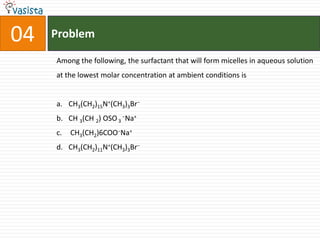
Problem04Among the following, the surfactant that will form micelles in aqueous solution at the lowest molar concentration at ambient conditions isCH3(CH2)15N+(CH3)3Br−CH 3(CH 2) OSO 3 −Na+ CH3(CH2)6COO−Na+CH3(CH2)11N+(CH3)3Br−
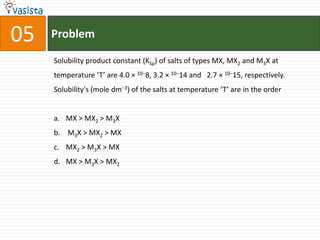
Problem05Solubility product constant (KSp) of salts of types MX, MX2 and M3X at temperature ‘T’ are 4.0 × 10⁻⁸, 3.2 × 10⁻¹⁴ and   2.7 × 10⁻¹⁵, respectively. Solubility's (mole dm−3) of the salts at temperature ‘T’ are in the orderMX > MX2 > M3X  M3X > MX2 > MXMX2 > M3X > MX MX > M3X > MX2
Problem06Electrolysis of dilute aqueous NaCl solution was carried out by passing 10 milli ampere current. The time required to  liberate 0.01 mol of H2 gas at the cathode is (1 Faraday = 96500 C mol−1)9.65 × 10⁴ sec 19.3 × 10⁴ sec28.95 × 104 sec  38.6 × 10⁴ sec
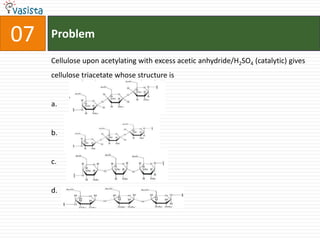
Problem07Cellulose upon acetylating with excess acetic anhydride/H2SO4 (catalytic) gives cellulose triacetate whose structure isa.b.c.d.
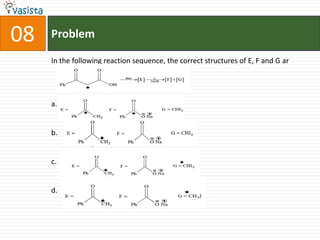
Problem08In the following reaction sequence, the correct structures of E, F and G ara.b.c.d.
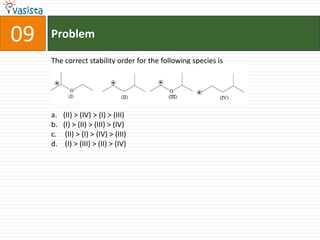
Problem09The correct stability order for the following species is(II) > (IV) > (I) > (III) (I) > (II) > (III) > (IV) (II) > (I) > (IV) > (III)  (I) > (III) > (II) > (IV)
SECTION – IIReasoning Type This section contains 4 reasoning type questions. Each question has 4 choices (A), (B), (C) and (D), out of which  ONLY ONE is correct.
Problem10STATEMENT-1: The geometrical isomers of the complex [M(NH3)4Cl2] are optically inactive.andSTATEMENT-2: Both geometrical isomers of the complex [M(NH3)4Cl2] possess axis of symmetry.STATEMENT-1 is True, STATEMENT-2 is True; STATEMENT-2 is correct explanation for STATEMENT-1STATEMENT-1 is True, STATEMENT-2 is True; STATEMENT-2 is NOT a correct explanation for     STATEMENT-1STATEMENT-1 is True, STATEMENT-2 is FalseSTATEMENT-1 is False, STATEMENT-2 is TrueE
Problem11STATEMENT-1: [Fe(H2O)5NO]SO4 is paramagnetic.andSTATEMENT-2: The Fe in [Fe(H2O)5NO]SO4 has three unpaired electrons.STATEMENT-1 is True, STATEMENT-2 is True; STATEMENT-2 is correct explanation for STATEMENT-1STATEMENT-1 is True, STATEMENT-2 is True; STATEMENT-2 is NOT a correct explanation for     STATEMENT-1c.   STATEMENT-1 is True, STATEMENT-2 is Falsed.  STATEMENT-1 is False, STATEMENT-2 is True
Problem12STATEMENT-1: Aniline on reaction with NaNO2/HCl at 0oC followed by coupling with β-naphthol gives a dark blue   coloured precipitate.andSTATEMENT-2: The colour of the compound formed in the reaction of aniline with NaNO2/HCl at 0oC followed by  coupling with β-naphthol is due to the extended conjugation.STATEMENT-1 is True, STATEMENT-2 is True; STATEMENT-2 is correct explanation for STATEMENT-1STATEMENT-1 is True, STATEMENT-2 is True; STATEMENT-2 is NOT a correct explanation for     STATEMENT-1STATEMENT-1 is True, STATEMENT-2 is FalseSTATEMENT-1 is False, STATEMENT-2 is TrueE
Problem13TATEMENT-1: There is a natural asymmetry between converting work to heat and converting heat to work.andSTATEMENT-2: No process is possible in which the sole result is the absorption of heat from a reservoir and its  complete conversion into work.STATEMENT-1 is True, STATEMENT-2 is True; STATEMENT-2 is correct explanation for STATEMENT-1STATEMENT-1 is True, STATEMENT-2 is True; STATEMENT-2 is NOT a correct explanation for    STATEMENT-1STATEMENT-1 is True, STATEMENT-2 is FalseSTATEMENT-1 is False, STATEMENT-2 is True
SECTION – IIILinked Comprehension Type This section contains 2 paragraphs. Based upon each paragraph, 3 multiple choice questions have to be answered.  Each question has 4 choices (A), (B), (C) and (D), out of which ONLY ONE is correct..
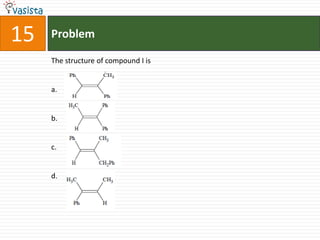
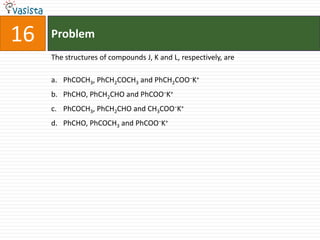
Paragraph for Question Nos. 14 to 16A tertiary alcohol H upon acid catalysed dehydration gives a product I. Ozonolysis of I leads to compounds J and K. Compound  J upon reaction with KOH gives benzyl alcohol and a compound L, whereas K on reaction with KOH gives only M,
Problem14Compound H is formed by the reaction of]a.b.c.d.
Problem15The structure of compound I isa.b.c.d.
Problem16The structures of compounds J, K and L, respectively, arePhCOCH3, PhCH2COCH3 and PhCH2COO−K+PhCHO, PhCH2CHO and PhCOO−K+PhCOCH3, PhCH2CHO and CH3COO−K+PhCHO, PhCOCH3 and PhCOO−K+
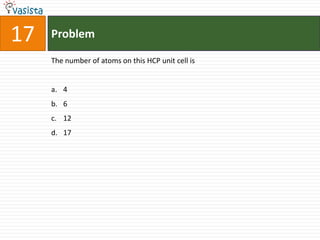
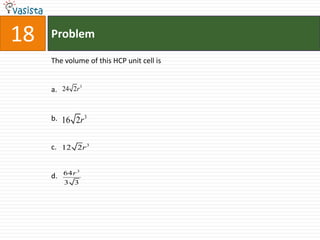
Paragraph for Question Nos. 17 to 19In hexagonal systems of crystals, a frequently encountered arrangement of atoms is described as a hexagonal prism. Here, the top  and bottom of the cell are regular hexagons and three atoms are sandwiched in between them. A space-filling model of this  structure, called hexagonal close-packed (HCP), is constituted of a sphere on a flat surface surrounded in the same plane by sixidentical spheres as closely as possible. Three spheres are then placed over the first layer so that they touch each other and  represent the second layer. Each one of these three spheres touches three spheres of the bottom layer. Finally, the second layer is covered with a third layer that is identical to the bottom layer in relative position. Assumer radius of every sphere to be ‘r’.
Problem17The number of atoms on this HCP unit cell is4 61217
Problem18The volume of this HCP unit cell isa.b.c.d.
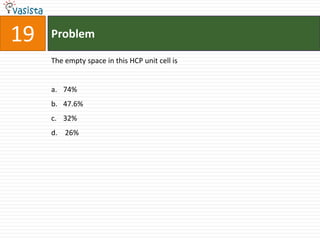
Problem19The empty space in this HCP unit cell is74% 47.6%32% 26%
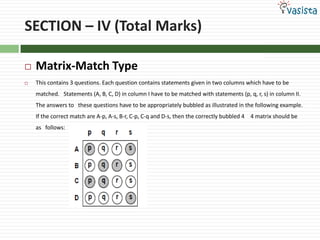
SECTION – IV (Total Marks)Matrix-Match Type This contains 3 questions. Each question contains statements given in two columns which have to be matched.   Statements (A, B, C, D) in column I have to be matched with statements (p, q, r, s) in column II. The answers to   these questions have to be appropriately bubbled as illustrated in the following example. If the correct match are A-p, A-s, B-r, C-p, C-q and D-s, then the correctly bubbled 4 × 4 matrix should be as   follows:
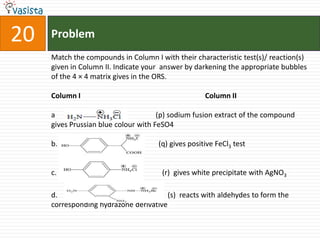
Problem20Match the compounds in Column I with their characteristic test(s)/ reaction(s) given in Column II. Indicate your  answer by darkening the appropriate bubbles of the 4 × 4 matrix gives in the ORS.Column I                                                                    Column IIa                                                       (p) sodium fusion extract of the compound gives Prussian blue colour with FeSO4                                                    (q) gives positive FeCl3 test                                                       (r)  gives white precipitate with AgNO3                                                         (s)  reacts with aldehydes to form thecorresponding hydrazone derivative
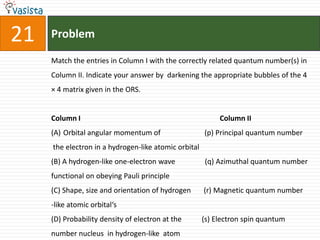
Problem21Match the entries in Column I with the correctly related quantum number(s) in Column II. Indicate your answer by  darkening the appropriate bubbles of the 4 × 4 matrix given in the ORS.Column I                                                                            Column IIOrbital angular momentum of                        (p) Principal quantum number the electron in a hydrogen-like atomic orbital(B) A hydrogen-like one-electron wave 	              (q) Azimuthal quantum number functional on obeying Pauli principle(C) Shape, size and orientation of hydrogen       (r) Magnetic quantum number-like atomic orbital‘s(D) Probability density of electron at the           (s) Electron spin quantum number nucleus  in hydrogen-like  atom
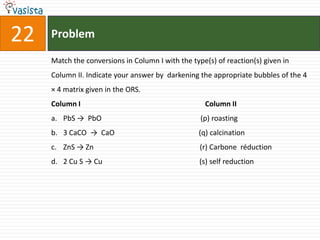
Problem22Match the conversions in Column I with the type(s) of reaction(s) given in Column II. Indicate your answer by  darkening the appropriate bubbles of the 4 × 4 matrix given in the ORS.Column I                                                                    Column IIPbS ->  PbO                                                      (p) roasting3 CaCO  ->  CaO                                              (q) calcinationZnS -> Zn                                                          (r) Carbone  réduction2 Cu S -> Cu                                                     (s) self reduction
FOR SOLUTION VISIT  WWW.VASISTA.NET

IIT JEE - 2008 ii - chemistry

  • 1.
    IITJEE –Past papersCHEMISTRY- UNSOLVED PAPER - 2008
  • 2.
    SECTION – IStraightObjective TypeThis section contains 9 multiple choice questions. Each question has 4 choices (A), (B), (C) and (D), out of which ONLY ONE is correct.
  • 3.
    01ProblemThe IUPAC nameof [Ni(NH3)4][NiCl4] isTetrachloronickel (II) – tetraamminenickel (II)Tetraamminenickel (II) – tetrachloronickel (II)Tetraamminenickel (II) – tetrachloronickelate (II)Tetrachloronickel (II) – tetraamminenickelate (0)
  • 4.
    Problem02Among the followingthe coloured compound isCuClK3[Cu(CN)4] CuF2 [Cu(CH3CN)4]BF4
  • 5.
    Problem03Both [Ni(CO)4] and[Ni(CN)4]2− are diamagnetic. The hybridization of nickel in these complexes, respectively, aresp3, sp3sp3, dsp2dsp2, sp3dsp2, dsp2
  • 6.
    Problem04Among the following,the surfactant that will form micelles in aqueous solution at the lowest molar concentration at ambient conditions isCH3(CH2)15N+(CH3)3Br−CH 3(CH 2) OSO 3 −Na+ CH3(CH2)6COO−Na+CH3(CH2)11N+(CH3)3Br−
  • 7.
    Problem05Solubility product constant(KSp) of salts of types MX, MX2 and M3X at temperature ‘T’ are 4.0 × 10⁻⁸, 3.2 × 10⁻¹⁴ and 2.7 × 10⁻¹⁵, respectively. Solubility's (mole dm−3) of the salts at temperature ‘T’ are in the orderMX > MX2 > M3X M3X > MX2 > MXMX2 > M3X > MX MX > M3X > MX2
  • 8.
    Problem06Electrolysis of diluteaqueous NaCl solution was carried out by passing 10 milli ampere current. The time required to liberate 0.01 mol of H2 gas at the cathode is (1 Faraday = 96500 C mol−1)9.65 × 10⁴ sec 19.3 × 10⁴ sec28.95 × 104 sec 38.6 × 10⁴ sec
  • 9.
    Problem07Cellulose upon acetylatingwith excess acetic anhydride/H2SO4 (catalytic) gives cellulose triacetate whose structure isa.b.c.d.
  • 10.
    Problem08In the followingreaction sequence, the correct structures of E, F and G ara.b.c.d.
  • 11.
    Problem09The correct stabilityorder for the following species is(II) > (IV) > (I) > (III) (I) > (II) > (III) > (IV) (II) > (I) > (IV) > (III) (I) > (III) > (II) > (IV)
  • 12.
    SECTION – IIReasoningType This section contains 4 reasoning type questions. Each question has 4 choices (A), (B), (C) and (D), out of which ONLY ONE is correct.
  • 13.
    Problem10STATEMENT-1: The geometricalisomers of the complex [M(NH3)4Cl2] are optically inactive.andSTATEMENT-2: Both geometrical isomers of the complex [M(NH3)4Cl2] possess axis of symmetry.STATEMENT-1 is True, STATEMENT-2 is True; STATEMENT-2 is correct explanation for STATEMENT-1STATEMENT-1 is True, STATEMENT-2 is True; STATEMENT-2 is NOT a correct explanation for STATEMENT-1STATEMENT-1 is True, STATEMENT-2 is FalseSTATEMENT-1 is False, STATEMENT-2 is TrueE
  • 14.
    Problem11STATEMENT-1: [Fe(H2O)5NO]SO4 isparamagnetic.andSTATEMENT-2: The Fe in [Fe(H2O)5NO]SO4 has three unpaired electrons.STATEMENT-1 is True, STATEMENT-2 is True; STATEMENT-2 is correct explanation for STATEMENT-1STATEMENT-1 is True, STATEMENT-2 is True; STATEMENT-2 is NOT a correct explanation for STATEMENT-1c. STATEMENT-1 is True, STATEMENT-2 is Falsed. STATEMENT-1 is False, STATEMENT-2 is True
  • 15.
    Problem12STATEMENT-1: Aniline onreaction with NaNO2/HCl at 0oC followed by coupling with β-naphthol gives a dark blue coloured precipitate.andSTATEMENT-2: The colour of the compound formed in the reaction of aniline with NaNO2/HCl at 0oC followed by coupling with β-naphthol is due to the extended conjugation.STATEMENT-1 is True, STATEMENT-2 is True; STATEMENT-2 is correct explanation for STATEMENT-1STATEMENT-1 is True, STATEMENT-2 is True; STATEMENT-2 is NOT a correct explanation for STATEMENT-1STATEMENT-1 is True, STATEMENT-2 is FalseSTATEMENT-1 is False, STATEMENT-2 is TrueE
  • 16.
    Problem13TATEMENT-1: There isa natural asymmetry between converting work to heat and converting heat to work.andSTATEMENT-2: No process is possible in which the sole result is the absorption of heat from a reservoir and its complete conversion into work.STATEMENT-1 is True, STATEMENT-2 is True; STATEMENT-2 is correct explanation for STATEMENT-1STATEMENT-1 is True, STATEMENT-2 is True; STATEMENT-2 is NOT a correct explanation for STATEMENT-1STATEMENT-1 is True, STATEMENT-2 is FalseSTATEMENT-1 is False, STATEMENT-2 is True
  • 17.
    SECTION – IIILinkedComprehension Type This section contains 2 paragraphs. Based upon each paragraph, 3 multiple choice questions have to be answered. Each question has 4 choices (A), (B), (C) and (D), out of which ONLY ONE is correct..
  • 18.
    Paragraph for QuestionNos. 14 to 16A tertiary alcohol H upon acid catalysed dehydration gives a product I. Ozonolysis of I leads to compounds J and K. Compound J upon reaction with KOH gives benzyl alcohol and a compound L, whereas K on reaction with KOH gives only M,
  • 19.
    Problem14Compound H isformed by the reaction of]a.b.c.d.
  • 20.
    Problem15The structure ofcompound I isa.b.c.d.
  • 21.
    Problem16The structures ofcompounds J, K and L, respectively, arePhCOCH3, PhCH2COCH3 and PhCH2COO−K+PhCHO, PhCH2CHO and PhCOO−K+PhCOCH3, PhCH2CHO and CH3COO−K+PhCHO, PhCOCH3 and PhCOO−K+
  • 22.
    Paragraph for QuestionNos. 17 to 19In hexagonal systems of crystals, a frequently encountered arrangement of atoms is described as a hexagonal prism. Here, the top and bottom of the cell are regular hexagons and three atoms are sandwiched in between them. A space-filling model of this structure, called hexagonal close-packed (HCP), is constituted of a sphere on a flat surface surrounded in the same plane by sixidentical spheres as closely as possible. Three spheres are then placed over the first layer so that they touch each other and represent the second layer. Each one of these three spheres touches three spheres of the bottom layer. Finally, the second layer is covered with a third layer that is identical to the bottom layer in relative position. Assumer radius of every sphere to be ‘r’.
  • 23.
    Problem17The number ofatoms on this HCP unit cell is4 61217
  • 24.
    Problem18The volume ofthis HCP unit cell isa.b.c.d.
  • 25.
    Problem19The empty spacein this HCP unit cell is74% 47.6%32% 26%
  • 26.
    SECTION – IV(Total Marks)Matrix-Match Type This contains 3 questions. Each question contains statements given in two columns which have to be matched. Statements (A, B, C, D) in column I have to be matched with statements (p, q, r, s) in column II. The answers to these questions have to be appropriately bubbled as illustrated in the following example. If the correct match are A-p, A-s, B-r, C-p, C-q and D-s, then the correctly bubbled 4 × 4 matrix should be as follows:
  • 27.
    Problem20Match the compoundsin Column I with their characteristic test(s)/ reaction(s) given in Column II. Indicate your answer by darkening the appropriate bubbles of the 4 × 4 matrix gives in the ORS.Column I Column IIa (p) sodium fusion extract of the compound gives Prussian blue colour with FeSO4 (q) gives positive FeCl3 test (r) gives white precipitate with AgNO3 (s) reacts with aldehydes to form thecorresponding hydrazone derivative
  • 28.
    Problem21Match the entriesin Column I with the correctly related quantum number(s) in Column II. Indicate your answer by darkening the appropriate bubbles of the 4 × 4 matrix given in the ORS.Column I Column IIOrbital angular momentum of (p) Principal quantum number the electron in a hydrogen-like atomic orbital(B) A hydrogen-like one-electron wave (q) Azimuthal quantum number functional on obeying Pauli principle(C) Shape, size and orientation of hydrogen (r) Magnetic quantum number-like atomic orbital‘s(D) Probability density of electron at the (s) Electron spin quantum number nucleus in hydrogen-like atom
  • 29.
    Problem22Match the conversionsin Column I with the type(s) of reaction(s) given in Column II. Indicate your answer by darkening the appropriate bubbles of the 4 × 4 matrix given in the ORS.Column I Column IIPbS -> PbO (p) roasting3 CaCO -> CaO (q) calcinationZnS -> Zn (r) Carbone réduction2 Cu S -> Cu (s) self reduction
  • 30.
    FOR SOLUTION VISIT WWW.VASISTA.NET

Editor's Notes