IITJEE –Past papersCHEMISTRY- UNSOLVED PAPER - 2007
SECTION – IStraight Objective TypeThis section contains 9 multiple choice questions numbered 23 to 31. Each question has 4 choices (A), (B), (C) and (D), out of   which ONLY ONE is correct.
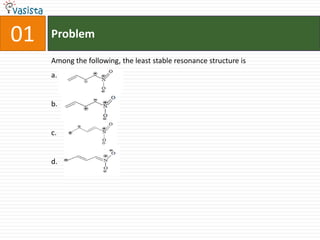
01ProblemAmong the following, the least stable resonance structure isa.b.c.d.
Problem02For the process H2O(l) (1 bar, 373 K) -> H2O(g) (1 bar, 373 K), the correct set of thermodynamic parameters isΔG = 0,ΔS = +ve  ΔG = 0,ΔS = −veΔG = +ve,ΔS = 0 ΔG = −ve,ΔS = +ve
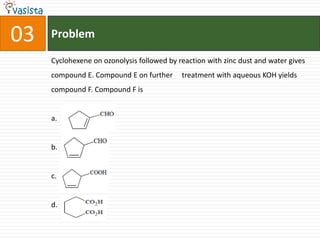
Problem03Cyclohexene on ozonolysis followed by reaction with zinc dust and water gives compound E. Compound E on further     treatment with aqueous KOH yields compound F. Compound F isa.b.c.d.
Problem04Consider a reaction aG + bH -> Products. When concentration of both the reactants G and H is doubled, the rate    increases by eight times. However, when concentration of G is doubled keeping the concentration of H fixed, the rate is  doubled. The overall order of the reaction is0  1 2  3
Problem05Among the following metal carbonyls, the C – O bond order is lowest in[Mn(CO)6]+ [Fe(CO)5][Cr(CO)6] [V(CO)6]-
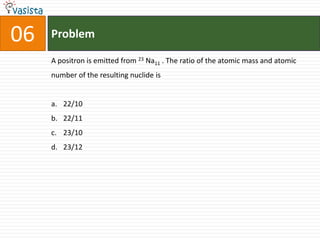
Problem06A positron is emitted from 23 Na11 . The ratio of the atomic mass and atomic number of the resulting nuclide is22/10 22/1123/1023/12
Problem07Consider a titration of potassium dichromate solution with acidified Mohr’s salt solution using diphenylamine as   indicator. The number of moles of Mohr’s salt required per mole of dichromate is3 45 6
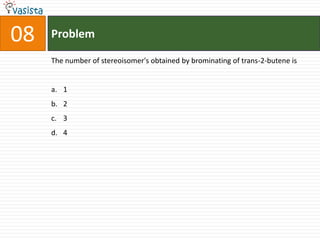
Problem08The number of stereoisomer's obtained by brominating of trans-2-butene is1 234
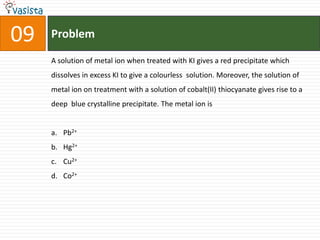
Problem09A solution of metal ion when treated with KI gives a red precipitate which dissolves in excess KI to give a colourless  solution. Moreover, the solution of metal ion on treatment with a solution of cobalt(II) thiocyanate gives rise to a deep  blue crystalline precipitate. The metal ion isPb2+ Hg2+Cu2+Co2+
SECTION – IIReason TypeThis section 4 questions numbered 32 to 35. Each question contains STATEMENT-1 (Assertion) and STATEMENT-2 (Reason). Each question has 4 choices (A), (B), (C) and (D) out of which ONLY ONE is correct.
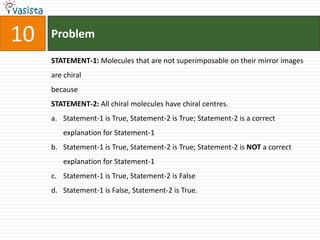
Problem10STATEMENT-1: Molecules that are not superimposable on their mirror images are chiralbecauseSTATEMENT-2: All chiral molecules have chiralcentres.Statement-1 is True, Statement-2 is True; Statement-2 is a correct explanation for Statement-1Statement-1 is True, Statement-2 is True; Statement-2 is NOT a correct explanation for Statement-1Statement-1 is True, Statement-2 is FalseStatement-1 is False, Statement-2 is True.
Problem11STATEMENT-1: Alkali metals dissolves in liquid ammonia to give blue solutionbecauseSTATEMENT-2: Alkali metals in liquid ammonia give solvated species of the type [M(NH3)n]+ (M = alkali metals).Statement-1 is True, Statement-2 is True; Statement-2 is a correct explanation for Statement-1Statement-1 is True, Statement-2 is True; Statement-2 is NOT a correct explanation for Statement-1Statement-1 is True, Statement-2 is FalseStatement-1 is False, Statement-2 is True
Problem12STATEMENT-1: Band gap in germanium is small.becauseSTATEMENT-2: The energy spread of each germanium atomic energy level is infinitesimally small.Statement-1 is True, Statement-2 is True; Statement-2 is a correct explanation for Statement-1Statement-1 is True, Statement-2 is True; Statement-2 is NOT a correct explanation for Statement-1 Statement-1 is True, Statement-2 is False Statement-1 is False, Statement-2 is True
Problem13STATEMENT-1: Glucose gives a reddish-brown precipitate with Fehling’s solution.becauseSTATEMENT-2: Reaction of glucose with Fehling’s solution gives CuO and glycolic acid.Statement-1 is True, Statement-2 is True; Statement-2 is a correct explanation for Statement-1Statement-1 is True, Statement-2 is True; Statement-2 is NOT a correct explanation for Statement-1Statement-1 is True, Statement-2 is FalseStatement-1 is False, Statement-2 is True
SECTION – IIILinked Comprehension TypeThis section contains 2 paragraphs C36-38 and C39-41. Based upon each paragraph, 3 multiple choice questions have to be   answered. Each question has 4 choices (A), (B), (C) and (D), out of which ONLY ONE is correct
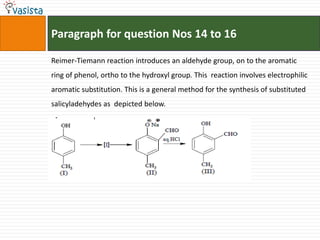
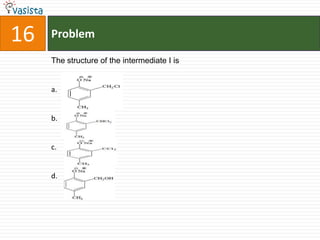
Paragraph for question Nos 14 to 16Reimer-Tiemann reaction introduces an aldehyde group, on to the aromatic ring of phenol, ortho to the hydroxyl group. Thisreaction involves electrophilic aromatic substitution. This is a general method for the synthesis of substituted  salicyladehydes as  depicted below.
Problem14Which one of the following reagents is used in the above reaction?aq. NaOH + CH3Cl aq. NaOH + CH2Cl2 aq. NaOH + CHCl3aq. NaOH + CCl4
Problem15The electrophile in this reaction isCHCl+CHCl2CCl2 CCl3
Problem16The structure of the intermediate I isa.b.c.d.
Paragraph for Question Nos. 17 to 19Redox reactions play a pivotal role in chemistry and biology. The values of standard redox potential (Eo) of two half-cell reactions decide which way the reaction is expected to proceed. A simple example is a Daniel cell in which zinc goes into  solution and copper gets deposited. Given below are a set of half-cell reactions (acidic medium) along with their Eo (V with respect to normal hydrogen electrode) values. Using this data obtain the correct explanations to Questions 39-41I2 + 2e- ->2I-                          Eo = 0.54Cl2 + 2e-->2Cl-Eo = 1.36Mn3+ + e- ->Mn2+                  Eo = 1.50Fe3+ + e-->Fe2+                       Eo = 0.77O2 + 4H+ + 4e- -> 2H2O       Eo = 1.23
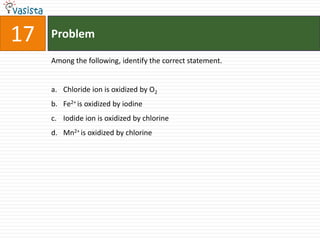
Problem17Among the following, identify the correct statement.Chloride ion is oxidized by O2Fe2+ is oxidized by iodineIodide ion is oxidized by chlorine Mn2+ is oxidized by chlorine
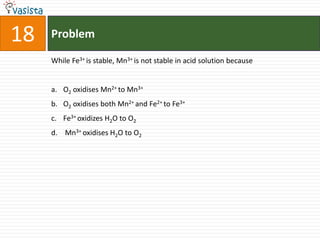
Problem18While Fe3+ is stable, Mn3+ is not stable in acid solution becauseO2oxidises Mn2+ to Mn3+O2oxidises both Mn2+ and Fe2+ to Fe3+Fe3+ oxidizes H2O to O2 Mn3+ oxidises H2O to O2
Problem19Sodium fusion extract, obtained from aniline, on treatment with iron (II) sulphate and H2SO4 in presence of air gives a  Prussian blue precipitate. The blue colour is due to the formation ofFe4[Fe(CN)6]3Fe3[Fe(CN)6]2Fe4[Fe(CN)6]2Fe3[Fe(CN)6]3
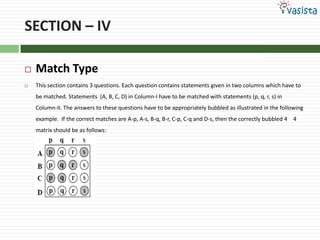
SECTION – IVMatch Type This section contains 3 questions. Each question contains statements given in two columns which have to be matched. Statements  (A, B, C, D) in Column-I have to be matched with statements (p, q, r, s) in Column-II. The answers to these questions have to be appropriately bubbled as illustrated in the following example.  If the correct matches are A-p, A-s, B-q, B-r, C-p, C-q and D-s, then the correctly bubbled 4 × 4 matrix should be as follows:
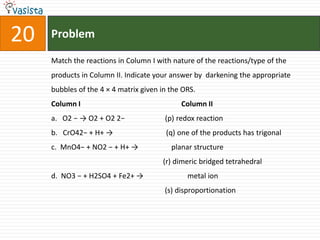
Problem20Match the reactions in Column I with nature of the reactions/type of the products in Column II. Indicate your answer by  darkening the appropriate bubbles of the 4 × 4 matrix given in the ORS.Column I                                                       Column IIa.   O2 − -> O2 + O2 2−                      (p) redox reactionb.   CrO42− + H+ ->                             (q) one of the products has trigonalc.  MnO4− + NO2 − + H+ ->                  planar structure                                                             (r) dimeric bridged tetrahedral                                                                               d.  NO3 − + H2SO4 + Fe2+ ->                        metal ion(s) disproportionation
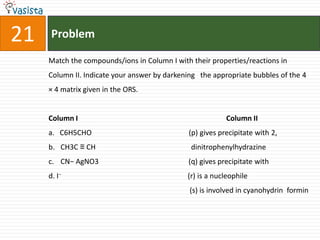
Problem21Match the compounds/ions in Column I with their properties/reactions in Column II. Indicate your answer by darkening   the appropriate bubbles of the 4 × 4 matrix given in the ORS.Column I                                                                                 Column IIa.   C6H5CHO                                                     (p) gives precipitate with 2, CH3C ≡ CH                                                    dinitrophenylhydrazineCN− AgNO3                                                 (q) gives precipitate withd. I−                                                                     (r) is a nucleophile                                                                             (s) is involved in cyanohydrinformin
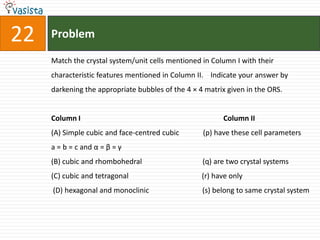
Problem22Match the crystal system/unit cells mentioned in Column I with their characteristic features mentioned in Column II.    Indicate your answer by darkening the appropriate bubbles of the 4 × 4 matrix given in the ORS.Column I                                                                              Column II(A) Simple cubic and face-centred cubic             (p) have these cell parametersa = b = c and α = β = γ(B) cubic and rhombohedral                                 (q) are two crystal systems(C) cubic and tetragonal                                        (r) have only (D) hexagonal and monoclinic                             (s) belong to same crystal system
FOR SOLUTION VISIT WWW.VASISTA.NET

IIT JEE - 2007 ii - chemistry

  • 1.
    IITJEE –Past papersCHEMISTRY-UNSOLVED PAPER - 2007
  • 2.
    SECTION – IStraightObjective TypeThis section contains 9 multiple choice questions numbered 23 to 31. Each question has 4 choices (A), (B), (C) and (D), out of which ONLY ONE is correct.
  • 3.
    01ProblemAmong the following,the least stable resonance structure isa.b.c.d.
  • 4.
    Problem02For the processH2O(l) (1 bar, 373 K) -> H2O(g) (1 bar, 373 K), the correct set of thermodynamic parameters isΔG = 0,ΔS = +ve ΔG = 0,ΔS = −veΔG = +ve,ΔS = 0 ΔG = −ve,ΔS = +ve
  • 5.
    Problem03Cyclohexene on ozonolysisfollowed by reaction with zinc dust and water gives compound E. Compound E on further treatment with aqueous KOH yields compound F. Compound F isa.b.c.d.
  • 6.
    Problem04Consider a reactionaG + bH -> Products. When concentration of both the reactants G and H is doubled, the rate increases by eight times. However, when concentration of G is doubled keeping the concentration of H fixed, the rate is doubled. The overall order of the reaction is0 1 2 3
  • 7.
    Problem05Among the followingmetal carbonyls, the C – O bond order is lowest in[Mn(CO)6]+ [Fe(CO)5][Cr(CO)6] [V(CO)6]-
  • 8.
    Problem06A positron isemitted from 23 Na11 . The ratio of the atomic mass and atomic number of the resulting nuclide is22/10 22/1123/1023/12
  • 9.
    Problem07Consider a titrationof potassium dichromate solution with acidified Mohr’s salt solution using diphenylamine as indicator. The number of moles of Mohr’s salt required per mole of dichromate is3 45 6
  • 10.
    Problem08The number ofstereoisomer's obtained by brominating of trans-2-butene is1 234
  • 11.
    Problem09A solution ofmetal ion when treated with KI gives a red precipitate which dissolves in excess KI to give a colourless solution. Moreover, the solution of metal ion on treatment with a solution of cobalt(II) thiocyanate gives rise to a deep blue crystalline precipitate. The metal ion isPb2+ Hg2+Cu2+Co2+
  • 12.
    SECTION – IIReasonTypeThis section 4 questions numbered 32 to 35. Each question contains STATEMENT-1 (Assertion) and STATEMENT-2 (Reason). Each question has 4 choices (A), (B), (C) and (D) out of which ONLY ONE is correct.
  • 13.
    Problem10STATEMENT-1: Molecules thatare not superimposable on their mirror images are chiralbecauseSTATEMENT-2: All chiral molecules have chiralcentres.Statement-1 is True, Statement-2 is True; Statement-2 is a correct explanation for Statement-1Statement-1 is True, Statement-2 is True; Statement-2 is NOT a correct explanation for Statement-1Statement-1 is True, Statement-2 is FalseStatement-1 is False, Statement-2 is True.
  • 14.
    Problem11STATEMENT-1: Alkali metalsdissolves in liquid ammonia to give blue solutionbecauseSTATEMENT-2: Alkali metals in liquid ammonia give solvated species of the type [M(NH3)n]+ (M = alkali metals).Statement-1 is True, Statement-2 is True; Statement-2 is a correct explanation for Statement-1Statement-1 is True, Statement-2 is True; Statement-2 is NOT a correct explanation for Statement-1Statement-1 is True, Statement-2 is FalseStatement-1 is False, Statement-2 is True
  • 15.
    Problem12STATEMENT-1: Band gapin germanium is small.becauseSTATEMENT-2: The energy spread of each germanium atomic energy level is infinitesimally small.Statement-1 is True, Statement-2 is True; Statement-2 is a correct explanation for Statement-1Statement-1 is True, Statement-2 is True; Statement-2 is NOT a correct explanation for Statement-1 Statement-1 is True, Statement-2 is False Statement-1 is False, Statement-2 is True
  • 16.
    Problem13STATEMENT-1: Glucose givesa reddish-brown precipitate with Fehling’s solution.becauseSTATEMENT-2: Reaction of glucose with Fehling’s solution gives CuO and glycolic acid.Statement-1 is True, Statement-2 is True; Statement-2 is a correct explanation for Statement-1Statement-1 is True, Statement-2 is True; Statement-2 is NOT a correct explanation for Statement-1Statement-1 is True, Statement-2 is FalseStatement-1 is False, Statement-2 is True
  • 17.
    SECTION – IIILinkedComprehension TypeThis section contains 2 paragraphs C36-38 and C39-41. Based upon each paragraph, 3 multiple choice questions have to be answered. Each question has 4 choices (A), (B), (C) and (D), out of which ONLY ONE is correct
  • 18.
    Paragraph for questionNos 14 to 16Reimer-Tiemann reaction introduces an aldehyde group, on to the aromatic ring of phenol, ortho to the hydroxyl group. Thisreaction involves electrophilic aromatic substitution. This is a general method for the synthesis of substituted salicyladehydes as depicted below.
  • 19.
    Problem14Which one ofthe following reagents is used in the above reaction?aq. NaOH + CH3Cl aq. NaOH + CH2Cl2 aq. NaOH + CHCl3aq. NaOH + CCl4
  • 20.
    Problem15The electrophile inthis reaction isCHCl+CHCl2CCl2 CCl3
  • 21.
    Problem16The structure ofthe intermediate I isa.b.c.d.
  • 22.
    Paragraph for QuestionNos. 17 to 19Redox reactions play a pivotal role in chemistry and biology. The values of standard redox potential (Eo) of two half-cell reactions decide which way the reaction is expected to proceed. A simple example is a Daniel cell in which zinc goes into solution and copper gets deposited. Given below are a set of half-cell reactions (acidic medium) along with their Eo (V with respect to normal hydrogen electrode) values. Using this data obtain the correct explanations to Questions 39-41I2 + 2e- ->2I- Eo = 0.54Cl2 + 2e-->2Cl-Eo = 1.36Mn3+ + e- ->Mn2+ Eo = 1.50Fe3+ + e-->Fe2+ Eo = 0.77O2 + 4H+ + 4e- -> 2H2O Eo = 1.23
  • 23.
    Problem17Among the following,identify the correct statement.Chloride ion is oxidized by O2Fe2+ is oxidized by iodineIodide ion is oxidized by chlorine Mn2+ is oxidized by chlorine
  • 24.
    Problem18While Fe3+ isstable, Mn3+ is not stable in acid solution becauseO2oxidises Mn2+ to Mn3+O2oxidises both Mn2+ and Fe2+ to Fe3+Fe3+ oxidizes H2O to O2 Mn3+ oxidises H2O to O2
  • 25.
    Problem19Sodium fusion extract,obtained from aniline, on treatment with iron (II) sulphate and H2SO4 in presence of air gives a Prussian blue precipitate. The blue colour is due to the formation ofFe4[Fe(CN)6]3Fe3[Fe(CN)6]2Fe4[Fe(CN)6]2Fe3[Fe(CN)6]3
  • 26.
    SECTION – IVMatchType This section contains 3 questions. Each question contains statements given in two columns which have to be matched. Statements (A, B, C, D) in Column-I have to be matched with statements (p, q, r, s) in Column-II. The answers to these questions have to be appropriately bubbled as illustrated in the following example. If the correct matches are A-p, A-s, B-q, B-r, C-p, C-q and D-s, then the correctly bubbled 4 × 4 matrix should be as follows:
  • 27.
    Problem20Match the reactionsin Column I with nature of the reactions/type of the products in Column II. Indicate your answer by darkening the appropriate bubbles of the 4 × 4 matrix given in the ORS.Column I Column IIa. O2 − -> O2 + O2 2− (p) redox reactionb. CrO42− + H+ -> (q) one of the products has trigonalc. MnO4− + NO2 − + H+ -> planar structure (r) dimeric bridged tetrahedral d. NO3 − + H2SO4 + Fe2+ -> metal ion(s) disproportionation
  • 28.
    Problem21Match the compounds/ionsin Column I with their properties/reactions in Column II. Indicate your answer by darkening the appropriate bubbles of the 4 × 4 matrix given in the ORS.Column I Column IIa. C6H5CHO (p) gives precipitate with 2, CH3C ≡ CH dinitrophenylhydrazineCN− AgNO3 (q) gives precipitate withd. I− (r) is a nucleophile (s) is involved in cyanohydrinformin
  • 29.
    Problem22Match the crystalsystem/unit cells mentioned in Column I with their characteristic features mentioned in Column II. Indicate your answer by darkening the appropriate bubbles of the 4 × 4 matrix given in the ORS.Column I Column II(A) Simple cubic and face-centred cubic (p) have these cell parametersa = b = c and α = β = γ(B) cubic and rhombohedral (q) are two crystal systems(C) cubic and tetragonal (r) have only (D) hexagonal and monoclinic (s) belong to same crystal system
  • 30.
    FOR SOLUTION VISITWWW.VASISTA.NET

Editor's Notes