Priyanka M. Patel, V. H. Pradhan / International Journal of Engineering Research and
                       Applications (IJERA) ISSN: 2248-9622 www.ijera.com
                         Vol. 3, Issue 1, January -February 2013, pp.169-180
Travelling Wave Solutions of BBM and Modified BBM Equations
              by Modified F-Expansion Method
                          Priyanka M. Patel1* and V. H. Pradhan1
                             Department of Applied Mathematics and Humanities,
                          S. V. National Institute of Technology, Surat-395007, India

Abstract
         A new modified F-expansion method is               ut  u x   u u x  u x x x  0                            (2)
introduced to obtain the travelling wave
solutions like soliton and periodic, of Benjamin-
                                                           Consider the travelling wave solutions of eq. (2),
Bona-Mahony (BBM) equation and modified
                                                           under the transformation
BBM equation. The method is convenient,
effective and can be applied to other nonlinear            u( x, t )  u( ) where   k ( x   t )     (3)
partial     differential   equations     in   the
mathematical physics.                                      where k  0 and  are constants that do
                                                           determined later. By substituting eq. (3) into eq. (2)
Keywords : Modified F-expansion method,                    we obtain
Benjamin-Bona-Mahony        (BBM)       equation,
modified BBM equation, travelling wave solutions.           k  u '  k u '  k  u u '  k 2 u '''  0
1. Introduction                                              u '  u '   u u '  k u '''  0                         (4)
          It is well known that nonlinear partial
differential equations (NLPDEs) are widely used to         Integrating eq. (4) with respect to „  ‟ and
describe many important phenomena and dynamic
                                                           considering the zero constant for integration we
processes in physics, mechanics, chemistry and
                                                           have
biology, etc. There are many methods to solve
NLPDEs such as tanh-sech method [2], homotopy                                u2
analysis method [14],sine-cosine method [8],                (1   ) u         k u ''  0                            (5)
                                                                             2
G / G  expansion
     '
                        method    [4,9],differential
                                                           where prime denotes differentiation with respect to
transform method [7], and so on. In this paper, we
apply the modified F-expansion method [3,9,10] to            . By balancing the order of u 2         and   u '' in eq. (5),
the generalized BBM equation                               we have 2 n  n  2 then n  2
                                                           So we can see its exact solutions in the form
ut  ux   u N ux  ux x x  0 with N  1      (1)
                                                            u ( )  a0  a2 F 2 ( )  a1 F 1 ( )  a1 F ( )  a2 F 2 ( )
         with constant parameter  . Wazwaz [2]                                                                         (6)
has obtained the analytical solution of eq.(1) with
tanh-sech method and sine-cosine method.
Abbasbandy [14] has applied homotopy analysis              where a 0 , a1 , a2 , a1 , a 2 are constants to be
method (HAM) to obtain the analytical solution of          determined later. And            F ( )          satisfies   the
generalized BBM equation for N  1 and N  2 .             following Riccati equation
In the present paper we have applied modified F-
expansion method to solve eq.(1) for N  1 and              F ' ( )  A  B F ( )  C F 2 ( )                        (7)
 N  2 . A set of new solutions are obtained other
than the solutions obtained by previous authors.
                                                           where A , B , C are constants. Substituting eq. (6)
*Corresponding author- Email address :
pinu7986@gmail.com                                         into eq. (5) and using eq. (7), the left-hand side of
                                                           eq. (5) can be converted into a finite series in
2. Travelling wave solutions of BBM                         F p ( ) , ( p = -4, -3 ,-2,          -1, 0, 1, 2, 3, 4).
equation                                                   Equating each coefficient of F ( ) to zero yields
                                                                                                  p
For N  1, eq.(1) reduces to the BBM equation or
                                                           the following set of algebraic equations.
the regularized long-wave equation (RLW).


                                                                                                        169 | P a g e
Priyanka M. Patel, V. H. Pradhan / International Journal of Engineering Research and
                    Applications (IJERA) ISSN: 2248-9622 www.ijera.com
                      Vol. 3, Issue 1, January -February 2013, pp.169-180
             a2                                                                    
 F 4 ( ) :     (12 A2 k  a2 )                                                  
              2
                                                                                    
 F 3 ( ) : 2 A2 ka1  10 ABka2  a1a2                                        
                                                                                    
                                   a 
                                     2
                                                                                    
 F 2 ( ) : Ak (3Ba1  8Ca2 )  1  a2 (1  4 B 2 k    a0 )
                                     2                                              
 F ( ) : a1 (1  B k  2 ACk    a0 )  a2 (6 BCk  a1 )
   1                2                                                              
                                                                                    
                                                                   a
                                                                    2               
                                                                                    
 F 0 ( ) : a0  BCka1  2C 2 ka2  ABka1  2 A2 ka2  a0  0  a1a1  a2 a2                             (8)
                                                                    2               
 F ( ) : a1 (1  B k  2 ACk    a0 )  a2 (6 ABk  a1 )
   1               2
                                                                                    
                                                                                    
                                a12                                                
 F ( ) : 3BCka1  4 B ka2 
   2                     2
                                        a1 (1  8 ACk    a0 )
                                  2                                                 
                                                                                    
 F ( ) : 2C ka1  10 BCka2  a1a2
   3           2
                                                                                    
            1                                                                       
 F 4 ( ) : a2 (12C 2 k  a2 )                                                     
            2                                                                       
                                                                                    
Solving the above algebraic equations by symbolic computations , we have the following solutions:
Case 1: A  0 , we have
                                        12BCk                   12C 2 k
a0  a0 , a1  0 , a2  0 , a1                       , a2               ,     1  B 2 k  a0            (9)
                                                                   
Case 2: B  0 , we have
                                             12C 2 k                                
a0  a0 , a1  0, a2  0, a1  0, a2                       ,   1  8 ACk  a0 
                                                                                    
                                                                                                               (10)
                           12 A k
                                 2
                                                    12C k2
a0  a0 , a1  0, a2              , a1  0, a2            ,   1  8 ACk  a0 
                                                                                   
                                                                                     
So we can list the solutions of u as follows:
When A  0, B  1, C  1 , from appendix and case 1, we have
                3k          
u1 ( )  a0  sec h 2                                                                                        (11)
                          2
where   k ( x  (1  k  a0 ) t )
When A  0, B  1, C  1 , from appendix and case 1, we have
                3k          
u2 ( )  a0  csc h 2                                                                                        (12)
                          2
where   k ( x  (1  k  a0 ) t )
            1                  1
When A  , B  0, C   ,                 from       appendix       and      case      2,              we       have
            2                  2
                         3k
          u3 ( )  a0  coth( )  csc h( )
                                                    2
                                                                                                                (13)
                           
                 3k                                     3k
                      coth( )  csc h( )                 coth( )  csc h( ) 
                                             2
u4 ( )  a0                                       
                                                                                      2
                                                                                                               (14)
                                                       
                 3k
u5 ( )  a0          tanh( )  i sec h( )
                                                2
                                                                                                               (15)
                 


                                                                                                       170 | P a g e
Priyanka M. Patel, V. H. Pradhan / International Journal of Engineering Research and
                   Applications (IJERA) ISSN: 2248-9622 www.ijera.com
                     Vol. 3, Issue 1, January -February 2013, pp.169-180
                 3k                                        3k
                       tanh( )  i sec h( )                  tanh( )  i sec h( )
                                                  2
u6 ( )  a0                                          
                                                                                        2
                                                                                                     (16)
                                           
where   k  x  1  2k  a0  t 
When A  1, B  0, C  1 , from appendix and case 2, we have
                 12k
u7 ( )  a0           tanh 2                                                                    (17)
                  
                 12k                     12k
u8 ( )  a0           tanh 2            tanh 2                                             (18)
                                         
                 12k
u9 ( )  a0           coth 2                                                                    (19)
                  
                  12k                    12k
u10 ( )  a0          coth 2             coth 2                                            (20)
                                        
                   where   k ( x  (1  8k  a0 ) t )
          1              1
When A      , B  0, C  , from appendix and case 2, we have
          2               2
                        3k
        u11    a0  sec    tan  
                                              2

                                                                                                  (21)

                             3k                 2 3k
        u12    a0    sec    tan    sec    tan  
                                                                        2

                                                                                               (22)

                       3k
        u13    a0  csc    cot   
                                                2

                                                                                                  (23)

                  3k                     2 3k
u14    a0     csc    cot    csc    cot  
                                                                 2

                                                                                               (24)

where   k  x  (1  2k  a0 ) t 
             1               1
When A       , B  0, C   , from appendix and case 2, we have
             2               2
                3k
u15    a0  sec    tan  
                                       2

                                                                                                 (25)

                  3k                     2 3k
u16    a0    sec    tan     sec    tan  
                                                                 2

                                                                                              (26)

               3k
u17    a0  csc    cot  
                                         2

                                                                                                 (27)

                  3k                      2 3k
u18    a0     csc    cot     csc    cot  
                                                                  2

                                                                                              (28)

where   k  x  (1  2k  a0 ) t 
When A  1   1 , B  0, C  1 1 ,         from appendix and case 2, we have
                  12k
u19    a0           tan 2                                                                   (29)
                   
                  12k                    12k
u20    a0           tan 2            tan 2                                             (30)
                                         
                  12k
u21    a0           cot 2                                                                   (31)
                   


                                                                                            171 | P a g e
Priyanka M. Patel, V. H. Pradhan / International Journal of Engineering Research and
                   Applications (IJERA) ISSN: 2248-9622 www.ijera.com
                     Vol. 3, Issue 1, January -February 2013, pp.169-180
                      12k                            12k
u22    a0              cot 2                          cot 2                                                                                               (32)
                                  
where   k  x  1  8k  a0  t 


2.1 Discussion                                                                                     shape and propagates at constant speed. It is a
         Travelling wave solutions from eq.(11) to                                                 stable solution. The first observation of this kind of
eq.(20) represents the soliton solutions and from                                                  wave was made in 1834 by John Scott Russell [5].
eq. (21) to eq.(32) represents        the periodic                                                 If we draw the solution with a constant speed, we
solutions.                                                                                         will get the following figure (A.1) which shows the
We discuss one travelling wave solution given by                                                   right moving wave at different values of t .
eq. (11). The travelling wave solution (11) is a
solitary like solution which does not change its

                                           4
                                                          t=0
                                                          t=1
                                                          t=2
                                          3.5
                                                          t=3


                                           3


                                          2.5
                                      u


                                           2


                                          1.5


                                           1
                                           -10       -8         -6       -4       -2       0          2         4        6         8       10
                                                                                           x


           Fig. A.1. Plot of travelling wave solution eq. (11) with k    a0  1 and                                                          t  0,1, 2,3

         If we draw the travelling wave solution                                                   spread out. If we take negative values of  (
(11) with different positive values of  (                                                           1,  1.5,  2 ), we will get the following
  1,1.5, 2 ), we will get the following figure                                                   figure (A.2-II) which shows the value of negative
(A.2-I) which shows the value of positive                                                          amplitude. Here negative amplitude means the
amplitude in decreasing. In other words the value                                                  wave is going to look upside down. From figures
of positive amplitude tends to zero. From this                                                     (A.2-I) and (A.2-II) we can say that positive and
physically we can say that the fluid becomes more                                                  negative      amplitudes    are     the      same
.
                4                                                                                    1
                                                                          alpha=1
                                                                          alpha=1.5                                                                     alpha= -1
                                                                          alpha=2                                                                       alpha= -1.5
               3.5                                                                                 0.5
                                                                                                                                                        alpha= -2


                3                                                                                    0


               2.5                                                                                 -0.5
           u


                                                                                               u


                2                                                                                   -1


               1.5                                                                                 -1.5


                1                                                                                   -2
                -10   -8    -6   -4        -2    0        2     4    6        8       10             -10   -8       -6   -4   -2       0    2   4   6      8      10
                                                 x                                                                                     x

                            (I)                                                     (II)
 Fig. A.2. Different solitary waves profiles given by eq. (11) at t  0 , a0  k  1 for (I)                                                        1,1.5,2 and (II)
                                                                           1,  1.5,  2


                                                                                                                                                               172 | P a g e
Priyanka M. Patel, V. H. Pradhan / International Journal of Engineering Research and
                   Applications (IJERA) ISSN: 2248-9622 www.ijera.com
                     Vol. 3, Issue 1, January -February 2013, pp.169-180
If we draw the travelling wave solution (11) with               amplitude in increasing. The            amplitude is
different values of k ( k  1, 2,3 ), we will get the           proportional to the velocity, which means that
following figure (A.3) which describes the value of             larger pulse travel faster than smaller ones.

                         10
                                                                            k=1
                         9                                                  k=2
                                                                            k=3
                         8

                         7


                         6
                     u


                         5


                         4


                         3


                         2


                         1
                         -10   -8   -6   -4   -2   0    2   4     6     8         10
                                                   x


Fig. A.3. Different solitary waves profiles given by eq. (11) at t  1 , a0    1 for k  1, 2,3
The other solitary and periodic solutions are graphically shown in fig.(A.4) to fig.(A.10).


Solitary solutions


                  Fig.A.4                                 Fig.A.5
Fig.A.4. Travelling wave solution given by eq. (17) with values a0    k  1 and Fig.A.5. Travelling wave
solution given by eq.(14) with values a0  2 and         k 1


                                      Fig.A.6
Fig.A.6 Travelling wave solution given by absolute of eq. (15) with values a0  2 and   k  1


                                                                                                     173 | P a g e
Priyanka M. Patel, V. H. Pradhan / International Journal of Engineering Research and
                   Applications (IJERA) ISSN: 2248-9622 www.ijera.com
                     Vol. 3, Issue 1, January -February 2013, pp.169-180
Trigonometric solutions :


                 Fig.A.7                                   Fig.A.8
Fig.A.7. Travelling wave solution given by eq. (23) and Fig.A.8 travelling wave solution given by eq.(25) with
values a0    k  1


                 Fig.A.9                                    Fig.A.10
Fig.A.9. Travelling wave solution given by eq. (29) and Fig.A.10. Travelling wave solution given by eq.(31)
with values a0    k  1

3. Travelling wave solutions of modified BBM equation
For N  2 , eq.(1) reduces to the modified BBM equation.
ut  ux   u 2 ux  ux x x  0                                                                                (33)
Now, we construct the travelling wave solutions of eq. (33), under the transformation
 v  x, t   v   where   k  x   t                                                               (34)
where k  0 and  are constants. Substituting eq. (34) into the eq. (33), we get
 k  v '  k v '   k v 2 v '  k 3 v '''  0                                                            (35)
Integrating eq. (35) with respect to „  ‟ and considering the zero constant for integration we have
                
1    v  v3  k 2v''  0                                                                              (36)
                 3
where prime denotes differentiation with respect to  . By balancing the order of v and v in eq. (36), we have
                                                                                      3       ''


3 m  m  2 then m  1. So we can write
 v    a0  a1 F 1    a1 F                                                                    (37)
where a 0 , a1 , a1 are constants to be determined later. And F ( ) satisfies Riccati equation given by eq. (7).
Substituting eq. (37) into eq. (36) and using eq. (7), the left-hand side of eq. (36) can be converted into a finite


                                                                                                    174 | P a g e
Priyanka M. Patel, V. H. Pradhan / International Journal of Engineering Research and
                   Applications (IJERA) ISSN: 2248-9622 www.ijera.com
                     Vol. 3, Issue 1, January -February 2013, pp.169-180
series in F ( ) , ( p = -3 ,-2,-1, 0, 1, 2, 3). Equating each coefficient of F ( ) to zero yields the following
              p                                                               p

set of algebraic equations.
                    a13                                                 
F 3   : 2 A2 k 2 a1                                                 
                       3                                                  
F   : 3 ABk a1  a0 a12
 2           2
                                                                          
                                                                          
F 1   : a1  B 2 k 2 a1  2 ACk 2 a1  a1  a0 2 a1  a12 a1 
                                                                          
                                                 a03                     
F   : a0  BCk a1  ABk a1  a0 
  0                     2           2
                                                         2a0 a1a1                                       (38)
                                                    3                     
F 1   : a1  B 2 k 2 a1  2 ACk 2 a1  a1  a0 2 a1  a1a12        
                                                                          
F 2   : 3BCk 2 a1  a0 a12                                            
                                                                          
                          a1 
                            3
                                                                          
F   : 2C k a1 
  3            2 2

                            3                                             
                                                                          
Solving the algebraic equations above by symbolic computations, we have the following solutions:


Case 3: A  0 , we have
                       3                          6            B2k 2
a0   i B k             , a1  0 , a1   i C k   ,   1                                               (39)
                      2                                       2
Case 4: B  0 , we have
                                       6                       
a0  0, a1  0, a1   i C k              ,   1  2 ACk 2  
                                                              
                                                                                                           (40)
                          6                 6                 2
a0  0, a1   i A k       , a  iC k       ,   1  4 ACk 
                           1                                 
So we can list the solutions of v as follows:
When A  0, B  1, C  1 , from appendix and case 3, we have
                       3         
v1 ( )   i            k tanh                                                                           (41)
                      2        2
                             k2  
where     k  x   1         t 
                             2 
When A  0, B  1, C  1 , from appendix and case 3, we have
                        3       
v2 ( )   i k           coth                                                                            (42)
                       2      2
                             k2  
where     k  x   1         t 
                             2 
            1                1
When A        , B  0, C   ,        from        appendix          and      case       4,       we        have
            2                2
                      ik 6
          v3 ( )           coth( )  csc h( )                                                        (43)
                       2 
              ik 6
v4 ( )           tanh    i sec h   
               2                                                                                         (44)


                                                                                                  175 | P a g e
Priyanka M. Patel, V. H. Pradhan / International Journal of Engineering Research and
                   Applications (IJERA) ISSN: 2248-9622 www.ijera.com
                     Vol. 3, Issue 1, January -February 2013, pp.169-180
                             k2  
where     k  x  1           t 
                             2  
              ik 6                          ik 6
                   coth( )  csc h( )       coth( )  csc h( ) 
                                         1
v5 ( )                                                                                           (45)
               2                            2 
              ik 6                              1 ik 6
v6 ( )           tanh    i sec h    
                                                       tanh    i sec h    46)
               2                                   2                            

where          
          k x  1  k 2  t      
When A  1, B  0, C           1 , from appendix and case 4, we have
                   6
v7 ( )   i k        tanh                                                                      (47)
                   
                   6
v8 ( )   i k        coth                                                                      (48)
                   
where          
          k x  1  2 k 2  t        
                   6                            6
v9 ( )  i k         tanh 1    i k           tanh                                         (49)
                                               
                   6                            6
v10 ( )   i k           coth 1    i k       coth                                         (50)
                                               
                   where               
                                  k x  1  4 k 2  t   
            1              1
When A        , B  0, C  , from appendix and case 4, we have
            2              2
                        ik 6
          v11           sec    tan   
                         2                                                                       (51)

                     ik 6
          v12         csc    cot   
                      2                                                                          (52)

              1 2 
where   k  x  1  k  t 
              2  
                            ik 6                        1 ik 6
          v13               sec    tan    
                                                              sec    tan   
                                                            2                                    (53)
                             2 
               ik 6                         1 ik 6
v14             csc    cot    
                                                   csc    cot   
                                                2                                                (54)
                2 
where          
          k x   1  k 2  t        
             1                 1
When A       , B  0, C   , from appendix and case 4, we have
             2                 2
             ik 6
v15             sec    tan   
              2                                                                                  (55)

               ik 6
v16             csc    cot   
                2                                                                                (56)


                                                                                           176 | P a g e
Priyanka M. Patel, V. H. Pradhan / International Journal of Engineering Research and
                   Applications (IJERA) ISSN: 2248-9622 www.ijera.com
                     Vol. 3, Issue 1, January -February 2013, pp.169-180
                            k2  
where     k  x  1          t 
                            2 
               ik 6                        1 ik 6
v17            sec    tan    
                                                 sec    tan   
                                               2                                                          (57)
                2 
               ik 6                         1 ik 6
v18             csc    cot    
                                                   csc    cot   
                                                2                                                         (58)
                2 
where           
          k x   1  k 2  t     
When A  1      1 , B  0, C  1 1 ,      from appendix and case 4, we have

                          6
v19        i k        tan                                                                         (59)
                          
                          6
v20        i k         cot                                                                        (60)
                          
where           
          k x  1  2 k 2  t     
                          6                              6
v21        i k        tan 1       i k        tan                                          (61)
                                                        
                          6                              6
v22        i k         cot 1       i k       cot                                         (62)
                                                        
where           
          k x   1  4 k 2  t       
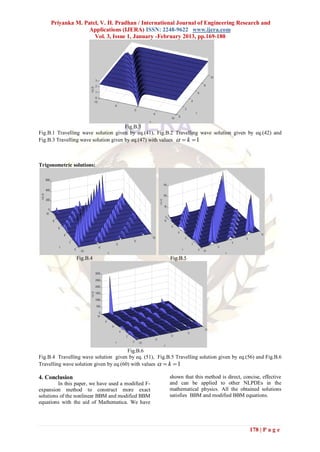
The travelling wave solutions given by eq.(41) to eq.(50) represents soliton-like solutions and eq.(51) to eq.(62)
represents periodic solutions. Some absolute of solitary and periodic solutions are shown in fig.(B.1) to
fig.(B.6).

Solitary solutions:


                    Fig.B.1                                             Fig.B.2


                                                                                                   177 | P a g e
Priyanka M. Patel, V. H. Pradhan / International Journal of Engineering Research and
                   Applications (IJERA) ISSN: 2248-9622 www.ijera.com
                     Vol. 3, Issue 1, January -February 2013, pp.169-180


                                       Fig.B.3
Fig.B.1 Travelling wave solution given by eq.(41), Fig.B.2 Travelling wave solution given by eq.(42) and
Fig.B.3 Travelling wave solution given by eq.(47) with values   k  1


Trigonometric solutions:


                Fig.B.4                                   Fig.B.5


                                        Fig.B.6
Fig.B.4 Travelling wave solution given by eq. (51), Fig.B.5 Travelling solution given by eq.(56) and Fig.B.6
Travelling wave solution given by eq.(60) with values   k  1

4. Conclusion                                             shown that this method is direct, concise, effective
         In this paper, we have used a modified F-        and can be applied to other NLPDEs in the
expansion method to construct more exact                  mathematical physics. All the obtained solutions
solutions of the nonlinear BBM and modified BBM           satisfies BBM and modified BBM equations.
equations with the aid of Mathematica. We have


                                                                                               178 | P a g e
Priyanka M. Patel, V. H. Pradhan / International Journal of Engineering Research and
                      Applications (IJERA) ISSN: 2248-9622 www.ijera.com
                        Vol. 3, Issue 1, January -February 2013, pp.169-180
Appendix A
Relations      between       values   of   (   A, B, C )    and   corresponding         F     in   Riccati   equation

F '    A  B F    C F 2  

A                       B                      C                  F  

                                                                  1 1      
0                      1                       1                   tanh  
                                                                  2 2     2
                                                                  1 1      
0                           1              1                       coth  
                                                                  2 2     2
1                                                  1
                       0                                         coth    csch   , tanh    i sec h  
2                                                  2

1                      0                       1                 tanh   , coth  

1                                              1
                       0                                          sec    tan   , csc    cot  
2                                              2
    1                                              1
                      0                                         sec    tan   , csc    cot  
    2                                              2

1 1                 0                    1 1                tan   , cot  

                                                                        1
0                      0                       0                           ( m is an arbitrary constant)
                                                                      C  m
arbitrary
constant               0                       0                  A

arbitrary                                                         exp  B   A
constant               0                      0
                                                                        B

References
    [1].    A.I.Volpert, Vitaly A. Volpert, Vladimir                  [5].   J-H. He, “Soliton perturbation”,Selected
            A. Volpert, “Travelling wave solutions of                        works of J-H.He, (2009), pp. 8453-8457.
            parabolic        systems”,         American               [6].   M.D.Abdur Rab, A.S.Mia, T.Akter,
            Mathematical Society, (1993).                                    “Some travelling wave solutions of Kdv-
    [2].    A.Wazwaz, “New travelling wave                                   Burger equation”, International Journal of
            solutions of different physical structures to                    Mathematical Analysis, (2012), pp.1053-
            generalized BBM equation”, Elsevier,                             1060.
            (2006), pp.358-362.                                       [7].   M.T.Alquran, “Applying differential
    [3].    G.Cai, Q.Wang, “A modified F-expansion                           transform method to nonlinear partial
            method for solving nonlinear PDEs”,                              differential equations: A modified
            Journal of Information and Computing                             approach”, Applications and Applied
            Science”, (2007), pp.03-16.                                      Mathematics:An International Journal,
    [4].    J.Manafianheris, “Exact solutions of the                         (2012), pp.155-163.
            BBM and MBBM equations by the                             [8].   M.T.Alquran, “Solitons and periodic
            generalized (G‟/G)-expansion method”,                            solutions to nonlinear partial differential
            International     Journal     of     Genetic                     equations by the Sine-Cosine method”,
            Engineering, (2012), pp.28-32.                                   Applied Mathematics & Information


                                                                                                          179 | P a g e
Priyanka M. Patel, V. H. Pradhan / International Journal of Engineering Research and
                 Applications (IJERA) ISSN: 2248-9622 www.ijera.com
                   Vol. 3, Issue 1, January -February 2013, pp.169-180
      Sciences: An International Journal,         [12]. N.Taghizadeh,       M.Mirzazadeh,    “The
      (2012), pp.85-88.                                 modified extended tanh method with the
[9]. M.T.Darvishi,         Maliheh     Najafi,          Riccati equation for solving nonlinear
      Mohammad Najafi, “Travelling wave                 partial       differential     equations”,
      solutions for the (3+1)-dimensional               Mathematica Aeterna, vol.2, (2012),
      breaking soliton equation by (G‟/G)-              pp.145-153.
      expansion method and modified F-            [13]. P.G.Estevez, S.Kuru, J.Negro and
      expansion method”, International Journal          L.M.Nieto, “Travelling wave solutions of
      of     Computational and Mathematical             the generalized Benjamin-Bona-Mahony
      Sciences 6:2, (2012), pp.64-69.
                                                        equation”, Cornell University Library,
[10]. M.T.Darvishi,        Maliheh     Najafi,
      Mohammad Najafi, “Travelling wave                 (2007), pp.1-19.
      solutions for foam drainage equation by     [14]. S.Abbasbandy,       “Homotopy     analysis
      modified F-expansion method”, Food and            method for generalized Benjamin-Bona-
      Public health, (2012), pp. 6-10.                  Mahony equation”, ZAMP, (2008), pp.51-
[11]. M.Wadati, “Introduction to solitons”,             62.
      Pramana Journal of Physics, (2001),
      pp.841-847.


                                                                                   180 | P a g e

Ab31169180

  • 1.
    Priyanka M. Patel,V. H. Pradhan / International Journal of Engineering Research and Applications (IJERA) ISSN: 2248-9622 www.ijera.com Vol. 3, Issue 1, January -February 2013, pp.169-180 Travelling Wave Solutions of BBM and Modified BBM Equations by Modified F-Expansion Method Priyanka M. Patel1* and V. H. Pradhan1 Department of Applied Mathematics and Humanities, S. V. National Institute of Technology, Surat-395007, India Abstract A new modified F-expansion method is ut  u x   u u x  u x x x  0 (2) introduced to obtain the travelling wave solutions like soliton and periodic, of Benjamin- Consider the travelling wave solutions of eq. (2), Bona-Mahony (BBM) equation and modified under the transformation BBM equation. The method is convenient, effective and can be applied to other nonlinear u( x, t )  u( ) where   k ( x   t ) (3) partial differential equations in the mathematical physics. where k  0 and  are constants that do determined later. By substituting eq. (3) into eq. (2) Keywords : Modified F-expansion method, we obtain Benjamin-Bona-Mahony (BBM) equation, modified BBM equation, travelling wave solutions. k  u '  k u '  k  u u '  k 2 u '''  0 1. Introduction  u '  u '   u u '  k u '''  0 (4) It is well known that nonlinear partial differential equations (NLPDEs) are widely used to Integrating eq. (4) with respect to „  ‟ and describe many important phenomena and dynamic considering the zero constant for integration we processes in physics, mechanics, chemistry and have biology, etc. There are many methods to solve NLPDEs such as tanh-sech method [2], homotopy u2 analysis method [14],sine-cosine method [8], (1   ) u    k u ''  0 (5) 2 G / G  expansion ' method [4,9],differential where prime denotes differentiation with respect to transform method [7], and so on. In this paper, we apply the modified F-expansion method [3,9,10] to  . By balancing the order of u 2 and u '' in eq. (5), the generalized BBM equation we have 2 n  n  2 then n  2 So we can see its exact solutions in the form ut  ux   u N ux  ux x x  0 with N  1 (1) u ( )  a0  a2 F 2 ( )  a1 F 1 ( )  a1 F ( )  a2 F 2 ( ) with constant parameter  . Wazwaz [2] (6) has obtained the analytical solution of eq.(1) with tanh-sech method and sine-cosine method. Abbasbandy [14] has applied homotopy analysis where a 0 , a1 , a2 , a1 , a 2 are constants to be method (HAM) to obtain the analytical solution of determined later. And F ( ) satisfies the generalized BBM equation for N  1 and N  2 . following Riccati equation In the present paper we have applied modified F- expansion method to solve eq.(1) for N  1 and F ' ( )  A  B F ( )  C F 2 ( ) (7) N  2 . A set of new solutions are obtained other than the solutions obtained by previous authors. where A , B , C are constants. Substituting eq. (6) *Corresponding author- Email address : pinu7986@gmail.com into eq. (5) and using eq. (7), the left-hand side of eq. (5) can be converted into a finite series in 2. Travelling wave solutions of BBM F p ( ) , ( p = -4, -3 ,-2, -1, 0, 1, 2, 3, 4). equation Equating each coefficient of F ( ) to zero yields p For N  1, eq.(1) reduces to the BBM equation or the following set of algebraic equations. the regularized long-wave equation (RLW). 169 | P a g e
  • 2.
    Priyanka M. Patel,V. H. Pradhan / International Journal of Engineering Research and Applications (IJERA) ISSN: 2248-9622 www.ijera.com Vol. 3, Issue 1, January -February 2013, pp.169-180 a2  F 4 ( ) : (12 A2 k  a2 )  2  F 3 ( ) : 2 A2 ka1  10 ABka2  a1a2   a  2  F 2 ( ) : Ak (3Ba1  8Ca2 )  1  a2 (1  4 B 2 k    a0 ) 2  F ( ) : a1 (1  B k  2 ACk    a0 )  a2 (6 BCk  a1 ) 1 2   a 2   F 0 ( ) : a0  BCka1  2C 2 ka2  ABka1  2 A2 ka2  a0  0  a1a1  a2 a2  (8) 2  F ( ) : a1 (1  B k  2 ACk    a0 )  a2 (6 ABk  a1 ) 1 2   a12  F ( ) : 3BCka1  4 B ka2  2 2  a1 (1  8 ACk    a0 ) 2   F ( ) : 2C ka1  10 BCka2  a1a2 3 2  1  F 4 ( ) : a2 (12C 2 k  a2 )  2   Solving the above algebraic equations by symbolic computations , we have the following solutions: Case 1: A  0 , we have 12BCk 12C 2 k a0  a0 , a1  0 , a2  0 , a1  , a2  ,   1  B 2 k  a0 (9)   Case 2: B  0 , we have 12C 2 k  a0  a0 , a1  0, a2  0, a1  0, a2  ,   1  8 ACk  a0     (10) 12 A k 2 12C k2 a0  a0 , a1  0, a2  , a1  0, a2  ,   1  8 ACk  a0      So we can list the solutions of u as follows: When A  0, B  1, C  1 , from appendix and case 1, we have 3k   u1 ( )  a0  sec h 2   (11)  2 where   k ( x  (1  k  a0 ) t ) When A  0, B  1, C  1 , from appendix and case 1, we have 3k   u2 ( )  a0  csc h 2   (12)  2 where   k ( x  (1  k  a0 ) t ) 1 1 When A  , B  0, C   , from appendix and case 2, we have 2 2 3k u3 ( )  a0  coth( )  csc h( ) 2 (13)  3k 3k coth( )  csc h( ) coth( )  csc h( )  2 u4 ( )  a0   2 (14)   3k u5 ( )  a0   tanh( )  i sec h( ) 2 (15)  170 | P a g e
  • 3.
    Priyanka M. Patel,V. H. Pradhan / International Journal of Engineering Research and Applications (IJERA) ISSN: 2248-9622 www.ijera.com Vol. 3, Issue 1, January -February 2013, pp.169-180 3k 3k  tanh( )  i sec h( )  tanh( )  i sec h( ) 2 u6 ( )  a0   2 (16)   where   k  x  1  2k  a0  t  When A  1, B  0, C  1 , from appendix and case 2, we have 12k u7 ( )  a0  tanh 2   (17)  12k 12k u8 ( )  a0  tanh 2    tanh 2   (18)   12k u9 ( )  a0  coth 2   (19)  12k 12k u10 ( )  a0  coth 2    coth 2   (20)   where   k ( x  (1  8k  a0 ) t ) 1 1 When A  , B  0, C  , from appendix and case 2, we have 2 2 3k u11    a0  sec    tan   2    (21) 3k 2 3k u12    a0  sec    tan    sec    tan   2       (22) 3k u13    a0  csc    cot    2    (23) 3k 2 3k u14    a0  csc    cot    csc    cot   2       (24) where   k  x  (1  2k  a0 ) t  1 1 When A   , B  0, C   , from appendix and case 2, we have 2 2 3k u15    a0  sec    tan   2    (25) 3k 2 3k u16    a0  sec    tan     sec    tan   2       (26) 3k u17    a0  csc    cot   2    (27) 3k 2 3k u18    a0  csc    cot     csc    cot   2       (28) where   k  x  (1  2k  a0 ) t  When A  1  1 , B  0, C  1 1 , from appendix and case 2, we have 12k u19    a0  tan 2   (29)  12k 12k u20    a0  tan 2    tan 2   (30)   12k u21    a0  cot 2   (31)  171 | P a g e
  • 4.
    Priyanka M. Patel,V. H. Pradhan / International Journal of Engineering Research and Applications (IJERA) ISSN: 2248-9622 www.ijera.com Vol. 3, Issue 1, January -February 2013, pp.169-180 12k 12k u22    a0  cot 2    cot 2   (32)   where   k  x  1  8k  a0  t  2.1 Discussion shape and propagates at constant speed. It is a Travelling wave solutions from eq.(11) to stable solution. The first observation of this kind of eq.(20) represents the soliton solutions and from wave was made in 1834 by John Scott Russell [5]. eq. (21) to eq.(32) represents the periodic If we draw the solution with a constant speed, we solutions. will get the following figure (A.1) which shows the We discuss one travelling wave solution given by right moving wave at different values of t . eq. (11). The travelling wave solution (11) is a solitary like solution which does not change its 4 t=0 t=1 t=2 3.5 t=3 3 2.5 u 2 1.5 1 -10 -8 -6 -4 -2 0 2 4 6 8 10 x Fig. A.1. Plot of travelling wave solution eq. (11) with k    a0  1 and t  0,1, 2,3 If we draw the travelling wave solution spread out. If we take negative values of  ( (11) with different positive values of  (   1,  1.5,  2 ), we will get the following   1,1.5, 2 ), we will get the following figure figure (A.2-II) which shows the value of negative (A.2-I) which shows the value of positive amplitude. Here negative amplitude means the amplitude in decreasing. In other words the value wave is going to look upside down. From figures of positive amplitude tends to zero. From this (A.2-I) and (A.2-II) we can say that positive and physically we can say that the fluid becomes more negative amplitudes are the same . 4 1 alpha=1 alpha=1.5 alpha= -1 alpha=2 alpha= -1.5 3.5 0.5 alpha= -2 3 0 2.5 -0.5 u u 2 -1 1.5 -1.5 1 -2 -10 -8 -6 -4 -2 0 2 4 6 8 10 -10 -8 -6 -4 -2 0 2 4 6 8 10 x x (I) (II) Fig. A.2. Different solitary waves profiles given by eq. (11) at t  0 , a0  k  1 for (I)   1,1.5,2 and (II)   1,  1.5,  2 172 | P a g e
  • 5.
    Priyanka M. Patel,V. H. Pradhan / International Journal of Engineering Research and Applications (IJERA) ISSN: 2248-9622 www.ijera.com Vol. 3, Issue 1, January -February 2013, pp.169-180 If we draw the travelling wave solution (11) with amplitude in increasing. The amplitude is different values of k ( k  1, 2,3 ), we will get the proportional to the velocity, which means that following figure (A.3) which describes the value of larger pulse travel faster than smaller ones. 10 k=1 9 k=2 k=3 8 7 6 u 5 4 3 2 1 -10 -8 -6 -4 -2 0 2 4 6 8 10 x Fig. A.3. Different solitary waves profiles given by eq. (11) at t  1 , a0    1 for k  1, 2,3 The other solitary and periodic solutions are graphically shown in fig.(A.4) to fig.(A.10). Solitary solutions Fig.A.4 Fig.A.5 Fig.A.4. Travelling wave solution given by eq. (17) with values a0    k  1 and Fig.A.5. Travelling wave solution given by eq.(14) with values a0  2 and   k 1 Fig.A.6 Fig.A.6 Travelling wave solution given by absolute of eq. (15) with values a0  2 and   k  1 173 | P a g e
  • 6.
    Priyanka M. Patel,V. H. Pradhan / International Journal of Engineering Research and Applications (IJERA) ISSN: 2248-9622 www.ijera.com Vol. 3, Issue 1, January -February 2013, pp.169-180 Trigonometric solutions : Fig.A.7 Fig.A.8 Fig.A.7. Travelling wave solution given by eq. (23) and Fig.A.8 travelling wave solution given by eq.(25) with values a0    k  1 Fig.A.9 Fig.A.10 Fig.A.9. Travelling wave solution given by eq. (29) and Fig.A.10. Travelling wave solution given by eq.(31) with values a0    k  1 3. Travelling wave solutions of modified BBM equation For N  2 , eq.(1) reduces to the modified BBM equation. ut  ux   u 2 ux  ux x x  0 (33) Now, we construct the travelling wave solutions of eq. (33), under the transformation v  x, t   v   where   k  x   t  (34) where k  0 and  are constants. Substituting eq. (34) into the eq. (33), we get k  v '  k v '   k v 2 v '  k 3 v '''  0 (35) Integrating eq. (35) with respect to „  ‟ and considering the zero constant for integration we have  1    v  v3  k 2v''  0 (36) 3 where prime denotes differentiation with respect to  . By balancing the order of v and v in eq. (36), we have 3 '' 3 m  m  2 then m  1. So we can write v    a0  a1 F 1    a1 F   (37) where a 0 , a1 , a1 are constants to be determined later. And F ( ) satisfies Riccati equation given by eq. (7). Substituting eq. (37) into eq. (36) and using eq. (7), the left-hand side of eq. (36) can be converted into a finite 174 | P a g e
  • 7.
    Priyanka M. Patel,V. H. Pradhan / International Journal of Engineering Research and Applications (IJERA) ISSN: 2248-9622 www.ijera.com Vol. 3, Issue 1, January -February 2013, pp.169-180 series in F ( ) , ( p = -3 ,-2,-1, 0, 1, 2, 3). Equating each coefficient of F ( ) to zero yields the following p p set of algebraic equations. a13  F 3   : 2 A2 k 2 a1   3  F   : 3 ABk a1  a0 a12 2 2   F 1   : a1  B 2 k 2 a1  2 ACk 2 a1  a1  a0 2 a1  a12 a1   a03  F   : a0  BCk a1  ABk a1  a0  0 2 2  2a0 a1a1  (38) 3  F 1   : a1  B 2 k 2 a1  2 ACk 2 a1  a1  a0 2 a1  a1a12   F 2   : 3BCk 2 a1  a0 a12   a1  3  F   : 2C k a1  3 2 2 3   Solving the algebraic equations above by symbolic computations, we have the following solutions: Case 3: A  0 , we have 3 6 B2k 2 a0   i B k , a1  0 , a1   i C k ,   1  (39) 2  2 Case 4: B  0 , we have 6  a0  0, a1  0, a1   i C k ,   1  2 ACk 2     (40) 6 6 2 a0  0, a1   i A k , a  iC k ,   1  4 ACk   1   So we can list the solutions of v as follows: When A  0, B  1, C  1 , from appendix and case 3, we have 3   v1 ( )   i k tanh   (41) 2 2   k2   where   k  x   1  t    2  When A  0, B  1, C  1 , from appendix and case 3, we have 3   v2 ( )   i k coth   (42) 2 2   k2   where   k  x   1  t    2  1 1 When A  , B  0, C   , from appendix and case 4, we have 2 2 ik 6 v3 ( )    coth( )  csc h( )  (43) 2  ik 6 v4 ( )    tanh    i sec h    2    (44) 175 | P a g e
  • 8.
    Priyanka M. Patel,V. H. Pradhan / International Journal of Engineering Research and Applications (IJERA) ISSN: 2248-9622 www.ijera.com Vol. 3, Issue 1, January -February 2013, pp.169-180   k2   where   k  x  1  t    2   ik 6 ik 6 coth( )  csc h( )  coth( )  csc h( )  1 v5 ( )   (45) 2  2  ik 6 1 ik 6 v6 ( )    tanh    i sec h        tanh    i sec h    46) 2  2    where    k x  1  k 2  t  When A  1, B  0, C  1 , from appendix and case 4, we have 6 v7 ( )   i k tanh   (47)  6 v8 ( )   i k coth   (48)  where    k x  1  2 k 2  t  6 6 v9 ( )  i k tanh 1    i k tanh   (49)   6 6 v10 ( )   i k coth 1    i k coth   (50)   where    k x  1  4 k 2  t  1 1 When A  , B  0, C  , from appendix and case 4, we have 2 2 ik 6 v11     sec    tan    2    (51) ik 6 v12      csc    cot    2    (52)   1 2  where   k  x  1  k  t    2   ik 6 1 ik 6 v13     sec    tan       sec    tan    2    (53) 2  ik 6 1 ik 6 v14      csc    cot        csc    cot    2    (54) 2  where    k x   1  k 2  t  1 1 When A   , B  0, C   , from appendix and case 4, we have 2 2 ik 6 v15     sec    tan    2    (55) ik 6 v16      csc    cot    2    (56) 176 | P a g e
  • 9.
    Priyanka M. Patel,V. H. Pradhan / International Journal of Engineering Research and Applications (IJERA) ISSN: 2248-9622 www.ijera.com Vol. 3, Issue 1, January -February 2013, pp.169-180   k2   where   k  x  1  t    2  ik 6 1 ik 6 v17     sec    tan       sec    tan    2    (57) 2  ik 6 1 ik 6 v18      csc    cot        csc    cot    2    (58) 2  where    k x   1  k 2  t  When A  1  1 , B  0, C  1 1 , from appendix and case 4, we have 6 v19        i k tan   (59)  6 v20        i k cot   (60)  where    k x  1  2 k 2  t  6 6 v21        i k tan 1       i k tan   (61)   6 6 v22        i k cot 1       i k cot   (62)   where    k x   1  4 k 2  t  The travelling wave solutions given by eq.(41) to eq.(50) represents soliton-like solutions and eq.(51) to eq.(62) represents periodic solutions. Some absolute of solitary and periodic solutions are shown in fig.(B.1) to fig.(B.6). Solitary solutions: Fig.B.1 Fig.B.2 177 | P a g e
  • 10.
    Priyanka M. Patel,V. H. Pradhan / International Journal of Engineering Research and Applications (IJERA) ISSN: 2248-9622 www.ijera.com Vol. 3, Issue 1, January -February 2013, pp.169-180 Fig.B.3 Fig.B.1 Travelling wave solution given by eq.(41), Fig.B.2 Travelling wave solution given by eq.(42) and Fig.B.3 Travelling wave solution given by eq.(47) with values   k  1 Trigonometric solutions: Fig.B.4 Fig.B.5 Fig.B.6 Fig.B.4 Travelling wave solution given by eq. (51), Fig.B.5 Travelling solution given by eq.(56) and Fig.B.6 Travelling wave solution given by eq.(60) with values   k  1 4. Conclusion shown that this method is direct, concise, effective In this paper, we have used a modified F- and can be applied to other NLPDEs in the expansion method to construct more exact mathematical physics. All the obtained solutions solutions of the nonlinear BBM and modified BBM satisfies BBM and modified BBM equations. equations with the aid of Mathematica. We have 178 | P a g e
  • 11.
    Priyanka M. Patel,V. H. Pradhan / International Journal of Engineering Research and Applications (IJERA) ISSN: 2248-9622 www.ijera.com Vol. 3, Issue 1, January -February 2013, pp.169-180 Appendix A Relations between values of ( A, B, C ) and corresponding F   in Riccati equation F '    A  B F    C F 2   A B C F   1 1   0 1 1  tanh   2 2 2 1 1   0 1 1  coth   2 2 2 1 1 0  coth    csch   , tanh    i sec h   2 2 1 0 1 tanh   , coth   1 1 0 sec    tan   , csc    cot   2 2 1 1  0  sec    tan   , csc    cot   2 2 1 1 0 1 1 tan   , cot   1 0 0 0  ( m is an arbitrary constant) C  m arbitrary constant 0 0 A arbitrary exp  B   A constant 0 0 B References [1]. A.I.Volpert, Vitaly A. Volpert, Vladimir [5]. J-H. He, “Soliton perturbation”,Selected A. Volpert, “Travelling wave solutions of works of J-H.He, (2009), pp. 8453-8457. parabolic systems”, American [6]. M.D.Abdur Rab, A.S.Mia, T.Akter, Mathematical Society, (1993). “Some travelling wave solutions of Kdv- [2]. A.Wazwaz, “New travelling wave Burger equation”, International Journal of solutions of different physical structures to Mathematical Analysis, (2012), pp.1053- generalized BBM equation”, Elsevier, 1060. (2006), pp.358-362. [7]. M.T.Alquran, “Applying differential [3]. G.Cai, Q.Wang, “A modified F-expansion transform method to nonlinear partial method for solving nonlinear PDEs”, differential equations: A modified Journal of Information and Computing approach”, Applications and Applied Science”, (2007), pp.03-16. Mathematics:An International Journal, [4]. J.Manafianheris, “Exact solutions of the (2012), pp.155-163. BBM and MBBM equations by the [8]. M.T.Alquran, “Solitons and periodic generalized (G‟/G)-expansion method”, solutions to nonlinear partial differential International Journal of Genetic equations by the Sine-Cosine method”, Engineering, (2012), pp.28-32. Applied Mathematics & Information 179 | P a g e
  • 12.
    Priyanka M. Patel,V. H. Pradhan / International Journal of Engineering Research and Applications (IJERA) ISSN: 2248-9622 www.ijera.com Vol. 3, Issue 1, January -February 2013, pp.169-180 Sciences: An International Journal, [12]. N.Taghizadeh, M.Mirzazadeh, “The (2012), pp.85-88. modified extended tanh method with the [9]. M.T.Darvishi, Maliheh Najafi, Riccati equation for solving nonlinear Mohammad Najafi, “Travelling wave partial differential equations”, solutions for the (3+1)-dimensional Mathematica Aeterna, vol.2, (2012), breaking soliton equation by (G‟/G)- pp.145-153. expansion method and modified F- [13]. P.G.Estevez, S.Kuru, J.Negro and expansion method”, International Journal L.M.Nieto, “Travelling wave solutions of of Computational and Mathematical the generalized Benjamin-Bona-Mahony Sciences 6:2, (2012), pp.64-69. equation”, Cornell University Library, [10]. M.T.Darvishi, Maliheh Najafi, Mohammad Najafi, “Travelling wave (2007), pp.1-19. solutions for foam drainage equation by [14]. S.Abbasbandy, “Homotopy analysis modified F-expansion method”, Food and method for generalized Benjamin-Bona- Public health, (2012), pp. 6-10. Mahony equation”, ZAMP, (2008), pp.51- [11]. M.Wadati, “Introduction to solitons”, 62. Pramana Journal of Physics, (2001), pp.841-847. 180 | P a g e