Holt Geometry
6-2 Properties of Parallelograms6-2 Properties of Parallelograms
Holt Geometry
Warm UpWarm Up
Lesson PresentationLesson Presentation
Lesson QuizLesson Quiz
Holt Geometry
6-2 Properties of Parallelograms
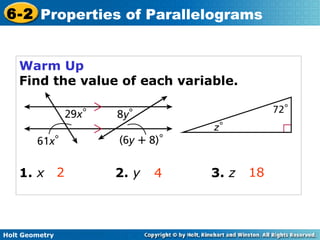
Warm Up
Find the value of each variable.
1. x 2. y 3. z2 184
Holt Geometry
6-2 Properties of Parallelograms
Prove and apply properties of
parallelograms.
Use properties of parallelograms to
solve problems.
Objectives
Holt Geometry
6-2 Properties of Parallelograms
parallelogram
Vocabulary
Holt Geometry
6-2 Properties of Parallelograms
Any polygon with four sides is a quadrilateral.
However, some quadrilaterals have special
properties. These special quadrilaterals are given
their own names.
Holt Geometry
6-2 Properties of Parallelograms
Opposite sides of a quadrilateral do not share a
vertex. Opposite angles do not share a side.
Helpful Hint
Holt Geometry
6-2 Properties of Parallelograms
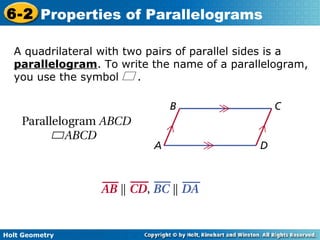
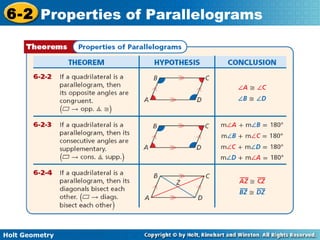
A quadrilateral with two pairs of parallel sides is a
parallelogram. To write the name of a parallelogram,
you use the symbol .
Holt Geometry
6-2 Properties of Parallelograms
Holt Geometry
6-2 Properties of Parallelograms
Holt Geometry
6-2 Properties of Parallelograms
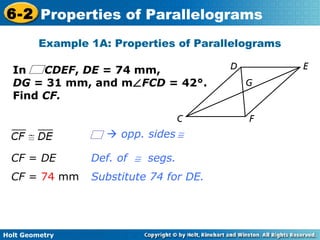
Example 1A: Properties of Parallelograms
Def. of ≅ segs.
Substitute 74 for DE.
In CDEF, DE = 74 mm,
DG = 31 mm, and m∠FCD = 42°.
Find CF.
CF = DE
CF = 74 mm
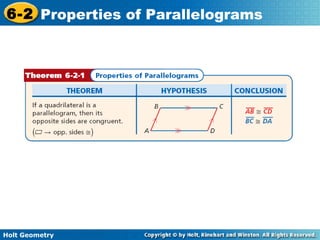
 opp. sides ≅
Holt Geometry
6-2 Properties of Parallelograms
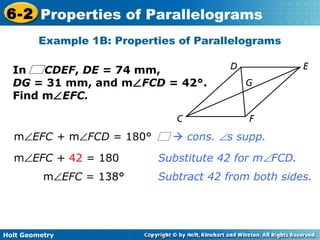
Substitute 42 for m∠FCD.
Example 1B: Properties of Parallelograms
Subtract 42 from both sides.
m∠EFC + m∠FCD = 180°
m∠EFC + 42 = 180
m∠EFC = 138°
In CDEF, DE = 74 mm,
DG = 31 mm, and m∠FCD = 42°.
Find m∠EFC.
 cons. ∠s supp.
Holt Geometry
6-2 Properties of Parallelograms
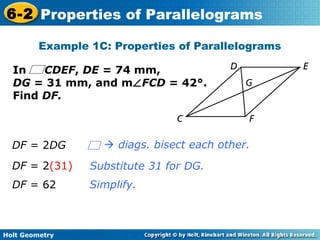
Example 1C: Properties of Parallelograms
Substitute 31 for DG.
Simplify.
In CDEF, DE = 74 mm,
DG = 31 mm, and m∠FCD = 42°.
Find DF.
DF = 2DG
DF = 2(31)
DF = 62
 diags. bisect each other.
Holt Geometry
6-2 Properties of Parallelograms
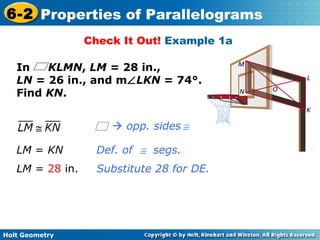
Check It Out! Example 1a
In KLMN, LM = 28 in.,
LN = 26 in., and m∠LKN = 74°.
Find KN.
Def. of ≅ segs.
Substitute 28 for DE.
LM = KN
LM = 28 in.
 opp. sides ≅
Holt Geometry
6-2 Properties of Parallelograms
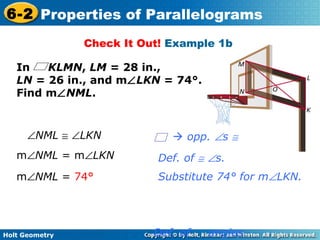
Check It Out! Example 1b
Def. of angles.
In KLMN, LM = 28 in.,
LN = 26 in., and m∠LKN = 74°.
Find m∠NML.
Def. of ≅ ∠s.
Substitute 74° for m∠LKN.
∠NML ≅ ∠LKN
m∠NML = m∠LKN
m∠NML = 74°
 opp. ∠s ≅
Holt Geometry
6-2 Properties of Parallelograms
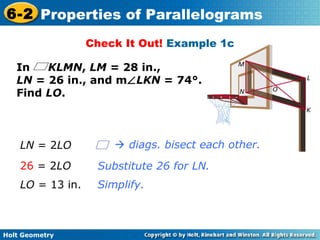
Check It Out! Example 1c
In KLMN, LM = 28 in.,
LN = 26 in., and m∠LKN = 74°.
Find LO.
Substitute 26 for LN.
Simplify.
LN = 2LO
26 = 2LO
LO = 13 in.
 diags. bisect each other.
Holt Geometry
6-2 Properties of Parallelograms
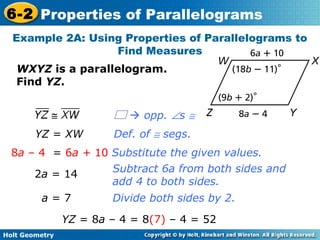
Example 2A: Using Properties of Parallelograms to
Find Measures
WXYZ is a parallelogram.
Find YZ.
Def. of ≅ segs.
Substitute the given values.
Subtract 6a from both sides and
add 4 to both sides.
Divide both sides by 2.
YZ = XW
8a – 4 = 6a + 10
2a = 14
a = 7
YZ = 8a – 4 = 8(7) – 4 = 52
 opp. ∠s ≅
Holt Geometry
6-2 Properties of Parallelograms
Example 2B: Using Properties of Parallelograms to
Find Measures
WXYZ is a parallelogram.
Find m∠Z .
Divide by 27.
Add 9 to both sides.
Combine like terms.
Substitute the given values.
m∠Z + m∠W = 180°
(9b + 2) + (18b – 11) = 180
27b – 9 = 180
27b = 189
b = 7
m∠Z = (9b + 2)° = [9(7) + 2]° = 65°
 cons. ∠s supp.
Holt Geometry
6-2 Properties of Parallelograms
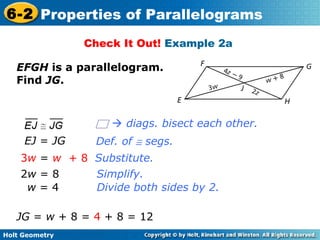
Check It Out! Example 2a
EFGH is a parallelogram.
Find JG.
Substitute.
Simplify.
EJ = JG
3w = w + 8
2w = 8
w = 4 Divide both sides by 2.
JG = w + 8 = 4 + 8 = 12
Def. of ≅ segs.
 diags. bisect each other.
Holt Geometry
6-2 Properties of Parallelograms
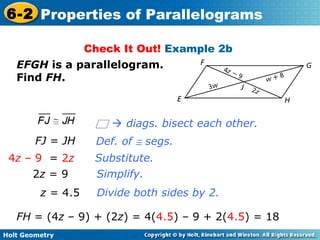
Check It Out! Example 2b
EFGH is a parallelogram.
Find FH.
Substitute.
Simplify.
FJ = JH
4z – 9 = 2z
2z = 9
z = 4.5 Divide both sides by 2.
Def. of ≅ segs.
FH = (4z – 9) + (2z) = 4(4.5) – 9 + 2(4.5) = 18
 diags. bisect each other.
Holt Geometry
6-2 Properties of Parallelograms
When you are drawing a figure in the coordinate
plane, the name ABCD gives the order of the
vertices.
Remember!
Holt Geometry
6-2 Properties of Parallelograms
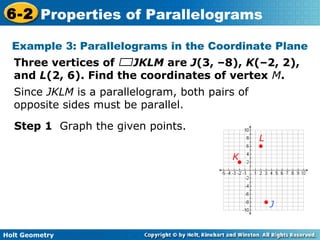
Example 3: Parallelograms in the Coordinate Plane
Three vertices of JKLM are J(3, –8), K(–2, 2),
and L(2, 6). Find the coordinates of vertex M.
Step 1 Graph the given points.
J
K
L
Since JKLM is a parallelogram, both pairs of
opposite sides must be parallel.
Holt Geometry
6-2 Properties of Parallelograms
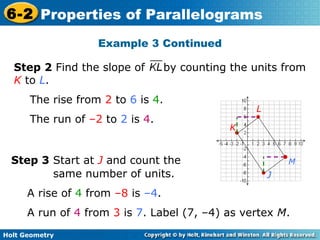
Example 3 Continued
Step 3 Start at J and count the
same number of units.
A rise of 4 from –8 is –4.
A run of 4 from 3 is 7. Label (7, –4) as vertex M.
Step 2 Find the slope of by counting the units from
K to L.
The rise from 2 to 6 is 4.
The run of –2 to 2 is 4.
J
K
L
M
Holt Geometry
6-2 Properties of Parallelograms
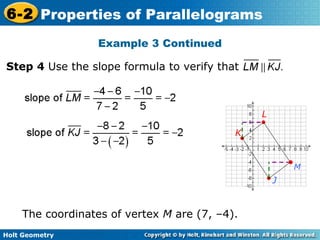
The coordinates of vertex M are (7, –4).
Example 3 Continued
Step 4 Use the slope formula to verify that
J
K
L
M
Holt Geometry
6-2 Properties of Parallelograms
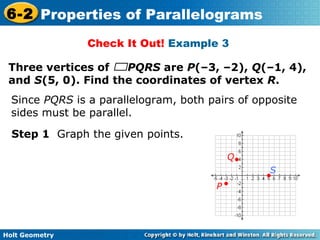
Check It Out! Example 3
Three vertices of PQRS are P(–3, –2), Q(–1, 4),
and S(5, 0). Find the coordinates of vertex R.
Step 1 Graph the given points.
Since PQRS is a parallelogram, both pairs of opposite
sides must be parallel.
P
Q
S
Holt Geometry
6-2 Properties of Parallelograms
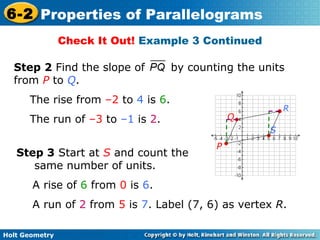
Step 3 Start at S and count the
same number of units.
A rise of 6 from 0 is 6.
A run of 2 from 5 is 7. Label (7, 6) as vertex R.
Check It Out! Example 3 Continued
P
Q
S
R
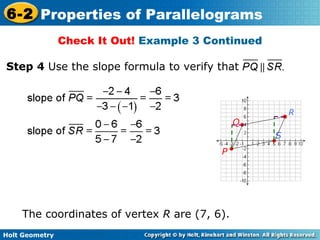
Step 2 Find the slope of by counting the units
from P to Q.
The rise from –2 to 4 is 6.
The run of –3 to –1 is 2.
Holt Geometry
6-2 Properties of Parallelograms
Check It Out! Example 3 Continued
The coordinates of vertex R are (7, 6).
Step 4 Use the slope formula to verify that
P
Q
S
R
Holt Geometry
6-2 Properties of Parallelograms
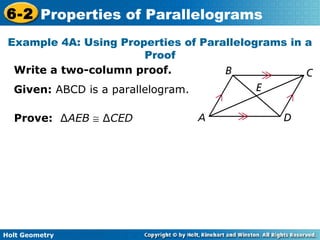
Example 4A: Using Properties of Parallelograms in a
Proof
Write a two-column proof.
Given: ABCD is a parallelogram.
Prove: ∆AEB ≅ ∆CED
Holt Geometry
6-2 Properties of Parallelograms
Example 4A Continued
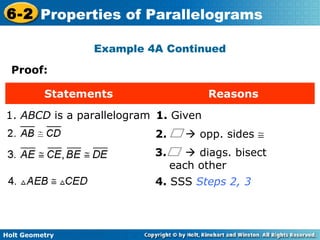
Proof:
Statements Reasons
1. ABCD is a parallelogram 1. Given
4. SSS Steps 2, 3
2.  opp. sides ≅
3.  diags. bisect
each other
Holt Geometry
6-2 Properties of Parallelograms
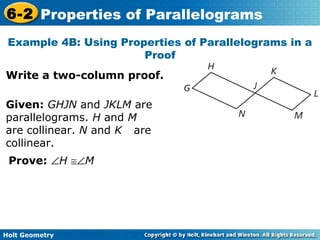
Example 4B: Using Properties of Parallelograms in a
Proof
Write a two-column proof.
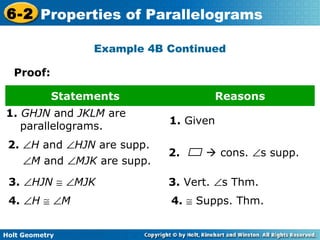
Given: GHJN and JKLM are
parallelograms. H and M
are collinear. N and K are
collinear.
Prove: ∠H ≅∠M
Holt Geometry
6-2 Properties of Parallelograms
Example 4B Continued
Proof:
Statements Reasons
1. GHJN and JKLM are
parallelograms.
1. Given
2.  cons. ∠s supp.
2. ∠H and ∠HJN are supp.
∠M and ∠MJK are supp.
3. Vert. ∠s Thm.3. ∠HJN ≅ ∠MJK
4. ∠H ≅ ∠M 4. ≅ Supps. Thm.
Holt Geometry
6-2 Properties of Parallelograms
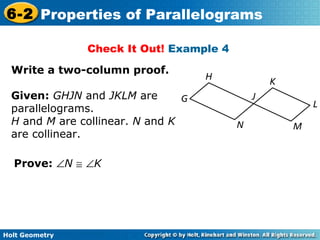
Check It Out! Example 4
Write a two-column proof.
Given: GHJN and JKLM are
parallelograms.
H and M are collinear. N and K
are collinear.
Prove: ∠N ≅ ∠K
Holt Geometry
6-2 Properties of Parallelograms
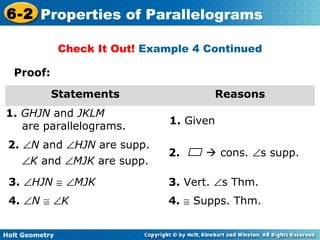
Proof:
Statements Reasons
1. GHJN and JKLM
are parallelograms.
1. Given
2. ∠N and ∠HJN are supp.
∠K and ∠MJK are supp.
Check It Out! Example 4 Continued
2.  cons. ∠s supp.
3. Vert. ∠s Thm.
4. ≅ Supps. Thm.4. ∠N ≅ ∠K
3. ∠HJN ≅ ∠MJK
Holt Geometry
6-2 Properties of Parallelograms
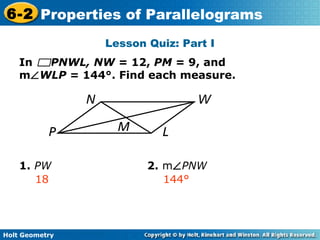
Lesson Quiz: Part I
In PNWL, NW = 12, PM = 9, and
m∠WLP = 144°. Find each measure.
1. PW 2. m∠PNW
18 144°
Holt Geometry
6-2 Properties of Parallelograms
Lesson Quiz: Part II
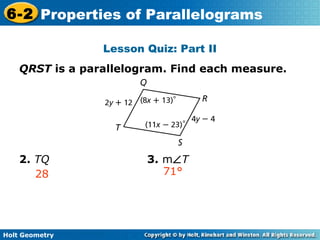
QRST is a parallelogram. Find each measure.
2. TQ 3. m∠T
28 71°
Holt Geometry
6-2 Properties of Parallelograms
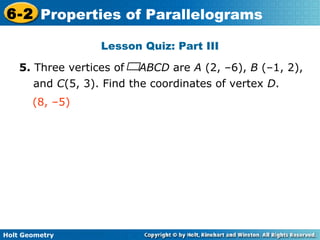
Lesson Quiz: Part III
5. Three vertices of ABCD are A (2, –6), B (–1, 2),
and C(5, 3). Find the coordinates of vertex D.
(8, –5)
Holt Geometry
6-2 Properties of Parallelograms
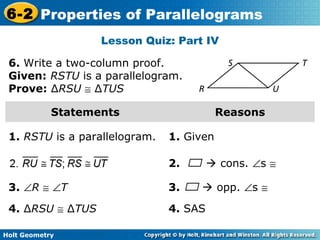
Lesson Quiz: Part IV
6. Write a two-column proof.
Given: RSTU is a parallelogram.
Prove: ∆RSU ≅ ∆TUS
Statements Reasons
1. RSTU is a parallelogram. 1. Given
4. SAS4. ∆RSU ≅ ∆TUS
3. ∠R ≅ ∠T
2.  cons. ∠s ≅
3.  opp. ∠s ≅

Gch6 l2

  • 1.
    Holt Geometry 6-2 Propertiesof Parallelograms6-2 Properties of Parallelograms Holt Geometry Warm UpWarm Up Lesson PresentationLesson Presentation Lesson QuizLesson Quiz
  • 2.
    Holt Geometry 6-2 Propertiesof Parallelograms Warm Up Find the value of each variable. 1. x 2. y 3. z2 184
  • 3.
    Holt Geometry 6-2 Propertiesof Parallelograms Prove and apply properties of parallelograms. Use properties of parallelograms to solve problems. Objectives
  • 4.
    Holt Geometry 6-2 Propertiesof Parallelograms parallelogram Vocabulary
  • 5.
    Holt Geometry 6-2 Propertiesof Parallelograms Any polygon with four sides is a quadrilateral. However, some quadrilaterals have special properties. These special quadrilaterals are given their own names.
  • 6.
    Holt Geometry 6-2 Propertiesof Parallelograms Opposite sides of a quadrilateral do not share a vertex. Opposite angles do not share a side. Helpful Hint
  • 7.
    Holt Geometry 6-2 Propertiesof Parallelograms A quadrilateral with two pairs of parallel sides is a parallelogram. To write the name of a parallelogram, you use the symbol .
  • 8.
  • 9.
  • 10.
    Holt Geometry 6-2 Propertiesof Parallelograms Example 1A: Properties of Parallelograms Def. of ≅ segs. Substitute 74 for DE. In CDEF, DE = 74 mm, DG = 31 mm, and m∠FCD = 42°. Find CF. CF = DE CF = 74 mm  opp. sides ≅
  • 11.
    Holt Geometry 6-2 Propertiesof Parallelograms Substitute 42 for m∠FCD. Example 1B: Properties of Parallelograms Subtract 42 from both sides. m∠EFC + m∠FCD = 180° m∠EFC + 42 = 180 m∠EFC = 138° In CDEF, DE = 74 mm, DG = 31 mm, and m∠FCD = 42°. Find m∠EFC.  cons. ∠s supp.
  • 12.
    Holt Geometry 6-2 Propertiesof Parallelograms Example 1C: Properties of Parallelograms Substitute 31 for DG. Simplify. In CDEF, DE = 74 mm, DG = 31 mm, and m∠FCD = 42°. Find DF. DF = 2DG DF = 2(31) DF = 62  diags. bisect each other.
  • 13.
    Holt Geometry 6-2 Propertiesof Parallelograms Check It Out! Example 1a In KLMN, LM = 28 in., LN = 26 in., and m∠LKN = 74°. Find KN. Def. of ≅ segs. Substitute 28 for DE. LM = KN LM = 28 in.  opp. sides ≅
  • 14.
    Holt Geometry 6-2 Propertiesof Parallelograms Check It Out! Example 1b Def. of angles. In KLMN, LM = 28 in., LN = 26 in., and m∠LKN = 74°. Find m∠NML. Def. of ≅ ∠s. Substitute 74° for m∠LKN. ∠NML ≅ ∠LKN m∠NML = m∠LKN m∠NML = 74°  opp. ∠s ≅
  • 15.
    Holt Geometry 6-2 Propertiesof Parallelograms Check It Out! Example 1c In KLMN, LM = 28 in., LN = 26 in., and m∠LKN = 74°. Find LO. Substitute 26 for LN. Simplify. LN = 2LO 26 = 2LO LO = 13 in.  diags. bisect each other.
  • 16.
    Holt Geometry 6-2 Propertiesof Parallelograms Example 2A: Using Properties of Parallelograms to Find Measures WXYZ is a parallelogram. Find YZ. Def. of ≅ segs. Substitute the given values. Subtract 6a from both sides and add 4 to both sides. Divide both sides by 2. YZ = XW 8a – 4 = 6a + 10 2a = 14 a = 7 YZ = 8a – 4 = 8(7) – 4 = 52  opp. ∠s ≅
  • 17.
    Holt Geometry 6-2 Propertiesof Parallelograms Example 2B: Using Properties of Parallelograms to Find Measures WXYZ is a parallelogram. Find m∠Z . Divide by 27. Add 9 to both sides. Combine like terms. Substitute the given values. m∠Z + m∠W = 180° (9b + 2) + (18b – 11) = 180 27b – 9 = 180 27b = 189 b = 7 m∠Z = (9b + 2)° = [9(7) + 2]° = 65°  cons. ∠s supp.
  • 18.
    Holt Geometry 6-2 Propertiesof Parallelograms Check It Out! Example 2a EFGH is a parallelogram. Find JG. Substitute. Simplify. EJ = JG 3w = w + 8 2w = 8 w = 4 Divide both sides by 2. JG = w + 8 = 4 + 8 = 12 Def. of ≅ segs.  diags. bisect each other.
  • 19.
    Holt Geometry 6-2 Propertiesof Parallelograms Check It Out! Example 2b EFGH is a parallelogram. Find FH. Substitute. Simplify. FJ = JH 4z – 9 = 2z 2z = 9 z = 4.5 Divide both sides by 2. Def. of ≅ segs. FH = (4z – 9) + (2z) = 4(4.5) – 9 + 2(4.5) = 18  diags. bisect each other.
  • 20.
    Holt Geometry 6-2 Propertiesof Parallelograms When you are drawing a figure in the coordinate plane, the name ABCD gives the order of the vertices. Remember!
  • 21.
    Holt Geometry 6-2 Propertiesof Parallelograms Example 3: Parallelograms in the Coordinate Plane Three vertices of JKLM are J(3, –8), K(–2, 2), and L(2, 6). Find the coordinates of vertex M. Step 1 Graph the given points. J K L Since JKLM is a parallelogram, both pairs of opposite sides must be parallel.
  • 22.
    Holt Geometry 6-2 Propertiesof Parallelograms Example 3 Continued Step 3 Start at J and count the same number of units. A rise of 4 from –8 is –4. A run of 4 from 3 is 7. Label (7, –4) as vertex M. Step 2 Find the slope of by counting the units from K to L. The rise from 2 to 6 is 4. The run of –2 to 2 is 4. J K L M
  • 23.
    Holt Geometry 6-2 Propertiesof Parallelograms The coordinates of vertex M are (7, –4). Example 3 Continued Step 4 Use the slope formula to verify that J K L M
  • 24.
    Holt Geometry 6-2 Propertiesof Parallelograms Check It Out! Example 3 Three vertices of PQRS are P(–3, –2), Q(–1, 4), and S(5, 0). Find the coordinates of vertex R. Step 1 Graph the given points. Since PQRS is a parallelogram, both pairs of opposite sides must be parallel. P Q S
  • 25.
    Holt Geometry 6-2 Propertiesof Parallelograms Step 3 Start at S and count the same number of units. A rise of 6 from 0 is 6. A run of 2 from 5 is 7. Label (7, 6) as vertex R. Check It Out! Example 3 Continued P Q S R Step 2 Find the slope of by counting the units from P to Q. The rise from –2 to 4 is 6. The run of –3 to –1 is 2.
  • 26.
    Holt Geometry 6-2 Propertiesof Parallelograms Check It Out! Example 3 Continued The coordinates of vertex R are (7, 6). Step 4 Use the slope formula to verify that P Q S R
  • 27.
    Holt Geometry 6-2 Propertiesof Parallelograms Example 4A: Using Properties of Parallelograms in a Proof Write a two-column proof. Given: ABCD is a parallelogram. Prove: ∆AEB ≅ ∆CED
  • 28.
    Holt Geometry 6-2 Propertiesof Parallelograms Example 4A Continued Proof: Statements Reasons 1. ABCD is a parallelogram 1. Given 4. SSS Steps 2, 3 2.  opp. sides ≅ 3.  diags. bisect each other
  • 29.
    Holt Geometry 6-2 Propertiesof Parallelograms Example 4B: Using Properties of Parallelograms in a Proof Write a two-column proof. Given: GHJN and JKLM are parallelograms. H and M are collinear. N and K are collinear. Prove: ∠H ≅∠M
  • 30.
    Holt Geometry 6-2 Propertiesof Parallelograms Example 4B Continued Proof: Statements Reasons 1. GHJN and JKLM are parallelograms. 1. Given 2.  cons. ∠s supp. 2. ∠H and ∠HJN are supp. ∠M and ∠MJK are supp. 3. Vert. ∠s Thm.3. ∠HJN ≅ ∠MJK 4. ∠H ≅ ∠M 4. ≅ Supps. Thm.
  • 31.
    Holt Geometry 6-2 Propertiesof Parallelograms Check It Out! Example 4 Write a two-column proof. Given: GHJN and JKLM are parallelograms. H and M are collinear. N and K are collinear. Prove: ∠N ≅ ∠K
  • 32.
    Holt Geometry 6-2 Propertiesof Parallelograms Proof: Statements Reasons 1. GHJN and JKLM are parallelograms. 1. Given 2. ∠N and ∠HJN are supp. ∠K and ∠MJK are supp. Check It Out! Example 4 Continued 2.  cons. ∠s supp. 3. Vert. ∠s Thm. 4. ≅ Supps. Thm.4. ∠N ≅ ∠K 3. ∠HJN ≅ ∠MJK
  • 33.
    Holt Geometry 6-2 Propertiesof Parallelograms Lesson Quiz: Part I In PNWL, NW = 12, PM = 9, and m∠WLP = 144°. Find each measure. 1. PW 2. m∠PNW 18 144°
  • 34.
    Holt Geometry 6-2 Propertiesof Parallelograms Lesson Quiz: Part II QRST is a parallelogram. Find each measure. 2. TQ 3. m∠T 28 71°
  • 35.
    Holt Geometry 6-2 Propertiesof Parallelograms Lesson Quiz: Part III 5. Three vertices of ABCD are A (2, –6), B (–1, 2), and C(5, 3). Find the coordinates of vertex D. (8, –5)
  • 36.
    Holt Geometry 6-2 Propertiesof Parallelograms Lesson Quiz: Part IV 6. Write a two-column proof. Given: RSTU is a parallelogram. Prove: ∆RSU ≅ ∆TUS Statements Reasons 1. RSTU is a parallelogram. 1. Given 4. SAS4. ∆RSU ≅ ∆TUS 3. ∠R ≅ ∠T 2.  cons. ∠s ≅ 3.  opp. ∠s ≅