International Journal of Computer Applications Technology and Research
Volume 5–Issue 12, 730-732, 2016, ISSN:-2319–8656
www.ijcat.com 730
Smartphone Remote Detection and Wipe System using
SMS
Nilesh Dorge
Department of Computer
Engineering, Savitribai Phule Pune
University, Pune, India
Atish Pawar
Department of Computer
Engineering, Savitribai Phule Pune
University, Pune, India
Suraj Khandbale
Department of Computer
Engineering, Savitribai Phule Pune
University, Pune, India
Abhijit Jachak
Department of Computer
Engineering, Savitribai Phule Pune
University, Pune, India
Shubham Nirmal
Department of Computer
Engineering, Savitribai Phule Pune
University, Pune, India
Prof. Jitendra Musale
Department of Computer
Engineering, Savitribai Phule Pune
University, Pune, India
Abstract: The project based on mobile application which functions on an Android operating system. The objective of this which
enable the user to locate the mobile phone in a silent mode to General mode when it is misplaced as well as if it is lost and wipe the
data from the device. To create an account the user needs to provide his /her mobile number, a password and 4 trustworthy numbers
this completes the registration process. The application, which is still in a deactivation mode, will operate only when the phone is
misplaced and the user sends the set password/ pass code from one of the 4 trustworthy numbers to one’s own mobile number. This
will change the profile of the misplaced phone i.e. switch it from the silent mode to the sound mode. It will also send an
acknowledgement to the trustworthy number from which the user has sent the message. Furthermore, it will also provide the location
with and also if mobile is lost then we can take back up from another mobile by using same application, we can also wipe the data
remotely by sending the message.
Keywords: Real-time, location tracking, Android.
1. INTRODUCTION
In this paper we are focusing on three major topics GPS,
Mode conversion (silent to general) and Data Wipe &
Recovery. Rapid evaluation of wireless technologies has
provided a platform to support system in the domain of
location tracking. Mobile devices such as phones are
common and internet access is possible everywhere in daily.
Worldwide out of 100% people who uses smart phone
Probably 80% and above uses android operating system
according to International Corporation market researches.
Android is common with its open source nature and working
capabilities on in expensive mobile devices. Location tracking
is continuously monitoring a device by using obtained
coordinates with GPS. Nowadays smart phone is mostly used
by every human , sometimes some people face problem in
finding the mobile are controlled by the smart phones, this
Application helps to find the mobile when it is misplaced.
This application is useful, when it is in silent and forgotten
where it is placed.As enabling all the users to receive
advantages and satisfaction, the smartphone have been applied
in a variety range and it expand a range of security threat.
Specially, security threat of the android phone by loss or
stolen may cause the user data disclosure such as credit cards,
login IDs, contacts, message, photos etc. To prevent these
problems, network operators should provide some security by
which intruder can not use mobile devices by and also need to
support the remote lock and wipe services which delete users’
data as in the state of factory reset.
2. ANDROID BASED ENERGY AWARE
REAL-TIME LOCATION TRACKING
SYSTEM.
EWAREL adopts a client-server scheme. User client is an
android application that performs real-time background
tracking and synchronizing to server in a given interval while
internet connection is present .It stores location changes when
internet access in not possible and synchronize as soon as
mobile device is connected to internet. Monitoring client is
also an android application to accomplish tracking of people
to monitor. Monitoring application alerts when one of the
clients does not send location data at predefined interval to
server and becomes unreachable.
3. AUTO MODE CONVERSION
3.1 EXISTING SYSTEM
In the previous projects the message sent will be sent as a
normal text message to the other mobile .But there is no
application developed to change the modes of the mobile
automatically by receiving a text message. For mobile
recovery we have applications, which use Global Positioning
System technology. If we want to change the mode we have to
change it manually, this is the main disadvantage. So we have
International Journal of Computer Applications Technology and Research
Volume 5–Issue 12, 730-732, 2016, ISSN:-2319–8656
www.ijcat.com 731
proposed a new system to overcome the problems in the
existing system
3.2 PROPOSED SYSTEM
In this project we will send a text message to mobile, it will
check the message and it will help in converting the modes.
There may be a situation where we cannot convert manually
when the mobile is misplaced then it can convert from silent
mode to general mode.
4. THE REMOTE LOCK AND WIPE
SYSTEM
4.1 THE REMOTE LOCK AND WIPE
SYSTEM
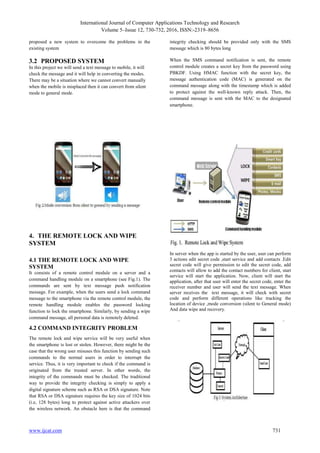
It consists of a remote control module on a server and a
command handling module on a smartphone (see Fig.1). The
commands are sent by text message push notification
message. For example, when the users send a lock command
message to the smartphone via the remote control module, the
remote handling module enables the password locking
function to lock the smartphone. Similarly, by sending a wipe
command message, all personal data is remotely deleted.
4.2 COMMAND INTEGRITY PROBLEM
The remote lock and wipe service will be very useful when
the smartphone is lost or stolen. However, there might be the
case that the wrong user misuses this function by sending such
commands to the normal users in order to interrupt the
service. Thus, it is very important to check if the command is
originated from the trusted server. In other words, the
integrity of the commands must be checked. The traditional
way to provide the integrity checking is simply to apply a
digital signature scheme such as RSA or DSA signature. Note
that RSA or DSA signature requires the key size of 1024 bits
(i.e, 128 bytes) long to protect against active attackers over
the wireless network. An obstacle here is that the command
integrity checking should be provided only with the SMS
message which is 80 bytes long
When the SMS command notification is sent, the remote
control module creates a secret key from the password using
PBKDF. Using HMAC function with the secret key, the
message authentication code (MAC) is generated on the
command message along with the timestamp which is added
to protect against the well-known reply attack. Then, the
command message is sent with the MAC to the designated
smartphone.
In server when the app is started by the user, user can perform
3 actions edit secret code ,start service and add contacts .Edit
secret code will give permission to edit the secret code, add
contacts will allow to add the contact numbers for client, start
service will start the application. Now, client will start the
application, after that user will enter the secret code, enter the
receiver number and user will send the text message. When
server receives the text message, it will check with secret
code and perform different operations like tracking the
location of device ,mode conversion (silent to General mode)
And data wipe and recovery.
International Journal of Computer Applications Technology and Research
Volume 5–Issue 12, 730-732, 2016, ISSN:-2319–8656
www.ijcat.com 732
5. CONCLUSION
This application is developed in android platform and this
provides higher curiosity to the android users. This system
provides the location of device and efficient method for
finding out the smart phones where it is placed(in silent
mode) it is helpful in changing from silent mode to General
Mode and also The remote lock and wipe service is necessary
to protect against the private data disclose. At the same time,
it must prevent the unknown user from launching DOS attacks
that sends such commands to the normal users intentionally.
6. REFERENCES
[1]http://compnetworking.about.com/od/basicnetworkingconc
epts/a/networktypes.html
[2]http://homeguides.sfgate.com/advantages-smart-house
8670.html
[3]http://en.wikipedia.org/wiki/Mobilesecurity
[4]Smartphone OS Market Share
http://www.idc.com/prodserv/smartphone os-
marketshare.jspast accessed January 15th, 2105.
[5]K.Jones and L. Liu, What where wiAn analysis of millions
of wi access points,PORTABLE07. IEEE International
Conference on Portable Information Devicespp. 25,29,2007
[6]Y . Cheng,Y. Chawathe, A. LaMarca, and J. Krumm,
Accuracy characterization for metropolitan scale Wi - Fi
localization, in Proceedings of the 3rd international
conference on Mobile systems, applications, and services.
ACM p.245 , 2005.
[7]Y.F .Chang, C.S. Chen, and H. Zhou, " Smart Phone For
Mobile Commerce",Computer Standards Interfaces ,Vol . 31,
Issue 4, June, 2009
[8]Sha k G. Punfa and Richard P. Mislan , "Smartphone
Device Analysis", Small Scale Digital Device Forensics
Journal , Vol. 2, No. 1, June, 2008.
[9]A . Menezes , P. van Oorschot , and S. Vanstone,
"Handbook of Applied Cryptography", CRC Press, 1996
[10]RSA Laboratories, "PKCS 5 v2.0: Password - Based
Crypto - graphy Standard",March, 1999.

Smartphone Remote Detection and Wipe System using SMS

  • 1.
    International Journal ofComputer Applications Technology and Research Volume 5–Issue 12, 730-732, 2016, ISSN:-2319–8656 www.ijcat.com 730 Smartphone Remote Detection and Wipe System using SMS Nilesh Dorge Department of Computer Engineering, Savitribai Phule Pune University, Pune, India Atish Pawar Department of Computer Engineering, Savitribai Phule Pune University, Pune, India Suraj Khandbale Department of Computer Engineering, Savitribai Phule Pune University, Pune, India Abhijit Jachak Department of Computer Engineering, Savitribai Phule Pune University, Pune, India Shubham Nirmal Department of Computer Engineering, Savitribai Phule Pune University, Pune, India Prof. Jitendra Musale Department of Computer Engineering, Savitribai Phule Pune University, Pune, India Abstract: The project based on mobile application which functions on an Android operating system. The objective of this which enable the user to locate the mobile phone in a silent mode to General mode when it is misplaced as well as if it is lost and wipe the data from the device. To create an account the user needs to provide his /her mobile number, a password and 4 trustworthy numbers this completes the registration process. The application, which is still in a deactivation mode, will operate only when the phone is misplaced and the user sends the set password/ pass code from one of the 4 trustworthy numbers to one’s own mobile number. This will change the profile of the misplaced phone i.e. switch it from the silent mode to the sound mode. It will also send an acknowledgement to the trustworthy number from which the user has sent the message. Furthermore, it will also provide the location with and also if mobile is lost then we can take back up from another mobile by using same application, we can also wipe the data remotely by sending the message. Keywords: Real-time, location tracking, Android. 1. INTRODUCTION In this paper we are focusing on three major topics GPS, Mode conversion (silent to general) and Data Wipe & Recovery. Rapid evaluation of wireless technologies has provided a platform to support system in the domain of location tracking. Mobile devices such as phones are common and internet access is possible everywhere in daily. Worldwide out of 100% people who uses smart phone Probably 80% and above uses android operating system according to International Corporation market researches. Android is common with its open source nature and working capabilities on in expensive mobile devices. Location tracking is continuously monitoring a device by using obtained coordinates with GPS. Nowadays smart phone is mostly used by every human , sometimes some people face problem in finding the mobile are controlled by the smart phones, this Application helps to find the mobile when it is misplaced. This application is useful, when it is in silent and forgotten where it is placed.As enabling all the users to receive advantages and satisfaction, the smartphone have been applied in a variety range and it expand a range of security threat. Specially, security threat of the android phone by loss or stolen may cause the user data disclosure such as credit cards, login IDs, contacts, message, photos etc. To prevent these problems, network operators should provide some security by which intruder can not use mobile devices by and also need to support the remote lock and wipe services which delete users’ data as in the state of factory reset. 2. ANDROID BASED ENERGY AWARE REAL-TIME LOCATION TRACKING SYSTEM. EWAREL adopts a client-server scheme. User client is an android application that performs real-time background tracking and synchronizing to server in a given interval while internet connection is present .It stores location changes when internet access in not possible and synchronize as soon as mobile device is connected to internet. Monitoring client is also an android application to accomplish tracking of people to monitor. Monitoring application alerts when one of the clients does not send location data at predefined interval to server and becomes unreachable. 3. AUTO MODE CONVERSION 3.1 EXISTING SYSTEM In the previous projects the message sent will be sent as a normal text message to the other mobile .But there is no application developed to change the modes of the mobile automatically by receiving a text message. For mobile recovery we have applications, which use Global Positioning System technology. If we want to change the mode we have to change it manually, this is the main disadvantage. So we have
  • 2.
    International Journal ofComputer Applications Technology and Research Volume 5–Issue 12, 730-732, 2016, ISSN:-2319–8656 www.ijcat.com 731 proposed a new system to overcome the problems in the existing system 3.2 PROPOSED SYSTEM In this project we will send a text message to mobile, it will check the message and it will help in converting the modes. There may be a situation where we cannot convert manually when the mobile is misplaced then it can convert from silent mode to general mode. 4. THE REMOTE LOCK AND WIPE SYSTEM 4.1 THE REMOTE LOCK AND WIPE SYSTEM It consists of a remote control module on a server and a command handling module on a smartphone (see Fig.1). The commands are sent by text message push notification message. For example, when the users send a lock command message to the smartphone via the remote control module, the remote handling module enables the password locking function to lock the smartphone. Similarly, by sending a wipe command message, all personal data is remotely deleted. 4.2 COMMAND INTEGRITY PROBLEM The remote lock and wipe service will be very useful when the smartphone is lost or stolen. However, there might be the case that the wrong user misuses this function by sending such commands to the normal users in order to interrupt the service. Thus, it is very important to check if the command is originated from the trusted server. In other words, the integrity of the commands must be checked. The traditional way to provide the integrity checking is simply to apply a digital signature scheme such as RSA or DSA signature. Note that RSA or DSA signature requires the key size of 1024 bits (i.e, 128 bytes) long to protect against active attackers over the wireless network. An obstacle here is that the command integrity checking should be provided only with the SMS message which is 80 bytes long When the SMS command notification is sent, the remote control module creates a secret key from the password using PBKDF. Using HMAC function with the secret key, the message authentication code (MAC) is generated on the command message along with the timestamp which is added to protect against the well-known reply attack. Then, the command message is sent with the MAC to the designated smartphone. In server when the app is started by the user, user can perform 3 actions edit secret code ,start service and add contacts .Edit secret code will give permission to edit the secret code, add contacts will allow to add the contact numbers for client, start service will start the application. Now, client will start the application, after that user will enter the secret code, enter the receiver number and user will send the text message. When server receives the text message, it will check with secret code and perform different operations like tracking the location of device ,mode conversion (silent to General mode) And data wipe and recovery.
  • 3.
    International Journal ofComputer Applications Technology and Research Volume 5–Issue 12, 730-732, 2016, ISSN:-2319–8656 www.ijcat.com 732 5. CONCLUSION This application is developed in android platform and this provides higher curiosity to the android users. This system provides the location of device and efficient method for finding out the smart phones where it is placed(in silent mode) it is helpful in changing from silent mode to General Mode and also The remote lock and wipe service is necessary to protect against the private data disclose. At the same time, it must prevent the unknown user from launching DOS attacks that sends such commands to the normal users intentionally. 6. REFERENCES [1]http://compnetworking.about.com/od/basicnetworkingconc epts/a/networktypes.html [2]http://homeguides.sfgate.com/advantages-smart-house 8670.html [3]http://en.wikipedia.org/wiki/Mobilesecurity [4]Smartphone OS Market Share http://www.idc.com/prodserv/smartphone os- marketshare.jspast accessed January 15th, 2105. [5]K.Jones and L. Liu, What where wiAn analysis of millions of wi access points,PORTABLE07. IEEE International Conference on Portable Information Devicespp. 25,29,2007 [6]Y . Cheng,Y. Chawathe, A. LaMarca, and J. Krumm, Accuracy characterization for metropolitan scale Wi - Fi localization, in Proceedings of the 3rd international conference on Mobile systems, applications, and services. ACM p.245 , 2005. [7]Y.F .Chang, C.S. Chen, and H. Zhou, " Smart Phone For Mobile Commerce",Computer Standards Interfaces ,Vol . 31, Issue 4, June, 2009 [8]Sha k G. Punfa and Richard P. Mislan , "Smartphone Device Analysis", Small Scale Digital Device Forensics Journal , Vol. 2, No. 1, June, 2008. [9]A . Menezes , P. van Oorschot , and S. Vanstone, "Handbook of Applied Cryptography", CRC Press, 1996 [10]RSA Laboratories, "PKCS 5 v2.0: Password - Based Crypto - graphy Standard",March, 1999.