Endothermic reactions
Endothermic reactions absorb thermal energy, and so
cause a decrease in temperature.

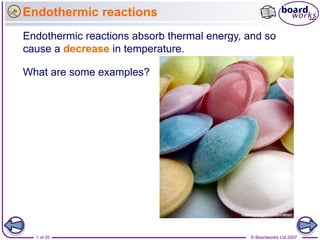
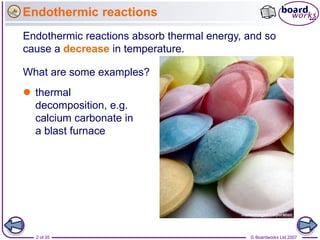
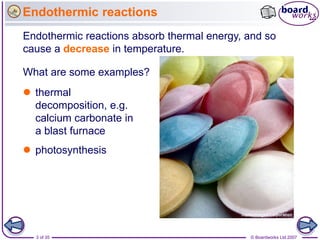
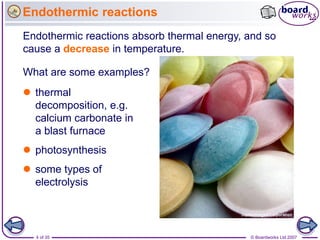
What are some examples?


  1 of 35                                    © Boardworks Ltd 2007
Endothermic reactions
Endothermic reactions absorb thermal energy, and so
cause a decrease in temperature.

What are some examples?
 thermal
  decomposition, e.g.
  calcium carbonate in
  a blast furnace


  2 of 35                                    © Boardworks Ltd 2007
Endothermic reactions
Endothermic reactions absorb thermal energy, and so
cause a decrease in temperature.

What are some examples?
 thermal
  decomposition, e.g.
  calcium carbonate in
  a blast furnace
 photosynthesis


  3 of 35                                    © Boardworks Ltd 2007
Endothermic reactions
Endothermic reactions absorb thermal energy, and so
cause a decrease in temperature.

What are some examples?
 thermal
  decomposition, e.g.
  calcium carbonate in
  a blast furnace
 photosynthesis
 some types of
  electrolysis


  4 of 35                                    © Boardworks Ltd 2007
Endothermic reactions
Endothermic reactions absorb thermal energy, and so
cause a decrease in temperature.

What are some examples?
 thermal
  decomposition, e.g.
  calcium carbonate in
  a blast furnace
 photosynthesis
 some types of
  electrolysis
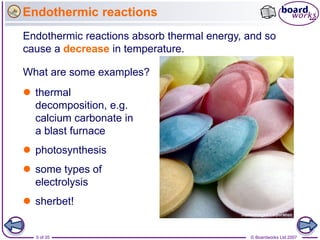
 sherbet!


  5 of 35                                    © Boardworks Ltd 2007
Endothermic reaction: energy transfer
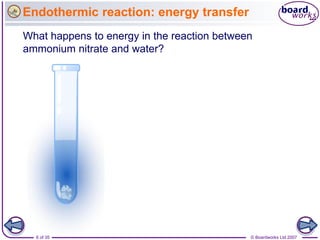
What happens to energy in the reaction between
ammonium nitrate and water?


  6 of 35                                    © Boardworks Ltd 2007
Endothermic reaction: energy transfer
What happens to energy in the reaction between
ammonium nitrate and water?
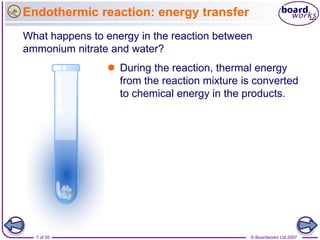
                 During the reaction, thermal energy
                  from the reaction mixture is converted
                  to chemical energy in the products.


  7 of 35                                     © Boardworks Ltd 2007
Endothermic reaction: energy transfer
What happens to energy in the reaction between
ammonium nitrate and water?
                 During the reaction, thermal energy
                  from the reaction mixture is converted
                  to chemical energy in the products.
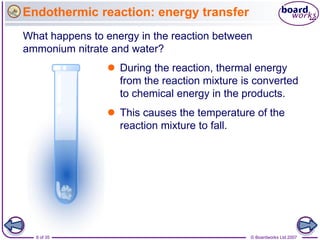
                 This causes the temperature of the
                  reaction mixture to fall.


  8 of 35                                     © Boardworks Ltd 2007
Endothermic reaction: energy transfer
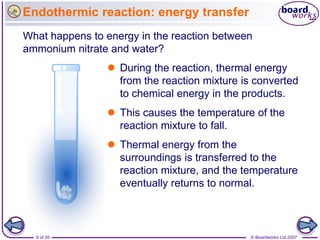
What happens to energy in the reaction between
ammonium nitrate and water?
                 During the reaction, thermal energy
                  from the reaction mixture is converted
                  to chemical energy in the products.
                 This causes the temperature of the
                  reaction mixture to fall.
                 Thermal energy from the
                  surroundings is transferred to the
                  reaction mixture, and the temperature
                  eventually returns to normal.


  9 of 35                                     © Boardworks Ltd 2007

IGCSE 11.1.5

  • 1.
    Endothermic reactions Endothermic reactionsabsorb thermal energy, and so cause a decrease in temperature. What are some examples? 1 of 35 © Boardworks Ltd 2007
  • 2.
    Endothermic reactions Endothermic reactionsabsorb thermal energy, and so cause a decrease in temperature. What are some examples?  thermal decomposition, e.g. calcium carbonate in a blast furnace 2 of 35 © Boardworks Ltd 2007
  • 3.
    Endothermic reactions Endothermic reactionsabsorb thermal energy, and so cause a decrease in temperature. What are some examples?  thermal decomposition, e.g. calcium carbonate in a blast furnace  photosynthesis 3 of 35 © Boardworks Ltd 2007
  • 4.
    Endothermic reactions Endothermic reactionsabsorb thermal energy, and so cause a decrease in temperature. What are some examples?  thermal decomposition, e.g. calcium carbonate in a blast furnace  photosynthesis  some types of electrolysis 4 of 35 © Boardworks Ltd 2007
  • 5.
    Endothermic reactions Endothermic reactionsabsorb thermal energy, and so cause a decrease in temperature. What are some examples?  thermal decomposition, e.g. calcium carbonate in a blast furnace  photosynthesis  some types of electrolysis  sherbet! 5 of 35 © Boardworks Ltd 2007
  • 6.
    Endothermic reaction: energytransfer What happens to energy in the reaction between ammonium nitrate and water? 6 of 35 © Boardworks Ltd 2007
  • 7.
    Endothermic reaction: energytransfer What happens to energy in the reaction between ammonium nitrate and water?  During the reaction, thermal energy from the reaction mixture is converted to chemical energy in the products. 7 of 35 © Boardworks Ltd 2007
  • 8.
    Endothermic reaction: energytransfer What happens to energy in the reaction between ammonium nitrate and water?  During the reaction, thermal energy from the reaction mixture is converted to chemical energy in the products.  This causes the temperature of the reaction mixture to fall. 8 of 35 © Boardworks Ltd 2007
  • 9.
    Endothermic reaction: energytransfer What happens to energy in the reaction between ammonium nitrate and water?  During the reaction, thermal energy from the reaction mixture is converted to chemical energy in the products.  This causes the temperature of the reaction mixture to fall.  Thermal energy from the surroundings is transferred to the reaction mixture, and the temperature eventually returns to normal. 9 of 35 © Boardworks Ltd 2007