2
14
Subject:
Topic:
Prepared By:
Class:
Section:
Submitted To:
Chemistry
10th
A
Rakesh Kumar
Endothermic and Exothermic Reaction
Mukesh Sir
7s 2
14
Endothermic and
Exothermic
Reaction
Table of contents:
Chemical Reactions
Energy and Reactions
Activation Energy
Endothermic Reaction
Exothermic Reaction
Energy Level Diagram
Conclusion
Chemical
Reactions
• All chemical reactions involve bond
breaking and bond forming.
• Energy is needed to break bonds and
released when bonds are formed.
• Chemical reactions are accompanied
by a change in energy, mainly in the
form of heat.
Energy and Reactions
• Chemical reactions always involve changes in
energy.
• Energy must be added to break bonds.
• Energy can be in the form of heat, electricity,
sound or light.
• Forming bonds release energy
• Energy is always conserved in chemical
reactions. (Law of Conservation of Energy)
Activation Energy
The energy required to break the
bonds in the reactants for a
chemical reaction to occur.
Endothermic Process
A few examples of the endothermic process are
photosynthesis, evaporating liquids, melting ice, dry
ice, alkane cracking, thermal decomposition,
ammonium chloride in water and much more.
The endothermic process is a term that describes a
reaction where the system absorbs the energy from
its surrounding in the form of heat.
2
1
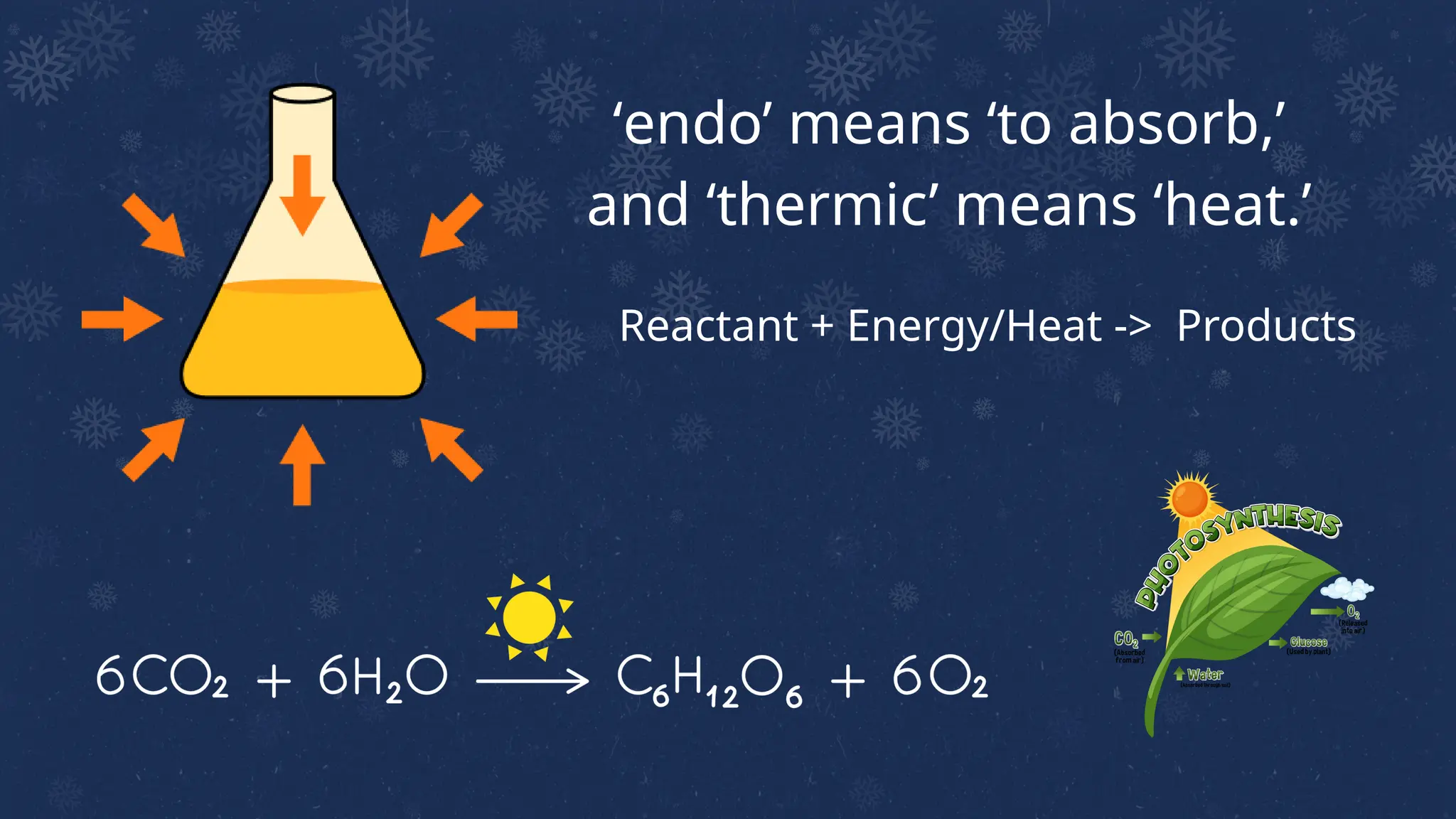
‘endo’ means ‘to absorb,’
and ‘thermic’ means ‘heat.’
Reactant + Energy/Heat -> Products
Endothermic Process
A few examples are neutralisation, burning a
substance, reactions of fuels, deposition of dry ice,
respiration, solution of sulphuric acid into water
and much more.
The exothermic reaction is the opposite of an
endothermic reaction. It releases energy by light or
heat to its surrounding.
2
1
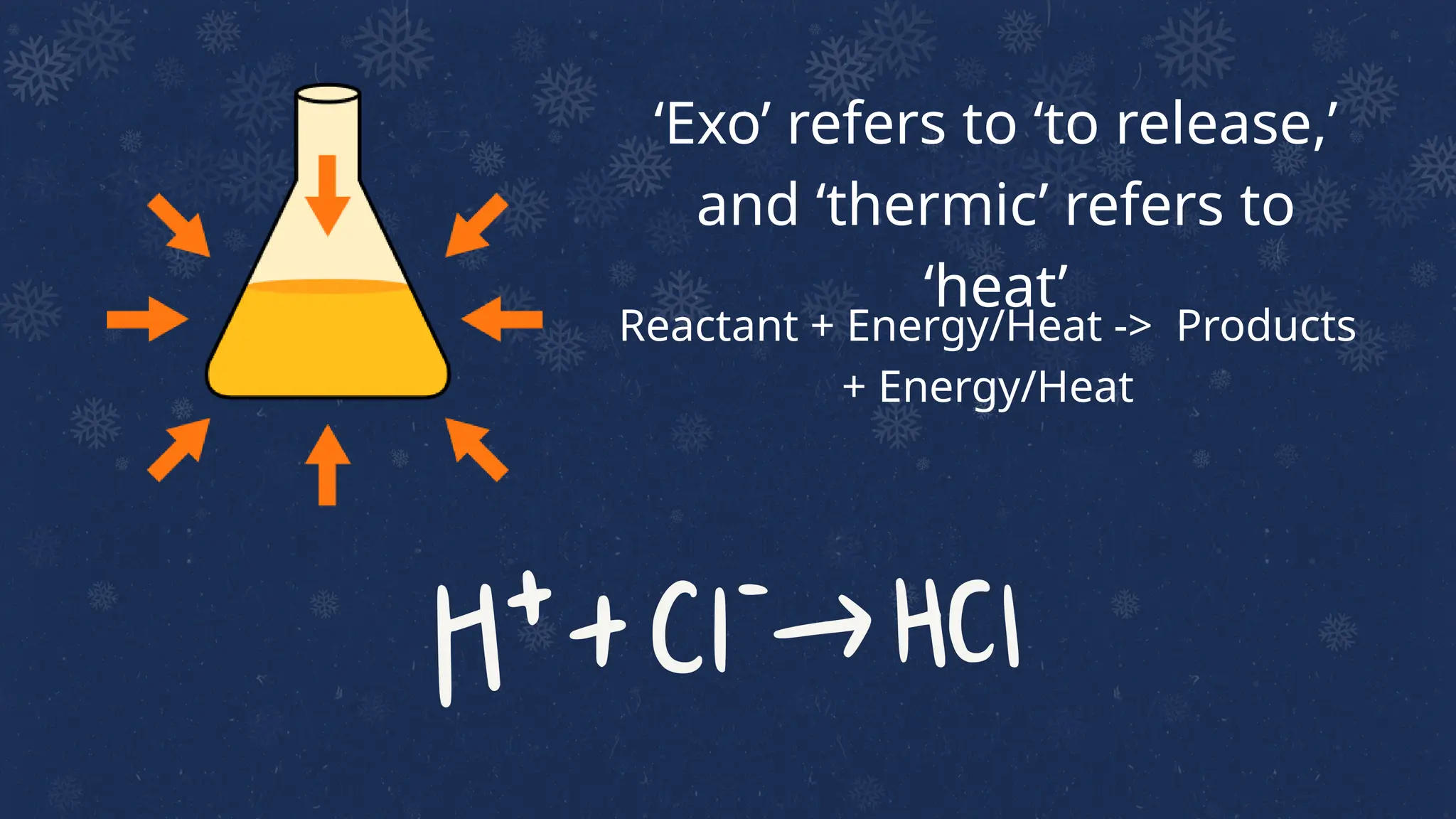
‘Exo’ refers to ‘to release,’
and ‘thermic’ refers to
‘heat’
Reactant + Energy/Heat -> Products
+ Energy/Heat
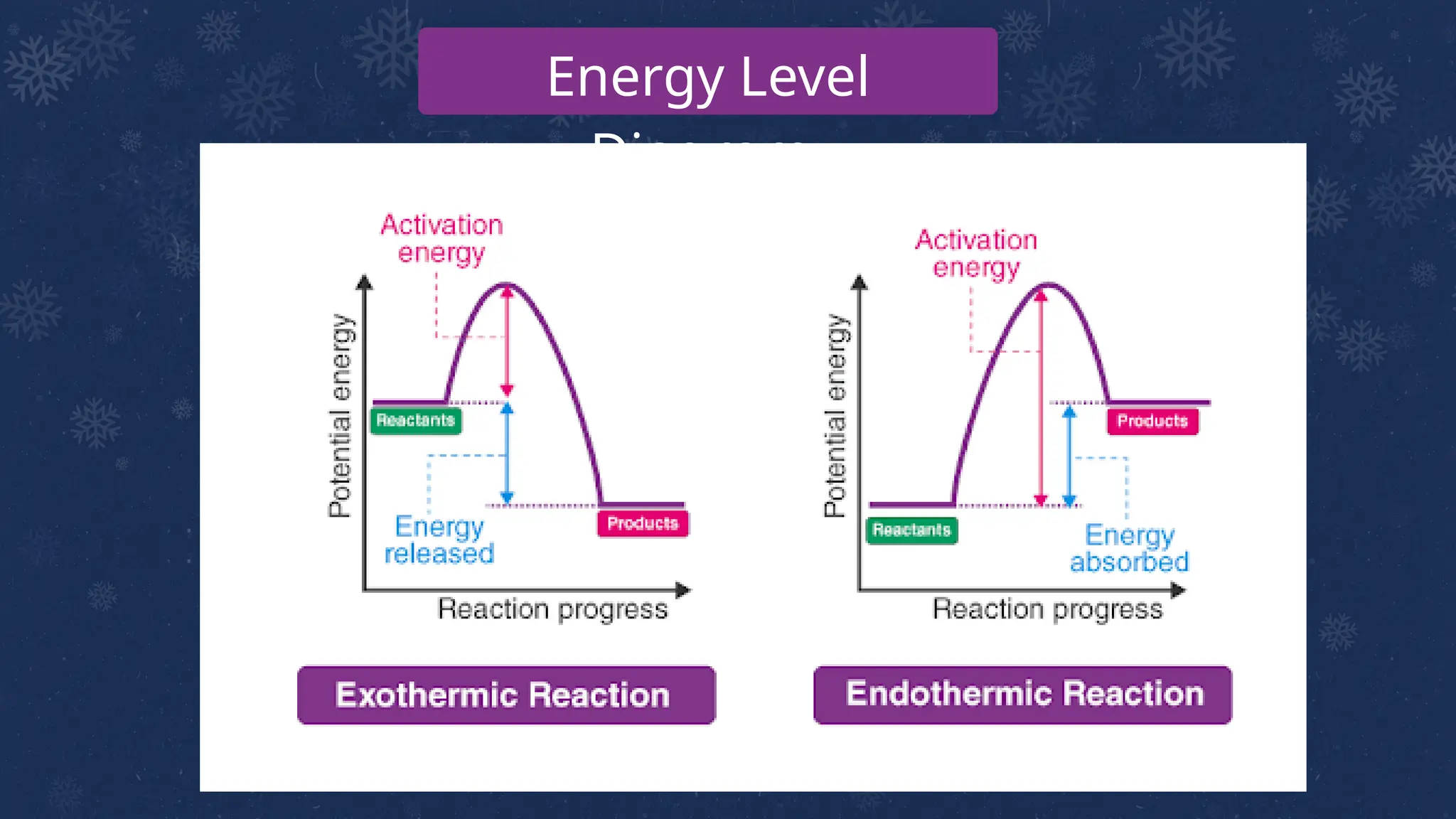
Energy Level
Diagram
Conclusion
• Exothermic reactions release more energy when new bonds form
in the products than is needed to break bonds in the reactants.
The energy released is greater than the energy required to break
the initial bonds.
• Endothermic reactions absorb more energy to break bonds in the
reactants than is released when new bonds form in the products.
These reactions require a continuous input of energy, usually in
the form of heat, because the energy needed to break the bonds
is greater than the energy released when new bonds form.
Thank You!

Endothermic and Exothermic Reaction.pptx

  • 1.
  • 2.
  • 3.
    Table of contents: ChemicalReactions Energy and Reactions Activation Energy Endothermic Reaction Exothermic Reaction Energy Level Diagram Conclusion
  • 4.
    Chemical Reactions • All chemicalreactions involve bond breaking and bond forming. • Energy is needed to break bonds and released when bonds are formed. • Chemical reactions are accompanied by a change in energy, mainly in the form of heat.
  • 5.
    Energy and Reactions •Chemical reactions always involve changes in energy. • Energy must be added to break bonds. • Energy can be in the form of heat, electricity, sound or light. • Forming bonds release energy • Energy is always conserved in chemical reactions. (Law of Conservation of Energy)
  • 6.
    Activation Energy The energyrequired to break the bonds in the reactants for a chemical reaction to occur.
  • 7.
    Endothermic Process A fewexamples of the endothermic process are photosynthesis, evaporating liquids, melting ice, dry ice, alkane cracking, thermal decomposition, ammonium chloride in water and much more. The endothermic process is a term that describes a reaction where the system absorbs the energy from its surrounding in the form of heat. 2 1
  • 8.
    ‘endo’ means ‘toabsorb,’ and ‘thermic’ means ‘heat.’ Reactant + Energy/Heat -> Products
  • 9.
    Endothermic Process A fewexamples are neutralisation, burning a substance, reactions of fuels, deposition of dry ice, respiration, solution of sulphuric acid into water and much more. The exothermic reaction is the opposite of an endothermic reaction. It releases energy by light or heat to its surrounding. 2 1
  • 10.
    ‘Exo’ refers to‘to release,’ and ‘thermic’ refers to ‘heat’ Reactant + Energy/Heat -> Products + Energy/Heat
  • 11.
  • 12.
    Conclusion • Exothermic reactionsrelease more energy when new bonds form in the products than is needed to break bonds in the reactants. The energy released is greater than the energy required to break the initial bonds. • Endothermic reactions absorb more energy to break bonds in the reactants than is released when new bonds form in the products. These reactions require a continuous input of energy, usually in the form of heat, because the energy needed to break the bonds is greater than the energy released when new bonds form.
  • 13.