E 
M 
A 
C 
ELSAM MANAGEMENT CONSULTANTS 
INTERNATIONAL 
FINANCIAL REPORTING 
STANDARDS 
IFRS by Sako Mayrick 
www.elsamconsult.com
E 
M 
A 
C 
Welcoming Remarks 
 Who are we? 
 Elsam Management Consultants (EMAC) is 
a pool of professional consultants in 
Finance, BSC, HR and Risk Management 
disciplines established as a limited liability 
company since 2006 
 Core Functions are: Recruitment, Training 
and Consultancies 
 More details: www.elsamconsult.com 
www.elsamconsult.com 2
E 
M 
A 
C 
Welcoming Remarks 
 Introduction of facilitators 
 Self introduction to others on your team 
 Recap- Share something on personal 
experience in Financial Reporting and 
high level expectations of this training 
 Document the expectations 
 Agree on key rules 
www.elsamconsult.com 3
E 
M 
A 
C 
Organization of this training 
 Day 1 – Overview of IFRS and Financial Statement 
Presentation 
Day 2 - Financial Instruments, IFRS 7,9 and IAS 32, 39 
Interim Financial Reports and IAS 34 
Day 3 – PPE, IAS 16, IFRS 13, IAS 28 
Day 4 - IAS 19, Employee Benefits, IFRs 10 and 
IAS 27 
Day 5 - Practical Issues in Taxation for Pension 
Funds, 
See the detailed Program Schedule in your bag 
www.elsamconsult.com 4
E 
M 
A 
C 
Day 1 
Overview of IFRS 
www.elsamconsult.com 5
E 
M 
A 
C 
Session 1 
GAAP,IASB, IFRS 
& 
Convergence Project 
www.elsamconsult.com 6
E 
M 
A 
C 
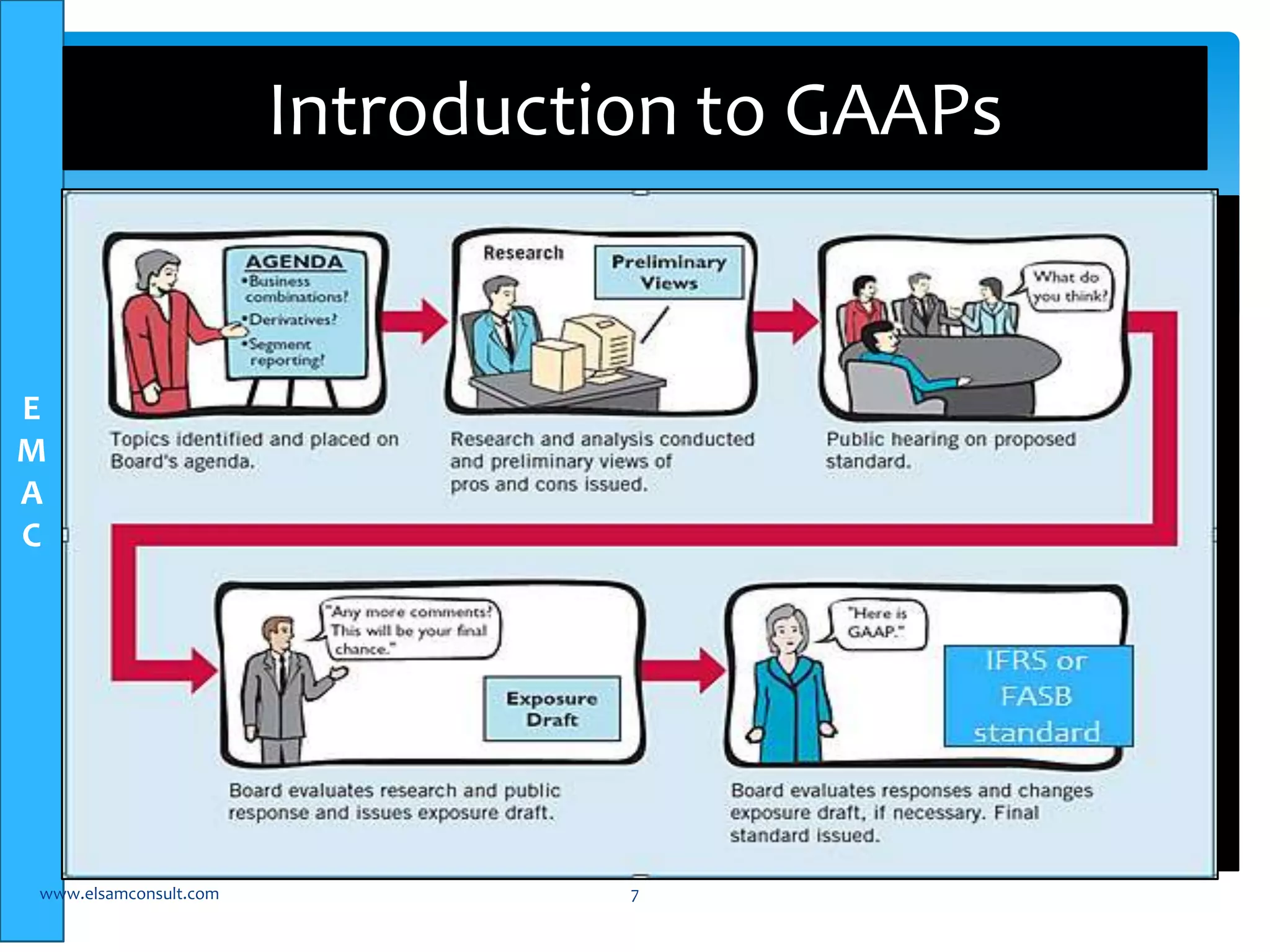
Introduction to GAAPs 
 GAAPs are set of standards that are generally accepted and 
universally practiced to recognize, classify, record and report 
financial transactions. 
 There are different types of GAAPs 
 American GAAPs 
 SEC 
 AICPA 
 FASB 
 International GAAPs 
 IFRS 
 IAS 
 IFRIC 
 SIC 
 Best Practices not yet codified 
www.elsamconsult.com 7
E 
M 
A 
C 
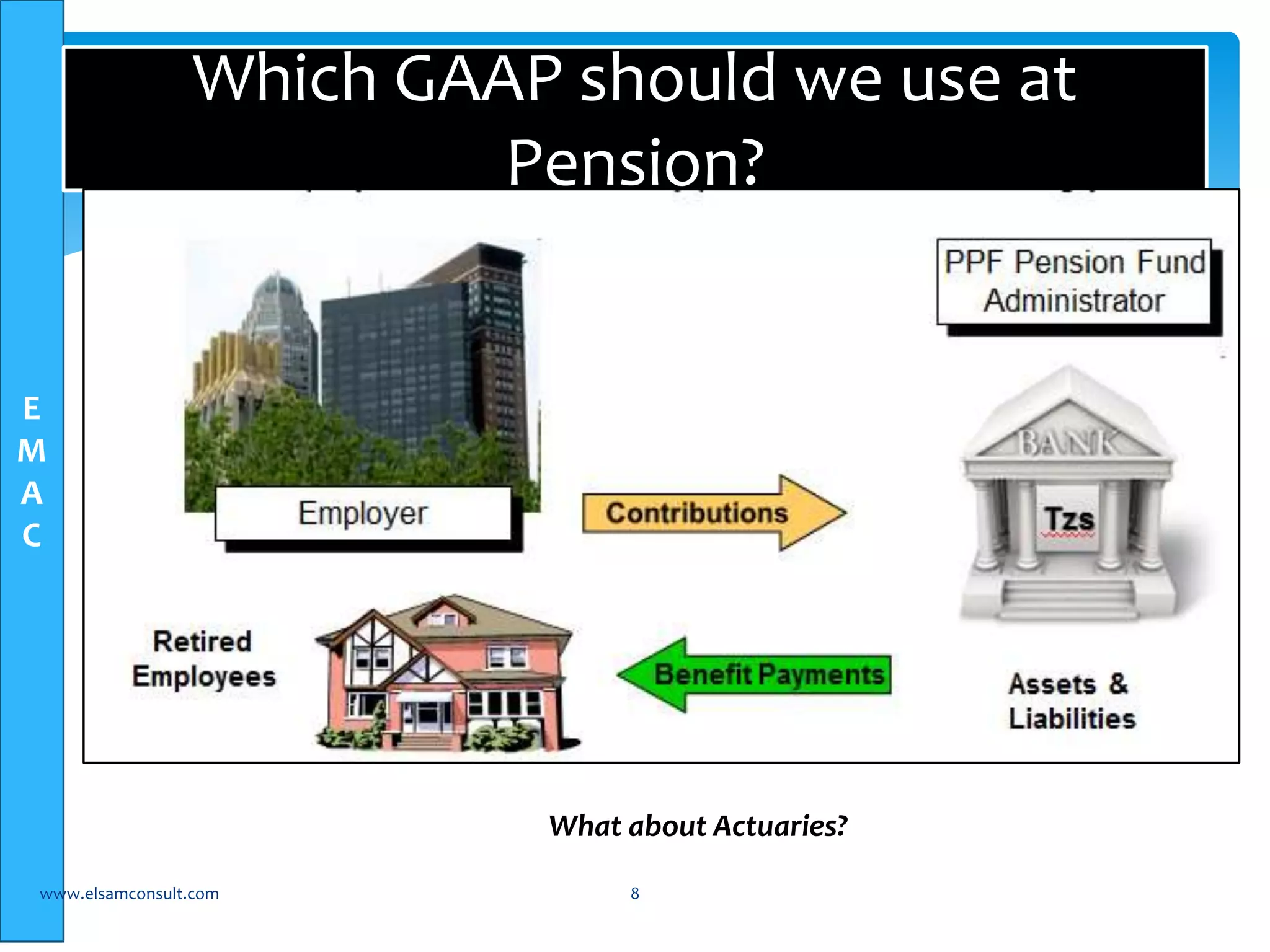
Which GAAP should we use at 
Pension? 
What about Actuaries? 
www.elsamconsult.com 8
E 
M 
A 
C 
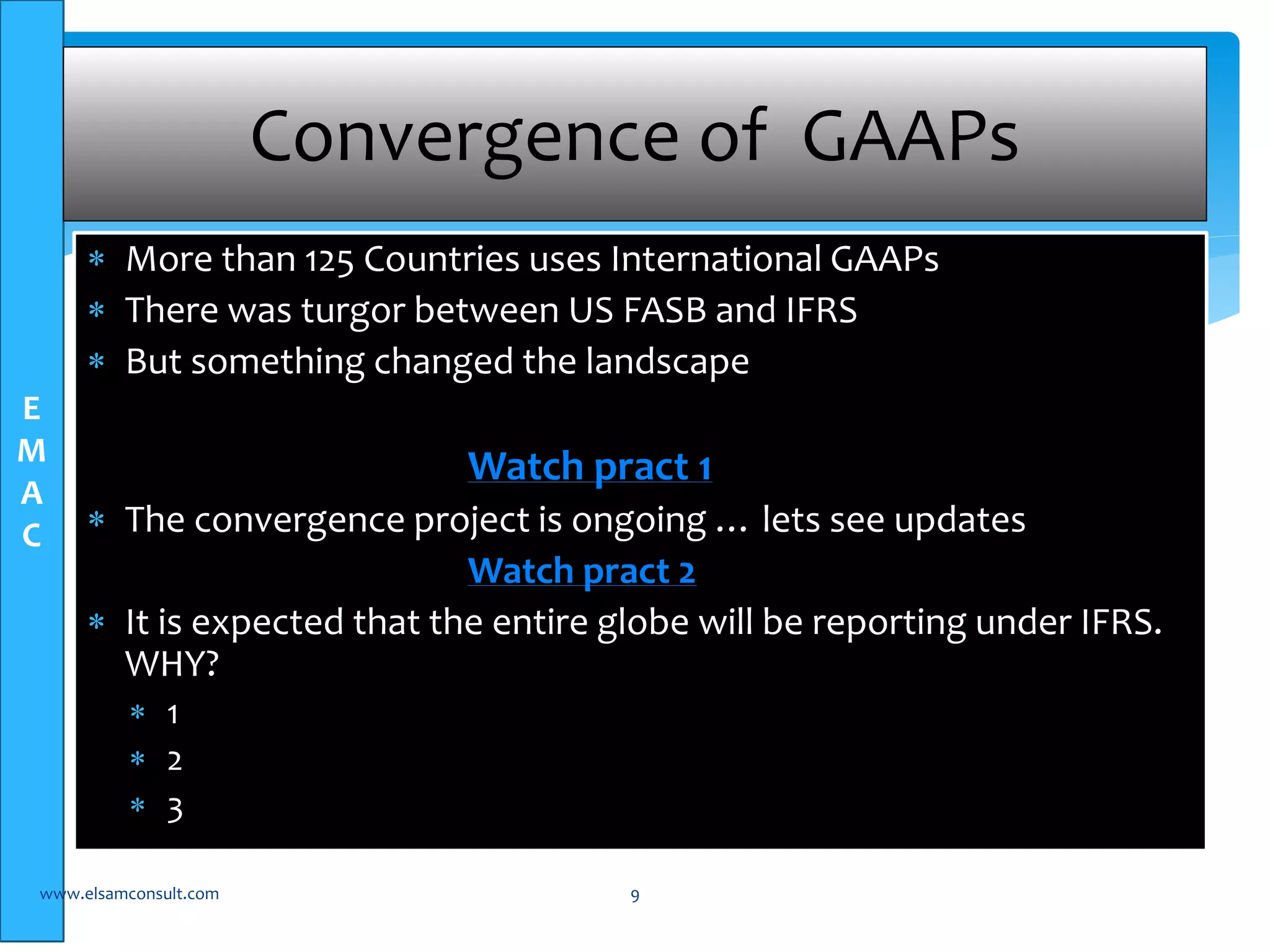
Convergence of GAAPs 
 More than 125 Countries uses International GAAPs 
 There was turgor between US FASB and IFRS 
 But something changed the landscape 
Watch pract 1 
 The convergence project is ongoing … lets see updates 
Watch pract 2 
 It is expected that the entire globe will be reporting under IFRS. 
WHY? 
 1 
 2 
 3 
www.elsamconsult.com 9
E 
M 
A 
C 
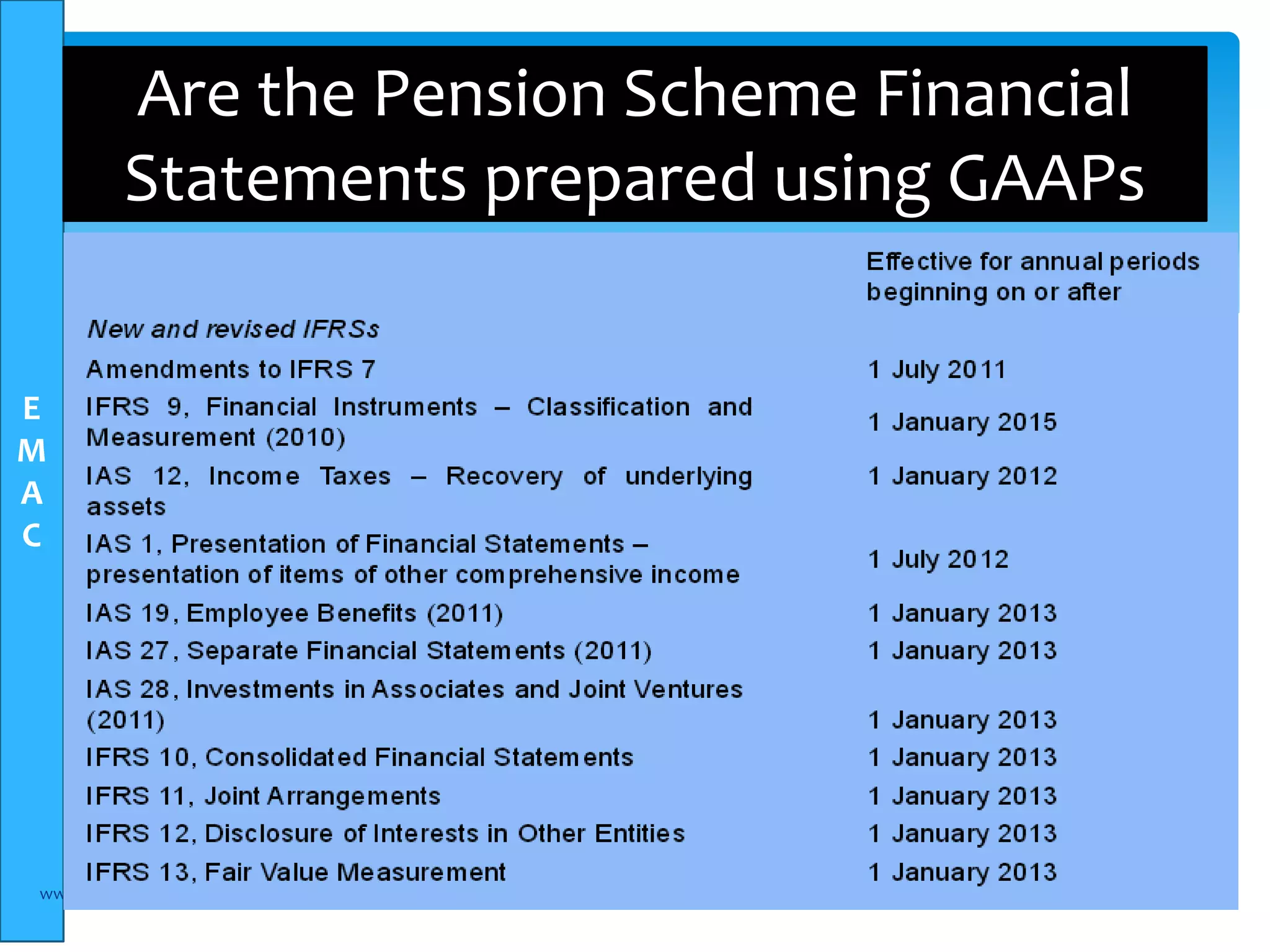
Are the Pension Scheme Financial 
Statements prepared using GAAPs 
www.elsamconsult.com 10
E 
M 
A 
C 
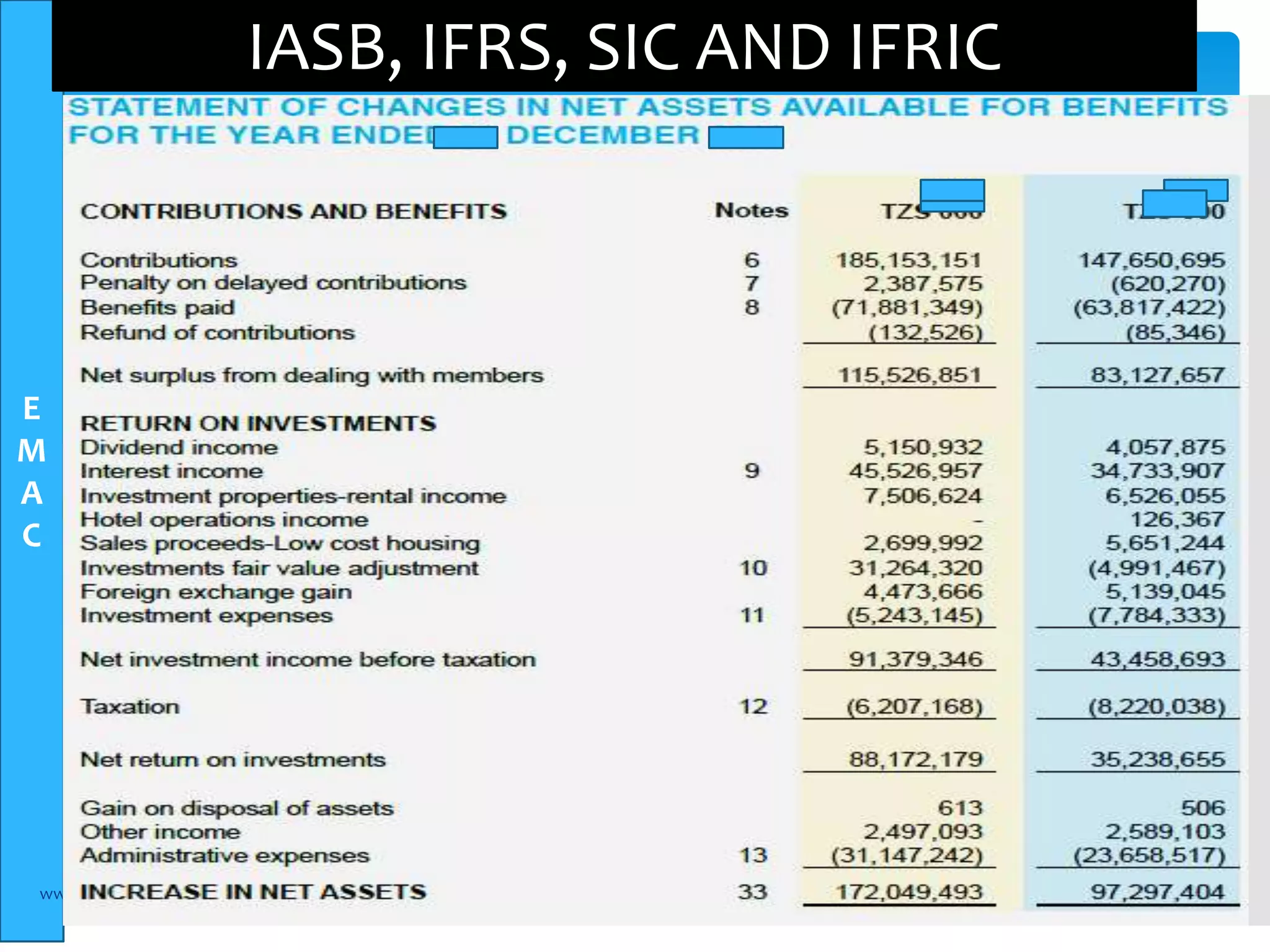
IASB, IFRS, SIC AND IFRIC 
www.elsamconsult.com 11
E 
M 
A 
C 
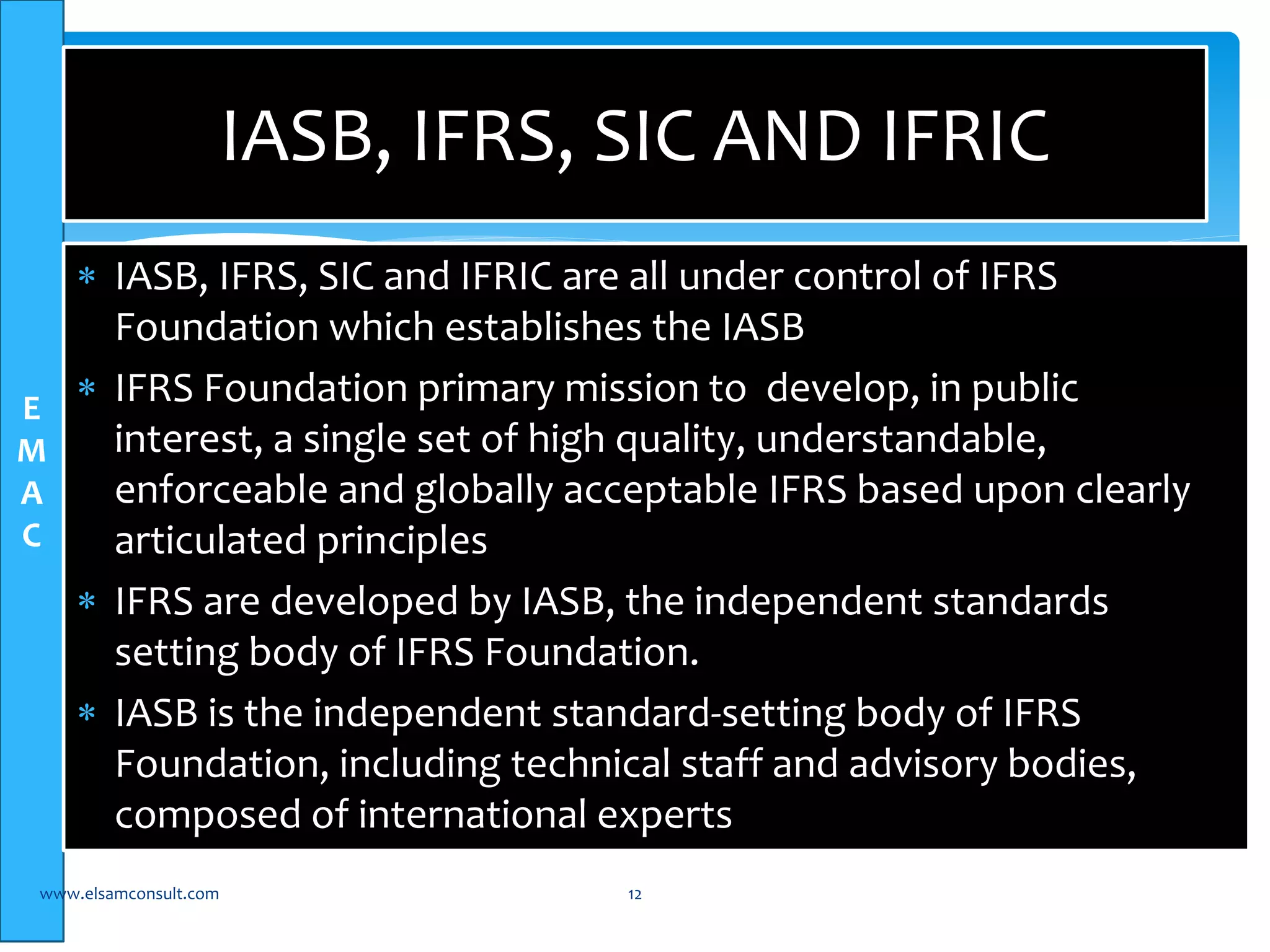
IASB, IFRS, SIC AND IFRIC 
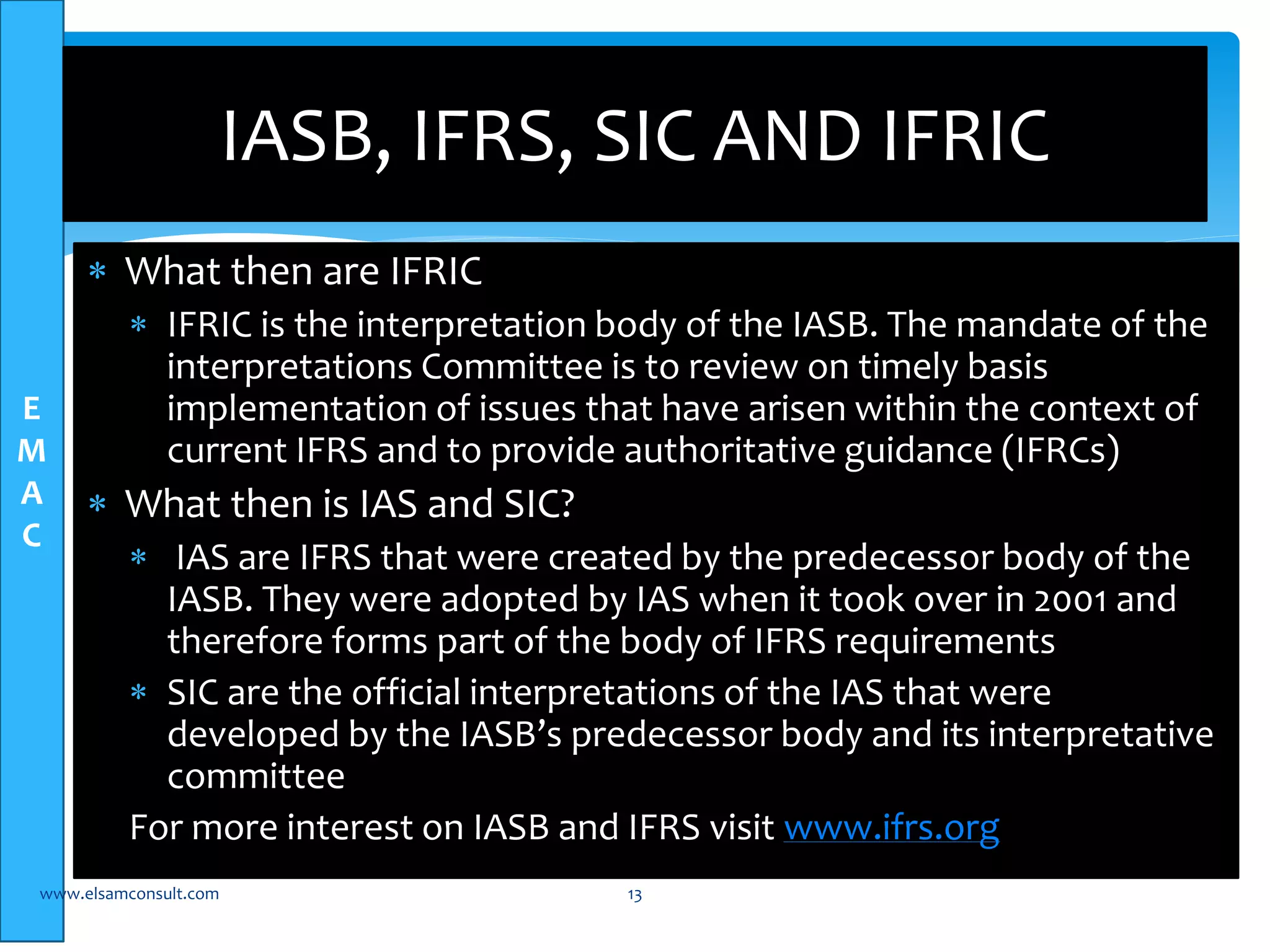
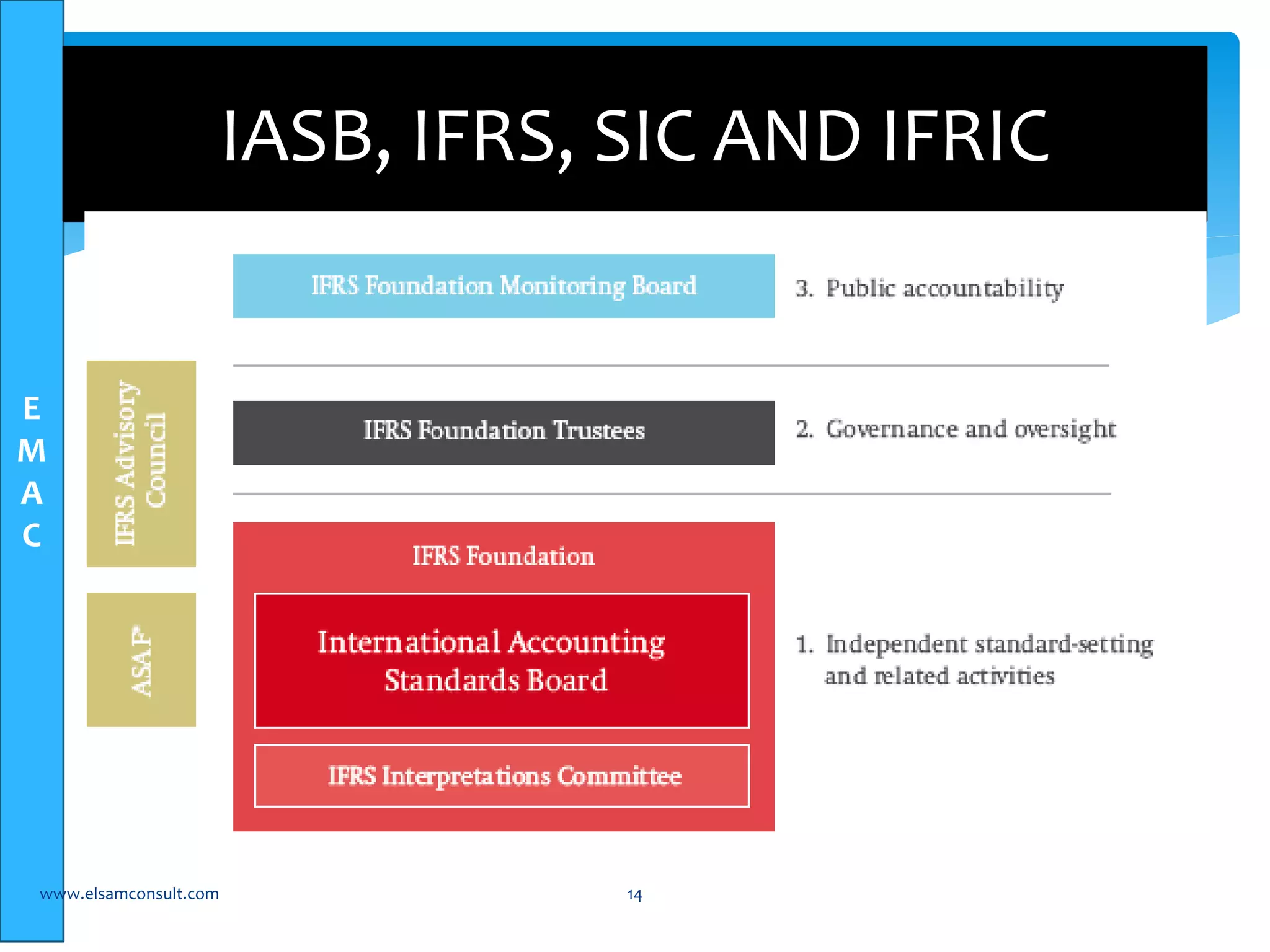
 IASB, IFRS, SIC and IFRIC are all under control of IFRS 
Foundation which establishes the IASB 
 IFRS Foundation primary mission to develop, in public 
interest, a single set of high quality, understandable, 
enforceable and globally acceptable IFRS based upon clearly 
articulated principles 
 IFRS are developed by IASB, the independent standards 
setting body of IFRS Foundation. 
 IASB is the independent standard-setting body of IFRS 
Foundation, including technical staff and advisory bodies, 
composed of international experts 
www.elsamconsult.com 12
E 
M 
A 
C 
IASB, IFRS, SIC AND IFRIC 
 What then are IFRIC 
 IFRIC is the interpretation body of the IASB. The mandate of the 
interpretations Committee is to review on timely basis 
implementation of issues that have arisen within the context of 
current IFRS and to provide authoritative guidance (IFRCs) 
 What then is IAS and SIC? 
 IAS are IFRS that were created by the predecessor body of the 
IASB. They were adopted by IAS when it took over in 2001 and 
therefore forms part of the body of IFRS requirements 
 SIC are the official interpretations of the IAS that were 
developed by the IASB’s predecessor body and its interpretative 
committee 
For more interest on IASB and IFRS visit www.ifrs.org 
www.elsamconsult.com 13
E 
M 
A 
C 
IASB, IFRS, SIC AND IFRIC 
www.elsamconsult.com 14
E 
M 
A 
C 
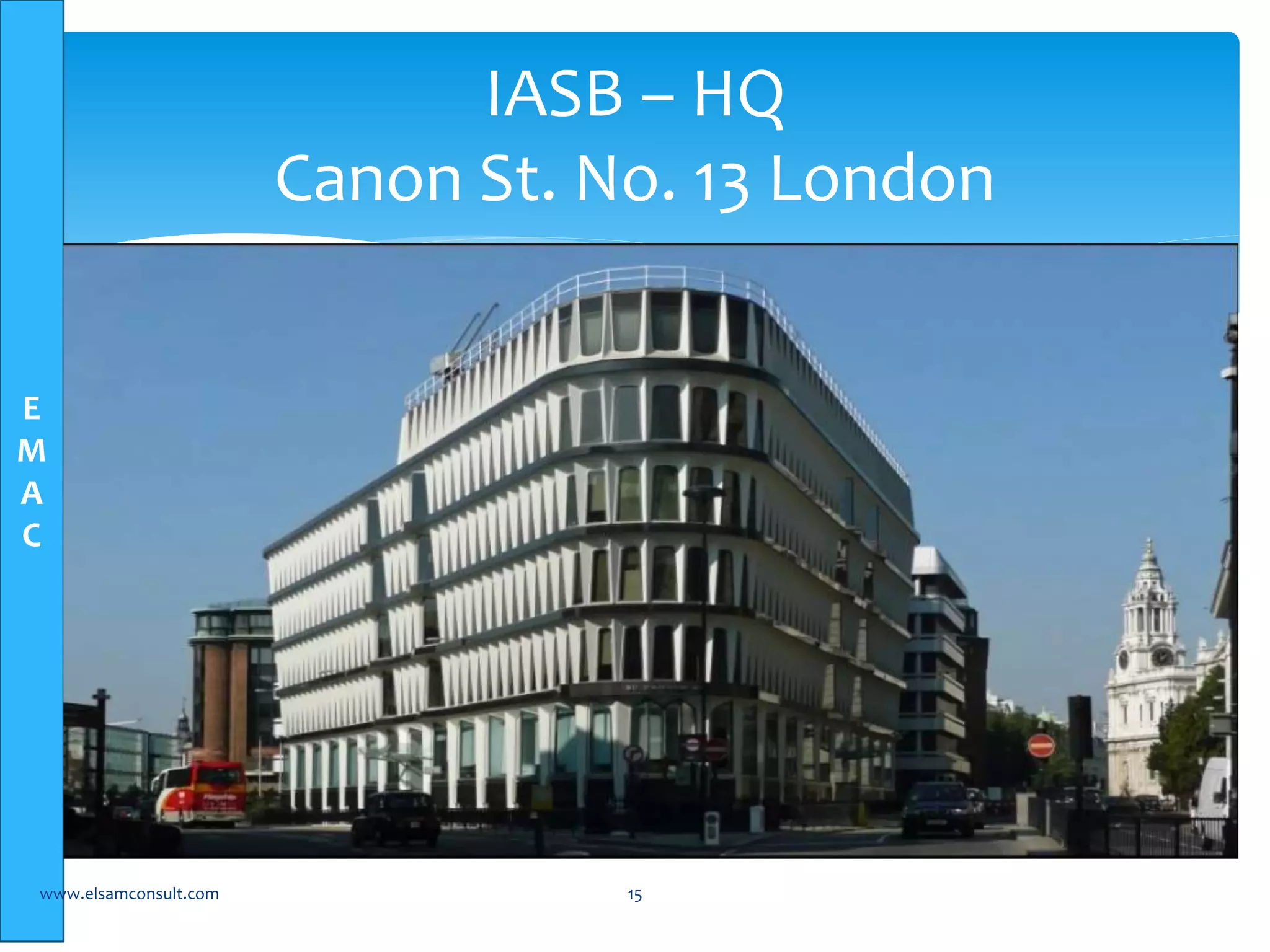
IASB – HQ 
Canon St. No. 13 London 
www.elsamconsult.com 15
E 
M 
A 
C 
Current IASB Projects 
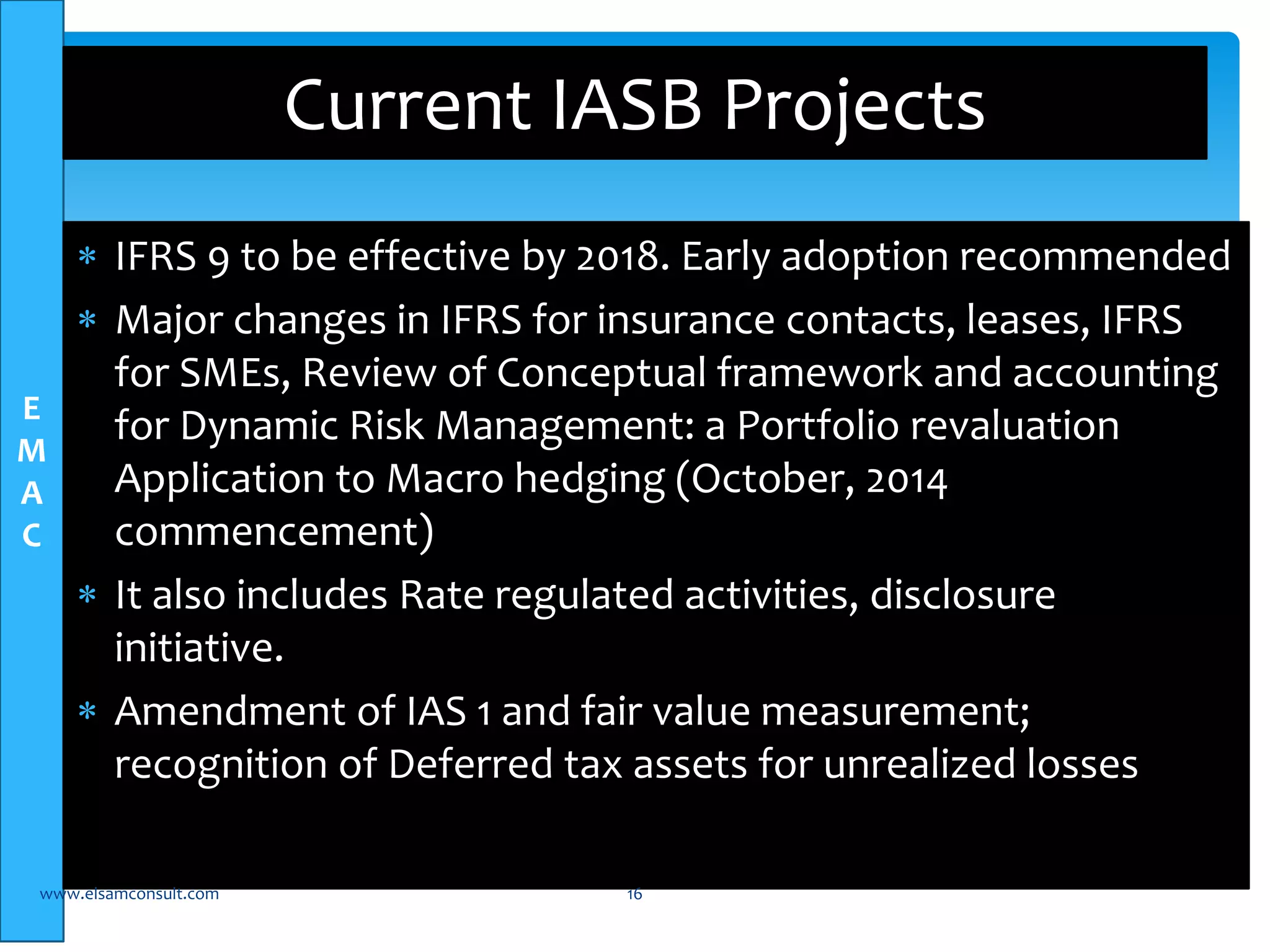
 IFRS 9 to be effective by 2018. Early adoption recommended 
 Major changes in IFRS for insurance contacts, leases, IFRS 
for SMEs, Review of Conceptual framework and accounting 
for Dynamic Risk Management: a Portfolio revaluation 
Application to Macro hedging (October, 2014 
commencement) 
 It also includes Rate regulated activities, disclosure 
initiative. 
 Amendment of IAS 1 and fair value measurement; 
recognition of Deferred tax assets for unrealized losses 
www.elsamconsult.com 16
E 
M 
A 
C 
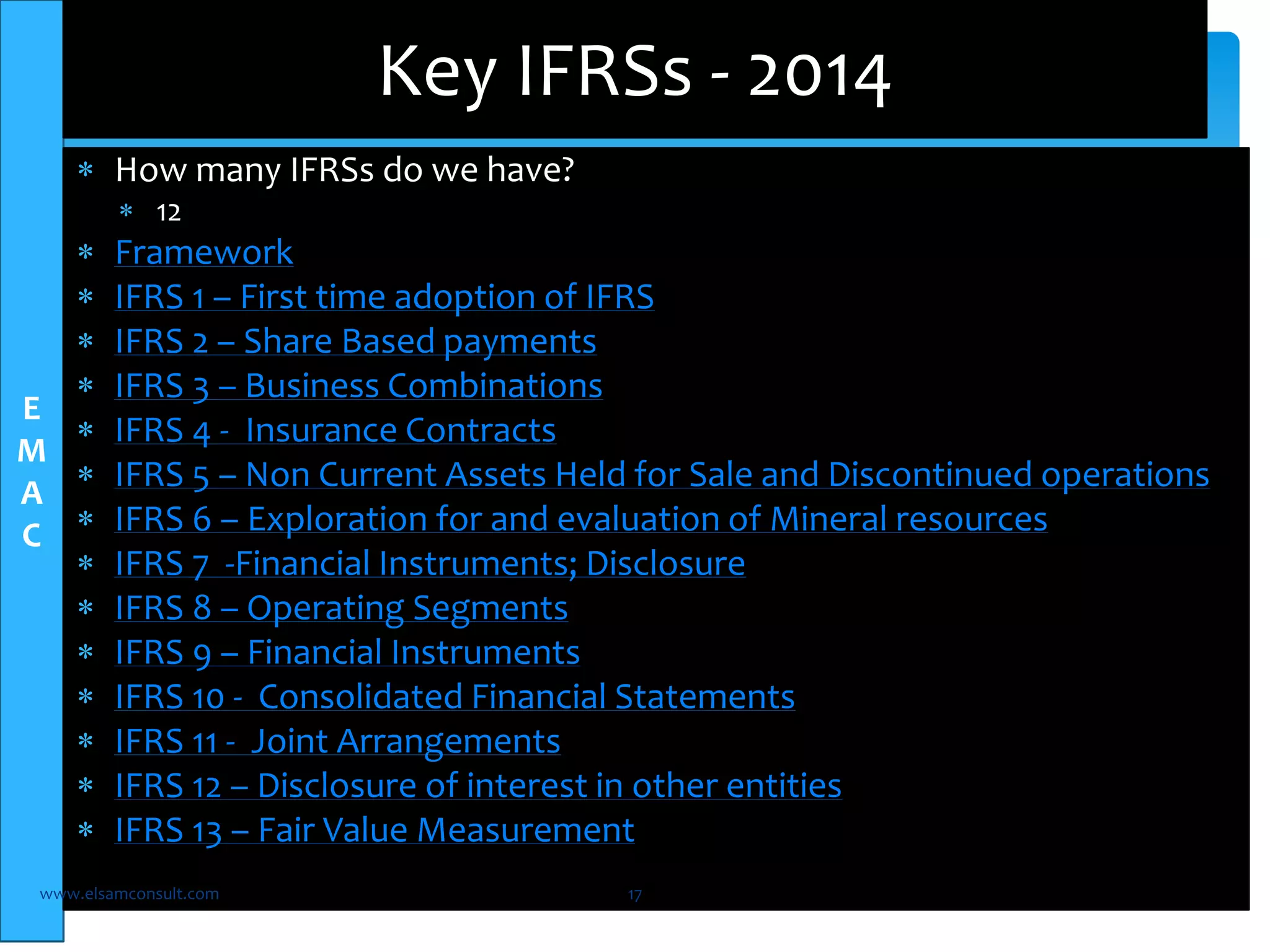
Key IFRSs - 2014 
 How many IFRSs do we have? 
 12 
 Framework 
 IFRS 1 – First time adoption of IFRS 
 IFRS 2 – Share Based payments 
 IFRS 3 – Business Combinations 
 IFRS 4 - Insurance Contracts 
 IFRS 5 – Non Current Assets Held for Sale and Discontinued operations 
 IFRS 6 – Exploration for and evaluation of Mineral resources 
 IFRS 7 -Financial Instruments; Disclosure 
 IFRS 8 – Operating Segments 
 IFRS 9 – Financial Instruments 
 IFRS 10 - Consolidated Financial Statements 
 IFRS 11 - Joint Arrangements 
 IFRS 12 – Disclosure of interest in other entities 
 IFRS 13 – Fair Value Measurement 
www.elsamconsult.com 17
E 
M 
A 
C 
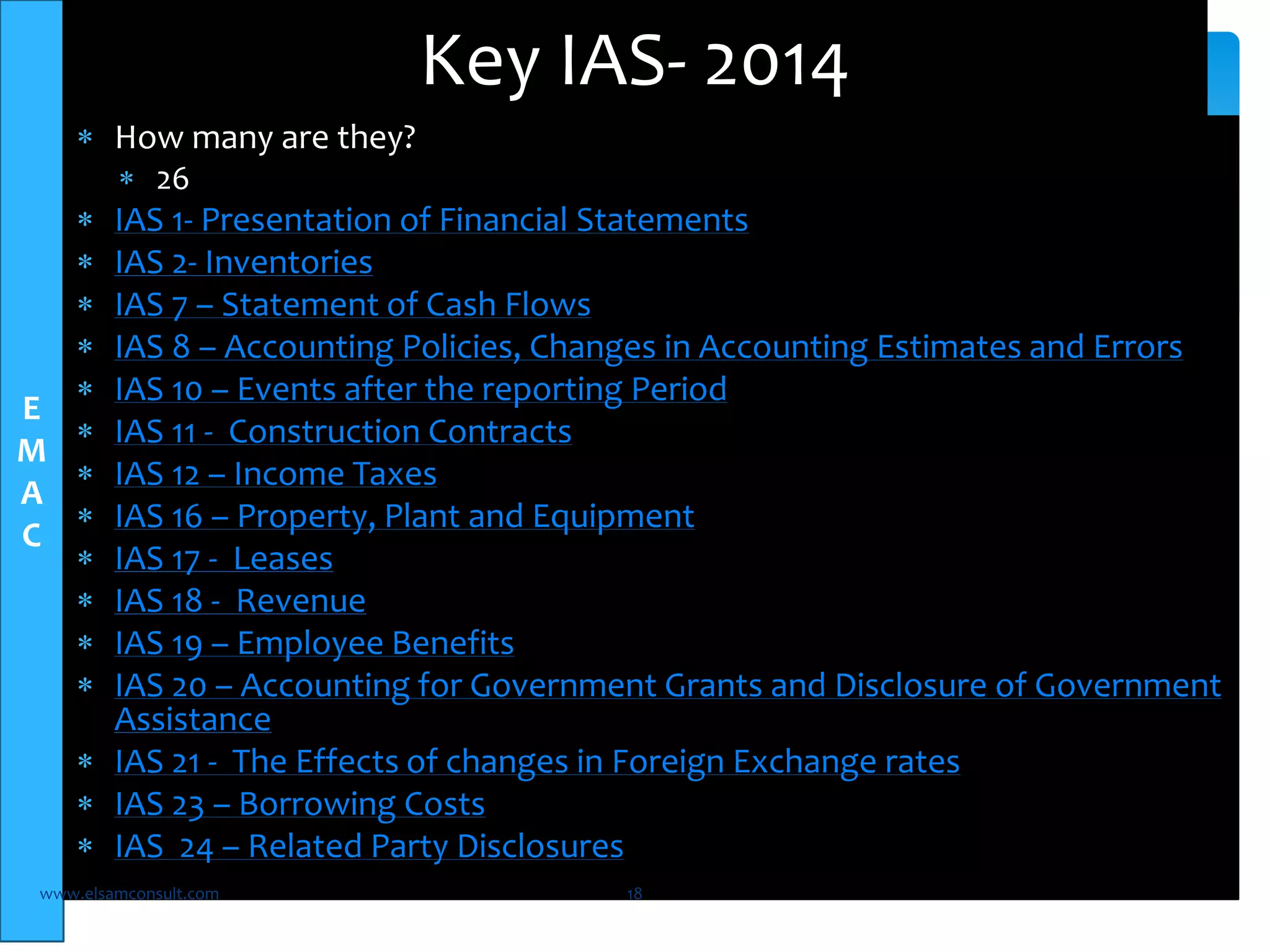
 How many are they? 
 26 
Key IAS- 2014 
 IAS 1- Presentation of Financial Statements 
 IAS 2- Inventories 
 IAS 7 – Statement of Cash Flows 
 IAS 8 – Accounting Policies, Changes in Accounting Estimates and Errors 
 IAS 10 – Events after the reporting Period 
 IAS 11 - Construction Contracts 
 IAS 12 – Income Taxes 
 IAS 16 – Property, Plant and Equipment 
 IAS 17 - Leases 
 IAS 18 - Revenue 
 IAS 19 – Employee Benefits 
 IAS 20 – Accounting for Government Grants and Disclosure of Government 
Assistance 
 IAS 21 - The Effects of changes in Foreign Exchange rates 
 IAS 23 – Borrowing Costs 
 IAS 24 – Related Party Disclosures 
www.elsamconsult.com 18
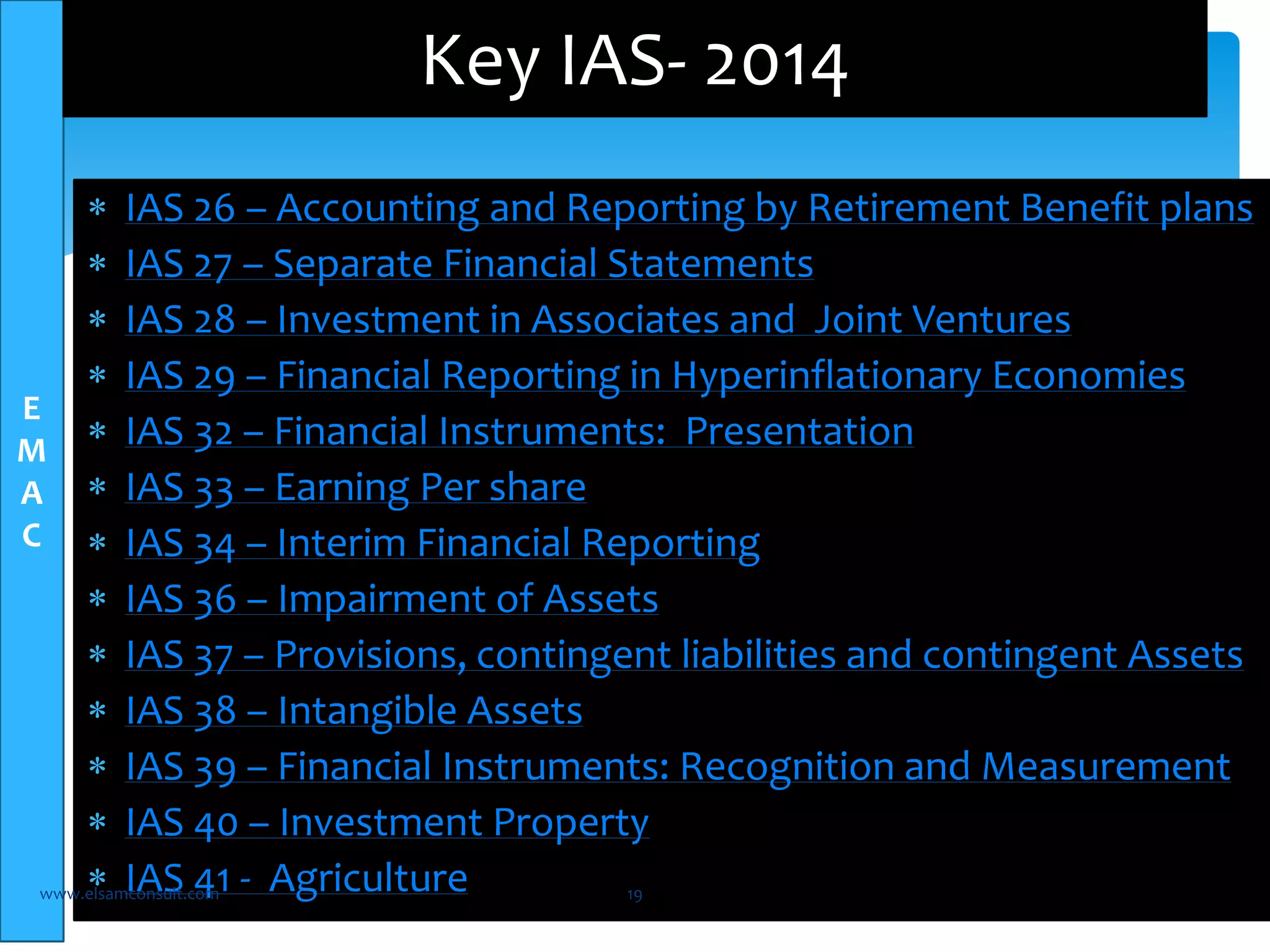
 IAS 26 – Accounting and Reporting by Retirement Benefit plans 
 IAS 27 – Separate Financial Statements 
 IAS 28 – Investment in Associates and Joint Ventures 
 IAS 29 – Financial Reporting in Hyperinflationary Economies 
 IAS 32 – Financial Instruments: Presentation 
 IAS 33 – Earning Per share 
 IAS 34 – Interim Financial Reporting 
 IAS 36 – Impairment of Assets 
 IAS 37 – Provisions, contingent liabilities and contingent Assets 
 IAS 38 – Intangible Assets 
 IAS 39 – Financial Instruments: Recognition and Measurement 
 IAS 40 – Investment Property 
 IAS 41 - Agriculture www.elsamconsult.com 19 
E 
M 
A 
C 
Key IAS- 2014
E 
M 
A 
C 
Key IFRIC and SIC - 2014 
 There are 17 IFRICs 
 What are they? 
 There are 8 SIC 
 What are they? 
www.elsamconsult.com 20
E 
M 
A 
C 
New and Revised standards 
 IFRS 10 – consolidated Financial Statements 
 IFRS 11 Joint arrangements 
 IFRS 12 Disclosure of interest in Other Entities 
 IAS 27 – Separate Financial Statements 
 IAS 28 Investment in Associates and Joint Ventures 
 Amendments to IFRS 10, IFRS 11 and IFRS 12 
Consolidated Financial Statements, Joint 
Arrangements and Disclosure interest in Other 
Entities: Transition Guidance 
www.elsamconsult.com 21
E 
M 
A 
C 
New and Revised standards 
 IFRS 13 Fair Value Measurement 
 IAS 19 Employee Benefits 
 Amendments to IFRS 1 Government Loans 
 Amendments to IFRS 7 Disclosures- Offsetting 
Financial Assets and Financial Liabilities 
 Amendments to IAS 1 Presentation of items of OCI 
 IFRC 20 Stripping Costs in the Production Phase of a 
surface Mine 
 Annual Improvements to IFRSs 
www.elsamconsult.com 22
E 
M 
A 
C 
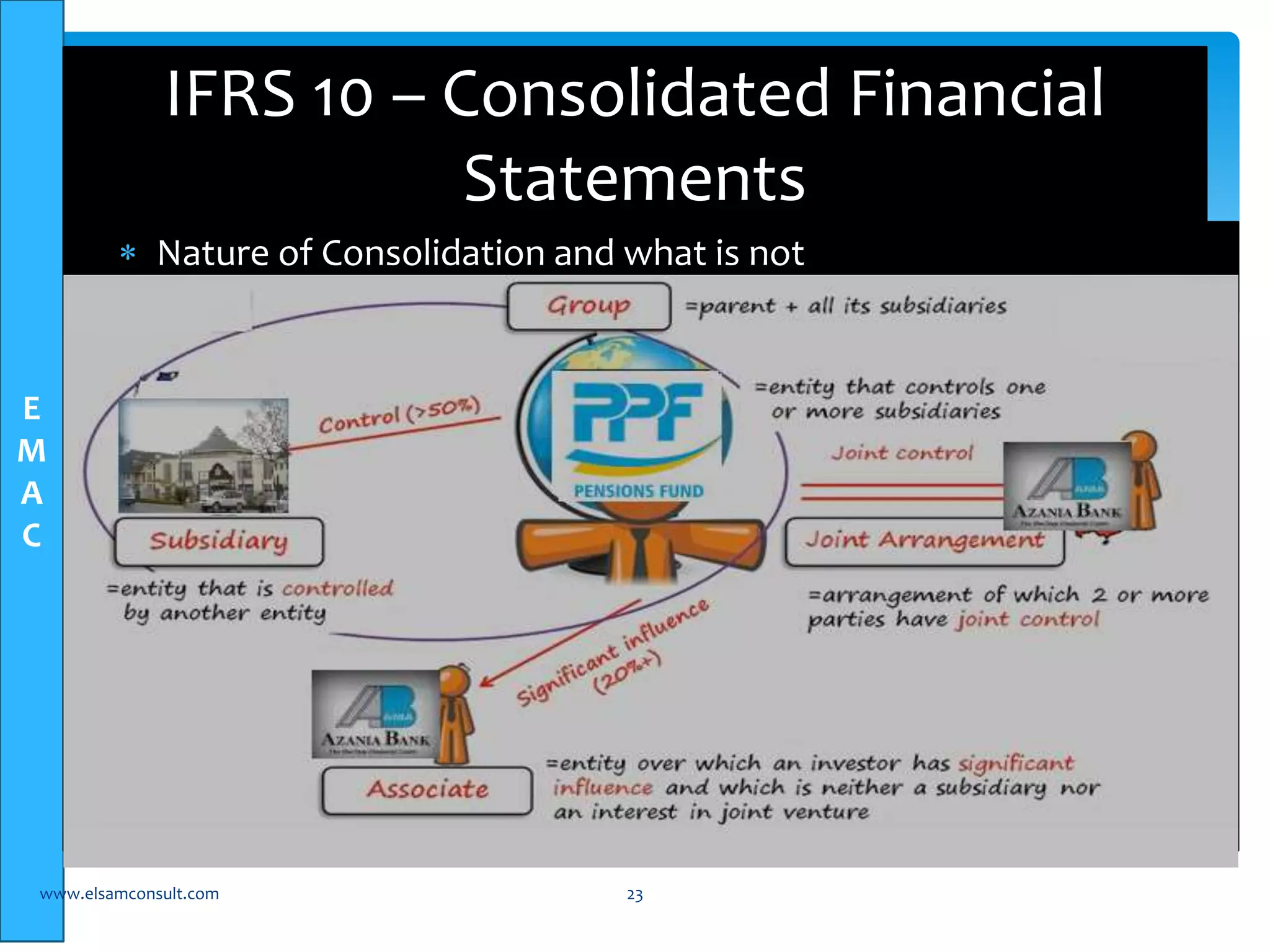
IFRS 10 – Consolidated Financial 
Statements 
 Nature of Consolidation and what is not 
www.elsamconsult.com 23
E 
M 
A 
C 
IFRS 10 – Consolidated Financial 
Statements 
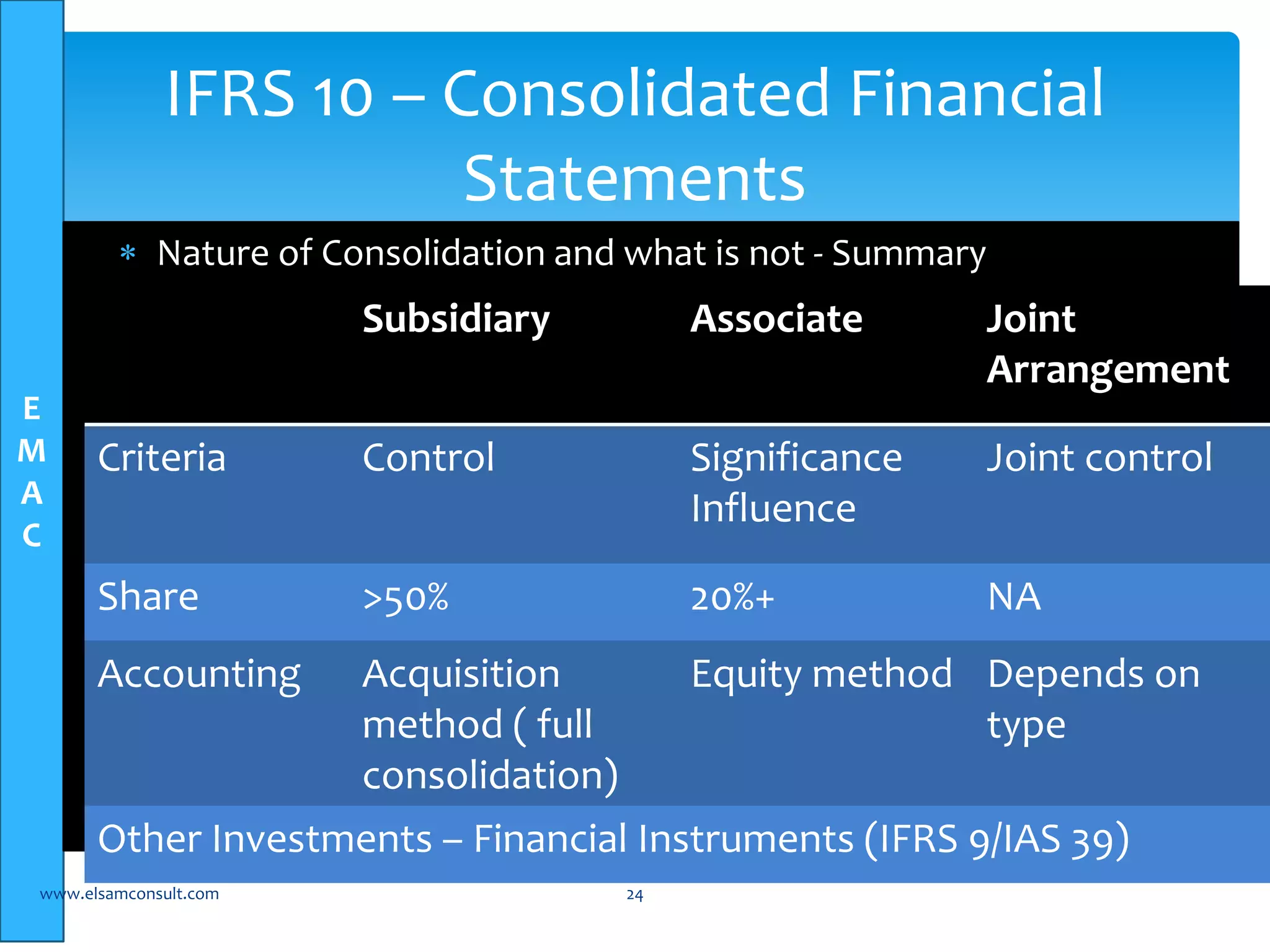
 Nature of Consolidation and what is not - Summary 
Subsidiary Associate Joint 
www.elsamconsult.com 24 
Arrangement 
Criteria Control Significance 
Influence 
Joint control 
Share >50% 20%+ NA 
Accounting Acquisition 
method ( full 
consolidation) 
Equity method Depends on 
type 
Other Investments – Financial Instruments (IFRS 9/IAS 39)
E 
M 
A 
C 
Other Standards deals with 
Consolidation 
 Group accounts and consolidation is covered by 6 IFRS 
standards 
 IAS 27 – Separate Financial statements 
 Not for consolidation, just a line for investment 
 Presentation of separate financial statements 
 Shares in subsidiaries or other investment 
 IAS 28 – Investment in Associate 
 Investment which you have no control 
 20-30% ownership of shares 
 We account using equity method 
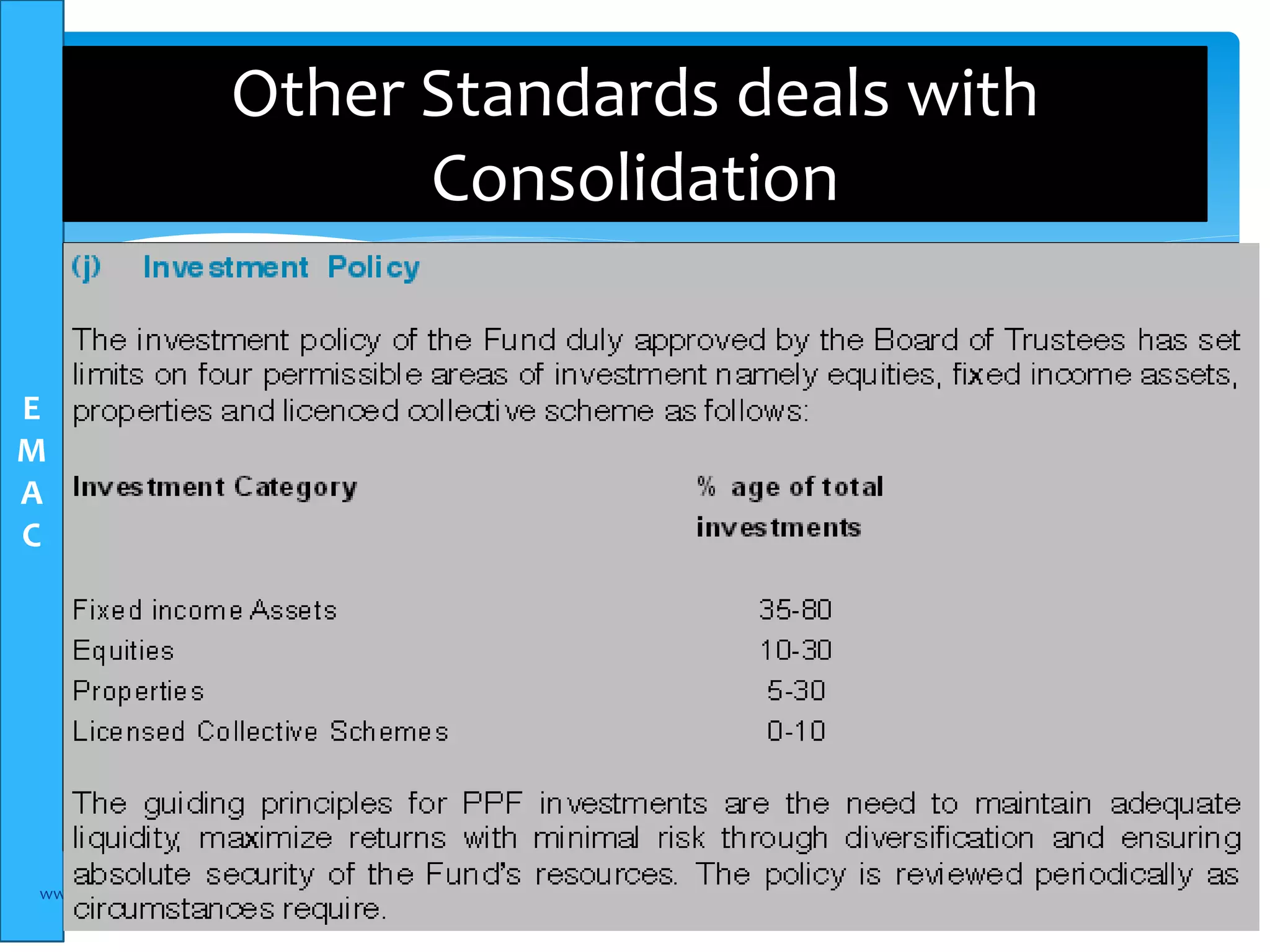
 What is the formula for investment at PPF Pension Fund 
www.elsamconsult.com 25
E 
M 
A 
C 
IFRS 10 – Consolidated Financial 
Statements 
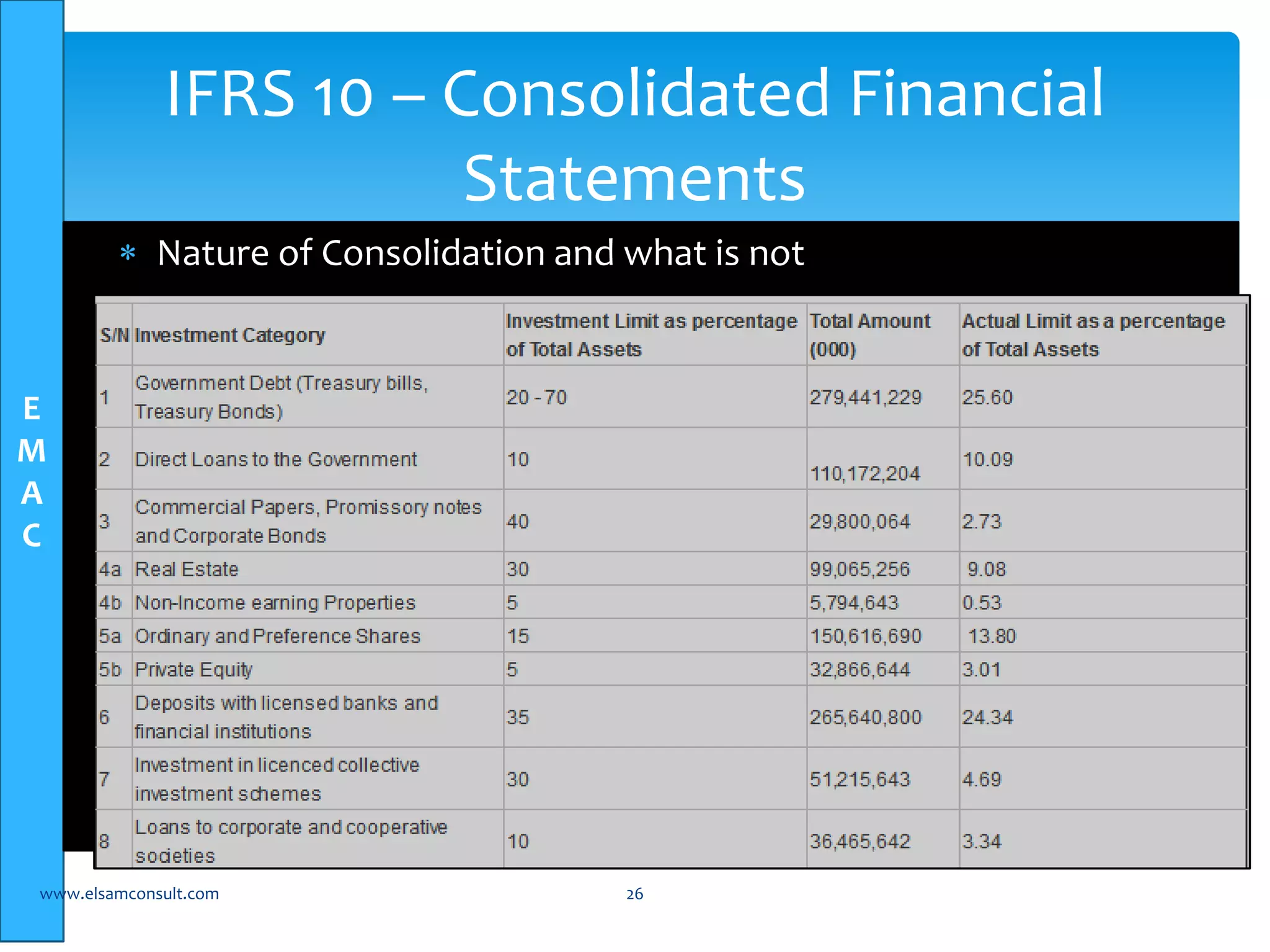
 Nature of Consolidation and what is not 
www.elsamconsult.com 26
E 
M 
A 
C 
IFRS 10 – Consolidated Financial 
Statements 
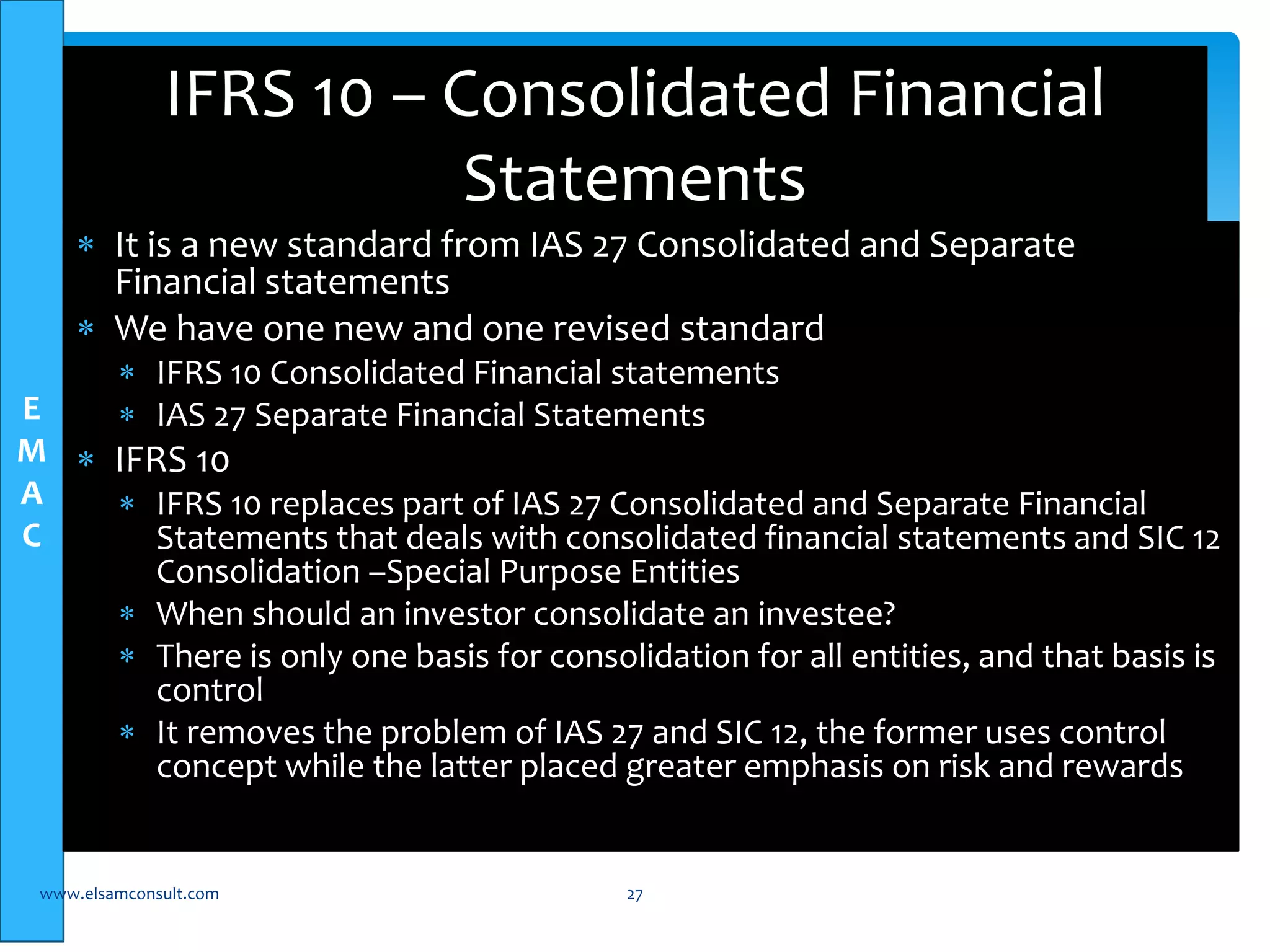
 It is a new standard from IAS 27 Consolidated and Separate 
Financial statements 
 We have one new and one revised standard 
 IFRS 10 Consolidated Financial statements 
 IAS 27 Separate Financial Statements 
 IFRS 10 
 IFRS 10 replaces part of IAS 27 Consolidated and Separate Financial 
Statements that deals with consolidated financial statements and SIC 12 
Consolidation –Special Purpose Entities 
 When should an investor consolidate an investee? 
 There is only one basis for consolidation for all entities, and that basis is 
control 
 It removes the problem of IAS 27 and SIC 12, the former uses control 
concept while the latter placed greater emphasis on risk and rewards 
www.elsamconsult.com 27
E 
M 
A 
C 
Other Standards deals with 
Consolidation 
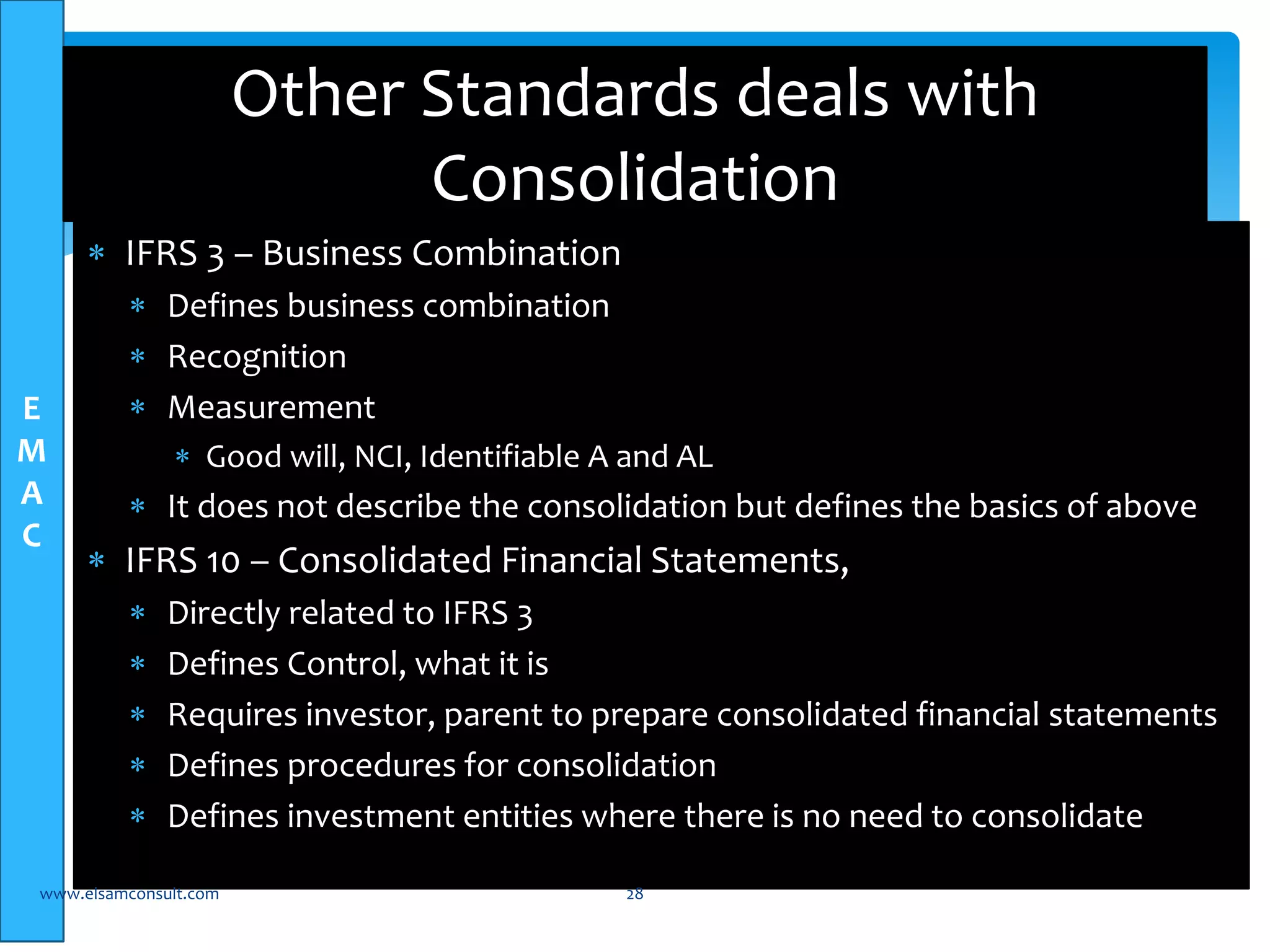
 IFRS 3 – Business Combination 
 Defines business combination 
 Recognition 
 Measurement 
 Good will, NCI, Identifiable A and AL 
 It does not describe the consolidation but defines the basics of above 
 IFRS 10 – Consolidated Financial Statements, 
 Directly related to IFRS 3 
 Defines Control, what it is 
 Requires investor, parent to prepare consolidated financial statements 
 Defines procedures for consolidation 
 Defines investment entities where there is no need to consolidate 
www.elsamconsult.com 28
E 
M 
A 
C 
IFRS 10 – Consolidated Financial 
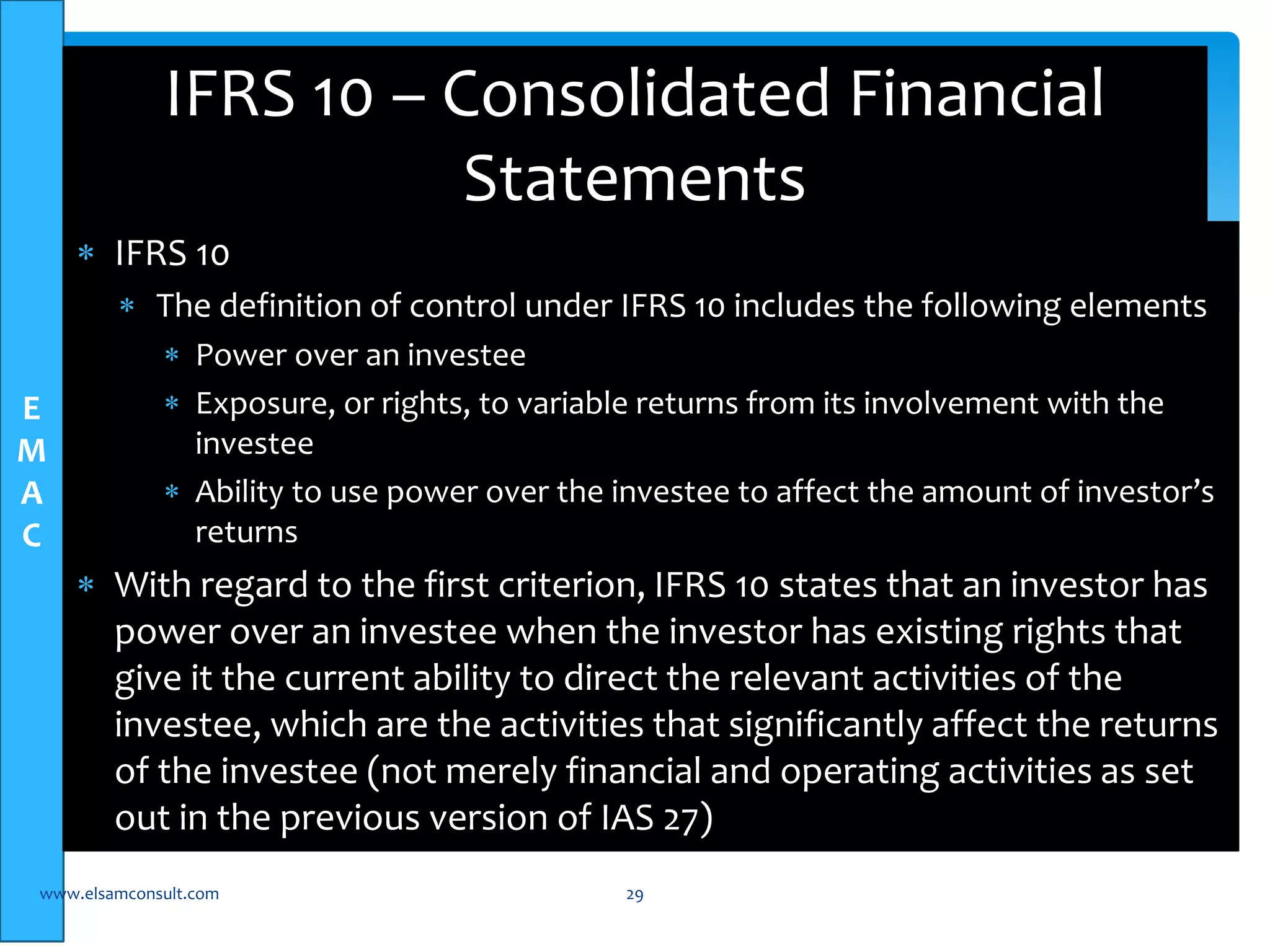
 IFRS 10 
Statements 
 The definition of control under IFRS 10 includes the following elements 
 Power over an investee 
 Exposure, or rights, to variable returns from its involvement with the 
investee 
 Ability to use power over the investee to affect the amount of investor’s 
returns 
 With regard to the first criterion, IFRS 10 states that an investor has 
power over an investee when the investor has existing rights that 
give it the current ability to direct the relevant activities of the 
investee, which are the activities that significantly affect the returns 
of the investee (not merely financial and operating activities as set 
out in the previous version of IAS 27) 
www.elsamconsult.com 29
E 
M 
A 
C 
IFRS 10 – Consolidated Financial 
 IFRS 10 
Statements 
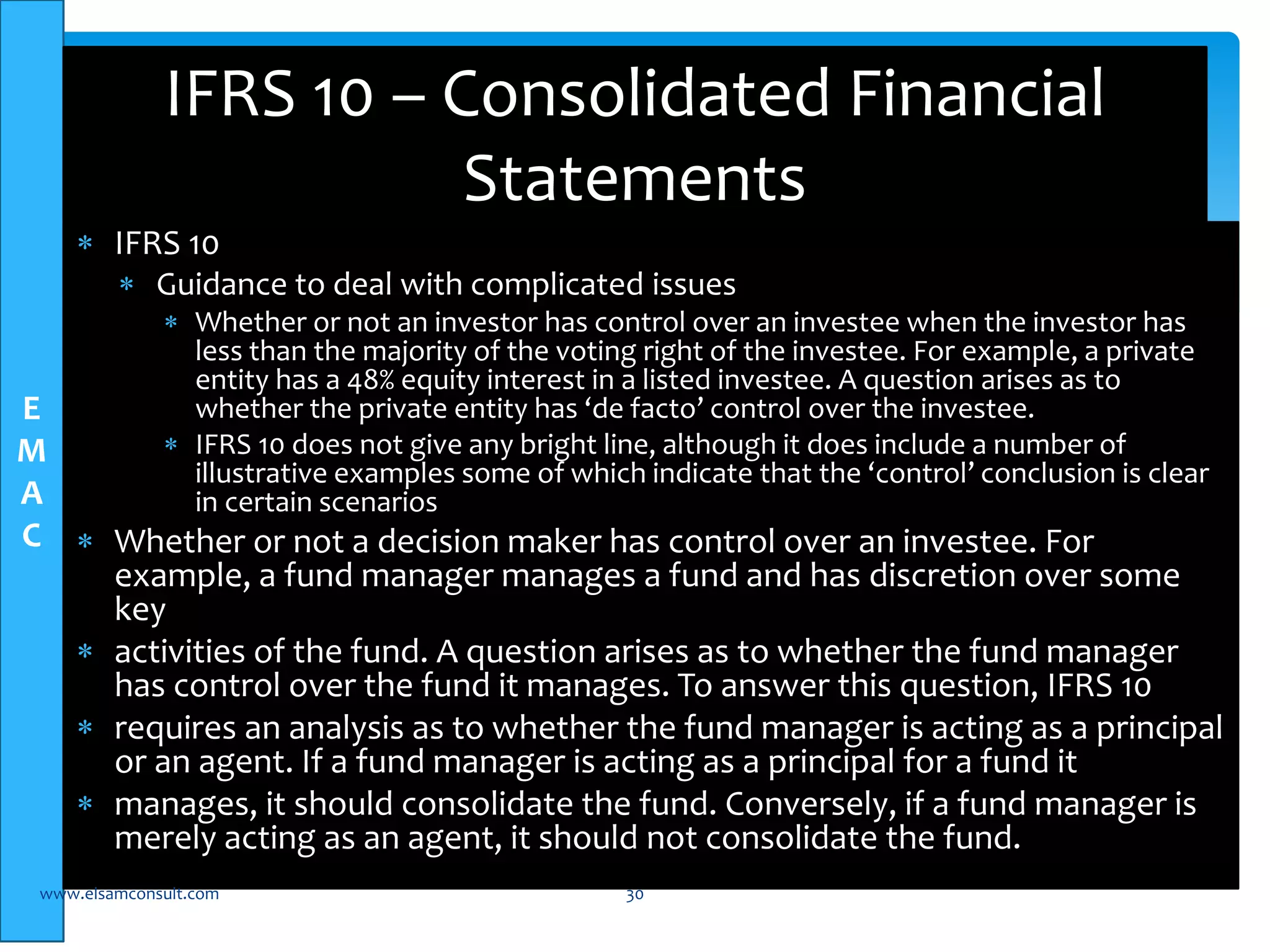
 Guidance to deal with complicated issues 
 Whether or not an investor has control over an investee when the investor has 
less than the majority of the voting right of the investee. For example, a private 
entity has a 48% equity interest in a listed investee. A question arises as to 
whether the private entity has ‘de facto’ control over the investee. 
 IFRS 10 does not give any bright line, although it does include a number of 
illustrative examples some of which indicate that the ‘control’ conclusion is clear 
in certain scenarios 
 Whether or not a decision maker has control over an investee. For 
example, a fund manager manages a fund and has discretion over some 
key 
 activities of the fund. A question arises as to whether the fund manager 
has control over the fund it manages. To answer this question, IFRS 10 
 requires an analysis as to whether the fund manager is acting as a principal 
or an agent. If a fund manager is acting as a principal for a fund it 
 manages, it should consolidate the fund. Conversely, if a fund manager is 
merely acting as an agent, it should not consolidate the fund. 
www.elsamconsult.com 30
E 
M 
A 
C 
Other Standards deals with 
Consolidation 
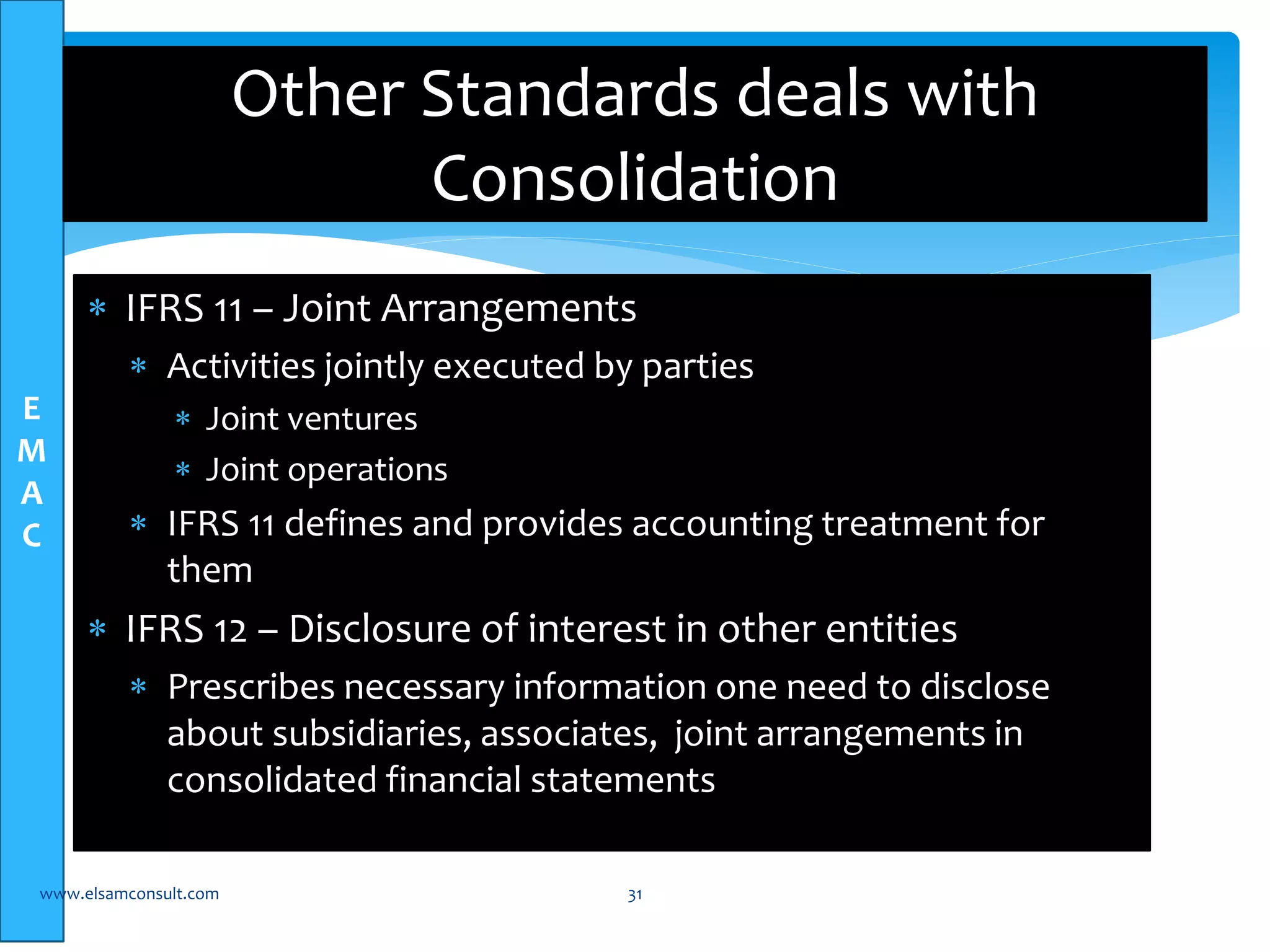
 IFRS 11 – Joint Arrangements 
 Activities jointly executed by parties 
 Joint ventures 
 Joint operations 
 IFRS 11 defines and provides accounting treatment for 
them 
 IFRS 12 – Disclosure of interest in other entities 
 Prescribes necessary information one need to disclose 
about subsidiaries, associates, joint arrangements in 
consolidated financial statements 
www.elsamconsult.com 31
IFRS 10 
E 
M 
A 
C Video Presentation 
www.elsamconsult.com 32
E 
M 
A 
C 
Framework for Preparation 
and 
presentation of Pension Fund 
Financial Statements 
www.elsamconsult.com 33
E 
M 
A 
C 
Conceptual Framework 
 Framework is a foundation for preparation of Financial 
Statements 
 It deals with 
1. Objectives of financial reporting 
 Useful information to existing and potential investors, lenders, 
creditor in making decisions about resources to entity 
 Investors , creditors and lenders are primary users of financial 
information for general purpose financial information 
 The financial information cannot provide all information and other 
sources are required 
 To meet the objectives, financial statements are prepared based on : 
 Accrual basis of accounting 
 Going Concern 
www.elsamconsult.com 34
E 
M 
A 
C 
Conceptual Framework 
 Framework is a foundation for preparation of Financial 
Statements 
 It deals with 
 Objectives of financial reporting 
 The qualitative characteristics of useful financial information 
 Makes financial statements most useful to the existing and potential 
investors, lenders and other creditors 
 Must be Relevant – predictive and confirmatory value, faithfully 
presented 
 Comparable, Verifiable, timely and understandable 
www.elsamconsult.com 35
E 
M 
A 
C 
Conceptual Framework 
 Framework is a foundation for preparation of Financial Statements 
 It deals with 
 Objectives of financial reporting 
 To meet the objectives, financial statements are prepared based on : 
 The qualitative characteristics of useful financial information 
 The definition, recognition and measurement of elements from which 
financial statements are constructed 
 Deals with measurement of financial position : Assets, liabilities and Equity 
 An Asset is a resource controlled by the entity as a result of past events and from which 
economic benefits are expected to flow to an entity 
 Liability is a present obligation of the entity arising from past events, the settlement of 
which is expected to result in an outflow from the entity resources embodying economic 
benefit 
 Equity is the residual interest in assets of the entity after deducting all its liabilities 
 Income is increases in economic benefits during the accounting period in the form of 
inflows or enhancement of assets or decreases in liabilities that result in increases in 
equity, other than those contributed by equity participants 
 Expenses are decreases in economic benefits during the accounting period in the form 
of out-flows or depletion of assets or incurrences of liabilities that result in decreases in 
equity, other than those relating to distributions to equity participants 
www.elsamconsult.com 36
E 
M 
A 
C 
Conceptual Framework 
 Framework is a foundation for preparation of Financial Statements 
 It deals with 
 Objectives of financial reporting 
 To meet the objectives, financial statements are prepared based on : 
 The qualitative characteristics of useful financial information 
 The definition, recognition and measurement of elements from which financial 
statements are constructed 
 The above elements are recognized only if : it is probable that any future economic 
benefit associated with the item will flow to or from the entity and … has a cost or 
value that can be measured with reliability 
 Concept of capital and capital maintenance 
 It is the basis for measurement or determining the monetary amounts at which the 
elements of the financial statements are recognized and carried in the balance sheet 
and income statements. 
 It is concerned with how the entity defines the capital it seeks to maintain 
 Differentiate between return of capital and return on capital; only inflows of assets in 
excess of amounts needed to maintain capital may be regarded as profits an therefore 
as a return on capital 
 If there is a conflict between IFRS and Framework, IFRS prevails 
www.elsamconsult.com 37
E 
M 
A 
C 
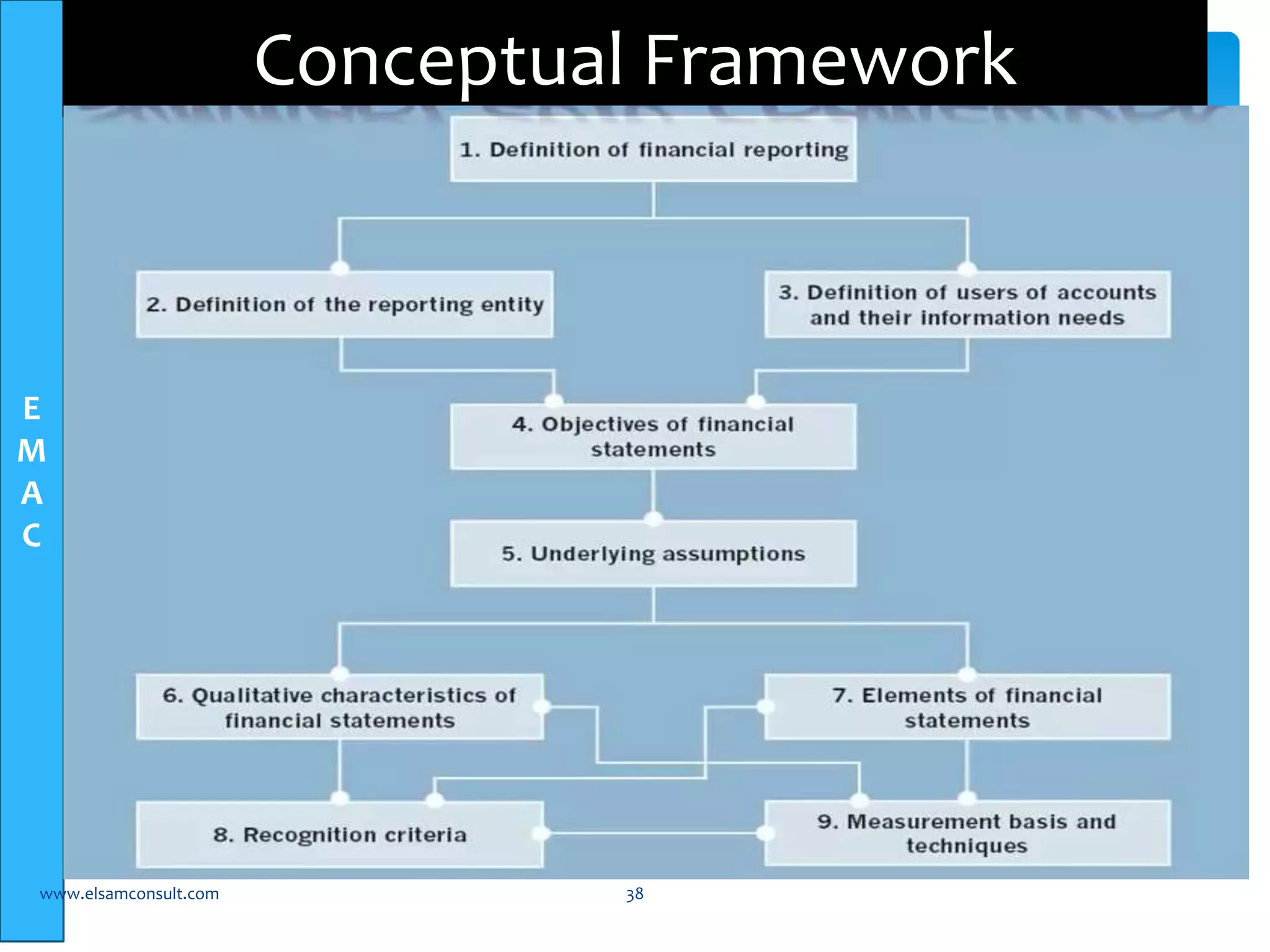
Conceptual Framework 
www.elsamconsult.com 38
E 
M 
A 
C 
Conceptual Framework 
Video Presentation and discussions 
www.elsamconsult.com 39
E 
M 
A 
C 
Group Work 1 
Use the Provided questions to 
digest various accounting 
issues at Pension Fund in 
practical perspective 
www.elsamconsult.com 40
E 
M 
A 
C 
Video Case Study 
Presentation of Financial Information 
and IFRS 1 
www.elsamconsult.com 41
E 
M 
A 
C 
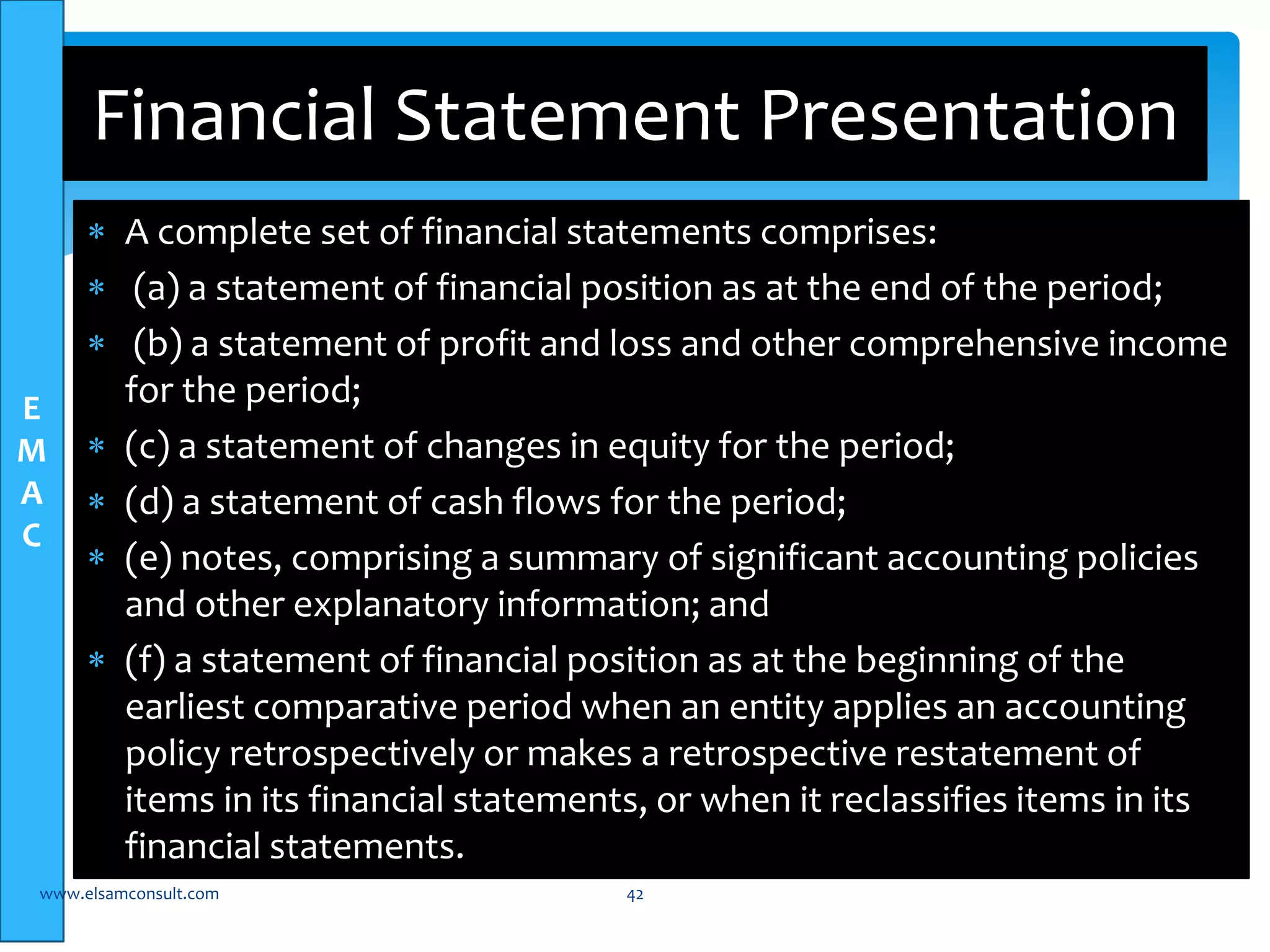
Financial Statement Presentation 
 A complete set of financial statements comprises: 
 (a) a statement of financial position as at the end of the period; 
 (b) a statement of profit and loss and other comprehensive income 
for the period; 
 (c) a statement of changes in equity for the period; 
 (d) a statement of cash flows for the period; 
 (e) notes, comprising a summary of significant accounting policies 
and other explanatory information; and 
 (f) a statement of financial position as at the beginning of the 
earliest comparative period when an entity applies an accounting 
policy retrospectively or makes a retrospective restatement of 
items in its financial statements, or when it reclassifies items in its 
financial statements. 
www.elsamconsult.com 42
E 
M 
A 
C 
Presentation of financial Statements 
Video explanation of IAS 1 
Video 2 presentation of financial 
statements 
www.elsamconsult.com 43
E 
M 
A 
C 
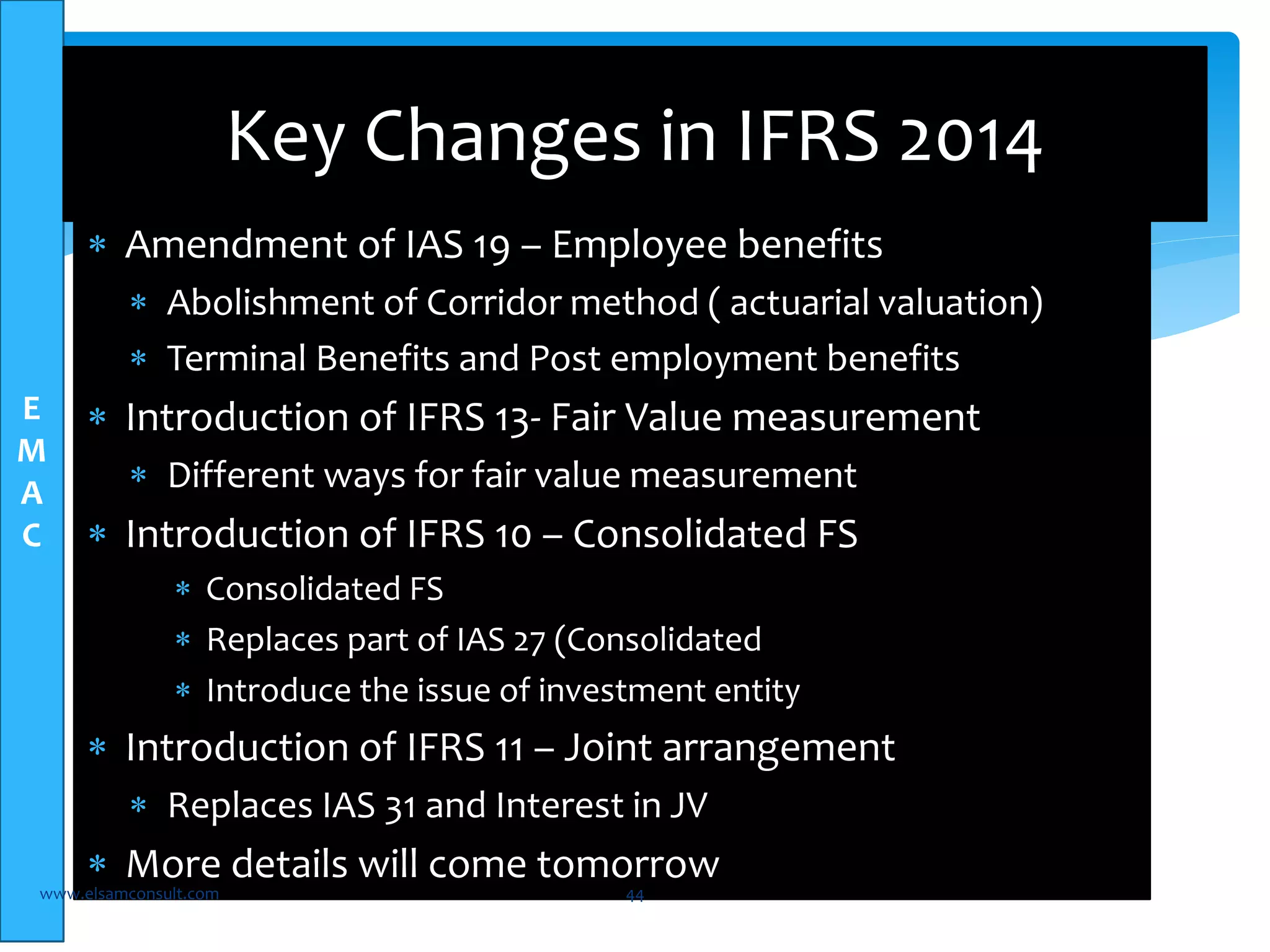
Key Changes in IFRS 2014 
 Amendment of IAS 19 – Employee benefits 
 Abolishment of Corridor method ( actuarial valuation) 
 Terminal Benefits and Post employment benefits 
 Introduction of IFRS 13- Fair Value measurement 
 Different ways for fair value measurement 
 Introduction of IFRS 10 – Consolidated FS 
 Consolidated FS 
 Replaces part of IAS 27 (Consolidated 
 Introduce the issue of investment entity 
 Introduction of IFRS 11 – Joint arrangement 
 Replaces IAS 31 and Interest in JV 
 More details will come tomorrow 
www.elsamconsult.com 44
E 
M 
A 
C 
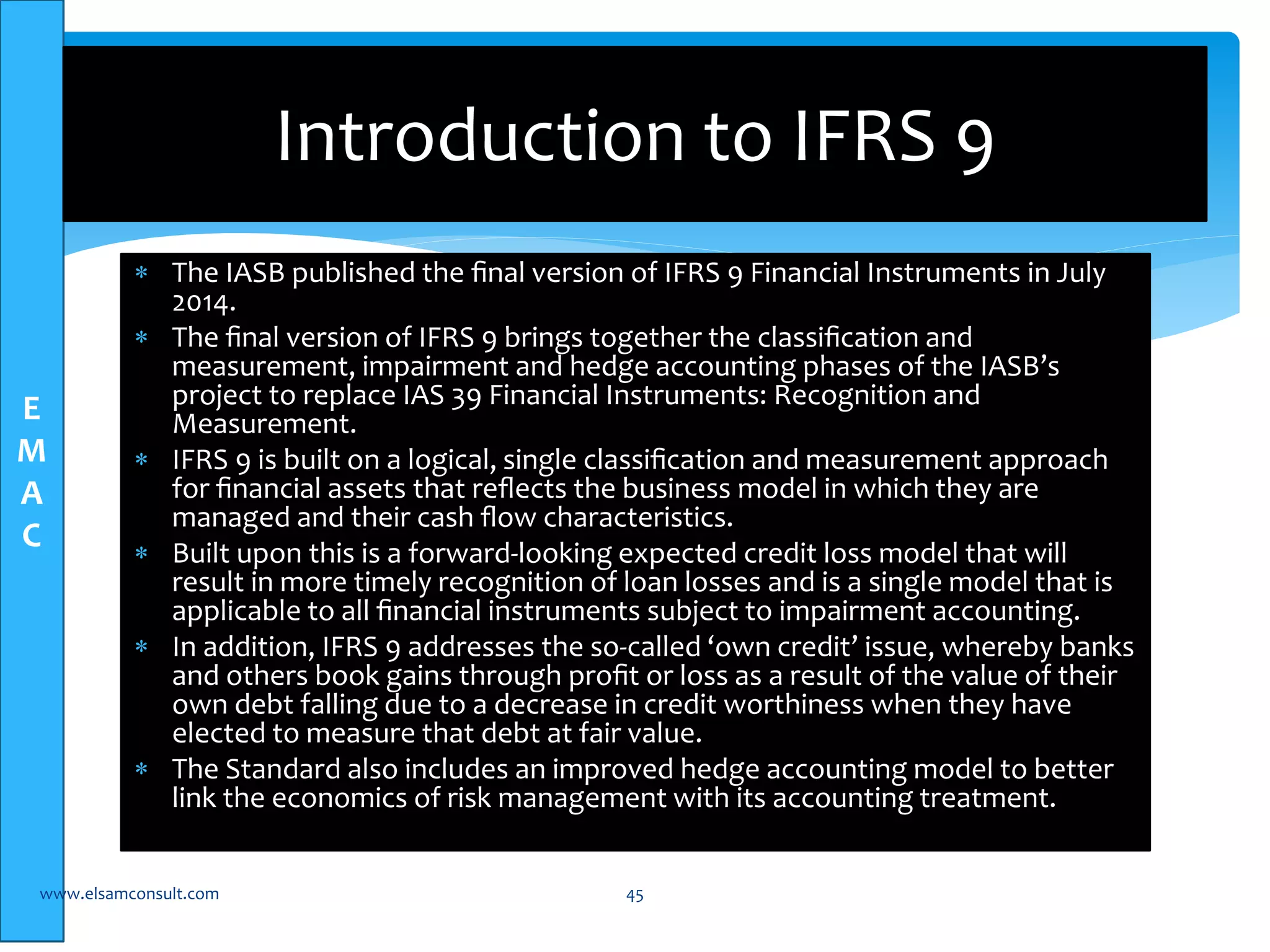
Introduction to IFRS 9 
 The IASB published the final version of IFRS 9 Financial Instruments in July 
2014. 
 The final version of IFRS 9 brings together the classification and 
measurement, impairment and hedge accounting phases of the IASB’s 
project to replace IAS 39 Financial Instruments: Recognition and 
Measurement. 
 IFRS 9 is built on a logical, single classification and measurement approach 
for financial assets that reflects the business model in which they are 
managed and their cash flow characteristics. 
 Built upon this is a forward-looking expected credit loss model that will 
result in more timely recognition of loan losses and is a single model that is 
applicable to all financial instruments subject to impairment accounting. 
 In addition, IFRS 9 addresses the so-called ‘own credit’ issue, whereby banks 
and others book gains through profit or loss as a result of the value of their 
own debt falling due to a decrease in credit worthiness when they have 
elected to measure that debt at fair value. 
 The Standard also includes an improved hedge accounting model to better 
link the economics of risk management with its accounting treatment. 
www.elsamconsult.com 45
E 
M 
A 
C 
Introduction to IFRS 9 
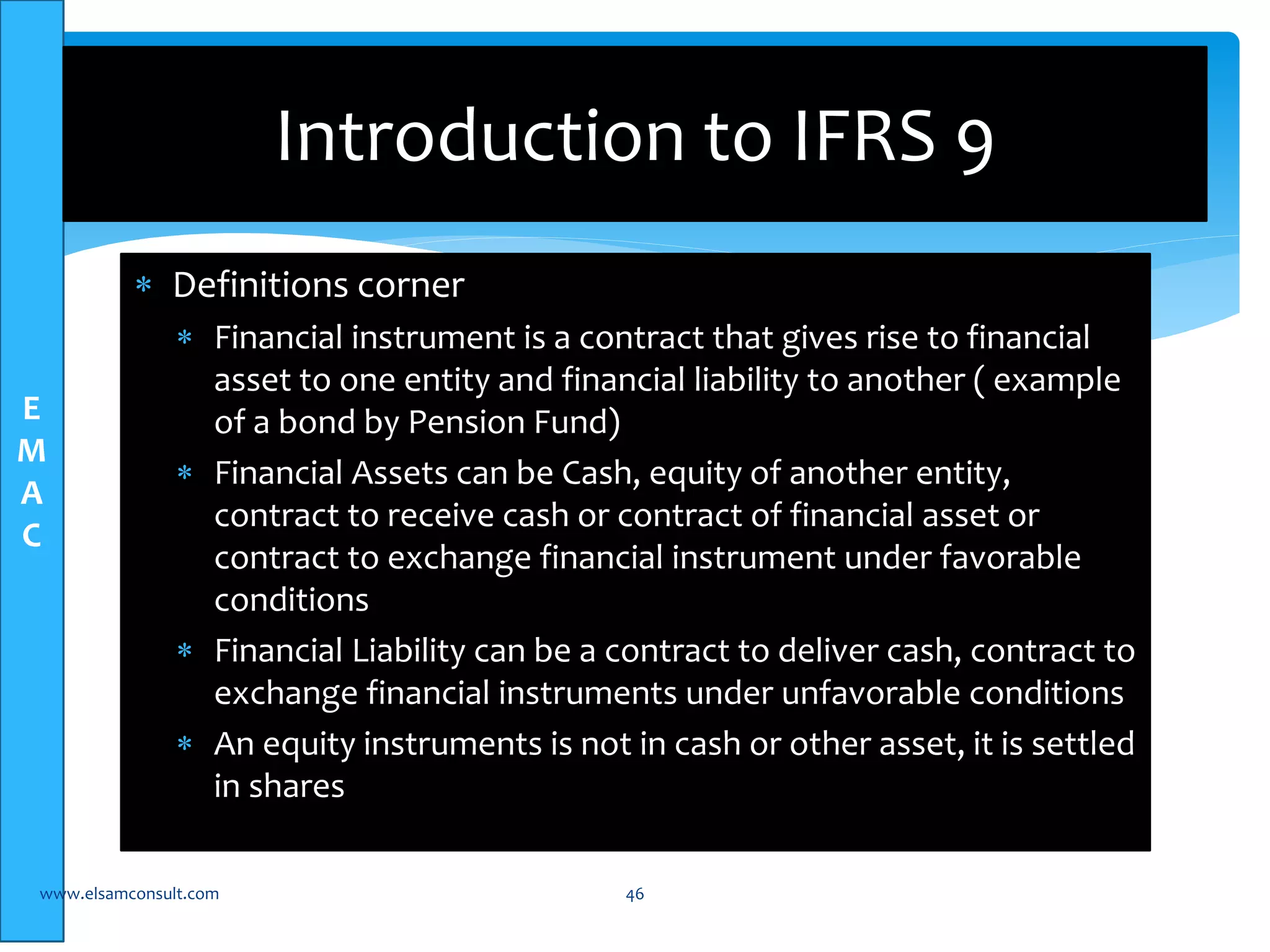
 Definitions corner 
 Financial instrument is a contract that gives rise to financial 
asset to one entity and financial liability to another ( example 
of a bond by Pension Fund) 
 Financial Assets can be Cash, equity of another entity, 
contract to receive cash or contract of financial asset or 
contract to exchange financial instrument under favorable 
conditions 
 Financial Liability can be a contract to deliver cash, contract to 
exchange financial instruments under unfavorable conditions 
 An equity instruments is not in cash or other asset, it is settled 
in shares 
www.elsamconsult.com 46
E 
M 
A 
C 
Introduction to IFRS 9 
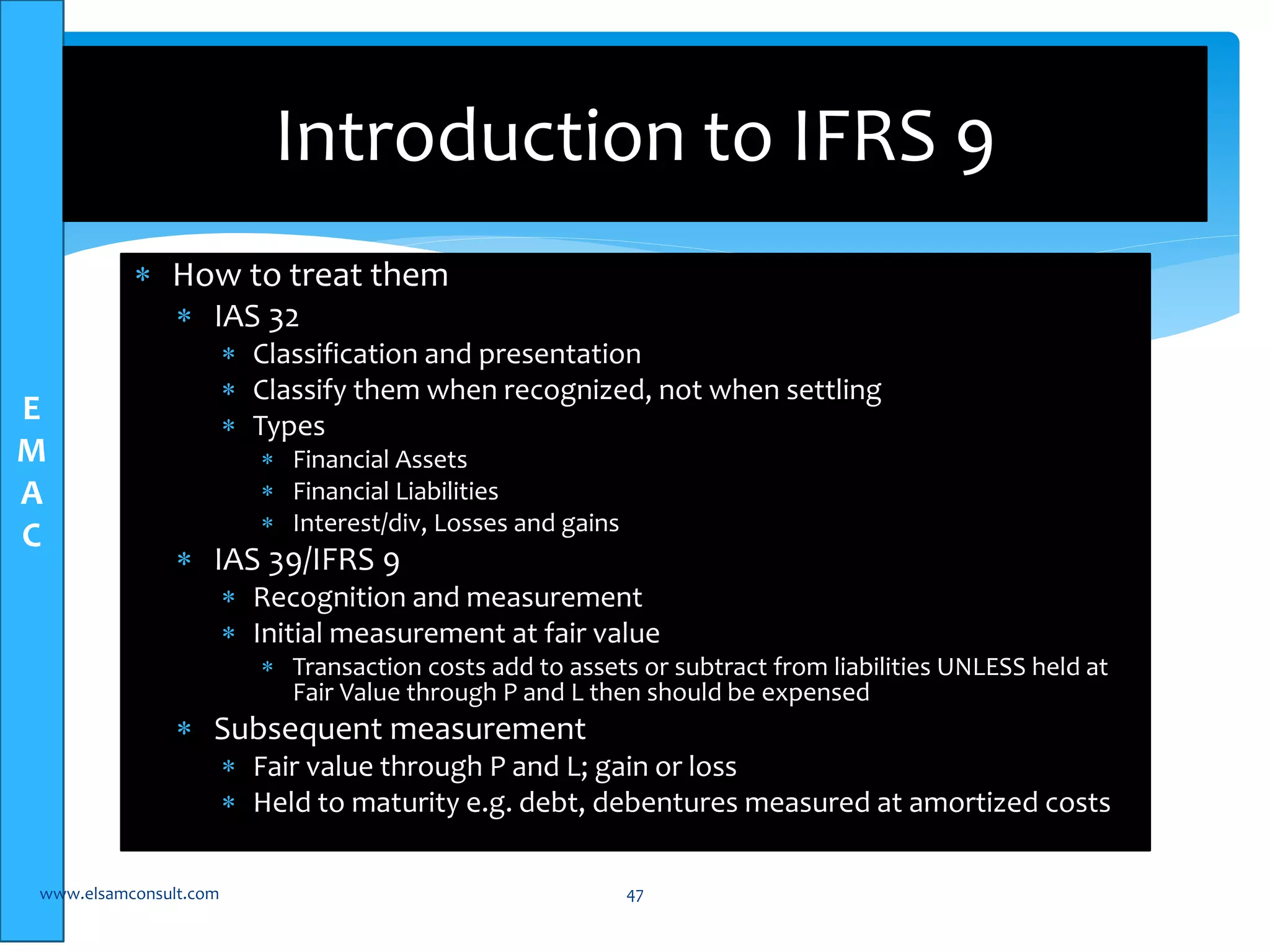
 How to treat them 
 IAS 32 
 Classification and presentation 
 Classify them when recognized, not when settling 
 Types 
 Financial Assets 
 Financial Liabilities 
 Interest/div, Losses and gains 
 IAS 39/IFRS 9 
 Recognition and measurement 
 Initial measurement at fair value 
 Transaction costs add to assets or subtract from liabilities UNLESS held at 
Fair Value through P and L then should be expensed 
 Subsequent measurement 
 Fair value through P and L; gain or loss 
 Held to maturity e.g. debt, debentures measured at amortized costs 
www.elsamconsult.com 47
E 
M 
A 
C 
IFRS 9 
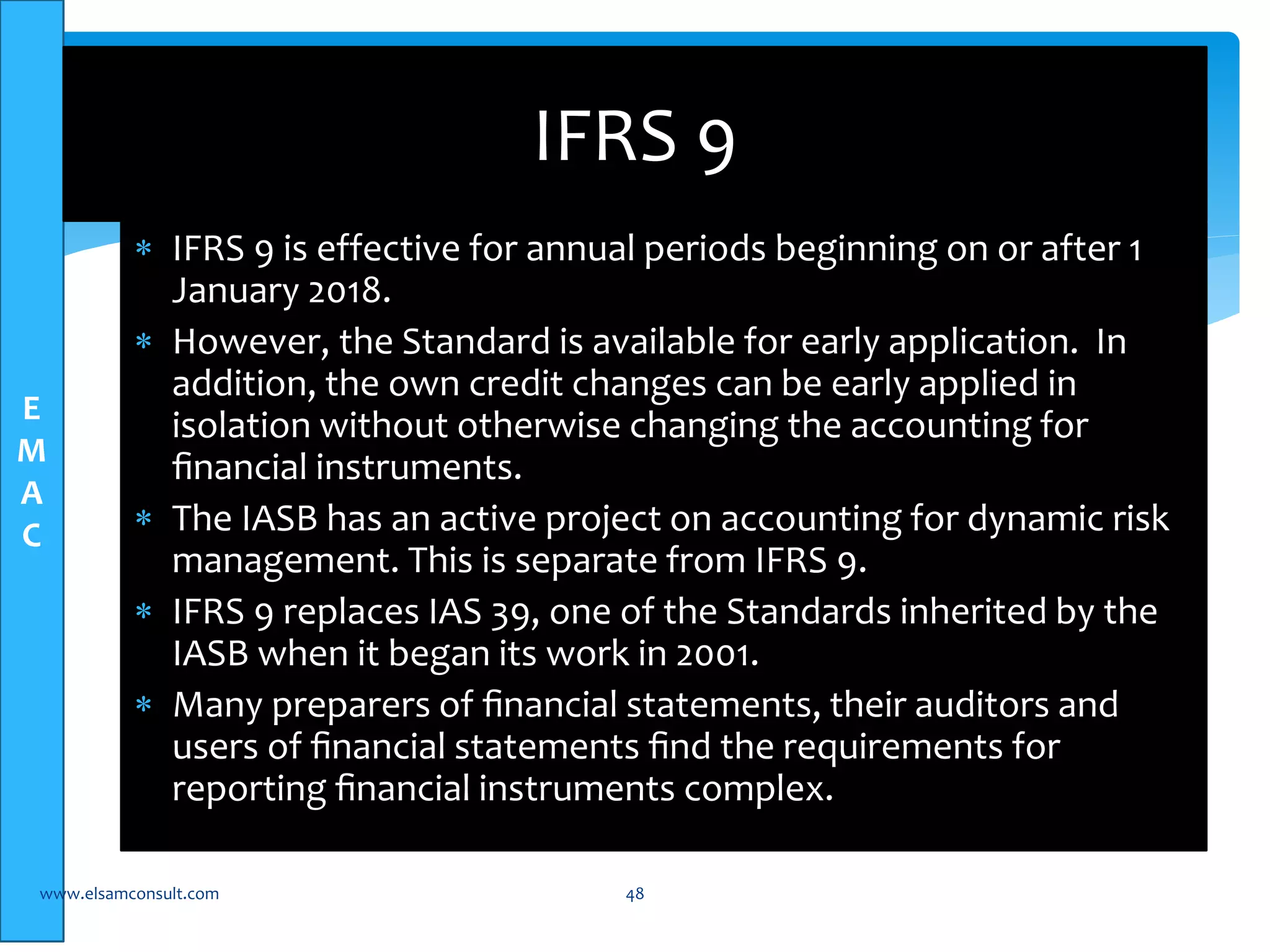
 IFRS 9 is effective for annual periods beginning on or after 1 
January 2018. 
 However, the Standard is available for early application. In 
addition, the own credit changes can be early applied in 
isolation without otherwise changing the accounting for 
financial instruments. 
 The IASB has an active project on accounting for dynamic risk 
management. This is separate from IFRS 9. 
 IFRS 9 replaces IAS 39, one of the Standards inherited by the 
IASB when it began its work in 2001. 
 Many preparers of financial statements, their auditors and 
users of financial statements find the requirements for 
reporting financial instruments complex. 
www.elsamconsult.com 48
E 
M 
A 
C 
Practical changes for 2013-14 with 
implication at Pension Fund 
 Key changes in IFRS up to May 2014 
Watch this IFRS Box Presentation and lets discuss 
Discussions of IFRS 9 
www.elsamconsult.com 49
E 
M 
A 
C 
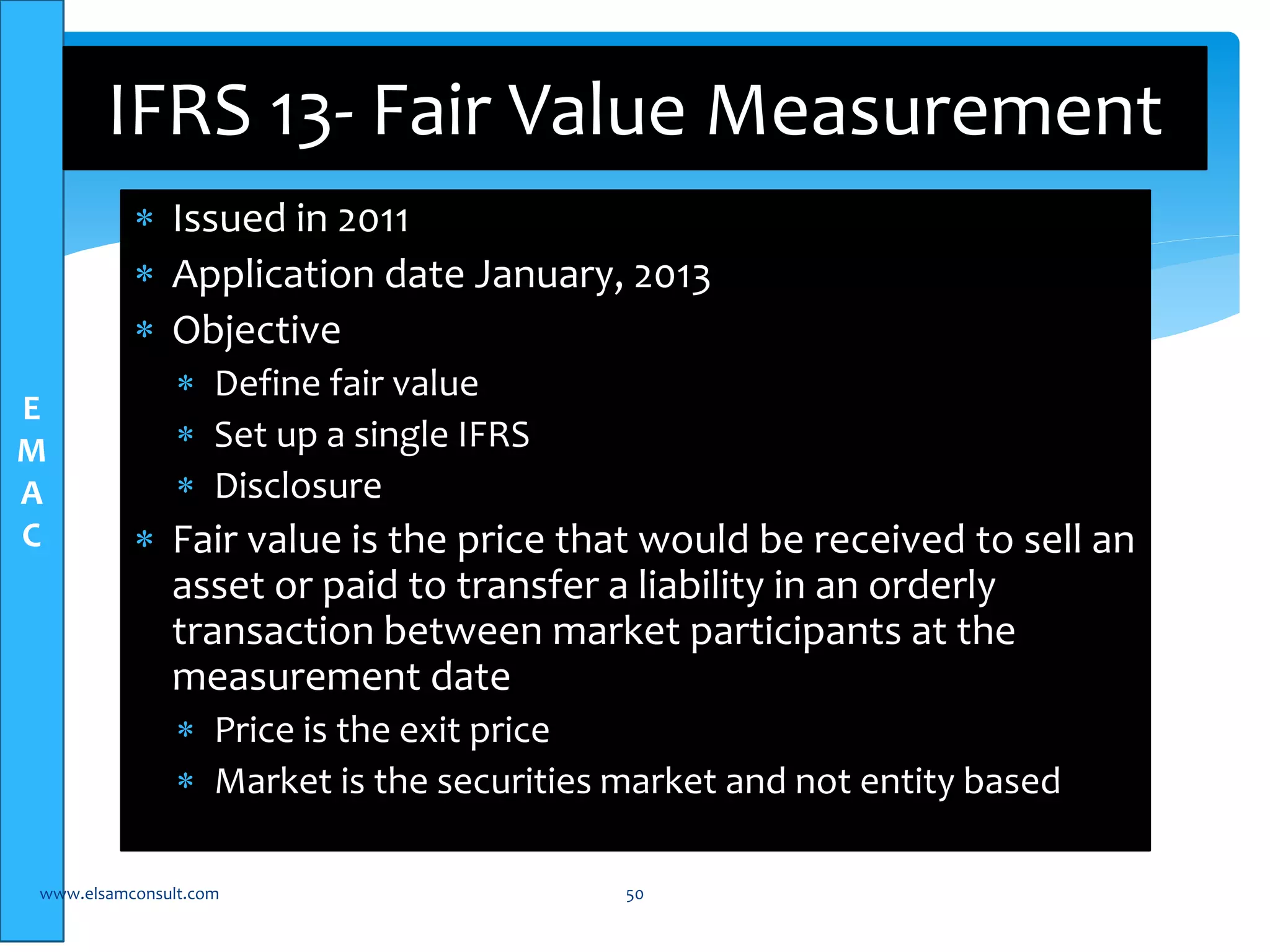
IFRS 13- Fair Value Measurement 
 Issued in 2011 
 Application date January, 2013 
 Objective 
 Define fair value 
 Set up a single IFRS 
 Disclosure 
 Fair value is the price that would be received to sell an 
asset or paid to transfer a liability in an orderly 
transaction between market participants at the 
measurement date 
 Price is the exit price 
 Market is the securities market and not entity based 
www.elsamconsult.com 50
E 
M 
A 
C 
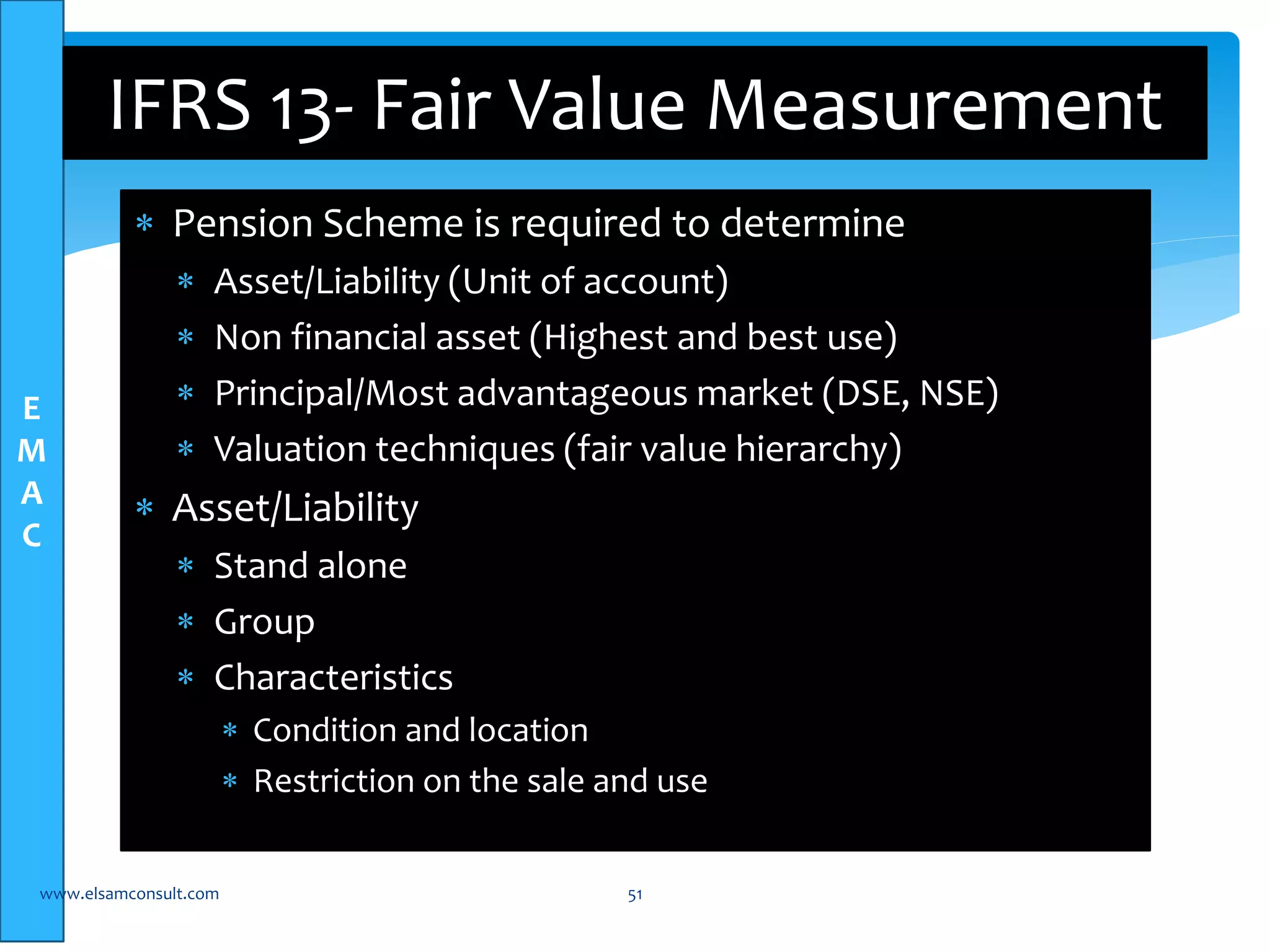
IFRS 13- Fair Value Measurement 
 Pension Scheme is required to determine 
 Asset/Liability (Unit of account) 
 Non financial asset (Highest and best use) 
 Principal/Most advantageous market (DSE, NSE) 
 Valuation techniques (fair value hierarchy) 
 Asset/Liability 
 Stand alone 
 Group 
 Characteristics 
 Condition and location 
 Restriction on the sale and use 
www.elsamconsult.com 51
E 
M 
A 
C 
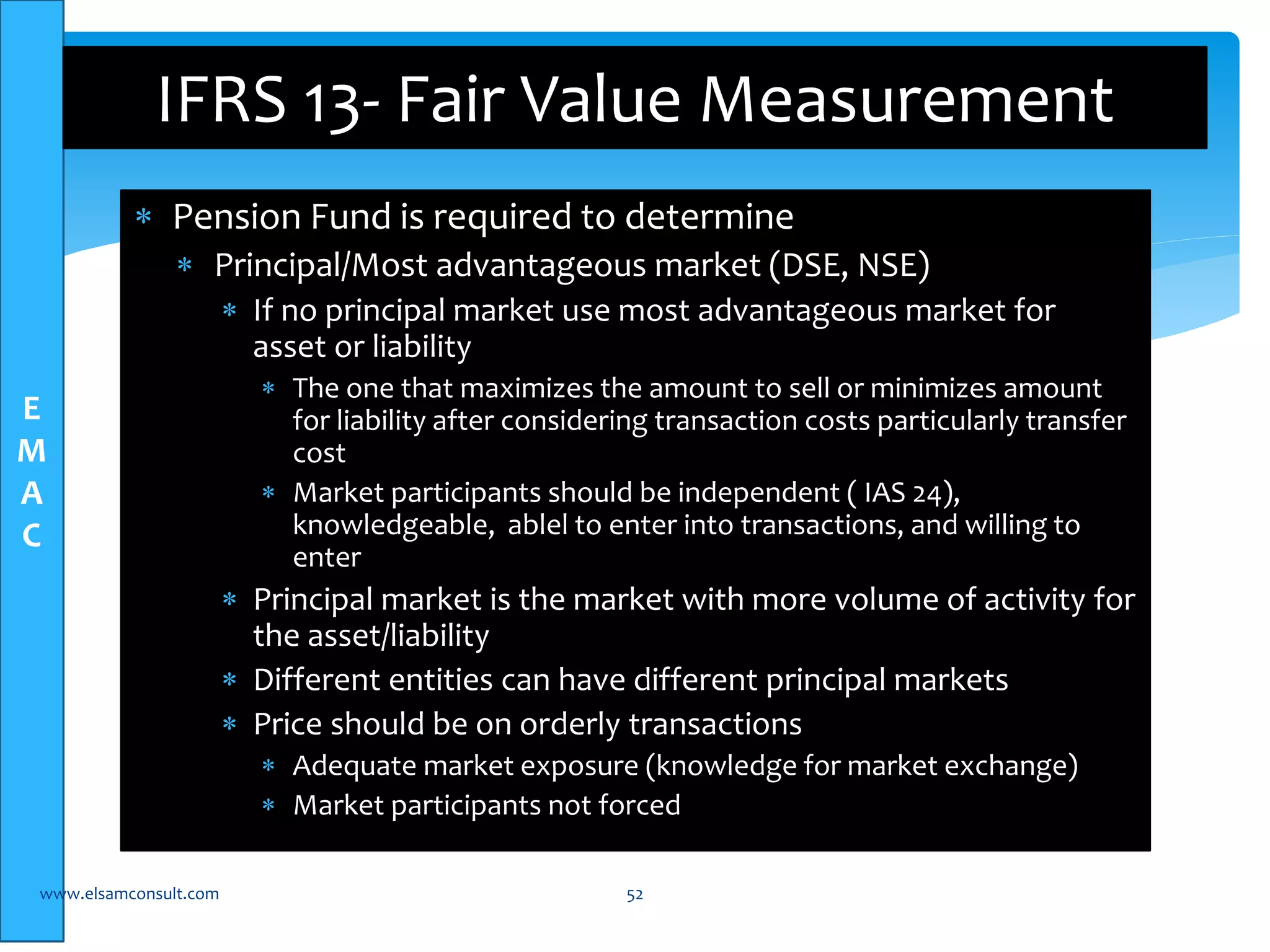
IFRS 13- Fair Value Measurement 
 Pension Fund is required to determine 
 Principal/Most advantageous market (DSE, NSE) 
 If no principal market use most advantageous market for 
asset or liability 
 The one that maximizes the amount to sell or minimizes amount 
for liability after considering transaction costs particularly transfer 
cost 
 Market participants should be independent ( IAS 24), 
knowledgeable, ablel to enter into transactions, and willing to 
enter 
 Principal market is the market with more volume of activity for 
the asset/liability 
 Different entities can have different principal markets 
 Price should be on orderly transactions 
 Adequate market exposure (knowledge for market exchange) 
 Market participants not forced 
www.elsamconsult.com 52
E 
M 
A 
C 
IFRS 13- Fair Value Measurement 
 Pension Fund is required to determine 
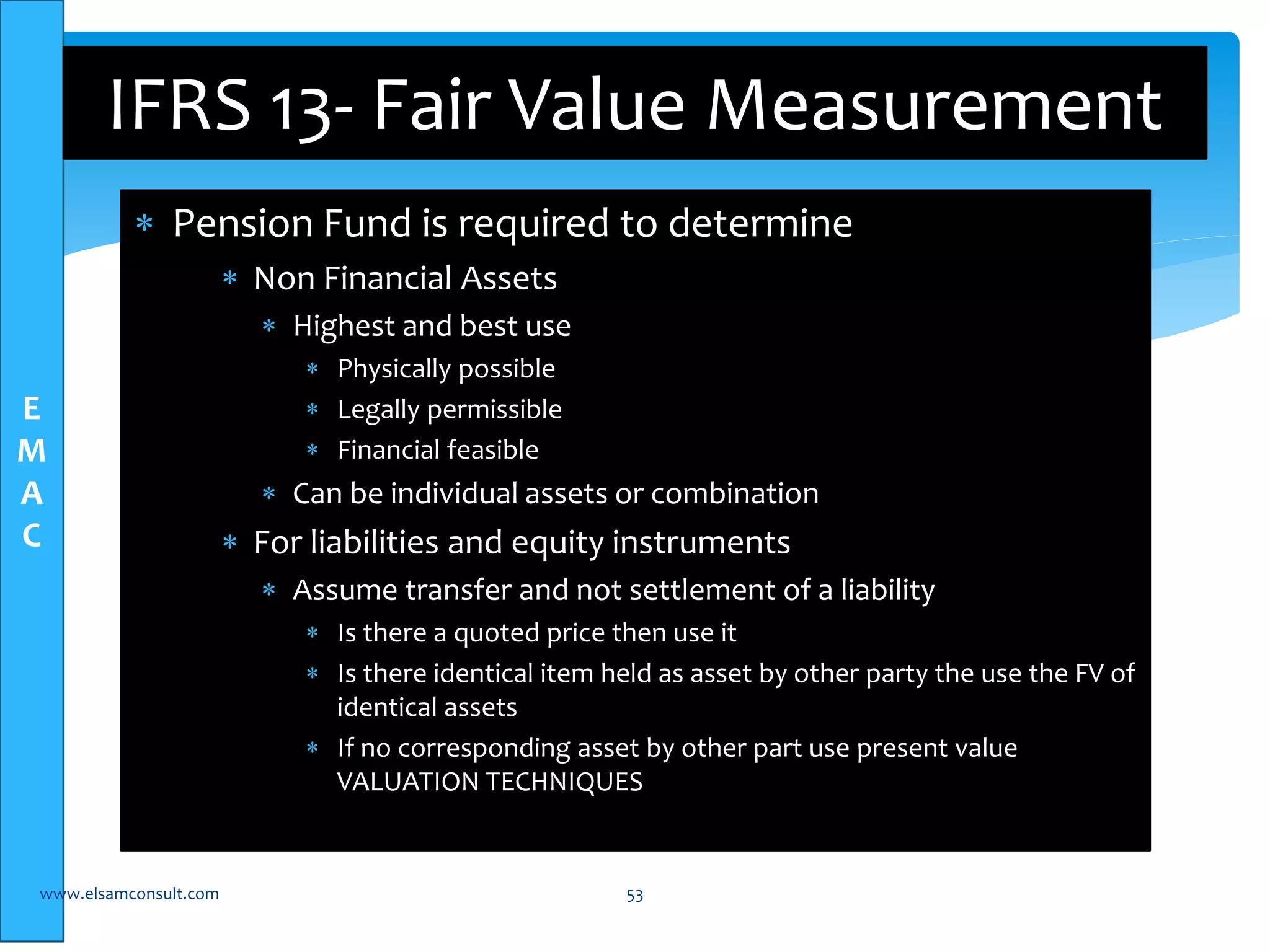
 Non Financial Assets 
 Highest and best use 
 Physically possible 
 Legally permissible 
 Financial feasible 
 Can be individual assets or combination 
 For liabilities and equity instruments 
 Assume transfer and not settlement of a liability 
 Is there a quoted price then use it 
 Is there identical item held as asset by other party the use the FV of 
identical assets 
 If no corresponding asset by other part use present value 
VALUATION TECHNIQUES 
www.elsamconsult.com 53
E 
M 
A 
C 
IFRS 13- Fair Value Measurement 
 Pension Fund is required to determine 
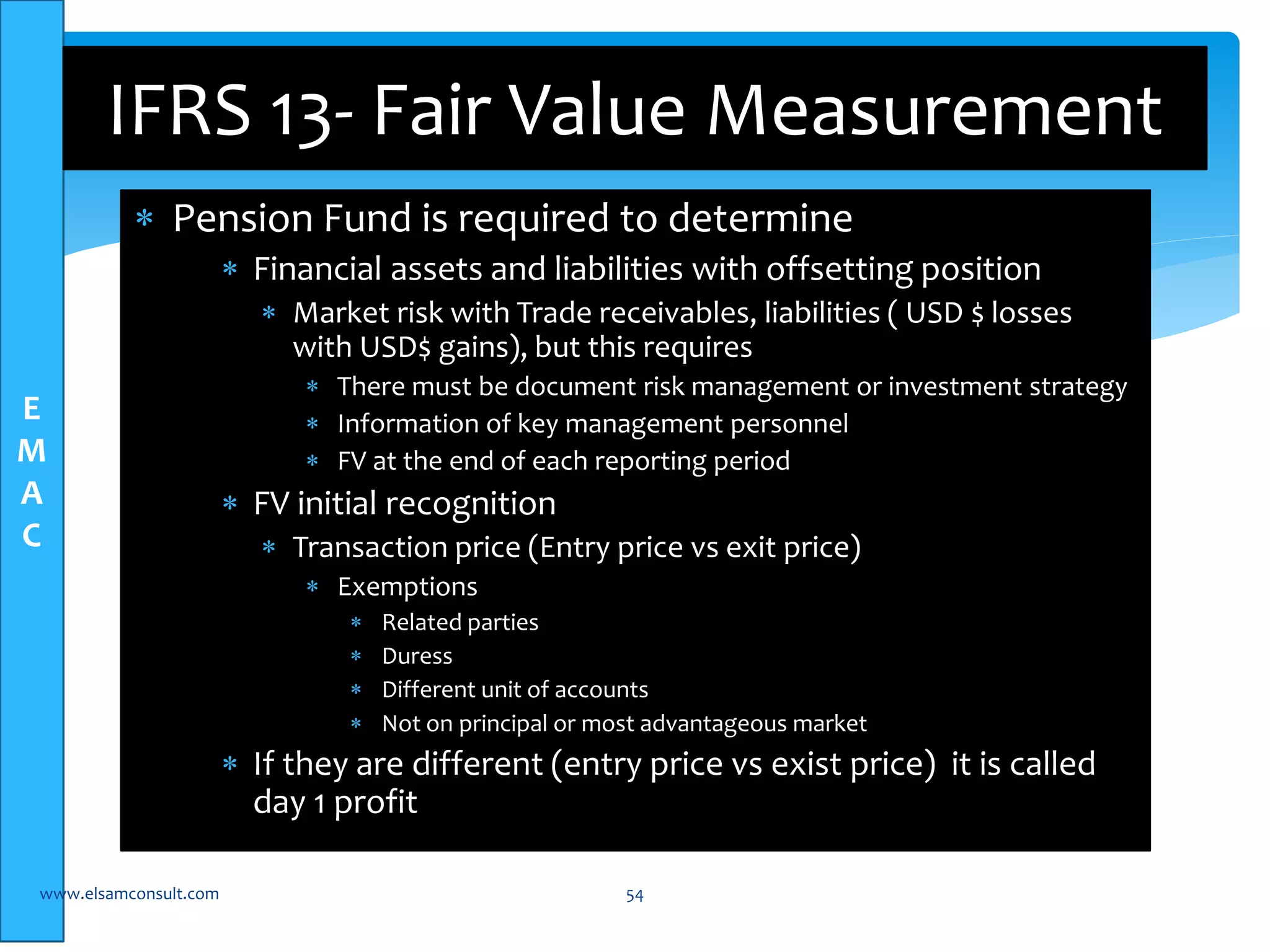
 Financial assets and liabilities with offsetting position 
 Market risk with Trade receivables, liabilities ( USD $ losses 
with USD$ gains), but this requires 
 There must be document risk management or investment strategy 
 Information of key management personnel 
 FV at the end of each reporting period 
 FV initial recognition 
 Transaction price (Entry price vs exit price) 
 Exemptions 
 Related parties 
 Duress 
 Different unit of accounts 
 Not on principal or most advantageous market 
 If they are different (entry price vs exist price) it is called 
day 1 profit 
www.elsamconsult.com 54
E 
M 
A 
C 
IFRS 13- Fair Value Measurement 
 Pension Fund is required to determine 
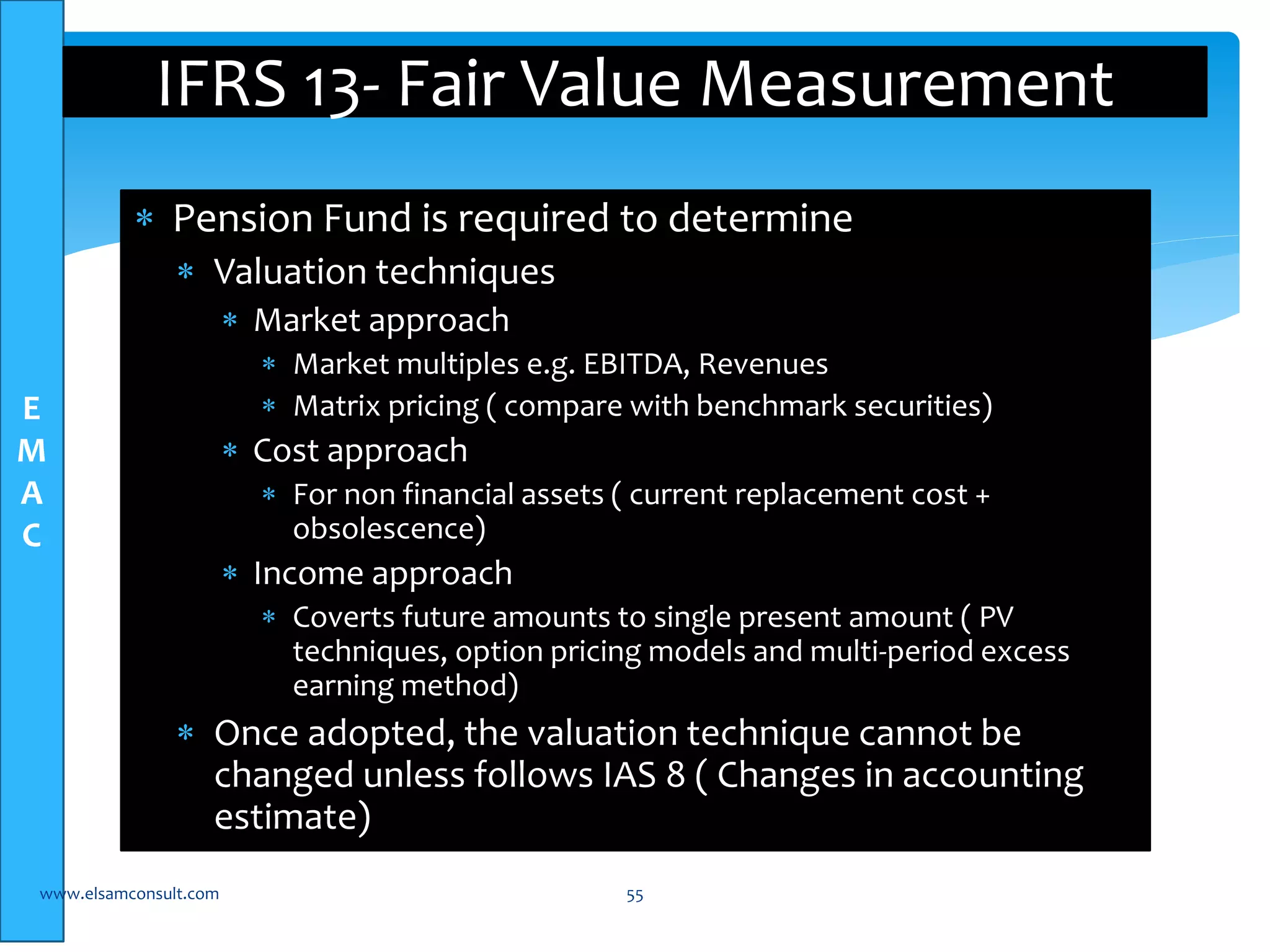
 Valuation techniques 
 Market approach 
 Market multiples e.g. EBITDA, Revenues 
 Matrix pricing ( compare with benchmark securities) 
 Cost approach 
 For non financial assets ( current replacement cost + 
obsolescence) 
 Income approach 
 Coverts future amounts to single present amount ( PV 
techniques, option pricing models and multi-period excess 
earning method) 
 Once adopted, the valuation technique cannot be 
changed unless follows IAS 8 ( Changes in accounting 
estimate) 
www.elsamconsult.com 55
E 
M 
A 
C 
IFRS 13- Fair Value Measurement 
 Pension Fund is required to determine 
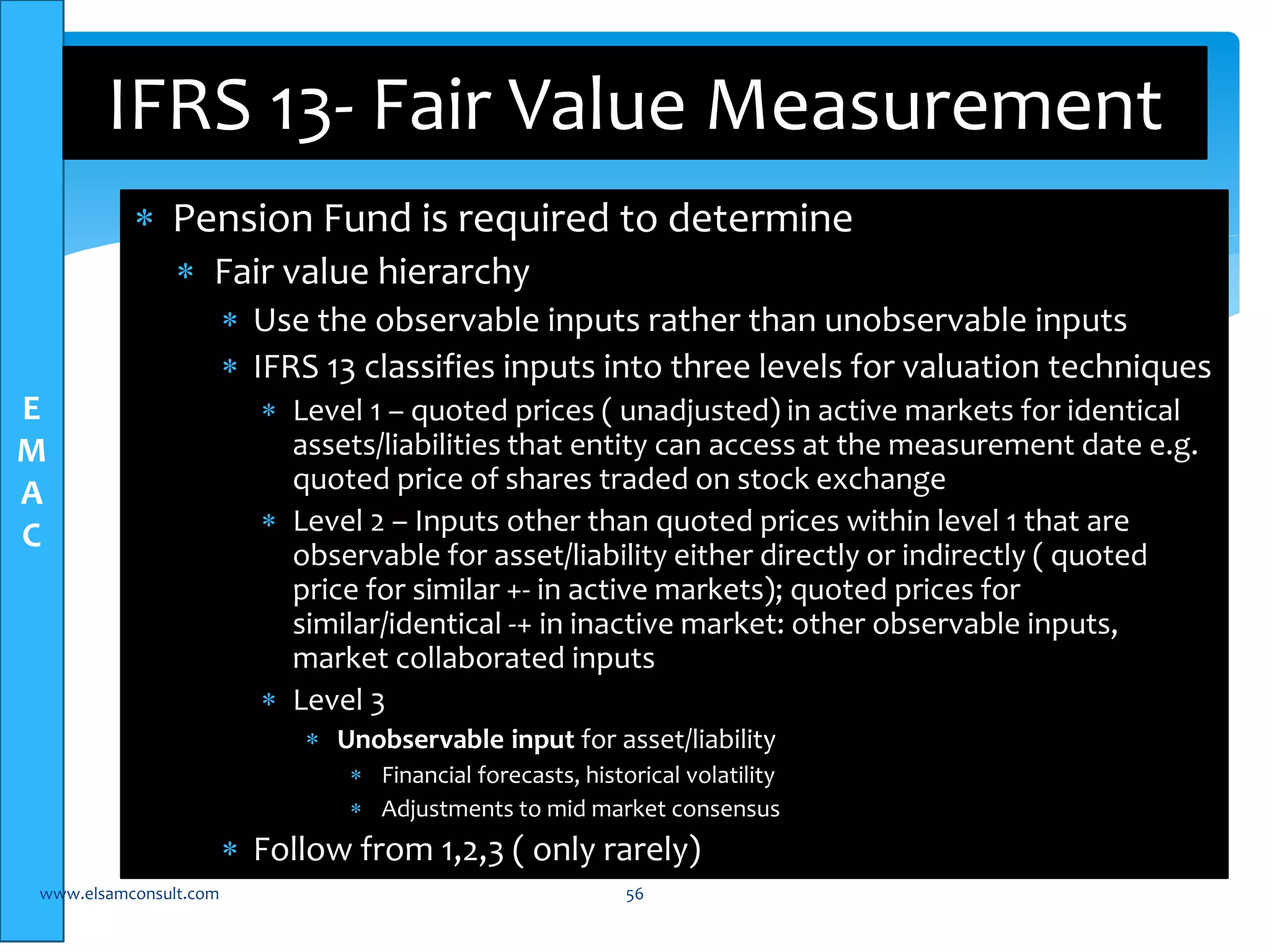
 Fair value hierarchy 
 Use the observable inputs rather than unobservable inputs 
 IFRS 13 classifies inputs into three levels for valuation techniques 
 Level 1 – quoted prices ( unadjusted) in active markets for identical 
assets/liabilities that entity can access at the measurement date e.g. 
quoted price of shares traded on stock exchange 
 Level 2 – Inputs other than quoted prices within level 1 that are 
observable for asset/liability either directly or indirectly ( quoted 
price for similar +- in active markets); quoted prices for 
similar/identical -+ in inactive market: other observable inputs, 
market collaborated inputs 
 Level 3 
 Unobservable input for asset/liability 
 Financial forecasts, historical volatility 
 Adjustments to mid market consensus 
 Follow from 1,2,3 ( only rarely) 
www.elsamconsult.com 56
E 
M 
A 
C 
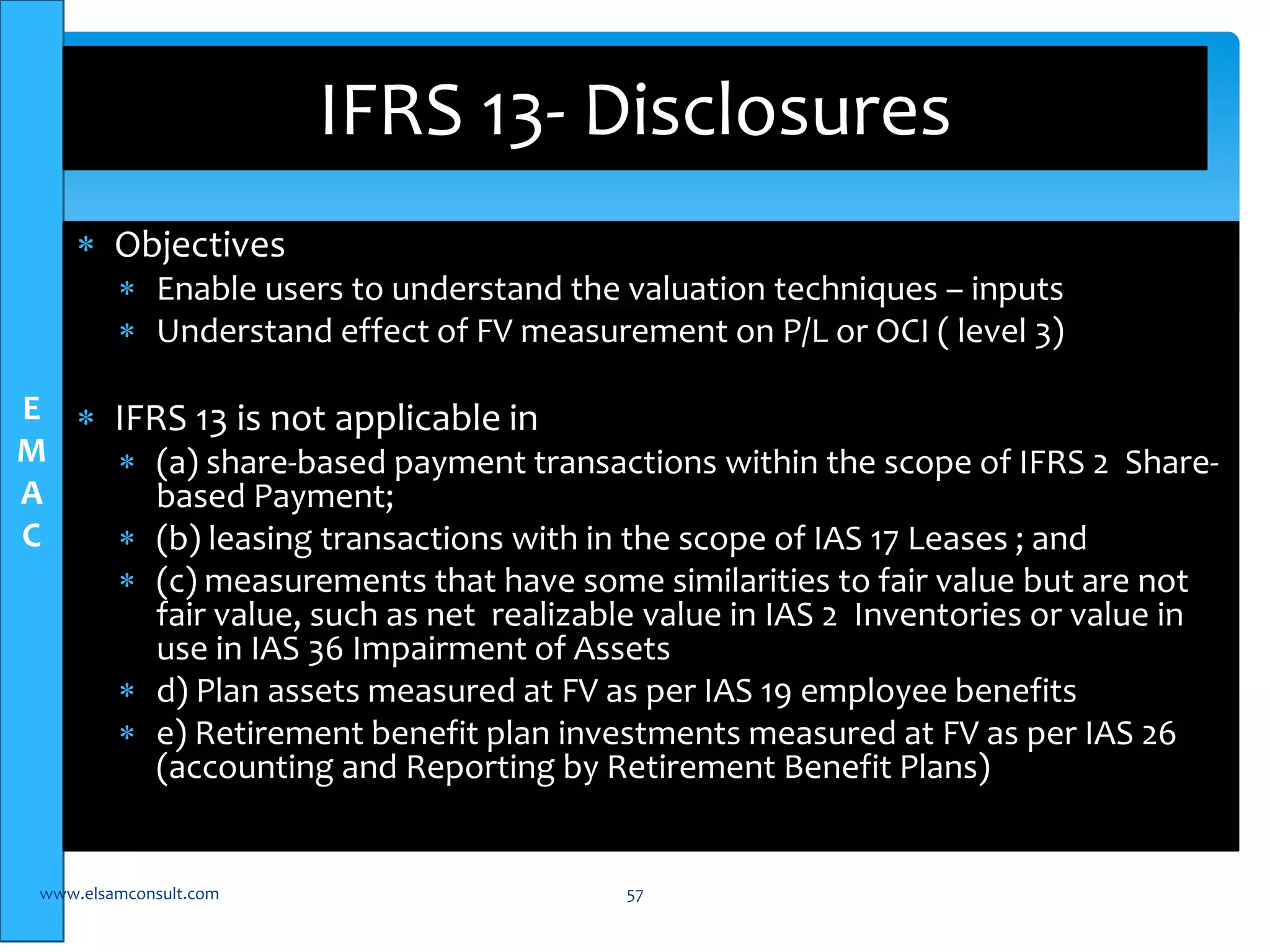
 Objectives 
IFRS 13- Disclosures 
 Enable users to understand the valuation techniques – inputs 
 Understand effect of FV measurement on P/L or OCI ( level 3) 
 IFRS 13 is not applicable in 
 (a) share-based payment transactions within the scope of IFRS 2 Share-based 
Payment; 
 (b) leasing transactions with in the scope of IAS 17 Leases ; and 
 (c) measurements that have some similarities to fair value but are not 
fair value, such as net realizable value in IAS 2 Inventories or value in 
use in IAS 36 Impairment of Assets 
 d) Plan assets measured at FV as per IAS 19 employee benefits 
 e) Retirement benefit plan investments measured at FV as per IAS 26 
(accounting and Reporting by Retirement Benefit Plans) 
www.elsamconsult.com 57
E 
M 
A 
C 
Introduction to XBRL 
 A brief introduction to XBRL (eXtensible Business Reporting Language) 
 XBRL representation of the IFRSs, known as the IFRS Taxonomy 
 The goal of the IFRS Foundation and its independent standard-setting 
body, the International Accounting Standards Board (IASB), is to provide 
the world’s integrating capital markets with a common language for 
financial reporting. 
 XBRL (eXtensible Business Reporting Language) was developed to 
provide a common, electronic format for business and financial 
reporting. Because both IFRSs and XBRL are intended to standardise 
financial reporting in order to promote transparency and to improve the 
quality and comparability of business information, the two form a 
perfect partnership. 
 XBRL can also easily handle language differences and therefore ease the 
burden associated with information translation. 
 It is estimated that the use of XBRL could reduce the time spent 
analysing a single financial statement by 15 - 30 per cent, and this is 
www.elsamconsult.com 58
E 
M 
A 
C 
XBRL 
 The IFRS Foundation recognised the potential impact that XBRL 
could have on financial reporting. The Foundation also realised 
that if XBRL were applied in conjunction with IFRSs, it could 
improve access for users to financial information and could also 
support IFRS adoption and implementation. 
 The IFRS Foundation therefore launched the IFRS XBRL initiative in 
2001 and the IFRS Foundation XBRL Team was created. 
 In the current economic climate where transparency in financial 
reporting is regarded as vital, the regulatory and investment 
community are requiring more, increasingly complex business 
information to be reported with greater accuracy and speed. 
 This demand places additional pressure on those who prepare, 
compile and analyse this information. However, the majority of 
this work continues to involve manual processing and is therefore 
prone to time delay and (human) error, and is cost- intensive. 
www.elsamconsult.com 59
E 
M 
A 
C 
XBRL 
 XBRL could potentially solve - or at least mitigate - these problems. 
 XBRL works in such a way that it allows financial information to be 
automatically accessed, extracted and processed by computers. The 
need to manually re-key information to adapt it to specific needs is 
removed. 
 Issuers are able to compile financial reports more speedily and with less 
chance of error. This in turn gives users access to more timely and 
accurate data, thereby enabling them to make better, more informed 
decisions and to produce more accurate reports in less time. 
 Because XBRL is adaptable and is not restricted to particular formats or 
tools, XBRL information can be transmitted to users in a variety of ways. 
Furthermore, the information contained within an XBRL report allows for 
increased comparability and therefore improved analysis. 
 The IFRS Foundation therefore launched the IFRS XBRL initiative in 2001 
and the IFRS Foundation XBRL Team was created. 
www.elsamconsult.com 60
E 
M 
A 
C 
XBRL 
 The mission of the IFRS Foundation XBRL Team is to: create and 
provide a framework for the consistent adoption and 
implementation of IFRSs with a high-quality IFRS Foundation-developed 
IFRS Taxonomy that is consistent with IFRSs. This 
mission is part of the adoption and implementation strategy of the 
IFRS Foundation and is integrated with the development of IFRSs. 
 XBRL is a data-rich dialect of XML (Extensible Markup Language), 
the universally preferred language for transmitting information via 
the Internet. 
 It was developed specifically to communicate information between 
businesses and other users of financial information, such as 
analysts, investors and regulators. 
 XBRL provides a common, electronic format for business reporting. 
It does not change what is being reported. It only changes how it 
is reported. 
www.elsamconsult.com 61
E 
M 
A 
C 
XBRL 
 A typical business report on an Internet page is a closed and self-contained 
document. Although it can be viewed and transmitted 
using the Internet, its format and content is fixed; neither the 
format nor the content can be changed unless you change the 
Internet page. 
 As a result, to extract the information from such a report for 
computerised analysis requires exporting or re-keying the data into 
a format that can be handled by computer software. 
 A business report that has been prepared using XBRL is known as 
an instance document, and it is different to a standard business 
report. The information contained in the instance document is not 
closed and does not have a predefined, fixed format. The data can 
be used interactively because it can be accessed, extracted and 
processed automatically by computers. This interactiveness is 
made possible by the use of tags. 
www.elsamconsult.com 62
E 
M 
A 
C 
XBRL 
 In XBRL, information is not treated as a static block of text or set 
of numbers. Instead, information is broken down into unique 
items of data (eg total liabilities = 100). These data items are then 
assigned mark-up tags that make them computer-readable. For 
example, the tag <Liabilities>100</Liabilities> enables a computer 
to understand that the item is liabilities, and it has a value of 100. 
 Computers can treat information that has been tagged using XBRL 
‘intelligently’; they can recognise, process, store, exchange and 
analyse it automatically using software. 
 Because XBRL tags are formed in a universally-accepted way, they 
can be read and processed by any computer that has XBRL 
software. 
www.elsamconsult.com 63
E 
M 
A 
C 
XBRL 
 XBRL tags are defined and organized using categorization schemes called taxonomies. 
 Taxonomies are the computer-readable ‘dictionaries’ of XBRL. Taxonomies provide 
definitions for XBRL tags, they provide information about the tags, and they organise 
the tags so that they have a meaningful structure. 
 Taxonomies differ according to reporting purposes, the type of information being 
reported and reporting presentation requirements. Consequently, a company may use 
one taxonomy when reporting to a stock exchange, but use a different taxonomy when 
reporting to a securities regulator. 
 Taxonomies are available for most of the major national accounting standards around 
the world. For a company reporting in IFRS, the IFRS Foundation publishes tags for all 
IFRS disclosures. These tags are organized and contained within the IFRS Taxonomy. 
 As a result, taxonomies enable computers with XBRL software to: 
 • understand what the tag is (eg whether it is a monetary item, a percentage or text); 
 • what characteristics the tag has (eg if it has a negative value); 
 • its relationship to other items (eg if it is part of a calculation). 
 This additional information is called meta-data. When information that has been tagged 
with XBRL is transmitted, the meta-data contained within the tags is also transmitted. 
www.elsamconsult.com 64
E 
M 
A 
C 
XBRL 
What is XBRL 
www.elsamconsult.com 65
E 
M 
A 
C 
End of day 1 
Thank you for 
Participation 
www.elsamconsult.com 66

Ifrs for pensions schemes emac

  • 1.
    E M A C ELSAM MANAGEMENT CONSULTANTS INTERNATIONAL FINANCIAL REPORTING STANDARDS IFRS by Sako Mayrick www.elsamconsult.com
  • 2.
    E M A C Welcoming Remarks  Who are we?  Elsam Management Consultants (EMAC) is a pool of professional consultants in Finance, BSC, HR and Risk Management disciplines established as a limited liability company since 2006  Core Functions are: Recruitment, Training and Consultancies  More details: www.elsamconsult.com www.elsamconsult.com 2
  • 3.
    E M A C Welcoming Remarks  Introduction of facilitators  Self introduction to others on your team  Recap- Share something on personal experience in Financial Reporting and high level expectations of this training  Document the expectations  Agree on key rules www.elsamconsult.com 3
  • 4.
    E M A C Organization of this training  Day 1 – Overview of IFRS and Financial Statement Presentation Day 2 - Financial Instruments, IFRS 7,9 and IAS 32, 39 Interim Financial Reports and IAS 34 Day 3 – PPE, IAS 16, IFRS 13, IAS 28 Day 4 - IAS 19, Employee Benefits, IFRs 10 and IAS 27 Day 5 - Practical Issues in Taxation for Pension Funds, See the detailed Program Schedule in your bag www.elsamconsult.com 4
  • 5.
    E M A C Day 1 Overview of IFRS www.elsamconsult.com 5
  • 6.
    E M A C Session 1 GAAP,IASB, IFRS & Convergence Project www.elsamconsult.com 6
  • 7.
    E M A C Introduction to GAAPs  GAAPs are set of standards that are generally accepted and universally practiced to recognize, classify, record and report financial transactions.  There are different types of GAAPs  American GAAPs  SEC  AICPA  FASB  International GAAPs  IFRS  IAS  IFRIC  SIC  Best Practices not yet codified www.elsamconsult.com 7
  • 8.
    E M A C Which GAAP should we use at Pension? What about Actuaries? www.elsamconsult.com 8
  • 9.
    E M A C Convergence of GAAPs  More than 125 Countries uses International GAAPs  There was turgor between US FASB and IFRS  But something changed the landscape Watch pract 1  The convergence project is ongoing … lets see updates Watch pract 2  It is expected that the entire globe will be reporting under IFRS. WHY?  1  2  3 www.elsamconsult.com 9
  • 10.
    E M A C Are the Pension Scheme Financial Statements prepared using GAAPs www.elsamconsult.com 10
  • 11.
    E M A C IASB, IFRS, SIC AND IFRIC www.elsamconsult.com 11
  • 12.
    E M A C IASB, IFRS, SIC AND IFRIC  IASB, IFRS, SIC and IFRIC are all under control of IFRS Foundation which establishes the IASB  IFRS Foundation primary mission to develop, in public interest, a single set of high quality, understandable, enforceable and globally acceptable IFRS based upon clearly articulated principles  IFRS are developed by IASB, the independent standards setting body of IFRS Foundation.  IASB is the independent standard-setting body of IFRS Foundation, including technical staff and advisory bodies, composed of international experts www.elsamconsult.com 12
  • 13.
    E M A C IASB, IFRS, SIC AND IFRIC  What then are IFRIC  IFRIC is the interpretation body of the IASB. The mandate of the interpretations Committee is to review on timely basis implementation of issues that have arisen within the context of current IFRS and to provide authoritative guidance (IFRCs)  What then is IAS and SIC?  IAS are IFRS that were created by the predecessor body of the IASB. They were adopted by IAS when it took over in 2001 and therefore forms part of the body of IFRS requirements  SIC are the official interpretations of the IAS that were developed by the IASB’s predecessor body and its interpretative committee For more interest on IASB and IFRS visit www.ifrs.org www.elsamconsult.com 13
  • 14.
    E M A C IASB, IFRS, SIC AND IFRIC www.elsamconsult.com 14
  • 15.
    E M A C IASB – HQ Canon St. No. 13 London www.elsamconsult.com 15
  • 16.
    E M A C Current IASB Projects  IFRS 9 to be effective by 2018. Early adoption recommended  Major changes in IFRS for insurance contacts, leases, IFRS for SMEs, Review of Conceptual framework and accounting for Dynamic Risk Management: a Portfolio revaluation Application to Macro hedging (October, 2014 commencement)  It also includes Rate regulated activities, disclosure initiative.  Amendment of IAS 1 and fair value measurement; recognition of Deferred tax assets for unrealized losses www.elsamconsult.com 16
  • 17.
    E M A C Key IFRSs - 2014  How many IFRSs do we have?  12  Framework  IFRS 1 – First time adoption of IFRS  IFRS 2 – Share Based payments  IFRS 3 – Business Combinations  IFRS 4 - Insurance Contracts  IFRS 5 – Non Current Assets Held for Sale and Discontinued operations  IFRS 6 – Exploration for and evaluation of Mineral resources  IFRS 7 -Financial Instruments; Disclosure  IFRS 8 – Operating Segments  IFRS 9 – Financial Instruments  IFRS 10 - Consolidated Financial Statements  IFRS 11 - Joint Arrangements  IFRS 12 – Disclosure of interest in other entities  IFRS 13 – Fair Value Measurement www.elsamconsult.com 17
  • 18.
    E M A C  How many are they?  26 Key IAS- 2014  IAS 1- Presentation of Financial Statements  IAS 2- Inventories  IAS 7 – Statement of Cash Flows  IAS 8 – Accounting Policies, Changes in Accounting Estimates and Errors  IAS 10 – Events after the reporting Period  IAS 11 - Construction Contracts  IAS 12 – Income Taxes  IAS 16 – Property, Plant and Equipment  IAS 17 - Leases  IAS 18 - Revenue  IAS 19 – Employee Benefits  IAS 20 – Accounting for Government Grants and Disclosure of Government Assistance  IAS 21 - The Effects of changes in Foreign Exchange rates  IAS 23 – Borrowing Costs  IAS 24 – Related Party Disclosures www.elsamconsult.com 18
  • 19.
     IAS 26– Accounting and Reporting by Retirement Benefit plans  IAS 27 – Separate Financial Statements  IAS 28 – Investment in Associates and Joint Ventures  IAS 29 – Financial Reporting in Hyperinflationary Economies  IAS 32 – Financial Instruments: Presentation  IAS 33 – Earning Per share  IAS 34 – Interim Financial Reporting  IAS 36 – Impairment of Assets  IAS 37 – Provisions, contingent liabilities and contingent Assets  IAS 38 – Intangible Assets  IAS 39 – Financial Instruments: Recognition and Measurement  IAS 40 – Investment Property  IAS 41 - Agriculture www.elsamconsult.com 19 E M A C Key IAS- 2014
  • 20.
    E M A C Key IFRIC and SIC - 2014  There are 17 IFRICs  What are they?  There are 8 SIC  What are they? www.elsamconsult.com 20
  • 21.
    E M A C New and Revised standards  IFRS 10 – consolidated Financial Statements  IFRS 11 Joint arrangements  IFRS 12 Disclosure of interest in Other Entities  IAS 27 – Separate Financial Statements  IAS 28 Investment in Associates and Joint Ventures  Amendments to IFRS 10, IFRS 11 and IFRS 12 Consolidated Financial Statements, Joint Arrangements and Disclosure interest in Other Entities: Transition Guidance www.elsamconsult.com 21
  • 22.
    E M A C New and Revised standards  IFRS 13 Fair Value Measurement  IAS 19 Employee Benefits  Amendments to IFRS 1 Government Loans  Amendments to IFRS 7 Disclosures- Offsetting Financial Assets and Financial Liabilities  Amendments to IAS 1 Presentation of items of OCI  IFRC 20 Stripping Costs in the Production Phase of a surface Mine  Annual Improvements to IFRSs www.elsamconsult.com 22
  • 23.
    E M A C IFRS 10 – Consolidated Financial Statements  Nature of Consolidation and what is not www.elsamconsult.com 23
  • 24.
    E M A C IFRS 10 – Consolidated Financial Statements  Nature of Consolidation and what is not - Summary Subsidiary Associate Joint www.elsamconsult.com 24 Arrangement Criteria Control Significance Influence Joint control Share >50% 20%+ NA Accounting Acquisition method ( full consolidation) Equity method Depends on type Other Investments – Financial Instruments (IFRS 9/IAS 39)
  • 25.
    E M A C Other Standards deals with Consolidation  Group accounts and consolidation is covered by 6 IFRS standards  IAS 27 – Separate Financial statements  Not for consolidation, just a line for investment  Presentation of separate financial statements  Shares in subsidiaries or other investment  IAS 28 – Investment in Associate  Investment which you have no control  20-30% ownership of shares  We account using equity method  What is the formula for investment at PPF Pension Fund www.elsamconsult.com 25
  • 26.
    E M A C IFRS 10 – Consolidated Financial Statements  Nature of Consolidation and what is not www.elsamconsult.com 26
  • 27.
    E M A C IFRS 10 – Consolidated Financial Statements  It is a new standard from IAS 27 Consolidated and Separate Financial statements  We have one new and one revised standard  IFRS 10 Consolidated Financial statements  IAS 27 Separate Financial Statements  IFRS 10  IFRS 10 replaces part of IAS 27 Consolidated and Separate Financial Statements that deals with consolidated financial statements and SIC 12 Consolidation –Special Purpose Entities  When should an investor consolidate an investee?  There is only one basis for consolidation for all entities, and that basis is control  It removes the problem of IAS 27 and SIC 12, the former uses control concept while the latter placed greater emphasis on risk and rewards www.elsamconsult.com 27
  • 28.
    E M A C Other Standards deals with Consolidation  IFRS 3 – Business Combination  Defines business combination  Recognition  Measurement  Good will, NCI, Identifiable A and AL  It does not describe the consolidation but defines the basics of above  IFRS 10 – Consolidated Financial Statements,  Directly related to IFRS 3  Defines Control, what it is  Requires investor, parent to prepare consolidated financial statements  Defines procedures for consolidation  Defines investment entities where there is no need to consolidate www.elsamconsult.com 28
  • 29.
    E M A C IFRS 10 – Consolidated Financial  IFRS 10 Statements  The definition of control under IFRS 10 includes the following elements  Power over an investee  Exposure, or rights, to variable returns from its involvement with the investee  Ability to use power over the investee to affect the amount of investor’s returns  With regard to the first criterion, IFRS 10 states that an investor has power over an investee when the investor has existing rights that give it the current ability to direct the relevant activities of the investee, which are the activities that significantly affect the returns of the investee (not merely financial and operating activities as set out in the previous version of IAS 27) www.elsamconsult.com 29
  • 30.
    E M A C IFRS 10 – Consolidated Financial  IFRS 10 Statements  Guidance to deal with complicated issues  Whether or not an investor has control over an investee when the investor has less than the majority of the voting right of the investee. For example, a private entity has a 48% equity interest in a listed investee. A question arises as to whether the private entity has ‘de facto’ control over the investee.  IFRS 10 does not give any bright line, although it does include a number of illustrative examples some of which indicate that the ‘control’ conclusion is clear in certain scenarios  Whether or not a decision maker has control over an investee. For example, a fund manager manages a fund and has discretion over some key  activities of the fund. A question arises as to whether the fund manager has control over the fund it manages. To answer this question, IFRS 10  requires an analysis as to whether the fund manager is acting as a principal or an agent. If a fund manager is acting as a principal for a fund it  manages, it should consolidate the fund. Conversely, if a fund manager is merely acting as an agent, it should not consolidate the fund. www.elsamconsult.com 30
  • 31.
    E M A C Other Standards deals with Consolidation  IFRS 11 – Joint Arrangements  Activities jointly executed by parties  Joint ventures  Joint operations  IFRS 11 defines and provides accounting treatment for them  IFRS 12 – Disclosure of interest in other entities  Prescribes necessary information one need to disclose about subsidiaries, associates, joint arrangements in consolidated financial statements www.elsamconsult.com 31
  • 32.
    IFRS 10 E M A C Video Presentation www.elsamconsult.com 32
  • 33.
    E M A C Framework for Preparation and presentation of Pension Fund Financial Statements www.elsamconsult.com 33
  • 34.
    E M A C Conceptual Framework  Framework is a foundation for preparation of Financial Statements  It deals with 1. Objectives of financial reporting  Useful information to existing and potential investors, lenders, creditor in making decisions about resources to entity  Investors , creditors and lenders are primary users of financial information for general purpose financial information  The financial information cannot provide all information and other sources are required  To meet the objectives, financial statements are prepared based on :  Accrual basis of accounting  Going Concern www.elsamconsult.com 34
  • 35.
    E M A C Conceptual Framework  Framework is a foundation for preparation of Financial Statements  It deals with  Objectives of financial reporting  The qualitative characteristics of useful financial information  Makes financial statements most useful to the existing and potential investors, lenders and other creditors  Must be Relevant – predictive and confirmatory value, faithfully presented  Comparable, Verifiable, timely and understandable www.elsamconsult.com 35
  • 36.
    E M A C Conceptual Framework  Framework is a foundation for preparation of Financial Statements  It deals with  Objectives of financial reporting  To meet the objectives, financial statements are prepared based on :  The qualitative characteristics of useful financial information  The definition, recognition and measurement of elements from which financial statements are constructed  Deals with measurement of financial position : Assets, liabilities and Equity  An Asset is a resource controlled by the entity as a result of past events and from which economic benefits are expected to flow to an entity  Liability is a present obligation of the entity arising from past events, the settlement of which is expected to result in an outflow from the entity resources embodying economic benefit  Equity is the residual interest in assets of the entity after deducting all its liabilities  Income is increases in economic benefits during the accounting period in the form of inflows or enhancement of assets or decreases in liabilities that result in increases in equity, other than those contributed by equity participants  Expenses are decreases in economic benefits during the accounting period in the form of out-flows or depletion of assets or incurrences of liabilities that result in decreases in equity, other than those relating to distributions to equity participants www.elsamconsult.com 36
  • 37.
    E M A C Conceptual Framework  Framework is a foundation for preparation of Financial Statements  It deals with  Objectives of financial reporting  To meet the objectives, financial statements are prepared based on :  The qualitative characteristics of useful financial information  The definition, recognition and measurement of elements from which financial statements are constructed  The above elements are recognized only if : it is probable that any future economic benefit associated with the item will flow to or from the entity and … has a cost or value that can be measured with reliability  Concept of capital and capital maintenance  It is the basis for measurement or determining the monetary amounts at which the elements of the financial statements are recognized and carried in the balance sheet and income statements.  It is concerned with how the entity defines the capital it seeks to maintain  Differentiate between return of capital and return on capital; only inflows of assets in excess of amounts needed to maintain capital may be regarded as profits an therefore as a return on capital  If there is a conflict between IFRS and Framework, IFRS prevails www.elsamconsult.com 37
  • 38.
    E M A C Conceptual Framework www.elsamconsult.com 38
  • 39.
    E M A C Conceptual Framework Video Presentation and discussions www.elsamconsult.com 39
  • 40.
    E M A C Group Work 1 Use the Provided questions to digest various accounting issues at Pension Fund in practical perspective www.elsamconsult.com 40
  • 41.
    E M A C Video Case Study Presentation of Financial Information and IFRS 1 www.elsamconsult.com 41
  • 42.
    E M A C Financial Statement Presentation  A complete set of financial statements comprises:  (a) a statement of financial position as at the end of the period;  (b) a statement of profit and loss and other comprehensive income for the period;  (c) a statement of changes in equity for the period;  (d) a statement of cash flows for the period;  (e) notes, comprising a summary of significant accounting policies and other explanatory information; and  (f) a statement of financial position as at the beginning of the earliest comparative period when an entity applies an accounting policy retrospectively or makes a retrospective restatement of items in its financial statements, or when it reclassifies items in its financial statements. www.elsamconsult.com 42
  • 43.
    E M A C Presentation of financial Statements Video explanation of IAS 1 Video 2 presentation of financial statements www.elsamconsult.com 43
  • 44.
    E M A C Key Changes in IFRS 2014  Amendment of IAS 19 – Employee benefits  Abolishment of Corridor method ( actuarial valuation)  Terminal Benefits and Post employment benefits  Introduction of IFRS 13- Fair Value measurement  Different ways for fair value measurement  Introduction of IFRS 10 – Consolidated FS  Consolidated FS  Replaces part of IAS 27 (Consolidated  Introduce the issue of investment entity  Introduction of IFRS 11 – Joint arrangement  Replaces IAS 31 and Interest in JV  More details will come tomorrow www.elsamconsult.com 44
  • 45.
    E M A C Introduction to IFRS 9  The IASB published the final version of IFRS 9 Financial Instruments in July 2014.  The final version of IFRS 9 brings together the classification and measurement, impairment and hedge accounting phases of the IASB’s project to replace IAS 39 Financial Instruments: Recognition and Measurement.  IFRS 9 is built on a logical, single classification and measurement approach for financial assets that reflects the business model in which they are managed and their cash flow characteristics.  Built upon this is a forward-looking expected credit loss model that will result in more timely recognition of loan losses and is a single model that is applicable to all financial instruments subject to impairment accounting.  In addition, IFRS 9 addresses the so-called ‘own credit’ issue, whereby banks and others book gains through profit or loss as a result of the value of their own debt falling due to a decrease in credit worthiness when they have elected to measure that debt at fair value.  The Standard also includes an improved hedge accounting model to better link the economics of risk management with its accounting treatment. www.elsamconsult.com 45
  • 46.
    E M A C Introduction to IFRS 9  Definitions corner  Financial instrument is a contract that gives rise to financial asset to one entity and financial liability to another ( example of a bond by Pension Fund)  Financial Assets can be Cash, equity of another entity, contract to receive cash or contract of financial asset or contract to exchange financial instrument under favorable conditions  Financial Liability can be a contract to deliver cash, contract to exchange financial instruments under unfavorable conditions  An equity instruments is not in cash or other asset, it is settled in shares www.elsamconsult.com 46
  • 47.
    E M A C Introduction to IFRS 9  How to treat them  IAS 32  Classification and presentation  Classify them when recognized, not when settling  Types  Financial Assets  Financial Liabilities  Interest/div, Losses and gains  IAS 39/IFRS 9  Recognition and measurement  Initial measurement at fair value  Transaction costs add to assets or subtract from liabilities UNLESS held at Fair Value through P and L then should be expensed  Subsequent measurement  Fair value through P and L; gain or loss  Held to maturity e.g. debt, debentures measured at amortized costs www.elsamconsult.com 47
  • 48.
    E M A C IFRS 9  IFRS 9 is effective for annual periods beginning on or after 1 January 2018.  However, the Standard is available for early application. In addition, the own credit changes can be early applied in isolation without otherwise changing the accounting for financial instruments.  The IASB has an active project on accounting for dynamic risk management. This is separate from IFRS 9.  IFRS 9 replaces IAS 39, one of the Standards inherited by the IASB when it began its work in 2001.  Many preparers of financial statements, their auditors and users of financial statements find the requirements for reporting financial instruments complex. www.elsamconsult.com 48
  • 49.
    E M A C Practical changes for 2013-14 with implication at Pension Fund  Key changes in IFRS up to May 2014 Watch this IFRS Box Presentation and lets discuss Discussions of IFRS 9 www.elsamconsult.com 49
  • 50.
    E M A C IFRS 13- Fair Value Measurement  Issued in 2011  Application date January, 2013  Objective  Define fair value  Set up a single IFRS  Disclosure  Fair value is the price that would be received to sell an asset or paid to transfer a liability in an orderly transaction between market participants at the measurement date  Price is the exit price  Market is the securities market and not entity based www.elsamconsult.com 50
  • 51.
    E M A C IFRS 13- Fair Value Measurement  Pension Scheme is required to determine  Asset/Liability (Unit of account)  Non financial asset (Highest and best use)  Principal/Most advantageous market (DSE, NSE)  Valuation techniques (fair value hierarchy)  Asset/Liability  Stand alone  Group  Characteristics  Condition and location  Restriction on the sale and use www.elsamconsult.com 51
  • 52.
    E M A C IFRS 13- Fair Value Measurement  Pension Fund is required to determine  Principal/Most advantageous market (DSE, NSE)  If no principal market use most advantageous market for asset or liability  The one that maximizes the amount to sell or minimizes amount for liability after considering transaction costs particularly transfer cost  Market participants should be independent ( IAS 24), knowledgeable, ablel to enter into transactions, and willing to enter  Principal market is the market with more volume of activity for the asset/liability  Different entities can have different principal markets  Price should be on orderly transactions  Adequate market exposure (knowledge for market exchange)  Market participants not forced www.elsamconsult.com 52
  • 53.
    E M A C IFRS 13- Fair Value Measurement  Pension Fund is required to determine  Non Financial Assets  Highest and best use  Physically possible  Legally permissible  Financial feasible  Can be individual assets or combination  For liabilities and equity instruments  Assume transfer and not settlement of a liability  Is there a quoted price then use it  Is there identical item held as asset by other party the use the FV of identical assets  If no corresponding asset by other part use present value VALUATION TECHNIQUES www.elsamconsult.com 53
  • 54.
    E M A C IFRS 13- Fair Value Measurement  Pension Fund is required to determine  Financial assets and liabilities with offsetting position  Market risk with Trade receivables, liabilities ( USD $ losses with USD$ gains), but this requires  There must be document risk management or investment strategy  Information of key management personnel  FV at the end of each reporting period  FV initial recognition  Transaction price (Entry price vs exit price)  Exemptions  Related parties  Duress  Different unit of accounts  Not on principal or most advantageous market  If they are different (entry price vs exist price) it is called day 1 profit www.elsamconsult.com 54
  • 55.
    E M A C IFRS 13- Fair Value Measurement  Pension Fund is required to determine  Valuation techniques  Market approach  Market multiples e.g. EBITDA, Revenues  Matrix pricing ( compare with benchmark securities)  Cost approach  For non financial assets ( current replacement cost + obsolescence)  Income approach  Coverts future amounts to single present amount ( PV techniques, option pricing models and multi-period excess earning method)  Once adopted, the valuation technique cannot be changed unless follows IAS 8 ( Changes in accounting estimate) www.elsamconsult.com 55
  • 56.
    E M A C IFRS 13- Fair Value Measurement  Pension Fund is required to determine  Fair value hierarchy  Use the observable inputs rather than unobservable inputs  IFRS 13 classifies inputs into three levels for valuation techniques  Level 1 – quoted prices ( unadjusted) in active markets for identical assets/liabilities that entity can access at the measurement date e.g. quoted price of shares traded on stock exchange  Level 2 – Inputs other than quoted prices within level 1 that are observable for asset/liability either directly or indirectly ( quoted price for similar +- in active markets); quoted prices for similar/identical -+ in inactive market: other observable inputs, market collaborated inputs  Level 3  Unobservable input for asset/liability  Financial forecasts, historical volatility  Adjustments to mid market consensus  Follow from 1,2,3 ( only rarely) www.elsamconsult.com 56
  • 57.
    E M A C  Objectives IFRS 13- Disclosures  Enable users to understand the valuation techniques – inputs  Understand effect of FV measurement on P/L or OCI ( level 3)  IFRS 13 is not applicable in  (a) share-based payment transactions within the scope of IFRS 2 Share-based Payment;  (b) leasing transactions with in the scope of IAS 17 Leases ; and  (c) measurements that have some similarities to fair value but are not fair value, such as net realizable value in IAS 2 Inventories or value in use in IAS 36 Impairment of Assets  d) Plan assets measured at FV as per IAS 19 employee benefits  e) Retirement benefit plan investments measured at FV as per IAS 26 (accounting and Reporting by Retirement Benefit Plans) www.elsamconsult.com 57
  • 58.
    E M A C Introduction to XBRL  A brief introduction to XBRL (eXtensible Business Reporting Language)  XBRL representation of the IFRSs, known as the IFRS Taxonomy  The goal of the IFRS Foundation and its independent standard-setting body, the International Accounting Standards Board (IASB), is to provide the world’s integrating capital markets with a common language for financial reporting.  XBRL (eXtensible Business Reporting Language) was developed to provide a common, electronic format for business and financial reporting. Because both IFRSs and XBRL are intended to standardise financial reporting in order to promote transparency and to improve the quality and comparability of business information, the two form a perfect partnership.  XBRL can also easily handle language differences and therefore ease the burden associated with information translation.  It is estimated that the use of XBRL could reduce the time spent analysing a single financial statement by 15 - 30 per cent, and this is www.elsamconsult.com 58
  • 59.
    E M A C XBRL  The IFRS Foundation recognised the potential impact that XBRL could have on financial reporting. The Foundation also realised that if XBRL were applied in conjunction with IFRSs, it could improve access for users to financial information and could also support IFRS adoption and implementation.  The IFRS Foundation therefore launched the IFRS XBRL initiative in 2001 and the IFRS Foundation XBRL Team was created.  In the current economic climate where transparency in financial reporting is regarded as vital, the regulatory and investment community are requiring more, increasingly complex business information to be reported with greater accuracy and speed.  This demand places additional pressure on those who prepare, compile and analyse this information. However, the majority of this work continues to involve manual processing and is therefore prone to time delay and (human) error, and is cost- intensive. www.elsamconsult.com 59
  • 60.
    E M A C XBRL  XBRL could potentially solve - or at least mitigate - these problems.  XBRL works in such a way that it allows financial information to be automatically accessed, extracted and processed by computers. The need to manually re-key information to adapt it to specific needs is removed.  Issuers are able to compile financial reports more speedily and with less chance of error. This in turn gives users access to more timely and accurate data, thereby enabling them to make better, more informed decisions and to produce more accurate reports in less time.  Because XBRL is adaptable and is not restricted to particular formats or tools, XBRL information can be transmitted to users in a variety of ways. Furthermore, the information contained within an XBRL report allows for increased comparability and therefore improved analysis.  The IFRS Foundation therefore launched the IFRS XBRL initiative in 2001 and the IFRS Foundation XBRL Team was created. www.elsamconsult.com 60
  • 61.
    E M A C XBRL  The mission of the IFRS Foundation XBRL Team is to: create and provide a framework for the consistent adoption and implementation of IFRSs with a high-quality IFRS Foundation-developed IFRS Taxonomy that is consistent with IFRSs. This mission is part of the adoption and implementation strategy of the IFRS Foundation and is integrated with the development of IFRSs.  XBRL is a data-rich dialect of XML (Extensible Markup Language), the universally preferred language for transmitting information via the Internet.  It was developed specifically to communicate information between businesses and other users of financial information, such as analysts, investors and regulators.  XBRL provides a common, electronic format for business reporting. It does not change what is being reported. It only changes how it is reported. www.elsamconsult.com 61
  • 62.
    E M A C XBRL  A typical business report on an Internet page is a closed and self-contained document. Although it can be viewed and transmitted using the Internet, its format and content is fixed; neither the format nor the content can be changed unless you change the Internet page.  As a result, to extract the information from such a report for computerised analysis requires exporting or re-keying the data into a format that can be handled by computer software.  A business report that has been prepared using XBRL is known as an instance document, and it is different to a standard business report. The information contained in the instance document is not closed and does not have a predefined, fixed format. The data can be used interactively because it can be accessed, extracted and processed automatically by computers. This interactiveness is made possible by the use of tags. www.elsamconsult.com 62
  • 63.
    E M A C XBRL  In XBRL, information is not treated as a static block of text or set of numbers. Instead, information is broken down into unique items of data (eg total liabilities = 100). These data items are then assigned mark-up tags that make them computer-readable. For example, the tag <Liabilities>100</Liabilities> enables a computer to understand that the item is liabilities, and it has a value of 100.  Computers can treat information that has been tagged using XBRL ‘intelligently’; they can recognise, process, store, exchange and analyse it automatically using software.  Because XBRL tags are formed in a universally-accepted way, they can be read and processed by any computer that has XBRL software. www.elsamconsult.com 63
  • 64.
    E M A C XBRL  XBRL tags are defined and organized using categorization schemes called taxonomies.  Taxonomies are the computer-readable ‘dictionaries’ of XBRL. Taxonomies provide definitions for XBRL tags, they provide information about the tags, and they organise the tags so that they have a meaningful structure.  Taxonomies differ according to reporting purposes, the type of information being reported and reporting presentation requirements. Consequently, a company may use one taxonomy when reporting to a stock exchange, but use a different taxonomy when reporting to a securities regulator.  Taxonomies are available for most of the major national accounting standards around the world. For a company reporting in IFRS, the IFRS Foundation publishes tags for all IFRS disclosures. These tags are organized and contained within the IFRS Taxonomy.  As a result, taxonomies enable computers with XBRL software to:  • understand what the tag is (eg whether it is a monetary item, a percentage or text);  • what characteristics the tag has (eg if it has a negative value);  • its relationship to other items (eg if it is part of a calculation).  This additional information is called meta-data. When information that has been tagged with XBRL is transmitted, the meta-data contained within the tags is also transmitted. www.elsamconsult.com 64
  • 65.
    E M A C XBRL What is XBRL www.elsamconsult.com 65
  • 66.
    E M A C End of day 1 Thank you for Participation www.elsamconsult.com 66