I
R
M
T
www.irmt.co.tz 1
18 Stella Maris,Bagamoyo
Compiled by: Sako Mayrick
INSTITUTE OF RISK MANAGEMENT TANZANIA
(IRMT)
ADVANCED RISK MANAGEMENT TRAINING
Project Risk Management Pack
I
R
M
T
Project Risk Management
www.irmt.co.tz 2
I
R
M
T
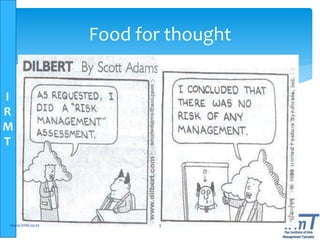
Food for thought
www.irmt.co.tz 3
I
R
M
T
Outline
 Introduction
 What is a project risk
 Project Risk Management
 Why Project Risk Management
 How to plan for project risks
 Identifying and quantifying Project Risks
 Project Risks Mitigation
 Project Risks Monitoring and Control
 Project Risk Management Techniques and Tricks
www.irmt.co.tz 4
I
R
M
T
Prerequisite Risk understanding
 Risk appetite
 Is the amount of risk that an organization is willing to seek or
accept in the pursuit of its long term objectives
 Risk Tolerance
 Are the boundaries of risk taking outside which the
organization is not prepared to venture in pursuit of its
objectives
 Risk Universe
 Is the full range of risks which could impact, either, positively
or negatively, on the ability of the organization to achieve its
long term objectives
www.irmt.co.tz 5
I
R
M
T
Your entity example
TCRA Target: Increase members to
5000 contributors
 Risk appetite
We are expecting risk that may result in
members counts as low as 4700 and as
high as 5600
 Risk Tolerance
If members fall below 3500 or exceed
7000 we will leave this market
www.irmt.co.tz 6
I
R
M
T
Introduction
 Project risk management is the art and science of identifying,
analyzing, and responding to risk throughout the life of a
project and in the best interests of meeting project objectives
 Risk management is often overlooked in projects, but it can
help improve project success by helping select good projects,
determining project scope, and developing realistic estimates
 Unfortunately, crisis management has higher visibility due to
the obvious danger to the success of the project but it’s risk
management that helps a project have fewer problems to
begin with.
www.irmt.co.tz 7
I
R
M
T
Introduction
 Negative Risk
 A dictionary definition of risk is “the possibility of
loss or injury”
 Negative risk involves understanding potential
problems that might occur in the project and how
they might impede project success
 Negative risk management is like a form of
insurance; it is an investment
 If IT projects are so risky, why do companies
pursue them?
www.irmt.co.tz 8
I
R
M
T
Introduction
 Positive Risks
 Positive risks are risks that result in good things
happening; sometimes called opportunities
 A general definition of project risk is an uncertainty that
can have a negative or positive effect on meeting
project objectives
 The goal of project risk management is to minimize
potential negative risks while maximizing potential
positive risks
www.irmt.co.tz 9
I
R
M
T
Introduction
 Some organizations make the mistake of only addressing
tactical and negative risks when performing project risk
management
 David Hillson (www.risk-doctor.com) suggests overcoming
this problem by widening the scope of risk management
to encompass both strategic risks and upside
opportunities, which he refers to as integrated risk
management
 Ensure that project delivery is tied to organizational needs
and vision
 Allowing an appropriate level of risk to be taken intelligently
with full awareness of the degree of uncertainty and its
potential effects on objectives
www.irmt.co.tz 10
I
R
M
T
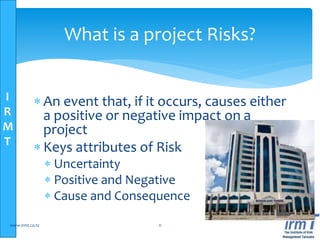
What is a project Risks?
 An event that, if it occurs, causes either
a positive or negative impact on a
project
 Keys attributes of Risk
 Uncertainty
 Positive and Negative
 Cause and Consequence
www.irmt.co.tz 11
I
R
M
T
Project Risk Management
 Risk management is concerned with identifying risks and
drawing up plans to minimise their effect on a project.
 A risk is a probability that some adverse (or positive)
circumstance will occur
 Project risks affect schedule or resources;
 Product risks affect the quality or performance of the
software being developed;
 Business risks affect the organization developing or
procuring the software.
www.irmt.co.tz 12
I
R
M
T
Project Risk Management Process
 PMBOK ® Definition
 “The systematic process of identifying, analyzing, and
responding to project risk”
 Steps
 Risk Management Planning
 Risk Identification
 Qualitative/Quantitative Risk Analysis
 Risk Response Planning
 Risk Monitoring & Control
www.irmt.co.tz 13
I
R
M
T
Benefits of managing project risks
 Opportunity to move from “fire-fighting” to
proactive decision making on the project.
 Better chance of project success.
 Improved project schedule and cost
performance.
 Stakeholders and team members better
understand the nature of the project.
 Helps define the strengths and weaknesses of
the project.www.irmt.co.tz 14
I
R
M
T
Why project risks are not managed
 With so much benefit to managing risk, why is it often
overlooked? :
1. The organization is too busy with real problems to worry
about potential ones,
2. There is a perception that there is not too much that can go
wrong, or
3. They have a fatalistic belief that not much can be done
about risks, or
4. “Shoot the messenger mentality”; fear that disclosure of
project risks will be seen as an indication of project
weakness.
www.irmt.co.tz 15
I
R
M
T
Project Risk myths
 Risk identification can make a project look bad
 All projects have risks, denial does not make
them go away, it just makes you unprepared for
them if they occur.
 Risk in itself is not bad, it is how well the project
plans for and reacts to risks that counts.
 Formal risk management is a cornerstone of
good project management. Stakeholder
visibility into project risks makes it easier to get
additional resources and organizational support
when risks do occur.
www.irmt.co.tz 16
I
R
M
T
Project Risk Management Planning
 Plan for the Planning
 Risk planning should be appropriate for the
project
 Question you should ask:
1. How risky is the project?
2. Is it a new technology or something your
organization is familiar with?
3. Do you have past projects to reference?
4. What is the visibility of the project?
5. How big is the project?
6. How important is the project?
www.irmt.co.tz 17
I
R
M
T
Project Risk Management Plan
 What should it include?
 How you will identify, quantify or qualify risk
Methods and tools
 Budget…yes budget
 Who is doing what
 How often
 Risk categories, levels, and thresholds for action.
 Reporting requirements
 Monitoring, tracking and documenting strategies
www.irmt.co.tz 18
I
R
M
T
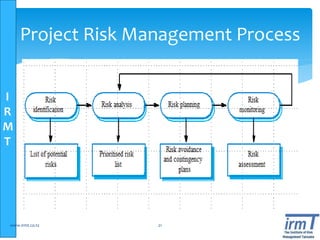
Project Risk Management Process
 Risk identification
 Identify project, product and business risks;
 Risk analysis
 Assess the likelihood and consequences of
these risks;
 Risk response planning
 Draw up plans to avoid or minimize the effects
of the risk;
 Risk monitoring
 Monitor the risks throughout the project;
www.irmt.co.tz 19
I
R
M
T
Project Risk Management Process
Video Case Study 1
Video Case Study 2
www.irmt.co.tz 20
I
R
M
T
Project Risk Management Process
www.irmt.co.tz 21
I
R
M
T
Identifying Project Risk
 Continuous, Iterative Process
 What is it and what does it look like
 The sooner the better
 The more the merrier
 A fact is not a risk (it’s an issue).
 Be specific
 Don’t try to do everything at once
www.irmt.co.tz 22
I
R
M
T
Project Risk Identification techniques
 Brainstorming
 Checklists
 Interviewing
 SWOT Analysis (strengths, weaknesses opportunities, threats)
 Delphi Technique (anonymous consensus building)
 Diagramming Techniques
 Cause & effect
 Flow Charts
 Influence Diagrams
www.irmt.co.tz 23
I
R
M
T
www.irmt.co.tz
Brainstorming
 Brainstorming is a technique by which a group
attempts to generate ideas or find a solution for a
specific problem by amassing ideas spontaneously
and without judgment
 An experienced facilitator should run the
brainstorming session
 Be careful not to overuse or misuse brainstorming
 Psychology literature shows that individuals produce a
greater number of ideas working alone than they do through
brainstorming in small, face-to-face groups
 Group effects often inhibit idea generation
24
I
R
M
T
www.irmt.co.tz
Delphi Technique
 The Delphi Technique is used to derive a consensus among a
panel of experts who make predictions about future
developments
 Developed by the RAND Corporation for the US Air Force
in the late 1960s
 Provides independent and anonymous input regarding future
events
 Uses repeated rounds of questioning and written responses and
avoids the biasing effects possible in oral methods, such as
brainstorming
 Requires a panel of experts for the particular area in question
25
I
R
M
T
www.irmt.co.tz
Interviewing
 Interviewing is a fact-finding technique for collecting
information in face-to-face, phone, e-mail, or instant-messaging
discussions
 Useful to have a prepared set of questions as a guide to the
interview
 Interviewing people with similar project experience is an
important tool for identifying potential risks
26
I
R
M
T
www.irmt.co.tz
SWOT Analysis
 SWOT analysis (strengths, weaknesses,
opportunities, and threats) can also be used
during risk identification
 Project teams focus on the broad perspectives
of potential risks for particular projects
 What are the company’s strengths and weaknesses
related to this project
 What opportunities and threats exist
 Helps identify the broad negative and positive
risks that apply to a project
27
I
R
M
T
www.irmt.co.tz
Other Risk Identification Methods
 Checklists based on risks encountered in previous
projects
 Analyze the validity of project assumptions as
incomplete, inaccurate and/or inconsistent
assumptions can lead to identifying more risks
 Diagramming techniques: cause-and-effect, fishbone,
flowcharts and influence diagrams
 Influence diagrams represent decision problems by displaying
essential elements, including decisions, uncertainties,
causality and objectives and how they influence each other
(www.lumina.com/software/influencediagrams.html)
28
I
R
M
T
www.irmt.co.tz
Other Risk Identification Methods
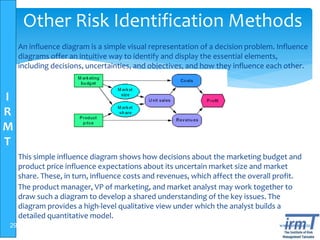
 An influence diagram is a simple visual representation of a decision problem. Influence
diagrams offer an intuitive way to identify and display the essential elements,
including decisions, uncertainties, and objectives, and how they influence each other.
 This simple influence diagram shows how decisions about the marketing budget and
product price influence expectations about its uncertain market size and market
share. These, in turn, influence costs and revenues, which affect the overall profit.
 The product manager, VP of marketing, and market analyst may work together to
draw such a diagram to develop a shared understanding of the key issues. The
diagram provides a high-level qualitative view under which the analyst builds a
detailed quantitative model.
29
I
R
M
T
www.irmt.co.tz
Other Risk Identification Methods
30
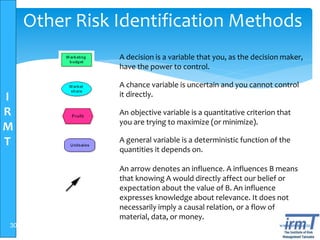
A decision is a variable that you, as the decision maker,
have the power to control.
A chance variable is uncertain and you cannot control
it directly.
An objective variable is a quantitative criterion that
you are trying to maximize (or minimize).
A general variable is a deterministic function of the
quantities it depends on.
An arrow denotes an influence. A influences B means
that knowing A would directly affect our belief or
expectation about the value of B. An influence
expresses knowledge about relevance. It does not
necessarily imply a causal relation, or a flow of
material, data, or money.
I
R
M
T
Examples of project risks
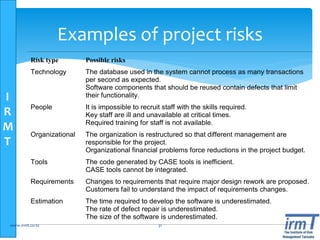
Risk type Possible risks
Technology The database used in the system cannot process as many transactions
per second as expected.
Software components that should be reused contain defects that limit
their functionality.
People It is impossible to recruit staff with the skills required.
Key staff are ill and unavailable at critical times.
Required training for staff is not available.
Organizational The organization is restructured so that different management are
responsible for the project.
Organizational financial problems force reductions in the project budget.
Tools The code generated by CASE tools is inefficient.
CASE tools cannot be integrated.
Requirements Changes to requirements that require major design rework are proposed.
Customers fail to understand the impact of requirements changes.
Estimation The time required to develop the software is underestimated.
The rate of defect repair is underestimated.
The size of the software is underestimated.
www.irmt.co.tz 31
I
R
M
T
Example of Project Risks
 Software development project risks
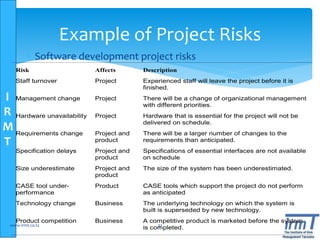
Risk Affects Description
Staff turnover Project Experienced staff will leave the project before it is
finished.
Management change Project There will be a change of organizational management
with different priorities.
Hardware unavailability Project Hardware that is essential for the project will not be
delivered on schedule.
Requirements change Project and
product
There will be a larger number of changes to the
requirements than anticipated.
Specification delays Project and
product
Specifications of essential interfaces are not available
on schedule
Size underestimate Project and
product
The size of the system has been underestimated.
CASE tool under-
performance
Product CASE tools which support the project do not perform
as anticipated
Technology change Business The underlying technology on which the system is
built is superseded by new technology.
Product competition Business A competitive product is marketed before the system
is completed.www.irmt.co.tz 32
I
R
M
T
Project Risk Analysis
Assess probability, seriousness, and
urgency of each risk.
Probability may be very low, low,
moderate, high or very high.
Risk effects might be catastrophic,
serious, tolerable or insignificant.
Urgency might be immediate, short
term, or long term.
www.irmt.co.tz 33
I
R
M
T
Project Risks Analysis - Qualitative
 Subjective
 Educated Guess
 High, Medium, Low
 Red, Yellow, Green
 1-10
 Prioritized/Ranked list of ALL identified
risks
 First step in risk analysis!
www.irmt.co.tz 34
I
R
M
T
Project Risks Analysis -Quantitative
Numerical/Statistical Analysis
Determines probability of
occurrence and consequences of
risks
Should be focused to highest risks
as determined by Qualitative Risk
Analysis and Risk Threshold
www.irmt.co.tz 35
I
R
M
T
Quantitative Risk Analysis
 Often follows qualitative risk analysis, but both
can be done together
 Large, complex projects involving leading edge
technologies often require extensive
quantitative risk analysis
 Main techniques include:
 Decision tree analysis
 Simulation
 Sensitivity analysis
36www.irmt.co.tz
I
R
M
T
www.irmt.co.tz
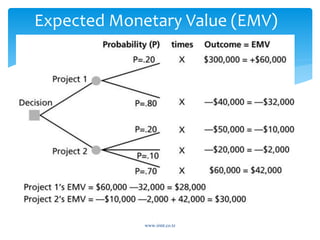
Decision Trees and
Expected Monetary Value (EMV)
 A decision tree is a diagramming analysis
technique used to help select the best course of
action in situations in which future outcomes
are uncertain
 Estimated monetary value (EMV) is the product
of a risk event probability and the risk event’s
monetary value
 You can draw a decision tree to help find the
EMV
37
www.irmt.co.tz
Expected Monetary Value (EMV)
38
I
R
M
T
www.irmt.co.tz
Simulation
 Simulation uses a representation or model of a system to
analyze the expected behavior or performance of the system
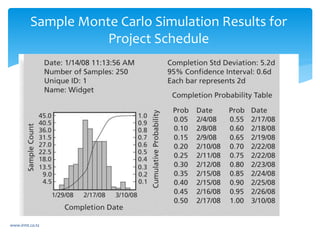
 To use a Monte Carlo simulation, you must have three
estimates (most likely, pessimistic, and optimistic) plus
an estimate of the likelihood of the estimate being
between the most likely and optimistic values
 Monte Carlo analysis simulates a model’s outcome many times
to provide a statistical distribution of the calculated results
 Predicts the probability of finishing by a certain date
or that the cost will be equal to or less than a certain
value
39
I
R
M
T
Steps of a Monte Carlo Analysis
1. Assess the range for the variables being considered –
gather most likely, optimistic and pessimistic time
estimates for each task
2. Determine the probability distribution of each variable
1. Optimistic 8 weeks, most likely 10 and pessimistic 15
3. For each variable, select a random value based on the
probability distribution
1. 20% chance between 8 and 10 weeks, 80% between 10 and 15
4. Run a deterministic analysis or one pass through the
model
5. Repeat steps 3 and 4 many times to obtain the probability
distribution of the model’s results – usually between 100
to 1,000 iterations
40www.irmt.co.tz
Sample Monte Carlo Simulation Results for
Project Schedule
41www.irmt.co.tz
I
R
M
T
www.irmt.co.tz
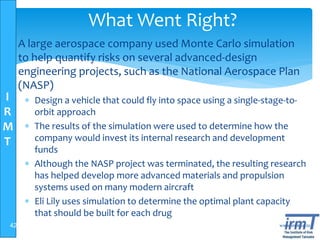
What Went Right?
 A large aerospace company used Monte Carlo simulation
to help quantify risks on several advanced-design
engineering projects, such as the National Aerospace Plan
(NASP)
 Design a vehicle that could fly into space using a single-stage-to-
orbit approach
 The results of the simulation were used to determine how the
company would invest its internal research and development
funds
 Although the NASP project was terminated, the resulting research
has helped develop more advanced materials and propulsion
systems used on many modern aircraft
 Eli Lily uses simulation to determine the optimal plant capacity
that should be built for each drug
42
I
R
M
T
www.irmt.co.tz
Sensitivity Analysis
 Sensitivity analysis is a technique used to show the effects of
changing one or more variables on an outcome
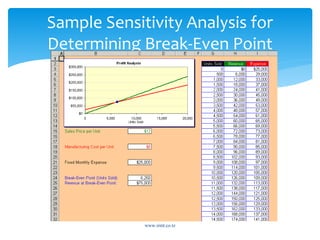
 For example, many people use it to determine what the
monthly payments for a loan will be given different interest
rates or periods of the loan, or for determining break-even
points based on different assumptions
 Spreadsheet software, such as Excel, is a common tool for
performing sensitivity analysis
43
www.irmt.co.tz
Sample Sensitivity Analysis for
Determining Break-Even Point
44
I
R
M
T
www.irmt.co.tz
Risk Response Planning
 After identifying and quantifying risks, you must decide how to
respond to them
 Four main response strategies for negative risks:
 Risk avoidance – don’t use h/w or s/w if unfamiliar with them
 Risk acceptance – prepare for risk with backup plan or contingency
reserves
 Risk transference – to deal with financial risk exposure, a company
may purchase special insurance for specific h/w needed for a project.
If h/w fails, insurer has to replace it.
 Risk mitigation – reduce probability of occurrence e.g., use proven
technology, buy maintenance or service contract
45
www.irmt.co.tz
General Risk Mitigation Strategies for Technical,
Cost, and Schedule Risks
46
I
R
M
T
www.irmt.co.tz
Response Strategies for Positive Risks
 Risk exploitation – do whatever you can to make sure the risk
occurs, call press conference to advertise new product, take
out ads, etc
 Risk sharing – allocating ownership of the risk to another party.
Hire an outside firm to do your advertising and PR
 Risk enhancement – identify and maximize key drivers of the
risk. Encourage your employees or users of your product to
spread the word of your product
 Risk acceptance – don’t take any action with regard to positive
risk. Assume the product will speak for itself
47
I
R
M
T
www.irmt.co.tz
Residual and Secondary Risks
 It’s also important to identify residual and secondary risks
 Residual risks are risks that remain after all of the response
strategies have been implemented
 Even though used stable h/w platform, it still may fail
 Secondary risks are a direct result of implementing a risk
response
 Using stable h/w may have caused a risk of peripheral
devices failing to function properly
48
I
R
M
T
www.irmt.co.tz
Media Snapshot
 A highly publicized example of a risk response to corporate
financial scandals, such as those affecting Enron, Arthur
Andersen, and WorldCom, was legal action
 The Sarbanes-Oxley Act is considered the most significant change
to federal securities laws in the United States since the New Deal
 Fines, prison sentences up to 20 years for anyone who knowingly
alters or destroys a record or document with the intent to obstruct
an investigation
 This Act has caused many organizations to initiate projects and
other actions to avoid litigation
49
I
R
M
T
www.irmt.co.tz
Risk Monitoring and Control
 Involves executing the risk management process to respond
to risk events
 This is an ongoing activity – new risks identified, old
risks disappear, weaken or get stronger
 Workarounds are unplanned responses to risk events that
must be done when there are no contingency plans
 Main outputs of risk monitoring and control are:
 Requested changes
 Recommended corrective and preventive actions
 Updates to the risk register, project management plan, and
organizational process assets
50
I
R
M
T
www.irmt.co.tz
Using Software to Assist in Project
Risk Management
 Risk registers can be created in a simple Word or Excel file or
as part of a database
 More sophisticated risk management software, such as
Monte Carlo simulation tools, help in analyzing project risks
 The PMI Risk Specific Interest Group’s Web site at
www.risksig.com has a detailed list of software products to
assist in risk management
51
I
R
M
T
www.irmt.co.tz
Results of Good Project Risk
Management
 Unlike crisis management, good project risk management
often goes unnoticed
 Well-run projects appear to be almost effortless, but a lot of
work goes into running a project well
 Project managers should strive to make their jobs look easy to
reflect the results of well-run projects
52
I
R
M
T
Quantitative Risk Analysis
 Video Case Study 1 (Risk Doctor)
 Video Case Study 2 (Lady)
www.irmt.co.tz 53
I
R
M
T
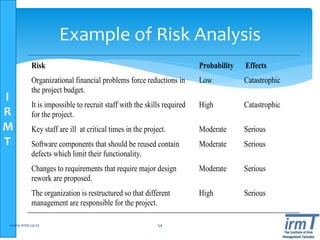
Example of Risk Analysis
Risk Probability Effects
Organizational financial problems force reductions in
the project budget.
Low Catastrophic
It is impossible to recruit staff with the skills required
for the project.
High Catastrophic
Key staff are ill at critical times in the project. Moderate Serious
Software components that should be reused contain
defects which limit their functionality.
Moderate Serious
Changes to requirements that require major design
rework are proposed.
Moderate Serious
The organization is restructured so that different
management are responsible for the project.
High Serious
www.irmt.co.tz 54
I
R
M
T
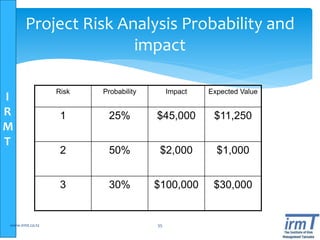
Project Risk Analysis Probability and
impact
Risk Probability Impact Expected Value
1 25% $45,000 $11,250
2 50% $2,000 $1,000
3 30% $100,000 $30,000
www.irmt.co.tz 55
I
R
M
T
Project Risk Mitigation
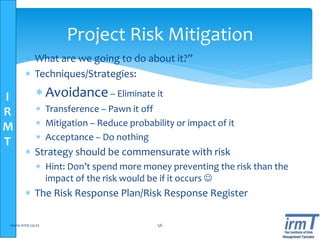
 What are we going to do about it?”
 Techniques/Strategies:
 Avoidance– Eliminate it
 Transference – Pawn it off
 Mitigation – Reduce probability or impact of it
 Acceptance – Do nothing
 Strategy should be commensurate with risk
 Hint: Don’t spend more money preventing the risk than the
impact of the risk would be if it occurs 
 The Risk Response Plan/Risk Response Register
www.irmt.co.tz 56
I
R
M
T
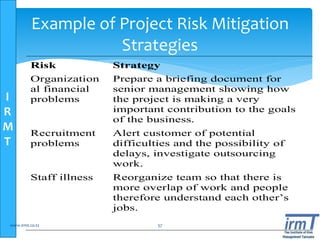
Example of Project Risk Mitigation
Strategies
Risk Strategy
Organization
al financial
problems
Prepare a briefing document for
senior management showing how
the project is making a very
important contribution to the goals
of the business.
Recruitment
problems
Alert customer of potential
difficulties and the possibility of
delays, investigate outsourcing
work.
Staff illness Reorganize team so that there is
more overlap of work and people
therefore understand each other’s
jobs.
www.irmt.co.tz 57
I
R
M
T
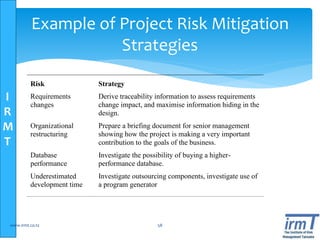
Example of Project Risk Mitigation
Strategies
Risk Strategy
Requirements
changes
Derive traceability information to assess requirements
change impact, and maximise information hiding in the
design.
Organizational
restructuring
Prepare a briefing document for senior management
showing how the project is making a very important
contribution to the goals of the business.
Database
performance
Investigate the possibility of buying a higher-
performance database.
Underestimated
development time
Investigate outsourcing components, investigate use of
a program generator
www.irmt.co.tz 58
I
R
M
T
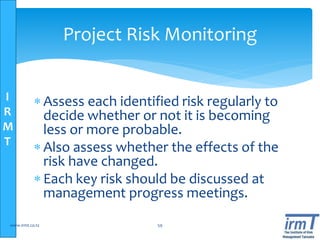
Project Risk Monitoring
 Assess each identified risk regularly to
decide whether or not it is becoming
less or more probable.
 Also assess whether the effects of the
risk have changed.
 Each key risk should be discussed at
management progress meetings.
www.irmt.co.tz 59
I
R
M
T
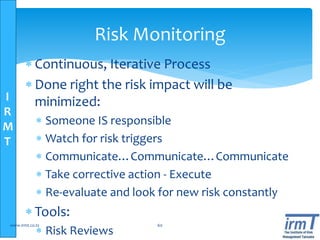
Risk Monitoring
 Continuous, Iterative Process
 Done right the risk impact will be
minimized:
 Someone IS responsible
 Watch for risk triggers
 Communicate…Communicate…Communicate
 Take corrective action - Execute
 Re-evaluate and look for new risk constantly
 Tools:
 Risk Reviews
www.irmt.co.tz 60
I
R
M
T
Project Risk Measures
 Key Risk Indicators
 These are measures that measures risk related
activities
 Control Effectiveness Indicators (Key Control
Indicator)
 These are measures of effectiveness of organizational
controls
 Non – Predictive Measures (Key Performance
Indicator)
 These are measures that would detect unexpected risk
related events
www.irmt.co.tz 61
I
R
M
T
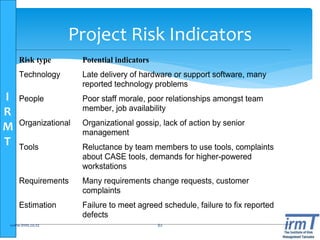
Project Risk Indicators
Risk type Potential indicators
Technology Late delivery of hardware or support software, many
reported technology problems
People Poor staff morale, poor relationships amongst team
member, job availability
Organizational Organizational gossip, lack of action by senior
management
Tools Reluctance by team members to use tools, complaints
about CASE tools, demands for higher-powered
workstations
Requirements Many requirements change requests, customer
complaints
Estimation Failure to meet agreed schedule, failure to fix reported
defects
www.irmt.co.tz 62
I
R
M
T
Project Risk Management tools and
Techniques
Risk Identification Spreadsheet
Risk log Spreadsheet
Templates
Make your own
www.irmt.co.tz 63
I
R
M
T
www.irmt.co.tz
Watch List
 A watch list is a list of risks that are low priority, but are still
identified as potential risks
 Qualitative analysis can also identify risks that should be
evaluated on a quantitative basis
64
I
R
M
T
www.irmt.co.tz 65
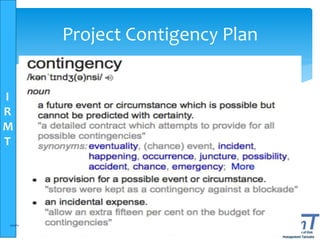
Project Contigency Plan
I
R
M
T
www.irmt.co.tz 66
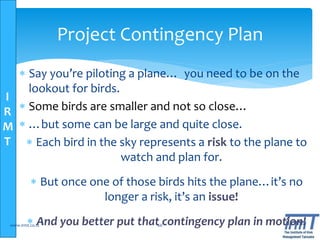
Project Contingency Plan
 Say you’re piloting a plane… you need to be on the
lookout for birds.
 Some birds are smaller and not so close…
 …but some can be large and quite close.
 Each bird in the sky represents a risk to the plane to
watch and plan for.
 But once one of those birds hits the plane…it’s no
longer a risk, it’s an issue!
 And you better put that contingency plan in motion!
I
R
M
T
www.irmt.co.tz 67
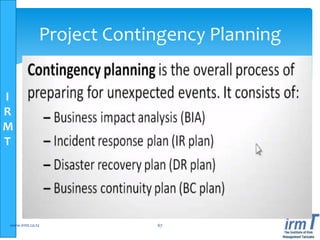
Project Contingency Planning
I
R
M
T
www.irmt.co.tz 68
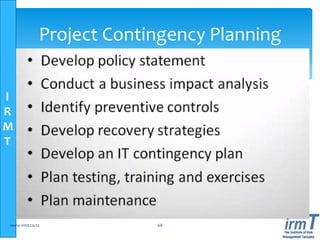
Project Contingency Planning
I
R
M
T
www.irmt.co.tz 69
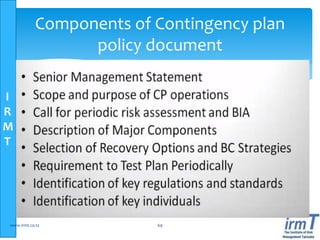
Components of Contingency plan
policy document
I
R
M
T
www.irmt.co.tz 70
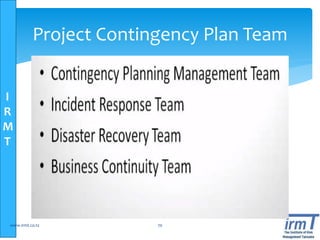
Project Contingency Plan Team
I
R
M
T
www.irmt.co.tz 71
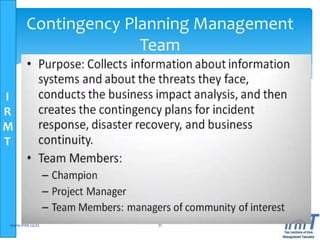
Contingency Planning Management
Team
I
R
M
T
www.irmt.co.tz 72
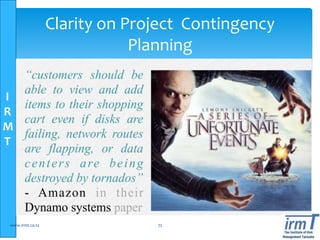
Clarity on Project Contingency
Planning
I
R
M
T  Video presentation
www.irmt.co.tz 73
Titanic Boat Case Study
I
R
M
T
www.irmt.co.tz 74
Recap
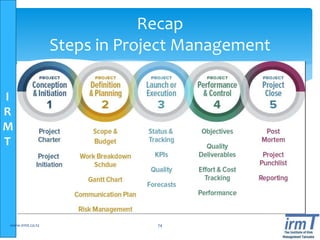
Steps in Project Management
I
R
M
T
www.irmt.co.tz 75
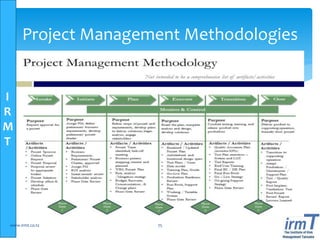
Project Management Methodologies
I
R
M
T
www.irmt.co.tz 76
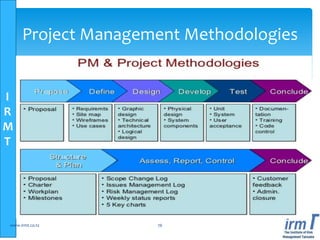
Project Management Methodologies
I
R
M
T
 Project Risk Management includes the processes of
conducting risk management planning, identification,
analysis, response planning, and controlling risk on a
project. The objectives of project risk management
are to increase the likelihood and impact of positive
events, and decrease the likelihood and impact of
negative events in the project. (PMBOK Guide® Fifth
Edition)
www.irmt.co.tz 77
Recap
Meaning of a Project Risk
Management
I
R
M
T
Steps in project risk management
 Plan risk management,
 Identify risk,
 Perform qualitative risk analysis,
 Perform quantitative risk analysis,
 Plan risk response,
 Control risk.
www.irmt.co.tz 78
Recap
I
R
M
T
www.irmt.co.tz 79
Project Risk Management Template
Project Management template including Risk Management
I
R
M
T
www.irmt.co.tz 80
EARNED VALUE MANAGEMENT
I
R
M
T
What is Earned Value Management?
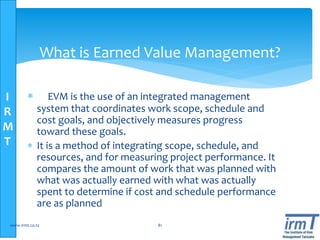
 EVM is the use of an integrated management
system that coordinates work scope, schedule and
cost goals, and objectively measures progress
toward these goals.
 It is a method of integrating scope, schedule, and
resources, and for measuring project performance. It
compares the amount of work that was planned with
what was actually earned with what was actually
spent to determine if cost and schedule performance
are as planned
www.irmt.co.tz 81
Earned Value Management Approach
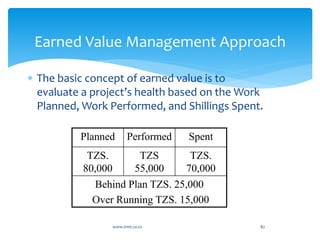
 The basic concept of earned value is to
evaluate a project’s health based on the Work
Planned, Work Performed, and Shillings Spent.
Planned Performed Spent
TZS.
80,000
TZS
55,000
TZS.
70,000
Behind Plan TZS. 25,000
Over Running TZS. 15,000
www.irmt.co.tz 82
I
R
M
T
Concept Applied to WMP
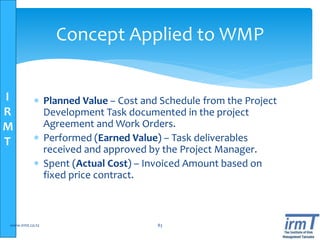
 Planned Value – Cost and Schedule from the Project
Development Task documented in the project
Agreement and Work Orders.
 Performed (Earned Value) – Task deliverables
received and approved by the Project Manager.
 Spent (Actual Cost) – Invoiced Amount based on
fixed price contract.
www.irmt.co.tz 83
I
R
M
T
Earned Value Terminology
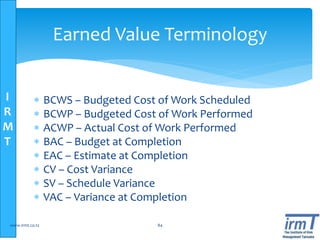
 BCWS – Budgeted Cost of Work Scheduled
 BCWP – Budgeted Cost of Work Performed
 ACWP – Actual Cost of Work Performed
 BAC – Budget at Completion
 EAC – Estimate at Completion
 CV – Cost Variance
 SV – Schedule Variance
 VAC – Variance at Completion
www.irmt.co.tz 84
I
R
M
T
Why Earned Value Management?
Entity Agreements
 The CONSULTANT will provide the CLIENT with any and
all reports, models, studies, maps or other documents
resulting from the PROJECT. Additionally, two (2) sets,
electronic and hardcopy, of any final reports must be
submitted to the CLIENT as Record and Library copies.
 The CONSULTANT must submit a Work Order status
report with each invoice to include the Project
Manager's assessment of the PROJECT'S actual progress
as compared to the approved performance schedule.
Details must include any deficiencies and the recovery
actions completed and planned.
www.irmt.co.tz 85
I
R
M
T EVM Video Presentation
Why EMV Video Presentation
www.irmt.co.tz 86
EVM Explained
I
R
M
T
Cases and exercises video
www.irmt.co.tz 87
Final Cases and exercises Video
What is the difference between Programs and Project
I
R
M
T
 Chose one project in your organization
 Construction Project
 Software Project
 Tanzania National Project
 Rehabilitation Project
 Any you wish
www.irmt.co.tz 88
Group Work sessions
I
R
M
T
 Define the project in terms of scope, objectives, budget,
schedules. Plus all mentioned components
 Identify the most suitable Project Management
Methodology according to the nature of the project
 Critically analyze the project using Project Life Cycle and
identify the key requirements in each phase
 Identify at least five risks and show clearly the assessment
and management plan
www.irmt.co.tz 89
Required
I
R
M
T
Project and Contract Risk Management Case Study
www.irmt.co.tz 90
Final Case study
Link of Project and Contract Risk Management
I
R
M
T
Source of Information for project
Risks
 Project Management Institute (PMI)
 www.pmi.org
 From practice to the practice
www.irmt.co.tz 91

Project risk management notes bagamoyo 12.10.2017 final v1

  • 1.
    I R M T www.irmt.co.tz 1 18 StellaMaris,Bagamoyo Compiled by: Sako Mayrick INSTITUTE OF RISK MANAGEMENT TANZANIA (IRMT) ADVANCED RISK MANAGEMENT TRAINING Project Risk Management Pack
  • 2.
  • 3.
  • 4.
    I R M T Outline  Introduction  Whatis a project risk  Project Risk Management  Why Project Risk Management  How to plan for project risks  Identifying and quantifying Project Risks  Project Risks Mitigation  Project Risks Monitoring and Control  Project Risk Management Techniques and Tricks www.irmt.co.tz 4
  • 5.
    I R M T Prerequisite Risk understanding Risk appetite  Is the amount of risk that an organization is willing to seek or accept in the pursuit of its long term objectives  Risk Tolerance  Are the boundaries of risk taking outside which the organization is not prepared to venture in pursuit of its objectives  Risk Universe  Is the full range of risks which could impact, either, positively or negatively, on the ability of the organization to achieve its long term objectives www.irmt.co.tz 5
  • 6.
    I R M T Your entity example TCRATarget: Increase members to 5000 contributors  Risk appetite We are expecting risk that may result in members counts as low as 4700 and as high as 5600  Risk Tolerance If members fall below 3500 or exceed 7000 we will leave this market www.irmt.co.tz 6
  • 7.
    I R M T Introduction  Project riskmanagement is the art and science of identifying, analyzing, and responding to risk throughout the life of a project and in the best interests of meeting project objectives  Risk management is often overlooked in projects, but it can help improve project success by helping select good projects, determining project scope, and developing realistic estimates  Unfortunately, crisis management has higher visibility due to the obvious danger to the success of the project but it’s risk management that helps a project have fewer problems to begin with. www.irmt.co.tz 7
  • 8.
    I R M T Introduction  Negative Risk A dictionary definition of risk is “the possibility of loss or injury”  Negative risk involves understanding potential problems that might occur in the project and how they might impede project success  Negative risk management is like a form of insurance; it is an investment  If IT projects are so risky, why do companies pursue them? www.irmt.co.tz 8
  • 9.
    I R M T Introduction  Positive Risks Positive risks are risks that result in good things happening; sometimes called opportunities  A general definition of project risk is an uncertainty that can have a negative or positive effect on meeting project objectives  The goal of project risk management is to minimize potential negative risks while maximizing potential positive risks www.irmt.co.tz 9
  • 10.
    I R M T Introduction  Some organizationsmake the mistake of only addressing tactical and negative risks when performing project risk management  David Hillson (www.risk-doctor.com) suggests overcoming this problem by widening the scope of risk management to encompass both strategic risks and upside opportunities, which he refers to as integrated risk management  Ensure that project delivery is tied to organizational needs and vision  Allowing an appropriate level of risk to be taken intelligently with full awareness of the degree of uncertainty and its potential effects on objectives www.irmt.co.tz 10
  • 11.
    I R M T What is aproject Risks?  An event that, if it occurs, causes either a positive or negative impact on a project  Keys attributes of Risk  Uncertainty  Positive and Negative  Cause and Consequence www.irmt.co.tz 11
  • 12.
    I R M T Project Risk Management Risk management is concerned with identifying risks and drawing up plans to minimise their effect on a project.  A risk is a probability that some adverse (or positive) circumstance will occur  Project risks affect schedule or resources;  Product risks affect the quality or performance of the software being developed;  Business risks affect the organization developing or procuring the software. www.irmt.co.tz 12
  • 13.
    I R M T Project Risk ManagementProcess  PMBOK ® Definition  “The systematic process of identifying, analyzing, and responding to project risk”  Steps  Risk Management Planning  Risk Identification  Qualitative/Quantitative Risk Analysis  Risk Response Planning  Risk Monitoring & Control www.irmt.co.tz 13
  • 14.
    I R M T Benefits of managingproject risks  Opportunity to move from “fire-fighting” to proactive decision making on the project.  Better chance of project success.  Improved project schedule and cost performance.  Stakeholders and team members better understand the nature of the project.  Helps define the strengths and weaknesses of the project.www.irmt.co.tz 14
  • 15.
    I R M T Why project risksare not managed  With so much benefit to managing risk, why is it often overlooked? : 1. The organization is too busy with real problems to worry about potential ones, 2. There is a perception that there is not too much that can go wrong, or 3. They have a fatalistic belief that not much can be done about risks, or 4. “Shoot the messenger mentality”; fear that disclosure of project risks will be seen as an indication of project weakness. www.irmt.co.tz 15
  • 16.
    I R M T Project Risk myths Risk identification can make a project look bad  All projects have risks, denial does not make them go away, it just makes you unprepared for them if they occur.  Risk in itself is not bad, it is how well the project plans for and reacts to risks that counts.  Formal risk management is a cornerstone of good project management. Stakeholder visibility into project risks makes it easier to get additional resources and organizational support when risks do occur. www.irmt.co.tz 16
  • 17.
    I R M T Project Risk ManagementPlanning  Plan for the Planning  Risk planning should be appropriate for the project  Question you should ask: 1. How risky is the project? 2. Is it a new technology or something your organization is familiar with? 3. Do you have past projects to reference? 4. What is the visibility of the project? 5. How big is the project? 6. How important is the project? www.irmt.co.tz 17
  • 18.
    I R M T Project Risk ManagementPlan  What should it include?  How you will identify, quantify or qualify risk Methods and tools  Budget…yes budget  Who is doing what  How often  Risk categories, levels, and thresholds for action.  Reporting requirements  Monitoring, tracking and documenting strategies www.irmt.co.tz 18
  • 19.
    I R M T Project Risk ManagementProcess  Risk identification  Identify project, product and business risks;  Risk analysis  Assess the likelihood and consequences of these risks;  Risk response planning  Draw up plans to avoid or minimize the effects of the risk;  Risk monitoring  Monitor the risks throughout the project; www.irmt.co.tz 19
  • 20.
    I R M T Project Risk ManagementProcess Video Case Study 1 Video Case Study 2 www.irmt.co.tz 20
  • 21.
    I R M T Project Risk ManagementProcess www.irmt.co.tz 21
  • 22.
    I R M T Identifying Project Risk Continuous, Iterative Process  What is it and what does it look like  The sooner the better  The more the merrier  A fact is not a risk (it’s an issue).  Be specific  Don’t try to do everything at once www.irmt.co.tz 22
  • 23.
    I R M T Project Risk Identificationtechniques  Brainstorming  Checklists  Interviewing  SWOT Analysis (strengths, weaknesses opportunities, threats)  Delphi Technique (anonymous consensus building)  Diagramming Techniques  Cause & effect  Flow Charts  Influence Diagrams www.irmt.co.tz 23
  • 24.
    I R M T www.irmt.co.tz Brainstorming  Brainstorming isa technique by which a group attempts to generate ideas or find a solution for a specific problem by amassing ideas spontaneously and without judgment  An experienced facilitator should run the brainstorming session  Be careful not to overuse or misuse brainstorming  Psychology literature shows that individuals produce a greater number of ideas working alone than they do through brainstorming in small, face-to-face groups  Group effects often inhibit idea generation 24
  • 25.
    I R M T www.irmt.co.tz Delphi Technique  TheDelphi Technique is used to derive a consensus among a panel of experts who make predictions about future developments  Developed by the RAND Corporation for the US Air Force in the late 1960s  Provides independent and anonymous input regarding future events  Uses repeated rounds of questioning and written responses and avoids the biasing effects possible in oral methods, such as brainstorming  Requires a panel of experts for the particular area in question 25
  • 26.
    I R M T www.irmt.co.tz Interviewing  Interviewing isa fact-finding technique for collecting information in face-to-face, phone, e-mail, or instant-messaging discussions  Useful to have a prepared set of questions as a guide to the interview  Interviewing people with similar project experience is an important tool for identifying potential risks 26
  • 27.
    I R M T www.irmt.co.tz SWOT Analysis  SWOTanalysis (strengths, weaknesses, opportunities, and threats) can also be used during risk identification  Project teams focus on the broad perspectives of potential risks for particular projects  What are the company’s strengths and weaknesses related to this project  What opportunities and threats exist  Helps identify the broad negative and positive risks that apply to a project 27
  • 28.
    I R M T www.irmt.co.tz Other Risk IdentificationMethods  Checklists based on risks encountered in previous projects  Analyze the validity of project assumptions as incomplete, inaccurate and/or inconsistent assumptions can lead to identifying more risks  Diagramming techniques: cause-and-effect, fishbone, flowcharts and influence diagrams  Influence diagrams represent decision problems by displaying essential elements, including decisions, uncertainties, causality and objectives and how they influence each other (www.lumina.com/software/influencediagrams.html) 28
  • 29.
    I R M T www.irmt.co.tz Other Risk IdentificationMethods  An influence diagram is a simple visual representation of a decision problem. Influence diagrams offer an intuitive way to identify and display the essential elements, including decisions, uncertainties, and objectives, and how they influence each other.  This simple influence diagram shows how decisions about the marketing budget and product price influence expectations about its uncertain market size and market share. These, in turn, influence costs and revenues, which affect the overall profit.  The product manager, VP of marketing, and market analyst may work together to draw such a diagram to develop a shared understanding of the key issues. The diagram provides a high-level qualitative view under which the analyst builds a detailed quantitative model. 29
  • 30.
    I R M T www.irmt.co.tz Other Risk IdentificationMethods 30 A decision is a variable that you, as the decision maker, have the power to control. A chance variable is uncertain and you cannot control it directly. An objective variable is a quantitative criterion that you are trying to maximize (or minimize). A general variable is a deterministic function of the quantities it depends on. An arrow denotes an influence. A influences B means that knowing A would directly affect our belief or expectation about the value of B. An influence expresses knowledge about relevance. It does not necessarily imply a causal relation, or a flow of material, data, or money.
  • 31.
    I R M T Examples of projectrisks Risk type Possible risks Technology The database used in the system cannot process as many transactions per second as expected. Software components that should be reused contain defects that limit their functionality. People It is impossible to recruit staff with the skills required. Key staff are ill and unavailable at critical times. Required training for staff is not available. Organizational The organization is restructured so that different management are responsible for the project. Organizational financial problems force reductions in the project budget. Tools The code generated by CASE tools is inefficient. CASE tools cannot be integrated. Requirements Changes to requirements that require major design rework are proposed. Customers fail to understand the impact of requirements changes. Estimation The time required to develop the software is underestimated. The rate of defect repair is underestimated. The size of the software is underestimated. www.irmt.co.tz 31
  • 32.
    I R M T Example of ProjectRisks  Software development project risks Risk Affects Description Staff turnover Project Experienced staff will leave the project before it is finished. Management change Project There will be a change of organizational management with different priorities. Hardware unavailability Project Hardware that is essential for the project will not be delivered on schedule. Requirements change Project and product There will be a larger number of changes to the requirements than anticipated. Specification delays Project and product Specifications of essential interfaces are not available on schedule Size underestimate Project and product The size of the system has been underestimated. CASE tool under- performance Product CASE tools which support the project do not perform as anticipated Technology change Business The underlying technology on which the system is built is superseded by new technology. Product competition Business A competitive product is marketed before the system is completed.www.irmt.co.tz 32
  • 33.
    I R M T Project Risk Analysis Assessprobability, seriousness, and urgency of each risk. Probability may be very low, low, moderate, high or very high. Risk effects might be catastrophic, serious, tolerable or insignificant. Urgency might be immediate, short term, or long term. www.irmt.co.tz 33
  • 34.
    I R M T Project Risks Analysis- Qualitative  Subjective  Educated Guess  High, Medium, Low  Red, Yellow, Green  1-10  Prioritized/Ranked list of ALL identified risks  First step in risk analysis! www.irmt.co.tz 34
  • 35.
    I R M T Project Risks Analysis-Quantitative Numerical/Statistical Analysis Determines probability of occurrence and consequences of risks Should be focused to highest risks as determined by Qualitative Risk Analysis and Risk Threshold www.irmt.co.tz 35
  • 36.
    I R M T Quantitative Risk Analysis Often follows qualitative risk analysis, but both can be done together  Large, complex projects involving leading edge technologies often require extensive quantitative risk analysis  Main techniques include:  Decision tree analysis  Simulation  Sensitivity analysis 36www.irmt.co.tz
  • 37.
    I R M T www.irmt.co.tz Decision Trees and ExpectedMonetary Value (EMV)  A decision tree is a diagramming analysis technique used to help select the best course of action in situations in which future outcomes are uncertain  Estimated monetary value (EMV) is the product of a risk event probability and the risk event’s monetary value  You can draw a decision tree to help find the EMV 37
  • 38.
  • 39.
    I R M T www.irmt.co.tz Simulation  Simulation usesa representation or model of a system to analyze the expected behavior or performance of the system  To use a Monte Carlo simulation, you must have three estimates (most likely, pessimistic, and optimistic) plus an estimate of the likelihood of the estimate being between the most likely and optimistic values  Monte Carlo analysis simulates a model’s outcome many times to provide a statistical distribution of the calculated results  Predicts the probability of finishing by a certain date or that the cost will be equal to or less than a certain value 39
  • 40.
    I R M T Steps of aMonte Carlo Analysis 1. Assess the range for the variables being considered – gather most likely, optimistic and pessimistic time estimates for each task 2. Determine the probability distribution of each variable 1. Optimistic 8 weeks, most likely 10 and pessimistic 15 3. For each variable, select a random value based on the probability distribution 1. 20% chance between 8 and 10 weeks, 80% between 10 and 15 4. Run a deterministic analysis or one pass through the model 5. Repeat steps 3 and 4 many times to obtain the probability distribution of the model’s results – usually between 100 to 1,000 iterations 40www.irmt.co.tz
  • 41.
    Sample Monte CarloSimulation Results for Project Schedule 41www.irmt.co.tz
  • 42.
    I R M T www.irmt.co.tz What Went Right? A large aerospace company used Monte Carlo simulation to help quantify risks on several advanced-design engineering projects, such as the National Aerospace Plan (NASP)  Design a vehicle that could fly into space using a single-stage-to- orbit approach  The results of the simulation were used to determine how the company would invest its internal research and development funds  Although the NASP project was terminated, the resulting research has helped develop more advanced materials and propulsion systems used on many modern aircraft  Eli Lily uses simulation to determine the optimal plant capacity that should be built for each drug 42
  • 43.
    I R M T www.irmt.co.tz Sensitivity Analysis  Sensitivityanalysis is a technique used to show the effects of changing one or more variables on an outcome  For example, many people use it to determine what the monthly payments for a loan will be given different interest rates or periods of the loan, or for determining break-even points based on different assumptions  Spreadsheet software, such as Excel, is a common tool for performing sensitivity analysis 43
  • 44.
    www.irmt.co.tz Sample Sensitivity Analysisfor Determining Break-Even Point 44
  • 45.
    I R M T www.irmt.co.tz Risk Response Planning After identifying and quantifying risks, you must decide how to respond to them  Four main response strategies for negative risks:  Risk avoidance – don’t use h/w or s/w if unfamiliar with them  Risk acceptance – prepare for risk with backup plan or contingency reserves  Risk transference – to deal with financial risk exposure, a company may purchase special insurance for specific h/w needed for a project. If h/w fails, insurer has to replace it.  Risk mitigation – reduce probability of occurrence e.g., use proven technology, buy maintenance or service contract 45
  • 46.
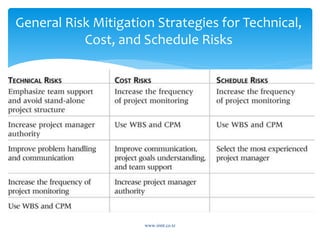
    www.irmt.co.tz General Risk MitigationStrategies for Technical, Cost, and Schedule Risks 46
  • 47.
    I R M T www.irmt.co.tz Response Strategies forPositive Risks  Risk exploitation – do whatever you can to make sure the risk occurs, call press conference to advertise new product, take out ads, etc  Risk sharing – allocating ownership of the risk to another party. Hire an outside firm to do your advertising and PR  Risk enhancement – identify and maximize key drivers of the risk. Encourage your employees or users of your product to spread the word of your product  Risk acceptance – don’t take any action with regard to positive risk. Assume the product will speak for itself 47
  • 48.
    I R M T www.irmt.co.tz Residual and SecondaryRisks  It’s also important to identify residual and secondary risks  Residual risks are risks that remain after all of the response strategies have been implemented  Even though used stable h/w platform, it still may fail  Secondary risks are a direct result of implementing a risk response  Using stable h/w may have caused a risk of peripheral devices failing to function properly 48
  • 49.
    I R M T www.irmt.co.tz Media Snapshot  Ahighly publicized example of a risk response to corporate financial scandals, such as those affecting Enron, Arthur Andersen, and WorldCom, was legal action  The Sarbanes-Oxley Act is considered the most significant change to federal securities laws in the United States since the New Deal  Fines, prison sentences up to 20 years for anyone who knowingly alters or destroys a record or document with the intent to obstruct an investigation  This Act has caused many organizations to initiate projects and other actions to avoid litigation 49
  • 50.
    I R M T www.irmt.co.tz Risk Monitoring andControl  Involves executing the risk management process to respond to risk events  This is an ongoing activity – new risks identified, old risks disappear, weaken or get stronger  Workarounds are unplanned responses to risk events that must be done when there are no contingency plans  Main outputs of risk monitoring and control are:  Requested changes  Recommended corrective and preventive actions  Updates to the risk register, project management plan, and organizational process assets 50
  • 51.
    I R M T www.irmt.co.tz Using Software toAssist in Project Risk Management  Risk registers can be created in a simple Word or Excel file or as part of a database  More sophisticated risk management software, such as Monte Carlo simulation tools, help in analyzing project risks  The PMI Risk Specific Interest Group’s Web site at www.risksig.com has a detailed list of software products to assist in risk management 51
  • 52.
    I R M T www.irmt.co.tz Results of GoodProject Risk Management  Unlike crisis management, good project risk management often goes unnoticed  Well-run projects appear to be almost effortless, but a lot of work goes into running a project well  Project managers should strive to make their jobs look easy to reflect the results of well-run projects 52
  • 53.
    I R M T Quantitative Risk Analysis Video Case Study 1 (Risk Doctor)  Video Case Study 2 (Lady) www.irmt.co.tz 53
  • 54.
    I R M T Example of RiskAnalysis Risk Probability Effects Organizational financial problems force reductions in the project budget. Low Catastrophic It is impossible to recruit staff with the skills required for the project. High Catastrophic Key staff are ill at critical times in the project. Moderate Serious Software components that should be reused contain defects which limit their functionality. Moderate Serious Changes to requirements that require major design rework are proposed. Moderate Serious The organization is restructured so that different management are responsible for the project. High Serious www.irmt.co.tz 54
  • 55.
    I R M T Project Risk AnalysisProbability and impact Risk Probability Impact Expected Value 1 25% $45,000 $11,250 2 50% $2,000 $1,000 3 30% $100,000 $30,000 www.irmt.co.tz 55
  • 56.
    I R M T Project Risk Mitigation What are we going to do about it?”  Techniques/Strategies:  Avoidance– Eliminate it  Transference – Pawn it off  Mitigation – Reduce probability or impact of it  Acceptance – Do nothing  Strategy should be commensurate with risk  Hint: Don’t spend more money preventing the risk than the impact of the risk would be if it occurs   The Risk Response Plan/Risk Response Register www.irmt.co.tz 56
  • 57.
    I R M T Example of ProjectRisk Mitigation Strategies Risk Strategy Organization al financial problems Prepare a briefing document for senior management showing how the project is making a very important contribution to the goals of the business. Recruitment problems Alert customer of potential difficulties and the possibility of delays, investigate outsourcing work. Staff illness Reorganize team so that there is more overlap of work and people therefore understand each other’s jobs. www.irmt.co.tz 57
  • 58.
    I R M T Example of ProjectRisk Mitigation Strategies Risk Strategy Requirements changes Derive traceability information to assess requirements change impact, and maximise information hiding in the design. Organizational restructuring Prepare a briefing document for senior management showing how the project is making a very important contribution to the goals of the business. Database performance Investigate the possibility of buying a higher- performance database. Underestimated development time Investigate outsourcing components, investigate use of a program generator www.irmt.co.tz 58
  • 59.
    I R M T Project Risk Monitoring Assess each identified risk regularly to decide whether or not it is becoming less or more probable.  Also assess whether the effects of the risk have changed.  Each key risk should be discussed at management progress meetings. www.irmt.co.tz 59
  • 60.
    I R M T Risk Monitoring  Continuous,Iterative Process  Done right the risk impact will be minimized:  Someone IS responsible  Watch for risk triggers  Communicate…Communicate…Communicate  Take corrective action - Execute  Re-evaluate and look for new risk constantly  Tools:  Risk Reviews www.irmt.co.tz 60
  • 61.
    I R M T Project Risk Measures Key Risk Indicators  These are measures that measures risk related activities  Control Effectiveness Indicators (Key Control Indicator)  These are measures of effectiveness of organizational controls  Non – Predictive Measures (Key Performance Indicator)  These are measures that would detect unexpected risk related events www.irmt.co.tz 61
  • 62.
    I R M T Project Risk Indicators Risktype Potential indicators Technology Late delivery of hardware or support software, many reported technology problems People Poor staff morale, poor relationships amongst team member, job availability Organizational Organizational gossip, lack of action by senior management Tools Reluctance by team members to use tools, complaints about CASE tools, demands for higher-powered workstations Requirements Many requirements change requests, customer complaints Estimation Failure to meet agreed schedule, failure to fix reported defects www.irmt.co.tz 62
  • 63.
    I R M T Project Risk Managementtools and Techniques Risk Identification Spreadsheet Risk log Spreadsheet Templates Make your own www.irmt.co.tz 63
  • 64.
    I R M T www.irmt.co.tz Watch List  Awatch list is a list of risks that are low priority, but are still identified as potential risks  Qualitative analysis can also identify risks that should be evaluated on a quantitative basis 64
  • 65.
  • 66.
    I R M T www.irmt.co.tz 66 Project ContingencyPlan  Say you’re piloting a plane… you need to be on the lookout for birds.  Some birds are smaller and not so close…  …but some can be large and quite close.  Each bird in the sky represents a risk to the plane to watch and plan for.  But once one of those birds hits the plane…it’s no longer a risk, it’s an issue!  And you better put that contingency plan in motion!
  • 67.
  • 68.
  • 69.
    I R M T www.irmt.co.tz 69 Components ofContingency plan policy document
  • 70.
  • 71.
  • 72.
    I R M T www.irmt.co.tz 72 Clarity onProject Contingency Planning
  • 73.
    I R M T  Videopresentation www.irmt.co.tz 73 Titanic Boat Case Study
  • 74.
  • 75.
  • 76.
  • 77.
    I R M T  Project RiskManagement includes the processes of conducting risk management planning, identification, analysis, response planning, and controlling risk on a project. The objectives of project risk management are to increase the likelihood and impact of positive events, and decrease the likelihood and impact of negative events in the project. (PMBOK Guide® Fifth Edition) www.irmt.co.tz 77 Recap Meaning of a Project Risk Management
  • 78.
    I R M T Steps in projectrisk management  Plan risk management,  Identify risk,  Perform qualitative risk analysis,  Perform quantitative risk analysis,  Plan risk response,  Control risk. www.irmt.co.tz 78 Recap
  • 79.
    I R M T www.irmt.co.tz 79 Project RiskManagement Template Project Management template including Risk Management
  • 80.
  • 81.
    I R M T What is EarnedValue Management?  EVM is the use of an integrated management system that coordinates work scope, schedule and cost goals, and objectively measures progress toward these goals.  It is a method of integrating scope, schedule, and resources, and for measuring project performance. It compares the amount of work that was planned with what was actually earned with what was actually spent to determine if cost and schedule performance are as planned www.irmt.co.tz 81
  • 82.
    Earned Value ManagementApproach  The basic concept of earned value is to evaluate a project’s health based on the Work Planned, Work Performed, and Shillings Spent. Planned Performed Spent TZS. 80,000 TZS 55,000 TZS. 70,000 Behind Plan TZS. 25,000 Over Running TZS. 15,000 www.irmt.co.tz 82
  • 83.
    I R M T Concept Applied toWMP  Planned Value – Cost and Schedule from the Project Development Task documented in the project Agreement and Work Orders.  Performed (Earned Value) – Task deliverables received and approved by the Project Manager.  Spent (Actual Cost) – Invoiced Amount based on fixed price contract. www.irmt.co.tz 83
  • 84.
    I R M T Earned Value Terminology BCWS – Budgeted Cost of Work Scheduled  BCWP – Budgeted Cost of Work Performed  ACWP – Actual Cost of Work Performed  BAC – Budget at Completion  EAC – Estimate at Completion  CV – Cost Variance  SV – Schedule Variance  VAC – Variance at Completion www.irmt.co.tz 84
  • 85.
    I R M T Why Earned ValueManagement? Entity Agreements  The CONSULTANT will provide the CLIENT with any and all reports, models, studies, maps or other documents resulting from the PROJECT. Additionally, two (2) sets, electronic and hardcopy, of any final reports must be submitted to the CLIENT as Record and Library copies.  The CONSULTANT must submit a Work Order status report with each invoice to include the Project Manager's assessment of the PROJECT'S actual progress as compared to the approved performance schedule. Details must include any deficiencies and the recovery actions completed and planned. www.irmt.co.tz 85
  • 86.
    I R M T EVM VideoPresentation Why EMV Video Presentation www.irmt.co.tz 86 EVM Explained
  • 87.
    I R M T Cases and exercisesvideo www.irmt.co.tz 87 Final Cases and exercises Video What is the difference between Programs and Project
  • 88.
    I R M T  Chose oneproject in your organization  Construction Project  Software Project  Tanzania National Project  Rehabilitation Project  Any you wish www.irmt.co.tz 88 Group Work sessions
  • 89.
    I R M T  Define theproject in terms of scope, objectives, budget, schedules. Plus all mentioned components  Identify the most suitable Project Management Methodology according to the nature of the project  Critically analyze the project using Project Life Cycle and identify the key requirements in each phase  Identify at least five risks and show clearly the assessment and management plan www.irmt.co.tz 89 Required
  • 90.
    I R M T Project and ContractRisk Management Case Study www.irmt.co.tz 90 Final Case study Link of Project and Contract Risk Management
  • 91.
    I R M T Source of Informationfor project Risks  Project Management Institute (PMI)  www.pmi.org  From practice to the practice www.irmt.co.tz 91