 PARMINDER SINGH
 M.PHIL (COMMERCE)
 MEANING OF IFRS
 CONCEPT AND INTRODUTION
 NEED AND IMPORTANCE AROUND THE WORLD
PART 2
 INDIAN PERSPECTIVE OF IFRS
 LIST OF CONVERGED IND. AS. WITH IFRS
 AREAS OF DIFFERENCES BETWEEN IND. AS AND IFRS
PART 3
 PROBLEMS AND CHALLENGES IN INDIA
 IFRS: ROAD AHEAD IN INDIA
 INTERNATIONAL FINANCIAL REPORTING
STANDARDS ARE:
SINGLE SET OF HIGH QUALITY. UNDERSTANDABLE.
GLOBAL ACCOUNTING STANDARDS THAT PROVIDES
HIGH QUALITY OF INFORMATION AND
TRANSPARENCY IN FINANCIAL STATEMENTS TO
HELP PARTICIPANTS OF WORLD CAPITAL MARKET
TO MAKE BETTER ECONOMIC DECESIONS
 INTERNATIONAL ACCOUNTING STANDARDS
 CONTAIN HIGH QUALITY INFORMATION
 TRANSPARENT AND UNDERSTANDABLE
 ENABLES IN DECESION MAKING
 MAKING PRESENCE WORLDWIDE
 THESE IFRS ARE FORMULATED BY INTERNATIONAL
ACCOUNTING STANDARD BORAD (IASB)
 IN INDIA THESE IFRS ARE CONVERGED WITH INDIAN
ACCOUNTING STANDARDS (IND. AS) WHICH ARE
FORMULATED BY ACCOUNTING STANDARD BOARD
(ASB 1977)
UNDER SUPERVISION OF ICAI AND ON THE
RECOMMENDATIONS OF NATIONAL ADVISORY
COMMITTEE ON ACCOUNTING STANDARDS
(NACAS)
 COMMON LANGUAGE
 INCREASED INTERNATIONAL TRADE
 INTEGRATED CAPITAL MARKETS
 MERGER AND ACQUISTIONS
 STRATEGIC ALLIANCES AND JOINT VENTURES
 AWARENESS AMONG INVESTORS
 HARMONIZATION IN FINANCIAL STATEMENTS
 SINGLE SET OF POLICIES AND PRINCIPLES
 COMPARABLITY
 RELIABLITY
 QUALITY INFORMATION AND REDUCED COST
 CONCEPT PAPER OF ICAI 2007 :
IN THIS
PAPER IT WAS DECIDED THAT INDIA WILL
CONVERGE IND. AS WITH IFRS RATHER THAN TO
ADOPT IFRS IN THEIR ORIGINAL FORM.
IFRS WERE TAKEN AS BENCHMARK AND INDIAN
ACCOUNTING STANDARDS WERE CONVERGED
WITH IFRS ACCORDING TO INDIAN LAWS AND
LEGISLATION, ECONOMIC ENVIRONMENT,
AND REQUIRMENT OF BUSINESS AND INDUSTRIES.
 MINISTRY OF CORPORATE AFFAIRS, GOVT. OF
INDIA:
ISSUED A PRESS NOTE IN 2010 THAT EXCEPT
BANKING, INSURANCE AND NON BANKING
FINANCIAL COMPANIES ALL OTHER COMPANIES
WILL ADOPT THESE CONVERGED IND. AS IN PROPER
SEQUENCE
 ACCORDING TO MCA THESE IFRS OR
CONVERGED IND. AS WILL BE IMPLEMENTED AS
BELOW:
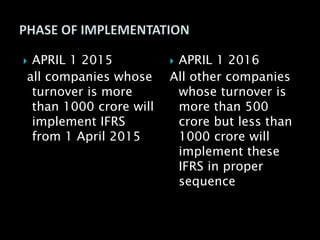
o COMPANIES WHOSE TURNOVER IS MORE THAN
1000 CRORE WILL IMPLEMENT FROM APRIL 1,
2015
o COMPANIES WHOSE TURNOVER IS MORE THAN
500 CRORE BUT LESS THAN 1000 CRORE WILL
IMPLEMENT FROM APRIL 1, 2016 IN PROPER
SEQUENCE
 APRIL 1 2015
all companies whose
turnover is more
than 1000 crore will
implement IFRS
from 1 April 2015
 APRIL 1 2016
All other companies
whose turnover is
more than 500
crore but less than
1000 crore will
implement these
IFRS in proper
sequence
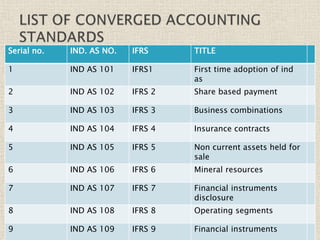
Serial no. IND. AS NO. IFRS TITLE
1 IND AS 101 IFRS1 First time adoption of ind
as
2 IND AS 102 IFRS 2 Share based payment
3 IND AS 103 IFRS 3 Business combinations
4 IND AS 104 IFRS 4 Insurance contracts
5 IND AS 105 IFRS 5 Non current assets held for
sale
6 IND AS 106 IFRS 6 Mineral resources
7 IND AS 107 IFRS 7 Financial instruments
disclosure
8 IND AS 108 IFRS 8 Operating segments
9 IND AS 109 IFRS 9 Financial instruments
SERIAL NO. IND AS NO. IFRS NO. TITLE
10 IND AS 110 IFRS 10 Consolidated financial
statement
11 IND AS 111 IFRS 11 Joint arrangements
12 IND AS 112 IFRS 12 Interest in other entities
13 IND AS 113 IFRS 13 Fair value measurement
14 IND AS 114 IFRS 14 Regulatory defferal
accounts
15 IND AS 115 IFRS 15 Contracts with customers
16 IND AS 1 IAS 1 Presentation of financial
statements
17 IND AS 2 IAS 2 Inventories
18 IND AS 7 IAS 7 Statement of cash flows
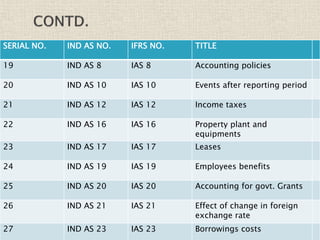
SERIAL NO. IND AS NO. IFRS NO. TITLE
19 IND AS 8 IAS 8 Accounting policies
20 IND AS 10 IAS 10 Events after reporting period
21 IND AS 12 IAS 12 Income taxes
22 IND AS 16 IAS 16 Property plant and
equipments
23 IND AS 17 IAS 17 Leases
24 IND AS 19 IAS 19 Employees benefits
25 IND AS 20 IAS 20 Accounting for govt. Grants
26 IND AS 21 IAS 21 Effect of change in foreign
exchange rate
27 IND AS 23 IAS 23 Borrowings costs
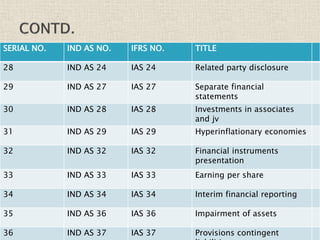
SERIAL NO. IND AS NO. IFRS NO. TITLE
28 IND AS 24 IAS 24 Related party disclosure
29 IND AS 27 IAS 27 Separate financial
statements
30 IND AS 28 IAS 28 Investments in associates
and jv
31 IND AS 29 IAS 29 Hyperinflationary economies
32 IND AS 32 IAS 32 Financial instruments
presentation
33 IND AS 33 IAS 33 Earning per share
34 IND AS 34 IAS 34 Interim financial reporting
35 IND AS 36 IAS 36 Impairment of assets
36 IND AS 37 IAS 37 Provisions contingent
SERIAL NO. IND AS NO. IFRS NO. TITLE
37 IND AS 38 IAS 38 Intangible assets
38 IND AS 40 IAS 40 Investment property
39 IND AS 41 IAS 41 Agriculture
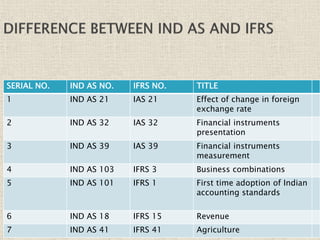
SERIAL NO. IND AS NO. IFRS NO. TITLE
1 IND AS 21 IAS 21 Effect of change in foreign
exchange rate
2 IND AS 32 IAS 32 Financial instruments
presentation
3 IND AS 39 IAS 39 Financial instruments
measurement
4 IND AS 103 IFRS 3 Business combinations
5 IND AS 101 IFRS 1 First time adoption of Indian
accounting standards
6 IND AS 18 IFRS 15 Revenue
7 IND AS 41 IFRS 41 Agriculture
 LACK OF SUITABLE ENVIRONMENT
 TRANING AND EDUCATION
 LEGAL AND REGULATORY FRAMEWORK
 FAIR VALUE MEASUREMENT
 DIFFERENCE BETWEEN GAAP AND IFRS
 In India ICAI is playing proactive role in
convergence of IFRS in to Indian accounting
standards and this concept of common accounting
is in developing phase so far. We are facing
number of challenges and problems in way of
convergence and implementation of IFRS. But due
to their importance and presence throughout the
world IFRS will be converged in to Indian
accounting standards in upcoming time to provide
benefit to Indian economy and corporate sector
 To achieve objectives of proper
implementation and adoption of these IFRS in
Indian economy. Govt. Of India, ICAI and SEBI
have to work in collaborative environment
with a sense of integration so that needed
platform can be provided to investors and
various other participants of capital markets
THANK YOU

Ifrs parminder singh

  • 1.
     PARMINDER SINGH M.PHIL (COMMERCE)
  • 3.
     MEANING OFIFRS  CONCEPT AND INTRODUTION  NEED AND IMPORTANCE AROUND THE WORLD PART 2  INDIAN PERSPECTIVE OF IFRS  LIST OF CONVERGED IND. AS. WITH IFRS  AREAS OF DIFFERENCES BETWEEN IND. AS AND IFRS PART 3  PROBLEMS AND CHALLENGES IN INDIA  IFRS: ROAD AHEAD IN INDIA
  • 4.
     INTERNATIONAL FINANCIALREPORTING STANDARDS ARE: SINGLE SET OF HIGH QUALITY. UNDERSTANDABLE. GLOBAL ACCOUNTING STANDARDS THAT PROVIDES HIGH QUALITY OF INFORMATION AND TRANSPARENCY IN FINANCIAL STATEMENTS TO HELP PARTICIPANTS OF WORLD CAPITAL MARKET TO MAKE BETTER ECONOMIC DECESIONS
  • 5.
     INTERNATIONAL ACCOUNTINGSTANDARDS  CONTAIN HIGH QUALITY INFORMATION  TRANSPARENT AND UNDERSTANDABLE  ENABLES IN DECESION MAKING  MAKING PRESENCE WORLDWIDE
  • 6.
     THESE IFRSARE FORMULATED BY INTERNATIONAL ACCOUNTING STANDARD BORAD (IASB)  IN INDIA THESE IFRS ARE CONVERGED WITH INDIAN ACCOUNTING STANDARDS (IND. AS) WHICH ARE FORMULATED BY ACCOUNTING STANDARD BOARD (ASB 1977) UNDER SUPERVISION OF ICAI AND ON THE RECOMMENDATIONS OF NATIONAL ADVISORY COMMITTEE ON ACCOUNTING STANDARDS (NACAS)
  • 7.
     COMMON LANGUAGE INCREASED INTERNATIONAL TRADE  INTEGRATED CAPITAL MARKETS  MERGER AND ACQUISTIONS  STRATEGIC ALLIANCES AND JOINT VENTURES  AWARENESS AMONG INVESTORS
  • 8.
     HARMONIZATION INFINANCIAL STATEMENTS  SINGLE SET OF POLICIES AND PRINCIPLES  COMPARABLITY  RELIABLITY  QUALITY INFORMATION AND REDUCED COST
  • 9.
     CONCEPT PAPEROF ICAI 2007 : IN THIS PAPER IT WAS DECIDED THAT INDIA WILL CONVERGE IND. AS WITH IFRS RATHER THAN TO ADOPT IFRS IN THEIR ORIGINAL FORM. IFRS WERE TAKEN AS BENCHMARK AND INDIAN ACCOUNTING STANDARDS WERE CONVERGED WITH IFRS ACCORDING TO INDIAN LAWS AND LEGISLATION, ECONOMIC ENVIRONMENT, AND REQUIRMENT OF BUSINESS AND INDUSTRIES.
  • 10.
     MINISTRY OFCORPORATE AFFAIRS, GOVT. OF INDIA: ISSUED A PRESS NOTE IN 2010 THAT EXCEPT BANKING, INSURANCE AND NON BANKING FINANCIAL COMPANIES ALL OTHER COMPANIES WILL ADOPT THESE CONVERGED IND. AS IN PROPER SEQUENCE
  • 11.
     ACCORDING TOMCA THESE IFRS OR CONVERGED IND. AS WILL BE IMPLEMENTED AS BELOW: o COMPANIES WHOSE TURNOVER IS MORE THAN 1000 CRORE WILL IMPLEMENT FROM APRIL 1, 2015 o COMPANIES WHOSE TURNOVER IS MORE THAN 500 CRORE BUT LESS THAN 1000 CRORE WILL IMPLEMENT FROM APRIL 1, 2016 IN PROPER SEQUENCE
  • 12.
     APRIL 12015 all companies whose turnover is more than 1000 crore will implement IFRS from 1 April 2015  APRIL 1 2016 All other companies whose turnover is more than 500 crore but less than 1000 crore will implement these IFRS in proper sequence
  • 13.
    Serial no. IND.AS NO. IFRS TITLE 1 IND AS 101 IFRS1 First time adoption of ind as 2 IND AS 102 IFRS 2 Share based payment 3 IND AS 103 IFRS 3 Business combinations 4 IND AS 104 IFRS 4 Insurance contracts 5 IND AS 105 IFRS 5 Non current assets held for sale 6 IND AS 106 IFRS 6 Mineral resources 7 IND AS 107 IFRS 7 Financial instruments disclosure 8 IND AS 108 IFRS 8 Operating segments 9 IND AS 109 IFRS 9 Financial instruments
  • 14.
    SERIAL NO. INDAS NO. IFRS NO. TITLE 10 IND AS 110 IFRS 10 Consolidated financial statement 11 IND AS 111 IFRS 11 Joint arrangements 12 IND AS 112 IFRS 12 Interest in other entities 13 IND AS 113 IFRS 13 Fair value measurement 14 IND AS 114 IFRS 14 Regulatory defferal accounts 15 IND AS 115 IFRS 15 Contracts with customers 16 IND AS 1 IAS 1 Presentation of financial statements 17 IND AS 2 IAS 2 Inventories 18 IND AS 7 IAS 7 Statement of cash flows
  • 15.
    SERIAL NO. INDAS NO. IFRS NO. TITLE 19 IND AS 8 IAS 8 Accounting policies 20 IND AS 10 IAS 10 Events after reporting period 21 IND AS 12 IAS 12 Income taxes 22 IND AS 16 IAS 16 Property plant and equipments 23 IND AS 17 IAS 17 Leases 24 IND AS 19 IAS 19 Employees benefits 25 IND AS 20 IAS 20 Accounting for govt. Grants 26 IND AS 21 IAS 21 Effect of change in foreign exchange rate 27 IND AS 23 IAS 23 Borrowings costs
  • 16.
    SERIAL NO. INDAS NO. IFRS NO. TITLE 28 IND AS 24 IAS 24 Related party disclosure 29 IND AS 27 IAS 27 Separate financial statements 30 IND AS 28 IAS 28 Investments in associates and jv 31 IND AS 29 IAS 29 Hyperinflationary economies 32 IND AS 32 IAS 32 Financial instruments presentation 33 IND AS 33 IAS 33 Earning per share 34 IND AS 34 IAS 34 Interim financial reporting 35 IND AS 36 IAS 36 Impairment of assets 36 IND AS 37 IAS 37 Provisions contingent
  • 17.
    SERIAL NO. INDAS NO. IFRS NO. TITLE 37 IND AS 38 IAS 38 Intangible assets 38 IND AS 40 IAS 40 Investment property 39 IND AS 41 IAS 41 Agriculture
  • 18.
    SERIAL NO. INDAS NO. IFRS NO. TITLE 1 IND AS 21 IAS 21 Effect of change in foreign exchange rate 2 IND AS 32 IAS 32 Financial instruments presentation 3 IND AS 39 IAS 39 Financial instruments measurement 4 IND AS 103 IFRS 3 Business combinations 5 IND AS 101 IFRS 1 First time adoption of Indian accounting standards 6 IND AS 18 IFRS 15 Revenue 7 IND AS 41 IFRS 41 Agriculture
  • 19.
     LACK OFSUITABLE ENVIRONMENT  TRANING AND EDUCATION  LEGAL AND REGULATORY FRAMEWORK  FAIR VALUE MEASUREMENT  DIFFERENCE BETWEEN GAAP AND IFRS
  • 20.
     In IndiaICAI is playing proactive role in convergence of IFRS in to Indian accounting standards and this concept of common accounting is in developing phase so far. We are facing number of challenges and problems in way of convergence and implementation of IFRS. But due to their importance and presence throughout the world IFRS will be converged in to Indian accounting standards in upcoming time to provide benefit to Indian economy and corporate sector
  • 21.
     To achieveobjectives of proper implementation and adoption of these IFRS in Indian economy. Govt. Of India, ICAI and SEBI have to work in collaborative environment with a sense of integration so that needed platform can be provided to investors and various other participants of capital markets
  • 22.

Editor's Notes

  • #19 Means that these are the areas where agreements or consensus have not been made so far due to differences in principles, concepts and general assumptions so India has to work towards convergence of these accounting standards with IFRS