

ACCOUNTING
UPDATE 2010


November 19, 2010
WHAT’S NEW?
   Standards codification
   Significant standards updates
   FASB – IASB joint projects (“convergence”)
   IFRS
   Private company financial reporting
CODIFICATION
 Effective for financial statements issued after September
  15, 2009 (references to standards, etc.)

 Did not change GAAP! Merged authoritative guidance
  into single source

 90 topics, subtopics, sections and paragraphs arranged
  by ASC #
    i.e. receivables-overall-recognition-factoring
         ASC 310-10-25-3
CODIFICATION
 Updates are denoted as “ASU 2010-01”
    Accounting standards update
    Issued in 2010
    First update issued in 2010


 Codification contains GAAP only – not OCBOA, GAAS,
  SSARS, etc.
STANDARDS UPDATES EFFECTIVE
           IN 2010
 ASU 2009-17 (Topic 810 Consolidation)
    Improvements to Financial Reporting by Enterprises
     Involved with Variable Interest Entities

         QSPEs no longer scoped out of VIE consolidation rules
         Eliminates quantitative evaluation of VIEs
         Evaluation of affiliated entities who are VIEs -
              If equity investors lack sufficient equity at risk, does reporting
               entity have the power to direct the activities of the VIE?
STANDARDS UPDATES EFFECTIVE
          IN 2010
 ASU 2010-06 (Topic 820 Fair Value Measurement)
    Improving Disclosures about Fair Value
     Measurements
         Requires more robust disclosures about:
            Different classes of assets and liabilities measured at fair value
            Valuation techniques and inputs used
            Activity in level 3 fair value measurements
            Details of and reasons for transfers between levels
OTHER UPDATES
             EFFECTIVE IN 2010

 ASU 2009-16 Transfers of Financial Assets

 ASU 2010-07 NFP Entities – Mergers and Acquisitions

 ASU 2010-09 Subsequent Events (further amendment)

 ASU 2010-25 EBPs – Loans to Participants
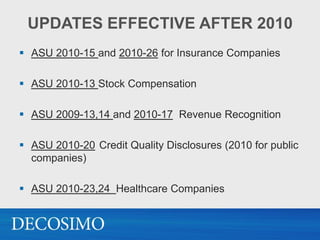
UPDATES EFFECTIVE AFTER 2010
 ASU 2010-15 and 2010-26 for Insurance Companies

 ASU 2010-13 Stock Compensation

 ASU 2009-13,14 and 2010-17 Revenue Recognition

 ASU 2010-20 Credit Quality Disclosures (2010 for public
  companies)

 ASU 2010-23,24 Healthcare Companies
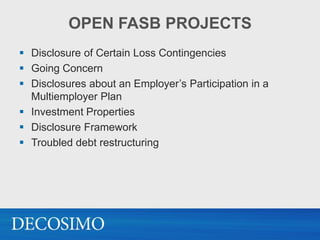
OPEN FASB PROJECTS
 Disclosure of Certain Loss Contingencies
 Going Concern
 Disclosures about an Employer’s Participation in a
  Multiemployer Plan
 Investment Properties
 Disclosure Framework
 Troubled debt restructuring
FASB/IASB JOINT PROJECTS
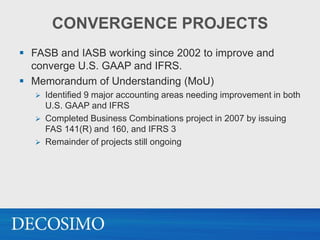
CONVERGENCE PROJECTS
 FASB and IASB working since 2002 to improve and
  converge U.S. GAAP and IFRS.
 Memorandum of Understanding (MoU)
      Identified 9 major accounting areas needing improvement in both
       U.S. GAAP and IFRS
      Completed Business Combinations project in 2007 by issuing
       FAS 141(R) and 160, and IFRS 3
      Remainder of projects still ongoing
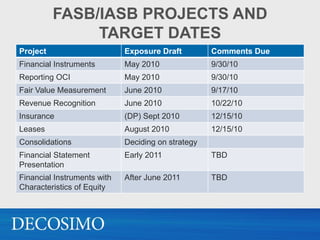
FASB/IASB PROJECTS AND
               TARGET DATES
Project                      Exposure Draft         Comments Due
Financial Instruments        May 2010               9/30/10
Reporting OCI                May 2010               9/30/10
Fair Value Measurement       June 2010              9/17/10
Revenue Recognition          June 2010              10/22/10
Insurance                    (DP) Sept 2010         12/15/10
Leases                       August 2010            12/15/10
Consolidations               Deciding on strategy
Financial Statement          Early 2011             TBD
Presentation
Financial Instruments with   After June 2011        TBD
Characteristics of Equity
SELECTED JOINT PROJECTS
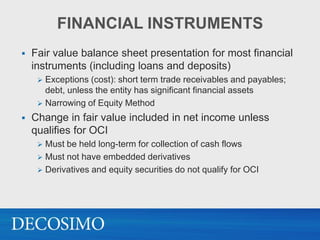
FINANCIAL INSTRUMENTS
   Fair value balance sheet presentation for most financial
    instruments (including loans and deposits)
      Exceptions (cost): short term trade receivables and payables;
       debt, unless the entity has significant financial assets
      Narrowing of Equity Method

   Change in fair value included in net income unless
    qualifies for OCI
      Must be held long-term for collection of cash flows
      Must not have embedded derivatives
      Derivatives and equity securities do not qualify for OCI
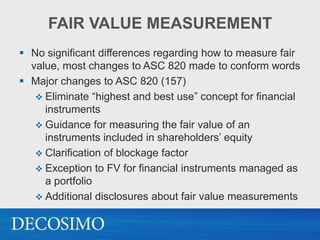
FAIR VALUE MEASUREMENT
 No significant differences regarding how to measure fair
  value, most changes to ASC 820 made to conform words
 Major changes to ASC 820 (157)
    Eliminate “highest and best use” concept for financial
     instruments
    Guidance for measuring the fair value of an
     instruments included in shareholders’ equity
    Clarification of blockage factor
    Exception to FV for financial instruments managed as
     a portfolio
    Additional disclosures about fair value measurements
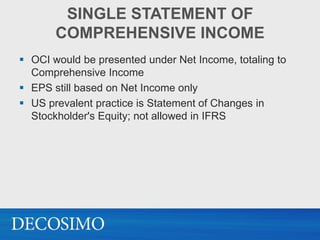
SINGLE STATEMENT OF
       COMPREHENSIVE INCOME
 OCI would be presented under Net Income, totaling to
  Comprehensive Income
 EPS still based on Net Income only
 US prevalent practice is Statement of Changes in
  Stockholder's Equity; not allowed in IFRS
REVENUE RECOGNITION
 Revenue is recognized as benefits are transferred to
  customer and promises are fulfilled. Will change pattern
  for some arrangements.
 Multi-element contracts are separated and recognized
  based on estimated selling prices of elements
 Credit risk is initially factored into measurement of
  revenue rather than as a hurdle for revenue recognition
 Contract costs must be expensed, unless they meet
  certain conditions
LEASES
 Lessees: Obligations recognized on balance sheet, with
  a corresponding asset. Interest expense on debt;
  amortization of right-to-use asset. Practical expedient for
  short (12 months) lease terms.
 Lessor: Record lease receivables; tentatively decided
  that credit should be to the leased asset (derecognition
  approach) or a deferred revenue account (performance
  obligation) depending on facts and circumstances.
CONSOLIDATIONS
 Control based consolidation model
    Contractual ability to direct activities
         Votingrights
         Contractual rights
         Combination of voting and contractual rights

      Other indicators of ability to direct activities:
         Reporting  entity’s voting rights relative to size and dispersion
          of holdings of other vote holders
         Evidence of ability to direct including:
            • Approving or appointing key management
            • Initiating, approving or vetoing significant transactions
FINANCIAL STATEMENT
             PRESENTATION
 The following comprise a complete set of financial
  statements:
    Statement of Financial Position
    Statement of Comprehensive Income
    Statement of Changes in Equity
    Statement of Cash Flows
 Comparative information for previous period is required.
CONVERGENCE
    VS.
  ADOPTION
“CONVERGENCE”
 Merging two separate sets of standards

 Best approach of-
    US GAAP
    IFRS
    Jointly developed new standard
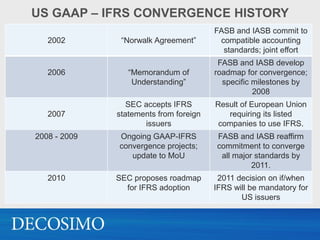
US GAAP – IFRS CONVERGENCE HISTORY
                                        FASB and IASB commit to
   2002        “Norwalk Agreement”       compatible accounting
                                          standards; joint effort
                                         FASB and IASB develop
   2006          “Memorandum of         roadmap for convergence;
                  Understanding”          specific milestones by
                                                   2008
                 SEC accepts IFRS       Result of European Union
   2007       statements from foreign      requiring its listed
                     issuers             companies to use IFRS.
2008 - 2009   Ongoing GAAP-IFRS         FASB and IASB reaffirm
              convergence projects;     commitment to converge
                 update to MoU           all major standards by
                                                  2011.
   2010       SEC proposes roadmap       2011 decision on if/when
                for IFRS adoption       IFRS will be mandatory for
                                               US issuers
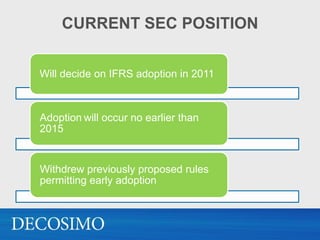
CURRENT SEC POSITION


Will decide on IFRS adoption in 2011


Adoption will occur no earlier than
2015


Withdrew previously proposed rules
permitting early adoption
OFFICE OF THE CHIEF
             ACCOUNTANT
 Will prepare comprehensive Work Plan to address:
   Whether IFRS is sufficiently developed
   Impact on US Issuers
   Investor understanding and education
   Changes to regulatory environment
   Human capital readiness
   Ongoing role of FASB post-adoption?
PRIVATE COMPANY SCENARIOS
 Conversion to IFRS or IFRS for SMEs
 Private company US GAAP (“Blue Ribbon Panel” report
  expected in early 2011 recommending separate
  standards for private companies)
 Existing US GAAP maintained/updated
OTHER CONSIDERATIONS

 No current guidance in IFRS for not for profits (refer to
  IAS 8)
 Little industry-specific guidance
 Educating the profession, investors, bankers
 Costs of conversion
QUESTIONS?
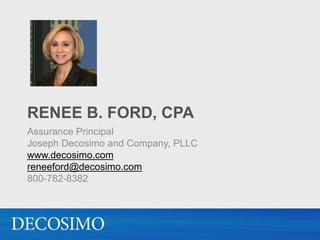
RENEE B. FORD, CPA
Assurance Principal
Joseph Decosimo and Company, PLLC
www.decosimo.com
reneeford@decosimo.com
800-782-8382

Accounting Update 2010

  • 1.
  • 2.
    WHAT’S NEW?  Standards codification  Significant standards updates  FASB – IASB joint projects (“convergence”)  IFRS  Private company financial reporting
  • 3.
    CODIFICATION  Effective forfinancial statements issued after September 15, 2009 (references to standards, etc.)  Did not change GAAP! Merged authoritative guidance into single source  90 topics, subtopics, sections and paragraphs arranged by ASC #  i.e. receivables-overall-recognition-factoring  ASC 310-10-25-3
  • 4.
    CODIFICATION  Updates aredenoted as “ASU 2010-01”  Accounting standards update  Issued in 2010  First update issued in 2010  Codification contains GAAP only – not OCBOA, GAAS, SSARS, etc.
  • 5.
    STANDARDS UPDATES EFFECTIVE IN 2010  ASU 2009-17 (Topic 810 Consolidation)  Improvements to Financial Reporting by Enterprises Involved with Variable Interest Entities  QSPEs no longer scoped out of VIE consolidation rules  Eliminates quantitative evaluation of VIEs  Evaluation of affiliated entities who are VIEs -  If equity investors lack sufficient equity at risk, does reporting entity have the power to direct the activities of the VIE?
  • 6.
    STANDARDS UPDATES EFFECTIVE IN 2010  ASU 2010-06 (Topic 820 Fair Value Measurement)  Improving Disclosures about Fair Value Measurements  Requires more robust disclosures about:  Different classes of assets and liabilities measured at fair value  Valuation techniques and inputs used  Activity in level 3 fair value measurements  Details of and reasons for transfers between levels
  • 7.
    OTHER UPDATES EFFECTIVE IN 2010  ASU 2009-16 Transfers of Financial Assets  ASU 2010-07 NFP Entities – Mergers and Acquisitions  ASU 2010-09 Subsequent Events (further amendment)  ASU 2010-25 EBPs – Loans to Participants
  • 8.
    UPDATES EFFECTIVE AFTER2010  ASU 2010-15 and 2010-26 for Insurance Companies  ASU 2010-13 Stock Compensation  ASU 2009-13,14 and 2010-17 Revenue Recognition  ASU 2010-20 Credit Quality Disclosures (2010 for public companies)  ASU 2010-23,24 Healthcare Companies
  • 9.
    OPEN FASB PROJECTS Disclosure of Certain Loss Contingencies  Going Concern  Disclosures about an Employer’s Participation in a Multiemployer Plan  Investment Properties  Disclosure Framework  Troubled debt restructuring
  • 10.
  • 11.
    CONVERGENCE PROJECTS  FASBand IASB working since 2002 to improve and converge U.S. GAAP and IFRS.  Memorandum of Understanding (MoU)  Identified 9 major accounting areas needing improvement in both U.S. GAAP and IFRS  Completed Business Combinations project in 2007 by issuing FAS 141(R) and 160, and IFRS 3  Remainder of projects still ongoing
  • 12.
    FASB/IASB PROJECTS AND TARGET DATES Project Exposure Draft Comments Due Financial Instruments May 2010 9/30/10 Reporting OCI May 2010 9/30/10 Fair Value Measurement June 2010 9/17/10 Revenue Recognition June 2010 10/22/10 Insurance (DP) Sept 2010 12/15/10 Leases August 2010 12/15/10 Consolidations Deciding on strategy Financial Statement Early 2011 TBD Presentation Financial Instruments with After June 2011 TBD Characteristics of Equity
  • 13.
  • 14.
    FINANCIAL INSTRUMENTS  Fair value balance sheet presentation for most financial instruments (including loans and deposits)  Exceptions (cost): short term trade receivables and payables; debt, unless the entity has significant financial assets  Narrowing of Equity Method  Change in fair value included in net income unless qualifies for OCI  Must be held long-term for collection of cash flows  Must not have embedded derivatives  Derivatives and equity securities do not qualify for OCI
  • 15.
    FAIR VALUE MEASUREMENT No significant differences regarding how to measure fair value, most changes to ASC 820 made to conform words  Major changes to ASC 820 (157)  Eliminate “highest and best use” concept for financial instruments  Guidance for measuring the fair value of an instruments included in shareholders’ equity  Clarification of blockage factor  Exception to FV for financial instruments managed as a portfolio  Additional disclosures about fair value measurements
  • 16.
    SINGLE STATEMENT OF COMPREHENSIVE INCOME  OCI would be presented under Net Income, totaling to Comprehensive Income  EPS still based on Net Income only  US prevalent practice is Statement of Changes in Stockholder's Equity; not allowed in IFRS
  • 17.
    REVENUE RECOGNITION  Revenueis recognized as benefits are transferred to customer and promises are fulfilled. Will change pattern for some arrangements.  Multi-element contracts are separated and recognized based on estimated selling prices of elements  Credit risk is initially factored into measurement of revenue rather than as a hurdle for revenue recognition  Contract costs must be expensed, unless they meet certain conditions
  • 18.
    LEASES  Lessees: Obligationsrecognized on balance sheet, with a corresponding asset. Interest expense on debt; amortization of right-to-use asset. Practical expedient for short (12 months) lease terms.  Lessor: Record lease receivables; tentatively decided that credit should be to the leased asset (derecognition approach) or a deferred revenue account (performance obligation) depending on facts and circumstances.
  • 19.
    CONSOLIDATIONS  Control basedconsolidation model  Contractual ability to direct activities  Votingrights  Contractual rights  Combination of voting and contractual rights  Other indicators of ability to direct activities:  Reporting entity’s voting rights relative to size and dispersion of holdings of other vote holders  Evidence of ability to direct including: • Approving or appointing key management • Initiating, approving or vetoing significant transactions
  • 20.
    FINANCIAL STATEMENT PRESENTATION  The following comprise a complete set of financial statements:  Statement of Financial Position  Statement of Comprehensive Income  Statement of Changes in Equity  Statement of Cash Flows  Comparative information for previous period is required.
  • 21.
    CONVERGENCE VS. ADOPTION
  • 22.
    “CONVERGENCE”  Merging twoseparate sets of standards  Best approach of-  US GAAP  IFRS  Jointly developed new standard
  • 23.
    US GAAP –IFRS CONVERGENCE HISTORY FASB and IASB commit to 2002 “Norwalk Agreement” compatible accounting standards; joint effort FASB and IASB develop 2006 “Memorandum of roadmap for convergence; Understanding” specific milestones by 2008 SEC accepts IFRS Result of European Union 2007 statements from foreign requiring its listed issuers companies to use IFRS. 2008 - 2009 Ongoing GAAP-IFRS FASB and IASB reaffirm convergence projects; commitment to converge update to MoU all major standards by 2011. 2010 SEC proposes roadmap 2011 decision on if/when for IFRS adoption IFRS will be mandatory for US issuers
  • 24.
    CURRENT SEC POSITION Willdecide on IFRS adoption in 2011 Adoption will occur no earlier than 2015 Withdrew previously proposed rules permitting early adoption
  • 25.
    OFFICE OF THECHIEF ACCOUNTANT  Will prepare comprehensive Work Plan to address:  Whether IFRS is sufficiently developed  Impact on US Issuers  Investor understanding and education  Changes to regulatory environment  Human capital readiness  Ongoing role of FASB post-adoption?
  • 26.
    PRIVATE COMPANY SCENARIOS Conversion to IFRS or IFRS for SMEs  Private company US GAAP (“Blue Ribbon Panel” report expected in early 2011 recommending separate standards for private companies)  Existing US GAAP maintained/updated
  • 27.
    OTHER CONSIDERATIONS  Nocurrent guidance in IFRS for not for profits (refer to IAS 8)  Little industry-specific guidance  Educating the profession, investors, bankers  Costs of conversion
  • 28.
  • 29.
    RENEE B. FORD,CPA Assurance Principal Joseph Decosimo and Company, PLLC www.decosimo.com reneeford@decosimo.com 800-782-8382