CA- IPCC
ACCOUNTING
syllabus
 Module –I
1. Introduction to Accounting Standards
2. Framework for preparation & presentation of
financial statements
3. overview of Accounting Standard
 Module – II
4. Financial Statement of Companies
5. Profit/Loss pre & post Incorporation
6. Accounting for Bonus Issue & Right Issue
7. Redemption of Preference shares
8. Redemption of Debentures
syllabus
 Module-III
9. Investment Accounts
10. Insurance Claims for loss of Stock & loss of
Profit
11. Hire-purchase Installment sale transactions
12. Departmental Accounts
13. Accounting for Branches including Foreign
Branches
14. Accounts for Incomplete Records
15. Partnership Accounts
MODULE 1
CONTENTS
INTRODUCTION TO ACCOUNTING
STANDARDS
FRAMEWORK FOR PREPARATION &
PRESENTATION OF FINANCIAL STATEMENTS
OVERVIEW OF ACCOUNTING STANDARDS
INTRODUCTION TO ACCOUNTING
STANDARDS
Regulatory bodies in India
 MCA
 SEBI
 ICAI
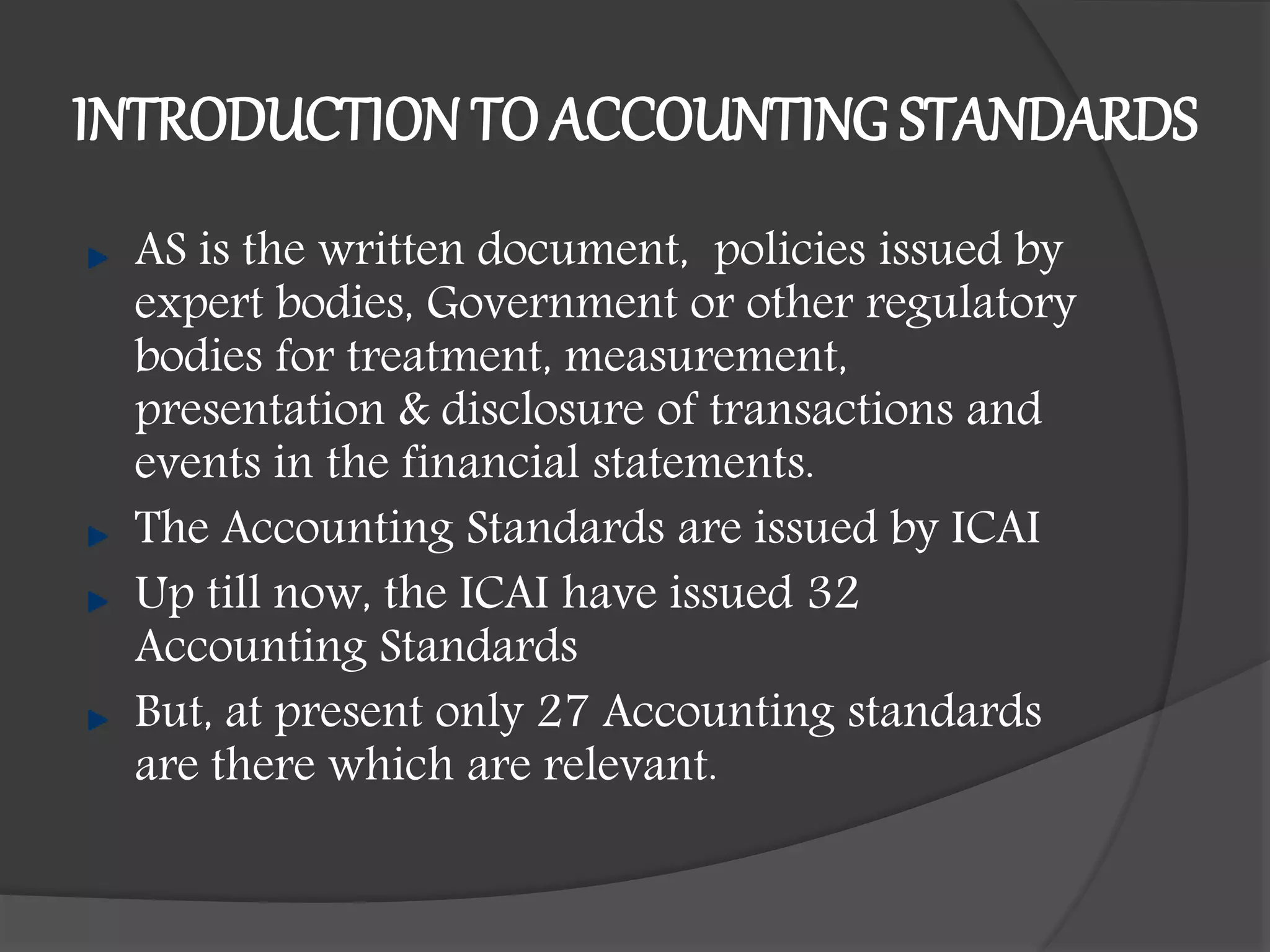
INTRODUCTION TO ACCOUNTING STANDARDS
AS is the written document, policies issued by
expert bodies, Government or other regulatory
bodies for treatment, measurement,
presentation & disclosure of transactions and
events in the financial statements.
The Accounting Standards are issued by ICAI
Up till now, the ICAI have issued 32
Accounting Standards
But, at present only 27 Accounting standards
are there which are relevant.
INTRODUCTION TO ACCOUNTING STANDARDS
The AS 30,31 & 32 are withdrawn
The AS 6 & 8 are withdrawn. But AS 6 is
included in AS 10 and AS 8 is included in
AS 26
So, only 27 AS are relevant for preparing
Financial statement.
INTRODUCTION TO ACCOUNTING STANDARDS
Accounting standards deals with –
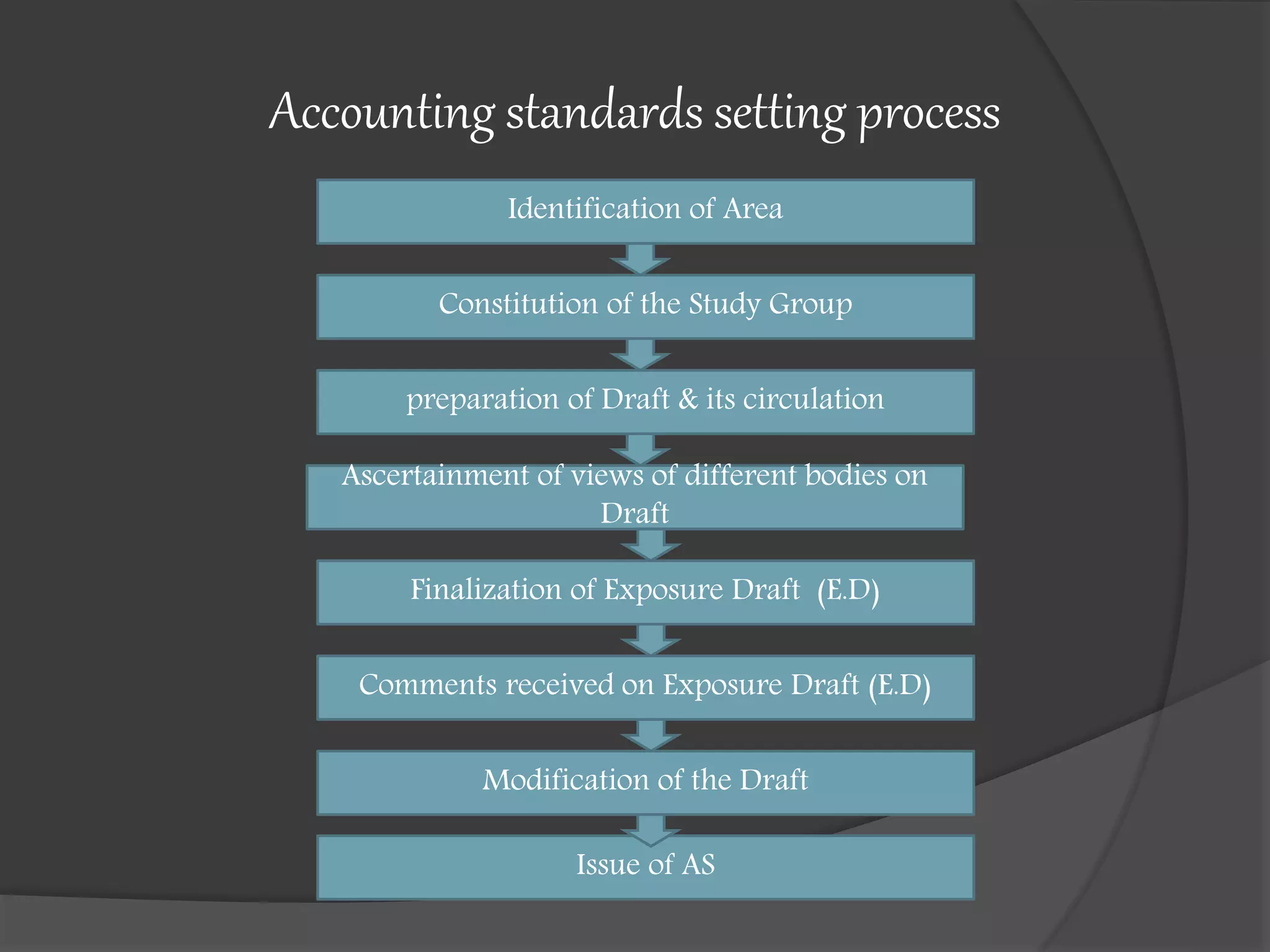
Accounting standards setting process
Identification of Area
Issue of AS
preparation of Draft & its circulation
Ascertainment of views of different bodies on
Draft
Finalization of Exposure Draft (E.D)
Comments received on Exposure Draft (E.D)
Modification of the Draft
Constitution of the Study Group
Benefits Of ACCOUNTING STANDARDS
Standardization
of alternative AS
Requirements
of additional
disclosures
Comparability
of financial
statements
Accounting standards
AS
No.
AS Title Date
1 Disclosure of Accounting Policies 1/4/1993
2 Valuation of Inventories (Revised) 1/4/1999
3 Cash Flow Statement 1/4/2001
4 Contingencies & Events Occurring after the Balance Sheet Date
(Revised)
1/4/1998
5 Net Profit/Loss for the period, prior period items & changes in
Accounting Policies
1/4/1996
6 Depreciation Accounting (included in AS 10) Withdrawn
w.e.f.1/4/2006
7 Construction Contracts 1/4/2002
8 Research & Development (included in AS 26) Withdrawn
9 Revenue Recognition 1/4/1993
10 Property, Plant & Equipment (Revised) ( before it was Fixed Assets) 1/4/2016
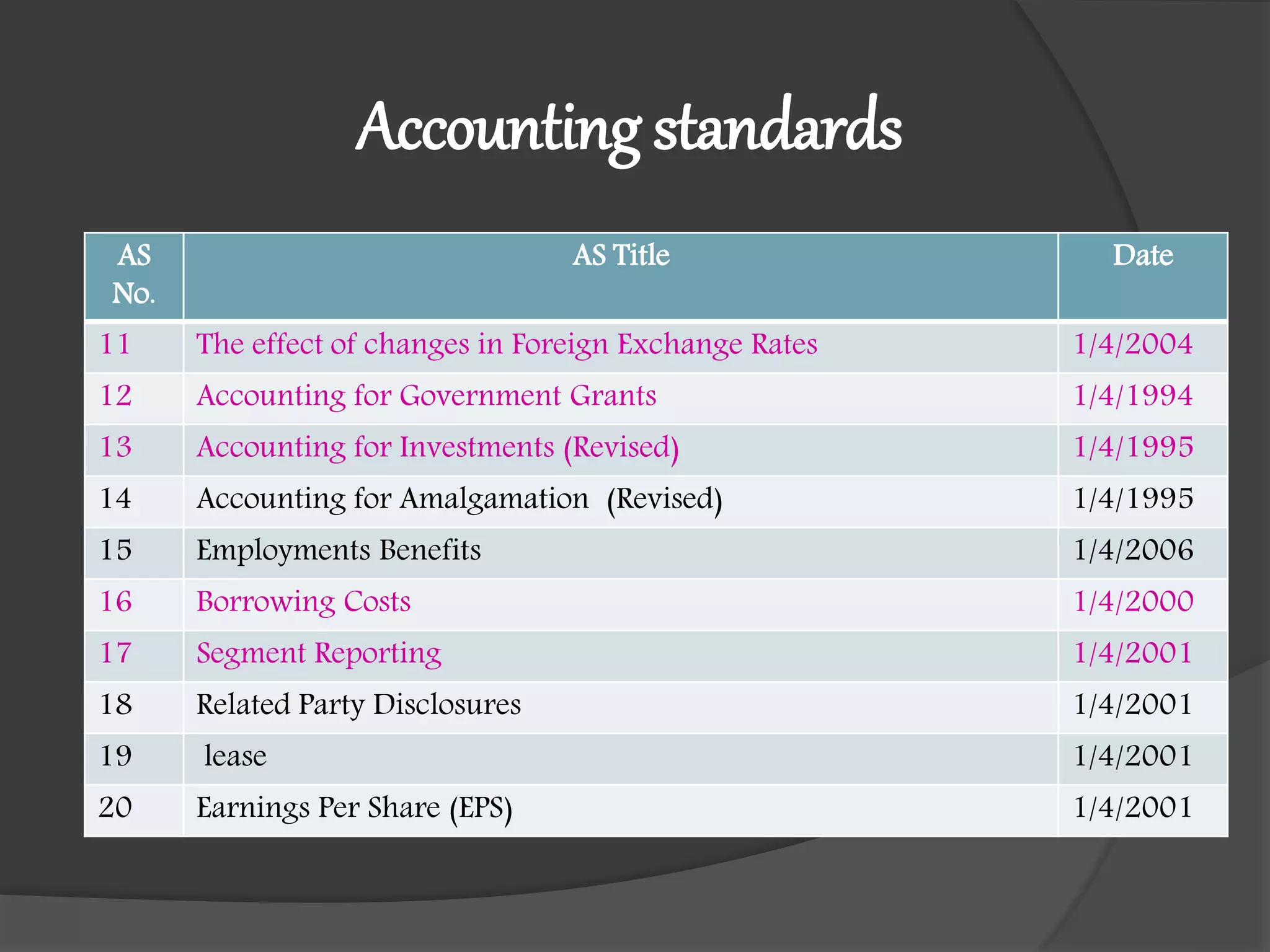
Accounting standards
AS
No.
AS Title Date
11 The effect of changes in Foreign Exchange Rates 1/4/2004
12 Accounting for Government Grants 1/4/1994
13 Accounting for Investments (Revised) 1/4/1995
14 Accounting for Amalgamation (Revised) 1/4/1995
15 Employments Benefits 1/4/2006
16 Borrowing Costs 1/4/2000
17 Segment Reporting 1/4/2001
18 Related Party Disclosures 1/4/2001
19 lease 1/4/2001
20 Earnings Per Share (EPS) 1/4/2001
Accounting standards
AS
No.
AS Title Date
21 Consolidated Financial Statements (Revised) 1/4/2001
22 Accounting for Taxes on Income 1/4/2006
23 Accounting for Investment in Associates in Consolidated Financial
Statements
1/4/2002
24 Discontinuing Operations 1/4/2004
25 Interim Financial Reporting 1/4/2002
26 Intangible Assets 1/4/2003
27 Financial Reporting on Interests in Joint Venture 1/4/2002
28 Impairment of Assets 1/4/2008
29 Provisions , Contingent Liabilities, Contingent Assets (Revised) 1/4/2004
Status of Accounting standards
ASB of ICAI develops AS
ICAI is not being a legislative body, can enforce
compliance with its Standards only to its members.
AS cannot override laws and local regulations
AS are never made mandatory from the dates
specified in respective standards
AS are generally applicable to all companies
The Companies Act had earlier notified 29 AS
mandatorily on Corporate entities. The companies
Act have withdrawn AS 6 & AS 8. so only 27 AS
corporate entities have to comply with their
financial statements
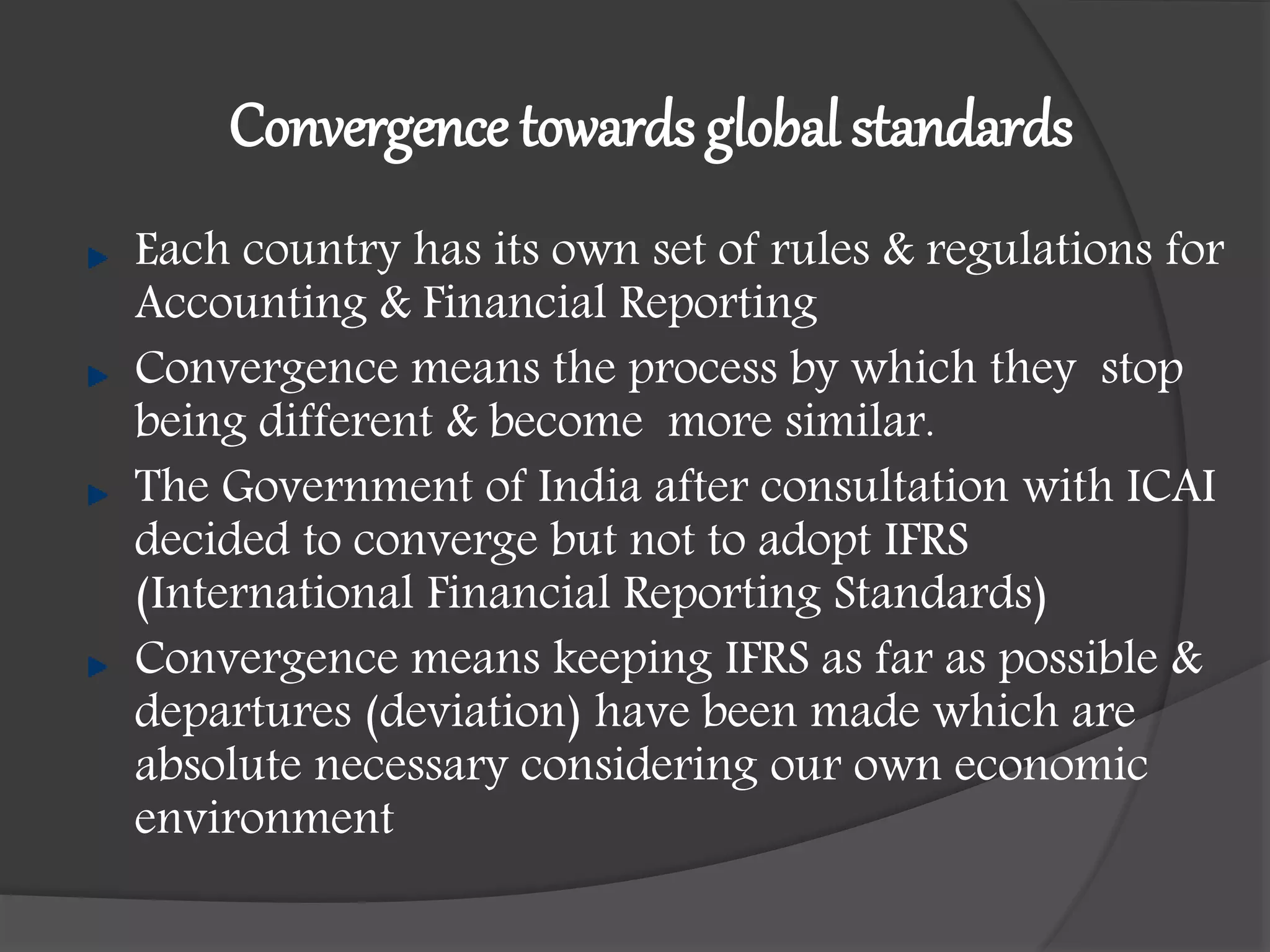
Convergence towards global standards
Each country has its own set of rules & regulations for
Accounting & Financial Reporting
Convergence means the process by which they stop
being different & become more similar.
The Government of India after consultation with ICAI
decided to converge but not to adopt IFRS
(International Financial Reporting Standards)
Convergence means keeping IFRS as far as possible &
departures (deviation) have been made which are
absolute necessary considering our own economic
environment
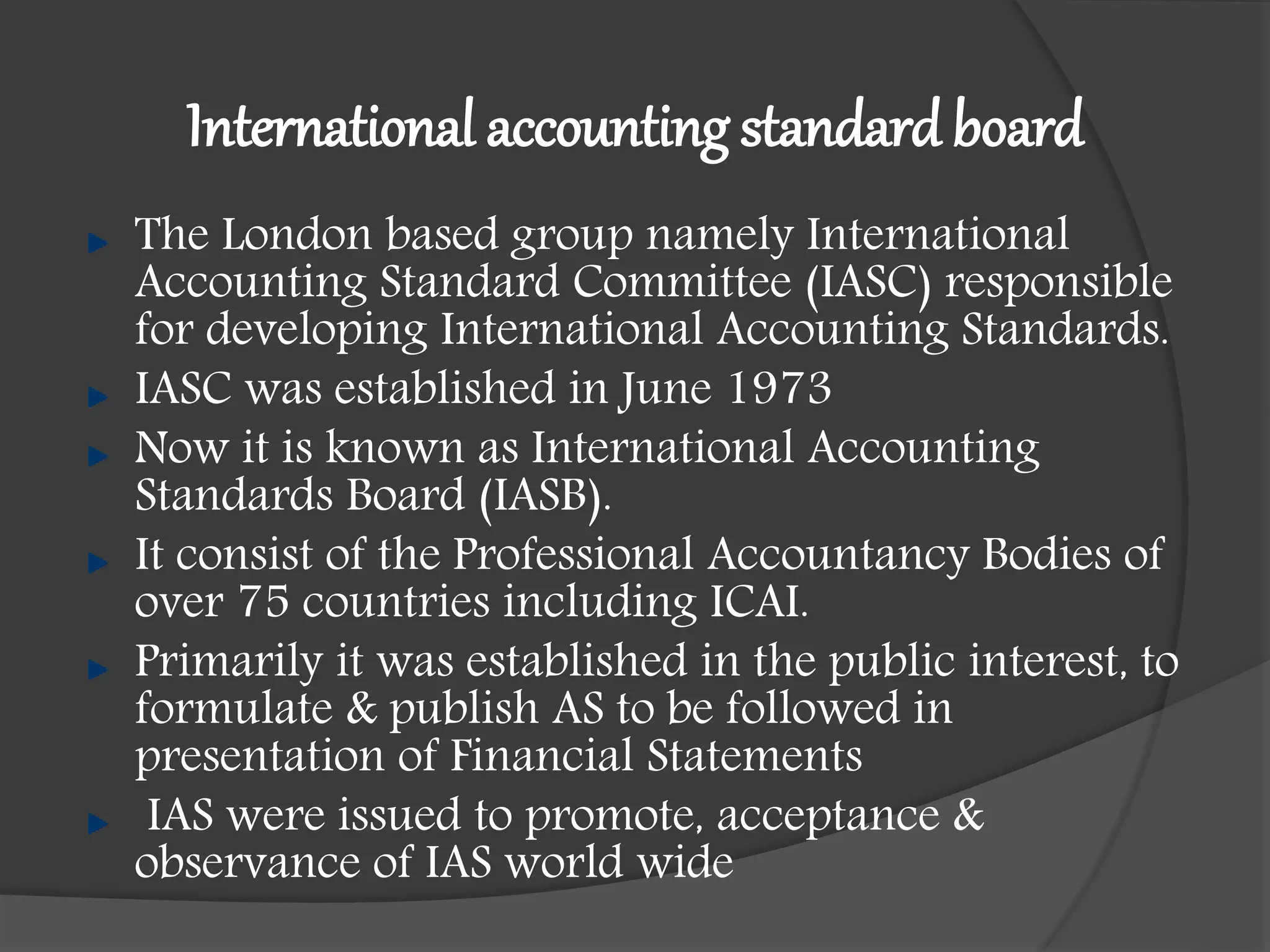
International accounting standard board
The London based group namely International
Accounting Standard Committee (IASC) responsible
for developing International Accounting Standards.
IASC was established in June 1973
Now it is known as International Accounting
Standards Board (IASB).
It consist of the Professional Accountancy Bodies of
over 75 countries including ICAI.
Primarily it was established in the public interest, to
formulate & publish AS to be followed in
presentation of Financial Statements
IAS were issued to promote, acceptance &
observance of IAS world wide
International accounting standard board
The member of IASC have undertaken a
responsibility to support the standards &
promulgated by IASC & to propagate those
standards in respective of their countries.
ISAB issued statements of past & future AS
ISAB publishes its standards in series of
pronouncements called IFRS
ISAB has not rejected the standards issued by IASC
Pronouncement continued to be designated as IAS
(International Accounting Standards)
IFRS
International Financial Reporting Standards
IFRS are AS formulated by IASB (International
Accounting Standard Board) in London, UK.
Many of the countries have adopted IFRS for
preparation of their Financial Statements
India has not adopted IFRS in fact it has converged
the IFRS as per the economic environment of the
company
IFRS are Global Standards
IFRS are issued by IASB
IAS are issued by IASC (International Accounting
Standard Committee)
Benefits of convergence with ifrs
INVESTORS
INDUSTRY
ECONOMY
Convergence to ifrs in India
In India the ICAI & the Government Authorities
such as National Advisory Committee on
Accounting Standards (NACAS) established under
Companies Act 1956 & various regulators such as
SEBI & RBI are concerned with the aim of
complying with the IFRS to the extent possible
with the object to formulate Financial Reporting
Standards
ICAI is a member of the IFAC (International
Federation of Accountants)
ICAI has worked through the convergence
considering the application of IFRS
Convergence to ifrs in India
For convergence of AS with IFRS the ASB in
consultation with the MCA has decided that there
will be two separate set of AS
The 2 sets of AS are
1. IND AS (convergence of AS with IFRS)
2. Existing Notified AS (AS)
Indian accounting standards (IND AS)
IND AS are AS converged with IFRS
IND AS are issued by Central Government of
India under the supervision and control of ASB
of ICAI & in consultation with NACAS
NACAS recommend these AS to MCA
MCA spell out AS applicable to companies
IND AS are named & numbered in the same way
Corresponding to IFRS
Indian accounting standards (IND AS)
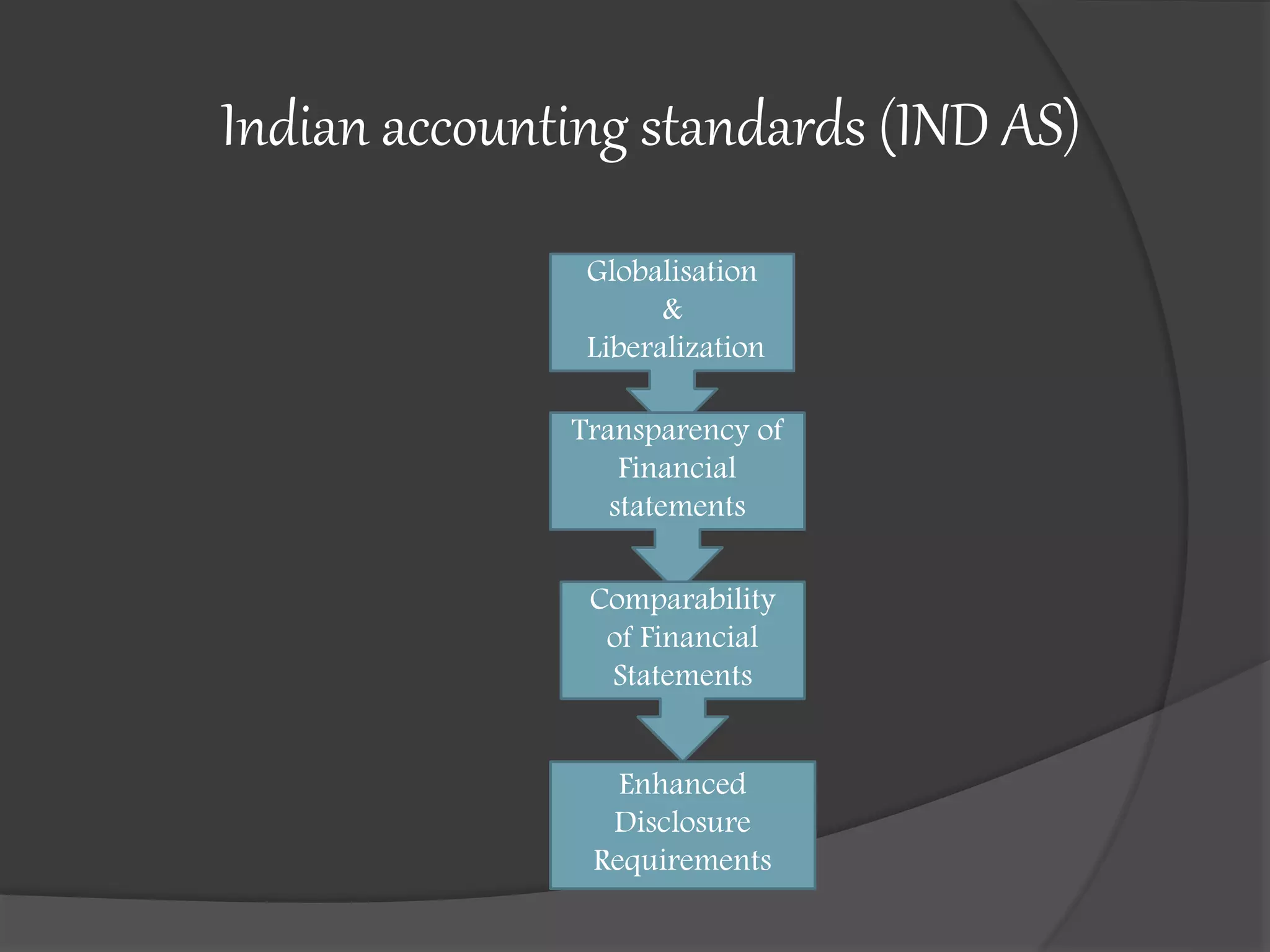
Globalisation
&
Liberalization
Transparency of
Financial
statements
Enhanced
Disclosure
Requirements
Comparability
of Financial
Statements
History of IFRS (Converged IND As)
The ICAI in the year 2006 started to move towards
IFRS issued by IASB with a view to enhance
transparency & acceptability of Financial statements
of corporate
The Government of India accepted the move towards
IFRS
The GOI after consultation with ICAI decided to
converge IFRS and not to adopt it
The decision of converge was taken after detailed
analysis of IFRS requirement with various
stakeholders
History of IFRS(Converged IND As)
ICAI has set out to introduce IND AS (Indian
Accounting Standards) converged with the IFRS
IND AS were accepted to be implemented from the
year 2011
MCA decided to postpone the date of
implementation of IND AS due to certain facts &
issues including Tax issues, which were still to be
addressed
In July 2014, the Finance Minster Shri. Arun Jaitely
in his Budget speech announced an urgency to
converge the existing AS with the IFRS through the
adoption of new IND AS by the Indian companies
History of IFRS(Converged IND As)
various steps have been taken to facilitate the
implementation of IFRS converged with the IND AS
MCA have issued Companies (Indian Accounting
Standard) Rules 2015 notification dated feb16, 2015
MCA is covering the revised roadmap of
implementation of IND AS for companies other than
Banking co.’s, Insurance Co.’s & NBFC’s
As per the notification IND AS shall be implemented
on voluntary basis from 1-4-2015 & mandatory from
1-4-2016
Banking co.’s, Insurance Co.’s & NBFC’s separate
roadmaps have been prescribed for implementation
of IND AS respectively
Carve ins/carve out of Ind AS
Carve ins: Carve INS are those point which were
adopted from IFRS but with some modifications
Carve out: carve out are those which were just not
taken from IFRS, but excluding it straightway
Carve ins/carve out of Ind AS
While formulating IFRS converged IND AS efforts
have been made to keep these standards as far as
possible in a line with the corresponding IFRS and
departures have been made where considered
absolutely necessary essential.
The changes have been made considering various
factors such as-
1. Terminology used in Laws
2. Removal of options in Accounting principles &
practice in IND AS and also in IFRS
3. changes as per Economic Environment
List of IND AS
IND
AS
IFRS TITLE OF IND AS / IFRS AS/GN AS/GN TITLE
101 1 First time adoption of IND AS - -
102 2 Share based payment GN 18 Guidance Notes on accounting for
Employee share based payments
103 3 Business combinations AS 14 Accounting for Amalgamations
104 4 Insurance contracts - -
105 5 Non-current Assets held for sale
& discontinued operations
As 24 Discontinuing operations
106 6 Exploration for the evaluation of
Mineral resources
GN 15 Guidance Notes on accounting for oil
& gas producing activities
107 7 Financial Instrument Disclosures - -
108 8 Operating Segments AS 18 Segment Reporting
109 9 Financial Instruments - -
110 10 Consolidated Financial Statements AS 21 Consolidated Financial Statements
List of IND AS
IND
AS
IFRS TITLE OF IND AS / IFRS AS/GN AS/GN TITLE
111 11 Joint Arrangements AS 27 Financial reporting of Interests in Joint
Venture
112 12 Disclosure of Interests in other
entities
- -
113 13 Fair value management - -
114 14 Regulatory deferral accounts GN Accounting for rate regulated activities
1 1 Presentation of financial
statements
As 1 Disclosure of Accounting Policies
2 2 Inventories AS 2 Valuation of inventories
7 7 Cash flow statement AS 3 Cash flow statement
8 8 Accounting policies, changes in
accounting estimates & errors
AS 5 Net profit/loss for the period ,prior period
items & changes in accounting policies
9 9 Events after the reporting
period
AS 4 Contingencies & events occurring after the
balance sheet date
11 11 Construction Contracts AS 7 Construction Contracts
List of IND AS
IND
AS
IFRS TITLE OF IND AS / IFRS AS/GN AS/GN TITLE
12 12 Income Taxes AS 22 Accounting for Taxes on Income
16 16 Property, Plant & equipment AS 10 Property, Plant & equipment
17 17 Lease AS 19 Lease
18 18 Revenue AS 9 Revenue Recognition
19 19 Employees benefits AS 15 Employees benefits
20 20 Accounting for Government Grants
& Disclosure of Government
Assistance
AS 12 Accounting for Government Grants
21 21 The effect of changes in Foreign
Exchange Rates
AS 11 The effect of changes in Foreign
Exchange Rates
23 23 Borrowing cost AS 16 Borrowing cost
24 24 Related party disclosures AS 18 Related party disclosures
27 27 Separate financial statements - -
List of IND AS
IND
AS
IFRS TITLE OF IND AS / IFRS AS/GN AS/GN TITLE
28 28 Investments in associates &
joint venture
AS 23 Accounting for investments in
associates in consolidated financial
statements
29 29 Financial reporting in
hyperinflation economies
- -
32 32 Financial Instruments
:presentation
- -
33 33 Earning per share AS 20 Earning per share
34 34 Interim financial reporting AS 25 Interim financial reporting
36 36 Impairment of Assets AS 28 Impairment of Assets
37 37 Provisions, contingent
liabilities, contingent asset
AS 29 Provisions, contingent liabilities,
contingent asset
38 38 Intangible Assets AS 26 Intangible Assets
40 40 Investment property AS 13 Accounting for investments
41 41 Agriculture - -
Road map for implementation of IND AS
for companies other than Banking co.’s, Insurance Co.’s & NBFC’s
1st April, 2015 or thereafter : voluntary basis for all
companies
Phase I - 1st April, 2016: Mandatory basis
1. Companies listed or in process of listing on stock
exchange in India or outside India having net
worth more than INR 5 billion (5 crore )
2. Unlisted companies having net worth more than
INR 5 billion
3. Parent, subsidiary and joint venture of above
Road map for implementation of IND AS
for companies other than Banking co.’s, Insurance Co.’s & NBFC’s
Phase II - 1st April, 2017: Mandatory basis
1. Companies listed or in process of listing on stock
exchange in India or outside India not covered in Phase I
(other then companies listed on SME exchanges)
2. Unlisted companies having net worth INR 2.5 billion but
more than 5 billion
3. Parent (holding ), subsidiary and joint venture of above
companies listed on SME exchanges are not required to apply
IND AS
Road map for implementation of IND AS
NBFCs
Phase I – From 1st April, 2018
1. NBFCs whether listed or unlisted having net worth
500 crore or more
2. holding , subsidiary and joint venture and associate
companies of above NBFC other than those already
covered under corporate roadmap shall also apply
from said date
Road map for implementation of IND AS
NBFCs
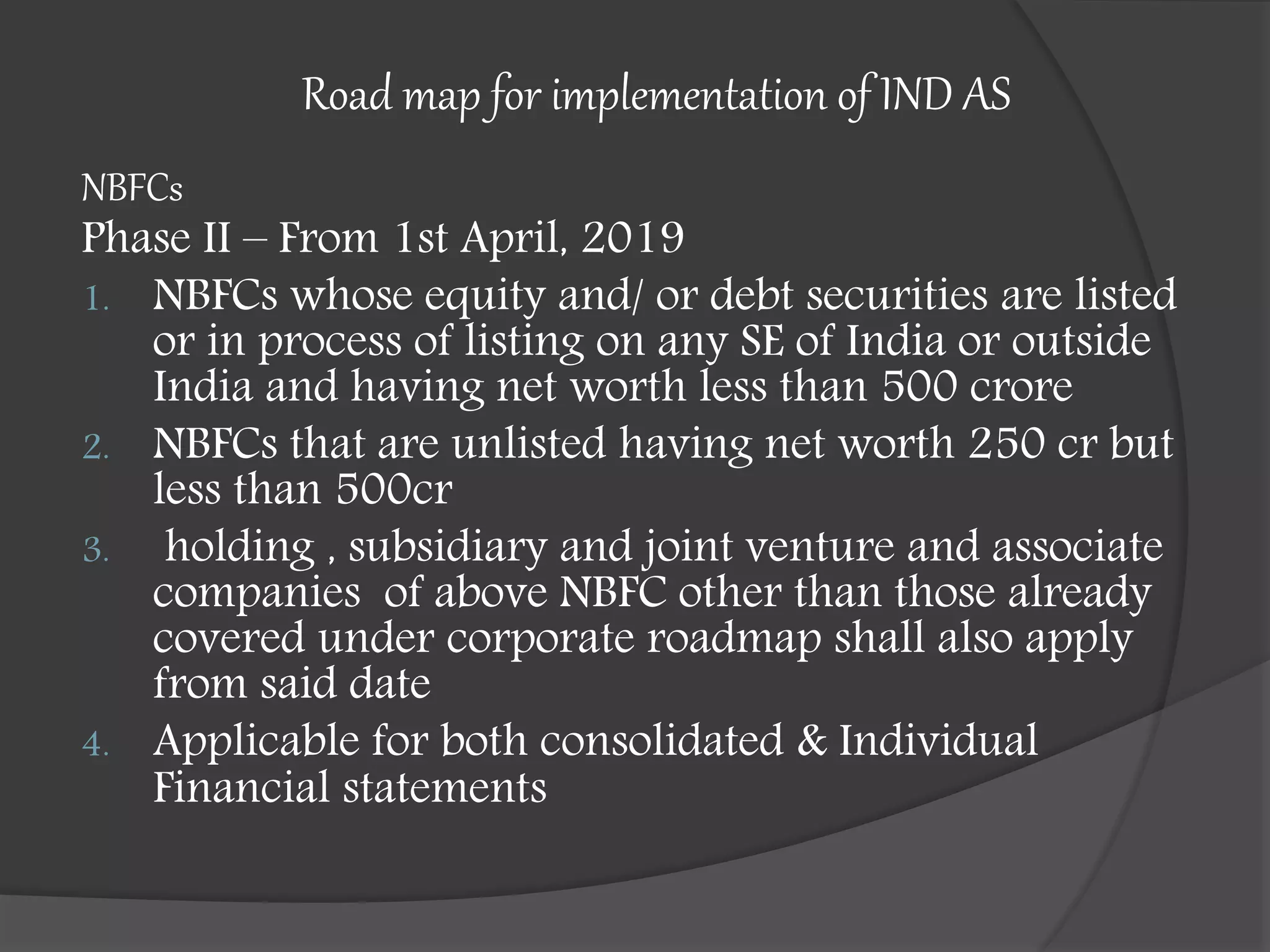
Phase II – From 1st April, 2019
1. NBFCs whose equity and/ or debt securities are listed
or in process of listing on any SE of India or outside
India and having net worth less than 500 crore
2. NBFCs that are unlisted having net worth 250 cr but
less than 500cr
3. holding , subsidiary and joint venture and associate
companies of above NBFC other than those already
covered under corporate roadmap shall also apply
from said date
4. Applicable for both consolidated & Individual
Financial statements
Road map for implementation of IND AS
Scheduled commercial banks (excluding RRBs ) and Insurance Companies
From 1st April, 2018
1. holding , subsidiary and joint venture and associate
companies of Scheduled commercial banks (excluding
RRBs ) shall also apply from the said date irrespective of
being covered under corporate map
2. Applicable for both consolidated & Individual Financial
statements
3. Regional Rural Banks ( RRBs) & urban cooperative banks
are not required to apply IND AS
Companies not covered under roadmap shall continue to
apply existing AS notified in Companies (Accounting
Standard) Rules 2006

Chapter 1

  • 1.
  • 2.
    syllabus  Module –I 1.Introduction to Accounting Standards 2. Framework for preparation & presentation of financial statements 3. overview of Accounting Standard  Module – II 4. Financial Statement of Companies 5. Profit/Loss pre & post Incorporation 6. Accounting for Bonus Issue & Right Issue 7. Redemption of Preference shares 8. Redemption of Debentures
  • 3.
    syllabus  Module-III 9. InvestmentAccounts 10. Insurance Claims for loss of Stock & loss of Profit 11. Hire-purchase Installment sale transactions 12. Departmental Accounts 13. Accounting for Branches including Foreign Branches 14. Accounts for Incomplete Records 15. Partnership Accounts
  • 4.
  • 5.
    CONTENTS INTRODUCTION TO ACCOUNTING STANDARDS FRAMEWORKFOR PREPARATION & PRESENTATION OF FINANCIAL STATEMENTS OVERVIEW OF ACCOUNTING STANDARDS
  • 6.
  • 7.
    Regulatory bodies inIndia  MCA  SEBI  ICAI
  • 8.
    INTRODUCTION TO ACCOUNTINGSTANDARDS AS is the written document, policies issued by expert bodies, Government or other regulatory bodies for treatment, measurement, presentation & disclosure of transactions and events in the financial statements. The Accounting Standards are issued by ICAI Up till now, the ICAI have issued 32 Accounting Standards But, at present only 27 Accounting standards are there which are relevant.
  • 9.
    INTRODUCTION TO ACCOUNTINGSTANDARDS The AS 30,31 & 32 are withdrawn The AS 6 & 8 are withdrawn. But AS 6 is included in AS 10 and AS 8 is included in AS 26 So, only 27 AS are relevant for preparing Financial statement.
  • 10.
    INTRODUCTION TO ACCOUNTINGSTANDARDS Accounting standards deals with –
  • 11.
    Accounting standards settingprocess Identification of Area Issue of AS preparation of Draft & its circulation Ascertainment of views of different bodies on Draft Finalization of Exposure Draft (E.D) Comments received on Exposure Draft (E.D) Modification of the Draft Constitution of the Study Group
  • 12.
    Benefits Of ACCOUNTINGSTANDARDS Standardization of alternative AS Requirements of additional disclosures Comparability of financial statements
  • 13.
    Accounting standards AS No. AS TitleDate 1 Disclosure of Accounting Policies 1/4/1993 2 Valuation of Inventories (Revised) 1/4/1999 3 Cash Flow Statement 1/4/2001 4 Contingencies & Events Occurring after the Balance Sheet Date (Revised) 1/4/1998 5 Net Profit/Loss for the period, prior period items & changes in Accounting Policies 1/4/1996 6 Depreciation Accounting (included in AS 10) Withdrawn w.e.f.1/4/2006 7 Construction Contracts 1/4/2002 8 Research & Development (included in AS 26) Withdrawn 9 Revenue Recognition 1/4/1993 10 Property, Plant & Equipment (Revised) ( before it was Fixed Assets) 1/4/2016
  • 14.
    Accounting standards AS No. AS TitleDate 11 The effect of changes in Foreign Exchange Rates 1/4/2004 12 Accounting for Government Grants 1/4/1994 13 Accounting for Investments (Revised) 1/4/1995 14 Accounting for Amalgamation (Revised) 1/4/1995 15 Employments Benefits 1/4/2006 16 Borrowing Costs 1/4/2000 17 Segment Reporting 1/4/2001 18 Related Party Disclosures 1/4/2001 19 lease 1/4/2001 20 Earnings Per Share (EPS) 1/4/2001
  • 15.
    Accounting standards AS No. AS TitleDate 21 Consolidated Financial Statements (Revised) 1/4/2001 22 Accounting for Taxes on Income 1/4/2006 23 Accounting for Investment in Associates in Consolidated Financial Statements 1/4/2002 24 Discontinuing Operations 1/4/2004 25 Interim Financial Reporting 1/4/2002 26 Intangible Assets 1/4/2003 27 Financial Reporting on Interests in Joint Venture 1/4/2002 28 Impairment of Assets 1/4/2008 29 Provisions , Contingent Liabilities, Contingent Assets (Revised) 1/4/2004
  • 16.
    Status of Accountingstandards ASB of ICAI develops AS ICAI is not being a legislative body, can enforce compliance with its Standards only to its members. AS cannot override laws and local regulations AS are never made mandatory from the dates specified in respective standards AS are generally applicable to all companies The Companies Act had earlier notified 29 AS mandatorily on Corporate entities. The companies Act have withdrawn AS 6 & AS 8. so only 27 AS corporate entities have to comply with their financial statements
  • 17.
    Convergence towards globalstandards Each country has its own set of rules & regulations for Accounting & Financial Reporting Convergence means the process by which they stop being different & become more similar. The Government of India after consultation with ICAI decided to converge but not to adopt IFRS (International Financial Reporting Standards) Convergence means keeping IFRS as far as possible & departures (deviation) have been made which are absolute necessary considering our own economic environment
  • 18.
    International accounting standardboard The London based group namely International Accounting Standard Committee (IASC) responsible for developing International Accounting Standards. IASC was established in June 1973 Now it is known as International Accounting Standards Board (IASB). It consist of the Professional Accountancy Bodies of over 75 countries including ICAI. Primarily it was established in the public interest, to formulate & publish AS to be followed in presentation of Financial Statements IAS were issued to promote, acceptance & observance of IAS world wide
  • 19.
    International accounting standardboard The member of IASC have undertaken a responsibility to support the standards & promulgated by IASC & to propagate those standards in respective of their countries. ISAB issued statements of past & future AS ISAB publishes its standards in series of pronouncements called IFRS ISAB has not rejected the standards issued by IASC Pronouncement continued to be designated as IAS (International Accounting Standards)
  • 20.
    IFRS International Financial ReportingStandards IFRS are AS formulated by IASB (International Accounting Standard Board) in London, UK. Many of the countries have adopted IFRS for preparation of their Financial Statements India has not adopted IFRS in fact it has converged the IFRS as per the economic environment of the company IFRS are Global Standards IFRS are issued by IASB IAS are issued by IASC (International Accounting Standard Committee)
  • 21.
    Benefits of convergencewith ifrs INVESTORS INDUSTRY ECONOMY
  • 22.
    Convergence to ifrsin India In India the ICAI & the Government Authorities such as National Advisory Committee on Accounting Standards (NACAS) established under Companies Act 1956 & various regulators such as SEBI & RBI are concerned with the aim of complying with the IFRS to the extent possible with the object to formulate Financial Reporting Standards ICAI is a member of the IFAC (International Federation of Accountants) ICAI has worked through the convergence considering the application of IFRS
  • 23.
    Convergence to ifrsin India For convergence of AS with IFRS the ASB in consultation with the MCA has decided that there will be two separate set of AS The 2 sets of AS are 1. IND AS (convergence of AS with IFRS) 2. Existing Notified AS (AS)
  • 24.
    Indian accounting standards(IND AS) IND AS are AS converged with IFRS IND AS are issued by Central Government of India under the supervision and control of ASB of ICAI & in consultation with NACAS NACAS recommend these AS to MCA MCA spell out AS applicable to companies IND AS are named & numbered in the same way Corresponding to IFRS
  • 25.
    Indian accounting standards(IND AS) Globalisation & Liberalization Transparency of Financial statements Enhanced Disclosure Requirements Comparability of Financial Statements
  • 26.
    History of IFRS(Converged IND As) The ICAI in the year 2006 started to move towards IFRS issued by IASB with a view to enhance transparency & acceptability of Financial statements of corporate The Government of India accepted the move towards IFRS The GOI after consultation with ICAI decided to converge IFRS and not to adopt it The decision of converge was taken after detailed analysis of IFRS requirement with various stakeholders
  • 27.
    History of IFRS(ConvergedIND As) ICAI has set out to introduce IND AS (Indian Accounting Standards) converged with the IFRS IND AS were accepted to be implemented from the year 2011 MCA decided to postpone the date of implementation of IND AS due to certain facts & issues including Tax issues, which were still to be addressed In July 2014, the Finance Minster Shri. Arun Jaitely in his Budget speech announced an urgency to converge the existing AS with the IFRS through the adoption of new IND AS by the Indian companies
  • 28.
    History of IFRS(ConvergedIND As) various steps have been taken to facilitate the implementation of IFRS converged with the IND AS MCA have issued Companies (Indian Accounting Standard) Rules 2015 notification dated feb16, 2015 MCA is covering the revised roadmap of implementation of IND AS for companies other than Banking co.’s, Insurance Co.’s & NBFC’s As per the notification IND AS shall be implemented on voluntary basis from 1-4-2015 & mandatory from 1-4-2016 Banking co.’s, Insurance Co.’s & NBFC’s separate roadmaps have been prescribed for implementation of IND AS respectively
  • 29.
    Carve ins/carve outof Ind AS Carve ins: Carve INS are those point which were adopted from IFRS but with some modifications Carve out: carve out are those which were just not taken from IFRS, but excluding it straightway
  • 30.
    Carve ins/carve outof Ind AS While formulating IFRS converged IND AS efforts have been made to keep these standards as far as possible in a line with the corresponding IFRS and departures have been made where considered absolutely necessary essential. The changes have been made considering various factors such as- 1. Terminology used in Laws 2. Removal of options in Accounting principles & practice in IND AS and also in IFRS 3. changes as per Economic Environment
  • 31.
    List of INDAS IND AS IFRS TITLE OF IND AS / IFRS AS/GN AS/GN TITLE 101 1 First time adoption of IND AS - - 102 2 Share based payment GN 18 Guidance Notes on accounting for Employee share based payments 103 3 Business combinations AS 14 Accounting for Amalgamations 104 4 Insurance contracts - - 105 5 Non-current Assets held for sale & discontinued operations As 24 Discontinuing operations 106 6 Exploration for the evaluation of Mineral resources GN 15 Guidance Notes on accounting for oil & gas producing activities 107 7 Financial Instrument Disclosures - - 108 8 Operating Segments AS 18 Segment Reporting 109 9 Financial Instruments - - 110 10 Consolidated Financial Statements AS 21 Consolidated Financial Statements
  • 32.
    List of INDAS IND AS IFRS TITLE OF IND AS / IFRS AS/GN AS/GN TITLE 111 11 Joint Arrangements AS 27 Financial reporting of Interests in Joint Venture 112 12 Disclosure of Interests in other entities - - 113 13 Fair value management - - 114 14 Regulatory deferral accounts GN Accounting for rate regulated activities 1 1 Presentation of financial statements As 1 Disclosure of Accounting Policies 2 2 Inventories AS 2 Valuation of inventories 7 7 Cash flow statement AS 3 Cash flow statement 8 8 Accounting policies, changes in accounting estimates & errors AS 5 Net profit/loss for the period ,prior period items & changes in accounting policies 9 9 Events after the reporting period AS 4 Contingencies & events occurring after the balance sheet date 11 11 Construction Contracts AS 7 Construction Contracts
  • 33.
    List of INDAS IND AS IFRS TITLE OF IND AS / IFRS AS/GN AS/GN TITLE 12 12 Income Taxes AS 22 Accounting for Taxes on Income 16 16 Property, Plant & equipment AS 10 Property, Plant & equipment 17 17 Lease AS 19 Lease 18 18 Revenue AS 9 Revenue Recognition 19 19 Employees benefits AS 15 Employees benefits 20 20 Accounting for Government Grants & Disclosure of Government Assistance AS 12 Accounting for Government Grants 21 21 The effect of changes in Foreign Exchange Rates AS 11 The effect of changes in Foreign Exchange Rates 23 23 Borrowing cost AS 16 Borrowing cost 24 24 Related party disclosures AS 18 Related party disclosures 27 27 Separate financial statements - -
  • 34.
    List of INDAS IND AS IFRS TITLE OF IND AS / IFRS AS/GN AS/GN TITLE 28 28 Investments in associates & joint venture AS 23 Accounting for investments in associates in consolidated financial statements 29 29 Financial reporting in hyperinflation economies - - 32 32 Financial Instruments :presentation - - 33 33 Earning per share AS 20 Earning per share 34 34 Interim financial reporting AS 25 Interim financial reporting 36 36 Impairment of Assets AS 28 Impairment of Assets 37 37 Provisions, contingent liabilities, contingent asset AS 29 Provisions, contingent liabilities, contingent asset 38 38 Intangible Assets AS 26 Intangible Assets 40 40 Investment property AS 13 Accounting for investments 41 41 Agriculture - -
  • 35.
    Road map forimplementation of IND AS for companies other than Banking co.’s, Insurance Co.’s & NBFC’s 1st April, 2015 or thereafter : voluntary basis for all companies Phase I - 1st April, 2016: Mandatory basis 1. Companies listed or in process of listing on stock exchange in India or outside India having net worth more than INR 5 billion (5 crore ) 2. Unlisted companies having net worth more than INR 5 billion 3. Parent, subsidiary and joint venture of above
  • 36.
    Road map forimplementation of IND AS for companies other than Banking co.’s, Insurance Co.’s & NBFC’s Phase II - 1st April, 2017: Mandatory basis 1. Companies listed or in process of listing on stock exchange in India or outside India not covered in Phase I (other then companies listed on SME exchanges) 2. Unlisted companies having net worth INR 2.5 billion but more than 5 billion 3. Parent (holding ), subsidiary and joint venture of above companies listed on SME exchanges are not required to apply IND AS
  • 37.
    Road map forimplementation of IND AS NBFCs Phase I – From 1st April, 2018 1. NBFCs whether listed or unlisted having net worth 500 crore or more 2. holding , subsidiary and joint venture and associate companies of above NBFC other than those already covered under corporate roadmap shall also apply from said date
  • 38.
    Road map forimplementation of IND AS NBFCs Phase II – From 1st April, 2019 1. NBFCs whose equity and/ or debt securities are listed or in process of listing on any SE of India or outside India and having net worth less than 500 crore 2. NBFCs that are unlisted having net worth 250 cr but less than 500cr 3. holding , subsidiary and joint venture and associate companies of above NBFC other than those already covered under corporate roadmap shall also apply from said date 4. Applicable for both consolidated & Individual Financial statements
  • 39.
    Road map forimplementation of IND AS Scheduled commercial banks (excluding RRBs ) and Insurance Companies From 1st April, 2018 1. holding , subsidiary and joint venture and associate companies of Scheduled commercial banks (excluding RRBs ) shall also apply from the said date irrespective of being covered under corporate map 2. Applicable for both consolidated & Individual Financial statements 3. Regional Rural Banks ( RRBs) & urban cooperative banks are not required to apply IND AS Companies not covered under roadmap shall continue to apply existing AS notified in Companies (Accounting Standard) Rules 2006