I
R
M
T
www.irmt.co.tz 1
18 Stella Maris,Bagamoyo
Compiled by: Sako Mayrick
INSTITUTE OF RISK MANAGEMENT TANZANIA
(IRMT)
ADVANCED RISK MANAGEMENT TRAINING
Contract Risk Management Pack
I
R
M
T
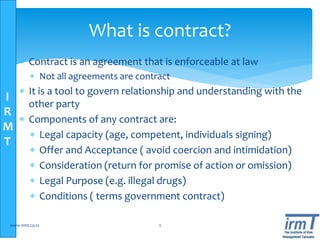
 Contract is an agreement that is enforceable at law
 Not all agreements are contract
 It is a tool to govern relationship and understanding with the
other party
 Components of any contract are:
 Legal capacity (age, competent, individuals signing)
 Offer and Acceptance ( avoid coercion and intimidation)
 Consideration (return for promise of action or omission)
 Legal Purpose (e.g. illegal drugs)
 Conditions ( terms government contract)
www.irmt.co.tz 2
What is contract?
I
R
M
T
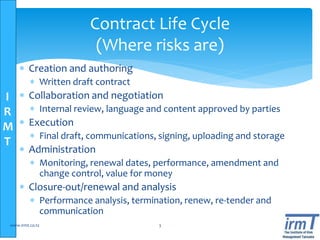
 Creation and authoring
 Written draft contract
 Collaboration and negotiation
 Internal review, language and content approved by parties
 Execution
 Final draft, communications, signing, uploading and storage
 Administration
 Monitoring, renewal dates, performance, amendment and
change control, value for money
 Closure-out/renewal and analysis
 Performance analysis, termination, renew, re-tender and
communication
www.irmt.co.tz 3
Contract Life Cycle
(Where risks are)
I
R
M
T
www.irmt.co.tz 4
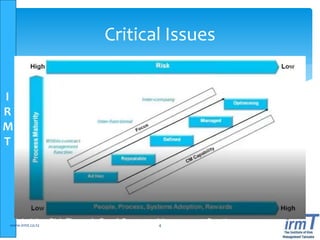
Critical Issues
I
R
M
T
 Contract life cycle management is the process
of systematically and efficiently managing
contract creation, execution and analysis for
maximizing operational and financial
performance and minimizing risks
 The foundation for effective and successful
post- award contract management rely upon
careful, comprehensive and thorough
implementation of the upstream or pre-award
activities
www.irmt.co.tz 5
Contract life cycle management
CLCM
I
R
M
T
 Pre-award stages, the emphasis should be
focus on why the contract is being
established and on whether the supplier will
be able to deliver in service and technical
term
 However, careful consideration must be
given to how the contract will work once it
has been awarded
www.irmt.co.tz 6
CLCM
I
R
M
T
 Preparing the business case and securing management approval
 Assembling contract team
 Developing contract strategy including SLA
 Risk Assessment
 Costs of identifying, controlling and assessing risks
 The need for insurance for risk not readily managed
 A need for sensitivity analysis on risks of unknown level
 Identifying compensating behavior practices
 Impact of time and other external factors and project actions on
risks an the need for assessment to be iterative
 Impact of product lifecycle including disposal and obsolescence
 Expertise for risk management
 Fair reimbursement mechanism, Insurance,
 Risk transfer to suppliers
www.irmt.co.tz 7
CLCM
Steps for Upstream or pre-award activities
I
R
M
T
 Developing contract exit strategy
 Developing a contract management plan
 Generally, during the pre-contract award stages, it is normal
for time to be devoted to the preparations of business case,
drafting specification and tender documents, selecting
potential suppliers
 However, time and effort must also be spent on determining
how the contract will work once it has been awarded.
 Drafting specifications requirements (operational
requirements)
 Establishing form of contract
www.irmt.co.tz 8
CLCM
Steps for Upstream or pre-award activities
I
R
M
T
 Establishing the pre-qualification, qualification and
tendering procedures
 Appraising suppliers
 Evaluating tenders and negotiations
 Contracting
 Changes within the contract
 Service delivery management (cost and value obtained,
customer satisfaction, added value, delivery capability,
benefits realized, relationship strength and
responsiveness)
www.irmt.co.tz 9
Steps for downstream or postward
I
R
M
T
 Risk Assessment
 Lack of capacity of supplier
 Reduction in demand leading to higher unit costs
 Increase in prices
 Program delay
 Changes of supplier’s business objectives
 Deteriation of supplier’s financial standing
 Demand changes
 Deteriation of quality
 Force majeure issues
 Market fluctuations for commodities
 Purchasing entity’s performance and effectiveness review
 Contract closure
www.irmt.co.tz 10
Steps for downstream or postward
I
R
M
T
www.irmt.co.tz 11
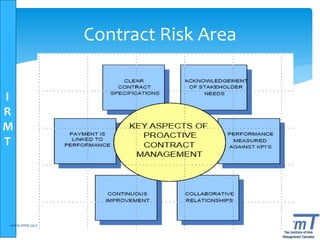
Contract Risk Area
I
R
M
T
 Realizing value for money
 Increased expectations of stakeholders and
customers
 Changing requirements over time
 No sight/input to contract specifications
 Lack of or poor quality specifications or KPIs
 Poor supplier performance and relationship
 Internal cross team communication
 Too many suppliers/contracts to manage
 Weak skills (commercial, risk, negotiations,
relationship, time management etc)
www.irmt.co.tz 12
Contract Management Pain points
I
R
M
T
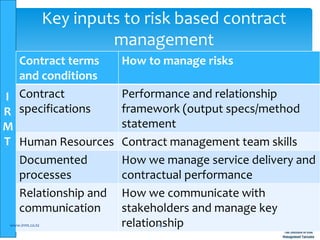
Contract terms
and conditions
How to manage risks
Contract
specifications
Performance and relationship
framework (output specs/method
statement
Human Resources Contract management team skills
Documented
processes
How we manage service delivery and
contractual performance
Relationship and
communication
How we communicate with
stakeholders and manage key
relationshipwww.irmt.co.tz 13
Key inputs to risk based contract
management
I
R
M
T
www.irmt.co.tz 14
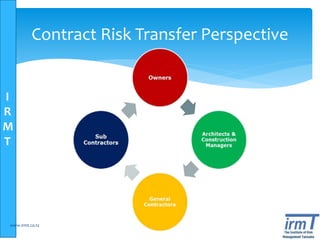
Contract Risk Transfer Perspective
I
R
M
T
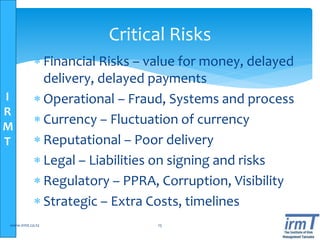
 Financial Risks – value for money, delayed
delivery, delayed payments
 Operational – Fraud, Systems and process
 Currency – Fluctuation of currency
 Reputational – Poor delivery
 Legal – Liabilities on signing and risks
 Regulatory – PPRA, Corruption, Visibility
 Strategic – Extra Costs, timelines
www.irmt.co.tz 15
Critical Risks
I
R
M
T
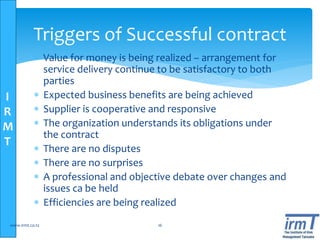
 Value for money is being realized – arrangement for
service delivery continue to be satisfactory to both
parties
 Expected business benefits are being achieved
 Supplier is cooperative and responsive
 The organization understands its obligations under
the contract
 There are no disputes
 There are no surprises
 A professional and objective debate over changes and
issues ca be held
 Efficiencies are being realized
www.irmt.co.tz 16
Triggers of Successful contract
I
R
M
T
Benefits of risk managed contracts
 Successful contract management covers the period
from the beginning of a procurement until after a
contract ends.
 The receipt of goods and services at the right price,
quality, and on time as well as proper compensation
of the contractor is the goal of a successful
procurement.
 Poor contract management often results in end-user
frustration, reluctance to use new vendors, agency
acceptance of poor quality service or goods,
increased costs due to lack of quality or overpayment
to contractors, lack of contractor accountability, and
generally poor contractor performance
I
R
M
T
Benefits of a risk managed contract
 A good contract is a means to an end.
 Simply enforcing the contract, however, does
not necessarily result in a successful
relationship with the contractor.
 Success should instead be measured by the
effectiveness of the program that the
contract supports.
I
R
M
T
Case study on contract Risks
www.irmt.co.tz 19
Contract Risk Case Study
I
R
M
T
 Organization must have a written policy in regards to contract
risk management
 The policy should address:
 Requirement that all contracts must be written
 Designated authority levels to negotiate and sign contracts
(generally, the greater the amount and potential exposure, the
greater the level of authority required)
 Requirement that all contracts be reviewed for risk management
considerations prior to acceptance
 Requirement that any indemnities granted by the institution are
approved pursuant to Public Finance Act
www.irmt.co.tz 20
Risk Management Policy in Contracts
I
R
M
T
 Organization must have a written policy in regards to
contract risk management
 The policy should address:
 Designated central storage areas, including who can access
stored contracts and procedures to obtain copies
 Requirement that current listings of all contracts be
maintained
 Schedule defining how frequently contracts should be
reviewed for both performance and risk management
issues
 Archieving procedures for expired contracts and how long
they will be retained
www.irmt.co.tz 21
Risk Management Policy in Contracts
I
R
M
T
 Organization must have a written policy in regards to
contract risk management
 The policy should address:
 Any one managing contracts must know if they have
authority to negotiate and sign the contract, and if they do
not who does
 Employees must understand the obligations under the
contract and the risks associated with those obligations.
 Employees responsible for contract negotiations should
receive instructions or training on how to effectively review
a contract
www.irmt.co.tz 22
Risk Management Policy in Contracts
I
R
M
T
 Organisation must develop a tool such as checklist for
quality review process
 All contracts must be reviewed periodically to
determine if changes are needed, or even if the
contract should be continued
 Consideration for changing needs, new regulation or
legislation and performance evaluation of the other
party
 Contract review should consider
 Parties to the contract are legal entities with correct
name
 Performance measures and reporting requirements are
set
www.irmt.co.tz 23
Contract Review
I
R
M
T
 Contract review should consider
 Any changes should be made in writing signed by all parties
 Insurance requirements should be specified
 Assignment of contract to another party is not allowed
without approval of the organization
 Subcontractors must be approved by organization, and are
bound by the same terms and conditions as the primary
contractor
 Confidentiality issues addressed and contractor is obliged to
follow PPA
 Contractor required to be trained and licensed to provide
services ( where appropriate)
 Termination provision should be specified and reasonable
 Dispute resolution processes are identifiedwww.irmt.co.tz 24
Contract Review
I
R
M
T
 Indemnification is an agreement between parties to
protect one of them from loss or damage that they may
incur as a result of fulfilment of the agreement
 Parties in contract should accept responsibility by a party
for the loss arising from own actions and those whom it is
responsible
 An agreement to indemnify is voluntary and may create
obligations beyond those imposed by negligence
 Organization should consider the necessity of
indemnifications and hold harmless clauses in any
contract, agreement, license or permit to protect the
institutions from claim arising out of the actions of other
party.
www.irmt.co.tz 25
Indemnification
I
R
M
T
 The intent of indemnification is that the institutions be
returned to the financial position It was in before the loss
occurred
 Organizations are frequently asked to provide an indemnity in
contract. Before granting this request that institutions must
carefully review that contract terms to ensure indemnity
provided is only for liability which arises from the contract
terms to ensure the indemnity provided is only form liability
 Indemnity should be allocated to the party which is able to
manage the risk
www.irmt.co.tz 26
Indemnification
I
R
M
T
 Contractors should carry sufficiency
insurance cover
 This provides assurance that the contractor
has the financial capacity to indemnify and
hold the Institution harmless
 There are different types of insurance cover
which a risk management team can advice
on
www.irmt.co.tz 27
Insurance
I
R
M
T
www.irmt.co.tz 28
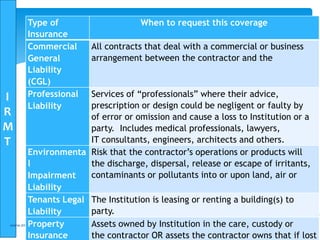
Type of
Insurance
When to request this coverage
Commercial
General
Liability
(CGL)
All contracts that deal with a commercial or business
arrangement between the contractor and the
Professional
Liability
Services of “professionals” where their advice,
prescription or design could be negligent or faulty by
of error or omission and cause a loss to Institution or a
party. Includes medical professionals, lawyers,
IT consultants, engineers, architects and others.
Environmenta
l
Impairment
Liability
Risk that the contractor’s operations or products will
the discharge, dispersal, release or escape of irritants,
contaminants or pollutants into or upon land, air or
Tenants Legal
Liability
The Institution is leasing or renting a building(s) to
party.
Property
Insurance
Assets owned by Institution in the care, custody or
the contractor OR assets the contractor owns that if lost
I
R
M
T
 It is not a waiver but it limits the degree to which one
party can be held responsible by capping, or limiting
the amount of damages the Institution can recover
from the provider for the loss arising out of the
agreement.
 It is normally limit the liability to the amount of fees
paid or payable under the contract. In reality, the
amount of fees paid or payable has no bearing on the
degree of risk in the contract. It is never acceptable
to limit liability for death, bodily injury, breach of
security or confidentiality or infringement of
intellectual property.
www.irmt.co.tz 29
Limitations of Liability
I
R
M
T Contract Risk Management Checklist
www.irmt.co.tz 30
Contract Risk Management checklist
I
R
M
T
OUTLINE OF CONTRACT RISK
MANAGEMENT ISSUES
 Developing Specifications - Specify The
Need
 What Are Contract Risks To Agency –
Protect The Agency
 What Is Contract Type
 Special Terms And Conditions Of
Resulting Contract – Eliminate Risks
I
R
M
T
DEVELOPING SPECIFICATIONS -
SPECIFY THE NEED
 Develop Bid or RFP Specifications (Scope of
Work) –
 The element of a contract that is most likely
to create contract administration problems
is the Scope of Work.
 The Contractor’s ability to interpret the
Scope of Work determines contract
performance.
I
R
M
T
DEVELOPING SPECIFICATIONS -
SPECIFY THE NEED cont…
 Design Specifications:
 Describes specifics of a good such as dimensions,
physical requirements, materials, etc.
 This type of specification gives an agency control
because it determines exactly what the
contractor must provide.
 However, it also places an additional burden on
the agency to ensure that the specifications are
exactly as needed and to inspect or test the item
to determine compliance.
I
R
M
T
DEVELOPING SPECIFICATIONS -
SPECIFY THE NEED cont…
 Performance Specifications:
 This type of specifications is oriented to results and
function.
 The responsibility for method or process becomes
the responsibility of the contractor.
 However, acceptance of goods or services
procured through performance specifications is the
responsibility of the agency which greatly impacts
contract administration.
I
R
M
T
WHAT ARE CONTRACT RISKS TO AGENCY –
Protect the agency
 Proposal Risk –
 How well is the good/service described? Do the terms and
conditions adequately protect the agency? Make sure that
ambiguous language is avoided. Integrate language
regarding the method for evaluating contract and contractor
performance.
 Surety/Liability Risk –
 Requirements of contractor (licensing, certification, etc.),
bonds, insurance, data privacy, warranties, etc.
 Schedule Risk –
 Is timely delivery ensured?
I
R
M
T
WHAT ARE CONTRACT RISKS TO AGENCY –
Protect the agency cont…
 Contractual Risk –
 Are procedures for dispute, breach and change
order /modification procedures clearly outlined?
 Performance Risk –
 Is the definition of agency acceptance clearly
defined?
 Price Risk –
 Do payment terms fit the contract and minimize
risk? (progress or milestone payments as
applicable, etc.)
I
R
M
T
WHAT IS CONTRACT TYPE
 Supplies/Goods
 Capital Outlay
 Professional Services
 Non-Professional
Services
 Software
 Lease
 Construction
 One-time goods
purchase
Dependent upon the type of contract, different team
members, different processes
I
R
M
T
SPECIAL TERMS AND CONDITIONS OF RESULTING CONTRACT –
Eliminate risks
 What are both parties’ responsibilities?
 Details of inspection/rejection – Who will
inspect/reject? (Contract Administration Team
member)
 Change order procedure – Must always involve
purchasing if a contract modification is required. (I.e,
quantity increase would not require a contract
modification other than an eVA purchase order change
order. Changes to the scope of the contract would
require a contract modification; i.e., add a building to a
janitorial contract.)
 Key Personnel – Who will be involved? Who will
evaluate proposals? Who will lead? Define roles
I
R
M
T
SPECIAL TERMS AND CONDITIONS OF RESULTING CONTRACT –
Eliminate risks cont…
 Breach/Termination procedure – Public
Procurement Act
 Dispute Resolution
 Warranties - Manufacturer or Commercial
 Acceptance – What constitutes acceptance
 Payment – Does vendor accept Small
Purchase cash? Are payments TZS. 50k or
less?
I
R
M
T
www.irmt.co.tz 40
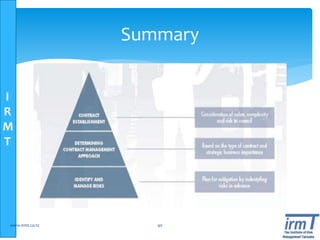
Summary
I
R
M
T
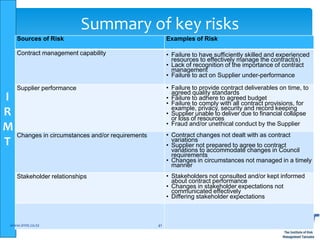
Sources of Risk Examples of Risk
Contract management capability • Failure to have sufficiently skilled and experienced
resources to effectively manage the contract(s)
• Lack of recognition of the importance of contract
management
• Failure to act on Supplier under-performance
Supplier performance • Failure to provide contract deliverables on time, to
agreed quality standards
• Failure to adhere to agreed budget
• Failure to comply with all contract provisions, for
example, privacy, security and record keeping
• Supplier unable to deliver due to financial collapse
or loss of resources
• Fraud and/or unethical conduct by the Supplier
Changes in circumstances and/or requirements • Contract changes not dealt with as contract
variations
• Supplier not prepared to agree to contract
variations to accommodate changes in Council
requirements
• Changes in circumstances not managed in a timely
manner
Stakeholder relationships • Stakeholders not consulted and/or kept informed
about contract performance
• Changes in stakeholder expectations not
communicated effectively
• Differing stakeholder expectations
www.irmt.co.tz 41
Summary of key risks
I
R
M
T
Final case study on contract Risk Management
www.irmt.co.tz 42
Final Case Study
I
R
M
T
 CIPS Contract Management Guide
 Risk Management in Purchasing & Supply
Management - Positions on Practice, CIPS
 Contract Management. A range of practical guides
and toolkits – Office of Government Commerce
 Legal and Procurement Processes - Study Guide, Eoin
Lonegan & Bernadette King (Revised edition 2003),
CIPS
 Law of Contract, Paul Richards (Fourth Edition 1999),
Pearson Education
 YouTube Video Resources
www.irmt.co.tz 43
References

Contracts risk management notes bagamoyo 2.12.2017 final v1

  • 1.
    I R M T www.irmt.co.tz 1 18 StellaMaris,Bagamoyo Compiled by: Sako Mayrick INSTITUTE OF RISK MANAGEMENT TANZANIA (IRMT) ADVANCED RISK MANAGEMENT TRAINING Contract Risk Management Pack
  • 2.
    I R M T  Contract isan agreement that is enforceable at law  Not all agreements are contract  It is a tool to govern relationship and understanding with the other party  Components of any contract are:  Legal capacity (age, competent, individuals signing)  Offer and Acceptance ( avoid coercion and intimidation)  Consideration (return for promise of action or omission)  Legal Purpose (e.g. illegal drugs)  Conditions ( terms government contract) www.irmt.co.tz 2 What is contract?
  • 3.
    I R M T  Creation andauthoring  Written draft contract  Collaboration and negotiation  Internal review, language and content approved by parties  Execution  Final draft, communications, signing, uploading and storage  Administration  Monitoring, renewal dates, performance, amendment and change control, value for money  Closure-out/renewal and analysis  Performance analysis, termination, renew, re-tender and communication www.irmt.co.tz 3 Contract Life Cycle (Where risks are)
  • 4.
  • 5.
    I R M T  Contract lifecycle management is the process of systematically and efficiently managing contract creation, execution and analysis for maximizing operational and financial performance and minimizing risks  The foundation for effective and successful post- award contract management rely upon careful, comprehensive and thorough implementation of the upstream or pre-award activities www.irmt.co.tz 5 Contract life cycle management CLCM
  • 6.
    I R M T  Pre-award stages,the emphasis should be focus on why the contract is being established and on whether the supplier will be able to deliver in service and technical term  However, careful consideration must be given to how the contract will work once it has been awarded www.irmt.co.tz 6 CLCM
  • 7.
    I R M T  Preparing thebusiness case and securing management approval  Assembling contract team  Developing contract strategy including SLA  Risk Assessment  Costs of identifying, controlling and assessing risks  The need for insurance for risk not readily managed  A need for sensitivity analysis on risks of unknown level  Identifying compensating behavior practices  Impact of time and other external factors and project actions on risks an the need for assessment to be iterative  Impact of product lifecycle including disposal and obsolescence  Expertise for risk management  Fair reimbursement mechanism, Insurance,  Risk transfer to suppliers www.irmt.co.tz 7 CLCM Steps for Upstream or pre-award activities
  • 8.
    I R M T  Developing contractexit strategy  Developing a contract management plan  Generally, during the pre-contract award stages, it is normal for time to be devoted to the preparations of business case, drafting specification and tender documents, selecting potential suppliers  However, time and effort must also be spent on determining how the contract will work once it has been awarded.  Drafting specifications requirements (operational requirements)  Establishing form of contract www.irmt.co.tz 8 CLCM Steps for Upstream or pre-award activities
  • 9.
    I R M T  Establishing thepre-qualification, qualification and tendering procedures  Appraising suppliers  Evaluating tenders and negotiations  Contracting  Changes within the contract  Service delivery management (cost and value obtained, customer satisfaction, added value, delivery capability, benefits realized, relationship strength and responsiveness) www.irmt.co.tz 9 Steps for downstream or postward
  • 10.
    I R M T  Risk Assessment Lack of capacity of supplier  Reduction in demand leading to higher unit costs  Increase in prices  Program delay  Changes of supplier’s business objectives  Deteriation of supplier’s financial standing  Demand changes  Deteriation of quality  Force majeure issues  Market fluctuations for commodities  Purchasing entity’s performance and effectiveness review  Contract closure www.irmt.co.tz 10 Steps for downstream or postward
  • 11.
  • 12.
    I R M T  Realizing valuefor money  Increased expectations of stakeholders and customers  Changing requirements over time  No sight/input to contract specifications  Lack of or poor quality specifications or KPIs  Poor supplier performance and relationship  Internal cross team communication  Too many suppliers/contracts to manage  Weak skills (commercial, risk, negotiations, relationship, time management etc) www.irmt.co.tz 12 Contract Management Pain points
  • 13.
    I R M T Contract terms and conditions Howto manage risks Contract specifications Performance and relationship framework (output specs/method statement Human Resources Contract management team skills Documented processes How we manage service delivery and contractual performance Relationship and communication How we communicate with stakeholders and manage key relationshipwww.irmt.co.tz 13 Key inputs to risk based contract management
  • 14.
  • 15.
    I R M T  Financial Risks– value for money, delayed delivery, delayed payments  Operational – Fraud, Systems and process  Currency – Fluctuation of currency  Reputational – Poor delivery  Legal – Liabilities on signing and risks  Regulatory – PPRA, Corruption, Visibility  Strategic – Extra Costs, timelines www.irmt.co.tz 15 Critical Risks
  • 16.
    I R M T  Value formoney is being realized – arrangement for service delivery continue to be satisfactory to both parties  Expected business benefits are being achieved  Supplier is cooperative and responsive  The organization understands its obligations under the contract  There are no disputes  There are no surprises  A professional and objective debate over changes and issues ca be held  Efficiencies are being realized www.irmt.co.tz 16 Triggers of Successful contract
  • 17.
    I R M T Benefits of riskmanaged contracts  Successful contract management covers the period from the beginning of a procurement until after a contract ends.  The receipt of goods and services at the right price, quality, and on time as well as proper compensation of the contractor is the goal of a successful procurement.  Poor contract management often results in end-user frustration, reluctance to use new vendors, agency acceptance of poor quality service or goods, increased costs due to lack of quality or overpayment to contractors, lack of contractor accountability, and generally poor contractor performance
  • 18.
    I R M T Benefits of arisk managed contract  A good contract is a means to an end.  Simply enforcing the contract, however, does not necessarily result in a successful relationship with the contractor.  Success should instead be measured by the effectiveness of the program that the contract supports.
  • 19.
    I R M T Case study oncontract Risks www.irmt.co.tz 19 Contract Risk Case Study
  • 20.
    I R M T  Organization musthave a written policy in regards to contract risk management  The policy should address:  Requirement that all contracts must be written  Designated authority levels to negotiate and sign contracts (generally, the greater the amount and potential exposure, the greater the level of authority required)  Requirement that all contracts be reviewed for risk management considerations prior to acceptance  Requirement that any indemnities granted by the institution are approved pursuant to Public Finance Act www.irmt.co.tz 20 Risk Management Policy in Contracts
  • 21.
    I R M T  Organization musthave a written policy in regards to contract risk management  The policy should address:  Designated central storage areas, including who can access stored contracts and procedures to obtain copies  Requirement that current listings of all contracts be maintained  Schedule defining how frequently contracts should be reviewed for both performance and risk management issues  Archieving procedures for expired contracts and how long they will be retained www.irmt.co.tz 21 Risk Management Policy in Contracts
  • 22.
    I R M T  Organization musthave a written policy in regards to contract risk management  The policy should address:  Any one managing contracts must know if they have authority to negotiate and sign the contract, and if they do not who does  Employees must understand the obligations under the contract and the risks associated with those obligations.  Employees responsible for contract negotiations should receive instructions or training on how to effectively review a contract www.irmt.co.tz 22 Risk Management Policy in Contracts
  • 23.
    I R M T  Organisation mustdevelop a tool such as checklist for quality review process  All contracts must be reviewed periodically to determine if changes are needed, or even if the contract should be continued  Consideration for changing needs, new regulation or legislation and performance evaluation of the other party  Contract review should consider  Parties to the contract are legal entities with correct name  Performance measures and reporting requirements are set www.irmt.co.tz 23 Contract Review
  • 24.
    I R M T  Contract reviewshould consider  Any changes should be made in writing signed by all parties  Insurance requirements should be specified  Assignment of contract to another party is not allowed without approval of the organization  Subcontractors must be approved by organization, and are bound by the same terms and conditions as the primary contractor  Confidentiality issues addressed and contractor is obliged to follow PPA  Contractor required to be trained and licensed to provide services ( where appropriate)  Termination provision should be specified and reasonable  Dispute resolution processes are identifiedwww.irmt.co.tz 24 Contract Review
  • 25.
    I R M T  Indemnification isan agreement between parties to protect one of them from loss or damage that they may incur as a result of fulfilment of the agreement  Parties in contract should accept responsibility by a party for the loss arising from own actions and those whom it is responsible  An agreement to indemnify is voluntary and may create obligations beyond those imposed by negligence  Organization should consider the necessity of indemnifications and hold harmless clauses in any contract, agreement, license or permit to protect the institutions from claim arising out of the actions of other party. www.irmt.co.tz 25 Indemnification
  • 26.
    I R M T  The intentof indemnification is that the institutions be returned to the financial position It was in before the loss occurred  Organizations are frequently asked to provide an indemnity in contract. Before granting this request that institutions must carefully review that contract terms to ensure indemnity provided is only for liability which arises from the contract terms to ensure the indemnity provided is only form liability  Indemnity should be allocated to the party which is able to manage the risk www.irmt.co.tz 26 Indemnification
  • 27.
    I R M T  Contractors shouldcarry sufficiency insurance cover  This provides assurance that the contractor has the financial capacity to indemnify and hold the Institution harmless  There are different types of insurance cover which a risk management team can advice on www.irmt.co.tz 27 Insurance
  • 28.
    I R M T www.irmt.co.tz 28 Type of Insurance Whento request this coverage Commercial General Liability (CGL) All contracts that deal with a commercial or business arrangement between the contractor and the Professional Liability Services of “professionals” where their advice, prescription or design could be negligent or faulty by of error or omission and cause a loss to Institution or a party. Includes medical professionals, lawyers, IT consultants, engineers, architects and others. Environmenta l Impairment Liability Risk that the contractor’s operations or products will the discharge, dispersal, release or escape of irritants, contaminants or pollutants into or upon land, air or Tenants Legal Liability The Institution is leasing or renting a building(s) to party. Property Insurance Assets owned by Institution in the care, custody or the contractor OR assets the contractor owns that if lost
  • 29.
    I R M T  It isnot a waiver but it limits the degree to which one party can be held responsible by capping, or limiting the amount of damages the Institution can recover from the provider for the loss arising out of the agreement.  It is normally limit the liability to the amount of fees paid or payable under the contract. In reality, the amount of fees paid or payable has no bearing on the degree of risk in the contract. It is never acceptable to limit liability for death, bodily injury, breach of security or confidentiality or infringement of intellectual property. www.irmt.co.tz 29 Limitations of Liability
  • 30.
    I R M T Contract RiskManagement Checklist www.irmt.co.tz 30 Contract Risk Management checklist
  • 31.
    I R M T OUTLINE OF CONTRACTRISK MANAGEMENT ISSUES  Developing Specifications - Specify The Need  What Are Contract Risks To Agency – Protect The Agency  What Is Contract Type  Special Terms And Conditions Of Resulting Contract – Eliminate Risks
  • 32.
    I R M T DEVELOPING SPECIFICATIONS - SPECIFYTHE NEED  Develop Bid or RFP Specifications (Scope of Work) –  The element of a contract that is most likely to create contract administration problems is the Scope of Work.  The Contractor’s ability to interpret the Scope of Work determines contract performance.
  • 33.
    I R M T DEVELOPING SPECIFICATIONS - SPECIFYTHE NEED cont…  Design Specifications:  Describes specifics of a good such as dimensions, physical requirements, materials, etc.  This type of specification gives an agency control because it determines exactly what the contractor must provide.  However, it also places an additional burden on the agency to ensure that the specifications are exactly as needed and to inspect or test the item to determine compliance.
  • 34.
    I R M T DEVELOPING SPECIFICATIONS - SPECIFYTHE NEED cont…  Performance Specifications:  This type of specifications is oriented to results and function.  The responsibility for method or process becomes the responsibility of the contractor.  However, acceptance of goods or services procured through performance specifications is the responsibility of the agency which greatly impacts contract administration.
  • 35.
    I R M T WHAT ARE CONTRACTRISKS TO AGENCY – Protect the agency  Proposal Risk –  How well is the good/service described? Do the terms and conditions adequately protect the agency? Make sure that ambiguous language is avoided. Integrate language regarding the method for evaluating contract and contractor performance.  Surety/Liability Risk –  Requirements of contractor (licensing, certification, etc.), bonds, insurance, data privacy, warranties, etc.  Schedule Risk –  Is timely delivery ensured?
  • 36.
    I R M T WHAT ARE CONTRACTRISKS TO AGENCY – Protect the agency cont…  Contractual Risk –  Are procedures for dispute, breach and change order /modification procedures clearly outlined?  Performance Risk –  Is the definition of agency acceptance clearly defined?  Price Risk –  Do payment terms fit the contract and minimize risk? (progress or milestone payments as applicable, etc.)
  • 37.
    I R M T WHAT IS CONTRACTTYPE  Supplies/Goods  Capital Outlay  Professional Services  Non-Professional Services  Software  Lease  Construction  One-time goods purchase Dependent upon the type of contract, different team members, different processes
  • 38.
    I R M T SPECIAL TERMS ANDCONDITIONS OF RESULTING CONTRACT – Eliminate risks  What are both parties’ responsibilities?  Details of inspection/rejection – Who will inspect/reject? (Contract Administration Team member)  Change order procedure – Must always involve purchasing if a contract modification is required. (I.e, quantity increase would not require a contract modification other than an eVA purchase order change order. Changes to the scope of the contract would require a contract modification; i.e., add a building to a janitorial contract.)  Key Personnel – Who will be involved? Who will evaluate proposals? Who will lead? Define roles
  • 39.
    I R M T SPECIAL TERMS ANDCONDITIONS OF RESULTING CONTRACT – Eliminate risks cont…  Breach/Termination procedure – Public Procurement Act  Dispute Resolution  Warranties - Manufacturer or Commercial  Acceptance – What constitutes acceptance  Payment – Does vendor accept Small Purchase cash? Are payments TZS. 50k or less?
  • 40.
  • 41.
    I R M T Sources of RiskExamples of Risk Contract management capability • Failure to have sufficiently skilled and experienced resources to effectively manage the contract(s) • Lack of recognition of the importance of contract management • Failure to act on Supplier under-performance Supplier performance • Failure to provide contract deliverables on time, to agreed quality standards • Failure to adhere to agreed budget • Failure to comply with all contract provisions, for example, privacy, security and record keeping • Supplier unable to deliver due to financial collapse or loss of resources • Fraud and/or unethical conduct by the Supplier Changes in circumstances and/or requirements • Contract changes not dealt with as contract variations • Supplier not prepared to agree to contract variations to accommodate changes in Council requirements • Changes in circumstances not managed in a timely manner Stakeholder relationships • Stakeholders not consulted and/or kept informed about contract performance • Changes in stakeholder expectations not communicated effectively • Differing stakeholder expectations www.irmt.co.tz 41 Summary of key risks
  • 42.
    I R M T Final case studyon contract Risk Management www.irmt.co.tz 42 Final Case Study
  • 43.
    I R M T  CIPS ContractManagement Guide  Risk Management in Purchasing & Supply Management - Positions on Practice, CIPS  Contract Management. A range of practical guides and toolkits – Office of Government Commerce  Legal and Procurement Processes - Study Guide, Eoin Lonegan & Bernadette King (Revised edition 2003), CIPS  Law of Contract, Paul Richards (Fourth Edition 1999), Pearson Education  YouTube Video Resources www.irmt.co.tz 43 References