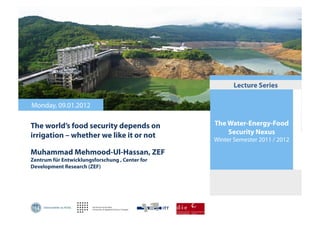
Lecture Series

Monday, 09.01.2012

The world’s food security depends on             The Water-Energy-Food
irrigation – whether we like it or not               Security Nexus
                                                 Winter Semester 2011 / 2012

Muhammad Mehmood-Ul-Hassan, ZEF
Zentrum für Entwicklungsforschung , Center for
Development Research (ZEF)	
  
 The World’s Food Security Depends
on Irrigation – Whether we like it or not 	


              Mehmood	
  Ul	
  Hassan	
  
        Center	
  for	
  Development	
  Research	
  
                   University	
  of	
  Bonn	
  
             mhassan@uni-­‐bonn.de	
  
                                                       January 09,
                                                             2012
Outline

•  What is food security?
•  The challenge
•  The state of global food security
•  Role of irrigation in enhancing food security
•  Water productivity
•  Approaches and challenges to increasing water
   productivity
•  Concluding Remarks
•  Key Resources
Food Security defined
•  FAO’s ideal food security is a “situation when all
   people, at all times, have physical, social, and economic
   access to sufficient, safe, and nutritious food that meets
   their dietary needs and food preferences...
   (Schmidhuber and Tubiello, 2007)
•  In its narrowest definition, food security means that
   enough (to meet energy and nutrient requirements) food
   is available, whether at the global, national, community,
   or household level (Pinstrup-Andersen, 2009).
•  Halving the global hunger by 2015 is an MDG
•  FAO uses proportion of undernourished to that of
   national population as an indicator to assess national
   food security levels.
Population Growth: Food
         Security Challenge


Source: UN (2004)
Expected regional growth
Year   World   Asia            Africa          Europe        Latin America   Northern America   Oceania

2010   6,909   4,167 (60.3%)   1,033 (15.0%)   733 (10.6%)   589 (8.5%)      352 (5.1%)         36 (0.5%)

2015   7,302   4,391 (60.1%)   1,153 (15.8%)   734 (10.1%)   618 (8.5%)      368 (5.0%)         38 (0.5%)

2020   7,675   4,596 (59.9%)   1,276 (16.6%)   733 (9.6%)    646 (8.4%)      383 (5.0%)         40 (0.5%)

2025   8,012   4,773 (59.6%)   1,400 (17.5%)   729 (9.1%)    670 (8.4%)      398 (5.0%)         43 (0.5%)

2030   8,309   4,917 (59.2%)   1,524 (18.3%)   723 (8.7%)    690 (8.3%)      410 (4.9%)         45 (0.5%)

2035   8,571   5,032 (58.7%)   1,647 (19.2%)   716 (8.4%)    706 (8.2%)      421 (4.9%)         46 (0.5%)

2040   8,801   5,125 (58.2%)   1,770 (20.1%)   708 (8.0%)    718 (8.2%)      431 (4.9%)         48 (0.5%)

2045   8,996   5,193 (57.7%)   1,887 (21.0%)   700 (7.8%)    726 (8.1%)      440 (4.9%)         50 (0.6%)


  Source: UN (2004)
State of Food Security (I)


Source: FAO (2009)
State of Food Security (II)
•    FAO estimated that the proportion of undernourished in developing world has
     decreased from 20 to 17% (1990-2003)

•    The number of undernourished practically has not decreased below 800 million
     during the past 40 years (over 1 billion remained hungry in 2009!!),

•    In the regions of Near East and North Africa (NENA) and Sub Sahara Africa
     (SSA) the number of undernourished people increased throughout.

•    Half of food insecure population lives in South Asia, NENA and Sub-Saharan
     Africa

•    Food insecurity has again witnessed an increasing trend in recent years

•    FAO estimates that by 2050, 27 countries will face undernourishment levels of
     above 5% in SA, SSA, and NENA
Food insecurity Hotspots


Source: Rockström, et al. 2007.
Irrigated agriculture & food security

•  The yields of most crops are 100-400% higher under irrigation
   compared to that of under rain-fed conditions (FAO, 2004)
•  The yields of rain-fed agriculture can be pushed up by providing
   (small amounts of) supplemental irrigation
•  The scale of global irrigated land is estimated at a total of 3,245,566
   km², what is nearly the size of India.[CIA, 2010)
•  About 68% of the area equipped for irrigation is located in Asia, 17%
   in America, 9% in Europe, 5% in Africa and 1% in Oceania.
•  The largest contiguous areas of high irrigation density are found in
   North India and Pakistan along the rivers Ganges and Indus, in the
   Hai He, Huang He and Yangtze basins in China, along the Nile river
   in Egypt and Sudan, in the Mississippi-Missouri river basin and in
   parts of California.
•  Smaller irrigation areas are spread across almost all populated parts
   of the world.
Irrigated Agric in Developing Countries

•  Currently, some 20% (around 205 million hectares) of agricultural land
   in developing countries is irrigated and it provides about 40% of crop
   production in these countries.

•  Asia accounts for more than 90% of world rice production and
   consumption (Van Tran, 2003)

•  Crop yield gaps in developing countries are mostly wide (Van Tran,
   2003)

•  The developing countries will become increasingly dependent on
   cereal imports. By 2030 they could be producing only 86 percent of
   their own needs, with net imports amounting to some 265 million
   tonnes annually - almost three times present levels (FAO, 2004).

•  Developing countries are expected to expand their irrigated area by 40
   million hectares by 2030 to ensure their food sovereignty
Asian agriculture is key to global food
               security
Food Sovereignty and WP
Recent trends in global food
price volatility have forced
countries to consider options for
being food sovereign
Climate change led events have
caused floods and droughts
Improving water productivity in
agriculture is the key way
forward for ensuring a food
secure world for all (IWMI,
2010)


   Source: FAOSTAT (http://faostat.fao.org/site/339/default.aspx)
Water Productivity
Water Productivity, a measure that captures efficiency of water
use in agriculture, is broader in scope than most agronomic
applications and must be considered on a watershed, basin,
irrigation district, or catchment scale (Howell, 2001).
Determinants of WP


•  The causes for the relatively low water
   productivity in agriculture are numerous
   and complex, including agronomic,
   biological, engineering, management,
   social, and economic facets (Hsiao, et. al,
   2007).
Three ways to enhance WP

•  Improving irrigation technologies
   (varieties, field level, system automation,
   rehabilitation)
•  Right Pricing
•  Management/ Governance Reforms
WP enhancing technologies


•  ach irrigation technology suitable for specific group of crops, soil and weather condition
 E
•  onsidering financial state of farmers in most developing countries, smart incentives for less capital
 C
intensive water saving techniques to start with


    Source:	
  Mar%us,	
  Bekchanov	
  and	
  Damis	
  (forthcoming)	
  
Challenges
•  Adoption constraints: Farmers with the most owned land, the
   highest number of acres and the most reliable water supplies are
   most likely to invest in more efficient irrigation systems during
   severe droughts (Schuck, et. al., 2005).
•  As water becomes scarcer (and more unreliable), farmers tend
   to rely more on groundwater and conjunctive use- Groundwater
   is much difficult to price and manage
•  Technical interventions have not always led to the expected,
   desirable outcomes, and the recommendations in many reports and
   papers are at best dubious, at worst simply wrong (Perry, 2007)
•  Appropriateness of technologies- need for transdisciplinarity
   approaches
Water Pricing
•  A useful means for achieving efficient allocation of irrigation water is
   to put the right price tag on it….. various pricing methods differ in the
   amount and type of information, and the administrative cost, needed
   in their implementation. The …water pricing methods are most
   pronounced through their effect on the cropping pattern—more
   so than through their effect on water demand for a given crop
   (Tsur and Dinar, 1997).

•  Pricing irrigation water can only happen when it directly relates to
   the level of consumption of water: A condition that can not be met in
   most irrigation systems in the developing world (Perry 2001)

•  Water markets work best in situations of water scarcity where
   agriculture and water rights are well developed (Jury and Vaux
   2005)

•  The price that farmers pay for water in many world areas is much
   less than the value of that water, but the application of right pricing
   might be impossible in poor countries (Hussain et al. 2007).
Irrigation Reforms
                          The Pentagon Model


Source: Ul Hassan, 2011
Intentions, Instruments and Impacts of irrigation
                              Reforms in Asia

Country/ Region Leading                   Key Intentions         Instruments            Implementation            Impact
                Institutions
Central Asia     State actors, financing Diverse, not made       Legal enactments and   None to weak; left to     Negligible
                 banks, rural elite      clear, state dictated   regulations only;      donor projects or state
                 involved                                        contracts with self-   administration
                                                                 declared WUAs
India            State, and financing     Clear                  Strong legal           Mixed, half hearted       Medium
                 banks, farmers                                  framework,             (irrigation agency lacked
                 involved later                                  rehabilitation         enthusiasm)
                 Conflict with old                               subsidies, one sided
                 institutions                                    contracts
                                                                 other instruments
                                                                 ignored
                 State, financing        Unclear, only by        Strong legal           Mixed, half hearted       Weak to medium
Pakistan         Banks, opposition       implication             framework, but
                 from irrigation                                 contradictory, one
                 agency and rural elite,                         sided agreements,
                 landless ignored                                arrangements for
                                                                 social mobilization
                 State, Financing         Clear                  Legal Framework,       Mixed, half hearted       Medium
Sri Lanka        Banks, Farmers,                                 social mobilization,
                 NGOs                                            rehabilitation
                                                                 subsidies
                 State, Financing         Clear                  Social Mobilization,   Enthusiastic agency      High
Turkey           Banks, Irrigation                               Joint Management,      served as the reform
                 Agency, Local                                   Legal Framework        champion, competition
                 Leadership                                      (later), mutual        amongst regions
                                                                 accountability         triggered quick turnover
                                                                                        of schemes
Concluding Remarks (I)
World can produce more food and can ensure that it is used more
efficiently and equitably (Godfray, et. al., 2010)
South Asia, NENA and SSA needs special attention to enhance food
security
•  here is a critical link between Food security and irrigated
 T
agriculture, and more so in case of developing countries
•  nhancing water productivity in irrigated agriculture in Asia, and
 E
supplemental irrigation in SSA and NENA can help reduce food
insecurity
Improving Irrigated Agriculture
•    To reduce conveyance losses, huge infrastructure projects have been implemented, but these
     tend to ignore the “soft” side of the equation

•    It is not that water users are not interested in enhancing WP, they do it when it makes sense
     under their conditions. We need to understand their rationality-> need for appropriate
     innovations that fit their reality

•    Water pricing remains and will remain a political issue and therefore can not be used as an
     effective tool to enhance WP under current circumstances in many countries-> Role for
     experimental economics to design, test and learn from smart incentives

•    Water reforms have generally been designed half heartedly in response to donor pressures,
     without much deep thinking behind and thus targeted lower tiers of irrigation systems more->
     Focus on reforming water bureaucracies as well

•     “…it is not the nominal implementation of the reform that matters, but rather it is the creation of
     new management institutions that offer water managers (and users) monetary incentives that lead
     to water savings” (Wang, et. al., 2005)-> Rethink reforms design principles….do not just
     transfer the management and cost burden to farmers, give them voice and authority in
     decision making

•    Address concerns related to transparency, accountability, and inclusiveness of reforms
Thank you very much!

•    Charles, H., et al. 2010. Food Security: The Challenge of Feeding 9 Billion People. Science Vol. 327 no. 5967 pp. 812-818. DOI: 10.1126/science.
     1185383
•    FAO (2009). Global Food Security: Challenges and long-term perspective. Agric. Dev Economics Division, FA. http://www.fao.org/economic/es-
     policybriefs/multimedia0/presentation-global-food-security/zh/
•    Fereres, E. and Soriano, MA (2007). Deficit irrigation for reducing agricultural water use. J. Exp. Bot. 58 (2): 147-159. doi: 10.1093/jxb/erl165
•    Hsiao, TC, Steduto, P and Fereres, E. (2007) A systematic and quantitative approach to improve water use efficiency in agriculture. Irrig Sci
     25:209–231. DOI 10.1007/s00271-007-0063-2
•    Howell, T.A. (2001). Enhancing water use efficiency in irrigated agriculture. Agronomy journal. Mar/Apr 2001. v. 93 (2), p. 281-289
•    Hussain I, Turral H, Molden DJ, Mobin-ud-Din A (2007). Measuring and enhancing the value of agricultural water in irrigated river basin. Irrig Sci
     25:209–231.
•    Jury WA, Vaux H Jr (2005) The role of science in solving the world’s emerging water problems. Proc Natl Acad Sci 102:15715–15720
•    Mehmood Ul Hassan, M. 2011. Analyzing governance reform in irrigation: Lessons from South, Central and West Asia. Irrig. and Drain. 60: 151–
     162 (2011)
•    Perry, C. J. 2001. Charging for Irrigation Water: the Issues and Options, with a Case Study from Iran. Research report 52. International Irrigation
     Management Institute, Colombo, Sri Lanka.
•    Perry, C. 2007. Efficient irrigation; inefficient communication; flawed recommendations. Irrig. and Drain 56 (4): 367- 378.
•    Pinstrup-Andersen, P. 2009. Food security: definition and measurement. Food Sec. (2009) 1:5–7
•    Schmidhuber, J., Francesco N. Tubiello. (2007). Global food security under climate change. Proc Natl Acad Sci U S A. 2007 December 11; 104(50):
     19703–19708
•    Rockström, et al. 2007. Proc Natl Acad Sci U S A. 2007 April 10; 104(15): 6253–6260.
•    Siebert, S.; J. Hoogeveen, P. Döll, J-M. Faurès, S. Feick, and K. Frenken (2006-11-10). "The Digital Global Map of Irrigation Areas – Development
     and Validation of Map Version 4" (PDF). Tropentag 2006 – Conference on International Agricultural Research for Development. Bonn, Germany.
•    Schuck, EC., Frasier, WM, Webb, RS., Ellingson, LJ, Umberger, WJ. 2005. Adoption of More Technically Efficient Irrigation Systems as a Drought
     Response. International Journal of Water Resources Development. 21(4): 651-662
•    Tsur, Y and Dinar A. The Relative Efficiency and Implementation Costs of Alternative Methods for Pricing Irrigation Water. World Bank Economic
     Review. 11(2): 243-262
•    United Nations (2004). Secretariat of Population Division of the Department of Economic and Social Affairs
•    Wang, J., Xu, Z, Hunag, J. 2005. Incentives in water management reform: assessing the effect on water use, production, and poverty in the Yellow
     River Basin. Environment and Development Economics 10: 769–799 C _ 2005 Cambridge University Press doi:10.1017/S1355770X05002524
•    Hong Yang,Peter Reichert, Karim C. Abbaspour, and Alexander J. B. Zehnder. A Water Resources Threshold and Its Implications for Food Security.
     Environ. Sci. Technol., 2003, 37 (14), pp 3048–3054 DOI: 10.1021/es0263689

FH Session 4

  • 1.
    Lecture Series Monday, 09.01.2012 Theworld’s food security depends on The Water-Energy-Food irrigation – whether we like it or not Security Nexus Winter Semester 2011 / 2012 Muhammad Mehmood-Ul-Hassan, ZEF Zentrum für Entwicklungsforschung , Center for Development Research (ZEF)  
  • 2.
     The World’s FoodSecurity Depends on Irrigation – Whether we like it or not     Mehmood  Ul  Hassan   Center  for  Development  Research   University  of  Bonn   mhassan@uni-­‐bonn.de   January 09, 2012
  • 3.
    Outline •  What isfood security? •  The challenge •  The state of global food security •  Role of irrigation in enhancing food security •  Water productivity •  Approaches and challenges to increasing water productivity •  Concluding Remarks •  Key Resources
  • 4.
    Food Security defined • FAO’s ideal food security is a “situation when all people, at all times, have physical, social, and economic access to sufficient, safe, and nutritious food that meets their dietary needs and food preferences... (Schmidhuber and Tubiello, 2007) •  In its narrowest definition, food security means that enough (to meet energy and nutrient requirements) food is available, whether at the global, national, community, or household level (Pinstrup-Andersen, 2009). •  Halving the global hunger by 2015 is an MDG •  FAO uses proportion of undernourished to that of national population as an indicator to assess national food security levels.
  • 5.
    Population Growth: Food Security Challenge Source: UN (2004)
  • 6.
    Expected regional growth Year World Asia Africa Europe Latin America Northern America Oceania 2010 6,909 4,167 (60.3%) 1,033 (15.0%) 733 (10.6%) 589 (8.5%) 352 (5.1%) 36 (0.5%) 2015 7,302 4,391 (60.1%) 1,153 (15.8%) 734 (10.1%) 618 (8.5%) 368 (5.0%) 38 (0.5%) 2020 7,675 4,596 (59.9%) 1,276 (16.6%) 733 (9.6%) 646 (8.4%) 383 (5.0%) 40 (0.5%) 2025 8,012 4,773 (59.6%) 1,400 (17.5%) 729 (9.1%) 670 (8.4%) 398 (5.0%) 43 (0.5%) 2030 8,309 4,917 (59.2%) 1,524 (18.3%) 723 (8.7%) 690 (8.3%) 410 (4.9%) 45 (0.5%) 2035 8,571 5,032 (58.7%) 1,647 (19.2%) 716 (8.4%) 706 (8.2%) 421 (4.9%) 46 (0.5%) 2040 8,801 5,125 (58.2%) 1,770 (20.1%) 708 (8.0%) 718 (8.2%) 431 (4.9%) 48 (0.5%) 2045 8,996 5,193 (57.7%) 1,887 (21.0%) 700 (7.8%) 726 (8.1%) 440 (4.9%) 50 (0.6%) Source: UN (2004)
  • 7.
    State of FoodSecurity (I) Source: FAO (2009)
  • 8.
    State of FoodSecurity (II) •  FAO estimated that the proportion of undernourished in developing world has decreased from 20 to 17% (1990-2003) •  The number of undernourished practically has not decreased below 800 million during the past 40 years (over 1 billion remained hungry in 2009!!), •  In the regions of Near East and North Africa (NENA) and Sub Sahara Africa (SSA) the number of undernourished people increased throughout. •  Half of food insecure population lives in South Asia, NENA and Sub-Saharan Africa •  Food insecurity has again witnessed an increasing trend in recent years •  FAO estimates that by 2050, 27 countries will face undernourishment levels of above 5% in SA, SSA, and NENA
  • 9.
    Food insecurity Hotspots Source:Rockström, et al. 2007.
  • 10.
    Irrigated agriculture &food security •  The yields of most crops are 100-400% higher under irrigation compared to that of under rain-fed conditions (FAO, 2004) •  The yields of rain-fed agriculture can be pushed up by providing (small amounts of) supplemental irrigation •  The scale of global irrigated land is estimated at a total of 3,245,566 km², what is nearly the size of India.[CIA, 2010) •  About 68% of the area equipped for irrigation is located in Asia, 17% in America, 9% in Europe, 5% in Africa and 1% in Oceania. •  The largest contiguous areas of high irrigation density are found in North India and Pakistan along the rivers Ganges and Indus, in the Hai He, Huang He and Yangtze basins in China, along the Nile river in Egypt and Sudan, in the Mississippi-Missouri river basin and in parts of California. •  Smaller irrigation areas are spread across almost all populated parts of the world.
  • 11.
    Irrigated Agric inDeveloping Countries •  Currently, some 20% (around 205 million hectares) of agricultural land in developing countries is irrigated and it provides about 40% of crop production in these countries. •  Asia accounts for more than 90% of world rice production and consumption (Van Tran, 2003) •  Crop yield gaps in developing countries are mostly wide (Van Tran, 2003) •  The developing countries will become increasingly dependent on cereal imports. By 2030 they could be producing only 86 percent of their own needs, with net imports amounting to some 265 million tonnes annually - almost three times present levels (FAO, 2004). •  Developing countries are expected to expand their irrigated area by 40 million hectares by 2030 to ensure their food sovereignty
  • 12.
    Asian agriculture iskey to global food security
  • 13.
    Food Sovereignty andWP Recent trends in global food price volatility have forced countries to consider options for being food sovereign Climate change led events have caused floods and droughts Improving water productivity in agriculture is the key way forward for ensuring a food secure world for all (IWMI, 2010) Source: FAOSTAT (http://faostat.fao.org/site/339/default.aspx)
  • 14.
    Water Productivity Water Productivity,a measure that captures efficiency of water use in agriculture, is broader in scope than most agronomic applications and must be considered on a watershed, basin, irrigation district, or catchment scale (Howell, 2001).
  • 15.
    Determinants of WP • The causes for the relatively low water productivity in agriculture are numerous and complex, including agronomic, biological, engineering, management, social, and economic facets (Hsiao, et. al, 2007).
  • 16.
    Three ways toenhance WP •  Improving irrigation technologies (varieties, field level, system automation, rehabilitation) •  Right Pricing •  Management/ Governance Reforms
  • 17.
    WP enhancing technologies • ach irrigation technology suitable for specific group of crops, soil and weather condition E •  onsidering financial state of farmers in most developing countries, smart incentives for less capital C intensive water saving techniques to start with Source:  Mar%us,  Bekchanov  and  Damis  (forthcoming)  
  • 18.
    Challenges •  Adoption constraints:Farmers with the most owned land, the highest number of acres and the most reliable water supplies are most likely to invest in more efficient irrigation systems during severe droughts (Schuck, et. al., 2005). •  As water becomes scarcer (and more unreliable), farmers tend to rely more on groundwater and conjunctive use- Groundwater is much difficult to price and manage •  Technical interventions have not always led to the expected, desirable outcomes, and the recommendations in many reports and papers are at best dubious, at worst simply wrong (Perry, 2007) •  Appropriateness of technologies- need for transdisciplinarity approaches
  • 19.
    Water Pricing •  Auseful means for achieving efficient allocation of irrigation water is to put the right price tag on it….. various pricing methods differ in the amount and type of information, and the administrative cost, needed in their implementation. The …water pricing methods are most pronounced through their effect on the cropping pattern—more so than through their effect on water demand for a given crop (Tsur and Dinar, 1997). •  Pricing irrigation water can only happen when it directly relates to the level of consumption of water: A condition that can not be met in most irrigation systems in the developing world (Perry 2001) •  Water markets work best in situations of water scarcity where agriculture and water rights are well developed (Jury and Vaux 2005) •  The price that farmers pay for water in many world areas is much less than the value of that water, but the application of right pricing might be impossible in poor countries (Hussain et al. 2007).
  • 20.
    Irrigation Reforms The Pentagon Model Source: Ul Hassan, 2011
  • 21.
    Intentions, Instruments andImpacts of irrigation Reforms in Asia Country/ Region Leading Key Intentions Instruments Implementation Impact Institutions Central Asia State actors, financing Diverse, not made Legal enactments and None to weak; left to Negligible banks, rural elite clear, state dictated regulations only; donor projects or state involved contracts with self- administration declared WUAs India State, and financing Clear Strong legal Mixed, half hearted Medium banks, farmers framework, (irrigation agency lacked involved later rehabilitation enthusiasm) Conflict with old subsidies, one sided institutions contracts other instruments ignored State, financing Unclear, only by Strong legal Mixed, half hearted Weak to medium Pakistan Banks, opposition implication framework, but from irrigation contradictory, one agency and rural elite, sided agreements, landless ignored arrangements for social mobilization State, Financing Clear Legal Framework, Mixed, half hearted Medium Sri Lanka Banks, Farmers, social mobilization, NGOs rehabilitation subsidies State, Financing Clear Social Mobilization, Enthusiastic agency High Turkey Banks, Irrigation Joint Management, served as the reform Agency, Local Legal Framework champion, competition Leadership (later), mutual amongst regions accountability triggered quick turnover of schemes
  • 22.
    Concluding Remarks (I) Worldcan produce more food and can ensure that it is used more efficiently and equitably (Godfray, et. al., 2010) South Asia, NENA and SSA needs special attention to enhance food security •  here is a critical link between Food security and irrigated T agriculture, and more so in case of developing countries •  nhancing water productivity in irrigated agriculture in Asia, and E supplemental irrigation in SSA and NENA can help reduce food insecurity
  • 23.
    Improving Irrigated Agriculture •  To reduce conveyance losses, huge infrastructure projects have been implemented, but these tend to ignore the “soft” side of the equation •  It is not that water users are not interested in enhancing WP, they do it when it makes sense under their conditions. We need to understand their rationality-> need for appropriate innovations that fit their reality •  Water pricing remains and will remain a political issue and therefore can not be used as an effective tool to enhance WP under current circumstances in many countries-> Role for experimental economics to design, test and learn from smart incentives •  Water reforms have generally been designed half heartedly in response to donor pressures, without much deep thinking behind and thus targeted lower tiers of irrigation systems more-> Focus on reforming water bureaucracies as well •  “…it is not the nominal implementation of the reform that matters, but rather it is the creation of new management institutions that offer water managers (and users) monetary incentives that lead to water savings” (Wang, et. al., 2005)-> Rethink reforms design principles….do not just transfer the management and cost burden to farmers, give them voice and authority in decision making •  Address concerns related to transparency, accountability, and inclusiveness of reforms
  • 24.
    Thank you verymuch! •  Charles, H., et al. 2010. Food Security: The Challenge of Feeding 9 Billion People. Science Vol. 327 no. 5967 pp. 812-818. DOI: 10.1126/science. 1185383 •  FAO (2009). Global Food Security: Challenges and long-term perspective. Agric. Dev Economics Division, FA. http://www.fao.org/economic/es- policybriefs/multimedia0/presentation-global-food-security/zh/ •  Fereres, E. and Soriano, MA (2007). Deficit irrigation for reducing agricultural water use. J. Exp. Bot. 58 (2): 147-159. doi: 10.1093/jxb/erl165 •  Hsiao, TC, Steduto, P and Fereres, E. (2007) A systematic and quantitative approach to improve water use efficiency in agriculture. Irrig Sci 25:209–231. DOI 10.1007/s00271-007-0063-2 •  Howell, T.A. (2001). Enhancing water use efficiency in irrigated agriculture. Agronomy journal. Mar/Apr 2001. v. 93 (2), p. 281-289 •  Hussain I, Turral H, Molden DJ, Mobin-ud-Din A (2007). Measuring and enhancing the value of agricultural water in irrigated river basin. Irrig Sci 25:209–231. •  Jury WA, Vaux H Jr (2005) The role of science in solving the world’s emerging water problems. Proc Natl Acad Sci 102:15715–15720 •  Mehmood Ul Hassan, M. 2011. Analyzing governance reform in irrigation: Lessons from South, Central and West Asia. Irrig. and Drain. 60: 151– 162 (2011) •  Perry, C. J. 2001. Charging for Irrigation Water: the Issues and Options, with a Case Study from Iran. Research report 52. International Irrigation Management Institute, Colombo, Sri Lanka. •  Perry, C. 2007. Efficient irrigation; inefficient communication; flawed recommendations. Irrig. and Drain 56 (4): 367- 378. •  Pinstrup-Andersen, P. 2009. Food security: definition and measurement. Food Sec. (2009) 1:5–7 •  Schmidhuber, J., Francesco N. Tubiello. (2007). Global food security under climate change. Proc Natl Acad Sci U S A. 2007 December 11; 104(50): 19703–19708 •  Rockström, et al. 2007. Proc Natl Acad Sci U S A. 2007 April 10; 104(15): 6253–6260. •  Siebert, S.; J. Hoogeveen, P. Döll, J-M. Faurès, S. Feick, and K. Frenken (2006-11-10). "The Digital Global Map of Irrigation Areas – Development and Validation of Map Version 4" (PDF). Tropentag 2006 – Conference on International Agricultural Research for Development. Bonn, Germany. •  Schuck, EC., Frasier, WM, Webb, RS., Ellingson, LJ, Umberger, WJ. 2005. Adoption of More Technically Efficient Irrigation Systems as a Drought Response. International Journal of Water Resources Development. 21(4): 651-662 •  Tsur, Y and Dinar A. The Relative Efficiency and Implementation Costs of Alternative Methods for Pricing Irrigation Water. World Bank Economic Review. 11(2): 243-262 •  United Nations (2004). Secretariat of Population Division of the Department of Economic and Social Affairs •  Wang, J., Xu, Z, Hunag, J. 2005. Incentives in water management reform: assessing the effect on water use, production, and poverty in the Yellow River Basin. Environment and Development Economics 10: 769–799 C _ 2005 Cambridge University Press doi:10.1017/S1355770X05002524 •  Hong Yang,Peter Reichert, Karim C. Abbaspour, and Alexander J. B. Zehnder. A Water Resources Threshold and Its Implications for Food Security. Environ. Sci. Technol., 2003, 37 (14), pp 3048–3054 DOI: 10.1021/es0263689