By Joshua Zake, Doctoral Thesis Defense, 23rd April 2015.
Email: joszake@gmail.com
Smallholder Banana Farming Systems and
Climate Variability: Understanding the
Impacts, Adaptation and Mitigation in Mpigi
District, Uganda.
Supervisors:
Sophie Zechmeister-Boltenstern, (Univ.Prof. Dr.phil.) Institute of Soil Research
Michael Hauser, (Ass. Prof. Dipl.-Ing. Dr.), Centre for Development Research
Outline of presentation
• Introduction
--Objectives
--Research hypothesis and questions
--Study site characteristics
• Materials and methods
• Key results and discussions
• Main conclusions
• Take home message
• Acknowledgements
• Key References
Introduction
• Uganda is one of the most unprepared and vulnerable countries
in the world in respect to impacts of climate variability disasters.
• Farmers' perceptions are rarely integrated in the implementation
of climate change disasters preparedness policy strategies.
• They try out new ideas and or make adjustments in existing
agronomic techniques and practices.
• These constitute innovations for adaptation and mitigation
depending on the farmer innovations definition.
Introduction
• However, in Uganda these innovations
are not known because they have not
been identified, evaluated and
documented.
• Climate variability will worsen soil
fertility depletion, which is already a
major constraint to agricultural
productivity.
• Agroforestry farming systems are more
resilient (through soil fertility
improvement, C storage) to climate
variability compared to monocultures.
Main objective of the study
Contributing to sustainable banana farming systems for
food security amidst climate change impacts among
smallholder farmers in Central Uganda.
Specific objectives:
(i) To examine farmers’ perceptions of the implementation of climate
change disaster preparedness policy strategies;
(ii) To evaluate smallholder farmers’ innovations for climate change
adaptation and mitigation under selected banana farming systems;
(iii) To evaluate the soil fertility status and C storage in smallholder
banana monocultures and banana-coffee agroforestry farming
systems under the current climate variability.
Research Hypothesis
• The inadequate implementation of climate variability disaster
preparedness strategies triggers early actions by farmers for
climate change adaption and mitigation.
• Likewise, the occurrence of climate variability disasters triggers
farmers to develop climate change adaption and mitigation
innovations.
• Smallholder banana-coffee agroforestry farming systems are more
resilient to climate change impacts.
• Specifically, banana-coffee agroforestry have higher levels of soil
fertility parameters and C pools compared to banana monoculture.
Research Questions
(i) Does inadequate implementation of climate variability disaster
preparedness strategies trigger early actions by farmers?
(ii) Do climate variability conditions trigger farmer innovations for
adaptation and mitigation?
(iii) What are the existing farmer innovations for climate change
adaptation and mitigation?
(iv) What is the soil fertility status of smallholder BM and BCA farming
systems in Central Uganda amidst the current climate variability?
(v) How much C is stored in the aboveground, belowground and the
soil under smallholder BM and BCA farming systems?
Study site characteristics
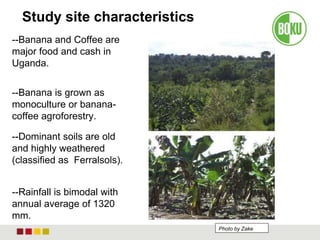
--Banana and Coffee are
major food and cash in
Uganda.
--Banana is grown as
monoculture or banana-
coffee agroforestry.
--Dominant soils are old
and highly weathered
(classified as Ferralsols).
--Rainfall is bimodal with
annual average of 1320
mm.
Photo by Zake
Site selection
The study was conducted in Nkozi
and Kituntu sub-counties.
Materials and methods
--Literature review.
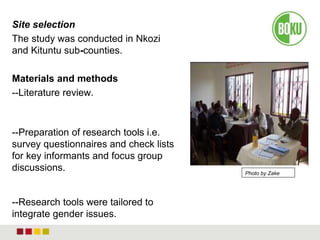
--Preparation of research tools i.e.
survey questionnaires and check lists
for key informants and focus group
discussions.
--Research tools were tailored to
integrate gender issues.
Photo by Zake
Materials and methods
Farmer selection (socio-economy)
• Random selection was done for respondents (133) involved in
household survey.
• Respondents (30) and key informants (30) involved focus group
discussions and expert interviews were purposively selected,
respectively.
Farm selection (carbon storage)
• The 20 farms evaluated for soil fertility and C storage were
identified through simple stratified sampling and selected
purposively.
• Thus, each farming system was a stratum and 10 farms were
evaluated under banana monoculture versus banana agroforestry.
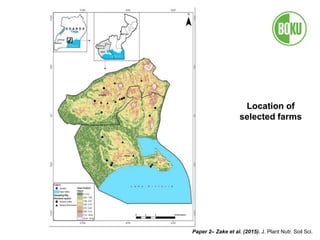
Location of
selected farms
Paper 2– Zake et al. (2015). J. Plant Nutr. Soil Sci.
Soil sampling and analyses
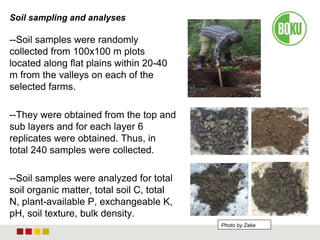
--Soil samples were randomly
collected from 100x100 m plots
located along flat plains within 20-40
m from the valleys on each of the
selected farms.
--They were obtained from the top and
sub layers and for each layer 6
replicates were obtained. Thus, in
total 240 samples were collected.
--Soil samples were analyzed for total
soil organic matter, total soil C, total
N, plant-available P, exchangeable K,
pH, soil texture, bulk density.
Photo by Zake
Soil sampling and analyses
• Depth of top and sub soil layers was determined using a tape
measure.
• Soil core samples were collected for each soil layer up a 20 cm
depth. Soil core diameter was measured and fresh weight of
each core sample was measured using a field scale.
• Soil C stocks were calculated based on total organic carbon and
bulk density using formulae according to Murphy et al. (2003).
Data collection
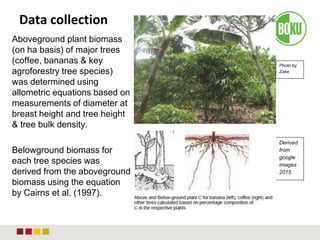
Aboveground plant biomass
(on ha basis) of major trees
(coffee, bananas & key
agroforestry tree species)
was determined using
allometric equations based on
measurements of diameter at
breast height and tree height
& tree bulk density.
Belowground biomass for
each tree species was
derived from the aboveground
biomass using the equation
by Cairns et al. (1997).
Photo by
Zake
Derived
from
google
images
2015
Data analyses
• Total C pools under each farming system were calculated as a
sum of aboveground, belowground and soil carbon in the soil
layers.
• Further analysis was done using a 2-factorial model to
determine analysis of variance at 5% using GenStat 13.
• Data generated using the survey questionnaires were analyzed
using SPSS 16 to generate percentages for variables and
cross-tabulation between selected variables using Chi-square
and 2-tailed T-test.
• Gender was integrated in the analyses to compare perceptions
of males and females.
Key results – excerts from 2 articles
and 1 manuscript
• Paper 1 - Zake, J. and Hauser, M. (2014). Farmers' perceptions of
implementation of climate variability disaster preparedness strategies
in Central Uganda. Journal of Environmental Hazards.
doi:10.1080/17477891.2014.910491
• Paper 2 - Zake, J., Pietsch, S. A., Friedel, J. K. and Zechmeister-
Boltenstern, S. (2015). Can agroforestry improve soil fertility and
carbon storage in smallholder banana farming systems? J. Plant
Nutr. Soil Sci. doi: 10.1002/jpln.201400281
• Paper 3 - Zake, J. (2014). Climate Variability triggers Innovations for
Adaptation and Mitigation: A case for Smallholder Banana Farmers in
Central Uganda. Unpublished manuscript submitted to the Journal
of Climate and Development for consideration and is under review.
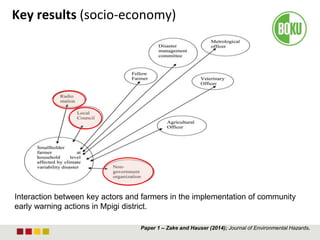
Interaction between key actors and farmers in the implementation of community
early warning actions in Mpigi district.
Paper 1 – Zake and Hauser (2014); Journal of Environmental Hazards.
Key results (socio-economy)
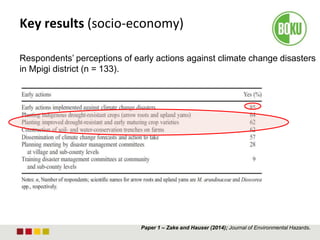
Respondents’ perceptions of early actions against climate change disasters
in Mpigi district (n = 133).
Paper 1 – Zake and Hauser (2014); Journal of Environmental Hazards.
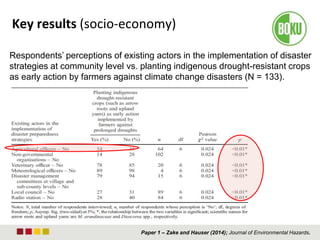
Respondents’ perceptions of existing actors in the implementation of disaster
strategies at community level vs. planting indigenous drought-resistant crops
as early action by farmers against climate change disasters (N = 133).
Key results (socio-economy)
Paper 1 – Zake and Hauser (2014); Journal of Environmental Hazards.
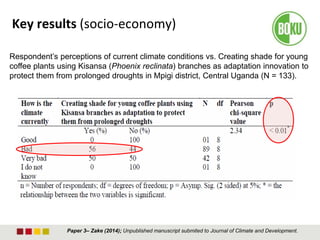
Respondent’s perceptions of current climate conditions vs. Creating shade for young
coffee plants using Kisansa (Phoenix reclinata) branches as adaptation innovation to
protect them from prolonged droughts in Mpigi district, Central Uganda (N = 133).
Key results (socio-economy)
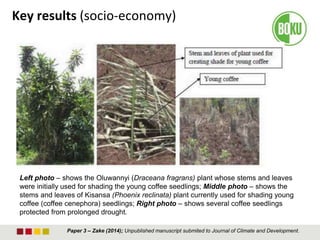
Paper 3– Zake (2014); Unpublished manuscript submited to Journal of Climate and Development.
Left photo – shows the Oluwannyi (Draceana fragrans) plant whose stems and leaves
were initially used for shading the young coffee seedlings; Middle photo – shows the
stems and leaves of Kisansa (Phoenix reclinata) plant currently used for shading young
coffee (coffee cenephora) seedlings; Right photo – shows several coffee seedlings
protected from prolonged drought.
Paper 3 – Zake (2014); Unpublished manuscript submited to Journal of Climate and Development.
Key results (socio-economy)
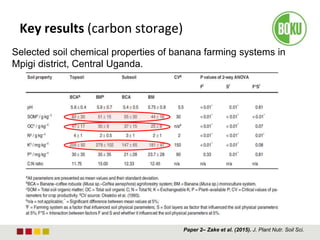
Key results (carbon storage)
Selected soil chemical properties of banana farming systems in
Mpigi district, Central Uganda.
Paper 2– Zake et al. (2015). J. Plant Nutr. Soil Sci.
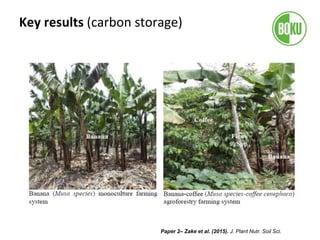
Key results (carbon storage)
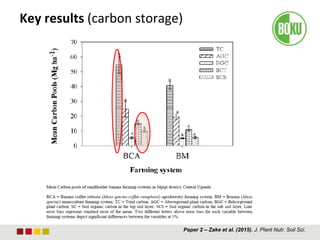
Paper 2 – Zake et al. (2015). J. Plant Nutr. Soil Sci.
Key results (carbon storage)
Conclusions
• Inadequate implementation of climate change disaster preparedness
strategies at community level triggers early actions by farmers.
• Climate variability triggers farmers to develop innovations for
adaptation and mitigation.
• Banana-coffee agroforestry improves soil fertility and C storage under
the prevailing climate conditions.
• Future research should focus on:
--Evaluation of the effectiveness of implementation of climate change
disasters management strategies by existing actors;
--Determination of C pools in deeper layers and greenhouse gas
emissions of smallholder banana farming systems.
Take home message
• Implementation of community climate change adaptation and mitigation
strategies should be strengthened.
• Farmer’s early actions for addressing climate change disasters should
be supported.
• Farmer innovators should be supported with inputs and financial
resources because their innovations potentially contribute to long term
adaptation and mitigation of climate change impacts.
• Promotion of Banana-coffee agroforestry would result in more C
storage per ha compared to banana monoculture.
• Agricultural and environmental policies should implement this shift.
Acknowledgements
Individuals
Supervisors:
-- Univ.Prof. Dr.phil. Sophie Zechmeister-
Boltenstern;
-- Ass. Prof. Dipl.-Ing. Dr. Michael Hauser.
Advisory Team:
--Priv. Doz. Dr. Stephan A. Pietsch;
-- Ao. Univ. Prof. Dipl.-Ing. Dr. Jürgen K. Friedel.
Others:
--Reviewers and Examiners;
--DI Elke Stinnig;
--Ass.Prof. Dipl.-Ing. Dr. Axel Mentler;
--Dr. Charles Walaga;
--Colleagues at the Institute of Soil Research and
CDR;
--Kituntu and Nkozi sub-counties farmers;
--Friends and Family.
Institutions
Thank you very much/Danke/Mwebale nnyo!!!

Smallholder Banana Farming Systems and Climate Variability: Understanding the Impacts, Adaptation and Mitigation in Mpigi District, Uganda.

  • 1.
    By Joshua Zake,Doctoral Thesis Defense, 23rd April 2015. Email: joszake@gmail.com Smallholder Banana Farming Systems and Climate Variability: Understanding the Impacts, Adaptation and Mitigation in Mpigi District, Uganda. Supervisors: Sophie Zechmeister-Boltenstern, (Univ.Prof. Dr.phil.) Institute of Soil Research Michael Hauser, (Ass. Prof. Dipl.-Ing. Dr.), Centre for Development Research
  • 2.
    Outline of presentation •Introduction --Objectives --Research hypothesis and questions --Study site characteristics • Materials and methods • Key results and discussions • Main conclusions • Take home message • Acknowledgements • Key References
  • 3.
    Introduction • Uganda isone of the most unprepared and vulnerable countries in the world in respect to impacts of climate variability disasters. • Farmers' perceptions are rarely integrated in the implementation of climate change disasters preparedness policy strategies. • They try out new ideas and or make adjustments in existing agronomic techniques and practices. • These constitute innovations for adaptation and mitigation depending on the farmer innovations definition.
  • 4.
    Introduction • However, inUganda these innovations are not known because they have not been identified, evaluated and documented. • Climate variability will worsen soil fertility depletion, which is already a major constraint to agricultural productivity. • Agroforestry farming systems are more resilient (through soil fertility improvement, C storage) to climate variability compared to monocultures.
  • 5.
    Main objective ofthe study Contributing to sustainable banana farming systems for food security amidst climate change impacts among smallholder farmers in Central Uganda. Specific objectives: (i) To examine farmers’ perceptions of the implementation of climate change disaster preparedness policy strategies; (ii) To evaluate smallholder farmers’ innovations for climate change adaptation and mitigation under selected banana farming systems; (iii) To evaluate the soil fertility status and C storage in smallholder banana monocultures and banana-coffee agroforestry farming systems under the current climate variability.
  • 6.
    Research Hypothesis • Theinadequate implementation of climate variability disaster preparedness strategies triggers early actions by farmers for climate change adaption and mitigation. • Likewise, the occurrence of climate variability disasters triggers farmers to develop climate change adaption and mitigation innovations. • Smallholder banana-coffee agroforestry farming systems are more resilient to climate change impacts. • Specifically, banana-coffee agroforestry have higher levels of soil fertility parameters and C pools compared to banana monoculture.
  • 7.
    Research Questions (i) Doesinadequate implementation of climate variability disaster preparedness strategies trigger early actions by farmers? (ii) Do climate variability conditions trigger farmer innovations for adaptation and mitigation? (iii) What are the existing farmer innovations for climate change adaptation and mitigation? (iv) What is the soil fertility status of smallholder BM and BCA farming systems in Central Uganda amidst the current climate variability? (v) How much C is stored in the aboveground, belowground and the soil under smallholder BM and BCA farming systems?
  • 8.
    Study site characteristics --Bananaand Coffee are major food and cash in Uganda. --Banana is grown as monoculture or banana- coffee agroforestry. --Dominant soils are old and highly weathered (classified as Ferralsols). --Rainfall is bimodal with annual average of 1320 mm. Photo by Zake
  • 9.
    Site selection The studywas conducted in Nkozi and Kituntu sub-counties. Materials and methods --Literature review. --Preparation of research tools i.e. survey questionnaires and check lists for key informants and focus group discussions. --Research tools were tailored to integrate gender issues. Photo by Zake
  • 10.
    Materials and methods Farmerselection (socio-economy) • Random selection was done for respondents (133) involved in household survey. • Respondents (30) and key informants (30) involved focus group discussions and expert interviews were purposively selected, respectively. Farm selection (carbon storage) • The 20 farms evaluated for soil fertility and C storage were identified through simple stratified sampling and selected purposively. • Thus, each farming system was a stratum and 10 farms were evaluated under banana monoculture versus banana agroforestry.
  • 11.
    Location of selected farms Paper2– Zake et al. (2015). J. Plant Nutr. Soil Sci.
  • 12.
    Soil sampling andanalyses --Soil samples were randomly collected from 100x100 m plots located along flat plains within 20-40 m from the valleys on each of the selected farms. --They were obtained from the top and sub layers and for each layer 6 replicates were obtained. Thus, in total 240 samples were collected. --Soil samples were analyzed for total soil organic matter, total soil C, total N, plant-available P, exchangeable K, pH, soil texture, bulk density. Photo by Zake
  • 13.
    Soil sampling andanalyses • Depth of top and sub soil layers was determined using a tape measure. • Soil core samples were collected for each soil layer up a 20 cm depth. Soil core diameter was measured and fresh weight of each core sample was measured using a field scale. • Soil C stocks were calculated based on total organic carbon and bulk density using formulae according to Murphy et al. (2003).
  • 14.
    Data collection Aboveground plantbiomass (on ha basis) of major trees (coffee, bananas & key agroforestry tree species) was determined using allometric equations based on measurements of diameter at breast height and tree height & tree bulk density. Belowground biomass for each tree species was derived from the aboveground biomass using the equation by Cairns et al. (1997). Photo by Zake Derived from google images 2015
  • 15.
    Data analyses • TotalC pools under each farming system were calculated as a sum of aboveground, belowground and soil carbon in the soil layers. • Further analysis was done using a 2-factorial model to determine analysis of variance at 5% using GenStat 13. • Data generated using the survey questionnaires were analyzed using SPSS 16 to generate percentages for variables and cross-tabulation between selected variables using Chi-square and 2-tailed T-test. • Gender was integrated in the analyses to compare perceptions of males and females.
  • 16.
    Key results –excerts from 2 articles and 1 manuscript • Paper 1 - Zake, J. and Hauser, M. (2014). Farmers' perceptions of implementation of climate variability disaster preparedness strategies in Central Uganda. Journal of Environmental Hazards. doi:10.1080/17477891.2014.910491 • Paper 2 - Zake, J., Pietsch, S. A., Friedel, J. K. and Zechmeister- Boltenstern, S. (2015). Can agroforestry improve soil fertility and carbon storage in smallholder banana farming systems? J. Plant Nutr. Soil Sci. doi: 10.1002/jpln.201400281 • Paper 3 - Zake, J. (2014). Climate Variability triggers Innovations for Adaptation and Mitigation: A case for Smallholder Banana Farmers in Central Uganda. Unpublished manuscript submitted to the Journal of Climate and Development for consideration and is under review.
  • 17.
    Interaction between keyactors and farmers in the implementation of community early warning actions in Mpigi district. Paper 1 – Zake and Hauser (2014); Journal of Environmental Hazards. Key results (socio-economy)
  • 18.
    Key results (socio-economy) Respondents’perceptions of early actions against climate change disasters in Mpigi district (n = 133). Paper 1 – Zake and Hauser (2014); Journal of Environmental Hazards.
  • 19.
    Respondents’ perceptions ofexisting actors in the implementation of disaster strategies at community level vs. planting indigenous drought-resistant crops as early action by farmers against climate change disasters (N = 133). Key results (socio-economy) Paper 1 – Zake and Hauser (2014); Journal of Environmental Hazards.
  • 20.
    Respondent’s perceptions ofcurrent climate conditions vs. Creating shade for young coffee plants using Kisansa (Phoenix reclinata) branches as adaptation innovation to protect them from prolonged droughts in Mpigi district, Central Uganda (N = 133). Key results (socio-economy) Paper 3– Zake (2014); Unpublished manuscript submited to Journal of Climate and Development.
  • 21.
    Left photo –shows the Oluwannyi (Draceana fragrans) plant whose stems and leaves were initially used for shading the young coffee seedlings; Middle photo – shows the stems and leaves of Kisansa (Phoenix reclinata) plant currently used for shading young coffee (coffee cenephora) seedlings; Right photo – shows several coffee seedlings protected from prolonged drought. Paper 3 – Zake (2014); Unpublished manuscript submited to Journal of Climate and Development. Key results (socio-economy)
  • 22.
    Key results (carbonstorage) Selected soil chemical properties of banana farming systems in Mpigi district, Central Uganda. Paper 2– Zake et al. (2015). J. Plant Nutr. Soil Sci.
  • 23.
    Paper 2– Zakeet al. (2015). J. Plant Nutr. Soil Sci. Key results (carbon storage)
  • 24.
    Paper 2 –Zake et al. (2015). J. Plant Nutr. Soil Sci. Key results (carbon storage)
  • 25.
    Conclusions • Inadequate implementationof climate change disaster preparedness strategies at community level triggers early actions by farmers. • Climate variability triggers farmers to develop innovations for adaptation and mitigation. • Banana-coffee agroforestry improves soil fertility and C storage under the prevailing climate conditions. • Future research should focus on: --Evaluation of the effectiveness of implementation of climate change disasters management strategies by existing actors; --Determination of C pools in deeper layers and greenhouse gas emissions of smallholder banana farming systems.
  • 26.
    Take home message •Implementation of community climate change adaptation and mitigation strategies should be strengthened. • Farmer’s early actions for addressing climate change disasters should be supported. • Farmer innovators should be supported with inputs and financial resources because their innovations potentially contribute to long term adaptation and mitigation of climate change impacts. • Promotion of Banana-coffee agroforestry would result in more C storage per ha compared to banana monoculture. • Agricultural and environmental policies should implement this shift.
  • 27.
    Acknowledgements Individuals Supervisors: -- Univ.Prof. Dr.phil.Sophie Zechmeister- Boltenstern; -- Ass. Prof. Dipl.-Ing. Dr. Michael Hauser. Advisory Team: --Priv. Doz. Dr. Stephan A. Pietsch; -- Ao. Univ. Prof. Dipl.-Ing. Dr. Jürgen K. Friedel. Others: --Reviewers and Examiners; --DI Elke Stinnig; --Ass.Prof. Dipl.-Ing. Dr. Axel Mentler; --Dr. Charles Walaga; --Colleagues at the Institute of Soil Research and CDR; --Kituntu and Nkozi sub-counties farmers; --Friends and Family. Institutions Thank you very much/Danke/Mwebale nnyo!!!