INTERNATIONAL FOOD
                POLICY RESEARCH INSTITUTE                                                                               UNIVERSITY OF HAMBURG
                sustainable solutions for ending hunger and poverty

                Supported by the CGIAR


                                                                                                                  IFPRI Research Brief        15–15
HOW CAN AFRICAN AGRICULTURE ADAPT TO CLIMATE CHANGE? INSIGHTS FROM ETHIOPIA AND SOUTH AFRICA

Economywide Impacts of Climate Change on Agriculture
in Sub-Saharan Africa
Alvaro Calzadilla , Tingju Zhu, Katrin Rehdanz, Richard S. J. Tol, and Claudia Ringler


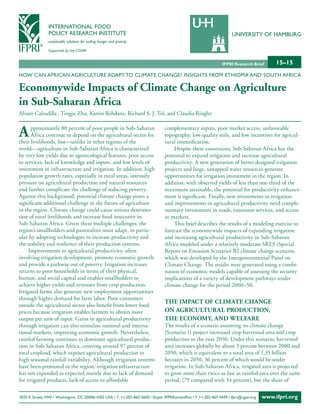
A     pproximately 80 percent of poor people in Sub-Saharan
      Africa continue to depend on the agricultural sector for
their livelihoods, but—unlike in other regions of the
                                                                                  complementary inputs, poor market access, unfavorable
                                                                                  topography, low-quality soils, and low incentives for agricul-
                                                                                  tural intensification.
world—agriculture in Sub-Saharan Africa is characterized                              Despite these constraints, Sub-Saharan Africa has the
by very low yields due to agroecological features, poor access                    potential to expand irrigation and increase agricultural
to services, lack of knowledge and inputs, and low levels of                      productivity. A new generation of better designed irrigation
investment in infrastructure and irrigation. In addition, high                    projects and large, untapped water resources generate
population growth rates, especially in rural areas, intensify                     opportunities for irrigation investment in the region. In
pressure on agricultural production and natural resources                         addition, with observed yields of less than one-third of the
and further complicate the challenge of reducing poverty.                         maximum attainable, the potential for productivity enhance-
Against this background, potential climate change poses a                         ment is significant. Finally, new investments in irrigation
significant additional challenge to the future of agriculture                     and improvements in agricultural productivity need comple-
in the region. Climate change could cause serious deteriora-                      mentary investments in roads, extension services, and access
tion of rural livelihoods and increase food insecurity in                         to markets.
Sub-Saharan Africa. Given these multiple challenges, the                              This brief describes the results of a modeling exercise to
region’s smallholders and pastoralists must adapt, in partic-                     forecast the economywide impacts of expanding irrigation
ular by adopting technologies to increase productivity and                        and increasing agricultural productivity in Sub-Saharan
the stability and resilience of their production systems.                         Africa modeled under a relatively moderate SRES (Special
     Improvements to agricultural productivity, often                             Report on Emission Scenario) B2 climate change scenario,
involving irrigation development, promote economic growth                         which was developed by the Intergovernmental Panel on
and provide a pathway out of poverty. Irrigation increases                        Climate Change. The results were generated using a combi-
returns to poor households in terms of their physical,                            nation of economic models capable of assessing the security
human, and social capital and enables smallholders to                             implications of a variety of development pathways under
achieve higher yields and revenues from crop production.                          climate change for the period 2000–50.
Irrigated farms also generate new employment opportunities
through higher demand for farm labor. Poor consumers
                                                                                  THE IMPACT OF CLIMATE CHANGE
outside the agricultural sector also benefit from lower food
prices because irrigation enables farmers to obtain more                          ON AGRICULTURAL PRODUCTION,
output per unit of input. Gains in agricultural productivity                      THE ECONOMY, AND WELFARE
through irrigation can also stimulate national and interna-                       The results of a scenario assuming no climate change
tional markets, improving economic growth. Nevertheless,                          (Scenario 1) project increased crop harvested area and crop
rainfed farming continues to dominate agricultural produc-                        production to the year 2050. Under this scenario, harvested
tion in Sub-Saharan Africa, covering around 97 percent of                         area increases globally by about 3 percent between 2000 and
total cropland, which exposes agricultural production to                          2050, which is equivalent to a total area of 1.35 billion
high seasonal rainfall variability. Although irrigation systems                   hectares in 2050, 36 percent of which would be under
have been promoted in the region, irrigation infrastructure                       irrigation. In Sub-Saharan Africa, irrigated area is projected
has not expanded as expected mainly due to lack of demand                         to grow more than twice as fast as rainfed area over the same
for irrigated products, lack of access to affordable                              period, (79 compared with 34 percent), but the share of

2033 K Street, NW • Washington, DC 20006-1002 USA • T. +1-202-862-5600 / Skype: IFPRIhomeoffice • F. +1-202-467-4439 • ifpri@cgiar.org   www.ifpri.org
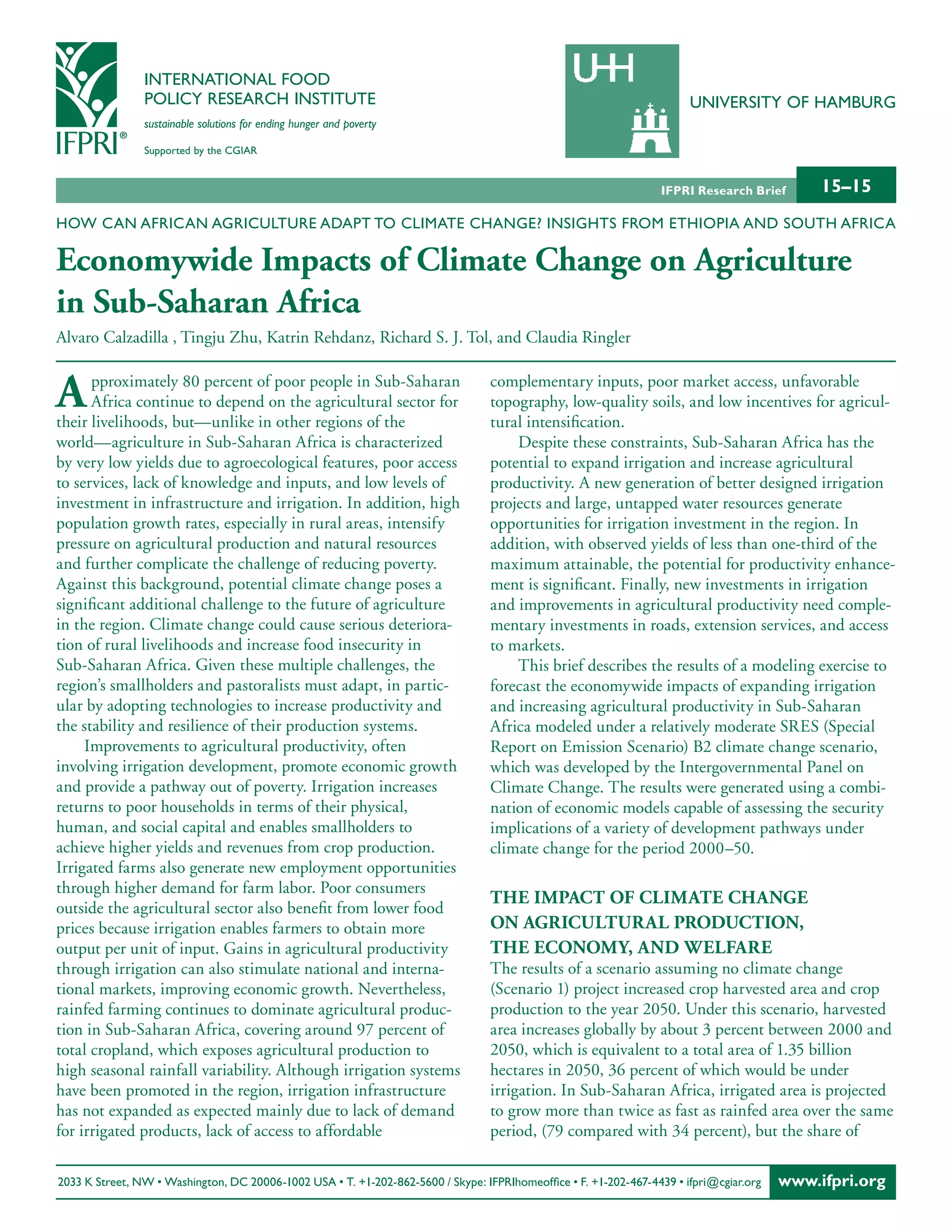
irrigated area is still only 4.5 percent in 2050 compared with         five years old increases by almost 2 million in the region
3.4 percent in 2000. Total agricultural production in                  under this scenario.
Sub-Saharan Africa is projected to increase by 158 percent                  In addition to the negative impacts described above,
between 2000 and 2050, whereas the share of irrigated                  under a moderate climate change scenario without appropriate
production is projected to increase from 9 to only 14 percent          adaptation, the prices of agricultural commodities are
over the same 50-year period.                                          projected to increase in both domestic and world markets.
     By comparison, a scenario of moderate climate change              Real commodity prices for all cereals are projected to rise by
(Scenario 2) indicates that the world’s crop harvested area            2050 due to increased land and water scarcity, as well as the
and food production would decrease by 0.3 and 2.7 percent,             impacts of climate change, biofuel development, increased
respectively, by 2050. Under this second scenario, both                population, and income- and growth-driven demand for food
irrigated area and irrigated production decrease, whereas              diversification. Meat prices are also expected to increase as a
rainfed production declines despite an increase in rainfed             result of increased demand and higher animal feed prices.
area. Hence, without proactive adaptation, climate change
has a significant negative impact on agriculture. Both rainfed
and irrigated harvested areas decrease in Sub-Saharan Africa           STRATEGIES FOR ADAPTATION
under climate change, whereas rainfed production increases             TO CLIMATE CHANGE
by 0.7 percent, and irrigated production drops by                      Adaptation by the agricultural sector can form a buffer
15.3 percent. This sharp decrease in irrigated productivity            against the negative impacts of climate change. Two
occurs because some irrigated crops, such as wheat and                 different adaptation scenarios were used to evaluate the
sugarcane, are more susceptible to heat stress and reduced             impact of adaptation on production and income. The first of
availability of water for irrigation. Under climate change,            these additional scenarios (Scenario 3) assumes expanded
only 4.4 percent of the total crop harvested area is expected          irrigated capacity, doubling the irrigated area in Sub-Saharan
to be under irrigation by 2050, whereas irrigated production           Africa, whereas the second of these adaptation scenarios
is expected to constitute 12.1 percent of total agricultural           (Scenario 4) considers productivity improvements in both
production in the region by 2050.                                      rainfed and irrigated agriculture without expanded irrigated
     Climate change also has negative implications for gross           area, increasing Sub-Saharan African yields by 25 percent
domestic product (GDP) and child malnutrition. At the                  through investments in agricultural research and develop-
global level, GDP is expected to decrease by US$87 billion             ment and enhanced farm management practices.
under a scenario of moderate climate change, which is                       Under Scenario 3, the expansion of irrigated area in the
equivalent to 0.09 percent of global GDP. For Sub-Saharan              region from a very small base helps farmers achieve higher
Africa, GDP losses due to climate change are estimated to be           yields per hectare. This is followed by an increase in total
US$3.3 billion, equivalent to 0.2 percent of regional GDP.             crop production and a small decrease in the price of some
Furthermore, the number of malnourished children under                 agricultural commodities. Under this scenario, the expansion

                      Table 1    The impact of climate change on agriculture in Sub-Saharan Africa

                                                                                   Scenario 1:             Scenario 2:
                                                                               no climate change,        moderate climate
       Indicator                                        2000 baseline                 2050                change, 2050

       Harvested area (thousand hectares)                   181,618                  246,363                   244,585

       Irrigated area (thousand hectares)                    6,243                    11,194                   10,801

       Rainfed area (thousand hectares)                     175,375                   235,169                  233,784

       Production (thousand metric tons)                    484,199                  1,250,491                1,231,158

       Irrigated production (thousand metric tons)           43,398                   175,561                  148,701

       Rainfed production (thousand metric tons)            440,800                  1,074,930                1,082,457

       Share of irrigated production (%)                       9                        14                       12

     SOURCE: IFPRI IMPACT model (2008).
     NOTE: Scenario 2 is based on the Special Report on Emission Scenarios B2 scenario, developed by the Intergovernmental Panel
     on Climate Change. Results from the Hadley Global Circulation Model were used.


                                                                   2
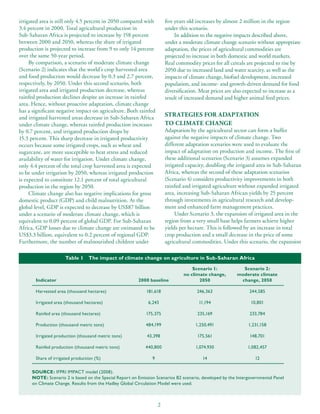
of irrigated area in Sub-Saharan Africa increases cereal                  sectors, but the domestic and world prices of nonagricultural
production in the region by 5 percent, and meat production                products increase under this scenario. An exception is food
by 1 percent. No change was observed for root and tuber                   products, for which prices decline because production is
production. Even though Sub-Saharan Africa is not a key                   promoted by higher supply and lower crop prices.
contributor to global food production, world food prices are                   Under Scenario 4, improvements in agricultural produc-
projected to decline under the expanded irrigation adapta-                tivity in both rainfed and irrigated agriculture enable farmers
tion scenario, which also leads to a small increase in GDP in             to obtain higher levels of output per unit of input and
Sub-Saharan Africa (0.007 percent, equivalent to                          therefore total crop production increases (although the
US$113 million). This slight increase, however, is insufficient           magnitude differs by crop type). Higher levels of agricultural
to counteract the regional GDP losses expected under                      productivity also result in a decline in production costs and
climate change without proactive adaptation. Results show                 consequently a decline in market prices. A 25 percent increase
that doubling irrigated area also reduces the number of                   in agricultural productivity leads to significant reductions in
malnourished children under the age of five years by a small              domestic and world market prices for most agricultural
amount (0.3 million children).                                            commodities compared with projections without proactive
     Adaptation also has an impact on the factors of produc-              adaptation (that is, Scenario 2). This adaptation scenario
tion, such as land, labor, and capital. Market prices for labor           (Scenario 4) promotes GDP growth by 1.5 percent
and capital increase as the economy expands. Changes in                   (US$26 billion), which more than offsets the initial reduction
total crop production have a mixed effect on nonagricultural              of 0.2 percent in GDP due to climate change as projected


                  Table 2     The impact of climate change and adaptation in Sub-Saharan Africa, 2050

                                                                                                                  Scenario 4:
                                                                                                Scenario 3:        moderate
                                                                                                 moderate            climate
                                                                               Scenario 2:        climate        change, 2050,
                                                                                moderate       change, 2050,       with a 25%
                                                          Scenario 1:            climate           with a           increase
                                                          no climate          change, 2050      doubling of       in irrigated
                                                           change,              (without         irrigated        and rainfed
         Indicator                                           2050             adaptation) a        areab          crop yieldsb

         Total production (thousand metric tons)           1,250,491              –1.5%             0.1%              18.0%

         Rainfed production (thousand metric tons)         1,074,930              0.7%              –0.6%             17.9%

         Irrigated production (thousand metric tons)        175,561              –15.3%             99.5%             23.4%

         Total area (thousand hectares)                     246,363               –0.7%             0.0%               0.0%

         Rainfed area (thousand hectares)                   235,169               –0.6%             –4.8%              0.0%

         Irrigated area (thousand hectares)                  11,194               –3.5%            100.0%              0.0%

         Change in welfare (US$ millions)                      --                 1,786              119              15,435

         Change in GDP

         US$ millions                                          --                 –3,333             113              25,720

         Percentage                                            --                 –0.2%             0.0%               1.5%

         Malnutrition (million children under age five)       30.2                 32.0              31.7              30.4


       SOURCE: IFPRI IMPACT and GTAP-W results (2008).
       NOTE: Scenarios 2, 3, and 4 are based on the Special Report on Emission Scenarios B2 scenario, developed by the Intergovern-
       mental Panel on Climate Change. Results from the Hadley Global Circulation Model were used.
       a Indicates the percentage change with respect to Scenario 1.
       b Indicates the percentage change with respect to Scenario 2.


                                                                      3
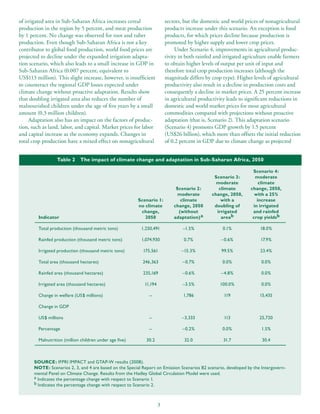
under Scenario 2. Increased rainfed and irrigated crop                                     irrigated area alone. The results show that improving crop
productivity also significantly reduces the number of malnour-                             yields in both rainfed and irrigated areas is a strategy that
ished children (by 1.6 million children), essentially canceling                            could almost completely offset the negative impact of climate
out the increases in malnutrition caused by climate change.                                change on productivity, GDP, prices, and child malnutrition.
     In addition, market prices for rainfed land, irrigated                                Substantial productivity gains are technically feasible in
land, and irrigation decline, while market prices for all other                            Sub-Saharan Africa because agricultural productivity is far
primary factors increase. The increase in the market price for                             below its potential.
unskilled labor is higher than for skilled labor under the                                      An increase in agricultural productivity widely exceeds
second adaptation scenario (Scenario 4). Total production in                               the GDP losses due to climate change, whereas increasing
nonagricultural sectors is also affected under Scenario 4.                                 irrigated area alone does not offset GDP losses due to climate
Reductions in total production are more pronounced for                                     change. While these results are promising in terms of the
energy-intensive industry, other industry and services, and                                potential to develop investment programs to counteract the
gas. Food products are positively affected, with production                                adverse impacts of climate change, the climate change
increasing by 1.4 percent. Domestic and world market prices                                scenario implemented here is conservative in light of the
increase for all nonagricultural sectors except for the food                               range of potential climate change scenarios that could
product industry.                                                                          ultimately eventuate.


IMPLICATIONS                                                                               FOR FURTHER READING
                                                                                           Calzadilla, A., T. Zhu, K. Redhanz, R. S. J. Tol, and C. Ringler,
Given the relatively low share of irrigated area in                                             Economywide Impacts of Climate Change in Sub-Saharan Africa,
Sub-Saharan Africa, an increase in agricultural productivity                                    IFPRI Discussion Paper No. 873 (Washington, DC: International
achieves much larger benefits for the region than doubling                                      Food Policy Research Institute, 2009).


Alvaro Calzadilla (alvaro.calzadilla@zmaw.de) is a PhD student at the Unit Sustainability and Global Change, Hamburg University, and the Centre for Marine and
Atmospheric Science, Hamburg, Germany. Tingju Zhu (t.zhu@cgiar.org) is a senior scientist in the Environment and Production Technology Division of the Interna-
tional Food Policy Research Institute (IFPRI), Washington, D.C. Katrin Rehdanz (katrin.rehdanz@ifw-kiel.de) is an assistant professor in the Department of Econom-
ics at Christian-Albrechts-University, Germany. Richard S. J. Tol (richard.tol@esri.ie) is a research professor at the Economic and Social Research Institute, Dublin,
Ireland. Claudia Ringler (c.ringler@cgiar.org) is a senior research fellow in IFPRI’s Environment and Production Technology Division.


     This series of IFPRI Research Briefs is based on research supported by the Federal Ministry for Economic Cooperation and Development, Germany, under the
     project “Food and Water Security under Global Change: Developing Adaptive Capacity with a Focus on Rural Africa,” which forms part of the CGIAR
     Challenge Program on Water and Food. Through collaboration with the Center for Environmental Economics and Policy in Africa, the Ethiopian Develop-
     ment Research Institute, the Ethiopian Economics Association, and the University of Hamburg, the project aims to provide policymakers and stakeholders in
     Ethiopia and South Africa with tools to better understand and analyze the consequences of global change—in particular climate change—and to form policy
     decisions that facilitate adaptation in these countries and beyond.


Financial Contributors and Partners
IFPRI’s research, capacity strengthening, and communications work is made possible by its financial contributors and partners. IFPRI receives its principal funding from
governments, private foundations, and international and regional organizations, most of which are members of the Consultative Group on International Agricultural
Research (CGIAR). IFPRI gratefully acknowledges the generous unrestricted funding from Australia, Canada, China, Finland, France, Germany, India, Ireland, Italy,
Japan, Netherlands, Norway, South Africa, Sweden, Switzerland, United Kingdom, United States, and World Bank.

Printed on alternative-fiber paper manufactured from agriculturally sustainable resources that are processed chlorine-free (PCF).
Copyright © 2009 International Food Policy Research Institute. All rights reserved. Sections of this document may be reproduced without the permission of but with
acknowledgment to IFPRI. Contact ifpri-copyright@cgiar.org for permission to reprint.

Climate

  • 1.
    INTERNATIONAL FOOD POLICY RESEARCH INSTITUTE UNIVERSITY OF HAMBURG sustainable solutions for ending hunger and poverty Supported by the CGIAR IFPRI Research Brief 15–15 HOW CAN AFRICAN AGRICULTURE ADAPT TO CLIMATE CHANGE? INSIGHTS FROM ETHIOPIA AND SOUTH AFRICA Economywide Impacts of Climate Change on Agriculture in Sub-Saharan Africa Alvaro Calzadilla , Tingju Zhu, Katrin Rehdanz, Richard S. J. Tol, and Claudia Ringler A pproximately 80 percent of poor people in Sub-Saharan Africa continue to depend on the agricultural sector for their livelihoods, but—unlike in other regions of the complementary inputs, poor market access, unfavorable topography, low-quality soils, and low incentives for agricul- tural intensification. world—agriculture in Sub-Saharan Africa is characterized Despite these constraints, Sub-Saharan Africa has the by very low yields due to agroecological features, poor access potential to expand irrigation and increase agricultural to services, lack of knowledge and inputs, and low levels of productivity. A new generation of better designed irrigation investment in infrastructure and irrigation. In addition, high projects and large, untapped water resources generate population growth rates, especially in rural areas, intensify opportunities for irrigation investment in the region. In pressure on agricultural production and natural resources addition, with observed yields of less than one-third of the and further complicate the challenge of reducing poverty. maximum attainable, the potential for productivity enhance- Against this background, potential climate change poses a ment is significant. Finally, new investments in irrigation significant additional challenge to the future of agriculture and improvements in agricultural productivity need comple- in the region. Climate change could cause serious deteriora- mentary investments in roads, extension services, and access tion of rural livelihoods and increase food insecurity in to markets. Sub-Saharan Africa. Given these multiple challenges, the This brief describes the results of a modeling exercise to region’s smallholders and pastoralists must adapt, in partic- forecast the economywide impacts of expanding irrigation ular by adopting technologies to increase productivity and and increasing agricultural productivity in Sub-Saharan the stability and resilience of their production systems. Africa modeled under a relatively moderate SRES (Special Improvements to agricultural productivity, often Report on Emission Scenario) B2 climate change scenario, involving irrigation development, promote economic growth which was developed by the Intergovernmental Panel on and provide a pathway out of poverty. Irrigation increases Climate Change. The results were generated using a combi- returns to poor households in terms of their physical, nation of economic models capable of assessing the security human, and social capital and enables smallholders to implications of a variety of development pathways under achieve higher yields and revenues from crop production. climate change for the period 2000–50. Irrigated farms also generate new employment opportunities through higher demand for farm labor. Poor consumers THE IMPACT OF CLIMATE CHANGE outside the agricultural sector also benefit from lower food prices because irrigation enables farmers to obtain more ON AGRICULTURAL PRODUCTION, output per unit of input. Gains in agricultural productivity THE ECONOMY, AND WELFARE through irrigation can also stimulate national and interna- The results of a scenario assuming no climate change tional markets, improving economic growth. Nevertheless, (Scenario 1) project increased crop harvested area and crop rainfed farming continues to dominate agricultural produc- production to the year 2050. Under this scenario, harvested tion in Sub-Saharan Africa, covering around 97 percent of area increases globally by about 3 percent between 2000 and total cropland, which exposes agricultural production to 2050, which is equivalent to a total area of 1.35 billion high seasonal rainfall variability. Although irrigation systems hectares in 2050, 36 percent of which would be under have been promoted in the region, irrigation infrastructure irrigation. In Sub-Saharan Africa, irrigated area is projected has not expanded as expected mainly due to lack of demand to grow more than twice as fast as rainfed area over the same for irrigated products, lack of access to affordable period, (79 compared with 34 percent), but the share of 2033 K Street, NW • Washington, DC 20006-1002 USA • T. +1-202-862-5600 / Skype: IFPRIhomeoffice • F. +1-202-467-4439 • ifpri@cgiar.org www.ifpri.org
  • 2.
    irrigated area isstill only 4.5 percent in 2050 compared with five years old increases by almost 2 million in the region 3.4 percent in 2000. Total agricultural production in under this scenario. Sub-Saharan Africa is projected to increase by 158 percent In addition to the negative impacts described above, between 2000 and 2050, whereas the share of irrigated under a moderate climate change scenario without appropriate production is projected to increase from 9 to only 14 percent adaptation, the prices of agricultural commodities are over the same 50-year period. projected to increase in both domestic and world markets. By comparison, a scenario of moderate climate change Real commodity prices for all cereals are projected to rise by (Scenario 2) indicates that the world’s crop harvested area 2050 due to increased land and water scarcity, as well as the and food production would decrease by 0.3 and 2.7 percent, impacts of climate change, biofuel development, increased respectively, by 2050. Under this second scenario, both population, and income- and growth-driven demand for food irrigated area and irrigated production decrease, whereas diversification. Meat prices are also expected to increase as a rainfed production declines despite an increase in rainfed result of increased demand and higher animal feed prices. area. Hence, without proactive adaptation, climate change has a significant negative impact on agriculture. Both rainfed and irrigated harvested areas decrease in Sub-Saharan Africa STRATEGIES FOR ADAPTATION under climate change, whereas rainfed production increases TO CLIMATE CHANGE by 0.7 percent, and irrigated production drops by Adaptation by the agricultural sector can form a buffer 15.3 percent. This sharp decrease in irrigated productivity against the negative impacts of climate change. Two occurs because some irrigated crops, such as wheat and different adaptation scenarios were used to evaluate the sugarcane, are more susceptible to heat stress and reduced impact of adaptation on production and income. The first of availability of water for irrigation. Under climate change, these additional scenarios (Scenario 3) assumes expanded only 4.4 percent of the total crop harvested area is expected irrigated capacity, doubling the irrigated area in Sub-Saharan to be under irrigation by 2050, whereas irrigated production Africa, whereas the second of these adaptation scenarios is expected to constitute 12.1 percent of total agricultural (Scenario 4) considers productivity improvements in both production in the region by 2050. rainfed and irrigated agriculture without expanded irrigated Climate change also has negative implications for gross area, increasing Sub-Saharan African yields by 25 percent domestic product (GDP) and child malnutrition. At the through investments in agricultural research and develop- global level, GDP is expected to decrease by US$87 billion ment and enhanced farm management practices. under a scenario of moderate climate change, which is Under Scenario 3, the expansion of irrigated area in the equivalent to 0.09 percent of global GDP. For Sub-Saharan region from a very small base helps farmers achieve higher Africa, GDP losses due to climate change are estimated to be yields per hectare. This is followed by an increase in total US$3.3 billion, equivalent to 0.2 percent of regional GDP. crop production and a small decrease in the price of some Furthermore, the number of malnourished children under agricultural commodities. Under this scenario, the expansion Table 1 The impact of climate change on agriculture in Sub-Saharan Africa Scenario 1: Scenario 2: no climate change, moderate climate Indicator 2000 baseline 2050 change, 2050 Harvested area (thousand hectares) 181,618 246,363 244,585 Irrigated area (thousand hectares) 6,243 11,194 10,801 Rainfed area (thousand hectares) 175,375 235,169 233,784 Production (thousand metric tons) 484,199 1,250,491 1,231,158 Irrigated production (thousand metric tons) 43,398 175,561 148,701 Rainfed production (thousand metric tons) 440,800 1,074,930 1,082,457 Share of irrigated production (%) 9 14 12 SOURCE: IFPRI IMPACT model (2008). NOTE: Scenario 2 is based on the Special Report on Emission Scenarios B2 scenario, developed by the Intergovernmental Panel on Climate Change. Results from the Hadley Global Circulation Model were used. 2
  • 3.
    of irrigated areain Sub-Saharan Africa increases cereal sectors, but the domestic and world prices of nonagricultural production in the region by 5 percent, and meat production products increase under this scenario. An exception is food by 1 percent. No change was observed for root and tuber products, for which prices decline because production is production. Even though Sub-Saharan Africa is not a key promoted by higher supply and lower crop prices. contributor to global food production, world food prices are Under Scenario 4, improvements in agricultural produc- projected to decline under the expanded irrigation adapta- tivity in both rainfed and irrigated agriculture enable farmers tion scenario, which also leads to a small increase in GDP in to obtain higher levels of output per unit of input and Sub-Saharan Africa (0.007 percent, equivalent to therefore total crop production increases (although the US$113 million). This slight increase, however, is insufficient magnitude differs by crop type). Higher levels of agricultural to counteract the regional GDP losses expected under productivity also result in a decline in production costs and climate change without proactive adaptation. Results show consequently a decline in market prices. A 25 percent increase that doubling irrigated area also reduces the number of in agricultural productivity leads to significant reductions in malnourished children under the age of five years by a small domestic and world market prices for most agricultural amount (0.3 million children). commodities compared with projections without proactive Adaptation also has an impact on the factors of produc- adaptation (that is, Scenario 2). This adaptation scenario tion, such as land, labor, and capital. Market prices for labor (Scenario 4) promotes GDP growth by 1.5 percent and capital increase as the economy expands. Changes in (US$26 billion), which more than offsets the initial reduction total crop production have a mixed effect on nonagricultural of 0.2 percent in GDP due to climate change as projected Table 2 The impact of climate change and adaptation in Sub-Saharan Africa, 2050 Scenario 4: Scenario 3: moderate moderate climate Scenario 2: climate change, 2050, moderate change, 2050, with a 25% Scenario 1: climate with a increase no climate change, 2050 doubling of in irrigated change, (without irrigated and rainfed Indicator 2050 adaptation) a areab crop yieldsb Total production (thousand metric tons) 1,250,491 –1.5% 0.1% 18.0% Rainfed production (thousand metric tons) 1,074,930 0.7% –0.6% 17.9% Irrigated production (thousand metric tons) 175,561 –15.3% 99.5% 23.4% Total area (thousand hectares) 246,363 –0.7% 0.0% 0.0% Rainfed area (thousand hectares) 235,169 –0.6% –4.8% 0.0% Irrigated area (thousand hectares) 11,194 –3.5% 100.0% 0.0% Change in welfare (US$ millions) -- 1,786 119 15,435 Change in GDP US$ millions -- –3,333 113 25,720 Percentage -- –0.2% 0.0% 1.5% Malnutrition (million children under age five) 30.2 32.0 31.7 30.4 SOURCE: IFPRI IMPACT and GTAP-W results (2008). NOTE: Scenarios 2, 3, and 4 are based on the Special Report on Emission Scenarios B2 scenario, developed by the Intergovern- mental Panel on Climate Change. Results from the Hadley Global Circulation Model were used. a Indicates the percentage change with respect to Scenario 1. b Indicates the percentage change with respect to Scenario 2. 3
  • 4.
    under Scenario 2.Increased rainfed and irrigated crop irrigated area alone. The results show that improving crop productivity also significantly reduces the number of malnour- yields in both rainfed and irrigated areas is a strategy that ished children (by 1.6 million children), essentially canceling could almost completely offset the negative impact of climate out the increases in malnutrition caused by climate change. change on productivity, GDP, prices, and child malnutrition. In addition, market prices for rainfed land, irrigated Substantial productivity gains are technically feasible in land, and irrigation decline, while market prices for all other Sub-Saharan Africa because agricultural productivity is far primary factors increase. The increase in the market price for below its potential. unskilled labor is higher than for skilled labor under the An increase in agricultural productivity widely exceeds second adaptation scenario (Scenario 4). Total production in the GDP losses due to climate change, whereas increasing nonagricultural sectors is also affected under Scenario 4. irrigated area alone does not offset GDP losses due to climate Reductions in total production are more pronounced for change. While these results are promising in terms of the energy-intensive industry, other industry and services, and potential to develop investment programs to counteract the gas. Food products are positively affected, with production adverse impacts of climate change, the climate change increasing by 1.4 percent. Domestic and world market prices scenario implemented here is conservative in light of the increase for all nonagricultural sectors except for the food range of potential climate change scenarios that could product industry. ultimately eventuate. IMPLICATIONS FOR FURTHER READING Calzadilla, A., T. Zhu, K. Redhanz, R. S. J. Tol, and C. Ringler, Given the relatively low share of irrigated area in Economywide Impacts of Climate Change in Sub-Saharan Africa, Sub-Saharan Africa, an increase in agricultural productivity IFPRI Discussion Paper No. 873 (Washington, DC: International achieves much larger benefits for the region than doubling Food Policy Research Institute, 2009). Alvaro Calzadilla (alvaro.calzadilla@zmaw.de) is a PhD student at the Unit Sustainability and Global Change, Hamburg University, and the Centre for Marine and Atmospheric Science, Hamburg, Germany. Tingju Zhu (t.zhu@cgiar.org) is a senior scientist in the Environment and Production Technology Division of the Interna- tional Food Policy Research Institute (IFPRI), Washington, D.C. Katrin Rehdanz (katrin.rehdanz@ifw-kiel.de) is an assistant professor in the Department of Econom- ics at Christian-Albrechts-University, Germany. Richard S. J. Tol (richard.tol@esri.ie) is a research professor at the Economic and Social Research Institute, Dublin, Ireland. Claudia Ringler (c.ringler@cgiar.org) is a senior research fellow in IFPRI’s Environment and Production Technology Division. This series of IFPRI Research Briefs is based on research supported by the Federal Ministry for Economic Cooperation and Development, Germany, under the project “Food and Water Security under Global Change: Developing Adaptive Capacity with a Focus on Rural Africa,” which forms part of the CGIAR Challenge Program on Water and Food. Through collaboration with the Center for Environmental Economics and Policy in Africa, the Ethiopian Develop- ment Research Institute, the Ethiopian Economics Association, and the University of Hamburg, the project aims to provide policymakers and stakeholders in Ethiopia and South Africa with tools to better understand and analyze the consequences of global change—in particular climate change—and to form policy decisions that facilitate adaptation in these countries and beyond. Financial Contributors and Partners IFPRI’s research, capacity strengthening, and communications work is made possible by its financial contributors and partners. IFPRI receives its principal funding from governments, private foundations, and international and regional organizations, most of which are members of the Consultative Group on International Agricultural Research (CGIAR). IFPRI gratefully acknowledges the generous unrestricted funding from Australia, Canada, China, Finland, France, Germany, India, Ireland, Italy, Japan, Netherlands, Norway, South Africa, Sweden, Switzerland, United Kingdom, United States, and World Bank. Printed on alternative-fiber paper manufactured from agriculturally sustainable resources that are processed chlorine-free (PCF). Copyright © 2009 International Food Policy Research Institute. All rights reserved. Sections of this document may be reproduced without the permission of but with acknowledgment to IFPRI. Contact ifpri-copyright@cgiar.org for permission to reprint.