GLOBAL SOIL PARTNERSHIP
     Sally Bunning and Ronald Vargas
   Land and Water Division, FAO Rome
Outline

• Why are Soils so important?
• What are the Challenges: past, present and future?
• Global Soil Partnership
      •   Why?
      •   Vision and mission
      •   Pillars of action
      •   Governance
      •   Status of its establishment
• Regional Soil Partnerships
• How can EGU scientists/members contribute to the
  GSP?
1. Why are Soils so Important?
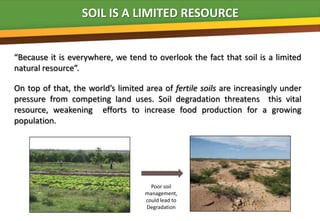
SOIL IS A LIMITED RESOURCE


“Because it is everywhere, we tend to overlook the fact that soil is a limited
natural resource”.

On top of that, the world’s limited area of fertile soils are increasingly under
pressure from competing land uses. Soil degradation threatens this vital
resource, weakening efforts to increase food production for a growing
population.


                                      Poor soil
                                    management,
                                    could lead to
                                    Degradation
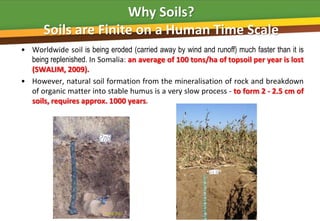
Why Soils?
       Soils are Finite on a Human Time Scale
• Worldwide soil is being eroded (carried away by wind and runoff) much faster than it is
  being replenished. In Somalia: an average of 100 tons/ha of topsoil per year is lost
  (SWALIM, 2009).
• However, natural soil formation from the mineralisation of rock and breakdown
  of organic matter into stable humus is a very slow process - to form 2 - 2.5 cm of
  soils, requires approx. 1000 years.
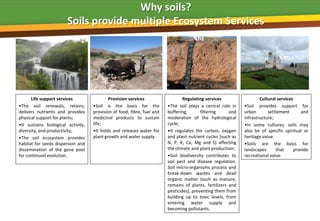
Why soils?
                        Soils provide multiple Ecosystem Services


      Life support services                 Provision services                   Regulating services                  Cultural services
•The soil renewals, retains,        •Soil is the basis for the           •The soil plays a central role in    •Soil provides support for
delivers nutrients and provides     provision of food, fibre, fuel and   buffering,       filtering     and   urban       settlement      and
physical support for plants;        medicinal products to sustain        moderation of the hydrological       infrastructure;
•It sustains biological activity,   life;                                cycle;                               •In some cultures, soils may
diversity, and productivity;        •It holds and releases water for     •It regulates the carbon, oxygen     also be of specific spiritual or
•The soil ecosystem provides        plant growth and water supply.       and plant nutrient cycles (such as   heritage value.
habitat for seeds dispersion and                                         N, P, K, Ca, Mg and S) affecting     •Soils are the basis for
dissemination of the gene pool                                           the climate and plant production;    landscapes      that     provide
for continued evolution.                                                 •Soil biodiversity contributes to    recreational value.
                                                                         soil pest and disease regulation.
                                                                         Soil micro-organisms process and
                                                                         break-down wastes and dead
                                                                         organic matter (such as manure,
                                                                         remains of plants, fertilizers and
                                                                         pesticides), preventing them from
                                                                         building up to toxic levels, from
                                                                         entering water supply and
                                                                         becoming pollutants.
What are the Challenges for Soils:
  Past, Present and Future?
Soil Productivity and Degradation

• Over some 50 years, world annual production of cereals coarse grains, roots and tubers,
  pulses and oil crops has grown from 1.8 million tonnes to 4.6 billion tonnes.
• These huge gains in agricultural production and productivity were often accompanied by
  negative effects on agriculture’s natural resource base (externalities)
• The land degradation effects are so serious that they jeopardize future productive
  potential: soil degradation and loss of biodiversity, salinization of irrigated areas, over-
  extraction of groundwater, build up of pollutants and pest resistance…..
• The declining quality of land and water resources available for food, feed, fibre, timber and
  fuel production has major implications for future food security and sustainable livelihoods.
• Many of today’s soil and crop, livestock and forest management systems are unsustainable:
    – extreme overuse of fertilizer in the EU  serious nitrate build up in water resources that
      threatens vast areas.
    – extreme under-use of organic and mineral fertilizer in most parts of sub-Saharan Africa 
      soil nutrients exported with harvested crops are not being replenished, leading to soil
      degradation and declining yields.
Soil degradation status and trends
    (Global land degradation information system)
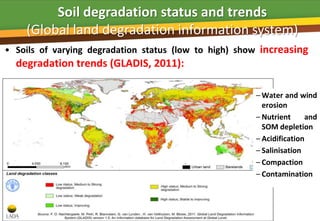
• Soils of varying degradation status (low to high) show increasing
  degradation trends (GLADIS, 2011):

                                                       – Water and wind
                                                         erosion
                                                       – Nutrient     and
                                                         SOM depletion
                                                       – Acidification
                                                       – Salinisation
                                                       – Compaction
                                                       – Contamination
CURRENT AND FUTURE CHALLENGES FOR
         MANAGING SOILS
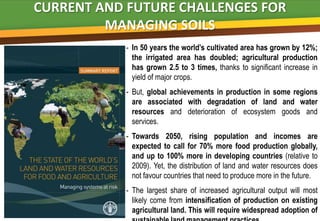
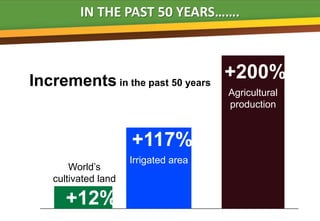
            - In 50 years the world’s cultivated area has grown by 12%;
              the irrigated area has doubled; agricultural production
              has grown 2.5 to 3 times, B  thanks to significant increase in
              yield of major crops.
            - But, global achievements in production in some regions
              are associated with degradation of land and water
              resources and deterioration of ecosystem goods and
              services.
            - Towards 2050, rising population and incomes are
              expected to call for 70% more food production globally,
              and up to 100% more in developing countries (relative to
              2009). Yet, the distribution of land and water resources does
              not favour countries that need to produce more in the future.
            - The largest share of increased agricultural output will most
              likely come from intensification of production on existing
              agricultural land. This will require widespread adoption of
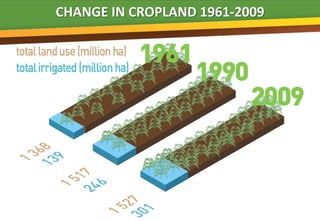
CHANGE IN CROPLAND 1961-2009


                     B
IN THE PAST 50 YEARS…….


Increments in the past 50 years        +200%
                                       Agricultural
                                       production


                      +117%
                      Irrigated area
        World’s
    cultivated land

       +12%
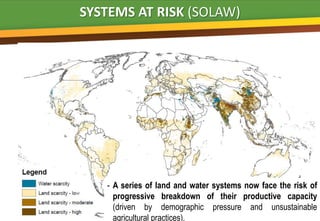
SYSTEMS AT RISK (SOLAW)


                                 B


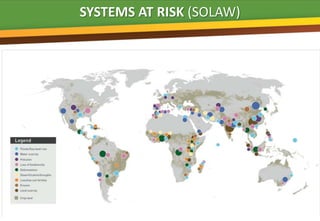
   - A series of land and water systems now face the risk of
     progressive breakdown of their productive capacity
     (driven by demographic pressure and unsustainable
     agricultural practices).
SYSTEMS AT RISK (SOLAW)


                   B
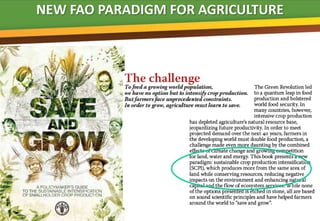
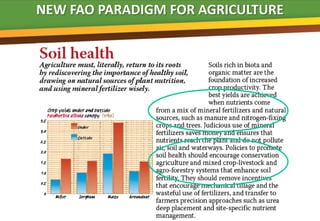
NEW FAO PARADIGM FOR AGRICULTURE


                       B
NEW FAO PARADIGM FOR AGRICULTURE


                       B
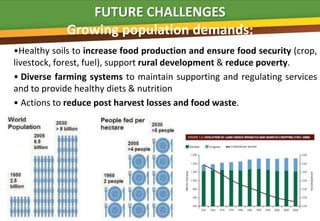
FUTURE CHALLENGES
            Growing population demands:
•Healthy soils to increase food production and ensure food security (crop,
livestock, forest, fuel), support rural development & reduce poverty.
                                                    B
• Diverse farming systems to maintain supporting and regulating services
and to provide healthy diets & nutrition
• Actions to reduce post harvest losses and food waste.
FUTURE CHALLENGES
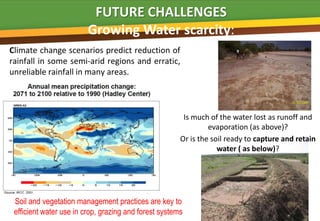
                         Growing Water scarcity:
Climate change scenarios predict reduction of
rainfall in some semi-arid regions and erratic,
unreliable rainfall in many areas.


                                                        Is much of the water lost as runoff and
                                                                evaporation (as above)?
                                                       Or is the soil ready to capture and retain
                                                                   water ( as below)?


 Soil and vegetation management practices are key to
 efficient water use in crop, grazing and forest systems
FUTURE CHALLENGES
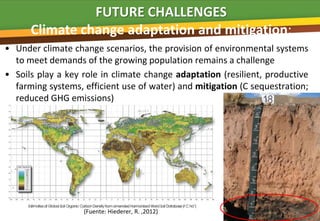
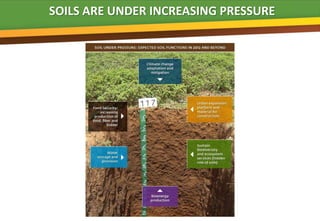
      Climate change adaptation and mitigation:
• Under climate change scenarios, the provision of environmental systems
  to meet demands of the growing population remains a challenge
• Soils play a key role in climate change adaptation (resilient, productive
  farming systems, efficient use of water) and mitigation (C sequestration;
  reduced GHG emissions)


                   (Fuente: Hiederer, R. ,2012)
SOILS ARE UNDER INCREASING PRESSURE
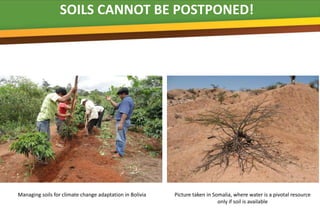
SOILS CANNOT BE POSTPONED!


Managing soils for climate change adaptation in Bolivia   Picture taken in Somalia, where water is a pivotal resource
                                                                             only if soil is available
2. Global Soil Partnership
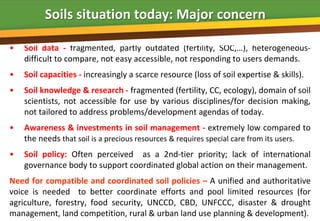
Soils situation today: Major concern

•   Soil data - fragmented, partly outdated (fertility, SOC,…), heterogeneous-
    difficult to compare, not easy accessible, not responding to users demands.
•   Soil capacities - increasingly a scarce resource (loss of soil expertise & skills).
•   Soil knowledge & research - fragmented (fertility, CC, ecology), domain of soil
    scientists, not accessible for use by various disciplines/for decision making,
    not tailored to address problems/development agendas of today.
•   Awareness & investments in soil management - extremely low compared to
    the needs that soil is a precious resources & requires special care from its users.
•   Soil policy: Often perceived as a 2nd-tier priority; lack of international
    governance body to support coordinated global action on their management.
Need for compatible and coordinated soil policies – A unified and authoritative
voice is needed to better coordinate efforts and pool limited resources (for
agriculture, forestry, food security, UNCCD, CBD, UNFCCC, disaster & drought
management, land competition, rural & urban land use planning & development).
WHY THOSE ANSWERS?


Soils are often perceived as a fifth-tier priority at the international decision
making process and also by the general public.

There is urgent need to raise awareness on the crucial role of soils for
responding to today’s global challenges of food security, poverty and climate
change.

Soils deserve much greater investment in all fields, including raising
awareness, developing and promoting sustainable soil management practices,
supporting technical cooperation, strengthening training of new soil scientists,
developing soil information and knowledge           with an interdisciplinary
perspective capable of bringing the crosscutting issue of soils back into the
centre of agricultural and environmental development processes.
Why a Global Soil Partnership?

The GSP was launched by FAO, with the support of EC-JRC, in Sept. 2011 and its Terms
of reference are to be endorsed and guided by the Committee on Agriculture in May
2012 to:
• Improve global coordination /governance of
  the world’s soil resources through an
  intergovernmental mechanism;
• Put national and regional needs in the centre.
• Involve local institutions and communities to
  create ownership.
• Catalyse effective and coordinated soils
                                                     200 participants; 100 countries
  policies and investments to guarantee              120 organizations; (int./reg./
  healthy productive soils for food security and     national institutes; soil science
  sustained ecosystem services.                      networks; NGOs; universities
                                                     research;farmers associations)
GSP Vision and Mission


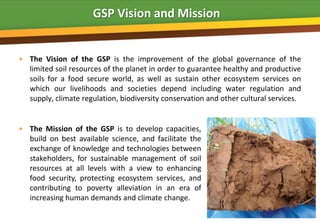
• The Vision of the GSP is the improvement of the global governance of the
  limited soil resources of the planet in order to guarantee healthy and productive
  soils for a food secure world, as well as sustain other ecosystem services on
  which our livelihoods and societies depend including water regulation and
  supply, climate regulation, biodiversity conservation and other cultural services.


• The Mission of the GSP is to develop capacities,
  build on best available science, and facilitate the
  exchange of knowledge and technologies between
  stakeholders, for sustainable management of soil
  resources at all levels with a view to enhancing
  food security, protecting ecosystem services, and
  contributing to poverty alleviation in an era of
  increasing human demands and climate change.
GSP Proposed Pillars of Action

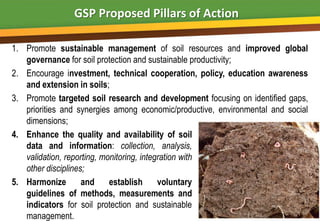
1. Promote sustainable management of soil resources and improved global
   governance for soil protection and sustainable productivity;
2. Encourage investment, technical cooperation, policy, education awareness
   and extension in soils;
3. Promote targeted soil research and development focusing on identified gaps,
   priorities and synergies among economic/productive, environmental and social
   dimensions;
4. Enhance the quality and availability of soil
   data and information: collection, analysis,
   validation, reporting, monitoring, integration with
   other disciplines;
5. Harmonize        and     establish      voluntary
   guidelines of methods, measurements and
   indicators for soil protection and sustainable
   management.
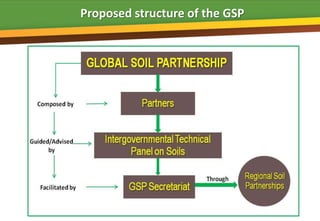
Proposed structure of the GSP
Progress in GSP establishment


• During the last COAG 23 Session,
  the Committee (193 member
  countries) endorsed the initiative
  of the establishment of the Global
  Soil Partnership, and welcomed
  the update provided by the
  Secretariat.
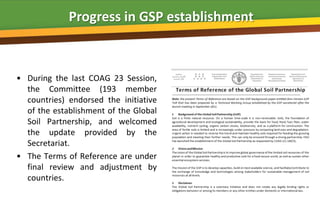
• The Terms of Reference are under
  final review and adjustment by
  countries.
Progress in GSP establishment

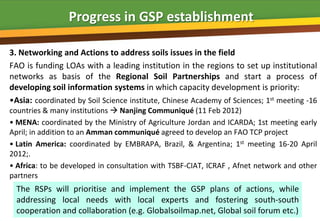
3. Networking and Actions to address soils issues in the field
FAO is funding LOAs with a leading institution in the regions to set up institutional
networks as basis of the Regional Soil Partnerships and start a process of
developing soil information systems in which capacity development is priority:
•Asia: coordinated by Soil Science institute, Chinese Academy of Sciences; 1st meeting -16
countries & many institutions  Nanjing Communiqué (11 Feb 2012)
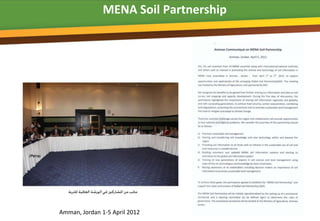
• MENA: coordinated by the Ministry of Agriculture Jordan and ICARDA; 1st meeting early
April; in addition to an Amman communiqué agreed to develop an FAO TCP project
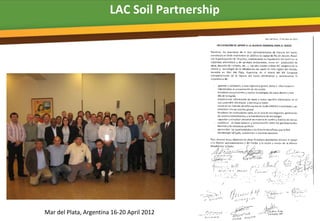
• Latin America: coordinated by EMBRAPA, Brazil, & Argentina; 1st meeting 16-20 April
2012;.
• Africa: to be developed in consultation with TSBF-CIAT, ICRAF , Afnet network and other
partners
  The RSPs will prioritise and implement the GSP plans of actions, while
  addressing local needs with local experts and fostering south-south
  cooperation and collaboration (e.g. Globalsoilmap.net, Global soil forum etc.)
ASIAN SOIL PARTNERSHIP


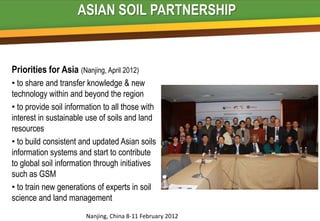
Priorities for Asia (Nanjing, April 2012)
• to share and transfer knowledge & new
technology within and beyond the region
• to provide soil information to all those with
interest in sustainable use of soils and land
resources
• to build consistent and updated Asian soils
information systems and start to contribute
to global soil information through initiatives
such as GSM
• to train new generations of experts in soil
science and land management
                        Nanjing, China 8-11 February 2012
MENA Soil Partnership


Amman, Jordan 1-5 April 2012
LAC Soil Partnership


Mar del Plata, Argentina 16-20 April 2012
Progress in GSP establishment

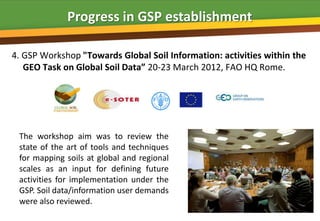
4. GSP Workshop "Towards Global Soil Information: activities within the
   GEO Task on Global Soil Data” 20-23 March 2012, FAO HQ Rome.


 The workshop aim was to review the
 state of the art of tools and techniques
 for mapping soils at global and regional
 scales as an input for defining future
 activities for implementation under the
 GSP. Soil data/information user demands
 were also reviewed.
SOILS AND GSP IN Rio+20 AND BEYOND


Soils at Rio+20
- Position soils on the sustainable development goals.
- Soil Side events to raise awareness and promote the importance of soils for
sustainable development.

Beyond Rio+20
• Recognition by UN System of the World Soil Day (5th December) and first
celebration this year organizing a workshop ”Managing Living Soils”.
• Implementation of the first Global Soil Week 2012, November 18-22 2012.
• Recognition of the International Year of Soils 2015.
• Implementation of Plan of actions in the different pillars at field level.
JOIN THE GLOBAL SOIL PARTNERSHIP


                     THANYOU

Global Soil Partnership

  • 1.
    GLOBAL SOIL PARTNERSHIP Sally Bunning and Ronald Vargas Land and Water Division, FAO Rome
  • 2.
    Outline • Why areSoils so important? • What are the Challenges: past, present and future? • Global Soil Partnership • Why? • Vision and mission • Pillars of action • Governance • Status of its establishment • Regional Soil Partnerships • How can EGU scientists/members contribute to the GSP?
  • 3.
    1. Why areSoils so Important?
  • 4.
    SOIL IS ALIMITED RESOURCE “Because it is everywhere, we tend to overlook the fact that soil is a limited natural resource”. On top of that, the world’s limited area of fertile soils are increasingly under pressure from competing land uses. Soil degradation threatens this vital resource, weakening efforts to increase food production for a growing population. Poor soil management, could lead to Degradation
  • 5.
    Why Soils? Soils are Finite on a Human Time Scale • Worldwide soil is being eroded (carried away by wind and runoff) much faster than it is being replenished. In Somalia: an average of 100 tons/ha of topsoil per year is lost (SWALIM, 2009). • However, natural soil formation from the mineralisation of rock and breakdown of organic matter into stable humus is a very slow process - to form 2 - 2.5 cm of soils, requires approx. 1000 years.
  • 6.
    Why soils? Soils provide multiple Ecosystem Services Life support services Provision services Regulating services Cultural services •The soil renewals, retains, •Soil is the basis for the •The soil plays a central role in •Soil provides support for delivers nutrients and provides provision of food, fibre, fuel and buffering, filtering and urban settlement and physical support for plants; medicinal products to sustain moderation of the hydrological infrastructure; •It sustains biological activity, life; cycle; •In some cultures, soils may diversity, and productivity; •It holds and releases water for •It regulates the carbon, oxygen also be of specific spiritual or •The soil ecosystem provides plant growth and water supply. and plant nutrient cycles (such as heritage value. habitat for seeds dispersion and N, P, K, Ca, Mg and S) affecting •Soils are the basis for dissemination of the gene pool the climate and plant production; landscapes that provide for continued evolution. •Soil biodiversity contributes to recreational value. soil pest and disease regulation. Soil micro-organisms process and break-down wastes and dead organic matter (such as manure, remains of plants, fertilizers and pesticides), preventing them from building up to toxic levels, from entering water supply and becoming pollutants.
  • 7.
    What are theChallenges for Soils: Past, Present and Future?
  • 8.
    Soil Productivity andDegradation • Over some 50 years, world annual production of cereals coarse grains, roots and tubers, pulses and oil crops has grown from 1.8 million tonnes to 4.6 billion tonnes. • These huge gains in agricultural production and productivity were often accompanied by negative effects on agriculture’s natural resource base (externalities) • The land degradation effects are so serious that they jeopardize future productive potential: soil degradation and loss of biodiversity, salinization of irrigated areas, over- extraction of groundwater, build up of pollutants and pest resistance….. • The declining quality of land and water resources available for food, feed, fibre, timber and fuel production has major implications for future food security and sustainable livelihoods. • Many of today’s soil and crop, livestock and forest management systems are unsustainable: – extreme overuse of fertilizer in the EU  serious nitrate build up in water resources that threatens vast areas. – extreme under-use of organic and mineral fertilizer in most parts of sub-Saharan Africa  soil nutrients exported with harvested crops are not being replenished, leading to soil degradation and declining yields.
  • 9.
    Soil degradation statusand trends (Global land degradation information system) • Soils of varying degradation status (low to high) show increasing degradation trends (GLADIS, 2011): – Water and wind erosion – Nutrient and SOM depletion – Acidification – Salinisation – Compaction – Contamination
  • 10.
    CURRENT AND FUTURECHALLENGES FOR MANAGING SOILS - In 50 years the world’s cultivated area has grown by 12%; the irrigated area has doubled; agricultural production has grown 2.5 to 3 times, B thanks to significant increase in yield of major crops. - But, global achievements in production in some regions are associated with degradation of land and water resources and deterioration of ecosystem goods and services. - Towards 2050, rising population and incomes are expected to call for 70% more food production globally, and up to 100% more in developing countries (relative to 2009). Yet, the distribution of land and water resources does not favour countries that need to produce more in the future. - The largest share of increased agricultural output will most likely come from intensification of production on existing agricultural land. This will require widespread adoption of
  • 11.
    CHANGE IN CROPLAND1961-2009 B
  • 12.
    IN THE PAST50 YEARS……. Increments in the past 50 years +200% Agricultural production +117% Irrigated area World’s cultivated land +12%
  • 13.
    SYSTEMS AT RISK(SOLAW) B - A series of land and water systems now face the risk of progressive breakdown of their productive capacity (driven by demographic pressure and unsustainable agricultural practices).
  • 14.
    SYSTEMS AT RISK(SOLAW) B
  • 15.
    NEW FAO PARADIGMFOR AGRICULTURE B
  • 16.
    NEW FAO PARADIGMFOR AGRICULTURE B
  • 17.
    FUTURE CHALLENGES Growing population demands: •Healthy soils to increase food production and ensure food security (crop, livestock, forest, fuel), support rural development & reduce poverty. B • Diverse farming systems to maintain supporting and regulating services and to provide healthy diets & nutrition • Actions to reduce post harvest losses and food waste.
  • 18.
    FUTURE CHALLENGES Growing Water scarcity: Climate change scenarios predict reduction of rainfall in some semi-arid regions and erratic, unreliable rainfall in many areas. Is much of the water lost as runoff and evaporation (as above)? Or is the soil ready to capture and retain water ( as below)? Soil and vegetation management practices are key to efficient water use in crop, grazing and forest systems
  • 19.
    FUTURE CHALLENGES Climate change adaptation and mitigation: • Under climate change scenarios, the provision of environmental systems to meet demands of the growing population remains a challenge • Soils play a key role in climate change adaptation (resilient, productive farming systems, efficient use of water) and mitigation (C sequestration; reduced GHG emissions) (Fuente: Hiederer, R. ,2012)
  • 20.
    SOILS ARE UNDERINCREASING PRESSURE
  • 21.
    SOILS CANNOT BEPOSTPONED! Managing soils for climate change adaptation in Bolivia Picture taken in Somalia, where water is a pivotal resource only if soil is available
  • 22.
    2. Global SoilPartnership
  • 23.
    Soils situation today:Major concern • Soil data - fragmented, partly outdated (fertility, SOC,…), heterogeneous- difficult to compare, not easy accessible, not responding to users demands. • Soil capacities - increasingly a scarce resource (loss of soil expertise & skills). • Soil knowledge & research - fragmented (fertility, CC, ecology), domain of soil scientists, not accessible for use by various disciplines/for decision making, not tailored to address problems/development agendas of today. • Awareness & investments in soil management - extremely low compared to the needs that soil is a precious resources & requires special care from its users. • Soil policy: Often perceived as a 2nd-tier priority; lack of international governance body to support coordinated global action on their management. Need for compatible and coordinated soil policies – A unified and authoritative voice is needed to better coordinate efforts and pool limited resources (for agriculture, forestry, food security, UNCCD, CBD, UNFCCC, disaster & drought management, land competition, rural & urban land use planning & development).
  • 24.
    WHY THOSE ANSWERS? Soilsare often perceived as a fifth-tier priority at the international decision making process and also by the general public. There is urgent need to raise awareness on the crucial role of soils for responding to today’s global challenges of food security, poverty and climate change. Soils deserve much greater investment in all fields, including raising awareness, developing and promoting sustainable soil management practices, supporting technical cooperation, strengthening training of new soil scientists, developing soil information and knowledge with an interdisciplinary perspective capable of bringing the crosscutting issue of soils back into the centre of agricultural and environmental development processes.
  • 25.
    Why a GlobalSoil Partnership? The GSP was launched by FAO, with the support of EC-JRC, in Sept. 2011 and its Terms of reference are to be endorsed and guided by the Committee on Agriculture in May 2012 to: • Improve global coordination /governance of the world’s soil resources through an intergovernmental mechanism; • Put national and regional needs in the centre. • Involve local institutions and communities to create ownership. • Catalyse effective and coordinated soils 200 participants; 100 countries policies and investments to guarantee 120 organizations; (int./reg./ healthy productive soils for food security and national institutes; soil science sustained ecosystem services. networks; NGOs; universities research;farmers associations)
  • 26.
    GSP Vision andMission • The Vision of the GSP is the improvement of the global governance of the limited soil resources of the planet in order to guarantee healthy and productive soils for a food secure world, as well as sustain other ecosystem services on which our livelihoods and societies depend including water regulation and supply, climate regulation, biodiversity conservation and other cultural services. • The Mission of the GSP is to develop capacities, build on best available science, and facilitate the exchange of knowledge and technologies between stakeholders, for sustainable management of soil resources at all levels with a view to enhancing food security, protecting ecosystem services, and contributing to poverty alleviation in an era of increasing human demands and climate change.
  • 27.
    GSP Proposed Pillarsof Action 1. Promote sustainable management of soil resources and improved global governance for soil protection and sustainable productivity; 2. Encourage investment, technical cooperation, policy, education awareness and extension in soils; 3. Promote targeted soil research and development focusing on identified gaps, priorities and synergies among economic/productive, environmental and social dimensions; 4. Enhance the quality and availability of soil data and information: collection, analysis, validation, reporting, monitoring, integration with other disciplines; 5. Harmonize and establish voluntary guidelines of methods, measurements and indicators for soil protection and sustainable management.
  • 28.
  • 29.
    Progress in GSPestablishment • During the last COAG 23 Session, the Committee (193 member countries) endorsed the initiative of the establishment of the Global Soil Partnership, and welcomed the update provided by the Secretariat. • The Terms of Reference are under final review and adjustment by countries.
  • 30.
    Progress in GSPestablishment 3. Networking and Actions to address soils issues in the field FAO is funding LOAs with a leading institution in the regions to set up institutional networks as basis of the Regional Soil Partnerships and start a process of developing soil information systems in which capacity development is priority: •Asia: coordinated by Soil Science institute, Chinese Academy of Sciences; 1st meeting -16 countries & many institutions  Nanjing Communiqué (11 Feb 2012) • MENA: coordinated by the Ministry of Agriculture Jordan and ICARDA; 1st meeting early April; in addition to an Amman communiqué agreed to develop an FAO TCP project • Latin America: coordinated by EMBRAPA, Brazil, & Argentina; 1st meeting 16-20 April 2012;. • Africa: to be developed in consultation with TSBF-CIAT, ICRAF , Afnet network and other partners The RSPs will prioritise and implement the GSP plans of actions, while addressing local needs with local experts and fostering south-south cooperation and collaboration (e.g. Globalsoilmap.net, Global soil forum etc.)
  • 31.
    ASIAN SOIL PARTNERSHIP Prioritiesfor Asia (Nanjing, April 2012) • to share and transfer knowledge & new technology within and beyond the region • to provide soil information to all those with interest in sustainable use of soils and land resources • to build consistent and updated Asian soils information systems and start to contribute to global soil information through initiatives such as GSM • to train new generations of experts in soil science and land management Nanjing, China 8-11 February 2012
  • 32.
    MENA Soil Partnership Amman,Jordan 1-5 April 2012
  • 33.
    LAC Soil Partnership Mardel Plata, Argentina 16-20 April 2012
  • 34.
    Progress in GSPestablishment 4. GSP Workshop "Towards Global Soil Information: activities within the GEO Task on Global Soil Data” 20-23 March 2012, FAO HQ Rome. The workshop aim was to review the state of the art of tools and techniques for mapping soils at global and regional scales as an input for defining future activities for implementation under the GSP. Soil data/information user demands were also reviewed.
  • 35.
    SOILS AND GSPIN Rio+20 AND BEYOND Soils at Rio+20 - Position soils on the sustainable development goals. - Soil Side events to raise awareness and promote the importance of soils for sustainable development. Beyond Rio+20 • Recognition by UN System of the World Soil Day (5th December) and first celebration this year organizing a workshop ”Managing Living Soils”. • Implementation of the first Global Soil Week 2012, November 18-22 2012. • Recognition of the International Year of Soils 2015. • Implementation of Plan of actions in the different pillars at field level.
  • 36.
    JOIN THE GLOBALSOIL PARTNERSHIP THANYOU