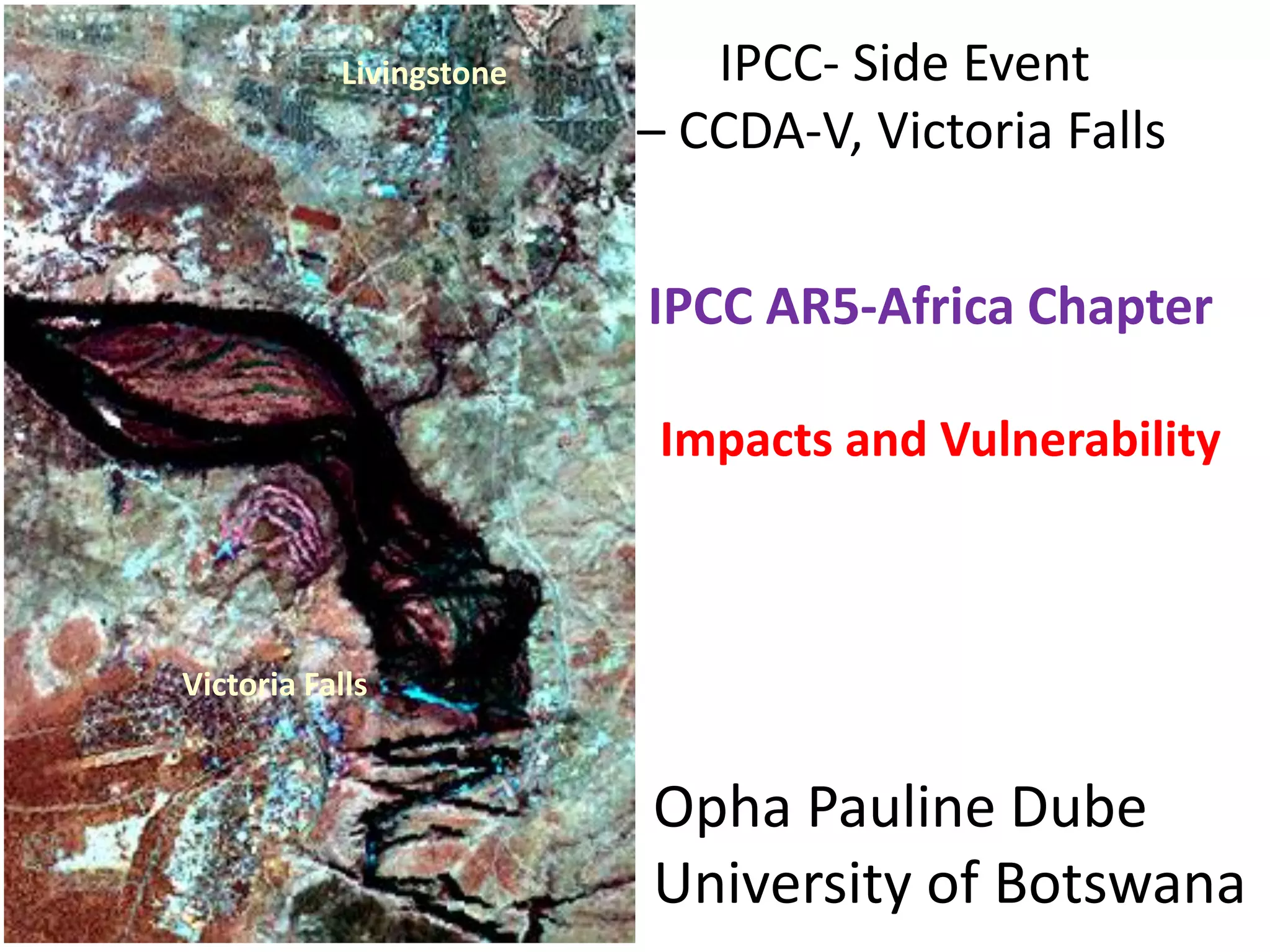
IPCC- Side Event
– CCDA-V, Victoria Falls
IPCC AR5-Africa Chapter
Impacts and Vulnerability
Opha Pauline Dube
University of Botswana
Livingstone
Victoria Falls
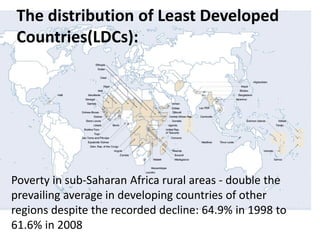
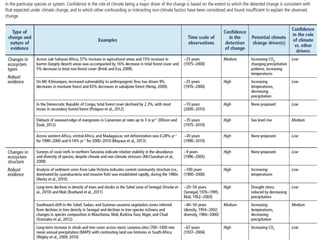
The distribution of Least Developed
Countries(LDCs):
Poverty in sub-Saharan Africa rural areas - double the
prevailing average in developing countries of other
regions despite the recorded decline: 64.9% in 1998 to
61.6% in 2008
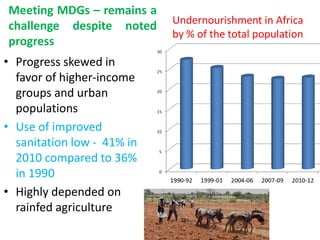
Meeting MDGs – remains a
challenge despite noted
progress
• Progress skewed in
favor of higher-income
groups and urban
populations
• Use of improved
sanitation low - 41% in
2010 compared to 36%
in 1990
• Highly depended on
rainfed agriculture
Undernourishment in Africa
by % of the total population
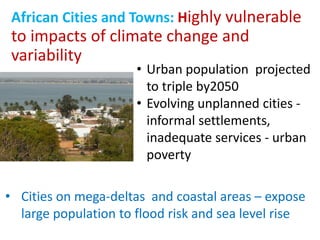
African Cities and Towns: Highly vulnerable
to impacts of climate change and
variability
• Urban population projected
to triple by2050
• Evolving unplanned cities -
informal settlements,
inadequate services - urban
poverty
• Cities on mega-deltas and coastal areas – expose
large population to flood risk and sea level rise
Some of the Projected Vulnerability in Cities
• Kenya: by 2030, 10,000 to 86,000 people would be
affected
– Losses ranging US$ 7 million to US$ 58 million (SEI,
2009).
• Tanzania- Dar-es-Salaam: By 2030 population at risk
of 1 in 100-year return period extreme water levels ~
30,300 and 110,000 inhabitants
– Potential losses of US$ 35.6 million to US$ 404.1 million
• High levels of vulnerability and low adaptive capacity in
African cities: due to structural factors, e.g. in-
capacitated local governments
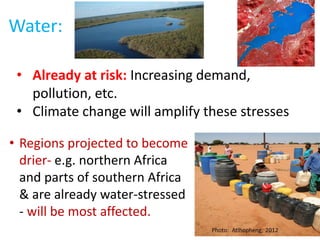
Water:
• Already at risk: Increasing demand,
pollution, etc.
• Climate change will amplify these stresses
• Regions projected to become
drier- e.g. northern Africa
and parts of southern Africa
& are already water-stressed
- will be most affected.
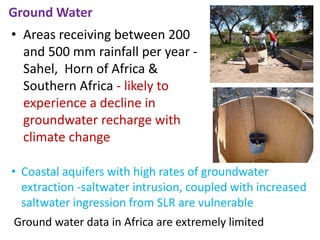
Ground Water
• Areas receiving between 200
and 500 mm rainfall per year -
Sahel, Horn of Africa &
Southern Africa - likely to
experience a decline in
groundwater recharge with
climate change
• Coastal aquifers with high rates of groundwater
extraction -saltwater intrusion, coupled with increased
saltwater ingression from SLR are vulnerable
Ground water data in Africa are extremely limited
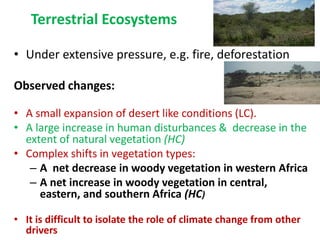
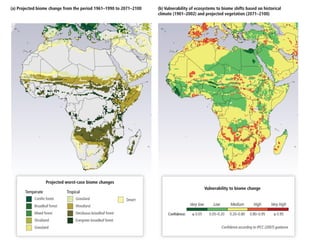
Terrestrial Ecosystems
• Under extensive pressure, e.g. fire, deforestation
Observed changes:
• A small expansion of desert like conditions (LC).
• A large increase in human disturbances & decrease in the
extent of natural vegetation (HC)
• Complex shifts in vegetation types:
– A net decrease in woody vegetation in western Africa
– A net increase in woody vegetation in central,
eastern, and southern Africa (HC)
• It is difficult to isolate the role of climate change from other
drivers
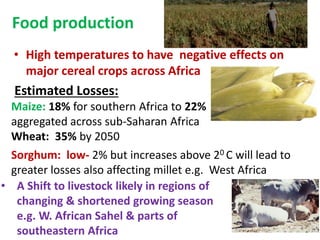
Food production
• High temperatures to have negative effects on
major cereal crops across Africa
Estimated Losses:
Maize: 18% for southern Africa to 22%
aggregated across sub-Saharan Africa
Wheat: 35% by 2050
Sorghum: low- 2% but increases above 20 C will lead to
greater losses also affecting millet e.g. West Africa
• A Shift to livestock likely in regions of
changing & shortened growing season
e.g. W. African Sahel & parts of
southeastern Africa
Perennial crops
• Economically valued crops - tea, coffee,
and cocoa:
• Suitable agro-climatic zones estimated
to significantly diminish due to rising
temperatures.
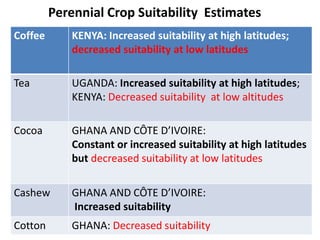
Perennial Crop Suitability Estimates
Coffee KENYA: Increased suitability at high latitudes;
decreased suitability at low latitudes
Tea UGANDA: Increased suitability at high latitudes;
KENYA: Decreased suitability at low altitudes
Cocoa GHANA AND CÔTE D’IVOIRE:
Constant or increased suitability at high latitudes
but decreased suitability at low latitudes
Cashew GHANA AND CÔTE D’IVOIRE:
Increased suitability
Cotton GHANA: Decreased suitability
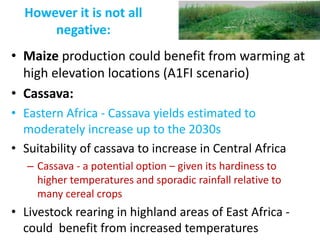
However it is not all
negative:
• Maize production could benefit from warming at
high elevation locations (A1FI scenario)
• Cassava:
• Eastern Africa - Cassava yields estimated to
moderately increase up to the 2030s
• Suitability of cassava to increase in Central Africa
– Cassava - a potential option – given its hardiness to
higher temperatures and sporadic rainfall relative to
many cereal crops
• Livestock rearing in highland areas of East Africa -
could benefit from increased temperatures

IPCC AR5 Africa Chapter - Impacts and Vulnerability

  • 1.
    IPCC- Side Event –CCDA-V, Victoria Falls IPCC AR5-Africa Chapter Impacts and Vulnerability Opha Pauline Dube University of Botswana Livingstone Victoria Falls
  • 2.
    The distribution ofLeast Developed Countries(LDCs): Poverty in sub-Saharan Africa rural areas - double the prevailing average in developing countries of other regions despite the recorded decline: 64.9% in 1998 to 61.6% in 2008
  • 3.
    Meeting MDGs –remains a challenge despite noted progress • Progress skewed in favor of higher-income groups and urban populations • Use of improved sanitation low - 41% in 2010 compared to 36% in 1990 • Highly depended on rainfed agriculture Undernourishment in Africa by % of the total population
  • 4.
    African Cities andTowns: Highly vulnerable to impacts of climate change and variability • Urban population projected to triple by2050 • Evolving unplanned cities - informal settlements, inadequate services - urban poverty • Cities on mega-deltas and coastal areas – expose large population to flood risk and sea level rise
  • 5.
    Some of theProjected Vulnerability in Cities • Kenya: by 2030, 10,000 to 86,000 people would be affected – Losses ranging US$ 7 million to US$ 58 million (SEI, 2009). • Tanzania- Dar-es-Salaam: By 2030 population at risk of 1 in 100-year return period extreme water levels ~ 30,300 and 110,000 inhabitants – Potential losses of US$ 35.6 million to US$ 404.1 million • High levels of vulnerability and low adaptive capacity in African cities: due to structural factors, e.g. in- capacitated local governments
  • 6.
    Water: • Already atrisk: Increasing demand, pollution, etc. • Climate change will amplify these stresses • Regions projected to become drier- e.g. northern Africa and parts of southern Africa & are already water-stressed - will be most affected.
  • 7.
    Ground Water • Areasreceiving between 200 and 500 mm rainfall per year - Sahel, Horn of Africa & Southern Africa - likely to experience a decline in groundwater recharge with climate change • Coastal aquifers with high rates of groundwater extraction -saltwater intrusion, coupled with increased saltwater ingression from SLR are vulnerable Ground water data in Africa are extremely limited
  • 8.
    Terrestrial Ecosystems • Underextensive pressure, e.g. fire, deforestation Observed changes: • A small expansion of desert like conditions (LC). • A large increase in human disturbances & decrease in the extent of natural vegetation (HC) • Complex shifts in vegetation types: – A net decrease in woody vegetation in western Africa – A net increase in woody vegetation in central, eastern, and southern Africa (HC) • It is difficult to isolate the role of climate change from other drivers
  • 11.
    Food production • Hightemperatures to have negative effects on major cereal crops across Africa Estimated Losses: Maize: 18% for southern Africa to 22% aggregated across sub-Saharan Africa Wheat: 35% by 2050 Sorghum: low- 2% but increases above 20 C will lead to greater losses also affecting millet e.g. West Africa • A Shift to livestock likely in regions of changing & shortened growing season e.g. W. African Sahel & parts of southeastern Africa
  • 12.
    Perennial crops • Economicallyvalued crops - tea, coffee, and cocoa: • Suitable agro-climatic zones estimated to significantly diminish due to rising temperatures.
  • 13.
    Perennial Crop SuitabilityEstimates Coffee KENYA: Increased suitability at high latitudes; decreased suitability at low latitudes Tea UGANDA: Increased suitability at high latitudes; KENYA: Decreased suitability at low altitudes Cocoa GHANA AND CÔTE D’IVOIRE: Constant or increased suitability at high latitudes but decreased suitability at low latitudes Cashew GHANA AND CÔTE D’IVOIRE: Increased suitability Cotton GHANA: Decreased suitability
  • 14.
    However it isnot all negative: • Maize production could benefit from warming at high elevation locations (A1FI scenario) • Cassava: • Eastern Africa - Cassava yields estimated to moderately increase up to the 2030s • Suitability of cassava to increase in Central Africa – Cassava - a potential option – given its hardiness to higher temperatures and sporadic rainfall relative to many cereal crops • Livestock rearing in highland areas of East Africa - could benefit from increased temperatures