IELTS
READING
Prepared by :
Your Online IELTS Tutor:
Anna Hilis
Lesson Outline:
1. Structure of the IELTS Reading Sub-test (Academic)
2. Understanding the demands of the test
3. Skills you need for a Higher Band Score in IELTS
Reading
WWW.YOURONLINEIELTSHELP.COM
TEST STRUCTURE
- The Listening and Reading tests have over 10 different types of questions
each. All of these questions require a different strategy and set of skills.
- The majority of your IELTS preparation should be spent learning these
skills.
WWW.YOURONLINEIELTSHELP.COM
THE READING SUB-TEST
▪ The Reading Sub-test takes 60 minutes and is in 3 sections. There are 3 passages with a
combined length of 1500-2500 words and a total of 40 questions.
▪ The reading passages become more difficult as you progress through the test (progressive
level of difficulty).
▪ The passages are taken from journals, magazines, books and newspapers. All the topics
are of general interest and are not specialised texts.
WWW.YOURONLINEIELTSHELP.COM
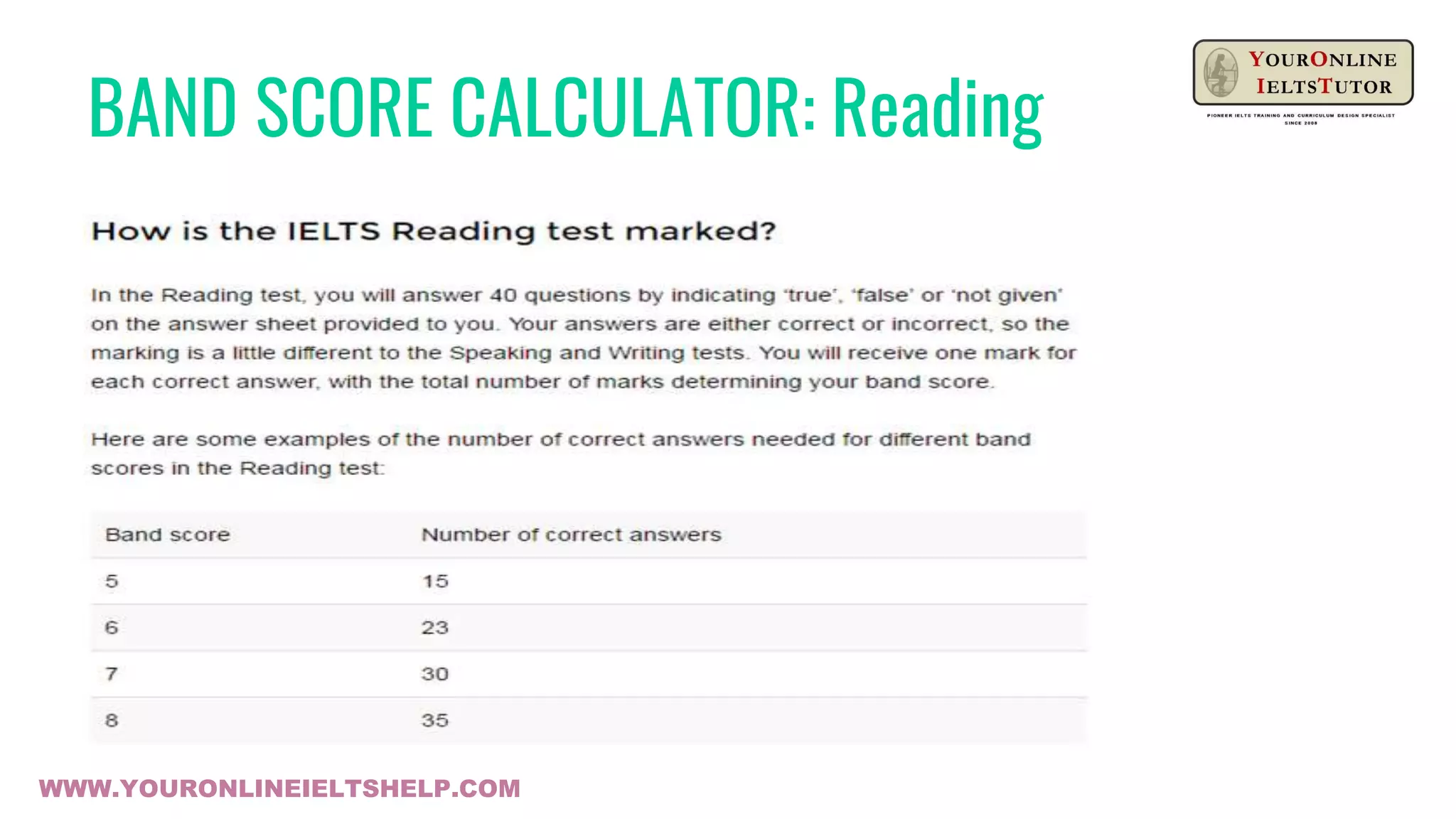
BAND SCORE CALCULATOR: Reading
1. BE READY TO LISTEN
Listen for details – who, what
where, when, why
2. LEARN TO PREDICT
IELTS Listening Question Tasks
a. matching tasks
b. multiple choice tasks
c. short-answer question tasks
d. true/false tasks
e. sentence completion tasks
f. chart / table completion tasks
g. gapfill tasks
h. diagram labelling tasksWWW.YOURONLINEIELTSHELP.COM
Reading Tips:
WWW.YOURONLINEIELTSHELP.COM
Reading Tips:
WWW.YOURONLINEIELTSHELP.COM
1. Don't expect to understand every word.
2. Practice your reading skills NOT your IELTS skills.
3. Read the instructions VERY carefully.
4. Don't panic.
5. It's really a vocabulary test. ...
6. Timing is crucial.
7. Ignore anything you already know about the topic.
8. Practice slow and fast.
Source: https://www.ieltsadvantage.com/
READING TEST HINTS
1. WRITE YOUR ANSWERS ON THE ANSWER SHEET
2. DO NOT READ THE READING PASSAGE FIRST
3. READ THE TEST IN A LOGICAL ORDER
4. CONSIDER THE PASSAGE LAYOUT
There are 8 basic types of IELTS reading question tasks:
a. matching tasks
b. multiple choice tasks
c. short-answer question tasks
d. true/false tasks
e. sentence completion tasks
f. classification tasks
g. gap fill tasks
h. table, chart or diagram completion tasks
WWW.YOURONLINEIELTSHELP.COM
Reading Hints
5. SCAN THE READING PASSAGE
6. READ THE TOPIC SENTENCES FIRST
Check the first sentence -» then the second sentence -* and
then the last sentence
7. KNOW WHERE TO START LOOKING FOR AN ANSWER
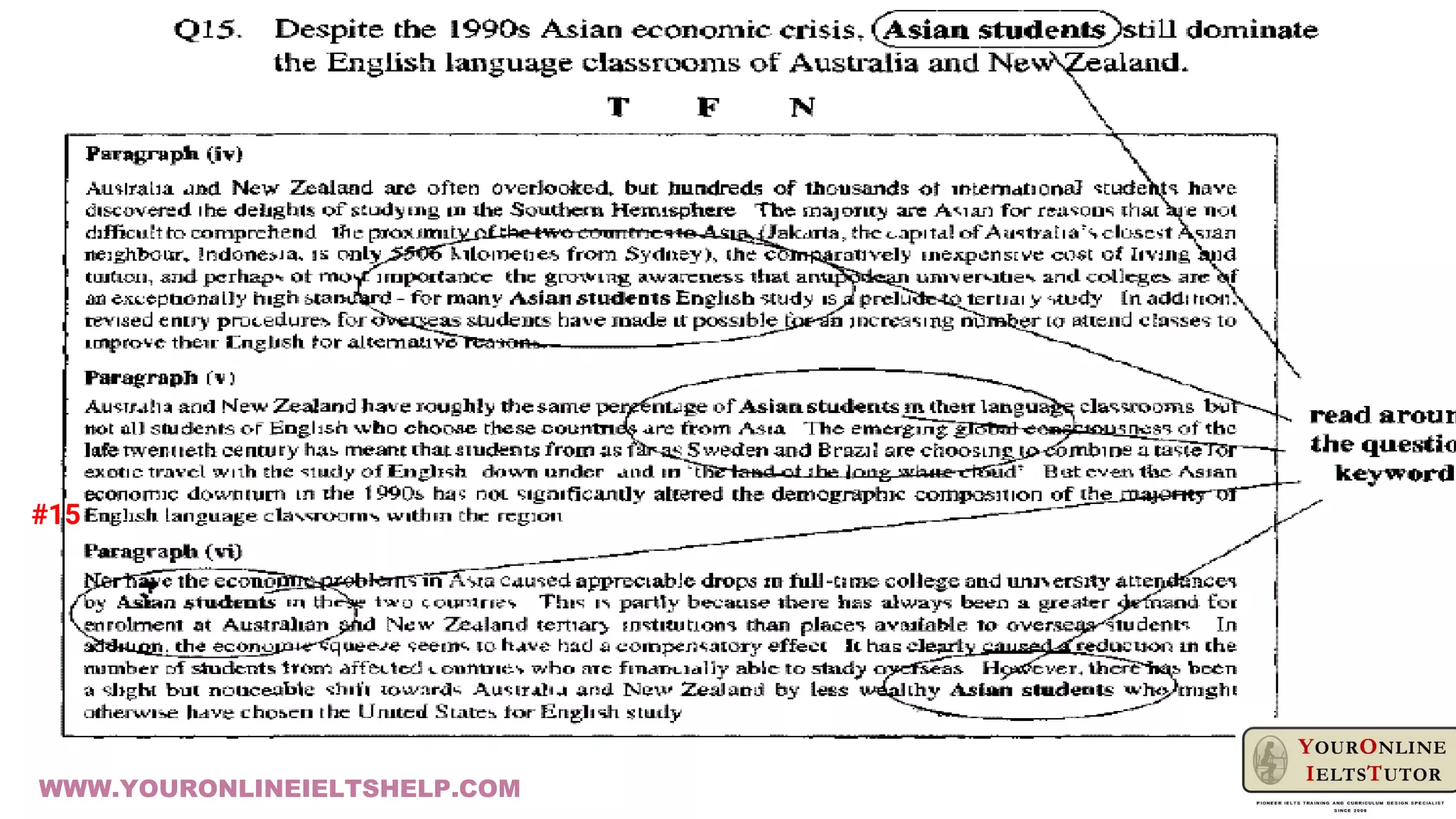
8. READ AROUND THE KEYWORDS/PHRASES
WWW.YOURONLINEIELTSHELP.COM
#15
WWW.YOURONLINEIELTSHELP.COM
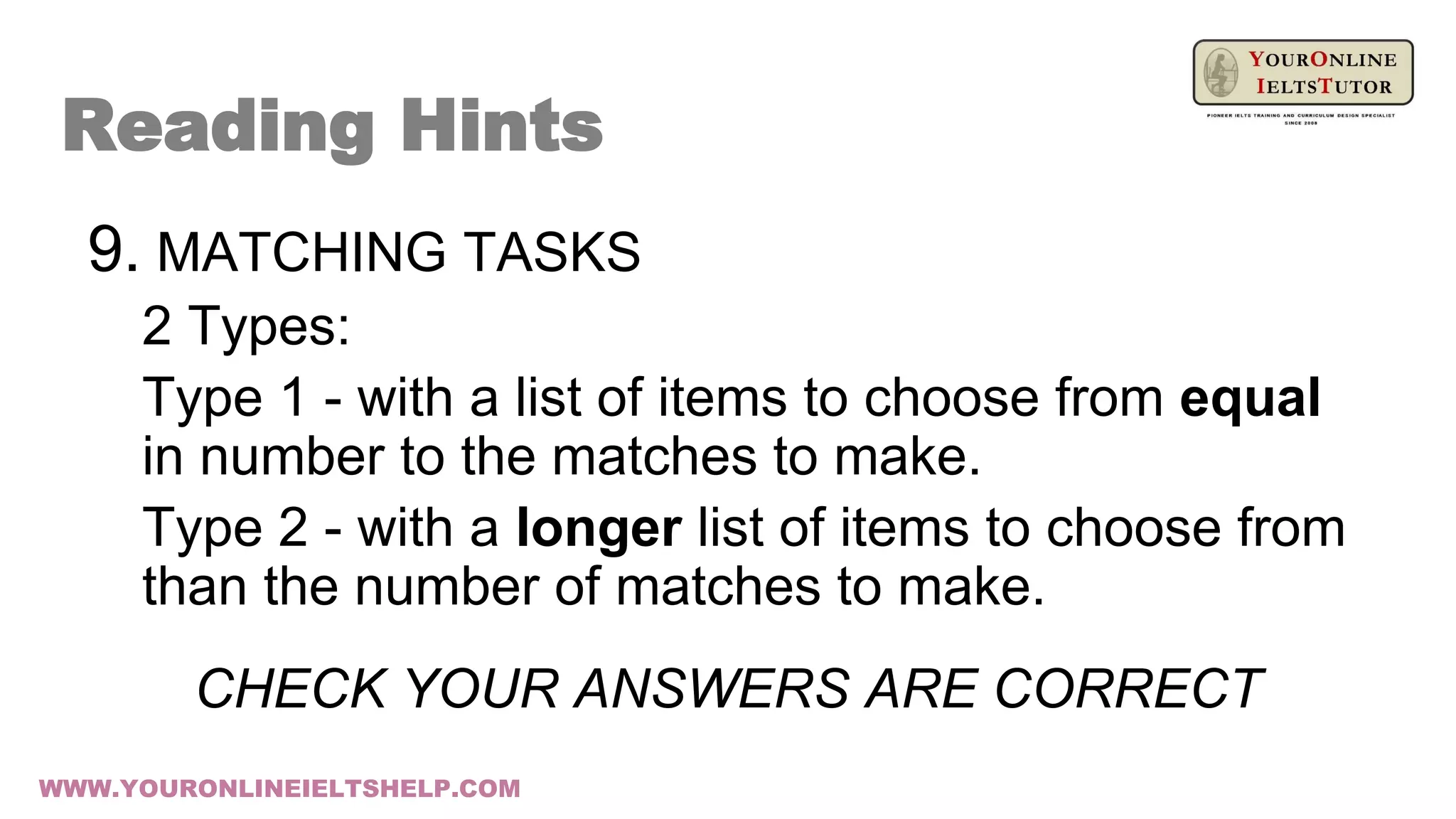
9. MATCHING TASKS
2 Types:
Type 1 - with a list of items to choose from equal
in number to the matches to make.
Type 2 - with a longer list of items to choose from
than the number of matches to make.
CHECK YOUR ANSWERS ARE CORRECT
Reading Hints
WWW.YOURONLINEIELTSHELP.COM
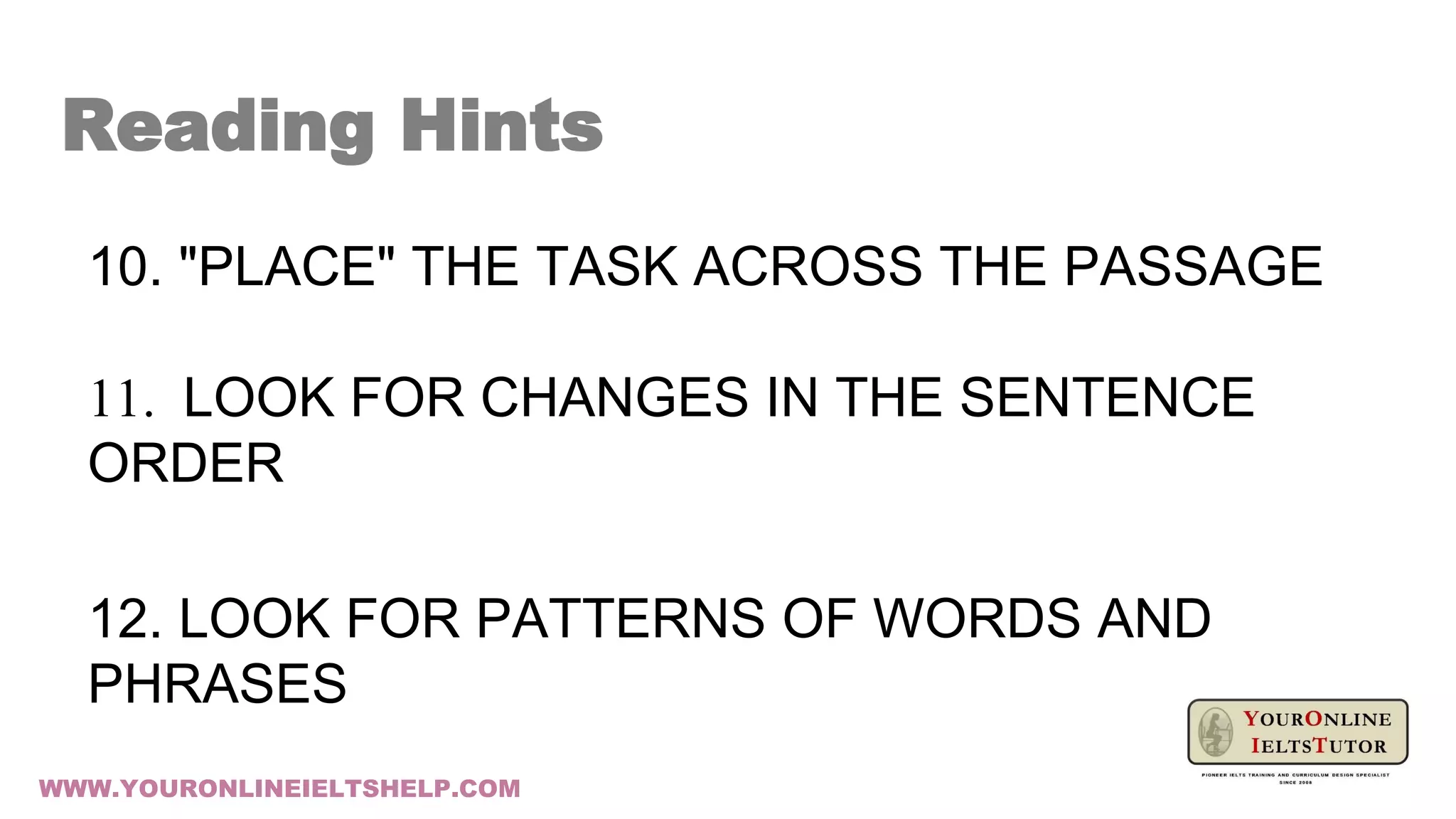
10. "PLACE" THE TASK ACROSS THE PASSAGE
11. LOOK FOR CHANGES IN THE SENTENCE
ORDER
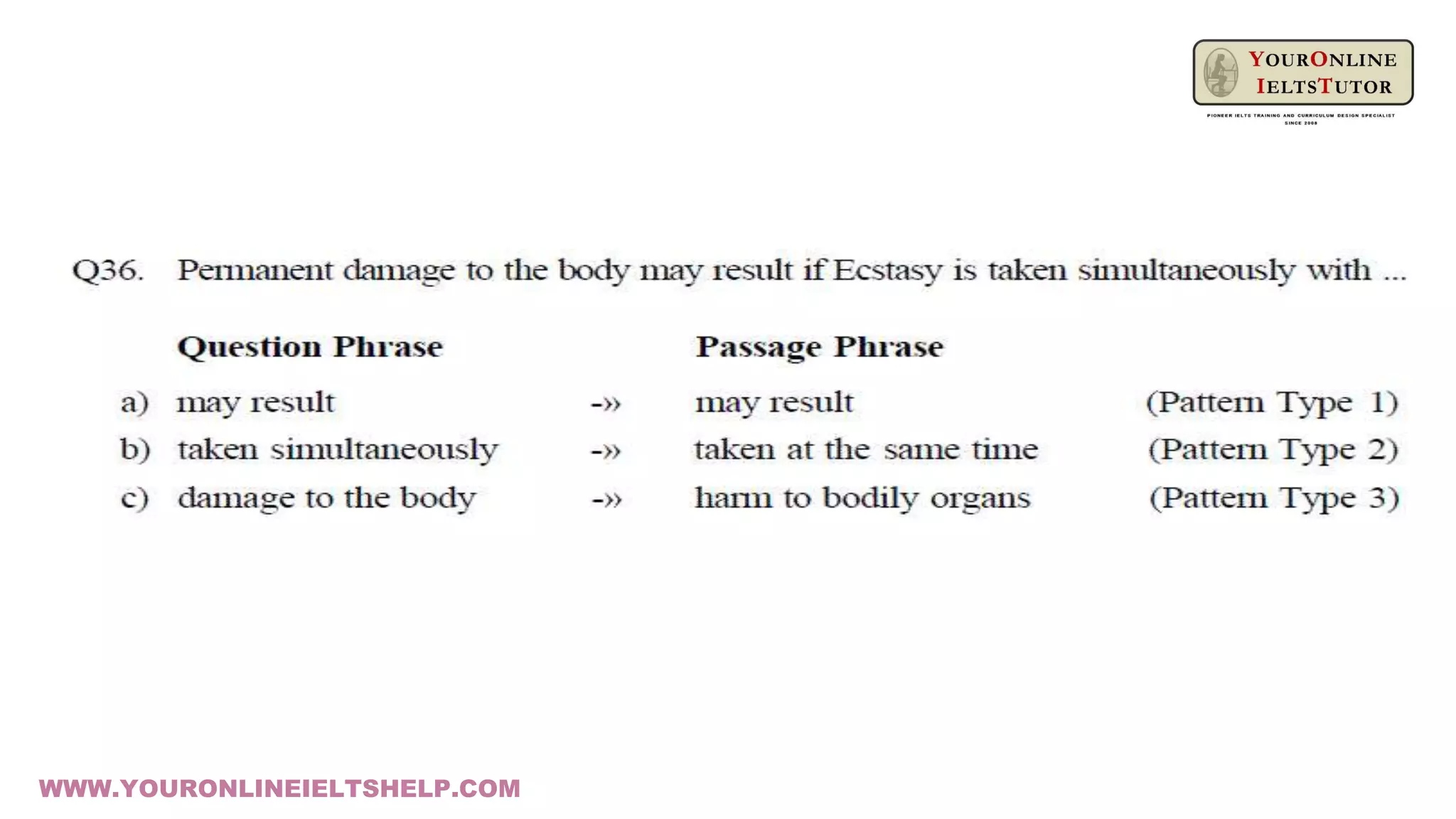
12. LOOK FOR PATTERNS OF WORDS AND
PHRASES
Reading Hints
WWW.YOURONLINEIELTSHELP.COM
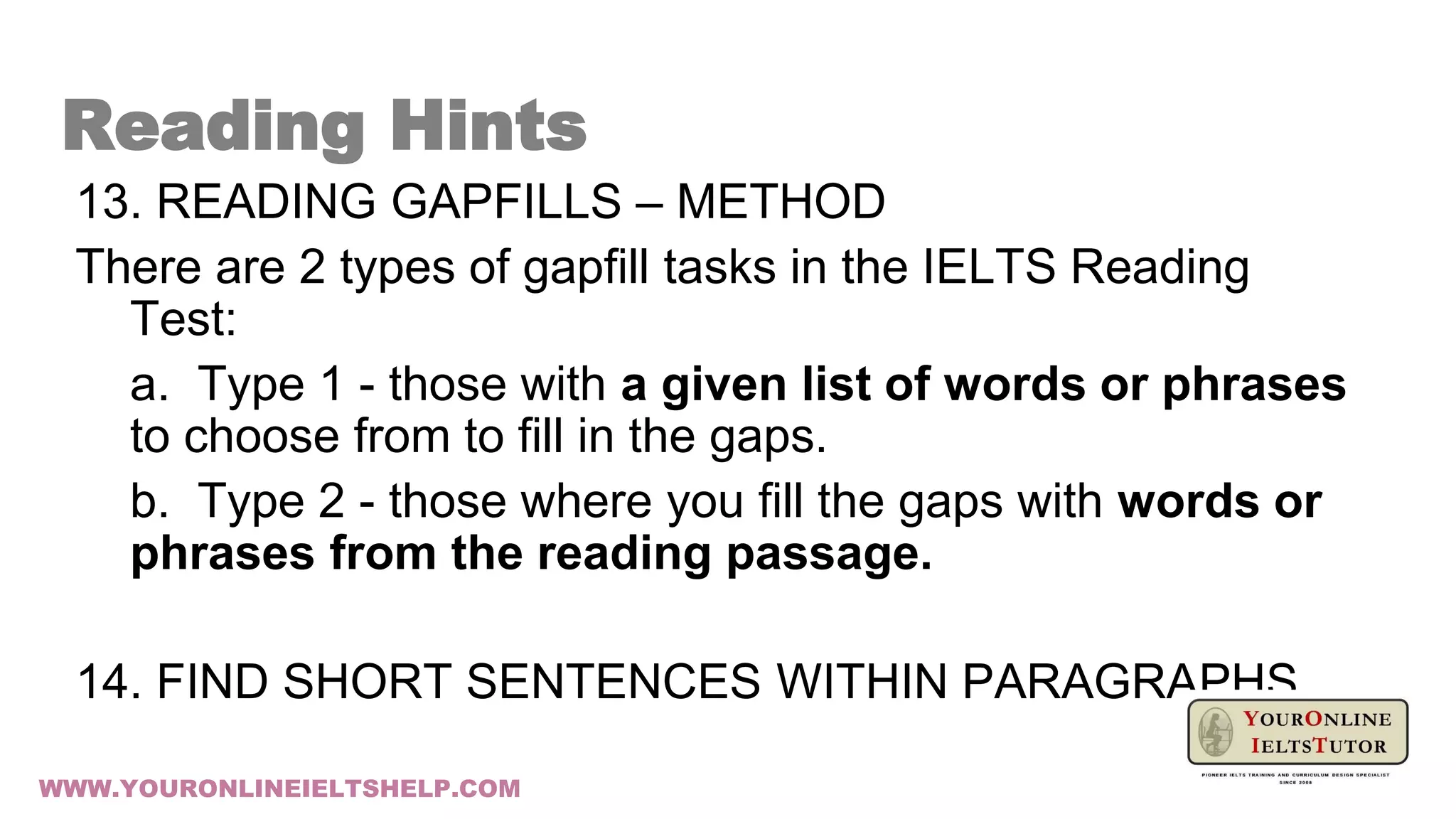
13. READING GAPFILLS – METHOD
There are 2 types of gapfill tasks in the IELTS Reading
Test:
a. Type 1 - those with a given list of words or phrases
to choose from to fill in the gaps.
b. Type 2 - those where you fill the gaps with words or
phrases from the reading passage.
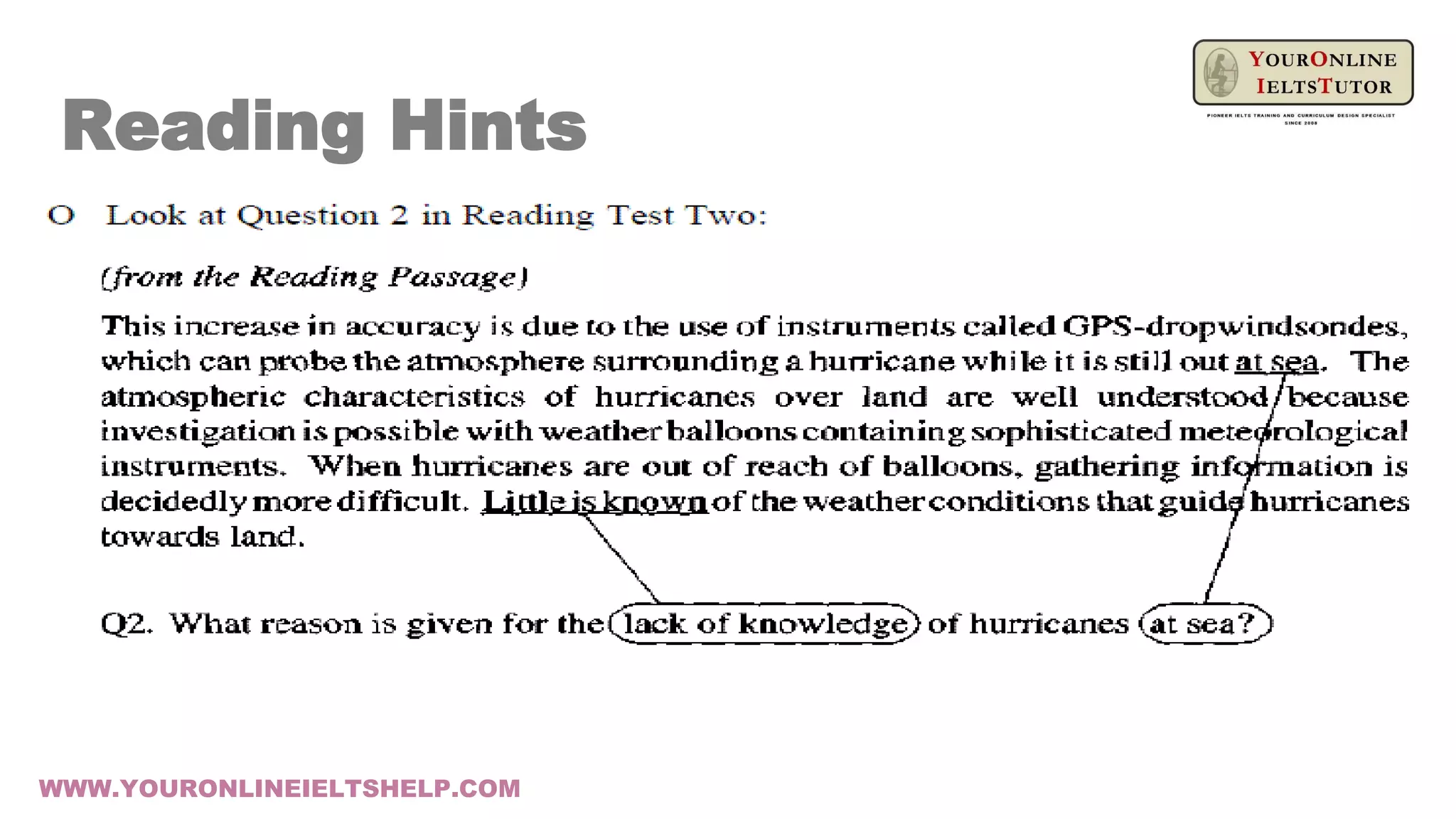
14. FIND SHORT SENTENCES WITHIN PARAGRAPHS
Reading Hints
WWW.YOURONLINEIELTSHELP.COM
Reading Hints
WWW.YOURONLINEIELTSHELP.COM
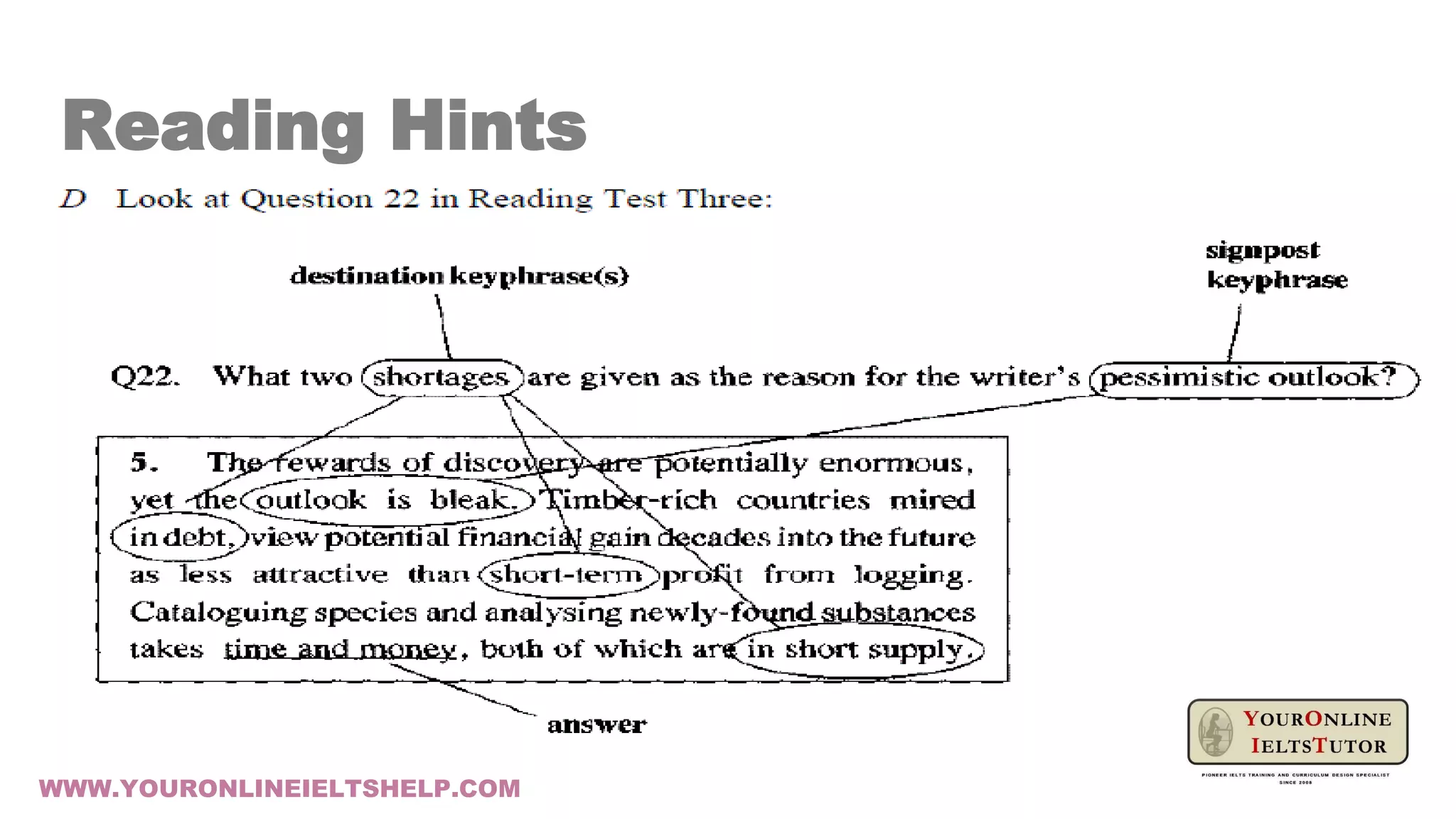
15. CONSIDER THE LOCATION OF THE
ANSWER
Reading Hints
WWW.YOURONLINEIELTSHELP.COM
Reading Hints
WWW.YOURONLINEIELTSHELP.COM
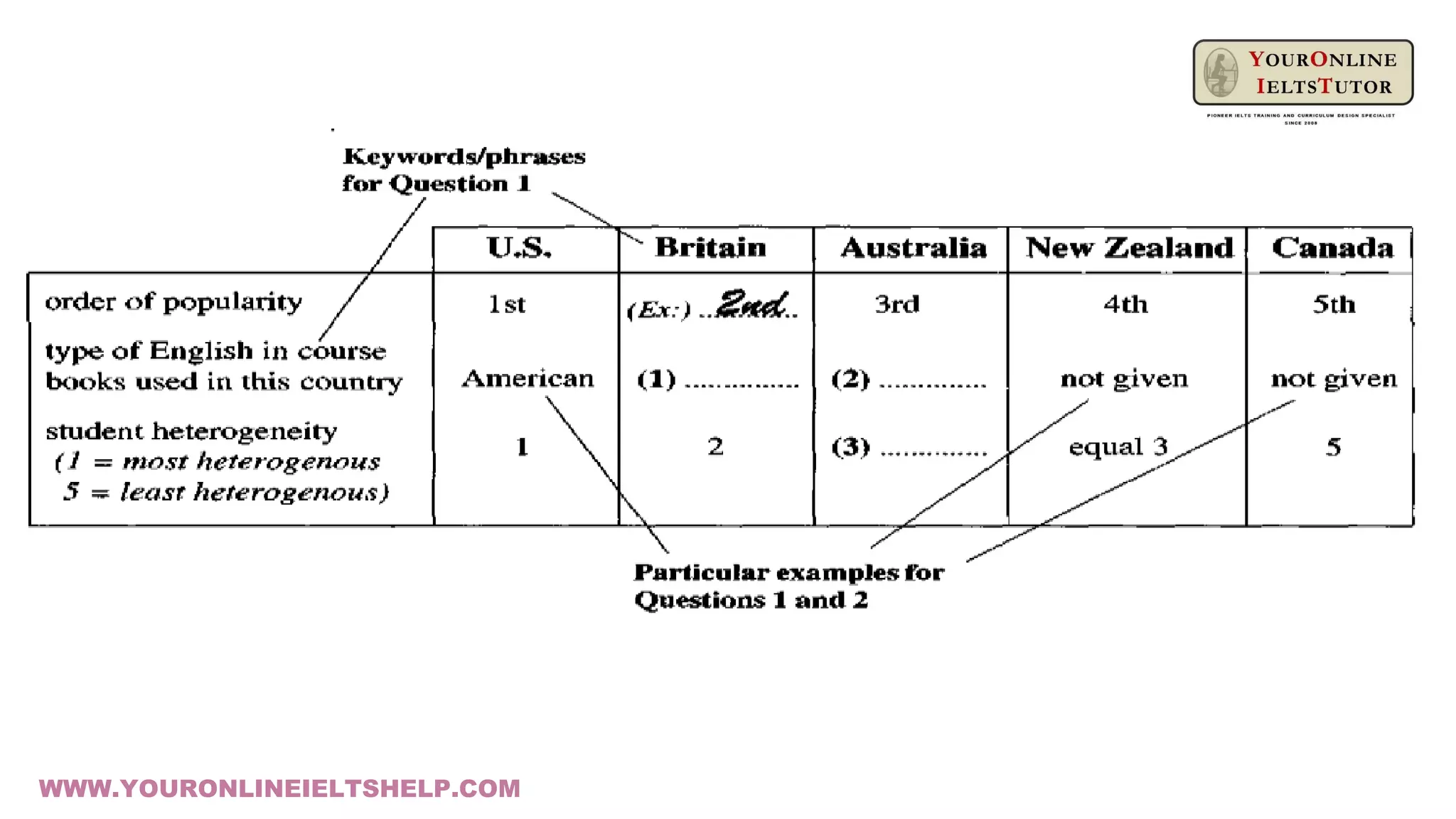
16. CHARTS AND TABLES IN QUESTION TASKS
▪ Keywords, key phrases, and examples are also
features of questions within charts and tables. Do not
overlook the words already contained in a chart or
table in your hurry to find the answer in the reading
passage. These words can also be considered as
'examples'.
Reading Hints
WWW.YOURONLINEIELTSHELP.COM
Remember to examine all the words and phrases contained in a chart or table
WWW.YOURONLINEIELTSHELP.COM
For more help regarding your IELTS PREPARATION, contact Your
Online IELTS Tutor through any of the following:
E-mail: youronlineieltstutor@gmail.com
Website: www.youronlineieltshelp.com
Facebook Page: https://www.facebook.com/onlineieltsanna/
WWW.YOURONLINEIELTSHELP.COM
Good luck!
WWW.YOURONLINEIELTSHELP.COM

IELTS Reading Overview

  • 1.
    IELTS READING Prepared by : YourOnline IELTS Tutor: Anna Hilis
  • 2.
    Lesson Outline: 1. Structureof the IELTS Reading Sub-test (Academic) 2. Understanding the demands of the test 3. Skills you need for a Higher Band Score in IELTS Reading WWW.YOURONLINEIELTSHELP.COM
  • 3.
    TEST STRUCTURE - TheListening and Reading tests have over 10 different types of questions each. All of these questions require a different strategy and set of skills. - The majority of your IELTS preparation should be spent learning these skills. WWW.YOURONLINEIELTSHELP.COM
  • 4.
    THE READING SUB-TEST ▪The Reading Sub-test takes 60 minutes and is in 3 sections. There are 3 passages with a combined length of 1500-2500 words and a total of 40 questions. ▪ The reading passages become more difficult as you progress through the test (progressive level of difficulty). ▪ The passages are taken from journals, magazines, books and newspapers. All the topics are of general interest and are not specialised texts. WWW.YOURONLINEIELTSHELP.COM
  • 5.
    BAND SCORE CALCULATOR:Reading 1. BE READY TO LISTEN Listen for details – who, what where, when, why 2. LEARN TO PREDICT IELTS Listening Question Tasks a. matching tasks b. multiple choice tasks c. short-answer question tasks d. true/false tasks e. sentence completion tasks f. chart / table completion tasks g. gapfill tasks h. diagram labelling tasksWWW.YOURONLINEIELTSHELP.COM
  • 6.
  • 7.
    Reading Tips: WWW.YOURONLINEIELTSHELP.COM 1. Don'texpect to understand every word. 2. Practice your reading skills NOT your IELTS skills. 3. Read the instructions VERY carefully. 4. Don't panic. 5. It's really a vocabulary test. ... 6. Timing is crucial. 7. Ignore anything you already know about the topic. 8. Practice slow and fast. Source: https://www.ieltsadvantage.com/
  • 8.
    READING TEST HINTS 1.WRITE YOUR ANSWERS ON THE ANSWER SHEET 2. DO NOT READ THE READING PASSAGE FIRST 3. READ THE TEST IN A LOGICAL ORDER 4. CONSIDER THE PASSAGE LAYOUT There are 8 basic types of IELTS reading question tasks: a. matching tasks b. multiple choice tasks c. short-answer question tasks d. true/false tasks e. sentence completion tasks f. classification tasks g. gap fill tasks h. table, chart or diagram completion tasks WWW.YOURONLINEIELTSHELP.COM
  • 9.
    Reading Hints 5. SCANTHE READING PASSAGE 6. READ THE TOPIC SENTENCES FIRST Check the first sentence -» then the second sentence -* and then the last sentence 7. KNOW WHERE TO START LOOKING FOR AN ANSWER 8. READ AROUND THE KEYWORDS/PHRASES WWW.YOURONLINEIELTSHELP.COM
  • 10.
  • 11.
    9. MATCHING TASKS 2Types: Type 1 - with a list of items to choose from equal in number to the matches to make. Type 2 - with a longer list of items to choose from than the number of matches to make. CHECK YOUR ANSWERS ARE CORRECT Reading Hints WWW.YOURONLINEIELTSHELP.COM
  • 12.
    10. "PLACE" THETASK ACROSS THE PASSAGE 11. LOOK FOR CHANGES IN THE SENTENCE ORDER 12. LOOK FOR PATTERNS OF WORDS AND PHRASES Reading Hints WWW.YOURONLINEIELTSHELP.COM
  • 13.
  • 14.
    13. READING GAPFILLS– METHOD There are 2 types of gapfill tasks in the IELTS Reading Test: a. Type 1 - those with a given list of words or phrases to choose from to fill in the gaps. b. Type 2 - those where you fill the gaps with words or phrases from the reading passage. 14. FIND SHORT SENTENCES WITHIN PARAGRAPHS Reading Hints WWW.YOURONLINEIELTSHELP.COM
  • 15.
  • 16.
    15. CONSIDER THELOCATION OF THE ANSWER Reading Hints WWW.YOURONLINEIELTSHELP.COM
  • 17.
  • 18.
    16. CHARTS ANDTABLES IN QUESTION TASKS ▪ Keywords, key phrases, and examples are also features of questions within charts and tables. Do not overlook the words already contained in a chart or table in your hurry to find the answer in the reading passage. These words can also be considered as 'examples'. Reading Hints WWW.YOURONLINEIELTSHELP.COM
  • 19.
    Remember to examineall the words and phrases contained in a chart or table WWW.YOURONLINEIELTSHELP.COM
  • 20.
    For more helpregarding your IELTS PREPARATION, contact Your Online IELTS Tutor through any of the following: E-mail: youronlineieltstutor@gmail.com Website: www.youronlineieltshelp.com Facebook Page: https://www.facebook.com/onlineieltsanna/ WWW.YOURONLINEIELTSHELP.COM
  • 21.