Listening: Tips & Strategy
Listening
• Tip 1
• The recording will only be played once
during the test. It helps to do a complete
practice test at least a few times before
you take the actual exam.
Listening
• Tip 2
• During the listening test you will need to
multi-task. This means reading the
questions, listening for the answer and
writing down your answer all at the same
time. It helps to practice this beforehand.
Listening
• Tip 3
• Practice transferring you answers to an
actual answer sheet after you have
finished the questions. This helps you to
focus on your spelling and gives you an
indication of how long it will take you to
transfer your answers.
Listening
• Tip 4
• Use a pencil instead of a pen to write down
your answers. This allows you to erase
mistakes on your answer sheet if needed.
Listening
• Tip 5
• Always guess if you don’t know the
answer. You earn a point for the correct
answer but you do not lose one for an
incorrect answer.
Listening
• Tip 6
• You can write down your answers in
capital letter or in lower case letters. If you
write your answers in capital letters,
however, you do not have to worry about
whether certain words, like names, need to
be capitalized or not.
Listening
• Tip 7
• Check for the maximum number of words
you can write for each answer. Each time
the question type changes, the number of
words may change too.
Listening
• Tip 8
• The number of words and numbers is
calculated as follows:
- A year, like ‘1985’, is one number.
- A large number, like ’12.376’, is one word.
- A hyphenated word, like ‘factory-made’, is
one word.
- A compound noun which is not
hyphenated, like ‘football field’, is two
words.
Listening
• Tip 9
• Whether you need to write articles and
prepositions depends on the question type.
For a sentence completion question, for
instance, your answer needs to be
grammatically correct, so your answer may
need to be ‘ … at the main building’. When
completing a form, on the other hand, after
‘PLACE: …’ you may be allowed to only put
‘main building’, or ‘the main building’, so
with or without a preposition. Make sure to
check the maximum number of words
allowed, however.
Listening
• Tip 10
• Check your spelling. If your answer is
spelled wrong, the answer is marked
wrong.
- Don’t worry about spelling while you are
listening. Use keywords and
abbreviations if you need to.
- Worry about your spelling when
transferring your answers onto the
answer sheet.
Listening
• Tip 11
• For multiple choice questions, be sure to
write down a letter. If you write down what
comes after the letter, your answer will be
marked wrong. For example:
a) green
b) blue
c) purple
Your answer could be ‘a’, but NOT
‘green’.
Listening
• Tip 12
• You can expect the following question
types:
• Form completion
• Note completion
• Summary completion
• Sentence completion
• Multiple choice
• Diagram labelling
• Map labelling
• Table completion
• Form completion
• Chart completion
Listening
• Tip 13
• Don’t try to understand everything. The
examiners will add lots of information that
you won’t need. Focus on listening for the
answer only.
Listening
• Tip 14
• The intervals between answers may vary.
Some answers may come quickly, one
after the other, while you may also need to
wait a while between answers. This is
done on purpose, so don’t panic. This
often occurs in section 4.
Listening
• Tip 15
• Look out for plural answers. Many students
have problems hearing the plural ’s’ so the
examiners will include them on purpose.
Listening
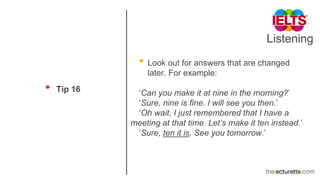
• Tip 16
• Look out for answers that are changed
later. For example:
‘Can you make it at nine in the morning?’
‘Sure, nine is fine. I will see you then.’
‘Oh wait, I just remembered that I have a
meeting at that time. Let’s make it ten instead.’
‘Sure, ten it is. See you tomorrow.’
Listening
• Tip 17
• Don’t lose your place in the recording. If
you miss an answer, move to the next
question and don’t waste time.
Listening
• Tip 18
• Practice multiple full listening tests at home
to build up your ability to concentrate. 30
minutes is a long time to actively listen and
it is very easy to lose concentration.
Practice is key.

IELTS Listening; Tips and Strategy

  • 1.
  • 2.
    Listening • Tip 1 •The recording will only be played once during the test. It helps to do a complete practice test at least a few times before you take the actual exam.
  • 3.
    Listening • Tip 2 •During the listening test you will need to multi-task. This means reading the questions, listening for the answer and writing down your answer all at the same time. It helps to practice this beforehand.
  • 4.
    Listening • Tip 3 •Practice transferring you answers to an actual answer sheet after you have finished the questions. This helps you to focus on your spelling and gives you an indication of how long it will take you to transfer your answers.
  • 5.
    Listening • Tip 4 •Use a pencil instead of a pen to write down your answers. This allows you to erase mistakes on your answer sheet if needed.
  • 6.
    Listening • Tip 5 •Always guess if you don’t know the answer. You earn a point for the correct answer but you do not lose one for an incorrect answer.
  • 7.
    Listening • Tip 6 •You can write down your answers in capital letter or in lower case letters. If you write your answers in capital letters, however, you do not have to worry about whether certain words, like names, need to be capitalized or not.
  • 8.
    Listening • Tip 7 •Check for the maximum number of words you can write for each answer. Each time the question type changes, the number of words may change too.
  • 9.
    Listening • Tip 8 •The number of words and numbers is calculated as follows: - A year, like ‘1985’, is one number. - A large number, like ’12.376’, is one word. - A hyphenated word, like ‘factory-made’, is one word. - A compound noun which is not hyphenated, like ‘football field’, is two words.
  • 10.
    Listening • Tip 9 •Whether you need to write articles and prepositions depends on the question type. For a sentence completion question, for instance, your answer needs to be grammatically correct, so your answer may need to be ‘ … at the main building’. When completing a form, on the other hand, after ‘PLACE: …’ you may be allowed to only put ‘main building’, or ‘the main building’, so with or without a preposition. Make sure to check the maximum number of words allowed, however.
  • 11.
    Listening • Tip 10 •Check your spelling. If your answer is spelled wrong, the answer is marked wrong. - Don’t worry about spelling while you are listening. Use keywords and abbreviations if you need to. - Worry about your spelling when transferring your answers onto the answer sheet.
  • 12.
    Listening • Tip 11 •For multiple choice questions, be sure to write down a letter. If you write down what comes after the letter, your answer will be marked wrong. For example: a) green b) blue c) purple Your answer could be ‘a’, but NOT ‘green’.
  • 13.
    Listening • Tip 12 •You can expect the following question types: • Form completion • Note completion • Summary completion • Sentence completion • Multiple choice • Diagram labelling • Map labelling • Table completion • Form completion • Chart completion
  • 14.
    Listening • Tip 13 •Don’t try to understand everything. The examiners will add lots of information that you won’t need. Focus on listening for the answer only.
  • 15.
    Listening • Tip 14 •The intervals between answers may vary. Some answers may come quickly, one after the other, while you may also need to wait a while between answers. This is done on purpose, so don’t panic. This often occurs in section 4.
  • 16.
    Listening • Tip 15 •Look out for plural answers. Many students have problems hearing the plural ’s’ so the examiners will include them on purpose.
  • 17.
    Listening • Tip 16 •Look out for answers that are changed later. For example: ‘Can you make it at nine in the morning?’ ‘Sure, nine is fine. I will see you then.’ ‘Oh wait, I just remembered that I have a meeting at that time. Let’s make it ten instead.’ ‘Sure, ten it is. See you tomorrow.’
  • 18.
    Listening • Tip 17 •Don’t lose your place in the recording. If you miss an answer, move to the next question and don’t waste time.
  • 19.
    Listening • Tip 18 •Practice multiple full listening tests at home to build up your ability to concentrate. 30 minutes is a long time to actively listen and it is very easy to lose concentration. Practice is key.