Network Attacks
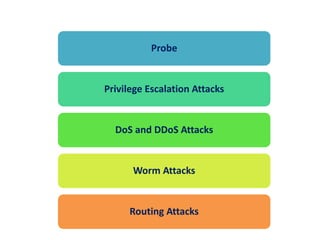
Probe
Privilege Escalation Attacks
DoS and DDoS Attacks
Worm Attacks
Routing Attacks
Probes
Network probes are usually attacks scanning computer networks to
gather information or find known vulnerabilities, which are
exploited for further or future attacks.
The goal of this information gathering is to find out about
computer and services that are present in a network as well as to
detect the possibility of attack based on known vulnerabilities.
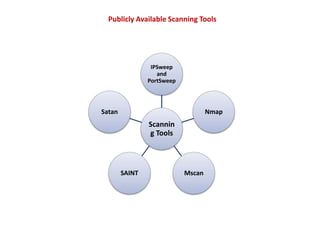
Publicly Available Scanning Tools
Scannin
g Tools
IPSweep
and
PortSweep
Nmap
Mscan
SAINT
Satan
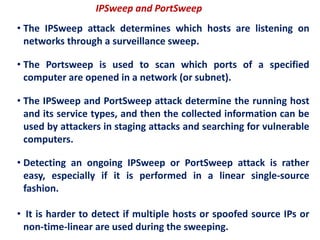
IPSweep and PortSweep
• The IPSweep attack determines which hosts are listening on
networks through a surveillance sweep.
• The Portsweep is used to scan which ports of a specified
computer are opened in a network (or subnet).
• The IPSweep and PortSweep attack determine the running host
and its service types, and then the collected information can be
used by attackers in staging attacks and searching for vulnerable
computers.
• Detecting an ongoing IPSweep or PortSweep attack is rather
easy, especially if it is performed in a linear single-source
fashion.
• It is harder to detect if multiple hosts or spoofed source IPs or
non-time-linear are used during the sweeping.
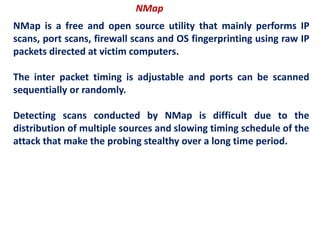
NMap
NMap is a free and open source utility that mainly performs IP
scans, port scans, firewall scans and OS fingerprinting using raw IP
packets directed at victim computers.
The inter packet timing is adjustable and ports can be scanned
sequentially or randomly.
Detecting scans conducted by NMap is difficult due to the
distribution of multiple sources and slowing timing schedule of the
attack that make the probing stealthy over a long time period.
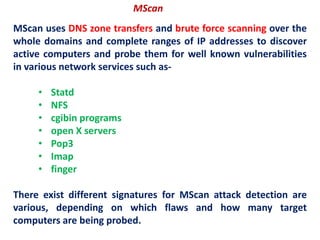
MScan uses DNS zone transfers and brute force scanning over the
whole domains and complete ranges of IP addresses to discover
active computers and probe them for well known vulnerabilities
in various network services such as-
• Statd
• NFS
• cgibin programs
• open X servers
• Pop3
• Imap
• finger
There exist different signatures for MScan attack detection are
various, depending on which flaws and how many target
computers are being probed.
MScan
SAINT
SAINT is the acronym for Security Administrator’s Integrated
Network Tool
It gathers a large amount of information from networking services,
such as finger, ftp, telnet, tftp, NIS, NFS, rexd, statd, and some
other services.
SAINT is not an attack tool in its very basic form. It, however,
gathers information that can be exploited for attackers to start
further intrusions.
The information mainly contains misconfiguration of network
services, well-known vulnerabilities in operating systems or
network utilities, and weak policy decisions.
SAINT provides three optional modes of operation, namely-
• light mode
• normal model
• heavy model
In light mode, SAINT scans the target computer for discovering
RPC and DNS vulnerabilities as well as unsecured NFS mount
points.
In normal mode, SAINT detects the vulnerabilities of fingerd,
bootd, and rusersd and performs port scans on several well
known TCP ports such as HTTP, FTP, Telnet, SMTP, UUCP, and
NNTP, and UDP ports, such as DNS.
Heavy mode is similar with normal mode except that many other
uncommon ports are scanned as well.
Satan
Satan is a collection of C and Perl programs and is the previous
version of SAINT. Like SAINT, Satan supports three levels of
scanning: light, normal, and heavy. An example for the list of
vulnerabilities scanning in the heavy mode is as follows-
• NFS export to unprivileged programs.
• NFS export via port mapper.
• NIS password file access.
• REXD access.
• TFTP file access.
• Remote shell access.
• Unrestricted NFS export.
• Unrestricted X Server access.
• Write-able FTP home directory.
• Several Sendmail vulnerabilities.
• Several FTP vulnerabilities.
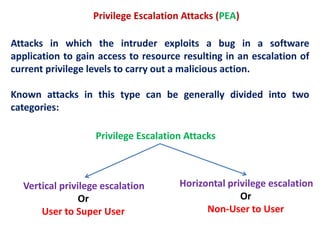
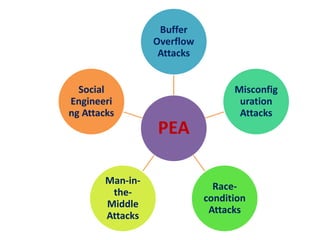
Privilege Escalation Attacks (PEA)
Attacks in which the intruder exploits a bug in a software
application to gain access to resource resulting in an escalation of
current privilege levels to carry out a malicious action.
Known attacks in this type can be generally divided into two
categories:
Vertical privilege escalation
Or
User to Super User
Horizontal privilege escalation
Or
Non-User to User
Privilege Escalation Attacks
1. Vertical privilege escalation or User to Super-user
A lower privilege user with ordinary user account on a system
exploits some flaws to assess functions or content reserved for
higher privileged users or super (root) users.
2. Horizontal privilege escalation or Non-user to User
A normal user with ordinary account or without any account on a
system exploits some vulnerability in the system in order to assess
functions or content reserved for other normal users.
PEA
Buffer
Overflow
Attacks
Misconfig
uration
Attacks
Race-
condition
Attacks
Man-in-
the-
Middle
Attacks
Social
Engineeri
ng Attacks
Buffer Overflow Attacks
A buffer is a contiguous allocated chunk of memory, such as an
array or a pointer in C language.
Buffer overflow occurs when a program or process tries to store
more data in a buffer than it is intended to hold.
Since buffers are created to store a finite amount of data, the
extra information leading an overflow into adjacent buffers, and
thus corrupting and overwriting the valid data held in them.
Buffer overflow attacks exploit this vulnerability and place the
code that the attacker tries to execute in the buffer’s
overflowing area.
The attacker then overwrite the return address of functions so it
points back to the buffer and execute the intended code to
trigger specific actions such as-
1. Spawning a shell with root permissions
2. Damage the user’s files
3. Change data
4. Disclose confidential information
Buffer Overflow Attacks ….
Misconfiguration Attacks
Any misconfiguration or weak configuration can be used by
intruders either to skip a security barrier or a security breach.
As a result, misconfigurtation or missing patch has become one of
the most significant vulnerabilities
A prediction shows that misconfiguration attacks will account for
70% of successful WLAN attacks through 2009.
Examples of misconfiguration attacks are –
1. Dictionary
2. FTPWrite
Dictionary Attack or Brute-Force Attack
An attacker knows about a user-name and makes repeated
guessing attempts for the password from a list of possible
passwords.
If the administrator does not change the default username and
password, guessing the possible passwords will become very
easy.
Prevention Method
1. Setting up a maximum number of failed login attempts for
each service
2. Inserting some delay between two consecutive login tries
FTP-Write Attack
It exploits the anonymous account that is a common login mode
provided by FTP services.
If the anonymous FTP root directory or its subdirectories are
owned by the FTP account or are in the same group as the FTP
account and they are not write protected, an attacker will be
able to add files like rhosts to gain local access to the system.
Detect and Prevent FTP-Write Attack
1. By monitoring anonymous FTP accounts
2. By checking for any attempts to create filesin the FTP root
folder
Race-condition Attacks
A race condition occurs when the output and/or result of the
process is unexpectedly and critically dependent on the sequence
or timing of other specific competing instructions.
A well known example of is the old Unix login attack, in which
when a new login process is created, there exists a short time gap
that the new process is running at priority (kernel or root) mode
and has not yet been switched to the normal user mode.
At this time, if the human user repeatedly poked at the escape key
while logging in, it is possible that the change from root to user will
be prevented, allowing the human completing access to the entire
system.
Some other places for race condition attacks involve
1. The opening and validating of a shell or batch file
2. Running a subprogram
3. Checking a password
4. Verifying a user name
Prevention
1. Initial checking is made to ensure that the batch file is safe
2. Have a good software writing practices, such as to be aware of
what are atomic and non-atomic operations in application
program macros, shell scripts, and locally written or user
written programs
3. The system end users should always pay attentions to the
security updates that patch race condition holes
Man-in-the-Middle Attacks (MITM)
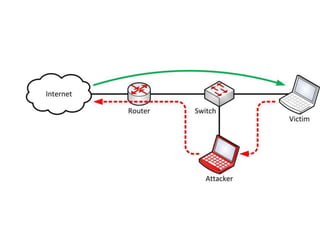
The attacker controls the entire conversation between victims by
making the independent connection with each victim, relaying
messages between victims and making victims believe that they
are talking directly to each other over a private connection.
The attacker intercept all messages going between the two victims,
inject new ones
How to prevent MITM attacks?
1. Cryptographic protocols
2. Endpoint authentication mechanisms
Social Engineering Attacks
An attack in which an attacker attempts to mislead a victim by
aggressive persuasion for accessing to a protected critical
information system.
The social engineering attack can be divided into two categories:
1. Physical Attacks
2. Psychological Attacks
Examples:
Physical Attacks : trash dump
Psychological Attacks : a pretended persuasion by telephone or
online communications
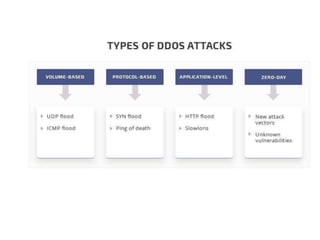
Denial of Service (DoS) and Distributed Denial of Service (DDoS)
Attacks
• Aim to interfere with the normal operation of network services
by flooding, exhausting and overwhelming the resources of the
targeted network or host.
• The resources may be network bandwidth, router’s packet
forwarding capacity, name servers, memory/computing power
on servers, or operating systems’ data structures.
• During DoS attacks, attackers usually generate large amounts of
nonsense traffic such as incomplete TCP connections, malformed
IP packets, bots-generated requests to web pages and some
other carefully crafted methods, causing the service or program
to cease functioning or prevent others from making use of the
service or program.
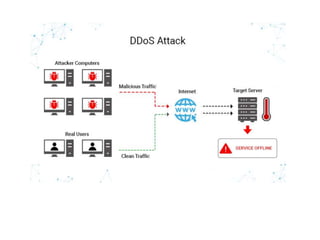
Distributed denial of service (DDoS) attacks are developed in a
distributed fashion.
In real networks, the intended victims of DoS attacks are usually
powerful servers with fast network connections.
The DoS attacker, has only limited computational and network
resources in most cases.
As a result, in order to conduct a successful DoS attack against a
powerful victim server, the smart attacker distributes and
propagates the attack script over multiple intermediate hosts.
These intermediate hosts are called zombies or bots in the hacker
community. The aggregation with a well organized structure for all
zombies resources, however, is enough to overwhelm powerful
servers with very fast connections.
Detection Approaches for DoS and DDoS Attacks
• Some existing intrusion detection systems such as Snort apply
signatures of well known DoS and DDoS attacks for identify
them
• Others monitor the changes in the normal behavior of host and
network and any deviation will be detected and reported as an
attack e.g. Bro
• A high traffic volume near the target server might be an
indication of DDoS attacks
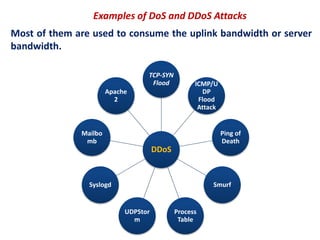
Examples of DoS and DDoS Attacks
Most of them are used to consume the uplink bandwidth or server
bandwidth.
DDoS
TCP-SYN
Flood ICMP/U
DP
Flood
Attack
Ping of
Death
Smurf
Process
Table
UDPStor
m
Syslogd
Mailbo
mb
Apache
2
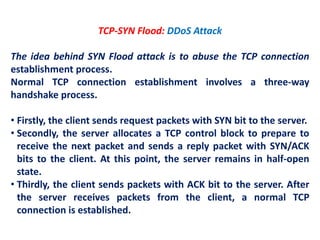
TCP-SYN Flood: DDoS Attack
The idea behind SYN Flood attack is to abuse the TCP connection
establishment process.
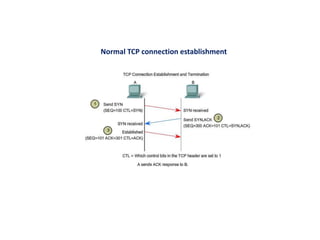
Normal TCP connection establishment involves a three-way
handshake process.
• Firstly, the client sends request packets with SYN bit to the server.
• Secondly, the server allocates a TCP control block to prepare to
receive the next packet and sends a reply packet with SYN/ACK
bits to the client. At this point, the server remains in half-open
state.
• Thirdly, the client sends packets with ACK bit to the server. After
the server receives packets from the client, a normal TCP
connection is established.
Normal TCP connection establishment
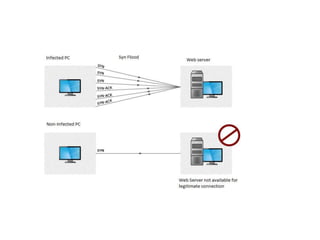
• SYN Flood attack generates a large number of half-open TCP
connections to fill up the TCP control blockin order to exhaust the
available resources.
• As such, the target host becomes unable to accept any more
incoming TCP connections.
• This creates a denial of service for legitimate requests.
• Some existing tools that can execute TCP-SYN flood attacks include
Phatbot/Agobot, TFN2K, Stacheldraht, Trinity, TFN and Shaft [8].
TCP-ACK flood attack
An attacker sends one SYN and multiple ACKs with a spoofed source IP address to overload
the server.
This attack can be simply filtered by a SPI firewall since the flooding packets do not belong
to an established TCP connection.
An example of existing tools to execute TCP-ACK flood attack is Mstream .
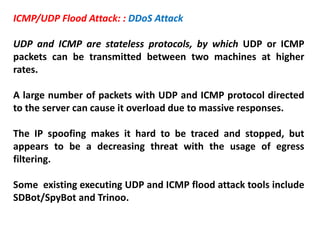
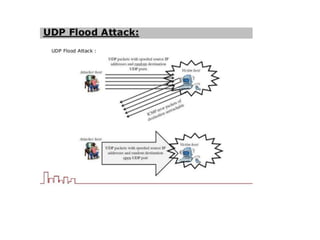
ICMP/UDP Flood Attack: : DDoS Attack
UDP and ICMP are stateless protocols, by which UDP or ICMP
packets can be transmitted between two machines at higher
rates.
A large number of packets with UDP and ICMP protocol directed
to the server can cause it overload due to massive responses.
The IP spoofing makes it hard to be traced and stopped, but
appears to be a decreasing threat with the usage of egress
filtering.
Some existing executing UDP and ICMP flood attack tools include
SDBot/SpyBot and Trinoo.
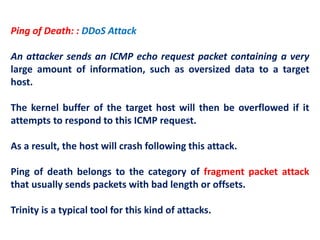
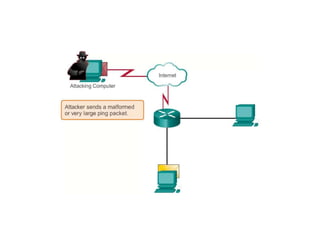
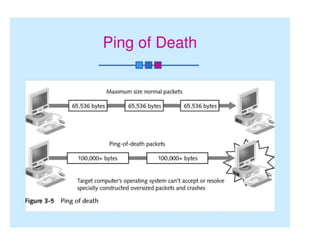
Ping of Death: : DDoS Attack
An attacker sends an ICMP echo request packet containing a very
large amount of information, such as oversized data to a target
host.
The kernel buffer of the target host will then be overflowed if it
attempts to respond to this ICMP request.
As a result, the host will crash following this attack.
Ping of death belongs to the category of fragment packet attack
that usually sends packets with bad length or offsets.
Trinity is a typical tool for this kind of attacks.
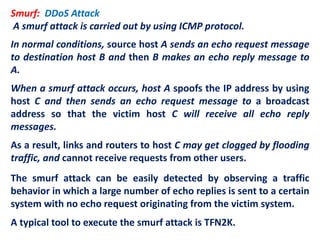
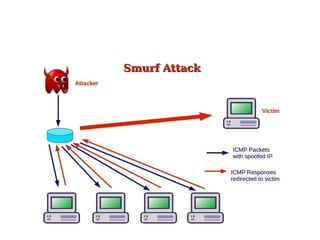
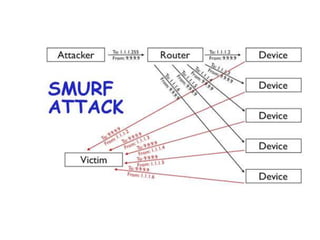
Smurf: DDoS Attack
A smurf attack is carried out by using ICMP protocol.
In normal conditions, source host A sends an echo request message
to destination host B and then B makes an echo reply message to
A.
When a smurf attack occurs, host A spoofs the IP address by using
host C and then sends an echo request message to a broadcast
address so that the victim host C will receive all echo reply
messages.
As a result, links and routers to host C may get clogged by flooding
traffic, and cannot receive requests from other users.
The smurf attack can be easily detected by observing a traffic
behavior in which a large number of echo replies is sent to a certain
system with no echo request originating from the victim system.
A typical tool to execute the smurf attack is TFN2K.
Process Table: DDoS Attack
The process table exploits the vulnerability that network services
will allocate a new process for each incoming TCP/IP
implementation.
It is possible that the process table of a target host will be filled
with multiple instantiations of network servers, and thus other
commands cannot be executed on the target host.
Many Unix services such as smtp, imap, and finger are vulnerable
to this type of attack.
In order to avoid this attack, vulnerable services must have
resistances to rapid-consecutive requests when system load
exceed over a certain level.
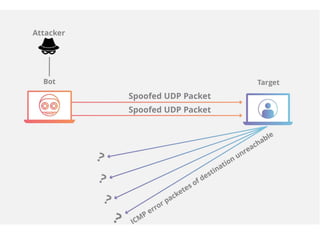
UDPStorm: DDoS Attack
During the UDPStorm attack, an attacker generates a never-
ending data stream between two UDP ports in the same or
different hosts.
As a result, the host cannot offer services to other users and the
network may be congested or slowed down.
Modeling behaviors of such an attack is rather easy and can be
fully prevented using a gateway that blocks IP-spoofed packets.
Syslogd: DDoS Attack
This attack exploits an implementation flaw in syslogd of Solaris
v2.5 server.
The syslogd daemon does a DNS lookup on the source IP address of
an incoming message. In case no IP address is found to match a
valid DNS record, the syslogd service will stop with a Segmentation
Fault error message.
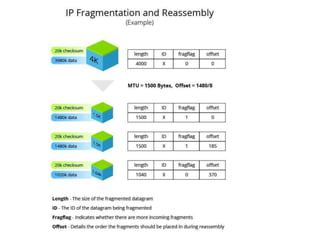
Teardrop attack also exploits flaws in the implementation of IP
protocol in the process of re-assembly of overlapping IP
segments.
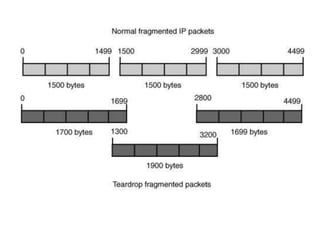
The teardrop attack crashes a system using an unusual
fragmentation of IP packets that will cause a complete crash of a
machine (blue screen) or a loss of network connectivity on
vulnerable machines.
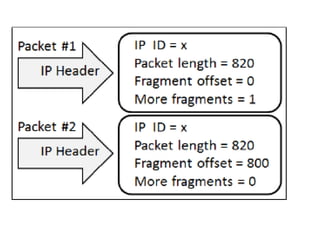
The attacker sends two or more fragments that cannot be
reassembled properly by manipulating the offset value of the
packet and causes the victim’s computer to reboot or halt its
activities.
Updating operating systems using security patches can effectively
prevent this type of attack.
Mailbomb: DDoS Attack
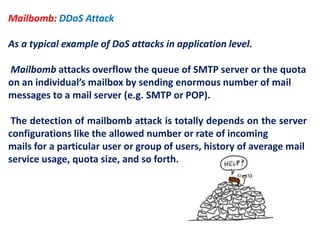
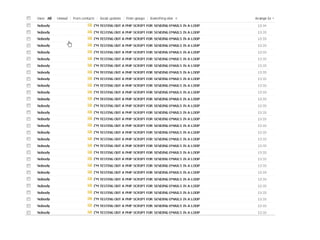
As a typical example of DoS attacks in application level.
Mailbomb attacks overflow the queue of SMTP server or the quota
on an individual’s mailbox by sending enormous number of mail
messages to a mail server (e.g. SMTP or POP).
The detection of mailbomb attack is totally depends on the server
configurations like the allowed number or rate of incoming
mails for a particular user or group of users, history of average mail
service usage, quota size, and so forth.
Apache2: DDoS Attack
An attacker sends a request containing a lot of HTTP headers to
the target Apache web servers.
The server will use an increasing amount of CPU time to process
these headers and thus may deny service to other users and
eventually crash due to running out of memory.
The detection of this attack is rather easy because a typical HTTP
request usually includes at most 20 headers and any deviation
far beyond this limit is anomalous.
Routing Attacks
Routing attacks exploit flaws and vulnerabilities in the design and
implementation of routers. A common routing attack is a protocol
specific break-in that targets operations of routing information
exchange. Most sophisticated attacks or substantial DoS attacks are
originally based on the routing attacks against the IP routing
infrastructure.
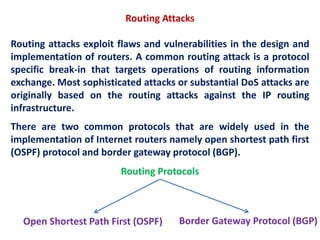
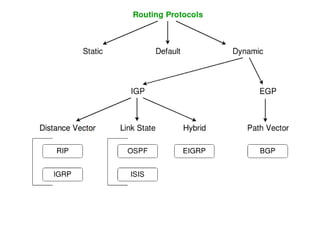
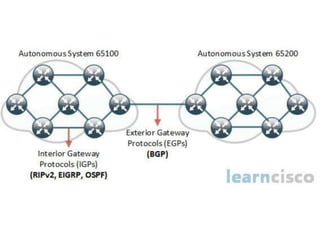
There are two common protocols that are widely used in the
implementation of Internet routers namely open shortest path first
(OSPF) protocol and border gateway protocol (BGP).
Open Shortest Path First (OSPF) Border Gateway Protocol (BGP)
Routing Protocols
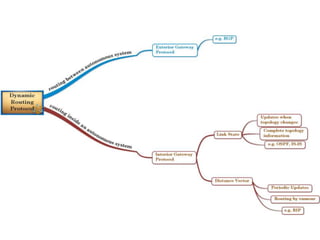
OSPF is perhaps the most widely used link-state hierarchical
Interior Gateway Protocol (IGP) routing algorithm in which the
shortest path tree is calculated using a method based on
Dijkstra’s algorithm.
A link state database is constructed to maintain the tree image of
network topology in each router and identical copies of the
database will be periodically updated by flooding on all routers in
each OSPF aware area.
A natural successor to the RIP (Routing Information Protocol),
OSPF is less vulnerable to external attacks because it does not use
TCP or UDP but uses IP directly and thus negates the need for TCP
or UDP functions.
Open Shortest Path First (OSPF)
BGP is a core routing protocol of the Internet and works by
maintaining a table of IP networks that designate network
reachability both inside an Autonomous System as well as
outside an AS.
BGP is a path vector protocol and does not use traditional IGP
metrics.
Routing decisions are made based on path, network policies or
rules.
Border Gateway Protocol (BGP)
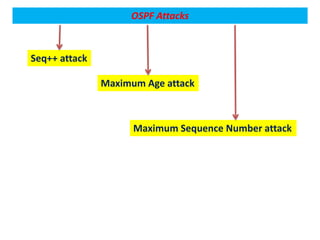
OSPF Attacks
Seq++ attack
Maximum Age attack
Maximum Sequence Number attack
Seq++ Attack: OSPF Attacks: Router Attack
During a seq++ attack…
1. the hacker receives a link state advertisement (LSA) instance
2. modifies the link state metric
3. increases the LSA sequence number by 1, and recalculates
both the LSA and OSPF checksums before the modified LSA is
re-injected into the routing system.
4. Other routers will consider the modified LSA as a fresher due
to its increased sequence number.
5. The changed LSA is finally propagated back to its originator
and then the originator should fight back (according to the
protocol) with a new LSA including correct link status
information and a fresher sequence number.
6. If in this case the attacker keeps on generating seq++ LSAs,
the network topology will become unstable.
Maximum Age: OSPF Attacks: Router Attack
1. the maximum age attack modifies the LSA age to Maximum
Age (i.e. 1 hour) and then re-injects it into the routing system.
2. The modified LSA will make all routers drop the corresponding
LSA from their network topology tables.
3. Similarly, the originator of the dropped LSA will receive the
MaxAge LSA finally and fight back with a new LSA containing
correct link status information and a fresher sequence number.
4. In case the attacker carries on generating Maximum Age LSAs,
the attack could make an unstable network topology.
Maximum Sequence Number : OSPF Attacks: Router Attack
1. This sets the LSA sequence number to Maximum Sequence
Number (7FFFFFFFh).
2. According to the protocol the originator will drop the LSA with
the maximum sequence number and then flood a new LSA
containing correct link status information with the smallest
sequence number:80000001h.
3. If the OSPF protocol is implemented properly, an unlimited
generation of such a LSA with maximum sequence number
therefore lead an unstable network topology.
4. In case dropping the MaxSeq LSA is missed in the router, the
MaxSeq LSA will stay in every router’s topology table for one
hour before it reaches its Maximum Age.
BGP Attacks
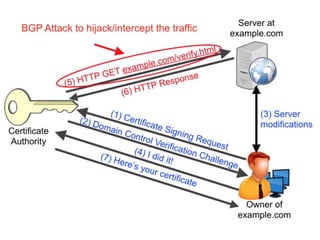
1. The main objectives of a typical BGP attack usually include
blackholing, redirection, subversion and instability.
2. Blackholing makes a prefix unreachable from a large portion of
the Internet.
3. Redirection enforces traffic flowing to a particular network
taking a different path and then reaching a compromised
destination.
4. Subversion can sniff and modifying data when the traffic is
forced to pass through a certain link.
5. Instability can trigger route dampening in upstream routers and
therefore cause connectivity outages.
BGP Attacks…
4. Blackholing, redirection and instability can be easily achieved
when a compromised router modifies, drops, or introduces fake
BGP updates.
5. In this case other routers obtain incorrect view of the network
conditions and topology.
6. There are 7 common mechanisms that BGP attackers usually
like to use, namely-
i. false updates
ii. prefix hijacking
iii. de-aggregation
iv. contradictory advertisements
v. update modifications
vi. advertent link flapping
vii. instability and congestion-induced BGP session failures.
BGP Attacks…
7. During false updates and prefix hijacking an AS announces or
originates an invalid route or prefix that it does not actually
have.
8. De-Aggregation breaks up an address block into a number of
specific longer prefixes with higher preferences and as a result,
the attacker can announce fake routes preferred over the
legitimate routes to that network.
9. Contradictory advertisement is a legitimate inter-domain traffic
engineering technique in which different routing
announcements are sent by the same AS to different BGP
peers.
10. The attacker can exploit it by redirecting traffic to the
malicious router itself or to another AS, resulting in congestion
in that AS.
11. In update modifications a compromised router redirects traffic
to make trouble for the origin AS. It is difficult to detect this
attack because business relationships and policies between AS
and/or service providers are kept confidential and will not be
released to the third party.
12. Through the advertent link flapping a compromised router
advertently flaps a route to a victim address block in a fashion
that neighboring BGP speakers dampen those routes.
Therefore, the victim network will stay unreachable during the
time period of route dampening.
13. Instability can be caused by many factors, such as a number of
timeout BGP sessions due to –
i. link congestion
ii. Router reboots
iii. Repeatedly physical link failures
iv. Routing or policy changes
14. Instability attacks are usually conducted by exploiting one or
more hijacked routers.
15. The congestion-induced BGP session failures exploit an
implementation flaw that the heavy congestion carrying BGP
peering sessions in links will lead to a slowdown for TCP based
BGP sessions.
16. As a result many of these sessions will be eventually aborted,
causing thousands of routes to be withdrawn.
17. When BGP sessions are backed up again, routers have to
exchange full routing tables, thus creating large amounts of
BGP traffic and causing significant routing convergence delays.
Ids 009 network attacks

Ids 009 network attacks

  • 1.
  • 2.
    Probe Privilege Escalation Attacks DoSand DDoS Attacks Worm Attacks Routing Attacks
  • 3.
    Probes Network probes areusually attacks scanning computer networks to gather information or find known vulnerabilities, which are exploited for further or future attacks. The goal of this information gathering is to find out about computer and services that are present in a network as well as to detect the possibility of attack based on known vulnerabilities.
  • 4.
    Publicly Available ScanningTools Scannin g Tools IPSweep and PortSweep Nmap Mscan SAINT Satan
  • 5.
    IPSweep and PortSweep •The IPSweep attack determines which hosts are listening on networks through a surveillance sweep. • The Portsweep is used to scan which ports of a specified computer are opened in a network (or subnet). • The IPSweep and PortSweep attack determine the running host and its service types, and then the collected information can be used by attackers in staging attacks and searching for vulnerable computers. • Detecting an ongoing IPSweep or PortSweep attack is rather easy, especially if it is performed in a linear single-source fashion. • It is harder to detect if multiple hosts or spoofed source IPs or non-time-linear are used during the sweeping.
  • 6.
    NMap NMap is afree and open source utility that mainly performs IP scans, port scans, firewall scans and OS fingerprinting using raw IP packets directed at victim computers. The inter packet timing is adjustable and ports can be scanned sequentially or randomly. Detecting scans conducted by NMap is difficult due to the distribution of multiple sources and slowing timing schedule of the attack that make the probing stealthy over a long time period.
  • 7.
    MScan uses DNSzone transfers and brute force scanning over the whole domains and complete ranges of IP addresses to discover active computers and probe them for well known vulnerabilities in various network services such as- • Statd • NFS • cgibin programs • open X servers • Pop3 • Imap • finger There exist different signatures for MScan attack detection are various, depending on which flaws and how many target computers are being probed. MScan
  • 8.
    SAINT SAINT is theacronym for Security Administrator’s Integrated Network Tool It gathers a large amount of information from networking services, such as finger, ftp, telnet, tftp, NIS, NFS, rexd, statd, and some other services. SAINT is not an attack tool in its very basic form. It, however, gathers information that can be exploited for attackers to start further intrusions. The information mainly contains misconfiguration of network services, well-known vulnerabilities in operating systems or network utilities, and weak policy decisions.
  • 9.
    SAINT provides threeoptional modes of operation, namely- • light mode • normal model • heavy model In light mode, SAINT scans the target computer for discovering RPC and DNS vulnerabilities as well as unsecured NFS mount points. In normal mode, SAINT detects the vulnerabilities of fingerd, bootd, and rusersd and performs port scans on several well known TCP ports such as HTTP, FTP, Telnet, SMTP, UUCP, and NNTP, and UDP ports, such as DNS. Heavy mode is similar with normal mode except that many other uncommon ports are scanned as well.
  • 10.
    Satan Satan is acollection of C and Perl programs and is the previous version of SAINT. Like SAINT, Satan supports three levels of scanning: light, normal, and heavy. An example for the list of vulnerabilities scanning in the heavy mode is as follows- • NFS export to unprivileged programs. • NFS export via port mapper. • NIS password file access. • REXD access. • TFTP file access. • Remote shell access. • Unrestricted NFS export. • Unrestricted X Server access. • Write-able FTP home directory. • Several Sendmail vulnerabilities. • Several FTP vulnerabilities.
  • 11.
    Privilege Escalation Attacks(PEA) Attacks in which the intruder exploits a bug in a software application to gain access to resource resulting in an escalation of current privilege levels to carry out a malicious action. Known attacks in this type can be generally divided into two categories: Vertical privilege escalation Or User to Super User Horizontal privilege escalation Or Non-User to User Privilege Escalation Attacks
  • 12.
    1. Vertical privilegeescalation or User to Super-user A lower privilege user with ordinary user account on a system exploits some flaws to assess functions or content reserved for higher privileged users or super (root) users. 2. Horizontal privilege escalation or Non-user to User A normal user with ordinary account or without any account on a system exploits some vulnerability in the system in order to assess functions or content reserved for other normal users.
  • 13.
  • 14.
    Buffer Overflow Attacks Abuffer is a contiguous allocated chunk of memory, such as an array or a pointer in C language. Buffer overflow occurs when a program or process tries to store more data in a buffer than it is intended to hold. Since buffers are created to store a finite amount of data, the extra information leading an overflow into adjacent buffers, and thus corrupting and overwriting the valid data held in them.
  • 15.
    Buffer overflow attacksexploit this vulnerability and place the code that the attacker tries to execute in the buffer’s overflowing area. The attacker then overwrite the return address of functions so it points back to the buffer and execute the intended code to trigger specific actions such as- 1. Spawning a shell with root permissions 2. Damage the user’s files 3. Change data 4. Disclose confidential information Buffer Overflow Attacks ….
  • 16.
    Misconfiguration Attacks Any misconfigurationor weak configuration can be used by intruders either to skip a security barrier or a security breach. As a result, misconfigurtation or missing patch has become one of the most significant vulnerabilities A prediction shows that misconfiguration attacks will account for 70% of successful WLAN attacks through 2009. Examples of misconfiguration attacks are – 1. Dictionary 2. FTPWrite
  • 17.
    Dictionary Attack orBrute-Force Attack An attacker knows about a user-name and makes repeated guessing attempts for the password from a list of possible passwords. If the administrator does not change the default username and password, guessing the possible passwords will become very easy. Prevention Method 1. Setting up a maximum number of failed login attempts for each service 2. Inserting some delay between two consecutive login tries
  • 18.
    FTP-Write Attack It exploitsthe anonymous account that is a common login mode provided by FTP services. If the anonymous FTP root directory or its subdirectories are owned by the FTP account or are in the same group as the FTP account and they are not write protected, an attacker will be able to add files like rhosts to gain local access to the system. Detect and Prevent FTP-Write Attack 1. By monitoring anonymous FTP accounts 2. By checking for any attempts to create filesin the FTP root folder
  • 19.
    Race-condition Attacks A racecondition occurs when the output and/or result of the process is unexpectedly and critically dependent on the sequence or timing of other specific competing instructions. A well known example of is the old Unix login attack, in which when a new login process is created, there exists a short time gap that the new process is running at priority (kernel or root) mode and has not yet been switched to the normal user mode. At this time, if the human user repeatedly poked at the escape key while logging in, it is possible that the change from root to user will be prevented, allowing the human completing access to the entire system.
  • 20.
    Some other placesfor race condition attacks involve 1. The opening and validating of a shell or batch file 2. Running a subprogram 3. Checking a password 4. Verifying a user name Prevention 1. Initial checking is made to ensure that the batch file is safe 2. Have a good software writing practices, such as to be aware of what are atomic and non-atomic operations in application program macros, shell scripts, and locally written or user written programs 3. The system end users should always pay attentions to the security updates that patch race condition holes
  • 21.
    Man-in-the-Middle Attacks (MITM) Theattacker controls the entire conversation between victims by making the independent connection with each victim, relaying messages between victims and making victims believe that they are talking directly to each other over a private connection. The attacker intercept all messages going between the two victims, inject new ones How to prevent MITM attacks? 1. Cryptographic protocols 2. Endpoint authentication mechanisms
  • 22.
    Social Engineering Attacks Anattack in which an attacker attempts to mislead a victim by aggressive persuasion for accessing to a protected critical information system. The social engineering attack can be divided into two categories: 1. Physical Attacks 2. Psychological Attacks Examples: Physical Attacks : trash dump Psychological Attacks : a pretended persuasion by telephone or online communications
  • 24.
    Denial of Service(DoS) and Distributed Denial of Service (DDoS) Attacks • Aim to interfere with the normal operation of network services by flooding, exhausting and overwhelming the resources of the targeted network or host. • The resources may be network bandwidth, router’s packet forwarding capacity, name servers, memory/computing power on servers, or operating systems’ data structures. • During DoS attacks, attackers usually generate large amounts of nonsense traffic such as incomplete TCP connections, malformed IP packets, bots-generated requests to web pages and some other carefully crafted methods, causing the service or program to cease functioning or prevent others from making use of the service or program.
  • 25.
    Distributed denial ofservice (DDoS) attacks are developed in a distributed fashion. In real networks, the intended victims of DoS attacks are usually powerful servers with fast network connections. The DoS attacker, has only limited computational and network resources in most cases. As a result, in order to conduct a successful DoS attack against a powerful victim server, the smart attacker distributes and propagates the attack script over multiple intermediate hosts. These intermediate hosts are called zombies or bots in the hacker community. The aggregation with a well organized structure for all zombies resources, however, is enough to overwhelm powerful servers with very fast connections.
  • 26.
    Detection Approaches forDoS and DDoS Attacks • Some existing intrusion detection systems such as Snort apply signatures of well known DoS and DDoS attacks for identify them • Others monitor the changes in the normal behavior of host and network and any deviation will be detected and reported as an attack e.g. Bro • A high traffic volume near the target server might be an indication of DDoS attacks
  • 27.
    Examples of DoSand DDoS Attacks Most of them are used to consume the uplink bandwidth or server bandwidth. DDoS TCP-SYN Flood ICMP/U DP Flood Attack Ping of Death Smurf Process Table UDPStor m Syslogd Mailbo mb Apache 2
  • 29.
    TCP-SYN Flood: DDoSAttack The idea behind SYN Flood attack is to abuse the TCP connection establishment process. Normal TCP connection establishment involves a three-way handshake process. • Firstly, the client sends request packets with SYN bit to the server. • Secondly, the server allocates a TCP control block to prepare to receive the next packet and sends a reply packet with SYN/ACK bits to the client. At this point, the server remains in half-open state. • Thirdly, the client sends packets with ACK bit to the server. After the server receives packets from the client, a normal TCP connection is established.
  • 30.
    Normal TCP connectionestablishment
  • 32.
    • SYN Floodattack generates a large number of half-open TCP connections to fill up the TCP control blockin order to exhaust the available resources. • As such, the target host becomes unable to accept any more incoming TCP connections. • This creates a denial of service for legitimate requests. • Some existing tools that can execute TCP-SYN flood attacks include Phatbot/Agobot, TFN2K, Stacheldraht, Trinity, TFN and Shaft [8]. TCP-ACK flood attack An attacker sends one SYN and multiple ACKs with a spoofed source IP address to overload the server. This attack can be simply filtered by a SPI firewall since the flooding packets do not belong to an established TCP connection. An example of existing tools to execute TCP-ACK flood attack is Mstream .
  • 33.
    ICMP/UDP Flood Attack:: DDoS Attack UDP and ICMP are stateless protocols, by which UDP or ICMP packets can be transmitted between two machines at higher rates. A large number of packets with UDP and ICMP protocol directed to the server can cause it overload due to massive responses. The IP spoofing makes it hard to be traced and stopped, but appears to be a decreasing threat with the usage of egress filtering. Some existing executing UDP and ICMP flood attack tools include SDBot/SpyBot and Trinoo.
  • 35.
    Ping of Death:: DDoS Attack An attacker sends an ICMP echo request packet containing a very large amount of information, such as oversized data to a target host. The kernel buffer of the target host will then be overflowed if it attempts to respond to this ICMP request. As a result, the host will crash following this attack. Ping of death belongs to the category of fragment packet attack that usually sends packets with bad length or offsets. Trinity is a typical tool for this kind of attacks.
  • 38.
    Smurf: DDoS Attack Asmurf attack is carried out by using ICMP protocol. In normal conditions, source host A sends an echo request message to destination host B and then B makes an echo reply message to A. When a smurf attack occurs, host A spoofs the IP address by using host C and then sends an echo request message to a broadcast address so that the victim host C will receive all echo reply messages. As a result, links and routers to host C may get clogged by flooding traffic, and cannot receive requests from other users. The smurf attack can be easily detected by observing a traffic behavior in which a large number of echo replies is sent to a certain system with no echo request originating from the victim system. A typical tool to execute the smurf attack is TFN2K.
  • 41.
    Process Table: DDoSAttack The process table exploits the vulnerability that network services will allocate a new process for each incoming TCP/IP implementation. It is possible that the process table of a target host will be filled with multiple instantiations of network servers, and thus other commands cannot be executed on the target host. Many Unix services such as smtp, imap, and finger are vulnerable to this type of attack. In order to avoid this attack, vulnerable services must have resistances to rapid-consecutive requests when system load exceed over a certain level.
  • 42.
    UDPStorm: DDoS Attack Duringthe UDPStorm attack, an attacker generates a never- ending data stream between two UDP ports in the same or different hosts. As a result, the host cannot offer services to other users and the network may be congested or slowed down. Modeling behaviors of such an attack is rather easy and can be fully prevented using a gateway that blocks IP-spoofed packets.
  • 44.
    Syslogd: DDoS Attack Thisattack exploits an implementation flaw in syslogd of Solaris v2.5 server. The syslogd daemon does a DNS lookup on the source IP address of an incoming message. In case no IP address is found to match a valid DNS record, the syslogd service will stop with a Segmentation Fault error message.
  • 45.
    Teardrop attack alsoexploits flaws in the implementation of IP protocol in the process of re-assembly of overlapping IP segments. The teardrop attack crashes a system using an unusual fragmentation of IP packets that will cause a complete crash of a machine (blue screen) or a loss of network connectivity on vulnerable machines. The attacker sends two or more fragments that cannot be reassembled properly by manipulating the offset value of the packet and causes the victim’s computer to reboot or halt its activities. Updating operating systems using security patches can effectively prevent this type of attack.
  • 49.
    Mailbomb: DDoS Attack Asa typical example of DoS attacks in application level. Mailbomb attacks overflow the queue of SMTP server or the quota on an individual’s mailbox by sending enormous number of mail messages to a mail server (e.g. SMTP or POP). The detection of mailbomb attack is totally depends on the server configurations like the allowed number or rate of incoming mails for a particular user or group of users, history of average mail service usage, quota size, and so forth.
  • 51.
    Apache2: DDoS Attack Anattacker sends a request containing a lot of HTTP headers to the target Apache web servers. The server will use an increasing amount of CPU time to process these headers and thus may deny service to other users and eventually crash due to running out of memory. The detection of this attack is rather easy because a typical HTTP request usually includes at most 20 headers and any deviation far beyond this limit is anomalous.
  • 52.
    Routing Attacks Routing attacksexploit flaws and vulnerabilities in the design and implementation of routers. A common routing attack is a protocol specific break-in that targets operations of routing information exchange. Most sophisticated attacks or substantial DoS attacks are originally based on the routing attacks against the IP routing infrastructure. There are two common protocols that are widely used in the implementation of Internet routers namely open shortest path first (OSPF) protocol and border gateway protocol (BGP). Open Shortest Path First (OSPF) Border Gateway Protocol (BGP) Routing Protocols
  • 57.
    OSPF is perhapsthe most widely used link-state hierarchical Interior Gateway Protocol (IGP) routing algorithm in which the shortest path tree is calculated using a method based on Dijkstra’s algorithm. A link state database is constructed to maintain the tree image of network topology in each router and identical copies of the database will be periodically updated by flooding on all routers in each OSPF aware area. A natural successor to the RIP (Routing Information Protocol), OSPF is less vulnerable to external attacks because it does not use TCP or UDP but uses IP directly and thus negates the need for TCP or UDP functions. Open Shortest Path First (OSPF)
  • 58.
    BGP is acore routing protocol of the Internet and works by maintaining a table of IP networks that designate network reachability both inside an Autonomous System as well as outside an AS. BGP is a path vector protocol and does not use traditional IGP metrics. Routing decisions are made based on path, network policies or rules. Border Gateway Protocol (BGP)
  • 59.
    OSPF Attacks Seq++ attack MaximumAge attack Maximum Sequence Number attack
  • 60.
    Seq++ Attack: OSPFAttacks: Router Attack During a seq++ attack… 1. the hacker receives a link state advertisement (LSA) instance 2. modifies the link state metric 3. increases the LSA sequence number by 1, and recalculates both the LSA and OSPF checksums before the modified LSA is re-injected into the routing system. 4. Other routers will consider the modified LSA as a fresher due to its increased sequence number. 5. The changed LSA is finally propagated back to its originator and then the originator should fight back (according to the protocol) with a new LSA including correct link status information and a fresher sequence number. 6. If in this case the attacker keeps on generating seq++ LSAs, the network topology will become unstable.
  • 61.
    Maximum Age: OSPFAttacks: Router Attack 1. the maximum age attack modifies the LSA age to Maximum Age (i.e. 1 hour) and then re-injects it into the routing system. 2. The modified LSA will make all routers drop the corresponding LSA from their network topology tables. 3. Similarly, the originator of the dropped LSA will receive the MaxAge LSA finally and fight back with a new LSA containing correct link status information and a fresher sequence number. 4. In case the attacker carries on generating Maximum Age LSAs, the attack could make an unstable network topology.
  • 62.
    Maximum Sequence Number: OSPF Attacks: Router Attack 1. This sets the LSA sequence number to Maximum Sequence Number (7FFFFFFFh). 2. According to the protocol the originator will drop the LSA with the maximum sequence number and then flood a new LSA containing correct link status information with the smallest sequence number:80000001h. 3. If the OSPF protocol is implemented properly, an unlimited generation of such a LSA with maximum sequence number therefore lead an unstable network topology. 4. In case dropping the MaxSeq LSA is missed in the router, the MaxSeq LSA will stay in every router’s topology table for one hour before it reaches its Maximum Age.
  • 63.
    BGP Attacks 1. Themain objectives of a typical BGP attack usually include blackholing, redirection, subversion and instability. 2. Blackholing makes a prefix unreachable from a large portion of the Internet. 3. Redirection enforces traffic flowing to a particular network taking a different path and then reaching a compromised destination. 4. Subversion can sniff and modifying data when the traffic is forced to pass through a certain link. 5. Instability can trigger route dampening in upstream routers and therefore cause connectivity outages.
  • 64.
    BGP Attacks… 4. Blackholing,redirection and instability can be easily achieved when a compromised router modifies, drops, or introduces fake BGP updates. 5. In this case other routers obtain incorrect view of the network conditions and topology. 6. There are 7 common mechanisms that BGP attackers usually like to use, namely- i. false updates ii. prefix hijacking iii. de-aggregation iv. contradictory advertisements v. update modifications vi. advertent link flapping vii. instability and congestion-induced BGP session failures.
  • 65.
    BGP Attacks… 7. Duringfalse updates and prefix hijacking an AS announces or originates an invalid route or prefix that it does not actually have. 8. De-Aggregation breaks up an address block into a number of specific longer prefixes with higher preferences and as a result, the attacker can announce fake routes preferred over the legitimate routes to that network. 9. Contradictory advertisement is a legitimate inter-domain traffic engineering technique in which different routing announcements are sent by the same AS to different BGP peers.
  • 66.
    10. The attackercan exploit it by redirecting traffic to the malicious router itself or to another AS, resulting in congestion in that AS. 11. In update modifications a compromised router redirects traffic to make trouble for the origin AS. It is difficult to detect this attack because business relationships and policies between AS and/or service providers are kept confidential and will not be released to the third party. 12. Through the advertent link flapping a compromised router advertently flaps a route to a victim address block in a fashion that neighboring BGP speakers dampen those routes. Therefore, the victim network will stay unreachable during the time period of route dampening.
  • 67.
    13. Instability canbe caused by many factors, such as a number of timeout BGP sessions due to – i. link congestion ii. Router reboots iii. Repeatedly physical link failures iv. Routing or policy changes 14. Instability attacks are usually conducted by exploiting one or more hijacked routers. 15. The congestion-induced BGP session failures exploit an implementation flaw that the heavy congestion carrying BGP peering sessions in links will lead to a slowdown for TCP based BGP sessions. 16. As a result many of these sessions will be eventually aborted, causing thousands of routes to be withdrawn. 17. When BGP sessions are backed up again, routers have to exchange full routing tables, thus creating large amounts of BGP traffic and causing significant routing convergence delays.