e-GovernanceVision and
Strategy
ASHFAQ AHAMMED.P
PGDeG 2015-16
IIITMK-Technopark
Understanding e-Governance Strategy
• What is a ‘Strategy’ in simple terms?
• It is a plan of action for achieving the defined goals and objectives.
• Is a road map to lead an organization from its present state to its desired
medium or long term future state.
• Government Strategy/Plan
• FiveYear Plan by Planning Commission of India
• National/State/Department Action plans for achieving the
national/state/department level goals and objectives…
‘e-Governance Strategy’ is an approach or a plan of action stating how Information
Technology will be leveraged in achieving the stated goals and objectives..
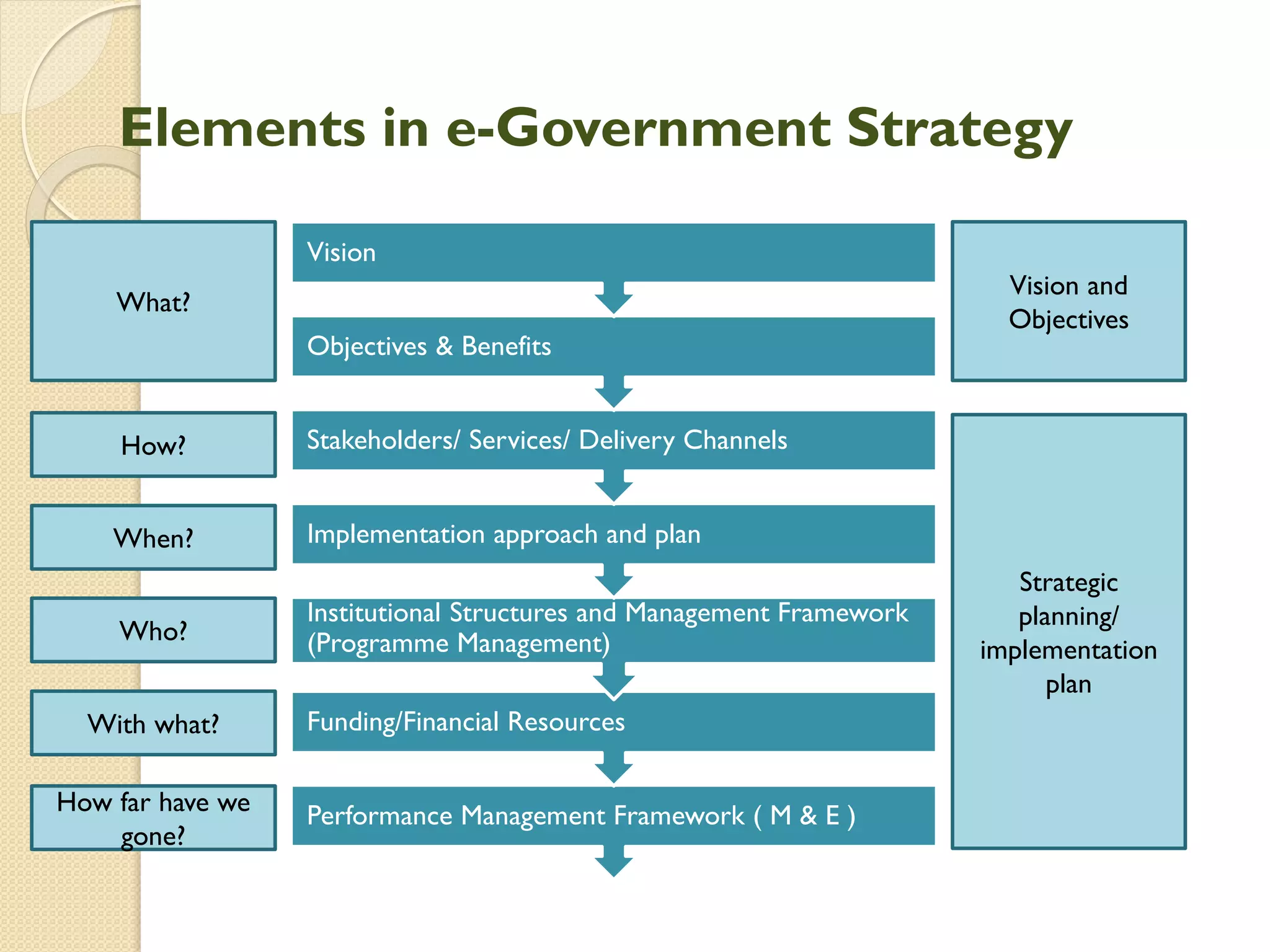
Elements in e-Government Strategy
Performance Management Framework ( M & E )
Funding/Financial Resources
Institutional Structures and Management Framework
(Programme Management)
Implementation approach and plan
Stakeholders/ Services/ Delivery Channels
Objectives & Benefits
Vision
Vision and
Objectives
Strategic
planning/
implementation
plan
What?
How?
When?
Who?
How far have we
gone?
With what?
e-GovernanceVision
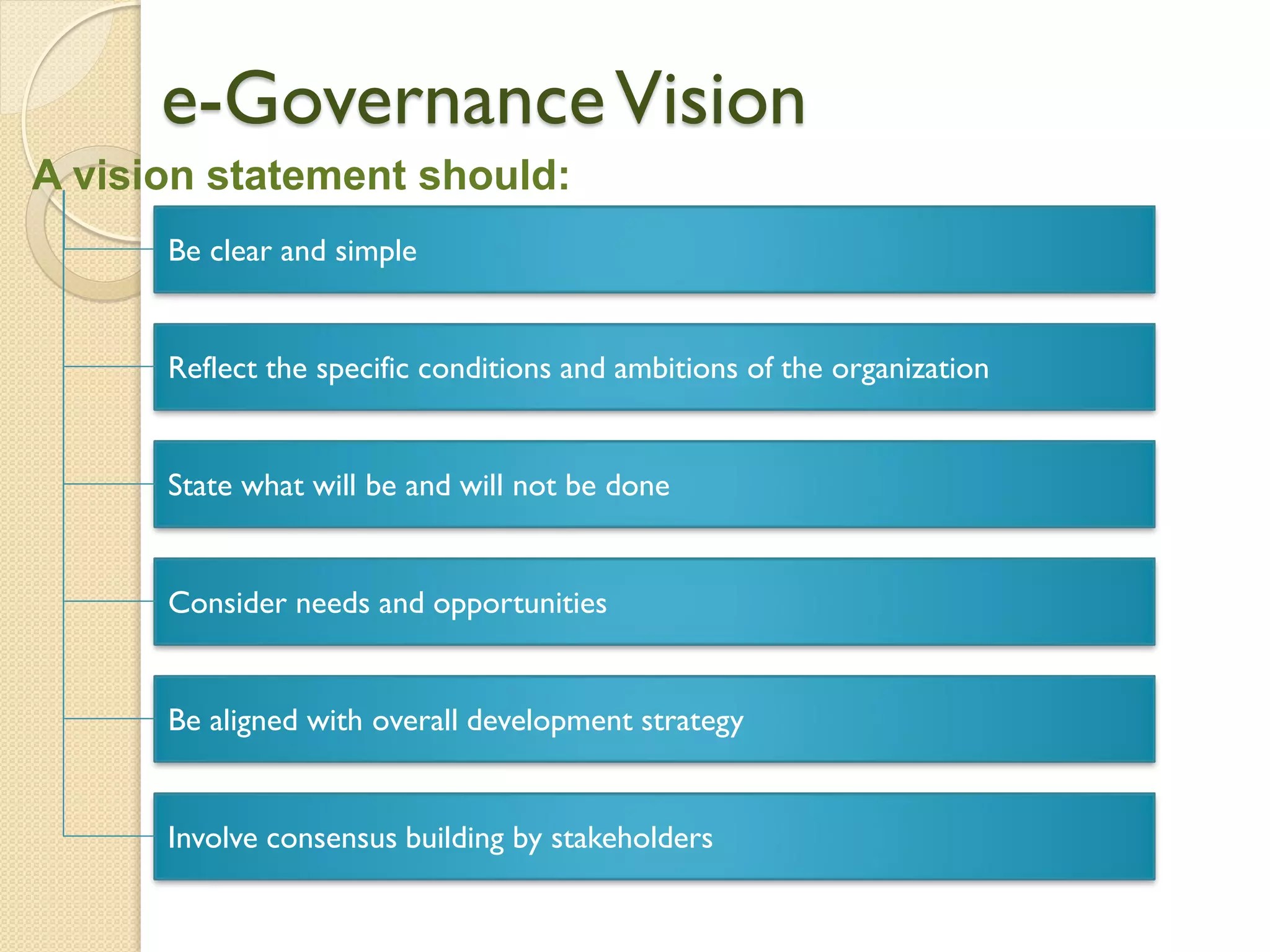
A vision statement should:
Be clear and simple
Reflect the specific conditions and ambitions of the organization
State what will be and will not be done
Consider needs and opportunities
Be aligned with overall development strategy
Involve consensus building by stakeholders
Steps in building vision statement includes:
Identifying and consulting stakeholders
Understand problems, needs and expectations of
Stakeholders
Draft a common vision based on stakeholders needs and
expectations
Aligning vision with more general local development
needs and opportunities
Consolidating and agree on final vision
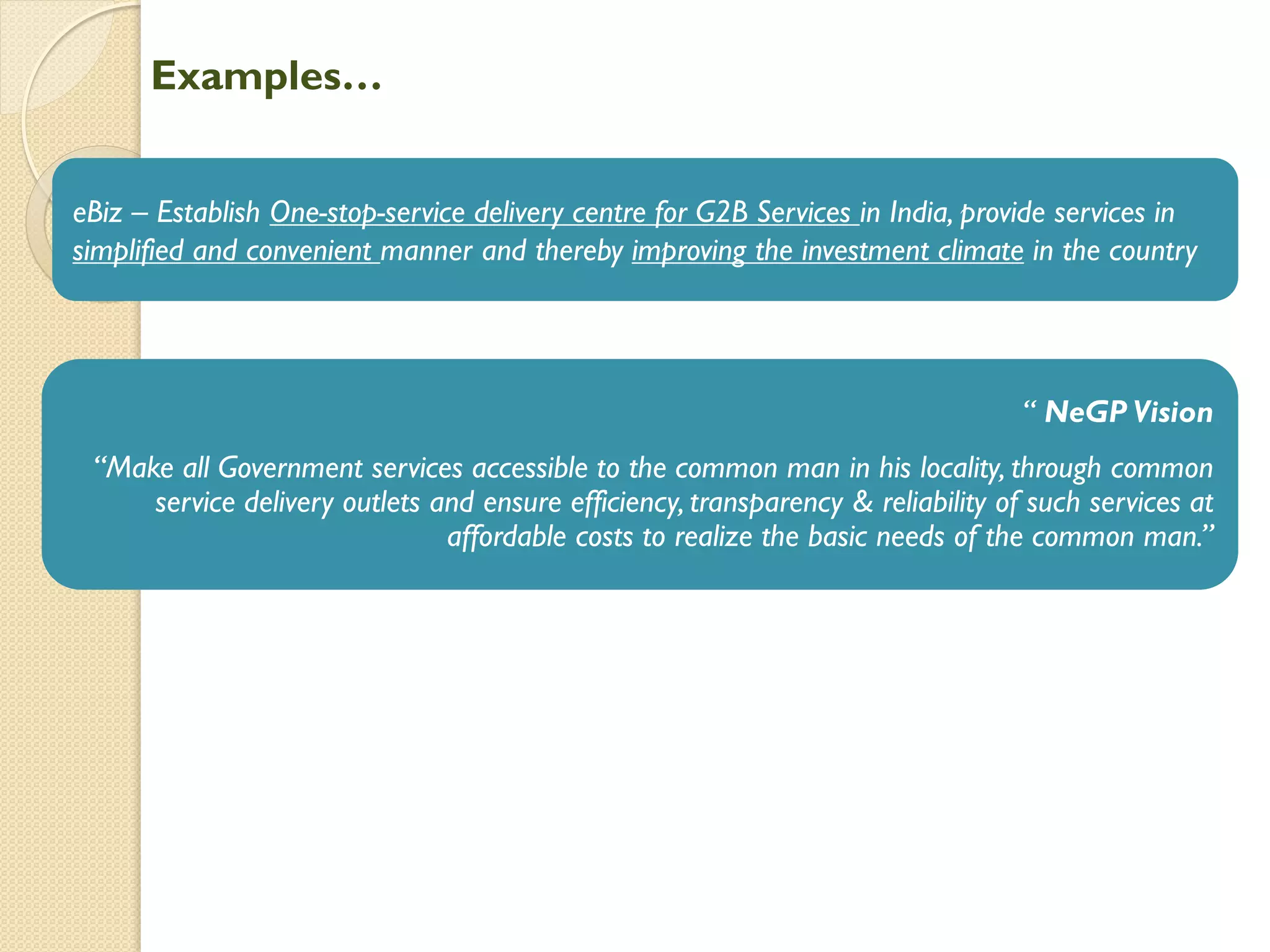
Examples…
eBiz – Establish One-stop-service delivery centre for G2B Services in India, provide services in
simplified and convenient manner and thereby improving the investment climate in the country
“ NeGP Vision
“Make all Government services accessible to the common man in his locality, through common
service delivery outlets and ensure efficiency, transparency & reliability of such services at
affordable costs to realize the basic needs of the common man.”
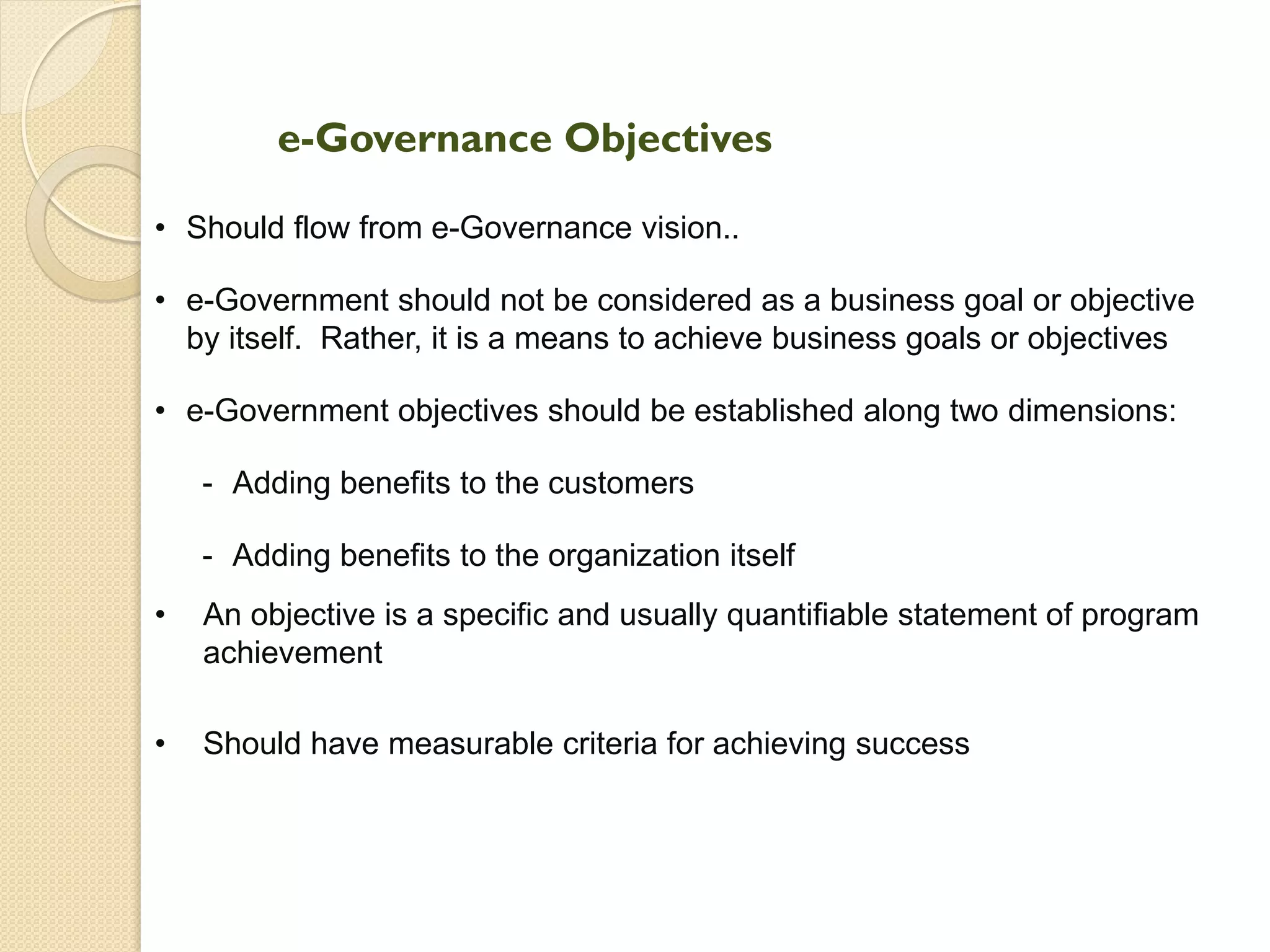
e-Governance Objectives
• Should flow from e-Governance vision..
• e-Government should not be considered as a business goal or objective
by itself. Rather, it is a means to achieve business goals or objectives
• e-Government objectives should be established along two dimensions:
- Adding benefits to the customers
- Adding benefits to the organization itself
• An objective is a specific and usually quantifiable statement of program
achievement
• Should have measurable criteria for achieving success
Defining e-Governance Objectives
For Citizens (General Objectives)
• Streamlined, standardized electronic
information gathering and access
• Reduce the time to access relevant
information
• Enable citizens to find benefits and
determine eligibility
• Reduce the time for citizens to find
information on opportunities,
schemes, benefits etc.
• Electronic delivery of services
• Convenient, any time and anywhere
services
For Citizens (Specific Objectives)
• Provide Passport to citizens in 3
business days
• Instantaneous payments of taxes &
bills online through kiosks
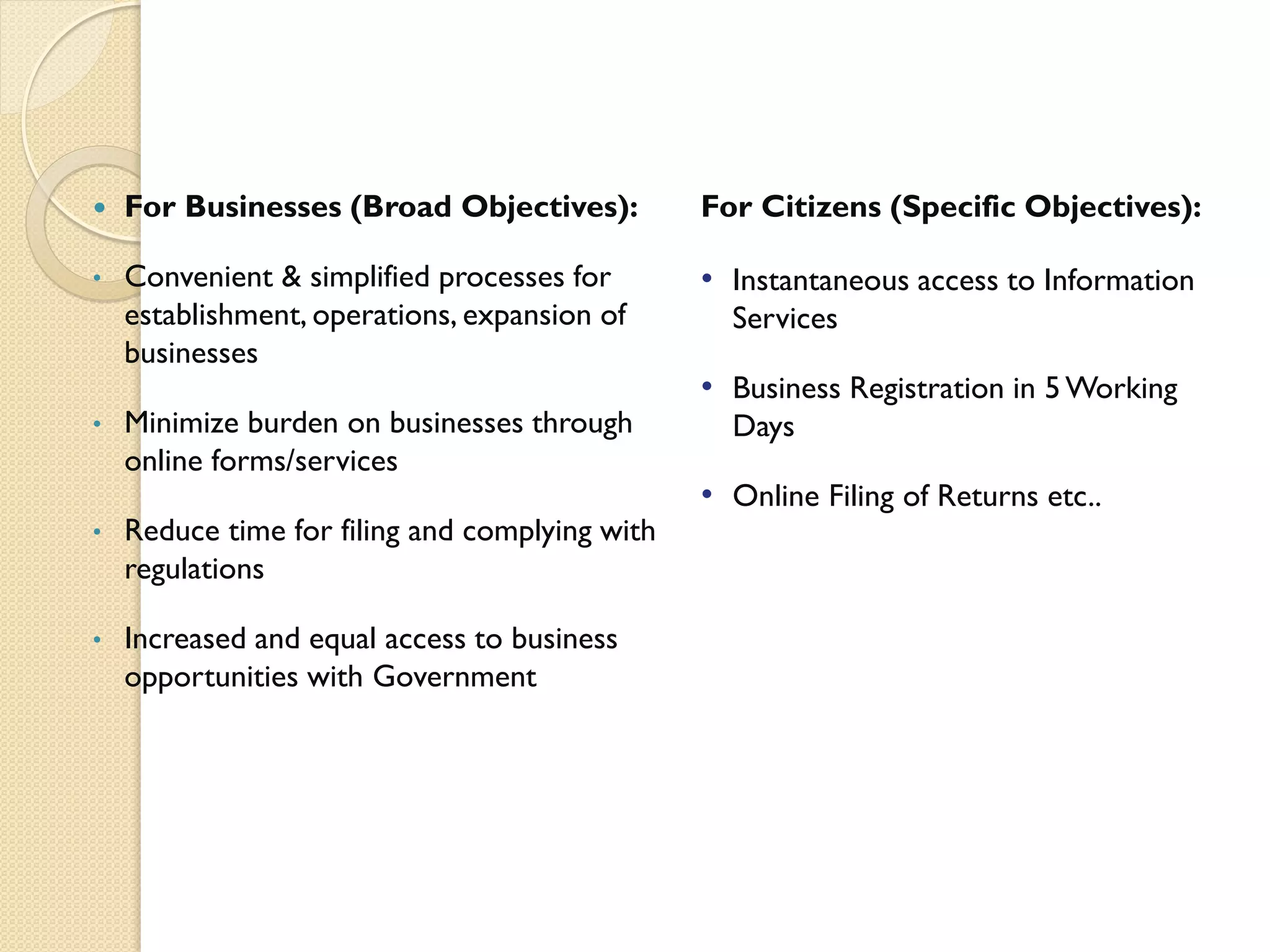
 For Businesses (Broad Objectives):
• Convenient & simplified processes for
establishment, operations, expansion of
businesses
• Minimize burden on businesses through
online forms/services
• Reduce time for filing and complying with
regulations
• Increased and equal access to business
opportunities with Government
For Citizens (Specific Objectives):
• Instantaneous access to Information
Services
• Business Registration in 5 Working
Days
• Online Filing of Returns etc..
 For Department (Broad
Objectives):
• Reduced administrative burden and
Increased employee productivity
• Information reuse across and within
departments
• Cost effectiveness in operations
For Department (Specific):
• Minimize direct interaction between
department & citizens
• Reduce cost of procurement by 50%
• Migrate to 75% online service delivery by
2008
• 0% of transactions at Department
counters for payment of taxes, duties etc..
Key Considerations forVision and Objectives Definition
• To be developed based on extensive interactions with
stakeholders, not based on board room discussions
• To be developed from stakeholder needs, not by department
thoughts
• Stakeholders include:
 Customers (citizens, businesses..) served by the government
 Employees of organization delivering the services..
◦ To be developed to address the current challenges and future needs
◦ To take learning’s/inputs from similar situations and initiatives in India and
world wide…
Identifying Stakeholders/Services/Delivery Channels
1.Stakeholders
Customer Segmentation
 Citizens
 Businesses
 Partners (suppliers and other government agencies)
Key Customer needs to be considered
 Easy Access – single & reliable access to information & services
 Clear Accountability – for delivering the services
 Integrated view of customers - no longer be required to submit the same
information/ documents repeatedly
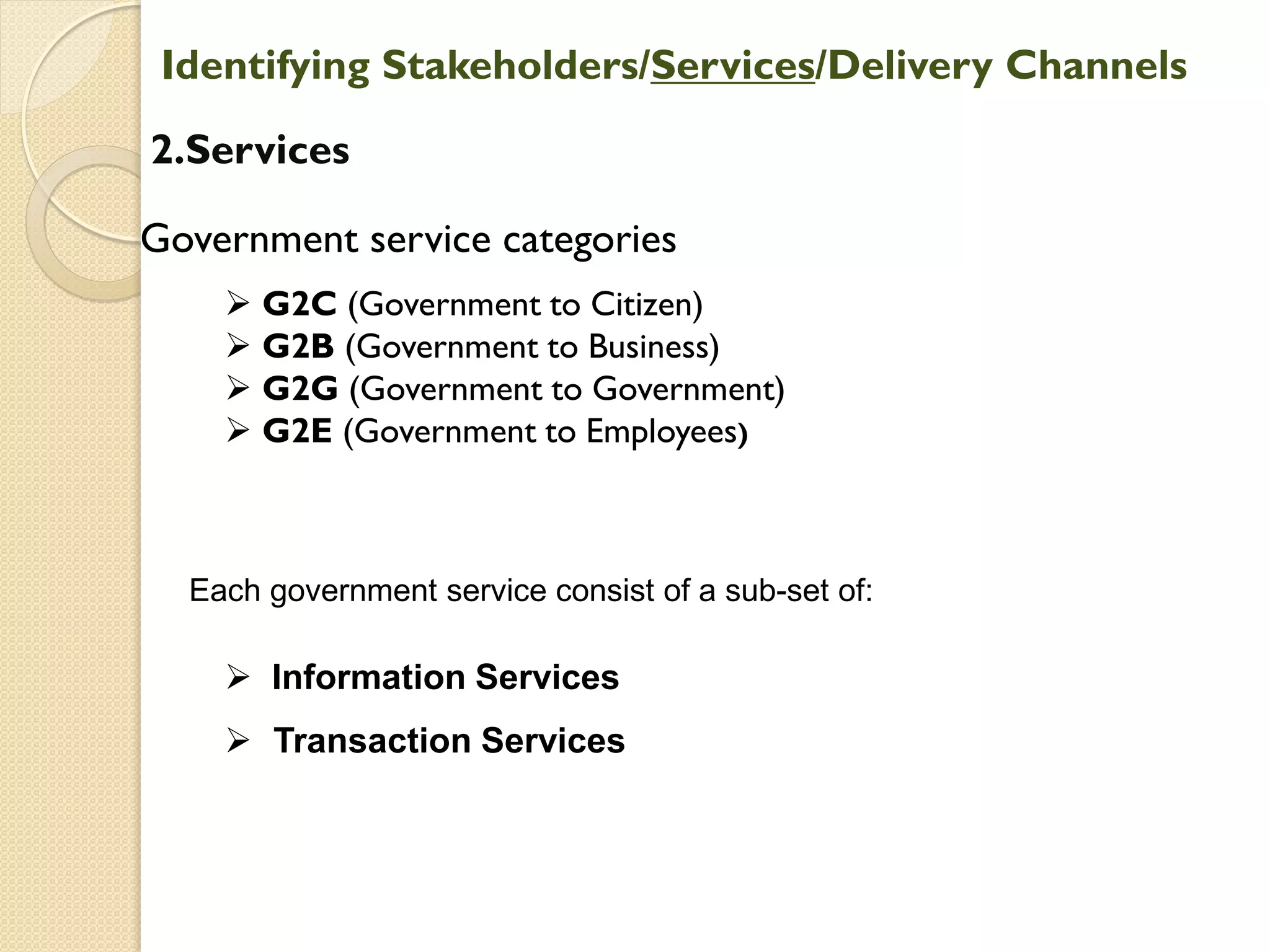
2.Services
Identifying Stakeholders/Services/Delivery Channels
Government service categories
 G2C (Government to Citizen)
 G2B (Government to Business)
 G2G (Government to Government)
 G2E (Government to Employees)
 Information Services
 Transaction Services
Each government service consist of a sub-set of:
 Services of government are generally categorized into:
Information Services
• Includes those services that solely provide ‘information’ to customers and
does not involve processing of any transactions or documents.
• Information services have relatively simple back-office operations and
can be easily be E-Government-enabled
◦ Transaction Services
 Transactional Services: includes those services where customers
require specific actions to be taken by the department.
 Transactional services mandate a higher degree of customer interaction
and more complex delivery operations than informational services.
Registration of a Company
Information Services Transaction Services
How to register company? Receipt of application forms and payments
Forms and documents needed for registration Processing of application and registration
Applicable payments? Issuing registration certificate
Status of registration processing?
Example
Service Category Service Delivery
Channels
How to register company? Information Website/Call Center/Dept
counter/CSC
Forms and documents needed for registration Information Website/Call Center/Dept
counter/CSC
Applicable payments? Information Website/Call Center/Dept
counter/CSC
Status of registration processing? Information Website/Call Center/Dept
counter/CSC
Receipt of application forms and payments Transaction Website/Call Center/Dept
counter/CSC
Processing of application and registration Transaction Internal to government
Issuing registration certificate Transaction Website/e-mail/Dept
counter/CSC
 Channels
 Department counters
 Internet/Portal
 Call Center
 Kiosk (CSCs)
 Mobile computing etc…
 Primary Channels
 Internet & Kiosks
 Secondary channels
 Call Center & Department
Counters
 Extended Reach
 Mobile computing etc.
Selection of delivery channels is
a critical element…. identifying
portal and internet as a service
delivery channel as the
primary channel for citizens in
rural parts of the State is a
bad choice…..
Internet penetration in villages
and rural parts is LOW
Identifying Stakeholders/Services/Delivery Channels
Implementation Approach and Plan
The four widely discussed implementation models are:
1.Big bang
The e-Governance project is launched across the location for all the
functions at the same time.All users move to the new system on a given date.
2.Phased rollout
Changeover occurs in phases over an extended period of time. Users
move onto new system in a phased manner.
3.Parallel adoption
Both the legacy and new system run at the same time. Users learn the
new system while working on the old.
4.Pilot and rollout
A small(sample) part of the project is implemented for testing purposes
before the complete project rollout is done.
Programme Management Framework
• A well planned programme or project management office with right
resources, skills and infrastructure can substantially improve the likelihood of
project success
• Programme management office should consist of cross-functional teams
with direct and strong executive management support
• e-Government implementation efforts are generally distributed as follows :
- 10% technical infrastructure implementation
- 30% software development and system integration
- 50% change management
- 10% Other activities
• Change management should focus on four key people segments - suppliers,
business partners, customers and employees.
• Programme management should appoint strategic partners for advice and
counseling on technical and business issues.
• Programme management should follow a phased approach with clear
deliverables and regular check-points.
Funding and Financial Resources
Consultancy Services
(Strategy development, process reengineering, systems design, business model
development, vendor selection, programme management, Quality assurance,
M & E, change management…)
Software Design, Development and Maintenance
(Custom development, ERP implantation, operations and maintenance of
software…)
IT Infrastructure creation and maintenance
(Data Center, Network, end user infrastructure…)
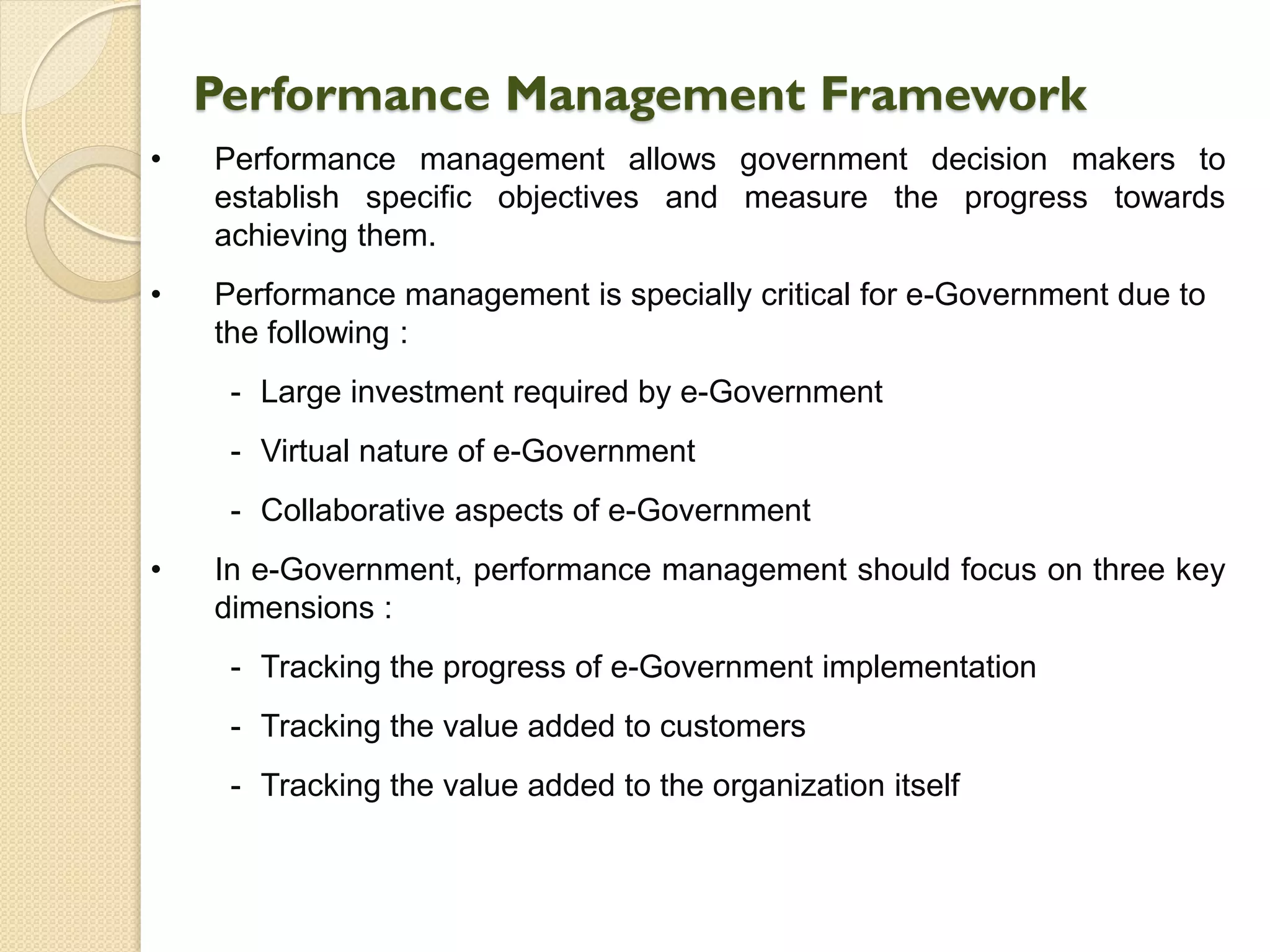
Performance Management Framework
• Performance management allows government decision makers to
establish specific objectives and measure the progress towards
achieving them.
• Performance management is specially critical for e-Government due to
the following :
- Large investment required by e-Government
- Virtual nature of e-Government
- Collaborative aspects of e-Government
• In e-Government, performance management should focus on three key
dimensions :
- Tracking the progress of e-Government implementation
- Tracking the value added to customers
- Tracking the value added to the organization itself
E governance vision and Strategy

E governance vision and Strategy

  • 1.
  • 2.
    Understanding e-Governance Strategy •What is a ‘Strategy’ in simple terms? • It is a plan of action for achieving the defined goals and objectives. • Is a road map to lead an organization from its present state to its desired medium or long term future state. • Government Strategy/Plan • FiveYear Plan by Planning Commission of India • National/State/Department Action plans for achieving the national/state/department level goals and objectives… ‘e-Governance Strategy’ is an approach or a plan of action stating how Information Technology will be leveraged in achieving the stated goals and objectives..
  • 3.
    Elements in e-GovernmentStrategy Performance Management Framework ( M & E ) Funding/Financial Resources Institutional Structures and Management Framework (Programme Management) Implementation approach and plan Stakeholders/ Services/ Delivery Channels Objectives & Benefits Vision Vision and Objectives Strategic planning/ implementation plan What? How? When? Who? How far have we gone? With what?
  • 4.
    e-GovernanceVision A vision statementshould: Be clear and simple Reflect the specific conditions and ambitions of the organization State what will be and will not be done Consider needs and opportunities Be aligned with overall development strategy Involve consensus building by stakeholders
  • 5.
    Steps in buildingvision statement includes: Identifying and consulting stakeholders Understand problems, needs and expectations of Stakeholders Draft a common vision based on stakeholders needs and expectations Aligning vision with more general local development needs and opportunities Consolidating and agree on final vision
  • 6.
    Examples… eBiz – EstablishOne-stop-service delivery centre for G2B Services in India, provide services in simplified and convenient manner and thereby improving the investment climate in the country “ NeGP Vision “Make all Government services accessible to the common man in his locality, through common service delivery outlets and ensure efficiency, transparency & reliability of such services at affordable costs to realize the basic needs of the common man.”
  • 7.
    e-Governance Objectives • Shouldflow from e-Governance vision.. • e-Government should not be considered as a business goal or objective by itself. Rather, it is a means to achieve business goals or objectives • e-Government objectives should be established along two dimensions: - Adding benefits to the customers - Adding benefits to the organization itself • An objective is a specific and usually quantifiable statement of program achievement • Should have measurable criteria for achieving success
  • 8.
    Defining e-Governance Objectives ForCitizens (General Objectives) • Streamlined, standardized electronic information gathering and access • Reduce the time to access relevant information • Enable citizens to find benefits and determine eligibility • Reduce the time for citizens to find information on opportunities, schemes, benefits etc. • Electronic delivery of services • Convenient, any time and anywhere services For Citizens (Specific Objectives) • Provide Passport to citizens in 3 business days • Instantaneous payments of taxes & bills online through kiosks
  • 9.
     For Businesses(Broad Objectives): • Convenient & simplified processes for establishment, operations, expansion of businesses • Minimize burden on businesses through online forms/services • Reduce time for filing and complying with regulations • Increased and equal access to business opportunities with Government For Citizens (Specific Objectives): • Instantaneous access to Information Services • Business Registration in 5 Working Days • Online Filing of Returns etc..
  • 10.
     For Department(Broad Objectives): • Reduced administrative burden and Increased employee productivity • Information reuse across and within departments • Cost effectiveness in operations For Department (Specific): • Minimize direct interaction between department & citizens • Reduce cost of procurement by 50% • Migrate to 75% online service delivery by 2008 • 0% of transactions at Department counters for payment of taxes, duties etc..
  • 11.
    Key Considerations forVisionand Objectives Definition • To be developed based on extensive interactions with stakeholders, not based on board room discussions • To be developed from stakeholder needs, not by department thoughts • Stakeholders include:  Customers (citizens, businesses..) served by the government  Employees of organization delivering the services.. ◦ To be developed to address the current challenges and future needs ◦ To take learning’s/inputs from similar situations and initiatives in India and world wide…
  • 12.
    Identifying Stakeholders/Services/Delivery Channels 1.Stakeholders CustomerSegmentation  Citizens  Businesses  Partners (suppliers and other government agencies) Key Customer needs to be considered  Easy Access – single & reliable access to information & services  Clear Accountability – for delivering the services  Integrated view of customers - no longer be required to submit the same information/ documents repeatedly
  • 13.
    2.Services Identifying Stakeholders/Services/Delivery Channels Governmentservice categories  G2C (Government to Citizen)  G2B (Government to Business)  G2G (Government to Government)  G2E (Government to Employees)  Information Services  Transaction Services Each government service consist of a sub-set of:
  • 14.
     Services ofgovernment are generally categorized into: Information Services • Includes those services that solely provide ‘information’ to customers and does not involve processing of any transactions or documents. • Information services have relatively simple back-office operations and can be easily be E-Government-enabled ◦ Transaction Services  Transactional Services: includes those services where customers require specific actions to be taken by the department.  Transactional services mandate a higher degree of customer interaction and more complex delivery operations than informational services.
  • 15.
    Registration of aCompany Information Services Transaction Services How to register company? Receipt of application forms and payments Forms and documents needed for registration Processing of application and registration Applicable payments? Issuing registration certificate Status of registration processing? Example
  • 16.
    Service Category ServiceDelivery Channels How to register company? Information Website/Call Center/Dept counter/CSC Forms and documents needed for registration Information Website/Call Center/Dept counter/CSC Applicable payments? Information Website/Call Center/Dept counter/CSC Status of registration processing? Information Website/Call Center/Dept counter/CSC Receipt of application forms and payments Transaction Website/Call Center/Dept counter/CSC Processing of application and registration Transaction Internal to government Issuing registration certificate Transaction Website/e-mail/Dept counter/CSC
  • 17.
     Channels  Departmentcounters  Internet/Portal  Call Center  Kiosk (CSCs)  Mobile computing etc…  Primary Channels  Internet & Kiosks  Secondary channels  Call Center & Department Counters  Extended Reach  Mobile computing etc. Selection of delivery channels is a critical element…. identifying portal and internet as a service delivery channel as the primary channel for citizens in rural parts of the State is a bad choice….. Internet penetration in villages and rural parts is LOW Identifying Stakeholders/Services/Delivery Channels
  • 18.
    Implementation Approach andPlan The four widely discussed implementation models are: 1.Big bang The e-Governance project is launched across the location for all the functions at the same time.All users move to the new system on a given date. 2.Phased rollout Changeover occurs in phases over an extended period of time. Users move onto new system in a phased manner. 3.Parallel adoption Both the legacy and new system run at the same time. Users learn the new system while working on the old. 4.Pilot and rollout A small(sample) part of the project is implemented for testing purposes before the complete project rollout is done.
  • 19.
    Programme Management Framework •A well planned programme or project management office with right resources, skills and infrastructure can substantially improve the likelihood of project success • Programme management office should consist of cross-functional teams with direct and strong executive management support • e-Government implementation efforts are generally distributed as follows : - 10% technical infrastructure implementation - 30% software development and system integration - 50% change management - 10% Other activities • Change management should focus on four key people segments - suppliers, business partners, customers and employees. • Programme management should appoint strategic partners for advice and counseling on technical and business issues. • Programme management should follow a phased approach with clear deliverables and regular check-points.
  • 20.
    Funding and FinancialResources Consultancy Services (Strategy development, process reengineering, systems design, business model development, vendor selection, programme management, Quality assurance, M & E, change management…) Software Design, Development and Maintenance (Custom development, ERP implantation, operations and maintenance of software…) IT Infrastructure creation and maintenance (Data Center, Network, end user infrastructure…)
  • 21.
    Performance Management Framework •Performance management allows government decision makers to establish specific objectives and measure the progress towards achieving them. • Performance management is specially critical for e-Government due to the following : - Large investment required by e-Government - Virtual nature of e-Government - Collaborative aspects of e-Government • In e-Government, performance management should focus on three key dimensions : - Tracking the progress of e-Government implementation - Tracking the value added to customers - Tracking the value added to the organization itself