MANAGING E-GOVERNANCE
                    IN PAKISTAN
                                               Asif Kabani, MBA
                           Deputy Director, Decentralization Support Program, NPSO
                                Asian Development Bank & Ministry of Finance
                                Government of Pakistan, Islamabad, Pakistan
                                                    © 2005


MANAGING E-GOVERNANCE IN PAKISTAN                                           By: Asif Kabani, ICEG 2005
3rd   International Conference on E-Governance Dec 9-11. 2005
PRESENTATION OULINE
      1 – Managing E-Governance in Pakistan
            What is E-Governance, Definition and Situational Analysis of E-
            governance
      2 - Strategic Impact of e-governance in Pakistan
            Vision for E-Government in Pakistan, Roadmap for E-Government
            Programme and Components
      3 - Target of e-governance and Impact
      4 – Process of E-Governance
            (Experience & Recommendations for Strategic Initiative)
            1: PUBLISH - using ICT to expand access to government information
            2: INTERACT - broadening civic participation in government
            3-TRANSACT: Making government services available online
      5- Process of Transforming Governments
         through E-Government
      6- Five Elements of Successful E-Governance
         Transformation
      7- Recommendations: Civic Engagement
MANAGING E-GOVERNANCE IN PAKISTAN                                               By: Asif Kabani, ICEG 2005
3rd   International Conference on E-Governance Dec 9-11. 2005
MANAGING E-GOVERNANCE IN
                          PAKISTAN
         1. What is E-Governance

         2. Definition
               –    The definition of e-governance is “the use of information and communication
                    technologies, and particularly the Internet, as a tool to achieve better government”.
               –    The e-governance is more about government than about “e”. Governments are
                    adopting information society tools and working practices to remain responsive to
                    citizens’ needs.
               –    The impact of e-governance is simply better government, by enabling better policy
                    outcomes, higher quality services, greater engagement with citizens, and by improving
                    efficiency, contributing to economic policy objectives and advancing the public reform
                    agenda.                                                 OECD, 2000

         3. Situational Analysis of E-governance

              RS. 2.6BN PLAN FOR E-GOVERNANCE IN PAKISTAN: KARACHI, Oct 14, 2001

MANAGING E-GOVERNANCE IN PAKISTAN                                                   By: Asif Kabani, ICEG 2005
3rd   International Conference on E-Governance Dec 9-11. 2005
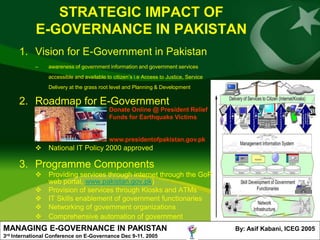
STRATEGIC IMPACT OF
               E-GOVERNANCE IN PAKISTAN
         1. Vision for E-Government in Pakistan
               –    awareness of government information and government services
                    accessible and available to citizen’s i.e Access to Justice, Service
                    Delivery at the grass root level and Planning & Development

         2. Roadmap for E-Government
                                              Donate Online @ President Relief
                                              Funds for Earthquake Victims


                                              www.presidentofpakistan.gov.pk
                National IT Policy 2000 approved

         3. Programme Components
                Providing services through internet through the GoP
                 web portal, www.pakistan.gov.pk)
                Provision of services through Kiosks and ATMs
                IT Skills enablement of government functionaries
                Networking of government organizations
                Comprehensive automation of government
MANAGING E-GOVERNANCE IN PAKISTAN                                                          By: Asif Kabani, ICEG 2005
3rd   International Conference on E-Governance Dec 9-11. 2005
TARGET OF E-GOVERNANCE AND
                            IMPACT
•        Citizen Online - provision of services through GOP portal: (Completed)
•        Salary Disbursement through ATMs
•        IT Skills Training program for Probationary Government Officers (Completed)
•        Process Mapping for improving efficiency at Ministry of Science & Technology: (Completed)
•        Survey of Federal Divisions for LAN & Hardware Requirements: (Completed)
•        Federal Government Data Center: (under implementation)
•        Electronic Office at Ministry of Information Technology (MoIT): (under implementation)
•        Secure Electronic Communications and Office Automation at Prime Minister's Secretariat: (under implementation)
•        Project "Lexicon, Machine Translation & Text-To-Speech Urdu Software". (under implementation)
•        Access to Statutory/Case Laws at District Bar Associations (under implementation)
•        E-Enabling of Majlis-e-Shoora (National Assembly of Pakistan and Senate of Pakistan): (under implementation)
•        Technical Support to IT Departments of Provinces and Azad Jammu & Kashmir: (under implementation)
•        Online Recruitment System for Federal Public Service Commission: (under implementation)
•        E-Services for Submission of Documents at Securities Exchange Commission of Pakistan: (under implementation)
•        E-Services to Citizens in Food, Agriculture and Livestock Sector: (under implementation)
•        E-Services for Commissioner's Office, Islamabad: (under implementation)
•        E-Services for Islamabad Police (under implementation)
•        E-Services for Capital Development Authority: (under implementation)
•        Online Processing of Hajj Applications (under implementation)
•        Hospital Management Information System for PIMS: (under implementation)
•        Hospital Management Information System for CDA Hospital: (under implementation)
•        Automation of Patent Office (under implementation)
•        E-Enablement of Press Clubs (under implementation)

MANAGING E-GOVERNANCE IN PAKISTAN                                                         By: Asif Kabani, ICEG 2005
3rd   International Conference on E-Governance Dec 9-11. 2005
TARGET OF E-GOVERNANCE AND
                         IMPACT (Continued)
•        E-Enablement of Establishment Division
•        Enterprise Budget System for Finance Division
•        PSDP Management System for Planning Division
•        E-Enablement of Civil Services Academy
•        E-Services for Ministry of Health
•        E-Services for Ministry of Interior
•        E-Services for Ministry of Population Welfare
•        Automation of Estate Office, Ministry of Housing & Works
•        Capacity building of SMEs for online submission of returns for SECP
•        Business Intelligence & information dissemination by SECP
•        Market monitoring & surveillance at SECP
•        Content Development Cell
•        Consultancy for formulating of projects for online services
•        Consultancy for Re-engineering of GoP business processes
•        District Government Automation - DG Khan
•        District Government Automation - Rawalpindi
•        Provincial Government Web sites www.punjab.gov.pk vs www.sindh.gov.pk
•        Managing Transition through support for accounts systems in the Government on NAM/SAP/R3 Solution (Ministry of
         Finance)
•        Database on Taxes and Taxpayers in Tando Adam, Sindh
•        Capacity Building /Technical Support to National Finance Commission (NFC) Secretariat
•        Institutional Development of PFCs
•        E-Justice sponsored by UNDP
•        Gender Mainstreaming United Nations Development Program with Government

MANAGING E-GOVERNANCE IN PAKISTAN                                                       By: Asif Kabani, ICEG 2005
3rd   International Conference on E-Governance Dec 9-11. 2005
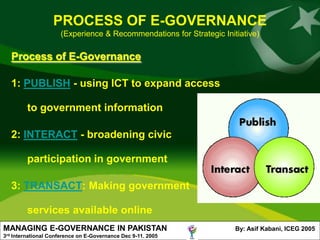
PROCESS OF E-GOVERNANCE
                        (Experience & Recommendations for Strategic Initiative)

      Process of E-Governance

      1: PUBLISH - using ICT to expand access

            to government information

      2: INTERACT - broadening civic

            participation in government

      3: TRANSACT: Making government

            services available online
MANAGING E-GOVERNANCE IN PAKISTAN                                       By: Asif Kabani, ICEG 2005
3rd   International Conference on E-Governance Dec 9-11. 2005
PROCESS OF E-GOVERNANCE
                        (Experience & Recommendations for Strategic Initiative)
      PUBLISH: using ICT to expand access to government information
      •   Governments generate huge volumes of information, much of it potentially useful to
          individuals and businesses.
      •   The Internet and other advanced communications technologies can bring this
          information quickly and more directly to citizens.
      •   Enabling citizens and businesses to readily access government information without
          having to travel to government offices, stand in long lines or pay bribes can be a
          revolutionary advance for nations wracked by inefficient bureaucracy and corruption.
      Recommendations for Publish Projects:
      1. Begin with a strategy to get information online, with appropriate milestones.
      2. Post information of value to people in their daily lives, and emphasize local language
          content.
      3. Consider a mandate that all agencies publish a specified range of information online.
      4. Seek attainable results using available resources.
      5. Design sites so they are easy to maintain, and sustain funding to ensure that information
          is updated regularly.
      6. Focus on content that supports other goals, e.g. economic development, anti-corruption,
          attracting foreign direct investment.
      Case Example: Government of Colombia Portal - a one-stop portal for access to government
          information. and Case Example: TaniNet
MANAGING E-GOVERNANCE IN PAKISTAN                                           By: Asif Kabani, ICEG 2005
3rd   International Conference on E-Governance Dec 9-11. 2005
PROCESS OF E-GOVERNANCE
                        (Experience & Recommendations for Strategic Initiative)
      INTERACT - broadening civic participation in government
      •  E- governance has the potential to involve citizens in the governance process
      •  Strengthening civic engagement contributes to building public trust in
         government.
      •  Interactive e-governance involves two-way communications, starting with basic
         functions like email contact information for government officials or feedback
         forms that allow users to submit comments on legislative or policy proposals.
      Recommendations for Interact:
      1. Show citizens that their engagement matters, by informing them of the
         outcomes of their online comments.
      2. Break down complex policy issues into easy-to-understand components.
      3. Be proactive about soliciting participation; use traditional media to publicize
         online consultations.
      4. Engage citizens collaboratively in the design phase.
      Case Example: Namibian Parliamentary web site - inviting citizens to
          participate online in their national government. OECD: Engaging Citizens
         Online for Better Policy-making, Armenia: Online Forum., UNDP Armenian
         web site http://www.undp.am, China: NGOs partner with ministries to assist in
         implementation of China's e-governance strategy.,

MANAGING E-GOVERNANCE IN PAKISTAN                                       By: Asif Kabani, ICEG 2005
3rd   International Conference on E-Governance Dec 9-11. 2005
PROCESS OF E-GOVERNANCE
                        (Experience & Recommendations for Strategic Initiative)
      TRANSACT: Making government services available online
      •   Governments can create websites that allow users to conduct transactions
          online.
      •   As the private sector in developing countries is beginning to make use of the
          Internet to offer e-commerce services
      •   Governments will be expected to do the same with their services.
      •   Potential cost savings, accountability through information logs and productivity
          improvements will be important drivers.
      Recommendations for Transact Projects:
      1. Target audiences that will have immediate use for the online services.
      2. Enlist the support of those who will be using the site and address the concerns
          of government workers whose role will change as a result of the innovation.
      3. Integrate e-governance with process reform, streamlining and consolidating
          processes before putting them online.
      4. Create a portal for transact services.
      Case Example: E-Procurement System, Chile/Pakistan - Revamping offline rules
          and regulations in order to establish an efficient online procurement system.
      Case Example: Pakistan Public Procurement Authority (PPRA) www.ppra.org.pk
      Latest update from EDG www.pakistan.gov.pk


MANAGING E-GOVERNANCE IN PAKISTAN                                       By: Asif Kabani, ICEG 2005
3rd   International Conference on E-Governance Dec 9-11. 2005
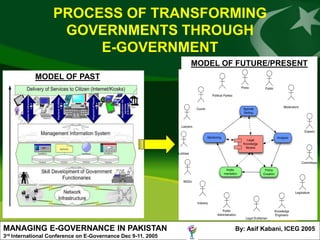
PROCESS OF TRANSFORMING
                      GOVERNMENTS THROUGH
                          E-GOVERNMENT
                                                                MODEL OF FUTURE/PRESENT
               MODEL OF PAST


MANAGING E-GOVERNANCE IN PAKISTAN                                       By: Asif Kabani, ICEG 2005
3rd   International Conference on E-Governance Dec 9-11. 2005
FIVE ELEMENTS OF SUCCESSFUL
             E-GOVERNANCE TRANSFORMATION
      1) Process Reform
             Already initiated through (ADB/Worldbank/UN) to support Govt.


      2) Leadership
             At all levels of Government (Federal/Provincial/Local) also Secretariate


      3) Strategic Investment
             Partnerships with Private Sector - Public sector and Donors/other Govts.


      4) Collaboration
             Synergies with CSOs/NGOs, Donors, Foras, and other Governments


      5) Civic Engagement
             Consult widely in designing systems and keep in mind differences in
             local culture when seeking to engage citizens

MANAGING E-GOVERNANCE IN PAKISTAN                                                       By: Asif Kabani, ICEG 2005
3rd   International Conference on E-Governance Dec 9-11. 2005
RECOMMENDATIONS
             “Once governments (Federal/Provincial/local) commit
              to strategies transforming their governance
                    processes, significant challenges and
                       opportunities will arise during their
              implementation the e-governance initiatives
                          especially country like Pakistan”
                                                       and
                     “Developing nations of South Asia
                            To Fight Poverty & Corrupt”
MANAGING E-GOVERNANCE IN PAKISTAN                               By: Asif Kabani, ICEG 2005
3rd   International Conference on E-Governance Dec 9-11. 2005
Thank You.
               MANAGING E-GOVERNANCE
                    IN PAKISTAN
                                               Asif Kabani, MBA
                           Deputy Director, Decentralization Support Program, NPSO
                                Asian Development Bank & Ministry of Finance
                                Government of Pakistan, Islamabad, Pakistan
                                                    © 2005


MANAGING E-GOVERNANCE IN PAKISTAN                                           By: Asif Kabani, ICEG 2005
3rd   International Conference on E-Governance Dec 9-11. 2005

Managing E Governance In Pakistan

  • 1.
    MANAGING E-GOVERNANCE IN PAKISTAN Asif Kabani, MBA Deputy Director, Decentralization Support Program, NPSO Asian Development Bank & Ministry of Finance Government of Pakistan, Islamabad, Pakistan © 2005 MANAGING E-GOVERNANCE IN PAKISTAN By: Asif Kabani, ICEG 2005 3rd International Conference on E-Governance Dec 9-11. 2005
  • 2.
    PRESENTATION OULINE 1 – Managing E-Governance in Pakistan What is E-Governance, Definition and Situational Analysis of E- governance 2 - Strategic Impact of e-governance in Pakistan Vision for E-Government in Pakistan, Roadmap for E-Government Programme and Components 3 - Target of e-governance and Impact 4 – Process of E-Governance (Experience & Recommendations for Strategic Initiative) 1: PUBLISH - using ICT to expand access to government information 2: INTERACT - broadening civic participation in government 3-TRANSACT: Making government services available online 5- Process of Transforming Governments through E-Government 6- Five Elements of Successful E-Governance Transformation 7- Recommendations: Civic Engagement MANAGING E-GOVERNANCE IN PAKISTAN By: Asif Kabani, ICEG 2005 3rd International Conference on E-Governance Dec 9-11. 2005
  • 3.
    MANAGING E-GOVERNANCE IN PAKISTAN 1. What is E-Governance 2. Definition – The definition of e-governance is “the use of information and communication technologies, and particularly the Internet, as a tool to achieve better government”. – The e-governance is more about government than about “e”. Governments are adopting information society tools and working practices to remain responsive to citizens’ needs. – The impact of e-governance is simply better government, by enabling better policy outcomes, higher quality services, greater engagement with citizens, and by improving efficiency, contributing to economic policy objectives and advancing the public reform agenda. OECD, 2000 3. Situational Analysis of E-governance  RS. 2.6BN PLAN FOR E-GOVERNANCE IN PAKISTAN: KARACHI, Oct 14, 2001 MANAGING E-GOVERNANCE IN PAKISTAN By: Asif Kabani, ICEG 2005 3rd International Conference on E-Governance Dec 9-11. 2005
  • 4.
    STRATEGIC IMPACT OF E-GOVERNANCE IN PAKISTAN 1. Vision for E-Government in Pakistan – awareness of government information and government services accessible and available to citizen’s i.e Access to Justice, Service Delivery at the grass root level and Planning & Development 2. Roadmap for E-Government Donate Online @ President Relief Funds for Earthquake Victims www.presidentofpakistan.gov.pk  National IT Policy 2000 approved 3. Programme Components  Providing services through internet through the GoP web portal, www.pakistan.gov.pk)  Provision of services through Kiosks and ATMs  IT Skills enablement of government functionaries  Networking of government organizations  Comprehensive automation of government MANAGING E-GOVERNANCE IN PAKISTAN By: Asif Kabani, ICEG 2005 3rd International Conference on E-Governance Dec 9-11. 2005
  • 5.
    TARGET OF E-GOVERNANCEAND IMPACT • Citizen Online - provision of services through GOP portal: (Completed) • Salary Disbursement through ATMs • IT Skills Training program for Probationary Government Officers (Completed) • Process Mapping for improving efficiency at Ministry of Science & Technology: (Completed) • Survey of Federal Divisions for LAN & Hardware Requirements: (Completed) • Federal Government Data Center: (under implementation) • Electronic Office at Ministry of Information Technology (MoIT): (under implementation) • Secure Electronic Communications and Office Automation at Prime Minister's Secretariat: (under implementation) • Project "Lexicon, Machine Translation & Text-To-Speech Urdu Software". (under implementation) • Access to Statutory/Case Laws at District Bar Associations (under implementation) • E-Enabling of Majlis-e-Shoora (National Assembly of Pakistan and Senate of Pakistan): (under implementation) • Technical Support to IT Departments of Provinces and Azad Jammu & Kashmir: (under implementation) • Online Recruitment System for Federal Public Service Commission: (under implementation) • E-Services for Submission of Documents at Securities Exchange Commission of Pakistan: (under implementation) • E-Services to Citizens in Food, Agriculture and Livestock Sector: (under implementation) • E-Services for Commissioner's Office, Islamabad: (under implementation) • E-Services for Islamabad Police (under implementation) • E-Services for Capital Development Authority: (under implementation) • Online Processing of Hajj Applications (under implementation) • Hospital Management Information System for PIMS: (under implementation) • Hospital Management Information System for CDA Hospital: (under implementation) • Automation of Patent Office (under implementation) • E-Enablement of Press Clubs (under implementation) MANAGING E-GOVERNANCE IN PAKISTAN By: Asif Kabani, ICEG 2005 3rd International Conference on E-Governance Dec 9-11. 2005
  • 6.
    TARGET OF E-GOVERNANCEAND IMPACT (Continued) • E-Enablement of Establishment Division • Enterprise Budget System for Finance Division • PSDP Management System for Planning Division • E-Enablement of Civil Services Academy • E-Services for Ministry of Health • E-Services for Ministry of Interior • E-Services for Ministry of Population Welfare • Automation of Estate Office, Ministry of Housing & Works • Capacity building of SMEs for online submission of returns for SECP • Business Intelligence & information dissemination by SECP • Market monitoring & surveillance at SECP • Content Development Cell • Consultancy for formulating of projects for online services • Consultancy for Re-engineering of GoP business processes • District Government Automation - DG Khan • District Government Automation - Rawalpindi • Provincial Government Web sites www.punjab.gov.pk vs www.sindh.gov.pk • Managing Transition through support for accounts systems in the Government on NAM/SAP/R3 Solution (Ministry of Finance) • Database on Taxes and Taxpayers in Tando Adam, Sindh • Capacity Building /Technical Support to National Finance Commission (NFC) Secretariat • Institutional Development of PFCs • E-Justice sponsored by UNDP • Gender Mainstreaming United Nations Development Program with Government MANAGING E-GOVERNANCE IN PAKISTAN By: Asif Kabani, ICEG 2005 3rd International Conference on E-Governance Dec 9-11. 2005
  • 7.
    PROCESS OF E-GOVERNANCE (Experience & Recommendations for Strategic Initiative) Process of E-Governance 1: PUBLISH - using ICT to expand access to government information 2: INTERACT - broadening civic participation in government 3: TRANSACT: Making government services available online MANAGING E-GOVERNANCE IN PAKISTAN By: Asif Kabani, ICEG 2005 3rd International Conference on E-Governance Dec 9-11. 2005
  • 8.
    PROCESS OF E-GOVERNANCE (Experience & Recommendations for Strategic Initiative) PUBLISH: using ICT to expand access to government information • Governments generate huge volumes of information, much of it potentially useful to individuals and businesses. • The Internet and other advanced communications technologies can bring this information quickly and more directly to citizens. • Enabling citizens and businesses to readily access government information without having to travel to government offices, stand in long lines or pay bribes can be a revolutionary advance for nations wracked by inefficient bureaucracy and corruption. Recommendations for Publish Projects: 1. Begin with a strategy to get information online, with appropriate milestones. 2. Post information of value to people in their daily lives, and emphasize local language content. 3. Consider a mandate that all agencies publish a specified range of information online. 4. Seek attainable results using available resources. 5. Design sites so they are easy to maintain, and sustain funding to ensure that information is updated regularly. 6. Focus on content that supports other goals, e.g. economic development, anti-corruption, attracting foreign direct investment. Case Example: Government of Colombia Portal - a one-stop portal for access to government information. and Case Example: TaniNet MANAGING E-GOVERNANCE IN PAKISTAN By: Asif Kabani, ICEG 2005 3rd International Conference on E-Governance Dec 9-11. 2005
  • 9.
    PROCESS OF E-GOVERNANCE (Experience & Recommendations for Strategic Initiative) INTERACT - broadening civic participation in government • E- governance has the potential to involve citizens in the governance process • Strengthening civic engagement contributes to building public trust in government. • Interactive e-governance involves two-way communications, starting with basic functions like email contact information for government officials or feedback forms that allow users to submit comments on legislative or policy proposals. Recommendations for Interact: 1. Show citizens that their engagement matters, by informing them of the outcomes of their online comments. 2. Break down complex policy issues into easy-to-understand components. 3. Be proactive about soliciting participation; use traditional media to publicize online consultations. 4. Engage citizens collaboratively in the design phase. Case Example: Namibian Parliamentary web site - inviting citizens to participate online in their national government. OECD: Engaging Citizens Online for Better Policy-making, Armenia: Online Forum., UNDP Armenian web site http://www.undp.am, China: NGOs partner with ministries to assist in implementation of China's e-governance strategy., MANAGING E-GOVERNANCE IN PAKISTAN By: Asif Kabani, ICEG 2005 3rd International Conference on E-Governance Dec 9-11. 2005
  • 10.
    PROCESS OF E-GOVERNANCE (Experience & Recommendations for Strategic Initiative) TRANSACT: Making government services available online • Governments can create websites that allow users to conduct transactions online. • As the private sector in developing countries is beginning to make use of the Internet to offer e-commerce services • Governments will be expected to do the same with their services. • Potential cost savings, accountability through information logs and productivity improvements will be important drivers. Recommendations for Transact Projects: 1. Target audiences that will have immediate use for the online services. 2. Enlist the support of those who will be using the site and address the concerns of government workers whose role will change as a result of the innovation. 3. Integrate e-governance with process reform, streamlining and consolidating processes before putting them online. 4. Create a portal for transact services. Case Example: E-Procurement System, Chile/Pakistan - Revamping offline rules and regulations in order to establish an efficient online procurement system. Case Example: Pakistan Public Procurement Authority (PPRA) www.ppra.org.pk Latest update from EDG www.pakistan.gov.pk MANAGING E-GOVERNANCE IN PAKISTAN By: Asif Kabani, ICEG 2005 3rd International Conference on E-Governance Dec 9-11. 2005
  • 11.
    PROCESS OF TRANSFORMING GOVERNMENTS THROUGH E-GOVERNMENT MODEL OF FUTURE/PRESENT MODEL OF PAST MANAGING E-GOVERNANCE IN PAKISTAN By: Asif Kabani, ICEG 2005 3rd International Conference on E-Governance Dec 9-11. 2005
  • 12.
    FIVE ELEMENTS OFSUCCESSFUL E-GOVERNANCE TRANSFORMATION 1) Process Reform Already initiated through (ADB/Worldbank/UN) to support Govt. 2) Leadership At all levels of Government (Federal/Provincial/Local) also Secretariate 3) Strategic Investment Partnerships with Private Sector - Public sector and Donors/other Govts. 4) Collaboration Synergies with CSOs/NGOs, Donors, Foras, and other Governments 5) Civic Engagement Consult widely in designing systems and keep in mind differences in local culture when seeking to engage citizens MANAGING E-GOVERNANCE IN PAKISTAN By: Asif Kabani, ICEG 2005 3rd International Conference on E-Governance Dec 9-11. 2005
  • 13.
    RECOMMENDATIONS “Once governments (Federal/Provincial/local) commit to strategies transforming their governance processes, significant challenges and opportunities will arise during their implementation the e-governance initiatives especially country like Pakistan” and “Developing nations of South Asia To Fight Poverty & Corrupt” MANAGING E-GOVERNANCE IN PAKISTAN By: Asif Kabani, ICEG 2005 3rd International Conference on E-Governance Dec 9-11. 2005
  • 14.
    Thank You. MANAGING E-GOVERNANCE IN PAKISTAN Asif Kabani, MBA Deputy Director, Decentralization Support Program, NPSO Asian Development Bank & Ministry of Finance Government of Pakistan, Islamabad, Pakistan © 2005 MANAGING E-GOVERNANCE IN PAKISTAN By: Asif Kabani, ICEG 2005 3rd International Conference on E-Governance Dec 9-11. 2005