L.Kritharides June 2003
Identifying New Biomarkers of
Coronary Disease
Dr. Len Kritharides
MBBS,PhD, FRACP, FAHA
Centre for Vascular Research University of New South Wales
and Department of Cardiology
Concord Hospital, University of Sydney,
Australia.
L.Kritharides June 2003
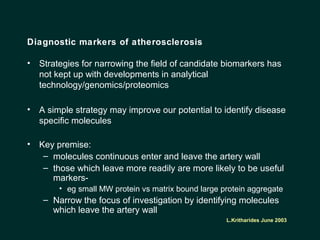
Diagnostic markers of atherosclerosis
• Strategies for narrowing the field of candidate biomarkers has
not kept up with developments in analytical
technology/genomics/proteomics
• A simple strategy may improve our potential to identify disease
specific molecules
• Key premise:
– molecules continuous enter and leave the artery wall
– those which leave more readily are more likely to be useful
markers-
• eg small MW protein vs matrix bound large protein aggregate
– Narrow the focus of investigation by identifying molecules
which leave the artery wall
L.Kritharides June 2003
identifying molecules which leave the
artery wall
• Hypothesis:
– That molecules which leave the artery wall most
readily during simple perfusion will also leave the
artery wall more readily in vivo
– Differences in protein elution from atherosclerotic
arteries and non-atherosclerotic arteries will
correlate with differences in vivo
• Problem:
– How to perfuse human arteries?
L.Kritharides June 2003
Coronary perfusion prior to bypass
surgery
• Routine perfusion gives cardioplegia (saline buffer with high
potassium)
• Can be given antegradely with collection of perfusate coming
through coronary sinus (venous system)
• Collected at start of operation using cuffed catheter
• Successive fractions contain decreasing amounts of blood
• Lowest blood contamination fractions used for analysis
L.Kritharides June 2003
Coronary perfusates
– AIMS
• Is there non-plasma protein derived from coronary tree?
• Identify at least one such protein
• Quantify in atherosclerotic and non-atherosclerotic
circulations
• Quantify relative to contaminating blood
• Relate to disease status- proof of principle
L.Kritharides June 2003
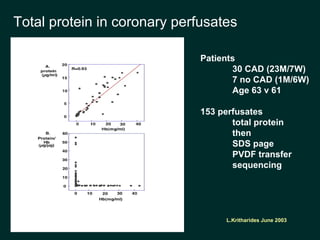
Patients
30 CAD (23M/7W)
7 no CAD (1M/6W)
Age 63 v 61
153 perfusates
total protein
then
SDS page
PVDF transfer
sequencing
Total protein in coronary perfusates
L.Kritharides June 2003
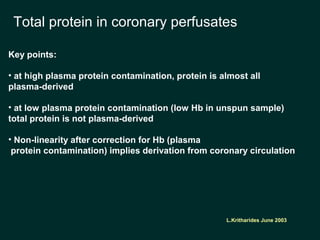
Total protein in coronary perfusates
Key points:
• at high plasma protein contamination, protein is almost all
plasma-derived
• at low plasma protein contamination (low Hb in unspun sample)
total protein is not plasma-derived
• Non-linearity after correction for Hb (plasma
protein contamination) implies derivation from coronary circulation
L.Kritharides June 2003
N-tmnl sequencing
40 kDa- Band
ILGGHLDA
100% homology with
Haptoglobin β-chain
Quantified by Western
L.Kritharides June 2003
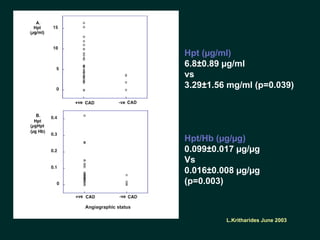
Hpt (µg/ml)
6.8±0.89 µg/ml
vs
3.29±1.56 mg/ml (p=0.039)
Hpt/Hb (µg/µg)
0.099±0.017 µg/µg
Vs
0.016±0.008 µg/µg
(p=0.003)
L.Kritharides June 2003
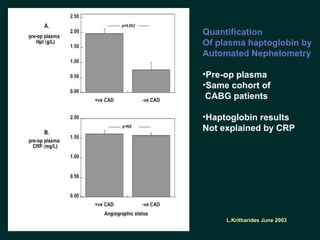
Quantification
Of plasma haptoglobin by
Automated Nephelometry
•Pre-op plasma
•Same cohort of
CABG patients
•Haptoglobin results
Not explained by CRP
L.Kritharides June 2003
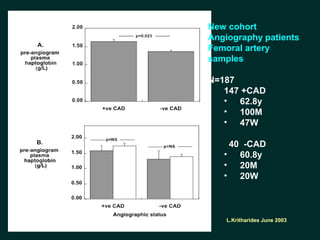
New cohort
Angiography patients
Femoral artery
samples
N=187
• 147 +CAD
• 62.8y
• 100M
• 47W
• 40 -CAD
• 60.8y
• 20M
• 20W
L.Kritharides June 2003
Conclusions
• Proteins do elute from human coronaries
• These proteins potentially distinguish
between atherosclerotic and non-
atherosclerotic vessels
• Co-ordination of elution strategies with
proteomic technology may facilitate
identification of new markers of arterial
pathology which may be disease specific
L.Kritharides June 2003
Acknowledgements
• Heart Research Institute Sydney
• Centre for Vascular Research UNSW
• Vincent Fairfax Family Trust
L.Kritharides June 2003

Identifying new biomarkers

  • 1.
    L.Kritharides June 2003 IdentifyingNew Biomarkers of Coronary Disease Dr. Len Kritharides MBBS,PhD, FRACP, FAHA Centre for Vascular Research University of New South Wales and Department of Cardiology Concord Hospital, University of Sydney, Australia.
  • 2.
    L.Kritharides June 2003 Diagnosticmarkers of atherosclerosis • Strategies for narrowing the field of candidate biomarkers has not kept up with developments in analytical technology/genomics/proteomics • A simple strategy may improve our potential to identify disease specific molecules • Key premise: – molecules continuous enter and leave the artery wall – those which leave more readily are more likely to be useful markers- • eg small MW protein vs matrix bound large protein aggregate – Narrow the focus of investigation by identifying molecules which leave the artery wall
  • 3.
    L.Kritharides June 2003 identifyingmolecules which leave the artery wall • Hypothesis: – That molecules which leave the artery wall most readily during simple perfusion will also leave the artery wall more readily in vivo – Differences in protein elution from atherosclerotic arteries and non-atherosclerotic arteries will correlate with differences in vivo • Problem: – How to perfuse human arteries?
  • 4.
    L.Kritharides June 2003 Coronaryperfusion prior to bypass surgery • Routine perfusion gives cardioplegia (saline buffer with high potassium) • Can be given antegradely with collection of perfusate coming through coronary sinus (venous system) • Collected at start of operation using cuffed catheter • Successive fractions contain decreasing amounts of blood • Lowest blood contamination fractions used for analysis
  • 5.
    L.Kritharides June 2003 Coronaryperfusates – AIMS • Is there non-plasma protein derived from coronary tree? • Identify at least one such protein • Quantify in atherosclerotic and non-atherosclerotic circulations • Quantify relative to contaminating blood • Relate to disease status- proof of principle
  • 6.
    L.Kritharides June 2003 Patients 30CAD (23M/7W) 7 no CAD (1M/6W) Age 63 v 61 153 perfusates total protein then SDS page PVDF transfer sequencing Total protein in coronary perfusates
  • 7.
    L.Kritharides June 2003 Totalprotein in coronary perfusates Key points: • at high plasma protein contamination, protein is almost all plasma-derived • at low plasma protein contamination (low Hb in unspun sample) total protein is not plasma-derived • Non-linearity after correction for Hb (plasma protein contamination) implies derivation from coronary circulation
  • 8.
    L.Kritharides June 2003 N-tmnlsequencing 40 kDa- Band ILGGHLDA 100% homology with Haptoglobin β-chain Quantified by Western
  • 9.
    L.Kritharides June 2003 Hpt(µg/ml) 6.8±0.89 µg/ml vs 3.29±1.56 mg/ml (p=0.039) Hpt/Hb (µg/µg) 0.099±0.017 µg/µg Vs 0.016±0.008 µg/µg (p=0.003)
  • 10.
    L.Kritharides June 2003 Quantification Ofplasma haptoglobin by Automated Nephelometry •Pre-op plasma •Same cohort of CABG patients •Haptoglobin results Not explained by CRP
  • 11.
    L.Kritharides June 2003 Newcohort Angiography patients Femoral artery samples N=187 • 147 +CAD • 62.8y • 100M • 47W • 40 -CAD • 60.8y • 20M • 20W L.Kritharides June 2003
  • 12.
    L.Kritharides June 2003 Conclusions •Proteins do elute from human coronaries • These proteins potentially distinguish between atherosclerotic and non- atherosclerotic vessels • Co-ordination of elution strategies with proteomic technology may facilitate identification of new markers of arterial pathology which may be disease specific L.Kritharides June 2003
  • 13.
    L.Kritharides June 2003 Acknowledgements •Heart Research Institute Sydney • Centre for Vascular Research UNSW • Vincent Fairfax Family Trust L.Kritharides June 2003