PRESENTED TO :
PROF.(DR.) ASHA KHANNA
DEPARTMENT OF BIO-SCIENCE
PRESENTED BY :
ATUL PATEL
MSc. 2nd SEM MICROBIOLOGY
TRANSPLANTATION
Transplantation is the process of moving cells,
tissues, or organs, from one site to another,
either within the same person or between a
donor and a recipient.
If an organ system fails, or becomes damaged
as a consequence of disease or injury, it can
be replaced with a healthy organ or tissue
from a donor.
• Alexis Carrel- study of transplantation in 1908; he
interchanged both kidneys in a series of nine cats. cats
maintained urinary output for up to 25 days. Although all
the cats eventually died.
• The first human kidney transplant, attempted
in 1935 by a Russian surgeon, failed because there was a
mismatch of blood types between donor and recipient.
• The first successful human kidney transplant, which was
between identical twins, was accomplished in Boston in
1954.
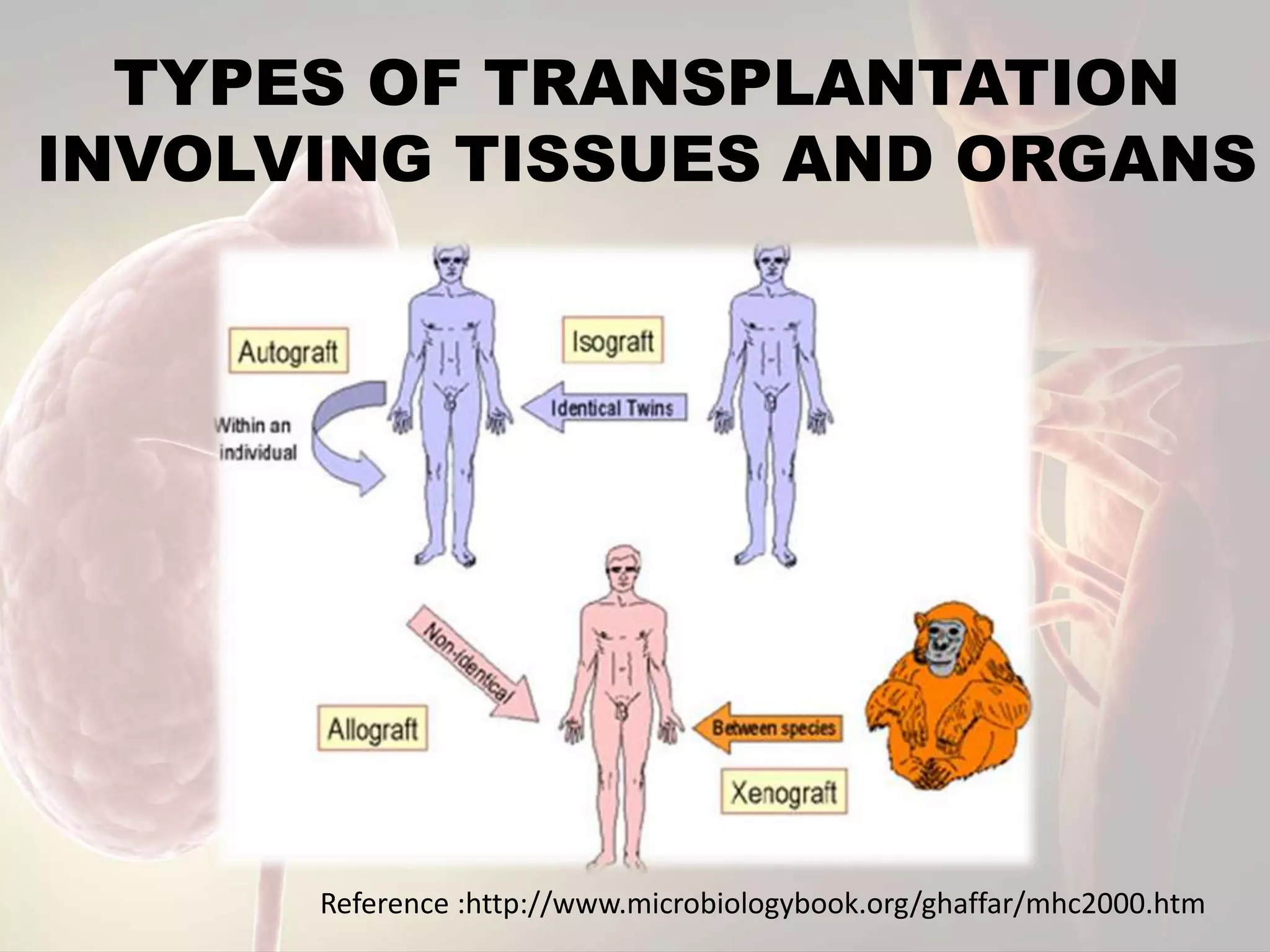
TYPES OF TRANSPLANTATION
INVOLVING TISSUES AND ORGANS
Reference :http://www.microbiologybook.org/ghaffar/mhc2000.htm
Autograft :-
Transplantation of cells, tissues or organs between sites
within the same individual e.g. skin graft.
Isograft:-
Isograft is tissue transferred between genetically identical
individuals. This occurs in inbred strains of mice or
identical human twins.
Allograft :-
Transplantation of organs or tissues from a donor to a non-
genetically identical individual of the
same species. Allografts are the most common type
of transplant.
Xenograft:-
It is the tissue transferred between different species. This
graft is also normally rejected. Pigs’ hearth valve usually
transplanted to humans.
ABO incompatible
ABO refers to blood group, which can vary between
individuals. For most transplant types, matching of blood
group between donor and recipient is a key strategy in
reducing rejection risk.
Stem cell transplant
Stem cells are cells that have the capacity to develop into a
range of different types of cells in the body.
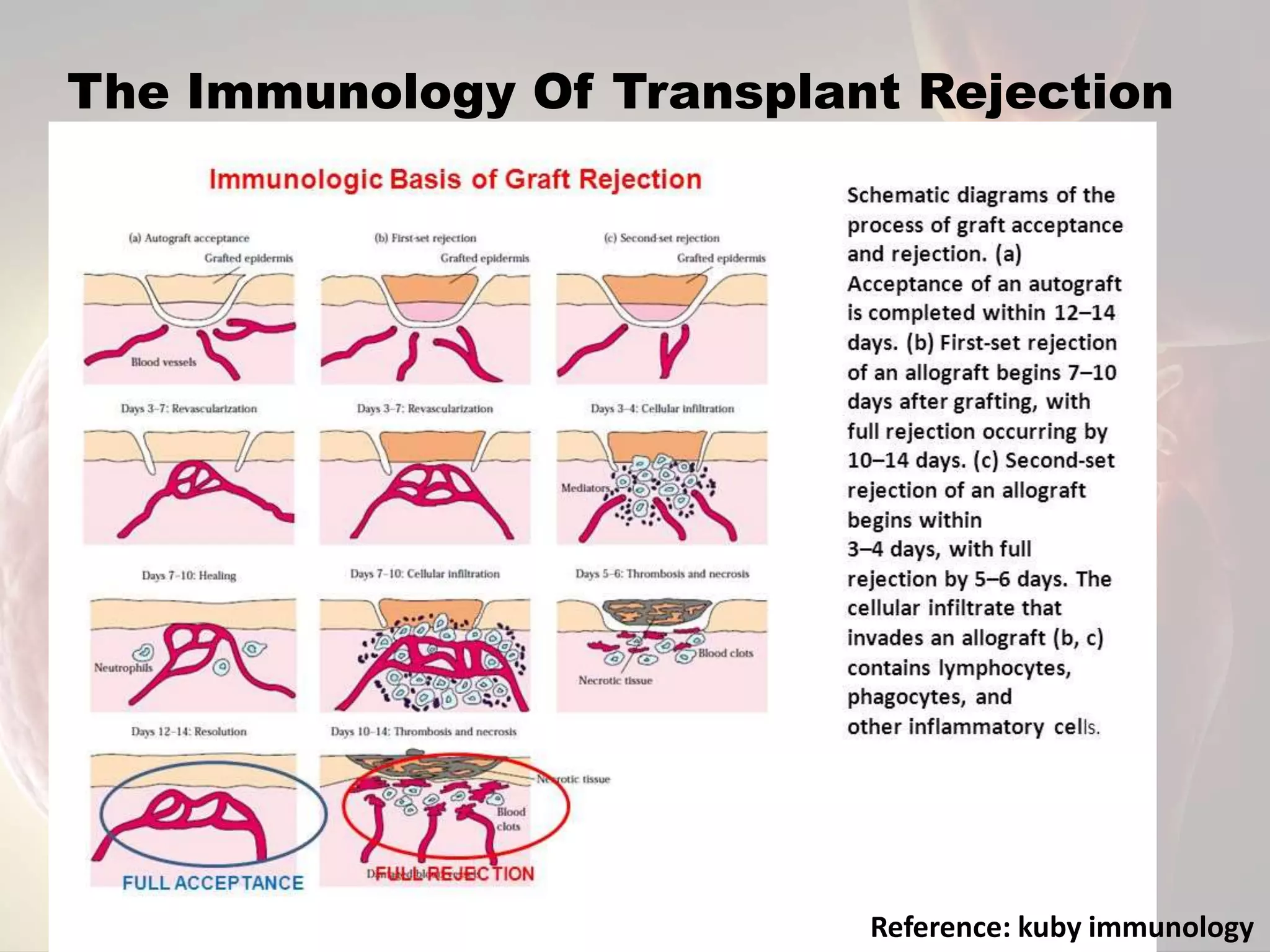
The Immunology Of Transplant Rejection
Reference: kuby immunology
Kuby immunology
Clinical stages of rejection
Hyperacute rejection
This occurs within minutes or hours after a transplantation
and is caused by the presence of pre-existing antibodies of
the recipient, that match the foreign antigens of the donor,
triggering an immune response against the transplant.
Acute rejection
This occurs within the first 6 months after transplantation.
Some degree of acute rejection will occur in all
transplantations, except between identical twins.
Chronic rejection
Repeated episodes of acute rejection can ultimately lead to
chronic rejection of the graft and failure of the transplant.
http://biosiva.50webs.org/imtr.htm
Factors favoring allograft
survival(Rejection
Prevention)
HLA typing of potential donors
and a recipient can be
accomplished with a
microcytotoxicity test. In this
test, white blood cells from
the potential donors and
recipient are distributed into a
series of wells on a microtiter
plate, and then antibodies
specific for various class I and
class II MHC alleles are added
to different wells. After
incubation, complement is
added to the wells, and
cytotoxicity is assessed by the
uptake or exclusion of various
dyes (e.g., trypan blue or
eosin Y) by the cells.
Reference :kuby immunology
Finding an eligible donor-recipient match:-
Rejection can be minimized by carefully matching the
donor and recipient for compatibility prior to
transplantation.
Compatibility between donor and recipient is assessed
using a combination of tests, including:
• ABO blood group compatibility
• Tissue typing
• Cross matching
• Panel reactive antibody test
• Serology screening
General Immunosuppressive
Therapy
To reduce the risk of transplant rejection, patients are treated
with immunosuppressive drugs that will dampen their immune
response.
• Mitotic Inhibitors Thwart T-Cell Proliferation –
Azathioprine (Imuran), a potent mitotic inhibitor, is often
given just before and after transplantation to diminish T-cell
proliferation in response to the alloantigen's of the graft.
• Corticosteroids Suppress Inflammation
corticosteroids, such as prednisone and dexamethasone, are
potent anti-inflammatory agents. It prevent acute episodes of
graft rejection.
• Certain Fungal Metabolites Are Immunosuppressant
Cyclosporin A (CsA), FK506 (tacrolimus), and rapamycin
(sirolimus) are fungal metabolites with immunosuppressive
properties.
Clinical Transplantation
Since the first kidney transplant was performed in the 1950s,
approximately 400,000 kidneys have been transplanted worldwide.
The next most frequently transplanted solid organ is the liver
(52,000), followed by the heart (42,000) and, more distantly, by the
lung (6,000) and pancreas (2,000). Bone-marrow transplants
number around 80,000.
The frequency with which a given organ or
tissue is transplanted depends on a number of factors:
• Clinical situations in which transplantation is indicated.
• Availability of tissue or organs.
• Difficulty in performing transplantation and caring for
post-transplantation patients.
• Specific factors that aid or hinder acceptance of the
particular transplant.
REFERENCEs
• https://www.nature.com
• https://www.journals.elsevier.com/transplant-
immunology
• kuby Immunology by Judith A. Owen, Jenni Punt,
Sharon A. Stranford , Patricia P. Jones.
• British Society for Immunology.
TRANSPLANTATION IMMUNOLOGY

TRANSPLANTATION IMMUNOLOGY

  • 1.
    PRESENTED TO : PROF.(DR.)ASHA KHANNA DEPARTMENT OF BIO-SCIENCE PRESENTED BY : ATUL PATEL MSc. 2nd SEM MICROBIOLOGY
  • 2.
    TRANSPLANTATION Transplantation is theprocess of moving cells, tissues, or organs, from one site to another, either within the same person or between a donor and a recipient. If an organ system fails, or becomes damaged as a consequence of disease or injury, it can be replaced with a healthy organ or tissue from a donor.
  • 3.
    • Alexis Carrel-study of transplantation in 1908; he interchanged both kidneys in a series of nine cats. cats maintained urinary output for up to 25 days. Although all the cats eventually died. • The first human kidney transplant, attempted in 1935 by a Russian surgeon, failed because there was a mismatch of blood types between donor and recipient. • The first successful human kidney transplant, which was between identical twins, was accomplished in Boston in 1954.
  • 4.
    TYPES OF TRANSPLANTATION INVOLVINGTISSUES AND ORGANS Reference :http://www.microbiologybook.org/ghaffar/mhc2000.htm
  • 5.
    Autograft :- Transplantation ofcells, tissues or organs between sites within the same individual e.g. skin graft. Isograft:- Isograft is tissue transferred between genetically identical individuals. This occurs in inbred strains of mice or identical human twins. Allograft :- Transplantation of organs or tissues from a donor to a non- genetically identical individual of the same species. Allografts are the most common type of transplant.
  • 6.
    Xenograft:- It is thetissue transferred between different species. This graft is also normally rejected. Pigs’ hearth valve usually transplanted to humans. ABO incompatible ABO refers to blood group, which can vary between individuals. For most transplant types, matching of blood group between donor and recipient is a key strategy in reducing rejection risk. Stem cell transplant Stem cells are cells that have the capacity to develop into a range of different types of cells in the body.
  • 7.
    The Immunology OfTransplant Rejection Reference: kuby immunology
  • 8.
  • 9.
  • 10.
  • 11.
    Clinical stages ofrejection Hyperacute rejection This occurs within minutes or hours after a transplantation and is caused by the presence of pre-existing antibodies of the recipient, that match the foreign antigens of the donor, triggering an immune response against the transplant. Acute rejection This occurs within the first 6 months after transplantation. Some degree of acute rejection will occur in all transplantations, except between identical twins. Chronic rejection Repeated episodes of acute rejection can ultimately lead to chronic rejection of the graft and failure of the transplant.
  • 12.
  • 13.
    Factors favoring allograft survival(Rejection Prevention) HLAtyping of potential donors and a recipient can be accomplished with a microcytotoxicity test. In this test, white blood cells from the potential donors and recipient are distributed into a series of wells on a microtiter plate, and then antibodies specific for various class I and class II MHC alleles are added to different wells. After incubation, complement is added to the wells, and cytotoxicity is assessed by the uptake or exclusion of various dyes (e.g., trypan blue or eosin Y) by the cells. Reference :kuby immunology
  • 14.
    Finding an eligibledonor-recipient match:- Rejection can be minimized by carefully matching the donor and recipient for compatibility prior to transplantation. Compatibility between donor and recipient is assessed using a combination of tests, including: • ABO blood group compatibility • Tissue typing • Cross matching • Panel reactive antibody test • Serology screening
  • 15.
    General Immunosuppressive Therapy To reducethe risk of transplant rejection, patients are treated with immunosuppressive drugs that will dampen their immune response. • Mitotic Inhibitors Thwart T-Cell Proliferation – Azathioprine (Imuran), a potent mitotic inhibitor, is often given just before and after transplantation to diminish T-cell proliferation in response to the alloantigen's of the graft. • Corticosteroids Suppress Inflammation corticosteroids, such as prednisone and dexamethasone, are potent anti-inflammatory agents. It prevent acute episodes of graft rejection. • Certain Fungal Metabolites Are Immunosuppressant Cyclosporin A (CsA), FK506 (tacrolimus), and rapamycin (sirolimus) are fungal metabolites with immunosuppressive properties.
  • 16.
    Clinical Transplantation Since thefirst kidney transplant was performed in the 1950s, approximately 400,000 kidneys have been transplanted worldwide. The next most frequently transplanted solid organ is the liver (52,000), followed by the heart (42,000) and, more distantly, by the lung (6,000) and pancreas (2,000). Bone-marrow transplants number around 80,000. The frequency with which a given organ or tissue is transplanted depends on a number of factors: • Clinical situations in which transplantation is indicated. • Availability of tissue or organs. • Difficulty in performing transplantation and caring for post-transplantation patients. • Specific factors that aid or hinder acceptance of the particular transplant.
  • 18.
    REFERENCEs • https://www.nature.com • https://www.journals.elsevier.com/transplant- immunology •kuby Immunology by Judith A. Owen, Jenni Punt, Sharon A. Stranford , Patricia P. Jones. • British Society for Immunology.