The Minneapolis Heart
Institute Foundation
The Minneapolis
Heart Institute
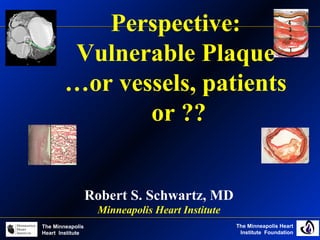
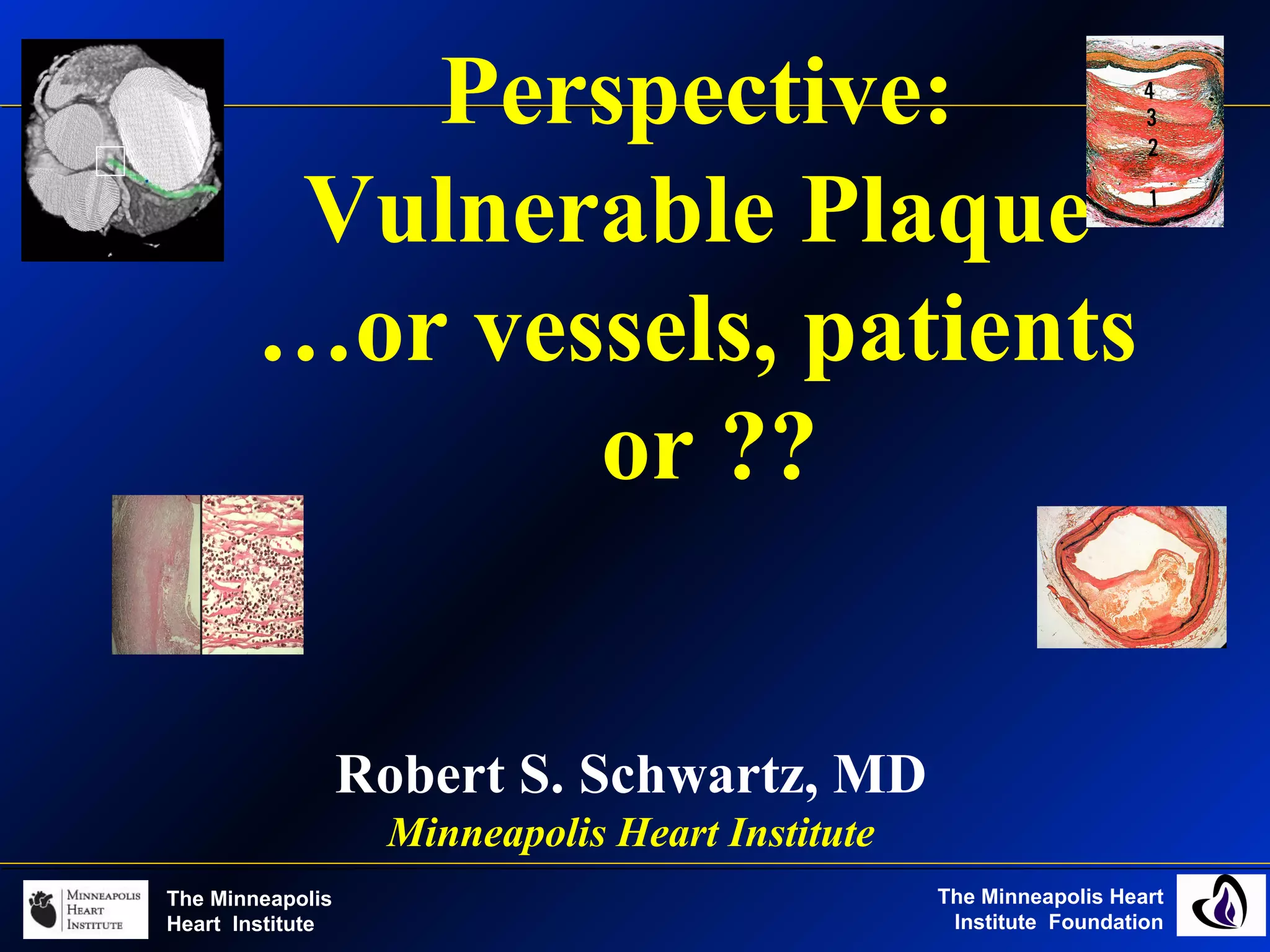
Perspective:
Vulnerable Plaque
…or vessels, patients
or ??
Robert S. Schwartz, MD
Minneapolis Heart Institute
The Minneapolis Heart
Institute Foundation
The Minneapolis
Heart Institute
How to Cure Human Disease
1. Define the Disease
2.Associate it reliably
3.Find the Disease
4. Deliver the ‘Fix’
The Minneapolis Heart
Institute Foundation
The Minneapolis
Heart Institute
The Minneapolis Heart
Institute Foundation
The Minneapolis
Heart Institute
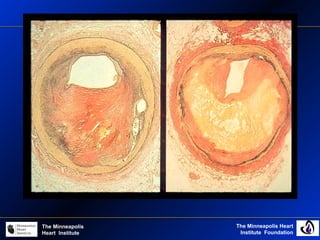
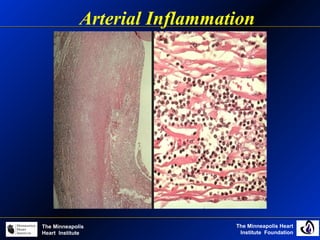
Arterial Inflammation
The Minneapolis Heart
Institute Foundation
The Minneapolis
Heart Institute
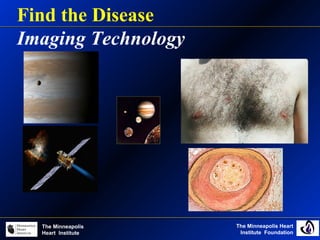
Find the Disease
Imaging Technology
The Minneapolis Heart
Institute Foundation
The Minneapolis
Heart Institute
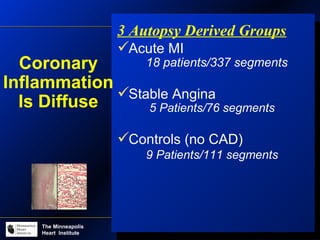
3 Autopsy Derived Groups
Acute MI
18 patients/337 segments
Stable Angina
5 Patients/76 segments
Controls (no CAD)
9 Patients/111 segments
Coronary
Inflammation
Is Diffuse
The Minneapolis Heart
Institute Foundation
The Minneapolis
Heart Institute
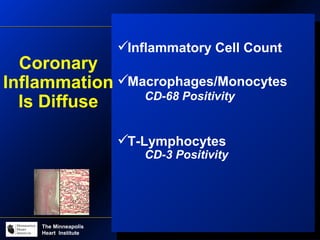
Inflammatory Cell Count
Macrophages/Monocytes
CD-68 Positivity
T-Lymphocytes
CD-3 Positivity
Coronary
Inflammation
Is Diffuse
The Minneapolis Heart
Institute Foundation
The Minneapolis
Heart Institute
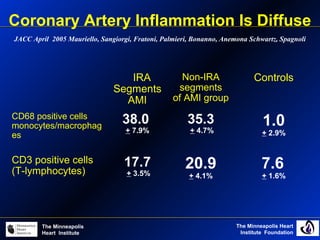
IRA
Segments
AMI
Non-IRA
segments
of AMI group
Controls
CD68 positive cells
monocytes/macrophag
es
38.0
+ 7.9%
35.3
+ 4.7%
1.0
+ 2.9%
CD3 positive cells
(T-lymphocytes)
17.7
+ 3.5%
20.9
+ 4.1%
7.6
+ 1.6%
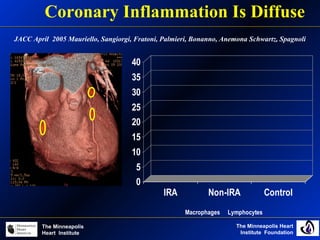
Coronary Artery Inflammation Is Diffuse
JACC April 2005 Mauriello, Sangiorgi, Fratoni, Palmieri, Bonanno, Anemona Schwartz, Spagnoli
The Minneapolis Heart
Institute Foundation
The Minneapolis
Heart Institute
Coronary Inflammation Is Diffuse
0
5
10
15
20
25
30
35
40
IRA Non-IRA Control
Macrophages Lymphocytes
JACC April 2005 Mauriello, Sangiorgi, Fratoni, Palmieri, Bonanno, Anemona Schwartz, Spagnoli
The Minneapolis Heart
Institute Foundation
The Minneapolis
Heart Institute
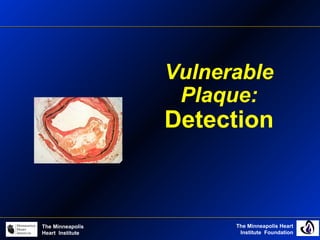
Vulnerable
Plaque:
Detection
The Minneapolis Heart
Institute Foundation
The Minneapolis
Heart Institute
Thermography
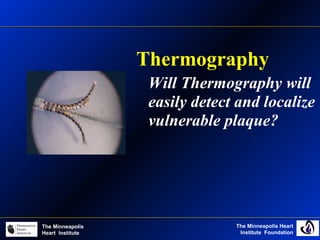
Will Thermography will
easily detect and localize
vulnerable plaque?
The Minneapolis Heart
Institute Foundation
The Minneapolis
Heart Institute
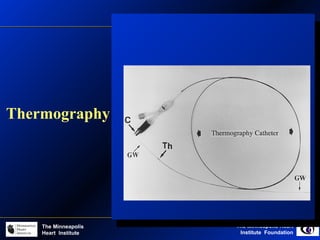
Thermography
The Minneapolis Heart
Institute Foundation
The Minneapolis
Heart Institute
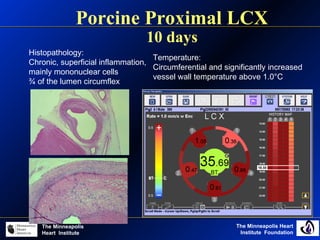
Porcine Proximal LCX
10 days
Histopathology:
Chronic, superficial inflammation,
mainly mononuclear cells
¾ of the lumen circumflex

Temperature:
Circumferential and significantly increased
vessel wall temperature above 1.0°C
The Minneapolis Heart
Institute Foundation
The Minneapolis
Heart Institute
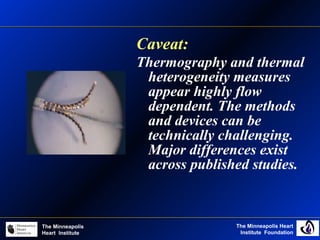
Caveat:
Thermography and thermal
heterogeneity measures
appear highly flow
dependent. The methods
and devices can be
technically challenging.
Major differences exist
across published studies.
The Minneapolis Heart
Institute Foundation
The Minneapolis
Heart Institute
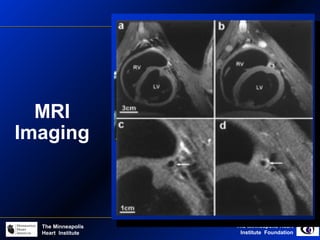
MRI
Imaging
The Minneapolis Heart
Institute Foundation
The Minneapolis
Heart Institute
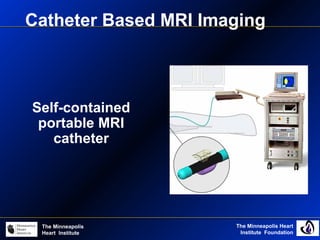
Self-contained
portable MRI
catheter
Catheter Based MRI Imaging
The Minneapolis Heart
Institute Foundation
The Minneapolis
Heart Institute
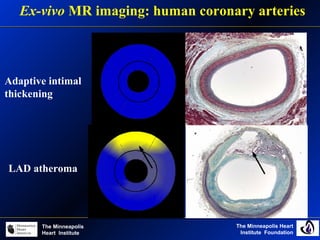
Ex-vivo MR imaging: human coronary arteries
Adaptive intimal
thickening
LAD atheroma
The Minneapolis Heart
Institute Foundation
The Minneapolis
Heart Institute
The Minneapolis Heart
Institute Foundation
The Minneapolis
Heart Institute
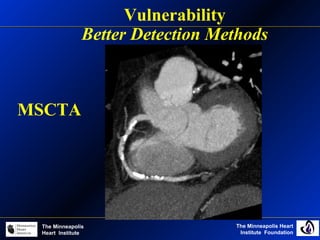
Vulnerability
Better Detection Methods
MSCTA
The Minneapolis Heart
Institute Foundation
The Minneapolis
Heart Institute
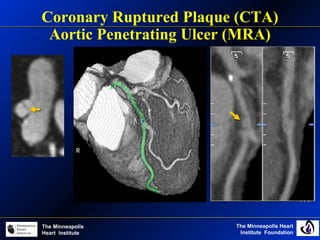
Coronary Ruptured Plaque (CTA)
Aortic Penetrating Ulcer (MRA)
The Minneapolis Heart
Institute Foundation
The Minneapolis
Heart Institute
Is Not ‘Soft Plaque”
MSCTA visualizes well
Questions:
 Prevalence of isolated Uncalcified Plaque (no
associated calcified plaque)
 Risk Factors associated
CTA and Uncalcified Plaque
The Minneapolis Heart
Institute Foundation
The Minneapolis
Heart Institute
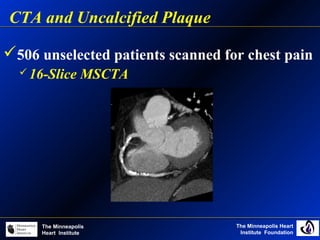
506 unselected patients scanned for chest pain
 16-Slice MSCTA
CTA and Uncalcified Plaque
The Minneapolis Heart
Institute Foundation
The Minneapolis
Heart Institute
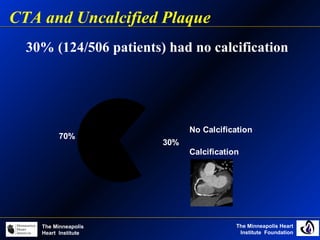
30% (124/506 patients) had no calcification
CTA and Uncalcified Plaque
30%
70%
No Calcification
Calcification
The Minneapolis Heart
Institute Foundation
The Minneapolis
Heart Institute
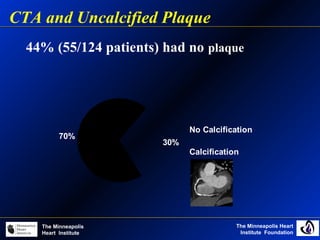
44% (55/124 patients) had no plaque
CTA and Uncalcified Plaque
30%
70%
No Calcification
Calcification
The Minneapolis Heart
Institute Foundation
The Minneapolis
Heart Institute
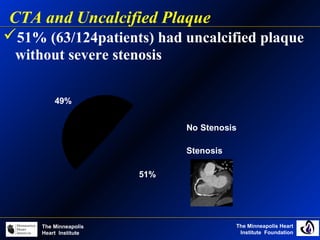
51% (63/124patients) had uncalcified plaque
without severe stenosis
CTA and Uncalcified Plaque
51%
49%
No Stenosis
Stenosis
The Minneapolis Heart
Institute Foundation
The Minneapolis
Heart Institute
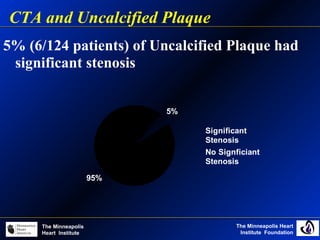
5% (6/124 patients) of Uncalcified Plaque had
significant stenosis
CTA and Uncalcified Plaque
5%
95%
Significant
Stenosis
No Signficiant
Stenosis
The Minneapolis Heart
Institute Foundation
The Minneapolis
Heart Institute
Risk Factors and all uncalcified plaque
83% Smokers (former/current)
98% of patients with 0-3 Risk factors had no plaque or
<50% Stenosis
86% of patients with > 4 Risk factors had UCP and/or
significant stenosis
No patient with <2 Risk Factors had uncalcified
plaque
The Minneapolis Heart
Institute Foundation
The Minneapolis
Heart Institute
Uncalcified plaque is prevalent in patients with chest
pain
Smoking may have significant impact on UCP
formation.
UCP prevalence is highly dependent on aggregate
coronary risk.
MSCTA appears useful for detecting both calcified
and noncalcified coronary plaque.
MSCTA and Uncalcified Plaque
The Minneapolis Heart
Institute Foundation
The Minneapolis
Heart Institute
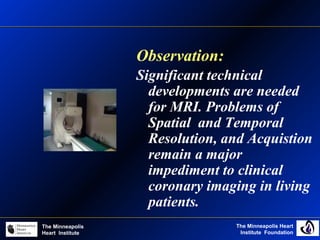
Observation:
Significant technical
developments are needed
for MRI. Problems of
Spatial and Temporal
Resolution, and Acquistion
remain a major
impediment to clinical
coronary imaging in living
patients.
The Minneapolis Heart
Institute Foundation
The Minneapolis
Heart Institute
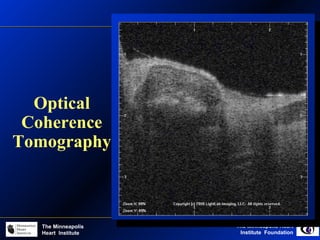
Optical
Coherence
Tomography
The Minneapolis Heart
Institute Foundation
The Minneapolis
Heart Institute
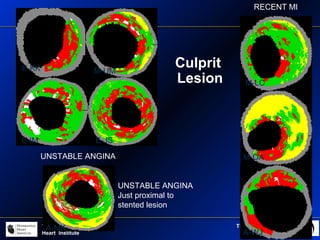
Culprit
Lesion
M-OA
M-LC
A-WJ
Unstable
E-KK M-UM
E-IM E-JS
A-MK
RECENT MI
UNSTABLE ANGINA
UNSTABLE ANGINA
Just proximal to
stented lesion
The Minneapolis Heart
Institute Foundation
The Minneapolis
Heart Institute
Caveat
Intravascular Imaging
can localize thin-cap
fibroadenoma and lipid-
laden regions of
vulnerability.
But what does it mean?
The Minneapolis Heart
Institute Foundation
The Minneapolis
Heart Institute
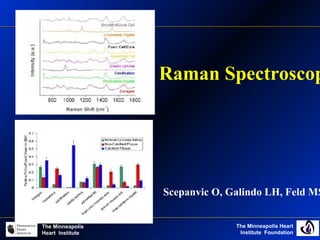
Raman Spectroscop
Scepanvic O, Galindo LH, Feld MS
The Minneapolis Heart
Institute Foundation
The Minneapolis
Heart Institute
Now that we aren’t certain about diagnoses,
what about therapy?
Perspective: Imaging Vulnerable Plaque
The Minneapolis Heart
Institute Foundation
The Minneapolis
Heart Institute
%%
withwith
EvenEven
tt
00 33 1818 2121 2424 2727 303066 99 1212 1515
2020
1515
1010
55
00
Months of Follow-up
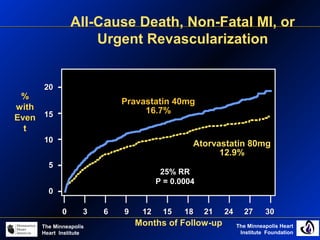
All-Cause Death, Non-Fatal MI, or
Urgent Revascularization
Pravastatin 40mgPravastatin 40mg
16.7%16.7%
Atorvastatin 80mgAtorvastatin 80mg
12.9%12.9%
25% RR25% RR
P = 0.0004P = 0.0004
The Minneapolis Heart
Institute Foundation
The Minneapolis
Heart Institute
16.7
20.5
33.3
16.7
6.4
3.9
1.3 1.3
0 0 0 0 0
0
5
10
15
20
25
30
35
Percent(%)
10
20
30
40
50
60
70
80
90
100
110
120
130
millimeters (mm)
Prox Mid Distal
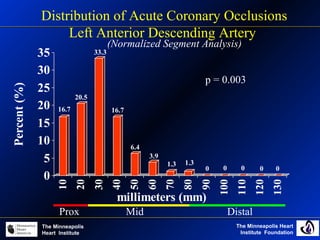
p = 0.003
Distribution of Acute Coronary Occlusions
Left Anterior Descending Artery
(Normalized Segment Analysis)
The Minneapolis Heart
Institute Foundation
The Minneapolis
Heart Institute
0
10
20
30
40
50
60
70
80
90
100 0
10
20
30
40
50
60
70
80
90
100
110
120
130
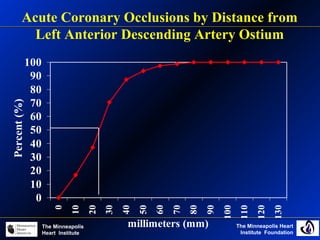
millimeters (mm)
Percent(%)Acute Coronary Occlusions by Distance from
Left Anterior Descending Artery Ostium
The Minneapolis Heart
Institute Foundation
The Minneapolis
Heart Institute
How to Cure Human Disease
1. Define the Disease
Not Yet
2.Associate it reliably
Not Yet
3.Find the Disease
Not Yet
4. Deliver the ‘Fix’
Not Yet
The Minneapolis Heart
Institute Foundation
The Minneapolis
Heart Institute
Perspective:
Vulnerable Plaque
…or vessels, patients
or ??
Robert S. Schwartz, MD
Minneapolis Heart Institute

Vuln shape aha 2005

  • 1.
    The Minneapolis Heart InstituteFoundation The Minneapolis Heart Institute Perspective: Vulnerable Plaque …or vessels, patients or ?? Robert S. Schwartz, MD Minneapolis Heart Institute
  • 2.
    The Minneapolis Heart InstituteFoundation The Minneapolis Heart Institute How to Cure Human Disease 1. Define the Disease 2.Associate it reliably 3.Find the Disease 4. Deliver the ‘Fix’
  • 3.
    The Minneapolis Heart InstituteFoundation The Minneapolis Heart Institute
  • 4.
    The Minneapolis Heart InstituteFoundation The Minneapolis Heart Institute Arterial Inflammation
  • 5.
    The Minneapolis Heart InstituteFoundation The Minneapolis Heart Institute Find the Disease Imaging Technology
  • 6.
    The Minneapolis Heart InstituteFoundation The Minneapolis Heart Institute 3 Autopsy Derived Groups Acute MI 18 patients/337 segments Stable Angina 5 Patients/76 segments Controls (no CAD) 9 Patients/111 segments Coronary Inflammation Is Diffuse
  • 7.
    The Minneapolis Heart InstituteFoundation The Minneapolis Heart Institute Inflammatory Cell Count Macrophages/Monocytes CD-68 Positivity T-Lymphocytes CD-3 Positivity Coronary Inflammation Is Diffuse
  • 8.
    The Minneapolis Heart InstituteFoundation The Minneapolis Heart Institute IRA Segments AMI Non-IRA segments of AMI group Controls CD68 positive cells monocytes/macrophag es 38.0 + 7.9% 35.3 + 4.7% 1.0 + 2.9% CD3 positive cells (T-lymphocytes) 17.7 + 3.5% 20.9 + 4.1% 7.6 + 1.6% Coronary Artery Inflammation Is Diffuse JACC April 2005 Mauriello, Sangiorgi, Fratoni, Palmieri, Bonanno, Anemona Schwartz, Spagnoli
  • 9.
    The Minneapolis Heart InstituteFoundation The Minneapolis Heart Institute Coronary Inflammation Is Diffuse 0 5 10 15 20 25 30 35 40 IRA Non-IRA Control Macrophages Lymphocytes JACC April 2005 Mauriello, Sangiorgi, Fratoni, Palmieri, Bonanno, Anemona Schwartz, Spagnoli
  • 10.
    The Minneapolis Heart InstituteFoundation The Minneapolis Heart Institute Vulnerable Plaque: Detection
  • 11.
    The Minneapolis Heart InstituteFoundation The Minneapolis Heart Institute Thermography Will Thermography will easily detect and localize vulnerable plaque?
  • 12.
    The Minneapolis Heart InstituteFoundation The Minneapolis Heart Institute Thermography
  • 13.
    The Minneapolis Heart InstituteFoundation The Minneapolis Heart Institute Porcine Proximal LCX 10 days Histopathology: Chronic, superficial inflammation, mainly mononuclear cells ¾ of the lumen circumflex Temperature: Circumferential and significantly increased vessel wall temperature above 1.0°C
  • 14.
    The Minneapolis Heart InstituteFoundation The Minneapolis Heart Institute Caveat: Thermography and thermal heterogeneity measures appear highly flow dependent. The methods and devices can be technically challenging. Major differences exist across published studies.
  • 15.
    The Minneapolis Heart InstituteFoundation The Minneapolis Heart Institute MRI Imaging
  • 16.
    The Minneapolis Heart InstituteFoundation The Minneapolis Heart Institute Self-contained portable MRI catheter Catheter Based MRI Imaging
  • 17.
    The Minneapolis Heart InstituteFoundation The Minneapolis Heart Institute Ex-vivo MR imaging: human coronary arteries Adaptive intimal thickening LAD atheroma
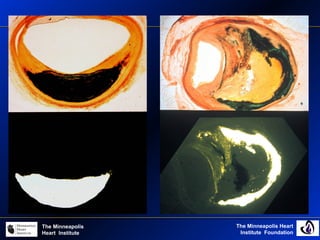
  • 18.
    The Minneapolis Heart InstituteFoundation The Minneapolis Heart Institute
  • 19.
    The Minneapolis Heart InstituteFoundation The Minneapolis Heart Institute Vulnerability Better Detection Methods MSCTA
  • 20.
    The Minneapolis Heart InstituteFoundation The Minneapolis Heart Institute Coronary Ruptured Plaque (CTA) Aortic Penetrating Ulcer (MRA)
  • 21.
    The Minneapolis Heart InstituteFoundation The Minneapolis Heart Institute Is Not ‘Soft Plaque” MSCTA visualizes well Questions:  Prevalence of isolated Uncalcified Plaque (no associated calcified plaque)  Risk Factors associated CTA and Uncalcified Plaque
  • 22.
    The Minneapolis Heart InstituteFoundation The Minneapolis Heart Institute 506 unselected patients scanned for chest pain  16-Slice MSCTA CTA and Uncalcified Plaque
  • 23.
    The Minneapolis Heart InstituteFoundation The Minneapolis Heart Institute 30% (124/506 patients) had no calcification CTA and Uncalcified Plaque 30% 70% No Calcification Calcification
  • 24.
    The Minneapolis Heart InstituteFoundation The Minneapolis Heart Institute 44% (55/124 patients) had no plaque CTA and Uncalcified Plaque 30% 70% No Calcification Calcification
  • 25.
    The Minneapolis Heart InstituteFoundation The Minneapolis Heart Institute 51% (63/124patients) had uncalcified plaque without severe stenosis CTA and Uncalcified Plaque 51% 49% No Stenosis Stenosis
  • 26.
    The Minneapolis Heart InstituteFoundation The Minneapolis Heart Institute 5% (6/124 patients) of Uncalcified Plaque had significant stenosis CTA and Uncalcified Plaque 5% 95% Significant Stenosis No Signficiant Stenosis
  • 27.
    The Minneapolis Heart InstituteFoundation The Minneapolis Heart Institute Risk Factors and all uncalcified plaque 83% Smokers (former/current) 98% of patients with 0-3 Risk factors had no plaque or <50% Stenosis 86% of patients with > 4 Risk factors had UCP and/or significant stenosis No patient with <2 Risk Factors had uncalcified plaque
  • 28.
    The Minneapolis Heart InstituteFoundation The Minneapolis Heart Institute Uncalcified plaque is prevalent in patients with chest pain Smoking may have significant impact on UCP formation. UCP prevalence is highly dependent on aggregate coronary risk. MSCTA appears useful for detecting both calcified and noncalcified coronary plaque. MSCTA and Uncalcified Plaque
  • 29.
    The Minneapolis Heart InstituteFoundation The Minneapolis Heart Institute Observation: Significant technical developments are needed for MRI. Problems of Spatial and Temporal Resolution, and Acquistion remain a major impediment to clinical coronary imaging in living patients.
  • 30.
    The Minneapolis Heart InstituteFoundation The Minneapolis Heart Institute Optical Coherence Tomography
  • 31.
    The Minneapolis Heart InstituteFoundation The Minneapolis Heart Institute Culprit Lesion M-OA M-LC A-WJ Unstable E-KK M-UM E-IM E-JS A-MK RECENT MI UNSTABLE ANGINA UNSTABLE ANGINA Just proximal to stented lesion
  • 32.
    The Minneapolis Heart InstituteFoundation The Minneapolis Heart Institute Caveat Intravascular Imaging can localize thin-cap fibroadenoma and lipid- laden regions of vulnerability. But what does it mean?
  • 33.
    The Minneapolis Heart InstituteFoundation The Minneapolis Heart Institute Raman Spectroscop Scepanvic O, Galindo LH, Feld MS
  • 34.
    The Minneapolis Heart InstituteFoundation The Minneapolis Heart Institute Now that we aren’t certain about diagnoses, what about therapy? Perspective: Imaging Vulnerable Plaque
  • 35.
    The Minneapolis Heart InstituteFoundation The Minneapolis Heart Institute %% withwith EvenEven tt 00 33 1818 2121 2424 2727 303066 99 1212 1515 2020 1515 1010 55 00 Months of Follow-up All-Cause Death, Non-Fatal MI, or Urgent Revascularization Pravastatin 40mgPravastatin 40mg 16.7%16.7% Atorvastatin 80mgAtorvastatin 80mg 12.9%12.9% 25% RR25% RR P = 0.0004P = 0.0004
  • 36.
    The Minneapolis Heart InstituteFoundation The Minneapolis Heart Institute 16.7 20.5 33.3 16.7 6.4 3.9 1.3 1.3 0 0 0 0 0 0 5 10 15 20 25 30 35 Percent(%) 10 20 30 40 50 60 70 80 90 100 110 120 130 millimeters (mm) Prox Mid Distal p = 0.003 Distribution of Acute Coronary Occlusions Left Anterior Descending Artery (Normalized Segment Analysis)
  • 37.
    The Minneapolis Heart InstituteFoundation The Minneapolis Heart Institute 0 10 20 30 40 50 60 70 80 90 100 0 10 20 30 40 50 60 70 80 90 100 110 120 130 millimeters (mm) Percent(%)Acute Coronary Occlusions by Distance from Left Anterior Descending Artery Ostium
  • 38.
    The Minneapolis Heart InstituteFoundation The Minneapolis Heart Institute How to Cure Human Disease 1. Define the Disease Not Yet 2.Associate it reliably Not Yet 3.Find the Disease Not Yet 4. Deliver the ‘Fix’ Not Yet
  • 39.
    The Minneapolis Heart InstituteFoundation The Minneapolis Heart Institute Perspective: Vulnerable Plaque …or vessels, patients or ?? Robert S. Schwartz, MD Minneapolis Heart Institute

Editor's Notes

  • #3 &amp;lt;number&amp;gt; So, given the impact that stents have on the vascular system, it is critical that the body’s response to this injury is in the form of controlled, healthy healing. A few things to consider when evaluating DES are: - The ability for certain compounds, such as paclitaxel, to selectively target smooth muscle cells at lower doses than endothelial cells, thereby allowing for endothelial cells to grow over the stent struts to create a slippery surface that is non-thrombogenic may be important. - While controlling late loss is important, it may be equally important that there is a degree of consistency across trials and patient subsets. While achieving zero millimeters of late loss intuitively seems favorable, such a condition may not be conducive to healing. - The presence of late incomplete apposition is of concern because blood may be able to flow behind the stent struts, which may lead to a complications. - One of the important follow-up measurements in clinical trials is the progression of incomplete apposition. Gaps that form behind struts or increase in size can potentially cause blood to pool and clots to form (thrombus)
  • #5 &amp;lt;number&amp;gt; There are only a handful of radioisotopes with characteristics suitable for coronary Brachytherapy applications. Radioactive isotopes have a fixed half-life (the time it takes for the activity to drop by half). Their energies are also fixed. These energies are dictated by the nuclear structure and cannot be altered. Therefore to reach a certain target with radioisotopes one must have the right energy. If the conditions between the isotope and the target are changed by the presence of foreign material with different properties than tissue the dose to the target may not be achieved. As I mentioned earlier, beta sources have a limited depth of penetration which is adequate for a millimeter depth. On the other hand due to gamma&amp;apos;s penetrating power it delivers a dose well beyond the treatment zone.
  • #6 &amp;lt;number&amp;gt; So, given the impact that stents have on the vascular system, it is critical that the body’s response to this injury is in the form of controlled, healthy healing. A few things to consider when evaluating DES are: - The ability for certain compounds, such as paclitaxel, to selectively target smooth muscle cells at lower doses than endothelial cells, thereby allowing for endothelial cells to grow over the stent struts to create a slippery surface that is non-thrombogenic may be important. - While controlling late loss is important, it may be equally important that there is a degree of consistency across trials and patient subsets. While achieving zero millimeters of late loss intuitively seems favorable, such a condition may not be conducive to healing. - The presence of late incomplete apposition is of concern because blood may be able to flow behind the stent struts, which may lead to a complications. - One of the important follow-up measurements in clinical trials is the progression of incomplete apposition. Gaps that form behind struts or increase in size can potentially cause blood to pool and clots to form (thrombus)
  • #7 &amp;lt;number&amp;gt; There are only a handful of radioisotopes with characteristics suitable for coronary Brachytherapy applications. Radioactive isotopes have a fixed half-life (the time it takes for the activity to drop by half). Their energies are also fixed. These energies are dictated by the nuclear structure and cannot be altered. Therefore to reach a certain target with radioisotopes one must have the right energy. If the conditions between the isotope and the target are changed by the presence of foreign material with different properties than tissue the dose to the target may not be achieved. As I mentioned earlier, beta sources have a limited depth of penetration which is adequate for a millimeter depth. On the other hand due to gamma&amp;apos;s penetrating power it delivers a dose well beyond the treatment zone.
  • #8 &amp;lt;number&amp;gt; There are only a handful of radioisotopes with characteristics suitable for coronary Brachytherapy applications. Radioactive isotopes have a fixed half-life (the time it takes for the activity to drop by half). Their energies are also fixed. These energies are dictated by the nuclear structure and cannot be altered. Therefore to reach a certain target with radioisotopes one must have the right energy. If the conditions between the isotope and the target are changed by the presence of foreign material with different properties than tissue the dose to the target may not be achieved. As I mentioned earlier, beta sources have a limited depth of penetration which is adequate for a millimeter depth. On the other hand due to gamma&amp;apos;s penetrating power it delivers a dose well beyond the treatment zone.
  • #10 &amp;lt;number&amp;gt; There are only a handful of radioisotopes with characteristics suitable for coronary Brachytherapy applications. Radioactive isotopes have a fixed half-life (the time it takes for the activity to drop by half). Their energies are also fixed. These energies are dictated by the nuclear structure and cannot be altered. Therefore to reach a certain target with radioisotopes one must have the right energy. If the conditions between the isotope and the target are changed by the presence of foreign material with different properties than tissue the dose to the target may not be achieved. As I mentioned earlier, beta sources have a limited depth of penetration which is adequate for a millimeter depth. On the other hand due to gamma&amp;apos;s penetrating power it delivers a dose well beyond the treatment zone.
  • #13 &amp;lt;number&amp;gt; There are only a handful of radioisotopes with characteristics suitable for coronary Brachytherapy applications. Radioactive isotopes have a fixed half-life (the time it takes for the activity to drop by half). Their energies are also fixed. These energies are dictated by the nuclear structure and cannot be altered. Therefore to reach a certain target with radioisotopes one must have the right energy. If the conditions between the isotope and the target are changed by the presence of foreign material with different properties than tissue the dose to the target may not be achieved. As I mentioned earlier, beta sources have a limited depth of penetration which is adequate for a millimeter depth. On the other hand due to gamma&amp;apos;s penetrating power it delivers a dose well beyond the treatment zone.
  • #16 &amp;lt;number&amp;gt; There are only a handful of radioisotopes with characteristics suitable for coronary Brachytherapy applications. Radioactive isotopes have a fixed half-life (the time it takes for the activity to drop by half). Their energies are also fixed. These energies are dictated by the nuclear structure and cannot be altered. Therefore to reach a certain target with radioisotopes one must have the right energy. If the conditions between the isotope and the target are changed by the presence of foreign material with different properties than tissue the dose to the target may not be achieved. As I mentioned earlier, beta sources have a limited depth of penetration which is adequate for a millimeter depth. On the other hand due to gamma&amp;apos;s penetrating power it delivers a dose well beyond the treatment zone.
  • #31 &amp;lt;number&amp;gt; There are only a handful of radioisotopes with characteristics suitable for coronary Brachytherapy applications. Radioactive isotopes have a fixed half-life (the time it takes for the activity to drop by half). Their energies are also fixed. These energies are dictated by the nuclear structure and cannot be altered. Therefore to reach a certain target with radioisotopes one must have the right energy. If the conditions between the isotope and the target are changed by the presence of foreign material with different properties than tissue the dose to the target may not be achieved. As I mentioned earlier, beta sources have a limited depth of penetration which is adequate for a millimeter depth. On the other hand due to gamma&amp;apos;s penetrating power it delivers a dose well beyond the treatment zone.
  • #39 &amp;lt;number&amp;gt; So, given the impact that stents have on the vascular system, it is critical that the body’s response to this injury is in the form of controlled, healthy healing. A few things to consider when evaluating DES are: - The ability for certain compounds, such as paclitaxel, to selectively target smooth muscle cells at lower doses than endothelial cells, thereby allowing for endothelial cells to grow over the stent struts to create a slippery surface that is non-thrombogenic may be important. - While controlling late loss is important, it may be equally important that there is a degree of consistency across trials and patient subsets. While achieving zero millimeters of late loss intuitively seems favorable, such a condition may not be conducive to healing. - The presence of late incomplete apposition is of concern because blood may be able to flow behind the stent struts, which may lead to a complications. - One of the important follow-up measurements in clinical trials is the progression of incomplete apposition. Gaps that form behind struts or increase in size can potentially cause blood to pool and clots to form (thrombus)