CARDIAC
BIOMARKERS
DR NIHANTH REDDY V
BIOMARKER
• BIOMARKER – BIOLOGIC MARKER : A
characteristic that is objectively
measured and evaluated as an
indicator of normal biologic processes,
pathogenic processes or
pharmacologic responses to a
therapeutic intervention
CLINICAL APPLICATIONS OF
CARDIOVASCULAR BIOMARKERS :
1. Diagnosis
2. Risk stratification
3. Goals for therapy
4. Targeting of therapy
5. Drug development, evaluation and
registration
BIOMARKER
CATEGORIES
ACCORDING
TO THE FDA-
NIH BEST
Resource
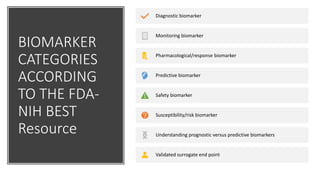
Diagnostic biomarker
Monitoring biomarker
Pharmacological/response biomarker
Predictive biomarker
Safety biomarker
Susceptibility/risk biomarker
Understanding prognostic versus predictive biomarkers
Validated surrogate end point
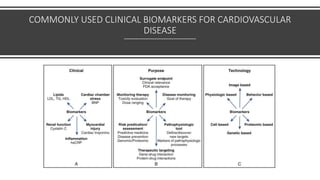
COMMONLY USED CLINICAL BIOMARKERS FOR CARDIOVASCULAR
DISEASE
CLINICAL
MEASURES OF
BIOMARKER
PERFORMANCE
• Before considering any biomarker in the
clinical setting for risk prediction, two things
are to be sought :
1. Is there a clear evidence that the
biomarker of interest predicts future
cardiovascular events independent of
other already measured biomarkers
2. Is there clear evidence that patients
identified by the biomarker of interest will
benefit from a therapy that they otherwise
would not have received
CARDIAC BIOMARKERS
• Cardiac biomarkers are protein molecules released into the blood stream from
damaged heart muscle secondary to various etiologies
• They are always normally present, however are significantly elevated during
injury to the heart muscle
• They include :
1. Most popular and effective Biomarkers : Cardiac troponin and Natriuretic
peptides
2. Other clinical biomarkers : C reactive protein, copeptin
3. Emerging biomarkers under study
a)Inflammation biomarkers
b)Cardiomyocytes injury biomarkers
c)Other biomarkers
CRITERIA OF IDEAL CARDIAC BIOMARKER
• Has high cardiac specificity
• Pharmacokinetics
• Easy diagnosis
• Marker should play a designed role in the treatment and
management of the clinical subject
• Correlates with amount of injury and enables prognosis prediction
INTRODUCTION
• According to the World Health Organization (WHO), cardiovascular disease (CVD)
is the number one cause of death globally and is responsible for 45% of all
deaths.
• Its high morbidity, mortality, and high rate of rehospitalization have forced several
researchers to search for the best way to diagnose, stratify risk, and manage
patients with suspected cardiovascular diseases, among which acute coronary
syndrome (ACS) and heart failure (HF) are most common
• The ideal biomarker for detecting myocardial injury needs to be expressed at
relatively high levels within cardiac tissue, with high clinical sensitivity and
specificity that is detectable in the blood early after the onset of symptoms, such
as chest pain
CLASSIFICATION OF BIOMARKERS
• Biomarkers of
1. Myocardial ischemia or necrosis
2. Inflammation and prognosis
3. Hemodynamics
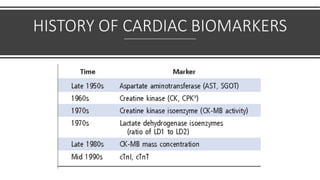
HISTORY OF CARDIAC BIOMARKERS
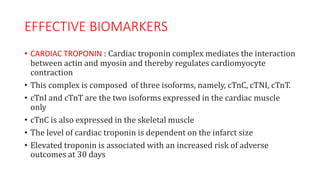
EFFECTIVE BIOMARKERS
• CARDIAC TROPONIN : Cardiac troponin complex mediates the interaction
between actin and myosin and thereby regulates cardiomyocyte
contraction
• This complex is composed of three isoforms, namely, cTnC, cTNI, cTnT.
• cTnI and cTnT are the two isoforms expressed in the cardiac muscle
only
• cTnC is also expressed in the skeletal muscle
• The level of cardiac troponin is dependent on the infarct size
• Elevated troponin is associated with an increased risk of adverse
outcomes at 30 days
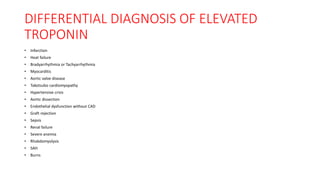
DIFFERENTIAL DIAGNOSIS OF ELEVATED
TROPONIN
• Infarction
• Heat failure
• Bradyarrhythmia or Tachyarrhythmia
• Myocarditis
• Aortic valve disease
• Takotsubo cardiomyopathy
• Hypertensive crisis
• Aortic dissection
• Endothelial dysfunction without CAD
• Graft rejection
• Sepsis
• Renal failure
• Severe anemia
• Rhabdomyolysis
• SAH
• Burns
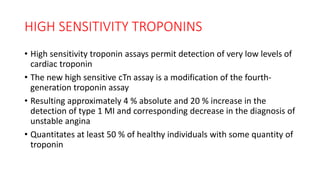
HIGH SENSITIVITY TROPONINS
• High sensitivity troponin assays permit detection of very low levels of
cardiac troponin
• The new high sensitive cTn assay is a modification of the fourth-
generation troponin assay
• Resulting approximately 4 % absolute and 20 % increase in the
detection of type 1 MI and corresponding decrease in the diagnosis of
unstable angina
• Quantitates at least 50 % of healthy individuals with some quantity of
troponin
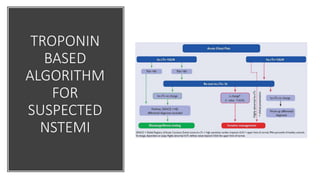
TROPONIN
BASED
ALGORITHM
FOR
SUSPECTED
NSTEMI
UTILITY AND CHALLENGES OF HIGH
SENSITIVITY TROPONIN
• POTENTIAL UTILITY
1. More rapid diagnosis in ACS
2. Population screening
3. Prognostic information in stable patients
4. Drug development and cardiotoxicity
POTENTIAL CHALLENGES
1. Nonspecific to etiology
2. False positive interpretation
• Studies have shown that hs-cTnT and hs-cTnI seem to have
comparable diagnostic accuracies, hs-cTnI had greater early diagnostic
accuracy
• Another study showed that the hs-cTnT blood concentration
exhibited a diurnal rhythm, characterized by gradually decreasing
concentrations throughout the daytime, rising concentrations during
nighttime, and peak concentrations in the morning
• The rhythm does not seem to affect the diagnostic accuracy for AMI,
except for screening purposes
• hs-TnI did not express the same rhythm, it demonstrated high
diagnostic accuracy for AMI, and it did not differ with time of
presentation.
BNP or NT pro BNP
• BNP is synthesized and released by cardiac ventricular cells in
response to volume or pressure overload
• Both active BNP and inactive NT-pro BNP are generated from the
cleavage of pro BNP and therefore they are secreted into the
bloodstream in equal concentrations
• After secretion into the bloodstream, the BNP will then bind to NP
receptors (NPRs) and subsequently activate the intracellular cGMP
signaling cascades to reduce the volume or pressure overload
• BNP is primarily cleared through the degradation by neutral
endopeptidases and partially through the uptake by NPR and renal
excretion
• BNP and NT-proBNP, the two most commonly used natriuretic
peptides, play a diagnostic role in the assessment of heart failure
• They may be increased due to systolic and/or diastolic dysfunction,
left ventricular hypertrophy, valvular heart disease, ischemia, or a
combination of these factors.
• In multiple analyses, the measurements of B-type natriuretic peptide
added significant independent predictive power to other clinical
variables in models predicting which patients had congestive heart
failure
• Guidelines recommend the use of BNP or NT-pro BNP in the
diagnostic algorithm for HF, especially for the patients whose
echocardiography was not found to have an important cardiac
abnormality, with higher levels indicating a higher likelihood for AHF
to be the main cause of acute dyspnea
• In addition to the utility in HF diagnosis, the levels of BNP or NT-pro
BNP were useful for risk stratification and management of patients
with suspected HF.
• A trend of decreasing levels of natriuretic peptide indicates
effectiveness of the management strategy deployed
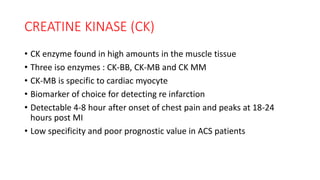
CREATINE KINASE (CK)
• CK enzyme found in high amounts in the muscle tissue
• Three iso enzymes : CK-BB, CK-MB and CK MM
• CK-MB is specific to cardiac myocyte
• Biomarker of choice for detecting re infarction
• Detectable 4-8 hour after onset of chest pain and peaks at 18-24
hours post MI
• Low specificity and poor prognostic value in ACS patients
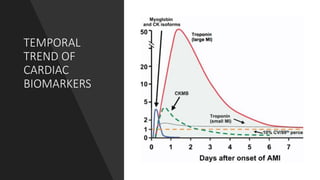
TEMPORAL
TREND OF
CARDIAC
BIOMARKERS
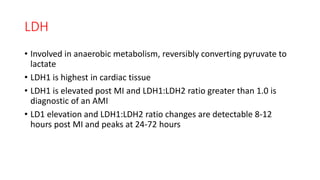
LDH
• Involved in anaerobic metabolism, reversibly converting pyruvate to
lactate
• LDH1 is highest in cardiac tissue
• LDH1 is elevated post MI and LDH1:LDH2 ratio greater than 1.0 is
diagnostic of an AMI
• LD1 elevation and LDH1:LDH2 ratio changes are detectable 8-12
hours post MI and peaks at 24-72 hours
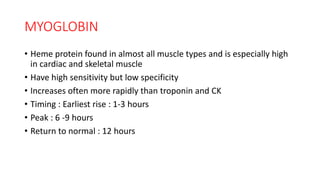
MYOGLOBIN
• Heme protein found in almost all muscle types and is especially high
in cardiac and skeletal muscle
• Have high sensitivity but low specificity
• Increases often more rapidly than troponin and CK
• Timing : Earliest rise : 1-3 hours
• Peak : 6 -9 hours
• Return to normal : 12 hours
ISCHEMIA MODIFIED ALBUMIN
• A novel marker of ischemia
• Produced when circulating serum albumin contacts ischemic heart
tissues
• IMA can be measured by the albumin cobalt binding assay that is
based on IMA’s inability to bind to cobalt
• IMA levels rise within 6 hours, remain elevated for 12 hours
• Drawbacks : Levels raised in non cardiac ischemia – hypoxia, acidosis
HEART TYPE FATTY ACID BINDING PROTEIN
• H-FABP is a protein involved in myocardial fatty acid metabolism
• It is rapidly released early in myocardial infarction and necrosis into
cytosol
• Associated with composite end point of death, myocardial infarction
and heart failure at 10 months
OTHER CLINICAL BIOMARKERS
• C Reactive Protein : Prognostic indicator in patients with ACS, as
elevated CRP levels are independent predictors of cardiac death, AMI,
and congestive heart failure
• Less specific and sensitive biomarker of cardiac injury
• Can aid in assessing the outcome in patients with heart disease, such
as in MI and ACS
COPEPTIN
• Copeptin, the c-terminal part of the vasopressin prohormone that is
released together with arginine vasopressin (AVP) within 0–4 h after
symptom onset, observably improves baseline cTn sensitivity and
could improve effectiveness and safety in combination with cTnT or
cTnI for early rule-out of AMI
EMERGING BIOMARKERS
• IL-6 : Critical inflammation biomarker that may be implicated in the
diagnosis, risk stratification, and prognosis of patients with AMI.
• IL-6 expression is shown to be elevated in induced myocardial
infarction by trans-coronary ablation of septal hypertrophy,
suggesting its diagnostic role
• The IL-6 concentration, independent of the already established
predictors, is also related to adverse cardiac events
• The IL-6 receptor antagonist could improve the inflammatory
response and the percutaneous coronary intervention- (PCI-) treated
cTn release in NSTEMI
• Soluble CD40 Ligand : sCD40L is a molecule involved in both inflammation and the
thrombosis process
• Studies have shown that it mediates the interaction of platelets and neutrophils,
plays a role in the vascular and endothelial dysfunction seen in AMI progression
• Gal-3 is a member of the inflammation mediators and is related to the extent of
myocardial inflammation and fibrosis
• Serum Gal-3 is related to left ventricular dilation and is a contributory factor in
predicting the outcome and guiding the monitoring of patients with both acute heart
failure and chronic heart failure
• Mean platelet volume (MPV) and beta-thromboglobulin (beta-TG) are
two important platelet biomarkers that may increase during platelet
activation and have a higher expression in patients with coronary
artery diseases
• High MPV value also correlates with an increased incidence of long-
term adverse events, especially all-cause mortality in NSTEMI patients
undergoing PCI
• Additionally, research demonstrates that MPV to platelet count ratio
(MPV/P ratio) has a good prognostic performance in predicting the
outcomes of patients with AMI
• PREGNACY ASSOCIATED PLASMA PROTEIN A : PAPP-A is a high
molecular weight and zinc-binding metalloproteinase, and several
studies have demonstrated that PAPP-A plays a role in cardiovascular
diseases.
• Coronary PAPP-A levels were significantly elevated among patients at
risk for cardiovascular diseases
THANK YOU

CARDIAC BIOMARKERS.pptx

  • 1.
  • 2.
    BIOMARKER • BIOMARKER –BIOLOGIC MARKER : A characteristic that is objectively measured and evaluated as an indicator of normal biologic processes, pathogenic processes or pharmacologic responses to a therapeutic intervention CLINICAL APPLICATIONS OF CARDIOVASCULAR BIOMARKERS : 1. Diagnosis 2. Risk stratification 3. Goals for therapy 4. Targeting of therapy 5. Drug development, evaluation and registration
  • 3.
    BIOMARKER CATEGORIES ACCORDING TO THE FDA- NIHBEST Resource Diagnostic biomarker Monitoring biomarker Pharmacological/response biomarker Predictive biomarker Safety biomarker Susceptibility/risk biomarker Understanding prognostic versus predictive biomarkers Validated surrogate end point
  • 4.
    COMMONLY USED CLINICALBIOMARKERS FOR CARDIOVASCULAR DISEASE
  • 5.
    CLINICAL MEASURES OF BIOMARKER PERFORMANCE • Beforeconsidering any biomarker in the clinical setting for risk prediction, two things are to be sought : 1. Is there a clear evidence that the biomarker of interest predicts future cardiovascular events independent of other already measured biomarkers 2. Is there clear evidence that patients identified by the biomarker of interest will benefit from a therapy that they otherwise would not have received
  • 6.
    CARDIAC BIOMARKERS • Cardiacbiomarkers are protein molecules released into the blood stream from damaged heart muscle secondary to various etiologies • They are always normally present, however are significantly elevated during injury to the heart muscle • They include : 1. Most popular and effective Biomarkers : Cardiac troponin and Natriuretic peptides 2. Other clinical biomarkers : C reactive protein, copeptin 3. Emerging biomarkers under study a)Inflammation biomarkers b)Cardiomyocytes injury biomarkers c)Other biomarkers
  • 7.
    CRITERIA OF IDEALCARDIAC BIOMARKER • Has high cardiac specificity • Pharmacokinetics • Easy diagnosis • Marker should play a designed role in the treatment and management of the clinical subject • Correlates with amount of injury and enables prognosis prediction
  • 8.
    INTRODUCTION • According tothe World Health Organization (WHO), cardiovascular disease (CVD) is the number one cause of death globally and is responsible for 45% of all deaths. • Its high morbidity, mortality, and high rate of rehospitalization have forced several researchers to search for the best way to diagnose, stratify risk, and manage patients with suspected cardiovascular diseases, among which acute coronary syndrome (ACS) and heart failure (HF) are most common • The ideal biomarker for detecting myocardial injury needs to be expressed at relatively high levels within cardiac tissue, with high clinical sensitivity and specificity that is detectable in the blood early after the onset of symptoms, such as chest pain
  • 9.
    CLASSIFICATION OF BIOMARKERS •Biomarkers of 1. Myocardial ischemia or necrosis 2. Inflammation and prognosis 3. Hemodynamics
  • 10.
  • 11.
    EFFECTIVE BIOMARKERS • CARDIACTROPONIN : Cardiac troponin complex mediates the interaction between actin and myosin and thereby regulates cardiomyocyte contraction • This complex is composed of three isoforms, namely, cTnC, cTNI, cTnT. • cTnI and cTnT are the two isoforms expressed in the cardiac muscle only • cTnC is also expressed in the skeletal muscle • The level of cardiac troponin is dependent on the infarct size • Elevated troponin is associated with an increased risk of adverse outcomes at 30 days
  • 12.
    DIFFERENTIAL DIAGNOSIS OFELEVATED TROPONIN • Infarction • Heat failure • Bradyarrhythmia or Tachyarrhythmia • Myocarditis • Aortic valve disease • Takotsubo cardiomyopathy • Hypertensive crisis • Aortic dissection • Endothelial dysfunction without CAD • Graft rejection • Sepsis • Renal failure • Severe anemia • Rhabdomyolysis • SAH • Burns
  • 13.
    HIGH SENSITIVITY TROPONINS •High sensitivity troponin assays permit detection of very low levels of cardiac troponin • The new high sensitive cTn assay is a modification of the fourth- generation troponin assay • Resulting approximately 4 % absolute and 20 % increase in the detection of type 1 MI and corresponding decrease in the diagnosis of unstable angina • Quantitates at least 50 % of healthy individuals with some quantity of troponin
  • 14.
  • 15.
    UTILITY AND CHALLENGESOF HIGH SENSITIVITY TROPONIN • POTENTIAL UTILITY 1. More rapid diagnosis in ACS 2. Population screening 3. Prognostic information in stable patients 4. Drug development and cardiotoxicity POTENTIAL CHALLENGES 1. Nonspecific to etiology 2. False positive interpretation
  • 16.
    • Studies haveshown that hs-cTnT and hs-cTnI seem to have comparable diagnostic accuracies, hs-cTnI had greater early diagnostic accuracy • Another study showed that the hs-cTnT blood concentration exhibited a diurnal rhythm, characterized by gradually decreasing concentrations throughout the daytime, rising concentrations during nighttime, and peak concentrations in the morning • The rhythm does not seem to affect the diagnostic accuracy for AMI, except for screening purposes
  • 17.
    • hs-TnI didnot express the same rhythm, it demonstrated high diagnostic accuracy for AMI, and it did not differ with time of presentation.
  • 18.
    BNP or NTpro BNP • BNP is synthesized and released by cardiac ventricular cells in response to volume or pressure overload • Both active BNP and inactive NT-pro BNP are generated from the cleavage of pro BNP and therefore they are secreted into the bloodstream in equal concentrations • After secretion into the bloodstream, the BNP will then bind to NP receptors (NPRs) and subsequently activate the intracellular cGMP signaling cascades to reduce the volume or pressure overload • BNP is primarily cleared through the degradation by neutral endopeptidases and partially through the uptake by NPR and renal excretion
  • 19.
    • BNP andNT-proBNP, the two most commonly used natriuretic peptides, play a diagnostic role in the assessment of heart failure • They may be increased due to systolic and/or diastolic dysfunction, left ventricular hypertrophy, valvular heart disease, ischemia, or a combination of these factors. • In multiple analyses, the measurements of B-type natriuretic peptide added significant independent predictive power to other clinical variables in models predicting which patients had congestive heart failure
  • 20.
    • Guidelines recommendthe use of BNP or NT-pro BNP in the diagnostic algorithm for HF, especially for the patients whose echocardiography was not found to have an important cardiac abnormality, with higher levels indicating a higher likelihood for AHF to be the main cause of acute dyspnea
  • 21.
    • In additionto the utility in HF diagnosis, the levels of BNP or NT-pro BNP were useful for risk stratification and management of patients with suspected HF. • A trend of decreasing levels of natriuretic peptide indicates effectiveness of the management strategy deployed
  • 22.
    CREATINE KINASE (CK) •CK enzyme found in high amounts in the muscle tissue • Three iso enzymes : CK-BB, CK-MB and CK MM • CK-MB is specific to cardiac myocyte • Biomarker of choice for detecting re infarction • Detectable 4-8 hour after onset of chest pain and peaks at 18-24 hours post MI • Low specificity and poor prognostic value in ACS patients
  • 23.
  • 24.
    LDH • Involved inanaerobic metabolism, reversibly converting pyruvate to lactate • LDH1 is highest in cardiac tissue • LDH1 is elevated post MI and LDH1:LDH2 ratio greater than 1.0 is diagnostic of an AMI • LD1 elevation and LDH1:LDH2 ratio changes are detectable 8-12 hours post MI and peaks at 24-72 hours
  • 25.
    MYOGLOBIN • Heme proteinfound in almost all muscle types and is especially high in cardiac and skeletal muscle • Have high sensitivity but low specificity • Increases often more rapidly than troponin and CK • Timing : Earliest rise : 1-3 hours • Peak : 6 -9 hours • Return to normal : 12 hours
  • 26.
    ISCHEMIA MODIFIED ALBUMIN •A novel marker of ischemia • Produced when circulating serum albumin contacts ischemic heart tissues • IMA can be measured by the albumin cobalt binding assay that is based on IMA’s inability to bind to cobalt • IMA levels rise within 6 hours, remain elevated for 12 hours • Drawbacks : Levels raised in non cardiac ischemia – hypoxia, acidosis
  • 27.
    HEART TYPE FATTYACID BINDING PROTEIN • H-FABP is a protein involved in myocardial fatty acid metabolism • It is rapidly released early in myocardial infarction and necrosis into cytosol • Associated with composite end point of death, myocardial infarction and heart failure at 10 months
  • 28.
    OTHER CLINICAL BIOMARKERS •C Reactive Protein : Prognostic indicator in patients with ACS, as elevated CRP levels are independent predictors of cardiac death, AMI, and congestive heart failure • Less specific and sensitive biomarker of cardiac injury • Can aid in assessing the outcome in patients with heart disease, such as in MI and ACS
  • 29.
    COPEPTIN • Copeptin, thec-terminal part of the vasopressin prohormone that is released together with arginine vasopressin (AVP) within 0–4 h after symptom onset, observably improves baseline cTn sensitivity and could improve effectiveness and safety in combination with cTnT or cTnI for early rule-out of AMI
  • 30.
    EMERGING BIOMARKERS • IL-6: Critical inflammation biomarker that may be implicated in the diagnosis, risk stratification, and prognosis of patients with AMI. • IL-6 expression is shown to be elevated in induced myocardial infarction by trans-coronary ablation of septal hypertrophy, suggesting its diagnostic role • The IL-6 concentration, independent of the already established predictors, is also related to adverse cardiac events • The IL-6 receptor antagonist could improve the inflammatory response and the percutaneous coronary intervention- (PCI-) treated cTn release in NSTEMI
  • 31.
    • Soluble CD40Ligand : sCD40L is a molecule involved in both inflammation and the thrombosis process • Studies have shown that it mediates the interaction of platelets and neutrophils, plays a role in the vascular and endothelial dysfunction seen in AMI progression • Gal-3 is a member of the inflammation mediators and is related to the extent of myocardial inflammation and fibrosis • Serum Gal-3 is related to left ventricular dilation and is a contributory factor in predicting the outcome and guiding the monitoring of patients with both acute heart failure and chronic heart failure
  • 32.
    • Mean plateletvolume (MPV) and beta-thromboglobulin (beta-TG) are two important platelet biomarkers that may increase during platelet activation and have a higher expression in patients with coronary artery diseases • High MPV value also correlates with an increased incidence of long- term adverse events, especially all-cause mortality in NSTEMI patients undergoing PCI • Additionally, research demonstrates that MPV to platelet count ratio (MPV/P ratio) has a good prognostic performance in predicting the outcomes of patients with AMI
  • 33.
    • PREGNACY ASSOCIATEDPLASMA PROTEIN A : PAPP-A is a high molecular weight and zinc-binding metalloproteinase, and several studies have demonstrated that PAPP-A plays a role in cardiovascular diseases. • Coronary PAPP-A levels were significantly elevated among patients at risk for cardiovascular diseases
  • 34.