Is coated stent THE answer?
In-Stent Restenosis = Neointimal Hyperplasia
The long-term clinical efficacy of intracoronary stenting is
limited by restenosis which, occurs in 15-30 % of patients. In-
stent restenosis is due solely to neointimal hyperplasia.
Shape and chemical biocompatibility of stent, and the extent of
inflammatory response to stenting are among major factors
predicting restenosis. Intravascular radiation has shown
significant benefit however the cost, repated interventions,
radiation safety, short and long term adverse effect all remain
unresolved issues.
Experimental data suggest that in-situ immunosuppressant and
inhibitors of cell cycle progression may be an effective strategy
to prevent restenosis.
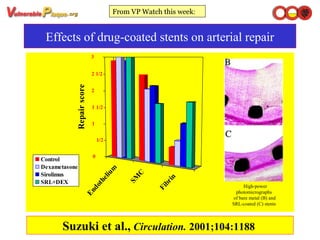
Effects of drug-coated stents on arterial repair
Suzuki et al., Circulation. 2001;104:1188
Endothelium
SM
C
Fibrin
0
1/2
1
1 1/2
2
2 1/2
3
Repairscore
Control
Dexametasone
Sirolimus
SRL+DEX
From VP Watch this week:
High-power
photomicrographs
of bare metal (B) and
SRL-coated (C) stents
As highlighted in VP Watch this week, Suzuki, Carter, et al.
determined that stents coated with a nonerodable polymer
matrix containing 185 µg SRL compared with a bare metal
stent reduces restenosis by 50% through inhibiting cellular
proliferation. The dose-response effects for this SRL-eluting
stent are incompletely characterized but, they indicated a dose-
dependent reduction in intimal hyperplasia with 60 µg to 200
µg SRL–coated stents in the rabbit model.
Circulation 2001;104:1188
 Also Suzuki et al. also showed that stent-based delivery of
dexamethasone (DEX) alone is insufficient to inhibit neointimal
formation. They did not observed any synergism in combination
of dexamethasonwith SRL.
Circulation 2001;104:1188
 It was shown years go that intraperitoneal administration of SRL, a potent
immunosuppressive agent, resulted in a dose-dependent inhibition of arterial
intimal thickening caused by either chronic alloimmune or mechanical injury
in a rat model. (Gregory CR, Huie P, Billingham ME, et al., Transplantation.
1993; 55: 1409–1418)
Other studies about the effect of Sirolimus on restenosis:
 Other studies also show that SRL inhibits the proliferation of vascular SMC
in human and rat in vitro by blocking the G1
/S transition. (Poon M et al., J
Clin Invest. 1996; 98: 2277–2283 and Marx SO et al., Circ Res. 1995; 76: 412–
417)
 Study of Gallo et al. indicates that systemic SRL therapy significantly
reduces the proliferative response after coronary angioplasty in the porcine
model. (Circulation. 1999; 99: 2164–2170)
Latest on Sirulimon restenosis clinical trial:
The RAVEL study this week
reported “zero” restenosis at 210
days.
Congress of European Society of Cardiology
Stockholm Sep 1-5th
Conclusion:
 Stent-based delivery of Sirolimus via a nonerodable
polymer matrix is feasible and effectively reduces restenosis.
Adding dexamethasone did not offer additional benefit.
If RAVEL holds true for 5 years, the immunosuppressant
RAPAMUNE® (Sirolimus) coated stents becomes the standard
therapy for coronary revascularization.
Questions:
Feel free to send your response to: 
Discussion-Group@VulnerablePlaque.org
 Knowing atherosclerosis as a diffuse disease, do you think that
stenting vulnerable plaques with coated stents can be the
treatment of choice besides statins?
If the coated stent reduces restenosis by 90%, will you stent
every vulnerable plaque? What if you find 3, 4, 5 or more
vulnerable plaques in one patient?

Vp watch editorial_slide25short-

  • 1.
    Is coated stentTHE answer?
  • 2.
    In-Stent Restenosis =Neointimal Hyperplasia The long-term clinical efficacy of intracoronary stenting is limited by restenosis which, occurs in 15-30 % of patients. In- stent restenosis is due solely to neointimal hyperplasia. Shape and chemical biocompatibility of stent, and the extent of inflammatory response to stenting are among major factors predicting restenosis. Intravascular radiation has shown significant benefit however the cost, repated interventions, radiation safety, short and long term adverse effect all remain unresolved issues. Experimental data suggest that in-situ immunosuppressant and inhibitors of cell cycle progression may be an effective strategy to prevent restenosis.
  • 3.
    Effects of drug-coatedstents on arterial repair Suzuki et al., Circulation. 2001;104:1188 Endothelium SM C Fibrin 0 1/2 1 1 1/2 2 2 1/2 3 Repairscore Control Dexametasone Sirolimus SRL+DEX From VP Watch this week: High-power photomicrographs of bare metal (B) and SRL-coated (C) stents
  • 4.
    As highlighted inVP Watch this week, Suzuki, Carter, et al. determined that stents coated with a nonerodable polymer matrix containing 185 µg SRL compared with a bare metal stent reduces restenosis by 50% through inhibiting cellular proliferation. The dose-response effects for this SRL-eluting stent are incompletely characterized but, they indicated a dose- dependent reduction in intimal hyperplasia with 60 µg to 200 µg SRL–coated stents in the rabbit model. Circulation 2001;104:1188  Also Suzuki et al. also showed that stent-based delivery of dexamethasone (DEX) alone is insufficient to inhibit neointimal formation. They did not observed any synergism in combination of dexamethasonwith SRL. Circulation 2001;104:1188
  • 5.
     It wasshown years go that intraperitoneal administration of SRL, a potent immunosuppressive agent, resulted in a dose-dependent inhibition of arterial intimal thickening caused by either chronic alloimmune or mechanical injury in a rat model. (Gregory CR, Huie P, Billingham ME, et al., Transplantation. 1993; 55: 1409–1418) Other studies about the effect of Sirolimus on restenosis:  Other studies also show that SRL inhibits the proliferation of vascular SMC in human and rat in vitro by blocking the G1 /S transition. (Poon M et al., J Clin Invest. 1996; 98: 2277–2283 and Marx SO et al., Circ Res. 1995; 76: 412– 417)  Study of Gallo et al. indicates that systemic SRL therapy significantly reduces the proliferative response after coronary angioplasty in the porcine model. (Circulation. 1999; 99: 2164–2170)
  • 6.
    Latest on Sirulimonrestenosis clinical trial: The RAVEL study this week reported “zero” restenosis at 210 days. Congress of European Society of Cardiology Stockholm Sep 1-5th
  • 7.
    Conclusion:  Stent-based deliveryof Sirolimus via a nonerodable polymer matrix is feasible and effectively reduces restenosis. Adding dexamethasone did not offer additional benefit. If RAVEL holds true for 5 years, the immunosuppressant RAPAMUNE® (Sirolimus) coated stents becomes the standard therapy for coronary revascularization.
  • 8.
    Questions: Feel free tosend your response to:  Discussion-Group@VulnerablePlaque.org  Knowing atherosclerosis as a diffuse disease, do you think that stenting vulnerable plaques with coated stents can be the treatment of choice besides statins? If the coated stent reduces restenosis by 90%, will you stent every vulnerable plaque? What if you find 3, 4, 5 or more vulnerable plaques in one patient?