Vulnerable Plaques andVulnerable Plaques and
Vulnerable PatientsVulnerable Patients
The 1The 1stst
  Guideline ofGuideline of Association for EradicationAssociation for Eradication
of Heart Attack AEHAof Heart Attack AEHA for Definition offor Definition of
Vulnerable Plaque and Vulnerable PatientVulnerable Plaque and Vulnerable Patient
(VP.org)(VP.org)
Morteza Naghavi, Erling Falk, Mohammad Madjid,
Silvio Litovsky, James Muller, Ward Casscells, Renu
Virmani, P.K. Shah, MD, Robert S. Schwartz, MD, Juan
Jose Badimon, PhD, Valentin Fuster, James T. Willerson
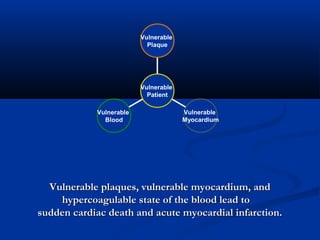
Vulnerable plaques, vulnerable myocardium, andVulnerable plaques, vulnerable myocardium, and
hypercoagulable state of the blood lead tohypercoagulable state of the blood lead to
sudden cardiac death and acute myocardial infarction.sudden cardiac death and acute myocardial infarction.
Vulnerable
Blood
Vulnerable
Myocardium
Vulnerable
Plaque
Vulnerable
Patient
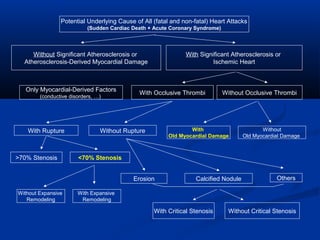
Potential Underlying Cause of All (fatal and non-fatal) Heart Attacks
(Sudden Cardiac Death + Acute Coronary Syndrome)
With Occlusive Thrombi
With Rupture
>70% Stenosis
With Significant Atherosclerosis or
Ischemic Heart
<70% Stenosis
Without Significant Atherosclerosis or
Atherosclerosis-Derived Myocardial Damage
Without Occlusive Thrombi
Without Rupture With
Old Myocardial Damage
Without
Old Myocardial Damage
Only Myocardial-Derived Factors
(conductive disorders, …)
Erosion Calcified Nodule Others
With Critical Stenosis Without Critical Stenosis
With Expansive
Remodeling
Without Expansive
Remodeling
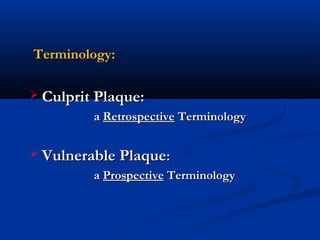
  Terminology:Terminology:
 Culprit Plaque:Culprit Plaque:
aa RetrospectiveRetrospective TerminologyTerminology
 Vulnerable PlaqueVulnerable Plaque::
aa ProspectiveProspective TerminologyTerminology
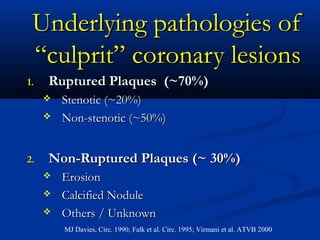
Underlying pathologies ofUnderlying pathologies of
“culprit” coronary lesions“culprit” coronary lesions
1.1. Ruptured Plaques (~70%)Ruptured Plaques (~70%)
 Stenotic (~20%)Stenotic (~20%)
 Non-stenotic (~50%)Non-stenotic (~50%)
2.2. Non-Ruptured Plaques (~ 30%)Non-Ruptured Plaques (~ 30%)
 ErosionErosion
 Calcified NoduleCalcified Nodule
 Others / UnknownOthers / Unknown
MJ Davies, Circ. 1990; Falk et al. Circ. 1995; Virmani et al. ATVB 2000
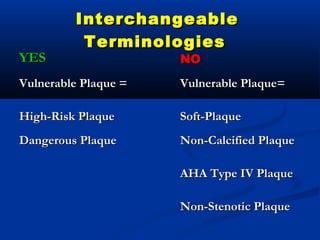
InterchangeableInterchangeable
TerminologiesTerminologies
YESYES NONO
Vulnerable Plaque =Vulnerable Plaque = Vulnerable Plaque=Vulnerable Plaque=
High-Risk PlaqueHigh-Risk Plaque Soft-PlaqueSoft-Plaque
Dangerous PlaqueDangerous Plaque Non-Calcified PlaqueNon-Calcified Plaque
AHA Type IV PlaqueAHA Type IV Plaque
Non-Stenotic PlaqueNon-Stenotic Plaque
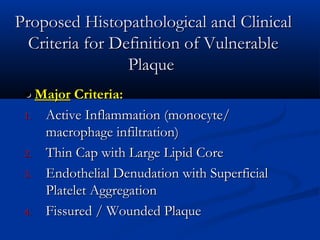
Proposed Histopathological and ClinicalProposed Histopathological and Clinical
Criteria for Definition of VulnerableCriteria for Definition of Vulnerable
PlaquePlaque
••  MajorMajor Criteria:Criteria:
1.1. Active Inflammation (monocyte/Active Inflammation (monocyte/
macrophage infiltration)macrophage infiltration)
2.2. Thin Cap with Large Lipid CoreThin Cap with Large Lipid Core
3.3. Endothelial Denudation with SuperficialEndothelial Denudation with Superficial
Platelet AggregationPlatelet Aggregation
4.4. Fissured / Wounded PlaqueFissured / Wounded Plaque
Proposed Histopathological and ClinicalProposed Histopathological and Clinical
Criteria for Definition of VulnerableCriteria for Definition of Vulnerable
PlaquePlaque
••  MinorMinor Criteria:Criteria:
1.1. Superficial Calcified noduleSuperficial Calcified nodule
2.2. Glistening YellowGlistening Yellow
3.3. Intraplaque HemorrhageIntraplaque Hemorrhage
4.4. Critical StenosisCritical Stenosis
5.5. Positive Remodeling?Positive Remodeling?
Ideal method for screeningIdeal method for screening
vulnerable plaque/patientvulnerable plaque/patient
 Non-invasiveNon-invasive
 InexpensiveInexpensive
 AccurateAccurate
 Widely ReproducibleWidely Reproducible
Diagnosis and Screening- PlaqueDiagnosis and Screening- Plaque
LevelLevel
 Plaque inflammation (macrophage density or rate of monocyte infiltration)Plaque inflammation (macrophage density or rate of monocyte infiltration)
 Matrix digesting enzyme activity in the cap (MMP 2, 3,9, etc)Matrix digesting enzyme activity in the cap (MMP 2, 3,9, etc)
 Endothelial denudation or dysfunction (local NO production, anti/pro-Endothelial denudation or dysfunction (local NO production, anti/pro-
coagulation properties of the endothelium)coagulation properties of the endothelium)
 Superficial platelet aggregation and fibrin deposition (residual muralSuperficial platelet aggregation and fibrin deposition (residual mural
thrombus)thrombus)
 Plaque cap thickness with a resolution of <100 micronPlaque cap thickness with a resolution of <100 micron
 Collagen content, lipid core size, mechanical stability (stiffness andCollagen content, lipid core size, mechanical stability (stiffness and
elasticity)  elasticity)  
Diagnosis and Screening- PlaqueDiagnosis and Screening- Plaque
LevelLevel
 Calcification burden and pattern (nodule, scattered, intimal,Calcification burden and pattern (nodule, scattered, intimal,
deep)deep)
 Angiogenesis, leaking vasa vaserum, and intraplaqueAngiogenesis, leaking vasa vaserum, and intraplaque
hemorrhagehemorrhage
 Presence of certain microbial antigensPresence of certain microbial antigens
 Rate of apoptosis (apoptosis protein markers, coronaryRate of apoptosis (apoptosis protein markers, coronary
microsatellite, etc)microsatellite, etc)
 Shear stress imaging (flow pattern throughout coronary arteryShear stress imaging (flow pattern throughout coronary artery
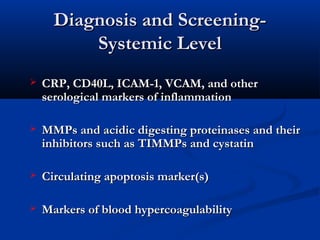
Diagnosis and Screening-Diagnosis and Screening-
Systemic LevelSystemic Level
 CRP, CD40L, ICAM-1, VCAM, and otherCRP, CD40L, ICAM-1, VCAM, and other
serological markers of inflammationserological markers of inflammation
 MMPs and acidic digesting proteinases and theirMMPs and acidic digesting proteinases and their
inhibitors such as TIMMPs and cystatininhibitors such as TIMMPs and cystatin
 Circulating apoptosis marker(s)Circulating apoptosis marker(s)
 Markers of blood hypercoagulabilityMarkers of blood hypercoagulability
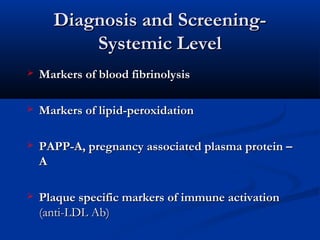
Diagnosis and Screening-Diagnosis and Screening-
Systemic LevelSystemic Level
 Markers of blood fibrinolysisMarkers of blood fibrinolysis
 Markers of lipid-peroxidationMarkers of lipid-peroxidation
 PAPP-A, pregnancy associated plasma protein –PAPP-A, pregnancy associated plasma protein –
AA
 Plaque specific markers of immune activationPlaque specific markers of immune activation
(anti-LDL Ab)(anti-LDL Ab)
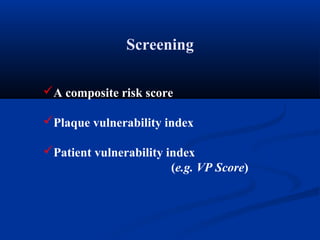
A composite risk score
Plaque vulnerability index
Patient vulnerability index
(e.g. VP Score)
Screening
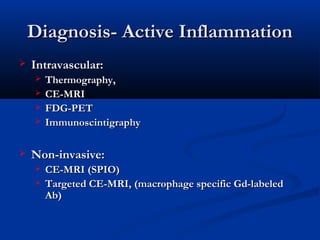
Diagnosis- Active InflammationDiagnosis- Active Inflammation
 Intravascular:Intravascular:
 Thermography,Thermography,
 CE-MRICE-MRI
 FDG-PETFDG-PET
 ImmunoscintigraphyImmunoscintigraphy
 Non-invasive:Non-invasive:
 CE-MRI (SPIO)CE-MRI (SPIO)
 Targeted CE-MRI, (macrophage specific Gd-labeledTargeted CE-MRI, (macrophage specific Gd-labeled
Ab)Ab)
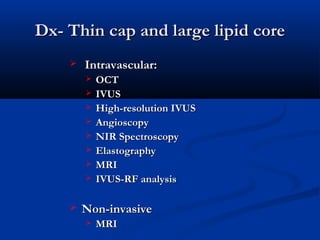
Dx- Thin cap and large lipid coreDx- Thin cap and large lipid core
   Intravascular:Intravascular:
 OCTOCT
 IVUSIVUS
 High-resolution IVUSHigh-resolution IVUS
 AngioscopyAngioscopy
 NIR SpectroscopyNIR Spectroscopy
 ElastographyElastography
 MRIMRI
 IVUS-RF analysisIVUS-RF analysis
  
 Non-invasiveNon-invasive
 MRIMRI
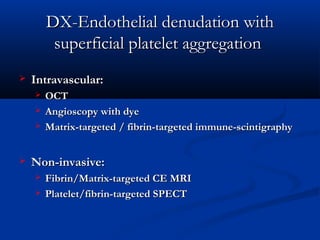
DX-Endothelial denudation withDX-Endothelial denudation with
superficial platelet aggregationsuperficial platelet aggregation
 Intravascular:Intravascular:
 OCTOCT
 Angioscopy with dyeAngioscopy with dye
 Matrix-targeted / fibrin-targeted immune-scintigraphyMatrix-targeted / fibrin-targeted immune-scintigraphy
 Non-invasive:Non-invasive:
 Fibrin/Matrix-targeted CE MRIFibrin/Matrix-targeted CE MRI
 Platelet/fibrin-targeted SPECTPlatelet/fibrin-targeted SPECT
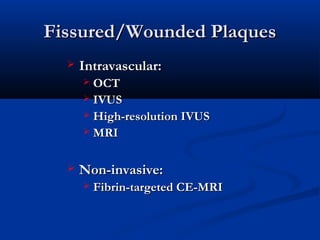
Fissured/Wounded PlaquesFissured/Wounded Plaques
 Intravascular:Intravascular:
 OCTOCT
 IVUSIVUS
 High-resolution IVUSHigh-resolution IVUS
 MRIMRI
  
 Non-invasive:Non-invasive:
 Fibrin-targeted CE-MRIFibrin-targeted CE-MRI
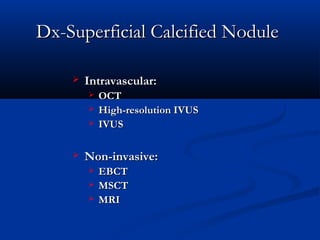
Dx-Superficial Calcified NoduleDx-Superficial Calcified Nodule
 Intravascular:Intravascular:
 OCTOCT
 High-resolution IVUSHigh-resolution IVUS
 IVUSIVUS
 Non-invasive:Non-invasive:
 EBCTEBCT
 MSCTMSCT
 MRIMRI
Yellow Color (in Angioscopy)Yellow Color (in Angioscopy)
 Intravascular:Intravascular:
 AngioscopyAngioscopy
 Transcatheter colorimetryTranscatheter colorimetry
 Non-invasive:Non-invasive:
 Presently impossiblePresently impossible
Dx- Intraplaque HemorrhageDx- Intraplaque Hemorrhage
 Intravascular:Intravascular:
 NIR SpectroscopyNIR Spectroscopy
 Tissue DopplerTissue Doppler
 Non-invasive:Non-invasive:
 MRIMRI
Dx-Stenotic PlaquesDx-Stenotic Plaques
 Intravascular:Intravascular:
 Invasive X-ray AngiographyInvasive X-ray Angiography
 Non-invasive:Non-invasive:
 Non-invasive MS-CECTNon-invasive MS-CECT
 MRA w/wo contrastMRA w/wo contrast
 EBT AngiographyEBT Angiography
Blood FactorBlood Factor
 Antithrombin III deficiencyAntithrombin III deficiency
 Protein C or S deficiencyProtein C or S deficiency
 Resistance to activated protein C (factor VResistance to activated protein C (factor V
Leiden)Leiden)
 Antiphospholipid syndromeAntiphospholipid syndrome
 Nephrotic syndromeNephrotic syndrome
 Platelet polymorphismsPlatelet polymorphisms
MyocardialMyocardial FactorFactor
 Different cardiomyopathiesDifferent cardiomyopathies
 Valvular diseaseValvular disease
 Primary electric disturbancesPrimary electric disturbances
 Chest traumaChest trauma
 Anomalous origin of coronary arteriesAnomalous origin of coronary arteries
 MyocarditisMyocarditis
 Myocardial bridgingMyocardial bridging
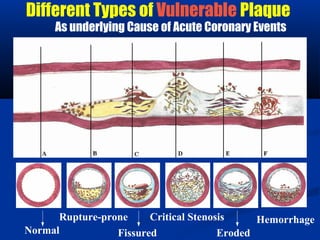
Different Types of Vulnerable Plaque
As underlying Cause of Acute Coronary Events
Normal
Rupture-prone
Fissured Eroded
Critical Stenosis Hemorrhage
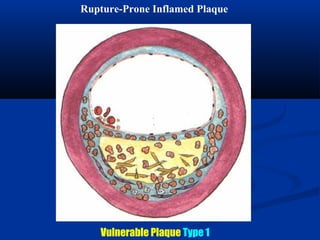
Rupture-Prone Inflamed Plaque
Vulnerable Plaque Type 1
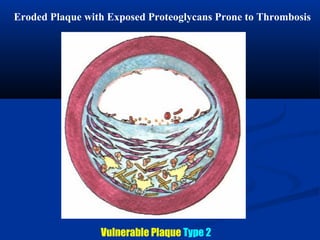
Eroded Plaque with Exposed Proteoglycans Prone to Thrombosis
Vulnerable Plaque Type 2
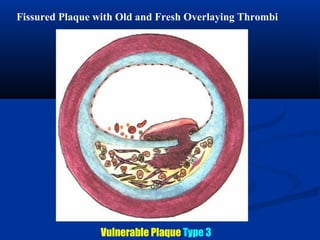
Fissured Plaque with Old and Fresh Overlaying Thrombi
Vulnerable Plaque Type 3
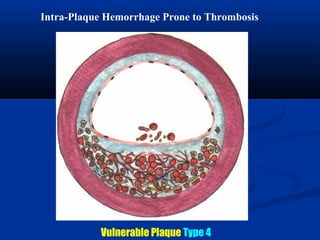
Intra-Plaque Hemorrhage Prone to Thrombosis
Vulnerable Plaque Type 4
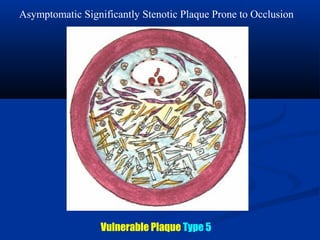
Vulnerable Plaque Type 5
Asymptomatic Significantly Stenotic Plaque Prone to Occlusion

Naghavi

  • 1.
    Vulnerable Plaques andVulnerablePlaques and Vulnerable PatientsVulnerable Patients The 1The 1stst   Guideline ofGuideline of Association for EradicationAssociation for Eradication of Heart Attack AEHAof Heart Attack AEHA for Definition offor Definition of Vulnerable Plaque and Vulnerable PatientVulnerable Plaque and Vulnerable Patient (VP.org)(VP.org) Morteza Naghavi, Erling Falk, Mohammad Madjid, Silvio Litovsky, James Muller, Ward Casscells, Renu Virmani, P.K. Shah, MD, Robert S. Schwartz, MD, Juan Jose Badimon, PhD, Valentin Fuster, James T. Willerson
  • 2.
    Vulnerable plaques, vulnerablemyocardium, andVulnerable plaques, vulnerable myocardium, and hypercoagulable state of the blood lead tohypercoagulable state of the blood lead to sudden cardiac death and acute myocardial infarction.sudden cardiac death and acute myocardial infarction. Vulnerable Blood Vulnerable Myocardium Vulnerable Plaque Vulnerable Patient
  • 3.
    Potential Underlying Causeof All (fatal and non-fatal) Heart Attacks (Sudden Cardiac Death + Acute Coronary Syndrome) With Occlusive Thrombi With Rupture >70% Stenosis With Significant Atherosclerosis or Ischemic Heart <70% Stenosis Without Significant Atherosclerosis or Atherosclerosis-Derived Myocardial Damage Without Occlusive Thrombi Without Rupture With Old Myocardial Damage Without Old Myocardial Damage Only Myocardial-Derived Factors (conductive disorders, …) Erosion Calcified Nodule Others With Critical Stenosis Without Critical Stenosis With Expansive Remodeling Without Expansive Remodeling
  • 4.
      Terminology:Terminology:  Culprit Plaque:CulpritPlaque: aa RetrospectiveRetrospective TerminologyTerminology  Vulnerable PlaqueVulnerable Plaque:: aa ProspectiveProspective TerminologyTerminology
  • 5.
    Underlying pathologies ofUnderlyingpathologies of “culprit” coronary lesions“culprit” coronary lesions 1.1. Ruptured Plaques (~70%)Ruptured Plaques (~70%)  Stenotic (~20%)Stenotic (~20%)  Non-stenotic (~50%)Non-stenotic (~50%) 2.2. Non-Ruptured Plaques (~ 30%)Non-Ruptured Plaques (~ 30%)  ErosionErosion  Calcified NoduleCalcified Nodule  Others / UnknownOthers / Unknown MJ Davies, Circ. 1990; Falk et al. Circ. 1995; Virmani et al. ATVB 2000
  • 6.
    InterchangeableInterchangeable TerminologiesTerminologies YESYES NONO Vulnerable Plaque=Vulnerable Plaque = Vulnerable Plaque=Vulnerable Plaque= High-Risk PlaqueHigh-Risk Plaque Soft-PlaqueSoft-Plaque Dangerous PlaqueDangerous Plaque Non-Calcified PlaqueNon-Calcified Plaque AHA Type IV PlaqueAHA Type IV Plaque Non-Stenotic PlaqueNon-Stenotic Plaque
  • 7.
    Proposed Histopathological andClinicalProposed Histopathological and Clinical Criteria for Definition of VulnerableCriteria for Definition of Vulnerable PlaquePlaque ••  MajorMajor Criteria:Criteria: 1.1. Active Inflammation (monocyte/Active Inflammation (monocyte/ macrophage infiltration)macrophage infiltration) 2.2. Thin Cap with Large Lipid CoreThin Cap with Large Lipid Core 3.3. Endothelial Denudation with SuperficialEndothelial Denudation with Superficial Platelet AggregationPlatelet Aggregation 4.4. Fissured / Wounded PlaqueFissured / Wounded Plaque
  • 8.
    Proposed Histopathological andClinicalProposed Histopathological and Clinical Criteria for Definition of VulnerableCriteria for Definition of Vulnerable PlaquePlaque ••  MinorMinor Criteria:Criteria: 1.1. Superficial Calcified noduleSuperficial Calcified nodule 2.2. Glistening YellowGlistening Yellow 3.3. Intraplaque HemorrhageIntraplaque Hemorrhage 4.4. Critical StenosisCritical Stenosis 5.5. Positive Remodeling?Positive Remodeling?
  • 9.
    Ideal method forscreeningIdeal method for screening vulnerable plaque/patientvulnerable plaque/patient  Non-invasiveNon-invasive  InexpensiveInexpensive  AccurateAccurate  Widely ReproducibleWidely Reproducible
  • 10.
    Diagnosis and Screening-PlaqueDiagnosis and Screening- Plaque LevelLevel  Plaque inflammation (macrophage density or rate of monocyte infiltration)Plaque inflammation (macrophage density or rate of monocyte infiltration)  Matrix digesting enzyme activity in the cap (MMP 2, 3,9, etc)Matrix digesting enzyme activity in the cap (MMP 2, 3,9, etc)  Endothelial denudation or dysfunction (local NO production, anti/pro-Endothelial denudation or dysfunction (local NO production, anti/pro- coagulation properties of the endothelium)coagulation properties of the endothelium)  Superficial platelet aggregation and fibrin deposition (residual muralSuperficial platelet aggregation and fibrin deposition (residual mural thrombus)thrombus)  Plaque cap thickness with a resolution of <100 micronPlaque cap thickness with a resolution of <100 micron  Collagen content, lipid core size, mechanical stability (stiffness andCollagen content, lipid core size, mechanical stability (stiffness and elasticity)  elasticity)  
  • 11.
    Diagnosis and Screening-PlaqueDiagnosis and Screening- Plaque LevelLevel  Calcification burden and pattern (nodule, scattered, intimal,Calcification burden and pattern (nodule, scattered, intimal, deep)deep)  Angiogenesis, leaking vasa vaserum, and intraplaqueAngiogenesis, leaking vasa vaserum, and intraplaque hemorrhagehemorrhage  Presence of certain microbial antigensPresence of certain microbial antigens  Rate of apoptosis (apoptosis protein markers, coronaryRate of apoptosis (apoptosis protein markers, coronary microsatellite, etc)microsatellite, etc)  Shear stress imaging (flow pattern throughout coronary arteryShear stress imaging (flow pattern throughout coronary artery
  • 12.
    Diagnosis and Screening-Diagnosisand Screening- Systemic LevelSystemic Level  CRP, CD40L, ICAM-1, VCAM, and otherCRP, CD40L, ICAM-1, VCAM, and other serological markers of inflammationserological markers of inflammation  MMPs and acidic digesting proteinases and theirMMPs and acidic digesting proteinases and their inhibitors such as TIMMPs and cystatininhibitors such as TIMMPs and cystatin  Circulating apoptosis marker(s)Circulating apoptosis marker(s)  Markers of blood hypercoagulabilityMarkers of blood hypercoagulability
  • 13.
    Diagnosis and Screening-Diagnosisand Screening- Systemic LevelSystemic Level  Markers of blood fibrinolysisMarkers of blood fibrinolysis  Markers of lipid-peroxidationMarkers of lipid-peroxidation  PAPP-A, pregnancy associated plasma protein –PAPP-A, pregnancy associated plasma protein – AA  Plaque specific markers of immune activationPlaque specific markers of immune activation (anti-LDL Ab)(anti-LDL Ab)
  • 14.
    A composite riskscore Plaque vulnerability index Patient vulnerability index (e.g. VP Score) Screening
  • 15.
    Diagnosis- Active InflammationDiagnosis-Active Inflammation  Intravascular:Intravascular:  Thermography,Thermography,  CE-MRICE-MRI  FDG-PETFDG-PET  ImmunoscintigraphyImmunoscintigraphy  Non-invasive:Non-invasive:  CE-MRI (SPIO)CE-MRI (SPIO)  Targeted CE-MRI, (macrophage specific Gd-labeledTargeted CE-MRI, (macrophage specific Gd-labeled Ab)Ab)
  • 16.
    Dx- Thin capand large lipid coreDx- Thin cap and large lipid core    Intravascular:Intravascular:  OCTOCT  IVUSIVUS  High-resolution IVUSHigh-resolution IVUS  AngioscopyAngioscopy  NIR SpectroscopyNIR Spectroscopy  ElastographyElastography  MRIMRI  IVUS-RF analysisIVUS-RF analysis     Non-invasiveNon-invasive  MRIMRI
  • 17.
    DX-Endothelial denudation withDX-Endothelialdenudation with superficial platelet aggregationsuperficial platelet aggregation  Intravascular:Intravascular:  OCTOCT  Angioscopy with dyeAngioscopy with dye  Matrix-targeted / fibrin-targeted immune-scintigraphyMatrix-targeted / fibrin-targeted immune-scintigraphy  Non-invasive:Non-invasive:  Fibrin/Matrix-targeted CE MRIFibrin/Matrix-targeted CE MRI  Platelet/fibrin-targeted SPECTPlatelet/fibrin-targeted SPECT
  • 18.
    Fissured/Wounded PlaquesFissured/Wounded Plaques Intravascular:Intravascular:  OCTOCT  IVUSIVUS  High-resolution IVUSHigh-resolution IVUS  MRIMRI     Non-invasive:Non-invasive:  Fibrin-targeted CE-MRIFibrin-targeted CE-MRI
  • 19.
    Dx-Superficial Calcified NoduleDx-SuperficialCalcified Nodule  Intravascular:Intravascular:  OCTOCT  High-resolution IVUSHigh-resolution IVUS  IVUSIVUS  Non-invasive:Non-invasive:  EBCTEBCT  MSCTMSCT  MRIMRI
  • 20.
    Yellow Color (inAngioscopy)Yellow Color (in Angioscopy)  Intravascular:Intravascular:  AngioscopyAngioscopy  Transcatheter colorimetryTranscatheter colorimetry  Non-invasive:Non-invasive:  Presently impossiblePresently impossible
  • 21.
    Dx- Intraplaque HemorrhageDx-Intraplaque Hemorrhage  Intravascular:Intravascular:  NIR SpectroscopyNIR Spectroscopy  Tissue DopplerTissue Doppler  Non-invasive:Non-invasive:  MRIMRI
  • 22.
    Dx-Stenotic PlaquesDx-Stenotic Plaques Intravascular:Intravascular:  Invasive X-ray AngiographyInvasive X-ray Angiography  Non-invasive:Non-invasive:  Non-invasive MS-CECTNon-invasive MS-CECT  MRA w/wo contrastMRA w/wo contrast  EBT AngiographyEBT Angiography
  • 23.
    Blood FactorBlood Factor Antithrombin III deficiencyAntithrombin III deficiency  Protein C or S deficiencyProtein C or S deficiency  Resistance to activated protein C (factor VResistance to activated protein C (factor V Leiden)Leiden)  Antiphospholipid syndromeAntiphospholipid syndrome  Nephrotic syndromeNephrotic syndrome  Platelet polymorphismsPlatelet polymorphisms
  • 24.
    MyocardialMyocardial FactorFactor  DifferentcardiomyopathiesDifferent cardiomyopathies  Valvular diseaseValvular disease  Primary electric disturbancesPrimary electric disturbances  Chest traumaChest trauma  Anomalous origin of coronary arteriesAnomalous origin of coronary arteries  MyocarditisMyocarditis  Myocardial bridgingMyocardial bridging
  • 25.
    Different Types ofVulnerable Plaque As underlying Cause of Acute Coronary Events Normal Rupture-prone Fissured Eroded Critical Stenosis Hemorrhage
  • 26.
  • 27.
    Eroded Plaque withExposed Proteoglycans Prone to Thrombosis Vulnerable Plaque Type 2
  • 28.
    Fissured Plaque withOld and Fresh Overlaying Thrombi Vulnerable Plaque Type 3
  • 29.
    Intra-Plaque Hemorrhage Proneto Thrombosis Vulnerable Plaque Type 4
  • 30.
    Vulnerable Plaque Type5 Asymptomatic Significantly Stenotic Plaque Prone to Occlusion