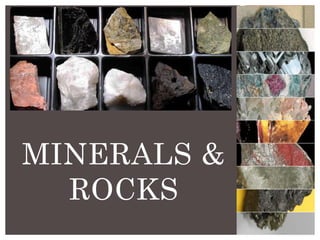
MINERALS &
ROCKS
MINEROLOGY
- IS THE
STUDY
OF
MINERALS
MINERALS
BUILDIN
G BLOCKS
OF
ROCKS
MINEROLOGIS
T
-THE PERSON
WHO
STUDIES
MINERAL
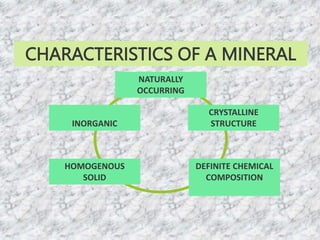
CHARACTERISTICS OF A MINERAL
NATURALLY
OCCURRING
CRYSTALLINE
STRUCTURE
DEFINITE CHEMICAL
COMPOSITION
INORGANIC
HOMOGENOUS
SOLID
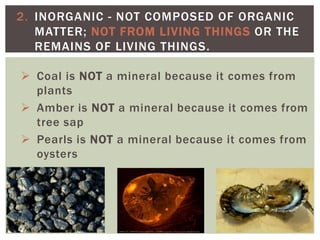
 Coal is NOT a mineral because it comes from
plants
 Amber is NOT a mineral because it comes from
tree sap
 Pearls is NOT a mineral because it comes from
oysters
2. INORGANIC - NOT COMPOSED OF ORGANIC
MATTER; NOT FROM LIVING THINGS OR THE
REMAINS OF LIVING THINGS.
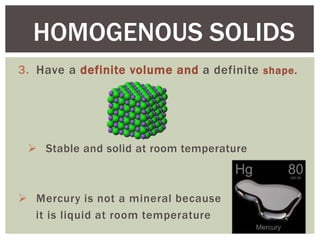
3. Have a definite volume and a definite shape.
 Stable and solid at room temperature
 Mercury is not a mineral because
it is liquid at room temperature
HOMOGENOUS SOLIDS
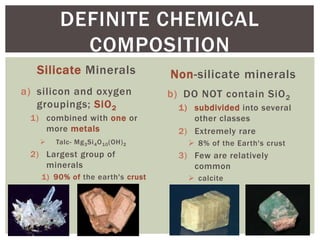
Silicate Minerals
a) silicon and oxygen
groupings; SiO2
1) combined with one or
more metals
 Talc- Mg3Si4O10(OH)2
2) Largest group of
minerals
1) 90% of the earth's crust
Non-silicate minerals
b) DO NOT contain SiO2
1) subdivided into several
other classes
2) Extremely rare
 8% of the Earth's crust
3) Few are relatively
common
 calcite
DEFINITE CHEMICAL
COMPOSITION
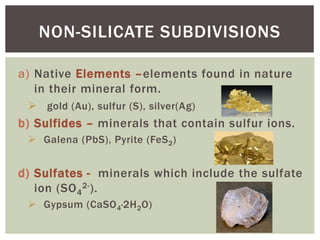
a) Native Elements –elements found in nature
in their mineral form.
 gold (Au), sulfur (S), silver(Ag)
b) Sulfides – minerals that contain sulfur ions.
 Galena (PbS), Pyrite (FeS2)
d) Sulfates - minerals which include the sulfate
ion (SO4
2-).
 Gypsum (CaSO4·2H2O)
NON-SILICATE SUBDIVISIONS
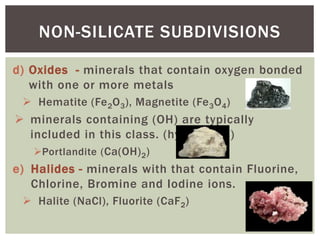
d) Oxides - minerals that contain oxygen bonded
with one or more metals
 Hematite (Fe2O3), Magnetite (Fe3O4)
 minerals containing (OH) are typically
included in this class. (hydroxides)
Portlandite (Ca(OH)2)
e) Halides - minerals with that contain Fluorine,
Chlorine, Bromine and Iodine ions.
 Halite (NaCl), Fluorite (CaF2)
NON-SILICATE SUBDIVISIONS
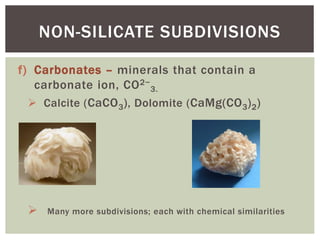
f) Carbonates – minerals that contain a
carbonate ion, CO2−
3.
 Calcite (CaCO3), Dolomite (CaMg(CO3)2)
 Many more subdivisions; each with chemical similarities
NON-SILICATE SUBDIVISIONS
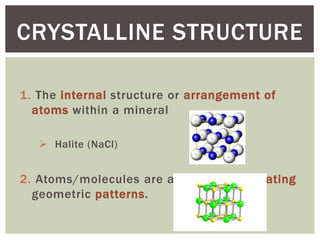
1. The internal structure or arrangement of
atoms within a mineral
 Halite (NaCl)
2. Atoms/molecules are arranged in repeating
geometric patterns.
CRYSTALLINE STRUCTURE
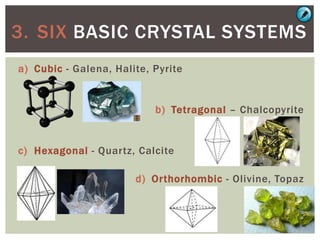
a) Cubic - Galena, Halite, Pyrite
b) Tetragonal – Chalcopyrite
c) Hexagonal - Quartz, Calcite
d) Orthorhombic - Olivine, Topaz
3. SIX BASIC CRYSTAL SYSTEMS
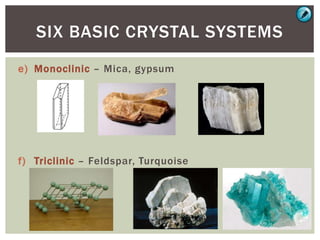
e) Monoclinic – Mica, gypsum
f) Triclinic – Feldspar, Turquoise
SIX BASIC CRYSTAL SYSTEMS
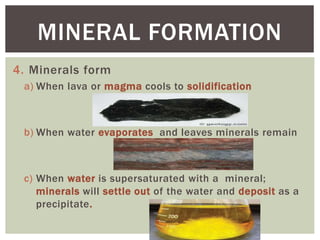
4. Minerals form
a) When lava or magma cools to solidification
b) When water evaporates and leaves minerals remain
c) When water is supersaturated with a mineral;
minerals will settle out of the water and deposit as a
precipitate.
MINERAL FORMATION
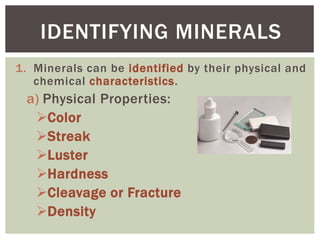
1. Minerals can be identified by their physical and
chemical characteristics.
a) Physical Properties:
Color
Streak
Luster
Hardness
Cleavage or Fracture
Density
IDENTIFYING MINERALS
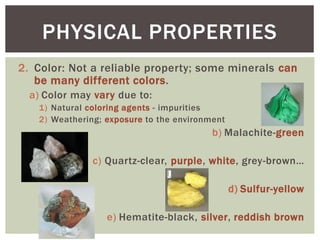
2. Color: Not a reliable property; some minerals can
be many different colors.
a) Color may vary due to:
1) Natural coloring agents - impurities
2) Weathering; exposure to the environment
b) Malachite-green
c) Quartz-clear, purple, white, grey-brown…
d) Sulfur-yellow
e) Hematite-black, silver, reddish brown
PHYSICAL PROPERTIES
3.Streak: The color of the mineral in
its powdered form.
a)Determined by using a streak plate
1) Quartz: White/colorless
2) Hematite: reddish brown
PHYSICAL PROPERTIES
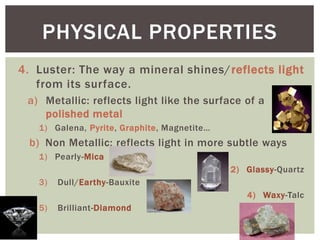
4. Luster: The way a mineral shines/reflects light
from its surface.
a) Metallic: reflects light like the surface of a
polished metal
1) Galena, Pyrite, Graphite, Magnetite…
b) Non Metallic: reflects light in more subtle ways
1) Pearly-Mica
2) Glassy-Quartz
3) Dull/Earthy-Bauxite
4) Waxy-Talc
5) Brilliant-Diamond
PHYSICAL PROPERTIES
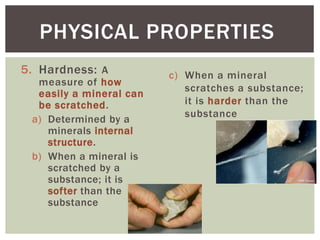
c) When a mineral
scratches a substance;
it is harder than the
substance
PHYSICAL PROPERTIES
5. Hardness: A
measure of how
easily a mineral can
be scratched.
a) Determined by a
minerals internal
structure.
b) When a mineral is
scratched by a
substance; it is
softer than the
substance
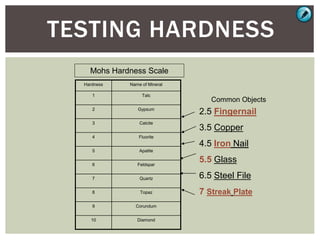
TESTING HARDNESS
Hardness Name of Mineral
1 Talc
2 Gypsum
3 Calcite
4 Fluorite
5 Apatite
6 Feldspar
7 Quartz
8 Topaz
9 Corundum
10 Diamond
Common Objects
2.5 Fingernail
3.5 Copper
4.5 Iron Nail
5.5 Glass
6.5 Steel File
7 Streak Plate
Mohs Hardness Scale
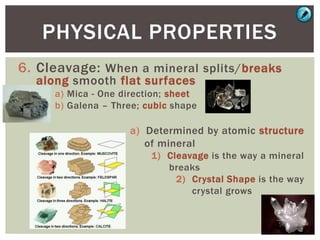
6. Cleavage: When a mineral splits/breaks
along smooth flat surfaces
a) Mica - One direction; sheet
b) Galena – Three; cubic shape
a) Determined by atomic structure
of mineral
1) Cleavage is the way a mineral
breaks
2) Crystal Shape is the way
crystal grows
PHYSICAL PROPERTIES
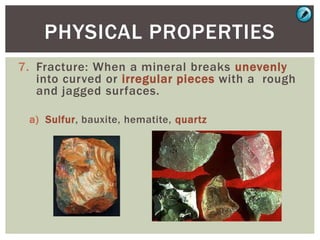
7. Fracture: When a mineral breaks unevenly
into curved or irregular pieces with a rough
and jagged surfaces.
a) Sulfur, bauxite, hematite, quartz
PHYSICAL PROPERTIES
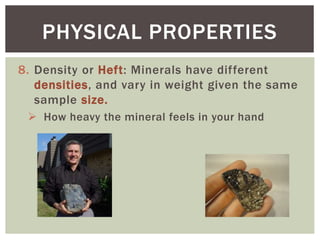
8. Density or Heft: Minerals have different
densities, and vary in weight given the same
sample size.
 How heavy the mineral feels in your hand
PHYSICAL PROPERTIES

CHARACTERISTIC-OF-A-MINERALS (1).ppt

  • 1.
  • 2.
    MINEROLOGY - IS THE STUDY OF MINERALS MINERALS BUILDIN GBLOCKS OF ROCKS MINEROLOGIS T -THE PERSON WHO STUDIES MINERAL
  • 3.
    CHARACTERISTICS OF AMINERAL NATURALLY OCCURRING CRYSTALLINE STRUCTURE DEFINITE CHEMICAL COMPOSITION INORGANIC HOMOGENOUS SOLID
  • 4.
     Coal isNOT a mineral because it comes from plants  Amber is NOT a mineral because it comes from tree sap  Pearls is NOT a mineral because it comes from oysters 2. INORGANIC - NOT COMPOSED OF ORGANIC MATTER; NOT FROM LIVING THINGS OR THE REMAINS OF LIVING THINGS.
  • 5.
    3. Have adefinite volume and a definite shape.  Stable and solid at room temperature  Mercury is not a mineral because it is liquid at room temperature HOMOGENOUS SOLIDS
  • 6.
    Silicate Minerals a) siliconand oxygen groupings; SiO2 1) combined with one or more metals  Talc- Mg3Si4O10(OH)2 2) Largest group of minerals 1) 90% of the earth's crust Non-silicate minerals b) DO NOT contain SiO2 1) subdivided into several other classes 2) Extremely rare  8% of the Earth's crust 3) Few are relatively common  calcite DEFINITE CHEMICAL COMPOSITION
  • 7.
    a) Native Elements–elements found in nature in their mineral form.  gold (Au), sulfur (S), silver(Ag) b) Sulfides – minerals that contain sulfur ions.  Galena (PbS), Pyrite (FeS2) d) Sulfates - minerals which include the sulfate ion (SO4 2-).  Gypsum (CaSO4·2H2O) NON-SILICATE SUBDIVISIONS
  • 8.
    d) Oxides -minerals that contain oxygen bonded with one or more metals  Hematite (Fe2O3), Magnetite (Fe3O4)  minerals containing (OH) are typically included in this class. (hydroxides) Portlandite (Ca(OH)2) e) Halides - minerals with that contain Fluorine, Chlorine, Bromine and Iodine ions.  Halite (NaCl), Fluorite (CaF2) NON-SILICATE SUBDIVISIONS
  • 9.
    f) Carbonates –minerals that contain a carbonate ion, CO2− 3.  Calcite (CaCO3), Dolomite (CaMg(CO3)2)  Many more subdivisions; each with chemical similarities NON-SILICATE SUBDIVISIONS
  • 10.
    1. The internalstructure or arrangement of atoms within a mineral  Halite (NaCl) 2. Atoms/molecules are arranged in repeating geometric patterns. CRYSTALLINE STRUCTURE
  • 11.
    a) Cubic -Galena, Halite, Pyrite b) Tetragonal – Chalcopyrite c) Hexagonal - Quartz, Calcite d) Orthorhombic - Olivine, Topaz 3. SIX BASIC CRYSTAL SYSTEMS
  • 12.
    e) Monoclinic –Mica, gypsum f) Triclinic – Feldspar, Turquoise SIX BASIC CRYSTAL SYSTEMS
  • 13.
    4. Minerals form a)When lava or magma cools to solidification b) When water evaporates and leaves minerals remain c) When water is supersaturated with a mineral; minerals will settle out of the water and deposit as a precipitate. MINERAL FORMATION
  • 14.
    1. Minerals canbe identified by their physical and chemical characteristics. a) Physical Properties: Color Streak Luster Hardness Cleavage or Fracture Density IDENTIFYING MINERALS
  • 15.
    2. Color: Nota reliable property; some minerals can be many different colors. a) Color may vary due to: 1) Natural coloring agents - impurities 2) Weathering; exposure to the environment b) Malachite-green c) Quartz-clear, purple, white, grey-brown… d) Sulfur-yellow e) Hematite-black, silver, reddish brown PHYSICAL PROPERTIES
  • 16.
    3.Streak: The colorof the mineral in its powdered form. a)Determined by using a streak plate 1) Quartz: White/colorless 2) Hematite: reddish brown PHYSICAL PROPERTIES
  • 17.
    4. Luster: Theway a mineral shines/reflects light from its surface. a) Metallic: reflects light like the surface of a polished metal 1) Galena, Pyrite, Graphite, Magnetite… b) Non Metallic: reflects light in more subtle ways 1) Pearly-Mica 2) Glassy-Quartz 3) Dull/Earthy-Bauxite 4) Waxy-Talc 5) Brilliant-Diamond PHYSICAL PROPERTIES
  • 18.
    c) When amineral scratches a substance; it is harder than the substance PHYSICAL PROPERTIES 5. Hardness: A measure of how easily a mineral can be scratched. a) Determined by a minerals internal structure. b) When a mineral is scratched by a substance; it is softer than the substance
  • 19.
    TESTING HARDNESS Hardness Nameof Mineral 1 Talc 2 Gypsum 3 Calcite 4 Fluorite 5 Apatite 6 Feldspar 7 Quartz 8 Topaz 9 Corundum 10 Diamond Common Objects 2.5 Fingernail 3.5 Copper 4.5 Iron Nail 5.5 Glass 6.5 Steel File 7 Streak Plate Mohs Hardness Scale
  • 20.
    6. Cleavage: Whena mineral splits/breaks along smooth flat surfaces a) Mica - One direction; sheet b) Galena – Three; cubic shape a) Determined by atomic structure of mineral 1) Cleavage is the way a mineral breaks 2) Crystal Shape is the way crystal grows PHYSICAL PROPERTIES
  • 21.
    7. Fracture: Whena mineral breaks unevenly into curved or irregular pieces with a rough and jagged surfaces. a) Sulfur, bauxite, hematite, quartz PHYSICAL PROPERTIES
  • 22.
    8. Density orHeft: Minerals have different densities, and vary in weight given the same sample size.  How heavy the mineral feels in your hand PHYSICAL PROPERTIES