Downloaded 44 times
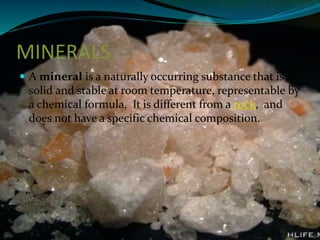

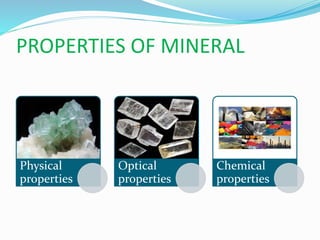




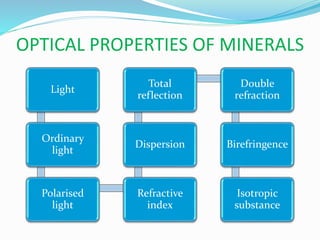

This document discusses the properties of minerals. It begins by defining a mineral as a naturally occurring solid substance that has a specific chemical composition and formula. It then outlines that minerals have physical, optical, and chemical properties. The document focuses on various physical properties of minerals such as hardness, luster, specific gravity, color, fracture, tenacity, streak, and cleavage. It provides details on how hardness and color are determined for minerals and explanations of streak and luster. The document also briefly mentions cleavage, fracture, specific gravity, and tenacity. It concludes by noting that minerals can be examined using light to study optical properties like refraction, dispersion, and birefringence.


