PHYSICAL SCIENCE 120 PHYSICAL PROPERTIES OF MINERALS As you view the Power Points you will be prompted to advance to the next slide when you see this symbol (*).  (*)
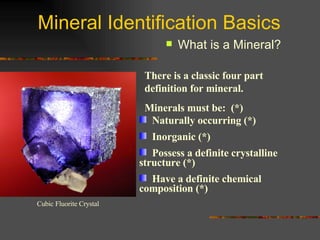
Mineral Identification Basics What is a Mineral? There is a classic four part definition for mineral.  Minerals must be:  (*) Naturally occurring (*) Inorganic (*) Possess a definite crystalline  structure (*) Have a definite chemical  composition (*) Cubic Fluorite Crystal
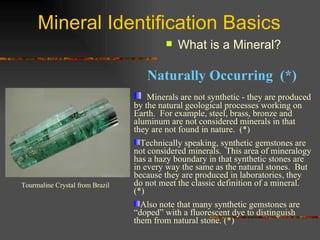
Mineral Identification Basics What is a Mineral? Minerals are not synthetic - they are produced by the natural geological processes working on Earth.  For example, steel, brass, bronze and aluminum are not considered minerals in that they are not found in nature.  (*) Technically speaking, synthetic gemstones are not considered minerals.  This area of mineralogy has a hazy boundary in that synthetic stones are in every way the same as the natural stones.  But because they are produced in laboratories, they do not meet the classic definition of a mineral. (*) Also note that many synthetic gemstones are “doped” with a fluorescent dye to distinguish them from natural stone. (*) Tourmaline Crystal from Brazil Naturally Occurring  (*)
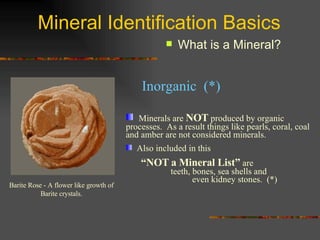
Mineral Identification Basics What is a Mineral? Minerals are  NOT  produced by organic processes.  As a result things like pearls, coral, coal and amber are not considered minerals. Also included in this “ NOT   a Mineral List”  are  teeth, bones, sea shells and  even kidney stones.  (*) Barite Rose - A flower like growth of Barite crystals. Inorganic  (*)
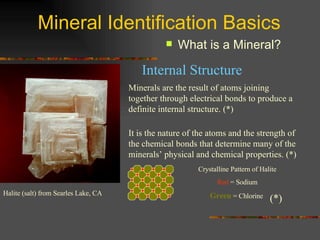
Mineral Identification Basics What is a Mineral? Minerals are the result of atoms joining together through electrical bonds to produce a definite internal structure. (*) Crystalline Pattern of Halite Red  = Sodium Green  = Chlorine  Internal Structure Halite (salt) from Searles Lake, CA It is the nature of the atoms and the strength of the chemical bonds that determine many of the minerals’ physical and chemical properties. (*) (*)
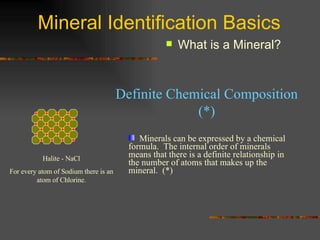
Mineral Identification Basics What is a Mineral? Minerals can be expressed by a chemical formula.  The internal order of minerals means that there is a definite relationship in the number of atoms that makes up the mineral.  (*) Halite - NaCl For every atom of Sodium there is an atom of Chlorine. Definite Chemical Composition (*)
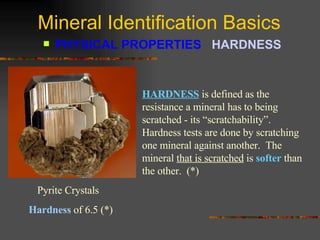
Mineral Identification Basics PHYSICAL PROPERTIES  HARDNESS   HARDNESS  is defined as the resistance a mineral has to being scratched - its “scratchability”.  Hardness tests are done by scratching one mineral against another.  The mineral  that is scratched  is  softer  than the other.  (*) Pyrite Crystals  Hardness  of 6.5 (*)
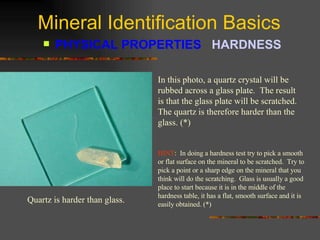
Mineral Identification Basics PHYSICAL PROPERTIES  HARDNESS   In this photo, a quartz crystal will be rubbed across a glass plate.  The result is that the glass plate will be scratched.  The quartz is therefore harder than the glass. (*) Quartz is harder than glass. HINT :  In doing a hardness test try to pick a smooth or flat surface on the mineral to be scratched.  Try to pick a point or a sharp edge on the mineral that you think will do the scratching.  Glass is usually a good place to start because it is in the middle of the hardness table, it has a flat, smooth surface and it is easily obtained. (*)
Mineral Identification Basics PHYSICAL PROPERTIES  HARDNESS   Care must be taken on some minerals that crumble easily.  Remember that hardness is the resistance a mineral has to being scratched - NOT how easily it breaks apart.  The physical property related to the ease in which a mineral breaks is tenacity.  (*) Also be sure to determine the hardness of a mineral on a fresh surface whenever possible.  Some minerals have a tendency to oxidize or corrode.  These surface deposits usually have a different hardness than the fresh mineral.  (*)
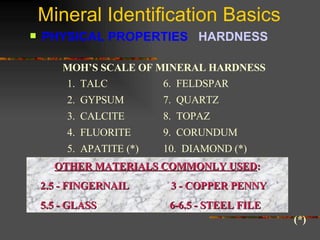
Mineral Identification Basics PHYSICAL PROPERTIES  HARDNESS   Moh’s scale is a list of minerals with increasing hardness.(*) MOH’S SCALE OF MINERAL HARDNESS 1.  TALC 2.  GYPSUM 3.  CALCITE 4.  FLUORITE 5.  APATITE (*) 6.  FELDSPAR 7.  QUARTZ 8.  TOPAZ 9.  CORUNDUM 10.  DIAMOND (*) OTHER MATERIALS COMMONLY USED : 2.5 - FINGERNAIL   3 - COPPER PENNY  5.5 - GLASS  6-6.5 - STEEL FILE (*)
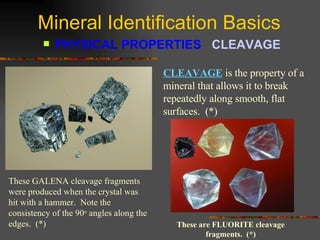
Mineral Identification Basics PHYSICAL PROPERTIES  CLEAVAGE   CLEAVAGE   is the property of a mineral that allows it to break repeatedly along smooth, flat surfaces.  (*) These GALENA cleavage fragments were produced when the crystal was hit with a hammer.  Note the consistency of the 90 o  angles along the edges.  (*) These are FLUORITE cleavage fragments.  (*)
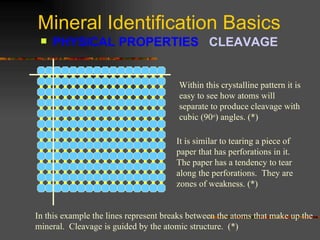
Mineral Identification Basics PHYSICAL PROPERTIES  CLEAVAGE   Within this crystalline pattern it is easy to see how atoms will separate to produce cleavage with cubic (90 o ) angles. (*) It is similar to tearing a piece of paper that has perforations in it.  The paper has a tendency to tear along the perforations.  They are zones of weakness. (*) In this example the lines represent breaks between the atoms that make up the mineral.  Cleavage is guided by the atomic structure.  (*)
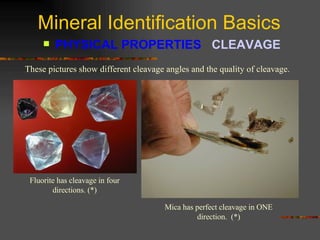
Mineral Identification Basics PHYSICAL PROPERTIES  CLEAVAGE   These pictures show different cleavage angles and the quality of cleavage. Fluorite has cleavage in four directions. (*) A thin sheet of Muscovite seen on edge. Mica has perfect cleavage in ONE direction.  (*)
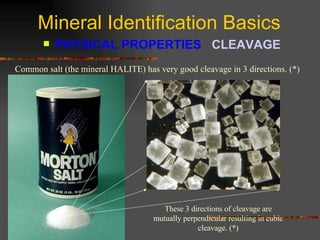
Mineral Identification Basics PHYSICAL PROPERTIES  CLEAVAGE   Common salt (the mineral HALITE) has very good cleavage in 3 directions. (*) These 3 directions of cleavage are mutually perpendicular resulting in cubic cleavage. (*)
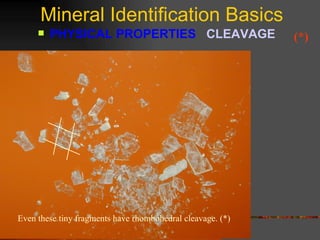
Mineral Identification Basics PHYSICAL PROPERTIES  CLEAVAGE   Even these tiny fragments have rhombohedral cleavage. (*) (*) Rhombohedral Cleavage - 3 directions CALCITE
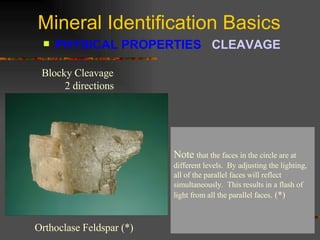
Mineral Identification Basics PHYSICAL PROPERTIES  CLEAVAGE   Blocky Cleavage  2 directions Orthoclase Feldspar (*) Orthoclase feldspar  has good cleavage in 2 directions.  The blocky appearance of this specimen is a hint that it has cleavage.  The clue that the specimen has cleavage is the fact that numerous faces will reflect light at the same time.  Each face is parallel and light will reflect of each face producing a flash of light. (*) Note  that the faces in the circle are at different levels.  By adjusting the lighting, all of the parallel faces will reflect simultaneously.  This results in a flash of light from all the parallel faces . (*)
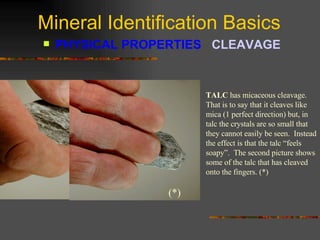
Mineral Identification Basics PHYSICAL PROPERTIES  CLEAVAGE   TALC  has micaceous cleavage.  That is to say that it cleaves like mica (1 perfect direction) but, in talc the crystals are so small that they cannot easily be seen.  Instead the effect is that the talc “feels soapy”.  The second picture shows some of the talc that has cleaved onto the fingers. (*) (*)
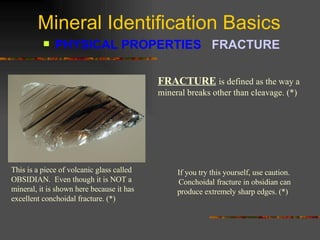
Mineral Identification Basics PHYSICAL PROPERTIES  FRACTURE   FRACTURE   is defined as the way a mineral breaks other than cleavage. (*) This is a piece of volcanic glass called OBSIDIAN.  Even though it is NOT a mineral, it is shown here because it has excellent conchoidal fracture. (*) If you try this yourself, use caution.  Conchoidal fracture in obsidian can produce extremely sharp edges. (*)
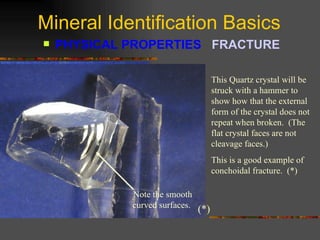
Mineral Identification Basics PHYSICAL PROPERTIES  FRACTURE   This Quartz crystal will be struck with a hammer to show how that the external form of the crystal does not repeat when broken.  (The flat crystal faces are not cleavage faces.) This is a good example of conchoidal fracture.  (*)  Note the smooth curved surfaces.  (*)
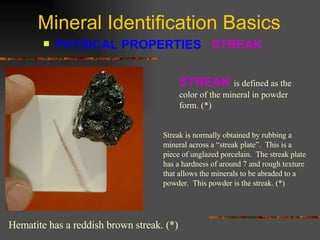
Mineral Identification Basics PHYSICAL PROPERTIES  STREAK   STREAK   is defined as the color of the mineral in powder form. (*) Streak is normally obtained by rubbing a mineral across a “streak plate”.  This is a piece of unglazed porcelain.  The streak plate has a hardness of around 7 and rough texture that allows the minerals to be abraded to a powder.  This powder is the streak. (*) Hematite has a reddish brown streak. (*) Hematite on Streak Plate
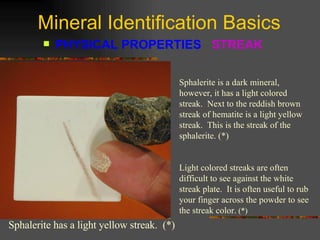
Mineral Identification Basics PHYSICAL PROPERTIES  STREAK   Sphalerite is a dark mineral, however, it has a light colored streak.  Next to the reddish brown streak of hematite is a light yellow streak.  This is the streak of the sphalerite. (*) Sphalerite has a light yellow streak.  (*) Light colored streaks are often difficult to see against the white streak plate.  It is often useful to rub your finger across the powder to see the streak color.  (*)
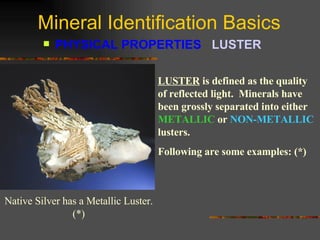
Mineral Identification Basics PHYSICAL PROPERTIES  LUSTER   LUSTER   is defined as the quality of reflected light.  Minerals have been grossly separated into either  METALLIC  or  NON-METALLIC  lusters.  Following are some   examples: (*) Native Silver has a Metallic Luster. (*)
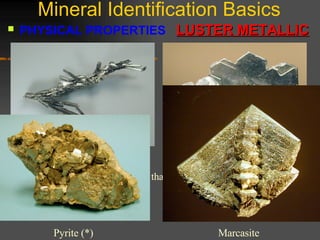
Mineral Identification Basics PHYSICAL PROPERTIES  LUSTER METALLIC   The basic idea for  Metallic Luster  is that the minerals look like metals.  (*) Stibnite  Galena  Marcasite  Pyrite (*)
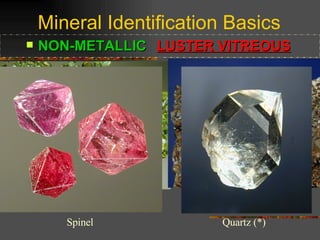
Mineral Identification Basics NON-METALLIC   LUSTER VITREOUS   Vitreous Luster means that the mineral has a “glassy” look.  Normally we think of glass as being clear, but there are many different colors of glass and they are all very “glassy” looking.  Even china plates and glazed porcelain are vitreous.  Here are some examples:  (*) Olivine - Peridot  Wulfenite  Spinel Quartz (*)
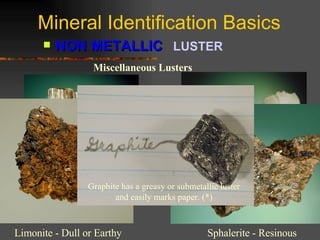
Mineral Identification Basics NON METALLIC   LUSTER   Miscellaneous Lusters Asbestos - Silky Apophyllite – Pearly (*) Limonite - Dull or Earthy Sphalerite - Resinous Graphite has a greasy or submetallic luster and easily marks paper. (*)
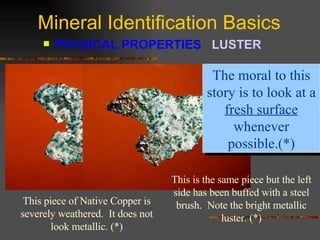
Mineral Identification Basics PHYSICAL PROPERTIES  LUSTER   This piece of Native Copper is severely weathered.  It does not look metallic. (*) The moral to this story is to look at a  fresh surface  whenever possible.(*) This is the same piece but the left side has been buffed with a steel brush.  Note the bright metallic luster. (*)
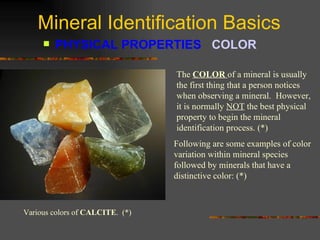
Mineral Identification Basics PHYSICAL PROPERTIES  COLOR   The  COLOR   of a mineral is usually the first thing that a person notices when observing a mineral.  However, it is normally  NOT  the best physical property to begin the mineral identification process. (*) Following are some examples of color variation within mineral species followed by minerals that have a distinctive color: (*) Various colors of  CALCITE .  (*)
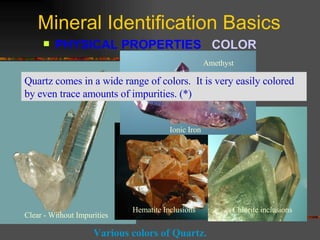
Mineral Identification Basics PHYSICAL PROPERTIES  COLOR   Various colors of Quartz.   Quartz comes in a wide range of colors.  It is very easily colored by even trace amounts of impurities. (*) Clear - Without Impurities Hematite Inclusions Chlorite inclusions Amethyst Ionic Iron
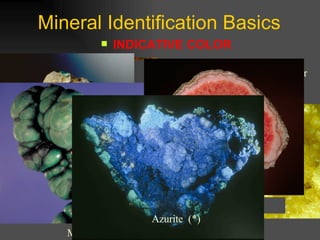
Mineral Identification Basics INDICATIVE COLOR  Some minerals do have a certain color associated with them.  Here are some examples:  (*) Turquoise  Sulfur Malachite Rhodochrosite Azurite  (*)
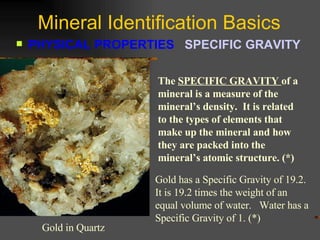
Mineral Identification Basics PHYSICAL PROPERTIES  SPECIFIC GRAVITY   The  SPECIFIC GRAVITY  of a mineral is a measure of the mineral’s density.  It is related to the types of elements that make up the mineral and how they are packed into the mineral’s atomic structure. (*) Gold in Quartz Gold has a Specific Gravity of 19.2.  It is 19.2 times the weight of an equal volume of water.  Water has a Specific Gravity of 1. (*)
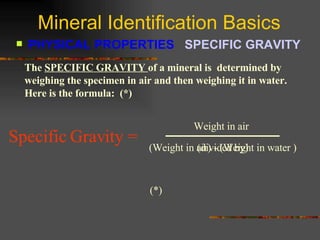
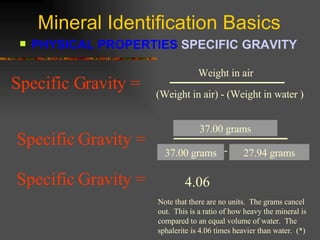
Mineral Identification Basics PHYSICAL PROPERTIES  SPECIFIC GRAVITY   The  SPECIFIC GRAVITY  of a mineral is  determined by weighing the specimen in air and then weighing it in water.  Here is the formula:  (*) (Weight in air) - (Weight in water ) Weight in air Specific Gravity =   (*) (divided by)
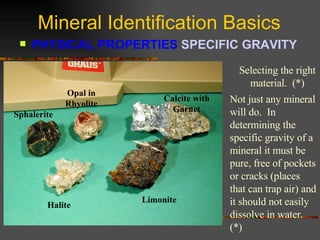
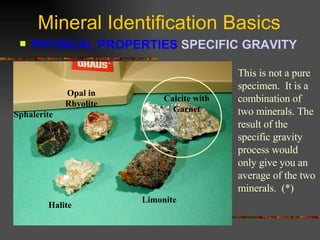
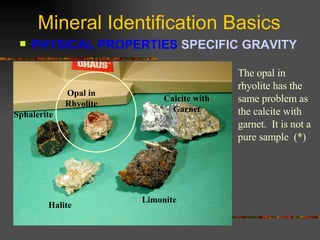
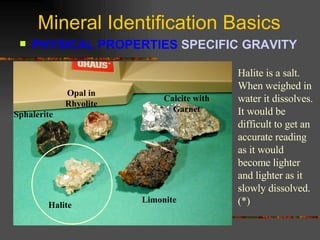
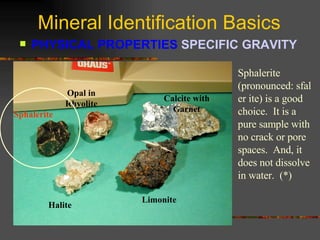
Mineral Identification Basics PHYSICAL PROPERTIES  SPECIFIC GRAVITY   Selecting the right material.  (*) Sphalerite Opal in Rhyolite Calcite with Garnet Halite Limonite Not just any mineral will do.  In determining the specific gravity of a mineral it must be pure, free of pockets or cracks (places that can trap air) and it should not easily dissolve in water. (*)
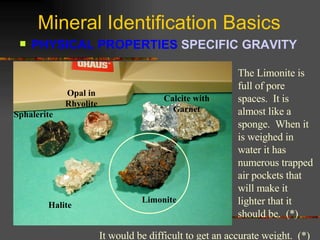
Mineral Identification Basics PHYSICAL PROPERTIES  SPECIFIC GRAVITY   Sphalerite Opal in Rhyolite Calcite with Garnet Halite Limonite The Limonite is full of pore spaces.  It is almost like a sponge.  When it is weighed in water it has numerous trapped air pockets that will make it lighter that it should be.  (*) It would be difficult to get an accurate weight.  (*)
Mineral Identification Basics PHYSICAL PROPERTIES  SPECIFIC GRAVITY   Sphalerite Opal in Rhyolite Calcite with Garnet Halite Limonite This is not a pure specimen.  It is a combination of two minerals. The result of the specific gravity process would only give you an average of the two minerals.  (*)
Mineral Identification Basics PHYSICAL PROPERTIES  SPECIFIC GRAVITY   Sphalerite Opal in Rhyolite Calcite with Garnet Halite Limonite The opal in rhyolite has the same problem as the calcite with garnet.  It is not a pure sample  (*)
Mineral Identification Basics PHYSICAL PROPERTIES  SPECIFIC GRAVITY   Sphalerite Opal in Rhyolite Calcite with Garnet Halite Limonite Halite is a salt.  When weighed in water it dissolves.  It would be difficult to get an accurate reading as it would become lighter and lighter as it slowly dissolved.  (*)
Mineral Identification Basics PHYSICAL PROPERTIES  SPECIFIC GRAVITY   Sphalerite Opal in Rhyolite Calcite with Garnet Halite Limonite Sphalerite (pronounced: sfal er ite) is a good choice.  It is a pure sample with no crack or pore spaces.  And, it does not dissolve in water.  (*) Sphalerite
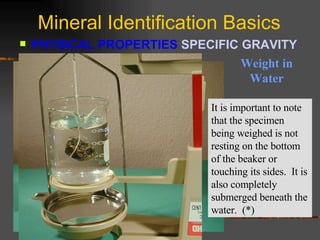
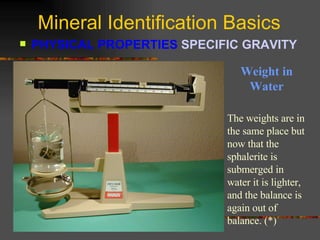
Mineral Identification Basics PHYSICAL PROPERTIES  SPECIFIC GRAVITY   Weight in Water The weights are in the same place but now that the sphalerite is submerged in water it is lighter, and the balance is again out of balance. (*)
Mineral Identification Basics PHYSICAL PROPERTIES  SPECIFIC GRAVITY   Weight in Water It is important to note that the specimen being weighed is not resting on the bottom of the beaker or touching its sides.  It is also completely submerged beneath the water.  (*)
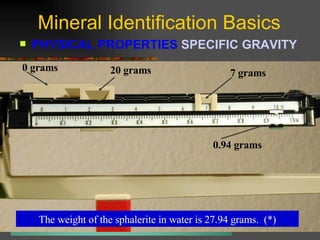
Mineral Identification Basics PHYSICAL PROPERTIES  SPECIFIC GRAVITY   Weight in Water (*) The weight of the sphalerite in water is 27.94 grams.  (*) 0 grams 0.94 grams 7 grams 20 grams
Mineral Identification Basics PHYSICAL PROPERTIES  SPECIFIC GRAVITY   37.00 grams 27.94 grams 37.00 grams 4.06 Specific Gravity =   Note that there are no units.  The grams cancel out.  This is a ratio of how heavy the mineral is compared to an equal volume of water.  The sphalerite is 4.06 times heavier than water.  (*) (Weight in air) - (Weight in water ) Weight in air Specific Gravity =   (Weight in air) - (Weight in water ) Weight in air Specific Gravity =
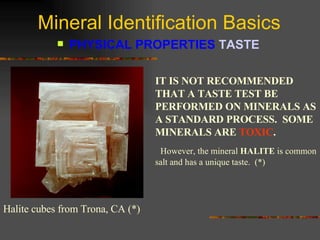
Mineral Identification Basics PHYSICAL PROPERTIES  TASTE   IT IS NOT RECOMMENDED THAT A TASTE TEST BE PERFORMED ON MINERALS AS A STANDARD PROCESS.  SOME MINERALS ARE  TOXIC . However, the mineral  HALITE  is common salt and has a unique taste.  (*) Halite cubes from Trona, CA (*)
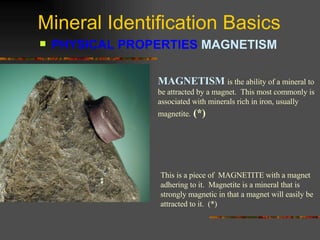
Mineral Identification Basics PHYSICAL PROPERTIES  MAGNETISM   MAGNETISM   is the ability of a mineral to be attracted by a magnet.  This most commonly is associated with minerals rich in iron, usually magnetite.  (*) This is a piece of  MAGNETITE with a magnet adhering to it.  Magnetite is a mineral that is strongly magnetic in that a magnet will easily be attracted to it.  (*)
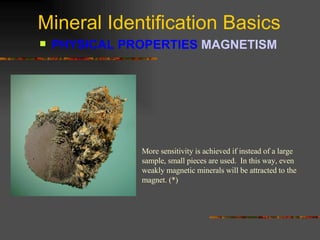
Mineral Identification Basics PHYSICAL PROPERTIES  MAGNETISM   More sensitivity is achieved if instead of a large sample, small pieces are used.  In this way, even weakly magnetic minerals will be attracted to the magnet. (*)
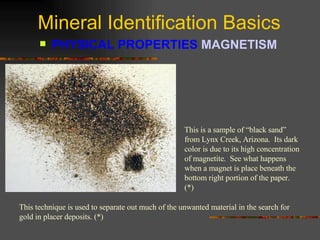
Mineral Identification Basics PHYSICAL PROPERTIES  MAGNETISM   This is a sample of “black sand” from Lynx Creek, Arizona.  Its dark color is due to its high concentration of magnetite.  See what happens when a magnet is place beneath the bottom right portion of the paper. (*) This technique is used to separate out much of the unwanted material in the search for gold in placer deposits. (*)
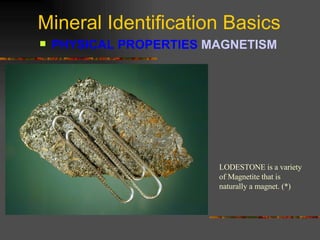
Mineral Identification Basics PHYSICAL PROPERTIES  MAGNETISM   LODESTONE is a variety of Magnetite that is naturally a magnet. (*)
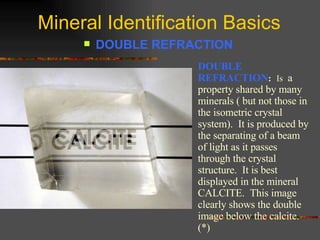
Mineral Identification Basics DOUBLE REFRACTION   DOUBLE REFRACTION :   Is   a property shared by many minerals ( but not those in the isometric crystal system).  It is produced by the separating of a beam of light as it passes through the crystal structure.  It is best displayed in the mineral CALCITE.  This image clearly shows the double image below the calcite. (*)
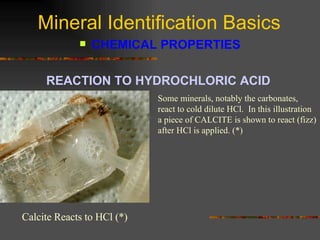
Mineral Identification Basics CHEMICAL PROPERTIES REACTION TO HYDROCHLORIC ACID   Some minerals, notably the carbonates, react to cold dilute HCl.  In this illustration a piece of CALCITE is shown to react (fizz) after HCl is applied. (*) Calcite Reacts to HCl (*)
This ends the basic introduction to the Physical Properties of Minerals.  The rest of this presentation takes you through a few other properties as well as crystal structures of minerals.  Feel free to take a look.  (*)
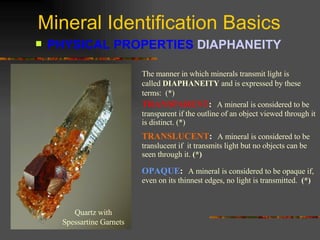
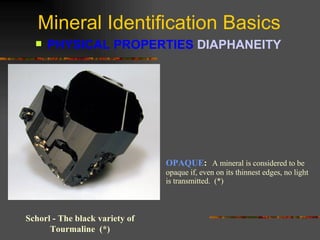
Mineral Identification Basics PHYSICAL PROPERTIES  DIAPHANEITY   The manner in which minerals transmit light is called  DIAPHANEITY  and is expressed by these terms:  (*) TRANSPARENT :   A mineral is considered to be transparent if the outline of an object viewed through it is distinct. (*) TRANSLUCENT :   A mineral is considered to be translucent if  it transmits light but no objects can be seen through it.  (*) OPAQUE :   A mineral is considered to be opaque if, even on its thinnest edges, no light is transmitted.   (*) Quartz with Spessartine Garnets
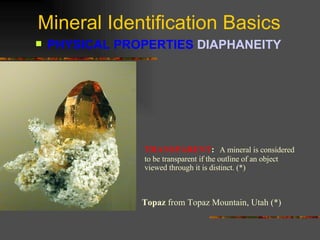
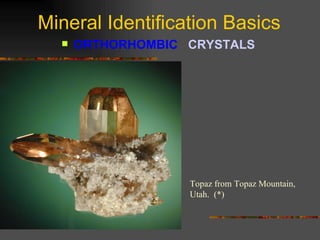
Mineral Identification Basics PHYSICAL PROPERTIES  DIAPHANEITY   TRANSPARENT :   A mineral is considered to be transparent if the outline of an object viewed through it is distinct. (*) Topaz  from Topaz Mountain, Utah (*)
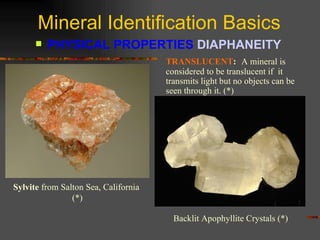
Mineral Identification Basics PHYSICAL PROPERTIES  DIAPHANEITY   Sylvite  from Salton Sea, California  (*) TRANSLUCENT :   A mineral is considered to be translucent if  it transmits light but no objects can be seen through it. (*) Backlit Apophyllite Crystals (*)
Mineral Identification Basics PHYSICAL PROPERTIES  DIAPHANEITY   Schorl - The black variety of Tourmaline  (*) OPAQUE :   A mineral is considered to be opaque if, even on its thinnest edges, no light is transmitted.  (*)
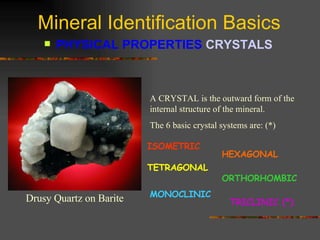
Mineral Identification Basics PHYSICAL PROPERTIES  CRYSTALS   A CRYSTAL is the outward form of the internal structure of the mineral.  The 6 basic crystal systems are: (*) ISOMETRIC HEXAGONAL TETRAGONAL ORTHORHOMBIC MONOCLINIC TRICLINIC (*) Drusy Quartz on Barite
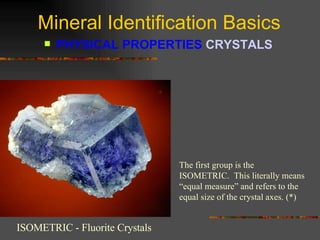
Mineral Identification Basics PHYSICAL PROPERTIES  CRYSTALS   ISOMETRIC - Fluorite Crystals The first group is the ISOMETRIC.  This literally means “equal measure” and refers to the equal size of the crystal axes. (*)
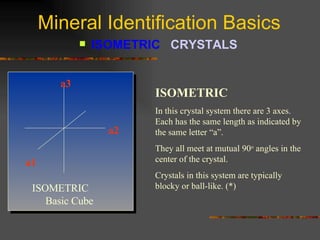
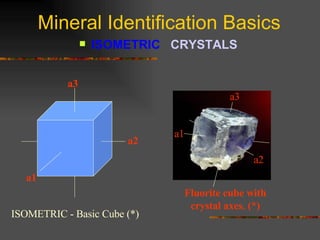
Mineral Identification Basics ISOMETRIC  CRYSTALS   ISOMETRIC In this   crystal system there are 3 axes.  Each has the same length as indicated by the same letter “a”.  They all meet at mutual 90 o  angles in the center of the crystal. Crystals in this system are typically blocky or ball-like. (*) ISOMETRIC  Basic Cube a3 a2 a1
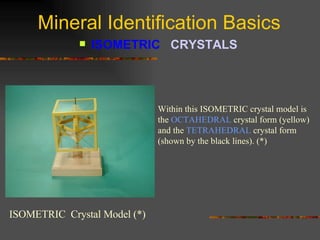
Mineral Identification Basics ISOMETRIC  CRYSTALS   ISOMETRIC  Crystal Model (*) Within this ISOMETRIC crystal model is the  OCTAHEDRAL  crystal form (yellow) and the  TETRAHEDRAL  crystal form (shown by the black lines). (*)
Mineral Identification Basics ISOMETRIC  CRYSTALS   ISOMETRIC - Basic Cube (*) a1 a3 a2 a3 a2 a1 Fluorite cube with crystal axes. (*)
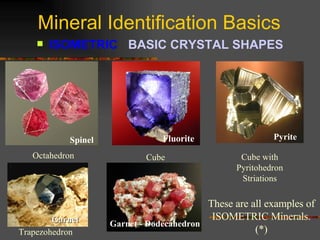
Mineral Identification Basics ISOMETRIC  BASIC CRYSTAL SHAPES Octahedron Spinel Garnet - Dodecahedron These are all examples of ISOMETRIC Minerals. (*) Cube Fluorite Pyrite Cube with Pyritohedron Striations Trapezohedron Garnet
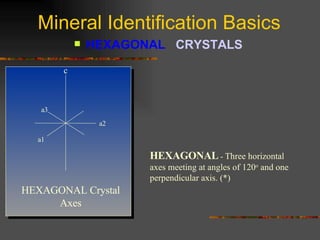
Mineral Identification Basics HEXAGONAL  CRYSTALS   HEXAGONAL  -  Three horizontal axes meeting at angles of 120 o  and one perpendicular axis. (*) a1 a2 a3 HEXAGONAL Crystal Axes c
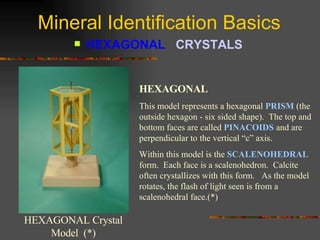
Mineral Identification Basics HEXAGONAL  CRYSTALS   HEXAGONAL Crystal Model  (*) HEXAGONAL This model represents a hexagonal  PRISM  (the outside hexagon - six sided shape).  The top and bottom faces are called  PINACOIDS  and are perpendicular to the vertical “c” axis. Within this model is the  SCALENOHEDRAL  form.  Each face is a scalenohedron.  Calcite often crystallizes with this form.  As the model rotates, the flash of light seen is from a scalenohedral face.(*)
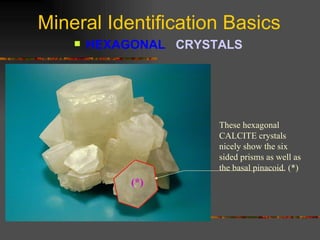
Mineral Identification Basics HEXAGONAL  CRYSTALS   These hexagonal CALCITE crystals nicely show the six sided prisms as well as the basal pinacoid. (*) (*)
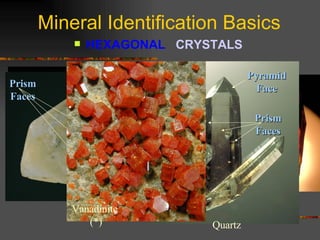
Mineral Identification Basics HEXAGONAL  CRYSTALS   Hanksite Prism Faces Pyramid Faces Vanadinite  (*) RHOMBOHEDRON Dolomite SCALENOHEDRON Rhodochrosite Quartz Pyramid Face Prism Faces
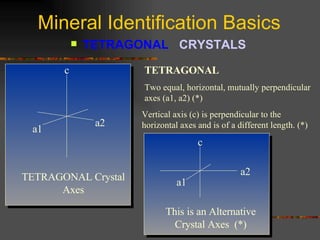
Mineral Identification Basics TETRAGONAL  CRYSTALS   TETRAGONAL   Two equal, horizontal, mutually perpendicular axes (a1, a2) (*) Vertical axis (c) is perpendicular to the horizontal axes and is of a different length. (*) TETRAGONAL Crystal Axes a1 a2 c c a2 a1 This is an Alternative Crystal Axes  (*)
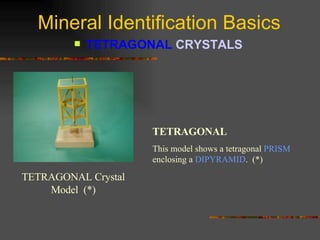
Mineral Identification Basics TETRAGONAL  CRYSTALS   TETRAGONAL Crystal Model  (*) TETRAGONAL   This model shows a tetragonal  PRISM  enclosing a  DIPYRAMID .  (*)
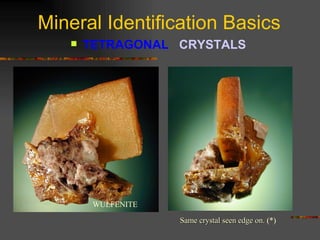
Mineral Identification Basics TETRAGONAL  CRYSTALS   WULFENITE  Same crystal seen edge on.  (*)
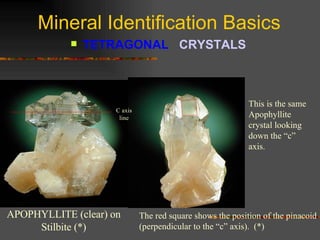
Mineral Identification Basics TETRAGONAL  CRYSTALS   APOPHYLLITE (clear) on Stilbite (*) This is the same Apophyllite crystal looking down the “c” axis. The red square shows the position of the pinacoid (perpendicular to the “c” axis).  (*) C axis line
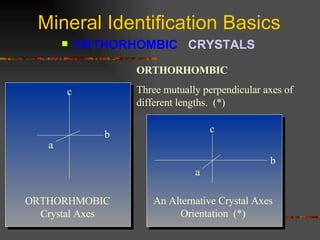
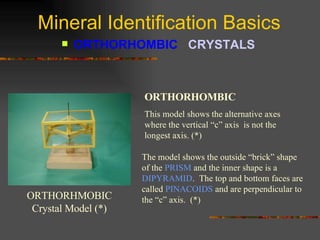
Mineral Identification Basics ORTHORHOMBIC  CRYSTALS   ORTHORHOMBIC Three mutually perpendicular axes of different lengths.  (*) ORTHORHMOBIC Crystal Axes An Alternative Crystal Axes Orientation  (*) a b c a c b
Mineral Identification Basics ORTHORHOMBIC  CRYSTALS   ORTHORHMOBIC Crystal Model (*) ORTHORHOMBIC This model shows the alternative axes where the vertical “c” axis  is not the longest axis. (*) The model shows the outside “brick” shape of the  PRISM  and the inner shape is a  DIPYRAMID .  The top and bottom faces are called  PINACOIDS  and are perpendicular to the “c” axis.  (*)
Mineral Identification Basics ORTHORHOMBIC  CRYSTALS   Topaz from Topaz Mountain, Utah.  (*)
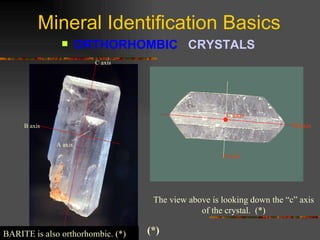
Mineral Identification Basics ORTHORHOMBIC  CRYSTALS   The view above is looking down the “c” axis of the crystal.  (*) BARITE is also orthorhombic. (*) (*) C axis B axis A axis C axis A axis B axis
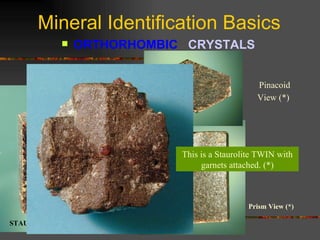
Mineral Identification Basics ORTHORHOMBIC  CRYSTALS   This is a Staurolite TWIN with garnets attached. (*) STAUROLITE (*) Prism View (*)  Pinacoid View (*)
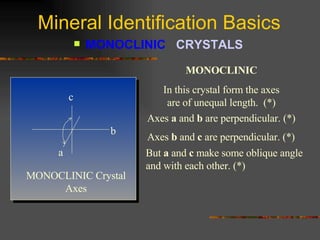
Mineral Identification Basics MONOCLINIC  CRYSTALS   MONOCLINIC In this crystal form the axes are of unequal length.  (*) But  a  and  c  make some oblique angle and with each other. (*) Axes  a  and  b  are perpendicular. (*) Axes  b  and  c  are perpendicular. (*) MONOCLINIC Crystal Axes a b c
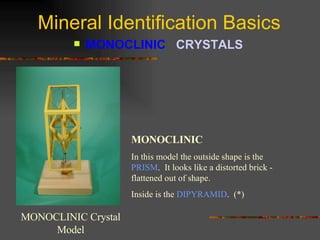
Mineral Identification Basics MONOCLINIC  CRYSTALS   MONOCLINIC Crystal Model MONOCLINIC In this model the outside shape is the  PRISM .  It looks like a distorted brick - flattened out of shape. Inside is the  DIPYRAMID .  (*)
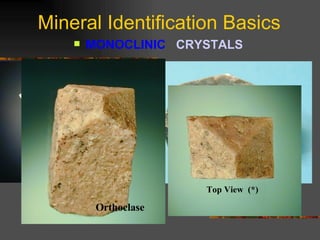
Mineral Identification Basics MONOCLINIC  CRYSTALS   Mica Gypsum Orthoclase Top View  (*)
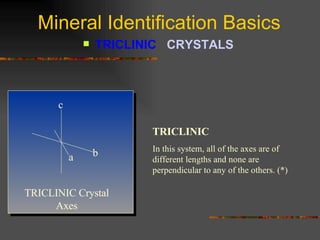
Mineral Identification Basics TRICLINIC  CRYSTALS   TRICLINIC In this system, all of the axes are of different lengths and none are perpendicular to any of the others. (*) TRICLINIC Crystal Axes a b c
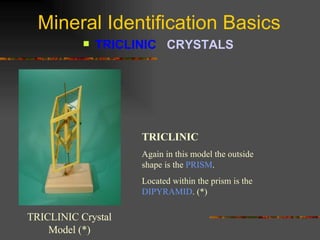
Mineral Identification Basics TRICLINIC  CRYSTALS   TRICLINIC Crystal Model (*) TRICLINIC   Again in this model the outside shape is the  PRISM .  Located within the prism is the  DIPYRAMID . (*)
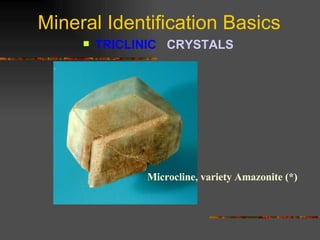
Mineral Identification Basics TRICLINIC  CRYSTALS   Microcline, variety Amazonite (*)
Mineral Identification   RESOURCES http://www. gc . maricopa . edu / earthsci / imagearchive /index. htm For lots of useful images of minerals  and more facts about minerals,  check out this web site:

Physical Properties 3

  • 1.
    PHYSICAL SCIENCE 120PHYSICAL PROPERTIES OF MINERALS As you view the Power Points you will be prompted to advance to the next slide when you see this symbol (*). (*)
  • 2.
    Mineral Identification BasicsWhat is a Mineral? There is a classic four part definition for mineral. Minerals must be: (*) Naturally occurring (*) Inorganic (*) Possess a definite crystalline structure (*) Have a definite chemical composition (*) Cubic Fluorite Crystal
  • 3.
    Mineral Identification BasicsWhat is a Mineral? Minerals are not synthetic - they are produced by the natural geological processes working on Earth. For example, steel, brass, bronze and aluminum are not considered minerals in that they are not found in nature. (*) Technically speaking, synthetic gemstones are not considered minerals. This area of mineralogy has a hazy boundary in that synthetic stones are in every way the same as the natural stones. But because they are produced in laboratories, they do not meet the classic definition of a mineral. (*) Also note that many synthetic gemstones are “doped” with a fluorescent dye to distinguish them from natural stone. (*) Tourmaline Crystal from Brazil Naturally Occurring (*)
  • 4.
    Mineral Identification BasicsWhat is a Mineral? Minerals are NOT produced by organic processes. As a result things like pearls, coral, coal and amber are not considered minerals. Also included in this “ NOT a Mineral List” are teeth, bones, sea shells and even kidney stones. (*) Barite Rose - A flower like growth of Barite crystals. Inorganic (*)
  • 5.
    Mineral Identification BasicsWhat is a Mineral? Minerals are the result of atoms joining together through electrical bonds to produce a definite internal structure. (*) Crystalline Pattern of Halite Red = Sodium Green = Chlorine Internal Structure Halite (salt) from Searles Lake, CA It is the nature of the atoms and the strength of the chemical bonds that determine many of the minerals’ physical and chemical properties. (*) (*)
  • 6.
    Mineral Identification BasicsWhat is a Mineral? Minerals can be expressed by a chemical formula. The internal order of minerals means that there is a definite relationship in the number of atoms that makes up the mineral. (*) Halite - NaCl For every atom of Sodium there is an atom of Chlorine. Definite Chemical Composition (*)
  • 7.
    Mineral Identification BasicsPHYSICAL PROPERTIES HARDNESS HARDNESS is defined as the resistance a mineral has to being scratched - its “scratchability”. Hardness tests are done by scratching one mineral against another. The mineral that is scratched is softer than the other. (*) Pyrite Crystals Hardness of 6.5 (*)
  • 8.
    Mineral Identification BasicsPHYSICAL PROPERTIES HARDNESS In this photo, a quartz crystal will be rubbed across a glass plate. The result is that the glass plate will be scratched. The quartz is therefore harder than the glass. (*) Quartz is harder than glass. HINT : In doing a hardness test try to pick a smooth or flat surface on the mineral to be scratched. Try to pick a point or a sharp edge on the mineral that you think will do the scratching. Glass is usually a good place to start because it is in the middle of the hardness table, it has a flat, smooth surface and it is easily obtained. (*)
  • 9.
    Mineral Identification BasicsPHYSICAL PROPERTIES HARDNESS Care must be taken on some minerals that crumble easily. Remember that hardness is the resistance a mineral has to being scratched - NOT how easily it breaks apart. The physical property related to the ease in which a mineral breaks is tenacity. (*) Also be sure to determine the hardness of a mineral on a fresh surface whenever possible. Some minerals have a tendency to oxidize or corrode. These surface deposits usually have a different hardness than the fresh mineral. (*)
  • 10.
    Mineral Identification BasicsPHYSICAL PROPERTIES HARDNESS Moh’s scale is a list of minerals with increasing hardness.(*) MOH’S SCALE OF MINERAL HARDNESS 1. TALC 2. GYPSUM 3. CALCITE 4. FLUORITE 5. APATITE (*) 6. FELDSPAR 7. QUARTZ 8. TOPAZ 9. CORUNDUM 10. DIAMOND (*) OTHER MATERIALS COMMONLY USED : 2.5 - FINGERNAIL 3 - COPPER PENNY 5.5 - GLASS 6-6.5 - STEEL FILE (*)
  • 11.
    Mineral Identification BasicsPHYSICAL PROPERTIES CLEAVAGE CLEAVAGE is the property of a mineral that allows it to break repeatedly along smooth, flat surfaces. (*) These GALENA cleavage fragments were produced when the crystal was hit with a hammer. Note the consistency of the 90 o angles along the edges. (*) These are FLUORITE cleavage fragments. (*)
  • 12.
    Mineral Identification BasicsPHYSICAL PROPERTIES CLEAVAGE Within this crystalline pattern it is easy to see how atoms will separate to produce cleavage with cubic (90 o ) angles. (*) It is similar to tearing a piece of paper that has perforations in it. The paper has a tendency to tear along the perforations. They are zones of weakness. (*) In this example the lines represent breaks between the atoms that make up the mineral. Cleavage is guided by the atomic structure. (*)
  • 13.
    Mineral Identification BasicsPHYSICAL PROPERTIES CLEAVAGE These pictures show different cleavage angles and the quality of cleavage. Fluorite has cleavage in four directions. (*) A thin sheet of Muscovite seen on edge. Mica has perfect cleavage in ONE direction. (*)
  • 14.
    Mineral Identification BasicsPHYSICAL PROPERTIES CLEAVAGE Common salt (the mineral HALITE) has very good cleavage in 3 directions. (*) These 3 directions of cleavage are mutually perpendicular resulting in cubic cleavage. (*)
  • 15.
    Mineral Identification BasicsPHYSICAL PROPERTIES CLEAVAGE Even these tiny fragments have rhombohedral cleavage. (*) (*) Rhombohedral Cleavage - 3 directions CALCITE
  • 16.
    Mineral Identification BasicsPHYSICAL PROPERTIES CLEAVAGE Blocky Cleavage 2 directions Orthoclase Feldspar (*) Orthoclase feldspar has good cleavage in 2 directions. The blocky appearance of this specimen is a hint that it has cleavage. The clue that the specimen has cleavage is the fact that numerous faces will reflect light at the same time. Each face is parallel and light will reflect of each face producing a flash of light. (*) Note that the faces in the circle are at different levels. By adjusting the lighting, all of the parallel faces will reflect simultaneously. This results in a flash of light from all the parallel faces . (*)
  • 17.
    Mineral Identification BasicsPHYSICAL PROPERTIES CLEAVAGE TALC has micaceous cleavage. That is to say that it cleaves like mica (1 perfect direction) but, in talc the crystals are so small that they cannot easily be seen. Instead the effect is that the talc “feels soapy”. The second picture shows some of the talc that has cleaved onto the fingers. (*) (*)
  • 18.
    Mineral Identification BasicsPHYSICAL PROPERTIES FRACTURE FRACTURE is defined as the way a mineral breaks other than cleavage. (*) This is a piece of volcanic glass called OBSIDIAN. Even though it is NOT a mineral, it is shown here because it has excellent conchoidal fracture. (*) If you try this yourself, use caution. Conchoidal fracture in obsidian can produce extremely sharp edges. (*)
  • 19.
    Mineral Identification BasicsPHYSICAL PROPERTIES FRACTURE This Quartz crystal will be struck with a hammer to show how that the external form of the crystal does not repeat when broken. (The flat crystal faces are not cleavage faces.) This is a good example of conchoidal fracture. (*) Note the smooth curved surfaces. (*)
  • 20.
    Mineral Identification BasicsPHYSICAL PROPERTIES STREAK STREAK is defined as the color of the mineral in powder form. (*) Streak is normally obtained by rubbing a mineral across a “streak plate”. This is a piece of unglazed porcelain. The streak plate has a hardness of around 7 and rough texture that allows the minerals to be abraded to a powder. This powder is the streak. (*) Hematite has a reddish brown streak. (*) Hematite on Streak Plate
  • 21.
    Mineral Identification BasicsPHYSICAL PROPERTIES STREAK Sphalerite is a dark mineral, however, it has a light colored streak. Next to the reddish brown streak of hematite is a light yellow streak. This is the streak of the sphalerite. (*) Sphalerite has a light yellow streak. (*) Light colored streaks are often difficult to see against the white streak plate. It is often useful to rub your finger across the powder to see the streak color. (*)
  • 22.
    Mineral Identification BasicsPHYSICAL PROPERTIES LUSTER LUSTER is defined as the quality of reflected light. Minerals have been grossly separated into either METALLIC or NON-METALLIC lusters. Following are some examples: (*) Native Silver has a Metallic Luster. (*)
  • 23.
    Mineral Identification BasicsPHYSICAL PROPERTIES LUSTER METALLIC The basic idea for Metallic Luster is that the minerals look like metals. (*) Stibnite Galena Marcasite Pyrite (*)
  • 24.
    Mineral Identification BasicsNON-METALLIC LUSTER VITREOUS Vitreous Luster means that the mineral has a “glassy” look. Normally we think of glass as being clear, but there are many different colors of glass and they are all very “glassy” looking. Even china plates and glazed porcelain are vitreous. Here are some examples: (*) Olivine - Peridot Wulfenite Spinel Quartz (*)
  • 25.
    Mineral Identification BasicsNON METALLIC LUSTER Miscellaneous Lusters Asbestos - Silky Apophyllite – Pearly (*) Limonite - Dull or Earthy Sphalerite - Resinous Graphite has a greasy or submetallic luster and easily marks paper. (*)
  • 26.
    Mineral Identification BasicsPHYSICAL PROPERTIES LUSTER This piece of Native Copper is severely weathered. It does not look metallic. (*) The moral to this story is to look at a fresh surface whenever possible.(*) This is the same piece but the left side has been buffed with a steel brush. Note the bright metallic luster. (*)
  • 27.
    Mineral Identification BasicsPHYSICAL PROPERTIES COLOR The COLOR of a mineral is usually the first thing that a person notices when observing a mineral. However, it is normally NOT the best physical property to begin the mineral identification process. (*) Following are some examples of color variation within mineral species followed by minerals that have a distinctive color: (*) Various colors of CALCITE . (*)
  • 28.
    Mineral Identification BasicsPHYSICAL PROPERTIES COLOR Various colors of Quartz. Quartz comes in a wide range of colors. It is very easily colored by even trace amounts of impurities. (*) Clear - Without Impurities Hematite Inclusions Chlorite inclusions Amethyst Ionic Iron
  • 29.
    Mineral Identification BasicsINDICATIVE COLOR Some minerals do have a certain color associated with them. Here are some examples: (*) Turquoise Sulfur Malachite Rhodochrosite Azurite (*)
  • 30.
    Mineral Identification BasicsPHYSICAL PROPERTIES SPECIFIC GRAVITY The SPECIFIC GRAVITY of a mineral is a measure of the mineral’s density. It is related to the types of elements that make up the mineral and how they are packed into the mineral’s atomic structure. (*) Gold in Quartz Gold has a Specific Gravity of 19.2. It is 19.2 times the weight of an equal volume of water. Water has a Specific Gravity of 1. (*)
  • 31.
    Mineral Identification BasicsPHYSICAL PROPERTIES SPECIFIC GRAVITY The SPECIFIC GRAVITY of a mineral is determined by weighing the specimen in air and then weighing it in water. Here is the formula: (*) (Weight in air) - (Weight in water ) Weight in air Specific Gravity = (*) (divided by)
  • 32.
    Mineral Identification BasicsPHYSICAL PROPERTIES SPECIFIC GRAVITY Selecting the right material. (*) Sphalerite Opal in Rhyolite Calcite with Garnet Halite Limonite Not just any mineral will do. In determining the specific gravity of a mineral it must be pure, free of pockets or cracks (places that can trap air) and it should not easily dissolve in water. (*)
  • 33.
    Mineral Identification BasicsPHYSICAL PROPERTIES SPECIFIC GRAVITY Sphalerite Opal in Rhyolite Calcite with Garnet Halite Limonite The Limonite is full of pore spaces. It is almost like a sponge. When it is weighed in water it has numerous trapped air pockets that will make it lighter that it should be. (*) It would be difficult to get an accurate weight. (*)
  • 34.
    Mineral Identification BasicsPHYSICAL PROPERTIES SPECIFIC GRAVITY Sphalerite Opal in Rhyolite Calcite with Garnet Halite Limonite This is not a pure specimen. It is a combination of two minerals. The result of the specific gravity process would only give you an average of the two minerals. (*)
  • 35.
    Mineral Identification BasicsPHYSICAL PROPERTIES SPECIFIC GRAVITY Sphalerite Opal in Rhyolite Calcite with Garnet Halite Limonite The opal in rhyolite has the same problem as the calcite with garnet. It is not a pure sample (*)
  • 36.
    Mineral Identification BasicsPHYSICAL PROPERTIES SPECIFIC GRAVITY Sphalerite Opal in Rhyolite Calcite with Garnet Halite Limonite Halite is a salt. When weighed in water it dissolves. It would be difficult to get an accurate reading as it would become lighter and lighter as it slowly dissolved. (*)
  • 37.
    Mineral Identification BasicsPHYSICAL PROPERTIES SPECIFIC GRAVITY Sphalerite Opal in Rhyolite Calcite with Garnet Halite Limonite Sphalerite (pronounced: sfal er ite) is a good choice. It is a pure sample with no crack or pore spaces. And, it does not dissolve in water. (*) Sphalerite
  • 38.
    Mineral Identification BasicsPHYSICAL PROPERTIES SPECIFIC GRAVITY Weight in Water The weights are in the same place but now that the sphalerite is submerged in water it is lighter, and the balance is again out of balance. (*)
  • 39.
    Mineral Identification BasicsPHYSICAL PROPERTIES SPECIFIC GRAVITY Weight in Water It is important to note that the specimen being weighed is not resting on the bottom of the beaker or touching its sides. It is also completely submerged beneath the water. (*)
  • 40.
    Mineral Identification BasicsPHYSICAL PROPERTIES SPECIFIC GRAVITY Weight in Water (*) The weight of the sphalerite in water is 27.94 grams. (*) 0 grams 0.94 grams 7 grams 20 grams
  • 41.
    Mineral Identification BasicsPHYSICAL PROPERTIES SPECIFIC GRAVITY 37.00 grams 27.94 grams 37.00 grams 4.06 Specific Gravity = Note that there are no units. The grams cancel out. This is a ratio of how heavy the mineral is compared to an equal volume of water. The sphalerite is 4.06 times heavier than water. (*) (Weight in air) - (Weight in water ) Weight in air Specific Gravity = (Weight in air) - (Weight in water ) Weight in air Specific Gravity =
  • 42.
    Mineral Identification BasicsPHYSICAL PROPERTIES TASTE IT IS NOT RECOMMENDED THAT A TASTE TEST BE PERFORMED ON MINERALS AS A STANDARD PROCESS. SOME MINERALS ARE TOXIC . However, the mineral HALITE is common salt and has a unique taste. (*) Halite cubes from Trona, CA (*)
  • 43.
    Mineral Identification BasicsPHYSICAL PROPERTIES MAGNETISM MAGNETISM is the ability of a mineral to be attracted by a magnet. This most commonly is associated with minerals rich in iron, usually magnetite. (*) This is a piece of MAGNETITE with a magnet adhering to it. Magnetite is a mineral that is strongly magnetic in that a magnet will easily be attracted to it. (*)
  • 44.
    Mineral Identification BasicsPHYSICAL PROPERTIES MAGNETISM More sensitivity is achieved if instead of a large sample, small pieces are used. In this way, even weakly magnetic minerals will be attracted to the magnet. (*)
  • 45.
    Mineral Identification BasicsPHYSICAL PROPERTIES MAGNETISM This is a sample of “black sand” from Lynx Creek, Arizona. Its dark color is due to its high concentration of magnetite. See what happens when a magnet is place beneath the bottom right portion of the paper. (*) This technique is used to separate out much of the unwanted material in the search for gold in placer deposits. (*)
  • 46.
    Mineral Identification BasicsPHYSICAL PROPERTIES MAGNETISM LODESTONE is a variety of Magnetite that is naturally a magnet. (*)
  • 47.
    Mineral Identification BasicsDOUBLE REFRACTION DOUBLE REFRACTION : Is a property shared by many minerals ( but not those in the isometric crystal system). It is produced by the separating of a beam of light as it passes through the crystal structure. It is best displayed in the mineral CALCITE. This image clearly shows the double image below the calcite. (*)
  • 48.
    Mineral Identification BasicsCHEMICAL PROPERTIES REACTION TO HYDROCHLORIC ACID Some minerals, notably the carbonates, react to cold dilute HCl. In this illustration a piece of CALCITE is shown to react (fizz) after HCl is applied. (*) Calcite Reacts to HCl (*)
  • 49.
    This ends thebasic introduction to the Physical Properties of Minerals. The rest of this presentation takes you through a few other properties as well as crystal structures of minerals. Feel free to take a look. (*)
  • 50.
    Mineral Identification BasicsPHYSICAL PROPERTIES DIAPHANEITY The manner in which minerals transmit light is called DIAPHANEITY and is expressed by these terms: (*) TRANSPARENT : A mineral is considered to be transparent if the outline of an object viewed through it is distinct. (*) TRANSLUCENT : A mineral is considered to be translucent if it transmits light but no objects can be seen through it. (*) OPAQUE : A mineral is considered to be opaque if, even on its thinnest edges, no light is transmitted. (*) Quartz with Spessartine Garnets
  • 51.
    Mineral Identification BasicsPHYSICAL PROPERTIES DIAPHANEITY TRANSPARENT : A mineral is considered to be transparent if the outline of an object viewed through it is distinct. (*) Topaz from Topaz Mountain, Utah (*)
  • 52.
    Mineral Identification BasicsPHYSICAL PROPERTIES DIAPHANEITY Sylvite from Salton Sea, California (*) TRANSLUCENT : A mineral is considered to be translucent if it transmits light but no objects can be seen through it. (*) Backlit Apophyllite Crystals (*)
  • 53.
    Mineral Identification BasicsPHYSICAL PROPERTIES DIAPHANEITY Schorl - The black variety of Tourmaline (*) OPAQUE : A mineral is considered to be opaque if, even on its thinnest edges, no light is transmitted. (*)
  • 54.
    Mineral Identification BasicsPHYSICAL PROPERTIES CRYSTALS A CRYSTAL is the outward form of the internal structure of the mineral. The 6 basic crystal systems are: (*) ISOMETRIC HEXAGONAL TETRAGONAL ORTHORHOMBIC MONOCLINIC TRICLINIC (*) Drusy Quartz on Barite
  • 55.
    Mineral Identification BasicsPHYSICAL PROPERTIES CRYSTALS ISOMETRIC - Fluorite Crystals The first group is the ISOMETRIC. This literally means “equal measure” and refers to the equal size of the crystal axes. (*)
  • 56.
    Mineral Identification BasicsISOMETRIC CRYSTALS ISOMETRIC In this crystal system there are 3 axes. Each has the same length as indicated by the same letter “a”. They all meet at mutual 90 o angles in the center of the crystal. Crystals in this system are typically blocky or ball-like. (*) ISOMETRIC Basic Cube a3 a2 a1
  • 57.
    Mineral Identification BasicsISOMETRIC CRYSTALS ISOMETRIC Crystal Model (*) Within this ISOMETRIC crystal model is the OCTAHEDRAL crystal form (yellow) and the TETRAHEDRAL crystal form (shown by the black lines). (*)
  • 58.
    Mineral Identification BasicsISOMETRIC CRYSTALS ISOMETRIC - Basic Cube (*) a1 a3 a2 a3 a2 a1 Fluorite cube with crystal axes. (*)
  • 59.
    Mineral Identification BasicsISOMETRIC BASIC CRYSTAL SHAPES Octahedron Spinel Garnet - Dodecahedron These are all examples of ISOMETRIC Minerals. (*) Cube Fluorite Pyrite Cube with Pyritohedron Striations Trapezohedron Garnet
  • 60.
    Mineral Identification BasicsHEXAGONAL CRYSTALS HEXAGONAL - Three horizontal axes meeting at angles of 120 o and one perpendicular axis. (*) a1 a2 a3 HEXAGONAL Crystal Axes c
  • 61.
    Mineral Identification BasicsHEXAGONAL CRYSTALS HEXAGONAL Crystal Model (*) HEXAGONAL This model represents a hexagonal PRISM (the outside hexagon - six sided shape). The top and bottom faces are called PINACOIDS and are perpendicular to the vertical “c” axis. Within this model is the SCALENOHEDRAL form. Each face is a scalenohedron. Calcite often crystallizes with this form. As the model rotates, the flash of light seen is from a scalenohedral face.(*)
  • 62.
    Mineral Identification BasicsHEXAGONAL CRYSTALS These hexagonal CALCITE crystals nicely show the six sided prisms as well as the basal pinacoid. (*) (*)
  • 63.
    Mineral Identification BasicsHEXAGONAL CRYSTALS Hanksite Prism Faces Pyramid Faces Vanadinite (*) RHOMBOHEDRON Dolomite SCALENOHEDRON Rhodochrosite Quartz Pyramid Face Prism Faces
  • 64.
    Mineral Identification BasicsTETRAGONAL CRYSTALS TETRAGONAL Two equal, horizontal, mutually perpendicular axes (a1, a2) (*) Vertical axis (c) is perpendicular to the horizontal axes and is of a different length. (*) TETRAGONAL Crystal Axes a1 a2 c c a2 a1 This is an Alternative Crystal Axes (*)
  • 65.
    Mineral Identification BasicsTETRAGONAL CRYSTALS TETRAGONAL Crystal Model (*) TETRAGONAL This model shows a tetragonal PRISM enclosing a DIPYRAMID . (*)
  • 66.
    Mineral Identification BasicsTETRAGONAL CRYSTALS WULFENITE Same crystal seen edge on. (*)
  • 67.
    Mineral Identification BasicsTETRAGONAL CRYSTALS APOPHYLLITE (clear) on Stilbite (*) This is the same Apophyllite crystal looking down the “c” axis. The red square shows the position of the pinacoid (perpendicular to the “c” axis). (*) C axis line
  • 68.
    Mineral Identification BasicsORTHORHOMBIC CRYSTALS ORTHORHOMBIC Three mutually perpendicular axes of different lengths. (*) ORTHORHMOBIC Crystal Axes An Alternative Crystal Axes Orientation (*) a b c a c b
  • 69.
    Mineral Identification BasicsORTHORHOMBIC CRYSTALS ORTHORHMOBIC Crystal Model (*) ORTHORHOMBIC This model shows the alternative axes where the vertical “c” axis is not the longest axis. (*) The model shows the outside “brick” shape of the PRISM and the inner shape is a DIPYRAMID . The top and bottom faces are called PINACOIDS and are perpendicular to the “c” axis. (*)
  • 70.
    Mineral Identification BasicsORTHORHOMBIC CRYSTALS Topaz from Topaz Mountain, Utah. (*)
  • 71.
    Mineral Identification BasicsORTHORHOMBIC CRYSTALS The view above is looking down the “c” axis of the crystal. (*) BARITE is also orthorhombic. (*) (*) C axis B axis A axis C axis A axis B axis
  • 72.
    Mineral Identification BasicsORTHORHOMBIC CRYSTALS This is a Staurolite TWIN with garnets attached. (*) STAUROLITE (*) Prism View (*) Pinacoid View (*)
  • 73.
    Mineral Identification BasicsMONOCLINIC CRYSTALS MONOCLINIC In this crystal form the axes are of unequal length. (*) But a and c make some oblique angle and with each other. (*) Axes a and b are perpendicular. (*) Axes b and c are perpendicular. (*) MONOCLINIC Crystal Axes a b c
  • 74.
    Mineral Identification BasicsMONOCLINIC CRYSTALS MONOCLINIC Crystal Model MONOCLINIC In this model the outside shape is the PRISM . It looks like a distorted brick - flattened out of shape. Inside is the DIPYRAMID . (*)
  • 75.
    Mineral Identification BasicsMONOCLINIC CRYSTALS Mica Gypsum Orthoclase Top View (*)
  • 76.
    Mineral Identification BasicsTRICLINIC CRYSTALS TRICLINIC In this system, all of the axes are of different lengths and none are perpendicular to any of the others. (*) TRICLINIC Crystal Axes a b c
  • 77.
    Mineral Identification BasicsTRICLINIC CRYSTALS TRICLINIC Crystal Model (*) TRICLINIC Again in this model the outside shape is the PRISM . Located within the prism is the DIPYRAMID . (*)
  • 78.
    Mineral Identification BasicsTRICLINIC CRYSTALS Microcline, variety Amazonite (*)
  • 79.
    Mineral Identification RESOURCES http://www. gc . maricopa . edu / earthsci / imagearchive /index. htm For lots of useful images of minerals and more facts about minerals, check out this web site:

Editor's Notes

  • #2 BE SURE TO READ THE NOTES !